EP4153668B1 - Kleinzellige polystyrol-schäume und verfahren zu deren herstellung - Google Patents
Kleinzellige polystyrol-schäume und verfahren zu deren herstellung Download PDFInfo
- Publication number
- EP4153668B1 EP4153668B1 EP21725199.0A EP21725199A EP4153668B1 EP 4153668 B1 EP4153668 B1 EP 4153668B1 EP 21725199 A EP21725199 A EP 21725199A EP 4153668 B1 EP4153668 B1 EP 4153668B1
- Authority
- EP
- European Patent Office
- Prior art keywords
- foam
- rest
- styrene
- general formula
- bisamide
- Prior art date
- Legal status (The legal status is an assumption and is not a legal conclusion. Google has not performed a legal analysis and makes no representation as to the accuracy of the status listed.)
- Active
Links
Images


Classifications
-
- C—CHEMISTRY; METALLURGY
- C07—ORGANIC CHEMISTRY
- C07C—ACYCLIC OR CARBOCYCLIC COMPOUNDS
- C07C233/00—Carboxylic acid amides
- C07C233/01—Carboxylic acid amides having carbon atoms of carboxamide groups bound to hydrogen atoms or to acyclic carbon atoms
- C07C233/34—Carboxylic acid amides having carbon atoms of carboxamide groups bound to hydrogen atoms or to acyclic carbon atoms having the nitrogen atom of at least one of the carboxamide groups bound to a carbon atom of a hydrocarbon radical substituted by amino groups
- C07C233/42—Carboxylic acid amides having carbon atoms of carboxamide groups bound to hydrogen atoms or to acyclic carbon atoms having the nitrogen atom of at least one of the carboxamide groups bound to a carbon atom of a hydrocarbon radical substituted by amino groups with the substituted hydrocarbon radical bound to the nitrogen atom of the carboxamide group by a carbon atom of a six-membered aromatic ring
- C07C233/43—Carboxylic acid amides having carbon atoms of carboxamide groups bound to hydrogen atoms or to acyclic carbon atoms having the nitrogen atom of at least one of the carboxamide groups bound to a carbon atom of a hydrocarbon radical substituted by amino groups with the substituted hydrocarbon radical bound to the nitrogen atom of the carboxamide group by a carbon atom of a six-membered aromatic ring having the carbon atom of the carboxamide group bound to a hydrogen atom or to a carbon atom of a saturated carbon skeleton
-
- C—CHEMISTRY; METALLURGY
- C07—ORGANIC CHEMISTRY
- C07C—ACYCLIC OR CARBOCYCLIC COMPOUNDS
- C07C233/00—Carboxylic acid amides
- C07C233/57—Carboxylic acid amides having carbon atoms of carboxamide groups bound to carbon atoms of rings other than six-membered aromatic rings
- C07C233/62—Carboxylic acid amides having carbon atoms of carboxamide groups bound to carbon atoms of rings other than six-membered aromatic rings having the nitrogen atom of at least one of the carboxamide groups bound to a carbon atom of a hydrocarbon radical substituted by amino groups
-
- C—CHEMISTRY; METALLURGY
- C07—ORGANIC CHEMISTRY
- C07C—ACYCLIC OR CARBOCYCLIC COMPOUNDS
- C07C233/00—Carboxylic acid amides
- C07C233/64—Carboxylic acid amides having carbon atoms of carboxamide groups bound to carbon atoms of six-membered aromatic rings
- C07C233/77—Carboxylic acid amides having carbon atoms of carboxamide groups bound to carbon atoms of six-membered aromatic rings having the nitrogen atom of at least one of the carboxamide groups bound to a carbon atom of a hydrocarbon radical substituted by amino groups
- C07C233/80—Carboxylic acid amides having carbon atoms of carboxamide groups bound to carbon atoms of six-membered aromatic rings having the nitrogen atom of at least one of the carboxamide groups bound to a carbon atom of a hydrocarbon radical substituted by amino groups with the substituted hydrocarbon radical bound to the nitrogen atom of the carboxamide group by a carbon atom of a six-membered aromatic ring
-
- C—CHEMISTRY; METALLURGY
- C08—ORGANIC MACROMOLECULAR COMPOUNDS; THEIR PREPARATION OR CHEMICAL WORKING-UP; COMPOSITIONS BASED THEREON
- C08J—WORKING-UP; GENERAL PROCESSES OF COMPOUNDING; AFTER-TREATMENT NOT COVERED BY SUBCLASSES C08B, C08C, C08F, C08G or C08H
- C08J9/00—Working-up of macromolecular substances to porous or cellular articles or materials; After-treatment thereof
- C08J9/0014—Use of organic additives
- C08J9/0028—Use of organic additives containing nitrogen
-
- C—CHEMISTRY; METALLURGY
- C08—ORGANIC MACROMOLECULAR COMPOUNDS; THEIR PREPARATION OR CHEMICAL WORKING-UP; COMPOSITIONS BASED THEREON
- C08J—WORKING-UP; GENERAL PROCESSES OF COMPOUNDING; AFTER-TREATMENT NOT COVERED BY SUBCLASSES C08B, C08C, C08F, C08G or C08H
- C08J9/00—Working-up of macromolecular substances to porous or cellular articles or materials; After-treatment thereof
- C08J9/04—Working-up of macromolecular substances to porous or cellular articles or materials; After-treatment thereof using blowing gases generated by a previously added blowing agent
- C08J9/12—Working-up of macromolecular substances to porous or cellular articles or materials; After-treatment thereof using blowing gases generated by a previously added blowing agent by a physical blowing agent
- C08J9/122—Hydrogen, oxygen, CO2, nitrogen or noble gases
-
- C—CHEMISTRY; METALLURGY
- C08—ORGANIC MACROMOLECULAR COMPOUNDS; THEIR PREPARATION OR CHEMICAL WORKING-UP; COMPOSITIONS BASED THEREON
- C08J—WORKING-UP; GENERAL PROCESSES OF COMPOUNDING; AFTER-TREATMENT NOT COVERED BY SUBCLASSES C08B, C08C, C08F, C08G or C08H
- C08J9/00—Working-up of macromolecular substances to porous or cellular articles or materials; After-treatment thereof
- C08J9/04—Working-up of macromolecular substances to porous or cellular articles or materials; After-treatment thereof using blowing gases generated by a previously added blowing agent
- C08J9/12—Working-up of macromolecular substances to porous or cellular articles or materials; After-treatment thereof using blowing gases generated by a previously added blowing agent by a physical blowing agent
- C08J9/14—Working-up of macromolecular substances to porous or cellular articles or materials; After-treatment thereof using blowing gases generated by a previously added blowing agent by a physical blowing agent organic
- C08J9/141—Hydrocarbons
-
- C—CHEMISTRY; METALLURGY
- C08—ORGANIC MACROMOLECULAR COMPOUNDS; THEIR PREPARATION OR CHEMICAL WORKING-UP; COMPOSITIONS BASED THEREON
- C08K—Use of inorganic or non-macromolecular organic substances as compounding ingredients
- C08K5/00—Use of organic ingredients
- C08K5/16—Nitrogen-containing compounds
- C08K5/20—Carboxylic acid amides
-
- C—CHEMISTRY; METALLURGY
- C08—ORGANIC MACROMOLECULAR COMPOUNDS; THEIR PREPARATION OR CHEMICAL WORKING-UP; COMPOSITIONS BASED THEREON
- C08L—COMPOSITIONS OF MACROMOLECULAR COMPOUNDS
- C08L25/00—Compositions of, homopolymers or copolymers of compounds having one or more unsaturated aliphatic radicals, each having only one carbon-to-carbon double bond, and at least one being terminated by an aromatic carbocyclic ring; Compositions of derivatives of such polymers
- C08L25/02—Homopolymers or copolymers of hydrocarbons
- C08L25/04—Homopolymers or copolymers of styrene
- C08L25/06—Polystyrene
-
- C—CHEMISTRY; METALLURGY
- C08—ORGANIC MACROMOLECULAR COMPOUNDS; THEIR PREPARATION OR CHEMICAL WORKING-UP; COMPOSITIONS BASED THEREON
- C08L—COMPOSITIONS OF MACROMOLECULAR COMPOUNDS
- C08L25/00—Compositions of, homopolymers or copolymers of compounds having one or more unsaturated aliphatic radicals, each having only one carbon-to-carbon double bond, and at least one being terminated by an aromatic carbocyclic ring; Compositions of derivatives of such polymers
- C08L25/02—Homopolymers or copolymers of hydrocarbons
- C08L25/04—Homopolymers or copolymers of styrene
- C08L25/08—Copolymers of styrene
- C08L25/12—Copolymers of styrene with unsaturated nitriles
-
- C—CHEMISTRY; METALLURGY
- C07—ORGANIC CHEMISTRY
- C07C—ACYCLIC OR CARBOCYCLIC COMPOUNDS
- C07C2601/00—Systems containing only non-condensed rings
- C07C2601/12—Systems containing only non-condensed rings with a six-membered ring
- C07C2601/14—The ring being saturated
-
- C—CHEMISTRY; METALLURGY
- C08—ORGANIC MACROMOLECULAR COMPOUNDS; THEIR PREPARATION OR CHEMICAL WORKING-UP; COMPOSITIONS BASED THEREON
- C08J—WORKING-UP; GENERAL PROCESSES OF COMPOUNDING; AFTER-TREATMENT NOT COVERED BY SUBCLASSES C08B, C08C, C08F, C08G or C08H
- C08J2201/00—Foams characterised by the foaming process
- C08J2201/02—Foams characterised by the foaming process characterised by mechanical pre- or post-treatments
- C08J2201/024—Preparation or use of a blowing agent concentrate, i.e. masterbatch in a foamable composition
-
- C—CHEMISTRY; METALLURGY
- C08—ORGANIC MACROMOLECULAR COMPOUNDS; THEIR PREPARATION OR CHEMICAL WORKING-UP; COMPOSITIONS BASED THEREON
- C08J—WORKING-UP; GENERAL PROCESSES OF COMPOUNDING; AFTER-TREATMENT NOT COVERED BY SUBCLASSES C08B, C08C, C08F, C08G or C08H
- C08J2203/00—Foams characterized by the expanding agent
- C08J2203/06—CO2, N2 or noble gases
-
- C—CHEMISTRY; METALLURGY
- C08—ORGANIC MACROMOLECULAR COMPOUNDS; THEIR PREPARATION OR CHEMICAL WORKING-UP; COMPOSITIONS BASED THEREON
- C08J—WORKING-UP; GENERAL PROCESSES OF COMPOUNDING; AFTER-TREATMENT NOT COVERED BY SUBCLASSES C08B, C08C, C08F, C08G or C08H
- C08J2203/00—Foams characterized by the expanding agent
- C08J2203/14—Saturated hydrocarbons, e.g. butane; Unspecified hydrocarbons
-
- C—CHEMISTRY; METALLURGY
- C08—ORGANIC MACROMOLECULAR COMPOUNDS; THEIR PREPARATION OR CHEMICAL WORKING-UP; COMPOSITIONS BASED THEREON
- C08J—WORKING-UP; GENERAL PROCESSES OF COMPOUNDING; AFTER-TREATMENT NOT COVERED BY SUBCLASSES C08B, C08C, C08F, C08G or C08H
- C08J2205/00—Foams characterised by their properties
- C08J2205/04—Foams characterised by their properties characterised by the foam pores
- C08J2205/044—Micropores, i.e. average diameter being between 0,1 micrometer and 0,1 millimeter
-
- C—CHEMISTRY; METALLURGY
- C08—ORGANIC MACROMOLECULAR COMPOUNDS; THEIR PREPARATION OR CHEMICAL WORKING-UP; COMPOSITIONS BASED THEREON
- C08J—WORKING-UP; GENERAL PROCESSES OF COMPOUNDING; AFTER-TREATMENT NOT COVERED BY SUBCLASSES C08B, C08C, C08F, C08G or C08H
- C08J2205/00—Foams characterised by their properties
- C08J2205/04—Foams characterised by their properties characterised by the foam pores
- C08J2205/052—Closed cells, i.e. more than 50% of the pores are closed
-
- C—CHEMISTRY; METALLURGY
- C08—ORGANIC MACROMOLECULAR COMPOUNDS; THEIR PREPARATION OR CHEMICAL WORKING-UP; COMPOSITIONS BASED THEREON
- C08J—WORKING-UP; GENERAL PROCESSES OF COMPOUNDING; AFTER-TREATMENT NOT COVERED BY SUBCLASSES C08B, C08C, C08F, C08G or C08H
- C08J2325/00—Characterised by the use of homopolymers or copolymers of compounds having one or more unsaturated aliphatic radicals, each having only one carbon-to-carbon double bond, and at least one being terminated by an aromatic carbocyclic ring; Derivatives of such polymers
- C08J2325/02—Homopolymers or copolymers of hydrocarbons
- C08J2325/04—Homopolymers or copolymers of styrene
- C08J2325/06—Polystyrene
-
- C—CHEMISTRY; METALLURGY
- C08—ORGANIC MACROMOLECULAR COMPOUNDS; THEIR PREPARATION OR CHEMICAL WORKING-UP; COMPOSITIONS BASED THEREON
- C08J—WORKING-UP; GENERAL PROCESSES OF COMPOUNDING; AFTER-TREATMENT NOT COVERED BY SUBCLASSES C08B, C08C, C08F, C08G or C08H
- C08J2325/00—Characterised by the use of homopolymers or copolymers of compounds having one or more unsaturated aliphatic radicals, each having only one carbon-to-carbon double bond, and at least one being terminated by an aromatic carbocyclic ring; Derivatives of such polymers
- C08J2325/02—Homopolymers or copolymers of hydrocarbons
- C08J2325/04—Homopolymers or copolymers of styrene
- C08J2325/08—Copolymers of styrene
- C08J2325/12—Copolymers of styrene with unsaturated nitriles
Definitions
- the present invention relates to a process for producing small-cell foam materials from at least one styrene-containing polymer material.
- the invention also relates to foams produced by this process and to the use of certain aromatic carboxylic acid amides as cell-reducing additives in foams.
- the polymer foams should preferably be closed-cell.
- the average cell size of the foams should also be small and preferably not vary greatly.
- open-cell polymer foam is understood to mean a polymer foam that has at least 20% open cells (based on the number of cells), determined according to the standard ASTM-D 2856-A (Open-Cell Content in Cellular Plastics).
- EP-A 681522 (Dow, 1994 ) a process for producing a polystyrene foam with closed cells, in which a melt is mixed with a cell enlarging agent and a blowing agent and the resulting foamable mixture is processed to the foam at low pressure; a polyethylene glycol, for example, is used as an additive.
- US 5210105 discloses the production of polystyrene foam with an average cell size of 50-1200 ⁇ m.
- EP-A 1031600 (BASF, 2000 ) teaches the production of thick foam boards from styrene polymers with reduced thermal conductivity that contain carbon particles.
- the boards are used for insulation and have an average cell count of 4-9, for example, and contain 1% graphite.
- EP-B 1385902 discloses a process for producing foams by extruding and foaming a mixture of styrene polymer, 3 to 15 wt. % blowing agent mixture and 0.01 to 10 wt. % graphite particles, in which a mixture of carbon dioxide, ethanol, an aliphatic C 3 -C 5 hydrocarbon and water is used as blowing agent.
- WO 2004/072168 (Ciba) describes the production of various tris-carboxylic acid amides, which are used as additives in polypropylene products.
- EP-A 1661939 (BASF, 2006 ) describes foams based on styrene polymers with a density in the range of 20 to 200 kg/m 3 , an average cell size of 0.08 to 0.25 mm and an average cell wall thickness of 350 to 1500 nm. Boards with reduced thermal conductivity and high compressive strength are produced; the use of special additives for cell reduction is not disclosed.
- US 8,420,721 discloses the synthesis of various aromatic bisamide compounds which are used together with other additives in polyolefins (PE/PP).
- DE-A 102011083434 (NMB, 2013 ) describes a process for producing open-cell polymer foams using aromatic trisamide compounds and long-chain branched HMS polypropylene (Daploy WB 140 HMS, Borealis).
- 1,3,5-tris(2,2-dimethylpropionyl-amino)benzene and tris(1,1,3,3-tetramethylbutyl)-1,3,5-benzene-tri-carboxamide are used as nucleating agents, and production takes place via the following steps: preparing the polymer melt, dissolving the organic nucleating agent in the melt, adding blowing agent to the melt and extruding the melt.
- WO 2015/090509 and EP-B 3083802 describe the use of aromatic trisamide compounds for the production of foamed polymer articles which can have a density of 10-65 kg/m 3 , for example.
- the preferred nucleation additive is 1,3,5-tris(2,2-dimethyl-proprionyl-amino)-benzene (Irgaclear ® XT 386; BASF, Ludwigshafen, formula (V)) of the following formula.
- This does not lead to uniformly small cell sizes in the polymer foam.
- the foam has a cell size of over 30 micrometers.
- the prior art also proposes the addition of graphite or talc for the production of foams from polymeric materials; the addition of these highly nucleating additives results in smaller cells in the production of the foam, used in amounts of more than 0.2% by weight, based on the polymeric material.
- these additives can have a negative effect on the expansion behavior of the foam.
- the density of the foam plays a role
- the average cell diameter (D) of the foam in micrometers
- the structure of the foam closed-cell
- the homogeneity of the cells also plays an important role, highly inconsistent cell sizes are disadvantageous for many applications.
- the average cell diameter or "cells per millimeter" (in each of the three spatial directions per millimeter of distance) can be specified for the foams produced according to the invention.
- a cell count value of 200 cells per mm describes, for example, a very small-cell foam, a value of 8 describes, for example, a large-cell foam.
- the process for producing a foam from styrene polymer component (S) and additive of formula (I) can be various typical processes for producing polymer foams.
- it can also be a (e.g. industrial) foam extrusion process in which, for example, a polystyrene (and/or a styrene copolymer) and the additive(s) are introduced into an extruder (e.g. twin-screw extruder) and heated (e.g. 260°C), then the blowing agent is injected in order to then feed the composition to the foam formation unit via another extruder (with a lower temperature).
- an extruder e.g. twin-screw extruder
- heated e.g. 260°C
- the "angled" aromatic carboxamide compounds (derivatives) used as additives are bisamides and preferably have as group Z a methylene group. They are preferably highly soluble in the polymers used, especially at the processing temperature.
- R1 and R2 independently of one another represent a C 3 -C 12 cycloalkyl radical, in particular a cyclohexyl radical or cyclopentyl radical, a butyl radical or a benzyl radical.
- Z represents a methylene group
- R3, R4, R5 and R6 each independently represent a C 1 -C 6 alkyl radical, in particular a C 1 -C 2 alkyl radical.
- Z is a -CH 2 group or an oxygen atom
- R1 and R2 independently of one another are a branched or unbranched C 4 -C 6 alkyl radical, a C 5 -C 6 cycloalkyl radical, or a benzyl radical
- R3, R4, R5 and R6 each independently of one another are hydrogen or an unbranched C 1 -C 3 alkyl radical, in particular a methyl or ethyl radical.
- the carboxylic acid bisamide derivative of the general formula (I) is used in the process in an amount of 0.01 to 2.0 wt.%, in particular 0.05 to 1.0 wt.%, often 0.1 to 0.5 wt.%, based on the total weight of the polymeric molding composition.
- a blowing agent (T) from the group consisting of pentane, cyclopentane, carbon dioxide and ethanol or a mixture (of two or more components) is introduced into the molten polymeric molding compound in the process.
- PS polystyrene
- SAN styrene-acrylonitrile
- a mixture of PS and other styrene polymer components can also be used.
- the invention also relates to a foam obtainable (or obtained) by a process according to at least one of the above-mentioned embodiments.
- This foam preferably has a density in the range of at least 30 kg/m 3 , in particular 45-85 kg/m 3 , often 60-85 kg/m 3 (especially for polystyrene).
- This foam has a structure that is at least 50% closed-cell, preferably at least 80% closed-cell, in particular at least 90% closed-cell, often at least 95% closed-cell.
- This foam has a mean cell diameter (D) of 0.1-25.0, often 1.0-16.0, preferably 2.0-15.0, often 3.0 to less than 15.0 micrometers.
- the foam preferably also has a nearly uniform mean cell size (small standard deviation of diameter) and a uniform cell morphology, e.g. honeycomb-shaped, which can be examined by SEM images.
- the foam is preferably a polystyrene-based foam or a styrene-acrylonitrile copolymer-based foam.
- the invention also relates to a polymer composition for the production of a foam containing at least one styrene polymer component (S) and at least one carboxamide of the general formula (I) and optionally further additives, where the substituents Z, R1 and R2 as well as R3, R4, R5 and R6 have the respective definitions given above.
- the invention also relates to the use of a carboxamide of the general formula (I), wherein the substituents Z, R1 and R2 as well as R3, R4, R5 and R6 have the respective definitions given above, as an additive which reduces the average cell diameter (D) of a foam in the production of foams from at least one polymeric material, in particular at least one styrene polymer component (S).
- the invention also relates to a process for preparing a carboxamide of the general formula (I), wherein the substituents Z, R1 and R2 as well as R3, R4, R5 and R6 have the respective definitions given above, by reacting at least one activated carboxylic acid derivative with an (aromatic) bisamine derivative.
- the invention further relates to the carboxylic acid amides of the general formula (I) themselves, in particular when Z is a -CH 2 group, R1 and R2 independently represent benzyl, cyclohexyl, n-butyl, t-butyl; and R3, R4, R5 and R6 each independently represent methyl or ethyl.
- R1 and R2 independently represent benzyl, cyclohexyl, n-butyl, t-butyl; and R3, R4, R5 and R6 each independently represent methyl or ethyl.
- Foams are also obtained which have largely (at least 80%, often at least 90%, often at least 95%) closed cells, which can be demonstrated, for example, by microscopic examination.
- the use of the bisamides of the formula (I) according to the invention makes it possible to achieve a significant reduction in the size of the cells during foaming and a desired uniform morphology, so that it is possible to produce improved molded parts from the foam.
- a foam is produced in a few steps from at least one styrene-containing polymer material.
- the styrene polymer component (S) used is generally a homopolymer or copolymer. Suitable polymers include homopolymers of styrene monomers (eg styrene, alpha-methyl styrene, core-substituted styrenes) but also copolymers of styrene monomers and ethylenically unsaturated monomers copolymerizable therewith.
- the styrene polymer component (S) is composed of at least 50% by weight, preferably at least 70% by weight, of styrene monomers and of at most 50% by weight, preferably at most 30% by weight of a further monomer, e.g. acrylonitrile.
- the styrene polymer component (S) is a polystyrene. Preferably, it contains more than 95% by weight of polystyrene (PS). Styrene-acrylonitrile (SAN) is also a preferred component (S), optionally mixed with polystyrene.
- PS polystyrene
- SAN Styrene-acrylonitrile
- styrene polymer component (S) in addition to the styrene polymer component (S), up to 50 wt. %, based on the total polymer mass, of another polymer is used, e.g. a PMMA or PVC.
- another polymer e.g. a PMMA or PVC.
- the styrene homopolymers and copolymers that can be used according to the invention can be prepared by known processes, for example by radical or ionic polymerization, in bulk, solution or emulsion. Radical polymerization is preferred. They generally have weight-average molecular weights (Mw) of 100,000 to 400,000 g/mol, preferably 120,000 to 350,000 g/mol.
- step (a) of the process according to the invention the polymeric material (S) is warmed or heated in order to obtain a molten polymeric molding compound.
- the styrene polymer component (S) it is necessary to heat the styrene polymer component (S) to a temperature above the melting or glass transition temperature. Suitable temperatures are generally 100 to 280 °C, preferably 180 to 260 °C. If polystyrene is used, the component (S) must generally be heated to a temperature of 180 °C or more in order to obtain a melt.
- Step (a) of the process according to the invention can be carried out continuously and discontinuously, preferably continuously, in which the styrene polymer component (S) is melted in the melting extruder.
- a foamable composition is then formed which can produce a continuous foam at the nozzle.
- T blowing agent
- Organic blowing agents include aliphatic hydrocarbons with 1-9 carbon atoms and fully or partially halogenated aliphatic hydrocarbons with 1-4 carbon atoms.
- Aliphatic hydrocarbons include methane, ethane, propane, n-butane, isobutene, n-pentane, isopentane, and neopentane.
- Fully and partially halogenated aliphatic hydrocarbons include fluorocarbon compounds, chlorocarbon compounds, and chlorofluorocarbon compounds.
- fluorocarbon compounds are methyl fluoride, perfluoromethane, ethyl fluoride, difluoromethane, 1,1-difluoroethane, 1,1,1-trifluoroethane, 1,1,1,2-tetrafluoroethane, pentafluoroethane, difluoromethane, perfluoroethane, 2,2-difluoropropane, 1,1,1-trifluoropropane, perfluoropropane, difluoropropane, difluoropropane, perfluorobutane, perfluorocyclopentane.
- Partially halogenated chlorocarbon compounds and chlorofluorocarbon compounds suitable for use in the process of the invention include methyl chloride, methylene chloride, ethyl chloride, 1,1,1-trichloroethane, chlorodifluoromethane, 1,1-dichloro-1-fluoroethane, 1-chloro-1,1-difluoroethane, 1,1-dichloro-2,2,2-trifluoroethane and 1-chloro-1,2,2,2-tetrafluoroethane.
- Fully halogenated chlorofluorocarbon compounds include trichloromonofluoromethane, dichlorodifluoromethane, trichlorotrifluoroethane, 1,1,1-trifluoroethane, pentafluoroethane, dichlorotetrafluoroethane, chloroheptafluoropropane and dichlorohexafluoropropane.
- T suitable chemical blowing agents
- azodicarboxylic acid diamide azodiisobutyronitrile
- benzenesulfonhydrazide 4,4-oxybenzenesulfonylsemicarbazide
- p-toluenesulfonylsemicarbazide barium azodicarboxylate
- N,N'-dimethyl-N,N'-dinitroso-therephthalamide trihydrazinotriazine.
- Another propellant mixture comprises 20 to 95 wt.% carbon dioxide, 5 to 80 wt.% water and 0 to 75 wt.% of an alcohol, for example methanol or ethanol, a ketone or ether.
- an alcohol for example methanol or ethanol, a ketone or ether.
- inorganic blowing agents For environmental reasons, it is often desirable to use inorganic blowing agents.
- Two popular inorganic blowing agents are carbon dioxide and water.
- the blowing agent can be introduced into the styrene polymer component (S) by various known methods, for example by means of an extruder, a mixer or a blender.
- the blowing agent is, for example, mixed with the molten polymer material at increased pressure.
- the pressure is high enough to essentially prevent expansion of the molten polymer material and to enable homogeneous distribution of the blowing agent (T) in the molten styrene polymer component (S).
- Suitable pressures are, for example, 100 to 200 bar (absolute), preferably 150 to 170 bar (absolute).
- step (b) of the process according to the invention is chosen so that the polymeric material is in the molten state. Therefore, step (b) of the process according to the invention is generally carried out at 100-180 °C. Step (b) can be carried out continuously or discontinuously, preferably continuously.
- At least one carboxamide derivative as described above is added to the molten styrene polymer component (S).
- step (a) and/or (b) of the process can be carried out, for example, in step (a) and/or (b) of the process. It can be carried out as a powder-powder mixture or, for example, via a master batch, both in step (a) and in step (b), preferably in step (a).
- Step (c) of the process according to the invention comprises foaming the foamable composition (Z) to obtain a foamed molded article (the foam).
- this foaming is obtained by extruding the molten styrene polymer component (S) containing blowing agent (T) through a suitable device, for example a nozzle, into a region of lower pressure (than used in step (b)).
- Step (c) is also carried out at a temperature at which the composition to be foamed is in a molten state, generally 80-125 °C, preferably 110-125 °C.
- step (c) By transferring the molten polymer material containing a blowing agent in step (c) to an area where there is a lower pressure, the blowing agent is converted into the gaseous state.
- the large increase in volume causes the polymer material to expand and foam.
- the process according to the invention is characterized in that a carboxylic acid bisamide of the above-mentioned general formula (I) is used in the molten styrene polymer component (S).
- the carboxylic acid bisamide is selected from the group of compounds mentioned in the examples and mixtures thereof.
- the carboxylic acid bisamides of the formula (I) which can be used according to the invention can be obtained by processes known to those skilled in the art, for example by optionally catalyzed reaction of the corresponding carboxylic acids (or activated derivatives) with the corresponding amines.
- the at least one carboxylic acid bisamide (I) is generally used in the process according to the invention in an amount of 0.01 to 2 wt. %, preferably 0.1 to 2 wt. %, particularly preferably 0.2 to 1.0 wt. %, for example 0.1 to 0.5 wt. %, in each case based on the total weight of the polymeric molding composition.
- the at least one carboxylic acid bisamide of the formula (I) can be added to the polymeric molding composition in steps (a) or (b) of the process according to the invention. Suitable procedures are, for example, the metering of the carboxylic acid bisamide into the melting zone of the extruder to form the polymeric material.
- the foam obtainable by the process according to the invention is characterized by a reduced cell size.
- the foam produced according to the invention contains a very large number of cells (>150) per mm (each spatial direction) of the foam.
- the small average cell size of the foam can be measured by methods known to those skilled in the art, for example scanning electron microscopy.
- the small cell size and the homogeneous size distribution mentioned are due to the use of the special carboxylic acid amides of the formula (I) in the process according to the invention.
- the carboxylic acid amides used allow the polymer material to be foamed particularly well, so that foam boards with greater thicknesses (e.g. greater than 60 mm) are also available directly. These have good insulating properties.
- additives for example inorganic fillers, pigments, antioxidants, acid scavengers, UV absorbers, flame retardants, processing aids and extrusion aids.
- these further additives are generally used in an amount of 0.1 to 2% by weight, in each case based on the total polymeric molding compound.
- These additives can already be present in the polymeric material before step (a), or they can be added to the polymeric material in step (a) and/or (b).
- Finely divided, inorganic solids such as talc, metal oxides, silicates or polyethylene waxes can be used as (further) nucleating agents in amounts of generally 0.1 to 1.0% by weight, based on the styrene polymer component (S).
- the average particle diameter of this nucleating agent is generally in the range from 0.01 to 100 ⁇ m, preferably 20 to 60 ⁇ m.
- the nucleating agent can be added to the polymer melt using known methods.
- the foam produced according to the present process can also be used to insulate surfaces by applying an insulating layer of the foam produced according to the invention to that surface. This can be done in all known insulation applications, for example on roofs, buildings and household appliances such as refrigerators.
- the foam produced according to the invention can be formed into a variety of foamed moldings, for example for packaging, or into solid workpieces of suitable size.
- the present invention also relates to the use of at least one carboxylic acid bisamide of the general formula (I) with the meanings defined above in the foaming of at least one styrene polymer component (S).
- the present invention also relates to a foam that can be obtained (or obtained) by the process according to the invention.
- Many measurement results were obtained when examining the foams with regard to their morphology, size and physical properties. The following figures are explained as examples.
- Figure 1 shows two scanning electron micrographs (A at 50x magnification and B at 250x magnification) of cells of a (pure) polystyrene foam ("Neat PS"), which was produced without the addition of a bisamide of formula (I).
- the foam is based on commercially available polystyrene PS 168N (INEOS STRYROLUTION, Frankfurt). It can be clearly seen that the cells of the foam have a large average cell size. The cell size distribution of the PS foam is also inconsistent.
- Figure 2 shows two scanning electron micrographs (A at 50x magnification and B at 250x magnification) of cells of a polystyrene foam that was produced using the bisamide of formula (I).
- the foam is based on polystyrene PS168N (INEOS STRYROLUTION).
- the compound N,N'-[methylenebis(2,6-diethyl-4,1-phenylene)]bis-cyclohexane-carboxamide] was used as component (3b) as an additive in an amount of 0.1 percent by weight. It can be clearly seen that the morphology of the cells of the foam is closed-cell and small-cell. A small average cell size (14.4 +/- 4.7 micrometers) and a narrow cell size distribution can be seen.
- the polystyrene foam has a cell density of 4.3 ⁇ 10 8 cm -3 and a foam density of 76.5 kg/m 3 . There is also no pronounced bimodal cell size distribution in the foam, as is often the case with other additives such as trisamide derivatives.
- the "angled" carboxylic acid bisamide derivatives used can be synthesized according to the procedures described below; all chemicals for the preparation are commercially available and can be used without further purification.
- the silicone oil M100 of medium viscosity (Carl Roth GmbH + Co. KG) was used as an oil bath for foaming the samples in the batch foam process.
- the blowing agent CO 2 with 99.995% purity was obtained from R manner Gase GmbH.
- DSC Differential scanning calorimetry
- MS studies were performed using electron spray ionization on a standard instrument (FINNIGAN MAT 8500 spectrometer from Thermo-Fisher Scientific).
- Scanning electron microscopy Scanning electron microscopy images were taken on a conventional microscope (Zeiss LEO 1530) with an accelerating voltage of 3 kV and using an inner lens or SE2 detector.
- the foam samples were first cryo-fractured with liquid nitrogen and the fracture edges were sputtered with 2 nm platinum under an argon atmosphere using a coater (Cressington Sputer Coater 208HR). Before sputtering, the samples were additionally coated on the sides with self-adhesive copper foil to ensure better conductivity.
- At least five samples of each foam were measured in different positions and average thermal conductivity values were determined.
- Foam density The foam density was determined by the water displacement method according to ISO 1183 using an analytical balance (Mettler Toledo XP 205) with density kit. For this purpose, small cubes were cut from the samples and weighed in air ( m air ). The buoyancy of the samples under water was then determined.
- aromatic bisamide derivatives were prepared, which are highly soluble in the polymer (PS, SAN) at processing temperature.
- the symmetrical aromatic trisamide Irgaclear ® XT 386 (1,3,5-tris(2,2-dimethyl-proprionyl-amino)-benzene; BASF, formula (V)), used as a transparency enhancer for polypropylene, can be prepared analogously from 1,3,5-tris-aminobenzene and acid chloride.
- a (non-angular) aromatic bis-amide derivative can be prepared from naphthalene-2,6-dicarboxylic acid and cyclohexylamine. It is also sold by New Japan Chemical as product NJ STAR NU100 (formula (VII)).
- Polystyrene foams were produced using the process according to the invention.
- a commercially available polystyrene PS168N, INEOS STRYROLUTION, Frankfurt am Main
- An average molecular weight Mw of 340,000 g/mol was determined for the polystyrene.
- the polymer granules were first ground with an ultra centrifuge (mill Retsch ZM200) at 18,000 rpm and a sieve mesh size of 1000 ⁇ m to ensure further incorporation and distribution of the additive. During the grinding process, the polymer was cooled with liquid nitrogen.
- the ground PS for each powder-powder masterbatch was added with 1.0 wt.% of the corresponding additive and homogenized with a Heidolph Reax 2 mixer at 50 rpm.
- the preparation was carried out using a co-rotating twin-screw compounder (DSM Xplore 15 mL). The components were mixed for 5 minutes at a rotation speed of 50 rpm at 260 °C. The polymer melt was then drained into the injection molding container for 2 minutes. Since it is time-consuming to completely empty the extruder and a defined dead volume remains, it is advantageous to prepare a dilution series to enable different concentrations. Initially, the extruder is filled with 13.5 g of the corresponding material. Around 8.1 g can be transferred to the injection molding container, while 5.4 g remain in the compounder. With this knowledge, it is possible to achieve the desired concentrations.
- concentrations of the above additives in the polymer composition were prepared: 1.0; 0.75; 0.5; 0.25; 0.1; 0.05; 0.025 and 0.01 wt.%.
- Injection molding was carried out using the DSM Xplore 12 mL micro injection molding machine.
- the container had a temperature of 250 °C and the melt was injected at a pressure of 6 bar for 10 seconds. The pressure was maintained for a further 10 seconds.
- Round polymer plates with a diameter of 27 mm and a thickness of 1.1 mm were obtained and tested.
- they are tempered in a closed iron mold at 135 °C for 4 hours. The stress-free samples guarantee uniform foaming.
- the polymer samples were placed in a BERGHOF HR-500 high-pressure autoclave and saturated with 50 bar CO 2 at room temperature for 24 hours.
- the samples were left in air for 18 minutes to achieve a CO 2 saturation of approximately 6.5%.
- the samples were then immersed in a hot silicone oil bath at 130 °C for 15 seconds to induce foaming.
- the resulting foams were first cooled in a cold oil bath and then in a cold water bath for approximately 20 seconds each. Finally, the resulting foams were washed in soapy water and dried in air for 12 hours before further analysis.
- the foam extrusions were carried out on a tandem extrusion line (Dr. Collin GmbH) (twin-screw extruder with 25 mm screw and UD 42; single-screw extruder with 45 mm screw and UD 30) equipped with a slot die with a 0.6 mm gap and 3 mm width.
- Dr. Collin GmbH twin-screw extruder with 25 mm screw and UD 42; single-screw extruder with 45 mm screw and UD 30
- a slot die with a 0.6 mm gap and 3 mm width.
- the different additive concentrations in the polymer were obtained using a gravimetric doser by diluting a masterbatch with pure polymer granules and controlling the flow rates.
- Table 3 shows the results of various extrusion foams produced based on the above-mentioned polystyrene.
- the extrusion foams differ in the carboxylic acid amide additives used (0.1 wt.% in each case).
- Additive Mean cell size and standard deviation (micrometers) Foam density (kg/m 3 ) No additive 632.1 +/- 183.9 52.3 Irgaclear XT 386 (0.1 wt.%) 25.7 +/- 7.8 72.6 Irgaclear XT 386 (0.5 wt.%) 31.3 +/- 10.1 - Bisamide (3b) (0.1 wt%) 14.4 +/- 4.7 76.5 Bisamide (3b) (0.2 wt%) 1
- the polystyrene foam with carboxamide (3b) shown in Table 3 shows a small cell size and consequently a significant increase in the number of cells even when using 0.1 wt.% of the additive. Small-cell, closed-cell foams are obtained.
- the average cell size of the foam was 25.7 +/- 7.8 micrometers; using 0.5 wt.% in the polystyrene, the average cell size of the foam was 31.3 micrometers.
- the additives according to the invention can also be used advantageously in other polymers.
- a significant reduction in the average cell size in a styrene-acrylonitrile copolymer (Luran ® 25100, INEOS Styrolution) can be achieved with the bisamide derivative (such as 3b) when used at just 0.1% by weight.
- the polymer foam obtained with carbon dioxide (130°C, 25 seconds) had an average cell diameter of 16.4 +/- 6.1 micrometers and the foam density was 39.9 kg/m 3 .
- a significant increase in the number of cells was observed, a small-cell, closed-cell SAN foam was obtained.
- the cell size distribution was also homogeneous.
- the compounds of formula (I) enable the provision of new closed-cell foam products which can also be advantageously used in composite bodies (with several layers).
Landscapes
- Chemical & Material Sciences (AREA)
- Organic Chemistry (AREA)
- Health & Medical Sciences (AREA)
- Chemical Kinetics & Catalysis (AREA)
- Medicinal Chemistry (AREA)
- Polymers & Plastics (AREA)
- Engineering & Computer Science (AREA)
- Materials Engineering (AREA)
- Manufacture Of Porous Articles, And Recovery And Treatment Of Waste Products (AREA)
Description
- Die vorliegende Erfindung betrifft ein Verfahren zur Herstellung von kleinzelligen Schaummaterialien aus wenigstens einem Styrol-haltigen polymeren Material. Gegenstand sind auch nach diesem Verfahren hergestellte Schaumstoffe sowie die Verwendung von bestimmten aromatischen Carbonsäureamiden als zellverkleinernde Additive in Schaumstoffen. Die Polymerschäume sollen dabei vorzugsweise geschlossen-zellig sein. Auch soll die mittlere Zellgröße der Schäume klein sein und vorzugsweise nicht stark variieren.
- Als "offenzelliger Polymerschaum" wird im Gegensatz zum geschlossen-zelligen Schaum ein Polymerschaum verstanden, der wenigstens 20% offene Zellen (bezogen auf Anzahl der Zellen), bestimmt nach der Norm ASTM-D 2856-A (Open-Cell Content in Cellular Plastics), aufweist.
- Verschiedenen Verfahren zur Herstellung von Schaumstoffen basierend auf Polymeren und organischen Hilfskomponenten sind aus dem Stand der Technik bekannt. Verschiedene Nukleierungsmittel werden als Additive in der Literatur, insbesondere Kristallnukleierung und zur Erhöhung der Transparenz, in teilkristallinen Polymeren zugesetzt.
- Überraschend hat es sich gezeigt, dass die Verwendung von, in thermoplastischen, styrolhaltigen Polymeren (in der Schmelze) gut löslichen, organischen gewinkelten Carbonsäure-bisamiden die Herstellung von geschlossen-zelligem Polymerschaum mit kleiner Zellengröße ermöglicht. Das erfindungsgemäße Verfahren lässt sich effizient und kostengünstig durchführen, sowohl im Kleinen wie auch im industriellen Maßstab. Damit können unter Einsatz von Styrol-Polymeren und diesen Additiven geschlossen-zellige Polymerschäume mit sehr kleiner mittlerer Zellgröße hergestellt werden, wobei diese Schäume insbesondere eine nahezu monomodale Zellgrößenverteilung haben.
- Im Stand der Technik beschreibt z.B.
EP-A 681522 (Dow, 1994 -
US 5210105 (Dow, 1993 ) offenbart die Herstellung von Polystyrol-Schaum mit einer mittleren Zellengröße von 50-1200 µm. -
EP-A 1031600 (BASF, 2000 ) lehrt die Herstellung von dicken Schaumstoffplatten aus Styrol-Polymeren mit verminderter Wärmeleitfähigkeit, die Kohlenstoffpartikel enthalten. Die Platten werden zum Isolieren eingesetzt und haben eine mittlere Zellenzahl von z.B. 4-9, sie enthalten z.B. 1% Graphit. -
EP-B 1385902 (BASF, 2009 ) offenbart ein Verfahren zur Herstellung von Schaumstoffen durch Extrudieren und Aufschäumen einer Mischung aus Styrol-Polymer, 3 bis 15 Gew.-% Treibmittelgemisch und 0,01 bis 10 Gew.-% Graphitpartikeln, bei dem als Treibmittel ein Gemisch aus Kohlenstoffdioxid, Ethanol, einem aliphatischen C3-C5-Kohlenwasserstoff und Wasser verwendet wird. -
WO 2004/072168 (Ciba) beschreibt die Herstellung von verschiedenen Tris-Carbonsäureamiden, die in Polypropylen Produkten als Additive Verwendung finden. -
EP-A 1661939 (BASF, 2006 ) beschreibt Schaumstoffe auf Basis von Styrol-Polymeren mit einer Dichte im Bereich von 20 bis 200 kg/m3, einer mittleren Zellgröße von 0,08 bis 0,25 mm und einer mittleren Zellwanddicke von 350 bis 1500 nm. Es werden Platten mit verminderter Wärmeleitfähigkeit und hoher Druckfestigkeit hergestellt, die Verwendung von speziellen Additiven zur Zellverkleinerung wird nicht offenbart. - Die Publikation von M. Stumpf et al. in Journal of Cellular Plastics 2011, 47(6), 519-534 lehrt die Herstellung von verschiedenen isotaktischen Polypropylen-Schäumen unter Einsatz von Benzol-Trisamiden als Schaum-Nukleierungsmittel.
-
US 8,420,721 (Adeka, 2013 ) offenbart die Synthese von verschiedenen aromatischen Bisamid-Verbindungen, die zusammen mit weiteren Additiven in Polyolefinen (PE/PP) verwendet werden.DE-A 102011083434 (NMB, 2013 ) beschreibt ein Verfahren zur Herstellung von offenzelligen Polymer-Schäumen unter Verwendung von aromatischen Trisamid-Verbindungen und langkettenverzweigtem HMS-Polypropylen (Daploy WB 140 HMS, Borealis). Als Nukleierungsmittel werden 1,3,5-Tris(2,2-dimethylpropionyl-amino)benzol und Tris(1,1,3,3-tetramethylbutyl)-1,3,5-benzol-tri-carboxamid eingesetzt, die Herstellung erfolgt über die Schritte: Herstellen der Polymerschmelze, Lösen des organischen Nukleierungsmittels in der Schmelze, Versetzen der Schmelze mit Treibmittel und Extrudieren der Schmelze. -
WO 2015/090509 undEP-B 3083802 (Clariant) beschreiben den Einsatz von aromatischen Trisamid-Verbindungen zur Herstellung von geschäumten Polymerartikeln, die z.B. eine Dichte von 10-65 kg/m3 aufweisen können. Als bevorzugtes Nukleierungs-Additiv wird 1,3,5-Tris(2,2-dimethyl-proprionyl-amino)-benzol (Irgaclear® XT 386; BASF, Ludwigshafen, Formel (V)) der nachfolgenden Formel eingesetzt. Dieses führt jedoch nicht zu einheitlich kleinen Zellgrößen im Polymerschaum.
-
WO 2015/197152 (Clariant) lehrt die Herstellung von Polymer-Schäumen, z.B. Polystyrol-Schaum basierend auf Polystyrol PS153F (INEOS Styrolution, Frankfurt,), unter Verwendung einer löslichen Benzyliden-Sorbitol-Verbindung der allgemeinen Formel (VI) als Keimbildner bei der Herstellung.
- Der Artikel von M. Mörl et al. in Journal of Cellular Plastics 2018, 54, 483-498 beschreibt die Herstellung von Polypropylen-Schäumen mit mittelgroßen Zellen, basierend auf Moplen HF400G (Lyondell-Basell) und verschiedenen aromatischen Trisamidbasierten Nukleierungsmitteln.
- Der Artikel von M. Aksit und B. Klose et al. in Journal of Cellular Plastics 2019, 55(3), 249 - 261 lehrt die Herstellung von Polystyrol-Schaum basierend auf Polystyrol PS168N (INEOS Styrolution, Frankfurt) unter Einsatz von 1,3,5-Tris(2,2-dimethyl-propionylamino)-benzol (Irgaclear XT386, BASF). Die Dichte des PS-Schaums wurde über die Wasserverdrängung (ISO 1183) bestimmt, die Struktur über Elektronenmikroskopie (REM). Einheitlich kleine Zellgrößen im Polymerschaum werden nicht gelehrt.
- Die Veröffentlichung von M. Aksit, C. Zhao et al. in Polymers, 2019, 11, 268ff. beschreibt die Herstellung von Polystyrol-Schaum unter Einsatz von Benzol-Trisamid-Verbindungen wie 1,3,5-Tris(2,2-dimethyl-proprionylamino)-benzol (Irgaclear XT386, BASF) und erwähnt eine Reduktion der Wärmeleitfähigkeit der Schäume.
- Selbst bei Verwendung von 0,5 Gew.-% des Nukleierungs-Additivs hat der Schaum eine Zellengröße von über 30 Mikrometer.
- Im Stand der Technik wird auch der Zusatz von Graphit oder Talkum für die Herstellung von Schaumstoffen aus polymeren Materialien vorgeschlagen, der Zusatz dieser stark nukleierenden Additive bewirkt bei der Herstellung des Schaumstoffs kleinere Zellen, eingesetzt in Mengen über 0,2 Gew.-%, bezogen auf das polymere Material. Diese Additive können sich jedoch negativ auf das Expansionsverhalten des Schaums auswirken.
- Im Rahmen der vorliegenden Erfindung spielt die Dichte des Schaumstoffs eine Rolle, auch der mittlere Zellendurchmesser (D) des Schaumstoffs (in Mikrometer) und die Struktur des Schaums (geschlossen-zellig) sowie die Morphologie der Zellen sind wichtig. Auch die Homogenität der Zellen spielt eine wichtige Rolle, stark uneinheitliche Zellen größen sind für viele Anwendungen von Nachteil.
- Als Maß für die Größe der Zellen kann der mittlere Zellendurchmesser aber auch "Zellen pro Millimeter" (in jeder der drei Raumrichtungen pro Millimeter Strecke) für die erfindungsgemäß hergestellten Schaumstoffe angegeben werden. Ein Zellenzahl-Wert von 200 Zellen pro mm beschreibt z.B. einen sehr kleinzelligen Schaum, ein Wert von 8 z.B. einen großzelligen Schaum.
- Eine Aufgabe der vorliegenden Erfindung ist es, ein einfaches Verfahren zur Herstellung von kleinzelligen Schaumstoffen mit (weitgehend) geschlossenen Zellen ausgehend von styrolhaltigen Polymeren und von kostengünstig herstellbaren Additiven bereitzustellen. Die Größe und Struktur der Schaumzellen kann durch die später beschriebenen Verfahren untersucht werden.
- Diese Aufgabe wird gelöst durch ein Verfahren zur Herstellung eines Schaumstoffs aus mindestens einer Styrol-Polymer-Komponente (S) und mindestens einem Additiv der allgemeinen Formel (I) und das Verfahren umfasst die Schritte:
- a. Erwärmen mindestens einer Styrol-Polymer-Komponente (S), um eine geschmolzene, polymere Formmasse zu erhalten,
- b. Einbringen eines Treibmittels (T) in die geschmolzene, polymere Formmasse zur Ausbildung einer schäumbaren Zusammensetzung (Z), und
- c. Aufschäumen der schäumbaren Zusammensetzung (Z), um einen geschäumten Formkörper zu erhalten,
- Z eine C1-C5-, insbesondere C1-C3-Alkylengruppe, oftmals -CH2-, oder ein Sauerstoffatom oder Schwefelatom, oftmals ein Sauerstoffatom;
- R1 und R2 unabhängig voneinander einen verzweigten C3-C12-Alkylrest oder unverzweigten C1-C12-Alkylrest, einen C3-C12-Cycloalkylrest, oder einen Benzylrest;
- R3, R4, R5 und R6 jeweils unabhängig voneinander Wasserstoff, einen unverzweigten C1-C6-Alkylrest oder einen verzweigten C3-C6-Alkylrest.
- Beim Verfahren zur Herstellung eines Schaumstoffs aus Styrol-Polymer-Komponente (S) und Additiv der Formel (I) kann es sich um verschiedene typische Verfahren zur Herstellung von Polymerschäumen handeln.
- Es kann ein einfaches "Batchschaum-Verfahren" (im kleinen Maßstab) sein, bei dem ein Treibmittel (T) über eine Pumpe in einen Autoklaven mit der Polymerzusammensetzung eingebracht wird.
- Es kann sich aber auch um ein (z.B. industrielles) Schaum-Extrusions-Verfahren handeln, bei dem z.B. ein Polystyrol (und/oder ein Styrolcopolymer) und das bzw. die Additive in einen Extruder (z.B. Doppelschneckenextruder) eingebracht und erhitzt werden (z.B. 260°C), dann eine Injektion des Treibmittels erfolgt, um die Zusammensetzung dann ggf. über einen weiteren Extruder (mit geringerer Temperatur) der Schaumbildungs-Einheit zuzuführen.
- Die als Additiv eingesetzten "gewinkelten" aromatischen Carbonsäureamid-Verbindungen (Derivate) sind Bisamide und weisen vorzugsweise als Gruppe Z eine Methylengruppe auf. Sie sind vorzugsweise in den eingesetzten Polymeren, insbesondere bei der Verarbeitungstemperatur, gut löslich.
- In einer Ausführungsform der Erfindung bedeuten in der allgemeinen Formel (I) R1 und R2 unabhängig voneinander einen C3-C12-Cycloalkylrest, insbesondere einen Cyclohexylrest oder Cyclopentylrest, einen Butylrest oder einen Benzylrest.
- In einer Ausführungsform der Erfindung bedeuten in der allgemeinen Formel (I) Z eine Methylengruppe, und R3, R4, R5 und R6 jeweils unabhängig voneinander einen C1-C6-Alkylrest, insbesondere einen C1-C2-Alkylrest.
- In einer Ausführungsform der Erfindung bedeuten in Formel (I) Z eine -CH2-Gruppe oder ein Sauerstoffatom; R1 und R2 unabhängig voneinander einen verzweigten oder unverzweigten C4-C6-Alkylrest, einen C5-C6-Cycloalkylrest, oder einen Benzylrest; R3, R4, R5 und R6 jeweils unabhängig voneinander Wasserstoff oder einen unverzweigten C1-C3-Alkylrest, insbesondere einen Methyl- oder Ethylrest.
- In einer Ausführungsform der Erfindung wird im Verfahren das Carbonsäure-bisamid-Derivat der allgemeinen Formel (I) in einer Menge von 0,01 bis 2,0 Gew.-%, insbesondere 0,05 bis 1,0 Gew.-%, oftmals 0,1 bis 0,5 Gew.-%, bezogen auf das Gesamtgewicht der polymeren Formmasse eingesetzt.
- In einer Ausführungsform der Erfindung wird im Verfahren in die geschmolzene, polymere Formmasse ein Treibmittel (T) aus der Gruppe aus Pentan, Cyclopentan, Kohlenstoffdioxid und Ethanol oder einer Mischung (zweier oder mehrerer Komponenten) eingebracht.
- In einer Ausführungsform der Erfindung wird als Styrol-Polymer-Komponente (S) ein Polystyrol (PS) oder ein Copolymer enthaltend Styrol und Acrylnitril, insbesondere Styrol-Acrylnitril (SAN), eingesetzt. Auch eine Mischung aus PS und anderen Styrol-Polymer-Komponenten ist verwendbar.
- Die Erfindung betrifft auch einen Schaumstoff, erhältlich (oder erhalten) durch ein Verfahren nach mindestens einer der o.g. Ausführungsformen.
- Dieser Schaumstoff hat vorzugsweise eine Dichte im Bereich von mindestens 30 kg/m3, insbesondere 45-85 kg/m3, oftmals 60-85 kg/m3 (insbesondere bei Polystyrol).
- Dieser Schaumstoff hat eine zumindest 50 % geschlossen-zellige Struktur, vorzugsweise eine zu mindestens 80 %, insbesondere zu mindestens 90 %, oftmals zu mindestens 95 % geschlossen-zellige Struktur.
- Dieser Schaumstoff hat einen mittlerer Zellendurchmesser (D) von 0,1- 25,0, häufig von 1,0- 16,0, vorzugsweise 2,0-15,0, oftmals 3,0 bis kleiner als 15,0 Mikrometer.
- Der Schaumstoff hat vorzugsweise auch eine nahezu einheitliche mittlere Zellengröße (kleine Standardabweichung des Durchmessers) und eine einheitliche Zellenmorphologie, z.B. Waben-förmig, was durch REM-Aufnahmen untersucht werden kann.
- Der Schaumstoff ist vorzugsweise ein Polystyrol-basierter Schaumstoff oder ein Styrol-Acrylnitril-Copolymer-basierter Schaumstoff.
- Gegenstand der Erfindung ist auch eine Polymerzusammensetzung für die Herstellung eines Schaumstoffs enthaltend mindestens eine Styrol-Polymer-Komponente (S) und mindestens ein Carbonsäureamid der allgemeinen Formel (I) sowie ggf. weitere Additive,

- Die Erfindung betrifft auch die Verwendung eines Carbonsäureamids der allgemeinen Formel (I), wobei die Substituenten Z, R1 und R2 sowie R3, R4, R5 und R6 die jeweils oben genannten Definitionen haben,

- Besonders gute Ergebnisse bzgl. klein-zelliger Schäume, hohem Anteil an geschlossenen Zellen sowie einheitlicher Größe der Zellen werden beim Einsatz von Polystyrol und SAN-Copolymeren erzielt.
- Gegenstand der Erfindung ist auch ein Verfahren zur Herstellung eines Carbonsäureamids der allgemeinen Formel (I), wobei die Substituenten Z, R1 und R2 sowie R3, R4, R5 und R6 die jeweils oben genannten Definitionen haben, durch Umsetzung mindestens eines aktivierten Carbonsäure-Derivats mit einem (aromatischen) Bisamin-Derivat.
- Gegenstand der Erfindung sind ferner auch die Carbonsäureamide der allgemeinen Formel (I) selbst, insbesondere, wenn Z eine -CH2 Gruppe, R1 und R2 unabhängig Benzyl, Cyclohexyl, n-Butyl, t-Butyl; und R3, R4, R5 und R6 jeweils unabhängig Methyl oder Ethyl bedeuten. Besonders interessant sind die Verbindungen aus den Beispielen.
- Mit Hilfe der erfindungsgemäß einsetzbaren Carbonsäureamide der allgemeinen Formel (I) ist es möglich, die Zellgröße eines in dessen Gegenwart hergestellten Schaumstoffes auf einen optimalen Wert einzustellen.
- Auch werden Schäume erhalten, die weitgehend (mindestens 80 %, häufig mindestens 90 %, oftmals mindestens 95 %) geschlossene Zellen aufweisen, was sich z.B. durch mikroskopische Untersuchungen nachweisen lässt.
- Durch den erfindungsgemäßen Einsatz der Bisamide der Formel (I) wird es möglich, eine deutliche Verkleinerung der Zellen beim Aufschäumen und eine gewünscht einheitliche Morphologie zu erreichen, so dass es möglich ist, verbesserte Formteile aus dem Schaum herzustellen.
- Bei dem erfindungsgemäßen Verfahren wird ein Schaumstoff in wenigen Schritten aus wenigstens einem Styrol-haltigen polymeren Material hergestellt. Die eingesetzte Styrol-Polymer-Komponente (S) ist im Allgemeinen ein Homo- oder Copolymer. Geeignete Polymere umfassen Homopolymere aus Styrol-Monomeren (z.B. Styrol, alpha-MethylStyrol, Kern-substituierte Styrole) aber auch Copolymere aus Styrol-Monomeren und damit copolymerisierbaren, ethylenisch ungesättigten Monomeren.
- Diese sind z.B. Acrylnitril, Maleinsäureanhydrid, Acrylsäuremethylester, Acrylsäureethylester, Methacrylsäuremethylester, Vinylacetat, Butadien, Divinylbenzol und Butandioldiacrylat. Zum Teil werden diese Co-Monomere nur in geringen Mengen eingesetzt, um ein Schäumen zu gewährleisten.
- In einer bevorzugten Ausführungsform ist die Styrol-Polymer-Komponente (S) aus wenigstens 50 Gew.-%, bevorzugt wenigstens 70 Gew.-% Styrol-Monomeren aufgebaut und aus höchstens 50 Gew.-%, bevorzugt höchstens 30 Gew.-% eines weiteren Monomers, z.B. Acrylnitril.
- In einer bevorzugten Ausführungsform ist die Styrol-Polymer-Komponente (S) ein Polystyrol. Bevorzugte enthält sie mehr als 95 Gew.-% Polystyrol (PS). Auch Styrol-Acrylnitril (SAN) ist eine bevorzugte Komponente (S), ggf. gemischt mit Polystyrol.
- In einer weiteren Ausführungsform wird neben der Styrol-Polymer-Komponente (S) auch bis zu 50 Gew.-%, bezogen auf die gesamte Polymermasse, eines weiteren Polymers verwendet, z.B. eines PMMA oder PVC.
- Die erfindungsgemäß einsetzbaren Homo- und Copolymere von Styrol können nach bekannten Verfahren hergestellt werden, beispielsweise durch radikalische oder ionische Polymerisation, in Substanz, Lösung oder Emulsion. Bevorzugt ist die radikalische Polymerisation. Sie haben im Allgemeinen gewichtsgemittelte Molekulargewichte (Mw) von 100.000 bis 400.000 g/Mol, bevorzugt 120.000 bis 350.000 g/Mol.
- In Schritt (a) des erfindungsgemäßen Verfahrens wird das polymere Material (S) erwärmt bzw. erhitzt, um eine geschmolzene polymere Formmasse zu erhalten. Dazu ist es notwendig, die Styrol-Polymer-Komponente (S) auf eine Temperatur oberhalb der Schmelz- bzw. Glasübergangstemperatur zu erhitzen. Geeignete Temperaturen betragen im Allgemeinen 100 bis 280 °C, bevorzugt 180 bis 260 °C. Wird Polystyrol eingesetzt, so muss die Komponente (S) i.d.R. auf eine Temperatur 180 °C oder mehr erhitzt werden, um eine Schmelze zu erhalten.
- Das Erzeugen einer schäumbaren Polymerschmelze kann in dem Fachmann bekannten Extrudern durchgeführt werden, z.B. über einen Tandem-Aufbau aus Aufschmelzextruder und Sekundärextruder. Der Schritt (a) des erfindungsgemäßen Verfahrens kann kontinuierlich und diskontinuierlich durchgeführt werden, bevorzugt kontinuierlich, bei dem die Styrol-Polymer-Komponente (S) im Aufschmelzextruder aufgeschmolzen wird.
- Durch Zugabe eines Treibmittels (T) z.B. im Primär- und/oder Sekundärextruder wird dann eine schäumbare Zusammensetzung gebildet, welche an der Düse einen kontinuierlichen Schaum erzeugen kann.
- Der Schritt (b) des erfindungsgemäßen Verfahrens umfasst das Einbringen mindestens eines Treibmittels (T) in die in Schritt (a) geschmolzene Styrol-Polymer-Komponente (S) zur Ausbildung einer schäumbaren Zusammensetzung. Geeignete Treibmittel (T) umfassen insbesondere anorganische und organische Treibmittel. Geeignete anorganische Treibmittel umfassen Kohlenstoffdioxid, Stickstoff, Argon, Wasser, Luft und Helium. Ein häufig eingesetztes Treibmittel ist z.B. eine Mischung von Kohlenstoffdioxid und Wasser.
- Organische Treibmittel sind z.B. aliphatische Kohlenwasserstoffe mit 1-9 Kohlenstoffatomen und vollkommen oder partiell halogenierte aliphatische Kohlenwasserstoffe mit 1-4 Kohlenstoffatomen. Aliphatische Kohlenwasserstoffe sind z.B. Methan, Ethan, Propan, n-Butan, iso-Buten, n-Pentan, iso-Pentan, und Neopentan. Vollständig und partiell halogenierte aliphatische Kohlenwasserstoffe sind insbesondere Fluorkohlenstoffverbindungen, Chlorkohlenstoffverbindungen und Chlorfluorkohlenstoffverbindungen. Beispiele für Fluorkohlenstoffverbindungen sind Methylfluorid, Perfluoromethan, Ethylfluorid, Difluormethan, 1,1-Difluorethan, 1,1,1-Trifluorethan, 1,1,1,2-Tetrafluorethan, Pentafluorethan, Difluormethan, Perfluorethan, 2,2-Difluorpropan, 1,1,1-Trifluorpropan, Perfluorpropan, Difluorpropan, Difluorpropan, Perfluorbutan, Perfluorcyclopentan.
- Teilweise halogenierte Chlorkohlenstoffverbindungen und Chlorfluorkohlenstoffverbindungen, welche zum Einsatz in dem erfindungsgemäßen Verfahren geeignet sind, umfassen Methylchlorid, Methylenchlorid, Ethylchlorid, 1,1,1-Trichlorethan, Chlordifluormethan, 1,1-Dichlor-1-fluorethan, 1-Chlor-1,1-difluorethan, 1,1-Dichlor-2,2,2-trifluorethan und 1-Chlor-1,2,2,2-tetrafluorethan. Vollständig halogenierte Chlorfluorkohlenwasserstoffverbindungen umfassen Trichlormonofluormethan, Dichlordifluormethan, Trichlortrifluorethan, 1,1,1-Trifluorethan, Pentafluorethan, Dichlor-tetrafluorethan, Chlorheptafluorpropan und Dichlorhexafluorpropan.
- Weitere geeignete chemische Treibmittel (T) sind Azodicarbonsäurediamid, Azodiisobutyronitril, Benzolsulfonhydrazid, 4,4-Oxibenzolsulfonylsemicarbazid, p-Toluolsulfonylsemicarbazid, Bariumazodicarboxylat, N,N'-Dimethyl-N,N'-Dinitroso-therephthalamid und Trihydrazinotriazin.
- Ein weiteres Treibmittelgemisch umfasst 20 bis 95 Gew.-% Kohlenstoffdioxid, 5 bis 80 Gew.-% Wasser und 0 bis 75 Gew.-% eines Alkohols, beispielsweise Methanol oder Ethanol, eines Ketons oder Ethers.
- Aus Umweltschutzgründen ist es oftmals wünschenswert anorganische Treibmittel zu verwenden. Zwei beliebte anorganische Treibmittel sind Kohlenstoffdioxid und Wasser.
- Die Menge des Treibmittels (T), welche in die geschmolzene Styrol-Polymer-Komponente (S) eingebracht wird, um eine schäumbare Zusammensetzung (Z) zu erhalten, beträgt 0,1-20, bevorzugt 0,5-15, oftmals 1,0 -10 Gew.-% bezogen auf die Masse der Styrol-Polymer-Komponente (S).
- Das Treibmittel kann in die Styrol-Polymer-Komponente (S) durch verschiedene bekannte Methoden eingebracht werden, beispielsweise mittels eines Extruders, eines Mixers oder eines Blenders. Das Treibmittel wird z.B. mit dem geschmolzenen Polymermaterial bei erhöhtem Druck gemischt. Der Druck ist hoch genug, um im Wesentlichen eine Ausdehnung des geschmolzenen Polymermaterials zu vermeiden und um eine homogene Verteilung des Treibmittels (T) in der geschmolzenen Styrol-Polymer-Komponente (S) zu ermöglichen. Geeignete Drücke sind z.B. 100 bis 200 bar (absolut), bevorzugt 150 bis 170 bar (absolut).
- Die Temperatur in Schritt (b) des erfindungsgemäßen Verfahrens ist so gewählt, dass das polymere Material im geschmolzenen Zustand vorliegt, Daher wird Schritt (b) des erfindungsgemäßen Verfahrens im Allgemeinen bei 100-180 °C durchgeführt. Schritt (b) kann kontinuierlich oder diskontinuierlich durchgeführt werden, bevorzugt kontinuierlich.
- In einer bevorzugten Ausführungsform wird der geschmolzenen Styrol-Polymer-Komponente (S) wenigstens ein Carbonsäureamid-Derivat wie oben beschrieben zugesetzt.
- Die Zugabe der Bisamide und weiterer Additive kann z.B. in Schritt (a) und/oder (b) des Verfahrens erfolgen. Sie kann als Pulver-Pulver-Mischung oder z.B. über ein MasterBatch erfolgen, sowohl in Schritt (a) als auch in Schritt (b), bevorzugt in Schritt (a).
- Der Schritt (c) des erfindungsgemäßen Verfahrens umfasst das Aufschäumen der schäumbaren Zusammensetzung (Z), um einen geschäumten Formkörper (den Schaumstoff) zu erhalten.
- In einer bevorzugten Ausführungsform wird dieses Aufschäumen durch Extrusion der Treibmittel (T)- haltigen, geschmolzenen Styrol-Polymer-Komponente (S) durch eine geeignete Vorrichtung, beispielsweise eine Düse, in einen Bereich niedrigeren Druckes (als in Schritt (b) eingesetzt) erhalten. Schritt (c) wird ebenfalls bei einer Temperatur durchgeführt, bei der die zu schäumende Zusammensetzung in geschmolzenem Zustand vorliegt, im Allgemeinen 80-125 °C, bevorzugt 110-125 °C.
- Dadurch, dass das ein Treibmittel enthaltende, geschmolzene, polymere Material in Schritt (c) in einen Bereich überführt wird, in dem ein niedrigerer Druck herrscht, wird das Treibmittel in den gasförmigen Zustand überführt. Durch den großen Volumenanstieg wird das polymere Material ausgedehnt und aufgeschäumt.
- Das erfindungsgemäße Verfahren ist dadurch gekennzeichnet, dass in der geschmolzenen die Styrol-Polymer-Komponente (S) ein Carbonsäurebisamid der oben genannten allgemeinen Formel (I) eingesetzt wird.
- In einer besonders bevorzugten Ausführungsform ist das Carbonsäurebisamid ausgewählt aus der Gruppe der in den Beispielen genannten Verbindungen und Mischungen davon.
- Die erfindungsgemäß einsetzbaren Carbonsäurebisamide der Formel (I) können nach dem Fachmann bekannten Verfahren erhalten werden, beispielsweise durch, gegebenenfalls katalysierte, Umsetzung der entsprechenden Carbonsäuren (bzw. aktivierten Derivate) mit den entsprechenden Aminen.
- Das wenigstens ein Carbonsäurebisamid (I) wird im erfindungsgemäßen Verfahren im Allgemeinen in einer Menge von 0,01 bis 2 Gew.-% eingesetzt, bevorzugt 0,1 bis 2 Gew.-%, besonders bevorzugt 0,2 bis 1,0 Gew.-%, beispielsweise 0,1 bis 0,5 Gew.-%, jeweils bezogen auf das Gesamtgewicht der polymeren Formmasse.
- Das wenigstens eine Carbonsäurebisamid der Formel (I) kann der polymeren Formmasse in den Schritten (a) oder (b) des erfindungsgemäßen Verfahrens zugesetzt werden. Geeignete Vorgehensweisen sind z.B. die Dosierung des Carbonsäurebisamids in die Aufschmelzzone des Extruders zum polymeren Material.
- Der durch das erfindungsgemäße Verfahren erhältliche Schaumstoff zeichnet sich durch eine reduzierte Größe der Zellen aus.
- Im Allgemeinen liegen in dem erfindungsgemäß hergestellten Schaum sehr viele Zellen (>150) pro mm (jeder Raumrichtung) des Schaumstoffs vor.
- Die kleine mittlere Zellengröße des Schaums kann durch dem Fachmann bekannte Verfahren gemessen werden, beispielsweise Rasterelektronenmikroskopie. Die erwähnte kleine Zellgröße und die homogene Größenverteilung ist auf den Einsatz der speziellen Carbonsäureamide der Formel (I) im erfindungsgemäßen Verfahren zurückzuführen.
- Durch die eingesetzten Carbonsäureamide kann das polymere Material besonders gut aufgeschäumt werden, so dass z.B. auch Schaumstoffplatten mit größeren Dicken (z.B. größer 60 mm) direkt erhältlich sind. Diese haben gute Dämmeigenschaften.
- Im erfindungsgemäßen Verfahren ist es möglich, ggfs. weitere Additive in den Schaumstoff einzubringen, beispielsweise anorganische Füllmittel, Pigmente, Antioxidantien, Säurefänger, UV-Absorber, Flammschutzmittel, Bearbeitungshilfsmittel und Extrusionshilfsmittel. Diese weiteren Additive werden im Allgemeinen in einer Menge von 0,1 bis 2 Gew.-% eingesetzt, jeweils bezogen auf die gesamte polymere Formmasse. Diese Additive können bereits vor Schritt (a) im polymeren Material vorliegen, oder sie werden in Schritt (a) und/oder (b) dem polymeren Material zugegeben.
- Als (weitere) Nukleierungsmittel können feinteilige, anorganische Feststoffe wie Talkum, Metalloxide, Silikate oder Polyethylenwachse in Mengen von im Allgemeinen 0,1 bis 1,0 Gew-%, bezogen auf die Styrol-Polymer-Komponente (S) eingesetzt werden. Der mittlere Teilchendurchmesser dieses Nukleierungsmittels liegt in der Regel im Bereich von 0,01 bis 100 µm, bevorzugt 20 bis 60 µm. Das Nukleierungsmittel kann nach bekannten Methoden der Polymerschmelze zugegeben werden.
- Der nach dem vorliegenden Verfahren hergestellte Schaumstoff kann auch dazu verwendet werden, Oberflächen zu isolieren, indem eine isolierende Schicht aus dem erfindungsgemäß hergestellten Schaumstoff auf diese Oberfläche aufgebracht wird. Dies kann in allen bekannten Isolierungsanwendungen durchgeführt werden, beispielsweise an Dächern, Gebäuden und Haushaltsgeräten, wie Kühlschränken.
- Der erfindungsgemäß hergestellte Schaumstoff kann in eine Vielzahl von geschäumten Formteilen geformt werden, beispielsweise für Verpackungen, oder in massive Werkstücke geeigneter Größe.
- Die vorliegende Erfindung betrifft auch die Verwendung von wenigstens einem Carbonsäure-bisamid der allgemeinen Formel (I) mit den oben definierten Bedeutungen beim Aufschäumen von wenigstens einer Styrol-Polymer-Komponente (S).
- Die vorliegende Erfindung betrifft auch einen Schaumstoff, der durch das erfindungsgemäße Verfahren erhältlich (bzw. erhalten) ist. Bei den Untersuchungen der Schäume hinsichtlich ihrer Morphologie, Größe und physikalischen Eigenschaften wurden viele Messergebnisse gewonnen. Exemplarisch werden die nachfolgenden Figuren erläutert.
-
Figur 1 zeigt zwei rasterelektronenmikroskopische Aufnahmen (A bei 50-facher Vergrößerung und B bei 250-facher Vergrößerung) von Zellen eines (reinen) Polystyrol-Schaumstoffs ("Neat PS"), der ohne Zusatz eines Bisamids der Formel (I) hergestellt wurde. Der Schaum basiert auf handelsüblichem Polystyrol PS 168N (INEOS STRYROLUTION, Frankfurt). Es ist deutlich zu erkennen, dass die Zellen des Schaums eine große mittlere Zellengröße aufweisen. Die Zellgrößenverteilung des PS-Schaums ist zudem uneinheitlich. -
Figur 2 zeigt zwei rasterelektronenmikroskopische Aufnahmen (A bei 50-facher Vergrößerung und B bei 250-facher Vergrößerung) von Zellen eines Polystyrol-Schaumstoffs, der unter Einsatz des Bisamids der Formel (I) hergestellt wurde. Der Schaum basiert auf Polystyrol PS168N (INEOS STRYROLUTION). Dabei wurde als Komponente (3b) die Verbindung N,N'-[Methylenbis(2,6-diethyl-4,1-phenylen)]bis-cyclohexan-carboxamid] als Additiv in einer Menge von 0,1 Gewichtsprozent eingesetzt. Man sieht deutlich, dass die Morphologie der Zellen des Schaums geschlossen-zellig und kleinzellig ist. Man erkennt eine kleine mittlere Zellengröße (14,4 +/- 4,7 Mikrometer) und eine enge Zellgrößenverteilung. - Der Polystyrol-Schaum hat dabei eine Zell-Dichte von 4,3 × 108 cm-3 sowie eine Schaumdichte von 76,5 kg/m3. Man findet auch keine ausgeprägte bimodale Zellgrö-ßenverteilung im Schaum, wie es oftmals bei anderen Additiven, wie z.B. Trisamid-Derivaten auftritt.
- Die Erfindung wird ferner durch die nachfolgenden Beispiele und Ansprüche näher erläutert.
- Die verwendeten "gewinkelten" Carbonsäurebisamid-Derivate können gemäß den unten beschriebenen Verfahren synthetisiert werden, alle Chemikalien für die Herstellung sind kommerziell erhältlich und können ohne weitere Aufreinigung eingesetzt werden. Das Silikonöl M100 mittlerer Viskosität (Carl Roth GmbH + Co. KG) wurde als Ölbad für das Aufschäumen der Proben im Batchschaum-Verfahren verwendet. Das Treibmittel CO2 mit 99,995 % Reinheit wurde von Rießner Gase GmbH bezogen.
- Zur Charakterisierung wurden folgende analytische Verfahren und Methoden eingesetzt:
Differential-Scanning-Kalorimetrie (DSC): DSC-Untersuchungen wurden mit einem Mettler Toledo DSC 2 durchgeführt. Hierzu wurden ca. 6 - 12 mg einer Verbindung in einem 30 µL Hochdruck-Tiegel eingewogen. Die gewinkelten Bisamid-Derivate 1a-d, 2a, 2d, 3a und 3d wurden in einem Temperaturbereich von 25-300 °C und die gewinkelten Bisamid-Derivate 2b-c und 3b-c in einem Temperaturbereich von 25-350 °C jeweils mit einer Rate von 10 K/min vermessen. Jeder Heiz- und Kühlschritt wurde dreimal wiederholt. Die dokumentierten Schmelzpunkte wurden dem zweiten Heizschritt entnommen. - Massenspektrometrie (MS): MS-Untersuchungen wurden mittels Elektronensprayionisation an einem üblichen Gerät (FINNIGAN MAT 8500 Spektrometer von Thermo-Fisher Scientific) durchgeführt.
- Rasterelektronenmikroskopie (REM): Rasterelektronenmikroskopische Aufnahmen wurden an einem üblichen Mikroskop (Zeiss LEO 1530) mit einer Beschleunigungsspannung von 3 kV und unter Verwendung eines Innenlinsen- oder SE2-Detektors gemacht.
- Hierzu wurden zunächst die Schaumproben mit flüssigem Stickstoff kryo-frakturiert und die Bruchkanten mit 2 nm Platin unter Argon-Atmosphäre mit einem Coater (Cressington Sputer Coater 208HR) besputtert. Vor dem Sputtern wurden die Proben an den Seiten zusätzlich mit selbstklebender Kupferfolie ummantelt, um eine bessere Leitfähigkeit zu gewährleisten.
- Thermische Leitfähigkeit: Die thermische Leitfähigkeit der Schaumproben wurde mit einem üblichen Wärmeflussmesser (LaserComp FOX 50 von TA Instruments) gemessen. Die Schaumproben wurden in Zylinder mit 60 mm Durchmesser und einer Dicke (L) zwischen 3 mm und 8 mm, abhängig von der extrudierten Dicke des Schaumstoffs, geschnitten. Die Proben wurden zwischen zwei temperierten Platten positioniert. Dabei wurde die Temperatur der oberen Platte auf 30 °C und die der unteren Platte auf 20 °C eingestellt, so dass entlang der Probendicke eine Temperaturdifferenz (ΔT) von 10 °C entsteht. Der resultierende Wärmefluss (Q/A) durch die Schaumprobe wurde durch zwei Dünnschicht-Wärmeflusswandler gemessen. Die thermischen Leitfähigkeiten (λt) wurden gemäß Formel (1) berechnet:

- Mindestens fünf Proben jedes Schaums wurden in verschiedenen Positionen gemessen und Durchschnittswerte der thermischen Leitfähigkeit bestimmt.
- Schaumdichte: Die Schaumdichte wurde durch das Wasserverdrängungsverfahren nach der Norm ISO 1183 unter Verwendung einer Analysenwaage (Mettler Toledo XP 205) mit Dichte-Kit bestimmt. Dafür wurden kleine Quader aus den Proben geschnitten und an Luft gewogen (mLuft ). Danach wurde der Auftrieb der Proben unter Wasser bestimmt.
- (mWasser ; ρWasser : Dichte des Wassers bei Messtemperatur). Die resultierende Dichte (ρSchaum ) wurde mit der folgenden Gleichung berechnet:

- Jede Messung wurde mit drei verschiedenen Quadern der entsprechenden Probe durchgeführt und der Durchschnittswert dokumentiert.
- Morphologie: Die Morphologie der Schaumproben wurde mittels REM-Aufnahme untersucht. Ein Bereich (AZelle ) von mindestens 70 Zellen jeder Probe wurde berücksichtigt. Unter Annahme einer Kreisform der Zellen wurde die folgende Gleichung zur Bestimmung der Größe (φ) aller einzelnen Zellen herangezogen:

- Das arithmetische Mittel (φ m ) aller berechneten Zellen mit Standardabweichung ist für jeden Schaum aufgeführt.
- Ausgehend von den entsprechenden aromatischen Bisamin-Verbindungen und Säurederivaten wurden die folgenden aromatischen Bisamid-Derivate hergestellt, die bei Verarbeitungstemperatur im Polymer (PS, SAN) gut löslich sind.
- Die Verbindungen 1a-d, 2a-d, 3a-d wurden gereinigt und charakterisiert. Die Synthesen dieser Bisamid-Additive der Formel (I) werden nachfolgend beschrieben.
- 5 g (25,2 mmol) 4,4'-Diaminodiphenylmethan, 4,5 mL Pyridin und 100 mL NMP wurden in einem Schlenkkolben gemischt und auf ca. 0-5°C abgekühlt. Unter Argon-Atmosphäre wurden 7,79 g (55,4 mmol) Benzoylchlorid tropfenweise zugefügt und die Mischung anschließend auf Raumtemperatur erwärmt. Nach einer Stunde wurde das Reaktionsgemisch in Eiswasser gefällt und der erhaltene Feststoff abfiltriert und getrocknet. Zur weiteren Aufreinigung wurde der Feststoff in 500 mL MeOH unter Rückfluss erhitzt, filtriert und im Hochvakuum getrocknet. 9,65 g (95 %) des Produkts 1a wurden in Form eines weißen Pulvers erhalten. Charakterisierung: MS:(70 eV), m/z (%): 406 [M+]; DSC: Tm = 249 °C.
- 3 g (15,0 mmol) 4,4'-Diaminodiphenylmethane, 20 mL Pyridin, 100 mL NMP und LiCl wurden in einem Schlenkkolben gemischt und auf ca. 0-5°C abgekühlt. Unter Argon-Atmosphäre wurden 4,9 g (33 mmol) Cyclohexancarbonylchlorid tropfenweise zugefügt. Das Reaktionsgemisch wurde anschließend für 12h auf 80 °C erhitzt und anschließend in Eiswasser ausgefällt. Der erhaltene Feststoff wurde abfiltriert und getrocknet. Zur weiteren Aufreinigung wurde der Feststoff in 500 mL MeOH umkristallisiert, filtriert und im Hochvakuum getrocknet. 5,5 g (88 %) des Produkts 1b wurden in Form eines weißen Pulvers erhalten. Charakterisierung: (88 %); MS: (70 eV), m/z (%): 418 [M+]; DSC: Tm = 221 °C.
- 3 g (15 mmol) 4,4'-Diaminodiphenylmethan, 20 mL Pyridine, 100 mL NMP und LiCl wurden in einem Schlenkkolben gemischt und auf ca. 0-5°C abgekühlt. Unter Argon-Atmosphäre wurden 4 g (33 mmol) Pivaloylchlorid tropfenweise zugefügt. Die Reaktion wurde für 12 h bei 80 °C gerührt und anschließend in Eiswasser gefällt. Der erhaltene Feststoff wurde abfiltriert und getrocknet. Zur weiteren Aufreinigung wurde der Feststoff in 500 mL Ethylacetat umkristallisiert, abfiltriert und im Hochvakuum getrocknet. 4,1 g (75 %) des Produkts 1c wurden in Form eines weißen Pulvers erhalten. Charakterisierung: MS: (70 eV), m/z (%): 366 [M+]; DSC: Tm = 239 °C
- 5 g (25,21 mmol) 4,4'-Diaminodiphenylmethan, 4,5 mL Pyridine und 100 mL NMP wurden in einem Schlenkkolben gemischt und auf ca. 0-5°C abgekühlt. Unter Argon-Atmosphäre wurden 6,02 g (55,47 mmol) Valeroylchlorid tropfenweise zugefügt und die Mischung auf Raumtemperatur erwärmt. Nach einer Stunde Reaktionszeit wurde das Gemisch in Eiswasser gefällt. Der erhaltene Feststoff wurde daraufhin abfiltriert und getrocknet. Zur weiteren Aufreinigung wurde der Feststoff in 300 mL MeOH umkristallisiert, filtriert und im Hochvakuum getrocknet. 8,8 g (95 %) des Produkts 1d wurden in Form eines weißen Pulvers erhalten. Charakterisierung: MS: (70 eV), m/z (%): 366 [M+]; DSC: Tm = 192 °C
- 5 g (19,65 mmol) 4,4'Methylenbis(2,6-dimethylanilin), 3,5 mL Pyridin und 100 mL NMP wurden in einem Schlenkkolben gemischt und auf ca. 0-5°C abgekühlt. Unter Argon-Atmosphäre wurden 6,07 g (43,23 mmol) Benzoylchlorid tropfenweise zugefügt und die Mischung auf Raumtemperatur erwärmt. Nach einer Stunde wurde das Reaktionsgemisch in Eiswasser gefällt. Der erhaltene Feststoff wurde daraufhin abfiltriert und getrocknet. Zur weiteren Aufreinigung wurde der Feststoff in 500 mL MeOH unter Rückfluss erhitzt, filtriert und im Hochvakuum getrocknet. 7,5 g (82 %) des Produkts 2a wurden in Form eines weißen Pulvers erhalten. Charakterisierung: MS: (70 eV), m/z (%): 462 [M+]; DSC: Tm = 225 °C
- 3,56 g (14,00 mmol) 4,4'Methylenbis(2,6-dimethylanilin), 4,28 mL Et3N und 100 mL THF wurden in einem Schlenkkolben gemischt und auf ca. 0-5°C abgekühlt. Unter Argon-Atmosphäre wurden 4,51 g (30,76 mmol) Cyclohexancarbonylchlorid tropfenweise zugefügt. Nach 48 h bei 60 °C wurde das Reaktionsgemisch in Eiswasser gefällt. Der erhaltene Feststoff wurde daraufhin abfiltriert mit Wasser gewaschen und anschließend getrocknet. Zur weiteren Aufreinigung wurde der Feststoff in 250 mL DMF umkristallisiert, filtriert und im Hochvakuum getrocknet.
- 5,6 g (84 %) des Produkts 2b (Formel (II)) wurden in Form eines weißen Pulvers erhalten. Charakterisierung: MS: (70 eV), m/z (%): 474 [M+]; DSC: Tm = 307 °C.

- 4 g (15,72 mmol) 4,4'Methylenbis(2,6-dimethylanilin), 2,8 mL Pyridin und 100 mL THF wurden in einem Schlenkkolben gemischt und auf ca. 0-5°C abgekühlt. Unter Argon-Atmosphäre wurden 4,17 g (34,59 mmol) Pivaloylchlorid tropfenweise zugefügt und die Mischung auf Raumtemperatur erwärmt. Nach einer Stunde wurde das Reaktionsgemisch in Eiswasser gefällt. Der Feststoff wurde daraufhin abfiltriert und getrocknet. Zur weiteren Aufreinigung wurde der Feststoff zuerst in 100 mL MeOH umkristallisiert, gefolgt von einer Filtration über Kieselgel mit DMF als Laufmittel. Das Lösungsmittel wurde eingeengt, der Feststoff in Wasser ausgefällt und bei 80 °C getrocknet. 4,9 g (74 %) des Produkts 2c wurden in Form eines weißen Pulvers erhalten. Charakterisierung: MS: (70 eV), m/z (%): 422 [M+]; DSC: Tm = 310 °C
- 3 g (11,79 mmol) 4,4'Methylenbis(2,6-dimethylanilin), 2,4 mL Pyridine und 200 mL THF wurden in einem Schlenkkolben gemischt und auf ca. 0-5°C abgekühlt. Unter Argon-Atmosphäre wurden 2,81 g (25,94 mmol) Valeroylchlorid tropfenweise zugefügt und die Mischung auf Raumtemperatur erwärmt. Nach einer Stunde wurde das Reaktionsgemisch in Eiswasser gefällt. Der Feststoff wurde daraufhin abfiltriert und getrocknet. Zur Aufreinigung wurde der Feststoff in 300 mL MeOH umkristallisiert, filtriert und im Hochvakuum getrocknet. 3,6 g (72 %) des Produkts 2d wurden in Form eines weißen Pulvers erhalten. Charakterisierung: MS: (70 eV), m/z (%): 422 [M+]; DSC: Tm1 = 190 °C, Tm2 = 258 °C
- 5 g (16,10 mmol) 4,4'Methylenbis(2,6-diethylanilin), 2,8 mL Pyridine und 100 mL NMP wurden in einem Schlenkkolben gemischt und auf ca. 0-5°C abgekühlt.
- Unter Argon-Atmosphäre wurden 4,98 g (35,42 mmol) Benzoylchlorid tropfenweise zugefügt und die Mischung auf Raumtemperatur erwärmt. Nach einer Stunde wurde das Reaktionsgemisch in Eiswasser gefällt. Der erhaltene Feststoff wurde anschließend abfiltriert und getrocknet. Zur weiteren Aufreinigung wurde der Feststoff in 500 mL MeOH unter Rückfluss erhitzt, filtriert und im Hochvakuum getrocknet. 7,0 g (83 %) des Produkts 3a wurden in Form eines weißen Pulvers erhalten. Charakterisierung: MS: (70 eV), m/z (%): 518 [M+]; DSC: Tm = 258 °C
- 9 g (28,00 mmol) 4,4'Methylenbis(2,6-diethylanilin), 5,1 mL Pyridine und 120 mL NMP wurden in einem Schlenkkolben gemischt und auf ca. 0-5°C abgekühlt. Unter Argon-Atmosphäre und eisgekühlt wurden 9,34 g (63,00 mmol) Cyclohexancarbonylchlorid tropfenweise zugefügt und die Mischung auf Raumtemperatur erwärmt. Nach zwei Stunden Reaktionszeit wurden der Mischung 100 mL Wasser hinzugefügt, für eine weitere Stunde gerührt und anschließend der Feststoff filtriert. Zur weiteren Aufreinigung wurde der Feststoff in 200 mL Aceton unter Rückfluss erhitzt, filtriert und im Hochvakuum getrocknet. 14,2 g (92 %) des Produkts 3b (Formel (III)) wurden in Form eines weißen Pulvers erhalten. Charakterisierung: MS: (70 eV), m/z (%): 530 [M+]; DSC: Tm = 297 °C
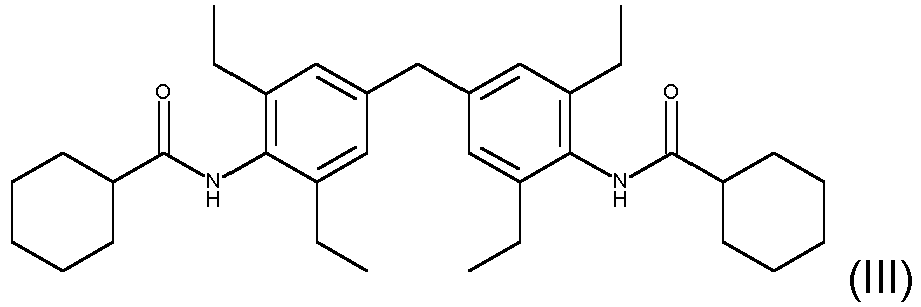
- 4,34 g (14,00 mmol) 4,4'Methylenbis(2,6-diethylanilin), 4,3 mL Et3N und 50 mL THF wurden in einem Schlenkkolben gemischt und auf ca. 0-5°C abgekühlt. Unter Argon-Atmosphäre wurden 3,71 g (30,80 mmol) Pivaloylchlorid tropfenweise zugefügt und das Reaktionsgemisch auf 60°C erhitzt. Nach 48 h wurde das Gemisch in Eiswasser gefällt. Der erhaltene Feststoff wurde daraufhin abfiltriert und in 500 mL MeOH umkristallisiert. Zur weiteren Aufreinigung wurde der Feststoff in 250 mL DMF umkristallisiert, filtriert und im Hochvakuum getrocknet. 4,8 g (71 %) des Produkts 3c wurden in Form eines weißen Pulvers erhalten. Charakterisierung: MS: (70 eV), m/z (%): 478 [M+]; DSC: Tm = 328 °C
- 4,34 g (14,00 mmol) 4,4'Methylenbis(2,6-diethylanilin), 4,3 mL Et3N und 50 mL THF wurden in einem Schlenkkolben zusammengemischt und auf ca. 0-5°C abgekühlt. Unter Argon-Atmosphäre wurden 3,71 g (30,8 mmol) Valeroylchlorid tropfenweise zugefügt und anschließend auf 50°C erhitzt. Nach 3 h wurde das Reaktionsgemisch in Eiswasser gefällt. Der erhaltene Feststoff wurde daraufhin abfiltriert und mit H2O gewaschen. Zur weiteren Aufreinigung wurde der Feststoff in 200 mL MeOH umkristallisiert, filtriert und im Hochvakuum getrocknet. 3,7 g (56 %) des Produkts 3d (Formel (IV)) wurden in Form eines weißen Pulvers erhalten. Charakterisierung: MS: (70 eV), m/z (%): 478 [M+]; DSC: Tm1 = 120 °C, Tm2 = 220 °C

- Alle in nachfolgender Tabelle 1 abgebildeten Carbonsäure-bisamide unterfallen der Formel (I). Sie lassen sich auch in größeren Mengen gut herstellen. Die genannten Verbindungen sind in Polystyrol und SAN bei Verarbeitungstemperatur löslich.
Tabelle 1 Verwendete gewinkelte Bisamide der allgemeinen Formel (I) Bisamid-Additiv Substituenten R3,R4 R5, R6 Substituenten R1 , R2 1 a H Benzyl b Cyclohexyl c t-Butyl d n-Butyl 2 a Methyl Benzyl b Cyclohexyl c t-Butyl d n-Butyl 3 a Ethyl Benzyl B Cyclohexyl C t-Butyl D n-Butyl - Für die Vergleichsexperimente wurden zum einen das Trisamid-Additiv Irgaclear® XT 386 (BASF SE) und zum anderen das Bisamid-Additiv NJ Star NU100 (N,N'-Dicyclohexyl-2,6-naphthalindicarboaxmid) der New Japan Chemical verwendet.
- Das als Transparenz-Verstärker für Polypropylen eingesetzte symmetrische aromatische Trisamid Irgaclear® XT 386 (1,3,5-Tris(2,2-dimethyl-proprionyl-amino)-benzol; BASF, Formel (V)) kann analog aus 1,3,5-Tris-aminobenzol und Säurechlorid hergestellt werden.

- Ein (nicht-gewinkeltes) aromatisches Bis-amid-Derivat kann aus Naphthalin-2,6-dicarbon-säure und Cyclohexylamin hergestellt werden. Es wird auch von New Japan Chemical als Produkt NJ STAR NU100 (Formel (VII)) vertrieben.

- Es wurden Polystyrol-Schaumstoffe nach dem erfindungsgemäßen Verfahren hergestellt. Dazu wurde ein handelsübliches Polystyrol (PS168N, INEOS STRYROLUTION, Frankfurt am Main) in Form von 3 mm Zylindergranulat (3 × 2 mm) verwendet. Für das Polystyrol wurde ein mittleres Molekulargewicht Mw von 340.000 g/mol ermittelt.
- Hierzu wurde zunächst das Polymer-Granulat mit einer Ultra-Zentrifuge (mill Retsch ZM200) bei 18.000 rpm Umdrehungsgeschwindigkeit und einer Siebmaschengröße von 1000 µm gemahlen, um die weitere Einarbeitung und die Verteilung des Additivs zu gewährleisten. Während des Mahlvorgangs wurde das Polymer mit flüssigem Stickstoff gekühlt.
- Anschließend wurde das gemahlene PS für jeden Pulver-Pulver-Masterbatch mit 1,0 Gew.-% des entsprechenden Additivs versehen und mit einem Heidolph Reax 2-Mixer bei 50 rpm homogenisiert.
- Die Aufbereitung wurde mit einem gleichsinnig drehenden Doppelschnecken-Compounder (DSM Xplore 15 mL) durchgeführt. Die Komponenten wurden für 5 Minuten mit einer Drehgeschwindigkeit von 50 rpm bei 260 °C vermischt. Danach wurde die Polymer-Schmelze 2 Minuten lang in den Spritzgussbehälter abgelassen. Da es aufwändig ist, den Extruder vollständig zu entleeren und ein definiertes Totvolumen zurückbleibt, ist es von Vorteil, eine Verdünnungsreihe anzusetzen, um verschiedene Konzentrationen zu ermöglichen. Anfangs ist der Extruder mit 13,5 g des entsprechenden Materials gefüllt. Etwa 8,1 g können in den Spritzgussbehälter überführt werden, während 5,4 g im Compounder zurückbleiben. Mit diesem Wissen ist es möglich, die gewünschten Konzentrationen zu erzielen.
- Die folgenden acht Konzentrationen der o.g. Additive in der Polymerzusammensetzung wurden hergestellt:
1,0; 0,75; 0,5; 0,25; 0,1; 0,05; 0,025 und 0,01 Gew.-%. - Das Spritzgießen wurde mit der Mikro-Spritzgussmaschine DSM Xplore 12 mL durchgeführt. Der Behälter hatte eine Temperatur von 250 °C und die Schmelze wurde mit einem Druck von 6 bar für 10 Sekunden eingespritzt. Der Druck wurde für weitere 10 Sekunden gehalten. Es wurden runde Polymer-Plättchen mit 27 mm Durchmesser und 1,1 mm Dicke erhalten und getestet. Um innere Spannungen der Polymerproben aus dem Spritzguss-Verfahren zu eliminieren, werden diese in einer geschlossenen Eisenform bei 135 °C für 4 Stunden getempert. Die spannungsfreien Proben garantieren ein einheitliches Aufschäumen.
- Nach dem Tempern wurden die Polymerproben in einem BERGHOF HR-500 Hochdruck-Autoklaven platziert und mit 50 bar CO2 bei Raumtemperatur für 24 Stunden gesättigt.
- Nach der Druckentlastung wurden die Proben für 18 min an der Luft belassen, um eine CO2-Sättigung von ca. 6,5 % zu erreichen. Anschließend wurden die Proben für 15 Sekunden in ein heißes Silikonölbad bei 130 °C getaucht, um das Aufschäumen zu induzieren. Zur Stabilisierung der Zellen wurden die entstehenden Schaumstoffe zuerst in einem kalten Ölbad und danach in einem kalten Wasserbad für jeweils etwa 20 Sekunden abgekühlt. Zuletzt wurden die resultierenden Schaumstoffe in Seifenwasser gewaschen und vor einer weiteren Analyse für 12 Stunden an Luft getrocknet.
- Die Schaumextrusionen wurden auf einer Tandem-Extrusionslinie (Dr. Collin GmbH) durchgeführt (Doppelschneckenextruder mit 25 mm Schnecke und UD 42; Einschnecken-extruder mit 45 mm Schnecke und UD 30), die mit einer Schlitzdüse mit einem 0,6 mm Spalt und 3 mm Breite ausgestattet ist.
- Es wurden extrudierter reiner XPS-Schaum sowie mehrere XPS-Schäume mit jeweils drei ausgewählten Additiv-Konzentrationen, nämlich 0,1 und 0,2 und 0,5 Gew.-% hergestellt und untersucht. Analoge Versuche werden mit SAN-Schäumen durchgeführt.
- Die verschiedenen Additiv-Konzentrationen im Polymer wurden mittels eines gravimetrischen Dosierers durch Verdünnung eines Masterbatches mit reinem Polymer-Granulat mittels Kontrolle der Flussraten erhalten.
- Eine Kombination von 4 Gew.-% CO2 und 3 Gew.-% Ethanol wurde als (physikalisches) Treibmittel eingesetzt. Um eine XPS Referenz zu erhalten, wurde PS Granulat ohne Carbonsäureamid-Additiv auf dieselbe Weise extrudiert.
- Die relevanten Verfahrensparameter für die Schaumextrusion sind in Tabelle 2 zusammengefasst.
Tabelle 2: Verfahrensparameter für die Schaumextrusion von PS Schaumstoffen Einlass-Schmelztemperatur [°C] Auslass-Schmelztemperatur [°C] Düsentemperatur [°C] Schneckendrehzahl [rpm] Durchsatz [kg/h] Treibmittel CO2 [Gew.-%] EtOH 260 106 - 130 123 - 132 8 4.5 4 3 - In Tabelle 3 werden die Ergebnisse verschiedener, hergestellter Extrusionsschäume dargestellt, welche auf dem o.g. Polystyrol basieren. Die Extrusions-Schäume unterscheiden sich durch die eingesetzten Carbonsäureamid-Additive (jeweils 0,1 Gew.-%).
Tabelle 3: Mittlere Zellgröße und Schaumdichte von PS-Extrusionsschäumen ohne Additiv, mit 0,1 oder 0,5 Gew.-% IrgaclearXT 386, mit 0,1, 0,2 oder 0,5 Gew.-% Carbonsäureamid 3b Additiv Mittlere Zellgröße und Standardabweichung (Mikrometer) Schaumdichte (kg/m3) Kein Additiv 632,1 +/- 183,9 52,3 Irgaclear XT 386 (0,1 Gew.-%) 25,7 +/- 7,8 72,6 Irgaclear XT 386 (0,5 Gew.-%) 31,3 +/- 10,1 - Bisamid (3b) (0,1 Gew.-%) 14,4 +/- 4,7 76,5 Bisamid (3b) (0,2 Gew.-%) 14,7 +/- 5,5 82,8 Bisamid (3b) (0,5 Gew.-%) 10,7 +/- 4,3 71,2 - Der in Tabelle 3 gezeigte Polystyrol-Schaum mit Carbonsäureamid (3b) zeigt bereits bei Verwendung von 0,1 Gew.-% des Additivs eine kleine Zellengröße und folglich eine signifikante Erhöhung der Zellenzahl. Es werden kleinzellige, geschlossen-zellige Schäume erhalten.
- Bei Einsatz von 0,2 Gew.-% von Carbonsäurebisamid (3b) im Polystyrol beträgt die mittlere Zellengröße des Schaums 14,7 und die Schaumdichte 82,8 kg/m3. Bei Einsatz von 0,5 Gew.-% von Carbonsäurebisamid (3b) im Polystyrol beträgt die mittlere Zellengröße des Schaums 10,7 Mikrometer und die Schaumdichte 71,2 kg/m3.
- Auch mit den anderen erfindungsgemäßen Bisamid-Derivaten (1a-d), (2a-d) und (3a, cd) wurden im Batchschaum-Verfahren bei den getesteten Konzentrationen (0,1; 0,25; 0,5 Gew.-% des Bisamids) in Polystyrol jeweils kleinzellige und geschlossen-zellige Schäume erhalten, die zudem eine sehr weitgehend homogene Zellengröße aufweisen.
- Beim Einsatz des bekannten Trisamid-Derivats Irgaclear XT 386 im Batchschaum-Verfahren wurden hingegen bei den getesteten Konzentrationen (0,1; 0,25; 0,5 Gew.-% des Trisamids) in Polystyrol jeweils deutlich größer-zellige Schäume erhalten, die zudem keine homogene Zellengröße aufwiesen.
- Im Schaumextrusions-Verfahren bei einem Einsatz von 0,1 Gew.-% an Irgaclear XT 386 im Polystyrol betrug die mittlere Zellengröße des Schaums 25,7 +/- 7,8 Mikrometer, beim Einsatz von 0,5 Gew.-% im Polystyrol betrug die mittlere Zellengröße des Schaums 31,3 Mikrometer.
- Zudem wurden ausführliche Untersuchungen der Wärmeleitfähigkeit der XPS-Schäume (an Rundplättchen mit 60 mm Durchmesser) durchgeführt. Es wurde festgestellt, dass die Bisamide der Formel (I) selbst in geringer Konzentration im Polymer eingesetzt zu deutlich besseren Isolations-Eigenschaften (z.B. bei 0,1 Gew.% des Bisamids 3b im o.g. Polystyrol von + 7 %) bei den Schäumen führen als bei entsprechenden Schäume, hergestellt mit dem Trisamid-Additiv Irgaclear XT 386 in Polystyrol.
- In weiteren Untersuchungen mit dem Batchschaum-Verfahren konnte gezeigt werden, dass die erfindungsgemäßen Additive auch in anderen Polymeren vorteilhaft eingesetzt werden können. So konnte mit dem Bisamid-Derivat (wie z.B. 3b) bereits bei Verwendung von 0,1 Gew.-% eine signifikante Reduzierung der mittleren Zellengröße in einem Styrol-Acrylnitril-Copolymer (Luran® 25100, INEOS Styrolution) erzielt werden kann.
- Der mit Kohlenstoffdioxid (130°C, 25 Sekunden) erhaltene Polymerschaum hatte eine mittleren Zellendurchmesser des Schaums 16,4 +/- 6,1 Mikrometer und die Schaumdichte betrug 39,9 kg/m3. Eine deutliche Erhöhung der Zellenzahl wurde festgestellt, es wurde ein kleinzelliger, geschlossen-zelliger SAN-Schaum erhalten. Auch war die Zellgrößenverteilung homogen.
- Somit ermöglichen die Verbindungen der Formel (I) die Bereitstellung neuer geschlossen-zelliger Schaumprodukte, die sich auch in Verbundkörpern (mit mehreren Schichten) vorteilhaft einsetzen lassen.

Claims (15)
- Verfahren zur Herstellung eines Schaumstoffs aus mindestens einer Styrol-Polymer-Komponente (S) und mindestens einem Additiv der allgemeinen Formel (I), umfassend die Schritte:a. Erwärmen mindestens einer Styrol-Polymer-Komponente (S), um eine geschmolzene, polymere Formmasse zu erhalten,b. Einbringen eines Treibmittels (T) in die geschmolzene, polymere Formmasse zur Ausbildung einer schäumbaren Zusammensetzung (Z), undc. Aufschäumen der schäumbaren Zusammensetzung (Z), um einen geschäumten Formkörper zu erhalten,wobei in der geschmolzenen polymeren Formmasse mindestens ein Carbonsäurebisamid der allgemeinen Formel (I) eingesetzt wird,
 wobei bedeuten:Z eine C1-C5-Alkylengruppe, insbesondere -CH2-, oder ein Sauerstoffatom oder ein Schwefelatom,R1 und R2 unabhängig voneinander einen verzweigten C3-C12-Alkylrest oder unverzweigten C1-C12-Alkylrest, einen C3-C12-Cycloalkylrest, oder einen Benzylrest;R3, R4, R5 und R6 jeweils unabhängig voneinander Wasserstoff, einen unverzweigten C1-C6-Alkylrest oder einen verzweigten C3-C6-Alkylrest.
 - Verfahren nach Anspruch 1, dadurch gekennzeichnet, dass in der allgemeinen Formel (I) R1 und R2 unabhängig voneinander einen C3-C12-Cycloalkylrest, insbesondere einen Cyclohexylrest oder Cyclopentylrest, einen Butylrest oder einen Benzylrest bedeuten.
- Verfahren nach Anspruch 1 oder 2, dadurch gekennzeichnet, dass in der allgemeinen Formel (I) Z eine Methylengruppe ist, und R3, R4, R5 und R6 jeweils unabhängig voneinander einen C1-C6-Alkylrest, insbesondere einen C1-C2-Alkylrest bedeuten.
- Verfahren nach mindestens einem der Ansprüche 1 bis 3, dadurch gekennzeichnet, dass das Carbonsäurebisamid der allgemeinen Formel (I) in einer Menge von 0,01 bis 2,0 Gew.-%, bezogen auf das Gesamtgewicht der polymeren Formmasse eingesetzt wird.
- Verfahren nach mindestens einem der Ansprüche 1 bis 4, dadurch gekennzeichnet, dass in die geschmolzene, polymere Formmasse ein Treibmittel (T) aus der Gruppe aus Pentan, Cyclopentan, Kohlenstoffdioxid und Ethanol oder einer Mischung eingebracht wird.
- Verfahren nach mindestens einem der Ansprüche 1 bis 5, dadurch gekennzeichnet, dass als Styrol-Polymer-Komponente (S) ein Polystyrol (PS) und/oder ein Copolymer enthaltend Styrol und Acrylnitril, insbesondere Styrol-Acrylnitril (SAN), eingesetzt wird.
- Schaumstoff, erhältlich durch ein Verfahren gemäß mindestens einem der Ansprüche 1 bis 6.
- Schaumstoff gemäß Anspruch 7, der eine Dichte im Bereich von mindestens 30 kg/m3 aufweist und der eine zumindest 50 % geschlossen-zellige Struktur aufweist.
- Schaumstoff gemäß Anspruch 7 oder 8, der eine Dichte im Bereich von 45-85 kg/m3 aufweist und der eine zumindest 90 % geschlossen-zellige Struktur aufweist.
- Schaumstoff gemäß mindestens einem der Ansprüche 7 bis 9, dessen mittlerer Zellendurchmesser (D) von 0,1- 25,0 Mikrometer beträgt, wobei der mittlere Zellendurchmesser (D) durch das in der Anmeldung offenbarte Verfahren bestimmt wird.
- Schaumstoff gemäß einem der Ansprüche 7 bis 10, dessen mittlerer Zellendurchmesser (D) von 1,0- 16,0, insbesondere 3,0 bis kleiner als 15,0 Mikrometer beträgt, wobei der mittlere Zellendurchmesser (D) durch das in der Anmeldung offenbarte Verfahren bestimmt wird.
- Schaumstoff gemäß mindestens einem der Ansprüche 7 bis 11, wobei es sich um einen Polystyrol-basierten Schaumstoff handelt.
- Schaumstoff gemäß mindestens einem der Ansprüche 7 bis 12, wobei es sich um einen Styrol-Acrylnitril-Copolymer-basierten Schaumstoff handelt.
- Polymerzusammensetzung für die Herstellung eines Schaumstoffs enthaltend mindestens eine Styrol-Polymer-Komponente (S) und mindestens ein Carbonsäurebisamid der allgemeinen Formel (I) sowie ggf. weitere Additive,
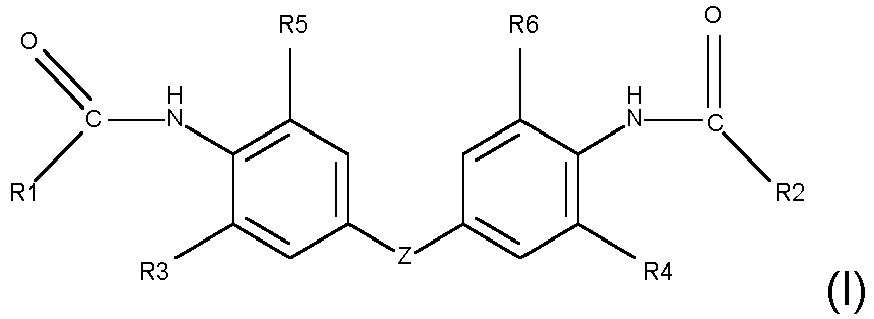 Z eine C1-C5-Alkylengruppe, insbesondere -CH2-, oder ein Sauerstoff- oder Schwefelatom ;R1 und R2 unabhängig voneinander einen verzweigten C3-C12-Alkylrest oder unverzweigten C1-C12-Alkylrest, einen C3-C12-Cycloalkylrest, oder einen Benzylrest;R3, R4, R5 und R6 jeweils unabhängig voneinander Wasserstoff, einen unverzweigten C1-C6-Alkylrest oder einen verzweigten C3-C6-Alkylrest.
 - Verwendung eines Carbonsäurebisamids der allgemeinen Formel (I), definiert gemäß einem der Ansprüche 1 bis 3,

Applications Claiming Priority (2)
| Application Number | Priority Date | Filing Date | Title |
|---|---|---|---|
| EP20175406 | 2020-05-19 | ||
| PCT/EP2021/062951 WO2021233811A1 (de) | 2020-05-19 | 2021-05-17 | Kleinzellige polystyrol-schäume und verfahren zu deren herstellung |
Publications (2)
| Publication Number | Publication Date |
|---|---|
| EP4153668A1 EP4153668A1 (de) | 2023-03-29 |
| EP4153668B1 true EP4153668B1 (de) | 2024-08-28 |
Family
ID=70779479
Family Applications (1)
| Application Number | Title | Priority Date | Filing Date |
|---|---|---|---|
| EP21725199.0A Active EP4153668B1 (de) | 2020-05-19 | 2021-05-17 | Kleinzellige polystyrol-schäume und verfahren zu deren herstellung |
Country Status (5)
| Country | Link |
|---|---|
| US (1) | US20230227627A1 (de) |
| EP (1) | EP4153668B1 (de) |
| KR (1) | KR20230013065A (de) |
| CN (1) | CN115667382B (de) |
| WO (1) | WO2021233811A1 (de) |
Family Cites Families (14)
| Publication number | Priority date | Publication date | Assignee | Title |
|---|---|---|---|---|
| US5210105A (en) | 1992-06-09 | 1993-05-11 | The Dow Chemical Company | Carbon black-containing bimodal foam structures and process for making |
| ES2134339T3 (es) | 1993-01-26 | 1999-10-01 | Dow Chemical Co | Espuma de celdillas agrandadas y metodo de fabricarla. |
| DE19907663A1 (de) | 1999-02-23 | 2000-08-24 | Basf Ag | Schaumstoffplatten mit verminderter Wärmeleitfähigkeit |
| DE10116841A1 (de) | 2001-04-04 | 2002-10-17 | Basf Ag | Verfahren zur Herstellung von Schaumstoffplatten |
| CN100425642C (zh) * | 2002-08-09 | 2008-10-15 | 株式会社钟化 | 发泡性苯乙烯类树脂粒子、和使用其的预发泡粒子、发泡成型体 |
| AU2004210907B2 (en) | 2003-02-14 | 2009-02-19 | Ciba Specialty Chemicals Holding Inc. | Resin compositions |
| DE102004057602A1 (de) | 2004-11-29 | 2006-06-01 | Basf Ag | Schaumstoffplatten mit verminderter Wärmeleitfähigkeit |
| EP2017294A1 (de) * | 2007-07-16 | 2009-01-21 | Sika Technology AG | Hitzehärtender Schaum |
| JP5495220B2 (ja) * | 2007-09-28 | 2014-05-21 | 株式会社Adeka | ポリオレフィン樹脂組成物 |
| JP2009235250A (ja) * | 2008-03-27 | 2009-10-15 | Kaneka Corp | 発泡性スチレン系樹脂粒子の製造方法 |
| DE102011083434B4 (de) | 2011-09-26 | 2016-11-17 | Neue Materialien Bayreuth Gmbh | Verfahren zur Herstellung eines offenzelligen Polymerschaums |
| US20150166752A1 (en) * | 2013-12-16 | 2015-06-18 | Clariant International, Ltd. | Polymeric Foam |
| US20150376361A1 (en) | 2014-06-26 | 2015-12-31 | Clariant International, Ltd. | Composition For Preparing A Polymeric Foam |
| AR101892A1 (es) * | 2014-09-26 | 2017-01-18 | Akzo Nobel Chemicals Int Bv | Proceso para preparar una mezcla maestra de aditivo de polímero |
-
2021
- 2021-05-17 WO PCT/EP2021/062951 patent/WO2021233811A1/de not_active Ceased
- 2021-05-17 CN CN202180036407.8A patent/CN115667382B/zh active Active
- 2021-05-17 KR KR1020227044084A patent/KR20230013065A/ko active Pending
- 2021-05-17 US US17/999,010 patent/US20230227627A1/en active Pending
- 2021-05-17 EP EP21725199.0A patent/EP4153668B1/de active Active
Also Published As
| Publication number | Publication date |
|---|---|
| CN115667382B (zh) | 2024-08-23 |
| KR20230013065A (ko) | 2023-01-26 |
| WO2021233811A1 (de) | 2021-11-25 |
| CN115667382A (zh) | 2023-01-31 |
| US20230227627A1 (en) | 2023-07-20 |
| EP4153668A1 (de) | 2023-03-29 |
Similar Documents
| Publication | Publication Date | Title |
|---|---|---|
| DE69329498T2 (de) | Verfahren zur herstellung von alkenyl aromatischen schaumstoffen unter verwendung einer zusammensetzung aus atmosphärischen und organischen gasen und danach hergestellte schaumstoffe | |
| EP0542066B1 (de) | Expandierbare Styrolpolymerisate, enthaltend als Treibmittel Kohlendioxid | |
| DE69325109T2 (de) | Grossporiger schaumstoff und sein herstellungsverfahren | |
| DE69031066T2 (de) | Verwendung von Nukleierungstreibmitteln bei der Herstellung von isolierenden alkenyl-aromatischen Polymerschaumstoffen | |
| DE10358786A1 (de) | Partikelschaumformteile aus expandierbaren, Füllstoff enthaltenden Polymergranulaten | |
| DE10358801A1 (de) | Partikelschaumformteile aus expandierbaren Styrolpolymeren und Mischungen mit thermoplastischen Polymeren | |
| DE69925014T2 (de) | Verfahren zur herstellung von extrudiertem schaumstoff | |
| EP2452968A1 (de) | Verfahren zur Herstellung von expandierbaren thermoplastischen Partikeln mit Verbesserter Expandierbarkeit | |
| WO1993024560A1 (de) | Verfahren zur herstellung von schaumstoffplatten mit hoher druckfestigkeit aus styrolpolymerisaten | |
| DE69331781T2 (de) | Verfahren für unimodulare styrolschaumstoffstrukturen | |
| EP2475711B1 (de) | San-extrusionsschaumstoffe | |
| EP2274369B2 (de) | Ps-schaumstoffe mit geringem metallgehalt | |
| EP1031600B1 (de) | Schaumstoffplatten mit verminderter Wärmeleitfähigkeit | |
| DE69508418T2 (de) | Schaumstoff hergestellt durch stromabwärtige wassereinspritzung | |
| DE2413375A1 (de) | Verfahren zur herstellung von schaumstoffen aus massen, die styrol- und aethylenpolymerisate enthalten | |
| DE102004057602A1 (de) | Schaumstoffplatten mit verminderter Wärmeleitfähigkeit | |
| EP1694755B1 (de) | Expandierbare styrolpolymergranulate mit bi- oder multimodaler molekulargewichtsverteilung | |
| EP4153668B1 (de) | Kleinzellige polystyrol-schäume und verfahren zu deren herstellung | |
| DE4445140A1 (de) | Mit Kohlendioxid getriebener Schaum aus Styrolpolymeren | |
| DE69933936T2 (de) | Verfahren zur herstellung von styrolschaumstoff | |
| DE10358798A1 (de) | Expandierbare Styrolpolymergranulate | |
| DE69333839T2 (de) | Alkylaromatische Schaumstoffe und Herstellungsverfahren davon | |
| DE69416833T2 (de) | Verbesserte styrolharz-formzusammensetzung und schaum | |
| EP0642546B1 (de) | Expandierbare styrolpolymerisate mit hoher wärmeformbeständigkeit | |
| DE69131735T2 (de) | Polymermischung mit einem Schaumkontrollmittel |
Legal Events
| Date | Code | Title | Description |
|---|---|---|---|
| STAA | Information on the status of an ep patent application or granted ep patent |
Free format text: STATUS: UNKNOWN |
|
| STAA | Information on the status of an ep patent application or granted ep patent |
Free format text: STATUS: THE INTERNATIONAL PUBLICATION HAS BEEN MADE |
|
| PUAI | Public reference made under article 153(3) epc to a published international application that has entered the european phase |
Free format text: ORIGINAL CODE: 0009012 |
|
| STAA | Information on the status of an ep patent application or granted ep patent |
Free format text: STATUS: REQUEST FOR EXAMINATION WAS MADE |
|
| 17P | Request for examination filed |
Effective date: 20221201 |
|
| AK | Designated contracting states |
Kind code of ref document: A1 Designated state(s): AL AT BE BG CH CY CZ DE DK EE ES FI FR GB GR HR HU IE IS IT LI LT LU LV MC MK MT NL NO PL PT RO RS SE SI SK SM TR |
|
| P01 | Opt-out of the competence of the unified patent court (upc) registered |
Effective date: 20230515 |
|
| DAV | Request for validation of the european patent (deleted) | ||
| DAX | Request for extension of the european patent (deleted) | ||
| GRAP | Despatch of communication of intention to grant a patent |
Free format text: ORIGINAL CODE: EPIDOSNIGR1 |
|
| STAA | Information on the status of an ep patent application or granted ep patent |
Free format text: STATUS: GRANT OF PATENT IS INTENDED |
|
| INTG | Intention to grant announced |
Effective date: 20240503 |
|
| GRAS | Grant fee paid |
Free format text: ORIGINAL CODE: EPIDOSNIGR3 |
|
| GRAA | (expected) grant |
Free format text: ORIGINAL CODE: 0009210 |
|
| STAA | Information on the status of an ep patent application or granted ep patent |
Free format text: STATUS: THE PATENT HAS BEEN GRANTED |
|
| AK | Designated contracting states |
Kind code of ref document: B1 Designated state(s): AL AT BE BG CH CY CZ DE DK EE ES FI FR GB GR HR HU IE IS IT LI LT LU LV MC MK MT NL NO PL PT RO RS SE SI SK SM TR |
|
| REG | Reference to a national code |
Ref country code: CH Ref legal event code: EP |
|
| REG | Reference to a national code |
Ref country code: DE Ref legal event code: R096 Ref document number: 502021004953 Country of ref document: DE |
|
| REG | Reference to a national code |
Ref country code: IE Ref legal event code: FG4D Free format text: LANGUAGE OF EP DOCUMENT: GERMAN |
|
| REG | Reference to a national code |
Ref country code: NL Ref legal event code: FP |
|
| REG | Reference to a national code |
Ref country code: LT Ref legal event code: MG9D |
|
| PG25 | Lapsed in a contracting state [announced via postgrant information from national office to epo] |
Ref country code: NO Free format text: LAPSE BECAUSE OF FAILURE TO SUBMIT A TRANSLATION OF THE DESCRIPTION OR TO PAY THE FEE WITHIN THE PRESCRIBED TIME-LIMIT Effective date: 20241128 |
|
| PG25 | Lapsed in a contracting state [announced via postgrant information from national office to epo] |
Ref country code: PL Free format text: LAPSE BECAUSE OF FAILURE TO SUBMIT A TRANSLATION OF THE DESCRIPTION OR TO PAY THE FEE WITHIN THE PRESCRIBED TIME-LIMIT Effective date: 20240828 Ref country code: GR Free format text: LAPSE BECAUSE OF FAILURE TO SUBMIT A TRANSLATION OF THE DESCRIPTION OR TO PAY THE FEE WITHIN THE PRESCRIBED TIME-LIMIT Effective date: 20241129 Ref country code: FI Free format text: LAPSE BECAUSE OF FAILURE TO SUBMIT A TRANSLATION OF THE DESCRIPTION OR TO PAY THE FEE WITHIN THE PRESCRIBED TIME-LIMIT Effective date: 20240828 Ref country code: PT Free format text: LAPSE BECAUSE OF FAILURE TO SUBMIT A TRANSLATION OF THE DESCRIPTION OR TO PAY THE FEE WITHIN THE PRESCRIBED TIME-LIMIT Effective date: 20241230 |
|
| PG25 | Lapsed in a contracting state [announced via postgrant information from national office to epo] |
Ref country code: BG Free format text: LAPSE BECAUSE OF FAILURE TO SUBMIT A TRANSLATION OF THE DESCRIPTION OR TO PAY THE FEE WITHIN THE PRESCRIBED TIME-LIMIT Effective date: 20240828 |
|
| PG25 | Lapsed in a contracting state [announced via postgrant information from national office to epo] |
Ref country code: LV Free format text: LAPSE BECAUSE OF FAILURE TO SUBMIT A TRANSLATION OF THE DESCRIPTION OR TO PAY THE FEE WITHIN THE PRESCRIBED TIME-LIMIT Effective date: 20240828 |
|
| PG25 | Lapsed in a contracting state [announced via postgrant information from national office to epo] |
Ref country code: IS Free format text: LAPSE BECAUSE OF FAILURE TO SUBMIT A TRANSLATION OF THE DESCRIPTION OR TO PAY THE FEE WITHIN THE PRESCRIBED TIME-LIMIT Effective date: 20241228 |
|
| PG25 | Lapsed in a contracting state [announced via postgrant information from national office to epo] |
Ref country code: HR Free format text: LAPSE BECAUSE OF FAILURE TO SUBMIT A TRANSLATION OF THE DESCRIPTION OR TO PAY THE FEE WITHIN THE PRESCRIBED TIME-LIMIT Effective date: 20240828 |
|
| PG25 | Lapsed in a contracting state [announced via postgrant information from national office to epo] |
Ref country code: RS Free format text: LAPSE BECAUSE OF FAILURE TO SUBMIT A TRANSLATION OF THE DESCRIPTION OR TO PAY THE FEE WITHIN THE PRESCRIBED TIME-LIMIT Effective date: 20241128 Ref country code: ES Free format text: LAPSE BECAUSE OF FAILURE TO SUBMIT A TRANSLATION OF THE DESCRIPTION OR TO PAY THE FEE WITHIN THE PRESCRIBED TIME-LIMIT Effective date: 20240828 |
|
| PG25 | Lapsed in a contracting state [announced via postgrant information from national office to epo] |
Ref country code: RS Free format text: LAPSE BECAUSE OF FAILURE TO SUBMIT A TRANSLATION OF THE DESCRIPTION OR TO PAY THE FEE WITHIN THE PRESCRIBED TIME-LIMIT Effective date: 20241128 Ref country code: PT Free format text: LAPSE BECAUSE OF FAILURE TO SUBMIT A TRANSLATION OF THE DESCRIPTION OR TO PAY THE FEE WITHIN THE PRESCRIBED TIME-LIMIT Effective date: 20241230 Ref country code: PL Free format text: LAPSE BECAUSE OF FAILURE TO SUBMIT A TRANSLATION OF THE DESCRIPTION OR TO PAY THE FEE WITHIN THE PRESCRIBED TIME-LIMIT Effective date: 20240828 Ref country code: NO Free format text: LAPSE BECAUSE OF FAILURE TO SUBMIT A TRANSLATION OF THE DESCRIPTION OR TO PAY THE FEE WITHIN THE PRESCRIBED TIME-LIMIT Effective date: 20241128 Ref country code: LV Free format text: LAPSE BECAUSE OF FAILURE TO SUBMIT A TRANSLATION OF THE DESCRIPTION OR TO PAY THE FEE WITHIN THE PRESCRIBED TIME-LIMIT Effective date: 20240828 Ref country code: IS Free format text: LAPSE BECAUSE OF FAILURE TO SUBMIT A TRANSLATION OF THE DESCRIPTION OR TO PAY THE FEE WITHIN THE PRESCRIBED TIME-LIMIT Effective date: 20241228 Ref country code: HR Free format text: LAPSE BECAUSE OF FAILURE TO SUBMIT A TRANSLATION OF THE DESCRIPTION OR TO PAY THE FEE WITHIN THE PRESCRIBED TIME-LIMIT Effective date: 20240828 Ref country code: GR Free format text: LAPSE BECAUSE OF FAILURE TO SUBMIT A TRANSLATION OF THE DESCRIPTION OR TO PAY THE FEE WITHIN THE PRESCRIBED TIME-LIMIT Effective date: 20241129 Ref country code: FI Free format text: LAPSE BECAUSE OF FAILURE TO SUBMIT A TRANSLATION OF THE DESCRIPTION OR TO PAY THE FEE WITHIN THE PRESCRIBED TIME-LIMIT Effective date: 20240828 Ref country code: ES Free format text: LAPSE BECAUSE OF FAILURE TO SUBMIT A TRANSLATION OF THE DESCRIPTION OR TO PAY THE FEE WITHIN THE PRESCRIBED TIME-LIMIT Effective date: 20240828 Ref country code: BG Free format text: LAPSE BECAUSE OF FAILURE TO SUBMIT A TRANSLATION OF THE DESCRIPTION OR TO PAY THE FEE WITHIN THE PRESCRIBED TIME-LIMIT Effective date: 20240828 |
|
| PG25 | Lapsed in a contracting state [announced via postgrant information from national office to epo] |
Ref country code: SM Free format text: LAPSE BECAUSE OF FAILURE TO SUBMIT A TRANSLATION OF THE DESCRIPTION OR TO PAY THE FEE WITHIN THE PRESCRIBED TIME-LIMIT Effective date: 20240828 Ref country code: RO Free format text: LAPSE BECAUSE OF FAILURE TO SUBMIT A TRANSLATION OF THE DESCRIPTION OR TO PAY THE FEE WITHIN THE PRESCRIBED TIME-LIMIT Effective date: 20240828 Ref country code: DK Free format text: LAPSE BECAUSE OF FAILURE TO SUBMIT A TRANSLATION OF THE DESCRIPTION OR TO PAY THE FEE WITHIN THE PRESCRIBED TIME-LIMIT Effective date: 20240828 |
|
| PG25 | Lapsed in a contracting state [announced via postgrant information from national office to epo] |
Ref country code: EE Free format text: LAPSE BECAUSE OF FAILURE TO SUBMIT A TRANSLATION OF THE DESCRIPTION OR TO PAY THE FEE WITHIN THE PRESCRIBED TIME-LIMIT Effective date: 20240828 |
|
| PG25 | Lapsed in a contracting state [announced via postgrant information from national office to epo] |
Ref country code: CZ Free format text: LAPSE BECAUSE OF FAILURE TO SUBMIT A TRANSLATION OF THE DESCRIPTION OR TO PAY THE FEE WITHIN THE PRESCRIBED TIME-LIMIT Effective date: 20240828 |
|
| PG25 | Lapsed in a contracting state [announced via postgrant information from national office to epo] |
Ref country code: IT Free format text: LAPSE BECAUSE OF FAILURE TO SUBMIT A TRANSLATION OF THE DESCRIPTION OR TO PAY THE FEE WITHIN THE PRESCRIBED TIME-LIMIT Effective date: 20240828 Ref country code: SK Free format text: LAPSE BECAUSE OF FAILURE TO SUBMIT A TRANSLATION OF THE DESCRIPTION OR TO PAY THE FEE WITHIN THE PRESCRIBED TIME-LIMIT Effective date: 20240828 |
|
| REG | Reference to a national code |
Ref country code: DE Ref legal event code: R097 Ref document number: 502021004953 Country of ref document: DE |
|
| PLBE | No opposition filed within time limit |
Free format text: ORIGINAL CODE: 0009261 |
|
| STAA | Information on the status of an ep patent application or granted ep patent |
Free format text: STATUS: NO OPPOSITION FILED WITHIN TIME LIMIT |
|
| PGFP | Annual fee paid to national office [announced via postgrant information from national office to epo] |
Ref country code: DE Payment date: 20250528 Year of fee payment: 5 |
|
| PGFP | Annual fee paid to national office [announced via postgrant information from national office to epo] |
Ref country code: AT Payment date: 20250721 Year of fee payment: 5 |
|
| 26N | No opposition filed |
Effective date: 20250530 |
|
| PG25 | Lapsed in a contracting state [announced via postgrant information from national office to epo] |
Ref country code: SE Free format text: LAPSE BECAUSE OF FAILURE TO SUBMIT A TRANSLATION OF THE DESCRIPTION OR TO PAY THE FEE WITHIN THE PRESCRIBED TIME-LIMIT Effective date: 20240828 |
|
| REG | Reference to a national code |
Ref country code: CH Ref legal event code: H13 Free format text: ST27 STATUS EVENT CODE: U-0-0-H10-H13 (AS PROVIDED BY THE NATIONAL OFFICE) Effective date: 20251223 |
|
| REG | Reference to a national code |
Ref country code: NL Ref legal event code: MM Effective date: 20250601 |
|
| PG25 | Lapsed in a contracting state [announced via postgrant information from national office to epo] |
Ref country code: LU Free format text: LAPSE BECAUSE OF NON-PAYMENT OF DUE FEES Effective date: 20250517 |
|
| PG25 | Lapsed in a contracting state [announced via postgrant information from national office to epo] |
Ref country code: CH Free format text: LAPSE BECAUSE OF NON-PAYMENT OF DUE FEES Effective date: 20250531 |
|
| GBPC | Gb: european patent ceased through non-payment of renewal fee |
Effective date: 20250517 |
|
| PG25 | Lapsed in a contracting state [announced via postgrant information from national office to epo] |
Ref country code: MC Free format text: LAPSE BECAUSE OF FAILURE TO SUBMIT A TRANSLATION OF THE DESCRIPTION OR TO PAY THE FEE WITHIN THE PRESCRIBED TIME-LIMIT Effective date: 20240828 |