EP4151332B1 - Inkrementelles umformwerkzeug - Google Patents
Inkrementelles umformwerkzeug Download PDFInfo
- Publication number
- EP4151332B1 EP4151332B1 EP20935308.5A EP20935308A EP4151332B1 EP 4151332 B1 EP4151332 B1 EP 4151332B1 EP 20935308 A EP20935308 A EP 20935308A EP 4151332 B1 EP4151332 B1 EP 4151332B1
- Authority
- EP
- European Patent Office
- Prior art keywords
- incremental forming
- forming tool
- hard
- hard film
- less
- Prior art date
- Legal status (The legal status is an assumption and is not a legal conclusion. Google has not performed a legal analysis and makes no representation as to the accuracy of the status listed.)
- Active
Links
Images




Classifications
-
- B—PERFORMING OPERATIONS; TRANSPORTING
- B21—MECHANICAL METAL-WORKING WITHOUT ESSENTIALLY REMOVING MATERIAL; PUNCHING METAL
- B21D—WORKING OR PROCESSING OF SHEET METAL OR METAL TUBES, RODS OR PROFILES WITHOUT ESSENTIALLY REMOVING MATERIAL; PUNCHING METAL
- B21D31/00—Other methods for working sheet metal, metal tubes, metal profiles
- B21D31/005—Incremental shaping or bending, e.g. stepwise moving a shaping tool along the surface of the workpiece
-
- B—PERFORMING OPERATIONS; TRANSPORTING
- B21—MECHANICAL METAL-WORKING WITHOUT ESSENTIALLY REMOVING MATERIAL; PUNCHING METAL
- B21D—WORKING OR PROCESSING OF SHEET METAL OR METAL TUBES, RODS OR PROFILES WITHOUT ESSENTIALLY REMOVING MATERIAL; PUNCHING METAL
- B21D37/00—Tools as parts of machines covered by this subclass
- B21D37/01—Selection of materials
Definitions
- the present invention relates to an incremental forming tool, and in more detail, relates to a rod-shaped incremental forming tool that is usable as a fixed pressing tool and/or a movable pressing tool of an incremental forming apparatus.
- a plastic processing method for mass production of automobile parts, etc. employs a widely used press working that uses dies.
- An incremental forming method is known as a forming method that enables manufacturing a formed object having a complicated shape, without the need for dies.
- the incremental forming method is a forming method for forming a metal plate into a predetermined three-dimensional shape as follows: a rod-shaped incremental forming tool is pressed against a metal plate having a circumferential part that is fixed by a support frame, and in this state, the incremental forming tool is relatively moved to extend the metal plate.
- Such an incremental forming method is generally performed by supplying a lubricating oil to a worked surface, in order to prevent a metal plate and an incremental forming tool from adhering together.
- JP 2017 051995 A discloses a technique for obtaining a smooth formed object without roughening a worked surface. This technique involves incrementally forming a metal plate while locally melting the surface thereof, whereby the metal plate and the incremental forming tool are prevented from adhering together without supplying a lubricating oil to the worked surface.
- a sliding mechanism used in sequential forming is known from JP 2018 192487 A , and is considered to form the basis for the preamble of claim 1.
- This sliding mechanism has a metal plate to be formed and a tool for pressurizing and forming the metal plate through a lubricating oil film.
- This lubricating oil film includes a lubricating oil containing an organic compound having hydrophilic groups.
- the tool has a coating of diamond at least on a surface of a sliding portion.
- the surface roughness Ra (arithmetic average roughness) of this coating made of diamond is 0.13 ⁇ m or less.
- JP 6 493111 B2 teaches an incremental forming method for forming a plate material into a three-dimensional shape by pressing the plate material with a fixed pressing tool on one side of the plate material supported around it by a supporting frame and a moving pressing tool on the other side, and moving the plate material and the moving pressing tool and/or the fixed pressing tool relative to each other.
- the temperature of a contact area between the moving pressing tool and the plate material is controlled to be higher than a melting temperature of a surface of the plate material.
- the surface roughness Ra of the moving pressing tool is 0.2 ⁇ m or less.
- JP 2017 051995 A requires a large amount of energy in forming a metal plate that has a high melting point.
- a facility for heating a metal plate is necessary, which causes an increase in size of an incremental forming apparatus.
- the present invention has been made in view of such problems in existing techniques, and an object of the present invention is to provide an incremental forming tool that enables obtaining a formed object having a smooth worked surface, without additionally installing a facility for preventing a metal plate and the incremental forming tool from adhering together.
- the inventors of the present invention have conducted an intensive study in order to achieve the above object, and they have found that providing a hard film that contains crystalline carbon (which may hereinafter be called a "hard film"), at a part for pressing a metal plate of an incremental forming tool, and controlling surface roughness of the hard film to be within a predetermined range, enables achieving the above object.
- a hard film that contains crystalline carbon (which may hereinafter be called a "hard film”
- an incremental forming tool of the present invention comprises a holding part and a free curved surface part.
- the holding part is configured to be attached to an incremental forming apparatus.
- the free curved surface part is configured to press a metal plate.
- the free curved surface part is made of at least a hard metal base material and has a hard film that contains crystalline carbon, on a surface of the free curved surface part.
- a surface of the hard film has an average reduced peak height (Rpk) of 0.15 ⁇ m or less and 0.001 ⁇ m or greater, which is calculated from a material ratio curve of a roughness curve specified in JIS B 0671-2002, and also has an arithmetic average roughness (Ra) of 0.2 ⁇ m or less and 0.001 ⁇ m or greater, which is calculated from a roughness curve specified in JIS B 0601-2001.
- Rpk average reduced peak height
- Ra arithmetic average roughness
- a hard film that contains crystalline carbon is formed on a free curved surface part for pressing a metal plate, and surface roughness of the hard film is controlled to be within a predetermined range.
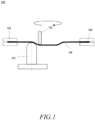
- the incremental forming tool is a rod-shaped tool that is usable as a fixed pressing tool 101 and/or a movable pressing tool 102 of an incremental forming apparatus 100 illustrated in FIG. 1 .
- the incremental forming tool includes a holding part 11 and a free curved surface part 12.
- the holding part 11 is configured to be attached to the incremental forming apparatus 100.
- the free curved surface part 12 is configured to press a metal plate.
- the free curved surface part 12 is made of at least a hard metal base material 13 and has a hard film 14 that contains crystalline carbon, on a surface thereof.
- the incremental forming tool of the present invention which has a free curved surface part that is formed of combination of multiple linear shapes, is different from a cutting tool and so on that are formed of a simple linear shape, such a straight line or a spiral, and it has a large area to be in contact with a metal plate and tends to be applied with a very large load.
- the surface shape of the free curved surface part to be in contact with a metal plate, which is a workpiece greatly affects not only the surface quality of the metal plate but also the product life (load-bearing capacity) of the incremental forming tool itself.
- the surface shape of the free curved surface part is particularly important for the incremental forming tool.
- the surface of the hard film has an Rpk of 0.15 ⁇ m or less and has an Ra of 0.2 ⁇ m or less.
- the value of Rpk is calculated from a material ratio curve of a roughness curve specified in JIS B 0671.
- the value of Ra is calculated from a roughness curve specified in JIS B 0601.
- the values of Rpk and Ra are, respectively, preferably 0.08 ⁇ m or less and 0.1 ⁇ m or less, more preferably 0.05 ⁇ m or less and 0.1 ⁇ m or less, and further preferably 0.05 ⁇ m or less and 0.07 ⁇ m or less.
- the value of Ra is an average value showing a roughness state of a section that is extracted from a roughness curve by a reference length.
- One step of the roughness curve does not greatly affect a measured value, whereby Ra can most accurately represent conditions of surface roughness in a wide area.
- an incremental forming tool has large protrusions, even though having a sufficiently small Ra, the protrusions scratch off a surface of a mating material to generate linear marks and the like, resulting in deterioration in surface quality.
- abrasive particles that are generated at this time may clog recesses, which causes metals to be brought into contact with each other to occur adhesion, whereby surface quality may be greatly deteriorated.
- the recesses that are generated by scratching of the protrusions may remain as damage on the surface of a formed object, and a satisfactory appearance may not be obtained.
- the incremental forming tool which has the hard film on the surface, has a high wear resistance, and the large protrusions hardly wear.
- the incremental forming tool can make scratches on a worked surface over a long period of time.
- Rpk which represents an average height of reduced peaks above a core part of a material ratio curve of a roughness curve, is set to 0.15 ⁇ m or less. This prevents the incremental forming tool from deeply scratching a surface of a metal plate. In this manner, a formed object having a smooth surface can be obtained although processing conditions are not set so as to melt the surface of the metal plate.
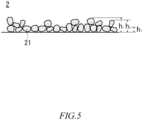
- the incremental forming tool in which the surface of the hard film has an Rpk of 0.15 ⁇ m or less, can be manufactured by selectively grinding largely protruding peaks on the surface of the hard film so as to uniform the height of the peaks, as illustrated in FIG. 3 .
- the largely protruding peaks can be selectively ground by using a polishing sheet of fixed abrasive grains that have a constant size and a uniform height and that are regularly arranged, as illustrated in FIG. 4 .
- the sizes of the abrasive grains may be uniform, but the abrasive grains may cohere together to produce large abrasive grain lumps.
- These abrasive grains are difficult to uniformly disperse, and uneven distribution of the abrasive grains cannot be completely eliminated. For these reasons, it is difficult to uniform the heights of peaks on the surface of the incremental forming tool.
- a polishing sheet of fixed abrasive grains that have a constant size and a uniform height and that are regularly arranged is held between a jig and the incremental forming tool, as illustrated in FIG. 6 .
- the jig has a curvature slightly smaller (has a radius slightly larger) than that of the free curved surface of the incremental forming tool. Under these conditions, as shown by the arrows in FIG. 6 , while the incremental forming tool is rotated, and the jig is swung, the polishing sheet is moved in one direction, whereby protruding peaks are selectively ground to have a uniform height.
- Rpk and smaller Ra of the surface of the hard film are more preferable, but from the point of view of productivity such as polishing time, a practical lower limit of Rpk is approximately 0.001 ⁇ m, whereas a practical lower limit of Ra is approximately 0.001 ⁇ m.
- the hard film that contains crystalline carbon can use a diamond film.
- a diamond film is formed of synthetic diamond that is manufactured by chemical vapor deposition (CVD) using a hydrocarbon gas mixture.
- a diamond film can be manufactured by a hot-filament CVD method or a microwave plasma CVD method.
- the hard film that contains crystalline carbon can be easily formed on the free curved surface of the hard metal base material by using a CVD method.
- a diamond film has a low friction coefficient and a high hardness and can be increased in thickness.
- the hard film which is a diamond film formed by the CVD method, contains carbon (C) of 99 mass % or greater. Even though the hard film is formed of diamond, if binder of a metal such as cobalt (Co), binder of hard ceramics, or another binder, exists at interfaces between diamond grains, as in a diamond sintered body (PCD), the binder that contains a metal component has a high affinity with a metal plate, whereby cohesion occurs, and a worked surface is roughened. In the state in which the amount of carbon (C) in the hard film is in the above-described range, the affinity for the metal plate is reduced, resulting in prevention of adhesion.
- a metal such as cobalt (Co)
- PCD diamond sintered body
- the diamond film is preferably polycrystal.
- Polycrystalline diamond has characteristics that do not vary by a crystalline plane and a crystal orientation, and it has isotropic characteristics, unlike single crystal diamond. Thus, polycrystalline diamond shows uniform characteristics in all orientations, and it is hard and is hardly cleaved, with respect to a force from each direction, while having a high load-bearing capacity.
- the film thickness of the hard film is preferably 5 ⁇ m or greater and 30 ⁇ m or less, and it is more preferably 10 ⁇ m or greater and 20 ⁇ m or less.
- the film thickness of the hard film is preferably 5 ⁇ m or greater and 30 ⁇ m or less, and it is more preferably 10 ⁇ m or greater and 20 ⁇ m or less.
- the film thickness of the hard film is too thin, cleavage easily occurs, and load-bearing capacity is reduced, whereby it is difficult to form a metal plate by sufficiently pressing it.
- the film thickness of the hard film is too thick, residual stress of the hard film that is generated in depositing the hard film, increases, which may make the hard film be easily cleaved in incremental forming.
- a relationship between the film thickness of the hard film and surface pressure for pressing a metal plate is illustrated in FIG. 7 .
- the hard metal base material can use any material that has a high hardness and that allows forming a diamond film thereon.
- An example of the hard metal base material includes a cemented carbide alloy made of a mixture of tungsten carbide (WC) and cobalt (Co).
- the value of Rpk of the free curved surface part of the hard metal base material is preferably 0.04 ⁇ m or greater, more preferably 0.05 ⁇ m or greater, further preferably 0.08 ⁇ m or greater, and yet further preferably 0.1 ⁇ m or greater and 0.25 ⁇ m or less.
- Ra is preferably 0.15 ⁇ m or greater and 0.4 ⁇ m or less.
- the hard metal base material can be manufactured as follows: a free curved surface having a desired shape is formed by polishing, and then, the surface thereof is roughened by an acid treatment or the like.
- a metal plate that can be formed by the incremental forming tool of the present invention is not specifically limited on the condition that it can be plastically deformed.
- the metal plate include metal plate materials such as of galvanized steel, mild steel, high tensile strength steel, stainless steel, and aluminum alloy.
- Table 1 A relationship between the type of metal plate and surface pressure (GPa) required in incremental forming of the PAD metal plate is shown in Table 1.
- R a ( ⁇ m) Thickness (mm) Surface Pressure (Gpa) Galvanized Steel Plate 0.2 to 1.5 0.35 to 2.5 11.0 Mild Steel 0.2 to 1.5 0.35 to 2.5 11.0 High Tensile Strength Steel Plate 0.2 to 1.5 0.35 to 1.5 11.0 Stainless Steel Plate 0.05 to 0.2 0.35 to 2.5 12.0 Aluminum Alloy Plate 0.1 to 1.5 0.35 to 2.5 4.8
- a hard metal base material (cemented carbide alloy) of a 20-mm diameter rod made of WC and containing 6 % of Co was prepared. After the surface of the hard metal base material was polished, a free curved surface part having a desired shape was formed. Then, the free curved surface part was immersed in a 5 % nitric acid solution for 10 minutes at room temperature, whereby cobalt in the hard metal base material was liquated, and the surface was roughened.
- a hard film containing crystalline carbon (diamond film, which is a diamond film formed by a CVD method) having a thickness of 20 ⁇ m was formed on the roughened surface of the free curved surface part of the hard metal base material by a hot-filament CVD method.
- the surface of the hard film was brought into contact with a polishing sheet (manufactured by 3M, Trizact diamond lapping film) of fixed abrasive grains that have a constant size and a uniform height and that are regularly arranged. Moreover, a jig that has a curvature slightly smaller than that of the free curved surface of the incremental forming tool was pressed against the polishing sheet to support it from a back side.
- a polishing sheet manufactured by 3M, Trizact diamond lapping film
- polishing sheet was moved in one direction. Polishing was thus performed for 12 hours, whereby the hard metal base material was produced.
- Incremental forming tools were produced in the same manner as in Example 1, except that roughening of the surface of the hard metal base material and polishing of the hard film were performed under the conditions shown in Table 2.
- the surface roughness of the hard metal base material was measured after the surface of the hard metal base material was roughened, and the surface roughness of the hard film was measured after the hard film was polished. Then, the immersion time of the hard metal base material and the polishing time of the hard film were finely adjusted so as to achieve a desired roughness.
- An incremental forming tool was produced in the same manner as in Example 1, except that polishing was performed under the conditions shown in Table 2 by using a polishing sheet (manufactured by 3M, diamond lapping film) of abrasive grains that are dispersed and fixed on the sheet and that have non-uniform heights.
- a polishing sheet manufactured by 3M, diamond lapping film
- An incremental forming tool was produced in the same manner as in Example 1, except that a diamond sintered body (PCD) was formed on the surface of the hard metal base material and that polishing was performed under the conditions shown in Table 2.
- PCD diamond sintered body
- Rpk and Ra of the hard film were measured in conformity with JIS B 0671-2002 and specifications in JIS B 0601-2001, respectively, by using a stylus profilometer.
- the hard film was peeled off, and Rpk and Ra of the surface of the hard metal base material were measured in the same manner as in the case of the hard film.
- the film thickness of the hard film was measured under the following conditions by FT-IR interferometry.
- a reflection spectrum of a sample was measured by using gold as a reference.
- Fracture strength was evaluated as follows: a load was continuously applied to the hard film via a carbide indenter (6-mm diameter ball), and an acoustic emission (AE) wave that occurred in response to generation of a crack due to elastic deformation of the hard film was detected as sound.
- AE acoustic emission
- Example 1 10 0.272 0.194 0.023 0.010 20
- Example 2 15 0.393 0.157 0.003 0.003 20
- Example 3 10 0.272 0.194 0.003 0.003 20
- Example 4 5 0.130 0.102 0.004 0.003 20
- Example 5 10 0.364 0.201 0.182 0.116 20
- Example 6 10 0.287 0.202 0.139 0.097 20
- Example 7 10 0.360 0.197 0.007 0.005 20
- Example 8 30 0.372 0.352 0.028 0.007 20
- Example 9 10 0.196 0.189 0.048 0.036 20
- Example 11 15 0.252 0.165 0.005 0.005
- Example 8 showed a low load-bearing capacity due to excessively roughening the surface of the hard metal base material.
- the Rpk of the hard film did not become 0.15 ⁇ m or less.
- the value of Ra of the formed object was calculated by averaging values of freely-selected five points that were measured in conformity with specifications in JIS B 0601-2001, by using a stylus profilometer.
Landscapes
- Engineering & Computer Science (AREA)
- Mechanical Engineering (AREA)
- Chemical & Material Sciences (AREA)
- Materials Engineering (AREA)
- Finish Polishing, Edge Sharpening, And Grinding By Specific Grinding Devices (AREA)
- Shaping Metal By Deep-Drawing, Or The Like (AREA)
- Mounting, Exchange, And Manufacturing Of Dies (AREA)
Claims (7)
- Inkrementelles Umformwerkzeug (1), umfassend:einen Halteabschnitt (11), der so konfiguriert ist, dass er an einer inkrementellen Umformvorrichtung (100) anbringbar ist; undeinen frei gekrümmten Oberflächenabschnitt (12), der zum Pressen einer Metallplatte (104) konfiguriert ist,wobei der frei gekrümmte Oberflächenabschnitt (12) aus wenigstens einem Hartmetall-Basismaterial (13) besteht und eine Hartschicht (14), die kristallinen Kohlenstoff enthält, auf einer Oberfläche des frei gekrümmten Oberflächenabschnitts (12) aufweist, undwobei eine Oberfläche der Hartschicht (14) einen arithmetischen Mittenrauwert (Ra) von 0,2 µm oder weniger und 0,001 µm oder mehr aufweist, der aus einem in JIS B 0601-2001 spezifizierten Rauheitsprofil berechnet wird,dadurch gekennzeichnet, dassdie Oberfläche der Hartschicht (14) eine durchschnittliche reduzierte Spitzenhöhe (Rpk) von 0,15 µm oder weniger und 0,001 µm oder mehr aufweist, die aus einer Materialverhältniskurve eines in JIS B 0671-2002 spezifizierten Rauheitsprofils berechnet wird.
- Inkrementelles Umformwerkzeug (1) nach Anspruch 1, wobei die Oberfläche der Hartschicht (14) einen Rpk-Wert von 0,08 µm oder weniger, berechnet aus einer Materialverhältniskurve eines in JIS B 0671-2002 spezifizierten Rauheitsprofils, und auch einen Ra-Wert von 0,1 µm oder weniger, berechnet aus einem in JIS B 0601-2001 spezifizierten Rauheitsprofil, aufweist.
- Inkrementelles Umformwerkzeug (1) nach Anspruch 1 oder 2, wobei eine Oberfläche des Hartmetall-Basismaterials (13) des frei gekrümmten Oberflächenabschnitts (12) einen Rpk-Wert von 0,04 µm oder mehr und 0,25 µm oder weniger aufweist, der aus einer Materialverhältniskurve eines in JIS B 0671-2002 spezifizierten Rauheitsprofils berechnet wird.
- Inkrementelles Umformwerkzeug (1) nach einem der Ansprüche 1 bis 3, wobei die Oberfläche des Hartmetall-Basismaterials (13) des frei gekrümmten Oberflächenabschnitts (12) einen Rpk-Wert von 0,1 µm oder mehr und 0,25 µm oder weniger aufweist, der aus einer Materialverhältniskurve eines in JIS B 0671-2002 spezifizierten Rauheitsprofils berechnet wird.
- Inkrementelles Umformwerkzeug (1) nach einem der Ansprüche 1 bis 4, wobei die Oberfläche des Hartmetall-Basismaterials (13) des frei gekrümmten Oberflächenabschnitts (12) einen Ra-Wert von 0,15 µm oder mehr und 0,4 µm oder weniger aufweist, der aus einem in JIS B 0601-2001 spezifizierten Rauheitsprofil berechnet wird.
- Inkrementelles Umformwerkzeug (1) nach einem der Ansprüche 1 bis 5, wobei die Hartschicht (14) eine Schichtdicke von 5 µm oder mehr und 30 µm oder weniger aufweist.
- Inkrementelles Umformwerkzeug (1) nach einem der Ansprüche 1 bis 6, wobei die Hartschicht (14) aus Diamant besteht, der durch ein Verfahren der chemischen Gasphasenabscheidung (CVD) gebildet ist.
Applications Claiming Priority (1)
| Application Number | Priority Date | Filing Date | Title |
|---|---|---|---|
| PCT/IB2020/000524 WO2021229254A1 (ja) | 2020-05-14 | 2020-05-14 | 逐次成形用工具 |
Publications (3)
| Publication Number | Publication Date |
|---|---|
| EP4151332A1 EP4151332A1 (de) | 2023-03-22 |
| EP4151332A4 EP4151332A4 (de) | 2023-06-21 |
| EP4151332B1 true EP4151332B1 (de) | 2024-08-07 |
Family
ID=78525365
Family Applications (1)
| Application Number | Title | Priority Date | Filing Date |
|---|---|---|---|
| EP20935308.5A Active EP4151332B1 (de) | 2020-05-14 | 2020-05-14 | Inkrementelles umformwerkzeug |
Country Status (5)
| Country | Link |
|---|---|
| US (1) | US11819900B2 (de) |
| EP (1) | EP4151332B1 (de) |
| JP (1) | JP7300096B2 (de) |
| CN (1) | CN115551654A (de) |
| WO (1) | WO2021229254A1 (de) |
Families Citing this family (1)
| Publication number | Priority date | Publication date | Assignee | Title |
|---|---|---|---|---|
| JP2023092216A (ja) * | 2021-12-21 | 2023-07-03 | 日産自動車株式会社 | 逐次成形装置及び逐次成形方法 |
Family Cites Families (14)
| Publication number | Priority date | Publication date | Assignee | Title |
|---|---|---|---|---|
| JP2006144100A (ja) * | 2004-11-24 | 2006-06-08 | Nissan Motor Co Ltd | 自動車エンジン用摺動部材 |
| US7543557B2 (en) * | 2005-09-01 | 2009-06-09 | Gm Global Technology Operations, Inc. | Scuff resistant aluminum piston and aluminum cylinder bore combination and method of making |
| JP2007313636A (ja) * | 2006-04-27 | 2007-12-06 | Kyocera Corp | 切削工具およびそれを用いた被削材の切削方法 |
| JP4954644B2 (ja) * | 2006-08-31 | 2012-06-20 | 日本ピストンリング株式会社 | シリンダライナとピストンリングの組み合わせ |
| JP5804589B2 (ja) * | 2010-02-10 | 2015-11-04 | 日立金属株式会社 | 摺動特性に優れた被覆金型または鋳造用部材及びその製造方法 |
| US8783078B2 (en) * | 2010-07-27 | 2014-07-22 | Ford Global Technologies, Llc | Method to improve geometrical accuracy of an incrementally formed workpiece |
| JP2014095392A (ja) * | 2012-11-07 | 2014-05-22 | Toyota Motor Corp | 歯車およびその製造方法 |
| EP2963317B1 (de) | 2013-02-28 | 2019-03-27 | Nippon Piston Ring Co., Ltd. | Hartkohlenstoffbeschichtungsfilm |
| US10500629B2 (en) * | 2014-10-07 | 2019-12-10 | The Penn State Research Foundation | Method for reducing springback using electrically-assisted manufacturing |
| JP6493111B2 (ja) | 2015-09-11 | 2019-04-03 | 日産自動車株式会社 | 逐次成形方法、逐次成形装置及び逐次成形方法用工具 |
| JP6701570B2 (ja) * | 2016-06-06 | 2020-05-27 | 日産自動車株式会社 | 逐次成形方法及び逐次成形装置 |
| JP6685509B2 (ja) * | 2016-07-29 | 2020-04-22 | 日産自動車株式会社 | 逐次成形用工具及びこれを用いた逐次成形方法 |
| JP7033399B2 (ja) | 2017-05-15 | 2022-03-10 | 日産自動車株式会社 | 摺動機構 |
| US12064801B2 (en) * | 2019-02-14 | 2024-08-20 | Northwestern University | In-situ springback compensation in incremental sheet forming |
-
2020
- 2020-05-14 WO PCT/IB2020/000524 patent/WO2021229254A1/ja not_active Ceased
- 2020-05-14 JP JP2022522077A patent/JP7300096B2/ja active Active
- 2020-05-14 US US17/924,773 patent/US11819900B2/en active Active
- 2020-05-14 CN CN202080100755.2A patent/CN115551654A/zh active Pending
- 2020-05-14 EP EP20935308.5A patent/EP4151332B1/de active Active
Also Published As
| Publication number | Publication date |
|---|---|
| EP4151332A1 (de) | 2023-03-22 |
| US11819900B2 (en) | 2023-11-21 |
| EP4151332A4 (de) | 2023-06-21 |
| JP7300096B2 (ja) | 2023-06-29 |
| JPWO2021229254A1 (de) | 2021-11-18 |
| US20230191471A1 (en) | 2023-06-22 |
| WO2021229254A1 (ja) | 2021-11-18 |
| CN115551654A (zh) | 2022-12-30 |
Similar Documents
| Publication | Publication Date | Title |
|---|---|---|
| JP6477867B2 (ja) | 被覆金型およびその製造方法 | |
| JP5351875B2 (ja) | 塑性加工用金型およびその製造方法、ならびにアルミニウム材の鍛造方法 | |
| EP0480878B1 (de) | (CBN)-kristallines-Bornitrid-Schleifwerkzeug | |
| US4496372A (en) | Abrasive bodies | |
| EP2700734B1 (de) | Pressformungsmatrize und verfahren zur herstellung eines schutzfilms für die pressformungsmatrize | |
| EP2239228A1 (de) | Polykristalliner diamant | |
| EP3054027B1 (de) | Verfahren zur verbesserung der haftung einer niedertemperaturkeramikbeschichtung | |
| CN1067002A (zh) | 将超硬磨料镀涂于镗磨头上的改进的工艺 | |
| JP2000246512A (ja) | ダイヤモンド類被覆切削工具 | |
| US6655181B2 (en) | Coating for superplastic and quick plastic forming tool and process of using | |
| EP4151332B1 (de) | Inkrementelles umformwerkzeug | |
| CN1042110C (zh) | 棱边式珩磨装置 | |
| JP6308298B2 (ja) | 被覆工具の製造方法 | |
| JP4873617B2 (ja) | 低摩擦特性と耐剥離性を有する硬質膜の被覆部材 | |
| JP5031182B2 (ja) | 超硬合金 | |
| JP3132981B2 (ja) | 切断砥石 | |
| JP5382638B2 (ja) | マグネシウム合金部材の成形方法およびその成形用金型 | |
| JPH0797603A (ja) | ダイヤモンド被覆用セラミック基基材及び被覆用基材の製造方法 | |
| JP2001501543A (ja) | トラッキングを最小限にするように配列したピーニング粒子を備えたピーニング物品 | |
| JP4360618B2 (ja) | 表面被覆切削工具 | |
| JP4825490B2 (ja) | ダイヤモンド膜被覆部材の製造方法 | |
| CN212635388U (zh) | 一种钢丝的喷砂机构 | |
| JPH02283627A (ja) | 光学ガラス素子成形用の成形型 | |
| JP2003211361A (ja) | ダイヤモンド研磨用砥石により得られたダイヤモンド研磨加工体、単結晶ダイヤモンド及びダイヤモンド焼結体 | |
| JP2001025971A (ja) | ダイヤモンド研磨用砥石及びダイヤモンド研磨方法並びにダイヤモンド研磨加工体 |
Legal Events
| Date | Code | Title | Description |
|---|---|---|---|
| STAA | Information on the status of an ep patent application or granted ep patent |
Free format text: STATUS: THE INTERNATIONAL PUBLICATION HAS BEEN MADE |
|
| PUAI | Public reference made under article 153(3) epc to a published international application that has entered the european phase |
Free format text: ORIGINAL CODE: 0009012 |
|
| STAA | Information on the status of an ep patent application or granted ep patent |
Free format text: STATUS: REQUEST FOR EXAMINATION WAS MADE |
|
| 17P | Request for examination filed |
Effective date: 20221122 |
|
| AK | Designated contracting states |
Kind code of ref document: A1 Designated state(s): AL AT BE BG CH CY CZ DE DK EE ES FI FR GB GR HR HU IE IS IT LI LT LU LV MC MK MT NL NO PL PT RO RS SE SI SK SM TR |
|
| A4 | Supplementary search report drawn up and despatched |
Effective date: 20230522 |
|
| RIC1 | Information provided on ipc code assigned before grant |
Ipc: C23C 16/27 20060101ALI20230515BHEP Ipc: B21D 22/18 20060101AFI20230515BHEP |
|
| DAV | Request for validation of the european patent (deleted) | ||
| DAX | Request for extension of the european patent (deleted) | ||
| STAA | Information on the status of an ep patent application or granted ep patent |
Free format text: STATUS: EXAMINATION IS IN PROGRESS |
|
| 17Q | First examination report despatched |
Effective date: 20231121 |
|
| GRAP | Despatch of communication of intention to grant a patent |
Free format text: ORIGINAL CODE: EPIDOSNIGR1 |
|
| STAA | Information on the status of an ep patent application or granted ep patent |
Free format text: STATUS: GRANT OF PATENT IS INTENDED |
|
| INTG | Intention to grant announced |
Effective date: 20240424 |
|
| GRAS | Grant fee paid |
Free format text: ORIGINAL CODE: EPIDOSNIGR3 |
|
| GRAA | (expected) grant |
Free format text: ORIGINAL CODE: 0009210 |
|
| STAA | Information on the status of an ep patent application or granted ep patent |
Free format text: STATUS: THE PATENT HAS BEEN GRANTED |
|
| AK | Designated contracting states |
Kind code of ref document: B1 Designated state(s): AL AT BE BG CH CY CZ DE DK EE ES FI FR GB GR HR HU IE IS IT LI LT LU LV MC MK MT NL NO PL PT RO RS SE SI SK SM TR |
|
| REG | Reference to a national code |
Ref country code: GB Ref legal event code: FG4D |
|
| REG | Reference to a national code |
Ref country code: CH Ref legal event code: EP |
|
| REG | Reference to a national code |
Ref country code: IE Ref legal event code: FG4D |
|
| REG | Reference to a national code |
Ref country code: DE Ref legal event code: R096 Ref document number: 602020035568 Country of ref document: DE |
|
| REG | Reference to a national code |
Ref country code: LT Ref legal event code: MG9D |
|
| REG | Reference to a national code |
Ref country code: NL Ref legal event code: MP Effective date: 20240807 |
|
| PG25 | Lapsed in a contracting state [announced via postgrant information from national office to epo] |
Ref country code: NO Free format text: LAPSE BECAUSE OF FAILURE TO SUBMIT A TRANSLATION OF THE DESCRIPTION OR TO PAY THE FEE WITHIN THE PRESCRIBED TIME-LIMIT Effective date: 20241107 |
|
| REG | Reference to a national code |
Ref country code: AT Ref legal event code: MK05 Ref document number: 1710384 Country of ref document: AT Kind code of ref document: T Effective date: 20240807 |
|
| PG25 | Lapsed in a contracting state [announced via postgrant information from national office to epo] |
Ref country code: GR Free format text: LAPSE BECAUSE OF FAILURE TO SUBMIT A TRANSLATION OF THE DESCRIPTION OR TO PAY THE FEE WITHIN THE PRESCRIBED TIME-LIMIT Effective date: 20241108 Ref country code: NL Free format text: LAPSE BECAUSE OF FAILURE TO SUBMIT A TRANSLATION OF THE DESCRIPTION OR TO PAY THE FEE WITHIN THE PRESCRIBED TIME-LIMIT Effective date: 20240807 Ref country code: FI Free format text: LAPSE BECAUSE OF FAILURE TO SUBMIT A TRANSLATION OF THE DESCRIPTION OR TO PAY THE FEE WITHIN THE PRESCRIBED TIME-LIMIT Effective date: 20240807 Ref country code: PL Free format text: LAPSE BECAUSE OF FAILURE TO SUBMIT A TRANSLATION OF THE DESCRIPTION OR TO PAY THE FEE WITHIN THE PRESCRIBED TIME-LIMIT Effective date: 20240807 Ref country code: PT Free format text: LAPSE BECAUSE OF FAILURE TO SUBMIT A TRANSLATION OF THE DESCRIPTION OR TO PAY THE FEE WITHIN THE PRESCRIBED TIME-LIMIT Effective date: 20241209 |
|
| PG25 | Lapsed in a contracting state [announced via postgrant information from national office to epo] |
Ref country code: BG Free format text: LAPSE BECAUSE OF FAILURE TO SUBMIT A TRANSLATION OF THE DESCRIPTION OR TO PAY THE FEE WITHIN THE PRESCRIBED TIME-LIMIT Effective date: 20240807 |
|
| PG25 | Lapsed in a contracting state [announced via postgrant information from national office to epo] |
Ref country code: LV Free format text: LAPSE BECAUSE OF FAILURE TO SUBMIT A TRANSLATION OF THE DESCRIPTION OR TO PAY THE FEE WITHIN THE PRESCRIBED TIME-LIMIT Effective date: 20240807 |
|
| PG25 | Lapsed in a contracting state [announced via postgrant information from national office to epo] |
Ref country code: AT Free format text: LAPSE BECAUSE OF FAILURE TO SUBMIT A TRANSLATION OF THE DESCRIPTION OR TO PAY THE FEE WITHIN THE PRESCRIBED TIME-LIMIT Effective date: 20240807 Ref country code: IS Free format text: LAPSE BECAUSE OF FAILURE TO SUBMIT A TRANSLATION OF THE DESCRIPTION OR TO PAY THE FEE WITHIN THE PRESCRIBED TIME-LIMIT Effective date: 20241207 |
|
| PG25 | Lapsed in a contracting state [announced via postgrant information from national office to epo] |
Ref country code: HR Free format text: LAPSE BECAUSE OF FAILURE TO SUBMIT A TRANSLATION OF THE DESCRIPTION OR TO PAY THE FEE WITHIN THE PRESCRIBED TIME-LIMIT Effective date: 20240807 |
|
| PG25 | Lapsed in a contracting state [announced via postgrant information from national office to epo] |
Ref country code: RS Free format text: LAPSE BECAUSE OF FAILURE TO SUBMIT A TRANSLATION OF THE DESCRIPTION OR TO PAY THE FEE WITHIN THE PRESCRIBED TIME-LIMIT Effective date: 20241107 Ref country code: ES Free format text: LAPSE BECAUSE OF FAILURE TO SUBMIT A TRANSLATION OF THE DESCRIPTION OR TO PAY THE FEE WITHIN THE PRESCRIBED TIME-LIMIT Effective date: 20240807 |
|
| PG25 | Lapsed in a contracting state [announced via postgrant information from national office to epo] |
Ref country code: RS Free format text: LAPSE BECAUSE OF FAILURE TO SUBMIT A TRANSLATION OF THE DESCRIPTION OR TO PAY THE FEE WITHIN THE PRESCRIBED TIME-LIMIT Effective date: 20241107 Ref country code: PT Free format text: LAPSE BECAUSE OF FAILURE TO SUBMIT A TRANSLATION OF THE DESCRIPTION OR TO PAY THE FEE WITHIN THE PRESCRIBED TIME-LIMIT Effective date: 20241209 Ref country code: PL Free format text: LAPSE BECAUSE OF FAILURE TO SUBMIT A TRANSLATION OF THE DESCRIPTION OR TO PAY THE FEE WITHIN THE PRESCRIBED TIME-LIMIT Effective date: 20240807 Ref country code: NO Free format text: LAPSE BECAUSE OF FAILURE TO SUBMIT A TRANSLATION OF THE DESCRIPTION OR TO PAY THE FEE WITHIN THE PRESCRIBED TIME-LIMIT Effective date: 20241107 Ref country code: NL Free format text: LAPSE BECAUSE OF FAILURE TO SUBMIT A TRANSLATION OF THE DESCRIPTION OR TO PAY THE FEE WITHIN THE PRESCRIBED TIME-LIMIT Effective date: 20240807 Ref country code: LV Free format text: LAPSE BECAUSE OF FAILURE TO SUBMIT A TRANSLATION OF THE DESCRIPTION OR TO PAY THE FEE WITHIN THE PRESCRIBED TIME-LIMIT Effective date: 20240807 Ref country code: IS Free format text: LAPSE BECAUSE OF FAILURE TO SUBMIT A TRANSLATION OF THE DESCRIPTION OR TO PAY THE FEE WITHIN THE PRESCRIBED TIME-LIMIT Effective date: 20241207 Ref country code: HR Free format text: LAPSE BECAUSE OF FAILURE TO SUBMIT A TRANSLATION OF THE DESCRIPTION OR TO PAY THE FEE WITHIN THE PRESCRIBED TIME-LIMIT Effective date: 20240807 Ref country code: GR Free format text: LAPSE BECAUSE OF FAILURE TO SUBMIT A TRANSLATION OF THE DESCRIPTION OR TO PAY THE FEE WITHIN THE PRESCRIBED TIME-LIMIT Effective date: 20241108 Ref country code: FI Free format text: LAPSE BECAUSE OF FAILURE TO SUBMIT A TRANSLATION OF THE DESCRIPTION OR TO PAY THE FEE WITHIN THE PRESCRIBED TIME-LIMIT Effective date: 20240807 Ref country code: ES Free format text: LAPSE BECAUSE OF FAILURE TO SUBMIT A TRANSLATION OF THE DESCRIPTION OR TO PAY THE FEE WITHIN THE PRESCRIBED TIME-LIMIT Effective date: 20240807 Ref country code: BG Free format text: LAPSE BECAUSE OF FAILURE TO SUBMIT A TRANSLATION OF THE DESCRIPTION OR TO PAY THE FEE WITHIN THE PRESCRIBED TIME-LIMIT Effective date: 20240807 Ref country code: AT Free format text: LAPSE BECAUSE OF FAILURE TO SUBMIT A TRANSLATION OF THE DESCRIPTION OR TO PAY THE FEE WITHIN THE PRESCRIBED TIME-LIMIT Effective date: 20240807 |
|
| PG25 | Lapsed in a contracting state [announced via postgrant information from national office to epo] |
Ref country code: DK Free format text: LAPSE BECAUSE OF FAILURE TO SUBMIT A TRANSLATION OF THE DESCRIPTION OR TO PAY THE FEE WITHIN THE PRESCRIBED TIME-LIMIT Effective date: 20240807 Ref country code: SM Free format text: LAPSE BECAUSE OF FAILURE TO SUBMIT A TRANSLATION OF THE DESCRIPTION OR TO PAY THE FEE WITHIN THE PRESCRIBED TIME-LIMIT Effective date: 20240807 |
|
| PG25 | Lapsed in a contracting state [announced via postgrant information from national office to epo] |
Ref country code: EE Free format text: LAPSE BECAUSE OF FAILURE TO SUBMIT A TRANSLATION OF THE DESCRIPTION OR TO PAY THE FEE WITHIN THE PRESCRIBED TIME-LIMIT Effective date: 20240807 |
|
| PG25 | Lapsed in a contracting state [announced via postgrant information from national office to epo] |
Ref country code: CZ Free format text: LAPSE BECAUSE OF FAILURE TO SUBMIT A TRANSLATION OF THE DESCRIPTION OR TO PAY THE FEE WITHIN THE PRESCRIBED TIME-LIMIT Effective date: 20240807 |
|
| PG25 | Lapsed in a contracting state [announced via postgrant information from national office to epo] |
Ref country code: SK Free format text: LAPSE BECAUSE OF FAILURE TO SUBMIT A TRANSLATION OF THE DESCRIPTION OR TO PAY THE FEE WITHIN THE PRESCRIBED TIME-LIMIT Effective date: 20240807 |
|
| REG | Reference to a national code |
Ref country code: DE Ref legal event code: R097 Ref document number: 602020035568 Country of ref document: DE |
|
| PLBE | No opposition filed within time limit |
Free format text: ORIGINAL CODE: 0009261 |
|
| STAA | Information on the status of an ep patent application or granted ep patent |
Free format text: STATUS: NO OPPOSITION FILED WITHIN TIME LIMIT |
|
| PGFP | Annual fee paid to national office [announced via postgrant information from national office to epo] |
Ref country code: DE Payment date: 20250423 Year of fee payment: 6 |
|
| PGFP | Annual fee paid to national office [announced via postgrant information from national office to epo] |
Ref country code: GB Payment date: 20250423 Year of fee payment: 6 |
|
| 26N | No opposition filed |
Effective date: 20250508 |
|
| PGFP | Annual fee paid to national office [announced via postgrant information from national office to epo] |
Ref country code: FR Payment date: 20250423 Year of fee payment: 6 |
|
| PG25 | Lapsed in a contracting state [announced via postgrant information from national office to epo] |
Ref country code: SE Free format text: LAPSE BECAUSE OF FAILURE TO SUBMIT A TRANSLATION OF THE DESCRIPTION OR TO PAY THE FEE WITHIN THE PRESCRIBED TIME-LIMIT Effective date: 20240807 |