EP4150683B1 - Elektrode für eine lithium-ionen-batterie und verfahren zu ihrer herstellung - Google Patents
Elektrode für eine lithium-ionen-batterie und verfahren zu ihrer herstellung Download PDFInfo
- Publication number
- EP4150683B1 EP4150683B1 EP21724331.0A EP21724331A EP4150683B1 EP 4150683 B1 EP4150683 B1 EP 4150683B1 EP 21724331 A EP21724331 A EP 21724331A EP 4150683 B1 EP4150683 B1 EP 4150683B1
- Authority
- EP
- European Patent Office
- Prior art keywords
- cathode
- sebs
- electrode
- active material
- anode
- Prior art date
- Legal status (The legal status is an assumption and is not a legal conclusion. Google has not performed a legal analysis and makes no representation as to the accuracy of the status listed.)
- Active
Links
Images




Classifications
-
- H—ELECTRICITY
- H01—ELECTRIC ELEMENTS
- H01M—PROCESSES OR MEANS, e.g. BATTERIES, FOR THE DIRECT CONVERSION OF CHEMICAL ENERGY INTO ELECTRICAL ENERGY
- H01M10/00—Secondary cells; Manufacture thereof
- H01M10/05—Accumulators with non-aqueous electrolyte
- H01M10/052—Li-accumulators
- H01M10/0525—Rocking-chair batteries, i.e. batteries with lithium insertion or intercalation in both electrodes; Lithium-ion batteries
-
- H—ELECTRICITY
- H01—ELECTRIC ELEMENTS
- H01M—PROCESSES OR MEANS, e.g. BATTERIES, FOR THE DIRECT CONVERSION OF CHEMICAL ENERGY INTO ELECTRICAL ENERGY
- H01M4/00—Electrodes
- H01M4/02—Electrodes composed of, or comprising, active material
-
- H—ELECTRICITY
- H01—ELECTRIC ELEMENTS
- H01M—PROCESSES OR MEANS, e.g. BATTERIES, FOR THE DIRECT CONVERSION OF CHEMICAL ENERGY INTO ELECTRICAL ENERGY
- H01M4/00—Electrodes
- H01M4/02—Electrodes composed of, or comprising, active material
- H01M4/04—Processes of manufacture in general
- H01M4/0402—Methods of deposition of the material
- H01M4/0404—Methods of deposition of the material by coating on electrode collectors
-
- H—ELECTRICITY
- H01—ELECTRIC ELEMENTS
- H01M—PROCESSES OR MEANS, e.g. BATTERIES, FOR THE DIRECT CONVERSION OF CHEMICAL ENERGY INTO ELECTRICAL ENERGY
- H01M4/00—Electrodes
- H01M4/02—Electrodes composed of, or comprising, active material
- H01M4/04—Processes of manufacture in general
- H01M4/0402—Methods of deposition of the material
- H01M4/0414—Methods of deposition of the material by screen printing
-
- H—ELECTRICITY
- H01—ELECTRIC ELEMENTS
- H01M—PROCESSES OR MEANS, e.g. BATTERIES, FOR THE DIRECT CONVERSION OF CHEMICAL ENERGY INTO ELECTRICAL ENERGY
- H01M4/00—Electrodes
- H01M4/02—Electrodes composed of, or comprising, active material
- H01M4/04—Processes of manufacture in general
- H01M4/0471—Processes of manufacture in general involving thermal treatment, e.g. firing, sintering, backing particulate active material, thermal decomposition, pyrolysis
-
- H—ELECTRICITY
- H01—ELECTRIC ELEMENTS
- H01M—PROCESSES OR MEANS, e.g. BATTERIES, FOR THE DIRECT CONVERSION OF CHEMICAL ENERGY INTO ELECTRICAL ENERGY
- H01M4/00—Electrodes
- H01M4/02—Electrodes composed of, or comprising, active material
- H01M4/13—Electrodes for accumulators with non-aqueous electrolyte, e.g. for lithium-accumulators; Processes of manufacture thereof
-
- H—ELECTRICITY
- H01—ELECTRIC ELEMENTS
- H01M—PROCESSES OR MEANS, e.g. BATTERIES, FOR THE DIRECT CONVERSION OF CHEMICAL ENERGY INTO ELECTRICAL ENERGY
- H01M4/00—Electrodes
- H01M4/02—Electrodes composed of, or comprising, active material
- H01M4/13—Electrodes for accumulators with non-aqueous electrolyte, e.g. for lithium-accumulators; Processes of manufacture thereof
- H01M4/139—Processes of manufacture
-
- H—ELECTRICITY
- H01—ELECTRIC ELEMENTS
- H01M—PROCESSES OR MEANS, e.g. BATTERIES, FOR THE DIRECT CONVERSION OF CHEMICAL ENERGY INTO ELECTRICAL ENERGY
- H01M4/00—Electrodes
- H01M4/02—Electrodes composed of, or comprising, active material
- H01M4/13—Electrodes for accumulators with non-aqueous electrolyte, e.g. for lithium-accumulators; Processes of manufacture thereof
- H01M4/139—Processes of manufacture
- H01M4/1391—Processes of manufacture of electrodes based on mixed oxides or hydroxides, or on mixtures of oxides or hydroxides, e.g. LiCoOx
-
- H—ELECTRICITY
- H01—ELECTRIC ELEMENTS
- H01M—PROCESSES OR MEANS, e.g. BATTERIES, FOR THE DIRECT CONVERSION OF CHEMICAL ENERGY INTO ELECTRICAL ENERGY
- H01M4/00—Electrodes
- H01M4/02—Electrodes composed of, or comprising, active material
- H01M4/62—Selection of inactive substances as ingredients for active masses, e.g. binders, fillers
- H01M4/621—Binders
- H01M4/622—Binders being polymers
-
- Y—GENERAL TAGGING OF NEW TECHNOLOGICAL DEVELOPMENTS; GENERAL TAGGING OF CROSS-SECTIONAL TECHNOLOGIES SPANNING OVER SEVERAL SECTIONS OF THE IPC; TECHNICAL SUBJECTS COVERED BY FORMER USPC CROSS-REFERENCE ART COLLECTIONS [XRACs] AND DIGESTS
- Y02—TECHNOLOGIES OR APPLICATIONS FOR MITIGATION OR ADAPTATION AGAINST CLIMATE CHANGE
- Y02E—REDUCTION OF GREENHOUSE GAS [GHG] EMISSIONS, RELATED TO ENERGY GENERATION, TRANSMISSION OR DISTRIBUTION
- Y02E60/00—Enabling technologies; Technologies with a potential or indirect contribution to GHG emissions mitigation
- Y02E60/10—Energy storage using batteries
Definitions
- the molecular weight of the polystyrene block, polyethylene/butylene block and that of the SEBS are controlled by the ratio and amount of monomers styrene and or butadiene relative to moles of initiator during the anionic polymerization reaction.
- the thickness of the separator is preferably from 0.5 to 40 ⁇ m, more preferably from 1 to 30 ⁇ m, and still more preferably from 1 to 25 ⁇ m from a viewpoint of reducing a resistance due to the separator in a lithium-ion secondary battery and excellent workability in manufacturing the lithium-ion secondary battery with degree of porosity between 40 and 60% .
- the following relative amounts of the solid components were used: 80% active material, 10% polymer binder and 10% conductive additive.
- the total solid content i.e. the total amount of active material, polymer binder and conductive additive, was 40 wt% of the ink cathode formulation.
- the polymer binder content was 6 wt% of the ink cathode formulation.
- a constant volume (1.5 mL) of sample was loaded in a stress controlled rotational rheometer (ARG2, TA Instruments) equipped with 40 mm diameter plates coated with sandpaper to limit wall slip.
- An automatic gap setting protocol with constant travelling speed of plates from back-off distance to sample thickness, was used to produce a similar flow history during sample loading.
- the shearing geometry was tapped with water to avoid any solvent loss during testing.
- a new sample was loaded in the rheometer for each thickness tested.
- a conditioning step (0.5 s -1 steady shear) was first applied to induce the same shear history on each sample. The duration of the step was 60 s to ensure the reading of a steady shear viscosity for all samples.
- the cathodes morphology was evaluated by scanning electron microscopy (SEM) with a NanoSEM-FEI Nova 200 equipment, at different magnifications (25 000 X and 120 000 X) and an acceleration voltage of 10 kV.
- the adhesion between the cathode and the current collector was evaluated as well as the cathode film cohesion and flexibility.
- a homemade "bend tester" with different diameter metal rods between 10.0 mm and 1.5 mm was used.
- three measurements were performed, as explained in Gören A. et al. 2015.
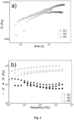
- Figure 2 depicts the extent of reproducibility of the rheological data measured with sample SEBS C-H6110/M3 (Comparative Example 3) in which four tests performed with different sample thickness are reported.
- a qualitatively similar set of data was measured with samples SEBS C-H6110/M1 (Comparative Example 1; see section above) and SEBS C-H6110/M2 (Comparative Example 4).
- SEBS C-H6110/M1 Comparative Example 1; see section above
- SEBS C-H6110/M2 Comparative Example 4
- Figure 3 presents the mean values and error bars of rheological functions computed from the data of four tests performed at different thicknesses. Overall, data displayed in Figure 3 reveal that rheological properties are sensitive to the method used to prepare the three inks.
- sample SEBS C.H6110/M3 shows longer structural build-up after steady shear cessation.
- Figure 3a indicates that G' for sample SEBS C-H61 10/M1 reaches a structural equilibrium at 1000 s after an initial power law behavior typical of glassy or gelled colloidal dispersions.
- the structure of sample SEBS C-H6110/M3 continues to recover after 2000 s and an equilibrium is barely reached within 1 hour.
- Sample SEBS C-H6110/M2 shows an intermediate kinetics.
- the homogeneous structure of the printed cathode plays an important role in battery performance.
- the morphological homogeneity of the samples was thus evaluated by SEM measurements ( Figure 4 ). A good particle distribution is verified in all printed cathodes showing that the ink properties are suitable for screen-printing technique. Aggregation of the components is also not visible in all samples.
- the images show a three-dimensional interconnected structure of all the three battery components (binder, conductive additive and active material). Also evident in all samples is the non-spherical shape of the active material particles, which exhibit a rod like structure with heterogeneous sizes in the order of 2 ⁇ m. The presence of voids along the electrode surface is evident (porosity) and attributed to the solvent evaporation and the difference in particles sizes and shapes. This porosity allows the lithium-ion access to the cathode, increasing the interface area between the electrode and the electrolyte, favoring the intercalation kinetics.
- Figures 4a, b and c show that, once the same dispersion method is applied, the morphology is not depending on the chemical structure of the binder. Comparing the SBS sample ( Figure 4a ; i.e. Comparative example 2) and the SEBS samples ( Figures 4b and c, i.e. Example 1 and Comparative example 1, respectively) prepared using Method 1, one may conclude that the dry mixing of active and conductive additives lead to a similar degree of particle dispersion. Therefore, the presence of ethylene blocks in the SEBS copolymer (not present in the SBS) and the styrene percentage do not affect the cathode morphology since the cathode's porosity (around 70%) and the microstructure are the same.
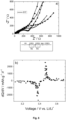
- the DC electrical conductivity is around 10 S.m -1 for the different polymers with the same method dispersion. According to this, a good structural distribution is achieved within the different polymers studied, promoting a good mechanical stability and good cohesion between the different particles.
- the electrical conductivity measurements were performed by the four point probe method with a current source DC 9818 from Time Electronics and a nano-voltmeter 2182 from Keithley.
- Figures 4c, d and e show significant differences in the particle distribution for the samples prepared with inks formulated after the different preparation methods.
- the sample prepared with Method 2 shows that polymer particles are covering the active and conductive particles.
- the presence of copolymer particles can be explained by the fact that, once the particles are first dispersed in the solvent, the resulting slurry has a significant viscosity, which is detrimental to the full solvation of the copolymer.
- the mixing time of the copolymer in the ink is reduced when compared to the two other methods.
- the polymer coating of particles influences not only the mechanical but also the DC electrical conductivity, as electrical connectivity between active materials is promoted.
- the DC electrical conductivity is 19.6 ⁇ 0.9 S.m -1 , that is higher than for the inks prepared by different methods: 8.4 ⁇ 1.5 and 15.7 ⁇ 1.0 S.m -1 for SEBS C-H6110/M1 and SEBS C-H6110/M3, respectively.
- the samples show the same 70% of porosity percentage.
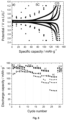
- the cycle stability of the printed cathodes was evaluated after 50 charge/discharge cycles at C- and 2C-rates ( Figure 5c ), all samples showing good stability and high capacity retention over cycling and scan rates.
- the capacity retention after 50 cycles at 2C for the cathodes with the different polymers binders is 85, 93 and 100% for SEBS C-H6110/M1, SBS C-718/M1 and SEBS C-H6180X/M1, respectively.
- the capacity fade between the 2 nd and 50 th cycle was calculated, and it is 40%, 5% and 7% for SEBS C-H6110/M1, SBS C-718/M1 and SEBS C-H6180X/M1, respectively.
Landscapes
- Chemical & Material Sciences (AREA)
- Engineering & Computer Science (AREA)
- Chemical Kinetics & Catalysis (AREA)
- Electrochemistry (AREA)
- General Chemical & Material Sciences (AREA)
- Manufacturing & Machinery (AREA)
- Materials Engineering (AREA)
- Battery Electrode And Active Subsutance (AREA)
- Secondary Cells (AREA)
Claims (15)
- Eine Elektrode für eine Lithium-Ionen-Batterie umfassend eine aktive Schicht umfassend ein aktives Elektrodenmaterial; ein leitfähiges Additiv; und ein lineares Copolymer aus Styrol-Ethylen/Butylen-Styrol (SEBS) als Bindemittel, welches dadurch gekennzeichnet ist, dass es:- eine Schmelzefließrate (MFR, melt flow rate), gemessen bei 230 °C und 2,16 kg Belastung, von 4 bis 220 g/10 min;- ein Molekulargewicht von weniger als 100.000 g/mol, insbesondere von 50.000 g/mol bis 100.000 g/mol und;- einen Styrolgehalt von 10 bis 20 Gew.- % hat.
- Die Elektrode von Anspruch 1, wobei das lineare SEBS-Copolymer ferner dadurch gekennzeichnet ist, dass das Molekulargewicht der Polystyrolblöcke (S) gleich oder kleiner als 9.000 g/mol ist.
- Die Elektrode der Ansprüche 1 oder 2, welche eine Kathode ist und das aktive Elektrodenmaterial ein aktives Kathodenmaterial ist.
- Die Kathode von Anspruch 3, wobei der Gehalt des Bindemittels in der aktiven Kathodenschicht von 2 Gew.-% bis 25 Gew.-% in Bezug auf das Gesamtgewicht der aktiven Kathodenschicht beträgt.
- Die Kathode von Anspruch 4, wobei die Menge an kathodenaktivem Material von 45 Gew.-% bis 95 Gew.-% in Bezug auf das Gesamtgewicht der aktiven Kathodenschicht beträgt.
- Die Kathode von Anspruch 5, wobei die Menge an leitfähigem Additiv von 3 Gew.-% bis 30 Gew.-% in Bezug auf das Gesamtgewicht der aktiven Kathodenschicht beträgt.
- Die Elektrode der Ansprüche 1 oder 2, welche eine Anode ist und das aktive Elektrodenmaterial ein aktives Anodenmaterial ist.
- Die Anode von Anspruch 7, wobei der Gehalt des Bindemittels in der aktiven Anodenschicht von 2 Gew.-% bis 25 Gew.-%, bezogen auf das Gesamtgewicht der aktiven Anodenschicht, beträgt.
- Ein Verfahren zur Herstellung einer Elektrode wie in Anspruch 1 definiert, umfassend:a) Erhalten einer Aufschlämmung, umfassendein lineares Copolymer aus Styrol-Ethylen/Butylen-Styrol (SEBS) als Bindemittel, welches dadurch gekennzeichnet ist, dass es:- eine Schmelzefließrate (MFR), gemessen bei 230 °C und 2,16 kg Belastung, von 4 bis 220 g/10 min;- ein Molekulargewicht von weniger als 100.000 g/mol, insbesondere von 50.000 g/mol bis 100.000 g/mol und;- einen Styrolgehalt von 10 bis 20 Gew.- % hat;ein aktives Elektrodenmaterial, ein leitfähiges Additiv und ein geeignetes Lösungsmittel;b) Aufbringen der Aufschlämmung auf einen Stromabnehmer; undc) Trocknen der aufgebrachten Aufschlämmung, um eine aktive Elektrodenschicht auf dem Stromabnehmer zu bilden.
- Das Verfahren zur Herstellung einer Elektrode von Anspruch 9, wobei die Elektrode eine Kathode ist und das aktive Elektrodenmaterial ein aktives Kathodenmaterial ist.
- Das Verfahren zur Herstellung einer Kathode von Anspruch 10, wobei die Aufschlämmung von Schritt a) gebildet wird durch:- Lösen des SEBS-Copolymers in einem Lösungsmittel unter Rühren, um eine Copolymerlösung zu erhalten;- sequentielles Zugeben eines kathodenaktiven Materials und eines leitfähigen Additivs zu der gerührten Copolymerlösung, um eine Suspension zu erhalten; und- Unterziehen der resultierenden Suspension einem Rührverfahren, um eine Aufschlämmung zu erhalten.
- Das Verfahren zur Herstellung einer Elektrode von Anspruch 9, wobei die Elektrode eine Anode ist und das aktive Elektrodenmaterial ein aktives Anodenmaterial ist.
- Das Verfahren zur Herstellung einer Elektrode nach den Ansprüchen 9 bis 12, wobei der Schritt b) durch Siebdruck durchgeführt wird.
- Eine Li-lonen-Batterie umfassend eine Kathode, und eine Anode, einen Separator und eine geeignete Elektrolytlösung, die zwischen der Kathode und der Anode angeordnet ist, wobei entweder die Kathode oder die Anode, oder beide, wie in den Ansprüchen 1 oder 2 definiert sind.
- Die Li-lonen-Batterie wie in Anspruch 14 definiert, wobei die Kathode wie in einem der Ansprüche 3 bis 6 definiert ist und/oder die Anode wie in einem der Ansprüche 7 oder 8 definiert ist.
Applications Claiming Priority (2)
| Application Number | Priority Date | Filing Date | Title |
|---|---|---|---|
| EP20382398 | 2020-05-13 | ||
| PCT/EP2021/062716 WO2021228995A1 (en) | 2020-05-13 | 2021-05-12 | Electrode for a lithium-ion battery and process for its preparation |
Publications (3)
| Publication Number | Publication Date |
|---|---|
| EP4150683A1 EP4150683A1 (de) | 2023-03-22 |
| EP4150683B1 true EP4150683B1 (de) | 2024-07-10 |
| EP4150683C0 EP4150683C0 (de) | 2024-07-10 |
Family
ID=70779653
Family Applications (1)
| Application Number | Title | Priority Date | Filing Date |
|---|---|---|---|
| EP21724331.0A Active EP4150683B1 (de) | 2020-05-13 | 2021-05-12 | Elektrode für eine lithium-ionen-batterie und verfahren zu ihrer herstellung |
Country Status (8)
| Country | Link |
|---|---|
| US (1) | US20230178739A1 (de) |
| EP (1) | EP4150683B1 (de) |
| JP (1) | JP7744362B2 (de) |
| KR (1) | KR20230008738A (de) |
| CN (1) | CN115606013B (de) |
| ES (1) | ES2991758T3 (de) |
| TW (1) | TW202203487A (de) |
| WO (1) | WO2021228995A1 (de) |
Families Citing this family (2)
| Publication number | Priority date | Publication date | Assignee | Title |
|---|---|---|---|---|
| CN115831268A (zh) * | 2023-02-22 | 2023-03-21 | 苏州易来科得科技有限公司 | 锂离子扩散系数的数据融合方法 |
| WO2025070323A1 (ja) * | 2023-09-29 | 2025-04-03 | 日本ゼオン株式会社 | 複合粒子製造用バインダー溶液及び電気化学素子用導電材分散液 |
Family Cites Families (11)
| Publication number | Priority date | Publication date | Assignee | Title |
|---|---|---|---|---|
| US5162170A (en) * | 1989-07-21 | 1992-11-10 | Mistubishi Petrochemical Co., Ltd. | Electrode for secondary battery |
| US5262255A (en) * | 1991-01-30 | 1993-11-16 | Matsushita Electric Industrial Co., Ltd. | Negative electrode for non-aqueous electrolyte secondary battery |
| JP2548460B2 (ja) * | 1991-01-30 | 1996-10-30 | 松下電器産業株式会社 | 非水電解質二次電池用負極 |
| JPH11199839A (ja) * | 1998-01-09 | 1999-07-27 | Sekisui Chem Co Ltd | 表面保護フィルム |
| US7033698B2 (en) | 2002-11-08 | 2006-04-25 | The Gillette Company | Flexible cathodes |
| JP4992217B2 (ja) | 2005-09-26 | 2012-08-08 | Jsr株式会社 | 二次電池電極用バインダー組成物、二次電池電極用スラリー、及び二次電池電極 |
| US20070141463A1 (en) * | 2005-12-21 | 2007-06-21 | Maya Stevanovic | Cathode for battery |
| WO2010077799A1 (en) * | 2008-12-15 | 2010-07-08 | Kraton Polymers Us Llc | Hydrogenated styrenic block copolymers blends with polypropylene |
| US9203090B2 (en) * | 2014-01-13 | 2015-12-01 | The Gillette Company | Method of making a cathode slurry and a cathode |
| US10964954B2 (en) * | 2017-10-20 | 2021-03-30 | Samsung Electronics Co., Ltd. | Stretchable electrode, electrochemical device including the same, and method of manufacturing the stretchable electrode |
| CN110511703B (zh) * | 2019-08-13 | 2022-02-08 | 拓迪化学(上海)有限公司 | 一种热熔胶及其应用 |
-
2021
- 2021-05-03 TW TW110115852A patent/TW202203487A/zh unknown
- 2021-05-12 US US17/924,331 patent/US20230178739A1/en active Pending
- 2021-05-12 WO PCT/EP2021/062716 patent/WO2021228995A1/en not_active Ceased
- 2021-05-12 EP EP21724331.0A patent/EP4150683B1/de active Active
- 2021-05-12 ES ES21724331T patent/ES2991758T3/es active Active
- 2021-05-12 CN CN202180033511.1A patent/CN115606013B/zh active Active
- 2021-05-12 JP JP2022568504A patent/JP7744362B2/ja active Active
- 2021-05-12 KR KR1020227039211A patent/KR20230008738A/ko active Pending
Also Published As
| Publication number | Publication date |
|---|---|
| TW202203487A (zh) | 2022-01-16 |
| KR20230008738A (ko) | 2023-01-16 |
| EP4150683C0 (de) | 2024-07-10 |
| JP2023525786A (ja) | 2023-06-19 |
| CN115606013A (zh) | 2023-01-13 |
| EP4150683A1 (de) | 2023-03-22 |
| WO2021228995A1 (en) | 2021-11-18 |
| JP7744362B2 (ja) | 2025-09-25 |
| CN115606013B (zh) | 2025-07-18 |
| ES2991758T3 (es) | 2024-12-04 |
| US20230178739A1 (en) | 2023-06-08 |
Similar Documents
| Publication | Publication Date | Title |
|---|---|---|
| EP2068385B1 (de) | Zusammensetzung für eine batterie | |
| EP2056380B1 (de) | Aktives material für eine negative elektrode für eine lithiumionen-sekundärbatterie, herstellungsverfahren dafür, sowie dieses verwendende negative elektrode für eine lithiumionen-sekundärbatterie und lithiumionen-sekundärbatterie | |
| CN111433948B (zh) | 二次电池用负极和二次电池以及它们的制造方法 | |
| JP2015092462A (ja) | 正極及びそれを用いたリチウムイオン二次電池 | |
| KR20100116199A (ko) | 비수 전해질 2 차 전지 전극용 바인더 조성물 및 비수 전해질 2 차 전지 | |
| CN110402509B (zh) | 粘结剂组合物、浆料组合物、电极、负极和非水系二次电池、以及电极的制造方法 | |
| JP2014130844A (ja) | リチウムイオン二次電池電極の製造方法、及びリチウムイオン二次電池 | |
| CN107431194A (zh) | 锂离子二次电池电极用粘结剂组合物、锂离子二次电池电极用浆料组合物、锂离子二次电池用电极以及锂离子二次电池 | |
| CN103038925B (zh) | 用于锂电池的电极 | |
| JP4818498B2 (ja) | 非水電解質二次電池 | |
| EP4150683B1 (de) | Elektrode für eine lithium-ionen-batterie und verfahren zu ihrer herstellung | |
| KR101623637B1 (ko) | 전극용 슬러리 조성물 및 리튬이온 이차전지 | |
| CN116057722A (zh) | 电化学元件用导电材料分散液、电化学元件电极用浆料、电化学元件用电极以及电化学元件 | |
| KR101902054B1 (ko) | 성능이 개선된 이차전지용 바인더 및 이를 포함하는 이차전지용 음극 | |
| KR102733693B1 (ko) | 양극 접착력 개선용 바인더, 이를 포함하는 리튬 이차전지용 양극 및 상기 양극을 포함하는 리튬 이차전지 | |
| KR102781562B1 (ko) | 양극 접착력 개선용 바인더, 이를 포함하는 리튬 이차전지용 양극 및 상기 양극을 포함하는 리튬 이차전지 | |
| EP4391102A1 (de) | Elektrode, sekundärbatterie damit und herstellungsverfahren dafür | |
| JP2015230794A (ja) | リチウムイオン二次電池用導電材料、リチウムイオン二次電池負極形成用組成物、リチウムイオン二次電池正極形成用組成物、リチウムイオン二次電池用負極、リチウムイオン二次電池用正極及びリチウムイオン二次電池 | |
| EP4459703A1 (de) | Dispergiermittelzusammensetzung für elektroden von energiespeichervorrichtungen | |
| US20100124702A1 (en) | High Energy Composite Cathodes for Lithium Ion Batteries | |
| KR100502531B1 (ko) | 무수 전해질 전지용 전극의 제조방법 | |
| US20250125362A1 (en) | Conducting Polymer-Based Electrode Matrices for Lithium-Ion Batteries | |
| KR102743362B1 (ko) | 리튬-황 전지용 양극 및 고에너지 밀도 특성을 갖는 리튬-황 전지 | |
| Niesen | Characterization and optimization of sulfurized poly (acrylonitrile) cathodes and silicon anodes | |
| KR20010012996A (ko) | 무수 전해질 전지용 전극 |
Legal Events
| Date | Code | Title | Description |
|---|---|---|---|
| STAA | Information on the status of an ep patent application or granted ep patent |
Free format text: STATUS: UNKNOWN |
|
| STAA | Information on the status of an ep patent application or granted ep patent |
Free format text: STATUS: THE INTERNATIONAL PUBLICATION HAS BEEN MADE |
|
| PUAI | Public reference made under article 153(3) epc to a published international application that has entered the european phase |
Free format text: ORIGINAL CODE: 0009012 |
|
| STAA | Information on the status of an ep patent application or granted ep patent |
Free format text: STATUS: REQUEST FOR EXAMINATION WAS MADE |
|
| 17P | Request for examination filed |
Effective date: 20221213 |
|
| AK | Designated contracting states |
Kind code of ref document: A1 Designated state(s): AL AT BE BG CH CY CZ DE DK EE ES FI FR GB GR HR HU IE IS IT LI LT LU LV MC MK MT NL NO PL PT RO RS SE SI SK SM TR |
|
| DAV | Request for validation of the european patent (deleted) | ||
| DAX | Request for extension of the european patent (deleted) | ||
| GRAP | Despatch of communication of intention to grant a patent |
Free format text: ORIGINAL CODE: EPIDOSNIGR1 |
|
| STAA | Information on the status of an ep patent application or granted ep patent |
Free format text: STATUS: GRANT OF PATENT IS INTENDED |
|
| INTG | Intention to grant announced |
Effective date: 20231211 |
|
| GRAS | Grant fee paid |
Free format text: ORIGINAL CODE: EPIDOSNIGR3 |
|
| GRAA | (expected) grant |
Free format text: ORIGINAL CODE: 0009210 |
|
| STAA | Information on the status of an ep patent application or granted ep patent |
Free format text: STATUS: THE PATENT HAS BEEN GRANTED |
|
| P01 | Opt-out of the competence of the unified patent court (upc) registered |
Effective date: 20240508 |
|
| AK | Designated contracting states |
Kind code of ref document: B1 Designated state(s): AL AT BE BG CH CY CZ DE DK EE ES FI FR GB GR HR HU IE IS IT LI LT LU LV MC MK MT NL NO PL PT RO RS SE SI SK SM TR |
|
| REG | Reference to a national code |
Ref country code: CH Ref legal event code: EP |
|
| REG | Reference to a national code |
Ref country code: DE Ref legal event code: R096 Ref document number: 602021015494 Country of ref document: DE |
|
| U01 | Request for unitary effect filed |
Effective date: 20240724 |
|
| P04 | Withdrawal of opt-out of the competence of the unified patent court (upc) registered |
Free format text: CASE NUMBER: APP_48688/2024 Effective date: 20240826 |
|
| U07 | Unitary effect registered |
Designated state(s): AT BE BG DE DK EE FI FR IT LT LU LV MT NL PT RO SE SI Effective date: 20240902 |
|
| REG | Reference to a national code |
Ref country code: ES Ref legal event code: FG2A Ref document number: 2991758 Country of ref document: ES Kind code of ref document: T3 Effective date: 20241204 |
|
| P05 | Withdrawal of opt-out of the competence of the unified patent court (upc) changed |
Free format text: CASE NUMBER: APP_48688/2024 Effective date: 20240902 |
|
| PG25 | Lapsed in a contracting state [announced via postgrant information from national office to epo] |
Ref country code: NO Free format text: LAPSE BECAUSE OF FAILURE TO SUBMIT A TRANSLATION OF THE DESCRIPTION OR TO PAY THE FEE WITHIN THE PRESCRIBED TIME-LIMIT Effective date: 20241010 |
|
| PG25 | Lapsed in a contracting state [announced via postgrant information from national office to epo] |
Ref country code: GR Free format text: LAPSE BECAUSE OF FAILURE TO SUBMIT A TRANSLATION OF THE DESCRIPTION OR TO PAY THE FEE WITHIN THE PRESCRIBED TIME-LIMIT Effective date: 20241011 Ref country code: PL Free format text: LAPSE BECAUSE OF FAILURE TO SUBMIT A TRANSLATION OF THE DESCRIPTION OR TO PAY THE FEE WITHIN THE PRESCRIBED TIME-LIMIT Effective date: 20240710 |
|
| PG25 | Lapsed in a contracting state [announced via postgrant information from national office to epo] |
Ref country code: IS Free format text: LAPSE BECAUSE OF FAILURE TO SUBMIT A TRANSLATION OF THE DESCRIPTION OR TO PAY THE FEE WITHIN THE PRESCRIBED TIME-LIMIT Effective date: 20241110 |
|
| PG25 | Lapsed in a contracting state [announced via postgrant information from national office to epo] |
Ref country code: HR Free format text: LAPSE BECAUSE OF FAILURE TO SUBMIT A TRANSLATION OF THE DESCRIPTION OR TO PAY THE FEE WITHIN THE PRESCRIBED TIME-LIMIT Effective date: 20240710 |
|
| PG25 | Lapsed in a contracting state [announced via postgrant information from national office to epo] |
Ref country code: RS Free format text: LAPSE BECAUSE OF FAILURE TO SUBMIT A TRANSLATION OF THE DESCRIPTION OR TO PAY THE FEE WITHIN THE PRESCRIBED TIME-LIMIT Effective date: 20241010 |
|
| PG25 | Lapsed in a contracting state [announced via postgrant information from national office to epo] |
Ref country code: RS Free format text: LAPSE BECAUSE OF FAILURE TO SUBMIT A TRANSLATION OF THE DESCRIPTION OR TO PAY THE FEE WITHIN THE PRESCRIBED TIME-LIMIT Effective date: 20241010 Ref country code: PL Free format text: LAPSE BECAUSE OF FAILURE TO SUBMIT A TRANSLATION OF THE DESCRIPTION OR TO PAY THE FEE WITHIN THE PRESCRIBED TIME-LIMIT Effective date: 20240710 Ref country code: NO Free format text: LAPSE BECAUSE OF FAILURE TO SUBMIT A TRANSLATION OF THE DESCRIPTION OR TO PAY THE FEE WITHIN THE PRESCRIBED TIME-LIMIT Effective date: 20241010 Ref country code: IS Free format text: LAPSE BECAUSE OF FAILURE TO SUBMIT A TRANSLATION OF THE DESCRIPTION OR TO PAY THE FEE WITHIN THE PRESCRIBED TIME-LIMIT Effective date: 20241110 Ref country code: HR Free format text: LAPSE BECAUSE OF FAILURE TO SUBMIT A TRANSLATION OF THE DESCRIPTION OR TO PAY THE FEE WITHIN THE PRESCRIBED TIME-LIMIT Effective date: 20240710 Ref country code: GR Free format text: LAPSE BECAUSE OF FAILURE TO SUBMIT A TRANSLATION OF THE DESCRIPTION OR TO PAY THE FEE WITHIN THE PRESCRIBED TIME-LIMIT Effective date: 20241011 |
|
| PG25 | Lapsed in a contracting state [announced via postgrant information from national office to epo] |
Ref country code: SM Free format text: LAPSE BECAUSE OF FAILURE TO SUBMIT A TRANSLATION OF THE DESCRIPTION OR TO PAY THE FEE WITHIN THE PRESCRIBED TIME-LIMIT Effective date: 20240710 |
|
| PG25 | Lapsed in a contracting state [announced via postgrant information from national office to epo] |
Ref country code: CZ Free format text: LAPSE BECAUSE OF FAILURE TO SUBMIT A TRANSLATION OF THE DESCRIPTION OR TO PAY THE FEE WITHIN THE PRESCRIBED TIME-LIMIT Effective date: 20240710 |
|
| PG25 | Lapsed in a contracting state [announced via postgrant information from national office to epo] |
Ref country code: SK Free format text: LAPSE BECAUSE OF FAILURE TO SUBMIT A TRANSLATION OF THE DESCRIPTION OR TO PAY THE FEE WITHIN THE PRESCRIBED TIME-LIMIT Effective date: 20240710 |
|
| PLBE | No opposition filed within time limit |
Free format text: ORIGINAL CODE: 0009261 |
|
| STAA | Information on the status of an ep patent application or granted ep patent |
Free format text: STATUS: NO OPPOSITION FILED WITHIN TIME LIMIT |
|
| 26N | No opposition filed |
Effective date: 20250411 |
|
| U20 | Renewal fee for the european patent with unitary effect paid |
Year of fee payment: 5 Effective date: 20250602 |
|
| PGFP | Annual fee paid to national office [announced via postgrant information from national office to epo] |
Ref country code: GB Payment date: 20250527 Year of fee payment: 5 Ref country code: ES Payment date: 20250601 Year of fee payment: 5 |
|
| REG | Reference to a national code |
Ref country code: CH Ref legal event code: H13 Free format text: ST27 STATUS EVENT CODE: U-0-0-H10-H13 (AS PROVIDED BY THE NATIONAL OFFICE) Effective date: 20251223 |
|
| PG25 | Lapsed in a contracting state [announced via postgrant information from national office to epo] |
Ref country code: CH Free format text: LAPSE BECAUSE OF NON-PAYMENT OF DUE FEES Effective date: 20250531 |
|
| PG25 | Lapsed in a contracting state [announced via postgrant information from national office to epo] |
Ref country code: MC Free format text: LAPSE BECAUSE OF FAILURE TO SUBMIT A TRANSLATION OF THE DESCRIPTION OR TO PAY THE FEE WITHIN THE PRESCRIBED TIME-LIMIT Effective date: 20240710 |