EP4149061B1 - Network control device, network control method, and network control program - Google Patents
Network control device, network control method, and network control program Download PDFInfo
- Publication number
- EP4149061B1 EP4149061B1 EP21800557.7A EP21800557A EP4149061B1 EP 4149061 B1 EP4149061 B1 EP 4149061B1 EP 21800557 A EP21800557 A EP 21800557A EP 4149061 B1 EP4149061 B1 EP 4149061B1
- Authority
- EP
- European Patent Office
- Prior art keywords
- vehicle
- control
- network
- state
- control profile
- Prior art date
- Legal status (The legal status is an assumption and is not a legal conclusion. Google has not performed a legal analysis and makes no representation as to the accuracy of the status listed.)
- Active
Links
Images




Classifications
-
- B—PERFORMING OPERATIONS; TRANSPORTING
- B60—VEHICLES IN GENERAL
- B60R—VEHICLES, VEHICLE FITTINGS, OR VEHICLE PARTS, NOT OTHERWISE PROVIDED FOR
- B60R16/00—Electric or fluid circuits specially adapted for vehicles and not otherwise provided for; Arrangement of elements of electric or fluid circuits specially adapted for vehicles and not otherwise provided for
- B60R16/02—Electric or fluid circuits specially adapted for vehicles and not otherwise provided for; Arrangement of elements of electric or fluid circuits specially adapted for vehicles and not otherwise provided for electric constitutive elements
- B60R16/023—Electric or fluid circuits specially adapted for vehicles and not otherwise provided for; Arrangement of elements of electric or fluid circuits specially adapted for vehicles and not otherwise provided for electric constitutive elements for transmission of signals between vehicle parts or subsystems
-
- H—ELECTRICITY
- H04—ELECTRIC COMMUNICATION TECHNIQUE
- H04L—TRANSMISSION OF DIGITAL INFORMATION, e.g. TELEGRAPHIC COMMUNICATION
- H04L12/00—Data switching networks
- H04L12/02—Details
- H04L12/12—Arrangements for remote connection or disconnection of substations or of equipment thereof
-
- H—ELECTRICITY
- H04—ELECTRIC COMMUNICATION TECHNIQUE
- H04L—TRANSMISSION OF DIGITAL INFORMATION, e.g. TELEGRAPHIC COMMUNICATION
- H04L12/00—Data switching networks
- H04L12/28—Data switching networks characterised by path configuration, e.g. LAN [Local Area Networks] or WAN [Wide Area Networks]
- H04L12/40—Bus networks
- H04L12/40006—Architecture of a communication node
- H04L12/40039—Details regarding the setting of the power status of a node according to activity on the bus
-
- H—ELECTRICITY
- H04—ELECTRIC COMMUNICATION TECHNIQUE
- H04L—TRANSMISSION OF DIGITAL INFORMATION, e.g. TELEGRAPHIC COMMUNICATION
- H04L12/00—Data switching networks
- H04L12/28—Data switching networks characterised by path configuration, e.g. LAN [Local Area Networks] or WAN [Wide Area Networks]
- H04L12/40—Bus networks
- H04L2012/40267—Bus for use in transportation systems
- H04L2012/40273—Bus for use in transportation systems the transportation system being a vehicle
Definitions
- the present apparatus, etc. relate to a technology for achieving power saving by controlling an in-vehicle network.
- Patent Literature 1 discloses a vehicle communication unit capable of reducing power consumption when not needed. More concretely, this unit collects vehicle information at a predetermined frequency while the vehicle is running and displays the information on a mobile device. When the vehicle is stopped, since it is less necessary to display the vehicle information compared with when it is running, an operation called a power saving mode is used to decrease the frequency of collecting the vehicle information and reduce the power consumption of the vehicle communication unit and the mobile device as compared with normal mode.
- Patent Literature 2 discloses a node control apparatus in a network system based on Software-Defined Networking (SDN) technology. More concretely, this apparatus controls a communication interface provided to a port of each node in the network according to a physical layer mode indicated by the control apparatus. Patent Literature 2 states that the power consumption of the port can be adjusted by switching the mode.
- SDN Software-Defined Networking
- a program for the network control can be stored in a computer-readable storage medium.
- the storage medium may be a non-transient one such as a semiconductor memory, a hard disk, a magnetic recording medium, an optical recording medium, and the like.
- the present invention can also be realized as a computer program product.
- a network control apparatus that contributes to saving power by acquiring the state inside a vehicle and controlling each piece of equipment connected to an in-vehicle network by applying the optimum settings (profile) thereto according to the acquired state.
- a network control apparatus 01 has a vehicle state acquisition part 02 that acquires the state of a vehicle; a control profile acquisition part 03 that acquires a control profile, according to the acquired vehicle state, from one or more control profiles including settings for controlling equipment connected to the in-vehicle network; and a control part 04 that controls equipment within the in-vehicle network on the basis of the acquired control profile.
- the network control apparatus 01 contributes to saving power in the entire network by distributing to each network device a control profile, which is network control content specified in advance to achieve power saving using not only information related to the in-vehicle network, but also information related to the state of the vehicle, and applying the control profile to each network device.
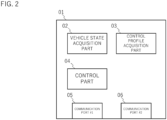
- Fig. 2 is a drawing showing an outline of the configuration of the network control apparatus 01 according to the present example embodiment.
- the network control apparatus has the vehicle state acquisition part 02, the control profile acquisition part 03, the control part 04, a communication port #1 05, and a communication port #2 06.
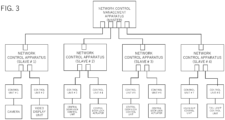
- a plurality of the network control apparatuses 01 may be provided in a vehicle.
- One may adopt a configuration in which the apparatuses are configured more or less identically and there is a master/slave relationship between the apparatuses with a master network control management apparatus managing slave apparatuses provided.
- the vehicle state acquisition part 02 acquires the state of a vehicle.
- vehicle generally refers to an automobile, however, the present apparatus can be applied to an object that moves autonomously such as a ship and railway vehicle without being limited thereto.
- a "vehicle state” denotes a state that can be grasped from information that can be acquired from driving-related equipment (engines, tires, steering, brakes, transmissions, etc.) and additional equipment (doors, tailgates, windscreen wipers, seats, air conditioners, power windows, audio equipment, meter panels, information terminals, etc.) in the vehicle, information that can be acquired from a control system for controlling these pieces of equipment, information that can be acquired from sensors attached thereto, and information (routers, switches, etc.) related to an in-vehicle network to which these pieces of equipment are connected.
- driving-related equipment engines, tires, steering, brakes, transmissions, etc.
- additional equipment doors, tailgates, windscreen wipers, seats, air conditioners, power windows, audio
- State parameters include engine revolutions per minute, speed, steering angle, whether or not the brakes are used, gear stage, whether a door/tailgate is open or closed, whether or not the wipers are operating, the angle of a seat back, air conditioning air volume, whether a window is open or closed, the source of audio, the type of information displayed on the meter panel or an information terminal, and the power consumption or operating mode (low power consumption mode, standby mode, etc.) of equipment. These parameters are collected via the in-vehicle network and outputted to the control profile acquisition part 03.
- the control profile acquisition part 03 acquires a control profile, according to the acquired vehicle state, from one or more control profiles including settings for controlling equipment connected to the in-vehicle network.
- the "control profile” is a comprehensive list that includes settings for each piece of equipment as described above and it may be selected from one or more profiles generated in advance and stored in a storage area or may be newly generated on the spot according to the vehicle state. Alternatively, a control profile may be generated by partially modifying an existing profile as a base according to the vehicle state.
- the profile may include the settings for an entire piece of equipment or may be a partial profile describing the settings for a part of equipment.
- Fig. 4 is a drawing for explaining the content of an example of the control profile. As shown in the drawing, each piece of controlled equipment is listed in association with its setting. Fig. 4 shows an example of the control profile applied to a state in which the vehicle is stopped and the driver is outside the car. For instance, a wireless module #1 is active for a keyless entry function to stand by and a central door lock control unit is in a low-power consumption standby state. Out of a plurality of ECUs, an ECU #1 that controls the central door lock control unit is in a standby state, and an ECU #2 is active. This is because the ECU #2 controls the wireless module#1 and needs to be active waiting for radio waves from the key.
- the ECU #2 When radio waves from the key arrive at the wireless module #1 via an antenna, the ECU #2 sends a trigger to the ECU #1, which then becomes active.
- the ECU #1 activates the central door lock control unit from the standby state by transmitting a trigger thereto.
- the central door lock control unit sends a signal to an actuator to open or close the door lock.
- the communication port # 1 on the path between the ECU # 2 and the ECU # 1 is set to be active. Other unnecessary ECUs, communication ports, cameras, sensors, video display units, etc., are turned off in order to reduce power consumption.
- the control profile optimizes the power consumption of each piece of equipment to achieve power saving. For instance, the optimization may be achieved by maintaining the functions required for an assumed vehicle state and minimizing the total power consumption of the equipment.
- control profile acquisition part 03 may acquire a control profile grouping a plurality of pieces of equipment and the control part 04 may control equipment on a group basis. For instance, it is possible to collectively control equipment required for driving at night such as headlights, tail lamps, interior lights, and the control units thereof by grouping them, turning the group off during daytime driving, and changing the state thereof from the off state to a standby state and then to an active state according to a value measured by an illuminance sensor. Further, the group may be activated in a mountainous area where lights are often needed in tunnels and deactivated in urban areas.
- the control part 04 controls equipment within the in-vehicle network on the basis of the acquired control profile. More concretely, the control part 04 reads a control profile such as the one described above and controls equipment, applying the written settings thereto.
- the control part 04 may directly transmit a control signal to a piece of equipment or indirectly control it via a control unit or an ECU. Further, from the vehicle state acquisition part 02, the control part 04 is able to obtain feedback on the result of executing control and further execute control on the basis of this feedback.
- the control part 04 has the communication port #1 05 and the communication port #2 06, described later, and communication transfer between communication ports, communication interruption, leasing and releasing of a network address required for communication, etc., are possible under the control of the control part 04.
- the control profile may also include settings for such control.
- a port in the present disclosure refers to a so-called input/output port and denotes a terminal of a network interface.
- the network control apparatus 01 in the first example embodiment has two communication ports, the number of communication ports is not particularly limited to two and any number of ports may be provided.
- the power consumption of a communication port generally changes according to a communication mode that sets the communicable band (for instance, 10 Mbps, 100 Mbps, 1000 Mbps), and the wider the communication band, the more power is consumed by the communication port. Therefore, it is possible to reduce power consumption by setting a communicable band according to the traffic in the in-vehicle network. In other words, power can be saved by putting a communication port on a path where no communication occurs in a standby state or in an off state in which no current flows in the circuit.
- a communication mode for instance, 10 Mbps, 100 Mbps, 1000 Mbps
- the power consumption of a communication port changes according to how the communication band is set. For instance, the power consumption of the entire vehicle can be minimized by using a control profile that corresponds to a path with traffic distributed across a plurality of slow-speed ports, rather than a path with traffic concentrated on a single high-speed communication port.
- Fig. 5 is a flowchart showing a flow of processing performed by the network control apparatus according to the present example embodiment.
- the apparatus first determines whether or not the state of the vehicle has changed (step S01). When determining that the vehicle state has changed, the apparatus acquires the state of the vehicle (step S02). Then, according to the acquired vehicle state, the apparatus acquires a control profile from one or more control profiles including settings for controlling equipment connected to the in-vehicle network (step S03). The apparatus controls equipment within the in-vehicle network on the basis of the acquired profile (step S04) and returns again to determining whether or not the state of the vehicle has changed (the step S01).
- FIG. 6 is a block diagram showing an example of the hardware configuration of the network control apparatus 01 relating to the first example embodiment.
- the network control apparatus 01 can be constituted by an information processing apparatus (computer) that comprises the configuration illustrated in Fig. 6 .
- the network control apparatus 01 comprises a CPU (Central Processing Unit) 101, a memory 102, an input/output interface 103, and a NIC (Network Interface Card) 104, which is communication means. These elements are interconnected by an internal bus 105.
- the NIC has a communication port.
- the configuration shown in Fig. 6 is not intended to limit the hardware configuration of the network control apparatus 01.
- the network control apparatus 01 may include hardware not shown in the drawing or dispense with the input/output interface 103, depending on the necessity. Further, the example of Fig. 6 does not limit the number of CPUs, etc., included in the network control apparatus 01, and for instance, a plurality of CPUs may be included in the network control apparatus 01.
- the memory 102 is a RAM (Random Access Memory), ROM (Read-Only Memory), or auxiliary storage device (such as a hard disk).
- RAM Random Access Memory
- ROM Read-Only Memory
- auxiliary storage device such as a hard disk
- the input/output interface 103 is means for interfacing a display device or an input device not shown in the drawing.
- the display device is a liquid crystal display.
- the input device is, for instance, a device that accepts user operations such as a touch panel display.
- the functions of the network control apparatus 01 are realized by the hardware described above and processing modules such as a vehicle state acquisition program, a control profile acquisition program, and a control program. These processing modules are realized by having the CPU 101 execute, for instance, the vehicle state acquisition program stored in the memory 102. Further, this program may be downloaded via a network or updated using a storage medium storing the program. In addition, the processing modules may be realized by a semiconductor chip. In other words, means for executing the functions performed by the processing modules using some kind of hardware and software may be provided.
- each of the programs described above is called from the memory 102 and is executed by the CPU 101.
- the priority of each program, thread, and process is optimized, and it is possible to reduce power consumption by lowering the priority of unused programs thereby reducing the CPU usage.
- the vehicle state acquisition program in a standby state is executed by the CPU 101.
- the program acquires the state of equipment in the vehicle via the in-vehicle network.
- the acquired state in the vehicle is temporarily stored in the memory 102.
- the control profile acquisition program is called from the memory 102 and executed.
- the program reads the state in the vehicle temporarily stored in the memory 102 and then acquires a control profile corresponding to the state in the vehicle by selecting or generating it. If a plurality of control profiles are acquired as a result, the program calculates the total power consumption of each profile and hands the profile with the lowest power consumption to the control program.
- the control program reads the settings for each piece of equipment written in the profile and transmits control information corresponding to the settings via the NIC 104.
- the network control apparatus of the first example embodiment it is possible to achieve power saving for an entire vehicle by selecting a control profile optimized for the state of a vehicle and applying the selected control profile to equipment connected to an in-vehicle network.
- Fig. 7 is a block diagram for explaining the functions of the network control apparatus 01 according to a second example embodiment.
- the network control apparatus 01 has the vehicle state acquisition part 02, the control profile acquisition part 03, the control part 04, the communication port #1 05, and the communication port #2 06. Since these elements have already been explained above, the description thereof will be omitted.
- the network control apparatus 01 of the present example embodiment is characterized by having a clocking part 07 that outputs a signal at a constant cycle.
- the clocking part 07 outputs a clock signal having a constant cycle to the control part 04. Further, the clocking part 07 may output a clock signal to each piece of equipment connected to the in-vehicle network and the control device/control unit that controls it. More concretely, the clocking part 07 may transmit a signal by various means such as NTP (Network Time Protocol), IEEE 802.1AS, IEEE 802.1AServ, and broadcast notification. By having the clocking part 07 transmit such a signal, it becomes possible for each piece of equipment to operate synchronously according to the signal.
- NTP Network Time Protocol
- IEEE 802.1AS IEEE 802.1AServ
- the clocking part 07 may constantly transmit a synchronization signal with each piece of equipment operating according to the received signal.
- each piece of equipment may have a timer, and the clock of each equipment timer may be adjusted at regular intervals.
- the timing of restoring an active state from a standby state can be synchronized, making it possible to execute control without any trouble.
- Fig. 8 is a block diagram for explaining the functions of the network control apparatus 01 according to a third example embodiment.
- the network control apparatus 01 has the vehicle state acquisition part 02, the control profile acquisition part 03, the control part 04, the communication port #1 05, and the communication port #2 06. Since these elements have already been explained above, the description thereof will be omitted.
- the network control apparatus of the present example embodiment is characterized by having a vehicle state transition information holding part 08 that states a current vehicle state and a state to which the current vehicle state may transition in the future and by having the control profile acquisition part 03 control the in-vehicle network on the basis of vehicle state transition information held by the vehicle state transition information holding part 08, in addition to a vehicle state acquired by the vehicle state acquisition part 02.
- the vehicle state transition information holding part 08 states a vehicle state and another vehicle state to which the vehicle state may transition in the future.
- a “vehicle state” refers to the state of a vehicle acquired by the vehicle state acquisition part 02.
- Fig. 9 is a table showing an example of the vehicle state transition information. As shown in the drawing, a vehicle state ID, a transition destination state ID, and a control profile ID are stored in association with each other. For instance, vehicle state ID 1 refers to a parked and unlocked state as indicated in the description. A control profile ID applied at this time is specified as P1. This state may transition to vehicle state ID 2 (parked/ACC state) or vehicle state ID 0 (parked/locked state).
- the control profile acquisition part 03 of the network control apparatus 01 is able to apply a control profile according to a next transition destination state by acquiring a control profile using such vehicle state transition information. For instance, in Fig. 9 , since it is known that the vehicle state ID 1 will transition to the vehicle state ID 2, it is possible to control equipment in advance anticipating an ACC state. Concretely, since in-vehicle information terminals may turn on in an ACC state, by activating control units and ECUs controlling the in-vehicle information terminals in advance, the operation can be started without delay when the state transitions to the vehicle state ID 2.
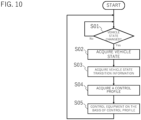
- Fig. 10 is a flowchart showing a flow of processing performed by the network control apparatus according to the present example embodiment.
- the apparatus first determines whether or not the state of the vehicle has changed (the step S01). When determining that the vehicle state has changed, the apparatus acquires the state of the vehicle (the step S02). Next, the apparatus acquires the vehicle state transition information (step S03). Then, according to the acquired vehicle state, the apparatus acquires a control profile from one or more control profiles including settings for controlling equipment connected to the in-vehicle network (step S04). At this time, the apparatus may derive settings of the minimum required power consumption for a next state to which the current state ID may transition. The apparatus controls equipment within the in-vehicle network on the basis of the acquired profile (step S05) and returns again to determining whether or not the state of the vehicle has changed (the step S01).
- FIG. 11 is a block diagram showing an example of the hardware configuration of the network control apparatus 01 relating to the third example embodiment.
- the network control apparatus 01 of the present example embodiment can be constituted by an information processing apparatus (computer) that comprises the configuration illustrated in Fig. 11 .
- the network control apparatus 01 comprises the CPU 101, the memory 102, the input/output interface 103, and the NIC (Network Interface Card) 104, which is communication means. These elements are interconnected by the internal bus 105.
- the NIC has a communication port.
- the network control apparatus 01 of the present example embodiment may have a timer 106.
- the configuration shown in Fig. 11 is not intended to limit the hardware configuration of the network control apparatus 01.
- the network control apparatus 01 may include hardware not shown in the drawing or dispense with the input/output interface 103, depending on the necessity. Further, the example of Fig. 11 does not limit the number of CPUs, etc., included in the network control apparatus 01, and for instance, a plurality of CPUs may be included in the network control apparatus 01.
- the memory 102 is a RAM (Random Access Memory), ROM (Read-Only Memory), or auxiliary storage device (such as a hard disk).
- RAM Random Access Memory
- ROM Read-Only Memory
- auxiliary storage device such as a hard disk
- the input/output interface 103 is means for interfacing a display device or an input device not shown in the drawing.
- the display device is a liquid crystal display.
- the input device is, for instance, a device that accepts user operations such as a keyboard or mouse.
- the functions of the network control apparatus 01 are realized by the hardware described above and processing modules such as the vehicle state acquisition program, the control profile acquisition program, and the control program. These processing modules are realized by having the CPU 101 execute, for instance, the vehicle state acquisition program stored in the memory 102. Further, this program may be downloaded via a network or updated using a storage medium storing the program. In addition, the processing modules may be realized by a semiconductor chip. In other words, means for executing the functions performed by the processing modules using some kind of hardware and software may be provided.
- the vehicle state acquisition program in a standby state is executed by the CPU 101.
- the program acquires the state of equipment in the vehicle via the in-vehicle network.
- the acquired vehicle state is temporarily stored in the memory 102.
- the control profile acquisition program is called from the memory 102 and executed.
- the program reads the vehicle state temporarily stored in the memory 102.
- the program reads the vehicle state transition information table held in the memory 102.
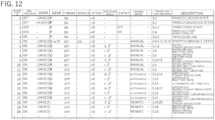
- Fig. 12 shows another example of the vehicle state transition information table.
- CPU 101 searches for the corresponding state in the table using the acquired vehicle state. When the corresponding entry is found in the table, a transition destination state ID is acquired by referring to the corresponding entry.
- the vehicle state relating to the acquired transition destination state ID is read by referring to the table.
- the program causes the CPU 101 to derive a control profile on the basis of the current vehicle state read from the memory 102 and the transition destination vehicle state read from the table. More concretely, the program derives the optimum control profile according to the current vehicle state, and while referring to this control profile and a control profile corresponding to the transition destination vehicle state, the program changes the currently applied control profile so as to be able to deal with the transition destination vehicle state more smoothly.
- Fig. 9 indicates that the control profile applied to this state is P4.
- potential transition destination state IDs are 3, 2, and 5.
- the control profile P5 is applied. Since P5 releases the handbrake, the device that controls the handbrake is activated in advance. Further, because the gear is changed to D (forward) or R (reverse) mode, the devices that control the headlights and the lamps turned on when the car is in reverse are activated in advance in preparation for turning on these lamps.
- a control profile is newly generated by adding these control items to the control profile P4.
- the control profile acquired as described is sent via the NIC 104 and the in-vehicle network, and the control content thereof is applied to each piece of equipment.
- the control content may be applied at a timing according to an interrupt of the timer 106.
- the network control apparatus of the present example embodiment since it is possible to perform control, considering, in addition to the current vehicle state, a next vehicle state to which the current vehicle state transitions, the state of the vehicle can be transitioned smoothly. Further, since the operation of equipment can be scheduled, it is possible to perform detailed control and operate a required device only when needed, achieving comprehensive power saving.
Landscapes
- Engineering & Computer Science (AREA)
- Computer Networks & Wireless Communication (AREA)
- Signal Processing (AREA)
- Mechanical Engineering (AREA)
- Small-Scale Networks (AREA)
Description
- The present apparatus, etc. relate to a technology for achieving power saving by controlling an in-vehicle network.
- In recent years, vehicles that travel while acquiring information such as the conditions and the environment inside the car with sensors have become common. The acquired information is collected by an information processing apparatus such as an ECU (Electronic Control Unit) via an in-vehicle network. Meanwhile, whether a vehicle runs on electricity or gasoline, it is necessary to save energy as much as possible so as to increase the mileage. Therefore, it is desirable that an in-vehicle network operate with low power consumption.
-
Patent Literature 1 discloses a vehicle communication unit capable of reducing power consumption when not needed. More concretely, this unit collects vehicle information at a predetermined frequency while the vehicle is running and displays the information on a mobile device. When the vehicle is stopped, since it is less necessary to display the vehicle information compared with when it is running, an operation called a power saving mode is used to decrease the frequency of collecting the vehicle information and reduce the power consumption of the vehicle communication unit and the mobile device as compared with normal mode. -
Patent Literature 2 discloses a node control apparatus in a network system based on Software-Defined Networking (SDN) technology. More concretely, this apparatus controls a communication interface provided to a port of each node in the network according to a physical layer mode indicated by the control apparatus.Patent Literature 2 states that the power consumption of the port can be adjusted by switching the mode. -
- [Patent Literature 1]
Japanese Patent Kokai Publication No.JP2018-074204A - [Patent Literature 2]
International Publication NumberWO2016/157847A - [Patent Literature 3]
International Publication NumberWO2016/157844A - [Patent Literature 4]
International Publication NumberWO2016/157845A - [Patent Literature 5]
International Publication NumberWO2016/157846A - [Patent Literature 6]
Japanese Patent Kokai Publication No.JP2014-236492A -
US 2015/025704 A discloses the preamble of the independent claims. -
US 2014/047255 A represents related art. - The following analysis was made by the present inventors.
- As described above, in order to reduce power used for a communication network, by turning off the power of a connection port of a network device (router or network switch) that controls a communication path or setting it to a power saving mode at specified time periods or according to network conditions such as traffic volume, it is possible to decrease the power required for the entire network.
- However, since it is difficult to determine the timing of changing a normal state to a power saving state or restoring the normal mode from the power saving mode, there is a problem that power saving is insufficient as a result. Further, if devices connected to an in-vehicle network perform power saving asynchronously, each device transitions from a power saving state to a normal state asynchronously as well. As a result, when a device in a power saving state receives normal-state network traffic from a communication partner device in a normal state, it cannot process the data, causing a packet loss. Due to the fact that a vehicle is constantly moving, an in-vehicle network must be controlled instantly, and if a packet loss forces the data to be retransmitted, this leads to a delay in operation, causing a big problem.
- Therefore, it is a main object of the present invention in one aspect to provide a network control apparatus that contributes to saving power of equipment connected to an in-vehicle network as an entire vehicle.
- The above object is achieved with the features of the independent claims.
- A program for the network control can be stored in a computer-readable storage medium. The storage medium may be a non-transient one such as a semiconductor memory, a hard disk, a magnetic recording medium, an optical recording medium, and the like. The present invention can also be realized as a computer program product.
- According to the present invention, there is provided a network control apparatus that contributes to saving power by acquiring the state inside a vehicle and controlling each piece of equipment connected to an in-vehicle network by applying the optimum settings (profile) thereto according to the acquired state.
-
-
Fig. 1 is a block diagram showing an example of a network control apparatus according to an example embodiment. -
Fig. 2 is a block diagram showing an example of a network control apparatus according to a first example embodiment. -
Fig. 3 is a block diagram illustrating a configuration example of the network control apparatus according to the first example embodiment. -
Fig. 4 is a drawing for explaining the content of an example of a control profile of the network control apparatus according to the first example embodiment. -
Fig. 5 is a flowchart showing a flow of processing performed by the network control apparatus according to the first example embodiment. -
Fig. 6 is a block diagram showing an example of the hardware configuration of the network control apparatus according to the first example embodiment. -
Fig. 7 is a block diagram for explaining the functions of a network control apparatus according to a second example embodiment. -
Fig. 8 is a block diagram for explaining the functions of a network control apparatus according to a third example embodiment. -
Fig. 9 shows an example of a vehicle state transition information table in the network control apparatus according to the third example embodiment. -
Fig. 10 is a flowchart showing a flow of processing performed by the network control apparatus according to the third example embodiment. -
Fig. 11 is a block diagram showing an example of the hardware configuration of the network control apparatus according to the third example embodiment. -
Fig. 12 shows another example of the vehicle state transition information table in the network control apparatus according to the third example embodiment. - First, an outline of an example embodiment will be given. It should be noted that the drawing reference signs in the outline are given to each element for convenience as an example to facilitate understanding, and the description in this outline is not intended to be any limitation.
- A
network control apparatus 01 according to an example embodiment has a vehiclestate acquisition part 02 that acquires the state of a vehicle; a controlprofile acquisition part 03 that acquires a control profile, according to the acquired vehicle state, from one or more control profiles including settings for controlling equipment connected to the in-vehicle network; and acontrol part 04 that controls equipment within the in-vehicle network on the basis of the acquired control profile. - The
network control apparatus 01 according to an example embodiment contributes to saving power in the entire network by distributing to each network device a control profile, which is network control content specified in advance to achieve power saving using not only information related to the in-vehicle network, but also information related to the state of the vehicle, and applying the control profile to each network device. - Specific example embodiments will be described below in more detail with reference to the drawings. Note that the same reference signs are given to the same elements in each example embodiment, and the description thereof will be omitted.
-
Fig. 2 is a drawing showing an outline of the configuration of thenetwork control apparatus 01 according to the present example embodiment. As shown in the drawing, the network control apparatus has the vehiclestate acquisition part 02, the controlprofile acquisition part 03, thecontrol part 04, acommunication port # 1 05, and acommunication port # 2 06. - Further, as shown in
Fig. 3 , a plurality of thenetwork control apparatuses 01, operating in cooperation, may be provided in a vehicle. One may adopt a configuration in which the apparatuses are configured more or less identically and there is a master/slave relationship between the apparatuses with a master network control management apparatus managing slave apparatuses provided. - The vehicle
state acquisition part 02 acquires the state of a vehicle. The term "vehicle" generally refers to an automobile, however, the present apparatus can be applied to an object that moves autonomously such as a ship and railway vehicle without being limited thereto. A "vehicle state" denotes a state that can be grasped from information that can be acquired from driving-related equipment (engines, tires, steering, brakes, transmissions, etc.) and additional equipment (doors, tailgates, windscreen wipers, seats, air conditioners, power windows, audio equipment, meter panels, information terminals, etc.) in the vehicle, information that can be acquired from a control system for controlling these pieces of equipment, information that can be acquired from sensors attached thereto, and information (routers, switches, etc.) related to an in-vehicle network to which these pieces of equipment are connected. State parameters include engine revolutions per minute, speed, steering angle, whether or not the brakes are used, gear stage, whether a door/tailgate is open or closed, whether or not the wipers are operating, the angle of a seat back, air conditioning air volume, whether a window is open or closed, the source of audio, the type of information displayed on the meter panel or an information terminal, and the power consumption or operating mode (low power consumption mode, standby mode, etc.) of equipment. These parameters are collected via the in-vehicle network and outputted to the controlprofile acquisition part 03. - The control
profile acquisition part 03 acquires a control profile, according to the acquired vehicle state, from one or more control profiles including settings for controlling equipment connected to the in-vehicle network. The "control profile" is a comprehensive list that includes settings for each piece of equipment as described above and it may be selected from one or more profiles generated in advance and stored in a storage area or may be newly generated on the spot according to the vehicle state. Alternatively, a control profile may be generated by partially modifying an existing profile as a base according to the vehicle state. The profile may include the settings for an entire piece of equipment or may be a partial profile describing the settings for a part of equipment. -
Fig. 4 is a drawing for explaining the content of an example of the control profile. As shown in the drawing, each piece of controlled equipment is listed in association with its setting.Fig. 4 shows an example of the control profile applied to a state in which the vehicle is stopped and the driver is outside the car. For instance, awireless module # 1 is active for a keyless entry function to stand by and a central door lock control unit is in a low-power consumption standby state. Out of a plurality of ECUs, anECU # 1 that controls the central door lock control unit is in a standby state, and anECU # 2 is active. This is because theECU # 2 controls thewireless module# 1 and needs to be active waiting for radio waves from the key. When radio waves from the key arrive at thewireless module # 1 via an antenna, theECU # 2 sends a trigger to theECU # 1, which then becomes active. TheECU # 1 activates the central door lock control unit from the standby state by transmitting a trigger thereto. The central door lock control unit sends a signal to an actuator to open or close the door lock. Further, with respect to communication ports, thecommunication port # 1 on the path between theECU # 2 and theECU # 1 is set to be active. Other unnecessary ECUs, communication ports, cameras, sensors, video display units, etc., are turned off in order to reduce power consumption. - The control profile optimizes the power consumption of each piece of equipment to achieve power saving. For instance, the optimization may be achieved by maintaining the functions required for an assumed vehicle state and minimizing the total power consumption of the equipment.
- The control profile described above lists the settings related to power saving for each piece of equipment, however, the control
profile acquisition part 03 may acquire a control profile grouping a plurality of pieces of equipment and thecontrol part 04 may control equipment on a group basis. For instance, it is possible to collectively control equipment required for driving at night such as headlights, tail lamps, interior lights, and the control units thereof by grouping them, turning the group off during daytime driving, and changing the state thereof from the off state to a standby state and then to an active state according to a value measured by an illuminance sensor. Further, the group may be activated in a mountainous area where lights are often needed in tunnels and deactivated in urban areas. Therefore, it is possible to precisely control the power consumption of each group according to the road environment, reducing the power consumption as a result. In addition, by having grouped equipment close to each other in terms of the network topology and having them use common switches and communication ports, it becomes possible to deactivate the network devices such as the switches and the communication ports when a group of connected equipment is in hibernation, further decreasing the power consumption. - The
control part 04 controls equipment within the in-vehicle network on the basis of the acquired control profile. More concretely, thecontrol part 04 reads a control profile such as the one described above and controls equipment, applying the written settings thereto. Thecontrol part 04 may directly transmit a control signal to a piece of equipment or indirectly control it via a control unit or an ECU. Further, from the vehiclestate acquisition part 02, thecontrol part 04 is able to obtain feedback on the result of executing control and further execute control on the basis of this feedback. - The
control part 04 has thecommunication port # 1 05 and thecommunication port # 2 06, described later, and communication transfer between communication ports, communication interruption, leasing and releasing of a network address required for communication, etc., are possible under the control of thecontrol part 04. The control profile may also include settings for such control. - The
communication port # 1 05 and thecommunication port # 2 06 communicate with other apparatuses and devices. A port in the present disclosure refers to a so-called input/output port and denotes a terminal of a network interface. Although thenetwork control apparatus 01 in the first example embodiment has two communication ports, the number of communication ports is not particularly limited to two and any number of ports may be provided. - As described above, in the
network control apparatus 01 in the present disclosure, thecontrol part 04 controls the communication ports. Generally speaking, the power consumption of communication ports increases as more ports are used. Therefore, it is possible to save power by creating a control profile optimized for a communication path that uses as few communication ports as possible. - Further, the power consumption of a communication port generally changes according to a communication mode that sets the communicable band (for instance, 10 Mbps, 100 Mbps, 1000 Mbps), and the wider the communication band, the more power is consumed by the communication port. Therefore, it is possible to reduce power consumption by setting a communicable band according to the traffic in the in-vehicle network. In other words, power can be saved by putting a communication port on a path where no communication occurs in a standby state or in an off state in which no current flows in the circuit.
- As described above, it is possible to save power further by taking into consideration the fact that the power consumption of a communication port changes according to how the communication band is set. For instance, the power consumption of the entire vehicle can be minimized by using a control profile that corresponds to a path with traffic distributed across a plurality of slow-speed ports, rather than a path with traffic concentrated on a single high-speed communication port.
-
Fig. 5 is a flowchart showing a flow of processing performed by the network control apparatus according to the present example embodiment. As shown in the drawing, the apparatus first determines whether or not the state of the vehicle has changed (step S01). When determining that the vehicle state has changed, the apparatus acquires the state of the vehicle (step S02). Then, according to the acquired vehicle state, the apparatus acquires a control profile from one or more control profiles including settings for controlling equipment connected to the in-vehicle network (step S03). The apparatus controls equipment within the in-vehicle network on the basis of the acquired profile (step S04) and returns again to determining whether or not the state of the vehicle has changed (the step S01). - Next, the hardware configuration of the network control apparatus relating to the first example embodiment will be described.
Fig. 6 is a block diagram showing an example of the hardware configuration of thenetwork control apparatus 01 relating to the first example embodiment. - The
network control apparatus 01 can be constituted by an information processing apparatus (computer) that comprises the configuration illustrated inFig. 6 . For instance, thenetwork control apparatus 01 comprises a CPU (Central Processing Unit) 101, amemory 102, an input/output interface 103, and a NIC (Network Interface Card) 104, which is communication means. These elements are interconnected by aninternal bus 105. The NIC has a communication port. - It should be noted that the configuration shown in
Fig. 6 is not intended to limit the hardware configuration of thenetwork control apparatus 01. Thenetwork control apparatus 01 may include hardware not shown in the drawing or dispense with the input/output interface 103, depending on the necessity. Further, the example ofFig. 6 does not limit the number of CPUs, etc., included in thenetwork control apparatus 01, and for instance, a plurality of CPUs may be included in thenetwork control apparatus 01. - The
memory 102 is a RAM (Random Access Memory), ROM (Read-Only Memory), or auxiliary storage device (such as a hard disk). - The input/
output interface 103 is means for interfacing a display device or an input device not shown in the drawing. For instance, the display device is a liquid crystal display. The input device is, for instance, a device that accepts user operations such as a touch panel display. - The functions of the
network control apparatus 01 are realized by the hardware described above and processing modules such as a vehicle state acquisition program, a control profile acquisition program, and a control program. These processing modules are realized by having theCPU 101 execute, for instance, the vehicle state acquisition program stored in thememory 102. Further, this program may be downloaded via a network or updated using a storage medium storing the program. In addition, the processing modules may be realized by a semiconductor chip. In other words, means for executing the functions performed by the processing modules using some kind of hardware and software may be provided. - When the network control apparatus starts to operate, each of the programs described above is called from the
memory 102 and is executed by theCPU 101. The priority of each program, thread, and process is optimized, and it is possible to reduce power consumption by lowering the priority of unused programs thereby reducing the CPU usage. - Here, when a hardware interrupt that changes the vehicle state (for instance, door opening or closing detected by a sensor) occurs, the vehicle state acquisition program in a standby state is executed by the
CPU 101. The program acquires the state of equipment in the vehicle via the in-vehicle network. The acquired state in the vehicle is temporarily stored in thememory 102. Next, the control profile acquisition program is called from thememory 102 and executed. The program reads the state in the vehicle temporarily stored in thememory 102 and then acquires a control profile corresponding to the state in the vehicle by selecting or generating it. If a plurality of control profiles are acquired as a result, the program calculates the total power consumption of each profile and hands the profile with the lowest power consumption to the control program. The control program reads the settings for each piece of equipment written in the profile and transmits control information corresponding to the settings via theNIC 104. - As described, according to the network control apparatus of the first example embodiment, it is possible to achieve power saving for an entire vehicle by selecting a control profile optimized for the state of a vehicle and applying the selected control profile to equipment connected to an in-vehicle network.
-
Fig. 7 is a block diagram for explaining the functions of thenetwork control apparatus 01 according to a second example embodiment. As shown in the drawing, thenetwork control apparatus 01 has the vehiclestate acquisition part 02, the controlprofile acquisition part 03, thecontrol part 04, thecommunication port # 1 05, and thecommunication port # 2 06. Since these elements have already been explained above, the description thereof will be omitted. Thenetwork control apparatus 01 of the present example embodiment is characterized by having a clockingpart 07 that outputs a signal at a constant cycle. - The clocking
part 07 outputs a clock signal having a constant cycle to thecontrol part 04. Further, the clockingpart 07 may output a clock signal to each piece of equipment connected to the in-vehicle network and the control device/control unit that controls it. More concretely, the clockingpart 07 may transmit a signal by various means such as NTP (Network Time Protocol), IEEE 802.1AS, IEEE 802.1AServ, and broadcast notification. By having the clockingpart 07 transmit such a signal, it becomes possible for each piece of equipment to operate synchronously according to the signal. - As for the method for transmitting a signal, the clocking
part 07 may constantly transmit a synchronization signal with each piece of equipment operating according to the received signal. Alternatively, each piece of equipment may have a timer, and the clock of each equipment timer may be adjusted at regular intervals. - When each piece of equipment can operate synchronously, it is possible to align the timing of restoring a normal active state from a low-power consumption standby state. If pieces of equipment are out of sync and operating separately, a situation occurs in which a device A returns to an active state and sends a signal to a device B, which is still in a standby state when receiving the signal due to the fact that the device B does not return to an active state from a standby state synchronously with the device A, and consequently the signal does not reach the device B. In this case, a packet loss will occur in an in-vehicle network in which a signal may be transmitted as a packet, and the signal must be retransmitted.
- Due to the fact that a vehicle is a moving object with the surrounding environment constantly changing, an in-vehicle network must be controlled instantly. Therefore, a time lag caused by retransmission may have a significant effect on the control result. According to the
network control apparatus 01 of the present example embodiment, the timing of restoring an active state from a standby state can be synchronized, making it possible to execute control without any trouble. -
Fig. 8 is a block diagram for explaining the functions of thenetwork control apparatus 01 according to a third example embodiment. As shown in the drawing, thenetwork control apparatus 01 has the vehiclestate acquisition part 02, the controlprofile acquisition part 03, thecontrol part 04, thecommunication port # 1 05, and thecommunication port # 2 06. Since these elements have already been explained above, the description thereof will be omitted. The network control apparatus of the present example embodiment is characterized by having a vehicle state transitioninformation holding part 08 that states a current vehicle state and a state to which the current vehicle state may transition in the future and by having the controlprofile acquisition part 03 control the in-vehicle network on the basis of vehicle state transition information held by the vehicle state transitioninformation holding part 08, in addition to a vehicle state acquired by the vehiclestate acquisition part 02. - The vehicle state transition
information holding part 08 states a vehicle state and another vehicle state to which the vehicle state may transition in the future. A "vehicle state" refers to the state of a vehicle acquired by the vehiclestate acquisition part 02.Fig. 9 is a table showing an example of the vehicle state transition information. As shown in the drawing, a vehicle state ID, a transition destination state ID, and a control profile ID are stored in association with each other. For instance,vehicle state ID 1 refers to a parked and unlocked state as indicated in the description. A control profile ID applied at this time is specified as P1. This state may transition to vehicle state ID 2 (parked/ACC state) or vehicle state ID 0 (parked/locked state). - The control
profile acquisition part 03 of thenetwork control apparatus 01 according to the present example embodiment is able to apply a control profile according to a next transition destination state by acquiring a control profile using such vehicle state transition information. For instance, inFig. 9 , since it is known that thevehicle state ID 1 will transition to thevehicle state ID 2, it is possible to control equipment in advance anticipating an ACC state. Concretely, since in-vehicle information terminals may turn on in an ACC state, by activating control units and ECUs controlling the in-vehicle information terminals in advance, the operation can be started without delay when the state transitions to thevehicle state ID 2. -
Fig. 10 is a flowchart showing a flow of processing performed by the network control apparatus according to the present example embodiment. As shown in the drawing, the apparatus first determines whether or not the state of the vehicle has changed (the step S01). When determining that the vehicle state has changed, the apparatus acquires the state of the vehicle (the step S02). Next, the apparatus acquires the vehicle state transition information (step S03). Then, according to the acquired vehicle state, the apparatus acquires a control profile from one or more control profiles including settings for controlling equipment connected to the in-vehicle network (step S04). At this time, the apparatus may derive settings of the minimum required power consumption for a next state to which the current state ID may transition. The apparatus controls equipment within the in-vehicle network on the basis of the acquired profile (step S05) and returns again to determining whether or not the state of the vehicle has changed (the step S01). - Next, the hardware configuration of the network control apparatus relating to the third example embodiment will be described.
Fig. 11 is a block diagram showing an example of the hardware configuration of thenetwork control apparatus 01 relating to the third example embodiment. - The
network control apparatus 01 of the present example embodiment can be constituted by an information processing apparatus (computer) that comprises the configuration illustrated inFig. 11 . For instance, thenetwork control apparatus 01 comprises theCPU 101, thememory 102, the input/output interface 103, and the NIC (Network Interface Card) 104, which is communication means. These elements are interconnected by theinternal bus 105. The NIC has a communication port. - Further, the
network control apparatus 01 of the present example embodiment may have atimer 106. - It should be noted that the configuration shown in
Fig. 11 is not intended to limit the hardware configuration of thenetwork control apparatus 01. Thenetwork control apparatus 01 may include hardware not shown in the drawing or dispense with the input/output interface 103, depending on the necessity. Further, the example ofFig. 11 does not limit the number of CPUs, etc., included in thenetwork control apparatus 01, and for instance, a plurality of CPUs may be included in thenetwork control apparatus 01. - The
memory 102 is a RAM (Random Access Memory), ROM (Read-Only Memory), or auxiliary storage device (such as a hard disk). - The input/
output interface 103 is means for interfacing a display device or an input device not shown in the drawing. For instance, the display device is a liquid crystal display. The input device is, for instance, a device that accepts user operations such as a keyboard or mouse. - The functions of the
network control apparatus 01 are realized by the hardware described above and processing modules such as the vehicle state acquisition program, the control profile acquisition program, and the control program. These processing modules are realized by having theCPU 101 execute, for instance, the vehicle state acquisition program stored in thememory 102. Further, this program may be downloaded via a network or updated using a storage medium storing the program. In addition, the processing modules may be realized by a semiconductor chip. In other words, means for executing the functions performed by the processing modules using some kind of hardware and software may be provided. - Here, when a signal from the
timer 106 causes a hardware interrupt, the vehicle state acquisition program in a standby state is executed by theCPU 101. The program acquires the state of equipment in the vehicle via the in-vehicle network. The acquired vehicle state is temporarily stored in thememory 102. Next, the control profile acquisition program is called from thememory 102 and executed. The program reads the vehicle state temporarily stored in thememory 102. Then, the program reads the vehicle state transition information table held in thememory 102.Fig. 12 shows another example of the vehicle state transition information table.CPU 101 searches for the corresponding state in the table using the acquired vehicle state. When the corresponding entry is found in the table, a transition destination state ID is acquired by referring to the corresponding entry. The vehicle state relating to the acquired transition destination state ID is read by referring to the table. The program causes theCPU 101 to derive a control profile on the basis of the current vehicle state read from thememory 102 and the transition destination vehicle state read from the table. More concretely, the program derives the optimum control profile according to the current vehicle state, and while referring to this control profile and a control profile corresponding to the transition destination vehicle state, the program changes the currently applied control profile so as to be able to deal with the transition destination vehicle state more smoothly. - With reference to
Fig. 12 , for instance, when the vehicle is parked and idling, the state ID is 4.Fig. 9 indicates that the control profile applied to this state is P4. As for transition destinations, potential transition destination state IDs are 3, 2, and 5. Here, if we assume that the state transitions to thevehicle state 5, which is a stopped/movable state, the control profile P5 is applied. Since P5 releases the handbrake, the device that controls the handbrake is activated in advance. Further, because the gear is changed to D (forward) or R (reverse) mode, the devices that control the headlights and the lamps turned on when the car is in reverse are activated in advance in preparation for turning on these lamps. A control profile is newly generated by adding these control items to the control profile P4. - The control profile acquired as described is sent via the
NIC 104 and the in-vehicle network, and the control content thereof is applied to each piece of equipment. The control content may be applied at a timing according to an interrupt of thetimer 106. - According to the network control apparatus of the present example embodiment, since it is possible to perform control, considering, in addition to the current vehicle state, a next vehicle state to which the current vehicle state transitions, the state of the vehicle can be transitioned smoothly. Further, since the operation of equipment can be scheduled, it is possible to perform detailed control and operate a required device only when needed, achieving comprehensive power saving.
- It is to be noted that it is possible to modify or adjust the example embodiments or examples within the scope of the claims.
-
- 01:
- network control apparatus
- 02:
- vehicle state acquisition part
- 03:
- control profile acquisition part
- 04:
- control part
- 05:
-
communication port # 1 - 06:
-
communication port # 2 - 07:
- clocking part
- 08:
- vehicle state transition information holding part
- 101:
- CPU (Central Processing Unit)
- 102:
- memory
- 103:
- input/output interface
- 104:
- NIC (Network Interface Card)
- 105:
- internal bus
- 106:
- timer
Claims (9)
- A network control apparatus comprising:a vehicle state acquisition part (02) that acquires the state of a vehicle;a control profile acquisition part (03) that acquires a control profile, according to the acquired vehicle state, from one or more control profiles including settings for controlling equipment connected to an in-vehicle network; anda control part (04) that controls equipment within the in-vehicle network on the basis of the acquired control profile,characterized in that:the vehicle state acquisition part (02) further acquires the state of a communication port (05, 06) of equipment connected to the in-vehicle network,the control profile acquisition part (03) further acquires a control profile on the basis of the acquired communication port state, andthe control part (04) further controls the communication port (05, 06) of equipment connected to the in-vehicle network on the basis of the acquired control profile.
- The network control apparatus according to Claim 1, whereinthe vehicle state acquisition part (02) further acquires the power consumption of each piece of equipment connected to the in-vehicle network, andthe control profile acquisition part (03) further acquires a control profile on the basis of the sum of the acquired power consumption of each piece of the equipment.
- The network control apparatus according to Claim 1 or 2, whereinthe control profile acquisition part (03) further acquires a control profile grouping equipment connected to the in-vehicle network, andthe control part (04) controls each group on the basis of the control profile grouping equipment.
- The network control apparatus according to Claim 1, whereinthe vehicle state acquisition part (02) further acquires the number of communication ports (05, 06) used for communication by each piece of equipment connected to the in-vehicle network, andthe control profile acquisition part (03) further acquires a control profile having a total number of ports used for communication smaller than the sum of the acquired number of communication ports (05, 06) used for communication by each piece of equipment.
- The network control apparatus according to Claim 4, whereinthe vehicle state acquisition part (02) further acquires the power consumption of a communication port (05, 06) used for communication by each piece of equipment connected to the in-vehicle network, andthe control profile acquisition part (03) further acquires a control profile having a total power consumption of a port used for communication smaller than the sum of the acquired power consumption of the communication port (05, 06) used for communication by each piece of equipment.
- The network control apparatus according to any one of Claims 1 to 5 further comprising a vehicle state transition information holding part (08) that holds vehicle state transition information stating a vehicle state and another vehicle state to which the vehicle state may transition in the future, wherein
the control profile acquisition part (03) acquires a control profile on the basis of the acquired vehicle state and the held vehicle state transition information. - The network control apparatus according to any one of Claims 1 to 6 further comprising a clocking part (07) that outputs a signal at a constant cycle, wherein
the control part (04) further performs control according to the signal outputted by the clocking part (07). - A network control method comprising:a vehicle state acquisition step of acquiring the state of a vehicle;a control profile acquisition step of acquiring a control profile, according to the acquired vehicle state, from one or more control profiles including settings for controlling equipment connected to an in-vehicle network; anda control step of controlling equipment within the in-vehicle network on the basis of the acquired control profile,characterized in that:the vehicle state acquisition step further acquires the state of a communication port (05, 06) of equipment connected to the in-vehicle network,the control profile acquisition step further acquires a control profile on the basis of the acquired communication port state, andthe control step further controls the communication port (05, 06) of equipment connected to the in-vehicle network on the basis of the acquired control profile.
- A network control program for causing a computer to execute:a process of acquiring the state of a vehicle;a process of acquiring a control profile, according to the acquired vehicle state, from one or more control profiles including settings for controlling equipment connected to an in-vehicle network; anda process of controlling equipment within the in-vehicle network on the basis of the acquired control profile,characterized in that:the process of acquiring the state of a vehicle further acquires the state of a communication port (05, 06) of equipment connected to the in-vehicle network,the process of acquiring the control profile further acquires a control profile on the basis of the acquired communication port state, andthe process of controlling further controls the communication port (05, 06) of equipment connected to the in-vehicle network on the basis of the acquired control profile.
Applications Claiming Priority (2)
| Application Number | Priority Date | Filing Date | Title |
|---|---|---|---|
| JP2020081718 | 2020-05-07 | ||
| PCT/JP2021/017344 WO2021225134A1 (en) | 2020-05-07 | 2021-05-06 | Network control device, network control method, and network control program |
Publications (3)
| Publication Number | Publication Date |
|---|---|
| EP4149061A1 EP4149061A1 (en) | 2023-03-15 |
| EP4149061A4 EP4149061A4 (en) | 2023-11-01 |
| EP4149061B1 true EP4149061B1 (en) | 2025-04-23 |
Family
ID=78467995
Family Applications (1)
| Application Number | Title | Priority Date | Filing Date |
|---|---|---|---|
| EP21800557.7A Active EP4149061B1 (en) | 2020-05-07 | 2021-05-06 | Network control device, network control method, and network control program |
Country Status (5)
| Country | Link |
|---|---|
| US (1) | US12184436B2 (en) |
| EP (1) | EP4149061B1 (en) |
| JP (1) | JP7381141B2 (en) |
| CN (1) | CN115552845A (en) |
| WO (1) | WO2021225134A1 (en) |
Family Cites Families (23)
| Publication number | Priority date | Publication date | Assignee | Title |
|---|---|---|---|---|
| JP5192284B2 (en) | 2008-05-16 | 2013-05-08 | 株式会社オートネットワーク技術研究所 | Circuit equipment |
| JP5741496B2 (en) * | 2012-03-14 | 2015-07-01 | 株式会社オートネットワーク技術研究所 | In-vehicle communication system |
| JP5617875B2 (en) * | 2012-08-10 | 2014-11-05 | 株式会社デンソー | In-vehicle network system |
| JP6033035B2 (en) | 2012-10-18 | 2016-11-30 | 株式会社リブ技術研究所 | VEHICLE STATUS MONITORING SYSTEM, STATUS MONITORING SWITCH, VEHICLE HAVING STATUS MONITORING FUNCTION, AND STATUS MONITORING METHOD |
| JP6040870B2 (en) | 2013-06-05 | 2016-12-07 | 株式会社デンソー | Vehicle monitoring system |
| JP6127944B2 (en) * | 2013-12-03 | 2017-05-17 | 株式会社デンソー | In-vehicle network system |
| JP6052228B2 (en) * | 2014-05-19 | 2016-12-27 | 株式会社デンソー | In-vehicle control system |
| CN105438062A (en) | 2014-08-27 | 2016-03-30 | 深圳酷派技术有限公司 | Method and device for prompting vehicle states |
| WO2016157847A1 (en) | 2015-03-30 | 2016-10-06 | 日本電気株式会社 | Network system, node device, control device, communication control method, and control method |
| WO2016157844A1 (en) | 2015-03-30 | 2016-10-06 | 日本電気株式会社 | Network system, node device, control device, communication control method, and control method |
| WO2016157845A1 (en) | 2015-03-30 | 2016-10-06 | 日本電気株式会社 | Network system, node device, control device, communication control method, and control method |
| WO2016157846A1 (en) | 2015-03-30 | 2016-10-06 | 日本電気株式会社 | Network system, node device, control device, communication control method, and control method |
| US9865413B2 (en) * | 2015-04-10 | 2018-01-09 | Honda Motor Co., Ltd. | Vehicle control device |
| JP6643210B2 (en) * | 2016-09-09 | 2020-02-12 | 本田技研工業株式会社 | Vehicle data reading device and vehicle data reading method |
| JP2018074204A (en) | 2016-10-24 | 2018-05-10 | 日本精機株式会社 | Communication unit for vehicle, power saving method, and program |
| JP6485429B2 (en) * | 2016-11-04 | 2019-03-20 | トヨタ自動車株式会社 | In-vehicle network system |
| JP6756661B2 (en) | 2017-04-28 | 2020-09-16 | 日立オートモティブシステムズ株式会社 | Vehicle electronic control unit |
| JP6888437B2 (en) * | 2017-06-23 | 2021-06-16 | 住友電気工業株式会社 | In-vehicle communication device, communication control method and communication control program |
| US10755567B2 (en) * | 2018-03-06 | 2020-08-25 | GM Global Technology Operations LLC | Determining vehicle parked location |
| CN110550044A (en) | 2018-05-14 | 2019-12-10 | 上海汽车集团股份有限公司 | Driving assisting method and device |
| US20200271470A1 (en) * | 2019-02-25 | 2020-08-27 | Ford Global Technologies, Llc | Vehicle path identification |
| JP7396356B2 (en) * | 2019-05-30 | 2023-12-12 | 住友電気工業株式会社 | Setting device, communication system and vehicle communication management method |
| CN110722947A (en) | 2019-10-26 | 2020-01-24 | 深圳市元征科技股份有限公司 | Vehicle control method and device |
-
2021
- 2021-05-06 CN CN202180033461.7A patent/CN115552845A/en active Pending
- 2021-05-06 JP JP2022519961A patent/JP7381141B2/en active Active
- 2021-05-06 US US17/921,418 patent/US12184436B2/en active Active
- 2021-05-06 EP EP21800557.7A patent/EP4149061B1/en active Active
- 2021-05-06 WO PCT/JP2021/017344 patent/WO2021225134A1/en not_active Ceased
Also Published As
| Publication number | Publication date |
|---|---|
| JPWO2021225134A1 (en) | 2021-11-11 |
| CN115552845A (en) | 2022-12-30 |
| JP7381141B2 (en) | 2023-11-15 |
| US12184436B2 (en) | 2024-12-31 |
| US20230163983A1 (en) | 2023-05-25 |
| EP4149061A4 (en) | 2023-11-01 |
| WO2021225134A1 (en) | 2021-11-11 |
| EP4149061A1 (en) | 2023-03-15 |
Similar Documents
| Publication | Publication Date | Title |
|---|---|---|
| DE102013221803B4 (en) | Smart Energy and Control Policy for Automotive Applications | |
| US7457301B2 (en) | Vehicular communications system | |
| US11639144B2 (en) | In-vehicle network system | |
| CN107209742B (en) | Vehicle system and method of operating the same, method of storing data in vehicle system | |
| US20150067372A1 (en) | Control device for a vehicle network and method for operating a vehicle network | |
| CN113794611A (en) | Intelligent automobile electronic and electrical architecture based on central computing platform | |
| JP2005529393A (en) | Method and chip unit for addressing and / or activating a user | |
| US9913081B1 (en) | Method and device for communicating with a vehicle system module while conserving power by using two different short range wireless communication (SRWC) protocols | |
| EP4149061B1 (en) | Network control device, network control method, and network control program | |
| EP1503269A1 (en) | Controller apparatus for a communication bus | |
| US9430026B2 (en) | Electronic control device and microcomputer control method | |
| US20220070774A1 (en) | Relay device | |
| US11337184B2 (en) | Method and apparatus for transmitting and receiving data stream performed in vehicle network | |
| US20150146745A1 (en) | Control unit for in-vehicle ethernet and method for controlling thereof | |
| US20240292195A1 (en) | Method and Apparatus for Defining Connection Parameters of Vehicle Communications Connections | |
| WO2006112161A1 (en) | Vehicle-mounted communication device and method of communication | |
| JP2008126738A (en) | Relay connection unit and in-vehicle multiple communication system | |
| JP2019009678A (en) | In-vehicle communication network system | |
| CN114185287A (en) | Vehicle body area controller | |
| US20260113709A1 (en) | Communication system | |
| JP3901539B2 (en) | Multiplexing device activation method | |
| CN221351964U (en) | Integrated vehicle-mounted wireless communication control equipment and automobile | |
| Herpel et al. | A simulation approach for the design of safety-relevant automotive multi-ECU systems | |
| JP2001094486A (en) | Method for reducing power consumption of on-vehicle device | |
| CN117734600A (en) | Interactive system for realizing whole vehicle network information based on CANFD multipath gateway |
Legal Events
| Date | Code | Title | Description |
|---|---|---|---|
| STAA | Information on the status of an ep patent application or granted ep patent |
Free format text: STATUS: THE INTERNATIONAL PUBLICATION HAS BEEN MADE |
|
| PUAI | Public reference made under article 153(3) epc to a published international application that has entered the european phase |
Free format text: ORIGINAL CODE: 0009012 |
|
| STAA | Information on the status of an ep patent application or granted ep patent |
Free format text: STATUS: REQUEST FOR EXAMINATION WAS MADE |
|
| 17P | Request for examination filed |
Effective date: 20221207 |
|
| AK | Designated contracting states |
Kind code of ref document: A1 Designated state(s): AL AT BE BG CH CY CZ DE DK EE ES FI FR GB GR HR HU IE IS IT LI LT LU LV MC MK MT NL NO PL PT RO RS SE SI SK SM TR |
|
| DAV | Request for validation of the european patent (deleted) | ||
| DAX | Request for extension of the european patent (deleted) | ||
| A4 | Supplementary search report drawn up and despatched |
Effective date: 20230928 |
|
| RIC1 | Information provided on ipc code assigned before grant |
Ipc: B60R 16/023 20060101ALI20230922BHEP Ipc: H04L 12/40 20060101ALI20230922BHEP Ipc: H04L 12/12 20060101ALI20230922BHEP Ipc: H04L 12/28 20060101AFI20230922BHEP |
|
| GRAP | Despatch of communication of intention to grant a patent |
Free format text: ORIGINAL CODE: EPIDOSNIGR1 |
|
| STAA | Information on the status of an ep patent application or granted ep patent |
Free format text: STATUS: GRANT OF PATENT IS INTENDED |
|
| RIC1 | Information provided on ipc code assigned before grant |
Ipc: B60R 16/023 20060101ALI20241219BHEP Ipc: H04L 12/40 20060101ALI20241219BHEP Ipc: H04L 12/12 20060101ALI20241219BHEP Ipc: H04L 12/28 20060101AFI20241219BHEP |
|
| INTG | Intention to grant announced |
Effective date: 20250110 |
|
| GRAS | Grant fee paid |
Free format text: ORIGINAL CODE: EPIDOSNIGR3 |
|
| GRAA | (expected) grant |
Free format text: ORIGINAL CODE: 0009210 |
|
| STAA | Information on the status of an ep patent application or granted ep patent |
Free format text: STATUS: THE PATENT HAS BEEN GRANTED |
|
| AK | Designated contracting states |
Kind code of ref document: B1 Designated state(s): AL AT BE BG CH CY CZ DE DK EE ES FI FR GB GR HR HU IE IS IT LI LT LU LV MC MK MT NL NO PL PT RO RS SE SI SK SM TR |
|
| REG | Reference to a national code |
Ref country code: GB Ref legal event code: FG4D |
|
| REG | Reference to a national code |
Ref country code: CH Ref legal event code: EP |
|
| REG | Reference to a national code |
Ref country code: DE Ref legal event code: R096 Ref document number: 602021029694 Country of ref document: DE |
|
| REG | Reference to a national code |
Ref country code: IE Ref legal event code: FG4D |
|
| PGFP | Annual fee paid to national office [announced via postgrant information from national office to epo] |
Ref country code: DE Payment date: 20250521 Year of fee payment: 5 |
|
| PGFP | Annual fee paid to national office [announced via postgrant information from national office to epo] |
Ref country code: AT Payment date: 20250721 Year of fee payment: 5 |
|
| REG | Reference to a national code |
Ref country code: NL Ref legal event code: MP Effective date: 20250423 |
|
| PG25 | Lapsed in a contracting state [announced via postgrant information from national office to epo] |
Ref country code: NL Free format text: LAPSE BECAUSE OF FAILURE TO SUBMIT A TRANSLATION OF THE DESCRIPTION OR TO PAY THE FEE WITHIN THE PRESCRIBED TIME-LIMIT Effective date: 20250423 |
|
| REG | Reference to a national code |
Ref country code: AT Ref legal event code: MK05 Ref document number: 1788899 Country of ref document: AT Kind code of ref document: T Effective date: 20250423 |
|
| PG25 | Lapsed in a contracting state [announced via postgrant information from national office to epo] |
Ref country code: FI Free format text: LAPSE BECAUSE OF FAILURE TO SUBMIT A TRANSLATION OF THE DESCRIPTION OR TO PAY THE FEE WITHIN THE PRESCRIBED TIME-LIMIT Effective date: 20250423 Ref country code: PT Free format text: LAPSE BECAUSE OF FAILURE TO SUBMIT A TRANSLATION OF THE DESCRIPTION OR TO PAY THE FEE WITHIN THE PRESCRIBED TIME-LIMIT Effective date: 20250825 Ref country code: ES Free format text: LAPSE BECAUSE OF FAILURE TO SUBMIT A TRANSLATION OF THE DESCRIPTION OR TO PAY THE FEE WITHIN THE PRESCRIBED TIME-LIMIT Effective date: 20250423 |
|
| REG | Reference to a national code |
Ref country code: LT Ref legal event code: MG9D |
|
| PG25 | Lapsed in a contracting state [announced via postgrant information from national office to epo] |
Ref country code: NO Free format text: LAPSE BECAUSE OF FAILURE TO SUBMIT A TRANSLATION OF THE DESCRIPTION OR TO PAY THE FEE WITHIN THE PRESCRIBED TIME-LIMIT Effective date: 20250723 Ref country code: GR Free format text: LAPSE BECAUSE OF FAILURE TO SUBMIT A TRANSLATION OF THE DESCRIPTION OR TO PAY THE FEE WITHIN THE PRESCRIBED TIME-LIMIT Effective date: 20250724 |
|
| PG25 | Lapsed in a contracting state [announced via postgrant information from national office to epo] |
Ref country code: PL Free format text: LAPSE BECAUSE OF FAILURE TO SUBMIT A TRANSLATION OF THE DESCRIPTION OR TO PAY THE FEE WITHIN THE PRESCRIBED TIME-LIMIT Effective date: 20250423 |
|
| PG25 | Lapsed in a contracting state [announced via postgrant information from national office to epo] |
Ref country code: BG Free format text: LAPSE BECAUSE OF FAILURE TO SUBMIT A TRANSLATION OF THE DESCRIPTION OR TO PAY THE FEE WITHIN THE PRESCRIBED TIME-LIMIT Effective date: 20250423 |
|
| PG25 | Lapsed in a contracting state [announced via postgrant information from national office to epo] |
Ref country code: HR Free format text: LAPSE BECAUSE OF FAILURE TO SUBMIT A TRANSLATION OF THE DESCRIPTION OR TO PAY THE FEE WITHIN THE PRESCRIBED TIME-LIMIT Effective date: 20250423 |
|
| PG25 | Lapsed in a contracting state [announced via postgrant information from national office to epo] |
Ref country code: AT Free format text: LAPSE BECAUSE OF FAILURE TO SUBMIT A TRANSLATION OF THE DESCRIPTION OR TO PAY THE FEE WITHIN THE PRESCRIBED TIME-LIMIT Effective date: 20250423 |
|
| PG25 | Lapsed in a contracting state [announced via postgrant information from national office to epo] |
Ref country code: RS Free format text: LAPSE BECAUSE OF FAILURE TO SUBMIT A TRANSLATION OF THE DESCRIPTION OR TO PAY THE FEE WITHIN THE PRESCRIBED TIME-LIMIT Effective date: 20250723 |
|
| PG25 | Lapsed in a contracting state [announced via postgrant information from national office to epo] |
Ref country code: IS Free format text: LAPSE BECAUSE OF FAILURE TO SUBMIT A TRANSLATION OF THE DESCRIPTION OR TO PAY THE FEE WITHIN THE PRESCRIBED TIME-LIMIT Effective date: 20250823 |
|
| PG25 | Lapsed in a contracting state [announced via postgrant information from national office to epo] |
Ref country code: LV Free format text: LAPSE BECAUSE OF FAILURE TO SUBMIT A TRANSLATION OF THE DESCRIPTION OR TO PAY THE FEE WITHIN THE PRESCRIBED TIME-LIMIT Effective date: 20250423 |
|
| REG | Reference to a national code |
Ref country code: CH Ref legal event code: H13 Free format text: ST27 STATUS EVENT CODE: U-0-0-H10-H13 (AS PROVIDED BY THE NATIONAL OFFICE) Effective date: 20251223 |
|
| PG25 | Lapsed in a contracting state [announced via postgrant information from national office to epo] |
Ref country code: DK Free format text: LAPSE BECAUSE OF FAILURE TO SUBMIT A TRANSLATION OF THE DESCRIPTION OR TO PAY THE FEE WITHIN THE PRESCRIBED TIME-LIMIT Effective date: 20250423 Ref country code: SM Free format text: LAPSE BECAUSE OF FAILURE TO SUBMIT A TRANSLATION OF THE DESCRIPTION OR TO PAY THE FEE WITHIN THE PRESCRIBED TIME-LIMIT Effective date: 20250423 |
|
| PG25 | Lapsed in a contracting state [announced via postgrant information from national office to epo] |
Ref country code: LU Free format text: LAPSE BECAUSE OF NON-PAYMENT OF DUE FEES Effective date: 20250506 |
|
| PG25 | Lapsed in a contracting state [announced via postgrant information from national office to epo] |
Ref country code: CH Free format text: LAPSE BECAUSE OF NON-PAYMENT OF DUE FEES Effective date: 20250531 |
|
| PG25 | Lapsed in a contracting state [announced via postgrant information from national office to epo] |
Ref country code: CZ Free format text: LAPSE BECAUSE OF FAILURE TO SUBMIT A TRANSLATION OF THE DESCRIPTION OR TO PAY THE FEE WITHIN THE PRESCRIBED TIME-LIMIT Effective date: 20250423 |
|
| PG25 | Lapsed in a contracting state [announced via postgrant information from national office to epo] |
Ref country code: EE Free format text: LAPSE BECAUSE OF FAILURE TO SUBMIT A TRANSLATION OF THE DESCRIPTION OR TO PAY THE FEE WITHIN THE PRESCRIBED TIME-LIMIT Effective date: 20250423 |
|
| REG | Reference to a national code |
Ref country code: DE Ref legal event code: R097 Ref document number: 602021029694 Country of ref document: DE |
|
| PG25 | Lapsed in a contracting state [announced via postgrant information from national office to epo] |
Ref country code: SK Free format text: LAPSE BECAUSE OF FAILURE TO SUBMIT A TRANSLATION OF THE DESCRIPTION OR TO PAY THE FEE WITHIN THE PRESCRIBED TIME-LIMIT Effective date: 20250423 |
|
| PG25 | Lapsed in a contracting state [announced via postgrant information from national office to epo] |
Ref country code: IT Free format text: LAPSE BECAUSE OF FAILURE TO SUBMIT A TRANSLATION OF THE DESCRIPTION OR TO PAY THE FEE WITHIN THE PRESCRIBED TIME-LIMIT Effective date: 20250423 |
|
| REG | Reference to a national code |
Ref country code: BE Ref legal event code: MM Effective date: 20250531 |
|
| PG25 | Lapsed in a contracting state [announced via postgrant information from national office to epo] |
Ref country code: MC Free format text: LAPSE BECAUSE OF FAILURE TO SUBMIT A TRANSLATION OF THE DESCRIPTION OR TO PAY THE FEE WITHIN THE PRESCRIBED TIME-LIMIT Effective date: 20250423 |
|
| PG25 | Lapsed in a contracting state [announced via postgrant information from national office to epo] |
Ref country code: RO Free format text: LAPSE BECAUSE OF FAILURE TO SUBMIT A TRANSLATION OF THE DESCRIPTION OR TO PAY THE FEE WITHIN THE PRESCRIBED TIME-LIMIT Effective date: 20250423 |
|
| PLBE | No opposition filed within time limit |
Free format text: ORIGINAL CODE: 0009261 |
|
| STAA | Information on the status of an ep patent application or granted ep patent |
Free format text: STATUS: NO OPPOSITION FILED WITHIN TIME LIMIT |
|
| REG | Reference to a national code |
Ref country code: CH Ref legal event code: L10 Free format text: ST27 STATUS EVENT CODE: U-0-0-L10-L00 (AS PROVIDED BY THE NATIONAL OFFICE) Effective date: 20260304 |
|
| GBPC | Gb: european patent ceased through non-payment of renewal fee |
Effective date: 20250723 |
|
| 26N | No opposition filed |
Effective date: 20260126 |
|
| PG25 | Lapsed in a contracting state [announced via postgrant information from national office to epo] |
Ref country code: GB Free format text: LAPSE BECAUSE OF NON-PAYMENT OF DUE FEES Effective date: 20250723 |
|
| PG25 | Lapsed in a contracting state [announced via postgrant information from national office to epo] |
Ref country code: IE Free format text: LAPSE BECAUSE OF NON-PAYMENT OF DUE FEES Effective date: 20250506 |
|
| PG25 | Lapsed in a contracting state [announced via postgrant information from national office to epo] |
Ref country code: BE Free format text: LAPSE BECAUSE OF NON-PAYMENT OF DUE FEES Effective date: 20250531 |
|
| PG25 | Lapsed in a contracting state [announced via postgrant information from national office to epo] |
Ref country code: FR Free format text: LAPSE BECAUSE OF NON-PAYMENT OF DUE FEES Effective date: 20250623 |