EP4147604B1 - Bürste für eine schallzahnbürste mit längsachsenschwingung - Google Patents
Bürste für eine schallzahnbürste mit längsachsenschwingung Download PDFInfo
- Publication number
- EP4147604B1 EP4147604B1 EP21196660.1A EP21196660A EP4147604B1 EP 4147604 B1 EP4147604 B1 EP 4147604B1 EP 21196660 A EP21196660 A EP 21196660A EP 4147604 B1 EP4147604 B1 EP 4147604B1
- Authority
- EP
- European Patent Office
- Prior art keywords
- brush
- longitudinal axis
- head
- geometric
- head portion
- Prior art date
- Legal status (The legal status is an assumption and is not a legal conclusion. Google has not performed a legal analysis and makes no representation as to the accuracy of the status listed.)
- Active
Links
Images

Classifications
-
- A—HUMAN NECESSITIES
- A46—BRUSHWARE
- A46B—BRUSHES
- A46B9/00—Arrangements of the bristles in the brush body
- A46B9/02—Position or arrangement of bristles in relation to surface of the brush body, e.g. inclined, in rows, in groups
- A46B9/04—Arranged like in or for toothbrushes
Definitions
- the invention relates to a brush for a sonic toothbrush with longitudinal axis vibration with an elongated base body which: has a truncated cone-shaped foot part with a drive adapter for rotationally fixed coupling to a sonic toothbrush drive with longitudinal axis vibration; has a head part with a bristle carrier in which a plurality of bristles are anchored; and which has an elongated neck part which connects the foot part and the head part.
- Sonic toothbrushes are very convenient for the user and are also considered efficient because the electrically powered brush makes the movements much faster than you can do by hand.
- WO 2017/050612 A1 is a sonic toothbrush that has an angled brush head. Because the sonic toothbrush is angled forward, the different parts of the teeth are easier to access. The bend also ensures that the filaments of the brush oscillate with a greater amplitude across the brush's long axis.
- the preferred operating frequency is 2000 to 8000 Hertz. However, the frequencies can also be higher, for example 10 kHz, 50 kHz, or lower, for example 200 Hz or 500 Hz.
- An ultrasonic toothbrush that has two parallel channels running across the longitudinal axis of the brush to increase the resonance frequency.
- the frequency is increased in a forward-backward direction if the two channels are placed at the front. If the channels are located on the left and right of the brush neck, the frequency increases in a lateral direction.
- the object of the invention is to create a toothbrush for sonic toothbrushes belonging to the technical field mentioned at the beginning, which has a better cleaning effect, in particular one that is gentler on the gums.
- a defined and controlled two-dimensional movement of the bristles should be generated.
- the solution is defined by claim 1.
- the base body has a bending angle such that a geometric foot part longitudinal axis and a geometric head part alignment axis enclose an angle ⁇ in the range of 5° to 12°.
- a geometric bending position in the base body has a distance from an end surface of the foot part of at least 60% of a total length of the base body.
- the sonic toothbrush according to the invention basically generates an oscillation of the brush around the longitudinal axis, i.e. the longitudinal axis of the foot part (which is defined here as the x-axis).
- the bristles therefore primarily carry out a wiping movement transverse to the longitudinal axis mentioned.
- a particular advantage of the brush according to the invention is that it has a bending angle position that results in a sufficiently large deflection (also called eccentricity) of the head part so that a certain oscillation is also carried out in the direction of the longitudinal axis. This results in a two-dimensional movement that can be described as a "figure 8" movement. This is particularly advantageous in several respects.
- one advantage of this brush design is that the brush also makes a small “nodding motion” in the direction of the bristles. This pushes the mixture of saliva and toothpaste “forward” into the spaces between the teeth. This is particularly important for single-tuft toothbrushes, which are specifically designed for better interdental cleaning.
- the bristle carrier has several tufts, each with a large number of bristles.
- the bristle carrier has exactly one tuft with a large number of bristles (single tuft variant).
- the bristles can also be anchored indirectly to the surface of the bristle carrier, especially if the brush is designed as an interdental brush.
- the bristle carrier has a twisted or folded wire loop on its surface, with the bristles clamped between the strands.
- the head part alignment axis is preferably aligned at right angles to the wire alignment.
- the geometric bending position is defined by an intersection point between the geometric foot part longitudinal axis and the geometric head part alignment axis. This means that there does not necessarily have to be a bend-like (or knee-like) change in direction of the base body.
- the geometric bend position is preferably located within the base body.
- the shape of the base body does not necessarily have to include a visually recognizable bend, but can be curved, for example. In variants, the geometric bend position can also be outside the base body. Other variations are known to the person skilled in the art.
- the distance between the end surface of the foot part and the bending position is measured along the foot part's longitudinal axis.
- the total length of the base body is also measured along the foot part's longitudinal axis.
- the geometric bend position is at a relatively large distance from the head part in order to achieve a particularly optimal vibration behavior for cleaning the teeth in conjunction with the angle ⁇ (gamma) between the geometric foot part longitudinal axis and the geometric head part alignment axis of 5° to 12°.
- ⁇ gamma
- the eccentricity also increases when the bend position is further away from the head part.
- the distance between the geometric bending position and the end surface of the foot part is at least 60% of the total length of the base body. This defines a particularly optimal range for the geometric bending position, which according to experiments leads to particularly advantageous 2-dimensional or 3-dimensional vibration patterns. This allows for particularly effective and at the same time gentle tooth cleaning.
- the distance between the geometric bending position and the end surface of the foot part is at most 75% of the total length (L) of the base body.
- L total length of the base body.
- the head part is plate-shaped and the neck part is rod-shaped.
- the head part is therefore wider in cross-section (i.e. in the plane perpendicular to the head part alignment axis) in one direction (e.g. y-direction) than in the other direction (e.g. z-direction).
- the shape of the cross-section can be, for example, rectangular, trapezoidal or oval.
- the neck part is, for example, circular, oval, square, hexagonal, octagonal, trapezoidal in cross-section or a geometric approximation or modification of such a shape.
- the cross-sectional shape does not have to be rotationally symmetrical.
- the head part is at least about twice as wide as the neck part.
- the head part is at most about 1.5 times as long as the neck part. This can also be combined with the previously mentioned embodiment.
- the head part is spanned in a cross section by the longitudinal axis of the brush and the Head alignment axis approximately the same thickness as the neck part. If the head part is plate-shaped, then the neck part is approximately the same thickness as the head part plate.
- the head part is at least about twice as wide and at most about 1.5 times as long as the neck part.
- the head part is particularly preferably between 2 and 3 times as wide and preferably between 0.5 and 1.5 times as long as the neck part.
- the neck part is relatively slim compared to the head part, resulting in particularly good vibration behavior and thus optimal cleaning of the teeth.
- the head part can also be less than twice as wide and more than 1.5 times as long as the neck part.
- the head part has a mass that is greater than a mass of the neck part, in particular the head part has a mass that is preferably more than 30%, particularly preferably more than 50% greater than the mass of the neck part.
- This mass distribution can be achieved either by appropriate geometric dimensions or by different materials or by both.
- the relatively large mass of the head section compared to the neck section has the effect that a slight nodding movement of the brush head (a movement in the z-direction) can be optimized when the toothbrush is in use.
- the larger mass means that the impulse of the nodding movement can be increased, which can strengthen the two-dimensional "8" movement and in turn make it easier to reach the spaces between the teeth. This is a great advantage, especially, but not only, with the single-tuft variant or the interdental brush.
- the head part can also have a mass that is less than 30% greater than the mass of the neck part, in particular the masses of the head part and the neck part can also be approximately the same. This is the case, for example, if the head part is the same thickness as the neck part is, and if the neck part is three times as long as the head part and the head part is three times as wide as the neck part.
- the foot section is approximately the same length as the head section. This means that the foot section is large enough to ensure stable attachment to the sonic toothbrush drive (e.g. with a long adapter channel for a correspondingly long pin on the handset). The vibration and thus the kinetic energy of the drive is efficiently transferred to the head section via the neck section.
- the foot section is shorter than the head section, in particular the foot section is about half as long as the head section. This creates more design freedom for the neck section. If in such a design the drive adapter is also designed as a slim pin on the brush that is inserted into an adapter channel in the handset, then the stable attachment to the sonic toothbrush drive is hidden.
- the foot part can also be longer than the head part.
- the neck part has a transverse dimension that is no more than a quarter of the length of the neck part.
- the transverse dimension is a diameter at right angles to the geometric alignment axis or at right angles to the foot part's longitudinal axis.
- the head part's alignment axis is decisive and where the neck part connects to the foot part, the foot part's longitudinal axis is decisive.
- the neck part is therefore deliberately kept slim so that the vibration behavior of the head part can be supported, in particular the vibration behavior in the plane (the "8" movement) and the pitching movement.
- the transverse dimension can also be more than a quarter of the length of the neck part. This can be useful if, for example, a particularly flexible or elastic material is used for the neck part.
- the base body preferably has a load-bearing material with an E-modulus of less than 8,000 MPa.
- the E-modulus is in a range of 2,000 MPa to 6,000 MPa. This results in a base body that is sufficiently elastic to optimally transmit the vibrations and, on the other hand, is also sufficiently stable.
- the modulus of elasticity is at least 2500 MPa, in particular at least 3000 MPa. This ensures a base body that is sufficiently strong to optimally transmit the longitudinal axis vibrations.
- the modulus of elasticity can tend to be lower (e.g. 2000 MPa to 3000 MPa) than with large bending angles (e.g. at 15°).
- Another special design is characterized by the fact that the modulus of elasticity of the supporting material (or materials) of the base body is in the range of 4000 MPa to 6000 MPa.
- E-modulus in the range of 5000 MPa to 6000 MPa is advantageous.
- the base body consists essentially of one piece and made of one material.
- this enables particularly cost-effective production of the base body.
- it also enables particularly optimal vibration behavior, since no boundary transitions between different materials disturb the vibration behavior, in particular a 2-dimensional or 3-dimensional vibration behavior, in which such a boundary transition is bent in different directions by the vibration pattern.
- a one-piece base body made of a supporting material is also referred to when the surface of the brush is coated or covered by a non-supporting material.
- a non-supporting material for example, in the case of a one-piece base body, areas made of a material with increased roughness or surface grip are provided on the foot part so that the brush can be more easily removed from the drive pin with the fingers.
- the base body is essentially made of two material parts that are connected in a material-locking manner.
- the foot part is injection-molded from a different plastic than the neck and head of the brush, then a very stiff plastic (with a high modulus of elasticity) can be used to ensure that the coupling to the drive pin on the handset optimally transfers the movement of the drive to the brush.
- the neck can be made sufficiently elastic using a less stiff material (the modulus of elasticity of the material of the neck part is lower than the modulus of elasticity of the foot part).
- the base body is essentially made up of three material parts that are connected in a material-locking manner.
- the base body can consist of two material parts of different strengths that are connected in a material-locking manner in the longitudinal direction.
- the head section, neck section and foot section are each made of different materials. The requirements for the head section are different from those for the foot section, which can be optimized by choosing the material.
- a base body made of two or three materially bonded materials is produced, for example, by modern plastic injection molding processes with two or three materials.
- Non-load-bearing (e.g. soft) coating layers may also be present on the base body with the two or three load-bearing material parts in order to achieve certain functions (e.g. protection when the back of the brush comes into contact with the teeth).
- the head part has a deflection of 10% - 20% based on a length of the brush.
- the deflection is defined here as a ratio between the distance a center (center of gravity) of the head part to the adapter's longitudinal axis, divided by the total length L (in the x direction) of the base body.
- the deflection can be viewed as the "eccentricity of the head part with respect to the adapter's longitudinal axis".
- the deflection is decisive for the vibration pattern: it was found that with a deflection of 10% - 20% the "8" movement is particularly pronounced.
- the deflection can also be less than 10% or more than 20%.
- the deflection is preferably selected in the range of 20% so that the "unbalance" of the head does not become too small.
- the deflection is selected in the range of 10% because at higher frequencies the "unbalance" of the head could otherwise become too large.
- the bristles protrude essentially perpendicularly from the head part alignment axis of the brush.
- the bristles are anchored, for example, on the main surface of the plate-shaped head.
- the head of a single-tuft brush can also be rod-shaped, with the single tuft anchored in a cylindrical recess (e.g. a blind hole).
- a geometric foot part longitudinal axis and a geometric head part alignment axis enclose an angle ⁇ (gamma) in the range of 7° to 10°.
- This angle range has proven to be particularly advantageous in experiments, so that a particularly ideal vibration pattern can be achieved for tooth cleaning. Experiments have shown that the vibration pattern, in particular the "8" movement, is particularly advantageous, so that tooth cleaning with the brush can be carried out particularly gently.
- the angle range has also proven to be particularly advantageous in connection with the deflection or eccentricity of the head section in relation to the total length of the brush between 10% and 20% and has also led to particularly good cleaning results with optimal ergonomics.
- the angle range of 7° - 10° in combination with a deflection of 10% to 20% leads to a good dynamic of the oscillation of the brush head in the sense of the desired "8-movement".
- the neck section is tapered in cross-section compared to the head section. This means that the head section is wider and/or thicker (viewed perpendicular to the head section alignment axis) than the neck section. This makes the neck section mechanically less rigid than the head section (provided the base body is made of one or more materials with approximately the same modulus of elasticity).
- a sonic toothbrush with longitudinal axis vibration according to the invention comprises a brush according to the invention and a handset with a brush coupling for detachably attaching the brush to the handset and with a drive that generates a longitudinal axis vibration on the brush coupling.
- the drive can have, for example, a piezo drive, a magnetic drive and/or an electric rotary drive.
- a piezo drive is particularly preferably used, in particular due to the simple structure, the particularly compact design and the precise controllability.
- the drive is designed to generate a longitudinal axis oscillation frequency in the range of 150 Hz to 400 Hz. Since the brush generates a 2-dimensional or 3-dimensional movement pattern, the longitudinal axis oscillation frequency is set relatively low, so that more time is available for carrying out several changes of direction per oscillation, e.g. in a "figure 8" movement.
- the longitudinal axis oscillation frequency is advantageously not higher than 300 Hz. If the frequency is too high, the base body can no longer transmit the longitudinal axis vibration generated by the drive to the brush head. Internal torsional movements can occur which lead to the head only executing every second vibration, for example.
- the longitudinal axis vibration frequency can also be less than 150 Hz, e.g. 120 Hz.
- the drive is designed to generate a longitudinal axis oscillation with an amplitude (deflection relative to a rest position) of less than 3°, in particular in the range of 1° to 3°.
- amplitude deflection relative to a rest position
- the foot part is periodically rotated (moved back and forth) by the angle around the foot part's longitudinal axis.
- the amplitude can also be greater than 3°.
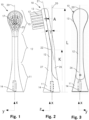
- the Figure 1 shows a schematic representation of a top view of a brush 10.
- the brush 10 comprises a truncated cone-shaped base part 11, a rod-shaped neck part 12 which adjoins the truncated cone-shaped base part 11, and finally a plate-shaped head part 13 which adjoins the neck part 12.
- the three parts form the basic body of the brush.
- the truncated cone-shaped base part 11 comprises a drive adapter.
- this is essentially formed by a channel-shaped receptacle 14 into which a pin of the handset of the sonic toothbrush can be inserted and locked (see below for Figure 4 ).
- the brush 10 has a foot part longitudinal axis 20 which is aligned coaxially to the holder 14 or, when the sonic toothbrush is in operation, coaxially to the pin.
- This longitudinal axis defines the x-axis of the xyz coordinate system used here.
- the drive adapter defines the geometric foot part longitudinal axis (x) of the brush.
- the bristle field 17 of the head part 13 is also visible, which in the present case has several (e.g. 20 - 40) tufts, each with a plurality (e.g. 100 - 200) of bristles.
- the head part 13 is teardrop-shaped when viewed from the front. This means that its shape gradually widens - starting at the transition to the neck part - almost to the upper end of the head part and ends there in a rounded final contour. With this shape (for a given length of the bristle field in the x direction) the center of gravity of the head part 13 is closer to the end of the brush. This can increase the eccentric effect at the specified operating frequency and thus also the "8" movement.
- the main surface of the plate-shaped head part 13 extends essentially transversely along the x-axis in the y-direction.
- an "8" lying in the y-direction is also shown with the reference number 23.
- the “8” illustrates the movement which is carried out in the plane due to the selected material property (modulus of elasticity), the angle between the geometric foot part longitudinal axis 20 and the geometric head part alignment axis (see below) and the bending position during operation.
- the brush In addition to the "8", the brush also performs a small nodding movement with the head part 13 - this movement is essentially perpendicular to the "8", i.e. essentially in the z-direction. In the sense of a preferred embodiment, the bristles are thus moved in three dimensions (x, y, z).
- the Figure 2 shows a schematic representation of a side view of the brush 10.
- the geometric Head part alignment axis 21 is visible.
- the foot part longitudinal axis 20 and the head part alignment axis 21 are one behind the other.
- the head part alignment axis 21 is essentially the longitudinal axis of the head part.
- the two axes intersect in the geometric bend position 22.
- the geometric foot part longitudinal axis 20 and the geometric head part alignment axis 21 enclose an angle ⁇ (gamma) of 10°.
- the geometric bend position 22 has a distance K to the end surface of the foot part 11 of 50% of the total length L of the brush 10. In this combination of the angle to the bend position 22, a brush 10 is created with which a particularly effective and gum-friendly cleaning of the teeth is possible.
- the head part 13 is plate-shaped and the neck part 12 is rod-shaped.
- the head part 13 and the neck part 12 have the same transverse dimension (i.e. the same thickness).
- the head part 13 is about three times as wide (y-direction) as the neck part 12.
- the length (x-direction) of the head part is about one third greater than the width (y-direction).
- the neck part 11 is, for example, one third as wide and 1.5 times as long as the head part 13.
- the neck part 12 is tapered compared to the head part 13 and the foot part 11.
- the neck part 12 is in at least one of the side views (here in the z-direction according to Figure 1 viewed from the side) is less wide than the headboard 13.
- the deflection is determined by the ratio of distance A to length L of the brush.
- the distance A corresponds to the distance from the front center of the head part (which here corresponds to the center of the bristle field 17) to the foot part longitudinal axis 20 (see Figure 2 ). In this example, the deflection is 14%.
- the bristles are arranged in several tufts and protrude vertically from the main surface of the plate-shaped head part. In the present case, they are perpendicular to the y-direction and run in the x-z plane. In the present embodiment, the bristles are attached to the front of the head part (or the front 27 of the brush), i.e. they point slightly downwards towards the adapter surface (y-z plane) of the foot part.
- the Figure 3 shows a schematic representation of a back view of the brush 10 according to the Figures 1 and 2
- the base body has a different material on the back 26, which is soft and offers protection (protective layer, protective coating) when the back of the brush comes into contact with the teeth.
- This material is non-load-bearing and can therefore have an E-modulus outside the E-modulus range of 2000 - 6000 MPa according to the invention.
- the load-bearing material can be seen on the front 27 and it makes up a significant part of the cross-section of the base body.
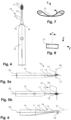
- the Figure 4 shows a schematic representation of a top view (z-direction) of a sonic toothbrush comprising the brush 10 and a handset 16 with a pin 15.
- the brush 10 is attached to the pin 15 so that the brush is detachable, rotationally fixed and axially fixed.
- the handset 16 rotates the pin 15 back and forth at a frequency of e.g. 180 - 270Hz with an amplitude of e.g. 2° (relative to a rest position) about the longitudinal axis of the pin 15 (which corresponds to the longitudinal axis of the handset 16).
- the brush therefore rotates back and forth about the foot part longitudinal axis 20 (x-axis).
- the Figure 5a shows a schematic representation of a side view of a sonic toothbrush 10.
- the sonic toothbrush 10 comprises a handset 16 and a brush 10.
- the drive of the handset 16 is designed as a piezoelectric drive (not shown), which generates an oscillation of the brush 10 about the x-axis 20 (longitudinal axis of the handset).
- the brush 10 thus carries out a rotational oscillation about the x-axis 20 relative to the handle.
- Due to the deflection of the head part 13 according to the invention an imbalance arises, which has a movement component in the Y-direction 24 and/or in the Z-direction 25 (see below, Figure 5b ).
- This effect is controlled by the suitably angled bend in the brush neck, the suitably selected modulus of elasticity and can be adjusted by further geometric design features of the brush (such as bend angle position, deflection, mass distribution and other features according to the particular embodiments of the invention).
- the Figure 5b shows a schematic plan view of a personal care device according to Figure 5a .
- the Z direction 25 is visible. It runs essentially in the direction of the bristles.
- the handset is significantly larger than the brush. This is the only way it can generate a longitudinal axis vibration (instead of an undefined or undirected vibration movement, as is the case with known sonic toothbrushes).
- the Figure 6 shows an embodiment of the sonic toothbrush, which comprises exactly one tuft 18.
- the tuft 18 is arranged at the back with respect to the head part 13.
- the head part is essentially tilted backwards.
- the Figure 7 shows a schematic representation of the "8" movement according to the invention.
- the "8" movement has the shape of a one-sided flattened “8", with a symmetry axis (X-axis) running through the center 27 of the "8".
- the two loops 28a, 28b of the "8" extend in the y-direction.
- the invention is not limited to exactly this form of the "8" movement, the exact form The movement ultimately depends on the parameters of the brush head and the vibration generated by the handset motor.
- the Figure 8 illustrates the amplitude of the longitudinal axis oscillation movement.
- the x-axis is perpendicular to the plane of the drawing.
- the plate-shaped head part 13 (shown without bristles) pivots around the x-axis at the angle ⁇ (alpha).
- the bristles extend in Figure 8 in the z-direction upwards).
- the main component of the pivoting movement (and thus the bristle wiping movement) is in the y-direction.
- the angle ⁇ (alpha) is preferably 2°.
- the Figure 9 shows a brush 10 with a plate-shaped oval head part 13.
- the longitudinal axis of the oval shape runs essentially in the x-direction and the transverse axis in the y-direction.
- the center of the head part 13 is further away from the upper end of the brush 10 than in the case of the drop-shaped head part according to Figure 1 .
- Figure 10 shows a brush with a bending angle ⁇ (gamma) of 14° and a distance K of the geometric bending position 22 to the end surface 29 of the foot part 11 of 75% based on the length L of the brush.
- the foot part 11 tapers from the end surface 29 to the transition into the neck part 12.
- the foot part 11 can be, for example, truncated cone-shaped or truncated pyramid-shaped, with a concave profile in longitudinal section, for example.
- the center of gravity of the foot part 11 is therefore closer to the end surface 29 than with a comparable foot part with straight profile lines.
- the neck part 12 takes up approximately half the length (L) of the brush. As the Figure 10 As illustrated, the neck part 12 does not necessarily have to have a constant cross-section along its entire length. It can certainly have a changing contour.
- the head part 13 is formed by the extension of the neck part 12.
- the head part 13 has essentially the same transverse dimensions (viewed in a section perpendicular to the head part alignment axis 21) as the neck part 12.
- the bristle field 17 is placed laterally on the head part 13. The bristles therefore protrude perpendicular to the head part alignment axis 21.
- Figure 11 shows an embodiment in which the foot part 11 is essentially formed by a pin 30 as a drive adapter.
- the neck part 12 is rod-shaped and takes up 90% of the length of the brush, for example.
- the head part 13 is the part in which the bristle field 17, here in the form of a single tuft, is anchored.
- the pin 30 is inserted into the handset in the x-direction for rotationally fixed coupling to a sonic toothbrush drive with longitudinal axis vibration, whereby the drive adapter defines the geometric foot part longitudinal axis (x) of the brush.
- a brush according to Fig. 11 is made of a material with an E-modulus of approx. 4600 MPa.
- the brush 10 has an interdental brush for cleaning the spaces between the teeth instead of the bristle field 17.
- a brush for a sonic toothbrush drive is created, which leads to a particularly advantageous movement of the head part for an effective cleaning of the teeth while gentle on the gums.
Landscapes
- Brushes (AREA)
Priority Applications (10)
| Application Number | Priority Date | Filing Date | Title |
|---|---|---|---|
| HRP20250375TT HRP20250375T1 (hr) | 2021-09-14 | 2021-09-14 | Četkica za soničnu četkicu za zube s vibracijama uzdužne osi |
| PL21196660.1T PL4147604T3 (pl) | 2021-09-14 | 2021-09-14 | Szczoteczka do sonicznej szczoteczki do zębów z drganiem wzdłuż osi wzdłużnej |
| RS20250318A RS66671B1 (sr) | 2021-09-14 | 2021-09-14 | Četkica za soničnu četkicu za zube sa vibracijama uzdužne ose |
| EP21196660.1A EP4147604B1 (de) | 2021-09-14 | 2021-09-14 | Bürste für eine schallzahnbürste mit längsachsenschwingung |
| EP25157733.4A EP4529807A3 (de) | 2021-09-14 | 2021-09-14 | Bürste für eine schallzahnbürste mit längsachsenschwingung |
| KR1020247009411A KR20240052953A (ko) | 2021-09-14 | 2022-09-14 | 종축 진동이 있는 음파 칫솔용 브러시 |
| PCT/EP2022/075566 WO2023041602A1 (de) | 2021-09-14 | 2022-09-14 | Bürste für eine schallzahnbürste mit längsachsenschwingung |
| JP2024515604A JP2024532573A (ja) | 2021-09-14 | 2022-09-14 | 長手方向軸線振動を有する音波歯ブラシ用のブラシ |
| US18/024,609 US20240277136A1 (en) | 2021-09-14 | 2022-09-14 | Brush For Sonic Toothbrush With Longitudinal Axis Vibration |
| CA3230017A CA3230017A1 (en) | 2021-09-14 | 2022-09-14 | Brush for a sonic toothbrush with longitudinal-axis vibration |
Applications Claiming Priority (1)
| Application Number | Priority Date | Filing Date | Title |
|---|---|---|---|
| EP21196660.1A EP4147604B1 (de) | 2021-09-14 | 2021-09-14 | Bürste für eine schallzahnbürste mit längsachsenschwingung |
Related Child Applications (2)
| Application Number | Title | Priority Date | Filing Date |
|---|---|---|---|
| EP25157733.4A Division EP4529807A3 (de) | 2021-09-14 | 2021-09-14 | Bürste für eine schallzahnbürste mit längsachsenschwingung |
| EP25157733.4A Previously-Filed-Application EP4529807A3 (de) | 2021-09-14 | 2021-09-14 | Bürste für eine schallzahnbürste mit längsachsenschwingung |
Publications (3)
| Publication Number | Publication Date |
|---|---|
| EP4147604A1 EP4147604A1 (de) | 2023-03-15 |
| EP4147604C0 EP4147604C0 (de) | 2025-02-19 |
| EP4147604B1 true EP4147604B1 (de) | 2025-02-19 |
Family
ID=77774701
Family Applications (2)
| Application Number | Title | Priority Date | Filing Date |
|---|---|---|---|
| EP21196660.1A Active EP4147604B1 (de) | 2021-09-14 | 2021-09-14 | Bürste für eine schallzahnbürste mit längsachsenschwingung |
| EP25157733.4A Pending EP4529807A3 (de) | 2021-09-14 | 2021-09-14 | Bürste für eine schallzahnbürste mit längsachsenschwingung |
Family Applications After (1)
| Application Number | Title | Priority Date | Filing Date |
|---|---|---|---|
| EP25157733.4A Pending EP4529807A3 (de) | 2021-09-14 | 2021-09-14 | Bürste für eine schallzahnbürste mit längsachsenschwingung |
Country Status (4)
| Country | Link |
|---|---|
| EP (2) | EP4147604B1 (pl) |
| HR (1) | HRP20250375T1 (pl) |
| PL (1) | PL4147604T3 (pl) |
| RS (1) | RS66671B1 (pl) |
Citations (1)
| Publication number | Priority date | Publication date | Assignee | Title |
|---|---|---|---|---|
| EP3352703B1 (de) * | 2015-09-22 | 2021-11-03 | Curaden AG | Bürstenkopf |
Family Cites Families (12)
| Publication number | Priority date | Publication date | Assignee | Title |
|---|---|---|---|---|
| JPS611738A (ja) | 1984-06-14 | 1986-01-07 | Kayaba Ind Co Ltd | 建設車両の合流回路 |
| JPH0443127A (ja) | 1990-06-07 | 1992-02-13 | Mazda Motor Corp | 車両の動力伝達装置 |
| DE29913406U1 (de) | 1999-07-31 | 1999-11-25 | Rowenta-Werke GmbH, 63071 Offenbach | Zubehörträger für eine elektrische Zahnbürste |
| ES2319629T3 (es) | 2003-11-13 | 2009-05-11 | Trisa Holding Ag | Cepillo de dientes. |
| US20060168744A1 (en) | 2005-01-28 | 2006-08-03 | Butler Clarence P | Electric toothbrush for implementing the bass brushing technique |
| EP1905382A1 (de) | 2006-09-29 | 2008-04-02 | Trisa Holding AG | Elektrozahnbürste und Getriebe für eine Elektrozahnbürste |
| EP2454967A1 (en) | 2010-11-19 | 2012-05-23 | Braun GmbH | Oral care implement |
| JP5802398B2 (ja) | 2011-02-03 | 2015-10-28 | 株式会社サニオン | 口腔清掃用具 |
| EP2704661B1 (en) | 2011-05-02 | 2018-03-07 | Water Pik, Inc. | Mechanically-driven, sonic toothbrush |
| US20120291212A1 (en) | 2011-05-16 | 2012-11-22 | Montagnino James G | Resonant vibration-enhancing cleaning attachment for an ultrasonic powered handle |
| EP2802285A4 (en) | 2012-01-13 | 2016-01-20 | Erskine Products Pty Ltd | DENTAL HYGIENE ARTICLE |
| DE102016011477B4 (de) | 2016-09-22 | 2022-03-31 | M + C Schiffer Gmbh | Bürstenkopf für eine elektrisch angetriebene Zahnbürste und Verfahren zu deren Herstellung |
-
2021
- 2021-09-14 PL PL21196660.1T patent/PL4147604T3/pl unknown
- 2021-09-14 EP EP21196660.1A patent/EP4147604B1/de active Active
- 2021-09-14 EP EP25157733.4A patent/EP4529807A3/de active Pending
- 2021-09-14 RS RS20250318A patent/RS66671B1/sr unknown
- 2021-09-14 HR HRP20250375TT patent/HRP20250375T1/hr unknown
Patent Citations (1)
| Publication number | Priority date | Publication date | Assignee | Title |
|---|---|---|---|---|
| EP3352703B1 (de) * | 2015-09-22 | 2021-11-03 | Curaden AG | Bürstenkopf |
Also Published As
| Publication number | Publication date |
|---|---|
| EP4147604C0 (de) | 2025-02-19 |
| RS66671B1 (sr) | 2025-05-30 |
| PL4147604T3 (pl) | 2025-04-28 |
| HRP20250375T1 (hr) | 2025-06-06 |
| EP4529807A3 (de) | 2025-04-09 |
| EP4147604A1 (de) | 2023-03-15 |
| EP4529807A2 (de) | 2025-04-02 |
Similar Documents
| Publication | Publication Date | Title |
|---|---|---|
| EP1061829B1 (de) | Zahnbürste und bürstenteil | |
| EP2886081B1 (de) | Elektrozahnbürste mit Bürstenkopf | |
| DE69328198T2 (de) | Bürstenteil für eine akustische zahnbürste | |
| EP0689404B1 (de) | Elektrische zahnbürste | |
| EP1912532B1 (de) | Zahnbürste mit schräggestellten und zugespitzten borsten | |
| EP3352703B1 (de) | Bürstenkopf | |
| EP1001693A1 (de) | Zahnbürste | |
| EP2184033A1 (de) | Elektrische Zahnbürste sowie Bürstenkopf hierfür | |
| DE68916949T2 (de) | Zahnreinigungsanordnung. | |
| WO2023041603A1 (de) | Bürste für eine schallzahnbürste mit längsachsenschwingung | |
| DE2728672A1 (de) | Zahnbuerste | |
| WO2006012974A1 (de) | Elektrische zahnbürste | |
| DE4402366C2 (de) | Zahnbürsten, deren Handgriffe und Stiele mit den borstentragenden Köpfen rundum abzufedern, die Borsten zum Vibrieren zu bringen und die Borsten an den Bürstköpfen zu befestigen sind | |
| EP4147605B1 (de) | Bürste für eine schallzahnbürste mit längsachsenschwingung | |
| EP4147604B1 (de) | Bürste für eine schallzahnbürste mit längsachsenschwingung | |
| DE102023126349A1 (de) | Vorrichtung zum Reinigen von Oberflächen und Verwendung derselben | |
| WO2024132336A1 (de) | Vorrichtung zum reinigen von oberflächen und verwendung derselben | |
| DE69524368T2 (de) | Spitze für ein Gerät zum Entfernen von Zahnstein und Herstellungsmethode | |
| EP1449496B1 (de) | Zahnbürste | |
| WO2020083554A1 (de) | Interdentalinstrument | |
| WO2023041602A1 (de) | Bürste für eine schallzahnbürste mit längsachsenschwingung | |
| DE8807968U1 (de) | Bürstenkopf | |
| DE10215805C1 (de) | Zahnreinigungsteil sowie Verfahren zur Herstellung eines solchen und Zahnreinigungsinstrument mit einem solchen | |
| WO2018002192A1 (de) | Bürste | |
| DE202008012567U1 (de) | Handgerät mit Vibrationsantrieb |
Legal Events
| Date | Code | Title | Description |
|---|---|---|---|
| REG | Reference to a national code |
Ref country code: HR Ref legal event code: TUEP Ref document number: P20250375T Country of ref document: HR |
|
| PUAI | Public reference made under article 153(3) epc to a published international application that has entered the european phase |
Free format text: ORIGINAL CODE: 0009012 |
|
| STAA | Information on the status of an ep patent application or granted ep patent |
Free format text: STATUS: THE APPLICATION HAS BEEN PUBLISHED |
|
| AK | Designated contracting states |
Kind code of ref document: A1 Designated state(s): AL AT BE BG CH CY CZ DE DK EE ES FI FR GB GR HR HU IE IS IT LI LT LU LV MC MK MT NL NO PL PT RO RS SE SI SK SM TR |
|
| STAA | Information on the status of an ep patent application or granted ep patent |
Free format text: STATUS: REQUEST FOR EXAMINATION WAS MADE |
|
| 17P | Request for examination filed |
Effective date: 20230713 |
|
| RBV | Designated contracting states (corrected) |
Designated state(s): AL AT BE BG CH CY CZ DE DK EE ES FI FR GB GR HR HU IE IS IT LI LT LU LV MC MK MT NL NO PL PT RO RS SE SI SK SM TR |
|
| STAA | Information on the status of an ep patent application or granted ep patent |
Free format text: STATUS: EXAMINATION IS IN PROGRESS |
|
| 17Q | First examination report despatched |
Effective date: 20230822 |
|
| GRAP | Despatch of communication of intention to grant a patent |
Free format text: ORIGINAL CODE: EPIDOSNIGR1 |
|
| STAA | Information on the status of an ep patent application or granted ep patent |
Free format text: STATUS: GRANT OF PATENT IS INTENDED |
|
| INTG | Intention to grant announced |
Effective date: 20240919 |
|
| GRAJ | Information related to disapproval of communication of intention to grant by the applicant or resumption of examination proceedings by the epo deleted |
Free format text: ORIGINAL CODE: EPIDOSDIGR1 |
|
| STAA | Information on the status of an ep patent application or granted ep patent |
Free format text: STATUS: EXAMINATION IS IN PROGRESS |
|
| GRAP | Despatch of communication of intention to grant a patent |
Free format text: ORIGINAL CODE: EPIDOSNIGR1 |
|
| STAA | Information on the status of an ep patent application or granted ep patent |
Free format text: STATUS: GRANT OF PATENT IS INTENDED |
|
| INTC | Intention to grant announced (deleted) | ||
| INTG | Intention to grant announced |
Effective date: 20241210 |
|
| GRAS | Grant fee paid |
Free format text: ORIGINAL CODE: EPIDOSNIGR3 |
|
| GRAA | (expected) grant |
Free format text: ORIGINAL CODE: 0009210 |
|
| STAA | Information on the status of an ep patent application or granted ep patent |
Free format text: STATUS: THE PATENT HAS BEEN GRANTED |
|
| AK | Designated contracting states |
Kind code of ref document: B1 Designated state(s): AL AT BE BG CH CY CZ DE DK EE ES FI FR GB GR HR HU IE IS IT LI LT LU LV MC MK MT NL NO PL PT RO RS SE SI SK SM TR |
|
| REG | Reference to a national code |
Ref country code: GB Ref legal event code: FG4D Free format text: NOT ENGLISH |
|
| REG | Reference to a national code |
Ref country code: CH Ref legal event code: EP |
|
| REG | Reference to a national code |
Ref country code: IE Ref legal event code: FG4D Free format text: LANGUAGE OF EP DOCUMENT: GERMAN |
|
| REG | Reference to a national code |
Ref country code: DE Ref legal event code: R096 Ref document number: 502021006686 Country of ref document: DE |
|
| U01 | Request for unitary effect filed |
Effective date: 20250312 |
|
| U07 | Unitary effect registered |
Designated state(s): AT BE BG DE DK EE FI FR IT LT LU LV MT NL PT RO SE SI Effective date: 20250320 |
|
| REG | Reference to a national code |
Ref country code: SK Ref legal event code: T3 Ref document number: E 46221 Country of ref document: SK |
|
| REG | Reference to a national code |
Ref country code: HR Ref legal event code: T1PR Ref document number: P20250375 Country of ref document: HR |
|
| PG25 | Lapsed in a contracting state [announced via postgrant information from national office to epo] |
Ref country code: ES Free format text: LAPSE BECAUSE OF FAILURE TO SUBMIT A TRANSLATION OF THE DESCRIPTION OR TO PAY THE FEE WITHIN THE PRESCRIBED TIME-LIMIT Effective date: 20250219 |
|
| PG25 | Lapsed in a contracting state [announced via postgrant information from national office to epo] |
Ref country code: NO Free format text: LAPSE BECAUSE OF FAILURE TO SUBMIT A TRANSLATION OF THE DESCRIPTION OR TO PAY THE FEE WITHIN THE PRESCRIBED TIME-LIMIT Effective date: 20250519 Ref country code: IS Free format text: LAPSE BECAUSE OF FAILURE TO SUBMIT A TRANSLATION OF THE DESCRIPTION OR TO PAY THE FEE WITHIN THE PRESCRIBED TIME-LIMIT Effective date: 20250619 |
|
| PG25 | Lapsed in a contracting state [announced via postgrant information from national office to epo] |
Ref country code: GR Free format text: LAPSE BECAUSE OF FAILURE TO SUBMIT A TRANSLATION OF THE DESCRIPTION OR TO PAY THE FEE WITHIN THE PRESCRIBED TIME-LIMIT Effective date: 20250520 |
|
| REG | Reference to a national code |
Ref country code: HR Ref legal event code: ODRP Ref document number: P20250375 Country of ref document: HR Payment date: 20250904 Year of fee payment: 5 |
|
| REG | Reference to a national code |
Ref country code: CH Ref legal event code: U11 Free format text: ST27 STATUS EVENT CODE: U-0-0-U10-U11 (AS PROVIDED BY THE NATIONAL OFFICE) Effective date: 20251001 |
|
| PG25 | Lapsed in a contracting state [announced via postgrant information from national office to epo] |
Ref country code: SM Free format text: LAPSE BECAUSE OF FAILURE TO SUBMIT A TRANSLATION OF THE DESCRIPTION OR TO PAY THE FEE WITHIN THE PRESCRIBED TIME-LIMIT Effective date: 20250219 |
|
| PGFP | Annual fee paid to national office [announced via postgrant information from national office to epo] |
Ref country code: PL Payment date: 20250905 Year of fee payment: 5 |
|
| PGFP | Annual fee paid to national office [announced via postgrant information from national office to epo] |
Ref country code: GB Payment date: 20250919 Year of fee payment: 5 |
|
| PGFP | Annual fee paid to national office [announced via postgrant information from national office to epo] |
Ref country code: HR Payment date: 20250904 Year of fee payment: 5 |
|
| PGFP | Annual fee paid to national office [announced via postgrant information from national office to epo] |
Ref country code: CZ Payment date: 20250908 Year of fee payment: 5 Ref country code: RS Payment date: 20250905 Year of fee payment: 5 |
|
| PGFP | Annual fee paid to national office [announced via postgrant information from national office to epo] |
Ref country code: SK Payment date: 20250909 Year of fee payment: 5 |
|
| U20 | Renewal fee for the european patent with unitary effect paid |
Year of fee payment: 5 Effective date: 20250924 |
|
| PLBE | No opposition filed within time limit |
Free format text: ORIGINAL CODE: 0009261 |
|
| STAA | Information on the status of an ep patent application or granted ep patent |
Free format text: STATUS: NO OPPOSITION FILED WITHIN TIME LIMIT |
|
| PGFP | Annual fee paid to national office [announced via postgrant information from national office to epo] |
Ref country code: CH Payment date: 20251001 Year of fee payment: 5 |
|
| 26N | No opposition filed |
Effective date: 20251120 |