EP4144735A1 - Substituted pyrazolo[1,5-a]pyridine compounds as ret kinase inhibitors - Google Patents
Substituted pyrazolo[1,5-a]pyridine compounds as ret kinase inhibitors Download PDFInfo
- Publication number
- EP4144735A1 EP4144735A1 EP22183490.6A EP22183490A EP4144735A1 EP 4144735 A1 EP4144735 A1 EP 4144735A1 EP 22183490 A EP22183490 A EP 22183490A EP 4144735 A1 EP4144735 A1 EP 4144735A1
- Authority
- EP
- European Patent Office
- Prior art keywords
- alkyl
- ring
- optionally substituted
- alkoxy
- fluoros
- Prior art date
- Legal status (The legal status is an assumption and is not a legal conclusion. Google has not performed a legal analysis and makes no representation as to the accuracy of the status listed.)
- Withdrawn
Links
- 101150077555 Ret gene Proteins 0.000 title description 45
- DVUBDHRTVYLIPA-UHFFFAOYSA-N pyrazolo[1,5-a]pyridine Chemical class C1=CC=CN2N=CC=C21 DVUBDHRTVYLIPA-UHFFFAOYSA-N 0.000 title description 3
- 229940043355 kinase inhibitor Drugs 0.000 title 1
- 239000003757 phosphotransferase inhibitor Substances 0.000 title 1
- 150000001875 compounds Chemical class 0.000 claims abstract description 242
- 150000003839 salts Chemical class 0.000 claims abstract description 60
- 239000012453 solvate Substances 0.000 claims abstract description 49
- 101000579425 Homo sapiens Proto-oncogene tyrosine-protein kinase receptor Ret Proteins 0.000 claims abstract description 11
- 102100028286 Proto-oncogene tyrosine-protein kinase receptor Ret Human genes 0.000 claims abstract description 11
- 125000004169 (C1-C6) alkyl group Chemical group 0.000 claims description 1543
- 125000001153 fluoro group Chemical group F* 0.000 claims description 599
- 125000004191 (C1-C6) alkoxy group Chemical group 0.000 claims description 575
- 229910052739 hydrogen Inorganic materials 0.000 claims description 432
- 239000001257 hydrogen Substances 0.000 claims description 408
- 125000000217 alkyl group Chemical group 0.000 claims description 276
- 125000005842 heteroatom Chemical group 0.000 claims description 275
- IJGRMHOSHXDMSA-UHFFFAOYSA-N Atomic nitrogen Chemical compound N#N IJGRMHOSHXDMSA-UHFFFAOYSA-N 0.000 claims description 236
- 125000001424 substituent group Chemical group 0.000 claims description 183
- UFHFLCQGNIYNRP-UHFFFAOYSA-N Hydrogen Chemical compound [H][H] UFHFLCQGNIYNRP-UHFFFAOYSA-N 0.000 claims description 173
- 229910052757 nitrogen Inorganic materials 0.000 claims description 160
- 125000004435 hydrogen atom Chemical group [H]* 0.000 claims description 124
- 125000002887 hydroxy group Chemical group [H]O* 0.000 claims description 112
- 206010028980 Neoplasm Diseases 0.000 claims description 95
- 229920006395 saturated elastomer Polymers 0.000 claims description 95
- 125000001559 cyclopropyl group Chemical group [H]C1([H])C([H])([H])C1([H])* 0.000 claims description 74
- 125000004178 (C1-C4) alkyl group Chemical group 0.000 claims description 70
- 201000011510 cancer Diseases 0.000 claims description 70
- 229910052736 halogen Inorganic materials 0.000 claims description 69
- 125000005913 (C3-C6) cycloalkyl group Chemical group 0.000 claims description 68
- 125000006239 protecting group Chemical group 0.000 claims description 65
- -1 Q is H Chemical group 0.000 claims description 59
- 229910052796 boron Inorganic materials 0.000 claims description 54
- 125000002924 primary amino group Chemical group [H]N([H])* 0.000 claims description 49
- 125000004433 nitrogen atom Chemical group N* 0.000 claims description 46
- 125000005843 halogen group Chemical group 0.000 claims description 45
- 125000006570 (C5-C6) heteroaryl group Chemical group 0.000 claims description 43
- 229910052760 oxygen Inorganic materials 0.000 claims description 43
- 125000000623 heterocyclic group Chemical group 0.000 claims description 42
- 229910052717 sulfur Inorganic materials 0.000 claims description 41
- 230000008878 coupling Effects 0.000 claims description 36
- 238000010168 coupling process Methods 0.000 claims description 36
- 238000005859 coupling reaction Methods 0.000 claims description 36
- 206010033701 Papillary thyroid cancer Diseases 0.000 claims description 33
- 208000030045 thyroid gland papillary carcinoma Diseases 0.000 claims description 33
- 229910052703 rhodium Inorganic materials 0.000 claims description 30
- 125000004429 atom Chemical group 0.000 claims description 27
- 125000006273 (C1-C3) alkyl group Chemical group 0.000 claims description 26
- KDLHZDBZIXYQEI-UHFFFAOYSA-N Palladium Chemical compound [Pd] KDLHZDBZIXYQEI-UHFFFAOYSA-N 0.000 claims description 26
- 150000002367 halogens Chemical class 0.000 claims description 24
- 239000008194 pharmaceutical composition Substances 0.000 claims description 20
- 229910052801 chlorine Inorganic materials 0.000 claims description 19
- 125000001997 phenyl group Chemical group [H]C1=C([H])C([H])=C(*)C([H])=C1[H] 0.000 claims description 18
- 125000004070 6 membered heterocyclic group Chemical group 0.000 claims description 16
- 239000003446 ligand Substances 0.000 claims description 16
- IWZSHWBGHQBIML-ZGGLMWTQSA-N (3S,8S,10R,13S,14S,17S)-17-isoquinolin-7-yl-N,N,10,13-tetramethyl-2,3,4,7,8,9,11,12,14,15,16,17-dodecahydro-1H-cyclopenta[a]phenanthren-3-amine Chemical compound CN(C)[C@H]1CC[C@]2(C)C3CC[C@@]4(C)[C@@H](CC[C@@H]4c4ccc5ccncc5c4)[C@@H]3CC=C2C1 IWZSHWBGHQBIML-ZGGLMWTQSA-N 0.000 claims description 14
- ITMCEJHCFYSIIV-UHFFFAOYSA-M triflate Chemical compound [O-]S(=O)(=O)C(F)(F)F ITMCEJHCFYSIIV-UHFFFAOYSA-M 0.000 claims description 14
- 239000003054 catalyst Substances 0.000 claims description 13
- 229910052763 palladium Inorganic materials 0.000 claims description 13
- 208000002154 non-small cell lung carcinoma Diseases 0.000 claims description 12
- 206010006187 Breast cancer Diseases 0.000 claims description 11
- 208000026310 Breast neoplasm Diseases 0.000 claims description 11
- 206010009944 Colon cancer Diseases 0.000 claims description 11
- 206010058467 Lung neoplasm malignant Diseases 0.000 claims description 10
- VSCWAEJMTAWNJL-UHFFFAOYSA-K aluminium trichloride Chemical compound Cl[Al](Cl)Cl VSCWAEJMTAWNJL-UHFFFAOYSA-K 0.000 claims description 10
- 125000001495 ethyl group Chemical group [H]C([H])([H])C([H])([H])* 0.000 claims description 10
- 201000005202 lung cancer Diseases 0.000 claims description 10
- 208000020816 lung neoplasm Diseases 0.000 claims description 10
- 125000002496 methyl group Chemical group [H]C([H])([H])* 0.000 claims description 10
- 238000004519 manufacturing process Methods 0.000 claims description 9
- 208000010507 Adenocarcinoma of Lung Diseases 0.000 claims description 8
- 208000024770 Thyroid neoplasm Diseases 0.000 claims description 8
- 125000004122 cyclic group Chemical group 0.000 claims description 8
- 125000000753 cycloalkyl group Chemical group 0.000 claims description 8
- 201000005249 lung adenocarcinoma Diseases 0.000 claims description 8
- 125000002950 monocyclic group Chemical group 0.000 claims description 8
- 229910052702 rhenium Inorganic materials 0.000 claims description 8
- 201000002510 thyroid cancer Diseases 0.000 claims description 8
- 201000009030 Carcinoma Diseases 0.000 claims description 6
- 208000001333 Colorectal Neoplasms Diseases 0.000 claims description 6
- 208000006876 Multiple Endocrine Neoplasia Type 2b Diseases 0.000 claims description 6
- 206010073148 Multiple endocrine neoplasia type 2A Diseases 0.000 claims description 6
- 208000015799 differentiated thyroid carcinoma Diseases 0.000 claims description 6
- 208000023356 medullary thyroid gland carcinoma Diseases 0.000 claims description 6
- 208000006265 Renal cell carcinoma Diseases 0.000 claims description 5
- 230000004927 fusion Effects 0.000 claims description 5
- 206010008342 Cervix carcinoma Diseases 0.000 claims description 4
- 208000009018 Medullary thyroid cancer Diseases 0.000 claims description 4
- 208000006105 Uterine Cervical Neoplasms Diseases 0.000 claims description 4
- 201000010881 cervical cancer Diseases 0.000 claims description 4
- 208000000587 small cell lung carcinoma Diseases 0.000 claims description 4
- 210000005265 lung cell Anatomy 0.000 claims description 3
- 210000004877 mucosa Anatomy 0.000 claims description 3
- 201000010279 papillary renal cell carcinoma Diseases 0.000 claims description 3
- 208000025061 parathyroid hyperplasia Diseases 0.000 claims description 3
- 208000028591 pheochromocytoma Diseases 0.000 claims description 3
- 230000000306 recurrent effect Effects 0.000 claims description 3
- 125000006519 CCH3 Chemical group 0.000 claims description 2
- 239000003085 diluting agent Substances 0.000 claims description 2
- 208000029729 tumor suppressor gene on chromosome 11 Diseases 0.000 claims description 2
- 238000011282 treatment Methods 0.000 abstract description 30
- 239000003112 inhibitor Substances 0.000 abstract description 9
- 229940125905 RET kinase inhibitor Drugs 0.000 abstract description 5
- 208000037765 diseases and disorders Diseases 0.000 abstract description 5
- 230000006806 disease prevention Effects 0.000 abstract description 2
- 150000002431 hydrogen Chemical group 0.000 description 114
- 125000001797 benzyl group Chemical group [H]C1=C([H])C([H])=C(C([H])=C1[H])C([H])([H])* 0.000 description 79
- 235000001014 amino acid Nutrition 0.000 description 67
- 150000001413 amino acids Chemical group 0.000 description 65
- 108091000080 Phosphotransferase Proteins 0.000 description 51
- 102000020233 phosphotransferase Human genes 0.000 description 51
- 238000000034 method Methods 0.000 description 45
- 230000000694 effects Effects 0.000 description 36
- 229910052701 rubidium Inorganic materials 0.000 description 34
- 230000014509 gene expression Effects 0.000 description 33
- 208000037265 diseases, disorders, signs and symptoms Diseases 0.000 description 30
- 229910052705 radium Inorganic materials 0.000 description 30
- 230000008482 dysregulation Effects 0.000 description 29
- 108090000623 proteins and genes Proteins 0.000 description 27
- 230000000670 limiting effect Effects 0.000 description 26
- 230000035772 mutation Effects 0.000 description 26
- 102000004169 proteins and genes Human genes 0.000 description 25
- 208000002551 irritable bowel syndrome Diseases 0.000 description 24
- 235000018102 proteins Nutrition 0.000 description 24
- 229910052740 iodine Inorganic materials 0.000 description 22
- 239000003153 chemical reaction reagent Substances 0.000 description 21
- 201000010099 disease Diseases 0.000 description 21
- 102000001253 Protein Kinase Human genes 0.000 description 18
- 108060006633 protein kinase Proteins 0.000 description 18
- 229910052786 argon Inorganic materials 0.000 description 17
- 239000002585 base Substances 0.000 description 17
- 229910052799 carbon Inorganic materials 0.000 description 16
- 239000000203 mixture Substances 0.000 description 15
- CDBYLPFSWZWCQE-UHFFFAOYSA-L Sodium Carbonate Chemical compound [Na+].[Na+].[O-]C([O-])=O CDBYLPFSWZWCQE-UHFFFAOYSA-L 0.000 description 14
- 230000000875 corresponding effect Effects 0.000 description 14
- 239000003814 drug Substances 0.000 description 14
- 125000004432 carbon atom Chemical group C* 0.000 description 13
- 230000037430 deletion Effects 0.000 description 13
- 238000012217 deletion Methods 0.000 description 13
- OPFJDXRVMFKJJO-ZHHKINOHSA-N N-{[3-(2-benzamido-4-methyl-1,3-thiazol-5-yl)-pyrazol-5-yl]carbonyl}-G-dR-G-dD-dD-dD-NH2 Chemical compound S1C(C=2NN=C(C=2)C(=O)NCC(=O)N[C@H](CCCN=C(N)N)C(=O)NCC(=O)N[C@H](CC(O)=O)C(=O)N[C@H](CC(O)=O)C(=O)N[C@H](CC(O)=O)C(N)=O)=C(C)N=C1NC(=O)C1=CC=CC=C1 OPFJDXRVMFKJJO-ZHHKINOHSA-N 0.000 description 11
- 229940126086 compound 21 Drugs 0.000 description 11
- 102100033177 Vascular endothelial growth factor receptor 2 Human genes 0.000 description 10
- 229940125773 compound 10 Drugs 0.000 description 10
- 229940125810 compound 20 Drugs 0.000 description 10
- JAXFJECJQZDFJS-XHEPKHHKSA-N gtpl8555 Chemical compound OC(=O)C[C@H](N)C(=O)N[C@@H](CCC(O)=O)C(=O)N[C@@H](C(C)C)C(=O)N[C@@H](C(C)C)C(=O)N1CCC[C@@H]1C(=O)N[C@H](B1O[C@@]2(C)[C@H]3C[C@H](C3(C)C)C[C@H]2O1)CCC1=CC=C(F)C=C1 JAXFJECJQZDFJS-XHEPKHHKSA-N 0.000 description 10
- ZLVXBBHTMQJRSX-VMGNSXQWSA-N jdtic Chemical compound C1([C@]2(C)CCN(C[C@@H]2C)C[C@H](C(C)C)NC(=O)[C@@H]2NCC3=CC(O)=CC=C3C2)=CC=CC(O)=C1 ZLVXBBHTMQJRSX-VMGNSXQWSA-N 0.000 description 10
- 238000003786 synthesis reaction Methods 0.000 description 10
- QFLWZFQWSBQYPS-AWRAUJHKSA-N (3S)-3-[[(2S)-2-[[(2S)-2-[5-[(3aS,6aR)-2-oxo-1,3,3a,4,6,6a-hexahydrothieno[3,4-d]imidazol-4-yl]pentanoylamino]-3-methylbutanoyl]amino]-3-(4-hydroxyphenyl)propanoyl]amino]-4-[1-bis(4-chlorophenoxy)phosphorylbutylamino]-4-oxobutanoic acid Chemical compound CCCC(NC(=O)[C@H](CC(O)=O)NC(=O)[C@H](Cc1ccc(O)cc1)NC(=O)[C@@H](NC(=O)CCCCC1SC[C@@H]2NC(=O)N[C@H]12)C(C)C)P(=O)(Oc1ccc(Cl)cc1)Oc1ccc(Cl)cc1 QFLWZFQWSBQYPS-AWRAUJHKSA-N 0.000 description 9
- 108010053099 Vascular Endothelial Growth Factor Receptor-2 Proteins 0.000 description 9
- 239000002246 antineoplastic agent Substances 0.000 description 9
- 229940041181 antineoplastic drug Drugs 0.000 description 9
- 150000001721 carbon Chemical group 0.000 description 9
- 208000035475 disorder Diseases 0.000 description 9
- 230000005764 inhibitory process Effects 0.000 description 9
- 230000008569 process Effects 0.000 description 9
- GHYOCDFICYLMRF-UTIIJYGPSA-N (2S,3R)-N-[(2S)-3-(cyclopenten-1-yl)-1-[(2R)-2-methyloxiran-2-yl]-1-oxopropan-2-yl]-3-hydroxy-3-(4-methoxyphenyl)-2-[[(2S)-2-[(2-morpholin-4-ylacetyl)amino]propanoyl]amino]propanamide Chemical group C1(=CCCC1)C[C@@H](C(=O)[C@@]1(OC1)C)NC([C@H]([C@@H](C1=CC=C(C=C1)OC)O)NC([C@H](C)NC(CN1CCOCC1)=O)=O)=O GHYOCDFICYLMRF-UTIIJYGPSA-N 0.000 description 8
- WWTBZEKOSBFBEM-SPWPXUSOSA-N (2s)-2-[[2-benzyl-3-[hydroxy-[(1r)-2-phenyl-1-(phenylmethoxycarbonylamino)ethyl]phosphoryl]propanoyl]amino]-3-(1h-indol-3-yl)propanoic acid Chemical compound N([C@@H](CC=1C2=CC=CC=C2NC=1)C(=O)O)C(=O)C(CP(O)(=O)[C@H](CC=1C=CC=CC=1)NC(=O)OCC=1C=CC=CC=1)CC1=CC=CC=C1 WWTBZEKOSBFBEM-SPWPXUSOSA-N 0.000 description 8
- 210000004027 cell Anatomy 0.000 description 8
- 229940125797 compound 12 Drugs 0.000 description 8
- 229940126208 compound 22 Drugs 0.000 description 8
- 108020001507 fusion proteins Proteins 0.000 description 8
- 102000037865 fusion proteins Human genes 0.000 description 8
- 150000007529 inorganic bases Chemical class 0.000 description 8
- RYHBNJHYFVUHQT-UHFFFAOYSA-N 1,4-Dioxane Chemical compound C1COCCO1 RYHBNJHYFVUHQT-UHFFFAOYSA-N 0.000 description 7
- NFHFRUOZVGFOOS-UHFFFAOYSA-N Pd(PPh3)4 Substances [Pd].C1=CC=CC=C1P(C=1C=CC=CC=1)C1=CC=CC=C1.C1=CC=CC=C1P(C=1C=CC=CC=1)C1=CC=CC=C1.C1=CC=CC=C1P(C=1C=CC=CC=1)C1=CC=CC=C1.C1=CC=CC=C1P(C=1C=CC=CC=1)C1=CC=CC=C1 NFHFRUOZVGFOOS-UHFFFAOYSA-N 0.000 description 7
- 238000006069 Suzuki reaction reaction Methods 0.000 description 7
- 150000004820 halides Chemical class 0.000 description 7
- 230000002489 hematologic effect Effects 0.000 description 7
- 230000037431 insertion Effects 0.000 description 7
- 238000003780 insertion Methods 0.000 description 7
- 238000010651 palladium-catalyzed cross coupling reaction Methods 0.000 description 7
- 102200006099 rs79658334 Human genes 0.000 description 7
- 229910000029 sodium carbonate Inorganic materials 0.000 description 7
- 230000005945 translocation Effects 0.000 description 7
- 208000018522 Gastrointestinal disease Diseases 0.000 description 6
- 238000003556 assay Methods 0.000 description 6
- 230000015572 biosynthetic process Effects 0.000 description 6
- 125000004482 piperidin-4-yl group Chemical group N1CCC(CC1)* 0.000 description 6
- BWHMMNNQKKPAPP-UHFFFAOYSA-L potassium carbonate Chemical compound [K+].[K+].[O-]C([O-])=O BWHMMNNQKKPAPP-UHFFFAOYSA-L 0.000 description 6
- 230000001105 regulatory effect Effects 0.000 description 6
- 229940124597 therapeutic agent Drugs 0.000 description 6
- 208000031261 Acute myeloid leukaemia Diseases 0.000 description 5
- VEXZGXHMUGYJMC-UHFFFAOYSA-N Hydrochloric acid Chemical compound Cl VEXZGXHMUGYJMC-UHFFFAOYSA-N 0.000 description 5
- 206010035226 Plasma cell myeloma Diseases 0.000 description 5
- DTQVDTLACAAQTR-UHFFFAOYSA-N Trifluoroacetic acid Chemical compound OC(=O)C(F)(F)F DTQVDTLACAAQTR-UHFFFAOYSA-N 0.000 description 5
- 229910052794 bromium Inorganic materials 0.000 description 5
- 208000029742 colonic neoplasm Diseases 0.000 description 5
- 150000002148 esters Chemical class 0.000 description 5
- 230000002401 inhibitory effect Effects 0.000 description 5
- 230000002018 overexpression Effects 0.000 description 5
- GLGNXYJARSMNGJ-VKTIVEEGSA-N (1s,2s,3r,4r)-3-[[5-chloro-2-[(1-ethyl-6-methoxy-2-oxo-4,5-dihydro-3h-1-benzazepin-7-yl)amino]pyrimidin-4-yl]amino]bicyclo[2.2.1]hept-5-ene-2-carboxamide Chemical compound CCN1C(=O)CCCC2=C(OC)C(NC=3N=C(C(=CN=3)Cl)N[C@H]3[C@H]([C@@]4([H])C[C@@]3(C=C4)[H])C(N)=O)=CC=C21 GLGNXYJARSMNGJ-VKTIVEEGSA-N 0.000 description 4
- 125000004777 2-fluoroethyl group Chemical group [H]C([H])(F)C([H])([H])* 0.000 description 4
- CJLHTKGWEUGORV-UHFFFAOYSA-N Artemin Chemical compound C1CC2(C)C(O)CCC(=C)C2(O)C2C1C(C)C(=O)O2 CJLHTKGWEUGORV-UHFFFAOYSA-N 0.000 description 4
- 208000003174 Brain Neoplasms Diseases 0.000 description 4
- OKTJSMMVPCPJKN-UHFFFAOYSA-N Carbon Chemical compound [C] OKTJSMMVPCPJKN-UHFFFAOYSA-N 0.000 description 4
- 102100029505 E3 ubiquitin-protein ligase TRIM33 Human genes 0.000 description 4
- 101000634991 Homo sapiens E3 ubiquitin-protein ligase TRIM33 Proteins 0.000 description 4
- 101000974343 Homo sapiens Nuclear receptor coactivator 4 Proteins 0.000 description 4
- 201000003793 Myelodysplastic syndrome Diseases 0.000 description 4
- 208000014767 Myeloproliferative disease Diseases 0.000 description 4
- HPKJGHVHQWJOOT-ZJOUEHCJSA-N N-[(2S)-3-cyclohexyl-1-oxo-1-({(2S)-1-oxo-3-[(3S)-2-oxopyrrolidin-3-yl]propan-2-yl}amino)propan-2-yl]-1H-indole-2-carboxamide Chemical compound C1C(CCCC1)C[C@H](NC(=O)C=1NC2=CC=CC=C2C=1)C(=O)N[C@@H](C[C@H]1C(=O)NCC1)C=O HPKJGHVHQWJOOT-ZJOUEHCJSA-N 0.000 description 4
- 102100022927 Nuclear receptor coactivator 4 Human genes 0.000 description 4
- 230000002378 acidificating effect Effects 0.000 description 4
- 230000004913 activation Effects 0.000 description 4
- 125000003277 amino group Chemical group 0.000 description 4
- KGNDCEVUMONOKF-UGPLYTSKSA-N benzyl n-[(2r)-1-[(2s,4r)-2-[[(2s)-6-amino-1-(1,3-benzoxazol-2-yl)-1,1-dihydroxyhexan-2-yl]carbamoyl]-4-[(4-methylphenyl)methoxy]pyrrolidin-1-yl]-1-oxo-4-phenylbutan-2-yl]carbamate Chemical compound C1=CC(C)=CC=C1CO[C@H]1CN(C(=O)[C@@H](CCC=2C=CC=CC=2)NC(=O)OCC=2C=CC=CC=2)[C@H](C(=O)N[C@@H](CCCCN)C(O)(O)C=2OC3=CC=CC=C3N=2)C1 KGNDCEVUMONOKF-UGPLYTSKSA-N 0.000 description 4
- 238000006243 chemical reaction Methods 0.000 description 4
- 201000010902 chronic myelomonocytic leukemia Diseases 0.000 description 4
- 229940125758 compound 15 Drugs 0.000 description 4
- 229940125833 compound 23 Drugs 0.000 description 4
- 208000032839 leukemia Diseases 0.000 description 4
- 230000007170 pathology Effects 0.000 description 4
- 230000003389 potentiating effect Effects 0.000 description 4
- 238000002360 preparation method Methods 0.000 description 4
- 230000002285 radioactive effect Effects 0.000 description 4
- 239000002904 solvent Substances 0.000 description 4
- 208000024891 symptom Diseases 0.000 description 4
- RIOQSEWOXXDEQQ-UHFFFAOYSA-N triphenylphosphine Chemical compound C1=CC=CC=C1P(C=1C=CC=CC=1)C1=CC=CC=C1 RIOQSEWOXXDEQQ-UHFFFAOYSA-N 0.000 description 4
- AOSZTAHDEDLTLQ-AZKQZHLXSA-N (1S,2S,4R,8S,9S,11S,12R,13S,19S)-6-[(3-chlorophenyl)methyl]-12,19-difluoro-11-hydroxy-8-(2-hydroxyacetyl)-9,13-dimethyl-6-azapentacyclo[10.8.0.02,9.04,8.013,18]icosa-14,17-dien-16-one Chemical compound C([C@@H]1C[C@H]2[C@H]3[C@]([C@]4(C=CC(=O)C=C4[C@@H](F)C3)C)(F)[C@@H](O)C[C@@]2([C@@]1(C1)C(=O)CO)C)N1CC1=CC=CC(Cl)=C1 AOSZTAHDEDLTLQ-AZKQZHLXSA-N 0.000 description 3
- 125000006569 (C5-C6) heterocyclic group Chemical group 0.000 description 3
- KQZLRWGGWXJPOS-NLFPWZOASA-N 1-[(1R)-1-(2,4-dichlorophenyl)ethyl]-6-[(4S,5R)-4-[(2S)-2-(hydroxymethyl)pyrrolidin-1-yl]-5-methylcyclohexen-1-yl]pyrazolo[3,4-b]pyrazine-3-carbonitrile Chemical compound ClC1=C(C=CC(=C1)Cl)[C@@H](C)N1N=C(C=2C1=NC(=CN=2)C1=CC[C@@H]([C@@H](C1)C)N1[C@@H](CCC1)CO)C#N KQZLRWGGWXJPOS-NLFPWZOASA-N 0.000 description 3
- YSUIQYOGTINQIN-UZFYAQMZSA-N 2-amino-9-[(1S,6R,8R,9S,10R,15R,17R,18R)-8-(6-aminopurin-9-yl)-9,18-difluoro-3,12-dihydroxy-3,12-bis(sulfanylidene)-2,4,7,11,13,16-hexaoxa-3lambda5,12lambda5-diphosphatricyclo[13.2.1.06,10]octadecan-17-yl]-1H-purin-6-one Chemical compound NC1=NC2=C(N=CN2[C@@H]2O[C@@H]3COP(S)(=O)O[C@@H]4[C@@H](COP(S)(=O)O[C@@H]2[C@@H]3F)O[C@H]([C@H]4F)N2C=NC3=C2N=CN=C3N)C(=O)N1 YSUIQYOGTINQIN-UZFYAQMZSA-N 0.000 description 3
- WFDIJRYMOXRFFG-UHFFFAOYSA-N Acetic anhydride Chemical compound CC(=O)OC(C)=O WFDIJRYMOXRFFG-UHFFFAOYSA-N 0.000 description 3
- 208000024893 Acute lymphoblastic leukemia Diseases 0.000 description 3
- 208000032791 BCR-ABL1 positive chronic myelogenous leukemia Diseases 0.000 description 3
- 206010004593 Bile duct cancer Diseases 0.000 description 3
- 102100031048 Coiled-coil domain-containing protein 6 Human genes 0.000 description 3
- 206010052358 Colorectal cancer metastatic Diseases 0.000 description 3
- 229940126657 Compound 17 Drugs 0.000 description 3
- 206010012735 Diarrhoea Diseases 0.000 description 3
- LFQSCWFLJHTTHZ-UHFFFAOYSA-N Ethanol Chemical compound CCO LFQSCWFLJHTTHZ-UHFFFAOYSA-N 0.000 description 3
- RRSNDVCODIMOFX-MPKOGUQCSA-N Fc1c(Cl)cccc1[C@H]1[C@@H](NC2(CCCCC2)[C@@]11C(=O)Nc2cc(Cl)ccc12)C(=O)Nc1ccc(cc1)C(=O)NCCCCCc1cccc2C(=O)N(Cc12)C1CCC(=O)NC1=O Chemical compound Fc1c(Cl)cccc1[C@H]1[C@@H](NC2(CCCCC2)[C@@]11C(=O)Nc2cc(Cl)ccc12)C(=O)Nc1ccc(cc1)C(=O)NCCCCCc1cccc2C(=O)N(Cc12)C1CCC(=O)NC1=O RRSNDVCODIMOFX-MPKOGUQCSA-N 0.000 description 3
- 102000034615 Glial cell line-derived neurotrophic factor Human genes 0.000 description 3
- 108091010837 Glial cell line-derived neurotrophic factor Proteins 0.000 description 3
- 208000017604 Hodgkin disease Diseases 0.000 description 3
- 208000010747 Hodgkins lymphoma Diseases 0.000 description 3
- 101000777370 Homo sapiens Coiled-coil domain-containing protein 6 Proteins 0.000 description 3
- 206010027476 Metastases Diseases 0.000 description 3
- 208000034578 Multiple myelomas Diseases 0.000 description 3
- 208000033776 Myeloid Acute Leukemia Diseases 0.000 description 3
- JGFZNNIVVJXRND-UHFFFAOYSA-N N,N-Diisopropylethylamine (DIPEA) Chemical compound CCN(C(C)C)C(C)C JGFZNNIVVJXRND-UHFFFAOYSA-N 0.000 description 3
- 101800000933 Non-structural protein 10 Proteins 0.000 description 3
- 208000002193 Pain Diseases 0.000 description 3
- 208000009956 adenocarcinoma Diseases 0.000 description 3
- 201000008395 adenosquamous carcinoma Diseases 0.000 description 3
- 150000001408 amides Chemical class 0.000 description 3
- 229940024606 amino acid Drugs 0.000 description 3
- 230000003321 amplification Effects 0.000 description 3
- XRWSZZJLZRKHHD-WVWIJVSJSA-N asunaprevir Chemical compound O=C([C@@H]1C[C@H](CN1C(=O)[C@@H](NC(=O)OC(C)(C)C)C(C)(C)C)OC1=NC=C(C2=CC=C(Cl)C=C21)OC)N[C@]1(C(=O)NS(=O)(=O)C2CC2)C[C@H]1C=C XRWSZZJLZRKHHD-WVWIJVSJSA-N 0.000 description 3
- 150000001732 carboxylic acid derivatives Chemical class 0.000 description 3
- 210000003169 central nervous system Anatomy 0.000 description 3
- 230000000973 chemotherapeutic effect Effects 0.000 description 3
- 229940125904 compound 1 Drugs 0.000 description 3
- 229940125961 compound 24 Drugs 0.000 description 3
- 229940125877 compound 31 Drugs 0.000 description 3
- 239000000463 material Substances 0.000 description 3
- 108020004999 messenger RNA Proteins 0.000 description 3
- 230000009401 metastasis Effects 0.000 description 3
- 201000005962 mycosis fungoides Diseases 0.000 description 3
- 238000003199 nucleic acid amplification method Methods 0.000 description 3
- 229910000027 potassium carbonate Inorganic materials 0.000 description 3
- 230000003319 supportive effect Effects 0.000 description 3
- 210000001685 thyroid gland Anatomy 0.000 description 3
- 208000013077 thyroid gland carcinoma Diseases 0.000 description 3
- SZUVGFMDDVSKSI-WIFOCOSTSA-N (1s,2s,3s,5r)-1-(carboxymethyl)-3,5-bis[(4-phenoxyphenyl)methyl-propylcarbamoyl]cyclopentane-1,2-dicarboxylic acid Chemical compound O=C([C@@H]1[C@@H]([C@](CC(O)=O)([C@H](C(=O)N(CCC)CC=2C=CC(OC=3C=CC=CC=3)=CC=2)C1)C(O)=O)C(O)=O)N(CCC)CC(C=C1)=CC=C1OC1=CC=CC=C1 SZUVGFMDDVSKSI-WIFOCOSTSA-N 0.000 description 2
- 125000003088 (fluoren-9-ylmethoxy)carbonyl group Chemical group 0.000 description 2
- 125000004778 2,2-difluoroethyl group Chemical group [H]C([H])(*)C([H])(F)F 0.000 description 2
- 125000003821 2-(trimethylsilyl)ethoxymethyl group Chemical group [H]C([H])([H])[Si](C([H])([H])[H])(C([H])([H])[H])C([H])([H])C(OC([H])([H])[*])([H])[H] 0.000 description 2
- GOJUJUVQIVIZAV-UHFFFAOYSA-N 2-amino-4,6-dichloropyrimidine-5-carbaldehyde Chemical group NC1=NC(Cl)=C(C=O)C(Cl)=N1 GOJUJUVQIVIZAV-UHFFFAOYSA-N 0.000 description 2
- QBWKPGNFQQJGFY-QLFBSQMISA-N 3-[(1r)-1-[(2r,6s)-2,6-dimethylmorpholin-4-yl]ethyl]-n-[6-methyl-3-(1h-pyrazol-4-yl)imidazo[1,2-a]pyrazin-8-yl]-1,2-thiazol-5-amine Chemical compound N1([C@H](C)C2=NSC(NC=3C4=NC=C(N4C=C(C)N=3)C3=CNN=C3)=C2)C[C@H](C)O[C@H](C)C1 QBWKPGNFQQJGFY-QLFBSQMISA-N 0.000 description 2
- 208000014697 Acute lymphocytic leukaemia Diseases 0.000 description 2
- 208000036762 Acute promyelocytic leukaemia Diseases 0.000 description 2
- 206010073478 Anaplastic large-cell lymphoma Diseases 0.000 description 2
- 102100026376 Artemin Human genes 0.000 description 2
- 101710205806 Artemin Proteins 0.000 description 2
- 208000010839 B-cell chronic lymphocytic leukemia Diseases 0.000 description 2
- 208000005623 Carcinogenesis Diseases 0.000 description 2
- 208000010833 Chronic myeloid leukaemia Diseases 0.000 description 2
- 108020004705 Codon Proteins 0.000 description 2
- YMWUJEATGCHHMB-UHFFFAOYSA-N Dichloromethane Chemical compound ClCCl YMWUJEATGCHHMB-UHFFFAOYSA-N 0.000 description 2
- 102100038415 ELKS/Rab6-interacting/CAST family member 1 Human genes 0.000 description 2
- 206010051066 Gastrointestinal stromal tumour Diseases 0.000 description 2
- 208000021309 Germ cell tumor Diseases 0.000 description 2
- 208000021519 Hodgkin lymphoma Diseases 0.000 description 2
- 101001100208 Homo sapiens ELKS/Rab6-interacting/CAST family member 1 Proteins 0.000 description 2
- 101000581507 Homo sapiens Methyl-CpG-binding domain protein 1 Proteins 0.000 description 2
- 101001134861 Homo sapiens Pericentriolar material 1 protein Proteins 0.000 description 2
- 201000003803 Inflammatory myofibroblastic tumor Diseases 0.000 description 2
- 206010067917 Inflammatory myofibroblastic tumour Diseases 0.000 description 2
- 208000032004 Large-Cell Anaplastic Lymphoma Diseases 0.000 description 2
- 206010025323 Lymphomas Diseases 0.000 description 2
- 208000037196 Medullary thyroid carcinoma Diseases 0.000 description 2
- 102100027383 Methyl-CpG-binding domain protein 1 Human genes 0.000 description 2
- 238000006751 Mitsunobu reaction Methods 0.000 description 2
- 208000003445 Mouth Neoplasms Diseases 0.000 description 2
- 208000033761 Myelogenous Chronic BCR-ABL Positive Leukemia Diseases 0.000 description 2
- 208000033833 Myelomonocytic Chronic Leukemia Diseases 0.000 description 2
- 201000007224 Myeloproliferative neoplasm Diseases 0.000 description 2
- 208000034176 Neoplasms, Germ Cell and Embryonal Diseases 0.000 description 2
- 102100021584 Neurturin Human genes 0.000 description 2
- 108010015406 Neurturin Proteins 0.000 description 2
- 208000033755 Neutrophilic Chronic Leukemia Diseases 0.000 description 2
- 208000015914 Non-Hodgkin lymphomas Diseases 0.000 description 2
- 206010033128 Ovarian cancer Diseases 0.000 description 2
- 206010061535 Ovarian neoplasm Diseases 0.000 description 2
- 206010061902 Pancreatic neoplasm Diseases 0.000 description 2
- 102100036660 Persephin Human genes 0.000 description 2
- 208000006664 Precursor Cell Lymphoblastic Leukemia-Lymphoma Diseases 0.000 description 2
- 208000033766 Prolymphocytic Leukemia Diseases 0.000 description 2
- 208000033826 Promyelocytic Acute Leukemia Diseases 0.000 description 2
- 206010060862 Prostate cancer Diseases 0.000 description 2
- 208000000236 Prostatic Neoplasms Diseases 0.000 description 2
- 102000004022 Protein-Tyrosine Kinases Human genes 0.000 description 2
- 108090000412 Protein-Tyrosine Kinases Proteins 0.000 description 2
- 208000004337 Salivary Gland Neoplasms Diseases 0.000 description 2
- 206010061934 Salivary gland cancer Diseases 0.000 description 2
- 206010039491 Sarcoma Diseases 0.000 description 2
- 102100021400 Sickle tail protein homolog Human genes 0.000 description 2
- 208000005718 Stomach Neoplasms Diseases 0.000 description 2
- LNUFLCYMSVYYNW-ZPJMAFJPSA-N [(2r,3r,4s,5r,6r)-2-[(2r,3r,4s,5r,6r)-6-[(2r,3r,4s,5r,6r)-6-[(2r,3r,4s,5r,6r)-6-[[(3s,5s,8r,9s,10s,13r,14s,17r)-10,13-dimethyl-17-[(2r)-6-methylheptan-2-yl]-2,3,4,5,6,7,8,9,11,12,14,15,16,17-tetradecahydro-1h-cyclopenta[a]phenanthren-3-yl]oxy]-4,5-disulfo Chemical compound O([C@@H]1[C@@H](COS(O)(=O)=O)O[C@@H]([C@@H]([C@H]1OS(O)(=O)=O)OS(O)(=O)=O)O[C@@H]1[C@@H](COS(O)(=O)=O)O[C@@H]([C@@H]([C@H]1OS(O)(=O)=O)OS(O)(=O)=O)O[C@@H]1[C@@H](COS(O)(=O)=O)O[C@H]([C@@H]([C@H]1OS(O)(=O)=O)OS(O)(=O)=O)O[C@@H]1C[C@@H]2CC[C@H]3[C@@H]4CC[C@@H]([C@]4(CC[C@@H]3[C@@]2(C)CC1)C)[C@H](C)CCCC(C)C)[C@H]1O[C@H](COS(O)(=O)=O)[C@@H](OS(O)(=O)=O)[C@H](OS(O)(=O)=O)[C@H]1OS(O)(=O)=O LNUFLCYMSVYYNW-ZPJMAFJPSA-N 0.000 description 2
- 125000002777 acetyl group Chemical group [H]C([H])([H])C(*)=O 0.000 description 2
- 208000017733 acquired polycythemia vera Diseases 0.000 description 2
- 230000003213 activating effect Effects 0.000 description 2
- 208000036676 acute undifferentiated leukemia Diseases 0.000 description 2
- 102000035181 adaptor proteins Human genes 0.000 description 2
- 108091005764 adaptor proteins Proteins 0.000 description 2
- 125000003545 alkoxy group Chemical group 0.000 description 2
- 238000010976 amide bond formation reaction Methods 0.000 description 2
- 150000001412 amines Chemical class 0.000 description 2
- CHKQALUEEULCPZ-UHFFFAOYSA-N amino 2,4,6-trimethylbenzenesulfonate Chemical compound CC1=CC(C)=C(S(=O)(=O)ON)C(C)=C1 CHKQALUEEULCPZ-UHFFFAOYSA-N 0.000 description 2
- 125000000539 amino acid group Chemical group 0.000 description 2
- 125000003118 aryl group Chemical group 0.000 description 2
- QVGXLLKOCUKJST-UHFFFAOYSA-N atomic oxygen Chemical compound [O] QVGXLLKOCUKJST-UHFFFAOYSA-N 0.000 description 2
- 230000003305 autocrine Effects 0.000 description 2
- 125000001584 benzyloxycarbonyl group Chemical group C(=O)(OCC1=CC=CC=C1)* 0.000 description 2
- 208000026900 bile duct neoplasm Diseases 0.000 description 2
- 230000008499 blood brain barrier function Effects 0.000 description 2
- 210000001218 blood-brain barrier Anatomy 0.000 description 2
- 230000036952 cancer formation Effects 0.000 description 2
- 150000004657 carbamic acid derivatives Chemical class 0.000 description 2
- 231100000504 carcinogenesis Toxicity 0.000 description 2
- 238000000423 cell based assay Methods 0.000 description 2
- 208000006990 cholangiocarcinoma Diseases 0.000 description 2
- HVYWMOMLDIMFJA-DPAQBDIFSA-N cholesterol Chemical compound C1C=C2C[C@@H](O)CC[C@]2(C)[C@@H]2[C@@H]1[C@@H]1CC[C@H]([C@H](C)CCCC(C)C)[C@@]1(C)CC2 HVYWMOMLDIMFJA-DPAQBDIFSA-N 0.000 description 2
- 210000000349 chromosome Anatomy 0.000 description 2
- 201000010903 chronic neutrophilic leukemia Diseases 0.000 description 2
- 229940126543 compound 14 Drugs 0.000 description 2
- 229940125782 compound 2 Drugs 0.000 description 2
- 229940125846 compound 25 Drugs 0.000 description 2
- 125000004850 cyclobutylmethyl group Chemical group C1(CCC1)C* 0.000 description 2
- 238000011161 development Methods 0.000 description 2
- 230000018109 developmental process Effects 0.000 description 2
- 125000001028 difluoromethyl group Chemical group [H]C(F)(F)* 0.000 description 2
- 229940079593 drug Drugs 0.000 description 2
- 239000003937 drug carrier Substances 0.000 description 2
- 238000001952 enzyme assay Methods 0.000 description 2
- 230000006870 function Effects 0.000 description 2
- 125000000524 functional group Chemical group 0.000 description 2
- 206010017758 gastric cancer Diseases 0.000 description 2
- 201000011243 gastrointestinal stromal tumor Diseases 0.000 description 2
- 210000004602 germ cell Anatomy 0.000 description 2
- 208000014829 head and neck neoplasm Diseases 0.000 description 2
- 208000024348 heart neoplasm Diseases 0.000 description 2
- 150000002466 imines Chemical class 0.000 description 2
- 238000000338 in vitro Methods 0.000 description 2
- 239000000543 intermediate Substances 0.000 description 2
- 125000000959 isobutyl group Chemical group [H]C([H])([H])C([H])(C([H])([H])[H])C([H])([H])* 0.000 description 2
- 125000001449 isopropyl group Chemical group [H]C([H])([H])C([H])(*)C([H])([H])[H] 0.000 description 2
- 230000000155 isotopic effect Effects 0.000 description 2
- 208000012987 lip and oral cavity carcinoma Diseases 0.000 description 2
- 208000014018 liver neoplasm Diseases 0.000 description 2
- 210000004072 lung Anatomy 0.000 description 2
- 208000015486 malignant pancreatic neoplasm Diseases 0.000 description 2
- 230000001404 mediated effect Effects 0.000 description 2
- 201000001441 melanoma Diseases 0.000 description 2
- 230000001394 metastastic effect Effects 0.000 description 2
- 206010061289 metastatic neoplasm Diseases 0.000 description 2
- 125000000956 methoxy group Chemical group [H]C([H])([H])O* 0.000 description 2
- 229940124303 multikinase inhibitor Drugs 0.000 description 2
- 206010028537 myelofibrosis Diseases 0.000 description 2
- 208000025113 myeloid leukemia Diseases 0.000 description 2
- 201000000050 myeloid neoplasm Diseases 0.000 description 2
- 208000018795 nasal cavity and paranasal sinus carcinoma Diseases 0.000 description 2
- 125000001971 neopentyl group Chemical group [H]C([*])([H])C(C([H])([H])[H])(C([H])([H])[H])C([H])([H])[H] 0.000 description 2
- QJGQUHMNIGDVPM-UHFFFAOYSA-N nitrogen group Chemical group [N] QJGQUHMNIGDVPM-UHFFFAOYSA-N 0.000 description 2
- 125000003544 oxime group Chemical group 0.000 description 2
- 239000001301 oxygen Substances 0.000 description 2
- 201000002528 pancreatic cancer Diseases 0.000 description 2
- 208000008443 pancreatic carcinoma Diseases 0.000 description 2
- 108010070453 persephin Proteins 0.000 description 2
- UYWQUFXKFGHYNT-UHFFFAOYSA-N phenylmethyl ester of formic acid Natural products O=COCC1=CC=CC=C1 UYWQUFXKFGHYNT-UHFFFAOYSA-N 0.000 description 2
- XHXFXVLFKHQFAL-UHFFFAOYSA-N phosphoryl trichloride Chemical compound ClP(Cl)(Cl)=O XHXFXVLFKHQFAL-UHFFFAOYSA-N 0.000 description 2
- 208000037244 polycythemia vera Diseases 0.000 description 2
- 208000003476 primary myelofibrosis Diseases 0.000 description 2
- 239000000047 product Substances 0.000 description 2
- 230000002062 proliferating effect Effects 0.000 description 2
- VVWRJUBEIPHGQF-UHFFFAOYSA-N propan-2-yl n-propan-2-yloxycarbonyliminocarbamate Chemical compound CC(C)OC(=O)N=NC(=O)OC(C)C VVWRJUBEIPHGQF-UHFFFAOYSA-N 0.000 description 2
- 150000003254 radicals Chemical class 0.000 description 2
- 230000008707 rearrangement Effects 0.000 description 2
- 238000011160 research Methods 0.000 description 2
- 238000012552 review Methods 0.000 description 2
- 125000006413 ring segment Chemical group 0.000 description 2
- 102200006166 rs77709286 Human genes 0.000 description 2
- 102200006097 rs79658334 Human genes 0.000 description 2
- 102200006361 rs79781594 Human genes 0.000 description 2
- 125000002914 sec-butyl group Chemical group [H]C([H])([H])C([H])([H])C([H])(*)C([H])([H])[H] 0.000 description 2
- 230000011664 signaling Effects 0.000 description 2
- 239000007858 starting material Substances 0.000 description 2
- 201000011549 stomach cancer Diseases 0.000 description 2
- 238000006467 substitution reaction Methods 0.000 description 2
- 230000004083 survival effect Effects 0.000 description 2
- 125000000999 tert-butyl group Chemical group [H]C([H])([H])C(*)(C([H])([H])[H])C([H])([H])[H] 0.000 description 2
- 230000001225 therapeutic effect Effects 0.000 description 2
- 238000002560 therapeutic procedure Methods 0.000 description 2
- 210000000115 thoracic cavity Anatomy 0.000 description 2
- 208000008732 thymoma Diseases 0.000 description 2
- 208000013818 thyroid gland medullary carcinoma Diseases 0.000 description 2
- 210000001519 tissue Anatomy 0.000 description 2
- 125000004044 trifluoroacetyl group Chemical group FC(C(=O)*)(F)F 0.000 description 2
- 125000006528 (C2-C6) alkyl group Chemical group 0.000 description 1
- WZZBNLYBHUDSHF-DHLKQENFSA-N 1-[(3s,4s)-4-[8-(2-chloro-4-pyrimidin-2-yloxyphenyl)-7-fluoro-2-methylimidazo[4,5-c]quinolin-1-yl]-3-fluoropiperidin-1-yl]-2-hydroxyethanone Chemical compound CC1=NC2=CN=C3C=C(F)C(C=4C(=CC(OC=5N=CC=CN=5)=CC=4)Cl)=CC3=C2N1[C@H]1CCN(C(=O)CO)C[C@@H]1F WZZBNLYBHUDSHF-DHLKQENFSA-N 0.000 description 1
- ONBQEOIKXPHGMB-VBSBHUPXSA-N 1-[2-[(2s,3r,4s,5r)-3,4-dihydroxy-5-(hydroxymethyl)oxolan-2-yl]oxy-4,6-dihydroxyphenyl]-3-(4-hydroxyphenyl)propan-1-one Chemical compound O[C@@H]1[C@H](O)[C@@H](CO)O[C@H]1OC1=CC(O)=CC(O)=C1C(=O)CCC1=CC=C(O)C=C1 ONBQEOIKXPHGMB-VBSBHUPXSA-N 0.000 description 1
- 125000004206 2,2,2-trifluoroethyl group Chemical group [H]C([H])(*)C(F)(F)F 0.000 description 1
- NGNBDVOYPDDBFK-UHFFFAOYSA-N 2-[2,4-di(pentan-2-yl)phenoxy]acetyl chloride Chemical compound CCCC(C)C1=CC=C(OCC(Cl)=O)C(C(C)CCC)=C1 NGNBDVOYPDDBFK-UHFFFAOYSA-N 0.000 description 1
- TVTJUIAKQFIXCE-HUKYDQBMSA-N 2-amino-9-[(2R,3S,4S,5R)-4-fluoro-3-hydroxy-5-(hydroxymethyl)oxolan-2-yl]-7-prop-2-ynyl-1H-purine-6,8-dione Chemical compound NC=1NC(C=2N(C(N(C=2N=1)[C@@H]1O[C@@H]([C@H]([C@H]1O)F)CO)=O)CC#C)=O TVTJUIAKQFIXCE-HUKYDQBMSA-N 0.000 description 1
- 125000006176 2-ethylbutyl group Chemical group [H]C([H])([H])C([H])([H])C([H])(C([H])([H])*)C([H])([H])C([H])([H])[H] 0.000 description 1
- FZWUIWQMJFAWJW-UHFFFAOYSA-N 3-bromo-5-methoxypyridine Chemical compound COC1=CN=CC(Br)=C1 FZWUIWQMJFAWJW-UHFFFAOYSA-N 0.000 description 1
- 125000001963 4 membered heterocyclic group Chemical group 0.000 description 1
- 125000002373 5 membered heterocyclic group Chemical group 0.000 description 1
- HBAQYPYDRFILMT-UHFFFAOYSA-N 8-[3-(1-cyclopropylpyrazol-4-yl)-1H-pyrazolo[4,3-d]pyrimidin-5-yl]-3-methyl-3,8-diazabicyclo[3.2.1]octan-2-one Chemical class C1(CC1)N1N=CC(=C1)C1=NNC2=C1N=C(N=C2)N1C2C(N(CC1CC2)C)=O HBAQYPYDRFILMT-UHFFFAOYSA-N 0.000 description 1
- 102100024049 A-kinase anchor protein 13 Human genes 0.000 description 1
- 102100036780 Actin filament-associated protein 1 Human genes 0.000 description 1
- 102100040634 Actin filament-associated protein 1-like 2 Human genes 0.000 description 1
- 102100035919 Acyl-CoA-binding domain-containing protein 5 Human genes 0.000 description 1
- 206010061424 Anal cancer Diseases 0.000 description 1
- 208000007860 Anus Neoplasms Diseases 0.000 description 1
- 206010073360 Appendix cancer Diseases 0.000 description 1
- 239000004475 Arginine Substances 0.000 description 1
- 102220618619 Arginine-glutamic acid dipeptide repeats protein_V804E_mutation Human genes 0.000 description 1
- 206010003571 Astrocytoma Diseases 0.000 description 1
- 201000008271 Atypical teratoid rhabdoid tumor Diseases 0.000 description 1
- 208000023275 Autoimmune disease Diseases 0.000 description 1
- 206010004146 Basal cell carcinoma Diseases 0.000 description 1
- 206010005003 Bladder cancer Diseases 0.000 description 1
- 206010005949 Bone cancer Diseases 0.000 description 1
- 208000018084 Bone neoplasm Diseases 0.000 description 1
- 241000283690 Bos taurus Species 0.000 description 1
- 206010006143 Brain stem glioma Diseases 0.000 description 1
- 208000011691 Burkitt lymphomas Diseases 0.000 description 1
- 102100028737 CAP-Gly domain-containing linker protein 1 Human genes 0.000 description 1
- 108091007381 CBL proteins Proteins 0.000 description 1
- OYPRJOBELJOOCE-UHFFFAOYSA-N Calcium Chemical compound [Ca] OYPRJOBELJOOCE-UHFFFAOYSA-N 0.000 description 1
- 241000282472 Canis lupus familiaris Species 0.000 description 1
- 239000004215 Carbon black (E152) Substances 0.000 description 1
- 206010007275 Carcinoid tumour Diseases 0.000 description 1
- 206010007279 Carcinoid tumour of the gastrointestinal tract Diseases 0.000 description 1
- 206010007953 Central nervous system lymphoma Diseases 0.000 description 1
- 102100031203 Centrosomal protein 43 Human genes 0.000 description 1
- 102100031219 Centrosomal protein of 55 kDa Human genes 0.000 description 1
- 101710092479 Centrosomal protein of 55 kDa Proteins 0.000 description 1
- 201000009047 Chordoma Diseases 0.000 description 1
- 102220593375 Complement factor H_C630W_mutation Human genes 0.000 description 1
- 208000009798 Craniopharyngioma Diseases 0.000 description 1
- 102000004127 Cytokines Human genes 0.000 description 1
- 108090000695 Cytokines Proteins 0.000 description 1
- 102100038281 Cytospin-A Human genes 0.000 description 1
- 230000004544 DNA amplification Effects 0.000 description 1
- 206010012812 Diffuse cutaneous mastocytosis Diseases 0.000 description 1
- 206010061818 Disease progression Diseases 0.000 description 1
- 102100022258 Disks large homolog 5 Human genes 0.000 description 1
- 102100027100 Echinoderm microtubule-associated protein-like 4 Human genes 0.000 description 1
- 206010014733 Endometrial cancer Diseases 0.000 description 1
- 206010014759 Endometrial neoplasm Diseases 0.000 description 1
- 206010014967 Ependymoma Diseases 0.000 description 1
- 241000283086 Equidae Species 0.000 description 1
- 208000000461 Esophageal Neoplasms Diseases 0.000 description 1
- 208000006168 Ewing Sarcoma Diseases 0.000 description 1
- 208000017259 Extragonadal germ cell tumor Diseases 0.000 description 1
- 102100026353 F-box-like/WD repeat-containing protein TBL1XR1 Human genes 0.000 description 1
- 102100029327 FERM domain-containing protein 4A Human genes 0.000 description 1
- 102100040351 FK506-binding protein 15 Human genes 0.000 description 1
- 201000001342 Fallopian tube cancer Diseases 0.000 description 1
- 208000013452 Fallopian tube neoplasm Diseases 0.000 description 1
- 241000282326 Felis catus Species 0.000 description 1
- 206010053717 Fibrous histiocytoma Diseases 0.000 description 1
- 102100027579 Forkhead box protein P4 Human genes 0.000 description 1
- 208000022072 Gallbladder Neoplasms Diseases 0.000 description 1
- 201000003741 Gastrointestinal carcinoma Diseases 0.000 description 1
- 208000034951 Genetic Translocation Diseases 0.000 description 1
- 208000032612 Glial tumor Diseases 0.000 description 1
- 206010018338 Glioma Diseases 0.000 description 1
- WHUUTDBJXJRKMK-UHFFFAOYSA-N Glutamic acid Natural products OC(=O)C(N)CCC(O)=O WHUUTDBJXJRKMK-UHFFFAOYSA-N 0.000 description 1
- 102100041032 Golgin subfamily A member 5 Human genes 0.000 description 1
- 239000007821 HATU Substances 0.000 description 1
- 241000282412 Homo Species 0.000 description 1
- 101000833679 Homo sapiens A-kinase anchor protein 13 Proteins 0.000 description 1
- 101000928226 Homo sapiens Actin filament-associated protein 1 Proteins 0.000 description 1
- 101000892366 Homo sapiens Actin filament-associated protein 1-like 2 Proteins 0.000 description 1
- 101000782705 Homo sapiens Acyl-CoA-binding domain-containing protein 5 Proteins 0.000 description 1
- 101000767052 Homo sapiens CAP-Gly domain-containing linker protein 1 Proteins 0.000 description 1
- 101000776477 Homo sapiens Centrosomal protein 43 Proteins 0.000 description 1
- 101000884816 Homo sapiens Cytospin-A Proteins 0.000 description 1
- 101000902114 Homo sapiens Disks large homolog 5 Proteins 0.000 description 1
- 101001057929 Homo sapiens Echinoderm microtubule-associated protein-like 4 Proteins 0.000 description 1
- 101000835675 Homo sapiens F-box-like/WD repeat-containing protein TBL1XR1 Proteins 0.000 description 1
- 101001062454 Homo sapiens FERM domain-containing protein 4A Proteins 0.000 description 1
- 101000891018 Homo sapiens FK506-binding protein 15 Proteins 0.000 description 1
- 101000861403 Homo sapiens Forkhead box protein P4 Proteins 0.000 description 1
- 101001039330 Homo sapiens Golgin subfamily A member 5 Proteins 0.000 description 1
- 101000726740 Homo sapiens Homeobox protein cut-like 1 Proteins 0.000 description 1
- 101001090172 Homo sapiens Kinectin Proteins 0.000 description 1
- 101001050559 Homo sapiens Kinesin-1 heavy chain Proteins 0.000 description 1
- 101001064427 Homo sapiens Liprin-beta-2 Proteins 0.000 description 1
- 101001028827 Homo sapiens Myosin phosphatase Rho-interacting protein Proteins 0.000 description 1
- 101001000109 Homo sapiens Myosin-10 Proteins 0.000 description 1
- 101000588961 Homo sapiens Myosin-13 Proteins 0.000 description 1
- 101001120760 Homo sapiens Olfactomedin-4 Proteins 0.000 description 1
- 101001135199 Homo sapiens Partitioning defective 3 homolog Proteins 0.000 description 1
- 101000583459 Homo sapiens Progesterone-induced-blocking factor 1 Proteins 0.000 description 1
- 101000761460 Homo sapiens Protein CASP Proteins 0.000 description 1
- 101000866633 Homo sapiens Protein Hook homolog 3 Proteins 0.000 description 1
- 101000708591 Homo sapiens RAB11-binding protein RELCH Proteins 0.000 description 1
- 101000714026 Homo sapiens RUN and FYVE domain-containing protein 1 Proteins 0.000 description 1
- 101001092172 Homo sapiens Ras-GEF domain-containing family member 1A Proteins 0.000 description 1
- 101000683584 Homo sapiens Ribosome-binding protein 1 Proteins 0.000 description 1
- 101000644537 Homo sapiens Sequestosome-1 Proteins 0.000 description 1
- 101000607560 Homo sapiens Ubiquitin-conjugating enzyme E2 variant 3 Proteins 0.000 description 1
- 101000851007 Homo sapiens Vascular endothelial growth factor receptor 2 Proteins 0.000 description 1
- 101000634977 Homo sapiens Zinc finger protein RFP Proteins 0.000 description 1
- 101001026573 Homo sapiens cAMP-dependent protein kinase type I-alpha regulatory subunit Proteins 0.000 description 1
- CPELXLSAUQHCOX-UHFFFAOYSA-N Hydrogen bromide Chemical compound Br CPELXLSAUQHCOX-UHFFFAOYSA-N 0.000 description 1
- AVXURJPOCDRRFD-UHFFFAOYSA-N Hydroxylamine Chemical compound ON AVXURJPOCDRRFD-UHFFFAOYSA-N 0.000 description 1
- 206010021042 Hypopharyngeal cancer Diseases 0.000 description 1
- 206010056305 Hypopharyngeal neoplasm Diseases 0.000 description 1
- 208000037396 Intraductal Noninfiltrating Carcinoma Diseases 0.000 description 1
- 206010073094 Intraductal proliferative breast lesion Diseases 0.000 description 1
- 206010061252 Intraocular melanoma Diseases 0.000 description 1
- 208000009164 Islet Cell Adenoma Diseases 0.000 description 1
- 101710059804 KIAA1217 Proteins 0.000 description 1
- 208000007766 Kaposi sarcoma Diseases 0.000 description 1
- 208000008839 Kidney Neoplasms Diseases 0.000 description 1
- 102100034751 Kinectin Human genes 0.000 description 1
- 102100023422 Kinesin-1 heavy chain Human genes 0.000 description 1
- QNAYBMKLOCPYGJ-REOHCLBHSA-N L-alanine Chemical compound C[C@H](N)C(O)=O QNAYBMKLOCPYGJ-REOHCLBHSA-N 0.000 description 1
- 201000005099 Langerhans cell histiocytosis Diseases 0.000 description 1
- 206010023825 Laryngeal cancer Diseases 0.000 description 1
- 206010061523 Lip and/or oral cavity cancer Diseases 0.000 description 1
- 206010062038 Lip neoplasm Diseases 0.000 description 1
- 102100031981 Liprin-beta-2 Human genes 0.000 description 1
- 206010025557 Malignant fibrous histiocytoma of bone Diseases 0.000 description 1
- 208000032271 Malignant tumor of penis Diseases 0.000 description 1
- 241000124008 Mammalia Species 0.000 description 1
- 208000002030 Merkel cell carcinoma Diseases 0.000 description 1
- 206010027406 Mesothelioma Diseases 0.000 description 1
- 241001465754 Metazoa Species 0.000 description 1
- 206010028193 Multiple endocrine neoplasia syndromes Diseases 0.000 description 1
- 241000699670 Mus sp. Species 0.000 description 1
- 102100037183 Myosin phosphatase Rho-interacting protein Human genes 0.000 description 1
- 102100036640 Myosin-10 Human genes 0.000 description 1
- 102100033013 Myosin-13 Human genes 0.000 description 1
- 229910017912 NH2OH Inorganic materials 0.000 description 1
- 208000001894 Nasopharyngeal Neoplasms Diseases 0.000 description 1
- 206010061306 Nasopharyngeal cancer Diseases 0.000 description 1
- 206010029260 Neuroblastoma Diseases 0.000 description 1
- 206010029266 Neuroendocrine carcinoma of the skin Diseases 0.000 description 1
- 206010030155 Oesophageal carcinoma Diseases 0.000 description 1
- 102100026071 Olfactomedin-4 Human genes 0.000 description 1
- 208000000160 Olfactory Esthesioneuroblastoma Diseases 0.000 description 1
- 108700020796 Oncogene Proteins 0.000 description 1
- 206010031096 Oropharyngeal cancer Diseases 0.000 description 1
- 206010057444 Oropharyngeal neoplasm Diseases 0.000 description 1
- 241000283973 Oryctolagus cuniculus Species 0.000 description 1
- 102000016979 Other receptors Human genes 0.000 description 1
- 229910019213 POCl3 Inorganic materials 0.000 description 1
- 208000008900 Pancreatic Ductal Carcinoma Diseases 0.000 description 1
- 206010061332 Paraganglion neoplasm Diseases 0.000 description 1
- 208000000821 Parathyroid Neoplasms Diseases 0.000 description 1
- 102100033496 Partitioning defective 3 homolog Human genes 0.000 description 1
- 241001494479 Pecora Species 0.000 description 1
- 208000002471 Penile Neoplasms Diseases 0.000 description 1
- 206010034299 Penile cancer Diseases 0.000 description 1
- 102100033422 Pericentriolar material 1 protein Human genes 0.000 description 1
- 208000009565 Pharyngeal Neoplasms Diseases 0.000 description 1
- 206010034811 Pharyngeal cancer Diseases 0.000 description 1
- 208000007913 Pituitary Neoplasms Diseases 0.000 description 1
- 201000008199 Pleuropulmonary blastoma Diseases 0.000 description 1
- 208000026149 Primary peritoneal carcinoma Diseases 0.000 description 1
- 241000288906 Primates Species 0.000 description 1
- 102100031015 Progesterone-induced-blocking factor 1 Human genes 0.000 description 1
- 102100024933 Protein CASP Human genes 0.000 description 1
- 102100031717 Protein Hook homolog 3 Human genes 0.000 description 1
- 102100028680 Protein patched homolog 1 Human genes 0.000 description 1
- 101710161390 Protein patched homolog 1 Proteins 0.000 description 1
- 102100036894 Protein patched homolog 2 Human genes 0.000 description 1
- 101710161395 Protein patched homolog 2 Proteins 0.000 description 1
- 102220570924 Proto-oncogene tyrosine-protein kinase receptor Ret_G593E_mutation Human genes 0.000 description 1
- 102220570865 Proto-oncogene tyrosine-protein kinase receptor Ret_L40P_mutation Human genes 0.000 description 1
- 102220570931 Proto-oncogene tyrosine-protein kinase receptor Ret_R360W_mutation Human genes 0.000 description 1
- 102220570913 Proto-oncogene tyrosine-protein kinase receptor Ret_V145G_mutation Human genes 0.000 description 1
- 102100032798 RAB11-binding protein RELCH Human genes 0.000 description 1
- 102100036446 RUN and FYVE domain-containing protein 1 Human genes 0.000 description 1
- 102100035771 Ras-GEF domain-containing family member 1A Human genes 0.000 description 1
- 241000700159 Rattus Species 0.000 description 1
- 208000015634 Rectal Neoplasms Diseases 0.000 description 1
- 206010038389 Renal cancer Diseases 0.000 description 1
- 201000000582 Retinoblastoma Diseases 0.000 description 1
- 102100023542 Ribosome-binding protein 1 Human genes 0.000 description 1
- 241000283984 Rodentia Species 0.000 description 1
- 101100189627 Saccharomyces cerevisiae (strain ATCC 204508 / S288c) PTC5 gene Proteins 0.000 description 1
- 101100189632 Saccharomyces cerevisiae (strain ATCC 204508 / S288c) PTC6 gene Proteins 0.000 description 1
- 102100020814 Sequestosome-1 Human genes 0.000 description 1
- 102100023085 Serine/threonine-protein kinase mTOR Human genes 0.000 description 1
- 208000009359 Sezary Syndrome Diseases 0.000 description 1
- 208000021388 Sezary disease Diseases 0.000 description 1
- 208000000453 Skin Neoplasms Diseases 0.000 description 1
- 206010041067 Small cell lung cancer Diseases 0.000 description 1
- KEAYESYHFKHZAL-UHFFFAOYSA-N Sodium Chemical compound [Na] KEAYESYHFKHZAL-UHFFFAOYSA-N 0.000 description 1
- 208000021712 Soft tissue sarcoma Diseases 0.000 description 1
- 241000282898 Sus scrofa Species 0.000 description 1
- 208000031673 T-Cell Cutaneous Lymphoma Diseases 0.000 description 1
- 208000029052 T-cell acute lymphoblastic leukemia Diseases 0.000 description 1
- 206010042971 T-cell lymphoma Diseases 0.000 description 1
- 208000027585 T-cell non-Hodgkin lymphoma Diseases 0.000 description 1
- 108010065917 TOR Serine-Threonine Kinases Proteins 0.000 description 1
- 108091007283 TRIM24 Proteins 0.000 description 1
- 208000024313 Testicular Neoplasms Diseases 0.000 description 1
- 206010057644 Testis cancer Diseases 0.000 description 1
- 206010043515 Throat cancer Diseases 0.000 description 1
- 201000009365 Thymic carcinoma Diseases 0.000 description 1
- 208000033781 Thyroid carcinoma Diseases 0.000 description 1
- 102100022011 Transcription intermediary factor 1-alpha Human genes 0.000 description 1
- 206010044407 Transitional cell cancer of the renal pelvis and ureter Diseases 0.000 description 1
- 102000006275 Ubiquitin-Protein Ligases Human genes 0.000 description 1
- 108010083111 Ubiquitin-Protein Ligases Proteins 0.000 description 1
- 102100039936 Ubiquitin-conjugating enzyme E2 variant 3 Human genes 0.000 description 1
- 206010046431 Urethral cancer Diseases 0.000 description 1
- 206010046458 Urethral neoplasms Diseases 0.000 description 1
- 208000007097 Urinary Bladder Neoplasms Diseases 0.000 description 1
- 208000002495 Uterine Neoplasms Diseases 0.000 description 1
- 201000005969 Uveal melanoma Diseases 0.000 description 1
- 206010047741 Vulval cancer Diseases 0.000 description 1
- 208000004354 Vulvar Neoplasms Diseases 0.000 description 1
- 208000033559 Waldenström macroglobulinemia Diseases 0.000 description 1
- 208000008383 Wilms tumor Diseases 0.000 description 1
- 102100029504 Zinc finger protein RFP Human genes 0.000 description 1
- LJOOWESTVASNOG-UFJKPHDISA-N [(1s,3r,4ar,7s,8s,8as)-3-hydroxy-8-[2-[(4r)-4-hydroxy-6-oxooxan-2-yl]ethyl]-7-methyl-1,2,3,4,4a,7,8,8a-octahydronaphthalen-1-yl] (2s)-2-methylbutanoate Chemical compound C([C@H]1[C@@H](C)C=C[C@H]2C[C@@H](O)C[C@@H]([C@H]12)OC(=O)[C@@H](C)CC)CC1C[C@@H](O)CC(=O)O1 LJOOWESTVASNOG-UFJKPHDISA-N 0.000 description 1
- GJWAPAVRQYYSTK-UHFFFAOYSA-N [(dimethyl-$l^{3}-silanyl)amino]-dimethylsilicon Chemical compound C[Si](C)N[Si](C)C GJWAPAVRQYYSTK-UHFFFAOYSA-N 0.000 description 1
- 230000001594 aberrant effect Effects 0.000 description 1
- 238000010521 absorption reaction Methods 0.000 description 1
- 208000006336 acinar cell carcinoma Diseases 0.000 description 1
- 125000002252 acyl group Chemical group 0.000 description 1
- 208000020990 adrenal cortex carcinoma Diseases 0.000 description 1
- 208000007128 adrenocortical carcinoma Diseases 0.000 description 1
- 235000004279 alanine Nutrition 0.000 description 1
- 229910000288 alkali metal carbonate Inorganic materials 0.000 description 1
- 150000008041 alkali metal carbonates Chemical class 0.000 description 1
- 229910000102 alkali metal hydride Inorganic materials 0.000 description 1
- 150000008046 alkali metal hydrides Chemical class 0.000 description 1
- 125000004453 alkoxycarbonyl group Chemical group 0.000 description 1
- 201000011165 anus cancer Diseases 0.000 description 1
- 208000021780 appendiceal neoplasm Diseases 0.000 description 1
- 239000000010 aprotic solvent Substances 0.000 description 1
- ODKSFYDXXFIFQN-UHFFFAOYSA-N arginine Natural products OC(=O)C(N)CCCNC(N)=N ODKSFYDXXFIFQN-UHFFFAOYSA-N 0.000 description 1
- 125000004104 aryloxy group Chemical group 0.000 description 1
- 230000008267 autocrine signaling Effects 0.000 description 1
- 208000037979 autoimmune inflammatory disease Diseases 0.000 description 1
- 230000035578 autophosphorylation Effects 0.000 description 1
- 230000009286 beneficial effect Effects 0.000 description 1
- 230000008901 benefit Effects 0.000 description 1
- 208000001119 benign fibrous histiocytoma Diseases 0.000 description 1
- 210000000988 bone and bone Anatomy 0.000 description 1
- 210000004556 brain Anatomy 0.000 description 1
- 210000000133 brain stem Anatomy 0.000 description 1
- 201000007452 breast secretory carcinoma Diseases 0.000 description 1
- 210000003123 bronchiole Anatomy 0.000 description 1
- 102100037490 cAMP-dependent protein kinase type I-alpha regulatory subunit Human genes 0.000 description 1
- 239000011575 calcium Substances 0.000 description 1
- 229910052791 calcium Inorganic materials 0.000 description 1
- 239000012830 cancer therapeutic Substances 0.000 description 1
- 208000002458 carcinoid tumor Diseases 0.000 description 1
- 230000004663 cell proliferation Effects 0.000 description 1
- 201000007455 central nervous system cancer Diseases 0.000 description 1
- 201000003719 cervical neuroblastoma Diseases 0.000 description 1
- 239000003795 chemical substances by application Substances 0.000 description 1
- 210000000038 chest Anatomy 0.000 description 1
- 208000011654 childhood malignant neoplasm Diseases 0.000 description 1
- 235000012000 cholesterol Nutrition 0.000 description 1
- 238000011097 chromatography purification Methods 0.000 description 1
- 230000002759 chromosomal effect Effects 0.000 description 1
- 229940126142 compound 16 Drugs 0.000 description 1
- 229940125851 compound 27 Drugs 0.000 description 1
- 229940127204 compound 29 Drugs 0.000 description 1
- 229940125898 compound 5 Drugs 0.000 description 1
- 230000037011 constitutive activity Effects 0.000 description 1
- 201000007241 cutaneous T cell lymphoma Diseases 0.000 description 1
- 208000017763 cutaneous neuroendocrine carcinoma Diseases 0.000 description 1
- 125000001995 cyclobutyl group Chemical group [H]C1([H])C([H])([H])C([H])(*)C1([H])[H] 0.000 description 1
- 125000000113 cyclohexyl group Chemical group [H]C1([H])C([H])([H])C([H])([H])C([H])(*)C([H])([H])C1([H])[H] 0.000 description 1
- FNIATMYXUPOJRW-UHFFFAOYSA-N cyclohexylidene Chemical group [C]1CCCCC1 FNIATMYXUPOJRW-UHFFFAOYSA-N 0.000 description 1
- 125000001511 cyclopentyl group Chemical group [H]C1([H])C([H])([H])C([H])([H])C([H])(*)C1([H])[H] 0.000 description 1
- XUJNEKJLAYXESH-UHFFFAOYSA-N cysteine Natural products SCC(N)C(O)=O XUJNEKJLAYXESH-UHFFFAOYSA-N 0.000 description 1
- 235000018417 cysteine Nutrition 0.000 description 1
- 230000001086 cytosolic effect Effects 0.000 description 1
- 230000003013 cytotoxicity Effects 0.000 description 1
- 231100000135 cytotoxicity Toxicity 0.000 description 1
- 230000001419 dependent effect Effects 0.000 description 1
- 238000010511 deprotection reaction Methods 0.000 description 1
- 238000003745 diagnosis Methods 0.000 description 1
- 239000000032 diagnostic agent Substances 0.000 description 1
- 229940039227 diagnostic agent Drugs 0.000 description 1
- 208000024334 diffuse gastric cancer Diseases 0.000 description 1
- 238000006471 dimerization reaction Methods 0.000 description 1
- 230000005750 disease progression Effects 0.000 description 1
- KPUWHANPEXNPJT-UHFFFAOYSA-N disiloxane Chemical class [SiH3]O[SiH3] KPUWHANPEXNPJT-UHFFFAOYSA-N 0.000 description 1
- 231100000371 dose-limiting toxicity Toxicity 0.000 description 1
- 230000003828 downregulation Effects 0.000 description 1
- 230000008406 drug-drug interaction Effects 0.000 description 1
- 208000028715 ductal breast carcinoma in situ Diseases 0.000 description 1
- 201000007273 ductal carcinoma in situ Diseases 0.000 description 1
- 208000014616 embryonal neoplasm Diseases 0.000 description 1
- 201000004101 esophageal cancer Diseases 0.000 description 1
- 208000032099 esthesioneuroblastoma Diseases 0.000 description 1
- FMVJYQGSRWVMQV-UHFFFAOYSA-N ethyl propiolate Chemical compound CCOC(=O)C#C FMVJYQGSRWVMQV-UHFFFAOYSA-N 0.000 description 1
- 230000001747 exhibiting effect Effects 0.000 description 1
- 201000008819 extrahepatic bile duct carcinoma Diseases 0.000 description 1
- 208000024519 eye neoplasm Diseases 0.000 description 1
- 125000004216 fluoromethyl group Chemical group [H]C([H])(F)* 0.000 description 1
- 238000009472 formulation Methods 0.000 description 1
- 125000002485 formyl group Chemical group [H]C(*)=O 0.000 description 1
- 230000037433 frameshift Effects 0.000 description 1
- 239000012458 free base Substances 0.000 description 1
- 238000007306 functionalization reaction Methods 0.000 description 1
- 201000010175 gallbladder cancer Diseases 0.000 description 1
- 238000007429 general method Methods 0.000 description 1
- 208000003884 gestational trophoblastic disease Diseases 0.000 description 1
- 235000013922 glutamic acid Nutrition 0.000 description 1
- 239000004220 glutamic acid Substances 0.000 description 1
- 229930004094 glycosylphosphatidylinositol Natural products 0.000 description 1
- 239000003102 growth factor Substances 0.000 description 1
- 201000009277 hairy cell leukemia Diseases 0.000 description 1
- 201000010536 head and neck cancer Diseases 0.000 description 1
- 201000010235 heart cancer Diseases 0.000 description 1
- 201000005787 hematologic cancer Diseases 0.000 description 1
- 208000024200 hematopoietic and lymphoid system neoplasm Diseases 0.000 description 1
- 206010073071 hepatocellular carcinoma Diseases 0.000 description 1
- 125000005553 heteroaryloxy group Chemical group 0.000 description 1
- 125000004051 hexyl group Chemical group [H]C([H])([H])C([H])([H])C([H])([H])C([H])([H])C([H])([H])C([H])([H])* 0.000 description 1
- 201000008298 histiocytosis Diseases 0.000 description 1
- 229930195733 hydrocarbon Natural products 0.000 description 1
- 150000002430 hydrocarbons Chemical group 0.000 description 1
- 201000006866 hypopharynx cancer Diseases 0.000 description 1
- 239000012216 imaging agent Substances 0.000 description 1
- 238000001727 in vivo Methods 0.000 description 1
- 238000011503 in vivo imaging Methods 0.000 description 1
- 201000011489 infantile myofibromatosis Diseases 0.000 description 1
- 239000004615 ingredient Substances 0.000 description 1
- 201000002313 intestinal cancer Diseases 0.000 description 1
- 230000003834 intracellular effect Effects 0.000 description 1
- 238000002955 isolation Methods 0.000 description 1
- 230000000366 juvenile effect Effects 0.000 description 1
- 201000010982 kidney cancer Diseases 0.000 description 1
- 238000012332 laboratory investigation Methods 0.000 description 1
- 206010023841 laryngeal neoplasm Diseases 0.000 description 1
- 201000006721 lip cancer Diseases 0.000 description 1
- 150000002632 lipids Chemical class 0.000 description 1
- 201000007270 liver cancer Diseases 0.000 description 1
- 201000000564 macroglobulinemia Diseases 0.000 description 1
- 238000012423 maintenance Methods 0.000 description 1
- 208000026045 malignant tumor of parathyroid gland Diseases 0.000 description 1
- 230000035800 maturation Effects 0.000 description 1
- 210000004379 membrane Anatomy 0.000 description 1
- 239000012528 membrane Substances 0.000 description 1
- 208000037970 metastatic squamous neck cancer Diseases 0.000 description 1
- 125000004184 methoxymethyl group Chemical group [H]C([H])([H])OC([H])([H])* 0.000 description 1
- 238000003032 molecular docking Methods 0.000 description 1
- 206010051747 multiple endocrine neoplasia Diseases 0.000 description 1
- 201000006462 myelodysplastic/myeloproliferative neoplasm Diseases 0.000 description 1
- SYSQUGFVNFXIIT-UHFFFAOYSA-N n-[4-(1,3-benzoxazol-2-yl)phenyl]-4-nitrobenzenesulfonamide Chemical class C1=CC([N+](=O)[O-])=CC=C1S(=O)(=O)NC1=CC=C(C=2OC3=CC=CC=C3N=2)C=C1 SYSQUGFVNFXIIT-UHFFFAOYSA-N 0.000 description 1
- 125000004108 n-butyl group Chemical group [H]C([H])([H])C([H])([H])C([H])([H])C([H])([H])* 0.000 description 1
- 125000004123 n-propyl group Chemical group [H]C([H])([H])C([H])([H])C([H])([H])* 0.000 description 1
- 125000002560 nitrile group Chemical group 0.000 description 1
- 102000039446 nucleic acids Human genes 0.000 description 1
- 108020004707 nucleic acids Proteins 0.000 description 1
- 150000007523 nucleic acids Chemical class 0.000 description 1
- 201000008106 ocular cancer Diseases 0.000 description 1
- 201000002575 ocular melanoma Diseases 0.000 description 1
- 201000005443 oral cavity cancer Diseases 0.000 description 1
- 201000006958 oropharynx cancer Diseases 0.000 description 1
- 201000008968 osteosarcoma Diseases 0.000 description 1
- 125000004430 oxygen atom Chemical group O* 0.000 description 1
- 201000008129 pancreatic ductal adenocarcinoma Diseases 0.000 description 1
- 208000022102 pancreatic neuroendocrine neoplasm Diseases 0.000 description 1
- 208000021010 pancreatic neuroendocrine tumor Diseases 0.000 description 1
- 208000003154 papilloma Diseases 0.000 description 1
- 208000029211 papillomatosis Diseases 0.000 description 1
- 230000014306 paracrine signaling Effects 0.000 description 1
- 208000007312 paraganglioma Diseases 0.000 description 1
- 230000036961 partial effect Effects 0.000 description 1
- 230000001717 pathogenic effect Effects 0.000 description 1
- 230000037361 pathway Effects 0.000 description 1
- 125000001147 pentyl group Chemical group C(CCCC)* 0.000 description 1
- 239000008177 pharmaceutical agent Substances 0.000 description 1
- 125000006678 phenoxycarbonyl group Chemical group 0.000 description 1
- 201000002511 pituitary cancer Diseases 0.000 description 1
- 208000010626 plasma cell neoplasm Diseases 0.000 description 1
- 229910000105 potassium hydride Inorganic materials 0.000 description 1
- NTTOTNSKUYCDAV-UHFFFAOYSA-N potassium hydride Chemical compound [KH] NTTOTNSKUYCDAV-UHFFFAOYSA-N 0.000 description 1
- 230000035935 pregnancy Effects 0.000 description 1
- 230000002265 prevention Effects 0.000 description 1
- 208000030266 primary brain neoplasm Diseases 0.000 description 1
- 208000016800 primary central nervous system lymphoma Diseases 0.000 description 1
- 208000025638 primary cutaneous T-cell non-Hodgkin lymphoma Diseases 0.000 description 1
- 238000007639 printing Methods 0.000 description 1
- 125000001436 propyl group Chemical group [H]C([*])([H])C([H])([H])C([H])([H])[H] 0.000 description 1
- 125000004076 pyridyl group Chemical group 0.000 description 1
- 125000000719 pyrrolidinyl group Chemical group 0.000 description 1
- 108091008598 receptor tyrosine kinases Proteins 0.000 description 1
- 102000005962 receptors Human genes 0.000 description 1
- 108020003175 receptors Proteins 0.000 description 1
- 230000007115 recruitment Effects 0.000 description 1
- 238000001953 recrystallisation Methods 0.000 description 1
- 206010038038 rectal cancer Diseases 0.000 description 1
- 201000001275 rectum cancer Diseases 0.000 description 1
- 208000015347 renal cell adenocarcinoma Diseases 0.000 description 1
- 208000030859 renal pelvis/ureter urothelial carcinoma Diseases 0.000 description 1
- 201000009410 rhabdomyosarcoma Diseases 0.000 description 1
- 102220041201 rs115423919 Human genes 0.000 description 1
- 102200006199 rs121913308 Human genes 0.000 description 1
- 102220007180 rs121913308 Human genes 0.000 description 1
- 102220335403 rs1393753095 Human genes 0.000 description 1
- 102220009196 rs145633958 Human genes 0.000 description 1
- 102220335400 rs1554818626 Human genes 0.000 description 1
- 102220335404 rs1554818786 Human genes 0.000 description 1
- 102200004935 rs192489011 Human genes 0.000 description 1
- 102220007165 rs201553718 Human genes 0.000 description 1
- 102220007164 rs201745826 Human genes 0.000 description 1
- 102200119611 rs267606715 Human genes 0.000 description 1
- 102200034108 rs28933683 Human genes 0.000 description 1
- 102200004867 rs34682185 Human genes 0.000 description 1
- 102220007163 rs377767388 Human genes 0.000 description 1
- 102220010314 rs377767389 Human genes 0.000 description 1
- 102220007166 rs377767390 Human genes 0.000 description 1
- 102200004573 rs377767391 Human genes 0.000 description 1
- 102200004574 rs377767391 Human genes 0.000 description 1
- 102200004575 rs377767391 Human genes 0.000 description 1
- 102200004634 rs377767393 Human genes 0.000 description 1
- 102220007168 rs377767394 Human genes 0.000 description 1
- 102220007169 rs377767395 Human genes 0.000 description 1
- 102200004571 rs377767396 Human genes 0.000 description 1
- 102200004579 rs377767397 Human genes 0.000 description 1
- 102220007170 rs377767397 Human genes 0.000 description 1
- 102220007174 rs377767400 Human genes 0.000 description 1
- 102220007175 rs377767402 Human genes 0.000 description 1
- 102220007176 rs377767404 Human genes 0.000 description 1
- 102200006195 rs377767405 Human genes 0.000 description 1
- 102200006197 rs377767405 Human genes 0.000 description 1
- 102200006198 rs377767405 Human genes 0.000 description 1
- 102220007177 rs377767406 Human genes 0.000 description 1
- 102220007178 rs377767406 Human genes 0.000 description 1
- 102220007183 rs377767407 Human genes 0.000 description 1
- 102220010316 rs377767409 Human genes 0.000 description 1
- 102220010311 rs377767433 Human genes 0.000 description 1
- 102220010313 rs377767442 Human genes 0.000 description 1
- 102220041202 rs545625150 Human genes 0.000 description 1
- 102220007181 rs55846256 Human genes 0.000 description 1
- 102200164125 rs63750240 Human genes 0.000 description 1
- 102220265970 rs747844360 Human genes 0.000 description 1
- 102200006308 rs74799832 Human genes 0.000 description 1
- 102200006161 rs75076352 Human genes 0.000 description 1
- 102200006162 rs75076352 Human genes 0.000 description 1
- 102220007167 rs75873440 Human genes 0.000 description 1
- 102200006164 rs75996173 Human genes 0.000 description 1
- 102200006167 rs75996173 Human genes 0.000 description 1
- 102200006205 rs75996173 Human genes 0.000 description 1
- 102200006358 rs76262710 Human genes 0.000 description 1
- 102200006359 rs76262710 Human genes 0.000 description 1
- 102200004939 rs76397662 Human genes 0.000 description 1
- 102200004609 rs767601598 Human genes 0.000 description 1
- 102200004932 rs76764689 Human genes 0.000 description 1
- 102200006363 rs77316810 Human genes 0.000 description 1
- 102200006364 rs77316810 Human genes 0.000 description 1
- 102200006191 rs77503355 Human genes 0.000 description 1
- 102200006362 rs77503355 Human genes 0.000 description 1
- 102200006365 rs77503355 Human genes 0.000 description 1
- 102200004570 rs77558292 Human genes 0.000 description 1
- 102200004635 rs77558292 Human genes 0.000 description 1
- 102220007154 rs77558292 Human genes 0.000 description 1
- 102200004934 rs77596424 Human genes 0.000 description 1
- 102220279293 rs776013456 Human genes 0.000 description 1
- 102200004572 rs77939446 Human genes 0.000 description 1
- 102220010204 rs77939446 Human genes 0.000 description 1
- 102200004641 rs78098482 Human genes 0.000 description 1
- 102200006357 rs79781594 Human genes 0.000 description 1
- 102200006360 rs79781594 Human genes 0.000 description 1
- 102200006366 rs79890926 Human genes 0.000 description 1
- 102200004577 rs80069458 Human genes 0.000 description 1
- 102200004872 rs80236571 Human genes 0.000 description 1
- 102220095273 rs876658138 Human genes 0.000 description 1
- 239000000523 sample Substances 0.000 description 1
- 108091006024 signal transducing proteins Proteins 0.000 description 1
- 102000034285 signal transducing proteins Human genes 0.000 description 1
- 230000019491 signal transduction Effects 0.000 description 1
- 102000035016 single-pass transmembrane receptors Human genes 0.000 description 1
- 108091005455 single-pass transmembrane receptors Proteins 0.000 description 1
- 201000000849 skin cancer Diseases 0.000 description 1
- 201000002314 small intestine cancer Diseases 0.000 description 1
- 239000012312 sodium hydride Substances 0.000 description 1
- 229910000104 sodium hydride Inorganic materials 0.000 description 1
- 206010041823 squamous cell carcinoma Diseases 0.000 description 1
- 208000037969 squamous neck cancer Diseases 0.000 description 1
- 238000013456 study Methods 0.000 description 1
- 239000000126 substance Substances 0.000 description 1
- 125000004213 tert-butoxy group Chemical group [H]C([H])([H])C(O*)(C([H])([H])[H])C([H])([H])[H] 0.000 description 1
- 201000003120 testicular cancer Diseases 0.000 description 1
- 238000012360 testing method Methods 0.000 description 1
- 208000016595 therapy related acute myeloid leukemia and myelodysplastic syndrome Diseases 0.000 description 1
- 206010043554 thrombocytopenia Diseases 0.000 description 1
- 238000001890 transfection Methods 0.000 description 1
- 125000004205 trifluoroethyl group Chemical group [H]C([H])(*)C(F)(F)F 0.000 description 1
- 125000002023 trifluoromethyl group Chemical group FC(F)(F)* 0.000 description 1
- 125000002221 trityl group Chemical group [H]C1=C([H])C([H])=C([H])C([H])=C1C([*])(C1=C(C(=C(C(=C1[H])[H])[H])[H])[H])C1=C([H])C([H])=C([H])C([H])=C1[H] 0.000 description 1
- 125000001493 tyrosinyl group Chemical group [H]OC1=C([H])C([H])=C(C([H])=C1[H])C([H])([H])C([H])(N([H])[H])C(*)=O 0.000 description 1
- 208000018417 undifferentiated high grade pleomorphic sarcoma of bone Diseases 0.000 description 1
- 150000003672 ureas Chemical class 0.000 description 1
- 201000005112 urinary bladder cancer Diseases 0.000 description 1
- 206010046766 uterine cancer Diseases 0.000 description 1
- 208000037965 uterine sarcoma Diseases 0.000 description 1
- 206010046885 vaginal cancer Diseases 0.000 description 1
- 208000013139 vaginal neoplasm Diseases 0.000 description 1
- 201000005102 vulva cancer Diseases 0.000 description 1
- XLYOFNOQVPJJNP-UHFFFAOYSA-N water Substances O XLYOFNOQVPJJNP-UHFFFAOYSA-N 0.000 description 1
- 229910001868 water Inorganic materials 0.000 description 1
Classifications
-
- A—HUMAN NECESSITIES
- A61—MEDICAL OR VETERINARY SCIENCE; HYGIENE
- A61K—PREPARATIONS FOR MEDICAL, DENTAL OR TOILETRY PURPOSES
- A61K31/00—Medicinal preparations containing organic active ingredients
- A61K31/33—Heterocyclic compounds
- A61K31/395—Heterocyclic compounds having nitrogen as a ring hetero atom, e.g. guanethidine or rifamycins
- A61K31/41—Heterocyclic compounds having nitrogen as a ring hetero atom, e.g. guanethidine or rifamycins having five-membered rings with two or more ring hetero atoms, at least one of which being nitrogen, e.g. tetrazole
- A61K31/415—1,2-Diazoles
- A61K31/4162—1,2-Diazoles condensed with heterocyclic ring systems
-
- A—HUMAN NECESSITIES
- A61—MEDICAL OR VETERINARY SCIENCE; HYGIENE
- A61K—PREPARATIONS FOR MEDICAL, DENTAL OR TOILETRY PURPOSES
- A61K31/00—Medicinal preparations containing organic active ingredients
- A61K31/33—Heterocyclic compounds
- A61K31/395—Heterocyclic compounds having nitrogen as a ring hetero atom, e.g. guanethidine or rifamycins
- A61K31/435—Heterocyclic compounds having nitrogen as a ring hetero atom, e.g. guanethidine or rifamycins having six-membered rings with one nitrogen as the only ring hetero atom
- A61K31/44—Non condensed pyridines; Hydrogenated derivatives thereof
- A61K31/4427—Non condensed pyridines; Hydrogenated derivatives thereof containing further heterocyclic ring systems
- A61K31/444—Non condensed pyridines; Hydrogenated derivatives thereof containing further heterocyclic ring systems containing a six-membered ring with nitrogen as a ring heteroatom, e.g. amrinone
-
- A—HUMAN NECESSITIES
- A61—MEDICAL OR VETERINARY SCIENCE; HYGIENE
- A61K—PREPARATIONS FOR MEDICAL, DENTAL OR TOILETRY PURPOSES
- A61K31/00—Medicinal preparations containing organic active ingredients
- A61K31/33—Heterocyclic compounds
- A61K31/395—Heterocyclic compounds having nitrogen as a ring hetero atom, e.g. guanethidine or rifamycins
- A61K31/435—Heterocyclic compounds having nitrogen as a ring hetero atom, e.g. guanethidine or rifamycins having six-membered rings with one nitrogen as the only ring hetero atom
- A61K31/44—Non condensed pyridines; Hydrogenated derivatives thereof
- A61K31/445—Non condensed piperidines, e.g. piperocaine
- A61K31/4523—Non condensed piperidines, e.g. piperocaine containing further heterocyclic ring systems
- A61K31/4545—Non condensed piperidines, e.g. piperocaine containing further heterocyclic ring systems containing a six-membered ring with nitrogen as a ring hetero atom, e.g. pipamperone, anabasine
-
- A—HUMAN NECESSITIES
- A61—MEDICAL OR VETERINARY SCIENCE; HYGIENE
- A61K—PREPARATIONS FOR MEDICAL, DENTAL OR TOILETRY PURPOSES
- A61K31/00—Medicinal preparations containing organic active ingredients
- A61K31/33—Heterocyclic compounds
- A61K31/395—Heterocyclic compounds having nitrogen as a ring hetero atom, e.g. guanethidine or rifamycins
- A61K31/495—Heterocyclic compounds having nitrogen as a ring hetero atom, e.g. guanethidine or rifamycins having six-membered rings with two or more nitrogen atoms as the only ring heteroatoms, e.g. piperazine or tetrazines
- A61K31/4965—Non-condensed pyrazines
- A61K31/497—Non-condensed pyrazines containing further heterocyclic rings
-
- A—HUMAN NECESSITIES
- A61—MEDICAL OR VETERINARY SCIENCE; HYGIENE
- A61K—PREPARATIONS FOR MEDICAL, DENTAL OR TOILETRY PURPOSES
- A61K31/00—Medicinal preparations containing organic active ingredients
- A61K31/33—Heterocyclic compounds
- A61K31/395—Heterocyclic compounds having nitrogen as a ring hetero atom, e.g. guanethidine or rifamycins
- A61K31/495—Heterocyclic compounds having nitrogen as a ring hetero atom, e.g. guanethidine or rifamycins having six-membered rings with two or more nitrogen atoms as the only ring heteroatoms, e.g. piperazine or tetrazines
- A61K31/50—Pyridazines; Hydrogenated pyridazines
- A61K31/501—Pyridazines; Hydrogenated pyridazines not condensed and containing further heterocyclic rings
-
- A—HUMAN NECESSITIES
- A61—MEDICAL OR VETERINARY SCIENCE; HYGIENE
- A61K—PREPARATIONS FOR MEDICAL, DENTAL OR TOILETRY PURPOSES
- A61K31/00—Medicinal preparations containing organic active ingredients
- A61K31/33—Heterocyclic compounds
- A61K31/395—Heterocyclic compounds having nitrogen as a ring hetero atom, e.g. guanethidine or rifamycins
- A61K31/495—Heterocyclic compounds having nitrogen as a ring hetero atom, e.g. guanethidine or rifamycins having six-membered rings with two or more nitrogen atoms as the only ring heteroatoms, e.g. piperazine or tetrazines
- A61K31/505—Pyrimidines; Hydrogenated pyrimidines, e.g. trimethoprim
- A61K31/506—Pyrimidines; Hydrogenated pyrimidines, e.g. trimethoprim not condensed and containing further heterocyclic rings
-
- A—HUMAN NECESSITIES
- A61—MEDICAL OR VETERINARY SCIENCE; HYGIENE
- A61K—PREPARATIONS FOR MEDICAL, DENTAL OR TOILETRY PURPOSES
- A61K31/00—Medicinal preparations containing organic active ingredients
- A61K31/33—Heterocyclic compounds
- A61K31/395—Heterocyclic compounds having nitrogen as a ring hetero atom, e.g. guanethidine or rifamycins
- A61K31/535—Heterocyclic compounds having nitrogen as a ring hetero atom, e.g. guanethidine or rifamycins having six-membered rings with at least one nitrogen and one oxygen as the ring hetero atoms, e.g. 1,2-oxazines
- A61K31/5375—1,4-Oxazines, e.g. morpholine
- A61K31/5377—1,4-Oxazines, e.g. morpholine not condensed and containing further heterocyclic rings, e.g. timolol
-
- A—HUMAN NECESSITIES
- A61—MEDICAL OR VETERINARY SCIENCE; HYGIENE
- A61K—PREPARATIONS FOR MEDICAL, DENTAL OR TOILETRY PURPOSES
- A61K45/00—Medicinal preparations containing active ingredients not provided for in groups A61K31/00 - A61K41/00
- A61K45/06—Mixtures of active ingredients without chemical characterisation, e.g. antiphlogistics and cardiaca
-
- A—HUMAN NECESSITIES
- A61—MEDICAL OR VETERINARY SCIENCE; HYGIENE
- A61P—SPECIFIC THERAPEUTIC ACTIVITY OF CHEMICAL COMPOUNDS OR MEDICINAL PREPARATIONS
- A61P1/00—Drugs for disorders of the alimentary tract or the digestive system
-
- A—HUMAN NECESSITIES
- A61—MEDICAL OR VETERINARY SCIENCE; HYGIENE
- A61P—SPECIFIC THERAPEUTIC ACTIVITY OF CHEMICAL COMPOUNDS OR MEDICINAL PREPARATIONS
- A61P1/00—Drugs for disorders of the alimentary tract or the digestive system
- A61P1/12—Antidiarrhoeals
-
- A—HUMAN NECESSITIES
- A61—MEDICAL OR VETERINARY SCIENCE; HYGIENE
- A61P—SPECIFIC THERAPEUTIC ACTIVITY OF CHEMICAL COMPOUNDS OR MEDICINAL PREPARATIONS
- A61P35/00—Antineoplastic agents
-
- A—HUMAN NECESSITIES
- A61—MEDICAL OR VETERINARY SCIENCE; HYGIENE
- A61P—SPECIFIC THERAPEUTIC ACTIVITY OF CHEMICAL COMPOUNDS OR MEDICINAL PREPARATIONS
- A61P35/00—Antineoplastic agents
- A61P35/02—Antineoplastic agents specific for leukemia
-
- C—CHEMISTRY; METALLURGY
- C07—ORGANIC CHEMISTRY
- C07D—HETEROCYCLIC COMPOUNDS
- C07D471/00—Heterocyclic compounds containing nitrogen atoms as the only ring hetero atoms in the condensed system, at least one ring being a six-membered ring with one nitrogen atom, not provided for by groups C07D451/00 - C07D463/00
- C07D471/02—Heterocyclic compounds containing nitrogen atoms as the only ring hetero atoms in the condensed system, at least one ring being a six-membered ring with one nitrogen atom, not provided for by groups C07D451/00 - C07D463/00 in which the condensed system contains two hetero rings
- C07D471/04—Ortho-condensed systems
Definitions
- the present disclosure relates to novel compounds which exhibit Rearranged during Transfection (RET) kinase inhibition, pharmaceutical compositions comprising the compounds, processes for making the compounds, and the use of the compounds in therapy. More particularly, it relates to substituted pyrazolo[1,5-a]pyridine compounds useful in the treatment and prevention of diseases which can be treated with a RET kinase inhibitor, including RET-associated diseases and disorders.
- RET Rearranged during Transfection
- RET is a single-pass transmembrane receptor belonging to the tyrosine kinase superfamily that is required for normal development, maturation and maintenance of several tissues and cell types ( Mulligan, L. M., Nature Reviews Cancer, 2014, 14, 173-186 ).
- the extracellular portion of the RET kinase contains four calcium-dependent cadherin-like repeats involved in ligand binding and a juxtamembrane cysteine-rich region necessary for the correct folding of the RET extracellular domain, while the cytoplasmic portion of the receptor includes two tyrosine kinase subdomains.
- RET signaling is mediated by the binding of a group of soluble proteins of the glial cell line-derived neurotrophic factor (GDNF) family ligands (GFLs), which also includes neurturin (NTRN), artemin (ARTN) and persephin (PSPN) ( Arighi et al., Cytokine Growth Factor Rev., 2005, 16, 441-67 ).
- GDNF glial cell line-derived neurotrophic factor
- NTRN neurturin
- ARTN artemin
- PSPN persephin
- RET does not directly bind to GFLs and requires an additional co-receptor: that is, one of four GDNF family receptor-a (GFR ⁇ ) family members, which are tethered to the cell surface by a glycosylphosphatidylinositol linkage.
- GFLs and GFR ⁇ family members form binary complexes that in turn bind to RET and recruit it into cholesterol-rich membrane subdomains, which
- RET dimerization and autophosphorylation on intracellular tyrosine residues recruits adaptor and signaling proteins to stimulate multiple downstream pathways.
- Adaptor protein binding to these docking sites leads to activation of Ras-MAPK and PI3K-Akt/mTOR signaling pathways or to recruitment of the CBL family of ubiquitin ligases that functions in RET downregulation of the RET-mediated functions.
- IBS irritable bowel syndrome
- substituted pyrazolo[1,5-a]pyridine compounds are inhibitors of RET kinase, and are useful for treating diseases such as proliferative diseases such as cancers.
- a compound of the Formula I or pharmaceutically acceptable salt or solvate thereof, wherein A, B, X 1 , X 2 , X 3 , X 4 , Ring D, E, R a , R b , n and m are as defined herein.
- composition comprising a compound of Formula I or a pharmaceutically acceptable salt or solvate thereof, in admixture with a pharmaceutically acceptable diluent or carrier.
- Also provided herein is a method of inhibiting cell proliferation, in vitro or in vivo, the method comprising contacting a cell with an effective amount of a compound of Formula I or a pharmaceutically acceptable salt or solvate thereof, or a pharmaceutical composition thereof as defined herein.
- Also provided herein is a method of treating a RET-associated disease or disorder in a patient in need of such treatment, the method comprising administering to the patient a therapeutically effective amount of a compound of Formula I or a pharmaceutically acceptable salt or solvate thereof, or a pharmaceutical composition thereof as defined herein.
- Also provided herein is a method of treating cancer and/or inhibiting metastasis associated with a particular cancer in a patient in need of such treatment, the method comprising administering to the patient a therapeutically effective amount of a compound of Formula I or a pharmaceutically acceptable salt or solvate thereof or a pharmaceutical composition thereof as defined herein.
- Also provided herein is a method of treating irritable bowel syndrome (IBS) and/or pain associated with IBS in a patient in need of such treatment, the method comprising administering to the patient a therapeutically effective amount of a compound of Formula I or a pharmaceutically acceptable salt or solvate thereof or a pharmaceutical composition thereof as defined herein.
- IBS irritable bowel syndrome
- Also provided herein is a compound of Formula I or a pharmaceutically acceptable salt or solvate thereof, or a pharmaceutical composition thereof as defined herein for use in therapy.
- Also provided herein is a compound of Formula I or a pharmaceutically acceptable salt or solvate thereof or a pharmaceutical composition thereof as defined herein for use in the treatment of cancer and/or inhibiting metastasis associated with a particular cancer.
- Also provided herein is a compound of Formula I or a pharmaceutically acceptable salt or solvate thereof or a pharmaceutical composition thereof as defined herein for use in the treatment of irritable bowel syndrome (IBS) or pain associated with IBS.
- IBS irritable bowel syndrome
- a compound of Formula I or a pharmaceutically acceptable salt or solvate thereof or a pharmaceutical composition thereof as defined herein for use providing supportive care to a cancer patient, including preventing or minimizing gastrointestinal disorders, such as diarrhea, associated with treatment, including chemotherapeutic treatment.
- Also provided herein is a compound of Formula I or a pharmaceutically acceptable salt or solvate thereof for use in the inhibition of RET kinase activity.
- Also provided herein is a compound of Formula I or a pharmaceutically acceptable salt or solvate thereof or a pharmaceutical composition thereof as defined herein, for use in the treatment of a RET-associated disease or disorder.
- Also provided herein is the use of a compound of Formula I or a pharmaceutically acceptable salt or solvate thereof, as defined herein in the manufacture of a medicament for the treatment of cancer and/or inhibiting metastasis associated with a particular cancer.
- a compound of Formula I or a pharmaceutically acceptable salt or solvate thereof as defined herein in the manufacture of a medicament for the treatment of irritable bowel syndrome (IBS) or pain associated with IBS.
- IBS irritable bowel syndrome
- Also provided herein is the use of a compound of Formula I or a pharmaceutically acceptable salt or solvate thereof, as defined herein in the manufacture of a medicament for providing supportive care to a cancer patient, including preventing or minimizing gastrointestinal disorders, such as diarrhea, associated with treatment, including chemotherapeutic treatment.
- Also provided herein is a use of a compound of Formula I or a pharmaceutically acceptable salt or solvate thereof, as defined herein in the manufacture of a medicament for the inhibition of RET kinase activity.
- Also provided herein is the use of a compound of Formula I or a pharmaceutically acceptable salt or solvate thereof, as defined herein, in the manufacture of a medicament for the treatment of a RET-associated disease or disorder.
- a pharmaceutical combination for treating cancer e.g., a RET-associated cancer, such as a RET-associated cancer having one or more RET inhibitor resistance mutations
- cancer e.g., a RET-associated cancer, such as a RET-associated cancer having one or more RET inhibitor resistance mutations
- a pharmaceutical combination for treating cancer which comprises (a) a compound of Formula I or a pharmaceutically acceptable salt or solvate thereof, (b) an additional therapeutic agent, and (c) optionally at least one pharmaceutically acceptable carrier, wherein the compound of Formula I or the pharmaceutically acceptable salt or solvate thereof and the additional therapeutic are formulated as separate compositions or dosages for simultaneous, separate or sequential use for the treatment of cancer, wherein the amounts of the compound of Formula I or a pharmaceutically acceptable salt or solvate thereof and of the additional therapeutic agent are together effective in treating the cancer.
- a pharmaceutical combination for treating cancer e.g., a RET-associated cancer, such as a RET-associated cancer having one or more RET inhibitor resistance mutations
- a pharmaceutical composition comprising such a combination. Also provided herein is the use of such a combination for the preparation of a medicament for the treatment of cancer. Also provided herein is a commercial package or product comprising such a combination as a combined preparation for simultaneous, separate or sequential use; and to a method of treatment of cancer a patient in need thereof.
- Also provided herein is a method for reversing or preventing acquired resistance to an anticancer drug, comprising administering a therapeutically effective amount of a compound of Formula I or a pharmaceutically acceptable salt or solvate thereof, to a patient at risk for developing or having acquired resistance to an anticancer drug.
- the patient is administered a dose of the anticancer drug (e.g., at substantially the same time as a dose of a compound of Formula I or a pharmaceutically acceptable salt or solvate thereof is administered to the patient).
- Also provided herein is a method of delaying and/or preventing development of cancer resistant to an anticancer drug in an individual, comprising administering to the individual an effective amount of a compound of Formula I or a pharmaceutically acceptable salt or solvate thereof, before, during, or after administration of an effective amount of the anticancer drug.
- Also provided herein is a method of treating an individual with cancer who has an increased likelihood of developing resistance to an anticancer drug, comprising administering to the individual (a) an effective amount of a compound of Formula I before, during, or after administration of (b) an effective amount of the anticancer drug.
- a first RET inhibitor e.g., a substitution at amino acid position 804, e.g., V804M, V804L, or V804E, and/or one or more RET inhibitor resistance mutations listed in Tables 3 and 4
- Also provided are methods of treating an individual with a RET-associated cancer that include administering a compound of Formula I or a pharmaceutically acceptable salt or solvate thereof, before, during, or after administration of another anticancer drug (e.g., a first RET kinase inhibitor).
- a compound of Formula I or a pharmaceutically acceptable salt or solvate thereof before, during, or after administration of another anticancer drug (e.g., a first RET kinase inhibitor).
- IBS irritable bowel syndrome
- a pharmaceutical combination for treating irritable bowel syndrome (IBS) in a patient in need thereof which comprises administering (a) a compound of General Formula I or a pharmaceutically acceptable salt or solvate thereof, (b) an additional therapeutic agent, and (c) optionally at least one pharmaceutically acceptable carrier, for simultaneous, separate or sequential use for the treatment of IBS, wherein the amounts of the compound of Formula I or a pharmaceutically acceptable salt or solvate thereof and of the additional therapeutic agent are together effective in treating the IBS.
- a pharmaceutical composition comprising such a combination.
- the use of such a combination for the preparation of a medicament for the treatment of the IBS is also provided herein is a commercial package or product comprising such a combination as a combined preparation for simultaneous, separate or sequential use; and to a method of treatment of the IBS a patient in need thereof.
- Also provided herein is a process for preparing a compound of Formula I or a pharmaceutically acceptable salt or solvate thereof.
- Also provided herein is a compound of Formula I or a pharmaceutically acceptable salt or solvate thereof obtained by a process of preparing the compound as defined herein.
- a substituent group is typically named before the group to which it attaches.
- methoxyethyl comprises an ethyl backbone with a methoxy substituent.
- halogen means -F (sometimes referred to herein as “fluoro” or “fluoros”), -Cl, -Br and -I.
- C1-C3 alkyl saturated linear or branched-chain monovalent hydrocarbon radicals of one to three, three to six, one to six, or two to six carbon atoms, respectively. Examples include, but are not limited to, methyl, ethyl, 1-propyl, isopropyl, 1-butyl, isobutyl, sec-butyl, tert-butyl, 2-methyl-2-propyl, pentyl, neopentyl, and hexyl.
- C1-C6 alkyl optionally substituted with 1-3 fluoros refers to a C1-C6 alkyl radical as defined herein, wherein one to three hydrogen atoms is replaced with one to three fluoro atoms, respectively. Examples include, but are not limited to, fluoromethyl, difluoromethyl, trifluoromethyl, 2-fluoroethyl, 2,2-difluoroethyl, 2,2,2-and trifluoroethyl.
- C1-C6 alkoxy refer to saturated linear or branched-chain monovalent alkoxy radicals of one to six carbon atoms, wherein the radical is on the oxygen atom. Examples include methoxy, ethoxy, propoxy, isopropoxy, butoxy and tert-butoxy.
- (C1-C6 alkoxy)C1-C6 alkyl refers to saturated linear or branched-chain monovalent radicals of one to six carbon atoms, wherein one of the carbon atoms is substituted with a C1-C6 alkoxy group as defined herein. Examples include methoxymethyl (CH 3 OCH 2 -) and methoxyethyl (CH 3 OCH 2 CH 2 -).
- (C1-C6 alkoxy)C1-C6 alkoxy refers to a C1-C6 alkoxy radical as defined herein, wherein one of the carbon atoms is substituted with a C1-C6 alkoxy group as defined herein. Examples include methoxymethoxy (CH 3 OCH 2 O-) and ethoxymethoxy (CH 3 CH 2 O-CH 2 O-).
- hydroxyC1-C6 alkyl and "hydroxyC2-C6 alkyl”, as used herein refers to saturated linear or branched-chain monovalent alkyl radicals of one to six or two to six carbon atoms, respectively, wherein one of the carbon atoms is substituted with a hydroxy group.
- dihydroxyC3-C6 alkyl refers to a C3-C6 alkyl radical as defined herein, wherein two hydrogen atoms are replaced with a hydroxy group, provided the hydroxy groups are not on the same carbon.
- (R 1 R 2 N)C1-C6 alkyl refers to a C1-C6 alkyl radical as defined herein, wherein one of the carbon atoms is substituted with a R 1 R 2 N- group, wherein R 1 and R 2 are as defined herein.
- hetAr 1 C1-C6 alkyl refers to a C1-C6 alkyl radical as defined herein, wherein one of the carbon atoms is substituted with a hetAr 1 group, wherein hetAr 1 is as defined herein.
- C3-C6 cycloalkyl refers to cyclopropyl, cyclobutyl, cyclopentyl or cyclohexyl.
- C3-C6 cycloalkylidene ring refers to a divalent C3-C6 cycloalkane ring derived from a saturated 3-6 membered hydrocarbon ring by removal of two hydrogen atoms from the same carbon atom, such as for example, cyclopropylidene, cyclobutylidene, cyclopentylidene, and cyclohexylidene. It can be represented in illustrative fashion by the following structure in which n is 1, 2 or 3:
- (C3-C6 cycloalkyl)C1-C3 alkyl refers to a C1-C3 alkyl radical as defined herein, wherein one of the carbon atoms is substituted with a C3-C6 cycloalkyl ring.
- An example is cyclobutylmethyl.
- (hetCyc a )C1-C3 alkyl refers to a C1-C3 alkyl radical as defined herein, wherein one of the carbon atoms is substituted with a hetCyc a group, wherein hetCyc a is as defined herein.
- Ar 1 C1-C6 alkyl refers to a C1-C6 alkyl radical as defined herein, wherein one of the carbon atoms is substituted with an Ar 1 group, wherein Ar 1 is as defined herein.
- hetAr 2 C1-C6 alkyl refers to a C1-C6 alkyl radical as defined herein, wherein one of the carbon atoms is substituted with a hetAr 2 group, wherein hetAr 2 is as defined herein.
- a 4-6 membered heterocyclic ring having 1-2 ring heteroatoms independently selected from N and O and substituted with an oxo may be, for example, a pyrrolidinyl ring substituted with oxo (e.g., a pyrrolidinonyl ring), which may be represented by the structure:
- spirocyclic ring refers to a group having two rings joined by a spirocyclic linkage through a common single carbon atom, wherein each ring is a 4-7-membered ring (including the common carbon atom).
- heterospirocyclic refers to a group having two rings joined by a spirocyclic linkage through a carbon atom, wherein each ring has 4 to 6 ring atoms (with one ring carbon atom being common to both rings), and wherein one of the ring atoms is a nitrogen atom.
- tautomer refers to compounds whose structures differ markedly in arrangement of atoms, but which exist in easy and rapid equilibrium, and it is to be understood that compounds provided herein may be depicted as different tautomers, and when compounds have tautomeric forms, all tautomeric forms are intended to be within the scope of the invention, and the naming of the compounds does not exclude any tautomer.
- certain compounds provided herein may contain one or more centers of asymmetry and may therefore be prepared and isolated in a mixture of isomers such as a racemic mixture, or in an enantiomerically pure form.
- X 1 , X 2 , X 3 and X 4 are independently CH or CF. In certain embodiments, each of X 1 , X 2 , X 3 and X 4 is CH.
- X 1 , X 2 , X 3 and X 4 are independently CH, CF or N, wherein one of X 1 , X 2 , X 3 and X 4 is N and the remainder are independently CH or CF.
- X 1 is N
- X 2 , X 3 and X 4 are independently CH or CF.
- X 1 is N
- X 2 , X 3 and X 4 are CH.
- X 1 , X 2 , X 3 and X 4 are independently CH, CF or N, wherein two of X 1 , X 2 , X 3 and X 4 are N. In certain embodiments of Formula I, X 1 and X 3 are N and X 2 and X 4 are independently CH or CF. In one embodiment, X 1 and X 3 are N and X 2 and X 4 are CH.
- A is H.
- A is Cl.
- A is CN
- A is methyl
- A is ethyl
- A is cyclopropyl
- B is hydrogen
- B is C1-C6 alkyl optionally substituted with 1-3 fluoros.
- Non-limiting examples include methyl, ethyl, propyl, isopropyl, isobutyl, sec-butyl, 2-ethylbutyl, neopentyl, difluoromethyl, 2,2-difluoroethyl, and 2,2,2-trifluoroethyl.
- B is methyl or ethyl.
- B is hydroxyC2-C6 alkyl wherein the alkyl portion is optionally substituted with a C3-C6 cycloalkylidene ring. In certain embodiments, the alkyl portion is unsubstituted.
- Non-limiting examples include the structures:
- B is dihydroxyC3-C6 alkyl- wherein the alkyl portion is optionally substituted with a C3-C6 cycloalkylidene ring.
- a non-limiting example includes 2,3-dihydroxypropyl.
- B is (C1-C6 alkoxy)C1-C6 alkyl-optionally substituted with 1-3 fluoros. In certain embodiments of Formula I , B is (C1-C6 alkoxy)C2-C6 alkyl- optionally substituted with 1-3 fluoros.
- Non-limiting examples include the structures:
- R 1 R 2 N)C1-C6 alkyl- include the structures:
- B is hetAr 1 C1-C3 alkyl-, where hetAr 1 is a 5-6 membered heteroaryl ring having 1-3 ring heteroatoms independently selected from N, O and S and is optionally substituted with one or more independently selected C1-C6 alkyl substituents.
- hetAr 1 is a 5-6 membered heteroaryl ring having 1-3 ring heteroatoms independently selected from N and O and is optionally substituted with C1-C6 alkyl.
- Non-limiting examples of hetAr 1 C1-C3 alkyl- include the structures:
- B is (C3-C6 cycloalkyl)C1-C3 alkyl-wherein said cycloalkyl is optionally substituted with OH.
- a non-limiting example is cyclobutylmethyl.
- B is (hetCyc a )C1-C3 alkyl-, where hetCyc a is as defined for Formula I.
- Non-limiting examples include the structures:
- B is hetCyc a , where hetCyc 2 is as defined for Formula I.
- hetCyc a is a 4-6 membered heterocyclic ring having 1-2 ring heteroatoms independently selected from N and O and is optionally substituted with OH, C1-C6 alkyl (optionally substituted with 1-3 fluoros) or hydroxyC1-C6 alkyl-.
- Non-limiting examples include the structures:
- R 1 and R 2 are independently selected from H and C1-C6 alkyl.
- R 1 and R 2 are independently selected from H and C1-C6 alkyl.
- a non-limiting example includes the structure:
- B is (b) C1-C6 alkyl optionally substituted with 1-3 fluoros or (c) hydroxyC2-C6 alkyl- wherein the alkyl portion is optionally substituted with a C3-C6 cycloalkylidene ring.
- B is (b) C1-C6 alkyl optionally substituted with 1-3 fluoros or (c) hydroxyC2-C6 alkyl-.
- Ring D is (i) a saturated monocyclic 4-7 membered heterocyclic ring having one ring heteroatom which is nitrogen, (ii) a saturated 7-8 membered bridged heterocyclic ring having one ring heteroatom which is nitrogen, or (iii) a saturated 7-11 membered heterospirocyclic ring system having one ring heteroatom which is nitrogen, wherein the E group may be bonded to any ring carbon atom of Ring D, each R a may be bonded to any ring carbon atom of Ring D, and R b may be bonded to any ring carbon of Ring D, provided that the ring carbon atom bonded to the E group is optionally substituted with only one of R a or R b .
- Ring D is a saturated monocyclic 4-7 membered heterocyclic ring having one ring heteroatom which is nitrogen.
- the phrase "having one ring heteroatom which is nitrogen" when Ring D is a saturated monocyclic 4-7 membered heterocyclic ring means that said ring nitrogen atom is the nitrogen atom shown in Ring D of Formula I .
- Nonlimiting examples include the structures: wherein the wavy line indicates the point of attachment of Ring D to the ring comprising X 1 , X 2 , X 3 and X 4 , the asterisk indicates the point of attachment of Ring D to the E group, and R a , n, R b and m are as defined for Formula I .
- n is 0, 1, 2, 3 or 4.
- n is 0, 1 or 2. In one embodiment, n is 0. In one embodiment, n is 1. In one embodiment, n is 2. In one embodiment, m is 0 or 1. In one embodiment, m is 0. In one embodiment, m is 1. In one embodiment, n is 0 and m is 0 or 1. In one embodiment, n is 0 or 1 and m is 0.
- Ring D is a saturated monocyclic 4-6 membered heterocyclic ring having one ring heteroatom which is nitrogen selected from the structures wherein the wavy line indicates the point of attachment of Ring D to the ring comprising X 1 , X 2 , X 3 and X 4 , the asterisk indicates the point of attachment of Ring D to the E group, and R a , n, R b and m are as defined for Formula I .
- n is 0, 1, 2, 3 or 4.
- n is 0, 1 or 2.
- n is zero.
- n is one.
- n is two.
- m is 0 or 1.
- m is 0.
- m is 1.
- Ring D is a saturated monocyclic 5-6 membered heterocyclic ring having one ring heteroatom which is nitrogen having the structure: wherein the wavy line indicates the point of attachment of Ring D to the ring comprising X 1 , X 2 , X 3 and X 4 , the asterisk indicates the point of attachment of Ring D to the E group, and R a , n, R b and m are as defined for Formula I .
- each R a is independently selected from C1-C6 alkyl (optionally substituted with 1-3 fluoros), hydroxyC1-C6 alkyl or (C1-C6 alkoxy)C1-C6 alkyl-.
- m is 0 or 1. In one embodiment, m is 0. In one embodiment, m is 1. In one embodiment, Ring D is a saturated monocyclic 6 membered heterocyclic ring having one ring heteroatom which is nitrogen. In one embodiment, Ring D is a saturated monocyclic 5 membered heterocyclic ring having one ring heteroatom which is nitrogen
- Ring D is a saturated monocyclic 4-6 membered heterocyclic ring having one ring heteroatom which is nitrogen selected from the structures: wherein the wavy line indicates the point of attachment of Ring D to the ring comprising X 1 , X 2 , X 3 and X 4 , the asterisk indicates the point of attachment of Ring D to the E group, and R a , n, R b and m are as defined for Formula I .
- each R a is independently selected from C1-C6 alkyl (optionally substituted with 1-3 fluoros) or (C1-C6 alkoxy)C1-C6 alkyl-.
- n is 0, 1, 2, 3 or 4.
- n is 0, 1 or 2. In one embodiment, n is 0. In one embodiment, n is one.
- m is 0 or 1. In one embodiment, m is 0. In one embodiment, m is 1. In one embodiment, n is 0 or 1 and m is 0 or 1.
- Ring D is an optionally substituted saturated 4-7 membered heterocyclic ring include the structures: wherein the wavy line indicates the point of attachment of Ring D to the ring comprising X 1 , X 2 , X 3 and X 4 , and asterisk indicates the point of attachment to the E group.
- Ring D is a saturated monocyclic 6 membered heterocyclic ring having one ring heteroatom which is nitrogen which may be represented by the structure:
- Ring D is a saturated 4-7 membered heterocyclic ring having one ring heteroatom which is nitrogen;
- each R a is independently selected from a C1-C6 substituent (optionally substituted with 1-3 fluoros).
- R b is (a) OH, (c) hetCyc b CH 2 - wherein hetCyc b is a 4-6 membered heterocyclic ring having 1-2 ring heteroatoms independently selected from N and O, wherein hetCyc b is optionally substituted with C1-C6 alkyl (optionally substituted with 1-3 fluoros), (e) R c R d N- or (f) R c R d NCH 2 -; R c is hydrogen or C1-C6 alkyl; and R d is hydrogen or C1-C6 alkyl (optionally substituted with 1-3 fluoros).
- Ring D is a saturated monocyclic 6-membered heterocyclic ring having one ring heteroatom which is nitrogen which may be represented by the structure: wherein the wavy line indicates the point of attachment of Ring D to the ring comprising X 1 , X 2 , X 3 and X 4 , and the asterisk indicates the point of attachment to the E group, and R a is C1-C6 alkyl (optionally substituted with 1-3 fluoros), hydroxyC1-C6 alkyl or (C1-C6 alkoxy)C1-C6 alkyl-. In one embodiment, R a is C1-C6 alkyl.
- R b is (a) OH, (c) hetCyc b CH 2 - , (e) R c R d N- or (f) R c R d NCH 2 -; R c is hydrogen or C1-C6 alkyl; R d is hydrogen or C1-C6 alkyl (optionally substituted with 1-3 fluoros); and hetCyc b is as defined for Formula I.
- R b is (c) hetCyc b CH 2 - , (e) R c R d N- or (f) R c R d NCH 2 -; R c is hydrogen or C1-C6 alkyl; R d is hydrogen or C1-C6 alkyl (optionally substituted with 1-3 fluoros); and hetCyc b is as defined for Formula I.
- Ring D is a saturated 4-7 membered heterocyclic ring having one ring heteroatom which is nitrogen;
- Ring D is a saturated 6 membered heterocyclic ring having one ring heteroatom. In one embodiment, Ring D is a saturated 5 membered heterocyclic ring having one ring heteroatom.
- n is 0, 1 or 2 and m is 0 or 1. In one embodiment, n is 0 and m is 0 or 1.
- Non-limiting examples include the structures:
- n 0, 1 or 2 and m is 0 or 1.
- Ring D is a saturated 6 membered heterocyclic ring having one ring heteroatom which is nitrogen.
- n is 0, 1 or 2 and m is 0 or 1.
- n is 0 and m is 0 or 1.
- a non-limiting example includes the structure:
- Ring D is a saturated 6 membered heterocyclic ring having one ring heteroatom which is nitrogen.
- n is 0, 1 or 2 and m is 0 or 1. In one embodiment, n is 0 and m is 0 or 1.
- Non-limiting examples include the structures:
- Ring D is a saturated 4-7 membered heterocyclic ring having one ring heteroatom which is nitrogen, R a , R b , n, and m are as defined for Formula I, and E is Ar 1 C1-C6 alkyl wherein said alkyl portion is optionally substituted with 1-3 fluoros and where Ar 1 is as defined for Formula I.
- Ring D is a saturated 6 membered heterocyclic ring having one ring heteroatom which is nitrogen.
- R b is OH.
- n is 0, 1 or 2 and m is 0 or 1.
- n is 0 and m is 0 or 1.
- Non-limiting examples include the structures:
- hetAr 2 is a 5-6 membered heteroaryl ring having 1-2 ring nitrogen atoms and optionally substituted with one or more substituents independently selected from the group consisting of halogen, C1-C6 alkyl (optionally substituted with 1-3 fluoros), and C1-C6 alkoxy (optionally substituted with 1-3 fluoros).
- Ring D is a saturated 6 membered heterocyclic ring having one ring heteroatom which is nitrogen.
- n is 0 or 1 and m is 0 or 1.
- n is 0 and m is 0.
- n is 0 and m is 1.
- n is 0 or 1 and m is 0 or 1. In one embodiment, n is 0 and m is 0. In one embodiment, n is 0 and m is 1. In one embodiment, R b is R c R d N-. Non-limiting examples include the structures:
- Ar 1 is unsubstituted or substituted with one or more substituents independently selected from halogen, CN and C1-C6 alkyl (optionally substituted with 1-3 fluoros).
- Ring D is a saturated 4 or 6 membered heterocyclic ring having one ring heteroatom which is nitrogen.
- n is 0, 1 or 2 and m is 0 or 1.
- n is 0 and m is 0.
- Non-limiting examples include the structures:
- hetAr 2 is a 5-6-membered heteroaryl ring having 1-2 ring heteroatoms independently selected from N and O and is optionally substituted with one or more substituents independently selected from the group consisting of halogen, C1-C6 alkoxy (optionally substituted with 1-3 fluoros), C1-C6 alkyl (optionally substituted with 1-3 fluoros) and hydroxyC1-C6 alkoxy.
- Ring D is a saturated 4-6 membered heterocyclic ring having one ring heteroatom which is nitrogen.
- Ring D is a saturated 5-6 membered heterocyclic ring having one ring heteroatom which is nitrogen.
- n is 0 or 1 and m is 0 or 1. In one embodiment, n is 0 and m is 0. In one embodiment, n is 0 and m is 1. In one embodiment, R a is C1-C6 alkyl. In one embodiment, R b is R c R d N-. Non-limiting examples include the structures:
- Ar 1 is optionally substituted with one or more halogens.
- Ring D is a saturated 6 membered heterocyclic ring having one ring heteroatom which is nitrogen.
- n is 0, 1 or 2 and m is 0 or 1.
- n is 0 and m is 0.
- a non-limiting example includes the structure:
- hetAr 2 is a pyridyl ring optionally substituted with one or more substituents independently selected from C1-C6 alkyl and halogen.
- n is 0, 1 or 2 and m is 0 or 1.
- R a is C1-C6 alkyl.
- n is 0 and m is 0.
- Non-limiting examples include the structures:
- R g is hydrogen.
- Ring D is a saturated 6 membered heterocyclic ring having one ring heteroatom which is nitrogen.
- n is 0, 1 or 2 and m is 0 or 1.
- n is 0 or 1 and m is 0.
- m is 1 and n is 0.
- R a is C1-C6 alkyl (optionally substituted with 1-3 fluoros).
- R b is hydroxy, hetCyc b CH 2 -, R c R d N-, R c R d NCH 2 -, C1-C6 alkoxy, (R'R"N)C1-C6 alkoxy(CH 2 ) n - where n is 0 or 1 and R' and R" are independently hydrogen or C1-C6 alkyl, or hetCyc b (C1-C3 alkyl)OCH 2 -, where hetCyc b , R c and R d are as defined for Formula I.
- R b is hetCyc b CH 2 - where hetCyc b is a 4-6 membered heterocyclic ring having 1-2 ring heteroatoms independently selected from N and O, wherein hetCyc b is optionally substituted with one or more substituents independently selected from OH, C1-C6 alkyl (optionally substituted with 1-3 fluoros), and R'R"N- where R' and R" are independently hydrogen or C1-C6 alkyl.
- R b is R c R d N- or R c R d NCH 2 - where R c is hydrogen or C1-C6 alkyl and R d is hydrogen or C1-C6 alkyl (optionally substituted with 1-3 fluoros).
- R c is hydrogen or C1-C6 alkyl
- R d is hydrogen or C1-C6 alkyl (optionally substituted with 1-3 fluoros).
- Non-limiting examples include the structures:
- Ar l is unsubstituted or substituted with one or more substituents independently selected from halogen, CN, C1-C6 alkyl (optionally substituted with 1-3 fluoros), C1-C6 alkoxy (optionally substituted with 1-3 fluoros), C3-C6 cycloalkyl, hydroxyC1-C6 alkyl, (C1-C6 alkyl)SO 2 -, and (R e R f N)C1-C6 alkyl- where each R e and R f is independently H or C1-C6 alkyl.
- Ring D is a saturated 5-6 membered heterocyclic ring having one ring heteroatom which is nitrogen.
- n is 0, 1 or 2 and m is 0 or 1. In one embodiment, n is 0 or 1 and m is 0. In one embodiment, n is 1 and m is 0. In one embodiment, n is 0 and m is 1. In one embodiment, R a is C1-C6 alkyl (optionally substituted with 1-3 fluoros) or hydroxyC1-C6 alkyl. In one embodiment, R b is C1-C6 alkoxy, hetCyc b CH 2 - or R c R d NCH 2 -, where hetCyc b , R c and R d are as defined for Formula I.
- R b is hetCyc b CH 2 -where hetCyc b is a 4-6 membered heterocyclic ring having 1-2 ring heteroatoms independently selected from N and O, wherein hetCyc b is optionally substituted with one or more substituents independently selected from OH, fluoro, C1-C6 alkyl (optionally substituted with 1-3 fluoros) and (C1-C6 alkoxy)C1-C6 alkyl-.
- R b is R c R d NCH 2 - where R c is H or C1-C6 alkyl and R d is C1-C6 alkyl (optionally substituted with 1-3 fluoros), hydroxyC1-C6 alkyl (optionally substituted with 1-3 fluoros). In one embodiment, R b is hydroxyl.
- Non-limiting examples include the structures:
- hetAr 2 is a 5-6-membered heteroaryl ring having 1-2 ring heteroatoms independently selected from N and O and is optionally substituted with one or more substituents independently selected from the group consisting of halogen, C1-C6 alkyl (optionally substituted with 1-3 fluoros) and C1-C6 alkoxy (optionally substituted with 1-3 fluoros).
- Ring D is a saturated 6 membered heterocyclic ring having one ring heteroatom which is nitrogen.
- n is 0, 1 or 2 and m is 0 or 1.
- n is 0 or 1 and m is 0.
- R a is C1-C6 alkyl (optionally substituted with 1-3 fluoros) or hydroxyC1-C6 alkyl.
- R b is hydroxy, hetCyc b CH 2 -, R c R d NCH 2 -, C1-C6 alkoxy, or hetCyc b (C1-C3 alkyl)OCH 2 -, where hetCyc b , R c and R d are as defined for Formula I.
- R b is hetCyc b CH 2 - where hetCyc b is a 4-6 membered heterocyclic ring having 1-2 ring heteroatoms independently selected from N and O, wherein hetCyc b is optionally substituted with one or more substituents independently selected from C1-C6 alkyl (optionally substituted with 1-3 fluoros).
- R b is R c R d NCH 2 - where R c is H or C1-C6 alkyl and R d is C1-C6 alkyl (optionally substituted with 1-3 fluoros).
- Non-limiting examples include the structures:
- Ring D is a saturated 6 membered heterocyclic ring having one ring heteroatom which is nitrogen.
- n is 0, 1 or 2 and m is 0 or 1.
- n is 0 or 1 and m is 0.
- R a is C1-C6 alkyl (optionally substituted with 1-3 fluoros) or hydroxyC1-C6 alkyl.
- R b is hetCyc b CH 2 -, R c R d NCH 2 -, or hetCyc b (C1-C3 alkyl)OCH 2 -, where hetCyc b , R c and R d are as defined for Formula I.
- R b is R c R d NCH 2 - where R c is H or C1-C6 alkyl and R d is C1-C6 alkyl (optionally substituted with 1-3 fluoros).
- R c is H or C1-C6 alkyl and R d is C1-C6 alkyl (optionally substituted with 1-3 fluoros).
- Non-limiting examples includes the structures:
- Ar 1 is unsubstituted or substituted with one or more halogens.
- m is 0.
- n is 0 or 1.
- R a is C1-C6 alkyl (optionally substituted with 1-3 fluoros). Non-limiting examples include the structures:
- hetAr 1 is a 5-6 membered heteroaryl having 1-2 ring nitrogen atoms and optionally substituted with one or more substituents independently selected from C1-C6 alkyl (optionally substituted with 1-3 fluoros) and C1-C6 alkoxy (optionally substituted with 1-3 fluoros).
- m is 0.
- n is 0 or 1.
- R a is C1-C6 alkyl (optionally substituted with 1-3 fluoros).
- R 4 and R 5 are independently hydrogen or C1-C6 alkyl.
- Ring D is a saturated 6 membered heterocyclic ring having one ring heteroatom which is nitrogen.
- n is 0, 1 or 2 and m is 0 or 1.
- n is 0 or 1 and m is 0.
- R a is C1-C6 alkyl (optionally substituted with 1-3 fluoros).
- n is 0 and m is 1.
- R b is hetCyc b CH 2 - where hetCyc b is a 4-6 membered heterocyclic ring having 1-2 ring heteroatoms independently selected from N and O, wherein hetCyc b is optionally substituted with C1-C6 alkyl (optionally substituted with 1-3 fluoros).
- R b is R c R d NCH 2 - where R c is H or C1-C6 alkyl and R d is C1-C6 alkyl (optionally substituted with 1-3 fluoros).
- Non-limiting examples include the structures:
- Ring D is a saturated 6 membered heterocyclic ring having one ring heteroatom which is nitrogen.
- n is 0, 1 or 2 and m is 0 or 1.
- n is 0 or 1 and m is 0.
- R a is C1-C6 alkyl (optionally substituted with 1-3 fluoros).
- Ar l is unsubstituted or substituted with one or more halogens.
- n is 0 or 1 and m is 0.
- R a is C1-C6 alkyl (optionally substituted with 1-3 fluoros).
- Non-limiting examples include the structures:
- hetAr 2 is a 5-6-membered heteroaryl ring. In one embodiment, hetAr 2 is unsubstituted. In one embodiment, n is 0. In one embodiment, m is 0.
- a non-limiting example includes the structure:
- hetAr 2 is a 5-6-membered heteroaryl ring. In one embodiment, hetAr 2 is unsubstituted. In one embodiment, n is 0. In one embodiment, m is 0.
- a non-limiting example includes the structure:
- hetAr 2 is unsubstituted or substituted with C1-C6 alkyl (optionally substituted with 1-3 fluoros).
- n is 0.
- m is 0 or 1.
- R b is OH.
- hetAr 2 is a 5-6-membered heteroaryl ring. In one embodiment, hetAr 2 is unsubstituted. In one embodiment, n is 0. In one embodiment, m is 0.
- Non-limiting examples include the structures:
- hetAr 2 is a 5-6-membered heteroaryl ring. In one embodiment, hetAr 2 is unsubstituted. In one embodiment, n is 0. In one embodiment, m is 0.
- Non-limiting examples include the structures:
- Ar 1 is unsubstituted or substituted with one or more halogens.
- m is 0.
- n is 0 or 1.
- R 1 is C1-C6 alkyl (optionally substituted with 1-3 fluoros).
- hetAr 2 is a 5-6-membered heteroaryl ring. In one embodiment, hetAr 2 is unsubstituted. In one embodiment, n is 0. In one embodiment, m is 0. A non-limiting example is the structure:
- Ar 2 is phenyl optionally substituted with one or more substituents independently selected from the group consisting of halogen, CN, C1-C6 alkyl (optionally substituted with 1-3 fluoros), C1-C6 alkoxy (optionally substituted with 1-3 fluoros), (C1-C6 alkoxy)C1-C6 alkyl- (optionally substituted with 1-3 fluoros), C3-C6 cycloalkyl, and R g R h N- where R g and R h are independently H or C1-C6 alkyl.
- Ar 2 is phenyl optionally substituted with one or more independently selected C1-C6 alkyl (optionally substituted with 1-3 fluoros) substituents.
- m is 0 or 1.
- n is 0.
- Non-limiting examples include the structures:
- hetCyc 5 is a 5-6 membered heterocyclic ring having a ring nitrogen atom.
- m is 0 or 1.
- n is 0.
- R b is R c R d NCH 2 - where R c and R d are as defined for Formula I.
- R c and R d are hydrogen or C1-C6 alkyl.
- Non-liming examples include the structures:
- n is 0 or 1.
- m is 0 or 1.
- R b is hydroxy, C1-C6 alkoxy- or hetCyc b (C1-C3 alkyl)OCH 2 -, where hetCyc b is as defined for Formula I.
- hetCyc b is a 5-6 membered heteroaryl ring having 1-2 ring heteroatoms independently selected from N and O.
- Non-limiting examples include the structures:
- Ring D is a saturated 7-8 membered bridged heterocyclic ring having one ring heteroatom which is nitrogen.
- the phrase "having one ring heteroatom which is nitrogen" when Ring D is a saturated 7-8 membered bridged heterocyclic ring means that the one ring nitrogen atom is the nitrogen atom shown in Ring D of Formula I.
- Non-limiting examples include rings such as wherein the wavy line indicates the point of attachment of Ring D to the ring comprising X 1 , X 2 , X 3 and X 4 , the asterisk indicates the point of attachment of Ring D to the E group, and R a , n, R b and m are as defined for Formula I .
- n is 0 or 1.
- n is 0.
- n is 1.
- m is 0 or 1.
- m is 0.
- m is 1.
- n is 0 and m is 0 or 1.
- Ring D is a saturated 7 membered bridged heterocyclic ring having one ring heteroatom which is nitrogen.
- Non-limiting examples include structures: wherein the wavy line indicates the point of attachment of Ring D to the ring comprising X 1 , X 2 , X 3 and X 4 , the asterisk indicates the point of attachment of Ring D to the E group, and R a , n, R b and m are as defined for Formula I .
- n is 0 or 1 and m is 0 or 1.
- n is 0 and m is 0 or 1.
- R b is R c R d N- where R c is H or C1-C6 alkyl and R d is H or C1-C6 alkyl. In one embodiment, R b is R c R d N- where R c and R d are H.
- Ring D is a saturated 7 membered bridged heterocyclic ring having one ring heteroatom which is nitrogen having the structure
- Ring D is a saturated 7-8 membered bridged heterocyclic ring having one ring heteroatom which is nitrogen
- Ring D is a saturated 7 membered bridged heterocyclic ring having one ring heteroatom which is nitrogen.
- n is 0, 1 or 2 and m is 0 or 1.
- n is 0 and m is 0 or 1.
- a non-limiting example includes the structure:
- Ring D is a saturated 7 membered bridged heterocyclic ring having one ring heteroatom which is nitrogen.
- n is 0, 1 or 2 and m is 0 or 1.
- n is 0 and m is 0.
- a non-limiting example includes the structure:
- Ring D is a saturated 7 membered bridged heterocyclic ring having one ring heteroatom which is nitrogen.
- n is 0, 1 or 2 and m is 0 or 1.
- n is 0 and m is 0.
- a non-limiting example includes the structure:
- hetAr 2 is a 5-6 membered heteroaryl ring having 1-2 ring nitrogen atoms optionally substituted with one or more substituents independently selected from C1-C6 alkoxy and halogen. In one embodiment, hetAr 2 is unsubstituted. In one embodiment, Ring D is a saturated 7 membered bridged heterocyclic ring having one ring heteroatom which is nitrogen. In one embodiment, n is 0, 1 or 2 and m is 0 or 1. In one embodiment, n is 0 or 1 and m is 0. In one embodiment, n is 0 and m is 0. Non-limiting examples include the structures:
- hetAr 2 is a 5-6 membered heteroaryl ring having 1-2 ring nitrogen atoms and optionally substituted with one or more substituents independently selected from C1-C6 alkoxy, halogen and C1-C6 alkoxy (optionally substituted with 1-3 fluoros).
- Ring D is a saturated 7 membered bridged heterocyclic ring having one ring heteroatom which is nitrogen.
- n is 0, 1 or 2 and m is 0 or 1.
- n is 0 and m is 0.
- Non-limiting examples include the structures:
- Ring D is a saturated 7 membered bridged heterocyclic ring having one ring heteroatom which is nitrogen.
- n is 0, 1 or 2 and m is 0 or 1.
- n is 0 and m is 0.
- Non-limiting examples includes the structures:
- Ar 1 is substituted with one or more substituents independently selected from halogen, CN and C1-C6 alkyl (optionally substituted with 1-3 fluoros). In one embodiment, Ar 1 is unsubstituted. In one embodiment, Ring D is a saturated 7 membered bridged heterocyclic ring having one ring heteroatom which is nitrogen. In one embodiment, n is 0, 1 or 2 and m is 0 or 1. In one embodiment, n is 0 and m is 0. A non-limiting example includes the structure:
- hetAr 2 is a 5-6 membered heteroaryl ring having 1-2 ring nitrogen atoms and optionally substituted with one or more substituents independently selected from halogen and C1-C6 alkoxy.
- Ring D is a saturated 7 membered bridged heterocyclic ring having one ring heteroatom which is nitrogen.
- n is 0, 1 or 2 and m is 0 or 1.
- n is 0 and m is 0.
- a non-limiting example includes the structure:
- Ring D is a saturated 7-11 membered heterospirocyclic ring system
- said one ring nitrogen is the ring nitrogen atom shown in Ring D of Formula I.
- Ring D is a saturated 9 membered heterospirocyclic ring system having one ring heteroatom which is nitrogen.
- Ring D is a 7-azaspiro[3.5]nonanyl ring, e.g., a 7-azaspiro[3.5]nonan-2-yl ring.
- Nonlimiting examples include the structures: wherein the wavy line indicates the point of attachment of Ring D to the ring comprising X 1 , X 2 , X 3 and X 4 , the asterisk indicates the point of attachment of Ring D to the E group, and R a , n, R b and m are as defined for Formula I .
- n is 0, 1 or 2 and m is 0 or 1.
- n is 0 or 1.
- n is 0.
- n is 1.
- m is 0 or 1.
- m is 0.
- m is 1.
- n is 0 and m is 0.
- Ring D is a 7-azaspiro[3.5]nonanyl ring, e.g., a 7-azaspiro[3.5]nonan-2-yl ring.
- n is 0 and m is 0 or 1.
- Non-limiting examples include the structures:
- Formula I includes compounds of Formula I-A, wherein:
- X 1 is N; X 2 , X 3 and X 4 are CH.
- A is CN
- X 1 is N; X 2 , X 3 and X 4 are CH; and A is CN.
- B is C1-C6 alkyl optionally substituted with 1-3 fluoros, or hydroxyC2-C6 alkyl- wherein the alkyl portion is optionally substituted with a C3-C6 cycloalkylidene ring. In one embodiment of Formula I-A, B is C1-C6 alkyl or hydroxyC2-C6 alkyl-.
- X 1 is N; X 2 , X 3 and X 4 are CH; A is CN; and B is C1-C6 alkyl optionally substituted with 1-3 fluoros, or hydroxyC2-C6 alkyl-wherein the alkyl portion is optionally substituted with a C3-C6 cycloalkylidene ring. In one embodiment, B is C1-C6 alkyl or hydroxyC2-C6 alkyl-.
- X 1 is N; X 2 , X 3 and X 4 are CH; A is CN; and B is C1-C6 alkyl optionally substituted with 1-3 fluoros. In one embodiment, B is C1-C6 alkyl.
- X 1 is N; X 2 , X 3 and X 4 are CH; A is CN; and B is hydroxyC2-C6 alkyl- optionally substituted with a C3-C6 cycloalkylidene ring. In one embodiment, B is hydroxyC2-C6 alkyl-.
- Ring D is: wherein the wavy line indicates the point of attachment of Ring D to the ring comprising X 1 , X 2 , X 3 and X 4 , the asterisk indicates the point of attachment of Ring D to the E group, and R a , n, R b and m are as defined for Formula I-A.
- n is 0, 1, 2, 3 or 4.
- n is 0.
- n is 0 or 1 and m is 0 or 1.
- n is 0 and m is 1.
- R b is hydroxy, or R c R d N-where R c is hydrogen or C1-C6 alkyl and R d is hydrogen or C1-C6 alkyl.
- Ring D is: wherein the wavy line indicates the point of attachment of Ring D to the ring comprising X 1 , X 2 , X 3 and X 4 , the asterisk indicates the point of attachment of Ring D to the E group, and R a , n, R b and m are as defined for Formula I-A.
- n is 0, 1, 2, 3 or 4.
- n is 0.
- n is 0 or 1 and m is 0 or 1.
- n is 0 and m is 1.
- R b is hydroxy, or R c R d N-where R c is hydrogen or C1-C6 alkyl and R d is hydrogen or C1-C6 alkyl.
- Ring D is:
- R a , n, R b and m are as defined for Formula I-A.
- n is 0, 1, 2, 3 or 4.
- n is 0.
- n is 0 or 1 and m is 0 or 1.
- n is 0 and m is 1.
- R b is hydroxy, or R c R d N-where R c is hydrogen or C1-C6 alkyl and R d is hydrogen or C1-C6 alkyl.
- X 1 is N; X 2 , X 3 and X 4 are CH; A is CN; B is C1-C6 alkyl optionally substituted with 1-3 fluoros or hydroxyC2-C6 alkyl-optionally substituted with a C3-C6 cycloalkylidene ring; and Ring D is: wherein the wavy line indicates the point of attachment of Ring D to the ring comprising X 1 , X 2 , X 3 and X 4 , the asterisk indicates the point of attachment of Ring D to the E group, and R a , n, R b and m are as defined for Formula I-A.
- X 1 is N; X 2 , X 3 and X 4 are CH; A is CN; B is C1-C6 alkyl optionally substituted with 1-3 fluoros or hydroxyC2-C6 alkyl-optionally substituted with a C3-C6 cycloalkylidene ring; and Ring D is: wherein the wavy line indicates the point of attachment of Ring D to the ring comprising X 1 , X 2 , X 3 and X 4 , the asterisk indicates the point of attachment of Ring D to the E group, and R a , n, R b and m are as defined for Formula I-A.
- X 1 is N; X 2 , X 3 and X 4 are CH; A is CN; B is C1-C6 alkyl optionally substituted with 1-3 fluoros or hydroxyC2-C6 alkyl-optionally substituted with a C3-C6 cycloalkylidene ring; and Ring D is: wherein the wavy line indicates the point of attachment of Ring D to the ring comprising X 1 , X 2 , X 3 and X 4 , the asterisk indicates the point of attachment of Ring D to the E group, and R a , n, R b and m are as defined for Formula I-A.
- X 1 is N; X 2 , X 3 and X 4 are CH; A is CN; B is C1-C6 alkyl optionally substituted with 1-3 fluoros; and Ring D is wherein the wavy line indicates the point of attachment of Ring D to the ring comprising X 1 , X 2 , X 3 and X 4 , the asterisk indicates the point of attachment of Ring D to the E group, and R a , n, R b and m are as defined for Formula I-A.
- X 1 is N; X 2 , X 3 and X 4 are CH; A is CN; B is C1-C6 alkyl optionally substituted with 1-3 fluoros; and Ring D is wherein the wavy line indicates the point of attachment of Ring D to the ring comprising X 1 , X 2 , X 3 and X 4 , the asterisk indicates the point of attachment of Ring D to the E group, and R a , n, R b and m are as defined for Formula I-A.
- X 1 is N; X 2 , X 3 and X 4 are CH; A is CN; B is C1-C6 alkyl optionally substituted with 1-3 fluoros; and Ring D is wherein the wavy line indicates the point of attachment of Ring D to the ring comprising X 1 , X 2 , X 3 and X 4 , the asterisk indicates the point of attachment of Ring D to the E group, and R a , n, R b and m are as defined for Formula I-A.
- X 1 is N; X 2 , X 3 and X 4 are CH; A is CN; B is hydroxyC2-C6 alkyl- optionally substituted with a C3-C6 cycloalkylidene ring; and Ring D is a piperidin-4-yl ring having the structure: wherein the wavy line indicates the point of attachment of Ring D to the ring comprising X 1 , X 2 , X 3 and X 4 , the asterisk indicates the point of attachment of Ring D to the E group, and R a , n, R b and m are as defined for Formula I-A.
- X 1 is N; X 2 , X 3 and X 4 are CH; A is CN; B is hydroxyC2-C6 alkyl- optionally substituted with a C3-C6 cycloalkylidene ring; and Ring D is a piperidin-4-yl ring having the structure: wherein the wavy line indicates the point of attachment of Ring D to the ring comprising X 1 , X 2 , X 3 and X 4 , the asterisk indicates the point of attachment of Ring D to the E group, and R a , n, R b and m are as defined for Formula I-A.
- X 1 is N; X 2 , X 3 and X 4 are CH; A is CN; B is hydroxyC2-C6 alkyl- optionally substituted with a C3-C6 cycloalkylidene ring; and Ring D is a piperidin-4-yl ring having the structure: wherein the wavy line indicates the point of attachment of Ring D to the ring comprising X 1 , X 2 , X 3 and X 4 , the asterisk indicates the point of attachment of Ring D to the E group, and R a , n, R b and m are as defined for Formula I-A.
- X 1 is N; X 2 , X 3 and X 4 are CH; A is CN; B is C1-C6 alkyl optionally substituted with 1-3 fluoros or hydroxyC2-C6 alkyl-optionally substituted with a C3-C6 cycloalkylidene ring; Ring D is a piperidin-4-yl ring having the structure: wherein the wavy line indicates the point of attachment of Ring D to the ring comprising X 1 , X 2 , X 3 and X 4 , the asterisk indicates the point of attachment of Ring D to the E group, and R a , n, R b and m are as defined for Formula I-A; and E is (d) Ar 1 C1-C6 alkyl- wherein said alkyl portion is optionally substituted with 1-3 fluoros, (e) hetAr 2 C1-C6 alkyl-, (g) Ar 1 O-, (h)
- X 1 is N; X 2 , X 3 and X 4 are CH; A is CN; B is C1-C6 alkyl optionally substituted with 1-3 fluoros or hydroxyC2-C6 alkyl-optionally substituted with a C3-C6 cycloalkylidene ring; Ring D is a piperidin-4-yl ring having the structure: wherein the wavy line indicates the point of attachment of Ring D to the ring comprising X 1 , X 2 , X 3 and X 4 , the asterisk indicates the point of attachment of Ring D to the E group, and R a , n, R b and m are as defined for Formula I-A; and E is (d) Ar 1 C1-C6 alkyl- wherein said alkyl portion is optionally substituted with 1-3 fluoros, (e) hetAr 2 C1-C6 alkyl-, (g) Ar 1 O-, (h)
- X 1 is N; X 2 , X 3 and X 4 are CH; A is CN; B is C1-C6 alkyl optionally substituted with 1-3 fluoros or hydroxyC2-C6 alkyl-optionally substituted with a C3-C6 cycloalkylidene ring; Ring D is a piperidin-4-yl ring having the structure: wherein the wavy line indicates the point of attachment of Ring D to the ring comprising X 1 , X 2 , X 3 and X 4 , the asterisk indicates the point of attachment of Ring D to the E group, and R a , n, R b and m are as defined for Formula I-A; and E is (d) Ar 1 C1-C6 alkyl- wherein said alkyl portion is optionally substituted with 1-3 fluoros, (e) hetAr 2 C1-C6 alkyl-, (g) Ar 1 O-, (h)
- Formula I includes compounds of Formula I-B, wherein:
- X 1 is N; X 2 , X 3 and X 4 are CH.
- A is CN
- X 1 is N; X 2 , X 3 and X 4 are CH; and A is CN.
- B is C1-C6 alkyl optionally substituted with 1-3 fluoros, or hydroxyC2-C6 alkyl- wherein the alkyl portion is optionally substituted with a C3-C6 cycloalkylidene ring. In one embodiment of Formula I-B, B is C1-C6 alkyl or hydroxyC2-C6 alkyl-.
- X 1 is N; X 2 , X 3 and X 4 are CH; A is CN; and B is C1-C6 alkyl optionally substituted with 1-3 fluoros, or hydroxyC2-C6 alkylwherein the alkyl portion is optionally substituted with a C3-C6 cycloalkylidene ring. In one embodiment, B is C1-C6 alkyl or hydroxyC2-C6 alkyl-.
- X 1 is N; X 2 , X 3 and X 4 are CH; A is CN; and B is C1-C6 alkyl optionally substituted with 1-3 fluoros. In one embodiment, B is C1-C6 alkyl.
- X 1 is N; X 2 , X 3 and X 4 are CH; A is CN; and hydroxyC2-C6 alkyl- wherein the alkyl portion is optionally substituted with a C3-C6 cycloalkylidene ring.
- B is hydroxyC2-C6 alkyl-.
- Ring D is wherein the wavy line indicates the point of attachment of Ring D to the ring comprising X 1 , X 2 , X 3 and X 4 , the asterisk indicates the point of attachment of Ring D to the E group, and R b and m are as defined for Formula I-B .
- n is 0, 1, 2, 3 or 4.
- n is 0.
- n is 0 or 1 and m is 0 or 1.
- n is 0 and m is 1.
- R b is R c R d N- where R c is H or C1-C6 alkyl and R d is H or C1-C6 alkyl.
- R b is R c R d N- where R c and R d are H.
- X 1 is N; X 2 , X 3 and X 4 are CH; A is CN; B is C1-C6 alkyl optionally substituted with 1-3 fluoros, or hydroxyC2-C6 alkyl- wherein the alkyl portion is optionally substituted with a C3-C6 cycloalkylidene ring; and Ring D is wherein the wavy line indicates the point of attachment of Ring D to the ring comprising X 1 , X 2 , X 3 and X 4 , the asterisk indicates the point of attachment of Ring D to the E group, and R b and m are as defined for Formula I-B . In one embodiment, m is 0.
- m is 1.
- R b is R c R d N- where R c is H or C1-C6 alkyl and R d is H or C1-C6 alkyl.
- R b is R c R d N- where R c and R d are H.
- m is 0. In one embodiment, m is 1. In one embodiment, R b is R c R d N- where R c is H or C1-C6 alkyl and R d is H or C1-C6 alkyl. In one embodiment, R b is R c R d N- where R c and R d are H.
- m is 0. In one embodiment, m is 1. In one embodiment, R b is R c R d N- where R c is H or C1-C6 alkyl and R d is H or C1-C6 alkyl. In one embodiment, R b is R c R d N- where R c and R d are H.
- m is 0. In one embodiment, m is 1. In one embodiment, R b is R c R d N- where R c is H or C1-C6 alkyl and R d is H or C1-C6 alkyl. In one embodiment, R b is R c R d N- where R c and R d are H.
- Formula I includes compounds of Formula I-C , wherein:
- X 1 is N; and X 2 , X 3 and X 4 are CH.
- A is CN.
- X 1 is N; X 2 , X 3 and X 4 are CH; and A is CN.
- B is C1-C6 alkyl optionally substituted with 1-3 fluoros, or hydroxyC2-C6 alkyl- wherein the alkyl portion is optionally substituted with a C3-C6 cycloalkylidene ring. In one embodiment of Formula I-C , B is C1-C6 alkyl or hydroxyC2-C6 alkyl-.
- X 1 is N; X 2 , X 3 and X 4 are CH; A is CN; and B is C1-C6 alkyl optionally substituted with 1-3 fluoros, or hydroxyC2-C6 alkyl-wherein the alkyl portion is optionally substituted with a C3-C6 cycloalkylidene ring. In one embodiment, B is C1-C6 alkyl or hydroxyC2-C6 alkyl-.
- X 1 is N; X 2 , X 3 and X 4 are CH; A is CN; and B is C1-C6 alkyl optionally substituted with 1-3 fluoros. In one embodiment, B is C1-C6 alkyl.
- X 1 is N; X 2 , X 3 and X 4 are CH; A is CN; and B is hydroxyC2-C6 alkyl- optionally substituted with a C3-C6 cycloalkylidene ring. In one embodiment, B is hydroxyC2-C6 alkyl-.
- R b is hetCyc b CH 2 - where hetCyc b is a 4-6 membered heterocyclic ring having 1-2 ring heteroatoms independently selected from N and O, wherein hetCyc b is optionally substituted with one or more substituents independently selected from OH, fluoro, C1-C6 alkyl (optionally substituted with 1-3 fluoros), hydroxyC1-C6 alkyl- (optionally substituted with 1-3 fluoros), and (C1-C6 alkoxy)C1-C6 alkyl-.
- R b is R c R d N-;
- R c is hydrogen or C1-C6 alkyl; and
- R b is R c R d NCH 2 -;
- R c is hydrogen or C1-C6 alkyl; and
- A is CN
- B is hydroxyC2-C6 alkyl-optionally substituted with a C3-C6 cycloalkylidene ring
- A is CN
- B is hydroxyC2-C6 alkyl-optionally substituted with a C3-C6 cycloalkylidene ring
- A is CN
- B is hydroxyC2-C6 alkyl-optionally substituted with a C3-C6 cycloalkylidene ring
- Formula I includes compounds of Formula I-D , wherein: X 1 and X 3 are N, and X 2 and X 4 are CH or CF; and A, B, E, R a , R b , m and n are as defined for Formula I.
- A is CN.
- A is CN;
- B is (c) hydroxyC2-C6 alkyl-wherein the alkyl portion is optionally substituted with a C3-C6 cycloalkylidene ring,
- hetAr 1 C1-C3 alkyl- where hetAr 1 is a 5-6 membered heteroaryl ring having 1-3 ring heteroatoms independently selected from N, O and S and is optionally substituted with one or more independently selected C1-C6 alkyl substituents, or (i) (hetCyc
- A is CN;
- B is (c) hydroxyC2-C6 alkyl-wherein the alkyl portion is optionally substituted with a C3-C6 cycloalkylidene ring,
- hetAr 1 C1-C3 alkyl- where hetAr 1 is a 5-6 membered heteroaryl ring having 1-3 ring heteroatoms independently selected from N, O and S and is optionally substituted with one or more independently selected C1-C6 alkyl substituents, or (i) (hetCyc
- m is 1; and n is 0 or 1.
- m is 1; and n is 0.
- m is 0; and n is 0 or 1.
- A is CN;
- B is (c) hydroxyC2-C6 alkyl-wherein the alkyl portion is optionally substituted with a C3-C6 cycloalkylidene ring,
- hetAr 1 C1-C3 alkyl- where hetAr 1 is a 5-6 membered heteroaryl ring having 1-3 ring heteroatoms independently selected from N, O and S and is optionally substituted with one or more independently selected C1-C6 alkyl substituents, or (i) (hetCyc
- Ring D is wherein the wavy line indicates the point of attachment of Ring D to the ring comprising X 1 , X 2 , X 3 and X 4 , the asterisk indicates the point of attachment of Ring D to the E group.
- X 1 is N; and X 2 , X 3 and X 4 are CH.
- A is CN
- X 1 is N; X 2 , X 3 and X 4 are CH; and A is CN.
- B is C1-C6 alkyl optionally substituted with 1-3 fluoros.
- X 1 is N; X 2 , X 3 and X 4 are CH; A is CN; and B is C1-C6 alkyl optionally substituted with 1-3 fluoros.
- X 1 is N; and X 2 , X 3 and X 4 are CH.
- E is (d) Ar 1 C1-C6 alkyl- wherein said alkyl portion is optionally substituted with 1-3 fluoros.
- E is (e) hetAr 2 C1-C6 alkyl-.
- A is CN.
- E is (d) Ar 1 C1-C6 alkyl- wherein said alkyl portion is optionally substituted with 1-3 fluoros.
- E is (e) hetAr 2 C1-C6 alkyl-.
- B is C1-C6 alkyl optionally substituted with 1-3 fluoros, or hydroxyC2-C6 alkyl- wherein the alkyl portion is optionally substituted with a C3-C6 cycloalkylidene ring.
- B is C1-C6 alkyl or hydroxyC2-C6 alkyl-.
- E is (d) Ar 1 C1-C6 alkyl-wherein said alkyl portion is optionally substituted with 1-3 fluoros.
- E is (e) hetAr 2 C1-C6 alkyl-.
- X 1 is N; X 2 , X 3 and X 4 are CH; A is CN; and B is C1-C6 alkyl optionally substituted with 1-3 fluoros, or hydroxyC2-C6 alkyl-wherein the alkyl portion is optionally substituted with a C3-C6 cycloalkylidene ring.
- B is C1-C6 alkyl or hydroxyC2-C6 alkyl-.
- E is (d) Ar 1 C1-C6 alkyl- wherein said alkyl portion is optionally substituted with 1-3 fluoros.
- E is (e) hetAr 2 C1-C6 alkyl-.
- X 1 is N; X 2 , X 3 and X 4 are CH; A is CN; B is C1-C6 alkyl optionally substituted with 1-3 fluoros, or hydroxyC2-C6 alkyl- wherein the alkyl portion is optionally substituted with a C3-C6 cycloalkylidene ring; and R b is (a) hydroxy.
- E is (d) Ar 1 C1-C6 alkyl- wherein said alkyl portion is optionally substituted with 1-3 fluoros.
- E is (e) hetAr 2 C1-C6 alkyl-.
- E is (d) Ar 1 C1-C6 alkyl- wherein said alkyl portion is optionally substituted with 1-3 fluoros.
- E is (e) hetAr 2 C1-C6 alkyl-.
- X 1 is N; X 2 , X 3 and X 4 are CH; A is CN; B is C1-C6 alkyl optionally substituted with 1-3 fluoros, or hydroxyC2-C6 alkyl- wherein the alkyl portion is optionally substituted with a C3-C6 cycloalkylidene ring; and R b is (e) R c R d N- where R c and R d are as defined for Formula I .
- E is (d) Ar 1 C1-C6 alkyl- wherein said alkyl portion is optionally substituted with 1-3 fluoros.
- E is (e) hetAr 2 C1-C6 alkyl-.
- X 1 is N; X 2 , X 3 and X 4 are CH; A is CN; B is C1-C6 alkyl optionally substituted with 1-3 fluoros, or hydroxyC2-C6 alkyl- wherein the alkyl portion is optionally substituted with a C3-C6 cycloalkylidene ring; and R b is (e) R c R d N- where R c and R d are as defined for Formula I .
- E is (d) Ar 1 C1-C6 alkyl- wherein said alkyl portion is optionally substituted with 1-3 fluoros.
- E is (e) hetAr 2 C1-C6 alkyl-.
- X 1 is N; and X 2 , X 3 and X 4 are CH.
- A is CN.
- X 1 is N; X 2 , X 3 and X 4 are CH; A is CN; and B is C1-C6 alkyl optionally substituted with 1-3 fluoros. In one embodiment, B is C1-C6 alkyl.
- X 1 is N; X 2 , X 3 and X 4 are CH; A is CN; and B is hydroxyC2-C6 alkyl- optionally substituted with a C3-C6 cycloalkylidene ring. In one embodiment, B is hydroxyC2-C6 alkyl-.
- X 1 is N; X 2 , X 3 and X 4 are CH; A is CN; and B is hetAr 1 C1-C3 alkyl-, where hetAr 1 is a 5-6 membered heteroaryl ring having 1-3 ring heteroatoms independently selected from N, O and S and is optionally substituted with one or more independently selected C1-C6 alkyl substituents.
- X 1 is N; X 2 , X 3 and X 4 are CH; A is CN; and B is (hetCyc a )C1-C3 alkyl-, where hetCyc a is as defined for Formula I .
- X 1 is N; and X 2 , X 3 and X 4 are CH.
- A is CN.
- B is (b) C1-C6 alkyl optionally substituted with 1-3 fluoros. In one embodiment, B is C1-C6 alkyl.
- X 1 is N; X 2 , X 3 and X 4 are CH; A is CN; and B is C1-C6 alkyl optionally substituted with 1-3 fluoros. In one embodiment, B is C1-C6 alkyl.
- X 1 is N; X 2 , X 3 and X 4 are CH; A is CN; B is C1-C6 alkyl optionally substituted with 1-3 fluoros; and R b is (a) hydroxy.
- X 1 is N; X 2 , X 3 and X 4 are CH; A is CN; B is C1-C6 alkyl optionally substituted with 1-3 fluoros; and R b is (c) hetCyc b CH 2 -.
- X 1 is N; X 2 , X 3 and X 4 are CH; A is CN; B is C1-C6 alkyl optionally substituted with 1-3 fluoros; and R b is (f) R c R d NCH 2 -.
- X 1 is N; X 2 , X 3 and X 4 are CH; A is CN; B is C1-C6 alkyl optionally substituted with 1-3 fluoros; and R b is (g) C1-C6 alkoxy-.
- X 1 is N; X 2 , X 3 and X 4 are CH; A is CN; B is C1-C6 alkyl optionally substituted with 1-3 fluoros; and R b is (j) hetCyc b (C1-C3 alkyl)OCH 2 -.
- X 1 is N; and X 2 , X 3 and X 4 are CH.
- A is CN.
- B is (b) C1-C6 alkyl optionally substituted with 1-3 fluoros. In one embodiment, B is C1-C6 alkyl.
- X 1 is N; X 2 , X 3 and X 4 are CH; A is CN; and B is C1-C6 alkyl optionally substituted with 1-3 fluoros. In one embodiment, B is C1-C6 alkyl.
- X 1 is N; X 2 , X 3 and X 4 are CH; A is CN; B is C1-C6 alkyl optionally substituted with 1-3 fluoros; and R b is (c) hetCyc b CH 2 -.
- X 1 is N; X 2 , X 3 and X 4 are CH; A is CN; B is C1-C6 alkyl optionally substituted with 1-3 fluoros; and R b is (f) R c R d NCH 2 -.
- X 1 is N; X 2 , X 3 and X 4 are CH; A is CN; B is C1-C6 alkyl optionally substituted with 1-3 fluoros; and R b is (j) hetCyc b (C1-C3 alkyl)OCH 2 -.
- X 1 is N; and X 2 , X 3 and X 4 are CH.
- A is CN.
- B is (b) C1-C6 alkyl optionally substituted with 1-3 fluoros or (i) (hetCyc a )C1-C3 alkyl-.
- X 1 is N; X 2 , X 3 and X 4 are CH; A is CN; and B is (b) C1-C6 alkyl optionally substituted with 1-3 fluoros.
- X 1 is N; X 2 , X 3 and X 4 are CH; A is CN; and B is (i) (hetCyc a )C1-C3 alkyl-.
- X 1 is N; X 2 , X 3 and X 4 are CH; A is CN; B is (b) C1-C6 alkyl optionally substituted with 1-3 fluoros or (i) (hetCyc a )C1-C3 alkyl-; and R b is (c) hetCyc b CH 2 -.
- X 1 is N; X 2 , X 3 and X 4 are CH; A is CN; B is (b) C1-C6 alkyl optionally substituted with 1-3 fluoros or (i) (hetCyc a )C1-C3 alkyl-; and R b is (f) R c R d NCH 2 -.
- X 1 is N; X 2 , X 3 and X 4 are CH; A is CN; B is (b) C1-C6 alkyl optionally substituted with 1-3 fluoros or (i) (hetCyc a )C1-C3 alkyl-; and R b is (j) hetCyc b (C1-C3 alkyl)OCH 2 -.
- X 1 is N; and X 2 , X 3 and X 4 are CH.
- A is CN.
- X 1 is N; X 2 , X 3 and X 4 are CH; and A is CN.
- B is (b) C1-C6 alkyl optionally substituted with 1-3 fluoros. In one embodiment, B is (b) C1-C6 alkyl.
- B is (c) hydroxyC2-C6 alkyl- wherein the alkyl portion is optionally substituted with a C3-C6 cycloalkylidene ring. In one embodiment of Formula I-J , B is (c) hydroxyC2-C6 alkyl-
- X 1 is N; X 2 , X 3 and X 4 are CH; A is CN; and B is (b) C1-C6 alkyl optionally substituted with 1-3 fluoros. In one embodiment, B is (b) C1-C6 alkyl.
- X 1 is N; X 2 , X 3 and X 4 are CH; A is CN; and B is (c) hydroxyC2-C6 alkyl- wherein the alkyl portion is optionally substituted with a C3-C6 cycloalkylidene ring. In one embodiment of Formula I-J , B is (c) hydroxyC2-C6 alkyl-.
- X 1 is N; and X 2 , X 3 and X 4 are CH.
- A is CN.
- X 1 is N; X 2 , X 3 and X 4 are CH; and A is CN.
- X 1 is N; X 2 , X 3 and X 4 are CH; A is CN; and B is (a) hydrogen.
- X 1 is N; X 2 , X 3 and X 4 are CH; A is CN; and B is (b) C1-C6 alkyl optionally substituted with 1-3 fluoros.
- X 1 is N; X 2 , X 3 and X 4 are CH; A is CN; and B is (c) hydroxyC2-C6 alkyl- wherein the alkyl portion is optionally substituted with a C3-C6 cycloalkylidene ring.
- X 1 is N; X 2 , X 3 and X 4 are CH; A is CN; and B is (g) hetAr 1 C1-C3 alkyl-, where hetAr 1 is a 5-6 membered heteroaryl ring having 1-3 ring heteroatoms independently selected from N, O and S and is optionally substituted with one or more independently selected C1-C6 alkyl substituents.
- X 1 is N; X 2 , X 3 and X 4 are CH; A is CN; and B is (i) (hetCyc a )C1-C3 alkyl-, where hetCyc a is as defined for Formula I .
- compounds of Formula I include compounds of Formula I-L where E is (g) Ar 1 O- or (h) hetAr 2 -O-; Ring D is where the wavy line indicates the point of attachment of Ring D to the ring comprising X 1 , X 2 , X 3 and X 4 ; and X 1 , X 1 , X 3 , X 4 , A, B, Ar 1 and hetAr 2 are as defined for Formula I .
- X 1 is N; and X 2 , X 3 and X 4 are CH.
- A is CN.
- X 1 is N; X 2 , X 3 and X 4 are CH; and A is CN.
- X 1 is N; X 2 , X 3 X 4 are CH; and A is CN; and B is (b) C1-C6 alkyl optionally substituted with 1-3 fluoros.
- X 1 is N; X 2 , X 3 X 4 are CH; and A is CN; and B is (c) hydroxyC2-C6 alkyl- wherein the alkyl portion is optionally substituted with a C3-C6 cycloalkylidene ring.
- X 1 is N; and X 2 , X 3 and X 4 are CH.
- A is CN.
- X 1 is N; X 2 , X 3 and X 4 are CH; and A is CN.
- B is (b) C1-C6 alkyl optionally substituted with 1-3 fluoros. In one embodiment, B is (b) C1-C6 alkyl.
- X 1 is N; X 2 , X 3 and X 4 are CH; A is CN; and B is (b) C1-C6 alkyl optionally substituted with 1-3 fluoros. In one embodiment, B is (b) C1-C6 alkyl.
- R 3 is C1-C6 alkyl (optionally substituted with 1-3 fluoros), C1-C6 alkoxy, or C3-C6 cycloalkyl, wherein said C3-C6 cycloalkyl is optionally substituted with C1-C6 alkyl (optionally substituted with 1-3 fluoros), C1-C6 alkoxy, OH, or R'R"N- where R' and R" are independently hydrogen or C1-C6 alkyl.
- the compounds of Formula I include pharmaceutically acceptable salts thereof.
- the compounds of Formula I also include other salts of such compounds which are not necessarily pharmaceutically acceptable salts, and which may be useful as intermediates for preparing and/or purifying compounds of Formula I and/or for separating enantiomers of compounds of Formula I .
- Non-limiting examples of pharmaceutically acceptable salts of compounds of Formula I include monohydrochloride, dihydrochloride, trifluoroacetic acid, and di-trifluoroacetic acid salts.
- compounds of Formula I include trifluoroacetic acid and dihydrochloride salts.
- the compounds of Formula I or their salts may be isolated in the form of solvates, and accordingly that any such solvate is included within the scope of the present invention.
- compounds of Formula I and salts thereof can exist in unsolvated as well as solvated forms with pharmaceutically acceptable solvents such as water, ethanol, and the like.
- the compounds of Formula I include the compounds of Examples 1-819 and stereoisomers and pharmaceutically acceptable salts and solvates thereof. In one embodiment, the compounds of Examples 1-819 are in the free base form. In one embodiment, the compounds of Examples 1-819 are dihydrochloride or trifluoroacetic acid salts.
- pharmaceutically acceptable indicates that the compound, or salt or composition thereof is compatible chemically and/or toxicologically with the other ingredients comprising a formulation and/or the patient being treated therewith.
- Compounds provided herein may also contain unnatural proportions of atomic isotopes at one or more of the atoms that constitute such compounds. That is, an atom, in particular when mentioned in relation to a compound according to Formula I , comprises all isotopes and isotopic mixtures of that atom, either naturally occurring or synthetically produced, either with natural abundance or in an isotopically enriched form.
- the compounds provided herein therefore also comprise compounds with one or more isotopes of one or more atoms, and mixtures thereof, including radioactive compounds, wherein one or more non-radioactive atoms has been replaced by one of its radioactive enriched isotopes.
- Radiolabeled compounds are useful as therapeutic agents, e.g., cancer therapeutic agents, research reagents, e.g., assay reagents, and diagnostic agents, e.g., in vivo imaging agents. All isotopic variations of the compounds provided herein, whether radioactive or not, are intended to be encompassed within the scope of the present invention.
- Schemes 1-6 show general methods for preparing the compounds provided herein as well as key intermediates. For a more detailed description of the individual reaction steps, see the Examples section below. Those skilled in the art will appreciate that other synthetic routes may be used to synthesize the inventive compounds. Although specific starting materials and reagents are depicted in the Schemes and discussed below, other starting materials and reagents can be easily substituted to provide a variety of derivatives and/or reaction conditions. In addition, many of the compounds prepared by the methods described below can be further modified in light of this disclosure using conventional chemistry well known to those skilled in the art.
- Scheme 1 shows a general scheme for the synthesis of compound X where A is CN, and B, X 1 , X 2 , X 3 , X 4 , Ring D, R a , R b , n, m and E are as defined for Formula I .
- Compound 2 is obtained by treating 3-bromo-5-methoxypyridine (compound 1), which is commercially available, with O-(mesitylsulfonyl)hydroxylamine.
- the O-mesitylsulfonylhydroxylamine may be prepared as described in Mendiola, J., et al., Org. Process Res. Dev. 2009, 13(2), 263-267 .
- Compound 2 may be reacted with ethyl propiolate to provide a mixture of compounds 3A and 3B , which typically are obtained in a ratio of approximately 2:1 to 9:1, respectively.
- the mixture of compounds 3A and 3B may be treated with 48% HBr at elevated temperatures, followed by recrystallization or chromatography purifications, to isolate compound 4A as the minor isomer and compound 4B as the major isomer.
- compound 4A may be treated with POCl3 to provide compound 5 .
- the formyl group may be converted to an oxime group using NH 2 OH to provide compound 6 .
- the oxime group may be converted to a nitrile group using acetic anhydride to provide compound 7 .
- the methoxy group of compound 7 may be converted to a hydroxy group by treating compound 7 with aluminum trichloride to provide compound 8 .
- compound 12 may be prepared by coupling compound 8 with the corresponding boronic ester compound 10 (where Ring D, E, X 1 , X 2 , X 3 and X 4 are as defined for Formula I ; Z is -B(OR x )(OR y ) and R z and R y are H or (1-6C)alkyl, or R x and R y together with the atoms to which they are connected form a 5-6 membered ring optionally substituted with 1-4 substituents selected from (C1-C3 alkyl)) to provide compound 11a using appropriate palladium-catalyzed cross-coupling reaction conditions, e.g., Suzuki coupling reaction conditions (for example, a palladium catalyst and optionally a ligand in the presence of an inorganic base, for example, Pd(PPh 3 ) 4 and Na 2 CO 3 in dioxane at elevated temperatures), wherein if Ring D of compound 10 is substituted with an R b substituent
- the amino protecting group if present on a substituent of Ring D of compound 11a may be removed under standard conditions (for example, a Boc group may be removed by treating compound 11a to acidic conditions, e.g., HCl) to provide compound 12 where B is hydrogen.
- the E group may be functionalized (i.e., reacted or treated with an appropriate reagent) under standard conditions such as described below to provide compound 12 where B is hydrogen and E is as defined for Formula I except that E is not hydrogen.
- Compound 12 may then be prepared from compound 11 as described above.
- compound 9 may be prepared by reacting compound 8 with a reagent such as C1-C6 alkyl-X optionally substituted with 1-3 fluoros, hydroxyC2-C6 alkyl-X wherein the alkyl portion is optionally substituted with a C3-C6 cycloalkylidene ring, dihydroxyC3-C6 alkyl-X wherein the alkyl portion is optionally substituted with a C3-C6 cycloalkylidene ring, (C1-C6 alkoxy)C1-C6 alkyl-X optionally substituted with 1-3 fluoros, (R 1 R 2 N)C1-C6 alkyl-X, hetAr 1 C1-C3 alkyl-X, (C3-C6 cycloalkyl)C1-C3 alkyl-X, (hetCyc a )C1-C3 alkyl-X, hetC
- compound when B is C1-C6 alkyl optionally substituted with 1-3 fluoros, compound may be prepared by reacting compound 8 with a C1-C6 alkyl-X, where X is a halogen such as Br or Cl, or a leaving group such as triflate.
- X is a halogen such as Br or Cl, or a leaving group such as triflate.
- Compound 11 may then be prepared by coupling compound 9 with the corresponding boronic ester compound 10 using appropriate palladium-catalyzed cross-coupling reaction conditions, e.g., Suzuki coupling reaction conditions (for example, a palladium catalyst and optionally a ligand in the presence of an inorganic base, for example, Pd(PPh 3 ) 4 and Na 2 CO 3 in dioxane at elevated temperatures), wherein if Ring D of compound 10 is substituted with an R b substituent that is R c R d N- wherein one or both of R c and R d is hydrogen, the nitrogen atom of R b may be protected with an appropriate amino protecting group prior to coupling.
- Compound 12 may then be prepared from compound 11 as described above.
- Scheme 2 shows another general scheme for the synthesis of compound 17 where A is CN, and B, X 1 , X 2 , X 3 , X 4 , Ring D, R a , R b , n, m and E are as defined for Formula I .
- Compound 9 (prepared, e.g., as described in Scheme 1) in which B is as defined for Formula I , may be coupled with compound 13 (where X 1 , X 2 , X 3 and X 4 are as defined for Formula I ; L 2 is a leaving group such as a triflate or halide); Z is - B(OR x )(OR y ) and R z and R y are H or (1-6C)alkyl, or R x and R y together with the atoms to which they are connected form a 5-6 membered ring optionally substituted with 1-4 substituents selected from (C1-C3 alkyl)), using appropriate palladium-catalyzed cross-coupling reaction conditions, e.g., Suzuki coupling reaction conditions (for example, a palladium catalyst and optionally a ligand in the presence of an inorganic base, for example, Pd(PPh 3 ) 4 and Na 2 CO 3 in dioxane at elevated temperatures) to provide
- Compound 16 may be prepared by coupling compound 14 with compound 15 under appropriate S N Ar conditions (for example, optionally in the presence of a base such as K 2 CO 3 and at elevated temperature), wherein if Ring D of compound 15 is substituted with an R b substituent that is R c R d N- wherein one or both of R c and R d is hydrogen, the nitrogen atom of R b may be protected with an appropriate amino protecting group prior to coupling.
- the amino protecting group if present may then be removed under standard conditions (for example, a Boc group may be removed by treating compound 1 to acidic conditions, e.g., HCl) to provide compound 17 where E is H.
- the E group may be functionalized (i.e., reacted or treated with an appropriate reagent) under standard conditions such as described below to provide compound 17 where E is as defined for Formula I except that E is not H.
- Scheme 3 shows a general scheme for the synthesis of Compound 21 where A is H, and B, X 1 , X 2 , X 3 , X 4 , Ring D, R a , R b , n, m and E are as defined for Formula I .
- Compound 18 may be prepared by coupling compound 4A (prepared e.g., as described in Scheme 1) with the corresponding boronic ester compound 10 (where Ring D, X 1 , X 2 , X 3 and X 4 are as defined for Formula I ; Z is -B(OR x )(OR y ) and R z and R y are H or (1-6C)alkyl, or R x and R y together with the atoms to which they are connected form a 5-6 membered ring optionally substituted with 1-4 substituents selected from (C1-C3 alkyl)) using appropriate palladium-catalyzed cross-coupling reaction conditions, e.g., Suzuki coupling reaction conditions (for example, a palladium catalyst and optionally a ligand in the presence of an inorganic base, for example, Pd(PPh 3 ) 4 and Na 2 CO 3 in dioxane at elevated temperatures), wherein if Ring D of compound 10 is substituted with an R
- compound 20 may be prepared by reacting compound 19 with a reagent such as C1-C6 alkyl-X optionally substituted with 1-3 fluoros, hydroxyC2-C6 alkyl-X wherein the alkyl portion is optionally substituted with a C3-C6 cycloalkylidene ring, dihydroxyC3-C6 alkyl-X wherein the alkyl portion is optionally substituted with a C3-C6 cycloalkylidene ring, (C1-C6 alkoxy)C1-C6 alkyl-X optionally substituted with 1-3 fluoros, (R 1 R 2 N)C1-C6 alkyl-X, hetAr 1 C1-C3 alkyl-X, (C3-C6 cycloalkyl)C1-C3 alkyl-X, (hetCyc a )C1-C3 alkyl-X, hetCyc a )C1-C3 alkyl-
- compound when B is C1-C6 alkyl optionally substituted with 1-3 fluoros, compound may be prepared by reacting compound 19 with C1-C6 alkyl-X, where X is a halogen such as Br or Cl, or a leaving group such as triflate. Compound 21 may then be prepared from compound 20 . If Ring D comprises a substituent having an amino protecting group, the amino protecting group may be removed under standard conditions (for example, a Boc group may be removed by treating compound 20 to acidic conditions, e.g., HCl) to provide compound 21 where E is H.
- a Boc group may be removed by treating compound 20 to acidic conditions, e.g., HCl
- the E group of compound 20 may be functionalized (i.e., reacted or treated with an appropriate reagent) under standard conditions such as described below to provide compound 21 where E is as defined for Formula I except that E is not H.
- compound 21 when group B is hydrogen, compound 21 may be prepared from compound 19 according to the deprotection and optional functionalization steps described herein.
- Scheme 4 shows an alternative general scheme for the synthesis of Compound 21 where A is H, and B, X 1 , X 2 , X 3 , X 4 , Ring D, R a , R b , n, m and E are as defined for Formula I .
- Compound 22 may be prepared by treating compound 4A (prepared e.g., as described in Scheme 1) with aluminum trichloride.
- compound 19 may be prepared by coupling compound 22 with the corresponding boronic ester compound 10 (where Ring D, X 1 , X 2 , X 3 and X 4 are as defined for Formula I ; Z is -B(OR x )(OR y ) and R z and R y are H or (1-6C)alkyl, or R x and R y together with the atoms to which they are connected form a 5-6 membered ring optionally substituted with 1-4 substituents selected from (C1-C3 alkyl)) using appropriate palladium-catalyzed cross-coupling reaction conditions, e.g., Suzuki coupling reaction conditions (for example, a palladium catalyst and optionally a ligand in the presence of an inorganic base, for example, Pd(PPh 3 ) 4 and Na 2 CO 3 in dioxane at elevated temperatures), wherein if Ring D of compound 10 is substituted with an R b substituent that is R c R
- compound 23 may be prepared by reacting compound 22 with a reagent such as C1-C6 alkyl-X optionally substituted with 1-3 fluoros, hydroxyC2-C6 alkyl-X wherein the alkyl portion is optionally substituted with a C3-C6 cycloalkylidene ring, dihydroxyC3-C6 alkyl-X wherein the alkyl portion is optionally substituted with a C3-C6 cycloalkylidene ring, (C1-C6 alkoxy)C1-C6 alkyl-X optionally substituted with 1-3 fluoros, (R 1 R 2 N)C1-C6 alkyl-X, hetAr 1 C1-C3 alkyl-X, (C3-C6 cycloalkyl)C1-C3 alkyl-X, (hetCyc a )C1-C3 alkyl-X, hetC
- compound when B is C1-C6 alkyl optionally substituted with 1-3 fluoros, compound may be prepared by reacting compound 22 with C1-C6 alkyl-X, where X is a halogen such as Br or Cl, or a leaving group such as triflate.
- Compound 20 may be prepared by coupling compound 23 with compound 10 as described in Scheme 3.
- Compound 21 may be prepared from compound 20 according to the process described for Scheme 3.
- compound 20 may be prepared by reacting compound 19 with a group such as (C1-C6 alkyl)OH, an appropriately substituted (C1-C3 alkyl)OH, an appropriately substituted (C1-C6 alkyl)OH, or hetCyc a OH (i.e., where hetCyc a a 4-6 membered heterocyclic ring having 1-2 ring heteroatoms independently selected from N and O and is optionally substituted with OH, C1-C6 alkyl (optionally substituted with 1-3 fluoros) or hydroxyC1-C6 alkyl) under Mitsunobu reaction conditions (PPh 3 and diisopropyl azodicarboxylate).
- Compound 21 may be prepared from compound 20 according to the process described for Scheme 3.
- Scheme 5 shows an alternative general scheme for the synthesis of Compound 21 where A is H, and B, X 1 , X 2 , X 3 , X 4 , Ring D, R a , R b , n, m and E are as defined for Formula I .
- Compound 22 may be prepared by treating compound 4A (prepared e.g., as described in Scheme 1) with aluminum trichloride.
- compound 23 may be prepared by reacting compound 22 with a reagent such as C1-C6 alkyl-X optionally substituted with 1-3 fluoros, hydroxyC2-C6 alkyl-X wherein the alkyl portion is optionally substituted with a C3-C6 cycloalkylidene ring, dihydroxyC3-C6 alkyl-X wherein the alkyl portion is optionally substituted with a C3-C6 cycloalkylidene ring, (C1-C6 alkoxy)C1-C6 alkyl-X optionally substituted with 1-3 fluoros, (R 1 R 2 N)C1-C6 alkyl-X, hetAr 1 C1-C3 alkyl-X, (C3-C6 cycloalkyl)C1-C3 alkyl-X, (hetCyc a )C1-C3 alkyl-X, hetCyc
- compound when B is C1-C6 alkyl optionally substituted with 1-3 fluoros, compound may be prepared by reacting compound 22 with C1-C6 alkyl-X, where X is a halogen such as Br or Cl, or a leaving group such as triflate.
- X is a halogen such as Br or Cl, or a leaving group such as triflate.
- Compound 24 may be prepared by reacting compound 23 with compound 13 (where X 1 , X 2 , X 3 and X 4 are as defined for Formula I ; L 2 is a leaving group such as a triflate or halide); Z is -B(OR x )(OR y ) and R z and R y are H or (1-6C)alkyl, or R x and R y together with the atoms to which they are connected form a 5-6 membered ring optionally substituted with 1-4 substituents selected from (C1-C3 alkyl)) using appropriate palladium-catalyzed cross-coupling reaction conditions, e.g., Suzuki coupling reaction conditions (for example, a palladium catalyst and optionally a ligand in the presence of an inorganic base, for example, Pd(PPh 3 ) 4 and Na 2 CO 3 in dioxane at elevated temperatures).
- Suzuki coupling reaction conditions for example, a palladium catalyst and optionally a
- compound 24 may be prepared by reacting compound 22 directly with compound 13 as described above.
- Compound 20 may be prepared by coupling compound 24 with compound 15 where Ring D and E are as defined for Formula I under appropriate S N Ar conditions (for example, optionally in the presence of a base such as K 2 CO 3 and at elevated temperature). If Ring D of compound 15 comprises a substituent having a primary or secondary ring nitrogen atom, the nitrogen atom is protected with an appropriate amino protecting group prior to coupling, and then the amino protecting group may be removed subsequent to coupling as described above.
- Compound 21 may be prepared from compound 20 according to the process described for Scheme 3.
- Scheme 6 shows a general scheme for the synthesis of Compound 31 where A is Cl, and B, X 1 , X 2 , X 3 , X 4 , Ring D, R a , R b , n, m and E are as defined for Formula I .
- Compound 25 may be prepared by treating compound 4A (prepared e.g., as described in Scheme 1) with aluminum trichloride.
- Compound 26 may be prepared by treating compound 25 with aluminum trichloride.
- compound 27 may be prepared by reacting compound 26 with a reagent such as C1-C6 alkyl-X optionally substituted with 1-3 fluoros, hydroxyC2-C6 alkyl-X wherein the alkyl portion is optionally substituted with a C3-C6 cycloalkylidene ring, dihydroxyC3-C6 alkyl-X wherein the alkyl portion is optionally substituted with a C3-C6 cycloalkylidene ring, (C1-C6 alkoxy)C1-C6 alkyl-X optionally substituted with 1-3 fluoros, (R 1 R 2 N)C1-C6 alkyl-X, hetAr 1 C1-C3 alkyl-X, (C3-C6 cycloalkyl)C1-C3 alkyl-X, (hetCyc a )C1-C3 alkyl-X, hetCyc
- compound when B is C1-C6 alkyl optionally substituted with 1-3 fluoros, compound may be prepared by reacting compound 26 with C1-C6 alkyl-X, where X is a halogen such as Br or Cl, or a leaving group such as triflate.
- X is a halogen such as Br or Cl, or a leaving group such as triflate.
- Compounds 28 (when group B is methyl), 29 (when group B is hydrogen) and 30 (when group B is other than hydrogen) may be prepared by coupling compounds 25 , 26 and 27 , respectively, with the corresponding boronic ester compound 10 (where Ring D, E, X 1 , X 2 , X 3 and X 4 are as defined for Formula I ; Z is -B(OR x )(OR y ) and R z and R y are H or (1-6C)alkyl, or R x and R y together with the atoms to which they are connected form a 5-6 membered ring optionally substituted with 1-4 substituents selected from (C1-C3 alkyl)) using appropriate palladium-catalyzed cross-coupling reaction conditions, e.g., Suzuki coupling reaction conditions (for example, a palladium catalyst and optionally a ligand in the presence of an inorganic base, for example, Pd(PPh 3 ) 4 and Na 2 CO 3 in
- the amino protecting group if present on a substituent of Ring D of compound 29 or 30 may be removed under standard conditions (for example, a Boc group may be removed by treating compound 1 to acidic conditions, e.g., HCl) to provide compound 31 where E is H.
- a Boc group may be removed by treating compound 1 to acidic conditions, e.g., HCl
- the E group may be functionalized (i.e., reacted or treated with an appropriate reagent) under standard conditions such as described below to provide compound 31 where E is as defined for Formula I except that E is not H.
- the E group of compounds 11, 11a, 16, 19, 20, 29 and 30 described in Schemes 1-6 may be functionalized (i.e., reacted or treated with an appropriate reagent) to introduce an E group, where E is any of the E groups defined for Formula I with the exception of hydrogen, using standard chemistry well known to persons skilled in the art.
- the term "functionalized” refers to a process step in the E group of a compound of general Formula I is reacted or treated with an appropriate reagent to provide a compound of Formula I where E is as defined for Formula I except that E is other than hydrogen.
- a base e.g., an amine base such as DIEA
- an appropriate solvent such as DCM
- compound 11 wherein E is -NH 2 may be reacted with an carboxylic acid using conventional amide bond formation conditions, for example by treating the carboxylic acid with an activating agent (e.g., HATU) followed by addition of compound 11 in the presence of a base (e.g., an amine base such as DIEA) in an appropriate solvent (such as DMA) to provide a functionalized compound 12 .
- an activating agent e.g., HATU
- a base e.g., an amine base such as DIEA
- an appropriate solvent such as DMA
- an appropriate base e.g., DIEA
- the same chemistry may be utilized with compounds 11a , 16, 19, 20 , 29 and 30 to prepare functionalized compounds 12 , 17 , 21 and 31 .
- an alkoxy, aryloxy or heteroaryloxy derivative may be prepared by reacting a compound 11 where E is hydroxy with a compound having the formula (C1-C6 alkoxy)C1-C6 alkyl-X, Ar 1 -X or hetAr 2 -X, where X is a halogen, in the presence of an inorganic base (e.g., an alkali metal hydride, such as sodium hydride or potassium hydride) in an appropriate solvent (e.g., an aprotic solvent such as DMA).
- an inorganic base e.g., an alkali metal hydride, such as sodium hydride or potassium hydride
- an appropriate solvent e.g., an aprotic solvent such as DMA
- amino protecting group refers to a derivative of the groups commonly employed to block or protect an amino group while reactions are carried out on other functional groups on the compound.
- suitable protecting groups for use in any of the processes described herein include carbamates, amides, alkyl and aryl groups, imines, as well as many N-heteroatom derivatives which can be removed to regenerate the desired amine group.
- Non-limiting examples of amino protecting groups are acetyl, trifluoroacetyl, t-butyloxycarbonyl ("Boc”), benzyloxycarbonyl (“CBz”) and 9-fluorenylmethyleneoxycarbonyl ("Fmoc”). Further examples of these groups, and other protecting groups, are found in T. W. Greene, et al. Greene's Protective Groups in Organic Synthesis. New York: Wiley Interscience, 2006 .
- amino protecting group refers to a derivative of the groups commonly employed to block or protect an amino group while reactions are carried out on other functional groups on the compound.
- suitable protecting groups for use in any of the processes described herein include carbamates, amides, alkyl and aryl groups, imines, as well as many N-heteroatom derivatives which can be removed to regenerate the desired amine group.
- Non-limiting examples of amino protecting groups are acetyl, trifluoroacetyl, t-butyloxycarbonyl ("Boc”), benzyloxycarbonyl (“CBz”) and 9-fluorenylmethyleneoxycarbonyl ("Fmoc”). Further examples of these groups, and other protecting groups, are found in T. W. Greene, et al., Greene's Protective Groups in Organic Synthesis. New York: Wiley Interscience, 2006 .
- Hydroxy groups may be protected with any convenient hydroxy protecting group, for example as described in T. W. Greene, et al., Greene's Protective Groups in Organic Synthesis. New York: Wiley Interscience, 2006 .
- Examples include benzyl, trityl, silyl ethers, and the like.
- Nitrogen atoms in compounds described in any of the above methods may be protected with any convenient nitrogen protecting group, for example as described in Greene & Wuts, eds., "Protecting Groups in Organic Synthesis", 2nd ed. New York; John Wiley & Sons, Inc., 1991 .
- nitrogen protecting groups include acyl and alkoxycarbonyl groups, such as t-butoxycarbonyl (BOC), phenoxycarbonyl, and [2-(trimethylsilyl)ethoxy]methyl (SEM).
- test compounds to act as RET inhibitors may be demonstrated by the assay described in Example A. IC 50 values are shown in Table 5.
- the compounds provided herein exhibit potent and selective RET inhibition.
- the compounds provided herein exhibit nanomolar potency against wild type RET and select RET mutants, including the KIF5B-RET fusion and V804M gatekeeper mutation, with minimal activity against related kinases.
- the compounds of Formula I or a pharmaceutically acceptable salt or solvate thereof selectively target a RET kinase.
- a compound of Formula I or a pharmaceutically acceptable salt or solvate thereof can selectively target a RET kinase over another kinase or non-kinase target.
- a compound of Formula I or a pharmaceutically acceptable salt or solvate thereof exhibits at least a 30-fold selectivity for a RET kinase over another kinase.
- a compound of Formula I or a pharmaceutically acceptable salt or solvate thereof exhibits at least a 40-fold selectivity; at least a 50-fold selectivity; at least a 60-fold selectivity; at least a 70-fold selectivity; at least a 80-fold selectivity; at least a 90-fold selectivity; at least 100-fold selectivity; at least 200-fold selectivity; at least 300-fold selectivity; at least 400-fold selectivity; at least 500-fold selectivity; at least 600-fold selectivity; at least 700-fold selectivity; at least 800-fold selectivity; at least 900-fold selectivity; or at least 1000-fold selectivity for a RET kinase over another kinase.
- the compounds provided herein can exhibit selectivity for a RET kinase over a KDR kinase (e.g., VEGFR2). In some embodiments, the selectivity for a RET kinase over a KDR kinase is observed without loss of gatekeeper mutant potency.
- a KDR kinase e.g., VEGFR2
- the selectivity for a RET kinase over a KDR kinase is observed without loss of gatekeeper mutant potency.
- the selectivity over a KDR kinase is at least 10-fold (e.g., at least a 40-fold selectivity; at least a 50-fold selectivity; at least a 60-fold selectivity; at least a 70-fold selectivity; at least a 80-fold selectivity; at least a 90-fold selectivity; at least 100-fold selectivity; at least 150-fold selectivity; at least 200-fold selectivity; at least 250-fold selectivity; at least 300-fold selectivity; at least 350-fold selectivity; or at least 400-fold selectivity) as compared to the inhibition of KIF5B-RET (i.e. the compounds were more potent against KIF5B-RET than KDR).
- the selectivity for a RET kinase over a KDR kinase is about 30-fold. In some embodiments, the selectivity for a RET kinase over a KDR kinase is at least 100-fold. In some embodiments, the selectivity for a RET kinase over a KDR kinase is at least 150-fold. In some embodiments, the selectivity for a RET kinase over a KDR kinase is at least 400-fold.
- potent KDR kinase inhibition is believed to be a common feature among multikinase inhibitors (MKIs) that target RET and may be the source of the dose-limiting toxicities observed with such compounds.
- MKIs multikinase inhibitors
- inhibition of V804M was similar to that observed for wild-type RET.
- inhibition of V804M was within about 2-fold (e.g., about 5-fold, about 7-fold, about 10-fold) of inhibition of wild-type RET (i.e. the compounds were similarly potent against wild-type RET and V804M).
- selectivity for a wildtype or V804M RET kinase over another kinase is measured in an enzyme assay (e.g., an enzyme assay as provided herein).
- the compounds provided herein exhibit selective cytotoxicity to RET-mutant cells.
- the compounds provided herein exhibit brain and/or central nervous system (CNS) penetrance. Such compounds are capable of crossing the blood brain barrier and inhibiting a RET kinase in the brain and/or other CNS structures. In some embodiments, the compounds provided herein are capable of crossing the blood brain barrier in a therapeutically effective amount.
- treatment of a patient with cancer e.g., a RET-associated cancer such as a RET-associated brain or CNS cancer
- administration e.g., oral administration
- the compounds provided herein are useful for treating a primary brain tumor or metastatic brain tumor.
- the compounds of Formula I or a pharmaceutically acceptable salt or solvate thereof exhibit one or more of high GI absorption, low clearance, and low potential for drug-drug interactions.
- RET-associated diseases and disorders e.g., proliferative disorders such as cancers, including hematological cancers and solid tumors, and gastrointestinal disorders such as IBS.
- treat or “treatment” refer to therapeutic or palliative measures.
- Beneficial or desired clinical results include, but are not limited to, alleviation, in whole or in part, of symptoms associated with a disease or disorder or condition, diminishment of the extent of disease, stabilized (i.e., not worsening) state of disease, delay or slowing of disease progression, amelioration or palliation of the disease state (e.g., one or more symptoms of the disease), and remission (whether partial or total), whether detectable or undetectable.
- Treatment can also mean prolonging survival as compared to expected survival if not receiving treatment.
- the terms “subject,” “individual,” or “patient,” are used interchangeably, refers to any animal, including mammals such as mice, rats, other rodents, rabbits, dogs, cats, swine, cattle, sheep, horses, primates, and humans.
- the patient is a human.
- the subject has experienced and/or exhibited at least one symptom of the disease or disorder to be treated and/or prevented.
- the subject has been identified or diagnosed as having a cancer with a dysregulation of a RET gene, a RET protein, or expression or activity, or level of any of the same (a RET-associated cancer) (e.g., as determined using a regulatory agency-approved, e.g., FDA-approved, assay or kit).
- the subject has a tumor that is positive for a dysregulation of a RET gene, a RET protein, or expression or activity, or level of any of the same (e.g., as determined using a regulatory agency-approved assay or kit).
- the subject can be a subject with a tumor(s) that is positive for a dysregulation of a RET gene, a RET protein, or expression or activity, or level of any of the same (e.g., identified as positive using a regulatory agency-approved, e.g., FDA-approved, assay or kit).
- the subject can be a subject whose tumors have a dysregulation of a RET gene, a RET protein, or expression or activity, or a level of the same (e.g., where the tumor is identified as such using a regulatory agency-approved, e.g., FDA-approved, kit or assay).
- the subject is suspected of having a RET-associated cancer.
- the subject has a clinical record indicating that the subject has a tumor that has a dysregulation of a RET gene, a RET protein, or expression or activity, or level of any of the same (and optionally the clinical record indicates that the subject should be treated with any of the compositions provided herein).
- the patient is a pediatric patient.
- the term "pediatric patient” as used herein refers to a patient under the age of 21 years at the time of diagnosis or treatment.
- the term “pediatric” can be further be divided into various subpopulations including: neonates (from birth through the first month of life); infants (1 month up to two years of age); children (two years of age up to 12 years of age); and adolescents (12 years of age through 21 years of age (up to, but not including, the twenty-second birthday)).
- Berhman RE Kliegman R, Arvin AM, Nelson WE. Nelson Textbook of Pediatrics, 15th Ed. Philadelphia: W.B. Saunders Company, 1996 ; Rudolph AM, et al. Rudolph's Pediatrics, 21st Ed.
- a pediatric patient is from birth through the first 28 days of life, from 29 days of age to less than two years of age, from two years of age to less than 12 years of age, or 12 years of age through 21 years of age (up to, but not including, the twenty-second birthday).
- a pediatric patient is from birth through the first 28 days of life, from 29 days of age to less than 1 year of age, from one month of age to less than four months of age, from three months of age to less than seven months of age, from six months of age to less than 1 year of age, from 1 year of age to less than 2 years of age, from 2 years of age to less than 3 years of age, from 2 years of age to less than seven years of age, from 3 years of age to less than 5 years of age, from 5 years of age to less than 10 years of age, from 6 years of age to less than 13 years of age, from 10 years of age to less than 15 years of age, or from 15 years of age to less than 22 years of age.
- compounds of Formula I are useful for preventing diseases and disorders as defined herein (for example, autoimmune diseases, inflammatory diseases, and cancer).
- preventing means the prevention of the onset, recurrence or spread, in whole or in part, of the disease or condition as described herein, or a symptom thereof.
- RET-associated disease or disorder refers to diseases or disorders associated with or having a dysregulation of a RET gene, a RET kinase (also called herein RET kinase protein), or the expression or activity or level of any (e.g., one or more) of the same (e.g., any of the types of dysregulation of a RET gene, a RET kinase, a RET kinase domain, or the expression or activity or level of any of the same described herein).
- Non-limiting examples of a RET-associated disease or disorder include, for example, cancer and gastrointestinal disorders such as irritable bowel syndrome (IBS).
- RET-associated cancer refers to cancers associated with or having a dysregulation of a RET gene, a RET kinase (also called herein RET kinase protein), or expression or activity, or level of any of the same.
- RET-associated cancer is described herein.
- a genetic mutation e.g., a RET gene translocation that results in the expression of a fusion protein, a deletion in a RET gene that results in the expression of a RET protein that includes a deletion of at least one amino acid as compared to the wild-type RET protein, a mutation in a RET gene that results in the expression of a RET protein with one or more point mutations, or an alternative spliced version of a RET mRNA that results in a RET protein having a deletion of at least one amino acid in the RET protein as compared to the wild-type RET protein) or a RET gene amplification that results in overexpression of a RET protein or an autocrine activity resulting from the overexpression of a RET gene in a cell that results in a pathogenic increase in the activity of a kinase domain of
- a dysregulation of a RET gene, a RET protein, or expression or activity, or level of any of the same can be a mutation in a RET gene that encodes a RET protein that is constitutively active or has increased activity as compared to a protein encoded by a RET gene that does not include the mutation.
- a dysregulation of a RET gene, a RET protein, or expression or activity, or level of any of the same can be the result of a gene or chromosome translocation which results in the expression of a fusion protein that contains a first portion of RET that includes a functional kinase domain, and a second portion of a partner protein (i.e., that is not RET).
- dysregulation of a RET gene, a RET protein, or expression or activity or level of any of the same can be a result of a gene translocation of one RET gene with another non-RET gene.
- Non-limiting examples of fusion proteins are described in Table 1.
- Non-limiting examples of RET kinase protein point mutations/insertions/deletions are described in Table 2.
- Additional examples of RET kinase protein mutations are RET inhibitor resistance mutations.
- Non-limiting examples of RET inhibitor resistance mutations are described in Tables 3 and 4.
- wildtype or wild-type describes a nucleic acid (e.g., a RET gene or a RET mRNA) or protein (e.g., a RET protein) that is found in a subject that does not have a RET-associated disease, e.g., a RET-associated cancer (and optionally also does not have an increased risk of developing a RET-associated disease and/or is not suspected of having a RET-associated disease), or is found in a cell or tissue from a subject that does not have a RET-associated disease, e.g., a RET-associated cancer (and optionally also does not have an increased risk of developing a RET-associated disease and/or is not suspected of having a RET-associated disease).
- a RET-associated disease e.g., a RET-associated cancer
- RET-associated cancer e.g., a RET-associated cancer
- regulatory agency refers to a country's agency for the approval of the medical use of pharmaceutical agents with the country.
- FDA U.S. Food and Drug Administration
- a method of treating cancer comprising administering to the patient a therapeutically effective amount of a compound of Formula I or a pharmaceutically acceptable salt or solvate thereof or a pharmaceutical composition thereof.
- a method for treating a RET-associated cancer in a patient in need of such treatment comprising a) detecting a dysregulation of a RET gene, a RET kinase, or the expression or activity or level of any of the same in a sample from the patient; and b) administering a therapeutically effective amount of a compound of Formula I or a pharmaceutically acceptable salt or solvate thereof.
- the dysregulation of a RET gene, a RET kinase, or the expression or activity or level of any of the same includes one or more fusion proteins.
- RET gene fusion proteins are described in Table 1.
- the fusion protein is KIF5B-RET.
- the dysregulation of a RET gene, a RET kinase, or the expression or activity or level of any of the same includes one or more RET kinase protein point mutations/insertions.
- RET kinase protein point mutations/insertions/deletions are described in Table 2.
- the RET kinase protein point mutations/insertions/deletions are selected from the group consisting of M918T, M918V, C634W, V804L, and V804M.
- a compound of Formula I is selected fromi) Example No. 1-20; ii) Example No. 21-40; iii) Example No. 41-49; iv) Example No. 50-70; v) Example No. 71-89; vi) Example No. 90-109; vii) Example No. 110-129; viii) Example No. 130-149; ix) Example No. 150-169; x) Example No. 170-189; xi) Example No.
- the cancer e.g., RET-associated cancer
- the cancer is a hematological cancer.
- the cancer e.g., RET-associated cancer
- the cancer e.g., RET-associated cancer
- lung cancer e.g., small cell lung carcinoma or non-small cell lung carcinoma
- papillary thyroid cancer medullary thyroid cancer, differentiated thyroid cancer, recurrent thyroid cancer, refractory differentiated thyroid cancer, lung adenocarcinoma, bronchioles lung cell carcinoma, multiple endocrine neoplasia type 2A or 2B (MEN2A or MEN2B, respectively), pheochromocytoma, parathyroid hyperplasia, breast cancer, colorectal cancer (e.g., metastatic colorectal cancer), papillary renal cell carcinoma, ganglioneuromatosis of the gastroenteric mucosa, inflammatory myofibroblastic tumor, or cervical cancer.
- lung cancer e.g., small cell lung carcinoma or non-small cell lung carcinoma
- papillary thyroid cancer medullary thyroid cancer
- differentiated thyroid cancer differentiated thyroid cancer
- recurrent thyroid cancer refractory differentiated thyroid cancer
- the cancer e.g., RET-associated cancer
- ALL acute lymphoblastic leukemia
- AML acute myeloid leukemia
- adrenocortical carcinoma anal cancer
- appendix cancer astrocytoma, atypical teratoid/rhabdoid tumor
- basal cell carcinoma bile duct cancer
- bladder cancer bone cancer
- brain stem glioma brain tumor, breast cancer, bronchial tumor, Burkitt lymphoma
- carcinoid tumor unknown primary carcinoma, cardiac tumors, cervical cancer, childhood cancers, chordoma, chronic lymphocytic leukemia (CLL), chronic myelogenous leukemia (CML), chronic myeloproliferative neoplasms, colon cancer, colorectal cancer, craniopharyngioma, cutaneous T-cell lymphoma, bile duct cancer, ductal
- a hematological cancer is selected from the group consisting of leukemias, lymphomas (non-Hodgkin's lymphoma), Hodgkin's disease (also called Hodgkin's lymphoma), and myeloma, for instance, acute lymphocytic leukemia (ALL), acute myeloid leukemia (AML), acute promyelocytic leukemia (APL), chronic lymphocytic leukemia (CLL), chronic myeloid leukemia (CML), chronic myelomonocytic leukemia (CMML), chronic neutrophilic leukemia (CNL), acute undifferentiated leukemia (AUL), anaplastic large-cell lymphoma (ALCL), prolymphocytic leukemia (PML), juvenile myelomonocyctic leukemia (JMML), adult T-cell ALL, AML with trilineage
- ALL acute lymphocytic leukemia
- AML acute myeloid leukemia
- hematological cancers include myeloproliferative disorders (MPD) such as polycythemia vera (PV), essential thrombocytopenia (ET) and idiopathic primary myelofibrosis (IMF/IPF/PMF).
- MPD myeloproliferative disorders
- PV polycythemia vera
- ET essential thrombocytopenia
- IMF/IPF/PMF idiopathic primary myelofibrosis
- the hematological cancer e.g., the hematological cancer that is a RET-associated cancer
- AML or CMML.
- the cancer is a solid tumor.
- solid tumors e.g., solid tumors that are RET-associated cancers
- the cancer is selected from the group consisting of lung cancer, papillary thyroid cancer, medullary thyroid cancer, differentiated thyroid cancer, recurrent thyroid cancer, refractory differentiated thyroid cancer, multiple endocrine neoplasia type 2A or 2B (MEN2A or MEN2B, respectively), pheochromocytoma, parathyroid hyperplasia, breast cancer, colorectal cancer, papillary renal cell carcinoma, ganglioneuromatosis of the gastroenteric mucosa, and cervical cancer.
- the patient is a human.
- a method for treating a patient diagnosed with or identified as having a RET-associated cancer comprising administering to the patient a therapeutically effective amount of a compound of Formula I or a pharmaceutically acceptable salt or solvate thereof, or a pharmaceutical composition thereof as defined herein.
- Dysregulation of a RET kinase, a RET gene, or the expression or activity or level of any (e.g., one or more) of the same can contribute to tumorigenesis.
- a dysregulation of a RET kinase, a RET gene, or expression or activity or level of any of the same can be a translocation, overexpression, activation, amplification, or mutation of a RET kinase, a RET gene, or a RET kinase domain.
- Translocation can include translocations involving the RET kinase domain
- mutations can include mutations involving the RET ligand-binding site
- amplification can be of a RET gene.
- Other dysregulations can include RET mRNA splice variants and RET autocrine/paracrine signaling, which can also contribute to tumorigenesis.
- the dysregulation of a RET gene, a RET kinase, or expression or activity or level of any of the same includes overexpression of wild-type RET kinase (e.g., leading to autocrine activation).
- the dysregulation of a RET gene, a RET kinase protein, or expression or activity or level of any of the same includes overexpression, activation, amplification, or mutation in a chromosomal segment comprising the RET gene or a portion thereof, including, for example, the kinase domain portion, or a portion capable of exhibiting kinase activity.
- the dysregulation of a RET gene, a RET kinase protein, or expression or activity or level of any of the same includes one or more chromosome translocations or inversions resulting in a RET gene fusion.
- the dysregulation of a RET gene, a RET kinase protein, or expression or activity or level of any of the same is a result of genetic translocations in which the expressed protein is a fusion protein containing residues from a non-RET partner protein, and includes a minimum of a functional RET kinase domain.
- Non-limiting examples of RET fusion proteins are shown in Table 1.
- Table 1. Exemplary RET Fusion Partners and Cancers Fusion Partner
- Non-limiting Exemplary RET-Associated Cancer(s) BCR Chronic Myelomonocytic Leukemia (CMML) CLIP1 Adenocarcinoma KIF5B NSCLC, Ovarian Cancer, Spitzoid Neoplasms; Lung Adenocarcinoma 3, 4, 14, 28 ; Adenosquamous Carcinomas 15 CCDC6 (also called PTC1, D10S170, or H4) NSCLC, Colon Cancer, Papillary Thyroid Cancer; Adenocarcinomas; Lung Adenocarcinoma; Metastatic Colorectal Cancer 5 ; Adenosquamous Carcinomas 15 , Breast Cancer 30 PTC1ex9 (a novel CCDC6 rearrangement) Metastatic papillary thyroid cancer 2 NCOA4 (also called PTC3, ELE1, and RFG) Papillary Thyroid Cancer 21 , NSCLC, Colon Cancer,
- the dysregulation of a RET gene, a RET kinase, or expression or activity or level of any of the same includes one or more deletions (e.g., deletion of an amino acid at position 4), insertions, or point mutation(s) in a RET kinase.
- the dysregulation of a RET gene, a RET kinase, or expression or activity or level of any of the same includes a deletion of one or more residues from the RET kinase, resulting in constitutive activity of the RET kinase domain.
- the dysregulation of a RET gene, a RET kinase, or expression or activity or level of any of the same includes at least one point mutation in a RET gene that results in the production of a RET kinase that has one or more amino acid substitutions, insertions, or deletions as compared to the wild-type RET kinase (see, for example, the point mutations listed in Table 2). Table 2.
- RET Point Mutations Amino acid position 2 Amino acid position 3 Amino acid position 4 Amino acid position 5 Amino acid position 6 Amino acid position 7 Amino acid position 8 Amino acid position 11 Amino acid position 12 Amino acid position 13 Amino acid position 20 Amino acid position 32 (e.g., S32L) Amino acid position 34 (e.g., D34S) Amino acid position 40 (e.g., L40P) Amino acid position 56 (e.g., L56M) 30 Amino acid position 64 (e.g., P64L) Amino acid position 67 (e.g., R67H) Amino acid position 114 (e.g., R114H) Amino acid position 136 (e.g., glutamic acid to stop codon) Amino acid position 145 (e.g., V145G) Amino acid position 180
- the dysregulation of a RET gene, a RET kinase, or expression or activity or level of any of the same includes at least one point mutation in a RET gene that results in the production of a RET kinase that has one or more amino acid substitutions, insertions, or deletions as compared to the wild-type RET kinase (see, for example, the point mutations listed in Table 2a).
- Amino acid position 20 Amino acid position 32 (e.g., S32L) Amino acid position 34 (e.g., D34S) Amino acid position 40 (e.g., L40P) Amino acid position 64 (e.g., P64L) Amino acid position 67 (e.g., R67H) Amino acid position 114 (e.g., R114H) Amino acid position 145 (e.g., V145G) Amino acid position 200 Amino acid position 292 (e.g., V292M) Amino acid position 294 Amino acid position 321 (e.g., G321R) Amino acid position 330 (e.g., R330Q) Amino acid position 338 (e.g., T338I) Amino acid position 360 (e.g., R360W) Amino acid position 393 (e.g., F393L) Amino acid position 432 ⁇
- the dysregulation of a RET gene, a RET kinase, or expression or activity or level of any of the same includes a splice variation in a RET mRNA which results in an expressed protein that is an alternatively spliced variant of RET having at least one residue deleted (as compared to the wild-type RET kinase) resulting in a constitutive activity of a RET kinase domain.
- a "RET kinase inhibitor” as defined herein includes any compound exhibiting RET inhibition activity.
- a RET kinase inhibitor is selective for a RET kinase.
- Exemplary RET kinase inhibitors can exhibit inhibition activity (IC 50 ) against a RET kinase of less than about 1000 nM, less than about 500 nM, less than about 200 nM, less than about 100 nM, less than about 50 nM, less than about 25 nM, less than about 10 nM, or less than about 1 nM as measured in an assay as described herein.
- a RET kinase inhibitor can exhibit inhibition activity (IC 50 ) against a RET kinase of less than about 25 nM, less than about 10 nM, less than about 5 nM, or less than about 1 nM as measured in an assay as provided herein.
- a "first RET kinase inhibitor” or “first RET inhibitor” is a RET kinase inhibitor as defined herein, but which does not include a compound of Formula I or a pharmaceutically acceptable salt or solvate thereof as defined herein.
- a "second RET kinase inhibitor” or a “second RET inhibitor” is a RET kinase inhibitor as defined herein, but which does not include a compound of Formula I or a pharmaceutically acceptable salt or solvate thereof as defined herein.
- the dysregulation of a RET gene, a RET kinase, or expression or activity or level of any of the same includes at least one point mutation in a RET gene that results in the production of a RET kinase that has one or more amino acid substitutions or insertions or deletions in a RET gene that results in the production of a RET kinase that has one or more amino acids inserted or removed, as compared to the wild-type RET kinase.
- the resulting RET kinase is more resistant to inhibition of its phosphotransferase activity by one or more first RET kinase inhibitor(s), as compared to a wildtype RET kinase or a RET kinase not including the same mutation.
- Such mutations optionally, do not decrease the sensitivity of the cancer cell or tumor having the RET kinase to treatment with a compound of Formula I or a pharmaceutically acceptable salt or solvate thereof (e.g., as compared to a cancer cell or a tumor that does not include the particular RET inhibitor resistance mutation).
- a RET inhibitor resistance mutation can result in a RET kinase that has one or more of an increased V max , a decreased K m for ATP, and an increased K D for a first RET kinase inhibitor, when in the presence of a first RET kinase inhibitor, as compared to a wildtype RET kinase or a RET kinase not having the same mutation in the presence of the same first RET kinase inhibitor.
- the dysregulation of a RET gene, a RET kinase, or expression or activity or level of any of the same includes at least one point mutation in a RET gene that results in the production of a RET kinase that has one or more amino acid substitutions as compared to the wild-type RET kinase, and which has increased resistance to a compound of Formula I or a pharmaceutically acceptable salt or solvate thereof, as compared to a wildtype RET kinase or a RET kinase not including the same mutation.
- a RET inhibitor resistance mutation can result in a RET kinase that has one or more of an increased V max , a decreased K m , and a decreased K D in the presence of a compound of Formula I or a pharmaceutically acceptable salt or solvate thereof, as compared to a wildtype RET kinase or a RET kinase not having the same mutation in the presence of the same compound of Formula I or a pharmaceutically acceptable salt or solvate thereof.
- RET inhibitor resistance mutations can, e.g., include point mutations, insertions, or deletions in and near the ATP binding site in the tertiary structure of RET kinase, including but not limited to the gatekeeper residue, P-loop residues, residues in or near the DFG motif, and ATP cleft solvent front amino acid residues. Additional examples of these types of mutations include changes in residues that may affect enzyme activity and/or drug binding including but are not limited to residues in the activation loop, residues near or interacting with the activation loop, residues contributing to active or inactive enzyme conformations, changes including mutations, deletions, and insertions in the loop proceeding the C-helix and in the C-helix.
- RET inhibitor resistance mutations include but are not limited to those listed in Table 3 based on the human wildtype RET protein sequence (e.g., SEQ ID NO: 1). Additional examples of RET inhibitor resistance mutation positions are shown in Table 4. Changes to these residues may include single or multiple amino acid changes, insertions within or flanking the sequences, and deletions within or flanking the sequences.
- compounds of Formula I and pharmaceutically acceptable salts and solvates are useful in treating patients that develop cancers with RET inhibitor resistance mutations (e.g., that result in an increased resistance to a first RET inhibitor, e.g., a substitution at amino acid position 804, e.g., V804M, V804L, or V804E, and/or one or more RET inhibitor resistance mutations listed in Tables 3 and 4) by either dosing in combination or as a follow-up therapy to existing drug treatments (e.g., other RET kinase inhibitors; e.g., first and/or second RET kinase inhibitors). Exemplary first and second RET kinase inhibitors are described herein.
- a first or second RET kinase inhibitor can be selected from the group consisting of cabozantinib, vandetanib, alectinib, sorafenib, lenvatinib, ponatinib, dovitinib, sunitinib, foretinib, BLU667, and BLU6864.
- compounds of Formula I or pharmaceutically acceptable salts and solvates thereof are useful for treating a cancer that has been identified as having one or more RET inhibitor resistance mutations (that result in an increased resistance to a first or second RET inhibitor, e.g., a substitution at amino acid position 804, e.g., V804M, V804L, or V804E).
- RET inhibitor resistance mutations are listed in Tables 3 and 4. Table 3.
- RET Inhibitor Resistance Mutations Exemplarv RET Resistance Mutations Amino acid position 732 (e.g., E732K) 7 Amino acid position 788 (e.g., I788N) 8 Amino acid position 804 (e.g., V804M 1, 2 , V804L 1, 2 , V804E 6 ) Amino acid position 804/805 (e.g., V804M/E805K) 3 Amino acid position 806 (e.g., Y806C 4, 6 , Y806E 4 , Y806S 6 , Y806H 6 , Y806N 6 ) Amino acid position 810 (e.g., G810A 5 , G810R 6 , G810S 6 ) Amino acid position 865 (e.g., L865V 6 ) Amino acid position 870 (e.g., L870F 6 ) 1 Yoon et al., J
- RET oncogenic role of RET was firstly described in papillary thyroid carcinoma (PTC) ( Grieco et al., Cell, 1990, 60, 557-63 ), which arises from follicular thyroid cells and is the most common thyroid malignancy.
- PTC papillary thyroid carcinoma
- the fusion transcripts are highly expressed and all the resulting chimeric proteins contain the N-terminal portion of the coiled-coil region of KIF5B, which mediates homodimerization, and the entire RET kinase domain. None of RET positive patients harbor other known oncogenic alterations (such as EGFR or K-Ras mutation, ALK translocation), supporting the possibility that KIF5B-RET fusion could be a driver mutation of lung adenocarcinoma.
- KIF5B-RET The oncogenic potential of KIF5B-RET has been confirmed by transfecting the fusion gene into cultured cell lines: similarly to what has been observed with RET-PTC fusion proteins, KIF5B-RET is constitutively phosphorylated and induces NIH-3T3 transformation and IL-3 independent growth of BA-F3 cells.
- RET fusion proteins have been identified in lung adenocarcinoma patients, such as the CCDC6-RET fusion protein, which has been found to play a key role in the proliferation of the human lung adenocarcinoma cell line LC-2/ad ( Journal of Thoracic Oncology, 2012, 7(12):1872-1876 ).
- RET inhibitors have been shown to be useful in treating lung cancers involving RET rearrangements ( Drilon, A.E. et al. J Clin Oncol 33, 2015 (suppl; abstr 8007 )). RET fusion proteins have also been identified in patients having colorectal cancer ( Song Eun-Kee, et al. International Journal of Cancer, 2015, 136: 1967-1975 ).
- MTC medullary thyroid carcinoma
- MEN2 endocrine neoplasia type 2
- MEN2 subtypes MEN2A, MEN2B and Familial MTC/FMTC
- RET gene mutations have a strong phenotype-genotype correlation defining different MTC aggressiveness and clinical manifestations of the disease.
- MEN2A syndrome mutations involve one of the six cysteine residues (mainly C634) located in the cysteine-rich extracellular region, leading to ligand-independent homodimerization and constitutive RET activation.
- Patients develop MTC at a young age (onset at 5-25 years) and may also develop pheochromocytoma (50%) and hyperparathyroidism.
- MEN2B is mainly caused by M918T mutation, which is located in the kinase domain.
- MEN2B syndrome is characterized by an early onset ( ⁇ 1 year) and very aggressive form of MTC, pheochromocytoma (50% of patients) and ganglioneuromas. In FMTC the only disease manifestation is MTC, usually occurring at an adult age. Many different mutations have been detected, spanning the entire RET gene. The remaining 75% of MTC cases are sporadic and about 50% of them harbor RET somatic mutations: the most frequent mutation is M918T that, as in MEN2B, is associated with the most aggressive phenotype.
- Somatic point mutations of RET have also been described in other tumors such as colorectal cancer ( Wood et al., Science, 2007, 318, 1108-13 ) and small cell lung carcinoma ( Jpn. J. Cancer Res., 1995, 86, 1127-30 ).
- RET signaling components have been found to be expressed in primary breast tumors and to functionally interact with estrogen receptor-cc pathway in breast tumor cell lines ( Boulay et al., Cancer Res. 2008, 68, 3743-51 ; Plaza-Menacho et al., Oncogene, 2010, 29, 4648-57 ), while RET expression and activation by GDNF family ligands could play an important role in perineural invasion by different types of cancer cells ( Ito et al., Surgery, 2005, 138, 788-94 ; Gil et al., J. Natl. Cancer Inst., 2010, 102, 107-18 ; Iwahashi et al., Cancer, 2002, 94, 167-74 ).
- RET is also expressed in 30-70% of invasive breast cancers, with expression being relatively more frequent in estrogen receptor-positive tumors ( Plaza-Menacho, I., et al., Oncogene, 2010, 29, 4648-4657 ; Esseghir, S., et al., Cancer Res., 2007, 67, 11732-11741 ; Morandi, A., et al., Cancer Res., 2013, 73, 3783-3795 ; Gattelli, A., EMBO Mol. Med., 2013, 5, 1335-1350 ).
- RET promoter is frequently methylated in colorectal cancers, and heterozygous missense mutations, which are predicted to reduce RET expression, are identified in 5-10% of cases, which suggests that RET might have some features of a tumor suppressor in sporadic colon cancers ( Luo, Y., et al., Oncogene, 2013, 32, 2037-2047 ; Sjoblom, T., et al., Science, 2006, 268-274 ; Cancer Genome Atlas Network, Nature, 2012, 487, 330-337 ).
- RET wild-type RET kinase
- RET is expressed in acute myeloid leukemia (AML) with monocytic differentiation, as well as in CMML ( Gattei, V. et al., Blood, 1997, 89, 2925-2937 ; Gattei, V., et al., Ann. Hematol, 1998, 77, 207-210 ; Camos, M., Cancer Res. 2006, 66, 6947-6954 ).
- AML acute myeloid leukemia
- CMML chronic myelomonocytic leukemia
- CMML is frequently associated with rearrangements of several tyrosine kinases, which result in the expression of chimeric cytosolic oncoproteins that lead to activation of RAS pathways ( Kohlmann, A., et al., J. Clin. Oncol. 2010, 28, 2858-2865 ).
- RET gene fusions that link RET with BCR (BCR-RET) or with fibroblast growth factor receptor 1 oncogene partner (FGFR1OP-RET) were transforming in early hematopoietic progenitor cells and could shift maturation of these cells towards monocytic paths, probably through the initiation of RET-mediated RAS signaling ( Ballerini, P., et al., Leukemia, 2012, 26, 2384-2389 ).
- RET expression has also been shown to occur in several other tumor types, including prostate cancer, small-cell lung carcinoma, melanoma, renal cell carcinoma, and head and neck tumors ( Narita, N., et al., Oncogene, 2009, 28, 3058-3068 ; Mulligan, L. M., et al., Genes Chromosomes Cancer, 1998, 21, 326-332 ; Flavin, R., et al., Urol. Oncol., 2012, 30, 900-905 ; Dawson, D. M., J Natl Cancer Inst, 1998, 90, 519-523 ).
- RET expression and activation by GFLs has roles in tumor cell differentiation, potentially collaborating with other neurotrophic factor receptors to down regulate N-Myc, the expression of which is a marker of poor prognosis ( Hofstra, R. M., W., et al., Hum. Genet. 1996, 97, 362-364 ; Petersen, S. and Bogenmann, E., Oncogene, 2004, 23, 213-225 ; Brön, G. M., Nature Ref. Cancer, 2003, 3, 203-216 ).
- Multitargeted inhibitors which cross react with RET are known ( Borrello, M.G., et al., Expert Opin. Ther. Targets, 2013, 17(4), 403-419 ; International Patent Application Nos. WO 2014/141187 , WO 2014/184069 , and WO 2015/079251 ).
- methods for treating a patient diagnosed with (or identified as having) a cancer that include administering to the patient a therapeutically effective amount of a compound of Formula I or a pharmaceutically acceptable salt or solvate thereof.
- methods for treating a patient identified or diagnosed as having a RET-associated cancer that include administering to the patient a therapeutically effective amount of a compound of Formula I or a pharmaceutically acceptable salt or solvate thereof or a pharmaceutical composition thereof.
- the patient that has been identified or diagnosed as having a RET-associated cancer through the use of a regulatory agency-approved, e.g., FDA-approved test or assay for identifying dysregulation of a RET gene, a RET kinase, or expression or activity or level of any of the same, in a patient or a biopsy sample from the patient or by performing any of the non-limiting examples of assays described herein.
- the test or assay is provided as a kit.
- the cancer is a RET-associated cancer.
- the RET-associated cancer can be a cancer that includes one or more RET inhibitor resistance mutations.
- Some embodiments of these methods further include administering to the subject another anticancer agent (e.g., a second RET inhibitor, a second compound of Formula I or a pharmaceutically acceptable salt or solvate thereof, or immunotherapy).
- the subject was previously treated with a first RET inhibitor or previously treated with another anticancer treatment, e.g., resection of the tumor or radiation therapy.
- the patient is determined to have a RET-associated cancer through the use of a regulatory agency-approved, e.g., FDA-approved test or assay for identifying dysregulation of a RET gene, a RET kinase, or expression or activity or level of any of the same, in a patient or a biopsy sample from the patient or by performing any of the non-limiting examples of assays described herein.
- the test or assay is provided as a kit.
- the cancer is a RET-associated cancer.
- the RET-associated cancer can be a cancer that includes one or more RET inhibitor resistance mutations.
- Also provided are methods of treating a patient that include performing an assay on a sample obtained from the patient to determine whether the patient has a dysregulation of a RET gene, a RET kinase, or expression or activity or level of any of the same, and administering (e.g., specifically or selectively administering) a therapeutically effective amount of a compound of Formula I or a pharmaceutically acceptable salt or solvate thereof or a pharmaceutical composition thereof to the patient determined to have a dysregulation of a RET gene, a RET kinase, or expression or activity or level of any of the same.
- Some embodiments of these methods further include administering to the subject another anticancer agent (e.g., a second RET inhibitor, a second compound of Formula I or a pharmaceutically acceptable salt or solvate thereof, or immunotherapy).
- another anticancer agent e.g., a second RET inhibitor, a second compound of Formula I or a pharmaceutically acceptable salt or solvate thereof, or immunotherapy.
- the subject was previously treated with a first RET inhibitor or previously treated with another anticancer treatment, e.g., resection of a tumor or radiation therapy.
- the patient is a patient suspected of having a RET-associated cancer, a patient presenting with one or more symptoms of a RET-associated cancer, or a patient having an elevated risk of developing a RET-associated cancer.
- the assay utilizes next generation sequencing, pyrosequencing, immunohistochemistry, or break apart FISH analysis.
- the assay is a regulatory agency-approved assay, e.g., FDA-approved kit. Additional, non-limiting assays that may be used in these methods are described herein. Additional assays are also known in the art.
- the dysregulation of a RET gene, a RET kinase, or expression or activity or level of any of the same includes one or more RET inhibitor resistance mutations.
- a compound of Formula I or a pharmaceutically acceptable salt or solvate thereof or a pharmaceutical composition thereof for use in treating a RET-associated cancer in a patient identified or diagnosed as having a RET-associated cancer through a step of performing an assay (e.g., an in vitro assay) on a sample obtained from the patient to determine whether the patient has a dysregulation of a RET gene, a RET kinase, or expression or activity or level of any of the same, where the presence of a dysregulation of a RET gene, a RET kinase, or expression or activity or level of any of the same, identifies that the patient has a RET-associated cancer.
- an assay e.g., an in vitro assay
- a compound of Formula I or a pharmaceutically acceptable salt or solvate thereof for the manufacture of a medicament for treating a RET-associated cancer in a patient identified or diagnosed as having a RET-associated cancer through a step of performing an assay on a sample obtained from the patient to determine whether the patient has a dysregulation of a RET gene, a RET kinase, or expression or activity or level of any of the same where the presence of dysregulation of a RET gene, a RET kinase, or expression or activity or level of any of the same, identifies that the patient has a RET-associated cancer.
- any of the methods or uses described herein further include recording in the patient's clinical record (e.g., a computer readable medium) that the patient is determined to have a dysregulation of a RET gene, a RET kinase, or expression or activity or level of any of the same, through the performance of the assay, should be administered a compound of Formula I or a pharmaceutically acceptable salt or solvate thereof or a pharmaceutical composition thereof.
- the assay utilizes next generation sequencing, pyrosequencing, immunohistochemistry, or break apart FISH analysis.
- the assay is a regulatory agency-approved assay, e.g., FDA-approved kit.
- the dysregulation of a RET gene, a RET kinase, or expression or activity or level of any of the same includes one or more RET inhibitor resistance mutations.
- a compound of Formula I or a pharmaceutically acceptable salt or solvate thereof for use in the treatment of a cancer in a patient in need thereof or a patient identified or diagnosed as having a RET-associated cancer. Also provided is the use of a compound of Formula I or a pharmaceutically acceptable salt or solvate thereof for the manufacture of a medicament for treating a cancer in a patient identified or diagnosed as having a RET-associated cancer.
- the cancer is a RET-associated cancer, for example, a RET-associated cancer having one or more RET inhibitor resistance mutations.
- a patient is identified or diagnosed as having a RET-associated cancer through the use of a regulatory agency-approved, e.g., FDA-approved, kit for identifying dysregulation of a RET gene, a RET kinase, or expression or activity or level of any of the same, in a patient or a biopsy sample from the sample.
- a regulatory agency-approved e.g., FDA-approved, kit for identifying dysregulation of a RET gene, a RET kinase, or expression or activity or level of any of the same, in a patient or a biopsy sample from the sample.
- a RET-associated cancer includes those described herein and known in the art.
- the patient has been identified or diagnosed as having a cancer with a dysregulation of a RET gene, a RET kinase, or expression or activity or level of any of the same.
- the patient has a tumor that is positive for a dysregulation of a RET gene, a RET kinase, or expression or activity or level of any of the same.
- the patient can be a patient with a tumor(s) that is positive for a dysregulation of a RET gene, a RET kinase, or expression or activity or level of any of the same.
- the patient can be a patient whose tumors have a dysregulation of a RET gene, a RET kinase, or expression or activity or level of any of the same.
- the patient is suspected of having a RET-associated cancer (e.g., a cancer having one or more RET inhibitor resistance mutations).
- RET-associated cancer in a patient in need of such treatment, the method comprising a) detecting a dysregulation of a RET gene, a RET kinase, or the expression or activity or level of any of the same in a sample from the patient; and b) administering a therapeutically effective amount of a compound of Formula I or a pharmaceutically acceptable salt or solvate thereof.
- the dysregulation of a RET gene, a RET kinase, or the expression or activity or level of any of the same includes one or more fusion proteins.
- Non-limiting examples of RET gene fusion proteins are described in Table 1.
- the fusion protein is KIF5B-RET.
- the dysregulation of a RET gene, a RET kinase, or the expression or activity or level of any of the same includes one or more RET kinase protein point mutations/insertions/deletions.
- RET kinase protein point mutations/insertions/deletions are described in Table 2.
- the RET kinase protein point mutations/insertions/deletions are selected from the group consisting of M918T, M918V, C634W, V804L, and V804M.
- the dysregulation of a RET gene, a RET kinase, or the expression or activity or level of any of the same includes one or more RET inhibitor resistance mutations.
- RET inhibitor resistance mutations are described in Tables 3 and 4.
- the RET inhibitor resistance mutation is V804M.
- the cancer with a dysregulation of a RET gene, a RET kinase, or expression or activity or level of any of the same is determined using a regulatory agency-approved, e.g., FDA-approved, assay or kit.
- the tumor that is positive for a dysregulation of a RET gene, a RET kinase, or expression or activity or level of any of the same is a tumor positive for one or more RET inhibitor resistance mutations.
- the tumor with a dysregulation of a RET gene, a RET kinase, or expression or activity or level of any of the same is determined using a regulatory agency-approved, e.g., FDA-approved, assay or kit.
- the patient has a clinical record indicating that the patient has a tumor that has a dysregulation of a RET gene, a RET kinase, or expression or activity or level of any of the same (e.g., a tumor having one or more RET inhibitor resistance mutations).
- the clinical record indicates that the patient should be treated with one or more of the compounds of Formula I or a pharmaceutically acceptable salts or solvates thereof or compositions provided herein.
- the cancer with a dysregulation of a RET gene, a RET kinase, or expression or activity or level of any of the same is a cancer having one or more RET inhibitor resistance mutations.
- the cancer with a dysregulation of a RET gene, a RET kinase, or expression or activity or level of any of the same is determined using a regulatory agency-approved, e.g., FDA-approved, assay or kit.
- the tumor that is positive for a dysregulation of a RET gene, a RET kinase, or expression or activity or level of any of the same is a tumor positive for one or more RET inhibitor resistance mutations.
- the tumor with a dysregulation of a RET gene, a RET kinase, or expression or activity or level of any of the same is determined using a regulatory agency-approved, e.g., FDA-approved, assay or kit.
- Also provided are methods of treating a patient that include administering a therapeutically effective amount of a compound of Formula I or a pharmaceutically acceptable salt or solvate thereof to a patient having a clinical record that indicates that the patient has a dysregulation of a RET gene, a RET kinase, or expression or activity or level of any of the same. Also provided is the use of a compound of Formula I or a pharmaceutically acceptable salt or solvate thereof for the manufacture of a medicament for treating a RET-associated cancer in a patient having a clinical record that indicates that the patient has a dysregulation of a RET gene, a RET kinase, or expression or activity or level of any of the same.
- Some embodiments of these methods and uses can further include: a step of performing an on a sample obtained from the patient to determine whether the patient has a dysregulation of a RET gene, a RET kinase, or expression or activity or level of any of the same, and recording the information in a patient's clinical file (e.g., a computer readable medium) that the patient has been identified to have a dysregulation of a RET gene, a RET kinase, or expression or activity or level of any of the same.
- the assay is an in vitro assay. For example, an assay that utilizes next generation sequencing, immunohistochemistry, or break apart FISH analysis.
- the assay is a regulatory agency-approved, e.g., FDA-approved, kit.
- the dysregulation of a RET gene, RET kinase, or expression or activity or level of any of the same includes one or more RET inhibitor resistance mutations.
- the method includes performing an assay on a sample obtained from the subject to determine whether the subject has a dysregulation of a RET gene, a RET protein, or expression or level of any of the same.
- the method also includes administering to a subject determined to have a dysregulation of a RET gene, a RET protein, or expression or activity, or level of any of the same a therapeutically effective amount of a compound of Formula I or a pharmaceutically acceptable salt or solvate thereof.
- the dysregulation in a RET gene, a RET kinase protein, or expression or activity of the same is a gene or chromosome translocation that results in the expression of a RET fusion protein (e.g., any of the RET fusion proteins described herein).
- the RET fusion can be selected from a KIF5B-RET fusion and a CCDC6-RET fusion.
- the dysregulation in a RET gene, a RET kinase protein, or expression or activity or level of any of the same is one or more point mutation in the RET gene (e.g., any of the one or more of the RET point mutations described herein).
- the one or more point mutations in a RET gene can result, e.g., in the translation of a RET protein having one or more of the following amino acid substitutions: M918T, M918V, C634W, V804L, and V804M.
- the dysregulation in a RET gene, a RET kinase protein, or expression or activity or level of any of the same is one or more RET inhibitor resistance mutations (e.g., any combination of the one or more RET inhibitor resistance mutations described herein).
- Some embodiments of these methods further include administering to the subject another anticancer agent (e.g., a second RET inhibitor a second compound of Formula I or a pharmaceutically acceptable salt or solvate thereof, or immunotherapy).
- the compounds provided herein exhibit brain and/or central nervous system (CNS) penetrance. Such compounds are capable of crossing the blood brain barrier and inhibiting a RET kinase in the brain and/or other CNS structures. In some embodiments, the compounds provided herein are capable of crossing the blood brain barrier in a therapeutically effective amount.
- treatment of a patient with cancer e.g., a RET-associated cancer such as a RET-associated brain or CNS cancer
- administration e.g., oral administration
- the compounds provided herein are useful for treating a primary brain tumor or metastatic brain tumor.
- the compounds can be used in the treatment of one or more of gliomas such as glioblastoma (also known as glioblastoma multiforme), astrocytomas, oligodendrogliomas, ependymomas, and mixed gliomas, meningiomas, medulloblastomas, gangliogliomas, schwannomas (neurilemmomas), and craniopharyngiomas (see, for example, the tumors listed in Louis, D.N. et al. Acta Neuropathol 131(6), 803-820 (June 2016 )).
- the brain tumor is a primary brain tumor.
- the patient has previously been treated with another anticancer agent, e.g., another RET inhibitor (e.g., a compound that is not a compound of General Formula I) or a multi-kinase inhibitor.
- another RET inhibitor e.g., a compound that is not a compound of General Formula I
- the brain tumor is a metastatic brain tumor.
- the patient has previously been treated with another anticancer agent, e.g., another RET inhibitor (e.g., a compound that is not a compound of General Formula I) or a multikinase inhibitor.
- the selected treatment can include administration of a therapeutically effective amount of a compound of Formula I or a pharmaceutically acceptable salt or solvate thereof.
- Some embodiments can further include a step of performing an assay on a sample obtained from the patient to determine whether the patient has a dysregulation of a RET gene, a RET kinase, or expression or activity or level of any of the same, and identifying and diagnosing a patient determined to have a dysregulation of a RET gene, a RET kinase, or expression or activity or level of any of the same, as having a RET-associated cancer.
- the cancer is a RET-associated cancer having one or more RET inhibitor resistance mutations.
- the patient has been identified or diagnosed as having a RET-associated cancer through the use of a regulatory agency-approved, e.g., FDA-approved, kit for identifying dysregulation of a RET gene, a RET kinase, or expression or activity or level of any of the same, in a patient or a biopsy sample from the patient.
- the RET-associated cancers is a cancer described herein or known in the art.
- the assay is an in vitro assay. For example, an assay that utilizes the next generation sequencing, immunohistochemistry, or break apart FISH analysis.
- the assay is a regulatory agency-approved, e.g., FDA-approved, kit.
- Also provided herein are methods of selecting a treatment for a patient wherein the methods include a step of performing an assay on a sample obtained from the patient to determine whether the patient has a dysregulation of a RET gene, a RET kinase, or expression or activity or level of any of the same (e.g., one or more RET inhibitor resistance mutations), and identifying or diagnosing a patient determined to have a dysregulation of a RET gene, a RET kinase, or expression or activity or level of any of the same, as having a RET-associated cancer. Some embodiments further include administering the selected treatment to the patient identified or diagnosed as having a RET-associated cancer.
- the selected treatment can include administration of a therapeutically effective amount of a compound of Formula I or a pharmaceutically acceptable salt or solvate thereof to the patient identified or diagnosed as having a RET-associated cancer.
- the assay is an in vitro assay.
- the assay is a regulatory agency-approved, e.g., FDA-approved, kit.
- Also provided are methods of selecting a patient for treatment wherein the methods include selecting, identifying, or diagnosing a patient having a RET-associated cancer, and selecting the patient for treatment including administration of a therapeutically-effective amount of a compound of Formula I or a pharmaceutically acceptable salt or solvate thereof.
- identifying or diagnosing a patient as having a RET-associated cancer can include a step of performing an assay on a sample obtained from the patient to determine whether the patient has a dysregulation of a RET gene, a RET kinase, or expression or activity or level of any of the same, and identifying or diagnosing a patient determined to have a dysregulation of a RET gene, a RET kinase, or expression or activity or level of any of the same, as having a RET-associated cancer.
- the method of selecting a treatment can be used as a part of a clinical study that includes administration of various treatments of a RET-associated cancer.
- a RET-associated cancer is a cancer having one or more RET inhibitor resistance mutations.
- the assay is an in vitro assay. For example, an assay that utilizes the next generation sequencing, immunohistochemistry, or break apart FISH analysis.
- the assay is a regulatory agency-approved, e.g., FDA-approved, kit.
- the dysregulation of the RET gene, the RET kinase, or expression or activity or level of any of the same includes one or more RET inhibitor resistance mutations.
- an assay used to determine whether the patient has a dysregulation of a RET gene, or a RET kinase, or expression or activity or level of any of the same, using a sample from a patient can include, for example, next generation sequencing, immunohistochemistry, fluorescence microscopy, break apart FISH analysis, Southern blotting, Western blotting, FACS analysis, Northern blotting, and PCR-based amplification (e.g., RT-PCR and quantitative real-time RT-PCR).
- the assays are typically performed, e.g., with at least one labelled nucleic acid probe or at least one labelled antibody or antigen-binding fragment thereof.
- the dysregulation of the RET gene, the RET kinase, or expression or activity or level of any of the same includes one or more RET inhibitor resistance mutations.
- the sample is a biological sample or a biopsy sample (e.g., a paraffin-embedded biopsy sample) from the patient.
- the patient is a patient suspected of having a RET-associated cancer, a patient having one or more symptoms of a RET-associated cancer, and/or a patient that has an increased risk of developing a RET-associated cancer)
- compositions provided herein may be, for example, surgery, radiotherapy, and chemotherapeutic agents, such as kinase inhibitors, signal transduction inhibitors and/or monoclonal antibodies.
- chemotherapeutic agents such as kinase inhibitors, signal transduction inhibitors and/or monoclonal antibodies.
- Compounds of Formula I therefore may also be useful as adjuvants to cancer treatment, that is, they can be used in combination with one or more additional therapies or therapeutic agents, for example a chemotherapeutic agent that works by the same or by a different mechanism of action.
- the compound of Formula I (or a pharmaceutically acceptable salt or solvate thereof) is administered in combination with a therapeutically effective amount of at least one additional therapeutic agent selected from one or more additional therapies or therapeutic (e.g., chemotherapeutic) agents.
- Non-limiting examples of additional therapeutic agents include: other RET-targeted therapeutic agents (i.e. a first or second RET kinase inhibitor), receptor tyrosine kinase-targeted therapeutic agents, signal transduction pathway inhibitors, checkpoint inhibitors, modulators of the apoptosis pathway (e.g. obataclax); cytotoxic chemotherapeutics, angiogenesis-targeted therapies, immune-targeted agents, including immunotherapy, and radiotherapy.
- RET-targeted therapeutic agents i.e. a first or second RET kinase inhibitor
- receptor tyrosine kinase-targeted therapeutic agents i.e. a first or second RET kinase inhibitor
- signal transduction pathway inhibitors e.g. obataclax
- modulators of the apoptosis pathway e.g. obataclax
- cytotoxic chemotherapeutics cytotoxic chemotherapeutics
- the other RET-targeted therapeutic is a multikinase inhibitor exhibiting RET inhibition activity. In some embodiments, the other RET-targeted therapeutic inhibitor is selective for a RET kinase.
- Exemplary RET kinase inhibitors can exhibit inhibition activity (IC 50 ) against a RET kinase of less than about 1000 nM, less than about 500 nM, less than about 200 nM, less than about 100 nM, less than about 50 nM, less than about 25 nM, less than about 10 nM, or less than about 1 nM as measured in an assay as described herein.
- a RET kinase inhibitors can exhibit inhibition activity (IC 50 ) against a RET kinase of less than about 25 nM, less than about 10 nM, less than about 5 nM, or less than about 1 nM as measured in an assay as provided herein.
- Non-limiting examples of RET-targeted therapeutic agents include alectinib, apatinib, cabozantinib (XL-184), dovitinib, lenvatinib, motesanib, nintedanib, ponatinib, regorafenib, sitravatinib (MGCD516), sunitinib, sorafenib, vatalanib, vandetanib, AUY-922 (5-(2,4-Dihydroxy-5-isopropyl-phenyl)-N-ethyl-4-[4-(morpholinomethyl)phenyl]isoxazole-3-carboxamide), BLU6864, BLU-667, DCC-2157, GSK3179106, NVP-AST487 (1-[4-[(4-ethylpiperazin-1-yl)methyl]-3-(trifluoromethyl)phenyl]-3-[4-[6-(methylamino)
- RET kinase inhibitors include those described in U.S. Patent Nos. 9,150,517 and 9,149,464 , and International Publication No. WO 2014075035 , all of which are hereby incorporated by reference.
- the other RET inhibitor is a compound of formula I: wherein R 1 is C 6 -C 24 alkyl or polyethylene glycol; or a pharmaceutically acceptable salt form thereof.
- the other RET inhibitor is 4- ⁇ 5-[bis-(chloroethyl)-amino]-1-methyl-1H-benzimidazol-2-yl ⁇ butyric acid dodecyl ester.
- RET kinase inhibitors include those described in International Publication No. WO 2016127074 , which is hereby incorporated by reference.
- the other RET inhibitor is a compound of Formula (I) or a pharmaceutically acceptable salt thereof, wherein:
- a RET inhibitor is selected from the group consisting of: ABT-348 (N-[4-[4-Amino-7-[1-(2-hydroxyethyl)-1H-pyrazol-4-yl]thieno[3,2-c]pyridin-3-yl]phenyl]-N'-(3-fluorophenyl)urea); AD-57, which has the structure: AD-80 (1-(4-(4-amino-1-isopropyl-1H-pyrazolo[3,4-d]pyrimidin-3-yl)phenyl)-3-(2-fluoro-5-(trifluoromethyl)phenyl)urea); ALW-II-41-27 (N-(5-((4-((4-ethylpiperazin-1-yl)methyl)-3-(trifluoromethyl)phenyl)carbamoyl)-2-methylphenyl)-5-(thiophen-2-yl)nicotinamide);
- RET inhibitors include: N-(2-fluoro-5-trifluoromethylphenyl)-N'- ⁇ 4'-[(2"-benzamido)pyridin-4"-ylamino]phenyl ⁇ urea; 1-isopropyl-3-(phenylethynyl)-1H-pyrazolo[3,4-d]pyrimidin-4-amine; 3-((6,7-dimethoxyquinazolin-4-yl)amino)-4-fluoro-2-methylphenol; N-(5-(tert-butyl)isoxazol-3-yl)-2-(4-(imidazo[1,2-a]pyridin-6-yl)phenyl)acetamide; N-(5-(tert-butyl)isoxazol-3-yl)-2-(3-(imidazo[1,2-b]pyridazin-6-yloxy)phenyl)acetamide; 2-amino-6- ⁇ [2-(4-benz
- RET inhibitors such as those described, for example, in U.S. Patent Nos. 7,504,509 ; 8,012,966 ; 8,299,057 ; 8,399,442 ; 8,067,434 ; 8,629,135 ; 8,895,744 ; 8,937,071 ; 9,006,256 ; and 9,035,063 ; U.S. Publication Nos.
- WO 2017/043550 WO 2017/026718 ; WO 2016/037578 ; WO 2016/038519 ; WO 2016/038552 ; WO 2014/184069 ; WO 2014/072220 ; WO 2012/053606 ; WO 2009/017838 ; WO 2008/031551 ; WO 2007/136103 ; WO 2007/087245 ; WO 2007/057399 ; WO 2005/051366 ; WO 2005/062795 ; and WO 2005/044835 ; and J. Med.Chem. 2012, 55 (10), 4872-4876 , all of which are hereby incorporated by reference in their entireties.
- Non-limiting examples of receptor tyrosine kinase (e.g., Trk) targeted therapeutic agents include afatinib, cabozantinib, cetuximab, crizotinib, dabrafenib, entrectinib, erlotinib, gefitinib, imatinib, lapatinib, lestaurtinib, nilotinib, pazopanib, panitumumab, pertuzumab, sunitinib, trastuzumab, 1-((3S,4R)-4-(3-fluorophenyl)-1-(2-methoxyethyl)pyrrolidin-3-yl)-3-(4-methyl-3-(2- methylpyrimidin-5-yl)-1 -phenyl- 1H-pyrazol-5-yl)urea, AG 879, AR-772, AR-786, AR-256, AR-618, AZ-
- Trk targeted therapeutic agents include those described in U.S. Patent No. 8,450,322 ; 8,513,263 ; 8,933,084 ; 8,791,123 ; 8,946,226 ; 8,450,322 ; 8,299,057 ; and 8,912,194 ; U.S. Publication No. 2016/0137654 ; 2015/0166564 ; 2015/0051222 ; 2015/0283132 ; and 2015/0306086 ; International Publication No.
- WO 2010/033941 WO 2010/048314 ; WO 2016/077841 ; WO 2011/146336 ; WO 2011/006074 ; WO 2010/033941 ; WO 2012/158413 ; WO 2014078454 ; WO 2014078417 ; WO 2014078408 ; WO 2014078378 ; WO 2014078372 ; WO 2014078331 ; WO 2014078328 ; WO 2014078325 ; WO 2014078323 ; WO 2014078322 ; WO 2015175788 ; WO 2009/013126 ; WO 2013/174876 ; WO 2015/124697 ; WO 2010/058006 ; WO 2015/017533 ; WO 2015/112806 ; WO 2013/183578 ; and WO 2013/074518 , all of which are hereby incorporated by reference in their entireties.
- Trk inhibitors can be found in U.S. Patent No. 8,637,516 , International Publication No. WO 2012/034091 , U.S. Patent No. 9,102,671 , International Publication No. WO 2012/116217 , U.S. Publication No. 2010/0297115 , International Publication No. WO 2009/053442 , U.S. Patent No. 8,642,035 , International Publication No. WO 2009092049 , U.S. Patent No. 8,691,221 , International Publication No. WO2006131952 , all of which are incorporated by reference in their entireties herein.
- Exemplary Trk inhibitors include GNF-4256, described in Cancer Chemother. Pharmacol.
- Trk inhibitors include those disclosed in U.S. Publication No. 2010/0152219 , U.S. Patent No. 8,114,989 , and International Publication No. WO 2006/123113 , all of which are incorporated by reference in their entireties herein.
- Exemplary Trk inhibitors include AZ623, described in Cancer 117(6):1321-1391, 2011 ; AZD6918, described in Cancer Biol. Ther. 16(3):477-483, 2015 ; AZ64, described in Cancer Chemother. Pharmacol.
- a Trk inhibitor can include those described in U.S. Patent Nos. 7,615,383 ; 7,384,632 ; 6,153,189 ; 6,027,927 ; 6,025,166 ; 5,910,574 ; 5,877,016 ; and 5,844,092 , each of which is incorporated by reference in its entirety.
- Trk inhibitors include CEP-751, described in Int. J. Cancer 72:672-679, 1997 ; CT327, described in Acta Derm. Venereol. 95:542-548, 2015 ; compounds described in International Publication No. WO 2012/034095 ; compounds described in U.S. Patent No. 8,673,347 and International Publication No. WO 2007/022999 ; compounds described in U.S. Patent No. 8,338,417 ; compounds described in International Publication No. WO 2016/027754 ; compounds described in U.S. Patent No. 9,242,977 ; compounds described in U.S. Publication No.
- sunitinib N-(2-diethylaminoethyl)-5-[(Z)-(5-fluoro-2-oxo-1H-indol-3-ylidene)methyl]-2,4-dimethyl-1H-pyrrole-3-carboxamide), as described in PLoS One 9:e95628, 2014 ; compounds described in International Publication No. WO 2011/133637 ; compounds described in U.S. Patent No. 8,637,256 ; compounds described in Expert. Opin. Ther. Pat. 24(7):731-744, 2014 ; compounds described in Expert Opin. Ther. Pat.
- (R)-2-phenylpyrrolidine substituted imidazopyridazines e.g., GNF-8625, (R)-1-(6-(6-(2-(3-fluorophenyl)pyrrolidin-1-yl)imidazo[1,2-b]pyridazin-3-yl)-[2,4'-bipyridin]-2'-yl)piperidin-4-ol as described in ACS Med. Chem. Lett.
- 4-aminopyrazolylpyrimidines e.g., AZ-23 (((S)-5-chloro-N2-(1-(5-fluoropyridin-2-yl)ethyl)-N4-(5-isopropoxy-1H-pyrazol-3-yl)pyrimidine-2,4-diamine)), as described in J. Med. Chem. 51(15):4672-4684, 2008 ; PHA-739358 (danusertib), as described in Mol. Cancer Ther.
- AZ-23 (((S)-5-chloro-N2-(1-(5-fluoropyridin-2-yl)ethyl)-N4-(5-isopropoxy-1H-pyrazol-3-yl)pyrimidine-2,4-diamine)), as described in J. Med. Chem. 51(15):4672-4684, 2008 ; PHA-739358 (danusertib), as described in Mol.
- Trk inhibitor to act as a TrkA, TrkB, and/or Trk C inhibitor may be tested using the assays described in Examples A and B in U.S. Patent No. 8,513,263 , which is incorporated herein by reference.
- signal transduction pathway inhibitors include Ras-Raf-MEK-ERK pathway inhibitors (e.g., binimetinib, selumetinib, encorafinib, sorafenib, trametinib, and vemurafenib), PI3K-Akt-mTOR-S6K pathway inhibitors (e.g.
- everolimus, rapamycin, perifosine, temsirolimus), and other kinase inhibitors such as baricitinib, brigatinib, capmatinib, danusertib, ibrutinib, milciclib, quercetin, regorafenib, ruxolitinib, semaxanib, AP32788, BLU285, BLU554, INCB39110, INCB40093, INCB50465, INCB52793, INCB54828, MGCD265, NMS-088, NMS-1286937, PF 477736 ((R)-amino-N-[5,6-dihydro-2-(1-methyl-1H-pyrazol-4-yl)-6-oxo-1Hpyrrolo[4,3,2-ef][2,3]benzodiazepin-8-yl]-cyclohexaneacetamide), PLX3397, PLX7486, PLX8394
- Non-limiting examples of checkpoint inhibitors include ipilimumab, tremelimumab, nivolumab, pidilizumab, MPDL3208A, MEDI4736, MSB0010718C, BMS-936559, BMS-956559, BMS-935559 (MDX-1105), AMP-224, and pembrolizumab.
- cytotoxic chemotherapeutics are selected from arsenic trioxide, bleomycin, cabazitaxel, capecitabine, carboplatin, cisplatin, cyclophosphamide, cytarabine, dacarbazine, daunorubicin, docetaxel, doxorubicin, etoposide, fluorouracil, gemcitabine, irinotecan, lomustine, methotrexate, mitomycin C, oxaliplatin, paclitaxel, pemetrexed, temozolomide, and vincristine.
- Non-limiting examples of angiogenesis-targeted therapies include aflibercept and bevacizumab.
- an immunotherapy refers to an agent that modulates the immune system.
- an immunotherapy can increase the expression and/or activity of a regulator of the immune system.
- an immunotherapy can decrease the expression and/or activity of a regulator of the immune system.
- an immunotherapy can recruit and/or enhance the activity of an immune cell.
- the immunotherapy is a cellular immunotherapy (e.g., adoptive T-cell therapy, dendritic cell therapy, natural killer cell therapy).
- the cellular immunotherapy is sipuleucel-T (APC8015; Provenge TM ; Plosker (2011) Drugs 71(1): 101-108 ).
- the cellular immunotherapy includes cells that express a chimeric antigen receptor (CAR).
- the cellular immunotherapy is a CAR-T cell therapy.
- the CAR-T cell therapy is tisagenlecleucel (Kymriah TM ).
- the immunotherapy is an antibody therapy (e.g., a monoclonal antibody, a conjugated antibody).
- the antibody therapy is bevacizumab (Mvasti TM , Avastin ® ), trastuzumab (Herceptin ® ), avelumab (Bavencio ® ), rituximab (MabThera TM , Rituxan ® ), edrecolomab (Panorex), daratumuab (Darzalex ® ), olaratumab (Lartruvo TM ), ofatumumab (Arzerra ® ), alemtuzumab (Campath ® ), cetuximab (Erbitux ® ), oregovomab, pembrolizumab (Keytruda ® ), dinutiximab (Unituxin ® ), obinutuzumab (Ga
- the immunotherapy is an antibody-drug conjugate.
- the antibody-drug conjugate is gemtuzumab ozogamicin (Mylotarg TM ), inotuzumab ozogamicin (Besponsa ® ), brentuximab vedotin (Adcetris ® ), ado-trastuzumab emtansine (TDM-1; Kadcyla ® ), mirvetuximab soravtansine (IMGN853) or anetumab ravtansine
- the immunotherapy includes blinatumomab (AMG103; Blincyto ® ) or midostaurin (Rydapt).
- the immunotherapy includes a toxin. In some embodiments, the immunotherapy is denileukin diftitox (Ontak ® ).
- the immunotherapy is a cytokine therapy.
- the cytokine therapy is an interleukin 2 (IL-2) therapy, an interferon alpha (IFN ⁇ ) therapy, a granulocyte colony stimulating factor (G-CSF) therapy, an interleukin 12 (IL-12) therapy, an interleukin 15 (IL-15) therapy, an interleukin 7 (IL-7) therapy or an erythropoietin-alpha (EPO) therapy.
- the IL-2 therapy is aldesleukin (Proleukin ® ).
- the IFN ⁇ therapy is IntronA ® (Roferon-A ® ).
- the G-CSF therapy is filgrastim (Neupogen ® ).
- the immunotherapy is an immune checkpoint inhibitor. In some embodiments, the immunotherapy includes one or more immune checkpoint inhibitors. In some embodiments, the immune checkpoint inhibitor is a CTLA-4 inhibitor, a PD-1 inhibitor or a PD-L1 inhibitor. In some embodiments, the CTLA-4 inhibitor is ipilimumab (Yervoy ® ) or tremelimumab (CP-675,206). In some embodiments, the PD-1 inhibitor is pembrolizumab (Keytruda ® ) or nivolumab (Opdivo ® ). In some embodiments, the PD-L1 inhibitor is atezolizumab (Tecentriq ® ), avelumab (Bavencio ® ) or durvalumab (Imfinzi TM ).
- the immunotherapy is mRNA-based immunotherapy.
- the mRNA-based immunotherapy is CV9104 (see, e.g., Rausch et al. (2014) Human Vaccin Immunother 10(11): 3146-52 ; and Kubler et al. (2015) J. Immunother Cancer 3:26 ).
- the immunotherapy is bacillus Calmette-Guerin (BCG) therapy.
- the immunotherapy is an oncolytic virus therapy.
- the oncolytic virus therapy is talimogene alherparepvec (T-VEC; Imlygic ® ).
- the immunotherapy is a cancer vaccine.
- the cancer vaccine is a human papillomavirus (HPV) vaccine.
- the HPV vaccine is Gardasil ® , Gardasil9 ® or Cervarix ® .
- the cancer vaccine is a hepatitis B virus (HBV) vaccine.
- the HBV vaccine is Engerix-B ® , Recombivax HB ® or GI-13020 (Tarmogen ® ).
- the cancer vaccine is Twinrix ® or Pediarix ® .
- the cancer vaccine is BiovaxID ® , Oncophage ® , GVAX, ADXS11-001, ALVAC-CEA, PROSTVAC ® , Rindopepimut ® , CimaVax-EGF, lapuleucel-T (APC8024; Neuvenge TM ), GRNVAC1, GRNVAC2, GRN-1201, hepcortespenlisimut-L (Hepko-V5), DCVAX ® , SCIB1, BMT CTN 1401, PrCa VBIR, PANVAC, ProstAtak ® , DPX-Survivac, or viagenpumatucel-L (HS-110).
- the immunotherapy is a peptide vaccine.
- the peptide vaccine is nelipepimut-S (E75) (NeuVax TM ), IMA901, or SurVaxM (SVN53-67).
- the cancer vaccine is an immunogenic personal neoantigen vaccine (see, e.g., Ott et al. (2017) Nature 547: 217-221 ; Sahin et al. (2017) Nature 547: 222-226 ).
- the cancer vaccine is RGSH4K, or NEO-PV-01.
- the cancer vaccine is a DNA-based vaccine.
- the DNA-based vaccine is a mammaglobin-A DNA vaccine (see, e.g., Kim et al. (2016) OncoImmunology 5(2): e1069940 ).
- immune-targeted agents are selected from aldesleukin, interferon alfa-2b, ipilimumab, lambrolizumab, nivolumab, prednisone, and sipuleucel-T.
- Non-limiting examples of radiotherapy include radioiodide therapy, externalbeam radiation, and radium 223 therapy.
- Additional kinase inhibitors include those described in, for example, U.S. Patent No. 7,514,446 ; 7,863,289 ; 8,026,247 ; 8,501,756 ; 8,552,002 ; 8,815,901 ; 8,912,204 ; 9,260,437 ; 9,273,051 ; U.S. Publication No. US 2015/0018336 ; International Publication No.
- kinase inhibitors include those described in, for example, WO 2016/081450 ; WO 2016/022569 ; WO 2016/011141 ; WO 2016/011144 ; WO 2016/011147 ; WO 2015/191667 ; WO 2012/101029 ; WO 2012/113774 ; WO 2015/191666 ; WO 2015/161277 ; WO 2015/161274 ; WO 2015/108992 ; WO 2015/061572 ; WO 2015/058129 ; WO 2015/057873 ; WO 2015/017528 ; WO/2015/017533 ; WO 2014/160521 ; and WO 2014/011900 , each of which is hereby incorporated by reference in its entirety.
- a method of treating cancer comprising administering to a patient in need thereof a pharmaceutical combination for treating cancer which comprises (a) a compound of Formula I or a pharmaceutically acceptable salt or solvate thereof, (b) an additional therapeutic agent, and (c) optionally at least one pharmaceutically acceptable carrier for simultaneous, separate or sequential use for the treatment of cancer, wherein the amounts of the compound of Formula I or a pharmaceutically acceptable salt or solvate thereof and the additional therapeutic agent are together effective in treating the cancer.
- the additional therapeutic agent(s) includes any one of the above listed therapies or therapeutic agents which are standards of care in cancers wherein the cancer has a dysregulation of a RET gene, a RET protein, or expression or activity, or level of any of the same.
- additional therapeutic agents may be administered with one or more doses of the compound of Formula I, or a pharmaceutically acceptable salt or solvate thereof, or pharmaceutical composition thereof, as part of the same or separate dosage forms, via the same or different routes of administration, and/or on the same or different administration schedules according to standard pharmaceutical practice known to one skilled in the art.
- a pharmaceutical combination for treating a cancer in a patient in need thereof which comprises (a) a compound of Formula I or a pharmaceutically acceptable salt or solvate thereof, (b) at least one additional therapeutic agent (e.g., any of the exemplary additional therapeutic agents described herein or known in the art), and (c) optionally at least one pharmaceutically acceptable carrier for simultaneous, separate or sequential use for the treatment of cancer, wherein the amounts of the compound of Formula I or pharmaceutically acceptable salt or solvate thereof and of the additional therapeutic agent are together effective in treating the cancer; (ii) a pharmaceutical composition comprising such a combination; (iii) the use of such a combination for the preparation of a medicament for the treatment of cancer; and (iv) a commercial package or product comprising such a combination as a combined preparation for simultaneous, separate or sequential use; and to a method of treatment of cancer in a patient in need thereof.
- the patient is a human.
- the cancer is a RET-associated cancer.
- pharmaceutical combination refers to a pharmaceutical therapy resulting from the mixing or combining of more than one active ingredient and includes both fixed and non-fixed combinations of the active ingredients.
- fixed combination means that a compound of Formula I or a pharmaceutically acceptable salt or solvate thereof and at least one additional therapeutic agent (e.g., a chemotherapeutic agent), are both administered to a patient simultaneously in the form of a single composition or dosage.
- non-fixed combination means that a compound of Formula I or a pharmaceutically acceptable salt or solvate thereof and at least one additional therapeutic agent (e.g., chemotherapeutic agent) are formulated as separate compositions or dosages such that they may be administered to a patient in need thereof simultaneously, concurrently or sequentially with variable intervening time limits, wherein such administration provides effective levels of the two or more compounds in the body of the patient.
- additional therapeutic agent e.g., chemotherapeutic agent
- cocktail therapies e.g. the administration of three or more active ingredients
- a method of treating a cancer comprising administering to a patient in need thereof a pharmaceutical combination for treating cancer which comprises (a) a compound of Formula I or pharmaceutically acceptable salt or solvate thereof, (b) an additional therapeutic agent, and (c) optionally at least one pharmaceutically acceptable carrier for simultaneous, separate or sequential use for the treatment of cancer, wherein the amounts of the compound of Formula I or pharmaceutically acceptable salt or solvate thereof and the additional therapeutic agent are together effective in treating the cancer.
- the compound of Formula I or pharmaceutically acceptable salt or solvate thereof, and the additional therapeutic agent are administered simultaneously as separate dosages.
- the compound of Formula I or pharmaceutically acceptable salt or solvate thereof, and the additional therapeutic agent are administered as separate dosages sequentially in any order, in jointly therapeutically effective amounts, e.g. in daily or intermittently dosages.
- the compound of Formula I or pharmaceutically acceptable salt or solvate thereof, and the additional therapeutic agent are administered simultaneously as a combined dosage.
- the cancer is a RET-associated cancer.
- a RET-associated cancer having one or more RET inhibitor resistance mutations.
- the disease or disorder mediated by RET is a dysregulation of RET gene, a RET kinase, or expression or activity or level of any of the same.
- the dysregulation of a RET gene, a RET kinase, or expression or activity or level of any of the same includes one or more RET inhibitor resistance mutations.
- a disease or disorder mediated by RET can include any disease, disorder or condition that is directly or indirectly linked to expression or activity of RET, including overexpression and/or abnormal activity levels.
- the disease is cancer (e.g., a RET-associated cancer).
- the cancer is any of the cancers or RET-associated cancers described herein.
- tumorigenesis may vary between different cancer types, the cellular and molecular mechanisms required for metastasis appear to be similar for all solid tumor types.
- the cancer cells lose growth inhibitory responses, undergo alterations in adhesiveness and produce enzymes that can degrade extracellular matrix components. This leads to detachment of tumor cells from the original tumor, infiltration into the circulation through newly formed vasculature, migration and extravasation of the tumor cells at favorable distant sites where they may form colonies.
- a number of genes have been identified as being promoters or suppressors of metastasis.
- GDNF glial cell-derived neurotrophic factor
- RET receptor tyrosine kinase RET receptor tyrosine kinase
- the method comprising administering to the patient a therapeutically effective amount of a compound of Formula I or a pharmaceutically acceptable salt or solvate thereof or a pharmaceutical composition thereof.
- Such methods can be used in the treatment of one or more of the cancers described herein. See, e.g., US Publication No. 2013/0029925 ; International Publication No. WO 2014/083567 ; and US Patent No. 8,568,998 .
- the cancer is a RET-associated cancer.
- the compound of Formula I or a pharmaceutically acceptable salt or solvate thereof is used in combination with an additional therapy or another therapeutic agent, including a chemotherapeutic agent, such as a kinase inhibitor.
- a chemotherapeutic agent such as a kinase inhibitor.
- a first or second RET kinase inhibitor for example, a first or second RET kinase inhibitor.
- tumor is an art known term and means the formation of an additional tumor (e.g., a solid tumor) at a site distant from a primary tumor in a subject or patient, where the additional tumor includes the same or similar cancer cells as the primary tumor.
- additional tumor e.g., a solid tumor
- Also provided are methods of decreasing the risk of developing a metastasis or an additional metastasis in a patient having a RET-associated cancer that include: selecting, identifying, or diagnosing a patient as having a RET-associated cancer, and administering a therapeutically effective amount of a compound of Formula I or a pharmaceutically acceptable salt or solvate thereof to the patient selected, identified, or diagnosed as having a RET-associated cancer. Also provided are methods of decreasing the risk of developing a metastasis or an additional metastasis in a patient having a RET-associated cancer that includes administering a therapeutically effective amount of a compound of Formula I or a pharmaceutically acceptable salt or solvent thereof to a patient having a RET-associated cancer.
- the decrease in the risk of developing a metastasis or an additional metastasis in a patient having a RET-associated cancer can be compared to the risk of developing a metastasis or an additional metastasis in the patient prior to treatment, or as compared to a patient or a population of patients having a similar or the same RET-associated cancer that has received no treatment or a different treatment.
- the RET-associated cancer is a RET-associated cancer having one or more RET inhibitor resistance mutations.
- risk of developing a metastasis means the risk that a subject or patient having a primary tumor will develop an additional tumor (e.g., a solid tumor) at a site distant from a primary tumor in a subject or patient over a set period of time, where the additional tumor includes the same or similar cancer cells as the primary tumor.
- additional tumor e.g., a solid tumor
- risk of developing additional metastases means the risk that a subject or patient having a primary tumor and one or more additional tumors at sites distant from the primary tumor (where the one or more additional tumors include the same or similar cancer cells as the primary tumor) will develop one or more further tumors distant from the primary tumor, where the further tumors include the same or similar cancer cells as the primary tumor. Methods for reducing the risk of developing additional metastasis are described herein.
- a "first RET kinase inhibitor” or “first RET inhibitor” is a RET kinase inhibitor as defined herein, but which does not include a compound of Formula I or a pharmaceutically acceptable salt or solvate thereof as defined herein.
- a "second RET kinase inhibitor” or a “second RET inhibitor” is a RET kinase inhibitor as defined herein, but which does not include a compound of Formula I or a pharmaceutically acceptable salt or solvate thereof as defined herein.
- the presence of one or more RET inhibitor resistance mutations in a tumor causes the tumor to be more resistant to treatment with a first RET inhibitor.
- Methods useful when a RET inhibitor resistance mutation causes the tumor to be more resistant to treatment with a first RET inhibitor are described below.
- methods of treating a subject having a cancer that include: identifying a subject having a cancer cell that has one or more RET inhibitor resistance mutations; and administering to the identified subject a compound of Formula I or a pharmaceutically acceptable salt or solvate thereof.
- the compound of Formula I or a pharmaceutically acceptable salt or solvate thereof is administered in combination with the first RET inhibitor.
- the compound of Formula I or a pharmaceutically acceptable salt or solvate thereof is administered in combination with the first RET inhibitor.
- the one or more RET inhibitor resistance mutations confer increased resistance to a cancer cell or tumor to treatment with the first RET inhibitor.
- the one or more RET inhibitor resistance mutations include one or more RET inhibitor resistance mutations listed in Tables 3 and 4.
- the one or more RET inhibitor resistance mutations can include a substitution at amino acid position 804, e.g., V804M, V804L, or V804E.
- RET-associated cancer in a subject in need of such treatment, the method comprising (a) detecting a dysregulation of a RET gene, a RET kinase, or the expression or activity or level of any of the same in a sample from the subject; and (b) administering to the subject a therapeutically effective amount of a first RET inhibitor, wherein the first RET inhibitor is selected from the group consisting of cabozantinib, vandetanib, alectinib, sorafenib, lenvatinib, ponatinib, dovitinib, sunitinib, foretinib, BLU667, and BLU6864.
- the methods further comprise (after (b)) (c) determining whether a cancer cell in a sample obtained from the subject has at least one RET inhibitor resistance mutation; and (d) administering a compound of Formula I, or a pharmaceutically acceptable salt of solvate thereof as a monotherapy or in conjunction with another anticancer agent to the subject if the subject has a cancer cell that has at least one RET inhibitor resistance mutation; or (e) administering additional doses of the first RET inhibitor of step (b) to the subject if the subject has a cancer cell that does not have a RET inhibitor resistance mutation.
- RET-associated cancer in a subject in need of such treatment, the method comprising (a) detecting a dysregulation of a RET gene, a RET kinase, or the expression or activity or level of any of the same in a sample from the subject; and (b) administering to the subject a therapeutically effective amount of a first RET inhibitor, wherein the first RET inhibitor is selected from the group consisting of cabozantinib, vandetanib, alectinib, sorafenib, lenvatinib, ponatinib, dovitinib, sunitinib, foretinib, BLU667, and BLU6864.
- the methods further comprise (after (b)) (c) determining whether a cancer cell in a sample obtained from the subject has at least one RET inhibitor resistance mutation; and (d) administering a compound of Formula I selected from i) Example No. 1-20; ii) Example No. 21-40; iii) Example No. 41-49; iv) Example No. 50-70; v) Example No. 71-89; vi) Example No. 90-109; vii) Example No. 110-129; viii) Example No. 130-149; ix) Example No. 150-169; x) Example No. 170-189; xi) Example No. 190-209; xii) Example No.
- step (b) administering additional doses of the first RET inhibitor of step (b) to the subject if the subject has a cancer cell that does not have a RET inhibitor resistance mutation.
- RET-associated cancer in a subject in need of such treatment, the method comprising (a) detecting one or more fusion proteins of Table 1 and/or one or more RET kinase protein point mutations/insertions/deletions of Table 2 in a sample from the subject; and (b) administering to the subject a therapeutically effective amount of a first RET inhibitor, wherein the first RET inhibitor is selected from the group consisting of cabozantinib, vandetanib, alectinib, sorafenib, lenvatinib, ponatinib, dovitinib, sunitinib, foretinib, BLU667, and BLU6864.
- the methods further comprise (after (b)) (c) determining whether a cancer cell in a sample obtained from the subject has at least one RET inhibitor resistance mutation of Tables 3 or 4; and (d) administering a compound of Formula I selected from i) Example No. 1-20; ii) Example No. 21-40; iii) Example No. 41-49; iv) Example No. 50-70; v) Example No. 71-89; vi) Example No. 90-109; vii) Example No. 110-129; viii) Example No. 130-149; ix) Example No. 150-169; x) Example No. 170-189; xi) Example No. 190-209; xii) Example No.
- step (b) administering additional doses of the first RET inhibitor of step (b) to the subject if the subject has a cancer cell that does not have a RET inhibitor resistance mutation.
- RET-associated cancer in a subject in need of such treatment, the method comprising (a) detecting the fusion protein KIF5B-RET in a sample from the subject; and (b) administering to the subject a therapeutically effective amount of a first RET inhibitor, wherein the first RET inhibitor is selected from the group consisting of cabozantinib, vandetanib, alectinib, sorafenib, lenvatinib, ponatinib, dovitinib, sunitinib, foretinib, BLU667, and BLU6864.
- the methods further comprise (after (b)) (c) determining whether a cancer cell in a sample obtained from the subject has the RET inhibitor resistance mutation V804M; and (d) administering a compound of Formula I or a pharmaceutically acceptable salt or solvate thereof selected from the group consisting of a compound of Formula I selected from i) Example No. 1-20; ii) Example No. 21-40; iii) Example No. 41-49; iv) Example No. 50-70; v) Example No. 71-89; vi) Example No. 90-109; vii) Example No. 110-129; viii) Example No. 130-149; ix) Example No. 150-169; x) Example No.
- RET-associated cancer in a subject in need of such treatment, the method comprising (a) detecting a dysregulation of a RET gene, a RET kinase, or the expression or activity or level of any of the same in a sample from the subject; and (b) administering to the subject a therapeutically effective amount of a compound of Formula I, or a pharmaceutically acceptable salt of solvate thereof.
- the methods further comprise (after (b)) (c) determining whether a cancer cell in a sample obtained from the subject has at least one RET inhibitor resistance mutation; and (d) administering a second RET inhibitor, wherein the second RET inhibitor is selected from the group consisting of cabozantinib, vandetanib, alectinib, sorafenib, lenvatinib, ponatinib, dovitinib, sunitinib, foretinib, BLU667, and BLU6864, as a monotherapy or in conjunction with another anticancer agent to the subject if the subject has a cancer cell that has at least one RET inhibitor resistance mutation; or (e) administering additional doses of the compound of Formula I or a pharmaceutically acceptable salt or solvate thereof of step (b) to the subject if the subject has a cancer cell that does not have a RET inhibitor resistance mutation.
- the second RET inhibitor is selected from the group consisting of cabozantin
- RET-associated cancer in a subject in need of such treatment, the method comprising (a) detecting a dysregulation of a RET gene, a RET kinase, or the expression or activity or level of any of the same in a sample from the subject; and (b) administering to the subject a therapeutically effective amount of a compound of Formula I selected from i) Example No. 1-20; ii) Example No. 21-40; iii) Example No. 41-49; iv) Example No. 50-70; v) Example No. 71-89; vi) Example No. 90-109; vii) Example No. 110-129; viii) Example No. 130-149; ix) Example No.
- the methods further comprise (after (b)) (c) determining whether a cancer cell in a sample obtained from the subject has at least one RET inhibitor resistance mutation; and (d) administering a second RET inhibitor, wherein the second RET inhibitor is selected from the group consisting of cabozantinib, vandetanib, alectinib, sorafenib, lenvatinib, ponatinib, dovitinib, sunitinib, foretinib, BLU667, and BLU6864, as a monotherapy or in conjunction with another anticancer agent to the subject if the subject has a cancer cell that has at least one RET inhibitor resistance mutation; or (e) administering additional doses of the compound of Formula
- RET-associated cancer in a subject in need of such treatment, the method comprising (a) detecting one or more fusion proteins of Table 1 and/or one or more RET kinase protein point mutations/insertions/deletions of Table 2 in a sample from the subject; and (b) administering to the subject a therapeutically effective amount of a compound of Formula I selected from i) Example No. 1-20; ii) Example No. 21-40; iii) Example No. 41-49; iv) Example No. 50-70; v) Example No. 71-89; vi) Example No. 90-109; vii) Example No. 110-129; viii) Example No.
- the methods further comprise (after (b)) (c) determining whether a cancer cell in a sample obtained from the subject has at least one RET inhibitor resistance mutation of Tables 3 or 4; and (d) administering a second RET inhibitor, wherein the second RET inhibitor is selected from the group consisting of cabozantinib, vandetanib, alectinib, sorafenib, lenvatinib, ponatinib, dovitinib, sunitinib, foretinib, BLU667, and BLU6864, as a monotherapy or in conjunction with another anticancer agent to the subject if the subject has a cancer cell that has at least one RET inhibitor resistance mutation; or (e) administering additional doses of the compound of Formula I or a pharmaceutically acceptable salt or solvate thereof of step (b) to the subject if the subject has a cancer cell that does not have a RET inhibitor resistance mutation.
- the second RET inhibitor is selected from the group consisting of
- RET-associated cancer in a subject in need of such treatment, the method comprising (a) detecting the fusion protein KIF5B-RET in a sample from the subject; and (b) administering to the subject a therapeutically effective amount of a compound of Formula I selected from i) Example No. 1-20; ii) Example No. 21-40; iii) Example No. 41-49; iv) Example No. 50-70; v) Example No. 71-89; vi) Example No. 90-109; vii) Example No. 110-129; viii) Example No. 130-149; ix) Example No. 150-169; x) Example No. 170-189; xi) Example No.
- the methods further comprise (after (b)) (c) determining whether a cancer cell in a sample obtained from the subject has the RET inhibitor resistance mutation V804M; and (d) administering a second RET inhibitor, wherein the second RET inhibitor is selected from the group consisting of cabozantinib, vandetanib, alectinib, sorafenib, lenvatinib, ponatinib, dovitinib, sunitinib, foretinib, BLU667, and BLU6864, as a monotherapy or in conjunction with another anticancer agent to the subject if the subject has a cancer cell that has at least one RET inhibitor resistance mutation; or (e) administering additional doses of the compound of Formula I or a pharmaceutically acceptable salt or solvate thereof of step (b) to the subject if the subject has
- RET-associated cancer in a subject in need of such treatment, the method comprising (a) detecting a dysregulation of a RET gene, a RET kinase, or the expression or activity or level of any of the same in a sample from the subject; and (b) administering to the subject a therapeutically effective amount of a compound of Formula I or a pharmaceutically acceptable salt or solvate thereof.
- the methods further comprise (after (b)) (c) determining whether a cancer cell in a sample obtained from the subject has at least one RET inhibitor resistance mutation; and (d) administering additional doses of the compound of Formula I or a pharmaceutically acceptable salt or solvate thereof of step (b) to the subject as a monotherapy or in conjunction with another anticancer agent (e.g., a second RET inhibitor, a second compound of Formula I or a pharmaceutically acceptable salt thereof, or immunotherapy) or anticancer therapy (e.g., surgery or radiation) if the subject has a cancer cell that has at least one RET inhibitor resistance mutation.
- another anticancer agent e.g., a second RET inhibitor, a second compound of Formula I or a pharmaceutically acceptable salt thereof, or immunotherapy
- anticancer therapy e.g., surgery or radiation
- RET-associated cancer in a subject in need of such treatment, the method comprising (a) detecting a dysregulation of a RET gene, a RET kinase, or the expression or activity or level of any of the same in a sample from the subject; and (b) administering to the subject a therapeutically effective amount of a compound of Formula I selected from i) Example No. 1-20; ii) Example No. 21-40; iii) Example No. 41-49; iv) Example No. 50-70; v) Example No. 71-89; vi) Example No. 90-109; vii) Example No. 110-129; viii) Example No. 130-149; ix) Example No.
- the methods further comprise (after (b)) (c) determining whether a cancer cell in a sample obtained from the subject has at least one RET inhibitor resistance mutation; and (d) administering additional doses of the compound of Formula I or a pharmaceutically acceptable salt or solvate thereof of step (b) to the subject as a monotherapy or in conjunction with another anticancer agent (e.g., a second RET inhibitor, a second compound of Formula I or a pharmaceutically acceptable salt thereof, or immunotherapy) or anticancer therapy (e.g., surgery or radiation) if the subject has a cancer cell that has at least one RET inhibitor resistance mutation.
- another anticancer agent e.g., a second RET inhibitor, a second compound of Formula I or a pharmaceutically acceptable salt thereof, or immunotherapy
- anticancer therapy e.g., surgery or radiation
- RET-associated cancer in a subject in need of such treatment, the method comprising (a) detecting one or more fusion proteins of Table 1 and/or one or more RET kinase protein point mutations/insertions/deletions of Table 2 in a sample from the subject; and (b) administering to the subject a therapeutically effective amount of a compound of Formula I or a pharmaceutically acceptable salt or solvate thereof selected from the group consisting of a compound of Formula I selected from i) Example No. 1-20; ii) Example No. 21-40; iii) Example No. 41-49; iv) Example No. 50-70; v) Example No. 71-89; vi) Example No.
- the methods further comprise (after (b)) (c) determining whether a cancer cell in a sample obtained from the subject has at least one RET inhibitor resistance mutation of Tables 3 or 4; and (d) administering additional doses of the compound of Formula I or a pharmaceutically acceptable salt or solvate thereof of step (b) to the subject as a monotherapy or in conjunction with another anticancer agent (e.g., a second RET inhibitor, a second compound of Formula I or a pharmaceutically acceptable salt thereof, or immunotherapy) or anticancer therapy (e.g., surgery or radiation) if the subject has a cancer cell that has at least one RET inhibitor resistance mutation.
- another anticancer agent e.g., a second RET inhibitor, a second compound of Formula I or a pharmaceutically acceptable salt thereof, or immunotherapy
- anticancer therapy e.g., surgery or radiation
- a second RET inhibitor selected from the group consisting of cabozantinib, vandetanib, alectinib, sorafenib, lenvatinib, ponatinib, dovitinib, sunitinib, foretinib, BLU667, and BLU6864 is administered in step (d).
- a second RET inhibitor selected from the group consisting of cabozantinib, vandetanib, alectinib, sorafenib, lenvatinib, ponatinib, dovitinib, sunitinib, foretinib, BLU667, and BLU6864 is administered in step (d).
- provided herein are methods for treating a RET-associated cancer in a subject in need of such treatment, the method comprising (a) detecting the fusion protein KIF5B-RET in a sample from the subject; and (b) administering to the subject a therapeutically
- the methods further comprise (after (b)) (c) determining whether a cancer cell in a sample obtained from the subject has the RET inhibitor resistance mutation V804M; and (d) administering additional doses of the compound of Formula I or a pharmaceutically acceptable salt or solvate thereof of step (b) to the subject as a monotherapy or in conjunction with another anticancer agent (e.g., a second RET inhibitor, a second compound of Formula I or a pharmaceutically acceptable salt thereof, or immunotherapy) or anticancer therapy (e.g., surgery or radiation) if the subject has a cancer cell that has at least one RET inhibitor resistance mutation.
- another anticancer agent e.g., a second RET inhibitor, a second compound of Formula I or a pharmaceutically acceptable salt thereof, or immunotherapy
- anticancer therapy e.g., surgery or radiation
- a second RET inhibitor selected from the group consisting of cabozantinib, vandetanib, alectinib, sorafenib, lenvatinib, ponatinib, dovitinib, sunitinib, foretinib, BLU667, and BLU6864 is administered in step (d).
- Also provided are methods of selecting a treatment for a subject having a cancer that include: identifying a subject having a cancer cell that has one or more RET inhibitor resistance mutations; and selecting a treatment that includes administration of a compound of Formula I or a pharmaceutically acceptable salt or solvate thereof.
- the one or more RET inhibitor resistance mutations confer increased resistance to a cancer cell or tumor to treatment with a first RET inhibitor.
- the compound of Formula I or a pharmaceutically acceptable salt or solvate thereof is administered in combination with the first RET inhibitor.
- Also provided are methods of selecting a treatment for a subject having a cancer that include: selecting a treatment that includes administration of a compound of Formula I or a pharmaceutically acceptable salt or solvate thereof for a subject identified as having a cancer cell that has one or more RET inhibitor resistance mutations. Also provided are methods of selecting a subject having a cancer for a treatment that does not include a first RET inhibitor as a monotherapy that include: identifying a subject having a cancer cell that has one or more RET inhibitor resistance mutations; and selecting the identified subject for a treatment that includes a compound of Formula I or a pharmaceutically acceptable salt or solvate thereof.
- Also provided are methods of selecting a subject having a cancer for a treatment that does not include a first RET inhibitor as a monotherapy that include: selecting a subject identified as having a cancer cell that has one or more RET inhibitor resistance mutations for a treatment that includes administration of a compound of Formula I or a pharmaceutically acceptable salt or solvate thereof.
- the one or more RET inhibitor resistance mutations include one or more RET inhibitor resistance mutations listed in Tables 3 and 4.
- the one or more RET inhibitor resistance mutations can include a substitution at amino acid position 804, e.g., V804M, V804L, or V804E.
- Also provided are methods of determining the likelihood that a subject having a cancer e.g., a RET-associated cancer
- determining whether a cancer cell in a sample obtained from the subject has one or more RET inhibitor resistance mutations determining whether a cancer cell in a sample obtained from the subject has one or more RET inhibitor resistance mutations; and determining that a subject having a cancer cell that has one or more RET inhibitor resistance mutations has a decreased likelihood of having a positive response (i.e. an increased likelihood of having a negative response) to treatment with a first RET inhibitor as a monotherapy.
- Also provided are methods of determining the likelihood that a subject having a cancer e.g., a RET-associated cancer
- determining whether a cancer cell in a sample obtained from the subject has one or more RET inhibitor resistance mutations determining whether a cancer cell in a sample obtained from the subject has one or more RET inhibitor resistance mutations; and determining that a subject not having a cancer cell that has one or more RET inhibitor resistance mutations has an increased likelihood of having a positive response to treatment with a first RET inhibitor as a monotherapy as compared to a subject having a cancer cell that has one or more RET inhibitor resistance mutations.
- Also provided are methods of predicting the efficacy of treatment with a first RET inhibitor as a monotherapy in a subject having cancer that include: determining whether a cancer cell in a sample obtained from the subject has one or more RET inhibitor resistance mutations; and determining that treatment with a first RET inhibitor as a monotherapy is less likely to be effective in a subject having a cancer cell in a sample obtained from the subject that has one or more RET inhibitor resistance mutations.
- Also provided are methods of predicting the efficacy of treatment with a first RET inhibitor as a monotherapy in a subject having cancer that include: determining that treatment with a first RET inhibitor as a monotherapy is less likely to be effective in a subject having a cancer cell in a sample obtained from the subject that has one or more RET inhibitor resistance mutations.
- the one or more RET inhibitor resistance mutations confer increased resistance to a cancer cell or tumor to treatment with the first RET inhibitor.
- the one or more RET inhibitor resistance mutations include one or more RET inhibitor resistance mutations listed in Tables 3 and 4.
- the one or more RET inhibitor resistance mutations can include a substitution at amino acid position 804, e.g., V804M, V804L, or V804E.
- Also provided are methods of treating a subject having a cancer that include: (a) administering one or more doses of a first RET inhibitor to the subject for a period of time; (b) after (a), determining whether a cancer cell in a sample obtained from the subject has at least one RET inhibitor resistance mutation; and (c) administering a compound of Formula I or a pharmaceutically acceptable salt or solvate thereof as a monotherapy or in conjunction with another anticancer agent to the subject if the subject has a cancer cell that has at least one RET inhibitor resistance mutation; or (d) administering additional doses of the first RET inhibitor of step (a) to the subject if the subject has a cancer cell that does not have a RET inhibitor resistance mutation.
- the subject can also be administered another anticancer agent (e.g., a second RET inhibitor or a compound of Formula I or a pharmaceutically acceptable salt or solvate thereof, or immunotherapy).
- another anticancer agent e.g., a second RET inhibitor or a compound of Formula I or a pharmaceutically acceptable salt or solvate thereof, or immunotherapy.
- the additional anticancer agent is any anticancer agent known in the art.
- the additional anticancer agent is another RET inhibitor (e.g., a second RET inhibitor).
- the additional anticancer agent is an immunotherapy.
- another RET inhibitor can be the first RET inhibitor administered in step (a).
- the one or more RET inhibitor resistance mutations confer increased resistance to a cancer cell or tumor to treatment with the first RET inhibitor.
- the one or more RET inhibitor resistance mutations include one or more RET inhibitor resistance mutations listed in Tables 3 and 4.
- the one or more RET inhibitor resistance mutations can include a substitution at amino acid position 804, e.g., V804M, V804L, or V804E.
- Also provided are methods of treating a subject having a cancer that include: (a) administering one or more doses of a first RET inhibitor to the subject for a period of time; (b) after (a), determining whether a cancer cell in a sample obtained from the subject has at least one RET inhibitor resistance mutation; and (c) administering a second RET inhibitor as a monotherapy or in conjunction with another anticancer agent to the subject if the subject has a cancer cell that has at least one RET inhibitor resistance mutation; or (d) administering additional doses of the first RET inhibitor step (a) to the subject if the subject has a cancer cell that does not have a RET inhibitor resistance mutation.
- the subject can also be administered another anticancer agent.
- the one or more RET inhibitor resistance mutations confer increased resistance to a cancer cell or tumor to treatment with the first RET inhibitor.
- the one or more RET inhibitor resistance mutations include one or more RET inhibitor resistance mutations listed in Tables 3 and 4.
- the one or more RET inhibitor resistance mutations can include a substitution at amino acid position 804, e.g., V804M, V804L, or V804E.
- the additional anticancer agent is any anticancer agent known in the art.
- the additional anticancer agent is another RET inhibitor (e.g., a compound of Formula I or a pharmaceutically acceptable salt or solvate thereof).
- the additional anticancer agent is an immunotherapy.
- Also provided are methods of treating a subject having a cancer e.g., a RET-associated cancer
- a cancer e.g., a RET-associated cancer
- methods of treating a subject having a cancer that include: (a) determining whether a cancer cell in a sample obtained from a subject having a cancer and previously administered one or more doses of a first RET inhibitor, has one or more RET inhibitor resistance mutations; and (b) administering a compound of Formula I or a pharmaceutically acceptable salt or solvate thereof as a monotherapy or in conjunction with another anticancer agent to the subject if the subject has a cancer cell that has at least one RET inhibitor resistance mutation; or (c) administering additional doses of the first RET inhibitor previously administered to the subject if the subject has cancer cell that does not have a RET inhibitor resistance mutation.
- the subject can also be administered another anticancer agent (e.g., a compound of Formula I or a pharmaceutically acceptable salt or solvate thereof, or immunotherapy).
- another anticancer agent e.g., a compound of Formula I or a pharmaceutically acceptable salt or solvate thereof, or immunotherapy.
- the one or more RET inhibitor resistance mutations confer increased resistance to a cancer cell or tumor to treatment with the first RET inhibitor.
- the one or more RET inhibitor resistance mutations include one or more RET inhibitor resistance mutations listed in Tables 3 and 4.
- the one or more RET inhibitor resistance mutations can include a substitution at amino acid position 804, e.g., V804M, V804L, or V804E.
- the additional anticancer agent is any anticancer agent known in the art.
- the additional anticancer agent is another RET inhibitor (e.g., a second RET inhibitor).
- the additional anticancer agent is an immunotherapy.
- another anticancer agent can be the first RET inhibitor administered in step (a).
- Also provided are methods of treating a subject having a cancer that include: (a) determining whether a cancer cell in a sample obtained from a subject having a cancer and previously administered one or more doses of a first RET inhibitor has one or more RET inhibitor resistance mutations; and (b) administering a second RET inhibitor as a monotherapy or in conjunction with another anticancer agent to the subject if the subject has a cancer cell that has at least one RET inhibitor resistance mutation; or (c) administering additional doses of the first RET inhibitor previously administered to the subject if the subject has a cancer cell that does not have a RET inhibitor resistance mutation.
- the subject can also be administered another anticancer agent.
- the one or more RET inhibitor resistance mutations confer increased resistance to a cancer cell or tumor to treatment with the first RET inhibitor.
- the one or more RET inhibitor resistance mutations include one or more RET inhibitor resistance mutations listed in Tables 3 and 4.
- the one or more RET inhibitor resistance mutations can include a substitution at amino acid position 804, e.g., V804M, V804L, or V804E.
- the additional anticancer agent is any anticancer agent known in the art.
- the additional anticancer agent is another RET inhibitor (e.g., a compound of Formula I or a pharmaceutically acceptable salt or solvate thereof).
- the additional anticancer agent is an immunotherapy.
- another anticancer agent can be the first RET inhibitor administered in step (a).
- Also provided are methods of selecting a treatment for a subject having a cancer that include (a) administering one or more doses of a first RET inhibitor to the subject for a period of time; (b) after (a), determining whether a cancer cell in a sample obtained from the subject has at least one RET inhibitor resistance mutation; and (c) selecting a compound of Formula I or a pharmaceutically acceptable salt or solvate thereof as a monotherapy or in conjunction with another anticancer agent for the subject if the subject has a cancer cell that has one or more RET inhibitor resistance mutations; or (d) selecting additional doses of the first RET inhibitor of step (a) for the subject if the subject has a cancer cell that does not have a RET inhibitor resistance mutation.
- the method can further include selecting doses of another anticancer agent for the subject.
- the one or more RET inhibitor resistance mutations confer increased resistance to a cancer cell or tumor to treatment with the first RET inhibitor.
- the one or more RET inhibitor resistance mutations include one or more RET inhibitor resistance mutations listed in Tables 3 and 4.
- the one or more RET inhibitor resistance mutations can include a substitution at amino acid position 804, e.g., V804M, V804L, or V804E.
- the additional anticancer agent is any anticancer agent known in the art.
- the additional anticancer agent is another RET inhibitor (e.g., a second RET inhibitor).
- the additional anticancer agent is an immunotherapy.
- another RET inhibitor can be the first RET inhibitor administered in step (a).
- Also provided are methods of selecting a treatment for a subject having a cancer that include (a) administering one or more doses of a first RET inhibitor to the subject for a period of time; (b) after (a), determining whether a cancer cell in a sample obtained from the subject has at least one RET inhibitor resistance mutation; and (c) selecting a second RET inhibitor as a monotherapy or in conjunction with another anticancer agent if the subject has a cancer cell that has one or more RET inhibitor resistance mutations; or (d) selecting additional doses of the first RET inhibitor of step (a) for the subject if the subject has a cancer cell that does not have a RET inhibitor resistance mutation.
- the method can further include selecting doses of another anticancer agent for the subject.
- the one or more RET inhibitor resistance mutations confer increased resistance to a cancer cell or tumor to treatment with the first RET inhibitor.
- the one or more RET inhibitor resistance mutations include one or more RET inhibitor resistance mutations listed in Tables 3 and 4.
- the one or more RET inhibitor resistance mutations can include a substitution at amino acid position 804, e.g., V804M, V804L, or V804E.
- the additional anticancer agent is any anticancer agent known in the art.
- the additional anticancer agent is another RET inhibitor (e.g., a compound of Formula I or a pharmaceutically acceptable salt or solvate thereof).
- the additional anticancer agent is an immunotherapy.
- another RET can be the first RET inhibitor administered in step (a).
- Also provided are methods of selecting a treatment for a subject having a cancer that include (a) determining whether a cancer cell in a sample obtained from a subject having a cancer and previously administered one or more doses of a first RET inhibitor has one or more RET inhibitor resistance mutations; (b) selecting a compound of Formula I or a pharmaceutically acceptable salt or solvate thereof as a monotherapy or in conjunction with another anticancer agent for the subject if the subject has a cancer cell that has at least one RET inhibitor resistance mutation; or (c) selecting additional doses of the first RET inhibitor previously administered to the subject if the subject has a cancer cell that does not have a RET inhibitor resistance mutation.
- the method can further include selecting doses of another anticancer agent (e.g., a compound of Formula I or a pharmaceutically acceptable salt or solvate thereof, or immunotherapy) for the subject.
- another anticancer agent e.g., a compound of Formula I or a pharmaceutically acceptable salt or solvate thereof, or immunotherapy
- the one or more RET inhibitor resistance mutations confer increased resistance to a cancer cell or tumor to treatment with the first RET inhibitor.
- the one or more RET inhibitor resistance mutations include one or more RET inhibitor resistance mutations listed in Tables 3 and 4.
- the one or more RET inhibitor resistance mutations can include a substitution at amino acid position 804, e.g., V804M, V804L, or V804E.
- the additional anticancer agent is any anticancer agent known in the art.
- the additional anticancer agent is another RET inhibitor (e.g., a second RET inhibitor).
- the additional anticancer agent is an immunotherapy.
- another RET inhibitor can be the first RET inhibitor administered in step (a).
- Also provided are methods of selecting a treatment for a subject having a cancer that include (a) determining whether a cancer cell in a sample obtained from a subject having a cancer and previously administered one or more doses of a first RET inhibitor has one or more RET inhibitor resistance mutations; (b) selecting a second RET inhibitor as a monotherapy or in conjunction with another anticancer agent for the subject if the subject has a cancer cell that has at least one RET inhibitor resistance mutation; or (c) selecting additional doses of the first RET inhibitor previously administered to the subject if the subject has a cancer cell that does not have a RET inhibitor resistance mutation.
- the method can further include selecting doses of another anticancer agent (e.g., a compound of Formula I or a pharmaceutically acceptable salt or solvate thereof, or immunotherapy) for the subject.
- another anticancer agent e.g., a compound of Formula I or a pharmaceutically acceptable salt or solvate thereof, or immunotherapy
- the one or more RET inhibitor resistance mutations confer increased resistance to a cancer cell or tumor to treatment with the first RET inhibitor.
- the one or more RET inhibitor resistance mutations include one or more RET inhibitor resistance mutations listed in Tables 3 and 4.
- the one or more RET inhibitor resistance mutations can include a substitution at amino acid position 804, e.g., V804M, V804L, or V804E.
- the additional anticancer agent is any anticancer agent known in the art.
- the additional anticancer agent is another RET inhibitor (e.g., a compound of Formula I or a pharmaceutically acceptable salt or solvate thereof).
- the additional anticancer agent is an immunotherapy.
- another RET can be the first RET inhibitor administered in step (a).
- Also provided are methods of determining a subject's risk for developing a cancer that has some resistance to a first RET inhibitor that include: determining whether a cell in a sample obtained from the subject has one or more RET inhibitor resistance mutations; and identifying a subject having a cell that has one or more RET inhibitor resistance mutations, as having an increased likelihood of developing a cancer that has some resistance to the first RET inhibitor. Also provided are methods of determining a subject's risk for developing a cancer that has some resistance to a first RET inhibitor that include: identifying a subject having a cell that has one or more RET inhibitor resistance mutations, as having an increased likelihood of developing a cancer that has some resistance to the first RET inhibitor.
- Also provided are methods of determining the presence of a cancer that has some resistance to a first RET inhibitor that include: determining whether a cancer cell in a sample obtained from the subject has one or more RET inhibitor resistance mutations; and determining that the subject having a cancer cell that has one or more RET inhibitor resistance mutations has a cancer that has some resistance to the first RET inhibitor. Also provided are methods of determining the presence of a cancer that has some resistance to a first RET inhibitor in a subject that include: determining that a subject having a cancer cell that has one or more RET inhibitor resistance mutations, has a cancer that has some resistance to the first RET inhibitor.
- the one or more RET inhibitor resistance mutations confer increased resistance to a cancer cell or tumor to treatment with the first RET inhibitor.
- the one or more RET inhibitor resistance mutations include one or more RET inhibitor resistance mutations listed in Tables 3 and 4.
- the one or more RET inhibitor resistance mutations can include a substitution at amino acid position 804, e.g., V804M, V804L, or V804E.
- a RET inhibitor resistance mutation that confers increased resistance to a cancer cell or tumor to treatment with a first RET inhibitor can be any of the RET inhibitor resistance mutations listed in Table 3 or 4 (e.g., a substitution at amino acid position 804, e.g., V804M, V804L, or V804E).
- the presence of one or more RET inhibitor resistance mutations in a tumor causes the tumor to be more resistant to treatment with a compound of Formula I or a pharmaceutically acceptable salt or solvate thereof.
- Methods useful when a RET inhibitor resistance mutation causes the tumor to be more resistant to treatment with a compound of Formula I or a pharmaceutically acceptable salt or solvate thereof are described below.
- methods of treating a subject having a cancer that include: identifying a subject having a cancer cell that has one or more RET inhibitor resistance mutations; and administering to the identified subject a treatment that does not include a compound of Formula I or a pharmaceutically acceptable salt or solvate thereof as a monotherapy (e.g., a second RET kinase inhibitor).
- the one or more RET inhibitor resistance mutations confer increased resistance to a cancer cell or tumor to treatment with a compound of Formula I or a pharmaceutically acceptable salt or solvate thereof.
- Also provided are methods of selecting a treatment for a subject having a cancer that include: identifying a subject having a cancer cell that has one or more RET inhibitor resistance mutations; and selecting a treatment that does not include a compound of Formula I or a pharmaceutically acceptable salt or solvate thereof as a monotherapy for the identified subject (e.g., a second RET kinase inhibitor). Also provided are methods of selecting a treatment for a subject having a cancer that include: selecting a treatment that does not include a compound of Formula I or a pharmaceutically acceptable salt or solvate thereof as a monotherapy (e.g., a second RET kinase inhibitor) for a subject identified as having a cancer cell that has one or more RET inhibitor resistance mutations.
- a monotherapy e.g., a second RET kinase inhibitor
- Also provided are methods of selecting a subject having a cancer for a treatment that does not include a compound of Formula I or a pharmaceutically acceptable salt or solvate thereof as a monotherapy e.g., a second RET kinase inhibitor
- a monotherapy e.g., a second RET kinase inhibitor
- selecting a subject having a cancer for a treatment that does not include a compound of Formula I or a pharmaceutically acceptable salt or solvate thereof as a monotherapy e.g., a second RET kinase inhibitor
- Also provided are methods of selecting a subject having a cancer for a treatment that does not include a compound of Formula I or a pharmaceutically acceptable salt or solvate thereof as a monotherapy e.g., a second RET kinase inhibitor
- a monotherapy e.g., a second RET kinase inhibitor
- the one or more RET inhibitor resistance mutations confer increased resistance to a cancer cell or tumor to treatment with a compound of Formula I or a pharmaceutically acceptable salt or solvate thereof.
- Also provided are methods of determining the likelihood that a subject having a cancer will have a positive response to treatment with a compound of Formula I or a pharmaceutically acceptable salt or solvate thereof as a monotherapy that include: determining whether a cancer cell in a sample obtained from the subject has one or more RET inhibitor resistance mutations; and determining that the subject having the cancer cell that has one or more RET inhibitor resistance mutations has a decreased likelihood of having a positive response to treatment with a compound of Formula I or a pharmaceutically acceptable salt or solvate thereof as a monotherapy.
- Also provided are methods of determining the likelihood that a subject having cancer will have a positive response to treatment with a compound of Formula I or a pharmaceutically acceptable salt or solvate thereof as a monotherapy that include: determining that a subject having a cancer cell that has one or more RET inhibitor resistance mutations has a decreased likelihood of having a positive response to treatment with a compound of Formula I or a pharmaceutically acceptable salt or solvate thereof as a monotherapy.
- Also provided are methods of predicting the efficacy of treatment with a compound of Formula I or a pharmaceutically acceptable salt or solvate thereof as a monotherapy in a subject having cancer that include: determining whether a cancer cell in a sample obtained from the subject has one or more RET inhibitor resistance mutations; and determining that treatment with a compound of Formula I or a pharmaceutically acceptable salt or solvate thereof as a monotherapy is less likely to be effective in a subject having a cancer cell in a sample obtained from the subject that has one or more RET inhibitor resistance mutations.
- Also provided are methods of predicting the efficacy of treatment with a compound of Formula I or a pharmaceutically acceptable salt or solvate thereof as a monotherapy in a subject having cancer that include: determining that treatment with a compound of Formula I or a pharmaceutically acceptable salt or solvate thereof as a monotherapy is less likely to be effective in a subject having a cancer cell in a sample obtained from the subject that has one or more RET inhibitor resistance mutations.
- the one or more RET inhibitor resistance mutations confer increased resistance to a cancer cell or tumor to treatment with a compound of Formula I or a pharmaceutically acceptable salt or solvate thereof.
- Also provided are methods of treating a subject having a cancer that include: (a) administering one or more doses of a compound of Formula I or a pharmaceutically acceptable salt or solvate thereof for a period of time; (b) after (a), determining whether a cancer cell in a sample obtained from the subject has one or more RET inhibitor resistance mutations; and (c) administering a second RET inhibitor or a second compound of Formula I or a pharmaceutically acceptable salt or solvate thereof as a monotherapy or in conjunction with another anticancer agent to a subject having a cancer cell that has one or more RET inhibitor resistance mutations; or (d) administering additional doses of the compound of Formula I or a pharmaceutically acceptable salt or solvate thereof of step (a) to a subject having a cancer cell that does not have a RET inhibitor resistance mutation.
- the subject can also be administered another anticancer agent or a second compound of Formula I or a pharmaceutically acceptable salt or solvate thereof.
- the one or more RET inhibitor resistance mutations confer increased resistance to a cancer cell or tumor to treatment with a compound of Formula I or a pharmaceutically acceptable salt or solvate thereof.
- the additional anticancer agent is any anticancer agent known in the art.
- the additional anticancer agent is another RET inhibitor (e.g., a second RET inhibitor).
- the additional anticancer agent is an immunotherapy.
- another RET can be the compound of Formula I or a pharmaceutically acceptable salt or solvate thereof administered in step (a).
- Also provided are methods of treating a subject having a cancer that include: (a) determining whether a cancer cell in a sample obtained from a subject having a cancer and previously administered one or more doses of a compound of Formula I or a pharmaceutically acceptable salt or solvate thereof, has one or more RET inhibitor resistance mutations; (b) administering a second RET inhibitor or a second compound of Formula I or a pharmaceutically acceptable salt or solvate thereof as a monotherapy or in conjunction with another anticancer agent to a subject having a cancer cell that has one or more RET inhibitor resistance mutations; or (c) administering additional doses of the compound of Formula I or a pharmaceutically acceptable salt or solvate thereof previously administered to a subject having a cancer cell that does not have a RET inhibitor resistance mutation.
- the subject can also be administered another anticancer agent.
- the one or more RET inhibitor resistance mutations confer increased resistance to a cancer cell or tumor to treatment with a compound of Formula I or a pharmaceutically acceptable salt or solvate thereof.
- the additional anticancer agent is any anticancer agent known in the art.
- the additional anticancer agent is another RET inhibitor (e.g., a second RET inhibitor).
- the additional anticancer agent is an immunotherapy.
- another RET can be the compound of Formula I or a pharmaceutically acceptable salt or solvate thereof administered in step (a).
- Also provided are methods of selecting a treatment for a subject having a cancer that include: (a) administering one or more doses of a compound of Formula I or a pharmaceutically acceptable salt or solvate thereof to the subject for a period of time; (b) after (a), determining whether a cancer cell in a sample obtained from the subject has one or more RET inhibitor resistance mutations; and (c) selecting a second RET inhibitor or a second compound of Formula I or a pharmaceutically acceptable salt or solvate thereof as a monotherapy or in conjunction with another anticancer agent for the subject if the subject has a cancer cell that has a RET inhibitor resistance mutation; or (d) selecting additional doses of the compound of Formula I or a pharmaceutically acceptable salt or solvate thereof of step (a) for the subject if the subject has a cancer cell that does not have a RET inhibitor resistance mutation.
- the method can also include further selecting another anticancer agent.
- the one or more RET inhibitor resistance mutations confer increased resistance to a cancer cell or tumor to treatment with a compound of Formula I or a pharmaceutically acceptable salt or solvate thereof.
- the additional anticancer agent is any anticancer agent known in the art.
- the additional anticancer agent is another RET inhibitor (e.g., a second RET inhibitor).
- the additional anticancer agent is an immunotherapy.
- another RET can be the compound of Formula I or a pharmaceutically acceptable salt or solvate thereof administered in step (a).
- Also provided are methods of selecting a treatment for a subject having a cancer that include: (a) determining whether a cancer cell in a sample obtained from a subject having a cancer and previously administered one or more doses of a compound of Formula I or a pharmaceutically acceptable salt or solvate thereof, has one or more RET inhibitor resistance mutations; (b) selecting a second RET inhibitor or a second compound of Formula I or a pharmaceutically acceptable salt or solvate thereof as a monotherapy or in conjunction with another anticancer agent for the subject if the subject has a cancer cell that has a RET inhibitor resistance mutation; or (c) selecting additional doses of the compound of Formula I or a pharmaceutically acceptable salt or solvate thereof previously administered to the subject if the subject has a cancer cell that does not have a RET inhibitor resistance mutation.
- the method can also include further selecting another anticancer agent.
- the one or more RET inhibitor resistance mutations confer increased resistance to a cancer cell or tumor to treatment with a compound of Formula I or a pharmaceutically acceptable salt or solvate thereof.
- the additional anticancer agent is any anticancer agent known in the art.
- the additional anticancer agent is another RET inhibitor (e.g., a second RET inhibitor).
- the additional anticancer agent is an immunotherapy.
- another RET can be the compound of Formula I or a pharmaceutically acceptable salt or solvate thereof administered in step (a).
- Also provided are methods of determining a subject's risk for developing a cancer that has some resistance to a compound of Formula I or a pharmaceutically acceptable salt or solvate thereof that include: determining whether a cell in a sample obtained from the subject has one or more RET inhibitor resistance mutations; and identifying the subject if the subject has a cell that has one or more RET inhibitor resistance mutations as having an increased likelihood of developing a cancer that has some resistance to a compound of Formula I or a pharmaceutically acceptable salt or solvate thereof.
- Also provided are methods of determining a subject's risk for developing a cancer that has some resistance to a compound of Formula I or a pharmaceutically acceptable salt or solvate thereof that include: identifying a subject having a cell that has one or more RET inhibitor resistance mutations as having an increased likelihood of developing a cancer that has some resistance to a compound of Formula I or a pharmaceutically acceptable salt or solvate thereof.
- Also provided are methods of determining the presence of a cancer that has some resistance to a compound of Formula I or a pharmaceutically acceptable salt or solvate thereof that includes: determining whether a cancer cell in a sample obtained from the subject has one or more RET inhibitor resistance mutations; and determining that the subject having the cancer cell that has one or more RET inhibitor resistance mutations has a cancer that has some resistance to a compound of Formula I or a pharmaceutically acceptable salt or solvate thereof.
- Also provided are methods of determining the presence of a cancer that has some resistance to a compound of Formula I or a pharmaceutically acceptable salt or solvate thereof in a subject that include: determining that a subject having a cancer cell that has one or more RET inhibitor resistance mutations has a cancer that has some resistance to a compound of Formula I or a pharmaceutically acceptable salt or solvate thereof.
- the one or more RET inhibitor resistance mutations confer increased resistance to a cancer cell or tumor to treatment with a compound of Formula I or a pharmaceutically acceptable salt or solvate thereof.
- a RET inhibitor resistance mutation that confers increased resistance to a cancer cell or tumor to treatment with a compound of Formula I or a pharmaceutically acceptable salt or solvate thereof can be any of the RET inhibitor resistance mutations listed in Table 3 or 4.
- Methods of determining the level of resistance of a cancer cell or a tumor to a RET inhibitor can be determined using methods known in the art.
- the level of resistance of a cancer cell to a RET inhibitor can be assessed by determining the IC 50 of a RET inhibitor (e.g., any of the RET inhibitors described herein or known in the art) on the viability of a cancer cell.
- the level of resistance of a cancer cell to a RET inhibitor can be assessed by determining the growth rate of the cancer cell in the presence of a RET inhibitor (e.g., any of the RET inhibitors described herein).
- the level of resistance of a tumor to a RET inhibitor can be assessed by determining the mass or size of one or more tumors in a subject over time during treatment with a RET inhibitor (e.g., any of the RET inhibitors described herein).
- the level of resistance of a cancer cell or a tumor to a RET inhibitor can be indirectly assessed by determining the activity of a RET kinase including one or more of the RET inhibitor resistance mutations (i.e., the same RET kinase expressed in a cancer cell or a tumor in a subject).
- the level of resistance of a cancer cell or tumor having one or more RET inhibitor resistance mutations to a RET inhibitor is relative to the level of resistance in a cancer cell or tumor that does not have a RET inhibitor resistance mutation (e.g., a cancer cell or tumor that does not have the same RET inhibitor resistance mutations, a cancer cell or a tumor that does not have any RET inhibitor resistance mutations, or a cancer cell or a tumor that expresses a wildtype RET protein).
- the determined level of resistance of a cancer cell or a tumor having one or more RET inhibitor resistance mutations can be greater than about 1%, greater than about 2%, greater than about 3% ,greater than about 4%, greater than about 5%, greater than about 6%, greater than about 7%, greater than about 8%, greater than about 9%, greater than about 10%, greater than about 11%, greater than about 12%, greater than about 13%, greater than about 14%, greater than about 15%, greater than about 20%, greater than about 25%, greater than about 30%, greater than about 35%, greater than about 40%, greater than about 45%, greater than about 50%, greater than about 60%, greater than about 70%, greater than about 80%, greater than about 90%, greater than about 100%, greater than about 110%, greater than about 120%, greater than about 130%, greater than about 140%, greater than about 150%, greater than about 160%, greater than about 170%, greater than about 180%, greater than about 190%, greater than about 200%, greater than about 210%, greater than about 220%, greater
- RET is thought to play an important role in the development and survival of afferent nociceptors in the skin and gut.
- RET kinase knock-out mice lack enteric neurons and have other nervous system anomalies suggesting that a functional RET kinase protein product is necessary during development ( Taraviras, S. et al., Development, 1999, 126:2785-2797 ).
- population studies of patients with Hirschsprung's disease characterized by colonic obstruction due to lack of normal colonic enervation have a higher proportion of both familial and sporadic loss of function RET mutations ( Butler Tjaden N., et al., Transl. Res., 2013, 162: 1-15 ).
- IBS Irritable bowel syndrome
- an irritable bowel syndrome including diarrheapredominant, constipation- predominant or alternating stool pattern, functional bloating, functional constipation, functional diarrhea, unspecified functional bowel disorder, functional abdominal pain syndrome, chronic idiopathic constipation, functional esophageal disorders, functional gastroduodenal disorders, functional anorectal pain, and inflammatory bowel disease that include administering to the patient a therapeutically effective amount of a compound of Formula I or a pharmaceutically acceptable salt or solvate thereof.
- IBS irritable bowel syndrome
- Also provided herein are methods for treating a patient identified or diagnosed as having a RET-associated irritable bowel syndrome (IBS) e.g., a patient that has been identified or diagnosed as having a RET-associated irritable bowel syndrome (IBS) through the use of a regulatory agency-approved, e.g., FDA-approved, kit for identifying dysregulation of a RET gene, a RET kinase, or expression or activity or level of any of the same, in a patient or a biopsy sample from the patient) that include administering to the patient a therapeutically effective amount of a compound of Formula I or a pharmaceutically acceptable salt or solvate thereof.
- IBS RET-associated irritable bowel syndrome
- Also provided herein are methods for treating pain associated with IBS that include administering to the patient a therapeutically effective amount of a compound of Formula I or a pharmaceutically acceptable salt or solvate thereof.
- a compound of Formula I or a pharmaceutically acceptable salt or solvate thereof is administered in combination with another therapeutic agent useful for treating one or more symptoms of IBS.
- a regulatory-agency approved e.g., FDA-approved, kit for identifying dysregulation of a RET gene, a RET kinase, or expression or activity or level of any of
- the compounds of the present invention are useful for treating irritable bowel syndrome (IBS) in combination with one or more additional therapeutic agents or therapies effective in treating the irritable bowel syndrome that work by the same or a different mechanism of action.
- IBS irritable bowel syndrome
- the at least one additional therapeutic agent may be administered with a compound of Formula I or a pharmaceutically acceptable salt or solvate thereof as part of the same or separate dosage forms, via the same or different routes of administration, and on the same or different administration schedules according to standard pharmaceutical practice known to one skilled in the art.
- Non-limiting examples of additional therapeutics for the treatment of irritable bowel syndrome include probiotics, fiber supplements (e.g., psyllium, methylcellulose), anti-diarrheal medications (e.g., loperamide), bile acid binders (e.g., cholestyramine, colestipol, colesevelam), anticholinergic and antispasmodic medications (e.g., hyoscyamine, dicyclomine), antidepressant medications (e.g., tricyclic antidepressant such as imipramine or notriptyline or a selective serotonin reuptake inhibitor (SSRI) such as fluoxetine or paroxetine), antibiotics (e.g., rifaximin), alosetron, and lubiprostone.
- fiber supplements e.g., psyllium, methylcellulose
- anti-diarrheal medications e.g., loperamide
- bile acid binders e
- IBS irritable bowel syndrome
- a pharmaceutical combination for treating IBS which comprises (a) a compound of Formula I or pharmaceutically acceptable salt or solvate thereof, (b) an additional therapeutic agent, and (c) optionally at least one pharmaceutically acceptable carrier for simultaneous, separate or sequential use for the treatment of IBS, wherein the amounts of the compound of Formula I or pharmaceutically acceptable salt or solvate thereof and the additional therapeutic agent are together effective in treating the IBS.
- the compound of Formula I or pharmaceutically acceptable salt or solvate thereof, and the additional therapeutic agent are administered simultaneously as separate dosages.
- the compound of Formula I or pharmaceutically acceptable salt or solvate thereof, and the additional therapeutic agent are administered as separate dosages sequentially in any order, in jointly therapeutically effective amounts, e.g. in daily or intermittently dosages.
- compound of Formula I or pharmaceutically acceptable salt or solvate thereof, and the additional therapeutic agent are administered simultaneously as a combined dosage.
- a pharmaceutical combination for treating irritable bowel syndrome in a patient in need thereof which comprises (a) a compound of Formula I or a pharmaceutically acceptable salt or solvate thereof, (b) at least one additional therapeutic agent (e.g., any of the exemplary additional therapeutic agents described herein for treating irritable bowel syndrome or known in the art), and (c) optionally at least one pharmaceutically acceptable carrier for simultaneous, separate or sequential use for the treatment of irritable bowel syndrome, wherein the amounts of the compound of Formula I or pharmaceutically acceptable salt or solvate thereof and of the additional therapeutic agent are together effective in treating the irritable bowel syndrome; (ii) a pharmaceutical composition comprising such a combination; (iii) the use of such a combination for the preparation of a medicament for the treatment of irritable bowel syndrome; and (iv) a commercial package or product comprising such a combination as a combined preparation for simultaneous, separate or sequential use; and to a method of treatment of irritable bowel syndrome in a patient
- pharmaceutical combination refers to a pharmaceutical therapy resulting from the mixing or combining of more than one active ingredient and includes both fixed and non-fixed combinations of the active ingredients.
- fixed combination means that a compound of Formula I or a pharmaceutically acceptable salt or solvate thereof and at least one additional therapeutic agent (e.g., an agent effective in treating irritable bowel syndrome), are both administered to a patient simultaneously in the form of a single composition or dosage.
- non-fixed combination means that a compound of Formula I or a pharmaceutically acceptable salt or solvate thereof and at least one additional therapeutic agent (e.g., an agent effective in treating irritable bowel syndrome) are formulated as separate compositions or dosages, such that they may be administered to a patient in need thereof simultaneously, concurrently or sequentially with variable intervening time limits, wherein such administration provides effective levels of the two or more compounds in the body of the patient.
- the compound of Formula I and the additional therapeutic agent are formulated as separate unit dosage forms, wherein the separate dosages forms are suitable for either sequential or simultaneous administration.
- cocktail therapies e.g. the administration of three or more active ingredients.
- a compound provided herein can be used as an agent for supportive care for a patient undergoing cancer treatment.
- a compound of Formula I or a pharmaceutically acceptable salt or solvate thereof can be useful to reduce one or more symptoms associated with treatment with one or more cancer therapies such as diarrheal or constipations complications and/or abdominal pain.
- cancer therapies such as diarrheal or constipations complications and/or abdominal pain.
- a compound, or a pharmaceutically acceptable salt thereof, or composition provided herein can be administered to a patient to address one or more complications associated with cancer treatment (e.g., gastrointestinal complications such as diarrhea, constipation, or abdominal pain).
- a therapeutically effective amount of a compound of Formula I or a pharmaceutically acceptable salt or solvate thereof can be administered to a patient undergoing cancer treatment (e.g., a patient experiencing an adverse event associated with cancer treatment such as an immune-related adverse event or a gastrointestinal complication including diarrhea, constipation, and abdominal pain).
- a compound provided herein, or a pharmaceutically acceptable salt thereof can be used in the treatment of colitis or IBS associated with administration of a checkpoint inhibitor; see, e.g., Postow, M.A. et al. Journal of Clinical Oncology (2015) 33: 1974-1982 .
- a compound provided herein, or a pharmaceutically acceptable salt thereof can be formulated to exhibit low bioavailability and/or be targeted for delivery in the gastrointestinal tract. See, for example, US Patent No. 6,531,152 .
- a method for inhibiting RET kinase activity in a cell comprising contacting the cell with a compound of Formula I.
- the contacting is in vitro.
- the contacting is in vivo.
- the contacting is in vivo, wherein the method comprises administering an effective amount of a compound of Formula I or a pharmaceutically acceptable salt or solvate thereof to a subject having a cell having RET kinase activity.
- the cell is a cancer cell.
- the cancer cell is any cancer as described herein.
- the cancer cell is a RET-associated cancer cell.
- the cell is a gastrointestinal cell.
- a method for inhibiting RET kinase activity in a mammalian cell comprising contacting the cell with a compound of Formula I.
- the contacting is in vitro.
- the contacting is in vivo.
- the contacting is in vivo, wherein the method comprises administering an effective amount of a compound of Formula I or a pharmaceutically acceptable salt or solvate thereof to a mammal having a cell having RET kinase activity.
- the mammalian cell is a mammalian cancer cell.
- the mammalian cancer cell is any cancer as described herein.
- the mammalian cancer cell is a RET-associated cancer cell.
- the mammalian cell is a gastrointestinal cell.
- contacting refers to the bringing together of indicated moieties in an in vitro system or an in vivo system.
- "contacting" a RET kinase with a compound provided herein includes the administration of a compound provided herein to an individual or patient, such as a human, having a RET kinase, as well as, for example, introducing a compound provided herein into a sample containing a cellular or purified preparation containing the RET kinase.
- Also provided herein is a method of inhibiting cell proliferation, in vitro or in vivo, the method comprising contacting a cell with an effective amount of a compound of Formula I or a pharmaceutically acceptable salt or solvate thereof, or a pharmaceutical composition thereof as defined herein
- the phrase "effective amount” means an amount of compound that, when administered to a patient in need of such treatment, is sufficient to (i) treat a RET kinaseassociated disease or disorder, (ii) attenuate, ameliorate, or eliminate one or more symptoms of the particular disease, condition, or disorder, or (iii) delay the onset of one or more symptoms of the particular disease, condition, or disorder described herein.
- the amount of a compound of Formula I that will correspond to such an amount will vary depending upon factors such as the particular compound, disease condition and its severity, the identity (e.g., weight) of the patient in need of treatment, but can nevertheless be routinely determined by one skilled in the art.
- the compounds of Formula I can be administered in the form of pharmaceutical compositions.
- These compositions can be prepared in a manner well known in the pharmaceutical art, and can be administered by a variety of routes, depending upon whether local or systemic treatment is desired and upon the area to be treated. Administration may be topical (including transdermal, epidermal, ophthalmic and to mucous membranes including intranasal, vaginal and rectal delivery), pulmonary (e.g., by inhalation or insufflation of powders or aerosols, including by nebulizer; intratracheal or intranasal), oral or parenteral.
- Oral administration can include a dosage form formulated for once-daily or twice-daily (BID) administration.
- Parenteral administration includes intravenous, intraarterial, subcutaneous, intraperitoneal intramuscular or injection or infusion; or intracranial, e.g., intrathecal or intraventricular, administration.
- Parenteral administration can be in the form of a single bolus dose, or may be, for example, by a continuous perfusion pump.
- Pharmaceutical compositions and formulations for topical administration may include transdermal patches, ointments, lotions, creams, gels, drops, suppositories, sprays, liquids and powders. Conventional pharmaceutical carriers, aqueous, powder or oily bases, thickeners and the like may be necessary or desirable
- compositions which contain, as the active ingredient, a compound of Formula I or a pharmaceutically acceptable salt or solvate thereof, in combination with one or more pharmaceutically acceptable carriers (excipients).
- the composition is suitable for topical administration.
- the active ingredient is typically mixed with an excipient, diluted by an excipient or enclosed within such a carrier in the form of, for example, a capsule, sachet, paper, or other container.
- the excipient serves as a diluent, it can be a solid, semi-solid, or liquid material, which acts as a vehicle, carrier or medium for the active ingredient.
- compositions can be in the form of tablets, pills, powders, lozenges, sachets, cachets, elixirs, suspensions, emulsions, solutions, syrups, aerosols (as a solid or in a liquid medium), ointments containing, for example, up to 10% by weight of the active compound, soft and hard gelatin capsules, suppositories, sterile injectable solutions, and sterile packaged powders.
- the composition is formulated for oral administration.
- the composition is formulated as a tablet or capsule.
- compositions comprising a compound of Formula I or a pharmaceutically acceptable salt or solvate thereof can be formulated in a unit dosage form, each dosage containing from about 5 to about 1,000 mg (1 g), more usually about 100 mg to about 500 mg, of the active ingredient.
- unit dosage form refers to physically discrete units suitable as unitary dosages for human subjects and other patients, each unit containing a predetermined quantity of active material (i.e., a compound for Formula I as provided herein) calculated to produce the desired therapeutic effect, in association with a suitable pharmaceutical excipient.
- the compositions provided herein contain from about 5 mg to about 50 mg of the active ingredient.
- the active ingredient contains from about 5 mg to about 50 mg.
- One having ordinary skill in the art will appreciate that this embodies compounds or compositions containing about 5 mg to about 10 mg, about 10 mg to about 15 mg, about 15 mg to about 20 mg, about 20 mg to about 25 mg, about 25 mg to about 30 mg, about 30 mg to about 35 mg, about 35 mg to about 40 mg, about 40 mg to about 45 mg, or about 45 mg to about 50 mg of the active ingredient.
- compositions provided herein contain from about 50 mg to about 500 mg of the active ingredient.
- the active ingredient contains from about 50 mg to about 500 mg of the active ingredient.
- One having ordinary skill in the art will appreciate that this embodies compounds or compositions containing about 50 mg to about 100 mg, about 100 mg to about 150 mg, about 150 mg to about 200 mg, about 200 mg to about 250 mg, about 250 mg to about 300 mg, about 350 mg to about 400 mg, or about 450 mg to about 500 mg of the active ingredient.
- the compositions provided herein contain from about 500 mg to about 1,000 mg of the active ingredient.
- the active ingredient contains from about 500 mg to about 1,000 mg of the active ingredient.
- this embodies compounds or compositions containing about 500 mg to about 550 mg, about 550 mg to about 600 mg, about 600 mg to about 650 mg, about 650 mg to about 700 mg, about 700 mg to about 750 mg, about 750 mg to about 800 mg, about 800 mg to about 850 mg, about 850 mg to about 900 mg, about 900 mg to about 950 mg, or about 950 mg to about 1,000 mg of the active ingredient.
- the compounds provided herein can be administered in an amount ranging from about 1 mg/kg to about 100 mg/kg. In some embodiments, the compound provided herein can be administered in an amount of about 1 mg/kg to about 20 mg/kg, about 5 mg/kg to about 50 mg/kg, about 10 mg/kg to about 40 mg/kg, about 15 mg/kg to about 45 mg/kg, about 20 mg/kg to about 60 mg/kg, or about 40 mg/kg to about 70 mg/kg.
- such administration can be once-daily or twice-daily (BID) administration.
- the active compound may be effective over a wide dosage range and is generally administered in a pharmaceutically effective amount. It will be understood, however, that the amount of the compound actually administered will usually be determined by a physician, according to the relevant circumstances, including the condition to be treated, the chosen route of administration, the actual compound administered, the age, weight, and response of the individual patient, the severity of the patient's symptoms, and the like.
- kits useful for example, in the treatment of RET-associated diseases or disorders, such as cancer or irritable bowel syndrome (IBS), which include one or more containers containing a pharmaceutical composition comprising a therapeutically effective amount of a compound provided herein.
- kits can further include, if desired, one or more of various conventional pharmaceutical kit components, such as, for example, containers with one or more pharmaceutically acceptable carriers, additional containers, etc., as will be readily apparent to those skilled in the art.
- Instructions, either as inserts or as labels, indicating quantities of the components to be administered, guidelines for administration, and/or guidelines for mixing the components, can also be included in the kit.
- 62TK0PEC 1 mM ATP along with test compound in a buffer consisting of 25 mM HEPES pH 7.4, 10 mM MgCl 2 , 0.01% Triton X-100, and 2% DMSO in a volume of 8 ⁇ L.
- Compounds were typically prepared in a threefold serial dilution in DMSO and added to the assay to give the appropriate final concentration. After a 30-minute incubation at 22 °C, the reaction was quenched by adding 8 ⁇ L of quench solution containing 31.25 nM Sa-XL665 and IX TK-ab-Cryptate in HTRF detection buffer (all from CisBio, part of Cat. No. 62TK0PEC).
- HEK-293 cells expressing a Kif5b-RET fusion protein The cellular potency of a compound inhibiting RET kinase was determined in HEK-293 cells expressing a Kif5b-RET fusion protein. Briefly, HEK-293 cells expressing a Kif5b-RET fusion protein were plated at 50K cells /well in 96 well poly-D-Lysine coated plates the day prior to the assay. The cells were incubated for 1 hour with test compound in DMEM (Dulbecco's Modified Eagle Medium) at a final DMSO concentration of 0.5%. Compounds were typically prepared in a three fold serial dilution in DMSO and added to the assay to give the appropriate final concentration.
- DMEM Dulbecco's Modified Eagle Medium
- the media was removed, the cells were fixed with 3.8% formaldehyde for 20 min, washed with PBS, and permeabilized for 10 min with 100% methanol. The plates were then washed with PBS-0.05% Tween20, and blocked with LI-COR Blocking solution (LI-COR catalog # 927-40000) for 1 hour. Plates were washed with PBS-0.05% Tween20, then incubated with anti-phospho-RET(Tyr1062) (Santa Cruz catalog #sc-20252-R) antibody and anti-GAPDH (Millipore catalog # MAB374) antibody for 2 hours.
- LI-COR Blocking solution LI-COR catalog # 927-40000
- the plates were washed with PBS-0.05%Tween20, and incubated with anti-rabbit 680 (Molecular Probes catalog No. A21109) and anti-mouse 800 (LI-COR catalog No. 926-32210) secondary antibodies for 1 hour. All antibodies were diluted in LI-COR Block containing 0.05% Tween. The plates were washed with PBS-0.05% Tween20, 100 ⁇ L PBS was added to each well, and the plates were read on a LI-COR Aerius fluorescent plate reader. The phospho-RET signal was normalized to the GAPDH signal. 100 POC (percent of control) was determined using no test compounds and 0 POC was determined using 1 ⁇ M of a control inhibitor. The POC values were fit to a 4 parameter logistic curve. The IC 50 value is the point where the curve crosses 50 POC. The IC 50 values for the compounds tested in this assay are provided in Table 5.
- the potency of a compound inhibiting G810R mutant RET kinase was determined using CisBio's HTRF Kinease-TK assay technology.
- the assays contained G810R mutant RET produced at Array Biopharma, Inc. (1 nM enzyme - p1982 Lot. No. 160713.
- the kinase was incubated with 250 nM TK-substrate biotin (CisBio, part of Catalog # 62TK0PEC) and 1 mM ATP along with test compound in a buffer consisting of 25 mM HEPES, pH 7.4, 10 mM MgCl 2 , 0.01% Triton X-100, and 2% DMSO in a volume of 8 ⁇ L.
- Step 1 Preparation of tert-butyl (mesilylsulfonyl)oxycarbamate.
- a solution of 2,4,6-trimethylbenzene-1-sulfonyl chloride (10.0 g, 45.72 mmol) and tert-butyl hydroxycarbamate (6.088 g, 45.72 mmol) in MTBE (100 mL) was added TEA (14.46 mL, 48.01 mmol) drop-wise while stirring.
- the resulting suspension was stirred at 0 °C for an additional 30 min and then warmed to ambient temperature.
- the reaction was then diluted with water (100 mL), adjusted to pH 4 with 1 N HCl (aq) .
- Step 2 Preparation of O-(mesilylsulfonyl)hydroxylamine .
- TFA 117 mL, 1521 mmol
- tert-butyl (mesitylsulfonyl)oxycarbamate 39.0 g, 124 mmol
- the reaction mixture was stirred at 0 °C for 1.5 h and then quenched with the sequential addition of crushed ice and water.
- the resulting thick suspension was vigorously stirred at ambient temperature for 5 min. Without allowing the filter cake to run dry, the solids were collected by careful vacuum filtration followed by subsequent rinsing with water (4 L) until the filtrate reached pH 6 (Caution: explosion risk exists with dry compound at ambient temperature).
- Step 1 Preparation of 1-amino-3-bromo-5-methoxypyridin-1-ium 2,4,6-trimethylbenzenesulfonate.
- Part A O-(mesitylsulfonyl)hydroxylamine
- DCM 570 mL
- 3-bromo-5-methoxypyridine 22.1 g, 117 mmol
- the reaction mixture was stirred for 1 h at 0 °C then treated with additional 3-bromo-5-methoxypyridine (250 mg, 1.39 mmol) and stirred for an additional 2 h at 0 °C.
- Step 2 Preparation of Ethyl 6-bromo-4-methoxypyrazolo[1,5-a]pyridine-3-carboxylate and Ethyl 4-bromo-6-methoxypyrazolo[1,5-a]pyridine-3-carboxylate.
- Step 3 Preparation of 6-bromo-4-methoxypyrazolo[1,5-a]pyridine (P1) and 4-bromo-6-methoxypyrazolo[1,5-a]pyridine.
- the isomeric mixture of ethyl 6-bromo-4-methoxypyrazolo[1,5-a]pyridine-3-carboxylate and ethyl 4-bromo-4-methoxypyrazolo[1,5-a]pyridine-3-carboxylate from Step 2 (15 g, 50.1 mmol) was added to 48% HBr (114 mL) while stirring, then heated at 80 °C for 90 min followed by stirring at ambient temperature overnight. The resulting suspension was vacuum filtered and rinsed with water.
- Step 4 Preparation of 4-bromo-6-methoxypyrazolo[1,5-a]pyridine-3-carbaldehyde: A solution of 4-bromo-6-methoxypyrazolo[1,5-a]pyridine (5.0 g, 22 mmol) in DMF (220 mL) was cooled to 0 °C and then slowly treated with POCl 3 (6.2 mL, 66 mmol). The reaction was warmed to ambient temperature and stirred overnight. The reaction mixture was cooled to 0 °C, quenched with water (220 mL), and basified with 6 M NaOH (aq) to pH 9-10. The reaction mixture was stirred for 1 h and then vacuum filtered.
- Step 5 Preparation of 4-bromo-6-methoxypyrazolo[1,5-a]pyridine-3-carbaldehyde oxime.
- a suspension of 4-bromo-6-methoxypyrazolo[1,5-a]pyridine-3-carbaldehyde (4.84 g, 19.0 mmol) in EtOH (253 mL) at ambient temperature was added water (127 mL) and hydroxylamine hydrochloride (1.98 g, 28.5 mmol). After stirring at 50 °C overnight, the reaction mixture was cooled to ambient temperature and concentrated in vacuo. The residue was suspended in water (150 mL) and then quenched slowly with saturated NaHCO 3(aq) (30 mL).
- Step 6 Preparation of 4-bromo-6-methoxypyrazolo[1,5-a]pyridine-3-carbonitrile.
- the E/Z mixture of 4-bromo-6-methoxypyrazolo[1,5-a]pyridine-3-carbaldehyde oxime (4.95 g, 18.33 mmol) in acetic anhydride (172.9 mL, 1833 mmol) was stirred at 140 °C for 25 h, and then cooled to ambient temperature. The resulting suspension was further cooled in an ice bath for 15 min and then vacuum filtered and rinsed sequentially with water and MTBE to provide the title compound (3.74 g, 81% yield).
- 1 H NMR (d 6 -DMSO) ⁇ 8.70 (s, 1H), 8.60 (s, 1H), 7.78 (s, 1H), 3.83 (s, 3H).
- Step 7 Preparation of 4-Bromo-6-hydroxypyrazolo[1,5-a]pyridine-3-carbonitrile: A slurry of 4-bromo-6-methoxypyrazolo[1,5-a]pyridine-3-carbonitrile (50.0 g, 198.4 mmol) in DCE (500 mL) was treated with AlCl 3 (79.34 g, 595.1 mmol). Under a N 2(g) atmosphere, the resulting mixture was stirred 19 h at 76 °C, before cooling to room temperature.
- the mixture was stirred 8 h at 90°C, and then overnight at ambient temperature.
- the reaction mixture was diluted with water and extracted with EtOAc.
- the combined organic extracts were washed with water (10 mL) and brine (10 mL), then were dried over anhydrous Na 2 SO 4(s) , filtered and concentrated in vacuo.
- the crude residue was purified by silica chromatography (using 0-15% MeOH in DCM as the gradient eluent) to afford impure title compound.
- the impure material was re-subjected to silica chromatography (0-50% EtOAc in Hexanes as the gradient eluent) to cleanly provide the title compound (351 mg, 80% yield).
- the resulting mixture was sparged with Ar (g) , then stirred for 12 h at 85 °C under an atmosphere of N 2(g) . After cooling to ambient temperature, the resultant mixture was poured into cold water (1.5 L). The pH of the mixture was adjusted to about pH 6 with the addition of 10% citric acid. After stirring for 1 hour at ambient temperature, the resultant suspension was vacuum filtered. The solids were collected and dried in vacuo to cleanly provide the title compound (10 g, 95% yield).
- Step 1 Preparation of tert-butyl (1-(5-(3-cyano-6-(2-hydroxy-2-methylpropoxy)pyrazolo[1,5-a]pyridin-4-yl)pyridin-2-yl)-4-methylpiperidin-4-yl)carbamate.
- Step 2 Preparation of 4-(6-(4-amino-4-methylpiperidin-1-yl)pyridin-3-yl)-6-(2-hydroxy-2-methylpropoxy)pyrazolo[1,5-a]pyridine-3-carbonitrile.
- Step 1 Preparation of methyl 3-(5-(3-cyano-6-(2-hydroxy-2-methylpropoxy)pyrazolo[1,5-a]pyridin-4-yl)pyridin-2-yl)-3-azabicyclo[3.1.1]heptane-6-carboxylate.
- Step 2 Preparation of 3-(5-(3-cyano-6-(2-hydroxy-2- methylpropoxy)pyrazolo[1,5-a]pyridin-4-yl)pyridin-2-yl)-3-azabicyclo[3.1.1]heptane-6-carboxylic acid.
- Step 1 Preparation of tert-butyl (1-(5-(3-cyano-6-(2-hydroxy-2-methylpropoxy)pyrazolo[1,5-a]pyridin-4-yl)pyridin-2-yl)-4-methylpiperidin-4-yl)carbamate.
- Step 2 Preparation of 4-(6-(4-amino-4-methylpiperidin-1-yl)pyridin-3-yl)-6-(2-hydroxy-2-methylpropoxy)pyrazolo[1,5-a]pyridine-3-carbonitrile dihydrochloride.
- a solution of tert-butyl (1-(5-(3-cyano-6-(2-hydroxy-2-methylpropoxy)pyrazolo[1,5-a]pyridin-4-yl)pyridin-2-yl)-4-methylpiperidin-4-yl)carbamate (4.04 g, 7.76 mmol) in DCM (20 mL) was cooled to 0°C. The reaction was treated with TFA (5.98 mL) and allowed to warm to RT.
- Step 1 Preparation of tert-butyl (R)-(1-(5-(3-cyano-6-(2-hydroxy-2-methylpropoxy)pyrazolo[1,5-a]pyridin-4-yl)pyridin-2-yl)-3-methylpyrrolidin-3-yl)carbamate.
- Step 2 (R)-4-(6-(3-amino-3-methylpyrrolidin-1-yl)pyridin-3-yl)-6-(2-hydroxy-2-methylpropoxy)pyrazolo[1,5-a]pyridine-3-carbonitrile bis(2,2,2-trifluoroacetate).
- (R)-(1-(5-(3-cyano-6-(2-hydroxy-2-methylpropoxy)pyrazolo[1,5-a]pyridin-4-yl)pyridin-2-yl)-3-methylpyrrolidin-3-yl)carbamate (1.05 g, 2.07 mmol) in 3 mL DCM was treated with TFA (3 mL, 39 mmol).
- Step 1 Preparation of tert-butyl (S)-(1-(5-(3-cyano-6-(2-hydroxy-2-methylpropoxy)pyrazolo[1,5-a]pyridin-4-yl)pyridin-2-yl)-3-methylpyrrolidin-3-yl)carbamate.
- Step 2 Preparation of (S)-4-(6-(3-amino-3-methylpyrrolidin-1-yl)pyridin-3-yl)-6-(2-hydroxy-2-methylpropoxy)pyrazolo[1,5-a]pyridine-3-carbonitrile bis(2,2,2-trifluoroacetate).
- Step 1 Preparation of tert-butyl (1-(5-(3-cyano-6-(2-hydroxy-2-methylpropoxy)pyrazolo[1,5-a]pyridin-4-yl)pyridin-2-yl)pyrrolidin-3-yl)carbamate.
- 4-(6-fluoropyridin-3-yl)-6-(2-hydroxy-2-methylpropoxy)pyrazolo[1,5-a]pyridine-3-carbonitrile ( Intermediate P42; 850 mg, 2.60 mmol) and 3-(tert-butoxycarbonylamino)pyrrolidine (679 mg, 3.65 mmol) in DMSO (5.2 mL) was added DIEA (1.36 mL, 7.81 mmol).
- Step 2 Preparation of 4-(6-(3-aminopyrrolidin-1-yl)pyridin-3-yl)-6-(2-hydroxy-2-methylpropoxy)pyrazolo[1,5-a]pyridine-3-carbonitrile bis(2,2,2-trifluoroacetate).
- tert-butyl (1-(5-(3-cyano-6-(2-hydroxy-2-methylpropoxy)pyrazolo[1,5-a]pyridin-4-yl)pyridin-2-yl)pyrrolidin-3-yl)carbamate 950 mg, 1.88 mmol
- TFA 3 mL, 39 mmol
- Step 1 Preparation of methyl 4-((tert-butoxycarbonyl)amino)-1-(5-(3-cyano-6-ethoxypyrazolo[1,5-a]pyridin-4-yl)pyridin-2-yl)piperidine-4-carboxylate.
- Step 2 Preparation of tert-butyl (1-(5-(3-cyano-6-ethoxypyrazolo[1,5-a]pyridin-4-yl)pyridin-2-yl)-4-(hydroxymethyl)piperidin-4-yl)carbamate.
- a solution of lithium borohydride (0.0120 mL, 0.365 mmol) in THF (0.912 mL) was added methyl 4-((tert-butoxycarbonyl)amino)-1-(5-(3-cyano-6-ethoxypyrazolo[1,5-a]pyridin-4-yl)pyridin-2-yl)piperidine-4-carboxylate (47.5 mg, 0.0912 mmol).
- Step 3 Preparation of 4-(6-(4-amino-4-(hydroxymethyl)piperidin-1-yl)pyridin-3-yl)-6-ethoxypyrazolor[1,5-a]pyridine-3-carbonitrile.
- a solution of tert-butyl (1-(5-(3-cyano-6-ethoxypyrazolo[1,5-a]pyridin-4-yl)pyridin-2-yl)-4-(hydroxymethyl)piperidin-4-yl)carbamate (65.9 mg, 0.134 mmol) in DCM (1 mL) was treated with TFA (0.2 mL, 2.68 mmol). The reaction mixture was stirred at rt 30 min then concentrated in vacuo.
- Step 1 Preparation of (3S,4S)-tert-butyl 3-azido-4-hydroxypyrrolidine-1-carboxylate.
- reaction mixture was treated with silica gel (30 g) and water (2 mL) and stirred at rt for an additional 72 h.
- the solution was filtered through a pad of Celite ® and concentrated in vacuo.
- the residue was purified by silica chromatography (20-50% EtOAc in hexanes as the gradient eluent) to afford the title compound (18.5 g, 81.05 mmol, 97.36 % yield) in sufficient purity for step 2.
- Step 2 Preparation of (3S,4S)-4-azidopyrrolidin-3-oldihydrochloride.
- a solution of tert-butyl (3S,4S)-3-azido-4-hydroxypyrrolidine-1-carboxylate (0.500 g, 2.19 mmol) in DCM (2.19 mL) was treated with 6M HCl in IPA (4.5 mL, 27 mmol).
- the reaction mixure was stirred at rt for 4 h, at which time the reaction mixture was concentrated in vacuo to afford the title compound (assumed theoretical yield, 0.440 g, 2.19 mmol) in sufficient purity for step 3.
- MS (apci) m/z 129.1 (M+H).
- Step 3 Preparation of 4-(6-((3S,4S)-3-azido-4-hydroxypyrrolidin-1-yl)pyridin-3-yl)-6-ethoxypyrazolo[1,5-a]pyridine-3-carbonitrile.
- Step 1 Preparation of (3R,4R)-tert-bulyl 3-azido-4-hydroxypyrrolidine-1-carboxylate.
- Step 2 Preparation of (3R,4R)-4-azidopyrrolidin-3-ol dihydrochloride.
- a solution of tert-butyl (3R,4R)-3-azido-4-hydroxypyrrolidine-1-carboxylate (0.500 g, 2.19 mmol) in DCM (2.19 mL) was treated with 6M HCl in IPA (4.5 mL, 27 mmol). The reaction mixure was stirred at rt for 4 h, at which time the reaction mixture was concentrated in vacuo to afford the title compound (assumed theoretical yield, 0.440 g, 2.19 mmol) in sufficient purity for step 3.
- MS (apci) m/z 129.1 (M+H).
- Step 3 Preparation of 4-(6-((3R,4R)-3-azido-4-hydroxypyrrolidin-1-yl)pyridin-3-yl)-6-ethoxypyrazolo[1,5-a]pyridine-3-carbonitrile.
- Step 1 Preparation of tert-butyl ((1R,5S,6r)-3-(5-(3-cyano-6-(2-hydroxy-2-methylpropoxy)pyrazolo[1,5-a]pyridin-4-yl)pyridin-2-yl)-3-azabicyclo[3.1.1]heptan-6-yl)carbamate.
- Step 2 Preparation of 4-(6-((1R,5S,6r)-6-amino-3-azabicyclo[3.1.1]heptan-3-yl)pyridin-3-yl)-6-(2-hydroxy-2-methylpropoxy)pyrazolo[1,5-a]pyridine-3-carbonitrile dihydrochloride.
- Step 1 Preparation of tert-butyl (1-(5-(3-cyano-6-(2-hydroxy-2-methylpropoxy)pyrazolo[1,5-a]pyridin-4-yl)pyridin-2-yl)piperidin-4-yl)carbamate.
- Step 2 Preparation of 4-(6-(4-aminopiperidin-1-yl)pyridin-3-yl)-6-(2-hydroxy-2-methylpropoxy)pyrazolo[1,5-a]pyridine-3-carbonitrile.
- tert-butyl (1-(5-(3-cyano-6-(2-hydroxy-2-methylpropoxy)pyrazolo[1,5-a]pyridin-4-yl)pyridin-2-yl)piperidin-4-yl)carbamate (319 mg, 0.63 mmol) in DCM (3.15 mL) was added TFA (3.14 mL, 40.9 mmol). The reaction was stirred for 30 min at ambient temperature. The reaction was concentrated in vacuo.
- Step 1 Preparation of methyl 1-(5-(3-cyano-6-(2-hydroxy-2-methylpropoxy)pyrazolo[1,5-a]pyridin-4-yl)pyridin-2-yl)-4-methylpiperidine-4-carboxylate.
- Step 2 Preparation of 1-(5-(3-cyano-6-(2-hydroxy-2-methylpropoxy)pyrazolo[1,5-a]pyridin-4-yl)pyridin-2-yl)-4-methylpiperidine-4-carboxylic acid.
- methyl 1-(5-(3-cyano-6-(2-hydroxy-2-methylpropoxy)pyrazolo[1,5-a]pyridin-4-yl)pyridin-2-yl)-4-methylpiperidine-4-carboxylate (1.40 g, 3.02 mmol) in THF (15 mL) and MeOH (15 mL) and treated with potassium hydroxide (4.53 mL, 9.06 mmol).
- the mixture was stirred 16 h at 80°C. After cooling to ambient temperature, the reaction mixture was diluted with MTBE and extracted with 1 M NaOH. The combined aqueous layers were extracted with MTBE. The combined aqueous layers were acidified to pH 4 with 4 M HCl. The suspension was filtered and washed with water to cleanly provide the title compound (14.8 g, 72% yield).
- Step 1 Preparation of tert-butyl (1-(5-(3-cyano-6-hydroxypyrazolo[1,5-a]pyridin-4-yl)pyridin-2-yl)-4-methylpiperidin-4-yl)carbamate .
- 4-(6-fluoropyridin-3-yl)-6-hydroxypyrazolo[1,5-a]pyridine-3-carbonitrile (Intermediate P66; 3.0 g, 9.44 mmol)
- tert-butyl 4-methylpiperidin-4-ylcarbamate (2.83 mg, 13.2 mmol) in DMSO (12 mL) was added DIEA (4.93 mL, 28.3 mmol).
- Step 2 Preparation of 4-(6-(4-amino-4-methylpiperidin-1-yl)pyridin-3-yl)-6-hydroxypyrazolo[1,5-a]pyridine-3-carbonitrile dihydrochloride
- tert-butyl (1-(5-(3-cyano-6-hydroxypyrazolo[1,5-a]pyridin-4-yl)pyridin-2-yl)-4-methylpiperidin-4-yl)carbamate (assumed 4.23 g, 9.44 mmol) in MeOH (30 mL) was added HCl (5-6 N solution in 2-propanol, 28.3 mL, 142 mmol).
- Step 1 Preparation of methyl 4-amino-1-(5-(3-cyano-6-ethoxypyrazolo[1,5-a]pyridin-4-yl)pyridin-2-yl)piperidine-4-carboxylate.
- a solution of methyl 4-((tert-butoxycarbonyl)amino)-1-(5-(3-cyano-6-ethoxypyrazolo[1,5-a]pyridin-4-yl)pyridin-2-yl)piperidine-4-carboxylate (Intermediate P69, 0.8 g, 1.5 mmol) in DCM was treated with TFA. The reaction mixture was stirred at rt for 24 h, then concentrated in vacuo.
- Step 2 Preparation of methyl 1-(5-(3-cyano-6-ethoxypyrazolo[1,5-a]pyridin-4-yl)pyridin-2-yl)-4-(5-fluoro-2-methylbenzamido)piperidine-4-carboxylate.
- Step 3 Preparation of N-(1-(5-(3-cyano-6-ethoxypyrazolo[1,5-a]pyridin-4-yl)pyridin-2-yl)-4-(hydroxymethyl)piperidin-4-yl)-5-fluoro-2-methylbenzamide.
- methyl 1-(5-(3-cyano-6-ethoxypyrazolo[1,5-a]pyridin-4-yl)pyridin-2-yl)-4-(5-fluoro-2-methylbenzamido)piperidine-4-carboxylate 750 mg, 1.35 mmol
- THF 26.949 mL
- lithium borohydride 117 mg, 5.39 mmol
- Step 4 Preparation of N-(1-(5-(3-cyano-6-ethoxypyrazolo[1,5-a]pyridin-4-yl)pyridin-2-yl)-4-formylpiperidin-4-yl)-5-fluoro-2-methylbenzamide.
- Step 1 Preparation of tert-butyl (1-(5-(3-cyano-6-ethoxypyrazolo[1,5-a]pyridin-4-yl)pyridin-2-yl)-4-(hydroxymethyl)piperidin-4-yl)carbamate.
- Step 2 Preparation of tert-bulyl (1-(5-(3-cyano-6-ethoxypyrazolo[1,5-a]pyridin-4-yl)pyridin-2-yl)-4-formylpiperidin-4-yl)carbamate.
- Step 1 Preparation of tert-butyl (1-(5-(3-cyano-6-ethoxypyrazolo[1,5-a]pyridin-4-yl)pyridin-2-yl)-4-((dimethylamino)methyl)piperidin-4-yl)carbamate.
- Step 2 Preparation of 4-(6-(4-amino-4-((dimethylamino)methyl)piperidin-1-yl)pyridin-3-yl)-6-ethoxypyrazolo[1,5-a]pyridine-3-carbonitrile.
Landscapes
- Health & Medical Sciences (AREA)
- Chemical & Material Sciences (AREA)
- Pharmacology & Pharmacy (AREA)
- Veterinary Medicine (AREA)
- Public Health (AREA)
- General Health & Medical Sciences (AREA)
- Medicinal Chemistry (AREA)
- Animal Behavior & Ethology (AREA)
- Life Sciences & Earth Sciences (AREA)
- Epidemiology (AREA)
- Organic Chemistry (AREA)
- Nuclear Medicine, Radiotherapy & Molecular Imaging (AREA)
- General Chemical & Material Sciences (AREA)
- Chemical Kinetics & Catalysis (AREA)
- Bioinformatics & Cheminformatics (AREA)
- Engineering & Computer Science (AREA)
- Hematology (AREA)
- Oncology (AREA)
- Pharmaceuticals Containing Other Organic And Inorganic Compounds (AREA)
- Nitrogen Condensed Heterocyclic Rings (AREA)
- Nitrogen And Oxygen Or Sulfur-Condensed Heterocyclic Ring Systems (AREA)
- Measuring Or Testing Involving Enzymes Or Micro-Organisms (AREA)
Abstract
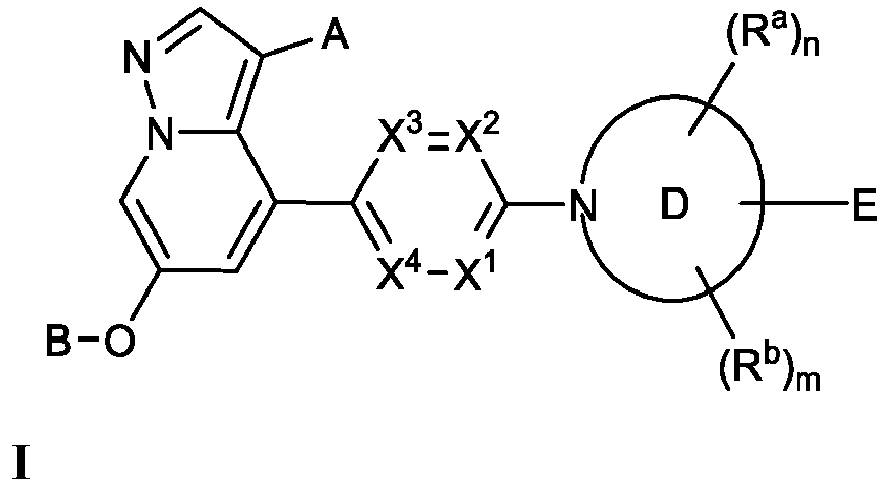
Description
- This application claims priority to
U.S. Provisional Application Serial Nos. 62/566,030, filed September 29, 2017 62/531,690, filed July 12, 2017 62/491,180, filed April 27, 2017 62/447,849, filed January 18, 2017 62/406,275, filed October 10, 2017 - The present disclosure relates to novel compounds which exhibit Rearranged during Transfection (RET) kinase inhibition, pharmaceutical compositions comprising the compounds, processes for making the compounds, and the use of the compounds in therapy. More particularly, it relates to substituted pyrazolo[1,5-a]pyridine compounds useful in the treatment and prevention of diseases which can be treated with a RET kinase inhibitor, including RET-associated diseases and disorders.
- RET is a single-pass transmembrane receptor belonging to the tyrosine kinase superfamily that is required for normal development, maturation and maintenance of several tissues and cell types (Mulligan, L. M., Nature Reviews Cancer, 2014, 14, 173-186). The extracellular portion of the RET kinase contains four calcium-dependent cadherin-like repeats involved in ligand binding and a juxtamembrane cysteine-rich region necessary for the correct folding of the RET extracellular domain, while the cytoplasmic portion of the receptor includes two tyrosine kinase subdomains.
- RET signaling is mediated by the binding of a group of soluble proteins of the glial cell line-derived neurotrophic factor (GDNF) family ligands (GFLs), which also includes neurturin (NTRN), artemin (ARTN) and persephin (PSPN) (Arighi et al., Cytokine Growth Factor Rev., 2005, 16, 441-67). Unlike other receptor tyrosine kinases, RET does not directly bind to GFLs and requires an additional co-receptor: that is, one of four GDNF family receptor-a (GFRα) family members, which are tethered to the cell surface by a glycosylphosphatidylinositol linkage. GFLs and GFRα family members form binary complexes that in turn bind to RET and recruit it into cholesterol-rich membrane subdomains, which are known as lipid rafts, where RET signaling occurs.
- Upon binding of the ligand-co-receptor complex, RET dimerization and autophosphorylation on intracellular tyrosine residues recruits adaptor and signaling proteins to stimulate multiple downstream pathways. Adaptor protein binding to these docking sites leads to activation of Ras-MAPK and PI3K-Akt/mTOR signaling pathways or to recruitment of the CBL family of ubiquitin ligases that functions in RET downregulation of the RET-mediated functions.
- Aberrant RET expression and/or activity have been demonstrated in different cancers and in gastrointestinal disorders such as irritable bowel syndrome (IBS).
- It has now been found that substituted pyrazolo[1,5-a]pyridine compounds are inhibitors of RET kinase, and are useful for treating diseases such as proliferative diseases such as cancers.
- Accordingly, provided herein is a compound of the Formula I:

- Also provided herein is a pharmaceutical composition comprising a compound of Formula I or a pharmaceutically acceptable salt or solvate thereof, in admixture with a pharmaceutically acceptable diluent or carrier.
- Also provided herein is a method of inhibiting cell proliferation, in vitro or in vivo, the method comprising contacting a cell with an effective amount of a compound of Formula I or a pharmaceutically acceptable salt or solvate thereof, or a pharmaceutical composition thereof as defined herein.
- Also provided herein is a method of treating a RET-associated disease or disorder in a patient in need of such treatment, the method comprising administering to the patient a therapeutically effective amount of a compound of Formula I or a pharmaceutically acceptable salt or solvate thereof, or a pharmaceutical composition thereof as defined herein.
- Also provided herein is a method of treating cancer and/or inhibiting metastasis associated with a particular cancer in a patient in need of such treatment, the method comprising administering to the patient a therapeutically effective amount of a compound of Formula I or a pharmaceutically acceptable salt or solvate thereof or a pharmaceutical composition thereof as defined herein.
- Also provided herein is a method of treating irritable bowel syndrome (IBS) and/or pain associated with IBS in a patient in need of such treatment, the method comprising administering to the patient a therapeutically effective amount of a compound of Formula I or a pharmaceutically acceptable salt or solvate thereof or a pharmaceutical composition thereof as defined herein.
- Also provided is a method of providing supportive care to a cancer patient, including preventing or minimizing gastrointestinal disorders, such as diarrhea, associated with treatment, including chemotherapeutic treatment, the method comprising administering to the patient a therapeutically effective amount of a compound of Formula I or a pharmaceutically acceptable salt or solvate thereof or a pharmaceutical composition thereof as defined herein.
- Also provided herein is a compound of Formula I or a pharmaceutically acceptable salt or solvate thereof, or a pharmaceutical composition thereof as defined herein for use in therapy.
- Also provided herein is a compound of Formula I or a pharmaceutically acceptable salt or solvate thereof or a pharmaceutical composition thereof as defined herein for use in the treatment of cancer and/or inhibiting metastasis associated with a particular cancer.
- Also provided herein is a compound of Formula I or a pharmaceutically acceptable salt or solvate thereof or a pharmaceutical composition thereof as defined herein for use in the treatment of irritable bowel syndrome (IBS) or pain associated with IBS.
- Also provided is a compound of Formula I or a pharmaceutically acceptable salt or solvate thereof or a pharmaceutical composition thereof as defined herein for use providing supportive care to a cancer patient, including preventing or minimizing gastrointestinal disorders, such as diarrhea, associated with treatment, including chemotherapeutic treatment.
- Also provided herein is a compound of Formula I or a pharmaceutically acceptable salt or solvate thereof for use in the inhibition of RET kinase activity.
- Also provided herein is a compound of Formula I or a pharmaceutically acceptable salt or solvate thereof or a pharmaceutical composition thereof as defined herein, for use in the treatment of a RET-associated disease or disorder.
- Also provided herein is the use of a compound of Formula I or a pharmaceutically acceptable salt or solvate thereof, as defined herein in the manufacture of a medicament for the treatment of cancer and/or inhibiting metastasis associated with a particular cancer.
- Also provided herein is the use of a compound of Formula I or a pharmaceutically acceptable salt or solvate thereof, as defined herein in the manufacture of a medicament for the treatment of irritable bowel syndrome (IBS) or pain associated with IBS.
- Also provided herein is the use of a compound of Formula I or a pharmaceutically acceptable salt or solvate thereof, as defined herein in the manufacture of a medicament for providing supportive care to a cancer patient, including preventing or minimizing gastrointestinal disorders, such as diarrhea, associated with treatment, including chemotherapeutic treatment.
- Also provided herein is a use of a compound of Formula I or a pharmaceutically acceptable salt or solvate thereof, as defined herein in the manufacture of a medicament for the inhibition of RET kinase activity.
- Also provided herein is the use of a compound of Formula I or a pharmaceutically acceptable salt or solvate thereof, as defined herein, in the manufacture of a medicament for the treatment of a RET-associated disease or disorder.
- Also provided herein is a method for treating cancer in a patient in need thereof, the method comprising (a) determining if the cancer is associated with a dysregulation of a RET gene, a RET kinase, or expression or activity or level of any of the same (e.g., a RET-associated cancer); and (b) if the cancer is determined to be associated with a dysregulation of a RET gene, a RET kinase, or expression or activity or level of any of the same (e.g., a RET-associated cancer), administering to the patient a therapeutically effective amount of a compound of Formula I or a pharmaceutically acceptable salt or solvate thereof, or a pharmaceutical composition thereof.
- Also provided herein is a pharmaceutical combination for treating cancer (e.g., a RET-associated cancer, such as a RET-associated cancer having one or more RET inhibitor resistance mutations) in a patient in need thereof, which comprises (a) a compound of Formula I or a pharmaceutically acceptable salt or solvate thereof, (b) an additional therapeutic agent, and (c) optionally at least one pharmaceutically acceptable carrier, wherein the compound of Formula I or the pharmaceutically acceptable salt or solvate thereof and the additional therapeutic are formulated as separate compositions or dosages for simultaneous, separate or sequential use for the treatment of cancer, wherein the amounts of the compound of Formula I or a pharmaceutically acceptable salt or solvate thereof and of the additional therapeutic agent are together effective in treating the cancer. Also provided herein is a pharmaceutical composition comprising such a combination. Also provided herein is the use of such a combination for the preparation of a medicament for the treatment of cancer. Also provided herein is a commercial package or product comprising such a combination as a combined preparation for simultaneous, separate or sequential use; and to a method of treatment of cancer a patient in need thereof.
- Also provided herein is a method for reversing or preventing acquired resistance to an anticancer drug, comprising administering a therapeutically effective amount of a compound of Formula I or a pharmaceutically acceptable salt or solvate thereof, to a patient at risk for developing or having acquired resistance to an anticancer drug. In some embodiments, the patient is administered a dose of the anticancer drug (e.g., at substantially the same time as a dose of a compound of Formula I or a pharmaceutically acceptable salt or solvate thereof is administered to the patient).
- Also provided herein is a method of delaying and/or preventing development of cancer resistant to an anticancer drug in an individual, comprising administering to the individual an effective amount of a compound of Formula I or a pharmaceutically acceptable salt or solvate thereof, before, during, or after administration of an effective amount of the anticancer drug.
- Also provided herein is a method of treating an individual with cancer who has an increased likelihood of developing resistance to an anticancer drug, comprising administering to the individual (a) an effective amount of a compound of Formula I before, during, or after administration of (b) an effective amount of the anticancer drug.
- Also provided are methods of treating an individual with a RET-associated cancer that has one or more RET inhibitor resistance mutations that increase resistance of the cancer to a first RET inhibitor (e.g., a substitution at amino acid position 804, e.g., V804M, V804L, or V804E, and/or one or more RET inhibitor resistance mutations listed in Tables 3 and 4), that include administering a compound of Formula I or a pharmaceutically acceptable salt or solvate thereof, before, during, or after administration of another anticancer drug (e.g., a second RET kinase inhibitor).
- Also provided are methods of treating an individual with a RET-associated cancer that include administering a compound of Formula I or a pharmaceutically acceptable salt or solvate thereof, before, during, or after administration of another anticancer drug (e.g., a first RET kinase inhibitor).
- Also provided herein is a method for treating irritable bowel syndrome (IBS) in a patient in need thereof, the method comprising (a) determining if the IBS is associated with a dysregulation of a RET gene, a RET kinase, or expression or activity or level of any of the same; and (b) if the IBS is determined to be associated with a dysregulation of a RET gene, a RET kinase, or expression or activity or level of any of the same, administering to the patient a therapeutically effective amount of a compound of Formula I or a pharmaceutically acceptable salt or solvate thereof, or a pharmaceutical composition thereof.
- Also provided herein is a pharmaceutical combination for treating irritable bowel syndrome (IBS) in a patient in need thereof, which comprises administering (a) a compound of General Formula I or a pharmaceutically acceptable salt or solvate thereof, (b) an additional therapeutic agent, and (c) optionally at least one pharmaceutically acceptable carrier, for simultaneous, separate or sequential use for the treatment of IBS, wherein the amounts of the compound of Formula I or a pharmaceutically acceptable salt or solvate thereof and of the additional therapeutic agent are together effective in treating the IBS. Also provided herein is a pharmaceutical composition comprising such a combination. Also provided herein is the use of such a combination for the preparation of a medicament for the treatment of the IBS. Also provided herein is a commercial package or product comprising such a combination as a combined preparation for simultaneous, separate or sequential use; and to a method of treatment of the IBS a patient in need thereof.
- Also provided herein is a process for preparing a compound of Formula I or a pharmaceutically acceptable salt or solvate thereof.
- Also provided herein is a compound of Formula I or a pharmaceutically acceptable salt or solvate thereof obtained by a process of preparing the compound as defined herein.
- Unless otherwise defined, all technical and scientific terms used herein have the same meaning as commonly understood by one of ordinary skill in the art to which this invention belongs. Methods and materials are described herein for use in the present invention; other, suitable methods and materials known in the art can also be used. The materials, methods, and examples are illustrative only and not intended to be limiting. All publications, patent applications, patents, sequences, database entries, and other references mentioned herein are incorporated by reference in their entirety. In case of conflict, the present specification, including definitions, will control.
- Other features and advantages of the invention will be apparent from the following detailed description and figures, and from the claims.
- Provided herein is a compound of Formula I:

- X1, X2, X3 and X4 are independently CH, CCH3, CF or N, wherein zero, one or two of X1, X2, X3 and X4 is N;
- A is H, CN, Cl, methyl, ethyl or cyclopropyl;
- B is:
- (a) hydrogen,
- (b) C1-C6 alkyl optionally substituted with 1-3 fluoros,
- (c) hydroxyC2-C6 alkyl- wherein the alkyl portion is optionally substituted with a C3-C6 cycloalkylidene ring,
- (d) dihydroxyC3-C6 alkyl- wherein the alkyl portion is optionally substituted with a C3-C6 cycloalkylidene ring,
- (e) (C1-C6 alkoxy)C1-C6 alkyl- optionally substituted with 1-3 fluoros,
- (f) (R1R2N)C1-C6 alkyl- where R1 and R2 are independently selected from H, C1-C6 alkyl (optionally substituted with 1-3 fluoros), (C1-C6 alkoxy)C1-C6 alkyl-, (C1-C6 alkyl)C(=O)- and (C1-C6 alkoxy)C(=O)-;
- (g) hetAr1C1-C3 alkyl-, where hetAr1 is a 5-6 membered heteroaryl ring having 1-3 ring heteroatoms independently selected from N, O and S and is optionally substituted with one or more independently selected C1-C6 alkyl substituents;
- (h) (C3-C6 cycloalkyl)C1-C3 alkyl-, wherein said cycloalkyl is optionally substituted with OH,
- (i) (hetCyca)C1-C3 alkyl-,
- (j) hetCyca,
- (k) (R1R2N)C(=O)C1-C6 alkyl-, where R1 and R2 are independently selected from H and C1-C6 alkyl;
- (l) (R1R2N)C(=O)-, where R1 and R2 are independently selected from H and C1-C6 alkyl, or
- (m) hetCycaC(=O)C1-C6 alkyl-;
- hetCyca is a 4-6 membered heterocyclic ring having 1-2 ring heteroatoms independently selected from N and O and optionally substituted with one or more substituents independently selected from OH, C1-C6 alkyl (optionally substituted with 1-3 fluoros), hydroxyC1-C6 alkyl, halogen, (C1-C6 alkyl)C(=O)-, C1-C6 alkoxy, oxo and (C1-C6 alkoxy)C(=O)-;
- Ring D is (i) a saturated monocyclic 4-7 membered heterocyclic ring having one ring heteroatom which is nitrogen, (ii) a saturated 7-8 membered bridged heterocyclic ring having one ring heteroatom which is nitrogen, or (iii) a saturated 7-11 membered heterospirocyclic ring system having one ring heteroatom which is nitrogen;
- each Ra is independently C1-C6 alkyl (optionally substituted with 1-3 fluoros), hydroxyC1-C6 alkyl or (C1-C6 alkoxy)C1-C6 alkyl-;
- Rb is (a) hydroxy, (b) cyclopropyl, (c) hetCycbCH2-, (d) RiRjNC(=O)CH2OCH2- where Ri and Rj are independently H or C1-C6 alkyl, (e) RcRdN-, (f) RcRdNCH2-, (g) C1-C6 alkoxy-, (h) (C1-C4 alkyl)-C(=O)NH- wherein said alkyl portion is optionally substituted with hetCycb, hetAra, C1-C6 alkoxy- or R'R"N-, or said alkyl portion is optionally substituted with two substituents independently selected from R'R"N- and OH, where each R' and R" is independently hydrogen or C1-C6 alkyl, (i) (R'R"N)C1-C6 alkoxy(CH2)n- where n is 0 or 1 and R' and R" are independently hydrogen or C1-C6 alkyl, (j) hetCycb(C1-C3 alkyl)OCH2-, (k) hetCycbC(=O)NH- or (l) hetAraC(=O)NH-;
- hetCycb is a 4-6 membered heterocyclic ring, a 7-8 membered bridged heterocyclic ring, or a 7-10 membered heterospirocyclic ring, each ring having 1-2 ring heteroatoms independently selected from N and O, wherein hetCycb is optionally substituted with one or more substituents independently selected from OH, fluoro, C1-C6 alkyl (optionally substituted with 1-3 fluoros), hydroxyC1-C6 alkyl- (optionally substituted with 1-3 fluoros), (C1-C6 alkoxy)C1-C6 alkyl-, (C1-C6 alkoxy)C(=O)-, C1-C6 alkoxy, and R'R"N- where R' and R" are independently hydrogen or C1-C6 alkyl;
- hetAra is a 5-6 membered heteroaryl ring having 1-3 ring heteroatoms independently selected from N, O and S wherein hetAra is optionally substituted with one or more substituents independently selected from the group consisting of halogen, CN, C1-C6 alkyl (optionally substituted with 1-3 fluoros), and C1-C6 alkoxy (optionally substituted with 1-3 fluoros),
- Rc is hydrogen or C1-C6 alkyl;
- Rd is hydrogen, C1-C6 alkyl (optionally substituted with 1-3 fluoros), (C1-C6 alkoxy)C(=O)-, hydroxyC1-C6 alkyl (optionally substituted with 1-3 fluoros), (hydroxyC1-C6 alkyl)C(=O)-, (C1-C6 alkyl)C(=O)-, (RkRlN)C1-C6 alkyl- where Rk and R1 are independently H or C1-C6 alkyl, RmRnNC(=O)C1-C6 alkyl- where Rm and Rn are independently H or C1-C6 alkyl, PhCH2- wherein the phenyl is optionally substituted with one or more substituents independently selected from the group consisting of halogen, CN, C1-C6 alkyl (optionally substituted with 1-3 fluoros), C1-C6 alkoxy (optionally substituted with 1-3 fluoros), (C1-C6 alkoxy)C1-C6 alkyl- (optionally substituted with 1-3 fluoros), C3-C6 cycloalkyl, hydroxyC1-C6 alkyl, (C1-C6 alkyl)SO2-, ReRfN- and (ReRfN)C1-C6 alkyl- where each Re and Rf is independently H or C1-C6 alkyl, (C1-C6 alkoxy)C1-C6 alkyl-, or hetCycc where hetCycc is a 4-6 membered heterocyclic ring having a ring heteroatom selected from N and O and optionally substituted with C1-C6 alkyl;
- n is 0, 1, 2, 3, 4, 5 or 6;
- m is 0 or 1;
- E is:
- (a) hydrogen,
- (b) hydroxy,
- (c) C1-C6 alkyl optionally substituted with 1-3 fluoros,
- (d) Ar1C1-C6 alkyl- wherein said alkyl portion is optionally substituted with 1-3 fluoros,
- (e) hetAr2C1-C6 alkyl-,
- (f) (C1-C6 alkoxy)C1-C6 alkoxy-,
- (g) Ar1O-,
- (h) hetAr2-O-,
- (i) Ar1NRg- where Rg is H or C1-C6 alkyl,
- (j) hetAr2NRg- where Rg is H or C1-C6 alkyl,
- (k) R3C(=O)NRg- where Rg is H or C1-C6 alkyl;
- (l) Ar1C(=O)NRg- where Rg is H or C1-C6 alkyl,
- (m) hetAr2C(=O)NRg(CH2)p- where p is 0 or 1 and Rg is H or C1-C6 alkyl,
- (n) R4R5NC(=O)-,
- (o) Ar1NRgC(=O)-, where Rg is H or C1-C6 alkyl,
- (p) hetAr2NRgC(=O)-, where Rg is H or C1-C6 alkyl,
- (q) Ar1(C1-C6 alkyl)C(=O)- wherein said alkyl portion is optionally substituted with OH, hydroxy(C1-C6 alkyl), C1-C6 alkoxy or NH2,
- (r) hetCyc5C(=O)-,
- (s) R4R5NC(=O)NRg- where Rg is H or C1-C6 alkyl, or
- (t) (C1-C6 alkyl)SO2-;
- (u) Ar1(C1-C6 alkyl)C(=O)NRg- where Rg is H or C1-C6 alkyl,
- (v) hetAr4C(=O)NRg- where Rg is H or C1-C6 alkyl,
- (w) hetAr2-S(=O)-,
- (x) (C3-C6 cycloalkyl)CH2SO2-,
- (y) Ar1(C1-C6 alkyl)SO2-,
- (z) hetAr2SO2-,
- (aa) Ar1,
- (bb) hetAr2,
- (cc) hetCyc5,
- (dd) C1-C6 alkoxy,
- (ee) Ar1(C1-C6 alkyl)-O-,
- (ff) hetAr2(C1-C6 alkyl)-O-,
- (gg) hetAr2-O-C1-C6 alkyl-,
- (hh) Ar1(C1-C6 alkyl)NRg- where Rg is H or C1-C6 alkyl,
- (ii) hetAr2-S-,
- (jj) Ar2SO2NRg(CH2)p- where p is 0 or 1 and Rg is H or C1-C6 alkyl,
- (kk) (C1-C6 alkoxy)C(=O)-,
- (11) (C1-C6 alkyl)NRgC(=O)O- where Rg is H or C1-C6 alkyl,
- (mm) (C1-C6 alkyl)NRgSO2- where Rg is H or C1-C6 alkyl,
- (nn) hetCyc5C(=O)NRg- where Rg is H or C1-C6 alkyl,
- (oo) Q-NRh(C1-C3 alkyl)C(=O)NRg- where Rg and Rh are independently H or C1-C6 alkyl and Q is H, C1-C6 alkyl or (C1-C6 alkyl)OC(=O)-,
- (pp)

- (qq)

- (rr)

- (ss) RgRhN- where Rg and Rh are independently H or C1-C6 alkyl,
- (tt) (C3-C6 cycloalkyl)C(=O)NRg- where the cycloalkyl is optionally and independently substituted with one or more halogens,
- (uu) (C1-C6 alkyl)C(=O)NRgCH2- where Rg is H or C1-C6 alkyl, or
- (vv) C1-C6 alkyl)SO2NRg- where Rg is H or C1-C6 alkyl;
- Ar1 is phenyl optionally substituted with one or more substituents independently selected from the group consisting of halogen, CN, C1-C6 alkyl (optionally substituted with 1-3 fluoros), C1-C6 alkoxy (optionally substituted with 1-3 fluoros), (C1-C6 alkoxy)C1-C6 alkyl- (optionally substituted with 1-3 fluoros), C3-C6 cycloalkyl, hydroxyC1-C6 alkyl, (C1-C6 alkyl)SO2-,ReRfN- and (ReRfN)C1-C6 alkyl-where each Re and Rf is independently H or C1-C6 alkyl;
- hetAr2 is a 5-6 membered heteroaryl ring having 1-3 ring heteroatoms independently selected from N, O and S, or a 9-10 membered bicyclic heteroaryl having 1-2 ring nitrogen atoms, wherein hetAr2 is optionally substituted with one or more substituents independently selected from the group consisting of halogen, CN, C1-C6 alkyl (optionally substituted with 1-3 fluoros), C1-C6 alkoxy (optionally substituted with 1-3 fluoros), (C1-C6 alkoxy)C1-C6 alkyl- (optionally substituted with 1-3 fluoros) and hydroxyC1-C6 alkoxy-;
- hetCyc5 is a 4-6 membered saturated heterocyclic ring having 1-2 ring heteroatoms independently selected from N, O and S wherein said heterocyclic ring is optionally substituted with one or more substituents independently selected from C1-C6 alkoxy and oxo;
- R3 is C1-C6 alkyl (optionally substituted with 1-3 fluoros), hydroxyC1-C6 alkyl-, C1-C6 alkoxy, C3-C6 cycloalkyl, (C3-C6 cycloalkyl)CH2-, (C3-C6 cycloalkyl)O-, (C3-C6 cycloalkyl)CH2O-, hetCyc7O-, Ph-O-, or (C1-C6 alkoxy)C1-C6 alkyl-; wherein each of said C3-C6 cycloalkyl moieties is optionally substituted with C1-C6 alkyl (optionally substituted with 1-3 fluoros), C1-C6 alkoxy, OH or R'R"N- where R' and R" are independently hydrogen or C1-C6 alkyl;
- R4 is H or C1-C6 alkyl;
- R5 is Ar2, hetAra, Ar2CH2-, hetCyc6-CH2-, hydroxyC1-C6 alkyl-, (C3-C6 cycloalkyl)CH2-, or C1-C6 alkyl optionally substituted with 1-3 fluoros;
- Ar2 is phenyl optionally substituted with one or more substituents independently selected from the group consisting of halogen, CN, C1-C6 alkyl (optionally substituted with 1-3 fluoros), C1-C6 alkoxy (optionally substituted with 1-3 fluoros), (C1-C6 alkoxy)C1-C6 alkyl- (optionally substituted with 1-3 fluoros), C3-C6 cycloalkyl, and RgRhN- where Rg and Rh are independently H or C1-C6 alkyl, or Ar2 is phenyl fused to a 6 membered heterocyclic ring having a ring nitrogen atom and optionally substituted with C1-C6 alkyl;
- hetAr3 is a 5-6 membered heteroaryl ring having 1-3 ring heteroatoms independently selected from N, O and S and optionally substituted with one or more substituents independently selected from the group consisting of halogen, CN, C1-C6 alkyl (optionally substituted with 1-3 fluoros), C1-C6 alkoxy (optionally substituted with 1-3 fluoros), and (C1-C6 alkoxy)C1-C6 alkyl- (optionally substituted with 1-3 fluoros);
- hetAr4 is pyridin-4(1H)-onyl or pyridin-2(1H)-onyl optionally substituted with one or more substituents independently selected from C1-C6 alkyl and halogen;
- hetCyc6 is a 5-7 membered heterocyclic ring having 1-3 ring heteroatoms independently selected from N, O and S; and
- hetCyc7 is a 5-7 membered heterocyclic ring having 1-3 ring heteroatoms independently selected from N, O and S.
- For complex chemical names employed herein, a substituent group is typically named before the group to which it attaches. For example, methoxyethyl comprises an ethyl backbone with a methoxy substituent.
- The term "halogen" means -F (sometimes referred to herein as "fluoro" or "fluoros"), -Cl, -Br and -I.
- The terms "C1-C3 alkyl", "C3-C6 alkyl", "C1-C6 alkyl", and "C2-C6 alkyl" as used herein refer to saturated linear or branched-chain monovalent hydrocarbon radicals of one to three, three to six, one to six, or two to six carbon atoms, respectively. Examples include, but are not limited to, methyl, ethyl, 1-propyl, isopropyl, 1-butyl, isobutyl, sec-butyl, tert-butyl, 2-methyl-2-propyl, pentyl, neopentyl, and hexyl.
- The term "C1-C6 alkyl optionally substituted with 1-3 fluoros" as used herein refers to a C1-C6 alkyl radical as defined herein, wherein one to three hydrogen atoms is replaced with one to three fluoro atoms, respectively. Examples include, but are not limited to, fluoromethyl, difluoromethyl, trifluoromethyl, 2-fluoroethyl, 2,2-difluoroethyl, 2,2,2-and trifluoroethyl.
- The term "C1-C6 alkoxy" as used herein refer to saturated linear or branched-chain monovalent alkoxy radicals of one to six carbon atoms, wherein the radical is on the oxygen atom. Examples include methoxy, ethoxy, propoxy, isopropoxy, butoxy and tert-butoxy.
- The term "(C1-C6 alkoxy)C1-C6 alkyl" as used herein refers to saturated linear or branched-chain monovalent radicals of one to six carbon atoms, wherein one of the carbon atoms is substituted with a C1-C6 alkoxy group as defined herein. Examples include methoxymethyl (CH3OCH2-) and methoxyethyl (CH3OCH2CH2-).
- The term "(C1-C6 alkoxy)C1-C6 alkoxy" as used herein refers to a C1-C6 alkoxy radical as defined herein, wherein one of the carbon atoms is substituted with a C1-C6 alkoxy group as defined herein. Examples include methoxymethoxy (CH3OCH2O-) and ethoxymethoxy (CH3CH2O-CH2O-).
- The terms "hydroxyC1-C6 alkyl" and "hydroxyC2-C6 alkyl", as used herein refers to saturated linear or branched-chain monovalent alkyl radicals of one to six or two to six carbon atoms, respectively, wherein one of the carbon atoms is substituted with a hydroxy group.
- The term "dihydroxyC3-C6 alkyl" as used herein refers to a C3-C6 alkyl radical as defined herein, wherein two hydrogen atoms are replaced with a hydroxy group, provided the hydroxy groups are not on the same carbon.
- The term "(R1R2N)C1-C6 alkyl" as used herein refers to a C1-C6 alkyl radical as defined herein, wherein one of the carbon atoms is substituted with a R1R2N- group, wherein R1 and R2 are as defined herein.
- The term "hetAr1C1-C6 alkyl" as used herein refers to a C1-C6 alkyl radical as defined herein, wherein one of the carbon atoms is substituted with a hetAr1 group, wherein hetAr1 is as defined herein.
- The term "C3-C6 cycloalkyl" as used herein refers to cyclopropyl, cyclobutyl, cyclopentyl or cyclohexyl.
- The term "C3-C6 cycloalkylidene ring" as used herein refers to a divalent C3-C6 cycloalkane ring derived from a saturated 3-6 membered hydrocarbon ring by removal of two hydrogen atoms from the same carbon atom, such as for example, cyclopropylidene, cyclobutylidene, cyclopentylidene, and cyclohexylidene. It can be represented in illustrative fashion by the following structure in which n is 1, 2 or 3:

- The term "(C3-C6 cycloalkyl)C1-C3 alkyl" as used herein refers to a C1-C3 alkyl radical as defined herein, wherein one of the carbon atoms is substituted with a C3-C6 cycloalkyl ring. An example is cyclobutylmethyl.
- The term "(hetCyca)C1-C3 alkyl" as used herein refers to a C1-C3 alkyl radical as defined herein, wherein one of the carbon atoms is substituted with a hetCyca group, wherein hetCyca is as defined herein.
- The term "Ar1C1-C6 alkyl" as used herein refers to a C1-C6 alkyl radical as defined herein, wherein one of the carbon atoms is substituted with an Ar1 group, wherein Ar1 is as defined herein.
- The terms "hetAr2C1-C6 alkyl" as used herein refers to a C1-C6 alkyl radical as defined herein, wherein one of the carbon atoms is substituted with a hetAr2 group, wherein hetAr2 is as defined herein.
- The term "oxo" as used herein means an oxygen that is double bonded to a carbon atom, i.e., =O. For example, in one embodiment when referring to hetCyca, a 4-6 membered heterocyclic ring having 1-2 ring heteroatoms independently selected from N and O and substituted with an oxo may be, for example, a pyrrolidinyl ring substituted with oxo (e.g., a pyrrolidinonyl ring), which may be represented by the structure:

- The term "spirocyclic ring" as used herein refers to a group having two rings joined by a spirocyclic linkage through a common single carbon atom, wherein each ring is a 4-7-membered ring (including the common carbon atom).
- The term "heterospirocyclic" as used herein refers to a group having two rings joined by a spirocyclic linkage through a carbon atom, wherein each ring has 4 to 6 ring atoms (with one ring carbon atom being common to both rings), and wherein one of the ring atoms is a nitrogen atom.
- The term "compound," as used herein is meant to include all stereoisomers, geometric isomers, tautomers, and isotopes of the structures depicted. Compounds herein identified by name or structure as one particular tautomeric form are intended to include other tautomeric forms unless otherwise specified.
- The term "tautomer" as used herein refers to compounds whose structures differ markedly in arrangement of atoms, but which exist in easy and rapid equilibrium, and it is to be understood that compounds provided herein may be depicted as different tautomers, and when compounds have tautomeric forms, all tautomeric forms are intended to be within the scope of the invention, and the naming of the compounds does not exclude any tautomer.
- It will be appreciated that certain compounds provided herein may contain one or more centers of asymmetry and may therefore be prepared and isolated in a mixture of isomers such as a racemic mixture, or in an enantiomerically pure form.
- In certain embodiments of Formula I, X1, X2, X3 and X4 are independently CH or CF. In certain embodiments, each of X1, X2, X3 and X4 is CH.
- In certain embodiments of Formula I, X1, X2, X3 and X4 are independently CH, CF or N, wherein one of X1, X2, X3 and X4 is N and the remainder are independently CH or CF. In certain embodiments of Formula I, X1 is N, and X2, X3 and X4 are independently CH or CF. In certain embodiments, X1 is N, and X2, X3 and X4 are CH.
- In certain embodiments of Formula I, X1, X2, X3 and X4 are independently CH, CF or N, wherein two of X1, X2, X3 and X4 are N. In certain embodiments of Formula I, X1 and X3 are N and X2 and X4 are independently CH or CF. In one embodiment, X1 and X3 are N and X2 and X4 are CH.
- In certain embodiments of Formula I, A is H.
- In certain embodiments of Formula I, A is Cl.
- In certain embodiments of Formula I, A is CN.
- In certain embodiments of Formula I, A is methyl.
- In certain embodiments of Formula I, A is ethyl.
- In certain embodiments of Formula I, A is cyclopropyl.
- In certain embodiments of Formula I, B is hydrogen.
- In certain embodiments of Formula I, B is C1-C6 alkyl optionally substituted with 1-3 fluoros. Non-limiting examples include methyl, ethyl, propyl, isopropyl, isobutyl, sec-butyl, 2-ethylbutyl, neopentyl, difluoromethyl, 2,2-difluoroethyl, and 2,2,2-trifluoroethyl. In certain embodiments, B is methyl or ethyl.
- In certain embodiments of Formula I, B is hydroxyC2-C6 alkyl wherein the alkyl portion is optionally substituted with a C3-C6 cycloalkylidene ring. In certain embodiments, the alkyl portion is unsubstituted. Non-limiting examples include the structures:


- In certain embodiments of Formula I, B is dihydroxyC3-C6 alkyl- wherein the alkyl portion is optionally substituted with a C3-C6 cycloalkylidene ring. A non-limiting example includes 2,3-dihydroxypropyl.
- In certain embodiments of Formula I, B is (C1-C6 alkoxy)C1-C6 alkyl-optionally substituted with 1-3 fluoros. In certain embodiments of Formula I, B is (C1-C6 alkoxy)C2-C6 alkyl- optionally substituted with 1-3 fluoros. Non-limiting examples include the structures:


- In certain embodiments of Formula I, B is (R1R2N)C1-C6 alkyl-, where R1 and R2 are independently H, C1-C6 alkyl (optionally substituted with 1-3 fluoros), (C1-C6 alkoxy)C1-C6 alkyl-, (C1-C6 alkyl)C(=O)- and (C1-C6 alkoxy)C(=O)-. Non-limiting examples of (R1R2N)C1-C6 alkyl- include the structures:


- In certain embodiments of Formula I, B is hetAr1C1-C3 alkyl-, where hetAr1 is a 5-6 membered heteroaryl ring having 1-3 ring heteroatoms independently selected from N, O and S and is optionally substituted with one or more independently selected C1-C6 alkyl substituents. In certain embodiments, hetAr1 is a 5-6 membered heteroaryl ring having 1-3 ring heteroatoms independently selected from N and O and is optionally substituted with C1-C6 alkyl. Non-limiting examples of hetAr1C1-C3 alkyl- include the structures:


- In certain embodiments of Formula I, B is (C3-C6 cycloalkyl)C1-C3 alkyl-wherein said cycloalkyl is optionally substituted with OH. A non-limiting example is cyclobutylmethyl.
- In certain embodiments of Formula I, B is (hetCyca)C1-C3 alkyl-, where hetCyca is as defined for Formula I. In certain embodiments of Formula I, B is (hetCyca)C1-C3 alkyl-, where hetCyca is a 4-6 membered heterocyclic ring having 1-2 ring heteroatoms independently selected from N and O and is optionally substituted with one or more substituents independently selected from OH, C1-C6 alkyl (optionally substituted with 1-3 fluoros), hydroxyC1-C6 alkyl-, halogen, (C1-C6 alkyl)C(=O)-, C1-C6 alkoxy, oxo and (C1-C6 alkoxy)C(=O)-. Non-limiting examples include the structures:


- In certain embodiments of Formula I, B is hetCyca, where hetCyc2 is as defined for Formula I. In certain embodiments, hetCyca is a 4-6 membered heterocyclic ring having 1-2 ring heteroatoms independently selected from N and O and is optionally substituted with OH, C1-C6 alkyl (optionally substituted with 1-3 fluoros) or hydroxyC1-C6 alkyl-. Non-limiting examples include the structures:

- In certain embodiments of Formula I, B is (R1R2N)C(=O)C1-C6 alkyl- where R1 and R2 are independently selected from H and C1-C6 alkyl. Non-limiting examples include the structures:

- In certain embodiments of Formula I, B is (R1R2N)C(=O)-, where R1 and R2 are independently selected from H and C1-C6 alkyl. Non-limiting examples include the structure:

- In certain embodiments of Formula I, B is hetCycaC(=O)C1-C6 alkyl- where hetCyca is as defined for Formula I. A non-limiting example includes the structure:

- In certain embodiments of Formula I, B is (b) C1-C6 alkyl optionally substituted with 1-3 fluoros or (c) hydroxyC2-C6 alkyl- wherein the alkyl portion is optionally substituted with a C3-C6 cycloalkylidene ring. In certain embodiments of Formula I, B is (b) C1-C6 alkyl optionally substituted with 1-3 fluoros or (c) hydroxyC2-C6 alkyl-.
- Referring now to Ring D of Formula I,

- In one embodiment, Ring D is a saturated monocyclic 4-7 membered heterocyclic ring having one ring heteroatom which is nitrogen. The phrase "having one ring heteroatom which is nitrogen" when Ring D is a saturated monocyclic 4-7 membered heterocyclic ring means that said ring nitrogen atom is the nitrogen atom shown in Ring D of Formula I. Nonlimiting examples include the structures:

- In one embodiment of Formula I, Ring D is a saturated monocyclic 4-6 membered heterocyclic ring having one ring heteroatom which is nitrogen selected from the structures


- In certain embodiments of Formula I, Ring D is a saturated monocyclic 5-6 membered heterocyclic ring having one ring heteroatom which is nitrogen having the structure:

- In certain embodiments of Formula I, Ring D is a saturated monocyclic 4-6 membered heterocyclic ring having one ring heteroatom which is nitrogen selected from the structures:

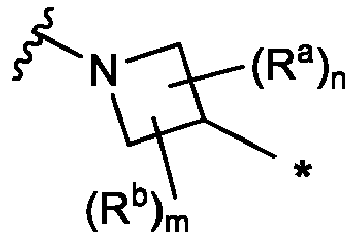


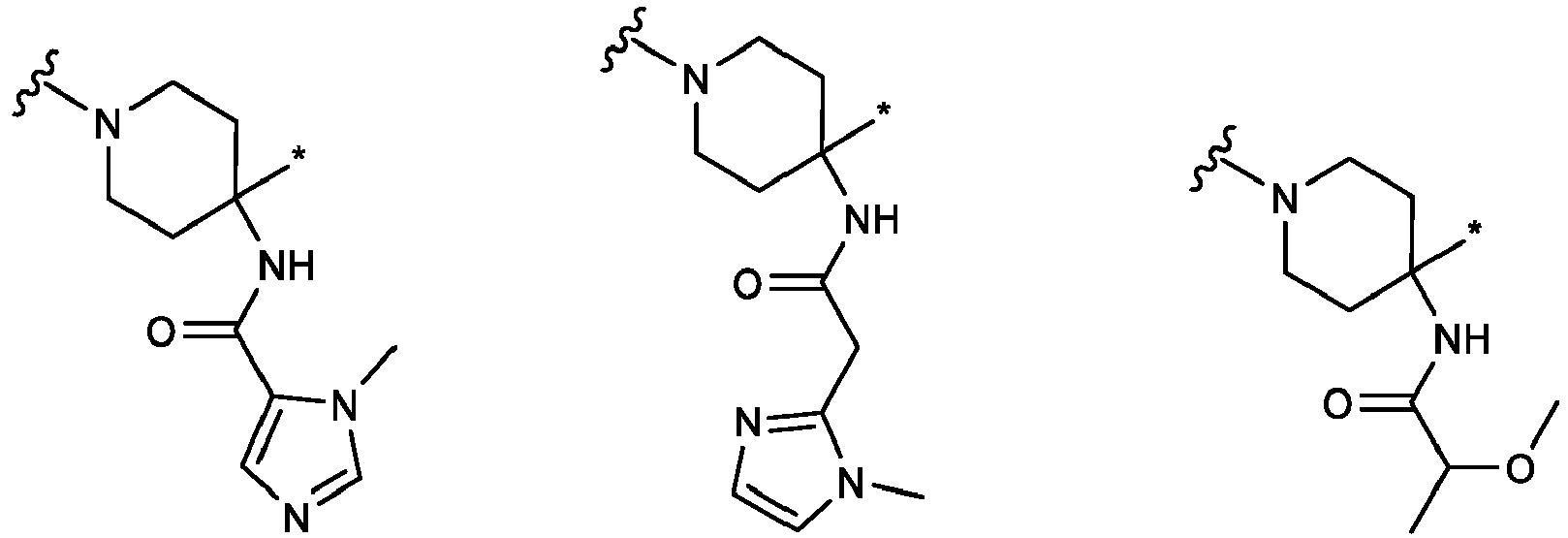


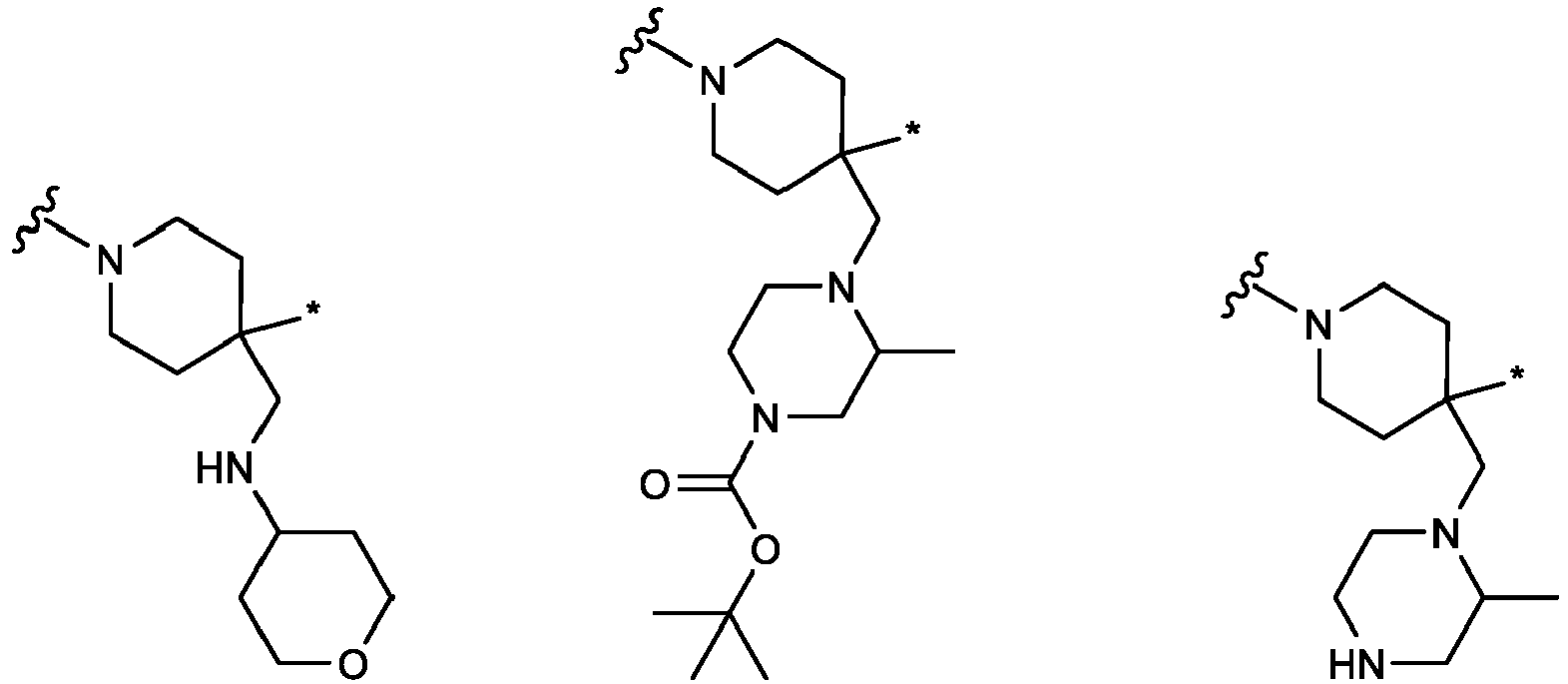

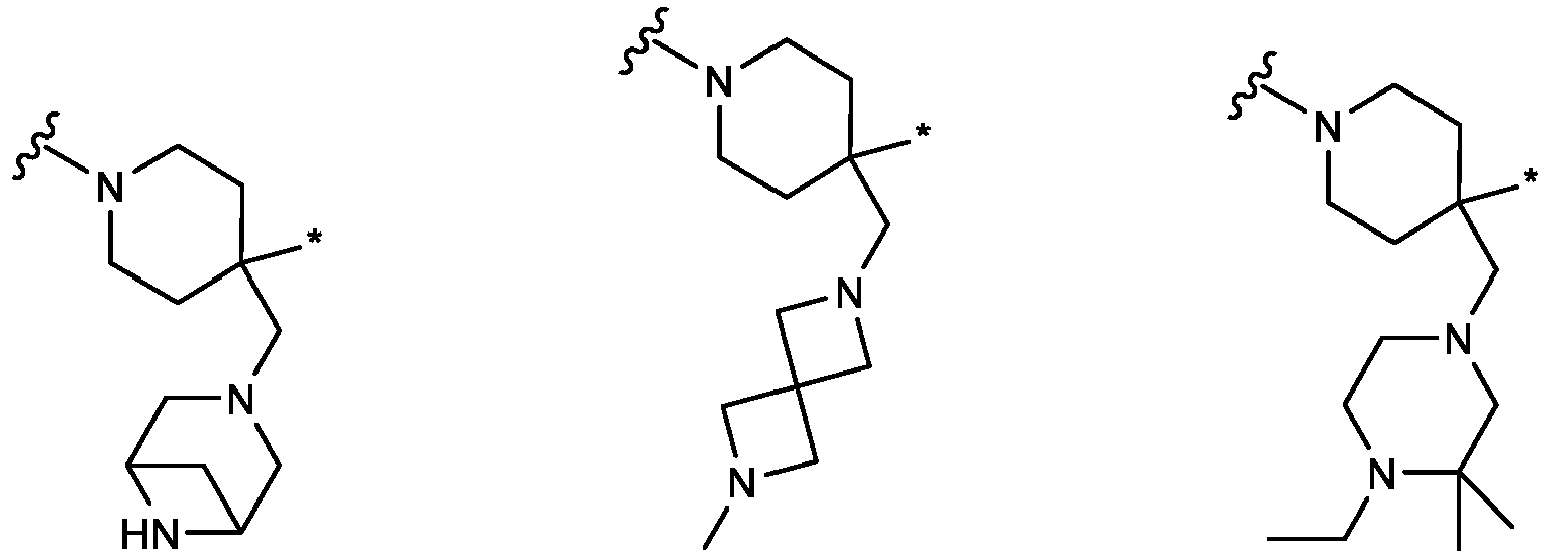


- In one embodiment, Ring D is a saturated monocyclic 6 membered heterocyclic ring having one ring heteroatom which is nitrogen which may be represented by the structure:

- where n and m are zero, that is, Ring D may be represented by the structure:

- wherein the wavy line indicates the point of attachment of Ring D to the ring comprising X1, X2, X3 and X4, and the asterisk indicates the point of attachment to the E group.
- In one embodiment, Ring D is a saturated 4-7 membered heterocyclic ring having one ring heteroatom which is nitrogen; E is (a) hydrogen, (b) hydroxy, (c) C1-C6 alkyl optionally substituted with 1-3 fluoros, (d) Ar1C1-C6 alkyl wherein said alkyl portion is optionally substituted with 1-3 fluoros, (e) hetAr2C1-C6 alkyl, (f) (C1-C6 alkoxy)C1-C6 alkoxy-, (g) Ar1O-, (h) hetAr2O-, (i) Ar1NRg- where Rg is H or C1-C6 alkyl, (j) hetAr2NRg- where Rg is H or C1-C6 alkyl, (k) R3C(=O)NRg- where Rg is H or C1-C6 alkyl, (l) Ar1C(=O)NRg- where Rg is H or C1-C6 alkyl, (m) hetAr2C(=O)NR9(CH2)p- where p is 0 or 1, (n) R4R5NC(=O)-, (o) Ar1NRgC(=O)-, where Rg is H or C1-C6 alkyl, (p) hetAr2NRgC(=O)-, where Rg is H or C1-C6 alkyl, (r) hetCyc5C(=O)-, (s) R4R5NC(=O)NRg- where Rg is H or C1-C6 alkyl, (t) C1-C6 alkyl)SO2-,(u) Ar1(C1-C6 alkyl)C(=O)NRg- where Rg is H or C1-C6 alkyl, (v) hetAr4C(=O)NRg- where Rg is H or C1-C6 alkyl, (w) hetAr2-S(=O)-, (x) (C3-C6 cycloalkyl)CH2SO2-, (y) Ar1(C1-C6 alkyl)SO2-, (z) hetAr2SO2-, (aa) Ar1,(bb) hetAr2, (cc) hetCyc5, (dd) C1-C6 alkoxy, (ee) Ar1(C1-C6 alkyl)-O-, (ff) hetAr2(C1-C6 alkyl)-O-, (gg) hetAr2-O-C1-C6 alkyl-, (hh) Ar1(C1-C6 alkyl)NRg- where Rg is H or C1-C6 alkyl, (ii) hetAr2-S-, (jj) Ar2SO2NRg(CH2)p- where p is 0 or 1 and Rg is H or C1-C6 alkyl, (kk) (C1-C6 alkoxy)C(=O)-, (11) (C1-C6 alkyl)NRgC(=O)O- where Rg is H or C1-C6 alkyl, (mm) (C1-C6 alkyl)NRgSO2- where Rg is H or C1-C6 alkyl, (nn) hetCyc5C(=O)NRg-, (oo) Q-NRh(C1-C3 alkyl)C(=O)NRg- where Rg and Rh are independently H or C1-C6 alkyl and Q is H, C1-C6 alkyl or (C1-C6 alkyl)OC(=O)-, (pp)


- In one embodiment, Ring D is a saturated monocyclic 6-membered heterocyclic ring having one ring heteroatom which is nitrogen which may be represented by the structure:

- In one embodiment, Ring D is a saturated monocyclic 6-membered heterocyclic ring having one ring heteroatom which is nitrogen which may be represented by the structures:

- In one embodiment, Ring D is a saturated 4-7 membered heterocyclic ring having one ring heteroatom which is nitrogen; E is (d) Ar1C1-C6 alkyl- wherein said alkyl portion is optionally substituted with 1-3 fluoros, (e) hetAr2C1-C6 alkyl-, (g) Ar1O-, (h) hetAr2O-, (k) R3C(=O)NRg where Rg is H or C1-C6 alkyl, (l) Ar1C(=O)NRg- where Rg is H or C1-C6 alkyl, (m) hetAr2C(=O)NRg(CH2)p- where p is 0 or 1, or (n) R4R5NC(=O)- where n is 0, 1, 2, 3, 4, 5 or 6; m is 0 or 1; and Ar1, hetAr2, Rg, R3, R4, and R5 are as defined for Formula I. In one embodiment, each Ra is independently selected from a C1-C6 substituent, Rb is OH or RcRdN- where Rc is hydrogen or C1-C6 alkyl and Rd is hydrogen, C1-C6 alkyl or (C1-C6 alkoxy)C(=O)-; n is 0, 1 or 2; and m is 0 or 1.
- In one embodiment, Ring D is a saturated 4-7 membered heterocyclic ring having one ring heteroatom which is nitrogen; E is hydrogen; each Ra is independently C1-C6 alkyl (optionally substituted with 1-3 fluoros), hydroxyC1-C6 alkyl or (C1-C6 alkoxy)C1-C6 alkyl-; Rb is (a) hydroxy, (b) cyclopropyl, (c) hetCycbCH2- where hetCycb is a 4-6 membered heterocyclic ring having 1-2 ring heteroatoms independently selected from N and O, (d) RiRjNC(=O)CH2OCH2- where Ri and Rj are independently H or C1-C6 alkyl, (e) RcRdN-, (f) RcRdNCH2-, (g) C1-C6 alkoxy-, (h) (C1-C4 alkyl)-C(=O)NH-wherein said alkyl portion is optionally substituted with hetCycb, hetAra, C1-C6 alkoxy- or R'R"N-, or said alkyl portion is optionally substituted with two substituents independently selected from R'R"N- and OH, where each R' and R" is independently hydrogen or C1-C6 alkyl, (i) (R'R"N)C1-C6 alkoxy(CH2)n- where n is 0 or 1 and R' and R" are independently hydrogen or C1-C6 alkyl, or (j) hetCycb(C1-C3 alkyl)OCH2-; hetCycb is as defined for Formula I; Rc is hydrogen or C1-C6 alkyl; Rd is hydrogen, C1-C6 alkyl (optionally substituted with 1-3 fluoros), (C1-C6 alkoxy)C(=O)-, hydroxyC1-C6 alkyl (optionally substituted with 1-3 fluoros), (hydroxyC1-C6 alkyl)C(=O)-, (C1-C6 alkyl)C(=O)-, (RkRlN)C1-C6 alkyl- where Rk and Rl are independently H or C1-C6 alkyl, RmRnNC(=O)C1-C6 alkyl- where Rm and Rn are independently H or C1-C6 alkyl, PhCH2-, (C1-C6 alkoxy)C1-C6 alkyl-, or hetCycc where hetCycc is a 4-6 membered heterocyclic ring having a ring heteroatom selected from N and O and optionally substituted with C1-C6 alkyl; n is 0, 1, 2, 3, 4, 5 or 6; and m is 0 or 1. In one embodiment, Ring D is a saturated 6 membered heterocyclic ring having one ring heteroatom. In one embodiment, Ring D is a saturated 5 membered heterocyclic ring having one ring heteroatom. In one embodiment, Rb is OH or RcRdN- where Rc is hydrogen or C1-C6 alkyl and Rd is hydrogen, C1-C6 alkyl, (C1-C6 alkoxy)C(=O)- or PhCH2-. In one embodiment, n is 0, 1 or 2 and m is 0 or 1. In one embodiment, n is 0 and m is 0 or 1. Non-limiting examples include the structures:

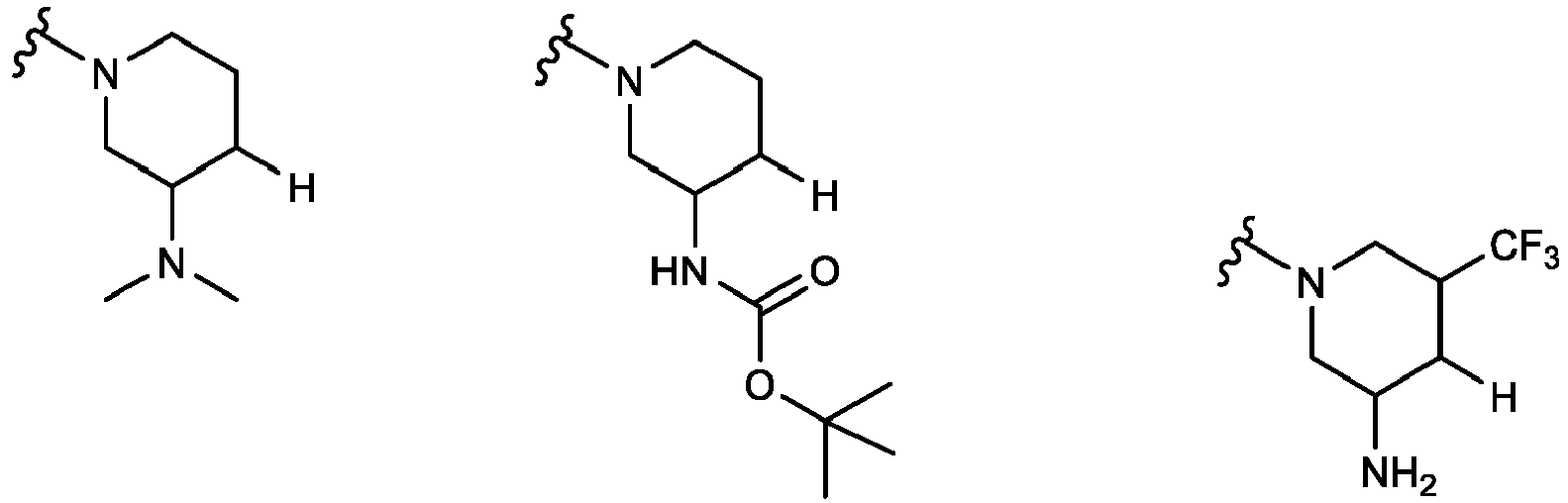


- In one embodiment, Ring D is a saturated 4-7 membered heterocyclic ring having one ring heteroatom which is nitrogen; each Ra is independently C1-C6 alkyl (optionally substituted with 1-3 fluoros), hydroxyC1-C6 alkyl or (C1-C6 alkoxy)C1-C6 alkyl-; Rb is (a) hydroxy, (b) cyclopropyl, (c) hetCycbCH2-, (d) RiRjNC(=O)CH2OCH2-where Ri and Rj are independently H or C1-C6 alkyl, (e) RcRdN-, (f) RcRdNCH2-, (g) C1-C6 alkoxy-, (h) (C1-C4 alkyl)-C(=O)NH- wherein said alkyl portion is optionally substituted with hetCycb, hetAra, C1-C6 alkoxy- or R'R"N-, or said alkyl portion is optionally substituted with two substituents independently selected from R'R"N- and OH, where each R' and R" is independently hydrogen or C1-C6 alkyl, (i) (R'R"N)C1-C6 alkoxy(CH2)n- where n is 0 or 1 and R' and R" are independently hydrogen or C1-C6 alkyl, or (j) hetCycb(C1-C3 alkyl)OCH2-; hetCycb is as defined for Formula I; Rc is hydrogen or C1-C6 alkyl; Rd is hydrogen, C1-C6 alkyl (optionally substituted with 1-3 fluoros), (C1-C6 alkoxy)C(=O)-, hydroxyC1-C6 alkyl (optionally substituted with 1-3 fluoros), (hydroxyC1-C6alkyl)C(=O)-, (C1-C6 alkyl)C(=O)-, (RkRlN)C1-C6 alkyl-where Rk and Rl are independently H or C1-C6 alkyl, RmRnNC(=O)C1-C6 alkyl- where Rm and Rn are independently H or C1-C6 alkyl, PhCH2-, (C1-C6 alkoxy)C1-C6 alkyl-, or hetCycc where hetCycc is a 4-6 membered heterocyclic ring having a ring heteroatom selected from N and O and optionally substituted with C1-C6 alkyl; n is 0, 1, 2, 3, 4, 5 or 6; m is 0 or 1; and E is hydroxy. In one embodiment, n is 0, 1 or 2 and m is 0 or 1. In one embodiment, Ring D is a saturated 6 membered heterocyclic ring having one ring heteroatom which is nitrogen. In one embodiment, Rb is RcRdN- where Rc is hydrogen or C1-C6 alkyl and Rd is hydrogen, C1-C6 alkyl or (C1-C6 alkoxy)C(=O)-. In one embodiment, n is 0, 1 or 2 and m is 0 or 1. In one embodiment, n is 0 and m is 0 or 1. A non-limiting example includes the structure:

- In one embodiment, Ring D is a saturated 4-7 membered heterocyclic ring having one ring heteroatom which is nitrogen; each Ra is independently C1-C6 alkyl (optionally substituted with 1-3 fluoros), hydroxyC1-C6 alkyl or (C1-C6 alkoxy)C1-C6 alkyl-; Rb is (a) hydroxy, (b) cyclopropyl, (c) hetCycbCH2-, (d) RiRjNC(=O)CH2OCH2-where Ri and Rj are independently H or C1-C6 alkyl, (e) RcRdN-, (f) RcRdNCH2-, (g) C1-C6 alkoxy-, (h) (C1-C4 alkyl)-C(=O)NH- wherein said alkyl portion is optionally substituted with hetCycb, hetAra, C1-C6 alkoxy- or R'R"N-, or said alkyl portion is optionally substituted with two substituents independently selected from R'R"N- and OH, where each R' and R" is independently hydrogen or C1-C6 alkyl, (i) (R'R"N)C1-C6 alkoxy(CH2)n- where n is 0 or 1 and R' and R" are independently hydrogen or C1-C6 alkyl, or (j) hetCycb(C1-C3 alkyl)OCH2-; hetCycb is as defined for Formula I; Rc is hydrogen or C1-C6 alkyl; Rd is hydrogen, C1-C6 alkyl (optionally substituted with 1-3 fluoros), (C1-C6 alkoxy)C(=O)-, hydroxyC1-C6 alkyl (optionally substituted with 1-3 fluoros), (hydroxyC1-C6 alkyl)C(=O)-, (C1-C6 alkyl)C(=O)-, (RkRlN)C1-C6 alkyl-where Rk and R1 are independently H or C1-C6 alkyl, RmRnNC(=O)C1-C6 alkyl- where Rm and Rn are independently H or C1-C6 alkyl, PhCH2-, (C1-C6 alkoxy)C1-C6 alkyl-, or hetCycc where hetCycc is a 4-6 membered heterocyclic ring having a ring heteroatom selected from N and O and optionally substituted with C1-C6 alkyl; n is 0, 1, 2, 3, 4, 5 or 6; m is 0 or 1; and E is C1-C6 alkyl optionally substituted with 1-3 fluoros. In one embodiment, Ring D is a saturated 6 membered heterocyclic ring having one ring heteroatom which is nitrogen. In one embodiment, Rb is OH or RcRdN- where Rc is hydrogen or C1-C6 alkyl and Rd is hydrogen, C1-C6 alkyl or (C1-C6 alkoxy)C(=O)-. In one embodiment, n is 0, 1 or 2 and m is 0 or 1. In one embodiment, n is 0 and m is 0 or 1. Non-limiting examples include the structures:


- In one embodiment, Ring D is a saturated 4-7 membered heterocyclic ring having one ring heteroatom which is nitrogen, Ra, Rb, n, and m are as defined for Formula I, and E is Ar1C1-C6 alkyl wherein said alkyl portion is optionally substituted with 1-3 fluoros and where Ar1 is as defined for Formula I. In one embodiment, Ring D is a saturated 4-7 membered heterocyclic ring having one ring heteroatom which is nitrogen; each Ra is independently C1-C6 alkyl (optionally substituted with 1-3 fluoros), hydroxyC1-C6 alkyl or (C1-C6 alkoxy)C1-C6 alkyl-; Rb is (a) hydroxy, (b) cyclopropyl, (c) hetCycbCH2-, (d) RiRjNC(=O)CH2OCH2- where Ri and Rj are independently H or C1-C6 alkyl, (e) RcRdN-, (f) RcRdNCH2-, (g) C1-C6 alkoxy-, (h) (C1-C4 alkyl)-C(=O)NH- wherein said alkyl portion is optionally substituted with hetCycb, hetAra, C1-C6 alkoxy- or R'R"N-, or said alkyl portion is optionally substituted with two substituents independently selected from R'R"N- and OH, where each R' and R" is independently hydrogen or C1-C6 alkyl, (i) (R'R"N)C1-C6 alkoxy(CH2)n- where n is 0 or 1 and R' and R" are independently hydrogen or C1-C6 alkyl, (j) hetCycb(C1-C3 alkyl)OCH2- or (k) hetCycbC(=O)NH-; hetCycb is as defined for Formula I; Rc is hydrogen or C1-C6 alkyl; Rd is hydrogen, C1-C6 alkyl (optionally substituted with 1-3 fluoros), (C1-C6 alkoxy)C(=O)-, hydroxyC1-C6 alkyl (optionally substituted with 1-3 fluoros), (hydroxyC1-C6 alkyl)C(=O)-, (C1-C6 alkyl)C(=O)-, (RkRlN)C1-C6 alkyl- where Rk and R1 are independently H or C1-C6 alkyl, RmRnNC(=O)C1-C6 alkyl- where Rm and Rn are independently H or C1-C6 alkyl, PhCH2-, (C1-C6 alkoxy)C1-C6 alkyl-, or hetCycc where hetCycc is a 4-6 membered heterocyclic ring having a ring heteroatom selected from N and O and optionally substituted with C1-C6 alkyl; n is 0, 1, 2, 3, 4, 5 or 6; m is 0 or 1; and E is Ar1C1-C6 alkyl, wherein said alkyl portion is optionally substituted with 1-3 fluoros and where Ar1 is as defined for Formula I. In one embodiment, Ring D is a saturated 6 membered heterocyclic ring having one ring heteroatom which is nitrogen. In one embodiment, Rb is OH. In one embodiment, n is 0, 1 or 2 and m is 0 or 1. In one embodiment, n is 0 and m is 0 or 1. Non-limiting examples include the structures:


- In one embodiment, Ring D is a saturated 4-7 membered heterocyclic ring having one ring heteroatom which is nitrogen; each Ra is independently C1-C6 alkyl (optionally substituted with 1-3 fluoros), hydroxyC1-C6 alkyl or (C1-C6 alkoxy)C1-C6 alkyl-; Rb is (a) hydroxy, (b) cyclopropyl, (c) hetCycbCH2-, (d) RiRjNC(=O)CH2OCH2-where Ri and Rj are independently H or C1-C6 alkyl, (e) RcRdN-, (f) RcRdNCH2-, (g) C1-C6 alkoxy-, (h) (C1-C4 alkyl)-C(=O)NH- wherein said alkyl portion is optionally substituted with hetCycb, hetAra, C1-C6 alkoxy- or R'R"N-, or said alkyl portion is optionally substituted with two substituents independently selected from R'R"N- and OH, where each R' and R" is independently hydrogen or C1-C6 alkyl, (i) (R'R"N)C1-C6 alkoxy(CH2)n- where n is 0 or 1 and R' and R" are independently hydrogen or C1-C6 alkyl, (j) hetCycb(C1-C3 alkyl)OCH2-, (k) hetCycbC(=O)NH- or (l) hetAraC(=O)NH-; hetAra and hetCycb are as defined for Formula I; Rc is hydrogen or C1-C6 alkyl; Rd is hydrogen, C1-C6 alkyl (optionally substituted with 1-3 fluoros), (C1-C6 alkoxy)C(=O)-, hydroxyC1-C6 alkyl (optionally substituted with 1-3 fluoros), (hydroxyC1-C6 alkyl)C(=O)-, (C1-C6 alkyl)C(=O)-, (RkRlN)C1-C6 alkyl- where Rk and Rl are independently H or C1-C6 alkyl, RmRnNC(=O)C1-C6 alkyl- where Rm and Rn are independently H or C1-C6 alkyl, PhCH2-, (C1-C6 alkoxy)C1-C6 alkyl-, or hetCycc where hetCycc is a 4-6 membered heterocyclic ring having a ring heteroatom selected from N and O and optionally substituted with C1-C6 alkyl; n is 0, 1, 2, 3, 4, 5 or 6; m is 0 or 1; and E is hetAr2C1-C6 alkyl, where hetAr1 is as defined for Formula I. In one embodiment, hetAr2 is a 5-6 membered heteroaryl ring having 1-2 ring nitrogen atoms and optionally substituted with one or more substituents independently selected from the group consisting of halogen, C1-C6 alkyl (optionally substituted with 1-3 fluoros), and C1-C6 alkoxy (optionally substituted with 1-3 fluoros). In one embodiment, Ring D is a saturated 6 membered heterocyclic ring having one ring heteroatom which is nitrogen. In one embodiment, n is 0 or 1 and m is 0 or 1. In one embodiment, n is 0 and m is 0. In one embodiment, n is 0 and m is 1. In one embodiment, Rb is (a) hydroxy, (e) RcRdN-, (h) (C1-C4 alkyl)-C(=O)NH- wherein said alkyl portion is optionally substituted with hetCycb, hetAra, C1-C6 alkoxy- or R'R"N-, or said alkyl portion is optionally substituted with two substituents independently selected from R'R"N- and OH, where each R' and R" is independently hydrogen or C1-C6 alkyl, (k) hetCycbC(=O)NH- or (l) hetAraC(=O)NH-Non-limiting examples include the structures:


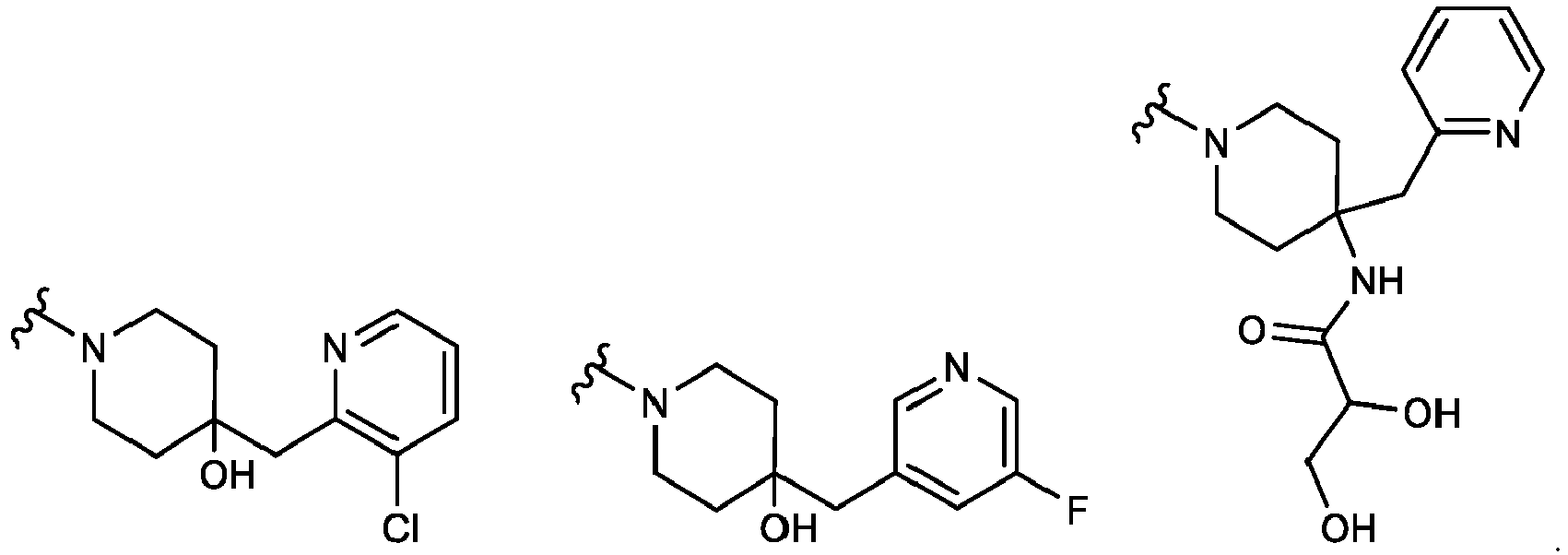
- In one embodiment, Ring D is a saturated 4-7 membered heterocyclic ring having one ring heteroatom which is nitrogen; each Ra is independently C1-C6 alkyl (optionally substituted with 1-3 fluoros), hydroxyC1-C6 alkyl or (C1-C6 alkoxy)C1-C6 alkyl-; Rb is (a) hydroxy, (b) cyclopropyl, (c) hetCycbCH2-, (d) RiRjNC(=O)CH2OCH2-where Ri and Rj are independently H or C1-C6 alkyl, (e) RcRdN-, (f) RcRdNCH2-, (g) C1-C6 alkoxy-, (h) (C1-C4 alkyl)-C(=O)NH- wherein said alkyl portion is optionally substituted with hetCycb, hetAra, C1-C6 alkoxy- or R'R"N-, or said alkyl portion is optionally substituted with two substituents independently selected from R'R"N- and OH, where each R' and R" is independently hydrogen or C1-C6 alkyl, (i) (R'R"N)C1-C6 alkoxy(CH2)n- where n is 0 or 1 and R' and R" are independently hydrogen or C1-C6 alkyl, or (j) hetCycb(C1-C3 alkyl)OCH2-; hetCycb is as defined for Formula I; Rc is hydrogen or C1-C6 alkyl; Rd is hydrogen, C1-C6 alkyl (optionally substituted with 1-3 fluoros), (C1-C6 alkoxy)C(=O)-, hydroxyC1-C6 alkyl (optionally substituted with 1-3 fluoros), (hydroxyC1-C6 alkyl)C(=O)-, (C1-C6 alkyl)C(=O)-, (RkRlN)C1-C6 alkyl-where Rk and Rl are independently H or C1-C6 alkyl, RmRnNC(=O)C1-C6 alkyl- where Rm and Rn are independently H or C1-C6 alkyl, PhCH2-, (C1-C6 alkoxy)C1-C6 alkyl-, or hetCycc where hetCycc is a 4-6 membered heterocyclic ring having a ring heteroatom selected from N and O and optionally substituted with C1-C6 alkyl; n is 0, 1, 2, 3, 4, 5 or 6; m is 0 or 1; and E is (C1-C6 alkoxy)C1-C6 alkoxy-. In one embodiment, n is 0 or 1 and m is 0 or 1. In one embodiment, n is 0 and m is 0. In one embodiment, n is 0 and m is 1. In one embodiment, Rb is RcRdN-. Non-limiting examples include the structures:


- In one embodiment, Ring D is a saturated 4-7 membered heterocyclic ring having one ring heteroatom which is nitrogen; each Ra is independently C1-C6 alkyl (optionally substituted with 1-3 fluoros), hydroxyC1-C6 alkyl or (C1-C6 alkoxy)C1-C6 alkyl-; Rb is (a) hydroxy, (b) cyclopropyl, (c) hetCycbCH2-, (d) RiRjNC(=O)CH2OCH2-where Ri and Rj are independently H or C1-C6 alkyl, (e) RcRdN-, (f) RcRdNCH2-, (g) C1-C6 alkoxy-, (h) (C1-C4 alkyl)-C(=O)NH- wherein said alkyl portion is optionally substituted with hetCycb, hetAra, C1-C6 alkoxy- or R'R"N-, or said alkyl portion is optionally substituted with two substituents independently selected from R'R"N- and OH, where each R' and R" is independently hydrogen or C1-C6 alkyl, (i) (R'R"N)C1-C6 alkoxy(CH2)n- where n is 0 or 1 and R' and R" are independently hydrogen or C1-C6 alkyl, or (j) hetCycb(C1-C3 alkyl)OCH2-; hetCycb is as defined for Formula I; Rc is hydrogen or C1-C6 alkyl; Rd is hydrogen, C1-C6 alkyl (optionally substituted with 1-3 fluoros), (C1-C6 alkoxy)C(=O)-, hydroxyC1-C6 alkyl (optionally substituted with 1-3 fluoros), (hydroxyC1-C6 alkyl)C(=O)-, (C1-C6 alkyl)C(=O)-, (RkRlN)C1-C6 alkyl-where Rk and Rl are independently H or C1-C6 alkyl, RmRnNC(=O)C1-C6 alkyl- where Rm and Rn are independently H or C1-C6 alkyl, PhCH2-, (C1-C6 alkoxy)C1-C6 alkyl-, or hetCycc where hetCycc is a 4-6 membered heterocyclic ring having a ring heteroatom selected from N and O and optionally substituted with C1-C6 alkyl; n is 0, 1, 2, 3, 4, 5 or 6; m is 0 or 1; and E is Ar1O-, where Ar1 is as defined for Formula I. In one embodiment, Ar1 is unsubstituted or substituted with one or more substituents independently selected from halogen, CN and C1-C6 alkyl (optionally substituted with 1-3 fluoros). In one embodiment, Ring D is a saturated 4 or 6 membered heterocyclic ring having one ring heteroatom which is nitrogen. In one embodiment, n is 0, 1 or 2 and m is 0 or 1. In one embodiment, n is 0 and m is 0. Non-limiting examples include the structures:


- In one embodiment, Ring D is a saturated 4-7 membered heterocyclic ring having one ring heteroatom which is nitrogen; each Ra is independently C1-C6 alkyl (optionally substituted with 1-3 fluoros), hydroxyC1-C6 alkyl or (C1-C6 alkoxy)C1-C6 alkyl-; Rb is (a) hydroxy, (b) cyclopropyl, (c) hetCycbCH2-, (d) RiRjNC(=O)CH2OCH2-where Ri and Rj are independently H or C1-C6 alkyl, (e) RcRdN-, (f) RcRdNCH2-, (g) C1-C6 alkoxy-, (h) (C1-C4 alkyl)-C(=O)NH- wherein said alkyl portion is optionally substituted with hetCycb, hetAra, C1-C6 alkoxy- or R'R"N-, or said alkyl portion is optionally substituted with two substituents independently selected from R'R"N- and OH, where each R' and R" is independently hydrogen or C1-C6 alkyl, (i) (R'R"N)C1-C6 alkoxy(CH2)n- where n is 0 or 1 and R' and R" are independently hydrogen or C1-C6 alkyl, or (j) hetCycb(C1-C3 alkyl)OCH2-; hetCycb is as defined for Formula I; Rc is hydrogen or C1-C6 alkyl; Rd is hydrogen, C1-C6 alkyl (optionally substituted with 1-3 fluoros), (C1-C6 alkoxy)C(=O)-, hydroxyC1-C6 alkyl (optionally substituted with 1-3 fluoros), (hydroxyC1-C6 alkyl)C(=O)-, (C1-C6 alkyl)C(=O)-, (RkRlN)C1-C6 alkyl-where Rk and Rl are independently H or C1-C6 alkyl, RmRnNC(=O)C1-C6 alkyl- where Rm and Rn are independently H or C1-C6 alkyl, PhCH2-, (C1-C6 alkoxy)C1-C6 alkyl-, or hetCycc where hetCycc is a 4-6 membered heterocyclic ring having a ring heteroatom selected from N and O and optionally substituted with C1-C6 alkyl; n is 0, 1, 2, 3, 4, 5 or 6; m is 0 or 1; and E is hetAr2O-, where hetAr2 is as defined for Formula I. In one embodiment, hetAr2 is a 5-6-membered heteroaryl ring having 1-2 ring heteroatoms independently selected from N and O and is optionally substituted with one or more substituents independently selected from the group consisting of halogen, C1-C6 alkoxy (optionally substituted with 1-3 fluoros), C1-C6 alkyl (optionally substituted with 1-3 fluoros) and hydroxyC1-C6 alkoxy. In one embodiment, Ring D is a saturated 4-6 membered heterocyclic ring having one ring heteroatom which is nitrogen. In one embodiment, Ring D is a saturated 5-6 membered heterocyclic ring having one ring heteroatom which is nitrogen. In one embodiment, n is 0 or 1 and m is 0 or 1. In one embodiment, n is 0 and m is 0. In one embodiment, n is 0 and m is 1. In one embodiment, Ra is C1-C6 alkyl. In one embodiment, Rb is RcRdN-. Non-limiting examples include the structures:


- In one embodiment, Ring D is a saturated 4-7 membered heterocyclic ring having one ring heteroatom which is nitrogen; each Ra is independently C1-C6 alkyl (optionally substituted with 1-3 fluoros), hydroxyC1-C6 alkyl or (C1-C6 alkoxy)C1-C6 alkyl-; Rb is (a) hydroxy, (b) cyclopropyl, (c) hetCycbCH2-, (d) RiRjNC(=O)CH2OCH2-where Ri and Rj are independently H or C1-C6 alkyl, (e) RcRdN-, (f) RcRdNCH2-, (g) C1-C6 alkoxy-, (h) (C1-C4 alkyl)-C(=O)NH- wherein said alkyl portion is optionally substituted with hetCycb, hetAra, C1-C6 alkoxy- or R'R"N-, or said alkyl portion is optionally substituted with two substituents independently selected from R'R"N- and OH, where each R' and R" is independently hydrogen or C1-C6 alkyl, (i) (R'R"N)C1-C6 alkoxy(CH2)n- where n is 0 or 1 and R' and R" are independently hydrogen or C1-C6 alkyl, or (j) hetCycb(C1-C3 alkyl)OCH2-; hetCycb is as defined for Formula I; Rc is hydrogen or C1-C6 alkyl; Rd is hydrogen, C1-C6 alkyl (optionally substituted with 1-3 fluoros), (C1-C6 alkoxy)C(=O)-, hydroxyC1-C6 alkyl (optionally substituted with 1-3 fluoros), (hydroxyC1-C6 alkyl)C(=O)-, (C1-C6 alkyl)C(=O)-, (RkRlN)C1-C6 alkyl-where Rk and Rl are independently H or C1-C6 alkyl, RmRnNC(=O)C1-C6 alkyl- where Rm and Rn are independently H or C1-C6 alkyl, PhCH2-, (C1-C6 alkoxy)C1-C6 alkyl-, or hetCycc where hetCycc is a 4-6 membered heterocyclic ring having a ring heteroatom selected from N and O and optionally substituted with C1-C6 alkyl; n is 0, 1, 2, 3, 4, 5 or 6; m is 0 or 1; and E is Ar1NRg-, where Ar1 is as defined for Formula I and Rg is H or C1-C6 alkyl. In one embodiment, Ar1 is optionally substituted with one or more halogens. In one embodiment, Ring D is a saturated 6 membered heterocyclic ring having one ring heteroatom which is nitrogen. In one embodiment, n is 0, 1 or 2 and m is 0 or 1. In one embodiment, n is 0 and m is 0. A non-limiting example includes the structure:

- In one embodiment, Ring D is a saturated 4-7 membered heterocyclic ring having one ring heteroatom which is nitrogen; each Ra is independently C1-C6 alkyl (optionally substituted with 1-3 fluoros), hydroxyC1-C6 alkyl or (C1-C6 alkoxy)C1-C6 alkyl-; Rb is (a) hydroxy, (b) cyclopropyl, (c) hetCycbCH2-, (d) RiRjNC(=O)CH2OCH2-where Ri and Rj are independently H or C1-C6 alkyl, (e) RcRdN-, (f) RcRdNCH2-, (g) C1-C6 alkoxy-, (h) (C1-C4 alkyl)-C(=O)NH- wherein said alkyl portion is optionally substituted with hetCycb, hetAra, C1-C6 alkoxy- or R'R"N-, or said alkyl portion is optionally substituted with two substituents independently selected from R'R"N- and OH, where each R' and R" is independently hydrogen or C1-C6 alkyl, (i) (R'R"N)C1-C6 alkoxy(CH2)n- where n is 0 or 1 and R' and R" are independently hydrogen or C1-C6 alkyl, or (j) hetCycb(C1-C3 alkyl)OCH2-; hetCycb is as defined for Formula I; Rc is hydrogen or C1-C6 alkyl; Rd is hydrogen, C1-C6 alkyl (optionally substituted with 1-3 fluoros), (C1-C6 alkoxy)C(=O)-, hydroxyC1-C6 alkyl (optionally substituted with 1-3 fluoros), (hydroxyC1-C6 alkyl)C(=O)-, (C1-C6 alkyl)C(=O)-, (RkRlN)C1-C6 alkyl-where Rk and Rl are independently H or C1-C6 alkyl, RmRnNC(=O)C1-C6 alkyl- where Rm and Rn are independently H or C1-C6 alkyl, PhCH2-, (C1-C6 alkoxy)C1-C6 alkyl-, or hetCycc where hetCycc is a 4-6 membered heterocyclic ring having a ring heteroatom selected from N and O and optionally substituted with C1-C6 alkyl; n is 0, 1, 2, 3, 4, 5 or 6; m is 0 or 1; and E is hetAr2NRg- where hetAr2 is a defined for Formula I and Rg is H or C1-C6 alkyl. In one embodiment, hetAr2 is a pyridyl ring optionally substituted with one or more substituents independently selected from C1-C6 alkyl and halogen. In one embodiment, n is 0, 1 or 2 and m is 0 or 1. In one embodiment, Ra is C1-C6 alkyl. In one embodiment, n is 0 and m is 0. Non-limiting examples include the structures:

- In one embodiment, Ring D is a saturated 4-7 membered heterocyclic ring having one ring heteroatom which is nitrogen; each Ra is independently C1-C6 alkyl (optionally substituted with 1-3 fluoros), hydroxyC1-C6 alkyl or (C1-C6 alkoxy)C1-C6 alkyl-; Rb is (a) hydroxy, (b) cyclopropyl, (c) hetCycbCH2-, (d) RiRjNC(=O)CH2OCH2-where Ri and Rj are independently H or C1-C6 alkyl, (e) RcRdN-, (f) RcRdNCH2-, (g) C1-C6 alkoxy-, (h) (C1-C4 alkyl)-C(=O)NH- wherein said alkyl portion is optionally substituted with hetCycb, hetAra, C1-C6 alkoxy- or R'R"N-, or said alkyl portion is optionally substituted with two substituents independently selected from R'R"N- and OH, where each R' and R" is independently hydrogen or C1-C6 alkyl, (i) (R'R"N)C1-C6 alkoxy(CH2)n- where n is 0 or 1 and R' and R" are independently hydrogen or C1-C6 alkyl, or (j) hetCycb(C1-C3 alkyl)OCH2-; hetCycb is as defined for Formula I; Rc is hydrogen or C1-C6 alkyl; Rd is hydrogen, C1-C6 alkyl (optionally substituted with 1-3 fluoros), (C1-C6 alkoxy)C(=O)-, hydroxyC1-C6 alkyl (optionally substituted with 1-3 fluoros), (hydroxyC1-C6 alkyl)C(=O)-, (C1-C6 alkyl)C(=O)-, (RkRlN)C1-C6 alkyl-where Rk and Rl are independently H or C1-C6 alkyl, RmRnNC(=O)C1-C6 alkyl- where Rm and Rn are independently H or C1-C6 alkyl, PhCH2-, (C1-C6 alkoxy)C1-C6 alkyl-, or hetCycc where hetCycc is a 4-6 membered heterocyclic ring having a ring heteroatom selected from N and O and optionally substituted with C1-C6 alkyl; n is 0, 1, 2, 3, 4, 5 or 6; m is 0 or 1; and E is R3C(=O)NRg- where R3 and Rg are as defined for Formula I. In one embodiment, Rg is hydrogen. In one embodiment, Ring D is a saturated 6 membered heterocyclic ring having one ring heteroatom which is nitrogen. In one embodiment, n is 0, 1 or 2 and m is 0 or 1. In one embodiment, n is 0 or 1 and m is 0. In one embodiment, m is 1 and n is 0. In one embodiment, Ra is C1-C6 alkyl (optionally substituted with 1-3 fluoros). In one embodiment, Rb is hydroxy, hetCycbCH2-, RcRdN-, RcRdNCH2-, C1-C6 alkoxy, (R'R"N)C1-C6 alkoxy(CH2)n- where n is 0 or 1 and R' and R" are independently hydrogen or C1-C6 alkyl, or hetCycb(C1-C3 alkyl)OCH2-, where hetCycb, Rc and Rd are as defined for Formula I. In one embodiment, Rb is hetCycbCH2- where hetCycb is a 4-6 membered heterocyclic ring having 1-2 ring heteroatoms independently selected from N and O, wherein hetCycb is optionally substituted with one or more substituents independently selected from OH, C1-C6 alkyl (optionally substituted with 1-3 fluoros), and R'R"N- where R' and R" are independently hydrogen or C1-C6 alkyl. In one embodiment, Rb is RcRdN- or RcRdNCH2- where Rc is hydrogen or C1-C6 alkyl and Rd is hydrogen or C1-C6 alkyl (optionally substituted with 1-3 fluoros). Non-limiting examples include the structures:


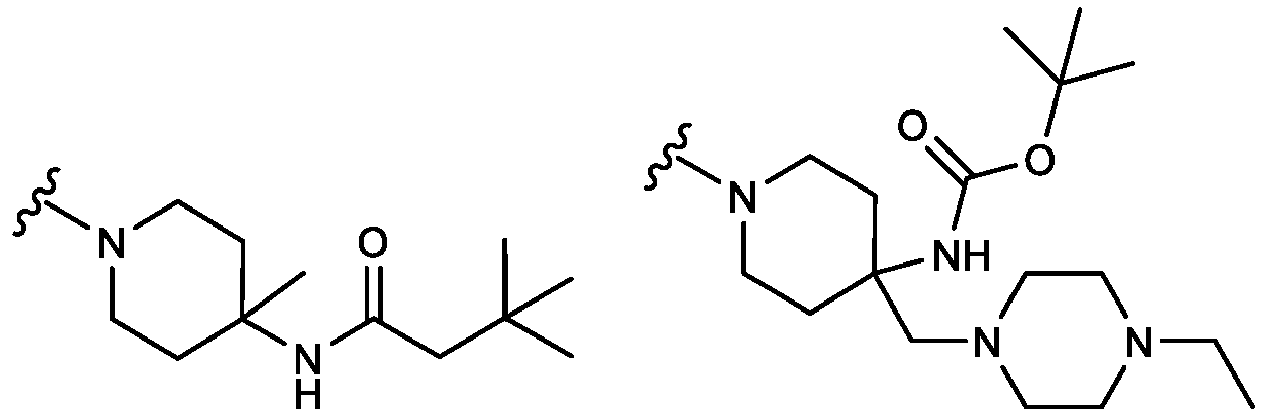


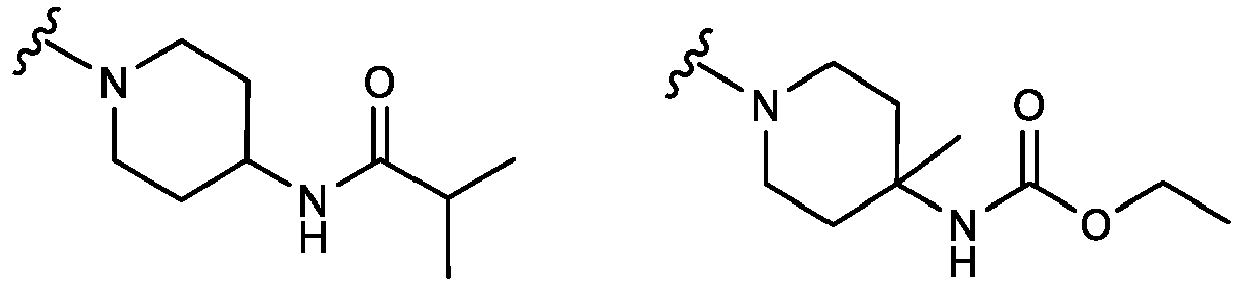


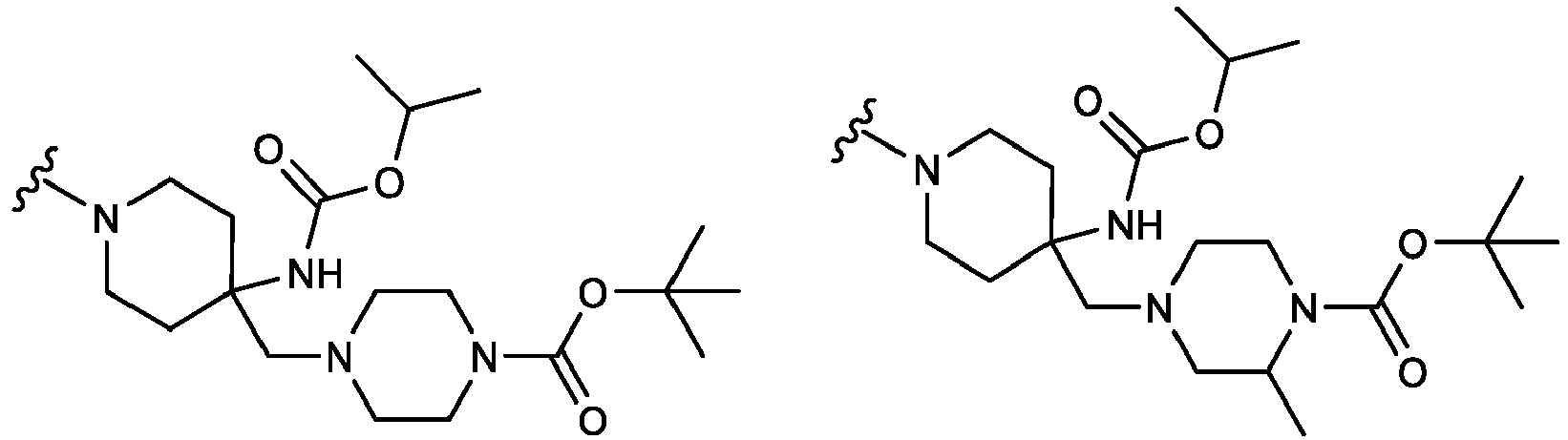

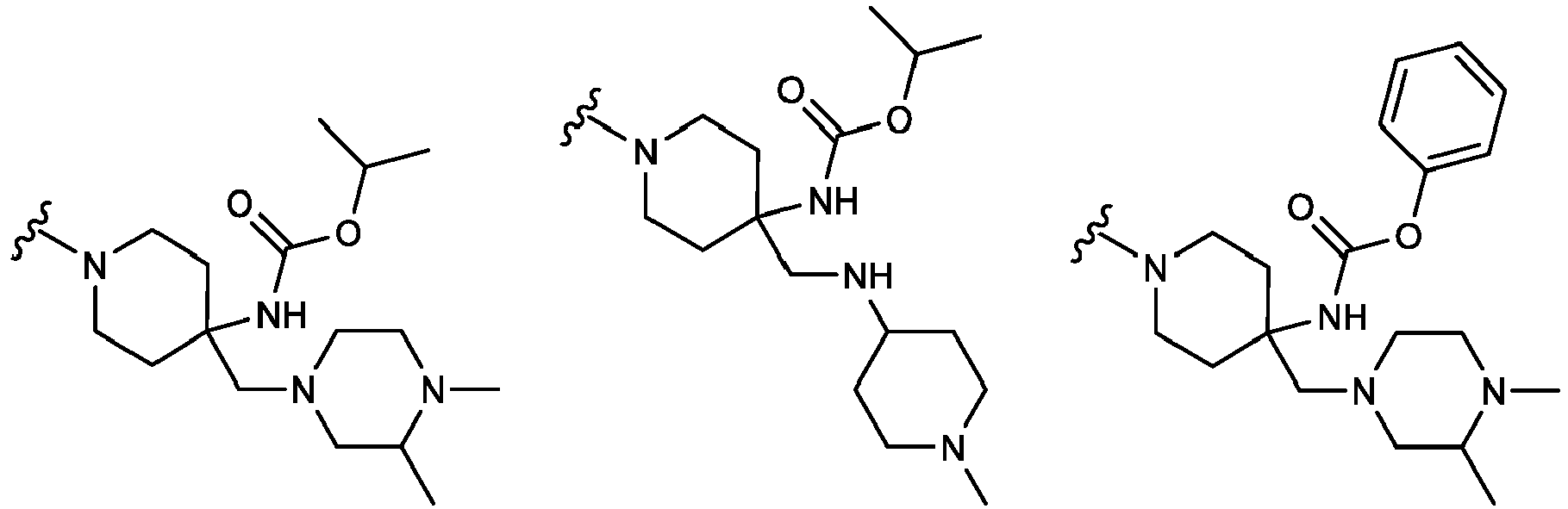


- In one embodiment, Ring D is a saturated 4-7 membered heterocyclic ring having one ring heteroatom which is nitrogen; each Ra is independently C1-C6 alkyl (optionally substituted with 1-3 fluoros), hydroxyC1-C6 alkyl or (C1-C6 alkoxy)C1-C6 alkyl-; Rb is (a) hydroxy, (b) cyclopropyl, (c) hetCycbCH2-, (d) RiRjNC(=O)CH2OCH2-where Ri and Rj are independently H or C1-C6 alkyl, (e) RcRdN-, (f) RcRdNCH2-, (g) C1-C6 alkoxy-, (h) (C1-C4 alkyl)-C(=O)NH- wherein said alkyl portion is optionally substituted with hetCycb, hetAra, C1-C6 alkoxy- or R'R"N-, or said alkyl portion is optionally substituted with two substituents independently selected from R'R"N- and OH, where each R' and R" is independently hydrogen or C1-C6 alkyl, (i) (R'R"N)C1-C6 alkoxy(CH2)n- where n is 0 or 1 and R' and R" are independently hydrogen or C1-C6 alkyl, or (j) hetCycb(C1-C3 alkyl)OCH2-; hetCycb is as defined for Formula I; Rc is hydrogen or C1-C6 alkyl; Rd is hydrogen, C1-C6 alkyl (optionally substituted with 1-3 fluoros), (C1-C6 alkoxy)C(=O)-, hydroxyC1-C6 alkyl (optionally substituted with 1-3 fluoros), (hydroxyC1-C6 alkyl)C(=O)-, (C1-C6 alkyl)C(=O)-, (RkRlN)C1-C6 alkyl-where Rk and Rl are independently H or C1-C6 alkyl, RmRnNC(=O)C1-C6 alkyl- where Rm and Rn are independently H or C1-C6 alkyl, PhCH2-, (C1-C6 alkoxy)C1-C6 alkyl-, or hetCycc where hetCycc is a 4-6 membered heterocyclic ring having a ring heteroatom selected from N and O and optionally substituted with C1-C6 alkyl; n is 0, 1, 2, 3, 4, 5 or 6; m is 0 or 1; and E is Ar1C(=O)NRg- where Arl is as defined for Formula I. In one embodiment, Arl is unsubstituted or substituted with one or more substituents independently selected from halogen, CN, C1-C6 alkyl (optionally substituted with 1-3 fluoros), C1-C6 alkoxy (optionally substituted with 1-3 fluoros), C3-C6 cycloalkyl, hydroxyC1-C6 alkyl, (C1-C6 alkyl)SO2-, and (ReRfN)C1-C6 alkyl- where each Re and Rf is independently H or C1-C6 alkyl. In one embodiment, Ring D is a saturated 5-6 membered heterocyclic ring having one ring heteroatom which is nitrogen. In one embodiment, n is 0, 1 or 2 and m is 0 or 1. In one embodiment, n is 0 or 1 and m is 0. In one embodiment, n is 1 and m is 0. In one embodiment, n is 0 and m is 1. In one embodiment, Ra is C1-C6 alkyl (optionally substituted with 1-3 fluoros) or hydroxyC1-C6 alkyl. In one embodiment, Rb is C1-C6 alkoxy, hetCycbCH2- or RcRdNCH2-, where hetCycb, Rc and Rd are as defined for Formula I. In one embodiment, Rb is hetCycbCH2-where hetCycb is a 4-6 membered heterocyclic ring having 1-2 ring heteroatoms independently selected from N and O, wherein hetCycb is optionally substituted with one or more substituents independently selected from OH, fluoro, C1-C6 alkyl (optionally substituted with 1-3 fluoros) and (C1-C6 alkoxy)C1-C6 alkyl-. In one embodiment, Rb is RcRdNCH2- where Rc is H or C1-C6 alkyl and Rd is C1-C6 alkyl (optionally substituted with 1-3 fluoros), hydroxyC1-C6 alkyl (optionally substituted with 1-3 fluoros). In one embodiment, Rb is hydroxyl. Non-limiting examples include the structures:






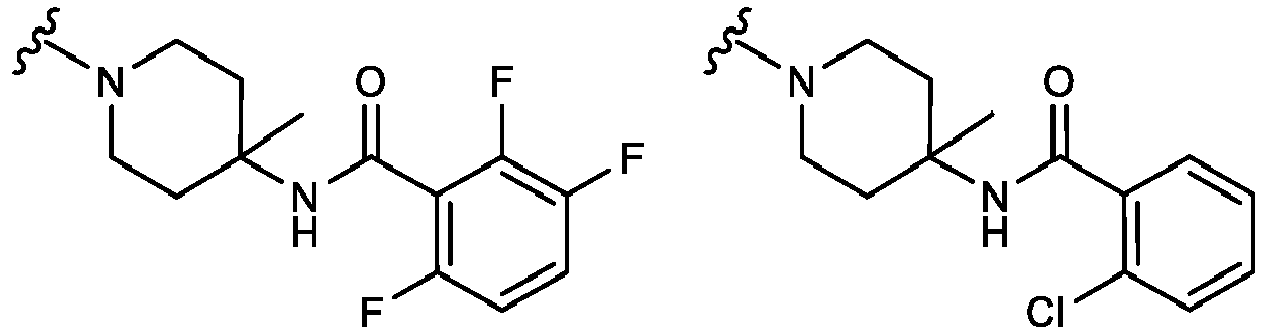
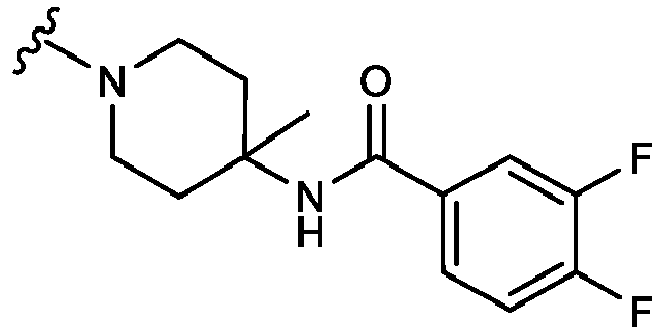


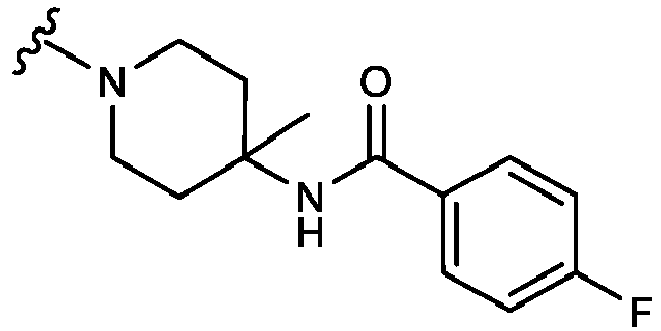


- In one embodiment, Ring D is a saturated 4-7 membered heterocyclic ring having one ring heteroatom which is nitrogen; each Ra is independently C1-C6 alkyl (optionally substituted with 1-3 fluoros), hydroxyC1-C6 alkyl or (C1-C6 alkoxy)C1-C6 alkyl-; Rb is (a) hydroxy, (b) cyclopropyl, (c) hetCycbCH2-, (d) RiRjNC(=O)CH2OCH2-where Ri and Rj are independently H or C1-C6 alkyl, (e) RcRdN-, (f) RcRdNCH2-, (g) C1-C6 alkoxy-, (h) (C1-C4 alkyl)-C(=O)NH- wherein said alkyl portion is optionally substituted with hetCycb, hetAra, C1-C6 alkoxy- or R'R"N-, or said alkyl portion is optionally substituted with two substituents independently selected from R'R"N- and OH, where each R' and R" is independently hydrogen or C1-C6 alkyl, (i) (R'R"N)C1-C6 alkoxy(CH2)n- where n is 0 or 1 and R' and R" are independently hydrogen or C1-C6 alkyl, or (j) hetCycb(C1-C3 alkyl)OCH2-; hetCycb is as defined for Formula I; Rc is hydrogen or C1-C6 alkyl; Rd is hydrogen, C1-C6 alkyl (optionally substituted with 1-3 fluoros), (C1-C6 alkoxy)C(=O)-, hydroxyC1-C6 alkyl (optionally substituted with 1-3 fluoros), (hydroxyC1-C6 alkyl)C(=O)-, (C1-C6 alkyl)C(=O)-, (RkRlN)C1-C6 alkyl-where Rk and Rl are independently H or C1-C6 alkyl, RmRnNC(=O)C1-C6 alkyl- where Rm and Rn are independently H or C1-C6 alkyl, PhCH2-, (C1-C6 alkoxy)C1-C6 alkyl-, or hetCycc where hetCycc is a 4-6 membered heterocyclic ring having a ring heteroatom selected from N and O and optionally substituted with C1-C6 alkyl; n is 0, 1, 2, 3, 4, 5 or 6; m is 0 or 1; and E is hetAr2C(=O)NRg(CH2)p- where p is 0 or 1, and hetAr2 and Rg are as defined for Formula I. In one embodiment, hetAr2 is a 5-6-membered heteroaryl ring having 1-2 ring heteroatoms independently selected from N and O and is optionally substituted with one or more substituents independently selected from the group consisting of halogen, C1-C6 alkyl (optionally substituted with 1-3 fluoros) and C1-C6 alkoxy (optionally substituted with 1-3 fluoros). In one embodiment, Ring D is a saturated 6 membered heterocyclic ring having one ring heteroatom which is nitrogen. In one embodiment, n is 0, 1 or 2 and m is 0 or 1. In one embodiment, n is 0 or 1 and m is 0. In one embodiment, Ra is C1-C6 alkyl (optionally substituted with 1-3 fluoros) or hydroxyC1-C6 alkyl. In one embodiment, Rb is hydroxy, hetCycbCH2-, RcRdNCH2-, C1-C6 alkoxy, or hetCycb(C1-C3 alkyl)OCH2-, where hetCycb, Rc and Rd are as defined for Formula I. In one embodiment, Rb is hetCycbCH2- where hetCycb is a 4-6 membered heterocyclic ring having 1-2 ring heteroatoms independently selected from N and O, wherein hetCycb is optionally substituted with one or more substituents independently selected from C1-C6 alkyl (optionally substituted with 1-3 fluoros). In one embodiment, Rb is RcRdNCH2- where Rc is H or C1-C6 alkyl and Rd is C1-C6 alkyl (optionally substituted with 1-3 fluoros). Non-limiting examples include the structures:


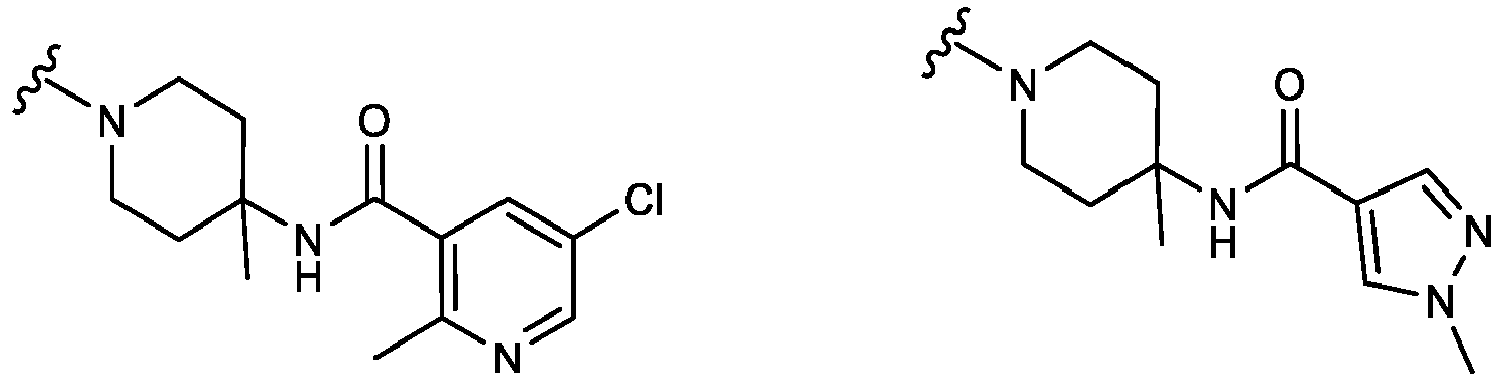

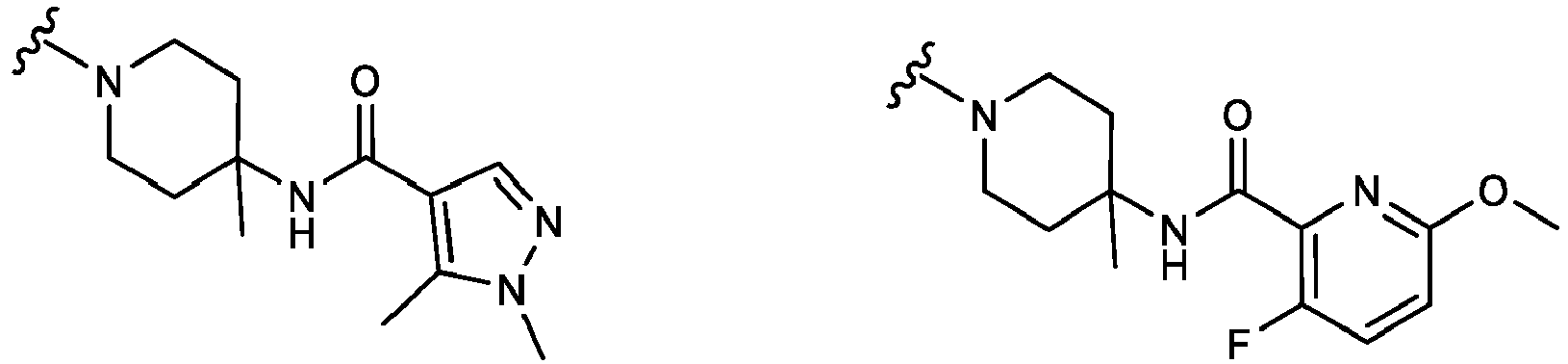

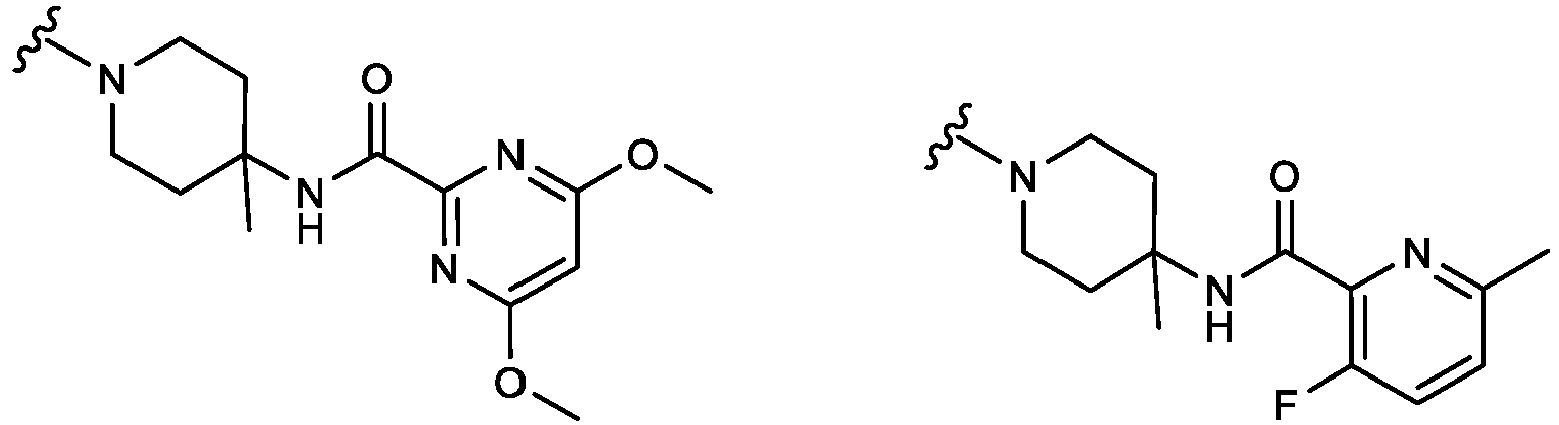


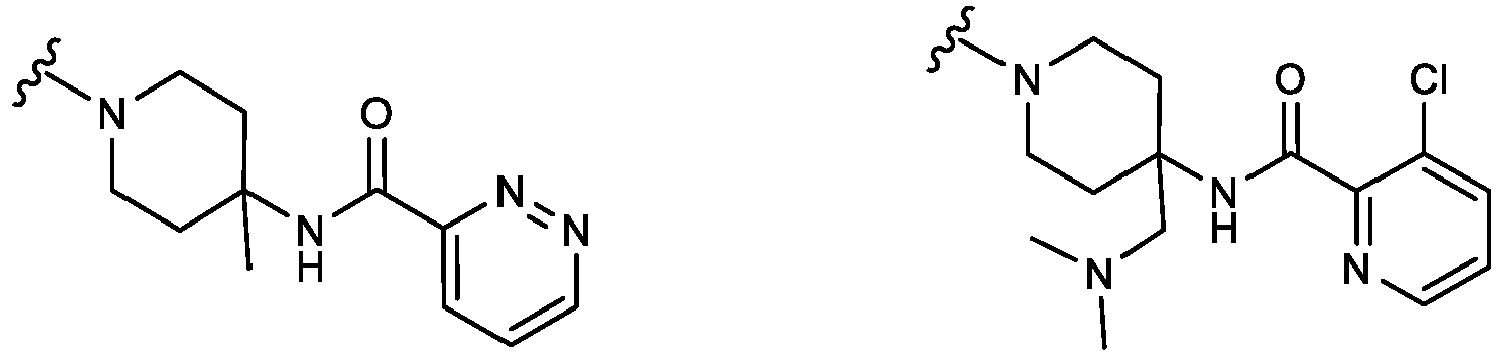


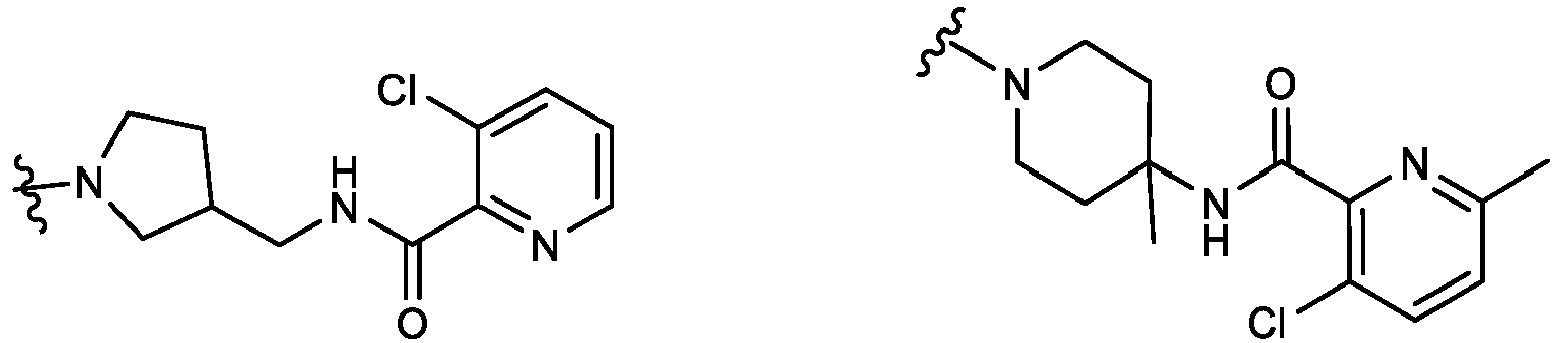

- In one embodiment, Ring D is a saturated 4-7 membered heterocyclic ring having one ring heteroatom which is nitrogen; each Ra is independently C1-C6 alkyl (optionally substituted with 1-3 fluoros), hydroxyC1-C6 alkyl or (C1-C6 alkoxy)C1-C6 alkyl-; Rb is (a) hydroxy, (b) cyclopropyl, (c) hetCycbCH2-, (d) RiRjNC(=O)CH2OCH2-where Ri and Rj are independently H or C1-C6 alkyl, (e) RcRdN-, (f) RcRdNCH2-, (g) C1-C6 alkoxy-, (h) (C1-C4 alkyl)-C(=O)NH- wherein said alkyl portion is optionally substituted with hetCycb, hetAra, C1-C6 alkoxy- or R'R"N-, or said alkyl portion is optionally substituted with two substituents independently selected from R'R"N- and OH, where each R' and R" is independently hydrogen or C1-C6 alkyl, (i) (R'R"N)C1-C6 alkoxy(CH2)n- where n is 0 or 1 and R' and R" are independently hydrogen or C1-C6 alkyl, or (j) hetCycb(C1-C3 alkyl)OCH2-; hetCycb is as defined for Formula I; Rc is hydrogen or C1-C6 alkyl; Rd is hydrogen, C1-C6 alkyl (optionally substituted with 1-3 fluoros), (C1-C6 alkoxy)C(=O)-, hydroxyC1-C6 alkyl (optionally substituted with 1-3 fluoros), (hydroxyC1-C6 alkyl)C(=O)-, (C1-C6 alkyl)C(=O)-, (RkRlN)C1-C6 alkyl-where Rk and Rl are independently H or C1-C6 alkyl, RmRnNC(=O)C1-C6 alkyl- where Rm and Rn are independently H or C1-C6 alkyl, PhCH2-, (C1-C6 alkoxy)C1-C6 alkyl-, or hetCycc where hetCycc is a 4-6 membered heterocyclic ring having a ring heteroatom selected from N and O and optionally substituted with C1-C6 alkyl; n is 0, 1, 2, 3, 4, 5 or 6; m is 0 or 1; and E is R4R5NC(=O)- where R4 and R5 are as defined for Formula I. In one embodiment, Ring D is a saturated 6 membered heterocyclic ring having one ring heteroatom which is nitrogen. In one embodiment, n is 0, 1 or 2 and m is 0 or 1. In one embodiment, n is 0 or 1 and m is 0. In one embodiment, Ra is C1-C6 alkyl (optionally substituted with 1-3 fluoros) or hydroxyC1-C6 alkyl. In one embodiment, Rb is hetCycbCH2-, RcRdNCH2-, or hetCycb(C1-C3 alkyl)OCH2-, where hetCycb, Rc and Rd are as defined for Formula I. In one embodiment, Rb is hetCycbCH2- where hetCycb is a 4-6 membered heterocyclic ring, a 7-8 membered bridged heterocyclic ring, or a 7-10 membered heterospirocyclic ring, each ring having 1-2 ring heteroatoms independently selected from N and O, wherein hetCycb is optionally substituted with one or more substituents independently selected from fluoro, C1-C6 alkyl (optionally substituted with 1-3 fluoros), C1-C6 alkoxy, (C1-C6 alkoxy)C(=O)-, and R'R"N- where R' and R" are independently hydrogen or C1-C6 alkyl. In one embodiment, Rb is RcRdNCH2- where Rc is H or C1-C6 alkyl and Rd is C1-C6 alkyl (optionally substituted with 1-3 fluoros). Non-limiting examples includes the structures:

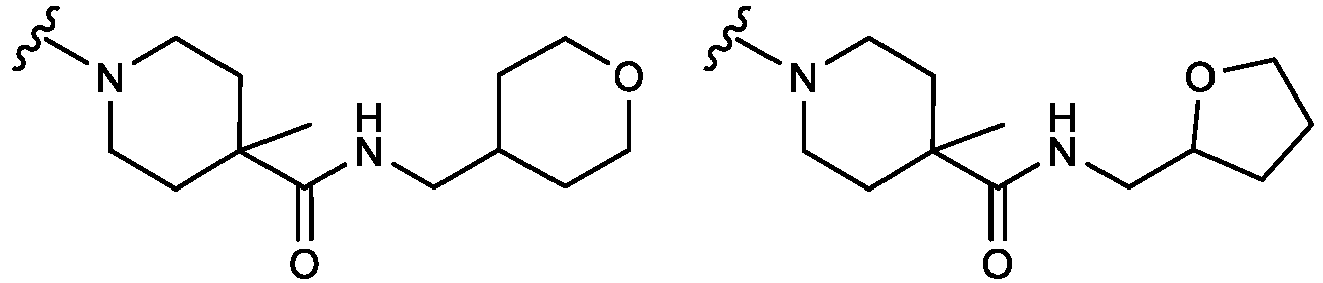


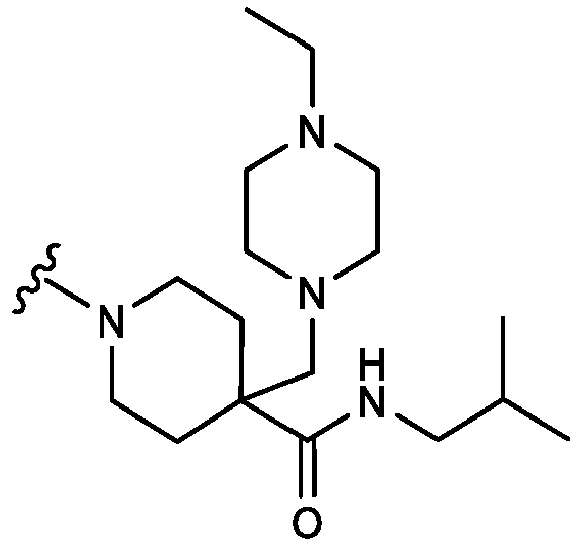


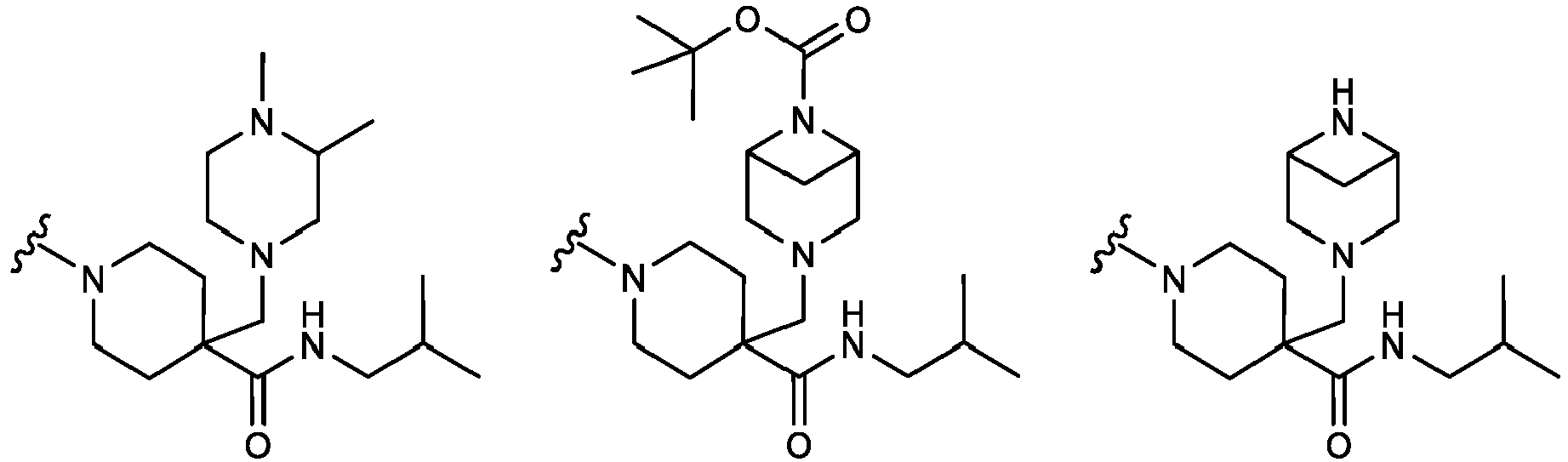


- In one embodiment, Ring D is a saturated 4-7 membered heterocyclic ring having one ring heteroatom which is nitrogen; each Ra is independently C1-C6 alkyl (optionally substituted with 1-3 fluoros), hydroxyC1-C6 alkyl or (C1-C6 alkoxy)C1-C6 alkyl-; Rb is (a) hydroxy, (b) cyclopropyl, (c) hetCycbCH2-, (d) RiRjNC(=O)CH2OCH2-where Ri and Rj are independently H or C1-C6 alkyl, (e) RcRdN-, (f) RcRdNCH2-, (g) C1-C6 alkoxy-, (h) (C1-C4 alkyl)-C(=O)NH- wherein said alkyl portion is optionally substituted with hetCycb, hetAra, C1-C6 alkoxy- or R'R"N-, or said alkyl portion is optionally substituted with two substituents independently selected from R'R"N- and OH, where each R' and R" is independently hydrogen or C1-C6 alkyl, (i) (R'R"N)C1-C6 alkoxy(CH2)n- where n is 0 or 1 and R' and R" are independently hydrogen or C1-C6 alkyl, or (j) hetCycb(C1-C3 alkyl)OCH2-; hetCycb is as defined for Formula I; Rc is hydrogen or C1-C6 alkyl; Rd is hydrogen, C1-C6 alkyl (optionally substituted with 1-3 fluoros), (C1-C6 alkoxy)C(=O)-, hydroxyC1-C6 alkyl (optionally substituted with 1-3 fluoros), (hydroxyC1-C6 alkyl)C(=O)-, (C1-C6 alkyl)C(=O)-, (RkRlN)C1-C6 alkyl-where Rk and Rl are independently H or C1-C6 alkyl, RmRnNC(=O)C1-C6 alkyl- where Rm and Rn are independently H or C1-C6 alkyl, PhCH2-, (C1-C6 alkoxy)C1-C6 alkyl-, or hetCycc where hetCycc is a 4-6 membered heterocyclic ring having a ring heteroatom selected from N and O and optionally substituted with C1-C6 alkyl; n is 0, 1, 2, 3, 4, 5 or 6; m is 0 or 1; and E is Ar1NRgC(=O)- where Ar1 and Rg are as defined for Formula I. In one embodiment, Ar1 is unsubstituted or substituted with one or more halogens. In one embodiment, m is 0. In one embodiment n is 0 or 1. In one embodiment, Ra is C1-C6 alkyl (optionally substituted with 1-3 fluoros). Non-limiting examples include the structures:


- In one embodiment, Ring D is a saturated 4-7 membered heterocyclic ring having one ring heteroatom which is nitrogen; each Ra is independently C1-C6 alkyl (optionally substituted with 1-3 fluoros), hydroxyC1-C6 alkyl or (C1-C6 alkoxy)C1-C6 alkyl-; Rb is (a) hydroxy, (b) cyclopropyl, (c) hetCycbCH2-, (d) RiRjNC(=O)CH2OCH2-where Ri and Rj are independently H or C1-C6 alkyl, (e) RcRdN-, (f) RcRdNCH2-, (g) C1-C6 alkoxy-, (h) (C1-C4 alkyl)-C(=O)NH- wherein said alkyl portion is optionally substituted with hetCycb, hetAra, C1-C6 alkoxy- or R'R"N-, or said alkyl portion is optionally substituted with two substituents independently selected from R'R"N- and OH, where each R' and R" is independently hydrogen or C1-C6 alkyl, (i) (R'R"N)C1-C6 alkoxy(CH2)n- where n is 0 or 1 and R' and R" are independently hydrogen or C1-C6 alkyl, or (j) hetCycb(C1-C3 alkyl)OCH2-; hetCycb is as defined for Formula I; Rc is hydrogen or C1-C6 alkyl; Rd is hydrogen, C1-C6 alkyl (optionally substituted with 1-3 fluoros), (C1-C6 alkoxy)C(=O)-, hydroxyC1-C6 alkyl (optionally substituted with 1-3 fluoros), (hydroxyC1-C6 alkyl)C(=O)-, (C1-C6 alkyl)C(=O)-, (RkRlN)C1-C6 alkyl-where Rk and Rl are independently H or C1-C6 alkyl, RmRnNC(=O)C1-C6 alkyl- where Rm and Rn are independently H or C1-C6 alkyl, PhCH2-, (C1-C6 alkoxy)C1-C6 alkyl-, or hetCycc where hetCycc is a 4-6 membered heterocyclic ring having a ring heteroatom selected from N and O and optionally substituted with C1-C6 alkyl; n is 0, 1, 2, 3, 4, 5 or 6; m is 0 or 1; and E is hetAr2NRgC(=O)- where hetAr2 and Rg are as defined for Formula I. In one embodiment, hetAr1 is a 5-6 membered heteroaryl having 1-2 ring nitrogen atoms and optionally substituted with one or more substituents independently selected from C1-C6 alkyl (optionally substituted with 1-3 fluoros) and C1-C6 alkoxy (optionally substituted with 1-3 fluoros). In one embodiment, m is 0. In one embodiment n is 0 or 1. In one embodiment, Ra is C1-C6 alkyl (optionally substituted with 1-3 fluoros). Non-limiting examples include the structures:


- In one embodiment, Ring D is a saturated 4-7 membered heterocyclic ring having one ring heteroatom which is nitrogen; each Ra is independently C1-C6 alkyl (optionally substituted with 1-3 fluoros), hydroxyC1-C6 alkyl or (C1-C6 alkoxy)C1-C6 alkyl-; Rb is (a) hydroxy, (b) cyclopropyl, (c) hetCycbCH2-, (d) RiRjNC(=O)CH2OCH2-where Ri and Rj are independently H or C1-C6 alkyl, (e) RcRdN-, (f) RcRdNCH2-, (g) C1-C6 alkoxy-, (h) (C1-C4 alkyl)-C(=O)NH- wherein said alkyl portion is optionally substituted with hetCycb, hetAra, C1-C6 alkoxy- or R'R"N-, or said alkyl portion is optionally substituted with two substituents independently selected from R'R"N- and OH, where each R' and R" is independently hydrogen or C1-C6 alkyl, (i) (R'R"N)C1-C6 alkoxy(CH2)n- where n is 0 or 1 and R' and R" are independently hydrogen or C1-C6 alkyl, or (j) hetCycb(C1-C3 alkyl)OCH2-; hetCycb is as defined for Formula I; Rc is hydrogen or C1-C6 alkyl; Rd is hydrogen, C1-C6 alkyl (optionally substituted with 1-3 fluoros), (C1-C6 alkoxy)C(=O)-, hydroxyC1-C6 alkyl (optionally substituted with 1-3 fluoros), (hydroxyC1-C6 alkyl)C(=O)-, (C1-C6 alkyl)C(=O)-, (RkRlN)C1-C6 alkyl-where Rk and Rl are independently H or C1-C6 alkyl, RmRnNC(=O)C1-C6 alkyl- where Rm and Rn are independently H or C1-C6 alkyl, PhCH2-, (C1-C6 alkoxy)C1-C6 alkyl-, or hetCycc where hetCycc is a 4-6 membered heterocyclic ring having a ring heteroatom selected from N and O and optionally substituted with C1-C6 alkyl; n is 0, 1, 2, 3, 4, 5 or 6; m is 0 or 1; and E is hetCyc5C(=O)- where hetCyc5 is as defined for Formula I. In one embodiment, m is 0. In one embodiment n is 0 or 1. In one embodiment, Ra is C1-C6 alkyl (optionally substituted with 1-3 fluoros). A non-limiting example is the structure:

- In one embodiment, Ring D is a saturated 4-7 membered heterocyclic ring having one ring heteroatom which is nitrogen; each Ra is independently C1-C6 alkyl (optionally substituted with 1-3 fluoros), hydroxyC1-C6 alkyl or (C1-C6 alkoxy)C1-C6 alkyl-; Rb is (a) hydroxy, (b) cyclopropyl, (c) hetCycbCH2-, (d) RiRjNC(=O)CH2OCH2-where Ri and Rj are independently H or C1-C6 alkyl, (e) RcRdN-, (f) RcRdNCH2-, (g) C1-C6 alkoxy-, (h) (C1-C4 alkyl)-C(=O)NH- wherein said alkyl portion is optionally substituted with hetCycb, hetAra, C1-C6 alkoxy- or R'R"N-, or said alkyl portion is optionally substituted with two substituents independently selected from R'R"N- and OH, where each R' and R" is independently hydrogen or C1-C6 alkyl, (i) (R'R"N)C1-C6 alkoxy(CH2)n- where n is 0 or 1 and R' and R" are independently hydrogen or C1-C6 alkyl, or (j) hetCycb(C1-C3 alkyl)OCH2-; hetCycb is as defined for Formula I; Rc is hydrogen or C1-C6 alkyl; Rd is hydrogen, C1-C6 alkyl (optionally substituted with 1-3 fluoros), (C1-C6 alkoxy)C(=O)-, hydroxyC1-C6 alkyl (optionally substituted with 1-3 fluoros), (hydroxyC1-C6 alkyl)C(=O)-, (C1-C6 alkyl)C(=O)-, (RkRlN)C1-C6 alkyl-where Rk and Rl are independently H or C1-C6 alkyl, RmRnNC(=O)C1-C6 alkyl- where Rm and Rn are independently H or C1-C6 alkyl, PhCH2-, (C1-C6 alkoxy)C1-C6 alkyl-, or hetCycc where hetCycc is a 4-6 membered heterocyclic ring having a ring heteroatom selected from N and O and optionally substituted with C1-C6 alkyl; n is 0, 1, 2, 3, 4, 5 or 6; m is 0 or 1; and E is R4R5NC(=O)NRg- where R4, R5 and Rg are as defined for Formula I. In one embodiment, R4 and R5 are independently hydrogen or C1-C6 alkyl. In one embodiment, Ring D is a saturated 6 membered heterocyclic ring having one ring heteroatom which is nitrogen. In one embodiment, n is 0, 1 or 2 and m is 0 or 1. In one embodiment, n is 0 or 1 and m is 0. In one embodiment, Ra is C1-C6 alkyl (optionally substituted with 1-3 fluoros). In one embodiment, n is 0 and m is 1. In one embodiment, Rb is hetCycbCH2- where hetCycb is a 4-6 membered heterocyclic ring having 1-2 ring heteroatoms independently selected from N and O, wherein hetCycb is optionally substituted with C1-C6 alkyl (optionally substituted with 1-3 fluoros). In one embodiment, Rb is RcRdNCH2- where Rc is H or C1-C6 alkyl and Rd is C1-C6 alkyl (optionally substituted with 1-3 fluoros). Non-limiting examples include the structures:


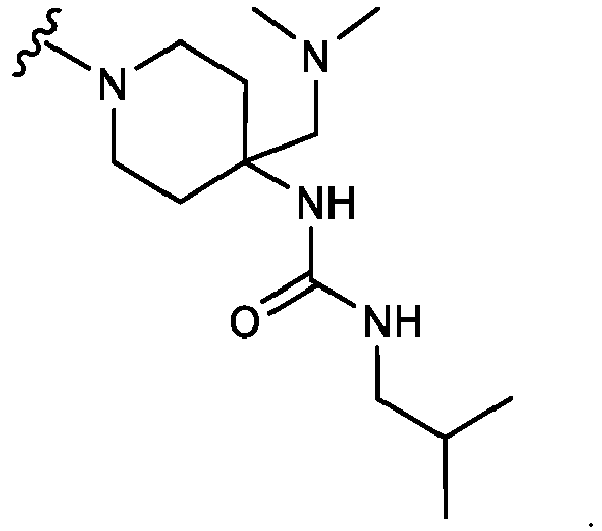
- In one embodiment, Ring D is a saturated 4-7 membered heterocyclic ring having one ring heteroatom which is nitrogen; each Ra is independently C1-C6 alkyl (optionally substituted with 1-3 fluoros), hydroxyC1-C6 alkyl or (C1-C6 alkoxy)C1-C6 alkyl-; Rb is (a) hydroxy, (b) cyclopropyl, (c) hetCycbCH2-, (d) RiRjNC(=O)CH2OCH2-where Ri and Rj are independently H or C1-C6 alkyl, (e) RcRdN-, (f) RcRdNCH2-, (g) C1-C6 alkoxy-, (h) (C1-C4 alkyl)-C(=O)NH- wherein said alkyl portion is optionally substituted with hetCycb, hetAra, C1-C6 alkoxy- or R'R"N-, or said alkyl portion is optionally substituted with two substituents independently selected from R'R"N- and OH, where each R' and R" is independently hydrogen or C1-C6 alkyl, (i) (R'R"N)C1-C6 alkoxy(CH2)n- where n is 0 or 1 and R' and R" are independently hydrogen or C1-C6 alkyl, or (j) hetCycb(C1-C3 alkyl)OCH2-; hetCycb is as defined for Formula I; Rc is hydrogen or C1-C6 alkyl; Rd is hydrogen, C1-C6 alkyl (optionally substituted with 1-3 fluoros), (C1-C6 alkoxy)C(=O)-, hydroxyC1-C6 alkyl (optionally substituted with 1-3 fluoros), (hydroxyC1-C6 alkyl)C(=O)-, (C1-C6 alkyl)C(=O)-, (RkRlN)C1-C6 alkyl-where Rk and Rl are independently H or C1-C6 alkyl, RmRnNC(=O)C1-C6 alkyl- where Rm and Rn are independently H or C1-C6 alkyl, PhCH2-, (C1-C6 alkoxy)C1-C6 alkyl-, or hetCycc where hetCycc is a 4-6 membered heterocyclic ring having a ring heteroatom selected from N and O and optionally substituted with C1-C6 alkyl; n is 0, 1, 2, 3, 4, 5 or 6; m is 0 or 1; and E is (C1-C6 alkyl)SO2-. In one embodiment, Ring D is a saturated 6 membered heterocyclic ring having one ring heteroatom which is nitrogen. In one embodiment, n is 0, 1 or 2 and m is 0 or 1. In one embodiment, n is 0 or 1 and m is 0. In one embodiment, Ra is C1-C6 alkyl (optionally substituted with 1-3 fluoros). Non-limiting examples include the structures:

- In one embodiment, Ring D is a saturated 4-7 membered heterocyclic ring having one ring heteroatom which is nitrogen; each Ra is independently C1-C6 alkyl (optionally substituted with 1-3 fluoros), hydroxyC1-C6 alkyl or (C1-C6 alkoxy)C1-C6 alkyl-; Rb is (a) hydroxy, (b) cyclopropyl, (c) hetCycbCH2-, (d) RiRjNC(=O)CH2OCH2-where Ri and Rj are independently H or C1-C6 alkyl, (e) RcRdN-, (f) RcRdNCH2-, (g) C1-C6 alkoxy-, (h) (C1-C4 alkyl)-C(=O)NH- wherein said alkyl portion is optionally substituted with hetCycb, hetAra, C1-C6 alkoxy- or R'R"N-, or said alkyl portion is optionally substituted with two substituents independently selected from R'R"N- and OH, where each R' and R" is independently hydrogen or C1-C6 alkyl, (i) (R'R"N)C1-C6 alkoxy(CH2)n- where n is 0 or 1 and R' and R" are independently hydrogen or C1-C6 alkyl, or (j) hetCycb(C1-C3 alkyl)OCH2-; hetCycb is as defined for Formula I; Rc is hydrogen or C1-C6 alkyl; Rd is hydrogen, C1-C6 alkyl (optionally substituted with 1-3 fluoros), (C1-C6 alkoxy)C(=O)-, hydroxyC1-C6 alkyl (optionally substituted with 1-3 fluoros), (hydroxyC1-C6 alkyl)C(=O)-, (C1-C6 alkyl)C(=O)-, (RkRlN)C1-C6 alkyl-where Rk and Rl are independently H or C1-C6 alkyl, RmRnNC(=O)C1-C6 alkyl- where Rm and Rn are independently H or C1-C6 alkyl, PhCH2-, (C1-C6 alkoxy)C1-C6 alkyl-, or hetCycc where hetCycc is a 4-6 membered heterocyclic ring having a ring heteroatom selected from N and O and optionally substituted with C1-C6 alkyl; n is 0, 1, 2, 3, 4, 5 or 6; m is 0 or 1; and E is Ar1(C1-C6 alkyl)C(=O)NRg- where Arl and Rg are as defined for Formula I. In one embodiment, Arl is unsubstituted or substituted with one or more halogens. In one embodiment, n is 0 or 1 and m is 0. In one embodiment, Ra is C1-C6 alkyl (optionally substituted with 1-3 fluoros). Non-limiting examples include the structures:



- In one embodiment, Ring D is a saturated 4-7 membered heterocyclic ring having one ring heteroatom which is nitrogen; each Ra is independently C1-C6 alkyl (optionally substituted with 1-3 fluoros), hydroxyC1-C6 alkyl or (C1-C6 alkoxy)C1-C6 alkyl-; Rb is (a) hydroxy, (b) cyclopropyl, (c) hetCycbCH2-, (d) RiRjNC(=O)CH2OCH2-where Ri and Rj are independently H or C1-C6 alkyl, (e) RcRdN-, (f) RcRdNCH2-, (g) C1-C6 alkoxy-, (h) (C1-C4 alkyl)-C(=O)NH- wherein said alkyl portion is optionally substituted with hetCycb, hetAra, C1-C6 alkoxy- or R'R"N-, or said alkyl portion is optionally substituted with two substituents independently selected from R'R"N- and OH, where each R' and R" is independently hydrogen or C1-C6 alkyl, (i) (R'R"N)C1-C6 alkoxy(CH2)n- where n is 0 or 1 and R' and R" are independently hydrogen or C1-C6 alkyl, or (j) hetCycb(C1-C3 alkyl)OCH2-; hetCycb is as defined for Formula I; Rc is hydrogen or C1-C6 alkyl; Rd is hydrogen, C1-C6 alkyl (optionally substituted with 1-3 fluoros), (C1-C6 alkoxy)C(=O)-, hydroxyC1-C6 alkyl (optionally substituted with 1-3 fluoros), (hydroxyC1-C6 alkyl)C(=O)-, (C1-C6 alkyl)C(=O)-, (RkRlN)C1-C6 alkyl-where Rk and Rl are independently H or C1-C6 alkyl, RmRnNC(=O)C1-C6 alkyl- where Rm and Rn are independently H or C1-C6 alkyl, PhCH2-, (C1-C6 alkoxy)C1-C6 alkyl-, or hetCycc where hetCycc is a 4-6 membered heterocyclic ring having a ring heteroatom selected from N and O and optionally substituted with C1-C6 alkyl; n is 0, 1, 2, 3, 4, 5 or 6; m is 0 or 1; and E is hetAr4C(=O)NRg- where hetAr4 and Rg are as defined for Formula I. In one embodiment, n is 0 or 1 and m is 0. In one embodiment, Ra is C1-C6 alkyl. Non-limiting examples include the structures:


- In one embodiment, Ring D is a saturated 4-7 membered heterocyclic ring having one ring heteroatom which is nitrogen; each Ra is independently C1-C6 alkyl (optionally substituted with 1-3 fluoros), hydroxyC1-C6 alkyl or (C1-C6 alkoxy)C1-C6 alkyl-; Rb is (a) hydroxy, (b) cyclopropyl, (c) hetCycbCH2-, (d) RiRjNC(=O)CH2OCH2-where Ri and Rj are independently H or C1-C6 alkyl, (e) RcRdN-, (f) RcRdNCH2-, (g) C1-C6 alkoxy-, (h) (C1-C4 alkyl)-C(=O)NH- wherein said alkyl portion is optionally substituted with hetCycb, hetAra, C1-C6 alkoxy- or R'R"N-, or said alkyl portion is optionally substituted with two substituents independently selected from R'R"N- and OH, where each R' and R" is independently hydrogen or C1-C6 alkyl, (i) (R'R"N)C1-C6 alkoxy(CH2)n- where n is 0 or 1 and R' and R" are independently hydrogen or C1-C6 alkyl, or (j) hetCycb(C1-C3 alkyl)OCH2-; hetCycb is as defined for Formula I; Rc is hydrogen or C1-C6 alkyl; Rd is hydrogen, C1-C6 alkyl (optionally substituted with 1-3 fluoros), (C1-C6 alkoxy)C(=O)-, hydroxyC1-C6 alkyl (optionally substituted with 1-3 fluoros), (hydroxyC1-C6 alkyl)C(=O)-, (C1-C6 alkyl)C(=O)-, (RkRlN)C1-C6 alkyl-where Rk and Rl are independently H or C1-C6 alkyl, RmRnNC(=O)C1-C6 alkyl- where Rm and Rn are independently H or C1-C6 alkyl, PhCH2-, (C1-C6 alkoxy)C1-C6 alkyl-, or hetCycc where hetCycc is a 4-6 membered heterocyclic ring having a ring heteroatom selected from N and O and optionally substituted with C1-C6 alkyl; n is 0, 1, 2, 3, 4, 5 or 6; m is 0 or 1; and E is hetAr2-S(=O)- where hetAr2 is as defined for Formula I. In one embodiment, hetAr2 is a 5-6-membered heteroaryl ring. In one embodiment, hetAr2 is unsubstituted. In one embodiment, n is 0. In one embodiment, m is 0. A non-limiting example includes the structure:

- In one embodiment, Ring D is a saturated 4-7 membered heterocyclic ring having one ring heteroatom which is nitrogen; each Ra is independently C1-C6 alkyl (optionally substituted with 1-3 fluoros), hydroxyC1-C6 alkyl or (C1-C6 alkoxy)C1-C6 alkyl-; Rb is (a) hydroxy, (b) cyclopropyl, (c) hetCycbCH2-, (d) RiRjNC(=O)CH2OCH2-where Ri and Rj are independently H or C1-C6 alkyl, (e) RcRdN-, (f) RcRdNCH2-, (g) C1-C6 alkoxy-, (h) (C1-C4 alkyl)-C(=O)NH- wherein said alkyl portion is optionally substituted with hetCycb, hetAra, C1-C6 alkoxy- or R'R"N-, or said alkyl portion is optionally substituted with two substituents independently selected from R'R"N- and OH, where each R' and R" is independently hydrogen or C1-C6 alkyl, (i) (R'R"N)C1-C6 alkoxy(CH2)n- where n is 0 or 1 and R' and R" are independently hydrogen or C1-C6 alkyl, or (j) hetCycb(C1-C3 alkyl)OCH2-; hetCycb is as defined for Formula I; Rc is hydrogen or C1-C6 alkyl; Rd is hydrogen, C1-C6 alkyl (optionally substituted with 1-3 fluoros), (C1-C6 alkoxy)C(=O)-, hydroxyC1-C6 alkyl (optionally substituted with 1-3 fluoros), (hydroxyC1-C6 alkyl)C(=O)-, (C1-C6 alkyl)C(=O)-, (RkRlN)C1-C6 alkyl-where Rk and Rl are independently H or C1-C6 alkyl, RmRnNC(=O)C1-C6 alkyl- where Rm and Rn are independently H or C1-C6 alkyl, PhCH2-, (C1-C6 alkoxy)C1-C6 alkyl-, or hetCycc where hetCycc is a 4-6 membered heterocyclic ring having a ring heteroatom selected from N and O and optionally substituted with C1-C6 alkyl; n is 0, 1, 2, 3, 4, 5 or 6; m is 0 or 1; and E is (C3-C6 cycloalkyl)CH2SO2-. In one embodiment, n is 0. In one embodiment, m is 0. A non-limiting example includes the structure:
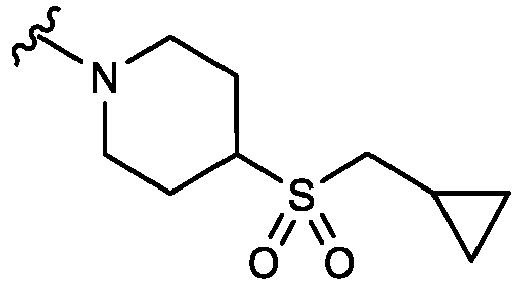
- In one embodiment, Ring D is a saturated 4-7 membered heterocyclic ring having one ring heteroatom which is nitrogen; each Ra is independently C1-C6 alkyl (optionally substituted with 1-3 fluoros), hydroxyC1-C6 alkyl or (C1-C6 alkoxy)C1-C6 alkyl-; Rb is (a) hydroxy, (b) cyclopropyl, (c) hetCycbCH2-, (d) RiRjNC(=O)CH2OCH2-where Ri and Rj are independently H or C1-C6 alkyl, (e) RcRdN-, (f) RcRdNCH2-, (g) C1-C6 alkoxy-, (h) (C1-C4 alkyl)-C(=O)NH- wherein said alkyl portion is optionally substituted with hetCycb, hetAra, C1-C6 alkoxy- or R'R"N-, or said alkyl portion is optionally substituted with two substituents independently selected from R'R"N- and OH, where each R' and R" is independently hydrogen or C1-C6 alkyl, (i) (R'R"N)C1-C6 alkoxy(CH2)n- where n is 0 or 1 and R' and R" are independently hydrogen or C1-C6 alkyl, or (j) hetCycb(C1-C3 alkyl)OCH2-; hetCycb is as defined for Formula I; Rc is hydrogen or C1-C6 alkyl; Rd is hydrogen, C1-C6 alkyl (optionally substituted with 1-3 fluoros), (C1-C6 alkoxy)C(=O)-, hydroxyC1-C6 alkyl (optionally substituted with 1-3 fluoros), (hydroxyC1-C6 alkyl)C(=O)-, (C1-C6 alkyl)C(=O)-, (RkRlN)C1-C6 alkyl-where Rk and Rl are independently H or C1-C6 alkyl, RmRnNC(=O)C1-C6 alkyl- where Rm and Rn are independently H or C1-C6 alkyl, PhCH2-, (C1-C6 alkoxy)C1-C6 alkyl-, or hetCycc where hetCycc is a 4-6 membered heterocyclic ring having a ring heteroatom selected from N and O and optionally substituted with C1-C6 alkyl; n is 0, 1, 2, 3, 4, 5 or 6; m is 0 or 1; and E is Arl(C1-C6 alkyl)SO2- where Arl is as defined for Formula I. In one embodiment, Arl is unsubstituted. In one embodiment, n is 0. In one embodiment, m is 0. A non-limiting example includes the structure:

- In one embodiment, Ring D is a saturated 4-7 membered heterocyclic ring having one ring heteroatom which is nitrogen; each Ra is independently C1-C6 alkyl (optionally substituted with 1-3 fluoros), hydroxyC1-C6 alkyl or (C1-C6 alkoxy)C1-C6 alkyl-; Rb is (a) hydroxy, (b) cyclopropyl, (c) hetCycbCH2-, (d) RiRjNC(=O)CH2OCH2-where Ri and Rj are independently H or C1-C6 alkyl, (e) RcRdN-, (f) RcRdNCH2-, (g) C1-C6 alkoxy-, (h) (C1-C4 alkyl)-C(=O)NH- wherein said alkyl portion is optionally substituted with hetCycb, hetAra, C1-C6 alkoxy- or R'R"N-, or said alkyl portion is optionally substituted with two substituents independently selected from R'R"N- and OH, where each R' and R" is independently hydrogen or C1-C6 alkyl, (i) (R'R"N)C1-C6 alkoxy(CH2)n- where n is 0 or 1 and R' and R" are independently hydrogen or C1-C6 alkyl, or (j) hetCycb(C1-C3 alkyl)OCH2-; hetCycb is as defined for Formula I; Rc is hydrogen or C1-C6 alkyl; Rd is hydrogen, C1-C6 alkyl (optionally substituted with 1-3 fluoros), (C1-C6 alkoxy)C(=O)-, hydroxyC1-C6 alkyl (optionally substituted with 1-3 fluoros), (hydroxyC1-C6 alkyl)C(=O)-, (C1-C6 alkyl)C(=O)-, (RkRlN)C1-C6 alkyl-where Rk and Rl are independently H or C1-C6 alkyl, RmRnNC(=O)C1-C6 alkyl- where Rm and Rn are independently H or C1-C6 alkyl, PhCH2-, (C1-C6 alkoxy)C1-C6 alkyl-, or hetCycc where hetCycc is a 4-6 membered heterocyclic ring having a ring heteroatom selected from N and O and optionally substituted with C1-C6 alkyl; n is 0, 1, 2, 3, 4, 5 or 6; m is 0 or 1; and E is hetAr2SO2- where hetAr2 is as defined for Formula I. In one embodiment, hetAr2 is a 5-6-membered heteroaryl ring. In one embodiment, hetAr2 is unsubstituted. In one embodiment, n is 0. In one embodiment, m is 0. A non-limiting example includes the structure:

- In one embodiment, Ring D is a saturated 4-7 membered heterocyclic ring having one ring heteroatom which is nitrogen; each Ra is independently C1-C6 alkyl (optionally substituted with 1-3 fluoros), hydroxyC1-C6 alkyl or (C1-C6 alkoxy)C1-C6 alkyl-; Rb is (a) hydroxy, (b) cyclopropyl, (c) hetCycbCH2-, (d) RiRjNC(=O)CH2OCH2-where Ri and Rj are independently H or C1-C6 alkyl, (e) RcRdN-, (f) RcRdNCH2-, (g) C1-C6 alkoxy-, (h) (C1-C4 alkyl)-C(=O)NH- wherein said alkyl portion is optionally substituted with hetCycb, hetAra, C1-C6 alkoxy- or R'R"N-, or said alkyl portion is optionally substituted with two substituents independently selected from R'R"N- and OH, where each R' and R" is independently hydrogen or C1-C6 alkyl, (i) (R'R"N)C1-C6 alkoxy(CH2)n- where n is 0 or 1 and R' and R" are independently hydrogen or C1-C6 alkyl, or (j) hetCycb(C1-C3 alkyl)OCH2-; hetCycb is as defined for Formula I; Rc is hydrogen or C1-C6 alkyl; Rd is hydrogen, C1-C6 alkyl (optionally substituted with 1-3 fluoros), (C1-C6 alkoxy)C(=O)-, hydroxyC1-C6 alkyl (optionally substituted with 1-3 fluoros), (hydroxyC1-C6 alkyl)C(=O)-, (C1-C6 alkyl)C(=O)-, (RkRlN)C1-C6 alkyl-where Rk and Rl are independently H or C1-C6 alkyl, RmRnNC(=O)C1-C6 alkyl- where Rm and Rn are independently H or C1-C6 alkyl, PhCH2-, (C1-C6 alkoxy)C1-C6 alkyl-, or hetCycc where hetCycc is a 4-6 membered heterocyclic ring having a ring heteroatom selected from N and O and optionally substituted with C1-C6 alkyl; n is 0, 1, 2, 3, 4, 5 or 6; m is 0 or 1; and E is Arl where Arl is as defined for Formula I. In one embodiment, Arl is unsubstituted. In one embodiment, n is 0. In one embodiment, m is 0 or 1. In one embodiment, Rb is OH. A non-limiting example includes the structure:

- In one embodiment, Ring D is a saturated 4-7 membered heterocyclic ring having one ring heteroatom which is nitrogen; each Ra is independently C1-C6 alkyl (optionally substituted with 1-3 fluoros), hydroxyC1-C6 alkyl or (C1-C6 alkoxy)C1-C6 alkyl-; Rb is (a) hydroxy, (b) cyclopropyl, (c) hetCycbCH2- (d) RiRjNC(=O)CH2OCH2-where Ri and Rj are independently H or C1-C6 alkyl, (e) RcRdN-, (f) RcRdNCH2-, (g) C1-C6 alkoxy-, (h) (C1-C4 alkyl)-C(=O)NH- wherein said alkyl portion is optionally substituted with hetCycb, hetAra, C1-C6 alkoxy- or R'R"N-, or said alkyl portion is optionally substituted with two substituents independently selected from R'R"N- and OH, where each R' and R" is independently hydrogen or C1-C6 alkyl, (i) (R'R"N)C1-C6 alkoxy(CH2)n- where n is 0 or 1 and R' and R" are independently hydrogen or C1-C6 alkyl, or (j) hetCycb(C1-C3 alkyl)OCH2-; hetCycb is as defined for Formula I; Rc is hydrogen or C1-C6 alkyl; Rd is hydrogen, C1-C6 alkyl (optionally substituted with 1-3 fluoros), (C1-C6 alkoxy)C(=O)-, hydroxyC1-C6 alkyl (optionally substituted with 1-3 fluoros), (hydroxyC1-C6 alkyl)C(=O)-, (C1-C6 alkyl)C(=O)-, (RkRlN)C1-C6 alkyl-where Rk and Rl are independently H or C1-C6 alkyl, RmRnNC(=O)C1-C6 alkyl- where Rm and Rn are independently H or C1-C6 alkyl, PhCH2-, (C1-C6 alkoxy)C1-C6 alkyl-, or hetCycc where hetCycc is a 4-6 membered heterocyclic ring having a ring heteroatom selected from N and O and optionally substituted with C1-C6 alkyl; n is 0, 1, 2, 3, 4, 5 or 6; m is 0 or 1; and E is hetAr2 where hetAr2 is as defined for Formula I. In one embodiment, hetAr2 is unsubstituted or substituted with C1-C6 alkyl (optionally substituted with 1-3 fluoros). In one embodiment, n is 0. In one embodiment, m is 0 or 1. In one embodiment, Rb is OH. Non-limiting examples include the structures:


- In one embodiment, Ring D is a saturated 4-7 membered heterocyclic ring having one ring heteroatom which is nitrogen; each Ra is independently C1-C6 alkyl (optionally substituted with 1-3 fluoros), hydroxyC1-C6 alkyl or (C1-C6 alkoxy)C1-C6 alkyl-; Rb is (a) hydroxy, (b) cyclopropyl, (c) hetCycbCH2-, (d) RiRjNC(=O)CH2OCH2-where Ri and Rj are independently H or C1-C6 alkyl, (e) RcRdN-, (f) RcRdNCH2-, (g) C1-C6 alkoxy-, (h) (C1-C4 alkyl)-C(=O)NH- wherein said alkyl portion is optionally substituted with hetCycb, hetAra, C1-C6 alkoxy- or R'R"N-, or said alkyl portion is optionally substituted with two substituents independently selected from R'R"N- and OH, where each R' and R" is independently hydrogen or C1-C6 alkyl, (i) (R'R"N)C1-C6 alkoxy(CH2)n- where n is 0 or 1 and R' and R" are independently hydrogen or C1-C6 alkyl, or (j) hetCycb(C1-C3 alkyl)OCH2-; hetCycb is as defined for Formula I; Rc is hydrogen or C1-C6 alkyl; Rd is hydrogen, C1-C6 alkyl (optionally substituted with 1-3 fluoros), (C1-C6 alkoxy)C(=O)-, hydroxyC1-C6 alkyl (optionally substituted with 1-3 fluoros), (hydroxyC1-C6 alkyl)C(=O)-, (C1-C6 alkyl)C(=O)-, (RkRlN)C1-C6 alkyl-where Rk and Rl are independently H or C1-C6 alkyl, RmRnNC(=O)C1-C6 alkyl- where Rm and Rn are independently H or C1-C6 alkyl, PhCH2-, (C1-C6 alkoxy)C1-C6 alkyl-, or hetCycc where hetCycc is a 4-6 membered heterocyclic ring having a ring heteroatom selected from N and O and optionally substituted with C1-C6 alkyl; n is 0, 1, 2, 3, 4, 5 or 6; m is 0 or 1; and E is hetCyc5 where hetCyc5 is as defined for Formula I. In one embodiment, m is 0. In one embodiment, n is 0 or 1. In one embodiment, Ra is C1-C6 alkyl (optionally substituted with 1-3 fluoros). Non-limiting examples include the structures:

- In one embodiment, Ring D is a saturated 4-7 membered heterocyclic ring having one ring heteroatom which is nitrogen; each Ra is independently C1-C6 alkyl (optionally substituted with 1-3 fluoros), hydroxyC1-C6 alkyl or (C1-C6 alkoxy)C1-C6 alkyl-; Rb is (a) hydroxy, (b) cyclopropyl, (c) hetCycbCH2-, (d) RiRjNC(=O)CH2OCH2-where Ri and Rj are independently H or C1-C6 alkyl, (e) RcRdN-, (f) RcRdNCH2-, (g) C1-C6 alkoxy-, (h) (C1-C4 alkyl)-C(=O)NH- wherein said alkyl portion is optionally substituted with hetCycb, hetAra, C1-C6 alkoxy- or R'R"N-, or said alkyl portion is optionally substituted with two substituents independently selected from R'R"N- and OH, where each R' and R" is independently hydrogen or C1-C6 alkyl, (i) (R'R"N)C1-C6 alkoxy(CH2)n- where n is 0 or 1 and R' and R" are independently hydrogen or C1-C6 alkyl, or (j) hetCycb(C1-C3 alkyl)OCH2-; hetCycb is as defined for Formula I; Rc is hydrogen or C1-C6 alkyl; Rd is hydrogen, C1-C6 alkyl (optionally substituted with 1-3 fluoros), (C1-C6 alkoxy)C(=O)-, hydroxyC1-C6 alkyl (optionally substituted with 1-3 fluoros), (hydroxyC1-C6 alkyl)C(=O)-, (C1-C6 alkyl)C(=O)-, (RkRlN)C1-C6 alkyl-where Rk and Rl are independently H or C1-C6 alkyl, RmRnNC(=O)C1-C6 alkyl- where Rm and Rn are independently H or C1-C6 alkyl, PhCH2-, (C1-C6 alkoxy)C1-C6 alkyl-, or hetCycc where hetCycc is a 4-6 membered heterocyclic ring having a ring heteroatom selected from N and O and optionally substituted with C1-C6 alkyl; n is 0, 1, 2, 3, 4, 5 or 6; m is 0 or 1; and E is C1-C6 alkoxy. In one embodiment, n is 0. In one embodiment, m is 0 or 1. In one embodiment, Rb is RcRdN- where Rc is H and Rd is H. Non-limiting examples include the structures:

- In one embodiment, Ring D is a saturated 4-7 membered heterocyclic ring having one ring heteroatom which is nitrogen; each Ra is independently C1-C6 alkyl (optionally substituted with 1-3 fluoros), hydroxyC1-C6 alkyl or (C1-C6 alkoxy)C1-C6 alkyl-; Rb is (a) hydroxy, (b) cyclopropyl, (c) hetCycbCH2-, (d) RiRjNC(=O)CH2OCH2-where Ri and Rj are independently H or C1-C6 alkyl, (e) RcRdN-, (f) RcRdNCH2-, (g) C1-C6 alkoxy-, (h) (C1-C4 alkyl)-C(=O)NH- wherein said alkyl portion is optionally substituted with hetCycb, hetAra, C1-C6 alkoxy- or R'R"N-, or said alkyl portion is optionally substituted with two substituents independently selected from R'R"N- and OH, where each R' and R" is independently hydrogen or C1-C6 alkyl, (i) (R'R"N)C1-C6 alkoxy(CH2)n- where n is 0 or 1 and R' and R" are independently hydrogen or C1-C6 alkyl, or (j) hetCycb(C1-C3 alkyl)OCH2-; hetCycb is as defined for Formula I; Rc is hydrogen or C1-C6 alkyl; Rd is hydrogen, C1-C6 alkyl (optionally substituted with 1-3 fluoros), (C1-C6 alkoxy)C(=O)-, hydroxyC1-C6 alkyl (optionally substituted with 1-3 fluoros), (hydroxyC1-C6 alkyl)C(=O)-, (C1-C6 alkyl)C(=O)-, (RkRlN)C1-C6 alkyl-where Rk and Rl are independently H or C1-C6 alkyl, RmRnNC(=O)C1-C6 alkyl- where Rm and Rn are independently H or C1-C6 alkyl, PhCH2-, (C1-C6 alkoxy)C1-C6 alkyl-, or hetCycc where hetCycc is a 4-6 membered heterocyclic ring having a ring heteroatom selected from N and O and optionally substituted with C1-C6 alkyl; n is 0, 1, 2, 3, 4, 5 or 6; m is 0 or 1; and E is Ar1(C1-C6 alkyl)-O- where Ar1 is as defined for Formula I. In one embodiment, Ar1 is unsubstituted. In one embodiment, n is 0. In one embodiment, m is 0. Non-limiting examples include the structures:

- In one embodiment, Ring D is a saturated 4-7 membered heterocyclic ring having one ring heteroatom which is nitrogen; each Ra is independently C1-C6 alkyl (optionally substituted with 1-3 fluoros), hydroxyC1-C6 alkyl or (C1-C6 alkoxy)C1-C6 alkyl-; Rb is (a) hydroxy, (b) cyclopropyl, (c) hetCycbCH2-, (g) C1-C6 alkoxy-, (h) (C1-C4 alkyl)-C(=O)NH- wherein said alkyl portion is optionally substituted with hetCycb, hetAr3, C1-C6 alkoxy- or R'R"N-, or said alkyl portion is optionally substituted with two substituents independently selected from R'R"N- and OH, where each R' and R" is independently hydrogen or C1-C6 alkyl, (i) (R'R"N)C1-C6 alkoxy(CH2)n- where n is 0 or 1 and R' and R" are independently hydrogen or C1-C6 alkyl, or (j) hetCycb(C1-C3 alkyl)OCH2-; hetCycb is as defined for Formula I; (d) RiRjNC(=O)CH2OCH2- where Ri and Rj are independently H or C1-C6 alkyl, (e) RcRdN-, or (f) RcRdNCH2-; Rc is hydrogen or C1-C6 alkyl; Rd is hydrogen, C1-C6 alkyl (optionally substituted with 1-3 fluoros), (C1-C6 alkoxy)C(=O)-, hydroxyC1-C6 alkyl (optionally substituted with 1-3 fluoros), (hydroxyC1-C6 alkyl)C(=O)-, (C1-C6 alkyl)C(=O)-, (RkRlN)C1-C6 alkyl-where Rk and Rl are independently H or C1-C6 alkyl, RmRnNC(=O)C1-C6 alkyl- where Rm and Rn are independently H or C1-C6 alkyl, PhCH2-, (C1-C6 alkoxy)C1-C6 alkyl-, or hetCycc where hetCycc is a 4-6 membered heterocyclic ring having a ring heteroatom selected from N and O and optionally substituted with C1-C6 alkyl; n is 0, 1, 2, 3, 4, 5 or 6; m is 0 or 1; and E is hetAr2(C1-C6 alkyl)-O- where hetAr2 is as defined for Formula I. In one embodiment, hetAr2 is a 5-6-membered heteroaryl ring. In one embodiment, hetAr2 is unsubstituted. In one embodiment, n is 0. In one embodiment, m is 0. Non-limiting examples include the structures:
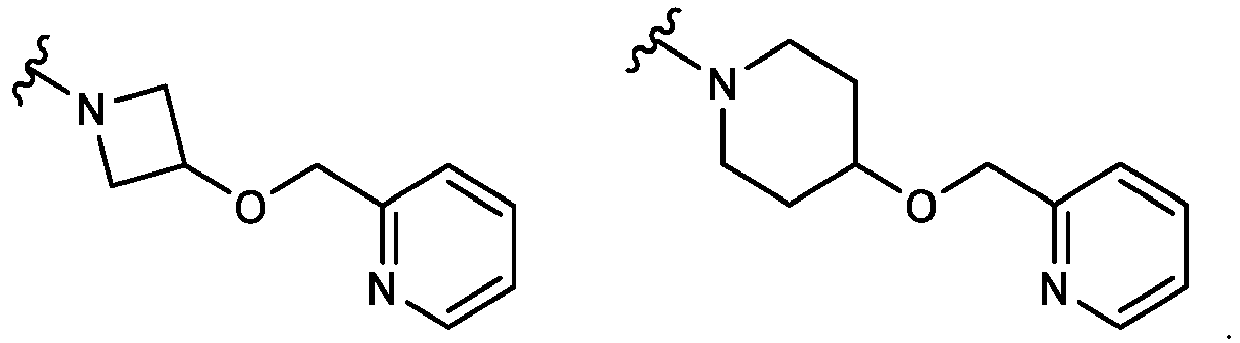
- In one embodiment, Ring D is a saturated 4-7 membered heterocyclic ring having one ring heteroatom which is nitrogen; each Ra is independently C1-C6 alkyl (optionally substituted with 1-3 fluoros), hydroxyC1-C6 alkyl or (C1-C6 alkoxy)C1-C6 alkyl-; Rb is (a) hydroxy, (b) cyclopropyl, (c) hetCycbCH2-, (d) RiRjNC(=O)CH2OCH2-where Ri and Rj are independently H or C1-C6 alkyl, (e) RcRdN-, (f) RcRdNCH2-, (g) C1-C6 alkoxy-, (h) (C1-C4 alkyl)-C(=O)NH- wherein said alkyl portion is optionally substituted with hetCycb, hetAr3, C1-C6 alkoxy- or R'R"N-, or said alkyl portion is optionally substituted with two substituents independently selected from R'R"N- and OH, where each R' and R" is independently hydrogen or C1-C6 alkyl, (i) (R'R"N)C1-C6 alkoxy(CH2)n- where n is 0 or 1 and R' and R" are independently hydrogen or C1-C6 alkyl, or (j) hetCycb(C1-C3 alkyl)OCH2-; hetCycb is as defined for Formula I; Rc is hydrogen or C1-C6 alkyl; Rd is hydrogen, C1-C6 alkyl (optionally substituted with 1-3 fluoros), (C1-C6 alkoxy)C(=O)-, hydroxyC1-C6 alkyl (optionally substituted with 1-3 fluoros), (hydroxyC1-C6 alkyl)C(=O)-, (C1-C6 alkyl)C(=O)-, (RkRlN)C1-C6 alkyl-where Rk and Rl are independently H or C1-C6 alkyl, RmRnNC(=O)C1-C6 alkyl- where Rm and Rn are independently H or C1-C6 alkyl, PhCH2-, (C1-C6 alkoxy)C1-C6 alkyl-, or hetCycc where hetCycc is a 4-6 membered heterocyclic ring having a ring heteroatom selected from N and O and optionally substituted with C1-C6 alkyl; n is 0, 1, 2, 3, 4, 5 or 6; m is 0 or 1; and E is hetAr2-O-C1-C6 alkyl- where hetAr2 is as defined for Formula I. In one embodiment, hetAr2 is a 5-6-membered heteroaryl ring. In one embodiment, hetAr2 is unsubstituted. In one embodiment, n is 0. In one embodiment, m is 0. Non-limiting examples include the structures:

- In one embodiment, Ring D is a saturated 4-7 membered heterocyclic ring having one ring heteroatom which is nitrogen; each Ra is independently C1-C6 alkyl (optionally substituted with 1-3 fluoros), hydroxyC1-C6 alkyl or (C1-C6 alkoxy)C1-C6 alkyl-; Rb is (a) hydroxy, (b) cyclopropyl, (c) hetCycbCH2-, (d) RiRjNC(=O)CH2OCH2-where Ri and Rj are independently H or C1-C6 alkyl, (e) RcRdN-, (f) RcRdNCH2-, (g) C1-C6 alkoxy-, (h) (C1-C4 alkyl)-C(=O)NH- wherein said alkyl portion is optionally substituted with hetCycb, hetAra, C1-C6 alkoxy- or R'R"N-, or said alkyl portion is optionally substituted with two substituents independently selected from R'R"N- and OH, where each R' and R" is independently hydrogen or C1-C6 alkyl, (i) (R'R"N)C1-C6 alkoxy(CH2)n- where n is 0 or 1 and R' and R" are independently hydrogen or C1-C6 alkyl, or (j) hetCycb(C1-C3 alkyl)OCH2-; hetCycb is as defined for Formula I; Rc is hydrogen or C1-C6 alkyl; Rd is hydrogen, C1-C6 alkyl (optionally substituted with 1-3 fluoros), (C1-C6 alkoxy)C(=O)-, hydroxyC1-C6 alkyl (optionally substituted with 1-3 fluoros), (hydroxyC1-C6 alkyl)C(=O)-, (C1-C6 alkyl)C(=O)-, (RkRlN)C1-C6 alkyl-where Rk and Rl are independently H or C1-C6 alkyl, RmRnNC(=O)C1-C6 alkyl- where Rm and Rn are independently H or C1-C6 alkyl, PhCH2-, (C1-C6 alkoxy)C1-C6 alkyl-, or hetCycc where hetCycc is a 4-6 membered heterocyclic ring having a ring heteroatom selected from N and O and optionally substituted with C1-C6 alkyl; n is 0, 1, 2, 3, 4, 5 or 6; m is 0 or 1; and E is Ar1(C1-C6 alkyl)NRg- where Ar1 and Rg are as defined for Formula I. In one embodiment, Ar1 is unsubstituted or substituted with one or more halogens. In one embodiment, m is 0. In one embodiment, n is 0 or 1. In one embodiment, R1 is C1-C6 alkyl (optionally substituted with 1-3 fluoros). Non-limiting examples include the structures:

- In one embodiment, Ring D is a saturated 4-7 membered heterocyclic ring having one ring heteroatom which is nitrogen; each Ra is independently C1-C6 alkyl (optionally substituted with 1-3 fluoros), hydroxyC1-C6 alkyl or (C1-C6 alkoxy)C1-C6 alkyl-; Rb is (a) hydroxy, (b) cyclopropyl, (c) hetCycbCH2-, (d) RiRjNC(=O)CH2OCH2-where Ri and Rj are independently H or C1-C6 alkyl, (e) RcRdN-, (f) RcRdNCH2-, (g) C1-C6 alkoxy-, (h) (C1-C4 alkyl)-C(=O)NH- wherein said alkyl portion is optionally substituted with hetCycb, hetAr3, C1-C6 alkoxy- or R'R"N-, or said alkyl portion is optionally substituted with two substituents independently selected from R'R"N- and OH, where each R' and R" is independently hydrogen or C1-C6 alkyl, (i) (R'R"N)C1-C6 alkoxy(CH2)n- where n is 0 or 1 and R' and R" are independently hydrogen or C1-C6 alkyl, or (j) hetCycb(C1-C3 alkyl)OCH2-; hetCycb is as defined for Formula I; Rc is hydrogen or C1-C6 alkyl; Rd is hydrogen, C1-C6 alkyl (optionally substituted with 1-3 fluoros), (C1-C6 alkoxy)C(=O)-, hydroxyC1-C6 alkyl (optionally substituted with 1-3 fluoros), (hydroxyC1-C6 alkyl)C(=O)-, (C1-C6 alkyl)C(=O)-, (RkRlN)C1-C6 alkyl-where Rk and Rl are independently H or C1-C6 alkyl, RmRnNC(=O)C1-C6 alkyl- where Rm and Rn are independently H or C1-C6 alkyl, PhCH2-, (C1-C6 alkoxy)C1-C6 alkyl-, or hetCycc where hetCycc is a 4-6 membered heterocyclic ring having a ring heteroatom selected from N and O and optionally substituted with C1-C6 alkyl; n is 0, 1, 2, 3, 4, 5 or 6; m is 0 or 1; and E is hetAr2-S- where hetAr2 is as defined for Formula I. In one embodiment, hetAr2 is a 5-6-membered heteroaryl ring. In one embodiment, hetAr2 is unsubstituted. In one embodiment, n is 0. In one embodiment, m is 0. A non-limiting example is the structure:

- In one embodiment, Ring D is a saturated 4-7 membered heterocyclic ring having one ring heteroatom which is nitrogen; each Ra is independently C1-C6 alkyl (optionally substituted with 1-3 fluoros), hydroxyC1-C6 alkyl or (C1-C6 alkoxy)C1-C6 alkyl-; Rb is (a) hydroxy, (b) cyclopropyl, (c) hetCycbCH2-, (d) RiRjNC(=O)CH2OCH2-where Ri and Rj are independently H or C1-C6 alkyl, (e) RcRdN-, (f) RcRdNCH2-, (g) C1-C6 alkoxy-, (h) (C1-C4 alkyl)-C(=O)NH- wherein said alkyl portion is optionally substituted with hetCycb, hetAr3, C1-C6 alkoxy- or R'R"N-, or said alkyl portion is optionally substituted with two substituents independently selected from R'R"N- and OH, where each R' and R" is independently hydrogen or C1-C6 alkyl, (i) (R'R"N)C1-C6 alkoxy(CH2)n- where n is 0 or 1 and R' and R" are independently hydrogen or C1-C6 alkyl, or (j) hetCycb(C1-C3 alkyl)OCH2-; hetCycb is as defined for Formula I; Rc is hydrogen or C1-C6 alkyl; Rd is hydrogen, C1-C6 alkyl (optionally substituted with 1-3 fluoros), (C1-C6 alkoxy)C(=O)-, hydroxyC1-C6 alkyl (optionally substituted with 1-3 fluoros), (hydroxyC1-C6 alkyl)C(=O)-, (C1-C6 alkyl)C(=O)-, (RkRlN)C1-C6 alkyl-where Rk and Rl are independently H or C1-C6 alkyl, RmRnNC(=O)C1-C6 alkyl- where Rm and Rn are independently H or C1-C6 alkyl, PhCH2-, (C1-C6 alkoxy)C1-C6 alkyl-, or hetCycc where hetCycc is a 4-6 membered heterocyclic ring having a ring heteroatom selected from N and O and optionally substituted with C1-C6 alkyl; n is 0, 1, 2, 3, 4, 5 or 6; m is 0 or 1; and E is Ar2SO2NRg(CH2)p- where p is 0 or 1, Rg is H or C1-C6 alkyl, and Ar2 is as defined for Formula I. In one embodiment, p is 0. In one embodiment, p is 1. In one embodiment, Ar2 is phenyl optionally substituted with one or more substituents independently selected from the group consisting of halogen, CN, C1-C6 alkyl (optionally substituted with 1-3 fluoros), C1-C6 alkoxy (optionally substituted with 1-3 fluoros), (C1-C6 alkoxy)C1-C6 alkyl- (optionally substituted with 1-3 fluoros), C3-C6 cycloalkyl, and RgRhN- where Rg and Rh are independently H or C1-C6 alkyl. In one embodiment, Ar2 is phenyl optionally substituted with one or more independently selected C1-C6 alkyl (optionally substituted with 1-3 fluoros) substituents. In one embodiment, m is 0 or 1. In one embodiment, n is 0. Non-limiting examples include the structures:


- In one embodiment, Ring D is a saturated 4-7 membered heterocyclic ring having one ring heteroatom which is nitrogen; each Ra is independently C1-C6 alkyl (optionally substituted with 1-3 fluoros), hydroxyC1-C6 alkyl or (C1-C6 alkoxy)C1-C6 alkyl-; Rb is (a) hydroxy, (b) cyclopropyl, (c) hetCycbCH2-, (d) RiRjNC(=O)CH2OCH2-where Ri and Rj are independently H or C1-C6 alkyl, (e) RcRdN-, (f) RcRdNCH2-, (g) C1-C6 alkoxy-, (h) (C1-C4 alkyl)-C(=O)NH- wherein said alkyl portion is optionally substituted with hetCycb, hetAr3, C1-C6 alkoxy- or R'R"N-, or said alkyl portion is optionally substituted with two substituents independently selected from R'R"N- and OH, where each R' and R" is independently hydrogen or C1-C6 alkyl, (i) (R'R"N)C1-C6 alkoxy(CH2)n- where n is 0 or 1 and R' and R" are independently hydrogen or C1-C6 alkyl, or (j) hetCycb(C1-C3 alkyl)OCH2-; hetCycb is as defined for Formula I; Rc is hydrogen or C1-C6 alkyl; Rd is hydrogen, C1-C6 alkyl (optionally substituted with 1-3 fluoros), (C1-C6 alkoxy)C(=O)-, hydroxyC1-C6 alkyl (optionally substituted with 1-3 fluoros), (hydroxyC1-C6 alkyl)C(=O)-, (C1-C6 alkyl)C(=O)-, (RkRlN)C1-C6 alkyl-where Rk and Rl are independently H or C1-C6 alkyl, RmRnNC(=O)C1-C6 alkyl- where Rm and Rn are independently H or C1-C6 alkyl, PhCH2-, (C1-C6 alkoxy)C1-C6 alkyl-, or hetCycc where hetCycc is a 4-6 membered heterocyclic ring having a ring heteroatom selected from N and O and optionally substituted with C1-C6 alkyl; n is 0, 1, 2, 3, 4, 5 or 6; m is 0 or 1; and E is (C1-C6 alkoxy)C(=O)-. In one embodiment, m is 0. In one embodiment, n is 0 or 1. In one embodiment, Ra is hydroxyC1-C6 alkyl. Non-limiting examples include the structures:

- In one embodiment, Ring D is a saturated 4-7 membered heterocyclic ring having one ring heteroatom which is nitrogen; each Ra is independently C1-C6 alkyl (optionally substituted with 1-3 fluoros), hydroxyC1-C6 alkyl or (C1-C6 alkoxy)C1-C6 alkyl-; Rb is (a) hydroxy, (b) cyclopropyl, (c) hetCycbCH2-, (d) RiRjNC(=O)CH2OCH2-where Ri and Rj are independently H or C1-C6 alkyl, (e) RcRdN-, (f) RcRdNCH2-, (g) C1-C6 alkoxy-, (h) (C1-C4 alkyl)-C(=O)NH- wherein said alkyl portion is optionally substituted with hetCycb, hetAr3, C1-C6 alkoxy- or R'R"N-, or said alkyl portion is optionally substituted with two substituents independently selected from R'R"N- and OH, where each R' and R" is independently hydrogen or C1-C6 alkyl, (i) (R'R"N)C1-C6 alkoxy(CH2)n- where n is 0 or 1 and R' and R" are independently hydrogen or C1-C6 alkyl, or (j) hetCycb(C1-C3 alkyl)OCH2-; hetCycb is as defined for Formula I; Rc is hydrogen or C1-C6 alkyl; Rd is hydrogen, C1-C6 alkyl (optionally substituted with 1-3 fluoros), (C1-C6 alkoxy)C(=O)-, hydroxyC1-C6 alkyl (optionally substituted with 1-3 fluoros), (hydroxyC1-C6 alkyl)C(=O)-, (C1-C6 alkyl)C(=O)-, (RkRlN)C1-C6 alkyl-where Rk and Rl are independently H or C1-C6 alkyl, RmRnNC(=O)C1-C6 alkyl- where Rm and Rn are independently H or C1-C6 alkyl, PhCH2-, (C1-C6 alkoxy)C1-C6 alkyl-, or hetCycc where hetCycc is a 4-6 membered heterocyclic ring having a ring heteroatom selected from N and O and optionally substituted with C1-C6 alkyl; n is 0, 1, 2, 3, 4, 5 or 6; m is 0 or 1; and E is (C1-C6 alkyl)NRgC(=O)O- where Rg is H or C1-C6 alkyl. In one embodiment, m is 0. In one embodiment, n is 0 or 1. In one embodiment, Ra is C1-C6 alkyl (optionally substituted with 1-3 fluoros). Non-limiting examples include the structures:

- In one embodiment, Ring D is a saturated 4-7 membered heterocyclic ring having one ring heteroatom which is nitrogen; each Ra is independently C1-C6 alkyl (optionally substituted with 1-3 fluoros), hydroxyC1-C6 alkyl or (C1-C6 alkoxy)C1-C6 alkyl-; Rb is (a) hydroxy, (b) cyclopropyl, (c) hetCycbCH2-, (d) RiRjNC(=O)CH2OCH2-where Ri and Rj are independently H or C1-C6 alkyl, (e) RcRdN-, (f) RcRdNCH2-, (g) C1-C6 alkoxy-, (h) (C1-C4 alkyl)-C(=O)NH- wherein said alkyl portion is optionally substituted with hetCycb, hetAra, C1-C6 alkoxy- or R'R"N-, or said alkyl portion is optionally substituted with two substituents independently selected from R'R"N- and OH, where each R' and R" is independently hydrogen or C1-C6 alkyl, (i) (R'R"N)C1-C6 alkoxy(CH2)n- where n is 0 or 1 and R' and R" are independently hydrogen or C1-C6 alkyl, or (j) hetCycb(C1-C3 alkyl)OCH2-; hetCycb is as defined for Formula I; Rc is hydrogen or C1-C6 alkyl; Rd is hydrogen, C1-C6 alkyl (optionally substituted with 1-3 fluoros), (C1-C6 alkoxy)C(=O)-, hydroxyC1-C6 alkyl (optionally substituted with 1-3 fluoros), (hydroxyC1-C6 alkyl)C(=O)-, (C1-C6 alkyl)C(=O)-, (RkRlN)C1-C6 alkyl-where Rk and Rl are independently H or C1-C6 alkyl, RmRnNC(=O)C1-C6 alkyl- where Rm and Rn are independently H or C1-C6 alkyl, PhCH2-, (C1-C6 alkoxy)C1-C6 alkyl-, or hetCycc where hetCycc is a 4-6 membered heterocyclic ring having a ring heteroatom selected from N and O and optionally substituted with C1-C6 alkyl; n is 0, 1, 2, 3, 4, 5 or 6; m is 0 or 1; and E is (C1-C6 alkyl)NRgSO2- where Rg is H or C1-C6 alkyl. In one embodiment, m is 0. In one embodiment, n is 0. A non-limiting example is the structure:

- In one embodiment, Ring D is a saturated 4-7 membered heterocyclic ring having one ring heteroatom which is nitrogen; each Ra is independently C1-C6 alkyl (optionally substituted with 1-3 fluoros), hydroxyC1-C6 alkyl or (C1-C6 alkoxy)C1-C6 alkyl-; Rb is (a) hydroxy, (b) cyclopropyl, (c) hetCycbCH2-, (d) RiRjNC(=O)CH2OCH2-where Ri and Rj are independently H or C1-C6 alkyl, (e) RcRdN-, (f) RcRdNCH2-, (g) C1-C6 alkoxy-, (h) (C1-C4 alkyl)-C(=O)NH- wherein said alkyl portion is optionally substituted with hetCycb, hetAra, C1-C6 alkoxy- or R'R"N-, or said alkyl portion is optionally substituted with two substituents independently selected from R'R"N- and OH, where each R' and R" is independently hydrogen or C1-C6 alkyl, (i) (R'R"N)C1-C6 alkoxy(CH2)n- where n is 0 or 1 and R' and R" are independently hydrogen or C1-C6 alkyl, or (j) hetCycb(C1-C3 alkyl)OCH2-; hetCycb is as defined for Formula I; Rc is hydrogen or C1-C6 alkyl; Rd is hydrogen, C1-C6 alkyl (optionally substituted with 1-3 fluoros), (C1-C6 alkoxy)C(=O)-, hydroxyC1-C6 alkyl (optionally substituted with 1-3 fluoros), (hydroxyC1-C6 alkyl)C(=O)-, (C1-C6 alkyl)C(=O)-, (RkRlN)C1-C6 alkyl-where Rk and Rl are independently H or C1-C6 alkyl, RmRnNC(=O)C1-C6 alkyl- where Rm and Rn are independently H or C1-C6 alkyl, PhCH2-, (C1-C6 alkoxy)C1-C6 alkyl-, or hetCycc where hetCycc is a 4-6 membered heterocyclic ring having a ring heteroatom selected from N and O and optionally substituted with C1-C6 alkyl; n is 0, 1, 2, 3, 4, 5 or 6; m is 0 or 1; and E is hetCyc5C(=O)NRg- where Rg is H or C1-C6 alkyl and hetCyc5 is as defined for Formula I. In one embodiment, hetCyc5 is a 5-6 membered heterocyclic ring having a ring nitrogen atom. In one embodiment, m is 0 or 1. In one embodiment, n is 0. In one embodiment, Rb is RcRdNCH2- where Rc and Rd are as defined for Formula I. In one embodiment, Rc and Rd are hydrogen or C1-C6 alkyl. Non-liming examples include the structures:

- In one embodiment, Ring D is a saturated 4-7 membered heterocyclic ring having one ring heteroatom which is nitrogen; each Ra is independently C1-C6 alkyl (optionally substituted with 1-3 fluoros), hydroxyC1-C6 alkyl or (C1-C6 alkoxy)C1-C6 alkyl-; Rb is (a) hydroxy, (b) cyclopropyl, (c) hetCycbCH2-, (d) RiRjNC(=O)CH2OCH2-where Ri and Rj are independently H or C1-C6 alkyl, (e) RcRdN-, (f) RcRdNCH2-, (g) C1-C6 alkoxy-, (h) (C1-C4 alkyl)-C(=O)NH- wherein said alkyl portion is optionally substituted with hetCycb, hetAr3, C1-C6 alkoxy- or R'R"N-, or said alkyl portion is optionally substituted with two substituents independently selected from R'R"N- and OH, where each R' and R" is independently hydrogen or C1-C6 alkyl, (i) (R'R"N)C1-C6 alkoxy(CH2)n- where n is 0 or 1 and R' and R" are independently hydrogen or C1-C6 alkyl, or (j) hetCycb(C1-C3 alkyl)OCH2-; hetCycb is as defined for Formula I; Rc is hydrogen or C1-C6 alkyl; Rd is hydrogen, C1-C6 alkyl (optionally substituted with 1-3 fluoros), (C1-C6 alkoxy)C(=O)-, hydroxyC1-C6 alkyl (optionally substituted with 1-3 fluoros), (hydroxyC1-C6 alkyl)C(=O)-, (C1-C6 alkyl)C(=O)-, (RkRlN)C1-C6 alkyl-where Rk and Rl are independently H or C1-C6 alkyl, RmRnNC(=O)C1-C6 alkyl- where Rm and Rn are independently H or C1-C6 alkyl, PhCH2-, (C1-C6 alkoxy)C1-C6 alkyl-, or hetCycc where hetCycc is a 4-6 membered heterocyclic ring having a ring heteroatom selected from N and O and optionally substituted with C1-C6 alkyl; n is 0, 1, 2, 3, 4, 5 or 6; m is 0 or 1; and E is Q-NRh(C1-C3 alkyl)C(=O)NRg- where Rg and Rh are independently H or C1-C6 alkyl and Q is H, C1-C6 alkyl or (C1-C6 alkyl)OC(=O)-. In one embodiment, m is 0. In one embodiment, n is 0 or 1. In one embodiment, Ra is C1-C6 alkyl (optionally substituted with 1-3 fluoros). Non-limiting examples include the structures:


- In one embodiment, Ring D is a saturated 4-7 membered heterocyclic ring having one ring heteroatom which is nitrogen; each Ra is independently C1-C6 alkyl (optionally substituted with 1-3 fluoros), hydroxyC1-C6 alkyl or (C1-C6 alkoxy)C1-C6 alkyl-; Rb is (a) hydroxy, (b) cyclopropyl, (c) hetCycbCH2-, (d) RiRjNC(=O)CH2OCH2-where Ri and Rj are independently H or C1-C6 alkyl, (e) RcRdN-, (f) RcRdNCH2-, (g) C1-C6 alkoxy-, (h) (C1-C4 alkyl)-C(=O)NH- wherein said alkyl portion is optionally substituted with hetCycb, hetAra, C1-C6 alkoxy- or R'R"N-, or said alkyl portion is optionally substituted with two substituents independently selected from R'R"N- and OH, where each R' and R" is independently hydrogen or C1-C6 alkyl, (i) (R'R"N)C1-C6 alkoxy(CH2)n- where n is 0 or 1 and R' and R" are independently hydrogen or C1-C6 alkyl, or (j) hetCycb(C1-C3 alkyl)OCH2-; hetCycb is as defined for Formula I; Rc is hydrogen or C1-C6 alkyl; Rd is hydrogen, C1-C6 alkyl (optionally substituted with 1-3 fluoros), (C1-C6 alkoxy)C(=O)-, hydroxyC1-C6 alkyl (optionally substituted with 1-3 fluoros), (hydroxyC1-C6 alkyl)C(=O)-, (C1-C6 alkyl)C(=O)-, (RkRlN)C1-C6 alkyl-where Rk and Rl are independently H or C1-C6 alkyl, RmRnNC(=O)C1-C6 alkyl- where Rm and Rn are independently H or C1-C6 alkyl, PhCH2-, (C1-C6 alkoxy)C1-C6 alkyl-, or hetCycc where hetCycc is a 4-6 membered heterocyclic ring having a ring heteroatom selected from N and O and optionally substituted with C1-C6 alkyl; n is 0, 1, 2, 3, 4, 5 or 6; m is 0 or 1; and E is (pp)


- In one embodiment, Ring D is a saturated 4-7 membered heterocyclic ring having one ring heteroatom which is nitrogen; each Ra is independently C1-C6 alkyl (optionally substituted with 1-3 fluoros), hydroxyC1-C6 alkyl or (C1-C6 alkoxy)C1-C6 alkyl-; Rb is (a) hydroxy, (b) cyclopropyl, (c) hetCycbCH2-, (d) RiRjNC(=O)CH2OCH2-where Ri and Rj are independently H or C1-C6 alkyl, (e) RcRdN-, (f) RcRdNCH2-, (g) C1-C6 alkoxy-, (h) (C1-C4 alkyl)-C(=O)NH- wherein said alkyl portion is optionally substituted with hetCycb, hetAr3, C1-C6 alkoxy- or R'R"N-, or said alkyl portion is optionally substituted with two substituents independently selected from R'R"N- and OH, where each R' and R" is independently hydrogen or C1-C6 alkyl, (i) (R'R"N)C1-C6 alkoxy(CH2)n- where n is 0 or 1 and R' and R" are independently hydrogen or C1-C6 alkyl, or (j) hetCycb(C1-C3 alkyl)OCH2-; hetCycb is as defined for Formula I; Rc is hydrogen or C1-C6 alkyl; Rd is hydrogen, C1-C6 alkyl (optionally substituted with 1-3 fluoros), (C1-C6 alkoxy)C(=O)-, hydroxyC1-C6 alkyl (optionally substituted with 1-3 fluoros), (hydroxyC1-C6 alkyl)C(=O)-, (C1-C6 alkyl)C(=O)-, (RkRlN)C1-C6 alkyl-where Rk and Rl are independently H or C1-C6 alkyl, RmRnNC(=O)C1-C6 alkyl- where Rm and Rn are independently H or C1-C6 alkyl, PhCH2-, (C1-C6 alkoxy)C1-C6 alkyl-, or hetCycc where hetCycc is a 4-6 membered heterocyclic ring having a ring heteroatom selected from N and O and optionally substituted with C1-C6 alkyl; n is 0, 1, 2, 3, 4, 5 or 6; m is 0 or 1; and E is


- In one embodiment, Ring D is a saturated 4-7 membered heterocyclic ring having one ring heteroatom which is nitrogen; each Ra is independently C1-C6 alkyl (optionally substituted with 1-3 fluoros), hydroxyC1-C6 alkyl or (C1-C6 alkoxy)C1-C6 alkyl-; Rb is (a) hydroxy, (b) cyclopropyl, (c) hetCycbCH2-, (d) RiRjNC(=O)CH2OCH2-where Ri and Rj are independently H or C1-C6 alkyl, (e) RcRdN-, (f) RcRdNCH2-, (g) C1-C6 alkoxy-, (h) (C1-C4 alkyl)-C(=O)NH- wherein said alkyl portion is optionally substituted with hetCycb, hetAr3, C1-C6 alkoxy- or R'R"N-, or said alkyl portion is optionally substituted with two substituents independently selected from R'R"N- and OH, where each R' and R" is independently hydrogen or C1-C6 alkyl, (i) (R'R"N)C1-C6 alkoxy(CH2)n- where n is 0 or 1 and R' and R" are independently hydrogen or C1-C6 alkyl, or (j) hetCycb(C1-C3 alkyl)OCH2-; hetCycb is as defined for Formula I; Rc is hydrogen or C1-C6 alkyl; Rd is hydrogen, C1-C6 alkyl (optionally substituted with 1-3 fluoros), (C1-C6 alkoxy)C(=O)-, hydroxyC1-C6 alkyl (optionally substituted with 1-3 fluoros), (hydroxyC1-C6 alkyl)C(=O)-, (C1-C6 alkyl)C(=O)-, (RkRlN)C1-C6 alkyl-where Rk and Rl are independently H or C1-C6 alkyl, RmRnNC(=O)C1-C6 alkyl- where Rm and Rn are independently H or C1-C6 alkyl, PhCH2-, (C1-C6 alkoxy)C1-C6 alkyl-, or hetCycc where hetCycc is a 4-6 membered heterocyclic ring having a ring heteroatom selected from N and O and optionally substituted with C1-C6 alkyl; n is 0, 1, 2, 3, 4, 5 or 6; m is 0 or 1; and E is


- In one embodiment, Ring D is a saturated 4-7 membered heterocyclic ring having one ring heteroatom which is nitrogen; each Ra is independently C1-C6 alkyl (optionally substituted with 1-3 fluoros), hydroxyC1-C6 alkyl or (C1-C6 alkoxy)C1-C6 alkyl-; Rb is (a) hydroxy, (b) cyclopropyl, (c) hetCycbCH2-, (d) RiRjNC(=O)CH2OCH2-where Ri and Rj are independently H or C1-C6 alkyl, (e) RcRdN-, (f) RcRdNCH2-, (g) C1-C6 alkoxy-, (h) (C1-C4 alkyl)-C(=O)NH- wherein said alkyl portion is optionally substituted with hetCycb, hetAr3, C1-C6 alkoxy- or R'R"N-, or said alkyl portion is optionally substituted with two substituents independently selected from R'R"N- and OH, where each R' and R" is independently hydrogen or C1-C6 alkyl, (i) (R'R"N)C1-C6 alkoxy(CH2)n- where n is 0 or 1 and R' and R" are independently hydrogen or C1-C6 alkyl, or (j) hetCycb(C1-C3 alkyl)OCH2-; hetCycb is as defined for Formula I; Rc is hydrogen or C1-C6 alkyl; Rd is hydrogen, C1-C6 alkyl (optionally substituted with 1-3 fluoros), (C1-C6 alkoxy)C(=O)-, hydroxyC1-C6 alkyl (optionally substituted with 1-3 fluoros), (hydroxyC1-C6 alkyl)C(=O)-, (C1-C6 alkyl)C(=O)-, (RkRlN)C1-C6 alkyl-where Rk and Rl are independently H or C1-C6 alkyl, RmRnNC(=O)C1-C6 alkyl- where Rm and Rn are independently H or C1-C6 alkyl, PhCH2-, (C1-C6 alkoxy)C1-C6 alkyl-, or hetCycc where hetCycc is a 4-6 membered heterocyclic ring having a ring heteroatom selected from N and O and optionally substituted with C1-C6 alkyl; n is 0, 1, 2, 3, 4, 5 or 6; m is 0 or 1; and E is RgRhN- where Rg and Rh are independently H or C1-C6 alkyl. In one embodiment, n is 0 or 1. In one embodiment, m is 0 or 1. In one embodiment, Rb is hydroxy, C1-C6 alkoxy- or hetCycb(C1-C3 alkyl)OCH2-, where hetCycb is as defined for Formula I. In one embodiment, hetCycb is a 5-6 membered heteroaryl ring having 1-2 ring heteroatoms independently selected from N and O. Non-limiting examples include the structures:


- In one embodiment, Ring D is a saturated 4-7 membered heterocyclic ring having one ring heteroatom which is nitrogen; each Ra is independently C1-C6 alkyl (optionally substituted with 1-3 fluoros), hydroxyC1-C6 alkyl or (C1-C6 alkoxy)C1-C6 alkyl-; Rb is (a) hydroxy, (b) cyclopropyl, (c) hetCycbCH2-, (d) RiRjNC(=O)CH2OCH2-where Ri and Rj are independently H or C1-C6 alkyl, (e) RcRdN-, (f) RcRdNCH2-, (g) C1-C6 alkoxy-, (h) (C1-C4 alkyl)-C(=O)NH- wherein said alkyl portion is optionally substituted with hetCycb, hetAr3, C1-C6 alkoxy- or R'R"N-, or said alkyl portion is optionally substituted with two substituents independently selected from R'R"N- and OH, where each R' and R" is independently hydrogen or C1-C6 alkyl, (i) (R'R"N)C1-C6 alkoxy(CH2)n- where n is 0 or 1 and R' and R" are independently hydrogen or C1-C6 alkyl, or (j) hetCycb(C1-C3 alkyl)OCH2-; hetCycb is as defined for Formula I; Rc is hydrogen or C1-C6 alkyl; Rd is hydrogen, C1-C6 alkyl (optionally substituted with 1-3 fluoros), (C1-C6 alkoxy)C(=O)-, hydroxyC1-C6 alkyl (optionally substituted with 1-3 fluoros), (hydroxyC1-C6 alkyl)C(=O)-, (C1-C6 alkyl)C(=O)-, (RkRlN)C1-C6 alkyl-where Rk and Rl are independently H or C1-C6 alkyl, RmRnNC(=O)C1-C6 alkyl- where Rm and Rn are independently H or C1-C6 alkyl, PhCH2-, (C1-C6 alkoxy)C1-C6 alkyl-, or hetCycc where hetCycc is a 4-6 membered heterocyclic ring having a ring heteroatom selected from N and O and optionally substituted with C1-C6 alkyl; n is 0, 1, 2, 3, 4, 5 or 6; m is 0 or 1; and E is (C3-C6 cycloalkyl)C(=O)NRg- where the cycloalkyl is optionally and independently substituted with one or more halogens. A non-limiting example includes the structure:

- In one embodiment, Ring D is a saturated 4-7 membered heterocyclic ring having one ring heteroatom which is nitrogen; each Ra is independently C1-C6 alkyl (optionally substituted with 1-3 fluoros), hydroxyC1-C6 alkyl or (C1-C6 alkoxy)C1-C6 alkyl-; Rb is (a) hydroxy, (b) cyclopropyl, (c) hetCycbCH2-, (d) RiRjNC(=O)CH2OCH2-where Ri and Rj are independently H or C1-C6 alkyl, (e) RcRdN-, (f) RcRdNCH2-, (g) C1-C6 alkoxy-, (h) (C1-C4 alkyl)-C(=O)NH- wherein said alkyl portion is optionally substituted with hetCycb, hetAr3, C1-C6 alkoxy- or R'R"N-, or said alkyl portion is optionally substituted with two substituents independently selected from R'R"N- and OH, where each R' and R" is independently hydrogen or C1-C6 alkyl, (i) (R'R"N)C1-C6 alkoxy(CH2)n- where n is 0 or 1 and R' and R" are independently hydrogen or C1-C6 alkyl, or (j) hetCycb(C1-C3 alkyl)OCH2-; hetCycb is as defined for Formula I; Rc is hydrogen or C1-C6 alkyl; Rd is hydrogen, C1-C6 alkyl (optionally substituted with 1-3 fluoros), (C1-C6 alkoxy)C(=O)-, hydroxyC1-C6 alkyl (optionally substituted with 1-3 fluoros), (hydroxyC1-C6 alkyl)C(=O)-, (C1-C6 alkyl)C(=O)-, (RkRlN)C1-C6 alkyl-where Rk and Rl are independently H or C1-C6 alkyl, RmRnNC(=O)C1-C6 alkyl- where Rm and Rn are independently H or C1-C6 alkyl, PhCH2-, (C1-C6 alkoxy)C1-C6 alkyl-, or hetCycc where hetCycc is a 4-6 membered heterocyclic ring having a ring heteroatom selected from N and O and optionally substituted with C1-C6 alkyl; n is 0, 1, 2, 3, 4, 5 or 6; m is 0 or 1; and E is (C1-C6 alkyl)C(=O)NRgCH2- where Rg is H or C1-C6 alkyl. A non-limiting example includes the structure:

- In one embodiment, Ring D is a saturated 4-7 membered heterocyclic ring having one ring heteroatom which is nitrogen; each Ra is independently C1-C6 alkyl (optionally substituted with 1-3 fluoros), hydroxyC1-C6 alkyl or (C1-C6 alkoxy)C1-C6 alkyl-; Rb is (a) hydroxy, (b) cyclopropyl, (c) hetCycbCH2-, (d) RiRjNC(=O)CH2OCH2-where Ri and Rj are independently H or C1-C6 alkyl, (e) RcRdN-, (f) RcRdNCH2-, (g) C1-C6 alkoxy-, (h) (C1-C4 alkyl)-C(=O)NH- wherein said alkyl portion is optionally substituted with hetCycb, hetAra, C1-C6 alkoxy- or R'R"N-, or said alkyl portion is optionally substituted with two substituents independently selected from R'R"N- and OH, where each R' and R" is independently hydrogen or C1-C6 alkyl, (i) (R'R"N)C1-C6 alkoxy(CH2)n- where n is 0 or 1 and R' and R" are independently hydrogen or C1-C6 alkyl, or (j) hetCycb(C1-C3 alkyl)OCH2-; hetCycb is as defined for Formula I; Rc is hydrogen or C1-C6 alkyl; Rd is hydrogen, C1-C6 alkyl (optionally substituted with 1-3 fluoros), (C1-C6 alkoxy)C(=O)-, hydroxyC1-C6 alkyl (optionally substituted with 1-3 fluoros), (hydroxyC1-C6 alkyl)C(=O)-, (C1-C6 alkyl)C(=O)-, (RkRlN)C1-C6 alkyl-where Rk and Rl are independently H or C1-C6 alkyl, RmRnNC(=O)C1-C6 alkyl- where Rm and Rn are independently H or C1-C6 alkyl, PhCH2-, (C1-C6 alkoxy)C1-C6 alkyl-, or hetCycc where hetCycc is a 4-6 membered heterocyclic ring having a ring heteroatom selected from N and O and optionally substituted with C1-C6 alkyl; n is 0, 1, 2, 3, 4, 5 or 6; m is 0 or 1; and E is C1-C6 alkyl)SO2NRg- where Rg is H or C1-C6 alkyl. A non-limiting example includes the structure:

- In one embodiment, Ring D is a saturated 7-8 membered bridged heterocyclic ring having one ring heteroatom which is nitrogen. The phrase "having one ring heteroatom which is nitrogen" when Ring D is a saturated 7-8 membered bridged heterocyclic ring means that the one ring nitrogen atom is the nitrogen atom shown in Ring D of Formula I. Non-limiting examples include rings such as
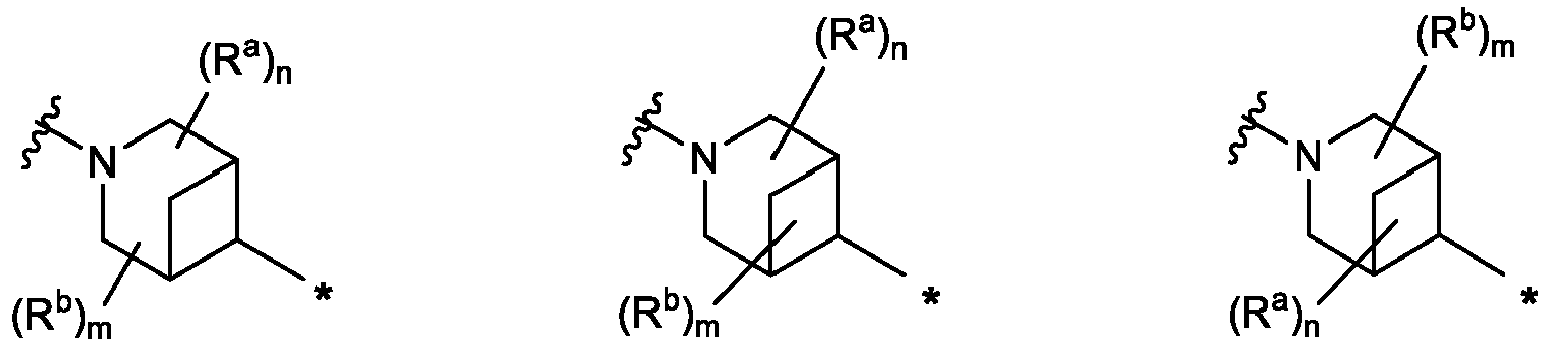


- In one embodiment, Ring D is a saturated 7 membered bridged heterocyclic ring having one ring heteroatom which is nitrogen. Non-limiting examples include structures:

- In one embodiment, Ring D is a saturated 7 membered bridged heterocyclic ring having one ring heteroatom which is nitrogen having the structure

- wherein the wavy line indicates the point of attachment of Ring D to the ring comprising X1, X2, X3 and X4, the asterisk indicates the point of attachment of Ring D to the E group, and Rb and m are as defined for Formula I. In one embodiment, m is 0. In one embodiment, m is 1. In one embodiment, Rb is RcRdN- where Rc is H or C1-C6 alkyl and Rd is H or C1-C6 alkyl. In one embodiment, Rb is RcRdN- where Rc and Rd are H. Non-limiting examples include the structures:

- where the wavy line indicates the point of attachment of Ring D to the ring comprising X1, X2, X3 and X4, the asterisk indicates the point of attachment to the E group.
- In one embodiment, Ring D is a saturated 7-8 membered bridged heterocyclic ring having one ring heteroatom which is nitrogen, and E is selected from (a) hydrogen, (b) hydroxy, (f) (C1-C6 alkoxy)C1-C6 alkoxy, (h) hetAr2O-, (j) hetAr2NRg- where Rg is H or C1-C6 alkyl, (n) R4R5NC(=O)-, (o) Ar1NRgC(=O)-, where Rg is H or C1-C6 alkyl, and (p) hetAr2NRgC(=O)-, where Rg is H or C1-C6 alkyl, where Ar1, hetAr2, R4 and R5 are as defined for Formula I.
- In one embodiment, Ring D is a saturated 7-8 membered bridged heterocyclic ring having one ring heteroatom which is nitrogen, each Ra is independently C1-C6 alkyl (optionally substituted with 1-3 fluoros), hydroxyC1-C6 alkyl or (C1-C6 alkoxy)C1-C6 alkyl-; Rb is (a) hydroxy, (b) cyclopropyl, (c) hetCycbCH2-, (d) RiRjNC(=O)CH2OCH2-where Ri and Rj are independently H or C1-C6 alkyl, (e) RcRdN-, (f) RcRdNCH2-, (g) C1-C6 alkoxy-, (h) (C1-C4 alkyl)-C(=O)NH- wherein said alkyl portion is optionally substituted with hetCycb, hetAra, C1-C6 alkoxy- or R'R"N-, or said alkyl portion is optionally substituted with two substituents independently selected from R'R"N- and OH, where each R' and R" is independently hydrogen or C1-C6 alkyl, (i) (R'R"N)C1-C6 alkoxy(CH2)n- where n is 0 or 1 and R' and R" are independently hydrogen or C1-C6 alkyl, or (j) hetCycb(C1-C3 alkyl)OCH2-; hetCycb is as defined for Formula I; Rc is hydrogen or C1-C6 alkyl; Rd is hydrogen, C1-C6 alkyl (optionally substituted with 1-3 fluoros), (C1-C6 alkoxy)C(=O)-, hydroxyC1-C6 alkyl (optionally substituted with 1-3 fluoros), (hydroxyC1-C6 alkyl)C(=O)-, (C1-C6 alkyl)C(=O)-, (RkRlN)C1-C6 alkyl-where Rk and Rl are independently H or C1-C6 alkyl, RmRnNC(=O)C1-C6 alkyl- where Rm and Rn are independently H or C1-C6 alkyl, PhCH2-, (C1-C6 alkoxy)C1-C6 alkyl-, or hetCycc where hetCycc is a 4-6 membered heterocyclic ring having a ring heteroatom selected from N and O and optionally substituted with C1-C6 alkyl; n is 0, 1 2, 3, 4, 5 or 6; m is 0 or 1; and E is hydrogen. In one embodiment, Ring D is a saturated 7 membered bridged heterocyclic ring having one ring heteroatom which is nitrogen. In one embodiment, n is 0, 1 or 2 and m is 0 or 1. In one embodiment, n is 0 and m is 0 or 1. In one embodiment, Rb is RcRdN- where Rc is hydrogen or C1-C6 alkyl and Rd is hydrogen, C1-C6 alkyl or (C1-C6 alkoxy)C(=O)-. A non-limiting example includes the structure:
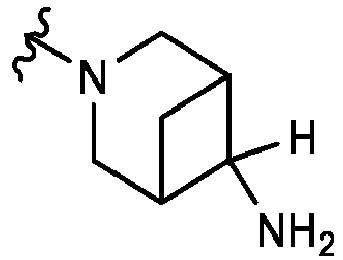
- In one embodiment, Ring D is a saturated 7-8 membered bridged heterocyclic ring having one ring heteroatom which is nitrogen; each Ra is independently C1-C6 alkyl (optionally substituted with 1-3 fluoros), hydroxyC1-C6 alkyl or (C1-C6 alkoxy)C1-C6 alkyl-; Rb is (a) hydroxy, (b) cyclopropyl, (c) hetCycbCH2-, (d) RiRjNC(=O)CH2OCH2-where Ri and Rj are independently H or C1-C6 alkyl, (e) RcRdN-, (f) RcRdNCH2-, (g) C1-C6 alkoxy-, (h) (C1-C4 alkyl)-C(=O)NH- wherein said alkyl portion is optionally substituted with hetCycb, hetAra, C1-C6 alkoxy- or R'R"N-, or said alkyl portion is optionally substituted with two substituents independently selected from R'R"N- and OH, where each R' and R" is independently hydrogen or C1-C6 alkyl, (i) (R'R"N)C1-C6 alkoxy(CH2)n- where n is 0 or 1 and R' and R" are independently hydrogen or C1-C6 alkyl, or (j) hetCycb(C1-C3 alkyl)OCH2-; hetCycb is as defined for Formula I; Rc is hydrogen or C1-C6 alkyl; Rd is hydrogen, C1-C6 alkyl (optionally substituted with 1-3 fluoros), (C1-C6 alkoxy)C(=O)-, hydroxyC1-C6 alkyl (optionally substituted with 1-3 fluoros), (hydroxyC1-C6 alkyl)C(=O)-, (C1-C6 alkyl)C(=O)-, (RkRlN)C1-C6 alkyl-where Rk and Rl are independently H or C1-C6 alkyl, RmRnNC(=O)C1-C6 alkyl- where Rm and Rn are independently H or C1-C6 alkyl, PhCH2-, (C1-C6 alkoxy)C1-C6 alkyl-, or hetCycc where hetCycc is a 4-6 membered heterocyclic ring having a ring heteroatom selected from N and O and optionally substituted with C1-C6 alkyl; n is 0, 1, 2, 3, 4, 5 or 6; m is 0 or 1; and E is hydroxy. In one embodiment, Ring D is a saturated 7 membered bridged heterocyclic ring having one ring heteroatom which is nitrogen. In one embodiment, n is 0, 1 or 2 and m is 0 or 1. In one embodiment, n is 0 and m is 0. A non-limiting example includes the structure:

- In one embodiment, Ring D is a saturated 7-8 membered bridged heterocyclic ring having one ring heteroatom which is nitrogen; each Ra is independently C1-C6 alkyl (optionally substituted with 1-3 fluoros), hydroxyC1-C6 alkyl or (C1-C6 alkoxy)C1-C6 alkyl-; Rb is (a) hydroxy, (b) cyclopropyl, (c) hetCycbCH2-, (d) RiRjNC(=O)CH2OCH2-where Ri and Rj are independently H or C1-C6 alkyl, (e) RcRdN-, (f) RcRdNCH2-, (g) C1-C6 alkoxy-, (h) (C1-C4 alkyl)-C(=O)NH- wherein said alkyl portion is optionally substituted with hetCycb, hetAra, C1-C6 alkoxy- or R'R"N-, or said alkyl portion is optionally substituted with two substituents independently selected from R'R"N- and OH, where each R' and R" is independently hydrogen or C1-C6 alkyl, (i) (R'R"N)C1-C6 alkoxy(CH2)n- where n is 0 or 1 and R' and R" are independently hydrogen or C1-C6 alkyl, or (j) hetCycb(C1-C3 alkyl)OCH2-; hetCycb is as defined for Formula I; Rc is hydrogen or C1-C6 alkyl; Rd is hydrogen, C1-C6 alkyl (optionally substituted with 1-3 fluoros), (C1-C6 alkoxy)C(=O)-, hydroxyC1-C6 alkyl (optionally substituted with 1-3 fluoros), (hydroxyC1-C6 alkyl)C(=O)-, (C1-C6 alkyl)C(=O)-, (RkRlN)C1-C6 alkyl-where Rk and Rl are independently H or C1-C6 alkyl, RmRnNC(=O)C1-C6 alkyl- where Rm and Rn are independently H or C1-C6 alkyl, PhCH2-, (C1-C6 alkoxy)C1-C6 alkyl-, or hetCycc where hetCycc is a 4-6 membered heterocyclic ring having a ring heteroatom selected from N and O and optionally substituted with C1-C6 alkyl; n is 0, 1, 2, 3, 4, 5 or 6; m is 0 or 1; and E is (C1-C6 alkoxy)C1-C6 alkoxy. In one embodiment, Ring D is a saturated 7 membered bridged heterocyclic ring having one ring heteroatom which is nitrogen. In one embodiment, n is 0, 1 or 2 and m is 0 or 1. In one embodiment, n is 0 and m is 0. A non-limiting example includes the structure:

- In one embodiment, Ring D is a saturated 7-8 membered bridged heterocyclic ring having one ring heteroatom which is nitrogen; each Ra is independently C1-C6 alkyl (optionally substituted with 1-3 fluoros), hydroxyC1-C6 alkyl or (C1-C6 alkoxy)C1-C6 alkyl-; Rb is (a) hydroxy, (b) cyclopropyl, (c) hetCycbCH2-, (d) RiRjNC(=O)CH2OCH2-where Ri and Rj are independently H or C1-C6 alkyl, (e) RcRdN-, (f) RcRdNCH2-, (g) C1-C6 alkoxy-, (h) (C1-C4 alkyl)-C(=O)NH- wherein said alkyl portion is optionally substituted with hetCycb, hetAr3, C1-C6 alkoxy- or R'R"N-, or said alkyl portion is optionally substituted with two substituents independently selected from R'R"N- and OH, where each R' and R" is independently hydrogen or C1-C6 alkyl, (i) (R'R"N)C1-C6 alkoxy(CH2)n- where n is 0 or 1 and R' and R" are independently hydrogen or C1-C6 alkyl, or (j) hetCycb(C1-C3 alkyl)OCH2-; hetCycb is as defined for Formula I; Rc is hydrogen or C1-C6 alkyl; Rd is hydrogen, C1-C6 alkyl (optionally substituted with 1-3 fluoros), (C1-C6 alkoxy)C(=O)-, hydroxyC1-C6 alkyl (optionally substituted with 1-3 fluoros), (hydroxyC1-C6 alkyl)C(=O)-, (C1-C6 alkyl)C(=O)-, (RkRlN)C1-C6 alkyl-where Rk and Rl are independently H or C1-C6 alkyl, RmRnNC(=O)C1-C6 alkyl- where Rm and Rn are independently H or C1-C6 alkyl, PhCH2, (C1-C6 alkoxy)C1-C6 alkyl-, or hetCycc where hetCycc is a 4-6 membered heterocyclic ring having a ring heteroatom selected from N and O and optionally substituted with C1-C6 alkyl; n is 0, 1, 2, 3, 4, 5 or 6; m is 0 or 1; and E is hetAr2O- where hetAr2 is as defined for Formula I. In one embodiment hetAr2 is a 5-6 membered heteroaryl ring having 1-2 ring nitrogen atoms optionally substituted with one or more substituents independently selected from C1-C6 alkoxy and halogen. In one embodiment, hetAr2 is unsubstituted. In one embodiment, Ring D is a saturated 7 membered bridged heterocyclic ring having one ring heteroatom which is nitrogen. In one embodiment, n is 0, 1 or 2 and m is 0 or 1. In one embodiment, n is 0 or 1 and m is 0. In one embodiment, n is 0 and m is 0. Non-limiting examples include the structures:

- In one embodiment, Ring D is a saturated 7-8 membered bridged heterocyclic ring having one ring heteroatom which is nitrogen; each Ra is independently C1-C6 alkyl (optionally substituted with 1-3 fluoros), hydroxyC1-C6 alkyl or (C1-C6 alkoxy)C1-C6 alkyl-; Rb is (a) hydroxy, (b) cyclopropyl, (c) hetCycbCH2-, (d) RiRjNC(=O)CH2OCH2-where Ri and Rj are independently H or C1-C6 alkyl, (e) RcRdN-, (f) RcRdNCH2-, (g) C1-C6 alkoxy-, (h) (C1-C4 alkyl)-C(=O)NH- wherein said alkyl portion is optionally substituted with hetCycb, hetAra, C1-C6 alkoxy- or R'R"N-, or said alkyl portion is optionally substituted with two substituents independently selected from R'R"N- and OH, where each R' and R" is independently hydrogen or C1-C6 alkyl, (i) (R'R"N)C1-C6 alkoxy(CH2)n- where n is 0 or 1 and R' and R" are independently hydrogen or C1-C6 alkyl, or (j) hetCycb(C1-C3 alkyl)OCH2-; hetCycb is as defined for Formula I; Rc is hydrogen or C1-C6 alkyl; Rd is hydrogen, C1-C6 alkyl (optionally substituted with 1-3 fluoros), (C1-C6 alkoxy)C(=O)-, hydroxyC1-C6 alkyl (optionally substituted with 1-3 fluoros), (hydroxyC1-C6 alkyl)C(=O)-, (C1-C6 alkyl)C(=O)-, (RkRlN)C1-C6 alkyl-where Rk and Rl are independently H or C1-C6 alkyl, RmRnNC(=O)C1-C6 alkyl- where Rm and Rn are independently H or C1-C6 alkyl, PhCH2-, (C1-C6 alkoxy)C1-C6 alkyl-, or hetCycc where hetCycc is a 4-6 membered heterocyclic ring having a ring heteroatom selected from N and O and optionally substituted with C1-C6 alkyl; n is 0, 1, 2, 3, 4, 5 or 6; m is 0 or 1; and E is hetAr2NH- where hetAr2 is as defined for Formula I. In one embodiment hetAr2 is a 5-6 membered heteroaryl ring having 1-2 ring nitrogen atoms and optionally substituted with one or more substituents independently selected from C1-C6 alkoxy, halogen and C1-C6 alkoxy (optionally substituted with 1-3 fluoros). In one embodiment, Ring D is a saturated 7 membered bridged heterocyclic ring having one ring heteroatom which is nitrogen. In one embodiment, n is 0, 1 or 2 and m is 0 or 1. In one embodiment, n is 0 and m is 0. Non-limiting examples include the structures:


- In one embodiment, Ring D is a saturated 7-8 membered bridged heterocyclic ring having one ring heteroatom which is nitrogen; each Ra is independently C1-C6 alkyl (optionally substituted with 1-3 fluoros), hydroxyC1-C6 alkyl or (C1-C6 alkoxy)C1-C6 alkyl-; Rb is (a) hydroxy, (b) cyclopropyl, (c) hetCycbCH2-, (d) RiRjNC(=O)CH2OCH2-where Ri and Rj are independently H or C1-C6 alkyl, (e) RcRdN-, (f) RcRdNCH2-, (g) C1-C6 alkoxy-, (h) (C1-C4 alkyl)-C(=O)NH- wherein said alkyl portion is optionally substituted with hetCycb, hetAr3, C1-C6 alkoxy- or R'R"N-, or said alkyl portion is optionally substituted with two substituents independently selected from R'R"N- and OH, where each R' and R" is independently hydrogen or C1-C6 alkyl, (i) (R'R"N)C1-C6 alkoxy(CH2)n- where n is 0 or 1 and R' and R" are independently hydrogen or C1-C6 alkyl, or (j) hetCycb(C1-C3 alkyl)OCH2-; hetCycb is as defined for Formula I; Rc is hydrogen or C1-C6 alkyl; Rd is hydrogen, C1-C6 alkyl (optionally substituted with 1-3 fluoros), (C1-C6 alkoxy)C(=O)-, hydroxyC1-C6 alkyl (optionally substituted with 1-3 fluoros), (hydroxyC1-C6 alkyl)C(=O)-, (C1-C6 alkyl)C(=O)-, (RkRlN)C1-C6 alkyl-where Rk and Rl are independently H or C1-C6 alkyl, RmRnNC(=O)C1-C6 alkyl- where Rm and Rn are independently H or C1-C6 alkyl, PhCH2-, (C1-C6 alkoxy)C1-C6 alkyl-, or hetCycc where hetCycc is a 4-6 membered heterocyclic ring having a ring heteroatom selected from N and O and optionally substituted with C1-C6 alkyl; n is 0, 1, 2, 3, 4, 5 or 6; m is 0 or 1; and E is R3C(=O)NRg- where R3 and Rg are as defined for Formula I. In one embodiment, n is 0 and m is 0. A non-limiting example includes the structure:

- In one embodiment, Ring D is a saturated 7-8 membered bridged heterocyclic ring having one ring heteroatom which is nitrogen; each Ra is independently C1-C6 alkyl (optionally substituted with 1-3 fluoros), hydroxyC1-C6 alkyl or (C1-C6 alkoxy)C1-C6 alkyl-; Rb is (a) hydroxy, (b) cyclopropyl, (c) hetCycbCH2-, (d) RiRjNC(=O)CH2OCH2-where Ri and Rj are independently H or C1-C6 alkyl, (e) RcRdN-, (f) RcRdNCH2-, (g) C1-C6 alkoxy-, (h) (C1-C4 alkyl)-C(=O)NH- wherein said alkyl portion is optionally substituted with hetCycb, hetAra, C1-C6 alkoxy- or R'R"N-, or said alkyl portion is optionally substituted with two substituents independently selected from R'R"N- and OH, where each R' and R" is independently hydrogen or C1-C6 alkyl, (i) (R'R"N)C1-C6 alkoxy(CH2)n- where n is 0 or 1 and R' and R" are independently hydrogen or C1-C6 alkyl, or (j) hetCycb(C1-C3 alkyl)OCH2-; hetCycb is as defined for Formula I; Rc is hydrogen or C1-C6 alkyl; Rd is hydrogen, C1-C6 alkyl (optionally substituted with 1-3 fluoros), (C1-C6 alkoxy)C(=O)-, hydroxyC1-C6 alkyl (optionally substituted with 1-3 fluoros), (hydroxyC1-C6 alkyl)C(=O)-, (C1-C6 alkyl)C(=O)-, (RkRlN)C1-C6 alkyl-where Rk and Rl are independently H or C1-C6 alkyl, RmRnNC(=O)C1-C6 alkyl- where Rm and Rn are independently H or C1-C6 alkyl, PhCH2-, (C1-C6 alkoxy)C1-C6 alkyl-, or hetCycc where hetCycc is a 4-6 membered heterocyclic ring having a ring heteroatom selected from N and O and optionally substituted with C1-C6 alkyl; n is 0, 1, 2, 3, 4, 5 or 6; m is 0 or 1; and E is Ar1C(=O)NH- where Ar1 is as defined for Formula I. In one embodiment, Ar1 is unsubstituted. In one embodiment, n is 0 and m is 0. A non-limiting example includes the structure:

- In one embodiment, Ring D is a saturated 7-8 membered bridged heterocyclic ring having one ring heteroatom which is nitrogen; each Ra is independently C1-C6 alkyl (optionally substituted with 1-3 fluoros), hydroxyC1-C6 alkyl or (C1-C6 alkoxy)C1-C6 alkyl-; Rb is (a) hydroxy, (b) cyclopropyl, (c) hetCycbCH2-, (d) RiRjNC(=O)CH2OCH2-where Ri and Rj are independently H or C1-C6 alkyl, (e) RcRdN-, (f) RcRdNCH2-, (g) C1-C6 alkoxy-, (h) (C1-C4 alkyl)-C(=O)NH- wherein said alkyl portion is optionally substituted with hetCycb, hetAra, C1-C6 alkoxy- or R'R"N-, or said alkyl portion is optionally substituted with two substituents independently selected from R'R"N- and OH, where each R' and R" is independently hydrogen or C1-C6 alkyl, (i) (R'R"N)C1-C6 alkoxy(CH2)n- where n is 0 or 1 and R' and R" are independently hydrogen or C1-C6 alkyl, or (j) hetCycb(C1-C3 alkyl)OCH2-; hetCycb is as defined for Formula I; Rc is hydrogen or C1-C6 alkyl; Rd is hydrogen, C1-C6 alkyl (optionally substituted with 1-3 fluoros), (C1-C6 alkoxy)C(=O)-, hydroxyC1-C6 alkyl (optionally substituted with 1-3 fluoros), (hydroxyC1-C6 alkyl)C(=O)-, (C1-C6 alkyl)C(=O)-, (RkRlN)C1-C6 alkyl-where Rk and Rl are independently H or C1-C6 alkyl, RmRnNC(=O)C1-C6 alkyl- where Rm and Rn are independently H or C1-C6 alkyl, PhCH2-, (C1-C6 alkoxy)C1-C6 alkyl-, or hetCycc where hetCycc is a 4-6 membered heterocyclic ring having a ring heteroatom selected from N and O and optionally substituted with C1-C6 alkyl; n is 0, 1, 2, 3, 4, 5 or 6; m is 0 or 1; and E is hetAr2C(=O)NR'- where hetAr2 and R' are as defined for Formula I. In one embodiment, hetAr2 is unsubstituted. In one embodiment, n is 0 and m is 0. A non-limiting example includes the structure:

- In one embodiment, Ring D is a saturated 7-8 membered bridged heterocyclic ring having one ring heteroatom which is nitrogen; each Ra is independently C1-C6 alkyl (optionally substituted with 1-3 fluoros), hydroxyC1-C6 alkyl or (C1-C6 alkoxy)C1-C6 alkyl-; Rb is (a) hydroxy, (b) cyclopropyl, (c) hetCycbCH2-, (d) RiRjNC(=O)CH2OCH2-where Ri and Rj are independently H or C1-C6 alkyl, (e) RcRdN-, (f) RcRdNCH2-, (g) C1-C6 alkoxy-, (h) (C1-C4 alkyl)-C(=O)NH- wherein said alkyl portion is optionally substituted with hetCycb, hetAra, C1-C6 alkoxy- or R'R"N-, or said alkyl portion is optionally substituted with two substituents independently selected from R'R"N- and OH, where each R' and R" is independently hydrogen or C1-C6 alkyl, (i) (R'R"N)C1-C6 alkoxy(CH2)n- where n is 0 or 1 and R' and R" are independently hydrogen or C1-C6 alkyl, or (j) hetCycb(C1-C3 alkyl)OCH2-; hetCycb is as defined for Formula I; Rc is hydrogen or C1-C6 alkyl; Rd is hydrogen, C1-C6 alkyl (optionally substituted with 1-3 fluoros), (C1-C6 alkoxy)C(=O)-, hydroxyC1-C6 alkyl (optionally substituted with 1-3 fluoros), (hydroxyC1-C6 alkyl)C(=O)-, (C1-C6 alkyl)C(=O)-, (RkRlN)C1-C6 alkyl-where Rk and Rl are independently H or C1-C6 alkyl, RmRnNC(=O)C1-C6 alkyl- where Rm and Rn are independently H or C1-C6 alkyl, PhCH2-, (C1-C6 alkoxy)C1-C6 alkyl-, or hetCycc where hetCycc is a 4-6 membered heterocyclic ring having a ring heteroatom selected from N and O and optionally substituted with C1-C6 alkyl; n is 0, 1, 2, 3, 4, 5 or 6; m is 0 or 1; and E is R4R5NC(=O)- where R4 and R5 are as defined for Formula I. In one embodiment, Ring D is a saturated 7 membered bridged heterocyclic ring having one ring heteroatom which is nitrogen. In one embodiment, n is 0, 1 or 2 and m is 0 or 1. In one embodiment, n is 0 and m is 0. Non-limiting examples includes the structures:


- In one embodiment, Ring D is a saturated 7-8 membered bridged heterocyclic ring having one ring heteroatom which is nitrogen; each Ra is independently C1-C6 alkyl (optionally substituted with 1-3 fluoros), hydroxyC1-C6 alkyl or (C1-C6 alkoxy)C1-C6 alkyl-; Rb is (a) hydroxy, (b) cyclopropyl, (c) hetCycbCH2-, (d) RiRjNC(=O)CH2OCH2-where Ri and Rj are independently H or C1-C6 alkyl, (e) RcRdN-, (f) RcRdNCH2-, (g) C1-C6 alkoxy-, (h) (C1-C4 alkyl)-C(=O)NH- wherein said alkyl portion is optionally substituted with hetCycb, hetAra, C1-C6 alkoxy- or R'R"N-, or said alkyl portion is optionally substituted with two substituents independently selected from R'R"N- and OH, where each R' and R" is independently hydrogen or C1-C6 alkyl, (i) (R'R"N)C1-C6 alkoxy(CH2)n- where n is 0 or 1 and R' and R" are independently hydrogen or C1-C6 alkyl, or (j) hetCycb(C1-C3 alkyl)OCH2-; hetCycb is as defined for Formula I; Rc is hydrogen or C1-C6 alkyl; Rd is hydrogen, C1-C6 alkyl (optionally substituted with 1-3 fluoros), (C1-C6 alkoxy)C(=O)-, hydroxyC1-C6 alkyl (optionally substituted with 1-3 fluoros), (hydroxyC1-C6 alkyl)C(=O)-, (C1-C6 alkyl)C(=O)-, (RkRlN)C1-C6 alkyl-where Rk and Rl are independently H or C1-C6 alkyl, RmRnNC(=O)C1-C6 alkyl- where Rm and Rn are independently H or C1-C6 alkyl, PhCH2-, (C1-C6 alkoxy)C1-C6 alkyl-, or hetCycc where hetCycc is a 4-6 membered heterocyclic ring having a ring heteroatom selected from N and O and optionally substituted with C1-C6 alkyl; n is 0, 1, 2, 3, 4, 5 or 6; m is 0 or 1; and E is Ar1NRgC(=O)-, where Ar1 and Rg areas defined for Formula I. In one embodiment, Ar1 is substituted with one or more substituents independently selected from halogen, CN and C1-C6 alkyl (optionally substituted with 1-3 fluoros). In one embodiment, Ar1 is unsubstituted. In one embodiment, Ring D is a saturated 7 membered bridged heterocyclic ring having one ring heteroatom which is nitrogen. In one embodiment, n is 0, 1 or 2 and m is 0 or 1. In one embodiment, n is 0 and m is 0. A non-limiting example includes the structure:

- In one embodiment, Ring D is a saturated 7-8 membered bridged heterocyclic ring having one ring heteroatom which is nitrogen; each Ra is independently C1-C6 alkyl (optionally substituted with 1-3 fluoros), hydroxyC1-C6 alkyl or (C1-C6 alkoxy)C1-C6 alkyl-; Rb is (a) hydroxy, (b) cyclopropyl, (c) hetCycbCH2-, (d) RiRjNC(=O)CH2OCH2-where Ri and Rj are independently H or C1-C6 alkyl, (e) RcRdN-, (f) RcRdNCH2-, (g) C1-C6 alkoxy-, (h) (C1-C4 alkyl)-C(=O)NH- wherein said alkyl portion is optionally substituted with hetCycb, hetAra, C1-C6 alkoxy- or R'R"N-, or said alkyl portion is optionally substituted with two substituents independently selected from R'R"N- and OH, where each R' and R" is independently hydrogen or C1-C6 alkyl, (i) (R'R"N)C1-C6 alkoxy(CH2)n- where n is 0 or 1 and R' and R" are independently hydrogen or C1-C6 alkyl, or (j) hetCycb(C1-C3 alkyl)OCH2-; hetCycb is as defined for Formula I; Rc is hydrogen or C1-C6 alkyl; Rd is hydrogen, C1-C6 alkyl (optionally substituted with 1-3 fluoros), (C1-C6 alkoxy)C(=O)-, hydroxyC1-C6 alkyl (optionally substituted with 1-3 fluoros), (hydroxyC1-C6 alkyl)C(=O)-, (C1-C6 alkyl)C(=O)-, (RkRlN)C1-C6 alkyl-where Rk and Rl are independently H or C1-C6 alkyl, RmRnNC(=O)C1-C6 alkyl- where Rm and Rn are independently H or C1-C6 alkyl, PhCH2-, (C1-C6 alkoxy)C1-C6 alkyl-, or hetCycc where hetCycc is a 4-6 membered heterocyclic ring having a ring heteroatom selected from N and O and optionally substituted with C1-C6 alkyl; n is 0, 1, 2, 3, 4, 5 or 6; m is 0 or 1; and E is hetAr2NRgC(=O)- where hetAr2 and Rg are as defined for Formula I. In one embodiment hetAr2 is a 5-6 membered heteroaryl ring having 1-2 ring nitrogen atoms and optionally substituted with one or more substituents independently selected from halogen and C1-C6 alkoxy. In one embodiment, Ring D is a saturated 7 membered bridged heterocyclic ring having one ring heteroatom which is nitrogen. In one embodiment, n is 0, 1 or 2 and m is 0 or 1. In one embodiment, n is 0 and m is 0. A non-limiting example includes the structure:

- In one embodiment, Ring D is a saturated 7-11 membered heterospirocyclic ring system having one ring heteroatom which is nitrogen; each Ra is independently C1-C6 alkyl (optionally substituted with 1-3 fluoros), hydroxyC1-C6 alkyl or (C1-C6 alkoxy)C1-C6 alkyl-; Rb is (a) hydroxy, (b) cyclopropyl, (c) hetCycbCH2-, (d) RiRjNC(=O)CH2OCH2- where Ri and Rj are independently H or C1-C6 alkyl, (e) RcRdN-, (f) RcRdNCH2-, (g) C1-C6 alkoxy-, (h) (C1-C4 alkyl)-C(=O)NH- wherein said alkyl portion is optionally substituted with hetCycb, hetAra, C1-C6 alkoxy- or R'R"N-, or said alkyl portion is optionally substituted with two substituents independently selected from R'R"N- and OH, where each R' and R" is independently hydrogen or C1-C6 alkyl, (i) (R'R"N)C1-C6 alkoxy(CH2)n- where n is 0 or 1 and R' and R" are independently hydrogen or C1-C6 alkyl, or (j) hetCycb(C1-C3 alkyl)OCH2-; hetCycb is as defined for Formula I; Rc is hydrogen or C1-C6 alkyl; Rd is hydrogen, C1-C6 alkyl (optionally substituted with 1-3 fluoros), (C1-C6 alkoxy)C(=O)-, hydroxyC1-C6 alkyl (optionally substituted with 1-3 fluoros), (hydroxyC1-C6 alkyl)C(=O)-, (C1-C6 alkyl)C(=O)-, C1-C6 alkyl- where Rk and Rl are independently H or C1-C6 alkyl, RmRnNC(=O)C1-C6 alkyl- where Rm and Rn are independently H or C1-C6 alkyl, PhCH2-, (C1-C6 alkoxy)C1-C6 alkyl-, or hetCycc where hetCycc is a 4-6 membered heterocyclic ring having a ring heteroatom selected from N and O and optionally substituted with C1-C6 alkyl; n is 0, 1, 2, 3, 4, 5 or 6; m is 0 or 1. The phrase "having one ring heteroatom which is nitrogen" when Ring D is a saturated 7-11 membered heterospirocyclic ring system means that said one ring nitrogen is the ring nitrogen atom shown in Ring D of Formula I. In one embodiment, Ring D is a saturated 9 membered heterospirocyclic ring system having one ring heteroatom which is nitrogen. In one embodiment, Ring D is a 7-azaspiro[3.5]nonanyl ring, e.g., a 7-azaspiro[3.5]nonan-2-yl ring. Nonlimiting examples include the structures:

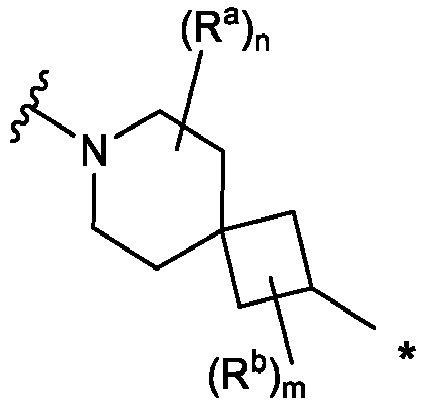
- In one embodiment, Ring D is a saturated 7-11 membered heterospirocyclic ring system having one ring heteroatom which is nitrogen; each Ra is independently C1-C6 alkyl (optionally substituted with 1-3 fluoros), hydroxyC1-C6 alkyl or (C1-C6 alkoxy)C1-C6 alkyl-; Rb is (a) hydroxy, (b) cyclopropyl, (c) hetCycbCH2-, (d) RiRjNC(=O)CH2OCH2- where Ri and Rj are independently H or C1-C6 alkyl, (e) RcRdN-, (f) RcRdNCH2-, (g) C1-C6 alkoxy-, (h) (C1-C4 alkyl)-C(=O)NH- wherein said alkyl portion is optionally substituted with hetCycb, hetAra, C1-C6 alkoxy- or R'R"N-, or said alkyl portion is optionally substituted with two substituents independently selected from R'R"N- and OH, where each R' and R" is independently hydrogen or C1-C6 alkyl, (i) (R'R"N)C1-C6 alkoxy(CH2)n- where n is 0 or 1 and R' and R" are independently hydrogen or C1-C6 alkyl, or (j) hetCycb(C1-C3 alkyl)OCH2-; hetCycb is as defined for Formula I; Rc is hydrogen or C1-C6 alkyl; Rd is hydrogen, C1-C6 alkyl (optionally substituted with 1-3 fluoros), (C1-C6 alkoxy)C(=O)-, hydroxyC1-C6 alkyl (optionally substituted with 1-3 fluoros), (hydroxyC1-C6 alkyl)C(=O)-, (C1-C6 alkyl)C(=O)-, (RkRlN)C1-C6 alkyl- where Rk and Rl are independently H or C1-C6 alkyl, RmRnNC(=O)C1-C6 alkyl- where Rm and Rn are independently H or C1-C6 alkyl, PhCH2-, (C1-C6 alkoxy)C1-C6 alkyl-, or hetCycc where hetCycc is a 4-6 membered heterocyclic ring having a ring heteroatom selected from N and O and optionally substituted with C1-C6 alkyl; n is 0, 1, 2, 3, 4, 5 or 6; m is 0 or 1; and E is hydrogen. In one embodiment, Ring D is a 7-azaspiro[3.5]nonanyl ring, e.g., a 7-azaspiro[3.5]nonan-2-yl ring. In one embodiment, n is 0 and m is 0 or 1. In one embodiment, Rb is RcRdN- where Rc is hydrogen or C1-C6 alkyl and Rd is hydrogen, C1-C6 alkyl or (C1-C6 alkoxy)C(=O)-. Non-limiting examples include the structures:

- In one embodiment, Formula I includes compounds of Formula I-A, wherein:
- X1, X2, X3 and X4 are independently CH, CF or N, wherein zero, one or two of X1, X2, X3 and X4 is N;
- A is H, CN, Cl, methyl, ethyl or cyclopropyl;
- B is
- (a) hydrogen,
- (b) C1-C6 alkyl optionally substituted with 1-3 fluoros,
- (c) hydroxyC2-C6 alkyl- wherein the alkyl portion is optionally substituted with a C3-C6 cycloalkylidene ring,
- (d) dihydroxyC3-C6 alkyl- wherein the alkyl portion is optionally substituted with a C3-C6 cycloalkylidene ring,
- (e) (C1-C6 alkoxy)C1-C6 alkyl- optionally substituted with 1-3 fluoros,
- (f) (R1R2N)C1-C6 alkyl- where R1 and R2 are independently selected from H, C1-C6 alkyl (optionally substituted with 1-3 fluoros), (C1-C6 alkoxy)C1-C6 alkyl-, (C1-C6 alkyl)C(=O)- and (C1-C6 alkoxy)C(=O)-;
- (g) hetAr1C1-C3 alkyl-, where hetAr1 is a 5-6 membered heteroaryl ring having 1-3 ring heteroatoms independently selected from N, O and S and is optionally substituted with one or more independently selected C1-C6 alkyl groups;
- (h) (C3-C6 cycloalkyl)C1-C3 alkyl-,
- (i) (hetCyca)C1-C3 alkyl-,
- (j) hetCyca,
- (k) (R1R2N)C(=O)C1-C6 alkyl- where R1 and R2 are independently selected from H and C1-C6 alkyl,
- (l) (R1R2N)C(=O)-, where R1 and R2 are independently selected from H and C1-C6 alkyl, or
- (m) hetCycaC(=O)C1-C6 alkyl-;
- hetCyca is a 4-6 membered heterocyclic ring having 1-2 ring heteroatoms independently selected from N and O and optionally substituted with one or more substituents independently selected from OH, C1-C6 alkyl (optionally substituted with 1-3 fluoros), hydroxyC1-C6 alkyl, halogen, (C1-C6 alkyl)C(=O)-, C1-C6 alkoxy, oxo and (C1-C6 alkoxy)C(=O)-;
- Ring D is a saturated 4-7 membered heterocyclic ring having one ring heteroatom which is nitrogen;
- each Ra is independently C1-C6 alkyl (optionally substituted with 1-3 fluoros), hydroxyC1-C6 alkyl or (C1-C6 alkoxy)C1-C6 alkyl-;
- Rb is (a) hydroxy, (b) cyclopropyl, (c) hetCycbCH2-, (d) RiRjNC(=O)CH2OCH2- where Ri and Rj are independently H or C1-C6 alkyl, (e) RcRdN-, (f) RcRdNCH2-, (g) C1-C6 alkoxy-,(h) (C1-C4 alkyl)-C(=O)NH- wherein said alkyl portion is optionally substituted with hetCycb, hetAra, C1-C6 alkoxy- or R'R"N-, or said alkyl portion is optionally substituted with two substituents independently selected from R'R"N- and OH, where each R' and R" is independently hydrogen or C1-C6 alkyl, (i) (R'R"N)C1-C6 alkoxy(CH2)n- where n is 0 or 1 and R' and R" are independently hydrogen or C1-C6 alkyl, (j) hetCycb(C1-C3 alkyl)OCH2-, (k) hetCycbC(=O)NH- or (l) hetAraC(=O)NH-;
- hetCycb is a 4-6 membered heterocyclic ring, a 7-8 membered bridged heterocyclic ring, or a 7-10 membered heterospirocyclic ring, each ring having 1-2 ring heteroatoms independently selected from N and O, wherein hetCycb is optionally substituted with one or more substituents independently selected from OH, fluoro, C1-C6 alkyl (optionally substituted with 1-3 fluoros), hydroxyC1-C6 alkyl- (optionally substituted with 1-3 fluoros), (C1-C6 alkoxy)C1-C6 alkyl-, (C1-C6 alkoxy)C(=O)-, C1-C6 alkoxy, and R'R"N- where R' and R" are independently hydrogen or C1-C6 alkyl;
- hetAra is a 5-6 membered heteroaryl ring having 1-3 ring heteroatoms independently selected from N, O and S herein hetAra is optionally substituted with one or more substituents independently selected from the group consisting of halogen, CN, C1-C6 alkyl (optionally substituted with 1-3 fluoros), and C1-C6 alkoxy (optionally substituted with 1-3 fluoros);
- Rc is hydrogen or C1-C6 alkyl;
- Rd is hydrogen, C1-C6 alkyl (optionally substituted with 1-3 fluoros), (C1-C6 alkoxy)C(=O)-, hydroxyC1-C6 alkyl (optionally substituted with 1-3 fluoros), (hydroxyC1-C6 alkyl)C(=O)-, (C1-C6 alkyl)C(=O)-, (RkRlN)C1-C6 alkyl- where Rk and R1 are independently H or C1-C6 alkyl, RmRnNC(=O)C1-C6 alkyl- where Rm and Rn are independently H or C1-C6 alkyl, PhCH2-, (C1-C6 alkoxy)C1-C6 alkyl-, or hetCycc where hetCycc is a 4-6 membered heterocyclic ring having a ring heteroatom selected from N and O and optionally substituted with C1-C6 alkyl;
- n is 0, 1, 2, 3, 4, 5 or 6;
- m is 0 or 1;
- E is
- (a) hydrogen,
- (b) hydroxy,
- (c) C1-C6 alkyl optionally substituted with 1-3 fluoros,
- (d) Ar1C1-C6 alkyl- wherein said alkyl portion is optionally substituted with 1-3 fluoros,
- (e) hetAr2C1-C6 alkyl-,
- (f) (C1-C6 alkoxy)C1-C6 alkoxy-,
- (g) Ar1O-,
- (h) hetAr2O-,
- (i) Ar1NRg- where Rg is H or C1-C6 alkyl,
- (j) hetAr2NRg- where Rg is H or C1-C6 alkyl,
- (k) R3C(=O)NRg- where Rg is H or C1-C6 alkyl,
- (l) Ar1C(=O)NRg- where Rg is H or C1-C6 alkyl,
- (m) hetAr2C(=O)NRg(CH2)p- where p is 0 or 1 and Rg is H or C1-C6 alkyl,
- (n) R4R5NC(=O)-,
- (o) Ar1NRgC(=O)-, where Rg is H or C1-C6 alkyl,
- (p) hetAr2NRgC(=O)-, where Rg is H or C1-C6 alkyl,
- (r) hetCyc5C(=O)-,
- (s) R4R5NC(=O)NRg- where Rg is H or C1-C6 alkyl,
- (t) (C1-C6 alkyl)SO2-;
- (u) Ar1(C1-C6 alkyl)C(=O)NRg- where Rg is H or C1-C6 alkyl,
- (v) hetAr4C(=O)NRg- where Rg is H or C1-C6 alkyl,
- (w) hetAr2-S(=O)-,
- (x) (C3-C6 cycloalkyl)CH2SO2-,
- (y) Ar1(C1-C6 alkyl)SO2-,
- (z) hetAr2SO2-,
- (aa) Ar1,
- (bb) hetAr2,
- (cc) hetCyc5,
- (dd) C1-C6 alkoxy,
- (ee) Ar1(C1-C6 alkyl)-O-,
- (ff) hetAr2(C1-C6 alkyl)-O-,
- (gg) hetAr2-O-C1-C6 alkyl-,
- (hh) Ar1(C1-C6 alkyl)NRg- where Rg is H or C1-C6 alkyl, or
- (ii) hetAr2-S-,
- (jj) Ar2SO2NRg(CH2)p- where p is 0 or 1 and Rg is H or C1-C6 alkyl,
- (kk) (C1-C6 alkoxy)C(=O)-,
- (11) (C1-C6 alkyl)NRgC(=O)O- where Rg is H or C1-C6 alkyl,
- (mm) (C1-C6 alkyl)NRgSO2- where Rg is H or C1-C6 alkyl,
- (nn) hetCyc5C(=O)NRg- where Rg is H or C1-C6 alkyl,
- (oo) Q-NRh(C1-C3 alkyl)C(=O)NRg- where Rg and Rh are independently H or C1-C6 alkyl and Q is H, C1-C6 alkyl or (C1-C6 alkyl)OC(=O)-,
- (pp)

- (qq)

- (rr)

- (ss) RgRhN- where Rg and Rh are independently H or C1-C6 alkyl,
- (tt) (C3-C6 cycloalkyl)C(=O)NRg- where the cycloalkyl is optionally and independently substituted with one or more halogens,
- (uu) (C1-C6 alkyl)C(=O)NRgCH2- where Rg is H or C1-C6 alkyl, or
- (vv) C1-C6 alkyl)SO2NRg- where Rg is H or C1-C6 alkyl;
- Ar1 is phenyl optionally substituted with one or more substituents independently selected from the group consisting of halogen, CN, C1-C6 alkyl (optionally substituted with 1-3 fluoros), C1-C6 alkoxy (optionally substituted with 1-3 fluoros), (C1-C6 alkoxy)C1-C6 alkyl- (optionally substituted with 1-3 fluoros), C3-C6 cycloalkyl, hydroxyC1-C6 alkyl, (C1-C6 alkyl)SO2-, ReRfN- and (ReRfN)C1-C6 alkyl-where each Re and Rf is independently H or C1-C6 alkyl;
- hetAr2 is a 5-6 membered heteroaryl ring having 1-3 ring heteroatoms independently selected from N, O and S, or a 9-10 membered bicyclic heteroaryl having 1-2 ring nitrogen atoms, wherein hetAr2 is optionally substituted with one or more substituents independently selected from the group consisting of halogen, CN, C1-C6 alkyl (optionally substituted with 1-3 fluoros), C1-C6 alkoxy (optionally substituted with 1-3 fluoros), (C1-C6 alkoxy)C1-C6 alkyl- (optionally substituted with 1-3 fluoros) and hydroxyC1-C6 alkoxy-;
- hetCyc5 is a 4-6 membered saturated heterocyclic ring having 1-2 ring heteroatoms independently selected from N, O and S wherein said heterocyclic ring is optionally substituted with one or more substituents independently selected from C1-C6 alkoxy and oxo;
- R3 is C1-C6 alkyl (optionally substituted with 1-3 fluoros), hydroxyC1-C6 alkyl-, C1-C6 alkoxy, C3-C6 cycloalkyl, (C3-C6 cycloalkyl)CH2-, (C3-C6 cycloalkyl)O-, (C3-C6 cycloalkyl)CH2O-, hetCyc7O-, Ph-O-, or (C1-C6 alkoxy)C1-C6 alkyl-; wherein each of said C3-C6 cycloalkyl moieties is optionally substituted with C1-C6 alkyl (optionally substituted with 1-3 fluoros), C1-C6 alkoxy, OH or R'R"N- where R' and R" are independently hydrogen or C1-C6 alkyl;
- R4 is H or C1-C6 alkyl;
- R5 is Ar2, hetAr3, Ar2CH2-, hetCyc6-CH2-, hydroxyC1-C6 alkyl-, (C3-C6 cycloalkyl)CH2-, or C1-C6 alkyl optionally substituted with 1-3 fluoros;
- Ar2 is phenyl optionally substituted with one or more substituents independently selected from the group consisting of halogen, CN, C1-C6 alkyl (optionally substituted with 1-3 fluoros), C1-C6 alkoxy (optionally substituted with 1-3 fluoros), (C1-C6 alkoxy)C1-C6 alkyl- (optionally substituted with 1-3 fluoros), C3-C6 cycloalkyl, and RgRhN- where Rg and Rh are independently H or C1-C6 alkyl, or Ar2 is phenyl fused to a 6 membered heterocyclic ring having a ring nitrogen atom and optionally substituted with C1-C6 alkyl;
- hetAr3 is a 5-6 membered heteroaryl ring having 1-3 ring heteroatoms independently selected from N, O and S and optionally substituted with one or more substituents independently selected from the group consisting of halogen, CN, C1-C6 alkyl (optionally substituted with 1-3 fluoros), C1-C6 alkoxy (optionally substituted with 1-3 fluoros), and (C1-C6 alkoxy)C1-C6 alkyl- (optionally substituted with 1-3 fluoros);
- hetAr4 is pyridin-4(1H)-onyl or pyridin-2(1H)-onyl optionally substituted with one or more substituents independently selected from C1-C6 alkyl and halogen;
- hetCyc6 is a 5-7 membered heterocyclic ring having 1-3 ring heteroatoms independently selected from N, O and S; and
- hetCyc7 is a 5-7 membered heterocyclic ring having 1-3 ring heteroatoms independently selected from N, O and S.
- In one embodiment of Formula I-A, X1 is N; X2, X3 and X4 are CH.
- In one embodiment of Formula I-A, A is CN.
- In one embodiment of Formula I-A, X1 is N; X2, X3 and X4 are CH; and A is CN.
- In one embodiment of Formula I-A, B is C1-C6 alkyl optionally substituted with 1-3 fluoros, or hydroxyC2-C6 alkyl- wherein the alkyl portion is optionally substituted with a C3-C6 cycloalkylidene ring. In one embodiment of Formula I-A, B is C1-C6 alkyl or hydroxyC2-C6 alkyl-.
- In one embodiment of Formula I-A, X1 is N; X2, X3 and X4 are CH; A is CN; and B is C1-C6 alkyl optionally substituted with 1-3 fluoros, or hydroxyC2-C6 alkyl-wherein the alkyl portion is optionally substituted with a C3-C6 cycloalkylidene ring. In one embodiment, B is C1-C6 alkyl or hydroxyC2-C6 alkyl-.
- In one embodiment of Formula I-A, X1 is N; X2, X3 and X4 are CH; A is CN; and B is C1-C6 alkyl optionally substituted with 1-3 fluoros. In one embodiment, B is C1-C6 alkyl.
- In one embodiment of Formula I-A, X1 is N; X2, X3 and X4 are CH; A is CN; and B is hydroxyC2-C6 alkyl- optionally substituted with a C3-C6 cycloalkylidene ring. In one embodiment, B is hydroxyC2-C6 alkyl-.
- In one embodiment of Formula I-A, Ring D is:

- In one embodiment of Formula I-A, Ring D is:

- In one embodiment of Formula I-A, Ring D is:

- wherein the wavy line indicates the point of attachment of Ring D to the ring comprising X1, X2, X3 and X4, the asterisk indicates the point of attachment of Ring D to the E group, and Ra, n, Rb and m are as defined for Formula I-A. In one embodiment, n is 0, 1, 2, 3 or 4. In one embodiment, n is 0. In one embodiment, n is 0 or 1 and m is 0 or 1. In one embodiment, n is 0 and m is 1. In one embodiment, Rb is hydroxy, or RcRdN-where Rc is hydrogen or C1-C6 alkyl and Rd is hydrogen or C1-C6 alkyl.
- In one embodiment of Formula I-A, E is (d) Ar1C1-C6 alkyl- wherein said alkyl portion is optionally substituted with 1-3 fluoros, (e) hetAr2C1-C6 alkyl-, (g) Ar1O-, (h) hetAr2O-, (i) Ar1NRg- where Rg is H or C1-C6 alkyl, (l) Ar1C(=O)NRg- where Rg is H or C1-C6 alkyl, or (m) hetAr2C(=O)NRg(CH2)p-, where p is 0 or 1 and Ar1, hetAr2 and Rg are as defined for Formula I-A.
- In one embodiment of Formula I-A, X1 is N; X2, X3 and X4 are CH; A is CN; B is C1-C6 alkyl optionally substituted with 1-3 fluoros or hydroxyC2-C6 alkyl-optionally substituted with a C3-C6 cycloalkylidene ring; and Ring D is:

- In one embodiment of Formula I-A, X1 is N; X2, X3 and X4 are CH; A is CN; B is C1-C6 alkyl optionally substituted with 1-3 fluoros or hydroxyC2-C6 alkyl-optionally substituted with a C3-C6 cycloalkylidene ring; and Ring D is:

- In one embodiment of Formula I-A, X1 is N; X2, X3 and X4 are CH; A is CN; B is C1-C6 alkyl optionally substituted with 1-3 fluoros or hydroxyC2-C6 alkyl-optionally substituted with a C3-C6 cycloalkylidene ring; and Ring D is:

- In one embodiment of Formula I-A, X1 is N; X2, X3 and X4 are CH; A is CN; B is C1-C6 alkyl optionally substituted with 1-3 fluoros; and Ring D is

- In one embodiment of Formula I-A, X1 is N; X2, X3 and X4 are CH; A is CN; B is C1-C6 alkyl optionally substituted with 1-3 fluoros; and Ring D is

- In one embodiment of Formula I-A, X1 is N; X2, X3 and X4 are CH; A is CN; B is C1-C6 alkyl optionally substituted with 1-3 fluoros; and Ring D is

- In one embodiment of Formula I-A, X1 is N; X2, X3 and X4 are CH; A is CN; B is hydroxyC2-C6 alkyl- optionally substituted with a C3-C6 cycloalkylidene ring; and Ring D is a piperidin-4-yl ring having the structure:
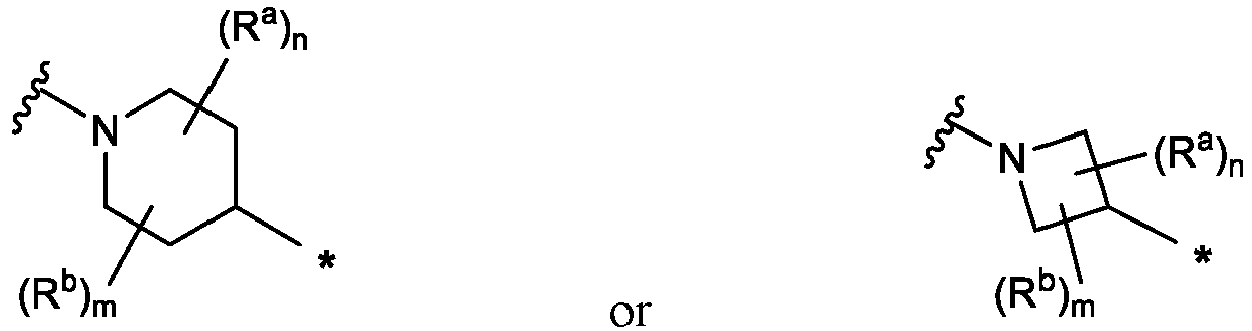
- In one embodiment of Formula I-A, X1 is N; X2, X3 and X4 are CH; A is CN; B is hydroxyC2-C6 alkyl- optionally substituted with a C3-C6 cycloalkylidene ring; and Ring D is a piperidin-4-yl ring having the structure:

- In one embodiment of Formula I-A, X1 is N; X2, X3 and X4 are CH; A is CN; B is hydroxyC2-C6 alkyl- optionally substituted with a C3-C6 cycloalkylidene ring; and Ring D is a piperidin-4-yl ring having the structure:

- In one embodiment of Formula I-A, X1 is N; X2, X3 and X4 are CH; A is CN; B is C1-C6 alkyl optionally substituted with 1-3 fluoros or hydroxyC2-C6 alkyl-optionally substituted with a C3-C6 cycloalkylidene ring; Ring D is a piperidin-4-yl ring having the structure:

- In one embodiment of Formula I-A, X1 is N; X2, X3 and X4 are CH; A is CN; B is C1-C6 alkyl optionally substituted with 1-3 fluoros or hydroxyC2-C6 alkyl-optionally substituted with a C3-C6 cycloalkylidene ring; Ring D is a piperidin-4-yl ring having the structure:
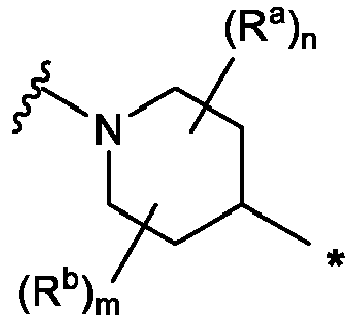
- In one embodiment of Formula I-A, X1 is N; X2, X3 and X4 are CH; A is CN; B is C1-C6 alkyl optionally substituted with 1-3 fluoros or hydroxyC2-C6 alkyl-optionally substituted with a C3-C6 cycloalkylidene ring; Ring D is a piperidin-4-yl ring having the structure:

- In one embodiment of Formula I-A, E is (d) Ar1C1-C6 alkyl- wherein said alkyl portion is optionally substituted with 1-3 fluoros, (e) hetAr2C1-C6 alkyl-, (g) Ar1O-, (h) hetAr2O-, (l) Ar1C(=O)NRg- where Rg is H or C1-C6 alkyl, or (m) hetAr2C(=O)NRg(CH2)p-, where p is 0 or 1 and Ar1, hetAr2 and Rg are as defined for Formula I-A.
- In one embodiment of Formula I-A, X1 is N; X2, X3 and X4 are CH; A is CN; B is C1-C6 alkyl optionally substituted with 1-3 fluoros; Ring D is

- In one embodiment of Formula I-A, X1 is N; X2, X3 and X4 are CH; A is CN; B is C1-C6 alkyl optionally substituted with 1-3 fluoros; Ring D is

- In one embodiment of Formula I-A, X1 is N; X2, X3 and X4 are CH; A is CN; B is C1-C6 alkyl optionally substituted with 1-3 fluoros; Ring D is

- In one embodiment of Formula I-A, X1 is N; X2, X3 and X4 are CH; A is CN; B is hydroxyC2-C6 alkyl- wherein the alkyl portion is optionally substituted with a C3-C6 cycloalkylidene ring; Ring D is

- In one embodiment of Formula I-A, X1 is N; X2, X3 and X4 are CH; A is CN; B is hydroxyC2-C6 alkyl- wherein the alkyl portion is optionally substituted with a C3-C6 cycloalkylidene ring; Ring D is

- In one embodiment of Formula I-A, X1 is N; X2, X3 and X4 are CH; A is CN; B is hydroxyC2-C6 alkyl- wherein the alkyl portion is optionally substituted with a C3-C6 cycloalkylidene ring; Ring D is

- In one embodiment, Formula I includes compounds of Formula I-B, wherein:
- X1, X2, X3 and X4 are independently CH, CF or N, wherein zero, one or two of X1, X2, X3 and X4 is N;
- A is H, CN, Cl, methyl, ethyl or cyclopropyl;
- B is
- (a) hydrogen,
- (b) C1-C6 alkyl optionally substituted with 1-3 fluoros,
- (c) hydroxyC2-C6 alkyl- wherein the alkyl portion is optionally substituted with a C3-C6 cycloalkylidene ring,
- (d) dihydroxyC3-C6 alkyl- wherein the alkyl portion is optionally substituted with a C3-C6 cycloalkylidene ring,
- (e) (C1-C6 alkoxy)C1-C6 alkyl- optionally substituted with 1-3 fluoros,
- (f) (R1R2N)C1-C6 alkyl- where R1 and R2 are independently selected from H, C1-C6 alkyl (optionally substituted with 1-3 fluoros), (C1-C6 alkoxy)C1-C6 alkyl- and (C1-C6 alkoxy)C(=O)-;
- (g) hetAr1C1-C3 alkyl-, where hetAr1 is a 5-6 membered heteroaryl ring having 1-3 ring heteroatoms independently selected from N, O and S and is optionally substituted with one or more independently selected C1-C6 alkyl groups;
- (h) (C3-C6 cycloalkyl)C1-C3 alkyl-,
- (i) (hetCyca)C1-C3 alkyl-, or
- (j) hetCyca;
- hetCyca is a 4-6 membered heterocyclic ring having 1-2 ring heteroatoms independently selected from N and O and optionally substituted with one or more substituents independently selected from OH, C1-C6 alkyl (optionally substituted with 1-3 fluoros), and hydroxyC1-C6 alkyl;
- Ring D is a saturated 7-8 membered bridged heterocyclic ring having one ring heteroatom which is nitrogen;
- each Ra is independently C1-C6 alkyl (optionally substituted with 1-3 fluoros) or hydroxyC1-C6 alkyl;
- Rb is hydroxy, cyclopropyl, or RcRdN- where Rc is hydrogen or C1-C6 alkyl and Rd is hydrogen, C1-C6 alkyl or (C1-C6 alkoxy)C(=O)-;
- n is 0, 1, 2, 3, 4, 5 or 6;
- m is 0 or 1;
- E is
- (a) hydrogen,
- (b) hydroxy,
- (f) (C1-C6 alkoxy)C1-C6 alkoxy,
- (h) hetAr2O-,
- (j) hetAr2NRg- where Rg is H or C1-C6 alkyl,
- (n) R4R5NC(=O)-,
- (o) Ar1NRgC(=O)-, where Rg is H or C1-C6 alkyl, or
- (p) hetAr2NRgC(=O)-, where Rg is H or C1-C6 alkyl;
- Ar1 is phenyl optionally substituted with one or more substituents independently selected from the group consisting of halogen, CN, C1-C6 alkyl (optionally substituted with 1-3 fluoros), C1-C6 alkoxy (optionally substituted with 1-3 fluoros), (C1-C6 alkoxy)C1-C6 alkyl- (optionally substituted with 1-3 fluoros), C3-C6 cycloalkyl, and ReRfN- where Re and Rf are independently H or C1-C6 alkyl;
- hetAr2 is a 5-6 membered heteroaryl ring having 1-3 ring heteroatoms independently selected from N, O and S, or a 9-10 membered bicyclic heteroaryl having 1-2 ring nitrogen atoms, wherein hetAr2 is optionally substituted with one or more substituents independently selected from the group consisting of halogen, CN, C1-C6 alkyl (optionally substituted with 1-3 fluoros), C1-C6 alkoxy (optionally substituted with 1-3 fluoros), and (C1-C6 alkoxy)C1-C6 alkyl- (optionally substituted with 1-3 fluoros);
- R4 is H or C1-C6 alkyl;
- R5 is Ar2, hetAr3 or C1-C6 alkyl optionally substituted with 1-3 fluoros;
- Ar2 is phenyl optionally substituted with one or more substituents independently selected from the group consisting of halogen, CN, C1-C6 alkyl (optionally substituted with 1-3 fluoros), C1-C6 alkoxy (optionally substituted with 1-3 fluoros), (C1-C6 alkoxy)C1-C6 alkyl- (optionally substituted with 1-3 fluoros), C3-C6 cycloalkyl, and RgRhN- where Rg and Rh are independently H or C1-C6 alkyl; and
- hetAr3 is a 5-6 membered heteroaryl ring having 1-3 ring heteroatoms independently selected from N, O and S and optionally substituted with one or more substituents independently selected from the group consisting of halogen, CN, C1-C6 alkyl (optionally substituted with 1-3 fluoros), C1-C6 alkoxy (optionally substituted with 1-3 fluoros), and (C1-C6 alkoxy)C1-C6 alkyl- (optionally substituted with 1-3 fluoros).
- In one embodiment of Formula I-B, X1 is N; X2, X3 and X4 are CH.
- In one embodiment of Formula I-B, A is CN.
- In one embodiment of Formula I-B, X1 is N; X2, X3 and X4 are CH; and A is CN.
- In one embodiment of Formula I-B, B is C1-C6 alkyl optionally substituted with 1-3 fluoros, or hydroxyC2-C6 alkyl- wherein the alkyl portion is optionally substituted with a C3-C6 cycloalkylidene ring. In one embodiment of Formula I-B, B is C1-C6 alkyl or hydroxyC2-C6 alkyl-.
- In one embodiment of Formula I-B, X1 is N; X2, X3 and X4 are CH; A is CN; and B is C1-C6 alkyl optionally substituted with 1-3 fluoros, or hydroxyC2-C6 alkylwherein the alkyl portion is optionally substituted with a C3-C6 cycloalkylidene ring. In one embodiment, B is C1-C6 alkyl or hydroxyC2-C6 alkyl-.
- In one embodiment of Formula I-B, X1 is N; X2, X3 and X4 are CH; A is CN; and B is C1-C6 alkyl optionally substituted with 1-3 fluoros. In one embodiment, B is C1-C6 alkyl.
- In one embodiment of Formula I-B, X1 is N; X2, X3 and X4 are CH; A is CN; and hydroxyC2-C6 alkyl- wherein the alkyl portion is optionally substituted with a C3-C6 cycloalkylidene ring. In one embodiment, B is hydroxyC2-C6 alkyl-.
- In one embodiment of Formula I-B, Ring D is

- In one embodiment of Formula I-B, E is R4R5NC(=O)-,where R4 and R5 are as defined for Formula I-B.
- In one embodiment of Formula I-B, X1 is N; X2, X3 and X4 are CH; A is CN; B is C1-C6 alkyl optionally substituted with 1-3 fluoros, or hydroxyC2-C6 alkyl- wherein the alkyl portion is optionally substituted with a C3-C6 cycloalkylidene ring; and Ring D is

- In one embodiment of Formula I-B, X1 is N; X2, X3 and X4 are CH; A is CN; B is C1-C6 alkyl optionally substituted with 1-3 fluoros or hydroxyC2-C6 alkyloptionally substituted with a C3-C6 cycloalkylidene ring; Ring D is

- In one embodiment of Formula I-B, X1 is N; X2, X3 and X4 are CH; A is CN; B is C1-C6 alkyl optionally substituted with 1-3 fluoros or hydroxyC2-C6 alkyloptionally substituted with a C3-C6 cycloalkylidene ring; Ring D is

- In one embodiment of Formula I-B, X1 is N; X2, X3 and X4 are CH; A is CN; B C1-C6 alkyl optionally substituted with 1-3 fluoros; Ring D is

- In one embodiment of Formula I-B, X1 is N; X2, X3 and X4 are CH; A is CN; B hydroxyC1-C6 alkyl wherein the alkyl portion is optionally substituted with a C3-C6 cycloalkylidene ring; and Ring D is

- In one embodiment, Formula I includes compounds of Formula I-C,

- X1, X2, X3 and X4 are independently CH, CF or N, wherein zero, one or two of X1, X2, X3 and X4 is N;
- A is H, CN, Cl, methyl, ethyl or cyclopropyl;
- B is
- (a) hydrogen,
- (b) C1-C6 alkyl optionally substituted with 1-3 fluoros,
- (c) hydroxyC2-C6 alkyl- wherein the alkyl portion is optionally substituted with a C3-C6 cycloalkylidene ring,
- (d) dihydroxyC3-C6 alkyl- wherein the alkyl portion is optionally substituted with a C3-C6 cycloalkylidene ring,
- (e) (C1-C6 alkoxy)C1-C6 alkyl- optionally substituted with 1-3 fluoros,
- (f) (R1R2N)C1-C6 alkyl- where R1 and R2 are independently selected from H, C1-C6 alkyl (optionally substituted with 1-3 fluoros), (C1-C6 alkoxy)C1-C6 alkyl-, (C1-C6 alkyl)C(=O)- and (C1-C6 alkoxy)C(=O)-;
- (g) hetAr1C1-C3 alkyl-, where hetAr1 is a 5-6 membered heteroaryl ring having 1-3 ring heteroatoms independently selected from N, O and S and is optionally substituted with one or more independently selected C1-C6 alkyl groups;
- (h) (C3-C6 cycloalkyl)C1-C3 alkyl-,
- (i) (hetCyca)C1-C3 alkyl-,
- (j) hetCyca,
- (k) (R1R2N)C(=O)C1-C6 alkyl- where R1 and R2 are independently selected from H and C1-C6 alkyl, or
- (l) (R1R2N)C(=O)-, where R1 and R2 are independently selected from H and C1-C6 alkyl;
- hetCyca is a 4-6 membered heterocyclic ring having 1-2 ring heteroatoms independently selected from N and O and optionally substituted with one or more substituents independently selected from OH, C1-C6 alkyl (optionally substituted with 1-3 fluoros), hydroxyC1-C6 alkyl, halogen, (C1-C6 alkyl)C(=O)-, C1-C6 alkoxy, oxo and (C1-C6 alkoxy)C(=O)-;
- Rb is (a) hydroxy, (b) cyclopropyl, (c) hetCycbCH2-, (d) RiRjNC(=O)CH2OCH2- where Ri and Rj are independently H or C1-C6 alkyl, (e) RcRdN-, (f) RcRdNCH2-, (g) C1-C6 alkoxy-,(h) (C1-C4 alkyl)-C(=O)NH- wherein said alkyl portion is optionally substituted with hetCycb, hetAra, C1-C6 alkoxy- or R'R"N-, or said alkyl portion is optionally substituted with two substituents independently selected from R'R"N- and OH, where each R' and R" is independently hydrogen or C1-C6 alkyl, (i) (R'R"N)C1-C6 alkoxy(CH2)n- where n is 0 or 1 and R' and R" are independently hydrogen or C1-C6 alkyl, (j) hetCycb(C1-C3 alkyl)OCH2-, (k) hetCycbC(=O)NH- or (1) hetAraC(=O)NH-;
- hetCycb is a 4-6 membered heterocyclic ring, a 7-8 membered bridged heterocyclic ring, or a 7-10 membered heterospirocyclic ring, each ring having 1-2 ring heteroatoms independently selected from N and O, wherein hetCycb is optionally substituted with one or more substituents independently selected from OH, fluoro, C1-C6 alkyl (optionally substituted with 1-3 fluoros), hydroxyC1-C6 alkyl- (optionally substituted with 1-3 fluoros), (C1-C6 alkoxy)C1-C6 alkyl-, (C1-C6 alkoxy)C(=O)-, C1-C6 alkoxy, and R'R"N- where R' and R" are independently hydrogen or C1-C6 alkyl;
- hetAra is a 5-6 membered heteroaryl ring having 1-3 ring heteroatoms independently selected from N, O and S herein hetAra is optionally substituted with one or more substituents independently selected from the group consisting of halogen, CN, C1-C6 alkyl (optionally substituted with 1-3 fluoros), and C1-C6 alkoxy (optionally substituted with 1-3 fluoros);
- Rc is hydrogen or C1-C6 alkyl;
- Rd is hydrogen, C1-C6 alkyl (optionally substituted with 1-3 fluoros), (C1-C6 alkoxy)C(=O)-, hydroxyC1-C6 alkyl (optionally substituted with 1-3 fluoros), (hydroxyC1-C6 alkyl)C(=O)-, (C1-C6 alkyl)C(=O)-, C1-C6 alkyl- where Rk and R1 are independently H or C1-C6 alkyl, RmRnNC(=O)C1-C6 alkyl- where Rm and Rn are independently H or C1-C6 alkyl, PhCH2-, (C1-C6 alkoxy)C1-C6 alkyl-, or hetCycc where hetCycc is a 4-6 membered heterocyclic ring having a ring heteroatom selected from N and O and optionally substituted with C1-C6 alkyl;
- E is
- (a) hydrogen,
- (b) hydroxy,
- (c) C1-C6 alkyl optionally substituted with 1-3 fluoros,
- (d) Ar1C1-C6 alkyl- wherein said alkyl portion is optionally substituted with 1-3 fluoros,
- (e) hetAr2C1-C6 alkyl-,
- (f) (C1-C6 alkoxy)C1-C6 alkoxy-,
- (g) Ar1O-,
- (h) hetAr2O-,
- (i) Ar1NRg- where Rg is H or C1-C6 alkyl,
- (j) hetAr2NRg- where Rg is H or C1-C6 alkyl,
- (k) R3C(=O)NRg- where Rg is H or C1-C6 alkyl,
- (1) Ar1C(=O)NRg- where Rg is H or C1-C6 alkyl,
- (m) hetAr2C(=O)NRg(CH2)p- where p is 0 or 1 and Rg is H or C1-C6 alkyl,
- (n) R4R5NC(=O)-,
- (o) Ar1NRgC(=O)-, where Rg is H or C1-C6 alkyl,
- (p) hetAr2NRgC(=O)-, where Rg is H or C1-C6 alkyl,
- (r) hetCyc5C(=O)-,
- (s) R4R5NC(=O)NRg- where Rg is H or C1-C6 alkyl,
- (t) (C1-C6 alkyl)SO2-;
- (u) Ar1(C1-C6 alkyl)C(=O)NRg- where Rg is H or C1-C6 alkyl,
- (v) hetAr4C(=O)NRg- where Rg is H or C1-C6 alkyl,
- (w) hetAr2-S(=O)-,
- (x) (C3-C6 cycloalkyl)CH2SO2-,
- (y) Ar1(C1-C6 alkyl)SO2-,
- (z) hetAr2SO2-,
- (aa) Ar1,
- (bb) hetAr2,
- (cc) hetCyc5,
- (dd) C1-C6 alkoxy,
- (ee) Ar1(C1-C6 alkyl)-O-,
- (ff) hetAr2(C1-C6 alkyl)-O-,
- (gg) hetAr2-O-C1-C6 alkyl-,
- (hh) Ar1(C1-C6 alkyl)NRg- where Rg is H or C1-C6 alkyl-,
- (ii) hetAr2-S-,
- (jj) Ar2SO2NRg(CH2)p- where p is 0 or 1 and Rg is H or C1-C6 alkyl,
- (kk) (C1-C6 alkoxy)C(=O)-,
- (11) (C1-C6 alkyl)NRgC(=O)O- where Rg is H or C1-C6 alkyl,
- (mm) (C1-C6 alkyl)NRgSO2- where Rg is H or C1-C6 alkyl,
- (oo) Q-NRh(C1-C3 alkyl)C(=O)NRg- where Rg and Rh are independently H or C1-C6 alkyl and Q is H, C1-C6 alkyl or (C1-C6 alkyl)OC(=O)-,
- (pp)
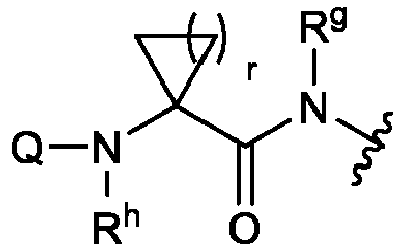
- (qq)

- (rr)

- (ss) RgRhN- where Rg and Rh are independently H or C1-C6 alkyl;
- Ar1 is phenyl optionally substituted with one or more substituents independently selected from the group consisting of halogen, CN, C1-C6 alkyl (optionally substituted with 1-3 fluoros), C1-C6 alkoxy (optionally substituted with 1-3 fluoros), (C1-C6 alkoxy)C1-C6 alkyl- (optionally substituted with 1-3 fluoros), C3-C6 cycloalkyl, hydroxyC1-C6 alkyl, (C1-C6 alkyl)SO2-, ReRfN- and (ReRfN)C1-C6 alkyl-where each Re and Rf is independently H or C1-C6 alkyl;
- hetAr2 is a 5-6 membered heteroaryl ring having 1-3 ring heteroatoms independently selected from N, O and S, or a 9-10 membered bicyclic heteroaryl having 1-2 ring nitrogen atoms, wherein hetAr2 is optionally substituted with one or more substituents independently selected from the group consisting of halogen, CN, C1-C6 alkyl (optionally substituted with 1-3 fluoros), C1-C6 alkoxy (optionally substituted with 1-3 fluoros), (C1-C6 alkoxy)C1-C6 alkyl- (optionally substituted with 1-3 fluoros) and hydroxyC1-C6 alkoxy-;
- hetCyc5 is a 4-6 membered saturated heterocyclic ring having 1-2 ring heteroatoms independently selected from N, O and S wherein said heterocyclic ring is optionally substituted with one or more substituents independently selected from C1-C6 alkoxy and oxo;
- R3 is C1-C6 alkyl (optionally substituted with 1-3 fluoros), hydroxyC1-C6 alkyl-, C1-C6 alkoxy, C3-C6 cycloalkyl, (C3-C6 cycloalkyl)CH2-, (C3-C6 cycloalkyl)O-, (C3-C6 cycloalkyl)CH2O-, hetCyc7O-, Ph-O-, or (C1-C6 alkoxy)C1-C6 alkyl-; wherein each of said C3-C6 cycloalkyl moieties is optionally substituted with C1-C6 alkyl (optionally substituted with 1-3 fluoros), C1-C6 alkoxy, OH or R'R"N- where R' and R" are independently hydrogen or C1-C6 alkyl;
- R4 is H or C1-C6 alkyl;
- R5 is Ar2, hetAr3, Ar2CH2-, hetCyc6-CH2-, hydroxyC1-C6 alkyl-, (C3-C6 cycloalkyl)CH2-, or C1-C6 alkyl optionally substituted with 1-3 fluoros;
- Ar2 is phenyl optionally substituted with one or more substituents independently selected from the group consisting of halogen, CN, C1-C6 alkyl (optionally substituted with 1-3 fluoros), C1-C6 alkoxy (optionally substituted with 1-3 fluoros), (C1-C6 alkoxy)C1-C6 alkyl- (optionally substituted with 1-3 fluoros), C3-C6 cycloalkyl, and RgRhN- where Rg and Rh are independently H or C1-C6 alkyl, or Ar2 is phenyl fused to a 6 membered heterocyclic ring having a ring nitrogen atom and optionally substituted with C1-C6 alkyl;
- hetAr3 is a 5-6 membered heteroaryl ring having 1-3 ring heteroatoms independently selected from N, O and S and optionally substituted with one or more substituents independently selected from the group consisting of halogen, CN, C1-C6 alkyl (optionally substituted with 1-3 fluoros), C1-C6 alkoxy (optionally substituted with 1-3 fluoros), and (C1-C6 alkoxy)C1-C6 alkyl- (optionally substituted with 1-3 fluoros);
- hetAr4 is pyridin-4(1H)-onyl or pyridin-2(1H)-onyl optionally substituted with one or more substituents independently selected from C1-C6 alkyl and halogen;
- hetCyc6 is a 5-7 membered heterocyclic ring having 1-3 ring heteroatoms independently selected from N, O and S; and
- hetCyc7 is a 5-7 membered heterocyclic ring having 1-3 ring heteroatoms independently selected from N, O and S.
- In one embodiment of Formula I-C, X1 is N; and X2, X3 and X4 are CH.
- In one embodiment of Formula I-C, A is CN.
- In one embodiment of Formula I-C, X1 is N; X2, X3 and X4 are CH; and A is CN.
- In one embodiment of Formula I-C, B is C1-C6 alkyl optionally substituted with 1-3 fluoros, or hydroxyC2-C6 alkyl- wherein the alkyl portion is optionally substituted with a C3-C6 cycloalkylidene ring. In one embodiment of Formula I-C, B is C1-C6 alkyl or hydroxyC2-C6 alkyl-.
- In one embodiment of Formula I-C, X1 is N; X2, X3 and X4 are CH; A is CN; and B is C1-C6 alkyl optionally substituted with 1-3 fluoros, or hydroxyC2-C6 alkyl-wherein the alkyl portion is optionally substituted with a C3-C6 cycloalkylidene ring. In one embodiment, B is C1-C6 alkyl or hydroxyC2-C6 alkyl-.
- In one embodiment of Formula I-C, X1 is N; X2, X3 and X4 are CH; A is CN; and B is C1-C6 alkyl optionally substituted with 1-3 fluoros. In one embodiment, B is C1-C6 alkyl.
- In one embodiment of Formula I-C, X1 is N; X2, X3 and X4 are CH; A is CN; and B is hydroxyC2-C6 alkyl- optionally substituted with a C3-C6 cycloalkylidene ring. In one embodiment, B is hydroxyC2-C6 alkyl-.
- In one embodiment of Formula I-C, E is (d) Ar1C1-C6 alkyl- wherein said alkyl portion is optionally substituted with 1-3 fluoros, (e) hetAr2C1-C6 alkyl-, (g) Ar1O-, (h) hetAr2O-, (i) Ar1NRg- where Rg is H or C1-C6 alkyl, (k) R3C(=O)NRg- where Rg is H or C1-C6 alkyl, (1) Ar1C(=O)NRg- where Rg is H or C1-C6 alkyl, or (m) hetAr2C(=O)NRg(CH2)p-, where p is 0 or 1 and R3, Rg, Ar1 and hetAr2 are as defined for Formula I-C.
- In one embodiment of Formula I-C, A is CN; B is C1-C6 alkyl optionally substituted with 1-3 fluoros; and E is (d) Ar1C1-C6 alkyl- wherein said alkyl portion is optionally substituted with 1-3 fluoros, (e) hetAr2C1-C6 alkyl-, (g) Ar1O-, (h) hetAr2O-, (i) Ar1NRg- where Rg is H or C1-C6 alkyl, (k) R3C(=O)NRg- where Rg is H or C1-C6 alkyl, (1) Ar1C(=O)NRg- where Rg is H or C1-C6 alkyl, or (m) hetAr2C(=O)NRg(CH2)p-, where p is 0 or 1 and R3, Rg, Ar1 and hetAr2 are as defined for Formula I-C.
- In one embodiment of Formula I-C, A is CN; B is hydroxyC2-C6 alkyl-optionally substituted with a C3-C6 cycloalkylidene ring; and E is (d) Ar1C1-C6 alkyl-wherein said alkyl portion is optionally substituted with 1-3 fluoros, (e) hetAr2C1-C6 alkyl-, (g) Ar1O-, (h) hetAr2O-, (i) Ar1NRg- where Rg is H or C1-C6 alkyl, (k) R3C(=O)NRg- where Rg is H or C1-C6 alkyl, (1) Ar1C(=O)NRg- where Rg is H or C1-C6 alkyl, or (m) hetAr2C(=O)NRg(CH2)p-, where p is 0 or 1 and Ar1, hetAr2 and Rg are as defined for Formula I-C.
- In one embodiment of Formula I-C, Rb is (c) hetCycbCH2- where hetCycb is a 4-6 membered heterocyclic ring having 1-2 ring heteroatoms independently selected from N and O, wherein hetCycb is optionally substituted with one or more substituents independently selected from OH, fluoro, C1-C6 alkyl (optionally substituted with 1-3 fluoros), hydroxyC1-C6 alkyl- (optionally substituted with 1-3 fluoros), and (C1-C6 alkoxy)C1-C6 alkyl-, (e) RcRdN-, or (f) RcRdNCH2-; Rc is hydrogen or C1-C6 alkyl; and Rd is hydrogen, C1-C6 alkyl (optionally substituted with 1-3 fluoros), (C1-C6 alkoxy)C(=O)-, hydroxyC1-C6 alkyl (optionally substituted with 1-3 fluoros), (hydroxyC1-C6 alkyl)C(=O)-, (C1-C6 alkyl)C(=O)-, (RkRlN)C1-C6 alkyl- where Rk and R1 are independently H or C1-C6 alkyl, RmRnNC(=O)C1-C6 alkyl- where Rm and Rn are independently H or C1-C6 alkyl, PhCH2-, (C1-C6 alkoxy)C1-C6 alkyl-, or hetCycc where hetCycc is a 4-6 membered heterocyclic ring having a ring heteroatom selected from N and O and optionally substituted with C1-C6 alkyl.
- In one embodiment of Formula I-C, Rb is hetCycbCH2- where hetCycb is a 4-6 membered heterocyclic ring having 1-2 ring heteroatoms independently selected from N and O, wherein hetCycb is optionally substituted with one or more substituents independently selected from OH, fluoro, C1-C6 alkyl (optionally substituted with 1-3 fluoros), hydroxyC1-C6 alkyl- (optionally substituted with 1-3 fluoros), and (C1-C6 alkoxy)C1-C6 alkyl-.
- In one embodiment of Formula I-C, Rb is RcRdN-; Rc is hydrogen or C1-C6 alkyl; and Rd is hydrogen, C1-C6 alkyl (optionally substituted with 1-3 fluoros), (C1-C6 alkoxy)C(=O)-, hydroxyC1-C6 alkyl (optionally substituted with 1-3 fluoros), (hydroxyC1-C6 alkyl)C(=O)-, (C1-C6 alkyl)C(=O)-, (RkRlN)C1-C6 alkyl- where Rk and R1 are independently H or C1-C6 alkyl, RmRnNC(=O)C1-C6 alkyl- where Rm and Rn are independently H or C1-C6 alkyl, PhCH2-, (C1-C6 alkoxy)C1-C6 alkyl-, or hetCycc where hetCycc is a 4-6 membered heterocyclic ring having a ring heteroatom selected from N and O and optionally substituted with C1-C6 alkyl.
- In one embodiment of Formula I-C, Rb is RcRdNCH2-; Rc is hydrogen or C1-C6 alkyl; and Rd is hydrogen, C1-C6 alkyl (optionally substituted with 1-3 fluoros), (C1-C6 alkoxy)C(=O)-, hydroxyC1-C6 alkyl (optionally substituted with 1-3 fluoros), (hydroxyC1-C6 alkyl)C(=O)-, (C1-C6 alkyl)C(=O)-, (RkRlN)C1-C6 alkyl- where Rk and R1 are independently H or C1-C6 alkyl, RmRnNC(=O)C1-C6 alkyl- where Rm and Rn are independently H or C1-C6 alkyl, PhCH2-, (C1-C6 alkoxy)C1-C6 alkyl-, or hetCycc where hetCycc is a 4-6 membered heterocyclic ring having a ring heteroatom selected from N and O and optionally substituted with C1-C6 alkyl.
- In one embodiment of Formula I-C, A is CN, B is hydroxyC2-C6 alkyl-optionally substituted with a C3-C6 cycloalkylidene ring; E is (d) Ar1C1-C6 alkyl-wherein said alkyl portion is optionally substituted with 1-3 fluoros, (e) hetAr2C1-C6 alkyl-, (g) Ar1O-, (h) hetAr2O-, (i) Ar1NRg- where Rg is H or C1-C6 alkyl, (k) R3C(=O)NRg- where Rg is H or C1-C6 alkyl, (1) Ar1C(=O)NRg- where Rg is H or C1-C6 alkyl, or (m) hetAr2C(=O)NRg(CH2)p-, where p is 0 or 1 and R3, Rg, Ar1 and hetAr2 are as defined for Formula I-C; and Rb is (c) hetCycbCH2- where hetCycb is a 4-6 membered heterocyclic ring having 1-2 ring heteroatoms independently selected from N and O, wherein hetCycb is optionally substituted with one or more substituents independently selected from OH, fluoro, C1-C6 alkyl (optionally substituted with 1-3 fluoros), hydroxyC1-C6 alkyl- (optionally substituted with 1-3 fluoros), and (C1-C6 alkoxy)C1-C6 alkyl-.
- In one embodiment of Formula I-C, A is CN, B is hydroxyC2-C6 alkyl-optionally substituted with a C3-C6 cycloalkylidene ring; E is (d) Ar1C1-C6 alkyl-wherein said alkyl portion is optionally substituted with 1-3 fluoros, (e) hetAr2C1-C6 alkyl-, (g) Ar1O-, (h) hetAr2O-, (i) Ar1NRg- where Rg is H or C1-C6 alkyl, (k) R3C(=O)NRg- where Rg is H or C1-C6 alkyl, (1) Ar1C(=O)NRg- where Rg is H or C1-C6 alkyl, or (m) hetAr2C(=O)NRg(CH2)p-, where p is 0 or 1 and R3, Rg, Ar1 and hetAr2 are as defined for Formula I-C; Rb is (e) RcRdN-; Rc is hydrogen or C1-C6 alkyl; and Rd is hydrogen, C1-C6 alkyl (optionally substituted with 1-3 fluoros), (C1-C6 alkoxy)C(=O)-, hydroxyC1-C6 alkyl (optionally substituted with 1-3 fluoros), (hydroxyC1-C6 alkyl)C(=O)-, (C1-C6 alkyl)C(=O)-, (RkRlN)C1-C6 alkyl- where Rk and Rl are independently H or C1-C6 alkyl, RmRnNC(=O)C1-C6 alkyl- where Rm and Rn are independently H or C1-C6 alkyl, PhCH2-, (C1-C6 alkoxy)C1-C6 alkyl-, or hetCycc where hetCycc is a 4-6 membered heterocyclic ring having a ring heteroatom selected from N and O and optionally substituted with C1-C6 alkyl.
- In one embodiment of Formula I-C, A is CN, B is hydroxyC2-C6 alkyl-optionally substituted with a C3-C6 cycloalkylidene ring; E is (d) Ar1C1-C6 alkyl-wherein said alkyl portion is optionally substituted with 1-3 fluoros, (e) hetAr2C1-C6 alkyl-, (g) Ar1O-, (h) hetAr2O-, (i) Ar1NRg- where Rg is H or C1-C6 alkyl, (k) R3C(=O)NRg- where Rg is H or C1-C6 alkyl, (1) Ar1C(=O)NRg- where Rg is H or C1-C6 alkyl, or (m) hetAr2C(=O)NRg(CH2)p-, where p is 0 or 1 and R3, Rg, Ar1 and hetAr2 are as defined for Formula I-C; Rb is (f) RcRdNCH2-; Rc is hydrogen or C1-C6 alkyl; and Rd is hydrogen, C1-C6 alkyl (optionally substituted with 1-3 fluoros), (C1-C6 alkoxy)C(=O)-, hydroxyC1-C6 alkyl (optionally substituted with 1-3 fluoros), (hydroxyC1-C6 alkyl)C(=O)-, (C1-C6 alkyl)C(=O)-, (RkRlN)C1-C6 alkyl- where Rk and Rl are independently H or C1-C6 alkyl, RmRnNC(=O)C1-C6 alkyl- where Rm and Rn are independently H or C1-C6 alkyl, PhCH2-, (C1-C6 alkoxy)C1-C6 alkyl-, or hetCycc where hetCycc is a 4-6 membered heterocyclic ring having a ring heteroatom selected from N and O and optionally substituted with C1-C6 alkyl.
- In one embodiment of Formula I-C, A is CN; B is C1-C6 alkyl optionally substituted with 1-3 fluoros; E is (d) Ar1C1-C6 alkyl- wherein said alkyl portion is optionally substituted with 1-3 fluoros, (e) hetAr2C1-C6 alkyl-, (g) Ar1O-, (h) hetAr2O-, (i) Ar1NRg- where Rg is H or C1-C6 alkyl, (k) R3C(=O)NRg- where Rg is H or C1-C6 alkyl, (1) Ar1C(=O)NRg- where Rg is H or C1-C6 alkyl, or (m) hetAr2C(=O)NRg(CH2)p-, where p is 0 or 1 and R3, Rg, Ar1 and hetAr2 are as defined for Formula I-C; and Rb is (c) hetCycbCH2- where hetCycb is a 4-6 membered heterocyclic ring having 1-2 ring heteroatoms independently selected from N and O, wherein hetCycb is optionally substituted with one or more substituents independently selected from OH, fluoro, C1-C6 alkyl (optionally substituted with 1-3 fluoros), hydroxyC1-C6 alkyl- (optionally substituted with 1-3 fluoros), and (C1-C6 alkoxy)C1-C6 alkyl-.
- In one embodiment of Formula I-C, A is CN; B is C1-C6 alkyl optionally substituted with 1-3 fluoros; E is (d) Ar1C1-C6 alkyl- wherein said alkyl portion is optionally substituted with 1-3 fluoros, (e) hetAr2C1-C6 alkyl-, (g) Ar1O-, (h) hetAr2O-, (i) Ar1NRg- where Rg is H or C1-C6 alkyl, (k) R3C(=O)NRg- where Rg is H or C1-C6 alkyl, (1) Ar1C(=O)NRg- where Rg is H or C1-C6 alkyl, or (m) hetAr2C(=O)NRg(CH2)p-, where p is 0 or 1 and R3, Rg, Ar1 and hetAr2 are as defined for Formula I-C; Rb is (e) RcRdN-; Rc is hydrogen or C1-C6 alkyl; and Rd is hydrogen, C1-C6 alkyl (optionally substituted with 1-3 fluoros), (C1-C6 alkoxy)C(=O)-, hydroxyC1-C6 alkyl (optionally substituted with 1-3 fluoros), (hydroxyC1-C6 alkyl)C(=O)-, (C1-C6 alkyl)C(=O)-, (RkRlN)C1-C6 alkyl- where Rk and Rl are independently H or C1-C6 alkyl, RmRnNC(=O)C1-C6 alkyl- where Rm and Rn are independently H or C1-C6 alkyl, PhCH2-, (C1-C6 alkoxy)C1-C6 alkyl-, or hetCycc where hetCycc is a 4-6 membered heterocyclic ring having a ring heteroatom selected from N and O and optionally substituted with C1-C6 alkyl.
- In one embodiment of Formula I-C, A is CN; B is C1-C6 alkyl optionally substituted with 1-3 fluoros; E is (d) Ar1C1-C6 alkyl- wherein said alkyl portion is optionally substituted with 1-3 fluoros, (e) hetAr2C1-C6 alkyl-, (g) Ar1O-, (h) hetAr2O-, (i) Ar1NRg- where Rg is H or C1-C6 alkyl, (k) R3C(=O)NRg- where Rg is H or C1-C6 alkyl, (1) Ar1C(=O)NRg- where Rg is H or C1-C6 alkyl, or (m) hetAr2C(=O)NRg(CH2)p-, where p is 0 or 1 and R3, Rg, Ar1 and hetAr2 are as defined for Formula I-C; Rb is (f) RcRdNCH2-; Rc is hydrogen or C1-C6 alkyl; and Rd is hydrogen, C1-C6 alkyl (optionally substituted with 1-3 fluoros), (C1-C6 alkoxy)C(=O)-, hydroxyC1-C6 alkyl (optionally substituted with 1-3 fluoros), (hydroxyC1-C6 alkyl)C(=O)-, (C1-C6 alkyl)C(=O)-, (RkRlN)C1-C6 alkyl- where Rk and Rl are independently H or C1-C6 alkyl, RmRnNC(=O)C1-C6 alkyl- where Rm and Rn are independently H or C1-C6 alkyl, PhCH2-, (C1-C6 alkoxy)C1-C6 alkyl-, or hetCycc where hetCycc is a 4-6 membered heterocyclic ring having a ring heteroatom selected from N and O and optionally substituted with C1-C6 alkyl.
- In one embodiment of Formula I-C, X1 is N; X2, X3 and X4 are CH; A is CN; B is hydroxyC2-C6 alkyl- optionally substituted with a C3-C6 cycloalkylidene ring; E is (d) Ar1C1-C6 alkyl- wherein said alkyl portion is optionally substituted with 1-3 fluoros, (e) hetAr2C1-C6 alkyl-, (g) Ar1O-, (h) hetAr2O-, (i) Ar1NRg- where Rg is H or C1-C6 alkyl, (k) R3C(=O)NRg- where Rg is H or C1-C6 alkyl, (1) Ar1C(=O)NRg- where Rg is H or C1-C6 alkyl, or (m) hetAr2C(=O)NRg(CH2)p-, where p is 0 or 1 and R3, Rg, Ar1 and hetAr2 are as defined for Formula I-C; and Rb is (c) hetCycbCH2- where hetCycb is a 4-6 membered heterocyclic ring having 1-2 ring heteroatoms independently selected from N and O, wherein hetCycb is optionally substituted with one or more substituents independently selected from OH, fluoro, C1-C6 alkyl (optionally substituted with 1-3 fluoros), hydroxyC1-C6 alkyl- (optionally substituted with 1-3 fluoros), and (C1-C6 alkoxy)C1-C6 alkyl-.
- In one embodiment of Formula I-C, X1 is N; X2, X3 and X4 are CH; A is CN; B is hydroxyC2-C6 alkyl- optionally substituted with a C3-C6 cycloalkylidene ring; E is (d) Ar1C1-C6 alkyl- wherein said alkyl portion is optionally substituted with 1-3 fluoros, (e) hetAr2C1-C6 alkyl-, (g) Ar1O-, (h) hetAr2O-, (i) Ar1NRg- where Rg is H or C1-C6 alkyl, (k) R3C(=O)NRg- where Rg is H or C1-C6 alkyl, (1) Ar1C(=O)NRg- where Rg is H or C1-C6 alkyl, or (m) hetAr2C(=O)NRg(CH2)p-, where p is 0 or 1 and R3, Rg, Ar1 and hetAr2 are as defined for Formula I-C; Rb is (e) RcRdN-; Rc is hydrogen or C1-C6 alkyl; and Rd is hydrogen, C1-C6 alkyl (optionally substituted with 1-3 fluoros), (C1-C6 alkoxy)C(=O)-, hydroxyC1-C6 alkyl (optionally substituted with 1-3 fluoros), (hydroxyC1-C6 alkyl)C(=O)-, (C1-C6 alkyl)C(=O)-, (RkRlN)C1-C6 alkyl- where Rk and R1 are independently H or C1-C6 alkyl, RmRnNC(=O)C1-C6 alkyl- where Rm and Rn are independently H or C1-C6 alkyl, PhCH2-, (C1-C6 alkoxy)C1-C6 alkyl-, or hetCycc where hetCycc is a 4-6 membered heterocyclic ring having a ring heteroatom selected from N and O and optionally substituted with C1-C6 alkyl.
- In one embodiment of Formula I-C, X1 is N; X2, X3 and X4 are CH; A is CN; B is hydroxyC2-C6 alkyl- optionally substituted with a C3-C6 cycloalkylidene ring; E is (d) Ar1C1-C6 alkyl- wherein said alkyl portion is optionally substituted with 1-3 fluoros, (e) hetAr2C1-C6 alkyl-, (g) Ar1O-, (h) hetAr2O-, (i) Ar1NRg- where Rg is H or C1-C6 alkyl, (k) R3C(=O)NRg- where Rg is H or C1-C6 alkyl, (1) Ar1C(=O)NRg- where Rg is H or C1-C6 alkyl, or (m) hetAr2C(=O)NRg(CH2)p-, where p is 0 or 1 and R3, Rg, Ar1 and hetAr2 are as defined for Formula I-C; Rb is (f) RcRdNCH2-; Rc is hydrogen or C1-C6 alkyl; and Rd is hydrogen, C1-C6 alkyl (optionally substituted with 1-3 fluoros), (C1-C6 alkoxy)C(=O)-, hydroxyC1-C6 alkyl (optionally substituted with 1-3 fluoros), (hydroxyC1-C6 alkyl)C(=O)-, (C1-C6 alkyl)C(=O)-, (RkRlN)C1-C6 alkyl- where Rk and R1 are independently H or C1-C6 alkyl, RmRnNC(=O)C1-C6 alkyl- where Rm and Rn are independently H or C1-C6 alkyl, PhCH2-, (C1-C6 alkoxy)C1-C6 alkyl-, or hetCycc where hetCycc is a 4-6 membered heterocyclic ring having a ring heteroatom selected from N and O and optionally substituted with C1-C6 alkyl.
- In one embodiment of Formula I-C, X1 is N; X2, X3 and X4 are CH; A is CN; B is C1-C6 alkyl optionally substituted with 1-3 fluoros; E is (d) Ar1C1-C6 alkyl-wherein said alkyl portion is optionally substituted with 1-3 fluoros, (e) hetAr2C1-C6 alkyl-, (g) Ar1O-, (h) hetAr2O-, (i) Ar1NRg- where Rg is H or C1-C6 alkyl, (k) R3C(=O)NRg- where Rg is H or C1-C6 alkyl, (1) Ar1C(=O)NRg- where Rg is H or C1-C6 alkyl, or (m) hetAr2C(=O)NRg(CH2)p-, where p is 0 or 1 and R3, Rg, Ar1 and hetAr2 are as defined for Formula I-C; and Rb is (c) hetCycbCH2- where hetCycb is a 4-6 membered heterocyclic ring having 1-2 ring heteroatoms independently selected from N and O, wherein hetCycb is optionally substituted with one or more substituents independently selected from OH, fluoro, C1-C6 alkyl (optionally substituted with 1-3 fluoros), hydroxyC1-C6 alkyl- (optionally substituted with 1-3 fluoros), and (C1-C6 alkoxy)C1-C6 alkyl-.
- In one embodiment of Formula I-C, X1 is N; X2, X3 and X4 are CH; A is CN; B is C1-C6 alkyl optionally substituted with 1-3 fluoros; E is (d) Ar1C1-C6 alkyl-wherein said alkyl portion is optionally substituted with 1-3 fluoros, (e) hetAr2C1-C6 alkyl-, (g) Ar1O-, (h) hetAr2O-, (i) Ar1NRg- where Rg is H or C1-C6 alkyl, (k) R3C(=O)NRg- where Rg is H or C1-C6 alkyl, (1) Ar1C(=O)NRg- where Rg is H or C1-C6 alkyl, or (m) hetAr2C(=O)NRg(CH2)p-, where p is 0 or 1 and R3, Rg, Ar1 and hetAr2 are as defined for Formula I-C; Rb is (e) RcRdN-; Rc is hydrogen or C1-C6 alkyl; and Rd is hydrogen, C1-C6 alkyl (optionally substituted with 1-3 fluoros), (C1-C6 alkoxy)C(=O)-, hydroxyC1-C6 alkyl (optionally substituted with 1-3 fluoros), (hydroxyC1-C6 alkyl)C(=O)-, (C1-C6 alkyl)C(=O)-, (RkRlN)C1-C6 alkyl- where Rk and Rl are independently H or C1-C6 alkyl, RmRnNC(=O)C1-C6 alkyl- where Rm and Rn are independently H or C1-C6 alkyl, PhCH2-, (C1-C6 alkoxy)C1-C6 alkyl-, or hetCycc where hetCycc is a 4-6 membered heterocyclic ring having a ring heteroatom selected from N and O and optionally substituted with C1-C6 alkyl.
- In one embodiment of Formula I-C, X1 is N; X2, X3 and X4 are CH; A is CN; B is C1-C6 alkyl optionally substituted with 1-3 fluoros; E is (d) Ar1C1-C6 alkyl-wherein said alkyl portion is optionally substituted with 1-3 fluoros, (e) hetAr2C1-C6 alkyl-, (g) Ar1O-, (h) hetAr2O-, (i) Ar1NRg- where Rg is H or C1-C6 alkyl, (k) R3C(=O)NRg- where Rg is H or C1-C6 alkyl, (1) Ar1C(=O)NRg- where Rg is H or C1-C6 alkyl, or (m) hetAr2C(=O)NRg(CH2)p-, where p is 0 or 1 and R3, Rg, Ar1 and hetAr2 are as defined for Formula I-C; Rb is (f) RcRdNCH2-; Rc is hydrogen or C1-C6 alkyl; and Rd is hydrogen, C1-C6 alkyl (optionally substituted with 1-3 fluoros), (C1-C6 alkoxy)C(=O)-, hydroxyC1-C6 alkyl (optionally substituted with 1-3 fluoros), (hydroxyC1-C6 alkyl)C(=O)-, (C1-C6 alkyl)C(=O)-, C1-C6 alkyl- where Rk and Rl are independently H or C1-C6 alkyl, RmRnNC(=O)C1-C6 alkyl- where Rm and Rn are independently H or C1-C6 alkyl, PhCH2-, (C1-C6 alkoxy)C1-C6 alkyl-, or hetCycc where hetCycc is a 4-6 membered heterocyclic ring having a ring heteroatom selected from N and O and optionally substituted with C1-C6 alkyl.
- In one embodiment, Formula I includes compounds of Formula I-D, wherein:
X1 and X3 are N, and X2 and X4 are CH or CF; and A, B, E, Ra, Rb, m and n are as defined for Formula I. - In one embodiment of Formula I-D, A is CN.
- In one embodiment of Formula I-D, B is (c) hydroxyC2-C6 alkyl- wherein the alkyl portion is optionally substituted with a C3-C6 cycloalkylidene ring, (f) (R1R2N)C1-C6 alkyl- where R1 and R2 are independently selected from H, C1-C6 alkyl (optionally substituted with 1-3 fluoros), (C1-C6 alkoxy)C1-C6 alkyl-, (C1-C6 alkyl)C(=O)- and (C1-C6 alkoxy)C(=O)-, (g) hetAr1C1-C3 alkyl-, where hetAr1 is a 5-6 membered heteroaryl ring having 1-3 ring heteroatoms independently selected from N, O and S and is optionally substituted with one or more independently selected C1-C6 alkyl substituents, or (i) (hetCyca)C1-C3 alkyl-; and hetCyca is a 4-6 membered heterocyclic ring having 1-2 ring heteroatoms independently selected from N and O and optionally substituted with one or more substituents independently selected from OH, C1-C6 alkyl (optionally substituted with 1-3 fluoros), hydroxyC1-C6 alkyl, halogen, (C1-C6 alkyl)C(=O)-, C1-C6 alkoxy, oxo and (C1-C6 alkoxy)C(=O)-.
- In one embodiment of Formula I-D, A is CN; B is (c) hydroxyC2-C6 alkyl-wherein the alkyl portion is optionally substituted with a C3-C6 cycloalkylidene ring, (f) (R1R2N)C1-C6 alkyl- where R1 and R2 are independently selected from H, C1-C6 alkyl (optionally substituted with 1-3 fluoros), (C1-C6 alkoxy)C1-C6 alkyl-, (C1-C6 alkyl)C(=O)- and (C1-C6 alkoxy)C(=O)-, (g) hetAr1C1-C3 alkyl-, where hetAr1 is a 5-6 membered heteroaryl ring having 1-3 ring heteroatoms independently selected from N, O and S and is optionally substituted with one or more independently selected C1-C6 alkyl substituents, or (i) (hetCyca)C1-C3 alkyl-; and hetCyca is a 4-6 membered heterocyclic ring having 1-2 ring heteroatoms independently selected from N and O and optionally substituted with one or more substituents independently selected from OH, C1-C6 alkyl (optionally substituted with 1-3 fluoros), hydroxyC1-C6 alkyl, halogen, (C1-C6 alkyl)C(=O)-, C1-C6 alkoxy, oxo and (C1-C6 alkoxy)C(=O)-.
- In one embodiment of Formula I-D, E is (1) Ar1C(=O)NRg- where Rg is H or C1-C6 alkyl, or (m) hetAr2C(=O)NRg(CH2)p- where p is 0 or 1 and Rg is H or C1-C6 alkyl.
- In one embodiment of Formula I-D, A is CN; B is (c) hydroxyC2-C6 alkyl-wherein the alkyl portion is optionally substituted with a C3-C6 cycloalkylidene ring, (f) (R1R2N)C1-C6 alkyl- where R1 and R2 are independently selected from H, C1-C6 alkyl (optionally substituted with 1-3 fluoros), (C1-C6 alkoxy)C1-C6 alkyl-, (C1-C6 alkyl)C(=O)- and (C1-C6 alkoxy)C(=O)-, (g) hetAr1C1-C3 alkyl-, where hetAr1 is a 5-6 membered heteroaryl ring having 1-3 ring heteroatoms independently selected from N, O and S and is optionally substituted with one or more independently selected C1-C6 alkyl substituents, or (i) (hetCyca)C1-C3 alkyl-; hetCyca is a 4-6 membered heterocyclic ring having 1-2 ring heteroatoms independently selected from N and O and optionally substituted with one or more substituents independently selected from OH, C1-C6 alkyl (optionally substituted with 1-3 fluoros), hydroxyC1-C6 alkyl, halogen, (C1-C6 alkyl)C(=O)-, C1-C6 alkoxy, oxo and (C1-C6 alkoxy)C(=O)-; and E is (1) Ar1C(=O)NRg- where Rg is H or C1-C6 alkyl, or (m) hetAr2C(=O)NRg(CH2)p- where p is 0 or 1 and Rg is H or C1-C6 alkyl.
- In one embodiment of Formula I-D, m is 1; and n is 0 or 1.
- In one embodiment of Formula I-D, m is 1; and n is 0.
- In one embodiment of Formula I-D, m is 1; n is 0; and Rb is hydroxy.
- In one embodiment of Formula I-D, m is 0; and n is 0 or 1.
- In one embodiment of Formula I-D, m is 0; n is 0 or 1; and Ra is C1-C6 alkyl optionally substituted with 1-3 fluoros.
- In one embodiment of Formula I-D, A is CN; B is (c) hydroxyC2-C6 alkyl-wherein the alkyl portion is optionally substituted with a C3-C6 cycloalkylidene ring, (f) (R1R2N)C1-C6 alkyl- where R1 and R2 are independently selected from H, C1-C6 alkyl (optionally substituted with 1-3 fluoros), (C1-C6 alkoxy)C1-C6 alkyl-, (C1-C6 alkyl)C(=O)- and (C1-C6 alkoxy)C(=O)-, (g) hetAr1C1-C3 alkyl-, where hetAr1 is a 5-6 membered heteroaryl ring having 1-3 ring heteroatoms independently selected from N, O and S and is optionally substituted with one or more independently selected C1-C6 alkyl substituents, or (i) (hetCyca)C1-C3 alkyl-; hetCyca is a 4-6 membered heterocyclic ring having 1-2 ring heteroatoms independently selected from N and O and optionally substituted with one or more substituents independently selected from OH, C1-C6 alkyl (optionally substituted with 1-3 fluoros), hydroxyC1-C6 alkyl, halogen, (C1-C6 alkyl)C(=O)-, C1-C6 alkoxy, oxo and (C1-C6 alkoxy)C(=O)-; E is (1) Ar1C(=O)NRg-where Rg is H or C1-C6 alkyl, or (m) hetAr2C(=O)NRg(CH2)p- where p is 0 or 1 and Rg is H or C1-C6 alkyl; m is 0 or 1; n is 0 or 1; Ra is C1-C6 alkyl optionally substituted with 1-3 fluoros; and Rb is hydroxy. In one embodiment, m is 1, n is 0, and Rb is hydroxy. In one embodiment, m is 0, n is 1, and Rb is C1-C6 alkyl optionally substituted with 1-3 fluoros.
- In one embodiment of Formula I-D, Ring D is

- In one embodiment of Formula I-D, A is CN; B is (c) hydroxyC2-C6 alkyl-wherein the alkyl portion is optionally substituted with a C3-C6 cycloalkylidene ring, (f) (R1R2N)C1-C6 alkyl- where R1 and R2 are independently selected from H, C1-C6 alkyl (optionally substituted with 1-3 fluoros), (C1-C6 alkoxy)C1-C6 alkyl-, (C1-C6 alkyl)C(=O)- and (C1-C6 alkoxy)C(=O)-, (g) hetAr1C1-C3 alkyl-, where hetAr1 is a 5-6 membered heteroaryl ring having 1-3 ring heteroatoms independently selected from N, O and S and is optionally substituted with one or more independently selected C1-C6 alkyl substituents, or (i) (hetCyca)C1-C3 alkyl-; hetCyca is a 4-6 membered heterocyclic ring having 1-2 ring heteroatoms independently selected from N and O and optionally substituted with one or more substituents independently selected from OH, C1-C6 alkyl (optionally substituted with 1-3 fluoros), hydroxyC1-C6 alkyl, halogen, (C1-C6 alkyl)C(=O)-, C1-C6 alkoxy, oxo and (C1-C6 alkoxy)C(=O)-; E is (1) Ar1C(=O)NRg-where Rg is H or C1-C6 alkyl, or (m) hetAr2C(=O)NRg(CH2)p- where p is 0 or 1 and Rg is H or C1-C6 alkyl; m is 0 or 1; n is 0 or 1; Ra is C1-C6 alkyl optionally substituted with 1-3 fluoros; and Ring D is

- In one embodiment, compounds of Formula I include compounds of Formula I-E:

- In one embodiment of Formula I-E, X1 is N; and X2, X3 and X4 are CH.
- In one embodiment of Formula I-E, A is CN.
- In one embodiment of Formula I-E, X1 is N; X2, X3 and X4 are CH; and A is CN.
- In one embodiment of Formula I-E, B is C1-C6 alkyl optionally substituted with 1-3 fluoros.
- In one embodiment of Formula I-E, X1 is N; X2, X3 and X4 are CH; A is CN; and B is C1-C6 alkyl optionally substituted with 1-3 fluoros.
- In one embodiment, compounds of Formula I include compounds of Formula I-F

- In one embodiment of Formula I-F, X1 is N; and X2, X3 and X4 are CH. In one embodiment, E is (d) Ar1C1-C6 alkyl- wherein said alkyl portion is optionally substituted with 1-3 fluoros. In one embodiment, E is (e) hetAr2C1-C6 alkyl-.
- In one embodiment of Formula I-F, A is CN. In one embodiment, E is (d) Ar1C1-C6 alkyl- wherein said alkyl portion is optionally substituted with 1-3 fluoros. In one embodiment, E is (e) hetAr2C1-C6 alkyl-.
- In one embodiment of Formula I-F, B is C1-C6 alkyl optionally substituted with 1-3 fluoros, or hydroxyC2-C6 alkyl- wherein the alkyl portion is optionally substituted with a C3-C6 cycloalkylidene ring. In one embodiment of Formula I-F, B is C1-C6 alkyl or hydroxyC2-C6 alkyl-. In one embodiment, E is (d) Ar1C1-C6 alkyl-wherein said alkyl portion is optionally substituted with 1-3 fluoros. In one embodiment, E is (e) hetAr2C1-C6 alkyl-.
- In one embodiment of Formula I-F, X1 is N; X2, X3 and X4 are CH; A is CN; and B is C1-C6 alkyl optionally substituted with 1-3 fluoros, or hydroxyC2-C6 alkyl-wherein the alkyl portion is optionally substituted with a C3-C6 cycloalkylidene ring. In one embodiment, B is C1-C6 alkyl or hydroxyC2-C6 alkyl-. In one embodiment, E is (d) Ar1C1-C6 alkyl- wherein said alkyl portion is optionally substituted with 1-3 fluoros. In one embodiment, E is (e) hetAr2C1-C6 alkyl-.
- In one embodiment of Formula I-F, X1 is N; X2, X3 and X4 are CH; A is CN; B is C1-C6 alkyl optionally substituted with 1-3 fluoros, or hydroxyC2-C6 alkyl- wherein the alkyl portion is optionally substituted with a C3-C6 cycloalkylidene ring; and Rb is (a) hydroxy. In one embodiment, E is (d) Ar1C1-C6 alkyl- wherein said alkyl portion is optionally substituted with 1-3 fluoros. In one embodiment, E is (e) hetAr2C1-C6 alkyl-.
- In one embodiment of Formula I-F, X1 is N; X2, X3 and X4 are CH; A is CN; B is C1-C6 alkyl optionally substituted with 1-3 fluoros, or hydroxyC2-C6 alkyl- wherein the alkyl portion is optionally substituted with a C3-C6 cycloalkylidene ring; and Rb is (d) RiRjNC(=O)CH2OCH2- where Ri and Rj are independently H or C1-C6 alkyl. In one embodiment, E is (d) Ar1C1-C6 alkyl- wherein said alkyl portion is optionally substituted with 1-3 fluoros. In one embodiment, E is (e) hetAr2C1-C6 alkyl-.
- In one embodiment of Formula I-F, X1 is N; X2, X3 and X4 are CH; A is CN; B is C1-C6 alkyl optionally substituted with 1-3 fluoros, or hydroxyC2-C6 alkyl- wherein the alkyl portion is optionally substituted with a C3-C6 cycloalkylidene ring; and Rb is (e) RcRdN- where Rc and Rd are as defined for Formula I. In one embodiment, E is (d) Ar1C1-C6 alkyl- wherein said alkyl portion is optionally substituted with 1-3 fluoros. In one embodiment, E is (e) hetAr2C1-C6 alkyl-.
- In one embodiment of Formula I-F, X1 is N; X2, X3 and X4 are CH; A is CN; B is C1-C6 alkyl optionally substituted with 1-3 fluoros, or hydroxyC2-C6 alkyl- wherein the alkyl portion is optionally substituted with a C3-C6 cycloalkylidene ring; and Rb is (e) RcRdN- where Rc and Rd are as defined for Formula I. In one embodiment, E is (d) Ar1C1-C6 alkyl- wherein said alkyl portion is optionally substituted with 1-3 fluoros. In one embodiment, E is (e) hetAr2C1-C6 alkyl-.
- In one embodiment, compounds of Formula I include compounds of Formula I-G

- In one embodiment of Formula I-G, X1 is N; and X2, X3 and X4 are CH.
- In one embodiment of Formula I-G, A is CN.
- In one embodiment of Formula I-G, B is (b) C1-C6 alkyl optionally substituted with 1-3 fluoros, (c) hydroxyC2-C6 alkyl- wherein the alkyl portion is optionally substituted with a C3-C6 cycloalkylidene ring, (f) (R1R2N)C1-C6 alkyl-where R1 and R2 are independently selected from H, C1-C6 alkyl (optionally substituted with 1-3 fluoros), (C1-C6 alkoxy)C1-C6 alkyl-, (C1-C6 alkyl)C(=O)- and (C1-C6 alkoxy)C(=O)-, (g) hetAr1C1-C3 alkyl-, where hetAr1 is a 5-6 membered heteroaryl ring having 1-3 ring heteroatoms independently selected from N, O and S and is optionally substituted with one or more independently selected C1-C6 alkyl substituents, or (i) (hetCyca)C1-C3 alkyl-, where hetCyca is as defined for Formula I.
- In one embodiment of Formula I-G, X1 is N; X2, X3 and X4 are CH; A is CN; and B is C1-C6 alkyl optionally substituted with 1-3 fluoros. In one embodiment, B is C1-C6 alkyl.
- In one embodiment of Formula I-G, X1 is N; X2, X3 and X4 are CH; A is CN; and B is hydroxyC2-C6 alkyl- optionally substituted with a C3-C6 cycloalkylidene ring. In one embodiment, B is hydroxyC2-C6 alkyl-.
- In one embodiment of Formula I-G, X1 is N; X2, X3 and X4 are CH; A is CN; and B is (R1R2N)C1-C6 alkyl- where R1 and R2 are independently selected from H, C1-C6 alkyl (optionally substituted with 1-3 fluoros), (C1-C6 alkoxy)C1-C6 alkyl-, (C1-C6 alkyl)C(=O)- and (C1-C6 alkoxy)C(=O)-
- In one embodiment of Formula I-G, X1 is N; X2, X3 and X4 are CH; A is CN; and B is hetAr1C1-C3 alkyl-, where hetAr1 is a 5-6 membered heteroaryl ring having 1-3 ring heteroatoms independently selected from N, O and S and is optionally substituted with one or more independently selected C1-C6 alkyl substituents.
- In one embodiment of Formula I-G, X1 is N; X2, X3 and X4 are CH; A is CN; and B is (hetCyca)C1-C3 alkyl-, where hetCyca is as defined for Formula I.
- In one embodiment, compounds of Formula I include compounds of Formula I-H
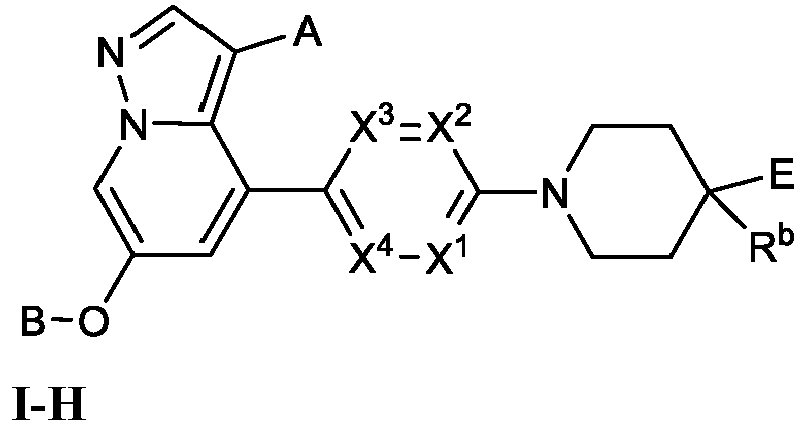
- In one embodiment of Formula I-H, X1 is N; and X2, X3 and X4 are CH.
- In one embodiment of Formula I-H, A is CN.
- In one embodiment of Formula I-H, B is (b) C1-C6 alkyl optionally substituted with 1-3 fluoros. In one embodiment, B is C1-C6 alkyl.
- In one embodiment of Formula I-H, X1 is N; X2, X3 and X4 are CH; A is CN; and B is C1-C6 alkyl optionally substituted with 1-3 fluoros. In one embodiment, B is C1-C6 alkyl.
- In one embodiment of Formula I-H, X1 is N; X2, X3 and X4 are CH; A is CN; B is C1-C6 alkyl optionally substituted with 1-3 fluoros; and Rb is (a) hydroxy.
- In one embodiment of Formula I-H, X1 is N; X2, X3 and X4 are CH; A is CN; B is C1-C6 alkyl optionally substituted with 1-3 fluoros; and Rb is (c) hetCycbCH2-.
- In one embodiment of Formula I-H, X1 is N; X2, X3 and X4 are CH; A is CN; B is C1-C6 alkyl optionally substituted with 1-3 fluoros; and Rb is (f) RcRdNCH2-.
- In one embodiment of Formula I-H, X1 is N; X2, X3 and X4 are CH; A is CN; B is C1-C6 alkyl optionally substituted with 1-3 fluoros; and Rb is (g) C1-C6 alkoxy-.
- In one embodiment of Formula I-H, X1 is N; X2, X3 and X4 are CH; A is CN; B is C1-C6 alkyl optionally substituted with 1-3 fluoros; and Rb is (j) hetCycb(C1-C3 alkyl)OCH2-.
- In one embodiment, compounds of Formula I include compounds of Formula I-I

- In one embodiment of Formula I-I, X1 is N; and X2, X3 and X4 are CH.
- In one embodiment of Formula I-I, A is CN.
- In one embodiment of Formula I-I, B is (b) C1-C6 alkyl optionally substituted with 1-3 fluoros. In one embodiment, B is C1-C6 alkyl.
- In one embodiment of Formula I-I, X1 is N; X2, X3 and X4 are CH; A is CN; and B is C1-C6 alkyl optionally substituted with 1-3 fluoros. In one embodiment, B is C1-C6 alkyl.
- In one embodiment of Formula I-H, X1 is N; X2, X3 and X4 are CH; A is CN; B is C1-C6 alkyl optionally substituted with 1-3 fluoros; and Rb is (c) hetCycbCH2-.
- In one embodiment of Formula I-H, X1 is N; X2, X3 and X4 are CH; A is CN; B is C1-C6 alkyl optionally substituted with 1-3 fluoros; and Rb is (f) RcRdNCH2-.
- In one embodiment of Formula I-H, X1 is N; X2, X3 and X4 are CH; A is CN; B is C1-C6 alkyl optionally substituted with 1-3 fluoros; and Rb is (j) hetCycb(C1-C3 alkyl)OCH2-.
- In one embodiment, compounds of Formula I include compounds of Formula I-I

- In one embodiment of Formula I-I, X1 is N; and X2, X3 and X4 are CH.
- In one embodiment of Formula I-I, A is CN.
- In one embodiment of Formula I-I, B is (b) C1-C6 alkyl optionally substituted with 1-3 fluoros or (i) (hetCyca)C1-C3 alkyl-.
- In one embodiment of Formula I-I, X1 is N; X2, X3 and X4 are CH; A is CN; and B is (b) C1-C6 alkyl optionally substituted with 1-3 fluoros.
- In one embodiment of Formula I-I, X1 is N; X2, X3 and X4 are CH; A is CN; and B is (i) (hetCyca)C1-C3 alkyl-.
- In one embodiment of Formula I-I, X1 is N; X2, X3 and X4 are CH; A is CN; B is (b) C1-C6 alkyl optionally substituted with 1-3 fluoros or (i) (hetCyca)C1-C3 alkyl-; and Rb is (c) hetCycbCH2-.
- In one embodiment of Formula I-I, X1 is N; X2, X3 and X4 are CH; A is CN; B is (b) C1-C6 alkyl optionally substituted with 1-3 fluoros or (i) (hetCyca)C1-C3 alkyl-; and Rb is (f) RcRdNCH2-.
- In one embodiment of Formula I-I, X1 is N; X2, X3 and X4 are CH; A is CN; B is (b) C1-C6 alkyl optionally substituted with 1-3 fluoros or (i) (hetCyca)C1-C3 alkyl-; and Rb is (j) hetCycb(C1-C3 alkyl)OCH2-.
- In one embodiment, compounds of Formula I include compounds of Formula I-J

- In one embodiment of Formula I-J, X1 is N; and X2, X3 and X4 are CH.
- In one embodiment of Formula I-J, A is CN.
- In one embodiment of Formula I-J, X1 is N; X2, X3 and X4 are CH; and A is CN.
- In one embodiment of Formula I-J, B is (b) C1-C6 alkyl optionally substituted with 1-3 fluoros. In one embodiment, B is (b) C1-C6 alkyl.
- In one embodiment of Formula I-J, B is (c) hydroxyC2-C6 alkyl- wherein the alkyl portion is optionally substituted with a C3-C6 cycloalkylidene ring. In one embodiment of Formula I-J, B is (c) hydroxyC2-C6 alkyl-
- In one embodiment of Formula I-J, X1 is N; X2, X3 and X4 are CH; A is CN; and B is (b) C1-C6 alkyl optionally substituted with 1-3 fluoros. In one embodiment, B is (b) C1-C6 alkyl.
- In one embodiment of Formula I-J, X1 is N; X2, X3 and X4 are CH; A is CN; and B is (c) hydroxyC2-C6 alkyl- wherein the alkyl portion is optionally substituted with a C3-C6 cycloalkylidene ring. In one embodiment of Formula I-J, B is (c) hydroxyC2-C6 alkyl-.
- In one embodiment, compounds of Formula I include compounds of Formula I-K where E is (l) Ar1C(=O)NRg- where Rg is H or C1-C6 alkyl or (m) hetAr2C(=O)NRg(CH2)p- where p is 0 or 1 and Rg is H or C1-C6 alkyl; Ring D is

- In one embodiment of Formula I-K, X1 is N; and X2, X3 and X4 are CH.
- In one embodiment of Formula I-K, A is CN.
- In one embodiment of Formula I-K, X1 is N; X2, X3 and X4 are CH; and A is CN.
- In one embodiment of Formula I-K, B is (a) hydrogen, (b) C1-C6 alkyl optionally substituted with 1-3 fluoros, (c) hydroxyC2-C6 alkyl- wherein the alkyl portion is optionally substituted with a C3-C6 cycloalkylidene ring, (f) (R1R2N)C1-C6 alkyl- where R1 and R2 are independently selected from H, C1-C6 alkyl (optionally substituted with 1-3 fluoros), (C1-C6 alkoxy)C1-C6 alkyl- and (C1-C6 alkoxy)C(=O)-, (g) hetAr1C1-C3 alkyl-, where hetAr1 is a 5-6 membered heteroaryl ring having 1-3 ring heteroatoms independently selected from N, O and S and is optionally substituted with one or more independently selected C1-C6 alkyl substituents, or (i) (hetCyca)C1-C3 alkyl-, where hetCyca is as defined for Formula I.
- In one embodiment of Formula I-K, X1 is N; X2, X3 and X4 are CH; A is CN; and B is (a) hydrogen.
- In one embodiment of Formula I-K, X1 is N; X2, X3 and X4 are CH; A is CN; and B is (b) C1-C6 alkyl optionally substituted with 1-3 fluoros.
- In one embodiment of Formula I-K, X1 is N; X2, X3 and X4 are CH; A is CN; and B is (c) hydroxyC2-C6 alkyl- wherein the alkyl portion is optionally substituted with a C3-C6 cycloalkylidene ring.
- In one embodiment of Formula I-K, X1 is N; X2, X3 and X4 are CH; A is CN; and B is (f) (R1R2N)C1-C6 alkyl- where R1 and R2 are independently selected from H, C1-C6 alkyl (optionally substituted with 1-3 fluoros), (C1-C6 alkoxy)C1-C6 alkyl- and (C1-C6 alkoxy)C(=O)-.
- In one embodiment of Formula I-K, X1 is N; X2, X3 and X4 are CH; A is CN; and B is (g) hetAr1C1-C3 alkyl-, where hetAr1 is a 5-6 membered heteroaryl ring having 1-3 ring heteroatoms independently selected from N, O and S and is optionally substituted with one or more independently selected C1-C6 alkyl substituents.
- In one embodiment of Formula I-K, X1 is N; X2, X3 and X4 are CH; A is CN; and B is (i) (hetCyca)C1-C3 alkyl-, where hetCyca is as defined for Formula I.
- In one embodiment, compounds of Formula I include compounds of Formula I-L where E is (g) Ar1O- or (h) hetAr2-O-; Ring D is

- In one embodiment of Formula I-L, X1 is N; and X2, X3 and X4 are CH.
- In one embodiment of Formula I-L, A is CN.
- In one embodiment of Formula I-L, X1 is N; X2, X3 and X4 are CH; and A is CN.
- In one embodiment of Formula I-L, B is (b) C1-C6 alkyl optionally substituted with 1-3 fluoros, (c) hydroxyC2-C6 alkyl- wherein the alkyl portion is optionally substituted with a C3-C6 cycloalkylidene ring, (i) (hetCyca)C1-C3 alkyl- or (k) (R1R2N)C(=O)C1-C6 alkyl- where R1 and R2 are independently selected from H and C1-C6 alkyl.
- In one embodiment of Formula I-L, X1 is N; X2, X3 X4 are CH; and A is CN; and B is (b) C1-C6 alkyl optionally substituted with 1-3 fluoros.
- In one embodiment of Formula I-L, X1 is N; X2, X3 X4 are CH; and A is CN; and B is (c) hydroxyC2-C6 alkyl- wherein the alkyl portion is optionally substituted with a C3-C6 cycloalkylidene ring.
- In one embodiment of Formula I-L, X1 is N; X2, X3 X4 are CH; and A is CN; and B is (i) (hetCyca)C1-C3 alkyl- or (k) (R1R2N)C(=O)C1-C6 alkyl- where R1 and R2 are independently selected from H and C1-C6 alkyl.
- In one embodiment, compounds of Formula I include compounds of Formula I-M

- In one embodiment of Formula I-M, X1 is N; and X2, X3 and X4 are CH.
- In one embodiment of Formula I-M, A is CN.
- In one embodiment of Formula I-M, X1 is N; X2, X3 and X4 are CH; and A is CN.
- In one embodiment of Formula I-M, B is (b) C1-C6 alkyl optionally substituted with 1-3 fluoros. In one embodiment, B is (b) C1-C6 alkyl.
- In one embodiment of Formula I-M, X1 is N; X2, X3 and X4 are CH; A is CN; and B is (b) C1-C6 alkyl optionally substituted with 1-3 fluoros. In one embodiment, B is (b) C1-C6 alkyl.
- In one embodiment of Formula I-M, R3 is C1-C6 alkyl (optionally substituted with 1-3 fluoros), C1-C6 alkoxy, or C3-C6 cycloalkyl, wherein said C3-C6 cycloalkyl is optionally substituted with C1-C6 alkyl (optionally substituted with 1-3 fluoros), C1-C6 alkoxy, OH, or R'R"N- where R' and R" are independently hydrogen or C1-C6 alkyl.
- The compounds of Formula I include pharmaceutically acceptable salts thereof. In addition, the compounds of Formula I also include other salts of such compounds which are not necessarily pharmaceutically acceptable salts, and which may be useful as intermediates for preparing and/or purifying compounds of Formula I and/or for separating enantiomers of compounds of Formula I. Non-limiting examples of pharmaceutically acceptable salts of compounds of Formula I include monohydrochloride, dihydrochloride, trifluoroacetic acid, and di-trifluoroacetic acid salts. In one embodiment, compounds of Formula I include trifluoroacetic acid and dihydrochloride salts.
- It will further be appreciated that the compounds of Formula I or their salts may be isolated in the form of solvates, and accordingly that any such solvate is included within the scope of the present invention. For example, compounds of Formula I and salts thereof can exist in unsolvated as well as solvated forms with pharmaceutically acceptable solvents such as water, ethanol, and the like.
- In one embodiment, the compounds of Formula I include the compounds of Examples 1-819 and stereoisomers and pharmaceutically acceptable salts and solvates thereof. In one embodiment, the compounds of Examples 1-819 are in the free base form. In one embodiment, the compounds of Examples 1-819 are dihydrochloride or trifluoroacetic acid salts.
- The term "pharmaceutically acceptable" indicates that the compound, or salt or composition thereof is compatible chemically and/or toxicologically with the other ingredients comprising a formulation and/or the patient being treated therewith.
- Compounds provided herein may also contain unnatural proportions of atomic isotopes at one or more of the atoms that constitute such compounds. That is, an atom, in particular when mentioned in relation to a compound according to Formula I, comprises all isotopes and isotopic mixtures of that atom, either naturally occurring or synthetically produced, either with natural abundance or in an isotopically enriched form. For example, when hydrogen is mentioned, it is understood to refer to 1H, 2H, 3H or mixtures thereof; when carbon is mentioned, it is understood to refer to 11C, 12C, 13C, 14C or mixtures thereof; when nitrogen is mentioned, it is understood to refer to 13N, 14N, 15N or mixtures thereof; when oxygen is mentioned, it is understood to refer to 14O, 15O, 16O, 17O, 18O or mixtures thereof; and when fluoro is mentioned, it is understood to refer to 18F, 19F or mixtures thereof. The compounds provided herein therefore also comprise compounds with one or more isotopes of one or more atoms, and mixtures thereof, including radioactive compounds, wherein one or more non-radioactive atoms has been replaced by one of its radioactive enriched isotopes. Radiolabeled compounds are useful as therapeutic agents, e.g., cancer therapeutic agents, research reagents, e.g., assay reagents, and diagnostic agents, e.g., in vivo imaging agents. All isotopic variations of the compounds provided herein, whether radioactive or not, are intended to be encompassed within the scope of the present invention.
- For illustrative purposes, Schemes 1-6 show general methods for preparing the compounds provided herein as well as key intermediates. For a more detailed description of the individual reaction steps, see the Examples section below. Those skilled in the art will appreciate that other synthetic routes may be used to synthesize the inventive compounds. Although specific starting materials and reagents are depicted in the Schemes and discussed below, other starting materials and reagents can be easily substituted to provide a variety of derivatives and/or reaction conditions. In addition, many of the compounds prepared by the methods described below can be further modified in light of this disclosure using conventional chemistry well known to those skilled in the art.

- Scheme 1 shows a general scheme for the synthesis of compound X where A is CN, and B, X1, X2, X3, X4, Ring D, Ra, Rb, n, m and E are as defined for Formula I.
- Compound 2 is obtained by treating 3-bromo-5-methoxypyridine (compound 1), which is commercially available, with O-(mesitylsulfonyl)hydroxylamine. The O-mesitylsulfonylhydroxylamine may be prepared as described in Mendiola, J., et al., Org. Process Res. Dev. 2009, 13(2), 263-267. Compound 2 may be reacted with ethyl propiolate to provide a mixture of compounds 3A and 3B, which typically are obtained in a ratio of approximately 2:1 to 9:1, respectively. The mixture of compounds 3A and 3B may be treated with 48% HBr at elevated temperatures, followed by recrystallization or chromatography purifications, to isolate compound 4A as the minor isomer and compound 4B as the major isomer. After isolation, compound 4A may be treated with POCl3 to provide compound 5. The formyl group may be converted to an oxime group using NH2OH to provide compound 6. The oxime group may be converted to a nitrile group using acetic anhydride to provide compound 7. The methoxy group of compound 7 may be converted to a hydroxy group by treating compound 7 with aluminum trichloride to provide compound 8.
- When group B is hydrogen, compound 12 may be prepared by coupling compound 8 with the corresponding boronic ester compound 10 (where Ring D, E, X1, X2, X3 and X4 are as defined for Formula I; Z is -B(ORx)(ORy) and Rz and Ry are H or (1-6C)alkyl, or Rx and Ry together with the atoms to which they are connected form a 5-6 membered ring optionally substituted with 1-4 substituents selected from (C1-C3 alkyl)) to provide compound 11a using appropriate palladium-catalyzed cross-coupling reaction conditions, e.g., Suzuki coupling reaction conditions (for example, a palladium catalyst and optionally a ligand in the presence of an inorganic base, for example, Pd(PPh3)4 and Na2CO3 in dioxane at elevated temperatures), wherein if Ring D of compound 10 is substituted with an Rb substituent that is RcRdN- wherein one or both of Rc and Rd is hydrogen, the nitrogen atom of Rb may be protected with an appropriate amino protecting group prior to coupling. The amino protecting group if present on a substituent of Ring D of compound 11a may be removed under standard conditions (for example, a Boc group may be removed by treating compound 11a to acidic conditions, e.g., HCl) to provide compound 12 where B is hydrogen. Alternatively, the E group may be functionalized (i.e., reacted or treated with an appropriate reagent) under standard conditions such as described below to provide compound 12 where B is hydrogen and E is as defined for Formula I except that E is not hydrogen.
- Alternatively, when group B is as defined for Formula I other than hydrogen, Compound 11a may be reacted with a reagent such as C1-C6 alkyl-OH, (C1-C6 alkoxy)C1-C6 alkyl-OH optionally substituted with 1-3 fluoros, hetAr1C1-C3 alkyl-OH, (C3-C6 cycloalkyl)C1-C3 alkyl-OH, (hetCyca)C1-C3 alkyl-OH, hetCycaOH or hetCycaC(=O)C1-C6 alkyl-OH, where hetAr1 and hetCyca are as defined for Formula I, under Mitsunobu reaction conditions (PPh3 and diisopropyl azodicarboxylate) to provide compound 11. Compound 12 may then be prepared from compound 11 as described above.
- Alternatively, when group B is as defined for Formula I other than hydrogen, compound 9 may be prepared by reacting compound 8 with a reagent such as C1-C6 alkyl-X optionally substituted with 1-3 fluoros, hydroxyC2-C6 alkyl-X wherein the alkyl portion is optionally substituted with a C3-C6 cycloalkylidene ring, dihydroxyC3-C6 alkyl-X wherein the alkyl portion is optionally substituted with a C3-C6 cycloalkylidene ring, (C1-C6 alkoxy)C1-C6 alkyl-X optionally substituted with 1-3 fluoros, (R1R2N)C1-C6 alkyl-X, hetAr1C1-C3 alkyl-X, (C3-C6 cycloalkyl)C1-C3 alkyl-X, (hetCyca)C1-C3 alkyl-X, hetCyca-X, or hetCycaC(=O)C1-C6 alkyl-X, where R1, R2, hetAr1, and hetCyca are as defined for Formula I and X is a leaving atom or group (such as a halide or triflate), wherein each of said reagents is optionally substituted with a protecting group (e.g., a t-butyldimethylsilyl group if the B group has one or two additional hydroxy groups), in the presence of a base (for example, an alkali metal carbonate, such as potassium carbonate). For example, when B is C1-C6 alkyl optionally substituted with 1-3 fluoros, compound may be prepared by reacting compound 8 with a C1-C6 alkyl-X, where X is a halogen such as Br or Cl, or a leaving group such as triflate. Compound 11 may then be prepared by coupling compound 9 with the corresponding boronic ester compound 10 using appropriate palladium-catalyzed cross-coupling reaction conditions, e.g., Suzuki coupling reaction conditions (for example, a palladium catalyst and optionally a ligand in the presence of an inorganic base, for example, Pd(PPh3)4 and Na2CO3 in dioxane at elevated temperatures), wherein if Ring D of compound 10 is substituted with an Rb substituent that is RcRdN- wherein one or both of Rc and Rd is hydrogen, the nitrogen atom of Rb may be protected with an appropriate amino protecting group prior to coupling. Compound 12 may then be prepared from compound 11 as described above.

- Scheme 2 shows another general scheme for the synthesis of compound 17 where A is CN, and B, X1, X2, X3, X4, Ring D, Ra, Rb, n, m and E are as defined for Formula I.
- Compound 9 (prepared, e.g., as described in Scheme 1) in which B is as defined for Formula I, may be coupled with compound 13 (where X1, X2, X3 and X4 are as defined for Formula I; L2 is a leaving group such as a triflate or halide); Z is - B(ORx)(ORy) and Rz and Ry are H or (1-6C)alkyl, or Rx and Ry together with the atoms to which they are connected form a 5-6 membered ring optionally substituted with 1-4 substituents selected from (C1-C3 alkyl)), using appropriate palladium-catalyzed cross-coupling reaction conditions, e.g., Suzuki coupling reaction conditions (for example, a palladium catalyst and optionally a ligand in the presence of an inorganic base, for example, Pd(PPh3)4 and Na2CO3 in dioxane at elevated temperatures) to provide compound 14. Compound 16 may be prepared by coupling compound 14 with compound 15 under appropriate SNAr conditions (for example, optionally in the presence of a base such as K2CO3 and at elevated temperature), wherein if Ring D of compound 15 is substituted with an Rb substituent that is RcRdN- wherein one or both of Rc and Rd is hydrogen, the nitrogen atom of Rb may be protected with an appropriate amino protecting group prior to coupling. The amino protecting group if present may then be removed under standard conditions (for example, a Boc group may be removed by treating compound 1 to acidic conditions, e.g., HCl) to provide compound 17 where E is H.
- Alternatively, the E group may be functionalized (i.e., reacted or treated with an appropriate reagent) under standard conditions such as described below to provide compound 17 where E is as defined for Formula I except that E is not H.

- Scheme 3 shows a general scheme for the synthesis of Compound 21 where A is H, and B, X1, X2, X3, X4, Ring D, Ra, Rb, n, m and E are as defined for Formula I.
- Compound 18 may be prepared by coupling compound 4A (prepared e.g., as described in Scheme 1) with the corresponding boronic ester compound 10 (where Ring D, X1, X2, X3 and X4 are as defined for Formula I; Z is -B(ORx)(ORy) and Rz and Ry are H or (1-6C)alkyl, or Rx and Ry together with the atoms to which they are connected form a 5-6 membered ring optionally substituted with 1-4 substituents selected from (C1-C3 alkyl)) using appropriate palladium-catalyzed cross-coupling reaction conditions, e.g., Suzuki coupling reaction conditions (for example, a palladium catalyst and optionally a ligand in the presence of an inorganic base, for example, Pd(PPh3)4 and Na2CO3 in dioxane at elevated temperatures), wherein if Ring D of compound 10 is substituted with an Rb substituent that is RcRdN- wherein one or both of Rc and Rd is hydrogen, the nitrogen atom of Rb may be protected with an appropriate amino protecting group prior to coupling. Compound 19 may be prepared by treating compound 18 with aluminum trichloride.
- When B is as defined for Formula I other than hydrogen, compound 20 may be prepared by reacting compound 19 with a reagent such as C1-C6 alkyl-X optionally substituted with 1-3 fluoros, hydroxyC2-C6 alkyl-X wherein the alkyl portion is optionally substituted with a C3-C6 cycloalkylidene ring, dihydroxyC3-C6 alkyl-X wherein the alkyl portion is optionally substituted with a C3-C6 cycloalkylidene ring, (C1-C6 alkoxy)C1-C6 alkyl-X optionally substituted with 1-3 fluoros, (R1R2N)C1-C6 alkyl-X, hetAr1C1-C3 alkyl-X, (C3-C6 cycloalkyl)C1-C3 alkyl-X, (hetCyca)C1-C3 alkyl-X, hetCyca-X or hetCycaC(=O)C1-C6 alkyl-X, where R1, R2, hetAr1, and hetCyca are as defined for Formula I and X is a leaving atom or group (such as a halide or triflate), wherein each of said reagents is optionally substituted with a protecting group (e.g., a t-butyldimethylsilyl group if B has one or two additional hydroxy groups). For example, when B is C1-C6 alkyl optionally substituted with 1-3 fluoros, compound may be prepared by reacting compound 19 with C1-C6 alkyl-X, where X is a halogen such as Br or Cl, or a leaving group such as triflate. Compound 21 may then be prepared from compound 20. If Ring D comprises a substituent having an amino protecting group, the amino protecting group may be removed under standard conditions (for example, a Boc group may be removed by treating compound 20 to acidic conditions, e.g., HCl) to provide compound 21 where E is H.
- Alternatively, the E group of compound 20 may be functionalized (i.e., reacted or treated with an appropriate reagent) under standard conditions such as described below to provide compound 21 where E is as defined for Formula I except that E is not H.
- Alternatively, when group B is hydrogen, compound 21 may be prepared from compound 19 according to the deprotection and optional functionalization steps described herein.

- Scheme 4 shows an alternative general scheme for the synthesis of Compound 21 where A is H, and B, X1, X2, X3, X4, Ring D, Ra, Rb, n, m and E are as defined for Formula I.
- Compound 22 may be prepared by treating compound 4A (prepared e.g., as described in Scheme 1) with aluminum trichloride.
- When group B is hydrogen, compound 19 may be prepared by coupling compound 22 with the corresponding boronic ester compound 10 (where Ring D, X1, X2, X3 and X4 are as defined for Formula I; Z is -B(ORx)(ORy) and Rz and Ry are H or (1-6C)alkyl, or Rx and Ry together with the atoms to which they are connected form a 5-6 membered ring optionally substituted with 1-4 substituents selected from (C1-C3 alkyl)) using appropriate palladium-catalyzed cross-coupling reaction conditions, e.g., Suzuki coupling reaction conditions (for example, a palladium catalyst and optionally a ligand in the presence of an inorganic base, for example, Pd(PPh3)4 and Na2CO3 in dioxane at elevated temperatures), wherein if Ring D of compound 10 is substituted with an Rb substituent that is RcRdN- wherein one or both of Rc and Rd is hydrogen, the nitrogen atom of Rb may be protected with an appropriate amino protecting group prior to coupling. Compound 21 may be prepared from compound 19 according to the process described for Scheme 3.
- Alternatively, when group B is as defined for Formula I other than hydrogen, compound 23 may be prepared by reacting compound 22 with a reagent such as C1-C6 alkyl-X optionally substituted with 1-3 fluoros, hydroxyC2-C6 alkyl-X wherein the alkyl portion is optionally substituted with a C3-C6 cycloalkylidene ring, dihydroxyC3-C6 alkyl-X wherein the alkyl portion is optionally substituted with a C3-C6 cycloalkylidene ring, (C1-C6 alkoxy)C1-C6 alkyl-X optionally substituted with 1-3 fluoros, (R1R2N)C1-C6 alkyl-X, hetAr1C1-C3 alkyl-X, (C3-C6 cycloalkyl)C1-C3 alkyl-X, (hetCyca)C1-C3 alkyl-X, hetCyca-X or hetCycaC(=O)C1-C6 alkyl-X, where R1, R2, hetAr1, and hetCyca are as defined for Formula I and X is a leaving atom or group (such as a halide or triflate), wherein each of said reagents is optionally substituted with a protecting group (e.g., a t-butyldimethylsilyl group if B has one or two additional hydroxy groups). For example, when B is C1-C6 alkyl optionally substituted with 1-3 fluoros, compound may be prepared by reacting compound 22 with C1-C6 alkyl-X, where X is a halogen such as Br or Cl, or a leaving group such as triflate. Compound 20 may be prepared by coupling compound 23 with compound 10 as described in Scheme 3. Compound 21 may be prepared from compound 20 according to the process described for Scheme 3.
- Alternatively, when group B is as defined for Formula I other than hydrogen, compound 20 may be prepared by reacting compound 19 with a group such as (C1-C6 alkyl)OH, an appropriately substituted (C1-C3 alkyl)OH, an appropriately substituted (C1-C6 alkyl)OH, or hetCycaOH (i.e., where hetCyca a 4-6 membered heterocyclic ring having 1-2 ring heteroatoms independently selected from N and O and is optionally substituted with OH, C1-C6 alkyl (optionally substituted with 1-3 fluoros) or hydroxyC1-C6 alkyl) under Mitsunobu reaction conditions (PPh3 and diisopropyl azodicarboxylate). Compound 21 may be prepared from compound 20 according to the process described for Scheme 3.

- Scheme 5 shows an alternative general scheme for the synthesis of Compound 21 where A is H, and B, X1, X2, X3, X4, Ring D, Ra, Rb, n, m and E are as defined for Formula I.
- Compound 22 may be prepared by treating compound 4A (prepared e.g., as described in Scheme 1) with aluminum trichloride.
- When group B is as defined for Formula I other than hydrogen, compound 23 may be prepared by reacting compound 22 with a reagent such as C1-C6 alkyl-X optionally substituted with 1-3 fluoros, hydroxyC2-C6 alkyl-X wherein the alkyl portion is optionally substituted with a C3-C6 cycloalkylidene ring, dihydroxyC3-C6 alkyl-X wherein the alkyl portion is optionally substituted with a C3-C6 cycloalkylidene ring, (C1-C6 alkoxy)C1-C6 alkyl-X optionally substituted with 1-3 fluoros, (R1R2N)C1-C6 alkyl-X, hetAr1C1-C3 alkyl-X, (C3-C6 cycloalkyl)C1-C3 alkyl-X, (hetCyca)C1-C3 alkyl-X, hetCyca-X or hetCycaC(=O)C1-C6 alkyl-X, where R1, R2, hetAr1, and hetCyca are as defined for Formula I and X is a leaving atom or group (such as a halide or triflate), wherein each of said reagents is optionally substituted with a protecting group (e.g., a t-butyldimethylsilyl group if B has one or two additional hydroxy groups). For example, when B is C1-C6 alkyl optionally substituted with 1-3 fluoros, compound may be prepared by reacting compound 22 with C1-C6 alkyl-X, where X is a halogen such as Br or Cl, or a leaving group such as triflate.
- Compound 24 may be prepared by reacting compound 23 with compound 13 (where X1, X2, X3 and X4 are as defined for Formula I; L2 is a leaving group such as a triflate or halide); Z is -B(ORx)(ORy) and Rz and Ry are H or (1-6C)alkyl, or Rx and Ry together with the atoms to which they are connected form a 5-6 membered ring optionally substituted with 1-4 substituents selected from (C1-C3 alkyl)) using appropriate palladium-catalyzed cross-coupling reaction conditions, e.g., Suzuki coupling reaction conditions (for example, a palladium catalyst and optionally a ligand in the presence of an inorganic base, for example, Pd(PPh3)4 and Na2CO3 in dioxane at elevated temperatures).
- When group B is hydrogen, compound 24 may be prepared by reacting compound 22 directly with compound 13 as described above.
- Compound 20 may be prepared by coupling compound 24 with compound 15 where Ring D and E are as defined for Formula I under appropriate SNAr conditions (for example, optionally in the presence of a base such as K2CO3 and at elevated temperature). If Ring D of compound 15 comprises a substituent having a primary or secondary ring nitrogen atom, the nitrogen atom is protected with an appropriate amino protecting group prior to coupling, and then the amino protecting group may be removed subsequent to coupling as described above.
- Compound 21 may be prepared from compound 20 according to the process described for Scheme 3.

- Scheme 6 shows a general scheme for the synthesis of Compound 31 where A is Cl, and B, X1, X2, X3, X4, Ring D, Ra, Rb, n, m and E are as defined for Formula I.
- Compound 25 may be prepared by treating compound 4A (prepared e.g., as described in Scheme 1) with aluminum trichloride.
- Compound 26 may be prepared by treating compound 25 with aluminum trichloride.
- When group B is as defined for Formula I other than hydrogen, compound 27 may be prepared by reacting compound 26 with a reagent such as C1-C6 alkyl-X optionally substituted with 1-3 fluoros, hydroxyC2-C6 alkyl-X wherein the alkyl portion is optionally substituted with a C3-C6 cycloalkylidene ring, dihydroxyC3-C6 alkyl-X wherein the alkyl portion is optionally substituted with a C3-C6 cycloalkylidene ring, (C1-C6 alkoxy)C1-C6 alkyl-X optionally substituted with 1-3 fluoros, (R1R2N)C1-C6 alkyl-X, hetAr1C1-C3 alkyl-X, (C3-C6 cycloalkyl)C1-C3 alkyl-X, (hetCyca)C1-C3 alkyl-X, hetCyca-X or hetCycaC(=O)C1-C6 alkyl-X, where R1, R2, hetAr1, and hetCyca are as defined for Formula I and X is a leaving atom or group (such as a halide or triflate), wherein each of said reagents is optionally substituted with a protecting group (e.g., a t-butyldimethylsilyl group if B has one or two additional hydroxy groups). For example, when B is C1-C6 alkyl optionally substituted with 1-3 fluoros, compound may be prepared by reacting compound 26 with C1-C6 alkyl-X, where X is a halogen such as Br or Cl, or a leaving group such as triflate.
- Compounds 28 (when group B is methyl), 29 (when group B is hydrogen) and 30 (when group B is other than hydrogen) may be prepared by coupling compounds 25, 26 and 27, respectively, with the corresponding boronic ester compound 10 (where Ring D, E, X1, X2, X3 and X4 are as defined for Formula I; Z is -B(ORx)(ORy) and Rz and Ry are H or (1-6C)alkyl, or Rx and Ry together with the atoms to which they are connected form a 5-6 membered ring optionally substituted with 1-4 substituents selected from (C1-C3 alkyl)) using appropriate palladium-catalyzed cross-coupling reaction conditions, e.g., Suzuki coupling reaction conditions (for example, a palladium catalyst and optionally a ligand in the presence of an inorganic base, for example, Pd(PPh3)4 and Na2CO3 in dioxane at elevated temperatures), wherein if Ring D of is substituted with an Rb substituent that is RcRdN- wherein one or both of Rc and Rd is hydrogen, the nitrogen atom of Rb may be protected with an appropriate amino protecting group prior to coupling. The amino protecting group if present on a substituent of Ring D of compound 29 or 30 may be removed under standard conditions (for example, a Boc group may be removed by treating compound 1 to acidic conditions, e.g., HCl) to provide compound 31 where E is H.
- Alternatively, the E group may be functionalized (i.e., reacted or treated with an appropriate reagent) under standard conditions such as described below to provide compound 31 where E is as defined for Formula I except that E is not H.
- The E group of compounds 11, 11a, 16, 19, 20, 29 and 30 described in Schemes 1-6 may be functionalized (i.e., reacted or treated with an appropriate reagent) to introduce an E group, where E is any of the E groups defined for Formula I with the exception of hydrogen, using standard chemistry well known to persons skilled in the art. As used herein, the term "functionalized" refers to a process step in the E group of a compound of general Formula I is reacted or treated with an appropriate reagent to provide a compound of Formula I where E is as defined for Formula I except that E is other than hydrogen.
- For example, an amide derivative (e.g., where E is Ar1C(=O)NRg-, hetAr2C(=O)NRg(CH2)p- p is 0 or 1, or R4R5NC(=O)NRg-, may be obtained by reacting compound 11 wherein E is -NH2 with an carboxylic acid derivative such as an acid chloride using conventional amide bond formation conditions, for example in the presence of a base (e.g., an amine base such as DIEA) in an appropriate solvent (such as DCM) to provide a functionalized compound 12. Alternative, compound 11 wherein E is -NH2 may be reacted with an carboxylic acid using conventional amide bond formation conditions, for example by treating the carboxylic acid with an activating agent (e.g., HATU) followed by addition of compound 11 in the presence of a base ( (e.g., an amine base such as DIEA) in an appropriate solvent (such as DMA) to provide a functionalized compound 12. The same chemistry may be utilized with compounds 11a, 16, 19, 20, 29 and 30 to prepare functionalized compounds 12, 17, 21 and 31.
- As another example, a urea derivative, (e.g., where E is R4RSNHC(=O)NRg-) may be prepared reacting a compound 11 where E is -NH2 with a compound having the formula R4R5N=C(=O) where R4 and R5 are as defined for Formula I in the presence of an appropriate base (e.g., DIEA) to provide a functionalized compound 12. The same chemistry may be utilized with compounds 11a, 16, 19, 20, 29 and 30 to prepare functionalized compounds 12, 17, 21 and 31.
- As another example, an alkoxy, aryloxy or heteroaryloxy derivative (e.g., where E is (C1-C6 alkoxy)C1-C6 alkoxy, Ar1O- or hetAr2O-), may be prepared by reacting a compound 11 where E is hydroxy with a compound having the formula (C1-C6 alkoxy)C1-C6 alkyl-X, Ar1-X or hetAr2-X, where X is a halogen, in the presence of an inorganic base (e.g., an alkali metal hydride, such as sodium hydride or potassium hydride) in an appropriate solvent (e.g., an aprotic solvent such as DMA). The same chemistry may be utilized with compounds 11a, 16, 19, 20, 29 and 30 to prepare functionalized compounds 12, 17, 21 and 31.
- The term "amino protecting group" as used herein refers to a derivative of the groups commonly employed to block or protect an amino group while reactions are carried out on other functional groups on the compound. Examples of suitable protecting groups for use in any of the processes described herein include carbamates, amides, alkyl and aryl groups, imines, as well as many N-heteroatom derivatives which can be removed to regenerate the desired amine group. Non-limiting examples of amino protecting groups are acetyl, trifluoroacetyl, t-butyloxycarbonyl ("Boc"), benzyloxycarbonyl ("CBz") and 9-fluorenylmethyleneoxycarbonyl ("Fmoc"). Further examples of these groups, and other protecting groups, are found in T. W. Greene, et al. Greene's Protective Groups in Organic Synthesis. New York: Wiley Interscience, 2006.
- Accordingly, further provided herein is a process for preparing of a compound of Formula I or a pharmaceutically acceptable salt thereof as defined herein which comprises:
- (a) for a compound of Formula I where E is H, A is CN, and B, X1, X2, X3, X4, Ring D, Ra, Rb, m and n are as defined for Formula I, coupling a corresponding compound 9 having the formula

- where B is as defined for Formula I, with a corresponding boronate ester having the formula 10

- where Z is -B(ORx)(ORy) and Rx and Ry are H or (1-6C)alkyl, or Rx and Ry together with the atoms to which they are connected form a 5-6 membered ring optionally substituted with 1-4 substituents selected from (C1-C3 alkyl), and Ring D, E, X1, X2, X3, X4, Ra, Rb, m and n are as defined for Formula I, wherein if Ring D is substituted with an Rb substituent that is RcRdN- wherein one or both of Rc and Rd is hydrogen, the nitrogen atom of Rb may be protected with an amino protecting group prior to coupling, in the presence of a palladium catalyst and optionally a ligand and in the presence of a base, optionally followed by removal of the amino protecting group if present; or
- where B is as defined for Formula I, with a corresponding boronate ester having the formula 10
- (b) for a compound of Formula I where A, B, X1, X2, X3, X4, Ring D, Ra, Rb, m, n, and E are as defined for Formula I with the exception that E is not hydrogen, functionalizing a corresponding compound of the formula

- (c) for a compound of Formula I where A is CN and B, X1, X2, X3, X4, Ring D, Ra, Rb, m, n, and E are as defined for Formula I, reacting a corresponding compound of the formula 14

- wherein Ring D, B, X1, X2, X3, and X4 are as defined for Formula I and L2 is a leaving group such as a halogen or triflate, with a compound of the formula 15

- wherein Ring D, Ra, Rb, m, n, and E are as defined for Formula I and wherein if Ring D is substituted with an Rb substituent that is RcRdN- wherein one or both of Rc and Rd is hydrogen, the nitrogen atom of Rb may be protected with an appropriate amino protecting group prior to coupling, in the presence of a base, optionally followed by removal of the amino protecting group if present; or
- wherein Ring D, B, X1, X2, X3, and X4 are as defined for Formula I and L2 is a leaving group such as a halogen or triflate, with a compound of the formula 15
- (d) for a compound of Formula I where E is H, A is CN, and B, X1, X2, X3, X4, and Ring D are as defined for Formula I, coupling a corresponding compound of formula 14

- where L2 is a leaving group and B, X1, X2, X3, and X4 are as defined for Formula I, with a compound of formula 15

- where Ring D, Ra, Rb, m and n are as defined for Formula I and E is hydrogen, wherein if Ring D is substituted with an Rb substituent that is RcRdN- wherein one or both of Rc and Rd is hydrogen, the nitrogen atom of Rb may be protected with an appropriate amino protecting group prior to coupling, in the presence of a base, optionally followed by removal of the amino protecting group if present; or
- where L2 is a leaving group and B, X1, X2, X3, and X4 are as defined for Formula I, with a compound of formula 15
- (e) for a compound of Formula I where A is H, B is H, and X1, X2, X3, X4, Ring D and E are as defined for Formula I, treating a corresponding compound of formula 18

- where A is H, B is H, and X1, X2, X3, X4, Ring D, Ra, Rb, m, n, and E are as defined for Formula I wherein if Ring D is substituted with an Rb substituent that is RcRdN- wherein one or both of Rc and Rd is hydrogen, the nitrogen atom of Rb may be protected with an amino protecting group, with aluminum trichloride to provide compound 19

- optionally followed by removal of the amino protecting group if present; or
- where A is H, B is H, and X1, X2, X3, X4, Ring D, Ra, Rb, m, n, and E are as defined for Formula I wherein if Ring D is substituted with an Rb substituent that is RcRdN- wherein one or both of Rc and Rd is hydrogen, the nitrogen atom of Rb may be protected with an amino protecting group, with aluminum trichloride to provide compound 19
- (f) for a compound of Formula I where A is H, and B, X1, X2, X3, X4, Ring D, Ra, Rb, m, n, and E are as defined for Formula I,
- (i) treating a corresponding compound of formula 18


- (ii) reacting compound 19 with C1-C6 alkyl-X optionally substituted with 1-3 fluoros, hydroxyC2-C6 alkyl-X wherein the alkyl portion is optionally substituted with a C3-C6 cycloalkylidene ring, dihydroxyC3-C6 alkyl-X wherein the alkyl portion is optionally substituted with a C3-C6 cycloalkylidene ring, (C1-C6 alkoxy)C1-C6 alkyl-X optionally substituted with 1-3 fluoros, (R1R2N)C1-C6 alkyl-X, hetAr1C1-C3 alkyl-X, (C3-C6 cycloalkyl)C1-C3 alkyl-X, (hetCyca)C1-C3 alkyl-X, hetCyca-X or hetCycaC(=O)C1-C6 alkyl-X, where R1, R2, hetAr1, and hetCyca are as defined for Formula I and X is a leaving atom or group, optionally followed by removal of the amino protecting group if present; or
- (i) treating a corresponding compound of formula 18
- (g) for a compound of Formula I where A is H or Cl, B is H, and X1, X2, X3, X4, Ring D, Ra, Rb, m, n, and E are as defined for Formula I, coupling a compound of formula

- where A is H or Cl with a boronate ester having formula 10

- where Z is -B(ORx)(ORy) and Rx and Ry are H or (1-6C)alkyl, or Rx and Ry together with the atoms to which they are connected form a 5-6 membered ring optionally substituted with 1-4 substituents selected from (C1-C3 alkyl), and Ring D, E, X1, X2, X3, X4, Ra, Rb, m and n are as defined for Formula I, wherein if Ring D is substituted with an Rb substituent that is RcRdN- wherein one or both of Rc and Rd is hydrogen, the nitrogen atom of Rb may be protected with an amino protecting group prior to said coupling, in the presence of a palladium catalyst and optionally a ligand and in the presence of a base, optionally followed by removal of the amino protecting group if present; or
- where A is H or Cl with a boronate ester having formula 10
- (h) for a compound of Formula I where A is H or Cl, and B, X1, X2, X3, X4, Ring D, Ra, Rb, m, n, and E are as defined for Formula I, coupling a compound of the formula

- where A is H or Cl, with a corresponding boronate ester compound of formula 10

- where Z is -B(ORx)(ORy) and Rx and Ry are H or (1-6C)alkyl, or Rx and Ry together with the atoms to which they are connected form a 5-6 membered ring optionally substituted with 1-4 substituents selected from (C1-C3 alkyl), and Ring D, E, X1, X2, X3, X4, Ra, Rb, m and n are as defined for Formula I, wherein if Ring D is substituted with an Rb substituent that is RCRdN- wherein one or both of Rc and Rd is hydrogen, the nitrogen atom of Rb may be protected with an amino protecting group prior to said coupling, in the presence of a palladium catalyst and optionally a ligand and in the presence of a base, and optionally followed by removal of the amino protecting group if present; or
- where A is H or Cl, with a corresponding boronate ester compound of formula 10
- (i) for a compound of Formula I where A is H, and B, X1, X2, X3, X4, Ring D, Ra, Rb, m, n, and E are as defined for Formula I, coupling a compound of formula 24

- where B, X1, X2, X3 and X4, are as defined for Formula I and L2 is a leaving group or atom, with a corresponding compound of formula 15

- where Ring D, Ra, Rb, m, n, and E are as defined for Formula I wherein if Ring D is substituted with an Rb substituent that is RcRdN- wherein one or both of Rc and Rd is hydrogen, the nitrogen atom of Rb may be protected with an amino protecting group, optionally followed by removal of the amino protecting group if present; and
- removing any additional protecting groups if present and optionally forming a pharmaceutically acceptable salt thereof.
- where B, X1, X2, X3 and X4, are as defined for Formula I and L2 is a leaving group or atom, with a corresponding compound of formula 15
- The term "amino protecting group" as used herein refers to a derivative of the groups commonly employed to block or protect an amino group while reactions are carried out on other functional groups on the compound. Examples of suitable protecting groups for use in any of the processes described herein include carbamates, amides, alkyl and aryl groups, imines, as well as many N-heteroatom derivatives which can be removed to regenerate the desired amine group. Non-limiting examples of amino protecting groups are acetyl, trifluoroacetyl, t-butyloxycarbonyl ("Boc"), benzyloxycarbonyl ("CBz") and 9-fluorenylmethyleneoxycarbonyl ("Fmoc"). Further examples of these groups, and other protecting groups, are found in T. W. Greene, et al., Greene's Protective Groups in Organic Synthesis. New York: Wiley Interscience, 2006.
- Hydroxy groups may be protected with any convenient hydroxy protecting group, for example as described in T. W. Greene, et al., Greene's Protective Groups in Organic Synthesis. New York: Wiley Interscience, 2006. Examples include benzyl, trityl, silyl ethers, and the like.
- Nitrogen atoms in compounds described in any of the above methods may be protected with any convenient nitrogen protecting group, for example as described in Greene & Wuts, eds., "Protecting Groups in Organic Synthesis", 2nd ed. New York; John Wiley & Sons, Inc., 1991. Examples of nitrogen protecting groups include acyl and alkoxycarbonyl groups, such as t-butoxycarbonyl (BOC), phenoxycarbonyl, and [2-(trimethylsilyl)ethoxy]methyl (SEM).
- The ability of test compounds to act as RET inhibitors may be demonstrated by the assay described in Example A. IC50 values are shown in Table 5.
- In some embodiments, the compounds provided herein exhibit potent and selective RET inhibition. For example, the compounds provided herein exhibit nanomolar potency against wild type RET and select RET mutants, including the KIF5B-RET fusion and V804M gatekeeper mutation, with minimal activity against related kinases.
- In some embodiments, the compounds of Formula I or a pharmaceutically acceptable salt or solvate thereof, selectively target a RET kinase. For example, a compound of Formula I or a pharmaceutically acceptable salt or solvate thereof, can selectively target a RET kinase over another kinase or non-kinase target.
- In some embodiments, a compound of Formula I or a pharmaceutically acceptable salt or solvate thereof, exhibits at least a 30-fold selectivity for a RET kinase over another kinase. For example, a compound of Formula I or a pharmaceutically acceptable salt or solvate thereof, exhibits at least a 40-fold selectivity; at least a 50-fold selectivity; at least a 60-fold selectivity; at least a 70-fold selectivity; at least a 80-fold selectivity; at least a 90-fold selectivity; at least 100-fold selectivity; at least 200-fold selectivity; at least 300-fold selectivity; at least 400-fold selectivity; at least 500-fold selectivity; at least 600-fold selectivity; at least 700-fold selectivity; at least 800-fold selectivity; at least 900-fold selectivity; or at least 1000-fold selectivity for a RET kinase over another kinase. In some embodiments, selectivity for a RET kinase over another kinase is measured in a cellular assay (e.g., a cellular assay as provided herein).
- In some embodiments, the compounds provided herein can exhibit selectivity for a RET kinase over a KDR kinase (e.g., VEGFR2). In some embodiments, the selectivity for a RET kinase over a KDR kinase is observed without loss of gatekeeper mutant potency. In some embodiments, the selectivity over a KDR kinase is at least 10-fold (e.g., at least a 40-fold selectivity; at least a 50-fold selectivity; at least a 60-fold selectivity; at least a 70-fold selectivity; at least a 80-fold selectivity; at least a 90-fold selectivity; at least 100-fold selectivity; at least 150-fold selectivity; at least 200-fold selectivity; at least 250-fold selectivity; at least 300-fold selectivity; at least 350-fold selectivity; or at least 400-fold selectivity) as compared to the inhibition of KIF5B-RET (i.e. the compounds were more potent against KIF5B-RET than KDR). In some embodiments, the selectivity for a RET kinase over a KDR kinase is about 30-fold. In some embodiments, the selectivity for a RET kinase over a KDR kinase is at least 100-fold. In some embodiments, the selectivity for a RET kinase over a KDR kinase is at least 150-fold. In some embodiments, the selectivity for a RET kinase over a KDR kinase is at least 400-fold. Without being bound by any theory, potent KDR kinase inhibition is believed to be a common feature among multikinase inhibitors (MKIs) that target RET and may be the source of the dose-limiting toxicities observed with such compounds.
- In some embodiments, inhibition of V804M was similar to that observed for wild-type RET. For example, inhibition of V804M was within about 2-fold (e.g., about 5-fold, about 7-fold, about 10-fold) of inhibition of wild-type RET (i.e. the compounds were similarly potent against wild-type RET and V804M). In some embodiments, selectivity for a wildtype or V804M RET kinase over another kinase is measured in an enzyme assay (e.g., an enzyme assay as provided herein). In some embodiments, the compounds provided herein exhibit selective cytotoxicity to RET-mutant cells.
- In some embodiments, the compounds provided herein exhibit brain and/or central nervous system (CNS) penetrance. Such compounds are capable of crossing the blood brain barrier and inhibiting a RET kinase in the brain and/or other CNS structures. In some embodiments, the compounds provided herein are capable of crossing the blood brain barrier in a therapeutically effective amount. For example, treatment of a patient with cancer (e.g., a RET-associated cancer such as a RET-associated brain or CNS cancer) can include administration (e.g., oral administration) of the compound to the patient. In some such embodiments, the compounds provided herein are useful for treating a primary brain tumor or metastatic brain tumor.
- In some embodiments, the compounds of Formula I or a pharmaceutically acceptable salt or solvate thereof, exhibit one or more of high GI absorption, low clearance, and low potential for drug-drug interactions.
- Compounds of Formula I are useful for treating diseases and disorders which can be treated with a RET kinase inhibitor, such as RET-associated diseases and disorders, e.g., proliferative disorders such as cancers, including hematological cancers and solid tumors, and gastrointestinal disorders such as IBS.
- As used herein, terms "treat" or "treatment" refer to therapeutic or palliative measures. Beneficial or desired clinical results include, but are not limited to, alleviation, in whole or in part, of symptoms associated with a disease or disorder or condition, diminishment of the extent of disease, stabilized (i.e., not worsening) state of disease, delay or slowing of disease progression, amelioration or palliation of the disease state (e.g., one or more symptoms of the disease), and remission (whether partial or total), whether detectable or undetectable. "Treatment" can also mean prolonging survival as compared to expected survival if not receiving treatment.
- As used herein, the terms "subject," "individual," or "patient," are used interchangeably, refers to any animal, including mammals such as mice, rats, other rodents, rabbits, dogs, cats, swine, cattle, sheep, horses, primates, and humans. In some embodiments, the patient is a human. In some embodiments, the subject has experienced and/or exhibited at least one symptom of the disease or disorder to be treated and/or prevented. In some embodiments, the subject has been identified or diagnosed as having a cancer with a dysregulation of a RET gene, a RET protein, or expression or activity, or level of any of the same (a RET-associated cancer) (e.g., as determined using a regulatory agency-approved, e.g., FDA-approved, assay or kit). In some embodiments, the subject has a tumor that is positive for a dysregulation of a RET gene, a RET protein, or expression or activity, or level of any of the same (e.g., as determined using a regulatory agency-approved assay or kit). The subject can be a subject with a tumor(s) that is positive for a dysregulation of a RET gene, a RET protein, or expression or activity, or level of any of the same (e.g., identified as positive using a regulatory agency-approved, e.g., FDA-approved, assay or kit). The subject can be a subject whose tumors have a dysregulation of a RET gene, a RET protein, or expression or activity, or a level of the same (e.g., where the tumor is identified as such using a regulatory agency-approved, e.g., FDA-approved, kit or assay). In some embodiments, the subject is suspected of having a RET-associated cancer. In some embodiments, the subject has a clinical record indicating that the subject has a tumor that has a dysregulation of a RET gene, a RET protein, or expression or activity, or level of any of the same (and optionally the clinical record indicates that the subject should be treated with any of the compositions provided herein). In some embodiments, the patient is a pediatric patient.
- The term "pediatric patient" as used herein refers to a patient under the age of 21 years at the time of diagnosis or treatment. The term "pediatric" can be further be divided into various subpopulations including: neonates (from birth through the first month of life); infants (1 month up to two years of age); children (two years of age up to 12 years of age); and adolescents (12 years of age through 21 years of age (up to, but not including, the twenty-second birthday)). Berhman RE, Kliegman R, Arvin AM, Nelson WE. Nelson Textbook of Pediatrics, 15th Ed. Philadelphia: W.B. Saunders Company, 1996; Rudolph AM, et al. Rudolph's Pediatrics, 21st Ed. New York: McGraw-Hill, 2002; and Avery MD, First LR. Pediatric Medicine, 2nd Ed. Baltimore: Williams & Wilkins; 1994. In some embodiments, a pediatric patient is from birth through the first 28 days of life, from 29 days of age to less than two years of age, from two years of age to less than 12 years of age, or 12 years of age through 21 years of age (up to, but not including, the twenty-second birthday). In some embodiments, a pediatric patient is from birth through the first 28 days of life, from 29 days of age to less than 1 year of age, from one month of age to less than four months of age, from three months of age to less than seven months of age, from six months of age to less than 1 year of age, from 1 year of age to less than 2 years of age, from 2 years of age to less than 3 years of age, from 2 years of age to less than seven years of age, from 3 years of age to less than 5 years of age, from 5 years of age to less than 10 years of age, from 6 years of age to less than 13 years of age, from 10 years of age to less than 15 years of age, or from 15 years of age to less than 22 years of age.
- In certain embodiments, compounds of Formula I are useful for preventing diseases and disorders as defined herein (for example, autoimmune diseases, inflammatory diseases, and cancer). The term "preventing" as used herein means the prevention of the onset, recurrence or spread, in whole or in part, of the disease or condition as described herein, or a symptom thereof.
- The term "RET-associated disease or disorder" as used herein refers to diseases or disorders associated with or having a dysregulation of a RET gene, a RET kinase (also called herein RET kinase protein), or the expression or activity or level of any (e.g., one or more) of the same (e.g., any of the types of dysregulation of a RET gene, a RET kinase, a RET kinase domain, or the expression or activity or level of any of the same described herein). Non-limiting examples of a RET-associated disease or disorder include, for example, cancer and gastrointestinal disorders such as irritable bowel syndrome (IBS).
- The term "RET-associated cancer" as used herein refers to cancers associated with or having a dysregulation of a RET gene, a RET kinase (also called herein RET kinase protein), or expression or activity, or level of any of the same. Non-limiting examples of a RET-associated cancer are described herein.
- The phrase "dysregulation of a RET gene, a RET kinase, or the expression or activity or level of any of the same" refers to a genetic mutation (e.g., a RET gene translocation that results in the expression of a fusion protein, a deletion in a RET gene that results in the expression of a RET protein that includes a deletion of at least one amino acid as compared to the wild-type RET protein, a mutation in a RET gene that results in the expression of a RET protein with one or more point mutations, or an alternative spliced version of a RET mRNA that results in a RET protein having a deletion of at least one amino acid in the RET protein as compared to the wild-type RET protein) or a RET gene amplification that results in overexpression of a RET protein or an autocrine activity resulting from the overexpression of a RET gene in a cell that results in a pathogenic increase in the activity of a kinase domain of a RET protein (e.g., a constitutively active kinase domain of a RET protein) in a cell. As another example, a dysregulation of a RET gene, a RET protein, or expression or activity, or level of any of the same, can be a mutation in a RET gene that encodes a RET protein that is constitutively active or has increased activity as compared to a protein encoded by a RET gene that does not include the mutation. For example, a dysregulation of a RET gene, a RET protein, or expression or activity, or level of any of the same, can be the result of a gene or chromosome translocation which results in the expression of a fusion protein that contains a first portion of RET that includes a functional kinase domain, and a second portion of a partner protein (i.e., that is not RET). In some examples, dysregulation of a RET gene, a RET protein, or expression or activity or level of any of the same can be a result of a gene translocation of one RET gene with another non-RET gene. Non-limiting examples of fusion proteins are described in Table 1. Non-limiting examples of RET kinase protein point mutations/insertions/deletions are described in Table 2. Additional examples of RET kinase protein mutations (e.g., point mutations) are RET inhibitor resistance mutations. Non-limiting examples of RET inhibitor resistance mutations are described in Tables 3 and 4.
- The term "wildtype" or "wild-type" describes a nucleic acid (e.g., a RET gene or a RET mRNA) or protein (e.g., a RET protein) that is found in a subject that does not have a RET-associated disease, e.g., a RET-associated cancer (and optionally also does not have an increased risk of developing a RET-associated disease and/or is not suspected of having a RET-associated disease), or is found in a cell or tissue from a subject that does not have a RET-associated disease, e.g., a RET-associated cancer (and optionally also does not have an increased risk of developing a RET-associated disease and/or is not suspected of having a RET-associated disease).
- The term "regulatory agency" refers to a country's agency for the approval of the medical use of pharmaceutical agents with the country. For example, a non-limiting example of a regulatory agency is the U.S. Food and Drug Administration (FDA).
- Provided herein is a method of treating cancer (e.g., a RET-associated cancer) in a patient in need of such treatment, the method comprising administering to the patient a therapeutically effective amount of a compound of Formula I or a pharmaceutically acceptable salt or solvate thereof or a pharmaceutical composition thereof. For example, provided herein are methods for treating a RET-associated cancer in a patient in need of such treatment, the method comprising a) detecting a dysregulation of a RET gene, a RET kinase, or the expression or activity or level of any of the same in a sample from the patient; and b) administering a therapeutically effective amount of a compound of Formula I or a pharmaceutically acceptable salt or solvate thereof. In some embodiments, the dysregulation of a RET gene, a RET kinase, or the expression or activity or level of any of the same includes one or more fusion proteins. Non-limiting examples of RET gene fusion proteins are described in Table 1. In some embodiments, the fusion protein is KIF5B-RET. In some embodiments, the dysregulation of a RET gene, a RET kinase, or the expression or activity or level of any of the same includes one or more RET kinase protein point mutations/insertions. Non-limiting examples of RET kinase protein point mutations/insertions/deletions are described in Table 2. In some embodiments, the RET kinase protein point mutations/insertions/deletions are selected from the group consisting of M918T, M918V, C634W, V804L, and V804M. In some embodiments, a compound of Formula I is selected fromi) Example No. 1-20; ii) Example No. 21-40; iii) Example No. 41-49; iv) Example No. 50-70; v) Example No. 71-89; vi) Example No. 90-109; vii) Example No. 110-129; viii) Example No. 130-149; ix) Example No. 150-169; x) Example No. 170-189; xi) Example No. 190-209; xii) Example No. 210-229; xiii) Example No. 230-249; xiv) Example No. 250-259; xv) Example No. 270-289; xvi) Example No. 290-309; xvii) Example No. 310-329; xviii) Example No. 330-349; xix) Example No. 350-369; xx) Example No. 370-384; xxi) Example No. 385-394; xxii) Example No. 395-407; xxiii) Example No. 408-427; xxiii) Example No. 428-447; xxiv) Example No. 448-467; or xxvi) Example No. 468-488; xxvii) Example No. 489-509; xxviii) Example No. 510-530; xxvix) Example No. 531-551; xxx) Example No. 552-572; xxxi) Example No. 573-593; xxxii) Example No. 594-614; xxxiii) Example No. 615-635; xxxiv) Example No. 636-686; xxxv) Example No. 687-707; xxxvi) Example No. 708-728; xxxvii) Example No. 729-749; xxxviii) Example No. 750-770; xxxix) Exampne No. 771-791; xl) Example No. 792-812; xli) Example No. 813-819.
- In some embodiments of any of the methods or uses described herein, the cancer (e.g., RET-associated cancer) is a hematological cancer. In some embodiments of any of the methods or uses described herein, the cancer (e.g., RET-associated cancer) is a solid tumor. In some embodiments of any of the methods or uses described herein, the cancer (e.g., RET-associated cancer) is lung cancer (e.g., small cell lung carcinoma or non-small cell lung carcinoma), papillary thyroid cancer, medullary thyroid cancer, differentiated thyroid cancer, recurrent thyroid cancer, refractory differentiated thyroid cancer, lung adenocarcinoma, bronchioles lung cell carcinoma, multiple endocrine neoplasia type 2A or 2B (MEN2A or MEN2B, respectively), pheochromocytoma, parathyroid hyperplasia, breast cancer, colorectal cancer (e.g., metastatic colorectal cancer), papillary renal cell carcinoma, ganglioneuromatosis of the gastroenteric mucosa, inflammatory myofibroblastic tumor, or cervical cancer. In some embodiments of any of the methods or uses described herein, the cancer (e.g., RET-associated cancer) is selected from the group of: acute lymphoblastic leukemia (ALL), acute myeloid leukemia (AML), cancer in adolescents, adrenocortical carcinoma, anal cancer, appendix cancer, astrocytoma, atypical teratoid/rhabdoid tumor, basal cell carcinoma, bile duct cancer, bladder cancer, bone cancer, brain stem glioma, brain tumor, breast cancer, bronchial tumor, Burkitt lymphoma, carcinoid tumor, unknown primary carcinoma, cardiac tumors, cervical cancer, childhood cancers, chordoma, chronic lymphocytic leukemia (CLL), chronic myelogenous leukemia (CML), chronic myeloproliferative neoplasms, colon cancer, colorectal cancer, craniopharyngioma, cutaneous T-cell lymphoma, bile duct cancer, ductal carcinoma in situ, embryonal tumors, endometrial cancer, ependymoma, esophageal cancer, esthesioneuroblastoma, Ewing sarcoma, extracranial germ cell tumor, extragonadal germ cell tumor, extrahepatic bile duct cancer, eye cancer, fallopian tube cancer, fibrous histiocytoma of bone, gallbladder cancer, gastric cancer, gastrointestinal carcinoid tumor, gastrointestinal stromal tumors (GIST), germ cell tumor, gestational trophoblastic disease, glioma, hairy cell tumor, hairy cell leukemia, head and neck cancer, heart cancer, hepatocellular cancer, histiocytosis, Hodgkin's lymphoma, hypopharyngeal cancer, intraocular melanoma, islet cell tumors, pancreatic neuroendocrine tumors, Kaposi sarcoma, kidney cancer, Langerhans cell histiocytosis, laryngeal cancer, leukemia, lip and oral cavity cancer, liver cancer, lung cancer, lymphoma, macroglobulinemia, malignant fibrous histiocytoma of bone, osteocarcinoma, melanoma, Merkel cell carcinoma, mesothelioma, metastatic squamous neck cancer, midline tract carcinoma, mouth cancer, multiple endocrine neoplasia syndromes, multiple myeloma, mycosis fungoides, myelodysplastic syndromes, myelodysplastic/myeloproliferative neoplasms, myelogenous leukemia, myeloid leukemia, multiple myeloma, myeloproliferative neoplasms, nasal cavity and paranasal sinus cancer, nasopharyngeal cancer, neuroblastoma, non-Hodgkin's lymphoma, non-small cell lung cancer, oral cancer, oral cavity cancer, lip cancer, oropharyngeal cancer, osteosarcoma, ovarian cancer, pancreatic cancer, papillomatosis, paraganglioma, paranasal sinus and nasal cavity cancer, parathyroid cancer, penile cancer, pharyngeal cancer, pheochromosytoma, pituitary cancer, plasma cell neoplasm, pleuropulmonary blastoma, pregnancy and breast cancer, primary central nervous system lymphoma, primary peritoneal cancer, prostate cancer, rectal cancer, renal cell cancer, retinoblastoma, rhabdomyosarcoma, salivary gland cancer, sarcoma, Sezary syndrome, skin cancer, small cell lung cancer, small intestine cancer, soft tissue sarcoma, squamous cell carcinoma, squamous neck cancer, stomach cancer, T-cell lymphoma, testicular cancer, throat cancer, thymoma and thymic carcinoma, thyroid cancer, transitional cell cancer of the renal pelvis and ureter, unknown primary carcinoma, urethral cancer, uterine cancer, uterine sarcoma, vaginal cancer, vulvar cancer, and Wilms' tumor.
- In some embodiments, a hematological cancer (e.g., hematological cancers that are RET-associated cancers) is selected from the group consisting of leukemias, lymphomas (non-Hodgkin's lymphoma), Hodgkin's disease (also called Hodgkin's lymphoma), and myeloma, for instance, acute lymphocytic leukemia (ALL), acute myeloid leukemia (AML), acute promyelocytic leukemia (APL), chronic lymphocytic leukemia (CLL), chronic myeloid leukemia (CML), chronic myelomonocytic leukemia (CMML), chronic neutrophilic leukemia (CNL), acute undifferentiated leukemia (AUL), anaplastic large-cell lymphoma (ALCL), prolymphocytic leukemia (PML), juvenile myelomonocyctic leukemia (JMML), adult T-cell ALL, AML with trilineage myelodysplasia (AML/TMDS), mixed lineage leukemia (MLL), myelodysplastic syndromes (MDSs), myeloproliferative disorders (MPD), and multiple myeloma (MM). Additional examples of hematological cancers include myeloproliferative disorders (MPD) such as polycythemia vera (PV), essential thrombocytopenia (ET) and idiopathic primary myelofibrosis (IMF/IPF/PMF). In one embodiment, the hematological cancer (e.g., the hematological cancer that is a RET-associated cancer) is AML or CMML.
- In some embodiments, the cancer (e.g., the RET-associated cancer) is a solid tumor. Examples of solid tumors (e.g., solid tumors that are RET-associated cancers) include, for example, thyroid cancer (e.g., papillary thyroid carcinoma, medullary thyroid carcinoma), lung cancer (e.g., lung adenocarcinoma, small-cell lung carcinoma), pancreatic cancer, pancreatic ductal carcinoma, breast cancer, colon cancer, colorectal cancer, prostate cancer, renal cell carcinoma, head and neck tumors, neuroblastoma, and melanoma. See, for example, Nature Reviews Cancer, 2014, 14, 173-186.
- In some embodiments, the cancer is selected from the group consisting of lung cancer, papillary thyroid cancer, medullary thyroid cancer, differentiated thyroid cancer, recurrent thyroid cancer, refractory differentiated thyroid cancer, multiple endocrine neoplasia type 2A or 2B (MEN2A or MEN2B, respectively), pheochromocytoma, parathyroid hyperplasia, breast cancer, colorectal cancer, papillary renal cell carcinoma, ganglioneuromatosis of the gastroenteric mucosa, and cervical cancer.
- In some embodiments, the patient is a human.
- Compounds of Formula I and pharmaceutically acceptable salts and solvates thereof are also useful for treating a RET-associated cancer.
- Accordingly, also provided herein is a method for treating a patient diagnosed with or identified as having a RET-associated cancer, e.g., any of the exemplary RET-associated cancers disclosed herein, comprising administering to the patient a therapeutically effective amount of a compound of Formula I or a pharmaceutically acceptable salt or solvate thereof, or a pharmaceutical composition thereof as defined herein.
- Dysregulation of a RET kinase, a RET gene, or the expression or activity or level of any (e.g., one or more) of the same can contribute to tumorigenesis. For example, a dysregulation of a RET kinase, a RET gene, or expression or activity or level of any of the same can be a translocation, overexpression, activation, amplification, or mutation of a RET kinase, a RET gene, or a RET kinase domain. Translocation can include translocations involving the RET kinase domain, mutations can include mutations involving the RET ligand-binding site, and amplification can be of a RET gene. Other dysregulations can include RET mRNA splice variants and RET autocrine/paracrine signaling, which can also contribute to tumorigenesis.
- In some embodiments, the dysregulation of a RET gene, a RET kinase, or expression or activity or level of any of the same, includes overexpression of wild-type RET kinase (e.g., leading to autocrine activation). In some embodiments, the dysregulation of a RET gene, a RET kinase protein, or expression or activity or level of any of the same, includes overexpression, activation, amplification, or mutation in a chromosomal segment comprising the RET gene or a portion thereof, including, for example, the kinase domain portion, or a portion capable of exhibiting kinase activity.
- In some embodiments, the dysregulation of a RET gene, a RET kinase protein, or expression or activity or level of any of the same, includes one or more chromosome translocations or inversions resulting in a RET gene fusion. In some embodiments, the dysregulation of a RET gene, a RET kinase protein, or expression or activity or level of any of the same, is a result of genetic translocations in which the expressed protein is a fusion protein containing residues from a non-RET partner protein, and includes a minimum of a functional RET kinase domain.
- Non-limiting examples of RET fusion proteins are shown in Table 1.
Table 1. Exemplary RET Fusion Partners and Cancers Fusion Partner Non-limiting Exemplary RET-Associated Cancer(s) BCR Chronic Myelomonocytic Leukemia (CMML) CLIP1 Adenocarcinoma KIF5B NSCLC, Ovarian Cancer, Spitzoid Neoplasms; Lung Adenocarcinoma3, 4, 14, 28; Adenosquamous Carcinomas15 CCDC6 (also called PTC1, D10S170, or H4) NSCLC, Colon Cancer, Papillary Thyroid Cancer; Adenocarcinomas; Lung Adenocarcinoma; Metastatic Colorectal Cancer5; Adenosquamous Carcinomas15, Breast Cancer30 PTC1ex9 (a novel CCDC6 rearrangement) Metastatic papillary thyroid cancer2 NCOA4 (also called PTC3, ELE1, and RFG) Papillary Thyroid Cancer21, NSCLC, Colon Cancer, Salivary Gland Cancer, Metastatic Colorectal Cancer5; Lung Adenocarcinoma 15; Adenosquamous Carcinomas15 Diffuse Sclerosing Variant of Papillary Thyroid Cancer16, Breast Cancer30, Acinic Cell Carcinoma32, Mammary Analog Secretory Carcinoma33 TRIM33 (also called PTC7 and RFG7) NSCLC, Papillary Thyroid Cancer ERC1 (also called ELKS) Papillary Thyroid Cancer, Breast Cancer FGFR1OP CMML, Primary Myelofibrosis with secondary Acute Myeloid Leukemia MBD1(also known as PCM1) Papillary Thyroid Cancer RAB61P2 Papillary Thyroid Cancer PRKAR1A (also called PTC2) Papillary Thyroid Cancer TRIM24 (also called PTC6) Papillary Thyroid Cancer KTN1 (also called PTC8) Papillary Thyroid Cancer GOLGA5 (also called PTC5) Papillary Thyroid Cancer, Spitzoid Neoplasms HOOK3 Papillary Thyroid Cancer KIAA1468 (also called PTC9 and RFG9) Papillary Thyroid Cancer, Lung Adenocarcinoma8, 12 TRIM27 (also called RFP) Papillary Thyroid Cancer AKAP13 Papillary Thyroid Cancer FKBP15 Papillary Thyroid Cancer SPECC1L Papillary Thyroid Cancer; Thyroid Gland Carcinoma TBL1XR1 Papillary Thyroid Cancer; Thyroid Gland Carcinoma CEP55 Diffuse Gastric Cancer7 CUX1 Lung Adenocarcinoma ACBD5 Papillary Thyroid Carcinoma MYH13 Medullary Thyroid Carcinoma1 Uncharacterized Inflammatory Myofibroblastic Tumor6 PIBF 1 Bronchiolus Lung Cell Carcinoma9 KIAA1217 (also called SKT) Papillary Thyroid Cancer10, 13 Lung Adenocarcinoma14 NSCLC14 MPRIP NSCLC11 HRH4-RET Thyroid cancer and/or paillary thyroid carcinoma17 Ria-RET Thyroid cancer and/or papillary thyroid carcinoma 17 RFG8 Papillary thyroid carcinoma 18 FOXP4 Lung adenocarcinoma19 MYH10 Infantile myofibromatosis20 HTIF1 Various22 TIF1G Various22 H4L Various22 PTC4 (a novel NCO4/ELE 1 rearrangement) Papillary thyroid cancer23 FRMD4A NSCLC24 SQSTM1 Papillary thyroid carcinoma25 AFAP1L2 Papillary thyroid carcinoma25 AFAP1 NSCLC31 PPFIBP2 Papillary thyroid carcinoma25 EML4 Papillary thyroid cancer23 PARD3 NSCLC27 UVELD Papillary thyroid cancer23 RASGEF1A Breast cancer30 TEL In vitro34 RUFY1 Colorectal Cancer35 OLFM4 Small-Bowel Cancer36 UEVLD Papillary Thyroid Carcinoma37 DLG5 Non-Anaplastic Thyroid (NAT) Cancer38 RRBP1 Colon Cancer39 1 Grubbs et al., J. Clin. Endocrinol. Metab. 100:788-793, 2015.
2 Halkova et al., Human Pathology 46:1962-1969, 2015.
3U.S. Patent No. 9,297,011
4U.S. Patent No. 9,216,172
5 Le Rolle et al., Oncotarget. 6(30):28929-37, 2015.
6 Antonescu et al., Am J Surg Pathol. 39(7):957-67, 2015.
7U.S. Patent Application Publication No. 2015/0177246 .
8U.S. Patent Application Publication No. 2015/0057335 .
9Japanese Patent Application Publication No. 2015/109806A
10Chinese Patent Application Publication No. 105255927A .
11 Fang, et al. Journal of Thoracic Oncology 11.2 (2016): S21-S22.
12 European Patent Application Publication No.EP3037547A1 .
13 Lee et al., Oncotarget. DOI: 10.18632/oncotarget.9137, e-published ahead of printing, 2016.
14 Saito et al., Cancer Science 107:713-720, 2016.
15 Pirker et al., Transl. Lung Cancer Res. 4(6):797-800, 2015.
16 Joung et al., Histopathology 69(1):45-53, 2016.
17PCT Patent Application Publication No. WO 2016/141169 .
18 Klugbauer et al., Cancer Res., 60(24):7028-32, 2000.
19 Bastien et al., Journal of Molecular Diagnostics, 18(6):1027, Abstract Number: S120, 2016 Annual Meeting of the Association for Molecular Pathology, Charlotte, NC, 2016.
20 Rosenzweig et al., Pediatr Blood Cancer, doi:10.1002/pbc.26377, 2016.
21 Su et al., PLoS One, 11(111): e0165596, 2016.
22U.S. Patent No. 9,487,491
23 Fugazzola et al., Oncogene, 13(5):1093-7, 1996.
24 Velcheti et al., J Thorac Oncol., 12(2):e15-e16. doi: 10.1016/j.jtho.2016.11.274, 2017.
25 Iyama et al., Thyroid, doi: 10.1089/thy.2016.0673, 2017.
26 Demeure et al., World J Surg.. 38(6):1296-305. doi: 10.1007/s00268-014-2485-3, 2014.
27 Sabari et al., Oncoscience, Advance Publications,www.impactjournals.com/oncoscience/files/papers/1/345/345.pdf, 2017.
28U.S. Patent Application Publication No. 2017/0014413 .
29 Lu et al., Oncotarget, doi: 10.18632/oncotarget. 17412, [Epub ahead of print], 2017.
30 Hirshfield et al., Cancer Research, (February 2017) Vol. 77, No. 4, Supp. 1. Abstract Number: P3-07-02. Meeting Info: 39th Annual CTRC-AACR San Antonio Breast Cancer Symposium. San Antonio, TX, United States. 06 Dec 2016-10 Dec 2016.
31 Morgensztern et al., Journal of Thoracic Oncology, (January 2017) Vol. 12, No. 1, Supp. 1, pp. S717-S718, Abstract Number: P1.07-035, Meeting Info: 17th World Conference of the International Association for the Study of Lung Cancer, IASLC 2016. Vienna, Austria. 04 Dec 2016.
32 Dogan et al., Laboratory Investigation, (February 2017) Vol. 97, Supp. 1, pp. 323A. Abstract Number: 1298, Meeting Info: 106th Annual Meeting of the United States and Canadian Academy of Pathology, USCAP 2017. San Antonio, TX, United States.
33 Dogan et al., MODERN PATHOLOGY, Vol. 30, Supp. [2], pp. 323A-323A. MA 1298, 2017.
34PCT Patent Application Publication No. WO 2017/146116 .
35PCT Patent Application Publication No. WO 2017/122815 .
36 Reeser et al., J. Mol. Diagn., 19(5):682-696, doi: 10.1016/j.jmoldx.2017.05.006, 2017.
37 Lu et al., Oncotarget, 8(28):45784-45792, doi: 10.18632/oncotarget.17412, 2017.
38 Ibrahimpasic et al., Clin. Cancer Res., doi: 10.1158/1078-0432.CCR-17-1183, 2017.
39 Kloosterman et al., Cancer Res., 77(14):3814-3822. doi: 10.1158/0008-5472.CAN-16-3563, 2017. - In some embodiments, the dysregulation of a RET gene, a RET kinase, or expression or activity or level of any of the same, includes one or more deletions (e.g., deletion of an amino acid at position 4), insertions, or point mutation(s) in a RET kinase. In some embodiments, the dysregulation of a RET gene, a RET kinase, or expression or activity or level of any of the same, includes a deletion of one or more residues from the RET kinase, resulting in constitutive activity of the RET kinase domain.
- In some embodiments, the dysregulation of a RET gene, a RET kinase, or expression or activity or level of any of the same, includes at least one point mutation in a RET gene that results in the production of a RET kinase that has one or more amino acid substitutions, insertions, or deletions as compared to the wild-type RET kinase (see, for example, the point mutations listed in Table 2).
Table 2. Activating RET Kinase Protein Point Mutations/Insertions/Deletions Exemplary RET Point Mutations Amino acid position 2 Amino acid position 3 Amino acid position 4 Amino acid position 5 Amino acid position 6 Amino acid position 7 Amino acid position 8 Amino acid position 11 Amino acid position 12 Amino acid position 13 Amino acid position 20 Amino acid position 32 (e.g., S32L) Amino acid position 34 (e.g., D34S) Amino acid position 40 (e.g., L40P) Amino acid position 56 (e.g., L56M)30 Amino acid position 64 (e.g., P64L) Amino acid position 67 (e.g., R67H) Amino acid position 114 (e.g., R114H) Amino acid position 136 (e.g., glutamic acid to stop codon) Amino acid position 145 (e.g., V145G) Amino acid position 180 (e.g., arginine to stop codon) Amino acid position 200 Amino acid position 292 (e.g., V292M) Amino acid position 294 Amino acid position 321 (e.g., G321R) Amino acid position 330 (e.g., R330Q) Amino acid position 338 (e.g., T338I) Amino acid position 360 (e.g., R360W) Amino acid position 373 (e.g., alanine to frameshift) Amino acid position 393 (e.g., F393L) Amino acid position 423 (e.g., G423R)27 Amino acid position 432 Amino acid position 446 (e.g., G446R)28 Δ Amino acid residues 505-506 (6-Base Pair In-Frame Germline Deletion in Exon 7)3 Amino acid position 510 (e.g., A510V) Amino acid position 511 (e.g., E511K) Amino acid position 513 (e.g., G513D)7∗ Amino acid position 515 (e.g., C515S, C515W4) Amino acid position 525 (e.g., R525W)7∗ Amino acid position 531 (e.g., C531R, or 9 base pair duplication2) Amino acid position 532 (e.g., duplication)2 Amino acid position 533 (e.g., G533C, G533S) Amino acid position 550 (e.g., G550E) Amino acid position 591 (e.g., V591I) Amino acid position 593 (e.g., G593E) Amino acid position 595 (e.g., E595D and E595A)18 Amino acid position 600 (e.g., R600Q) Amino acid position 602 (e.g., I602V)6 Amino acid position 603 (e.g., K603Q, K603E2) Amino acid position 606 (e.g., Y606C) Amino acid position 609 (e.g., C609Y, C609S, C609G, C609R, C609F, C609W, C690C32) Amino acid position 611 (e.g., C611R, C611S, C611G, C611Y, C611F, C611W) Amino acid position 616 (e.g., E616Q)23 Amino acid position 618 (e.g., C618S, C618Y, C618R, C618Y, C618G, C618F, C618W) Amino acid position 619 (e.g., F619F) Amino acid position 620 (e.g., C620S, C620W, C620R, C620G, C620L, C620Y, C620F) Amino acid position 623 (e.g., E623K) Amino acid position 624 (e.g., D624N) Amino acid position 630 (e.g., C630A, C630R, C630S, C630Y, C630F, C630W) Amino acid position 631 (e.g., D631N, D631Y, D631A, D631G, D631V, D631E, ) Amino acid position 632 (e.g., E632K, E632G5, 11) Δ Amino acid residues 632-633 (6-Base Pair In-Frame Germline Deletion in Exon 11)9 Amino acid position 633 (e.g., 9 base pair duplication2) Amino acid position 634 (e.g., C634W, C634Y, C634S, C634R, C634F, C634G, C634L, C634A, or C634T, or an insertion ELCR2, or a 12 base pair duplication2) (e.g., causing MTC) Amino acid position 635 (e.g., R635G) Amino acid position 636 (e.g., T636P2, T636M4) Amino acid position 640 (e.g., A640G) Amino acid position 641 (e.g., A641S, A641T8) Amino acid position 648 (e.g., V648I) Amino acid position 649 (e.g., S649L)28 Amino acid position 664 (e.g., A664D) Amino acid position 665 (e.g., H665Q) Amino acid position 666 (e.g., K666E, K666M, K666N, K666R) Amino acid position 675 (T675T, silent nucleotide change)18 Amino acid position 686 (e.g., S686N) Amino acid position 689 (e.g., S689T)18 Amino acid position 691 (e.g., G691S) Amino acid position 694 (e.g., R694Q) Amino acid position 700 (e.g., M700L) Amino acid position 706 (e.g., V706M, V706A) Amino acid position 713 splice variant (e.g., E713K)6 Amino acid position 732 (e.g., E732K)20 Amino acid position 736 (e.g., G736R)6 Amino acid position 748 (e.g., G748C) Amino acid position 750 (e.g., A750P) Amino acid position 765 (e.g., S765P) Amino acid position 766 (e.g., P766S, P766M6) Amino acid position 768 (e.g., E768Q, E768D) Amino acid position 769 (e.g., L769L) Amino acid position 770 (e.g., R770Q) Amino acid position 771 (e.g., D771N) Amino acid position 777 (e.g., N777S) Amino acid position 778 (e.g., V778I) Amino acid position 781 (e.g., Q781R) Amino acid position 788 (e.g., I788I32) Amino acid position 790 (e.g., L790F) Amino acid position 791 (e.g., Y791F, Y791N24) Amino acid position 802 Amino acid position 804 (e.g., V804L15, 16, V804M15, 16, V804E12) (e.g., causing MTC) Amino acid position 805 (e.g., E805K) Amino acid position 804/805 (e.g., V804M/E805K)17 Amino acid position 806 (e.g., Y806F, Y806S12, Y806G, Y806C2, 12, 14, Y806E14, Y806HI2, Y806N12, Y806Y32) Amino acid position 810 (e.g., G810R12, G810S12, G810A13) Amino acid position 818 (e.g., E818K) Amino acid position 819 (e.g., S819I) Amino acid position 823 (e.g., G823E) Amino acid position 826 (e.g., Y826M, Y826S)10 Amino acid position 833 (e.g., R833C) Amino acid position 836 (e.g., S836S)19 Amino acid position 841 (e.g., P841L, P841P) Amino acid position 843 (e.g., E843D) Amino acid position 844 (e.g., R844W, R844Q, R844L) Amino acid position 848 (e.g., M848T) Amino acid position 852 (e.g., I852M) Amino acid position 865 (e.g., L865V)12 Amino acid position 870 (e.g., L870F)12 Amino acid position 873 (e.g., R873W) Amino acid position 876 (e.g., A876V) Amino acid position 881 (e.g., L881V) Amino acid position 882 Amino acid position 883 (e.g., A883F, A883S, A883T) Amino acid position 884 (e.g., E884K) Amino acid position 886 (e.g., R886W) Amino acid position 891 (e.g., S891A, S891S32) Amino acid position 897 (e.g., R897Q) Amino acid position 898 (e.g., D898V) Amino acid position 900 (e.g., Y900F)22 Amino acid position 901 (e.g., E901K) Amino acid position 904 (e.g., S904F, S904S, S904C2) Amino acid position 905 (e.g., Y905F)22 Amino acid position 907 (e.g., K907E, K907M) Amino acid position 908 (e.g., R908K) Amino acid position 911 (e.g., G911D) Amino acid position 912 (e.g., R912P, R912Q) Amino acid position 918 (e.g., M918T2, M918V, M918L6) (e.g., causing MTC) Amino acid position 919 (e.g., A919V) Amino acid position 921 (e.g., E921K) Amino acid position 922 (e.g., S922P, S922Y) Amino acid position 930 (e.g., T930M) Amino acid position 961 (e.g., F961L) Amino acid position 972 (e.g., R972G) Amino acid position 981 (e.g., Y981F)22 Amino acid position 982 (e.g., R982C) Amino acid position 1009 (e.g., M1009V) Amino acid position 1015 (e.g., Y1015F)22 Amino acid position 1017 (e.g., D1017N) Amino acid position 1041 (e.g., V1041G) Amino acid position 1064 (e.g., M1064T) Amino acid position 1096 (e.g., Y1096F)21 RET+31 (In-Frame Deletion in Exons 6 and 11)25 (3bp In-Frame Deletion in Exon 15)26 Nucleotide position 2136+2 (e.g., 2136+2T>G)29 (del632-636 ins6)31 Amino acid positions 791 and 852 (e.g., Y791F + I852M)31 Amino acid positions 634 and 852 (e.g., C634R + I852M)31 1 U.S. Patent Application Publication No. 2014/0272951 .
2 Krampitz et al., Cancer 120:1920-1931, 2014.
3 Latteyer, et al., J. Clin. Endocrinol. Metab. 101(3):1016-22, 2016.
4 Silva, et al. Endocrine 49.2:366-372, 2015.
5 Scollo, et al., Endocr. J. 63(1):87-91, 2016.
6 Jovanovic, et al., Prilozi 36(1):93-107, 2015.
7 Qi, et al., Oncotarget. 6(32):33993-4003, 2015. ∗R525W and G513D appear to act in combination with S891A to enchance oncogenic activity.
8 Kim, et al. ACTA ENDOCRINOLOGICA-BUCHAREST 11.2, 189-194, 2015.
9 Cecchirini, et al. Oncogene, 14, 2609-2612, 1997.
10 Karrasch, et al. Eur. Thyroid J., 5(1):73-7, 2016.
11 Scollo et al., Endocr. J. 63:87-91, 2016.
12PCT Patent Application Publication No. WO 2016/127074 .
13 Huang et al., Mol. Cancer Ther., 2016 Aug 5. pii: molcanther.0258.2016. [Epub ahead of print].
14 Carlomagno, et al., Endocr. Rel. Cancer 16(1):233-41, 2009.
15 Yoon et al., J. Med. Chem. 59(1):358-73, 2016.
16U.S. Patent No. 8,629,135 .
17 Cranston, et al., Cancer Res. 66(20):10179-87, 2006.
18 Kheiroddin et al., Clin. Lab. 62(5):871-6, 2016.
19 Ceolin et al., PLoS One. 11(2): e0147840, doi: 10.1371/journal.pone.0147840, 2016.
20 Nadezda et al., Summer Undergraduate Research Programs (SURP) Student Abstracts, University of Oklahoma Health Sciences Center, 2016.
21 Liu et al., J. Biol. Chem., 271(10): 5309-12, 1995.
22 Kato et al., Cancer Res., 62: 2414-22, 2002.
23 Grey et al., Endocrine Pathology, doi:10.1007/s12022-016-9451-6, 2016.
24 De Almeida et al., Endocrine Reviews, 2016, Vol. 37, No. 2, Supp. Supplement 1. Abstract Number: SUN-068; 98th Annual Meeting and Expo of the Endocrine Society, ENDO 2016. Boston, MA, US. 01 Apr 2016-04 Apr 2016.
25 Vanden et al., Annals of Oncology, 2016, Vol. 27, Supp. Supplement 6. Abstract Number: 427PD; 41st European Society for Medical Oncology Congress, ESMP 2016. Copenhagen, Denmark. 07 Oct 2016-11 Oct 2016.
26 Romei et al., European Thyroid Journal (August 2016) Vol. 5, Supp. Supplement 1, pp. 75; 39th Annual Meeting of the European Thyroid Association, ETA 2016. Copenhagen, Denmark. 03 Sep 2016-06 Sep 2016.
27 Lee et al., Oncotarget, 8(4): 6579-6588, doi: 10.18632/oncotarget.14172, 2017.
28 Zhang et al., Laboratory Investigation, (February 2017) Vol. 97, Supp. 1, pp. 209A. Abstract Number: 840, Meeting Info: 106th Annual Meeting of the United States and Canadian Academy of Pathology, USCAP 2017. San Antonio, TX, United States.
29 Borecka et al., European Journal of Cancer, (July 2016) Vol. 61, No. 1, pp. S26, Abstract Number: 162, Meeting Info: 24th Biennial Congress of the European Association for Cancer Research, EACR 2016. Manchester, United Kingdom.
30 Corsello et al., Endocrine Reviews, (JUN 2014) Vol. 35, No. 3, Suppl. S, pp. SUN-0322, Meeting Info.: 96th Annual Meeting and Expo of the Endocrine-Society, Chicago, IL, USA, June 21-24, 2014.
31 Gazizova et al., Endocrine Reviews, (JUN 2014) Vol. 35, No. 3, Suppl. S, pp. SAT-0304, Meeting Info.: 96th Annual Meeting and Expo of the Endocrine-Society, Chicago, IL, USA, June 21-24, 2014.
32 Sromek et al., Endocr Pathol., doi: 10.1007/s12022-017-9487-2, 2017. - In some embodiments, the dysregulation of a RET gene, a RET kinase, or expression or activity or level of any of the same, includes at least one point mutation in a RET gene that results in the production of a RET kinase that has one or more amino acid substitutions, insertions, or deletions as compared to the wild-type RET kinase (see, for example, the point mutations listed in Table 2a).
-
Exemplary RET Point Mutations Amino acid position 20 Amino acid position 32 (e.g., S32L) Amino acid position 34 (e.g., D34S) Amino acid position 40 (e.g., L40P) Amino acid position 64 (e.g., P64L) Amino acid position 67 (e.g., R67H) Amino acid position 114 (e.g., R114H) Amino acid position 145 (e.g., V145G) Amino acid position 200 Amino acid position 292 (e.g., V292M) Amino acid position 294 Amino acid position 321 (e.g., G321R) Amino acid position 330 (e.g., R330Q) Amino acid position 338 (e.g., T338I) Amino acid position 360 (e.g., R360W) Amino acid position 393 (e.g., F393L) Amino acid position 432 Δ Amino acid residues 505-506 (6-Base Pair In-Frame Germline Deletion in Exon 7) Amino acid position 510 (e.g., A510V) Amino acid position 511 (e.g., E511K) Amino acid position 513 (e.g., G513D) Amino acid position 515 (e.g., C515S, C515W4) Amino acid position 525 (e.g., R525W) Amino acid position 531 (e.g., C531R, or 9 base pair duplication) Amino acid position 532 (e.g., duplication) Amino acid position 533 (e.g., G533C, G533S) Amino acid position 550 (e.g., G550E) Amino acid position 591 (e.g., V591I) Amino acid position 593 (e.g., G593E) Amino acid position 595 (e.g., E595D and E595A) Amino acid position 600 (e.g., R600Q) Amino acid position 602 (e.g., I602V) Amino acid position 603 (e.g., K603Q, K603E) Amino acid position 606 (e.g., Y606C) Amino acid position 609 (e.g., C609Y, C609S, C609G, C609R, C609F, C609W) Amino acid position 611 (e.g., C611R, C611S, C611G, C611Y, C611F, C611W) Amino acid position 616 (e.g., E616Q) Amino acid position 618 (e.g., C618S, C618Y, C618R, C618G, C618F, C618W) Amino acid position 620 (e.g., C620S, C620W, C620R, C620G, C620L, C620Y, C620F) Amino acid position 623 (e.g., E623K) Amino acid position 624 (e.g., D624N) Amino acid position 630 (e.g., C630A, C630R, C630S, C630Y, C630F, C630W) Amino acid position 631 (e.g., D631N, D631Y, D631A, D631G, D631V, D631E, ) Amino acid position 632 (e.g., E632K, E632G) Δ Amino acid residues 632-633 (6-Base Pair In-Frame Germline Deletion in Exon 11) Amino acid position 633 (e.g., 9 base pair duplication) Amino acid position 634 (e.g., C634W, C634Y, C634S, C634R, C634F, C634G, C634L, C634A, or C634T, or an insertion ELCR, or a 12 base pair duplication) (e.g., causing MTC) Amino acid position 635 (e.g., R635G) Amino acid position 636 (e.g., T636P, T636M) Amino acid position 640 (e.g., A640G) Amino acid position 641 (e.g., A641S, A641T) Amino acid position 648 (e.g., V648I) Amino acid position 649 (e.g., S649L) Amino acid position 664 (e.g., A664D) Amino acid position 665 (e.g., H665Q) Amino acid position 666 (e.g., K666E, K666M, K666N, K666R) Amino acid position 686 (e.g., S686N) Amino acid position 689 (e.g., S689T) Amino acid position 691 (e.g., G691S) Amino acid position 694 (e.g., R694Q) Amino acid position 700 (e.g., M700L) Amino acid position 706 (e.g., V706M, V706A) Amino acid position 713 splice variant (e.g., E713K) Amino acid position 732 (e.g., E732K) Amino acid position 736 (e.g., G736R) Amino acid position 748 (e.g., G748C) Amino acid position 750 (e.g., A750P) Amino acid position 765 (e.g., S765P) Amino acid position 766 (e.g., P766S, P766M) Amino acid position 768 (e.g., E768Q, E768D) Amino acid position 769 (e.g., L769L) Amino acid position 770 (e.g., R770Q) Amino acid position 771 (e.g., D771N) Amino acid position 777 (e.g., N777S) Amino acid position 778 (e.g., V778I) Amino acid position 781 (e.g., Q781R) Amino acid position 790 (e.g., L790F) Amino acid position 791 (e.g., Y791F, Y791N) Amino acid position 802 Amino acid position 804 (e.g., V804L, V804M, V804E) (e.g., causing MTC) Amino acid position 805 (e.g., E805K) Amino acid position 804/805 (e.g., V804M/E805K) Amino acid position 806 (e.g., Y806F, Y806S, Y806G, Y806C, Y806E, Y806H, Y806N) Amino acid position 810 (e.g., G810R, G810S, G810A) Amino acid position 818 (e.g., E818K) Amino acid position 819 (e.g., S819I) Amino acid position 823 (e.g., G823E) Amino acid position 826 (e.g., Y826M, Y826S) Amino acid position 833 (e.g., R833C) Amino acid position 836 (e.g., S836S) Amino acid position 841 (e.g., P841L, P841P) Amino acid position 843 (e.g., E843D) Amino acid position 844 (e.g., R844W, R844Q, R844L) Amino acid position 848 (e.g., M848T) Amino acid position 852 (e.g., I852M) Amino acid position 865 (e.g., L865V) Amino acid position 870 (e.g., L870F) Amino acid position 873 (e.g., R873W) Amino acid position 876 (e.g., A876V) Amino acid position 881 (e.g., L881V) Amino acid position 882 Amino acid position 883 (e.g., A883F, A883S, A883T) Amino acid position 884 (e.g., E884K) Amino acid position 886 (e.g., R886W) Amino acid position 891 (e.g., S891A) Amino acid position 897 (e.g., R897Q) Amino acid position 898 (e.g., D898V) Amino acid position 900 (e.g., Y900F) Amino acid position 901 (e.g., E901K) Amino acid position 904 (e.g., S904F, S904S, S904C) Amino acid position 907 (e.g., K907E, K907M) Amino acid position 908 (e.g., R908K) Amino acid position 911 (e.g., G911D) Amino acid position 912 (e.g., R912P, R912Q) Amino acid position 918 (e.g., M918T, M918V, M918L) (e.g., causing MTC) Amino acid position 919 (e.g., A919V) Amino acid position 921 (e.g., E921K) Amino acid position 922 (e.g., S922P, S922Y) Amino acid position 930 (e.g., T930M) Amino acid position 961 (e.g., F961L) Amino acid position 972 (e.g., R972G) Amino acid position 982 (e.g., R982C) Amino acid position 1009 (e.g., M1009V) Amino acid position 1015 (e.g., Y1015F) Amino acid position 1017 (e.g., D1017N) Amino acid position 1041 (e.g., V1041G) Amino acid position 1064 (e.g., M1064T) Amino acid position 1096 (e.g., Y1096F) RET+3 (In-Frame Deletion in Exons 6 and 11) (3bp In-Frame Deletion in Exon 15) - In some embodiments, the dysregulation of a RET gene, a RET kinase, or expression or activity or level of any of the same, includes a splice variation in a RET mRNA which results in an expressed protein that is an alternatively spliced variant of RET having at least one residue deleted (as compared to the wild-type RET kinase) resulting in a constitutive activity of a RET kinase domain.
- A "RET kinase inhibitor" as defined herein includes any compound exhibiting RET inhibition activity. In some embodiments, a RET kinase inhibitor is selective for a RET kinase. Exemplary RET kinase inhibitors can exhibit inhibition activity (IC50) against a RET kinase of less than about 1000 nM, less than about 500 nM, less than about 200 nM, less than about 100 nM, less than about 50 nM, less than about 25 nM, less than about 10 nM, or less than about 1 nM as measured in an assay as described herein. In some embodiments, a RET kinase inhibitor can exhibit inhibition activity (IC50) against a RET kinase of less than about 25 nM, less than about 10 nM, less than about 5 nM, or less than about 1 nM as measured in an assay as provided herein.
- As used herein, a "first RET kinase inhibitor" or "first RET inhibitor" is a RET kinase inhibitor as defined herein, but which does not include a compound of Formula I or a pharmaceutically acceptable salt or solvate thereof as defined herein. As used herein, a "second RET kinase inhibitor" or a "second RET inhibitor" is a RET kinase inhibitor as defined herein, but which does not include a compound of Formula I or a pharmaceutically acceptable salt or solvate thereof as defined herein. When both a first and a second RET inhibitor are present in a method provided herein, the first and second RET kinase inhibitor are different.
- In some embodiments, the dysregulation of a RET gene, a RET kinase, or expression or activity or level of any of the same, includes at least one point mutation in a RET gene that results in the production of a RET kinase that has one or more amino acid substitutions or insertions or deletions in a RET gene that results in the production of a RET kinase that has one or more amino acids inserted or removed, as compared to the wild-type RET kinase. In some cases, the resulting RET kinase is more resistant to inhibition of its phosphotransferase activity by one or more first RET kinase inhibitor(s), as compared to a wildtype RET kinase or a RET kinase not including the same mutation. Such mutations, optionally, do not decrease the sensitivity of the cancer cell or tumor having the RET kinase to treatment with a compound of Formula I or a pharmaceutically acceptable salt or solvate thereof (e.g., as compared to a cancer cell or a tumor that does not include the particular RET inhibitor resistance mutation). In such embodiments, a RET inhibitor resistance mutation can result in a RET kinase that has one or more of an increased Vmax, a decreased Km for ATP, and an increased KD for a first RET kinase inhibitor, when in the presence of a first RET kinase inhibitor, as compared to a wildtype RET kinase or a RET kinase not having the same mutation in the presence of the same first RET kinase inhibitor.
- In other embodiments, the dysregulation of a RET gene, a RET kinase, or expression or activity or level of any of the same, includes at least one point mutation in a RET gene that results in the production of a RET kinase that has one or more amino acid substitutions as compared to the wild-type RET kinase, and which has increased resistance to a compound of Formula I or a pharmaceutically acceptable salt or solvate thereof, as compared to a wildtype RET kinase or a RET kinase not including the same mutation. In such embodiments, a RET inhibitor resistance mutation can result in a RET kinase that has one or more of an increased Vmax, a decreased Km, and a decreased KD in the presence of a compound of Formula I or a pharmaceutically acceptable salt or solvate thereof, as compared to a wildtype RET kinase or a RET kinase not having the same mutation in the presence of the same compound of Formula I or a pharmaceutically acceptable salt or solvate thereof.
- Examples of RET inhibitor resistance mutations can, e.g., include point mutations, insertions, or deletions in and near the ATP binding site in the tertiary structure of RET kinase, including but not limited to the gatekeeper residue, P-loop residues, residues in or near the DFG motif, and ATP cleft solvent front amino acid residues. Additional examples of these types of mutations include changes in residues that may affect enzyme activity and/or drug binding including but are not limited to residues in the activation loop, residues near or interacting with the activation loop, residues contributing to active or inactive enzyme conformations, changes including mutations, deletions, and insertions in the loop proceeding the C-helix and in the C-helix. Specific residues or residue regions that may be changed (and are RET inhibitor resistance mutations) include but are not limited to those listed in Table 3 based on the human wildtype RET protein sequence (e.g., SEQ ID NO: 1). Additional examples of RET inhibitor resistance mutation positions are shown in Table 4. Changes to these residues may include single or multiple amino acid changes, insertions within or flanking the sequences, and deletions within or flanking the sequences.
- Exemplary Sequence of Mature Human RET Protein (SEQ ID NO: 1)

- In some embodiments, compounds of Formula I and pharmaceutically acceptable salts and solvates are useful in treating patients that develop cancers with RET inhibitor resistance mutations (e.g., that result in an increased resistance to a first RET inhibitor, e.g., a substitution at amino acid position 804, e.g., V804M, V804L, or V804E, and/or one or more RET inhibitor resistance mutations listed in Tables 3 and 4) by either dosing in combination or as a follow-up therapy to existing drug treatments (e.g., other RET kinase inhibitors; e.g., first and/or second RET kinase inhibitors). Exemplary first and second RET kinase inhibitors are described herein. In some embodiments, a first or second RET kinase inhibitor can be selected from the group consisting of cabozantinib, vandetanib, alectinib, sorafenib, lenvatinib, ponatinib, dovitinib, sunitinib, foretinib, BLU667, and BLU6864.
- In some embodiments, compounds of Formula I or pharmaceutically acceptable salts and solvates thereof are useful for treating a cancer that has been identified as having one or more RET inhibitor resistance mutations (that result in an increased resistance to a first or second RET inhibitor, e.g., a substitution at amino acid position 804, e.g., V804M, V804L, or V804E). Non-limiting examples of RET inhibitor resistance mutations are listed in Tables 3 and 4.
Table 3. RET Inhibitor Resistance Mutations Exemplarv RET Resistance Mutations Amino acid position 732 (e.g., E732K)7 Amino acid position 788 (e.g., I788N)8 Amino acid position 804 (e.g., V804M1, 2, V804L1, 2, V804E6) Amino acid position 804/805 (e.g., V804M/E805K)3 Amino acid position 806 (e.g., Y806C4, 6, Y806E4, Y806S6, Y806H6, Y806N6) Amino acid position 810 (e.g., G810A5, G810R6, G810S6) Amino acid position 865 (e.g., L865V6) Amino acid position 870 (e.g., L870F6) 1 Yoon et al., J. Med. Chem. 59(1):358-73, 2016.
2U.S. Patent No. 8,629,135 .
3 Cranston, et al., Cancer Res. 66(20):10179-87, 2006.
4 Carlomagno, et al., Endocr. Rel. Cancer 16(1):233-41, 2009.
5 Huang et al., Mol. Cancer Ther., 2016 Aug 5. pii: molcanther.0258.2016. [Epub ahead of print].
6PCT Patent Application Publication No. WO 2016/127074 .
7 Nadezda et al., Summer Undergraduate Research Programs (SURP) Student Abstracts, University of Oklahoma Health Sciences Center, 2016.
8 Plenker et al., Sci. Transl. Med., 9(394), doi: 10.1126/scitranslmed.aah6144, 2017.Table 4. Additional Exemplary Amino Acid Positions of RET Inhibitor Resistance Mutations RET Amino Acid and Position Exemplary Mutation Mechanistic Resistance Rationale L730 P Steric hindrance and/or active conformational effect G731 V Steric hindrance and/or active conformational effect E732 K Steric hindrance and/or active conformational effect G733 V Steric hindrance and/or active conformational effect E734 K Steric hindrance and/or active conformational effect L760 M Active conformational effect K761 E Active conformational effect E762 K Active conformational effect N763 D Active conformational effect A764 V Active conformational effect S765 N Active conformational effect P766 A Active conformational effect S767 C Active conformational effect E768 K Active conformational effect L779 M Steric hindrance and/or active conformational effect 1788 M Steric hindrance and/or active conformational effect M868 R Steric hindrance and/or active conformational effect K869 E Steric hindrance and/or active conformational effect L870 Q Steric hindrance and/or active conformational effect V871 M Steric hindrance and/or active conformational effect H872 R Steric hindrance and/or active conformational effect R873 P Steric hindrance and/or active conformational effect D874 Y Steric hindrance and/or active conformational effect L881 R Steric hindrance and/or active conformational effect L895 M Active conformational effect S896 N Active conformational effect R897 C Active conformational effect D898 Y Active conformational effect V899 G Active conformational effect Y900 D Active conformational effect E901 K Active conformational effect E902 K Active conformational effect D903 Y Active conformational effect S904 C Active conformational effect Y905 D Active conformational effect V906 M Active conformational effect K907 E Active conformational effect R908 P Active conformational effect S909 C Active conformational effect Q910 R Active conformational effect G911 C Active conformational effect R912 P Active conformational effect - The oncogenic role of RET was firstly described in papillary thyroid carcinoma (PTC) (Grieco et al., Cell, 1990, 60, 557-63), which arises from follicular thyroid cells and is the most common thyroid malignancy. Approximately 20-30% of PTC harbor somatic chromosomal rearrangements (translocations or inversions) linking the promoter and the 5' portions of constitutively expressed, unrelated genes to the RET tyrosine kinase domain (Greco et al., Q. J. Nucl. Med. Mol. Imaging, 2009, 53, 440-54), therefore driving its ectopic expression in thyroid cells. To date, a variety of fusion partners have been identified, all providing a protein/protein interaction domain that induces ligand-independent RET dimerization and constitutive kinase activity (see, e.g., Table 1). The role of RET-PTC rearrangements in the pathogenesis of PTC has been confirmed in transgenic mice (Santoro et al., Oncogene, 1996, 12, 1821-6). Recently, a 10.6 Mb pericentric inversion in chromosome 10, where RET gene maps, has been identified in about 2% of lung adenocarcinoma patients, generating different variants of the chimeric gene KIF5B-RET (Ju et al., Genome Res., 2012, 22, 436-45; Kohno et al., 2012, Nature Med., 18, 375-7; Takeuchi et al., Nature Med., 2012, 18, 378-81; Lipson et al., 2012, Nature Med., 18, 382-4). The fusion transcripts are highly expressed and all the resulting chimeric proteins contain the N-terminal portion of the coiled-coil region of KIF5B, which mediates homodimerization, and the entire RET kinase domain. None of RET positive patients harbor other known oncogenic alterations (such as EGFR or K-Ras mutation, ALK translocation), supporting the possibility that KIF5B-RET fusion could be a driver mutation of lung adenocarcinoma. The oncogenic potential of KIF5B-RET has been confirmed by transfecting the fusion gene into cultured cell lines: similarly to what has been observed with RET-PTC fusion proteins, KIF5B-RET is constitutively phosphorylated and induces NIH-3T3 transformation and IL-3 independent growth of BA-F3 cells. However, other RET fusion proteins have been identified in lung adenocarcinoma patients, such as the CCDC6-RET fusion protein, which has been found to play a key role in the proliferation of the human lung adenocarcinoma cell line LC-2/ad ( Journal of Thoracic Oncology, 2012, 7(12):1872-1876). RET inhibitors have been shown to be useful in treating lung cancers involving RET rearrangements (Drilon, A.E. et al. J Clin Oncol 33, 2015 (suppl; abstr 8007)). RET fusion proteins have also been identified in patients having colorectal cancer (Song Eun-Kee, et al. International Journal of Cancer, 2015, 136: 1967-1975).
- Besides rearrangements of the RET sequence, gain of function point mutations of RET proto-oncogene are also driving oncogenic events, as shown in medullary thyroid carcinoma (MTC), which arises from parafollicular calcitoninproducing cells (de Groot, et al., Endocrine Rev., 2006, 27, 535-60; Wells and Santoro, Clin. Cancer Res., 2009, 15, 7119-7122). Around 25% of MTC are associated with multiple endocrine neoplasia type 2 (MEN2), a group of inherited cancer syndromes affecting neuroendocrine organs caused by germline activating point mutations of RET. In MEN2 subtypes (MEN2A, MEN2B and Familial MTC/FMTC) RET gene mutations have a strong phenotype-genotype correlation defining different MTC aggressiveness and clinical manifestations of the disease. In MEN2A syndrome mutations involve one of the six cysteine residues (mainly C634) located in the cysteine-rich extracellular region, leading to ligand-independent homodimerization and constitutive RET activation. Patients develop MTC at a young age (onset at 5-25 years) and may also develop pheochromocytoma (50%) and hyperparathyroidism. MEN2B is mainly caused by M918T mutation, which is located in the kinase domain. This mutation constitutively activates RET in its monomeric state and alters substrate recognition by the kinase. MEN2B syndrome is characterized by an early onset (< 1 year) and very aggressive form of MTC, pheochromocytoma (50% of patients) and ganglioneuromas. In FMTC the only disease manifestation is MTC, usually occurring at an adult age. Many different mutations have been detected, spanning the entire RET gene. The remaining 75% of MTC cases are sporadic and about 50% of them harbor RET somatic mutations: the most frequent mutation is M918T that, as in MEN2B, is associated with the most aggressive phenotype. Somatic point mutations of RET have also been described in other tumors such as colorectal cancer (Wood et al., Science, 2007, 318, 1108-13) and small cell lung carcinoma ( Jpn. J. Cancer Res., 1995, 86, 1127-30).
- RET signaling components have been found to be expressed in primary breast tumors and to functionally interact with estrogen receptor-cc pathway in breast tumor cell lines (Boulay et al., Cancer Res. 2008, 68, 3743-51; Plaza-Menacho et al., Oncogene, 2010, 29, 4648-57), while RET expression and activation by GDNF family ligands could play an important role in perineural invasion by different types of cancer cells (Ito et al., Surgery, 2005, 138, 788-94; Gil et al., J. Natl. Cancer Inst., 2010, 102, 107-18; Iwahashi et al., Cancer, 2002, 94, 167-74).
- RET is also expressed in 30-70% of invasive breast cancers, with expression being relatively more frequent in estrogen receptor-positive tumors (Plaza-Menacho, I., et al., Oncogene, 2010, 29, 4648-4657; Esseghir, S., et al., Cancer Res., 2007, 67, 11732-11741; Morandi, A., et al., Cancer Res., 2013, 73, 3783-3795; Gattelli, A., EMBO Mol. Med., 2013, 5, 1335-1350).
- The identification of RET rearrangements has been reported in a subset of (patient-derived xenograft) PDX established from colorectal cancer. Although the frequency of such events in colorectal cancer patients remains to be defined, these data suggest a role of RET as a target in this indication (Gozgit et al., AACR Annual Meeting 2014). Studies have shown that the RET promoter is frequently methylated in colorectal cancers, and heterozygous missense mutations, which are predicted to reduce RET expression, are identified in 5-10% of cases, which suggests that RET might have some features of a tumor suppressor in sporadic colon cancers (Luo, Y., et al., Oncogene, 2013, 32, 2037-2047; Sjoblom, T., et al., Science, 2006, 268-274; Cancer Genome Atlas Network, Nature, 2012, 487, 330-337).
- An increasing number of tumor types are now being shown to express substantial levels of wild-type RET kinase that could have implications for tumor progression and spread. RET is expressed in 50-65% of pancreatic ductal carcinomas, and expression is more frequent in metastatic and higher grade tumors (Ito, Y, et al., Surgery, 2005, 138, 788-794; Zeng, Q., et al., J. Int. Med. Res. 2008, 36, 656-664).
- In neoplasms of hematopoietic lineages, RET is expressed in acute myeloid leukemia (AML) with monocytic differentiation, as well as in CMML (Gattei, V. et al., Blood, 1997, 89, 2925-2937; Gattei, V., et al., Ann. Hematol, 1998, 77, 207-210; Camos, M., Cancer Res. 2006, 66, 6947-6954). Recent studies have identified rare chromosomal rearrangements that involve RET in patients with chronic myelomonocytic leukemia (CMML). CMML is frequently associated with rearrangements of several tyrosine kinases, which result in the expression of chimeric cytosolic oncoproteins that lead to activation of RAS pathways (Kohlmann, A., et al., J. Clin. Oncol. 2010, 28, 2858-2865). In the case of RET, gene fusions that link RET with BCR (BCR-RET) or with fibroblast growth factor receptor 1 oncogene partner (FGFR1OP-RET) were transforming in early hematopoietic progenitor cells and could shift maturation of these cells towards monocytic paths, probably through the initiation of RET-mediated RAS signaling (Ballerini, P., et al., Leukemia, 2012, 26, 2384-2389).
- RET expression has also been shown to occur in several other tumor types, including prostate cancer, small-cell lung carcinoma, melanoma, renal cell carcinoma, and head and neck tumors (Narita, N., et al., Oncogene, 2009, 28, 3058-3068; Mulligan, L. M., et al., Genes Chromosomes Cancer, 1998, 21, 326-332; Flavin, R., et al., Urol. Oncol., 2012, 30, 900-905; Dawson, D. M., J Natl Cancer Inst, 1998, 90, 519-523).
- In neuroblastoma, RET expression and activation by GFLs has roles in tumor cell differentiation, potentially collaborating with other neurotrophic factor receptors to down regulate N-Myc, the expression of which is a marker of poor prognosis (Hofstra, R. M., W., et al., Hum. Genet. 1996, 97, 362-364; Petersen, S. and Bogenmann, E., Oncogene, 2004, 23, 213-225; Brodeur, G. M., Nature Ref. Cancer, 2003, 3, 203-216).
- Multitargeted inhibitors which cross react with RET are known (Borrello, M.G., et al., Expert Opin. Ther. Targets, 2013, 17(4), 403-419; International Patent Application Nos.
WO 2014/141187 ,WO 2014/184069 , andWO 2015/079251 ). - Accordingly, provided herein are methods for treating a patient diagnosed with (or identified as having) a cancer that include administering to the patient a therapeutically effective amount of a compound of Formula I or a pharmaceutically acceptable salt or solvate thereof. Also provided herein are methods for treating a patient identified or diagnosed as having a RET-associated cancer that include administering to the patient a therapeutically effective amount of a compound of Formula I or a pharmaceutically acceptable salt or solvate thereof or a pharmaceutical composition thereof. In some embodiments, the patient that has been identified or diagnosed as having a RET-associated cancer through the use of a regulatory agency-approved, e.g., FDA-approved test or assay for identifying dysregulation of a RET gene, a RET kinase, or expression or activity or level of any of the same, in a patient or a biopsy sample from the patient or by performing any of the non-limiting examples of assays described herein. In some embodiments, the test or assay is provided as a kit. In some embodiments, the cancer is a RET-associated cancer. For example, the RET-associated cancer can be a cancer that includes one or more RET inhibitor resistance mutations.
- Also provided are methods for treating cancer in a patient in need thereof, the method comprising: (a) determining if the cancer in the patient is a RET-associated cancer; and (b) if the cancer is determined to be a RET-associated cancer, administering to the patient a therapeutically effective amount of a compound of Formula I or a pharmaceutically acceptable salt or solvate thereof or a pharmaceutical composition thereof. Some embodiments of these methods further include administering to the subject another anticancer agent (e.g., a second RET inhibitor, a second compound of Formula I or a pharmaceutically acceptable salt or solvate thereof, or immunotherapy). In some embodiments, the subject was previously treated with a first RET inhibitor or previously treated with another anticancer treatment, e.g., resection of the tumor or radiation therapy. In some embodiments, the patient is determined to have a RET-associated cancer through the use of a regulatory agency-approved, e.g., FDA-approved test or assay for identifying dysregulation of a RET gene, a RET kinase, or expression or activity or level of any of the same, in a patient or a biopsy sample from the patient or by performing any of the non-limiting examples of assays described herein. In some embodiments, the test or assay is provided as a kit. In some embodiments, the cancer is a RET-associated cancer. For example, the RET-associated cancer can be a cancer that includes one or more RET inhibitor resistance mutations.
- Also provided are methods of treating a patient that include performing an assay on a sample obtained from the patient to determine whether the patient has a dysregulation of a RET gene, a RET kinase, or expression or activity or level of any of the same, and administering (e.g., specifically or selectively administering) a therapeutically effective amount of a compound of Formula I or a pharmaceutically acceptable salt or solvate thereof or a pharmaceutical composition thereof to the patient determined to have a dysregulation of a RET gene, a RET kinase, or expression or activity or level of any of the same. Some embodiments of these methods further include administering to the subject another anticancer agent (e.g., a second RET inhibitor, a second compound of Formula I or a pharmaceutically acceptable salt or solvate thereof, or immunotherapy). In some embodiments of these methods, the subject was previously treated with a first RET inhibitor or previously treated with another anticancer treatment, e.g., resection of a tumor or radiation therapy. In some embodiments, the patient is a patient suspected of having a RET-associated cancer, a patient presenting with one or more symptoms of a RET-associated cancer, or a patient having an elevated risk of developing a RET-associated cancer. In some embodiments, the assay utilizes next generation sequencing, pyrosequencing, immunohistochemistry, or break apart FISH analysis. In some embodiments, the assay is a regulatory agency-approved assay, e.g., FDA-approved kit. Additional, non-limiting assays that may be used in these methods are described herein. Additional assays are also known in the art. In some embodiments, the dysregulation of a RET gene, a RET kinase, or expression or activity or level of any of the same includes one or more RET inhibitor resistance mutations.
- Also provided is a compound of Formula I or a pharmaceutically acceptable salt or solvate thereof or a pharmaceutical composition thereof for use in treating a RET-associated cancer in a patient identified or diagnosed as having a RET-associated cancer through a step of performing an assay (e.g., an in vitro assay) on a sample obtained from the patient to determine whether the patient has a dysregulation of a RET gene, a RET kinase, or expression or activity or level of any of the same, where the presence of a dysregulation of a RET gene, a RET kinase, or expression or activity or level of any of the same, identifies that the patient has a RET-associated cancer. Also provided is the use of a compound of Formula I or a pharmaceutically acceptable salt or solvate thereof for the manufacture of a medicament for treating a RET-associated cancer in a patient identified or diagnosed as having a RET-associated cancer through a step of performing an assay on a sample obtained from the patient to determine whether the patient has a dysregulation of a RET gene, a RET kinase, or expression or activity or level of any of the same where the presence of dysregulation of a RET gene, a RET kinase, or expression or activity or level of any of the same, identifies that the patient has a RET-associated cancer. Some embodiments of any of the methods or uses described herein further include recording in the patient's clinical record (e.g., a computer readable medium) that the patient is determined to have a dysregulation of a RET gene, a RET kinase, or expression or activity or level of any of the same, through the performance of the assay, should be administered a compound of Formula I or a pharmaceutically acceptable salt or solvate thereof or a pharmaceutical composition thereof. In some embodiments, the assay utilizes next generation sequencing, pyrosequencing, immunohistochemistry, or break apart FISH analysis. In some embodiments, the assay is a regulatory agency-approved assay, e.g., FDA-approved kit. In some embodiments, the dysregulation of a RET gene, a RET kinase, or expression or activity or level of any of the same includes one or more RET inhibitor resistance mutations.
- Also provided is a compound of Formula I or a pharmaceutically acceptable salt or solvate thereof, for use in the treatment of a cancer in a patient in need thereof or a patient identified or diagnosed as having a RET-associated cancer. Also provided is the use of a compound of Formula I or a pharmaceutically acceptable salt or solvate thereof for the manufacture of a medicament for treating a cancer in a patient identified or diagnosed as having a RET-associated cancer. In some embodiments, the cancer is a RET-associated cancer, for example, a RET-associated cancer having one or more RET inhibitor resistance mutations. In some embodiments, a patient is identified or diagnosed as having a RET-associated cancer through the use of a regulatory agency-approved, e.g., FDA-approved, kit for identifying dysregulation of a RET gene, a RET kinase, or expression or activity or level of any of the same, in a patient or a biopsy sample from the sample. As provided herein, a RET-associated cancer includes those described herein and known in the art.
- In some embodiments of any of the methods or uses described herein, the patient has been identified or diagnosed as having a cancer with a dysregulation of a RET gene, a RET kinase, or expression or activity or level of any of the same. In some embodiments of any of the methods or uses described herein, the patient has a tumor that is positive for a dysregulation of a RET gene, a RET kinase, or expression or activity or level of any of the same. In some embodiments of any of the methods or uses described herein, the patient can be a patient with a tumor(s) that is positive for a dysregulation of a RET gene, a RET kinase, or expression or activity or level of any of the same. In some embodiments of any of the methods or uses described herein, the patient can be a patient whose tumors have a dysregulation of a RET gene, a RET kinase, or expression or activity or level of any of the same. In some embodiments of any of the methods or uses described herein, the patient is suspected of having a RET-associated cancer (e.g., a cancer having one or more RET inhibitor resistance mutations). In some embodiments, provided herein are methods for treating a RET-associated cancer in a patient in need of such treatment, the method comprising a) detecting a dysregulation of a RET gene, a RET kinase, or the expression or activity or level of any of the same in a sample from the patient; and b) administering a therapeutically effective amount of a compound of Formula I or a pharmaceutically acceptable salt or solvate thereof. In some embodiments, the dysregulation of a RET gene, a RET kinase, or the expression or activity or level of any of the same includes one or more fusion proteins. Non-limiting examples of RET gene fusion proteins are described in Table 1. In some embodiments, the fusion protein is KIF5B-RET. In some embodiments, the dysregulation of a RET gene, a RET kinase, or the expression or activity or level of any of the same includes one or more RET kinase protein point mutations/insertions/deletions. Non-limiting examples of RET kinase protein point mutations/insertions/deletions are described in Table 2. In some embodiments, the RET kinase protein point mutations/insertions/deletions are selected from the group consisting of M918T, M918V, C634W, V804L, and V804M. In some embodiments, the dysregulation of a RET gene, a RET kinase, or the expression or activity or level of any of the same includes one or more RET inhibitor resistance mutations. Non-limiting examples of RET inhibitor resistance mutations are described in Tables 3 and 4. In some embodiments, the RET inhibitor resistance mutation is V804M. In some embodiments, the cancer with a dysregulation of a RET gene, a RET kinase, or expression or activity or level of any of the same is determined using a regulatory agency-approved, e.g., FDA-approved, assay or kit. In some embodiments, the tumor that is positive for a dysregulation of a RET gene, a RET kinase, or expression or activity or level of any of the same is a tumor positive for one or more RET inhibitor resistance mutations. In some embodiments, the tumor with a dysregulation of a RET gene, a RET kinase, or expression or activity or level of any of the same is determined using a regulatory agency-approved, e.g., FDA-approved, assay or kit.
- In some embodiments of any of the methods or uses described herein, the patient has a clinical record indicating that the patient has a tumor that has a dysregulation of a RET gene, a RET kinase, or expression or activity or level of any of the same (e.g., a tumor having one or more RET inhibitor resistance mutations). In some embodiments, the clinical record indicates that the patient should be treated with one or more of the compounds of Formula I or a pharmaceutically acceptable salts or solvates thereof or compositions provided herein. In some embodiments, the cancer with a dysregulation of a RET gene, a RET kinase, or expression or activity or level of any of the same is a cancer having one or more RET inhibitor resistance mutations. In some embodiments, the cancer with a dysregulation of a RET gene, a RET kinase, or expression or activity or level of any of the same is determined using a regulatory agency-approved, e.g., FDA-approved, assay or kit. In some embodiments, the tumor that is positive for a dysregulation of a RET gene, a RET kinase, or expression or activity or level of any of the same is a tumor positive for one or more RET inhibitor resistance mutations. In some embodiments, the tumor with a dysregulation of a RET gene, a RET kinase, or expression or activity or level of any of the same is determined using a regulatory agency-approved, e.g., FDA-approved, assay or kit.
- Also provided are methods of treating a patient that include administering a therapeutically effective amount of a compound of Formula I or a pharmaceutically acceptable salt or solvate thereof to a patient having a clinical record that indicates that the patient has a dysregulation of a RET gene, a RET kinase, or expression or activity or level of any of the same. Also provided is the use of a compound of Formula I or a pharmaceutically acceptable salt or solvate thereof for the manufacture of a medicament for treating a RET-associated cancer in a patient having a clinical record that indicates that the patient has a dysregulation of a RET gene, a RET kinase, or expression or activity or level of any of the same. Some embodiments of these methods and uses can further include: a step of performing an on a sample obtained from the patient to determine whether the patient has a dysregulation of a RET gene, a RET kinase, or expression or activity or level of any of the same, and recording the information in a patient's clinical file (e.g., a computer readable medium) that the patient has been identified to have a dysregulation of a RET gene, a RET kinase, or expression or activity or level of any of the same. In some embodiments, the assay is an in vitro assay. For example, an assay that utilizes next generation sequencing, immunohistochemistry, or break apart FISH analysis. In some embodiments, the assay is a regulatory agency-approved, e.g., FDA-approved, kit. In some embodiments, the dysregulation of a RET gene, RET kinase, or expression or activity or level of any of the same includes one or more RET inhibitor resistance mutations.
- Also provided herein is a method of treating a subject. The method includes performing an assay on a sample obtained from the subject to determine whether the subject has a dysregulation of a RET gene, a RET protein, or expression or level of any of the same. The method also includes administering to a subject determined to have a dysregulation of a RET gene, a RET protein, or expression or activity, or level of any of the same a therapeutically effective amount of a compound of Formula I or a pharmaceutically acceptable salt or solvate thereof. In some embodiments, the dysregulation in a RET gene, a RET kinase protein, or expression or activity of the same is a gene or chromosome translocation that results in the expression of a RET fusion protein (e.g., any of the RET fusion proteins described herein). In some embodiments, the RET fusion can be selected from a KIF5B-RET fusion and a CCDC6-RET fusion. In some embodiments, the dysregulation in a RET gene, a RET kinase protein, or expression or activity or level of any of the same is one or more point mutation in the RET gene (e.g., any of the one or more of the RET point mutations described herein). The one or more point mutations in a RET gene can result, e.g., in the translation of a RET protein having one or more of the following amino acid substitutions: M918T, M918V, C634W, V804L, and V804M. In some embodiments, the dysregulation in a RET gene, a RET kinase protein, or expression or activity or level of any of the same is one or more RET inhibitor resistance mutations (e.g., any combination of the one or more RET inhibitor resistance mutations described herein). Some embodiments of these methods further include administering to the subject another anticancer agent (e.g., a second RET inhibitor a second compound of Formula I or a pharmaceutically acceptable salt or solvate thereof, or immunotherapy).
- In some embodiments, the compounds provided herein exhibit brain and/or central nervous system (CNS) penetrance. Such compounds are capable of crossing the blood brain barrier and inhibiting a RET kinase in the brain and/or other CNS structures. In some embodiments, the compounds provided herein are capable of crossing the blood brain barrier in a therapeutically effective amount. For example, treatment of a patient with cancer (e.g., a RET-associated cancer such as a RET-associated brain or CNS cancer) can include administration (e.g., oral administration) of the compound to the patient. In some such embodiments, the compounds provided herein are useful for treating a primary brain tumor or metastatic brain tumor. For example, the compounds can be used in the treatment of one or more of gliomas such as glioblastoma (also known as glioblastoma multiforme), astrocytomas, oligodendrogliomas, ependymomas, and mixed gliomas, meningiomas, medulloblastomas, gangliogliomas, schwannomas (neurilemmomas), and craniopharyngiomas (see, for example, the tumors listed in Louis, D.N. et al. Acta Neuropathol 131(6), 803-820 (June 2016)). In some embodiments, the brain tumor is a primary brain tumor. In some embodiments, the patient has previously been treated with another anticancer agent, e.g., another RET inhibitor (e.g., a compound that is not a compound of General Formula I) or a multi-kinase inhibitor. In some embodiments, the brain tumor is a metastatic brain tumor. In some embodiments, the patient has previously been treated with another anticancer agent, e.g., another RET inhibitor (e.g., a compound that is not a compound of General Formula I) or a multikinase inhibitor.
- Also provided are methods (e.g., in vitro methods) of selecting a treatment for a patient identified or diagnosed as having a RET-associated cancer. Some embodiments can further include administering the selected treatment to the patient identified or diagnosed as having a RET-associated cancer. For example, the selected treatment can include administration of a therapeutically effective amount of a compound of Formula I or a pharmaceutically acceptable salt or solvate thereof. Some embodiments can further include a step of performing an assay on a sample obtained from the patient to determine whether the patient has a dysregulation of a RET gene, a RET kinase, or expression or activity or level of any of the same, and identifying and diagnosing a patient determined to have a dysregulation of a RET gene, a RET kinase, or expression or activity or level of any of the same, as having a RET-associated cancer. In some embodiments, the cancer is a RET-associated cancer having one or more RET inhibitor resistance mutations. In some embodiments, the patient has been identified or diagnosed as having a RET-associated cancer through the use of a regulatory agency-approved, e.g., FDA-approved, kit for identifying dysregulation of a RET gene, a RET kinase, or expression or activity or level of any of the same, in a patient or a biopsy sample from the patient. In some embodiments, the RET-associated cancers is a cancer described herein or known in the art. In some embodiments, the assay is an in vitro assay. For example, an assay that utilizes the next generation sequencing, immunohistochemistry, or break apart FISH analysis. In some embodiments, the assay is a regulatory agency-approved, e.g., FDA-approved, kit.
- Also provided herein are methods of selecting a treatment for a patient, wherein the methods include a step of performing an assay on a sample obtained from the patient to determine whether the patient has a dysregulation of a RET gene, a RET kinase, or expression or activity or level of any of the same (e.g., one or more RET inhibitor resistance mutations), and identifying or diagnosing a patient determined to have a dysregulation of a RET gene, a RET kinase, or expression or activity or level of any of the same, as having a RET-associated cancer. Some embodiments further include administering the selected treatment to the patient identified or diagnosed as having a RET-associated cancer. For example, the selected treatment can include administration of a therapeutically effective amount of a compound of Formula I or a pharmaceutically acceptable salt or solvate thereof to the patient identified or diagnosed as having a RET-associated cancer. In some embodiments, the assay is an in vitro assay. For example, an assay that utilizes the next generation sequencing, immunohistochemistry, or break apart FISH analysis. In some embodiments, the assay is a regulatory agency-approved, e.g., FDA-approved, kit.
- Also provided are methods of selecting a patient for treatment, wherein the methods include selecting, identifying, or diagnosing a patient having a RET-associated cancer, and selecting the patient for treatment including administration of a therapeutically-effective amount of a compound of Formula I or a pharmaceutically acceptable salt or solvate thereof. In some embodiments, identifying or diagnosing a patient as having a RET-associated cancer can include a step of performing an assay on a sample obtained from the patient to determine whether the patient has a dysregulation of a RET gene, a RET kinase, or expression or activity or level of any of the same, and identifying or diagnosing a patient determined to have a dysregulation of a RET gene, a RET kinase, or expression or activity or level of any of the same, as having a RET-associated cancer. In some embodiments, the method of selecting a treatment can be used as a part of a clinical study that includes administration of various treatments of a RET-associated cancer. In some embodiments, a RET-associated cancer is a cancer having one or more RET inhibitor resistance mutations. In some embodiments, the assay is an in vitro assay. For example, an assay that utilizes the next generation sequencing, immunohistochemistry, or break apart FISH analysis. In some embodiments, the assay is a regulatory agency-approved, e.g., FDA-approved, kit. In some embodiments, the dysregulation of the RET gene, the RET kinase, or expression or activity or level of any of the same includes one or more RET inhibitor resistance mutations.
- In some embodiments of any of the methods or uses described herein, an assay used to determine whether the patient has a dysregulation of a RET gene, or a RET kinase, or expression or activity or level of any of the same, using a sample from a patient can include, for example, next generation sequencing, immunohistochemistry, fluorescence microscopy, break apart FISH analysis, Southern blotting, Western blotting, FACS analysis, Northern blotting, and PCR-based amplification (e.g., RT-PCR and quantitative real-time RT-PCR). As is well-known in the art, the assays are typically performed, e.g., with at least one labelled nucleic acid probe or at least one labelled antibody or antigen-binding fragment thereof. Assays can utilize other detection methods known in the art for detecting dysregulation of a RET gene, a RET kinase, or expression or activity or levels of any of the same (see, e.g., the references cited herein). In some embodiments, the dysregulation of the RET gene, the RET kinase, or expression or activity or level of any of the same includes one or more RET inhibitor resistance mutations. In some embodiments, the sample is a biological sample or a biopsy sample (e.g., a paraffin-embedded biopsy sample) from the patient. In some embodiments, the patient is a patient suspected of having a RET-associated cancer, a patient having one or more symptoms of a RET-associated cancer, and/or a patient that has an increased risk of developing a RET-associated cancer)
- In the field of medical oncology it is normal practice to use a combination of different forms of treatment to treat each patient with cancer. In medical oncology the other component(s) of such conjoint treatment or therapy in addition to compositions provided herein may be, for example, surgery, radiotherapy, and chemotherapeutic agents, such as kinase inhibitors, signal transduction inhibitors and/or monoclonal antibodies. Compounds of Formula I therefore may also be useful as adjuvants to cancer treatment, that is, they can be used in combination with one or more additional therapies or therapeutic agents, for example a chemotherapeutic agent that works by the same or by a different mechanism of action.
- In some embodiments of any the methods described herein, the compound of Formula I (or a pharmaceutically acceptable salt or solvate thereof) is administered in combination with a therapeutically effective amount of at least one additional therapeutic agent selected from one or more additional therapies or therapeutic (e.g., chemotherapeutic) agents.
- Non-limiting examples of additional therapeutic agents include: other RET-targeted therapeutic agents (i.e. a first or second RET kinase inhibitor), receptor tyrosine kinase-targeted therapeutic agents, signal transduction pathway inhibitors, checkpoint inhibitors, modulators of the apoptosis pathway (e.g. obataclax); cytotoxic chemotherapeutics, angiogenesis-targeted therapies, immune-targeted agents, including immunotherapy, and radiotherapy.
- In some embodiments, the other RET-targeted therapeutic is a multikinase inhibitor exhibiting RET inhibition activity. In some embodiments, the other RET-targeted therapeutic inhibitor is selective for a RET kinase. Exemplary RET kinase inhibitors can exhibit inhibition activity (IC50) against a RET kinase of less than about 1000 nM, less than about 500 nM, less than about 200 nM, less than about 100 nM, less than about 50 nM, less than about 25 nM, less than about 10 nM, or less than about 1 nM as measured in an assay as described herein. In some embodiments, a RET kinase inhibitors can exhibit inhibition activity (IC50) against a RET kinase of less than about 25 nM, less than about 10 nM, less than about 5 nM, or less than about 1 nM as measured in an assay as provided herein.
- Non-limiting examples of RET-targeted therapeutic agents include alectinib, apatinib, cabozantinib (XL-184), dovitinib, lenvatinib, motesanib, nintedanib, ponatinib, regorafenib, sitravatinib (MGCD516), sunitinib, sorafenib, vatalanib, vandetanib, AUY-922 (5-(2,4-Dihydroxy-5-isopropyl-phenyl)-N-ethyl-4-[4-(morpholinomethyl)phenyl]isoxazole-3-carboxamide), BLU6864, BLU-667, DCC-2157, GSK3179106, NVP-AST487 (1-[4-[(4-ethylpiperazin-1-yl)methyl]-3-(trifluoromethyl)phenyl]-3-[4-[6-(methylamino)pyrimidin-4-yl]oxyphenyl]urea), PZ-1, RPI-1 (1,3-dihydro-5,6-dimethoxy-3-[(4-hydroxyphenyl)methylene]-H-indol-2-one), RXDX-105 (1-(3-((6,7-dimethoxyquinazolin-4-yl)oxy)phenyl)-3-(5-(1,1,1-trifluoro-2-methylpropan-2-yl)isoxazol-3-yl)urea), SPP86 (1-Isopropyl-3-(phenylethynyl)-1H-pyrazolo[3,4-d]pyrimidin-4-amine), and TG101209 (N-(1,1-dimethylethyl)-3-[[5-methyl-2-[[4-(4-methyl-1-piperazinyl)phenyl]amino]-4-pyrimidinyl]amino]-benzenesulfonamide).
- Additional examples of other RET kinase inhibitors include those described in
U.S. Patent Nos. 9,150,517 9,149,464 WO 2014075035 , all of which are hereby incorporated by reference. For example, in some embodiments the other RET inhibitor is a compound of formula I:
- Additional examples of other RET kinase inhibitors include those described in International Publication No.
WO 2016127074 , which is hereby incorporated by reference. For example, in some embodiments, the other RET inhibitor is a compound of Formula (I) or a pharmaceutically acceptable salt thereof, wherein:
- wherein Rings A and B are each independently selected from aryl, heteroaryl, cycloalkyl and heterocyclyl;
- each L1 and L2 is independently selected from a bond, -(C1-C6 alkylene)-, -(C2-C6alkenylene)-, -(C2-C6 alkynylene)-, -(C1-C6 haloalkylene)-, -(C1-C6 heteroalkylene)-, - C(O)-, -O-, -S-, -S(O), -S(O)2-, -N(R1)-, -O-(C1-C6 alkylene)-, -(C1-C6 alkylene)-O-, - N(R1)-C(O)-, -C(O)N(R1)-, -(C1-C6 alkylene)-N(R1)-, -N(R1)-(C1-C6 alkylene)-, -N(R1)-C(O)-(C1-C6 alkylene)-, -(C1-C6 alkylene)-N(R1)-C(O)-, -C(O)-N(R1)-(C1-C6 alkylene)-, - (C1-C6 alkylene)-C(O)-N(R1)-, -N(R1)-S(O)2-, -S(O)2-N(R1)-, -N(R1)-S(O)2-(C1-C6 alkylene)-, and-S(O)2-N(R1)-(C1-C6 alkylene)-; wherein each alkylene, alkenylene, alkynylene, haloalkylene, and heteroalkylene is independently substituted with 0-5 occurrences of R';
- each RA and RB is independently selected from C1-C6 alkyl, C1-C6 alkoxy, halo, C1-C6 haloalkyl, C1-C6 hydroxyalkyl, C1-C6 heteroalkyl, and -N(R1)(R1); wherein each alkyl, alkoxy, haloalkyl, hydroxyalkyl, and hydroxyalkyl is independently substituted with 0-5 occurrences of Ra;
- each RC and RD is independently selected from C1-C6 alkyl, C2-C6 alkenyl, C2-C6 alkynyl, C1-C6 alkoxy, halo, C1-C6 heteroalkyl, C1-C6 haloalkyl, C1-C6 haloalkoxy, C1-C6 hydroxyalkyl, cycloalkyl, aryl, heteroaryl, aryloxy, aralkyl, heterocyclyl, heterocyclylalkyl, nitro, cyano, -C(O)R1, -OC(O)R1, -C(O)OR1, -(C1-C6 alkylene)-C(O)R1, -SR1,-S(O)2R1, - S(O)2-N(R1)(R1), -(C1-C6 alkylene)-S(O)2R1, -(C1-C6 alkylene)-S(O)2-N(R1)(R1), - N(R1)(R1) -C(O)-N(R1)(R1)-N(R1)-C(O)R1, -N(R1)-C(O)OR1, -(C1-C6 alkylene)-N(R1)-C(O)R1, -N(R1)S(O)2R1, and -P(O)(R1)(R1); wherein each of alkyl, alkenyl, alkynyl, alkoxy, heteroalkyl, haloalkyl, haloalkoxy, hydroxyalkyl, cycloalkyl, aryl, heteroaryl, aryloxy, aralkyl, heterocyclyl, and heterocyclylalkyl is independently substituted with 0-5 occurrences of Ra; or 2 RC or 2 RD together with the carbon atom(s) to which they are attached form a cycloalkyl or heterocyclyl ring independently substituted with 0-5 occurrences of Ra;
- each R1 is independently selected from hydrogen, hydroxyl, halo, thiol, C1-C6 alkyl, C1-C6 thioalkyl, C1-C6 alkoxy, C1-C6 haloalkyl, C1-C6 hydroxyalkyl, C1-C6 heteroalkyl, cycloalkyl, cycloalkylalkyl, heteroarylalkyl, heterocyclyl, and heterocyclylalkyl, wherein each of alkyl, thioalkyl, alkoxy, haloalkyl, hydroxyalkyl, heteroalkyl, cycloalkyl, cycloalkylalkyl, heteroarylalkyl, heterocyclyl, and heterocyclylalkyl is independently substituted with 0-5 occurrences of Rb, or 2 R1 together with the atom(s) to which they are attached form a cycloalkyl or heterocyclyl ring independently substituted with 0-5 occurrences of Rb;
- each Ra and Rb is independently C1-C6 alkyl, halo, hydroxyl, C1-C6 haloalkyl, C1-C6 heteroalkyl, C1-C6 hydroxyalkyl, C1-C6 alkoxy, cycloalkyl, heterocyclyl, or cyano, wherein each of alkyl, haloalkyl, heteroalkyl, hydroxyalkyl, alkoxy, cycloalkyl and heterocyclyl is independently substituted with 0-5 occurrences of R';
- each R' is C1-C6 alkyl, C1-C6 heteroalkyl, halo, hydroxyl, C1-C6 haloalkyl, C1-C6 hydroxyalkyl, cycloalkyl or cyano; or 2 R', together with the atom(s) to which they are attached form a cycloalkyl or heterocyclyl ring;
- m is 0, 1, 2, or 3;
- n is 0, 1, or 2; and
- p and q are each independently 0, 1, 2, 3, or 4. For example, a RET inhibitor can be selected from the group consisting of:

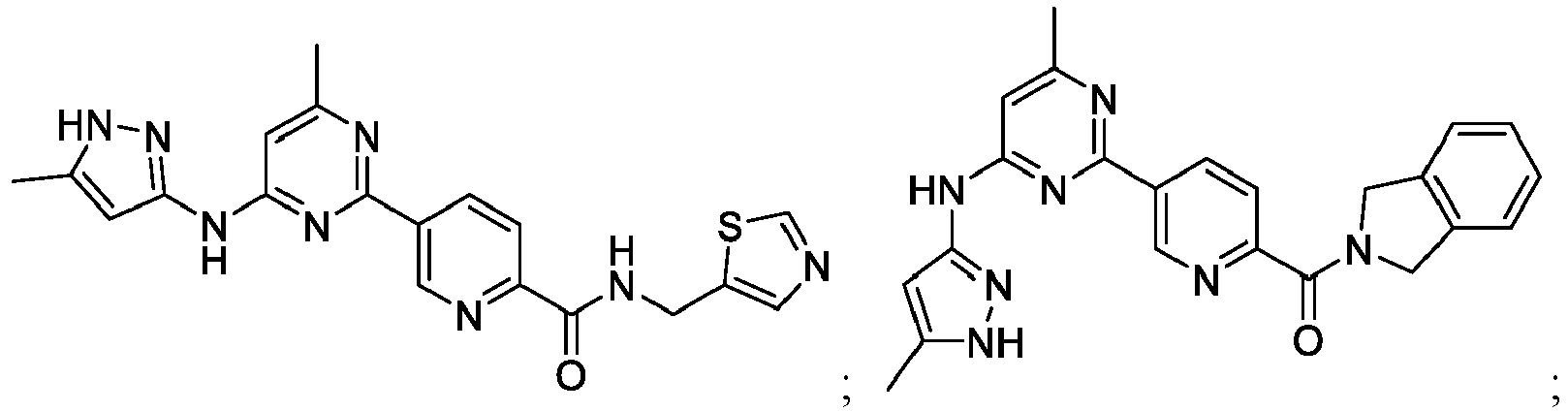


- In some embodiments, a RET inhibitor is selected from the group consisting of: ABT-348 (N-[4-[4-Amino-7-[1-(2-hydroxyethyl)-1H-pyrazol-4-yl]thieno[3,2-c]pyridin-3-yl]phenyl]-N'-(3-fluorophenyl)urea); AD-57, which has the structure:

- Further examples of RET inhibitors include: N-(2-fluoro-5-trifluoromethylphenyl)-N'-{4'-[(2"-benzamido)pyridin-4"-ylamino]phenyl}urea; 1-isopropyl-3-(phenylethynyl)-1H-pyrazolo[3,4-d]pyrimidin-4-amine; 3-((6,7-dimethoxyquinazolin-4-yl)amino)-4-fluoro-2-methylphenol; N-(5-(tert-butyl)isoxazol-3-yl)-2-(4-(imidazo[1,2-a]pyridin-6-yl)phenyl)acetamide; N-(5-(tert-butyl)isoxazol-3-yl)-2-(3-(imidazo[1,2-b]pyridazin-6-yloxy)phenyl)acetamide; 2-amino-6-{[2-(4-chlorophenyl)-2-oxoethyl]sulfanyl}-4-(3-thienyl)pyridine-3,5-dicarbonitrile; and 3-arylureidobenzylidene-indolin-2-ones.
- Yet other therapeutic agents include RET inhibitors such as those described, for example, in
U.S. Patent Nos. 7,504,509 ;8,012,966 ;8,299,057 ;8,399,442 ;8,067,434 ;8,629,135 ;8,895,744 ;8,937,071 ;9,006,256 9,035,063 U.S. Publication Nos. 2015/0272958 ;2015/0238477 ;2014/0121239 ;20160176865 ;2011/0053934 ;2011/0301157 ;2010/0324065 ;2009/0227556 ;2009/0130229 ;2009/0099167 ;2005/0209195 ; International Publication Nos.WO 2017/043550 ;WO 2017/026718 ;WO 2016/037578 ;WO 2016/038519 ;WO 2016/038552 ;WO 2014/184069 ;WO 2014/072220 ;WO 2012/053606 ;WO 2009/017838 ;WO 2008/031551 ;WO 2007/136103 ;WO 2007/087245 ;WO 2007/057399 ;WO 2005/051366 ;WO 2005/062795 ; andWO 2005/044835 ; and J. Med.Chem. 2012, 55 (10), 4872-4876, all of which are hereby incorporated by reference in their entireties. - Non-limiting examples of receptor tyrosine kinase (e.g., Trk) targeted therapeutic agents, include afatinib, cabozantinib, cetuximab, crizotinib, dabrafenib, entrectinib, erlotinib, gefitinib, imatinib, lapatinib, lestaurtinib, nilotinib, pazopanib, panitumumab, pertuzumab, sunitinib, trastuzumab, 1-((3S,4R)-4-(3-fluorophenyl)-1-(2-methoxyethyl)pyrrolidin-3-yl)-3-(4-methyl-3-(2- methylpyrimidin-5-yl)-1 -phenyl- 1H-pyrazol-5-yl)urea, AG 879, AR-772, AR-786, AR-256, AR-618, AZ-23, AZ623, DS-6051, Gö 6976, GNF-5837, GTx-186, GW 441756, LOXO-101, MGCD516, PLX7486, RXDX101, TPX-0005, and TSR-011. Additional Trk targeted therapeutic agents include those described in
U.S. Patent No. 8,450,322 ;8,513,263 ;8,933,084 ;8,791,123 ;8,946,226 ;8,450,322 ;8,299,057 ; and8,912,194 ;U.S. Publication No. 2016/0137654 ;2015/0166564 ;2015/0051222 ;2015/0283132 ; and2015/0306086 ; International Publication No.WO 2010/033941 ;WO 2010/048314 ;WO 2016/077841 ;WO 2011/146336 ;WO 2011/006074 ;WO 2010/033941 ;WO 2012/158413 ;WO 2014078454 ;WO 2014078417 ;WO 2014078408 ;WO 2014078378 ;WO 2014078372 ;WO 2014078331 ;WO 2014078328 ;WO 2014078325 ;WO 2014078323 ;WO 2014078322 ;WO 2015175788 ;WO 2009/013126 ;WO 2013/174876 ;WO 2015/124697 ;WO 2010/058006 ;WO 2015/017533 ;WO 2015/112806 ;WO 2013/183578 ; andWO 2013/074518 , all of which are hereby incorporated by reference in their entireties. - Further examples of Trk inhibitors can be found in
U.S. Patent No. 8,637,516 , International Publication No.WO 2012/034091 ,U.S. Patent No. 9,102,671 WO 2012/116217 ,U.S. Publication No. 2010/0297115 , International Publication No.WO 2009/053442 ,U.S. Patent No. 8,642,035 , International Publication No.WO 2009092049 ,U.S. Patent No. 8,691,221 , International Publication No.WO2006131952 , all of which are incorporated by reference in their entireties herein. Exemplary Trk inhibitors include GNF-4256, described in Cancer Chemother. Pharmacol. 75(1):131-141, 2015; and GNF-5837 (N-[3-[[2,3-dihydro-2-oxo-3-(1H-pyrrol-2-ylmethylene)-1H-indol-6-yl]amino]-4-methylphenyl]-N'-[2-fluoro-5-(trifluoromethyl)phenyl]-urea), described in ACSMed. Chem. Lett. 3(2):140-145, 2012, each of which is incorporated by reference in its entirety herein. - Additional examples of Trk inhibitors include those disclosed in
U.S. Publication No. 2010/0152219 ,U.S. Patent No. 8,114,989 , and International Publication No.WO 2006/123113 , all of which are incorporated by reference in their entireties herein. Exemplary Trk inhibitors include AZ623, described in Cancer 117(6):1321-1391, 2011; AZD6918, described in Cancer Biol. Ther. 16(3):477-483, 2015; AZ64, described in Cancer Chemother. Pharmacol. 70:477-486, 2012; AZ-23 ((S)-5-Chloro-N2-(1-(5-fluoropyridin-2-yl)ethyl)-N4-(5-isopropoxy-1H-pyrazol-3-yl)pyrimidine-2,4-diamine), described in Mol. Cancer Ther. 8:1818-1827, 2009; and AZD7451; each of which is incorporated by reference in its entirety. -
- Further examples of Trk inhibitors include CEP-751, described in Int. J. Cancer 72:672-679, 1997; CT327, described in Acta Derm. Venereol. 95:542-548, 2015; compounds described in International Publication No.
WO 2012/034095 ; compounds described inU.S. Patent No. 8,673,347 and International Publication No.WO 2007/022999 ; compounds described inU.S. Patent No. 8,338,417 ; compounds described in International Publication No.WO 2016/027754 ; compounds described inU.S. Patent No. 9,242,977 U.S. Publication No. 2016/0000783 ; sunitinib (N-(2-diethylaminoethyl)-5-[(Z)-(5-fluoro-2-oxo-1H-indol-3-ylidene)methyl]-2,4-dimethyl-1H-pyrrole-3-carboxamide), as described in PLoS One 9:e95628, 2014; compounds described in International Publication No.WO 2011/133637 ; compounds described inU.S. Patent No. 8,637,256 ; compounds described in Expert. Opin. Ther. Pat. 24(7):731-744, 2014; compounds described in Expert Opin. Ther. Pat. 19(3):305-319, 2009; (R)-2-phenylpyrrolidine substituted imidazopyridazines, e.g., GNF-8625, (R)-1-(6-(6-(2-(3-fluorophenyl)pyrrolidin-1-yl)imidazo[1,2-b]pyridazin-3-yl)-[2,4'-bipyridin]-2'-yl)piperidin-4-ol as described in ACS Med. Chem. Lett. 6(5):562-567, 2015; GTx-186 and others, as described in PLoS One 8(12):e83380, 2013; K252a ((9S-(9α,10β,12α))-2,3,9,10,11,12-hexahydro-10-hydroxy-10-(methoxycarbonyl)-9-methyl-9,12-epoxy-1H-diindolo[1,2,3-fg:3',2',1'-kl]pyrrolo[3,4-i][1,6]benzodiazocin-1-one), as described in Mol. Cell Biochem. 339(1-2):201-213, 2010; 4-aminopyrazolylpyrimidines, e.g., AZ-23 (((S)-5-chloro-N2-(1-(5-fluoropyridin-2-yl)ethyl)-N4-(5-isopropoxy-1H-pyrazol-3-yl)pyrimidine-2,4-diamine)), as described in J. Med. Chem. 51(15):4672-4684, 2008; PHA-739358 (danusertib), as described in Mol. Cancer Ther. 6:3158, 2007; Gö 6976 (5,6,7,13-tetrahydro-13-methyl-5-oxo-12H-indolo[2,3-a]pyrrolo[3,4-c]carbazole-12-propanenitrile), as described in J. Neurochem. 72:919-924, 1999; GW441756 ((3Z)-3-[(1-methylindol-3-yl)methylidene]-1H-pyrrolo[3,2-b]pyridin-2-one), as described in IJAE 115:117, 2010; milciclib (PHA-848125AC), described in J. Carcinog. 12:22, 2013; AG-879 ((2E)-3-[3,5-Bis(1,1-dimethylethyl)-4-hydroxyphenyl]-2-cyano-2-propenethioamide); altiratinib (N-(4-((2-(cyclopropanecarboxamido)pyridin-4-yl)oxy)-2,5-difluorophenyl)-N-(4-fluorophenyl)cyclopropane-1,1-dicarboxamide); cabozantinib (N-(4-((6,7-Dimethoxyquinolin-4-yl)oxy)phenyl)-N'-(4-fluorophenyl)cyclopropane-1,1-dicarboxamide); lestaurtinib ((5S,6S,8R)-6-Hydroxy-6-(hydroxymethyl)-5-methyl-7,8,14,15-tetrahydro-5H-16-oxa-4b,8a,14-triaza-5,8-methanodibenzo[b,h]cycloocta[jkl]cyclopenta[e]-as-indacen-13(6H)-one); dovatinib (4-amino-5-fluoro-3-[6-(4-methylpiperazin-1-yl)-1H-benzimidazol-2-yl]quinolin-2(1H)-one mono 2-hydroxypropanoate hydrate); sitravatinib (N-(3-fluoro-4-((2-(5-(((2-methoxyethyl)amino)methyl)pyridin-2-yl)thieno[3,2-b]pyridin-7-yl)oxy)phenyl)-N-(4-fluorophenyl)cyclopropane-1,1-dicarboxamide); ONO-5390556; regorafenib (4-[4-({[4-Chloro-3-(trifluoromethyl)phenyl]carbamoyl}amino)-3-fluorophenoxy]-N-methylpyridine-2-carboxamide hydrate); and VSR-902A; all of the references above are incorporated by reference in their entireties herein. - The ability of a Trk inhibitor to act as a TrkA, TrkB, and/or Trk C inhibitor may be tested using the assays described in Examples A and B in
U.S. Patent No. 8,513,263 , which is incorporated herein by reference. - In some embodiments, signal transduction pathway inhibitors include Ras-Raf-MEK-ERK pathway inhibitors (e.g., binimetinib, selumetinib, encorafinib, sorafenib, trametinib, and vemurafenib), PI3K-Akt-mTOR-S6K pathway inhibitors (e.g. everolimus, rapamycin, perifosine, temsirolimus), and other kinase inhibitors, such as baricitinib, brigatinib, capmatinib, danusertib, ibrutinib, milciclib, quercetin, regorafenib, ruxolitinib, semaxanib, AP32788, BLU285, BLU554, INCB39110, INCB40093, INCB50465, INCB52793, INCB54828, MGCD265, NMS-088, NMS-1286937, PF 477736 ((R)-amino-N-[5,6-dihydro-2-(1-methyl-1H-pyrazol-4-yl)-6-oxo-1Hpyrrolo[4,3,2-ef][2,3]benzodiazepin-8-yl]-cyclohexaneacetamide), PLX3397, PLX7486, PLX8394, PLX9486, PRN1008, PRN1371, RXDX103, RXDX106, RXDX108, and TG101209 (N-tert-butyl-3-(5-methyl-2-(4-(4-methylpiperazin-1-yl)phenylamino)pyrimidin-4- ylamino)benzenesulfonamide).
- Non-limiting examples of checkpoint inhibitors include ipilimumab, tremelimumab, nivolumab, pidilizumab, MPDL3208A, MEDI4736, MSB0010718C, BMS-936559, BMS-956559, BMS-935559 (MDX-1105), AMP-224, and pembrolizumab.
- In some embodiments, cytotoxic chemotherapeutics are selected from arsenic trioxide, bleomycin, cabazitaxel, capecitabine, carboplatin, cisplatin, cyclophosphamide, cytarabine, dacarbazine, daunorubicin, docetaxel, doxorubicin, etoposide, fluorouracil, gemcitabine, irinotecan, lomustine, methotrexate, mitomycin C, oxaliplatin, paclitaxel, pemetrexed, temozolomide, and vincristine.
- Non-limiting examples of angiogenesis-targeted therapies include aflibercept and bevacizumab.
- The term "immunotherapy" refers to an agent that modulates the immune system. In some embodiments, an immunotherapy can increase the expression and/or activity of a regulator of the immune system. In some embodiments, an immunotherapy can decrease the expression and/or activity of a regulator of the immune system. In some embodiments, an immunotherapy can recruit and/or enhance the activity of an immune cell.
- In some embodiments, the immunotherapy is a cellular immunotherapy (e.g., adoptive T-cell therapy, dendritic cell therapy, natural killer cell therapy). In some embodiments, the cellular immunotherapy is sipuleucel-T (APC8015; Provenge™; Plosker (2011) Drugs 71(1): 101-108). In some embodiments, the cellular immunotherapy includes cells that express a chimeric antigen receptor (CAR). In some embodiments, the cellular immunotherapy is a CAR-T cell therapy. In some embodiments, the CAR-T cell therapy is tisagenlecleucel (Kymriah™).
- In some embodiments, the immunotherapy is an antibody therapy (e.g., a monoclonal antibody, a conjugated antibody). In some embodiments, the antibody therapy is bevacizumab (Mvasti™, Avastin®), trastuzumab (Herceptin®), avelumab (Bavencio®), rituximab (MabThera™, Rituxan®), edrecolomab (Panorex), daratumuab (Darzalex®), olaratumab (Lartruvo™), ofatumumab (Arzerra®), alemtuzumab (Campath®), cetuximab (Erbitux®), oregovomab, pembrolizumab (Keytruda®), dinutiximab (Unituxin®), obinutuzumab (Gazyva®), tremelimumab (CP-675,206), ramucirumab (Cyramza®), ublituximab (TG-1101), panitumumab (Vectibix®), elotuzumab (Empliciti™), avelumab (Bavencio®), necitumumab (Portrazza™), cirmtuzumab (UC-961), ibritumomab (Zevalin®), isatuximab (SAR650984), nimotuzumab, fresolimumab (GC1008), lirilumab (INN), mogamulizumab (Poteligeo®), ficlatuzumab (AV-299), denosumab (Xgeva®), ganitumab, urelumab, pidilizumab or amatuximab.
- In some embodiments, the immunotherapy is an antibody-drug conjugate. In some embodiments, the antibody-drug conjugate is gemtuzumab ozogamicin (Mylotarg™), inotuzumab ozogamicin (Besponsa®), brentuximab vedotin (Adcetris®), ado-trastuzumab emtansine (TDM-1; Kadcyla®), mirvetuximab soravtansine (IMGN853) or anetumab ravtansine
- In some embodiments, the immunotherapy includes blinatumomab (AMG103; Blincyto®) or midostaurin (Rydapt).
- In some embodiments, the immunotherapy includes a toxin. In some embodiments, the immunotherapy is denileukin diftitox (Ontak®).
- In some embodiments, the immunotherapy is a cytokine therapy. In some embodiments, the cytokine therapy is an interleukin 2 (IL-2) therapy, an interferon alpha (IFNα) therapy, a granulocyte colony stimulating factor (G-CSF) therapy, an interleukin 12 (IL-12) therapy, an interleukin 15 (IL-15) therapy, an interleukin 7 (IL-7) therapy or an erythropoietin-alpha (EPO) therapy. In some embodiments, the IL-2 therapy is aldesleukin (Proleukin®). In some embodiments, the IFNα therapy is IntronA® (Roferon-A®). In some embodiments, the G-CSF therapy is filgrastim (Neupogen®).
- In some embodiments, the immunotherapy is an immune checkpoint inhibitor. In some embodiments, the immunotherapy includes one or more immune checkpoint inhibitors. In some embodiments, the immune checkpoint inhibitor is a CTLA-4 inhibitor, a PD-1 inhibitor or a PD-L1 inhibitor. In some embodiments, the CTLA-4 inhibitor is ipilimumab (Yervoy®) or tremelimumab (CP-675,206). In some embodiments, the PD-1 inhibitor is pembrolizumab (Keytruda®) or nivolumab (Opdivo®). In some embodiments, the PD-L1 inhibitor is atezolizumab (Tecentriq®), avelumab (Bavencio®) or durvalumab (Imfinzi™).
- In some embodiments, the immunotherapy is mRNA-based immunotherapy. In some embodiments, the mRNA-based immunotherapy is CV9104 (see, e.g., Rausch et al. (2014) Human Vaccin Immunother 10(11): 3146-52; and Kubler et al. (2015) J. Immunother Cancer 3:26).
- In some embodiments, the immunotherapy is bacillus Calmette-Guerin (BCG) therapy.
- In some embodiments, the immunotherapy is an oncolytic virus therapy. In some embodiments, the oncolytic virus therapy is talimogene alherparepvec (T-VEC; Imlygic®).
- In some embodiments, the immunotherapy is a cancer vaccine. In some embodiments, the cancer vaccine is a human papillomavirus (HPV) vaccine. In some embodiments, the HPV vaccine is Gardasil®, Gardasil9® or Cervarix®. In some embodiments, the cancer vaccine is a hepatitis B virus (HBV) vaccine. In some embodiments, the HBV vaccine is Engerix-B®, Recombivax HB® or GI-13020 (Tarmogen®). In some embodiments, the cancer vaccine is Twinrix® or Pediarix®. In some embodiments, the cancer vaccine is BiovaxID®, Oncophage®, GVAX, ADXS11-001, ALVAC-CEA, PROSTVAC®, Rindopepimut®, CimaVax-EGF, lapuleucel-T (APC8024; Neuvenge™), GRNVAC1, GRNVAC2, GRN-1201, hepcortespenlisimut-L (Hepko-V5), DCVAX®, SCIB1, BMT CTN 1401, PrCa VBIR, PANVAC, ProstAtak®, DPX-Survivac, or viagenpumatucel-L (HS-110).
- In some embodiments, the immunotherapy is a peptide vaccine. In some embodiments, the peptide vaccine is nelipepimut-S (E75) (NeuVax™), IMA901, or SurVaxM (SVN53-67). In some embodiments, the cancer vaccine is an immunogenic personal neoantigen vaccine (see, e.g., Ott et al. (2017) Nature 547: 217-221; Sahin et al. (2017) Nature 547: 222-226). In some embodiments, the cancer vaccine is RGSH4K, or NEO-PV-01. In some embodiments, the cancer vaccine is a DNA-based vaccine. In some embodiments, the DNA-based vaccine is a mammaglobin-A DNA vaccine (see, e.g., Kim et al. (2016) OncoImmunology 5(2): e1069940).
- In some embodiments, immune-targeted agents are selected from aldesleukin, interferon alfa-2b, ipilimumab, lambrolizumab, nivolumab, prednisone, and sipuleucel-T.
- Non-limiting examples of radiotherapy include radioiodide therapy, externalbeam radiation, and radium 223 therapy.
- Additional kinase inhibitors include those described in, for example,
U.S. Patent No. 7,514,446 ;7,863,289 ;8,026,247 ;8,501,756 ;8,552,002 ;8,815,901 ;8,912,204 ;9,260,437 9,273,051 US 2015/0018336 ; International Publication No.WO 2007/002325 ;WO 2007/002433 ;WO 2008/080001 ;WO 2008/079906 ;WO 2008/079903 ;WO 2008/079909 ;WO 2008/080015 ;WO 2009/007748 ;WO 2009/012283 ;WO 2009/143018 ;WO 2009/143024 ;WO 2009/014637 ;2009/152083 ;WO 2010/111527 ;WO 2012/109075 ;WO 2014/194127 ;WO 2015/112806 ;WO 2007/110344 ;WO 2009/071480 ;WO 2009/118411 ;WO 2010/031816 ;WO 2010/145998 ;WO 2011/092120 ;WO 2012/101032 ;WO 2012/139930 ;WO 2012/143248 ;WO 2012/152763 ;WO 2013/014039 ;WO 2013/102059 ;WO 2013/050448 ;WO 2013/050446 ;WO 2014/019908 ;WO 2014/072220 ;WO 2014/184069 ; andWO 2016/075224 all of which are hereby incorporated by reference in their entireties. - Further examples of kinase inhibitors include those described in, for example,
WO 2016/081450 ;WO 2016/022569 ;WO 2016/011141 ;WO 2016/011144 ;WO 2016/011147 ;WO 2015/191667 ;WO 2012/101029 ;WO 2012/113774 ;WO 2015/191666 ;WO 2015/161277 ;WO 2015/161274 ;WO 2015/108992 ;WO 2015/061572 ;WO 2015/058129 ;WO 2015/057873 ;WO 2015/017528 ;WO/2015/017533 ;WO 2014/160521 ; andWO 2014/011900 , each of which is hereby incorporated by reference in its entirety. - Accordingly, also provided herein is a method of treating cancer, comprising administering to a patient in need thereof a pharmaceutical combination for treating cancer which comprises (a) a compound of Formula I or a pharmaceutically acceptable salt or solvate thereof, (b) an additional therapeutic agent, and (c) optionally at least one pharmaceutically acceptable carrier for simultaneous, separate or sequential use for the treatment of cancer, wherein the amounts of the compound of Formula I or a pharmaceutically acceptable salt or solvate thereof and the additional therapeutic agent are together effective in treating the cancer.
- In some embodiments, the additional therapeutic agent(s) includes any one of the above listed therapies or therapeutic agents which are standards of care in cancers wherein the cancer has a dysregulation of a RET gene, a RET protein, or expression or activity, or level of any of the same.
- These additional therapeutic agents may be administered with one or more doses of the compound of Formula I, or a pharmaceutically acceptable salt or solvate thereof, or pharmaceutical composition thereof, as part of the same or separate dosage forms, via the same or different routes of administration, and/or on the same or different administration schedules according to standard pharmaceutical practice known to one skilled in the art.
- Also provided herein is (i) a pharmaceutical combination for treating a cancer in a patient in need thereof, which comprises (a) a compound of Formula I or a pharmaceutically acceptable salt or solvate thereof, (b) at least one additional therapeutic agent (e.g., any of the exemplary additional therapeutic agents described herein or known in the art), and (c) optionally at least one pharmaceutically acceptable carrier for simultaneous, separate or sequential use for the treatment of cancer, wherein the amounts of the compound of Formula I or pharmaceutically acceptable salt or solvate thereof and of the additional therapeutic agent are together effective in treating the cancer; (ii) a pharmaceutical composition comprising such a combination; (iii) the use of such a combination for the preparation of a medicament for the treatment of cancer; and (iv) a commercial package or product comprising such a combination as a combined preparation for simultaneous, separate or sequential use; and to a method of treatment of cancer in a patient in need thereof. In one embodiment the patient is a human. In some embodiments, the cancer is a RET-associated cancer. For example, a RET-associated cancer having one or more RET inhibitor resistance mutations.
- The term "pharmaceutical combination", as used herein, refers to a pharmaceutical therapy resulting from the mixing or combining of more than one active ingredient and includes both fixed and non-fixed combinations of the active ingredients. The term "fixed combination" means that a compound of Formula I or a pharmaceutically acceptable salt or solvate thereof and at least one additional therapeutic agent (e.g., a chemotherapeutic agent), are both administered to a patient simultaneously in the form of a single composition or dosage. The term "non-fixed combination" means that a compound of Formula I or a pharmaceutically acceptable salt or solvate thereof and at least one additional therapeutic agent (e.g., chemotherapeutic agent) are formulated as separate compositions or dosages such that they may be administered to a patient in need thereof simultaneously, concurrently or sequentially with variable intervening time limits, wherein such administration provides effective levels of the two or more compounds in the body of the patient. These also apply to cocktail therapies, e.g. the administration of three or more active ingredients
- Accordingly, also provided herein is a method of treating a cancer, comprising administering to a patient in need thereof a pharmaceutical combination for treating cancer which comprises (a) a compound of Formula I or pharmaceutically acceptable salt or solvate thereof, (b) an additional therapeutic agent, and (c) optionally at least one pharmaceutically acceptable carrier for simultaneous, separate or sequential use for the treatment of cancer, wherein the amounts of the compound of Formula I or pharmaceutically acceptable salt or solvate thereof and the additional therapeutic agent are together effective in treating the cancer. In one embodiment, the compound of Formula I or pharmaceutically acceptable salt or solvate thereof, and the additional therapeutic agent are administered simultaneously as separate dosages. In one embodiment, the compound of Formula I or pharmaceutically acceptable salt or solvate thereof, and the additional therapeutic agent are administered as separate dosages sequentially in any order, in jointly therapeutically effective amounts, e.g. in daily or intermittently dosages. In one embodiment, the compound of Formula I or pharmaceutically acceptable salt or solvate thereof, and the additional therapeutic agent are administered simultaneously as a combined dosage. In some embodiments, the cancer is a RET-associated cancer. For example, a RET-associated cancer having one or more RET inhibitor resistance mutations.
- Also provided herein is a method of treating a disease or disorder mediated by RET in a patient in need of such treatment, the method comprising administering to the patient a therapeutically effective amount of a compound of Formula I or a pharmaceutically acceptable salt or solvate thereof or a pharmaceutical composition thereof. In some embodiments, the disease or disorder mediated by RET is a dysregulation of RET gene, a RET kinase, or expression or activity or level of any of the same. For example the dysregulation of a RET gene, a RET kinase, or expression or activity or level of any of the same includes one or more RET inhibitor resistance mutations. A disease or disorder mediated by RET can include any disease, disorder or condition that is directly or indirectly linked to expression or activity of RET, including overexpression and/or abnormal activity levels. In one embodiment, the disease is cancer (e.g., a RET-associated cancer). In one embodiment, the cancer is any of the cancers or RET-associated cancers described herein.
- Although the genetic basis of tumorigenesis may vary between different cancer types, the cellular and molecular mechanisms required for metastasis appear to be similar for all solid tumor types. During a metastatic cascade, the cancer cells lose growth inhibitory responses, undergo alterations in adhesiveness and produce enzymes that can degrade extracellular matrix components. This leads to detachment of tumor cells from the original tumor, infiltration into the circulation through newly formed vasculature, migration and extravasation of the tumor cells at favorable distant sites where they may form colonies. A number of genes have been identified as being promoters or suppressors of metastasis. For example, overexpression of glial cell-derived neurotrophic factor (GDNF) and its RET receptor tyrosine kinase have been correlated with cancer proliferation and metastasis. See, e.g., Zeng, Q. et al. J. Int. Med. Res. (2008) 36(4): 656-64.
- Accordingly, also provided herein are methods for inhibiting, preventing, aiding in the prevention, or decreasing the symptoms of metastasis of a cancer in a patient in need thereof, the method comprising administering to the patient a therapeutically effective amount of a compound of Formula I or a pharmaceutically acceptable salt or solvate thereof or a pharmaceutical composition thereof. Such methods can be used in the treatment of one or more of the cancers described herein. See, e.g.,
US Publication No. 2013/0029925 ; International Publication No.WO 2014/083567 ; andUS Patent No. 8,568,998 . In some embodiments, the cancer is a RET-associated cancer. In some embodiments, the compound of Formula I or a pharmaceutically acceptable salt or solvate thereof is used in combination with an additional therapy or another therapeutic agent, including a chemotherapeutic agent, such as a kinase inhibitor. For example, a first or second RET kinase inhibitor. - The term "metastasis" is an art known term and means the formation of an additional tumor (e.g., a solid tumor) at a site distant from a primary tumor in a subject or patient, where the additional tumor includes the same or similar cancer cells as the primary tumor.
- Also provided are methods of decreasing the risk of developing a metastasis or an additional metastasis in a patient having a RET-associated cancer that include: selecting, identifying, or diagnosing a patient as having a RET-associated cancer, and administering a therapeutically effective amount of a compound of Formula I or a pharmaceutically acceptable salt or solvate thereof to the patient selected, identified, or diagnosed as having a RET-associated cancer. Also provided are methods of decreasing the risk of developing a metastasis or an additional metastasis in a patient having a RET-associated cancer that includes administering a therapeutically effective amount of a compound of Formula I or a pharmaceutically acceptable salt or solvent thereof to a patient having a RET-associated cancer. The decrease in the risk of developing a metastasis or an additional metastasis in a patient having a RET-associated cancer can be compared to the risk of developing a metastasis or an additional metastasis in the patient prior to treatment, or as compared to a patient or a population of patients having a similar or the same RET-associated cancer that has received no treatment or a different treatment. In some embodiments, the RET-associated cancer is a RET-associated cancer having one or more RET inhibitor resistance mutations.
- The phrase "risk of developing a metastasis" means the risk that a subject or patient having a primary tumor will develop an additional tumor (e.g., a solid tumor) at a site distant from a primary tumor in a subject or patient over a set period of time, where the additional tumor includes the same or similar cancer cells as the primary tumor. Methods for reducing the risk of developing a metastasis in a subject or patient having a cancer are described herein.
- The phrase "risk of developing additional metastases" means the risk that a subject or patient having a primary tumor and one or more additional tumors at sites distant from the primary tumor (where the one or more additional tumors include the same or similar cancer cells as the primary tumor) will develop one or more further tumors distant from the primary tumor, where the further tumors include the same or similar cancer cells as the primary tumor. Methods for reducing the risk of developing additional metastasis are described herein.
- As used herein, a "first RET kinase inhibitor" or "first RET inhibitor" is a RET kinase inhibitor as defined herein, but which does not include a compound of Formula I or a pharmaceutically acceptable salt or solvate thereof as defined herein. As used herein, a "second RET kinase inhibitor" or a "second RET inhibitor" is a RET kinase inhibitor as defined herein, but which does not include a compound of Formula I or a pharmaceutically acceptable salt or solvate thereof as defined herein. When both a first and a second RET inhibitor are present in a method provided herein, the first and second RET kinase inhibitor are different.
- In some embodiments, the presence of one or more RET inhibitor resistance mutations in a tumor causes the tumor to be more resistant to treatment with a first RET inhibitor. Methods useful when a RET inhibitor resistance mutation causes the tumor to be more resistant to treatment with a first RET inhibitor are described below. For example, provided herein are methods of treating a subject having a cancer that include: identifying a subject having a cancer cell that has one or more RET inhibitor resistance mutations; and administering to the identified subject a compound of Formula I or a pharmaceutically acceptable salt or solvate thereof. In some embodiments, the compound of Formula I or a pharmaceutically acceptable salt or solvate thereof is administered in combination with the first RET inhibitor. Also provided are methods of treating a subject identified as having a cancer cell that has one or more RET inhibitor resistance mutations that include administering to the subject a compound of Formula I or a pharmaceutically acceptable salt or solvate thereof. In some embodiments, the compound of Formula I or a pharmaceutically acceptable salt or solvate thereof is administered in combination with the first RET inhibitor. In some embodiments, the one or more RET inhibitor resistance mutations confer increased resistance to a cancer cell or tumor to treatment with the first RET inhibitor. In some embodiments, the one or more RET inhibitor resistance mutations include one or more RET inhibitor resistance mutations listed in Tables 3 and 4. For example, the one or more RET inhibitor resistance mutations can include a substitution at amino acid position 804, e.g., V804M, V804L, or V804E.
- For example, provided herein are methods for treating a RET-associated cancer in a subject in need of such treatment, the method comprising (a) detecting a dysregulation of a RET gene, a RET kinase, or the expression or activity or level of any of the same in a sample from the subject; and (b) administering to the subject a therapeutically effective amount of a first RET inhibitor, wherein the first RET inhibitor is selected from the group consisting of cabozantinib, vandetanib, alectinib, sorafenib, lenvatinib, ponatinib, dovitinib, sunitinib, foretinib, BLU667, and BLU6864. In some embodiments, the methods further comprise (after (b)) (c) determining whether a cancer cell in a sample obtained from the subject has at least one RET inhibitor resistance mutation; and (d) administering a compound of Formula I, or a pharmaceutically acceptable salt of solvate thereof as a monotherapy or in conjunction with another anticancer agent to the subject if the subject has a cancer cell that has at least one RET inhibitor resistance mutation; or (e) administering additional doses of the first RET inhibitor of step (b) to the subject if the subject has a cancer cell that does not have a RET inhibitor resistance mutation. In some embodiments, provided herein are methods for treating a RET-associated cancer in a subject in need of such treatment, the method comprising (a) detecting a dysregulation of a RET gene, a RET kinase, or the expression or activity or level of any of the same in a sample from the subject; and (b) administering to the subject a therapeutically effective amount of a first RET inhibitor, wherein the first RET inhibitor is selected from the group consisting of cabozantinib, vandetanib, alectinib, sorafenib, lenvatinib, ponatinib, dovitinib, sunitinib, foretinib, BLU667, and BLU6864. In some embodiments, the methods further comprise (after (b)) (c) determining whether a cancer cell in a sample obtained from the subject has at least one RET inhibitor resistance mutation; and (d) administering a compound of Formula I selected from i) Example No. 1-20; ii) Example No. 21-40; iii) Example No. 41-49; iv) Example No. 50-70; v) Example No. 71-89; vi) Example No. 90-109; vii) Example No. 110-129; viii) Example No. 130-149; ix) Example No. 150-169; x) Example No. 170-189; xi) Example No. 190-209; xii) Example No. 210-229; xiii) Example No. 230-249; xiv) Example No. 250-259; xv) Example No. 270-289; xvi) Example No. 290-309; xvii) Example No. 310-329; xviii) Example No. 330-349; xix) Example No. 350-369; xx) Example No. 370-384; xxi) Example No. 385-394; xxii) Example No. 395-407; xxiii) Example No. 408-427; xxiii) Example No. 428-447; xxiv) Example No. 448-467; or xxvi) Example No. 468-488; xxvii) Example No. 489-509; xxviii) Example No. 510-530; xxvix) Example No. 531-551; xxx) Example No. 552-572; xxxi) Example No. 573-593; xxxii) Example No. 594-614; xxxiii) Example No. 615-635; xxxiv) Example No. 636-686; xxxv) Example No. 687-707; xxxvi) Example No. 708-728; xxxvii) Example No. 729-749; xxxviii) Example No. 750-770; xxxix) Exampne No. 771-791; xl) Example No. 792-812; xli) Example No. 813-819, or a pharmaceutically acceptable salt of solvate thereof as a monotherapy or in conjunction with another anticancer agent to the subject if the subject has a cancer cell that has at least one RET inhibitor resistance mutation; or (e) administering additional doses of the first RET inhibitor of step (b) to the subject if the subject has a cancer cell that does not have a RET inhibitor resistance mutation. In some embodiments, provided herein are methods for treating a RET-associated cancer in a subject in need of such treatment, the method comprising (a) detecting one or more fusion proteins of Table 1 and/or one or more RET kinase protein point mutations/insertions/deletions of Table 2 in a sample from the subject; and (b) administering to the subject a therapeutically effective amount of a first RET inhibitor, wherein the first RET inhibitor is selected from the group consisting of cabozantinib, vandetanib, alectinib, sorafenib, lenvatinib, ponatinib, dovitinib, sunitinib, foretinib, BLU667, and BLU6864. In some embodiments, the methods further comprise (after (b)) (c) determining whether a cancer cell in a sample obtained from the subject has at least one RET inhibitor resistance mutation of Tables 3 or 4; and (d) administering a compound of Formula I selected from i) Example No. 1-20; ii) Example No. 21-40; iii) Example No. 41-49; iv) Example No. 50-70; v) Example No. 71-89; vi) Example No. 90-109; vii) Example No. 110-129; viii) Example No. 130-149; ix) Example No. 150-169; x) Example No. 170-189; xi) Example No. 190-209; xii) Example No. 210-229; xiii) Example No. 230-249; xiv) Example No. 250-259; xv) Example No. 270-289; xvi) Example No. 290-309; xvii) Example No. 310-329; xviii) Example No. 330-349; xix) Example No. 350-369; xx) Example No. 370-384; xxi) Example No. 385-394; xxii) Example No. 395-407; xxiii) Example No. 408-427; xxiii) Example No. 428-447; xxiv) Example No. 448-467; or xxvi) Example No. 468-488; xxvii) Example No. 489-509; xxviii) Example No. 510-530; xxvix) Example No. 531-551; xxx) Example No. 552-572; xxxi) Example No. 573-593; xxxii) Example No. 594-614; xxxiii) Example No. 615-635; xxxiv) Example No. 636-686; xxxv) Example No. 687-707; xxxvi) Example No. 708-728; xxxvii) Example No. 729-749; xxxviii) Example No. 750-770; xxxix) Exampne No. 771-791; xl) Example No. 792-812; xli) Example No. 813-819, or a pharmaceutically acceptable salt of solvate thereof as a monotherapy or in conjunction with another anticancer agent to the subject if the subject has a cancer cell that has at least one RET inhibitor resistance mutation; or (e) administering additional doses of the first RET inhibitor of step (b) to the subject if the subject has a cancer cell that does not have a RET inhibitor resistance mutation. In some embodiments, provided herein are methods for treating a RET-associated cancer in a subject in need of such treatment, the method comprising (a) detecting the fusion protein KIF5B-RET in a sample from the subject; and (b) administering to the subject a therapeutically effective amount of a first RET inhibitor, wherein the first RET inhibitor is selected from the group consisting of cabozantinib, vandetanib, alectinib, sorafenib, lenvatinib, ponatinib, dovitinib, sunitinib, foretinib, BLU667, and BLU6864. In some embodiments, the methods further comprise (after (b)) (c) determining whether a cancer cell in a sample obtained from the subject has the RET inhibitor resistance mutation V804M; and (d) administering a compound of Formula I or a pharmaceutically acceptable salt or solvate thereof selected from the group consisting of a compound of Formula I selected from i) Example No. 1-20; ii) Example No. 21-40; iii) Example No. 41-49; iv) Example No. 50-70; v) Example No. 71-89; vi) Example No. 90-109; vii) Example No. 110-129; viii) Example No. 130-149; ix) Example No. 150-169; x) Example No. 170-189; xi) Example No. 190-209; xii) Example No. 210-229; xiii) Example No. 230-249; xiv) Example No. 250-259; xv) Example No. 270-289; xvi) Example No. 290-309; xvii) Example No. 310-329; xviii) Example No. 330-349; xix) Example No. 350-369; xx) Example No. 370-384; xxi) Example No. 385-394; xxii) Example No. 395-407; xxiii) Example No. 408-427; xxiii) Example No. 428-447; xxiv) Example No. 448-467; or xxvi) Example No. 468-488; xxvii) Example No. 489-509; xxviii) Example No. 510-530; xxvix) Example No. 531-551; xxx) Example No. 552-572; xxxi) Example No. 573-593; xxxii) Example No. 594-614; xxxiii) Example No. 615-635; xxxiv) Example No. 636-686; xxxv) Example No. 687-707; xxxvi) Example No. 708-728; xxxvii) Example No. 729-749; xxxviii) Example No. 750-770; xxxix) Exampne No. 771-791; xl) Example No. 792-812; xli) Example No. 813-819, or a pharmaceutically acceptable salt of solvate thereof as a monotherapy or in conjunction with another anticancer agent to the subject if the subject has a cancer cell that has at least one RET inhibitor resistance mutation; or (e) administering additional doses of the first RET inhibitor of step (b) to the subject if the subject has a cancer cell that does not have a RET inhibitor resistance mutation.
- As another example, provided herein are methods for treating a RET-associated cancer in a subject in need of such treatment, the method comprising (a) detecting a dysregulation of a RET gene, a RET kinase, or the expression or activity or level of any of the same in a sample from the subject; and (b) administering to the subject a therapeutically effective amount of a compound of Formula I, or a pharmaceutically acceptable salt of solvate thereof. In some embodiments, the methods further comprise (after (b)) (c) determining whether a cancer cell in a sample obtained from the subject has at least one RET inhibitor resistance mutation; and (d) administering a second RET inhibitor, wherein the second RET inhibitor is selected from the group consisting of cabozantinib, vandetanib, alectinib, sorafenib, lenvatinib, ponatinib, dovitinib, sunitinib, foretinib, BLU667, and BLU6864, as a monotherapy or in conjunction with another anticancer agent to the subject if the subject has a cancer cell that has at least one RET inhibitor resistance mutation; or (e) administering additional doses of the compound of Formula I or a pharmaceutically acceptable salt or solvate thereof of step (b) to the subject if the subject has a cancer cell that does not have a RET inhibitor resistance mutation. In some embodiments, provided herein are methods for treating a RET-associated cancer in a subject in need of such treatment, the method comprising (a) detecting a dysregulation of a RET gene, a RET kinase, or the expression or activity or level of any of the same in a sample from the subject; and (b) administering to the subject a therapeutically effective amount of a compound of Formula I selected from i) Example No. 1-20; ii) Example No. 21-40; iii) Example No. 41-49; iv) Example No. 50-70; v) Example No. 71-89; vi) Example No. 90-109; vii) Example No. 110-129; viii) Example No. 130-149; ix) Example No. 150-169; x) Example No. 170-189; xi) Example No. 190-209; xii) Example No. 210-229; xiii) Example No. 230-249; xiv) Example No. 250-259; xv) Example No. 270-289; xvi) Example No. 290-309; xvii) Example No. 310-329; xviii) Example No. 330-349; xix) Example No. 350-369; xx) Example No. 370-384; xxi) Example No. 385-394; xxii) Example No. 395-407; xxiii) Example No. 408-427; xxiii) Example No. 428-447; xxiv) Example No. 448-467; or xxvi) Example No. 468-488; xxvii) Example No. 489-509; xxviii) Example No. 510-530; xxvix) Example No. 531-551; xxx) Example No. 552-572; xxxi) Example No. 573-593; xxxii) Example No. 594-614; xxxiii) Example No. 615-635; xxxiv) Example No. 636-686; xxxv) Example No. 687-707; xxxvi) Example No. 708-728; xxxvii) Example No. 729-749; xxxviii) Example No. 750-770; xxxix) Exampne No. 771-791; xl) Example No. 792-812; xli) Example No. 813-819, or a pharmaceutically acceptable salt of solvate thereof. In some embodiments, the methods further comprise (after (b)) (c) determining whether a cancer cell in a sample obtained from the subject has at least one RET inhibitor resistance mutation; and (d) administering a second RET inhibitor, wherein the second RET inhibitor is selected from the group consisting of cabozantinib, vandetanib, alectinib, sorafenib, lenvatinib, ponatinib, dovitinib, sunitinib, foretinib, BLU667, and BLU6864, as a monotherapy or in conjunction with another anticancer agent to the subject if the subject has a cancer cell that has at least one RET inhibitor resistance mutation; or (e) administering additional doses of the compound of Formula I or a pharmaceutically acceptable salt or solvate thereof of step (b) to the subject if the subject has a cancer cell that does not have a RET inhibitor resistance mutation. In some embodiments, provided herein are methods for treating a RET-associated cancer in a subject in need of such treatment, the method comprising (a) detecting one or more fusion proteins of Table 1 and/or one or more RET kinase protein point mutations/insertions/deletions of Table 2 in a sample from the subject; and (b) administering to the subject a therapeutically effective amount of a compound of Formula I selected from i) Example No. 1-20; ii) Example No. 21-40; iii) Example No. 41-49; iv) Example No. 50-70; v) Example No. 71-89; vi) Example No. 90-109; vii) Example No. 110-129; viii) Example No. 130-149; ix) Example No. 150-169; x) Example No. 170-189; xi) Example No. 190-209; xii) Example No. 210-229; xiii) Example No. 230-249; xiv) Example No. 250-259; xv) Example No. 270-289; xvi) Example No. 290-309; xvii) Example No. 310-329; xviii) Example No. 330-349; xix) Example No. 350-369; xx) Example No. 370-384; xxi) Example No. 385-394; xxii) Example No. 395-407; xxiii) Example No. 408-427; xxiii) Example No. 428-447; xxiv) Example No. 448-467; or xxvi) Example No. 468-488; xxvii) Example No. 489-509; xxviii) Example No. 510-530; xxvix) Example No. 531-551; xxx) Example No. 552-572; xxxi) Example No. 573-593; xxxii) Example No. 594-614; xxxiii) Example No. 615-635; xxxiv) Example No. 636-686; xxxv) Example No. 687-707; xxxvi) Example No. 708-728; xxxvii) Example No. 729-749; xxxviii) Example No. 750-770; xxxix) Exampne No. 771-791; xl) Example No. 792-812; xli) Example No. 813-819, or a pharmaceutically acceptable salt of solvate thereof. In some embodiments, the methods further comprise (after (b)) (c) determining whether a cancer cell in a sample obtained from the subject has at least one RET inhibitor resistance mutation of Tables 3 or 4; and (d) administering a second RET inhibitor, wherein the second RET inhibitor is selected from the group consisting of cabozantinib, vandetanib, alectinib, sorafenib, lenvatinib, ponatinib, dovitinib, sunitinib, foretinib, BLU667, and BLU6864, as a monotherapy or in conjunction with another anticancer agent to the subject if the subject has a cancer cell that has at least one RET inhibitor resistance mutation; or (e) administering additional doses of the compound of Formula I or a pharmaceutically acceptable salt or solvate thereof of step (b) to the subject if the subject has a cancer cell that does not have a RET inhibitor resistance mutation. In some embodiments, provided herein are methods for treating a RET-associated cancer in a subject in need of such treatment, the method comprising (a) detecting the fusion protein KIF5B-RET in a sample from the subject; and (b) administering to the subject a therapeutically effective amount of a compound of Formula I selected from i) Example No. 1-20; ii) Example No. 21-40; iii) Example No. 41-49; iv) Example No. 50-70; v) Example No. 71-89; vi) Example No. 90-109; vii) Example No. 110-129; viii) Example No. 130-149; ix) Example No. 150-169; x) Example No. 170-189; xi) Example No. 190-209; xii) Example No. 210-229; xiii) Example No. 230-249; xiv) Example No. 250-259; xv) Example No. 270-289; xvi) Example No. 290-309; xvii) Example No. 310-329; xviii) Example No. 330-349; xix) Example No. 350-369; xx) Example No. 370-384; xxi) Example No. 385-394; xxii) Example No. 395-407; xxiii) Example No. 408-427; xxiii) Example No. 428-447; xxiv) Example No. 448-467; or xxvi) Example No. 468-488; xxvii) Example No. 489-509; xxviii) Example No. 510-530; xxvix) Example No. 531-551; xxx) Example No. 552-572; xxxi) Example No. 573-593; xxxii) Example No. 594-614; xxxiii) Example No. 615-635; xxxiv) Example No. 636-686; xxxv) Example No. 687-707; xxxvi) Example No. 708-728; xxxvii) Example No. 729-749; xxxviii) Example No. 750-770; xxxix) Exampne No. 771-791; xl) Example No. 792-812; xli) Example No. 813-819, or a pharmaceutically acceptable salt of solvate thereof. In some embodiments, the methods further comprise (after (b)) (c) determining whether a cancer cell in a sample obtained from the subject has the RET inhibitor resistance mutation V804M; and (d) administering a second RET inhibitor, wherein the second RET inhibitor is selected from the group consisting of cabozantinib, vandetanib, alectinib, sorafenib, lenvatinib, ponatinib, dovitinib, sunitinib, foretinib, BLU667, and BLU6864, as a monotherapy or in conjunction with another anticancer agent to the subject if the subject has a cancer cell that has at least one RET inhibitor resistance mutation; or (e) administering additional doses of the compound of Formula I or a pharmaceutically acceptable salt or solvate thereof of step (b) to the subject if the subject has a cancer cell that does not have a RET inhibitor resistance mutation.
- Also, provided herein are methods for treating a RET-associated cancer in a subject in need of such treatment, the method comprising (a) detecting a dysregulation of a RET gene, a RET kinase, or the expression or activity or level of any of the same in a sample from the subject; and (b) administering to the subject a therapeutically effective amount of a compound of Formula I or a pharmaceutically acceptable salt or solvate thereof. In some embodiments, the methods further comprise (after (b)) (c) determining whether a cancer cell in a sample obtained from the subject has at least one RET inhibitor resistance mutation; and (d) administering additional doses of the compound of Formula I or a pharmaceutically acceptable salt or solvate thereof of step (b) to the subject as a monotherapy or in conjunction with another anticancer agent (e.g., a second RET inhibitor, a second compound of Formula I or a pharmaceutically acceptable salt thereof, or immunotherapy) or anticancer therapy (e.g., surgery or radiation) if the subject has a cancer cell that has at least one RET inhibitor resistance mutation. In some embodiments, provided herein are methods for treating a RET-associated cancer in a subject in need of such treatment, the method comprising (a) detecting a dysregulation of a RET gene, a RET kinase, or the expression or activity or level of any of the same in a sample from the subject; and (b) administering to the subject a therapeutically effective amount of a compound of Formula I selected from i) Example No. 1-20; ii) Example No. 21-40; iii) Example No. 41-49; iv) Example No. 50-70; v) Example No. 71-89; vi) Example No. 90-109; vii) Example No. 110-129; viii) Example No. 130-149; ix) Example No. 150-169; x) Example No. 170-189; xi) Example No. 190-209; xii) Example No. 210-229; xiii) Example No. 230-249; xiv) Example No. 250-259; xv) Example No. 270-289; xvi) Example No. 290-309; xvii) Example No. 310-329; xviii) Example No. 330-349; xix) Example No. 350-369; xx) Example No. 370-384; xxi) Example No. 385-394; xxii) Example No. 395-407; xxiii) Example No. 408-427; xxiii) Example No. 428-447; xxiv) Example No. 448-467; or xxvi) Example No. 468-488; xxvii) Example No. 489-509; xxviii) Example No. 510-530; xxvix) Example No. 531-551; xxx) Example No. 552-572; xxxi) Example No. 573-593; xxxii) Example No. 594-614; xxxiii) Example No. 615-635; xxxiv) Example No. 636-686; xxxv) Example No. 687-707; xxxvi) Example No. 708-728; xxxvii) Example No. 729-749; xxxviii) Example No. 750-770; xxxix) Exampne No. 771-791; xl) Example No. 792-812; xli) Example No. 813-819, or a pharmaceutically acceptable salt of solvate thereof. In some embodiments, the methods further comprise (after (b)) (c) determining whether a cancer cell in a sample obtained from the subject has at least one RET inhibitor resistance mutation; and (d) administering additional doses of the compound of Formula I or a pharmaceutically acceptable salt or solvate thereof of step (b) to the subject as a monotherapy or in conjunction with another anticancer agent (e.g., a second RET inhibitor, a second compound of Formula I or a pharmaceutically acceptable salt thereof, or immunotherapy) or anticancer therapy (e.g., surgery or radiation) if the subject has a cancer cell that has at least one RET inhibitor resistance mutation. In some embodiments, provided herein are methods for treating a RET-associated cancer in a subject in need of such treatment, the method comprising (a) detecting one or more fusion proteins of Table 1 and/or one or more RET kinase protein point mutations/insertions/deletions of Table 2 in a sample from the subject; and (b) administering to the subject a therapeutically effective amount of a compound of Formula I or a pharmaceutically acceptable salt or solvate thereof selected from the group consisting of a compound of Formula I selected from i) Example No. 1-20; ii) Example No. 21-40; iii) Example No. 41-49; iv) Example No. 50-70; v) Example No. 71-89; vi) Example No. 90-109; vii) Example No. 110-129; viii) Example No. 130-149; ix) Example No. 150-169; x) Example No. 170-189; xi) Example No. 190-209; xii) Example No. 210-229; xiii) Example No. 230-249; xiv) Example No. 250-259; xv) Example No. 270-289; xvi) Example No. 290-309; xvii) Example No. 310-329; xviii) Example No. 330-349; xix) Example No. 350-369; xx) Example No. 370-384; xxi) Example No. 385-394; xxii) Example No. 395-407; xxiii) Example No. 408-427; xxiii) Example No. 428-447; xxiv) Example No. 448-467; or xxvi) Example No. 468-488; xxvii) Example No. 489-509; xxviii) Example No. 510-530; xxvix) Example No. 531-551; xxx) Example No. 552-572; xxxi) Example No. 573-593; xxxii) Example No. 594-614; xxxiii) Example No. 615-635; xxxiv) Example No. 636-686; xxxv) Example No. 687-707; xxxvi) Example No. 708-728; xxxvii) Example No. 729-749; xxxviii) Example No. 750-770; xxxix) Exampne No. 771-791; xl) Example No. 792-812; xli) Example No. 813-819, or a pharmaceutically acceptable salt of solvate thereof. In some embodiments, the methods further comprise (after (b)) (c) determining whether a cancer cell in a sample obtained from the subject has at least one RET inhibitor resistance mutation of Tables 3 or 4; and (d) administering additional doses of the compound of Formula I or a pharmaceutically acceptable salt or solvate thereof of step (b) to the subject as a monotherapy or in conjunction with another anticancer agent (e.g., a second RET inhibitor, a second compound of Formula I or a pharmaceutically acceptable salt thereof, or immunotherapy) or anticancer therapy (e.g., surgery or radiation) if the subject has a cancer cell that has at least one RET inhibitor resistance mutation. In some embodiments, a second RET inhibitor selected from the group consisting of cabozantinib, vandetanib, alectinib, sorafenib, lenvatinib, ponatinib, dovitinib, sunitinib, foretinib, BLU667, and BLU6864 is administered in step (d). In some embodiments, provided herein are methods for treating a RET-associated cancer in a subject in need of such treatment, the method comprising (a) detecting the fusion protein KIF5B-RET in a sample from the subject; and (b) administering to the subject a therapeutically effective amount of a compound of Formula I selected from i) Example No. 1-20; ii) Example No. 21-40; iii) Example No. 41-49; iv) Example No. 50-70; v) Example No. 71-89; vi) Example No. 90-109; vii) Example No. 110-129; viii) Example No. 130-149; ix) Example No. 150-169; x) Example No. 170-189; xi) Example No. 190-209; xii) Example No. 210-229; xiii) Example No. 230-249; xiv) Example No. 250-259; xv) Example No. 270-289; xvi) Example No. 290-309; xvii) Example No. 310-329; xviii) Example No. 330-349; xix) Example No. 350-369; xx) Example No. 370-384; xxi) Example No. 385-394; xxii) Example No. 395-407; xxiii) Example No. 408-427; xxiii) Example No. 428-447; xxiv) Example No. 448-467; or xxvi) Example No. 468-488; xxvii) Example No. 489-509; xxviii) Example No. 510-530; xxvix) Example No. 531-551; xxx) Example No. 552-572; xxxi) Example No. 573-593; xxxii) Example No. 594-614; xxxiii) Example No. 615-635; xxxiv) Example No. 636-686; xxxv) Example No. 687-707; xxxvi) Example No. 708-728; xxxvii) Example No. 729-749; xxxviii) Example No. 750-770; xxxix) Exampne No. 771-791; xl) Example No. 792-812; xli) Example No. 813-819, or a pharmaceutically acceptable salt of solvate thereof. In some embodiments, the methods further comprise (after (b)) (c) determining whether a cancer cell in a sample obtained from the subject has the RET inhibitor resistance mutation V804M; and (d) administering additional doses of the compound of Formula I or a pharmaceutically acceptable salt or solvate thereof of step (b) to the subject as a monotherapy or in conjunction with another anticancer agent (e.g., a second RET inhibitor, a second compound of Formula I or a pharmaceutically acceptable salt thereof, or immunotherapy) or anticancer therapy (e.g., surgery or radiation) if the subject has a cancer cell that has at least one RET inhibitor resistance mutation. In some embodiments, a second RET inhibitor selected from the group consisting of cabozantinib, vandetanib, alectinib, sorafenib, lenvatinib, ponatinib, dovitinib, sunitinib, foretinib, BLU667, and BLU6864 is administered in step (d).
- Also provided are methods of selecting a treatment for a subject having a cancer that include: identifying a subject having a cancer cell that has one or more RET inhibitor resistance mutations; and selecting a treatment that includes administration of a compound of Formula I or a pharmaceutically acceptable salt or solvate thereof. In some embodiments, the one or more RET inhibitor resistance mutations confer increased resistance to a cancer cell or tumor to treatment with a first RET inhibitor. In some embodiments, the compound of Formula I or a pharmaceutically acceptable salt or solvate thereof is administered in combination with the first RET inhibitor. Also provided are methods of selecting a treatment for a subject having a cancer that include: selecting a treatment that includes administration of a compound of Formula I or a pharmaceutically acceptable salt or solvate thereof for a subject identified as having a cancer cell that has one or more RET inhibitor resistance mutations. Also provided are methods of selecting a subject having a cancer for a treatment that does not include a first RET inhibitor as a monotherapy that include: identifying a subject having a cancer cell that has one or more RET inhibitor resistance mutations; and selecting the identified subject for a treatment that includes a compound of Formula I or a pharmaceutically acceptable salt or solvate thereof. Also provided are methods of selecting a subject having a cancer for a treatment that does not include a first RET inhibitor as a monotherapy that include: selecting a subject identified as having a cancer cell that has one or more RET inhibitor resistance mutations for a treatment that includes administration of a compound of Formula I or a pharmaceutically acceptable salt or solvate thereof. In some embodiments, the one or more RET inhibitor resistance mutations include one or more RET inhibitor resistance mutations listed in Tables 3 and 4. In some embodiments, the one or more RET inhibitor resistance mutations can include a substitution at amino acid position 804, e.g., V804M, V804L, or V804E.
- Also provided are methods of determining the likelihood that a subject having a cancer (e.g., a RET-associated cancer) will have a positive response to treatment with a first RET inhibitor as a monotherapy that include: determining whether a cancer cell in a sample obtained from the subject has one or more RET inhibitor resistance mutations; and determining that a subject having a cancer cell that has one or more RET inhibitor resistance mutations has a decreased likelihood of having a positive response (i.e. an increased likelihood of having a negative response) to treatment with a first RET inhibitor as a monotherapy. Also provided are methods of determining the likelihood that a subject having a cancer (e.g., a RET-associated cancer) will have a positive response to treatment with a first RET inhibitor as a monotherapy that include: determining whether a cancer cell in a sample obtained from the subject has one or more RET inhibitor resistance mutations; and determining that a subject not having a cancer cell that has one or more RET inhibitor resistance mutations has an increased likelihood of having a positive response to treatment with a first RET inhibitor as a monotherapy as compared to a subject having a cancer cell that has one or more RET inhibitor resistance mutations. Also provided are methods of predicting the efficacy of treatment with a first RET inhibitor as a monotherapy in a subject having cancer that include: determining whether a cancer cell in a sample obtained from the subject has one or more RET inhibitor resistance mutations; and determining that treatment with a first RET inhibitor as a monotherapy is less likely to be effective in a subject having a cancer cell in a sample obtained from the subject that has one or more RET inhibitor resistance mutations. Also provided are methods of predicting the efficacy of treatment with a first RET inhibitor as a monotherapy in a subject having cancer that include: determining that treatment with a first RET inhibitor as a monotherapy is less likely to be effective in a subject having a cancer cell in a sample obtained from the subject that has one or more RET inhibitor resistance mutations. In some embodiments, the one or more RET inhibitor resistance mutations confer increased resistance to a cancer cell or tumor to treatment with the first RET inhibitor. In some embodiments, the one or more RET inhibitor resistance mutations include one or more RET inhibitor resistance mutations listed in Tables 3 and 4. For example, the one or more RET inhibitor resistance mutations can include a substitution at amino acid position 804, e.g., V804M, V804L, or V804E.
- Also provided are methods of treating a subject having a cancer that include: (a) administering one or more doses of a first RET inhibitor to the subject for a period of time; (b) after (a), determining whether a cancer cell in a sample obtained from the subject has at least one RET inhibitor resistance mutation; and (c) administering a compound of Formula I or a pharmaceutically acceptable salt or solvate thereof as a monotherapy or in conjunction with another anticancer agent to the subject if the subject has a cancer cell that has at least one RET inhibitor resistance mutation; or (d) administering additional doses of the first RET inhibitor of step (a) to the subject if the subject has a cancer cell that does not have a RET inhibitor resistance mutation. In some embodiments, where the subject is administered additional doses of the first RET inhibitor of step (a), the subject can also be administered another anticancer agent (e.g., a second RET inhibitor or a compound of Formula I or a pharmaceutically acceptable salt or solvate thereof, or immunotherapy). In some embodiments, the additional anticancer agent is any anticancer agent known in the art. For example, the additional anticancer agent is another RET inhibitor (e.g., a second RET inhibitor). In some embodiments, the additional anticancer agent is an immunotherapy. In some embodiments of step (c), another RET inhibitor can be the first RET inhibitor administered in step (a). In some embodiments, the one or more RET inhibitor resistance mutations confer increased resistance to a cancer cell or tumor to treatment with the first RET inhibitor. In some embodiments, the one or more RET inhibitor resistance mutations include one or more RET inhibitor resistance mutations listed in Tables 3 and 4. For example, the one or more RET inhibitor resistance mutations can include a substitution at amino acid position 804, e.g., V804M, V804L, or V804E.
- Also provided are methods of treating a subject having a cancer that include: (a) administering one or more doses of a first RET inhibitor to the subject for a period of time; (b) after (a), determining whether a cancer cell in a sample obtained from the subject has at least one RET inhibitor resistance mutation; and (c) administering a second RET inhibitor as a monotherapy or in conjunction with another anticancer agent to the subject if the subject has a cancer cell that has at least one RET inhibitor resistance mutation; or (d) administering additional doses of the first RET inhibitor step (a) to the subject if the subject has a cancer cell that does not have a RET inhibitor resistance mutation. In some embodiments, where the subject is administered additional doses of the first RET inhibitor of step (a), the subject can also be administered another anticancer agent. In some embodiments, the one or more RET inhibitor resistance mutations confer increased resistance to a cancer cell or tumor to treatment with the first RET inhibitor. In some embodiments, the one or more RET inhibitor resistance mutations include one or more RET inhibitor resistance mutations listed in Tables 3 and 4. For example, the one or more RET inhibitor resistance mutations can include a substitution at amino acid position 804, e.g., V804M, V804L, or V804E. In some embodiments, the additional anticancer agent is any anticancer agent known in the art. For example, the additional anticancer agent is another RET inhibitor (e.g., a compound of Formula I or a pharmaceutically acceptable salt or solvate thereof). In some embodiments, the additional anticancer agent is an immunotherapy.
- Also provided are methods of treating a subject having a cancer (e.g., a RET-associated cancer) that include: (a) determining whether a cancer cell in a sample obtained from a subject having a cancer and previously administered one or more doses of a first RET inhibitor, has one or more RET inhibitor resistance mutations; and (b) administering a compound of Formula I or a pharmaceutically acceptable salt or solvate thereof as a monotherapy or in conjunction with another anticancer agent to the subject if the subject has a cancer cell that has at least one RET inhibitor resistance mutation; or (c) administering additional doses of the first RET inhibitor previously administered to the subject if the subject has cancer cell that does not have a RET inhibitor resistance mutation. In some embodiments, where the subject is administered additional doses of the first RET inhibitor previously administered to the subject, the subject can also be administered another anticancer agent (e.g., a compound of Formula I or a pharmaceutically acceptable salt or solvate thereof, or immunotherapy). In some embodiments, the one or more RET inhibitor resistance mutations confer increased resistance to a cancer cell or tumor to treatment with the first RET inhibitor. In some embodiments, the one or more RET inhibitor resistance mutations include one or more RET inhibitor resistance mutations listed in Tables 3 and 4. For example, the one or more RET inhibitor resistance mutations can include a substitution at amino acid position 804, e.g., V804M, V804L, or V804E. In some embodiments, the additional anticancer agent is any anticancer agent known in the art. For example, the additional anticancer agent is another RET inhibitor (e.g., a second RET inhibitor). In some embodiments, the additional anticancer agent is an immunotherapy. In some embodiments of step (b), another anticancer agent can be the first RET inhibitor administered in step (a).
- Also provided are methods of treating a subject having a cancer that include: (a) determining whether a cancer cell in a sample obtained from a subject having a cancer and previously administered one or more doses of a first RET inhibitor has one or more RET inhibitor resistance mutations; and (b) administering a second RET inhibitor as a monotherapy or in conjunction with another anticancer agent to the subject if the subject has a cancer cell that has at least one RET inhibitor resistance mutation; or (c) administering additional doses of the first RET inhibitor previously administered to the subject if the subject has a cancer cell that does not have a RET inhibitor resistance mutation. In some embodiments, where the subject is administered additional doses of the first RET inhibitor previously administered to the subject, the subject can also be administered another anticancer agent. In some embodiments, the one or more RET inhibitor resistance mutations confer increased resistance to a cancer cell or tumor to treatment with the first RET inhibitor. In some embodiments, the one or more RET inhibitor resistance mutations include one or more RET inhibitor resistance mutations listed in Tables 3 and 4. For example, the one or more RET inhibitor resistance mutations can include a substitution at amino acid position 804, e.g., V804M, V804L, or V804E. In some embodiments, the additional anticancer agent is any anticancer agent known in the art. For example, the additional anticancer agent is another RET inhibitor (e.g., a compound of Formula I or a pharmaceutically acceptable salt or solvate thereof). In some embodiments, the additional anticancer agent is an immunotherapy. In some embodiments of (b), another anticancer agent can be the first RET inhibitor administered in step (a).
- Also provided are methods of selecting a treatment for a subject having a cancer that include (a) administering one or more doses of a first RET inhibitor to the subject for a period of time; (b) after (a), determining whether a cancer cell in a sample obtained from the subject has at least one RET inhibitor resistance mutation; and (c) selecting a compound of Formula I or a pharmaceutically acceptable salt or solvate thereof as a monotherapy or in conjunction with another anticancer agent for the subject if the subject has a cancer cell that has one or more RET inhibitor resistance mutations; or (d) selecting additional doses of the first RET inhibitor of step (a) for the subject if the subject has a cancer cell that does not have a RET inhibitor resistance mutation. In some embodiments, when additional doses of the first RET inhibitor of step (a) are selected for the subject, the method can further include selecting doses of another anticancer agent for the subject. In some embodiments, the one or more RET inhibitor resistance mutations confer increased resistance to a cancer cell or tumor to treatment with the first RET inhibitor. In some embodiments, the one or more RET inhibitor resistance mutations include one or more RET inhibitor resistance mutations listed in Tables 3 and 4. For example, the one or more RET inhibitor resistance mutations can include a substitution at amino acid position 804, e.g., V804M, V804L, or V804E. In some embodiments, the additional anticancer agent is any anticancer agent known in the art. For example, the additional anticancer agent is another RET inhibitor (e.g., a second RET inhibitor). In some embodiments, the additional anticancer agent is an immunotherapy. In some embodiments of step (c), another RET inhibitor can be the first RET inhibitor administered in step (a).
- Also provided are methods of selecting a treatment for a subject having a cancer that include (a) administering one or more doses of a first RET inhibitor to the subject for a period of time; (b) after (a), determining whether a cancer cell in a sample obtained from the subject has at least one RET inhibitor resistance mutation; and (c) selecting a second RET inhibitor as a monotherapy or in conjunction with another anticancer agent if the subject has a cancer cell that has one or more RET inhibitor resistance mutations; or (d) selecting additional doses of the first RET inhibitor of step (a) for the subject if the subject has a cancer cell that does not have a RET inhibitor resistance mutation. In some embodiments, when additional doses of the first RET inhibitor of step (a) are selected for the subject, the method can further include selecting doses of another anticancer agent for the subject. In some embodiments, the one or more RET inhibitor resistance mutations confer increased resistance to a cancer cell or tumor to treatment with the first RET inhibitor. In some embodiments, the one or more RET inhibitor resistance mutations include one or more RET inhibitor resistance mutations listed in Tables 3 and 4. For example, the one or more RET inhibitor resistance mutations can include a substitution at amino acid position 804, e.g., V804M, V804L, or V804E. In some embodiments, the additional anticancer agent is any anticancer agent known in the art. For example, the additional anticancer agent is another RET inhibitor (e.g., a compound of Formula I or a pharmaceutically acceptable salt or solvate thereof). In some embodiments, the additional anticancer agent is an immunotherapy. In some embodiments, another RET can be the first RET inhibitor administered in step (a).
- Also provided are methods of selecting a treatment for a subject having a cancer that include (a) determining whether a cancer cell in a sample obtained from a subject having a cancer and previously administered one or more doses of a first RET inhibitor has one or more RET inhibitor resistance mutations; (b) selecting a compound of Formula I or a pharmaceutically acceptable salt or solvate thereof as a monotherapy or in conjunction with another anticancer agent for the subject if the subject has a cancer cell that has at least one RET inhibitor resistance mutation; or (c) selecting additional doses of the first RET inhibitor previously administered to the subject if the subject has a cancer cell that does not have a RET inhibitor resistance mutation. In some embodiments, when additional doses of the first RET inhibitor previously administered to the subject are selected for the subject, the method can further include selecting doses of another anticancer agent (e.g., a compound of Formula I or a pharmaceutically acceptable salt or solvate thereof, or immunotherapy) for the subject. In some embodiments, the one or more RET inhibitor resistance mutations confer increased resistance to a cancer cell or tumor to treatment with the first RET inhibitor. In some embodiments, the one or more RET inhibitor resistance mutations include one or more RET inhibitor resistance mutations listed in Tables 3 and 4. For example, the one or more RET inhibitor resistance mutations can include a substitution at amino acid position 804, e.g., V804M, V804L, or V804E. In some embodiments, the additional anticancer agent is any anticancer agent known in the art. For example, the additional anticancer agent is another RET inhibitor (e.g., a second RET inhibitor). In some embodiments, the additional anticancer agent is an immunotherapy. In some embodiments of step (c), another RET inhibitor can be the first RET inhibitor administered in step (a).
- Also provided are methods of selecting a treatment for a subject having a cancer that include (a) determining whether a cancer cell in a sample obtained from a subject having a cancer and previously administered one or more doses of a first RET inhibitor has one or more RET inhibitor resistance mutations; (b) selecting a second RET inhibitor as a monotherapy or in conjunction with another anticancer agent for the subject if the subject has a cancer cell that has at least one RET inhibitor resistance mutation; or (c) selecting additional doses of the first RET inhibitor previously administered to the subject if the subject has a cancer cell that does not have a RET inhibitor resistance mutation. In some embodiments, when additional doses of the first RET inhibitor previously administered to the subject are selected for the subject, the method can further include selecting doses of another anticancer agent (e.g., a compound of Formula I or a pharmaceutically acceptable salt or solvate thereof, or immunotherapy) for the subject. In some embodiments, the one or more RET inhibitor resistance mutations confer increased resistance to a cancer cell or tumor to treatment with the first RET inhibitor. In some embodiments, the one or more RET inhibitor resistance mutations include one or more RET inhibitor resistance mutations listed in Tables 3 and 4. For example, the one or more RET inhibitor resistance mutations can include a substitution at amino acid position 804, e.g., V804M, V804L, or V804E. In some embodiments, the additional anticancer agent is any anticancer agent known in the art. For example, the additional anticancer agent is another RET inhibitor (e.g., a compound of Formula I or a pharmaceutically acceptable salt or solvate thereof). In some embodiments, the additional anticancer agent is an immunotherapy. In some embodiments, another RET can be the first RET inhibitor administered in step (a).
- Also provided are methods of determining a subject's risk for developing a cancer that has some resistance to a first RET inhibitor that include: determining whether a cell in a sample obtained from the subject has one or more RET inhibitor resistance mutations; and identifying a subject having a cell that has one or more RET inhibitor resistance mutations, as having an increased likelihood of developing a cancer that has some resistance to the first RET inhibitor. Also provided are methods of determining a subject's risk for developing a cancer that has some resistance to a first RET inhibitor that include: identifying a subject having a cell that has one or more RET inhibitor resistance mutations, as having an increased likelihood of developing a cancer that has some resistance to the first RET inhibitor. Also provided are methods of determining the presence of a cancer that has some resistance to a first RET inhibitor that include: determining whether a cancer cell in a sample obtained from the subject has one or more RET inhibitor resistance mutations; and determining that the subject having a cancer cell that has one or more RET inhibitor resistance mutations has a cancer that has some resistance to the first RET inhibitor. Also provided are methods of determining the presence of a cancer that has some resistance to a first RET inhibitor in a subject that include: determining that a subject having a cancer cell that has one or more RET inhibitor resistance mutations, has a cancer that has some resistance to the first RET inhibitor. In some embodiments, the one or more RET inhibitor resistance mutations confer increased resistance to a cancer cell or tumor to treatment with the first RET inhibitor. In some embodiments, the one or more RET inhibitor resistance mutations include one or more RET inhibitor resistance mutations listed in Tables 3 and 4. For example, the one or more RET inhibitor resistance mutations can include a substitution at amino acid position 804, e.g., V804M, V804L, or V804E.
- In some embodiments of any of the methods described herein, a RET inhibitor resistance mutation that confers increased resistance to a cancer cell or tumor to treatment with a first RET inhibitor can be any of the RET inhibitor resistance mutations listed in Table 3 or 4 (e.g., a substitution at amino acid position 804, e.g., V804M, V804L, or V804E).
- In some embodiments, the presence of one or more RET inhibitor resistance mutations in a tumor causes the tumor to be more resistant to treatment with a compound of Formula I or a pharmaceutically acceptable salt or solvate thereof. Methods useful when a RET inhibitor resistance mutation causes the tumor to be more resistant to treatment with a compound of Formula I or a pharmaceutically acceptable salt or solvate thereof are described below. For example, provided herein are methods of treating a subject having a cancer that include: identifying a subject having a cancer cell that has one or more RET inhibitor resistance mutations; and administering to the identified subject a treatment that does not include a compound of Formula I or a pharmaceutically acceptable salt or solvate thereof as a monotherapy (e.g., a second RET kinase inhibitor). Also provided are methods of treating a subject identified as having a cancer cell that has one or more RET inhibitor resistance mutations that include administering to the subject a treatment that does not include a compound of Formula I or a pharmaceutically acceptable salt or solvate thereof as a monotherapy (e.g., a second RET kinase inhibitor). In some embodiments, the one or more RET inhibitor resistance mutations confer increased resistance to a cancer cell or tumor to treatment with a compound of Formula I or a pharmaceutically acceptable salt or solvate thereof.
- Also provided are methods of selecting a treatment for a subject having a cancer that include: identifying a subject having a cancer cell that has one or more RET inhibitor resistance mutations; and selecting a treatment that does not include a compound of Formula I or a pharmaceutically acceptable salt or solvate thereof as a monotherapy for the identified subject (e.g., a second RET kinase inhibitor). Also provided are methods of selecting a treatment for a subject having a cancer that include: selecting a treatment that does not include a compound of Formula I or a pharmaceutically acceptable salt or solvate thereof as a monotherapy (e.g., a second RET kinase inhibitor) for a subject identified as having a cancer cell that has one or more RET inhibitor resistance mutations. Also provided are methods of selecting a subject having a cancer for a treatment that does not include a compound of Formula I or a pharmaceutically acceptable salt or solvate thereof as a monotherapy (e.g., a second RET kinase inhibitor) that include: identifying a subject having a cancer cell that has one or more RET inhibitor resistance mutations; and selecting the identified subject for a treatment that does not include a compound of Formula I or a pharmaceutically acceptable salt or solvate thereof as a monotherapy (e.g., a second RET kinase inhibitor). Also provided are methods of selecting a subject having a cancer for a treatment that does not include a compound of Formula I or a pharmaceutically acceptable salt or solvate thereof as a monotherapy (e.g., a second RET kinase inhibitor) that include: selecting a subject identified as having a cancer cell that has one or more RET inhibitor resistance mutations for a treatment that does not include a compound of Formula I or a pharmaceutically acceptable salt or solvate thereof as a monotherapy. In some embodiments, the one or more RET inhibitor resistance mutations confer increased resistance to a cancer cell or tumor to treatment with a compound of Formula I or a pharmaceutically acceptable salt or solvate thereof.
- Also provided are methods of determining the likelihood that a subject having a cancer will have a positive response to treatment with a compound of Formula I or a pharmaceutically acceptable salt or solvate thereof as a monotherapy that include: determining whether a cancer cell in a sample obtained from the subject has one or more RET inhibitor resistance mutations; and determining that the subject having the cancer cell that has one or more RET inhibitor resistance mutations has a decreased likelihood of having a positive response to treatment with a compound of Formula I or a pharmaceutically acceptable salt or solvate thereof as a monotherapy. Also provided are methods of determining the likelihood that a subject having cancer will have a positive response to treatment with a compound of Formula I or a pharmaceutically acceptable salt or solvate thereof as a monotherapy that include: determining that a subject having a cancer cell that has one or more RET inhibitor resistance mutations has a decreased likelihood of having a positive response to treatment with a compound of Formula I or a pharmaceutically acceptable salt or solvate thereof as a monotherapy. Also provided are methods of predicting the efficacy of treatment with a compound of Formula I or a pharmaceutically acceptable salt or solvate thereof as a monotherapy in a subject having cancer that include: determining whether a cancer cell in a sample obtained from the subject has one or more RET inhibitor resistance mutations; and determining that treatment with a compound of Formula I or a pharmaceutically acceptable salt or solvate thereof as a monotherapy is less likely to be effective in a subject having a cancer cell in a sample obtained from the subject that has one or more RET inhibitor resistance mutations. Also provided are methods of predicting the efficacy of treatment with a compound of Formula I or a pharmaceutically acceptable salt or solvate thereof as a monotherapy in a subject having cancer that include: determining that treatment with a compound of Formula I or a pharmaceutically acceptable salt or solvate thereof as a monotherapy is less likely to be effective in a subject having a cancer cell in a sample obtained from the subject that has one or more RET inhibitor resistance mutations. In some embodiments, the one or more RET inhibitor resistance mutations confer increased resistance to a cancer cell or tumor to treatment with a compound of Formula I or a pharmaceutically acceptable salt or solvate thereof.
- Also provided are methods of treating a subject having a cancer that include: (a) administering one or more doses of a compound of Formula I or a pharmaceutically acceptable salt or solvate thereof for a period of time; (b) after (a), determining whether a cancer cell in a sample obtained from the subject has one or more RET inhibitor resistance mutations; and (c) administering a second RET inhibitor or a second compound of Formula I or a pharmaceutically acceptable salt or solvate thereof as a monotherapy or in conjunction with another anticancer agent to a subject having a cancer cell that has one or more RET inhibitor resistance mutations; or (d) administering additional doses of the compound of Formula I or a pharmaceutically acceptable salt or solvate thereof of step (a) to a subject having a cancer cell that does not have a RET inhibitor resistance mutation. In some embodiments, where the subject is administered additional doses of the compound of Formula I or a pharmaceutically acceptable salt or solvate thereof of step (a), the subject can also be administered another anticancer agent or a second compound of Formula I or a pharmaceutically acceptable salt or solvate thereof. In some embodiments, the one or more RET inhibitor resistance mutations confer increased resistance to a cancer cell or tumor to treatment with a compound of Formula I or a pharmaceutically acceptable salt or solvate thereof. In some embodiments, the additional anticancer agent is any anticancer agent known in the art. For example, the additional anticancer agent is another RET inhibitor (e.g., a second RET inhibitor). In some embodiments, the additional anticancer agent is an immunotherapy. In some embodiments, another RET can be the compound of Formula I or a pharmaceutically acceptable salt or solvate thereof administered in step (a).
- Also provided are methods of treating a subject having a cancer that include: (a) determining whether a cancer cell in a sample obtained from a subject having a cancer and previously administered one or more doses of a compound of Formula I or a pharmaceutically acceptable salt or solvate thereof, has one or more RET inhibitor resistance mutations; (b) administering a second RET inhibitor or a second compound of Formula I or a pharmaceutically acceptable salt or solvate thereof as a monotherapy or in conjunction with another anticancer agent to a subject having a cancer cell that has one or more RET inhibitor resistance mutations; or (c) administering additional doses of the compound of Formula I or a pharmaceutically acceptable salt or solvate thereof previously administered to a subject having a cancer cell that does not have a RET inhibitor resistance mutation. In some embodiments, where the subject is administered additional doses of the compound of Formula I or a pharmaceutically acceptable salt or solvate thereof of step (a), the subject can also be administered another anticancer agent. In some embodiments, the one or more RET inhibitor resistance mutations confer increased resistance to a cancer cell or tumor to treatment with a compound of Formula I or a pharmaceutically acceptable salt or solvate thereof. In some embodiments, the additional anticancer agent is any anticancer agent known in the art. For example, the additional anticancer agent is another RET inhibitor (e.g., a second RET inhibitor). In some embodiments, the additional anticancer agent is an immunotherapy. In some embodiments, another RET can be the compound of Formula I or a pharmaceutically acceptable salt or solvate thereof administered in step (a).
- Also provided are methods of selecting a treatment for a subject having a cancer that include: (a) administering one or more doses of a compound of Formula I or a pharmaceutically acceptable salt or solvate thereof to the subject for a period of time; (b) after (a), determining whether a cancer cell in a sample obtained from the subject has one or more RET inhibitor resistance mutations; and (c) selecting a second RET inhibitor or a second compound of Formula I or a pharmaceutically acceptable salt or solvate thereof as a monotherapy or in conjunction with another anticancer agent for the subject if the subject has a cancer cell that has a RET inhibitor resistance mutation; or (d) selecting additional doses of the compound of Formula I or a pharmaceutically acceptable salt or solvate thereof of step (a) for the subject if the subject has a cancer cell that does not have a RET inhibitor resistance mutation. In some embodiments, where additional doses of a compound of Formula I or a pharmaceutically acceptable salt or solvate thereof of step (a) are selected for the subject, the method can also include further selecting another anticancer agent. In some embodiments, the one or more RET inhibitor resistance mutations confer increased resistance to a cancer cell or tumor to treatment with a compound of Formula I or a pharmaceutically acceptable salt or solvate thereof. In some embodiments, the additional anticancer agent is any anticancer agent known in the art. For example, the additional anticancer agent is another RET inhibitor (e.g., a second RET inhibitor). In some embodiments, the additional anticancer agent is an immunotherapy. In some embodiments, another RET can be the compound of Formula I or a pharmaceutically acceptable salt or solvate thereof administered in step (a).
- Also provided are methods of selecting a treatment for a subject having a cancer that include: (a) determining whether a cancer cell in a sample obtained from a subject having a cancer and previously administered one or more doses of a compound of Formula I or a pharmaceutically acceptable salt or solvate thereof, has one or more RET inhibitor resistance mutations; (b) selecting a second RET inhibitor or a second compound of Formula I or a pharmaceutically acceptable salt or solvate thereof as a monotherapy or in conjunction with another anticancer agent for the subject if the subject has a cancer cell that has a RET inhibitor resistance mutation; or (c) selecting additional doses of the compound of Formula I or a pharmaceutically acceptable salt or solvate thereof previously administered to the subject if the subject has a cancer cell that does not have a RET inhibitor resistance mutation. In some embodiments, where additional doses of the compound of Formula I or a pharmaceutically acceptable salt or solvate thereof of step (a) are selected for the subject, the method can also include further selecting another anticancer agent. In some embodiments, the one or more RET inhibitor resistance mutations confer increased resistance to a cancer cell or tumor to treatment with a compound of Formula I or a pharmaceutically acceptable salt or solvate thereof. In some embodiments, the additional anticancer agent is any anticancer agent known in the art. For example, the additional anticancer agent is another RET inhibitor (e.g., a second RET inhibitor). In some embodiments, the additional anticancer agent is an immunotherapy. In some embodiments, another RET can be the compound of Formula I or a pharmaceutically acceptable salt or solvate thereof administered in step (a).
- Also provided are methods of determining a subject's risk for developing a cancer that has some resistance to a compound of Formula I or a pharmaceutically acceptable salt or solvate thereof that include: determining whether a cell in a sample obtained from the subject has one or more RET inhibitor resistance mutations; and identifying the subject if the subject has a cell that has one or more RET inhibitor resistance mutations as having an increased likelihood of developing a cancer that has some resistance to a compound of Formula I or a pharmaceutically acceptable salt or solvate thereof. Also provided are methods of determining a subject's risk for developing a cancer that has some resistance to a compound of Formula I or a pharmaceutically acceptable salt or solvate thereof that include: identifying a subject having a cell that has one or more RET inhibitor resistance mutations as having an increased likelihood of developing a cancer that has some resistance to a compound of Formula I or a pharmaceutically acceptable salt or solvate thereof. Also provided are methods of determining the presence of a cancer that has some resistance to a compound of Formula I or a pharmaceutically acceptable salt or solvate thereof that includes: determining whether a cancer cell in a sample obtained from the subject has one or more RET inhibitor resistance mutations; and determining that the subject having the cancer cell that has one or more RET inhibitor resistance mutations has a cancer that has some resistance to a compound of Formula I or a pharmaceutically acceptable salt or solvate thereof. Also provided are methods of determining the presence of a cancer that has some resistance to a compound of Formula I or a pharmaceutically acceptable salt or solvate thereof in a subject that include: determining that a subject having a cancer cell that has one or more RET inhibitor resistance mutations has a cancer that has some resistance to a compound of Formula I or a pharmaceutically acceptable salt or solvate thereof. In some embodiments, the one or more RET inhibitor resistance mutations confer increased resistance to a cancer cell or tumor to treatment with a compound of Formula I or a pharmaceutically acceptable salt or solvate thereof.
- In some embodiments of any of the methods described herein, a RET inhibitor resistance mutation that confers increased resistance to a cancer cell or tumor to treatment with a compound of Formula I or a pharmaceutically acceptable salt or solvate thereof, can be any of the RET inhibitor resistance mutations listed in Table 3 or 4.
- Methods of determining the level of resistance of a cancer cell or a tumor to a RET inhibitor (e.g., any of the RET inhibitors described herein or known in the art) can be determined using methods known in the art. For example, the level of resistance of a cancer cell to a RET inhibitor can be assessed by determining the IC50 of a RET inhibitor (e.g., any of the RET inhibitors described herein or known in the art) on the viability of a cancer cell. In other examples, the level of resistance of a cancer cell to a RET inhibitor can be assessed by determining the growth rate of the cancer cell in the presence of a RET inhibitor (e.g., any of the RET inhibitors described herein). In other examples, the level of resistance of a tumor to a RET inhibitor can be assessed by determining the mass or size of one or more tumors in a subject over time during treatment with a RET inhibitor (e.g., any of the RET inhibitors described herein). In other examples, the level of resistance of a cancer cell or a tumor to a RET inhibitor can be indirectly assessed by determining the activity of a RET kinase including one or more of the RET inhibitor resistance mutations (i.e., the same RET kinase expressed in a cancer cell or a tumor in a subject). The level of resistance of a cancer cell or tumor having one or more RET inhibitor resistance mutations to a RET inhibitor is relative to the level of resistance in a cancer cell or tumor that does not have a RET inhibitor resistance mutation (e.g., a cancer cell or tumor that does not have the same RET inhibitor resistance mutations, a cancer cell or a tumor that does not have any RET inhibitor resistance mutations, or a cancer cell or a tumor that expresses a wildtype RET protein). For example, the determined level of resistance of a cancer cell or a tumor having one or more RET inhibitor resistance mutations can be greater than about 1%, greater than about 2%, greater than about 3% ,greater than about 4%, greater than about 5%, greater than about 6%, greater than about 7%, greater than about 8%, greater than about 9%, greater than about 10%, greater than about 11%, greater than about 12%, greater than about 13%, greater than about 14%, greater than about 15%, greater than about 20%, greater than about 25%, greater than about 30%, greater than about 35%, greater than about 40%, greater than about 45%, greater than about 50%, greater than about 60%, greater than about 70%, greater than about 80%, greater than about 90%, greater than about 100%, greater than about 110%, greater than about 120%, greater than about 130%, greater than about 140%, greater than about 150%, greater than about 160%, greater than about 170%, greater than about 180%, greater than about 190%, greater than about 200%, greater than about 210%, greater than about 220%, greater than about 230%, greater than about 240%, greater than about 250%, greater than about 260%, greater than about 270%, greater than about 280%, greater than about 290%, or greater than about 300% of the level of resistance in a cancer cell or tumor that does not have a RET inhibitor resistance mutation (e.g., a cancer cell or tumor that does not have the same RET inhibitor resistance mutations, a cancer cell or a tumor that does not have any RET inhibitor resistance mutations, or a cancer cell or a tumor that expresses a wildtype RET protein).
- RET is thought to play an important role in the development and survival of afferent nociceptors in the skin and gut. RET kinase knock-out mice lack enteric neurons and have other nervous system anomalies suggesting that a functional RET kinase protein product is necessary during development (Taraviras, S. et al., Development, 1999, 126:2785-2797). Moreover population studies of patients with Hirschsprung's disease characterized by colonic obstruction due to lack of normal colonic enervation have a higher proportion of both familial and sporadic loss of function RET mutations (Butler Tjaden N., et al., Transl. Res., 2013, 162: 1-15). Irritable bowel syndrome (IBS) is a common illness affecting 10-20% of individuals in developed countries and is characterized by abnormal bowel habits, bloating and visceral hypersensitivity (Camilleri, M., N. Engl. J. Med., 2012, 367: 1626-1635). While the etiology of IBS is unknown it is thought to result from either a disorder between the brain and gastrointestinal tract, a disturbance in the gut microbiome or increased inflammation. The resulting gastrointestinal changes affect normal bowel transit resulting in either diarrhea or constipation. Furthermore in many IBS patients the sensitization of the peripheral nervous system results in visceral hypersensitivity or allodynia (Keszthelyi, D., Eur. J. Pain, 2012, 16: 1444-1454). See, e.g.,
U.S. Publication No. 2015/0099762 . - Accordingly, provided herein are methods for treating a patient diagnosed with (or identified as having) an irritable bowel syndrome (IBS) including diarrheapredominant, constipation- predominant or alternating stool pattern, functional bloating, functional constipation, functional diarrhea, unspecified functional bowel disorder, functional abdominal pain syndrome, chronic idiopathic constipation, functional esophageal disorders, functional gastroduodenal disorders, functional anorectal pain, and inflammatory bowel disease that include administering to the patient a therapeutically effective amount of a compound of Formula I or a pharmaceutically acceptable salt or solvate thereof.
- Also provided herein are methods for treating a patient identified or diagnosed as having a RET-associated irritable bowel syndrome (IBS) (e.g., a patient that has been identified or diagnosed as having a RET-associated irritable bowel syndrome (IBS) through the use of a regulatory agency-approved, e.g., FDA-approved, kit for identifying dysregulation of a RET gene, a RET kinase, or expression or activity or level of any of the same, in a patient or a biopsy sample from the patient) that include administering to the patient a therapeutically effective amount of a compound of Formula I or a pharmaceutically acceptable salt or solvate thereof.
- Also provided herein are methods for treating pain associated with IBS that include administering to the patient a therapeutically effective amount of a compound of Formula I or a pharmaceutically acceptable salt or solvate thereof. In some embodiments, a compound of Formula I or a pharmaceutically acceptable salt or solvate thereof is administered in combination with another therapeutic agent useful for treating one or more symptoms of IBS.
- Also provided are methods for treating an irritable bowel syndrome (IBS) in a patient in need thereof, the method comprising: (a) determining if the irritable bowel syndrome (IBS) in the patient is a RET-associated IBS (e.g., using a regulatory-agency approved, e.g., FDA-approved, kit for identifying dysregulation of a RET gene, a RET kinase, or expression or activity or level of any of the same, in a patient or a biopsy sample from the patient, or by performing any of the non-limiting examples of assays described herein); and (b) if the IBS is determined to be a RET-associated IBS, administering to the patient a therapeutically effective amount of a compound of Formula I or a pharmaceutically acceptable salt or solvate thereof.
- In some embodiments, the compounds of the present invention are useful for treating irritable bowel syndrome (IBS) in combination with one or more additional therapeutic agents or therapies effective in treating the irritable bowel syndrome that work by the same or a different mechanism of action. The at least one additional therapeutic agent may be administered with a compound of Formula I or a pharmaceutically acceptable salt or solvate thereof as part of the same or separate dosage forms, via the same or different routes of administration, and on the same or different administration schedules according to standard pharmaceutical practice known to one skilled in the art.
- Non-limiting examples of additional therapeutics for the treatment of irritable bowel syndrome (IBS) include probiotics, fiber supplements (e.g., psyllium, methylcellulose), anti-diarrheal medications (e.g., loperamide), bile acid binders (e.g., cholestyramine, colestipol, colesevelam), anticholinergic and antispasmodic medications (e.g., hyoscyamine, dicyclomine), antidepressant medications (e.g., tricyclic antidepressant such as imipramine or notriptyline or a selective serotonin reuptake inhibitor (SSRI) such as fluoxetine or paroxetine), antibiotics (e.g., rifaximin), alosetron, and lubiprostone.
- Accordingly, also provided herein are methods of treating irritable bowel syndrome (IBS), comprising administering to a patient in need thereof a pharmaceutical combination for treating IBS which comprises (a) a compound of Formula I or pharmaceutically acceptable salt or solvate thereof, (b) an additional therapeutic agent, and (c) optionally at least one pharmaceutically acceptable carrier for simultaneous, separate or sequential use for the treatment of IBS, wherein the amounts of the compound of Formula I or pharmaceutically acceptable salt or solvate thereof and the additional therapeutic agent are together effective in treating the IBS. In one embodiment, the compound of Formula I or pharmaceutically acceptable salt or solvate thereof, and the additional therapeutic agent are administered simultaneously as separate dosages. In one embodiment, the compound of Formula I or pharmaceutically acceptable salt or solvate thereof, and the additional therapeutic agent are administered as separate dosages sequentially in any order, in jointly therapeutically effective amounts, e.g. in daily or intermittently dosages. In one embodiment, compound of Formula I or pharmaceutically acceptable salt or solvate thereof, and the additional therapeutic agent are administered simultaneously as a combined dosage.
- Also provided herein is (i) a pharmaceutical combination for treating irritable bowel syndrome in a patient in need thereof, which comprises (a) a compound of Formula I or a pharmaceutically acceptable salt or solvate thereof, (b) at least one additional therapeutic agent (e.g., any of the exemplary additional therapeutic agents described herein for treating irritable bowel syndrome or known in the art), and (c) optionally at least one pharmaceutically acceptable carrier for simultaneous, separate or sequential use for the treatment of irritable bowel syndrome, wherein the amounts of the compound of Formula I or pharmaceutically acceptable salt or solvate thereof and of the additional therapeutic agent are together effective in treating the irritable bowel syndrome; (ii) a pharmaceutical composition comprising such a combination; (iii) the use of such a combination for the preparation of a medicament for the treatment of irritable bowel syndrome; and (iv) a commercial package or product comprising such a combination as a combined preparation for simultaneous, separate or sequential use; and to a method of treatment of irritable bowel syndrome in a patient in need thereof. In one embodiment the patient is a human.
- The term "pharmaceutical combination", as used herein, refers to a pharmaceutical therapy resulting from the mixing or combining of more than one active ingredient and includes both fixed and non-fixed combinations of the active ingredients. The term "fixed combination" means that a compound of Formula I or a pharmaceutically acceptable salt or solvate thereof and at least one additional therapeutic agent (e.g., an agent effective in treating irritable bowel syndrome), are both administered to a patient simultaneously in the form of a single composition or dosage. The term "non-fixed combination" means that a compound of Formula I or a pharmaceutically acceptable salt or solvate thereof and at least one additional therapeutic agent (e.g., an agent effective in treating irritable bowel syndrome) are formulated as separate compositions or dosages, such that they may be administered to a patient in need thereof simultaneously, concurrently or sequentially with variable intervening time limits, wherein such administration provides effective levels of the two or more compounds in the body of the patient. In one embodiment, the compound of Formula I and the additional therapeutic agent are formulated as separate unit dosage forms, wherein the separate dosages forms are suitable for either sequential or simultaneous administration. These also apply to cocktail therapies, e.g. the administration of three or more active ingredients.
- In some embodiments, a compound provided herein can be used as an agent for supportive care for a patient undergoing cancer treatment. For example, a compound of Formula I or a pharmaceutically acceptable salt or solvate thereof, can be useful to reduce one or more symptoms associated with treatment with one or more cancer therapies such as diarrheal or constipations complications and/or abdominal pain. See, for example,
U.S. Publication No. 2015/0099762 and Hoffman, J.M. et al. Gastroenterology (2012) 142:844-854. Accordingly, a compound, or a pharmaceutically acceptable salt thereof, or composition provided herein can be administered to a patient to address one or more complications associated with cancer treatment (e.g., gastrointestinal complications such as diarrhea, constipation, or abdominal pain). - In some embodiments, a therapeutically effective amount of a compound of Formula I or a pharmaceutically acceptable salt or solvate thereof, can be administered to a patient undergoing cancer treatment (e.g., a patient experiencing an adverse event associated with cancer treatment such as an immune-related adverse event or a gastrointestinal complication including diarrhea, constipation, and abdominal pain). For example, a compound provided herein, or a pharmaceutically acceptable salt thereof, can be used in the treatment of colitis or IBS associated with administration of a checkpoint inhibitor; see, e.g., Postow, M.A. et al. Journal of Clinical Oncology (2015) 33: 1974-1982. In some such embodiments, a compound provided herein, or a pharmaceutically acceptable salt thereof, can be formulated to exhibit low bioavailability and/or be targeted for delivery in the gastrointestinal tract. See, for example,
US Patent No. 6,531,152 . - Also provided is a method for inhibiting RET kinase activity in a cell, comprising contacting the cell with a compound of Formula I. In one embodiment, the contacting is in vitro. In one embodiment, the contacting is in vivo. In one embodiment, the contacting is in vivo, wherein the method comprises administering an effective amount of a compound of Formula I or a pharmaceutically acceptable salt or solvate thereof to a subject having a cell having RET kinase activity. In some embodiments, the cell is a cancer cell. In one embodiment, the cancer cell is any cancer as described herein. In some embodiments, the cancer cell is a RET-associated cancer cell. In some embodiments, the cell is a gastrointestinal cell.
- Also provided is a method for inhibiting RET kinase activity in a mammalian cell, comprising contacting the cell with a compound of Formula I. In one embodiment, the contacting is in vitro. In one embodiment, the contacting is in vivo. In one embodiment, the contacting is in vivo, wherein the method comprises administering an effective amount of a compound of Formula I or a pharmaceutically acceptable salt or solvate thereof to a mammal having a cell having RET kinase activity. In some embodiments, the mammalian cell is a mammalian cancer cell. In one embodiment, the mammalian cancer cell is any cancer as described herein. In some embodiments, the mammalian cancer cell is a RET-associated cancer cell. In some embodiments, the mammalian cell is a gastrointestinal cell.
- As used herein, the term "contacting" refers to the bringing together of indicated moieties in an in vitro system or an in vivo system. For example, "contacting" a RET kinase with a compound provided herein includes the administration of a compound provided herein to an individual or patient, such as a human, having a RET kinase, as well as, for example, introducing a compound provided herein into a sample containing a cellular or purified preparation containing the RET kinase.
- Also provided herein is a method of inhibiting cell proliferation, in vitro or in vivo, the method comprising contacting a cell with an effective amount of a compound of Formula I or a pharmaceutically acceptable salt or solvate thereof, or a pharmaceutical composition thereof as defined herein
- The phrase "effective amount" means an amount of compound that, when administered to a patient in need of such treatment, is sufficient to (i) treat a RET kinaseassociated disease or disorder, (ii) attenuate, ameliorate, or eliminate one or more symptoms of the particular disease, condition, or disorder, or (iii) delay the onset of one or more symptoms of the particular disease, condition, or disorder described herein. The amount of a compound of Formula I that will correspond to such an amount will vary depending upon factors such as the particular compound, disease condition and its severity, the identity (e.g., weight) of the patient in need of treatment, but can nevertheless be routinely determined by one skilled in the art.
- When employed as pharmaceuticals, the compounds of Formula I can be administered in the form of pharmaceutical compositions. These compositions can be prepared in a manner well known in the pharmaceutical art, and can be administered by a variety of routes, depending upon whether local or systemic treatment is desired and upon the area to be treated. Administration may be topical (including transdermal, epidermal, ophthalmic and to mucous membranes including intranasal, vaginal and rectal delivery), pulmonary (e.g., by inhalation or insufflation of powders or aerosols, including by nebulizer; intratracheal or intranasal), oral or parenteral. Oral administration can include a dosage form formulated for once-daily or twice-daily (BID) administration. Parenteral administration includes intravenous, intraarterial, subcutaneous, intraperitoneal intramuscular or injection or infusion; or intracranial, e.g., intrathecal or intraventricular, administration. Parenteral administration can be in the form of a single bolus dose, or may be, for example, by a continuous perfusion pump. Pharmaceutical compositions and formulations for topical administration may include transdermal patches, ointments, lotions, creams, gels, drops, suppositories, sprays, liquids and powders. Conventional pharmaceutical carriers, aqueous, powder or oily bases, thickeners and the like may be necessary or desirable
- Also provided herein are pharmaceutical compositions which contain, as the active ingredient, a compound of Formula I or a pharmaceutically acceptable salt or solvate thereof, in combination with one or more pharmaceutically acceptable carriers (excipients). In some embodiments, the composition is suitable for topical administration. In making the compositions provided herein, the active ingredient is typically mixed with an excipient, diluted by an excipient or enclosed within such a carrier in the form of, for example, a capsule, sachet, paper, or other container. When the excipient serves as a diluent, it can be a solid, semi-solid, or liquid material, which acts as a vehicle, carrier or medium for the active ingredient. Thus, the compositions can be in the form of tablets, pills, powders, lozenges, sachets, cachets, elixirs, suspensions, emulsions, solutions, syrups, aerosols (as a solid or in a liquid medium), ointments containing, for example, up to 10% by weight of the active compound, soft and hard gelatin capsules, suppositories, sterile injectable solutions, and sterile packaged powders. In one embodiment, the composition is formulated for oral administration. In one embodiment, the composition is formulated as a tablet or capsule.
- The compositions comprising a compound of Formula I or a pharmaceutically acceptable salt or solvate thereof can be formulated in a unit dosage form, each dosage containing from about 5 to about 1,000 mg (1 g), more usually about 100 mg to about 500 mg, of the active ingredient. The term "unit dosage form" refers to physically discrete units suitable as unitary dosages for human subjects and other patients, each unit containing a predetermined quantity of active material (i.e., a compound for Formula I as provided herein) calculated to produce the desired therapeutic effect, in association with a suitable pharmaceutical excipient.
- In some embodiments, the compositions provided herein contain from about 5 mg to about 50 mg of the active ingredient. One having ordinary skill in the art will appreciate that this embodies compounds or compositions containing about 5 mg to about 10 mg, about 10 mg to about 15 mg, about 15 mg to about 20 mg, about 20 mg to about 25 mg, about 25 mg to about 30 mg, about 30 mg to about 35 mg, about 35 mg to about 40 mg, about 40 mg to about 45 mg, or about 45 mg to about 50 mg of the active ingredient.
- In some embodiments, the compositions provided herein contain from about 50 mg to about 500 mg of the active ingredient. One having ordinary skill in the art will appreciate that this embodies compounds or compositions containing about 50 mg to about 100 mg, about 100 mg to about 150 mg, about 150 mg to about 200 mg, about 200 mg to about 250 mg, about 250 mg to about 300 mg, about 350 mg to about 400 mg, or about 450 mg to about 500 mg of the active ingredient.
- In some embodiments, the compositions provided herein contain from about 500 mg to about 1,000 mg of the active ingredient. One having ordinary skill in the art will appreciate that this embodies compounds or compositions containing about 500 mg to about 550 mg, about 550 mg to about 600 mg, about 600 mg to about 650 mg, about 650 mg to about 700 mg, about 700 mg to about 750 mg, about 750 mg to about 800 mg, about 800 mg to about 850 mg, about 850 mg to about 900 mg, about 900 mg to about 950 mg, or about 950 mg to about 1,000 mg of the active ingredient.
- In some embodiments, the compounds provided herein can be administered in an amount ranging from about 1 mg/kg to about 100 mg/kg. In some embodiments, the compound provided herein can be administered in an amount of about 1 mg/kg to about 20 mg/kg, about 5 mg/kg to about 50 mg/kg, about 10 mg/kg to about 40 mg/kg, about 15 mg/kg to about 45 mg/kg, about 20 mg/kg to about 60 mg/kg, or about 40 mg/kg to about 70 mg/kg. For example, about 5 mg/kg, about 10 mg/kg, about 15 mg/kg, about 20 mg/kg, about 25 mg/kg, about 30 mg/kg, about 35 mg/kg, about 40 mg/kg, about 45 mg/kg, about 50 mg/kg, about 55 mg/kg, about 60 mg/kg, about 65 mg/kg, about 70 mg/kg, about 75 mg/kg, about 80 mg/kg, about 85 mg/kg, about 90 mg/kg, about 95 mg/kg, or about 100 mg/kg. In some embodiments, such administration can be once-daily or twice-daily (BID) administration.
- The active compound may be effective over a wide dosage range and is generally administered in a pharmaceutically effective amount. It will be understood, however, that the amount of the compound actually administered will usually be determined by a physician, according to the relevant circumstances, including the condition to be treated, the chosen route of administration, the actual compound administered, the age, weight, and response of the individual patient, the severity of the patient's symptoms, and the like.
- Provided herein are pharmaceutical kits useful, for example, in the treatment of RET-associated diseases or disorders, such as cancer or irritable bowel syndrome (IBS), which include one or more containers containing a pharmaceutical composition comprising a therapeutically effective amount of a compound provided herein. Such kits can further include, if desired, one or more of various conventional pharmaceutical kit components, such as, for example, containers with one or more pharmaceutically acceptable carriers, additional containers, etc., as will be readily apparent to those skilled in the art. Instructions, either as inserts or as labels, indicating quantities of the components to be administered, guidelines for administration, and/or guidelines for mixing the components, can also be included in the kit.
- One skilled in the art will recognize that, both in vivo and in vitro trials using suitable, known and generally accepted cell and/or animal models are predictive of the ability of a test compound to treat or prevent a given disorder.
- One skilled in the art will further recognize that human clinical trials including first-in-human, dose ranging and efficacy trials, in healthy patients and/or those suffering from a given disorder, may be completed according to methods well known in the clinical and medical arts.
- The following examples illustrate the invention.
- Compounds of Formula I were screened for their ability to inhibit wildtype and V804M mutant RET kinase using CisBio's HTRF® KinEASE™-TK assay technology. Briefly, N-terminal GST tagged recombinant human RET cytoplasmic domain (aa 658-end) from Eurofins (0.25 nM RET; Catalog No. 14-570M) or N-terminal GST tagged recombinant human V804M mutant RET cytoplasmic domain (aa 658-end) from Millipore (0.25 nM enzyme; Catalog No. 14-760) was incubated with 250 nM TK-substrate biotin (CisBio, part of Catalog No. 62TK0PEC) and 1 mM ATP along with test compound in a buffer consisting of 25 mM HEPES pH 7.4, 10 mM MgCl2, 0.01% Triton X-100, and 2% DMSO in a volume of 8 µL. Compounds were typically prepared in a threefold serial dilution in DMSO and added to the assay to give the appropriate final concentration. After a 30-minute incubation at 22 °C, the reaction was quenched by adding 8 µL of quench solution containing 31.25 nM Sa-XL665 and IX TK-ab-Cryptate in HTRF detection buffer (all from CisBio, part of Cat. No. 62TK0PEC). After a 1 hour incubation at 22°C, the extent of reaction was determined using a PerkinElmer EnVision multimode plate reader via HTRF dual wavelength detection, and the percent of control (POC) was calculated using a ratiometric emission factor. 100 POC was determined using no test compounds and 0 POC was determined using pre-quenched control reactions. The POC values were fit to a 4 parameter logistic curve, and the IC50 is defined as the concentration of inhibitor at which the POC equals 50 for the fitted curve. The IC50 values for the compounds tested in this assay are provided in Table 5.
- The cellular potency of a compound inhibiting RET kinase was determined in HEK-293 cells expressing a Kif5b-RET fusion protein. Briefly, HEK-293 cells expressing a Kif5b-RET fusion protein were plated at 50K cells /well in 96 well poly-D-Lysine coated plates the day prior to the assay. The cells were incubated for 1 hour with test compound in DMEM (Dulbecco's Modified Eagle Medium) at a final DMSO concentration of 0.5%. Compounds were typically prepared in a three fold serial dilution in DMSO and added to the assay to give the appropriate final concentration. After 1 hour the media was removed, the cells were fixed with 3.8% formaldehyde for 20 min, washed with PBS, and permeabilized for 10 min with 100% methanol. The plates were then washed with PBS-0.05% Tween20, and blocked with LI-COR Blocking solution (LI-COR catalog # 927-40000) for 1 hour. Plates were washed with PBS-0.05% Tween20, then incubated with anti-phospho-RET(Tyr1062) (Santa Cruz catalog #sc-20252-R) antibody and anti-GAPDH (Millipore catalog # MAB374) antibody for 2 hours. The plates were washed with PBS-0.05%Tween20, and incubated with anti-rabbit 680 (Molecular Probes catalog No. A21109) and anti-mouse 800 (LI-COR catalog No. 926-32210) secondary antibodies for 1 hour. All antibodies were diluted in LI-COR Block containing 0.05% Tween. The plates were washed with PBS-0.05% Tween20, 100 µL PBS was added to each well, and the plates were read on a LI-COR Aerius fluorescent plate reader. The phospho-RET signal was normalized to the GAPDH signal. 100 POC (percent of control) was determined using no test compounds and 0 POC was determined using 1 µM of a control inhibitor. The POC values were fit to a 4 parameter logistic curve. The IC50 value is the point where the curve crosses 50 POC. The IC50 values for the compounds tested in this assay are provided in Table 5.
- The potency of a compound inhibiting G810R mutant RET kinase was determined using CisBio's HTRF Kinease-TK assay technology. The assays contained G810R mutant RET produced at Array Biopharma, Inc. (1 nM enzyme - p1982 Lot. No. 160713. The kinase was incubated with 250 nM TK-substrate biotin (CisBio, part of Catalog # 62TK0PEC) and 1 mM ATP along with test compound in a buffer consisting of 25 mM HEPES, pH 7.4, 10 mM MgCl2, 0.01% Triton X-100, and 2% DMSO in a volume of 8 µL. Compounds were typically prepared as a three-fold serial dilution in DMSO and added to the assay to give the appropriate final concentration. After a 60-min incubation at 22 °C, the reaction was quenched by adding 8 µL of quench solution containing 31.25 nM Sa-XL665 and 1× TK-Ab-Cryptate in HTRF detection buffer (all from CisBio, part of cat # 62TK0PEC). After a 1-h incubation at 22 °C, the extent of reaction was determined using a PerkinElmer EnVision multimode plate reader via HTRF dual wavelength detection, and the percent of control (POC) was calculated using a ratiometric emission factor. One hundred POC was determined using no test compounds, and 0 POC was determined using pre-quenched control reactions. A 4-parameter logistic curve was fit to the POC values as a function of the concentration of compound, and the IC50 value was the point where the best-fit curve crossed 50 POC.
Table 5. IC50's of compounds tested in the assay of Examples A,B and C Ex.# RET Enzyme (wild type) IC50 (nM) RET enzyme (V804M) IC50 (nM) KIF5B-RET pTYR1062 Cell IC50 (nM) RET Enzyme (G810R) IC50 (nM) 1 91.5 758.2 205.6 1026 2 1891.7 3930.6 N/A N/A 3 82.9 587.7 143 N/A 4 231.4 1969.1 N/A N/A 5 457.3 3808.5 N/A 3669 6 1518.4 N/A N/A N/A 7 105.5 1107.7 364 N/A 8 41.5 285.3 146.2 N/A 9 18.8 24.6 9.8 128 10 61.2 264.4 163.8 N/A 11 93.6 511.3 722.8 N/A 12 34.8 328.3 212.8 N/A 13 23.1 127.2 54.8 N/A 14 199.1 817.4 N/A N/A 15 264.6 1038.8 N/A N/A 16 69.9 199.1 61.1 N/A 17 165.4 1874.7 N/A N/A 18 54.7 632.3 366.1 N/A 19 24.6 120.1 20.6 N/A 20 336.9 1571.7 N/A N/A 21 15.5 70.6 25.5 N/A 22 16.6 138.1 38 N/A 23 15.6 83.9 43.3 N/A 24 49 355 310 N/A 25 38.1 207.5 330 N/A 26 40.6 183.2 165.6 N/A 27 15.3 50.4 8.3 636 28 158 1020.9 N/A N/A 29 15.5 54.6 8.4 613 30 49.6 236.4 41.1 N/A 31 75.8 316.4 137.9 N/A 32 90.2 502.2 97.8 N/A 33 44.5 215.2 20.8 N/A 34 64.9 402.2 72.2 N/A 35 8.4 17.3 2.7 133 36 8 20.2 6.3 N/A 37 16 39.3 4.7 N/A 38 13.3 22 3.6 N/A 39 17.2 54.3 12.7 550 40 18.5 70 16.8 632 41 80.2 248.9 48 N/A 42 6.7 13.6 1.5 N/A 43 12.2 21 5.4 N/A 44 20.7 108.2 31.6 195 45 6.3 20.9 2.9 37 46 14.5 44.5 11.2 N/A 47 13.7 34.8 4.2 64 48 10 17.3 2.5 N/A 49 29.6 169 34.6 1375 50 67.8 585.6 135.5 N/A 51 112.7 442.8 N/A N/A 52 20.1 49.7 2 N/A 53 14.4 27.9 1.3 N/A 54 10.8 21.1 1.2 N/A 55 22.9 70.7 3.4 N/A 56 13.9 35.9 1.2 N/A 57 14.8 94.5 12.5 N/A 58 68.6 692.1 153.1 N/A 59 74.3 401.5 170.7 N/A 60 50.5 194.2 93 N/A 61 22.4 97.5 17.8 N/A 62 13.4 31.9 1.7 92 63 66.5 511.9 150.1 N/A 64 19.2 69 10 628 65 9.1 45.7 6.1 N/A 66 9.1 27.5 1.5 N/A 67 21.6 49.9 11.4 N/A 68 19 64.8 13.3 N/A 69 14.9 49.7 11.7 N/A 70 16.4 46.4 10.1 N/A 71 74.6 586.8 80 N/A 72 14.7 46.2 2 N/A 73 16.3 49.1 1.9 N/A 74 11.5 57.4 10.3 N/A 75 24.6 50.2 4.7 N/A 76 23.9 77.6 54.9 N/A 77 16.5 33.3 3 N/A 78 25 34.5 2 280 79 43.3 105.7 6.3 755 80 13.9 25.9 2 N/A 81 11.2 27 2.6 N/A 82 61.3 250.6 58.5 N/A 83 34.2 79.6 6.8 1711 84 25.5 128.8 45.6 N/A 85 39.8 150.8 91.3 N/A 86 16.7 72.5 20 N/A 87 5.3 30.7 9.7 463 88 26.2 71 4.2 N/A 89 26.9 282.8 38.7 N/A 90 29.3 153.9 30.8 N/A 91 13.3 52.7 7.9 N/A 92 11.3 40.3 6.4 N/A 93 9.4 19 1.8 N/A 94 16.8 28.8 3.7 N/A 95 79.9 478.5 1667 N/A 96 48.9 311.9 689.8 N/A 97 137.5 602.4 N/A N/A 98 208.9 1549.4 N/A N/A 99 21.1 100.7 265.2 N/A 100 38 100.5 10.6 N/A 101 12.8 29.7 1.2 N/A 102 11.8 27.5 1 N/A 103 61.8 323.2 57.7 N/A 104 10.7 20.4 3.1 N/A 105 11.2 25 1.2 96 106 24.7 90.3 12.2 N/A 107 12.4 51.6 9.4 N/A 108 12.6 73.9 5.6 N/A 109 18.3 65.2 30 N/A 110 22.6 42.8 44.4 N/A 111 25.3 255.8 40 N/A 112 40.4 243.5 48.5 N/A 113 70.5 237.4 168.4 N/A 114 65.6 106.8 37.4 N/A 115 155.9 321.8 N/A N/A 116 86.9 578 136.1 N/A 117 46.2 160 39.1 N/A 118 49.8 352.6 51 N/A 119 69.9 119.7 34.9 N/A 120 177.4 846.1 N/A N/A 121 276.1 1622.5 N/A N/A 122 124.3 580.7 N/A N/A 123 51.1 123.4 73.6 N/A 124 31.3 104.4 8.9 N/A 125 24.1 134.3 32.7 N/A 126 222.4 1516.6 N/A N/A 127 43.2 191.1 26.5 N/A 128 94.8 584.7 113.7 N/A 129 21.7 37.8 3.2 N/A 130 21 40.5 3.5 N/A 131 21 40.7 3.5 N/A 132 24.8 68.4 7.6 N/A 133 16 31.1 2.4 N/A 134 34.5 187.9 68.2 N/A 135 22.1 151.2 41.8 N/A 136 31.9 196.3 130.5 N/A 137 30.3 242.4 226.8 N/A 138 164.5 1108.6 N/A N/A 139 12.4 22.8 1.4 N/A 140 7.9 47 9.2 N/A 141 48.1 346.6 115.6 N/A 142 56 405.5 169.2 N/A 143 50.1 310.5 377.3 N/A 144 9.8 22.2 1.1 N/A 145 32.3 118.3 9.1 N/A 146 19.1 47.6 1.6 N/A 147 18.5 44.7 5.6 N/A 148 102.7 1153.6 N/A N/A 149 131.8 1076.2 N/A N/A 150 133.2 1117.3 N/A N/A 151 39.5 129.6 77.2 N/A 152 49.9 163.6 106 N/A 153 230.6 2403.5 N/A N/A 154 142.6 962.4 N/A N/A 155 21.3 97.2 44.1 N/A 156 28.4 108 31 N/A 157 21.3 47.2 10.2 N/A 158 1716.6 10000 N/A N/A 159 25.3 181.2 49.7 N/A 160 91 512.3 294.2 N/A 161 8.7 19.2 6.1 N/A 162 17.4 45.7 9.8 N/A 163 28.8 104.4 34.9 N/A 164 358.2 4281.1 N/A N/A 165 14.6 60.1 37.6 N/A 166 1023.9 10000 N/A N/A 167 16.7 39.3 9.2 N/A 168 5.8 14.6 5.2 N/A 169 8.2 35.3 13.7 N/A 170 44.3 260.8 162.6 N/A 171 29.3 134.2 89.7 N/A 172 338.7 3403.3 N/A N/A 173 1976.5 10000 N/A N/A 174 9.8 17.8 3.2 N/A 175 75.8 417.4 272.4 N/A 176 26.4 77.5 18.4 N/A 177 20.9 46 13.3 N/A 178 73.2 429.1 354.2 N/A 179 27.1 139 59.6 N/A 180 68.6 328.6 362.8 N/A 181 83.6 478 78.6 N/A 182 191.5 1299.6 N/A N/A 183 15.4 41.2 23.4 N/A 184 40 379.3 271 N/A 185 10.4 93.9 50 N/A 186 15.5 68.9 25.4 N/A 187 5 15.2 8.3 N/A 188 13.7 75.5 44.6 N/A 189 9.2 35 36.7 N/A 190 22.4 201.9 39.1 N/A 191 93.7 1197.3 968.7 N/A 192 12.9 50.5 27.3 N/A 193 21.1 73.8 26.2 N/A 194 70.3 585.5 165.6 N/A 195 124.6 1864.5 N/A N/A 196 16 200.5 29.5 N/A 197 45.3 316.2 179.3 N/A 198 18.3 126.7 61.7 N/A 199 14.7 107.5 40.3 N/A 200 554.4 4088.7 N/A N/A 201 10.5 22.7 4.5 165 202 11.6 26.5 18.9 181 203 9.2 68.3 23.3 N/A 204 82.3 813.1 N/A 495 205 10.7 62.1 6.5 275 206 13.8 91.1 44.2 N/A 207 18 92.7 27 496 208 20 87.2 23.9 N/A 209 11 141.8 36.3 N/A 210 19.7 272.8 94.7 1600 211 84 767.9 445.1 8099 212 19.2 69.4 12 286 213 16.3 137.4 34.3 N/A 214 21.4 38.4 14.2 N/A 215 30.2 272 110.6 N/A 216 195.9 1574.7 N/A N/A 217 7.9 45.3 15.5 N/A 218 25.3 222 69.5 N/A 219 17.3 109.2 43.9 N/A 220 33 229.7 57.2 N/A 221 10.9 49.9 16.3 N/A 222 22.2 59.5 6.3 N/A 223 193.6 1614.9 N/A N/A 224 14.4 84.5 14.5 N/A 225 39.1 316.7 141.6 N/A 226 16.9 152.4 20.9 N/A 227 18 140.5 26.5 N/A 228 33.5 411.4 64.8 N/A 229 10.3 213.5 140.45 N/A 230 251.3 3206.5 N/A N/A 231 12.8 56.9 7.6 N/A 232 22.1 122.9 127.3 N/A 233 10.5 44 5.3 N/A 234 15.1 49.8 5.2 N/A 235 26.9 155 32.1 N/A 236 30.3 132.7 22.4 N/A 237 23.9 74.7 12.6 1169 238 99 573.7 260.9 N/A 239 11.9 33.8 4.6 253 240 15.4 51 4.5 245 241 21.7 131 18.1 834 242 13.2 96.2 18.9 284 243 10.6 69.3 9.4 303 244 19.9 91.1 20.9 353 245 36.1 218.5 56.3 1675 246 38.5 299.6 85 3494 247 55.2 306 145.4 N/A 248 11.3 55.2 25.4 N/A 249 46.4 181.6 27.5 N/A 250 76.5 508.2 98.8 N/A 251 8.4 31.7 16.7 N/A 252 8 16.8 5.4 N/A 253 25.3 61.3 38.8 N/A 254 120.1 298.9 N/A N/A 255 30.7 69.1 12.4 N/A 256 24.5 86.8 51.2 N/A 257 20.3 88.7 30.6 N/A 258 12.3 19.2 1.2 N/A 259 16.8 39.1 10.8 N/A 260 131.7 534.8 N/A N/A 261 24.6 154.7 86.9 N/A 262 49.4 337.2 88.8 N/A 263 90.8 888.2 318.9 N/A 264 30.4 118.7 26.8 N/A 265 7.6 19.3 10.8 N/A 266 29.4 182.5 32.5 N/A 267 18.1 67.1 15.9 N/A 268 23.3 128.6 23.1 N/A 269 18.8 70.2 4.9 N/A 270 16.9 44.8 10.5 N/A 271 44.9 137.3 8.6 N/A 272 17.9 55.2 14.7 N/A 273 21.3 41.6 7.9 N/A 274 16.5 64.2 20.2 N/A 275 39.9 460.1 124.3 N/A 276 640.7 4408.8 N/A N/A 277 29.8 242.6 74.9 779 278 22.7 186.3 108.5 858 279 33.4 147.7 20.2 N/A 280 226.2 620.7 N/A N/A 281 23 140.8 65.3 N/A 282 36.1 144.6 31.6 2304 283 17.1 83.7 18.1 1077 284 76.6 693.1 141.6 5741 285 103.4 961.7 N/A 10000 286 29.8 93.8 14.1 864 287 17.3 77.8 9.1 N/A 288 16.1 80 7.7 N/A 289 18 119.4 52.4 N/A 290 17.3 158.3 80.5 N/A 291 95.4 895.5 956.6 N/A 292 14.7 122.6 36.4 N/A 293 106.2 904.7 N/A N/A 294 15.1 244.4 111.3 N/A 295 29 81.4 19.7 N/A 296 50.8 247.6 110.8 N/A 297 121 737.2 N/A N/A 298 94.9 606.4 251.1 N/A 299 6.8 14.9 5.6 N/A 300 14.8 57.4 13.3 N/A 301 6.1 32.6 4.7 52 302 11.8 26.7 13.7 74 303 14.1 28.7 4.6 73 304 22.1 68.3 10.3 136 305 10.7 47.2 5.8 75 306 23.3 95.2 4.3 239 307 25.5 39.8 395.1 N/A 308 11.3 28.8 14.5 329 309 7.6 18.1 18 N/A 310 14.7 30.8 3.2 67 311 8.3 15.4 3.7 28 312 7.7 35.3 10 43 313 52.1 230.2 107.6 N/A 314 14.2 30.7 13.9 66 315 16.5 50.2 12 164 316 18.8 47.5 9.4 165 317 25.9 69.7 6.6 104 318 6.6 15.8 3.5 32 319 17.8 85.6 9.3 160 320 20.6 59.3 3.7 N/A 321 9.8 37.3 14.3 65 322 13.7 27.4 8.9 73 323 16.1 30.5 3.6 69 324 8.7 22 1.4 30 325 17.1 70.9 23.4 255 326 103.9 661.8 203.1 N/A 327 13.2 22.8 11.7 N/A 328 14.9 109.7 19.4 N/A 329 112 751 225.8 N/A 330 165.9 745.5 N/A N/A 331 18.9 137.3 34.5 N/A 332 11 48.3 29.8 N/A 333 963.6 6081 N/A N/A 334 6.6 28.5 18.1 79 335 68.7 221.2 172.9 163 336 16.6 88.9 30.8 241 337 391.6 1085.9 N/A 1000 338 11 33.7 15 52 339 726.9 2657.9 N/A 5804 340 12.9 33.5 2.2 92 341 7.6 12 4.4 21 342 12.4 32 7.6 58 343 15.1 50.4 20 80 344 27.1 233.5 58.7 168 345 717 3887.4 N/A 3617 346 135 1472.2 N/A N/A 347 189.6 1812.1 N/A N/A 348 31.1 135.4 71.8 N/A 349 101.1 627.6 131 N/A 350 21.7 185.6 43.4 N/A 351 133.5 1286.4 N/A N/A 352 89.6 1553.9 229.9 N/A 353 87.6 647.4 148.9 N/A 354 53 542.9 137.6 N/A 355 210 2822.4 N/A N/A 356 159.5 2217.3 N/A N/A 357 194.6 1446.7 N/A N/A 358 7.6 41.3 7.6 38 359 10.9 56.9 7 123 360 88.9 833.3 277.9 N/A 361 11.7 74.4 9.2 90 362 4.4 16.9 4.7 19 363 5.5 22.7 3.3 35 364 104.8 972.1 N/A N/A 365 347.5 3719.7 N/A N/A 366 451.4 2866.2 N/A N/A 367 37.1 89.4 41 N/A 368 22.6 69.6 5.5 159 369 34.3 55.4 5.2 92 370 19.6 111.5 24.6 N/A 371 4.2 19.7 23.6 24 372 18.3 55 18.6 109 373 29.7 233.8 116.5 N/A 374 9.8 58.5 23.9 43 375 155.4 749.7 N/A 1073 376 93 428.3 168.4 1069 377 57.7 314.8 39.4 754 378 N/A N/A N/A N/A 379 8.8 21.8 4.8 54 380 7.1 14.7 6.3 41 381 10.3 24.7 15.1 N/A 382 20.5 62.9 8.8 N/A 383 21.5 43.4 18.3 62 384 5.7 14 2.6 22 385 5.8 26.4 4.7 37 386 9.7 101.9 9.8 67 387 52.7 497 429.3 327 388 22 71 18.6 75 389 13.4 26 1.3 124 390 11.1 37.2 4.3 63 391 6.7 10.6 2 21 392 48.9 212.5 54.2 458 393 6.4 52.8 9.3 58 394 7.5 31 3.5 39 395 26.4 102.8 146.9 146 396 26.5 87.5 115.8 114 397 17.5 40.2 16.8 86 398 230.7 2422.2 N/A 8419 399 26.1 56.9 4.1 319 400 13.7 36.6 8.2 189 401 19 33.6 2.9 109 402 11.7 18.5 3.2 71 403 22.3 37.1 2.1 182 404 12.2 31.2 20.7 94 405 8 28.2 12.7 N/A 406 12.2 54.9 19.1 73 407 14 47.5 19.7 42 408 30.2 239.8 72.6 N/A 409 8.9 12.7 3.3 N/A 410 8.7 14.3 3.9 N/A 411 150.2 1078.2 N/A N/A 412 17.3 89.7 13.6 N/A 413 637 3424.7 N/A 5467 414 15.8 50.1 16.5 145 415 6.9 24 5.6 N/A 416 8.6 38.6 8.6 N/A 417 32 58 204.9 89 418 340.2 473.3 N/A N/A 419 106.5 176.3 N/A N/A 420 147.4 227.9 N/A N/A 421 25.7 61.9 70.1 159 422 16.5 30.7 28.9 116 423 23.6 54.1 38.2 144 424 42.2 32.4 137.4 273 425 31.2 70.3 74 195 426 238.4 457 N/A N/A 427 41.8 72.8 152.3 1122 428 47.5 104.2 141.5 N/A 429 56.2 222.5 745.3 4107 430 334.7 542 N/A N/A 431 38.2 102 47.8 854 432 32.2 81.2 9.5 239 433 20.2 48.5 2.7 90 434 6.2 45.2 7.7 32 435 12.4 35.2 2.7 57 436 19.3 96.2 8.7 182 437 21.8 87.2 9.4 95 438 14.9 92.8 28.2 68 439 22 142.6 16.3 118 440 13.2 30 5 N/A 441 12.4 49.9 13.8 231 442 15 56.2 6.9 70 443 12.6 47.7 6.5 111 444 15.2 60.4 12.7 N/A 445 19.6 161.3 17.2 89 446 26.2 94.8 52.8 241 447 24.8 163 98.3 N/A 448 22.9 161.9 80.1 N/A 449 85.4 1111.1 417.2 N/A 450 20.8 180.6 38 137 451 15.5 84.5 18.3 86 452 9.8 71.2 22.3 109 453 21.4 158.4 24.8 245 454 20.7 189.5 64.3 195 455 25.8 83.8 16.6 231 456 17.7 42.9 11.9 75 457 74.8 395 238.5 470 458 35.6 239.4 82.4 414 459 12.7 70 461.8 297 460 12.3 87.4 22.9 401 461 45.9 357.6 65.6 725 462 22.9 93 63.2 283 463 34.6 190.7 36.4 454 464 39.5 211.9 32.7 312 465 28.6 121.4 21.7 383 466 41.7 203.7 55.7 N/A 467 383.8 2091.3 N/A N/A 468 20.1 83.1 17.6 N/A 469 42.9 208.2 139.2 N/A 470 12.5 95.1 29.6 N/A 471 44.7 391.4 88.2 N/A 472 22 171 47.3 N/A 473 19.8 68.1 11 195 474 12.8 141.4 43.5 N/A 475 10.1 69.9 25.6 N/A 476 9.3 62.8 19.5 N/A 477 19.4 173.3 34.7 N/A 478 59.9 613.7 116.5 N/A 479 728.3 2778.9 N/A N/A 480 317.3 1708 N/A 1739 481 16.6 88.9 30.8 N/A 482 47 N/A N/A 10000 483 127 508 N/A N/A 484 590.6 3508.1 N/A N/A 485 3.7 30.7 32.3 N/A 486 397.9 2303.6 N/A N/A 487 5.5 35.1 88 78 488 8.4 73 23.9 N/A 489 20.5 484.2 73.9 104 490 913.7 10000 N/A 10000 491 65.1 358 N/A 269 492 20.1 80.5 30.6 55 493 12.8 166.2 17.2 79 494 55.2 307.3 N/A 276 495 40.4 358.1 57.6 176 496 118.7 588.3 N/A 422 497 110.1 573.8 N/A 896 498 71.9 216.1 171.4 194 499 322.1 446.8 N/A 3336 500 108.6 2197.9 N/A 1205 501 276 3898.7 N/A 5553 502 78.1 1145.1 142.1 1034 503 103.7 718.4 N/A 970 504 10.2 64.8 9.5 47 505 250.4 3282.6 N/A 1670 506 432.1 6553.4 N/A 2012 507 49.4 528.9 1223 399 508 45.1 211.1 110.1 292 509 12.8 195.8 38.7 82 510 523.6 6442.1 N/A 10000 511 598 10000 N/A 1111 512 65.7 719.4 235.1 1093 513 13.9 185.6 29 106 514 26.1 101.1 35.7 207 515 141.8 1027.2 N/A 2392 516 114.8 720.7 N/A 944 517 265.9 10000 N/A 10000 518 478 1164.2 N/A 4570 519 10.2 35.1 7.8 42 520 8.2 31.1 5.6 22 521 59.6 402.5 N/A 723 522 12.2 98.4 9.6 56 523 11.2 39.3 7.4 63 524 25 154.3 28 111 525 20.4 207.4 35.2 133 526 24.6 123.5 22.7 94 527 24.4 443.8 104.2 261 528 6.4 14.7 3 18 529 115.8 1111.9 N/A 698 530 534.8 10000 N/A 10000 531 26.9 159.1 34.4 158 532 98.9 471.6 454.3 841 533 454.3 6705.6 N/A 6786 534 107.5 2683.6 N/A 3297 535 173 1520.5 N/A 1050 536 403.9 1511.9 N/A 2854 537 317.9 1394.1 N/A 3052 538 620.6 4423.4 N/A 5231 539 434.8 2716.5 N/A 5008 540 329.1 2134.6 N/A 4435 541 10.6 89.4 5 106 542 28.8 179.5 33.5 209 543 7.8 91.9 10 80 544 21.7 343 25.2 278 545 90.6 N/A N/A 836 546 29.8 243.3 157.7 274 547 68.6 762.1 388 1382 548 33.5 441.1 320.4 395 549 50.7 688.6 481 1088 550 45.2 724.2 218.7 1219 551 60.5 1990.8 130.9 666 552 44.6 311.3 75.3 394 553 138.2 732.8 N/A 1775 554 255.7 6537.2 N/A 1442 555 19.9 189.4 35 258 556 12.5 22.8 41.8 114 557 29.1 266.5 45.2 420 558 27.7 192.5 34.2 345 559 55.3 508.7 100.1 693 560 23.9 166.7 35.6 280 561 361.7 2985.3 N/A 7429 562 37.6 195.9 25.2 176 563 41.7 176.5 51.6 211 564 11.1 17.9 3.1 39 565 13.7 116.3 23.3 168 566 10.1 147.2 51.7 124 567 7.8 140.2 37.9 66 568 35.5 216.6 141.4 331 569 20.8 59.9 9.9 40 570 7.2 28.9 6.5 44 571 8.9 55.3 5.3 48 572 11.2 67.6 36.7 116 573 15.2 94.1 48.3 155 574 28.5 212.1 65.8 119 575 33.2 165.7 219.1 144 576 439.5 3690.9 N/A 1217 577 203.6 1673.1 N/A 602 578 9.8 43.7 7.6 51 579 9.8 27.4 4.1 32 580 8 25.3 7.4 55 581 8.4 21.4 3.3 35 582 18.2 32.9 11.4 62 583 46.3 308.9 109 642 584 13.7 110.7 23.3 226 585 32.3 304.7 33.4 289 586 25.7 158.9 10.9 251 587 30.8 96.9 13.2 95 588 58.8 513.1 91.4 467 589 57.4 716 136.5 677 590 92.3 443.3 122.6 431 591 122.8 2320.8 N/A 2022 592 25 270.7 54.2 280 593 31.9 245.7 42.2 309 594 30.5 85.6 8.45 71 595 45.5 348.4 55.6 N/A 597 6 13.6 2.2 25 598 10.9 59.1 10.2 48 599 17 35.8 4.8 94 600 14 79.4 17.7 113 601 17 67.7 11 97 602 7.6 49 7.2 61 603 17.2 68 10 158 604 18.2 43.4 5.9 129 605 784.1 3987.4 N/A 6980 606 15.1 119.6 51.7 226 607 21.1 69.4 23.3 320 608 22.9 130.6 488.2 193 609 190.9 983.7 N/A 1113 610 27.1 195.1 142.4 296 611 36 150.3 34.9 457 612 13.9 139.4 225.6 258 613 10 27.2 3.2 48 614 19.3 49.8 9.5 76 615 9.6 24 8.9 62 616 23.6 67.9 10.9 N/A 617 44.9 118.6 15 N/A 618 15.1 148.5 39.4 319 619 14.3 77.4 13.1 286 620 15.8 N/A 19 333 621 16.4 83 22.6 260 622 23 196.5 104.8 582 623 31.3 139.5 20.7 363 624 30.3 280.2 34.8 414 625 105.1 718.3 N/A 3513 626 20.4 112.7 1071.8 415 627 41 254.4 1667 917 628 18.3 272.7 79 259 629 13.7 125.9 43.4 293 630 16.8 87.5 80.6 270 631 29 244.9 23.6 312 632 38.9 98.9 107.8 507 633 14.5 124.1 45.1 165 634 30.1 251.1 71.4 272 635 17.5 94.8 222.9 228 636 30.7 158.7 100.8 315 637 263.6 1952 N/A 2112 638 21.4 237.6 22.4 213 639 105.1 442.8 N/A 1131 640 47.3 166.4 801.5 508 641 13.3 88.7 6.9 86 642 27.1 255.4 19.6 930 643 32.4 183.4 17.6 223 644 25.1 203.8 19.7 185 645 12.4 86 10.6 89 646 30.9 207.8 23.5 159 647 34.9 361.6 50.5 279 648 72 575.9 125.7 888 649 112 793.4 N/A 1029 650 149.6 1088.8 N/A 1017 651 6.5 53.9 48.9 78 652 14.9 181.6 177.5 190 653 12.3 39.5 228.7 108 654 10.2 90.6 10.5 114 655 27.5 79.7 19.8 149 656 6.3 35 4.3 54 657 15.5 86.5 17.7 91 658 19.4 159.3 161.1 191 659 14.7 133.3 14.6 267 660 16.2 106.9 9.1 168 661 36.2 142.4 48.9 274 662 9.8 42.4 10.4 46 663 492.1 5103.1 N/A 10000 664 3959.5 10000 N/A 10000 665 729.5 3613.2 N/A 10000 666 29.6 41.9 27.2 72 667 174.9 493.3 N/A 994 668 45.6 133.5 66.1 604 669 22 59.1 28.8 402 670 18.4 67 17.5 194 671 20.7 75.1 23.1 159 672 13 52.3 23.9 148 673 11.1 65.5 21.4 157 674 39.3 105.4 3.2 279 675 30.2 91 2.4 249 676 12.9 30.1 8 141 677 13.5 26.8 5 61 678 17.9 38.4 2.3 55 679 18 33.3 2.3 135 680 5.2 28.9 12 88 681 42.9 226.1 25.2 311 682 24.9 53.3 4.9 106 683 16.5 90.2 11.5 196 684 15.2 40.9 4.3 122 685 19.6 53.2 7.7 498 686 11 40.7 8.6 174 687 14.8 45.4 13.2 81 688 5 11.5 5.4 109 689 12.7 50.4 9 165 690 3.7 12.6 3.7 42 691 21.9 31.5 3 85 692 9.3 38.9 7.8 128 693 6 63.3 14.1 183 694 27.7 74.2 4.8 161 695 21.8 82.1 28.6 204 696 42.4 61 11.7 277 697 34.7 93 8.4 382 698 6.1 16 81.5 114 699 16 26.5 8.8 153 700 78.7 88.5 N/A 357 701 6.1 21.3 25.1 162 702 10.7 48.3 10.5 130 703 7.2 26.3 14.7 63 704 21.9 87.4 10.9 218 705 4.6 17.8 24.3 131 706 17 121.7 16.5 4540 707 9.1 36.3 11.6 59 708 43 450 372 1044 709 11 32 8 83 710 53 517 103 467 711 6 11 3 26 712 20 191 29 315 713 17 276 90 284 714 32 303 103 747 715 34 132 66 158 716 125 765 N/A 1151 717 23 473 268 1405 718 34 310 85 607 719 16 112 47 123 720 435 3438 938 10000 721 14 30 30 58 722 2 10 3 15 723 3 10 2 13 724 15 95 11 40 725 4 15 2 16 726 44 176 105 214 727 24 195 67 194 728 19 316 80 804 729 7 21 13 35 730 5 12 5 16 731 5 15 8 27 732 96 455 N/A 472 733 434 8002 N/A 10000 734 52 321 80 694 735 56 568 N/A 6169 736 53 993 N/A 10000 737 69 295 105 10000 738 40 304 18 10000 739 68 301 96 10000 740 43 320 119 8460 741 217 1315 N/A 5702 742 4 24 5 648 743 12 63 6 1119 744 40 218 36 1109 745 128 966 N/A 10000 746 28 97 15 1283 747 19 66 12 1490 748 14 81 12 1999 749 25 152 15 2584 750 42 212 23 4308 751 48 256 39 1530 752 143 2665 N/A 10000 753 13 72 7 943 754 7 73 16 543 755 143 1197 483 1305 756 6 50 22 81 757 19 537 41 2375 758 29 164 15 570 759 11 137 11 338 760 53 508 76 2594 761 18 134 13 394 762 12 116 11 239 763 22 124 16 3272 764 79 247 418 351 765 578 3799 N/A 10000 766 23 361 54 351 767 23 196 13 592 768 11 118 16 1984 769 12 162 36 6870 770 4 24 12 63 771 9 26 4 52 772 8 24 4 30 773 12 10000 9 10000 774 8 45 6 51 775 3 16 5 26 776 10 46 11 94 777 3 13 3 25 778 23 129 19 192 779 19 66 13 58 780 21 91 15 328 781 41 90 7 154 782 33 221 92 520 783 3 43 62 76 784 24 77 17 796 785 37 142 20 1475 786 48 179 13 965 787 22 60 8 541 788 23 93 9 983 789 23 159 8 1022 790 8 35 34 268 791 16 77 19 107 792 13 106 18 92 793 8 47 11 76 794 5 32 7 29 795 16 245 25 122 796 5 34 7 21 797 10 30 11 423 798 9 9 11 222 799 21 37 28 274 800 9 21 6 86 801 114 1078 N/A 1744 802 176 818 N/A 1214 803 62 213 N/A 384 804 71 266 N/A 368 805 33 319 72 301 806 33 180 59 276 807 5 21 6 55 808 6 27 5 51 809 8 37 9 73 810 19 78 13 128 811 7 24 9 94 812 16 83 26 158 813 6 23 8 38 814 8 24 9 64 815 9 37 13 87 816 13 39 24 83 817 7 27 29 80 818 38 253 60 431 819 23 149 55 245 N/A = not available -
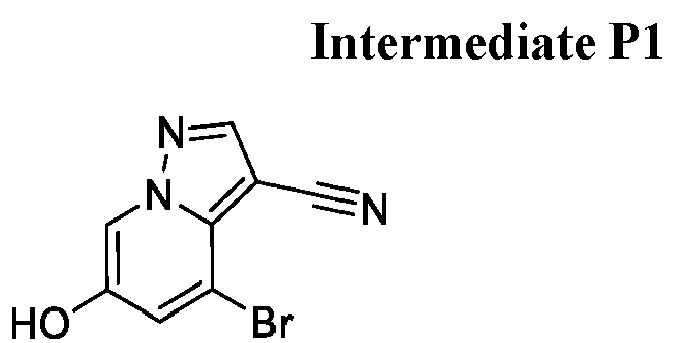
- Step 1: Preparation of tert-butyl (mesilylsulfonyl)oxycarbamate. To a 0 °C solution of 2,4,6-trimethylbenzene-1-sulfonyl chloride (10.0 g, 45.72 mmol) and tert-butyl hydroxycarbamate (6.088 g, 45.72 mmol) in MTBE (100 mL) was added TEA (14.46 mL, 48.01 mmol) drop-wise while stirring. The resulting suspension was stirred at 0 °C for an additional 30 min and then warmed to ambient temperature. The reaction was then diluted with water (100 mL), adjusted to pH 4 with 1 N HCl(aq). The organic layer was dried (Na2SO4), filtered and concentrated to yield the title compound initially as a yellowish oil, which upon drying overnight under high vacuum became a white solid (12.89 g, 89% yield). 1H NMR (CDCl3) δ 7.66 (br s, 1H), 6.98 (s, 2H), 2.67 (s, 6H), 2.32 (s, 3H), 1.31 (s, 9H).
- Step 2: Preparation of O-(mesilylsulfonyl)hydroxylamine. To TFA (117 mL, 1521 mmol) at 0 °C was slowly added tert-butyl (mesitylsulfonyl)oxycarbamate (39.0 g, 124 mmol) over 25 min. The reaction mixture was stirred at 0 °C for 1.5 h and then quenched with the sequential addition of crushed ice and water. The resulting thick suspension was vigorously stirred at ambient temperature for 5 min. Without allowing the filter cake to run dry, the solids were collected by careful vacuum filtration followed by subsequent rinsing with water (4 L) until the filtrate reached pH 6 (Caution: explosion risk exists with dry compound at ambient temperature). The wet filter cake was taken up in DCM (150 mL) and the resulting biphasic solution was separated. The DCM layer was dried over MgSO4 for 30 min and then filtered and rinsed with DCM (420 mL) to provide the title compound as a 0.22 M solution in DCM
- Step 1: Preparation of 1-amino-3-bromo-5-methoxypyridin-1-ium 2,4,6-trimethylbenzenesulfonate. To a solution of O-(mesitylsulfonyl)hydroxylamine (Part A, 26.6 g, 117 mmol) in DCM (570 mL) cooled to 0 °C was added 3-bromo-5-methoxypyridine (22.1 g, 117 mmol) in portions. The reaction mixture was stirred for 1 h at 0 °C then treated with additional 3-bromo-5-methoxypyridine (250 mg, 1.39 mmol) and stirred for an additional 2 h at 0 °C. The reaction mixture was diluted with Et2O (600 mL), stirred at 0 °C for 10 min and then vacuum filtered, rinsed with Et2O (3 × 250 mL). Upon reduction in volume by about 1/3, the filtrate yielded additional precipitate which was collected by filtration. Both filter cakes were dried in vacuo to provide the title compound (39.3 g, 83% yield). 1H NMR (CDCl3) δ 9.25 (br s, 1H), 8.99 (m, 1H), 8.74 (m, 1H), 7.46 (m, 1H), 6.83 (s, 2H), 3.92 (s, 3H), 2.65 (s, 6H), 2.22 (s, 3H).
- Step 2: Preparation of Ethyl 6-bromo-4-methoxypyrazolo[1,5-a]pyridine-3-carboxylate and Ethyl 4-bromo-6-methoxypyrazolo[1,5-a]pyridine-3-carboxylate. To a magnetically stirred white suspension of 1-amino-3-bromo-5-methoxypyridin-1-ium 2,4,6-trimethylbenzenesulfonate (33.24 g, 82.42 mmol) in DMF (82 mL) at ambient temperature was added TEA (22.98 mL, 164.8 mmol), followed by drop-wise addition of ethyl propiolate (16.71 mL, 164.8 mmol). After vigorous stirring for 2 d, the reaction was slowly quenched via portion-wise addition to rapidly stirring ice water (820 mL). The mixture was stirred at ambient temperature for 10 min and then vacuum filtered. Solids collected were rinsed with water and air-dried, yielding the title compounds as an orange solid in an isomeric ratio of about 4:1 (by 1H NMR) with the 6-Br isomer as the major isomer (21 g). The wet solid isomeric mixture (about 75% w/w) was directly used in Step 3 without further purification. MS (apci) m/z = 298.9, 300.9 (M+H). Regioisomeric ratio was determined by MeO chemical shift in 1H NMR (CDCl3) δ 3.98 (6-Br isomer) vs. 3.83 (4-Br isomer).
- Step 3: Preparation of 6-bromo-4-methoxypyrazolo[1,5-a]pyridine (P1) and 4-bromo-6-methoxypyrazolo[1,5-a]pyridine. The isomeric mixture of ethyl 6-bromo-4-methoxypyrazolo[1,5-a]pyridine-3-carboxylate and ethyl 4-bromo-4-methoxypyrazolo[1,5-a]pyridine-3-carboxylate from Step 2 (15 g, 50.1 mmol) was added to 48% HBr (114 mL) while stirring, then heated at 80 °C for 90 min followed by stirring at ambient temperature overnight. The resulting suspension was vacuum filtered and rinsed with water. The aqueous filtrate and the filter cake were treated independently. The filter cake was taken up in MTBE and vacuum filtered to remove insoluble impurities. The MTBE filtrate was dried over anhydrous Na2SO4, filtered and concentrated in vacuo to yield 6-bromo-4-methoxypyrazolo[1,5-a]pyridine as a beige solid (about 98:2 6-/4- Br; 5.08 g). MS (apci) m/z = 226.9, 228.9 (M+H). 1H NMR (CDCl3) δ 8.26 (m, 1H), 7.82 (d, 1H), 6.61 (m, 1H), 6.43 (m, 1H), 3.94 (s, 3H). Independently the original aqueous reaction mixture filtrate was extracted with EtOAc. The combined organic extracts were dried (Na2SO4), filtered and concentrated in vacuo. The crude residue was taken up in DCM (50 mL) and then filtered to remove insoluble solids. Concentration of the DCM filtrate under vacuum followed by silica chromatography (0 to 50% EtOAc/hexanes) yielded a second batch of 6-bromo-4-methoxypyrazolo[1,5-a]pyridine (Intermediate P1) as white solid (upper R f spot, 2.06 g), as well as the minor isomer title compound 4-bromo-6-methoxypyrazolo[1,5-a]pyridine (Intermediate P2) also as white solid (lower R f spot, 1.32 g). MS (apci) m/z = 226.9, 228.9 (M+H). 1H NMR (CDCl3) δ 8.02 (m, 1H), 7.85 (d, 1H), 7.17 (d, 1H), 6.55 (m, 1H), 3.80 (s, 3H).
- Step 4: Preparation of 4-bromo-6-methoxypyrazolo[1,5-a]pyridine-3-carbaldehyde: A solution of 4-bromo-6-methoxypyrazolo[1,5-a]pyridine (5.0 g, 22 mmol) in DMF (220 mL) was cooled to 0 °C and then slowly treated with POCl3 (6.2 mL, 66 mmol). The reaction was warmed to ambient temperature and stirred overnight. The reaction mixture was cooled to 0 °C, quenched with water (220 mL), and basified with 6 M NaOH(aq) to pH 9-10. The reaction mixture was stirred for 1 h and then vacuum filtered. The solids were rinsed sequentially with water and MTBE. The collected solid was suspended in DCM (500 mL) and stirred in a sonicating bath for 30 min and then vacuum filtered. The filtrate was retained, while the filter cake was taken up in water (300 mL) and extracted with DCM. The organic extracts, along with the retained DCM filtrate, were combined and dried over anhydrous Na2SO4, then filtered and concentrated in vacuo to provide the title compound (4.84 g, 86% yield). MS (apci), m/z = 256.9 (M+H).
- Step 5: Preparation of 4-bromo-6-methoxypyrazolo[1,5-a]pyridine-3-carbaldehyde oxime. To a suspension of 4-bromo-6-methoxypyrazolo[1,5-a]pyridine-3-carbaldehyde (4.84 g, 19.0 mmol) in EtOH (253 mL) at ambient temperature was added water (127 mL) and hydroxylamine hydrochloride (1.98 g, 28.5 mmol). After stirring at 50 °C overnight, the reaction mixture was cooled to ambient temperature and concentrated in vacuo. The residue was suspended in water (150 mL) and then quenched slowly with saturated NaHCO3(aq) (30 mL). After stirring for 1 hour at ambient temperature the suspension was vacuum filtered and the filter cake rinsed sequentially with H2O (500 mL) and MTBE (100 mL) to yield the title compound as a 2:1 E/Z mixture (5.13 g, quantitative yield), which was used in the next step without further purification. MS (apci) m/z = 271.9 (M+H).
- Step 6: Preparation of 4-bromo-6-methoxypyrazolo[1,5-a]pyridine-3-carbonitrile. The E/Z mixture of 4-bromo-6-methoxypyrazolo[1,5-a]pyridine-3-carbaldehyde oxime (4.95 g, 18.33 mmol) in acetic anhydride (172.9 mL, 1833 mmol) was stirred at 140 °C for 25 h, and then cooled to ambient temperature. The resulting suspension was further cooled in an ice bath for 15 min and then vacuum filtered and rinsed sequentially with water and MTBE to provide the title compound (3.74 g, 81% yield). 1H NMR (d6-DMSO) δ 8.70 (s, 1H), 8.60 (s, 1H), 7.78 (s, 1H), 3.83 (s, 3H).
- Step 7: Preparation of 4-Bromo-6-hydroxypyrazolo[1,5-a]pyridine-3-carbonitrile: A slurry of 4-bromo-6-methoxypyrazolo[1,5-a]pyridine-3-carbonitrile (50.0 g, 198.4 mmol) in DCE (500 mL) was treated with AlCl3 (79.34 g, 595.1 mmol). Under a N2(g) atmosphere, the resulting mixture was stirred 19 h at 76 °C, before cooling to room temperature. Using THF (1750 mL) as a rinse solvent, the reaction mixture was poured into a mechanically stirred suspension of sodium sulfate decahydrate (10 eq, 639 g) in THF (1000 mL). After stirring overnight at ambient temperature, the resulting suspension was filtered, and the solids were rinsed with additional THF (2 × 250 mL). The filtrate was concentrated in vacuo, and the resulting solid was dried under high vacuum for 3 days to afford the title compound (46.18 g, 98% yield) in sufficient purity for subsequent use. 1H NMR (d 6-DMSO) δ 10.48 (s, 1H), 8.58 (s, 1H), 8.38 (d, 1H), 7.64 (3, 1H).
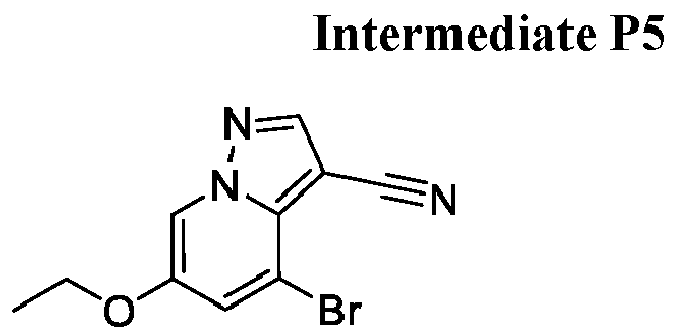
- A solution of 4-bromo-6-hydroxypyrazolo[1,5-a]pyridine-3-carbonitrile (Intermediate P1; 4.0 g, 16.80 mmol) in DMA (100 mL) was treated with K2CO3(s) (7.0 g, 51 mmol) and iodoethane (2.0 mL, 25 mmol) and then stirred for 3 hrs at 60 °C. The reaction mixture was cooled to ambient temperature and then quenched with 1:1 NH4OH/Water. The resulting suspension was filtered, and the solids were isolated to provide the title compound (4.35 g, 97% yield) in sufficient purity for subsequent use.

- In a pressure vessel, a solution of 4-bromo-6-ethoxypyrazolo[1,5-a]pyridine-3-carbonitrile (Intermediate P5; 500 mg, 1.88 mmol) in dioxane (9.40 mL) was treated sequentially with 2-fluoro-5-(4,4,5,5-tetramethyl-1,3,2-dioxaborolan-2-yl)pyridine (629 mg, 2.82 mmol), Pd(PPh3)4 (217 mg, 0.188 mmol) and 2 M Na2CO3(aq) (4.70 mL, 9.40). The resulting mixture was sparged with Ar(g) and then the vessel was sealed. The mixture was stirred 8 h at 90°C, and then overnight at ambient temperature. The reaction mixture was diluted with water and extracted with EtOAc. The combined organic extracts were washed with water and brine, dried over anhydrous Na2SO4(s), filtered and concentrated in vacuo. The crude residue was purified by silica chromatography (25-100% EtOAc in hexanes as the gradient eluent) to cleanly provide the title compound (500 mg, 94% yield). MS (apci) m/z = 283.1 (M+H).

- A mixture of (2-bromoethoxy)(tert-butyl)dimethylsilane (451 µL, 2.10 mmol), 4-bromo-6-hydroxypyrazolo[1,5-a]pyridine-3-carbonitrile (Intermediate P1; 500 mg, 2.10 mmol) and K2CO3(s) (871 mg, 6.30 mmol) in DMF (10.5 mL) was stirred for 1 day at 50 °C. After cooling to ambient temperature, the reaction mixture was diluted with EtOAc and washed with water and brine. The resulting organic extracts were directly purified by silica chromatography (0-100% EtOAc/hexanes as the gradient eluent) to cleanly provide the title compound (420 mg, 49% yield).

- In a pressure vessel, a solution of 4-bromo-6-(2-((tertbutyldimethylsilyl)oxy)ethoxy)pyrazolo[1,5-a]pyridine-3-carbonitrile (Intermediate P25; 420 mg, 1.06 mmol) in dioxane (10.6 mL) was treated sequentially with 2-fluoro-5-(4,4,5,5-tetramethyl-1,3,2-dioxaborolan-2-yl)pyridine (355 mg, 1.59 mmol), Pd(PPh3)4 (61.2 mg, 0.530 mmol) and 2 M Na2CO3(aq) (2.65 mL, 5.30). The resulting mixture was sparged with Ar(g) and the vessel was sealed. The mixture was stirred 8 h at 90°C, and then overnight at ambient temperature. The reaction mixture was diluted with water and extracted with EtOAc. The combined organic extracts were washed with water (10 mL) and brine (10 mL), then were dried over anhydrous Na2SO4(s), filtered and concentrated in vacuo. The crude residue was purified by silica chromatography (using 0-15% MeOH in DCM as the gradient eluent) to afford impure title compound. The impure material was re-subjected to silica chromatography (0-50% EtOAc in Hexanes as the gradient eluent) to cleanly provide the title compound (351 mg, 80% yield). 1H NMR (400 MHz, DMSO-d6 -) δ: 8.81 (d, 1H, J=2.0 Hz), 8.61 (s, 1H), 8.48 (d, 1H, J=2.7 Hz), 8.25 (td, 1H, J=7.8, 2.7 Hz), 7.47 (d, 1H, J=1.9 Hz), 7.38 (dd, 1H, J=7.8, 2.3 Hz), 4.21 (t, 2H, J=4.3 Hz), 3.97 (t, 2H, J=4.7 Hz), 0.86 (s, 9H), 0.08 (s, 6H).

- In a pressure vessel, a mixture of 4-bromo-6-hydroxypyrazolo[1,5-a]pyridine-3-carbonitrile (Intermediate P1; 10.0 g, 42.0 mmol) and K2CO3(s) (17.4 g, 126 mmol) in DMF (50 mL) was treated with 2,2-dimethyloxirane (36.9 mL, 420 mmol). After sealing the vessel, the reaction mixture was stirred for 12 h at 60 °C, then for 12 h at 85 °C. The mixture was allowed to cool to ambient temperature. The room temperature mixture was poured into water (400 mL), then stirred for 1 hour at ambient temperature. The resultant suspension was vacuum filtered and the filter cake was rinsed with water. The solids were collected and dried in vacuo to cleanly provide the title compound (11 g, 84% yield).

- A mixture of 4-bromo-6-(2-hydroxy-2-methylpropoxy)pyrazolo[1,5-a]pyridine-3-carbonitrile (Intermediate P41; 10.0 g, 32.2 mmol), 2-fluoro-5-(4,4,5,5-tetramethyl-1,3,2-dioxaborolan-2-yl)pyridine (10.8 g, 48.4 mmol) and Pd(PPh3)4 (1.12 g, 0.967 mmol) in dioxane (200 mL) was treated with 2 M Na2CO3(aq) (64.5 mL, 129 mmol). The resulting mixture was sparged with Ar(g), then stirred for 12 h at 85 °C under an atmosphere of N2(g). After cooling to ambient temperature, the resultant mixture was poured into cold water (1.5 L). The pH of the mixture was adjusted to about pH 6 with the addition of 10% citric acid. After stirring for 1 hour at ambient temperature, the resultant suspension was vacuum filtered. The solids were collected and dried in vacuo to cleanly provide the title compound (10 g, 95% yield).

- Step 1: Preparation of tert-butyl (1-(5-(3-cyano-6-(2-hydroxy-2-methylpropoxy)pyrazolo[1,5-a]pyridin-4-yl)pyridin-2-yl)-4-methylpiperidin-4-yl)carbamate. A solution of 4-(6-fluoropyridin-3-yl)-6-(2-hydroxy-2-methylpropoxy)pyrazolo[1,5-a]pyridine-3-carbonitrile (Intermediate P42; 100 mg, 0.306 mmol) in DMA (2.04 mL) was treated sequentially with tert-butyl (4-methylpiperidin-4-yl)carbamate (98.5 mg, 0.460 mmol) and DIEA (107 µL, 0.613 mmol). The resulting mixture was sparged with Ar(g), then stirred overnight at 90 °C. After cooling to ambient temperature, the reaction mixture was diluted with water and washed with DCM. The combined organic extracts were washed with water and brine, then dried over anhydrous Na2SO4(s), filtered and concentrated in vacuo to afford the title compound (22.4 mg, 50% yield) in sufficient purity for step 2. MS (apci) m/z = 521.3 (M+H).
- Step 2: Preparation of 4-(6-(4-amino-4-methylpiperidin-1-yl)pyridin-3-yl)-6-(2-hydroxy-2-methylpropoxy)pyrazolo[1,5-a]pyridine-3-carbonitrile. A solution of tert-butyl (1-(5-(3-cyano-6-(2-hydroxy-2-methylpropoxy)pyrazolo[1,5-a]pyridin-4-yl)pyridin-2-yl)-4-methylpiperidin-4-yl)carbamate (160 mg, 0.307 mmol) in DCM (1.54 mL) was treated with TFA (1 mL, 13.8 mmol). After stirring for 30 min at ambient temperature, the mixture was treated with additional TFA (1 mL) and stirred an additional 1 hour at ambient temperature. The reaction mixture was concentrated in vacuo and the residue was purified by silica chromatography (1-9% MeOH in DCM with 0.1-0.9% NH4OH as the gradient eluent) to cleanly provide the title compound (110 mg, 85% yield). MS (apci) m/z = 421.2 (M+H).

- Step 1: Preparation of methyl 3-(5-(3-cyano-6-(2-hydroxy-2-methylpropoxy)pyrazolo[1,5-a]pyridin-4-yl)pyridin-2-yl)-3-azabicyclo[3.1.1]heptane-6-carboxylate. A solution of 4-(6-fluoropyridin-3-yl)-6-(2-hydroxy-2-methylpropoxy)pyrazolo[1,5-a]pyridine-3-carbonitrile (Intermediate P42; 103.4 mg, 0.3169 mmol) in DMA (2.11 mL) was treated sequentially with methyl 3-azabicyclo[3.1.1]heptane-6-carboxylate (88.52 mg, 0.5703 mmol) and DIEA (110.7 µL, 0.6337 mmol) and then sparged with Ar(g) for 5 min. The mixture was stirred overnight at 90 °C, then for 4 h at 100 °C, before introducing TEA (0.2 mL). The mixture was stirred overnight at 100 °C, then for 4 days at 90 °C. After cooling to ambient temperature, the reaction mixture was diluted with water and washed with DCM. The combined organic extracts were washed with water and brine, then dried over anhydrous Na2SO4(s), filtered and concentrated in vacuo. The crude residue was purified by silica chromatography (1-9% MeOH in DCM as the gradient eluent) to afford the title compound (134 mg, 58% yield). MS (apci) m/z = 462.2 (M+H).
- Step 2: Preparation of 3-(5-(3-cyano-6-(2-hydroxy-2-methylpropoxy)pyrazolo[1,5-a]pyridin-4-yl)pyridin-2-yl)-3-azabicyclo[3.1.1]heptane-6-carboxylic acid. A solution of methyl 3-(5-(3-cyano-6-(2-hydroxy-2-methylpropoxy)pyrazolo[1,5-a]pyridin-4-yl)pyridin-2-yl)-3-azabicyclo[3.1.1]heptane-6-carboxylate (134 mg, 0.290 mmol) in EtOH (2.90 mL) was treated with 2 M NaOH(aq) (436 µL). After stirring overnight at ambient temperature, the mixture was brought to pH 4 with the addition of 2.0 N HCl(aq), and then the aqueous layer was returned to pH 7 with the addition of saturated NaHCO3(aq). The aqueous phase was extracted with DCM. The combined organic extracts were washed with brine, then dried over anhydrous Na2SO4(s), filtered and concentrated in vacuo to afford the title compound (100 mg, 77% yield). MS (apci) m/z = 448.2 (M+H).

- Step 1: Preparation of tert-butyl (1-(5-(3-cyano-6-(2-hydroxy-2-methylpropoxy)pyrazolo[1,5-a]pyridin-4-yl)pyridin-2-yl)-4-methylpiperidin-4-yl)carbamate. A solution of 4-(6-fluoropyridin-3-yl)-6-(2-hydroxy-2-methylpropoxy)pyrazolo[1,5-a]pyridine-3-carbonitrile (Intermediate P42; 2.535 g, 7.768 mmol) in DMSO (6.1 mL) was treated sequentially with tert-butyl (4-methylpiperidin-4-yl)carbamate (1.998 mg, 9.322 mmol) and DIEA (4.06 mL, 23.3 mmol). The resulting mixture stirred overnight at 90 °C. After cooling to ambient temperature, the reaction mixture was poured into 80 mL water and diluted with 80 mL heptane and stirred for 1 hour. The suspension was filtered and the solids were rinsed with 25 mL water then 25 mL heptane. The isolated solids were dried under vacuum for 18 hours to afford the title compound (4.04 g, 99.9% yield) in sufficient purity for step 2. MS (apci) m/z = 521.3 (M+H)
- Step 2: Preparation of 4-(6-(4-amino-4-methylpiperidin-1-yl)pyridin-3-yl)-6-(2-hydroxy-2-methylpropoxy)pyrazolo[1,5-a]pyridine-3-carbonitrile dihydrochloride. A solution of tert-butyl (1-(5-(3-cyano-6-(2-hydroxy-2-methylpropoxy)pyrazolo[1,5-a]pyridin-4-yl)pyridin-2-yl)-4-methylpiperidin-4-yl)carbamate (4.04 g, 7.76 mmol) in DCM (20 mL) was cooled to 0°C. The reaction was treated with TFA (5.98 mL) and allowed to warm to RT. After stirring for 30 min at ambient the reaction mixture was concentrated in vacuo. The residue was dissolved in MeOH (20 mL) and cooled to 0°C and then treated with Hydrochloric acid, 5 to 6N solution in 2-propanol (15.5 mL, 77.5 mmol) and stirred f0or 15 min at 0°C. The reaction was diluted with 20 mL MTBE, filtered, and solids were rinsed with 20 mL 1:1 MTBE: MeOH. The isolated solids were dried under vacuum to cleanly provide the title compound (3.37 g, 88% yield). MS (apci) m/z = 421.2 (M+H).
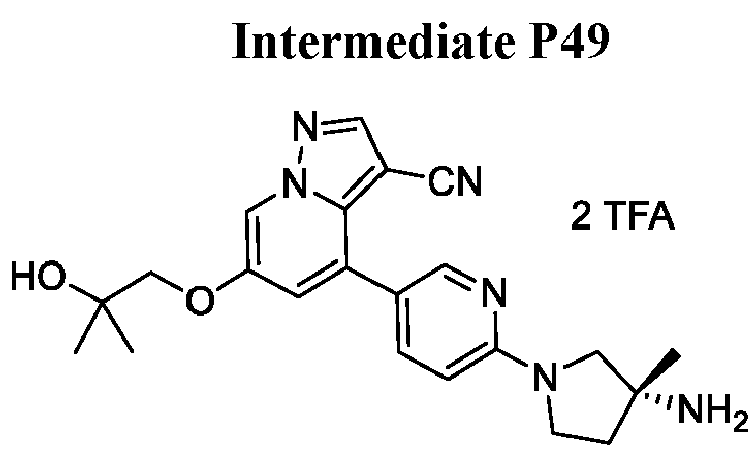
- Step 1: Preparation of tert-butyl (R)-(1-(5-(3-cyano-6-(2-hydroxy-2-methylpropoxy)pyrazolo[1,5-a]pyridin-4-yl)pyridin-2-yl)-3-methylpyrrolidin-3-yl)carbamate. To a mixture of 4-(6-fluoropyridin-3-yl)-6-(2-hydroxy-2-methylpropoxy)pyrazolo[1,5-a]pyridine-3-carbonitrile (Intermediate P42; 750 mg, 2.30 mmol) and (R)-(3-Methyl-pyrrolidin-3-yl)-carbamic acid tert-butyl ester HCl (644 mg, 3.22 mmol) in DMSO (4.6 mL) was added DIEA (1.2 mL, 6.89 mmol). The reaction mixture was stirred 12 h at 90°C. After cooling to ambient temperature, the reaction mixture was diluted into cold water and stirred for 2 h at ambient temperature. The suspension was filtered and the solids were rinsed with water. The isolated solids were dried under vacuum for 48 h to afford the title compound (1.05 g, 90% yield) in sufficient purity for step 2. MS (apci) m/z = 507.3 (M+H)
- Step 2: (R)-4-(6-(3-amino-3-methylpyrrolidin-1-yl)pyridin-3-yl)-6-(2-hydroxy-2-methylpropoxy)pyrazolo[1,5-a]pyridine-3-carbonitrile bis(2,2,2-trifluoroacetate). To a solution of (R)-(1-(5-(3-cyano-6-(2-hydroxy-2-methylpropoxy)pyrazolo[1,5-a]pyridin-4-yl)pyridin-2-yl)-3-methylpyrrolidin-3-yl)carbamate (1.05 g, 2.07 mmol) in 3 mL DCM was treated with TFA (3 mL, 39 mmol). The reaction mixture was stirred for 4 h at ambient temperature, and then concentrated in vacuo. The residue was diluted with DCM (4 mL) and toluene (1 mL) and stirred at ambient temperature for 15 min. The mixture was concentrated in vacuo and dried under vacuum for 2 days to afford the title compound with quantitative yield. MS (apci) m/z = 407.3 (M+H).

- Step 1: Preparation of tert-butyl (S)-(1-(5-(3-cyano-6-(2-hydroxy-2-methylpropoxy)pyrazolo[1,5-a]pyridin-4-yl)pyridin-2-yl)-3-methylpyrrolidin-3-yl)carbamate. To a mixture of 4-(6-fluoropyridin-3-yl)-6-(2-hydroxy-2-methylpropoxy)pyrazolo[1,5-a]pyridine-3-carbonitrile (Intermediate P42; 700 mg, 2.15 mmol) and (S)-(3-Methyl-pyrrolidin-3-yl)-carbamic acid tert-butyl ester HCl (601 mg, 3.0 mmol) in DMSO (4.3 mL) was added DIEA (1.1 mL, 6.44 mmol). The reaction mixture was stirred 12 h at 90°C. After cooling to ambient temperature, the reaction mixture was diluted into cold water and stirred for 2 h at ambient temperature. The suspension was filtered and the solids were rinsed with water. The isolated solids were dried under vacuum for 48 h to afford the title compound (950 mg, 87% yield) in sufficient purity for step 2. MS (apci) m/z = 507.3 (M+H)
- Step 2: Preparation of (S)-4-(6-(3-amino-3-methylpyrrolidin-1-yl)pyridin-3-yl)-6-(2-hydroxy-2-methylpropoxy)pyrazolo[1,5-a]pyridine-3-carbonitrile bis(2,2,2-trifluoroacetate). To a solution of tert-butyl (S)-(1-(5-(3-cyano-6-(2-hydroxy-2-methylpropoxy)pyrazolo[1,5-a]pyridin-4-yl)pyridin-2-yl)-3-methylpyrrolidin-3-yl)carbamate (950 mg, 1.88 mmol) in 3 mL DCM was treated with TFA (3 mL, 39 mmol). The reaction mixture was stirred for 4 h at ambient temperature, and then concentrated in vacuo. The residue was diluted with DCM (4 mL) and toluene (1 mL) and stirred at ambient temperature for 15 min. The mixture was concentrated in vacuo and dried under vacuum for 2 days afford the title compound with quantitive yield. MS (apci) m/z = 407.2 (M+H).

- Step 1 Preparation of tert-butyl (1-(5-(3-cyano-6-(2-hydroxy-2-methylpropoxy)pyrazolo[1,5-a]pyridin-4-yl)pyridin-2-yl)pyrrolidin-3-yl)carbamate. To a mixture of 4-(6-fluoropyridin-3-yl)-6-(2-hydroxy-2-methylpropoxy)pyrazolo[1,5-a]pyridine-3-carbonitrile (Intermediate P42; 850 mg, 2.60 mmol) and 3-(tert-butoxycarbonylamino)pyrrolidine (679 mg, 3.65 mmol) in DMSO (5.2 mL) was added DIEA (1.36 mL, 7.81 mmol). The reaction mixture was stirred 12 h at 90°C. After cooling to ambient temperature, the reaction mixture was diluted into cold water and stirred for 2 h at ambient temperature. The suspension was filtered and the solids were rinsed with water. The isolated solids were dried under vacuum for 48 h to afford the title compound (1.26 g, 98% yield) in sufficient purity for step 2. MS (apci) m/z = 493.3 (M+H)
- Step 2: Preparation of 4-(6-(3-aminopyrrolidin-1-yl)pyridin-3-yl)-6-(2-hydroxy-2-methylpropoxy)pyrazolo[1,5-a]pyridine-3-carbonitrile bis(2,2,2-trifluoroacetate). To a solution of tert-butyl (1-(5-(3-cyano-6-(2-hydroxy-2-methylpropoxy)pyrazolo[1,5-a]pyridin-4-yl)pyridin-2-yl)pyrrolidin-3-yl)carbamate (950 mg, 1.88 mmol) in 3 mL DCM was treated with TFA (3 mL, 39 mmol). The reaction mixture was stirred for 4 h at ambient temperature, and then concentrated in vacuo. The residue was diluted with DCM (4 mL) and toluene (1 mL) and stirred at ambient temperature for 15 min. The mixture was concentrated in vacuo and dried under vacuum for 2 days afford the title compound with quantative yield. MS (apci) m/z = 393.2 (M+H).

- To a solution of 6-ethoxy-4-(6-fluoropyridin-3-yl)pyrazolo[1,5-a]pyridine-3-carbonitrile (Intermediate P6, 0.500 g, 1.77 mmol) in DMSO (3.5 mL) was added TEA (0.741 mL, 5.31 mmol) and piperidin-4-ol (269 mg, 2.66 mmol). The reaction mixture was stirred at 70°C for 5 h. After cooling to ambient temperature, the reaction mixture was poured into ice water. The resultant solids were isolated by vacuum filtration to afford the title compound (501 mg, 1.38 mmol, 77.8 % yield). MS (apci) m/z = 364.2 (M+H).

- To a solution of 6-ethoxy-4-(6-fluoropyridin-3-yl)pyrazolo[1,5-a]pyridine-3-carbonitrile (Intermediate P6, 30 mg, 0.106 mmol) in DMA (0.5 mL) was added TEA (0.044 mL, 0.319 mmol) and 4-benzylpiperidin-4-ol (40.7 mg, 0.213 mmol) The reaction mixture was stirred at 90°C for 24 h. After cooling to ambient temperature, the reaction mixture was diluted with DCM and washed with saturated NH4Cl(aq) then water. The combined aqueous washes were further extracted with DCM, and the combined organic extracts were dried over anhydrous Na2SO4(s) and concentrated in vacuo. The residue was purified by silica chromatography (30-100% EtOAc in hexanes as the gradient eluent) to afford the title compound (39 mg, 0.0860 mmol, 80.9 % yield). MS (apci) m/z = 454.2 (M+H).

- To a solution of 4-(6-fluoropyridin-3-yl)-6-(2-hydroxy-2-methylpropoxy)pyrazolo[1,5-a]pyridine-3-carbonitrile (Intermediate P42; 210 mg, 0.64 mmol) and 2-(piperidin-4-ylsulfanyl)pyridine (357 mg, 1.84 mmol) in DMA (1.6 mL) was added TEA (628 µL, 4.50 mmol). The reaction mixture was stirred overnight at 95°C. After cooling to ambient temperature, the reaction mixture was diluted water and extracted with EtOAc. The organic extracts were washed with water and brine. The organic extracts were dried over anhydrous Na2SO4(s), filtered and concentrated in vacuo. The residue was purified by silica chromatography (10-90% EtOAc in Hexanes to afford the title compound (20 mg, 61% yield). MS (apci) m/z = 501.2 (M+H).

- To a solution of 6-ethoxy-4-(6-fluoropyridin-3-yl)pyrazolo[1,5-a]pyridine-3-carbonitrile (Intermediate P6, 100.5 mg, 0.3560 mmol) in DMSO (3 ml) was added (4-benzylpiperidin-4-yl)methanol hydrochloride (151.5 mg, 0.6267 mmol) and cesium carbonate (812.0 mg, 2.492 mmol). The reaction mixture was stirred at 60°C for 24 h. After cooling to ambient temperature, the reaction mixture was diluted with DCM and washed with water and saturated NH4Cl(aq). The combined aqueous layers were extracted with DCM, and the combined organic extracts were dried over anhydrous Na2SO4(s) and concentrated. The residue was purified by silica chromatography (0-100% EtOAc in hexanes as the gradient eluent) to afford the title compound (118.2 mg, 0.2528 mmol, 71.00 % yield). MS (apci) m/z = 468.2 (M+H).

- Step 1: Preparation of methyl 4-((tert-butoxycarbonyl)amino)-1-(5-(3-cyano-6-ethoxypyrazolo[1,5-a]pyridin-4-yl)pyridin-2-yl)piperidine-4-carboxylate. To a solution of 6-ethoxy-4-(6-fluoropyridin-3-yl)pyrazolo[1,5-a]pyridine-3-carbonitrile (Intermediate P6, 303.4 mg, 1.075 mmol) in DMSO (21.50 mL) was added 4-N-Boc-amino-piperidine-4-carboxylic acid methyl ester (416.5 mg, 1.612 mmol) and potassium carbonate (297.1 mg, 2.150 mmol). The reaction mixture was stirred at 110°C for 72 h. The reaction mixture was diluted with water and extracted with EtOAc. The combined organic extracts were dried over anhydrous MgSO4(s) and concentrated in vacuo. The resultant crude residue was purified by silica chromatography (0-100% EtOAc in hexanes as the gradient eluent) to afford the title compound (76.7 mg, 13.7% yield) in sufficient purity for step 2. MS (apci) m/z = 521.2 (M+H).
- Step 2: Preparation of tert-butyl (1-(5-(3-cyano-6-ethoxypyrazolo[1,5-a]pyridin-4-yl)pyridin-2-yl)-4-(hydroxymethyl)piperidin-4-yl)carbamate. To a solution of lithium borohydride (0.0120 mL, 0.365 mmol) in THF (0.912 mL) was added methyl 4-((tert-butoxycarbonyl)amino)-1-(5-(3-cyano-6-ethoxypyrazolo[1,5-a]pyridin-4-yl)pyridin-2-yl)piperidine-4-carboxylate (47.5 mg, 0.0912 mmol). The reaction mixture was stirred at rt for 2 h. The reaction mixture was concentrated in vacuo, and the residue was diluted with EtOAc and washed with brine. The organic extract was dried over anhydrous MgSO4(s) and concentrated in vacuo to afford the title compound as crude product (65.9 mg), which was used in the next step without further purifications. MS (apci) m/z = 493.2 (M+H).
- Step 3: Preparation of 4-(6-(4-amino-4-(hydroxymethyl)piperidin-1-yl)pyridin-3-yl)-6-ethoxypyrazolor[1,5-a]pyridine-3-carbonitrile. A solution of tert-butyl (1-(5-(3-cyano-6-ethoxypyrazolo[1,5-a]pyridin-4-yl)pyridin-2-yl)-4-(hydroxymethyl)piperidin-4-yl)carbamate (65.9 mg, 0.134 mmol) in DCM (1 mL) was treated with TFA (0.2 mL, 2.68 mmol). The reaction mixture was stirred at rt 30 min then concentrated in vacuo. The residue was taken up in DCM and washed with saturated Na2CO3. The aqueous fraction was extracted with DCM, and the combined organic extracts were dried over anhydrous MgSO4(s) and concentrated in vacuo to afford the title compound (35.6 mg, 68% yield). MS (apci) m/z = 393.2 (M+H).

- To a solution of 6-ethoxy-4-(6-fluoropyridin-3-yl)pyrazolo[1,5-a]pyridine-3-carbonitrile (Intermediate P6, 0.147 g, 0.521 mmol) in DMSO (1 mL) was added tert-butyl (R)-piperidin-3-ylcarbamate (209 mg, 1.04 mmol) and potassium carbonate (216 mg, 1.56 mmol). The reaction mixture was heated to 110°C for 72 h. After cooling to ambient temperature, the reaction mixture was diluted with DCM and quenched with saturated NH4Cl and extracted into additional DCM. The combined organic extracts were dried over anhydrous Na2SO4(s) and concentrated in vacuo. The residue was purified by silica chromatography (0-100% EtOAc in hexanes as the gradient eluent) to afford the title compound (100 mg, 0.216 mmol, 41.5 % yield). MS (apci) m/z = 463.2 (M+H).


- Step 1: Preparation of (3S,4S)-tert-butyl 3-azido-4-hydroxypyrrolidine-1-carboxylate. A solution of tert-butyl 6-oxa-3-azabicyclo[3.1.0]hexane-3-carboxylate (15.42 g, 83.25 mmol), (R)-N,N'-Bis(3,5-Di-tert-butylsalicylidene)-1,2-cyclohexanediaminochromium(III) chloride (0.5904 g, 0.8325 mmol), potassium carbonate (13.81 g, 99.90 mmol), and azidotrimethylsilane (12.79 ml, 91.58 mmol) was sparged with nitrogen and stirred at rt for 24 h. The reaction mixture was treated with silica gel (30 g) and water (2 mL) and stirred at rt for an additional 72 h. The solution was filtered through a pad of Celite® and concentrated in vacuo. The residue was purified by silica chromatography (20-50% EtOAc in hexanes as the gradient eluent) to afford the title compound (18.5 g, 81.05 mmol, 97.36 % yield) in sufficient purity for step 2.
- Step 2: Preparation of (3S,4S)-4-azidopyrrolidin-3-oldihydrochloride. A solution of tert-butyl (3S,4S)-3-azido-4-hydroxypyrrolidine-1-carboxylate (0.500 g, 2.19 mmol) in DCM (2.19 mL) was treated with 6M HCl in IPA (4.5 mL, 27 mmol). The reaction mixure was stirred at rt for 4 h, at which time the reaction mixture was concentrated in vacuo to afford the title compound (assumed theoretical yield, 0.440 g, 2.19 mmol) in sufficient purity for step 3. MS (apci) m/z = 129.1 (M+H).
- Step 3: Preparation of 4-(6-((3S,4S)-3-azido-4-hydroxypyrrolidin-1-yl)pyridin-3-yl)-6-ethoxypyrazolo[1,5-a]pyridine-3-carbonitrile. To a solution of 6-ethoxy-4-(6-fluoropyridin-3-yl)pyrazolo[1,5-a]pyridine-3-carbonitrile (Intermediate P6, 0.300 g, 1.06 mmol) in DMSO (2 mL) was added N-ethyl-N-isopropylpropan-2-amine (3.70 mL, 21.3 mmol) and (3S,4S)-4-azidopyrrolidin-3-ol dihydrochloride (0.427 g, 2.13 mmol) The reaction mixture was stirred 100°C for 24 h. After cooling to ambient temperature, the reaction mixture was quenched with saturated NH4Cl(aq) and extracted into DCM. The combined organic extracts were dried over anhydrous Na2SO4(s) and concentrated in vacuo. The residue was purified by silica chromatography (20-100% EtOAc in hexanes as the gradient eluent) to afford the title compound (0.220 g, 0.564 mmol, 53.0 % yield over two steps). MS (apci) m/z = 391.15 (M+H).

- Step 1: Preparation of (3R,4R)-tert-bulyl 3-azido-4-hydroxypyrrolidine-1-carboxylate. A solution of tert-butyl 6-oxa-3-azabicyclo[3.1.0]hexane-3-carboxylate (15.42 g, 83.25 mmol), (1S,2S)-(-)-[1,2-Cyclohexanediamino-N,N'-bis(3,5-di-t-butylsalicylidene)]chromium (III) chloride (1.181 g, 1.665 mmol), and azidotrimethylsilane (12.79 ml, 91.58 mmol) was sparged with nitrogen and stirred at rt for 24 h. To this was added potassium carbonate (13.81 g, 99.90 mmol) in MeOH (100 mL), and the reaction mixture was stirred an additional 5 h at rt. The solution was filtered through a pad of Celite® and concentrated in vacuo. The residue was taken up in EtOAc and water. The aqueous fraction was extracted with EtOAc, and the combined organic extracts were washed successively with saturated NaHCO3(aq), water, and brine. They were dried over anhydrous MgSO4(s) and concentrated in vacuo. The residue was purified by silica chromatography (20% EtOAc in hexanes as the eluent) to afford the title compound (18.5 g, 81.05 mmol, 97.36 % yield) in sufficient purity for step 2.
- Step 2: Preparation of (3R,4R)-4-azidopyrrolidin-3-ol dihydrochloride. A solution of tert-butyl (3R,4R)-3-azido-4-hydroxypyrrolidine-1-carboxylate (0.500 g, 2.19 mmol) in DCM (2.19 mL) was treated with 6M HCl in IPA (4.5 mL, 27 mmol). The reaction mixure was stirred at rt for 4 h, at which time the reaction mixture was concentrated in vacuo to afford the title compound (assumed theoretical yield, 0.440 g, 2.19 mmol) in sufficient purity for step 3. MS (apci) m/z = 129.1 (M+H).
- Step 3: Preparation of 4-(6-((3R,4R)-3-azido-4-hydroxypyrrolidin-1-yl)pyridin-3-yl)-6-ethoxypyrazolo[1,5-a]pyridine-3-carbonitrile. To a solution of 6-ethoxy-4-(6-fluoropyridin-3-yl)pyrazolo[1,5-a]pyridine-3-carbonitrile (Intermediate P6, 0.300 g, 1.06 mmol) in DMSO (2 mL) was added N-ethyl-N-isopropylpropan-2-amine (3.70 mL, 21.3 mmol) and (3R,4R)-4-azidopyrrolidin-3-ol dihydrochloride (0.427 g, 2.13 mmol) The reaction mixture was stirred 100°C for 24 h. After cooling to ambient temperature, the reaction mixture was quenched with saturated NH4Cl(aq) and extracted into DCM. The combined organic extracts were dried over anhydrous Na2SO4(s) and concentrated in vacuo. The residue was purified by silica chromatography (20-100% EtOAc in hexanes as the gradient eluent) to afford the title compound (0.205 g, 0.525 mmol, 49.4 % yield over two steps). MS (apci) m/z = 391.2 (M+H).
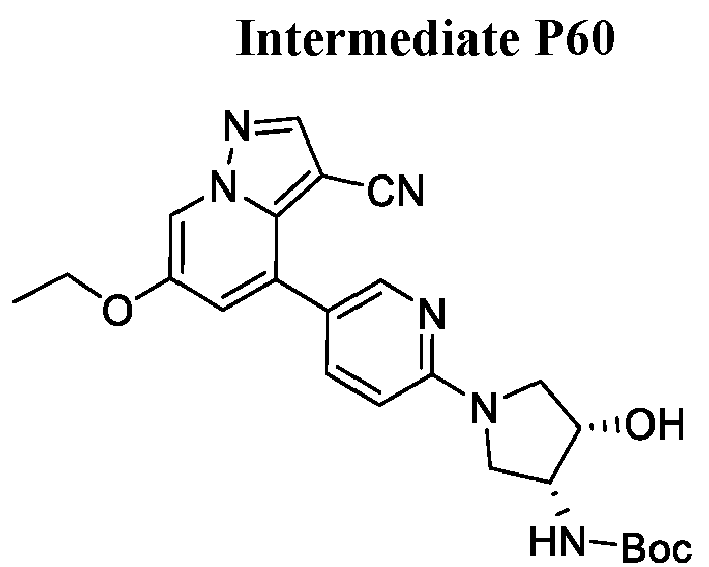
- To a solution of 6-ethoxy-4-(6-fluoropyridin-3-yl)pyrazolo[1,5-a]pyridine-3-carbonitrile (Intermediate P6, 0.215 g, 0.762 mmol) in DMSO (1.5 mL) was added N-ethyl-N-isopropylpropan-2-amine (0.663 ml, 3.81 mmol) and tert-butyl ((3R,4S)-4-hydroxypyrrolidin-3-yl)carbamate (0.231 g, 1.14 mmol). The reaction mixture was stirred 100°C for 24 h. After cooling to ambient temperature, the reaction mixture was quenched with saturated NH4Cl(aq) and extracted into DCM. The combined organic extracts were dried over anhydrous Na2SO4(s) and concentrated in vacuo. The residue was purified by silica chromatography (20-100% EtOAc in hexanes as the gradient eluent) to afford the title compound (0.347 g, 0.747 mmol, 98.1 % yield). MS (apci) m/z = 465.3 (M+H).

- To a solution of 6-ethoxy-4-(6-fluoropyridin-3-yl)pyrazolo[1,5-a]pyridine-3-carbonitrile (Intermediate P6, 0.215 g, 0.762 mmol) in DMSO (1.5 mL) was added N-ethyl-N-isopropylpropan-2-amine (0.663 ml, 3.81 mmol) and tert-butyl ((3S,4R)-4-hydroxypyrrolidin-3-yl)carbamate (0.231 g, 1.14 mmol). The reaction mixture was stirred 100°C for 24 h. After cooling to ambient temperature, the reaction mixture was quenched with saturated NH4Cl(aq) and extracted into DCM. The combined organic extracts were dried over anhydrous Na2SO4(s) and concentrated in vacuo. The residue was purified by silica chromatography (0-100% EtOAc in hexanes as the gradient eluent) to afford the title compound (0.284 g, 0.611 mmol, 80.3 % yield). MS (apci) m/z = 465.2 (M+H).


- To a solution of 6-ethoxy-4-(6-fluoropyridin-3-yl)pyrazolo[1,5-a]pyridine-3-carbonitrile (Intermediate P6, 0.060 g, 0.21 mmol) in DMSO (0.4 mL) was added potassium carbonate (0.15 g, 1.1 mmol) and tert-butyl ((3R,5S)-5-(trifluoromethyl)piperidin-3-yl)carbamate (0.171 g, 0.638 mmol). The reaction mixture was stirred at 110°C for 24 h. After cooling to ambient temperature, the reaction mixture was quenched with saturated NH4Cl(aq) and extracted into DCM. The combined organic extracts were dried over anhydrous Na2SO4(s) and concentrated in vacuo. The residue was purified by silica chromatography (0-100% EtOAc in hexanes as the gradient eluent) to afford the title compound (0.0538 g47.7 % yield) in sufficient purity for step 2. MS (apci) m/z = 531.2 (M+H).

- Step 1: Preparation of tert-butyl ((1R,5S,6r)-3-(5-(3-cyano-6-(2-hydroxy-2-methylpropoxy)pyrazolo[1,5-a]pyridin-4-yl)pyridin-2-yl)-3-azabicyclo[3.1.1]heptan-6-yl)carbamate. To a solution of 4-(6-fluoropyridin-3-yl)-6-(2-hydroxy-2-methylpropoxy)pyrazolo[1,5-a]pyridine-3-carbonitrile (Intermediate P42; 200 mg, 0.57 mmol) and tert-butyl ((1R,5S,6r)-3-azabicyclo[3.1.1]heptan-6-yl)carbamate(169 mg, 0.80 mmol) in DMSO (0.57 mL) was added DIEA (298 µL, 1.71 mmol). Under a N2(g) atmosphere, reaction was stirred overnight at 90°C. After cooling to ambient temperature, the reaction mixture was diluted with water (5.7 mL). The suspension was filtered and the solids were rinsed with water (3x5 mL) then MTBE (3x5mL). The isolated solids were dried under vacuum while the MTBE filtrate was concentrated in vacuo. The filtrate residue was purified by C18 reverse phase chromatography (5-50% ACN in water). The precipitate solids and chromatography product were combined and concentrated in vacuo to cleanly provide the title compound (292 mg, 98% yield) in sufficient purity for step 2. MS (apci) m/z= 519.20 (M+H)
- Step 2: Preparation of 4-(6-((1R,5S,6r)-6-amino-3-azabicyclo[3.1.1]heptan-3-yl)pyridin-3-yl)-6-(2-hydroxy-2-methylpropoxy)pyrazolo[1,5-a]pyridine-3-carbonitrile dihydrochloride. To a solution of tert-butyl ((1R,5S,6r)-3-(5-(3-cyano-6-(2-hydroxy-2-methylpropoxy)pyrazolo[1,5-a]pyridin-4-yl)pyridin-2-yl)-3-azabicyclo[3.1.1]heptan-6-yl)carbamate (148 mg, 0.29 mmol) in MeOH (571 µL) was added HCl (conc.) (476 µL, 5.71 mmol) dropwise. The reaction was stirred for 2 h at ambient temperature. The reaction was diluted with EtOAc (1 mL) and was stirred at ambient temperature for 10 minutes. MTBE (1mL) was added and a suspension formed. The suspension was filtered and solids were rinsed with 10% MeOH in MTBE (3xlmL) to cleanly provide the title compound (114 mg, 81% yield). MS (apci) m/z = 419.15 (M+H).


- Step 1: Preparation of tert-butyl (1-(5-(3-cyano-6-(2-hydroxy-2-methylpropoxy)pyrazolo[1,5-a]pyridin-4-yl)pyridin-2-yl)piperidin-4-yl)carbamate. To a solution of 4-(6-fluoropyridin-3-yl)-6-(2-hydroxy-2-methylpropoxy)pyrazolo[1,5-a]pyridine-3-carbonitrile (Intermediate P42; 205 mg, 0.628 mmol) and tert-butyl piperidin-4-ylcarbamate (252 mg, 1.26 mmol) in DMA (2.09 mL) was added DIEA (549 µL, 3.14 mmol). The reaction was stirred 2 h at 95°C. After cooling to ambient temperature, the reaction mixture was diluted with water and extracted with EtOAc. The organic extracts were washed with water and brine. The organic extracts were dried over anhydrous Na2SO4(s), filtered and concentrated in vacuo to afford the title compound (assumed quantative yield, 319 mg) in sufficient purity for step 2. MS (apci) m/z= 507.20 (M+H)
- Step 2: Preparation of 4-(6-(4-aminopiperidin-1-yl)pyridin-3-yl)-6-(2-hydroxy-2-methylpropoxy)pyrazolo[1,5-a]pyridine-3-carbonitrile. To a solution of tert-butyl (1-(5-(3-cyano-6-(2-hydroxy-2-methylpropoxy)pyrazolo[1,5-a]pyridin-4-yl)pyridin-2-yl)piperidin-4-yl)carbamate (319 mg, 0.63 mmol) in DCM (3.15 mL) was added TFA (3.14 mL, 40.9 mmol). The reaction was stirred for 30 min at ambient temperature. The reaction was concentrated in vacuo. The residue was resuspended in DCM and purified using silica chromatography (1-9% MeOH in DCM with 0.1-0.9% NH4OH as the gradient eluent) to cleanly provide the title compound (37 mg, 53% yield) MS (apci) m/z = 407.2 (M+H).


- Step 1: Preparation of methyl 1-(5-(3-cyano-6-(2-hydroxy-2-methylpropoxy)pyrazolo[1,5-a]pyridin-4-yl)pyridin-2-yl)-4-methylpiperidine-4-carboxylate. To a solution of 4-(6-fluoropyridin-3-yl)-6-(2-hydroxy-2-methylpropoxy)pyrazolo[1,5-a]pyridine-3-carbonitrile (Intermediate P42; 1.04 mg, 3.19 mmol) and 4-Methyl-piperidine-4-carboxylic acid methyl ester (1.00 mg, 6.37 mmol) in DMSO (3.2 mL) was added DIEA (1.67 mL, 9.56 mmol). The reaction was stirred 16 h at 90°C. After cooling to ambient temperature, the reaction mixture was diluted with water and extracted with EtOAc. The organic extracts were washed with water and brine. The organic extracts were dried over anhydrous Na2SO4(s), filtered and concentrated in vacuo. The residue was purified using silica chromatography (30-100% Hexanes to EtOAc) to afford the title compound (1.40 g, 95% yield) in sufficient purity for step 2. MS (apci) m/z= 464.2 (M+H).
- Step 2: Preparation of 1-(5-(3-cyano-6-(2-hydroxy-2-methylpropoxy)pyrazolo[1,5-a]pyridin-4-yl)pyridin-2-yl)-4-methylpiperidine-4-carboxylic acid. To a solution of methyl 1-(5-(3-cyano-6-(2-hydroxy-2-methylpropoxy)pyrazolo[1,5-a]pyridin-4-yl)pyridin-2-yl)-4-methylpiperidine-4-carboxylate (1.40 g, 3.02 mmol) in THF (15 mL) and MeOH (15 mL) and treated with potassium hydroxide (4.53 mL, 9.06 mmol). The reaction was stirred for 48 h at ambient temperature. The reaction was concentrated in vacuo. The residue was diluted with water and extracted with Et2O. The aqueous layer was acidified to pH 5 using 4N HCl and extracted with 4:1 DCM:IPA. The combined organic extracts were washed with water. The organic extracts were dried over anhydrous Na2SO4(s), filtered and concentrated in vacuo to afford the title compound (1.20 g, 88% yield) in sufficient purity for step 2. MS (apci) m/z= 450.2

- In a pressure vessel, a solution of 4-bromo-6-hydroxypyrazolo[1,5-a]pyridine-3-carbonitrile (Intermediate P1; 15.4 g, 64.7 mmol) in dioxane (320 mL) was treated sequentially with 2-fluoro-5-(4,4,5,5-tetramethyl-1,3,2-dioxaborolan-2-yl)pyridine (15.2 g, 67.9 mmol), Pd(PPh3)4 (3.74 g, 3.23 mmol) and 2 M Na2CO3(aq) (97 mL, 194 mmol). The resulting mixture was sparged with Ar(g) and then the vessel was sealed. The mixture was stirred 16 h at 80°C. After cooling to ambient temperature, the reaction mixture was diluted with MTBE and extracted with 1 M NaOH. The combined aqueous layers were extracted with MTBE. The combined aqueous layers were acidified to pH 4 with 4 M HCl. The suspension was filtered and washed with water to cleanly provide the title compound (14.8 g, 72% yield). MS (apci) m/z = 253.1 (M-H) 1H NMR (400 MHz, DMSO-d6) δ 8.53 (s, 1H), 8.48-8.47 (d, 1H), 8.41-8.40 (d, 1H), 8.26-8.21 (m, 1H), 7.38-7.36 (m, 1H), 7.31-7.30 (d, 1H).

- Step 1: Preparation of tert-butyl (1-(5-(3-cyano-6-hydroxypyrazolo[1,5-a]pyridin-4-yl)pyridin-2-yl)-4-methylpiperidin-4-yl)carbamate. To a solution of 4-(6-fluoropyridin-3-yl)-6-hydroxypyrazolo[1,5-a]pyridine-3-carbonitrile (Intermediate P66; 3.0 g, 9.44 mmol) and tert-butyl 4-methylpiperidin-4-ylcarbamate (2.83 mg, 13.2 mmol) in DMSO (12 mL) was added DIEA (4.93 mL, 28.3 mmol). The reaction was stirred 16 h at 90°C. After cooling to ambient temperature, the reaction mixture was diluted into water and acidified to pH 5 using a 10% citric acid solution and stirred for 15 min at ambient temperature. The suspension was filtered and the precipitate was rinsed with water. The isolated solids were dissolved in 4:1 DCM:IPA and dried over anhydrous Na2SO4(s), filtered and concentrated in vacuo. The residue was purified using silica chromatography (5-75% EtOAc in DCM) to afford the title compound (assumed theoretical yield, 4.23 g) in sufficient purity for step 2. MS (apci) m/z= 449.3 (M+H)
- Step 2: Preparation of 4-(6-(4-amino-4-methylpiperidin-1-yl)pyridin-3-yl)-6-hydroxypyrazolo[1,5-a]pyridine-3-carbonitrile dihydrochloride To a solution of tert-butyl (1-(5-(3-cyano-6-hydroxypyrazolo[1,5-a]pyridin-4-yl)pyridin-2-yl)-4-methylpiperidin-4-yl)carbamate (assumed 4.23 g, 9.44 mmol) in MeOH (30 mL) was added HCl (5-6 N solution in 2-propanol, 28.3 mL, 142 mmol). The reaction was stirred for 2.5 h at ambient temperature. The reaction was diluted with MTBE (30 mL) and stirred for 30 min at ambient temperature. The suspension was filtered and washed with MTBE (50 mL) to cleanly provide the title compound (2.18 g, 55% yield over two steps) MS (apci) m/z = 349.2 (M+H).


- To a solution of 4-(6-(4-amino-4-methylpiperidin-1-yl)pyridin-3-yl)-6-hydroxypyrazolo[1,5-a]pyridine-3-carbonitrile dihydrochloride (Intermediate P67; 503 mg, 1.19 mmol), 5-fluoro-2-methylbenzoic acid (552 mg, 3.58 mmol), and HATU (1.36g, 3.58 mmol) in DMSO (5 mL) was added DIEA (1.7 mL, 9.55 mmol). The reaction was stirred 16 h at ambient temperature. The reaction mixture was diluted with THF (4 mL) and treated with NaOH (5.97 mL, 11.9 mmol) and stirred for 4 h at ambient temperature. The reaction was concentrated in vacuo. The residue was diluted with EtOAc and washed with water. The pH was adjusted to pH 5 with AcOH and then extracted with EtOAc. The organic extracts were washed with brine. The organic extracts were dried over anhydrous Na2SO4(s), filtered and concentrated in vacuo. The residue was purified using silica chromatography (50-100% Hexanes to EtOAc) to afford the title compound (534 mg, 92% yield) in sufficient purity for step 2. MS (apci) m/z= 485.2 (M+H).

- To a solution of 6-ethoxy-4-(6-fluoropyridin-3-yl)pyrazolo[1,5-a]pyridine-3-carbonitrile (Intermediate P6, 0.700 g, 2.480 mmol) in DMSO (4.96 mL) was added DIEA (1.296 mL, 7.439 mmol) and methyl 4-((tert-butoxycarbonyl)amino)piperidine-4-carboxylate (0.8968 g, 3.472 mmol). The reaction mixture was stirred 90°C for 24 h. After cooling to ambient temperature, the reaction mixture was quenched water and extracted into EtOAc. The combined organic extracts were washed with saturated NaCl(aq), dried over anhydrous Na2SO4(s) and concentrated in vacuo. The residue was purified by silica chromatography (10-90% EtOAc in hexanes as the gradient eluent) to afford the title compound (1.003 g, 1.927 mmol, 77.69 % yield). MS (apci) m/z = 521.3 (M+H).

- Step 1: Preparation of methyl 4-amino-1-(5-(3-cyano-6-ethoxypyrazolo[1,5-a]pyridin-4-yl)pyridin-2-yl)piperidine-4-carboxylate. A solution of methyl 4-((tert-butoxycarbonyl)amino)-1-(5-(3-cyano-6-ethoxypyrazolo[1,5-a]pyridin-4-yl)pyridin-2-yl)piperidine-4-carboxylate (Intermediate P69, 0.8 g, 1.5 mmol) in DCM was treated with TFA. The reaction mixture was stirred at rt for 24 h, then concentrated in vacuo. HCl in iPrOH (6N) was added to the mixture to precipitate product. The suspension was stirred at RT for 1h then concentrated, affording the title compound (assumed theoretical yield, 0.65 g, 1.5 mmol) in sufficient purity for step 2. MS (apci) m/z = 421.25 (M+H).
- Step 2: Preparation of methyl 1-(5-(3-cyano-6-ethoxypyrazolo[1,5-a]pyridin-4-yl)pyridin-2-yl)-4-(5-fluoro-2-methylbenzamido)piperidine-4-carboxylate. To a solution of methyl 4-amino-1-(5-(3-cyano-6-ethoxypyrazolo[1,5-a]pyridin-4-yl)pyridin-2-yl)piperidine-4-carboxylate (0.65 g, 1.5 mmol) in DCM (31 mL) was added 5-fluoro-2-methylbenzoic acid (0.36 g, 2.3 mmol) and HATU (0.88 g, 2.3 mmol). The reaction mixture was stirred at rt for 1 h, at which time a catalytic amount of DMAP was added. The reaction mixture was stirred at 50°C for 1 h, then cooled to RT and purified directly by silica chromatography (0-100% EtOAc in Hexanes then 1-10% MeOH in CHCl3 as the gradient eluent) to afford the title compound (0.8g, 1.4 mmol, 93% yield over two steps) in sufficient purity for step 3. MS (apci) m/z = 557.2 (M+H).
- Step 3: Preparation of N-(1-(5-(3-cyano-6-ethoxypyrazolo[1,5-a]pyridin-4-yl)pyridin-2-yl)-4-(hydroxymethyl)piperidin-4-yl)-5-fluoro-2-methylbenzamide. To a solution of methyl 1-(5-(3-cyano-6-ethoxypyrazolo[1,5-a]pyridin-4-yl)pyridin-2-yl)-4-(5-fluoro-2-methylbenzamido)piperidine-4-carboxylate (750 mg, 1.35 mmol) in THF (26.949 mL) at 0°C was added lithium borohydride (117 mg, 5.39 mmol). The reaction mixture was stirred at 0°C for 1h. The reaction mixture was diluted with EtOAc and washed with a 10% aqueous citric acid solution. The organic extract was dried and concentrated in vacuo. The residue was purified by silica chromatography (0-100% EtOAc in Hexanes then 1-10% MeOH in EtOAc as the gradient eluent) to afford the title compound (700 mg, 1.32 mmol, 98.3% yield) in sufficient purity for step 4. MS (apci) m/z = 529.1 (M+H).
- Step 4: Preparation of N-(1-(5-(3-cyano-6-ethoxypyrazolo[1,5-a]pyridin-4-yl)pyridin-2-yl)-4-formylpiperidin-4-yl)-5-fluoro-2-methylbenzamide. To a solution of N-(1-(5-(3-cyano-6-ethoxypyrazolo[1,5-a]pyridin-4-yl)pyridin-2-yl)-4-(hydroxymethyl)piperidin-4-yl)-5-fluoro-2-methylbenzamide (100 mg, 0.189 mmol) in DCM (0.946 mL) at 0°C was added 3-oxo-1l5-benzo[d][1,2]iodaoxole-1,1,1(3H)-triyl triacetate (201 mg, 0.473 mmol). The reaction mixture was warmed to rt and stirred at that temperature for 1 h, at which time additional 3-oxo-1l5-benzo[d][1,2]iodaoxole-1,1,1(3H)-triyl triacetate (201 mg, 0.473 mmol) was added. The reaction mixture was stirred at rt an additional 15 min, then quenched with EtOAc and saturated NaHCO3(aq). The organic extract was washed with Na2S2O3(aq), dried, and concentrated in vacuo. The residue was purified by silica chromatography (0-100% EtOAc in Hexanes then 1-10% MeOH in EtOAc as the gradient eluent) to afford the title compound (358 mg, 55.3% yield). MS (apci) m/z = 527.15 (M+H).
-

- Step 1: Preparation of tert-butyl (1-(5-(3-cyano-6-ethoxypyrazolo[1,5-a]pyridin-4-yl)pyridin-2-yl)-4-(hydroxymethyl)piperidin-4-yl)carbamate. To a solution of methyl 4-((tert-butoxycarbonyl)amino)-1-(5-(3-cyano-6-ethoxypyrazolo[1,5-a]pyridin-4-yl)pyridin-2-yl)piperidine-4-carboxylate (Intermediate P69, 1.00 g, 1.92 mmol) in THF (12.8 mL) at 0°C was added lithium borohydride (0.167 g, 7.68 mmol). The reaction mixture was allowed to reach rt and stirred at this temperature for 24 h. The reaction mixture was quenched with water, and the residual solids were removed by filtration. The filtrate was extracted with EtOAc, and the combined organic extracts were washed with saturated NaCl(aq). The organic extracts were dried over anhydrous Na2SO4(s) and concentrated in vacuo. The residue was purified by silica chromatography (10-90% EtOAc in hexanes as the gradient eluent) to afford the title compound (0.832 g, 1.69 mmol, 87.9 % yield) in sufficient purity for step 2. MS (apci) m/z = 493.3 (M+H).
- Step 2: Preparation of tert-bulyl (1-(5-(3-cyano-6-ethoxypyrazolo[1,5-a]pyridin-4-yl)pyridin-2-yl)-4-formylpiperidin-4-yl)carbamate. To a solution of tert-butyl (1-(5-(3-cyano-6-ethoxypyrazolo[1,5-a]pyridin-4-yl)pyridin-2-yl)-4-(hydroxymethyl)piperidin-4-yl)carbamate (0.832 g, 1.69 mmol) in THF (16.9 mL) was added 3-oxo-1l5-benzo[d][1,2]iodaoxole-1,1,1(3H)-triyl triacetate (0.832 g, 1.69 mmol). The reaction mixture was stirred at rt for 24 h then quenched with water. The mixture was extracted with EtOAc, and the combined organic extracts were washed with saturated NaCl(aq). The organic extracts were concentrated in vacuo, and the residue was purified by silica chromatography (10-90% EtOAc in hexanes as the gradient eluent) to afford the title compound (0.594 g, 1.21 mmol, 71.7 % yield). MS (apci) m/z = 491.2 (M+H).

- Step 1: Preparation of tert-butyl (1-(5-(3-cyano-6-ethoxypyrazolo[1,5-a]pyridin-4-yl)pyridin-2-yl)-4-((dimethylamino)methyl)piperidin-4-yl)carbamate. To a mixture of tert-butyl (1-(5-(3-cyano-6-ethoxypyrazolo[1,5-a]pyridin-4-yl)pyridin-2-yl)-4-formylpiperidin-4-yl)carbamate (0.594 g, 1.21 mmol) in DCM (0.077 mL) was added dimethylamine hydrochloride (0.197 g, 2.42 mmol) and DIEA (0.443 mL, 2.54 mmol). This mixture was stirred at rt for 15 min, then sodium triacetoxyborohydride (0.385 g, 1.82 mmol) was slowly added. The reaction mixture was stirred at rt for 24 h then quenched with water. The solution was extracted with EtOAc, and the combined organic extracts were washed with saturated NaCl(aq). The organic extracts were dried over anhydrous Na2SO4(s) and concentrated in vacuo, and the residue was purified by silica chromatography (10-90% EtOAc in hexanes as the gradient eluent) to afford the title compound (0.181 g, 0.348 mmol, 28.8 % yield) in sufficient purity for step 2. MS (apci) m/z = 520.3 (M+H).
- Step 2: Preparation of 4-(6-(4-amino-4-((dimethylamino)methyl)piperidin-1-yl)pyridin-3-yl)-6-ethoxypyrazolo[1,5-a]pyridine-3-carbonitrile. A mixture of tert-butyl (1-(5-(3-cyano-6-ethoxypyrazolo[1,5-a]pyridin-4-yl)pyridin-2-yl)-4-((dimethylamino)methyl)piperidin-4-yl)carbamate (0.181 g, 0.348 mmol) in DCM (0.02 mL) was treated with TFA (0.0268 mL). The reaction mixture was stirred at rt. The reaction mixture was concentrated in vacuo, resuspended in DCM, and washed successively with saturated NaHCO3(aq) and saturated NaCl(aq). The organic extract was dried over anhydrous Na2SO4(s) and concentrated in vacuo to afford the title compound (0.145 g, 0.346 mmol, 99.2 % yield). MS (apci) m/z = 420.3 (M+H).

- Step 1: Preparation of tert-butyl (1-(5-(3-cyano-6-ethoxypyrazolo[1,5-a]pyridin-4-yl)pyridin-2-yl)-4-(morpholinomethyl)piperidin-4-yl)carbamate. To a solution of tert-butyl (1-(5-(3-cyano-6-ethoxypyrazolo[1,5-a]pyridin-4-yl)pyridin-2-yl)-4-formylpiperidin-4-yl)carbamate (Intermediate P71, 400 mg, 0.815 mmol) in DCM (4.077 mL) was added morpholine (0.07703 mL, 0.815 mmol) and sodium triacetoxyborohydride (346 mg, 1.63 mmol). The reaction mixture was stirred at rt for 72 h. The reaction mixture was concentrated in vacuo, and the residue was purified by C-18 reverse phase chromatography (5-95% ACN in water [+ 0.1% TFA] as the gradient eluent). The fractions containing the desired product were diluted with 4:1 DCM/IPA and washed successively with saturated NaHCO3(aq) and saturated NaCl(aq). The organic extract was dried over anhydrous Na2SO4(s), filtered, and concentrated in vacuo to afford the title compound (assumed theoretical yield, 458 mg, 0.815 mmol) in sufficient purity for step 2. MS (apci) m/z = 562.4 (M+H).
- Step 2: Preparation of 4-(6-(4-amino-4-(morpholinomethyl)piperidin-1-yl)pyridin-3-yl)-6-ethoxypyrazolo[1,5-a]pyridine-3-carbonitrile. A solution of tert-butyl (1-(5-(3-cyano-6-ethoxypyrazolo[1,5-a]pyridin-4-yl)pyridin-2-yl)-4-(morpholinomethyl)piperidin-4-yl)carbamate (458 mg, 0.815 mmol) in DCM (0.815 mL) was treated with TFA (0.0628 mL, 0.815 mmol). The reaction mixture was stirred at rt for 1 h. The reaction mixture was quenched with 4:1 DCM/IPA and water. The mixture was washed washed successively with saturated NaHCO3(aq) and saturated NaCl(aq). The organic extract was dried over anhydrous Na2SO4(s), filtered, and concentrated in vacuo to afford the title compound (135 mg, 0.292 mmol, 35.9 % yield over two steps). MS (apci) m/z = 462.3 (M+H).

- A solution of tert-butyl (1-(5-(3-cyano-6-ethoxypyrazolo[1,5-a]pyridin-4-yl)pyridin-2-yl)-4-((4-ethylpiperazin-1-yl)methyl)piperidin-4-yl)carbamate (Example 379, 0.149 g, 0.253 mmol) in DCM (0.0163 mL) was treated with HCl in IPA (0.00769 mL, 0.253 mmol). The reaction mixture was stirred at rt then quenched with DCM and saturated Na2CO3(aq). The organic extract was dried over anhydrous MgSO4(s), filtered, then concentrated in vacuo to afford the title compound (assumed theoretical yield, 0.124 g, 0.253 mmol). MS (apci) m/z = 489.3 (M+H).

- To a solution of 4-(6-(4-amino-4-methylpiperidin-1-yl)pyridin-3-yl)-6-hydroxypyrazolo[1,5-a]pyridine-3-carbonitrile dihydrochloride (Intermediate P67; 256 mg, 0.608 mmol), 3-Chloropicolinic acid (287 mg, 1.82 mmol), and HATU (294 mg, 1.82 mmol) in DMSO (3 mL) was added DIEA (0.74 mL, 4.25 mmol). The reaction was stirred overnight at ambient temperature. The reaction mixture was diluted with EtOAc (10 mL) and washed with water (10 mL) and 4:1 AcOH:water (10 mL) and then extracted with EtOAc. The organic extracts were washed with 4:1 AcOH:Water and then brine. The organic extracts were dried over anhydrous Na2SO4(s), filtered and concentrated in vacuo. The residue was diluted with THF (4 mL) and 2M NaOH (6 mL). The solution was concentrated in vacuo. The residue was resuspended in DCM (2mL) and purified by C18 reverse phase chromatography (5-95% ACN in water with 0.1% TFA as the gradient eluent) to afford the title compound as the TFA salt. The TFA salt was resuspended in DCM and passed through a Pl-HCO3 resin to elute the free-based product. The organic eluents were concentrated in vacuo and recrystallized using DCM/Hexanes to afford the title compound (226 mg, 76% yield). MS (apci) m/z = 488.2 (M+H).

- Step 1: Preparation of methyl 1-(5-(3-cyano-6-ethoxypyrazolo[1,5-a]pyridin-4-yl)pyridin-2-yl)-4-(isobutylcarbamoyl)piperidine-4-carboxylate. To a solution of 6-ethoxy-4-(6-fluoropyridin-3-yl)pyrazolo[1,5-a]pyridine-3-carbonitrile (Intermediate P6, 616.0 mg, 2.182 mmol) in DMSO (8.7 mL) was added methyl 4-(isobutylcarbamoyl)piperidine-4-carboxylate (1058 mg, 4.364 mmol) and DIEA (0.7602 mL, 4.364 mmol). The reaction mixture was stirred at 75°C for 16 h. After cooling to ambient temperature, the reaction mixture was diluted with EtOAc and washed successively with water and saturated NaCl(aq). The organic extract was dried over anhydrous Na2SO4(s), filtered, and concentrated in vacuo. The residue was purified by silica chromatography (5-95% acetone in DCM as the gradient eluent) to afford the title compound (818.0 mg, 1.621 mmol, 74% yield) in sufficient purity for step 2. MS (apci) m/z = 505.3 (M+H).
- Step 2: Preparation of 1-(5-(3-cyano-6-ethoxypyrazolo[1,5-a]pyridin-4-yl)pyridin-2-yl)-4-(hydroxymethyl)-N-isobutylpiperidine-4-carboxamide. To a solution of methyl 1-(5-(3-cyano-6-ethoxypyrazolo[1,5-a]pyridin-4-yl)pyridin-2-yl)-4-(isobutylcarbamoyl)piperidine-4-carboxylate (818.0 mg, 1.621 mmol) in MeOH (16 mL) was added sodium borohydride (98%, 1532 mg, 40.1 mmol). The reaction mixture was stirred at rt for 17 h. The reaction mixture was diluted with DCM and washed with water. The organic extract was dried over anhydrous Na2SO4(s), filtered, and concentrated in vacuo to afford the title compound (762 mg, 1.599 mmol, 99% yield) in sufficient purity for step 3. MS (apci) m/z = 477.3 (M+H).
- Step 3: Preparation of 1-(5-(3-cyano-6-ethoxypyrazolo[1,5-a]pyridin-4-yl)pyridin-2-yl)-4-formyl-N-isobutylpiperidine-4-carboxamide. A solution of 1-(5-(3-cyano-6-ethoxypyrazolo[1,5-a]pyridin-4-yl)pyridin-2-yl)-4-(hydroxymethyl)-N-isobutylpiperidine-4-carboxamide (762.0 mg, 1.599 mmol) in DCM (16 mL) was treated with 3-oxo-1l5-benzo[d][1,2]iodaoxole-1,1,1(3H)-triyl triacetate (813.8 mg, 1.919 mmol). The reaction mixture was stirred at rt for 16 h. The crude reaction mixture was concentrated in vacuo, and the residue was directly purified by silica chromatography (5-95% EtOAc in DCM as the gradient eluent) to afford the title compound (555.2 mg, 1.170 mmol, 73.17 % yield). MS (apci) m/z = 475.2 (M+H).

- Step 1: Preparation of 4-(6-(4-benzyl-4-(hydroxymethyl)piperidin-1-yl)pyridin-3-yl)-6-ethoxypyrazolo[1,5-a]pyridine-3-carbonitrile. To a solution of 6-ethoxy-4-(6-fluoropyridin-3-yl)pyrazolo[1,5-a]pyridine-3-carbonitrile (Intermediate P6, 100.5 mg, 0.3560 mmol) in DMSO (3 mL) was added (4-benzylpiperidin-4-yl)methanol hydrochloride (151.5 mg, 0.6267 mmol), and cesium carbonate (812.0 mg, 2.492 mmol). The reaction mixture was stirred at 60°C for 24 h. After cooling to ambient temperature, the reaction mixture was diluted with DCM and washed successively with water and saturated NH4Cl(aq). The aqueous fractions were extracted with DCM, and the combined organic extracts were dried over anhydrous Na2SO4(s) then purified by silica chromatography (0-100% EtOAc in hexanes as the gradient eluent) to afford the title compound (118.2 mg, 0.2528 mmol, 71.00 % yield) in sufficient purity for step 2. MS (apci) m/z = 468.2 (M+H).
- Step 2: Preparation of 4-(6-(4-benzyl-4-formylpiperidin-1-yl)pyridin-3-yl)-6-ethoxypyrazolo[1,5-a]pyridine-3-carbonitrile. A solution of 4-(6-(4-benzyl-4-(hydroxymethyl)piperidin-1-yl)pyridin-3-yl)-6-ethoxypyrazolo[1,5-a]pyridine-3-carbonitrile (51.3 mg, 0.110 mmol) in DCM (1.5 mL) was treated with 3-oxo-1l5-benzo[d][1,2]iodaoxole-1,1,1(3H)-triyl triacetate (93.1 mg, 0.219 mmol). The reaction mixture was stirred at rt for 1.5 h. The reaction mixture was quenched with saturated NaHCO3(aq) and extracted with DCM. The combined organic extracts were dried over anhydrous Na2SO4(s) and purified by silica chromatography (0-100% EtOAc in hexanes as the gradient eluent) to afford the title compound (46.7 mg, 0.100 mmol, 91.4 % yield) in sufficient purity for step 2. MS (apci) m/z = 466.3 (M+H).

- Step 1: Preparation of 2-(4-(pyridin-2-yloxy)piperidin-1-yl)-5-(4,4,5,5-tetramethyl-1,3,2-dioxaborolan-2-yl)pyridine. To a solution of 2-Chloropyridine-5-boronic acid, pinacol ester (1.18 g, 4.93 mmol) in DMSO (5.0 mL) was added DIEA (4.29 mL, 24.6 mmol) and 2-(piperidin-4-yloxy)pyridine dihydrochloride (1.55 g, 6.16 mmol). The reaction mixture was stirred at 90°C for 72 h. After cooling to ambient temperature, the reaction mixture was quenched with water and extracted with EtOAc. The combined organic extracts were successively washed with water and saturated NaCl(aq) then dried over anhydrous Na2SO4(s), filtered, and concentrated in vacuo to afford the title compound (1.19 g, 3.12 mmol, 63.3 % yield) in sufficient purity for step 2.
- Step 2: Preparation of 6-hydroxy-4-(6-(4-(pyridin-2-yloxy)piperidin-1-yl)pyridin-3-yl)pyrazolo[1,5-a]pyridine-3-carbonitrile. A solution of 4-bromo-6-hydroxypyrazolo[1,5-a]pyridine-3-carbonitrile (Intermediate P1, 800.5 mg, 3.363 mmol) in 4:1 dioxane:water (30 mL) was treated with 2-(4-(pyridin-2-yloxy)piperidin-1-yl)-5-(4,4,5,5-tetramethyl-1,3,2-dioxaborolan-2-yl)pyridine (1410.406 mg, 3.699 mmol), tetrakis(triphenylphosphine)palladium (0) (388.6035 mg, 0.3363 mmol), and aqueous potassium carbonate (1394.277 mg, 10.088 mmol). The reaction mixture was sparged with argon and stirred at 90°C for 16 h. After cooling to ambient temperature, the reaction mixture was quenched with water and adjusted to pH 7 with 4N HCl. The mixture was extracted with 4:1 DCM:IPA, and the combined organic extracts were dried over anhydrous Na2SO4(s), filtered, and concentrated in vacuo. The residue was purified by silica chromatography (5-95% acetone in hexanes as the gradient eluent) to afford the title compound (475.3 mg, 1.152 mmol, 34.3% yield). MS (apci) m/z = 413.2 (M+H).

- Step 1: Preparation of 4-bromo-6-(2-morpholinoethoxy)pyrazolo[1,5-a]pyridine-3-carbonitrile. A solution of 4-bromo-6-hydroxypyrazolo[1,5-a]pyridine-3-carbonitrile (Intermediate P1, 1000 mg, 4.201 mmol) in DMA (21.005 L) was treated with potassium carbonate (1742 mg, 12.60 mmol) and 4-(2-chloroethyl)morpholine (1.132 mL, 8.402 mmol). The reaction mixture was stirred at 50°C for 72 h. After cooling to ambient temperature, the reaction mixture was quenched with saturated NaCl(aq). The resultant precipitate was isolated by filtration to afford the title compound (1475 mg, 4.200 mmol, 99% yield) in sufficient purity for step 2. MS (apci) m/z = 351 (M+).
- Step 2: Preparation of 4-(6-fluoropyridin-3-yl)-6-(2-morpholinoethoxy)pyrazolo[1,5-a]pyridine-3-carbonitrile. A solution of 4-bromo-6-(2-morpholinoethoxy)pyrazolo[1,5-a]pyridine-3-carbonitrile (0.83 g, 1.394 mmol) in 1,4-dioxane (1000 mL) was treated with 2-Fluoro-5-(4,4,5,5-tetramethyl-1,3,2-dioxaborolan-2-yl)pyridine (373.2181 mg, 1.673 mmol), tetrakis(triphenylphosphine)palladium (0) (32.22577 mg, 0.0279 mmol), and aqueous potassium carbonate (2.092 mL, 4.183 mmol). The reaction mixture was sparged with argon and stirred at 90°C for 16 h. After cooling to ambient temperature, the reaction mixture was diluted with MTBE and washed with 1N NaOH. The aqueous fractions were extracted with MTBE then adjusted to pH 4 with 4N HCl. Saturated NaCl(aq) was added and the aqueous mixture was extracted with 4:1 DCM/IPA. The combined organic extracts were dried over anhydrous Na2SO4(s), filtered and concentrated in vacuo to afford the title compound (0.341 g, 0.928 mmol, 66.6 % yield). MS (apci) m/z = 368.1 (M+H).

- To a solution of 4-(6-fluoropyridin-3-yl)-6-hydroxypyrazolo[1,5-a]pyridine-3-carbonitrile (Intermediate P66, 0.2027 g, 0.78935 mmol) in THF (3.16 mL) was added aqueous sodium hydroxide (2M, 0.40257 mL, 0.80514 mmol) dropwise. The mixture was stirred at rt for 1 h, at which time (R)-2-methyloxirane (0.33181 mL, 4.7361 mmol) was added. The reaction mixture was stirred at 80°C for 16 h. After cooling to ambient temperature, the pH was adjusted to 5 by addition of a 10% aqueous citric acid solution. The mixture was extracted with EtOAc, then the combined organic extracts were washed successively with water and saturated NaCl(aq) then dried over anhydrous Na2SO4(s), filtered, and concentrated in vacuo. The residue was purified by silica chromatography (10-90% EtOAc in hexanes as the gradient eluent) to afford the title compound (0.084 g, 0.26897 mmol, 34.074 % yield. MS (apci) m/z = 313.1 (M+H).

- Step 1: Preparation of 4-(6-fluoropyridin-3-yl)-6-methoxypyrazolo[1,5-a]pyridine. To a solution of 4-bromo-6-methoxypyrazolo[1,5-a]pyridine (5.122 g, 22.56 mmol) in 1,4-dioxane (45.12 mL) was added 2-fluoro-5-(4,4,5,5-tetramethyl-1,3,2-dioxaborolan-2-yl)pyridine (6.038 g, 27.07 mmol), tetrakis(triphenylphosphine)palladium (0) (1.043 g, 0.9023 mmol), and aqueous sodium carbonate (2M, 23.69 mL, 47.37 mmol). The reaction mixture was stirred at 80°C for 16 h. After cooling to ambient temperature, the reaction mixture was poured onto water and stirred for 4 h. The resultant precipitate was isolated by vacuum filtration then taken up in MTBE and stirred an additional 30 min. The precipitate was isolated by vacuum filtration to afford the title compound (4.616 g, 18.98 mmol, 84.13 % yield) in sufficient purity for step 2. MS (apci) m/z = 244.1 (M+H).
- Step 2: Preparation of tert-butyl (1-(5-(6-methoxypyrazolo[1,5-a]pyridin-4-yl)pyridin-2-yl)-4-methylpiperidin-4-yl)carbamate. To a solution of 4-(6-fluoropyridin-3-yl)-6-methoxypyrazolo[1,5-a]pyridine (2.25 g, 9.25 mmol) in DMSO (18.5 mL) was added tert-butyl (4-methylpiperidin-4-yl)carbamate (2.97 g, 13.9 mmol) and DIEA (4.83 mL, 27.8 mmol). The reaction mixture was stirred at 90°C for 16 h. After cooling to ambient temperature, the reaction mixture was quenched with water and extracted with EtOAc. The combined organic extracts were washed with saturated NaCl(aq, dried over anhydrous Na2SO4(s), and concentrated in vacuo. The residue was purified by silica chromatography (10-90% EtOAc in hexanes as the gradient eluent) to afford the title compound (3.8 g, 8.68 mmol, 93.9 % yield). MS (apci) m/z = 438.3 (M+H).
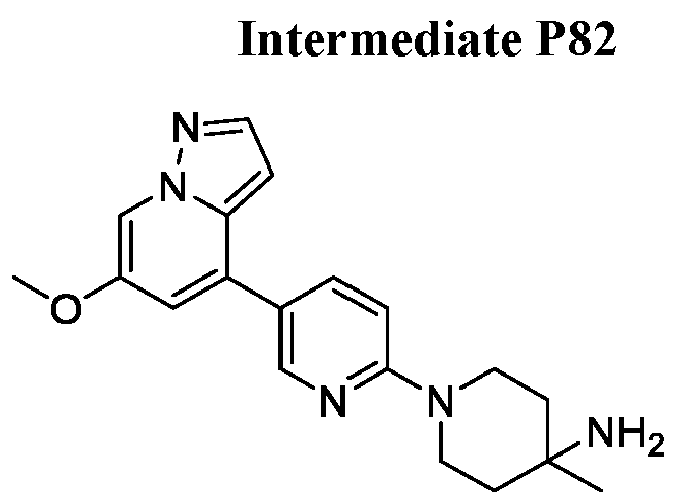
- A solution of tert-butyl (1-(5-(6-methoxypyrazolo[1,5-a]pyridin-4-yl)pyridin-2-yl)-4-methylpiperidin-4-yl)carbamate (Intermediate P81, 0.500 g, 1.14 mmol) in DCM (5 mL) was treated with TFA (5 mL). The reaction mixture was stirred at rt for 1 h. The reaction mixture was concentrated in vacuo, and the residue was diluted with EtOAc and washed successively with saturated NaHCO3(aq) and saturated NaCl(aq). The organic extract was dried over anhydrous Na2SO4(s), and concentrated in vacuo to afford the title compound (0.38 g, 1.13 mmol, 98.5 % yield). MS (apci) m/z = 338.2 (M+H).

- Step 1: Preparation of tert-butyl (1-(5-(3-chloro-6-methoxypyrazolo[1,5-a]pyridin-4-yl)pyridin-2-yl)-4-methylpiperidin-4-yl)carbamate. To a solution of tert-butyl (1-(5-(6-methoxypyrazolo[1,5-a]pyridin-4-yl)pyridin-2-yl)-4-methylpiperidin-4-yl)carbamate (Intermediate P81, 0.800 g, 1.83 mmol) in DCM (12.2 mL) was added NCS (0.293 g, 2.19 mmol). The reaction mixture was stirred at rt for 16 h. The reaction mixture was diluted with EtOAc and washed successively with water and saturated NaCl(aq). The organic extract was dried over anhydrous Na2SO4(s), and concentrated in vacuo. The residue was purified by silica chromatography (10-90% EtOAc in hexanes as the gradient eluent) to afford the title compound (0.765 g, 1.62 mmol, 88.6 % yield) in sufficient purity for step 2. MS (apci) m/z = 472.2 (M+H).
- Step 2: Preparation of 1-(5-(3-chloro-6-methoxypyrazolo[1,5-a]pyridin-4-yl)pyridin-2-yl)-4-methylpipendin-4-amine. A solution of tert-butyl (1-(5-(3-chloro-6-methoxypyrazolo[1,5-a]pyridin-4-yl)pyridin-2-yl)-4-methylpiperidin-4-yl)carbamate (0.765 g, 1.62 mmol) in DCM (12 mL) was treated with TFA (12 mL). The reaction mixture was stirred at rt for 1 h. The reaction mixture was diluted with EtOAc and washed successively with saturated NaHCO3(aq) and saturated NaCl(aq). The organic extract was dried over anhydrous Na2SO4(s), and concentrated in vacuo to afford the title compound (0.548 g, 1.47 mmol, 90.9 % yield). MS (apci) m/z = 372.2 (M+H).

- Step 1: Preparation of 4-bromo-3-chloro-6-methoxypyrazolo[1,5-a]pyridine. To a solution of 4-bromo-6-methoxypyrazolo[1,5-a]pyridine (15 g, 66.06 mmol) in DCM (100 mL) was added NCS (8.821 g, 66.06 mmol). The reaction mixture was sonicated for 5 min then stirred at rt for 24 h. The reaction mixture was diluted with Et2O, in which it was stirred for 10 min then sonicated for 2 min. The solid precipitate was isolated by vacuum filtration to afford the title compound (18.69 g, 71.47 mmol, 108.2% yield) in sufficient purity for step 2. MS (apci) m/z = 263.1 (M+H).
- Step 2: Preparation of 4-bromo-3-chloropyrazolo[1,5-a]pyridin-6-ol. A solution of 4-bromo-3-chloro-6-methoxypyrazolo[1,5-a]pyridine (7.59 g, 29.0 mmol) in DCE (290 mL) was sparged with N2 and treated with aluminum trichloride (11.6 g, 87.1 mmol) over the course of 5 min. The reaction mixture was stirred at 76°C for 16 h. After cooling to ambient temperature, the reaction mixture was quenched with DMA then concentrated in vacuo. The residue was taken up in water and cooled on ice for 30 min. The resultant precipitate was isolated by vacuum filtration then taken up in DMA. The solution was filtered through a plug of silica to afford the title compound as a solution in DMA (assumed quantitative yield, 7.00g, 28.3 mmol).
-

- Step 1: Preparation of 1-((4-bromo-3-chloropyrazolo[1,5-a]pyridin-6-yl)oxy)-2-methylpropan-2-ol. To a solution of 4-bromo-3-chloropyrazolo[1,5-a]pyridin-6-ol (Intermediate P84, 4.2 g, 17.0 mmol) in DMA (300 mL) was added potassium carbonate (23.5 g, 170 mmol) and 2,2-dimethyloxirane (14.9 mL, 169.8 mmol). The reaction mixture was stirred at 85°C for 2 h. After cooling to ambient temperature, the reaction mixture was quenched with 1:1 saturated NH4Cl(aq)/water. The solution was extracted with EtOAc. The combined organic extracts were dried over anhydrous Na2SO4(s) and concentrated in vacuo to afford the title compound (2.62 g, 5.74 mmol, 33.8% yield) in sufficient purity for step 2. MS (apci) m/z = 321.0 (M+H).
- Step 2: Preparation of 1-((3-chloro-4-(6-fluoropyridin-3-yl)pyrazolo[1,5-a]pyridin-6-yl)oxy)-2-methylpropan-2-ol. To a solution of 1-((4-bromo-3-chloropyrazolo[1,5-a]pyridin-6-yl)oxy)-2-methylpropan-2-ol (1.44 g, 4.51 mmol) in 1,4-dioxane was added 2-fluoro-5-(4,4,5,5-tetramethyl-1,3,2-dioxaborolan-2-yl)pyridine (1.51 g, 6.76 mmol), tetrakis(triphenylphosphine)palladium(0) (0.260 g, 0.225 mmol), and aqueous sodium carbonate (2M, 50 mL, 100 mmol). The reaction mixture was sparged with N2 and stirred at 90°C for 16 h. After cooling to ambient temperature, the reaction mixture was quenched with water. The solution was extracted with MTBE, and the combined organic extracts were dried over anhydrous Na2SO4(s), and concentrated in vacuo. The residue was purified by silica chromatography (0-100% EtOAc in hexanes as the gradient eluent) to afford the title compound (0.37 g, 1.10 mmol, 24.5 % yield). MS (apci) m/z = 336.1 (M+H).
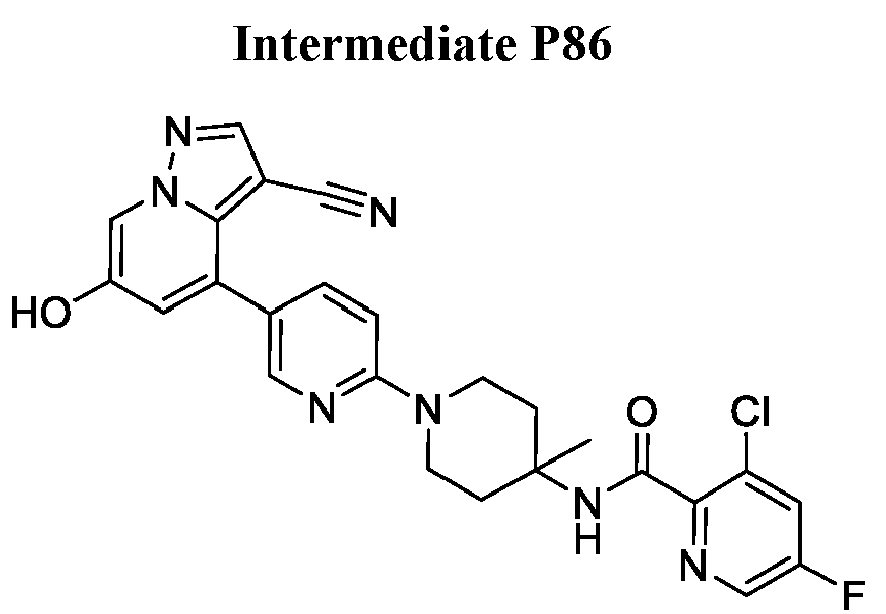
- To a solution of 4-(6-(4-amino-4-methylpiperidin-1-yl)pyridin-3-yl)-6-hydroxypyrazolo[1,5-a]pyridine-3-carbonitrile dihydrochloride (Intermediate P67, 0.253 g, 0.600 mmol) in DCM (3 mL) was added 3-chloro-5-fluoropicolinic acid (0.232 g, 1.32 mmol), HATU (0.502 g, 1.32 mmol), and DIEA (0.524 mL, 3.00 mmol). The reaction mixture was stirred at rt for 30 min. The reaction mixture was diluted with DCM and washed with aqueous citric acid (adjusted to pH 5). The aqueous mixture was extracted with DCM, and the combined organic extracts were washed successively with water and saturated NaCl(aq) then dried over anhydrous Na2SO4(s) and concentrated in vacuo. The residue was taken up in THF and 2M NaOH and stirred at rt for 5 min. The mixture was diluted with DCM, washed with aqueous citric acid (adjusted to pH 5), and extracted with 4:1 DCM/IPA. The combined organic extracts were washed with saturated NaCl(aq), dried over anhydrous Na2SO4(s), filtered, and concentrated in vacuo. The residue was purified by C-18 reverse phase chromatography (5-95% ACN in water [+ 0.1% TFA] as the gradient eluent). The fractions containing the desired product were diluted with 4:1 DCM/IPA and washed successively with saturated NaHCO3(aq) and saturated NaCl(aq). The organic extract was dried over anhydrous Na2SO4(s), filtered, and concentrated in vacuo to afford the title compound (0.325 g, 0.578 mmol, 96.3 % yield). MS (apci) m/z = 506.2 (M+H).

- To a solution of 4-(6-(4-amino-4-methylpiperidin-1-yl)pyridin-3-yl)-6-hydroxypyrazolo[1,5-a]pyridine-3-carbonitrile dihydrochloride (Intermediate P67, 255.4 mg, 0.606 mmol) in DCM (6 mL) was added benzoic acid (185.072 mg, 1.51545 mmol), HATU (576.228 mg, 1.515 mmol), and DIEA (1.056 mL, 6.06 mmol). The reaction mixture was stirred at rt for 16 h then concentrated in vacuo. The residue was taken up in THF and treated with 2M KOH(aq). The mixture was stirred at rt for 1 h then adjusted to pH 4 by addition of 2M HCl. The mixture was diluted with water and extracted with 4:1 DCM/IPA. The combined organic extracts were washed with water then dried over anhydrous Na2SO4(s), filtered, and concentrated in vacuo. The residue was purified by C-18 reverse phase chromatography (5-95% ACN in water [+ 0.1% TFA] as the gradient eluent). The fractions containing the desired product were washed with saturated NaHCO3(aq) and extracted with 4:1 DCM/IPA. The combined organic extracts were dried over anhydrous Na2SO4(s), filtered, and concentrated in vacuo to afford the title compound (172.5 mg, 0.381 mmol, 62.9% yield). MS (apci) m/z = 453.2 (M+H).

- Step 1: Preparation of tert-butyl 4-(2-((4-(6-(4-benzamido-4-methylpiperidin-1-yl)pyridin-3-yl)-3-cyanopyrazolo[1,5-a]pyridin-6-yl)oxy)ethyl)piperazine-1-carboxylate. To a solution of N-(1-(5-(3-cyano-6-hydroxypyrazolo[1,5-a]pyridin-4-yl)pyridin-2-yl)-4-methylpiperidin-4-yl)benzamide (Intermediate P87, 157.2 mg, 0.3474 mmol) in DMA (3.5 mL) was added tert-Butyl 4-(2-chloroethyl)tetrahydro-1(2H)-pyrazinecarboxylate (172.8 mg, 0.6948 mmol) and cesium carbonate (565.9 mg, 1.737 mmol). The reaction mixture was stirred at 60°C for 16 h. After cooling to ambient temperature, the reaction mixture was diluted with EtOAc and washed successively with water and saturated NaCl(aq). The combined organic extracts were dried over anhydrous Na2SO4(s), filtered, and concentrated in vacuo to afford the title compound (assumed theoretical yield, 231 mg, 0.3474 mmol) in sufficient purity for step 2. MS (apci) m/z = 665.4 (M+H).
- Step 2: Preparation of N-(1-(5-(3-cyano-6-(2-(piperazin-1-yl)ethoxy)pyrazolo[1,5-a]pyridin-4-yl)pyridin-2-yl)-4-methylpiperidin-4-yl)benzamide. A solution of tert-butyl 4-(2-((4-(6-(4-benzamido-4-methylpiperidin-1-yl)pyridin-3-yl)-3-cyanopyrazolo[1,5-a]pyridin-6-yl)oxy)ethyl)piperazine-1-carboxylate in DCM (1.75 mL) was treated with TFA (1.75 mL, 22.9 mmol). The reaction mixture was stirred at rt for 30 min then concentrated in vacuo. The residue was directly purified by C-18 reverse phase chromatography (5-95% ACN in water (+ 0.1% TFA) as the gradient eluent). The fractions containing the desired product were washed with saturated NaHCO3(aq) and extracted with 4:1 DCM/IPA. The combined organic extracts were dried over anhydrous Na2SO4(s), filtered, and concentrated in vacuo to afford the title compound (111.8 mg, 0.1980 mmol, 56.99% yield over two steps). MS (apci) m/z = 565.3 (M+H).

- A solution of tert-butyl (1-(5-(3-cyano-6-ethoxypyrazolo[1,5-a]pyridin-4-yl)pyridin-2-yl)-4-methylpiperidin-4-yl)carbamate (Example 469, 100 mg, 0.210 mmol) in DCM (2 mL) was treated with TFA (2 mL). The reaction mixture was stirred at rt for 1 h. The crude reaction mixture was directly purified by silica chromatography (5-50% [MeOH + 2% NH4OH] in DCM as the gradient eluent) to afford the title compound (20 mg, 0.0531 mmol, 25.3% yield). MS (apci) m/z = 377.2 (M+H).

- To a solution of 4-(6-(4-amino-4-methylpiperidin-1-yl)pyridin-3-yl)-6-hydroxypyrazolo[1,5-a]pyridine-3-carbonitrile dihydrochloride (Intermediate P67, 1.38 g, 3.2754 mmol) in DCM (6.5507 mL) was added 2-Picolinic acid (1.0081 g, 8.1884 mmol), HATU (3.1135 g, 8.1884 mmol), and DIEA (5.7207 mL, 32.754 mmol). The reaction mixture was stirred at rt for 1 h then concentrated in vacuo. The residue was taken up in THF and 2M aqueous KOH and stirred at rt for 30 min. The mixture was adjusted to pH 4 by addition of 1M HCl and extracted with 4:1 DCM/IPA. The combined organic extracts were washed successively with water and saturated NaCl(aq) then dried over anhydrous Na2SO4(s), filtered, and concentrated in vacuo. The residue was purified by C-18 reverse phase chromatography (5-95% ACN in water (+ 0.1% TFA) as the gradient eluent). The fractions containing the desired product were diluted with 4:1 DCM/IPA and washed successively with saturated NaHCO3(aq) and saturated NaCl(aq). The organic extract was dried over anhydrous Na2SO4(s), filtered, and concentrated in vacuo to afford the title compound (737 mg, 1.6251 mmol, 49.616% yield). MS (apci) m/z = 454.2 (M+H).
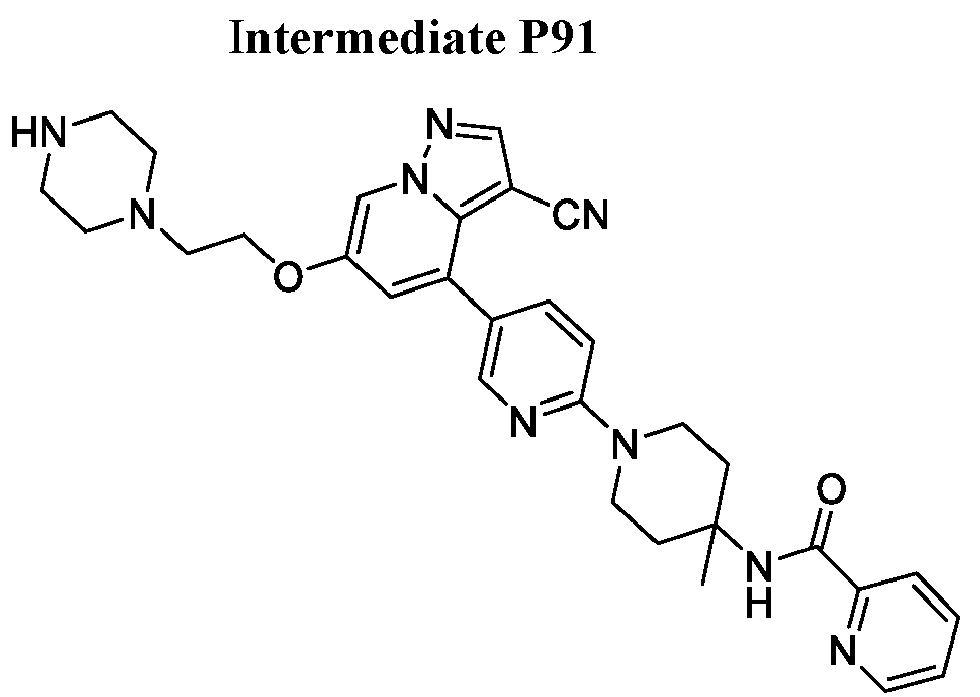
- Step 1: Preparation of tert-butyl 4-(2-((3-cyano-4-(6-(4-methyl-4-(picolinamido)piperidin-1-yl)pyridin-3-yl)pyrazolo[1,5-a]pyridin-6-yl)oxy)ethyl)piperazine-1-carboxylate. To a solution of N-(1-(5-(3-cyano-6-hydroxypyrazolo[1,5-a]pyridin-4-yl)pyridin-2-yl)-4-methylpiperidin-4-yl)picolinamide (Intermediate P90, 120 mg, 0.265 mmol) in DMA (2.646 mL) was added tert-Butyl 4-(2-chloroethyl)tetrahydro-1(2H)-pyrazinecarboxylate (65.8 mg, 0.265 mmol) and cesium carbonate (431 mg, 1.32 mmol). The reaction mixture was stirred at 60°C for 48 h. After cooling to ambient temperature, the reaction mixture was diluted with 4:1 DCM/IPA and washed successively with saturated NaHCO3(aq) and saturated NaCl(aq). The organic extract was dried over anhydrous Na2SO4(s), filtered, and concentrated in vacuo to afford the title compound (176 mg, 0.264 mmol, 99.9 % yield) in sufficient purity for step 2. MS (apci) m/z = 666.4 (M+H).
- Step 2: Preparation of N-(1-(5-(3-cyano-6-(2-(piperazin-1-yl)ethoxy)pyrazolo[1,5-a]pyridin-4-yl)pyridin-2-yl)-4-methylpiperidin-4-yl)picolinamide. A solution of tert-butyl 4-(2-((3-cyano-4-(6-(4-methyl-4-(picolinamido)piperidin-1-yl)pyridin-3-yl)pyrazolo[1,5-a]pyridin-6-yl)oxy)ethyl)piperazine-1-carboxylate (176 mg, 0.264 mmol) in DCM (2.643 mL) was treated with TFA (0.2 mL). The reaction mixture was stirred at rt for 1 h. The reaction mixture was diluted with 4:1 DCM/IPA and washed successively with saturated NaHCO3(aq), water, and saturated NaCl(aq). The organic extract was dried over anhydrous Na2SO4(s), filtered, and concentrated in vacuo to afford the title compound (assumed theoretical yield, 150 mg, 0.264 mmol). MS (apci) m/z = 566.4 (M+H).

- Step 1: Preparation of methyl 1-(5-(3-cyano-6-ethoxypyrazolo[1,5-a]pyridin-4-yl)pyridin-2-yl)-4-methylpiperidine-4-carboxylate. To a solution of 6-ethoxy-4-(6-fluoropyridin-3-yl)pyrazolo[1,5-a]pyridine-3-carbonitrile (Intermediate P6, 0.9974 g, 3.533 mmol) in DMA (14.13 mL) was added methyl 4-methylpiperidine-4-carboxylate (1.666 g, 10.6 mmol) and TEA (2.396 mL, 17.67 mmol). The reaction mixture was stirred at 80°C for 16 h. After cooling to ambient temperature, the reaction mixture was diluted with EtOAc and washed successively with water and brine. The aqueous fractions were extracted with 4:1 DCM/IPA. The combined organic extracts were concentrated in vacuo, and the residue was taken up in EtOAc and washed successively with water and brine. The organic extract was dried over anhydrous Na2SO4(s), filtered, and concentrated in vacuo. The residue was purified by silica chromatography (5-95% EtOAc in hexanes as the gradient eluent) to afford the title compound (436.4 mg, 1.040 mmol, 29.44%) in sufficient purity for step 2. MS (apci) m/z = 420.2 (M+H).
- Step 2: Preparation of 1-(5-(3-cyano-6-ethoxypyrazolo[1,5-a]pyridin-4-yl)pyridin-2-yl)-4-methylpiperidine-4-carboxylic acid. A mixture of methyl 1-(5-(3-cyano-6-ethoxypyrazolo[1,5-a]pyridin-4-yl)pyridin-2-yl)-4-methylpiperidine-4-carboxylate (776.5 mg, 1.851 mmol) in 1:1 THF/MeOH (37 mL) was treated with KOH (aq. 2M) (3.7 mL, 7.4 mmol). After stirred at rt for 80 h, the reaction mixture was diluted with 1N NaOH and washed successively with MTBE and DCM. After phase-separation, the aqueous layer was acidified to ca. pH 5 and extracted with 4:1 DCM/IPA. The combined organic extracts were dried over anhydrous Na2SO4(s), filtered, and concentrated in vacuo to afford the title compound (470.4 mg, 1.160 mmol, 62.68% yield). MS (apci) m/z = 406.2 (M+H).

- In a pressure tube, a mixture of 4-bromo-6-methoxypyrazolo[1,5-a]pyridine-3-carbonitrile (Intermediate P1, Step 6; 1.1854 g, 4.7026 mmol), 2-fluoro-5-(4,4,5,5-tetramethyl-1,3,2-dioxaborolan-2-yl)pyridine (1.2587 g, 5.6432 mmol), Pd(PPh3)4 (0.1087 g, 0.094 mmol) and 2 M Na2CO3(aq) (15 mL, 30 mmol) in dioxane (15 mL) was sparged with N2(g). The vessel was sealed, and the sparged mixture was stirred for 4 d at 60 °C. After cooling to ambient temperature, the reaction mixture was quenched with water. The resultant precipitate was filtered, washed with water, and then purified by silica chromatography (0-25% MeOH in DCM) to afford the title compound (734.6 mg, 58% yield). MS (apci), m/z = 269.1 (M+H).

- A solution of tert-butyl ((3S,4S)-1-(5-(3-cyano-6-methoxypyrazolo[1,5-a]pyridin-4-yl)pyridin-2-yl)-3-hydroxypiperidin-4-yl)carbamate (Example 514, 274.5 mg, 0.5909 mmol) in dioxane (3 mL) was treated with 37% HCl (97 µL, 1.18 mmol), then stirred overnight at ambient temperature. The resulting mixture was concentrated in vacuo to afford the title compound (258 mg, 100% yield). MS (apci) m/z = 365.2 (M+H).


- A stirring, ambient temperature, solution of tert-butyl (1-(5-(3-cyano-6-ethoxypyrazolo[1,5-a]pyridin-4-yl)pyridin-2-yl)-4-methylpiperidin-4-yl)carbamate (Example 469, 807 mg, 1.69 mmol) in MeOH (3387 µL) was treated dropwise with 12 M HCl(aq) (1.41 mL, 16.9 mmol). The resulting mixture was stirred overnight at ambient temperature. The resulting thick slurry was diluted with MeOH (ca. 1 mL), and vacuum filtered. The solids were rinsed with MeOH (3 × 1 mL) and MTBE (3 × 10 mL), then dried in vacuo to afford the title compound (690 mg, 91% yield). MS (apci) m/z = 377.2 (M+H).

- Tert-Butyl (1-(5-(3-cyano-6-ethoxypyrazolo[1,5-a]pyridin-4-yl)pyridin-2-yl)-4-formylpiperidin-4-yl)carbamate (Intermediate P71, 100 mg, 0.2038 mmol) was added to solution of pyrrolidine (681 µL, 0.82 mmol) and TEA (142 µL, 1.0 mmol) in DCM (1.0 mL), and the mixture was stirred for 1 h at ambient temperature. Subsequently, NaBH(AcO)3 (86.4 mg, 0.41 mmol) was added, and the resulting mixture was stirred for 2.5 h at ambient temperature then concentrated in vacuo. The residue was purified by C18 reverse phase chromatography (5-95% ACN:water with 0.1% TFA). Fractions containing the desired product were combined, diluted with 4:1 DCM:iPrOH, then sequentially extracted with saturated NaHCO3(aq), water and brine. The organic extracts were dried over anhydrous Na2SO4(s), filtered, and concentrated in vacuo to cleanly afford the title compound (40 mg, 36% yield). MS (apci) m/z = 546.3 (M+H).

- A solution of tert-butyl (1-(5-(3-cyano-6-ethoxypyrazolo[1,5-a]pyridin-4-yl)pyridin-2-yl)-4-(pyrrolidin-1-ylmethyl)piperidin-4-yl)carbamate (Intermediate P96; 40 mg, 0.073 mmol) in DCE (4.7 µL) and TFA (5.6 µL, 0.073 mmol) was stirred for 90 min at ambient temperature. The resulting mixture was diluted with 4:1 DCM:iPrOH, then sequentially extracted with saturated NaHCO3(aq), water and brine. The organic extracts were dried over anhydrous Na2SO4(s), filtered, and concentrated in vacuo to cleanly afford the title compound (30 mg, 92% yield). MS (apci) m/z = 446.3 (M+H).


- A solution of tert-butyl (1-(5-(3-cyano-6-ethoxypyrazolo[1,5-a]pyridin-4-yl)pyridin-2-yl)-4-((4-ethylpiperazin-1-yl)methyl)piperidin-4-yl)carbamate (Example 379, 171.2 mg, 0.2908 mmol) in dioxane (5.0 mL) was treated with 12 M HCl(aq) (23.88 µL, 0.2908 mmol). The resulting mixture was stirred for 45 min at ambient temperature before concentrating the mixture in vacuo to cleanly afford the title compound (205.5 mg, quantitative yield). MS (apci) m/z = 489.3 (M+H).

- A solution of tert-butyl (1-(5-(3-cyano-6-ethoxypyrazolo[1,5-a]pyridin-4-yl)pyridin-2-yl)-4-formylpiperidin-4-yl)carbamate (Intermediate P71, 278 mg, 0.567 mmol) and (S)-1,2-dimethylpiperazine (Intermediate P93; 270 mg, 2.36 mmol) in DCE (5 mL) was stirred for 30 min at ambient temperature before adding NaBH(AcO)3 (480.4 mg, 2.267 mmol). The resulting mixture was stirred overnight at ambient temperature, then concentrated in vacuo. The residue was suspended in 4:1 DCM:iPrOH, and extracted sequentially with saturated NaHCO3(aq) (2x) and brine. The organic extracts were dried over anhydrous Na2SO4(s), filtered and concentrated in vacuo. The residue was purified by silica chromatography (using 0-15% [MeOH with 1% NH4OH] in DCM as the gradient eluent) to cleanly afford the title compound (133 mg, 40% yield). MS (apci) m/z = 589.3 (M+H).

- A solution of methyl 4-amino-1-(5-(3-cyano-6-ethoxypyrazolo[1,5-a]pyridin-4-yl)pyridin-2-yl)piperidine-4-carboxylate (Step 1, Intermediate P70, 500 mg, 1.19 mmol) in DCM (5 mL) was treated with DIEA (415.4 µL, 2.378 mmol), then stirred for 10 min at 0 °C. The cold solution was treated dropwise with isovaleryl chloride (174 µL, 1.43 mmol). The resulting mixture was stirred for 1 h at 0 °C. The mixture was diluted with 4:1 DCM:iPrOH, and extracted with saturated NaHCO3(aq) (2x). After back extracting the aqueous extracts with DCM, all organic extracts were combined, dried over anhydrous Na2SO4(s), filtered, and concentrated in vacuo to cleanly afford the title compound (943.9 mg, 79% yield). MS (apci) m/z = 505.2 (M+H).


- A solution of methyl 1-(5-(3-cyano-6-ethoxypyrazolo[1,5-a]pyridin-4-yl)pyridin-2-yl)-4-(3-methylbutanamido)piperidine-4-carboxylate (Intermediate P93; 476.3 mg, 0.9439 mmol) in THF (5 mL) was stirred for 20 min at 0 °C. The cold solution was treated with LiBH4 (82.24 mg, 3.776 mmol). The resulting mixture was stirred overnight at ambient temperature, then concentrated in vacuo. The residue was dissolved in EtOAc, and extracted with brine (3x). After back extracting the aqueous extracts with EtOAc, the organic extracts were combined, dried over anhydrous Na2SO4(s), filtered, and concentrated in vacuo. The crude product was purified by silica chromatography (using 40-100% EtOAc in Hexanes as the gradient eluent) to cleanly afford the title compound (95.7 mg, 21% yield). MS (apci) m/z = 477.25 (M+H).

- A solution of N-(1-(5-(3-cyano-6-ethoxypyrazolo[1,5-a]pyridin-4-yl)pyridin-2-yl)-4-(hydroxymethyl)piperidin-4-yl)-3-methylbutanamide (Intermediate P101; 95.7 mg, 0.201 mmol) in DCM (2 mL) was treated with DMP (170 mg, 0.402 mmol). The resulting mixture was stirred for 1.5 h at ambient temperature. The reaction mixture was diluted with DCM, and extracted with saturated NaHCO3(aq). After back extracting the aqueous extracts with DCM, the organic extracts were combined, dried over anhydrous Na2SO4(s), and filtered. The filtrate was purified directly by silica chromatography (using 20-80% EtOAc in Hexanes as the gradient eluent) to cleanly afford the title compound (41.0 mg, 43% yield). MS (apci) m/z = 475.2 (M+H).

- A solution of methyl 4-amino-1-(5-(3-cyano-6-ethoxypyrazolo[1,5-a]pyridin-4-yl)pyridin-2-yl)piperidine-4-carboxylate (step1, Intermediate P70, 334.8 mg, 0.7962 mmol) in DCM (51.23 µL) was treated with DIEA (278.1 µL, 1.592 mmol), then stirred for 10 min at 0 °C. The cold solution was treated dropwise with isopropyl carbonochloridate (955.5 µL, 0.9555 mmol). The resulting mixture was stirred for 40 min at 0 °C, then overnight at ambient temperature. The mixture was purified directly by silica chromatography (using 30-70% EtOAc in Hexanes as the gradient eluent) to cleanly afford the title compound (323.5 mg, 80% yield). MS (apci) m/z = 507.15 (M+H).

- A solution of methyl 1-(5-(3-cyano-6-ethoxypyrazolo[1,5-a]pyridin-4-yl)pyridin-2-yl)-4-((isopropoxycarbonyl)amino)piperidine-4-carboxylate (Intermediate P103; 323.5 mg, 0.6386 mmol) in THF (3 mL) was stirred for 20 min at 0 °C. The cold solution was treated with LiBH4 (55.64 mg, 2.554 mmol). The resulting mixture was stirred overnight at ambient temperature, then concentrated in vacuo. The residue was dissolved in DCM, and extracted with brine. The organic extracts were purified directly by silica chromatography (using 30-100% EtOAc in Hexanes as the gradient eluent) to cleanly afford the title compound (171.7 mg, 56% yield). MS (apci) m/z = 479.2 (M+H).
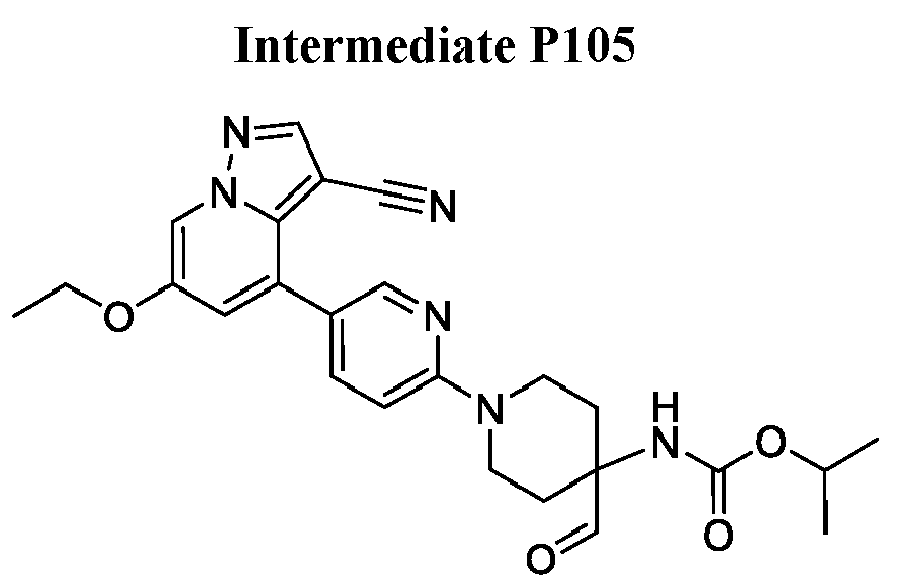
- A solution of isopropyl (1-(5-(3-cyano-6-ethoxypyrazolo[1,5-a]pyridin-4-yl)pyridin-2-yl)-4-(hydroxymethyl)piperidin-4-yl)carbamate (Intermediate P104; 171 mg, 0.357 mmol) in DCM (1 mL) was treated with DMP (303.1 mg, 0.7147 mmol). The resulting mixture was stirred overnight at ambient temperature. The reaction mixture was diluted with DCM, and extracted sequentially with water and brine. After back extracting the aqueous extracts with DCM, the organic extracts were combined, dried over anhydrous Na2SO4(s), and filtered. The filtrate was purified directly by silica chromatography (using 20-80% EtOAc in Hexanes as the gradient eluent) to cleanly afford the title compound (167.4 mg, 98% yield). MS (apci) m/z = 477.2 (M+H).

- A solution of 4-(pyridin-2-ylmethyl)piperidin-4-amine bis(2,2,2-trifluoroacetate) (Intermediate R41; 287.5 mg, 0.6856 mmol) in DMF (2 mL) was treated with 6-ethoxy-4-(6-fluoropyridin-3-yl)pyrazolo[1,5-a]pyridine-3-carbonitrile (Intermediate P6, 176 mg, 0.624 mmol), K2CO3(s) (431 mg, 3.12 mmol) was stirred overnight at 70 °C. The mixture was cooled to ambient temperature, diluted with water (50 mL) and extracted with DCM (3 × 20 mL). The organic extracts were dried over anhydrous Na2SO4(s), filtered, and concentrated in vacuo. The crude residue was purified by silica chromatography (0-15% MeOH in DCM) to afford the title compound (73 mg, 26% yield). MS (apci) m/z = 454 (M+H).


- A solution of 1-(5-(3-cyano-6-ethoxypyrazolo[1,5-a]pyridin-4-yl)pyridin-2-yl)-4-(hydroxymethyl)piperidine-4-carboxylic acid (Intermediate P156; 30 mg, 0.071 mmol) in DMF (1 mL) was treated with NaH (60 wt.% in mineral oil; 8.5 mg, 0.21 mmol). The suspension was stirred for 5 min at 50 °C, then treated with 4-(2-chloroethyl)morpholine (32 mg, 0.21 mmol). The resulting mixture was stirred for 15 h at 50 °C before introducing additional NaH (2 equivalents) and 4-(2-chloroethyl)morpholine (3 equivalents). The mixture was stirred for 4 h at 70 °C. After cooling to ambient temperature, the mixture was concentrated in vacuo, and diluted with MeOH (2 mL). The methanolic mixture was treated with 2 M NaOH(aq) (2 mL), and stirred for 15 h at 50 °C. After cooling to ambient temperature, the reaction mixture was concentrated in vacuo, and purified by C18 reverse phase chromatography (5-95% acetonitrile/water). Fractions containing the desired product were combined, concentrated in vacuo, and then treated with 4 M HCl in dioxane. The HCl mixture was concentrated in vacuo to afford the title compound (25 mg, 58% yield). MS (apci) m/z = 535.2 (M+H).


- A solution of ethyl 1-(5-(3-cyano-6-ethoxypyrazolo[1,5-a]pyridin-4-yl)pyridin-2-yl)-4-(hydroxymethyl)piperidine-4-carboxylate (Example 701; 30 mg, 0.067 mmol) in DMF (1 mL) was treated with NaH (60 wt.% in mineral oil; 21 mg, 0.53 mmol). The suspension was stirred for 5 min at 50 °C, then treated with 2-chloro-N,N-dimethylethan-1-amine hydrochloride (38 mg, 0.27 mmol). The resulting mixture was stirred for 1 h at ambient temperature then for 15 h at 50 °C. After cooling to ambient temperature, the mixture was diluted with water and extracted with DCM. The organic extracts were purified by C18 reverse phase chromatography (5-95% ACN:water with 0.1% TFA). Fractions containing the desired product were combined, passed through a basic resin (Stratospheres Pl-HCO3) rinsing with 1 M HCl(aq), then concentrated in vacuo to afford the title compound (6 mg, 17% yield). MS (apci) m/z = 521.3 (M+H).

- A mixture of ethyl 1-(5-(3-cyano-6-ethoxypyrazolo[1,5-a]pyridin-4-yl)pyridin-2-yl)-4-((2-(dimethylamino)ethoxy)methyl)piperidine-4-carboxylate dihydrochloride (8 mg, 0.02 mmol), 2 M NaOH(aq) (1 mL) and EtOH (1 mL) was stirred for 60 h at ambient temperature. After concentrating the mixture in vacuo, the residue was purified by C18 reverse phase chromatography (5-95% ACN:water with 0.1% TFA). Fractions containing the desired product were combined, concentrated in vacuo and then treated with 4 M HCl in dioxane. The HCl mixture was concentrated in vacuo to afford the title compound (4 mg, 53% yield). MS (apci) m/z = 493.4 (M+H).

- In a pressure vessel, a solution of 4-bromo-6-ethoxypyrazolo[1,5-a]pyridine-3-carbonitrile (Intermediate P5, 1.37 g, 5.15 mmol) in dioxane (52 mL) was treated with bis(pinacolato)diboron (3.92 g, 15.4 mmol), PdCl2(dppf)•CH2Cl2 (0.420 g, 0.515 mmol), and KOAc (1.52 g, 15.4 mmol), then sparged with Ar(g). The vessel was sealed, and the mixture was stirred for 16 h at 90 °C. After cooling to ambient temperature, the reaction mixture was diluted with EtOAc, and washed sequentially with water (2x) and brine (1x). The organic extracts were dried over anhydrous Na2SO4(s), filtered and concentrated in vacuo. The crude residue was purified by silica chromatography (using 5-75% Hexanes-EtOAc as the gradient eluent) to cleanly afford the title compound (1.31 g, 81% yield). MS (apci) m/z = 314.2 (M+H).


- In a pressure vessel, a solution of methyl 1-(4-bromophenyl)-4-((tert-butoxycarbonyl)amino)piperidine-4-carboxylate (Intermediate R43; 377.4 mg, 0.9131 mmol) in dioxane (77 mL) was treated with 6-ethoxy-4-(4,4,5,5-tetramethyl-1,3,2-dioxaborolan-2-yl)pyrazolo[1,5-a]pyridine-3-carbonitrile (Intermediate P110; 314.5 mg, 1.004 mmol), Pd(PPh3)4 (105.5 mg, 0.09131 mmol) and K2CO3(s) (378.6 mg, 2.739 mmol), then sparged with Ar(g). The vessel was sealed, and stirred for 16 h at 90 °C. After cooling to ambient temperature, the reaction mixture was diluted with EtOAc, and washed sequentially with water (2x) and brine (1x). The organic extracts were dried over anhydrous Na2SO4(s), filtered and concentrated in vacuo. The crude residue was purified by silica chromatography (using 5-95% Hexanes-EtOAc as the gradient eluent) to cleanly afford the title compound (173.0 mg, 36% yield). MS (apci) m/z = 520.3 (M+H).

- A solution of methyl 4-((tert-butoxycarbonyl)amino)-1-(4-(3-cyano-6-ethoxypyrazolo[1,5 -a]pyridin-4-yl)phenyl)piperidine-4-carboxylate (Intermediate P111; 173.0 mg, 0.3329 mmol) in THF (3.3 mL) was stirred at 0 °C, then treated with LiBH4 (36.26 mg, 1.665 mmol). The resulting mixture was stirred overnight at ambient temperature, then diluted with 10% citric acid solution, and extracted with EtOAc (2x). The combined organic extracts were washed sequentially with water (1x) and brine (1x), dried over anhydrous Na2SO4(s), filtered, and concentrated in vacuo. The crude product was purified by silica chromatography (using 5-95% Hexanes-Acetone as the gradient eluent) to cleanly afford the title compound (64 mg, 39% yield). MS (apci) m/z = 492.3 (M+H).

- A solution of tert-butyl (1-(4-(3-cyano-6-ethoxypyrazolo[1,5-a]pyridin-4-yl)phenyl)-4-(hydroxymethyl)piperidin-4-yl)carbamate (Intermediate P112; 64.0 mg, 0.130 mmol) in DCM (1.3 mL) was treated with DMP (66.3 mg, 0.156 mmol). The resulting mixture was stirred for 16 h at ambient temperature. The reaction mixture was concentrated in vacuo. The crude residue was purified directly by silica chromatography (using 5-95% Hexanes-EtOAc as the gradient eluent) to cleanly afford the title compound (41.8 mg, 66% yield). MS (apci) m/z = 490.3 (M+H).


- Step 1: Preparation of tert-butyl (1-(4-(3-cyano-6-ethoxypyrazolo[1,5-a]pyridin-4-yl)phenyl)-4-((dimethylamino)methyl)piperidin-4-yl)carbamate. A solution of dimethylamine hydrochloride (34.8 mg, 0.427 mmol) in DCM (1.7 mL) was treated with TEA (59.5 µL, 0.427 mmol). The mixture was stirred at for 15 minutes at ambient temperature before tert-butyl (1-(4-(3-cyano-6-ethoxypyrazolo[1,5-a]pyridin-4-yl)phenyl)-4-formylpiperidin-4-yl)carbamate (Intermediate P113; 41.8 mg, 0.0854 mmol) was added. The resulting mixture was stirred for 15 min at ambient temperature, then NaBH(AcO)3 (90.5 mg, 0.427 mmol) was added. The reaction mixture was stirred for 16 h at room temperature. The mixture was diluted with 4:1 DCM:iPrOH, and washed with water. The organic extracts were washed sequentially with water (1x) and brine (1x), dried over anhydrous Na2SO4(s), filtered, and concentrated in vacuo afford the title compound which was carried directly into Step 2 (0.0854 mmol, quantitative yield was assumed). MS (apci) m/z = 519.3 (M+H).
- Step 2: Preparation of 4-(4-(4-amino-4-((dimethylamino)methyl)piperidin-1-yl)phenyl)-6-ethoxypyrazolo[1,5-a]pyridine-3-carbonitrile. Crude tert-butyl (1-(4-(3-cyano-6-ethoxypyrazolo[1,5-a]pyridin-4-yl)phenyl)-4-((dimethylamino)methyl)piperidin-4-yl)carbamate (Step 1, 0.0854 mmol) was 1:1 DCM:TFA (2.0 mL), and stirred for 30 min at ambient temperature before concentrating the mixture in vacuo. The crude residue was suspended in 4:1 DCM:iPrOH, and extracted with saturated NaHCO3(aq) (2x). The organic extracts were dried over anhydrous Na2SO4(s), filtered and concentrated in vacuo to afford the title compound (35.7 mg, quantitative yield). MS (apci) m/z = 419.3 (M+H).

- A solution of 4-(6-fluoropyridin-3-yl)-6-hydroxypyrazolo[1,5-a]pyridine-3-carbonitrile (Intermediate P66, 145.9 mg, 0.5739 mmol) and DIEA (200.5 µL, 1.148 mmol) in DCM (2.0 mL) was treated with dimethylcarbamic chloride (92.57 mg, 0.8609 mmol), then stirred overnight at ambient temperature. The reaction mixture was washed with water. The organic extracts were separated, and purified directly by silica chromatography (using 20-80% Hexanes/ EtOAc as the gradient eluent) to cleanly afford the title compound (158.4 mg, 85% yield). MS (apci) m/z = 326.1 (M+H).
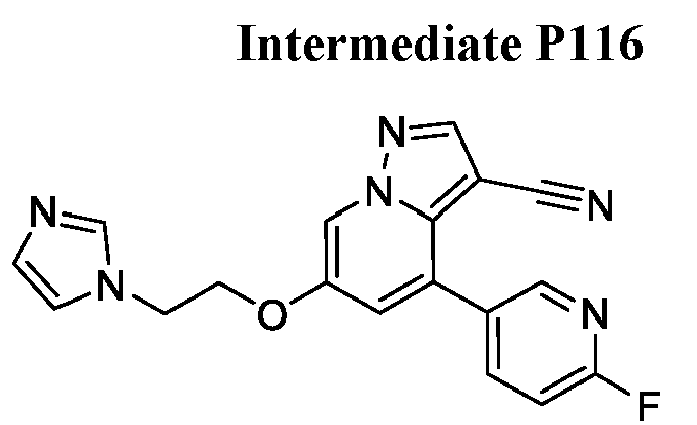
- A mixture of 4-(6-fluoropyridin-3-yl)-6-hydroxypyrazolo[1,5-a]pyridine-3-carbonitrile (Intermediate P66, 100.3 mg, 0.3945 mmol), 1-(2-chloroethyl)-1H-imidazole hydrochloride (197.7 mg, 1.184 mmol) and Cs2CO3(s) (1.285 g, 3.945 mmol) in DMA (2.0 mL) was stirred overnight at 60 °C. After cooling to ambient temperature, the reaction mixture was diluted with water and washed sequentially with DCM (4x) and 4:1 DCM:iPrOH. The combined organic extracts were dried over anhydrous Na2SO4(s), and filtered. The filtrate was purified directly by silica chromatography (using 0-25% DCM/MeOH with 1% NH4OH as the gradient eluent) to cleanly afford the title compound (158.4 mg, 85% yield). MS (apci) m/z = 349.10 (M+H).

- A mixture of 4-(6-fluoropyridin-3-yl)-6-hydroxypyrazolo[1,5-a]pyridine-3-carbonitrile (Intermediate P66, 103.6 mg, 0.4075 mmol), 4-(chloromethyl)-1-methyl-1H-imidazole hydrochloride (199.7 mg, 1.196 mmol) and Cs2CO3(s) (1.328 g, 4.075 mmol) in DMA (2.0 mL) was stirred for 1 d at 60 °C, then for an additional 1 d at 110 °C. After cooling to ambient temperature, the reaction mixture was acidified with 2 M HCl(aq), and purified directly by C18 reverse phase chromatography (using 0-70% water/ACN with 0.1% TFA as the gradient eluent). Fractions containing the desired product were combined, partially concentrated in vacuo to remove the ACN, then partitioned between saturated NaHCO3(aq) and 4:1 DCM:iPrOH. The biphasic mixture was extracted with additional 4:1 DCM:iPrOH (3x). The combined organic extracts were dried over anhydrous Na2SO4(s), filtered and concentrated in vacuo to afford the title compound (26.0 mg, 18% yield). MS (apci) m/z = 349.10 (M+H).

- A solution of 4-(6-fluoropyridin-3-yl)-6-(2-morpholinoethoxy)pyrazolo[1,5-a]pyridine-3-carbonitrile (Intermediate P79, 485 mg, 1.32 mmol) in DMSO (2.64 mL) was treated with tert-butyl 4-methylpiperidin-4-ylcarbamate (396 mg, 1.85 mmol) and DIEA (690 µL, 3.96 mmol) was stirred overnight at 90 °C. After cooling to ambient temperature, the reaction mixture was poured into water (200 mL), and acidified to pH 5 with 10% citric acid. After stirring for 15 min at ambient temperature, the aqueous suspension was vacuum filtered. The solids were purified by silica chromatography (5-95%: 10% MeOH in DCM with 1% NH4OH / DCM) to afford the title compound (390 mg, 53% yield). MS (apci) m/z = 562.3 (M+H).

- A solution of tert-butyl (1-(5-(3-cyano-6-(2-morpholinoethoxy)pyrazolo[1,5-a]pyridin-4-yl)pyridin-2-yl)-4-methylpiperidin-4-yl)carbamate (Intermediate P118; 390 mg, 0.694 mmol) was suspended in DCM (3 mL) and treated with TFA (1.0 mL). The resulting mixture was stirred for 2 h at ambient temperature before concentrating the mixture in vacuo to afford the title compound as a TFA salt (229.6 mg, 48% yield). MS: m/z = 462.3 (M+H).


- A solution of 4-(6-fluoropyridin-3-yl)-6-(2-morpholinoethoxy)pyrazolo[1,5-a]pyridine-3-carbonitrile (Intermediate P79, 305.6 mg, 0.8318 mmol) in DMF (3.327 mL) was treated with methyl 4-methylpiperidine-4-carboxylate (350.3 µL, 2.495 mmol) and TEA (564.2 µL, 4.159 mmol) was stirred overnight at 90 °C. After cooling to ambient temperature, the reaction mixture diluted with EtOAc, and washed sequentially with water (3x) and brine (1x).After washing the aqueous extracts with 4:1 DCM:iPrOH, the DCM:iPrOH extracts were concentrated in vacuo. The residue was dissolved in EtOAc, then extracted with water (3x) and brine (1x) before combining with the original EtOAc extracts. The combined EtOAc extracts were dried over anhydrous Na2SO4(s), filtered and concentrated in vacuo. The crude residue was purified by silica chromatography (using 5-95% Hexanes:EtOAc as the gradient eluent) to afford the title compound (354 mg, 84% yield). MS (apci) m/z = 505.3 (M+H).

- A solution of methyl 1-(5-(3-cyano-6-(2-morpholinoethoxy)pyrazolo[1,5-a]pyridin-4-yl)pyridin-2-yl)-4-methylpiperidine-4-carboxylate (Intermediate P120; 354 mg, 0.702 mmol) in 1:1 THF:MeOH (3.0 mL) was treated with 2.0 M KOH(aq) (3.5 mL, 7.02 mmol), then stirred for 64 h at ambient temperature. The resulting mixture was diluted with water then treated with 1.0 M NaOH(aq) to bring the mixture to pH 14. The mixture was extracted with 4:1 DCM:iPrOH (3x). The aqueous extracts were acidified (ca. pH 4) with the addition of 1.0 M HCl(aq), then extracted with 4:1 DCM:iPrOH (3x). The organic extracts from the acid extraction were combined, dried over anhydrous Na2SO4(s), filtered, and concentrated in vacuo to afford the title compound (298 mg, 87% yield). MS (apci) m/z = 505.3 (M+H).

- In a pressure vessel, a mixture of 4-bromo-6-(2-morpholinoethoxy)pyrazolo[1,5-a]pyridine-3-carbonitrile (Intermediate P79, step 1, 426mg, 1.21mmol), bis(pinacolato)diboron (3.08 g, 12.1 mmol), PdCl2(dppf)•CH2Cl2 (89mg, 0.121mmol) and KOAc (595mg, 6.06mmol) in dioxane (10 mL) was sparged with N2(g), for 1 min. The vessel was sealed, and the mixture was stirred overnight at 90 °C. After cooling to ambient temperature, the reaction mixture was diluted with DCM (15 mL), and filtered through Celite®. The filtrate was concentrated in vacuo, and the residue was purified by silica chromatography (using 0-100% Hexanes/Acetone as the gradient eluent) to afford the title compound (185 mg, 38% yield). MS (apci) m/z = 317 (M+H).


- In a pressure tube, a suspension of 6-(2-morpholinoethoxy)-4-(4,4,5,5-tetramethyl-1,3,2-dioxaborolan-2-yl)pyrazolo[1,5-a]pyridine-3-carbonitrile (Intermediate P122; 24 mg, 0.061 mmol) in 3:1 dioxane:water (0.4 mL) was treated with Cs2CO3(s) (60 mg, 0.18 mmol) and tert-butyl (1-(6-bromopyridin-3-yl)-4-methylpiperidin-4-yl)carbamate (Intermediate R45; 25 mg, 0.068 mmol), then sparged with N2(g) for 5 min. The resulting mixture was treated with X-phos (150.9 mg, 0.3165 mmol) and Pd2(dba)3 (144.9 mg, 0.1582 mmol), then sparged with N2(g). After sealing the vessel, the reaction mixture was stirred for 20 h at 80 °C. After cooling to ambient temperature, the resulting suspension was diluted with water (25 mL) and extracted with DCM (2 × 25 mL). The combined organic extracts were dried over anhydrous MgSO4(s), filtered and concentrated in vacuo. The crude residue was purified by silica chromatography (using 0-90% Acetone/Hexanes as the gradient eluent) to cleanly afford the title compound (5.4 mg, 16% yield). MS (apci) m/z = 562.3 (M+H).

- A solution of tert-butyl (1-(6-(3-cyano-6-(2-morpholinoethoxy)pyrazolo[1,5-a]pyridin-4-yl)pyridin-3-yl)-4-methylpiperidin-4-yl)carbamate (Intermediate P123; 5.0 mg, 0.0089 mmol) in DCM (500 µL) was treated with 5-6 N HCl in iPrOH (534 µL, 2.67 mmol), and stirred for 30 min at ambient temperature. The resulting mixture was concentrated in vacuo, azeotroping with Et2O, and then dried under high vacuum to afford the title compound (4.8 mg, quantitative yield). MS (apci) m/z = 462.3 (M+H).

- A mixture of 4-bromo-6-hydroxypyrazolo[1,5-a]pyridine-3-carbonitrile (Intermediate P1, 574 mg, 2.41 mmol) in DMF (2.41 mL) was treated sequentially with anhydrous K2CO3(s) (1.67 g, 12.1 mmol) and 1-chloro-2-iodoethane (221 µL, 2.41 mmol), then stirred for 48 h at ambient temperature. Subsequently, additional 1-chloro-2-iodoethane (221 µL, 2.41 mmol) was introduced, and the mixture was stirred for an additional 60 h at ambient temperature. The reaction mixture was partitioned between DCM and water. The resulting emulsion was filtered, and the biphasic filtrate was separated. After back extracting the aqueous extracts with 4:1 DCM:iPrOH (3x), all organic extracts were combined, dried over anhydrous Na2SO4(s), filtered and concentrated in vacuo. The crude residue was purified by silica chromatography (using 0-100% EtOAc/Hexanes as the gradient eluent) to cleanly afford the title compound (331 mg, 46% yield). 1H NMR (CDCl3) δ 8.19 (s, 1H), 8.11 (d, 1H), 7.47 (d, 1H), 4.24 (t, 2H), 3.84 (t, 2H).

- A solution of 4-bromo-6-(2-chloroethoxy)pyrazolo[1,5-a]pyridine-3-carbonitrile (Intermediate P125; 77 mg, 0.256 mmol) in DMF (256 µL) was treated sequentially with DIEA (447 µl, 2.56 mmol) and azetidine (43.9 mg, 0.769 mmol). The resulting mixture was stirred overnight at 60 °C. After cooling to ambient temperature, the reaction mixture was diluted with water, and the resultant suspension was filtered. The solids were collected, and dried under high vacuum to cleanly afford the title compound (42 mg, 51% yield). MS (apci) m/z = 321 (M+H).

- In a pressure vessel, a mixture of 4-bromo-6-(2-morpholinoethoxy)pyrazolo[1,5-a]pyridine-3-carbonitrile (Intermediate P79, step 1, 200 mg, 0.3360 mmol), bis(pinacolato)diboron (1.446 g, 5.694 mmol), PdCl2(dppf)•CH2Cl2 (46.4 mg, 0.0570 mmol) and KOAc (167.7 mg, 1.709 mmol) in dioxane (3.36 mL) was sparged with Ar(g), for 10 min. The vessel was sealed, and the mixture was stirred overnight at 90 °C. After cooling to ambient temperature, the reaction mixture was diluted with DCM, and filtered through GF/F paper. The filtrate was concentrated in vacuo, and the residue was purified by silica chromatography (using 0-20% MeOH in DCM with 2% NH4OH as the gradient eluent). The purified residue was dissolved in DCM (2 mL) and triturated with Et2O (5 mL). The resulting suspension was filtered, and the solids were isolated to afford the title compound (60 mg, 56% yield). MS (apci) m/z = 317.1 (M+H).


- In a pressure tube, a mixture of (3-cyano-6-(2-morpholinoethoxy)pyrazolo[1,5-a]pyridin-4-yl)boronic acid (Intermediate P127; 215 mg, 0.680 mmol), tert-butyl (1-(5-chloropyrazin-2-yl)-4-methylpiperidin-4-yl)carbamate (Intermediate R46; 37.6 mg, 0.0991 mmol), X-phos (64.8 mg, 0.136 mmol) and Pd2(dba)3 (31.1 mg, 0.0340 mmol) in dioxane (3.40 mL) was treated with 2 M K3PO4(aq) (1.02 mL, 2.04 mmol). The mixture was sparged with Ar(g) for 10 min, and then the vessel was sealed. The reaction mixture was stirred overnight at 80 °C. After cooling to ambient temperature, the reaction mixture was diluted with DCM and extracted sequentially with water and brine. The organic extracts were dried over anhydrous Na2SO4(s), filtered and concentrated in vacuo. The crude residue was purified by silica chromatography (using 0-100% EtOAc/Hexanes followed by 0-10% MeOH in DCM with 0.1% NH4OH as the gradient eluent) to cleanly afford the title compound (102 mg, 27% yield). MS (apci) m/z = 563.3 (M+H).

- A solution tert-butyl (1-(5-(3-cyano-6-(2-morpholinoethoxy)pyrazolo[1,5-a]pyridin-4-yl)pyrazin-2-yl)-4-methylpiperidin-4-yl)carbamate (Intermediate P128; 102 mg, 0.181 mmol) in DCM (1 mL) and TFA (1.4 mL, 18.1 mmol) was stirred for 2.5 h at ambient temperature. The reaction mixture was concentrated in vacuo. The residue was diluted with DCM, then triturated with Et2O, and concentrated in vacuo (repeat trituration 3x). The solid residue was dried under high vacuum to afford the title compound (125 mg, 100% yield). MS (apci) m/z = 463.3 (M+H).

- Step 1: Preparation of (2-(4-((tert-butoxycarbonyl)amino)-4-methylpiperidin-1-yl)pyrimidin-5-yl)boronic acid. In a pressure vessel, a mixture of tert-butyl (4-methylpiperidin-4-yl)carbamate (0.23 g, 1.1 mmol), 2-fluoro-5-(4,4,5,5-tetramethyl-1,3,2-dioxaborolan-2-yl)pyrimidine (0.2 g, 0.89 mmol) and K2CO3(s) (0.62 g, 4.5 mmol) was combined in dioxane (8.9 mL), and the vessel was sealed. The reaction mixture was stirred overnight at 60 °C. After cooling to ambient temperature, the reaction mixture was directly used for the next step assuming quantitative yield. MS (apci) m/z = 337.2 (M+H).
- Step 2: Preparation of tert-butyl (1-(5-(3-cyano-6-(2-morpholinoethoxy)pyrazolo[1,5-a]pyridin-4-yl)pyrimidin-2-yl)-4-methylpiperidin-4-yl)carbamate. In a sealed vessel, a solution of (2-(4-((tert-butoxycarbonyl)amino)-4-methylpiperidin-1-yl)pyrimidin-5-yl)boronic acid (300 mg, 0.892 mmol) and K2CO3(s) (617 mg, 4.46 mmol) in dioxane (8.92 mL) was treated with water (0.892 mL), 4-bromo-6-(2-morpholinoethoxy)pyrazolo[1,5-a]pyridine-3-carbonitrile (Intermediate P79, step 1, 313 mg, 0.892 mmol) and Pd(PPh3)4 (103 mg, 0.0892 mmol), then sparged with Ar(g). After sealing the vessel, the reaction mixture was stirred for 16 h at 80 °C. After cooling to ambient temperature, the reaction mixture was diluted with EtOAc, and washed with brine (3x). The organic extracts were dried over anhydrous Na2SO4(s), filtered and concentrated in vacuo. The crude residue was purified by silica chromatography (using 0-20% MeOH in EtOAc as the gradient eluent) to cleanly afford the title compound (243 mg, 36% yield). MS (apci) m/z = 563.4 (M+H).

- A solution tert-butyl (1-(5-(3-cyano-6-(2-morpholinoethoxy)pyrazolo[1,5-a]pyridin-4-yl)pyrimidin-2-yl)-4-methylpiperidin-4-yl)carbamate (Intermediate P130; 91 mg, 0.147 mmol in DCM (2 mL) and TFA (2 mL, 26 mmol) was stirred overnight at ambient temperature, then treated with additional TFA (2 mL). The reaction mixture was stirred for 4 h at 40 °C, and 60 h at ambient temperature before concentrating in vacuo. The residue was dried under high vacuum for 3 h to afford the title compound (101.52 mg, quantitative yield). MS (apci) m/z = 463.3 (M+H).

- A mixture of 4-bromo-6-hydroxypyrazolo[1,5-a]pyridine-3-carbonitrile (Intermediate P1, 200 mg, 0.840 mmol) in DMA (4.20 mL) was treated sequentially with K2CO3(s) (348 mg, 12.1 mmol) and tert-butyl 4-(2-bromoethyl)piperazine-1-carboxylate (493 mg, 1.68 mmol), then stirred for 3 h at 60 °C. After cooling to ambient temperature, the mixture was diluted with brine. The resulting suspension was filtered, and the solids were rinsed with water (5x). The solids the were collected, dissolved in DCM and concentrated in vacuo to cleanly afford the title compound (239 mg, 63% yield). MS (apci) m/z = 452.0 (M+H).
- The compounds in Table bbb were prepared using a similar procedure to that used for the synthesis of tert-butyl 4-(2-((4-bromo-3-cyanopyrazolo[1,5-a]pyridin-6-yl)oxy)ethyl)piperazine-1-carboxylate (Intermediate P132) replacing tert-butyl 4-(2-bromoethyl)piperazine-1-carboxylate with (1.0 - 2.0 equivalents) of the appropriate alkyl halide (or alkyl halide salt). Reactions were conducted between 50-60 °C, and monitored for completion by LCMS, and reaction durations were adjusted accordingly. Where noted (*) an additional work up step was required, involving an aqueous work up of the filtrate (or the reaction mixture) using DCM, water and brine, followed by a chromatographic purification of the organics from the extraction using an appropriate gradient eluent.
Table bbb Interme diate # Structure Chemical Name Analytical P133 
tert-butyl 3-(((4-bromo-3-cyanopyrazolo[1,5-a]pyridin-6-yl)oxy)methyl)-3-fluoropyrrolidine-1-carboxylate 1H NMR (CDCl3) δ 8.20 (s, 1H), 8.14 (d, 1H), 7.49 (br m, 1H), 4.19 m, 2H), 3.46-3.82 (m, 6H), 2.28 (m, 1H), 2.09 (m, 1H) 1.46 (s, 12H). P134 
4-bromo-6-(2-(pyrrolidin-1-yl)ethoxy)pyrazolο[1,5-a]pyridine-3 -carbonitrile MS (apci) m/z 337 (M+2, with Br pattern) P135* 
tert-butyl 3-(((4-bromo-3-cyanopyrazolo[1,5-a]pyridin-6-yl)oxy)methyl)-3-fluoroazetidine-1-carboxylate 1H NMR (CDCl3) δ 8.83 (d, 1H), 8.67 (s, 1H), 7.91 (d, 1H), 4.49-4.55 (d, 2H), 3.91-4.15 (m, 4H), 1.39 (s, 9H) P136* 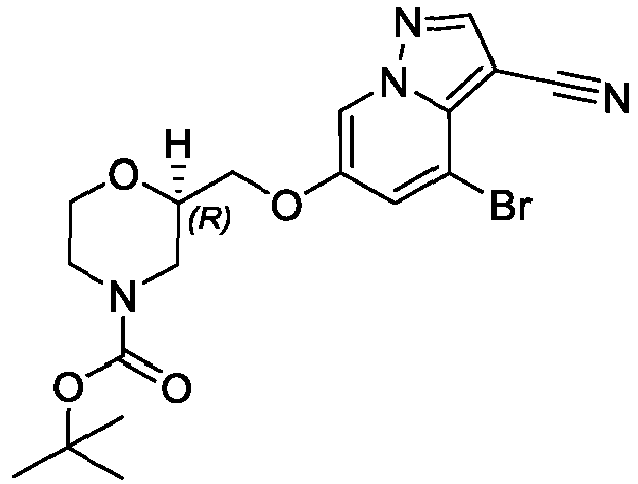
tert-butyl (R)-2-(((4-bromo-3-cyanopyrazolo[1,5-a]pyridin-6-yl)oxy)methyl)morpholine-4-carboxylate 1H NMR (CDCl3) 8.21 (s, 1H), 8.17(d, 1H), 7.50(d, 1H), 3.78-4.42(m, 9H), 1.48(s, 9H) P137* 
4-bromo-6-((1-methyl-1H-imidazol-4-yl)methoxy)pyrazolo[1,5-a]pyridine-3 -carbonitrile MS (apci) m/z 334 (M+2, with Br pattern) P138* 
tert-butyl (S)-2-(((4-bromo-3-cyanopyrazolo[1,5-a]pyridin-6-yl)oxy)methyl)morpholine-4-carboxylate 1H NMR (CDCl3)8.23 (d, 1H), 8.21 (s, 1H), 7.51 (d, 1H), 3.52-4.14 (m, 9H), 1.48 (s, 9H) P139* 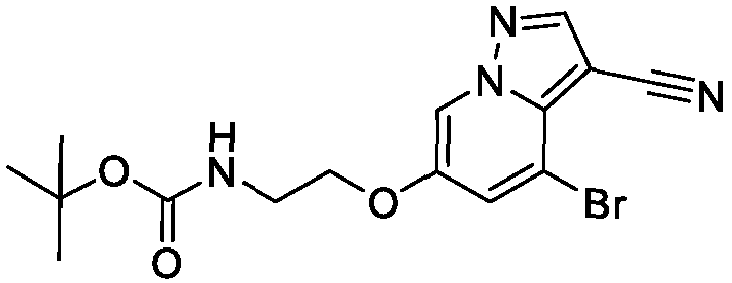
tert-butyl (2-((4-bromo-3-cyanopyrazolo[1,5-a]pyridin-6-yl)oxy)ethyl)carbamate 1H NMR (CDCl3) δ 8.19 (s, 1H), 8.10 (d, 1H), 7.43 (d, 1H), 4.91 (s, 1H), 4.03 (t, 2H), 3.56 (t, 2H), 1.44 (s, 9H) 
- In a pressure vessel, a mixture of tert-butyl (R)-2-(((4-bromo-3-cyanopyrazolo[1,5-a]pyridin-6-yl)oxy)methyl)morpholine-4-carboxylate (Intermediate P136; 367 mg, 0.839 mmol), bis(pinacolato)diboron (2.131 g, 8.39 mmol), PdCl2(dppf)•CH2Cl2 (68.4 mg, 0.0839 mmol) and KOAc (412 mg, 4.20 mmol) in dioxane (8.393 mL) was sparged with Ar(g), for 10 min. The vessel was sealed, and the mixture was stirred overnight at 80 °C. After cooling to ambient temperature, the reaction mixture was diluted with EtOAc, and filtered through GF/F paper. The filtrate was concentrated in vacuo, and the residue was triturated with pentane. The pentane suspension was filtered, and the solids were isolated to afford the title compound (304 mg, 75% yield). 1HNMR (CDCl3) δ 8.19 (s, 1H), 7.70 (s,1H), 7.25 (s, 1H), 3.80-4.12 (m, 6H), 3.52-3.75 (m, 3H), 1.57 (s, 9H), 1.49 (s, 12H).
- The compounds in Table ccc were prepared using a similar procedure to that used for the synthesis of tert-butyl (R)-2-(((3-cyano-4-(4,4,5,5-tetramethyl-1,3,2-dioxaborolan-2-yl)pyrazolo[1,5-a]pyridin-6-yl)oxy)methyl)morpholine-4-carboxylate (Intermediate P140) replacing tert-butyl (R)-2-(((4-bromo-3-cyanopyrazolo[1,5-a]pyridin-6-yl)oxy)methyl)morpholine-4-carboxylate (Intermediate P136) with the appropriate 4-bromo-6-alkoxypyrazolo[1,5-a]pyridine-3-carbonitrile from Table bbb (or the synthetic intermediate referenced therein). Reactions were monitored for completion by LCMS, and reaction durations were adjusted accordingly. Work ups were conducted with either DCM or EtOAc, and where noted (*) either a second trituration from pentane or a chromatographic purification using an appropriate gradient eluent (in place of the trituration) was required.
Table ccc Interme diate # Structure Chemical Name Analytical P141* 
tert-butyl 4-(2-((3-cyano-4-(4,4,5,5-tetramethyl-1,3,2-dioxaborolan-2-yl)pyrazolo[1,5-a]pyridin-6-yl)oxy)ethyl)piperazine-1-carboxylate MS (apci) m/z 416.2 (M-Pinacol) 1H NMR (CDCl3) δ 8.19 (s, 1H), 8.16 (d, 1H), 7.65 (d, 1H), 4.10 (t, 2H), 3.45 (t, 4H), 2.83 (t, 2H), 2.51 (t, 4H) 1.45 (s, 9H), 1.41 (s, 12H). P142 
tert-butyl 3-(((3-cyano-4-(4,4,5,5-tetramethyl-1,3,2-dioxaborolan-2-yl)pyrazolo[1,5-a]pyridin-6-yl)oxy)methyl)-3-fluoropyrrolidine-1-carboxylate 1H NMR (CDCl3) δ 8.20 (m, 2H), 7.67 (s, 1H), 4.17 (m, 2H), 3.49-3.84 (m, 5H), 2.00-2.35 (m, 3H), 1.45 (s, 9H), 1.42 (s, 12H). P143* 
6-(2-(pyrrolidin-1-yl)ethoxy)-4-(4,4,5,5-tetramethyl-1,3,2-dioxaborolan-2-yl)pyrazolo[1,5-a]pyridine-3 -carbonitrile MS (apci) m/z 301.1 (M-Pinacol) P144 
tert-butyl 3-(((3-cyano-4-(4,4,5,5-tetramethyl-1,3,2-dioxaborolan-2-yl)pyrazolo[1,5-a]pyridin-6-yl)oxy)methyl)-3-fluoroazetidine-1-carboxylate 1H NMR (CDCl3) δ 8.21 (d, 1H), 8.19 (s, 1H), 7.69 (d, 1H), 4.11-4.39 (m, 6H), 1.45 (s, 9H), 1.41 (s, 12H) P145 
6-((1-methyl-1H-imidazol-4-yl)methoxy)-4-(4,4,5,5-tetramethyl-1,3,2-dioxaborolan-2-yl)pyrazolo[1,5-a]pyridine-3-carbonitrile 1H NMR (CDCl3) δ 8.36 (s, 1H), 8.18 (d, 1H), 7.45 (d, 1H), 7.01 (d, 1H), 6.97 (s, 1H), 5.05 (s, 2H), 3.71 (s, 3H), 1.26 (s, 12H) P146 
tert-butyl (S)-2-(((3-cyano-4-(4,4,5,5-tetramethyl-1,3,2-dioxaborolan-2-yl)pyrazolo[1,5-a]pyridin-6-yl)oxy)methyl)morpholine-4-carboxylate 1H NMR (CDCl3) δ 8.20 (d, 1H), 7.69 (s, 1H), 7.26 (d, 1H), 3.54- 4.25 (m, 9H), 1.48 (s, 9H), !.42 (s, 12H) P147 
tert-butyl (2-((3-cyano-4-(4,4,5,5-tetramethyl-1,3,2-dioxaborolan-2-yl)pyrazolo[1,5-a]pyridin-6-yl)oxy)ethyl)carbamate MS (apci) m/z 347.1 (M-pinacol) 

- In a pressure tube, a mixture of tert-butyl (R)-2-(((3-cyano-4-(4,4,5,5-tetramethyl-1,3,2-dioxaborolan-2-yl)pyrazolo[1,5-a]pyridin-6-yl)oxy)methyl)morpholine-4-carboxylate (Intermediate P140; 96 mg, 0.198 mmol), 2-chloro-N-(1-(5-chloropyrazin-2-yl)-4-methylpiperidin-4-yl)-6-methylbenzamide (Intermediate R48; 37.6 mg, 0.0991 mmol), 2 M K3PO4(aq) (149 µL, 0.297 mmol), X-phos (9.45 mg, 0.0198 mmol) and Pd2(dba)3 (4.54 mg, 0.00495 mmol) in dioxane (1.0 mL) was sparged with Ar(g) for 10 min, and then the vessel was sealed. The reaction mixture was stirred overnight at 80 °C. After cooling to ambient temperature, the reaction mixture was diluted with DCM, and extracted sequentially with water (3x) and brine (1x). The organic extracts were concentrated in vacuo, and purified by silica chromatography (using 0-100% EtOAc/Hexanes as the gradient eluent) to cleanly afford the title compound (40.3 mg, 58% yield). MS (apci) m/z = 701.2 (M+H).
- The compounds in Table ddd were prepared using a similar procedure to that used for the synthesis of tert-butyl (R)-2-(((4-(5-(4-(2-chloro-6-methylbenzamido)-4-methylpiperidin-1-yl)pyrazin-2-yl)-3-cyanopyrazolo[1,5-a]pyridin-6-yl)oxy)methyl)morpholine-4-carboxylate (Intermediate P148) replacing of tert-butyl (R)-2-(((3-cyano-4-(4,4,5,5-tetramethyl-1,3,2-dioxaborolan-2-yl)pyrazolo[1,5-a]pyridin-6-yl)oxy)methyl)morpholine-4-carboxylate (Intermediate P140) with the appropriate boronate ester from Table ccc (or the synthetic intermediate referenced therein). Reactions were monitored for completion by LCMS, and reaction durations were adjusted accordingly. The title compounds were isolated following a chromatographic purification using an appropriate eluent.
Table ddd Interme diate # Structure Chemical Name MS (apci) m/z P149 
tert-butyl 3-(((4-(5-(4-(2-chloro-6-methylbenzamido) -4-methylpiperidin-1-yl)pyrazin-2-yl)-3-cyanopyrazolo[1,5 -a]pyridin-6-yl)oxy)methyl)-3-fluoropyrrolidine-1-carboxylate 703.2 (M+H) P150 
tert-butyl (S)-2-(((4-(5-(4-(2-chloro-6-methylbenzamido) -4-methylpiperidin-1-yl)pyrazin-2-yl)-3-cyanopyrazolo[1,5 -a]pyridin-6-yl)oxy)methyl)mor pholine-4-carboxylate 701.2 (M+H) P151 
tert-butyl (2-((4-(5-(4-(2-chloro-6-methylbenzamido) -4-methylpiperidin-1-yl)pyrazin-2-yl)-3-cyanopyrazolo[1,5 -a]pyridin-6-yl)oxy)ethyl)carba mate 645.2 (M+H) 
- A solution tert-butyl (2-((4-(5-(4-(2-chloro-6-methylbenzamido)-4-methylpiperidin-1-yl)pyrazin-2-yl)-3-cyanopyrazolo[1,5-a]pyridin-6-yl)oxy)ethyl)carbamate (Intermediate P151; 134 mg, 0.208 mmol) in DCM (1 mL) and TFA (0.5 mL, 6.53 mmol) was stirred overnight at ambient temperature. The reaction mixture was concentrated in vacuo to afford the title compound (161 mg, quantitative yield). MS (apci) m/z = 545.2 (M+H).
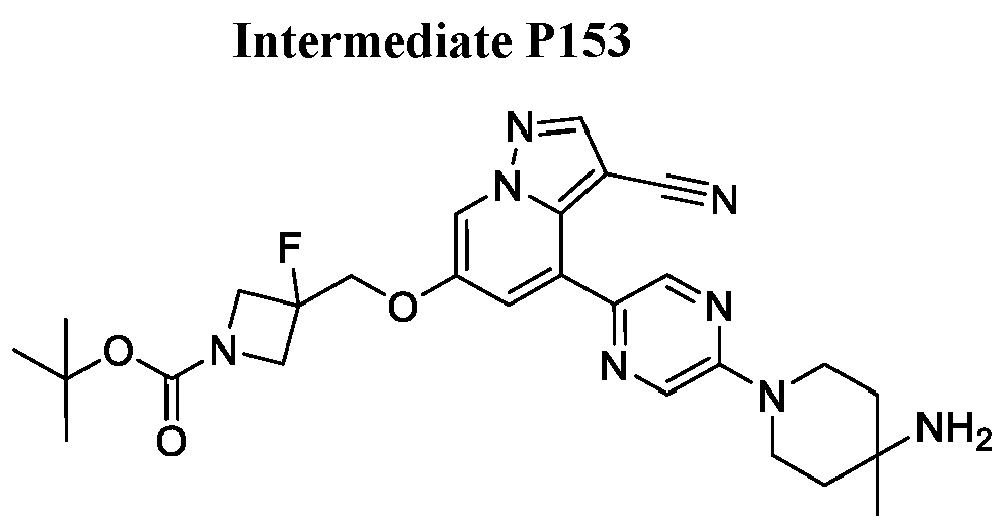
- In a pressure tube, a mixture of tert-butyl 3-(((3-cyano-4-(4,4,5,5-tetramethyl-1,3,2-dioxaborolan-2-yl)pyrazolo[1,5-a]pyridin-6-yl)oxy)methyl)-3-fluoroazetidine-1-carboxylate (Intermediate P144; 155 mg, 0.328 mmol), 1-(5-chloropyrazin-2-yl)-4-methylpiperidin-4-amine bis(2,2,2-trifluoroacetate) (Intermediate R47; 149 mg, 0.328 mmol), was treated with 2 M K3PO4(aq) (492 µL, 0.984 mmol), X-phos (31.3 mg, 0.0656 mmol) and Pd2(dba)3 (15.0 mg, 0.0164 mmol) in dioxane (1.64 mL) was sparged with Ar(g) for 3 min, and then the vessel was sealed. The reaction mixture was stirred for 4 h at 80 °C. After cooling to ambient temperature, the reaction mixture was purified directly, first by silica chromatography (using 0-30% MeOH in DCM as the gradient eluent) then by C18 reverse phase chromatography (using 5-95% ACN in water with 0.1% TFA as the gradient eluent) to afford the TFA salt of the title compound. The TFA salt was diluted with DCM, then extracted with saturated NaHCO3(aq). The organic extracts were dried over anhydrous Na2SO4(s), filtered, and concentrated in vacuo to cleanly afford the title compound (27 mg, 15% yield). MS (apci) m/z = 473.2 (M+H).

- A solution of 2-chloro-5-fluorobenzoic acid (5.9 mg, 0.034 mmol), tert-butyl 3-(((4-(5-(4-amino-4-methylpiperidin-1-yl)pyrazin-2-yl)-3-cyanopyrazolo[1,5-a]pyridin-6-yl)oxy)methyl)-3-fluoroazetidine-1-carboxylate (Intermediate P153; 6 mg, 0.011 mmol), DIEA (20 µL, 0.11 mmol) and HATU (8.5 mg, 0.022 mmol) in DCM (112 µL) was stirred overnight at ambient temperature. The resulting mixture was purified directly by silica chromatography (using 0-100% EtOAc in Hexanes as the gradient eluent) to cleanly provide the title compound (3 mg, 39% yield). MS (apci) m/z = 693.2 (M+H).


- A solution of tert-butyl (S)-(1-(5-(3-cyano-6-ethoxypyrazolo[1,5-a]pyridin-4-yl)pyridin-2-yl)-4-((3,4-dimethylpiperazin-1-yl)methyl)piperidin-4-yl)carbamate (Intermediate P99; 133.0 mg, 0.2259 mmol) in dioxane (5.0 mL) was treated with 12 M HCl(aq) (37.1 µL, 0.452 mmol). The resulting mixture was stirred for 4 d at ambient temperature before concentrating the mixture in vacuo. The residue was dissolved in 4:1 DCM:iPrOH, and extracted with saturated NaHCO3(aq) (2x). The aqueous extracts were washed with additional 4:1 DCM:iPrOH (3x). The combined organic extracts were dried over anhydrous Na2SO4(s), filtered and concentrated in vacuo to cleanly afford the title compound (70.1 mg, 64% yield). MS (apci) m/z = 489.3 (M+H).

- Intermediate P156 was isolated as a side product in the preparation of ethyl 1-(5-(3-cyano-6-ethoxypyrazolo[1,5-a]pyridin-4-yl)pyridin-2-yl)-4-(hydroxymethyl)piperidine-4-carboxylate (Example 701).


- A solution tert-butyl 3-(((4-(5-(4-(2-chloro-5-fluorobenzamido)-4-methylpiperidin-1-yl)pyrazin-2-yl)-3-cyanopyrazolo[1,5-a]pyridin-6-yl)oxy)methyl)-3-fluoroazetidine-1-carboxylate (Intermediate P154; 19 mg, 0.027 mmol) in DCM (2 mL) and TFA (2 mL, 13 mmol) was stirred for 2 h at ambient temperature. The reaction mixture was concentrated in vacuo to afford the title compound (16 mg, 73% yield). MS (apci) m/z = 593.2 (M+H).

- A mixture of 6-ethoxy-4-(6-fluoropyridin-3-yl)pyrazolo[l,5-a]pyridine-3-carbonitrile (Intermediate P6, 0.204 g, 0.723 mmol), tert-butyl ((3r,4r)-4-hydroxypiperidin-3-yl)carbamate (0.313 g, 1.45 mmol) and DIEA (0.378 ml, 2.17 mmol) in DMSO (1.81 mL) was heated at 90 °C overnight. After cooling to RT, the reaction mixture was partitioned between EtOAc and water. After phase-separation, the aqueous layer was extracted with EtOAc. The organic extracts were combined, washed with brine, dried with Na2SO4 and concentrated to yield the title product (0.33 g, 0.69 mmol, 95 % yield). MS (apci) m/z = 479.2 (M+H).

- Step 1: Preparation of tert-butyl ((3R,4S)-1-(5-(3-cyano-6-methoxypyrazolo[1,5-a]pyridin-4-yl)pyridin-2-yl)-3-hydroxypiperidin-4-yl)carbamate. A mixture of 4-(6-fluoropyridin-3-yl)-6-methoxypyrazolo[1,5-a]pyridine-3-carbonitrile (Intermediate P93, 0.206 g, 0.768 mmol), tert-butyl ((3R,4S)-3-hydroxypiperidin-4-yl)carbamate (0.216 g, 0.998 mmol) and DIEA (0.669 mL, 3.84 mmol) in DMSO (1.92 mL) was heated to 90 °C overnight. The reaction mixture was worked up with EtOAc and water. The organic layers were washed with brine, dried with Na2SO4, filtered and concentrated. The crude material was purified by silica chromatography (1-10% MeOH in DCM) to yield the title product (0.223 g, 62.5 % yield). MS (apci) m/z = 465.2 (M+H).
- Step 2: Preparation of 4-(6-((3R,4S)-4-amino-3-hydroxypiperidin-1-yl)pyridin-3-yl)-6-methoxypyrazolo[1,5-a]pyridine-3-carbonitrile. Tert-butyl ((3R,4S)-1-(5-(3-cyano-6-methoxypyrazolo[1,5-a]pyridin-4-yl)pyridin-2-yl)-3-hydroxypiperidin-4-yl)carbamate (0.223 g, 0.480 mmol) was taken up in DCM and TFA (1 mL each) and stirred for 1 h. The mixture was concentrated, taken up in DCM and stirred with MP-carbonate for 20 min. The mixture was filtered and concentrated to give the title product (0.055 g, 31.4 % yield). MS (apci) m/z = 365.1 (M+H).


- A solution of 3-chloro-6-ethoxy-4-(6-fluoropyridin-3-yl)pyrazolo[1,5-a]pyridine (Example 425, Step 2; 93.1 mg, 0.319 mmol) and tert-butyl ((3S,4S)-3-hydroxypiperidin-4-yl)carbamate (104 mg, 0.479 mmol) in DMSO (2 mL) was treated with DIEA (0.279 mL, 1.60 mmol) and stirred at 115°C overnight. After cooling to RT, the reaction mixture was diluted with water and filtered, yielding the title compound (112 mg, 72 % yield). MS (apci) m/z = 488.2 (M+H).

- A solution of tert-butyl ((3S,4S)-1-(5-(3-chloro-6-ethoxypyrazolo[1,5-a]pyridin-4-yl)pyridin-2-yl)-3-hydroxypiperidin-4-yl)carbamate (Intermediate P160, 110 mg, 0.225 mmol) in 1,4-dioxane (2 mL, 0.225 mmol) was treated with HCl (0.0370 mL, 0.451 mmol) and stirred at RT overnight. Removal of solvent under vacuum yielded the title compound as solid assuming quantitative yield. MS (apci) m/z = 388.2 (M+H).


- Step 1: Preparation of tert-butyl ((3S,4R)-1-(5-(3-cyano-6-ethoxypyrazolo[1,5-a]pyridin-4-yl)pyridin-2-yl)-4-hydroxypiperidin-3-yl)carbamate. A mixture of 6-ethoxy-4-(6-fluoropyridin-3-yl)pyrazolo[1,5-a]pyridine-3-carbonitrile (Intermediate P6, 0.270 g, 0.957 mmol), tert-butyl ((3S,4R)-4-hydroxypiperidin-3-yl)carbamate (0.414 g, 1.91 mmol) and Hunig's base (0.500 ml, 2.87 mmol) in DMSO (2.39 mL) was heated to 90 °C overnight. The reaction mixture was worked up with EtOAc and water. The organic layers were washed with brine, dried with Na2SO4, filtered and concentrated to yield the title compound (0.291 g, 63.6 % yield). MS (apci) m/z = 479.2 (M+H).
- Step 2: Preparation of (3S,4R)-3-((tert-butoxycarbonyl)amino)-1-(5-(3-cyano-6-ethoxypyrazolo[1,5-a]pyridin-4-yl)pyridin-2-yl)piperidin-4-yl methanesulfonate. A mixture of tert-butyl ((3S,4R)-1-(5-(3-cyano-6-ethoxypyrazolo[1,5-a]pyridin-4-yl)pyridin-2-yl)-4-hydroxypiperidin-3-yl)carbamate (0.291 g, 0.608 mmol), methanesulfonyl chloride (0.0471 ml, 0.608 mmol) and Hunig's base (0.159 ml, 0.912 mmol) in DCM (6.08 mL) was stirred at RT overnight. The mixture was the worked up with DCM and water. The organic layers were washed with brine, dried with Na2SO4, filtered and concentrated to yield the title compound (0.293 g, 86.6 % yield). MS (apci) m/z = 557.2 (M+H).
- Step 3: Preparation of tert-butyl ((3S,4S)-4-azido-1-(5-(3-cyano-6-ethoxypyrazolo[1,5-a]pyridin-4-yl)pyridin-2-yl)piperidin-3-yl)carbamate. (3S,4R)-3-((tert-butoxycarbonyl)amino)-1-(5-(3-cyano-6-ethoxypyrazolo[1,5-a]pyridin-4-yl)pyridin-2-yl)piperidin-4-yl methanesulfonate (0.293 g, 0.526 mmol) and NaN3 (0.0513 g, 0.790 mmol) in DMF (2.11 mL) was heated to 90 °C overnight. The mixture was worked up with DCM and water. The organic layers were washed with brine, dried with Na2SO4, filtered and concentrated. The crude material was purified by silica chromatography (1-10% MeOH in DCM) to yield the title compound (0.177 g, 66.8 % yield). MS (apci) m/z = 504.2 (M+H).
- Step 4: Preparation of tert-butyl ((3S,4S)-4-amino-1-(5-(3-cyano-6-ethoxypyrazolo[1,5-a]pyridin-4-yl)pyridin-2-yl)piperidin-3-yl)carbamate. Tert-butyl ((3S,4S)-4-azido-1-(5-(3-cyano-6-ethoxypyrazolo[1,5-a]pyridin-4-yl)pyridin-2-yl)piperidin-3-yl)carbamate (0.177 g, 0.351 mmol) and Pd/C (0.00748 g, 0.0703 mmol) in MeOH (3.51 mL) was stirred under H2 balloon overnight. This was the filtered and concentrated to give the title compound (0.152 g, 90.6 % yield). MS (apci) m/z = 478.2 (M+H).

- Step 1: Preparation of 4-(5-bromopyrimidin-2-yl)-6-(2-morpholinoethoxy)pyrazolo[1,5-a]pyridine-3-carbonitrile. To a mixture of (3-cyano-6-(2-morpholinoethoxy)pyrazolo[1,5-a]pyridin-4-yl)boronic acid (Intermediate P127, 86 mg, 0.27 mmol) and 5-bromo-2-iodopyrimidine (78 mg, 0.27 mmol) in dioxane (2 mL) and water (0.8 mL) was added XPhos (26 mg, 0.054mmol), Pd2(dba)3 (12mg, 0.014mmol) and 2M K3PO4 (0.4 mL, 0.8 mmol). The reaction was heated to 60 °C for 3 hours. After cooling to RT, the reaction was partitioned between DCM and water (15 mL each), followed by extracting the aqueous with DCM (2 × 15 mL). The organic extracts were combined and concentrated. The crude material was purified by silica chromatography (0 to 100% acetone in hexanes) to yield the title compound (48 mg, 41%). MS (apci) m/z = 429.1, 431.1 (M+H).
- Step 2: Preparation of tert-butyl (1-(2-(3-cyano-6-(2-morpholinoethoxy)pyrazolo[1,5-a]pyridin-4-yl)pyrimidin-5-yl)-4-methylpiperidin-4-yl)carbamate. A mixture of 4-(5-bromopyrimidin-2-yl)-6-(2-morpholinoethoxy)pyrazolo[1,5-a]pyridine-3-carbonitrile (48 mg, 0.11 mmol), tert-butyl (4-methylpiperidin-4-yl)carbamate (36 mg, 0.17 mmol), Cs2CO3 (73 mg, 0.22 mmol), XPHOS (11 mg, 0.022 mmol) and Pd2dba3 (10 mg, 0.011 mmol) in dioxane (1 mL) was heated at 90 °C overnight. The reaction mixture was diluted with water (25 mL) and extracted with DCM (2 × 25 mL). The combined organic extracts were filtered through a Celite® pad and concentrated under reduced pressure. The crude material was purified by silica chromatography (10-100% acetone in hexanes) to yield the title compound (22 mg, 35%). MS (apci) m/z = 563.3 (M+H).
- Step 3: Preparation of 4-(5-(4-amino-4-methylpiperidin-1-yl)pyrimidin-2-yl)-6-(2-morpholinoethoxy)pyrazolo[1,5-a]pyridine-3-carbonitrile. A mixture of tert-butyl (1-(2-(3-cyano-6-(2-morpholinoethoxy)pyrazolo[1,5-a]pyridin-4-yl)pyrimidin-5-yl)-4-methylpiperidin-4-yl)carbamate (22 mg, 0.04 mmol) in 1:1 DCM:TFA was stirred at RT for 1 h and then concentrated. The crude material was taken up in minimal amount of MeOH and passed thru a P1-HCO3 resin plug. Removal of solvent under reduced pressure yielded the title compound with quantitative yield. MS (apci) m/z = 463.2 (M+H).

- A mixture of 4-bromo-6-hydroxypyrazolo[1,5-a]pyridine-3-carbonitrile (Intermediate P1; 500 mg, 2.10 mmol) in DMF (4 mL) was treated sequentially with K2CO3(s) (1451 mg, 10.5 mmol) and (S)-2-methyloxirane (1830 mg, 31.5 mmol). The reaction mixture was stirred for 3 d at 50 °C in a sealed vessel. After cooling to ambient temperature, the reaction mixture was diluted with water (50 mL) and extracted with DCM (2 × 50 mL). The combined organic extracts were washed with brine (50 mL). The resultant emulsion was filtered through a coarse glass frit, and the biphasic filtrate was separated. The organic extracts were washed again with brine (50 mL), then dried over anhydrous MgSO4(s), filtered and concentrated in vacuo. The crude residue was purified by silica chromatography (using 0-90% EtOAc/Hexanes as the gradient eluent) to cleanly provide the title compound (357 mg, 57% yield). 1H NMR (400 MHz, CDCl3) δ 8.21 (s, 1H), 8.14 (d, 1H), 7.49 (d, 1H), 4.25 (m, 1H), 3.96 (dd, 1H), 3.86 (dd, 1H), 1.33 (d, 3H).

- In a pressure tube, a solution of (S)-4-bromo-6-(2-hydroxypropoxy)pyrazolo[1,5-a]pyridine-3-carbonitrile (Intermediate P164; 357 mg, 1.21 mmol) in dioxane (6 mL) was treated with 2-fluoro-5-(4,4,5,5-tetramethyl-1,3,2-dioxaborolan-2-yl)pyridine (323 mg, 1.45 mmol), and 2 M Na2CO3(aq) (1808 µL, 3.62 mmol) was sparged with N2(g) for 5 min. The resulting mixture was treated with Pd(PPh3)4 (34.8 mg, 0.0301 mmol) then sparged again with N2(g) for 5 min, before sealing the vessel. The reaction mixture was stirred for 22 h at 80 °C. After cooling to ambient temperature, the reaction mixture was diluted with water (25 mL) and stirred for 1 h. The resulting suspension was vacuum filtered and the solids were collected to cleanly provide the title compound (191 mg, 51% yield). MS (apci) m/z = 313.1 (M+H).

- In a pressure vessel, a mixture of 4-bromo-6-(2-hydroxy-2-methylpropoxy)pyrazolo[1,5-a]pyridine-3-carbonitrile (Intermediate P41; 2.0 g, 6.4 mmol), bis(pinacolato)diboron (2.5 g, 9.7 mmol), PdCl2 (dppf)•CH2Cl2 (0.53 g, 0.64 mmol), and KOAc (1.9 g, 19 mmol) in dioxane (15 mL) was sparged with Ar(g) for 10 min. The vessel was sealed and the mixture was stirred overnight at 90 °C. After cooling to room temperature, the reaction mixture was diluted with EtOAc (100 mL). The resulting suspension was filtered, and the filter cake was washed with EtOAc. The filtrate was concentrated in vacuo, and the residue was purified by silica chromatography (25% EtOAc in Hexanes as the eluent) to afford the title compound (2.2 g, 91% yield). 1H-NMR (400 MHz, CDCl3) δ: 8.19 (s, 1H), 8.17 (d, J = 2.3 Hz, 1H), 7.66 (d, J = 2.3 Hz, 1H), 3.80 (s, 2H), 1.41 (s, 12H), 1.35 (s, 6H).

- A mixture of 4-bromo-3-chloro-6-methoxypyrazolo[1,5-a]pyridine (Intermediate P84, Step 1; 152mg, 0.581mmol), PdCl2(dppf)•CH2Cl2 (23.7 mg, 0.029 mmol), KOAc (285 mg, 2.91 mmol) and bis(pinacolato)diboron (443 mg, 1.74 mmol) in dioxane (5.8 mL) was sparged with Ar(g). The reaction vessel was sealed, and the mixture was stirred for 2 h 15 min at 90 °C. After cooling to ambient temperature, the reaction mixture was filtered through Celite®. The filtrate was concentrated in vacuo to afford the title compound (102 mg, 57%). MS (apci) m/z = 309.1 (M+H).

- A mixture of 4-bromo-6-methoxypyrazolo[1,5-a]pyridine-3-carbonitrile (Intermediate P1, Step 6; 150 mg, 0.6 mmol), PdCl2(dppf) (17 mg, 0.02 mmol), KOAc (165 mg, 1.7 mmol) and 4,4,4',4',5,5,5',5'-octamethyl-2,2'-bi(1,3,2-dioxaborolane) (267 mg, 1.05 mmol) in dioxane (4 mL) was sparged with argon, then heated to 90 °C for 3 h. After cooling to RT, the reaction was filtered through Celite® and concentrated. The crude material was purified by silica chromatography (0-10% MeOH/DCM) to afford the title product (126 mg, 70%).

- To a solution of 4-bromo-6-hydroxypyrazolo[1,5-a]pyridine-3-carbonitrile (Intermediate P1; 194 mg, 0.815 mmol) in DMA (4.0 mL, 0.815 mmol) was added K2CO3 (338 mg, 2.44 mmol) then ((4-bromo-2-methylbutan-2-yl)oxy)(tert-butyl)dimethylsilane (459 mg, 1.63 mmol). The reaction was sealed and heated at 60°C overnight. After cooling to RT, the reaction was diluted with brine and filtered, rinsed with water. The solid obtained was dissolved in minimal amount of DCM, followed by addition of Et2O to induce precipitation. After stirred for 2 h, the suspension was filtered to afford the title product (250 mg, 70%). 1H-NMR (400 MHz, CDCl3) δ: 8.19 (s, 1H), 8.09 (br d, 1H), 7.42 (br d, 1H), 4.13 (t, 2H), 1.97 (t, 2H), 1.31 (s, 6H), 0.86 (s, 9H), 0.10 (s, 6H).

- To a mixture of 4-bromo-6-(2-chloroethoxy)pyrazolo[1,5-a]pyridine-3-carbonitrile (Intermediate P125; 50 mg, 0.17 mmol) in DMF (0.33 mL) were added DIEA (291 µl, 1.7 mmol), followed by 3,3-difluoroazetidine (46 mg, 0.50 mmol). The reaction was stirred at 60 °C for 4 d, after which additional 3,3-difluoroazetidine (46 mg, 0.50 mmol) was added and heating resumed for another 16 h to reach completion. The reaction was diluted with water and filtered to afford the title product, which was directly used without further purifications (31 mg, 37%). MS (apci) m/z = 357, 359 (M+H).

- To a solution of 4-bromo-6-hydroxypyrazolo[1,5-a]pyridine-3-carbonitrile (Intermediate P1; 100 mg, 0.420 mmol) in DMA (2 mL) were added K2CO3 (87.1 mg, 0.63 mmol) then 2-chloro-1-(pyrrolidin-1-yl)ethan-1-one (74.4 mg, 0.504 mmol). The reaction was heated at 50 °C overnight, then poured into water (10 mL) and stirred for 1 h before it was filtered and rinsed with water (5 mL), yielding the title product as beige solid (127 mg, 86%). 1H NMR (CDCl3) δ 8.20 (s, 1H), 8.19 (d, 1H), 7.50 (d, 1H), 4.66 (s, 2H), 3.54 (t, 2H), 3.47 (t, 2H), 2.04 (m, 2H), 1.90 (m, 2H).

- Step 1: Preparation of tert-butyl (1-(5-(3-cyano-6-ethoxypyrazolo[1,5-a]pyridin-4-yl)pyrazin-2-yl)-4-methylpipendin-4-yl)carbamate. A mixture of 6-ethoxy-4-(4,4,5,5-tetramethyl-1,3,2-dioxaborolan-2-yl)pyrazolo[1,5-a]pyridine-3-carbonitrile (Intermediate P110; 500 mg, 1.60 mmol), tert-butyl (1-(5-chloropyrazin-2-yl)-4-methylpiperidin-4-yl)carbamate (Intermediate R46; 521.8 mg, 1.60 mmol), K3PO4 (2 M aq, 2.4 mL, 4.79 mmol), dicyclohexyl(2',4',6'-triisopropyl-[1,1'-biphenyl]-2-yl)phosphane (152.2 mg, 0.32 mmol) and Pd2(dba)3 (73.10 mg, 0.080 mmol) in 1,4-dioxane (8.0 mL) was degassed with argon for 3 min, then sealed and heated to 80°C overnight. After an aqueous workup the crude material was purified using silica chromatography (0-100% EtOAc in hexanes) to afford the title product (338.5 mg, 44%). MS (apci) m/z = 478.2 (M+H).
- Step 2: Preparation of 4-(5-(4-amino-4-methylpiperidin-1-yl)pyrazin-2-yl)-6-ethoxypyrazolo[1,5-a]pyridine-3-carbonitrile bis(2,2,2-trifluoroacetate). To a solution of tert-butyl (1-(5-(3-cyano-6-ethoxypyrazolo[1,5-a]pyridin-4-yl)pyrazin-2-yl)-4-methylpiperidin-4-yl)carbamate (338.5 mg, 0.71 mmol) in DCM (2 mL) was added 2,2,2-trifluoroacetic acid (2 mL). After stirred at RT for 1 h, the reaction was diluted with Et2O (20 mL) and filtered to afford the title product (342 mg, 80%). MS (apci) m/z = 378.1 (M+H).

- The title product was prepared according to the procedure described in Intermediate P172, replacing 6-ethoxy-4-(4,4,5,5-tetramethyl-1,3,2-dioxaborolan-2-yl)pyrazolo[1,5-a]pyridine-3-carbonitrile with 6-(2-hydroxy-2-methylpropoxy)-4-(4,4,5,5-tetramethyl-1,3,2-dioxaborolan-2-yl)pyrazolo[1,5-a]pyridine-3-carbonitrile (Intermediate P166) in Step 1. MS (apci) m/z = 422.3 (M+H).

- Step 1: Preparation of tert-butyl (4-methyl-1-(5-(4,4,5,5-tetramethyl-1,3,2-dioxaborolan-2-yl)pyrazin-2-yl)piperidin-4-yl)carbamate. In a pressure vessel were combined tert-butyl (1-(5-chloropyrazin-2-yl)-4-methylpiperidin-4-yl)carbamate (Intermediate R46; 26 mg, 0.080 mmol), 4,4,4',4',5,5,5',5'-octamethyl-2,2'-bi(1,3,2-dioxaborolane) (202 mg, 0.80 mmol), PdCl2(dppf)-DCM (6.5 mg, 0.0080 mmol), KOAc (39 mg, 0.40 mmol) and dioxane (796 µl). The reaction mixture was sparged with argon for 10 min before it was sealed and heated to 90 °C overnight. After cooling to RT, the reaction was partitioned between DCM and water, extracting the aqueous with DCM (3x) after phase-separation. The combined organic extracts were washed with brine, then dried (Na2SO4), filtered and concentrated. The crude material was used directly in the next step assuming quantitative yield.
- Step 2: Preparation of tert-butyl (1-(5-(3-cyano-6-methoxyi)yrazolo[1,5-a]pyridin-4-yl)pyrazin-2-yl)-4-methylpiperidin-4-yl)carbamate. A mixture of 4-bromo-6-methoxypyrazolo[1,5-a]pyridine-3-carbonitrile (Intermediate P1, Step 6; 300 mg, 1.19 mmol), tert-butyl (4-methyl-1-(5-(4,4,5,5-tetramethyl-1,3,2-dioxaborolan-2-yl)pyrazin-2-yl)piperidin-4-yl)carbamate (1158 mg, 1.19 mmol), Pd(Ph3P)4 (138 mg, 0.119 mmol) and Na2CO3 (2 M aq, 3.6 mL, 7.14 mmol) in dioxane (6.0 mL) was sparged with argon for 10 min then heated to 80°C overnight. After cooling to ambient temperature, the reaction was diluted with water (10 mL) and extracted with 4:1 DCM:IPA (5×10 mL). The combined organic extractions was passed through a Phase Separator frit, and the filtrate was concentrated then purified by silica gel chromatography (0-10% MeOH in DCM) to afford the title product as solid (173 mg, 31%). MS (apci) m/z = 464.2 (M+H).
- Step 3: Preparation of 4-(5-(4-amino-4-methylpiperidin-1-yl)pyrazin-2-yl)-6-methoxypyrazolo[1,5-a]pyridine-3-carbonitrile bis(2,2,2-trifluoroacetate). To a solution of tert-butyl (1-(5-(3-cyano-6-methoxypyrazolo[1,5-a]pyridin-4-yl)pyrazin-2-yl)-4-methylpiperidin-4-yl)carbamate (173 mg, 0.336 mmol) in DCM (2 mL) was added TFA (2 mL). After stirred at RT for 30 min, the reaction was diluted with Et2O (20 mL) and filtered to yield the title product (163 mg, 78%). MS (apci) m/z = 364.2 (M+H).

- A mixture of 3-chloro-6-methoxy-4-(4,4,5,5-tetramethyl-1,3,2-dioxaborolan-2-yl)pyrazolo[1,5-a]pyridine (P167 55 mg, 0.18 mmol), 1-(5-chloropyrazin-2-yl)-4-methylpiperidin-4-amine (R47, 40 mg, 0.18 mmol), dicyclohexyl(2',4',6'-triisopropyl-[1,1'-biphenyl]-2-yl)phosphane (17 mg, 0.036 mmol)), and Pd2(dba)3 (8.2 mg, 0.0089 mmol) in 1,4-dioxane (891 µL) and K3PO4 (2 M aq, 267 µL) was sparged with argon before sealed and heated to 80 °C overnight. After cooling to RT, the reaction was diluted with DCM, washed with water and brine, then dried (Na2SO4), filtered and concentrated. The residue was purified using silica chromatography ( 0-20% MeOH in DCM with 0.2% NH4OH) to afford the title compound (29 mg, 44%). LCMS m/z = 373.1 (M+H).
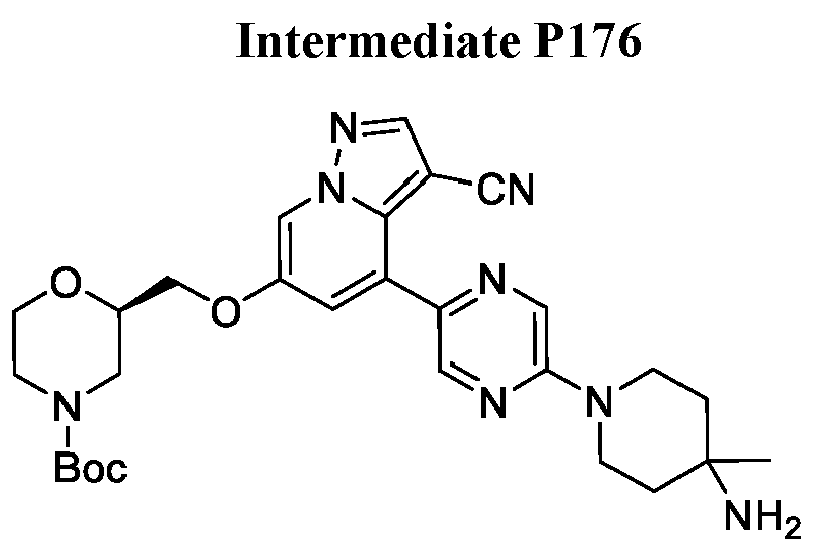
- The title compound (36 mg, 16%) was prepared by a similar method as described in Intermediate P175, replacing 3-chloro-6-methoxy-4-(4,4,5,5-tetramethyl-1,3,2-dioxaborolan-2-yl)pyrazolo[1,5-a]pyridine with tert-butyl (R)-2-(((3-cyano-4-(4,4,5,5-tetramethyl-1,3,2-dioxaborolan-2-yl)pyrazolo[1,5-a]pyridin-6-yl)oxy)methyl)morpholine-4-carboxylate (Intermediate P140). LCMS m/z = 549.3 (M+H).


- The title compound (36 mg, 16%) was prepared by a similar method as described in Intermediate P175, replacing 3-chloro-6-methoxy-4-(4,4,5,5-tetramethyl-1,3,2-dioxaborolan-2-yl)pyrazolo[1,5-a]pyridine with tert-butyl (S)-2-(((3-cyano-4-(4,4,5,5-tetramethyl-1,3,2-dioxaborolan-2-yl)pyrazolo[1,5-a]pyridin-6-yl)oxy)methyl)morpholine-4-carboxylate (Intermediate P146). LCMS m/z = 549.3 (M+H).

- Step 1: Preparation of 1-(5-boronopyridin-2-yl)-4-ethylpiperidine-4-carboxylic acid. A solution of 2-fluoro-5-(4,4,5,5-tetramethyl-1,3,2-dioxaborolan-2-yl)pyridine (2.0 g, 9.0 mmol) in DMSO (18 mL) was treated with 4-ethylpiperidine-4-carboxylic acid (4.7 g, 30 mmol) and K2CO3(s) (5.0 g, 36 mmol). The resulting mixture was stirred overnight at 80°C. After cooling to ambient temperature, the reaction mixture was diluted with water, and extracted with 20% MeOH/DCM. The combined organic extracts were dried over anhydrous Na2SO4(s), filtered, and concentrated in vacuo to afford the title compound (4.2 g, quantitative yield). The material was carried forward without further purification. MS (apci) m/z = 320.2 (M+H).
- Step 2: Preparation of 4-Ethyl-N-isopropyl-1-(5-(4,4,5,5-tetramethyl-1,3,2-dioxaborolan-2-yl)pyridin-2-yl)piperidine-4-carboxamide. A solution of 1-(5-boronopyridin-2-yl)-4-ethylpiperidine-4-carboxylic acid (2.45 g, 8.81 mmol) in DMA (35 mL) was treated sequentially with DIEA (8.44 mL, 48.5 mmol), propan-2-amine (2.25 mL, 26.4 mmol), and HATU (8.37 g, 22.0 mmol), then stirred overnight at ambient temperature. The resulting mixture was diluted with water, and extracted with 20% MeOH/DCM. The combined organic extracts were dried over anhydrous Na2SO4(s), filtered, and concentrated in vacuo. The crude residue was purified by C18 reverse phase chromatography (0-80% ACN/water as the gradient eluent) to cleanly provide the title compound (1.0 g, 36% yield). MS (apci) m/z = 411.2 (M+H).

- Step 1: Preparation of tert-butyl 6-((6-methoxypyridin-3-yl)amino)-3-azabicyclo[3.1.1]heptane-3-carboxylate. Under an atmosphere of N2(g), a solution of tert-butyl 6-oxo-3-azabicyclo[3.1.1]heptane-3-carboxylate (40 mg, 0.19 mmol) and 6-methoxypyridin-3-amine (33 mg, 0.27 mmol) in 1:1 MeOH: DCE (1.5 mL) was treated with decaborane (6.9 mg, 0.057 mmol). After stirring overnight at ambient temperature, the reaction mixture was quenched with water. The resulting biphasic mixture was extracted with DCM. The combined organic extracts were dried over anhydrous Na2SO4(s), filtered, and concentrated in vacuo. The crude residue was purified by silica chromatography (40-100% EtOAc/Hexanes as the gradient eluent) to afford the title compound (56 mg, 93% yield). MS (apci) m/z = 320.2 (M+H).
- Step 2: Preparation of N-(6-methoxypyridin-3-yl)-3-azabicyclo[3.1.1]heptan-6-amine (TFA salt). A solution of tert-butyl 6-((6-methoxypyridin-3-yl)amino)-3-azabicyclo[3.1.1]heptane-3-carboxylate (56 mg, 0.175 mmol) in DCM (500 µL) was treated with trifluroacetic acid (TFA) (0.40 mL, 5.26 mmol and stirred overnight at ambient temperature. The reaction mixture was concentrated in vacuo and purified by C18 reverse phase chromatography (5-95% water-ACN with 0.01% TFA as the gradient eluent) to cleanly provide the title compound as TFA salt. (25 mg, 65% yield). MS (apci) m/z = 220.1 (M+H).

- Step 1: Preparation of tert-butyl 4-((6-methoxypyridin-3-yl)oxy)piperidine-1-carboxylate. A solution of 6-methoxypyridin-3-ol (100 mg, 0.799 mmol) and tert-butyl 4-hydroxypiperidine-1-carboxylate (161 mg, 0.799 mmol) in THF was treated with PPh3 (231 mg, 0879 mmol), then sparged with Ar(g) for 5 min. While stirring at ambient temperature, the mixture was treated slowly with DIAD (186 µL, 0.959 mmol). The resulting reaction mixture was stirred for 9 h at ambient temperature, then overnight at 70 °C before introducing additional DIAD (186 µL, 0.959 mmol). The reaction mixture was stirred for 4 h at 70 °C and then allowed to cool to ambient temperature. After concentrating the reaction mixture in vacuo, the residue was suspended in DCM and washed with saturated Na2CO3(aq), water and brine. The combined organic extracts were dried over anhydrous Na2SO4(s), filtered and concentrated in vacuo to afford the title compound (246 mg, quantitative yield). MS (apci) m/z = 309.15 (M+H).
- Step 2: Preparation of 2-methoxy-5-(piperidin-4-yloxy)pyridine. A solution of tert-butyl 4-((6-methoxypyridin-3-yl)oxy)piperidine-1-carboxylate (246 mg, 0.80 mmol) in DCM (4.0 mL) was treated with TFA (4.0 mL, 0.80 mmol), then stirred for 5 min at ambient temperature before introducing additional TFA (1 mL). After stirring for 45 min at ambient temperature, the reaction mixture was concentrated in vacuo. The crude residue was purified by silica chromatography (1-9% MeOH in DCM with 0.1-0.9% NH4OH as the gradient eluent) to cleanly provide the title compound (127.5 mg, 77% yield). MS (apci) m/z = 209.1 (M+H).

- A solution of N-tert-Butoxycarbonyl-(R)-(-)-3-pyrrolidinol (2.0 g, 10.7 mmol) in DCM (28 mL) was treated with TEA (2.9 mL, 21.4 mmol). The solution was cooled to 0°C for 30 minutes. Then methanesulfonyl chloride (868 µL, 11.2 mmol) was added. The reaction was stirred at 0°C for 30 minutes. The reaction was diluted with DCM and washed with saturated NaHCO3(aq). The organic extracts were dried over anhydrous Na2SO4(s), filtered and concentrated in vacuo. The residue was purified by silica chromatography (5-95% EtOAc in Hexanes as the gradient eluent) to afford the title compound (2.83 g, 100% yield). 1H NMR (400 MHz, DMSO-d6) δ 5.24 (s, 1H), 3.55-3.38 (m, 3H), 3.31-3.27 (m, 1H), 3.23 (s, 3H), 2.18-2.08 (m, 2H), 1.40 (s, 9H).

- Step 1: Preparation of tert-butyl 4-ethyl-4-(phenylcarbamoyl)piperidine-1-carboxylate. A solution of 1-(tert-butoxycarbonyl)-4-ethylpiperidine-4-carboxylic acid (269.5 mg, 1.047 mmol) and HATU (477.9 mg, 1.257 mmol) in DMF (3.9 mL) was treated with DIEA (3.649 mL, 2.095 mmol) and aniline (0.1051 mL, 1.152 mmol). The reaction mixture was stirred at 60°C for 60 h. The reaction mixture was diluted with EtOAc and washed successively with water and saturated NaCl(aq). The combined organic extracts were dried over anhydrous Na2SO4(s) and concentrated in vacuo. The residue was purified by silica chromatography (0-100% EtOAc in hexanes as the gradient eluent) to afford the title compound (assumed theoretical yield, 348.1 mg, 1.047 mmol) in sufficient purity for step 2. MS (apci) m/z = 233.2 (M+H-Boc).
- Step 2: Preparation of 4-ethyl-N-phenylpiperidine-4-carboxamide. A solution tert-butyl 4-ethyl-4-(phenylcarbamoyl)piperidine-1-carboxylate (348.1 mg, 1.047 mmol) in DCM (2 mL) was treated with TFA (2 mL) and stirred at rt for 1 h. The reaction mixture was concentrated in vacuo. The residue was diluted with saturated NaHCO3(aq) and extracted with 4:1 DCM/IPA. The combined organic extracts were dried over anhydrous Na2SO4(s) and concentrated in vacuo to afford the title compound (162.4 mg, 0.6990 mmol , 66.7% yield over two steps). MS (apci) m/z = 233.1 (M+H).

- Step 1: Preparation of tert-butyl 4-ethyl-4-(isobutylcarbamoyl)piperidine-1-carboxylate. A solution of 1-(tert-butoxycarbonyl)-4-ethylpiperidine-4-carboxylic acid (260.3 mg, 1.012 mmol) and HATU (461.5 mg, 1.214 mmol) in DMF (3.9 mL) was treated with DIEA (3.524 mL, 2.023 mmol) and 2-methylpropan-1-amine (81.38 mg, 1.113 mmol). The reaction mixture was stirred at 60°C for 60 h. The reaction mixture was diluted with EtOAc and washed successively with water and saturated NaCl(aq). The combined organic extracts were dried over anhydrous Na2SO4(s) and concentrated in vacuo. The residue was purified by silica chromatography (1-95% EtOAc in hexanes as the gradient eluent) to afford the title compound (assumed theoretical yield, 216 mg, 1.012 mmol) in sufficient purity for step 2. MS (apci) m/z = 213.2 (M+H-Boc).
- Step 2: Preparation of 4-ethyl-N-isobutylpiperidine-4-carboxamide. A solution tert-butyl 4-ethyl-4-(isobutylcarbamoyl)piperidine-1-carboxylate (216 mg, 1.012 mmol) in DCM (1 mL) was treated with TFA (1 mL) and stirred at rt for 16 h. The reaction mixture was concentrated in vacuo. The residue was diluted with saturated NaHCO3(aq) and extracted with 4:1 DCM/IPA. The combined organic extracts were dried over anhydrous Na2SO4(s) and concentrated in vacuo to afford the title compound (100.8 mg, 0.3988 mmol, 39% yield over two steps). MS (apci) m/z = 213.2 (M+H).

- Step 1: Preparation of tert-butyl 4-(benzylthio)piperidine-1-carboxylate. A solution of tert-butyl 4-mercaptopiperidine-1-carboxylate (211.2 mg, 0.9718 mmol) and benzyl bromide (199.5 mg, 1.166 mmol) in DMF (3.9 mL) was treated with potassium carbonate (537.2 mg, 3.887 mmol). The reaction mixture was stirred at 70°C for 60 h. After cooling to ambient temperature, the reaction mixture was diluted with EtOAc and washed successively with water and saturated NaCl(aq). The combined organic extracts were concentrated in vacuo, and the residue was purified by silica chromatography (1-50% EtOAc in hexanes as the gradient eluent) to afford the title compound (290.1 mg, 0.9436 mmol, 97% yield) in sufficient purity for step 2. MS (apci) m/z = 208.1 (M+H-Boc).
- Step 2: Preparation of tert-butyl 4-(benzylsulfonyl)piperidine-1-carboxylate. To a solution of tert-butyl 4-(benzylthio)piperidine-1-carboxylate (290.1 mg, 0.9436 mmol) in DCM (9.5 mL) was added 3-chlorobenzoperoxoic acid (488.5 mg, 2.831 mmol). The reaction mixture was stirred at 0°C and gradually warmed to rt, then stirred at rt for 16 h. The reaction mixture was concentrated in vacuo, and the residue was purified by silica chromatography (0-95% EtOAc in hexanes as the gradient eluent) to afford the title compound (assumed theoretical yield, 320.3 mg, 0.9436 mmol) in sufficient purity for step 3. MS (apci) m/z = 240.1 (M+H-Boc).
- Step 3: Preparation of 4-(benzylsulfonyl)piperidine. A solution of tert-butyl 4-(benzylsulfonyl)piperidine-1-carboxylate (320.3 mg, 0.9436 mmol) in DCM (2 mL) was treated with TFA (2 mL, 26 mmol). The reaction mixture was stirred at rt for 15 min. The reaction mixture was washed with saturated NaHCO3(aq) then extracted with 4:1 DCM/IPA. The combined organic extracts were concentrated in vacuo to afford the title compound (138.0 mg, 0.5766 mmol, 61.1% yield over two steps). MS (apci) m/z = 240.1 (M+H).

- Step 1: Preparation oftert-butyl 4-(N-isopropylsulfamoyl)piperidine-1-carboxylate. A mixture of tert-butyl 4-(chlorosulfonyl)piperidine-1-carboxylate (1.0137 g, 3.5723 mmol) in DCM (2 mL) was treated with pyridine (722 µL, 8.93 mmol) and propan-2-amine (460 µL, 5.36 mmol), then stirred overnight at ambient temperature. The resulting mixture was washed with water (4x). The organic extracts were dried over anhydrous Na2SO4(s), filtered, and concentrated in vacuo to afford the title compound in sufficient purity to carry into step 2 (1.09 g, quantitative yield). MS (apci) m/z = 207.2 [(M-Boc)+H].
- Step 2: Preparation of N-isopropylpiperidine-4-sulfonamide. Crude tert-butyl 4-(N-isopropylsulfamoyl)piperidine-1-carboxylate (1.09 g, 3.56 mmol) was suspended in DCM (5 mL) and treated with TFA (2.5 mL, 32 mmol). The resulting mixture was stirred for 3 h at ambient temperature before concentrating the mixture in vacuo. The crude residue was suspended in 4:1 DCM:iPrOH, and extracted with saturated NaHCO3(aq). The organic extracts were dried over anhydrous Na2SO4(s), filtered and concentrated in vacuo to afford the title compound (734 mg, quantitative yield). MS (apci) m/z = 207.2 (M+H).


- Step 1: Preparation of tert-butyl 4-((isopropoxycarbonyl)amino)-4-methylpiperidine-1-carboxylate. A mixture of tert-butyl 4-amino-4-methylpiperidine-1-carboxylate (546.5 mg, 2.550 mmol) and DIEA (1113 µL, 6.375 mmol) in DCM (164.1 µL) was cooled to 0 °C, then treated dropwise (over 10 min) with isopropyl carbonochloridate (3825 µL, 3.825 mmol). After being allowed to gradually warm to ambient temperature, the mixture was stirred overnight at ambient temperature. The mixture was concentrated in vacuo, and the crude residue was purified by silica chromatography (using 0-100% Hexanes/ EtOAc as the gradient eluent) to cleanly afford the title compound (746.6 mg, 97% yield). MS (apci) m/z = 201.2 (M+H).
- Step 2: Part A: Preparation of isopropyl (4-methylpipendin-4-yl)carbamate. A mixture of tert-butyl 4-((isopropoxycarbonyl)amino)-4-methylpiperidine-1-carboxylate (315.0 mg, 1.049 mmol) in DCM (4 mL) was treated dropwise with TFA (2.5 mL, 32 mmol). The resulting mixture was stirred for 1 h at ambient temperature before concentrating the mixture in vacuo. The crude residue was suspended in DCM, treated with saturated NaHCO3(aq), and then the biphasic mixture was extracted with 4:1 DCM:iPrOH. The aqueous phase was set aside for Step 2: Part B. The combined organic extracts were dried over anhydrous Na2SO4(s), filtered and concentrated in vacuo to afford the title compound (96.0 mg, 46% yield). MS (apci) m/z = 201.2 (M+H).
- Step 2: Part B: Preparation of isopropyl (4-methylpiperidin-4-yl)carbamate hydrochloride.

- Additional title compound, in the form of the HCl salt, was extracted from the aqueous phase by adjusting the pH of the aqueous extracts to pH 2 with the addition of 2M HCl(aq). The acidified aqueous extracts were concentrated in vacuo, reducing the volume by half. Trituration of this mixture with dioxane afforded a precipitate, which was collected by filtration. Subsequent, air drying of the solids provided the HCl salt of the title compound (182.7 mg, quantitative yield based on expected recovery). MS (apci) m/z = 201.2 (M+H):

- A solution of tert-butyl (3S,4S)-3-amino-4-hydroxypyrrolidine-1-carboxylate (355.5 mg, 1.758 mmol) in DCM (2 mL) was treated with DIEA (921.0 µL, 5.273 mmol) then stirred for 30 min at 0 °C. The 0 °C mixture was treated dropwise with isovaleryl chloride (235.7 µL, 1.933 mmol). The resulting mixture was stirred for 20 min, over which time the temperature was allowed to gradually reach ambient temperature. The reaction mixture was diluted with DCM, and washed with saturated NaHCO3(aq). The organic extracts were directly purified by silica chromatography (using 20-100% EtOAc in Hexanes as the gradient eluent) to cleanly provide the title compound (487.2 mg, 97% yield). MS (apci) m/z = 187.2 ([M - boc]+H).

- A solution of tert-butyl (3S,4S)-3-hydroxy-4-(3-methylbutanamido)pyrrolidine-1-carboxylate (Intermediate R20; 487.2 mg, 1.701 mmol) in dioxane (2.0 mL) was treated with 12 M HCl(aq) (139.7 µL, 1.701 mmol). The resulting mixture was stirred for 2 h at ambient temperature before concentrating the mixture in vacuo to afford the title compound (378 mg, 100% yield). MS (apci) m/z = 187.2 (M+H-Boc).

- A solution of 1-(tert-butyl) 4-ethyl piperidine-1,4-dicarboxylate (321.9 mg, 1.251 mmol) in DCM (2.0 mL) was treated with TFA (2.0 mL, 25.96 mmol). The resulting mixture was stirred overnight at ambient temperature before concentrating the mixture in vacuo. The crude residue was suspended in dioxane, and treated with 12 M HCl(aq). The resulting mixture was concentrated in vacuo to afford the title compound (240 mg, 99% yield).

- A solution of 2-isocyanatopropane (50.5 mg, 0.593 mmol) in DCM (2 mL) and 12 M HCl(aq) (2.44 µL, 0.0297 mmol) was stirred 5 min at ambient temperature, then added to tert-butyl 4-hydroxy-4-methylpiperidine-1-carboxylate (172.1 mg, 0.7994 mmol). The reaction mixture was stirred overnight at ambient temperature before introducing additional 2-isocyanatopropane (50.5 mg, 0.593 mmol) and 12 M HCl(aq) (2.44 µL, 0.0297 mmol). The resulting mixture was stirred for 3 h at ambient temperature before another equivalent of 2-isocyanatopropane (50.5 mg, 0.593 mmol) was introduced. After stirring overnight at ambient temperature, the reaction mixture was concentrated in vacuo. The crude residue was purified directly by silica chromatography (using 0-100% Hexanes/ EtOAc as the gradient eluent) to cleanly provide the title compound (180 mg, quantitative yield). MS (apci) m/z = 201.2 (M+H).

- A solution of to tert-butyl 4-((isopropylcarbamoyl)oxy)-4-methylpiperidine-1-carboxylate (Intermediate R23; 60 mg, 0.20 mmol) in DCM (1.0 mL) was treated with TFA (1.0 mL, 13.0 mmol). The resulting mixture was stirred for 30 min at ambient temperature before concentrating the mixture in vacuo. The crude residue was suspended in dioxane (1 mL), and treated with two drops of conc. HCl(aq). The resulting mixture was concentrated in vacuo to afford the title compound (50 mg, quantitative yield). MS (apci) m/z = 201.2 (M+H).

- The title compound (93.3 mg, 0.693 mmol, quantitative yield is assumed) was prepared and worked up using a similar procedure to that described for (S)-tetrahydrofuran-3-yl carbonochloridate (Intermediate R54), replacing (S)-tetrahydrofuran-3-ol (100 mg, 1.13 mmol) with cyclobutanol (54.3 µl, 0.693 mmol).

- Step 1: Preparation of methyl 1-methoxycyclopropane-1-carboxylate. A solution of 1-hydroxy-1-cyclopropanecarboxylic acid (1.02 g, 9.99 mmol) in DMF (33 mL) was treated sequentially with iodomethane (1.56 mL, 25.0 mmol) and NaH (60 wt.% in mineral oil; 1.00 g, 25.0 mmol), then stirred for 16 h at ambient temperature. The resulting mixture was diluted with water, and then extracted with Et2O (2x). The combined organic extracts were washed sequentially with water (3x) and brine (1x), and then dried over anhydrous Na2SO4(s), filtered, and concentrated in vacuo to afford the title compound in sufficient purity to carry into step 2 (1.30 g, quantitative yield).
- Step 2: Preparation of 1-methoxycyclopropane-1-carboxylic acid. A solution of crude methyl 1-methoxycyclopropane-1-carboxylate (Step 1; 1.30, 9.99 mmol, assumed) in 1:1 THF:MeOH (60 mL) was treated with 2.0 M KOH(aq)• (14.99 mL, 29.97 mmol), then stirred for 60 h at ambient temperature. The resulting mixture was diluted with Et2O, and extracted with 1.0 M NaOH(aq) (2x). The combined aqueous extracts were acidified to pH ~2 with the addition of 4.0 M HCl(aq), then extracted with DCM (2x). The combined DCM extracts were dried over anhydrous Na2SO4(s), filtered, and concentrated in vacuo to afford the title compound (240 mg, 99% yield). 1H NMR (400 MHz, DMSO-d6) δ 12.56 (s, 1H), 3.29 (s, 3H), 1.14-1.04 (m, 4H).

- A solution of tert-butyl (S)-3-methylpiperazine-1-carboxylate (4.9980 g, 24.955 mmol) in DCM (10 mL) was treated with formaldehyde (37 wt% in water with 5-15% MeOH stabilizer; 2.79 mL, 37.4 mmol), and stirred for 2.5 h at ambient temperature. The reaction mixture was treated with NaBH(AcO)3 (7.9334 mg, 37.432 mmol), and stirred overnight at room temperature. The reaction mixture was concentrated in vacuo. The residue was diluted with 4:1 DCM:iPrOH, and filtered. The filtrate was extracted sequentially with saturated NaHCO3(aq)(2x) and water. The organic extracts were dried over anhydrous Na2SO4(s), filtered, and concentrated in vacuo to cleanly afford the title compound (3.9335 g, 74% yield). MS (apci) m/z = 215.2 (M+H).

- A solution of tert-butyl (S)-3,4-dimethylpiperazine-1-carboxylate (Intermediate R27; 3.9335 g, 18.354 mmol) in DCM (2.0 mL) was treated with TFA (1.5 mL, 19.5 mmol). The resulting mixture was stirred overnight at ambient temperature before concentrating the mixture in vacuo. The residue was diluted with 4:1 DCM:iPrOH, and extracted with saturated NaHCO3(aq). The aqueous extracts were back extracted with 4:1 DCM:iPrOH. The combined organic extracts were dried over anhydrous Na2SO4(s), filtered, and concentrated in vacuo to cleanly afford the title compound (2.0 g, 95% yield). MS (apci) m/z = 115.3 (M+H).

- Step 1: Preparation of tert-butyl 4-(dimethylamino)-4-(pyridin-2-ylmethyl)piperidine-1-carboxylate. A solution of tert-Butyl 4-amino-4-(pyridin-2-ylmethyl)piperidine-1-carboxylate (50.2 mg, 0.172 mmol) in DCM (1.15 mL) was treated with formaldehyde (37 wt.% in water with 5-15%MeOH stabilizer; 64.7 µl, 0.861 mmol) and NaBH(AcO)3 (365 mg, 1.72 mmol), and stirred for 1 h at ambient temperature. The reaction mixture was diluted with water and the biphasic mixture was extracted with DCM (3x). The combined organic extracts were washed with brine. After back extracting all aqueous extracts once again with DCM, all DCM extracts were combined and concentrated in vacuo. The crude residue was purified by silica chromatography (50-100% EtOAc/Hexanes followed by 0-10% MeOH in EtOAc) to cleanly afford the title compound (55 mg, 100% yield). MS (apci) m/z = 320.2 (M+H).
- Step 2: Preparation of N,N-dimethyl-4-(pyridin-2-ylmethyl)piperidin-4-amine bis(2,2,2-trifluoroacetate). A mixture of tert-butyl 4-(dimethylamino)-4-(pyridin-2-ylmethyl)piperidine-1-carboxylate (55 mg, 0.172 mmol) in DCM (2 mL) was treated with TFA (1 mL, 6.51 mmol). The resulting mixture was stirred overnight at ambient temperature before concentrating the mixture in vacuo to afford the title compound (77.0 mg, quantitative yield). MS (apci) m/z = 220.1 (M+H).

- Step 1: Preparation of tert-butyl 4-(2-(dimethylamino)acetamido)-4-(pyridin-2-ylmethyl)piperidine-1-carboxylate. A solution of 1 tert-butyl 4-amino-4-(pyridin-2-ylmethyl)piperidine-1-carboxylate (50 mg, 0.172 mmol) in DCM (1144 µL) was treated sequentially with HATU (78.3 mg, 0.206 mmol), DIEA (59.8 µL, 0.343 mmol) and N,N-dimethylglycine (19.5 mg, 0.189 mmol). The resulting mixture was stirred overnight at ambient temperature, and then purified directly by C18 reverse phase chromatography (using 5-95% ACN/ water with 0.1% TFA as the gradient eluent) to afford the title compound as the TFA salt. The TFA salt was suspended in MeOH (5 mL), eluted through a basic resin (Stratospheres P1-HCO3) to cleanly afford the title compound (50 mg, 77% yield). MS (apci) m/z = 377.2 (M+H).
- Step 2: Preparation of 2-(dimethylamino)-N-(4-(pyridin-2-ylmethyl)piperidin-4-yl)acetamide bis(2,2,2-trifluoroacetate). A mixture of tert-butyl 4-(2-(dimethylamino)acetamido)-4-(pyridin-2-ylmethyl)piperidine-1-carboxylate (50 mg, 0.13 mmol) in DCM (1 mL) was treated with TFA (1 mL, 13.07 mmol). The resulting mixture was stirred for 1 h at ambient temperature to afford the title compound (50 mg, 75% yield). MS (apci) m/z = 277.2 (M+H).
- The compounds in Table aaa were prepared using a similar 2 step procedure to that used for the synthesis of 2-(dimethylamino)-N-(4-(pyridin-2-ylmethyl)piperidin-4-yl)acetamide bis(2,2,2-trifluoroacetate) (Intermediate R30) replacing N,N-dimethylglycine in step 1 with (1.0 - 1.1 equivalents) of the appropriate carboxylic acid.
Table aaa Int # Structure Chemical Name MS (apci) m/z R31 
2-(piperidin-1-yl)-N-(4-(pyridin-2-ylmethyl)pi peridin-4-yl)acetamide bis(2,2,2-trifluoroacetate) 317.3 (M+H) R32 
1-methyl-N-(4-(pyridin-2-ylmethyl)piperidin-4-yl)-1H-imidazole-5-carboxamide bis(2,2,2-trifluoroacetate) 300.2 (M+H) R33 
2-(1-methyl-1H-imidazol-2-yl)-N-(4-(pyridin-2-ylmethyl)piperidin-4-yl)acetamide bis(2,2,2-trifluoroacetate) 314.3 (M+H) R34 
2-morpholino-N-(4-(pyridin-2-ylmethyl)piperidin-4-yl)acetamide bis(2,2,2-trifluoroacetate) 319.2 (M+H) R35 
3-morpholino-N-(4-(pyridin-2-ylmethyl)piperidin-4-yl)propanamide bis(2,2,2-trifluoroacetate) 333.2 (M+H) R36 
(9H-fluoren-9-yl)methyl (R)-(3-methyl-1-oxo-1-((4-(pyridin-2-ylmethyl)piperidin-4-yl)amino)butan-2-yl)carbamate bis(2,2,2-trifluoroacetate) 513.2 (M+H) R37 
(9H-fluoren-9-yl)methyl (S)-(3-methyl-1-oxo-1-((4-(pyridin-2-ylmethyl)piperidin-4-yl)amino)butan-2-yl)carbamate bis(2,2,2-trifluoroacetate) 513.2 (M+H) 
- Step 1: Preparation of tert-butyl (R)-4-(1-methylpyrrolidine-2-carboxamido)-4-(pyridin-2-ylmethyl)piperidine-1-carboxylate. A solution of 1 tert-butyl 4-amino-4-(pyridin-2-ylmethyl)piperidine-1-carboxylate (50 mg, 0.172 mmol) in DCM (1144 µL) was treated sequentially with HATU (78.3 mg, 0.206 mmol), DIEA (59.8 µL, 0.343 mmol) and N-methyl-D-proline hydrochloride (28.4 mg, 0.172 mmol). The resulting mixture was stirred overnight at ambient temperature, and then purified directly by C18 reverse phase chromatography (using 5-95% ACN/ water with 0.1% TFA as the gradient eluent) to afford the title compound as the TFA salt. The TFA salt was suspended in MeOH (5 mL), eluted through a basic resin (Stratospheres P1-HCO3) to cleanly afford the title compound (55 mg, 80% yield). MS (apci) m/z = 408.3 (M+H).
- Step 2: Preparation of (R)-1-methyl-N-(4-(pyridin-2-ylmethyl)piperidin-4-yl)pyrrolidine-2-carboxamide bis(2,2,2-trifluoroacetate). A mixture of tert-butyl (R)-4-(1-methylpyrrolidine-2-carboxamido)-4-(pyridin-2-ylmethyl)piperidine-1-carboxylate (55 mg, 0.14 mmol) in DCM (1 mL) was treated with TFA (1 mL, 13.07 mmol). The resulting mixture was stirred for 1 h at ambient temperature before concentrating the mixture in vacuo to afford the title compound (55 mg, 76% yield). MS (apci) m/z = 303.2 (M+H).

- Step 1: Preparation of tert-butyl (R)-4-(2-((((9H-fluoren-9-yl)methoxy)carbonyl)amino)propanamido)-4-(pyridin-2-ylmethyl)piperidine-1-carboxylate. A solution of 1 tert-butyl 4-amino-4-(pyridin-2-ylmethyl)piperidine-1-carboxylate (51.3 mg, 0.176 mmol) in DCM (880 µL) was treated sequentially with HATU (80.3 mg, 0.211 mmol), DIEA (61.3 µL, 0.352 mmol) and (((9H-fluoren-9-yl)methoxy)carbonyl)-D-alanine (58.0 mg, 0.176 mmol), then stirred at ambient temperature for 2 d. The reaction mixture was washed with water, then dried over Na2SO4(s), filtered, and concentrated. The crude was purified by silica chromatography (0-100% EtOAc/hexanes followed by 0-10% MeOH/EtOAc) to cleanly afford the title compound (107 mg, quantitative yield). MS (apci) m/z = 585.2 (M+H).
- Step 2: Preparation of (9H-fluoren-9-yl)methyl (R)-(1-oxo-1-((4-(pyridin-2-ylmethyl)piperidin-4-yl)amino)propan-2-yl)carbamate bis(2,2,2-trifluoroacetate). A mixture of tert-butyl (R)-4-(2-((((9H-fluoren-9-yl)methoxy)carbonyl)amino)propanamido)-4-(pyridin-2-ylmethyl)piperidine-1-carboxylate (55 mg, 0.14 mmol) in DCM (1 mL) was treated with TFA (0.5 mL, 6.53 mmol). The resulting mixture was stirred for 1 h at ambient temperature before concentrating the mixture in vacuo to afford the title compound (130 mg, 100% yield). MS (apci) m/z = 485.2 (M+H).

- Step 1: Preparation of tert-butyl (R)-4-(2-methoxypropanamido)-4-(pyridin-2-ylmethyl)piperidine-1-carboxylate. A solution of 1 tert-butyl 4-amino-4-(pyridin-2-ylmethyl)piperidine-1-carboxylate (51.3 mg, 0.176 mmol) in DCM (880 µL) was treated sequentially with HATU (80.3 mg, 0.211 mmol), DIEA (61.3 µL, 0.352 mmol) and (R)-(+)-2-methoxypropionic acid (18.9 µL, 0.176 mmol). The resulting mixture was stirred overnight at ambient temperature. The reaction mixture was purified directly by silica chromatography (using a stepped gradient of 0-100% EtOAc/Hex followed by 0-10% MeOH/EtOAc) to cleanly afford the title compound (0.176 mmol, quantitative yield was assumed), which was carried directly into step 2. MS (apci) m/z = 378.2 (M+H).
- Step 2: Preparation of (R)-2-methoxy-N-(4-(pyridin-2-ylmethyl)piperidin-4-yl)propenamide bis(2,2,2-trifluoroacetate. A mixture of tert-butyl (R)-4-(2-methoxypropanamido)-4-(pyridin-2-ylmethyl)piperidine-1-carboxylate (Step 1; 0.176 mmol) in DCM (1 mL) was treated with TFA (1 mL, 13.07 mmol). The mixture was stirred for 1 h at ambient temperature before concentrating the mixture in vacuo to afford the title compound (123 mg, quantitative yield). MS (apci) m/z = 278.2 (M+H).

- A mixture of 1 tert-butyl 4-amino-4-(pyridin-2-ylmethyl)piperidine-1-carboxylate (200 mg, 0.686 mmol) in DCM (0.25 mL) was treated with TFA (0.25 mL, 3.27 mmol). The resulting mixture was stirred for 1.75 h at ambient temperature before concentrating the mixture in vacuo to afford the title compound (287 mg, 100% yield). MS (apci) m/z = 192.2 (M+H)

- Step 1: Preparation of 1-(tert-butyl) 4-ethyl 4-(hydroxymethyl)piperidine-1,4-dicarboxylate. A solution of 1-tert-butyl 4-ethyl piperidine-1,4-dicarboxylate (6.86 g, 26.6 mmol) in THF (30 mL) was cooled to -40 °C. The cold solution was treated slowly with LiHMDS (53.3 mL, 53.3 mmol) and stirred at -40 °C for 1 h. Subsequently, paraformaldehyde (3.20 g, 106.6 mmol) was added, and the reaction mixture was warmed to ambient temperature, then stirred for 14 h. The reaction was quenched with water and saturated NaHCO3(aq) then extracted with DCM (3x). The combined organic layers were washed with brine, then dried over anhydrous Na2SO4(s), filtered, and concentrated in vacuo. to afford the title compound (10.6 g, quantitative yield). The portion of the crude residue (1 g) was purified directly by silica chromatography (using 9:1 to 1:1 Hexanes:EtOAc as the gradient eluent) to cleanly afford the title compound, which was carried directly into step 2. MS (apci) m/z = 188.1 (M+H-Boc).
- Step 2: Preparation of ethyl 4-(hydroxymethyl)piperidine-4-carboxylate hydrochloride. A solution of 1-(tert-butyl) 4-ethyl 4-(hydroxymethyl)piperidine-1,4-dicarboxylate (250 mg, 0.870 mmol) in MeOH (1740 µL) was treated dropwise with 12 M HCl(aq) (725 µL, 8.70 mmol), then stirred overnight at ambient temperature. The reaction mixture was diluted with MeOH, and concentrated in vacuo. The resultant residue was triturated with EtOAc (5 mL) and ACN (5 mL), then concentrated in vacuo to cleanly afford the title compound (195 mg, 100% yield).

- In a pressure vessel, a solution of methyl 4-((tert-butoxycarbonyl)amino)piperidine-4-carboxylate (1.99 g, 7.70 mmol) in dioxane (77 mL) was treated with 1,4-dibromobenzene (5.45 g, 23.1 mmol), Pd2(dba)3 (0.705 g, 0.770 mmol), (±)-BINAP (0.959 g, 1.54 mmol) and Cs2CO3(s) (7.53 g, 23.1 mmol), then sparged with Ar(g). The vessel was sealed, and stirred for 16 h at 90 °C. After cooling to ambient temperature, the reaction mixture was diluted with EtOAc, and washed with water (2x) and brine (1x). The organic extracts were dried over anhydrous Na2SO4(s), filtered and concentrated in vacuo. The crude residue was purified by silica chromatography (using 5-75% Hexanes-EtOAc as the gradient eluent) to cleanly afford the title compound (377.4 mg, 81% yield). MS (apci) m/z = 415.2 (M+2 with Br pattern).

- In a pressure tube, a suspension of 3-bromopyridine (304.9 µL, 3.165 mmol), tert-butyl (4-methylpiperidin-4-yl)carbamate (678.2 mg, 3.165 mmol), and Cs2CO3(s) (2.062 g, 6.329 mmol) in dioxane (15 mL) was sparged with N2(g) for 5 min then treated with X-phos (150.9 mg, 0.3165 mmol) and Pd2(dba)3 (144.9 mg, 0.1582 mmol). The resulting mixture was sparged with N2(g). After sealing the vessel, the reaction mixture was stirred for 60 h at 90 °C. After cooling to ambient temperature, the resulting suspension was diluted with water (25 mL) and extracted with DCM (2 × 25 mL). The combined organic extracts were dried over anhydrous MgSO4(s), filtered and concentrated in vacuo. The crude residue was purified by silica chromatography (0-50% acetone/hexanes) to afford the title compound (639.9 mg, 81% yield). MS (apci) m/z = 292.2 (M+H).

- A solution of tert-butyl (4-methyl-1-(pyridin-3-yl)piperidin-4-yl)carbamate (Intermediate R44; 50 mg, 0.172 mmol) in DCM (0.5 mL) was cooled to 0 °C, then treated with NBS (30.5 mg, 0.172 mmol). The resulting mixture was stirred for 1 h at 0 °C, and then diluted with water. The biphasic mixture was extracted with DCM (2 × 1 mL). The combined organic extracts were partially concentrated then purified directly by silica chromatography (0-90% acetone/hexanes) to afford the title compound (50.2 mg, 79% yield). MS (apci) m/z = 372.2 (M+H).

- In a sealed vessel, a mixture of tert-butyl (4-methylpiperidin-4-yl)carbamate (1.44 g, 6.71 mmol), 2,5-dichloropyrazine (1.00 g, 6.71 mmol) and K2CO3(s) (4.64 g, 33.6 mmol) in dioxane (67.1 mL) was stirred for 60 h at 60 °C. After cooling to ambient temperature, the resulting suspension was diluted with EtOAc, filtered through Celite ® then concentrated in vacuo. The crude residue was purified by silica chromatography (0-100% EtOAc in hexanes) to afford the title compound (657 mg, 30% yield). MS (apci) m/z = 327.1 (M+H).
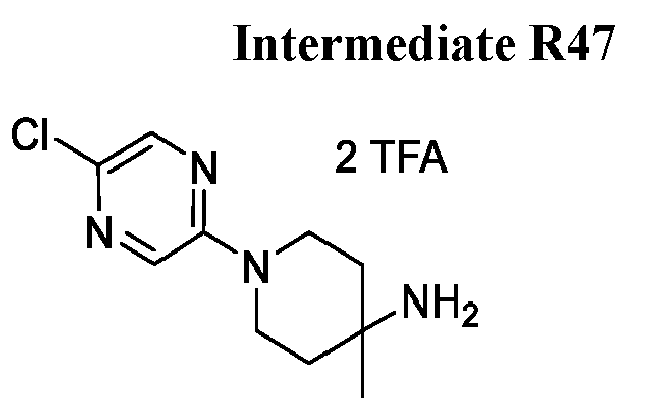
- A mixture of tert-butyl (1-(5-chloropyrazin-2-yl)-4-methylpiperidin-4-yl)carbamate (Intermediate R46; 500 mg, 1.53 mmol) in DCM (0.5 mL) was treated with TFA (0.25 mL, 3.27 mmol). The resulting mixture was stirred for 2 h at ambient temperature before concentrating the mixture in vacuo to afford the title compound (696 mg, quantitative yield). MS (apci) m/z = 227.1 (M+H).


- A solution of 1-(5-chloropyrazin-2-yl)-4-methylpiperidin-4-amine bis(2,2,2-trifluoroacetate) (Intermediate R47; 596 mg, 1.31 mmol) in DCM (26 mL) was treated sequentially with 2-chloro-6-methylbenzoic acid (1.345 g, 7.89 mmol), HATU (1.999 g, 5.26 mmol) and DIEA (4.6 mL 26.3 mmol). The resulting mixture was stirred overnight at ambient temperature, before concentrating the mixture in vacuo. The crude residue was purified by silica chromatography (0-60% EtOAc in hexanes) to afford the title compound (360 mg, 72% yield). MS (apci) m/z = 379 (M+H).

- In a pressure vessel, a mixture of 2-chloro-N-(1-(5-chloropyrazin-2-yl)-4-methylpiperidin-4-yl)-6-methylbenzamide (Intermediate R48; 730 mg, 1.92 mmol), bis(pinacolato)diboron (4.888 g, 19.2 mmol), KOAc (944 mg, 9.62 mmol) and PdCl2(dppf)•CH2Cl2 (157 mg, 0.192 mmol), in dioxane (19.25 mL) was sparged with Ar(g). The vessel was sealed, and the mixture was stirred overnight at 80 °C. After cooling to ambient temperature, the reaction mixture was diluted with DCM, and filtered through a GF/F filter. The filtrate was concentrated in vacuo, and the residue was triturated with pentane (50 mL). The resulting suspension was sonicated for 4 min, and then filtered. The solids were collected to afford the title compound (980 mg, 54% yield). MS (apci) m/z = 389.1 (M+H).

- In a pressure vessel, a mixture of tert-butyl (4-methylpiperidin-4-yl)carbamate (0.23 g, 1.1 mmol), 2-fluoro-5-(4,4,5,5-tetramethyl-1,3,2-dioxaborolan-2-yl)pyrimidine (0.2 g, 0.89 mmol) and K2CO3(s) (944 mg, 9.62 mmol) was combined in dioxane (8.9 mL). The vessel was sealed, and the reaction mixture was stirred overnight at 60 °C. After cooling to ambient temperature, the reaction mixture was preserved as a suspension (i.e. without further work up, purification or isolation) containing the title compound (assumed 370 mg, quantitative yield. MS (apci) m/z = 419.3 (M+H).

- A mixture of 4-(6-(4-amino-4-(hydroxymethyl)piperidin-1-yl)pyridin-3-yl)-6-ethoxypyrazolo[1,5-a]pyridine-3-carbonitrile (Intermediate P56, 78.5 mg, 0.200 mmol), TsCl (114 mg, 0.600 mmol), DMAP (4.89 mg, 0.0400 mmol) and TEA (139 µL, 1.00 mmol) in DCM (3 mL) was stirred for 1.5 h at ambient temperature, before introducing additional TsCl (38 mg, 0.20 mmol). After stirring for an additional 15 h at ambient temperature, the resulting mixture was purified directly by silica chromatography (using 0-50% EtOAc in Hexanes as the gradient eluent) to afford the title compound (55 mg, 52% yield). MS (apci) m/z = 529.2 (M+H), 551.2 (M+Na).
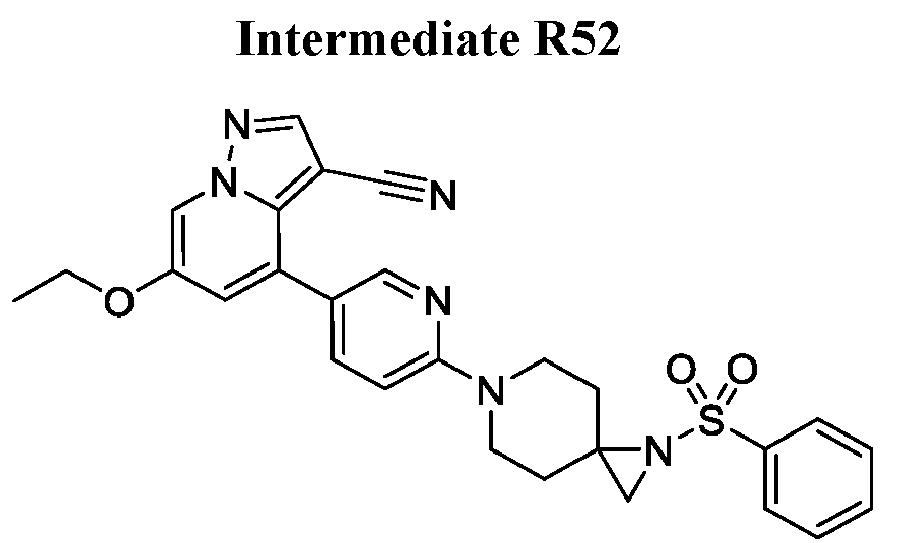
- A suspension of 4-(6-(4-amino-4-(hydroxymethyl)piperidin-1-yl)pyridin-3-yl)-6-ethoxypyrazolo[1,5-a]pyridine-3-carbonitrile (Intermediate P56, 40 mg, 0.10 mmol), and TEA (57 µL, 0.41 mmol) in DCM (2 mL) was treated sequentially with benzenesulfonyl chloride (33 µL, 0.25 mmol) and DMAP (1.2 mg, 0.01 mmol). The resulting mixture was stirred for 22 h at ambient temperature. The reaction mixture was purified directly by silica chromatography (0-70% EtOAc in hexanes) to afford the title compound (26 mg, 50% yield). MS (apci) m/z = 515.2 (M+H), 537.1 (M+Na).

- A solution of 2,5-dichloropyrazine (217 mg, 1.46 mmol), tert-butyl ((3S,4S)-3-hydroxypiperidin-4-yl)carbamate (300 mg, 1.387 mmol) and K2CO3 (575 mg, 2.25 mmol) in DMSO (2.3 mL) was stirred at 90 °C for 12 h, then at room temperature overnight. The reaction was diluted with water (15 mL) and extracted with DCM (3 × 15 mL). The combined organic extracts was washed with brine (15 mL), dried over anhydrous Na2SO4(s), filtered, and concentrated in vacuo. The crude was purified by silica chromatography (0-15% MeOH/DCM) followed by reverse phase chromatography (0 to 98% MeCN/water). The fractions containing product were combined, concentrated to remove most ACN, diluted with sat. NaHCO3 (15 mL) and extracted with DCM (3 × 15 mL). The combined organic extracts was washed with brine (15 mL) and dried over anhydrous Na2SO4(s), filtered, and concentrated in vacuo to afford the title compound (180.7 mg, 40% yield). MS (apci) m/z = 329.2 (M+H).

- A solution of triphosgene (111 mg, 0.375 mmol) in DCM (284 µL) was stirred at 0 °C, while sequentially adding dropwise (S)-tetrahydrofuran-3-ol (100 mg, 1.13 mmol) and a solution of pyridine (91.8 µL, 1.13 mmol) in DCM (0.15 mL). The resulting mixture was stirred for 1.5 h at 0 °C, then for an additional 0.5 h at ambient temperature. The resulting mixture was filtered to remove pyridinium solids. The filtrate containing the title compound in DCM was collected and used as is in subsequent steps assuming quantitative yield.

- Step 1: Preparation of tert-butyl 4-(2-fluorobenzyl)-4-hydroxypiperidine-1-carboxylate. To a solution of (2-fluorobenzyl)magnesium chloride (0.5 M in Et2O, 2.4 mL, 1.227 mmol) cooled to -78 °C was added tert-butyl 4-oxopiperidine-1-carboxylate (203.7 mg, 1.022 mmol) portionwise. The reaction mixture was allowed to gradually warm up to RT and stirred overnight. After removal of solvent under reduced pressure, the residue was taken up in DCM and washed with water and brine. The organic layer was concentrated and the crude material was treated with silica chromatography (0-70% EtOAc in hexanes) to yield the title compound as colorless oil (143.9 mg, 45.5%). MS (apci) m/z = 210.2 (M+H-Boc).
- Step 2: Preparation of 4-(2-fluorobenzyl)piperidin-4-ol hydrochloride. A solution of tert-butyl 4-(2-fluorobenzyl)-4-hydroxypiperidine-1-carboxylate (143.9 mg, 0.4651 mmol) in 1,4-dioxane (0.5 mL) was treated with conc. HCl (0.038 mL, 0.46 mmol) and stirred at RT for 1 h. Removal of solvent under reduced pressure gave the title product as colorless oil (114 mg, 99 % yield). MS (apci) m/z = 210.1 (M+H).

- Step 1: Preparation of tert-butyl 4-hydroxy-4-(2-methoxybenzyl)piperidine-1-carboxylate. To a solution of (2-methoxybenzyl)magnesium chloride (0.25 M in 2-methyltetrahydrofuran, 4.8 mL, 1.2 mmol) cooled to -78 °C was added tert-butyl 4-oxopiperidine-1-carboxylate (207.0 mg, 1.04 mmol) portionwise. The reaction was stirred at -78°C for 2 h before it was quenched with sat. NH4Cl (aq.). After phase-separation, the aqueous was extracted with EtOAc (3x). The organic extracts were combined, dried over Na2SO4, filtered and concentrated. The residue was purified by silica chromatography (0-70% EtOAc in hexanes) to afford the title compound as a colorless oil (64.1mg, 19 %). MS (apci) m/z = 222.2 (M+H-Boc).
- Step 2: Preparation of 4-(2-methoxybenzyl)piperidin-4-ol hydrochloride. The title product (51 mg, 99%) was prepared according to the procedure described for the preparation of Intermediate R55, Step 2. MS (apci) m/z = 222.2 (M+H).

- Step 1: Preparation of tert-butyl 4-(4-fluorobenzyl)-4-hydroxypiperidine-1-carboxylate. To a solution of (4-fluorobenzyl)magnesium chloride (0.5 M in 2-methyltetrahydrofuran, 7.5 mL, 3.75 mmol) cooled to 0°C was added tert-butyl 4-oxopiperidine-1-carboxylate (496.4 mg, 2.49 mmol) portionwise. The mixture was stirred at 0°C for 30 min before it was quenched with sat. NH4Cl (aq). After phase-separation, the aqueous was extracted with EtOAc (3x). The organic extracts were combined, dried over Na2SO4, filtered and concentrated. The residue was purified by silica chromatography (0-70% EtOAc in hexanes) to afford the title compound as a colorless oil (950.5 mg, 73%). MS (apci) m/z = 210.2 (M+H-Boc).
- Step 2: Preparation of 4-(2-methoxybenzyl)piperidin-4-ol hydrochloride. The title product (51 mg, 99%) was prepared according to the procedure described for the preparation of Intermediate R55, Step 2. MS (apci) m/z = 210.1 (M+H).

- Step 1: Preparation of tert-butyl 4-hydroxy-4-((6-methylpyridin-2-yl)methyl)pipendine-1-carboxylate. To a flask that was dried under vacuum with heat was added 2,6-dimethylpyridine (0.06 mL, 0.5 mmol) and dry THF (1.1 mL) under argon. After cooling to -78 °C, n-BuLi (2.5 M in THF, 0.17 mL, 0.43mmol) was introduced. The reaction was allowed to warm up to 0°C, then cooled to -78°C again, and 1-benzylpiperidin-4-one (66 mg, 0.33mmol) was added. The reaction was allowed to slowly warm up to RT and stirred for 3 h before it was partitioned between DCM and water. After phase-separation and extracting the aqueous with DCM (2 x), the organic extracts were combined, dried (Na2SO4), filtered and concentrated. The crude was purified by silica chromatography (0-20% MeOH in DCM) to afford the title compound (73 mg, 71%). MS (apci) m/z = 307.2 (M+H).
- Step 2: Preparation of 4-((6-methylpyridin-2-yl)methyl)piperidin-4-ol. A mixture of tert-butyl 4-hydroxy-4-((6-methylpyridin-2-yl)methyl)piperidine-1-carboxylate (73 mg, 0.24 mmol) in DCM (3 mL) and TFA (2 mL) was stirred at RT for 2 h before it was concentrated. The residue was taken up in minimal amount of MeOH and passed thru a P1-HCO3 resin plug. Removal of solvent under reduced pressure yielded the title compound with quantitative yield. MS (apci) m/z = 207.1 (M+H).
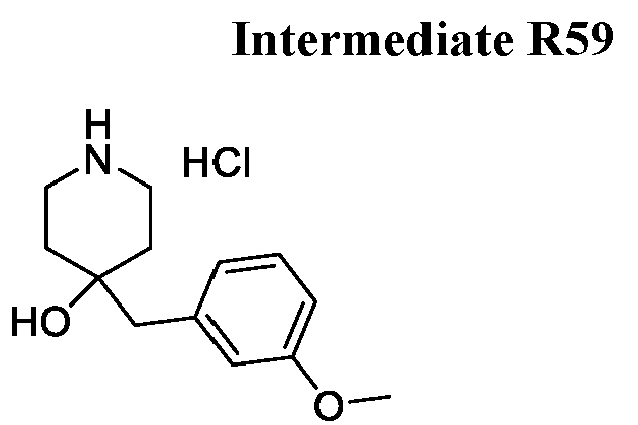
- Step 1: Preparation of tert-butyl 4-hydroxy-4-(3-methoxybenzyl)piperidine-1-carboxylate. To a solution of (3-methoxybenzyl)magnesium chloride (0.25 M in 2-methyltetrahydrofuran, 15 mL, 3.75 mmol) cooled to 0 °C was added tert-butyl 4-oxopiperidine-1-carboxylate (678 mg, 3.40 mmol) portionwise. The reaction mixture was allowed to slowly warm up to RT and stirred overnight before quenched with sat. NH4Cl (aq.). After phase-separation, the aqueous was extracted with EtOAc (3x). The organic extracts were combined, dried over Na2SO4, filtered and concentrated. The residue was purified by silica chromatography (0-70% EtOAc in hexanes) to afford the title compound as a colorless oil (1.09 g). MS (apci) m/z = 222.2 (M+H-Boc).
- Step 2: Preparation of 4-(3-methoxybenzyl)piperidin-4-ol hydrochloride. The title product was prepared according to the procedure described for the preparation of Intermediate R55, Step 2. MS (apci) m/z = 222.1 (M+H).
RE23649-093
- Step 1: Preparation of tert-butyl 4-((3-chloropyridin-2-yl)methyl)-4-hydroxypiperidine-1-carboxylate. A solution of 3-chloro-2-methylpyridine (64.2 mg, 0.50 mmol) in THF (1 mL) was sparged with N2 and cooled to -78 °C before n-butyllithium (2.5 M THF, 0.16 mL, 0.41 mmol) was added dropwise. After stirred at -78 °C for 45 min, the mixture was warmed to RT and stirred for 2 h before cooled again to - 78 °C. A solution of tert-butyl 4-oxopiperidine-1-carboxylate (74.2 mg, 0.37 mmol) in THF (1.5 mL) was added dropwise. After stirring for 2 hr at -78 °C, the mixture was warmed to rt and stirred for 2 d. The reaction was then partitioned between EtOAc and sat. NH4Cl (aq). After phase-separation, the aqueous was extracted with EtOAc (3x). The organic extracts were combined, dried over Na2SO4, filtered and concentrated. The residue was purified by silica chromatography (10-90% EtOAc in hexanes) to afford the title compound as a colorless oil (103.5 mg, 85%). MS (apci) m/z = 227.1 (M+H-Boc).
- Step 2: Preparation of 4-((3-chloropyridin-2-yl)methyl)piperidin-4-ol. A solution of tert-butyl 4-((3-chloropyridin-2-yl)methyl)-4-hydroxypiperidine-1-carboxylate (103.5 mg, 0.32 mmol) in DCM (1.5 mL) was treated with TFA (1.5 mL) and stirred at RT overnight. After removal of solvent under reduced pressure, the residue was treated with NaHCO3 (sat.) and extracted with 4:1 DCM/IPA (4x). The combined organic extracts were passed through a phase-separator frit and concentrated to afford the title product as a colorless oil (71.1 mg, 99%). MS (apci) m/z = 227.1 (M+H).

- Step 1: Preparation of tert-butyl 4-((5-fluoropyridin-3-yl)methyl)-4-hydroxypiperidine-1-carboxylate. A solution of 3-fluoro-5-methylpyridine (279 mg, 2.51 mmol) in THF (1.5 mL) was sparged with N2 and cooled to -78 °C before butyllithium (2.5 M THF, 0.79 mL, 1.99 mmol) was added dropwise. After 5 min stirring, a solution of tert-butyl 4-oxopiperidine-1-carboxylate (359.7 mg, 1.805 mmol) in THF (1.5mL) was added dropwise, and stirring continued for another 5 min.. The reaction was then quenched with sat. NH4Cl (aq) and filtered. After phase-separation, the organic layer was washed with water, dried (Na2SO4), filtered and concentrated. The crude material was purified by silica chromatography (10-90% EtOAc in hexanes) to afford the title product as a colorless oil (104.9 mg, 18.7% ). MS (apci) m/z = 211.1 (M+H-Boc).
- Step 2: Preparation of 4-((5-fluoropyridin-3-yl)methyl)piperidin-4-ol. The title product was prepared according to the procedure described for the preparation of Intermediate R60, Step 2. MS (apci) m/z = 211.2 (M+H).
- The compounds in Table R1 were prepared using similar methods as described for the preparation of Intermediate R56 (Method A), Intermediate R57 (Method B), Intermediate R60 (Method C), Intermediate R55 (Method D) or Intermediate R58 (Method E), using the appropriate reagent and chromatography conditions for Step 1.
Table R1 Intermediat e Method Structure Chemical Name LCMS m/z R62 A 
4-(3-methylbenzyl)piperidin-4-ol hydrochloride 206.2 (M+H) R63 A 
4-(4-methylbenzyl)piperidin-4-ol hydrochloride 206.3 (M+H) R64 B 
4-(2-methylbenzyl)piperidin-4-ol hydrochloride 206.2 (M+H) R65 C 
4-((5-methylpyrazin-2-yl)methyl)piperidin-4-ol 208.2 (M+H) R66 C 
4-((6-methoxypyridin-3-yl)methyl)piperidin-4-ol hydrochloride 223.1 (M+H) R67 D 
4-(3-fluorobenzyl)piperidin-4-ol hydrochloride 210.2 (M+H) R68 E 
4-((3-fluoropyridin-2-yl)methyl)piperidin-4-ol 211.2 (M+H) 
- A solution of 4-((3-chloropyridin-2-yl)methyl)piperidin-4-ol (R60, 222.0 mg, 0.98 mmol) and 2,5-dichloropyrazine (145.9 mg, 0.98 mmol) in DMSO (2 mL) was treated with DIEA (0.86 mL, 4.90 mmol) and stirred at 100°C overnight. After cooling to RT the reaction was diluted with H2O and extracted with 4:1 DCM/IPA (3x). The organic extracts were combined and concentrated. The crude residue was purified by silica chromatography (20-80% EtOAc in hexanes) to afford the title product as a colorless oil (206.7 mg, 62% yield). MS (apci) m/z = 339.1 (M+H).

- The title product (460 mg, 59%) was prepared according to the procedure described for the preparation of Intermediate R69, replacing 4-((3-chloropyridin-2-yl)methyl)piperidin-4-ol with 4-((3-fluoropyridin-2-yl)methyl)piperidin-4-ol (Intermediate R68). MS (apci) m/z = 323.1 (M+H).

- The title product (550 mg, 96%) was prepared according to the procedure described for the preparation of Intermediate R69, replacing 4-((3-chloropyridin-2-yl)methyl)piperidin-4-ol with 4-(pyridin-2-ylmethyl)piperidin-4-ol dihydrochloride. MS (apci) m/z = 305.1 (M+H).

- Step 1: Preparation of 4-benzylpiperidin-4-amine bis(2,2,2-trifluoroacetate). A mixture of tert-butyl 4-amino-4-benzylpiperidine-1-carboxylate (210 mg, 0.723 mmol) in DCM (2 mL) and TFA (1 mL) was stirred at RT for ~3 h before it was concentrated to yield the title compound assuming quantitative yield. MS (apci) m/z = 191.2 (M+H).
- Step 2: Preparation of 4-benzyl-1-(5-chloropyrazin-2-yl)piperidin-4-amine. To a solution of 2,5-dichloropyrazine (0.1316 mL, 0.7243 mmol) in DMSO (10 mL) were added K2CO3 (300.3 mg, 2.173 mmol) followed by 4-benzylpiperidin-4-amine bis(2,2,2-trifluoroacetate) (303 mg, 0.72 mmol). The reaction was sealed and heated at 75 °C overnight. After cooling to RT, the reaction was diluted with EtOAc (10 mL) and water (20 mL). After phase-separation, the aqueous was extracted with EtOAc (2x). The combined organic extracts were concentrated and used directly in the next step. MS (apci) m/z = 303.1 (M+H).
-

- A stirred solution of 4-bromo-6-methoxypyrazolo[1,5-a]pyridine-3-carbonitrile (Intermediate P1, Step 6 of Part B; 20 mg, 0.0793 mmol) in dioxane (33.7 mL) was treated with (6-(4-ethyl-4-(isopropylcarbamoyl)piperidin-1-yl)pyridin-3-yl)boronic acid (Intermediate R3; 38.0 mg, 0.119 mmol) and 2 M K2CO3(aq) (79.3 µL, 0.159 mmol). The mixture was purged with N2(g) for 5 min, then treated with X-Phos (7.56 mg, 0.0159 mmol) and Pd2(dba)3 (3.63 mg, 0.00397 mmol), and purged again with N2(g) for an additional 5 min. The resulting reaction mixture was stirred overnight at 80 °C. After cooling to ambient temperature, the reaction mixture was diluted with water and the biphasic mixture was extracted with EtOAc. The combined organic extracts were dried over anhydrous Na2SO4(s), filtered, and concentrated in vacuo. Purification of the crude residue by silica chromatography (0-10% MeOH/DCM in EtOAc as the gradient eluent) cleanly provided the title compound (29.2 mg, 82% yield). MS (apci) m/z = 447.2 (M+H).
-
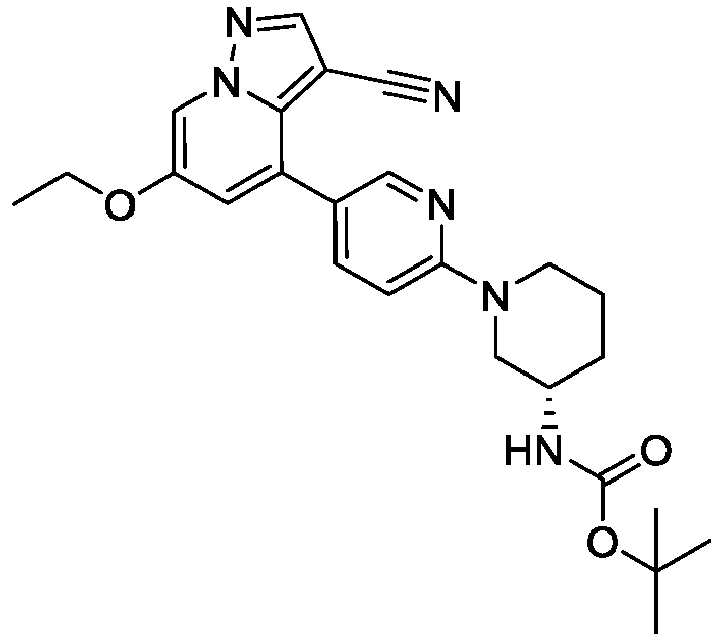
- A suspension of 6-ethoxy-4-(6-fluoropyridin-3-yl)pyrazolo[1,5-a]pyridine-3-carbonitrile (Intermediate P6; 0.086 g, 0.30 mmol) in DMSO (709 µL) was treated with tert-butyl (S)-piperidin-3-ylcarbamate (180 mg, 0.91 mmol) and K2CO3(s) (170 mg, 1.2 mmol) was stirred overnight at 110°C. The reaction mixture was cooled to ambient temperature, and then diluted with DCM. The pH of the resulting mixture was adjusted to about pH 7 with the addition of saturated NH4Cl(aq). The biphasic mixture was extracted with DCM, and the combined organic extracts were dried over anhydrous Na2SO4(s), filtered, and concentrated in vacuo. The crude residue was purified by silica chromatography (0-15% MeOH/EtOAc as the gradient eluent) to afford the title compound (94 mg, 67% yield). MS (apci) m/z = 463.3 (M+H).
-

- A solution of tert-butyl (S)-(1-(5-(3-cyano-6-ethoxypyrazolo[1,5-a]pyridin-4-yl)pyridin-2-yl)piperidin-3-yl)carbamate (Example 2; 10 mg, 0.0216 mmol) in DCM (500 µL) was treated with TFA (49.7 µL, 0.6486 mmol) and stirred overnight at ambient temperature. The reaction mixture was diluted with DCM and directly purified by C18 reverse phase chromatography (20-80% ACN/Water with 0.1% formic acid as the gradient eluent) to afford the title compound (5.7 mg, 73% yield). MS (apci) m/z = 363.2 (M+H).
-

- Step 1: Preparation of tert-butyl (S)-(1-(5-(3-cyano-6-ethoxypyrazolo[1,5-a]pyridin-4-yl)pyridin-2-yl)piperidin-3-yl)(methyl)carbamate 2,2,2-trifluoroacetate. A solution of tert-butyl (S)-(1-(5-(3-cyano-6-ethoxypyrazolo[1,5-a]pyridin-4-yl)pyridin-2-yl)piperidin-3-yl)carbamate (Example 2; 0.026 g, 0.0562 mmol) in DMA (250 µL) was treated with TEA (94 µL, 0.675 mmol) and a solution of iodomethane (1 drop, approximately 3.5 µL, 0562 mmol) in DMA (250 µL). The reaction mixture was stirred 2 h at ambient temperature before introducing additional concentrated iodomethane (2 drops, approximately 7 µL, 1.1 mmol). The reaction mixture was allowed to stir overnight at 0 °C. Due to insufficient reaction progression, the reaction mixture was treated with NaH (60% in mineral oil; 3 mg, 0.125 mmol). The resulting mixture was allowed to stir 6 h at ambient temperature, and then additional concentrated iodomethane (4 drops, approximately 14 µL, 2.25 mmol) was added. The reaction mixture was stirred overnight at ambient temperature, and then quenched with water in DCM. The resulting biphasic mixture was extracted with DCM, and the combined organic extracts were dried over anhydrous Na2SO4(s), filtered, and concentrated in vacuo. The residue was purified by C18 reverse phase chromatography (5-95% ACN in water with 0.01% TFA as the gradient eluent) to afford the title compound as the TFA Salt (13.7 mg, 51% yield). MS (apci) m/z = 477.3 (M+H).
- Step 2: Preparation of (S)-6-ethoxy-4-(6-(3 -(methylamino)pyperidin-1-yl)pyridin-3-yl)pyrazolo[1,5-a]pyridine-3-carbonitrile. A solution of tert-butyl (S)-(1-(5-(3-cyano-6-ethoxypyrazolo[1,5-a]pyridin-4-yl)pyridin-2-yl)piperidin-3-yl)(methyl)carbamate 2,2,2-trifluoroacetate (step 1, 13.7 mg, 0.0288 mmol) in DCM (500 µL) was treated with TFA (22.0 µL, 0.288 mmol) was stirred for 5 h at ambient temperature. The reaction mixture was diluted with MeOH (1 mL) and purified directly by C18 reverse phase chromatography (5-95% ACN in water with 0.01% TFA as the gradient eluent) to afford the title compound (9.7 mg, 90% yield). MS (apci) m/z = 377.2 (M+H).
-

- A solution of tert-butyl (S)-(1-(5-(3-cyano-6-ethoxypyrazolo[1,5-a]pyridin-4-yl)pyridin-2-yl)piperidin-3-yl)carbamate (Example 2; 20 mg, 0.0432 mmol) and formaldehyde (130 µL, 0.140 mmol) in formic acid (326 µL) was stirred 4 h at ambient temperature and then an additional 2 h at 90 °C. Due to insufficient reaction progression, the reaction mixture was treated with NaH (60% in mineral oil; 3 mg, 0.125 mmol). The resulting mixture was quenched with saturated NH4Cl(aq). The resulting biphasic mixture was concentrated in vacuo. The residue was purified by C18 reverse phase chromatography (5-95% ACN in water with 0.01% TFA as the gradient eluent) to afford the title compound (5.5 mg, 33% yield). MS (apci) m/z = 391.2 (M+H).
-

- A suspension of 6-ethoxy-4-(6-fluoropyridin-3-yl)pyrazolo[1,5-a]pyridine-3-carbonitrile (Intermediate P6; 0.060 g, 0.21 mmol) in DMSO (1.0 mL) was treated with tert-butyl methyl((3S,4S)-4-methylpiperidin-3-yl)carbamate (97 mg, 0.43 mmol) and K2CO3(s) (120 mg, 0.85 mmol) was stirred for 10 h at 90 °C. The reaction mixture was cooled to ambient temperature and then quenched with the addition of a 1:1 mixture of water and saturated NH4Cl(aq). The resulting mixture was extracted with DCM. The combined organic extracts were dried over anhydrous Na2SO4(s), filtered, and concentrated in vacuo. The crude residue was purified by C18 reverse phase chromatography (20-90% ACN/water as the gradient eluent) to afford the title compound (63 mg, 60% yield). MS (apci) m/z = 491.3 (M+H).
-

- A suspension of tert-butyl ((3S,4S)-1-(5-(3-cyano-6-ethoxypyrazolo[1,5-a]pyridin-4-yl)pyridin-2-yl)-4-methylpiperidin-3-yl)(methyl)carbamate (Example 6; 63 mg, 0.13 mmol) in DCM (0.5 mL) was treated with TFA (98.3 µL, 1.284 mmol). The reaction mixture was stirred for 5 h at ambient temperature, and then concentrated in vacuo. The crude residue was purified by C18 reverse phase chromatography (5-95% ACN in water with 0.01% TFA as the gradient eluent) to afford the title compound as TFA salt (41.1 mg, 82% yield). MS (apci) m/z = 391.2 (M+H).
-

- A suspension of 6-ethoxy-4-(6-fluoropyridin-3-yl)pyrazolo[1,5-a]pyridine-3-carbonitrile Intermediate P6; 87 mg, 0.31 mmol) in DMSO (3.0 mL) was treated with tert-butyl ((3R,4R)-4-hydroxypiperidin-3-yl)carbamate (200 mg, 0.92 mmol) and K2CO3(s) (170 mg, 1.2 mmol) was stirred overnight at 110 °C. After cooling to ambient temperature, the reaction mixture was diluted with DCM, and the pH of the mixture was adjusted to about pH 7 with the addition of saturated NH4Cl(aq). The resulting biphasic mixture was extracted with DCM. The combined organic extracts were dried over anhydrous Na2SO4(s), filtered, and concentrated in vacuo. The crude residue was purified by C18 reverse phase chromatography (10-85% ACN in water with 0.01% TFA as the gradient eluent) to provide a 2:1 mixture of the title compound plus the Boc protected title compound. The mixture was next purified by C18 reverse phase chromatography (5-95% ACN in water with 0.1 w/w % TFA) to afford the title compound as the TFA salt (15 mg, 13% yield). MS (apci) m/z = 379.1 (M+H).
-

- A suspension of 6-ethoxy-4-(6-fluoropyridin-3-yl)pyrazolo[1,5-a]pyridine-3-carbonitrile (Intermediate P6; 30 mg, 0.11 mmol), 2-(piperidin-4-yloxy)pyridine (28.4 mg, 0.159 mmol), and TEA (44 µL, 0.319 mmol) in DMA (500 µL) was stirred overnight at 90 °C. After cooling to ambient temperature, the reaction mixture was diluted with DCM and quenched with water. The resulting biphasic mixture was extracted with DCM. The combined organic extracts were dried over anhydrous Na2SO4(s), filtered, and concentrated in vacuo. The crude residue was purified by silica chromatography (40-100% EtOAc/ Hexanes as the gradient eluent) to afford the title compound (23.6 mg, 50% yield). MS (apci) m/z = 441.2 (M+H).
-
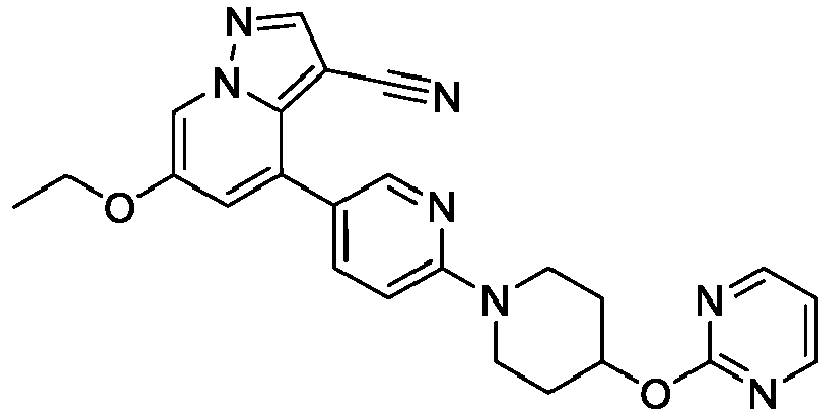
- The title compound (18.6 mg, 40% yield) was prepared and purified using a similar procedure to that described for Example 9, replacing 2-(piperidin-4-yloxy)pyridine with 2-(piperidin-4-yloxy)pyrimidine. MS (apci) m/z = 442.3 (M+H).
-

- The title compound was prepared, quenched and worked up using similar procedures to those described for Example 6, replacing tert-butyl ((3R,4R)-4-hydroxypiperidin-3-yl)carbamate with 3-azabicyclo[3.1.1]heptan-6-ol. The crude residue was suspended in 19:1 Et2O:MeOH, and the resultant suspension was filtered to cleanly provide the title compound (73.2 mg, 61% yield). MS (apci) m/z = 376.2 (M+H).
-

- A cold (0 °C) suspension of 6-ethoxy-4-(6-(6-hydroxy-3-azabicyclo[3.1.1]heptan-3-yl)pyridin-3-yl)pyrazolo[1,5-a]pyridine-3-carbonitrile (Example 11; 15 mg, 0.040 mmol) in DMA (500 µL) was treated with NaH (3 mg, 0.12 mmol). The resulting mixture was allowed to warm to ambient temperature, before introducing 1-bromo-2-methoxyethane (56 mg, 0.40 mmol). After stirring for 1 hour at 90 °C, the reaction mixture was cooled to ambient temperature and quenched with water. The resulting mixture was diluted with additional water and brine, and was extracted with DCM. The combined organic extracts were dried over anhydrous Na2SO4(s), filtered, and concentrated in vacuo. The residue was purified by silica chromatography (0-15% MeOH/EtOAc as the gradient eluent) to afford the title compound (7.7 mg, 44% yield). MS (apci) m/z = 434.2 (M+H).
-

- A cold (0 °C) suspension of 6-ethoxy-4-(6-(6-hydroxy-3-azabicyclo[3.1.1]heptan-3-yl)pyridin-3-yl)pyrazolo[1,5-a]pyridine-3-carbonitrile (Example 11; 20 mg, 0.0533 mmol) in DMSO (500 µL) was treated with NaH (2.6 mg, 0.107 mmol) The resulting mixture was allowed to warm to ambient temperature, and 2-chloropyrimidine (18.3 mg, 0.160 mmol) was added. After stirring for 0.5 h at 50 °C, the reaction mixture was cooled to ambient temperature and quenched dropwise with water. The resulting mixture was diluted with additional water and brine and then extracted with DCM. The combined organic extracts were dried over anhydrous Na2SO4(s), filtered, and concentrated in vacuo. The residue was purified by silica chromatography (0-15% MeOH/EtOAc as the gradient eluent) to afford the title compound (13.9 mg, 58% yield). MS (apci) m/z = 454.2 (M+H).
-

- The title compound was prepared using a similar method to that described for Example 13, replacing 2-chloropyrimidine with 2-chloropyridine. Purification by silica chromatography (40-100% EtOAc/hexanes as the gradient eluent) cleanly provided the title compound (11.3 mg, 47% yield). (MS (apci) m/z = 453.2 (M+H).
-
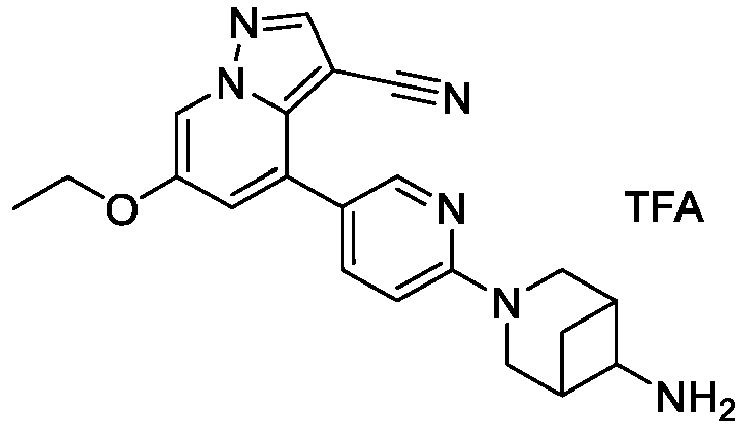
- Step 1: Preparation of tert-butyl (3-(5-(3-cyano-6-ethoxypyrazolo[1,5-a]pyridin-4-yl)pyridin-2-yl)-3-azabicyclo[3.1.1]heptan-6-yl)carbamate. A suspension of 6-ethoxy-4-(6-fluoropyridin-3-yl)pyrazolo[1,5-a]pyridine-3-carbonitrile (Intermediate P6; 0.065 g, 0.23 mmol), ), tert-butyl (3-azabicyclo[3.1.1]heptan-6-yl)carbamate (98 mg, 0.46 mmol) and K2CO3(s) (130 mg, 0.92 mmol) in DMSO (500 µL) was stirred overnight at 90 °C. The reaction mixture was diluted with DCM, and quenched with water. The resulting biphasic mixture was diluted with additional water and brine, and then extracted with DCM. The combined organic extracts were dried over anhydrous Na2SO4(s), filtered, and concentrated in vacuo. The residue was purified by silica chromatography (40-100% EtOAc/hexanes as the gradient eluent) to afford the title compound (7.3 mg, 67% yield). MS (apci) m/z = 475.2 (M+H).
- Step 2: Preparation of 4-(6-(6-amino-3-azabicyclo[3.1.1]heptan-3-yl)pyridin-3-yl)-6-ethoxypyrazolo[1,5-a]pyridine-3-carbonitrile 2,2,2-trifluoroacetate. A solution of tert-butyl (3-(5-(3-cyano-6-ethoxypyrazolo[1,5-a]pyridin-4-yl)pyridin-2-yl)-3-azabicyclo[3.1.1]heptan-6-yl)carbamate (90 mg, 0.1896 mmol) in DCM (1.25 mL) was treated with TFA (581 µL, 7.59 mmol) and stirred overnight at ambient temperature. The reaction mixture was concentrated in vacuo, and the residue was purified by C18 reverse phase chromatography (5-95% ACN in water with 0.01% TFA as the gradient eluent) to afford the title compound as TFA salt (8.72 mg,). MS (apci) m/z = 375.2 (M+H).
-

- A suspension of 6-ethoxy-4-(6-fluoropyridin-3-yl)pyrazolo[1,5-a]pyridine-3-carbonitrile (Intermediate P6; 64.4 mg, 0.228 mmol), N-(6-methoxypyridin-3-yl)-3-azabicyclo[3.1.1]heptan-6-amine 2,2,2-trifluoroacetate (Intermediate R8; 25 mg, 0.114 mmol) in DMSO (500 µL) was treated with K2CO3(s) (63.0 mg, 0.456 mmol) and stirred overnight at 90 °C. After cooling to ambient temperature, the reaction mixture was diluted with DCM and quenched with water. The resulting biphasic mixture was extracted with DCM. The combined organic extracts were dried over anhydrous Na2SO4(s), filtered, and concentrated in vacuo. The crude residue was purified by silica chromatography (40-100% EtOAc/hexanes as the gradient eluent) to afford the title compound (10.2 mg, 19% yield). MS (apci) m/z = 482.3 (M+H).
-
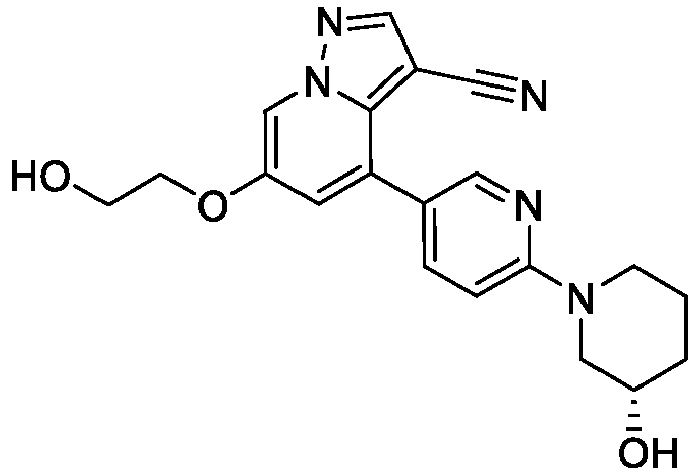
- A solution of 6-(2-((tert-butyldimethylsilyl)oxy)ethoxy)-4-(6-fluoropyridin-3-yl)pyrazolo[1,5-a]pyridine-3-carbonitrile (Intermediate P26; 30 mg, 0.073 mmol) in DMSO (1.5 mL) was treated with (S)-3-hydroxypiperidine hydrochloride (0.050 g, 0.36 mmol) and K2CO3(s) (40 mg, 0.29 mmol) and stirred 2 h at 110 °C. After cooling to ambient temperature, the reaction mixture was quenched with water. The resultant suspension was filtered, and the isolated solids were purified by silica chromatography (0-20% MeOH in DCM as the gradient eluent) to afford the title compound (7.5 mg, 27% yield). MS (apci) m/z = 380.1 (M+H).
-

- A solution of 6-(2-((tert-butyldimethylsilyl)oxy)ethoxy)-4-(6-fluoropyridin-3-yl)pyrazolo[1,5-a]pyridine-3-carbonitrile (Intermediate P26; 60 mg, 0.15 mmol) in DMSO (2.9 mL) was treated with (S)-3-(tert-butoxycarbonylamino)piperidine (0.12 g, 0.58 mmol) and K2CO3(s) (80 mg, 0.58 mmol) and stirred for 1 hour at 110 °C. After cooling to ambient temperature, the reaction mixture was neutralized with the addition 1 M HCl(aq). The resultant suspension was extracted with DCM, and the organic extracts were dried over anhydrous Na2SO4(s), filtered and concentrated in vacuo. The residue was purified by silica chromatography (0-10% MeOH in DCM as the gradient eluent) to afford the Boc-protected title compound. The Boc-protected material was dissolved in DCM (3 mL) then treated with 4 N HCl in dioxanes (3 mL). After stirring overnight at ambient temperature, the reaction mixture was concentrated in vacuo. The residue was purified by silica chromatography (0-100 % [20% MeOH, 2% NH4OH, 78% DCM] in DCM as the gradient eluent) to cleanly provide the title compound (20 mg, 35% yield). MS (apci) m/z = 379.2 (M+H).
-

- A solution of 6-(2-((tert-butyldimethylsilyl)oxy)ethoxy)-4-(6-fluoropyridin-3-yl)pyrazolo[1,5-a]pyridine-3-carbonitrile (Intermediate P26; 111 mg, 0.269 mmol) and tert-butyl N-(4-methyl-4-piperidyl)carbamate (173 mg, 0.807 mmol) in DMSO (2.5 mL) was stirred for 1 hour at 110 °C. After cooling to ambient temperature, the reaction mixture was quenched with water. The resultant suspension was filtered, and the solids were collected to cleanly provide the title compound (65 mg, 49% yield). MS (apci) m/z = 493.2 (M+H).
-

- A solution of tert-butyl (1-(5-(3-cyano-6-(2-hydroxyethoxy)pyrazolo[1,5-a]pyridin-4-yl)pyridin-2-yl)-4-methylpiperidin-4-yl)carbamate (Example 19; 45 mg, 0.091 mmol) in DCM (2 mL) was treated with 4 N HCl in dioxanes (3 mL, 12 mmol) and stirred for 2 h at ambient temperature. The resultant mixture was concentrated in vacuo to afford the title compound as the HCl salt. The salt was dissolved in MeOH, filtered through an Agilent PL-HCO3 MP SPE filter (to neutralize the HCl salt), and concentrated in vacuo to cleanly provide the title compound (30 mg, 84% yield). MS (apci) m/z = 393.2 (M+H).
-

- A solution of 4-(6-(4-amino-4-methylpiperidin-1-yl)pyridin-3-yl)-6-(2-hydroxyethoxy)pyrazolo[1,5-a]pyridine-3-carbonitrile (Example 20; 15 mg, 0.038 mmol) in DCM (191 µL) was treated sequentially with DIEA (20 µL, 0.11 mmol) and isovaleryl chloride (5.1 µL, 0.042 mmol) and stirred overnight at ambient temperature. The reaction mixture was concentrated in vacuo, and the residue was purified by silica chromatography (0-20% MeOH in DCM as the gradient eluent) to cleanly provide the title compound (4.8 mg, 26% yield). MS (apci) m/z = 477.2 (M+H).
-

- The title compound was prepared using a similar procedure to that described for Example 21, replacing isovaleryl chloride with isobutyryl chloride and using 5 equivalents of DIE. Following purification by silica chromatography (0-20% MeOH in DCM as the gradient eluent), the title compound was cleanly isolated (3.8 mg, 21% yield). MS (apci) m/z = 463.2 (M+H).
-

- The title compound was prepared using a similar procedure to that described for Example 21, replacing isovaleryl chloride with isobutyl chloroformate (1 equivalent). Following purification by silica chromatography (0-20% MeOH in DCM as the gradient eluent), the title compound was cleanly isolated (6.6 mg, 35% yield). MS (apci) m/z = 493.2 (M+H).
-

- A solution of 4-(6-(4-amino-4-methylpiperidin-l-yl)pyridin-3-yl)-6-(2-hydroxyethoxy)pyrazolo[1,5-a]pyridine-3-carbonitrile (Example 20; 15 mg, 0.038 mmol) in DCM (764 µL) was treated (R)-2-hydroxy-3-methylbutanoic acid (5.42 mg, 0.0459), HATU (17.4 mg, 0.0459 mmol) and DIEA (26.6 µL, 0.153 mmol), and stirred overnight at ambient temperature. The mixture was concentrated in vacuo, and then purified by silica chromatography (0-20% MeOH in DCM as the gradient eluent) to afford the title compound contaminated with DIEA. The impure residue was partitioned between MTBE and saturated NH4Cl(aq). The combined organic extracts were concentrated in vacuo to cleanly provide the title compound (1.6 mg, 9% yield). MS (apci) m/z = 493.2 (M+H).
-

- A solution of 4-(6-(4-amino-4-methylpiperidin-1-yl)pyridin-3-yl)-6-(2-hydroxyethoxy)pyrazolo[1,5-a]pyridine-3-carbonitrile (Example 20; 15 mg, 0.038 mmol) in anhydrous DMA (191 µL) was treated sequentially with DIEA (20.0 µL, 0.115 mmol) and isopropyl isocyanate (3.78 µL, 0.0382 mmol). After stirring overnight at ambient temperature, the reaction mixture was purified directly by C18 reverse phase chromatography (5-95% ACN in water with 0.1% TFA as the gradient eluent) to cleanly provide the title compound as a TFA salt. The salt was dissolved in MeOH, filtered through an Agilent PL-HCO3 MP SPE tube to neutralize, and the filtrate was concentrated in vacuo to cleanly provide the title compound (4.15 mg, 23% yield). MS (apci) m/z = 478.2 (M+H).
-

- The title compound (2.0, 11% yield) was prepared, purified and neutralized using a similar procedure to that described for Example 25, replacing isopropyl isocyanate with 1-isocyanato-2-methylpropane. MS (apci) m/z = 492.3 (M+H).
-

- A mixture of 4-(6-fluoropyridin-3-yl)-6-(2-hydroxy-2-methylpropoxy)pyrazolo[1,5-a]pyridine-3-carbonitrile (Intermediate P42; 29.3 mg, 0.0898 mmol), 4-benzylpiperidin-4-ol (25.8 mg, 0.135 mmol) and TEA (37.5 µL, 0.269 mmol) in DMA (599 µL) was stirred overnight at 90 °C. After cooling to ambient temperature, the reaction mixture was diluted with water and washed with DCM. The organic extracts were washed with brine, then dried over anhydrous Na2SO4(s), filtered and concentrated in vacuo. The residue was purified by C18 reverse phase chromatography (5-95% water:ACN with 0.1% TFA as the gradient eluent) to afford the title compound as the TFA salt. The TFA salt was dissolved in DCM and washed with saturated Na2CO3(aq). The organic extracts were washed with brine, then dried over anhydrous Na2SO4(s), filtered and concentrated in vacuo to cleanly provide the title compound (22.4 mg, 50% yield). MS (apci) m/z = 498.2 (M+H).
-

- The title compound (10.8 mg, 28% yield) was prepared and purified using a similar procedure to that described for Example 27, replacing 4-benzylpiperidin-4-ol with 4-methylpiperidin-4-ol. MS (apci) m/z = 422.1 (M+H).
-

- A mixture of 4-(6-(4-amino-4-methylpiperidin-1-yl)pyridin-3-yl)-6-(2-hydroxy-2-methylpropoxy)pyrazolo[1,5-a]pyridine-3-carbonitrile (Intermediate P46; 36 mg, 0.0856 mmol), benzoic acid (20.9 mg, 0.171 mmol) and HATU (35.8 mg, 0.0942 mmol) in DCM (856 µL) was treated with DIEA (74.8 µL, 0.428 mmol) and then stirred for 2 h at ambient temperature. The reaction mixture was concentrated in vacuo. The residue was suspended in 60:40 ACN:water containing 2% TFA, then filtered through a syringe filter. The filtrate was purified directly by C18 reverse phase chromatography (5-95% ACN in water with 0.1% TFA as the gradient eluent) to afford the title compound as the TFA salt. The TFA salt was treated with saturated NaHCO3(aq) and extracted with DCM. The combined organic extracts were washed with brine, then dried over anhydrous Na2SO4(s), filtered and concentrated in vacuo to afford the title compound (33.2 mg, 74% yield). MS (apci) m/z = 525.25 (M+H).
- The compounds in Table N were prepared using a similar method to that described for the synthesis of Example 29, replacing benzoic acid with the appropriate carboxylic acid. Reactions were monitored for completion by LCMS, and reaction durations were adjusted accordingly. Title compounds were cleanly isolated following chromatographic purification using an appropriate gradient eluent (and if necessary converted to the free base).
Table N Ex # Structure Chemical Name MS (apci) m/z 30 
N-(1-(5-(3-cyano-6-(2-hydroxy-2-methylpropoxy)pyrazolo[1 ,5-a]pyridin-4-yl)pyridin-2-yl)-4-methylpiperidin-4-yl)isobutyramide 491.3 (M+H) 31 
N-(1-(5-(3-cyano-6-(2-hydroxy-2-methylpropoxy)pyrazolo[1 ,5-a]pyridin-4-yl)pyridin-2-yl)-4-methylpiperidin-4-yl)-6-methoxynicotinamide 556.3 (M+H) -

- A mixture of 3-(5-(3-cyano-6-(2-hydroxy-2-methylpropoxy)pyrazolo[1,5-a]pyridin-4-yl)pyridin-2-yl)-3-azabicyclo[3.1.1]heptane-6-carboxylic acid (Intermediate P47; 32 mg, 0.072 mmol), propan-2-amine (11.7 µL, 0.143 mmol) and HATU (29.9 mg, 0.358 mmol) in DCM (715 µL) was treated with DIEA (62.4 µL, 0.358 mmol) and then stirred overnight at ambient temperature. The reaction mixture was concentrated in vacuo. The residue was purified by silica chromatography (1-6% MeOH in DCM as the gradient eluent) to afford the title compound (8.3 mg, 24% yield). MS (apci) m/z = 489.3 (M+H).
- The compounds in Table O were prepared using a similar method to that described for the synthesis of Example 32, replacing propan-2-amine with the appropriate amine. Reactions were monitored for completion by LCMS, and reaction durations were adjusted accordingly. Title compounds were cleanly isolated following chromatographic purification using an appropriate gradient eluent.
Table O Ex # Structure Chemical Name MS (apci) m/z 33 
3-(5-(3-cyano-6-(2-hydroxy-2-methylpropoxy)pyra zolo[1,5-a]pyridin-4-yl)pyridin-2-yl)-N-phenyl-3-azabicyclo[3.1.1]hep tane-6-carboxamide 523.2 (M+H) 34 
3-(5-(3-cyano-6-(2-hydroxy-2-methylpropoxy)pyra zolo[1,5-a]pyridin-4-yl)pyridin-2-yl)-N-(6-methoxypyridin-3-yl)-3-azabicyclo[3.1.1]hep tane-6-carboxamide 554.25 (M+H) -

- A mixture of 4-(6-fluoropyridin-3-yl)-6-(2-hydroxy-2-methylpropoxy)pyrazolo[1,5-a]pyridine-3-carbonitrile (Intermediate P42; 29.7 mg, 0.0910 mmol), 2-(piperidin-4-yloxy)pyridine (24.3 mg, 0.137 mmol) and TEA (38.1 µL, 0.273 mmol) in DMA (607 µL) was stirred overnight at 90 °C. After cooling to ambient temperature, the reaction mixture was diluted with water and washed with DCM. The organic extracts were washed with brine, then dried over anhydrous Na2SO4(s), filtered and concentrated in vacuo. The residue was purified by C18 reverse phase chromatography (5-95% ACN in water with 0.1% TFA as the gradient eluent) to afford the title compound as the TFA salt. The TFA salt was dissolved in DCM and washed with saturated Na2CO3(aq). The organic extracts were washed with brine, then dried over anhydrous Na2SO4(s), filtered and concentrated in vacuo to cleanly provide the title compound (12.1 mg, 27% yield). MS (apci) m/z = 485.2 (M+H). 1H NMR (400 MHz, CDCl3) δ: 8.34(d, 1H), 8.20(s, 1H), 8.15(m, 2H), 7.71(dd, 1H), 7.58(m, 1H), 7.15(d, 1H), 6.86(m, 1H), 6.81(d, 1H), 6.74(d, 1H), 5.35(m, 1H), 4.06(m, 2H), 3.86(s, 2H), 3.55(m, 2H), 2.15(m, 2H), 1.88(m, 2H), 1.40(s, 6H).
- The compounds in Table P were prepared using a similar method to that described for the synthesis of Example 35, replacing 2-(piperidin-4-yloxy)pyridine with the appropriate piperidine. Reactions were monitored for completion by LCMS, and reaction durations were adjusted accordingly.
Table P Ex # Structure Chemical Name MS (apci) m/z 36 
6-(2-hydroxy-2-methylpropoxy)-4-(6-(4-(pyridin-3-yloxy)piperidin-1-yl)pyridin-3-yl)pyrazolo[1,5-a]pyridine-3-carbonitrile 485.2 (M+H) 37 
4-(6-(4-(4-fluorophenoxy)piperid in-1-yl)pyridin-3-yl)-6-(2-hydroxy-2-methylpropoxy)pyrazo lo[1,5-a]pyridine-3-carbonitrile 502.2 (M+H) 38 
6-(2-hydroxy-2-methylpropoxy)-4-(6-(4-phenoxypiperidin-1-yl)pyridin-3-yl)pyrazolo[1,5-a]pyridine-3-carbonitrile 484.2 (M+H) 39 
6-(2-hydroxy-2-methylpropoxy)-4-(6-(4-(phenylamino)piperidi n-1-yl)pyridin-3-yl)pyrazolo[1,5-a]pyridine-3-carbonitrile 483.2 (M+H) 40 
6-(2-hydroxy-2-methylpropoxy)-4-(6-(4-(pyridin-2-ylmethyl)piperidin-1-yl)pyridin-3-yl)pyrazolo[1,5-a]pyridine3- 483.2 (M+H) carbonitrile 41 
4-(6-(4-benzylpiperidin-1-yl)pyridin-3 -yl)-6-(2-hydroxy-2-methylpropoxy)pyrazo lo[1,5-a]pyridine-3-carbonitrile 482.2 (M+H) -

- A solution of 2-methoxy-5-(piperidin-4-yloxy)pyridine (Intermediate R13; 66.1 mg, 0.317 mmol) in DMA (794 µL) was treated with 4-(6-fluoropyridin-3-yl)-6-(2-hydroxy-2-methylpropoxy)pyrazolo[1,5-a]pyridine-3-carbonitrile (Intermediate P42; 51.8 mg, 0.159 mmol), and TEA (43.4 µL, 0.317 mmol). The resulting mixture was sparged with Ar(g) then stirred overnight at 110 °C. After cooling to ambient temperature, the reaction mixture was diluted with DCM and washed with saturated NaHCO3(aq), and brine. The combined organic extracts were dried over anhydrous Na2SO4(s), filtered and concentrated in vacuo. The residue was purified by C18 reverse phase chromatography (5-95% ACN in water with 0.1% TFA as the gradient eluent) to afford the title compound as the TFA salt. The TFA salt was dissolved in DCM and washed with saturated NaHCO3(aq). The aqueous extracts were back extracted with DCM. The combined organic extracts were washed with brine, and subsequently dried over anhydrous Na2SO4(s), filtered and concentrated in vacuo to cleanly provide the title compound (41 mg, 50% yield). MS (apci) m/z = 515.2 (M+H).
-

- A mixture of 4-(6-fluoropyridin-3-yl)-6-(2-hydroxy-2-methylpropoxy)pyrazolo[1,5-a]pyridine-3-carbonitrile (Intermediate P42; 42.7 mg, 0.131 mmol), 3-phenoxyazetidine (23.4 mg, 0.157 mmol) and TEA (54.7 µL, 0.393 mmol) in DMA (872 µL) was stirred overnight at 90 °C. After cooling to ambient temperature, the reaction mixture was diluted with water and washed with DCM. The organic extracts were washed with brine and dried over anhydrous Na2SO4(s), filtered and concentrated in vacuo. The residue was purified by C18 reverse phase chromatography (5-95% ACN in water with 0.1% TFA as the gradient eluent) to afford the title compound as the TFA salt. The TFA salt was dissolved in DCM and washed with saturated Na2CO3(aq). The combined organic extracts were washed with brine, then dried over anhydrous Na2SO4(s), filtered and concentrated in vacuo to cleanly provide the title compound (14.1 mg, 24% yield). MS (apci) m/z = 456.2 (M+H).
-

- 6-ethoxy-4-(6-fluoropyridin-3-yl)pyrazolo[1,5-a]pyridine-3-carbonitrile (Intermediate P6, 0.030 g, 0.11 mmol), triethylamine (0.044 mL, 0.32 mmol) and 4-(pyridin-2-ylmethyl)piperidin-4-ol (0.041 g, 0.21 mmol) were combined in DMA (0.5 mL) and stirred at 90°C for 5 h. The reaction mixture was diluted with DCM (5 mL), sat. NH4Cl (aq., 5 mL) and water (20 mL). After phase-separation, the aqueous layer was extracted with DCM. The combined organic extracts were dried (Na2SO4), filtered, concentrated and purified by silica chromatography (30-100% EtOAc/hexanes) to provide the title product as solid (0.022 g, 46 % yield). 1H NMR (400 MHz, CDCl3) δ 8.5 (dq, 1H), 8.3 (d, 1H), 8.15 (s, 1H), 8.05 (d, 1H), 7.65 (qd, 2H), 7.15 (qd, 1H), 7.1 (d, 1H), 7.05 (d, 1H), 6.75 (d, 1H), 6.05 (br s, 1H), 4.1 (q, 2H), 3.45 (m, 2H), 2.9 (s, 2H), 1.6 (m, 4H), 1.5 (t, 3H). LCMS (apci) m/z = 455.2 (M+H).
-

- Step 1: Preparation of tert-butyl ((3S,4R)-1-(5-(3-cyano-6-ethoxypyrazolo[1,5-a]pyridin-4-yl)pyridin-2-yl)-4-hydroxypyrrolidin-3-yl)carbamate. 6-ethoxy-4-(6-fluoropyridin-3-yl)pyrazolo[1,5-a]pyridine-3-carbonitrile (Intermediate P6, 0.22 g, 0.76 mmol), N-ethyl-N-isopropylpropan-2-amine (0.66 mL, 3.81 mmol), and tert-butyl ((3S,4R)-4-hydroxypyrrolidin-3-yl)carbamate (0.23 g, 1.14 mmol) were combined in DMSO (1.5 mL) and stirred at 100 °C for 60 h. The reaction mixture was diluted with sat. NH4Cl and extracted into DCM. The combined organic extracts were dried (Na2SO4), filtered, concentrated in vacuo and purified by silica chromatography (0-100% EtOAc/hexanes) to provide the product as solid (0.28 g, 80% yield).
- Step 2: Preparation of 4-(6-((3S,4S)-3-amino-4-((5-fluoro-6-methoxypyridin-3-yl)oxy)pyrrolidin-1-yl)pyridin-3-yl)-6-ethoxypyrazolo[1,5-a]pyridine-3-carbonitrile. A mixture of tert-butyl ((3 S,4R)-1-(5-(3-cyano-6-ethoxypyrazolo[1,5-a]pyridin-4-yl)pyridin-2-yl)-4-hydroxypyrrolidin-3-yl)carbamate (0.030 g, 0.07 mmol), 5-fluoro-6-methoxypyridin-3-ol (0.037 g, 0.26 mmol), and triphenylphosphine (0.068 g, 0.26 mmol) was combined in 1:1 DCM/THF (0.7 mL). The reaction vessel was sparged with argon, and diisopropyl (E)-diazene-1,2-dicarboxylate (0.035 mL, 0.26 mmol) was added. The reaction was stirred at room temperature for 48 h. The reaction mixture was diluted with DCM and H2O, filtered through phase separating paper, and extracted into DCM. The combined organic extracts were dried (Na2SO4), filtered, concentrated in vacuo and purified by silica chromatography (0-100% EtOAc/hexanes). The fractions containing the Boc-protected title compound were concentrated, and the residue was diluted with 6 mL 1:1 DCM/5N HCl in isopropyl alcohol. This mixture was stirred at room temperature 24 h. The combined organic extracts were washed with 2M NaOH and purified by reverse phase chromatography (0-80% ACN/Water [0.1% Formic Acid]) to provide the title compound (2.2 mg, 7.0 % yield). 1H NMR (400 MHz, CD3OD) δ 8.4 (d, 1H), 8.3 (s, 1H), 8.25 (dd, 1H), 7.75 (dd, 1H), 7.7 (d, 1H), 7.3 (dd, 1H), 7.2 (d, 1H), 6.7 (dd, 1H), 4.1 (m, 2H), 3.95 (s, 3H), 3.9 (m, 2H), 3.7 (dd, 1H), 3.6 (dd, 1H), 3.3 (s, 2H), 1.45 (t, 3H). LCMS (apci) m/z = 490.1 (M+H).
-

- A mixture of 4-(6-fluoropyridin-3-yl)-6-(2-hydroxy-2-methylpropoxy)pyrazolo[1,5-a]pyridine-3-carbonitrile (0.040 g, 0.12 mmol) (Intermediate P42), 2-(azetidin-3-yloxy)pyridine dihydrochloride (0.055 g, 0.24 mmol) and triethylamine (0.10 mL, 0.74 mmol) in DMA (0.82 mL) was heated in a sealed vial to 90 °C overnight. After cooling to ambient temperature, the reaction was partitioned between DCM and water (10 mL each). After phase-separation, the aqueous was extracted with DCM (2 × 10 mL). The combined organic extracts was washed with brine, dried (Na2SO4), filtered and concentrated. The crude was purified by preparative HPLC (5-95% ACN in water with 0.1% TFA) to yield the title product as a TFA salt, which was then converted to the free base by partitioning in DCM and Na2CO3 (sat. aq). The combined organic extracts were washed with brine, dried (Na2SO4), filtered and concentrated to yield the title product (4.7 mg, 8.4 % yield). 1H NMR (CDCl3) δ 8.31 (dd, 1H), 8.19 (s, 1H), 8.14 (m, 2H), 7.68 (dd, 1H), 7.61 (m, 1H), 7.13 (d, 1H), 6.91 (m, 1H), 6.80 (m, 1H), 6.44 (dd, 1H), 5.57 (m, 1H), 4.55 (m, 2H), 4.15 (m, 2H), 3.86 (s, 2H), 1.39 (s, 6H). LCMS (apci) m/z = 457.2 (M+H).
-

- A mixture of 4-(6-fluoropyridin-3-yl)-6-(2-hydroxy-2-methylpropoxy)pyrazolo[1,5-a]pyridine-3-carbonitrile (0.031 g, 0.095 mmol) (Intermediate P42), 3-methoxy-6-(piperidin-4-yloxy)pyridazine dihydrochloride (0.090 g, 0.32 mmol), triethylamine (0.10 mL, 0.76 mmol) in DMA (0.32 mL) was heated in a sealed vial to 95 °C overnight. After cooling to ambient temperature, the reaction mixture was diluted with DCM (10 mL) and sequentially washed with sat. NaHCO3 (15 mL), water (2 × 15 mL) and brine (15 mL), then dried (Na2SO4), filtered and concentrated. The crude material was purified by C18 reverse phase chromatography (5-95% ACN in water with 0.01% TFA) and the combined product fractions was concentrated and converted to the free base with sat. NaHCO3 (15 mL). The aqueous layer was extracted with DCM (3 × 15 mL). The combined organic extracts were washed with brine (15 mL), dried (Na2SO4), filtered and concentrated to afford the title compound as a white solid (22.5 mg, 46 % yield). 1H NMR (CDCl3) δ 8.32 (dd, 1H), 8.19 (s, 1H), 8.13 (d, 1H), 7.68 (dd, 1H), 7.13 (d, 1H), 6.92 (m, 2H), 6.80 (m, 1H), 5.42 (m, 1H), 4.10 (m, 2H), 4.04 (s, 3H), 3.84 (s, 2H), 3.46 (m, 2H), 2.22 (m, 2H), 1.88 (m, 2H), 1.39 (s, 6H). LCMS (apci) m/z = 516.2 (M+H).
-

- A solution of 4-(6-fluoropyridin-3-yl)-6-(2-hydroxy-2-methylpropoxy)pyrazolo[1,5-a]pyridine-3-carbonitrile (25 mg, 0.077 mmol) (Intermediate P42), 4-methyl-N-phenylpiperidine-4-carboxamide (66.9 mg, 0.31 mmol) and triethylamine (104 µL, 0.77 mmol) in DMA (0.4 mL) was heated in a sealed vessel at 80°C for 32 h. The reaction was then cooled to room temperature, diluted with EtOAc and washed with water and brine. The combined organic extracts were dried over Na2SO4, filtered, and concentrated in vacuo. The crude material was purified by preparative HPLC (5 to 95% ACN in water with 0.1% TFA) to provide the title product as a TFA salt, which was converted to the free base by partitioning between 20% IPA in DCM and NaHCO3 (sat. aq). After phase-separation, the aqueous layer was extracted with DCM. The combined organic extracts were dried (Na2SO4), filtered, and concentrated under vacuum to afford the title product as white solid (23.7 mg, 56% yield). LCMS (apci) m/z = 525.2 (M+H). 1H NMR (400 MHz, d6 -DMSO) δ 9.38 (s, 1H), 8.66-8.65 (d, 1H), 8.57 (s, 1H), 8.33-8.32 (d, 1H), 7.77-7.74 (dd, 1H), 7.66-7.64 (m, 2H), 7.32-7.28 (m, 3H), 7.07-7.03 (m, 1H), 6.98-6.96 (d, 1H), 4.70 (s, 1H), 3.95-3.87 (m, 4H), 3.42-3.36 (m, 2H), 2.23-2.19 (m, 2H), 1.58-1.52 (m, 2H), 1.30 (s, 3H), 1.22 (s, 6H).
-

- 4-(6-fluoropyridin-3-yl)-6-(2-hydroxy-2-methylpropoxy)pyrazolo[1,5-a]pyridine-3-carbonitrile (27.2 mg, 0.083 mmol) (Intermediate P42) and 4-(isobutylsulfonyl)piperidine (51.3 mg, 0.25 mmol) were dissolved in DMA (0.5 mL, 0.15 M) at room temperature. The reaction mixture was treated with triethylamine (56 µL, 0.42 mmol), sealed, and heated at 80°C for 36 h. The reaction mixture was then cooled to room temperature, diluted with ethyl acetate and washed with water and brine. The combined organic extracts were dried over Na2SO4, filtered, and concentrated in vacuo. The crude material was purified by preparative HPLC (5 to 95% ACN in water with 0.1% TFA) to provide the product as a TFA salt, which was converted to the free base by partitioning between 20% IPA in DCM and NaHCO3 (sat. aq). After phase separation, the aqueous layer was extracted with DCM. The combined organic extracts were dried (Na2SO4), filtered, and concentrated under vacuum to afford the title product as a white solid (20 mg, 47% yield). LCMS (apci) m/z = 512.2 (M+H). 1H-NMR (400 MHz, d6 -DMSO) δ 8.67-8.66 (d, 1H), 8.57 (s, 1H), 8.35-8.34 (d, 1H), 7.81-7.78 (dd, 1H), 7.32-7.31 (d, 1H), 7.03-7.01 (d, 1H), 4.70 (s, 1H), 4.57-4.54 (m, 2H), 3.87 (s, 2H), 3.46-3.36 (m, 1H), 3.01-2.93 (m, 4H), 2.29-2.19 (m, 1H), 2.10-2.06 (m, 2H), 1.64-1.53 (m, 2H), 1.22 (s, 6H), 1.07-1.03 (m, 7H).
-

- To a solution of 4-(6-(4-amino-4-methylpiperidin-1-yl)pyridin-3-yl)-6-(2-hydroxy-2-methylpropoxy)pyrazolo[1,5-a]pyridine-3-carbonitrile (Intermediate P46; 50 mg, 0.119 mmol) in DCM (1 mL) was added DIEA (73µL, 0.416 mmol). The solution stirred for 10 min at ambient temperature. 5-Fluoro-2-methylbenzaldehyde (29 µL, 0.238 mmol) was added, followed by NaBH(AcO)3 (76 mg, 0.357 mmol) The resulting reaction mixture was allowed to stir 12 h at ambient temperature. The reaction was diluted with DCM and washed with saturated NaHCO3(aq). The combined organic extracts were dried over anhydrous Na2SO4(s), filtered and concentrated in vacuo. The residue was purified by silica chromatography (1-10% MeOH in DCM with 0.1-1% NH4OH as the gradient eluent) to cleanly provide the title compound (25 mg, 39% yield). MS (apci) m/z=543.3 (M+H)
-

- To a solution of 4-(6-(4-amino-4-methylpiperidin-1-yl)pyridin-3-yl)-6-(2-hydroxy-2-methylpropoxy)pyrazolo[1,5-a]pyridine-3-carbonitrile (Intermediate P46; 50 mg, 0.119 mmol) in DCM (1 mL) was added DIEA (73µL, 0.416 mmol). The solution stirred for 10 min at ambient temperature. Then benzaldehyde (25 mg, 0.238 mmol) was added, followed by NaBH(AcO)3 (76 mg, 0.357 mmol) The resulting reaction mixture was allowed to stir 12 h at ambient temperature. The reaction was diluted with DCM and washed with saturated NaHCO3(aq) The combined organic extracts were dried over anhydrous Na2SO4(s), filtered and concentrated in vacuo. The residue was purified by silica chromatography (1-10% MeOH in DCM with 0.1-1% NH4OH as the gradient eluent) to cleanly provide the title compound (27 mg, 45% yield) MS (apci) m/z=511.3 (M+H)
-

- A mixture of 4-(6-(4-amino-4-methylpiperidin-1-yl)pyridin-3-yl)-6-(2-hydroxy-2-methylpropoxy)pyrazolo[1,5-a]pyridine-3-carbonitrile (Intermediate P46; 50 mg, 0.12 mmol), HATU (50 mg, 0.13 mmol), and 2-(trifluoromethyl)benzoic acid (25 mg, 0.13 mmol) in DMSO (1 mL) was treated with DIEA (83 µL, 0.48 mmol) and then stirred for 18 h at ambient temperature. The reaction mixture was concentrated in vacuo. The reaction mixture was diluted with EtOAc and washed with water. The organic extracts then dried over anhydrous MgSO4(s), filtered and concentrated in vacuo. The residue was purified by silica chromatography (1-10% MeOH in DCM with 0.1-1% NH4OH as the gradient eluent) to cleanly provide the title compound (37 mg, 53% yield) MS (apci) m/z=593.3 (M+H).
- The compounds in Table Q were prepared using a similar method to that described for the synthesis of Example 52, replacing 2-(trifluoromethyl)benzoic acid with the appropriate carboxylic acid. Reactions were monitored for completion by LCMS, and reaction durations were adjusted accordingly. Title compounds were cleanly isolated following chromatographic purification using an appropriate gradient eluent (and if necessary converted to the free base).
Table Q Ex. # Structure Chemical Name LCMS m/z 53 
N-(1-(5-(3-cyano-6-(2-hydroxy-2-methylpropoxy)pyrazolo[1, 5-a]pyridin-4-yl)pyridin-2-yl)-4-methylpiperidin-4-yl)-3-fluoro-2-methylbenzamide 557.3 (M+H) 54 
N-(1-(5-(3-cyano-6-(2-hydroxy-2-methylpropoxy)pyrazolo[1, 5-a]pyridin-4-yl)pyridin-2-yl)-4-methylpiperidin-4-yl)-2,3 -difluorobenzamide 561.3 (M+H) 55 
N-(1-(5-(3-cyano-6-(2-hydroxy-2-methylpropoxy)pyrazolo[1,5 -a]pyridin-4-yl)pyridin-2-yl)-4-methylpiperidin-4-yl)-5-fluoro-2-(trifluoromethyl)benzamide 611.3 (M+H) -

- A mixture of 4-(6-(4-amino-4-methylpiperidin-1-yl)pyridin-3-yl)-6-(2-hydroxy-2-methylpropoxy)pyrazolo[1,5-a]pyridine-3-carbonitrile (Intermediate P46; 50 mg, 0.12 mmol), HATU (90 mg, 0.24 mmol), and 2-Fluoro-6-methylbenzoic acid (37 mg, 0.24 mmol) in DMSO (1 mL) was treated with DIEA (93 µL, 0.54 mmol) and then stirred for 18 h at ambient temperature. The reaction mixture was concentrated in vacuo. The reaction mixture was diluted with EtOAc and washed with water. The organic extracts were dried over anhydrous MgSO4(s), filtered and concentrated in vacuo. The residue was purified by silica chromatography (1-10% MeOH in DCM with 0.1-1% NH4OH as the gradient eluent) to cleanly provide the title compound (35 mg, 53% yield) MS (apci) m/z= 557.3 (M+H).
- The compounds in Table R were prepared using a similar method to that described for the synthesis of Example 56, replacing 2-Fluoro-6-methylbenzoic acid with the appropriate carboxylic acid. Reactions were monitored for completion by LCMS, and reaction durations were adjusted accordingly. Title compounds were cleanly isolated following chromatographic purification using an appropriate gradient eluent (and if necessary converted to the free base).
Table R Ex. # Structure Chemical Name LCMS m/z 57 
N-(1-(5-(3-cyano-6-(2-hydroxy-2-methylpropoxy)pyrazolo[1 ,5-a]pyridin-4-yl)pyridin-2-yl)-4-methylpiperidin-4-yl)-3,4-difluorobenzamide 561.3 (M+H) 58 
N-(1-(5-(3-cyano-6-(2-hydroxy-2-methylpropoxy)pyrazolo[1 ,5-a]pyridin-4-yl)pyridin-2-yl)-4-methylpiperidin-4-yl)-2,6-dimethylisonicotinamide 554.3 (M+H) -

- A mixture of 4-(6-(4-amino-4-methylpiperidin-1-yl)pyridin-3-yl)-6-(2-hydroxy-2-methylpropoxy)pyrazolo[1,5-a]pyridine-3-carbonitrile (Intermediate P46; 43 mg, 0.10 mmol), HATU (77.8 mg, 0.21 mmol), and pyrimidine-4-carboxylic acid (12.7 mg, 0.10 mmol) in DMSO (600 µL) was treated with DIEA (80 µL, 0.46 mmol) and then stirred for 18 h at ambient temperature. The reaction mixture was diluted with EtOAc and washed with water. The organic extracts then dried over anhydrous MgSO4(s), filtered and concentrated in vacuo. The residue was purified by silica chromatography (1-10% MeOH in DCM with 0.1-1% NH4OH as the gradient eluent) to cleanly provide the title compound (35 mg, 53% yield). MS (apci) m/z= 527.3 (M+H).
-

- The compound was prepared using a similar method to that described for the synthesis of Example 59, replacing pyrimidine-4-carboxylic acid with pyrazine-2-carboxylic acid. MS (apci) m/z= 527.2 (M+H).
-

- A mixture of 4-(6-(4-amino-4-methylpiperidin-1-yl)pyridin-3-yl)-6-(2-hydroxy-2-methylpropoxy)pyrazolo[1,5-a]pyridine-3-carbonitrile (Intermediate P46; 35 mg, 0.08 mmol), HATU (34.8 mg, 0.09 mmol), and picolinic acid (22.6 mg, 0.18 mmol) in DCM (832 µL) was treated with DIEA (47 µL, 0.35 mmol) and then stirred for 18 h at ambient temperature. The reaction mixture was concentrated in vacuo. The residue was suspended in 60:40 ACN:water containing 2% TFA. The solution was purified directly by C18 reverse phase chromatography (5-95% ACN in water with 0.1% TFA as the gradient eluent) to afford the title compound as the TFA salt. The TFA salt was treated with saturated NaHCO3(aq) and extracted with DCM. The combined organic extracts were washed with brine, then dried over anhydrous Na2SO4(s), filtered and concentrated in vacuo to afford the title compound (43.7 mg, 49.3% yield). MS (apci) m/z = 526.20 (M+H). 1H NMR (400 MHz, CDCl3) δ 8.54 (m, 1H), 8.33 (d, 1H), 8.19 (s, 1H), 8.18 (dt, 1H), 8.16 (s, br, 1H), 8.14 (d, 1H), 7.85 (td, 1H). 7.70 (dd, 1H), 7.43 (m, 1H), 7.13 (d, 1H), 6.80 (d, 1H), 4.08 (m, 2H), 3.85 (s, 2H), 3.37 (m, 2H), 2.42 (m, 2H), 1.82 (m, 2H), 1.59 (s, 3H), 1.39 (s, 6H)
-

- A mixture of 4-(6-(4-amino-4-methylpiperidin-1-yl)pyridin-3-yl)-6-(2-hydroxy-2-methylpropoxy)pyrazolo[1,5-a]pyridine-3-carbonitrile (Intermediate P46; 15.8 mg, 0.038 mmol), HATU (15.7 mg, 0.041 mmol), and 5-Fluoro-2-methylbenzoic acid (11.6 mg, 0.075 mmol) in DCM (1.07 mL) was treated with DIEA (33 µL, 0.19 mmol) and then stirred for 18 h at ambient temperature. The reaction mixture was concentrated in vacuo. The residue was suspended in 60:40 ACN:water containing 2% TFA. The solution was purified directly by C18 reverse phase chromatography (5-95% ACN in water with 0.1% TFA as the gradient eluent) to afford the title compound as the TFA salt. The TFA salt was treated with saturated NaHCO3(aq) and extracted with DCM. The combined organic extracts were washed with brine, then dried over anhydrous Na2SO4(s), filtered and concentrated in vacuo to afford the title compound (11.2 mg, 53.6% yield). MS (apci) m/z = 557.3 (M+H).1H NMR (400 MHz, CDCl3) δ 8.34 (d, 1H), 8.20 (s, 1H), 8.15 (d, 1H), 7.71 (dd, 1H), 7.17 (dd, 1H). 7.14 (d, 1H), 7.06 (dd, 1H), 7.00 (td, 1H), 6.81 (d, 1H), 5.50 (s, br, 1H), 4.01 (m, 2H), 3.86 (s, 2H), 3.41 (m, 2H), 2.41 (s, 3H), 2.30 (m, 2H), 1.84 (m, 2H), 1.61 (s, 3H), 1.39 (s, 6H)
- The compounds in Table S were prepared using a similar method to that described for the synthesis of Example 62, replacing 5-Fluoro-2-methylbenzoic acid with the appropriate carboxylic acid. Reactions were monitored for completion by LCMS, and reaction durations were adjusted accordingly. Title compounds were cleanly isolated following chromatographic purification using an appropriate gradient eluent (and if necessary converted to the free base).
Table S Ex. # Structure Chemical Name LCMS m/z 63 
N-(1-(5-(3-cyano-6-(2-hydroxy-2-methylpropoxy)pyrazolo[1 ,5-a]pyridin-4-yl)pyridin-2-yl)-4-methylpiperidin-4-yl)pyridazine-3-carboxamide 527.20 (M+H) 64 
N-(1-(5-(3-cyano-6-(2-hydroxy-2-methylpropoxy)pyrazolo[1 ,5-a]pyridin-4-yl)pyridin-2-yl)-4-methylpiperidin-4-yl)-3 ,5-difluorobenzamide 561.2 (M+H) 65 
N-(1-(5-(3-cyano-6-(2-hydroxy-2-methylpropoxy)pyrazolo[1 ,5-a]pyridin-4-yl)pyridin-2-yl)-4-methylpiperidin-4-yl)-3 -fluorobenzamide 543.2 (M+H) 66 
N-(1-(5-(3-cyano-6-(2-hydroxy-2-methylpropoxy)pyrazolo[1 ,5-a]pyridin-4-yl)pyridin-2-yl)-4-methylpiperidin-4-yl)-2-methylbenzamide 539.3 (M+H) 67 
N-(1-(5-(3-cyano-6-(2-hydroxy-2-methylpropoxy)pyrazolo[1 ,5-a]pyridin-4-yl)pyridin-2-yl)-4-methylpiperidin-4-yl)-2-cyclopropylbenzamide 565.3 (M+H) 68 
N-(1-(5-(3-cyano-6-(2-hydroxy-2-methylpropoxy)pyrazolo[1 ,5-a]pyridin-4-yl)pyridin-2-yl)-4-methylpiperidin-4-yl)-2-methoxybenzamide 555.3 (M+H) 69 
N-(1-(5-(3-cyano-6-(2-hydroxy-2-methylpropoxy)pyrazolo[1 ,5-a]pyridin-4-yl)pyridin-2-yl)-4-methylpiperidin-4-yl)-3 -methoxybenzamide 555.3 (M+H) 70 
N-(1-(5-(3-cyano-6-(2-hydroxy-2-methylpropoxy)pyrazolo[1 ,5-a]pyridin-4-yl)pyridin-2-yl)-4-methylpiperidin-4-yl)-3-cyclopropylbenzamide 565.3 (M+H) 71 
N-(1-(5-(3-cyano-6-(2-hydroxy-2-methylpropoxy)pyrazolo[1 ,5-a]pyridin-4-yl)pyridin-2-yl)-4-methylpiperidin-4-yl)-6-methoxypicolinamide 556.3 (M+H) 72 
3-chloro-N-(1-(5-(3-cyano-6-(2-hydroxy-2-methylpropoxy)pyrazolo[1 ,5-a]pyridin-4-yl)pyridin-2-yl)-4-methylpiperidin-4-yl)-2-methylbenzamide 573.3 (M+H) 73 
5-chloro-N-(1-(5-(3-cyano-6-(2-hydroxy-2-methylpropoxy)pyrazolo[1 ,5-a]pyridin-4-yl)pyridin-2-yl)-4-methylpiperidin-4- 573.3 (M+H) yl)-2-methylbenzamide 74 
2-cyano-N-(1-(5-(3-cyano-6-(2-hydroxy-2-methylpropoxy)pyrazolo[1 ,5-a]pyridin-4-yl)pyridin-2-yl)-4-methylpiperidin-4-yl)benzamide 550.3 (M+H) 75 
N-(1-(5-(3-cyano-6-(2-hydroxy-2-methylpropoxy)pyrazolo[1 ,5-a]pyridin-4-yl)pyridin-2-yl)-4-methylpiperidin-4-yl)-2-ethylbenzamide 553.3 (M+H) 76 
N-(1-(5-(3-cyano-6-(2-hydroxy-2-methylpropoxy)pyrazolo[1 ,5-a]pyridin-4-yl)pyridin-2-yl)-4-methylpiperidin-4-yl)-2-(methylsulfonyl)benzamid e 603.3 (M+H) 77 
N-(1-(5-(3-cyano-6-(2-hydroxy-2-methylpropoxy)pyrazolo[1 ,5-a]pyridin-4-yl)pyridin-2-yl)-4-methylpiperidin-4-yl)-2-fluorobenzamide 543.3 (M+H) -

- A mixture of 4-(6-(4-amino-4-methylpiperidin-1-yl)pyridin-3-yl)-6-(2-hydroxy-2-methylpropoxy)pyrazolo[1,5-a]pyridine-3-carbonitrile (Intermediate P46; 50 mg, 0.12 mmol), HATU (50 mg, 0.13 mmol), and 3-chloropicolinic acid (37 mg, 0.24 mmol) in DMSO (1.2 mL, 0.1 M) was treated with DIEA (100 µL, 0.59 mmol) and then stirred for 1h at ambient temperature. The reaction mixture was diluted with EtOAc and washed with water. The organic extracts were washed with brine, then dried over anhydrous Na2SO4(s), filtered and concentrated in vacuo. The residue was suspended in 60:40 ACN:water containing 2% TFA. The solution was purified directly by C18 reverse phase chromatography (5-95% ACN in water with 0.1% TFA as the gradient eluent) to afford the title compound as the TFA salt. The TFA salt was treated with saturated NaHCO3(aq) and extracted with DCM. The combined organic extracts were washed with brine, then dried over anhydrous Na2SO4(s), filtered and concentrated in vacuo to afford the title compound (45 mg, 68% yield). MS (apci) m/z = 560.2 (M+H). 1H NMR (400 MHz, CDCl3) δ 8.43 (dd, 1H), 8.32 (d, 1H), 8.18 (s, 1H), 8.12 (d, 1H), 7.88 (s, br, 1H), 7.81 (dd, 1H). 7.68 (dd, 1H), 7.35 (dd, 1H), 7.11 (d, 1H), 6.78 (d, 1H), 4.06 (m, 2H), 3.85 (s, 2H), 3.36 (m, 2H), 2.38 (m, 2H), 1.79 (m, 2H), 1.60 (s, 3H), 1.38 (s, 6H).
-

- A mixture of 4-(6-(4-amino-4-methylpiperidin-1-yl)pyridin-3-yl)-6-(2-hydroxy-2-methylpropoxy)pyrazolo[1,5-a]pyridine-3-carbonitrile (Intermediate P46; 50 mg, 0.12 mmol), HATU (50 mg, 0.13 mmol), and 3-(trifluoromethyl)picolinic acid (45.4mg, 0.24 mmol) in DMSO (1.19 mL, 0.1 M) was treated with DIEA (104 µL, 0.60 mmol) and then stirred for 18 h at ambient temperature. The reaction mixture was diluted with EtOAc and washed with water. The organic extracts were washed with brine, then dried over anhydrous Na2SO4(s), filtered and concentrated in vacuo. The residue was suspended in 60:40 ACN:water containing 2% TFA. The solution was purified directly by C18 reverse phase chromatography (5-95% ACN in water with 0.1% TFA as the gradient eluent) to afford the title compound as the TFA salt. The TFA salt was treated with saturated NaHCO3(aq) and extracted with DCM. The combined organic extracts were washed with brine, then dried over anhydrous Na2SO4(s), filtered and concentrated in vacuo to afford the title compound (46.5 mg, 66% yield). MS (apci) m/z = 594.3 (M+H). 1H NMR (400 MHz, CDCl3) δ 8.8.71 (d, 1H), 8.34 (d, 1H), 8.19 (s, 1H), 8.16 (d, 1H), 8.14 (d, 1H), 7.70 (dd, 1H). 7.56 (dd, 1H), 7.52 (s, br, 1H), 7.13 (d, 1H), 6.80 (d, 1H), 4.06 (m, 2H), 3.85 (s, 2H), 3.36 (m, 2H), 2.40 (m, 2H), 1.82 (m, 2H), 1.60 (s, 3H), 1.39 (s, 6H).
-

- A mixture of 4-(6-(4-amino-4-methylpiperidin-1-yl)pyridin-3-yl)-6-(2-hydroxy-2-methylpropoxy)pyrazolo[1,5-a]pyridine-3-carbonitrile (Intermediate P46; 50 mg, 0.12 mmol), HATU (50 mg, 0.13 mmol), and 2,6-difluorobenzoic acid (37.6 mg, 0.24 mmol) in DMSO (1.19 mL, 0.1 M) was treated with DIEA (104 µL, 0.60 mmol) and then stirred for 18 h at ambient temperature. The reaction mixture was diluted with EtOAc and washed with water. The organic extracts were washed with brine, then dried over anhydrous Na2SO4(s), filtered and concentrated in vacuo. The residue was suspended in 60:40 ACN:water containing 2% TFA. The solution was purified directly by C18 reverse phase chromatography (5-95% ACN in water with 0.1% TFA as the gradient eluent) to afford the title compound as the TFA salt. The TFA salt was treated with saturated NaHCO3(aq) and extracted with DCM. The combined organic extracts were washed with brine, then dried over anhydrous Na2SO4(s), filtered and concentrated in vacuo to afford the title compound (46.5 mg, 66% yield). MS (apci) m/z = 561.2 (M+H).
-

- A mixture of 4-(6-(4-amino-4-methylpiperidin-1-yl)pyridin-3-yl)-6-(2-hydroxy-2-methylpropoxy)pyrazolo[1,5-a]pyridine-3-carbonitrile (Intermediate P46; 67 mg, 0.16 mmol), HATU (67 mg, 0.18 mmol), and 2,5-difluorobenzoic acid (50 mg, 0.32 mmol) in DMSO (1.6 mL, 0.1 M) was treated with DIEA (0.14 mL, 0.80 mmol) and then stirred for 18 h at ambient temperature. The reaction mixture was diluted with EtOAc and washed with water. The organic extracts were washed with brine, then dried over anhydrous Na2SO4(s), filtered and concentrated in vacuo. The residue was suspended in 60:40 ACN:water containing 2% TFA. The solution was purified directly by C18 reverse phase chromatography (5-95% ACN in water with 0.1% TFA as the gradient eluent) to afford the title compound as the TFA salt. The TFA salt was treated with saturated NaHCO3(aq) and extracted with DCM. The combined organic extracts were washed with brine, then dried over anhydrous Na2SO4(s), filtered and concentrated in vacuo to afford the title compound (57 mg, 64% yield). MS (apci) m/z = 561.2 (M+H). 1H NMR (400 MHz, CDCl3) δ 8.34 (d, 1H), 8.20 (s, 1H), 8.14 (d, 1H), 7.76 (m, 1H). 7.70 (dd, 1H), 7.14 (m, 3H), 6.80 (d, 1H), 6.62 (d, 1H), 4.06 (m, 2H), 3.86 (s, 2H), 3.34 (m, 2H), 2.31 (m, 2H), 1.81 (m, 2H), 1.59 (s, 3H), 1.39 (s, 6H).
- The compounds in Table T were prepared using a similar method to that described for the synthesis of Example 81, replacing 2,5-difluorobenzoic acid with the appropriate carboxylic acid. Reactions were monitored for completion by LCMS, and reaction durations were adjusted accordingly. Title compounds were cleanly isolated following chromatographic purification using an appropriate gradient eluent (and if necessary converted to the free base).
Table T Ex. # Structure Chemical Name LCMS m/z 82 
N-(1-(5-(3-cyano-6-(2-hydroxy-2-methylpropoxy)pyrazolo[1 ,5-a]pyridin-4-yl)pyridin-2-yl)-4-methylpiperidin-4-yl)-6-ethylpicolinamide 554.3 (M+H) 83 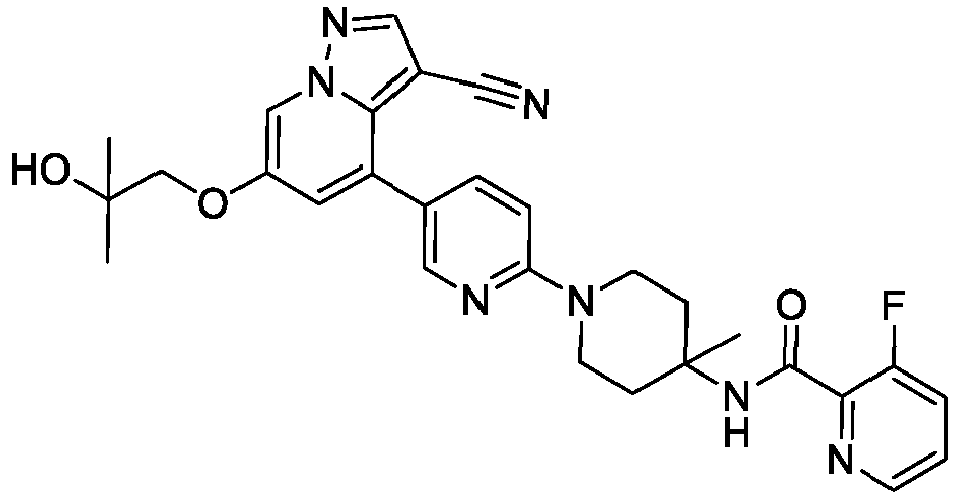
N-(1-(5-(3-cyano-6-(2-hydroxy-2-methylpropoxy)pyrazolo[1 ,5-a]pyridin-4-yl)pyridin-2-yl)-4-methylpiperidin-4-yl)-3-fluoropicolinamide 544.3 (M+H) 84 
N-(1-(5-(3 -cyano-6-(2-hydroxy-2-methylpropoxy)pyrazolo[1 ,5-a]pyridin-4-yl)pyridin-2-yl)-4-methylpiperidin-4-yl)-3-methoxypicolinamide 556.3 (M+H) 85 
N-(1-(5-(3-cyano-6-(2-hydroxy-2-methylpropoxy)pyrazolo[1 ,5-a]pyridin-4-yl)pyridin-2-yl)-4-methylpiperidin-4-yl)pyrimidine-2-carboxamide 527.2 (M+H) 86 
3-chloro-N-(1-(5-(3-cyano-6-(2-hydroxy-2-methylpropoxy)pyrazolo[1 ,5-a]pyridin-4-yl)pyridin-2-yl)-4-methylpiperidin-4-yl)benzamide 559.2 (M+H) -

- A mixture of 4-(6-(4-amino-4-methylpiperidin-1-yl)pyridin-3-yl)-6-(2-hydroxy-2-methylpropoxy)pyrazolo[1,5-a]pyridine-3-carbonitrile dihydrochloride (Intermediate P48; 53 mg, 0.107 mmol), HATU (44.9mg, 0.118 mmol), and 5-Chloro-2-methyl-3-pyridinecarboxylic acid (36.9 mg, 0.107 mmol) in DMSO (1.28 mL, 0.1 M) was treated with DIEA (0.09 mL, 0.54 mmol) and then stirred for 18 h at ambient temperature. The reaction mixture was diluted with EtOAc and washed with water. The organic extracts were washed with brine, then dried over anhydrous Na2SO4(s), filtered and concentrated in vacuo. The residue was suspended in 60:40 ACN:water containing 2% TFA. The solution was purified directly by C18 reverse phase chromatography (5-95% ACN in water with 0.1% TFA as the gradient eluent) to afford the title compound as the TFA salt. The TFA salt was treated with saturated NaHCO3(aq) and extracted with DCM. The combined organic extracts were washed with brine, then dried over anhydrous Na2SO4(s), filtered and concentrated in vacuo to afford the title compound (26.1 mg, 42% yield). MS (apci) m/z = 574.2 (M+H).
-

- A mixture of 4-(6-(4-amino-4-methylpiperidin-1-yl)pyridin-3-yl)-6-(2-hydroxy-2-methylpropoxy)pyrazolo[1,5-a]pyridine-3-carbonitrile dihydrochloride (Intermediate P48; 63 mg, 0.128 mmol), HATU (67 mg, 0.18 mmol), and 3,6-Dimethylpicolinic acid (38.6 mg, 0.26 mmol) in DMSO (1.28 mL, 0.1 M) was treated with DIEA (0.11 mL, 0.64 mmol) and then stirred for 18 h at ambient temperature. The reaction mixture was diluted with EtOAc and washed with water. The organic extracts were washed with brine, then dried over anhydrous Na2SO4(s), filtered and concentrated in vacuo. The residue was suspended in 60:40 ACN:water containing 2% TFA. The solution was purified directly by C18 reverse phase chromatography (5-95% ACN in water with 0.1% TFA as the gradient eluent) to afford the title compound as the TFA salt. The TFA salt was treated with saturated NaHCO3(aq) and extracted with DCM. The combined organic extracts were washed with brine, then dried over anhydrous Na2SO4(s), filtered and concentrated in vacuo to afford the title compound (57 mg, 64% yield). MS (apci) m/z = 554.3 (M+H).
- The compounds in Table U were prepared using a similar method to that described for the synthesis of Example 88, replacing 3,6-Dimethylpicolinic acid with the appropriate carboxylic acid. Reactions were monitored for completion by LCMS, and reaction durations were adjusted accordingly. Title compounds were cleanly isolated following chromatographic purification using an appropriate gradient eluent (and if necessary converted to the free base).
Table U Ex. # Structure Chemical Name LCMS m/z 89 
N-(1-(5-(3-cyano-6-(2-hydroxy-2-methylpropoxy)pyrazolo[1 ,5-a]pyridin-4-yl)pyridin-2-yl)-4-methylpiperidin-4-yl)-5-fluoro-2-methoxynicotinamide 574.3 (M+H) 90 
N-(1-(5-(3-cyano-6-(2-hydroxy-2-methylpropoxy)pyrazolo[1 ,5-a]pyridin-4-yl)pyridin-2-yl)-4-methylpiperidin-4-yl)-4-methoxypyrimidine- 557.3 (M+H) 2-carboxamide 91 
5-cyano-N-(1-(5-(3-cyano-6-(2-hydroxy-2-methylpropoxy)pyrazolo[1 ,5-a]pyridin-4-yl)pyridin-2-yl)-4-methylpiperidin-4-yl)-2-methylbenzamide 564.3 (M+H) 92 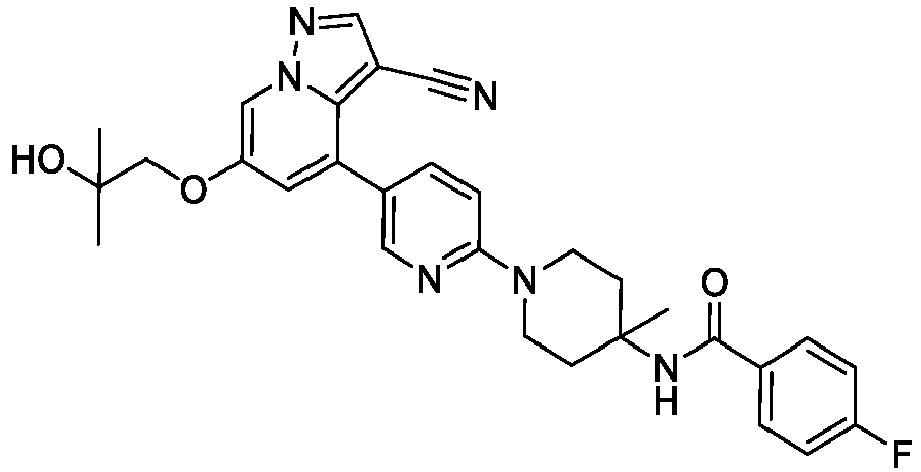
N-(1-(5-(3-cyano-6-(2-hydroxy-2-methylpropoxy)pyrazolo[1 ,5-a]pyridin-4-yl)pyridin-2-yl)-4-methylpiperidin-4-yl)-4-fluorobenzamide 543.2 (M+H) 93 
N-(1-(5-(3-cyano-6-(2-hydroxy-2-methylpropoxy)pyrazolo[1 ,5-a]pyridin-4-yl)pyridin-2-yl)-4-methylpiperidin-4-yl)-4-fluoro-2-methylbenzamide 557.3 (M+H) 94 
N-(1-(5-(3-cyano-6-(2-hydroxy-2-methylpropoxy)pyrazolo[1 ,5-a]pyridin-4-yl)pyridin-2-yl)-4-methylpiperidin-4-yl)-3-fluoro-6- 558.3 (M+H) methylpicolinamide 95 
N-(1-(5-(3-cyano-6-(2-hydroxy-2-methylpropoxy)pyrazolo[1 ,5-a]pyridin-4-yl)pyridin-2-yl)-4-methylpiperidin-4-yl)-4-oxo-1,4-dihydropyridine-3-carboxamide 542.3 (M+H) 96 
N-(1-(5-(3-cyano-6-(2-hydroxy-2-methylpropoxy)pyrazolo[1 ,5-a]pyridin-4-yl)pyridin-2-yl)-4-methylpiperidin-4-yl)-4-oxo-1,4-dihydropyri dine- 2-carboxamide 542.3 (M+H) 97 
N-(1-(5-(3-cyano-6-(2-hydroxy-2-methylpropoxy)pyrazolo[1 ,5-a]pyridin-4-yl)pyridin-2-yl)-4-methylpiperidin-4-yl)-1-methyl-2-oxo-1,2-dihydropyridine-3-carboxamide 556.2 (M+H) 98 
N-(1-(5-(3-cyano-6-(2-hydroxy-2-methylpropoxy)pyrazolo[1 ,5-a]pyridin-4-yl)pyridin-2-yl)-4-methylpiperidin-4-yl)-1,6-dimethyl-4-oxo-1,4-dihydropyridine- 2-carboxamide 570.3 (M+H) 99 
N-(1-(5-(3-cyano-6-(2-hydroxy-2-methylpropoxy)pyrazolo[1 ,5-a]pyridin-4-yl)pyridin-2-yl)-4-methylpiperidin-4-yl)-3 -fluoro-6-oxo- 1, 6-dihydropyri dine- 2-carboxamide 560.3 (M+H) 100 
N-(1-(5-(3-cyano-6-(2-hydroxy-2-methylpropoxy)pyrazolo[1 ,5-a]pyridin-4-yl)pyridin-2-yl)-4-methylpiperidin-4-yl)-3-(methoxymethyl)benzamid e 569.3 (M+H) 101 
2-chloro-N-(1-(5-(3-cyano-6-(2-hydroxy-2-methylpropoxy)pyrazolo[1 ,5-a]pyridin-4-yl)pyridin-2-yl)-4-methylpiperidin-4-yl)-6-methylbenzamide 573.2 (M+H) 102 
2-chloro-N-(1-(5-(3-cyano-6-(2-hydroxy-2-methylpropoxy)pyrazolo[1 ,5-a]pyridin-4-yl)pyridin-2-yl)-4-methylpiperidin-4-yl)-6-fluorobenzamide 577.2 (M+H) 103 
N-(1-(5-(3-cyano-6-(2-hydroxy-2-methylpropoxy)pyrazolo[1 ,5-a]pyridin-4-yl)pyridin-2-yl)-4-methylpiperidin-4-yl)-4,6-dimethylpicolinamide 554.3 (M+H) 104 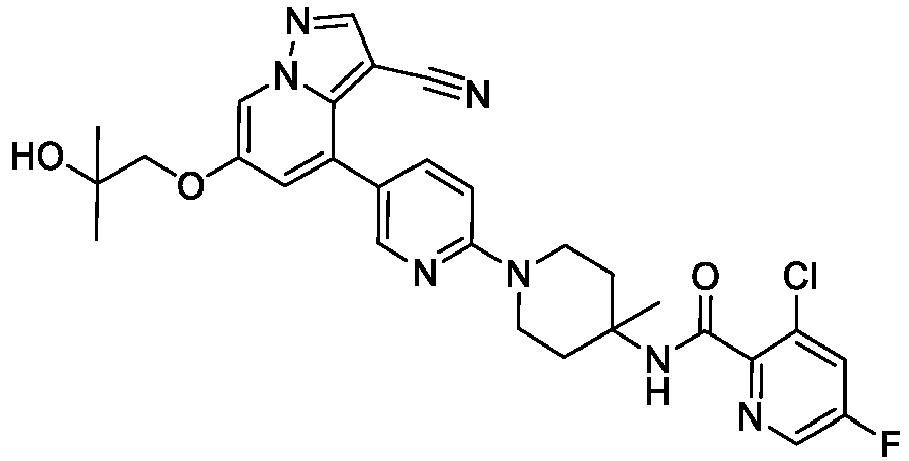
3-chloro-N-(1-(5-(3-cyano-6-(2-hydroxy-2-methylpropoxy)pyrazolo[1 ,5-a]pyridin-4-yl)pyridin-2-yl)-4-methylpiperidin-4-yl)-5-fluoropicolinamide 578.2 (M+H) -

- 2-chloro-N-(1-(5-(3-cyano-6-(2-hydroxy-2-methylpropoxy)pyrazolo[1,5-a]pyridin-4-yl)pyridin-2-yl)-4-methylpiperidin-4-yl)-5-fluorobenzamideA mixture of 4-(6-(4-amino-4-methylpiperidin-1-yl)pyridin-3-yl)-6-(2-hydroxy-2-methylpropoxy)pyrazolo[1,5-a]pyridine-3-carbonitrile dihydrochloride (Intermediate P48; 56 mg, 0.11 mmol), HATU (47.5 mg, 0.125 mmol), and 2-Chloro-5-fluorobenzoic acid (39.6 mg, 0.23 mmol) in DMSO (1.13 mL, 0.1 M) was treated with DIEA (0.06 mL, 0.125 mmol) and then stirred for 4h at ambient temperature. The reaction mixture was concentrated in vacuo. The reaction mixture was diluted with EtOAc and washed with water. The organic extracts were washed with brine, then dried over anhydrous Na2SO4(s), filtered and concentrated in vacuo. The residue was suspended in 60:40 ACN:water containing 2% TFA. The solution was purified directly by C18 reverse phase chromatography (5-95% ACN in water with 0.1% TFA as the gradient eluent) to afford the title compound as the TFA salt. The TFA salt was treated with saturated NaHCO3(aq) and extracted with DCM. The combined organic extracts were washed with brine, then dried over anhydrous Na2SO4(s), filtered and concentrated in vacuo to afford the title compound (34.3 mg, 52% yield). MS (apci) m/z = 577.2 (M+H).
- The compounds in Table V were prepared using a similar method to that described for the synthesis of Example 105, replacing 2-Chloro-5-fluorobenzoic acid with the appropriate carboxylic acid. Reactions were monitored for completion by LCMS, and reaction durations were adjusted accordingly. Title compounds were cleanly isolated following chromatographic purification using an appropriate gradient eluent (and if necessary converted to the free base).
Table V Ex. # Structure Chemical Name LCMS m/z 106 
N-(1-(5-(3-cyano-6-(2-hydroxy-2-methylpropoxy)pyrazolo[1 ,5-a]pyridin-4-yl)pyridin-2-yl)-4-methylpiperidin-4-yl)-5-fluoro-2-methoxybenzamide 573.3 (M+H) 107 
N-(1-(5-(3-cyano-6-(2-hydroxy-2-methylpropoxy)pyrazolo[1 ,5-a]pyridin-4-yl)pyridin-2-yl)-4-methylpiperidin-4-yl)-3-fluoro-6-methoxypicolinamide 574.2 (M+H) -

- A mixture of 4-(6-(4-amino-4-methylpiperidin-1-yl)pyridin-3-yl)-6-(2-hydroxy-2-methylpropoxy)pyrazolo[1,5-a]pyridine-3-carbonitrile dihydrochloride (Intermediate P48; 52 mg, 0.105 mmol), HATU (44.1 mg, 0.116 mmol), 3,5-difluoro-2-methoxybenzoic acid (19.8 mg, 0.105 mmol) in DMSO (1.05 mL, 0.1 M) was treated with DIEA (0.09 mL, 0.527 mmol) and then stirred for 2h at ambient temperature. The reaction mixture was diluted with EtOAc and washed with water. The organic extracts were washed with brine, then dried over anhydrous Na2SO4(s), filtered and concentrated in vacuo. The residue was suspended in 60:40 ACN:water containing 2% TFA. The solution was purified directly by C18 reverse phase chromatography (5-95% ACN in water with 0.1% TFA as the gradient eluent) to afford the title compound as the TFA salt. The TFA salt was treated with saturated NaHCO3(aq) and extracted with DCM. The combined organic extracts were washed with brine, then dried over anhydrous Na2SO4(s), filtered and concentrated in vacuo to afford the title compound (41.6 mg, 66.8% yield). MS (apci) m/z = 591.3 (M+H).
-

- Prepared using a similar method to that described for the synthesis of Example 108, replacing 3,5-difluoro-2-methoxybenzoic acid with the appropriate carboxylic acid. The reaction was monitored for completion by LCMS, and reaction duration was adjusted accordingly. The title compound was cleanly isolated following chromatographic purification using an appropriate gradient eluent (and if necessary converted to the free base). MS (apci) m/z = 555.3 (M+H).
-

- Step 1: Preparation of tert-butyl 5-((1-(5-(3-cyano-6-(2-hydroxy-2-methylpropoxy)pyrazolo[1,5-a]pyridin-4-yl)pyridin-2-yl)-4-methylpiperidin-4-yl)carbamoyl)-3,4-dihydroisoquinoline-2(1H)-carboxylate. A mixture of 4-(6-(4-amino-4-methylpiperidin-1-yl)pyridin-3-yl)-6-(2-hydroxy-2-methylpropoxy)pyrazolo[1,5-a]pyridine-3-carbonitrile dihydrochloride (Intermediate P48; 50 mg, 0.10 mmol), HATU (42 mg, 0.11 mmol), 2-(tert-butoxycarbonyl)-1,2,3,4-tetrahydroisoquinoline-5-carboxylic acid (56 mg, 0.20 mmol) in DMSO (1.0 mL, 0.1 M) was treated with DIEA (0.09 mL, 0.51 mmol) and then stirred for 2 h at ambient temperature. The reaction mixture was concentrated in vacuo. The reaction mixture was diluted with EtOAc and washed with water. The organic extracts were washed with brine, then dried over anhydrous Na2SO4(s), filtered and concentrated in vacuo. The residue was purified by silica chromatography (0.5-9% MeOH in DCM with 0.05-0.9% NH4OH as the gradient eluent) to afford the title compound (63 mg, 91% yield) in sufficient purity for step 2. MS (apci) m/z = 680.4 (M+H)
- Step 2: Preparation of N-(1-(5-(3-cyano-6-(2-hydroxy-2-methylpropoxy)pyrazolo[1,5-a]pyridin-4-yl)pyridin-2-yl)-4-methylpiperidin-4-yl)-1,2,3,4-tetrahydroisoquinoline-5-carboxamide. Tert-butyl 5-((1-(5-(3-cyano-6-(2-hydroxy-2-methylpropoxy)pyrazolo[1,5-a]pyridin-4-yl)pyridin-2-yl)-4-methylpiperidin-4-yl)carbamoyl)-3,4-dihydroisoquinoline-2(1H)-carboxylate (62 mg, 0.091 mmol) in DCM (0.46 mL) was treated with TFA (0.46 mL, 0.68 mmol) and stirred at ambient temperature for 15 minutes. The reaction was concentrated in vacuo and resuspended in 10 mL DCM and passed through a Pl-HCO3 resin to free-base product. Plug was washed with 10 mL DCM. Solution was concentrated in vacuo to afford the title compound (53 mg, 100% yield) in sufficient purity for step 3. MS (apci) m/z = 580.3 (M+H)
- Step 3: Preparation of N-(1-(5-(3-cyano-6-(2-hydroxy-2-methylpropoxy)pyrazolo[1,5-a]pyridin-4-yl)pyridin-2-yl)-4-methylpiperidin-4-yl)-2-methyl-1,2,3,4-tetrahydroisoquinoline-5-carboxamide. N-(1-(5-(3-cyano-6-(2-hydroxy-2-methylpropoxy)pyrazolo[1,5-a]pyridin-4-yl)pyridin-2-yl)-4-methylpiperidin-4-yl)-1,2,3,4-tetrahydroisoquinoline-5-carboxamide (53 mg, 0.091 mmol) in DMA (0.9 mL, 0.1M) was treated with sodium triacetoxyhydroborate (194 mg, 0.914 mmol) followed by formaldehyde (127 µL, 0.457 mmol). The reaction was stirred at ambient temperature for 30 min. The reaction mixture was diluted with EtOAc and washed with water. The organic extracts were washed with brine, then dried over anhydrous Na2SO4(s), filtered and concentrated in vacuo. An additional aqueous extraction was performed using 20 mL 4:1 DCM:IPA, organics were dried with anhydrous Na2SO4(s), filtered and concentrated in vacuo. The residue was suspended in 60:40 ACN:water containing 2% TFA. The solution was purified directly by C18 reverse phase chromatography (5-95% ACN in water with 0.1% TFA as the gradient eluent) to afford the title compound as the TFA salt. The TFA salt was treated with saturated NaHCO3(aq) and extracted with 4:1DCM:IPA. The combined organic extracts were washed with brine, then dried over anhydrous Na2SO4(s), filtered and concentrated in vacuo to afford the title compound (41.6 mg, 66.8% yield). MS (apci) m/z = 594.3 (M+H).
-

- A mixture of 4-(6-(4-amino-4-methylpiperidin-1-yl)pyridin-3-yl)-6-(2-hydroxy-2-methylpropoxy)pyrazolo[1,5-a]pyridine-3-carbonitrile (Intermediate P46; 21 mg, 0.05 mmol), HATU (23 mg, 0.06 mmol), Cyclopropylacetic acid (5 mg, 0.05 mmol) in DCM (100 µL) was treated with DIEA (35 µL, 0.2 mmol) and then stirred for 18 h at ambient temperature. The reaction mixture was diluted with DCM and washed with water. The organic extracts were washed with brine, then dried over anhydrous Na2SO4(s), filtered and concentrated in vacuo. The residue was purified by silica chromatography (50-100% EtOAc in Hexanes then 0-20% MeOH in EtOAc as the gradient eluent) to cleanly provide the title compound (17 mg, 67.5% yield) MS (apci) m/z= 503.30 (M+H).
- The compounds in Table W were prepared using a similar method to that described for the synthesis of Example 111, replacing cyclopropylacetic acid with the appropriate carboxylic acid. Reactions were monitored for completion by LCMS, and reaction durations were adjusted accordingly. Title compounds were cleanly isolated following chromatographic purification using an appropriate gradient eluent (and if necessary converted to the free base).
Table W Ex. # Structure Chemical Name LCMS m/z 112 
N-(1-(5-(3-cyano-6-(2-hydroxy-2-methylpropoxy)pyrazolo[1 ,5-a]pyridin-4-yl)pyridin-2-yl)-4-methylpiperidin-4-yl)-6-methylpicolinamide 540.30 (M+H) 113 
N-(1-(5-(3-cyano-6-(2-hydroxy-2-methylpropoxy)pyrazolo[1 ,5-a]pyridin-4-yl)pyridin-2-yl)-4-methylpiperidin-4-yl)nicotinamide 526.25 (M+H) 114 
N-(1-(5-(3-cyano-6-(2-hydroxy-2-methylpropoxy)pyrazolo[1 ,5-a]pyridin-4-yl)pyridin-2-yl)-4-methylpiperidin-4-yl)-3,3-dimethylbutanamide 519.30 (M+H) 115 
N-(1-(5-(3-cyano-6-(2-hydroxy-2-methylpropoxy)pyrazolo[1 ,5-a]pyridin-4-yl)pyridin-2-yl)-4-methylpiperidin-4-yl)-5-methylpicolinamide 540.30 (M+H) -

- A mixture of 4-(6-(4-amino-4-methylpiperidin-1-yl)pyridin-3-yl)-6-(2-hydroxy-2-methylpropoxy)pyrazolo[1,5-a]pyridine-3-carbonitrile (Intermediate P46; 21.3 mg, 0.051 mmol), HATU (21 mg, 0.055 mmol), propionic acid (3.4 µL , 0.046 mmol) in DCM (92µL) was treated with DIEA (32 µL, 0.18 mmol) and then stirred for 18 h at ambient temperature. The reaction mixture was diluted with DCM and washed with water. The organic extracts were washed with brine, then dried over anhydrous Na2SO4(s), filtered and concentrated in vacuo. The residue was purified by silica chromatography (50-100% EtOAc in Hexanes then 0-20% MeOH in EtOAc as the gradient eluent) to cleanly provide the title compound (17.5 mg, 79.7% yield) MS (apci) m/z= 477.25 (M+H).
- The compounds in Table X were prepared using a similar method to that described for the synthesis of Example 116, replacing propionic acid with the appropriate carboxylic acid. Reactions were monitored for completion by LCMS, and reaction durations were adjusted accordingly. Title compounds were cleanly isolated following chromatographic purification using an appropriate gradient eluent (and if necessary converted to the free base).
Table X Ex. # Structure Chemical Name LCMS m/z 117 
N-(1-(5-(3-cyano-6-(2-hydroxy-2-methylpropoxy)pyrazolo[1 ,5-a]pyridin-4-yl)pyridin-2-yl)-4-methylpiperidin-4-yl)cyclopropanecarboxami de 489.30 (M+H) 118 
N-(1-(5-(3-cyano-6-(2-hydroxy-2-methylpropoxy)pyrazolo[1 ,5-a]pyridin-4-yl)pyridin-2-yl)-4-methylpiperidin-4-yl)-3,3,3-trifluoropropanamide 531.20 (M+H) -

- A mixture of 4-(6-(4-amino-4-methylpiperidin-1-yl)pyridin-3-yl)-6-(2-hydroxy-2-methylpropoxy)pyrazolo[1,5-a]pyridine-3-carbonitrile (Intermediate P46; 20 mg, 0.048 mmol), HATU (54 mg, 0.14 mmol), 4-methylpicolinic acid (6.52 mg, 0.048 mmol) in DCM (238 µL) was treated with DIEA (33 µL, 0.19 mmol) and then stirred for 1 h at ambient temperature. The reaction mixture was filtered to remove solids, then the filtrate was concentrated in vacuo. The residue was purified by C18 reverse phase chromatography (5-95% ACN in water with 0.1% TFA as the gradient eluent) to afford the title compound as the TFA salt (14.2 mg, 55.3% yield). MS (apci) m/z = 540.3 (M+H).
- The compounds in Table Y were prepared using a similar method to that described for the synthesis of Example 119, replacing 4-methylpicolinic acid with the appropriate carboxylic acid. Reactions were monitored for completion by LCMS, and reaction durations were adjusted accordingly. Title compounds were cleanly isolated following chromatographic purification using an appropriate gradient eluent.
Table Y Ex. # Structure Chemical Name LCMS m/z 120 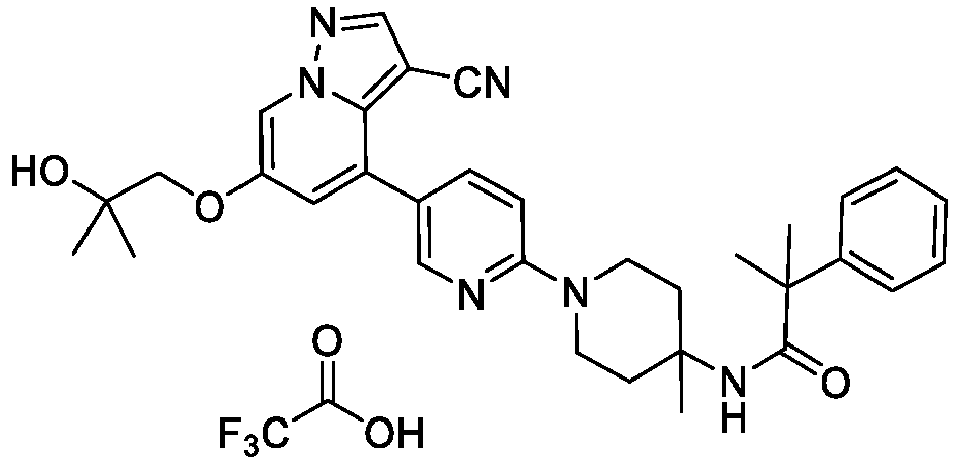
N-(1-(5-(3-cyano-6-(2-hydroxy-2-methylpropoxy)pyrazolo[1 ,5-a]pyridin-4-yl)pyridin-2-yl)-4-methylpiperidin-4-yl)-2-methyl-2-phenylpropanamide 2,2,2-trifluoroacetate 567.3 (M+H) 121 
2-(4-chlorophenyl)-N-(1-(5-(3-cyano-6-(2-hydroxy-2-methyl propoxy)pyrazolo[1 ,5-a]pyridin-4-yl)pyridin-2-yl)-4-methylpiperidin-4-yl)-2-methylpropanamide 2,2,2-trifluoroacetate 601.3 (M+H) -

- A mixture of 4-(6-(4-amino-4-methylpiperidin-1-yl)pyridin-3-yl)-6-(2-hydroxy-2-methylpropoxy)pyrazolo[1,5-a]pyridine-3-carbonitrile (Intermediate P46; 20 mg, 0.048 mmol), HATU (54 mg, 0.14 mmol), 6-methylnicotinic acid (6.52 mg, 0.048 mmol) in DCM (238 µL) was treated with DIEA (33 µL, 0.19 mmol) and then stirred for 4 h at ambient temperature. The reaction was purified directly by silica chromatography (1-10% MeOH in CHCl3 with 0.1-1% NH4OH as the gradient eluent) to cleanly provide the title compound (10 mg, 39% yield) MS (apci) m/z= 540.3 (M+H).
- The compounds in Table Z were prepared using a similar method to that described for the synthesis of Example 122, replacing 6-methylnicotinic acid with the appropriate carboxylic acid. Reactions were monitored for completion by LCMS, and reaction durations were adjusted accordingly. Title compounds were cleanly isolated following chromatographic purification using an appropriate gradient eluent (and if necessary converted to the free base).
Table Z Ex. # Structure Chemical Name LCMS m/z 123 
N-(1-(5-(3-cyano-6-(2-hydroxy-2-methylpropoxy)pyrazolo[1 ,5-a]pyridin-4-yl)pyridin-2-yl)-4-methylpiperidin-4-yl)-2-methylnicotinamide 540.3 (M+H) 124 
N-(1-(5-(3-cyano-6-(2-hydroxy-2-methylpropoxy)pyrazolo[1 ,5-a]pyridin-4-yl)pyridin-2-yl)-4-methylpiperidin-4-yl)-3-methylpicolinamide 540.3 (M+H) 125 
N-(1-(5-(3-cyano-6-(2-hydroxy-2-methylpropoxy)pyrazolo[1 ,5-a]pyridin-4-yl)pyridin-2-yl)-4-methylpiperidin-4-yl)-2-phenylacetamide 539.3 (M+H) 126 
N-(1-(5-(3-cyano-6-(2-hydroxy-2-methylpropoxy)pyrazolo[1 ,5-a]pyridin-4-yl)pyridin-2-yl)-4-methylpiperidin-4-yl)-3-methyl-3-phenylbutanamide 581.3 (M+H) 127 
N-(1-(5-(3-cyano-6-(2-hydroxy-2-methylpropoxy)pyrazolo[1 ,5-a]pyridin-4-yl)pyridin-2-yl)-4-methylpiperidin-4-yl)-4-methylnicotinami de 540.3 (M+H) 128 
N-(1-(5-(3-cyano-6-(2-hydroxy-2-methylpropoxy)pyrazolo[1 ,5-a]pyridin-4-yl)pyridin-2-yl)-4-methylpiperidin-4-yl)-5-methylnicotinamide 540.3 (M+H) -

- A mixture of 4-(6-(4-amino-4-methylpiperidin-1-yl)pyridin-3-yl)-6-(2-hydroxy-2-methylpropoxy)pyrazolo[1,5-a]pyridine-3-carbonitrile (Intermediate P46; 50 mg, 0.12 mmol), HATU (54 mg, 0.14 mmol), 3-methoxy-2-methylbenzoic acid (24 mg, 0.14 mmol) in DMSO (793 µL) was treated with DIEA (25 µL, 0.14 mmol) and then stirred for 18 h at ambient temperature. The reaction mixture was diluted with EtOAc and washed with water. The organic extracts were washed with brine, then dried over anhydrous Na2SO4(s), filtered and concentrated in vacuo. The solution was purified directly by C18 reverse phase chromatography (5-95% ACN in water with 0.1% TFA as the gradient eluent) to afford the title compound as the TFA salt. The TFA salt was treated with saturated NaHCO3(aq) and extracted with DCM. The combined organic extracts were washed with brine, then dried over anhydrous Na2SO4(s), filtered and concentrated in vacuo to afford the title compound (25 mg, 37% yield). MS (apci) m/z = 569.3 (M+H).
- The compounds in Table AA were prepared using a similar method to that described for the synthesis of Example 129, replacing 3-methoxy-2-methylbenzoic acid with the appropriate carboxylic acid. Reactions were monitored for completion by LCMS, and reaction durations were adjusted accordingly. Title compounds were cleanly isolated following chromatographic purification using an appropriate gradient eluent (and if necessary converted to the free base).
Table AA Ex. # Structure Chemical Name MS (apci) m/z 130 
N-(1-(5-(3-cyano-6-(2-hydroxy-2-methylpropoxy)pyrazolo[1 ,5-a]pyridin-4-yl)pyridin-2-yl)-4-methylpiperidin-4-yl)-5-methoxy-2-methylbenzamide 569.3 (M+H) 131 
N-(1-(5-(3-cyano-6-(2-hydroxy-2-methylpropoxy)pyrazolo[1 ,5-a]pyridin-4-yl)pyridin-2-yl)-4-methylpiperidin-4-yl)-2,6-dimethylbenzamide 553.3 (M+H) -

- A mixture of 4-(6-(4-amino-4-methylpiperidin-1-yl)pyridin-3-yl)-6-(2-hydroxy-2-methylpropoxy)pyrazolo[1,5-a]pyridine-3-carbonitrile dihydrochloride (Intermediate P48; 50 mg, 0.10 mmol), HATU (59 mg, 0.16 mmol), 3,5-difluoropicolinic acid (25 mg, 0.16 mmol) in DMSO (793 µL) was treated with DIEA (73 µL, 0.42 mmol) and then stirred for 18 h at ambient temperature. The reaction mixture was diluted with EtOAc and washed with water. The organic extracts were washed with brine, then dried over anhydrous Na2SO4(s), filtered and concentrated in vacuo. The solution was purified directly by C18 reverse phase chromatography (5-95% ACN in water with 0.1% TFA as the gradient eluent) to afford the title compound as the TFA salt. The TFA salt was treated with saturated NaHCO3(aq) and extracted with DCM. The combined organic extracts were washed with brine, then dried over anhydrous Na2SO4(s), filtered and concentrated in vacuo to afford the title compound (29.7 mg, 44.5% yield). MS (apci) m/z = 562.2 (M+H).
- The compounds in Table BB were prepared using a similar method to that described for the synthesis of Example 132, replacing 3,5-difluoropicolinic acid with the appropriate carboxylic acid. Reactions were monitored for completion by LCMS, and reaction durations were adjusted accordingly. Title compounds were cleanly isolated following chromatographic purification using an appropriate gradient eluent (and if necessary converted to the free base).
Table BB Ex. # Structure Chemical Name LCMS m/z 133 
N-(1-(5-(3-cyano-6-(2-hydroxy-2-methylpropoxy)pyrazolo[1 ,5-a]pyridin-4-yl)pyridin-2-yl)-4-methylpiperidin-4-yl)-2-fluoro-5-methylbenzamide 557.3 (M+H) 134 
N-(1-(5-(3-cyano-6-(2-hydroxy-2-methylpropoxy)pyrazolo[1 ,5-a]pyridin-4-yl)pyridin-2-yl)-4-methylpiperidin-4-yl)-2-methylisonicotinamide 540.3 (M+H) 135 
N-(1-(5-(3-cyano-6-(2-hydroxy-2-methylpropoxy)pyrazolo[1 ,5-a]pyridin-4-yl)pyridin-2-yl)-4-methylpiperidin-4-yl)-4,6-dimethoxypyrimidine- 2-carboxamide 587.3 (M+H) 136 
N-(1-(5-(3-cyano-6-(2-hydroxy-2-methylpropoxy)pyrazolo[1 ,5-a]pyridin-4-yl)pyridin-2-yl)-4-methylpiperidin-4-yl)-4-methylpyrimidine-2-carboxamide 541.3 (M+H) 137 
N-(1-(5-(3-cyano-6-(2-hydroxy-2-methylpropoxy)pyrazolo[1 ,5-a]pyridin-4-yl)pyridin-2-yl)-4-methylpiperidin-4-yl)-4-methylpyrimidine-5-carboxamide 541.3 (M+H) 138 
N-(1-(5-(3-cyano-6-(2-hydroxy-2-methylpropoxy)pyrazolo[1 ,5-a]pyridin-4-yl)pyridin-2-yl)-4-methylpiperidin-4-yl)-6-methyl-4-oxo-1,4-dihydropyri dine- 2-carboxamide 556.3 (M+H) 139 
2-chloro-N-(1-(5-(3-cyano-6-(2-hydroxy-2-methylpropoxy)pyrazolo[1 ,5-a]pyridin-4-yl)pyridin-2-yl)-4-methylpiperidin-4-yl)-3 ,5-difluorobenzamide 595.2 (M+H) 140 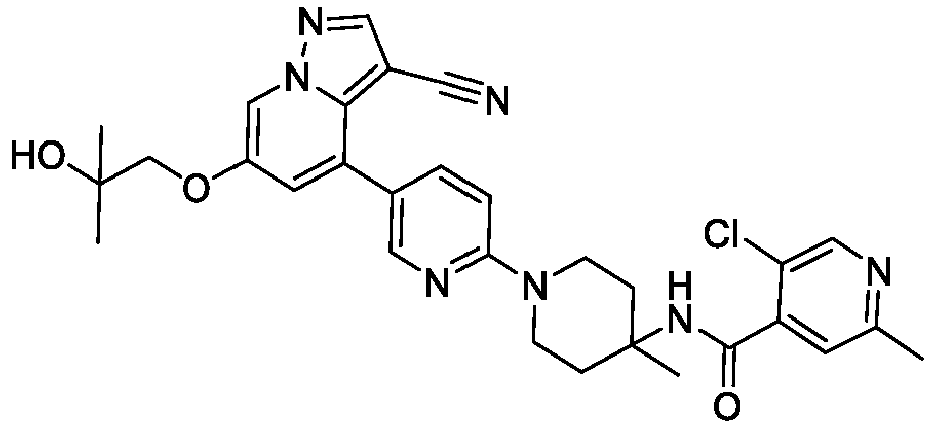
5-chloro-N-(1-(5-(3-cyano-6-(2-hydroxy-2-methylpropoxy)pyrazolo[1 ,5-a]pyridin-4-yl)pyridin-2-yl)-4-methylpiperidin-4-yl)-2-methylisonicotinamide 561.3 (M+H) 141 
N-(1-(5-(3-cyano-6-(2-hydroxy-2-methylpropoxy)pyrazolo[1 ,5-a]pyridin-4-yl)pyridin-2-yl)-4-methylpiperidin-4-yl)-4,6-dimethylpyrimidine-2-carboxamide 555.3 (M+H) 142 
N-(1-(5-(3-cyano-6-(2-hydroxy-2-methylpropoxy)pyrazolo[1 ,5-a]pyridin-4-yl)pyridin-2-yl)-4-methylpiperidin-4-yl)-3-((dimethylamino)methyl)b enzamide 582.3 (M+H) -

- A mixture of 4-(6-(4-amino-4-methylpiperidin-1-yl)pyridin-3-yl)-6-(2-hydroxy-2-methylpropoxy)pyrazolo[1,5-a]pyridine-3-carbonitrile dihydrochloride (Intermediate P48; 50 mg, 0.10 mmol), HATU (90 mg, 0.238 mmol), 6-hydroxy-3-methylpicolinic acid (36 mg, 0.238 mmol) in DMSO (793 µL) was treated with DIEA (93 µL, 0.535 mmol) and then stirred for 18 h at ambient temperature. The reaction mixture was diluted with EtOAc and washed with water. The organic extracts were washed with brine, then dried over anhydrous Na2SO4(s), filtered and concentrated in vacuo. The solution was purified directly by C18 reverse phase chromatography (5-95% ACN in water with 0.1% TFA as the gradient eluent) to afford the title compound as the TFA salt. The TFA salt was treated with saturated NaHCO3(aq) and extracted with DCM. The combined organic extracts were washed with brine, then dried over anhydrous Na2SO4(s), filtered and concentrated in vacuo to afford the title compound (10 mg, 15.1% yield). MS (apci) m/z = 556.3 (M+H).
- The compounds in Table CC were prepared using a similar method to that described for the synthesis of Example 143, replacing 6-Hydroxy-3-methylpicolinic acid with the appropriate carboxylic acid. Reactions were monitored for completion by LCMS, and reaction durations were adjusted accordingly. Title compounds were cleanly isolated following chromatographic purification using an appropriate gradient eluent (and if necessary converted to the free base).
Table CC Ex. # Structure Chemical Name LCMS m/z 144 
2-chloro-N-(1-(5-(3-cyano-6-(2-hydroxy-2-methylpropoxy)pyrazolo[1 ,5-a]pyridin-4-yl)pyridin-2-yl)-4-methylpiperidin-4-yl)benzamide 559.2 (M+H) 145 
5-chloro-N-(1-(5-(3-cyano-6-(2-hydroxy-2-methylpropoxy)pyrazolo[1 ,5-a]pyridin-4-yl)pyridin-2-yl)-4-methylpiperidin-4-yl)-4-methylnicotinami de 574.3 (M+H) 146 
N-(1-(5-(3-cyano-6-(2-hydroxy-2-methylpropoxy)pyrazolo[1 ,5-a]pyridin-4-yl)pyridin-2-yl)-4-methylpiperidin-4-yl)-2,3,6-trifluorobenzamide 579.3 (M+H) -
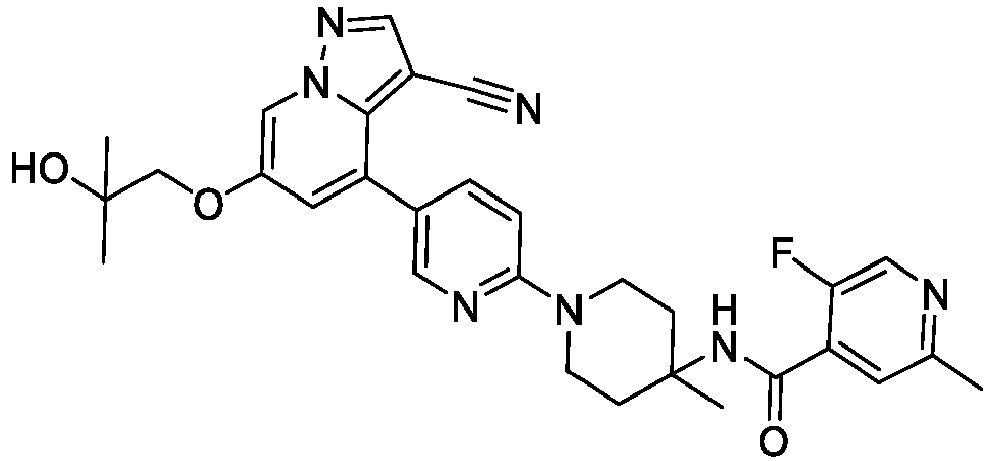
- A mixture of 4-(6-(4-amino-4-methylpiperidin-1-yl)pyridin-3-yl)-6-(2-hydroxy-2-methylpropoxy)pyrazolo[1,5-a]pyridine-3-carbonitrile dihydrochloride (Intermediate P48; 50 mg, 0.10 mmol), HATU (90 mg, 0.238 mmol), 5-Fluoro-2-methylisonicotinic acid (18 mg, 0.12 mmol) in DMSO (793 µL) was treated with DIEA (93 µL, 0.535 mmol) and then stirred for 18 h at ambient temperature. The reaction mixture was diluted with EtOAc and washed with water. The organic extracts were washed with brine, then dried over anhydrous Na2SO4(s), filtered and concentrated in vacuo. The reaction was purified directly by silica chromatography (1-10% MeOH in DCM as the gradient eluent) to cleanly provide the title compound (41.9 mg, 63.2% yield) MS (apci) m/z= 558.3 (M+H).
-

- A mixture of 4-(6-(4-amino-4-methylpiperidin-1-yl)pyridin-3-yl)-6-(2-hydroxy-2-methylpropoxy)pyrazolo[1,5-a]pyridine-3-carbonitrile dihydrochloride (Intermediate P46; 50 mg, 0.12 mmol), HATU (54 mg, 0.14 mmol), 1,5-dimethyl-1H-pyrazole-4-carboxylic acid (25 mg, 0.18 mmol) in DCM (2.4 mL) was treated with DIEA (104 µL, 0.59 mmol) and then stirred for 16 h at ambient temperature. The reaction mixture was diluted with DCM and washed with saturated NaHCO3. The organic extracts were dried over anhydrous Na2SO4(s), filtered and concentrated in vacuo. The reaction was purified by silica chromatography (1-10% MeOH in EtOAc as the gradient eluent) to cleanly provide the title compound (41.9 mg, 63.2% yield) MS (apci) m/z= 543.20 (M+H).
- The compounds in Table DD were prepared using a similar method to that described for the synthesis of Example 148, replacing 1,5-dimethyl-1H-pyrazole-4-carboxylic acid with the appropriate carboxylic acid. Reactions were monitored for completion by LCMS, and reaction durations were adjusted accordingly. Title compounds were cleanly isolated following chromatographic purification using an appropriate gradient eluent (and if necessary converted to the free base).
Table DD Ex. # Structure Chemical Name LCMS m/z 149 
N-(1-(5-(3-cyano-6-(2-hydroxy-2-methylpropoxy)pyrazolo[1 ,5-a]pyridin-4-yl)pyridin-2-yl)-4-methylpiperidin-4-yl)-1-methyl-1H-pyrazole-4-carboxamide 528.6 (M+H) 150 
N-(1-(5-(3-cyano-6-(2-hydroxy-2-methylpropoxy)pyrazolo[1 ,5-a]pyridin-4-yl)pyridin-2-yl)-4-methylpiperidin-4-yl)-1,3-dimethyl-1H-pyrazole-4-carboxamide 543.2 (M+H) -

- A mixture of 4-(6-(4-amino-4-methylpiperidin-1-yl)pyridin-3-yl)-6-(2-hydroxy-2-methylpropoxy)pyrazolo[1,5-a]pyridine-3-carbonitrile dihydrochloride (Intermediate P46; 50 mg, 0.12 mmol), HATU (54 mg, 0.14 mmol), 2-methyloxazole-4-carboxylic acid (18 mg, 0.14 mmol) in DCM (2.4 mL) was treated with DIEA (104 µL, 0.59 mmol) and then stirred for 20 h at ambient temperature. The reaction mixture was diluted with DCM (5 mL) and washed with 0.1M NaOH. The organic extracts were dried over anhydrous Na2SO4(s), filtered and concentrated in vacuo. The residue was triturated with MTBE to cleanly provide the title compound (15 mg, 23.8% yield) MS (apci) m/z= 543.20 (M+H).
- The compounds in Table EE were prepared using a similar method to that described for the synthesis of Example 151, replacing 2-methyloxazole-4-carboxylic acid with the appropriate carboxylic acid. Reactions were monitored for completion by LCMS, and reaction durations were adjusted accordingly. Title compounds were cleanly isolated following the same a basic workup and trituration purification.
Table EE Ex. # Structure Chemical Name LCMS m/z 152 
N-(1-(5-(3-cyano-6-(2-hydroxy-2-methylpropoxy)pyrazolo[1 ,5-a]pyridin-4-yl)pyridin-2-yl)-4-methylpiperidin-4-yl)-1-methyl-1H-pyrazole-3-carboxamide 528.2 (M+H) 153 
N-(1-(5-(3-cyano-6-(2-hydroxy-2-methylpropoxy)pyrazolo[1 ,5-a]pyridin-4-yl)pyridin-2-yl)-4-methylpiperidin-4-yl)-1,4-dimethyl-1H-imidazole-5-carboxamide 543.20 (M+H) 154 
N-(1-(5-(3-cyano-6-(2-hydroxy-2-methylpropoxy)pyrazolo[1 ,5-a]pyridin-4-yl)pyridin-2-yl)-4-methylpiperidin-4-yl)-1-isopropyl-1H-pyrazole-4-carboxamide 557.20 (M+H) -

- A mixture of 4-(6-fluoropyridin-3-yl)-6-(2-hydroxy-2-methylpropoxy)pyrazolo[1,5-a]pyridine-3-carbonitrile (Intermediate P42; 30.7 mg, 0.0941 mmol), 3-(azetidin-3-yloxy)pyridine (28.3 mg, 0.188 mmol) and TEA (78.7 µL, 0.564 mmol) in DMA (627 µL) was stirred overnight at 90 °C. After cooling to ambient temperature, the reaction mixture was diluted with water and washed with DCM. The organic extracts were washed with brine and dried over anhydrous Na2SO4(s), filtered and concentrated in vacuo. The residue was purified by C18 reverse phase chromatography (5-95% ACN in water with 0.1% TFA as the gradient eluent) to afford the title compound as the TFA salt. The TFA salt was dissolved in DCM and washed with saturated Na2CO3(aq). The combined organic extracts were washed with brine, then dried over anhydrous Na2SO4(s), filtered and concentrated in vacuo to cleanly provide the title compound (17 mg, 39.6% yield). MS (apci) m/z = 457.2 (M+H).
- The compounds in Table FF were prepared using a similar method to that described for the synthesis of Example 155, replacing 3-(azetidin-3-yloxy)pyridine with the appropriate azetidine nucleophile. Reactions were monitored for completion by LCMS, and reaction durations were adjusted accordingly. Title compounds were cleanly isolated following chromatographic purification using an appropriate gradient eluent (and if necessary converted to the free base).
Table FF Ex. # Structure Chemical Name LCMS m/z 156 
4-(6-(3-(4-cyanophenoxy)azetidin-1-yl)pyridin-3 -yl)-6-(2-hydroxy-2-methyl propoxy)pyrazolo[1 ,5-a]pyridine-3-carbonitrile 481.1 (M+H) 157 
6-(2-hydroxy-2-methylpropoxy)-4-(6-(3-(m-tolyloxy)azetidin-1-yl)pyridin-3-yl)pyrazolo[1,5-a]pyridine-3-carbonitrile 470.2 (M+H) 158 
6-(2-hydroxy-2-methylpropoxy)-4-(6-(3-(2-methoxyethoxy)azetidin-1-yl)pyridin-3-yl)pyrazolo[1,5-a]pyridine-3-carbonitrile 438.2 (M+H) 159 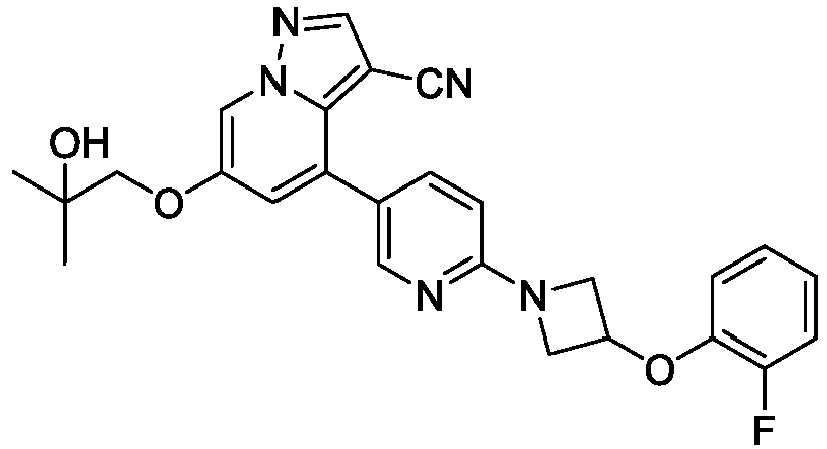
4-(6-(3-(2-fluorophenoxy)azetidin-1-yl)pyridin-3-yl)-6-(2-hydroxy-2-methylpropoxy)pyrazolo[1 ,5-a]pyridine-3-carbonitrile 474.1 (M+H) 160 
6-(2-hydroxy-2-methylpropoxy)-4-(6-(3-((5-methoxypyridin-3-yl)oxy)azetidin-1-yl)pyridin-3-yl)pyrazolo[1,5-a]pyridine-3-carbonitrile 487.1 (M+H) 161 
6-(2-hydroxy-2-methylpropoxy)-4-(6-(3-(p-tolyloxy)azetidin-1-yl)pyridin-3-yl)pyrazolo[1,5-a]pyridine-3-carbonitrile 470.2 (M+H) 162 
4-(6-(3-(3-chlorophenoxy)azetidin-1-yl)pyridin-3 -yl)-6-(2-hydroxy-2-methyl propoxy)pyrazolo[1 ,5-a]pyridine-3-carbonitrile 490.1 (M+H) -

- A mixture of 4-(6-fluoropyridin-3-yl)-6-(2-hydroxy-2-methylpropoxy)pyrazolo[1,5-a]pyridine-3-carbonitrile (Intermediate P42; 36.4 mg, 0.112 mmol), 3-(4-(trifluoromethyl)phenoxy)azetidine hydrochloride (70.7 mg, 0.279 mmol) and TEA (93.3 µL, 0.669 mmol) in DMA (372 µL) was stirred overnight at 90 °C. After cooling to ambient temperature, the reaction mixture was diluted with water and washed with DCM. The organic extracts were washed with brine and dried over anhydrous Na2SO4(s), filtered and concentrated in vacuo. The residue was purified by C18 reverse phase chromatography (5-95% ACN in water with 0.1% TFA as the gradient eluent) to afford the title compound as the TFA salt. The TFA salt was dissolved in DCM and washed with saturated Na2CO3(aq). The combined organic extracts were washed with brine, then dried over anhydrous Na2SO4(s), filtered and concentrated in vacuo to cleanly provide the title compound (15 mg, 25.7% yield). MS (apci) m/z = 524.1 (M+H).
-

- A mixture of 4-(6-fluoropyridin-3-yl)-6-(2-hydroxy-2-methylpropoxy)pyrazolo[1,5-a]pyridine-3-carbonitrile (Intermediate P42; 35 mg, 0.107 mmol), 2-(azetidin-3-yloxy)-3-methylpyridine dihydrochloride (76.3 mg, 0.322 mmol) and TEA (117 µL, 0.858 mmol) in DMA (358 µL) was stirred overnight at 105°C. After cooling to ambient temperature, the reaction mixture was diluted with DCM and washed with saturated Na2CO3(aq). The organic extracts were washed with water. Then the organic extracts were washed with brine and dried over anhydrous Na2SO4(s), filtered and concentrated in vacuo. The residue was suspended in 60:40 ACN:water containing 2% TFA. The solution was purified directly by C18 reverse phase chromatography (5-95% ACN in water with 0.1% TFA as the gradient eluent) to afford the title compound as the TFA salt. The TFA salt was treated with saturated NaHCO3(aq) and extracted with DCM. The combined organic extracts were washed with brine, then dried over anhydrous Na2SO4(s), filtered and concentrated in vacuo to afford the title compound (9.4 mg, 18.6% yield). MS (apci) m/z = 471.10 (M+H).
- The compounds in Table GG were prepared using a similar method to that described for the synthesis of Example 164, replacing 2-(azetidin-3-yloxy)-3-methylpyridine dihydrochloride with the appropriate azetidine nucleophile. Reactions were monitored for completion by LCMS, and reaction durations were adjusted accordingly. Title compounds were cleanly isolated following chromatographic purification using an appropriate gradient eluent (and if necessary converted to the free base).
Table GG Ex. # Structure Chemical Name LCMS m/z 165 
6-(2-hydroxy-2-methylpropoxy)-4-(6-(3-((5-methylpyridin-2-yl)oxy)azetidin-1-yl)pyridin-3-yl)pyrazolo[1,5-a]pyridine-3-carbonitrile 471.20 (M+H) 166 
6-(2-hydroxy-2-methylpropoxy)-4-(6-(3-((1-methyl-1H-pyrazol-5-yl)oxy)azetidin-1-yl)pyridin-3-yl)pyrazolo[1,5-a]pyridine-3-carbonitrile 460.20 (M+H) 167 
6-(2-hydroxy-2-methylpropoxy)-4-(6-(3-((5-methoxypyridin-2-yl)oxy)azetidin-1-yl)pyridin-3-yl)pyrazolo[1,5-a]pyridine-3-carbonitrile 487.20 (M+H) 168 
4-(6-(3-(3-fluorophenoxy)azetidin-1-yl)pyridin-3-yl)-6-(2-hydroxy-2-methylpropoxy)pyrazolo[1 ,5-a]pyridine-3-carbonitrile 474.20 (M+H) -

- A mixture of 4-(6-fluoropyridin-3-yl)-6-(2-hydroxy-2-methylpropoxy)pyrazolo[1,5-a]pyridine-3-carbonitrile (Intermediate P42; 36.5 mg, 0.112 mmol), 3-(4-fluorophenoxy)azetidine hydrochloride (68.3 mg, 0.336 mmol) and TEA (91.8 µL, 0.671 mmol) in DMA (358 µL) was stirred overnight at 105°C. After cooling to ambient temperature, the reaction mixture was diluted with DCM and washed with water. Then the organic extracts were washed with brine and dried over anhydrous Na2SO4(s), filtered and concentrated in vacuo. The residue was suspended in 60:40 ACN:water containing 2% TFA. The solution was purified directly by C18 reverse phase chromatography (5-95% ACN in water with 0.1% TFA as the gradient eluent) to afford the title compound as the TFA salt. The TFA salt was treated with saturated NaHCO3(aq) and extracted with DCM. The combined organic extracts were washed with brine, then dried over anhydrous Na2SO4(s), filtered and concentrated in vacuo to afford the title compound (23.5 mg, 44.4% yield). MS (apci) m/z = 474.20 (M+H).
-

- A mixture of 4-(6-fluoropyridin-3-yl)-6-(2-hydroxy-2-methylpropoxy)pyrazolo[1,5-a]pyridine-3-carbonitrile (Intermediate P42; 35 mg, 0.107 mmol), 2-(azetidin-3-yloxy)-5-fluoropyridine dihydrochloride (51.7 mg, 0.215 mmol) and TEA (65.1 µL, 0.644 mmol) in DMA (358 µL) was stirred overnight at 105°C. After cooling to ambient temperature, the reaction mixture was diluted with DCM and washed with water. Then the organic extracts were washed with brine and dried over anhydrous Na2SO4(s), filtered and concentrated in vacuo. The residue was suspended in 60:40 ACN:water containing 2% TFA. The solution was purified directly by C18 reverse phase chromatography (5-95% ACN in water with 0.1% TFA as the gradient eluent) to afford the title compound as the TFA salt. The TFA salt was treated with saturated NaHCO3(aq) and extracted with DCM. The combined organic extracts were washed with brine, then dried over anhydrous Na2SO4(s), filtered and concentrated in vacuo to afford the title compound (8.3 mg, 16.3% yield). MS (apci) m/z = 475.20 (M+H).
-

- A mixture of 4-(6-fluoropyridin-3-yl)-6-(2-hydroxy-2-methylpropoxy)pyrazolo[1,5-a]pyridine-3-carbonitrile (Intermediate P42; 35 mg, 0.107 mmol), 2-(azetidin-3-yloxy)-5-chloropyridine dihydrochloride (94.7 mg, 0.368 mmol) and TEA (117 µL, 0.858 mmol) in DMA (358 µL) was stirred overnight at 105°C. After cooling to ambient temperature, the reaction mixture was diluted with DCM and washed with water. Then the organic extracts were washed with brine, dried over anhydrous Na2SO4(s), filtered and concentrated in vacuo. The residue was suspended in 60:40 ACN:water containing 2% TFA. The solution was purified directly by C18 reverse phase chromatography (5-95% ACN in water with 0.1% TFA as the gradient eluent) to afford the title compound as the TFA salt. The TFA salt was treated with saturated NaHCO3(aq) and extracted with DCM. The combined organic extracts were washed with brine, then dried over anhydrous Na2SO4(s), filtered and concentrated in vacuo to afford the title compound (19.1 mg, 36.3% yield). MS (apci) m/z = 491.10 (M+H).
-

- A mixture of 4-(6-fluoropyridin-3-yl)-6-(2-hydroxy-2-methylpropoxy)pyrazolo[1,5-a]pyridine-3-carbonitrile (Intermediate P42; 35 mg, 0.107 mmol), 3-(2-Methylphenoxy)azetidine (52.2 mg, 0.322 mmol) and TEA (44 µL, 0.322 mmol) in DMA (358 µL) was stirred overnight at 105°C. After cooling to ambient temperature, the reaction mixture was diluted with DCM and washed with water. Then the organic extracts were washed with brine and dried over anhydrous Na2SO4(s), filtered and concentrated in vacuo. The reaction was purified by silica chromatography (40-90% EtOAc in Hexanes as the gradient eluent). Impurities remained and product-containing fractions were concentrated in vacuo. The residue was suspended in 60:40 ACN:water containing 2% TFA. The solution was purified directly by C18 reverse phase chromatography (5-95% ACN in water with 0.1% TFA as the gradient eluent) to afford the title compound as the TFA salt. The TFA salt was treated with saturated NaHCO3(aq) and extracted with DCM. The combined organic extracts were washed with brine, then dried over anhydrous Na2SO4(s), filtered and concentrated in vacuo to afford the title compound (21.6 mg, 42.9% yield). MS (apci) m/z = 470.20 (M+H).
-

- A mixture of 4-(6-fluoropyridin-3-yl)-6-(2-hydroxy-2-methylpropoxy)pyrazolo[1,5-a]pyridine-3-carbonitrile (Intermediate P42; 35 mg, 0.107 mmol), 3-(1-methylethoxy)-azetidine hydrochloride (48.8 mg, 0.322 mmol) and TEA (73 µL, 0.536 mmol) in DMA (358 µL) was stirred overnight at 90°C. After cooling to ambient temperature, the reaction mixture was diluted with DCM and washed with water. The organic extracts were washed with brine and dried over anhydrous Na2SO4(s), filtered and concentrated in vacuo. The residue was suspended in 60:40 ACN:water containing 2% TFA. The solution was purified directly by C18 reverse phase chromatography (5-95% ACN in water with 0.1% TFA as the gradient eluent) to afford the title compound as the TFA salt. The TFA salt was treated with saturated NaHCO3(aq) and extracted with DCM. The combined organic extracts were washed with brine, then dried over anhydrous Na2SO4(s), filtered and concentrated in vacuo to afford the title compound (16.8 mg, 37.2% yield). MS (apci) m/z = 422.20 (M+H).
- The compounds in Table HH were prepared using a similar method to that described for the synthesis of 173, replacing 3-(1-methylethoxy)-azetidine hydrochloride with the appropriate azetidine nucleophile. Reactions were monitored for completion by LCMS, and reaction durations were adjusted accordingly. Title compounds were cleanly isolated following chromatographic purification using an appropriate gradient eluent (and if necessary converted to the free base).
Table HH Ex. # Structure Chemical Name LCMS m/z 174 
4-(6-(3-((5-fluoro-6-methoxypyridin-3-yl)oxy)azetidin-1-yl)pyridin-3 -yl)-6-(2-hydroxy-2-methylpropoxy)pyrazolo[1 ,5-a]pyridine-3 -carbonitrile 505.20 (M+H) 175 
6-(2-hydroxy-2-methylpropoxy)-4-(6-(3-((6-methylpyridazin-3-yl)oxy)azetidin-1-yl)pyridin-3-yl)pyrazolo[1,5-a]pyridine-3-carbonitrile 472.20 (M+H) -

- A mixture of 4-(6-fluoropyridin-3-yl)-6-(2-hydroxy-2-methylpropoxy)pyrazolo[1,5-a]pyridine-3-carbonitrile (Intermediate P42; 76.1mg, 0.233 mmol), 2-((3-methylazetidin-3-yl)oxy)pyridine (95 mg, 0.579 mmol) and TEA (159 µL, 1.17 mmol) in DMA (777 µL) was stirred overnight at 105°C. After cooling to ambient temperature, the reaction mixture was diluted with DCM and washed with water. The organic extracts were washed with brine and dried over anhydrous Na2SO4(s), filtered and concentrated in vacuo. The residue was suspended in 60:40 ACN:water containing 2% TFA. The solution was purified directly by C18 reverse phase chromatography (5-95% ACN in water with 0.1% TFA as the gradient eluent) to afford the title compound as the TFA salt. The TFA salt was treated with saturated NaHCO3(aq) and extracted with DCM. The combined organic extracts were washed with brine, then dried over anhydrous Na2SO4(s), filtered and concentrated in vacuo to afford the title compound (33 mg, 30.1% yield). MS (apci) m/z = 471.20 (M+H).
-

- A mixture of 4-(6-fluoropyridin-3-yl)-6-(2-hydroxy-2-methylpropoxy)pyrazolo[1,5-a]pyridine-3-carbonitrile (Intermediate P42; 75.8 mg, 0.232 mmol), 5-(azetidin-3-yloxy)-2-methoxypyridine (93 mg, 0.516 mmol) and TEA (118 µL, 1.16 mmol) in DMA (774 µL) was stirred overnight at 95°C. After cooling to ambient temperature, the reaction mixture was diluted with DCM and washed with water. The organic extracts were washed with brine and dried over anhydrous Na2SO4(s), filtered and concentrated in vacuo. The residue was suspended in 60:40 ACN:water containing 2% TFA. The solution was purified directly by C18 reverse phase chromatography (5-95% ACN in water with 0.1% TFA as the gradient eluent) to afford the title compound as the TFA salt. The TFA salt was treated with saturated NaHCO3(aq) and extracted with DCM. The combined organic extracts were washed with brine, then dried over anhydrous Na2SO4(s), filtered and concentrated in vacuo to afford the title compound (65.6 mg, 58% yield). MS (apci) m/z = 487.15 (M+H).
-
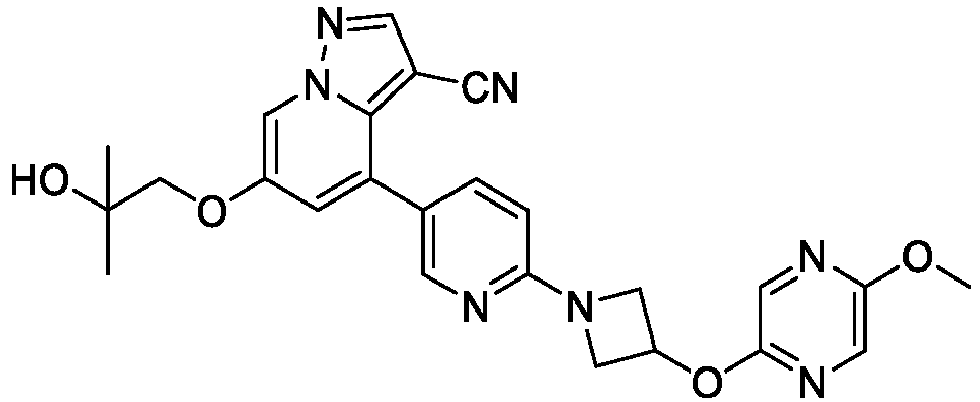
- A mixture of 4-(6-fluoropyridin-3-yl)-6-(2-hydroxy-2-methylpropoxy)pyrazolo[1,5-a]pyridine-3-carbonitrile (Intermediate P42; 32.2 mg, 0.0987 mmol), 2-(azetidin-3-yloxy)-5-methoxypyrazine (41.7 mg, 0.230 mmol) and TEA (67.5 µL, 0.493 mmol) in DMA (329 µL) was stirred overnight at 95°C. After cooling to ambient temperature, the reaction mixture was diluted with DCM and washed with water. The organic extracts were washed with brine and dried over anhydrous Na2SO4(s), filtered and concentrated in vacuo. The residue was suspended in 60:40 ACN:water containing 2% TFA. The solution was purified directly by C18 reverse phase chromatography (5-95% ACN in water with 0.1% TFA as the gradient eluent) to afford the title compound as the TFA salt. The TFA salt was treated with saturated NaHCO3(aq) and extracted with DCM. The combined organic extracts were washed with brine, then dried over anhydrous Na2SO4(s), filtered and concentrated in vacuo to afford the title compound (14.8 mg, 30.8% yield). MS (apci) m/z = 488.20 (M+H).
-

- A mixture of 4-(6-fluoropyridin-3-yl)-6-(2-hydroxy-2-methylpropoxy)pyrazolo[1,5-a]pyridine-3-carbonitrile (Intermediate P42; 32.2 mg, 0.0987 mmol), 3-(azetidin-3-yloxy)-6-methoxypyridazine (51 mg, 0.281 mmol) and TEA (67.5 µL, 0.493 mmol) in DMA (329 µL) was stirred overnight at 95°C. After cooling to ambient temperature, the reaction mixture was diluted with DCM and washed with water. The organic extracts were washed with brine and dried over anhydrous Na2SO4(s), filtered and concentrated in vacuo. The residue was suspended in 60:40 ACN:water containing 2% TFA. The solution was purified directly by C18 reverse phase chromatography (5-95% ACN in water with 0.1% TFA as the gradient eluent) to afford the title compound as the TFA salt. The TFA salt was treated with saturated NaHCO3(aq) and extracted with DCM. The combined organic extracts were washed with brine, then dried over anhydrous Na2SO4(s), filtered and concentrated in vacuo to afford the title compound (28.6 mg, 59.5% yield). MS (apci) m/z = 488.20 (M+H).
-

- A mixture of 4-(6-fluoropyridin-3-yl)-6-(2-hydroxy-2-methylpropoxy)pyrazolo[1,5-a]pyridine-3-carbonitrile (Intermediate P42; 30.0 mg, 0.0919 mmol), 5-(azetidin-3-yloxy)-2-methoxypyrimidine (56 mg, 0.309 mmol) and TEA (101 µL, 0.735 mmol) in DMA (306 µL) was stirred overnight at 95°C. After cooling to ambient temperature, the reaction mixture was diluted with DCM and washed with water. The organic extracts were washed with brine and dried over anhydrous Na2SO4(s), filtered and concentrated in vacuo. The residue was suspended in 60:40 ACN:water containing 2% TFA. The solution was purified directly by C18 reverse phase chromatography (5-95% ACN in water with 0.1% TFA as the gradient eluent) to afford the title compound as the TFA salt. The TFA salt was treated with saturated NaHCO3(aq) and extracted with DCM. The combined organic extracts were washed with brine, then dried over anhydrous Na2SO4(s), filtered and concentrated in vacuo to afford the title compound (14.9 mg, 33.2% yield). MS (apci) m/z = 488.20 (M+H).
-
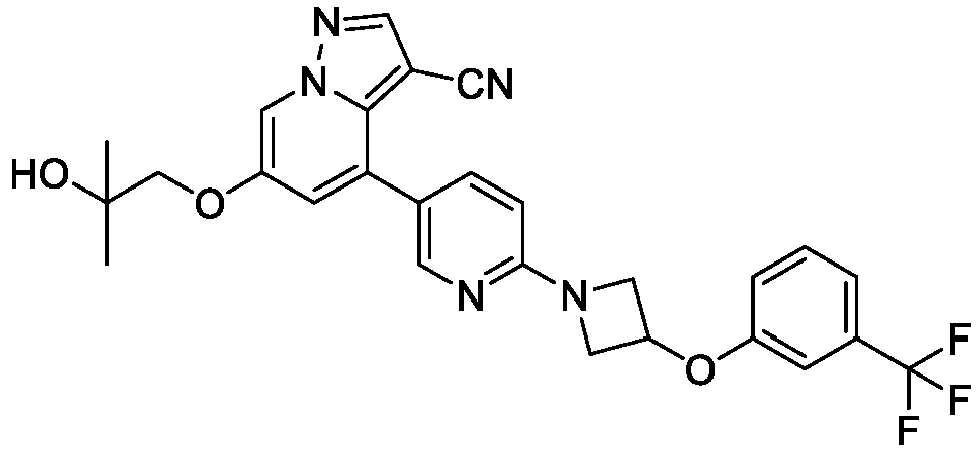
- A mixture of 4-(6-fluoropyridin-3-yl)-6-(2-hydroxy-2-methylpropoxy)pyrazolo[1,5-a]pyridine-3-carbonitrile (Intermediate P42; 31.9 mg, 0.0978 mmol), 3-[3-(trifluoromethyl)phenoxy]azetidine hydrochloride (74.4 mg, 0.293 mmol) and TEA (93.6 µL, 0.684 mmol) in DMA (326 µL) was stirred overnight at 105°C. After cooling to ambient temperature, the reaction mixture was diluted with DCM and washed with saturated NaHCO3(aq). The organic extracts were washed with water. Then the organic extracts were washed with brine and dried over anhydrous Na2SO4(s), filtered and concentrated in vacuo. The residue was suspended in 60:40 ACN:water containing 2% TFA. The solution was purified directly by C18 reverse phase chromatography (5-95% ACN in water with 0.1% TFA as the gradient eluent) to afford the title compound as the TFA salt. The TFA salt was treated with saturated NaHCO3(aq) and extracted with DCM. The combined organic extracts were washed with brine, then dried over anhydrous Na2SO4(s), filtered and concentrated in vacuo to afford the title compound (36.6 mg, 71.5% yield). MS (apci) m/z = 524.10 (M+H).
- The compounds in Table II were prepared using a similar method to that described for the synthesis of Example 181, replacing 3-[3-(trifluoromethyl)phenoxy]azetidine hydrochloride with the appropriate azetidine nucleophile. Reactions were monitored for completion by LCMS, and reaction durations were adjusted accordingly. Title compounds were cleanly isolated following chromatographic purification.
Table II Ex. # Structure Chemical Name LCMS m/z 182 
6-(2-hydroxy-2-methylpropoxy)-4-(6-(3-((6-(trifluoromethyl)pyridin-2-yl)oxy)azetidin-1-yl)pyridin-3-yl)pyrazolo[1,5-a]pyridine-3-carbonitrile 525.10 (M+H) 183 
4-(6-(3-(4-chlorophenoxy)azetidin-1-yl)pyridin-3 -yl)-6-(2-hydroxy-2-methylpropoxy)pyrazolo[1 ,5-a]pyridine-3-carbonitrile 490.10 (M+H) 184 
4-(6-(3-(2,4-difluorophenoxy)azetidin-1-yl)pyridin-3-yl)-6-(2-hydroxy-2-methylpropoxy)pyrazolo[1 492.15 (M+H) ,5-a]pyridine-3 -carbonitrile 185 
4-(6-(3-(2,6-difluorophenoxy)azetidin-1-yl)pyridin-3-yl)-6-(2-hydroxy-2-methylpropoxy)pyrazolo[1 ,5-a]pyridine-3 -carbonitrile 492.10 (M+H) 186 
4-(6-(3-(3,4-difluorophenoxy)azetidin-1-yl)pyridin-3-yl)-6-(2-hydroxy-2-methylpropoxy)pyrazolo[1 ,5-a]pyridine-3 -carbonitrile 492.10 (M+H) 187 
4-(6-(3-(3,5-difluorophenoxy)azetidin-1-yl)pyridin-3-yl)-6-(2-hydroxy-2-methylpropoxy)pyrazolo[1 ,5-a]pyridine-3 -carbonitrile 492.15 (M+H) 188 
4-(6-(3-((5-chloro-6-methoxypyridin-3-yl)oxy)azetidin-1-yl)pyridin-3 -yl)-6-(2-hydroxy-2-methylpropoxy)pyrazolo[1 ,5-a]pyridine-3 -carbonitrile 521.10 (M+H) 189 
4-(6-(3-((5-fluoropyridin-3-yl)oxy)azetidin-1-yl)pyridin-3 -yl)-6-(2-hydroxy-2-methylpropoxy)pyrazolo[1 ,5-a]pyridine-3 -carbonitrile 475.10 (M+H) 190 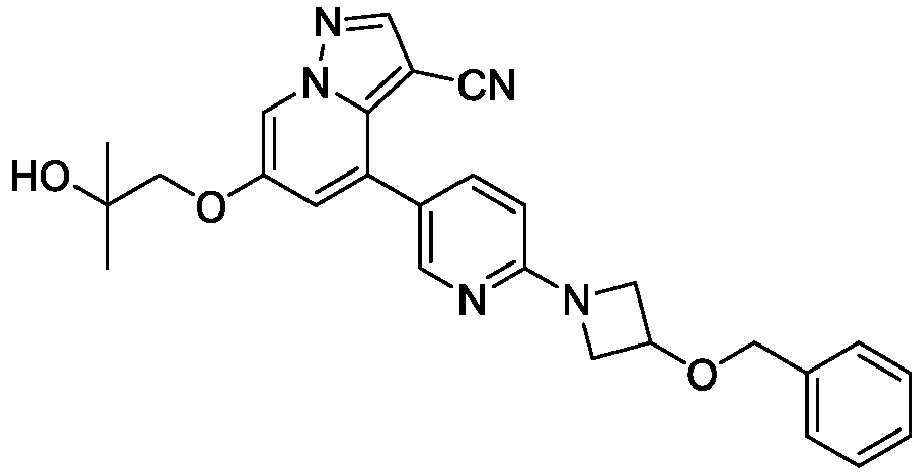
4-(6-(3-(benzyloxy)azetidin-1-yl)pyridin-3 -yl)-6-(2-hydroxy-2-methylpropoxy)pyrazolo[1 ,5-a]pyridine-3-carbonitrile 470.20 (M+H) 191 
4-(6-(3-((4-fluorophenyl)amino)azetid in-1-yl)pyridin-3 -yl)-6-(2-hydroxy-2-methylpropoxy)pyrazolo[1 ,5-a]pyridine-3 -carbonitrile 473.20 (M+H) -

- A mixture of 4-(6-fluoropyridin-3-yl)-6-(2-hydroxy-2-methylpropoxy)pyrazolo[1,5-a]pyridine-3-carbonitrile (Intermediate P42; 30.7 mg, 0.0941 mmol), 5-(azetidin-3-yloxy)-2-(difluoromethoxy)pyridine (55 mg, 0.254 mmol) and TEA (64.3 µL, 0.470 mmol) in DMA (314 µL) was stirred overnight at 95°C. After cooling to ambient temperature, the reaction mixture was diluted with EtOAc and washed with water. Then the organic extracts were washed with brine and dried over anhydrous Na2SO4(s), filtered and concentrated in vacuo. The residue was suspended in 60:40 ACN:water containing 2% TFA. The solution was purified directly by C18 reverse phase chromatography (5-95% ACN in water with 0.1% TFA as the gradient eluent) to afford the title compound as the TFA salt. The TFA salt was treated with saturated NaHCO3(aq) and extracted with DCM. The combined organic extracts were washed with brine, then dried over anhydrous Na2SO4(s), filtered and concentrated in vacuo to afford the title compound (39.9 mg, 81.2% yield). MS (apci) m/z = 523.20 (M+H).
-

- A mixture of 4-(6-fluoropyridin-3-yl)-6-(2-hydroxy-2-methylpropoxy)pyrazolo[1,5-a]pyridine-3-carbonitrile (Intermediate P42; 25.5 mg, 0.0781 mmol), 2-(azetidin-3-yloxy)-4-methylpyridine (50 mg, 0.304 mmol) and TEA (74.8 µL, 0.547 mmol) in DMA (391 µL) was stirred overnight at 95°C. After cooling to ambient temperature, the reaction mixture was diluted with water and extracted with EtOAc. The organic extracts were washed with water. Then the organic extracts were washed with brine and dried over anhydrous Na2SO4(s), filtered and concentrated in vacuo. The residue was suspended in 60:40 ACN:water containing 2% TFA. The solution was purified directly by C18 reverse phase chromatography (5-95% ACN in water with 0.1% TFA as the gradient eluent) to afford the title compound as the TFA salt. The TFA salt was treated with saturated NaHCO3(aq) and extracted with DCM. The combined organic extracts were washed with brine, then dried over anhydrous Na2SO4(s), filtered and concentrated in vacuo to afford the title compound (19.3 mg, 52.5% yield). MS (apci) m/z = 471.3 (M+H).
-

- A mixture of 4-(6-fluoropyridin-3-yl)-6-(2-hydroxy-2-methylpropoxy)pyrazolo[1,5-a]pyridine-3-carbonitrile (Intermediate P42; 28 mg, 0.0858 mmol), 2-(azetidin-3-yloxy)-4-methoxypyridine (15.5 mg, 0.858 mmol) and TEA (82.1 µL, 0.601 mmol) in DMA (286 µL) was stirred overnight at 95°C. After cooling to ambient temperature, the reaction mixture was diluted with water and extracted with EtOAc. The organic extracts were washed with water. Then the organic extracts were washed with brine and dried over anhydrous Na2SO4(s), filtered and concentrated in vacuo. The residue was suspended in 60:40 ACN:water containing 2% TFA. The solution was purified directly by C18 reverse phase chromatography (5-95% ACN in water with 0.1% TFA as the gradient eluent) to afford the title compound as the TFA salt. The TFA salt was treated with saturated NaHCO3(aq) and extracted with DCM. The combined organic extracts were washed with brine, then dried over anhydrous Na2SO4(s), filtered and concentrated in vacuo to afford the title compound (16.9 mg, 40.5% yield). MS (apci) m/z = 487.20 (M+H).
-

- A mixture of 4-(6-fluoropyridin-3-yl)-6-(2-hydroxy-2-methylpropoxy)pyrazolo[1,5-a]pyridine-3-carbonitrile (Intermediate P42; 25 mg, 0.077 mmol), 2-((azetidin-3-yloxy)methyl)pyridine (17 mg, 0.10 mmol) and TEA (73 µL, 0.54 mmol) in DMA (260 µL) was stirred overnight at 95°C. After cooling to ambient temperature, the reaction mixture was diluted with water and extracted with EtOAc. The organic extracts were washed with water. Then the organic extracts were washed with brine and dried over anhydrous Na2SO4(s), filtered and concentrated in vacuo. The residue was suspended in 60:40 ACN:water containing 2% TFA. The solution was purified directly by C18 reverse phase chromatography (5-95% ACN in water with 0.1% TFA as the gradient eluent) to afford the title compound as the TFA salt. The TFA salt was treated with saturated NaHCO3(aq) and extracted with DCM. The combined organic extracts were washed with brine, then dried over anhydrous Na2SO4(s), filtered and concentrated in vacuo to afford the title compound (6.6 mg, 18% yield). MS (apci) m/z = 471.20 (M+H).
-

- A mixture of 4-(6-fluoropyridin-3-yl)-6-(2-hydroxy-2-methylpropoxy)pyrazolo[1,5-a]pyridine-3-carbonitrile (Intermediate P42; 26 mg, 0.0797 mmol), 2-(azetidin-3-ylmethoxy)pyridine (73.5 mg, 0.448 mmol) and TEA (76.3 µL, 0.558 mmol) in DMA (266 µL) was stirred overnight at 95°C. After cooling to ambient temperature, the reaction mixture was diluted with water and extracted with EtOAc. The organic extracts were washed with water. Then the organic extracts were washed with brine and dried over anhydrous Na2SO4(s), filtered and concentrated in vacuo. The residue was suspended in 60:40 ACN:water containing 2% TFA. The solution was purified directly by C18 reverse phase chromatography (5-95% ACN in water with 0.1% TFA as the gradient eluent) to afford the title compound as the TFA salt. The TFA salt was treated with saturated NaHCO3(aq) and extracted with DCM. The combined organic extracts were washed with brine, then dried over anhydrous Na2SO4(s), filtered and concentrated in vacuo to afford the title compound (16.6 mg, 44.3% yield). MS (apci) m/z = 471.20 (M+H).
-
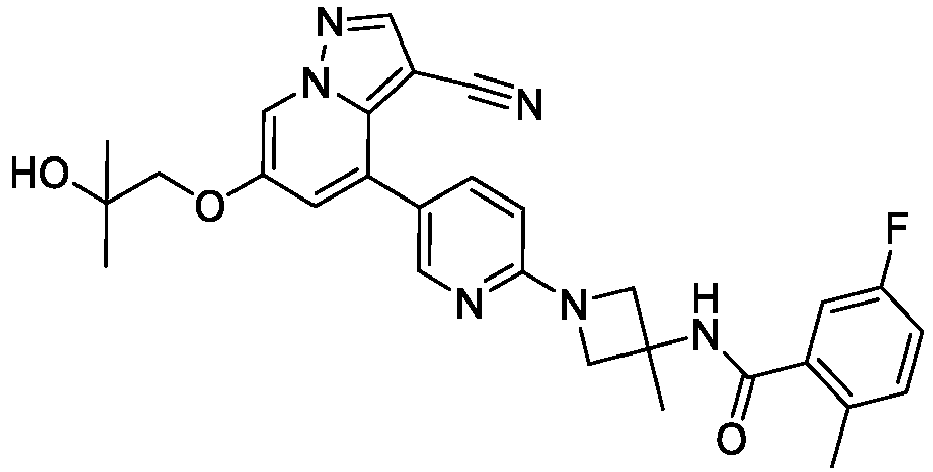
- Step 1: Preparation of tert-butyl (1-(5-(3-cyano-6-(2-hydroxy-2-methylpropoxy)pyrazolo[1,5-a]pyridin-4-yl)pyridin-2-yl)-3-methylazetidin-3-yl)carbamate. A mixture of 4-(6-fluoropyridin-3-yl)-6-(2-hydroxy-2-methylpropoxy)pyrazolo[1,5-a]pyridine-3-carbonitrile (Intermediate P42; 753 mg, 2.307 mmol), tert-butyl (3-methylazetidin-3-yl)carbamate hydrochloride (770.9 mg, 3.461 mmol) and DIEA (1.809 mL, 10.38 mmol) in DMSO (4.615 mL) was stirred overnight at 90°C. After cooling to ambient temperature, the reaction mixture was diluted with water and extracted with EtOAc. The organic extracts were washed with brine and dried over anhydrous Na2SO4(s), filtered and concentrated in vacuo. The residue was purified by silica chromatography (1-10% MeOH in DCM as the gradient eluent) to afford the title compound (1.089 g, 95.81% yield) in sufficient purity for step 2. MS (apci) m/z = 493.3 (M+H).
- Step 2: Preparation of 4-(6-(3-amino-3-methylazetidin-1-yl)pyridin-3-yl)-6-(2-hydroxy-2-methylpropoxy)pyrazolo[1,5-a]pyridine-3-carbonitrile.A solution of tert-butyl (1-(5-(3-cyano-6-(2-hydroxy-2-methylpropoxy)pyrazolo[1,5-a]pyridin-4-yl)pyridin-2-yl)-3-methylazetidin-3-yl)carbamate (1.089g, 2.211 mmol) in DCM (5.527 mL) was treated with TFA (10 mL, 130 mmol). After stirring for 1 h at ambient temperature the mixture was concentrated in vacuo and the residue diluted with EtOAc and washed with saturated NaHCO3(aq).The organic extracts were washed with brine and dried over anhydrous Na2SO4(s), filtered and concentrated in vacuo to cleanly provide the title compound (800 mg, 92.2% yield) in sufficient purity for step 3. MS (apci) m/z = 393.2 (M+H).
- Step 3: Preparation of N-(1-(5-(3-cyano-6-(2-hydroxy-2-methylpropoxy)pyrazolo[1,5-a]pyridin-4-yl)pyridin-2-yl)-3-methylazetidin-3-yl)-5-fluoro-2-methylbenzamide. A mixture of 4-(6-(3-amino-3-methylazetidin-1-yl)pyridin-3-yl)-6-(2-hydroxy-2-methylpropoxy)pyrazolo[1,5-a]pyridine-3-carbonitrile (54 mg, 0.138 mmol), HATU (57.5 mg, 0.151 mmol), 5-Fluoro-2-methylbenzoic acid (42.4 mg, 0.275 mmol) in DMSO (1.38 mL) was treated with DIEA (120 µL, 0.688 mmol) and then stirred overnight at ambient temperature. The reaction mixture was diluted with EtOAc and washed with water. The organic extracts were washed with brine, then dried over anhydrous Na2SO4(s), filtered and concentrated in vacuo. The residue was purified by silica chromatography (0.5-10% MeOH in DCM with 0.05-1% NH4OH as the gradient eluent) to cleanly provide the title compound (48.2 mg, 66.3% yield) MS (apci) m/z=529.2 (M+H)
-

- Step 1: Preparation of tert-butyl (R)-3-(phenylcarbamoyl)pyrrolidine-1-carboxylate. A mixture of (R)-1-N-Boc-beta-proline (504.1 mg, 2.34 mmol) , HATU (1.069 g, 2.810 mmol), and Aniline (239.9 mg, 2.576 mmol) in DCM (25 mL) was treated with DIEA (816 µL, 4.684 mmol) and then stirred 60 hours at ambient temperature. The reaction mixture concentrated in vacuo. The residue was purified by silica chromatography (10-60% EtOAc in Hexanes as the gradient eluent) to afford the title compound (assumed theoretical yield, 679 mg, 2.34 mmol ) in sufficient purity for step 2. MS (apci) m/z = 191.10 (M-Boc).
- Step 2: Preparation of (R)-N-phenylpyrrolidine-3-carboxamide. Tert-butyl (R)-3-(phenylcarbamoyl)pyrrolidine-1-carboxylate (assumed 679 mg, 2.34 mmol) in 2mL DCM was treated with TFA (2 mL, 26mmol). The reaction mixture was stirred for 16 h at ambient temperature, and then concentrated in vacuo. The crude residue was diluted with 4:1 DCM: IPA and washed with saturated NaHCO3(aq). The organic extracts were dried over anhydrous Na2SO4(s), filtered and concentrated in vacuo to afford the title compound (218.9 mg, 49.13 % yield over two steps) in sufficient purity for step 3. MS (apci) m/z = 191.10 (M+H).
- Step 3: Preparation of (R)-1-(5-(3-cyano-6-(2-hydroxy-2-methylpropoxy)pyrazolo[1,5-a]pyridin-4-yl)pyridin-2-yl)-N-phenylpyrrolidine-3-carboxamide. A mixture of 4-(6-fluoropyridin-3-yl)-6-(2-hydroxy-2-methylpropoxy)pyrazolo[1,5-a]pyridine-3-carbonitrile (Intermediate P42; 33.4 mg, 0.102 mmol, (R)-N-phenylpyrrolidine-3-carboxamide (58.4 mg, 0.307 mmol) and TEA (69.4 µL, 0.512 mmol) in DMA (512 µL) was stirred overnight at 80°C. After cooling to ambient temperature, the reaction mixture was diluted with EtOAc and washed with water. The organic extracts were washed with brine and the organic extracts were concentrated in vacuo. The residue was purified directly by C18 reverse phase chromatography (5-95% ACN in water with 0.1% TFA as the gradient eluent) to afford the title compound as the TFA salt. The TFA salt was treated with saturated NaHCO3(aq) and extracted with 4:1 DCM:IPA. The combined organic extracts were dried over anhydrous Na2SO4(s), filtered and concentrated in vacuo to afford the title compound (36.8 mg, 72.4% yield). MS (apci) m/z = 497.2 (M+H).
-

- Step 1: Preparation of tert-butyl (S)-3-(phenylcarbamoyl)pyrrolidine-1-carboxylate. A mixture of tert-butyl (S)-3-(phenylcarbamoyl)pyrrolidine-1-carboxylate (518.6 mg, 2.409 mmol), HATU (1.008 g, 2.891 mmol), and aniline (269.3 mg, 2.891mmol) in DCM (25 mL) was treated with DIEA (816 µL, 4.684 mmol) and then stirred 60 hours at ambient temperature. The reaction mixture concentrated in vacuo. The residue was purified by silica chromatography (10-60% EtOAc in Hexanes as the gradient eluent) to afford the title compound (assume theoretical yield, 699 mg, 2.409 mmol) in sufficient purity for step 2. MS (apci) m/z = 191.10 (M-Boc).
- Step 2: Preparation of (S)-N-phenylpyrrolidine-3-carboxamide. Tert-butyl (S)-3-(phenylcarbamoyl)pyrrolidine-1-carboxylate (assumed 699 mg, 2.409 mmol) in 2mL DCM was treated with TFA (2 mL, 26mmol). The reaction mixture was stirred for 16 h at ambient temperature, and then concentrated in vacuo. The crude residue was diluted with 4:1 DCM: IPA and washed with saturated NaHCO3(aq). The organic extracts were dried over anhydrous Na2SO4(s), filtered and concentrated in vacuo to afford the title compound (458.4 mg, 98 % yield over two steps) in sufficient purity for step 3. MS (apci) m/z = 191.10 (M+H).
- Step 3: Preparation of (S)-1-(5-(3-cyano-6-(2-hydroxy-2-methylpropoxy)pyrazolo[1,5-a]pyridin-4-yl)pyridin-2-yl)-N-phenylpyrrolidine-3-carboxamide. A mixture of 4-(6-fluoropyridin-3-yl)-6-(2-hydroxy-2-methylpropoxy)pyrazolo[1,5-a]pyridine-3-carbonitrile (Intermediate P42; 28 mg, 0.086 mmol), (S)-N-phenylpyrrolidine-3-carboxamide (49 mg, 0.257 mmol) and TEA (58 µL, 0.429 mmol) in DMA (572 µL) was stirred overnight at 80°C. After cooling to ambient temperature, the reaction mixture was diluted with EtOAc and washed with water. The organic extracts were washed with brine and the organic extracts were concentrated in vacuo. The residue was purified directly by C18 reverse phase chromatography (5-95% ACN in water with 0.1% TFA as the gradient eluent) to afford the title compound as the TFA salt. The TFA salt was treated with saturated NaHCO3(aq) and extracted with 4:1 DCM:IPA. The combined organic extracts were dried over anhydrous Na2SO4(s), filtered and concentrated in vacuo to afford the title compound (16.7 mg, 39% yield). MS (apci) m/z = 497.2 (M+H).
-

- A mixture of 4-(6-fluoropyridin-3-yl)-6-(2-hydroxy-2-methylpropoxy)pyrazolo[1,5-a]pyridine-3-carbonitrile (Intermediate P42; 50 mg, 0.153 mmol), 4'-Methyl-[1,4']bipiperidinyl dihydrochloride (54.7 mg, 0.215 mmol) and DIEA (133 µL, 0.766 mmol) in DMSO (306 µL) was sparged with argon and stirred overnight at 90°C. After cooling to ambient temperature, the reaction mixture was diluted with EtOAc and washed with water. The combined organic extracts were dried over anhydrous Na2SO4(s), filtered and concentrated in vacuo. The residue was purified directly by C18 reverse phase chromatography (5-95% ACN in water with 0.1% TFA as the gradient eluent) to afford the title compound as the TFA salt. The TFA salt was treated with saturated NaHCO3(aq) and extracted with EtOAc. The combined organic extracts were dried over anhydrous Na2SO4(s), filtered and concentrated in vacuo to afford the title compound (27 mg, 36% yield). MS (apci) m/z = 489.3 (M+H).
-

- A mixture of 4-(6-fluoropyridin-3-yl)-6-(2-hydroxy-2-methylpropoxy)pyrazolo[1,5-a]pyridine-3-carbonitrile (Intermediate P42; 394 mg, 1.208 mmol, (S)-2-(pyrrolidin-3-yloxy)-pyridine dihydrochloride (1.146 g, 4.833 mmol) and TEA (1.639 mL, 12.08 mmol) in DMA ( 12 mL) was stirred 16 h at 90°C. After cooling to ambient temperature, the reaction mixture was diluted with water and extracted with EtOAc. The organic extracts were washed with water. Then the organic extracts were washed with brine and dried over anhydrous Na2SO4(s), filtered and concentrated in vacuo. The residue was purified directly by C18 reverse phase chromatography (5-95% ACN in water with 0.1% TFA as the gradient eluent) to afford the title compound as the TFA salt. The TFA salt was treated with saturated NaHCO3(aq) and extracted with 4:1 DCM:IPA. The combined organic extracts were dried over anhydrous Na2SO4(s), filtered and concentrated in vacuo to afford the title compound (400 mg, 70% yield). MS (apci) m/z = 471.2 (M+H). 1H NMR (400 MHz, DMSO) δ 8.65-8.64 (d, 1H), 8.56 (s, 1H), 8.31-8.30 (dd, 1H), 8.22-8.20 (m, 1H), 7.76-7.69 (m, 2H), 7.26-7.25 (d, 1H), 7.01-6.98 (m, 1H), 6.85-6.83 (m, 1H), 6.61-6.59 (d, 1H), 5.69-5.67 (m, 1H), 4.69 (s, 1H), 3.86-3.81 (m, 3H), 3.70-3.65 (m, 2H), 3.60-3.53 (m, 1H), 2.42-2.22 (m, 2H), 1.22 (s, 6H)
-

- A solution of 4-(6-fluoropyridin-3-yl)-6-(2-hydroxy-2-methylpropoxy)pyrazolo[1,5-a]pyridine-3-carbonitrile (Intermediate P42; 25 mg, 0.077 mmol) in DMA (100 µL) was treated with TEA (27 µL, 0.192 mmol) and (R)-2-(pyrrolidin-3-yloxy)pyridine hydrochloride (15.4 mg, 0.077 mmol) and was stirred overnight at 110°C. After cooling to ambient temperature, the reaction mixture was diluted with water (10 mL) and extracted with DCM (3 x 10 mL) using a phase separator frit. The organic extracts were concentrated in vacuo. The residue was purified directly by C18 reverse phase chromatography (0-60% ACN in water as the gradient eluent) to cleanly provide the title compound (16 mg, 44% yield). MS (apci) m/z = 471.2 (M+H).
-

- A solution of 4-(6-fluoropyridin-3-yl)-6-(2-hydroxy-2-methylpropoxy)pyrazolo[1,5-a]pyridine-3-carbonitrile (Intermediate P42; 31.6 mg, 0.097 mmol) in DMA (1 mL) was treated with (S)-3-(4-fluorophenoxy)pyrrolidine hydrochloride (22.1 mg, 0.102 mmol) followed by TEA (65.7 µL, 0.484 mmol) and was stirred overnight at 90°C. Additional (S)-3-(4-fluorophenoxy)pyrrolidine hydrochloride (8.8 mg, 0.48 mmol) was added to the reaction and reaction continued to stir for an additional 16 h at 90°C. After cooling to ambient temperature, the reaction mixture was diluted with water and extracted with EtOAc. The organic extracts were washed with water. Then the organic extracts were washed with brine and dried over anhydrous Na2SO4(s), filtered and concentrated in vacuo. The residue was purified by silica chromatography (5-50% Acetone in DCM as the gradient eluent). An impurity remained so product-containing fractions were concentrated in vacuo. The residue was repurified by C18 reverse phase chromatography (5-95% ACN in water with 0.1% TFA as the gradient eluent) to afford the title compound as the TFA salt. The TFA salt was treated with saturated NaHCO3(aq) and extracted with 4:1 DCM:IPA. The combined organic extracts were dried over anhydrous Na2SO4(s), filtered and concentrated in vacuo to afford the title compound (9.8 mg, 20.8% yield). MS (apci) m/z = 488.2 (M+H).
-

- Step 1: Preparation of tert-butyl (S)-3-(pyrazin-2-yloxy)pyrrolidine-1-carboxylate. To a solution of tert-butyl (S)-3-(phenylcarbamoyl)pyrrolidine-1-carboxylate (264.5 mg, 1.413 mmol) in DMF (7.1 mL) was added 2-chloropyrazine (192.2 mg, 1.695 mmol) followed by sodium hydride (60% w/w, 113 mg, 2.825 mmol) and then the reaction mixture was stirred for 16 hours at 80°C After cooling to ambient temperature, the reaction mixture was diluted with water and extracted with EtOAc. The organic extracts were washed with water. Then the organic extracts were washed with brine and dried over anhydrous Na2SO4(s), filtered and concentrated in vacuo. The residue was purified by silica chromatography (5-60% EtOAc in Hexanes as the gradient eluent) to afford the title compound (assume theoretical yield, 374.9 mg, 1.413 mmol) in sufficient purity for step 2. 1H NMR (400 MHz, DMSO-d6) δ 8.31 (s, 1H), 8.22 (s, 2H), 5.49 (s, 1H), 3.64-3.57 (m, 1H), 3.48-3.31 (m, 3H), 2.23-2.04 (m, 2H), 1.40-1.39 (d, 9H).
- Step 2: Preparation of (S)-2-(pyrrolidin-3-yloxy)pyrazine. To a solution of tert-butyl (S)-3-(pyrazin-2-yloxy)pyrrolidine-1-carboxylate (assumed 374.9 mg, 1.413 mmol) in 3mL DCM was treated with TFA (3 mL, 39 mmol). The reaction mixture was stirred for 0.5 h at ambient temperature, and then concentrated in vacuo. The crude residue was diluted with 4:1 DCM: IPA and washed with saturated NaHCO3(aq). The organic extracts were dried over anhydrous Na2SO4(s), filtered and concentrated in vacuo to afford the title compound (72.1 mg, 31 % yield over two steps) in sufficient purity for step 3. 1H NMR (400 MHz, DMSO-d6) δ 8.27 (s, 1H), 8.21 (s, 2H), 5.46-5.42 (m, 1H), 3.25-3.21 (m, 1H), 3.09-2.95 (m, 3H), 2.17-2.08 (m, 1H), 1.96-1.89 (m, 1H).
- Step 3: Preparation of (S)-6-(2-hydroxy-2-methylpropoxy)-4-(6-(3-(pyrazin-2-yloxy)pyrrolidin-1-yl)pyridin-3-yl)pyrazolo[1,5-a]pyridine-3-carbonitrile. To a solution of 4-(6-fluoropyridin-3-yl)-6-(2-hydroxy-2-methylpropoxy)pyrazolo[1,5-a]pyridine-3-carbonitrile (Intermediate P42; 30.8 mg, 0.094 mmol) in DMA (2 mL) was added TEA (64 µL, 0.472 mmol) followed by (S)-2-(pyrrolidin-3-yloxy)pyrazine (71.7mg, 0.434 mmol). The reaction mixture was stirred overnight at 90°C. After cooling to ambient temperature, the reaction was purified directly by C18 reverse phase chromatography (5-95% ACN in water with 0.1% TFA as the gradient eluent). An impurity remained and product-containing fractions were concentrated in vacuo. The residue was repurified by silica chromatography (5-95% Acetone in DCM as the gradient eluent) to afford the title compound (36.2 mg, 81% yield). MS (apci) m/z = 472.2 (M+H).
-

- Step 1: Preparation of tert-butyl (S)-3-((6-methoxypyridin-3-yl)oxy)pyrrolidine-1-carboxylate. To a solution of tert-butyl (R)-3-((methylsulfonyl)oxy)pyrrolidine-1-carboxylate (Intermediate R14; 208.7 mg, 0.787 mmol) in DMF (8 mL) was added 5-hydroxy-2-methoxylpyridine (118.1 mg, 0.944 mmol) followed by potassium carbonate (217.4 mg, 1.573 mmol) and then the reaction mixture was stirred for 16 hours at 90°C After cooling to ambient temperature, the reaction mixture was diluted with water and extracted with EtOAc. The organic extracts were washed with water. Then the organic extracts were washed with brine and dried over anhydrous Na2SO4(s), filtered and concentrated in vacuo. The residue was purified by silica chromatography (5-75% Acetone in DCM as the gradient eluent) to afford the title compound (assume theoretical yield, 231 mg, 0.787 mmol) in sufficient purity for step 2. MS (apci) m/z = 295.1 (M+H).
- Step 2: Preparation of (S)-2-methoxy-5-(pyrrolidin-3-yloxy)pyridine. To a solution of tert-butyl (S)-3-((6-methoxypyridin-3-yl)oxy)pyrrolidine-1-carboxylate (assumed 231 mg, 0.787 mmol) in 2mL DCM was treated with TFA (2 mL, 26 mmol). The reaction mixture was stirred for 15 min at ambient temperature, and then concentrated in vacuo. The crude residue was diluted with 4:1 DCM: IPA and washed with saturated NaHCO3(aq). The organic extracts were dried over anhydrous Na2SO4(s), filtered and concentrated in vacuo to afford the title compound (54.6 mg, 36% yield over two steps) in sufficient purity for step 3. MS (apci) m/z = 195.1 (M+H).
- Step 3: Preparation of (S)-6-(2-hydroxy-2-methylpropoxy)-4-(6-(3-((6-methoxypyridin-3-yl)oxy)pyrrolidin-1-yl)pyridin-3-yl)pyrazolo[1,5-a]pyridine-3-carbonitrile. To a solution of 4-(6-fluoropyridin-3-yl)-6-(2-hydroxy-2-methylpropoxy)pyrazolo[1,5-a]pyridine-3-carbonitrile (Intermediate P42; 60.8 mg, 0.186 mmol) in DMA (2 mL) was added TEA (126µL, 0.932 mmol) followed by (S)-2-methoxy-5-(pyrrolidin-3-yloxy)pyridine (54.3 mg, 0.279 mmol). The reaction mixture was stirred overnight at 90°C. After cooling to ambient temperature, the reaction was purified by C18 reverse phase chromatography (5-95% ACN in water with 0.1% TFA as the gradient eluent) to afford the title compound as the TFA salt. The TFA salt was treated with saturated NaHCO3(aq) and extracted with 4:1 DCM:IPA. The combined organic extracts were dried over anhydrous Na2SO4(s), filtered and concentrated in vacuo to afford the title compound (39.5 mg, 42% yield). MS (apci) m/z = 501.2 (M+H).
-
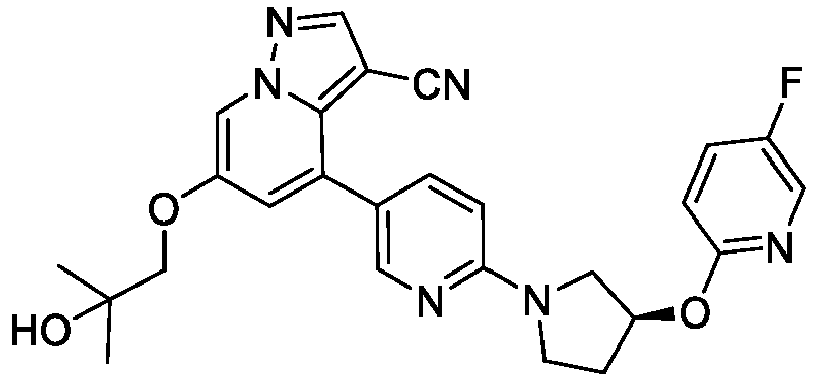
- Step 1: Preparation of tert-butyl (S)-3-((5-fluoropyridin-2-yl)oxy)pyrrolidine-1-carboxylate. To a solution of tert-butyl (R)-3-((methylsulfonyl)oxy)pyrrolidine-1-carboxylate (Intermediate R14; 200.8 mg, 0.757 mmol) in DMF (8 mL) was added 5-fluoro-2-hydroxypyridine (102.7 mg, 0.908 mmol) followed by potassium carbonate (209.2 mg, 1.514 mmol) and then the reaction mixture was stirred for 60 hours at 90°C After cooling to ambient temperature, the reaction mixture was diluted with EtOAc washed with water. Then the organic extracts were washed with brine and dried over anhydrous Na2SO4(s), filtered and concentrated in vacuo. The residue was purified by silica chromatography (5-75% Acetone in DCM as the gradient eluent) to afford the title compound (assume theoretical yield, 213.5 mg, 0.757 mmol) in sufficient purity for step 2. MS (apci) m/z = 183.1 (M-Boc).
- Step 2: Preparation of (S)-5-fluoro-2-(pyrrolidin-3-yloxy)pyridine. To a solution tert-butyl (S)-3-((5-fluoropyridin-2-yl)oxy)pyrrolidine-1-carboxylate (assumed 213.5 mg, 0.75 mmol) in 2mL DCM was treated with TFA (2 mL, 26 mmol). The reaction mixture was stirred for 15 min at ambient temperature, and then concentrated in vacuo. The crude residue was diluted with 4:1 DCM: IPA and washed with saturated NaHCO3(aq). The organic extracts were dried over anhydrous Na2SO4(s), filtered and concentrated in vacuo to afford the title compound (57.2 mg, 41% yield over two steps) in sufficient purity for step 3. MS (apci) m/z = 183.1 (M+H).
- Step 3: Preparation of (S)-6-(2-hydroxy-2-methylpropoxy)-4-(6-(3-((6-methoxypyridin-3-yl)oxy)pyrrolidin-1-yl)pyridin-3-yl)pyrazolo[1,5-a]pyridine-3-carbonitrile. To a mixture of 4-(6-fluoropyridin-3-yl)-6-(2-hydroxy-2-methylpropoxy)pyrazolo[1,5-a]pyridine-3-carbonitrile (Intermediate P42; 30.3 mg, 0.093 mmol) and (S)-5-fluoro-2-(pyrrolidin-3-yloxy)pyridine (55.8 mg, 0.31 mmol) in DMA (2 mL) was added TEA (63µL, 0.464 mmol). The reaction mixture was stirred 16 h at 90°C. After cooling to ambient temperature, the reaction mixture was diluted with EtOAc washed with water. Then the organic extracts were washed with brine and dried over anhydrous Na2SO4(s), filtered and concentrated in vacuo. The reaction was purified by C18 reverse phase chromatography (5-95% ACN in water with 0.1% TFA as the gradient eluent) to afford the title compound as the TFA salt. The TFA salt was treated with saturated NaHCO3(aq) and extracted with 4:1 DCM:IPA. The combined organic extracts were dried over anhydrous Na2SO4(s), filtered and concentrated in vacuo to afford the title compound (29.6 mg, 65% yield). MS (apci) m/z = 489.2 (M+H).
-

- Step 1: Preparation of tert-butyl (S)-3-((6-methoxypyridin-2-yl)oxy)pyrrolidine-1-carboxylate. To a mixture of (S)-1-Boc-3-hydroxypyrrolidine(112.5 mg, 0.601 mmol) and 2-Chloro-6-methoxypyridine (86 µL, 0.721 mmol) in DMF (6 mL) was added sodium hydride (60% w/w, 48.1 mg, 1.20 mmol) and then the reaction mixture was stirred for 16 hours at 80°C. Additional sodium hydride (60% w/w, 48.1 mg, 1.20 mmol) was added and the reaction mixture was stirred for an additional 16 hours at 80°C. After cooling to ambient temperature, the reaction mixture was diluted with EtOAc and washed with water. Then the organic extracts were washed with brine and dried over anhydrous Na2SO4(s), filtered and concentrated in vacuo. The residue was purified by silica chromatography (5-95% EtOAc in Hexanes as the gradient eluent) to afford the title compound as crude product that was directly used in the next step, assuming quantitative yield. MS (apci) m/z = 195.1 (M-Boc).
- Step 2: Preparation of (S)-2-methoxy-6-(pyrrolidin-3-yloxy)pyridine. To a solution of tert-butyl (S)-3-((6-methoxypyridin-2-yl)oxy)pyrrolidine-1-carboxylate (assumed 176.8 mg, 0.601 mmol) in 2mL DCM was treated with TFA (2 mL). The reaction mixture was stirred for 15 min at ambient temperature, and then concentrated in vacuo. The crude residue was diluted with 4:1 DCM: IPA and washed with saturated NaHCO3(aq). The organic extracts were dried over anhydrous Na2SO4(s), filtered and concentrated in vacuo to afford the title compound (81.6 mg, 70% yield over two steps) in sufficient purity for step 3. MS (apci) m/z = 195.1 (M+H).
- Step 3: Preparation of (S)-6-(2-hydroxy-2-methylpropoxy)-4-(6-(3-((6-methoxypyridin-2-yl)oxy)pyrrolidin-1-yl)pyridin-3-yl)pyrazolo[1,5-a]pyridine-3-carbonitrile. To a mixture of 4-(6-fluoropyridin-3-yl)-6-(2-hydroxy-2-methylpropoxy)pyrazolo[1,5-a]pyridine-3-carbonitrile (Intermediate P42; 57.2 mg, 0.175 mmol) and (S)-2-methoxy-6-(pyrrolidin-3-yloxy)pyridine (71.5 mg, 0.368 mmol) in DMA (3 mL) was added TEA (64 µL, 0.472 mmol) . The reaction mixture was stirred overnight at 80°C. After cooling to ambient temperature, the reaction mixture was diluted with EtOAc washed with water. Then the organic extracts were washed with brine and dried over anhydrous Na2SO4(s), filtered and concentrated in vacuo. The reaction was purified by C18 reverse phase chromatography (5-95% ACN in water with 0.1% TFA as the gradient eluent) to afford the title compound as the TFA salt. The TFA salt was treated with saturated NaHCO3(aq) and extracted with 4:1 DCM:IPA. The combined organic extracts were dried over anhydrous Na2SO4(s), filtered and concentrated in vacuo to afford the title compound (56.6 mg, 65% yield). MS (apci) m/z = 501.2 (M+H).
-

- Step 1: Preparation of tert-butyl (S)-3-((6-methylpyridin-2-yl)oxy)pyrrolidine-1-carboxylate. To a mixture of (S)-1-Boc-3-hydroxypyrrolidine (112.5 mg, 0.601 mmol) and 2-chloro-6-methylpyridine (74 µL, 0.669 mmol) in DMF (6 mL) was added sodium hydride (60% w/w, 44.6 mg, 1.11 mmol) and then the reaction mixture was stirred for 16 hours at 80°C. Additional sodium hydride (60% w/w, 44.6 mg, 1.11 mmol) was added and the reaction mixture was stirred for an additional 16 hours at 80°C. After cooling to ambient temperature, the reaction mixture was diluted with EtOAc and washed with water. Then the organic extracts were washed with brine and dried over anhydrous Na2SO4(s), filtered and concentrated in vacuo. The residue was purified by silica chromatography (5-95% EtOAc in Hexanes as the gradient eluent) to afford the title compound (assume theoretical yield, 155 mg, 0.557 mmol) in sufficient purity for step 2. MS (apci) m/z = 279.1 (M+H).
- Step 2: Preparation of (S)-2-methyl-6-(pyrrolidin-3-yloxy)pyridine. To a solution of tert-butyl (S)-3-((6-methylpyridin-2-yl)oxy)pyrrolidine-1-carboxylate (assumed 155 mg, 0.557 mmol) in 2mL DCM was treated with TFA (2 mL, 26 mmol). The reaction mixture was stirred for 15 min at ambient temperature, and then concentrated in vacuo. The crude residue was diluted with 4:1 DCM: IPA and washed with saturated NaHCO3(aq). The organic extracts were dried over anhydrous Na2SO4(s), filtered and concentrated in vacuo to afford the title compound (81.6 mg, 70 % yield over two steps) in sufficient purity for step 3. MS (apci) m/z = 179.1(M+H).
- Step 3: Preparation of (S)-6-(2-hydroxy-2-methylpropoxy)-4-(6-(3-((6-methylpyridin-2-yl)oxy)pyrrolidin-1-yl)pyridin-3-yl)pyrazolo[1,5-a]pyridine-3-carbonitrile. To a mixture of 4-(6-fluoropyridin-3-yl)-6-(2-hydroxy-2-methylpropoxy)pyrazolo[1,5-a]pyridine-3-carbonitrile (Intermediate P42; 53.3 mg, 0.163 mmol) and (S)-2-methyl-6-(pyrrolidin-3-yloxy)pyridine (69.9 mg, 0.392 mmol) in DMA (2 mL) was added TEA (111 µL, 0.817mmol). The reaction mixture was stirred overnight at 80°C. After cooling to ambient temperature, the reaction mixture was diluted with EtOAc washed with water. Then the organic extracts were washed with brine and dried over anhydrous Na2SO4(s), filtered and concentrated in vacuo. The residue was purified by silica chromatography 1-30% MeOH in EtOAc with 0.1-2% NH4OH as the gradient eluent) to cleanly provide the title compound (60.8 mg, 76.8% yield) MS (apci) m/z=485.2 (M+H)
-

- Step 1: Preparation of tert-butyl (S)-3-((5-fluoropyridin-3-yl)oxy)pyrrolidine-1-carboxylate. To a mixture of tert-butyl (R)-3-((methylsulfonyl)oxy)pyrrolidine-1-carboxylate (Intermediate R14; 301.5 mg, 1.136 mmol) and 5-fluoropyridin-3-ol (154.2 mg, 1.364 mmol) in DMF (11 mL) was added potassium carbonate (314.1 mg, 2.273 mmol) and then the reaction mixture was stirred for 16 hours at 80°C After cooling to ambient temperature, the reaction mixture was diluted with EtOAc washed with water. Then the organic extracts were washed with brine and dried over anhydrous Na2SO4(s), filtered and concentrated in vacuo. The residue was purified by silica chromatography (5-95% EtOAc in Hexanes as the gradient eluent) to afford the title compound (assume theoretical yield, 320.7 mg, 1.136 mmol) in sufficient purity for step 2. MS (apci) m/z = 183.1 (M-Boc).
- Step 2: Preparation of (S)-3-fluoro-5-(pyrrolidin-3-yloxy)pyridine. To a solution tert-butyl (S)-3-((5-fluoropyridin-3-yl)oxy)pyrrolidine-1-carboxylate (assumed 320.7 mg, 1.136 mmol) in 2.5 mL DCM was treated with TFA (2.5 mL, 32.7 mmol). The reaction mixture was stirred for 15 min at ambient temperature, and then concentrated in vacuo. The crude residue was diluted with 4:1 DCM: IPA and washed with saturated NaHCO3(aq). The organic extracts were dried over anhydrous Na2SO4(s), filtered and concentrated in vacuo to afford the title compound (57.2 mg, 41% yield over two steps) in sufficient purity for step 3. MS (apci) m/z = 183.1 (M+H).
- Step 3: Preparation of (S)-4-(6-(3-((5-fluoropyridin-3-yl)oxy)pyrrolidin-1-yl)pyridin-3-yl)-6-(2-hydroxy-2-methylpropoxy)pyrazolo[1,5-a]pyridine-3-carbonitrile. To a mixture of 4-(6-fluoropyridin-3-yl)-6-(2-hydroxy-2-methylpropoxy)pyrazolo[1,5-a]pyridine-3-carbonitrile (Intermediate P42; 32.7 mg, 0.10 mmol) and (S)-3-fluoro-5-(pyrrolidin-3-yloxy)pyridine (48.4 mg, 0.266 mmol) in DMA (2 mL) was added TEA (68µL, 0.501 mmol). The reaction mixture was stirred 16 h at 90°C. After cooling to ambient temperature, the reaction mixture was diluted with EtOAc washed with water. Then the organic extracts were washed with brine and dried over anhydrous Na2SO4(s), filtered and concentrated in vacuo. The residue was purified by silica chromatography 1-30% MeOH in EtOAc with 0.1-2% NH4OH as the gradient eluent) to cleanly provide the title compound (23 mg, 47% yield) MS (apci) m/z=489.2 (M+H)
-

- Step 1: Preparation of tert-butyl (S)-3-((5-methoxypyridin-3-yl)oxy)pyrrolidine-1-carboxylate. To a mixture of tert-butyl (R)-3-((methylsulfonyl)oxy)pyrrolidine-1-carboxylate (Intermediate R14; 301.6 mg, 1.137 mmol) and 5-methoxypyridin-3-ol(170.7 mg, 1.364 mmol) in DMF (11 mL) was added potassium carbonate (314 mg, 2.273 mmol) and then the reaction mixture was stirred for 16 hours at 80°C After cooling to ambient temperature, the reaction mixture was diluted with EtOAc washed with water. Then the organic extracts were washed with brine and dried over anhydrous Na2SO4(s), filtered and concentrated in vacuo. The residue was purified by silica chromatography (5-95% EtOAc in Hexanes as the gradient eluent) to afford the title compound (assume theoretical yield, 334.7 mg, 1.137 mmol) in sufficient purity for step 2. MS (apci) m/z = 239.1 (M-t-Bu fragment).
- Step 2: Preparation of (S)-3-methoxy-5-(pyrrolidin-3-yloxy)pyridine. To a solution of tert-butyl (S)-3-((5-methoxypyridin-3-yl)oxy)pyrrolidine-1-carboxylate (assumed 334.7 mg, 1.137 mmol) in 2.5 mL DCM was treated with TFA (2.5 mL, 32.7 mmol). The reaction mixture was stirred for 15 min at ambient temperature, and then concentrated in vacuo. The crude residue was diluted with 4:1 DCM: IPA and washed with saturated NaHCO3(aq). The organic extracts were dried over anhydrous Na2SO4(s), filtered and concentrated in vacuo to afford the title compound (59.4 mg, 26.9% yield over two steps) in sufficient purity for step 3. MS (apci) m/z = 195.1 (M+H).
- Step 3: Preparation of ((S)-6-(2-hydroxy-2-methylpropoxy)-4-(6-(3-((5-methoxypyridin-3-yl)oxy)pyrrolidin-1-yl)pyridin-3-yl)pyrazolo[1,5-a]pyridine-3-carbonitrile. To a mixture of 4-(6-fluoropyridin-3-yl)-6-(2-hydroxy-2-methylpropoxy)pyrazolo[1,5-a]pyridine-3-carbonitrile (Intermediate P42; 30 mg, 0.092 mmol) and (S)-3-methoxy-5-(pyrrolidin-3-yloxy)pyridine (59.4 mg, 0.306 mmol) in DMA (2 mL) was added TEA (62µL, 0.46 mmol). The reaction mixture was stirred 16 h at 90°C. After cooling to ambient temperature, the reaction mixture was diluted with EtOAc washed with water. Then the organic extracts were washed with brine and dried over anhydrous Na2SO4(s), filtered and concentrated in vacuo. The residue was purified by silica chromatography 1-30% MeOH in EtOAc with 0.1-2% NH4OH as the gradient eluent) to cleanly provide the title compound (32.6 mg, 71 % yield) MS (apci) m/z=501.2 (M+H)
-

- Step 1: Preparation of tert-butyl (S)-3-((2-methoxypyrimidin-5-yl)oxy)pyrrolidine-1-carboxylate. To a mixture of tert-butyl (R)-3-((methylsulfonyl)oxy)pyrrolidine-1-carboxylate (Intermediate R14; 374.0 mg, 1.410 mmol) and 2-methoxypyrimidine-5-ol (213.3 mg, 1.692 mmol) in DMF (14 mL) was added potassium carbonate (390 mg, 2.819 mmol) and then the reaction mixture was stirred for 60 hours at 80°C After cooling to ambient temperature, the reaction mixture was diluted with EtOAc washed with water. Then the organic extracts were washed with brine and dried over anhydrous Na2SO4(s), filtered and concentrated in vacuo. The residue was purified by silica chromatography (5-95% EtOAc in Hexanes as the gradient eluent) to afford the title compound (assume theoretical yield, 416.4 mg, 1.410 mmol) in sufficient purity for step 2. MS (apci) m/z = 196.1 (M-Boc).
- Step 2: Preparation of and (S)-2-methoxy-5-(pyrrolidin-3-yloxy)pyrimidine. To a solution of tert-butyl (S)-3-((2-methoxypyrimidin-5-yl)oxy)pyrrolidine-1-carboxylate (assumed 416.4 mg, 1.410 mmol) in 2 mL DCM was treated with TFA (2 mL, 26mmol). The reaction mixture was stirred for 15 min at ambient temperature, and then concentrated in vacuo. The crude residue was diluted with 4:1 DCM: IPA and washed with saturated NaHCO3(aq). The organic extracts were dried over anhydrous Na2SO4(s), filtered and concentrated in vacuo to afford the title compound (61.7 mg, 20% yield over two steps) in sufficient purity for step 3. MS (apci) m/z = 196.1 (M+H).
- Step 3: Preparation of (S)-6-(2-hydroxy-2-methylpropoxy)-4-(6-(3-((2-methoxypyrimidin-5-yl)oxy)pyrrolidin-1-yl)pyridin-3-yl)pyrazolo[1,5-a]pyridine-3-carbonitrile. To a mixture of 4-(6-fluoropyridin-3-yl)-6-(2-hydroxy-2-methylpropoxy)pyrazolo[1,5-a]pyridine-3-carbonitrile (Intermediate P42; 31.7 mg, 0.097 mmol) and (S)-2-methoxy-5-(pyrrolidin-3-yloxy)pyrimidine (60.7 mg, 0.311 mmol) in DMA (2 mL) was added TEA (79µL, 0.58 mmol). The reaction mixture was stirred 16 h at 80°C. The reaction mixture was stirred at 80°C for 16 hours. The reaction was heated to 100°C for 60 hours. The reaction was heated to 150°C for 2 hours in a microwave reactor. The reaction was heated to 150°C for 8 hours in a microwave reactor. After cooling to ambient temperature, the reaction mixture was diluted with EtOAc washed with water. Then the organic extracts were washed with brine and dried over anhydrous Na2SO4(s), filtered and concentrated in vacuo. The reaction was purified by C18 reverse phase chromatography (5-95% ACN in water with 0.1% TFA as the gradient eluent) to afford the title compound as the TFA salt. The TFA salt was treated with saturated NaHCO3(aq) and extracted with 4:1 DCM:IPA. The combined organic extracts were dried over anhydrous Na2SO4(s), filtered and concentrated in vacuo to afford the title compound (16.6 mg, 34% yield). MS (apci) m/z = 502.3 (M+H).
-

- Step 1: Preparation of tert-butyl (S)-3-((6-methoxypyridazin-3-yl)oxy)pyrrolidine-1-carboxylate. To a mixture of (S)-1-Boc-3-hydroxypyrrolidine (83.9 mg, 0.448 mmol) 3-Chloro-6-methoxypyridazine (77.7 mg, 0.538 mmol) in DMF (4.5 mL) was added sodium hydride (60% w/w, 35.8 mg, 0.896 mmol) and then the reaction mixture was stirred for 60 hours at 80°C. Additional sodium hydride (60% w/w, 35.8 mg, 0.896 mmol) was added and the reaction mixture was stirred for an additional 16 hours at 80°C. After cooling to ambient temperature, the reaction mixture was diluted with EtOAc and washed with water. Then the organic extracts were washed with brine and dried over anhydrous Na2SO4(s), filtered and concentrated in vacuo. The residue was purified by silica chromatography (5-95% EtOAc in Hexanes as the gradient eluent) to afford the title compound (assume theoretical yield, 132 mg, 0.448 mmol) in sufficient purity for step 2. MS (apci) m/z = 295.1 (M+H).
- Step 2: Preparation of (S)-3-methoxy-6-(pyrrolidin-3-yloxy)pyridazine. To a solution of tert-butyl (S)-3-((6-methoxypyridazin-3-yl)oxy)pyrrolidine-1-carboxylate (assumed 132 mg, 0.448 mmol) in 2 mL DCM was treated with TFA (2 mL, 26 mmol). The reaction mixture was stirred for 15 min at ambient temperature, and then concentrated in vacuo. The crude residue was diluted with 4:1 DCM: IPA and washed with saturated NaHCO3(aq). The organic extracts were dried over anhydrous Na2SO4(s), filtered and concentrated in vacuo to afford the title compound (17.6 mg, 20.1% yield over two steps) in sufficient purity for step 3.
- Step 3: Preparation of (S)-6-(2-hydroxy-2-methylpropoxy)-4-(6-(3-((6-methoxypyridazin-3-yl)oxy)pyrrolidin-1-yl)pyridin-3-yl)pyrazolo[1,5-a]pyridine-3-carbonitrile. To a mixture of 4-(6-fluoropyridin-3-yl)-6-(2-hydroxy-2-methylpropoxy)pyrazolo[1,5-a]pyridine-3-carbonitrile (Intermediate P42; 22.4 mg, 0.069 mmol) and (S)-3-methoxy-6-(pyrrolidin-3-yloxy)pyridazine (17.4 mg, 0.892 mmol) in DMA (3 mL) was added TEA (46µL, 0.343 mmol). The reaction mixture was stirred 16 h at 80°C. The reaction mixture was stirred for 60 h at 100°C. The reaction mixture was then stirred for 2 h at 150°C in a microwave reactor. The reaction was heated for an additional 8 h at 150°C in a microwave reactor. After cooling to ambient temperature, the reaction mixture was diluted with EtOAc washed with water. Then the organic extracts were washed with brine and dried over anhydrous Na2SO4(s), filtered and concentrated in vacuo. The reaction was purified by C18 reverse phase chromatography (5-95% ACN in water with 0.1% TFA as the gradient eluent) to afford the title compound as the TFA salt. The TFA salt was treated with saturated NaHCO3(aq) and extracted with 4:1 DCM:IPA. The combined organic extracts were dried over anhydrous Na2SO4(s), filtered and concentrated in vacuo to afford the title compound (6.3 mg, 18.3% yield). MS (apci) m/z = 502.2 (M+H).
-

- Step 1: Preparation of tert-butyl (S)-3-((5-chloro-6-methoxypyridin-3-yl)oxy)pyrrolidine-1-carboxylate. To a mixture of tert-butyl (R)-3-((methylsulfonyl)oxy)pyrrolidine-1-carboxylate (Intermediate R14; 602.2 mg, 2.27 mmol) and 3-Chloro-5-hydroxy-2-methoxypyridine (301.8 mg, 1.891 mmol) in DMF (22 mL) was added potassium carbonate (522.8 mg, 3.783 mmol) and then the reaction mixture was stirred for 60 hours at 80°C After cooling to ambient temperature, the reaction mixture was diluted with EtOAc washed with water. Then the organic extracts were washed with brine and dried over anhydrous Na2SO4(s), filtered and concentrated in vacuo. The residue was purified by silica chromatography (5-95% EtOAc in Hexanes as the gradient eluent) to afford the title compound (assume theoretical yield, 621.7 mg, 1.891 mmol) in sufficient purity for step 2. MS (apci) m/z = 229.1 (M-Boc).
- Step 2: Preparation of (S)-3-chloro-2-methoxy-5-(pyrrolidin-3-yloxy)pyridine. To a solution tert-butyl (S)-3-((5-chloro-6-methoxypyridin-3-yl)oxy)pyrrolidine-1-carboxylate (assumed 621.7 mg, 1.891 mmol) in 2 mL DCM was treated with TFA (2 mL, 26 mmol). The reaction mixture was stirred for 15 min at ambient temperature, and then concentrated in vacuo. The crude residue was diluted with 4:1 DCM: IPA and washed with saturated NaHCO3(aq). The organic extracts were dried over anhydrous Na2SO4(s), filtered and concentrated in vacuo to afford the title compound (140.6 mg, 32.5% yield over two steps) in sufficient purity for step 3. MS (apci) m/z = 229.10 (M+H).
- Step 3: Preparation of (S)-4-(6-(3-((5-chloro-6-methoxypyridin-3-yl)oxy)pyrrolidin-1-yl)pyridin-3-yl)-6-(2-hydroxy-2-methylpropoxy)pyrazolo[1,5-a]pyridine-3-carbonitrile. To a mixture of 4-(6-fluoropyridin-3-yl)-6-(2-hydroxy-2-methylpropoxy)pyrazolo[1,5-a]pyridine-3-carbonitrile (Intermediate P42; 26.4 mg, 0.081 mmol) and (S)-3-chloro-2-methoxy-5-(pyrrolidin-3-yloxy)pyridine (64.7 mg, 0.283 mmol) in DMA (1 mL) was added TEA (66 µL, 0.49 mmol). The reaction mixture was stirred 16 h at 80°C. After cooling to ambient temperature, the reaction mixture was diluted with EtOAc washed with water. Then the organic extracts were washed with brine and dried over anhydrous Na2SO4(s), filtered and concentrated in vacuo. The reaction was purified by C18 reverse phase chromatography (5-95% ACN in water with 0.1% TFA as the gradient eluent) to afford the title compound as the TFA salt. The TFA salt was treated with saturated NaHCO3(aq) and extracted with 4:1 DCM:IPA. The combined organic extracts were dried over anhydrous Na2SO4(s), filtered and concentrated in vacuo to afford the title compound (27.2 mg, 63% yield). MS (apci) m/z = 535.2 (M+H).
-
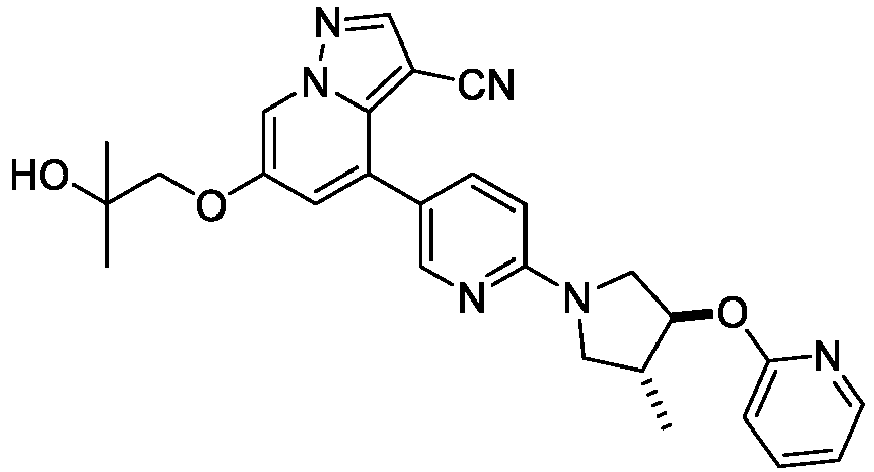
- Step 1: Preparation of tert-butyl (trans)-3-methyl-4-(pyridin-2-yloxy)pyrrolidine-1-carboxylate. To a mixture of tert-butyl (trans)-3-hydroxy-4-methylpyrrolidine-1-carboxylate (303.8 mg, 1.509 mmol) and 2-fluoropyridine (259 µL, 3.019 mmol) in DMA (7.5 mL) was added sodium hydride (60% w/w, 120.7 mg, 3.019 mmol). The reaction mixture was stirred for 16 h at 80°C. After cooling to ambient temperature, the reaction mixture was diluted with EtOAc and washed with water. Then the organic extracts were washed with brine and dried over anhydrous Na2SO4(s), filtered and concentrated in vacuo. The residue was purified by silica chromatography (5-50% EtOAc in hexanes as the gradient eluent) to afford the title compound (assume theoretical yield, 420 mg, 1.509 mmol) in sufficient purity for step 2. MS (apci) m/z = 279.1 (M+H).
- Step 2: Preparation of 2-(((trans)-4-methylpyrrolidin-3-yl)oxy)pyridine. To a solution of tert-butyl (trans)-3-hydroxy-4-methylpyrrolidine-1-carboxylate (assumed 420 mg, 1.509 mmol) in 3 mL DCM was treated with TFA (3 mL, 39.2 mmol). The reaction mixture was stirred for 15 min at ambient temperature, and then concentrated in vacuo. The crude residue was diluted with 4:1 DCM: IPA and washed with saturated NaHCO3(aq). The organic extracts were dried over anhydrous Na2SO4(s), filtered and concentrated in vacuo to afford the title compound (178.6 mg, 66% yield over two steps) in sufficient purity for step 3. MS (apci) m/z = 179.1 (M+H).
- Step 3: Preparation of 6-(2-hydroxy-2-methylpropoxy)-4-(6-((trans)-3-methyl-4-(pyridin-2-yloxy)pyrrolidin-1-yl)pyridin-3-yl)pyrazolo[1,5-a]pyridine-3-carbonitrile. To a mixture of 4-(6-fluoropyridin-3-yl)-6-(2-hydroxy-2-methylpropoxy)pyrazolo[1,5-a]pyridine-3-carbonitrile (Intermediate P42; 35 mg, 0.107 mmol) and 2-(((trans)-4-methylpyrrolidin-3-yl)oxy)pyridine (76.5 mg, 0.428 mmol) in DMA (1.1 mL) was added TEA (145µL, 1.07 mmol). The reaction mixture was stirred 16 h at 90°C. After cooling to ambient temperature, the reaction mixture was diluted with water and extracted with EtOAc. The organic extracts were washed with water. Then the organic extracts were washed with brine and dried over anhydrous Na2SO4(s), filtered and concentrated in vacuo. The reaction was purified by C18 reverse phase chromatography (5-95% ACN in water with 0.1% TFA as the gradient eluent) to afford the title compound as the TFA salt. The TFA salt was treated with saturated NaHCO3(aq) and extracted with 4:1 DCM:IPA. The combined organic extracts were dried over anhydrous Na2SO4(s), filtered and concentrated in vacuo to afford the title compound (38.2 mg, 73.5% yield). MS (apci) m/z = 485.2 (M+H).
-

- Step 1: Preparation of 3,6-difluoro-2-methoxypyridine. To a solution of 2,3,6-Trifluoropyridine (1.00 mL, 11.27 mmol) in MeOH (11 mL) was added sodium methoxide (30% solution in MeOH, 2.5 mL), 13.5 mmol). The reaction solution was stirred for 2 h at 70°C. After cooling to ambient temperature, the reaction mixture was diluted with EtOAc and washed with water. Then the organic extracts were washed with brine and dried over anhydrous Na2SO4(s), filtered and concentrated in vacuo to afford the title compound (257 mg, 16% yield) in sufficient purity for step 2. 1H NMR (400 MHz, DMSO-d6) δ 7.90-7.84 (m, 1H), 6.75-6.72 (m, 1H), 3.92 (s, 3H).
- Step 2: Preparation of tert-butyl (S)-3-((5-fluoro-6-methoxypyridin-2-yl)oxy)pyrrolidine-1-carboxylate. A solution of (S)-1-Boc-3-hydroxypyrrolidine (255 mg, 1.362 mmol) in 13.6 mL DMF was treated with 3,6-difluoro-2-methoxypyridine (256.9 mg, 1.77 mmol) followed by sodium hydride (60% w/w, 163.4 mg, 4.086 mmol). The reaction mixture was stirred for 16 h at 80°C. After cooling to ambient temperature, the reaction mixture was diluted with water and extracted with EtOAc. The organic extracts were washed with water. Then the organic extracts were washed with brine and dried over anhydrous Na2SO4(s), filtered and concentrated in vacuo. The residue was purified by silica chromatography (5-40% EtOAc in Hexanes as the gradient eluent) to afford the title compound (assume theoretical yield, 425 mg, 1.362 mmol) in sufficient purity for step 3. MS (apci) m/z = 213.1 (M-Boc).
- Step 3: Preparation of (S)-3-fluoro-2-methoxy-6-(pyrrolidin-3-yloxy)pyridine. To a solution of tert-butyl (S)-3-((5-fluoro-6-methoxypyridin-2-yl)oxy)pyrrolidine-1-carboxylate (assumed 425 mg, 1.362 mmol) in 3 mL DCM was treated with TFA (3 mL, 39 mmol). The reaction mixture was stirred for 30 min at ambient temperature, and then concentrated in vacuo. The crude residue was diluted with 4:1 DCM: IPA and washed with saturated NaHCO3(aq). The organic extracts were dried over anhydrous Na2SO4(s), filtered and concentrated in vacuo to afford the title compound (222.2 mg, 77% yield over two steps) in sufficient purity for step 4. MS (apci) m/z = 213.1 (M+H).
- Step 4: Preparation of (S)-4-(6-(3-((5-fluoro-6-methoxypyridin-2-yl)oxy)pyrrolidin-1-yl)pyridin-3-yl)-6-(2-hydroxy-2-methylpropoxy)pyrazolo[1,5-a]pyridine-3-carbonitrile. To a solution of 4-(6-fluoropyridin-3-yl)-6-(2-hydroxy-2-methylpropoxy)pyrazolo[1,5-a]pyridine-3-carbonitrile (Intermediate P42; 35.2 mg, 0.108 mmol) in DMA (1.1 mL) was added (S)-3-fluoro-2-methoxy-6-(pyrrolidin-3-yloxy)pyridine (91.6 mg, 0.431 mmol) followed by TEA (145µL, 1.07 mmol). The reaction mixture was stirred 16 h at 90°C. After cooling to ambient temperature, the reaction mixture was diluted with water and extracted with EtOAc. The organic extracts were washed with water. Then the organic extracts were washed with brine and dried over anhydrous Na2SO4(s), filtered and concentrated in vacuo. The reaction was purified by C18 reverse phase chromatography (5-95% ACN in water with 0.1% TFA as the gradient eluent) to afford the title compound as the TFA salt. The TFA salt was treated with saturated NaHCO3(aq) and extracted with 4:1 DCM:IPA. The combined organic extracts were dried over anhydrous Na2SO4(s), filtered and concentrated in vacuo to afford the title compound (44.8 mg, 80.1% yield). MS (apci) m/z = 519.2 (M+H).
-

- To a solution of 4-(6-fluoropyridin-3-yl)-6-(2-hydroxy-2-methylpropoxy)pyrazolo[1,5-a]pyridine-3-carbonitrile (Intermediate P42; 29 mg, 0.09 mmol) and 1-(4-Piperidinyl)-2-pyrrolidinone (30 mg, 0.18 mmol) in DMA (2 mL) was added TEA (61 µL, 0.45 mmol). The reaction mixture was stirred 16 h at 80°C. After cooling to ambient temperature, additional and 1-(4-piperidinyl)-2-pyrrolidinone (30 mg, 0.18 mmol) was added and reaction was stirred 16 h at 80°C. After cooling to ambient temperature, the reaction mixture was diluted with EtOAc and washed with water and brine. The organic extracts were concentrated in vacuo. The residue was purified by C18 reverse phase chromatography (5-95% ACN in water with 0.1% TFA as the gradient eluent) to afford the title compound as the TFA salt. The TFA salt was treated with saturated NaHCO3(aq) and extracted with 4:1 DCM:IPA. The combined organic extracts were dried over anhydrous Na2SO4(s), filtered and concentrated in vacuo to afford the title compound (14.1 mg, 33% yield). MS (apci) m/z = 475.2 (M+H).
-

- Step 1: Preparation of tert-butyl 4-(phenylcarbamoyl)piperidine-1-carboxylate. A mixture of Boc-Inp-OH (253 mg, 1.10 mmol), HATU (504 mg, 1.33 mmol), and aniline (111 µL, 1.22 mmol) in DCM (11 mL) was treated with DIEA (385 µL, 2.21 mmol) and then stirred for 12 h at ambient temperature. The reaction mixture was concentrated in vacuo and the residue was purified by silica chromatography (5-95% EtOAc in Hexanes as the gradient eluent) to afford the title compound (assumed theoretical yield, 338 mg) in sufficient purity for step 2. MS (apci) m/z = 205.1 (M-Boc).
- Step 2: Preparation of N-phenylpiperidine-4-carboxamide. To a solution of tert-butyl 4-(phenylcarbamoyl)piperidine-1-carboxylate (assumed 338 mg, 1.104 mmol) in 2 mL DCM was treated with TFA (2 mL, 26 mmol). The reaction mixture was stirred for 30 min at ambient temperature, and then concentrated in vacuo. The crude residue was diluted with 4:1 DCM: IPA and washed with saturated NaHCO3(aq). The organic extracts were dried over anhydrous Na2SO4(s), filtered and concentrated in vacuo to afford the title compound (67 mg, 30% yield over two steps) in sufficient purity for step 3. MS (apci) m/z = 205.1 (M+H).
- Step 3: Preparation of 1-(5-(3-cyano-6-(2-hydroxy-2-methylpropoxy)pyrazolo[1,5-a]pyridin-4-yl)pyridin-2-yl)-N-phenylpiperidine-4-carboxamide. To a solution of 4-(6-fluoropyridin-3-yl)-6-(2-hydroxy-2-methylpropoxy)pyrazolo[1,5-a]pyridine-3-carbonitrile (Intermediate P42; 28 mg, 0.09 mmol) and N-phenylpiperidine-4-carboxamide (66 mg, 0.32 mmol) in DMA (0.5 mL) was added TEA (59 µL, 0.43 mmol). The reaction mixture was stirred 16 h at 80°C. After cooling to ambient temperature, additional TEA (59 µL, 0.43 mmol) was added and reaction was stirred 16 h at 90°C. After cooling to ambient temperature, the reaction mixture was diluted with EtOAc and washed with water and brine. The organic extracts were concentrated in vacuo. The residue was purified by C18 reverse phase chromatography (5-95% ACN in water with 0.1% TFA as the gradient eluent) to afford the title compound as the TFA salt. The TFA salt was treated with saturated NaHCO3(aq) and extracted with 4:1 DCM:IPA. The combined organic extracts were dried over anhydrous Na2SO4(s), filtered and concentrated in vacuo to afford the title compound (21 mg, 47% yield). MS (apci) m/z = 511.2 (M+H).
-

- Step 1: Preparation of tert-butyl 4-(benzylcarbamoyl)piperidine-1-carboxylate. A mixture of Boc-Inp-OH (250 mg, 1.09 mmol), HATU (498 mg, 1.31 mmol), and benzylamine (131 µL, 1.20 mmol) in DCM (11 mL) was treated with DIEA (380 µL, 2.18 mmol) and then stirred for 60 h at ambient temperature. The reaction mixture was concentrated in vacuo and the residue was purified by silica chromatography (5-95% EtOAc in Hexanes as the gradient eluent) to afford the title compound (assumed theoretical yield, 347 mg) in sufficient purity for step 2. MS (apci) m/z = 219.1 (M-Boc).
- Step 2: Preparation of N-benzylpiperidine-4-carboxamide. To a solution of tert-butyl 4-(benzylcarbamoyl)piperidine-1-carboxylate (assumed 347 mg, 1.09 mmol) in 2 mL DCM was treated with TFA (2 mL, 26 mmol). The reaction mixture was stirred for 30 min at ambient temperature, and then concentrated in vacuo. The crude residue was diluted with 4:1 DCM: IPA and washed with saturated NaHCO3(aq). The organic extracts were dried over anhydrous Na2SO4(s), filtered and concentrated in vacuo to afford the title compound (33 mg, 14% yield over two steps) in sufficient purity for step 3. MS (apci) m/z = 219.2 (M+H).
- Step 3: Preparation of N-benzyl-1-(5-(3-cyano-6-(2-hydroxy-2-methylpropoxy)pyrazolo[1,5-a]pyridin-4-yl)pyridin-2-yl)piperidine-4-carboxamide. To a solution of 4-(6-fluoropyridin-3-yl)-6-(2-hydroxy-2-methylpropoxy)pyrazolo[1,5-a]pyridine-3-carbonitrile (Intermediate P42; 19 mg, 0.06 mmol) and N-benzylpiperidine-4-carboxamide (33 mg, 0.15 mmol) in DMA (0.3 mL) was added TEA (40 µL, 0.29 mmol). The reaction mixture was stirred 16 h at 80°C. After cooling to ambient temperature, additional TEA (40 µL, 0.29 mmol) was added and reaction was stirred 16 h at 90°C. After cooling to ambient temperature, the reaction mixture was diluted with EtOAc and washed with water and brine. The organic extracts were concentrated in vacuo. The residue was purified by C18 reverse phase chromatography (5-95% ACN in water with 0.1% TFA as the gradient eluent) to afford the title compound as the TFA salt. The TFA salt was treated with saturated NaHCO3(aq) and extracted with 4:1 DCM:IPA. The combined organic extracts were dried over anhydrous Na2SO4(s), filtered and concentrated in vacuo to afford the title compound (19 mg, 63% yield). MS (apci) m/z = 525.2 (M+H).
-

- Step 1: Preparation of tert-butyl 4-(pyridin-2-ylthio)piperidine-1-carboxylate. To a solution of tert-butyl 4-mercaptopiperidine-1-carboxylate (205 mg, 0.94 mmol) and 2-iodopyridine (263 mg, 1.28 mmol) in DMF (3.8 mL) was added potassium carbonate (521 mg, 3.8 mmol). The reaction mixture was stirred 16 h at 70°C. The reaction was heated 16 h at 90°C. After cooling to ambient temperature, the reaction mixture was diluted with EtOAc and washed with water and brine. The organic extracts were dried over anhydrous Na2SO4(s), filtered and concentrated in vacuo. The residue was purified using silica chromatography (0-50% EtOAc in Hexanes as the gradient eluent) to afford the title compound (106.2 mg, 361 mmol) in sufficient purity for step 2. MS (apci) m/z = 295.2 (M+H).
- Step 2: Preparation of tert-butyl 4-(pyridin-2-ylsulfonyl)piperidine-1-carboxylate. Tert-butyl 4-(pyridin-2-ylthio)piperidine-1-carboxylate (106 mg, 0.36 mmol) and 3-chlorobenzoperoxoic acid (187 mg, 1.08 mmol) were combined in DCM (3.6 mL) at 0°C. The reaction mixture was warmed to ambient temperatureand stirred for 16h. The reaction mixture was concentrated in vacuo. The residue was diluted with 4:1 DCM:IPA and was washed with saturated NaHCO3(aq) . The organic extracts were concentrated in vacuo. The residue was purified by silica chromatography (0-95% EtOAc in Hexanes as the gradient eluent) to afford the title compound (assumed theoretical yield, 118 mg) in sufficient purity for step 3. MS (apci) m/z = 227.1 (M-Boc).
- Step 3: Preparation of 2-(piperidin-4-ylsulfonyl)pyridine. To a solution of tert-butyl 4-(pyridin-2-ylsulfonyl)piperidine-1-carboxylate (assumed 118 mg, 0.36 mmol) in 2 mL DCM was treated with TFA (2 mL, 26 mmol). The reaction mixture was stirred for 15 min at ambient temperature, and then concentrated in vacuo. The crude residue was diluted with 4:1 DCM: IPA and washed with saturated NaHCO3(aq). The organic extracts were concentrated in vacuo to afford the title compound (47 mg, 57% yield over two steps) in sufficient purity for step 4. MS (apci) m/z = 227.1 (M+H).
- Step 4: Preparation of 6-(2-hydroxy-2-methylpropoxy)-4-(6-(4-(pyridin-2-ylsulfonyl)piperidin-1-yl)pyridin-3-yl)pyrazolo[1,5-a]pyridine-3-carbonitrile. To a solution of 4-(6-fluoropyridin-3-yl)-6-(2-hydroxy-2-methylpropoxy)pyrazolo[1,5-a]pyridine-3-carbonitrile (Intermediate P42; 27 mg, 0.08 mmol) and 2-(piperidin-4-ylsulfonyl)pyridine (57 mg, 0.25 mmol) in DMA (0.5 mL) was added TEA (57 µL, 0.42 mmol). The reaction mixture was stirred 60 h at 80°C. After cooling to ambient temperature, the reaction mixture was diluted with EtOAc and washed with water and brine. The combined organic extracts were dried over anhydrous Na2SO4(s), filtered and concentrated in vacuo. The residue was purified by silica chromatography (0-100% EtOAc in Hexanes as the gradient eluent) to afford the title compound (20 mg, 46% yield). MS (apci) m/z = 533.2 (M+H).
-

- Step 1: Preparation of tert-butyl 4-((cyclopropylmethyl)thio)piperidine-1-carboxylate. To a solution of tert-butyl 4-mercaptopiperidine-1-carboxylate (222 mg, 1.02 mmol) and (Bromomethyl)cyclopropane (184 mg, 1.36 mmol) in DMF (4 mL) was added potassium carbonate (566 mg, 4.09 mmol). The reaction mixture was stirred 60 h at 70°C. After cooling to ambient temperature, the reaction mixture was diluted with EtOAc and washed with water and brine. The organic extracts were dried over anhydrous Na2SO4(s), filtered and concentrated in vacuo. The residue was purified using silica chromatography (5-95% EtOAc in Hexanes as the gradient eluent) to afford the title compound (256 mg, 92% yield) in sufficient purity for the next step. 1H NMR (400 MHz, DMSO-d6) δ 3.81-3.77 (m, 2H), 2.92-2.86 (m, 2H), 2.48-2.47 (d, 2H), 1.89-1.85 (m, 2H), 1.38 (s, 9H), 1.33-1.23 (m, 2H), 0.93-0.89 (m, 1H), 0.51-0.47 (m, 2H), 0.19-0.16 (m, 2H).
- Step 2: Preparation of tert-butyl 4-((cyclopropylmethyl)sulfonyl)piperidine-1-carboxylate. Tert-butyl 4-((cyclopropylmethyl)thio)piperidine-1-carboxylate (256 mg, 0.94 mmol) and 3-chlorobenzoperoxoic acid (187 mg, 1.08 mmol) were combined in DCM (9.5 mL) at 0°C. The reaction mixture was warmed to ambient temperatureand stirred for 16 h. The reaction mixture was concentrated in vacuo. The residue was diluted with 4:1 DCM:IPA and was washed with saturated NaHCO3(aq). The organic extracts were concentrated in vacuo. The residue was purified by silica chromatography (0-95% EtOAc in Hexanes as the gradient eluent) to afford the title compound (assumed theoretical yield, 286 mg) in sufficient purity for step 3. MS (apci) m/z = 204.1 (M-Boc).
- Step 3: Preparation of 4-((cyclopropylmethyl)sulfonyl)piperidine. To a solution of tert-butyl 4-((cyclopropylmethyl)sulfonyl)piperidine-1-carboxylate (assumed 286 mg, 0.94 mmol) in 2 mL DCM was treated with TFA (2 mL, 26 mmol). The reaction mixture was stirred for 15 min at ambient temperature, and then concentrated in vacuo. The crude residue was diluted with 4:1 DCM: IPA and washed with saturated NaHCO3(aq). The organic extracts were concentrated in vacuo to afford the title compound (60 mg, 31% yield over two steps) in sufficient purity for step 4. MS (apci) m/z = 204.1 (M+H).
- Step 4: Preparation of 4-(6-(4-((cyclopropylmethyl)sulfonyl)piperidin-1-yl)pyridin-3-yl)-6-(2-hydroxy-2-methylpropoxy)pyrazolo[1,5-a]pyridine-3-carbonitrile. To a solution of 4-(6-fluoropyridin-3-yl)-6-(2-hydroxy-2-methylpropoxy)pyrazolo[1,5-a]pyridine-3-carbonitrile (Intermediate P42; 28.1 mg, 0.08 mmol) and of 4-((cyclopropylmethyl)sulfonyl)piperidine (53 mg, 0.26 mmol) in DMA (0.5 mL) was added TEA (44 µL, 0.43 mmol). The reaction mixture was stirred 60 h at 80°C. After cooling to ambient temperature, the reaction mixture was diluted with EtOAc and washed with water and brine. The combined organic extracts were dried over anhydrous Na2SO4(s), filtered and concentrated in vacuo. The residue was purified by silica chromatography (0-100% EtOAc in Hexanes as the gradient eluent). Fractions containing the product were concentrated in vacuo. Residue was purified by silica chromatography (0-95% EtOAc in Hexanes as the gradient eluent) and product-containing fractions were concentrated in vacuo. Residue was purified by C18 reverse phase chromatography (5-95% ACN in water with 0.1% TFA as the gradient eluent) to afford the title compound as the TFA salt. The TFA salt was treated with saturated NaHCO3(aq) and extracted with 4:1 DCM:IPA. The combined organic extracts were dried over anhydrous Na2SO4(s), filtered and concentrated in vacuo to afford the title compound (21 mg, 48% yield). MS (apci) m/z = 510.2 (M+H).
-

- Step 1: Preparation of tert-butyl 4-(benzylthio)piperidine-1carboxylate. To a solution of tert-butyl 4-mercaptopiperidine-1-carboxylate (211 mg, 0.97 mmol) and Benzyl bromide (200 mg, 1.17 mmol) in DMF (3.9 mL) was added potassium carbonate (537 mg, 3.89 mmol). The reaction mixture was stirred 60 h at 70°C. After cooling to ambient temperature, the reaction mixture was diluted with EtOAc and washed with water and brine. The organic extracts were concentrated in vacuo. The residue was purified using silica chromatography (1-50 % EtOAc in Hexanes as the gradient eluent) to afford the title compound (290 mg, 97 % yield) in sufficient purity for step 2. MS (apci) m/z = 208.1 (M-Boc).
- Step 2: Preparation of tert-butyl 4-(benzylsulfonyl)piperidine-1-carboxylate. Tert-butyl 4-(benzylthio)piperidine-1-carboxylate (290 mg, 0.94 mmol) and 3-chlorobenzoperoxoic acid (489 mg, 1.08 mmol) were combined in DCM (9.5 mL) at 0°C. The reaction mixture was warmed to ambient temperatureand stirred for 16 h. The reaction mixture was concentrated in vacuo. The residue was diluted with 4:1 DCM:IPA and was washed with saturated NaHCO3(aq). The organic extracts were concentrated in vacuo. The residue was purified by silica chromatography (0-95% EtOAc in Hexanes as the gradient eluent) to afford the title compound (assumed theoretical yield, 320 mg) in sufficient purity for step 3. MS (apci) m/z = 240.1 (M-Boc).
- Step 3: Preparation of 4-(benzylsulfonyl)piperidine. To a solution of tert-butyl 4-(benzylsulfonyl)piperidine-1-carboxylate (assumed 320 mg, 0.94 mmol) in 2 mL DCM was treated with TFA (2 mL, 26 mmol). The reaction mixture was stirred for 15 min at ambient temperature, and then concentrated in vacuo. The crude residue was diluted with 4:1 DCM: IPA and washed with saturated NaHCO3(aq). The organic extracts were concentrated in vacuo to afford the title compound (138 mg, 61% yield over two steps) in sufficient purity for step 4. MS (apci) m/z = 240.1 (M+H).
- Step 4: Preparation of 4-(6-(4-(benzylsulfonyl)piperidin-1-yl)pyridin-3-yl)-6-(2-hydroxy-2-methylpropoxy)pyrazolo[1,5-a]pyridine-3-carbonitrile. To a solution of 4-(6-fluoropyridin-3-yl)-6-(2-hydroxy-2-methylpropoxy)pyrazolo[1,5-a]pyridine-3-carbonitrile (Intermediate P42; 24 mg, 0.074 mmol) and of 4-(benzylsulfonyl)piperidine (53 mg, 0.22 mmol) in DMA (0.5 mL) was added TEA (50 µL, 0.37 mmol). The reaction mixture was stirred 76 h at 80°C. After cooling to ambient temperature, the reaction mixture was diluted with EtOAc and washed with water and brine. The combined organic extracts were dried over anhydrous Na2SO4(s), filtered and concentrated in vacuo. The residue was purified by silica chromatography (0-100% EtOAc in Hexanes as the gradient eluent). Fractions containing the product were concentrated in vacuo. Residue was purified by C18 reverse phase chromatography (5-95% ACN in water with 0.1% TFA as the gradient eluent) to afford the title compound as the TFA salt. The TFA salt was treated with saturated NaHCO3(aq) and extracted with 4:1 DCM:IPA. The combined organic extracts were dried over anhydrous Na2SO4(s), filtered and concentrated in vacuo to afford the title compound (23 mg, 57% yield). MS (apci) m/z = 546.2 (M+H).
-

- Step 1: Preparation of tert-butyl 4-ethyl-4-(phenylcarbamoyl)piperidine-1-carboxylate. A mixture of 1-(tert-butoxycarbonyl)-4-ethylpiperidine-4-carboxylic acid (270 mg, 1.05 mmol), HATU (478 mg, 1.26 mmol), and aniline (105 µL, 1.15 mmol) in DMF (3.9 mL) was treated with DIEA (365 µL, 2.1 mmol) and then stirred for 60 h at 60°C. After cooling to ambient temperature, the reaction mixture was diluted with EtOAc and washed with water and brine. The combined organic extracts were dried over anhydrous Na2SO4(s), filtered and concentrated in vacuo. The residue was purified by silica chromatography (0-100% EtOAc in Hexanes as the gradient eluent) to afford the title compound (assumed theoretical yield, 348 mg) in sufficient purity for step 2. MS (apci) m/z = 233.2 (M-Boc).
- Step 2: Preparation of 4-ethyl-N-phenylpiperidine-4-carboxamide. To a solution of tert-butyl 4-ethyl-4-(phenylcarbamoyl)piperidine-1-carboxylate (assumed 348 mg, 1.05 mmol) in 2 mL DCM was treated with TFA (2 mL, 26 mmol). The reaction mixture was stirred for 1 h at ambient temperature, and then concentrated in vacuo. The crude residue was diluted with 4:1 DCM: IPA and washed with saturated NaHCO3(aq). The organic extracts were dried over anhydrous Na2SO4(s), filtered and concentrated in vacuo to afford the title compound (162 mg, 67% yield over two steps) in sufficient purity for step 3. MS (apci) m/z = 233.1 (M+H).
- Step 3: Preparation of 1-(5-(3-cyano-6-(2-hydroxy-2-methylpropoxy)pyrazolo[1,5-a]pyridin-4-yl)pyridin-2-yl)-4-ethyl-N-phenylpiperidine-4-carboxamide. To a solution of 4-(6-fluoropyridin-3-yl)-6-(2-hydroxy-2-methylpropoxy)pyrazolo[1,5-a]pyridine-3-carbonitrile (Intermediate P42; 20 mg, 0.06 mmol) and 4-ethyl-N-phenylpiperidine-4-carboxamide (42 mg, 0.18 mmol) in DMA (0.24 mL) was added TEA (41 µL, 0.30 mmol). The reaction mixture was stirred 16 h at 90°C. After cooling to ambient temperature, the reaction mixture was diluted with EtOAc and washed with water and brine. The organic extracts were concentrated in vacuo. The residue was purified by C18 reverse phase chromatography (5-95% ACN in water with 0.1% TFA as the gradient eluent) to afford the title compound as the TFA salt. The TFA salt was treated with saturated NaHCO3(aq) and extracted with 4:1 DCM:IPA. The combined organic extracts were dried over anhydrous Na2SO4(s), filtered and concentrated in vacuo. The residue was repurified using silica chromatography (0-100% EtOAc in Hexanes) to afford the title compound (27 mg, 82% yield). MS (apci) m/z = 539.3 (M+H).
-

- 6-(2-hydroxy-2-methylpropoxy)-4-(6-(4-(pyridin-2-ylthio)piperidin-1-yl)pyridin-3-yl)pyrazolo[1,5-a]pyridine-3-carbonitrile (Intermediate P54, 27 mg, 0.054 mmol) and 3-chloroperoxybenzoic acid (93 mg, 0.54 mmol) were combined in EtOH (270 µL). The reaction was stirred overnight at ambient temperature. The reaction mixture was concentrated in vacuo. The residue was suspended in 60:40 ACN:water containing 2% TFA. The solution was purified directly by C18 reverse phase chromatography (5-95% ACN in water with 0.1% TFA as the gradient eluent) to afford the title compound as the TFA salt. The TFA salt was treated with saturated NaHCO3(aq) and extracted with DCM. The combined organic extracts were washed with brine, then dried over anhydrous Na2SO4(s), filtered and concentrated in vacuo to afford the title compound (13.9 mg, 50% yield). MS (apci) m/z = 517.2 (M+H).
-

- A mixture of (R)-4-(6-(3-amino-3-methylpyrrolidin-1-yl)pyridin-3-yl)-6-(2-hydroxy-2-methylpropoxy)pyrazolo[1,5-a]pyridine-3-carbonitrile bis(2,2,2-trifluoroacetate)(Intermediate P49; 40 mg, 0.098 mmol), HATU (75 mg, 0.20 mmol), and benzoic acid (24 mg, 0.20 mmol) in ACN (600 µL) was treated with DIEA (86 µL, 0.49 mmol) and then stirred for 12 h at ambient temperature. The reaction mixture was diluted with 60:40 ACN:water containing 2% TFA. The solution was purified directly by C18 reverse phase chromatography (5-95% ACN in water with 0.1% TFA as the gradient eluent) to afford the title compound as the TFA salt. The TFA salt was treated with saturated NaHCO3(aq) and extracted with EtOAc. The combined organic extracts were washed with brine, then dried over anhydrous MgSO4(s), filtered and concentrated in vacuo to afford the title compound (15 mg, 46% yield). MS (apci) m/z = 511.3 (M+H).
- The compounds in Table JJ were prepared using a similar method to that described for the synthesis of Example 224, replacing benzoic acid with the appropriate carboxylic acid. Reactions were monitored for completion by LCMS, and reaction durations were adjusted accordingly. Title compounds were cleanly isolated following chromatographic purification using an appropriate gradient eluent (and if necessary converted to the free base).
Table JJ Ex. # Structure Chemical Name LCMS m/z 225 
(R)-N-(1-(5-(3-cyano-6-(2-hydroxy-2-methyl propoxy)pyrazolo[ 1,5-a]pyridin-4-yl)pyridin-2-yl)-3-methylpyrrolidin-3 -yl)-2- 525.3 (M+H) phenylacetamide 226 
(R)-N-(1-(5-(3-cyano-6-(2-hydroxy-2-methyl propoxy)pyrazolo[ 1,5-a]pyridin-4-yl)pyridin-2-yl)-3-methylpyrrolidin-3 -yl)-2,3 -difluorobenzamide 547.3 (M+H) 227 
(R)-N-(1-(5-(3-cyano-6-(2-hydroxy-2-methyl propoxy)pyrazolo[ 1,5-a]pyridin-4-yl)pyridin-2-yl)-3-methylpyrrolidin-3 -yl)-2,6-difluorobenzamide 547.3 (M+H) 228 
(R)-N-(1-(5-(3-cyano-6-(2-hydroxy-2-methylpropoxy)pyrazolo[ 1,5-a]pyridin-4-yl)pyridin-2-yl)-3-methylpyrrolidin-3-yl)-5-fluoro-2-methylbenzamide 543.3 (M+H) 229 
(R)-3-chloro-N-(1-(5-(3-cyano-6-(2-hydroxy-2-methylpropoxy)pyrazolo[ 1,5-a]pyridin-4-yl)pyridin-2-yl)-3-methylpyrrolidin-3-yl)picolinamide 546.3 (M+H) 230 
(R)-N-(1-(5-(3-cyano-6-(2-hydroxy-2-methylpropoxy)pyrazolo[ 1,5-a]pyridin-4-yl)pyridin-2-yl)-3-methylpyrrolidin-3-yl)cyclopropanecarboxa mide 475.3 (M+H) -

- A mixture of (S)-4-(6-(3-amino-3-methylpyrrolidin-1-yl)pyridin-3-yl)-6-(2-hydroxy-2-methylpropoxy)pyrazolo[1,5-a]pyridine-3-carbonitrile bis(2,2,2-trifluoroacetate) (Intermediate P50; 30 mg, 0.047 mmol), HATU (56 mg, 0.15 mmol), and benzoic acid (18 mg, 0.15 mmol) in ACN (600 µL) was treated with DIEA (64 µL, 0.37 mmol) and then stirred for 12 h at ambient temperature. The reaction mixture was diluted with 60:40 ACN:water containing 2% TFA. The solution was purified directly by C18 reverse phase chromatography (5-95% ACN in water with 0.1% TFA as the gradient eluent) to afford the title compound as the TFA salt. The TFA salt was treated with saturated NaHCO3(aq) and extracted with EtOAc. The combined organic extracts were washed with brine, then dried over anhydrous MgSO4(s), filtered and concentrated in vacuo to afford the title compound (12 mg, 51% yield). MS (apci) m/z = 511.3 (M+H).
- The compounds in Table KK were prepared using a similar method to that described for the synthesis of Example 231, replacing benzoic acid with the appropriate carboxylic acid. Reactions were monitored for completion by LCMS, and reaction durations were adjusted accordingly. Title compounds were cleanly isolated following chromatographic purification using an appropriate gradient eluent (and if necessary converted to the free base).
Table KK Ex. # Structure Chemical Name LCMS m/z 232 
(S)-N-(1-(5-(3-cyano-6-(2-hydroxy-2-methylpropoxy)pyrazolo[1 ,5-a]pyridin-4-yl)pyridin-2-yl)-3 -methylpyrrolidin-3 -yl)-2-phenylacetamide 525.3 (M+H) 233 
(S)-N-(1-(5-(3-cyano-6-(2-hydroxy-2-methylpropoxy)pyrazolo[1 ,5-a]pyridin-4-yl)pyridin- 547.3 (M+H) 2-yl)-3 -methylpyrrolidin-3-yl)-2,3-difluorobenzamide 234 
(S)-N-(1-(5-(3-cyano-6-(2-hydroxy-2-methylpropoxy)pyrazolo[1 ,5-a]pyridin-4-yl)pyridin-2-yl)-3 -methylpyrrolidin-3-yl)-2,6-difluorobenzamide 547.2 (M+H) 235 
(S)-N-(1-(5-(3-cyano-6-(2-hydroxy-2-methylpropoxy)pyrazolo[1 ,5-a]pyridin-4-yl)pyridin-2-yl)-3 -methylpyrrolidin-3-yl)-5-fluoro-2-methylbenzamide 543.3 (M+H) 236 
(S)-N-(1-(5-(3-cyano-6-(2-hydroxy-2-methylpropoxy)pyrazolo[1 ,5-a]pyridin-4-yl)pyridin-2-yl)-3 -methylpyrrolidin-3 -yl)-3 -fluoropicolinamide 530.2 (M+H) 237 
(S)-3-chloro-N-(1-(5-(3-cyano-6-(2-hydroxy-2-methylpropoxy)pyrazolo[1 ,5-a]pyridin-4-yl)pyridin-2-yl)-3 -methylpyrrolidin-3-yl)picolinamide 546.2 (M+H) 238 
(S)-N-(1-(5-(3-cyano-6-(2-hydroxy-2-methylpropoxy)pyrazolo[1 ,5-a]pyridin-4-yl)pyridin-2-yl)-3 -methylpyrrolidin-3-yl)cyclopropanecarboxami de 475.3 (M+H) 239 
(S)-2-chloro-N-(1-(5-(3-cyano-6-(2-hydroxy-2-methylpropoxy)pyrazolo[1 ,5-a]pyridin-4-yl)pyridin-2-yl)-3 -methylpyrrolidin-3-yl)benzamide 545.2 (M+H) 240 
(S)-N-(1-(5-(3-cyano-6-(2-hydroxy-2-methylpropoxy)pyrazolo[1 ,5-a]pyridin-4-yl)pyridin-2-yl)-3 -methylpyrrolidin-3 -yl)-2-fluorobenzamide 529.3 (M+H) 241 
(S)-N-(1-(5-(3-cyano-6-(2-hydroxy-2-methylpropoxy)pyrazolo[1 ,5-a]pyridin-4-yl)pyridin-2-yl)-3 -methylpyrrolidin-3-yl)-3-fluorobenzamide 529.2 (M+H) -

- A mixture of 4-(6-(3-aminopyrrolidin-1-yl)pyridin-3-yl)-6-(2-hydroxy-2-methylpropoxy)pyrazolo[1,5-a]pyridine-3-carbonitrile bis(2,2,2-trifluoroacetate) (Intermediate P51; 40 mg, 0.064 mmol), HATU (78 mg, 0.20 mmol), and benzoic acid (25 mg, 0.20 mmol) in ACN (600 µL) was treated with DIEA (89 µL, 0.51 mmol) and then stirred for 12 h at ambient temperature. The reaction mixture was diluted with 60:40 ACN:water containing 2% TFA. The solution was purified directly by C18 reverse phase chromatography (5-95% ACN in water with 0.1% TFA as the gradient eluent) to afford the title compound as the TFA salt. The TFA salt was treated with saturated NaHCO3(aq) and extracted with EtOAc. The combined organic extracts were washed with brine, then dried over anhydrous MgSO4(s), filtered and concentrated in vacuo to afford the title compound (15 mg, 47% yield). MS (apci) m/z = 497.2 (M+H).
- The compounds in Table LL were prepared using a similar method to that described for the synthesis of Example 242, replacing benzoic acid with the appropriate carboxylic acid. Reactions were monitored for completion by LCMS, and reaction durations were adjusted accordingly. Title compounds were cleanly isolated following chromatographic purification using an appropriate gradient eluent (and if necessary converted to the free base).
Table LL Ex. # Structure Chemical Name LCMS m/z 243 
N-(1-(5-(3-cyano-6-(2-hydroxy-2-methylpropoxy)pyrazolo[1 ,5-a]pyridin-4-yl)pyridin-2-yl)pyrrolidin-3 -yl)-2,3 - difluorobenzamide 533.2 (M+H) 244 
N-(1-(5-(3-cyano-6-(2-hydroxy-2-methylpropoxy)pyrazolo[1 ,5-a]pyridin-4-yl)pyridin-2-yl)pyrrolidin-3 -yl)-2,6-difluorobenzamide 533.2 (M+H) 245 
N-(1-(5-(3-cyano-6-(2-hydroxy-2-methylpropoxy)pyrazolo[1 ,5-a]pyridin-4-yl)pyridin-2-yl)pyrrolidin-3 -yl)-3 - fluoropicolinamide 516.3 (M+H) 246 
3-chloro-N-(1-(5-(3-cyano-6-(2-hydroxy-2-methylpropoxy)pyrazolo[1 ,5-a]pyridin-4-yl)pyridin-2-yl)pyrrolidin-3-yl)picolinamide 532.2 (M+H) -

- To a solution of 4-(6-fluoropyridin-3-yl)-6-(2-hydroxy-2-methylpropoxy)pyrazolo[1,5-a]pyridine-3-carbonitrile (Intermediate P42; 40 mg, 0.123 mmol) in DMA (1.2 mL) was added 2-(piperidin-4-yloxy)pyrimidine (242 mg, 0.135 mmol) followed by TEA (33.5µL, 0.245 mmol). The reaction mixture was sparged with argon and stirred overnight at 90°C. Then additional 2-(piperidin-4-yloxy)pyrimidine (242 mg, 0.135 mmol) and TEA (33.5µL, 0.245 mmol) and the reaction was stirred for 8 h at 110°C and then the reaction temperature was lowered to 90°C where it was stirred at for 60 h. After cooling to ambient temperature, the reaction mixture was diluted with water and extracted with DCM. The organic extracts were washed with water. Then the organic extracts were washed with brine and dried over anhydrous Na2SO4(s), filtered and concentrated in vacuo. The reaction was purified by silica chromatography (40-99% EtOAc in hexanes as the gradient eluent) to afford the title compound (20.8 mg, 35% yield). MS (apci) m/z = 486.2 (M+H).
-

- To a solution of 4-(6-fluoropyridin-3-yl)-6-(2-hydroxy-2-methylpropoxy)pyrazolo[1,5-a]pyridine-3-carbonitrile (Intermediate P42; 25 mg, 0.077 mmol) in DMA (38 mL) was added 2-(piperidin-4-yloxy)pyrazine (13.7 mg, 0.077 mmol) followed by TEA (21 µL,0.153 mmol). The reaction mixture was sparged with argon and stirred for 60 h at 90°C. After cooling to ambient temperature, the reaction mixture was diluted with DCM the organic extracts were washed with saturated NaHCO3(aq) and then water. Then the organic extracts were washed with brine and dried over anhydrous Na2SO4(s), filtered and concentrated in vacuo. The residue was resuspended in 1 mL DCM and was purified by silica chromatography (40-99% EtOAc in hexanes as the gradient eluent) to afford the title compound (12.3 mg, 33.1% yield). MS (apci) m/z = 486.2 (M+H).
-

- To a solution of 4-(6-fluoropyridin-3-yl)-6-(2-hydroxy-2-methylpropoxy)pyrazolo[1,5-a]pyridine-3-carbonitrile (Intermediate P42; 51.1 mg, 0.157 mmol) in DMA (78 mL) was added 5-chloro-2-(piperidin-4-yloxy)pyridine (40 mg, 0.188 mmol) followed by TEA (43µL, 0.313 mmol). The reaction mixture was stirred for 48 h at 90°C. After cooling to ambient temperature, the reaction mixture was diluted with DCM the organic extracts were washed with saturated NaHCO3(aq) and then water. Then the organic extracts were washed with brine and dried over anhydrous Na2SO4(s), filtered and concentrated in vacuo. The reaction was purified by silica chromatography (40-75% EtOAc in hexanes as the gradient eluent) to afford the title compound (16.1 mg, 20% yield). MS (apci) m/z = 519.2 (M+H).
-

- Step 1: Preparation of tert-butyl 4-((5-chloro-3-fluoropyridin-2-yl)oxy)pipendine-1-carboxylate. To a solution of tert-butyl-4-hydroxy-1-piperidinecarboxylate (135 mg, 0.67 mmol) in DMF (2.2 mL) was added sodium hydride (60% w/w, 113 mg, 2.825 mmol). The mixture stirred at ambient temperature for 30 minutes and then 5-chloro-2,3-difluoropyridine (100 mg, 0.67 mmol) was added. The reaction mixture was stirred for 60 h at 60°C. After cooling to ambient temperature, the reaction mixture was diluted with DCM and washed with saturated NaHCO3(aq) and then water. Then the organic extracts were washed with brine and dried over anhydrous Na2SO4(s), filtered and concentrated in vacuo to afford the title compound (assume theoretical yield, 222 mg, 0.671 mmol) in sufficient purity for step 2. MS (apci) m/z = 213.1 (M-Boc).
- Step 2: Preparation of 5-chloro-3-fluoro-2-(piperidin-4-yloxy)pyridine. To a solution of tert-butyl 4-((5-chloro-3-fluoropyridin-2-yl)oxy)piperidine-1-carboxylate (assumed 222 mg, 0.671 mmol) in 3.4 mL DCM was treated with TFA (3.4 mL, 43.6 mmol). The reaction mixture was stirred for 16 h at ambient temperature, and then concentrated in vacuo. The crude residue was resuspended in DCM (1 mL). The solution was purified by silica chromatography 1-10% MeOH in DCM with 0.1-1% NH4OH as the gradient eluent) to provide the title compound (56 mg, 36% yield) in sufficient purity for step 3. MS (apci) m/z=231.1 (M+H).
- Step 3: Preparation of 4-(6-(4-((5-chloro-3-fluoropyridin-2-yl)oxy)piperidin-1-yl)pyridin-3-yl)-6-(2-hydroxy-2-methylpropoxy)pyrazolo[1,5-a]pyridine-3-carbonitrile. To a mixture of 4-(6-fluoropyridin-3-yl)-6-(2-hydroxy-2-methylpropoxy)pyrazolo[1,5-a]pyridine-3-carbonitrile (Intermediate P42; 25 mg, 0.77 mmol) and 5-chloro-3-fluoro-2-(piperidin-4-yloxy)pyridine (35 mg, 0.153 mmol) in DMA (0.4 mL) was added TEA (52 µL, 0.383 mmol). The reaction mixture was stirred overnight at 90°C. After cooling to ambient temperature, the reaction mixture was diluted with DCM and washed with saturated NaHCO3(aq) and then water. Then the organic extracts were washed with brine and dried over anhydrous Na2SO4(s), filtered and concentrated in vacuo. The residue was purified by silica chromatography (25-99% EtOAc in hexanes as the gradient eluent) to afford the title compound (8.2 mg, 20% yield). MS (apci) m/z = 357.1 (M+H).
-

- Step 1: Preparation of tert-butyl 4-((-chloropyridin-3-yl)oxy)piperidine-1-carboxylate. A solution of 5-Chloro-3-pyridinol (1.018 g, 0.786 mmol) and tert-butyl 4-hydroxypiperidine-1-carboxylate (1.582 mg, 0.786 mmol) in THF was treated with PPh3 (227 mg, 0.864 mmol), then sparged with Ar(g) for 5 min. While stirring at ambient temperature, the mixture was treated slowly with DIAD (186 µL, 0.959 mmol). The resulting reaction mixture was stirred for 5 h at 70°C and then allowed to cool to ambient temperature. The reaction was diluted with DCM and washed with saturated Na2CO3(aq), water and brine. The combined organic extracts were dried over anhydrous Na2SO4(s), filtered and concentrated in vacuo to afford the title compound (246 mg, assumed quantitative yield). MS (apci) m/z = 213.1 (M-Boc).
- Step 2: Preparation of 3-chloro-5-(piperidin-4-yloxy)pyridine dihydrochloride. To a solution of tert-butyl 4-((5-chloropyridin-3-yl)oxy)piperidine-1-carboxylate (264 mg, 0.844 mmol) in 4.2 mL DCM was treated with TFA (4.2 mL, 54.5 mmol). The reaction mixture was stirred for 16 h at ambient temperature, and then concentrated in vacuo. The crude residue was resuspended in MeOH and treated with then treated with 4 N HCl in dioxanes (5 mL). The solution was stirred at ambient temperature and concentrated in vacuo to provide the title compound as a dihydrochloride salt, which was used in the next step without further purifications. MS (apci) m/z=213.1(M+H).
- Step 3: Preparation of 4-(6-(4-((5-chloropyridin-3-yl)oxy)piperidin-1-yl)pyridin-3-yl)-6-(2-hydroxy-2-methylpropoxy)pyrazolo[1,5-a]pyridine-3-carbonitrile. To a mixture of 4-(6-fluoropyridin-3-yl)-6-(2-hydroxy-2-methylpropoxy)pyrazolo[1,5-a]pyridine-3-carbonitrile (Intermediate P42; 40 mg, 0.123 mmol) and 3-chloro-5-(piperidin-4-yloxy)pyridine dihydrochloride (35 mg, 0.123 mmol) in DMA (0.6 mL) was added TEA (84 µL, 0.613 mmol). The reaction mixture was stirred overnight at 105°C. The reaction was maintained at 90 °C for 60 h. After cooling to ambient temperature, the reaction mixture was diluted with DCM and washed with water. Then the organic extracts were washed with brine and dried over anhydrous Na2SO4(s), filtered and concentrated in vacuo. The residue was suspended in 60:40 ACN:water containing 2% TFA. The solution was purified directly by C18 reverse phase chromatography (5-95% ACN in water with 0.1% TFA as the gradient eluent) to afford the title compound as the TFA salt. The TFA salt was treated with saturated NaHCO3(aq) and extracted with DCM. The combined organic extracts were washed with brine, then dried over anhydrous Na2SO4(s), filtered and concentrated in vacuo to afford the title compound (8.1 mg, 13% yield). MS (apci) m/z = 519.20 (M+H).
-

- Step 1: Preparation of tert-butyl 4-(5-methoxypyridin-2-yl)oxy)piperidine-1-carboxylate. To a solution of tert-butyl 4-hydroxypiperidine-1-carboxylate (158 mg, 0.787 mmol) in DMF (2 mL) was added sodium hydride (60% w/w, 38 mg, 0.944 mmol). The reaction was stirred for 10 min at ambient temperature. Then 2-fluoro-5-methoxypyridine (100 mg, 0.787 mmol) was added and reaction stirred overnight at 60°C. The reaction was heated to 70°C for an additional overnight. The reaction was cooled to ambient temperature and additional of tert-butyl 4-hydroxypiperidine-1-carboxylate (316 mg, 1.574 mmol) and sodium hydride (60% w/w, 76 mg, 1.888 mmol) was added and reaction was stirred for 60 h at 70°C. The reaction was cooled to ambient temperature and diluted with DCM and washed water and brine. The combined organic extracts were dried over anhydrous Na2SO4(s), filtered and concentrated in vacuo to afford the title compound (243 mg, assumed quantitative yield). MS (apci) m/z = 253.1 (M-Bu t ).
- Step 2: Preparation of 5-methoxy-2-(piperidin-4-yloxy)pyridine dihydrochloride. To a solution of tert-butyl 4-((5-methoxypyridin-2-yl)oxy)piperidine-1-carboxylate (assumed 243 mg, 0.786 mmol) in 2 mL DCM was treated with TFA (2 mL, 26 mmol). The reaction mixture was stirred for 1 h at ambient temperature, and then concentrated in vacuo. The crude residue was resuspended in MeOH and treated with then treated with 4 N HCl in dioxanes (4 mL). The solution was stirred at ambient temperature and concentrated in vacuo to provide the title compound as a dihydrochloride salt (221 mg, 100% yield), which was used in the next step without further purifications.
- Step 3: Preparation of 6-(2-hydroxy-2-methylpropoxy)-4-(6-(4-((5-methoxypyridin-2-yl)oxy)piperidin-1-yl)pyridin-3-yl)pyrazolo[1,5-a]pyridine-3-carbonitrile. To a mixture of 4-(6-fluoropyridin-3-yl)-6-(2-hydroxy-2-methylpropoxy)pyrazolo[1,5-a]pyridine-3-carbonitrile (Intermediate P42; 25 mg, 0.077 mmol) and 5-methoxy-2-(piperidin-4-yloxy)pyridine dihydrochloride (43 mg, 0.153 mmol) in DMA (0.4 mL) was added TEA (52 µL, 0.383 mmol). The reaction mixture was stirred overnight at 105°C. After cooling to ambient temperature, the reaction mixture was diluted with DCM and washed with saturated NaHCO3(aq), water, and brine. The organic extracts were dried over anhydrous Na2SO4(s), filtered and concentrated in vacuo. The residue was suspended in 60:40 ACN:water containing 2% TFA. The solution was purified directly by C18 reverse phase chromatography (5-95% ACN in water with 0.1% TFA as the gradient eluent) to afford the title compound as the TFA salt. The TFA salt was treated with saturated NaHCO3(aq) and extracted with DCM. The combined organic extracts were washed with brine, then dried over anhydrous Na2SO4(s), filtered and concentrated in vacuo to afford the title compound (4.3 mg, 11% yield). MS (apci) m/z = 515.30 (M+H). 1H-NMR (CDCl3, 400 MHz) δ 8.34 (m, 1 H), 8.20 (s, 1 H), 8.14 (d, 1 H), 7.81 (d, 1 H), 7.69-7.72 (m, 1 H), 7.20-7.24 (m, 1 H), 7.14 (m, 1 H), 6.81 (d, 1 H), 6.68 (m, 1 H), 5.20-5.26 (m, 1 H), 4.03-4.08 (m, 2 H), 3.86 (s, 2 H), 3.82 (s, 3 H), 3.50-3.56 (m, 2 H), 2.09-2.14 (m, 2 H), 2.04 (s, 1 H), 1.82-1.89 (m, 2 H), 1.40 (s, 6 H).
-

- Step 1: Preparation of tert-butyl 4-((5-fluoropyridin-2-yl)oxy)piperidine-1-carboxylate. To a solution of tert-butyl 4-hydroxypiperidine-1-carboxylate (175 mg, 0.869 mmol) in DMF (2.9 mL) was added sodium hydride (60% w/w, 41.7 mg, 1.043 mmol). The reaction was stirred for 10 min at ambient temperature. 2,5-Difluoropyridine (100 mg, 0.869 mmol) was added and reaction stirred overnight at 60°C. The reaction was heated to 70°C for an additional overnight. The reaction was cooled to ambient temperature and additional of tert-butyl 4-hydroxypiperidine-1-carboxylate (316 mg, 1.574 mmol) and sodium hydride (60% w/w, 76 mg, 1.888 mmol) was added and reaction was stirred for 4 h at 70°C. The reaction was cooled to ambient temperature and diluted with DCM and washed water and brine. The combined organic extracts were dried over anhydrous Na2SO4(s), filtered and concentrated in vacuo to afford the title compound (257.5 mg, assumed quantitative yield). MS (apci) m/z = 197.10 (M-Boc).
- Step 2: Preparation of 5-methoxy-2-(piperidin-4-yloxy)pyridine dihydrochloride. To a solution of tert-butyl 4-((5-fluoropyridin-2-yl)oxy)piperidine-1-carboxylate (assumed 257.5 mg, 0.869 mmol) in 2 mL DCM was treated with 4 N HCl in dioxanes (4 mL). The solution was stirred at ambient temperature for 15 min and concentrated in vacuo to provide the title compound as a dihydrochloride salt (202 mg, 100% yield) in sufficient purity for step 3 MS (apci) m/z = 197.10 (M+H).
- Step 3: Preparation of 4-(6-(4-((5-fluoropyridin-2-yl)oxy)piperidin-1-yl)pyridin-3-yl)-6-(2-hydroxy-2-methylpropoxy)pyrazolo[1,5-a]pyridine-3-carbonitrile. To a mixture of 4-(6-fluoropyridin-3-yl)-6-(2-hydroxy-2-methylpropoxy)pyrazolo[1,5-a]pyridine-3-carbonitrile (Intermediate P42; 35 mg, 0.107 mmol) and 5-methoxy-2-(piperidin-4-yloxy)pyridine dihydrochloride (87 mg, 0.322 mmol) in DMA (0.4 mL) was added TEA (117 µL, 0.858 mmol). The reaction mixture was stirred overnight at 105°C. After cooling to ambient temperature, the reaction mixture was diluted with DCM and washed with water and brine. The organic extracts were dried over anhydrous Na2SO4(s), filtered and concentrated in vacuo. The residue was suspended in 60:40 ACN:water containing 2% TFA. The solution was purified directly by C18 reverse phase chromatography (5-95% ACN in water with 0.1% TFA as the gradient eluent) to afford the title compound as the TFA salt. The TFA salt was treated with saturated NaHCO3(aq) and extracted with DCM. The combined organic extracts were washed with brine, then dried over anhydrous Na2SO4(s), filtered and concentrated in vacuo to afford the title compound (7.7 mg, 14% yield). MS (apci) m/z = 503.20 (M+H).
-

- To a mixture of 4-(6-fluoropyridin-3-yl)-6-(2-hydroxy-2-methylpropoxy)pyrazolo[1,5-a]pyridine-3-carbonitrile (Intermediate P42; 35 mg, 0.107 mmol) and 2-(piperidin-4-yloxy)-5-(trifluoromethyl)pyridine dihydrochloride (79 mg, 0.322 mmol) in DMA (0.4 mL) was added TEA (117 µL, 0.858 mmol). The reaction mixture was stirred overnight at 105°C. After cooling to ambient temperature, the reaction mixture was diluted with DCM and washed with water and brine. The organic extracts were dried over anhydrous Na2SO4(s), filtered and concentrated in vacuo. The residue was suspended in 60:40 ACN:water containing 2% TFA. The solution was purified directly by C18 reverse phase chromatography (5-95% ACN in water with 0.1% TFA as the gradient eluent) to afford the title compound as the TFA salt. The TFA salt was treated with saturated NaHCO3(aq) and extracted with DCM. The combined organic extracts were washed with brine, then dried over anhydrous Na2SO4(s), filtered and concentrated in vacuo to afford the title compound (14.6 mg, 25% yield). MS (apci) m/z = 553.20 (M+H).
-

- Step 1: Preparation of tert-butyl 4-methyl-4-(pyridin-2-yloxy)piperidine-1-carboxylate. To a solution of tert-Butyl 4-hydroxy-4-methylpiperidine-1-carboxylate (266 mg, 1.24 mmol) in DMF (2.6 mL) was added sodium hydride (60% w/w, 91 mg, 2.27 mmol). The reaction was stirred for 5 min at ambient temperature. Then 2-Fluoropyridine (100 mg, 1.03 mmol) was added and reaction stirred overnight at 70°C. The reaction was cooled to ambient temperature and diluted with DCM and washed with saturated NaHCO3(aq), water, and brine. The combined organic extracts were dried over anhydrous Na2SO4(s), filtered and concentrated in vacuo. The residue was purified by silica chromatography (5-50% EtOAc in hexanes as the gradient eluent) to afford the title compound (assumed quantative yield, 301 mg) in sufficient purity for step 2. MS (apci) m/z = 293.3 (M+H).
- Step 2: Preparation of 2-((4-methylpipendin-4-yl)oxy)pyridine dihydrochloride. To a solution of tert-butyl 4-methyl-4-(pyridin-2-yloxy)piperidine-1-carboxylate (assumed 301 mg, 1.03 mmol) in 2 mL DCM was treated with TFA (2 mL, 26 mmol). The reaction mixture was stirred for 1 h at ambient temperature, and then concentrated in vacuo. The crude residue was resuspended in MeOH and treated with then treated with 4 N HCl in dioxanes (4 mL). The solution was stirred at ambient temperature for 5 min. The reaction was concentrated in vacuo to provide the title compound as a dihydrochloride salt (221 mg, 100% yield) in sufficient purity for step 3. 1H NMR (400 MHz, d6 -DMSO) δ 8.12 (d, 1H), 7.69 (dd, 1H), 6.97 (dd, 1H), 6.84 (d, 1H), 3.26 (m, 4H), 2.74 (m, 2H), 1.89 (m, 2H), 1.64 (s,3H).
- Step 3: Preparation of 6-(2-hydroxy-2-methylpropoxy)-4-(6-(4-methyl-4-(pyridin-2-yloxy)piperidin-1-yl)pyridin-3-yl)pyrazolo[1,5-a]pyridine-3-carbonitrile. To a mixture of 4-(6-fluoropyridin-3-yl)-6-(2-hydroxy-2-methylpropoxy)pyrazolo[1,5-a]pyridine-3-carbonitrile (Intermediate P42; 25 mg, 0.077 mmol) and 2-((4-methylpiperidin-4-yl)oxy)pyridine dihydrochloride (44 mg, 0.17 mmol) in DMA (0.3 mL) was added TEA (84 µL, 0.61 mmol). The reaction mixture was stirred overnight at 105°C. After cooling to ambient temperature, the reaction mixture was diluted with DCM and washed with saturated NaHCO3(aq), water, and brine. The organic extracts were dried over anhydrous Na2SO4(s), filtered and concentrated in vacuo. The residue was suspended in 60:40 ACN:water containing 2% TFA. The solution was purified directly by C18 reverse phase chromatography (5-95% ACN in water with 0.1% TFA as the gradient eluent) to afford the title compound as the TFA salt. The TFA salt was treated with saturated NaHCO3(aq) and extracted with DCM. The combined organic extracts were washed with brine, then dried over anhydrous Na2SO4(s), filtered and concentrated in vacuo to afford the title compound (5.6 mg, 15% yield). (400 MHz, CDCl3) δ 8.32 (d, 1H), 8.19 (s, 1H), 8.12 (m, 2H), 7.69 (dd, 1H), 7.54 (m, 1H). 7.13 (d, 1H), 6.83 (m, 1H), 6.78 (d, 1H), 6.72 (d, 1H), 4.08 (m, 2H), 3.85 (s, 3H), 3.36 (m, 2H), 2.57 (m, 2H), 1.79 (m, 2H), 1.70 (s, 3H), 1.39 (s, 6H).
-

- Step 1: Preparation of tert-butyl 4-((5-methoxypyrazin-2-yl)oxy)piperidine-1-carboxylate. To a solution of tert-butyl 4-hydroxy-4-methylpiperidine-1-carboxylate (278 mg, 1.38 mmol) in DMF (1.7 mL) was added sodium hydride (60% w/w, 61 mg, 1.52 mmol). The reaction was stirred for 5 min at ambient temperature. Then 2-chloro-5-methoxypyrazine (100 mg, 0.692 mmol) was added and reaction stirred overnight at 95°C. The reaction was cooled to ambient temperature and diluted with DCM and washed with saturated NaHCO3(aq), water, and brine. The combined organic extracts were dried over anhydrous Na2SO4(s), filtered and concentrated in vacuo. The residue was purified by silica chromatography (5-40% EtOAc in hexanes as the gradient eluent) to afford the title compound (assumed quantative yield, 214 mg) in sufficient purity for step 2. MS (apci) m/z = 210.1 (M-Boc).
- Step 2: Preparation of 2-methoxy-5-(piperidin-4-yloxy)pyrazine dihydrochloride. To a solution of tert-butyl 4-((5-methoxypyrazin-2-yl)oxy)piperidine-1-carboxylate (assumed 214 mg, 0.692 mmol) in 2 mL DCM was treated with TFA (2 mL, 26 mmol). The reaction mixture was stirred for 1 h at ambient temperature, and then concentrated in vacuo. The crude residue was resuspended in MeOH and treated with treated with 4 N HCl in dioxanes (4 mL). The solution was stirred at ambient temperature for 5 min. The reaction was concentrated in vacuo to provide the title compound as a dihydrochloride salt (61.3 mg, 21.7% yield) in sufficient purity for step 3. MS (apci) m/z = 210.1 (M+H).
- Step 3: Preparation of 6-(2-hydroxy-2-methylpropoxy)-4-(6-(4-((5-methoxypyrazin-2-yl)oxy)piperidin-1-yl)pyridin-3-yl)pyrazolo[1,5-a]pyridine-3-carbonitrile. To a mixture of 4-(6-fluoropyridin-3-yl)-6-(2-hydroxy-2-methylpropoxy)pyrazolo[1,5-a]pyridine-3-carbonitrile (Intermediate P42; 32 mg, 0.098 mmol) and 2-methoxy-5-(piperidin-4-yloxy)pyrazine dihydrochloride (61 mg, 0.216 mmol) in DMA (0.3 mL) was added TEA (107 µL, 0.784 mmol). The reaction mixture was stirred overnight at 95°C. After cooling to ambient temperature, the reaction mixture was diluted with DCM and washed with saturated NaHCO3(aq), water, and brine. The organic extracts were dried over anhydrous Na2SO4(s), filtered and concentrated in vacuo. The residue was suspended in 60:40 ACN:water containing 2% TFA. The solution was purified directly by C18 reverse phase chromatography (5-95% ACN in water with 0.1% TFA as the gradient eluent) to afford the title compound as the TFA salt. The TFA salt was treated with saturated NaHCO3(aq) and extracted with DCM. The combined organic extracts were washed with brine, then dried over anhydrous Na2SO4(s), filtered and concentrated in vacuo to afford the title compound (16.7 mg, 33% yield). MS (apci) m/z = 516.25 (M+H).
-

- Step 1: Preparation of tert-butyl 4-((2-methoxypyrimidin-5-yl)oxy)piperidine-1-carboxylate. To a solution of tert-butyl 4-((methylsulfonyl)oxy)piperidine-1-carboxylate (222 mg, 0.793 mmol) and 2-methoxypyrimidin-5-ol (100 mg, 0.793 mmol) in DMF (2 mL) was added potassium carbonate (219 mg, 1.59 mmol) and then the reaction mixture was stirred overnight at 95°C. After cooling to ambient temperature, the reaction mixture was diluted with DCM and washed with saturated NaHCO3(aq), water, and brine. The organic extracts were dried over anhydrous Na2SO4(s), filtered and concentrated in vacuo to afford the title compound (assumed theoretical yield, 245 mg) in sufficient purity for step 2. MS (apci) m/z = 254.1 (M-t-bu).
- Step 2: Preparation of 2-methoxy-5-(piperidin-4-yloxy)pyrimidine dihydrochloride. To a solution of tert-butyl 4-((2-methoxypyrimidin-5-yl)oxy)piperidine-1-carboxylate (assumed 245 mg, 0.793 mmol) in 2 mL DCM was treated with TFA (2 mL, 26 mmol). The reaction mixture was stirred for 45 min at ambient temperature, and then concentrated in vacuo. The crude residue was treated with 4 N HCl in dioxanes (4 mL). The solution was stirred at ambient temperature for 5 min. The reaction was concentrated in vacuo to provide the title compound as a dihydrochloride salt (166 mg, 74.2% yield) in sufficient purity for step 3. MS (apci) m/z = 210.2 (M+H).
- Step 3: Preparation of 6-(2-hydroxy-2-methylpropoxy)-4-(6-(4-((2-methoxypyrimidin-5-yl)oxy)piperidin-1-yl)pyridin-3-yl)pyrazolo[1,5-a]pyridine-3-carbonitrile. To a mixture of 4-(6-fluoropyridin-3-yl)-6-(2-hydroxy-2-methylpropoxy)pyrazolo[1,5-a]pyridine-3-carbonitrile (Intermediate P42; 31 mg, 0.096 mmol) 2-methoxy-5-(piperidin-4-yloxy)pyrimidine dihydrochloride (81 mg, 0.287 mmol) in DMA (0.3 mL) was added TEA (105 µL, 0.765 mmol). The reaction mixture was stirred overnight at 95°C. After cooling to ambient temperature, the reaction mixture was diluted with DCM and washed with saturated NaHCO3(aq), water, and brine. The organic extracts were dried over anhydrous Na2SO4(s), filtered and concentrated in vacuo. The residue was suspended in 60:40 ACN:water containing 2% TFA. The solution was purified directly by C18 reverse phase chromatography (5-95% ACN in water with 0.1% TFA as the gradient eluent) to afford the title compound as the TFA salt. The TFA salt was treated with saturated NaHCO3(aq) and extracted with DCM. The combined organic extracts were washed with brine, then dried over anhydrous Na2SO4(s), filtered and concentrated in vacuo to afford the title compound (9.6 mg, 20% yield).
-

- Step 1: Preparation of tert-butyl 4-((5-fluoro-6-methoxypyridin-3-yl)oxy)pipendine-1-carboxylate. To a solution of tert-butyl 4-((methylsulfonyl)oxy)piperidine-1-carboxylate (197 mg, 0.706 mmol) and 5-fluoro-6-methoxypyridin-3-ol (101 mg, 0.706 mmol) in DMF (1.8 mL) was added potassium carbonate (195 mg, 1.41 mmol) and then the reaction mixture was stirred for 60 h at 95°C. After cooling to ambient temperature, the reaction mixture was diluted with saturated NaHCO3(aq) and extracted with EtOAc. The organic extracts were washed with water and brine. The organic extracts were dried over anhydrous Na2SO4(s), filtered and concentrated in vacuo to afford the title compound (assumed theoretical yield, 230 mg) in sufficient purity for step 2. MS (apci) m/z = 227.1 (M-Boc).
- Step 2: Preparation of 3-fluoro-2-methoxy-5-(piperidin-4-yloxy)pyridine. To a solution of tert-butyl 4-((5-fluoro-6-methoxypyridin-3-yl)oxy)piperidine-1-carboxylate (assumed 230 mg, 0.706 mmol) in 2 mL DCM was treated with TFA (2 mL, 26 mmol). The reaction mixture was stirred for 45 min at ambient temperature, and then concentrated in vacuo. The residue was purified by silica chromatography (1-9% MeOH in DCM with 0.1-0.9% NH4OH as the gradient eluent) to afford the title compound (86 mg, 54% yield over two steps) in sufficient purity for step 3. MS (apci) m/z = 227.10 (M+H).
- Step 3: Preparation of 4-(6-(4-((5-fluoro-6-methoxypyridin-3-yl)oxy)piperidin-1-yl)pyridin-3-yl)-6-(2-hydroxy-2-methylpropoxy)pyrazolo[1,5-a]pyridine-3-carbonitrile. To a solution of 4-(6-fluoropyridin-3-yl)-6-(2-hydroxy-2-methylpropoxy)pyrazolo[1,5-a]pyridine-3-carbonitrile (Intermediate P42; 33 mg, 0.102 mmol) and 3-fluoro-2-methoxy-5-(piperidin-4-yloxy)pyridine (86 mg, 0.380 mmol) in DMA (0.3 mL) was added TEA (97 µL, 0.712 mmol). The reaction mixture was stirred overnight at 105°C. After cooling to ambient temperature, the reaction mixture was diluted with EtOAc and washed with saturated NaHCO3(aq), water, and brine. The organic extracts were dried over anhydrous Na2SO4(s), filtered and concentrated in vacuo. The residue was suspended in 60:40 ACN:water containing 2% TFA. The solution was purified directly by C18 reverse phase chromatography (5-95% ACN in water with 0.1% TFA as the gradient eluent) to afford the title compound as the TFA salt. The TFA salt was treated with saturated NaHCO3(aq) and extracted with DCM. The combined organic extracts were washed with brine, then dried over anhydrous Na2SO4(s), filtered and concentrated in vacuo to afford the title compound (36 mg, 67% yield). MS (apci) m/z = 533.20 (M+H).
-

- Step 1: Preparation of tert-butyl 4-((6-(difluoromethoxy)pyridin-3-yl)oxy)pipendine-1-carboxylate. To a solution of tert-butyl 4-((methylsulfonyl)oxy)piperidine-1-carboxylate (133 mg, 0.475 mmol) and 6-(difluoromethoxy)pyridin-3-ol (76.5 mg, 0.475 mmol) in DMF (1.2 mL) was added potassium carbonate (197 mg, 1.42 mmol) and then the reaction mixture was stirred overnight at 95°C. After cooling to ambient temperature, the reaction mixture was diluted with saturated NaHCO3(aq) and extracted with EtOAc. The organic extracts were washed with water and brine. The organic extracts were dried over anhydrous Na2SO4(s), filtered and concentrated in vacuo to afford the title compound (assumed theoretical yield, 164 mg) in sufficient purity for step 2. MS (apci) m/z = 245.10 (M-Boc).
- Step 2: Preparation of 2-(difluoromethoxy)-5-(piperidin-4-yloxy)pyridine. To a solution tert-butyl 4-((6-(difluoromethoxy)pyridin-3-yl)oxy)piperidine-1-carboxylate (assumed 164 mg, 0.706 mmol) in 2 mL DCM was treated with TFA (2 mL, 26 mmol). The reaction mixture was stirred for 45 min at ambient temperature, and then concentrated in vacuo. The residue was purified by silica chromatography (1-9% MeOH in DCM with 0.1-0.9% NH4OH as the gradient eluent) to afford the title compound (61 mg, 53% yield over two steps) in sufficient purity for step 3. MS (apci) m/z = 245.10 (M+H).
- Step 3: Preparation of 4-(6-(4-((6-(difluoromethoxy)pyridin-3-yl)oxy)piperidin-1-yl)pyridin-3-yl)-6-(2-hydroxy-2-methylpropoxy)pyrazolo[1,5-a]pyridine-3-carbonitrile. To a solution of 4-(6-fluoropyridin-3-yl)-6-(2-hydroxy-2-methylpropoxy)pyrazolo[1,5-a]pyridine-3-carbonitrile (Intermediate P42; 31 mg, 0.095 mmol) and 2-(difluoromethoxy)-5-(piperidin-4-yloxy)pyridine (61 mg, 0.25 mmol) in DMA (0.32 mL) was added TEA (65 µL, 0.477 mmol). The reaction mixture was stirred overnight at 95°C. After cooling to ambient temperature, the reaction mixture was diluted with EtOAc and washed with water and brine. The organic extracts were dried over anhydrous Na2SO4(s), filtered and concentrated in vacuo. The residue was suspended in 60:40 ACN:water containing 2% TFA. The solution was purified directly by C18 reverse phase chromatography (5-95% ACN in water with 0.1% TFA as the gradient eluent) to afford the title compound as the TFA salt. The TFA salt was treated with saturated NaHCO3(aq) and extracted with DCM. The combined organic extracts were washed with brine, then dried over anhydrous Na2SO4(s), filtered and concentrated in vacuo to afford the title compound (21 mg, 41% yield). MS (apci) m/z = 551.20 (M+H).
-

- To a solution of 4-(6-fluoropyridin-3-yl)-6-(2-hydroxy-2-methylpropoxy)pyrazolo[1,5-a]pyridine-3-carbonitrile (Intermediate P42; 35 mg, 0.106 mmol) and 4-[2-(propan-2-yloxy)ethoxy]piperidine HCl (71 mg, 0.319 mmol) in DMA (0.35 mL) was added TEA (102 µL, 0.744 mmol). The reaction mixture was stirred overnight at 95°C. After cooling to ambient temperature, the reaction mixture was diluted with EtOAc and washed with water and brine. The organic extracts were dried over anhydrous Na2SO4(s), filtered and concentrated in vacuo. The residue was suspended in 60:40 ACN:water containing 2% TFA. The solution was purified directly by C18 reverse phase chromatography (5-95% ACN in water with 0.1% TFA as the gradient eluent) to afford the title compound as the TFA salt. The TFA salt was treated with saturated NaHCO3(aq) and extracted with DCM. The combined organic extracts were washed with brine, then dried over anhydrous Na2SO4(s), filtered and concentrated in vacuo to afford the title compound (52.5 mg, 66% yield). MS (apci) m/z = 494.20 (M+H).
- The compounds in Table MM were prepared using a similar method to that described for the synthesis of Example 260, replacing 4-[2-(propan-2-yloxy)ethoxy]piperidine HCl with the appropriate piperidine nucleophile. Reactions were monitored for completion by LCMS, and reaction durations were adjusted accordingly. Title compounds were cleanly isolated following chromatographic purification using an appropriate gradient eluent (and if necessary converted to the free base).
Table MM Ex. # Structure Chemical Name MS m/z 261 
4-(6-(4-(benzyloxy)piperidin-1-yl)pyridin-3 -yl)-6-(2-hydroxy-2-methylpropoxy)pyrazolo[1 ,5-a]pyridine-3 -carbonitrile 498.20 (M+H) 262 
6-(2-hydroxy-2-methylpropoxy)-4-(6-(4-(pyridin-2-ylmethoxy)piperidin-1-yl)pyridin-3-yl)pyrazolo[1,5-a]pyridine-3-carbonitrile 499.20 (M+H) 263 
6-(2-hydroxy-2-methylpropoxy)-4-(6-(4-((pyridin-2-yloxy)methyl)piperidin-1-yl)pyridin-3-yl)pyrazolo[1,5-a]pyridine-3-carbonitrile 499.20 (M+H) -

- Step 1: Preparation of tert-butyl 4-((5-chloro-6-methoxypyndin-3-yl)oxy)pipendine-1-carboxylate. To a solution of tert-butyl 4-((methylsulfonyl)oxy)piperidine-1-carboxylate (186 mg, 0.664 mmol) and 5-chloro-6-methoxypyridin-3-ol (106 mg, 0.664 mmol) in DMF (1.7 mL) was added potassium carbonate (275mg, 1.99 mmol) and then the reaction mixture was stirred overnight at 105°C. After cooling to ambient temperature, the reaction mixture was diluted with saturated NaHCO3(aq) and extracted with EtOAc. The organic extracts were washed with water and brine. The organic extracts were dried over anhydrous Na2SO4(s), filtered and concentrated in vacuo to afford the title compound (assumed theoretical yield, 228 mg) in sufficient purity for step 2. MS (apci) m/z = 243.10 (M-Boc).
- Step 2: Preparation 3-chloro-2-methoxy-5-(piperidin-4-yloxy)pyridine. To a solution tert-butyl 4-((5-chloro-6-methoxypyridin-3-yl)oxy)piperidine-1-carboxylate (assumed 228 mg, 0.664 mmol) in 2 mL DCM was treated with TFA (2 mL, 26 mmol). The reaction mixture was stirred for 15 min at ambient temperature, and then concentrated in vacuo. The residue was purified by silica chromatography (1-9% MeOH in DCM with 0.1-0.9% NH4OH as the gradient eluent) to afford the title compound (65 mg, 40% yield over two steps) in sufficient purity for step 3. MS (apci) m/z = 243.10 (M+H).
- Step 3: Preparation of 4-(6-(4-((5-chloro-6-methoxypyridin-3-yl)oxy)piperidin-1-yl)pyridin-3-yl)-6-(2-hydroxy-2-methylpropoxy)pyrazolo[1,5-a]pyridine-3-carbonitrile. To a solution of 4-(6-fluoropyridin-3-yl)-6-(2-hydroxy-2-methylpropoxy)pyrazolo[1,5-a]pyridine-3-carbonitrile (Intermediate P42; 26 mg, 0.079 mmol) and 3-chloro-2-methoxy-5-(piperidin-4-yloxy)pyridine (82 mg, 0.338 mmol) in DMA (0.26 mL) was added TEA (76 µL, 0.553 mmol). The reaction mixture was stirred 1 h at 95°C. After cooling to ambient temperature, the reaction mixture was diluted with 60:40 ACN:water containing 2% TFA. The solution was purified directly by C18 reverse phase chromatography (5-95% ACN in water with 0.1% TFA as the gradient eluent) to afford the title compound as the TFA salt. The TFA salt was treated with saturated NaHCO3(aq) and extracted with DCM. The combined organic extracts were washed with brine, then dried over anhydrous Na2SO4(s), filtered and concentrated in vacuo to afford the title compound (12 mg, 28% yield). MS (apci) m/z = 549.15 (M+H).
-

- Step 1: Preparation of tert-butyl 4-((5-fluoropyridin-3-yl)oxy)piperidine-1-carboxylate. To a solution of tert-butyl 4-((methylsulfonyl)oxy)piperidine-1-carboxylate (257 mg, 0.920 mmol) and 3-fluoro-5-hydroxypyridine (104 mg, 0.920 mmol) in DMF (2.3 mL) was added potassium carbonate (381 mg, 2.76 mmol) and then the reaction mixture was stirred overnight at 105°C. After cooling to ambient temperature, the reaction mixture was diluted with saturated NaHCO3(aq) and extracted with EtOAc. The organic extracts were washed with water and brine. The organic extracts were dried over anhydrous Na2SO4(s), filtered and concentrated in vacuo to afford the title compound (assumed theoretical yield, 273 mg) in sufficient purity for step 2. MS (apci) m/z = 297.2 (M+H).
- Step 2: Preparation 3-fluoro-5-(piperidin-4-yloxy)pyridine. To a solution tert-butyl 4-((5-fluoropyridin-3-yl)oxy)piperidine-1-carboxylate (assumed 273 mg, 0.920 mmol) in 2 mL DCM was treated with TFA (2 mL, 26 mmol). The reaction mixture was stirred for 15 min at ambient temperature, and then concentrated in vacuo. The residue was purified by silica chromatography (1-9% MeOH in DCM with 0.1-0.9% NH4OH as the gradient eluent) to afford the title compound (89 mg, 49% yield over two steps) in sufficient purity for step 3. MS (apci) m/z = 197.10 (M+H).
- Step 3: Preparation of 4-(6-(4-((5-fluoropyridin-3-yl)oxy)piperidin-1-yl)pyridin-3-yl)-6-(2-hydroxy-2-methylpropoxy)pyrazolo[1,5-a]pyridine-3-carbonitrile. To a solution of 4-(6-fluoropyridin-3-yl)-6-(2-hydroxy-2-methylpropoxy)pyrazolo[1,5-a]pyridine-3-carbonitrile (Intermediate P42; 25.5 mg, 0.078 mmol) and 3-fluoro-5-(piperidin-4-yloxy)pyridine (15.3 mg, 0.781 mmol) in DMA (0.26 mL) was added TEA (75 µL, 0.547 mmol). The reaction mixture was stirred 1 h at 95°C. After cooling to ambient temperature, the reaction mixture was diluted with 60:40 ACN:water containing 2% TFA. The solution was purified directly by C18 reverse phase chromatography (5-95% ACN in water with 0.1% TFA as the gradient eluent) to afford the title compound as the TFA salt. The TFA salt was treated with saturated NaHCO3(aq) and extracted with DCM. The combined organic extracts were washed with brine, then dried over anhydrous Na2SO4(s), filtered and concentrated in vacuo to afford the title compound (12 mg, 31% yield). MS (apci) m/z = 503.25 (M+H).
-

- Step 1: Preparation of tert-butyl 4-((4-methoxypyridin-2-yl)oxy)piperidine-1-carboxylate. To a solution of tert-Butyl 4-hydroxy-4-methylpiperidine-1-carboxylate (146 mg, 0.725 mmol) in DMF (2.4 mL) was added sodium hydride (60% w/w, 37.7 mg, 0.943 mmol). The reaction was stirred for 10 min at ambient temperature. Then 2-chloro-4-methoxypyridine (104 mg, 0.725 mmol) was added and reaction stirred 92 h at 95°C. The reaction was cooled to ambient temperature and diluted with water and extracted with EtOAc. Combined organics were washed with saturated NaHCO3(aq), water, and brine. The combined organic extracts were dried over anhydrous Na2SO4(s), filtered and concentrated in vacuo to afford the title compound (assumed quantative yield, 224 mg) in sufficient purity for step 2. MS (apci) m/z = 309.1 (M+H).
- Step 2: Preparation of 4-methoxy-2-(piperidin-4-yloxy)pyridine. To a solution tert-butyl 4-((4-methoxypyridin-2-yl)oxy)piperidine-1-carboxylate (assumed 224 mg, 0.725 mmol) in 2 mL DCM was treated with TFA (2 mL, 26 mmol). The reaction mixture was stirred for 20 min at ambient temperature, and then concentrated in vacuo. The crude residue was resuspended in DCM and the solution was purified by silica chromatography (1-9% MeOH in DCM with 0.1-0.9% NH4OH as the gradient eluent) to afford the title compound (54 mg, 36% yield over two steps) in sufficient purity for step 3. MS (apci) m/z = 209.1 (M+H).
- Step 3: Preparation of 6-(2-hydroxy-2-methylpropoxy)-4-(6-(4-((4-methoxypyridin-2-yl)oxy)piperidin-1-yl)pyridin-3-yl)pyrazolo[1,5-a]pyridine-3-carbonitrile. To a mixture of 4-(6-fluoropyridin-3-yl)-6-(2-hydroxy-2-methylpropoxy)pyrazolo[1,5-a]pyridine-3-carbonitrile (Intermediate P42; 25 mg, 0.077 mmol) and 4-methoxy-2-(piperidin-4-yloxy)pyridine (16 mg, 0.077mmol) in DMA (0.3 mL) was added TEA (73 µL,0.54 mmol). The reaction mixture was stirred overnight at 95°C. After cooling to ambient temperature, the reaction mixture was diluted with water and extracted with EtOAc. The combined organic extracts were washed with saturated NaHCO3(aq), water, and brine. The organic extracts were dried over anhydrous Na2SO4(s), filtered and concentrated in vacuo. The residue was suspended in 60:40 ACN:water containing 2% TFA. The solution was purified directly by C18 reverse phase chromatography (5-95% ACN in water with 0.1% TFA as the gradient eluent) to afford the title compound as the TFA salt. The TFA salt was treated with saturated NaHCO3(aq) and extracted with DCM. The combined organic extracts were washed with brine, then dried over anhydrous Na2SO4(s), filtered and concentrated in vacuo to afford the title compound (16.7 mg, 33% yield). MS (apci) m/z = 515.20 (M+H).
-

- Step 1: Preparation of tert-butyl 4-(pyridazin-3-yloxy)piperidine-1-carboxylate. To a solution of tert-butyl 4-hydroxy-4-methylpiperidine-1-carboxylate (140 mg, 0.696 mmol) in DMF (2.3 mL) was added sodium hydride (60% w/w, 56 mg, 1.39 mmol). The reaction was stirred for 10 min at ambient temperature. Then 3-chloropyridazine (159 mg, 1.39 mmol) was added and reaction stirred 3 h at 95°C. The reaction was cooled to ambient temperature and diluted with water and extracted with EtOAc. Combined organics were washed with saturated NaHCO3(aq), water, and brine. The combined organic extracts were dried over anhydrous Na2SO4(s), filtered and concentrated in vacuo to afford the title compound (assumed quantative yield, 194 mg) in sufficient purity for step 2. MS (apci) m/z = 280.2 (M+H).
- Step 2: Preparation of 3-(piperidin-4-yloxy)pyridazine. To a solution of tert-butyl 4-(pyridazin-3-yloxy)piperidine-1-carboxylate (assumed 194 mg, 0.696 mmol) in 2 mL DCM was treated with TFA (2 mL, 26 mmol). The reaction mixture was stirred for 20 min at ambient temperature, and then concentrated in vacuo. The crude residue was resuspended in DCM and the solution was purified by silica chromatography (1-9% MeOH in DCM with 0.1-0.9% NH4OH as the gradient eluent) to afford the title compound (111 mg, 89% yield over two steps) in sufficient purity for the next step. MS (apci) m/z = 180.1 (M+H).
- Step 3: Preparation of 6-(2-hydroxy-2-methylpropoxy)-4-(6-(4-(pyridazin-3-yloxy)piperidin-1-yl)pyridin-3-yl)pyrazolo[1,5-a]pyridine-3-carbonitrile. To a mixture of 4-(6-fluoropyridin-3-yl)-6-(2-hydroxy-2-methylpropoxy)pyrazolo[1,5-a]pyridine-3-carbonitrile (Intermediate P42; 28 mg, 0.086 mmol) and 3-(piperidin-4-yloxy)pyridazine (46 mg, 0.257 mmol) in DMA (0.3 mL) was added TEA (82 µL, 0.601 mmol). The reaction mixture was stirred overnight at 95°C. After cooling to ambient temperature, the reaction mixture was diluted with water and extracted with EtOAc. The combined organic extracts were washed with saturated NaHCO3(aq), water, and brine. The organic extracts were dried over anhydrous Na2SO4(s), filtered and concentrated in vacuo. The residue was suspended in 60:40 ACN:water containing 2% TFA. The solution was purified directly by C18 reverse phase chromatography (5-95% ACN in water with 0.1% TFA as the gradient eluent) to afford the title compound as the TFA salt. The TFA salt was treated with saturated NaHCO3(aq) and extracted with DCM. The combined organic extracts were washed with brine, then dried over anhydrous Na2SO4(s), filtered and concentrated in vacuo to afford the title compound (23.5 mg, 56% yield). MS (apci) m/z = 486.20 (M+H).
-

- Step 1: Preparation of tert-butyl 4-((6-methoxy-5-methylpyridazin-3-yl)oxy)pipendine-1-carboxylate. To a solution of tert-butyl 4-hydroxy-4-methylpiperidine-1-carboxylate (761 mg, 3.78 mmol) in DMF (7.9 mL) was added sodium hydride (60% w/w, 164 mg, 4.10 mmol). The reaction was stirred for 5 min at ambient temperature. Then 6-chloro-3-methoxy-4-methylpyridazine (500 mg, 3.15 mmol) was added and reaction stirred overnight at 95°C. The reaction was cooled to ambient temperature and diluted with water and extracted with EtOAc. Combined organics were washed with saturated NaHCO3(aq), water, and brine. The combined organic extracts were dried over anhydrous Na2SO4(s), filtered and concentrated in vacuo to afford the title compound (assumed quantative yield, 1.019 g) in sufficient purity for step 2. MS (apci) m/z = 324.1 (M+H).
- Step 2: Preparation of 3-methoxy-4-methyl-6-(piperidin-4-yloxy)pyridazine. To a solution of tert-butyl 4-((6-methoxy-5-methylpyridazin-3-yl)oxy)piperidine-1-carboxylate (assumed 1.019 g, 3.15 mmol) in 2 mL DCM was treated with TFA (2 mL, 26 mmol). The reaction mixture was stirred for 20 min at ambient temperature, and then concentrated in vacuo. The crude residue was resuspended in DCM and the solution was purified by silica chromatography (1-9% MeOH in DCM with 0.1-0.9% NH4OH as the gradient eluent) to afford the title compound (70 mg, 10% yield over two steps) in sufficient purity for step 3. MS (apci) m/z = 224.15 (M+H).
- Step 3: Preparation of 6-(2-hydroxy-2-methylpropoxy)-4-(6-(4-((6-methoxy-5-methylpyridazin-3-yl)oxy)piperidin-1-yl)pyridin-3-yl)pyrazolo[1,5-a]pyridine-3-carbonitrile. To a mixture of 4-(6-fluoropyridin-3-yl)-6-(2-hydroxy-2-methylpropoxy)pyrazolo[1,5-a]pyridine-3-carbonitrile (Intermediate P42; 51 mg, 0.156 mmol) and 3-methoxy-4-methyl-6-(piperidin-4-yloxy)pyridazine (70 mg, 0.314 mmol) in DMA (0.8 mL) was added TEA (150 µL, 1.09 mmol). The reaction mixture was stirred 40 h at 95°C. After cooling to ambient temperature, the reaction mixture was diluted with water and extracted with EtOAc. The combined organic extracts were washed with saturated NaHCO3(aq), water, and brine. The organic extracts were dried over anhydrous Na2SO4(s), filtered and concentrated in vacuo. The residue was suspended in 60:40 ACN:water containing 2% TFA. The solution was purified directly by C18 reverse phase chromatography (5-95% ACN in water with 0.1% TFA as the gradient eluent) to afford the title compound as the TFA salt. The TFA salt was treated with saturated NaHCO3(aq) and extracted with DCM. The combined organic extracts were washed with brine, then dried over anhydrous Na2SO4(s), filtered and concentrated in vacuo to afford the title compound (26.5 mg, 32% yield). MS (apci) m/z = 530.30 (M+H).
-

- Step 1: Preparation of tert-butyl 4-((5-ethylpyridin-2-yl)oxy)piperidine-1-carboxylate. To a solution of tert-butyl 4-hydroxy-4-methylpiperidine-1-carboxylate (1.42 g, 7.06 mmol) in DMF (11.8 mL) was added sodium hydride (60% w/w, 311 mg, 7.77mmol). The reaction was stirred for 15 min at ambient temperature. Then 2-chloro-5-ethylpyridine (1.00 g, 3.15 mmol) was added and reaction stirred 48 h at 90°C. The reaction was cooled to ambient temperature and additional tert-Butyl 4-hydroxy-4-methylpiperidine-1-carboxylate (1.42 g, 7.06 mmol) and sodium hydride (60% w/w, 311 mg, 7.77 mmol) were added. The reaction was stirred for 60 h at 90°C. The reaction was cooled to ambient temperature and additional tert-Butyl 4-hydroxy-4-methylpiperidine-1-carboxylate (1.42 g, 7.06 mmol) and sodium hydride (60% w/w, 311 mg, 7.77 mmol) were added. The reaction was stirred for 4 h at 90°C The reaction was cooled to ambient temperature and diluted with water and saturated NaHCO3(aq) and extracted with EtOAc. Combined organics were washed with water and brine. The combined organic extracts were dried over anhydrous Na2SO4(s), filtered and concentrated in vacuo. The crude residue was resuspended in DCM and the solution was purified by silica chromatography (5-50% EtOAc in Hexanes as the gradient eluent) to afford the title compound (assumed quantative yield, 2.163g) in sufficient purity for step 2. MS (apci) m/z = 307.2 (M+H).
- Step 2: Preparation of 5-ethyl-2-(piperidin-4-yloxy)pyridine. To a solution of tert-butyl 4-((5-ethylpyridin-2-yl)oxy)piperidine-1-carboxylate (assumed 2.163 g, 7.06 mmol) in 5 mL DCM was treated with TFA (10 mL, 130 mmol). The reaction mixture was stirred for 20 min at ambient temperature, and then concentrated in vacuo. The crude residue was resuspended in DCM and the solution was purified by silica chromatography (1-9% MeOH in DCM with 0.1-0.9% NH4OH as the gradient eluent) to afford the title compound (835 mg, 57% yield over two steps) in sufficient purity for step 3. MS (apci) m/z = 207.20 (M+H).
- Step 3: Preparation of 4-(6-(4-((5-ethylpyridin-2-yl)oxy)piperidin-1-yl)pyridin-3-yl)-6-(2-hydroxy-2-methylpropoxy)pyrazolo[1,5-a]pyridine-3-carbonitrile. To a mixture of 4-(6-fluoropyridin-3-yl)-6-(2-hydroxy-2-methylpropoxy)pyrazolo[1,5-a]pyridine-3-carbonitrile (Intermediate P42; 25 mg, 0.077 mmol) and 5-ethyl-2-(piperidin-4-yloxy)pyridine (55 mg, 0.27 mmol) in DMA (0.8 mL) was added TEA (73 µL, 0.54 mmol). The reaction mixture was stirred 40 h at 95°C. After cooling to ambient temperature, the reaction mixture was diluted with water and extracted with EtOAc. The combined organic extracts were washed with water and brine. The organic extracts were dried over anhydrous Na2SO4(s), filtered and concentrated in vacuo. The residue was suspended in 60:40 ACN:water containing 2% TFA. The solution was purified directly by C18 reverse phase chromatography (5-95% ACN in water with 0.1% TFA as the gradient eluent) to afford the title compound as the TFA salt. The TFA salt was treated with saturated NaHCO3(aq) and extracted with DCM. The combined organic extracts were washed with brine, then dried over anhydrous Na2SO4(s), filtered and concentrated in vacuo to afford the title compound (6.7 mg, 17% yield). MS (apci) m/z = 513.30 (M+H).
-

- Step 1: Preparation of tert-butyl 4-((6-methylpyridazin-3-yl)oxy)piperidine-1-carboxylate. To a solution of tert-Butyl 4-hydroxy-4-methylpiperidine-1-carboxylate (313 mg, 1.56 mmol) in DMF (1.94 mL) was added sodium hydride (60% w/w, 68.4 mg, 1.71mmol). The reaction was stirred for 5 min at ambient temperature. Then 3-chloro-6-methylpyridazine (100 mg, 0.778 mmol) was added and reaction stirred overnight at 95°C. The reaction was cooled to ambient temperature and diluted with saturated NaHCO3(aq) and extracted with EtOAc. Combined organics were washed with water and brine. The combined organic extracts were dried over anhydrous Na2SO4(s), filtered and concentrated in vacuo to afford the title compound (assumed quantative yield, 228 mg) in sufficient purity for step 2. MS (apci) m/z = 294.20 (M+H).
- Step 2: 3-methyl-6-(piperidin-4-yloxy)pyridazine. To a solution of tert-butyl 4-((6-methylpyridazin-3-yl)oxy)piperidine-1-carboxylate (assumed 228 mg, 0.778 mmol) in 2 mL DCM was treated with TFA (2 mL, 26 mmol). The reaction mixture was stirred for 1 h at ambient temperature, and then concentrated in vacuo. The crude residue was resuspended in DCM and the solution was purified by silica chromatography (1-9% MeOH in DCM with 0.1-0.9% NH4OH as the gradient eluent) to afford the title compound (104 mg, 69% yield over two steps) in sufficient purity for step 3. MS (apci) m/z = 194.1 (M+H).
- Step 3: Preparation of 6-(2-hydroxy-2-methylpropoxy)-4-(6-(4-((6-methylpyridazin-3-yl)oxy)piperidin-1-yl)pyridin-3-yl)pyrazolo[1,5-a]pyridine-3-carbonitrile. To a mixture of 4-(6-fluoropyridin-3-yl)-6-(2-hydroxy-2-methylpropoxy)pyrazolo[1,5-a]pyridine-3-carbonitrile (Intermediate P42; 32mg, 0.098 mmol) and 3-methyl-6-(piperidin-4-yloxy)pyridazine (57 mg, 0.29 mmol) in DMA (0.3 mL) was added TEA (67 µL, 0.49 mmol). The reaction mixture was stirred overnight at 95°C. After cooling to ambient temperature, the reaction mixture was diluted with EtOAc and washed with water and brine. The organic extracts were dried over anhydrous Na2SO4(s), filtered and concentrated in vacuo. The residue was suspended in 60:40 ACN:water containing 2% TFA. The solution was purified directly by C18 reverse phase chromatography (5-95% ACN in water with 0.1% TFA as the gradient eluent) to afford the title compound as the TFA salt. The TFA salt was treated with saturated NaHCO3(aq) and extracted with DCM. The combined organic extracts were washed with brine, then dried over anhydrous Na2SO4(s), filtered and concentrated in vacuo to afford the title compound (25 mg, 51% yield). MS (apci) m/z = 500.20 (M+H). 1H NMR (400 MHz, CDCl3) δ 8.35 (d, 1H), 8.20 (s, 1H), 8.15 (d, 1H), 7.72 (dd, 1H), 7.24 (d, 1H). 7.15 (d, 1H), 6.87 (d, 1H), 6.82 (d, 1H), 5.56 (m, 1H), 4.10 (m, 2H), 3.86 (s, 2H), 3.51 (m, 2H), 2.61 (s, 3H), 2.23 (m, 2H), 1.91 (m, 2H), 1.39 (s, 6H).
-

- To a mixture of 4-(6-fluoropyridin-3-yl)-6-(2-hydroxy-2-methylpropoxy)pyrazolo[1,5-a]pyridine-3-carbonitrile (Intermediate P42; 25.5 mg, 0.078 mmol) and 4-(4-chlorophenoxy)piperidine hydrochloride (38.8 mg, 0.156 mmol) in DMA (0.5 mL) was added TEA (33 µL, 0.234 mmol). The reaction mixture was stirred overnight at 90°C. After cooling to ambient temperature, the reaction mixture was diluted with DCM and washed with water and brine. The organic extracts were dried over anhydrous Na2SO4(s), filtered and concentrated in vacuo. The residue purified by C18 reverse phase chromatography (5-95% ACN in water with 0.1% TFA as the gradient eluent) to afford the title compound as the TFA salt. The TFA salt was treated with saturated Na2CO3(aq) and extracted with DCM. The combined organic extracts were washed with brine, then dried over anhydrous Na2SO4(s), filtered and concentrated in vacuo to afford the title compound (28 mg, 70% yield). MS (apci) m/z = 518.1 (M+H).
-

-

- To a mixture of 4-(6-fluoropyridin-3-yl)-6-(2-hydroxy-2-methylpropoxy)pyrazolo[1,5-a]pyridine-3-carbonitrile (Intermediate P42; 28 mg, 0.085 mmol) and 4-(3-fluorophenoxy)piperidine hydrochloride (39 mg, 0.170 mmol) in DMA (0.6 mL) was added TEA (47 µL, 0.34 mmol). The reaction mixture was stirred overnight at 90°C. After cooling to ambient temperature, the reaction mixture was diluted with DCM and washed with water and brine. The organic extracts were dried over anhydrous Na2SO4(s), filtered and concentrated in vacuo. The residue was purified by C18 reverse phase chromatography (5-95% ACN in water with 0.1% TFA as the gradient eluent) to afford the title compound as the TFA salt. The TFA salt was treated with saturated Na2CO3(aq) and extracted with DCM. The combined organic extracts were washed with brine, then dried over anhydrous Na2SO4(s), filtered and concentrated in vacuo to afford the title compound (25.5 mg, 60% yield). MS (apci) m/z = 502.2 (M+H).
-

- The title compound was prepared using a similar method to that described for the synthesis of Example 273, replacing 4-(3-fluorophenoxy)piperidine hydrochloride with 4-(2-fluorophenoxy)piperidine. MS (apci) m/z = 502.2 (M+H).
-

- To a mixture of 4-(6-fluoropyridin-3-yl)-6-(2-hydroxy-2-methylpropoxy)pyrazolo[1,5-a]pyridine-3-carbonitrile (Intermediate P42; 27 mg, 0.083 mmol) and 2-(piperidin-4-yloxy)benzonitrile (34 mg, 0.166 mmol) in DMA (0.42 mL) was added TEA (70 µL, 0.498mmol). The reaction mixture was stirred overnight at 95°C. After cooling to ambient temperature, the reaction mixture was diluted with DCM and washed with water and brine. The organic extracts were dried over anhydrous Na2SO4(s), filtered and concentrated in vacuo. The residue was purified by C18 reverse phase chromatography (5-95% ACN in water with 0.1% TFA as the gradient eluent) to afford the title compound as the TFA salt. The TFA salt was treated with saturated Na2CO3(aq) and extracted with DCM. The combined organic extracts were washed with brine, then dried over anhydrous Na2SO4(s), filtered and concentrated in vacuo to afford the title compound (23 mg, 55% yield). MS (apci) m/z = 509.2 (M+H).
-

- To a mixture of 4-(6-fluoropyridin-3-yl)-6-(2-hydroxy-2-methylpropoxy)pyrazolo[1,5-a]pyridine-3-carbonitrile (Intermediate P42; 26.1 mg, 0.08 mmol) in DMA (1 mL) was added 4-methoxy-piperidine (9.7 mg, 0.084 mmol) followed by TEA (54 µL, 0.40 mmol). The reaction mixture was stirred overnight at 90°C. The reaction was cooled to ambient temperature and additional 4-methoxypiperidine (5 mg, 0.04 mmol) was added. After cooling to ambient temperature, the reaction mixture was diluted with water and extracted with EtOAc. Combined organic extracts were washed with water and brine. The organic extracts were dried over anhydrous Na2SO4(s), filtered and concentrated in vacuo. The residue was purified by silica chromatography (5-50% Acetone in DCM as the gradient eluent). Fractions containing the product were concentrated in vacuo and repurified by C18 reverse phase chromatography (5-95% ACN in water with 0.1% TFA as the gradient eluent) to afford the title compound as the TFA salt. The TFA salt was treated with saturated Na2CO3(aq) and extracted with 4:1 DCM:IPA. The combined organic extracts were washed with brine, then dried over anhydrous Na2SO4(s), filtered and concentrated in vacuo to afford the title compound (23 mg, 55% yield). MS (apci) m/z = 422.2 (M+H).
-

- A mixture of 4-(6-fluoropyridin-3-yl)-6-(2-hydroxy-2-methylpropoxy)pyrazolo[1,5-a]pyridine-3-carbonitrile (Intermediate P42; 50 mg, 0.15 mmol) and 1-methyl-2-(piperidin-4-yl)-1H-benzo[d]imidazole dihydrochloride (66 mg, 0.23 mmol) and DIEA (133µL, 0.77 mmol) were combined in DMSO (306 µL). The reaction mixture was stirred 72 h at 90°C. After cooling to ambient temperature, the reaction mixture was purified directly by C18 reverse phase chromatography (5-45% ACN in water as the gradient eluent) to afford the title compound (38 mg, 47% yield). MS (apci) m/z = 522.2 (M+H).
-

- The title compound was prepared using a similar method to that described for the synthesis of Example 277, replacing 1-methyl-2-(piperidin-4-yl)-1H-benzo[d]imidazole dihydrochloride with 2-(piperidin-4-yl)-1H-benzo[d]imidazole. MS (apci) m/z = 508.2 (M+H).
-

- Step 1: Preparation tert-butyl 4-ethyl-4-(isobutylcarbamoyl)pipendine-1-carboxylate. A mixture of 1-(tert-butoxycarbonyl)-4-ethylpiperidine-4-carboxylic acid (260 mg, 1.01 mmol), HATU (461 mg, 1.21 mmol), and 2-methylpropan-1-amine (81 mg, 1.11 mmol) in DMF (4 mL) was treated with DIEA (352 µL, 2.0 mmol) and then stirred for 60 h at 60°C. After cooling to ambient temperature, the reaction mixture was diluted with EtOAc and washed with water and brine. The combined organic extracts were dried over anhydrous Na2SO4(s), filtered and concentrated in vacuo. The residue was purified by silica chromatography (0-95% EtOAc in Hexanes as the gradient eluent) to afford the title compound (assumed theoretical yield, 316 mg) in sufficient purity for step 2. MS (apci) m/z = 256.2 (M-Bu t ).
- Step 2: Preparation of 4-ethyl-N-isobutylpiperidine-4-carboxamide. A solution of tert-butyl 4-ethyl-4-(isobutylcarbamoyl)piperidine-1-carboxylate (assumed 316 mg, 1.01 mmol) in 2 mL DCM was treated with TFA (2 mL, 26 mmol). The reaction mixture was stirred for 1 h at ambient temperature, and then concentrated in vacuo. The crude residue was diluted with 4:1 DCM: IPA and washed with saturated NaHCO3(aq). The organic extracts were dried over anhydrous Na2SO4(s), filtered and concentrated in vacuo to afford the title compound (101 mg, 84% yield over two steps) in sufficient purity for step 3. MS (apci) m/z = 213.2 (M+H).
- Step 3: Preparation of 1-(5-(3-cyano-6-(2-hydroxy-2-methylpropoxy)pyrazolo[1,5-a]pyridin-4-yl)pyridin-2-yl)-4-ethyl-N-isobutylpiperidine-4-carboxamide. To a solution of 4-(6-fluoropyridin-3-yl)-6-(2-hydroxy-2-methylpropoxy)pyrazolo[1,5-a]pyridine-3-carbonitrile (Intermediate P42; 20 mg, 0.06 mmol) and 4-ethyl-N-phenylpiperidine-4-carboxamide (42 mg, 0.18 mmol) in DMA (0.25 mL) was added TEA (41 µL, 0.30 mmol). The reaction mixture was stirred 14 h at 90°C. After cooling to ambient temperature, the reaction mixture was diluted with EtOAc and washed with water and brine. The organic extracts were dried over anhydrous Na2SO4(s), filtered and concentrated in vacuo. The residue was purified by C18 reverse phase chromatography (5-95% ACN in water with 0.1% TFA as the gradient eluent) to afford the title compound as the TFA salt. The TFA salt was treated with saturated NaHCO3(aq) and extracted with 4:1 DCM:IPA. The combined organic extracts were dried over anhydrous Na2SO4(s), filtered and concentrated in vacuo. The residue was repurified by silica chromatography (0-30% MeOH in DCM with 0-2% NH4OH as the gradient eluent) to cleanly provide the title compound (21 mg, 65% yield) MS (apci) m/z=519.3 (M+H).
-

- To a solution of 4-(6-fluoropyridin-3-yl)-6-(2-hydroxy-2-methylpropoxy)pyrazolo[1,5-a]pyridine-3-carbonitrile (Intermediate P42; 38 mg, 0.117 mmol) N-(piperidin-4-yl)pyridin-2-amine (42 mg, 0.235 mmol) in DMA (0.78 mL) was added TEA (98 µL, 0.70 mmol). The reaction mixture was stirred overnight at 90°C. After cooling to ambient temperature, the reaction mixture was diluted with DCM and washed with water and brine. The organic extracts were dried over anhydrous Na2SO4(s), filtered and concentrated in vacuo. The residue was purified by C18 reverse phase chromatography (5-95% ACN in water with 0.1% TFA as the gradient eluent) to afford the title compound as the TFA salt. The TFA salt was treated with saturated NaHCO3(aq) and extracted with 4:1 DCM:IPA. The combined organic extracts were dried over anhydrous Na2SO4(s), filtered and concentrated in vacuo to cleanly provide the title compound (11 mg, 20% yield) MS (apci) m/z= 484.2 (M+H).
-
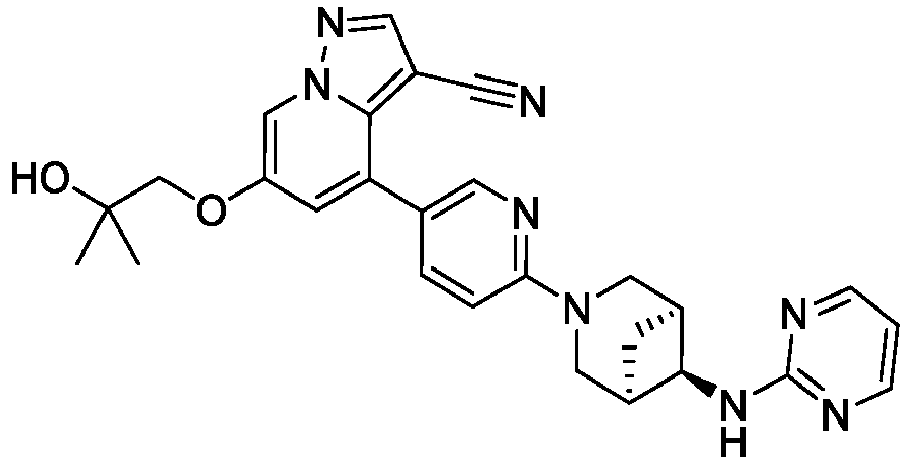
- To a mixture of 4-(6-((1R,5S,6r)-6-amino-3-azabicyclo[3.1.1]heptan-3-yl)pyridin-3-yl)-6-(2-hydroxy-2-methylpropoxy)pyrazolo[1,5-a]pyridine-3-carbonitrile dihydrochloride (Intermediate P63; 25 mg, 0.051 mmol) and 2-chloropyrimidine (8.7 mg, 0.076 mmol) in DMSO (102 µL) was added DIEA (44 µL, 0.25 mmol). The reaction mixture was stirred 60 h at 90°C. After cooling to ambient temperature, the reaction was purified directly by C18 reverse phase chromatography (5-40% ACN in water as the gradient eluent) to afford the title compound (9.5 mg, 38% yield) MS (apci) m/z= 497.25 (M+H).
- The compounds in Table NN were prepared using a similar method to that described for the synthesis of Example 281, replacing 2-chloropyrimidine with the appropriate halogenated heterocycle. Reactions were monitored for completion by LCMS, and reaction durations were adjusted accordingly. Title compounds were cleanly isolated following chromatographic purification using an appropriate gradient eluent (and if necessary converted to the free base).
Table NN Ex. # Structure Chemical Name MS m/z 282 
6-(2-hydroxy-2-methylpropoxy)-4-(6-((1R,5S,6r)-6-((5-methylpyrimidin-2-yl)amino)-3-azabicyclo[3.1.1]heptan-3-yl)pyridin-3-yl)pyrazolo[1,5-a]pyridine-3-carbonitrile 511.2 (M+H) 283 
6-(2-hydroxy-2-methyl propoxy)-4-(6-((1R,5S,6r)-6-(pyridin-2-ylamino)-3-azabicyclo[3.1.1]heptan-3-yl)pyridin-3-yl)pyrazolo[1,5-a]pyridine-3-carbonitrile 496.1 (M+H) 284 
4-(6-((1R,5S,6r)-6-((3-chloropyridin-2-yl)amino)-3-azabicyclo[3.1.1]heptan-3-yl)pyridin-3-yl)-6-(2-hydroxy-2-methylpropoxy)pyrazolo[1 ,5-a]pyridine-3-carbonitrile 530.1 (M+H) 285 
6-(2-hydroxy-2-methylpropoxy)-4-(6-((1R,5S,6r)-6-((2-methylpyrimidin-4-yl)amino)-3-azabicyclo[3.1.1]heptan-3-yl)pyridin-3-yl)pyrazolo[1,5-a]pyridine-3-carbonitrile 511.2 (M+H) 286 
4-(6-((1R,5S,6r)-6-((3-fluoro-6-methylpyridin-2-yl)amino)-3-azabicyclo[3.1.1]heptan-3-yl)pyridin-3-yl)-6-(2-hydroxy-2-methylpropoxy)pyrazolo[1 ,5-a]pyridine-3-carbonitrile 475.2 (M+H) 497.1 (M+Na ) -

- A mixture of 4-(6-((1R,5S,6r)-6-amino-3-azabicyclo[3.1.1]heptan-3-yl)pyridin-3-yl)-6-(2-hydroxy-2-methylpropoxy)pyrazolo[1,5-a]pyridine-3-carbonitrile dihydrochloride (Intermediate P63; 25 mg, 0.051 mmol), HATU (21 mg, 0.056 mmol), and benzoic acid (7 mg, 0.061 mmol) in DMSO (254 µL) was treated with DIEA (44 µL, 0.254 mmol) and then stirred for 2 min at ambient temperature. The reaction was purified directly by C18 reverse phase chromatography (5-50% ACN in water as the gradient eluent) to afford the title compound (22.8 mg, 86% yield) MS (apci) m/z= 523.2 (M+H), 545.2 (M+Na).
-

- The title compound was prepared using a similar method to that described for the synthesis of Example 287, replacing benzoic acid with picolinic acid. MS m/z = 524.2 (M+H), 546.2 (M+Na)
-

- A mixture of 4-(6-(4-amino-4-methylpiperidin-1-yl)pyridin-3-yl)-6-(2-hydroxy-2-methylpropoxy)pyrazolo[1,5-a]pyridine-3-carbonitrile (Intermediate P64; 20 mg, 0.049 mmol), HATU (21 mg, 0.054 mmol), and benzoic acid (9 mg, 0.24 mmol) in DCM (0.5 mL) was treated with DIEA (43 µL, 0.054 mmol) and then stirred for 1 h at ambient temperature. The reaction mixture was concentrated in vacuo. The residue was suspended in 60:40 ACN:water containing 2% TFA. The solution was purified directly by C18 reverse phase chromatography (5-95% ACN in water with 0.1% TFA as the gradient eluent) to afford the title compound as the TFA salt. The TFA salt was treated with saturated NaHCO3(aq) and extracted with DCM. The combined organic extracts were washed with brine, then dried over anhydrous Na2SO4(s), filtered and concentrated in vacuo to afford the title compound (43.7 mg, 49.3% yield). MS (apci) m/z = 511.20 (M+H).
- The compounds in Table OO were prepared using a similar method to that described for the synthesis of Example 289, replacing benzoic acid with the appropriate carboxylic acid. Reactions were monitored for completion by LCMS, and reaction durations were adjusted accordingly. Title compounds were cleanly isolated following chromatographic purification using an appropriate gradient eluent (and if necessary converted to the free base).
Table OO Ex. # Structure Chemical Name MS m/z 290 
N-(1-(5-(3-cyano-6-(2-hydroxy-2-methylpropoxy)pyrazolo[1 ,5-a]pyridin-4-yl)pyridin-2-yl)piperidin-4-yl)-3-fluorobenzamide 529.20 (M+H) 291 
N-(1-(5-(3-cyano-6-(2-hydroxy-2-methylpropoxy)pyrazolo[1 ,5-a]pyridin-4-yl)pyridin-2-yl)piperidin-4-yl)isobutyramide 477.20 (M+H) 292 
N-(1-(5-(3-cyano-6-(2-hydroxy-2-methylpropoxy)pyrazolo[1 ,5-a]pyridin-4-yl)pyridin-2-yl)piperidin-4-yl)picolinamide 512.20 (M+H) 293 
N-(1-(5-(3-cyano-6-(2-hydroxy-2-methylpropoxy)pyrazolo[1 ,5-a]pyridin-4-yl)pyridin-2-yl)piperidin-4-yl)nicotinamide 512.20 (M+H) -

- A mixture of 4-(6-(4-amino-4-methylpiperidin-1-yl)pyridin-3-yl)-6-(2 hydroxy-2-methylpropoxy)pyrazolo[1,5-a]pyridine-3-carbonitrile (Intermediate P64; 20 mg, 0.049 mmol), HATU (21 mg, 0.054 mmol), and 4-fluorobenzoic acid (69 mg, 0.049 mmol) in DCM (0.5 mL) was treated with DIEA (43 µL, 0.049 mmol) and then stirred for 2.5 h at ambient temperature. The reaction mixture was concentrated in vacuo. The residue was suspended in 60:40 ACN:water containing 2% TFA. The solution was purified directly by C18 reverse phase chromatography (5-95% ACN in water with 0.1% TFA as the gradient eluent) to afford the title compound as the TFA salt. The TFA salt was treated with saturated NaHCO3(aq) and extracted with DCM. The combined organic extracts were washed with brine, then dried over anhydrous Na2SO4(s), filtered and concentrated in vacuo to afford the title compound (16 mg, 60% yield). MS (apci) m/z = 529.20 (M+H).
-

- A mixture of 1-(5-(3-cyano-6-(2-hydroxy-2-methylpropoxy)pyrazolo[1,5-a]pyridin-4-yl)pyridin-2-yl)-4-methylpiperidine-4-carboxylic acid (Intermediate P65; 30 mg, 0.067 mmol), HATU (31 mg, 0.080 mmol), and isobutylamine (6 mg, 0.08 mmol) in DCM (133 µL) was treated with DIEA (35 µL, 0.2 mmol) and then stirred for 2 h at ambient temperature. The reaction mixture was concentrated in vacuo. The residue was purified directly by C18 reverse phase chromatography (5-95% ACN in water with 1% TFA as the gradient eluent) to afford the title compound as the TFA salt. The TFA salt was treated with saturated NaHCO3(aq) and extracted with DCM. The combined organic extracts were washed with brine, then dried over anhydrous Na2SO4(s), filtered and concentrated in vacuo. The residue was triturated with DCM/Hexanes and concentrated in vacuo to afford the title compound (12 mg, 36% yield). MS (apci) m/z = 505.3 (M+H).
-
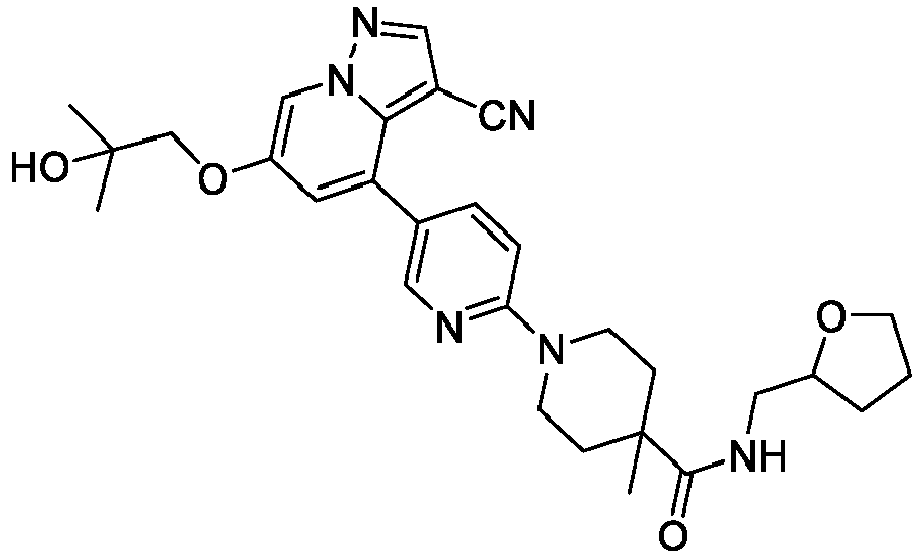
- A mixture of 1-(5-(3-cyano-6-(2-hydroxy-2-methylpropoxy)pyrazolo[1,5-a]pyridin-4-yl)pyridin-2-yl)-4-methylpiperidine-4-carboxylic acid (Intermediate P65; 30 mg, 0.067 mmol), HATU (30 mg, 0.080 mmol), and (tetrahydrofuran-2-yl)methanamine (7 mg, 0.067 mmol) in DCM (133 µL) was treated with DIEA (35 µL, 0.20 mmol) and then stirred for overnight at ambient temperature. The reaction mixture was concentrated in vacuo. The residue was purified directly by C18 reverse phase chromatography (5-95% ACN in water with 1% TFA as the gradient eluent) to afford the title compound as the TFA salt. The TFA salt was treated with saturated NaHCO3(aq) and extracted with DCM. The combined organic extracts were washed with brine, then dried over anhydrous Na2SO4(s), filtered and concentrated in vacuo. The residue was triturated with DCM/Hexanes and concentrated in vacuo to afford the title compound (24 mg, 67% yield). MS (apci) m/z = 533.3 (M+H).
- The compounds in Table PP were prepared using a similar method to that described for the synthesis of Example 296, replacing (tetrahydrofuran-2-yl)methanamine with the appropriate amine. Reactions were monitored for completion by LCMS, and reaction durations were adjusted accordingly. Title compounds were cleanly isolated following chromatographic purification using an appropriate gradient eluent (and if necessary converted to the free base).
Table PP Ex. # Structure Chemical Name MS m/z 297 
1-(5-(3-cyano-6-(2-hydroxy-2-methylpropoxy)pyrazolo[1 ,5-a]pyridin-4-yl)pyridin-2-yl)-4-methyl-N-((tetrahydro-2H -pyran-4-yl)methyl)pi peridine-4-carboxamide 547.3 (M+H) 298 
1-(5-(3-cyano-6-(2-hydroxy-2-methylpropoxy)pyrazolo[1 ,5-a]pyridin-4-yl)pyridin-2-yl)-4-methyl-N-((tetrahydro-2H-pyran-3-yl)methyl)pi peridine-4-carboxamide 547.3 (M+H) -
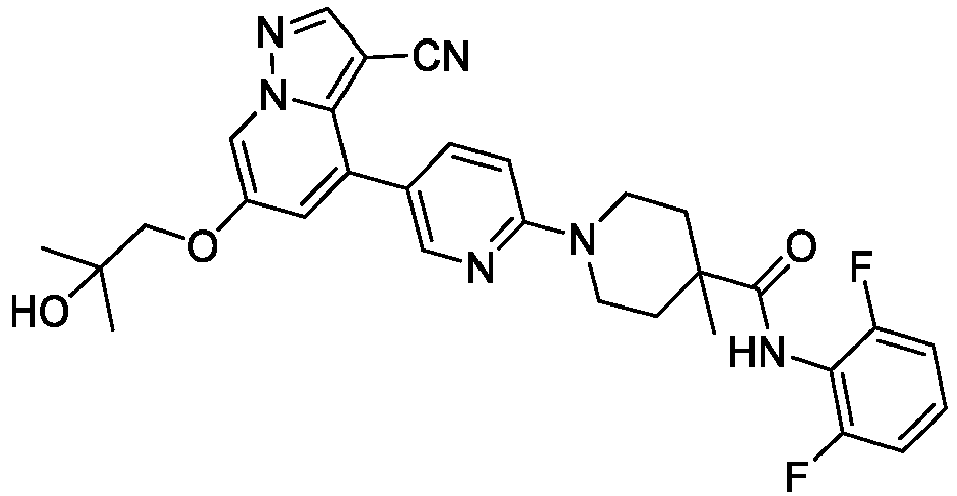
- Step 1: Preparation of tert-butyl 4-((2,6-difluorophenyl)carbamoyl)-4-methylpipendine-1-carboxylate. To a solution of 2,6-difluoroaniline (226.2 µL, 2.24 mmol) in toluene (9.0 mL) was treated with trimethylaluminum (1.1 mL, 2.24 mmol) was stirred for 15 min at ambient temperature. Then the solution was treated with ethyl N-Boc-4-methylpiperidine-4-carboxylate (506 mg, 1.86 mmol) and then stirred for 16 h at 70°C. The reaction was cooled to ambient temperature and treated with 0.5 M NaK Tartrate and diluted with EtOAc. The organic solution was washed with water and brine. The organic extracts were dried over anhydrous Na2SO4(s), filtered and concentrated in vacuo. The residue was purified by silica chromatography (5-75% EtOAc in Hexanes as the gradient eluent) to cleanly provide the title compound (211 mg, 32% yield) MS (apci) m/z= 343.2 (M-H).
- Step 2: Preparation of N-(2,6-difluorophenyl)-4-methylpiperidine-4-carboxamide. To a solution of tert-butyl 4-((2,6-difluorophenyl)carbamoyl)-4-methylpiperidine-1-carboxylate (211 mg, 0.60 mmol) in 20 µL DCM was treated with TFA (20 µL, 0.26 mmol). The reaction mixture was stirred for 1 h at ambient temperature, and then concentrated in vacuo vacuo to afford the title compound as the TFA salt. The TFA salt was treated with saturated NaHCO3(aq) and extracted with 4:1 DCM:IPA. The combined organic extracts were dried over anhydrous Na2SO4(s), filtered and concentrated in vacuo. The residue was triturated with DCM/Hexanes and concentrated in vacuo to afford the title compound (107 mg, 71% yield over two steps) in sufficient purity for step 3. MS (apci) m/z = 255.1 (M+H).
- Step 3: Preparation of 1-(5-(3-cyano-6-(2-hydroxy-2-methylpropoxy)pyrazolo[1,5-a]pyridin-4-yl)pyridin-2-yl)-N-(2,6-difluorophenyl)-4-methylpiperidine-4-carboxamide. To a solution of 4-(6-fluoropyridin-3-yl)-6-(2-hydroxy-2-methylpropoxy)pyrazolo[1,5-a]pyridine-3-carbonitrile (Intermediate P42; 46 mg, 0.14 mmol) and N-(2,6-difluorophenyl)-4-methylpiperidine-4-carboxamide (108 mg, 0.46 mmol) in DMSO (0.564 mL) was added DIEA (74 µL, 0.42 mmol). The reaction mixture was stirred overnight at 70°C. After cooling to ambient temperature, the reaction mixture was diluted with 4:1 DCM:IPA and washed with water and brine. The organic extracts were dried over anhydrous Na2SO4(s), filtered and concentrated in vacuo. The residue was purified by C18 reverse phase chromatography (5-95% ACN in water with 0.1% TFA as the gradient eluent) to afford the title compound as the TFA salt. The TFA salt was treated with saturated NaHCO3(aq) and extracted with 4:1 DCM:IPA. The combined organic extracts were dried over anhydrous Na2SO4(s), filtered and concentrated in vacuo. The residue was triturated with DCM/Hexanes and concentrated in vacuo to afford the title compound (50 mg, 63% yield) MS (apci) m/z=561.3 (M+H).
-

- Step 1: Preparation of tert-butyl 4-((5-fluoro-2-methylpheny)carbamoyl)-4-methylpipendine-1-carboxylate. To a solution of 5-fluoro-2-methylaniline (586 mg, 4.68 mmol) in toluene (12.0 mL) was treated with trimethylaluminum (2.3 mL, 4.68 mmol) was stirred for 15 min at ambient temperature. Then the solution was treated with 1-(tert-butyl) 4-ethyl 4-methylpiperidine-1,4-dicarboxylate (635 mg, 2.341 mmol) and then stirred for 16 h at 70°C. The reaction was cooled to ambient temperature and treated with 0.5 M NaK Tartrate and diluted with EtOAc. The organic solution was washed with water and brine. The organic extracts were dried over anhydrous Na2SO4(s), filtered and concentrated in vacuo. The residue was purified by silica chromatography (5-75% EtOAc in Hexanes as the gradient eluent) to cleanly provide the title compound (266 mg, 32% yield) MS (apci) m/z= 349.2 (M-H).
- Step 2: Preparation of N-(5-fluoro-2-methylphenyl)-4-methylpiperidine-4-carboxamide. To a solution of tert-butyl 4-((5-fluoro-2-methylphenyl)carbamoyl)-4-methylpiperidine-1-carboxylate (211 mg, 0.60 mmol) in 25 µL DCM was treated with TFA (25 µL, 0.32 mmol). The reaction mixture was stirred for 1 h at ambient temperature, and then concentrated in vacuo to afford the title compound as the TFA salt. The TFA salt was treated with saturated NaHCO3(aq) and extracted with 4:1 DCM:IPA. The combined organic extracts were dried over anhydrous Na2SO4(s), filtered and concentrated in vacuo. The residue was triturated with DCM/Hexanes and concentrated in vacuo to afford the title compound (127 mg, 64% yield over two steps) in sufficient purity for step 3. MS (apci) m/z = 251.1 (M+H).
- Step 3: Preparation of 1-(5-(3-cyano-6-(2-hydroxy-2-methylpropoxy)pyrazolo[1,5-a]pyridin-4-yl)pyridin-2-yl)-N-(5-fluoro-2-methylphenyl)-4-methylpiperidine-4-carboxamide. To a solution of 4-(6-fluoropyridin-3-yl)-6-(2-hydroxy-2-methylpropoxy)pyrazolo[1,5-a]pyridine-3-carbonitrile (Intermediate P42; 55 mg, 0.17 mmol) and N-(5-fluoro-2-methylphenyl)-4-methylpiperidine-4-carboxamide (127 mg, 0.51 mmol) in DMSO (12 µL) was added DIEA (88 µL, 0.51 mmol). The reaction mixture was stirred overnight at 70°C. After cooling to ambient temperature, the reaction mixture was diluted with 4:1 DCM:IPA and washed with water and brine. The organic extracts were dried over anhydrous Na2SO4(s), filtered and concentrated in vacuo. The residue was purified by C18 reverse phase chromatography (5-95% ACN in water with 0.1% TFA as the gradient eluent) to afford the title compound as the TFA salt. The TFA salt was treated with saturated NaHCO3(aq) and extracted with 4:1 DCM:IPA. The combined organic extracts were dried over anhydrous Na2SO4(s), filtered and concentrated in vacuo. The residue was triturated with DCM/Hexanes and concentrated in vacuo to afford the title compound (48 mg, 51% yield) MS (apci) m/z=557.3 (M+H).
-

- To a solution ofN-(1-(5-(3-cyano-6-hydroxypyrazolo[1,5-a]pyridin-4-yl)pyridin-2-yl)-4-methylpiperidin-4-yl)-5-fluoro-2-methylbenzamide (P68, 30 mg, 0.619 mmol) in DMF (0.6 mL) was added potassium carbonate (26 mg, 0.186 mmol), followed by iodomethane (6 µL, 0.09 mmol) and was stirred for 1 h at 60°C. The reaction was diluted with EtOAc and washed with water and brine and dried over anhydrous Na2SO4(s), filtered and concentrated in vacuo. The residue was resuspended in DCM (2 mL) and purified using silica chromatography 10-90% EtOAc in Hexanes to afford the title compound (9 mg, 29% yield) MS (apci) m/z=499.2 (M+H).
-

- Step 1: Preparation of tert-butyl 3-(((3-cyano-4-(6-(4-(5-fluoro-2-methylbenzamido)-4-methylpiperidin-1-yl)pyridin-3-yl)pyrazolo[1,5-a]pyridin-6-yl)oxy)methyl)-3-fluoroazetidine-1-carboxylate. To a mixture of N-(1-(5-(3-cyano-6-hydroxypyrazolo[1,5-a]pyridin-4-yl)pyridin-2-yl)-4-methylpiperidin-4-yl)-5-fluoro-2-methylbenzamide (Intermediate P68; 47 mg, 0.097 mmol) and tert-butyl 3-(bromomethyl)-3-fluoroazetidine-1-carboxylate (39 mg, 0.146 mmol) was added cesium carbonate (126 mg, 0.388 mmol) in DMA (1 mL) and was stirred overnight at 60°C. After cooling to ambient temperature, reaction was diluted with EtOAc and washed with water and dried over anhydrous Na2SO4(s), filtered and concentrated in vacuo. The residue was purified using silica chromatography 25-50% EtOAc in Hexanes to afford the title compound (62 mg, 95% yield) MS (apci) m/z=672.3 (M+H).
- Step 2: Preparation of N-(1-(5-(3-cyano-6-((3-fluoroazetidin-3-yl)methoxy)pyrazolo[1,5-a]pyridin-4-yl)pyridin-2-yl)-4-methylpiperidin-4-yl)-5-fluoro-2-methylbenzamide. To a solution of tert-butyl 3-(((3-cyano-4-(6-(4-(5-fluoro-2-methylbenzamido)-4-methylpiperidin-1-yl)pyridin-3-yl)pyrazolo[1,5-a]pyridin-6-yl)oxy)methyl)-3-fluoroazetidine-1-carboxylate (62 mg, 0.09 mmol) in DCM (4 mL) was treated with TFA (2 mL, 26 mmol). The reaction mixture was stirred for 2 h at ambient temperature, and then concentrated in vacuo. The residue was purified by C18 reverse phase chromatography (5-95% ACN in water with 0.1% TFA as the gradient eluent). Fractions containing the desired product were combined, diluted with 4:1 DCM:iPrOH and washed sequentially with saturated NaHCO3(aq) and brine. The organic extracts then were dried over anhydrous Na2SO4(s), filtered, and concentrated in vacuo to afford the title compound. (42 mg, 80% yield) MS (apci) m/z=572.3 (M+H).
-

- A mixture of N-(1-(5-(3-cyano-6-((3-fluoroazetidin-3-yl)methoxy)pyrazolo[1,5-a]pyridin-4-yl)pyridin-2-yl)-4-methylpiperidin-4-yl)-5-fluoro-2-methylbenzamide (Example 302; 30 mg, 0.053 mmol), formaldehyde (20 µL, 0.26 mmol), and NaBH(AcO)3 (56 mg, 0.26 mmol) were dissolved in DMA (2 mL). The reaction mixture was stirred overnight at ambient temperature. The reaction mixture was diluted with EtOAc and washed with water. The combined organic extracts were dried over anhydrous Na2SO4, filtered, and concentrated in vacuo. The residue was purified by C18 reverse phase chromatography (5-95% ACN in water with 0.1% TFA as the gradient eluent). Fractions containing the desired product were combined, diluted with 4:1 DCM:iPrOH and washed sequentially with saturated NaHCO3(aq) and brine. The organic extracts then were dried over anhydrous Na2SO4(s), filtered, and concentrated in vacuo to afford the title compound (27 mg, 87% yield) MS (apci) m/z = 586.3 (M+H). 1H NMR (400 MHz, CDCl3) δ 8.32-8.30 (m, 1H), 8.19-8.15 (m, 2H), 7.71-7.66 (m, 1H), 7.17-7.13 (m, 2H), 7.06-7.02 (m, 1H), 7.00-6.94 (m, 1H), 6.80-6.77 (m, 1H), 5.50 (br s, 1H), 4.36-4.29 (m, 2H), 4.05-3.92 (m, 2H), 3.75-3.57 (m, 2H), 3.43-3.32 (m, 2H), 3.26-3.13 (m, 2H), 2.43 (s, 3H), 2.39 (s, 3H), 2.33-2.21 (m, 2H), 1.90-1.75 (m, 2H), 1.58 (s, 3H).
-

- To a mixture of N-(1-(5-(3-cyano-6-hydroxypyrazolo[1,5-a]pyridin-4-yl)pyridin-2-yl)-4-methylpiperidin-4-yl)-5-fluoro-2-methylbenzamide (Intermediate P68; 39 mg, 0.08 mmol) and 2-bromo-N,N-dimethylethan-1-amine hydrobromide (37 mg, 0.16 mmol) was added cesium carbonate (105 mg, 0.32 mmol) in DMA (1 mL) and was stirred overnight at 60°C. After cooling to ambient temperature, reaction was diluted with EtOAc and washed with water and dried over anhydrous Na2SO4(s), filtered and concentrated in vacuo. The residue was purified using silica chromatography 2-4% MeOH in DCM. Fractions containing the product were concentrated in vacuo. The residue was repurified was purified by C18 reverse phase chromatography (5-95% ACN in water with 0.1% TFA as the gradient eluent). Fractions containing the desired product were combined, diluted with 4:1 DCM:iPrOH and washed sequentially with saturated NaHCO3(aq) and brine. The organic extracts then were dried over anhydrous Na2SO4(s), filtered, and concentrated in vacuo to afford the title compound (8 mg, 18% yield) MS (apci) m/z = 556.3 (M+H).
- The compounds in Table QQ were prepared using a similar method to that described for the synthesis of Example 304, replacing 2-bromo-N,N-dimethylethan-1-amine hydrobromide with the appropriate alkyl halide. Reactions were monitored for completion by LCMS, and reaction durations were adjusted accordingly. Title compounds were cleanly isolated following chromatographic purification using an appropriate gradient eluent (and if necessary converted to the free base).
Table QQ Ex. # Structure Chemical Name MS m/z 305 
N-(1-(5-(3-cyano-6-(2-(pyrrolidin-1-yl)ethoxy)pyrazolo[1,5-a]pyridin-4-yl)pyridin-2-yl)-4-methylpiperidin-4-yl)-5-fluoro-2-methylbenzamide 582.3 (M+H) 306 
N-(1-(5-(3-cyano-6-(2-morpholinoethoxy)pyrazol o[1,5-a]pyridin-4-yl)pyridin-2-yl)-4-methylpiperidin-4-yl)-5-fluoro-2-methylbenzamide 598.3 (M+H) -

- Step 1: Preparation of tert-butyl 3-(((3-cyano-4-(6-(4-(5-fluoro-2-methylbenzamido)-4-methylpiperidin-1-yl)pyridin-3-yl)pyrazolo[1,5-a]pyridin-6-yl)oxy)methyl)-3-methylazetidine-1-carboxylate. To a mixture of N-(1-(5-(3-cyano-6-hydroxypyrazolo[1,5-a]pyridin-4-yl)pyridin-2-yl)-4-methylpiperidin-4-yl)-5-fluoro-2-methylbenzamide (Intermediate P68; 42 mg, 0.087 mmol) and tert-butyl 3-(bromomethyl)-3-methylazetidine-1-carboxylate (34 mg, 0.13 mmol) was added cesium carbonate (113 mg, 0.347 mmol) in DMA (1 mL) and was stirred overnight at 60°C. After cooling to ambient temperature, reaction was diluted with EtOAc and washed with water and the organic extracts were dried over anhydrous Na2SO4(s), filtered and concentrated in vacuo. The residue was purified using silica chromatography 50-100% EtOAc in Hexanes to afford the title compound (21 mg, 36% yield) MS (apci) m/z=668.4 (M+H).
- Step 2: Preparation of N-(1-(5-(3-cyano-6-((3-methylazetidin-3-yl)methoxy)pyrazolo[1,5-a]pyridin-4-yl)pyridin-2-yl)-4-methylpiperidin-4-yl)-5-fluoro-2-methylbenzamide. To a solution of tert-butyl 3-(((3-cyano-4-(6-(4-(5-fluoro-2-methylbenzamido)-4-methylpiperidin-1-yl)pyridin-3-yl)pyrazolo[1,5-a]pyridin-6-yl)oxy)methyl)-3-methylazetidine-1-carboxylate (21 mg, 0.03 mmol) in DCM (4 mL) was treated with TFA (2 mL, 26 mmol). The reaction mixture was stirred for 2 h at ambient temperature, and then concentrated in vacuo. The residue was purified by C18 reverse phase chromatography (5-95% ACN in water with 0.1% TFA as the gradient eluent). Fractions containing the desired product were combined, diluted with 4:1 DCM:iPrOH and washed sequentially with saturated NaHCO3(aq) and brine. The organic extracts then were dried over anhydrous Na2SO4(s), filtered, and concentrated in vacuo to afford the title compound. (13 mg, 73% yield) MS (apci) m/z=568.3 (M+H).
-

- A mixture of N-(1-(5-(3-cyano-6-((3-methylazetidin-3-yl)methoxy)pyrazolo[1,5-a]pyridin-4-yl)pyridin-2-yl)-4-methylpiperidin-4-yl)-5-fluoro-2-methylbenzamide (Example 307; 12 mg, 0.021 mmol), formaldehyde (8 µL, 0.106 mmol), and NaBH(AcO)3 (22 mg, 0.106 mmol) were dissolved in DCM (4 mL). The resulting reaction mixture was allowed to stir overnight at room temperature. The reaction mixture was diluted with EtOAc and washed with water. The combined organic extracts were dried over anhydrous Na2SO4, filtered, and concentrated in vacuo. The residue was purified by C18 reverse phase chromatography (5-95% ACN in water with 0.1% TFA as the gradient eluent). Fractions containing the desired product were combined, diluted with 4:1 DCM:iPrOH and washed sequentially with saturated NaHCO3(aq) and brine. The organic extracts then were dried over anhydrous Na2SO4(s), filtered, and concentrated in vacuo to afford the title compound (10 mg, 81% yield) MS (apci) m/z = 582.3 (M+H).
-

- Step 1: Preparation of tert-butyl 4-(2-((3-cyano-4-(6-(4-(5-fluoro-2-methylbenzamido)-4-methylpiperidin-1-yl)pyridin-3-yl)pyrazolo[1,5-a]pyridin-6-yl)oxy)ethyl)piperazine-1-carboxylate. To a mixture of N-(1-(5-(3-cyano-6-hydroxypyrazolo[1,5-a]pyridin-4-yl)pyridin-2-yl)-4-methylpiperidin-4-yl)-5-fluoro-2-methylbenzamide (Intermediate P68; 55 mg, 0.114 mmol), tert-Butyl 4-(2-chloroethyl)tetrahydro-1(2H)-pyrazine carboxylate (57 mg, 0.227 mmol) was added cesium carbonate (148 mg, 0.454 mmol) in DMA (1 mL) and was stirred overnight at 60°C. After cooling to ambient temperature, reaction was diluted with EtOAc and washed with water and the organic extracts were dried over anhydrous Na2SO4(s), filtered and concentrated in vacuo. The residue was purified using silica chromatography (50-100% EtOAc in Hexanes) to afford the title compound (49 mg, 62% yield) MS (apci) m/z=697.4 (M+H).
- Step 2: Preparation of N-(1-(5-(3-cyano-6-(2-(piperazin-1-yl)ethoxy)pyrazolo[1,5-a]pyridin-4-yl)pyridin-2-yl)-4-methylpiperidin-4-yl)-5-fluoro-2-methylbenzamide. To a solution of tert-butyl 4-(2-((3-cyano-4-(6-(4-(5-fluoro-2-methylbenzamido)-4-methylpiperidin-1-yl)pyridin-3-yl)pyrazolo[1,5-a]pyridin-6-yl)oxy)ethyl)piperazine-1-carboxylate (49 mg, 0.070 mmol) in DCM (4 mL) was treated with TFA (2 mL, 26 mmol). The reaction mixture was stirred for 1 h at ambient temperature, and then concentrated in vacuo. The residue was purified by C18 reverse phase chromatography (5-95% ACN in water with 0.1% TFA as the gradient eluent). Fractions containing the product were concentrated in vacuo. The residue was repurified using silica chromatography (4% MeOH in DCM with 1% TEA as the eluent) to afford the title compound. (33 mg, 79% yield) MS (apci) m/z=597.3 (M+H).
-

- To a solution of N-(1-(5-(3-cyano-6-(2-(piperazin-1-yl)ethoxy)pyrazolo[1,5-a]pyridin-4-yl)pyridin-2-yl)-4-methylpiperidin-4-yl)-5-fluoro-2-methylbenzamide (Example 309; 27 mg, 0.045 mmol) in DCM (0.25 mL) and MeOH (0.25 mL) was added formaldehyde (17 µL, 0.226 mmol) and NaBH(AcO)3 (48 mg, 0.226 mmol) The resulting reaction mixture was allowed to stir overnight at room temperature. The reaction was directly purified by C18 reverse phase chromatography (5-95% ACN in water with 0.1% TFA as the gradient eluent) to afford the title compound as the TFA salt. The TFA salt was treated with saturated NaHCO3(aq) and extracted with 4:1 DCM:IPA. The combined organic extracts were dried over anhydrous Na2SO4(s), filtered and concentrated in vacuo. The residue was triturated with DCM/Hexanes and concentrated in vacuo to afford the title compound (12.5 mg, 45% yield) MS (apci) m/z=611.4 (M+H).
-

- Step 1: Preparation of tert-butyl (S)-2-(((3-cyano-4-(6-(4-(5-fluoro-2-methylbenzamido)-4-methylpiperidin-1-yl)pyridin-3-yl)pyrazolo[1,5-a]pyridin-6-yl)oxy)methyl)morpholine-4-carboxylate. To N-(1-(5-(3-cyano-6-hydroxypyrazolo[1,5-a]pyridin-4-yl)pyridin-2-yl)-4-methylpiperidin-4-yl)-5-fluoro-2-methylbenzamide (Intermediate P68; 30 mg, 0.062 mmol) was added cesium carbonate (22 mg, 0.068 mmol) in DMA (1.2 mL). The resulting mixture was sparged with Ar(g) and stirred for 10 min. (S)-tert-butyl 2-(bromomethyl)morpholine-4-carboxylate (26 mg, 0.093 mmol) was added to the reaction mixture. The resulting mixture was sparged with Ar(g) and stirred overnight at 60°C. After cooling to ambient temperature, reaction was diluted with EtOAc and washed with water and brine and the organic extracts were dried over anhydrous Na2SO4(s), filtered and concentrated in vacuo to afford the title compound (42 mg, 99% yield) MS (apci) m/z=684.3(M+H).
- Step 2: Preparation of (S)-N-(1-(5-(3-cyano-6-(morpholin-2-ylmethoxy)pyrazolo[1,5-a]pyridin-4-yl)pyridin-2-yl)-4-methylpiperidin-4-yl)-5-fluoro-2-methylbenzamide. To a solution tert-butyl (S)-2-(((3-cyano-4-(6-(4-(5-fluoro-2-methylbenzamido)-4-methylpiperidin-1-yl)pyridin-3-yl)pyrazolo[1,5-a]pyridin-6-yl)oxy)methyl)morpholine-4-carboxylate (42 mg, 0.061 mmol) in DCM (2 mL) was treated with TFA (0.31 mL). The reaction mixture was stirred for 15 min at ambient temperature, and then concentrated in vacuo. The residue was resuspended in DCM (2 mL). The solution was purified by by silica chromatography (0.5-10% MeOH in DCM with 0.05-1% NH4OH as the gradient eluent) to afford the title compound (6 mg, 16% yield) MS (apci) m/z=584.3 (M+H).
-

- To a solution of 3-chloro-N-(1-(5-(3-cyano-6-hydroxypyrazolo[1,5-a]pyridin-4-yl)pyridin-2-yl)-4-methylpiperidin-4-yl)picolinamide (Intermediate P75; 34 mg, 0.070 mmol) in DMF (0.7 mL) was added potassium carbonate (29 mg, 0.209 mmol) and then iodomethane (7 µL, 0.105 mmol) was added to the reaction mixture. The resulting mixture was stirred overnight at 60°C. After cooling to ambient temperature, reaction was diluted with DCM and purified directly using silica chromatography (0.5-10% MeOH in DCM with 0.1-2% NH4OH as the gradient eluent). Fractions containing the product were concentrated in vacuo. The residue was diluted with EtOAc and washed with water and brine and then dried over anhydrous Na2SO4(s), filtered and concentrated in vacuo to afford the title compound (16 mg, 45% yield) MS (apci) m/z=502.2 (M+H).
-

- To a solution of 3-chloro-N-(1-(5-(3-cyano-6-methoxypyrazolo[1,5-a]pyridin-4-yl)pyridin-2-yl)-4-methylpiperidin-4-yl)picolinamide (Example 312; 10 mg, 0.020 mmol) in ACN (0.3 mL) was added iodomethane (4 µL, 0.06 mmol) followed by sodium hydride (1.4 mg, 0.06 mmol) and then the reaction mixture was stirred for 1 hour at ambient temperature. The reaction was stirred for 1 hour at 85°C. After cooling to ambient temperature, the reaction mixture was directly purified by C18 reverse phase chromatography (5-95% ACN in water with 0.1% TFA as the gradient eluent) to afford the title compound as the TFA salt. The TFA salt was treated with saturated NaHCO3(aq) and extracted with 4:1 DCM:IPA. The combined organic extracts were dried over anhydrous Na2SO4(s), filtered and concentrated in vacuo to afford the title compound (6.5 mg, 63% yield). MS (apci) m/z= 516.2 (M+H).
-

- To a solution of 3-chloro-N-(1-(5-(3-cyano-6-hydroxypyrazolo[1,5-a]pyridin-4-yl)pyridin-2-yl)-4-methylpiperidin-4-yl)picolinamide (Intermediate P75; 25 mg, 0.051 mmol) in DMF (0.5 mL) was added potassium carbonate (22 mg, 0.159 mmol) then 4-(Chloromethyl)-1-methyl-1H-imidazole (13 mg, 0.102 mmol). The resulting mixture was stirred 2 h at 60°C. After cooling to ambient temperature, reaction was diluted with 60:40 ACN:water. The solution was purified directly by C18 reverse phase chromatography (5-95% ACN in water with 0.1% TFA as the gradient eluent) to afford the title compound as the TFA salt. The TFA salt was dissolved in DCM (10 mL) and MeOH (1 mL) and eluted through a Pl-HCO3 resin. The organic eluent concentrated in vacuo to afford the title compound (14 mg, 45% yield). MS (apci) m/z = 582.2 (M+H).
-

- To a solution of 3-chloro-N-(1-(5-(3-cyano-6-hydroxypyrazolo[1,5-a]pyridin-4-yl)pyridin-2-yl)-4-methylpiperidin-4-yl)picolinamide (Intermediate P75; 25 mg, 0.051 mmol) in DMA (0.5 mL) was added cesium carbonate (52 mg, 0.159 mmol) then 2-dimethylaminoethyl chloride hydrochloride (15 mg, 0.102 mmol). The resulting mixture was stirred 1 h at 60°C. After cooling to ambient temperature, potassium carbonate was added. The resulting mixture was stirred overnight at 60°C. After cooling to ambient temperature, reaction was diluted with DCM and purified directly by silica chromatography (0.5-10% MeOH in DCM with 0.1-2% NH4OH as the gradient eluent) to afford the title compound (14 mg, 47% yield). MS (apci) m/z = 559.2 (M+H).
-
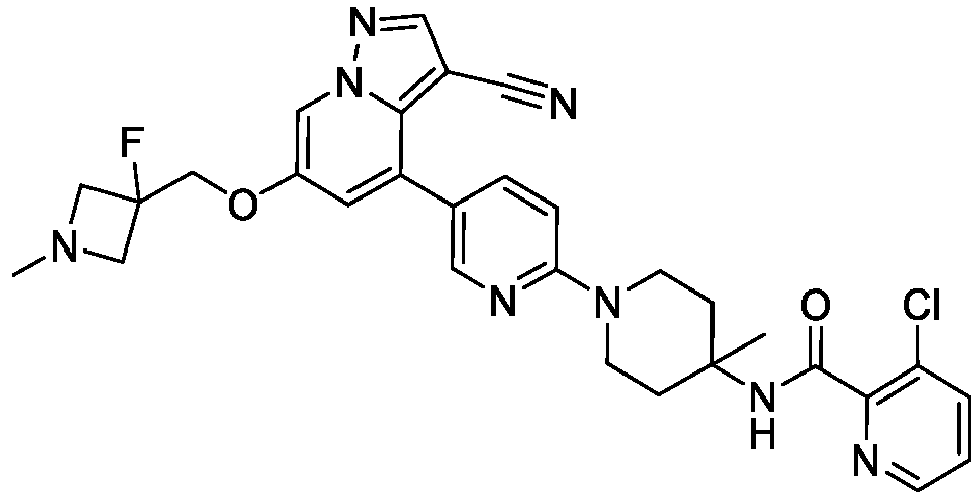
- Step 1: Preparation of tert-butyl 3-(((4-(6-(4-(3-chloropicolinamido)-4-methylpiperidin-1-yl)pyridin-3-yl)-3-cyanopyrazolo[1,5-a]pyridin-6-yl)oxy)methyl)-3-fluoroazetidine-1-carboxylate. To a solution of 3-chloro-N-(1-(5-(3-cyano-6-hydroxypyrazolo[1,5-a]pyridin-4-yl)pyridin-2-yl)-4-methylpiperidin-4-yl)picolinamide (Intermediate P75; 37 mg, 0.076 mmol) in DMF (0.76 mL) was added cesium carbonate (27 mg, 0.083 mmol) then tert-butyl 3-(bromomethyl)-3-fluoroazetidine-1-carboxylate (41 mg, 0.15 mmol). The resulting mixture was stirred 3 h at 60°C. After cooling to ambient temperature, reaction was diluted with EtOAc and washed with water and brine and the organic extracts were dried over anhydrous Na2SO4(s), filtered and concentrated in vacuo to afford the title compound (Assumed quantative yield, 51 mg) MS (apci) m/z=675.3 (M+H).
- Step 2: Preparation of 3-chloro-N-(1-(5-(3-cyano-6-((3-fluoroazetidin-3-yl)methoxy)pyrazolo[1,5-a]pyridin-4-yl)pyridin-2-yl)-4-methylpiperidin-4-yl)picolinamide. To a solution of tert-butyl 3-(((4-(6-(4-(3-chloropicolinamido)-4-methylpiperidin-1-yl)pyridin-3-yl)-3-cyanopyrazolo[1,5-a]pyridin-6-yl)oxy)methyl)-3-fluoroazetidine-1-carboxylate (62 mg, 0.092 mmol) in DCM (0.46 mL) was treated with TFA (0.46 mL, 6 mmol). The reaction mixture was stirred for 15 min at ambient temperature, and then concentrated in vacuo. The residue was resuspended in DCM (3 mL). The solution was passed through two Pl-HCO3 resins and eluted with additional DCM. The eluent was concentrated in vacuo to afford the title compound (30 mg, 57% yield) MS (apci) m/z=575.2 (M+H).
- Step 3: Preparation of 3-chloro-N-(1-(5-(3-cyano-6-((3-fluoro-1-methylazetidin-3-yl)methoxy)pyrazolo[1,5-a]pyridin-4-yl)pyridin-2-yl)-4-methylpiperidin-4-yl)picolinamide. To a solution of 3-chloro-N-(1-(5-(3-cyano-6-((3-fluoroazetidin-3-yl)methoxy)pyrazolo[1,5-a]pyridin-4-yl)pyridin-2-yl)-4-methylpiperidin-4-yl)picolinamide (35 mg, 0.061 mmol) in DMA (0.61 mL) was added formaldehyde (8 µL, 0.304 mmol) and NaBH(AcO)3 (116 mg, 0.547 mmol) The resulting reaction mixture was allowed to stir overnight at room temperature. The reaction was directly purified by C18 reverse phase chromatography (5-75% ACN in water with 0.1% TFA as the gradient eluent) to afford the title compound as the TFA salt. The TFA salt was diluted with DCM and passed through a Pl-HCO3 resin and eluted with additional DCM. The eluent was concentrated in vacuo. The residue was dissolved in DCM and treated with saturated NaHCO3(aq) and extracted with 4:1 DCM:IPA. The combined organic extracts were dried over anhydrous Na2SO4(s), filtered and concentrated in vacuo to afford the title compound (7 mg, 19% yield) MS (apci) m/z=589.3 (M+H).
-

- To a solution of 3-chloro-N-(1-(5-(3-cyano-6-hydroxypyrazolo[1,5-a]pyridin-4-yl)pyridin-2-yl)-4-methylpiperidin-4-yl)picolinamide (Intermediate P75; 36 mg, 0.074 mmol) in DMA (0.74 mL) was added cesium carbonate (26 mg, 0.081 mmol) followed by 4-(2-chloroethyl)morpholine (44 mg, 0.295 mmol) was added to the reaction mixture. The resulting mixture was stirred overnight at 60°C. After cooling to ambient temperature, reaction was diluted with 60:40 ACN:water. The solution was purified directly by C18 reverse phase chromatography (5-95% ACN in water with 0.1% TFA as the gradient eluent) to afford the title compound as the TFA salt. The TFA salt was treated with saturated NaHCO3(aq) and extracted with 4:1 DCM:IPA and then washed with brine. The combined organic extracts were dried over anhydrous Na2SO4(s), filtered and concentrated in vacuo to afford the title compound (9 mg, 20% yield) MS (apci) m/z=601.3 (M+H).
-

- To a solution of 3-chloro-N-(1-(5-(3-cyano-6-hydroxypyrazolo[1,5-a]pyridin-4-yl)pyridin-2-yl)-4-methylpiperidin-4-yl)picolinamide (Intermediate P75; 36 mg, 0.074 mmol) in DMF (0.74 mL) was added potassium carbonate (31 mg, 0.221 mmol) followed by iodoethane (17 mg, 0.111 mmol). The resulting mixture was stirred overnight at 60°C. After cooling to ambient temperature, reaction was diluted with 60:40 ACN:water. The solution was purified directly by C18 reverse phase chromatography (5-95% ACN in water with 0.1% TFA as the gradient eluent) to afford the title compound as the TFA salt. The TFA salt was treated with saturated NaHCO3(aq) and extracted with 4:1 DCM:IPA and then washed with brine. The combined organic extracts were dried over anhydrous Na2SO4(s), filtered and concentrated in vacuo to afford the title compound (19 mg, 50% yield) MS (apci) m/z=516.2 (M+H).
-

- To a solution of 3-chloro-N-(1-(5-(3-cyano-6-hydroxypyrazolo[1,5-a]pyridin-4-yl)pyridin-2-yl)-4-methylpiperidin-4-yl)picolinamide (Intermediate P75; 31 mg, 0.063 mmol) in DMA (0.63 mL) was added potassium carbonate (10 mg, 0.69 mmol) followed by 1-(2-Chloroethyl)-pyrrolidine (25 mg, 0.189 mmol). The resulting mixture was stirred overnight at 60°C. After cooling to ambient temperature, the reaction mixture was diluted with EtOAc and washed with water. The water layer was further extracted using 4:1 DCM:IPA. The organic extracts were seperately washed with brine, then combined and dried over anhydrous Na2SO4, filtered, and concentrated in vacuo. The residue was resuspended with 60:40 ACN:water. The solution was purified directly by C18 reverse phase chromatography (5-95% ACN in water with 0.1% TFA as the gradient eluent) to afford the title compound as the TFA salt. The TFA salt was treated with saturated NaHCO3(aq) and extracted with 4:1 DCM:IPA and then washed with brine. The combined organic extracts were dried over anhydrous Na2SO4(s), filtered and concentrated in vacuo to afford the title compound (16 mg, 42% yield) MS (apci) m/z=585.3 (M+H).
-

- To a mixture of 3-chloro-N-(1-(5-(3-cyano-6-hydroxypyrazolo[1,5-a]pyridin-4-yl)pyridin-2-yl)-4-methylpiperidin-4-yl)picolinamide (Intermediate P75; 150 mg, 0.307 mmol) and potassium carbonate (47 mg, 0.34 mmol) in DMA (3.07 mL) was added 2-(boc-amino)ethyl bromide (138 mg, 0.615 mmol). The resulting mixture was stirred overnight at 60°C. After cooling to ambient temperature, addional 2-(boc-amino)ethyl bromide (69 mg, 0.307 mmol) was added and reaction stirred for 1 h at ambient temperature. Then additional potassium carbonate (42 mg, 0.31 mmol) was added and reaction stirred for two overnights at 60°C. After cooling to ambient temperature, the reaction mixture was diluted with EtOAc and washed with water. The organic extracts were washed with brine, then combined and dried over anhydrous Na2SO4, filtered, and concentrated in vacuo. The residue was purified by silica chromatography (10-90% EtOAc in hexanes as the gradient eluent) to afford the title compound in sufficient purity for the next step. 10 mg of the title compound was repurified using C18 reverse phase chromatography (5-95% ACN in water with 0.1% TFA as the gradient eluent) to afford the title compound as the TFA salt. The TFA salt was treated with saturated NaHCO3(aq) and extracted with 4:1 DCM:IPA and then washed with brine. The combined organic extracts were dried over anhydrous Na2SO4(s), filtered and concentrated in vacuo to afford the title compound. (169 mg, 87% yield) MS (apci) m/z=631.3 (M+H).
-

- To a solution tert-butyl (2-((4-(6-(4-(3-chloropicolinamido)-4-methylpiperidin-1-yl)pyridin-3-yl)-3-cyanopyrazolo[1,5-a]pyridin-6-yl)oxy)ethyl)carbamate (Example 320, 158 mg, 0.250 mmol) in DCM (2.5 mL) was treated with TFA (2.5 mL, 32 mmol). The reaction mixture was stirred for 10 min at ambient temperature, and then concentrated in vacuo. The residue was treated with saturated NaHCO3(aq) and extracted with 4:1 DCM:IPA and then washed with brine. The combined organic extracts were dried over anhydrous Na2SO4(s), filtered and concentrated in vacuo to afford the title compound (130 mg, 98% yield) MS (apci) m/z=531.2 (M+H)
-

- To a solution of N-(1-(5-(6-(2-aminoethoxy)-3-cyanopyrazolo[1,5-a]pyridin-4-yl)pyridin-2-yl)-4-methylpiperidin-4-yl)-3-chloropicolinamide (Example 321; 27 mg, 0.51 mmol) in DCM (0.5 mL) was added acetic anhydride (5 µL, 0.51 mmol) followed by TEA (14 µL, 0.102 mmol). The reaction solution was stirred for 1 h at ambient temperature. The reaction was concentrated in vacuo. The residue was resuspended with 60:40 ACN:water. The solution was purified directly by C18 reverse phase chromatography (5-75% ACN in water with 0.1% TFA as the gradient eluent) to afford the title compound as the TFA salt. The TFA salt was treated with saturated NaHCO3(aq) and extracted with 4:1 DCM:IPA and then washed with brine. The combined organic extracts were dried over anhydrous Na2SO4(s), filtered and concentrated in vacuo to afford the title compound (20 mg, 67% yield) MS (apci) m/z=573.2 (M+H).
-

- To a solution of N-(1-(5-(6-(2-aminoethoxy)-3-cyanopyrazolo[1,5-a]pyridin-4-yl)pyridin-2-yl)-4-methylpiperidin-4-yl)-3-chloropicolinamide (Example 321, 27 mg, 0.051 mmol) in DMA (0.5 mL) was added potassium carbonate (35 mg, 0.254 mmol). The suspension was sparged with argon and stirred for 10 min at ambient temperature. Then 2,2-difluoroethyl trifluoromethanesulfonate (11 mg, 0.51 mmol). The resulting mixture was sparged with argon and stirred 60 h at 60°C. After cooling to ambient temperature, reaction was diluted with 60:40 ACN:water. The solution was purified directly by C18 reverse phase chromatography (5-95% ACN in water with 0.1% TFA as the gradient eluent) to afford the title compound as the TFA salt. The TFA salt was treated with saturated NaHCO3(aq) and extracted with 4:1 DCM:IPA and then washed with brine. The combined organic extracts were dried over anhydrous Na2SO4(s), filtered and concentrated in vacuo to afford the title compound (4 mg, 13% yield) MS (apci) m/z=595.2 (M+H).
-

- Step 1: Preparation of tert-butyl 4-((6-methoxypyridazin-3-yl)oxy)piperidine-1-carboxylate.To a solution of tert-butyl 4-hydroxypiperidine-1-carboxylate (10.0 g, 49.7 mmol) in DMF (82.8 mL) was added sodium hydride (2.19 g, 54.7 mmol). The mixture was stirred at rt for 15 mins, after which 3-chloro-6-methoxypyridazine (7.18 g, 49.7 mmol) was added. The reaction mixture was stirred at 90°C for 24 h. After cooling to ambient temperature, the reaction mixture was diluted with saturated NaHCO3(aq) and extracted with EtOAc. The combined organic extracts were washed with water and brine, dried over anhydrous Na2SO4(s), and concentrated in vacuo. The residue was purified by silica chromatography (5-50% EtOAc in hexanes as the gradient eluent) to afford the title compound (assumed theoretical yield, 15.4 g, 49.8 mmol) in sufficient purity for Step 2. MS (apci) m/z = 310.1 (M+H).
- Step 2: Preparation of 3-methoxy-6-(piperidin-4-yloxy)pyridazine. To a solution of tert-butyl 4-((6-methoxypyridazin-3-yl)oxy)piperidine-1-carboxylate (assumed 15.4 g, 49.8 mol) in DCM (16 mL) was added TFA (19.2 mL, 250.9 mmol). The reaction mixture was stirred at rt 15 min, at which time it was concentrated in vacuo. The residue was resuspended in 20 mL DCM and purified by silica chromatography (1-9% MeOH in DCM with 1% NH4OH as the gradient eluent) to afford the title compound (6.0 g, 28.7 mmol, 57.6 % yield over two steps) in sufficient purity for Step 3. MS (apci) m/z = 210.1 (M+H).
- Step 3: Preparation of 6-ethoxy-4-(6-(4-((6-methoxypyridazin-3-yl)oxy)piperidin-1-yl)pyridin-3-yl)pyrazolo[1,5-a]pyridine-3-carbonitrile. To a solution of 6-ethoxy-4-(6-fluoropyridin-3-yl)pyrazolo[1,5-a]pyridine-3-carbonitrile (Intermediate P6, 0.012 g, 0.0425 mmol) in DMSO (0.1 mL) was added 3-methoxy-6-(piperidin-4-yloxy)pyridazine (0.0133 g, 0.0638 mmol) and DIEA (37 µL, 0.213 mmol). The reaction mixture was stirred at 110°C for 24 h. After cooling to ambient temperature, the reaction mixture was diluted with DCM and washed with saturated NH4Cl(aq). The combined aqueous washes were were further extracted with DCM, and the combined organic extracts were dried over anhydrous Na2SO4(s) and concentrated in vacuo. The residue was purified by silica chromatography (0-100% EtOAc in hexanes as the gradient eluent) to afford the title compound (6 mg, 0.0127 mmol, 30 % yield). MS (apci) m/z = 472.2 (M+H).
-

- To a solution of 6-ethoxy-4-(6-fluoropyridin-3-yl)pyrazolo[1,5-a]pyridine-3-carbonitrile (Intermediate P6, 30 mg, 0.106 mmol) in DMA (0.5 mL) was added TEA (0.044 mL, 0.319 mmol) and 4-benzylpiperidin-4-ol (40.7 mg, 0.213 mmol) The reaction mixture was stirred at 90°C for 24 h. After cooling to ambient temperature, the reaction mixture was diluted with DCM and washed with saturated NH4Cl(aq) then water. The combined aqueous washes were further extracted with DCM, and the combined organic extracts were dried over anhydrous Na2SO4(s) and concentrated in vacuo. The residue was purified by silica chromatography (30-100% EtOAc in hexanes as the gradient eluent) to afford the title compound (39 mg, 0.0860 mmol, 80.9 % yield). MS (apci) m/z = 454.2 (M+H).
- The compounds in Table RR were prepared using a similar method to that described for the synthesis of Example 325, replacing 4-benzylpiperidin-4-ol with the appropriate piperidine nucleophile. Reactions were monitored for completion by LCMS, and reaction durations were adjusted accordingly. Title compounds were cleanly isolated following chromatographic purification using an appropriate gradient eluent (and if necessary converted to the free base).
Table RR Ex. # Structure Chemical Name MS m/z 326 
6-ethoxy-4-(6-(4-hydroxy-4-(2-(pyridin-3-yl)ethyl)piperidin-1-yl)pyridin-3-yl)pyrazolo[1, 5-a]pyridine-3-carbonitrile 469.15 (M+H) 327 
6-ethoxy-4-(6-(4-hydroxy-4-phenylpiperidin-1-yl)pyridin-3-yl)pyrazolo[1, 5 -a]pyridine-3-carbonitrile 440.15 (M+H) 328 
6-ethoxy-4-(6-(4-hydroxy-4-(pyridin-2-yl)piperidin-1-yl)pyridin-3-yl)pyrazolo[1,5 -a]pyridine-3-carbonitrile 441.10 (M+H) 329 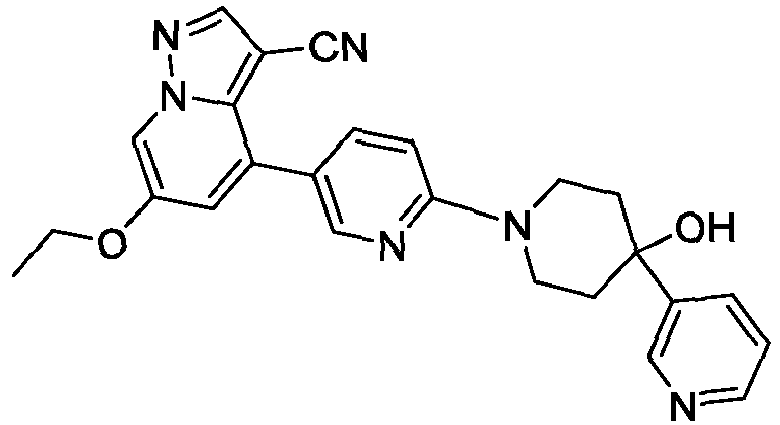
6-ethoxy-4-(6-(4-hydroxy-4-(pyridin-3-yl)piperidin-1-yl)pyridin-3-yl)pyrazolo[1, 5-a]pyridine-3-carbonitrile 441.10 (M+H) 330 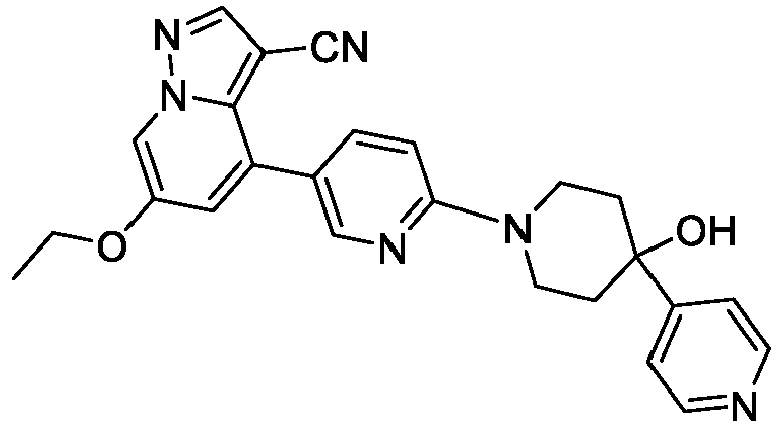
6-ethoxy-4-(6-(4-hydroxy-4-(pyridin-4-yl)piperidin-1-yl)pyridin-3-yl)pyrazolo[1, 5-a]pyridine-3-carbonitrile 441.10 (M+H) -

- To a solution of 6-ethoxy-4-(6-(4-hydroxypiperidin-1-yl)pyridin-3-yl)pyrazolo[1,5-a]pyridine-3-carbonitrile (Intermediate P52, 30 mg, 0.0825 mmol) in 1:1 DCM/THF (0.7 mL) was added 6-methylpyridazin-3-ol (18.2 mg, 0.165 mmol) and triphenylphosphane (43.3 mg, 0.165 mmol). The reaction vessel was sparged with argon, at which time diisopropyl (E)-diazene-1,2-dicarboxylate (0.0235 ml, 0.165 mmol) was added, and the reaction mixture was stirred at rt 24 h. The reaction mixture was diluted with DCM and washed with water. The aqueous fraction was extracted with DCM, and the combined organic extracts were dried over anhydrous Na2SO4(s) and concentrated in vacuo. The residue was purified by silica chromatography (50-100% EtOAc in hexanes as the gradient eluent) to afford the title compound (15 mg, 0.0329 mmol, 39.9 % yield). MS (apci) m/z = 456.2 (M+H).
-

- The title compound was prepared using a similar method to that described for the synthesis of Example 331, replacing 6-methylpyridazin-3-ol with 6-chloropyridin-3-ol. MS (apci) m/z = 475.2 (M+H).
-

- To a solution of ethane-1,2-diol (9.8 mg, 0.16 mmol) in DMF (0.2 mL) was added sodium hydride (60% w/w, 2.3 mg, 0.095 mmol) and stirred at rt for 5 min, at which time 4-(6-(4-((6-chloropyridin-3-yl)oxy)piperidin-1-yl)pyridin-3-yl)-6-ethoxypyrazolo[1,5-a]pyridine-3-carbonitrile (Example 332, 15 mg, 0.032 mmol) in an additional 0.3 mL of DMF was added. The reaction mixture was stirred at 110°C for 24 h. After cooling to ambient temperature, the reaction mixture was quenched with saturated NH4Cl and extracted with DCM. The combined organic extracts were dried over anhydrous Na2SO4(s) and concentrated in vacuo. The residue was purified by C-18 reverse phase chromatography (10-90% ACN in water with 0.1% formic acid as the gradient eluent) to afford the title compound (2.2 mg, 0.0044 mmol, 14 % yield). MS (apci) m/z = 501.25 (M+H).
-

- To a solution of 4-(6-(4-benzyl-4-hydroxypiperidin-1-yl)pyridin-3-yl)-6-ethoxypyrazolo[1,5-a]pyridine-3-carbonitrile (Intermediate P53, 19.5 mg, 0.0430 mmol) was added 3-hydroxypropanenitrile (0.5 mL, 0.0430 mmol). The mixture was stirred at rt for 5 min, at which time sulfuric acid (98%, 0.0023 mL, 0.0430 mmol) was added dropwise. The reaction mixture was stirred at rt for 24 h. The crude mixture was purified by C-18 reverse phase chromatography (0-70% ACN in water as the gradient eluent) to afford the title compound (6 mg, 0.01 mmol, 27% yield). MS (apci) m/z = 547.2 (M+H).
-

- The title compound was prepared using a similar method to that described for the synthesis of Example 334, replacing 3-hydroxypropanenitrile with 3-hydroxy-3-methylbutanenitrile. MS (apci) m/z = 553.2 (M+H).
-

- To a solution of 6-ethoxy-4-(6-fluoropyridin-3-yl)pyrazolo[1,5-a]pyridine-3-carbonitrile (100.5 mg, 0.3560 mmol) in DMSO (3 ml) was added (4-benzylpiperidin-4-yl)methanol hydrochloride (151.5 mg, 0.6267 mmol) and cesium carbonate (812.0 mg, 2.492 mmol). The reaction mixture was stirred at 60°C for 24 h. After cooling to ambient temperature, the reaction mixture was diluted with DCM and washed with water and saturated NH4Cl(aq). The combined aqueous layers were extracted with DCM, then the combined organic extracts were dried over anhydrous Na2SO4(s) and concentrated in vacuo. The residue was purified by silica chromatography (0-100% EtOAc in hexanes as the gradient eluent) to afford the title compound (118.2 mg, 0.2528 mmol, 71.00 % yield). MS (apci) m/z = 468.2 (M+H).
-

- To a solution of 4-(6-(4-benzyl-4-(hydroxymethyl)piperidin-1-yl)pyridin-3-yl)-6-ethoxypyrazolo[1,5-a]pyridine-3-carbonitrile (Intermediate P55, 9.0 mg, 0.019 mmol) in DMF (0.4 mL) was added sodium hydride (60% w/w, 2.8 mg, 0.070 mmol). This mixture was stirred at rt 1 h, at which time methyl iodide (0.021 ml, 0.34 mmol) was added. The reaction mixture was stirred at rt for 72 h. The reaction mixture was diluted with DCM and washed with water. The combined organic extracts were dried over anhydrous Na2SO4(s) and concentrated in vacuo. The residue was purified by silica chromatography (0-100% EtOAc in hexanes as the gradient eluent) to afford the title compound (4.0 mg, 0.0083 mmol, 43 % yield). MS (apci) m/z = 482.25 (M+H).
-

- The title compound was prepared using a similar method to that described for the synthesis of Example 337, replacing methyl iodide with 2-chloro-N,N-dimethylacetamide. MS (apci) m/z = 553.2 (M+H).
-

- Step 1: Preparation of tert-butyl 4-formyl-4-(4-methoxybenzyl)piperidine-1-carboxylate. To a sealed 3-neck flask that had been sparged with N2 was added tert-butyl 4-formylpiperidine-1-carboxylate (201.8 mg, 0.9462 mmol) in THF (2 mL). The mixture was cooled to -78°C and stirred at this temperature for 10 min, at which time lithium bis(trimethylsilyl)amide (3 mL, 3 mmol) was added dropwise. The reaction mixture was stirred at -78°C for 40 min then warmed to rt. After 16 h, 1-(bromomethyl)-4-methoxybenzene (0.3 mL, 2.058 mmol) was added, and the reaction mixture was stirred an additional 24 h at rt. The reaction was quenched with water, extracted into EtOAc, and the organic extracts were dried over anhydrous Na2SO4(s) and concentrated in vacuo to afford the title compound (assumed theoretical yield, 315 mg, 0.946 mmol) in sufficient purity for Step 2. MS (apci) m/z = 234.2 (M+H-Boc).
- Step 2: Preparation of 4-(4-methoxybenzyl)piperidine-4-carbaldehyde. To a solution of tert-butyl 4-formyl-4-(4-methoxybenzyl)piperidine-1-carboxylate (assumed 315 mg, 0.946 mmol) in DCM (2 mL) was added TFA (2 mL, 26 mmol). The reaction mixture was stirred at rt 30 min then concentrated in vacuo. The residue was diluted in DCM and 10% NH4OH in MeOH and stirred for 15 min. The mixture was concentrated in vacuo to afford the title compound (assumed theoretical yield, 220.8 mg, 0.9462 mmol) in sufficient purity for Step 3. MS (apci) m/z = 234.2 (M+H).
- Step 3: Preparation of 6-ethoxy-4-(6-(4-formyl-4-(4-methoxybenzyl)piperidin-1-yl)pyridin-3-yl)pyrazolo[1,5-a]pyridine-3-carbonitrile. To a solution of 6-ethoxy-4-(6-fluoropyridin-3-yl)pyrazolo[1,5-a]pyridine-3-carbonitrile (Intermediate P6, 40.3 mg, 0.143 mmol) in DMSO (0.5 mL) was added 4-(4-methoxybenzyl)piperidine-4-carbaldehyde (66.6 mg, 0.286 mmol) and cesium carbonate (465 mg, 1.43 mmol). The reaction mixture was stirred at 60°C for 16 h. After cooling to ambient temperature, the reaction mixture was diluted with water and extracted with DCM. The combined organic extracts were dried over anhydrous Na2SO4(s) and purified by silica chromatography (0-100% EtOAc in hexanes as the gradient eluent) to afford the title compound (assumed theoretical yield, 70.8 mg, 0.143 mmol) in sufficient purity for Step 4. MS (apci) m/z = 496.2 (M+H).
- Step 4: Preparation of 6-ethoxy-4-(6-(4-(hydroxymethyl)-4-(4-methoxybenzyl)piperidin-1-yl)pyridin-3-yl)pyrazolo[1,5-a]pyridine-3-carbonitrile. MeOH (0.5 mL) was added to 6-ethoxy-4-(6-(4-formyl-4-(4-methoxybenzyl)piperidin-1-yl)pyridin-3-yl)pyrazolo[1,5-a]pyridine-3-carbonitrile (assumed 70.8 mg, 0.143 mmol) and stirred at rt 10 min, at which time sodium borohydride (103.5 mg, 2.736 mmol) was added. The reaction mixture was stirred at rt 1.5 h then quenched with water and 2M HCl. The pH of the mixture was adjusted to 12 with 2M NaOH, and the mixture was extracted with 4:1 DCM/IPA. The combined organic extracts were dried over anhydrous Na2SO4(s) and concentrated in vacuo. The residue was purified by C-18 reverse phase chromatography (0-70% ACN in water with 0.1% TFA). The fractions containing the desired product were free-based with saturated NaHCO3(aq) to afford the title compound (1.1 mg, 0.00221 mmol, 1.57 % yield over four steps). MS (apci) m/z = 498.3 (M+H).
-
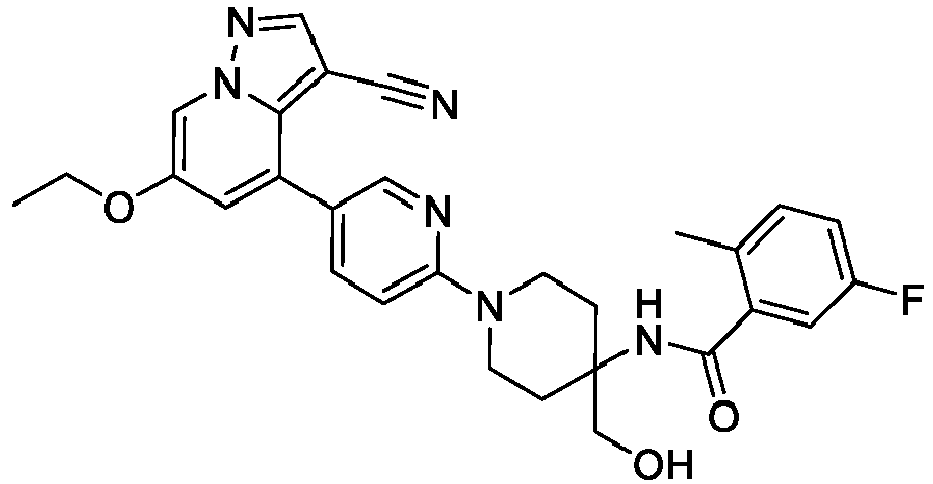
- To a solution of 4-(6-(4-amino-4-(hydroxymethyl)piperidin-1-yl)pyridin-3-yl)-6-ethoxypyrazolo[1,5-a]pyridine-3-carbonitrile (Intermediate P56, 30 mg, 0.0764 mmol) in DCM (0.005 mL) was added 5-fluoro-2-methylbenzoic acid (11.8 mg, 0.0764 mmol), DIEA (13.4 µl, 0.0764 mmol), and HATU (29.1 mg, 0.0764 mmol). The reaction mixture was stirred at rt 24 h then purified by C18 prep HPLC eluting with a 5-95% acetonitrile/water + 0.1% TFA gradient then silica chromaography eluting with (0-100% EtOAc in Hexanes then 0-10% MeOH in EtOAc as the gradient eluent) followed by trituration with 1:3 DCM/MTBE to afford the title compound (23.8 mg, 0.045 mmol, 59% yield). MS (apci) m/z = 529.2 (M+H).
- The compounds in Table SS were prepared using a similar method to that described for the synthesis of Example 340, replacing 5-fluoro-2-methylbenzoic acid with the appropriate carboxylic acid. Reactions were monitored for completion by LCMS, and reaction durations were adjusted accordingly. Title compounds were cleanly isolated following chromatographic purification using an appropriate gradient eluent (and if necessary converted to the free base).
Table SS Ex. # Structure Chemical Name MS m/z 341 
N-(1-(5-(3-cyano-6-ethoxypyrazolo[1,5-a]pyridin-4-yl)pyridin-2-yl)-4-(hydroxymethy l)pi peri din-4-yl)-2,6-difluorobenzamide 533.20 (M+H) 342 
3-chloro-N-(1-(5-(3-cyano-6-ethoxypyrazolo[1,5-a]pyridin-4-yl)pyridin-2-yl)-4-(hydroxymethyl)piperidin-4-yl)picolinamide 532.20 (M+) 343 
N-(1-(5-(3-cyano-6-ethoxypyrazolo[1,5-a]pyridin-4-yl)pyridin-2-yl)-4-(hydroxymethyl)piperidin-4-yl)-3 -fluoropicolinamide 516.20 (M+H) -

- A solution of tert-butyl (R)-(1-(5-(3-cyano-6-ethoxypyrazolo[1,5-a]pyridin-4-yl)pyridin-2-yl)piperidin-3-yl)carbamate (Intermediate P57, 30 mg, 0.0649 mmol) in DCM (0.1 mL) was treated with TFA (0.124 mL). The reaction mixture was stirred at rt for 3 h before it was concentrated in vacuo to yield the title product (12 mg, 31 % yield). MS (apci) m/z = 363.2 (M+H).
-

- A solution of tert-butyl (R)-(1-(5-(3-cyano-6-ethoxypyrazolo[1,5-a]pyridin-4-yl)pyridin-2-yl)piperidin-3-yl)carbamate (Intermediate P57, 30 mg, 0.0649 mmol) in formic acid (0.489 mL) was treated with formaldehyde (0.195 mL, 2.59 mmol). The reaction mixture was stirred at 90°C for 24 h. After cooling to ambient temperature, the reaction mixture was quenched with water and extracted with DCM. The combined organic extracts were dried over anhydrous Na2SO4(s) and concentrated in vacuo. The residue was purified by C-18 reverse phase chromatography (10-90% ACN in water + 0.1% formic acid as the gradient eluent) to afford the title compound (2.0 mg, 0.00512 mmol, 7.90 % yield). MS (apci) m/z = 391.25 (M+H).
-

- To a solution of (R)-4-(6-(3-aminopiperidin-1-yl)pyridin-3-yl)-6-ethoxypyrazolo[1,5-a]pyridine-3-carbonitrile (Example 344, 10 mg, 0.0276 mmol) in DMA (0.4 mL) was added TEA (0.0115 mL, 0.0828 mmol) and (bromomethyl)benzene (0.003 mL, 0.028 mmol). The reaction mixture was stirred at rt for 24 h. The reaction mixture was quenched with saturated NH4Cl(aq) and extracted into DCM. The combined organic extracts were dried over anhydrous Na2SO4(s) and concentrated in vacuo. The residue was purified by silica chromatography (0-100% EtOAc in hexanes as the gradient eluent) to afford the title compound (3.9 mg, 31% yield). MS (apci) m/z = 453.2 (M+H).
-

- Step 1: Preparation of tert-butyl ((3R,4R)-1-(5-(3-cyano-6-ethoxypyrazolo[1,5-a]pyridin-4-yl)pyridin-2-yl)-4-methylpiperidin-3-yl)(methyl)carbamate. To a solution of 6-ethoxy-4-(6-fluoropyridin-3-yl)pyrazolo[1,5-a]pyridine-3-carbonitrile (Intermediate P6, 60 mg, 0.213 mmol) in DMSO (0.4 mL) was added potassium carbonate (147 mg, 1.06 mmol) and tert-butyl methyl((3R,4R)-4-methylpiperidin-3-yl)carbamate (146 mg, 0.638 mmol). The reaction mixture was stirred at 110°C for 24 h. After cooling to ambient temperature, the reaction mixture was quenched with saturated NH4Cl(aq) and extracted into DCM. The combined organic extracts were dried over anhydrous Na2SO4(s) and concentrated in vacuo. The residue was purified by silica chromatography (0-100% EtOAc in hexanes as the gradient eluent) to afford the title compound (72.5 mg, 0.148 mmol, 69.5 % yield) in sufficient purity for step 2. MS (apci) m/z = 491.3 (M+H).
- Step 2: Preparation of 6-ethoxy-4-(6-((3R,4R)-4-methyl-3-(methylamino)piperidin-1-yl)pyridin-3-yl)pyrazolo[1,5-a]pyridine-3-carbonitrile. To a solution of tert-butyl ((3R,4R)-1-(5-(3-cyano-6-ethoxypyrazolo[1,5-a]pyridin-4-yl)pyridin-2-yl)-4-methylpiperidin-3-yl)(methyl)carbamate (0.020 g, 0.0408 mmol) in DCM (0.2 mL) was added 5M HCl in IPA (0.204 mL, 1.02 mmol). The reaction mixture was stirred at rt for 24 h, at which time it was quenched in water and adjusted to pH 10 by addition of 2M NaOH(aq). The solution was extracted with DCM, and the combined organic extracts were concentrated in vacuo to afford the title compound (0.0145 g, 0.0371 mmol, 91.1 % yield). MS (apci) m/z = 391.2 (M+H).
-

- A solution of tert-butyl ((3R,5S)-1-(5-(3-cyano-6-ethoxypyrazolo[1,5-a]pyridin-4-yl)pyridin-2-yl)-5-(trifluoromethyl)piperidin-3-yl)carbamate (Intermediate P62, 0.020 g, 0.038 mmol) in DCM (0.2 mL) was treated with 5M HCl in IPA (0.19 mL, 1.1 mmol). The reaction was stirred at rt 6 h. The reaction mixture was concentrated in vacuo, and the residue was purified by silica chromatography (0-30% [9:1 MeOH/NH4OH] in EtOAc) to afford the title compound (0.0073 g, 0.017 mmol, 45 % yield). MS (apci) m/z = 431.2 (M+H).
-

- Step 1: Preparation of tert-butyl ((3R,5S)-1-(5-(3-cyano-6-ethoxypyrazolo[1,5-a]pyridin-4-yl)pyridin-2-yl)-5-(trifluoromethyl)piperidin-3-yl)(methyl)carbamate. A solution of tert-butyl ((3R,5S)-1-(5-(3-cyano-6-ethoxypyrazolo[1,5-a]pyridin-4-yl)pyridin-2-yl)-5-(trifluoromethyl)piperidin-3-yl)carbamate (Intermediate P62, 0.020 g, 0.038 mmol) in DMA (0.5 mL) was cooled to 0°C then treated with sodium hydride (60% w/w, 0.0090 g, 0.11 mmol). The reaction mixture was warmed to rt and stirred for 20 min, at which time iodomethane (0.016 g, 0.11 mmol) was added and the reaction mixture stirred at rt an additional 24 h. The reaction mixture was quenched with saturated NH4Cl(aq) and extracted into DCM. The combined organic extracts were dried over anhydrous Na2SO4(s) and concentrated in vacuo. The residue was purified by silica chromatography (0-100% EtOAc in hexanes as the gradient eluent) to afford the title compound (0.010 g, 0.018 mmol, 49 % yield) in sufficient purity for step 2. MS (apci) m/z = 545.25 (M+H).
- Step 2: Preparation of 6-ethoxy-4-(6-((3R,5S)-3-(methylamino)-5-(trifluoromethyl)piperidin-1-yl)pyridin-3-yl)pyrazolo[1,5-a]pyridine-3-carbonitrile. A solution of tert-butyl ((3R,5S)-1-(5-(3-cyano-6-ethoxypyrazolo[1,5-a]pyridin-4-yl)pyridin-2-yl)-5-(trifluoromethyl)piperidin-3-yl)(methyl)carbamate (0.010 g, 0.018 mmol) in DCM (0.2 mL) was treated with 5M HCl in IPA (0.2 ml, 0.018 mmol). The reaction was stirred at rt 6 h. The reaction mixture was concentrated in vacuo, and the residue was purified by silica chromatography (0-30% [9:1 MeOH/NH4OH] in EtOAc) to afford the title compound (0.0045 g, 0.010 mmol, 55 % yield). MS (apci) m/z = 445.2 (M+H).
-

- Step 1: Preparation of 4-(6-((3S,4R)-3-azido-4-(pyridin-2-yloxy)pyrrolidin-1-yl)pyridin-3-yl)-6-ethoxypyrazolo[1,5-a]pyridine-3-carbonitrile. To a solution of 4-(6-((3S,4S)-3-azido-4-hydroxypyrrolidin-1-yl)pyridin-3-yl)-6-ethoxypyrazolo[1,5-a]pyridine-3-carbonitrile (Intermediate P58, 0.050 g, 0.128 mmol) in 1:1 DCM/THF (0.7 mL) was added pyridin-2-ol (0.0244 g, 0.256 mmol) and triphenylphosphane (0.0672 g, 0.256 mmol). The reaction mixture was sparged with argon, diisopropyl (E)-diazene-1,2-dicarboxylate (0.0350 mL, 0.256 mmol) was added. The reaction mixture was stirred at rt for 24 h. It was quenched with water and extracted into DCM. The combined organic extracts were dried over anhydrous Na2SO4(s) and concentrated in vacuo. The residue was purified by silica chromatography (20-100% EtOAc in hexanes as the gradient eluent) to afford the title compound (0.014 g, 0.0299 mmol, 23.4 % yield) in sufficient purity for step 2. MS (apci) m/z = 468.1 (M+H).
- Step 2: Preparation of 4-(6-((3S,4R)-3-amino-4-(pyridin-2-yloxy)pyrrolidin-1-yl)pyridin-3-yl)-6-ethoxypyrazolo[1,5-a]pyridine-3-carbonitrile. To a solution of 4-(6-((3S,4R)-3-azido-4-(pyridin-2-yloxy)pyrrolidin-1-yl)pyridin-3-yl)-6-ethoxypyrazolo[1,5-a]pyridine-3-carbonitrile (0.013 g, 0.028 mmol) in 1:1 MeOH/EtOAc (2 mL) was added 10% palladium on carbon (0.33 mg, 0.0028 mmol). The reaction mixture was sparged with H2 and stirred at rt for 24 h. The solids were removed by filtration, and the filtrate was concentrated in vacuo. The residue was purified by silica chromatography (0-40% [9:1 MeOH/NH4OH] in EtOAc as the gradient eluent) to afford the title compound (7 mg, 56 % yield). MS (apci) m/z = 442.2 (M+H).
-

- Step 1: Preparation of 4-(6-((3S,4S)-3-azido-4-propoxypyrrolidin-1-yl)pyridin-3-yl)-6-ethoxypyrazolo[1,5-a]pyridine-3-carbonitrile. To a solution of 4-(6-((3S,4S)-3-azido-4-hydroxypyrrolidin-1-yl)pyridin-3-yl)-6-ethoxypyrazolo[1,5-a]pyridine-3-carbonitrile (Intermediate P58, 0.027 g, 0.069 mmol) in DMA (0.5 mL) was added potassium carbonate (0.029 g, 0.21 mmol) and 1-iodopropane (0.021 ml, 0.21 mmol). The reaction mixture was stirred at 85°C for 48 h. After cooling to ambient temperature, the reaction was quenched with water and extracted into DCM. The combined organic extracts were dried over anhydrous Na2SO4(s) and concentrated in vacuo. The residue was purified by silica chromatography (0-100% EtOAc in hexanes as the gradient eluent) to afford the title compound (assumed theoretical yield, 0.030 g, 0.069 mmol) in sufficient purity for step 2. MS (apci) m/z = 433.2 (M+H).
- Step 2: Preparation of 4-(6-((3S,4S)-3-amino-4-propoxypyrrolidin-1-yl)pyridin-3-yl)-6-ethoxypyrazolo[1,5-a]pyridine-3-carbonitnle. To a solution of 4-(6-((3S,4S)-3-azido-4-propoxypyrrolidin-1-yl)pyridin-3-yl)-6-ethoxypyrazolo[1,5-a]pyridine-3-carbonitrile (0.022 g, 0.051 mmol) in EtOAc (5 mL) was added 10% palladium on carbon (0.012 g, 0.010 mmol). The reaction mixture was sparged with H2 and stirred at rt for 24 h. The solids were removed by filtration, and the filtrate was concentrated in vacuo. The residue was purified by silica chromatography (0-40% [9:1 MeOH/NH4OH] in EtOAc as the gradient eluent) to afford the title compound (0.0026 g, 0.0064 mmol, 13 % yield over two steps). MS (apci) m/z = 407.2 (M+H).
-

- Step 1: Preparation of 4-(6-((3SAS)-3-azido-4-isobutoxypyrrolidin-1-yl)pyridin-3-yl)-6-ethoxypyrazolo[1,5-a]pyridine-3-carbonitrile. To a solution of 4-(6-((3S,4S)-3-azido-4-hydroxypyrrolidin-1-yl)pyridin-3-yl)-6-ethoxypyrazolo[1,5-a]pyridine-3-carbonitrile (Intermediate P58, 0.027 g, 0.069 mmol) in DMA (0.5 mL) was added potassium carbonate (0.029 g, 0.21 mmol) and 1-bromo-2-methylpropane (0.024 ml, 0.21 mmol). The reaction mixture was stirred at 85°C for 120 h. It was quenched with saturated NH4Cl(aq) and extracted into DCM. The combined organic extracts were dried over anhydrous Na2SO4(s) and concentrated in vacuo. The residue was purified by silica chromatography (0-100% EtOAc in hexanes as the gradient eluent) to afford the title compound (assumed theoretical yield, 0.031 g, 0.069 mmol) in sufficient purity for step 2. MS (apci) m/z = 447.1 (M+H).
- Step 2: Preparation of 4-(6-((3S,4S)-3-amino-4-isobutoxypyrrolidin-1-yl)pyridin-3-yl)-6-ethoxypyrazolo[1,5-a]pyridine-3-carbonitnle. To a solution of 4-(6-((3S,4S)-3-azido-4-isobutoxypyrrolidin-1-yl)pyridin-3-yl)-6-ethoxypyrazolo[1,5-a]pyridine-3-carbonitrile (0.015 g, 0.034 mmol) in EtOAc (5 mL) was added 10% palladium on carbon (0.012 g, 0.010 mmol). The reaction mixture was sparged with H2 and stirred at rt for 24 h. The solids were removed by filtration, and the filtrate was concentrated in vacuo. The residue was purified by silica chromatography (0-40% [9:1 MeOH/NH4OH] in EtOAc as the gradient eluent) to afford the title compound (0.0033 g, 0.0078 mmol, 23% yield over two steps). MS (apci) m/z = 421.25 (M+H).
-
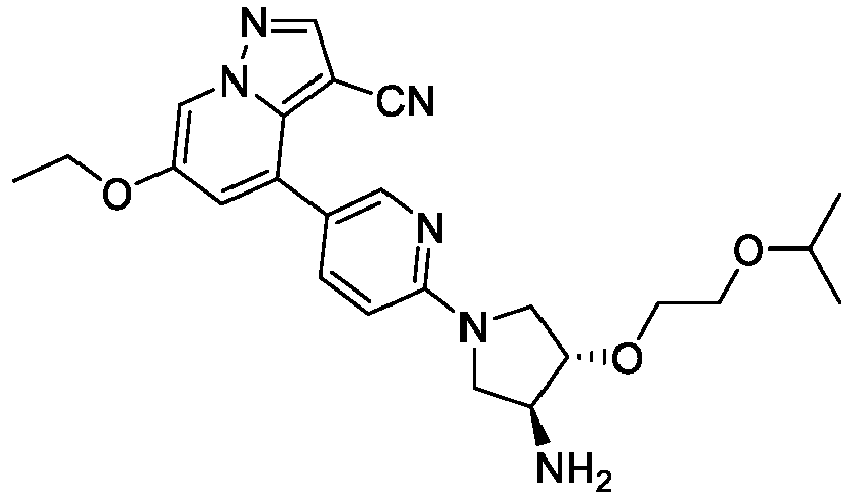
- Step 1: Preparation of 4-(6-((3S,4S)-3-azido-4-(2-isopropoxyethoxy)pyrrolidin-1-yl)pyridin-3-yl)-6-ethoxypyrazolo[1,5-a]pyridine-3-carbonitrile. To a solution of 4-(6-((3S,4S)-3-azido-4-hydroxypyrrolidin-1-yl)pyridin-3-yl)-6-ethoxypyrazolo[1,5-a]pyridine-3-carbonitrile (Intermediate P58, 0.040 g, 0.10 mmol) in DMA (0.7 mL) was added cesium carbonate (0.17 g, 0.51 mmol) and 2-(2-bromoethoxy)propane (0.086 g, 0.51 mmol). The reaction mixture was stirred at 90°C for 96 h. It was quenched with saturated NH4Cl(aq) and extracted into DCM. The combined organic extracts were dried over anhydrous Na2SO4(s) and concentrated in vacuo. The residue was purified by silica chromatography (0-100% EtOAc in hexanes as the gradient eluent) to afford the title compound (assumed theoretical yield, 0.048 g, 0.10 mmol) in sufficient purity for step 2.
- Step 2: Preparation of 4-(6-((3S,4S)-3-amino-4-(2-isopropoxyethoxy)pyrrolidin-1-yl)pyridin-3-yl)-6-ethoxypyrazolo[1,5-a]pyridine-3-carbonitrile. To a solution of 4-(6-((3S,4S)-3-azido-4-(2-isopropoxyethoxy)pyrrolidin-1-yl)pyridin-3-yl)-6-ethoxypyrazolo[1,5-a]pyridine-3-carbonitrile (0.048 g, 0.010 mmol) in EtOAc (2 mL) was added 10% palladium on carbon (0.010 g, 0.010 mmol). The reaction mixture was sparged with H2 and stirred at rt for 24 h. The solids were removed by filtration, and the filtrate was concentrated in vacuo. The residue was purified by silica chromatography (0-40% [9:1 MeOH/NH4OH] in EtOAc as the gradient eluent) to afford the title compound (8 mg, 0.017 mmol, 16% yield over two steps). MS (apci) m/z = 452.3 (M+H).
-

- Step 1: Preparation of 4-(6-((3R,4S)-3-azido-4-(pyridin-2-yloxy)pyrrolidin-1-yl)pyridin-3-yl)-6-ethoxypyrazolo[1,5-a]pyridine-3-carbonitrile. To a solution of 4-(6-((3R,4R)-3-azido-4-hydroxypyrrolidin-1-yl)pyridin-3-yl)-6-ethoxypyrazolo[1,5-a]pyridine-3-carbonitrile (Intermediate P59, 0.050 g, 0.128 mmol) in 1:1 DCM/THF (0.7 mL) was added pyridin-2-ol (0.0244 g, 0.256 mmol) and triphenylphosphane (0.0672 g, 0.256 mmol). The reaction mixture was sparged with argon, diisopropyl (E)-diazene-1,2-dicarboxylate (0.0350 mL, 0.256 mmol) was added. The reaction mixture was stirred at rt for 24 h. It was quenched with water and extracted into DCM. The combined organic extracts were dried over anhydrous Na2SO4(s) and concentrated in vacuo. The residue was purified by silica chromatography (20-100% EtOAc in hexanes as the gradient eluent) to afford the title compound (0.025 g, 0.0535 mmol, 41.8% yield) in sufficient purity for step 2. MS (apci) m/z = 468.1 (M+H).
- Step 2: Preparation of 4-(6-((3R,4S)-3-amino-4-(pyridin-2-yloxy)pyrrolidin-1-yl)pyridin-3-yl)-6-ethoxypyrazolo[1,5-a]pyridine-3-carbonitrile. To a solution of 4-(6-((3R,4S)-3-azido-4-(pyridin-2-yloxy)pyrrolidin-1-yl)pyridin-3-yl)-6-ethoxypyrazolo[1,5-a]pyridine-3-carbonitrile (0.022 g, 0.0471 mmol) in 1:1 MeOH/EtOAc (2 mL) was added 10% palladium on carbon (0.56 mg, 0.0047 mmol). The reaction mixture was sparged with H2 and stirred at rt for 24 h. The solids were removed by vacuum filtration, and the filtrate was concentrated in vacuo. The residue was purified by silica chromatography (0-40% [9:1 MeOH/NH4OH] in EtOAc as the gradient eluent) to afford the title compound (13 mg, 0.0297 mmol, 63.1 % yield). MS (apci) m/z = 442.2 (M+H).
-

- Step 1: Preparation of 4-(6-((3R,4R)-3-azido-4-isobutoxypyrrolidin-1-yl)pyridin-3-yl)-6-ethoxypyrazolo[1,5-a]pyridine-3-carbonitrile. To a solution of 4-(6-((3R,4R)-3-azido-4-hydroxypyrrolidin-1-yl)pyridin-3-yl)-6-ethoxypyrazolo[1,5-a]pyridine-3-carbonitrile (Intermediate P59, 0.025 g, 0.064 mmol) in DMA (0.5 mL) was added potassium carbonate (0.027 g, 0.19 mmol) and 1-bromo-2-methylpropane (0.022 ml, 0.19 mmol). The reaction mixture was stirred at 85°C for 120 h. It was quenched with saturated NH4Cl(aq) and extracted into DCM. The combined organic extracts were dried over anhydrous Na2SO4(s) and concentrated in vacuo. The residue was purified by silica chromatography (0-100% EtOAc in hexanes as the gradient eluent) to afford the title compound (assumed theoretical yield, 0.029 g, 0.064 mmol) in sufficient purity for step 2. MS (apci) m/z = 447.2 (M+H).
- Step 2: Preparation of 4-(6-((3R,4R)-3-amino-4-isobutoxypyrrolidin-1-yl)pyridin-3-yl)-6-ethoxypyrazolo[1,5-a]pyridine-3-carbonitnle. To a solution of 4-(6-((3R,4R)-3-azido-4-isobutoxypyrrolidin-1-yl)pyridin-3-yl)-6-ethoxypyrazolo[1,5-a]pyridine-3-carbonitrile (0.014 g, 0.032 mmol) in EtOAc (5 mL) was added 10% palladium on carbon (0.012 g, 0.010 mmol). The reaction mixture was sparged with H2 and stirred at rt for 24 h. The solids were removed by filtration, and the filtrate was concentrated in vacuo. The residue was purified by silica chromatography (0-40% [9:1 MeOH/NH4OH] in EtOAc as the gradient eluent) to afford the title compound (1 mg, 0.0024 mmol, 7.3% yield over two steps). MS (apci) m/z = 421.3 (M+H).
-

- Step 1: Preparation of 4-(6-((3R,4R)-3-azido-4-propoxypyrrolidin-1-yl)pyridin-3-yl)-6-ethoxypyrazolo[1,5-a]pyridine-3-carbonitrile. To a solution of 4-(6-((3R,4R)-3-azido-4-hydroxypyrrolidin-1-yl)pyridin-3-yl)-6-ethoxypyrazolo[1,5-a]pyridine-3-carbonitrile (Intermediate P59, 0.025 g, 0.064 mmol) in DMA (0.5 mL) was added potassium carbonate (0.027 g, 0.19 mmol) and 1-iodopropane (0.019 mL, 0.19 mmol). The reaction mixture was stirred at 85°C for 48 h. After cooling to ambient temperature, the reaction was quenched with water and extracted into DCM. The combined organic extracts were dried over anhydrous Na2SO4(s) and concentrated in vacuo. The residue was purified by silica chromatography (0-100% EtOAc in hexanes as the gradient eluent) to afford the title compound (assumed theoretical yield, 0.028 g, 0.064 mmol) in sufficient purity for step 2. MS (apci) m/z = 433.2 (M+H).
- Step 2: Preparation of 4-(6-((3R,4R)-3-amino-4-propoxypyrrolidin-1 yl)pyridin-3-yl)-6-ethoxypyrazolo[1,5-a]pyridine-3-carbonitrile. To a solution of 4-(6-((3R,4R)-3-azido-4-propoxypyrrolidin-1-yl)pyridin-3-yl)-6-ethoxypyrazolo[1,5-a]pyridine-3-carbonitrile (0.017 g, 0.039 mmol) in EtOAc (5 mL) was added 10% palladium on carbon (0.0093 g, 0.0079 mmol). The reaction mixture was sparged with H2 and stirred at rt for 24 h. The solids were removed by vacuum filtration, and the filtrate was concentrated in vacuo. The residue was purified by silica chromatography (0-40% [9:1 MeOH/NH4OH] in EtOAc as the gradient eluent) to afford the title compound (0.0026 g, 0.0064 mmol, 16% yield over two steps). MS (apci) m/z = 407.2 (M+H).
-

- Step 1: Preparation of 4-(6-((3R,4R)-3-azido-4-(2-isopropoxyethoxy)pyrrolidin-1-yl)pyridin-3-yl)-6-ethoxypyrazolo[1,5-a]pyridine-3-carbonitrile. To a solution of 4-(6-((3R,4R)-3-azido-4-hydroxypyrrolidin-1-yl)pyridin-3-yl)-6-ethoxypyrazolo[1,5-a]pyridine-3-carbonitrile (Intermediate P59, 0.025 g, 0.064 mmol) in DMA (0.5 mL) was added cesium carbonate (0.10 g, 0.32 mmol) and 2-(2-bromoethoxy)propane (0.053 g, 0.32 mmol). The reaction mixture was stirred at 90°C for 96 h. It was quenched with saturated NH4Cl(aq) and extracted into DCM. The combined organic extracts were dried over anhydrous Na2SO4(s) and concentrated in vacuo. The residue was purified by silica chromatography (0-100% EtOAc in hexanes as the gradient eluent) to afford the title compound (assumed theoretical yield, 0.031 g, 0.064 mmol) in sufficient purity for step 2.
- Step 2: Preparation of 4-(6-((3R,4R)-3-amino-4-(2-isopropoxyethoxy)pyrrolidin-1-yl)pyridin-3-yl)-6-ethoxypyrazolo[1,5-a]pyridine-3-carbonitrile. To a solution of 4-(6-((3R,4R)-3-azido-4-(2-isopropoxyethoxy)pyrrolidin-1-yl)pyridin-3-yl)-6-ethoxypyrazolo[1,5-a]pyridine-3-carbonitrile (0.031 g, 0.064 mmol) in EtOAc (2 mL) was added 10% palladium on carbon (0.010 g, 0.010 mmol). The reaction mixture was sparged with H2 and stirred at rt for 24 h. The solids were removed by filtration, and the filtrate was concentrated in vacuo. The residue was purified by silica chromatography (0-40% [9:1 MeOH/NH4OH] in EtOAc as the gradient eluent) to afford the title compound (0.0043 g, 0.0095 mmol, 15% yield over two steps). MS (apci) m/z = 452.3 (M+H).
-

- Step 1: Preparation of tert-butyl ((3R,4R)-1-(5-(3-cyano-6-ethoxypyrazolo[1,5-a]pyridin-4-yl)pyridin-2-yl)-4-(pyridin-2-yloxy)pyrrolidin-3-yl)carbamate. To a solution of tert-butyl ((3R,4S)-1-(5-(3-cyano-6-ethoxypyrazolo[1,5-a]pyridin-4-yl)pyridin-2-yl)-4-hydroxypyrrolidin-3-yl)carbamate (Intermediate P60, 0.030 g, 0.0646 mmol) in 1:1 DCM/THF (0.75 mL) was added pyridin-2-ol (0.0123 g, 0.129 mmol) and triphenylphosphane (0.0339 g, 0.129 mmol). The reaction mixture was sparged with argon, and diisopropyl (E)-diazene-1,2-dicarboxylate (0.0176 mL, 0.129 mmol) was added. The reaction mixture was stirred at rt for 24 h. It was quenched with water and extracted into DCM. The combined organic extracts were dried over anhydrous Na2SO4(s) and concentrated in vacuo. The residue was purified by silica chromatography (20-100% EtOAc in hexanes as the gradient eluent) to afford the title compound (assumed theoretical yield, 0.035 g, 0.0646 mmol) in sufficient purity for step 2.
- Step 2: Preparation of 4-(6-((3R,4R)-3-amino-4-(pyridin-2-yloxy)pyrrolidin-1-yl)pyridin-3-yl)-6-ethoxypyrazolo[1,5-a]pyridine-3-carbonitrile. A solution of tert-butyl ((3R,4R)-1-(5-(3-cyano-6-ethoxypyrazolo[1,5-a]pyridin-4-yl)pyridin-2-yl)-4-(pyridin-2-yloxy)pyrrolidin-3-yl)carbamate (0.035 g, 0.0646 mmol) in DCM (2 mL) was treated with 6M HCl in IPA (2 mL) and stirred at rt for 24 h. The reaction mixture was concentrated in vacuo, and the residue was taken up in water. 2M NaOH was added and extracted with DCM. The combined organic extracts were passed through a phase separator frit then purified by silica chromatography (0-40% [9:1 MeOH/NH4OH] in EtOAc as the gradient eluent) to afford the title compound (0.0073 g, 0.0165 mmol, 25.6% yield over two steps). MS (apci) m/z = 442.2 (M+H).
-

- Step 1: Preparation of tert-butyl ((3R,4R)-1-(5-(3-cyano-6-ethoxypyrazolo[1,5-a]pyridin-4-yl)pyridin-2-yl)-4-(pyridin-2-yloxy)pyrrolidin-3-yl)carbamate. To a solution of tert-butyl ((3R,4S)-1-(5-(3-cyano-6-ethoxypyrazolo[1,5-a]pyridin-4-yl)pyridin-2-yl)-4-hydroxypyrrolidin-3-yl)carbamate (Intermediate P60, 0.030 g, 0.0646 mmol) in 1:1 DCM/THF (0.75 mL) was added 5-methoxypyridin-2-ol (0.0162 g, 0.129 mmol) and triphenylphosphane (0.0339 g, 0.129 mmol). The reaction mixture was sparged with argon, and diisopropyl (E)-diazene-1,2-dicarboxylate (0.0176 mL, 0.129 mmol) was added. The reaction mixture was stirred at rt for 24 h. It was quenched with water and extracted into DCM. The combined organic extracts were dried over anhydrous Na2SO4(s) and concentrated in vacuo. The residue was purified by silica chromatography (20-100% EtOAc in hexanes as the gradient eluent) to afford the title compound (assumed theoretical yield, 0.037 g, 0.0646 mmol) in sufficient purity for step 2.
- Step 2: Preparation of 4-(6-((3R,4R)-3-amino-4-((6-methoxypyridin-3-yl)oxy)pyrrolidin-1-yl)pyridin-3-yl)-6-ethoxypyrazolo[1,5-a]pyridine-3-carbonitrile. A solution of tert-butyl ((3R,4R)-1-(5-(3-cyano-6-ethoxypyrazolo[1,5-a]pyridin-4-yl)pyridin-2-yl)-4-(pyridin-2-yloxy)pyrrolidin-3-yl)carbamate (0.037 g, 0.0646) in DCM (2 mL) was treated with 6M HCl in IPA (2 mL) and stirred at rt for 24 h. The reaction mixture was concentrated in vacuo, and the residue was taken up in water. 2M NaOH was added and extracted with DCM. The combined organic extracts were passed through a phase separator frit then purified by silica chromatography (0-40% [9:1 MeOH/NH4OH] in EtOAc as the gradient eluent) to afford the title compound (0.0065 g, 0.0138 mmol, 21.3% yield over two steps). MS (apci) m/z = 472.2 (M+H).
-

- Step 1: Preparation of tert-butyl ((3R,4R)-4-((6-chloropyridazin-3-yl)oxy)-1-(5-(3-cyano-6-ethoxypyrazolo[1,5-a]pyridin-4-yl)pyridin-2-yl)pyrrolidin-3-yl)carbamate. To a solution of tert-butyl ((3R,4S)-1-(5-(3-cyano-6-ethoxypyrazolo[1,5-a]pyridin-4-yl)pyridin-2-yl)-4-hydroxypyrrolidin-3-yl)carbamate (Intermediate P60, 0.030 g, 0.0646 mmol) in 1:1 DCM/THF (0.7 mL) was added 6-chloropyridazin-3-ol (0.0169 g, 0.129 mmol) and triphenylphosphane (0.0339 g, 0.129 mmol). The reaction mixture was sparged with argon, and diisopropyl (E)-diazene-1,2-dicarboxylate (0.0176 mL, 0.129 mmol) was added. The reaction mixture was stirred at rt for 24 h. It was quenched with water and extracted into DCM. The combined organic extracts were dried over anhydrous Na2SO4(s) and concentrated in vacuo. The residue was purified by silica chromatography (20-100% EtOAc in hexanes as the gradient eluent) to afford the title compound (assumed theoretical yield, 0.031 g, 0.0646 mmol) in sufficient purity for step 2.
- Step 2: Preparation of 4-(6-((3R,4R)-3-amino-4-((6-chloropyridazin-3-yl)oxy)pyrrolidin-1-yl)pyridin-3-yl)-6-ethoxypyrazolo[1,5-a]pyridine-3-carbonitrile. A solution of tert-butyl ((3R,4R)-4-((6-chloropyridazin-3-yl)oxy)-1-(5-(3-cyano-6-ethoxypyrazolo[1,5-a]pyridin-4-yl)pyridin-2-yl)pyrrolidin-3-yl)carbamate (0.031 g, 0.0646) in DCM (2 mL) was treated with 6M HCl in IPA (2 mL) and stirred at rt for 24 h. The reaction mixture was concentrated in vacuo, and the residue was taken up in water. 2M NaOH was added and extracted with DCM. The combined organic extracts were passed through a phase separator frit then purified by silica chromatography (0-40% [9:1 MeOH/NH4OH] in EtOAc as the gradient eluent) to afford the title compound (0.013 g, 0.0273 mmol, 42.2% yield over two steps). MS (apci) m/z = 477.1 (M+H).
-

- Step 1: Preparation of tert-butyl ((3R,4R)-1-(5-(3-cyano-6-ethoxypyrazolo[1,5-a]pyridin-4-yl)pyridin-2-yl)-4-((5-fluoro-6-methoxypyridin-3-yl)oxy)pyrrolidin-3-yl)carbamate. To a solution of tert-butyl ((3R,4S)-1-(5-(3-cyano-6-ethoxypyrazolo[1,5-a]pyridin-4-yl)pyridin-2-yl)-4-hydroxypyrrolidin-3-yl)carbamate (Intermediate P60, 0.030 g, 0.0646 mmol) in 1:1 DCM/THF (0.7 mL) was added 5-fluoro-6-methoxypyndin-3-ol (0.0185 g, 0.129 mmol) and triphenylphosphane (0.0339 g, 0.129 mmol). The reaction mixture was sparged with argon, and diisopropyl (E)-diazene-1,2-dicarboxylate (0.0176 mL, 0.129 mmol) was added. The reaction mixture was stirred at rt for 24 h. It was quenched with water and extracted into DCM. The combined organic extracts were dried over anhydrous Na2SO4(s) and concentrated in vacuo. The residue was purified by silica chromatography (20-100% EtOAc in hexanes as the gradient eluent) to afford the title compound (assumed theoretical yield, 0.038 g, 0.0646 mmol) in sufficient purity for step 2.
- Step 2: Preparation of 4-(6-((3R,4R)-3-amino-4-((5-fluoro-6-methoxypyridin-3-yl)oxy)pyrrolidin-1-yl)pyridin-3-yl)-6-ethoxypyrazolo[1,5-a]pyridine-3-carbonitrile. A solution of tert-butyl ((3R,4R)-1-(5-(3-cyano-6-ethoxypyrazolo[1,5-a]pyridin-4-yl)pyridin-2-yl)-4-((5-fluoro-6-methoxypyridin-3-yl)oxy)pyrrolidin-3-yl)carbamate (0.038 g, 0.0646) in DCM (2 mL) was treated with 6M HCl in IPA (2 mL) and stirred at rt for 24 h. The reaction mixture was concentrated in vacuo, and the residue was taken up in water. 2M NaOH was added and extracted with DCM. The combined organic extracts were passed through a phase separator frit then purified by silica chromatography (0-40% [9:1 MeOH/NH4OH] in EtOAc as the gradient eluent) to afford the title compound (0.0014 g, 0.00286 mmol, 4.43% yield over two steps). MS (apci) m/z = 490.2 (M+H).
-

- Step 1: Preparation of tert-butyl ((3S,4S)-1-(5-(3-cyano-6-ethoxypyrazolo[1,5-a]pyridin-4-yl)pyridin-2-yl)-4-(pyridin-2-yloxy)pyrrolidin-3-yl)carbamate. To a solution of tert-butyl ((3S,4R)-1-(5-(3-cyano-6-ethoxypyrazolo[1,5-a]pyridin-4-yl)pyridin-2-yl)-4-hydroxypyrrolidin-3-yl)carbamate (Intermediate P61, 0.030 g, 0.0646 mmol) in 1:1 DCM/THF (0.75 mL) was added pyridin-2-ol (0.0123 g, 0.129 mmol) and triphenylphosphane (0.0339 g, 0.129 mmol). The reaction mixture was sparged with argon, and diisopropyl (E)-diazene-1,2-dicarboxylate (0.0176 mL, 0.129 mmol) was added. The reaction mixture was stirred at rt for 24 h. It was quenched with water and extracted into DCM. The combined organic extracts were dried over anhydrous Na2SO4(s) and concentrated in vacuo. The residue was purified by silica chromatography (20-100% EtOAc in hexanes as the gradient eluent) to afford the title compound (assumed theoretical yield, 0.035 g, 0.0646 mmol) in sufficient purity for step 2. MS (apci) m/z = 542.3 (M+H).
- Step 2: Preparation of 4-(6-((3S,4S)-3-amino-4-(pyridin-2-yloxy)pyrrolidin-1-yl)pyridin-3-yl)-6-ethoxypyrazolo[1,5-a]pyridine-3-carbonitrile. A solution of tert-butyl ((3S,4S)-1-(5-(3-cyano-6-ethoxypyrazolo[1,5-a]pyridin-4-yl)pyridin-2-yl)-4-(pyridin-2-yloxy)pyrrolidin-3-yl)carbamate (0.035 g, 0.0646 mmol) in DCM (2 mL) was treated with 6M HCl in IPA (2 mL) and stirred at rt for 24 h. The reaction mixture was concentrated in vacuo, and the residue was taken up in water. 2M NaOH was added and extracted with DCM. The combined organic extracts were passed through a phase separator frit then purified by silica chromatography (0-40% [9:1 MeOH/NH4OH] in EtOAc as the gradient eluent) to afford the title compound (0.0101 g, 0.0229 mmol, 35.4% yield over two steps). MS (apci) m/z = 442.2 (M+H).
-

- Step 1: Preparation of tert-butyl ((3S,4S)-1-(5-(3-cyano-6-ethoxypyrazolo[1,5-a]pyridin-4-yl)pyridin-2-yl)-4-(pyridin-2-yloxy)pyrrolidin-3-yl)carbamate. To a solution of tert-butyl ((3S,4R)-1-(5-(3-cyano-6-ethoxypyrazolo[1,5-a]pyridin-4-yl)pyridin-2-yl)-4-hydroxypyrrolidin-3-yl)carbamate (Intermediate P61, 0.030 g, 0.0646 mmol) in 1:1 DCM/THF (0.75 mL) was added 5-methoxypyridin-2-ol (0.0162 g, 0.129 mmol) and triphenylphosphane (0.0339 g, 0.129 mmol). The reaction mixture was sparged with argon, and diisopropyl (E)-diazene-1,2-dicarboxylate (0.0176 mL, 0.129 mmol) was added. The reaction mixture was stirred at rt for 48 h. It was quenched with water and extracted into DCM. The combined organic extracts were dried over anhydrous Na2SO4(s) and concentrated in vacuo. The residue was purified by silica chromatography (20-100% EtOAc in hexanes as the gradient eluent) to afford the title compound (assumed theoretical yield, 0.037 g, 0.0646 mmol) in sufficient purity for step 2. MS (apci) m/z = 572.3 (M+H).
- Step 2: Preparation of 4-(6-((3S,4S)-3-amino-4-((6-methoxypyridin-3-yl)oxy)pyrrolidin-1-yl)pyridin-3-yl)-6-ethoxypyrazolo[1,5-a]pyridine-3-carbonitrile. A solution of tert-butyl ((3S,4S)-1-(5-(3-cyano-6-ethoxypyrazolo[1,5-a]pyridin-4-yl)pyridin-2-yl)-4-(pyridin-2-yloxy)pyrrolidin-3-yl)carbamate (0.037 g, 0.0646) in DCM (2 mL) was treated with 6M HCl in IPA (2 mL) and stirred at rt for 24 h. The reaction mixture was concentrated in vacuo, and the residue was taken up in water. 2M NaOH was added and extracted with DCM. The combined organic extracts were passed through a phase separator frit then purified by silica chromatography (0-40% [9:1 MeOH/NH4OH] in EtOAc as the gradient eluent) to afford the title compound (0.0112 g, 0.0238 mmol, 36.8% yield over two steps). MS (apci) m/z = 472.2 (M+H).
-

- Step 1: Preparation of tert-butyl ((3S,4S)-4-((6-chloropyridazin-3-yl)oxy)-1-(5-(3-cyano-6-ethoxypyrazolo[1,5-a]pyridin-4-yl)pyridin-2-yl)pyrrolidin-3-yl)carbamate. To a solution of tert-butyl ((3S,4R)-1-(5-(3-cyano-6-ethoxypyrazolo[1,5-a]pyridin-4-yl)pyridin-2-yl)-4-hydroxypyrrolidin-3-yl)carbamate (Intermediate P61, 0.030 g, 0.0646 mmol) in 1:1 DCM/THF (0.7 mL) was added 6-chloropyridazin-3-ol (0.0169 g, 0.129 mmol) and triphenylphosphine (0.0339 g, 0.129 mmol). The reaction mixture was sparged with argon, and diisopropyl (E)-diazene-1,2-dicarboxylate (0.0176 mL, 0.129 mmol) was added. The reaction mixture was stirred at rt for 24 h. It was quenched with water and extracted into DCM. The combined organic extracts were dried over anhydrous Na2SO4(s) and concentrated in vacuo. The residue was purified by silica chromatography (20-100% EtOAc in hexanes as the gradient eluent) to afford the title compound (assumed theoretical yield, 0.031 g, 0.0646 mmol) in sufficient purity for step 2. MS (apci) m/z = 577.2 (M+H).
- Step 2: Preparation of 4-(6-((3S,4S)-3-amino-4-((6-chloropyridazin-3-yl)oxy)pyrrolidin-1-yl)pyridin-3-yl)-6-ethoxypyrazolo[1,5-a]pyridine-3-carbonitrile. A solution of tert-butyl ((3S,4S)-4-((6-chloropyridazin-3-yl)oxy)-1-(5-(3-cyano-6-ethoxypyrazolo[1,5-a]pyridin-4-yl)pyridin-2-yl)pyrrolidin-3-yl)carbamate (0.031 g, 0.0646) in DCM (2 mL) was treated with 6M HCl in IPA (2 mL) and stirred at rt for 24 h. The reaction mixture was concentrated in vacuo, and the residue was taken up in water. 2M NaOH was added and extracted with DCM. The combined organic extracts were passed through a phase separator frit then purified by silica chromatography (0-40% [9:1 MeOH/NH4OH] in EtOAc as the gradient eluent) to afford the title compound (0.0096 g, 0.0201 mmol, 31.2% yield over two steps). MS (apci) m/z = 477.2 (M+H).
-

- Step 1: Preparation of tert-butyl (R)-(1-(5-(3-cyano-6-ethoxypyrazolo[1,5-a]pyridin-4-yl)pyridin-2-yl)pyrrolidin-3-yl)carbamate. To a solution of 6-ethoxy-4-(6-fluoropyridin-3-yl)pyrazolo[1,5-a]pyridine-3-carbonitrile (Intermediate P6, 0.025 g, 0.0886 mmol) in DMSO (0.5 mL) was added N-ethyl-N-isopropylpropan-2-amine (0.0771 ml, 0.443 mmol) and tert-butyl (R)-pyrrolidin-3-ylcarbamate (0.0330 g, 0.177 mmol). The reaction mixture was stirred 100°C for 24 h. After cooling to ambient temperature, the reaction mixture was quenched with saturated NH4Cl(aq) and extracted into DCM. The combined organic extracts were dried over anhydrous Na2SO4(s) and concentrated in vacuo. The residue was purified by silica chromatography (40-100% EtOAc in hexanes as the gradient eluent) to afford the title compound (assumed theoretical yield, 0.040 g, 0.0886 mmol) in sufficient purity for step 2. MS (apci) m/z = 449.2 (M+H).
- Step 2: Preparation of (R)-4-(6-(3-aminopyrrolidin-1-yl)pyridin-3-yl)-6-ethoxypyrazolo[1,5-a]pyridine-3-carbonitrile. A solution of tert-butyl (R)-(1-(5-(3-cyano-6-ethoxypyrazolo[1,5-a]pyridin-4-yl)pyridin-2-yl)pyrrolidin-3-yl)carbamate (0.040 g, 0.0886 mmol) in DCM (1.5 mL) was treated with 5M HCl in IPA (1.5 mL) and stirred at rt for 2 h. The reaction mixture was concentrated in vacuo, and the residue was taken up in DCM. 2M NaOH was added and extracted with DCM. The combined organic extracts were passed through a phase separator frit then concentrated in vacuo to afford the title compound (0.0227 g, 0.0652 mmol, 73.6% yield over two steps). MS (apci) m/z = 349.2 (M+H).
-

- Step 1: Preparation of tert-butyl (S)-(1-(5-(3-cyano-6-ethoxypyrazolo[1,5-a]pyridin-4-yl)pyridin-2-yl)pyrrolidin-3-yl)carbamate. To a solution of 6-ethoxy-4-(6-fluoropyridin-3-yl)pyrazolo[1,5-a]pyridine-3-carbonitrile (Intermediate P6, 0.025 g, 0.0886 mmol) in DMSO (0.5 mL) was added N-ethyl-N-isopropylpropan-2-amine (0.0771 ml, 0.443 mmol) and tert-butyl (S)-pyrrolidin-3-ylcarbamate (0.0396 g, 0.213 mmol). The reaction mixture was stirred 100°C for 24 h. After cooling to ambient temperature, the reaction mixture was quenched with saturated NH4Cl(aq) and extracted into DCM. The combined organic extracts were dried over anhydrous Na2SO4(s) and concentrated in vacuo. The residue was purified by silica chromatography (40-100% EtOAc in hexanes as the gradient eluent) to afford the title compound (assumed theoretical yield, 0.040 g, 0.0886 mmol) in sufficient purity for step 2. MS (apci) m/z = 449.2 (M+H).
- Step 2: Preparation of (S)-4-(6-(3-aminopyrrolidin-1-yl)pyridin-3-yl)-6-ethoxypyrazolo[1,5-a]pyridine-3-carbonitrile. A solution of tert-butyl (S)-(1-(5-(3-cyano-6-ethoxypyrazolo[1,5-a]pyridin-4-yl)pyridin-2-yl)pyrrolidin-3-yl)carbamate (0.040 g, 0.0886 mmol) in DCM (1.5 mL) was treated with 5M HCl in IPA (1.5 mL) and stirred at rt for 2 h. The reaction mixture was concentrated in vacuo, and the residue was taken up in DCM. 2M NaOH was added and extracted with DCM. The combined organic extracts were passed through a phase separator frit then concentrated in vacuo to afford the title compound (0.0236 g, 0.0677 mmol, 63.7% yield over two steps). MS (apci) m/z = 349.1 (M+H).
-

- To a solution of 6-ethoxy-4-(6-fluoropyridin-3-yl)pyrazolo[1,5-a]pyridine-3-carbonitrile (Intermediate P6, 0.050 g, 0.18 mmol) in DMSO (0.35 mL) was added cesium carbonate (0.23 g, 0.71 mmol) and tert-butyl ((3R,5R)-5-(trifluoromethyl)piperidin-3-yl)carbamate (0.052 g, 0.19 mmol). The reaction mixture was stirred 105°C for 24 h. After cooling to ambient temperature, the reaction mixture was quenched with saturated NH4Cl(aq) and extracted into DCM. The combined organic extracts were dried over anhydrous Na2SO4(s) and concentrated in vacuo. The residue was purified by silica chromatography (0-40% [9:1 MeOH/NH4OH] in EtOAc as the gradient eluent) followed by purification by preparative HPLC (5-95% ACN in water [+ 0.1% TFA] as the gradient eluent). The final product fractions were washed with 2M NaOH and extracted with DCM. The combined organic extracts were passed through a phase separator frit and concentrated in vacuo to afford the title compound (0.0085 g, 0.020 mmol, 11% yield). MS (apci) m/z = 431.2 (M+H).
-

- Step 1: Preparation of tert-butyl 4-methyl-4-(phenylcarbamoyl)piperidine-1-carboxylate. A solution of 1-Boc-4-methyl-piperidine-4-carboxylic acid (717.3 mg, 2.948 mmol) and HATU (1345 mg, 3.538 mmol) in DCM (30 mL) was treated with DIEA (1.027 mL, 5.896 mmol) and aniline (.2958 mL, 3.243 mmol). The reaction mixture was stirred at rt for 60 h, then concentrated in vacuo. The residue was purified by silica chromatography (5-70% EtOAc in hexanes as the gradient eluent) to afford the title compound (assumed theoretical yield, 938.6 mg, 2.948 mmol) in sufficient purity for step 2. MS (apci) m/z = 219.2 (M+H-Boc).
- Step 2: Preparation of 4-methyl-N-phenylpiperidine-4-carboxamide. A solution of tert-butyl 4-methyl-4-(phenylcarbamoyl)piperidine-1-carboxylate (938.6 mg, 2.948 mmol) in DCM (2 mL) was treated with TFA (2 mL, 26 mmol) and stirred at rt for 16 h. The reaction mixture was concentrated in vacuo. The residue was diluted with saturated NaHCO3(aq) and extracted with 4:1 DCM/IPA. The combined organic extracts were dried over anhydrous Na2SO4(s) and concentrated in vacuo to afford the title compound (240.9 mg, 1.104 mmol, 37% yield over two steps) in sufficient purity for step 3. MS (apci) m/z = 219.2 (M+H).
- Step 3: Preparation of 1-(5-(3-cyano-6-ethoxypyrazolo[1,5-a]pyridin-4-yl)pyridin-2-yl)-4-methyl-N-phenylpiperidine-4-carboxamide. To a solution of 6-ethoxy-4-(6-fluoropyridin-3-yl)pyrazolo[1,5-a]pyridine-3-carbonitrile (Intermediate P6, 0.030 g, 0.108 mmol) in DMA (0.5 mL) was added TEA (0.073 mL, 0.538 mmol) and 4-methyl-N-phenylpiperidine-4-carboxamide (0.0705 g, 0.323 mmol). The reaction mixture was stirred 80°C for 20 h. After cooling to ambient temperature, the reaction mixture was quenched with water and extracted into EtOAc. The combined organic extracts were washed with water and saturated NaCl(aq), then dried over anhydrous Na2SO4(s) and concentrated in vacuo. The residue was purified by C-18 reverse phase chromatography (5-95% ACN in water [+ 0.1% TFA] as the gradient eluent). The fractions containing the desired product were washed with saturated NaHCO3(aq) and extracted with 4:1 DCM/IPA. The combined organic extracts were dried over anhydrous Na2SO4(s) and concentrated in vacuo to afford the title compound (0.0227 g, 0.0472 mmol, 44% yield). MS (apci) m/z = 481.2 (M+H).
-

- To a solution of 6-ethoxy-4-(6-fluoropyridin-3-yl)pyrazolo[1,5-a]pyridine-3-carbonitrile (Intermediate P6, 20.8 mg, 0.0737 mmol) in DMA (0.3 mL) was added TEA (0.0502 mL, 0.368 mmol) and 4-ethyl-N-phenylpiperidine-4-carboxamide (Intermediate R15, 51.4 mg, 0.221 mmol). The reaction mixture was stirred 90°C for 16 h. After cooling to ambient temperature, the reaction mixture was quenched with water and extracted into EtOAc. The combined organic extracts were washed with water and saturated NaCl(aq), then dried over anhydrous Na2SO4(s) and concentrated in vacuo. The residue was purified by C-18 reverse phase chromatography (5-95% ACN in water [+ 0.1% TFA] as the gradient eluent). The fractions containing the desired product were washed with saturated NaHCO3(aq) and extracted with 4:1 DCM/IPA. The combined organic extracts were dried over anhydrous Na2SO4(s) and concentrated in vacuo. The residue was purified by silica chromatography (0-100% EtOAc in hexanes as the gradient eluent) to afford the title compound (36.4 mg, 0.0166 mmol, 22.5% yield). MS (apci) m/z = 495.3 (M+H).
-
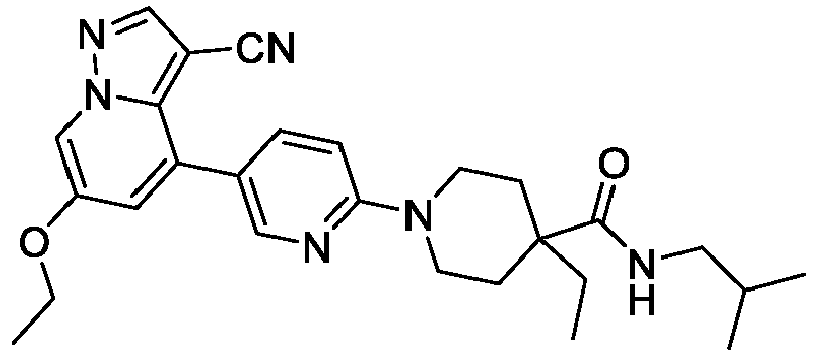
- To a solution of 6-ethoxy-4-(6-fluoropyridin-3-yl)pyrazolo[1,5-a]pyridine-3-carbonitrile (Intermediate P6, 21.4 mg, 0.0758 mmol) in DMA (0.25 mL) was added TEA (0.0517 mL, 0.379 mmol) and 4-ethyl-N-isobutylpiperidine-4-carboxamide (Intermediate R16, 48.3 mg, 0.227 mmol). The reaction mixture was stirred 90°C for 14 h. After cooling to ambient temperature, the reaction mixture was quenched with water and extracted into EtOAc. The combined organic extracts were washed with water and saturated NaCl(aq), then dried over anhydrous Na2SO4(s) and concentrated in vacuo. The residue was purified by C-18 reverse phase chromatography (5-95% ACN in water [+ 0.1% TFA] as the gradient eluent). The fractions containing the desired product were washed with saturated NaHCO3(aq) and extracted with 4:1 DCM/IPA. The combined organic extracts were dried over anhydrous Na2SO4(s) and concentrated in vacuo. The residue was purified by silica chromatography (0-30% MeOH [+ 2% NH4OH] in DCM as the gradient eluent) to afford the title compound (25.6 mg, 0.0539 mmol, 71.1% yield). MS (apci) m/z = 475.3 (M+H).
-

- Step 1: Preparation of 6-benzyl-1-oxa-6-azaspiro[2.5]octane. A solution of sodium hydride (60% w/w, 4.07 g, 102 mmol) in DMSO (200 mL) was treated with trimethylsulfoxonium iodide (22.4 g, 102 mmol) portionwise at rt over the course of 30 min. This mixture was stirred at rt 1 h then treated with 1-benzyl-4-piperidone (14.0 mL, 78.2 mmol). The reaction mixture was stirred at 60°C for 16 h. After cooling to ambient temperature, the reaction mixture was quenched with water and extracted into EtOAc. The combined organic extracts were washed with water and saturated NaCl(aq), then dried over anhydrous Na2SO4(s) and concentrated in vacuo. The residue was purified by silica chromatography (5-95% EtOAc [+ 2% TEA] in DCM as the gradient eluent) to afford the title compound (6.5 g, 32.0 mmol, 40.9% yield) in sufficient purity for step 2.
- Step 2: Preparation of 6-benzyl-1-thia-6-azaspiro[2.5]octane. To a solution of 6-benzyl-1-oxa-6-azaspiro[2.5]octane (6.50 g, 32.0 mmol) in MeOH (130 mL) was added thiourea (2.68 g, 35.2 mmol). The reaction mixture was stirred at 40°C for 16 h. After cooling to ambient temperature, the reaction mixture was diluted with EtOAc and washed with water and saturated NaCl(aq) The organic extracts were dried over anhydrous Na2SO4(s) and concentrated in vacuo. The residue was purified by silica chromatography (5-75% EtOAc [+ 2% TEA] in DCM as the gradient eluent) to afford the title compound (4.84 g, 22.1 mmol, 69% yield) in sufficient purity for step 3.
- Step 3: Preparation of 1-benzyl-4-methylpiperidine-4-thiol. A solution of 6-benzyl-1-thia-6-azaspiro[2.5]octane (4.84 g, 22.1 mmol) in THF (110 mL) was sparged with N2 and cooled to 0°C. To this solution was added lithium aluminum hydride (33.1 mL, 33.1 mmol), and the mixture was stirred at 0°C for 1 h. The reaction mixture was treated with dropwise addition of water and 1M NaOH. The reaction mixture was extracted with DCM, and the combined organic extracts were washed with water then dried over anhydrous Na2SO4(s) and concentrated in vacuo to afford the title compound (2.22 g, 10.0 mmol, 45.5% yield) in sufficient purity for step 4.
- Step 4: Preparation of 1-benzyl-4-(isobutylthio)-4-methylpiperidine. A solution of 1-benzyl-4-methylpiperidine-4-thiol (1.36 g, 6.144 mmol) in DMF (20 mL) was treated with potassium carbonate (2.547 g, 18.43 mmol) and 1-bromo-2-methylpropane (0.8017 mL, 7.373 mmol). The reaction mixture was stirred at 60°C for 16 h. After cooling to ambient temperature, the reaction mixture was diluted with EtOAc and washed with water and saturated NaCl(aq) The organic extracts were dried over anhydrous Na2SO4(s) and concentrated in vacuo. The residue was purified by silica chromatography (5-95% EtOAc [+ 2% TEA] in DCM as the gradient eluent). The fractions containing the desired product were combined and concentrated in vacuo, and the residue was purified by C-18 reverse phase chromatography (5-95% ACN in water [+ 0.1% TFA] as the gradient eluent). The fractions containing the desired product were combined and washed with saturated NaHCO3(aq) and extracted into 4:1 DCM/IPA. The combined organic extracts were dried over anhydrous Na2SO4(s) and concentrated in vacuo to afford the title compound (281.3 mg, 1.014 mmol, 16.5% yield) in sufficient purity for step 5.
- Step 5: Preparation of 1-benzyl-4-(isobutylsulfonyl-4-methylpiperidine. A solution of 1-benzyl-4-(isobutylthio)-4-methylpiperidine (10.138 mL, 1.014 mmol) in DCM (10 mL) was treated with 3-chloroperoxybenzoic acid (681.6 mg, 3.041 mmol). The reaction mixture was stirred at rt for 16 h. The reaction mixture was diluted with DCM and washed with 10% Na2CO3(aq). The organic extract was dried over anhydrous Na2SO4(s) and concentrated in vacuo. The residue was purified by C-18 reverse phase chromatography (5-95% ACN in water [+ 0.1% TFA] as the gradient eluent). The fractions containing the desired product were combined and washed with saturated NaHCO3(aq) and extracted into 4:1 DCM/IPA. The combined organic extracts were dried over anhydrous Na2SO4(s) and concentrated in vacuo to afford the title compound (206 mg, 0.6657 mmol, 66.5% yield) in sufficient purity for step 6.
- Step 6: Preparation of 4-(isobutylsulfonyl)-4-methylpiperidine. A solution of 1-benzyl-4-(isobutylsulfonyl)-4-methylpiperidine (206.0 mg, 0.666 mmol) in EtOH (6.7 mL) was treated with palladium on carbon (5%, 70.8 mg, 0.0333 mmol). The reaction mixture was sparged with N2 then H2, and was stirred at rt under an H2 atmosphere for 16 h. The solids were removed by vacuum filtration, and the filtrate was concentrated in vacuo to afford the title compound (144.6 mg, 0.659 mmol, 99% yield) in sufficient purity for step 7.
- Step 7: Preparation of 6-ethoxy-4-(6-(4-(isobutylsulfonyl)-4-methylpiperidin-1-yl)pyridin-3-yl)pyrazolo[1,5-a]pyridine-3-carbonitrile. To a solution of 6-ethoxy-4-(6-fluoropyridin-3-yl)pyrazolo[1,5-a]pyridine-3-carbonitrile (Intermediate P6, 118.2 mg, 0.4187 mmol) in DMSO (4.2 mL) was added 4-(isobutylsulfonyl)-4-methylpiperidine (137.8 mg, 0.6281 mmol) and DIEA (0.1459 mL, 0.8375 mmol). The reaction mixture was stirred at 90°C for 16 h. After cooling to ambient temperature, the reaction mixture was diluted with EtOAc and washed with water and saturated NaCl(aq) The organic extracts were dried over anhydrous Na2SO4(s) and concentrated in vacuo. The residue was purified by C-18 reverse phase chromatography (5-95% ACN in water [+ 0.1% TFA] as the gradient eluent). The fractions containing the desired product were combined and washed with saturated NaHCO3(aq) and extracted into 4:1 DCM/IPA. The combined organic extracts were dried over anhydrous Na2SO4(s) and concentrated in vacuo to afford the title compound (72.5 mg, 0.1505 mmol, 36% yield). MS (apci) m/z = 482.2 (M+H).
-

- Step 1: Preparation of N-(4-benzylpiperidin-4-yl)acetamide. A solution of 4-benzylpiperidin-4-ol (0.100 g, 0.523 mmol) in ACN (0.5 mL) was cooled to 0°C and then treated with dropwise addition of sulfuric acid (98%, 0.418 mL, 7.84 mmol). The reaction mixture was warmed to rt and stirred at the same temperature for 24 h. The reaction mixture was cooled to 0°C and treated with slow addition of 2M NaOH until basic. The solution was extracted with DCM, and the combined organic extracts were passed through a phase separation frit then concentrated in vacuo to afford the title compound (0.102 g, 0.439 mmol, 84% yield) in sufficient purity for step 2. MS (apci) m/z = 233.2 (M+H).
- Step 2: Preparation of N-(4-benzyl-1-(5-(3-cyano-6-ethoxypyrazolo[1,5-a]pyridin-4-yl)pyridin-2-yl)piperidin-4-yl)acetamide. To a solution of 6-ethoxy-4-(6-fluoropyridin-3-yl)pyrazolo[1,5-a]pyridine-3-carbonitrile (Intermediate P6, 0.060 g, 0.213 mmol) in DMSO (1 mL) was added DIEA (0.184 mL, 1.06 mmol) and N-(4-benzylpiperidin-4-yl)acetamide (0.0988 g, 0.425 mmol). The reaction mixture was stirred at 100°C for 24 h. After cooling to ambient temperature, the reaction mixture was quenched with saturated NH4Cl(aq) and extracted into DCM. The combined organic extracts were dried over anhydrous Na2SO4(s) and concentrated in vacuo. The residue was purified by silica chromatography (0-100% EtOAc in hexanes as the gradient eluent) to afford the title compound (0.072 g, 0.146 mmol, 68.5 % yield). MS (apci) m/z = 495.2 (M+H).
-
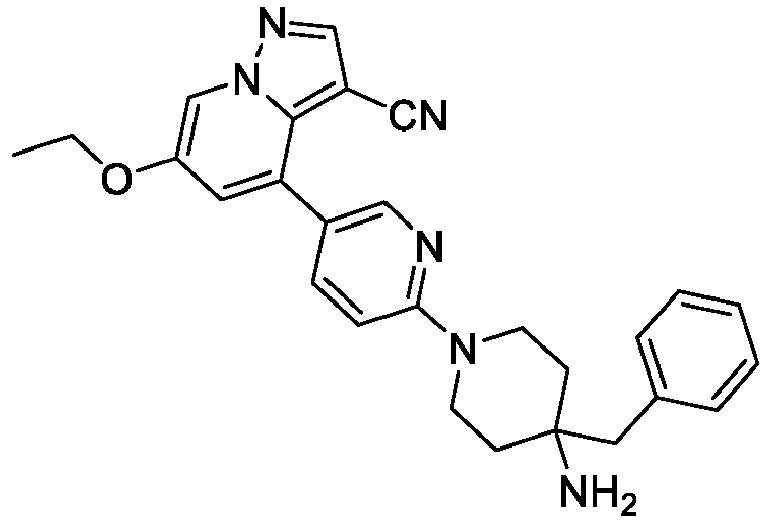
- To a solution of N-(4-benzyl-1-(5-(3-cyano-6-ethoxypyrazolo[1,5-a]pyridin-4-yl)pyridin-2-yl)piperidin-4-yl)acetamide (Example 372, 0.020 g, 0.040 mmol) in 1:1 THF/DCM (0.7 mL) was added titanium(IV) propan-2-olate (0.048 mL, 0.16 mmol) and diphenylsilane (0.030 g, 0.16 mmol). The reaction mixture was stirred at rt for 24 h then quenched with water. The mixture was extracted with DCM, and the combined organic extracts were dried over anhydrous Na2SO4(s) and concentrated in vacuo. The residue was purified by preparative HPLC (5-95% ACN in water [+ 0.1% TFA] as the gradient eluent). The fractions containing the desired product were combined and washed with 2M NaOH and extracted into DCM. The combined organic extracts were were passed through a phase separation frit then concentrated in vacuo to afford the title compound (0.0030 g, 0.0066 mmol, 16 % yield). MS (apci) m/z = 453.3 (M+H).
-

- To a solution of 6-ethoxy-4-(6-fluoropyridin-3-yl)pyrazolo[1,5-a]pyridine-3-carbonitrile (Intermediate P6, 21.3 m g, 0.0755 mmol) in DMA (0.35 mL) was added TEA (0.0526 mL, 0.377 mmol) and 4-(benzylsulfonyl)piperidine (52.4 mg, 0.219 mmol). The reaction mixture was stirred at 90°C for 16 h. After cooling to ambient temperature, the reaction mixture was diluted with EtOAc and washed successively with water and saturated NaCl(aq). The combined organic extracts were dried over anhydrous Na2SO4(s) and concentrated in vacuo. The residue was purified by C-18 reverse phase chromatography (5-95% ACN in water [+ 0.1% TFA] as the gradient eluent). The fractions containing the desired product were combined and washed with saturated NaHCO3(aq) and extracted into 4:1 DCM/IPA. The combined organic extracts were dried over anhydrous Na2SO4(s) and concentrated in vacuo. The residue was purified by silica chromatography (0-100% EtOAc in hexanes as the gradient eluent) to afford the title compound (13 mg, 0.0255 mmol, 34% yield). MS (apci) m/z = 502.2 (M+H).
-

- To a solution of 6-ethoxy-4-(6-fluoropyridin-3-yl)pyrazolo[1,5-a]pyridine-3-carbonitrile (Intermediate P6, 80 mg, 0.283 mmol) in DMSO (0.567 mL) was added tert-butyl ((1R,5S,6r)-3-azabicyclo[3.1.1]heptan-6-yl)carbamate (72.2 mg, 0.340 mmol) and DIEA (0.148 mL, 0.850 mmol). The reaction mixture was stirred at 90°C for 17 h. After cooling to ambient temperature, the reaction mixture was diluted with water and stirred for 1 h. The resultant precipitate was isolated by vacuum filtration and rinsed on the filter successively with water and heptane to afford the title compound (130 mg, 0.266 mmol, 94% yield). MS (apci) m/z = 475.2 (M+H).
-

- To a solution of tert-butyl ((1R,5S,6r)-3-(5-(3-cyano-6-ethoxypyrazolo[1,5-a]pyridin-4-yl)pyridin-2-yl)-3-azabicyclo[3.1.1]heptan-6-yl)carbamate (Example 375, 130 mg, 0.274 mmol) in MeOH (0.548 mL) was added HCl (37% w/w, 0.457 mL, 5.48 mmol) dropwise at rt. The reaction slurry was stirred at rt for 3 h. The slurry was vacuum filtered, and the isolated solid was rinsed on the filter with MeOH and MTBE to afford the title compound (114 mg, 0.252 mmol, 92% yield). MS (apci) m/z = 375.2 (M+H).
-

- To a mixture of 4-(6-((1R,5S,6r)-6-amino-3-azabicyclo[3.1.1]heptan-3-yl)pyridin-3-yl)-6-ethoxypyrazolo[1,5-a]pyridine-3-carbonitrile dihydrochloride (Example 376, 25 mg, 0.056 mmol) and 2,3-difluoro-6-methylpyridine (11 mg, 0.084 mmol) in DMSO (0.112 mL) was added DIEA (0.049 mL, 0.28 mmol). The reaction mixture was stirred at 110°C for 24 h then 150°C for an additional 24 h. After cooling to ambient temperature, the reaction mixture was directly purified by C-18 reverse phase chromatography (5-95% ACN in water as the gradient eluent) to afford the title compound (7.7 mg, 0.015 mmol, 28%). MS (apci) m/z = 484.2 (M+H).
-

- To a solution of tert-butyl (1-(5-(3-cyano-6-ethoxypyrazolo[1,5-a]pyridin-4-yl)pyridin-2-yl)-4-formylpiperidin-4-yl)carbamate (Intermediate P71, 0.225 g, 0.459 mmol), in DCE (2.29 mL) was added 1-ethylpiperazine (0.157 g, 1.38 mmol). The mixture was stirred at rt for 30 min, then sodium triacetoxyborohydride (0.146 g, 0.688 mmol) was added. The reaction mixture was stirred at rt an additional 16 h. The crude reaction mixture was directly purified by silica chromatography (1-10% MeOH in DCM with 0.1-1% NH4OH as the gradient eluent) to afford the title compound (0.149 mg, 0.253 mmol, 55% yield). MS (apci) m/z = 589.4 (M+H).
-

- To a solution of N-(1-(5-(3-cyano-6-ethoxypyrazolo[1,5-a]pyridin-4-yl)pyridin-2-yl)-4-formylpiperidin-4-yl)-5-fluoro-2-methylbenzamide (Intermediate P70, 0.0196 g, 0.03722 mmol) in DCE (0.1861 mL) was added morpholine (0.009661 mL, 0.1117 mmol) and sodium triacetoxyborohydride (0.01183 g, 0.05583 mmol). The reaction mixture was stirred at rt for 16 h. The crude reaction mixture was directly purified by silica chromatography (0-100% EtOAc in Hexanes then 0-10% MeOH in CHCl3 as the gradient eluent) to afford the title compound (0.0172 g, 0.02878 mmol, 77% yield). MS (apci) m/z = 598.3 (M+H).
- The compounds in Table TT were prepared using a similar method to that described for the synthesis of Example 379, replacing morpholine with the appropriate amine. Reactions were monitored for completion by LCMS, and reaction durations were adjusted accordingly. Title compounds were cleanly isolated following chromatographic purification using an appropriate gradient eluent (and if necessary converted to the free base).
Table TT Ex. # Structure Chemical Name MS m/z 380 
N-(1-(5-(3-cyano-6-ethoxypyrazolo[1,5-a]pyridin-4-yl)pyridin-2-yl)-4-(((3-hydroxypropyl)(methyl)am ino)methyl)piperidin-4-yl)-5-fluoro-2-methylbenzamide 600.30 (M+H) 381 
N-(1-(5-(3-cyano-6-ethoxypyrazolo[1,5-a]pyridin-4-yl)pyridin-2-yl)-4-(((2-hydroxy-2-methylpropyl)amino)meth yl)pi peridin-4-yl)-5-fluoro-2-methylbenzamide 600.30 (M+H) 382 
N-(1-(5-(3-cyano-6-ethoxypyrazolo[1,5-a]pyridin-4-yl)pyridin-2-yl)-4-(((2,2-difluoro-3-hydroxypropyl)(methyl)am ino)methyl)piperidin-4-yl)-5-fluoro-2-methylbenzamide 636.40 (M+H) -

- To a solution of 4-(6-(4-amino-4-((dimethylamino)methyl)piperidin-1-yl)pyridin-3-yl)-6-ethoxypyrazolo[1,5-a]pyridine-3-carbonitrile (Intermediate P72, 7 mg, 0.017 mmol) in DMF (0.334 mL) was added 5-fluoro-2-methylbenzoic acid (5.1 mg, 0.033 mmol), HATU (13 mg, 0.033 mmol), and DIEA (0.015 mL, 0.083 mmol). The reaction mixture was stirred at rt for 1 h. The crude reaction mixture was directly purified by silica chromatography (0-100% EtOAc in Hexanes then 1-10% MeOH in EtOAc with 0.1-1% NH4OH as the gradient eluent) to afford the title compound (5 mg, 0.0090 mmol, 54% yield). MS (apci) m/z = 556.2 (M+H).
-

- To a mixture of 4-(6-(4-amino-4-((dimethylamino)methyl)piperidin-1-yl)pyridin-3-yl)-6-ethoxypyrazolo[1,5-a]pyridine-3-carbonitrile (Intermediate P72, 0.050 g, 0.119 mmol) in DMSO (0.795 mL) was added 3-chloropicolinic acid (0.0282 g, 0.179 mmol) followed by Hunig's base (0.0934 mL, 0.536 mmol) and HATU (0.0906 g, 0.238 mmol). The reaction mixture was stirred at rt for 16 h. The reaction mixture was diluted with EtOAc and washed with water. The organic extract was washed with saturated NaCl(aq), dried over anhydrous Na2SO4(s), and concentrated in vacuo. The residue was purified by preparative HPLC (5-95% ACN in water [+ 0.1% TFA] as the gradient eluent). The fractions containing the desired product were combined and washed with saturated NaHCO3(aq) and extracted into DCM. The combined organic extracts were washed with saturated NaCl(aq), dried over anhydrous Na2SO4(s), and concentrated in vacuo to afford the title compound (0.0108 g, 0.0193 mmol, 16.2% yield). MS (apci) m/z = 559.3 (M+H).
-

- To a solution of 4-(6-(4-amino-4-((dimethylamino)methyl)piperidin-1-yl)pyridin-3-yl)-6-ethoxypyrazolo[1,5-a]pyridine-3-carbonitrile (Intermediate P72, 40 mg, 0.095 mmol) in DCM (0.953 mL) was added and isovaleryl chloride (11 mg, 0.095 mmol) and TEA (0.027 mL, 0.19 mmol). The reaction mixture was stirred at rt 3 h. The reaction mixture was diluted with 4:1 DCM:IPA and washed successively with saturated NaHCO3(aq), water, and saturated NaCl(aq). The organic extract was dried over anhydrous Na2SO4(s), filtered, and concentrated in vacuo to afford the title compound (48 mg, 0.095 mmol, 100 % yield). MS (apci) m/z = 504.3 (M+H).
-

- The compound was prepared using a similar method to that described for the synthesis of Example 385, replacing isovaleryl chloride with the 2-cyclopropylacetyl chloride. LCMS m/z = 502.3 (M+H).
-

- To a solution of 4-(6-(4-amino-4-((dimethylamino)methyl)piperidin-1-yl)pyridin-3-yl)-6-ethoxypyrazolo[1,5-a]pyridine-3-carbonitrile (Intermediate P72, 30 mg, 0.072 mmol) and DIEA (125 µL, 0.715 mmol) in DMA (1.43 mL) was added 4-nitrophenyl chlorformate (17 mg, 0.086 mmol). The reaction mixture was stirred for 1 h at ambient temperature. Propan-2-amine (31 µL, 0.358 mmol) was added to the reaction mixture. The reaction mixture was stirred overnight at 80°C. The reaction mixture was cooled to ambient temperature and concentrated in vacuo. The residue was purified by C18 reverse phase chromatography (5-95% ACN in water with 0.1% TFA as the gradient eluent) to afford the title compound as the TFA salt. The TFA salt was treated with saturated NaHCO3(aq) and extracted with 4:1 DCM:IPA. The combined organic extracts were washed with brine, then dried over anhydrous Na2SO4(s), filtered and concentrated in vacuo to afford the title compound (4 mg, 11% yield). MS (apci) m/z = 505.3 (M+H).
-

- To a solution of 4-(6-(4-amino-4-(morpholinomethyl)piperidin-1-yl)pyridin-3-yl)-6-ethoxypyrazolo[1,5-a]pyridine-3-carbonitrile (Intermediate P73, 30 mg, 0.065 mmol) in DCM (0.650 mL) was added TEA (0.018 mL, 0.13 mmol) and cyclopropylacetyl chloride (9.2 mg, 0.078 mmol). The reaction mixture was stirred at rt for 16 h. The reaction mixture was diluted with 4:1 DCM:IPA and washed successively with saturated NaHCO3(aq), water, and saturated NaCl(aq). The organic extract was dried over anhydrous Na2SO4(s), filtered, and concentrated in vacuo to afford the title compound (35 mg, 0.064 mmol, 99% yield). MS (apci) m/z = 544.3 (M+H).
-

- To a solution of 4-(6-(4-amino-4-((4-ethylpiperazin-1-yl)methyl)piperidin-1-yl)pyridin-3-yl)-6-ethoxypyrazolo[1,5-a]pyridine-3-carbonitrile dihydrochloride (Intermediate P74. 20 mg, 0.0356 mmol) in DMF (0.356 mL) was added 5-fluoro-2-methylbenzoic acid (6.86 mg, 0.0445 mmol), DIEA (0.0311 mL, 0.178 mmol), and HATU (16.9 mg, 0.0445 mmol). The reaction mixture was stirred at rt for 5 min. The crude reaction mixture was directly purified by silica chromatography (0-100% EtOAc in Hexanes then 1-10% MeOH in EtOAc with 0.1-1% NH4OH as the gradient eluent) to afford the title compound (7 mg, 0.0112 mmol, 31.5% yield). MS (apci) m/z = 625.4 (M+H).
- The compounds in Table UU were prepared using a similar method to that described for the synthesis of Example 389, replacing 5-fluoro-2-methylbenzoic acid with the appropriate carboxylic acid. Reactions were monitored for completion by LCMS, and reaction durations were adjusted accordingly. Title compounds were cleanly isolated following chromatographic purification using an appropriate gradient eluent (and if necessary converted to the free base).
Table UU Ex. # Structure Chemical Name MS (apci) m/z 390 
N-(1-(5-(3-cyano-6-ethoxypyrazolo[1,5-a]pyridin-4-yl)pyridin-2-yl)-4-((4-ethylpiperazin-1-yl)methyl)pi peridin-4-yl)-3-(trifluoromethyl)pi colinam ide 662.20 (M+H) -

- To a solution of 4-(6-(4-amino-4-(hydroxymethyl)piperidin-1-yl)pyridin-3-yl)-6-ethoxypyrazolo[1,5-a]pyridine-3-carbonitrile (Intermediate P74, 0.0238 g, 0.0606 mmol) in DMSO (0.606 mL) was added DIEA (0.0530 ml, 0.303 mmol), 2,6-difluorobenzoic acid (0.0192 g, 0.121 mmol), HATU (0.0461 g, 0.121 mmol). The reaction mixture was stirred at rt for 16 h. The crude reaction mixture was directly purified by silica chromatography (1-10% MeOH in DCM with 0.1-1% NH4OH as the gradient eluent) to afford the title compound (29 mg, 0.023 mmol, 49.5% yield). MS (apci) m/z = 629.4 (M+H).
-

- To a solution of 4-(6-(4-amino-4-(hydroxymethyl)piperidin-1-yl)pyridin-3-yl)-6-ethoxypyrazolo[1,5-a]pyridine-3-carbonitrile (Intermediate P74, 0.0238 g, 0.0606 mmol) in DCM (0.48 mL) was added DIEA (13 µL, 0.072 mmol) followed by methyl chloroformate (5 µL, 0.058 mmol). The reaction mixture was stirred for 1 h at ambient temperature. The crude reaction mixture was filtered and the filtrate was directly purified by silica chromatography (1-10% MeOH in DCM with 0.1-1% NH4OH as the gradient eluent) to afford the title compound (1.9 mg, 7% yield). MS (apci) m/z = 547.3 (M+H).
-

- To a solution of 4-(6-(4-amino-4-((4-ethylpiperazin-1-yl)methyl)piperidin-1-yl)pyridin-3-yl)-6-ethoxypyrazolo[1,5-a]pyridine-3-carbonitrile (Intermediate P74, 50 mg, 0.10 mmol) in DMA (1.023 mL) was added cyclopropylacetyl chloride (15 mg, 0.12 mmol) and TEA (0.029 mL, 0.20 mmol). The reaction mixture was stirred at rt for 3 h. The reaction mixture was diluted with 4:1 DCM:IPA and washed successively with saturated NaHCO3(aq), water, and saturated NaCl(aq). The organic extract was dried over anhydrous Na2SO4(s), filtered, and concentrated in vacuo to afford the title compound (45 mg, 0.079 mmol, 77% yield). MS (apci) m/z = 571.4 (M+H).
-

- The compound was prepared using a similar method to that described for the synthesis of Example 393, replacing 2-cyclopropylacetyl chloride with 3-methylbutanoyl chloride. MS (apci) m/z = 573.4 (M+H).
-

- To a solution of 4-(6-(4-amino-4-((4-ethylpiperazin-1-yl)methyl)piperidin-1-yl)pyridin-3-yl)-6-ethoxypyrazolo[1,5-a]pyridine-3-carbonitrile (Intermediate P74, 30 mg, 0.061 mmol) and DIEA (107 µL, 0.614 mmol) in DMA (1.228 mL) was added 4-nitrophenyl chlorformate (15 mg, 0.074 mmol). The reaction mixture was stirred for 1 h at ambient temperature before propan-2-amine (26.3 µl, 0.307 mmol). was introduced. The reaction mixture was stirred for 2 h at 80°C. The reaction mixture was cooled to ambient temperature and concentrated in vacuo. The residue was purified by C18 reverse phase chromatography (5-95% ACN in water with 0.1% TFA as the gradient eluent) to afford the title compound as the TFA salt. The TFA salt was treated with saturated NaHCO3(aq) and extracted with 4:1 DCM:IPA. The combined organic extracts were washed with brine, then dried over anhydrous Na2SO4(s), filtered and concentrated in vacuo to afford the title compound (27 mg, 77% yield). MS (apci) m/z = 574.4 (M+H).
-

- The title compound was prepared using a similar method to that described for the synthesis of Example 395, replacing propan-2-amine with 2-methylpropan-1-amine. MS (apci) m/z = 588.4 (M+H).
-

- To a solution of 1-(5-(3-cyano-6-ethoxypyrazolo[1,5-a]pyridin-4-yl)pyridin-2-yl)-4-formyl-N-isobutylpiperidine-4-carboxamide (Intermediate P76, 101.6 mg, 0.2141 mmol) in DCM (1.0 mL) was added morpholine (0.0942 mL, 1.070 mmol) and sodium triacetoxyborohydride (226.9 mg, 1.070 mmol). The reaction mixture was stirred at rt for 16 h. The reaction mixture was concentrated in vacuo, and the resultant crude residue was directly purified by C-18 reverse phase chromatography (5-95% ACN in water [+ 0.1% TFA] as the gradient eluent). The fractions containing the desired product were diluted with 4:1 DCM:IPA and washed with saturated NaHCO3(aq). The organic extract was dried over anhydrous Na2SO4(s), filtered, and concentrated in vacuo.The residue was purified by silica chromatography (1-30% MeOH [+2% NH4OH] in DCM as the gradient eluent) afford the title compound (71.1 mg, 0.1303 mmol, 60.86% yield). MS (apci) m/z = 546.4 (M+H).
-

- To a solution of 4-(6-(4-benzyl-4-formylpiperidin-1-yl)pyridin-3-yl)-6-ethoxypyrazolo[1,5-a]pyridine-3-carbonitrile (Intermediate P77, 10.4 mg, 0.0223 mmol) in DCE (0.75 mL) was added morpholine (9.1 mg, 0.104 mmol). The mixture was stirred at rt for 1 hr then was treated with sodium triacetoxyborohydride (34.0 mg, 0.160 mmol). The reaction mixture was stirred at rt for 96 h. The reaction mixture was diluted with DCM and washed with water. The organic extract was dried over anhydrous Na2SO4(s) and purified by silica chromatography (0-100% EtOAc in hexanes as the gradient eluent to afford the title compound (1.6 mg, 0.00295 mmol, 13.2 % yield). MS (apci) m/z = 537.3 (M+H).
-

- A solution of triphenylphosphane (31.7966 mg, 0.121 mmol) in 1:1 DCM:THF (0.6 mL) was cooled to 0°C and treated with diisopropyl azodicarboxylate (0.023 mL, 0.121 mmol) and stirred at 0°C for 15 min. The reaction mixture was treated with 6-hydroxy-4-(6-(4-(pyridin-2-yloxy)piperidin-1-yl)pyridin-3-yl)pyrazolo[1,5-a]pyridine-3-carbonitrile (Intermediate P78, 25.0 mg, 0.0606 mmol) in a 1:1 DCM:THF (0.6 mL) and 1-(N-hydroxyethyl)-4-methyl piperazine (13.1 mg, 0.0909 mmol). The reaction mixture was allowed to warm to rt and was stirred at this temperature for 30 min. The reaction mixture was concentrated in vacuo, and the resultant crude residue was directly purified by C-18 reverse phase chromatography (5-95% ACN in water [+ 0.1% TFA] as the gradient eluent). The fractions containing the desired product were diluted with 4:1 DCM:IPA and washed with saturated NaHCO3(aq). The organic extract was dried over anhydrous Na2SO4(s), filtered, and concentrated in vacuo to afford the title compound (31.5 mg, 0.0526 mmol, 86.8% yield). MS (apci) m/z = 539.2 (M+H).
- The compounds in Table VV were prepared using a similar method to that described for the synthesis of Example 399, replacing1-(N-hydroxyethyl)-4-methyl piperazine with the appropriate alcohol. Reactions were monitored for completion by LCMS, and reaction durations were adjusted accordingly. Title compounds were cleanly isolated following chromatographic purification using an appropriate gradient eluent (and if necessary converted to the free base).
Table VV Ex. # Structure Chemical Name MS m/z 400 
6-(2-(dimethylamino)ethoxy)-4-(6-(4-(pyridin-2-yloxy)piperidin-1-yl)pyridin-3-yl)pyrazolo[1, 5-a]pyridine-3-carbonitrile 484.20 (M+H) 401 
6-(2-morpholinoethoxy)-4-(6-(4-(pyridin-2-yloxy)piperidin-1-yl)pyridin-3-yl)pyrazolo[1, 5-a]pyridine-3-carbonitrile 526.20 (M+H) 402 
6-(2-(1 -methylazetidin-3 - yl)ethoxy)-4-(6-(4-(pyridin-2-yloxy)piperidin-1-yl)pyridin-3-yl)pyrazolo[1, 5-a]pyridine-3-carbonitrile 510.20 (M+H) 403 
6-((4-methylmorpholin-2-yl)methoxy)-4-(6-(4-(pyridin-2-yloxy)piperidin-1-yl)pyridin-3-yl)pyrazolo[1, 5-a]pyridine-3-carbonitrile 526.20 (M+H) 404 
4-(6-(4-(pyridin-2-yloxy)piperidin-1-yl)pyridin-3 -yl)-6-(2-(pyrrolidin-1-yl)ethoxy)pyrazolo[1,5-a]pyridine-3 -carbonitrile 510.30 (M+H) -

- To a solution of 6-hydroxy-4-(6-(4-(pyridin-2-yloxy)piperidin-1-yl)pyridin-3-yl)pyrazolo[1,5-a]pyridine-3-carbonitrile (Intermediate P78, 0.010 g, 0.0242 mmol) in DMF (0.8 mL) was added 1-(2-chloroethyl)pyrrolidin-2-one (7.16 mg, 0.0485 mmol), potassium carbonate (6.7 mg, 0.0485 mmol), and sodium bromide (3.24 mg, 0.0315 mmol). The reaction mixture was stirred at 100°C for 72 h. After cooling to ambient temperature, the crude reaction mixture purified by C-18 reverse phase chromatography (0-70% ACN in water as the gradient eluent) to afford the title compound (8 mg, 0.0153 mmol, 63% yield). MS (apci) m/z = 524.2 (M+H).
- The compounds in Table WW were prepared using a similar method to that described for the synthesis of Example 405, replacing 1-(2-chloroethyl)pyrrolidin-2-one with the appropriate alkyl halide. Reactions were monitored for completion by LCMS, and reaction durations were adjusted accordingly. Title compounds were cleanly isolated following chromatographic purification using an appropriate gradient eluent (and if necessary converted to the free base).
Table WW Ex. # Structure Chemical Name MS m/z 406 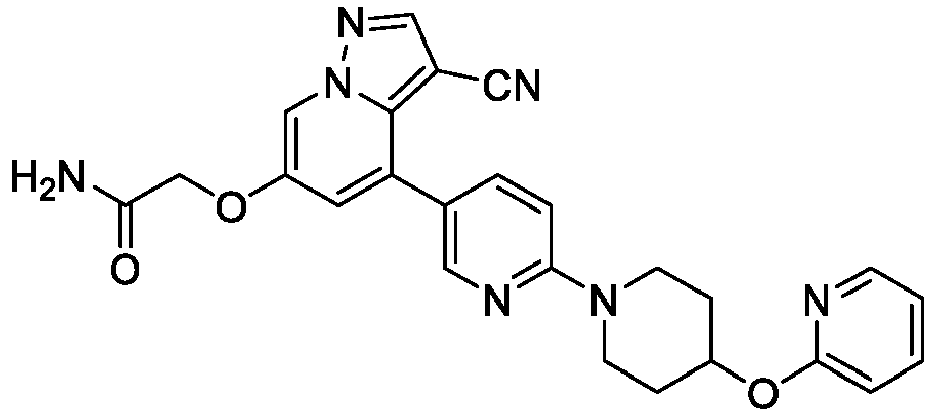
2-((3-cyano-4-(6-(4-(pyridin-2-yloxy)piperidin-1-yl)pyridin-3-yl)pyrazolo[1, 5-a]pyridin-6-yl)oxy)acetamide 470.10 (M+H) 407 
2-((3-cyano-4-(6-(4-(pyridin-2-yloxy)piperidin-1-yl)pyridin-3-yl)pyrazolo[1, 5-a]pyridin-6-yl)oxy)-N-methylacetamide 484.10 (M+H) 408 
2-((3-cyano-4-(6-(4-(pyridin-2-yloxy)piperidin-1-yl)pyridin-3-yl)pyrazolo[1, 5-a]pyridin-6-yl)oxy)-N,N-dimethylacetamide 498.15 (M+H) -

- To a solution of 6-hydroxy-4-(6-(4-(pyridin-2-yloxy)piperidin-1-yl)pyridin-3-yl)pyrazolo[1,5-a]pyridine-3-carbonitrile (Intermediate P78, 1.023 mL, 0.0512 mmol) in DMF (1.0 mL) was added aqueous sodium hydroxide (1M, 0.0563 mL, 0.0563 mmol). The mixture was stirred at rt for 5 min, at which time R-(+)-propylene oxide (35.8 µL, 0.512 mmol) was added. The reaction mixture was stirred at 80°C for 16 h. After cooling to ambient temperature, the reaction mixture was diluted with EtOAc then washed successively with water and saturated NaCl(aq). The organic extract was dried over anhydrous Na2SO4(s), filtered, and concentrated in vacuo. The residue was purified by C-18 reverse phase chromatography (5-95% ACN in water [+ 0.1% TFA] as the gradient eluent). The fractions containing the desired product were diluted with 4:1 DCM/IPA and washed with saturated NaHCO3(aq). The organic extract was dried over anhydrous Na2SO4(s), filtered, and concentrated in vacuo to afford the title compound (8.5 mg, 0.0181 mmol, 35.3% yield). MS (apci) m/z = 471.2 (M+H).
-

- The title compound was prepared using a similar method to that described for the synthesis of Example 409, replacing R-(+)-propylene oxide with S-(-)-propylene oxide. MS (apci) m/z = 471.2 (M+H).
-

- To a solution of 4-(6-fluoropyridin-3-yl)-6-(2-morpholinoethoxy)pyrazolo[1,5-a]pyridine-3-carbonitrile (Intermediate P79, 19.7 mg, 0.05362 mmol) in DMSO (1 mL) was added 4-(pyridin-2-ylmethyl)piperidin-4-ol hydrochloride (39.3 mg, 0.1718 mmol) and cesium carbonate (157.2 mg, 0.4826 mmol). The reaction mixture was stirred at 60°C for 16 h. After cooling to ambient temperature, the reaction mixture was diluted with DCM and washed successively with water and saturated NH4Cl(aq). The aqueous fraction was extracted with DCM, and the combined organic extracts were dried over anhydrous Na2SO4(s). The mixture was purified by silica chromatography (0-100% MeOH in DCM as the gradient eluent) to afford the title compound (16.9 mg, 0.02505 mmol, 46.72 % yield). MS (apci) m/z = 540.2 (M+H).
- The compounds in Table XX were prepared using a similar method to that described for the synthesis of Example 411, replacing 4-(pyridin-2-ylmethyl)piperidin-4-ol hydrochloride with the appropriate amine. Reactions were monitored for completion by LCMS, and reaction durations were adjusted accordingly. Title compounds were cleanly isolated following chromatographic purification using an appropriate gradient eluent (and if necessary converted to the free base).
Table XX Ex. # Structure Chemical Name MS m/z 412 
4-(6-(4-benzyl-4-hydroxypiperidin-1-yl)pyridin-3 -yl)-6-(2-morpholinoethoxy)pyrazol o[1,5-a]pyridine-3-carbonitrile 539.20 (M+H) 413 
6-(2-morpholinoethoxy)-4-(6-(3-(pyridin-2-yloxy)azetidin-1-yl)pyridin-3-yl)pyrazolo[1, 5-a]pyridine-3-carbonitrile 498.20 (M+H) -

- Step 1: Preparation of 6-hydroxy-4-(6-(3-(pyridin-2-yloxy)azetidin-1-yl)pyridin-3-yl)pyrazolo[1,5-a]pyridine-3-carbonitrile. To a solution of 4-(6-fluoropyridin-3-yl)-6-hydroxypyrazolo[1,5-a]pyridine-3-carbonitrile (Intermediate P66, 0.250 g, 0.9834 mmol) in DMA (2.458 mL) was added 2-(azetidin-3-yloxy)pyridine (0.452 g, 3.010 mmol) and TEA (0.9413 mL, 6.884 mmol). The reaction mixture was stirred at 95°C for 72 h. After cooling to ambient temperature, the reaction mixture was quenched with saturated NaHCO3(aq) and extracted with EtOAc. The combined organic extracts were washed successively with water and saturated NaCl(aq) then dried over anhydrous Na2SO4(s), filtered, and concentrated in vacuo. The residue was purified by silica chromatography (1-9% MeOH in DCM as the gradient eluent) to afford the title compound (0.1557 g, 0.4050 mmol, 41.19% yield) in sufficient purity for step 2. MS (apci) m/z = 385.1 (M+H).
- Step 2: Preparation of 6-(2-methoxyethoxy)-4-(6-(3-(pyridin-2-yloxy)azetidin-1-yl)pyridin-3-yl)pyrazolo[1,5-a]pyridine-3-carbonitrile. To a solution of 6-hydroxy-4-(6-(3-(pyridin-2-yloxy)azetidin-1-yl)pyridin-3-yl)pyrazolo[1,5-a]pyridine-3-carbonitrile (0.030 g, 0.07804 mmol) in DMF (0.3902 mL) was added potassium carbonate (0.02157 g, 0.1561 mmol) and 2-bromoethyl methyl ether (0.01467 mL, 0.1561 mmol). The reaction mixture was stirred at 95°C for 16 h. After cooling to ambient temperature, the reaction mixture was quenched with saturated NaHCO3(aq) and extracted with EtOAc. The combined organic extracts were washed successively with water and saturated NaCl(aq) then dried over anhydrous Na2SO4(s), filtered, and concentrated in vacuo. The residue was purified by preparative HPLC (5-95% ACN in water [+ 0.1% TFA] as the gradient eluent). The fractions containing the desired product were washed with saturated NaHCO3(aq) and extracted with DCM. The combined organic extracts were washed successively with water and saturated NaCl(aq) then dried over anhydrous Na2SO4(s), filtered, and concentrated in vacuo to afford the title compound (0.0108 g, 0.02441 mmol, 31.27% yield). MS (apci) m/z = 443.2 (M+H).
-

- To a solution of (R)-4-(6-fluoropyridin-3-yl)-6-(2-hydroxypropoxy)pyrazolo[1,5-a]pyridine-3-carbonitrile (Intermediate P80, 0.020 g, 0.0640 mmol) in DMA (0.640 mL) was added 3-methyl-6-(piperidin-4-yloxy)pyridazine (0.039 g, 0.202 mmol) and TEA (0.0613 ml, 0.448 mmol). The reaction mixture was stirred at 90°C for 48 h. After cooling to ambient temperature, the reaction mixture was quenched with water and extracted with EtOAc. The combined organic extracts were washed successively with water and saturated NaCl(aq) then dried over anhydrous Na2SO4(s), filtered, and concentrated in vacuo. The residue was purified by preparative HPLC (5-95% ACN in water [+ 0.1% TFA] as the gradient eluent). The fractions containing the desired product were washed with saturated NaHCO3(aq) and extracted with DCM. The combined organic extracts were washed successively with water and saturated NaCl(aq) then dried over anhydrous Na2SO4(s), filtered, and concentrated in vacuo to afford the title compound (11 mg, 0.022 mmol, 34 % yield). MS (apci) m/z = 486.2 (M+H).
-

- The compound was prepared using a similar method to that described for the synthesis of Example 415, replacing 3-methyl-6-(piperidin-4-yloxy)pyridazine with 2-(azetidin-3-yloxy)pyridine. MS (apci) m/z = 443.1 (M+H).
-

- Step 1: Preparation of 4-(6-fluoropyridin-3-yl)-6-methoxypyrazolo[1,5-a]pyridine. To a mixture of 4-bromo-6-methoxypyrazolo[1,5-a]pyridine (10.0 g, 44.04 mmol) in 1,4-dioxane (88.08 mL) was added 2-fluoro-5-(4,4,5,5-tetramethyl-1,3,2-dioxaborolan-2-yl)pyridine (11.79 g, 52.85 mmol), tetrakis(triphenylphosphine)palladium(0) (1.018 g, 0.8808 mmol) and aqueous sodium carbonate (2M, 46.24 mL, 92.49 mmol). The reaction mixture was stirred at 90°C for 16 h. After cooling to ambient temperature, the reaction mixture was poured onto water and stirred for 4 h. The resultant precipitate was isolated by vacuum filtration then taken up in MTBE and stirred an additional 30 min. The precipitate was isolated by vacuum filtration to afford the title compound (4.616 g, 18.98 mmol, 43.09% yield) in sufficient yield for step 2. MS (apci) m/z = 244.0 (M+H).
- Step 2: Preparation of 3-chloro-4-(6-fluoropyridin-3-yl)-6-methoxypyrazolo[1,5-a]pyridine. A solution of 4-(6-fluoropyridin-3-yl)-6-methoxypyrazolo[1,5-a]pyridine (1.00 g, 4.11 mmol) in DCM (27.4 mL) was treated with NCS (0.549 g, 4.11 mmol). The reaction mixture was stirred at rt for 16 h. The mixture was poured into 2M NaOH and extracted with 10% IPA in DCM in a PS frit. The organic extract was concentrated in vacuo, and the residue was triturated with Et2O. The solid was isolated on a glass frit to afford the title compound (0.98 g, 3.53 mmol, 85.8% yield) in sufficient purity for step 3. MS (apci) m/z = 278.0 (M+H).
- Step 3: Preparation of 3-chloro-6-methoxy-4-(6-(4-((6-methylpyridazin-3-yl)oxy)piperidin-1-yl)pyridin-3-yl)pyrazolo[1,5-a]pyridine. To a solution of 3-chloro-4-(6-fluoropyridin-3-yl)-6-methoxypyrazolo[1,5-a]pyridine (30 mg, 0.11 mmol) in DMSO (0.2 mL) was added 3-methyl-6-(piperidin-4-yloxy)pyridazine (31 mg, 0.16 mmol) and cesium carbonate (176 mg, 0.54 mmol). The reaction mixture was stirred at 90°C for 16 h. After cooling to ambient temperature, the mixture was poured into 2M NaOH and extracted with 10% IPA in DCM in a PS frit. The organic extract was concentrated in vacuo, and the residue was purified by silica chromatography (0-100% EtOAc in hexanes as the gradient eluent) to afford the title compound (14 mg, 0.031 mmol, 29% yield). MS (apci) m/z = 451.2 (M+H).
-

- To a mixture of 1-(5-(6-methoxypyrazolo[1,5-a]pyridin-4-yl)pyridin-2-yl)-4-methylpiperidin-4-amine (0.057 g, 0.169 mmol) in DMSO (1.13 mL) was added 3-chloropicolinic acid (0.0399 g, 0.253 mmol), DIEA (0.132 mL, 0.760 mmol), and HATU (0.128 g, 0.338 mmol). The reaction mixture was stirred at rt for 16 h. The reaction mixture was diluted with EtOAc and washed successively with water and saturated NaCl(aq). The organic extract was dried over anhydrous Na2SO4(s), and concentrated in vacuo. The residue was purified by preparative HPLC (5-95% ACN in water [+ 0.1% TFA] as the gradient eluent). The fractions containing the desired product were diluted with DCM and washed successively with saturated NaHCO3(aq) and saturated NaCl(aq). The organic extract was dried over anhydrous Na2SO4(s), filtered, and concentrated in vacuo to afford the title compound (0.0501 g, 0.105 mmol, 62.2% yield). MS (apci) m/z = 477.2 (M+H).
- The compounds in Table YY were prepared using a similar method to that described for the synthesis of Example 418, replacing 3-chloropicolinic acid with the appropriate carboxylic acid. Reactions were monitored for completion by LCMS, and reaction durations were adjusted accordingly. Title compounds were cleanly isolated following chromatographic purification using an appropriate gradient eluent (and if necessary converted to the free base).
Table YY Ex. # Structure Chemical Name MS (apci) m/z 419 
2-chloro-6-fluoro-N-(1-(5-(6-methoxypyrazolo[1,5-a]pyridin-4-yl)pyridin-2-yl)-4-methylpiperidin-4-yl)benzamide 494.20 (M+H) 420 
2-chloro-5-fluoro-N-(1-(5-(6-methoxypyrazolo[1,5-a]pyridin-4-yl)pyridin-2-yl)-4-methylpiperidin-4-yl)benzamide 494.20 (M+H) -

- To a mixture of 1-(5-(3-chloro-6-methoxypyrazolo[1,5-a]pyridin-4-yl)pyridin-2-yl)-4-methylpiperidin-4-amine (0.057 g, 0.153 mmol) in DMSO (1.02 mL) was added 3-chloropicolinic acid (0.0362 g, 0.230 mmol), DIEA (0.120 mL, 0.690 mmol), and HATU (0.117 g, 0.307 mmol). The reaction mixture was stirred at rt for 16 h. The reaction mixture was diluted with EtOAc and washed successively with water and saturated NaCl(aq). The organic extract was dried over anhydrous Na2SO4(s), and concentrated in vacuo. The residue was purified by silica chromatography (10-99% EtOAc in hexanes as the gradient eluent) to afford the title compound (0.0415 g, 0.0811 mmol, 52.9% yield). MS (apci) m/z = 511.2 (M+).
- The compounds in Table ZZ were prepared using a similar method to that described for the synthesis of Example 421, replacing 3-chloropicolinic acid with the appropriate carboxylic acid. Reactions were monitored for completion by LCMS, and reaction durations were adjusted accordingly. Title compounds were cleanly isolated following chromatographic purification using an appropriate gradient eluent (and if necessary converted to the free base).
Table ZZ Ex. # Structure Chemical Name MS m/z 422 
2-chloro-N-(1-(5-(3-chloro-6-methoxypyrazolo[1,5-a]pyridin-4-yl)pyridin-2-yl)-4-methylpiperidin-4-yl)-6-fluorobenzamide 528.20 (M+) 423 
2-chloro-N-(1-(5-(3-chloro-6-methoxypyrazolo[1,5-a]pyridin-4-yl)pyridin-2-yl)-4-methylpiperidin-4-yl)-5-fluorobenzamide 528.20 (M+) -

- Step 1: Preparation of tert-butyl (1-(5-(3-bromo-6-methoxypyrazolo[1,5-a]pyridin-4-yl)pyridin-2-yl)-4-methylpiperidin-4-yl)carbamate. To a solution of tert-butyl (1-(5-(6-methoxypyrazolo[1,5-a]pyridin-4-yl)pyridin-2-yl)-4-methylpiperidin-4-yl)carbamate (Intermediate P81, 0.806 g, 1.84 mmol) in DCM (12.3 mL) was added NBS (0.328 g, 1.84 mmol). The reaction mixture was stirred at rt for 16 h. The reaction mixture was diluted with EtOAc and washed successively with water and saturated NaCl(aq). The organic extract was dried over anhydrous Na2SO4(s), and concentrated in vacuo. The residue was purified by silica chromatography (10-90% EtOAc in hexanes as the gradient eluent) to afford the title compound (0.839 g, 1.62 mmol, 88% yield) in sufficient purity for step 2. MS (apci) m/z = 518.1 (M+H+1).
- Step 2: Preparation of tert-butyl (1-(5-(3-cyclopropyl-6-methoxypyrazolo[1,5-a]pyridin-4-yl)pyridin-2-yl)-4-methylpiperidin-4-yl)carbamate. To a mixture of tert-butyl (1-(5-(3-bromo-6-methoxypyrazolo[1,5-a]pyridin-4-yl)pyridin-2-yl)-4-methylpiperidin-4-yl)carbamate (0.250 g, 0.484 mmol) in a biphasic mixture of toluene (2.42 mL) and water (0.4 mL) was added cyclopropylboronic acid (0.0832 g, 0.968 mmol), potassium phosphate (0.308 g, 1.45 mmol), palladium(II) acetate (0.0109 g, 0.0484 mmol) and tricyclopentylphosphine (0.0272 g, 0.0968 mmol). The reaction mixture was stirred at 90°C for 16 h. After cooling to ambient temperature, the reaction mixture was diluted with EtOAc and washed successively with water and saturated NaCl(aq). The organic extract was dried over anhydrous Na2SO4(s), and concentrated in vacuo. The residue was purified by silica chromatography (10-90% EtOAc in hexanes as the gradient eluent) to afford the title compound (0.061 g, 0.128 mmol, 26% yield) in sufficient purity for step 3. MS (apci) m/z = 478.3 (M+H).
- Step 3: Preparation of 1-(5-(3-cyclopropyl-6-methoxypyrazolo[1,5-a]pyridin-4-yl)pyridin-2-yl)-4-methylpiperidin-4-amine
- A solution of tert-butyl (1-(5-(3-cyclopropyl-6-methoxypyrazolo[1,5-a]pyridin-4-yl)pyridin-2-yl)-4-methylpiperidin-4-yl)carbamate (0.060 g, 0.13 mmol) in DCM (12 mL) was treated with TFA (12 mL). The reaction mixture was stirred at rt for 1 h. The reaction mixture was diluted with DCM and washed with saturated NaHCO3(aq). The organic extract was dried over anhydrous Na2SO4(s), and concentrated in vacuo to afford the title compound (0.047 g, 0.12 mmol, 99% yield) in sufficient purity for step 4. MS (apci) m/z = 378.2 (M+H).
- Step 4: Preparation of 3-chloro-N-(1-(5-(3-cyclopropyl-6-methoxypyrazolo[1,5-a]pyridin-4-yl)pyridin-2-yl)-4-methylpiperidin-4-yl)picolinamide. To a mixture of 1-(5-(3-cyclopropyl-6-methoxypyrazolo[1,5-a]pyridin-4-yl)pyridin-2-yl)-4-methylpiperidin-4-amine (0.047 g, 0.125 mmol) in DMSO (0.830 mL) was added 3-chloropicolinic acid (0.0294 g, 0.187 mmol), DIEA (0.0976 mL, 0.560 mmol), and HATU (0.0947 g, 0.249 mmol). The reaction mixture was stirred at rt for 16 h. The reaction mixture was diluted with EtOAc and washed successively with water and saturated NaCl(aq). The organic extract was dried over anhydrous Na2SO4(s), and concentrated in vacuo. The residue was purified by preparative HPLC (5-95% ACN in water [+ 0.1% TFA] as the gradient eluent). The fractions containing the desired product were diluted with DCM and washed successively with saturated NaHCO3(aq) and saturated NaCl(aq). The organic extract was dried over anhydrous Na2SO4(s), filtered, and concentrated in vacuo to afford the title compound (0.0441 g, 0.0853 mmol, 68.5% yield). MS (apci) m/z = 517.2 (M+).
-

- Step 1: Preparation of 4-bromo-3-chloro-6-ethoxypyrazolo[1,5-a]pyridine. To a solution of 4-bromo-3-chloropyrazolo[1,5-a]pyridin-6-ol (Intermediate P84, 2.5 g, 10.1 mmol) in DMA (150 mL) was added potassium carbonate (14.0 g, 101 mmol) and iodoethane (2.45 mL, 30.3 mmol). The reaction mixture was stirred at 65°C for 16 h. After cooling to ambient temperature, the reaction mixture was quenched with water and extracted with EtOAc. The combined organic extracts were dried over anhydrous Na2SO4(s), and concentrated in vacuo to afford the title compound (2.00 g, 7.26 mmol, 72% yield) in sufficient purity for step 2. MS (apci) m/z = 277.0 (M+H).
- Step 2: Preparation of 3-chloro-6-ethoxy-4-(6-fluoropyridin-3-yl)pyrazolo[1,5-a]pyridine. To a solution of 4-bromo-3-chloro-6-ethoxypyrazolo[1,5-a]pyridine (1.0 g, 3.6 mmol) in 1,4-dioxane (18 mL) was added 2-fluoro-5-(4,4,5,5-tetramethyl-1,3,2-dioxaborolan-2-yl)pyridine (1.1 g, 4.7 mmol), tetrakis(triphenylphosphine)palladium (0) (0.21 g, 0.18 mmol), and aqueous sodium carbonate (2M, 9.1 mL, 18 mmol). The reaction mixture was sparged with N2 and stirred at 90°C for 4 h. After cooling to ambient temperature, the reaction mixture was quenched with water and sonicated for 5 min. The resultant precipitate was isolated by vacuum filtration and washed on the filter with Et2O to afford the title compound (0.4 g, 1.4 mmol, 38% yield) in sufficient purity for step 3. MS (apci) m/z = 292.1 (M+H).
- Step 3: Preparation of tert-butyl ((3S,4R)-1-(5-(3-chloro-6-ethoxypyrazolo[1,5-a]pyridin-4-yl)pyridin-2-yl)-4-hydroxypyrrolidin-3-yl)carbamate. To a solution of 3-chloro-6-ethoxy-4-(6-fluoropyridin-3-yl)pyrazolo[1,5-a]pyridine (0.100 g, 0.343 mmol) in DMSO (1 mL) was added DIEA (0.296 mL, 1.71 mmol) and tert-butyl ((3S,4R)-4-hydroxypyrrolidin-3-yl)carbamate (0.139 g, 0.686 mmol). The reaction mixture was stirred at 95°C for 16 h. After cooling to ambient temperature, the reaction mixture was quenched with water and cooled to 0°C. The resultant precipitate was isolated by vacuum filtration then taken up in 1:1 MTBE/pentane. The slurry was sonicated for 20 min, and the solids were isolated by vacuum filtration to afford the title compound (0.148 g, 0.312 mmol, 91.1% yield) in sufficient purity for step 4. MS (apci) m/z = 474.15 (M+H).
- Step 4: Preparation of (3S,4S)-1-(5-(3-chloro-6-ethoxypyrazolo[1,5-a]pyridin-4-yl)pyridin-2-yl)-4-((6-methoxypyridin-3-yl)oxy)pyrrolidin-3-amine. To a solution of tert-butyl ((3S,4R)-1-(5-(3-chloro-6-ethoxypyrazolo[1,5-a]pyridin-4-yl)pyridin-2-yl)-4-hydroxypyrrolidin-3-yl)carbamate (0.040 g, 0.0844 mmol) in 1:1 THF/DCM (0.8 mL) was added 6-methoxypyridin-3-ol (0.0211 g, 0.169 mmol) and triphenylphosphane (0.0443 g, 0.169 mmol). The reaction mixture was sparged with argon and stirred at rt for 16 h. The reaction mixture was quenched with saturated NH4Cl(aq) and extracted with DCM. The combined organic extracts were dried using a PS frit, concentrated in vacuo, and purified by silica chromatography (0-100% EtOAc in hexanes as the gradient eluent). The fractions containing the desired product were concentrated in vacuo, and the residue was taken up in 6M HCl in IPA and stirred for 2 h. The mixture was concentrated in vacuo, taken up in water and 2M NaOH, then extracted with DCM. The combined organic extracts were dried using a PS frit, concentrated in vacuo, and purified by silica chromatography (0-35% [9:1 MeOH/NH4OH] in EtOAc as the gradient eluent to afford the title compound (0.004 g, 0.00832 mmol, 9.85% yield). MS (apci) m/z = 481.2 (M+H).
-

- To a solution of 1-((3-chloro-4-(6-fluoropyridin-3-yl)pyrazolo[1,5-a]pyridin-6-yl)oxy)-2-methylpropan-2-ol (Intermediate P85, 0.026 g, 0.077 mmol) in DMA (0.5 mL) was added TEA (0.024 g, 0.23 mmol) and 4-(piperidin-4-yloxy)benzonitrile (0.023 g, 0.12 mmol). The reaction mixture was stirred at 105°C for 16 h. After cooling to ambient temperature, the reaction mixture was quenched with water and extracted with DCM. The combined organic extracts were dried over anhydrous Na2SO4(s), concentrated in vacuo, and purified by silica chromatography (0-100% EtOAc in hexanes as the gradient eluent) to afford the title compound (0.012 g, 0.023 mmol, 30% yield). MS (apci) m/z = 518.2 (M+H).
- The compounds in Table AAA were prepared using a similar method to that described for the synthesis of Example 426, replacing 4-(piperidin-4-yloxy)benzonitrile with the appropriate amine reagent. Reactions were monitored for completion by LCMS, and reaction durations were adjusted accordingly. Title compounds were cleanly isolated following chromatographic purification using an appropriate gradient eluent (and if necessary converted to the free base).
Table AAA Ex. # Structure Chemical Name MS m/z 427 
1-((3-chloro-4-(6-(4-(pyridin-2-yloxy)piperidin-1-yl)pyridin-3-yl)pyrazolo[1,5-a]pyridin-6-yl)oxy)-2-methylpropan-2-ol 494.20 (M+H) 428 
(S)-1-((3-chloro-4-(6-(3-(pyridin-2-yloxy)pyrrolidin-1-yl)pyridin-3-yl)pyrazolo[1,5-a]pyridin-6-yl)oxy)-2-methylpropan-2-ol 480.20 (M+H) 429 
(R)-1-((3-chloro-4-(6-(3-(pyridin-2-yloxy)pyrrolidin-1-yl)pyridin-3-yl)pyrazolo[1,5-a]pyridin-6-yl)oxy)-2-methylpropan-2-ol 480.20 (M+H) 430 
1-((3-chloro-4-(6-(4-(phenylamino)piperidin-1-yl)pyridin-3-yl)pyrazolo[1,5-a]pyridin-6-yl)oxy)-2-methylpropan-2-ol 492.20 (M+H) 431 
1-((3 -chloro-4-(6-(4-((6-methoxypyridin-3-yl)oxy)piperidin-1-yl)pyridin-3-yl)pyrazolo[1,5-a]pyridin-6-yl)oxy)-2-methylpropan-2-ol 524.20 (M+H) -

- To a solution of 3-chloro-N-(1-(5-(3-cyano-6-hydroxypyrazolo[1,5-a]pyridin-4-yl)pyridin-2-yl)-4-methylpiperidin-4-yl)-5-fluoropicolinamide (Intermediate P86, 0.035 g, 0.0692 mmol) in DMA (0.692 mL) was added potassium carbonate (0.0478 g, 0.346 mmol). The reaction mixture was sparged with argon, then 1-(3-chloropropyl)-pyrrolidine (0.0204 g, 0.138 mmol) was added, and the reaction mixture was stirred at 60°C for 5 h. After cooling to ambient temperature, the reaction mixture was directly purified by preparative HPLC (5-75% ACN in water [+ 2% TFA] as the gradient eluent). The fractions containing the desired product were diluted with 4:1 DCM/IPA and washed successively with saturated NaHCO3(aq) and saturated NaCl(aq). The organic extract was dried over anhydrous Na2SO4(s), filtered, and concentrated in vacuo to afford the title compound (0.0186 g, 0.0301 mmol, 43.6% yield). MS (apci) m/z = 617.3 (M+H).
- The compounds in Table BBB were prepared using a similar method to that described for the synthesis of Example 432, replacing 1-(3-chloropropyl)-pyrrolidine with the appropriate alkyl halide. Reactions were monitored for completion by LCMS, and reaction durations were adjusted accordingly. Title compounds were cleanly isolated following chromatographic purification using an appropriate gradient eluent (and if necessary converted to the free base).
Table BBB Ex. # Structure Chemical Name MS m/z 433 
3-chloro-N-(1-(5-(3-cyano-6-(3-morpholinopropoxy)pyraz olo[1,5-a]pyridin-4-yl)pyridin-2-yl)-4-methylpiperidin-4-yl)-5-fluoropicolinamide 633.30 (M+H) 434 
3-chloro-N-(1-(5-(3-cyano-6-methoxypyrazolo[1,5-a]pyridin-4-yl)pyridin-2-yl)-4-methylpiperidin-4-yl)-5-fluoropicolinamide 520.2 (M+H) 435 
3-chloro-N-(1-(5-(3-cyano-6-(2-methoxyethoxy)pyrazolo[1 ,5-a]pyridin-4-yl)pyridin-2-yl)-4-methylpiperidin-4-yl)-5-fluoropicolinamide 564.20 (M+H) 436 
3-chloro-N-(1-(5-(3-cyano-6-(2-(dimethylamino)ethoxy)py razolo[1,5-a]pyridin-4-yl)pyridin-2-yl)-4-methylpiperidin-4-yl)-5-fluoropicolinamide 577.20 (M+H) -

- To a solution of N-(1-(5-(3-cyano-6-hydroxypyrazolo[1,5-a]pyridin-4-yl)pyridin-2-yl)-4-methylpiperidin-4-yl)benzamide (Intermediate P87, 30.3 mg, 0.0670 mmol) in DMA (0.7 mL) was added 4-(2-chloroethyl)morpholine hydrochloride (24.9 mg, 0.134 mmol) and cesium carbonate (109 mg, 0.335 mmol). The reaction mixture was stirred at 60°C for 16 h. After cooling to ambient temperature, the reaction mixture was diluted with EtOAc and washed successively with water and saturated NaCl(aq), dried over anhydrous Na2SO4(s), filtered, and concentrated in vacuo. The residue was purified by C-18 reverse phase chromatography (5-95% ACN in water [+ 0.1% TFA] as the gradient eluent). The fractions containing the desired product were diluted with 4:1 DCM/IPA and washed with saturated NaHCO3(aq). The organic extract was dried over anhydrous Na2SO4(s), filtered, and concentrated in vacuo to afford the title compound (22.3 mg, 0.0394 mmol, 58.9% yield). MS (apci) m/z = 566.3 (M+H).
- The compounds in Table CCC were prepared using a similar method to that described for the synthesis of Example 437, replacing 4-(2-chloroethyl)morpholine hydrochloride with the appropriate alkyl halide. Reactions were monitored for completion by LCMS, and reaction durations were adjusted accordingly. Title compounds were cleanly isolated following chromatographic purification using an appropriate gradient eluent (and if necessary converted to the free base).
Table CCC Ex. # Structure Chemical Name MS m/z 438 
N-(1-(5-(3-cyano-6-((1-methyl-1H-imidazol-4-yl)methoxy)pyrazolo[1,5-a]pyridin-4-yl)pyridin-2-yl)-4-methylpiperidin-4-yl)benzamide 547.30 (M+H) 439 
N-(1-(5-(3-cyano-6-(2-(pyrrolidin-1-yl)ethoxy)pyrazolo[1,5-a]pyridin-4-yl)pyridin-2-yl)-4-methylpiperidin-4-yl)benzamide 550.30 (M+H) 440 
N-(1-(5-(3-cyano-6-(3-morpholinopropoxy)pyraz olo[1,5-a]pyridin-4-yl)pyridin-2-yl)-4-methylpiperidin-4-yl)benzamide 580.30 (M+H) -

- Step 1: Preparation of tert-butyl 3-(((4-(6-(4-benzamido-4-methylpiperidin-1-yl)pyridin-3-yl)-3-cyanopyrazolo[1,5-a]pyridin-6-yl)oxy)methyl)-3-fluoroazetidine-1-carboxylate. To a solution of N-(1-(5-(3-cyano-6-hydroxypyrazolo[1,5-a]pyridin-4-yl)pyridin-2-yl)-4-methylpiperidin-4-yl)benzamide (Intermediate P87, 44.8 mg, 0.0990 mmol) in DMA (1 mL) was added tert-butyl 3-(bromomethyl)-3-fluoroazetidine-1-carboxylate (53.1 mg, 0.198 mmol) and cesium carbonate (161 mg, 0.495 mmol). The reaction mixture was stirred at 60°C for 16 h. After cooling to ambient temperature, the reaction mixture was diluted with EtOAc and washed successively with water and brine. The organic extract was dried over anhydrous Na2SO4(s), filtered, and concentrated in vacuo to afford the title compound (assumed theoretical yield, 63 mg, 0.099 mmol) in sufficient purity for step 2. MS (apci) m/z = 640.25 (M+H).
- Step 2: Preparation of N-(1-(5-(3-cyano-6-((3-fluoroazetidin-3-yl)methoxy)pyrazolo[1,5-a]pyridin-4-yl)pyridin-2-yl)-4-methylpiperidin-4-yl)benzamide. A solution of tert-butyl 3-(((4-(6-(4-benzamido-4-methylpiperidin-1-yl)pyridin-3-yl)-3-cyanopyrazolo[1,5-a]pyridin-6-yl)oxy)methyl)-3-fluoroazetidine-1-carboxylate in DCM (0.5 mL) was treated with TFA (0.5 mL, 6.5 mmol). The reaction mixture was stirred at rt for 30 min then concentrated in vacuo. The resultant crude residue was directly purified by C-18 reverse phase chromatography (5-95% ACN in water [+ 0.1% TFA] as the gradient eluent). The fractions containing the desired product were diluted with 4:1 DCM/IPA and washed with saturated NaHCO3(aq). The organic extract was dried over anhydrous Na2SO4(s), filtered, and concentrated in vacuo to afford the title compound (29.5 mg, 0.055 mmol, 55.2% yield over two steps). MS (apci) m/z = 540.3 (M+H).
- Step 3: Preparation of N-(1-(5-(3-cyano-6-((3-fluoro-1-methylazetidin-3-yl)methoxy)pyrazolo[1,5-a]pyridin-4-yl)pyridin-2-yl)-4-methylpiperidin-4-yl)benzamide. To a solution of N-(1-(5-(3-cyano-6-((3-fluoroazetidin-3-yl)methoxy)pyrazolo[1,5-a]pyridin-4-yl)pyridin-2-yl)-4-methylpiperidin-4-yl)benzamide (29.5 mg, 0.055 mmol) in 1:1 DCM:MeOH (1.1 mL) was added formaldehyde (21 µL, 0.273 mmol) was added, followed by NaBH(AcO)3 (58 mg, 0.273 mmol) The resulting reaction mixture was allowed to stir 30 min at ambient temperature. The reaction was concentrated in vacuo. The residue was purified directly by C18 reverse phase chromatography (5-95% ACN in water with 0.1% TFA as the gradient eluent) to afford the title compound as the TFA salt. The TFA salt was treated with saturated NaHCO3(aq) and extracted with 4:1 DCM:IPA. The combined organic extracts were dried over anhydrous Na2SO4(s), filtered and concentrated in vacuo to afford the title compound (24 mg, 78% yield). MS (apci) m/z = 554.3 (M+H).
-

- To a solution of N-(1-(5-(3-cyano-6-(2-(piperazin-1-yl)ethoxy)pyrazolo[1,5-a]pyridin-4-yl)pyridin-2-yl)-4-methylpiperidin-4-yl)benzamide (Intermediate P88, 32.7 mg, 0.0579 mmol) in 1:1 DCM/MeOH (1 mL) was added formaldehyde (0.0218 mL, 0.290 mmol) and sodium triacetoxyborohydride (61.4 mg, 0.290 mmol). The reaction mixture was stirred at rt for 16 h then concentrated in vacuo. The residue was directly purified by C-18 reverse phase chromatography (5-95% ACN in water [+ 0.1% TFA] as the gradient eluent). The fractions containing the desired product were diluted with 4:1 DCM/IPA and washed with saturated NaHCO3(aq). The organic extract was dried over anhydrous Na2SO4(s), filtered, and concentrated in vacuo to afford the title compound (21.4 mg, 0.0370 mmol, 63.9% yield). MS (apci) m/z = 579.4 (M+H).
-

- The compound was prepared using a similar method to that described for the synthesis of Example 442, replacing formaldehyde with acetaldehyde. MS (apci) m/z = 593.4 (M+H).
-

- To a solution of N-(1-(5-(3-cyano-6-(2-(piperazin-1-yl)ethoxy)pyrazolo[1,5-a]pyridin-4-yl)pyridin-2-yl)-4-methylpiperidin-4-yl)benzamide (Intermediate P88, 46.4 mg, 0.0822 mmol) in DCM (1 mL) was added TEA (0.0557 mL, 0.411 mmol) then acetyl chloride (0.164 mL, 0.164 mmol). The reaction mixture was stirred at rt for 16 h then concentrated in vacuo. The residue was directly purified by C-18 reverse phase chromatography (5-95% ACN in water [+ 0.1% TFA] as the gradient eluent). The fractions containing the desired product were diluted with 4:1 DCM/IPA and washed with saturated NaHCO3(aq). The organic extract was dried over anhydrous Na2SO4(s), filtered, and concentrated in vacuo. The residue was purified by silica chromatography (1-30% [MeOH + 2% NH4OH] in DCM as the gradient eluent) to afford the title compound (24.7 mg, 0.0407 mmol, 49.5% yield). MS (apci) m/z = 607.4 (M+H).
-

- Step 1: Preparation of tert-butyl (2-((4-(6-(4-benzamido-4-methylpiperidin-1-yl)pyridin-3-yl)-3-cyanopyrazolo[1,5-a]pyridin-6-yl)oxy)ethyl)carbamate. To a solution of N-(1-(5-(3-cyano-6-hydroxypyrazolo[1,5-a]pyridin-4-yl)pyridin-2-yl)-4-methylpiperidin-4-yl)benzamide (Intermediate P87, 64.2 mg, 0.142 mmol) in DMA (1.5 mL) was added 2-(Boc-amino)ethyl bromide (63.6 mg, 0.284 mmol) and cesium carbonate (231 mg, 0.709 mmol). The reaction mixture was stirred at 60°C for 16 h. After cooling to ambient temperature, the reaction mixture was diluted with EtOAc and washed successively with water and saturated NaCl(aq), dried over anhydrous Na2SO4(s), filtered, and concentrated in vacuo to afford the title compound (assumed theoretical yield, 84.6 mg, 0.142 mmol) in sufficient purity for step 2. MS (apci) m/z = 596.3 (M+H).
- Step 2: Preparation of N-(1-(5-(6-(2-aminoethoxy)-3-cyanopyrazolo[1,5-a]pyridin-4-yl)pyridin-2-yl)-4-methylpiperidin-4-yl)benzamide. A solution of tert-butyl (2-((4-(6-(4-benzamido-4-methylpiperidin-1-yl)pyridin-3-yl)-3-cyanopyrazolo[1,5-a]pyridin-6-yl)oxy)ethyl)carbamate (84.6 mg, 0.142 mmol) in DCM (0.75 mL) was treated with TFA (0.75 mL, 9.8 mmol). The reaction mixture was stirred at rt for 30 min then concentrated in vacuo. The residue was directly purified by C-18 reverse phase chromatography (5-95% ACN in water [+ 0.1% TFA] as the gradient eluent). The fractions containing the desired product were diluted with 4:1 DCM/IPA and washed with saturated NaHCO3(aq). The organic extract was dried over anhydrous Na2SO4(s), filtered, and concentrated in vacuo to afford the title compound (17.9 mg, 0.0361 mmol, 25.5% yield over two steps). MS (apci) m/z = 496.2 (M+H).
- Step 3: Preparation of N-(1-(5-(3-cyano-6-((3-fluoro-1-methylazetidin-3-yl)methoxy)pyrazolo[1,5-a]pyridin-4-yl)pyridin-2-yl)-4-methylpiperidin-4-yl)benzamide. To a solution of N-(1-(5-(6-(2-aminoethoxy)-3-cyanopyrazolo[1,5-a]pyridin-4-yl)pyridin-2-yl)-4-methylpiperidin-4-yl)benzamide (18 mg, 0.036 mmol) in 1:1 DCM:MeOH (0.5 mL) was added formaldehyde (27 µL, 0.36 mmol) was added, followed by NaBH(AcO)3 (77 mg, 0.36 mmol) The resulting reaction mixture was allowed to stir 16 h at ambient temperature. The reaction was concentrated in vacuo. The residue was purified directly by C18 reverse phase chromatography (5-95% ACN in water with 0.1% TFA as the gradient eluent) to afford the title compound as the TFA salt. The TFA salt was treated with saturated NaHCO3(aq) and extracted with 4:1 DCM:IPA. The combined organic extracts were dried over anhydrous Na2SO4(s), filtered and concentrated in vacuo to afford the title compound (9 mg, 49% yield). MS (apci) m/z = 524.3 (M+H).
-

- To a solution of 6-ethoxy-4-(6-fluoropyridin-3-yl)pyrazolo[1,5-a]pyridine-3-carbonitrile (Intermediate P6, 106.2 mg, 0.3762 mmol) in DMSO (1 mL) was added tert-butyl (4-methylpiperidin-4-yl)carbamate (201.6 mg, 0.9406 mmol) and cesium carbonate (858.1 mg, 2.634 mmol). The reaction mixture was stirred at 60°C for 16 h. After cooling to ambient temperature, the reaction mixture was diluted with water and extracted into DCM. The combined organic extracts were dried over anhydrous Na2SO4(s) and purified by silica chromatography (0-100% EtOAc in hexanes as the gradient eluent) to afford the title compound (159.2 mg, 0.3274 mmol, 87.01 % yield). MS (apci) m/z = 477.2 (M+H).
-

- To a solution of 4-(6-(4-amino-4-methylpiperidin-1-yl)pyridin-3-yl)-6-ethoxypyrazolo[1,5-a]pyridine-3-carbonitrile (Intermediate P89, 25.6 mg, 0.0680 mmol) in DCM (0.136 mL) was added 2-picolinic acid (10.9 mg, 0.0884 mmol), HATU (31.0 mg, 0.0816 mmol), and DIEA (0.0474 mL, 0.272 mmol). The reaction mixture was stirred at rt for 72 h. After cooling to ambient temperature, the reaction mixture was washed with water and concentrated in vacuo. The residue was purified by silica chromatography (50-100% EtOAc in hexanes then 0-10% MeOH in EtOAc as the gradient eluent) to afford the title compound (23 mg, 0.0473 mmol, 70% yield). MS (apci) m/z = 482.2 (M+H).
-

- The title compound was prepared using a similar method to that described for the synthesis of Example 447, replacing 2-picolinic acid with nicotinic acid. MS (apci) m/z = 482.2 (M+H).
-

- To a solution of 4-(6-(4-amino-4-methylpiperidin-1-yl)pyridin-3-yl)-6-ethoxypyrazolo[1,5-a]pyridine-3-carbonitrile hydrochloride (Intermediate P89, 26 mg, 0.0630 mmol) in DMF (0.315 mL) was added TEA (0.018 mL, 0.126 mmol) and stirred for 5 min, at which time 5-fluoro-2-methylbenzaldehyde (13.0 mg, 0.0944 mmol) and sodium triacetoxyborohydride (66.7 mg, 0.315 mmol) was added. The reaction mixture was stirred at rt then purified by silica chromatography (0-100% EtOAc in hexanes as the gradient eluent) to afford the title compound (20 mg, 0.0401 mmol, 63.7% yield). MS (apci) m/z = 499.2 (M+H).
-

- To a solution of 4-(6-(4-amino-4-methylpiperidin-1-yl)pyridin-3-yl)-6-ethoxypyrazolo[1,5-a]pyridine-3-carbonitrile (Intermediate P89, 4.3 mg, 0.0114 mmol) in DCM (0.5 mL) was added DIEA (2.95 mg, 0.0228 mmol) and 2-cyclopropylacetyl chloride (1.63 mg, 0.0137 mmol). The reaction mixture was stirred at rt for 2 h then diluted with 4:1 DCM/IPA. The mixture was washed successively with 2M HCl, water, and saturated NaHCO3(aq). The organic extract was dried over anhydrous Na2SO4(s), filtered, concentrated in vacuo, and purified by silica chromatography (0-100% EtOAc in hexanes as the gradient eluent) to afford the title compound (2.3 mg, 0.00502 mmol, 43.9% yield). MS (apci) m/z = 459.2 (M+H).
- The compounds in Table DDD were prepared using a similar method to that described for the synthesis of Example 450, replacing 2-cyclopropylacetyl chloride with the appropriate acyl chloride or chloroformate. Reactions were monitored for completion by LCMS, and reaction durations were adjusted accordingly. Title compounds were cleanly isolated following chromatographic purification using an appropriate gradient eluent (and if necessary converted to the free base).
Table DDD Ex. # Structure Chemical Name MS m/z 451 
N-(1-(5-(3-cyano-6-ethoxypyrazolo[1,5-a]pyridin-4-yl)pyridin-2-yl)-4-methylpiperidin-4-yl)-3-methylbutanamide 461.20 (M+H) 452 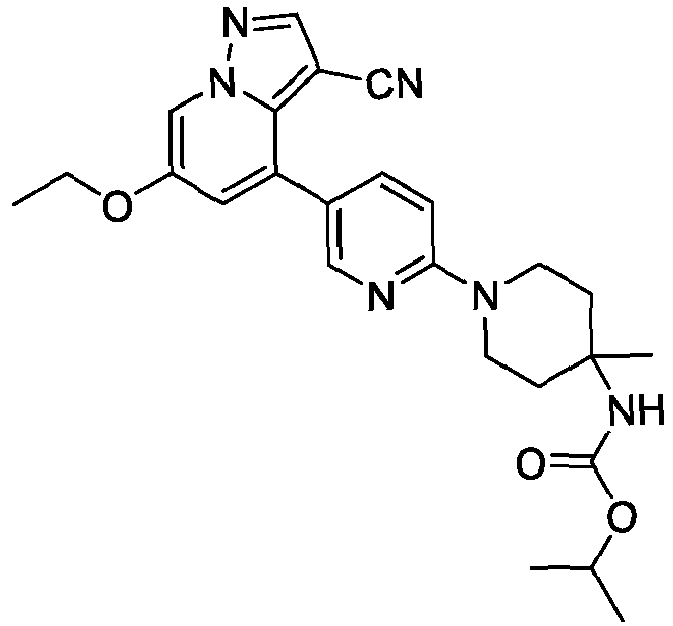
isopropyl (1-(5-(3-cyano-6-ethoxypyrazolo[1,5-a]pyridin-4-yl)pyridin-2-yl)-4-methylpiperidin-4-yl)carbamate 463.20 (M+H) -

- To a solution of N-(1-(5-(3-cyano-6-hydroxypyrazolo[1,5-a]pyridin-4-yl)pyridin-2-yl)-4-methylpiperidin-4-yl)picolinamide (Intermediate P90, 40 mg, 0.0882 mmol) in DMA (0.882 mL) was added 4-(2-chloroethyl)morpholine hydrochloride (32.8 mg, 0.176 mmol) and cesium carbonate (144 mg, 0.441 mmol). The reaction mixture was stirred at 60°C for 16 h. After cooling to ambient temperature, the reaction mixture was diluted with 4:1 DCM/IPA and washed successively with water and saturated NaCl(aq). The organic extract was dried over anhydrous Na2SO4(s), filtered, concentrated in vacuo, and purified by C-18 reverse phase chromatography (5-95% ACN in water [+ 0.1% TFA] as the gradient eluent). The fractions containing the desired product were diluted with 4:1 DCM/IPA and washed with saturated NaHCO3(aq) and saturated NaCl(aq). The organic extract was dried over anhydrous Na2SO4(s), filtered, and concentrated in vacuo to afford the title compound (15.0 mg, 0.0265 mmol, 30.0% yield). MS (apci) m/z = 567.3 (M+H).
- The compounds in Table EEE were prepared using a similar method to that described for the synthesis of Example 453, replacing 4-(2-chloroethyl)morpholine hydrochloride with the appropriate alkyl halide. Reactions were monitored for completion by LCMS, and reaction durations were adjusted accordingly. Title compounds were cleanly isolated following chromatographic purification using an appropriate gradient eluent (and if necessary converted to the free base).
Table EEE Ex. # Structure Chemical Name MS m/z 454 
N-(1-(5-(3-cyano-6-((1-methyl-1H-imidazol-4-yl)methoxy)pyrazolo[1,5-a]pyridin-4-yl)pyridin-2-yl)-4-methylpiperidin-4-yl)picolinamide 548.30 (M+H) 455 
N-(1-(5-(3-cyano-6-(3-morpholinopropoxy)pyraz olo[1,5-a]pyridin-4-yl)pyridin-2-yl)-4-methylpiperidin-4-yl)picolinamide 581.30 (M+H) 456 
N-(1-(5-(6-(2-(1H-imidazol-1-yl)ethoxy)-3 - cyanopyrazolo[1,5-a]pyridin-4-yl)pyridin-2-yl)-4-methylpiperidin-4-yl)picolinamide 548.30 (M+H) 457 
N-(1-(5-(3-cyano-6-((1-methyl-1H-imidazol-2-yl)methoxy)pyrazolo[1,5-a]pyridin-4-yl)pyridin-2-yl)-4-methylpiperidin-4-yl)picolinamide 548.30 (M+H) 458 
N-(1-(5-(3-cyano-6-(2-(pyrrolidin-1-yl)ethoxy)pyrazolo[1,5-a]pyridin-4-yl)pyridin-2-yl)-4-methylpiperidin-4-yl)picolinamide 551.30 (M+H) -

- Step 1: Preparation of tert-butyl 3-(((3-cyano-4-(6-(4-methyl-4-(picolinamido)piperidin-1-yl)pyridin-3-yl)pyrazolo[1,5-a]pyridin-6-yl)oxy)methyl)azetidine-1-carboxylate. To a solution of N-(1-(5-(3-cyano-6-hydroxypyrazolo[1,5-a]pyridin-4-yl)pyridin-2-yl)-4-methylpiperidin-4-yl)picolinamide (Intermediate P90, 40 mg, 0.088 mmol) in DMA (0.882 mL) was added 3-bromomethyl-azetidine-1-carboxylic acid tert-butyl ester (22 mg, 0.088 mmol) and cesium carbonate (144 mg, 0.44 mmol). The reaction mixture was stirred at 60°C for 16 h. After cooling to ambient temperature the reaction mixture was diluted with 4:1 DCM/IPA and washed successively with water and saturated NaCl(aq). The organic extract was dried over anhydrous Na2SO4(s), filtered, concentrated in vacuo, and purified by C-18 reverse phase chromatography (5-95% ACN in water [+ 0.1% TFA] as the gradient eluent). The fractions containing the desired product were diluted with 4:1 DCM/IPA and washed with saturated NaHCO3(aq) and saturated NaCl(aq). The organic extract was dried over anhydrous Na2SO4(s), filtered, and concentrated in vacuo to afford the title compound (15.0 mg, 0.0265 mmol, 30.0% yield) in sufficient purity for step 2. MS (apci) m/z = 623.3 (M+H).
- Step 2: Preparation of N-(1-(5-(6-(azetidin-3-ylmethoxy)-3-cyanopyrazolo[1,5-a]pyridin-4-yl)pyridin-2-yl)-4-methylpiperidin-4-yl)picolinamide. A solution of tert-butyl 3-(((3-cyano-4-(6-(4-methyl-4-(picolinamido)piperidin-1-yl)pyridin-3-yl)pyrazolo[1,5-a]pyridin-6-yl)oxy)methyl)azetidine-1-carboxylate (55 mg, 0.088 mmol) in 1:1 (v/v) mixture of DCM:TFA (883 µL) was stirred at rt for 16 h. The reaction mixture was diluted with 4:1 DCM/IPA and washed successively with saturated NaHCO3(aq) and brine. The organic extract was dried over anhydrous Na2SO4(s), filtered, and concentrated in vacuo to afford the title compound (46 mg, 0.088 mmol, 100% yield). MS (apci) m/z = 523.3 (M+H).
-

- To a solution of N-(1-(5-(6-(azetidin-3-ylmethoxy)-3-cyanopyrazolo[1,5-a]pyridin-4-yl)pyridin-2-yl)-4-methylpiperidin-4-yl)picolinamide (Example 459, 46 mg, 0.088 mmol) in DCM (1.760 mL) was added formaldehyde (0.066 mL, 0.88 mmol) and sodium triacetoxyborohydride (93 mg, 0.44 mmol). The reaction mixture was stirred at rt for 1 h then concentrated in vacuo. The resultant crude residue was directly purified by C-18 reverse phase chromatography (5-95% ACN in water [+ 0.1% TFA] as the gradient eluent). The fractions containing the desired product were diluted with 4:1 DCM/IPA and washed with saturated NaHCO3(aq) and saturated NaCl(aq). The organic extract was dried over anhydrous Na2SO4(s), filtered, and concentrated in vacuo to afford the title compound (9.4 mg, 0.017 mmol, 20% yield) in sufficient purity for step 2. MS (apci) m/z = 537.3 (M+H).
-

- Step 1: Preparation of tert-butyl (2-((3-cyano-4-(6-(4-methyl-4-(picolinamido)piperidin-1-yl)pyridin-3-yl)pyrazolo[1,5-a]pyridin-6-yl)oxy)ethyl)carbamate. To a solution of N-(1-(5-(3-cyano-6-hydroxypyrazolo[1,5-a]pyridin-4-yl)pyridin-2-yl)-4-methylpiperidin-4-yl)picolinamide (Intermediate P90, 40 mg, 0.088 mmol) in DMA (0.882 mL) was added 2-(Boc-amino)ethyl bromide (20 mg, 0.088 mmol) and cesium carbonate (144 mg, 0.44 mmol). The reaction mixture was stirred at 70°C for 3 h. After cooling to ambient temperature, the reaction mixture was diluted with 4:1 DCM/IPA and washed successively with water and saturated NaCl(aq). The organic extract was dried over anhydrous Na2SO4(s), filtered, concentrated in vacuo, and purified by C-18 reverse phase chromatography (5-95% ACN in water [+ 0.1% TFA] as the gradient eluent). The fractions containing the desired product were diluted with 4:1 DCM/IPA and washed with saturated NaHCO3(aq) and saturated NaCl(aq). The organic extract was dried over anhydrous Na2SO4(s), filtered, and concentrated in vacuo to afford the title compound (assumed theoretical yield, 53 mg, 0.088 mmol) in sufficient purity for step 2. MS (apci) m/z = 597.3 (M+H).
- Step 2: Preparation of N-(1-(5-(6-(2-aminoethoxy)-3-cyanopyrazolo[1,5-a]pyridin-4-yl)pyridin-2-yl)-4-methylpiperidin-4-yl)picolinamide. A solution of tert-butyl (2-((3-cyano-4-(6-(4-methyl-4-(picolinamido)piperidin-1-yl)pyridin-3-yl)pyrazolo[1,5-a]pyridin-6-yl)oxy)ethyl)carbamate (53 mg, 0.089 mmol) in 1:1 (v/v) mixture of DCM:TFA (0.89 mL) was stirred at rt for 16 h. The reaction mixture was diluted with 4:1 DCM/IPA and washed successively with saturated NaHCO3(aq) and brine. The organic extract was dried over anhydrous Na2SO4(s), filtered, and concentrated in vacuo to afford the title compound (34 mg, 0.068 mmol, 77% yield over two steps) in sufficient purity for step 3. MS (apci) m/z = 497.2 (M+H).
- Step 3: Preparation of N-(1-(5-(3-cyano-6-(2-(dimethylamino)ethoxy)pyrazolo[1,5-a]pyridin-4-yl)pyridin-2-yl)-4-methylpiperidin-4-yl)picolinamide. To a solution of N-(1-(5-(6-(2-aminoethoxy)-3-cyanopyrazolo[1,5-a]pyridin-4-yl)pyridin-2-yl)-4-methylpiperidin-4-yl)picolinamide (34 mg, 0.0685 mmol) in DCM (1.369 mL) was added formaldehyde (0.051 mL, 0.685 mmol) and sodium triacetoxyborohydride (72.6 mg, 0.342 mmol). The reaction mixture was stirred at rt for 1 h then concentrated in vacuo. The resultant crude residue was directly purified by C-18 reverse phase chromatography (5-95% ACN in water [+ 0.1% TFA] as the gradient eluent). The fractions containing the desired product were diluted with 4:1 DCM/IPA and washed with saturated NaHCO3(aq) and saturated NaCl(aq). The organic extract was dried over anhydrous Na2SO4(s), filtered, and concentrated in vacuo. The resultant film was triturated with DCM/hexanes and concentrated in vacuo to afford the title compound (10.5 mg, 0.0198 mmol, 29% yield). MS (apci) m/z = 525.3 (M+H).
-

- Step 1: Preparation of tert-butyl 3-(((3-cyano-4-(6-(4-methyl-4-(picolinamido)piperidin-1-yl)pyridin-3-yl)pyrazolo[1,5-a]pyridin-6-yl)oxy)methyl)-3-fluoroazetidine-1-carboxylate. To a solution of N-(1-(5-(3-cyano-6-hydroxypyrazolo[1,5-a]pyridin-4-yl)pyridin-2-yl)-4-methylpiperidin-4-yl)picolinamide (Intermediate P90, 40 mg, 0.088 mmol) in DMA (0.882 mL) was added 1-boc-3-bromomethyl-azetidine (24 mg, 0.088 mmol) and cesium carbonate (144 mg, 0.44 mmol). The reaction mixture was stirred at 60°C for 16 h. After cooling to ambient temperature, the reaction mixture was diluted with 4:1 DCM/IPA and washed successively with water and saturated NaCl(aq). The organic extract was dried over anhydrous Na2SO4(s), filtered, concentrated in vacuo, and purified by C-18 reverse phase chromatography (5-95% ACN in water [+ 0.1% TFA] as the gradient eluent). The fractions containing the desired product were diluted with 4:1 DCM/IPA and washed with saturated NaHCO3(aq) and saturated NaCl(aq). The organic extract was dried over anhydrous Na2SO4(s), filtered, and concentrated in vacuo to afford the title compound (54 mg, 0.084 mmol, 96% yield) in sufficient purity for step 2. MS (apci) m/z = 641.3 (M+H).
- Step 2: Preparation of N-(1-(5-(3-cyano-6-((3-fluoroazetidin-3-yl)methoxy)pyrazolo[1,5-a]pyridin-4-yl)pyridin-2-yl)-4-methylpiperidin-4-yl)picolinamide. A solution of tert-butyl 3-(((3-cyano-4-(6-(4-methyl-4-(picolinamido)piperidin-1-yl)pyridin-3-yl)pyrazolo[1,5-a]pyridin-6-yl)oxy)methyl)-3-fluoroazetidine-1-carboxylate (54 mg, 0.084 mmol) in 1:1 (v/v) mixture of DCM:TFA (0.84 mL) was stirred at rt for 1 h. The reaction mixture was diluted with 4:1 DCM/IPA and washed successively with saturated NaHCO3(aq) and brine. The organic extract was dried over anhydrous Na2SO4(s), filtered, and concentrated in vacuo. The residue was purified by C-18 reverse phase chromatography (5-95% ACN in water [+ 0.1% TFA] as the gradient eluent). The fractions containing the desired product were diluted with 4:1 DCM/IPA and washed with saturated NaHCO3(aq) and saturated NaCl(aq). The organic extract was dried over anhydrous Na2SO4(s), filtered, and concentrated in vacuo to afford the title compound (5.0 mg, 11% yield). MS (apci) m/z = 541.2 (M+H).
-

- To a solution of N-(1-(5-(3-cyano-6-((3-fluoroazetidin-3-yl)methoxy)pyrazolo[1,5-a]pyridin-4-yl)pyridin-2-yl)-4-methylpiperidin-4-yl)picolinamide (Example 462, 35 mg, 0.065 mmol) in DCM (1.295 mL) was added formaldehyde (0.048 mL, 0.65 mmol) and sodium triacetoxyborohydride (69 mg, 0.32 mmol). The reaction mixture was stirred at rt for 1 h. The reaction mixture was concentrated in vacuo, and the resultant crude residue was directly purified by C-18 reverse phase chromatography (5-95% ACN in water [+ 0.1% TFA] as the gradient eluent). The fractions containing the desired product were diluted with 4:1 DCM/IPA and washed with saturated NaHCO3(aq) and saturated NaCl(aq). The organic extract was dried over anhydrous Na2SO4(s), filtered, and concentrated in vacuo to afford the title compound (19 mg, 0.034 mmol, 53% yield). MS (apci) m/z = 555.3 (M+H).
-

- To a solution of N-(1-(5-(3-cyano-6-(2-(piperazin-1-yl)ethoxy)pyrazolo[1,5-a]pyridin-4-yl)pyridin-2-yl)-4-methylpiperidin-4-yl)picolinamide (Intermediate P91, 35 mg, 0.0619 mmol) in DCM (0.619 mL) was added TEA (0.00862 mL, 0.0619 mmol) and acetyl chloride (0.124 mL, 0.124 mmol). The reaction mixture was stirred at rt for 1 h. The reaction mixture was diluted with 4:1 DCM/IPA and washed successively with water and brine. The organic extract was dried over anhydrous Na2SO4(s), filtered, and concentrated in vacuo. The residue was purified by C-18 reverse phase chromatography (5-95% ACN in water [+ 0.1% TFA] as the gradient eluent). The fractions containing the desired product were diluted with 4:1 DCM/IPA and washed with saturated NaHCO3(aq) and saturated NaCl(aq). The organic extract was dried over anhydrous Na2SO4(s), filtered, and concentrated in vacuo to afford the title compound (27.7 mg, 0.0456 mmol, 73.7% yield). MS (apci) m/z = 608.3 (M+H).
-

- To a solution of N-(1-(5-(3-cyano-6-(2-(piperazin-1-yl)ethoxy)pyrazolo[1,5-a]pyridin-4-yl)pyridin-2-yl)-4-methylpiperidin-4-yl)picolinamide (Intermediate P91, 40 mg, 0.0707 mmol) in DCM (1.414 mL) was added formaldehyde (0.0526 mL, 0.707 mmol) and sodium triacetoxyborohydride (74.9 mg, 0.354 mmol). The reaction mixture was stirred at rt for 1 h. The reaction mixture was concentrated in vacuo, and the resultant crude residue was directly purified by C-18 reverse phase chromatography (5-95% ACN in water [+ 0.1% TFA] as the gradient eluent). The fractions containing the desired product were diluted with 4:1 DCM/IPA and washed with saturated NaHCO3(aq) and saturated NaCl(aq). The organic extract was dried over anhydrous Na2SO4(s), filtered, and concentrated in vacuo. The residue was purified by silica chromatography (0-10% MeOH in DCM as the gradient eluent) to afford the title compound (15.4 mg, 37.6% yield). MS (apci) m/z = 580.3 (M+H).
-

- To a solution of 1-(5-(3-cyano-6-ethoxypyrazolo[1,5-a]pyridin-4-yl)pyridin-2-yl)-4-methylpiperidine-4-carboxylic acid (Intermediate P92, 38.2 mg, 0.0942 mmol) in DCM (0.942 mL) was added HATU (43.0 mg, 0.113 mmol), DIEA (0.033 mL, 0.188 mmol), and propan-2-amine (0.009 mL, 0.104 mmol). The reaction mixture was stirred at rt for 16 h. The reaction mixture was concentrated in vacuo, and the resultant crude residue was directly purified by C-18 reverse phase chromatography (5-95% ACN in water [+ 2% TFA] as the gradient eluent). The fractions containing the desired product were diluted with 4:1 DCM/IPA and washed with saturated NaHCO3(aq). The organic extract was dried over anhydrous Na2SO4(s), filtered, and concentrated in vacuo to afford the title compound (32.4 mg, 0.0726 mmol, 77% yield). MS (apci) m/z = 447.2 (M+H).
- The compounds in Table FFF were prepared using a similar method to that described for the synthesis of Example 466, replacing propan-2-amine with the appropriate amine coupling partner. Reactions were monitored for completion by LCMS, and reaction durations were adjusted accordingly. Title compounds were cleanly isolated following chromatographic purification using an appropriate gradient eluent (and if necessary converted to the free base).
Table FFF Ex. # Structure Chemical Name MS m/z 467 
6-ethoxy-4-(6-(4-methyl-4-(pyrrolidine-1-carbonyl)piperidin-1-yl)pyridin-3-yl)pyrazolo[1,5-a]pyridine-3-carbonitrile 459.25 (M+H) 468 
1-(5-(3-cyano-6-ethoxypyrazolo[1,5-a]pyridin-4-yl)pyridin-2-yl)-N-isobutyl-4-methylpiperidine-4-carboxamide 461.25 (M+H) 469 
1-(5-(3-cyano-6-ethoxypyrazolo[1,5-a]pyridin-4-yl)pyridin-2-yl)-N-(6-methoxypyridin-3-yl)-4-methylpiperidine-4-carboxamide 512.20 (M+H) 470 
1-(5-(3-cyano-6-ethoxypyrazolo[1,5-a]pyridin-4-yl)pyridin-2-yl)-4-methyl-N-(pyridin-3-yl)piperidine-4-carboxamide 482.20 (M+H) 471 
1-(5-(3-cyano-6-ethoxypyrazolo[1,5-a]pyridin-4-yl)pyridin-2-yl)-4-methyl-N-(6-methylpyridin-3-yl)piperidine-4-carboxamide 496.20 (M+H) 472 
1-(5-(3-cyano-6-ethoxypyrazolo[1,5-a]pyridin-4-yl)pyridin-2-yl)-4-methyl-N-(5-methylpyridin-2-yl)piperidine-4-carboxamide 496.20 (M+H) 473 
1-(5-(3-cyano-6-ethoxypyrazolo[1,5-a]pyridin-4-yl)pyridin-2-yl)-4-methyl-N-(pyridin-2-yl)piperidine-4-carboxamide 482.20 (M+H) 474 
1-(5-(3-cyano-6-ethoxypyrazolo[1,5-a]pyridin-4-yl)pyridin-2-yl)-N-(cyclopropylmethyl)-4-methylpiperidine-4-carboxamide 459.20 (M+H) 475 
(R)-1-(5-(3-cyano-6-ethoxypyrazolo[1,5-a]pyridin-4-yl)pyridin-2-yl)-4-methyl-N-(3-methylbutan-2-yl)piperidine-4-carboxamide 475.30 (M+H) 476 
(S)-1-(5-(3-cyano-6-ethoxypyrazolo[1,5-a]pyridin-4-yl)pyridin-2-yl)-4-methyl-N-(3-methylbutan-2-yl)piperidine-4-carboxamide 475.30 (M+H) 477 
1-(5-(3-cyano-6-ethoxypyrazolo[1,5-a]pyridin-4-yl)pyridin-2-yl)-4-methyl-N-(2,2,2-trifluoroethyl)piperidine-4-carboxamide 487.20 (M+H) 478 
(S)-1-(5-(3-cyano-6-ethoxypyrazolo[1,5-a]pyridin-4-yl)pyridin-2-yl)-N-(2-hydroxypropyl)-4-methylpiperidine-4-carboxamide 463.20 (M+H) -

- Step 1: Preparation of tert-butyl (1-(5-(3-cyano-6-(2-hydroxy-2-methylpropoxy)pyrazolo[1,5-a]pyridin-4-yl)pyridin-2-yl)-4-methylpiperidin-4-yl)carbamate. A solution of 4-(6-fluoropyridin-3-yl)-6-(2-hydroxy-2-methylpropoxy)pyrazolo[1,5-a]pyridine-3-carbonitrile (Intermediate P42; 2.535 g, 7.768 mmol) in DMSO (6.1 mL) was treated sequentially with tert-butyl (4-methylpiperidin-4-yl)carbamate (1.998 mg, 9.322 mmol) and DIEA (4.06 mL, 23.3 mmol). The resulting mixture stirred overnight at 90 °C. After cooling to ambient temperature, the reaction mixture was poured into 80 mL water and diluted with 80 mL heptane and stirred for 1 hour. The suspension was filtered and the solids were rinsed with 25 mL water then 25 mL heptane. The isolated solids were dried under vacuum for 18 hours to afford the title compound (4.04 g, 99.9% yield) in sufficient purity for step 2. MS (apci) m/z = 521.3 (M+H)
- Step 2: Preparation of 4-(6-(4-amino-4-methylpiperidin-1-yl)pyridin-3-yl)-6-(2-hydroxy-2-methylpropoxy)pyrazolo[1,5-a]pyridine-3-carbonitrile dihydrochloride. A solution of tert-butyl (1-(5-(3-cyano-6-(2-hydroxy-2-methylpropoxy)pyrazolo[1,5-a]pyridin-4-yl)pyridin-2-yl)-4-methylpiperidin-4-yl)carbamate (4.04 g, 7.76 mmol) in DCM (20 mL) was cooled to 0°C. The reaction was treated with TFA (5.98 mL) and allowed to warm to RT. After stirring for 30 min at ambient the reaction mixture was concentrated in vacuo. The residue was dissolved in MeOH (20 mL) and cooled to 0°C and then treated with Hydrochloric acid, 5 to 6N solution in 2-propanol (15.5 mL, 77.5 mmol) and stirred for 15 min at 0°C. The reaction was diluted with 20 mL MTBE, filtered, and solids were rinsed with 20 mL 1:1 MTBE: MeOH. The isolated solids were dried under vacuum to cleanly provide the title compound (3.37 g, 88% yield). MS (apci) m/z = 421.2 (M+H).
-

- To a solution of 6-ethoxy-4-(6-fluoropyridin-3-yl)pyrazolo[1,5-a]pyridine-3-carbonitrile (Intermediate P6, 0.500 g, 1.77 mmol) in DMSO (3.5 mL) was added TEA (0.741 mL, 5.31 mmol) and piperidin-4-ol (269 mg, 2.66 mmol). The reaction mixture was stirred at 70°C for 5 h. After cooling to ambient temperature, the reaction mixture was poured into ice water. The resultant solids were isolated by vacuum filtration to afford the title compound (501 mg, 1.38 mmol, 77.8 % yield). MS (apci) m/z = 364.2 (M+H).
-

- To a solution of 4-(6-fluoropyridin-3-yl)-6-(2-hydroxy-2-methylpropoxy)pyrazolo[1,5-a]pyridine-3-carbonitrile (Intermediate P42; 210 mg, 0.64 mmol) and 2-(piperidin-4-ylsulfanyl)pyridine (357 mg, 1.84 mmol) in DMA (1.6 mL) was added TEA (628 µL, 4.50 mmol). The reaction mixture was stirred overnight at 95°C. After cooling to ambient temperature, the reaction mixture was diluted water and extracted with EtOAc. The organic extracts were washed with water and brine. The organic extracts were dried over anhydrous Na2SO4(s), filtered and concentrated in vacuo. The residue was purified by silica chromatography (10-90% EtOAc in Hexanes to afford the title compound (20 mg, 61% yield). MS (apci) m/z = 501.2 (M+H).
-

- Step 1: Preparation of tert-butyl ((1R,5S,6r)-3-(5-(3-cyano-6-(2-hydroxy-2-methylpropoxy)pyrazolo[1,5-a]pyridin-4-yl)pyridin-2-yl)-3-azabicyclo[3.1.1]heptan-6-yl)carbamate. To a solution of 4-(6-fluoropyridin-3-yl)-6-(2-hydroxy-2-methylpropoxy)pyrazolo[1,5-a]pyridine-3-carbonitrile (Intermediate P42; 200 mg, 0.57 mmol) and tert-butyl ((1R,5S,6r)-3-azabicyclo[3.1.1]heptan-6-yl)carbamate(169 mg, 0.80 mmol) in DMSO (0.57 mL) was added DIEA (298 µL, 1.71 mmol). The reaction mixture was stirred overnight under a N2(g) atmosphere at 90°C. After cooling to ambient temperature, the reaction mixture was diluted with water (5.7 mL). The suspension was filtered and the solids were rinsed with water (3x5 mL) then MTBE (3x5mL). The isolated solids were dried under vacuum while the MTBE filtrate was concentrated in vacuo. The filtrate residue was purified by C18 reverse phase chromatography (5-50% ACN in water). The precipitate solids and chromatography product were combined and concentrated in vacuo to cleanly provide the title compound (292 mg, 98% yield) in sufficient purity for step 2. MS (apci) m/z= 519.20 (M+H).
-

- To a solution of tert-butyl ((1R,5S,6r)-3-(5-(3-cyano-6-(2-hydroxy-2-methylpropoxy)pyrazolo[1,5-a]pyridin-4-yl)pyridin-2-yl)-3-azabicyclo[3.1.1]heptan-6-yl)carbamate (Example 507A; 148 mg, 0.29 mmol) in MeOH (571 µL) was added HCl (conc.) (476 µL, 5.71 mmol) dropwise. The reaction was stirred for 2 h at ambient temperature. The reaction was diluted with EtOAc (1 mL) and was stirred at ambient temperature for 10 minutes. MTBE (1mL) was added and a suspension formed. The suspension was filtered and solids were rinsed with 10% MeOH in MTBE (3×1mL) to cleanly provide the title compound (114 mg, 81% yield). MS (apci) m/z = 419.15 (M+H).
-

- Step 1: Preparation of tert-butyl (1-(5-(3-cyano-6-(2-hydroxy-2-methylpropoxy)pyrazolo[1,5-a]pyridin-4-yl)pyridin-2-yl)piperidin-4-yl)carbamate. To a solution of 4-(6-fluoropyridin-3-yl)-6-(2-hydroxy-2-methylpropoxy)pyrazolo[1,5-a]pyridine-3-carbonitrile (Intermediate P42; 205 mg, 0.628 mmol) and tert-butyl piperidin-4-ylcarbamate (252 mg, 1.26 mmol) in DMA (2.09 mL) was added DIEA (549 µL, 3.14 mmol). The reaction was stirred 2 h at 95°C. After cooling to ambient temperature, the reaction mixture was diluted with water and extracted with EtOAc. The organic extracts were washed with water and brine. The organic extracts were dried over anhydrous Na2SO4(s), filtered and concentrated in vacuo to afford the title compound (assumed quantative yield, 319 mg) in sufficient purity for step 2. MS (apci) m/z= 507.20 (M+H)
- Step 2: Preparation of 4-(6-(4-aminopiperidin-1-yl)pyridin-3-yl)-6-(2-hydroxy-2-methylpropoxy)pyrazolo[1,5-a]pyridine-3-carbonitrile. To a solution of tert-butyl (1-(5-(3-cyano-6-(2-hydroxy-2-methylpropoxy)pyrazolo[1,5-a]pyridin-4-yl)pyridin-2-yl)piperidin-4-yl)carbamate (319 mg, 0.63 mmol) in DCM (3.15 mL) was added TFA (3.14 mL, 40.9 mmol). The reaction was stirred for 30 min at ambient temperature. The reaction was concentrated in vacuo. The residue was resuspended in DCM and purified using silica chromatography (1-9% MeOH in DCM with 0.1-0.9% NH4OH as the gradient eluent) to cleanly provide the title compound (37 mg, 53% yield) MS (apci) m/z = 407.2 (M+H).
-

- To a solution of 4-(6-(4-amino-4-methylpiperidin-1-yl)pyridin-3-yl)-6-hydroxypyrazolo[1,5-a]pyridine-3-carbonitrile dihydrochloride (Intermediate P67; 503 mg, 1.19 mmol), 5-fluoro-2-methylbenzoic acid (552 mg, 3.58 mmol), and HATU (1.36g, 3.58 mmol) in DMSO (5 mL) was added DIEA (1.7 mL, 9.55 mmol). The reaction was stirred 16 h at ambient temperature. The reaction mixture was diluted with THF (4 mL) and treated with NaOH (5.97 mL, 11.9 mmol) and stirred for 4 h at ambient temperature. The reaction was concentrated in vacuo. The residue was diluted with EtOAc and washed with water. The pH was adjusted to pH 5 with AcOH and then extracted with EtOAc. The organic extracts were washed with brine. The organic extracts were dried over anhydrous Na2SO4(s), filtered and concentrated in vacuo. The residue was purified using silica chromatography (50-100% Hexanes to EtOAc) to afford the title compound (534 mg, 92% yield) in sufficient purity for step 2. MS (apci) m/z= 485.2 (M+H).
-

- A solution of tert-butyl (1-(5-(3-cyano-6-ethoxypyrazolo[1,5-a]pyridin-4-yl)pyridin-2-yl)-4-methylpiperidin-4-yl)carbamate (Example 446, 100 mg, 0.210 mmol) in DCM (2 mL) was treated with TFA (2 mL). The reaction mixture was stirred at rt for 1 h. The crude reaction mixture was directly purified by silica chromatography (5-50% [MeOH + 2% NH4OH] in DCM as the gradient eluent) to afford the title compound (20 mg, 0.0531 mmol, 25.3% yield). MS (apci) m/z = 377.2 (M+H).
-

- To a solution of 4-(6-(4-amino-4-methylpiperidin-1-yl)pyridin-3-yl)-6-hydroxypyrazolo[1,5-a]pyridine-3-carbonitrile dihydrochloride (Intermediate P67; 256 mg, 0.608 mmol), 3-Chloropicolinic acid (287 mg, 1.82 mmol), and HATU (294 mg, 1.82 mmol) in DMSO (3 mL) was added DIEA (0.74 mL, 4.25 mmol). The reaction was stirred overnight at ambient temperature. The reaction mixture was diluted with EtOAc (10 mL) and washed with water (10 mL) and 4:1AcOH:water (10 mL) and then extracted with EtOAc. The organic extracts were washed with 4:1 AcOH:Water and then brine. The organic extracts were dried over anhydrous Na2SO4(s), filtered and concentrated in vacuo. The residue was diluted with THF (4 mL) and 2M NaOH (6 mL). The solution was concentrated in vacuo. The residue was resuspended in DCM (2mL) and purified by C18 reverse phase chromatography (5-95% ACN in water with 0.1% TFA as the gradient eluent) to afford the title compound as the TFA salt. The TFA salt was resuspended in DCM and passed through a Pl-HCO3 resin to elute the free-based product. The organic eluents were concentrated in vacuo and recrystallized using DCM/Hexanes to afford the title compound (226 mg, 76% yield). MS (apci) m/z = 488.2 (M+H).
-

- Step 1: Preparation of tert-butyl 4-((3-fluoropyridin-2-yl)oxy)piperidine-1-carboxylate. To a solution of tert-Butyl 4-hydroxy-4-methylpiperidine-1-carboxylate (175 mg, 0.869 mmol) in DMF (2.2 mL) was added sodium hydride (60% w/w, 41.7 mg, 1.04 mmol). The reaction was stirred for 10 min at ambient temperature. 2,3-Difluoropyridine (100 mg, 0.869 mmol) was added and reaction stirred overnight at 60°C. The reaction was cooled to ambient temperature and diluted with DCM and washed with saturated NaHCO3(aq), water, and brine. The combined organic extracts were dried over anhydrous Na2SO4(s), filtered and concentrated in vacuo to afford the title compound (assumed quantative yield, 258 mg) in sufficient purity for step 2. MS (apci) m/z = 197.2 (M-Boc).
- Step 2: Preparation of 3-fluoro-2-(piperidin-4-yloxy)pyridine hydrochloride. To a solution of tert-butyl 4-((3-fluoropyridin-2-yl)oxy)piperidine-1-carboxylate (assumed 258mg, 0.869 mmol) in 4.3 mL DCM was treated with TFA (4.3 mL, 55.8 mmol). The reaction mixture was stirred for 1 h at ambient temperature, and then concentrated in vacuo. The crude residue was resuspended in MeOH and treated with treated with 4 N HCl in dioxanes (4 mL). The solution was stirred at ambient temperature for 15 min. The reaction was concentrated in vacuo to provide the title compound as a dihydrochloride salt, which was used in the next step without further purifications.. MS (apci) m/z = 197.1 (M+H).
- Step 3: Preparation of 4-(6-(4-((3-fluoropyridin-2-yl)oxy)piperidin-1-yl)pyridin-3-yl)-6-(2-hydroxy-2-methylpropoxy)pyrazolo[1,5-a]pyridine-3-carbonitrile. To a mixture of 4-(6-fluoropyridin-3-yl)-6-(2-hydroxy-2-methylpropoxy)pyrazolo[1,5-a]pyridine-3-carbonitrile (Intermediate P42; 40 mg, 0.123 mmol) and 3-fluoro-2-(piperidin-4-yloxy)pyridine dihydrochloride (66 mg, 0.245 mmol) in DMA (0.817 mL) was added TEA (103 µL, 0.735mmol). The reaction mixture was stirred overnight at 95°C. After cooling to ambient temperature, the reaction mixture was diluted with DCM and washed with water and brine. The organic extracts were dried over anhydrous Na2SO4(s), filtered and concentrated in vacuo. The residue was purified by C18 reverse phase chromatography (5-95% ACN in water with 0.1% TFA as the gradient eluent) to afford the title compound as the TFA salt. The TFA salt was treated with saturated Na2CO3(aq) and extracted with DCM. The combined organic extracts were washed with brine, then dried over anhydrous Na2SO4(s), filtered and concentrated in vacuo to afford the title compound (17 mg, 28% yield). MS (apci) m/z = 503.2 (M+H).
-

- A mixture of 4-(6-fluoropyridin-3-yl)-6-methoxypyrazolo[1,5-a]pyridine-3-carbonitrile (Intermediate P93; 31.8 mg, 0.119 mmol), N-isopropylpiperidine-4-sulfonamide (Intermediate R18; 45 mg, 0.218 mmol) and DIEA (62.1 µL, 0.356 mmol) in DMSO (500 µL) was stirred for 2 d at 90 °C. After cooling to ambient temperature, the mixture was diluted with water, cooled to 0 °C, and the resultant suspension was filtered. The solids were rinsed with water, and purified by silica chromatography (using 30-100% Hexanes/ EtOAc as the gradient eluent) to afford the title compound (11.5 mg, 21% yield). MS (apci) m/z = 455.15 (M+H).
-

- A mixture of 4-(6-fluoropyridin-3-yl)-6-methoxypyrazolo[1,5-a]pyridine-3-carbonitrile (Intermediate P93; 201.7 mg, 0.7519 mmol), tert-butyl (3-methoxypiperidin-4-yl)carbamate (mixture of trans isomers) (259.8 mg, 1.128 mmol) and DIEA (394.0 µL, 2.256 mmol) in DMSO (3 mL) was stirred overnight at 90 °C. After cooling to ambient temperature, the mixture was diluted with water, and cooled to 0 °C. The resultant suspension was filtered, and the solids were rinsed with cold water (3x), and purified by silica chromatography (using 30-70% Hexanes/ EtOAc as the gradient eluent) to afford the title compound (299.8 mg, 83% yield). MS (apci) m/z = 479.2 (M+H).
-

- A solution of 4-(6-fluoropyridin-3-yl)-6-methoxypyrazolo[1,5-a]pyridine-3-carbonitrile (Intermediate P93; 158.5 mg, 0.5909 mmol), and tert-butyl ((3S,4S)-3-hydroxypiperidin-4-yl)carbamate (216.3 mg, 1.000 mmol) in DMSO (2 mL) was treated with DIEA (516.0 µL, 2.954 mmol), then stirred overnight at 100 °C. After cooling to ambient temperature, the mixture was diluted with water, and the resultant suspension was filtered. The solids were rinsed with water (3x), then dried in vacuo to cleanly afford the title compound (335.8 mg, quantitative yield). MS (apci) m/z = 465.2 (M+H).
-

- A solution of 4-(6-((3S,4S)-4-amino-3-hydroxypiperidin-1-yl)pyridin-3-yl)-6-methoxypyrazolo[1,5-a]pyridine-3-carbonitrile dihydrochloride (Intermediate P94; 50 mg, 0.11 mmol) and DIEA (120 µL, 0.69 mmol) in DCM (2 mL) was cooled to 0 °C, then treated with isovaleryl chloride (33 µL, 0.27 mmol). The resulting mixture was stirred for 10 min at 0 °C, and then for 2 h at ambient temperature. The reaction mixture was purified by silica chromatography (using 20-100% EtOAc in Hexanes as the gradient eluent), then again by C18 reverse phase chromatography (using 20-80% ACN in water with 0.1% TFA as the gradient eluent) to cleanly provide the title compound as the TFA salt. The TFA salt was partitioned between saturated NaHCO3(aq) and 4:1 DCM:iPrOH, and passed through a PS Frit. The organic extracts were concentrated in vacuo to cleanly afford the title compound (2.0 mg, 3% yield). MS (apci) m/z = 449.2 (M+H).
-

- A solution of 4-(6-((3S,4S)-4-amino-3-hydroxypiperidin-1-yl)pyridin-3-yl)-6-methoxypyrazolo[1,5-a]pyridine-3-carbonitrile dihydrochloride (Intermediate P94; 50 mg, 0.11 mmol) and DIEA (120 µL, 0.686 mmol) in DCM (2 mL) was treated sequentially with 1-(trifluoromethyl)cyclobutane-1-carboxylic acid (46.1 mg, 0.274 mmol) and HATU (104 mg, 0.274 mmol), then stirred for 1.5 h at ambient temperature. The resulting mixture was purified directly by silica chromatography (using 20-100% EtOAc in Hexanes as the gradient eluent) to cleanly provide the title compound (18.4 mg, 26% yield). MS (apci) m/z = 515.2 (M+H).
- The compounds in Table GGG were prepared using a similar method to that described in the synthesis of N-((3S,4S)-1-(5-(3-cyano-6-methoxypyrazolo[1,5-a]pyridin-4-yl)pyridin-2-yl)-3-hydroxypiperidin-4-yl)-1-(trifluoromethyl)cyclobutane-1-carboxamide (Example 493) replacing 1-(trifluoromethyl)cyclobutane-1-carboxylic acid with the appropriate carboxylic acid. Reactions were monitored for completion by LCMS, and reaction durations were adjusted accordingly. The title compounds were isolated following a chromatographic purification utilizing an appropriate gradient eluent.
Table GGG Ex # Structure Chemical Name MS (apci) m/z 494 
N-((3S,4S)-1-(5-(3-cyano-6-methoxypyrazolo[1,5-a]pyridin-4-yl)pyridin-2-yl)-3 -hydroxypiperidin-4-yl)-1-methylcyclobutane-1-carboxamide 461.3 (M+H) 495 
N-((3S,4S)-1-(5-(3-cyano-6-methoxypyrazolo[1,5 - a]pyridin-4-yl)pyridin-2-yl)-3 -hydroxypiperidin-4-yl)-1-(trifluoromethyl)cycloprop ane-1-carboxamide 501.2 (M+H) 496 
N-((3S,4S)-1-(5-(3-cyano-6-methoxypyrazolo[1,5-a]pyridin-4-yl)pyridin-2-yl)-3-hydroxypiperidin-4-yl)-2,3-dimethylbutanamide 463.2 (M+H) -

- A mixture of 4-(6-fluoropyridin-3-yl)-6-methoxypyrazolo[1,5-a]pyridine-3-carbonitrile (Intermediate P93; 26.5 mg, 0.0988 mmol), isopropyl (4-methylpiperidin-4-yl)carbamate hydrochloride (Intermediate R19, part B; 72.3 mg, 0.305 mmol) and Cs2CO3(s) (322 mg, 0.988 mmol) in DMSO (1.5 mL) was stirred overnight at 100 °C. The reaction mixture was cooled to ambient temperature. The incomplete reaction mixture was treated with additional isopropyl (4-methylpiperidin-4-yl)carbamate hydrochloride (72.3 mg, 0.305 mmol) and a few drops of DIEA. After stirring for 6 d at ambient temperature, the reaction mixture was diluted with water and extracted with additional DCM (4x). The combined DCM extracts were dried over anhydrous Na2SO4(s), filtered and concentrated in vacuo. The resulting crude residue was purified by silica chromatography (using 0-100% Hexanes/ EtOAc as the gradient eluent) to cleanly afford the title compound (5.1 mg, 12% yield). MS (apci) m/z = 449.2 (M+H).
-

- In a pressure vessel, a mixture of 3-chloro-4-(6-fluoropyridin-3-yl)-6-methoxypyrazolo[1,5-a]pyridine (Example 417, Step 2; 30 mg, 0.11 mmol), 2-(piperidin-4-yloxy)pyridine (29 mg, 0.16 mmol) and Cs2CO3(s) (176 mg, 0.54 mmol) in DMSO (200 µL) was stirred overnight at 90 °C. After cooling to ambient temperature, the reaction mixture was poured into 2N NaOH(aq) (2 mL), and extracted with 10% iPrOH in DCM (2 × 3 mL) in a PS Frit. The combined organic extracts were concentrated in vacuo. The resulting crude residue was purified by silica chromatography (using 0-100% EtOAc / Hexanes as the gradient eluent) to cleanly afford the title compound (22 mg, 47% yield). MS (apci) m/z = 436.1 (M+H).
-

- A mixture of 3-chloro-4-(6-fluoropyridin-3-yl)-6-methoxypyrazolo[1,5-a]pyridine (Example 417, Step 2; 26.5 mg, 0.0954 mmol), isopropyl (4-methylpiperidin-4-yl)carbamate hydrochloride (Intermediate R19; 70.9 mg, 0.299 mmol) and Cs2CO3(s) (311 mg, 0.954 mmol) in DMSO (3 mL) was stirred overnight at 100 °C. The reaction mixture was cooled to ambient temperature. The incomplete reaction mixture was treated with additional isopropyl (4-methylpiperidin-4-yl)carbamate hydrochloride (Intermediate R19, part B; 70.9 mg, 0.299 mmol) and a few drops of DIEA. After stirring for 6 d at ambient temperature, the reaction mixture was partitioned between water and DCM then extracted with additional DCM (3x). The DCM extracts were combined, dried over anhydrous Na2SO4(s), filtered and concentrated in vacuo. The resulting crude residue was purified by silica chromatography (using 0-100% Hexanes/ EtOAc as the gradient eluent) to cleanly afford the title compound (1.8 mg, 3% yield). MS (apci) m/z = 458.15 (M+H).
-

- A solution of 6-ethoxy-4-(6-fluoropyridin-3-yl)pyrazolo[1,5-a]pyridine-3-carbonitrile (Intermediate P6, 176.2 mg, 0.6242 mmol), and N-((3S,4S)-4-hydroxypyrrolidin-3-yl)-3-methylbutanamide hydrochloride (Intermediate R21; 270 mg, 1.212 mmol) in DMSO (1.5 mL) was treated with DIEA (545.1 µL, 3.121 mmol). The reaction mixture was stirred overnight at 90 °C, then cooled to ambient temperature, and diluted with water. The resultant suspension was filtered, and the solids were rinsed with water (3x), then dried in vacuo. The crude solids were purified by C18 reverse phase chromatography (using 5-95% ACN in water with 0.1% TFA as the gradient eluent) to afford the title compound as the TFA salt. The TFA salt was suspended in MeOH, eluted through a basic resin (Stratospheres MP-HCO3) to cleanly afford the title compound (5.5 mg, 77% yield). MS (apci) m/z = 449.2 (M+H).
- The compounds in Table HHH were prepared using a similar method to that described for the preparation, isolation and purification of N-((3S,4S)-1-(5-(3-cyano-6-ethoxypyrazolo[1,5-a]pyridin-4-yl)pyridin-2-yl)-4-hydroxypyrrolidin-3-yl)-3-methylbutanamide (Example 500), replacing the N-((3S,4S)-4-hydroxypyrrolidin-3-yl)-3-methylbutanamide hydrochloride with the appropriate commercial pyrrolidine. Reactions were monitored for completion by LCMS. And reaction durations were adjusted accordingly.
Table HHH Ex # Structure Chemical Name MS (apci) m/z 501 
tert-butyl ((3R,4S)-1-(5-(3-cyano-6-ethoxypyrazolo[1,5-a]pyridin-4-yl)pyridin-2-yl)-4-hydroxypyrrolidin-3-yl)carbamate 465.2 (M+H) 502 
tert-butyl ((3S,4R)-1-(5-(3-cyano-6-ethoxypyrazolo[1,5-a]pyridin-4-yl)pyridin-2-yl)-4-hydroxypyrrolidin-3-yl)carbamate 465.2 (M+H) -

- Step 1: Preparation of 4-(6-((trans)-3-amino-4-methoxypyrrolidin-1-yl)pyridin-3-yl)-6-ethoxypyrazolo[1,5-a]pyridine-3-carbonitrileA solution of 6-ethoxy-4-(6-fluoropyridin-3-yl)pyrazolo[1,5-a]pyridine-3-carbonitrile (Intermediate P6, 252.1 mg, 0.8931 mmol) in DMSO (4.5 mL) was treated with tert-butyl ((3R,4R)-4-methoxypyrrolidin-3-yl)carbamate (386.3 mg, 1.786 mmol) and DIEA (311.1 µL, 1.786 mmol). The reaction mixture was stirred for 1 h at 90 °C. After cooling to ambient temperature, the reaction mixture was diluted with EtOAc, washed with water (3x) and brine (1x). The organic extracts were dried over Na2SO4(s), then filtered, and concentrated in vacuo. The crude residue was dissolved in 1:1 DCM:TFA (4.5 mL), stirred for 30 min at ambient temperature, and subsequently concentrated in vacuo. The residue was purified by C18 reverse phase chromatography (5-95% ACN in water with 0.1% TFA). Fractions containing the desired compound were combined, and partitioned between 4:1 DCM:iPrOH and saturated NaHCO3(aq). The organic extracts were dried over anhydrous Na2SO4(s), filtered, and concentrated in vacuo to afford the title compound (125.8 mg, 37% yield). MS (apci) m/z = 379.2 (M+H).
- Step 2: Preparation of N-((trans)-1-(5-(3-cyano-6-ethoxypyrazolo[1,5-a]pyridin-4-yl)pyridin-2-yl)-4-methoxypyrrolidin-3-yl)-3-methylbutanamide. A solution of 4-(6-((trans)-3-amino-4-methoxypyrrolidin-1-yl)pyridin-3-yl)-6-ethoxypyrazolo[1,5-a]pyridine-3-carbonitrile (46.0 mg, 0.122 mmol) in DCM (1.2 mL) was treated with isovaleryl chloride (29.6 µL, 0.243 mmol) and TEA (84.7 µL, 0.608 mmol), then stirred for 16 h at ambient temperature. The reaction mixture was directly purified by silica chromatography (using 5-60% DCM-Acetone as the gradient eluent) to cleanly provide the title compound (45.6 mg, 81% yield). MS (apci) m/z = 463.3 (M+H).
-

- A solution of 4-(6-((trans)-3-amino-4-methoxypyrrolidin-1-yl)pyridin-3-yl)-6-ethoxypyrazolo[1,5-a]pyridine-3-carbonitrile (Example 503, step 1: 46.5 mg, 0.1229 mmol) in DCM (1.2 mL) was treated with benzoyl chloride (28.53 µL, 0.2457 mmol) and TEA (85.63 µL, 0.6144 mmol), then stirred for 16 h at ambient temperature. The reaction mixture was directly purified by silica chromatography (using 5-60% DCM-Acetone as the gradient eluent) to cleanly provide the title compound (45.6 mg, 81% yield). MS (apci) m/z = 483.3 (M+H).
-

- Step 1: Preparation of tert-butyl ((3S,4S)-4-azido-1-(5-(3-cyano-6-ethoxypyrazolo[1,5-a]pyridin-4-yl)pyridin-2-yl)pyrrolidin-3-yl)carbamate. A mixture of tert-butyl ((3S,4R)-1-(5-(3-cyano-6-ethoxypyrazolo[1,5-a]pyridin-4-yl)pyridin-2-yl)-4-hydroxypyrrolidin-3-yl)carbamate (Intermediate P61, 49.1 mg, 0.106 mmol), DIAD (41.1 µL, 0.211 mmol), diphenyl phosphorazidate (58.2 mg, 0.211 mmol) and PPh3 (55.4 mg, 0.211 mmol) in THF (1 mL) was stirred overnight at ambient temperature. The reaction mixture was concentrated in vacuo, and purified by silica chromatography (using 0-70% EtOAc in Hexanes as the gradient eluent) to cleanly afford the title compound (51 mg, 99% yield). MS (apci) m/z = 448.2 (M+H).
- Step 2: Preparation of 4-(6-((3S,4S)-3-amino-4-azidopyrrolidin-1-yl)pyridin-3-yl)-6-ethoxypyrazolo[1,5-a]pyridine-3-carbonitrile dihydrochloride. A solution of tert-butyl ((3S,4S)-4-azido-1-(5-(3-cyano-6-ethoxypyrazolo[1,5-a]pyridin-4-yl)pyridin-2- yl)pyrrolidin-3-yl)carbamate (51 mg, 0.10 mmol) in dioxane (1.0 mL) was treated with conc. HCl(aq) (6.3 µL, 0.21 mmol). The resulting mixture was stirred overnight at ambient temperature before concentrating the mixture in vacuo to afford the title compound (48 mg, 100% yield). MS (apci) m/z = 390.15 (M+H).
- Step 3: Preparation of N-((3S,4S)-4-azido-1-(5-(3-cyano-6-ethoxypyrazolo[1,5-a]pyridin-4-yl)pyridin-2-yl)pyrrolidin-3-yl)-3-methylbutanamide. A 0 °C solution of 4-(6-((3S,4S)-3-amino-4-azidopyrrolidin-1-yl)pyridin-3-yl)-6-ethoxypyrazolo[1,5-a]pyridine-3-carbonitrile dihydrochloride (48 mg, 0.104 mmol) and DIEA (90.7 µL, 0.519 mmol) in DCM (1 mL) was treated dropwise with isovaleryl chloride (15.2 µL, 0.125 mmol). The cooling bath was removed, and resulting mixture was stirred overnight at ambient temperature. The reaction mixture was diluted with DCM, and washed with water. The organic extracts were directly purified by silica chromatography (using 20-80% EtOAc in Hexanes as the gradient eluent) to cleanly provide the title compound (40.1 mg, 82% yield). MS (apci) m/z = 474.2 (M+H).
- Step 4: Preparation of N-((3S,4S)-4-amino-1-(5-(3-cyano-6-ethoxypyrazolo[1,5-a]pyridin-4-yl)pyridin-2-yl)pyrrolidin-3-yl)-3-methylbutanamide. A solution of N-((3S,4S)-4-azido-1-(5-(3-cyano-6-ethoxypyrazolo[1,5-a]pyridin-4-yl)pyridin-2-yl)pyrrolidin-3-yl)-3-methylbutanamide (40.1 mg, 0.0847 mmol) and PPh3 (44.4 mg, 0.169 mmol) in THF (1 mL) was stirred at for 30 min at ambient temperature. The resulting mixture was diluted with water (0.1 mL, 0.0847 mmol), then stirred for 2 h at ambient temperature. Subsequently, additional water (0.1 mL, 0.0847 mmol) was introduced, and the reaction mixture was stirred overnight at ambient temperature. As the reaction remained incomplete, additional water (0.1 mL, 0.0847 mmol) was introduced, and the mixture was stirred overnight at 55 °C. After cooling to ambient temperature, the mixture was concentrated in vacuo. The residue was purified by C18 reverse phase chromatography (using 5-95% water-ACN with 0.1% TFA as the gradient eluent) to afford the title compound as the TFA salt. The TFA salt was suspended in MeOH and filtered through a basic resin (Stratospheres MP-HCO3). The filtrate was concentrated in vacuo to cleanly afford the title compound (5.5 mg, 14% yield). MS (apci) m/z = 448.2 (M+H).
-

- Step 1: Preparation of tert-butyl ((3R,4R)-4-azido-1-(5-(3-cyano-6-ethoxypyrazolo[1,5-a]pyridin-4-yl)pyridin-2-yl)pyrrolidin-3-yl)carbamate. A mixture of tert-butyl ((3R,4S)-1-(5-(3-cyano-6-ethoxypyrazolo[1,5-a]pyridin-4-yl)pyridin-2-yl)-4-hydroxypyrrolidin-3-yl)carbamate (Intermediate P60, 52.9 mg, 0.114 mmol), DIAD (44.3 µL, 0.228 mmol), diphenyl phosphorazidate (62.7 mg, 0.228 mmol) and PPh3 (59.7 mg, 0.228 mmol) in THF (1 mL) was stirred overnight at ambient temperature. The reaction mixture was concentrated in vacuo, and purified by silica chromatography (using 0-70% EtOAc in Hexanes as the gradient eluent) to cleanly afford the title compound (55 mg, 99% yield). MS (apci) m/z = 490.2 (M+H).
- Step 2: Preparation of 4-(6-((3R,4R)-3-amino-4-azidopyrrolidin-1-yl)pyridin-3-yl)-6-ethoxypyrazolo[1,5-a]pyridine-3-carbonitrile dihydrochloride. A solution of tert-butyl ((3R,4R)-4-azido-1-(5-(3-cyano-6-ethoxypyrazolo[1,5-a]pyridin-4-yl)pyridin-2-yl)pyrrolidin-3-yl)carbamate (55 mg, 0.11 mmol) in dioxane (1.0 mL) was treated with 12 M HCl(aq) (6.8 µL, 0.22 mmol). The resulting mixture was stirred overnight at ambient temperature before concentrating the mixture in vacuo to afford the title compound (52 mg, 100% yield). MS (apci) m/z = 390.1 (M+H).
- Step 3: Preparation of N-((3R,4R)-4-azido-1-(5-(3-cyano-6-ethoxypyrazolo[1,5-a]pyridin-4-yl)pyridin-2-yl)pyrrolidin-3-yl)-3-methylbutanamide. A cold (0 °C) solution of 4-(6-((3R,4R)-3-amino-4-azidopyrrolidin-1-yl)pyridin-3-yl)-6-ethoxypyrazolo[1,5-a]pyridine-3-carbonitrile dihydrochloride (52 mg, 0.112 mmol) and DIEA (98.2 µL, 0.562 mmol) in DCM (1 mL) was treated dropwise with isovaleryl chloride (16.5 µL, 0.135 mmol). The cooling bath was removed, and resulting mixture was stirred overnight at ambient temperature. The reaction mixture was diluted with DCM, and washed with water. The organic extracts were directly purified by silica chromatography (using 20-80% EtOAc in Hexanes as the gradient eluent) to cleanly provide the title compound (55.3 mg, quantitative yield). MS (apci) m/z = 474.2 (M+H).
- Step 4: Preparation of N-((3R,4R)-4-amino-1-(5-(3-cyano-6-ethoxypyrazolo[1,5-a]pyridin-4-yl)pyridin-2-yl)pyrrolidin-3-yl)-3-methylbutanamide. A solution of N-((3R,4R)-4-azido-1-(5-(3-cyano-6-ethoxypyrazolo[1,5-a]pyridin-4-yl)pyridin-2-yl)pyrrolidin-3-yl)-3-methylbutanamide (55.3 mg, 0.117 mmol) and PPh3 (61.3 mg, 0.234 mmol) in THF (9.57 µL) was stirred at for 30 min at ambient temperature. The resulting mixture was diluted with water (2.10 µL, 0.117 mmol), then stirred for 2 h at ambient temperature. As the reaction remained incomplete, additional water (2.10 µL, 0.117 mmol) was introduced, and the mixture was stirred for 5 d at 55 °C. After cooling to ambient temperature, the mixture was concentrated in vacuo. The residue was purified by C18 reverse phase chromatography (using 5-95% water-ACN with 0.1% TFA as the gradient eluent) to afford the title compound as the TFA salt. The TFA salt was suspended in MeOH and filtered through a basic resin (Stratospheres MP-HCO3). The filtrate was concentrated in vacuo to cleanly afford the title compound (5.2 mg, 10% yield). MS (apci) m/z = 448.2 (M+H).
-

- A mixture of 6-ethoxy-4-(6-fluoropyridin-3-yl)pyrazolo[1,5-a]pyridine-3-carbonitrile (Intermediate P6, 103.4 mg, 0.3663 mmol), ethyl piperidine-4-carboxylate hydrochloride (Intermediate R22; 242.3 mg, 1.251 mmol) and TEA (510.6 µL, 3.663 mmol) in DMSO (3 mL) was stirred for 6 d at 60 °C. The reaction mixture was cooled to ambient temperature, and partitioned between water and DCM. The resulting biphasic mixture was extracted with DCM (3x) and then with 4:1 DCM/iPrOH. The combined organic extracts were dried over anhydrous Na2SO4(s), filtered and concentrated in vacuo. The resulting crude residue was purified by silica chromatography (using 0-25% DCM/MeOH as the gradient eluent) to cleanly afford the title compound (66.3 mg, 41% yield). MS (apci) m/z = 420.2 (M+H).
-

- A solution of 2-isocyanatopropane (50.5 mg, 0.593 mmol) in DCM (1 mL) and 12 M HCl(aq) (0.1 mL, 0.0825 mmol) was added to 6-ethoxy-4-(6-(4-hydroxypiperidin-1-yl)pyridin-3-yl)pyrazolo[1,5-a]pyridine-3-carbonitrile (Intermediate P52, 30 mg, 0.0825 mmol). After stirring overnight at ambient temperature, the reaction mixture was purified directly by silica chromatography (using 20-80% Hexanes/ EtOAc as the gradient eluent) to cleanly provide the title compound (6.0 mg, 16% yield). MS (apci) m/z = 449.2 (M+H).
-

- A mixture of 6-ethoxy-4-(6-fluoropyridin-3-yl)pyrazolo[1,5-a]pyridine-3-carbonitrile (Intermediate P6, 32.1 mg, 0.114 mmol), N-isopropylpiperidine-4-sulfonamide (Intermediate R18; 45 mg, 0.218 mmol) and DIEA (59.6 µL, 0.341 mmol) in DMSO (500 µL) was stirred for 2 d at 90 °C. After cooling to ambient temperature, the mixture was diluted with water, cooled to 0 °C, and the resultant suspension was filtered. The solids were rinsed with water, and purified by silica chromatography (using 30-100% Hexanes/ EtOAc as the gradient eluent) to afford the title compound (9.8 mg, 16% yield). MS (apci) m/z = 469.2 (M+H).
-

- A mixture of 6-ethoxy-4-(6-fluoropyridin-3-yl)pyrazolo[1,5-a]pyridine-3-carbonitrile (Intermediate P6, 106.1 mg, 0.3759 mmol), tert-butyl (3-methoxypiperidin-4-yl)carbamate (mixture of trans isomers) (173.1 mg, 0.7517 mmol), and Cs2CO3(s) (612.3 mg, 1.879 mmol) in DMSO (2.0 mL) was stirred for 4 d at 60 °C. The reaction mixture was cooled to ambient temperature, and diluted with water. The resulting suspension was filtered, and the solids were rinsed with water. The crude solid was purified by silica chromatography (using 20-60% Hexanes/ EtOAc as the gradient eluent) to cleanly afford the title compound (154 mg, 83% yield). MS (apci) m/z = 493.2 (M+H).
-

- A solution of tert-butyl (1-(5-(3-cyano-6-ethoxypyrazolo[1,5-a]pyridin-4-yl)pyridin-2-yl)-3-methoxypiperidin-4-yl)carbamate (Example 510; 181 mg, 0.367 mmol) was suspended in DCM (3 mL) and treated with TFA (1.5 mL, 19 mmol). The resulting mixture was stirred for 1 h at ambient temperature before concentrating the mixture in vacuo. The crude residue was partitioned between DCM and saturated NaHCO3(aq) then extracted with 4:1 DCM:iPrOH (3x), then with EtOAc. The combined organic extracts were dried over anhydrous Na2SO4(s), filtered and concentrated in vacuo to afford the title compound (45.4 mg, 32% yield). MS (apci) m/z = 393.2 (M+H).
-

- A solution of 6-ethoxy-4-(6-fluoropyridin-3-yl)pyrazolo[1,5-a]pyridine-3-carbonitrile (Intermediate P6, 177.8 mg, 0.6299 mmol) and tert-butyl ((3R,4R)-3-hydroxypiperidin-4-yl)carbamate (199 mg, 0.9201 mmol) in DMSO (1.5 mL) was treated with DIEA (55.01 µL, 3.149 mmol), and stirred for 2 d at 90 °C. After cooling to ambient temperature, the mixture was diluted with water, and the resultant suspension was filtered. The solids were rinsed with water (3x), then dried in vacuo to afford the title compound (255.2 mg, 81% yield). MS (apci) m/z = 479.2 (M+H).
- The compounds in Table III were prepared using a similar method to that described for the preparation, isolation and purification of tert-butyl ((3R,4R)-1-(5-(3-cyano-6-ethoxypyrazolo[1,5-a]pyridin-4-yl)pyridin-2-yl)-3-hydroxypiperidin-4-yl)carbamate (Example 512), replacing the tert-butyl ((3R,4R)-3-hydroxypiperidin-4-yl)carbamate with the appropriate commercial piperidine. Reactions were conducted at 90-95 °C, and monitored for completion by LCMS. And reaction durations were adjusted accordingly.
Table III Ex # Structure Chemical Name MS (apci) m/z 513 
tert-butyl ((3S,4S)-1-(5-(3-cyano-6-ethoxypyrazolo[1,5-a]pyridin-4-yl)pyridin-2-yl)-3-hydroxypi peri din -4-yl)carbamate 479.2 (M+H) 514 
tert-butyl ((3R,4S)-1-(5-(3-cyano-6-ethoxypyrazolο[1,5-a]pyridin-4-yl)pyridin-2-yl)-3-hydroxypi peri din -4-yl)carbamate 479.2 (M+H) 515 
tert-butyl ((3S,4R)-1-(5-(3-cyano-6-ethoxypyrazolo[1,5 - a]pyridin-4-yl)pyridin-2-yl)-3-hydroxypi peri din -4-yl)carbamate 479.2 (M+H) -
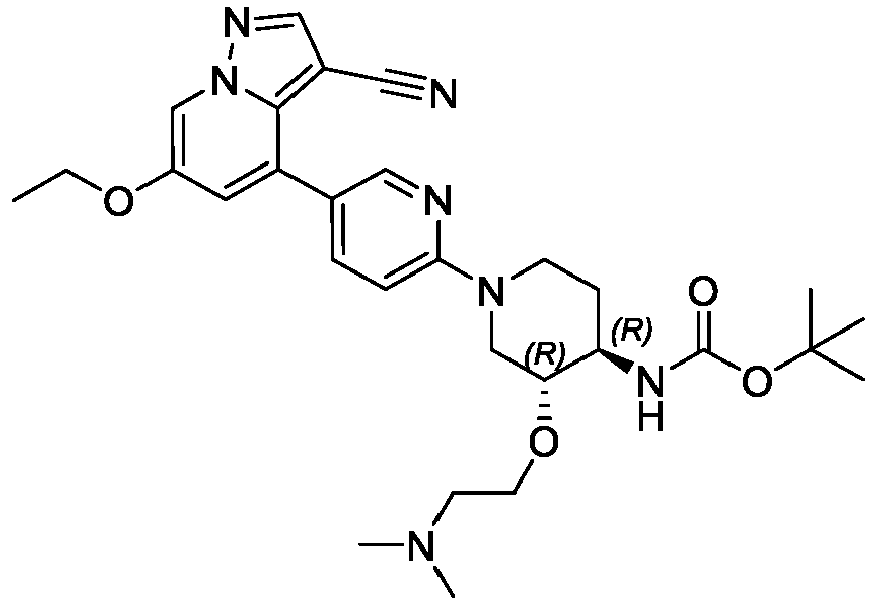
- A solution of tert-butyl ((3R,4R)-1-(5-(3-cyano-6-ethoxypyrazolo[1,5-a]pyridin-4-yl)pyridin-2-yl)-3-hydroxypiperidin-4-yl)carbamate (Example 512; 51.8mg, 0.108 mmol) and 2-bromo-N,N-dimethylethan-1-amine hydrobromide (25.2 mg, 0.108 mmol) in DCM (1 mL) was treated with DIEA (189 µL, 1.08 mmol). After stirring overnight at ambient temperature, 5 mg of NaH was introduced. The reaction was stirred for 3 d at ambient temperature before additional 2-bromo-N,N-dimethylethan-1-amine hydrobromide (25.2 mg, 0.108 mmol) and DIEA (189 µL, 1.08 mmol) in 1 mL DCM was added. The resulting mixture was stirred overnight at ambient temperature. The reaction mixture was diluted with DCM and washed with water. The organic extracts were purified by C18 reverse phase chromatography (5-95% ACN in water with 0.1% TFA) to cleanly provide the title compound as the TFA salt. The TFA salt was suspended in MeOH, eluted through a basic resin (Stratospheres MP-HCO3) to cleanly afford the title compound (2.7 mg, 5% yield). MS (apci) m/z = 550.2 (M+H).
-

- The title compound was prepared, worked up and purified using a similar procedure to that described for tert-butyl ((3R,4R)-1-(5-(3-cyano-6-ethoxypyrazolo[1,5-a]pyridin-4-yl)pyridin-2-yl)-3-(2-(dimethylamino)ethoxy)piperidin-4-yl)carbamate (Example 516), replacing tert-butyl ((3R,4R)-1-(5-(3-cyano-6-ethoxypyrazolo[1,5-a]pyridin-4-yl)pyridin-2-yl)-3-hydroxypiperidin-4-yl)carbamate (Example 512) with tert-butyl ((3S,4S)-1-(5-(3-cyano-6-ethoxypyrazolo[1,5-a]pyridin-4-yl)pyridin-2-yl)-3-hydroxypiperidin-4-yl)carbamate (Example 513). MS (apci) m/z = 550.3 (M+H).
-

- A solution of tert-butyl ((3S,4S)-1-(5-(3-cyano-6-ethoxypyrazolo[1,5-a]pyridin-4-yl)pyridin-2-yl)-3-hydroxypiperidin-4-yl)carbamate (Example 513; 174.3 mg, 0.36 mmol) in dioxane (2.0 mL) was treated with 12 M HCl(aq) (22.13 µL, 0.7284 mmol). The resulting mixture was stirred for 1 h at ambient temperature before concentrating the mixture in vacuo. The crude residue was dissolve in MeOH and eluted through a basic resin (Stratospheres MP-HCO3), to cleanly afford the title compound (137 mg, 96% yield). MS (apci) m/z = 379.15 (M+H).
-

- A solution of 4-(6-((3S,4S)-4-amino-3-hydroxypiperidin-1-yl)pyridin-3-yl)-6-ethoxypyrazolo[1,5-a]pyridine-3-carbonitrile (Example 518; 50 mg, 0.132 mmol) and DIEA (115 µL, 0.661mmol) in DCM (2 mL) was stirred for 20 min at 0 °C. The cold solution was treated dropwise with isovaleryl chloride (32.2 µL, 0.264 mmol). The resulting mixture was stirred overnight at ambient temperature. The reaction mixture was directly purified by silica chromatography (using 20-80% EtOAc in Hexanes as the gradient eluent) to cleanly provide the title compound (30.9 mg, 51% yield). MS (apci) m/z = 463.25 (M+H).
-

- Step 1: Preparation of 4-(6-((3R,4S)-4-amino-3-hydroxypiperidin-1-yl)pyridin-3-yl)-6-ethoxypyrazolo[1,5-a]pyridine-3-carbonitrile dihydrochloride. A solution tert-butyl ((3R,4S)-1-(5-(3-cyano-6-ethoxypyrazolo[1,5-a]pyridin-4-yl)pyridin-2-yl)-3-hydroxypiperidin-4-yl)carbamate (Example 514; 293.5 mg, 0.6133 mmol) in dioxane (2.0 mL) was treated with 12 M HCl(aq) (100.7 µL, 1.227 mmol). The resulting mixture was stirred overnight at ambient temperature, then concentrated in vacuo to cleanly afford the title compound (276 mg, 100% yield). MS (apci) m/z = 379.2 (M+H).
- Step 2: Preparation of N-((3R,4S)-1-(5-(3-cyano-6-ethoxypyrazolo[1,5-a]pyridin-4-yl)pyridin-2-yl)-3-hydroxypiperidin-4-yl)-3-methylbutanamide. A solution of 4-(6-((3R,4S)-4-amino-3-hydroxypiperidin-1-yl)pyridin-3-yl)-6-ethoxypyrazolo[1,5-a]pyridine-3-carbonitrile dihydrochloride (112 mg, 0.2481 mmol) in DCM (2 mL) was treated with DIEA (433.4 µL, 2.481 mmol), and then stirred for 5 min at 0 °C. The cold solution was treated dropwise with isovaleryl chloride (60.51 µL, 0.4963 mmol). The cooling bath was removed, and the resulting mixture was stirred for 1h at ambient temperature. The reaction mixture was directly purified by silica chromatography (using 20-100% EtOAc in Hexanes as the gradient eluent) to cleanly provide the title compound (115.7 mg, quantitative yield). MS (apci) m/z = 463.2 (M+H).
-

- Step 1: Preparation of 4-(6-((3S,4R)-4-amino-3-hydroxypiperidin-1-yl)pyridin-3-yl)-6-ethoxypyrazolo[1,5-a]pyridine-3-carbonitrile dihydrochloride. A solution of tert-butyl ((3S,4R)-1-(5-(3-cyano-6-ethoxypyrazolo[1,5-a]pyridin-4-yl)pyridin-2-yl)-3-hydroxypiperidin-4-yl)carbamate (Example 515; 341.5 mg, 0.7136 mmol) in dioxane (2.0 mL) was treated with 12 M HCl(aq) (117.2 µL, 1.427 mmol). The resulting mixture was stirred overnight at ambient temperature, then concentrated in vacuo to cleanly afford the title compound (322 mg, 100% yield). MS (apci) m/z = 379.2 (M+H).
- Step 2: Preparation of N-((3S,4R)-1-(5-(3-cyano-6-ethoxypyrazolo[1,5-a]pyridin-4-yl)pyridin-2-yl)-3-hydroxypiperidin-4-yl)-3-methylbutanamide. A solution of 4-(6-((3S,4R)-4-amino-3-hydroxypiperidin-1-yl)pyridin-3-yl)-6-ethoxypyrazolo[1,5-a]pyridine-3-carbonitrile dihydrochloride (160.4 mg, 0.3554 mmol) in DCM (2 mL) was treated with DIEA (620.7 µL, 3.554 mmol), and then stirred for 5 min at 0 °C. The cold solution was treated dropwise with isovaleryl chloride (86.65 µL, 0.7108 mmol). The cooling bath was removed, and the resulting mixture was stirred for 1h at ambient temperature. The reaction mixture was directly purified by silica chromatography (using 30-100% EtOAc in Hexanes as the gradient eluent) to cleanly provide the title compound (63.4 mg, 39% yield). MS (apci) m/z = 463.2 (M+H).
-

- Step 1: Preparation of 4-(6-((3S,4S)-4-amino-3-hydroxypiperidin-1-yl)pyridin-3-yl)-6-ethoxypyrazolo[1,5-a]pyridine-3-carbonitrile dihydrochloride. A solution of tert-butyl ((3S,4S)-1-(5-(3-cyano-6-ethoxypyrazolo[1,5-a]pyridin-4-yl)pyridin-2-yl)-3-hydroxypiperidin-4-yl)carbamate (Example 513; 845.1 mg, 1.766 mmol) in dioxane (3.0 mL) was treated with 12 M HCl(aq) (290.0 µL, 3.532 mmol). The resulting mixture was stirred overnight at ambient temperature then concentrated in vacuo to cleanly afford the title compound (797 mg, 100% yield). MS (apci) m/z = 379.3 (M+H).
- Step 2: Preparation of N-((3S,4S)-1-(5-(3-cyano-6-ethoxypyrazolo[1,5-a]pyridin-4-yl)pyridin-2-yl)-3-hydroxypiperidin-4-yl)-1-(trifluoromethyl)cyclobutane-1-carboxamide. A solution of 4-(6-((3S,4S)-4-amino-3-hydroxypiperidin-1-yl)pyridin-3-yl)-6-ethoxypyrazolo[1,5-a]pyridine-3-carbonitrile dihydrochloride (61.6 mg, 0.136 mmol) and 1-(trifluoromethyl)cyclobutane-1-carboxylic acid (45.9 mg, 0.273 mmol) in DCM (1 mL) was treated sequentially with DIEA (119 µL, 0.682 mmol) and HATU (104 mg, 0.273 mmol), then stirred for 1 h at ambient temperature. The resulting mixture was purified directly by silica chromatography (using 20-100% EtOAc in Hexanes as the gradient eluent) to cleanly provide the title compound (45.5 mg, 63% yield). MS (apci) m/z = 529.25 (M+H).
- The compounds in Table JJJ were prepared using a similar method to that described in Step 2 in the synthesis of N-((3S,4S)-1-(5-(3-cyano-6-ethoxypyrazolo[1,5-a]pyridin-4-yl)pyridin-2-yl)-3-hydroxypiperidin-4-yl)-1-(trifluoromethyl)cyclobutane-1-carboxamide (Example 522), replacing 1-(trifluoromethyl)cyclobutane-1-carboxylic acid with the appropriate carboxylic acid. Reactions were monitored for completion by LCMS, and reaction durations were adjusted accordingly. The title compounds were isolated following a chromatographic purification utilizing an appropriate gradient eluent. Where noted (∗) an aqueous work up, consisting of dilution of the reaction mixture with DCM and water wash preceded the chromatographic purification.
Table JJJ Ex # Structure Chemical Name MS (apci) m/z 523* 
3-chloro-N-((3S,4S)-1-(5-(3-cyano-6-ethoxypyrazolo[1,5-a]pyridin-4-yl)pyridin-2-yl)-3-hydroxypiperidin-4-yl)picolinamide 518.15 (M+H) 524 
N-((3S,4S)-1-(5-(3-cyano-6-ethoxypyrazolo[1,5-a]pyridin-4-yl)pyridin-2-yl)-3-hydroxypiperidin-4-yl)-1-methylcyclobutane-1-carboxamide 475.3 (M+H) 525 
N-((3S,4S)-1-(5-(3-cyano-6-ethoxypyrazolo[1,5-a]pyridin-4-yl)pyridin-2-yl)-3-hydroxypiperidin-4-yl)-1-(trifluoromethyl)cycloprop ane-1-carboxamide 515.2 (M+H) 526 
N-((3 S,4S)-1-(5-(3-cyano-6-ethoxypyrazolo[1,5-a]pyridin-4-yl)pyridin-2-yl)-3-hydroxypiperidin-4-yl)-2,3-dimethylbutanamide 477.3 (M+H) -

- A solution of trans-4-(6-(()-4-amino-3-methoxypiperidin-1-yl)pyridin-3-yl)-6-ethoxypyrazolo[1,5-a]pyridine-3-carbonitrile (Example 511; 26.5 mg, 0.0675 mmol) in DMSO (500 µL) was treated sequentially with 3-chloropicolinic acid (21.3 mg, 0.135 mmol), DIEA (59.0 µL, 0.338 mmol) and HATU (51.3 mg, 0.135 mmol). The mixture was stirred 2.5 h at ambient temperature then diluted with DCM, and washed with water. The organic extracts were purified directly by silica chromatography (using 30-100% EtOAc in Hexanes as the gradient eluent) to cleanly provide the title compound (21.5 mg, 60% yield). MS (apci) m/z = 532.2 (M+H).
-

- A solution of 4-(6-((3R,4S)-4-amino-3-hydroxypiperidin-1-yl)pyridin-3-yl)-6-ethoxypyrazolo[1,5-a]pyridine-3-carbonitrile dihydrochloride (Example 520, Step 1; 164 mg, 0.3634 mmol) in DCM (2 mL) was treated sequentially with DIEA (634.6 µL, 3.634 mmol), 3-chloropicolinic acid (229.0 mg, 1.453 mmol) and HATU (276.3 mg, 0.7267 mmol). The resulting mixture was stirred for 3 h at ambient temperature, and washed with water. The organic extracts were purified directly by silica chromatography (using 30-100% EtOAc in Hexanes as the gradient eluent) to cleanly provide the title compound (241.1 mg, quantitative yield). MS (apci) m/z = 518.1 (M+H).
-

- A solution of 4-(6-((3S,4R)-4-amino-3-hydroxypiperidin-1-yl)pyridin-3-yl)-6-ethoxypyrazolo[1,5-a]pyridine-3-carbonitrile dihydrochloride (Example 521, Step 1; 161.6 mg, 0.3580 mmol) in DCM (2 mL) was treated sequentially with DIEA (625.3 µL, 3.580 mmol), 3-chloropicolinic acid (225.6 mg, 1.432 mmol) and HATU (272.3 mg, 0.7161 mmol). The resulting mixture was stirred for 3 h at ambient temperature, and washed with water. The organic extracts were purified directly by silica chromatography (using 30-100% EtOAc in Hexanes as the gradient eluent) to cleanly provide the title compound (241.1 mg, quantitative yield). MS (apci) m/z = 518.1 (M+H).
-

- A solution of trans-4-(6-(4-amino-3-methoxypiperidin-1-yl)pyridin-3-yl)-6-ethoxypyrazolo[1,5-a]pyridine-3-carbonitrile (Example 511; 50 mg, 0.13 mmol) and DIEA (4.45 µL, 0.0255 mmol) in DCM (500 µL) was treated with isopropyl carbonochloridate (2.34 mg, 0.0191 mmol). The resulting mixture was stirred overnight at ambient temperature, and then directly purified by silica chromatography (using 20-80% Hexanes/EtOAc as the gradient eluent) to cleanly provide the title compound (6.3 mg, quantitative yield). MS (apci) m/z = 479.15 (M+H).
-

- A solution of 4-(6-((3S,4S)-4-amino-3-hydroxypiperidin-1-yl)pyridin-3-yl)-6-ethoxypyrazolo[1,5-a]pyridine-3-carbonitrile (Example 518; 50 mg, 0.13 mmol) and DIEA (120 µL, 0.69 mmol) in DCM (2 mL) was stirred for 20 min at 0 °C. The cold solution was treated with isopropyl chloroformate (33 µL, 0.26 mmol), and the resulting mixture was stirred for 3 d at ambient temperature. The reaction mixture was directly purified by silica chromatography (using 20-90% EtOAc in Hexanes as the gradient eluent) to cleanly provide the title compound (60 mg, 98% yield). MS (apci) m/z = 465.2 (M+H).
-

- A mixture of 6-ethoxy-4-(6-fluoropyridin-3-yl)pyrazolo[1,5-a]pyridine-3-carbonitrile (Intermediate P6, 26.4 mg, 0.0935 mmol), 4-methylpiperidin-4-yl isopropylcarbamate hydrochloride (Intermediate R24; 50 mg, 0.211 mmol) and Cs2CO3(s) (400 mg, 1.23 mmol) in DMSO (1.0 mL) was stirred overnight at 60 °C. The reaction mixture was cooled to ambient temperature. The reaction mixture was partitioned between DCM and water, then extracted with DCM (3x). The combined organic extracts were dried over Na2SO4(s), then filtered, and concentrated in vacuo. The crude residue was purified first by silica chromatography (using 0-100% Hexanes/ EtOAc as the gradient eluent), then by C18 reverse phase chromatography (using 0-70% water/ACN with 0.1% TFA as the gradient eluent) to afford the title compound as the TFA salt. The TFA salt was partitioned between DCM and saturated NaHCO3(aq), and the biphasic mixture was extracted with DCM (2x). The combined organic extracts were dried over anhydrous Na2SO4(s), filtered, and concentrated in vacuo to cleanly afford the title compound (2.7 mg, 6% yield). MS (apci) m/z = 463.2 (M+H).
-

- A mixture of 4-(6-(4-amino-4-methylpiperidin-1-yl)pyridin-3-yl)-6-ethoxypyrazolo[1,5-a]pyridine-3-carbonitrile (Intermediate P89, 16.1 mg, 0.0428 mmol), 2,3-difluoro-6-methylpyridine (28.7 mg, 0.222 mmol) and Cs2CO3(s) (139.3 mg, 0.4277 mmol) in DMSO (1.0 mL) was stirred for 4 d at 60 °C. Subsequently, additional 2,3-difluoro-6-methylpyridine (28.7 mg, 0.222 mmol) was introduced, and the reaction mixture was stirred overnight at 100 °C. As the reaction had still not progressed sufficiently, the mixture was cooled to ambient temperature and DIEA (a few drops) was added. The resulting mixture was stirred for 7 d at ambient temperature. The reaction mixture was partitioned between DCM and water, then extracted with DCM (3x). The combined organic extracts were dried over Na2SO4(s), then filtered, and concentrated in vacuo. The crude residue was purified by silica chromatography (using 0-100% Hexanes/ EtOAc as the gradient eluent) to cleanly afford the title compound (2.1 mg, 10% yield). MS (apci) m/z = 486.2 (M+H).
-

- A solution of 1-((tert-butoxycarbonyl)amino)cyclopentane-1-carboxylic acid (24 mg, 0.11 mmol) in DMA (445 µL) was treated sequentially with HATU (41 mg, 0.11 mmol), 4-(6-(4-amino-4-methylpiperidin-1-yl)pyridin-3-yl)-6-ethoxypyrazolo[1,5-a]pyridine-3-carbonitrile dihydrochloride (Intermediate P95; 40 mg, 0.089 mmol) and DIEA (78 µL, 0.45 mmol). The resulting mixture was stirred for 16 h at ambient temperature, and then vacuum filtered. The solids were washed sequentially with DMA (3 × 0.2 mL) and heptane (3 × 0.5 mL) then dried in vacuo. The filtrate was concentrated in vacuo, and purified by C18 reverse phase chromatography (using 5-60% ACN in water as the gradient eluent). The solids from the filtration were combined with the pure fractions from the chromatography to cleanly afford the title compound (50 mg, 96% yield). MS (apci) m/z = 588.3 (M+H); 610.2 (M+Na).
- The compounds in Table KKK were prepared using a similar method to that described in the synthesis of tert-butyl (1-((1-(5-(3-cyano-6-ethoxypyrazolo[1,5-a]pyridin-4-yl)pyridin-2-yl)-4-methylpiperidin-4-yl)carbamoyl)cyclopentyl)carbamate (Example 534), replacing 1-((tert-butoxycarbonyl)amino)cyclopentane-1-carboxylic acid with the appropriate carboxylic acid. Reactions were monitored for completion by LCMS, and reaction durations were adjusted accordingly. Reactions that produced suspensions were worked up/ purified following a method similar to that used in the synthesis of Example 534 substituting an appropriate gradient eluent for the chromatographic purification of the filtrate. For reactions that produced solutions, the reaction mixtures were directly subjected to chromatographic purification using an appropriate gradient eluent. Either method allowed for the clean isolation of the title compounds shown.
Table KKK Ex # Structure Chemical Name MS (apci) m/z 535 
tert-butyl (S)-(1-((1-(5-(3-cyano-6-ethoxypyrazolo[1, 5-a]pyridin-4-yl)pyridin-2-yl)-4-methylpiperidin-4-yl)amino)-1-oxobutan-2-yl)carbamate 562.3 (M+H), 584.3 (M+Na) 536 
tert-butyl (1-((1-(5-(3-cyano-6-ethoxypyrazolo[1, 5-a]pyridin-4-yl)pyridin-2-yl)-4-methylpiperidin-4-yl)carbamoyl)cycl opropyl)carbamate 560.2 (M+H), 582.3 (M+Na) 537 
tert-butyl (1-((1-(5-(3-cyano-6-ethoxypyrazolo[1, 5-a]pyridin-4-yl)pyridin-2-yl)-4-methylpiperidin-4-yl)carbamoyl)cycl obutyl)carbamate 574.3 (M+H), 596.2 (M+Na) 538 
tert-butyl (S)-(1-((1-(5-(3-cyano-6-ethoxypyrazolo[1, 5-a]pyridin-4-yl)pyridin-2-yl)-4-methylpiperidin-4-yl)amino)-1-oxopropan-2-yl)(methyl)carbam ate 562.3 (M+H), 584.2 (M+Na) 539 
tert-butyl (S)-2-((1-(5-(3-cyano-6-ethoxypyrazolo[1, 5-a]pyridin-4-yl)pyridin-2-yl)-4-methylpiperidin-4-yl)carbamoyl)azeti dine-1-carboxylate 560.2 (M+H) 540 
tert-butyl (4-((1-(5-(3-cyano-6-ethoxypyrazolo[1, 5-a]pyridin-4-yl)pyridin-2-yl)-4-methylpiperidin-4-yl)carbamoyl)tetra hydro-2H-pyran-4-yl)carbamate 604.3 (M+H), 626.2 (M+Na) 541 
N-(1-(5-(3-cyano-6-ethoxypyrazolo[1, 5-a]pyridin-4-yl)pyridin-2-yl)-4-methylpiperidin-4-yl)-1-(trifluoromethyl)cy clobutane-1-carboxamide 527.2 (M+H), 549.2 (M+Na) 542 
N-(1-(5-(3-cyano-6-ethoxypyrazolo[1, 5-a]pyridin-4-yl)pyridin-2-yl)-4-methylpiperidin-4-yl)-1-hydroxycycloprop ane-1-carboxamide 461.2 (M+H), 483.2 (M+Na) 543 
N-(1-(5-(3-cyano-6-ethoxypyrazolo[1, 5-a]pyridin-4-yl)pyridin-2-yl)-4-methylpiperidin-4-yl)-1-methylcyclobutane -1-carboxamide 473.3 (M+H), 495.2 (M+Na) -

- A solution of tert-butyl (1-((1-(5-(3-cyano-6-ethoxypyrazolo[1,5-a]pyridin-4-yl)pyridin-2-yl)-4-methylpiperidin-4-yl)carbamoyl)cyclopentyl)carbamate (Example 534; 45 mg, 0.077 mmol) in DCM (766 µL) was treated with 5-6 N HCl in iPrOH (306 µL, 1.5 mmol), and stirred overnight at ambient temperature. The resulting slurry was diluted with MTBE (1 mL) and vacuum filtered. The solids were rinsed with MTBE (3 × 1 mL), and dried in vacuo to cleanly afford the title compound (26 mg, 60% yield). MS (apci) m/z = 488.3 (M+H); 510.2 (M+Na).
-

- A solution of tert-butyl (4-((1-(5-(3-cyano-6-ethoxypyrazolo[1,5-a]pyridin-4-yl)pyridin-2-yl)-4-methylpiperidin-4-yl)carbamoyl)tetrahydro-2H-pyran-4-yl)carbamate (Example 540; 30 mg, 0.050 mmol) in DCM (497 µL) was treated with 5-6 N HCl in iPrOH (199 µL, 0.99 mmol), and stirred overnight at ambient temperature. The resulting slurry was diluted with MTBE (1 mL) and vacuum filtered. The solids were rinsed with MTBE (3 × 1 mL), and dried in vacuo to cleanly afford the title compound (28 mg, 98% yield). MS (apci) m/z = 504.3 (M+H); 526.2 (M+Na).
-

- A solution of tert-butyl (1-((1-(5-(3-cyano-6-ethoxypyrazolo[1,5-a]pyridin-4-yl)pyridin-2-yl)-4-methylpiperidin-4-yl)carbamoyl)cyclobutyl)carbamate (Example 537; 25 mg, 0.044 mmol) in DCM (436 µL) was treated with 5-6 N HCl in iPrOH (174 µL, 0.87 mmol), then stirred for 3 h at ambient temperature. The resulting mixture was concentrated in vacuo to cleanly afford the title compound (24 mg, 99% yield). MS (apci) m/z = 474.2 (M+H); 496.2 (M+Na).
- The compounds in Table LLL were prepared using a similar method to that described in the synthesis of 1-amino-N-(1-(5-(3-cyano-6-ethoxypyrazolo[1,5-a]pyridin-4-yl)pyridin-2-yl)-4-methylpiperidin-4-yl)cyclobutane-1-carboxamide dihydrochloride (Example 546), replacing tert-butyl (1-((1-(5-(3-cyano-6-ethoxypyrazolo[1,5-a]pyridin-4-yl)pyridin-2-yl)-4-methylpiperidin-4-yl)carbamoyl)cyclobutyl)carbamate (Example 537) with the appropriate Boc-Protected amino from Table KKK.
Table LLL Ex # Structure Chemical Name MS (apci) m/z 547 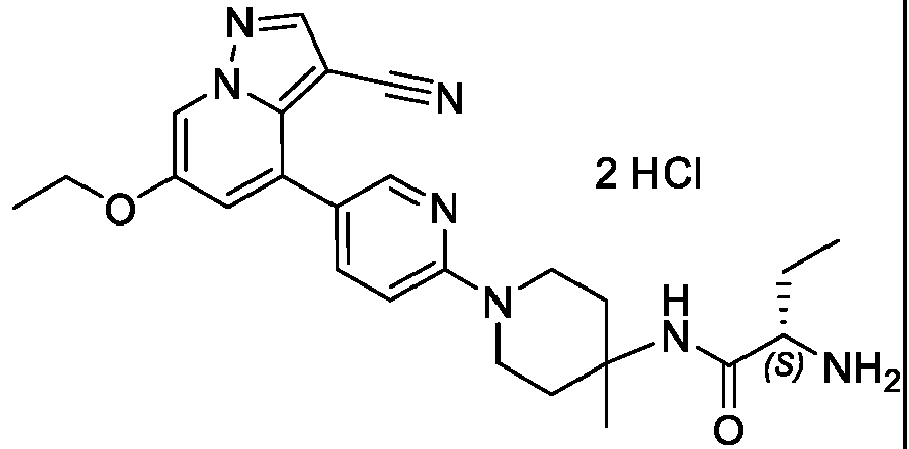
((S)-2-amino-N-(1-(5-(3-cyano-6-ethoxypyrazolo[1,5-a]pyridin-4-yl)pyridin-2-yl)-4-methylpiperidin-4-yl)butanamide dihydrochloride 462.2 (M+H), 484.3 (M+Na) 548 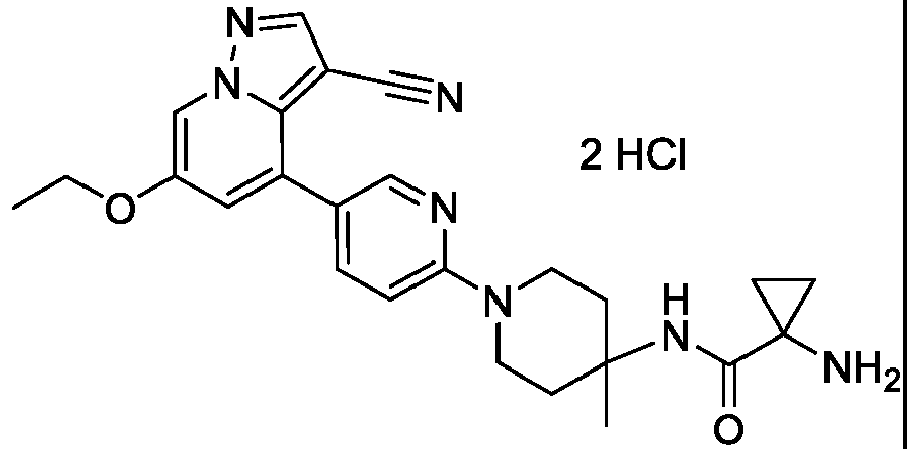
1-amino-N-(1-(5-(3-cyano-6-ethoxypyrazolo[1,5-a]pyridin-4-yl)pyridin-2-yl)-4-methylpiperidin-4-yl)cyclopropane-1-carboxamide dihydrochloride 460.2 (M+H), 482.2 (M+Na) 549 
(S)-N-(1-(5-(3-cyano-6-ethoxypyrazolo[1,5-a]pyridin-4-yl)pyridin-2-yl)-4-methylpiperidin-4-yl)-2-(methylamino)propanamide dihydrochloride 462.2 (M+H) -

- A solution of tert-butyl (S)-2-((1-(5-(3-cyano-6-ethoxypyrazolo[1,5-a]pyridin-4-yl)pyridin-2-yl)-4-methylpiperidin-4-yl)carbamoyl)azetidine-1-carboxylate (Example 539; 40 mg, 0.071 mmol) in DCM (357 µL) was treated with TFA (55 µL, 0.71 mmol). The resulting mixture was stirred overnight at ambient temperature then concentrated in vacuo. The residue was dissolved in MeOH (0.5 mL), and eluted through a basic resin (StratoSpheres Pl-HCO3), rinsing with additional MeOH (3 × 0.5 mL). The combined MeOH filtrates were concentrated in vacuo to cleanly afford the title compound as white solid.MS (apci) m/z = 460.2 (M+H); 482.2 (M+Na).
-

- A solution of 1-amino-N-(1-(5-(3-cyano-6-ethoxypyrazolo[1,5-a]pyridin-4-yl)pyridin-2-yl)-4-methylpiperidin-4-yl)cyclopentane-1-carboxamide dihydrochloride (Example 544; 24 mg, 0.0428 mmol) and formaldehyde (37 wt.% in water with 5-15%MeOH stabilizer; 31.9 µL, 0.428 mmol) in DCM (428 µL) was treated with NaBH(AcO)3 (45.4 mg, 0.214 mmol), and stirred overnight at room temperature. The resulting mixture was directly purified by C18 reverse phase chromatography (using 5-75% ACN in water as the gradient eluent) to afford the title compound (21 mg, 94% yield). MS (apci) m/z = 516.2 (M+H); 538.2 (M+Na).
- The compounds in Table MMM were prepared using a similar method to that described in the synthesis of N-(1-(5-(3-cyano-6-ethoxypyrazolo[1,5-a]pyridin-4-yl)pyridin-2-yl)-4-methylpiperidin-4-yl)-1-(dimethylamino)cyclopentane-1-carboxamide (Example 551), replacing 1-amino-N-(1-(5-(3-cyano-6-ethoxypyrazolo[1,5-a]pyridin-4-yl)pyridin-2-yl)-4-methylpiperidin-4-yl)cyclopentane-1-carboxamide dihydrochloride (Example 544) with the listed amine. Reactions were monitored for completion by LCMS, and reaction durations were adjusted accordingly. Title compounds were isolated following chromatographic purification using an appropriate gradient eluent.
Table MMM Ex # Starti ng Amine Ex # Structure Chemical Name MS (apci) m/z 552 546 
N-(1-(5-(3-cyano-6-ethoxypyrazolo[1,5-a]pyridin -4-yl)pyridin-2-yl)-4-methylpiperidin-4-yl)-1-(dimethylamino)cycl obutane-1-carboxamide 502.2 (M+H), 524.2 (M+Na) 553 550 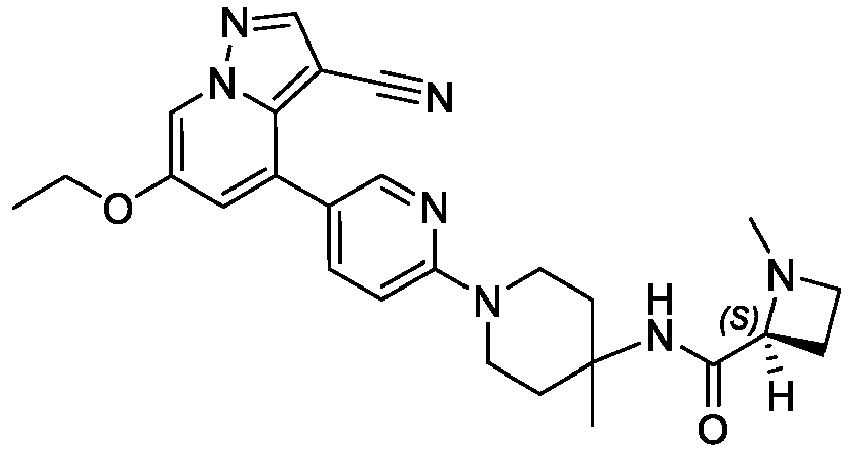
(S)-N-(1-(5-(3-cyano-6-ethoxypyrazolo[1,5-a]pyri din -4-yl)pyridin-2-yl)-4-methylpiperidin-4-yl)-1-methylazetidine-2-carboxamide 474.2 (M+H), 496.2 (M+Na) 554 545 
N-(1-(5-(3-cyano-6-ethoxypyrazolo[1,5-a]pyri din -4-yl)pyridin-2-yl)-4-methylpiperidin-4-yl)-4-(dimethylamino)tetra hydro-2H-pyran-4-carboxamide 532.3 (M+H), 554.3 (M+Na) -

- A solution of 4-(6-(4-amino-4-methylpiperidin-1-yl)pyridin-3-yl)-6-ethoxypyrazolo[1,5-a]pyridine-3-carbonitrile (Intermediate P89, 15.9 mg, 0.0422 mmol) and DIEA (14.6 µL, 0.0845 mmol) in DCM (500 µL) was treated with cyclopropylmethyl carbonochloridate (6.82 mg, 0.0507 mmol). The resulting mixture was stirred overnight at ambient temperature, and then directly purified by silica chromatography (using 20-80% Hexanes/EtOAc as the gradient eluent) to cleanly provide the title compound (13.4 mg, 66% yield). MS (apci) m/z = 475.2 (M+H).
- The compounds in Table NNN were prepared using a similar method to that described in the synthesis of cyclopropylmethyl (1-(5-(3-cyano-6-ethoxypyrazolo[1,5-a]pyridin-4-yl)pyridin-2-yl)-4-methylpiperidin-4-yl)carbamate (Example 555), replacing cyclopropylmethyl carbonochloridate with the appropriate carbonochloridate. Where noted (∗) the carbonochloridate is prepared in the reagents section, otherwise commercial reagents were utilized. Reactions were monitored for completion by LCMS, and reaction durations were adjusted accordingly. Title compounds were isolated following chromatographic purification using an appropriate gradient eluent.
Table NNN Ex # Structure Chemical Name MS (apci) m/z 556 
cyclopentyl (1-(5-(3-cyano-6-ethoxypyrazolo[1, 5-a]pyridin-4-yl)pyridin-2-yl)-4-methylpiperidin-4-yl)carbamate 489.25 (M+H) 557 
ethyl (1-(5-(3-cyano-6-ethoxypyrazolo[1, 5-a]pyridin-4-yl)pyridin-2-yl)-4-methylpiperidin-4-yl)carbamate 449.2 (M+H) 558 
isobutyl (1-(5-(3-cyano-6-ethoxypyrazolo[1, 5-a]pyridin-4-yl)pyridin-2-yl)-4-methylpiperidin-4-yl)carbamate 477.2 (M+H) 559* 
(S)-tetrahydrofuran - 3-yl (1-(5-(3-cyano-6-ethoxypyrazolo[1, 5-a]pyridin-4-yl)pyridin-2-yl)-4-methylpiperidin-4-yl)carbamate 491.2 (M+H) 560* 
cyclobutyl (1-(5-(3-cyano-6-ethoxypyrazolo[1, 5-a]pyridin-4-yl)pyridin-2-yl)-4-methylpiperidin-4-yl)carbamate 475.2 (M+H) -

- A suspension of 4-(6-(4-amino-4-(hydroxymethyl)piperidin-1-yl)pyridin-3-yl)-6-ethoxypyrazolo[1,5-a]pyridine-3-carbonitrile (Intermediate P56, 40 mg, 0.10 mmol) in DMF (2 mL) was treated sequentially with NaH (60 wt.% in mineral oil; 41 mg, 1.0 mmol) and 4-(2-chloroethyl)morpholine (76 mg, 0.51 mmol). After stirring for 4 h at 50 °C, the reaction mixture was cooled to ambient temperature, and quenched with water (2 mL). The quenched mixture was concentrated to dryness in vacuo. The residue was purified by C18 reverse phase chromatography (5-95% ACN in water with 0.1% TFA) to afford the title compound (40 mg, 55% yield). MS (apci) m/z = 506.3 (M+H).
-

- A solution of 4-(6-(4-amino-4-((2-morpholinoethoxy)methyl)piperidin-1-yl)pyridin-3-yl)-6-ethoxypyrazolo[1,5-a]pyridine-3-carbonitrile) (Example 561; 25 mg, 0.030 mmol) in DCM (1.0 mL) was treated sequentially with TEA (8.3 µL, 0.059 mmol) and isovaleryl chloride (4.3 µL, 0.036 mmol), then stirred for 30 min at ambient temperature. The reaction mixture was concentrated in vacuo, and the resulting residue was purified by silica chromatography (0-7% MeOH in DCM) to cleanly afford the title compound (1.7 mg, 10% yield). MS (apci) m/z = 590.3 (M+H).
-

- A suspension of 4-(6-(4-amino-4-((2-morpholinoethoxy)methyl)piperidin-1-yl)pyridin-3-yl)-6-ethoxypyrazolo[1,5-a]pyridine-3-carbonitrile) (Example 561; 25 mg, 0.049 mmol) in DMF (1 mL) was treated sequentially with DIEA (35 µL, 0.20 mmol), 6-chloropicolinic acid (16 mg, 0.099 mmol) and HATU (38 mg, 0.099 mmol). The resulting mixture was stirred for 15 h at ambient temperature. The mixture was diluted with EtOAc (20 mL), and washed sequentially with saturated NaHCO3(aq), and water. The combined organic extracts were concentrated in vacuo. The organic extracts were purified directly by silica chromatography (0-7% MeOH in DCM) to cleanly afford the title compound (21 mg, 66% yield). MS (apci) m/z = 645.2 (M+H).
-

- The title compound (12 mg, 52% yield) was prepared and worked up using a similar procedure to that described for 6-chloro-N-(1-(5-(3-cyano-6-ethoxypyrazolo[1,5-a]pyridin-4-yl)pyridin-2-yl)-4-((2-morpholinoethoxy)methyl)piperidin-4-yl)picolinamide (Example 563), replacing 6-chloropicolinic acid with 3-chloropicolinic acid. MS (apci) m/z = 645.2 (M+H).
-

- Under an inert atmosphere (N2(g)), a suspension of 6-ethoxy-4-(6-(1-tosyl-1,6-diazaspiro[2.5]octan-6-yl)pyridin-3-yl)pyrazolo[1,5-a]pyridine-3-carbonitrile (Intermediate R51; 40 mg, 0.076 mmol), 2-morpholinoethan-1-ol (30 mg, 0.23 mmol) and 18-Crown-6 (40 mg, 0. 15 mmol) in DMA (1.5 mL) was cooled to -10 °C, then treated with a 1 M solution of KOtBu in THF (150 µL, 1.0 mmol). The reaction mixture was stirred for 30 min at -10 °C, then allowed to stir for an additional 1 h at temperatures between -10 °C - 0 °C. The reaction mixture was quenched with saturated NH4Cl(aq), and diluted with water (2 mL). The resulting suspension was filtered. The solids were rinsed with water (20 mL), then dried in vacuo to afford the title compound (38 mg, 76% yield). MS (apci) m/z = 660.3 (M+H).
-

- A solution of 6-ethoxy-4-(6-(1-tosyl-1,6-diazaspiro[2.5]octan-6-yl)pyridin-3-yl)pyrazolo[1,5-a]pyridine-3-carbonitrile (Intermediate R51; 26 mg, 0.049 mmol) in dioxane (2 mL) and 2 M H2SO4(aq) (1 mL, 2.00 mmol) was stirred for 15 h at ambient temperature. The reaction mixture was quenched with 2 M K2CO3(aq) (5 mL) and extracted with EtOAc. The organic extracts were dried over anhydrous Na2SO4(s), filtered, concentrated in vacuo. The residue was triturated with MTBE, and filtered. The solids collected were purified by silica chromatography (using 0-70% EtOAc in Hexanes as the gradient eluent) to cleanly afford the title compound (17 mg, 63% yield). MS (apci) m/z = 547.2 (M+H).
-

- A solution of 6-ethoxy-4-(6-(1-(phenylsulfonyl)-1,6-diazaspiro[2.5]octan-6-yl)pyridin-3-yl)pyrazolo[1,5-a]pyridine-3-carbonitrile (Intermediate R52; 10.5 mg, 0.0204 mmol) in dioxane (2 mL) and 2 M H2SO4(aq) (0.5 mL, 1.00 mmol) was stirred for 1 h at ambient temperature. The reaction mixture was quenched with 2 M Na2CO3(aq) (5 mL), and diluted with water. The resulting suspension was extracted with DCM. The organic extracts were concentrated in vacuo, and the residue was purified by silica chromatography (using 0-100% EtOAc in Hexanes as the gradient eluent) to cleanly afford the title compound (1.8 mg, 17% yield). MS (apci) m/z = 533.2 (M+H).
-

- Step 1. Preparation of ethyl 2-cyclopropylideneacetate. A solution of ((1-ethoxycyclopropyl)oxy)trimethylsilane (2.30 mL, 11.5 mmol) in toluene (29 mL) was treated with (carboethoxymethylene)triphenylphosphorane (4.20 g, 12.0 mmol) and benzoic acid (1.54 g, 12.6 mmol), then stirred at 90°C for 2 hrs. After cooled to RT, the reaction mixture was directly purified by silica chromatography (0 to 50% EtOAc in hexanes) to yield the title product (1.1 g, 75%).
- Step 2. Preparation of 2-(1-methoxycyclopropyl)acetic acid. To a solution of ethyl 2-cyclopropylideneacetate (0.50 g, 3.96 mmol) in MeOH (10 mL) was added trimethylphosphine (0.0205 mL, 0.198 mmol). The reaction was sealed and heated at 45 °C for 3 d. After removal of most solvent under vacuum, the residue was taken up in MeOH and treated with NaOH (2 N, aq; 3.96 mL) at RT for overnight. The reaction mixture was concentrated first, then diluted with water (5 mL) and washed with washed with EtOAc (2x). After phase-separation, the aqueous layer was acidified to pH ~2 and then extracted with EtOAc (2x). The combined organics were dried (Na2SO4), filtered and concentrated to yield the title product (0.2 g, 39%).
- Step 3. Preparation of N-(1-(5-(3-cyano-6-ethoxypyrazolo[1,5-a]pyridin-4-yl)pyridin-2-yl)-4-((dimethylamino)methyl)piperidin-4-yl)-2-(1-methoxycyclopropyl)acetamide. A mixture of 4-(6-(4-amino-4-((dimethylamino)methyl)piperidin-1-yl)pyridin-3-yl)-6-ethoxypyrazolo[1,5-a]pyridine-3-carbonitrile (Intermediate P72, 32.2 mg, 0.0768 mmol), 2-(1-methoxycyclopropyl)acetic acid (10 mg, 0.077 mmol) and HATU (73.0 mg, 0.192 mmol) in DCM (154 µL) was treated with DIEA (134 µL, 0.768 mmol), then stirred overnight at ambient temperature. The resulting mixture was concentrated in vacuo, and the residue was purified by C18 reverse phase chromatography (using 5-95% water:ACN with 0.1% TFA as the gradient eluent). Fractions containing the desired compound were combined, diluted with 4:1 DCM:iPrOH, and extracted sequentially with saturated NaHCO3(aq) and brine. The organic extracts were dried over anhydrous Na2SO4(s), filtered, and concentrated in vacuo to afford the title compound (26 mg, 64% yield). MS (apci) m/z = 532.3 (M+H).
-

- The title compound (21 mg, 43% yield) was prepared and worked up using a similar procedure to that described for N-(1-(5-(3-cyano-6-ethoxypyrazolo[1,5-a]pyridin-4-yl)pyridin-2-yl)-4-((dimethylamino)methyl)piperidin-4-yl)-2-(1-methoxycyclopropyl)acetamide (Example 568), replacing 2-(1-methoxycyclopropyl)acetic acid with 2,3-dimethylbutanoic acid. MS (apci) m/z = 518.3 (M+H).
-

- A solution of 4-(6-(4-amino-4-((dimethylamino)methyl)piperidin-1-yl)pyridin-3-yl)-6-ethoxypyrazolo[1,5-a]pyridine-3-carbonitrile (Intermediate P72, 50 mg, 0.119 mmol) in DMSO (795 µL) was treated sequentially with 3-fluoropicolinic acid (0.0252 g, 0.179 mmol), DIEA (93.4 µL, 0.536 mmol) and HATU (90.6 mg, 0.238 mmol). The resulting mixture was stirred overnight at ambient temperature, and then partitioned between EtOAc and water. The organic extracts were washed with brine, dried over anhydrous Na2SO4(s), filtered, and concentrated in vacuo. The crude residue was purified by C18 reverse phase chromatography (using 5-95% water:ACN with 0.1% TFA as the gradient eluent) to afford the title compound as the TFA salt. The TFA salt was dissolved in DCM, and extracted sequentially with saturated NaHCO3(aq) and brine. The organic extracts were dried over anhydrous Na2SO4(s), filtered, and concentrated in vacuo to afford the title compound (40.1 mg, 62% yield). MS (apci) m/z = 543.3 (M+H).
-

- The title compound (24 mg, 34% yield) was prepared, worked up and purified using a similar procedure to that described for N-(1-(5-(3-cyano-6-ethoxypyrazolo[1,5-a]pyridin-4-yl)pyridin-2-yl)-4-((dimethylamino)methyl)piperidin-4-yl)-3-fluoropicolinamide (Example 570), replacing 3-fluoropicolinic acid with 3-(trifluoromethyl)picolinic acid. MS (apci) m/z = 593.3 (M+H).
-

- A solution of 4-(6-(4-amino-4-((dimethylamino)methyl)piperidin-1-yl)pyridin-3-yl)-6-ethoxypyrazolo[1,5-a]pyridine-3-carbonitrile (Intermediate P72, 30 mg, 0.072 mmol) and TEA (20 µL, 0.14 mmol) in DCM (715 µL) was treated with isobutyl chloroformate (9.4 µL, 0.072 mmol), and the resulting mixture was stirred for 6 d at ambient temperature. The reaction mixture was concentrated in vacuo, and the residue was purified by C18 reverse phase chromatography (using 5-95% water:ACN with 0.1% TFA as the gradient eluent). Fractions containing the desired product were combined, diluted with 4:1 DCM:iPrOH, then extracted sequentially with saturated NaHCO3(aq) and brine. The organic extracts were dried over anhydrous Na2SO4(s), filtered, and concentrated in vacuo to afford the title compound (30 mg, 81% yield). MS (apci) m/z = 520.3 (M+H).
-

- The title compound (18 mg, 44% yield) was prepared, worked up and purified using a similar procedure to that described for isobutyl (1-(5-(3-cyano-6-ethoxypyrazolo[1,5-a]pyridin-4-yl)pyridin-2-yl)-4-((dimethylamino)methyl)piperidin-4-yl)carbamate (Example 572), replacing isobutyl chloroformate with neopentyl chloroformate. MS (apci) m/z = 534.4 (M+H).
-

- The title compound (21 mg, 57% yield) was prepared, worked up and purified using a similar procedure to that described for isobutyl (1-(5-(3-cyano-6-ethoxypyrazolo[1,5-a]pyridin-4-yl)pyridin-2-yl)-4-((dimethylamino)methyl)piperidin-4-yl)carbamate (Example 572), replacing isobutyl chloroformate (1 equivalent) with cyclopropylmethyl chloroformate (1.2 equivalents). MS (apci) m/z = 518.3 (M+H).
-

- A solution of 4-(6-(4-amino-4-((dimethylamino)methyl)piperidin-1-yl)pyridin-3-yl)-6-ethoxypyrazolo[1,5-a]pyridine-3-carbonitrile (Intermediate P72, 30 mg, 0.072 mmol) and DIEA (125 µL, 0.715 mmol) in DMA (1.4 mL) was treated with 4-nitrophenyl chloroformate (17.3 mg, 0.0858 mmol). The resulting mixture was stirred for 1 h at ambient temperature, before adding isobutylamine (35.5 µL, 0.358 mmol). The resulting mixture was stirred overnight at 80 °C. After cooling to ambient temperature, the reaction mixture was concentrated in vacuo, and the residue was purified by C18 reverse phase chromatography (using 5-95% water:ACN with 0.1% TFA as the gradient eluent). Fractions containing the desired product were combined, diluted with 4:1 DCM:iPrOH, then extracted sequentially with saturated NaHCO3(aq) (1x) and brine (2x). The organic extracts were dried over anhydrous Na2SO4(s), filtered, and concentrated in vacuo to afford the title compound (35 mg, 94% yield). MS (apci) m/z = 519.3 (M+H).
-

- The title compound (25 mg, 68% yield) was prepared using a similar procedure to that described for 1-(1-(5-(3-cyano-6-ethoxypyrazolo[1,5-a]pyridin-4-yl)pyridin-2-yl)-4-((dimethylamino)methyl)piperidin-4-yl)-3-isobutylurea (Example 575), replacing isobutylamine (5 equivalents) with pyrrolidine (1 equivalent). The cooled reaction mixture was diluted with water then extracted with EtOAc. The EtOAc extracts were washed sequentially with water and brine, then dried over anhydrous Na2SO4(s), filtered, and concentrated in vacuo, prior to employing similar purification/ free basing steps as those used in Example 575. MS (apci) m/z = 517.3 (M+H).
-

- The title compound (25 mg, 68% yield) was prepared using a similar procedure to that described for 1-(1-(5-(3-cyano-6-ethoxypyrazolo[1,5-a]pyridin-4-yl)pyridin-2-yl)-4-((dimethylamino)methyl)piperidin-4-yl)-3-isobutylurea (Example 575), replacing isobutylamine (5 equivalents) with piperidine (1 equivalent). For the work up, the cooled reaction mixture was diluted with water then extracted with EtOAc. The EtOAc extracts were washed sequentially with water and brine then dried over anhydrous Na2SO4(s), filtered, and concentrated in vacuo, prior to employing similar purification/ free basing steps as those used in Example 575. MS (apci) m/z = 531.3 (M+H).
-

- A solution of dimethylamine hydrochloride (41.7 mg, 0.511 mmol) in DCM (1.0 ml) was treated with triethylamine (69.3 µL, 0.511 mmol) and stirred for 5 min at ambient temperature before introducing 1-(5-(3-cyano-6-ethoxypyrazolo[1,5-a]pyridin-4-yl)pyridin-2-yl)-4-formyl-N-isobutylpiperidine-4-carboxamide (Intermediate P76, 48.5 mg, 0.102 mmol). The resulting mixture was treated with NaBH(AcO)3 (108 mg, 0.511 mmol), stirred overnight at room temperature, and then concentrated in vacuo. The crude residue was purified by C18 reverse phase chromatography (using 5-95% water-ACN with 0.1% TFA as the gradient eluent). Fractions containing the desired product were diluted with 4:1 DCM:iPrOH, and extracted with saturated NaHCO3(aq). The organic extracts were dried over anhydrous Na2SO4(s), filtered, and concentrated in vacuo to cleanly afford the title compound (23.1 mg, 45% yield). MS (apci) m/z = 504.3 (M+H).
-

- A solution of 1-(5-(3-cyano-6-ethoxypyrazolo[1,5-a]pyridin-4-yl)pyridin-2-yl)-4-formyl-N-isobutylpiperidine-4-carboxamide (Intermediate P76, 58.6 mg, 0.123 mmol) in DCM (1.2 mL) was treated sequentially with azetidine (41.6 µL, 0.617 mmol) and NaBH(AcO)3 (131 mg, 0.617 mmol), and stirred for 16 h at ambient temperature. The reaction mixture was concentrated in vacuo. The crude residue was purified directly by C18 reverse phase chromatography (using 5-95% water:ACN with 0.1% TFA as the gradient eluent). Fractions containing the desired product were partitioned between 4:1 DCM:iPrOH and saturated NaHCO3(aq). The organic extracts were dried over anhydrous Na2SO4(s), filtered, and concentrated in vacuo to afford the title compound (42.8 mg, 57% yield). MS (apci) m/z = 516.4 (M+H).
-

- A solution of 4-(6-(4-amino-4-(pyrrolidin-1-ylmethyl)piperidin-1-yl)pyridin-3-yl)-6-ethoxypyrazolo[1,5-a]pyridine-3-carbonitrile (Intermediate P97; 30 mg, 0.065 mmol) and TEA (19 µL, 0. 13 mmol) in DCM (673 µL) was treated with isovaleryl chloride (8.2 µL, 0.067 mmol), and then stirred overnight at ambient temperature. The reaction mixture was purified directly by C18 reverse phase chromatography (using 5-95% water:ACN with 0.1% TFA as the gradient eluent). Fractions containing the desired product were combined, diluted with 4:1 DCM:iPrOH, then extracted sequentially with saturated NaHCO3(aq) (1x) and brine (2x). The organic extracts were dried over anhydrous Na2SO4(s), filtered, and concentrated in vacuo to afford the title compound (23 mg, 64% yield). MS (apci) m/z = 530.4 (M+H).
-

- A solution of 1-(5-(3-cyano-6-ethoxypyrazolo[1,5-a]pyridin-4-yl)pyridin-2-yl)-4-formyl-N-isobutylpiperidine-4-carboxamide (Intermediate P76, 54.6 mg, 0.115 mmol) in DCM (1.2 mL) was treated sequentially with pyrrolidine (48.0 µL, 0.575 mmol) and NaBH(AcO)3 (122 mg, 0.575 mmol), and stirred for 16 h at ambient temperature. The reaction mixture was concentrated in vacuo. The crude residue was purified directly by C18 reverse phase chromatography (using 5-95% water:ACN with 0.1% TFA as the gradient eluent). Fractions containing the desired product were partitioned between 4:1 DCM:iPrOH, and saturated NaHCO3(aq). The organic extracts were dried over anhydrous Na2SO4(s), filtered, and concentrated in vacuo to afford the title compound (44.4 mg, 73% yield). MS (apci) m/z = 530.2 (M+H).
-

- A solution of 4-(6-(4-amino-4-(morpholinomethyl)piperidin-1-yl)pyridin-3-yl)-6-ethoxypyrazolo[1,5-a]pyridine-3-carbonitrile (Intermediate P73, 30 mg, 0.065 mmol) and TEA (18 µL, 0. 13 mmol) in DCM (650 µL) was treated with isovaleryl chloride (7.9 µL, 0.065 mmol), and then stirred overnight at ambient temperature. The mixture was treated with additional isovaleryl chloride (7.9 µL, 0.065 mmol), and stirred for an additional 3 h. The resulting mixture was diluted with 4:1 DCM:iPrOH, and then extracted with saturated NaHCO3(aq), water (1x) and brine (2x). The organic extracts were dried over anhydrous Na2SO4(s), filtered and concentrated in vacuo to cleanly afford the title compound (35 mg, 99% yield). MS (apci) m/z = 546.3 (M+H).
-

- A solution of 4-(6-(4-amino-4-(morpholinomethyl)piperidin-1-yl)pyridin-3-yl)-6-ethoxypyrazolo[1,5-a]pyridine-3-carbonitrile (Intermediate P73, 40 mg, 0.087 mmol) and TEA (24 µL, 0. 17 mmol) in DCM (867 µL) was treated with propionyl chloride (8.0 mg, 0.087 mmol), and then stirred overnight at ambient temperature. The mixture was concentrated in vacuo and the residue was purified by C18 reverse phase chromatography (5-95% water:ACN with 0.1% TFA). Fractions containing the desired product were combined, diluted with 4:1 DCM:iPrOH, and then extracted with saturated NaHCO3(aq), water (1x) and brine (2x). The organic extracts were dried over anhydrous Na2SO4(s), filtered and concentrated in vacuo to cleanly afford the title compound (31 mg, 69% yield). MS (apci) m/z = 518.3 (M+H).
-

- The title compound (29 mg, 63% yield) was prepared, worked up and purified using a similar procedure to that described for N-(1-(5-(3-cyano-6-ethoxypyrazolo[1,5-a]pyridin-4-yl)pyridin-2-yl)-4-(morpholinomethyl)piperidin-4-yl)propionamide (Example 583), replacing propionyl chloride with butyryl chloride. MS (apci) m/z = 532.4 (M+H).
-

- The title compound (29 mg, 47% yield) was prepared, worked up and purified using a similar procedure to that described for N-(1-(5-(3-cyano-6-ethoxypyrazolo[1,5-a]pyridin-4-yl)pyridin-2-yl)-4-(morpholinomethyl)piperidin-4-yl)propionamide (Example 583), replacing propionyl chloride with 3,3,3-trifluoropropionyl chloride. MS (apci) m/z = 572.3 (M+H).
-

- A mixture of 4-(6-(4-amino-4-(morpholinomethyl)piperidin-1-yl)pyridin-3-yl)-6-ethoxypyrazolo[1,5-a]pyridine-3-carbonitrile (Intermediate P73, 30 mg, 0.065 mmol), 3-trifluoromethylbutyric acid (10 mg, 0.065 mmol) and HATU (62 mg, 0.16 mmol) in DCM (130 µL) was treated with DIEA (114 µL, 0.65 mmol), then stirred for 3 d at ambient temperature. The resulting mixture was concentrated in vacuo, and the residue was purified by C18 reverse phase chromatography (using 5-95% water:ACN with 0.1% TFA as the gradient eluent). Fractions containing the desired compound were combined, diluted with 4:1 DCM:iPrOH, and extracted sequentially with saturated NaHCO3(aq) and brine. The organic extracts were dried over anhydrous Na2SO4(s), filtered, and concentrated in vacuo to afford the title compound (31 mg, 80% yield). MS (apci) m/z = 600.3 (M+H).
- The compounds in Table OOO were prepared using a similar method to that described in the synthesis of N-(1-(5-(3-cyano-6-ethoxypyrazolo[1,5-a]pyridin-4-yl)pyridin-2-yl)-4-(morpholinomethyl)piperidin-4-yl)-4,4,4-trifluoro-3-methylbutanamide (Example 586), replacing 3-trifluoromethylbutyric acid with the appropriate carboxylic acid. Where noted (∗) the carboxylic acid is prepared in the reagents section, otherwise commercial reagents were utilized. Reactions were monitored for completion by LCMS, and reaction durations were adjusted accordingly. Title compounds were isolated following chromatographic purification using an appropriate gradient eluent. When chromatographic conditions resulted in the isolation of the TFA salt of the title compound, chromatography was followed by a basic work up as in Example 586.
Table OOO Ex # Structure Chemical Name MS (apci) m/z 587 
N-(1-(5-(3-cyano-6-ethoxypyrazolo[1,5-a]pyri din -4-yl)pyridin-2-yl)-4-(morpholinomethyl)p iperidin-4-yl)-2,3-dimethylbutanamide 560.3 (M+H) 588 
N-(1-(5-(3-cyano-6-ethoxypyrazolo[1,5-a]pyridin -4-yl)pyridin-2-yl)-4-(morpholinomethyl)p iperidin-4-yl)-3-hydroxy-3-methylbutanamide 562.3 (M+H) 589 
N-(1-(5-(3-cyano-6-ethoxypyrazolo[1,5-a]pyridin -4-yl)pyridin-2-yl)-4-(morpholinomethyl)p iperidin-4-yl)-3-methoxy-3-methylbutanamide 576.4 (M+H) 590 
N-(1-(5-(3-cyano-6-ethoxypyrazolo[1,5-a]pyridin -4-yl)pyridin-2-yl)-4-(morpholinomethyl)p iperidin-4-yl)-1-methoxycyclopropan e-1-carboxamide 560.3 (M+H) -

- A mixture of 4-(6-(4-amino-4-(morpholinomethyl)piperidin-1-yl)pyridin-3-yl)-6-ethoxypyrazolo[1,5-a]pyridine-3-carbonitrile (Intermediate P73, 30 mg, 0.065 mmol), (R)-3-hydroxybutyric acid (6.8 mg, 0.065 mmol) and HATU (25 mg, 0.065 mmol) in DCM (650 µL) was treated with DIEA (11 µL, 0.065 mmol), then stirred for 3 d at ambient temperature. The resulting mixture was concentrated in vacuo, and the residue was purified by C18 reverse phase chromatography (using 5-95% water:ACN with 0.1% TFA as the gradient eluent). Fractions containing the desired compound were combined, diluted with 4:1 DCM:iPrOH, and extracted sequentially with saturated NaHCO3(aq) and brine. The organic extracts were dried over anhydrous Na2SO4(s), filtered, and concentrated in vacuo to afford the title compound (17 mg, 48% yield). MS (apci) m/z = 548.3 (M+H).
-

- A solution of 4-(6-(4-amino-4-(morpholinomethyl)piperidin-1-yl)pyridin-3-yl)-6-ethoxypyrazolo[1,5-a]pyridine-3-carbonitrile (Intermediate P73, 25 mg, 0.054 mmol) and DIEA (18.9 µL, 0.108 mmol) in DCM (500 µL) was treated with ethyl carbonochloridate (7.05 mg, 0.0650 mmol). The resulting mixture was stirred overnight at ambient temperature, and then directly purified by silica chromatography (using 40-100% Hexanes/EtOAc as the gradient eluent) to cleanly provide the title compound (20.5 mg, 70% yield). MS (apci) m/z = 534.2 (M+H).
-

- The title compound (22 mg, 64% yield) was prepared, worked up and purified using a similar procedure to that described for ethyl (1-(5-(3-cyano-6-ethoxypyrazolo[1,5-a]pyridin-4-yl)pyridin-2-yl)-4-(morpholinomethyl)piperidin-4-yl)carbamate (Example 592), replacing ethyl carbonochloridate with isopropyl carbonochloridate. MS (apci) m/z = 548.2 (M+H).
-

- A mixture of 4-(6-(4-amino-4-((4-ethylpiperazin-1-yl)methyl)piperidin-1-yl)pyridin-3-yl)-6-ethoxypyrazolo[1,5-a]pyridine-3-carbonitrile (Intermediate P74, 40 mg, 0.082 mmol), 2,3-dimethylbutanoic acid (9.5 mg, 0.082 mmol) and HATU (78 mg, 0.20 mmol) in DCM (164 µL) was treated with DIEA (143 µL, 0.820 mmol). The resulting mixture was stirred overnight at ambient temperature, and then concentrated in vacuo. The crude residue was purified by C18 reverse phase chromatography (5-95% ACN:water with 0.1% TFA). Fractions containing the desired product were combined, diluted with 4:1 DCM:iPrOH, then sequentially extracted with saturated NaHCO3(aq), water and brine. The organic extracts were dried over anhydrous Na2SO4(s), filtered, and concentrated in vacuo to cleanly afford the title compound (18 mg, 37% yield). MS (apci) m/z = 587.4 (M+H).
-

- N-(1-(5-(3-cyano-6-ethoxypyrazolo[1,5-a]pyridin-4-yl)pyridin-2-yl)-4-((4-ethylpiperazin-1-yl)methyl)piperidin-4-yl)isobutyramide
- A solution of 4-(6-(4-amino-4-((4-ethylpiperazin-1-yl)methyl)piperidin-1-yl)pyridin-3-yl)-6-ethoxypyrazolo[1,5-a]pyridine-3-carbonitrile dihydrochloride (Intermediate P98; 9.5 mg, 0.0169 mmol), isobutyric acid (1.86 mg, 0.0211 mmol) and DIEA (14.8 µL, 0.0846 mmol) in DMF (169 µL) was treated with HATU (8.04 mg, 0.0211 mmol). The resulting mixture was stirred for 5 min at ambient temperature, and then purified by silica chromatography (using 0-10% [MeOH with 1% NH4OH] in EtOAc as the gradient eluent). The purified residue was triturated with MTBE then concentrated in vacuo to cleanly afford the title compound (9 mg, 95% yield). MS (apci) m/z = 559.3 (M+H).
-

- The title compound can be prepared in a similar fashion as described for N-(1-(5-(3-cyano-6-ethoxypyrazolo[1,5-a]pyridin-4-yl)pyridin-2-yl)-4-((4-ethylpiperazin-1-yl)methyl)piperidin-4-yl)isobutyramide (Example 595), replacing isobutyric acid with 2-(trifluoromethyl)benzoic acid.
-

- A solution of 4-(6-(4-amino-4-((4-ethylpiperazin-1-yl)methyl)piperidin-1-yl)pyridin-3-yl)-6-ethoxypyrazolo[1,5-a]pyridine-3-carbonitrile (Intermediate P74, 23.5 mg, 0.0481 mmol) in DMSO (481 µL) was treated with DIEA (42.0 µL, 0.240 mmol), 3-chloro-5-fluoropicolinic acid (16.9 mg, 0.0962 mmol) and HATU (36.6 mg, 0.0962 mmol). The resulting mixture was stirred overnight at ambient temperature, and then purified directly by silica chromatography (using 0-10% [MeOH with 1% NH4OH] in DCM as the gradient eluent) to cleanly afford the title compound (20.6 mg, 66% yield). MS (apci) m/z = 646.3 (M+H).
-

- The title compound (17.2 mg, 56% yield) was prepared, worked up and purified using a similar procedure to that described for 3-chloro-N-(1-(5-(3-cyano-6-ethoxypyrazolo[1,5-a]pyridin-4-yl)pyridin-2-yl)-4-((4-ethylpiperazin-1-yl)methyl)piperidin-4-yl)-5-fluoropicolinamide (Example 597), replacing 3-chloro-5-fluoropicolinic acid (2 equivalents) with 5-chloro-2-methyl-3-pyridinecarboxylic acid (1 equivalent). MS (apci) m/z = 642.4 (M+H).
-

- A solution of 4-(6-(4-amino-4-((4-ethylpiperazin-1-yl)methyl)piperidin-1-yl)pyridin-3-yl)-6-ethoxypyrazolo[1,5-a]pyridine-3-carbonitrile dihydrochloride (Intermediate P98; 31.9 mg, 0.0568 mmol) in DMF (169 µL) was treated with DIEA (9.2 µL, 0.0568 mmol), 3-chloropicolinic acid (26.9 mg, 0.170 mmol) and HATU (43.2 mg, 0.114 mmol). The resulting mixture was stirred for 30 min at ambient temperature, and then purified directly by silica chromatography (using 10-25% [MeOH with 1% NH4OH] in DCM as the gradient eluent) to cleanly afford the title compound (23.4 mg, 66% yield). MS (apci) m/z = 628.3 (M+H).
-

- The title compound (13.7 mg, 51% yield) was prepared, worked up and purified using a similar procedure to that described for methyl (1-(5-(3-cyano-6-ethoxypyrazolo[1,5-a]pyridin-4-yl)pyridin-2-yl)-4-((4-ethylpiperazin-1-yl)methyl)piperidin-4-yl)carbamate (Example 392), with the following exceptions, methyl chloroformate was replaced with ethyl chloroformate, and the reaction was allowed to stir only 1 h before filtering. MS (apci) m/z = 561.3 (M+H).
-

- The title compound (8.5 mg, 30% yield) was prepared, worked up and purified using a similar procedure to that described for methyl (1-(5-(3-cyano-6-ethoxypyrazolo[1,5-a]pyridin-4-yl)pyridin-2-yl)-4-((4-ethylpiperazin-1-yl)methyl)piperidin-4-yl)carbamate (Example 392), with the following exceptions, methyl chloroformate was replaced with isopropyl chloroformate, and the reaction was allowed to stir overnight before filtering. MS (apci) m/z = 574.4 (M+H).
-

- A solution of 1-(5-(3-cyano-6-ethoxypyrazolo[1,5-a]pyridin-4-yl)pyridin-2-yl)-4-formyl-N-isobutylpiperidine-4-carboxamide (Intermediate P76, 51.8 mg, 0.109 mmol) in DCM (1.0 mL) was treated sequentially with 1-ethylpiperazine (69.3 µL, 0.546 mmol) and NaBH(AcO)3 (116 mg, 0.546 mmol), and stirred for 16 h at ambient temperature. The reaction mixture was concentrated in vacuo. The crude residue was purified directly by C18 reverse phase chromatography (using 5-95% water:ACN with 0.1% TFA as the gradient eluent). Fractions containing the desired product were partitioned between 4:1 DCM:iPrOH and saturated NaHCO3(aq). The organic extracts were dried over anhydrous Na2SO4(s), filtered, and concentrated in vacuo to afford the title compound (32.3 mg, 52% yield). MS (apci) m/z = 573.4 (M+H).
-

- A solution of N-(1-(5-(3-cyano-6-ethoxypyrazolo[1,5-a]pyridin-4-yl)pyridin-2-yl)-4-formylpiperidin-4-yl)-3-methylbutanamide (Intermediate P102; 500 mg, 1.189 mmol) in DCM (5 mL) was treated with (S)-1,2-dimethylpiperazine (Intermediate R28; 42.6 mg, 0.373 mmol), and stirred for 2 h at ambient temperature. The resulting mixture was treated with NaBH(AcO)3 (63.2 mg, 0.298 mmol), and stirred overnight at ambient temperature. The reaction mixture was diluted with DCM and extracted with saturated NaHCO3(aq). The organic extracts were purified directly by silica chromatography (using 0-20% [MeOH with 1% NH4OH] in DCM as the gradient eluent) to cleanly afford the title compound (5.4 mg, 12% yield). MS (apci) m/z = 573.3 (M+H).
-

- A solution of (S)-4-(6-(4-amino-4-((3,4-dimethylpiperazin-1-yl)methyl)piperidin-1-yl)pyridin-3-yl)-6-ethoxypyrazolo[1,5-a]pyridine-3-carbonitrile (Intermediate P155; 37.0 mg, 0.0757 mmol) in DCM (2 mL) was treated with DIEA (132 µL, 0.757 mmol), 3-chloropicolinic acid (35.8 mg, 0.227 mmol) and HATU (57.6 mg, 0.151 mmol). The resulting mixture was stirred overnight at ambient temperature, and then purified directly by silica chromatography (using 0-20% [MeOH with 1% NH4OH] in DCM as the gradient eluent). Fractions containing the desired product were concentrated, and the resultant residue was taken up with saturated NaHCO3(aq) and extracted into EtOAc. The organic extracts were dried over Na2SO4(s), filtered, and concentrated in vacuo to afford the title compound (14.6 mg, 29% yield). MS (apci) m/z = 628.2 (M+H).
-

- A solution of isopropyl (1-(5-(3-cyano-6-ethoxypyrazolo[1,5-a]pyridin-4-yl)pyridin-2-yl)-4-formylpiperidin-4-yl)carbamate (Intermediate P105; 47.8 mg, 0.100 mmol) in DCE (3 mL) was treated with tert-butyl (S)-2-methylpiperazine-1-carboxylate (100 mg, 0.502 mmol), and stirred for 45 min at ambient temperature. The resulting mixture was treated with NaBH(AcO)3 (128 mg, 0.602 mmol), and stirred for 1.5 h at ambient temperature. The reaction mixture was diluted with DCM, and extracted with water. The organic extracts were purified directly by silica chromatography (first using 0-25% MeOH in DCM as the gradient eluent, then using 0-40% [MeOH with 1% NH4OH] in EtOAc) to afford the title compound (44.5 mg, 63% yield). MS (apci) m/z = 661.3 (M+H).
-

- A solution of tert-butyl (S)-4-((1-(5-(3-cyano-6-ethoxypyrazolo[1,5-a]pyridin-4-yl)pyridin-2-yl)-4-((isopropoxycarbonyl)amino)piperidin-4-yl)methyl)-2-methylpiperazine-1-carboxylate (Example 605; 23.1 mg, 0.0350 mmol) in dioxane (500 µL) was treated with 12 M HCl(aq) (5.74 µL, 0.0699 mmol). The resulting mixture was stirred for 1 h at ambient temperature, then concentrated in vacuo. The crude residue was dissolved in 4:1 DCM:iPrOH, then extracted with saturated NaHCO3(aq). The organic extracts were dried over anhydrous Na2SO4(s), filtered, and concentrated in vacuo to cleanly afford the title compound (21.5 mg, quantitative yield). MS (apci) m/z = 561.3 (M+H).
-

- A solution of isopropyl (S)-(1-(5-(3-cyano-6-ethoxypyrazolo[1,5-a]pyridin-4-yl)pyridin-2-yl)-4-((3-methylpiperazin-1-yl)methyl)piperidin-4-yl)carbamate (Example 606; 12.5 mg, 0.02229 mmol) in DCE (1.0 mL) was treated with formaldehyde (37 wt.% in water with 5-15% MeOH stabilizer; 9.046 mg, 0.1115 mmol), and stirred for 45 min at ambient temperature. The resulting mixture was treated with NaBH(AcO)3 (28.35 mg, 0.1338 mmol), stirred for 2 h at ambient temperature, and then concentrated in vacuo. The crude residue was suspended in 4:1 DCM:iPrOH and then filtered. The filtrate was concentrated in vacuo to cleanly provide the title compound (8.7 mg, 64% yield). MS (apci) m/z = 575.3 (M+H).
-

- A solution of (S)-4-(6-(4-amino-4-((3,4-dimethylpiperazin-1-yl)methyl)piperidin-1-yl)pyridin-3-yl)-6-ethoxypyrazolo[1,5-a]pyridine-3-carbonitrile (Intermediate P155; 33.1 mg, 0.0677 mmol) in DCM (2 mL) was treated with DIEA (47.3 µL, 0.271 mmol) and phenyl carbonochloridate (12.8 µL, 0.102 mmol). The resulting mixture was stirred overnight at ambient temperature, then diluted with DCM. The DCM solution was extracted with saturated NaHCO3(aq). The organic extracts were purified by silica chromatography (using 0-20% [MeOH with 1% NH4OH] in DCM as the gradient eluent) to cleanly provide the title compound (1.4 mg, 3% yield). MS (apci) m/z = 609.3 (M+H).
-

- A solution of isopropyl (1-(5-(3-cyano-6-ethoxypyrazolo[1,5-a]pyridin-4-yl)pyridin-2-yl)-4-formylpiperidin-4-yl)carbamate (Intermediate P105; 38.9 mg, 0.0816 mmol) in DCE (1.5 mL) was treated with tert-butyl piperazine-1-carboxylate (76.0 mg, 0.408 mmol), and stirred for 45 min at ambient temperature. The resulting mixture was treated with NaBH(AcO)3 (104 mg, 0.490 mmol), and stirred for 1.5 h at ambient temperature. The reaction mixture was diluted with DCM and extracted with water. The organic extracts were purified directly by silica chromatography (using 0-100% EtOAc in hexanes as the gradient eluent) to cleanly afford the title compound (19.7 mg, 37% yield). MS (apci) m/z = 647.3 (M+H).
-

- A solution of tert-butyl 4-((1-(5-(3-cyano-6-ethoxypyrazolo[1,5-a]pyridin-4-yl)pyridin-2-yl)-4-((isopropoxycarbonyl)amino)piperidin-4-yl)methyl)piperazine-1-carboxylate (Example 609; 14.5 mg, 0.0224 mmol) in dioxane (500 µL) was treated with 12 M HCl(aq) (3.68 µL, 0.0448 mmol). The resulting mixture was stirred for 1 h at ambient temperature then concentrated in vacuo. The crude residue was dissolved in 4:1 DCM:iPrOH, then extracted with saturated NaHCO3(aq). The organic extracts were dried over anhydrous Na2SO4(s), filtered, and concentrated in vacuo to cleanly afford the title compound (8.5 mg, 69% yield). MS (apci) m/z = 547.25 (M+H).
-

- A solution of isopropyl (1-(5-(3-cyano-6-ethoxypyrazolo[1,5-a]pyridin-4-yl)pyridin-2-yl)-4-(piperazin-1-ylmethyl)piperidin-4-yl)carbamate (Example 610; 5.7 mg, 0.010 mmol) in DCE (1.0 mL) was treated with formaldehyde (37 wt.% in water with 5-15% MeOH stabilizer; 4.231 mg, 0.05213 mmol), and stirred for 45 min at ambient temperature. The resulting mixture was treated with NaBH(AcO)3 (13.26 mg, 0.06256 mmol), stirred for 2 h at ambient temperature, and then concentrated in vacuo. The crude residue was dissolved in DCM, then extracted sequentially with water and saturated NaHCO3(aq). After back extracting the aqueous extracts with DCM, the organic extracts were combined, dried over anhydrous Na2SO4(s), and filtered. The filtrate was directly purified silica chromatography (using 0-30% [MeOH with 1% NH4OH] in DCM as the gradient eluent) to cleanly provide the title compound (2.1 mg, 36% yield). MS (apci) m/z = 561.3 (M+H).
-

- A solution of isopropyl (1-(5-(3-cyano-6-ethoxypyrazolo[1,5-a]pyridin-4-yl)pyridin-2-yl)-4-formylpiperidin-4-yl)carbamate (Intermediate P105; 35.5 mg, 0.0745 mmol) in DCE (1.0 mL) was treated with 1-methylpiperidin-4-amine (42.5 mg, 0.372 mmol), and stirred for 45 min at ambient temperature. The resulting mixture was treated with NaBH(AcO)3 (94.7 mg, 0.447 mmol), and stirred overnight at ambient temperature. The reaction mixture was diluted with DCM, and extracted sequentially with water and saturated NaHCO3(aq). After back extracting the aqueous extracts with DCM, the organic extracts were combined, dried over anhydrous Na2SO4(s), and filtered. The filtrate was purified directly by silica chromatography (using 0-50% [MeOH with 1% NH4OH] in DCM as the gradient eluent) to cleanly afford the title compound (2.3 mg, 5% yield). MS (apci) m/z = 575.3 (M+H).
-

- A solution of N-(1-(5-(3-cyano-6-ethoxypyrazolo[1,5-a]pyridin-4-yl)pyridin-2-yl)-4-formylpiperidin-4-yl)-5-fluoro-2-methylbenzamide (Intermediate P70, 33.6 mg, 0.0638 mmol) and 1-(2-methoxyethyl)piperazine (28.5 µL, 0.191 mmol) in DCM (319 µL) was stirred for 30 min at ambient temperature. The resulting mixture was treated with NaBH(AcO)3 (20.3 mg, 0.0957 mmol), and stirred overnight at room temperature. The resulting mixture was directly purified by silica chromatography (using 0-10% [9:1 DCM:MeOH with 1% NH4OH] in DCM as the gradient eluent) to afford the title compound (30.3 mg, 73% yield). MS (apci) m/z = 655.4 (M+H).
-
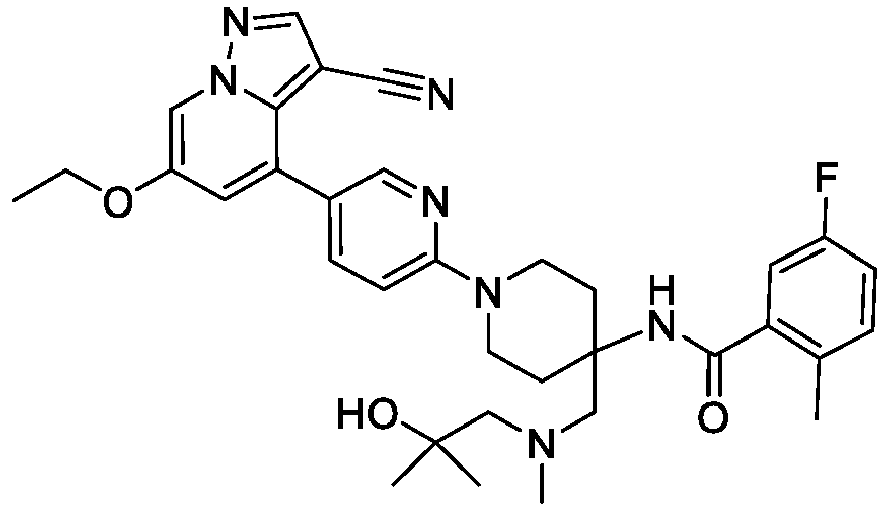
- A solution of N-(1-(5-(3-cyano-6-ethoxypyrazolo[1,5-a]pyridin-4-yl)pyridin-2-yl)-4-(((2-hydroxy-2-methylpropyl)amino)methyl)piperidin-4-yl)-5-fluoro-2-methylbenzamide (Example 381; 30.6 mg, 0.0510 mmol) and formaldehyde (37 wt.% in water with 5-15% MeOH stabilizer; 19.2 µL, 0.255 mmol) in DCE (255 µL) was stirred for 30 min at ambient temperature. The resulting mixture was treated with NaBH(AcO)3 (108 mg, 0.510 mmol), and stirred overnight at room temperature. The resulting mixture was directly purified by silica chromatography (using 0-10% [9:1 DCM:MeOH with 1% NH4OH] in DCM as the gradient eluent) to afford the title compound (26.5 mg, 85% yield). MS (apci) m/z = 614.4 (M+H).
-

- A solution of N-(1-(5-(3-cyano-6-ethoxypyrazolo[1,5-a]pyridin-4-yl)pyridin-2-yl)-4-formylpiperidin-4-yl)-5-fluoro-2-methylbenzamide (Intermediate P70, 44.3 mg, 0.0841 mmol), 3-hydroxy-3-methylazetidine hydrochloride (31.2 mg, 0.252 mmol) and DIEA (44.1 µL, 0.252 mmol) in DCM (421 µL) was stirred for 30 min at ambient temperature. The resulting mixture was treated with NaBH(AcO)3 (26.7 mg, 0.126 mmol), and stirred overnight at room temperature. The resulting mixture was directly purified by silica chromatography (using 0-10% [9:1 DCM:MeOH with 1% NH4OH] in DCM as the gradient eluent) to afford the title compound (42.2 mg, 84% yield). MS (apci) m/z = 598.3 (M+H).
-

- The title compound (17.5 mg, 35% yield) was prepared, worked up and purified using a similar procedure to that described for N-(1-(5-(3-cyano-6-ethoxypyrazolo[1,5-a]pyridin-4-yl)pyridin-2-yl)-4-((3-hydroxy-3-methylazetidin-1-yl)methyl)piperidin-4-yl)-5-fluoro-2-methylbenzamide (Example 615), replacing 3-hydroxy-3-methylazetidine hydrochloride with 2,2-difluoro-N-methylethanamine hydrochloride. MS (apci) m/z = 606.3 (M+H).
-

- The title compound (45.4 mg, 84% yield) was prepared, worked up and purified using a similar procedure to that described for N-(1-(5-(3-cyano-6-ethoxypyrazolo[1,5-a]pyridin-4-yl)pyridin-2-yl)-4-((3-hydroxy-3-methylazetidin-1-yl)methyl)piperidin-4-yl)-5-fluoro-2-methylbenzamide (Example 615), replacing 3-hydroxy-3-methylazetidine hydrochloride with 3,3-difluoropyrrolidine hydrochloride. MS (apci) m/z = 618.3 (M+H).
-

- A solution of 2-(1-methyl-1H-imidazol-2-yl)-N-(4-(pyridin-2-ylmethyl)piperidin-4-yl)acetamide bis(2,2,2-trifluoroacetate) (Intermediate R33; 92.9 mg, 0.172 mmol), 6-ethoxy-4-(6-fluoropyridin-3-yl)pyrazolo[1,5-a]pyridine-3-carbonitrile (Intermediate P6, 44 mg, 0.156 mmol) and K2CO3(s) (108 mg, 0.779 mmol) in DMSO (1039 µL) was stirred overnight at 90 °C. After cooling to ambient temperature, the mixture was filtered, and the filtrate was purified directly by C18 reverse phase chromatography (using 5-95% ACN/ water with 0.1% TFA as the gradient eluent) to afford the title compound as the TFA salt. The TFA salt was suspended in MeOH (5 mL), eluted through a basic resin (Stratospheres Pl-HCO3) to cleanly afford the title compound (34.9 mg, 39% yield). MS (apci) m/z = 576.3 (M+H).
- The compounds in Table PPP were prepared, worked up, purified and free based using a similar method to that described in the synthesis of N-(1-(5-(3-cyano-6-ethoxypyrazolo[1,5-a]pyridin-4-yl)pyridin-2-yl)-4-(pyridin-2-ylmethyl)piperidin-4-yl)-2-(1-methyl-1H-imidazol-2-yl)acetamide (Example 618), replacing 2-(1-methyl-1H-imidazol-2-yl)-N-(4-(pyridin-2-ylmethyl)piperidin-4-yl)acetamide bis(2,2,2-trifluoroacetate) (Intermediate R33) with the appropriate amine (1.0-1.5 equivalents). Reactions were monitored for completion by LCMS, and reaction durations were adjusted accordingly.
Table PPP Ex # Structure Chemical Name MS (apci) m/z 619 
N-(1-(5-(3-cyano-6-ethoxypyrazolo[1,5-a]pyridin-4-yl)pyridin-2-yl)-4-(pyridin-2-ylmethyl)piperidin-4-yl)-2-(dimethylamino)acetami de 539.3 (M+H) 620 
(R)-N-(1-(5-(3-cyano-6-ethoxypyrazolo[1,5-a]pyridin-4-yl)pyridin-2-yl)-4-(pyridin-2-ylmethyl)piperidin-4-yl)-1-methylpyrrolidine-2-carboxamide 565.3 (M+H) 621 
N-(1-(5-(3-cyano-6-ethoxypyrazolo[1,5-a]pyridin-4-yl)pyridin-2-yl)-4-(pyridin-2-ylmethyl)pi peridin-4-yl)-2-(piperidin-1-yl)acetamide 579.4 (M+H) 622 
N-(1-(5-(3-cyano-6-ethoxypyrazolo[1,5-a]pyridin-4-yl)pyridin-2-yl)-4-(pyridin-2-ylmethyl)pi peridin-4-yl)-1-methyl-1H-imidazole-5-carboxamide 562.3 (M+H) 623 
(R)-N-(1-(5-(3-cyano-6-ethoxypyrazolo[1,5-a]pyridin-4-yl)pyridin-2-yl)-4-(pyridin-2-ylmethyl)pi peridin-4-yl)-2-methoxypropanamide 540.2 (M+H) 624 
N-(1-(5-(3-cyano-6-ethoxypyrazolo[1,5-a]pyridin-4-yl)pyridin-2-yl)-4-(pyridin-2-ylmethyl)piperidin-4-yl)-2-morpholinoacetamide 581.3 (M+H) -

- A solution of N,N-dimethyl-4-(pyridin-2-ylmethyl)piperidin-4-amine bis(2,2,2-trifluoroacetate) (Intermediate R29; 71 mg, 0.16 mmol), 6-ethoxy-4-(6-fluoropyridin-3-yl)pyrazolo[1,5-a]pyridine-3-carbonitrile (Intermediate P6, 30 mg, 0.11 mmol) and K2CO3(s) (73 mg, 0.53 mmol) in DMSO (1063 µL) was stirred for 1 h at 100 °C. After cooling to ambient temperature, the mixture was filtered, and the filtrate was purified directly by C18 reverse phase chromatography (using 5-95% ACN/ water with 0.1% TFA as the gradient eluent) to afford the title compound as the TFA salt. The TFA salt was suspended in MeOH (5 mL), eluted through a basic resin (Stratospheres Pl-HCO3) to cleanly afford the title compound (15 mg, 29% yield). MS (apci) m/z = 482.3 (M+H).
-

- Step 1: Preparation of tert-butyl 3-(2-((1-(5-(3-cyano-6-ethoxypyrazolo[1,5-a]pyridin-4-yl)pyridin-2-yl)-4-(pyridin-2-ylmethyl)piperidin-4-yl)amino)-2-oxoethyl)azetidine-1-carboxylate. A solution of 4-(6-(4-amino-4-(pyridin-2-ylmethyl)piperidin-1-yl)pyridin-3-yl)-6-ethoxypyrazolo[1,5-a]pyridine-3-carbonitrile (Intermediate P106; 41 mg, 0.09mmol) and 2-(1-(tert-butoxycarbonyl)azetidin-3-yl)acetic acid (21 mg, 0.1 mmol) in DCM (0.5 mL) was treated sequentially with DIEA (32 µL, 0.18 mmol) and HATU (41 mg, 0.11 mmol). The resulting mixture was stirred overnight at ambient temperature then diluted with water and extracted with DCM (3 × 20 mL). The combined organic extracts were dried over anhydrous Na2SO4(s), filtered and concentrated in vacuo. The crude residue was purified by silica chromatography (using 0-50% [20% MeOH in DCM] in DCM as the gradient eluent) to cleanly afford the title compound (59 mg, 100% yield). MS (apci) m/z = 651 (M+H).
- Step 2: Preparation of 2-(azetidin-3-yl)-N-(1-(5-(3-cyano-6-ethoxypyrazolo[1,5-a]pyridin-4-yl)pyridin-2-yl)-4-(pyridin-2-ylmethyl)piperidin-4-yl)acetamide. A solution of tert-butyl 3-(2-((1-(5-(3-cyano-6-ethoxypyrazolo[1,5-a]pyridin-4-yl)pyridin-2-yl)-4-(pyridin-2-ylmethyl)piperidin-4-yl)amino)-2-oxoethyl)azetidine-1-carboxylate (59mg, 0.091mmol) in DCM (3.00 mL) was treated with TFA (3.00 mL, 39.2 mmol). The resulting mixture was stirred for 1.5 h at ambient temperature. The mixture was diluted with saturated NaHCO3(aq) (3 mL) and extracted with DCM (3 × 5 mL). The combined organic extracts were concentrated in vacuo. The residue was purified by silica chromatography (using 0-50% [20% MeOH/DCM] in DCM followed by 0- 50% MeOH in (20% MeOH/DCM) as the gradient eluent) to cleanly afford the title compound (10 mg, 20% yield). MS (apci) m/z = 551.2 (M+H).
-
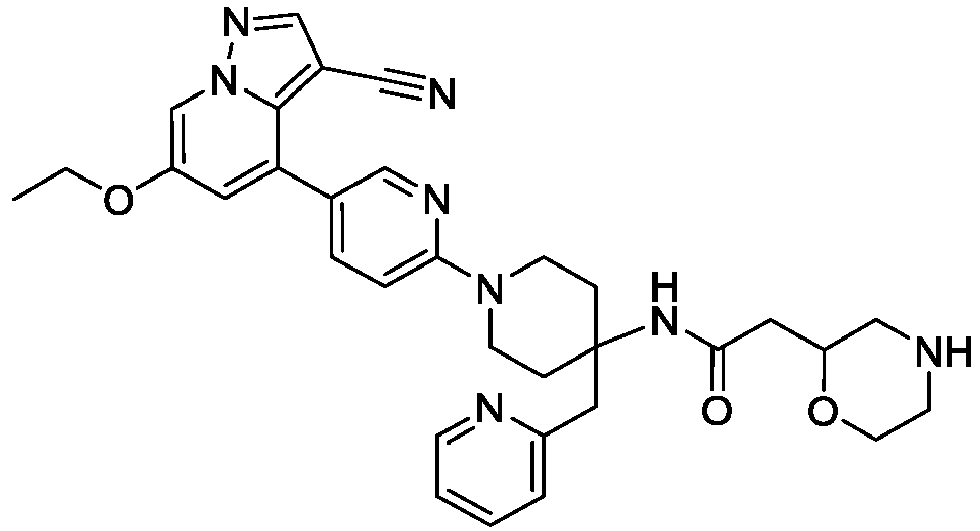
- Step 1: Preparation of tert-butyl 2-(2-((1-(5-(3-cyano-6-ethoxypyrazolo[1,5-a]pyridin-4-yl)pyridin-2-yl)-4-(pyridin-2-ylmethyl)piperidin-4-yl)amino)-2-oxoethyl)morpholine-4-carboxylate. A solution of 4-(6-(4-amino-4-(pyridin-2-ylmethyl)piperidin-1-yl)pyridin-3-yl)-6-ethoxypyrazolo[1,5-a]pyridine-3-carbonitrile (Intermediate P106; 32 mg, 0.07 mmol) and 2-(4-(tert-butoxycarbonyl)morpholin-2-yl)acetic acid (19mg, 0.08mmol) in DCM (0.35 mL) was treated sequentially with DIEA (25 µL, 0.14 mmol) and HATU (32 mg, 0.085 mmol). The resulting mixture was stirred overnight at ambient temperature, then diluted with water and extracted with DCM (3 × 15 mL). The combined organic extracts were dried over anhydrous Na2SO4(s), filtered and concentrated in vacuo. The crude residue was purified by silica chromatography (using 0-50% [20% MeOH in DCM] in DCM as the gradient eluent) to cleanly afford the title compound (48 mg, 100% yield). MS (apci) m/z = 681 (M+H).
- Step 2: Preparation of N-(1-(5-(3-cyano-6-ethoxypyrazolo[1,5-a]pyridin-4-yl)pyridin-2-yl)-4-(pyridin-2-ylmethyl)piperidin-4-yl)-2-(morpholin-2-yl)acetamide. A solution of tert-butyl 2-(2-((1-(5-(3-cyano-6-ethoxypyrazolo[1,5-a]pyridin-4-yl)pyridin-2-yl)-4-(pyridin-2-ylmethyl)piperidin-4-yl)amino)-2-oxoethyl)morpholine-4-carboxylate (Step 1; 48 mg, 0.071 mmol) in DCM (300 µL) was treated with TFA (300 µL, 3.92 mmol). The resulting mixture was stirred for 80 min at ambient temperature. The resulting mixture was diluted with saturated NaHCO3(aq), and extracted with DCM (3 × 10 mL). The combined organic extracts were dried over anhydrous Na2SO4(s), filtered and concentrated in vacuo. The crude residue was purified by silica chromatography (using 0-50% MeOH in [20% MeOH/ DCM] as the gradient eluent) to cleanly afford the title compound (8 mg, 20% yield). MS (apci) m/z = 581.25 (M+H).
-

- A solution of N-(1-(5-(3-cyano-6-ethoxypyrazolo[1,5-a]pyridin-4-yl)pyridin-2-yl)-4-(pyridin-2-ylmethyl)piperidin-4-yl)-2-(morpholin-2-yl)acetamide (Example 627; 6 mg, 0.01 mmol) in DCM (100 µL) was treated sequentially with acetaldehyde (2 µL, 0.03 mmol) and NaBH(AcO)3 (11 mg, 0.052 mmol), and stirred for 2 d and 19 h at room temperature. The resulting mixture was diluted with water (10 mL) and extracted with DCM (3 × 10 mL). The combined organic extracts were dried over anhydrous Na2SO4(s), filtered and concentrated in vacuo. The crude residue was purified by C18 reverse phase chromatography (5-95% ACN:water with 0.1% TFA) to afford the title compound (0.831 mg, 13% yield). MS (apci) m/z = 609.3 (M+H).
-

- Step 1: Preparation of (9H-fluoren-9-yl)methyl ((2S,3R)-1-((1-(5-(3-cyano-6-ethoxypyrazolo[1,5-a]pyridin-4-yl)pyridin-2-yl)-4-(pyridin-2-ylmethyl)piperidin-4-yl)amino)-3-hydroxy-1-oxobutan-2-yl)carbamate. A solution of 4-(6-(4-amino-4-(pyridin-2-ylmethyl)piperidin-1-yl)pyridin-3-yl)-6-ethoxypyrazolo[1,5-a]pyridine-3-carbonitrile (Intermediate P106; 7.8 mg, 0.0172 mmol) in DCM (0.35 mL) was treated sequentially with HATU (7.85 mg, 0.0206 mmol), DIEA (3.00 µL, 0.0172 mmol) and (((9H-fluoren-9-yl)methoxy)carbonyl)-L-threonine (5.87 mg, 0.0172 mmol). The resulting mixture was stirred for 3 d at ambient temperature, then concentrated in vacuo to afford crude title compound (0.0172 mmol; assumed quantitative yield) which was carried directly into step 2. MS (apci) m/z = 777.3 (M+H).
- Step 2: Preparation of (2S,3R)-2-amino-N-(1-(5-(3-cyano-6-ethoxypyrazolo[1,5-a]pyridin-4-yl)pyridin-2-yl)-4-(pyridin-2-ylmethyl)piperidin-4-yl)-3-hydroxybutanamide. A solution of (9H-fluoren-9-yl)methyl ((2S,3R)-1-((1-(5-(3-cyano-6-ethoxypyrazolo[1,5-a]pyridin-4-yl)pyridin-2-yl)-4-(pyridin-2-ylmethyl)piperidin-4-yl)amino)-3-hydroxy-1-oxobutan-2-yl)carbamate (0.0172 mmol) in 1:1 v/v morpholine DCM (1 mL) was stirred for 3h at ambient temperature, then concentrated and purified by reverse-phase chromatography (5 to 95% acetonitrile/water with 0.2% TFA) to yield the title product after freebasing with HCO3 Stratosphere resin (5 mg, 52% yield). MS (apci) m/z = 555.7 (M+H).
-

- A solution of (9H-fluoren-9-yl)methyl (R)-(1-oxo-1-((4-(pyridin-2-ylmethyl)piperidin-4-yl)amino)propan-2-yl)carbamate bis(2,2,2-trifluoroacetate) (Intermediate R39; 130 mg, 0.182 mmol) in DMF (0.3mL) was treated with Cs2CO3(s) (270 mg, 0.829 mmol) and 6-ethoxy-4-(6-fluoropyridin-3-yl)pyrazolo[1,5-a]pyridine-3-carbonitrile (Intermediate P6, 46.8 mg, 0.166 mmol). The resulting mixture was stirred overnight at 90 °C. After cooling to ambient temperature, the mixture was purified directly by C18 reverse phase chromatography (using 5-95% ACN/ water with 0.1% TFA as the gradient eluent) to afford the title compound as the TFA salt. The TFA salt was suspended in MeOH (5 mL), eluted through a basic resin (Stratospheres Pl-HCO3) to cleanly afford the title compound (30.2 mg, 35% yield). MS (apci) m/z = 525.2 (M+H).
- The compounds in Table QQQ were prepared, worked up, purified and free based using a similar method to that described in the synthesis of (R)-2-amino-N-(1-(5-(3-cyano-6-ethoxypyrazolo[1,5-a]pyridin-4-yl)pyridin-2-yl)-4-(pyridin-2-ylmethyl)piperidin-4-yl)propanamide (Example 630), replacing (9H-fluoren-9-yl)methyl (R)-(1-oxo-1-((4-(pyridin-2-ylmethyl)piperidin-4-yl)amino)propan-2-yl)carbamate bis(2,2,2-trifluoroacetate) (Intermediate R39) with the appropriate amine (1.0-1.5 equivalents). Reactions were monitored for completion by LCMS, and reaction durations were adjusted accordingly.
Table QQQ Ex # Structure Chemical Name MS (apci) m/z 631 
N-(1-(5-(3-cyano-6-ethoxypyrazolo[1,5-a]pyridin-4-yl)pyridin-2-yl)-4-(pyridin-2-ylmethyl)piperidin-4-yl)-3-morpholinopropanamid e 595.3 (M+H) 632 
(R)-2-amino-N-(1-(5-(3-cyano-6-ethoxypyrazolo[1,5-a]pyridin-4-yl)pyridin-2-yl)-4-(pyridin-2-ylmethyl)piperidin-4-yl)-3-methylbutanamide 553.3 (M+H) 633 
(S)-2-amino-N-(1-(5-(3-cyano-6-ethoxypyrazolo[1,5 - a]pyridin-4-yl)pyridin-2-yl)-4-(pyridin-2-ylmethyl)piperidin-4-yl)-3-methylbutanamide 553.3 (M+H) -

- A solution of 4-(6-(4-benzyl-4-formylpiperidin-1-yl)pyridin-3-yl)-6-ethoxypyrazolo[1,5-a]pyridine-3-carbonitrile (Intermediate P77, 10 mg, 0.0215 mmol) and 2-(methylamino)ethan-1-ol (13.0 mg, 0.173 mmol) in DCE (750 µL) was stirred for 1 h at ambient temperature, then treated with NaBH(AcO)3 (105.9 mg, 0.4997 mmol). The resulting mixture was stirred for 4 d at ambient temperature, before introducing additional 2-(methylamino)ethan-1-ol (13.0 mg, 0.173 mmol) and NaBH(AcO)3 (105.9 mg, 0.4997 mmol). The resulting mixture was stirred overnight at ambient temperature before diluting with DCM, and extracting with water (3x). The combined organic extracts were dried over anhydrous Na2SO4(s), and filtered. The filtrate was purified directly by silica chromatography (using 0-100% Hexanes/EtOAc as the gradient eluent) to afford the title compound (1.8 mg, 16% yield). MS (apci) m/z = 525.25 (M+H).
-

- A solution of 4-(6-(4-benzyl-4-formylpiperidin-1-yl)pyridin-3-yl)-6-ethoxypyrazolo[1,5-a]pyridine-3-carbonitrile (Intermediate P77, 10.5 mg, 0.0226 mmol) and N1,N1,N2-trimethylethane-1,2-diamine (24.1 mg, 0.236 mmol) in DCE (750 µL) was stirred for 1 h at ambient temperature then treated with NaBH(AcO)3 (75 mg, 0.354 mmol). The resulting mixture was stirred overnight at ambient temperature. The resulting mixture was diluted with water, and extracted with DCM. The combined organic extracts were dried over anhydrous Na2SO4(s), and filtered. The filtrate was purified directly by silica chromatography (using 0-50% DCM/MeOH as the gradient eluent) to afford the title compound (6.0 mg, 48% yield). MS (apci) m/z = 552.3 (M+H).
-

- A solution of 4-(6-(4-benzyl-4-formylpiperidin-1-yl)pyridin-3-yl)-6-ethoxypyrazolo[1,5-a]pyridine-3-carbonitrile (Intermediate P77, 11.4 mg, 0.0245 mmol) and N,N-dimethyl-2-(methylamino)acetamide (28.4 mg, 0.245 mmol) in DCE (750 µL) was stirred for 2 h at ambient temperature then treated with NaBH(AcO)3 (104 mg, 0.490 mmol). The resulting mixture was stirred overnight at ambient temperature. The resulting mixture was diluted with water, and extracted with DCM. The combined organic extracts were dried over anhydrous Na2SO4(s), and filtered. The filtrate was purified directly by silica chromatography (using 0-100% Hexanes/EtOAc as the gradient eluent) to afford the title compound (2.3 mg, 17% yield). MS (apci) m/z = 566.25 (M+H).
-

- A solution of 1-(5-(3-cyano-6-ethoxypyrazolo[1,5-a]pyridin-4-yl)pyridin-2-yl)-4-formyl-N-isobutylpiperidine-4-carboxamide (Intermediate P76, 45.6 mg, 0.0961 mmol) and tert-butyl (S)-3-methylpiperazine-1-carboxylate (96.22 mg, 0.4804 mmol) in DCE (1 mL) was stirred for 30 min at ambient temperature before adding NaBH(AcO)3 (122.2 mg, 0.5765 mmol). The resulting mixture was stirred for 5 d at ambient temperature, then diluted with DCM, and washed with water. The organic extracts were purified directly by silica chromatography (using 20-80% Hexanes/EtOAc as the gradient eluent) to cleanly provide the title compound (37.9 mg, 57% yield). MS (apci) m/z = 659.3 (M+H).
- The compounds in Table RRR were prepared using a similar method to that described in the synthesis of tert-butyl (S)-4-((1-(5-(3-cyano-6-ethoxypyrazolo[1,5-a]pyridin-4-yl)pyridin-2-yl)-4-(isobutylcarbamoyl)piperidin-4-yl)methyl)-3-methylpiperazine-1-carboxylate (Example 637), replacing 1 tert-butyl (S)-3-methylpiperazine-1-carboxylate with the appropriate amine and using 4-6 equivalents of NaBH(AcO)3. Reactions were monitored for completion by LCMS, as such reaction durations, both prior to and after NaBH(AcO)3 addition, were adjusted accordingly. Title compounds were isolated following a similar aqueous work up with water or brine, followed by a chromatographic purification using an appropriate gradient eluent.
Table RRR Ex # Structure Chemical Name MS (apci) m/z 638 
1-(5-(3-cyano-6-ethoxypyrazolo[ 1,5-a]pyridin-4-yl)pyridin-2-yl)-N-isobutyl-4-(((tetrahydro-2H-pyran-4-yl)amino)methy l)piperidine-4-carboxamide 560.3 (M+H) 639 
tert-butyl 3-((1-(5-(3-cyano-6-ethoxypyrazolo[ 1,5-a]pyridin-4-yl)pyridin-2-yl)-4-(isobutylcarbam oyl)piperidin-4-yl)methyl)-3,6-diazabicyclo[3. 1.1]heptane-6-carboxylate 657.3 (M+H) 640 
1-(5-(3-cyano-6-ethoxypyrazolo[ 1,5-a]pyridin-4-yl)pyridin-2-yl)-N-isobutyl-4-((6-methyl-2,6-diazaspiro[3.3]h eptan-2-yl)methyl)piperi dine-4-carboxamide 571.3 (M+H) -

- A solution of 1-(5-(3-cyano-6-ethoxypyrazolo[1,5-a]pyridin-4-yl)pyridin-2-yl)-4-formyl-N-isobutylpiperidine-4-carboxamide (Intermediate P76, 40 mg, 0.084 mmol) and N, N-dimethylazetidin-3-amine hydrochloride (42 mg, 0.42 mmol) in DCM (169 µL) was stirred for 30 min at ambient temperature. The resulting mixture was treated with NaBH(AcO)3 (89 mg, 0.42 mmol), and stirred overnight at ambient temperature. The reaction mixture was concentrated in vacuo. The crude residue was purified directly by C18 reverse phase chromatography (using 5-95% water:ACN with 0.1% TFA as the gradient eluent). Fractions containing the desired product were diluted with 4:1 DCM:iPrOH, and extracted sequentially with saturated NaHCO3(aq) (1×), and brine (2x). The organic extracts were dried over anhydrous Na2SO4(s), filtered, and concentrated in vacuo to afford the title compound (23 mg, 49% yield). MS (apci) m/z = 559.4 (M+H).
- The compounds in Table SSS were prepared using a similar method to that described in the synthesis of 1-(5-(3-cyano-6-ethoxypyrazolo[1,5-a]pyridin-4-yl)pyridin-2-yl)-4-((3-(dimethylamino)azetidin-1-yl)methyl)-N-isobutylpiperidine-4-carboxamide (Example 641), replacing N, N-dimethylazetidin-3-amine hydrochloride with 2-5 equivalents of the appropriate amine and 5-6 equivalents of NaBH(AcO)3. Reactions were monitored for completion by LCMS, as such reaction durations, both prior to and after the NaBH(AcO)3 addition, were adjusted accordingly. Title compounds were isolated following a chromatographic purification using an appropriate gradient eluent. For examples in which an acid modifier (e.g. 0.1% TFA) was employed in the chromatographic purification conditions, a basic work up (e.g. an aqueous work up as described for Example 641; or use of a basic resin) was used to isolate the title compound.
Table SSS Ex # Structure Chemical Name MS (apci) m/z 642 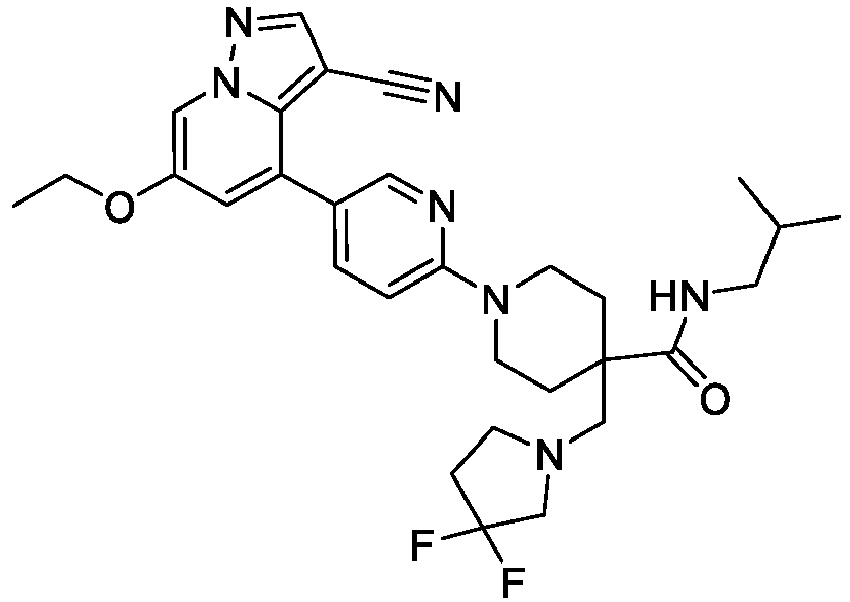
1-(5-(3-cyano-6-ethoxypyrazolo[1,5-a]pyridin-4-yl)pyridin-2-yl)-4-((3,3-difluoropyrrolidin-1-yl)methyl)-N-isobutylpiperidine-4-carboxamide 566.3 (M+H) 643 
1-(5-(3-cyano-6-ethoxypyrazolo[1,5-a]pyridin-4-yl)pyridin-2-yl)-N-isobutyl-4-((3-methoxyazetidin-1-yl)methyl)piperidine-4-carboxamide 546.3 (M+H) 644 
1-(5-(3-cyano-6-ethoxypyrazolo[1,5-a]pyridin-4-yl)pyridin-2-yl)-N-isobutyl-4-(((2-methoxyethyl)(methyl) amino)methyl)piperidi ne-4-carboxamide 548.4 (M+H) 645 
(S)-1-(5-(3-cyano-6-ethoxypyrazolo[1,5-a]pyridin-4-yl)pyridin-2-yl)-N-isobutyl-4-((3-methoxypyrrolidin-1-yl)methyl)piperidine-4-carboxamide 560.4 (M+H) 646 
(R)-1-(5-(3-cyano-6-ethoxypyrazolo[1,5-a]pyridin-4-yl)pyridin-2-yl)-N-isobutyl-4-((3-methoxypyrrolidin-1-yl)methyl)piperidine-4-carboxamide 560.4 (M+H) 647 
1-(5-(3-cyano-6-ethoxypyrazolo[1,5-a]pyridin-4-yl)pyridin-2-yl)-4-((3,3-difluoroazetidin-1-yl)methyl)-N-isobutylpiperidine-4-carboxamide 552.25 , M+H 648 
tert-butyl (S)-4-((1-(5-(3-cyano-6-ethoxypyrazolo[1,5-a]pyridin-4-yl)pyridin-2-yl)-4-(isobutylcarbamoyl)pi p eridin-4-yl)methyl)-2-methylpiperazine-1-carboxylate 659.35 , M+H 649 
tert-butyl (R)-4-((1-(5-(3-cyano-6-ethoxypyrazolo[1,5-a]pyridin-4-yl)pyridin-2-yl)-4-(isobutylcarbamoyl)pip eridin-4-yl)methyl)-2-methylpiperazine-1-carboxylate 659.3, M+H 650 
tert-butyl 4-((1-(5-(3-cyano-6-ethoxypyrazolo[1,5-a]pyridin-4-yl)pyridin-2-yl)-4-(isobutylcarbamoyl)pi p eridin-4-yl)methyl)-2,2-dimethylpiperazine-1-carboxylate 673.3, M+H -

- A solution of tert-butyl (S)-4-((1-(5-(3-cyano-6-ethoxypyrazolo[1,5-a]pyridin-4-yl)pyridin-2-yl)-4-(isobutylcarbamoyl)piperidin-4-yl)methyl)-2-methylpiperazine-1-carboxylate (Example 648; 27 mg, 0.0410 mmol) in DCM (1.5 mL) was treated with TFA (1.5 mL, 19 mmol). The resulting mixture was stirred at ambient temperature until LCMS indicated complete consumption of starting Boc-protected compound, then concentrated in vacuo. The residue was diluted with EtOAc, and extracted with saturated NaHCO3(aq) (2x). After back extracting the aqueous extracts with EtOAc, the organic extracts were combined, dried over anhydrous Na2SO4(s), filtered, and concentrated in vacuo to cleanly afford the title compound (21.5 mg, 94% yield). MS (apci) m/z = 559.3 (M+H).
-

- A solution of tert-butyl (S)-4-((1-(5-(3-cyano-6-ethoxypyrazolo[1,5-a]pyridin-4-yl)pyridin-2-yl)-4-(isobutylcarbamoyl)piperidin-4-yl)methyl)-3-methylpiperazine-1-carboxylate (Example 637; 35 mg, 0.053 mmol) in DCM (3.0 mL) was treated with TFA (1.5 mL, 19 mmol). The resulting mixture was stirred for 4 d at ambient temperature, then concentrated in vacuo. The residue was diluted with 4:1 DCM/iPrOH, and extracted with saturated NaHCO3(aq). The organic extracts were combined, dried over anhydrous Na2SO4(s), filtered, and concentrated in vacuo. The crude residue was purified by C18 reverse phase chromatography (using 0-70% ACN in water with 0.1% TFA as the gradient eluent). Fractions containing the desired product were diluted with 4:1 DCM:iPrOH, and extracted with saturated NaHCO3(aq). After back extracting the aqueous extracts with 4:1 DCM:iPrOH, the organic extracts were combined, dried over anhydrous Na2SO4(s), filtered, and concentrated in vacuo to afford the title compound to cleanly afford the title compound (3.3 mg, 9% yield). MS (apci) m/z = 559.3 (M+H).
-

- A solution of tert-butyl 3-((1-(5-(3-cyano-6-ethoxypyrazolo[1,5-a]pyridin-4-yl)pyridin-2-yl)-4-(isobutylcarbamoyl)piperidin-4-yl)methyl)-3,6-diazabicyclo[3.1.1]heptane-6-carboxylate (Example 639; 15.7 mg, 0.0239 mmol) in DCM (2 mL) was treated with TFA (1.0 mL, 13 mmol). The resulting mixture was stirred for 30 min at ambient temperature, then concentrated in vacuo. The residue was diluted with 4:1 DCM:iPrOH, and extracted with saturated NaHCO3(aq) (2×). After back extracting the aqueous extracts with 4:1 DCM:iPrOH, the organic extracts were combined, dried over anhydrous Na2SO4(s), filtered, and concentrated in vacuo to cleanly afford the title compound (13.9 mg, 100% yield). MS (apci) m/z = 557.3 (M+H).
-

- Step 1: Preparation of (R)-1-(5-(3-cyano-6-ethoxypyrazolo[1,5-a]pyridin-4-yl)pyridin-2-yl)-N-isobutyl-4-((3-methylpiperazin-1-yl)methyl)piperidine-4-carboxamide bis(2,2,2-trifluoroacetate). A mixture of tert-butyl (R)-4-((1-(5-(3-cyano-6-ethoxypyrazolo[1,5-a]pyridin-4-yl)pyridin-2-yl)-4-(isobutylcarbamoyl)piperidin-4-yl)methyl)-2-methylpiperazine-1-carboxylate (Example 649; 6.3 mg, 0.0096 mmol) in DCM (0.5 mL) was treated with TFA (0.1 mL, 1.3 mmol). The resulting mixture was stirred for 1 h at ambient temperature before concentrating the mixture in vacuo to afford the title compound (5.3 mg, quantitative yield). MS (apci) m/z = 559.3 (M+H).
- Step 2: Preparation of (R)-1-(5-(3-cyano-6-ethoxypyrazolo[1,5-a]pyridin-4-yl)pyridin-2-yl)-N-isobutyl-4-((3-methylpiperazin-1-yl)methyl)piperidine-4-carboxamide. A solution of (R)-1-(5-(3-cyano-6-ethoxypyrazolo[1,5-a]pyridin-4-yl)pyridin-2-yl)-N-isobutyl-4-((3-methylpiperazin-1-yl)methyl)piperidine-4-carboxamide (5.3 mg, 0.00949 mmol) in DCM (0.61 µL) was treated with acetaldehyde (0.550µL, 0.0190 mmol) and NaBH(AcO)3 (4.02 mg, 0.0190 mmol), and stirred overnight at room temperature. The resulting mixture was diluted with 4:1 DCM:iPrOH , and extracted with saturated NaHCO3(aq)., and filtered through PS frit. The organic filtrate was concentrated in vacuo to cleanly afford the title compound (4.4 mg, 79% yield). MS (apci) m/z = 587.3 (M+H).
-

- Step 1: Preparation of 1-(5-(3-cyano-6-ethoxypyrazolo[1,5-a]pyridin-4-yl)pyridin-2-yl)-4-((3,3-dimethylpiperazin-1-yl)methyl)-N-isobutylpiperidine-4-carboxamide bis(2,2,2-trifluoroacetate). A mixture of tert-butyl tert-butyl 4-((1-(5-(3-cyano-6-ethoxypyrazolo[1,5-a]pyridin-4-yl)pyridin-2-yl)-4-(isobutylcarbamoyl)piperidin-4-yl)methyl)-2,2-dimethylpiperazine-1-carboxylate (Example 650; 7.7 mg, 0.011 mmol) in DCM (0.5 mL) was treated with TFA (0.1 mL, 1.3 mmol). The resulting mixture was stirred for 1 h at ambient temperature before concentrating the mixture in vacuo to afford the title compound (6.6 mg, quantitative yield). MS (apci) m/z = 573.4 (M+H).
- Step 2: Preparation of 1-(5-(3-cyano-6-ethoxypyrazolo[1,5-a]pyridin-4-yl)pyridin-2-yl)-4-((4-ethyl-3,3-dimethylpiperazin-1-yl)methyl)-N-isobutylpiperidine-4-carboxamide. A solution of 1-(5-(3-cyano-6-ethoxypyrazolo[1,5-a]pyridin-4-yl)pyridin-2-yl)-4-((3,3-dimethylpiperazin-1-yl)methyl)-N-isobutylpiperidine-4-carboxamide (6.6 mg, 0.0115 mmol) in DCM (0.73 µL) was treated with acetaldehyde (0.668 µL, 0.0230 mmol) and NaBH(AcO)3 (4.88 mg, 0.0230 mmol), and stirred overnight at room temperature. The resulting mixture was purified directly by silica chromatography (using 0-100% DCM/[ 10% MeOH/1% NH4OH in DCM] as the gradient eluent) to cleanly afford the title compound (3.8 mg, 55% yield). MS (apci) m/z = 601.3 (M+H).
-

- A solution of (S)-1-(5-(3-cyano-6-ethoxypyrazolo[1,5-a]pyridin-4-yl)pyridin-2-yl)-N-isobutyl-4-((3-methylpiperazin-1-yl)methyl)piperidine-4-carboxamide (Example 651; 23.6 mg, 0.04224 mmol) in DCE (1000 µL) was treated with formaldehyde (37 wt.% in water with 5-15% MeOH stabilizer; 17.14 mg, 0.2112 mmol), then stirred for 45 min at ambient temperature before adding NaBH(AcO)3 (53.71 mg, 0.2534 mmol). The resulting mixture was stirred for 3 d at room temperature. The reaction mixture was diluted with acetone, and concentrated in vacuo. The residue was dissolved in DCM, and washed with water. The organic extracts were purified directly by silica chromatography (using 0-100% [10% MeOH + 1% NH4OH] in DCM as the gradient eluent) to cleanly afford the title compound (16.2 mg, 67% yield). MS (apci) m/z = 575.3 (M+H).
-

- A solution of 1-(5-(3-cyano-6-ethoxypyrazolo[1,5-a]pyridin-4-yl)pyridin-2-yl)-4-formyl-N-isobutylpiperidine-4-carboxamide (Intermediate P76, 62.8 mg, 0.132 mmol) in 1:1 DCM:MeOH (1.3 mL) was treated with NaBH4 (98%; 50.1 mg, 1.32 mmol), stirred overnight at room temperature, and then concentrated in vacuo. The residue was diluted with 4:1 DCM:iPrOH, and extracted with saturated NaHCO3(aq). The organic extracts were dried over anhydrous Na2SO4(s), filtered, and concentrated in vacuo to cleanly afford the title compound (44.4 mg, 70% yield). MS (apci) m/z = 477.3 (M+H).
-

- A slurry of 6-ethoxy-4-(6-fluoropyridin-3-yl)pyrazolo[1,5-a]pyridine-3-carbonitrile (Intermediate P6, 76 mg, 0.269 mmol), ethyl 4-(hydroxymethyl)piperidine-4-carboxylate hydrochloride (Intermediate R42; 84.1 mg, 0.323 mmol), and DIEA (141 µL, 0.808 mmol) in DMSO (538 µL) was stirred for 2 d at 90 °C. After cooling to ambient temperature, the mixture was purified directly by C18 reverse phase chromatography (using 5-50% ACN/water as the gradient eluent). This allowed for the clean separation and isolation of the title compound (35.2 mg, 29% yield; MS (apci) m/z = 450.2 (M+H)) and another product 1-(5-(3-cyano-6-ethoxypyrazolo[1,5-a]pyridin-4-yl)pyridin-2-yl)-4-(hydroxymethyl)piperidine-4-carboxylic acid (Intermediate P156; 7.4 mg, 7% yield):
-

- A solution of 1-(5-(3-cyano-6-ethoxypyrazolo[1,5-a]pyridin-4-yl)pyridin-2-yl)-4-((2-morpholinoethoxy)methyl)piperidine-4-carboxylic acid dihydrochloride (Intermediate P107; 25 mg, 0.044 mmol), DIEA (32.6 µL, 0.187 mmol), HATU (35.6 mg, 0.0935 mmol) and isobutylamine (13.9 µL, 0.140 mmol) in DMF (1.0 mL) was stirred for 5 h at ambient temperature. The mixture was concentrated in vacuo, and purified directly by C18 reverse phase chromatography (5 to 95% acetonitrile in water) to cleanly afford the title compound (6 mg, 22% yield). MS (apci) m/z = 590.3 (M+H).
-

- A solution of 1-(5-(3-cyano-6-ethoxypyrazolo[1,5-a]pyridin-4-yl)pyridin-2-yl)-4-((2-(dimethylamino)ethoxy)methyl)piperidine-4-carboxylic acid dihydrochloride (Intermediate P109; 22 mg, 0.0447 mmol), DIEA (31.1 µL, 0.179 mmol), HATU (34.0 mg, 0.0893 mmol) and isobutylamine (13.4 µL, 0.134 mmol) in DMF (1.0 mL) was stirred for 15 h at ambient temperature. The mixture was concentrated in vacuo, and purified directly by C18 reverse phase chromatography (5 to 95% acetonitrile in water) to cleanly afford the title compound (4 mg, 16% yield). MS (apci) m/z = 548.3 (M+H).
-

- A slurry of 6-ethoxy-4-(6-fluoropyridin-3-yl)pyrazolo[1,5-a]pyridine-3-carbonitrile (Intermediate P6, 100 mg, 0.354 mmol), tert-butyl (7-azaspiro[3.5]nonan-2-yl)carbamate (102 mg, 0.425 mmol), and DIEA (185 µL, 1.06 mmol) in DMSO (1417 µL) was stirred for 18 h at 90 °C. After cooling to ambient temperature, the mixture was poured into water (12 mL) while stirring. The resulting suspension was vacuum filtered, and the solids were rinsed sequentially with water (3 × 15 mL) and heptane (3 × 5 mL), then dried in vacuo to cleanly afford the title compound (175 mg, 98% yield). MS (apci) m/z = 503.2 (M+H).
-

- A solution of 4-(4-(4-amino-4-((dimethylamino)methyl)piperidin-1-yl)phenyl)-6-ethoxypyrazolo[1,5-a]pyridine-3-carbonitrile (Intermediate P114; 35.7 mg, 0.0853 mmol) in DCM (6.6 µL) was treated with TEA (59.4 µL, 0.426 mmol) and isovaleryl chloride (20.8 µL, 0.171 mmol). The resulting mixture was stirred for 30 min at ambient temperature, and then concentrated in vacuo. The residue was purified by C18 reverse phase chromatography (using 5-95% water-ACN with 0.1% TFA as the gradient eluent). Fractions containing desired product were combined, and partitioned between 4:1 DCM:iPrOH, and saturated NaHCO3(aq). The organic extracts were separated, and sequentially dried over anhydrous Na2SO4(s), filtered and concentrated in vacuo. The slightly impure product residue was purified by silica chromatography (using 1-30% DCM-MeOH with 2% NH4OH as the gradient eluent) to cleanly afford the title compound (8 mg, 17% yield). MS (apci) m/z = 503.3 (M+H).
-

- A slurry of 3-cyano-4-(6-fluoropyridin-3-yl)pyrazolo[1,5-a]pyridin-6-yl dimethylcarbamate (Intermediate P115; 69.4 mg, 0.213 mmol), tert-butyl (4-methylpiperidin-4-yl)carbamate (114 mg, 0.533 mmol) and DIEA (186 µL, 1.07 mmol) in DMSO (3 mL) was stirred for 2 h at 90 °C. After cooling to ambient temperature, the mixture was diluted with water and extracted with EtOAc (3x). The combined organic extracts were washed sequentially with water (2x) and brine. The aqueous extracts were combined, neutralized (pH 6-7) with the addition 6 M HCl(aq), and then extracted with EtOAc (2x). The organic extracts from the neutralization were combined, and concentrated in vacuo. The crude residue was purified by silica chromatography (using 30-90% Hexanes/EtOAc as the gradient eluent), resulting in the clean isolation of 4-(6-(4-((tert-butoxycarbonyl)amino)-4-methylpiperidin-1-yl)pyridin-3-yl)-3-cyanopyrazolo[1,5-a]pyridin-6-yl dimethylcarbamate (45.3 mg), along with mixed fractions containing both 4-(6-(4-((tert-butoxycarbonyl)amino)-4-methylpiperidin-1-yl)pyridin-3-yl)-3-cyanopyrazolo[1,5-a]pyridin-6-yl dimethylcarbamate and the desired tert-butyl (1-(5-(3-cyano-6-hydroxypyrazolo[1,5-a]pyridin-4-yl)pyridin-2-yl)-4-methylpiperidin-4-yl)carbamate. The mixed fractions were combined and concentrated in vacuo. The residue was dissolved in DCM (500 µL), and treated with DIEA (100 µL, 0.57 mmol) and dimethylcarbamyl chloride (52 µL, 0.57 mmol). The resulting mixture was stirred for a total of 5 d, supplementing with additional dimethylcarbamyl chloride (52 µL, 0.57 mmol) after the initial 24 h. The resulting mixture was washed sequentially with water and 2 M NaOH(aq). The organic extracts were purified directly by silica chromatography (using 50-90% Hexanes/EtOAc as the gradient eluent) to cleanly afford the title compound (74.8 mg, 66% yield). MS (apci) m/z = 520.2 (M+H).
-

- A solution of 4-(6-(4-((tert-butoxycarbonyl)amino)-4-methylpiperidin-1-yl)pyridin-3-yl)-3-cyanopyrazolo[1,5-a]pyridin-6-yl dimethylcarbamate (Example 663; 70 mg, 0.135 mmol) in DCM (3 mL) was treated with TFA 1.5 mL, 19 mmol). The resulting mixture was stirred for 30 min at ambient temperature before concentrating in vacuo. The residue was diluted with DCM, and washed with saturated NaHCO3(aq). After back extracting the aqueous extracts with 4:1 DCM:iPrOH, the organic extracts were combined, dried over anhydrous Na2SO4(s), filtered, and concentrated in vacuo to cleanly afford the title compound (25.2 mg, 45% yield). MS (apci) m/z = 420.2 (M+H).
-

- A mixture of 4-(6-(4-amino-4-methylpiperidin-1-yl)pyridin-3-yl)-3-cyanopyrazolo[1,5-a]pyridin-6-yl dimethylcarbamate (Example 664; 13.6 mg, 0.0324 mmol) and DIEA (22.6 µL, 0.130 mmol) in DCM (500 µL) was treated with isopropyl carbonochloridate (4.77 mg, 0.0389 mmol). The resulting mixture was stirred for 1 h at ambient temperature, and was purified directly by silica chromatography (using 0-100% Hexanes/EtOAc as the gradient eluent) to cleanly afford the title compound (11.5 mg, 69% yield). MS (apci) m/z = 506.2 (M+H).
-

- A mixture of 6-(2-(1H-imidazol-1-yl)ethoxy)-4-(6-fluoropyridin-3-yl)pyrazolo[1,5-a]pyridine-3-carbonitrile (Intermediate P116; 12 mg, 0.034 mmol), isopropyl (4-methylpiperidin-4-yl)carbamate hydrochloride (Intermediate R19, part B; 16 mg, 0.069 mmol) and Cs2CO3(s) (112 mg, 0.34 mmol) in DMSO (1.5 mL) was stirred overnight at 100 °C. Subsequently, additional isopropyl (4-methylpiperidin-4-yl)carbamate hydrochloride (Intermediate R19, part B; 16 mg, 0.069 mmol) was introduced, and the resulting mixture was stirred overnight at 100 °C. After cooling to ambient temperature, the reaction mixture was diluted with water, and washed sequentially with DCM (4x) and 4:1 DCM:iPrOH. The combined organic extracts were dried over anhydrous Na2SO4(s), and filtered. The filtrate was purified directly by silica chromatography (using 0-50% DCM/MeOH with 1% NH4OH as the gradient eluent). Fractions containing the desired compound were combined, concentrated in vacuo, then partitioned between water and DCM. The organic extracts were separated, and concentrated in vacuo to cleanly afford the title compound (7.2 mg, 34% yield). MS (apci) m/z = 529.2 (M+H).
-

- A solution of 4-(6-fluoropyridin-3-yl)-6-((1-methyl-1H-imidazol-4-yl)methoxy)pyrazolo[1,5-a]pyridine-3-carbonitrile (Intermediate P117; 26.0 mg, 0.0746 mmol) in DMA (1.0 mL) was treated with isopropyl (4-methylpiperidin-4-yl)carbamate hydrochloride (Intermediate R19; 35.34 mg, 0.1493 mmol) and TEA (104.1 µL, 0.7464 mmol) was stirred for 60 h at 60 °C. After cooling to ambient temperature, the reaction mixture purified directly by C18 reverse phase chromatography (using 0-50% water/ACN with 0.1% TFA as the gradient eluent). Fractions containing the desired product were combined, concentrated in vacuo to remove the ACN, then partitioned between saturated NaHCO3(aq) and 4:1 DCM:iPrOH. The organic extracts were concentrated in vacuo to afford the title compound (8.7 mg, 18% yield). MS (apci) m/z = 529.2(M+H).
-

- A mixture of 4-(6-fluoropyridin-3-yl)-6-(2-morpholinoethoxy)pyrazolo[1,5-a]pyridine-3-carbonitrile (Intermediate P79, 22.1 mg, 0.0602 mmol), isopropyl (4-methylpiperidin-4-yl)carbamate hydrochloride (Intermediate R19; 28.5 mg, 0.120 mmol) and Cs2CO3(s) (196 mg, 0.602 mmol) in DMSO (1.5 mL) was stirred overnight at 100 °C. Subsequently, additional isopropyl (4-methylpiperidin-4-yl)carbamate hydrochloride (Intermediate R19; 28.5 mg, 0.120 mmol) was introduced, and the resulting mixture was stirred overnight at 100 °C. After cooling to ambient temperature, the reaction mixture was diluted with water, and washed sequentially with DCM (4x) and 4:1 DCM:iPrOH. The combined organic extracts were dried over anhydrous Na2SO4(s), and filtered. The filtrate was purified directly by silica chromatography (using 0-50% water/ACN with 0.1% TFA as the gradient eluent). Fractions containing the desired product were combined, concentrated in vacuo to remove the ACN, then partitioned between saturated NaHCO3(aq) and 4:1 DCM:iPrOH. The organic extracts were concentrated in vacuo to afford the title compound (2.7 mg, 8% yield). MS (apci) m/z = 548.2 (M+H).
-

- A solution of 4-(6-(4-amino-4-methylpiperidin-1-yl)pyridin-3-yl)-6-(2-morpholinoethoxy)pyrazolo[1,5-a]pyridine-3-carbonitrile bis(2,2,2-trifluoroacetate) (Intermediate P119; 41 mg, 0.060 mmol) in DCM (500 µL) was treated sequentially with DIEA (30.9 µL, 0.178 mmol) and isobutyl chloroformate (13.9 µL, 0.107 mmol). The resulting mixture was stirred for 24 h at ambient temperature. The reaction mixture was diluted with 4:1 DCM:iPrOH, and extracted sequentially with water and brine. After back extracting the aqueous extracts with 4:1 DCM:iPrOH, the organic extracts were combined, dried over anhydrous Na2SO4(s), then concentrated in vacuo. The residue was purified by C18 reverse phase chromatography (using 5-95% water:ACN with 0.1% TFA as the gradient eluent) to afford the title compound as the TFA salt. The TFA salt was suspended in MeOH (5 mL), and eluted through a basic resin (Stratospheres P1-HCO3) to cleanly afford the title compound (11.2 mg, 33% yield). MS (apci) m/z = 562.3 (M+H).
-

- A solution of 4-(6-(4-amino-4-methylpiperidin-1-yl)pyridin-3-yl)-6-(2-morpholinoethoxy)pyrazolo[1,5-a]pyridine-3-carbonitrile bis(2,2,2-trifluoroacetate) (Intermediate P119; 40 mg, 0.058 mmol) in DCM (578 µL) was treated sequentially with DIEA (30.2 µL, 0.173 mmol), HATU (39.5 mg, 0.104 mmol) and isovaleric acid (10.5 µL, 0.0953 mmol). The resulting mixture was stirred overnight at ambient temperature, then purified directly by C18 reverse phase chromatography (using 5-95% ACN/ water with 0.1% TFA as the gradient eluent) to afford the TFA salt of the title compound. The TFA salt was dissolved in MeOH (1 mL), and eluted through a basic resin (Stratospheres P1-HCO3) to cleanly afford the title compound (19 mg, 60% yield). MS (apci) m/z = 546.2 (M+H).
-

- A solution of 1-(5-(3-cyano-6-(2-morpholinoethoxy)pyrazolo[1,5-a]pyridin-4-yl)pyridin-2-yl)-4-methylpiperidine-4-carboxylic acid (Intermediate P121; 40 mg, 0.0815 mmol) in DCM (544 µL) was treated sequentially with DIEA (28.4 µL, 0.163 mmol), HATU (37.2 mg, 0.0978 mmol) and (S)-(+)-3-methyl-2-butylamine (9.48 µL, 0.0815 mmol). The resulting mixture was stirred for 16 h at ambient temperature, then concentrated in vacuo. The crude residue was purified by silica chromatography (using 5-95% ACN/ water with 0.1% TFA as the gradient eluent) to afford the TFA salt of the title compound. The TFA salt was dissolved in MeOH (5 mL), and eluted through a basic resin (Stratospheres P1-HCO3) to cleanly afford the title compound (21 mg, 46% yield). MS (apci) m/z = 560.4 (M+H).
-

- The title compound (22.5 mg, 47% yield) was prepared and purified using a similar procedure to that described for (S)-1-(5-(3-cyano-6-(2-morpholinoethoxy)pyrazolo[1,5-a]pyridin-4-yl)pyridin-2-yl)-4-methyl-N-(3-methylbutan-2-yl)piperidine-4-carboxamide (Example 671), replacing (S)-(+)-3-methyl-2-butylamine (1 equiv) with (R)-(-)-3-methyl-2-butylamine (1.1 equiv). MS (apci) m/z = 560.4 (M+H).
-

- The title compound (26.7 mg, 60% yield) was prepared and purified using a similar procedure to that described for (S)-1-(5-(3-cyano-6-(2-morpholinoethoxy)pyrazolo[1,5-a]pyridin-4-yl)pyridin-2-yl)-4-methyl-N-(3-methylbutan-2-yl)piperidine-4-carboxamide (Example 671), replacing (S)-(+)-3-methyl-2-butylamine with isobutylamine. MS (apci) m/z = 546.3 (M+H).
-

- A solution of 3-chloro-N-(1-(5-(3-cyano-6-hydroxypyrazolo[1,5-a]pyridin-4-yl)pyridin-2-yl)-4-methylpiperidin-4-yl)picolinamide (Intermediate P75, 100 mg, 0.205 mmol) and Cs2CO3(s) (134 mg, 0.410 mmol) in DMF (1366 µL) was treated with tert-butyl (S)-2-(bromomethyl)morpholine-4-carboxylate (57.4 mg 0.205 mmol) was stirred overnight at 60 °C. After cooling to ambient temperature, the reaction mixture was diluted with water (10 mL), and extracted with EtOAc (4 × 10 mL). The combined organic extracts were washed sequentially with water (3 × 10 mL) and brine (10 mL). The organic extracts were dried over anhydrous Na2SO4(s), filtered and concentrated in vacuo. The residue was purified twice by silica chromatography (first using 0-100% [10% MeOH with 1% NH4OH in DCM]/DCM, and again using a stepped gradient of 0-100% EtOAc/Hexanes followed by 0-10% EtOAc/MeOH as the gradient eluent) to afford the title compound (130 mg, 84% yield). MS (apci) m/z = 687.2(M+H).
-

- The title compound (110 mg, 78% yield) was prepared, worked up and purified using a similar procedure to that described for tert-butyl (S)-2-(((4-(6-(4-(3-chloropicolinamido)-4-methylpiperidin-1-yl)pyridin-3-yl)-3-cyanopyrazolo[1,5-a]pyridin-6-yl)oxy)methyl)morpholine-4-carboxylate (Example 674), replacing tert-butyl (S)-2-(bromomethyl)morpholine-4-carboxylate with tert-butyl (R)-2-(bromomethyl)morpholine-4-carboxylate. MS (apci) m/z = 687.2(M+H).
-

- A solution of tert-butyl (R)-2-(((4-(6-(4-(3-chloropicolinamido)-4-methylpiperidin-1-yl)pyridin-3-yl)-3-cyanopyrazolo[1,5-a]pyridin-6-yl)oxy)methyl)morpholine-4-carboxylate (Example 675; 110 mg, 0.160 mmol) in DCM (10.2 µL) and TFA (12.2 µL, 0.160 mmol) was stirred for 1 h at ambient temperature. The reaction mixture was concentrated in vacuo, and the residue was dissolved in MeOH (3 mL). A portion of the methanolic solution (2 mL) was concentrated in vacuo to afford the TFA salt of the title compound, (R)-3-chloro-N-(1-(5-(3-cyano-6-(morpholin-2-ylmethoxy)pyrazolo[1,5-a]pyridin-4-yl)pyridin-2-yl)-4-methylpiperidin-4-yl)picolinamide bis(2,2,2-trifluoroacetate) (63 mg, 48% yield; MS (apci) m/z = 587.2 (M+H)). The remaining portion of the methanolic solution (1 mL) was purified by C18 reverse phase chromatography (using 5-95% ACN in water with 0.2% TFA as the gradient eluent). Fractions containing the desired compound were combined, then sequentially, concentrated in vacuo, dissolved in MeOH (5 mL), and eluted through a basic resin (Stratospheres MP-HCO3) to cleanly afford the title compound (9.3 mg, 10% yield). MS (apci) m/z = 587.2 (M+H).
-

- The title compound (8.2 mg, 7% yield), along with the TFA salt of the title compound (S)-3-chloro-N-(1-(5-(3-cyano-6-(morpholin-2-ylmethoxy)pyrazolo[1,5-a]pyridin-4-yl)pyridin-2-yl)-4-methylpiperidin-4-yl)picolinamide bis(2,2,2-trifluoroacetate) (78 mg, 51% yield) were prepared, separated and purified using a similar procedure to that described for (R)-3-chloro-N-(1-(5-(3-cyano-6-(morpholin-2-ylmethoxy)pyrazolo[1,5-a]pyridin-4-yl)pyridin-2-yl)-4-methylpiperidin-4-yl)picolinamide (Example 676), replacing tert-butyl (R)-2-(((4-(6-(4-(3-chloropicolinamido)-4-methylpiperidin-1-yl)pyridin-3-yl)-3-cyanopyrazolo[1,5-a]pyridin-6-yl)oxy)methyl)morpholine-4-carboxylate (Example 675; with tert-butyl (S)-2-(((4-(6-(4-(3-chloropicolinamido)-4-methylpiperidin-1-yl)pyridin-3-yl)-3-cyanopyrazolo[1,5-a]pyridin-6-yl)oxy)methyl)morpholine-4-carboxylate (Example 674). MS (apci) m/z = 587.2 (M+H).
-

- A solution of (S)-3-chloro-N-(1-(5-(3-cyano-6-(morpholin-2-ylmethoxy)pyrazolo[1,5-a]pyridin-4-yl)pyridin-2-yl)-4-methylpiperidin-4-yl)picolinamide bis(2,2,2-trifluoroacetate) (Example 677, TFA salt; 78 mg, 0.0957 mmol) in DCM (957 µL) was treated with formaldehyde (35 wt.% in water with 5-15% MeOH stabilizer; 38 µL, 0.478), and NaBH(AcO)3 (203 mg, 0.957 mmol), and stirred for 1 h at room temperature. The reaction mixture was purified directly by C18 reverse phase chromatography (using 5-95% ACN in water with 0.2% TFA as the gradient eluent). Fractions containing the desired compound were combined, then sequentially, concentrated in vacuo, dissolved in MeOH (5 mL), and eluted through a basic resin (Stratospheres MP-HCO3) to cleanly afford the title compound (31 mg, 54% yield). MS (apci) m/z = 601.2 (M+H).
-

- The title compound (21 mg, 45% yield) was prepared and purified using a similar procedure to that described for (S)-3-chloro-N-(1-(5-(3-cyano-6-((4-methylmorpholin-2-yl)methoxy)pyrazolo[1,5-a]pyridin-4-yl)pyridin-2-yl)-4-methylpiperidin-4-yl)picolinamide (Example 678), replacing (S)-3-chloro-N-(1-(5-(3-cyano-6-(morpholin-2-ylmethoxy)pyrazolo[1,5-a]pyridin-4-yl)pyridin-2-yl)-4-methylpiperidin-4-yl)picolinamide bis(2,2,2-trifluoroacetate) (Example 677) with (R)-3-chloro-N-(1-(5-(3-cyano-6-(morpholin-2-ylmethoxy)pyrazolo[1,5-a]pyridin-4-yl)pyridin-2-yl)-4-methylpiperidin-4-yl)picolinamide bis(2,2,2-trifluoroacetate) (Example 676). MS (apci) m/z = 601.2 (M+H).
-
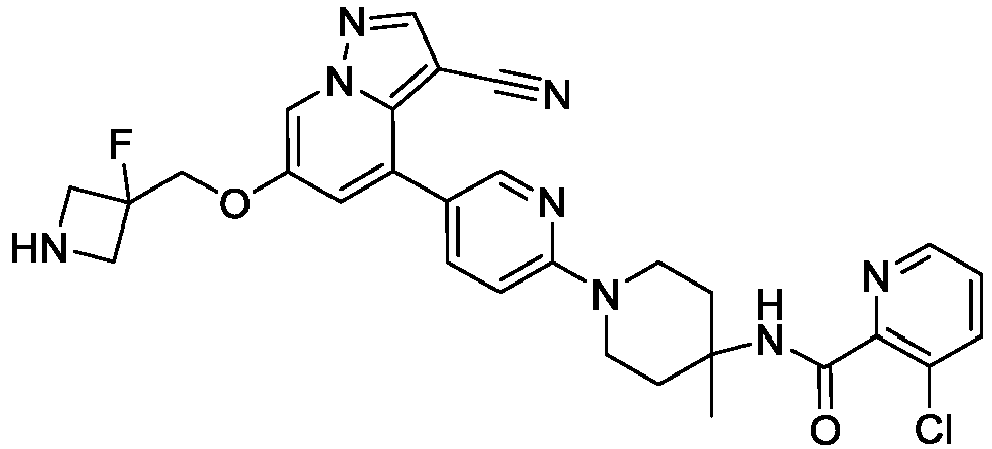
- Step 1: Preparation of tert-butyl 3-(((4-(6-(4-(3-chloropicolinamido)-4-methylpiperidin-1-yl)pyridin-3-yl)-3-cyanopyrazolo[1,5-a]pyridin-6-yl)oxy)methyl)-3-fluoroazetidine-1-carboxylate. A mixture of 3-chloro-N-(1-(5-(3-cyano-6-hydroxypyrazolo[1,5-a]pyridin-4-yl)pyridin-2-yl)-4-methylpiperidin-4-yl)picolinamide (Intermediate P75, 200 mg, 0.410 mmol), tert-butyl 3-(bromomethyl)-3-fluoroazetidine-1-carboxylate (220 mg, 0.820 mmol) and Cs2CO3(s) (160 mg, 0.492 mmol) in DMA (4099 µL) was stirred overnight at 60 °C. Subsequently, additional Cs2CO3(s) (160 mg, 0.492 mmol) was introduced, and the reaction mixture was stirred overnight again at 60 °C. After cooling to ambient temperature, the reaction mixture was partitioned between 4:1 DCM:IPA and water through a PS Frit rinsing with 4:1 DCM:IPA (3x). The combined organic extracts were concentrated in vacuo, and purified by silica chromatography (using a stepped gradient of 0-100% EtOAc/Hexanes as the gradient eluent) to afford the title compound contaminated with DMA (277 mg, quantitative yield assumed). MS (apci) m/z = 675.3 (M+H).
- Step 2: Preparation of 3-chloro-N-(1-(5-(3-cyano-6-((3-fluoroazetidin-3-yl)methoxy)pyrazolo[1,5-a]pyridin-4-yl)pyridin-2-yl)-4-methylpiperidin-4-yl)picolinamide.
- A solution of tert-butyl 3-(((4-(6-(4-(3-chloropicolinamido)-4-methylpiperidin-1-yl)pyridin-3-yl)-3-cyanopyrazolo[1,5-a]pyridin-6-yl)oxy)methyl)-3-fluoroazetidine-1-carboxylate (277 mg, 0.410 mmol) in DMA (∼0.5 mL; a solution that carried through the column) was treated with TFA (1106 µL, 14.4 mmol) and stirred for 60 h at ambient temperature. The reaction mixture was diluted with DCM and brine, then neutralized to pH 7 with 2 N NaOH(aq). The resulting biphasic mixture was passed through a PS Frit, and the organics were concentrated in vacuo. The crude residue was purified by silica chromatography (using 0-15% MeOH in EtOAc with 0.2% NH4OH as the gradient eluent) to cleanly afford the title compound (79 mg, 34% yield, over 2 steps). MS (apci) m/z = 575.2 (M+H).
-

- A solution of 4-(5-(4-amino-4-methylpiperidin-1-yl)pyridin-2-yl)-6-(2-morpholinoethoxy)pyrazolo[1,5-a]pyridine-3-carbonitrile dihydrochloride (Intermediate P124; 4.8 mg, 0.010 mmol) in DCM (0.2 mL) was treated sequentially with 2-chloro-6-methylbenzoic acid (3.5 mg, 0.021 mmol), DIEA (27 µL, 0.16 mmol), HATU (7.9 mg, 0.021 mmol). The resulting mixture was stirred for 17 h at ambient temperature, before diluting with water (10 mL) and extracting with DCM (2 × 10 mL). The combined organic extracts were dried over anhydrous MgSO4(s), filtered and concentrated in vacuo. The crude residue was purified by C18 reverse phase chromatography (using 5-95% ACN in water with 0.2% TFA as the gradient eluent) to afford the TFA salt of the title compound. The TFA salt was dissolved in MeOH (1 mL), and eluted through a basic resin (Stratospheres SPE MP-HCO3) to cleanly afford the title compound (3.5 mg, 55% yield). MS (apci) m/z = 614.2 (M+H).
-

- A solution of 4-(2-(4-amino-4-methylpiperidin-1-yl)pyrimidin-5-yl)-6-(2-morpholinoethoxy)pyrazolo[1,5-a]pyridine-3-carbonitrile bis(2,2,2-trifluoroacetate) (Intermediate P131; 22.7 mg, 0.0329 mmol) in DCM (579 µL) was treated with 2-chloro-6-methylbenzoic acid (25.1 mg, 0.147 mmol), DIEA (15 µL, 0.087 mmol) and HATU (13 mg, 0.035 mmol). The resulting mixture was stirred for 3 h at ambient temperature, was concentrated in vacuo. The residue was purified directly by silica chromatography (0-100% EtOAc in Hexanes followed by 0-10% MeOH in DCM). Persistent impurities required a second silica chromatography (0-10% MeOH in DCM with 0-0.1% NH4OH) to cleanly afford the title compound (2.8 mg, 9% yield). MS (apci) m/z = 615.2 (M+H).
-

- The title compound (12.34 mg, 42% yield) was prepared and purified using a similar procedure to that described for N-(1-(5-(3-cyano-6-(2-morpholinoethoxy)pyrazolo[1,5-a]pyridin-4-yl)pyrazin-2-yl)-4-methylpiperidin-4-yl)-5-fluoro-2-methylbenzamide (Example 682), replacing 2-chloro-6-methylbenzoic acid with 5-fluoro-2-methylbenzoic acid. MS (apci) m/z = 599.3 (M+H).
-

- The title compound (14 mg, 46% yield) was prepared and purified using a similar procedure to that described for N-(1-(5-(3-cyano-6-(2-morpholinoethoxy)pyrazolo[1,5-a]pyridin-4-yl)pyrazin-2-yl)-4-methylpiperidin-4-yl)-5-fluoro-2-methylbenzamide (Example 682), except 2-chloro-6-methylbenzoic acid was replaced with 2-chloro-5-fluorobenzoic acid and the reaction was allowed to stir overnight at ambient temperature before the work up and purification required only a single silica chromatographic separation (using 0-100% EtOAc in Hex then 0-10% MeOH in EtOAc as the gradient eluent). MS (apci) m/z = 619.2 (M+H).
-

- In a sealed vessel, a solution of 4-bromo-6-(2-hydroxy-2-methylpropoxy)pyrazolo[1,5-a]pyridine-3-carbonitrile (Intermediate P41, 18 mg, 0.058 mmol) in dioxane (0.5 mL) was treated sequentially with water (0.15 mL), Cs2CO3(s) (57 mg, 0.17 mmol), and 2-chloro-6-methyl-N-(4-methyl-1-(5-(4,4,5,5-tetramethyl-1,3,2-dioxaborolan-2-yl)pyrazin-2-yl)piperidin-4-yl)benzamide (Intermediate P125; 38 mg, 0.058 mmol). The resulting mixture was sparged with N2(g) for 5 min then treated with X-phos (11 mg, 0.023 mmol) and Pd2(dba)3 (5.3 mg, 0.0058 mmol). After sparging with N2(g) for 5 min, the vessel was sealed, and the resulting mixture was stirred for 17 h at 80 °C. After cooling to ambient temperature, the resulting suspension was diluted with water (10 mL) and extracted with DCM (2 × 10 mL). The combined organic extracts were dried over anhydrous MgSO4(s), filtered and concentrated in vacuo. The crude residue was purified by C18 reverse phase chromatography (using 5-95% ACN in water with 0.1% TFA as the gradient eluent) to afford the TFA salt of the title compound. The TFA salt was dissolved in MeOH (1 mL), and eluted through a basic resin (Stratospheres SPE MP-HCO3) to cleanly afford the title compound (3.6 mg, 11% yield). MS (apci) m/z = 574.2 (M+H); 596.2 (M+Na).
-

- A solution of N-(1-(5-(6-(2-aminoethoxy)-3-cyanopyrazolo[1,5-a]pyridin-4-yl)pyrazin-2-yl)-4-methylpiperidin-4-yl)-2-chloro-6-methylbenzamide bis(2,2,2-trifluoroacetate) (Intermediate P152; 80 mg, 0.103 mmol) in DCM (66 µL) was treated with formaldehyde (37% aq, 19.3 µL, 0.517 mmol) and NaBH(AcO)3 (110 mg, 0.517 mmol), then stirred overnight at ambient temperature. The resulting mixture was partitioned between 4:1 DCM:iPrOH and saturated NaHCO3(aq), and eluted through a PS Frit. The organic filtrate was concentrated in vacuo to cleanly afford the title compound (12.6 mg, 21% yield). MS (apci) m/z = 573.3 (M+H).
-

- In a pressure tube, a mixture of 6-((1-methyl-1H-imidazol-4-yl)methoxy)-4-(4,4,5,5-tetramethyl-1,3,2-dioxaborolan-2-yl)pyrazolo[1,5-a]pyridine-3-carbonitrile (Intermediate P145; 54 mg, 0.142 mmol), 2-chloro-N-(1-(5-chloropyrazin-2-yl)-4-methylpiperidin-4-yl)-6-methylbenzamide (Intermediate R48; 54.0 mg, 0.142 mmol), 2 M K3PO4(aq) (214 µL, 0.427 mmol), X-phos (13.6 mg, 0.0285 mmol) and Pd2(dba)3 (6.52 mg, 0.00712 mmol) in dioxane (1.0 mL) was sparged with Ar(g) for 10 min, and then the vessel was sealed. The reaction mixture was stirred overnight at 80 °C. After cooling to ambient temperature, the reaction mixture was diluted with DCM, and extracted sequentially with water (3x) and brine (1x). The organic extracts were purified directly by silica chromatography (0-100% EtOAc/Hexanes), and then by C18 reverse phase chromatography (5-95% ACN in water with 0.1% TFA) to cleanly provide the title compound (12.5 mg, 14.7% yield). MS (apci) m/z = 596.2 (M+H).
-

- A solution of tert-butyl (R)-2-(((4-(5-(4-(2-chloro-6-methylbenzamido)-4-methylpiperidin-1-yl)pyrazin-2-yl)-3-cyanopyrazolo[1,5-a]pyridin-6-yl)oxy)methyl)morpholine-4-carboxylate (Intermediate P148; 40.3 mg, 0.0575 mmol) in DCM (1 mL) and TFA (500 µL, 6.53 mmol) was stirred for 2 h at ambient temperature. Reaction was then concentrated down and purified by silica chromatography (using 0-100% [10% MeOH in DCM WITH 1% NH4OH]/ DCM as the gradient eluent) to cleanly afford the title compound (21.3 mg, 10% yield). MS (apci) m/z = 601.2 (M+H).
-

- A solution of (R)-2-chloro-N-(1-(5-(3-cyano-6-(morpholin-2-ylmethoxy)pyrazolo[1,5-a]pyridin-4-yl)pyrazin-2-yl)-4-methylpiperidin-4-yl)-6-methylbenzamide (Example 688; 12 mg, 0.02 mmol) in DCM (100 µL) was treated with acetaldehyde (1 µL, 0.02 mmol) and NaBH(AcO)3 (4 mg, 0.02 mmol), and stirred for 20 h at ambient temperature. The resulting mixture was concentrated in vacuo, and the residue was purified by C18 reverse phase chromatography (using 5-95% water-ACN with 0.1% TFA as the gradient eluent) to afford the TFA salt of the title compound. The TFA salt was partitioned between 4:1 DCM:iPrOH and saturated NaHCO3(aq) The organic extracts were separated, dried over anhydrous Na2SO4(s), filtered and concentrated in vacuo to cleanly afford the title compound (2.25 mg, 18% yield). MS (apci) m/z = 629.2 (M+H).
-

- The title compound (26.2 mg, quantitative yield) was prepared and purified using a similar procedure to that described for (R)-2-chloro-N-(1-(5-(3-cyano-6-(morpholin-2-ylmethoxy)pyrazolo[1,5-a]pyridin-4-yl)pyrazin-2-yl)-4-methylpiperidin-4-yl)-6-methylbenzamide (Example 688), replacing tert-butyl (R)-2-(((4-(5-(4-(2-chloro-6-methylbenzamido)-4-methylpiperidin-1-yl)pyrazin-2-yl)-3-cyanopyrazolo[1,5-a]pyridin-6-yl)oxy)methyl)morpholine-4-carboxylate (Intermediate P148; 0.0575 mmol) with of tert-butyl (S)-2-(((4-(5-(4-(2-chloro-6-methylbenzamido)-4-methylpiperidin-1-yl)pyrazin-2-yl)-3-cyanopyrazolo[1,5-a]pyridin-6-yl)oxy)methyl)morpholine-4-carboxylate (Intermediate P150; 0.164 mmol) and using 1 mL TFA. MS (apci) m/z = 601.2 (M+H).
-

- A solution of (S)-2-chloro-N-(1-(5-(3-cyano-6-(morpholin-2-ylmethoxy)pyrazolo[1,5-a]pyridin-4-yl)pyrazin-2-yl)-4-methylpiperidin-4-yl)-6-methylbenzamide (Example 690; 19.5 mg, 0.0324 mmol) in DCM (200 µL) was treated with acetaldehyde (1.88 µL, 0.0649 mmol) and NaBH(AcO)3 (13.8 mg, 0.0649 mmol), and stirred overnight at ambient temperature. The resulting mixture was partitioned between 4:1 DCM:iPrOH and saturated NaHCO3(aq), and eluted through a PS Frit. The combined organic filtrates were concentrated in vacuo to cleanly afford the title compound (9.4 mg, 46% yield). MS (apci) m/z = 629.3 (M+H).
-

- In a pressure tube, a mixture of 6-(2-(azetidin-1-yl)ethoxy)-4-bromopyrazolo[1,5-a]pyridine-3-carbonitrile (Intermediate P126; 26.4 mg, 0.0822 mmol), 2-chloro-6-methyl-N-(4-methyl-1-(5-(4,4,5,5-tetramethyl-1,3,2-dioxaborolan-2-yl)pyrazin-2-yl)piperidin-4-yl)benzamide (Intermediate R49; 53 mg, 0.0822 mmol), Pd(PPh3)4 (2.85 mg, 0.00247 mmol) and 2 M Na2CO3(aq) (247 µL, 0.493 mmol) in dioxane (2 mL) was sparged with Ar(g). The vessel was sealed, and the mixture was stirred for 2 h at 80 °C. After cooling to ambient temperature, the reaction mixture was diluted with water (10 mL) and extracted with 4:1 DCM:iPrOH (5 × 10 mL). The combined organic extracts were concentrated in vacuo, and the residue was purified by silica chromatography (using 0-10% MeOH in DCM as the gradient eluent) to cleanly afford the title compound (17 mg, 35% yield). MS (apci), m/z = 585.3 (M+H).
-

- In a pressure tube, a mixture of 6-(2-(pyrrolidin-1-yl)ethoxy)-4-(4,4,5,5-tetramethyl-1,3,2-dioxaborolan-2-yl)pyrazolo[1,5-a]pyridine-3-carbonitrile (Intermediate P143; 68 mg, 0.178 mmol), 2-chloro-N-(1-(5-chloropyrazin-2-yl)-4-methylpiperidin-4-yl)-6-methylbenzamide (Intermediate R48; 67.5 mg, 0.178 mmol), 2 M K3PO4(aq) (267 µL, 0.534 mmol), X-phos (17.0 mg, 0.0356 mmol) and Pd2(dba)3 (8.14 mg, 0.00889 mmol) in dioxane (889 µL) was sparged with Ar(g) for 3 min, and then the vessel was sealed. The reaction mixture was stirred overnight at 80 °C. After cooling to ambient temperature, the reaction mixture was diluted with water, and extracted with DCM (4x). The combined organic extracts were washed with brine (1x), dried over anhydrous Na2SO4(s), filtered, and concentrated in vacuo. The residue was purified by silica chromatography (using 0-20% MeOH in DCM as the gradient eluent) to cleanly afford the title compound (2.04 mg, 2% yield). MS (apci), m/z = 599.2 (M+H).
-

- A solution of 4-(5-(4-amino-4-methylpiperidin-1-yl)pyrazin-2-yl)-6-(2-morpholinoethoxy)pyrazolo[1,5-a]pyridine-3-carbonitrile bis(2,2,2-trifluoroacetate) (Intermediate P129; 20 mg, 0.0290 mmol), HATU (13.2 mg, 0.0348 mmol) and 2-chloro-6-methylbenzoic acid (5.43 mg, 0.0319 mmol) in DCM (579 µL) was treated with DIEA (15.2 µL, 0.0869 mmol). The resulting mixture was stirred overnight at ambient temperature, before introducing additional HATU (3.4 mg, 0.015 mmol) and DIEA (5 µL, 0.029 mmol). The resulting mixture was stirred for 60 h at ambient temperature. The reaction mixture was purified directly by silica chromatography (using 0-10% MeOH in EtOAc with 0.2% NH4OH as the gradient eluent) to cleanly afford the title compound (2.87 mg, 16% yield). MS (apci) m/z = 615.4 (M+H).
-

- A solution of 4-(5-(4-amino-4-methylpiperidin-1-yl)pyrazin-2-yl)-6-(2-morpholinoethoxy)pyrazolo[1,5-a]pyridine-3-carbonitrile bis(2,2,2-trifluoroacetate) (Intermediate P129; 20 mg, 0.0290 mmol), HATU (13 mg, 0.035 mmol) and 3-chloropicolinic acid (5.0 mg, 0.032 mmol) in DCM (579 µL) was treated with DIEA (15 µL, 0.087 mmol). The resulting mixture was stirred overnight at ambient temperature, was purified directly by silica chromatography (using 0-10% MeOH in EtOAc with 0.2% NH4OH as the gradient eluent) to cleanly afford the title compound (4 mg, 22% yield). MS (apci) m/z = 602.3 (M+H).
-

- A solution of 4-(5-(4-amino-4-methylpiperidin-1-yl)pyrazin-2-yl)-6-(2-morpholinoethoxy)pyrazolo[1,5-a]pyridine-3-carbonitrile bis(2,2,2-trifluoroacetate) (Intermediate P129; 20 mg, 0.0290 mmol), HATU (13 mg, 0.035 mmol) and 5-fluoro-2-methylbenzoic acid (4.9 mg, 0.032 mmol) in DCM (579 µL) was treated with DIEA (15 µL, 0.087 mmol). The resulting mixture was stirred overnight at ambient temperature, was purified directly by silica chromatography (using 0-10% MeOH in EtOAc with 0.2% NH4OH as the gradient eluent) to cleanly afford the title compound (4 mg, 22% yield). MS (apci) m/z = 599.3 (M+H).
-

- In a pressure tube, a mixture of tert-butyl 4-(2-((3-cyano-4-(4,4,5,5-tetramethyl-1,3,2-dioxaborolan-2-yl)pyrazolo[1,5-a]pyridin-6-yl)oxy)ethyl)piperazine-1-carboxylate (Intermediate P141; 50 mg, 0.10 mmol), 2-chloro-N-(1-(5-chloropyrazin-2-yl)-4-methylpiperidin-4-yl)-6-methylbenzamide (Intermediate R48; 38 mg, 0.10 mmol), 2 M K3PO4(aq) (151 µL, 0.30 mmol), X-phos (9.6 mg, 0.02 mmol) and Pd2(dba)3 (4.6 mg, 0.0050 mmol) in dioxane (503 µL) was sparged with Ar(g) for 3 min, and then the vessel was sealed. The reaction mixture was stirred for 4 h at 80 °C. After cooling to ambient temperature, the reaction mixture was diluted with water, and extracted with DCM (4x). The combined organic extracts were washed with brine (1x), dried over anhydrous Na2SO4(s), filtered, and concentrated in vacuo. The residue was purified twice by silica chromatography (using 0-100% EtOAc in Hexanes then with 0-20% MeOH in DCM as the gradient eluent) to cleanly afford the title compound (2.04 mg, 2% yield). MS (apci), m/z = 714.3 (M+H).
-

- A solution of tert-butyl 4-(2-((4-(5-(4-(2-chloro-6-methylbenzamido)-4-methylpiperidin-1-yl)pyrazin-2-yl)-3-cyanopyrazolo[1,5-a]pyridin-6-yl)oxy)ethyl)piperazine-1-carboxylate (Example 697; 26 mg, 0.036 mmol) in DCM (1 mL) and TFA (1 mL, 13 mmol) was stirred for 45 min at ambient temperature. The reaction mixture was treated with saturated NaHCO3(aq) (20 mL), extracted with 4:1 DCM:iPrOH (3x) and eluted through a PS Frit. The organics were concentrated in vacuo, and the residue was purified by silica chromatography (using 0-100% DCM in Hexanes then 0-10% MeOH in DCM with 0.1% NH4OH as the gradient eluent) to cleanly afford the title compound (7 mg, 31% yield). MS (apci) m/z = 614.2 (M+H).
-

- A solution of 2-chloro-N-(1-(5-(3-cyano-6-(2-(piperazin-1-yl)ethoxy)pyrazolo[1,5-a]pyridin-4-yl)pyrazin-2-yl)-4-methylpiperidin-4-yl)-6-methylbenzamide (Example 698; 6 mg, 0.01mmol) in DCM (488 µL) was treated with acetaldehyde (2.74 µL, 0.0488 mmol) and NaBH(AcO)3 (20.7 mg, 0.10 mmol), then stirred for 2 d at ambient temperature. The resulting mixture was purified directly by silica chromatography (using 0-20% MeOH in DCM with 0.1% NH4OH as the gradient eluent) to cleanly afford the title compound (1.33 mg, 20% yield). MS (apci) m/z = 642.3 (M+H).
-

- In a pressure tube, a mixture tert-butyl 3-(((3-cyano-4-(4,4,5,5-tetramethyl-1,3,2-dioxaborolan-2-yl)pyrazolo[1,5-a]pyridin-6-yl)oxy)methyl)-3-fluoroazetidine-1-carboxylate (Intermediate P144; 125 mg, 0.264 mmol), 2-chloro-N-(1-(5-chloropyrazin-2-yl)-4-methylpiperidin-4-yl)-6-methylbenzamide (Intermediate R48; 50 mg, 0.132 mmol), 2 M K3PO4(aq) (198 µL, 0.395 mmol), X-phos (12.6 mg, 0.0264 mmol) and Pd2(dba)3 (6.04 mg, 0.00659 mmol) in dioxane (659 µL) was sparged with Ar(g) for 10 min, and then the vessel was sealed. The reaction mixture was stirred overnight at 80 °C. After cooling to ambient temperature, the reaction mixture was diluted with DCM, and extracted with water (3x) and brine (1x). The organic extracts were concentrated in vacuo. The residue was purified by silica chromatography (using 0-100% EtOAc in Hexanes as the gradient eluent) to cleanly afford the title compound (28.2 mg, 31% yield). MS (apci), m/z = 689.3 (M+H).
-

- A solution tert-butyl 3-(((4-(5-(4-(2-chloro-6-methylbenzamido)-4-methylpiperidin-1-yl)pyrazin-2-yl)-3-cyanopyrazolo[1,5-a]pyridin-6-yl)oxy)methyl)-3-fluoroazetidine-1-carboxylate (Example 700; 27 mg, 0.039 mmol) in DCM (1 mL) and TFA (0.2 mL, 2.6 mmol) was stirred overnight at ambient temperature. The reaction mixture was concentrated in vacuo, and the residue was purified by silica chromatography (using 0-100% DCM/10% MeOH/1% NH4OH as the gradient eluent) to cleanly afford the title compound (19 mg, 82% yield). MS (apci) m/z = 589.2 (M+H).
-

- A solution of 2-chloro-N-(1-(5-(3-cyano-6-((3-fluoroazetidin-3-yl)methoxy)pyrazolo[1,5-a]pyridin-4-yl)pyrazin-2-yl)-4-methylpiperidin-4-yl)-6-methylbenzamide (Example 701; 16 mg, 0.0270 mmol) in DCM (0.15 mL) was treated with acetaldehyde (7.6 µL, 0.136 mmol) and NaBH(AcO)3 (29 mg, 0.136 mmol), then stirred for 15 h at ambient temperature. The resulting mixture was concentrated in vacuo. The residue was purified by C18 reverse phase chromatography (5-95% acetonitrile in water with 0.1% TFA) to cleanly afford the title compound (10 mg, 60% yield). MS (apci) m/z = 617.2 (M+H).
-

- A solution of tert-butyl 3-(((4-(5-(4-(2-chloro-5-fluorobenzamido)-4-methylpiperidin-1-yl)pyrazin-2-yl)-3-cyanopyrazolo[1,5-a]pyridin-6-yl)oxy)methyl)-3-fluoroazetidine-1-carboxylate (Intermediate P154; 3 mg, 0.0043 mmol) in DCM (0.25 mL) and TFA (0.05 mL, 0.65 mmol) was stirred overnight at ambient temperature. The reaction mixture was diluted with DCM, treated with saturated NaHCO3(aq), and the biphasic mixture was extracted with DCM (3x). The combined organic extracts were washed with brine, dried over anhydrous Na2SO4(s), filtered and concentrated in vacuo to afford the title compound (1.79 mg, 70% yield). MS (apci) m/z = 593.2 (M+H).
-

- A solution of 2-chloro-N-(1-(5-(3-cyano-6-((3-fluoroazetidin-3-yl)methoxy)pyrazolo[1,5-a]pyridin-4-yl)pyrazin-2-yl)-4-methylpiperidin-4-yl)-5-fluorobenzamide (Example 703; 16 mg, 0.0270 mmol) in DCM (1.72 mL) was treated with acetaldehyde (7.57 µL, 0.135 mmol) and NaBH(AcO)3 (57.2 mg, 0.270 mmol), then stirred for 1 h at ambient temperature. The resulting mixture was purified directly by silica chromatography (using 0-20% MeOH in DCM with 0.1% NH4OH as the gradient eluent) to cleanly afford the title compound (2 mg, 12% yield). MS (apci) m/z = 521.2 (M+H).
-

- A solution of tert-butyl 3-(((4-(5-(4-(2-chloro-6-methylbenzamido)-4-methylpiperidin-1-yl)pyrazin-2-yl)-3-cyanopyrazolo[1,5-a]pyridin-6-yl)oxy)methyl)-3-fluoropyrrolidine-1-carboxylate (Intermediate P149; 15 mg, 0.019 mmol) in DCM (1 mL) and TFA (1 mL, 13 mmol) was stirred overnight at ambient temperature. The reaction mixture was concentrated in vacuo, and the residue was purified directly by silica chromatography (using 0-100% DCM in Hexanes then 0-10% MeOH in DCM with 0.1% NH4OH as the gradient eluent to cleanly afford the title compound (7 mg, 60% yield). MS (apci) m/z = 603.2 (M+H).
-

- To a suspension of 4-(6-fluoropyridin-3-yl)-6-(2-hydroxy-2-methylpropoxy)pyrazolo[1,5-a]pyridine-3-carbonitrile (Intermediate P42, 90 mg, 0.276 mmol) in DMSO (2 mL) was added DIEA (193 µL, 1.10 mmol), followed by the addition of 4-(pyridin-2-ylmethyl)piperidin-4-ol hydrochloride (69 mg, 0.303 mmol). The reaction mixture was stirred at 90 °C for 60 h, then purified directly by C18 reverse phase chromatography (using 5-95% acetonitrile in water with 0.1% TFA as the gradient eluent). Fractions containing the desired product were combined, partially concentrated in vacuo to remove the ACN, then partitioned between saturated NaHCO3(aq) and DCM. The biphasic mixture was extracted with additional DCM (2x). The combined organic extracts were dried over anhydrous MgSO4(s), filtered and concentrated in vacuo. The residue was sonicated in Et2O (2 mL) and then concentrated in vacuo to afford the title compound (48 mg, 35% yield). MS (apci) m/z = 499.2 (M+H).
-

- Step 1: Preparation of tert-butyl ((3S,4S)-1-(5-(3-cyano-6-ethoxypyrazolo[1,5-a]pyridin-4-yl)pyrazin-2-yl)-3-hydroxypiperidin-4-yl)carbamate. To a mixture of 6-ethoxy-4-(4,4,5,5-tetramethyl-1,3,2-dioxaborolan-2-yl)pyrazolo[1,5-a]pyridine-3-carbonitrile (Intermediate P110, 296 mg, 0.782 mmol) and tert-butyl ((3S,4S)-1-(5-chloropyrazin-2-yl)-3-hydroxypiperidin-4-yl)carbamate (Intermediate R53, 181 mg, 0.55 mmol) in dioxane (2.7 mL) was added XPhos (52 mg, 0.11 mmol), Pd2(dba)3 (25 mg, 0.028 mmol), and K3PO4 (2 M aq., 0.82 mL). The reaction was sparged with Argon for one minute before heating to 85 °C and stirring overnight. After cooling to RT, the reaction was diluted with water (15 mL) and extracted with DCM (3 × 15 mL). The combined organic extracts were washed with brine (15 mL), dried over anhydrous Na2SO4(s), filtered, and concentrated in vacuo. The crude material was purified by silica chromatography (0-15% MeOH/DCM) to afford the title compound (147 mg, 56% yield). MS (apci) m/z = 480.2 (M+H).
- Step 2: Preparation of 4-(5-((3S,4S)-4-amino-3-hydroxypipelidin-1-yl)pyrazin-2-yl)-6-ethoxypyrazolo[1,5-a]pyridine-3-carbonitrile. A solution of tert-butyl ((3S,4S)-1-(5-(3-cyano-6-ethoxypyrazolo[1,5-a]pyridin-4-yl)pyrazin-2-yl)-3-hydroxypiperidin-4-yl)carbamate (147 mg, 0.31 mmol) in DCM (3 mL) and TFA (2 mL) was stirred for 30 minutes at RT. The solution was concentrated in vacuo, then diluted with saturated NaHCO3 (10 mL) and extracted with DCM (3 × 10 mL). The combined organic extracts were dried over anhydrous Na2SO4(s), filtered, and concentrated in vacuo to afford the title compound (58 mg, 50% yield). MS (apci) m/z = 380.2 (M+H).
- Step 3: Preparation of 3-chloro-N-((3S,4S)-1-(5-(3-cyano-6-ethoxypyrazolo[1,5-a]pyridin-4-yl)pyrazin-2-yl)-3-hydroxypiperidin-4-yl)picolinamide. To a solution of 4-(5-((3S,4S)-4-amino-3-hydroxypiperidin-1-yl)pyrazin-2-yl)-6-ethoxypyrazolo[1,5-a]pyridine-3-carbonitrile (21.2 mg, 0.056 mmol) in DMSO (0.6 mL) was added 3-chloropicolinic acid (8.8 mg, 0.056 mmol) and DIEA (0.1 mL, 0.56 mmol), followed by the addition of HATU (23.4 mg, 0.061 mmol). After stirring for 80 minutes at RT, the reaction mixture was diluted with saturated NaHCO3 (5 mL) and extracted with DCM (3 × 5 mL). The combined organic extracts were washed with brine (5 mL), dried over anhydrous Na2SO4(s), filtered, and concentrated in vacuo to afford the title compound (29 mg, 99% yield). MS (apci) m/z = 519.1 (M+H).
- The compounds in Table ZZZ were prepared using a similar method as described in Example 707 Step 3, replacing 3-chloropicolinic acid with the appropriate carboxylic acid.
Table ZZZ Ex. # Structure Chemical Name LCMS m/z 708 
N-((3S,4S)-1-(5-(3-cyano-6-ethoxypyrazolo[1,5-a]pyridin-4-yl)pyrazin-2-yl)-3-hydroxypiperidin-4-yl)-3-methylbutanamide 464.2 (M+H) 709 
2-chloro-N-((3S,4S)-1-(5-(3-cyano-6-ethoxypyrazolo[1,5-a]pyridin-4-yl)pyrazin-2-yl)-3-hydroxypiperidin-4-yl)-5-fluorobenzamide 536.1 (M+H) 710 
N-((3S,4S)-1-(5-(3-cyano-6-ethoxypyrazolo[1,5-a]pyridin-4-yl)pyrazin- 2-yl)-3-hydroxypiperidin-4-yl)-3-(trifluoromethyl)picolinam ide 553.1 (M+H) 711 
2-chloro-N-((3S,4S)-1-(5-(3-cyano-6-ethoxypyrazolo[1,5-a]pyridin-4-yl)pyrazin-2-yl)-3-hydroxypiperidin-4-yl)-6-fluorobenzamide 536.1 (M+H) 712 
N-((3S,4S)-1-(5-(3-cyano-6-ethoxypyrazolο[1,5-a]pyridin-4-yl)pyrazin-2-yl)-3-hydroxypiperidin-4-yl)-3-methylpicolinamide 499.2, 521.2 (M+H, M+Na) -

- A mixture of tert-butyl ((3r,4r)-1-(5-(3-cyano-6-ethoxypyrazolo[1,5-a]pyridin-4-yl)pyridin-2-yl)-4-hydroxypiperidin-3-yl)carbamate (Intermediate P158, 0.025 g, 0.052 mmol), 3-chloro-6-methylpyridazine (0.010 g, 0.078 mmol) and NaH (0.0042 g, 0.10 mmol) in DMF (0.26 mL) was heated to 90 °C overnight. The mixture was then concentrated down and purified by preparative HPLC (5-95% ACN in water with 1% TFA). The mixture was then worked up with DCM and sat. NaHCO3. The organic layers were washed with brine, dried with Na2SO4 and concentrated to yield the title product (6.4 mg, 26 % yield). MS (apci) m/z = 471.2 (M+H).
-

- 4-(6-((3r,4r)-3-amino-4-((6-methylpyridazin-3-yl)oxy)piperidin-1-yl)pyridin-3-yl)-6-ethoxypyrazolo[1,5-a]pyridine-3-carbonitrile (Example 713, 65 mg, 0.138 mmol) was treated with SFC chiral chromatography (5-70% MeOH:IPA:DEA 80:20:0.1) to yield two products. The desired product was isolated from fractions containing peak 1 and was arbitrarily assigned as the (R,R) isomer (6.6 mg). MS (apci) m/z = 471.2 (M+H).
-
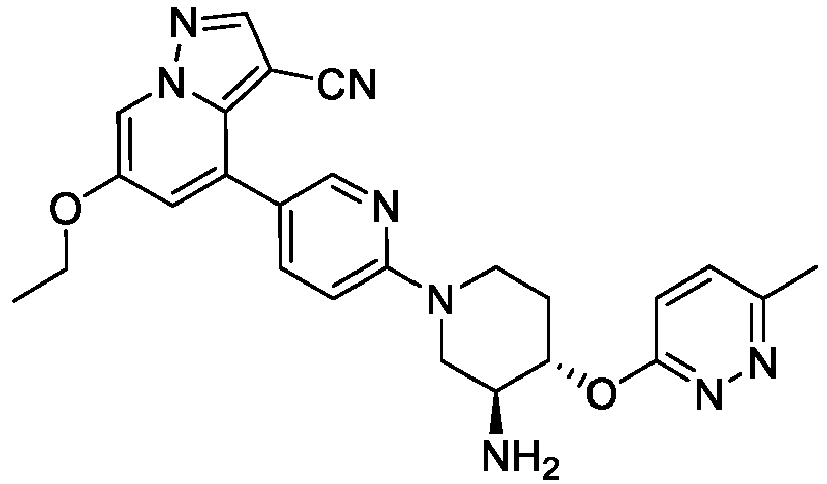
- The title compound was prepared and purified by chiral chromatography according to the procedure described in Example 714. The desired product was isolated from fractions containing peak 2 and was arbitrarily assigned as the (S,S) isomer (9.1 mg). MS (apci) m/z = 471.2 (M+H).
-

- A mixture of tert-butyl ((3r,4r)-1-(5-(3-cyano-6-ethoxypyrazolo[1,5-a]pyridin-4-yl)pyridin-2-yl)-4-hydroxypiperidin-3-yl)carbamate (Intermediate P158, 0.035 g, 0.073 mmol), 2-(2-bromoethoxy)propane (0.012 g, 0.073 mmol) and NaH (0.0035 g, 0.088 mmol) in DMF (0.49 mL) was heated to 90 °C overnight. The mixture was concentrated and purified by preparative HPLC (5-95% ACN in water with 1% TFA). The fractions containing the product were concentrated and partitioned between DCM and sat. NaHCO3. After phase-separation and aqueous extractions with DCM, the combined organic extracts were washed with brine, dried with Na2SO4, and concentrated to yield the title product (2.9 mg, 8.5 % yield). MS (apci) m/z = 465.3 (M+H).
-

- A mixture of 4-(6-((3R,4S)-4-amino-3-hydroxypiperidin-1-yl)pyridin-3-yl)-6-methoxypyrazolo[1,5-a]pyridine-3-carbonitrile (Intermediate P159, 0.025 g, 0.0686 mmol), 2-chloro-5-fluorobenzoic acid (0.0180 g, 0.103 mmol), HATU (0.0522 g, 0.137 mmol) and Hunig's base (0.0358 ml, 0.206 mmol) in DMSO (0.686 mL) was stirred at RT overnight. The mixture was worked up with DCM and water. The organic layer was washed with brine, dried with Na2SO4, filtered and concentrated. The crude material was purified by preparative HPLC (5-95% ACN in water with 1% TFA). The combined fractions containing the product were worked up with DCM and sat. NaHCO3. The combined organic extracts were washed with brine, dried (Na2SO4), filtered and concentrated to yield the title product (0.0198 g, 55.4 % yield). MS (apci) m/z = 521.1 (M+H).
-

- The title product was prepared according to the procedure described in Example 717, replacing 2-chloro-5-fluorobenzoic acid with 2-chloro-6-fluorobenzoic acid. MS (apci) m/z = 521.1 (M+H).
-

- A solution of 4-(6-((3S,4S)-4-amino-3-hydroxypiperidin-1-yl)pyridin-3-yl)-6-ethoxypyrazolo[1,5-a]pyridine-3-carbonitrile dihydrochloride (Example 522, Step 1; 30.6 mg, 0.0678 mmol) and 2-methylpropane-1-sulfonyl chloride (15.9 mg, 0.102 mmol) in DCM (1 mL) was treated with DIEA (0.118 mL, 0.678 mmol) and stirred at RT for 1 h. The reaction mixture was treated with silica chromatography (30-100% EtOAc in hexanes) to yield the title product (12.3 mg, 36.4 % yield). MS (apci) m/z = 499.2, 521.2 (M+H, M+Na).
-

- The title product was prepared according to the procedure described in Example 719, replacing 2-methylpropane-1-sulfonyl chloride with 1-bromo-3-methylbutane. The crude material was first treated with silica chromatography (0-25% MeOH in DCM), followed by preparative HPLC (15-85% ACN in water with 0.1% TFA). The combined fractions containing the product were partitioned between sat. NaHCO3 and 4:1 DCM/IPA, and the combined organic extracts were passed thru a PS-Separator frit and concentrated to yield the title product as white solid (2.7 mg, 8 % yield) MS (apci) m/z = 449.3 (M+H).
-

- A solution of (3S,4S)-4-amino-1-(5-(3-chloro-6-ethoxypyrazolo[1,5-a]pyridin-4-yl)pyridin-2-yl)piperidin-3-ol dihydrochloride (Intermediate P161; 50 mg, 0.109 mmol) in DCM (1 mL, 0.109 mmol) was treated with DIEA (0.190 mL, 1.09 mmol) and 3-methylbutanoyl chloride (19.6 mg, 0.163 mmol). The reaction mixture was stirred at rt for 1 h, then purified by silica chromatography (20-100% EtOAc in hexanes) to yield the title product as white solid (14.6 mg, 28 % yield). MS (apci) m/z = 472.2 (M+H).
- The compounds in Table X1 were prepared using a similar method to that described in Step 2 in the synthesis of N-((3S,4S)-1-(5-(3-cyano-6-ethoxypyrazolo[1,5-a]pyridin-4-yl)pyridin-2-yl)-3-hydroxypiperidin-4-yl)-1-(trifluoromethyl)cyclobutane-1-carboxamide (Example 522), replacing 1-(trifluoromethyl)cyclobutane-1-carboxylic acid with the appropriate carboxylic acid. Reactions were monitored for completion by LCMS, and reaction durations were adjusted accordingly. The title compounds were isolated following a chromatographic purification utilizing an appropriate gradient eluent.
Table X1 Ex # Structure Chemical Name MS (apci) m/z 722 
2-chloro-N-((3 S,4S)-1-(5-(3-cyano-6-ethoxypyrazolo[1,5-a]pyridin-4-yl)pyridin-2-yl)-3-hydroxypiperidin-4-yl)-5-fluorobenzamide 535.2 (M+H) 723 
2-chloro-N-((3S,4S)-1-(5-(3-cyano-6-ethoxypyrazolo[1,5-a]pyridin-4-yl)pyridin-2-yl)-3-hydroxypiperidin-4-yl)-6-fluorobenzamide 535.1 (M+H) 724 
N-((3S,4S)-1-(5-(3-cyano-6-ethoxypyrazolo[1,5-a]pyridin-4-yl)pyridin-2-yl)-3-hydroxypiperidin-4-yl)-3-(trifluoromethyl)picolinam ide 552.1 (M+H) 725 
N-((3S,4S)-1-(5-(3-cyano-6-ethoxypyrazolo[1,5-a]pyridin-4-yl)pyridin-2-yl)-3-hydroxypiperidin-4-yl)-5-fluoro-2-methylbenzamide 515.2, 557.2 (M+H, M+Na) 726 
N-((3S,4S)-1-(5-(3-cyano-6-ethoxypyrazolo[1,5-a]pyridin-4-yl)pyridin-2-yl)-3-hydroxypiperidin-4-yl)-3,3-difluorocyclobutane-1-carboxamide 497.2 (M+H) 727 
N-((3S,4S)-1-(5-(3-cyano-6-ethoxypyrazolo[1,5-a]pyridin-4-yl)pyridin-2-yl)-3-hydroxypiperidin-4-yl)-4,4,4-trifluorobutanamide 503.1 (M+H) -

- Step 1: Preparation of (3r,4r)-3-((tert-butoxycarbonyl)amino)-1-(5-(3-cyano-6-ethoxypyrazolo[1,5-a]pyridin-4-yl)pyridin-2-yl)piperidin-4-yl methanesulfonate. A mixture of tert-butyl ((3r,4r)-1-(5-(3-cyano-6-ethoxypyrazolo[1,5-a]pyridin-4-yl)pyridin-2-yl)-4-hydroxypiperidin-3-yl)carbamate (Intermediate P158, 0.0234 g, 0.0489 mmol), methanesulfonyl chloride (0.00454 ml, 0.0587 mmol) and Hunig's base (0.0128 ml, 0.0733 mmol) in DCM (0.489 mL) was stirred at RT overnight. The mixture was worked up with DCM and water. The organic layers were washed with brine, dried with Na2SO4 and concentrated to yield the title compound (0.025 g, 91.9 % yield). MS (apci) m/z = 557.2 (M+H).
- Step 2: Preparation of tert-butyl ((3r,4s)-4-azido-1-(5-(3-cyano-6-ethoxypyrazolo[1,5-a]pyridin-4-yl)pyridin-2-yl)piperidin-3-yl)carbamate. (3r,4r)-3-((tert-butoxycarbonyl)amino)-1-(5-(3-cyano-6-ethoxypyrazolo[1,5-a]pyridin-4-yl)pyridin-2-yl)piperidin-4-yl methanesulfonate (0.025 g, 0.045 mmol) and NaN3 (0.0035 g, 0.054 mmol) in DMF (0.45 mL) was heated to 90 °C overnight. The mixture was worked up with DCM and water. The organic layers were combined, washed with brine, dried over Na2SO4, and concentrated to yield the title compound (0.021 g, 93 % yield). MS (apci) m/z = 504.2 (M+H).
- Step 3: Preparation of tert-butyl ((3r,4s)-4-amino-1-(5-(3-cyano-6-ethoxypyrazolo[1,5-a]pyridin-4-yl)pyridin-2-yl)piperidin-3-yl)carbamate. Tert-butyl ((3r,4s)-4-azido-1-(5-(3-cyano-6-ethoxypyrazolo[1,5-a]pyridin-4-yl)pyridin-2-yl)piperidin-3-yl)carbamate (0.021 g, 0.042 mmol) and Pd/C was stirred in MeOH under H2 balloon for 4 hours. The mixture was then filtered and concentrated down to yield the title compound (0.017 g, 85 % yield). MS (apci) m/z = 478.2 (M+H).
- Step 4: Preparation of N-((3r,4r)-3-amino-1-(5-(3-cyano-6-ethoxypyrazolo[1,5-a]pyridin-4-yl)pyridin-2-yl)piperidin-4-yl)-3-methylbutanamide. A mixture of tert-butyl ((3r,4s)-4-amino-1-(5-(3-cyano-6-ethoxypyrazolo[1,5-a]pyridin-4-yl)pyridin-2-yl)piperidin-3-yl)carbamate (0.017 g, 0.0356 mmol), 3-methylbutanoic acid (0.00545 g, 0.0534 mmol), HATU (0.0271 g, 0.0712 mmol) and Hunig's base (0.00806 mL, 0.0463 mmol) in DMSO (0.356 mL) was stirred RT overnight. The mixture was worked up with DCM and water. The organic layers were combined, washed with brine, dried over Na2SO4 and concentrated, and then stirred in DCM (1 mL) and TFA (1 mL) for 1 h. The mixture was concentrated and then purified by preparative HPLC (5-95% ACN in water with 1% TFA). The fractions containing the product were combined and worked up with DCM and sat. NaHCO3. The combined organic extracts were washed with brine, dried (Na2SO4), filtered and concentrated to yield the title product (0.0066 g, 40% yield). MS (apci) m/z = 462.2 (M+H).
-

- A mixture of tert-butyl ((3S,4S)-4-amino-1-(5-(3-cyano-6-ethoxypyrazolo[1,5-a]pyridin-4-yl)pyridin-2-yl)piperidin-3-yl)carbamate (Intermediate P162; 0.026 g, 0.0544 mmol), 3-chloropicolinic acid (0.00944 g, 0.0599 mmol), HATU (0.0414 g, 0.109 mmol) and Hunig's base (0.0123 ml, 0.0708 mmol) in DMSO (0.544 mL) was stirred at room temp overnight. The mixture was worked up with DCM and water. The organic layer was washed with brine, dried with Na2SO4, filtered and concentrated. The concentrated material was stirred in DCM (1 mL) and TFA (1 mL) for 1 h, then concentrated and purified by preparative HPLC (5-95% acetonitrile in water with 1% TFA). The fractions containing the product were combined and partitioned between DCM and saturated NaHCO3 The combined organic extracts were washed with brine, dried (Na2SO4), filtered and concentrated to yield the title product (0.008 g, 28.4 % yield). MS (apci) m/z = 517.2 (M+H).
- The compounds in Table X2 were prepared using a similar method to that described in Example 729, replacing 3-chloropicolinic acid with the appropriate carboxylic acid. Reactions were monitored for completion by LCMS, and reaction durations were adjusted accordingly. The title compounds were isolated following a chromatographic purification utilizing an appropriate gradient eluent.
Table X2 Ex # Structure Chemical Name MS (apci) m/z 730 
N-((3S,4S)-3-amino-1-(5-(3-cyano-6-ethoxypyrazolo[1,5-a]pyridin-4-yl)pyridin-2-yl)piperidin-4-yl)-2-chloro-6-methylbenzamide 530.2 (M+H) 731 
N-((3S,4S)-3-amino-1-(5-(3-cyano-6-ethoxypyrazolo[1,5-a]pyridin-4-yl)pyridin-2-yl)piperidin-4-yl)-5-fluoro-2-methylbenzamide 514.2 (M+H) -

- Step 1: Preparation of 4-(6-((3R,4R)-4-amino-3-hydroxypiperidin-1-yl)pyridin-3-yl)-6-ethoxypyrazolo[1,5-a)pyridine-3-carbonitrile. To a solution of tert-butyl ((3R,4R)-1-(5-(3-cyano-6-ethoxypyrazolo[1,5-a]pyridin-4-yl)pyridin-2-yl)-3-hydroxypiperidin-4-yl)carbamate (Example 512; 110 mg, 0.23 mmol) in DCM (2 mL) was added TFA (1 mL). After 90 min stirring, the reaction was concentrated, taken up in minimal amount of MeOH and passed thru a P1-HCO3 resin plug. Removal of solvent under reduced pressure yielded the title compound, which was directly used in the next step without further purifications, assuming quantitative yield. MS (apci) m/z = 379.2 (M+H).
- Step 2: Preparation of N-((3R,4R)-1-(5-(3-cyano-6-ethoxypyrazolo[1,5-a]pyridin-4-yl)pyridin-2-yl)-3-hydroxypiperidin-4-yl)-3-methylbutanamide. A mixture of 4-(6-((3R,4R)-4-amino-3-hydroxypiperidin-1-yl)pyridin-3-yl)-6-ethoxypyrazolo[1,5-a]pyridine-3-carbonitrile (24 mg, 0.0634mmol), 3-methylbutanoic acid (0.01 mL, 0.063 mmol), DCM (0.6 mL), DIEA (0.066 mL, 0.38mmol) and HATU (29 mg, 0.076 mmol) was stirred at RT overnight. The reaction mixture was partitioned between DCM and water (10 mL each). The organic layer was concentrated and purified by preparative HPLC (5-95% acetonitrile in water with 1% TFA) to yield the title product (2 mg, 6% yield). MS (apci) m/z = 463.2 (M+H).
-

- To a solution of 4-(5-(4-amino-4-methylpiperidin-1-yl)pyrimidin-2-yl)-6-(2-morpholinoethoxy)pyrazolo[1,5-a]pyridine-3-carbonitrile (P163, 4 mg, 0.00865 mmol) in DCM (0.3 mL) was added 3-methylbutanoic acid (0.001mL, 0.013 mmol), N-ethyl-N-isopropylpropan-2-amine (0.009 mL, 0.052 mmol) and HATU (4.3mg, 0.0112 mmol). After stirred at RT overnight, the reaction was partitioned between DCM and saturated NaHCO3. After phase-separation, the aqueous was extracted with DCM (3 × 10 mL). The organic extracts were combined and concentrated. The crude material was purified by preparative HPLC (5-95% acetonitrile in water with 1% TFA) to yield the title product (1.7 mg, 36%). MS (apci) m/z = 547.3 (M+H).
-

- The title compound was prepared using a similar method to that described in Example 733, replacing 3-methylbutanoic acid with the 2-chloro-6-methylbenzoic acid. MS (apci) m/z = 615.2 (M+H).
- The compounds in Table X3 were prepared using a similar method as described in Example 88, replacing 3,6-dimethylpicolinic acid with the appropriate carboxylic acid.
Table X3 Ex. # Structure Chemical Name LCMS m/z 735 
N-(1-(5-(3-cyano-6-(2-hydroxy-2-methylpropoxy)pyrazolo[1 ,5-a]pyridin-4-yl)pyridin-2-yl)-4-methylpiperidin-4-yl)-4-methylpyridazine-3-carboxamide 541.2 (M+H) 736 
N-(1-(5-(3-cyano-6-(2-hydroxy-2-methylpropoxy)pyrazolo[1 ,5-a]pyridin-4-yl)pyridin-2-yl)-4-methylpiperidin-4-yl)-3 -methylpyrazine-2-carboxamide 541.2 (M+H) 737 
N-(1-(5-(3-cyano-6-(2-hydroxy-2-methylpropoxy)pyrazolo[1 ,5-a]pyridin-4-yl)pyridin-2-yl)-4-methylpiperidin-4-yl)-6-methylpyridazine-3-carboxamide 541.2 (M+H) 738 
N-(1-(5-(3-cyano-6-(2-hydroxy-2-methylpropoxy)pyrazolo[1 ,5-a]pyridin-4-yl)pyridin-2-yl)-4-methylpiperidin-4-yl)-3 ,6-dimethyl pyrazine-2-carboxamide 555.3 (M+H) -

- Step 1: Preparation of 4-(5-bromopyrimidin-2-yl)-6-ethoxypyrazolo[1,5-a]pyridine-3-carbonitrile. To (3-cyano-6-(2-morpholinoethoxy)pyrazolo[1,5-a]pyridin-4-yl)boronic acid (Intermediate P110, 190 mg, 0.61mmol) and 5-bromo-2-iodopyrimidine (225mg, 0.789mmol) in dioxane (2 mL) was added XPhos (58 mg, 0.121 mmol), Pd2(dba)3 (3.3 mg, 0.03 mmol) and K3PO4 (2 M aq, 0.9 mL, 1.8 mmol). The reaction mixture was sparged with argon and heated at 85 °C overnight. After cooling to RT, the reaction was partitioned in 1:1 DCM:water (30 mL). After phase-separation, the aqueous was extracted with DCM (2 × 15 mL). The combined organic extracts were dried (Na2SO4), filtered and concentrated. The crude material was purified by silica chromatography (0-60% EtOAc/hexanes) to afford the title compound (30 mg, 14%).
- Step 2: Preparation of 6-ethoxy-4-(5-(4-((5-methoxypyridin-2-yl)oxy)piperidin-1-yl)pyrimidin-2-yl)pyrazolo[1,5-a]pyridine-3-carbonitrile. A mixture of 4-(5-bromopyrimidin-2-yl)-6-ethoxypyrazolo[1,5-a]pyridine-3-carbonitrile (30 mg, 0.087 mmol), 5-methoxy-2-(piperidin-4-yloxy)pyridine (37 mg, 0.18mmol), Cs2CO3 (57 mg, 0.17 mmol), XPhos (4 mg, 0.0087 mmol) and Pd2(dba)3 (4 mg, 0.0044 mmol) in dioxane (0.44 mL) was sparged with argon, and stirred at 90 °C overnight. After cooling to RT, the reaction was partitioned in 1:1 DCM:water (20 mL). After phase-separation, the aqueous was extracted with DCM (2 × 10 mL). The combined organic extracts were dried (Na2SO4), filtered and concentrated. The crude material was purified by preparative TLC (10% MeOH in DCM) to afford the title product (1.4 mg, 3%). MS (apci) m/z = 472.2 (M+H).
- The compounds in Table X4 were prepared using a similar method as described in Example 706, replacing 4-(pyridin-2-ylmethyl)piperidin-4-ol hydrochloride with the appropriate piperidine intermediate.
Table X4 Ex. # Structure Chemical Name LCMS m/z Intermediate 740 
6-(2-hydroxy-2-methylpropoxy)-4-(6-(4-hydroxy-4-(pyridin-3-ylmethyl)piperidin-1-yl)pyridin-3-yl)pyrazolo[1,5-a]pyridine-3-carbonitrile 499.2 (M+H) 4-(pyridin-3-ylmethyl)piperidi hydrochloride (commercially available) 741 
6-(2-hydroxy-2-methylpropoxy)-4-(6-(4-hydroxy-4-((6-methoxypyridin-3-yl)methyl)piperidin-1-yl)pyridin-3-yl)pyrazolo[1,5-a]pyridine-3-carbonitrile 529.2 (M+H) R66 742 
4-(6-(4-(3-fluorobenzyl)-4-hydroxypiperidin-1-yl)pyridin-3-yl)-6-(2-hydroxy-2-methylpropoxy)pyrazolo[1 ,5-a]pyridine-3 -carbonitrile 516.2 (M+H) R67 743 
4-(6-(4-((3-fluoropyridin-2-yl)methyl)-4-hydroxypiperidin-1-yl)pyridin-3-yl)-6-(2-hydroxy-2-methylpropoxy)pyrazolo[1 ,5-a]pyridine-3-carbonitrile 517.2 (M+H) R68 744 
4-(6-(4-(2-fluorobenzyl)-4-hydroxypiperidin-1-yl)pyridin-3-yl)-6-(2-hydroxy-2-methylpropoxy)pyrazolo[1 ,5-a]pyridine-3-carbonitrile 516.3 (M+H) R55 745 
6-(2-hydroxy-2-methylpropoxy)-4-(6-(4-hydroxy-4-(2-methoxybenzyl)piperidin-1-yl)pyridin-3-yl)pyrazolo[1,5-a]pyridine-3-carbonitrile 528.3 (M+H) R56 746 
6-(2-hydroxy-2-methylpropoxy)-4-(6-(4-hydroxy-4-(3-methylbenzyl)piperidin-1-yl)pyridin-3-yl)pyrazolo[1,5-a]pyridine- 512.3 (M+H) R62 3-carbonitrile 747 
6-(2-hydroxy-2-methylpropoxy)-4-(6-(4-hydroxy-4-(4-methylbenzyl)piperidin-1-yl)pyridin-3-yl)pyrazolo[1,5-a]pyridine-3-carbonitrile 512.2 (M+H) R63 748 
4-(6-(4-(4-fluorobenzyl)-4-hydroxypiperidin-1-yl)pyridin-3-yl)-6-(2-hydroxy-2-methylpropoxy)pyrazolo[1 ,5-a]pyridine-3-carbonitrile 516.2 (M+H) R57 749 
6-(2-hydroxy-2-methylpropoxy)-4-(6-(4-hydroxy-4-(2-methylbenzyl)piperidin-1-yl)pyridin-3-yl)pyrazolo[1,5-a]pyridine-3-carbonitrile 512.3 (M+H) R64 750 
6-(2-hydroxy-2-methylpropoxy)-4-(6-(4-hydroxy-4-((6-methylpyridin-2-yl)methyl)piperidin-1- 513.2 (M+H) R58 yl)pyridin-3-yl)pyrazolo[1,5-a]pyridine-3-carbonitrile 751 
6-(2-hydroxy-2-methylpropoxy)-4-(6-(4-hydroxy-4-(3-methoxybenzyl)pi peri din-1-yl)pyridin-3-yl)pyrazolo[1,5-a]pyridine-3-carbonitrile 528.3 (M+H) R59 752 
6-(2-hydroxy-2-methylpropoxy)-4-(6-(4-hydroxy-4-((5-methylpyrazin-2-yl)methyl)piperidin-1-yl)pyridin-3-yl)pyrazolo[1,5-a]pyridine-3-carbonitrile 514.3 (M+H) R65 753 
4-(6-(4-((3-chloropyridin-2-yl)methyl)-4-hydroxypiperidin-1-yl)pyridin-3-yl)-6-(2-hydroxy-2-methylpropoxy)pyrazolo[1 ,5-a]pyridine-3-carbonitrile 533.2 (M+H) R60 754 
4-(6-(4-((5-fluoropyridin-3-yl)methyl)-4-hydroxypiperidin-1-yl)pyridin-3-yl)-6-(2-hydroxy-2-methylpropoxy)pyrazolo[1 ,5-a]pyridine-3-carbonitrile 517.3 (M+H) R61 - The compounds in Table X5 were prepared using a similar method as described in Example 325, replacing 4-benzylpiperidin-4-ol with the appropriate piperidine intermediate.
Table X5 Ex. # Structure Chemical Name MS m/z Intermediate 755 
6-ethoxy-4-(6-(4-hydroxy-4-((6-methoxypyridin-3-yl)methyl)piperidin-1-yl)pyridin-3-yl)pyrazolo[1,5-a]pyridine-3-carbonitrile 485.2 (M+H) R66 756 
6-ethoxy-4-(6-(4-(3-fluorobenzyl)-4-hydroxypiperidin-1-yl)pyridin-3-yl)pyrazolo[1,5-a]pyridine-3-carbonitrile 472.2 (M+H) R67 - The compounds in Table X6 were prepared according to the procedure described in Example 415, reacting either Intermediate P80 (Method A) or Intermediate P165 (Method B) with an appropriate piperidine intermediate.
Table X6 Ex. # Structure Chemical Name MS m/z Intermediate (Method) 757 
(R)-4-(6-(4-hydroxy-4-(pyridin-2-ylmethyl)piperidin-1-yl)pyridin-3-yl)-6-(2-hydroxypropoxy)pyrazolo[ 1,5-a]pyridine-3-carbonitrile 485.3 (M+H) 4-(pyridin-2-ylmethyl)piper idin-4-ol hydrochloride (Commercially available) (Method A) 758 
(R)-4-(6-(4-((3-fluoropyridin-2-yl)methyl)-4-hydroxypiperidin-1-yl)pyridin-3-yl)-6-(2-hydroxypropoxy)pyrazol o[ 1,5-a]pyridine-3-carbonitrile 503.2 (M+H) R68 (Method A) 759 
(R)-4-(6-(4-((3-chloropyridin-2-yl)methyl)-4-hydroxypiperidin-1-yl)pyridin-3-yl)-6-(2-hydroxypropoxy)pyrazolo[ 1,5-a]pyridine-3-carbonitrile 519.1 (M+H) R60 (Method A) 760 
(S)-4-(6-(4-hydroxy-4-(pyridin-2-ylmethyl)piperidin-1-yl)pyridin-3-yl)-6-(2-hydroxypropoxy)pyrazolo[ 1,5-a]pyridine-3-carbonitrile 485.2 (M+H) 4-(pyridin-2-ylmethyl)piper idin-4-ol hydrochloride (Commercially available) (Method B) 761 
(S)-4-(6-(4-((3-fluoropyridin-2-yl)methyl)-4-hydroxypiperidin-1-yl)pyridin-3-yl)-6-(2-hydroxypropoxy)pyrazolo[ 1,5-a]pyridine-3-carbonitrile 503.2 (M+H) R68 (Method B) 762 
(S)-4-(6-(4-((3-chloropyridin-2-yl)methyl)-4-hydroxypiperidin-1-yl)pyridin-3-yl)-6-(2-hydroxypropoxy)pyrazolo[ 1,5-a]pyridine-3-carbonitrile 519.2 (M+H) R60 (Method B) -

- A pressure vessel was charged with 6-(2-hydroxy-2-methylpropoxy)-4-(4,4,5,5-tetramethyl-1,3,2-dioxaborolan-2-yl)pyrazolo[1,5-a]pyridine-3-carbonitrile (P166 76.0 mg, 0.213 mmol), 1-(5-chloropyrazin-2-yl)-4-((3-chloropyridin-2-yl)methyl)piperidin-4-ol (R69, 65.6 mg, 0.193 mmol), and K3PO4 (123 mg, 0.580 mmol), followed by 1,4-dioxane (1.5 mL) and water (0.2 mL). The reaction mixture was sparged with N2 for 10 min before Pd2(dba)3 (8.85 mg, 0.00967 mmol) and XPhos (18.4 mg, 0.0387 mmol) were introduced. The reaction was sparged with N2 for an additional 3 min before it was sealed and heated to 100°C for 3 d to reach ~79% conversion (LCMS). After cooling to RT, the reaction was diluted with 60/40 ACN:H2O with 2% TFA and filtered through a Pall Acrodisc to remove solids. The filtrate was concentrated and purified by preparative HPLC (40-60% ACN/H2O with 0.1% TFA). The combined fractions containing the product were concentrated, and the residue was taken up in MeOH and filtered through MP-HCO3 resin. The filtrate was concentrated to yield the title product as yellow powder (2.0 mg, 1.9%). MS (apci) m/z = 534.2 (M+H).
-

- To a mixture of 3-chloropicolinic acid (23 mg, 0.14 mmol) and HATU (37 mg, 0.097 mmol) in DCM (2.4 mL) was added DIEA (84 µL, 0.48 mmol). After 30-min stirring at RT, 1-(5-(3-chloro-6-methoxypyrazolo[1,5-a]pyridin-4-yl)pyrazin-2-yl)-4-methylpiperidin-4-amine (Intermediate P175, 29 mg, 0.078 mmol) was added in one portion. The reaction was stirred for 3 h at ambient temperature, then partitioned in sat. NH4Cl and DCM. After phase-separation, the organic layer was concentrated and purified by silica chromatography (0-100% EtOAc in hexanes) to afford the title product (20 mg, 50%). MS (apci) m/z = 512.2 (M+H).
-
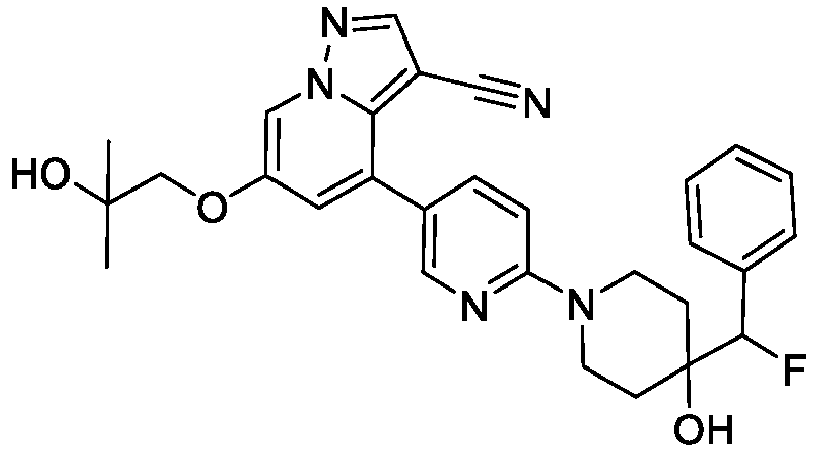
- To a solution of 1-chloromethyl-4-fluoro-1,4-diazoniabicyclo[2.2.2]octane bis(tetrafluoroborate) (115 mg, 0.325 mmol) and V2O3 (2.87 mg, 0.0192 mmol) in CH3CN (2 mL) was added 4-(6-(4-benzyl-4-hydroxypiperidin-1-yl)pyridin-3-yl)-6-(2-hydroxy-2-methylpropoxy)pyrazolo[1,5-a]pyridine-3-carbonitrile (Example 27, 95.3 mg, 0.192 mmol). The reaction mixture was frozen at -78°C, and purged of air. The mixture was slowly warmed up to RT and stirred overnight. After diluting the reaction with H2O, the mixture was extracted with EtOAc (3 x). The combined organic extracts were concentrated and purified by preparative HPLC (20-80% ACN in H2O with 0.1% TFA). The combined fractions containing the product were concentrated, dissolved in minimal amount of MeOH, and passed through PL-HCO3 resin. The filtrate was concentrated to afford the title product as a pale yellow solid (4.2 mg, 4%). MS (apci) m/z = 516.2 (M+H).
-

- To 6-methoxy-4-(4,4,5,5-tetramethyl-1,3,2-dioxaborolan-2-yl)pyrazolo[1,5-a]pyridine-3-carbonitrile (Intermediate P168, 126 mg, 0.211mmol) and 1-(5-chloropyrazin-2-yl)-4-((3-fluoropyridin-2-yl)methyl)piperidin-4-ol (Intermediate R70, 68 mg, 0.211mmol) in dioxane (1.5 mL) were added XPhos (20 mg, 0.04 mmol), Pd2(dba)3 (10 mg, 0.011mmol) and K3PO4 (2 M aq, 0.3 mL, 0.3 mmol). The mixture was sparged with Ar and heated to 90 °C for 17 h. After cooling to RT, the reaction was partitioned in 1:1 DCM/water (30 mL). After phase-separation, the organic layer was washed with water and brine and concentrated. The crude material was purified by preparative HPLC (5 to 95% acetonitrile in water with 1% TFA) to afford the title product (3.4 mg, 2.8%). MS (apci) m/z = 460.2 (M+H).
- The compounds in Table X7 were prepared according to the procedure described in Example 766, coupling the appropriate boronate and halide intermediates.
Table X7 Ex. # Structure Chemical Name LCMS m/z Reactant Intermediates 767 
4-(5-(4-((3-fluoropyridin-2-yl)methyl)-4-hydroxypiperidin-1-yl)pyrazin-2-yl)-6-(2-morpholinoethoxy)pyrazol o[1,5-a]pyridine-3-carbonitrile 559.2 (M+H) P12 and R70 768 
4-(5-(4-((3-fluoropyridin-2-yl)methyl)-4-hydroxypiperidin-1-yl)pyrazin-2-yl)-6-(2-hydroxy-2-methylpropoxy)pyrazolo[1 ,5-a]pyridine-3-carbonitrile 518.2 (M+H) P166 and R70 769 
6-(2-hydroxy-2-methylpropoxy)-4-(5-(4-hydroxy-4-(pyridin-2-ylmethyl)piperidin-1-yl)pyrazin-2- 500.2 (M+H) P166 and R71 yl)pyrazolo[1,5-a]pyridine-3-carbonitrile -

- Step 1: Preparation of 4-(5-(4-amino-4-benzylpiperidin-1-yl)pyrazin-2-yl)-6-methoxypyrazolo[1,5-a]pyridine-3-carbonitrile. The title compound (62.7 mg, 53%) was prepared in the same method as described in Example 766, replacing 1-(5-chloropyrazin-2-yl)-4-((3-fluoropyridin-2-yl)methyl)piperidin-4-ol with 4-benzyl-1-(5-chloropyrazin-2-yl)piperidin-4-amine (Intermediate R72). LCMS m/z = 440.2 (M+H).
- Step 2: Preparation of (R)-N-(4-benzyl-1-(5-(3-cyano-6-methoxypyrazolo[1,5-a]pyridin-4-yl)pyrazin-2-yl)piperidin-4-yl)-2,3-dihydroxypropanamide. To a mixture of D-glyceric acid hemicalcium salt (5.79 mg, 0.0396 mmol) and HATU in DMA was added N-ethyl-N-isopropylpropan-2-amine (9.19 µl, 0.0528 mmol). After stirring at RT for 1 h, 4-(5-(4-amino-4-benzylpiperidin-1-yl)pyrazin-2-yl)-6-methoxypyrazolo[1,5-a]pyridine-3-carbonitrile (11.6 mg, 0.0264 mmol) was introduced and the reaction was heated at 60 °C overnight. After cooling to RT, the reaction was diluted with DCM, washed with water (3x) and brine (1x), then concentrated and purified by preparative HPLC (5-95% MeCN/H2O/0.2%TFA). The combined fractions containing the product were concentrated, then taken up in sat. NaHCO3 and 4:1 DCM/IPA. The organic layer was separated and concentrated to yield the title product (4 mg, 27%). MS (apci) m/z = 528.2 (M+H).
-

- To a mixture of 2,3,6-trifluorobenzoic acid (22 mg, 0.12 mmol) and HATU (31 mg, 0.083 mmol) in DCM (2.1 mL) was added DIEA (72 µl, 0.41 mmol) and stirred for 30 min at RT, followed by addition of 4-(5-(4-amino-4-methylpiperidin-1-yl)pyrazin-2-yl)-6-ethoxypyrazolo[1,5-a]pyridine-3-carbonitrile bis(2,2,2-trifluoroacetate) (Intermediate P172; 25 mg, 0.041 mmol) in one portion. After stirred for another 2 h, the reaction was diluted with sat. NH4Cl (2 mL) and passed through a Phase Separator frit. The organic filtrate was purified by silica chromatography (0-100% EtOAc in hexanes) to afford the title compound (17 mg, 77%). MS (apci) m/z = 536.1 (M+H).
- The compounds in Table X8 were prepared using a similar method as described in Example 771, replacing 2,3,6-trifluorobenzoic acid with the appropriate carboxylic acid.
Table X8 Ex. # Structure Chemical Name LCMS m/z 772 
2-chloro-N-(1-(5-(3-cyano-6-ethoxypyrazolo[1,5-a]pyridin-4-yl)pyrazin-2-yl)-4-methylpiperidin-4-yl)-5-fluorobenzamide 534.2 (M+H) 773 
N-(1-(5-(3-cyano-6-ethoxypyrazolo[1,5-a]pyridin-4-yl)pyrazin-2-yl)-4-methylpiperidin-4-yl)-5-fluoro-2-(trifl uoromethy l)benzami d e 568.2 (M+H) 774 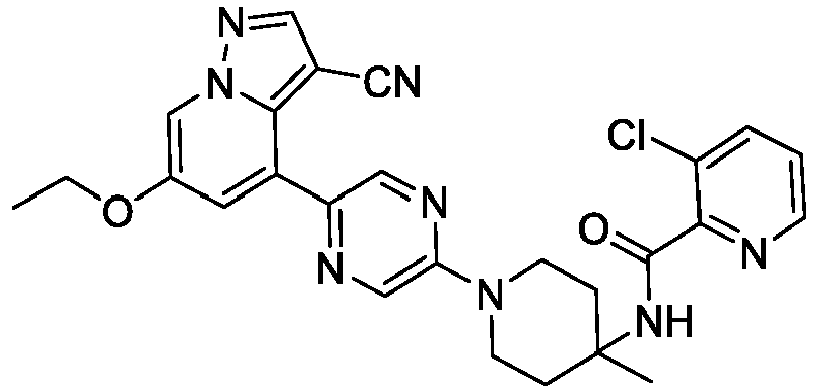
3-chloro-N-(1-(5-(3-cyano-6-ethoxypyrazolo[1,5-a]pyridin-4-yl)pyrazin-2-yl)-4-methylpiperidin-4-yl)picolinamide 517.1 (M+H) 775 
3-chloro-N-(1-(5-(3-cyano-6-ethoxypyrazolo[1,5-a]pyridin-4-yl)pyrazin-2-yl)-4-methylpiperidin-4-yl)-5-fluoropicolinamide 535.1 (M+H) 776 
N-(1-(5-(3-cyano-6-ethoxypyrazolo[1,5-a]pyridin-4-yl)pyrazin-2-yl)-4-methylpiperidin-4-yl)-3-fluoro-6-methylpicolinamide 515.2 (M+H) 777 
3-chloro-N-(1-(5-(3-cyano-6-ethoxypyrazolo[1,5-a]pyridin-4-yl)pyrazin-2-yl)-4-methylpiperidin-4-yl)-6-methylpicolinamide 531.2, 553.2 (M+H, M+Na) 778 
N-(1-(5-(3-cyano-6-ethoxypyrazolo[1,5-a]pyridin-4-yl)pyrazin-2-yl)-4-methylpiperidin-4-yl)-3,6-dimethylpicolinamide 511.2 (M+H) -

- In a 15-mL pressure tube was charged 4-bromo-6-ethoxypyrazolo[1,5-a]pyridine-3-carbonitrile (Intermediate P5; 15 mg, 0.056 mmol) and dioxane (0.5 mL) to form a suspension, followed by addition of water (0.15 mL), Cs2CO3 (55 mg, 0.17 mmol) and 2-chloro-6-methyl-N-(4-methyl-1-(5-(4,4,5,5-tetramethyl-1,3,2-dioxaborolan-2-yl)pyrazin-2-yl)piperidin-4-yl)benzamide (Intermediate R49; 37 mg, 0.056 mmol). The mixture was sparged with N2 for 5 min before XPHOS (11 mg, 0.023 mmol) and Pd2dba3 (5.2 mg, 0.0056 mmol) were added, followed by an additional 5 min of sparging with N2 before the reaction was sealed and heated at 80°C for 17 h. Once cooled to RT, the reaction was diluted with water (10 mL) and extracted with DCM (2 x 10 mL). The combined organic phases were dried (MgSO4), filtered, and concentrated. The crude material was purified first by preparative HPLC (5-95% MeCN/H2O with 0.2% TFA), followed by silica chromatography (0-100% acetone/hexanes) to afford the title product (2.1 mg, 7%). MS (apci) m/z = 530.2 (M+H).
- The compounds in Table X9 were prepared according to the procedure described in Example 779, replacing 4-bromo-6-ethoxypyrazolo[1,5-a]pyridine-3-carbonitrile with the appropriate bromide intermediate.
Table X9 Ex. # Structure Chemical Name LCMS m/z Bromide Intermediate 780* 
2-chloro-N-(1-(5-(3-cyano-6-(3 -hydroxy-3 - methylbutoxy)pyrazolo[11,5 -a]pyridin-4-yl)pyrazin-2-yl)-4-methylpiperidin-4-yl)-6-methylbenzamide 588.2 (M+H) P169 781 
2-chloro-N-(1-(5-(3-cyano-6-(2-(3,3 - difluoroazetidin-1-yl)ethoxy)pyrazolo[1,5-a]pyridin-4-yl)pyrazin-2-yl)-4-methylpiperidin-4-yl)-6-methylbenzamide 621.2 (M+H) P170 782 
2-chloro-N-(1-(5-(3-cyano-6-(2-oxo-2-(pyrrolidin-1-yl)ethoxy)pyrazolo[1,5-a]pyridin-4-yl)pyrazin-2-yl)-4-methylpiperidin-4-yl)-6-methylbenzamide 613.2 (M+H) P171 783 
2-chloro-N-(1-(5-(3-cyano-6-hydroxypyrazolo[1,5-a]pyridin-4-yl)pyrazin-2-yl)-4-methylpiperidin-4-yl)-6-methylbenzamide 502.1 (M+H) P1 ∗Note: TBS protective group was removed during preparative HPLC purification (5-95% ACN in water with 0.1% TFA). -

- To a suspension of 4-(5-(4-amino-4-methylpiperidin-1-yl)pyrazin-2-yl)-6-(2-hydroxy-2-methylpropoxy)pyrazolo[1,5-a]pyridine-3-carbonitrile dihydrochloride (Intermediate P173; 10 mg, 0.020 mmol) in DCM (0.2 mL) were added 2-chloro-5-fluorobenzoic acid (4.2 mg, 0.024 mmol) , DIEA (14 µl, 0.081 mmol) and HATU (12 mg, 0.030 mmol). The reaction was stirred at RT for 2 d, then diluted with H2O (10 mL), extracted with DCM (3 x 10 mL), and the combined organic phases were concentrated. The crude material was purified by preparative HPLC (5-95% MeCN/H2O with 0.1% TFA). The combined fractions containing the product were diluted with sat. NaHCO3 (10 mL) and extracted with DCM (3 x 10 mL). The combined organic phases were washed with brine (15 mL), dried (MgSO4), filtered, and concentrated to afford the title product (1.2 mg, 10%). MS (apci) m/z = 578.2 (M+H).
- The compounds in Table X10 were prepared using a similar method as described in Example 784, replacing 2-chloro-5-fluorobenzoic acid with the appropriate carboxylic acid.
Table X10 Ex. # Structure Chemical Name LCMS m/z 785 
3-chloro-N-(1-(5-(3-cyano-6-(2-hydroxy-2-methylpropoxy)pyrazolo[1 ,5-a]pyridin-4-yl)pyrazin-2-yl)-4-methylpiperidin-4-yl)picolinamide 561.2, 583.2 (M+H, M+Na) 786 
3-chloro-N-(1-(5-(3-cyano-6-(2-hydroxy-2-methylpropoxy)pyrazolo[1 ,5-a]pyridin-4-yl)pyrazin-2-yl)-4-methylpiperidin-4-yl)-6-methylpicolinamide 575.2, 597.2 (M+H, M+Na) 787 
N-(1-(5-(3-cyano-6-(2-hydroxy-2-methylpropoxy)pyrazolo[1 ,5-a]pyridin-4-yl)pyrazin-2-yl)-4-methylpiperidin-4-yl)-2,3,6-trifluorobenzamide 580.2 (M+H) 788 
3-chloro-N-(1-(5-(3-cyano-6-(2-hydroxy-2-methylpropoxy)pyrazolo[1 ,5-a]pyridin-4-yl)pyrazin-2-yl)-4-methylpiperidin-4-yl)-5-fluoropicolinamide 579.2 (M+H) 789 
N-(1-(5-(3-cyano-6-(2-hydroxy-2-methylpropoxy)pyrazolo[1 ,5-a]pyridin-4-yl)pyrazin-2-yl)-4-methylpiperidin-4-yl)-5-fluoro-2-(trifl uoromethy l)benzami d e 612.2, 634.2 (M+H, M+Na) -

- Step 1: Preparation of tert-butyl 3-(((4-(5-(4-(3-chloropicolinamido)-4-methylpiperidin-1-yl)pyrazin-2-yl)-3-cyanopyrazolo[1,5-a]pyridin-6-yl)oxy)methyl)-3-fluoroazetidine-1-carboxylate. A mixture of 3-chloropicolinic acid (24 mg, 0.15 mmol) and HATU (38 mg, 0.10 mmol) in DCM (2.5 mL) was treated with DIEA (88 µL, 0.50 mmol), then stirred for 30 min at RT before tert-butyl 3-(((4-(5-(4-amino-4-methylpiperidin-1-yl)pyrazin-2-yl)-3-cyanopyrazolo[1,5-a]pyridin-6-yl)oxy)methyl)-3-fluoroazetidine-1-carboxylate (Intermediate P153; 27 mg, 0.050 mmol) was added in one portion. After overnight stirring, the reaction was diluted with sat. NH4Cl (aq) (2 mL) and passed through a Phase Separator frit. The filtrate was purified by silica chromatography (0-100% EtOAc in hexanes) to afford the title compound (34 mg, quantitative yield). LCMS m/z = 676.2 (M+H).
- Step 2: Preparation of (R)-N-(4-benzyl-1-(5-(3-cyano-6-methoxypyrazolo[1,5-a]pyridin-4-yl)pyrazin-2-yl)piperidin-4-yl)-2,3-dihydroxypropanamide. A solution of tert-butyl 3-(((4-(5-(4-(3-chloropicolinamido)-4-methylpiperidin-1-yl)pyrazin-2-yl)-3-cyanopyrazolo[1,5-a]pyridin-6-yl)oxy)methyl)-3-fluoroazetidine-1-carboxylate (34 mg, 0.050 mmol) in DCM (2 mL) was treated with TFA (2 mL). The reaction was stirred for 20 min at ambient temperature before it was concentrated in vacuo and purified by silica chromatography (0-10% MeOH in DCM with 0.1% NH4OH) to afford the title product (12 mg, 41%). MS (apci) m/z = 576.2 (M+H).
-

- To a mixture of 3-chloropicolinic acid (15 mg, 0.096 mmol) and HATU (24 mg, 0.064 mmol) in DCM (1.6 mL) was added DIEA (56 µl, 0.32 mmol), then stirred for 30 min before 4-(5-(4-amino-4-methylpiperidin-1-yl)pyrazin-2-yl)-6-methoxypyrazolo[1,5-a]pyridine-3-carbonitrile bis(2,2,2-trifluoroacetate) (Intermediate P174; 20 mg, 0.032 mmol) was added in one portion. The reaction was stirred for 1 h at RT, then diluted with sat. NH4Cl (aq) (2 mL) and passed through a Phase Separator frit. The organic filtrate was purified by silica chromatography (0-100% EtOAc in hexanes) to yield the title product as solid (14 mg, 87%). MS (apci) m/z = 503.2 (M+H).
- The compounds in Table X11 were prepared using a similar method as described in Example 791, replacing 3-chloropicolinic acid with the appropriate carboxylic acid.
Table X11 Ex. # Structure Chemical Name LCMS m/z 792 
3-chloro-N-(1-(5-(3-cyano-6-methoxypyrazolo[1,5-a]pyridin-4-yl)pyrazin-2-yl)-4-methylpiperidin-4-yl)-5-fluoropicolinamide 521.1 (M+H) 793 
N-(1-(5-(3-cyano-6-methoxypyrazolo[1,5-a]pyridin-4-yl)pyrazin-2-yl)-4-methylpiperidin-4-yl)-2,3,6-trifluorobenzamide 522.1 (M+H) 794 
2-chloro-N-(1-(5-(3-cyano-6-methoxypyrazolo[1,5-a]pyridin-4-yl)pyrazin-2-yl)-4-methylpiperidin-4-yl)-5-fluorobenzamide 520.1 (M+H) 795 
N-(1-(5-(3-cyano-6-methoxypyrazolo[1,5-a]pyridin-4-yl)pyrazin-2-yl)-4-methylpiperidin-4-yl)-5-fluoro-2-(trifluoromethyl)benzami d e 554.2 (M+H) 796 
3-chloro-N-(1-(5-(3-cyano-6-methoxypyrazolo[1,5-a]pyridin-4-yl)pyrazin-2-yl)-4-methylpiperidin-4-yl)-6-methylpicolinamide 517.2 (M+H) -

- Step 1: Preparation of tert-butyl (R)-2-(((4-(5-(4-(3-chloropicolinamido)-4-methylpiperidin-1-yl)pyrazin-2-yl)-3-cyanopyrazolo[1,5-a]pyridin-6-yl)oxy)methyl)morpholine-4-carboxylate. The title compound (30 mg, 67%) was prepared according to the procedure described in Example 791, replacing 4-(5-(4-amino-4-methylpiperidin-1-yl)pyrazin-2-yl)-6-methoxypyrazolo[1,5-a]pyridine-3-carbonitrile bis(2,2,2-trifluoroacetate) with tert-butyl (R)-2-(((4-(5-(4-amino-4-methylpiperidin-1-yl)pyrazin-2-yl)-3-cyanopyrazolo[1,5-a]pyridin-6-yl)oxy)methyl)morpholine-4-carboxylate (Intermediate P176). LCMS m/z = 688.2 (M+H).
- Step 2: Preparation of (R)-3-chloro-N-(1-(5-(3-cyano-6-(morpholin-2-ylmethoxy)pyrazolo[1,5-a]pyridin-4-yl)pyrazin-2-yl)-4-methylpiperidin-4-yl)picolinamide. To a solution of tert-butyl (R)-2-(((4-(5-(4-(3-chloropicolinamido)-4-methylpiperidin-1-yl)pyrazin-2-yl)-3-cyanopyrazolo[1,5-a]pyridin-6-yl)oxy)methyl)morpholine-4-carboxylate (30.2 mg, 0.044 mmol) in DCM (2 mL) was added TFA (1 mL), then stirred for 2 h at RT and then concentrated and redissolved in 4:1 DCM/IPA. The mixture was washed with sat. NaHCO3, dried (Na2SO4), filtered and concentrated to yield the title product (21.5 mg, 83% yield). MS (apci) m/z = 588.3 (M+H).
- The compounds in Table X12 were prepared using a similar method as described in Example 797, replacing 3-chloropicolinic acid with the appropriate carboxylic acid in Step 1.
Table X12 Ex. # Structure Chemical Name LCMS m/z 798 
(R)-3-chloro-N-(1-(5-(3-cyano-6-(morpholin-2-ylmethoxy)pyrazolo[1,5-a]pyridin-4-yl)pyrazin-2-yl)-4-methylpiperidin-4-yl)-5-fluoropicolinamide 606.2 (M+H) 799 
(R)-N-(1-(5-(3-cyano-6-(morpholin-2-ylmethoxy)pyrazolo[1,5-a]pyridin-4-yl)pyrazin-2-yl)-4-methylpiperidin-4-yl)-5-fluoro-2-(trifluoromethyl)benzami d e 639.2 (M+H) -

- The title compound (50 mg, 74%) was prepared according to the procedure described in Example 797, replacing tert-butyl (R)-2-(((4-(5-(4-amino-4-methylpiperidin-1-yl)pyrazin-2-yl)-3-cyanopyrazolo[1,5-a]pyridin-6-yl)oxy)methyl)morpholine-4-carboxylate with tert-butyl (S)-2-(((4-(5-(4-amino-4-methylpiperidin-1-yl)pyrazin-2-yl)-3-cyanopyrazolo[1,5-a]pyridin-6-yl)oxy)methyl)morpholine-4-carboxylate (Intermediate 177). LCMS m/z = 688.2 (M+H).
-
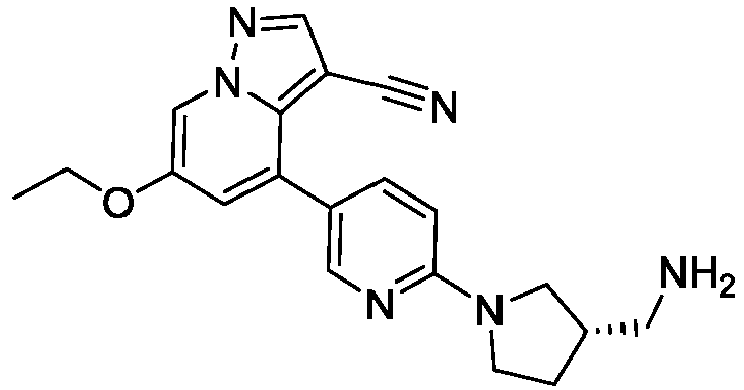
- Step 1: Preparation of tert-butyl (S)-((1-(5-(3-cyano-6-ethoxypyrazolo[1,5-a]pyridin-4-yl)pyridin-2-yl)pyrrolidin-3-yl)methyl)carbamate. A solution of 6-ethoxy-4-(6-fluoropyridin-3-yl)pyrazolo[1,5-a]pyridine-3-carbonitrile (Intermediate P6, 50.7 mg, 0.180 mmol) and tert-butyl (R)-(pyrrolidin-3-ylmethyl)carbamate (54.0 mg, 0.269 mmol) in DMSO (1.5 mL) was treated with DIEA (0.157 mL, 0.898 mmol) and stirred at 115°C overnight. After cooling to RT, the reaction was diluted with H2O and filtered. The solid was rinsed with water, and then dried under vacuum to afford the title product as a light tan solid (83 mg, 99% yield). LCMS m/z = 463.2 (M+H).
- Step 2: Preparation of (S)-4-(6-(3-(aminomethyl)pyrrolidin-1-yl)pyridin-3-yl)-6-ethoxypyrazolo[1,5-a]pyridine-3-carbonitrile. A solution of tert-butyl (S)-((1-(5-(3-cyano-6-ethoxypyrazolo[1,5-a]pyridin-4-yl)pyridin-2-yl)pyrrolidin-3-yl)methyl)carbamate (83 mg, 0.18 mmol) in 1,4-dioxane (1.5 mL) was treated with conc. HCl (0.029 mL, 0.36 mmol) and stirred at RT overnight. The reaction was concentrated, then taken up in 4:1 DCM/IPA and free-based with sat. NaHCO3. The organic layer was passed through a Phase-Separator frit and concentrated to yield the title product as solid (8.9 mg, 13%). MS (apci) m/z = 363.2 (M+H).
-

- The title compound (12 mg, 18%) was prepared according to the procedure described in Example 801, replacing tert-butyl (R)-(pyrrolidin-3-ylmethyl)carbamate with tert-butyl (S)-(pyrrolidin-3-ylmethyl)carbamate in Step 1. LCMS m/z = 363.2 (M+H).
-

- The title compound (32.6 mg, 71%) was prepared according to the procedure described in Example 791, replacing 4-(5-(4-amino-4-methylpiperidin-1-yl)pyrazin-2-yl)-6-methoxypyrazolo[1,5-a]pyridine-3-carbonitrile bis(2,2,2-trifluoroacetate) with (S)-4-(6-(3-(aminomethyl)pyrrolidin-1-yl)pyridin-3-yl)-6-ethoxypyrazolo[1,5-a]pyridine-3-carbonitrile (Example 801). LCMS m/z = 502.2 (M+H).
- The compounds in Table X13 were prepared according to the procedure described in Example 803, coupling the appropriate amine intermediate the corresponding carboxylic acid.
Table X13 Ex. # Structure Chemical Name LCMS m/z Amine intermediate 804 
(S)-N-((1-(5-(3-cyano-6-ethoxypyrazolo[1,5-a]pyridin-4-yl)pyridin-2-yl)pyrrolidin-3-yl)methyl)-3-methylbutanamide 447.3 (M+H) Example 801 805 
(R)-N-((1-(5-(3-cyano-6-ethoxypyrazolo[1,5-a]pyridin-4-yl)pyridin-2-yl)pyrrolidin-3-yl)methyl)-3-methylbutanamide 447.3 (M+H) Example 802 806 
(R)-3-chloro-N-((1-(5-(3-cyano-6-ethoxypyrazolo[1,5-a]pyridin-4-yl)pyridin-2-yl)pyrrolidin-3-yl)methyl)picolinamide 502.1 (M+H) Example 802 -

- Step 1: Preparation of 4-(6-(4-amino-4-benzylpiperidin-1-yl)pyridin-3-yl)-6-ethoxypyrazolo[1,5-a]pyridine-3-carbonitrile. A solution of tert-butyl 4-amino-4-benzylpiperidine-1-carboxylate (220 mg, 0.758 mmol) in DCM (1.5 mL) was treated with TFA (0.5 mL), stirred at RT for 1 h then concentrated. The residue was re-dissolved in DMA (3.8 mL), followed by addition of 6-ethoxy-4-(6-fluoropyridin-3-yl)pyrazolo[1,5-a]pyridine-3-carbonitrile (Intermediate P6, 214 mg, 0.758 mmol) and K2CO3 (524 mg, 3.79 mmol). The mixture was stirred at 60 °C for 24 h before it was cooled to RT and diluted with water. The aqueous mixture was extracted with EtOAc, and the combined organic extractions was concentrated and purified by silica chromatography (0-100% DCM/10%MeOH/1%NH4OH) to yield the title compound (261 mg, 76%). LCMS m/z = 453.2 (M+H).
- Step 2: Preparation of N-(4-benzyl-1-(5-(3-cyano-6-ethoxypyrazolo[1,5-a]pyridin-4-yl)pyridin-2-yl)piperidin-4-yl)-2-hydroxyacetamide. To a solution of 4-(6-(4-amino-4-benzylpiperidin-1-yl)pyridin-3-yl)-6-ethoxypyrazolo[1,5-a]pyridine-3-carbonitrile (30 mg, 0.0663 mmol) in DCM (0.66 mL) was added 2-hydroxyacetic acid (5.55 mg, 0.0729 mmol), N-ethyl-N-isopropylpropan-2-amine (23.1 µl, 0.133 mmol), and HATU (30.2 mg, 0.0795 mmol), then stirred at RT overnight. The reaction mixture was directly treated with reverse phase chromatography (5-95% MeCN/H2O/0.2% TFA). The combined fractions containing the product were partitioned between 4:1 DCM/IPA and sat. NaHCO3. After phase-separation the organic layer was concentrated to yield the title product as solid (7.2 mg, 21%). MS (apci) m/z = 511.2 (M+H).
- The compounds in Table X14 were prepared using a similar method as described in Step 2 of Example 807, replacing 2-hydroxyacetic acid with the appropriate carboxylic acid.
Table X14 Ex. # Structure Chemical Name LCMS m/z 808 
(S)-N-(4-benzyl-1-(5-(3-cyano-6-ethoxypyrazolo[1,5-a]pyridin-4-yl)pyridin-2-yl)piperidin-4-yl)-3-hydroxybutanamide 539.2 (M+H) 809 
(S)-N-(4-benzyl-1-(5-(3-cyano-6-ethoxypyrazolo[1,5-a]pyridin-4-yl)pyridin-2-yl)pi peridin-4-yl)-2-hydroxypropanamide 525.3 (M+H) 810 
(R)-N-(4-benzyl-1-(5-(3-cyano-6-ethoxypyrazolo[1,5-a]pyridin-4-yl)pyridin-2-yl)piperidin-4-yl)-2-methoxypropanamide 539.3 (M+H) 811 
(R)-N-(4-benzyl-1-(5-(3-cyano-6-ethoxypyrazolo[1,5-a]pyridin-4-yl)pyridin-2-yl)piperidin-4-yl)-1-methyl pyrrolidine-2-carboxamide 564.3 (M+H) 812 
N-(4-benzyl-1-(5-(3-cyano-6-ethoxypyrazolo[1,5-a]pyridin-4-yl)pyridin-2-yl)pi peridin-4-yl)-2-hydroxy-2-methylpropanamide 539.2 (M+H) 813 
(R)-N-(4-benzyl-1-(5-(3-cyano-6-ethoxypyrazolo[1,5-a]pyridin-4-yl)pyridin-2-yl)piperidin-4-yl)-2,3-dihydroxypropanamide 541.2 (M+H) 814 
N-(4-benzyl-1-(5-(3-cyano-6-ethoxypyrazolo[1,5-a]pyridin-4-yl)pyridin-2-yl)piperidin-4-yl)-2-(dimethylamino)acetamide 538.2 (M+H) -

- The title compound was prepared using a similar method as described in Step 2 of Example 807, replacing 2-hydroxyacetic acid with an N-Fmoc-protected acid (((9H-fluoren-9-yl)methoxy)carbonyl)-L-threonine. The N-protected crude product was treated with 1:1 morpholine:DCM to remove the protective group, then concentrated and purified according to the procedure described in Example 807 to afford the final product as solid (13.8 mg, 28%). MS (apci) m/z = 554.3 (M+H).
-

- The title compound (3 mg, 8%) was prepared using a similar method as described in Example 815, replacing (((9H-fluoren-9-yl)methoxy)carbonyl)-L-threonine with (((9H-fluoren-9-yl)methoxy)carbonyl)-L-valine. MS (apci) m/z = 552.3 (M+H).
-

- The title compound was prepared using a similar method as described in Step 2 of Example 807, replacing 2-hydroxyacetic acid with an N-Boc-protected acid (2S,3S)-1-(tert-butoxycarbonyl)-3-hydroxypyrrolidine-2-carboxylic acid. The N-protected product was isolated after a silica chromatography (0-100% EtOAc in hexanes). The isolated product was dissolved in 1:1 DCM:TFA at 0°C, then allowed to slowly warm up to RT over 24 h. After removal of solvent, The crude material was treated with a second silica chromatography (0-100% 1:9 MeOH:DCM with 1% NH4OH in DCM) to afford the title product as solid (33 mg, 36%). MS (apci) m/z = 566.2 (M+H).
-

- A solution of (2S,3S)-N-(4-benzyl-1-(5-(3-cyano-6-ethoxypyrazolo[1,5-a]pyridin-4-yl)pyridin-2-yl)piperidin-4-yl)-3-hydroxypyrrolidine-2-carboxamide (Example 817, 15 mg, 0.0265 mmol) in DCM (0.13 mL) was treated with sodium triacetoxyhydroborate (11.2 mg, 0.0530 mmol) and acetaldehyde (0.769 µL, 0.0265 mmol), then stirred at RT overnight. The reaction mixture was diluted with 4:1 DCM/IPA and washed with sat. NaHCO3 (aq). After phase separation, the organic layer was concentrated to yield the title product (11 mg, 72%). MS (apci) m/z = 594.3 (M+H).
-

- The title product (21.6 mg, 18%) was prepared using a similar method as described in Step 1 of Example 626, replacing 2-(1-(tert-butoxycarbonyl)azetidin-3-yl)acetic acid with D(+)-glyceric acid hemicalcium salt. MS (apci) m/z = 542.2 (M+H).
Abbreviations: 18-Crown-6 1,4,7,10,13,16-hexaoxacyclooctadecane ACN Acetonitrile AcOH Acetic Acid (±)-BINAP 2,2'-Bis(diphenylphosphino)-1,1'-binaphthalene Bis(pinacolato)diboron 4,4,4',4',5,5,5',5'-octamethyl-2,2'-bi(1,3,2-dioxaborolane) Boc tert-butyl carboxylate group Boc-anhydride di-tert-butyl dicarbonate Boc-Inp-OH 1-Boc-piperidine-4-carboxylic acid; or Boc-isonipecotic acid n-BuLi n-butyllithium or 1-butyllithium s-BuOH Sec-Butanol or 2-Butanol t-BuOH tert-Butanol or 2-Methylpropan-2-ol Celite® Diatomaceous earth; SiO2 CuI Copper (I) iodide Cu(OAc)2 Copper (II) diacetate d day, days DCE 1,2-Dichloroethane DCM Dichloromethane DIAD Diisopropyl azodicarboxylate DIEA N,N-Diisopropylethylamine DI water Deionized water dioxane 1,4-dioxane DMA N,N-Dimethylacetamide DMAP 4-Dimethylaminopyridine DME 1,2-Dimethoxyethane DMF N,N-Dimethylformamide DMSO Dimethylsulfoxide DMP Dess-MartinPeriodinane; 1,1,1-Tris(acetyloxy)-1,1-dihydro-1,2-benziodoxol-3-(1H)-one EDC-HCl 1-Ethyl-3-(3-dimethylaminopropyl)carbodiimide hydrochloride Et2O Diethyl Ether EtOAc Ethyl Acetate EtOH Ethanol eq equivalent GF/F paper GF/F glass microfiber filter paper h hour, hours HATU 1-[Bis(dimethylamino)methylene]-1H-1,2,3-triazolo[4,5-b]pyridinium 3-oxide hexafluorophosphate or 2-(7-Aza-1H-benzotriazole-1-yl)-1,1,3,3 -tetramethyluronium hexafluorophosphate HBTU 3-[Bis(dimethylamino)methyliumyl]-3H-benzotriazol-1-oxide hexafluorophosphate or 2-(1H-benzotriazole-1-yl)-1,1,3,3-tetramethyluronium hexafluorophosphate HOAc Acetic Acid isobutyl chloroformate isobutyl carbonochloridate isovaleryl chloride 3-methylbutanoyl chloride iPrOH Isopropanol i-PrMgCl Isopropyl magnesium chloride KOAc Potassium Acetate KOtBu Potassium tert-Butoxide K2 HPO 4 Potassium Phosphate, Dibasic LCMS Liquid chromatography-mass spectrometry LiHMDS Lithium Hexamethyldisilazide; or Lithium bis(trimethylsilyl)amide MeOH Methanol Me4N(AcO)3BH Tetramethylammonium Triacetoxyborohydride min minute, minutes MSH o-(mesitylsulfonyl)hydroxylamine MTBE Methyl tert-Butyl Ether NCS N-Chlorosuccinimide NBS N-Bromosuccinimide NIS N-Iodosuccinimide NaBH(AcO)3 Sodium Triacetoxyborohydride NH4OAc Ammonium Acetate P1-HCO3 resin Stratospheres MP-HCO3 10% Pd/C Palladium 10 wt. % (dry basis), active carbon, wet, Degussa Pd(PPh3)4 Tetrakis(triphenylphosphine)palladium (0) Pd2(dba)3 tris(dibenzylideneacetone)dipalladium (0) PdCl2 (dppf)•CH2Cl2 1,1'-Bis(diphenylphosphino)ferrocene-palladium(II)dichloride dichloromethane complex Pd2(dba)3•CHCl3 tris(dibenzylideneacetone)dipalladium (0) chloroform complex PdCl2(PPh3)2 Palladium(II)bis(triphenylphosphine) dichloride, PPh3 Triphenylphosphine PPTS Pyridinium p-toluenesulfonate PS frit Biotage® "Isolute® Phase Separators" PS paper Whatman® silicone treated Phase Separators filter paper PVDF (0.45 µm) disc polyvinylidene difluoride membrane with a 0.45-micron pore size rt Room temperature TBAF Tetra-n-butylammonium fluoride TEA Triethylamine TFA Trifluoroacetic acid THF tetrahydrofuran Triphosgene (bis(trichloromethyl) carbonate Tf-O-Tf trifluoromethanesulfonic anhydride TsCl 4-Toluenesulfonyl chloride X-Phos dicyclohexyl(2',4',6'-triisopropyl-[1,1'-biphenyl]-2-yl)phosphine
Claims (34)
- A compound of the Formula I:
 X1, X2, X3 and X4 are independently CH, CCH3, CF or N, wherein zero, one or two of X1, X2, X3 and X4 is N;A is H, CN, Cl, methyl, ethyl or cyclopropyl;B is:(a) hydrogen,(b) C1-C6 alkyl optionally substituted with 1-3 fluoros,(c) hydroxyC2-C6 alkyl- wherein the alkyl portion is optionally substituted with a C3-C6 cycloalkylidene ring,(d) dihydroxyC3-C6 alkyl- wherein the alkyl portion is optionally substituted with a C3-C6 cycloalkylidene ring,(e) (C1-C6 alkoxy)C1-C6 alkyl- optionally substituted with 1-3 fluoros,(f) (R1R2N)C1-C6 alkyl- where R1 and R2 are independently selected from H, C1-C6 alkyl (optionally substituted with 1-3 fluoros), (C1-C6 alkoxy)C1-C6 alkyl- and (C1-C6 alkoxy)C(=O)-;(g) hetAr1C1-C3 alkyl-, where hetAr1 is a 5-6 membered heteroaryl ring having 1-3 ring heteroatoms independently selected from N, O and S and is optionally substituted with one or more independently selected C1-C6 alkyl substituents;(h) (C3-C6 cycloalkyl)C1-C3 alkyl-,(i) (hetCyca)C1-C3 alkyl-,(j) hetCyca,(k) (R1R2N)C(=O)C1-C6 alkyl- where R1 and R2 are independently selected from H and C1-C6 alkyl,(l) (R1R2N)C(=O)-, where R1 and R2 are independently selected from H and C1-C6 alkyl, or(m) hetCycaC(=O)C1-C6 alkyl-;hetCyca is a 4-6 membered heterocyclic ring having 1-2 ring heteroatoms independently selected from N and O and optionally substituted with one or more substituents independently selected from OH, C1-C6 alkyl (optionally substituted with 1-3 fluoros), hydroxyC1-C6 alkyl, halogen, (C1-C6 alkyl)C(=O)-, C1-C6 alkoxy, oxo, and (C1-C6 alkoxy)C(=O)-;Ring D is(i) a saturated monocyclic 4-7 membered heterocyclic ring having one ring heteroatom which is nitrogen,(ii) a saturated 7-8 membered bridged heterocyclic ring having one ring heteroatom which is nitrogen, or(iii) a saturated 7-11 membered heterospirocyclic ring system having one ring heteroatom which is nitrogen;each Ra is independently C1-C6 alkyl (optionally substituted with 1-3 fluoros), hydroxyC1-C6 alkyl or (C1-C6 alkoxy)C1-C6 alkyl-;Rb is (a) hydroxy, (b) cyclopropyl, (c) hetCycbCH2-, (d) RiRjNC(=O)CH2OCH2-where Ri and Rj are independently H or C1-C6 alkyl, (e) RcRdN-, (f) RcRdNCH2-, (g) C1-C6 alkoxy-, (h) (C1-C4 alkyl)-C(=O)NH- wherein said alkyl portion is optionally substituted with hetCycb, hetAr3, C1-C6 alkoxy- or R'R"N-, or said alkyl portion is optionally substituted with two substituents independently selected from R'R"N- and OH, where each R' and R" is independently hydrogen or C1-C6 alkyl, (i) (R'R"N)C1-C6 alkoxy(CH2)n- where n is 0 or 1 and R' and R" are independently hydrogen or C1-C6 alkyl, (j) hetCycb(C1-C3 alkyl)OCH2-, (k) hetCycbC(=O)NH- or (l) hetAr1C(=O)NH-;hetCycb is a 4-6 membered heterocyclic ring, a 7-8 membered bridged heterocyclic ring, or a 7-10 membered heterospirocyclic ring, each ring having 1-2 ring heteroatoms independently selected from N and O, wherein hetCycb is optionally substituted with one or more substituents independently selected from OH, fluoro, C1-C6 alkyl (optionally substituted with 1-3 fluoros), hydroxyC1-C6 alkyl- (optionally substituted with 1-3 fluoros), (C1-C6 alkoxy)C1-C6 alkyl-, (C1-C6 alkoxy)C(=O)-, C1-C6 alkoxy, and R'R"N- where R' and R" are independently hydrogen or C1-C6 alkyl;hetAra is a 5-6 membered heteroaryl ring having 1-3 ring heteroatoms independently selected from N, O and S herein hetAra is optionally substituted with one or more substituents independently selected from the group consisting of halogen, CN, C1-C6 alkyl (optionally substituted with 1-3 fluoros), and C1-C6 alkoxy (optionally substituted with 1-3 fluoros);Rc is hydrogen or C1-C6 alkyl;Rd ishydrogen,C1-C6 alkyl (optionally substituted with 1-3 fluoros),(C1-C6 alkoxy)C(=O)-,hydroxyC1-C6 alkyl (optionally substituted with 1-3 fluoros),(hydroxyC1-C6 alkyl)C(=O)-,(C1-C6 alkyl)C(=O)-,(RkRlN)C1-C6 alkyl- where Rk and Rl are independently H or C1-C6 alkyl,RmRnNC(=O)C1-C6 alkyl- where Rm and Rn are independently H or C1-C6 alkyl, PhCH2- wherein the phenyl is optionally substituted with one or more substituents independently selected from the group consisting of halogen, CN, C1-C6 alkyl (optionally substituted with 1-3 fluoros), C1-C6 alkoxy (optionally substituted with 1-3 fluoros), (C1-C6 alkoxy)C1-C6 alkyl- (optionally substituted with 1-3 fluoros), C3-C6 cycloalkyl, hydroxyC1-C6 alkyl, (C1-C6 alkyl)SO2-, ReRfN- and (ReRfN)C1-C6 alkyl- where each Re and Rf is independently H or C1-C6 alkyl,(C1-C6 alkoxy)C1-C6 alkyl-, orhetCycc where hetCycc is a 4-6 membered heterocyclic ring having a ring heteroatom selected from N and O and optionally substituted with C1-C6 alkyl;n is 0, 1, 2, 3, 4, 5 or 6;m is 0 or 1;E is:(a) hydrogen,(b) hydroxy,(c) C1-C6 alkyl optionally substituted with 1-3 fluoros,(d) Ar1C1-C6 alkyl- wherein said alkyl portion is optionally substituted with 1-3 fluoros,(e) hetAr2C1-C6 alkyl-,(f) (C1-C6 alkoxy)C1-C6 alkoxy-,(g) Ar1O-,(h) hetAr2-O-,(i) Ar1NRg- where Rg is H or C1-C6 alkyl,(j) hetAr2NRg- where Rg is H or C1-C6 alkyl,(k) R3C(=O)NRg- where Rg is H or C1-C6 alkyl;(l) Ar1C(=O)NRg- where Rg is H or C1-C6 alkyl,(m) hetAr2C(=O)NRg(CH2)p- where p is 0 or 1 and Rg is H or C1-C6 alkyl,(n) R4R5NC(=O)-,(o) Ar1NRgC(=O)-, where Rg is H or C1-C6 alkyl,(p) hetAr2NRgC(=O)-, where Rg is H or C1-C6 alkyl,(q) Ar1(C1-C6 alkyl)C(=O)- wherein said alkyl portion is optionally substituted with OH, hydroxy(C1-C6 alkyl), C1-C6 alkoxy or NH2,(r) hetCyc5C(=O)-,(s) R4R5NC(=O)NRg- where Rg is H or C1-C6 alkyl,(t) (C1-C6 alkyl)SO2-,(u) Ar1(C1-C6 alkyl)C(=O)NRg- where Rg is H or C1-C6 alkyl,(v) hetAr4C(=O)NRg- where Rg is H or C1-C6 alkyl,(w) hetAr2-S(=O)-,(x) (C3-C6 cycloalkyl)CH2SO2-,(y) Ar1(C1-C6 alkyl)SO2-,(z) hetAr2SO2-,(aa) Ar1,(bb) hetAr2,(cc) hetCyc5,(dd) C1-C6 alkoxy,(ee) Ar1(C1-C6 alkyl)-O-,(ff) hetAr2(C1-C6 alkyl)-O-,(gg) hetAr2-O-C1-C6 alkyl-,(hh) Ar1(C1-C6 alkyl)NRg- where Rg is H or C1-C6 alkyl,(ii) hetAr2-S-,(jj) Ar2SO2NRg(CH2)p- where p is 0 or 1 and Rg is H or C1-C6 alkyl,(kk) (C1-C6 alkoxy)C(=O)-,(11) (C1-C6 alkyl)NRgC(=O)O- where Rg is H or C1-C6 alkyl, (mm) (C1-C6 alkyl)NRgSO2- where Rg is H or C1-C6 alkyl,(nn) hetCyc5C(=O)NRg- where Rg is H or C1-C6 alkyl,(oo) Q-NRh(C1-C3 alkyl)C(=O)NRg- where Rg and Rh are independently H or C1-C6 alkyl and Q is H, C1-C6 alkyl or (C1-C6 alkyl)OC(=O)-,

 (ss) RgRhN- where Rg and Rh are independently H or C1-C6 alkyl,(tt) (C3-C6 cycloalkyl)C(=O)NRg- where the cycloalkyl is optionally and independently substituted with one or more halogens,(uu) (C1-C6 alkyl)C(=O)NRgCH2- where Rg is H or C1-C6 alkyl, or(vv) C1-C6 alkyl)SO2NRg- where Rg is H or C1-C6 alkyl;Ar1 is phenyl optionally substituted with one or more substituents independently selected from the group consisting of halogen, CN, C1-C6 alkyl (optionally substituted with 1-3 fluoros), C1-C6 alkoxy (optionally substituted with 1-3 fluoros), (C1-C6 alkoxy)C1-C6 alkyl- (optionally substituted with 1-3 fluoros), C3-C6 cycloalkyl, hydroxyC1-C6 alkyl, (C1-C6 alkyl)SO2-, ReRfN- and (ReRfN)C1-C6 alkyl- where each Re and Rf is independently H or C1-C6 alkyl;hetAr2 is a 5-6 membered heteroaryl ring having 1-3 ring heteroatoms independently selected from N, O and S, or a 9-10 membered bicyclic heteroaryl having 1-2 ring nitrogen atoms, wherein hetAr2 is optionally substituted with one or more substituents independently selected from the group consisting of halogen, CN, C1-C6 alkyl (optionally substituted with 1-3 fluoros), C1-C6 alkoxy (optionally substituted with 1-3 fluoros), (C1-C6 alkoxy)C1-C6 alkyl- (optionally substituted with 1-3 fluoros) and hydroxyC1-C6 alkoxy-;hetCyc5 is a 4-6 membered saturated heterocyclic ring having 1-2 ring heteroatoms independently selected from N, O and S wherein said heterocyclic ring is optionally substituted with one or more substituents independently selected from C1-C6 alkoxy and oxo;R3 is C1-C6 alkyl (optionally substituted with 1-3 fluoros), hydroxyC1-C6 alkyl-, C1-C6 alkoxy, C3-C6 cycloalkyl, (C3-C6 cycloalkyl)CH2-, (C3-C6 cycloalkyl)O-, (C3-C6 cycloalkyl)CH2O-, hetCyc7O-, Ph-O-, or (C1-C6 alkoxy)C1-C6 alkyl-; wherein each of said C3-C6 cycloalkyl moieties is optionally substituted with C1-C6 alkyl (optionally substituted with 1-3 fluoros), C1-C6 alkoxy, OH, or R'R"N- where R' and R" are independently hydrogen or C1-C6 alkyl;R4 is H or C1-C6 alkyl;R5 is Ar2, hetAr3, Ar2CH2-, hetCyc6-CH2-, hydroxyC1-C6 alkyl-, (C3-C6 cycloalkyl)CH2-, or C1-C6 alkyl optionally substituted with 1-3 fluoros;Ar2 is phenyl optionally substituted with one or more substituents independently selected from the group consisting of halogen, CN, C1-C6 alkyl (optionally substituted with 1-3 fluoros), C1-C6 alkoxy (optionally substituted with 1-3 fluoros), (C1-C6 alkoxy)C1-C6 alkyl- (optionally substituted with 1-3 fluoros), C3-C6 cycloalkyl, and RgRhN- where Rg and Rh are independently H or C1-C6 alkyl, or Ar2 is phenyl fused to a 6 membered heterocyclic ring having a ring nitrogen atom and optionally substituted with C1-C6 alkyl;hetAr3 is a 5-6 membered heteroaryl ring having 1-3 ring heteroatoms independently selected from N, O and S and optionally substituted with one or more substituents independently selected from the group consisting of halogen, CN, C1-C6 alkyl (optionally substituted with 1-3 fluoros), C1-C6 alkoxy (optionally substituted with 1-3 fluoros), and (C1-C6 alkoxy)C1-C6 alkyl- (optionally substituted with 1-3 fluoros);hetAr4 is pyridin-4(1H)-onyl or pyridin-2(1H)-onyl optionally substituted with one or more substituents independently selected from C1-C6 alkyl and halogen;hetCyc6 is a 5-7 membered heterocyclic ring having 1-3 ring heteroatoms independently selected from N, O and S; andhetCyc7 is a 5-7 membered heterocyclic ring having 1-3 ring heteroatoms independently selected from N, O and S.
 - A compound according to claim 1, wherein D is a saturated monocyclic 4-7 membered heterocyclic ring having one ring heteroatom which is nitrogen.
- A compound according to claim 2, wherein D is

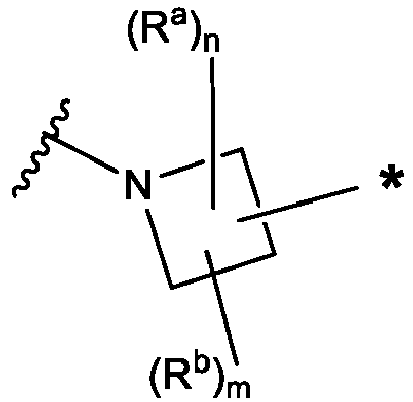
- A compound according to claim 3, wherein D is

- A compound according to claim 4, wherein D is

- A compound according to any one of claims 2-5, wherein each Ra is an independently selected C1-C6 alkyl group.
- A compound according to claim 6, wherein D is

- A compound according to any one of claims 2-5, wherein Rb is (a) hydroxy, (c) hetCycbCH2- wherein hetCycb is a 4-6 membered heterocyclic ring having 1-2 ring heteroatoms independently selected from N and O and wherein hetCycb is optionally substituted with C1-C6 alkyl (optionally substituted with 1-3 fluoros), (e) RcRdN- or (f) RcRdNCH2-; Rc is hydrogen or C1-C6 alkyl; and Rd is hydrogen or C1-C6 alkyl (optionally substituted with 1-3 fluoros).
- A compound according to claim 8, wherein D is
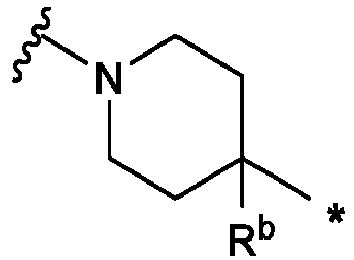
- A compound according to any one of claims 2-5, wherein n is 0 or 1 and m is 0 or 1.
- A compound according to any one of claims 2-10, wherein E is (a) hydrogen, (b) hydroxy, (c) C1-C6 alkyl optionally substituted with 1-3 fluoros, (d) Ar1C1-C6 alkyl-wherein said alkyl portion is optionally substituted with 1-3 fluoros, (e) hetAr2C1-C6 alkyl-, (g) Ar1O-, (h) hetAr2O-, (k) R3C(=O)NRg- where Rg is H or C1-C6 alkyl, (1) Ar1C(=O)NRg-where Rg is H or C1-C6 alkyl, (m) hetAr2C(=O)NRg(CH2)p- where p is 0 or 1, (n) R4R5NC(=O)-, or (s) R4R5NC(=O)NRg- where Rg is H or C1-C6 alkyl.
- A compound according to claim 11, wherein E is (d) Ar1C1-C6 alkyl- wherein said alkyl portion is optionally substituted with 1-3 fluoros, (e) hetAr2C1-C6 alkyl-, (g) Ar1O-, (h) hetAr2O-, (1) Ar1C(=O)NRg- where Rg is H or C1-C6 alkyl, or (m) hetAr2C(=O)NRg(CH2)p-where p is 0 or 1.
- A compound according to claim 1, wherein D is a saturated 7-8 membered bridged heterocyclic ring having one ring heteroatom which is nitrogen.
- A compound according to claim 13, wherein D is
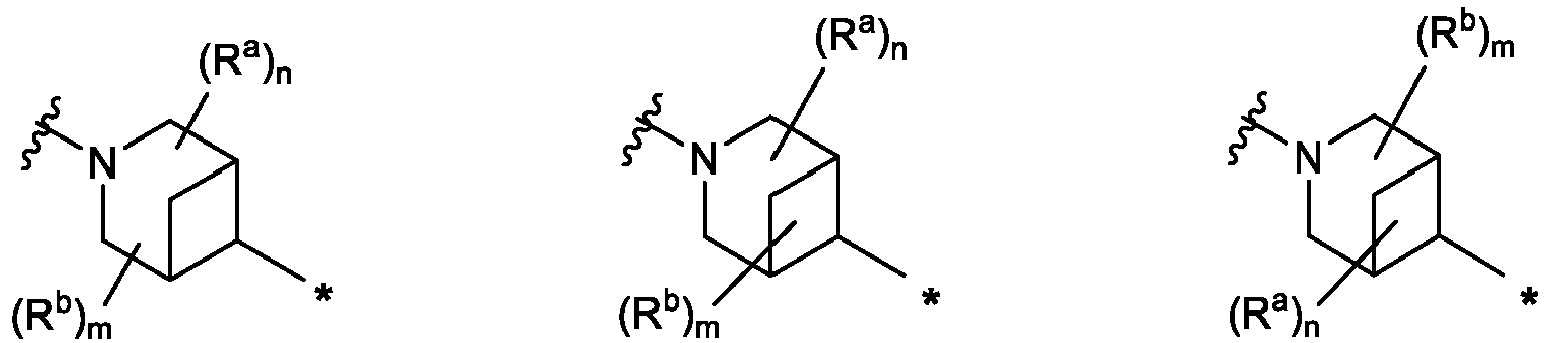


- A compound according to claim 14, wherein D is

- A compound according to claim 15, wherein D is

- A compound according to any one of claims 13-16, wherein E is (a) hydrogen, (b) hydroxy, (f) (C1-C6 alkoxy)C1-C6 alkoxy-, (h) hetAr2O-, (j) hetAr2NRg- where Rg is H or C1-C6 alkyl, (n) R4R5NC(=O)-, (o) Ar1NRgC(=O)-, where Rg is H or C1-C6 alkyl, or (p) hetAr2NRgC(=O)-, where Rg is H or C1-C6 alkyl.
- A compound according to claim 17, wherein E is (h) hetAr2O-, (j) hetAr2NRg- where Rg is H or C1-C6 alkyl, (o) Ar1NRgC(=O)-, where Rg is H or C1-C6 alkyl, or (p) hetAr2NRgC(=O)-, where Rg is H or C1-C6 alkyl.
- A compound according to claim 1, wherein D is a saturated 7-11 membered heterospirocyclic ring system having one ring heteroatom which is nitrogen.
- A compound according to any one of claims 1-19, wherein B is C1-C6 alkyl optionally substituted with 1-3 fluoros, or hydroxyC2-C6 alkyl wherein the alkyl portion is optionally substituted with a C3-C6 cycloalkylidene ring.
- A compound according to claim 20, wherein B is C1-C6 alkyl optionally substituted with 1-3 fluoros.
- A compound according to claim 20, wherein B is hydroxyC2-C6 alkyl wherein the alkyl portion is optionally substituted with a C3-C6 cycloalkylidene ring.
- A compound according to any one of claims 1-22, wherein X1 is N, and X2, X3 and X4 are independently CH or CF.
- A compound according to claim 23, wherein X1 is N, and X2, X3 and X4 are CH.
- A compound according to any one of claims 1-22, wherein X1 and X3 are N and X2 and X4 are independently CH or CF.
- A compound according to claim 25, wherein X1 and X3 are N and X2 and X4 are CH.
- A compound according to any one of claims 1-26, wherein A is CN.
- A compound according to claim 1, wherein the compound of Formula I is selected from the compounds of Examples 1-819 or a pharmaceutically acceptable salt thereof.
- A pharmaceutical composition, comprising a compound according to any one of claims 1-28, or a pharmaceutically acceptable salt or solvate thereof, in admixture with a pharmaceutically acceptable diluent or carrier.
- A compound of any one of claims 1-28 or a pharmaceutically acceptable salt or solvate thereof or a pharmaceutical composition according to claim 29 for use in treating a patient identified or diagnosed as having a RET-associated cancer.
- The compound for use according to claim 30, wherein the RET-associated cancer is selected from the group consisting of: lung cancer, papillary thyroid cancer, medullary thyroid cancer, differentiated thyroid cancer, recurrent thyroid cancer, refractory differentiated thyroid cancer, multiple endocrine neoplasia type 2A or 2B (MEN2A or MEN2B, respectively), pheochromocytoma, parathyroid hyperplasia, breast cancer, colorectal cancer, papillary renal cell carcinoma, ganglioneuromatosis of the gastroenteric mucosa, and cervical cancer.
- The compound for use according to claim 31, wherein the lung cancer is RET fusion lung cancer or the cancer is medullary thyroid cancer.
- The compound for use according to claim 31, wherein the lung cancer is small cell lung carcinoma, non-small cell lung cancer, bronciolus lung cell carcinoma, or lung adenocarcinoma.
- A process for preparing of a compound of claim 1 or a pharmaceutically acceptable salt thereof, comprising:(a) for a compound of claim 1 where E is H, A is CN, and B, X1, X2, X3, X4, Ring D, Ra, Rb, m and n are as defined in claim 1, coupling a corresponding compound 9 having the formula

 (b) for a compound of claim 1 where A, B, X1, X2, X3, X4, Ring D, Ra, Rb, m, n, and E are as defined in claim 1 with the exception that E is not hydrogen, functionalizing a corresponding compound of the formula
 (c) for a compound of claim 1 where A is CN and B, X1, X2, X3, X4, Ring D, Ra, Rb, m, n, and E are as defined in claim 1, reacting a corresponding compound of the formula 14
 (d) for a compound of claim 1 where E is H, A is CN, and B, X1, X2, X3, X4, and Ring D are as defined in claim 1, coupling a corresponding compound of formula 14
 (e) for a compound of claim 1 where A is H, B is H, and X1, X2, X3, X4, Ring D and E are as defined in claim 1, treating a corresponding compound of formula 18
 (f) for a compound of claim 1 where A is H, and B, X1, X2, X3, X4, Ring D, Ra, Rb, m, n, and E are as defined in claim 1,(i) treating a corresponding compound of formula 18
 (ii) reacting compound 19 with C1-C6 alkyl-X optionally substituted with 1-3 fluoros, hydroxyC2-C6 alkyl-X wherein the alkyl portion is optionally substituted with a C3-C6 cycloalkylidene ring, dihydroxyC3-C6 alkyl-X wherein the alkyl portion is optionally substituted with a C3-C6 cycloalkylidene ring, (C1-C6 alkoxy)C1-C6 alkyl-X optionally substituted with 1-3 fluoros, (R1R2N)C1-C6 alkyl-X, hetAr1C1-C3 alkyl-X, (C3-C6 cycloalkyl)C1-C3 alkyl-X, (hetCyca)C1-C3 alkyl-X, hetCyca-X or hetCycaC(=O)C1-C6 alkyl-X, where R1, R2, hetAr1, and hetCyca are as defined in claim 1 and X is a leaving atom or group, optionally followed by removal of the amino protecting group if present; or(g) for a compound of claim 1 where A is H or Cl, B is H, and X1, X2, X3, X4, Ring D, Ra, Rb, m, n, and E are as defined in claim 1, coupling a compound of formula
 (h) for a compound of claim 1 where A is H or Cl, and B, X1, X2, X3, X4, Ring D, Ra, Rb, m, n, and E are as defined in claim 1, coupling a compound of the formula
 (i) for a compound of claim 1where A is H, and B, X1, X2, X3, X4, Ring D, Ra, Rb, m, n, and E are as defined in claim 1, coupling a compound of formula 24

removing any additional protecting groups if present and optionally forming a pharmaceutically acceptable salt thereof.
Applications Claiming Priority (7)
| Application Number | Priority Date | Filing Date | Title |
|---|---|---|---|
| US201662406275P | 2016-10-10 | 2016-10-10 | |
| US201762447849P | 2017-01-18 | 2017-01-18 | |
| US201762491180P | 2017-04-27 | 2017-04-27 | |
| US201762531690P | 2017-07-12 | 2017-07-12 | |
| US201762566030P | 2017-09-29 | 2017-09-29 | |
| PCT/US2017/055993 WO2018071454A1 (en) | 2016-10-10 | 2017-10-10 | Substituted pyrazolo[1,5-a]pyridine compounds as ret kinase inhibitors |
| EP17787844.4A EP3523302B1 (en) | 2016-10-10 | 2017-10-10 | Substituted pyrazolo[1,5-a]pyridine compounds as ret kinase inhibitors |
Related Parent Applications (1)
| Application Number | Title | Priority Date | Filing Date |
|---|---|---|---|
| EP17787844.4A Division EP3523302B1 (en) | 2016-10-10 | 2017-10-10 | Substituted pyrazolo[1,5-a]pyridine compounds as ret kinase inhibitors |
Publications (1)
| Publication Number | Publication Date |
|---|---|
| EP4144735A1 true EP4144735A1 (en) | 2023-03-08 |
Family
ID=60153576
Family Applications (2)
| Application Number | Title | Priority Date | Filing Date |
|---|---|---|---|
| EP17787844.4A Active EP3523302B1 (en) | 2016-10-10 | 2017-10-10 | Substituted pyrazolo[1,5-a]pyridine compounds as ret kinase inhibitors |
| EP22183490.6A Withdrawn EP4144735A1 (en) | 2016-10-10 | 2017-10-10 | Substituted pyrazolo[1,5-a]pyridine compounds as ret kinase inhibitors |
Family Applications Before (1)
| Application Number | Title | Priority Date | Filing Date |
|---|---|---|---|
| EP17787844.4A Active EP3523302B1 (en) | 2016-10-10 | 2017-10-10 | Substituted pyrazolo[1,5-a]pyridine compounds as ret kinase inhibitors |
Country Status (35)
| Country | Link |
|---|---|
| US (5) | US10144734B2 (en) |
| EP (2) | EP3523302B1 (en) |
| JP (1) | JP7075399B2 (en) |
| KR (1) | KR102287752B1 (en) |
| CN (1) | CN110177786B (en) |
| AU (1) | AU2017342027B2 (en) |
| BR (1) | BR112019007143A2 (en) |
| CA (1) | CA3039912A1 (en) |
| CL (1) | CL2019000942A1 (en) |
| CO (1) | CO2019004649A2 (en) |
| CR (1) | CR20190224A (en) |
| CY (1) | CY1125606T1 (en) |
| DK (1) | DK3523302T3 (en) |
| DO (1) | DOP2019000091A (en) |
| EC (1) | ECSP19033052A (en) |
| ES (1) | ES2926136T3 (en) |
| HR (1) | HRP20221154T1 (en) |
| HU (1) | HUE060089T2 (en) |
| IL (1) | IL265918B (en) |
| JO (1) | JOP20190077B1 (en) |
| LT (1) | LT3523302T (en) |
| MD (1) | MD3523302T2 (en) |
| MX (1) | MX388140B (en) |
| PE (1) | PE20191613A1 (en) |
| PH (1) | PH12019500776A1 (en) |
| PL (1) | PL3523302T3 (en) |
| PT (1) | PT3523302T (en) |
| RS (1) | RS63510B1 (en) |
| SA (1) | SA519401544B1 (en) |
| SG (1) | SG11201903187WA (en) |
| SI (1) | SI3523302T1 (en) |
| TN (1) | TN2019000107A1 (en) |
| TW (1) | TWI752098B (en) |
| UA (1) | UA125032C2 (en) |
| WO (1) | WO2018071454A1 (en) |
Families Citing this family (51)
| Publication number | Priority date | Publication date | Assignee | Title |
|---|---|---|---|---|
| HUE053067T2 (en) | 2015-07-16 | 2021-06-28 | Array Biopharma Inc | Substituted pyrazolo [1,5-A] pyridine compounds as RET kinase inhibitors |
| NZ742351A (en) | 2015-11-02 | 2023-03-31 | Blueprint Medicines Corp | Inhibitors of ret |
| TWI704148B (en) * | 2016-10-10 | 2020-09-11 | 美商亞雷生物製藥股份有限公司 | Substituted pyrazolo[1,5-a]pyridine compounds as ret kinase inhibitors |
| TWI752098B (en) | 2016-10-10 | 2022-01-11 | 美商亞雷生物製藥股份有限公司 | Substituted pyrazolo[1,5-a]pyridine compounds as ret kinase inhibitors |
| ES2962865T3 (en) * | 2016-11-18 | 2024-03-21 | Integrative Res Laboratories Sweden Ab | New azetidine derivatives useful as modulators of cortical catecholaminergic neurotransmission |
| US11168090B2 (en) | 2017-01-18 | 2021-11-09 | Array Biopharma Inc. | Substituted pyrazolo[1,5-a]pyrazines as RET kinase inhibitors |
| TWI791053B (en) * | 2017-10-10 | 2023-02-01 | 美商亞雷生物製藥股份有限公司 | Crystalline forms of 6-(2-hydroxy-2-methylpropoxy)-4-(6-(6-((6-methoxypyridin-3-yl)methyl)-3,6-diazabicyclo[3.1.1]heptan-3-yl)pyridin-3-yl)pyrazolo[1,5-a]pyridine-3-carbonitrile and pharmaceutical composition thereof |
| CA3087972C (en) | 2018-01-18 | 2023-01-10 | Array Biopharma Inc. | Substituted pyrazolyl[4,3-c]pyridinecompounds as ret kinase inhibitors |
| EP3740490A1 (en) | 2018-01-18 | 2020-11-25 | Array Biopharma, Inc. | Substituted pyrazolo[3,4-d]pyrimidine compounds as ret kinase inhibitors |
| EP3740491A1 (en) | 2018-01-18 | 2020-11-25 | Array Biopharma, Inc. | Substituted pyrrolo[2,3-d]pyrimidines compounds as ret kinase inhibitors |
| EP3773589B1 (en) | 2018-04-03 | 2023-11-01 | Blueprint Medicines Corporation | Ret inhibitor for use in treating cancer having a ret alteration |
| JP2022500383A (en) | 2018-09-10 | 2022-01-04 | アレイ バイオファーマ インコーポレイテッド | Condensed heterocyclic compound as a RET kinase inhibitor |
| TW202028209A (en) * | 2018-09-27 | 2020-08-01 | 大陸商重慶複創醫藥研究有限公司 | Substituted imidazo[1,2-a]pyridine and [1,2,4]triazolo[1,5-a]pyridine compounds as ret kinase inhibitors |
| KR102558308B1 (en) * | 2018-09-27 | 2023-07-24 | 주식회사 엘지화학 | 3-azabicyclo[3,1,1]heptane derivatives and pharmaceutical composition comprising the same |
| WO2020064009A1 (en) * | 2018-09-30 | 2020-04-02 | 北京志健金瑞生物医药科技有限公司 | Substituted pyrazole fused ring derivative, preparation method therefor, and application thereof |
| WO2020094084A1 (en) * | 2018-11-07 | 2020-05-14 | 南京明德新药研发有限公司 | Tricyclic derivative as ret inhibitor |
| EP3886854A4 (en) | 2018-11-30 | 2022-07-06 | Nuvation Bio Inc. | PYRROLE AND PYRAZOLE COMPOUNDS AND METHODS OF USE THEREOF |
| CA3117854A1 (en) | 2018-12-07 | 2020-06-11 | Sunshine Lake Pharma Co., Ltd. | Ret inhibitors, pharmaceutical compositions and uses thereof |
| EP3891148A4 (en) * | 2018-12-07 | 2022-09-07 | Sunshine Lake Pharma Co., Ltd. | RET INHIBITORS, PHARMACEUTICAL COMPOSITIONS AND USES THEREOF |
| EP3942045A1 (en) | 2019-03-21 | 2022-01-26 | Onxeo | A dbait molecule in combination with kinase inhibitor for the treatment of cancer |
| CN111808077B (en) | 2019-04-12 | 2023-05-02 | 浙江海正药业股份有限公司 | Piperazine amide derivatives, process for their preparation and their use in medicine |
| EP3971187B1 (en) * | 2019-05-14 | 2025-05-07 | Shanghai Hansoh Biomedical Co., Ltd. | Inhibitor containing bicyclic derivative, preparation method therefor and use thereof |
| CN114127080B (en) * | 2019-06-10 | 2023-05-05 | 捷思英达医药技术(上海)有限公司 | Heterocyclic compounds as kinase inhibitors, compositions comprising the same, and methods of use thereof |
| WO2021043209A1 (en) * | 2019-09-04 | 2021-03-11 | 广东东阳光药业有限公司 | Ret inhibitor, pharmaceutical composition and use thereof |
| WO2021057970A1 (en) * | 2019-09-29 | 2021-04-01 | 广东东阳光药业有限公司 | Ret inhibitor, pharmaceutical composition thereof and use thereof |
| WO2021057963A1 (en) * | 2019-09-29 | 2021-04-01 | 广东东阳光药业有限公司 | Ret inhibitor, pharmaceutical composition comprising same and use thereof |
| EP4054579A1 (en) | 2019-11-08 | 2022-09-14 | Institut National de la Santé et de la Recherche Médicale (INSERM) | Methods for the treatment of cancers that have acquired resistance to kinase inhibitors |
| WO2021088911A1 (en) * | 2019-11-08 | 2021-05-14 | 杭州邦顺制药有限公司 | 3,6-diazabicyclo[3.1.1]heptane derivative as ret kinase inhibitor |
| US20230095530A1 (en) * | 2019-12-27 | 2023-03-30 | TYK Medicines, Inc | Compound used as ret kinase inhibitor and application thereof |
| CN113121524B (en) * | 2019-12-31 | 2023-04-25 | 南京创济生物医药有限公司 | Heterocyclic sulfoxide imine compound, intermediate thereof, preparation method and application |
| WO2021148581A1 (en) | 2020-01-22 | 2021-07-29 | Onxeo | Novel dbait molecule and its use |
| CN111285887B (en) * | 2020-03-27 | 2020-11-17 | 苏州信诺维医药科技有限公司 | a spiro compound |
| CN111410662B (en) * | 2020-03-27 | 2020-12-29 | 苏州信诺维医药科技有限公司 | a tyrosine kinase inhibitor |
| CN111269229B (en) * | 2020-03-27 | 2021-02-12 | 苏州信诺维医药科技有限公司 | a compound to treat cancer |
| CN111233899B (en) * | 2020-03-27 | 2020-12-29 | 苏州信诺维医药科技有限公司 | RET inhibitor |
| CN113527291B (en) * | 2020-04-13 | 2025-07-22 | 广东东阳光药业股份有限公司 | RET inhibitor, pharmaceutical composition thereof and application thereof |
| CN113527292B (en) * | 2020-04-13 | 2025-07-22 | 广东东阳光药业股份有限公司 | RET inhibitor, pharmaceutical composition and application thereof |
| CN113527290B (en) * | 2020-04-13 | 2025-07-22 | 广东东阳光药业股份有限公司 | RET inhibitor, pharmaceutical composition and application thereof |
| EP4141003A4 (en) * | 2020-04-22 | 2024-05-15 | Shenzhen Zhongge Biological Technology Co., Ltd. | PYRAZOLO[1,5-A]PYRIDINE DERIVATIVE, PREPARATION METHOD THEREFOR AND ASSOCIATED COMPOSITION AND USE |
| CN113620944B (en) * | 2020-05-07 | 2024-10-15 | 广东东阳光药业股份有限公司 | Novel RET inhibitor, pharmaceutical composition and use thereof |
| CN113683610B (en) * | 2020-05-18 | 2025-02-25 | 广东东阳光药业股份有限公司 | A RET inhibitor, its pharmaceutical composition and its use |
| CN113683611B (en) * | 2020-05-18 | 2025-02-11 | 广东东阳光药业股份有限公司 | New RET inhibitors, pharmaceutical compositions and uses thereof |
| JP7599228B2 (en) * | 2020-05-20 | 2024-12-13 | ティーワイケー メディシンズ インコーポレーテッド | Compounds as RET kinase inhibitors and their applications |
| CA3183728A1 (en) | 2020-05-29 | 2021-12-02 | Blueprint Medicines Corporation | Solid forms of pralsetinib |
| EP4192458A4 (en) | 2020-08-05 | 2024-09-04 | C4 Therapeutics, Inc. | COMPOUNDS FOR TARGETED RET DEGRADATION |
| CN114478586B (en) * | 2020-11-13 | 2026-04-28 | 上海翰森生物医药科技有限公司 | A dicyclic derivative inhibitor salt or crystal form, its preparation method, and its application. |
| CN116528859A (en) * | 2020-11-13 | 2023-08-01 | 上海翰森生物医药科技有限公司 | Crystal form containing free alkali of di-fused ring derivative inhibitor and preparation method and application thereof |
| AU2022463015A1 (en) | 2021-10-22 | 2024-05-09 | Tract Pharmaceuticals, Inc. | Methods and compositions for treating chronic inflammatory injury, metaplasia, dysplasia and cancers of epithelial tissues |
| WO2024006841A2 (en) * | 2022-06-29 | 2024-01-04 | Knowledge Pharmaceuticals Inc. | Compositions for weight loss and cancer treatment |
| KR20250058008A (en) * | 2022-08-01 | 2025-04-29 | 장쑤 한서 파마슈티칼 그룹 캄파니 리미티드 | Intermediates of conjugated bicyclic inhibitors and methods for their preparation |
| KR20250055538A (en) * | 2022-08-03 | 2025-04-24 | 브리스톨-마이어스 스큅 컴퍼니 | Compounds for modulating RET proteins |
Citations (143)
| Publication number | Priority date | Publication date | Assignee | Title |
|---|---|---|---|---|
| US5844092A (en) | 1994-03-18 | 1998-12-01 | Genentech, Inc. | Human TRK receptors and neurotrophic factor inhibitors |
| US5877016A (en) | 1994-03-18 | 1999-03-02 | Genentech, Inc. | Human trk receptors and neurotrophic factor inhibitors |
| WO2005044835A1 (en) | 2003-10-27 | 2005-05-19 | Genelabs Technologies, Inc. | METHODS FOR PREPARING 7-(2'-SUBSTITUTED-ß-D-RIBOFURANOSYL)-4-(NR2R3)-5-(SUBSTITUTED ETHYN-1-YL)-PYRROLO[2,3-D]PYRIMIDINE DERIVATIVES |
| WO2005051366A2 (en) | 2003-11-28 | 2005-06-09 | Novartis Ag | Diaryl urea derivatives in the treatment of protein kinase dependent diseases |
| WO2005062795A2 (en) | 2003-12-19 | 2005-07-14 | Plexxikon, Inc. | Compounds and methods for development of ret modulators |
| US20050209195A1 (en) | 2004-01-20 | 2005-09-22 | Cell Therapeutics Europe S.R.I | Indolinone derivatives |
| WO2006123113A2 (en) | 2005-05-16 | 2006-11-23 | Astrazeneca Ab | Pyrazolylaminopyrimidine derivatives useful as tyrosine kinase inhibitors |
| WO2006131952A1 (en) | 2005-06-07 | 2006-12-14 | Lay Line Genomics S.P.A. | Novel analgesic treatment with prolonged effect |
| WO2007002433A1 (en) | 2005-06-22 | 2007-01-04 | Plexxikon, Inc. | Pyrrolo [2, 3-b] pyridine derivatives as protein kinase inhibitors |
| WO2007022999A1 (en) | 2005-08-25 | 2007-03-01 | Creabilis Therapeutics S.P.A. | Polymer conjugates of k-252a and derivatives thereof |
| WO2007057399A2 (en) | 2005-11-15 | 2007-05-24 | Boehringer Ingelheim International Gmbh | Treatment of cancer with indole derivatives |
| WO2007087245A2 (en) | 2006-01-24 | 2007-08-02 | Merck & Co., Inc. | Ret tyrosine kinase inhibition |
| WO2007110344A1 (en) | 2006-03-27 | 2007-10-04 | Nerviano Medical Sciences S.R.L. | Pyridyl- and pyrimidinyl-substituted pyrrole-, thiophene- and furane-derivatives as kinase inhibitors |
| WO2007136103A1 (en) | 2006-05-18 | 2007-11-29 | Eisai R & D Management Co., Ltd. | Antitumor agent for thyroid cancer |
| WO2008031551A2 (en) | 2006-09-12 | 2008-03-20 | Novartis Forschungsstiftung, Zweigniederlassung | Non-neuroendocrine cancer therapy |
| US7384632B2 (en) | 2000-06-22 | 2008-06-10 | Genentech, Inc. | Agonist anti-trk-C monoclonal antibodies |
| WO2008079903A1 (en) | 2006-12-21 | 2008-07-03 | Plexxikon, Inc. | Pyrrolo [2, 3-b] pyridine derivatives as kinase modulators |
| WO2008080015A2 (en) | 2006-12-21 | 2008-07-03 | Plexxikon, Inc. | Compounds and methods for kinase modulation, and indications therefor |
| WO2008079909A1 (en) | 2006-12-21 | 2008-07-03 | Plexxikon, Inc. | Pyrrolo [2,3-b] pyridines as kinase modulators |
| WO2009007748A2 (en) | 2007-07-09 | 2009-01-15 | Astrazeneca Ab | Trisubstituted pyrimidine derivatives for the treatment of proliferative diseases |
| WO2009012283A1 (en) | 2007-07-17 | 2009-01-22 | Plexxikon Inc. | Compounds and methods for kinase modulation, and indications therefor |
| WO2009014637A2 (en) | 2007-07-19 | 2009-01-29 | Schering Corporation | Heterocyclic amide compounds as protein kinase inhibitors |
| WO2009013126A1 (en) | 2007-07-20 | 2009-01-29 | Nerviano Medical Sciences S.R.L. | Substituted indazole derivatives active as kinase inhibitors |
| WO2009017838A2 (en) | 2007-08-01 | 2009-02-05 | Exelixis, Inc. | Combinations of jak-2 inhibitors and other agents |
| US7514446B2 (en) | 2003-02-20 | 2009-04-07 | Smithkline Beecham Corporation | Pyrimidine compounds |
| US20090099167A1 (en) | 2004-01-22 | 2009-04-16 | Novartis Institutes For Biomedical Research | Organic compounds |
| WO2009053442A1 (en) | 2007-10-23 | 2009-04-30 | Novartis Ag | Use of trkb antibodies for the treatment of respiratory disorders |
| US20090130229A1 (en) | 2002-07-23 | 2009-05-21 | Cell Therapeutics, Inc. | Antitumor uses of compound |
| WO2009071480A2 (en) | 2007-12-04 | 2009-06-11 | Nerviano Medical Sciences S.R.L. | Substituted dihydropteridin-6-one derivatives, process for their preparation and their use as kinase inhibitors |
| WO2009092049A1 (en) | 2008-01-17 | 2009-07-23 | Irm Llc | Improved anti-trkb antibodies |
| US20090227556A1 (en) | 2008-01-31 | 2009-09-10 | Eisai R&D Management Co., Ltd. | Receptor tyrosine kinase inhibitors comprising pyridine and pyrimidine derivatives |
| WO2009118411A2 (en) | 2008-03-28 | 2009-10-01 | Nerviano Medical Sciences S.R.L. | 3,4-dihydro-2h-pyrazino[1,2-a]indol-1-one derivatives active as kinase inhibitors, process for their preparation and pharmaceutical compositions comprising them |
| WO2009143018A2 (en) | 2008-05-19 | 2009-11-26 | Plexxikon, Inc. | Compounds and methods for kinase modulation, and indications therefor |
| WO2009143024A2 (en) | 2008-05-19 | 2009-11-26 | Plexxikon, Inc. | Compounds and methods for kinase modulation, and indications therefor |
| WO2009152083A1 (en) | 2008-06-10 | 2009-12-17 | Plexxikon, Inc. | 5h-pyrr0l0 [2,3-b] pyrazine derivatives for kinase modulation, and indications therefor |
| WO2010033941A1 (en) | 2008-09-22 | 2010-03-25 | Array Biopharma Inc. | Substituted imidazo[1,2b]pyridazine compounds as trk kinase inhibitors |
| WO2010031816A1 (en) | 2008-09-19 | 2010-03-25 | Nerviano Medical Sciences S.R.L. | 3,4 DIHYDRO-2H-PYRROLO[1,2-a]PYRAZIN-1-ONE DERIVATIVES |
| WO2010048314A1 (en) | 2008-10-22 | 2010-04-29 | Array Biopharma Inc. | SUBSTITUTED PYRAZOLO[1,5-a]PYRIMIDINE COMPOUNDS AS TRK KINASE INHIBITORS |
| WO2010058006A1 (en) | 2008-11-24 | 2010-05-27 | Nerviano Medical Sciences S.R.L. | Cdk inhibitor for the treatment of mesothelioma |
| US20100152219A1 (en) | 2003-11-17 | 2010-06-17 | Astrazeneca R&D | Pyrazole derivatives as inhibitors of receptor tyrosine kinases |
| WO2010111527A1 (en) | 2009-03-26 | 2010-09-30 | Plexxikon, Inc. | Pyrazolo [ 3, 4 -b] pyridines as kinase inhibitors and their medical use |
| WO2010145998A1 (en) | 2009-06-15 | 2010-12-23 | Nerviano Medical Sciences S.R.L. | Substituted pyrimidinylpyrrolopyridinone derivatives, process for their preparation and their use as kinase inhibitors |
| WO2011006074A1 (en) | 2009-07-09 | 2011-01-13 | Array Biopharma Inc. | SUBSTITUTED PYRAZOLO[1,5-a]PYRIMIDINE COMPOUNDS AS TRK KINASE INHIBITORS |
| US20110053934A1 (en) | 2007-03-20 | 2011-03-03 | Glaxosmithkline Llc | Compounds and methods of treatment |
| WO2011092120A1 (en) | 2010-01-29 | 2011-08-04 | Nerviano Medical Sciences S.R.L. | 6,7- dihydroimidazo [1,5-a] pyrazin-8 (5h) - one derivatives as protein kinase modulators |
| US8012966B2 (en) | 2006-01-27 | 2011-09-06 | Shanghai Hengrui Pharmaceutical Co., Ltd. | Pyrrolo [3,2-c] pyridine-4-one 2-indolinone protein kinase inhibitors |
| US8026247B2 (en) | 2004-09-15 | 2011-09-27 | Novartis Ag | Bicyclic amides as kinase inhibitors |
| WO2011133637A2 (en) | 2010-04-21 | 2011-10-27 | Plexxikon, Inc. | Compounds and methods for kinase modulation, and indications therefor |
| WO2011146336A1 (en) | 2010-05-20 | 2011-11-24 | Array Biopharma Inc. | Macrocyclic compounds as trk kinase inhibitors |
| WO2012034091A1 (en) | 2010-09-09 | 2012-03-15 | Irm Llc | Imidazo [1, 2] pyridazin compounds and compositions as trk inhibitors |
| WO2012034095A1 (en) | 2010-09-09 | 2012-03-15 | Irm Llc | Compounds and compositions as trk inhibitors |
| WO2012053606A1 (en) | 2010-10-22 | 2012-04-26 | アステラス製薬株式会社 | Arylaminoheterocyclic carboxamide compound |
| WO2012101032A1 (en) | 2011-01-26 | 2012-08-02 | Nerviano Medical Sciences S.R.L. | Tricyclic pyrrolo derivatives, process for their preparation and their use as kinase inhibitors |
| WO2012101029A1 (en) | 2011-01-26 | 2012-08-02 | Nerviano Medical Sciences S.R.L. | Tricyclic derivatives, process for their preparation and their use as kinase inhibitors |
| WO2012109075A1 (en) | 2011-02-07 | 2012-08-16 | Plexxikon Inc. | Compounds and methods for kinase modulation, and indications therefor |
| WO2012116217A1 (en) | 2011-02-25 | 2012-08-30 | Irm Llc | Compounds and compositions as trk inhibitors |
| WO2012113774A1 (en) | 2011-02-24 | 2012-08-30 | Nerviano Medical Sciences S.R.L. | Thiazolylphenyl-benzenesulfonamido derivatives as kinase inhibitors |
| WO2012139930A1 (en) | 2011-04-11 | 2012-10-18 | Nerviano Medical Sciences S.R.L. | Pyrazolyl-pyrimidine derivatives as kinase inhibitors |
| WO2012143248A1 (en) | 2011-04-19 | 2012-10-26 | Nerviano Medical Sciences S.R.L. | Substituted pyrimidinyl-pyrroles active as kinase inhibitors |
| US20120277247A1 (en) * | 2011-04-28 | 2012-11-01 | Christel Jeanne Marie Menet | Novel compound useful for the treatment of degenerative and inflammatory diseases |
| WO2012152763A1 (en) | 2011-05-12 | 2012-11-15 | Nerviano Medical Sciences S.R.L. | Substituted indazole derivatives active as kinase inhibitors |
| WO2012158413A2 (en) | 2011-05-13 | 2012-11-22 | Array Biopharma Inc. | Pyrrolidinyl urea and pyrrolidinyl thiourea compounds as trka kinase inhibitors |
| US8338417B2 (en) | 2007-05-04 | 2012-12-25 | Irm Llc | Compounds and compositions as c-kit and PDGFR kinase inhibitors |
| WO2013014039A1 (en) | 2011-07-28 | 2013-01-31 | Nerviano Medical Sciences S.R.L. | Alkynyl substituted pyrimidinyl-pyrroles active as kinases inhibitors |
| US20130029925A1 (en) | 2010-02-18 | 2013-01-31 | Universite De Bretagne Occidentale (U.B.O.) | Method for Preventing Cancer Metastasis |
| US8399442B2 (en) | 2005-12-30 | 2013-03-19 | Astex Therapeutics Limited | Pharmaceutical compounds |
| WO2013050448A1 (en) | 2011-10-07 | 2013-04-11 | Nerviano Medical Sciences S.R.L. | 4-ALKYL SUBSTITUTED 3,4-DIHYDROPYRROLO[1,2-a]PYRAZIN-1(2H)-ONE DERIVATIVES AS KINASES INHIBITORS |
| WO2013050446A1 (en) | 2011-10-07 | 2013-04-11 | Nerviano Medical Sciences S.R.L. | SUBSTITUTED 3,4-DIHYDROPYRROLO[1,2-a]PYRAZIN-1(2H)-ONE DERIVATIVES AS KINASES INHIBITORS |
| WO2013074518A1 (en) | 2011-11-14 | 2013-05-23 | Tesaro, Inc. | Modulating certain tyrosine kinases |
| WO2013102059A1 (en) | 2011-12-30 | 2013-07-04 | Pharmacyclics, Inc. | Pyrazolo [3, 4-d] pyrimidine and pyrrolo [2, 3-d] pyrimidine compounds as kinase inhibitors |
| US8501756B2 (en) | 2008-12-09 | 2013-08-06 | Novartis Ag | Heterobicyclic carboxamides as inhibitors for kinases |
| US8552002B2 (en) | 2004-06-24 | 2013-10-08 | Novartis Ag | Compounds and compositions as protein kinase inhibitors |
| US8568998B2 (en) | 2004-03-26 | 2013-10-29 | Whitehead Institute For Biomedical Research | Methods of diagnosing, preventing and treating cancer metastasis |
| WO2013174876A1 (en) | 2012-05-23 | 2013-11-28 | Nerviano Medical Sciences S.R.L. | Process for the preparation of n-[5-(3,5-difluoro-benzyl)-1h-indazol-3-yl]-4-(4-methyl-piperazin-1-yl)-2-(tetrahydro-pyran-4-ylamino)-benzamide |
| WO2013183578A1 (en) | 2012-06-04 | 2013-12-12 | 第一三共株式会社 | IMIDAZO[1,2-b]PYRIDAZINE DERIVATIVE AS KINASE INHIBITOR |
| US8629135B2 (en) | 2008-07-14 | 2014-01-14 | Queen's University At Kingston | Pharmaceutical compositions comprising RET inhibitors and methods for the treatment of cancer |
| WO2014011900A2 (en) | 2012-07-11 | 2014-01-16 | Blueprint Medicines | Inhibitors of the fibroblast growth factor receptor |
| US8637256B2 (en) | 2005-01-26 | 2014-01-28 | Sphingotec Gmbh | Immunoassay for determining the release of neurotensin into the circulation |
| WO2014019908A2 (en) | 2012-08-02 | 2014-02-06 | Nerviano Medical Sciences S.R.L. | Substituted pyrroles active as kinases inhibitors |
| US20140121239A1 (en) | 2012-09-07 | 2014-05-01 | Exelixis, Inc. | Method of treating lung adenocarcinoma |
| WO2014072220A1 (en) | 2012-11-07 | 2014-05-15 | Nerviano Medical Sciences S.R.L. | Substituted pyrimidinyl and pyridinyl-pyrrolopyridinones, process for their preparation and their use as kinase inhibitors |
| WO2014075035A1 (en) | 2012-11-12 | 2014-05-15 | Cephalon, Inc. | Bendamustine derivatives and methods of using same |
| WO2014078417A1 (en) | 2012-11-13 | 2014-05-22 | Array Biopharma Inc. | Pyrazolyl urea, thiourea, guanidine and cyanoguanidine compounds as trka kinase inhibitors |
| WO2014078378A1 (en) | 2012-11-13 | 2014-05-22 | Array Biopharma Inc. | Pyrrolidinyl urea, thiourea, guanidine and cyanoguanidine compounds as trka kinase inhibitors |
| WO2014078408A1 (en) | 2012-11-13 | 2014-05-22 | Array Biopharma Inc. | Bicyclic heteroaryl urea, thiourea, guanidine and cyanoguanidine compounds as trka kinase inhibitors |
| WO2014078323A1 (en) | 2012-11-13 | 2014-05-22 | Array Biopharma Inc. | N-pyrrolidinyl, n'-pyrazolyl- urea, thiourea, guanidine and cyanoguanidine compounds as trka kinase inhibitors |
| WO2014078322A1 (en) | 2012-11-13 | 2014-05-22 | Array Biopharma Inc. | Thiazolyl and oxazolyl urea, thiourea, guanidine and cyanoguanidine compounds as trka kinase inhibitors |
| WO2014078331A1 (en) | 2012-11-13 | 2014-05-22 | Array Biopharma Inc. | N-(arylalkyl)-n'-pyrazolyl-urea, thiourea, guanidine and cyanoguanidine compounds as trka kinase inhibitors |
| WO2014078372A1 (en) | 2012-11-13 | 2014-05-22 | Array Biopharma Inc. | Pyrrolidinyl urea, thiourea, guanidine and cyanoguanidine compounds as trka kinase inhibitors |
| WO2014078454A1 (en) | 2012-11-13 | 2014-05-22 | Array Biopharma Inc. | Bicyclic urea, thiourea, guanidine and cyanoguanidine compounds useful for the treatment of pain |
| WO2014078328A1 (en) | 2012-11-13 | 2014-05-22 | Array Biopharma Inc. | N-bicyclic aryl,n'-pyrazolyl urea, thiourea, guanidine and cyanoguanidine compounds as trka kinase inhibitors |
| WO2014078325A1 (en) | 2012-11-13 | 2014-05-22 | Array Biopharma Inc. | N-(monocyclic aryl),n'-pyrazolyl-urea, thiourea, guanidine and cyanoguanidine compounds as trka kinase inhibitors |
| WO2014083567A2 (en) | 2012-11-29 | 2014-06-05 | Yeda Research And Development Co. Ltd. | Methods of preventing tumor metastasis, treating and prognosing cancer and identifying agents which are putative metastasis inhibitors |
| US8815901B2 (en) | 2008-05-23 | 2014-08-26 | Novartis Ag | Quinoline carboxamide derivatives as protein tyrosine kinase inhibitors |
| US20140272951A1 (en) | 2005-05-26 | 2014-09-18 | The Johns Hopkins University | Methods of identifying mutations in nucleic acid |
| WO2014141187A1 (en) | 2013-03-15 | 2014-09-18 | Glaxosmithkline Intellectual Property Development Limited | Pyridine derivatives as rearranged during transfection (ret) kinase inhibitors |
| WO2014160521A1 (en) | 2013-03-15 | 2014-10-02 | Blueprint Medicines Corporation | Piperazine derivatives and their use as kit modulators |
| WO2014184069A1 (en) | 2013-05-14 | 2014-11-20 | Nerviano Medical Sciences S.R.L. | Pyrrolo[2,3-d]pyrimidine derivatives, process for their preparation and their use as kinase inhibitors |
| US8895744B2 (en) | 2008-09-08 | 2014-11-25 | Universita' Degli Studi Di Milano-Bicocca | Alfa-carboline inhibitors of NPM-ALK, RET, and Bcr-Abl |
| WO2014194127A1 (en) | 2013-05-30 | 2014-12-04 | Plexxikon Inc. | Compounds for kinase modulation, and indications therefor |
| US8937071B2 (en) | 2013-03-15 | 2015-01-20 | Glaxosmithkline Intellectual Property Development Limited | Compounds as rearranged during transfection (RET) inhibitors |
| US8946226B2 (en) | 2008-07-29 | 2015-02-03 | Nerviano Medical Sciences S.R.L. | Use of CDK inhibitor for the treatment of glioma |
| WO2015017533A1 (en) | 2013-07-30 | 2015-02-05 | Blueprint Medicines Corporation | Ntrk2 fusions |
| WO2015017528A1 (en) | 2013-07-30 | 2015-02-05 | Blueprint Medicines Corporation | Pik3c2g fusions |
| US20150057335A1 (en) | 2013-08-20 | 2015-02-26 | National Cancer Center | Novel fusion genes identified in lung cancer |
| WO2015057873A1 (en) | 2013-10-17 | 2015-04-23 | Blueprint Medicines Corporation | Compositions useful for treating disorders related to kit |
| WO2015058129A1 (en) | 2013-10-17 | 2015-04-23 | Blueprint Medicines Corporation | Compositions useful for treating disorders related to kit |
| WO2015061572A1 (en) | 2013-10-25 | 2015-04-30 | Blueprint Medicines Corporation | Inhibitors of the fibroblast growth factor receptor |
| WO2015079251A1 (en) | 2013-11-29 | 2015-06-04 | Cancer Research Technology Limited | Quinazoline compounds |
| JP2015109806A (en) | 2012-03-22 | 2015-06-18 | アステラス製薬株式会社 | Method for detecting new ret fused body |
| US20150177246A1 (en) | 2012-07-26 | 2015-06-25 | Lsip, Llc | Fusion gene of cep55 gene and ret gene |
| WO2015108992A1 (en) | 2014-01-15 | 2015-07-23 | Blueprint Medicines Corporation | Heterobicyclic compounds and their use as fgfr4 receptor inhibitors |
| WO2015112806A2 (en) | 2014-01-24 | 2015-07-30 | Tp Therapeutics, Inc. | Diaryl macrocycles as modulators of protein kinases |
| WO2015124697A1 (en) | 2014-02-20 | 2015-08-27 | Ignyta, Inc. | Compounds for treating patients with ros1 mutant cancer cells |
| US20150272958A1 (en) | 2012-09-25 | 2015-10-01 | Chugai Seiyaku Kabushiki Kaisha | Ret inhibitor |
| WO2015161274A1 (en) | 2014-04-18 | 2015-10-22 | Blueprint Medicines Corporation | Pik3ca fusions |
| WO2015161277A1 (en) | 2014-04-18 | 2015-10-22 | Blueprint Medicines Corporation | Met fusions |
| WO2015175788A1 (en) | 2014-05-15 | 2015-11-19 | Array Biopharma Inc. | 1-((3s,4r)-4-(3-fluorophenyl)-1-(2-methoxyethyl)pyrrolidin-3-yl)-3-(4-methyl-3-(2-methylpyrimidin-5-yl)-1-phenyl-1h-pyrazol-5-yl)urea as a trka kinase inhibitor |
| WO2015191666A2 (en) | 2014-06-10 | 2015-12-17 | Blueprint Medicines Corporation | Raf1 fusions |
| WO2015191667A1 (en) | 2014-06-10 | 2015-12-17 | Blueprint Medicines Corporation | Pkn1 fusions |
| US9216172B2 (en) | 2011-08-04 | 2015-12-22 | National Cancer Center | Method for determining effectiveness of cancer treatment by assessing the presence of a KIF5B-RET chimeric gene |
| US20160000783A1 (en) | 2013-02-19 | 2016-01-07 | Ono Pharmaceutical Co., Ltd. | Trk-INHIBITING COMPOUND |
| CN105255927A (en) | 2015-09-30 | 2016-01-20 | 温州医科大学附属第一医院 | KIAA1217-RET fusion gene |
| WO2016011147A1 (en) | 2014-07-17 | 2016-01-21 | Blueprint Medicines Corporation | Prkc fusions |
| WO2016011141A1 (en) | 2014-07-17 | 2016-01-21 | Blueprint Medicines Corporation | Fgr fusions |
| WO2016011144A1 (en) | 2014-07-17 | 2016-01-21 | Blueprint Medicines Corporation | Tert fusions |
| US9242977B2 (en) | 2012-04-26 | 2016-01-26 | Ono Pharmaceutical Co., Ltd. | Trk-inhibiting compound |
| WO2016022569A1 (en) | 2014-08-04 | 2016-02-11 | Blueprint Medicines Corporation | Compositions useful for treating disorders related to kit |
| WO2016027754A1 (en) | 2014-08-18 | 2016-02-25 | 小野薬品工業株式会社 | ACID-ADDITION SALT OF Trk-INHIBITING COMPOUND |
| WO2016037578A1 (en) | 2014-09-10 | 2016-03-17 | Glaxosmithkline Intellectual Property Development Limited | Novel compounds as rearranged during transfection (ret) inhibitors |
| WO2016038519A1 (en) | 2014-09-08 | 2016-03-17 | Glaxosmithkline Intellectual Property Development Limited | Crystalline forms of 2-(4-(4-ethoxy-6-oxo-1,6-dihydropyridin-3-yl)-2-fluorophenyl)-n-(5-(1,1,1-trifluoro-2-methylpropan-2-yl)isoxazol-3-yl)acetamide |
| WO2016038552A1 (en) | 2014-09-10 | 2016-03-17 | Glaxosmithkline Intellectual Property Development Limited | Pyridone derivatives as rearranged during transfection (ret) kinase inhibitors |
| US9297011B2 (en) | 2011-08-23 | 2016-03-29 | Foundation Medicine, Inc. | KIF5B-RET fusion molecules and uses thereof |
| WO2016077841A1 (en) | 2014-11-16 | 2016-05-19 | Array Biopharma, Inc. | Crystalline form of (s)-n-(5-((r)-2-(2,5-difluorophenyl)-pyrrolidin-1-yl)-pyrazolo[1,5-a]pyrimidin-3-yl)-3-hydroxypyrrolidine-1-carboxamide hydrogen sulfate |
| WO2016075224A1 (en) | 2014-11-14 | 2016-05-19 | Nerviano Medical Sciences S.R.L. | 6-amino-7-bicyclo-7-deaza-purine derivatives as protein kinase inhibitors |
| WO2016081450A1 (en) | 2014-11-18 | 2016-05-26 | Blueprint Medicines Corporation | Prkacb fusions |
| WO2016127074A1 (en) | 2015-02-06 | 2016-08-11 | Blueprint Medicines Corporation | 2-(pyridin-3-yl)-pyrimidine derivatives as ret inhibitors |
| WO2016141169A1 (en) | 2015-03-03 | 2016-09-09 | Caris Mpi, Inc. | Molecular profiling for cancer |
| US9487491B2 (en) | 2009-05-08 | 2016-11-08 | Astellas Pharma Inc. | Diamino heterocyclic carboxamide compound |
| WO2017026718A1 (en) | 2015-08-07 | 2017-02-16 | 한국과학기술연구원 | Novel 3-(isoxazol-3-yl)-pyrazolo[3,4-d]pyrimidin-4-amine compound, which is ret kinase inhibitor |
| WO2017043550A1 (en) | 2015-09-08 | 2017-03-16 | 大鵬薬品工業株式会社 | Condensed pyrimidine compound or salt thereof |
| WO2017122815A1 (en) | 2016-01-15 | 2017-07-20 | 公益財団法人がん研究会 | Novel fusant and method for detecting same |
| WO2017146116A1 (en) | 2016-02-23 | 2017-08-31 | 大鵬薬品工業株式会社 | Novel condensed pyrimidine compound or salt thereof |
Family Cites Families (121)
| Publication number | Priority date | Publication date | Assignee | Title |
|---|---|---|---|---|
| US4783443A (en) | 1986-03-03 | 1988-11-08 | The University Of Chicago | Amino acyl cephalosporin derivatives |
| DE69736428T2 (en) | 1996-05-08 | 2007-08-30 | Biogen Idec Ma Inc., Cambridge | RET-LIGAND 3 (RetL3) TO STIMULATE NEURAL AND RENAL GROWTH |
| US6677135B1 (en) | 1996-05-08 | 2004-01-13 | Biogen, Inc. | Ret ligand (RetL) for stimulating neutral and renal growth |
| US6682921B1 (en) | 1996-08-21 | 2004-01-27 | New York University | Crystals of the tyrosine kinase domain of non-insulin receptor tyrosine kinases |
| US6531152B1 (en) | 1998-09-30 | 2003-03-11 | Dexcel Pharma Technologies Ltd. | Immediate release gastrointestinal drug delivery system |
| WO2001016169A2 (en) | 1999-09-01 | 2001-03-08 | Biogen, Inc. | RET LIGAND 5 (Retl5) FROM HUMAN AND MOUSE |
| FI20000403A0 (en) | 2000-02-22 | 2000-02-22 | Hannu Sariola | Use of GDNF family-related compounds for the preparation of testicular cancer treatment products |
| AU2002334355A1 (en) | 2001-09-06 | 2003-03-18 | Prochon Biotech Ltd. | Protein tyrosine kinase inhibitors |
| PE20030762A1 (en) | 2001-12-18 | 2003-09-05 | Schering Corp | HETEROCYCLIC COMPOUNDS AS NK1 ANTAGONISTS |
| US7466344B2 (en) | 2002-06-07 | 2008-12-16 | Scimeasure Analytical Systems, Inc. | High-speed low noise CCD controller |
| US20060116381A1 (en) | 2002-07-24 | 2006-06-01 | Fagin James A | 4-4(methylpiperazin-1-ylmethyl)-n-[4-methyl-3-(pyridin-3-yl)pyrimidin-2-ylamino)phenyl]-ben-zamide for treating mutated-ret kinase associated diseases |
| US20090143399A1 (en) | 2003-10-14 | 2009-06-04 | Arizona Board Of Regents On Behalf Of The University Of Arizona | Protein Kinase Inhibitors |
| JP2007511575A (en) | 2003-11-21 | 2007-05-10 | ノバルティス アクチエンゲゼルシャフト | 1H-imidazoquinoline derivatives as protein kinase inhibitors |
| GB0330043D0 (en) | 2003-12-24 | 2004-01-28 | Pharmacia Italia Spa | Pyrrolo [2,3-b] pyridine derivatives active as kinase inhibitors process for their preparation and pharmaceutical compositions comprising them |
| GB0330042D0 (en) | 2003-12-24 | 2004-01-28 | Pharmacia Italia Spa | Pyrrolo [2,3-b] pyridine derivatives active as kinase inhibitors process for their preparation and pharmaceutical compositions them |
| AR049769A1 (en) | 2004-01-22 | 2006-09-06 | Novartis Ag | DERIVATIVES OF PIRAZOLO (1,5-A) PIRIMIDIN 7-IL-AMINA TO BE USED IN THE TREATMENT OF DEPENDENT DISEASES OF PROTEIN KINASE |
| US7465726B2 (en) | 2004-08-02 | 2008-12-16 | Osi Pharmaceuticals, Inc. | Substituted pyrrolo[2.3-B]pyridines |
| US7855205B2 (en) | 2004-10-29 | 2010-12-21 | Janssen Pharmaceutica Nv | Pyrimidinyl substituted fused-pyrrolyl compounds useful in treating kinase disorders |
| NZ555942A (en) | 2004-12-17 | 2011-01-28 | Univ Pennsylvania | Radiolabelled tilbene derivatives and their use for binding and imaging amyloid plaques |
| GB0501999D0 (en) | 2005-02-01 | 2005-03-09 | Sentinel Oncology Ltd | Pharmaceutical compounds |
| EP1848506A2 (en) | 2005-02-18 | 2007-10-31 | Attenuon, LLC | Pyrimidine-fused diazepine derivatives and indole-fused pteridines |
| GB0507575D0 (en) | 2005-04-14 | 2005-05-18 | Novartis Ag | Organic compounds |
| EP1874731A4 (en) | 2005-04-15 | 2009-08-05 | Cylene Pharmaceuticals Inc | QUINOBENZOXAZINE ANALOGUES AND METHODS OF USE THEREOF |
| EP1896462A2 (en) | 2005-05-31 | 2008-03-12 | The Pfahl Family Trust (Dated 9 July 1996) | Substituted biarylheterocycle derivatives as protein kinase inhibitors for the treatment of cancer and other diseases |
| WO2006130673A1 (en) | 2005-05-31 | 2006-12-07 | Janssen Pharmaceutica, N.V. | 3-benzoimidazolyl-pyrazolopyridines useful in treating kinase disorders |
| GB0515026D0 (en) | 2005-07-21 | 2005-08-31 | Novartis Ag | Organic compounds |
| EP1948647A1 (en) | 2005-11-03 | 2008-07-30 | SGX Pharmaceuticals, Inc. | Pyrimidinyl-thiophene kinase modulators |
| US20070149523A1 (en) | 2005-11-14 | 2007-06-28 | Jan Ehlert | Thiazole Analogues and Uses Thereof |
| EP1785420A1 (en) | 2005-11-14 | 2007-05-16 | 4Sc Ag | Thiazole analogues and uses thereof |
| WO2007057397A1 (en) | 2005-11-15 | 2007-05-24 | Boehringer Ingelheim International Gmbh | Treatment of cancer |
| GB0524436D0 (en) | 2005-11-30 | 2006-01-11 | Novartis Ag | Organic compounds |
| WO2007065664A2 (en) | 2005-12-08 | 2007-06-14 | Novartis Ag | Pyrazolo[1,5-a]pyridine-3-carboxylic acids as ephb and vegfr2 kinase inhibitors |
| BRPI0710181A2 (en) | 2006-03-16 | 2011-08-09 | Novartis Ag | organic compounds |
| WO2007109120A2 (en) | 2006-03-17 | 2007-09-27 | Ambit Biosciences Corporation | Imidazolothiazole compounds for the treatment of disease |
| MX2008014618A (en) | 2006-05-15 | 2008-11-28 | Irm Llc | Compositions and methods for fgf receptor kinases inhibitors. |
| US8063225B2 (en) | 2006-08-14 | 2011-11-22 | Chembridge Corporation | Tricyclic compound derivatives useful in the treatment of neoplastic diseases, inflammatory disorders and immunomodulatory disorders |
| WO2008033562A2 (en) | 2006-09-15 | 2008-03-20 | Xcovery, Inc. | Kinase inhibitor compounds |
| US20120225057A1 (en) | 2006-10-11 | 2012-09-06 | Deciphera Pharmaceuticals, Llc | Methods and compositions for the treatment of myeloproliferative diseases and other proliferative diseases |
| EP1918291A1 (en) | 2006-10-30 | 2008-05-07 | Novartis AG | 3-Aminocarbonyl-substituted fused pyrazolo-derivatives as protein kinase modulators |
| LT2848610T (en) | 2006-11-15 | 2017-11-10 | Ym Biosciences Australia Pty Ltd | Inhibitors of kinase activity |
| CL2007003627A1 (en) * | 2006-12-15 | 2008-07-25 | Bayer Schering Pharma Ag | COMPOUNDS DERIVED FROM 3-H-PIRAZOLOPIRIDINAS; PREPARATION METHOD; PHARMACEUTICAL COMPOSITION; AND USE FOR THE TREATMENT OF DECREGULATED VASCULAR GROWTH DISEASES SUCH AS ACUTE MYELOGEN LEUKEMIA, RETINOPATIA, REUMATOID ARTHRITIS, PSORIAS |
| US20080199426A1 (en) | 2007-01-11 | 2008-08-21 | Sukhatme Vikas P | Methods and compositions for the treatment and diagnosis of vascular inflammatory disorders or endothelial cell disorders |
| JP2010516692A (en) | 2007-01-19 | 2010-05-20 | バイエル・ヘルスケア・エルエルシー | Treatment of cancer resistant to chemotherapeutic agents |
| US20110189167A1 (en) | 2007-04-20 | 2011-08-04 | Flynn Daniel L | Methods and Compositions for the Treatment of Myeloproliferative Diseases and other Proliferative Diseases |
| WO2008138184A1 (en) | 2007-05-14 | 2008-11-20 | Shanghai Hengrui Pharmaceutical Co.Ltd. | Derivatives of pyrroloazacycles, the method of making them and the use thereof as inhibitors of protein kinases |
| WO2009003136A1 (en) | 2007-06-26 | 2008-12-31 | Rigel Pharmaceuticals, Inc. | Substituted pyrimidine-2, 4 -diamines for treating cell proliferative disorders |
| WO2009012262A1 (en) | 2007-07-16 | 2009-01-22 | The Regents Of The University Of California | Protein kinase modulating compounds and methods for making and using them |
| JP5703466B2 (en) | 2007-08-07 | 2015-04-22 | パーデュー・リサーチ・ファウンデーションPurdue Research Foundation | Kinase inhibitors and uses thereof |
| EP2025678A1 (en) | 2007-08-17 | 2009-02-18 | Oncalis AG | Pyrazolo[3,4-d]pyrimidine compounds and their use as modulators of protein kinase |
| WO2009042646A1 (en) | 2007-09-24 | 2009-04-02 | Curis, Inc. | Anti-proliferative agents |
| CN101459004B (en) | 2007-12-14 | 2011-02-09 | 深圳富泰宏精密工业有限公司 | Press-key panel construction for electronic device and method for manufacturing the press-key panel construction |
| TW200942537A (en) | 2008-02-01 | 2009-10-16 | Irm Llc | Compounds and compositions as kinase inhibitors |
| WO2009103076A1 (en) | 2008-02-15 | 2009-08-20 | Oxigene, Inc. | Methods and compositions for enhancing the efficacy of rtk inhibitors |
| DK2262807T3 (en) | 2008-03-19 | 2015-11-30 | Chembridge Corp | NOVEL tyrosine kinase inhibitors |
| EP2303890A4 (en) | 2008-06-19 | 2012-04-11 | Progenics Pharm Inc | Phosphatidylinositol 3 kinase inhibitors |
| JO3041B1 (en) | 2008-07-25 | 2016-09-05 | Galapagos Nv | Novel compounds useful for the treatment of degenerative and inflammatory diseases |
| BRPI0917178A2 (en) | 2008-09-01 | 2015-11-10 | Sharp Kk | organic electroluminescent panel, organic electroluminescent display and production methods thereof |
| WO2010028254A2 (en) | 2008-09-05 | 2010-03-11 | Auspek Pharmaceuticals, Inc. | Substituted quinazoline inhibitors of growth factor receptor tyrosine kinases |
| EP2331530B8 (en) | 2008-09-26 | 2013-12-25 | National Health Research Institutes | Fused multicyclic compounds as protein kinase inhibitors |
| JP5686736B2 (en) | 2008-11-06 | 2015-03-18 | アムビト ビオスシエンセス コルポラチオン | Imidazolothiazole compounds as protein kinase modulators |
| KR101061599B1 (en) | 2008-12-05 | 2011-09-02 | 한국과학기술연구원 | Novel indazole derivatives that are protein kinase inhibitors for the treatment of abnormal cell growth diseases, pharmaceutically acceptable salts thereof, and pharmaceutical compositions containing the same as active ingredients |
| KR101709492B1 (en) | 2009-03-18 | 2017-02-23 | 리스버로직스 코퍼레이션 | Novel anti-inflammatory agents |
| TWI410418B (en) | 2009-04-29 | 2013-10-01 | Ind Tech Res Inst | Azaazulene compound, pharmaceutical composition, and method of inhibiting the activity of protein kinsae in a cell |
| EP2440058A4 (en) | 2009-06-12 | 2012-11-21 | Dana Farber Cancer Inst Inc | FOUNDED HETEROCYCLIC COMPOUNDS AND USES THEREOF |
| MY162604A (en) | 2009-08-17 | 2017-06-30 | Intellikine Llc | Heterocyclic compounds and uses thereof |
| KR101256018B1 (en) | 2009-08-20 | 2013-04-18 | 한국과학기술연구원 | 1,3,6-Substituted indole derivatives having inhibitory activity for protein kinase |
| FR2951172B1 (en) | 2009-10-13 | 2014-09-26 | Pf Medicament | PYRAZOLOPYRIDINE DERIVATIVES AS ANTI-CANCER AGENT |
| KR101147550B1 (en) | 2009-10-22 | 2012-05-17 | 한국과학기술연구원 | 2,7-Substituted thieno[3,2-d]pyrimidine compounds as protein kinase inhibitors |
| KR101116756B1 (en) | 2009-10-27 | 2012-03-13 | 한국과학기술연구원 | Novel 1,6-disubstituted indole compounds as protein kinase inhibitors |
| MX2012004846A (en) | 2009-10-29 | 2012-10-05 | Genosco | Kinase inhibitors. |
| US8629132B2 (en) | 2009-11-13 | 2014-01-14 | Genosco | Kinase inhibitors |
| KR101094446B1 (en) | 2009-11-19 | 2011-12-15 | 한국과학기술연구원 | 2,4,7-substituted thieno [3,2-d] pyrimidine compounds with protein kinase inhibitory activity |
| EP2937345B1 (en) | 2009-12-29 | 2018-03-21 | Dana-Farber Cancer Institute, Inc. | Type ii raf kinase inhibitors |
| KR101483215B1 (en) | 2010-01-29 | 2015-01-16 | 한미약품 주식회사 | Bicyclic heteroaryl derivatives having inhibitory activity for protein kinases |
| KR101347303B1 (en) | 2010-01-29 | 2014-01-06 | 한미사이언스 주식회사 | THIENO[3,2-d]PYRIMIDINE DERIVATIVES HAVING INHIBITORY ACTIVITY ON PROTEIN KINASES |
| WO2012037155A2 (en) | 2010-09-13 | 2012-03-22 | Gtx, Inc. | Tyrosine kinase inhibitors |
| WO2012047017A2 (en) | 2010-10-05 | 2012-04-12 | 크리스탈지노믹스(주) | 2,3-dihydro-isoindol-1-one derivative and a composition comprising the same |
| CN102093421B (en) | 2011-01-28 | 2014-07-02 | 北京康辰药业有限公司 | Phosphorus substituent group-containing quinoline compound and preparation method of quinoline compound as well as pharmaceutical composition containing quinoline compound and application of pharmaceutical composition |
| US8791112B2 (en) | 2011-03-30 | 2014-07-29 | Arrien Pharmaceuticals Llc | Substituted 5-(pyrazin-2-yl)-1H-pyrazolo [3, 4-B] pyridine and pyrazolo [3, 4-B] pyridine derivatives as protein kinase inhibitors |
| EP3628665B1 (en) | 2011-04-01 | 2022-11-02 | University of Utah Research Foundation | Substituted n-phenylpyrimidin-2-amine analogs as inhibitors of the axl kinase |
| RU2477723C2 (en) | 2011-06-16 | 2013-03-20 | Общество С Ограниченной Ответственностью "Фьюжн Фарма" | Protein kinase inhibitor (versions), use thereof for treating oncological diseases and based pharmaceutical composition |
| CN102827073A (en) * | 2011-06-17 | 2012-12-19 | 安吉奥斯医药品有限公司 | Therapeutically active compositions and application methods thereof |
| WO2013016720A2 (en) | 2011-07-28 | 2013-01-31 | Gerinda Therapeutics, Inc. | Novel substituted biarylheterocycle derivatives as protein kinase inhibitors for the treatment of cancer and other diseases |
| MX370814B (en) | 2011-09-02 | 2020-01-08 | Univ California | Substituted pyrazolo[3,4-d]pyrimidines and uses thereof. |
| WO2013036232A2 (en) | 2011-09-08 | 2013-03-14 | Deciphera Pharmaceuticals, Llc | Methods and compositions for the treatment of myeloproliferative diseases and other proliferative diseases |
| CN102408411B (en) | 2011-09-19 | 2014-10-22 | 北京康辰药业股份有限公司 | Hydroximic acid compound containing quinolyl and preparation method thereof, and drug composition containing the compound and use thereof |
| WO2013042137A1 (en) | 2011-09-19 | 2013-03-28 | Aurigene Discovery Technologies Limited | Bicyclic heterocycles as irak4 inhibitors |
| KR20140100938A (en) | 2011-11-30 | 2014-08-18 | 도쿠리츠교세이호진 고쿠리츠간켄큐센터 | Induced malignant stem cells |
| USRE47451E1 (en) | 2011-12-30 | 2019-06-25 | Hanmi Pharm. Co. Ltd. | Thieno[3,2-D]pyrimidine derivatives having inhibitory activity for protein kinases |
| AU2013259267A1 (en) | 2012-05-10 | 2014-11-06 | Synta Pharmaceuticals Corp. | Treating cancer with Hsp90 inhibitory compounds |
| CN104428463B (en) | 2012-07-13 | 2018-07-24 | 奥的斯电梯公司 | belt including fiber |
| CN103848785B (en) | 2012-12-04 | 2016-07-13 | 上海医药集团股份有限公司 | One class deuterated 3-cyano quinoline compound, its Pharmaceutical composition, preparation method and its usage |
| FR3000492B1 (en) | 2012-12-28 | 2015-09-11 | Oribase Pharma | NOVEL AZAINDOLE DERIVATIVES AS MULTIKINASE INHIBITORS |
| FR3000494B1 (en) | 2012-12-28 | 2015-08-21 | Oribase Pharma | NOVEL AZAINDOLE DERIVATIVES AS INHIBITORS OF PROTEIN KINASES |
| FR3000493A1 (en) | 2012-12-28 | 2014-07-04 | Oribase Pharma | NEW INHIBITORS OF PROTEIN KINASES |
| ES2696700T3 (en) | 2012-12-28 | 2019-01-17 | Crystalgenomics Inc | Derivative of 2,3-dihydro-isoindol-1-on as BTK kinase suppressor and pharmaceutical composition including the same |
| US20160151461A1 (en) | 2013-03-14 | 2016-06-02 | The Trustees Of The University Of Pennsylvania | Cardio-Metabolic and Vascular Effects of GLP-1 Metabolites |
| CN105683182A (en) | 2013-08-30 | 2016-06-15 | 埃姆比特生物科学公司 | Biaryl acetamide compounds and methods of use thereof |
| AU2013402175B2 (en) | 2013-09-30 | 2017-09-07 | Handok Inc. | Novel triazolopyrazine derivative and use thereof |
| EP3076966A2 (en) | 2013-12-02 | 2016-10-12 | BerGenBio AS | Use of kinase inhibitors |
| AU2015218236B2 (en) | 2014-02-14 | 2019-06-13 | Exelixis, Inc. | Crystalline solid forms of N-{4-[(6,7-dimethoxyquinolin-4-yl)oxy]phenyl}-N'-(4-fluorophenyl) cyclopropane-1, 1-dicarboxamide, processes for making, and methods of use |
| CA2952083C (en) | 2014-07-17 | 2023-01-24 | Sunshine Lake Pharma Co., Ltd. | Substituted urea derivatives and pharmaceutical uses thereof |
| TWI538914B (en) | 2014-10-03 | 2016-06-21 | 國立交通大學 | Selective inhibitors for protein kinases, a pharmaceutical composition and an use thereof |
| WO2016096709A1 (en) | 2014-12-16 | 2016-06-23 | Eudendron S.R.L. | Heterocyclic derivatives modulating activity of certain protein kinases |
| KR101675984B1 (en) | 2015-02-23 | 2016-11-14 | 한양대학교 에리카산학협력단 | Thienodiazepine derivatives or pharmaceutically acceptable salt thereof, and pharmaceutical composition comprising the same as an active ingredient |
| CN108137593B (en) | 2015-04-21 | 2021-01-05 | 上海交通大学医学院附属瑞金医院 | Preparation and use of protein kinase inhibitors |
| GB201512365D0 (en) | 2015-07-15 | 2015-08-19 | King S College London | Novel therapy |
| HUE053067T2 (en) | 2015-07-16 | 2021-06-28 | Array Biopharma Inc | Substituted pyrazolo [1,5-A] pyridine compounds as RET kinase inhibitors |
| EP3120851A1 (en) | 2015-07-21 | 2017-01-25 | Pangaea Biotech S.L. | 4-amino-6-(2,6-dichlorophenyl)-8-methyl-2-(phenylamino)-pyrido[2,3-d]pyrimidin-7(8h)-one for treatment of solid cancers |
| US10550124B2 (en) | 2015-08-13 | 2020-02-04 | San Diego State University Foundation | Atropisomerism for increased kinase inhibitor selectivity |
| WO2017049462A1 (en) | 2015-09-22 | 2017-03-30 | 合肥中科普瑞昇生物医药科技有限公司 | Novel flt3 kinase inhibitor and uses thereof |
| NZ742351A (en) | 2015-11-02 | 2023-03-31 | Blueprint Medicines Corp | Inhibitors of ret |
| WO2017097697A1 (en) | 2015-12-08 | 2017-06-15 | Boehringer Ingelheim International Gmbh | Method using a ret fusion gene as a biomarker to select non-small cell lung cancer (nsclc) and thyroid cancer patients for a cancer treatment |
| TWI620748B (en) | 2016-02-05 | 2018-04-11 | National Health Research Institutes | Aminothiazole compounds and use thereof |
| WO2017145050A1 (en) | 2016-02-23 | 2017-08-31 | Glaxosmithkline Intellectual Property Development Limited | Pyridylpyridone derivative useful as a ret kinase inhibitor in the treatment of ibs and cancer |
| UY37155A (en) | 2016-03-17 | 2017-10-31 | Blueprint Medicines Corp | RET INHIBITORS |
| US10045991B2 (en) | 2016-04-04 | 2018-08-14 | Loxo Oncology, Inc. | Methods of treating pediatric cancers |
| RS63609B1 (en) | 2016-04-15 | 2022-10-31 | Cancer Research Tech Ltd | HETEROCYCLIC COMPOUNDS AS RET KINASE INHIBITORS |
| EP3442980B1 (en) | 2016-04-15 | 2021-06-09 | Cancer Research Technology Limited | Heterocyclic compounds as ret kinase inhibitors |
| TWI704148B (en) * | 2016-10-10 | 2020-09-11 | 美商亞雷生物製藥股份有限公司 | Substituted pyrazolo[1,5-a]pyridine compounds as ret kinase inhibitors |
| TWI752098B (en) | 2016-10-10 | 2022-01-11 | 美商亞雷生物製藥股份有限公司 | Substituted pyrazolo[1,5-a]pyridine compounds as ret kinase inhibitors |
-
2017
- 2017-10-06 TW TW106134612A patent/TWI752098B/en not_active IP Right Cessation
- 2017-10-10 MD MDE20190907T patent/MD3523302T2/en unknown
- 2017-10-10 DK DK17787844.4T patent/DK3523302T3/en active
- 2017-10-10 EP EP17787844.4A patent/EP3523302B1/en active Active
- 2017-10-10 PE PE2019000791A patent/PE20191613A1/en unknown
- 2017-10-10 HU HUE17787844A patent/HUE060089T2/en unknown
- 2017-10-10 TN TNP/2019/000107A patent/TN2019000107A1/en unknown
- 2017-10-10 CN CN201780076283.XA patent/CN110177786B/en not_active Expired - Fee Related
- 2017-10-10 LT LTEPPCT/US2017/055993T patent/LT3523302T/en unknown
- 2017-10-10 KR KR1020197013105A patent/KR102287752B1/en not_active Expired - Fee Related
- 2017-10-10 ES ES17787844T patent/ES2926136T3/en active Active
- 2017-10-10 AU AU2017342027A patent/AU2017342027B2/en not_active Ceased
- 2017-10-10 PT PT177878444T patent/PT3523302T/en unknown
- 2017-10-10 MX MX2019004204A patent/MX388140B/en unknown
- 2017-10-10 JO JOJO/P/2019/0077A patent/JOP20190077B1/en active
- 2017-10-10 WO PCT/US2017/055993 patent/WO2018071454A1/en not_active Ceased
- 2017-10-10 EP EP22183490.6A patent/EP4144735A1/en not_active Withdrawn
- 2017-10-10 CA CA3039912A patent/CA3039912A1/en active Pending
- 2017-10-10 PL PL17787844.4T patent/PL3523302T3/en unknown
- 2017-10-10 HR HRP20221154TT patent/HRP20221154T1/en unknown
- 2017-10-10 UA UAA201904246A patent/UA125032C2/en unknown
- 2017-10-10 CR CR20190224A patent/CR20190224A/en unknown
- 2017-10-10 SI SI201731196T patent/SI3523302T1/en unknown
- 2017-10-10 JP JP2019519331A patent/JP7075399B2/en not_active Expired - Fee Related
- 2017-10-10 RS RS20220783A patent/RS63510B1/en unknown
- 2017-10-10 SG SG11201903187WA patent/SG11201903187WA/en unknown
- 2017-10-10 BR BR112019007143A patent/BR112019007143A2/en not_active Application Discontinuation
- 2017-12-29 US US15/858,929 patent/US10144734B2/en active Active
-
2018
- 2018-01-03 US US15/861,244 patent/US10172845B2/en active Active
- 2018-01-03 US US15/860,894 patent/US10441581B2/en active Active
-
2019
- 2019-04-08 IL IL265918A patent/IL265918B/en active IP Right Grant
- 2019-04-08 CL CL2019000942A patent/CL2019000942A1/en unknown
- 2019-04-10 PH PH12019500776A patent/PH12019500776A1/en unknown
- 2019-04-10 SA SA519401544A patent/SA519401544B1/en unknown
- 2019-04-10 DO DO2019000091A patent/DOP2019000091A/en unknown
- 2019-05-06 CO CONC2019/0004649A patent/CO2019004649A2/en unknown
- 2019-05-10 EC ECSENADI201933052A patent/ECSP19033052A/en unknown
- 2019-09-23 US US16/579,150 patent/US10881652B2/en active Active
-
2020
- 2020-12-01 US US17/108,528 patent/US11648243B2/en active Active
-
2022
- 2022-10-04 CY CY20221100658T patent/CY1125606T1/en unknown
Patent Citations (186)
| Publication number | Priority date | Publication date | Assignee | Title |
|---|---|---|---|---|
| US5877016A (en) | 1994-03-18 | 1999-03-02 | Genentech, Inc. | Human trk receptors and neurotrophic factor inhibitors |
| US5910574A (en) | 1994-03-18 | 1999-06-08 | Genentech, Inc. | Human trk receptors and neurotrophic factor inhibitors |
| US6025166A (en) | 1994-03-18 | 2000-02-15 | Genentech, Inc. | Human trk receptors and neurotrophic factor inhibitors |
| US6027927A (en) | 1994-03-18 | 2000-02-22 | Genentech, Inc. | Human trk receptors and neurotrophic factor inhibitors |
| US6153189A (en) | 1994-03-18 | 2000-11-28 | Genentech, Inc. | Human TRK receptors and neurotrophic factor inhibitors |
| US5844092A (en) | 1994-03-18 | 1998-12-01 | Genentech, Inc. | Human TRK receptors and neurotrophic factor inhibitors |
| US7384632B2 (en) | 2000-06-22 | 2008-06-10 | Genentech, Inc. | Agonist anti-trk-C monoclonal antibodies |
| US7615383B2 (en) | 2000-06-22 | 2009-11-10 | Genentech, Inc. | Methods for treating neuropathy by agonist anti-trk-C monoclonal antibodies |
| US20090130229A1 (en) | 2002-07-23 | 2009-05-21 | Cell Therapeutics, Inc. | Antitumor uses of compound |
| US7514446B2 (en) | 2003-02-20 | 2009-04-07 | Smithkline Beecham Corporation | Pyrimidine compounds |
| WO2005044835A1 (en) | 2003-10-27 | 2005-05-19 | Genelabs Technologies, Inc. | METHODS FOR PREPARING 7-(2'-SUBSTITUTED-ß-D-RIBOFURANOSYL)-4-(NR2R3)-5-(SUBSTITUTED ETHYN-1-YL)-PYRROLO[2,3-D]PYRIMIDINE DERIVATIVES |
| US20100152219A1 (en) | 2003-11-17 | 2010-06-17 | Astrazeneca R&D | Pyrazole derivatives as inhibitors of receptor tyrosine kinases |
| WO2005051366A2 (en) | 2003-11-28 | 2005-06-09 | Novartis Ag | Diaryl urea derivatives in the treatment of protein kinase dependent diseases |
| US7504509B2 (en) | 2003-12-19 | 2009-03-17 | Plexxikon, Inc. | Compounds and methods for development of Ret modulators |
| US8067434B2 (en) | 2003-12-19 | 2011-11-29 | Plexxikon Inc. | Compounds and methods for development of Ret modulators |
| US20100324065A1 (en) | 2003-12-19 | 2010-12-23 | Plexxikon Inc | Compounds and methods for development of Ret Modulators |
| WO2005062795A2 (en) | 2003-12-19 | 2005-07-14 | Plexxikon, Inc. | Compounds and methods for development of ret modulators |
| US20050209195A1 (en) | 2004-01-20 | 2005-09-22 | Cell Therapeutics Europe S.R.I | Indolinone derivatives |
| US20090099167A1 (en) | 2004-01-22 | 2009-04-16 | Novartis Institutes For Biomedical Research | Organic compounds |
| US8568998B2 (en) | 2004-03-26 | 2013-10-29 | Whitehead Institute For Biomedical Research | Methods of diagnosing, preventing and treating cancer metastasis |
| US8552002B2 (en) | 2004-06-24 | 2013-10-08 | Novartis Ag | Compounds and compositions as protein kinase inhibitors |
| US20110301157A1 (en) | 2004-09-15 | 2011-12-08 | Novartis Ag | Bicyclic amides as kinase inhibitors |
| US8026247B2 (en) | 2004-09-15 | 2011-09-27 | Novartis Ag | Bicyclic amides as kinase inhibitors |
| US8637256B2 (en) | 2005-01-26 | 2014-01-28 | Sphingotec Gmbh | Immunoassay for determining the release of neurotensin into the circulation |
| WO2006123113A2 (en) | 2005-05-16 | 2006-11-23 | Astrazeneca Ab | Pyrazolylaminopyrimidine derivatives useful as tyrosine kinase inhibitors |
| US8114989B2 (en) | 2005-05-16 | 2012-02-14 | Astrazeneca Ab | Pyrazolylaminopyrimidine derivatives useful as tyrosine kinase inhibitors |
| US20140272951A1 (en) | 2005-05-26 | 2014-09-18 | The Johns Hopkins University | Methods of identifying mutations in nucleic acid |
| WO2006131952A1 (en) | 2005-06-07 | 2006-12-14 | Lay Line Genomics S.P.A. | Novel analgesic treatment with prolonged effect |
| US8691221B2 (en) | 2005-06-07 | 2014-04-08 | Lay Line Genomics S.P.A. | Analgesic treatment with prolonged effect |
| WO2007002325A1 (en) | 2005-06-22 | 2007-01-04 | Plexxikon, Inc. | Pyrrolo[2,3-b] pyridine derivatives as protein kinase inhibitors |
| WO2007002433A1 (en) | 2005-06-22 | 2007-01-04 | Plexxikon, Inc. | Pyrrolo [2, 3-b] pyridine derivatives as protein kinase inhibitors |
| US20160176865A1 (en) | 2005-06-22 | 2016-06-23 | Plexxikon Inc. | Compounds and methods for kinase modulation, and indications therefor |
| WO2007022999A1 (en) | 2005-08-25 | 2007-03-01 | Creabilis Therapeutics S.P.A. | Polymer conjugates of k-252a and derivatives thereof |
| US8673347B2 (en) | 2005-08-25 | 2014-03-18 | Creabilis Therapeutics S.P.A. | Polymer conjugates of K-252A and derivatives thereof |
| WO2007057399A2 (en) | 2005-11-15 | 2007-05-24 | Boehringer Ingelheim International Gmbh | Treatment of cancer with indole derivatives |
| US8399442B2 (en) | 2005-12-30 | 2013-03-19 | Astex Therapeutics Limited | Pharmaceutical compounds |
| WO2007087245A2 (en) | 2006-01-24 | 2007-08-02 | Merck & Co., Inc. | Ret tyrosine kinase inhibition |
| US8012966B2 (en) | 2006-01-27 | 2011-09-06 | Shanghai Hengrui Pharmaceutical Co., Ltd. | Pyrrolo [3,2-c] pyridine-4-one 2-indolinone protein kinase inhibitors |
| WO2007110344A1 (en) | 2006-03-27 | 2007-10-04 | Nerviano Medical Sciences S.R.L. | Pyridyl- and pyrimidinyl-substituted pyrrole-, thiophene- and furane-derivatives as kinase inhibitors |
| WO2007136103A1 (en) | 2006-05-18 | 2007-11-29 | Eisai R & D Management Co., Ltd. | Antitumor agent for thyroid cancer |
| US9006256B2 (en) | 2006-05-18 | 2015-04-14 | Eisai R&D Management Co., Ltd. | Antitumor agent for thyroid cancer |
| WO2008031551A2 (en) | 2006-09-12 | 2008-03-20 | Novartis Forschungsstiftung, Zweigniederlassung | Non-neuroendocrine cancer therapy |
| WO2008080001A2 (en) | 2006-12-21 | 2008-07-03 | Plexxikon, Inc. | Compounds and methods for kinase modulation, and indications therefor |
| WO2008079903A1 (en) | 2006-12-21 | 2008-07-03 | Plexxikon, Inc. | Pyrrolo [2, 3-b] pyridine derivatives as kinase modulators |
| WO2008080015A2 (en) | 2006-12-21 | 2008-07-03 | Plexxikon, Inc. | Compounds and methods for kinase modulation, and indications therefor |
| WO2008079909A1 (en) | 2006-12-21 | 2008-07-03 | Plexxikon, Inc. | Pyrrolo [2,3-b] pyridines as kinase modulators |
| WO2008079906A1 (en) | 2006-12-21 | 2008-07-03 | Plexxikon, Inc. | Pyrrolo [2, 3-b] pyridine derivatives as kinase modulators |
| US7863289B2 (en) | 2006-12-21 | 2011-01-04 | Plexxikon, Inc. | Compounds and methods for kinase modulation, and indications therefor |
| US20110053934A1 (en) | 2007-03-20 | 2011-03-03 | Glaxosmithkline Llc | Compounds and methods of treatment |
| US8338417B2 (en) | 2007-05-04 | 2012-12-25 | Irm Llc | Compounds and compositions as c-kit and PDGFR kinase inhibitors |
| WO2009007748A2 (en) | 2007-07-09 | 2009-01-15 | Astrazeneca Ab | Trisubstituted pyrimidine derivatives for the treatment of proliferative diseases |
| WO2009012283A1 (en) | 2007-07-17 | 2009-01-22 | Plexxikon Inc. | Compounds and methods for kinase modulation, and indications therefor |
| WO2009014637A2 (en) | 2007-07-19 | 2009-01-29 | Schering Corporation | Heterocyclic amide compounds as protein kinase inhibitors |
| WO2009013126A1 (en) | 2007-07-20 | 2009-01-29 | Nerviano Medical Sciences S.R.L. | Substituted indazole derivatives active as kinase inhibitors |
| US8299057B2 (en) | 2007-07-20 | 2012-10-30 | Nerviano Medical Sciences S.R.L. | Substituted indazole derivatives active as kinase inhibitors |
| WO2009017838A2 (en) | 2007-08-01 | 2009-02-05 | Exelixis, Inc. | Combinations of jak-2 inhibitors and other agents |
| WO2009053442A1 (en) | 2007-10-23 | 2009-04-30 | Novartis Ag | Use of trkb antibodies for the treatment of respiratory disorders |
| US20100297115A1 (en) | 2007-10-23 | 2010-11-25 | Novartis Ag | Use of trkb antibodies for the treatment of respiratory disorders |
| WO2009071480A2 (en) | 2007-12-04 | 2009-06-11 | Nerviano Medical Sciences S.R.L. | Substituted dihydropteridin-6-one derivatives, process for their preparation and their use as kinase inhibitors |
| WO2009092049A1 (en) | 2008-01-17 | 2009-07-23 | Irm Llc | Improved anti-trkb antibodies |
| US8642035B2 (en) | 2008-01-17 | 2014-02-04 | Irm Llc | Anti-TrkB antibodies |
| US20090227556A1 (en) | 2008-01-31 | 2009-09-10 | Eisai R&D Management Co., Ltd. | Receptor tyrosine kinase inhibitors comprising pyridine and pyrimidine derivatives |
| WO2009118411A2 (en) | 2008-03-28 | 2009-10-01 | Nerviano Medical Sciences S.R.L. | 3,4-dihydro-2h-pyrazino[1,2-a]indol-1-one derivatives active as kinase inhibitors, process for their preparation and pharmaceutical compositions comprising them |
| WO2009143024A2 (en) | 2008-05-19 | 2009-11-26 | Plexxikon, Inc. | Compounds and methods for kinase modulation, and indications therefor |
| US9260437B2 (en) | 2008-05-19 | 2016-02-16 | Plexxikon Inc. | Compounds and methods for kinase modulation, and indications therefor |
| WO2009143018A2 (en) | 2008-05-19 | 2009-11-26 | Plexxikon, Inc. | Compounds and methods for kinase modulation, and indications therefor |
| US8912204B2 (en) | 2008-05-19 | 2014-12-16 | Plexxikon Inc. | Compounds and methods for kinase modulation, and indications therefor |
| US8815901B2 (en) | 2008-05-23 | 2014-08-26 | Novartis Ag | Quinoline carboxamide derivatives as protein tyrosine kinase inhibitors |
| WO2009152083A1 (en) | 2008-06-10 | 2009-12-17 | Plexxikon, Inc. | 5h-pyrr0l0 [2,3-b] pyrazine derivatives for kinase modulation, and indications therefor |
| US8629135B2 (en) | 2008-07-14 | 2014-01-14 | Queen's University At Kingston | Pharmaceutical compositions comprising RET inhibitors and methods for the treatment of cancer |
| US8946226B2 (en) | 2008-07-29 | 2015-02-03 | Nerviano Medical Sciences S.R.L. | Use of CDK inhibitor for the treatment of glioma |
| US8895744B2 (en) | 2008-09-08 | 2014-11-25 | Universita' Degli Studi Di Milano-Bicocca | Alfa-carboline inhibitors of NPM-ALK, RET, and Bcr-Abl |
| WO2010031816A1 (en) | 2008-09-19 | 2010-03-25 | Nerviano Medical Sciences S.R.L. | 3,4 DIHYDRO-2H-PYRROLO[1,2-a]PYRAZIN-1-ONE DERIVATIVES |
| US8450322B2 (en) | 2008-09-22 | 2013-05-28 | Array Biopharma Inc. | Substituted imidazo[1,2b]pyridazine compounds as Trk kinase inhibitors |
| WO2010033941A1 (en) | 2008-09-22 | 2010-03-25 | Array Biopharma Inc. | Substituted imidazo[1,2b]pyridazine compounds as trk kinase inhibitors |
| US8513263B2 (en) | 2008-10-22 | 2013-08-20 | Array Biopharma Inc. | Substituted pyrazolo[1,5-a]pyrimidine compounds as Trk kinase inhibitors |
| WO2010048314A1 (en) | 2008-10-22 | 2010-04-29 | Array Biopharma Inc. | SUBSTITUTED PYRAZOLO[1,5-a]PYRIMIDINE COMPOUNDS AS TRK KINASE INHIBITORS |
| WO2010058006A1 (en) | 2008-11-24 | 2010-05-27 | Nerviano Medical Sciences S.R.L. | Cdk inhibitor for the treatment of mesothelioma |
| US8912194B2 (en) | 2008-11-24 | 2014-12-16 | Nerviano Medical Sciences S.R.L. | CDK inhibitor for the treatment of mesothelioma |
| US8501756B2 (en) | 2008-12-09 | 2013-08-06 | Novartis Ag | Heterobicyclic carboxamides as inhibitors for kinases |
| WO2010111527A1 (en) | 2009-03-26 | 2010-09-30 | Plexxikon, Inc. | Pyrazolo [ 3, 4 -b] pyridines as kinase inhibitors and their medical use |
| US9487491B2 (en) | 2009-05-08 | 2016-11-08 | Astellas Pharma Inc. | Diamino heterocyclic carboxamide compound |
| WO2010145998A1 (en) | 2009-06-15 | 2010-12-23 | Nerviano Medical Sciences S.R.L. | Substituted pyrimidinylpyrrolopyridinone derivatives, process for their preparation and their use as kinase inhibitors |
| US8791123B2 (en) | 2009-07-09 | 2014-07-29 | Array Biopharma, Inc. | Substituted pyrazolo[1,5-a]pyrimidine compounds as Trk kinase inhibitors |
| WO2011006074A1 (en) | 2009-07-09 | 2011-01-13 | Array Biopharma Inc. | SUBSTITUTED PYRAZOLO[1,5-a]PYRIMIDINE COMPOUNDS AS TRK KINASE INHIBITORS |
| WO2011092120A1 (en) | 2010-01-29 | 2011-08-04 | Nerviano Medical Sciences S.R.L. | 6,7- dihydroimidazo [1,5-a] pyrazin-8 (5h) - one derivatives as protein kinase modulators |
| US20130029925A1 (en) | 2010-02-18 | 2013-01-31 | Universite De Bretagne Occidentale (U.B.O.) | Method for Preventing Cancer Metastasis |
| WO2011133637A2 (en) | 2010-04-21 | 2011-10-27 | Plexxikon, Inc. | Compounds and methods for kinase modulation, and indications therefor |
| US8933084B2 (en) | 2010-05-20 | 2015-01-13 | Array Biopharma Inc. | Macrocyclic compounds as Trk kinase inhibitors |
| WO2011146336A1 (en) | 2010-05-20 | 2011-11-24 | Array Biopharma Inc. | Macrocyclic compounds as trk kinase inhibitors |
| WO2012034095A1 (en) | 2010-09-09 | 2012-03-15 | Irm Llc | Compounds and compositions as trk inhibitors |
| WO2012034091A1 (en) | 2010-09-09 | 2012-03-15 | Irm Llc | Imidazo [1, 2] pyridazin compounds and compositions as trk inhibitors |
| US8637516B2 (en) | 2010-09-09 | 2014-01-28 | Irm Llc | Compounds and compositions as TRK inhibitors |
| WO2012053606A1 (en) | 2010-10-22 | 2012-04-26 | アステラス製薬株式会社 | Arylaminoheterocyclic carboxamide compound |
| WO2012101029A1 (en) | 2011-01-26 | 2012-08-02 | Nerviano Medical Sciences S.R.L. | Tricyclic derivatives, process for their preparation and their use as kinase inhibitors |
| WO2012101032A1 (en) | 2011-01-26 | 2012-08-02 | Nerviano Medical Sciences S.R.L. | Tricyclic pyrrolo derivatives, process for their preparation and their use as kinase inhibitors |
| WO2012109075A1 (en) | 2011-02-07 | 2012-08-16 | Plexxikon Inc. | Compounds and methods for kinase modulation, and indications therefor |
| WO2012113774A1 (en) | 2011-02-24 | 2012-08-30 | Nerviano Medical Sciences S.R.L. | Thiazolylphenyl-benzenesulfonamido derivatives as kinase inhibitors |
| US9102671B2 (en) | 2011-02-25 | 2015-08-11 | Novartis Ag | Compounds and compositions as TRK inhibitors |
| WO2012116217A1 (en) | 2011-02-25 | 2012-08-30 | Irm Llc | Compounds and compositions as trk inhibitors |
| WO2012139930A1 (en) | 2011-04-11 | 2012-10-18 | Nerviano Medical Sciences S.R.L. | Pyrazolyl-pyrimidine derivatives as kinase inhibitors |
| WO2012143248A1 (en) | 2011-04-19 | 2012-10-26 | Nerviano Medical Sciences S.R.L. | Substituted pyrimidinyl-pyrroles active as kinase inhibitors |
| US20120277247A1 (en) * | 2011-04-28 | 2012-11-01 | Christel Jeanne Marie Menet | Novel compound useful for the treatment of degenerative and inflammatory diseases |
| WO2012152763A1 (en) | 2011-05-12 | 2012-11-15 | Nerviano Medical Sciences S.R.L. | Substituted indazole derivatives active as kinase inhibitors |
| WO2012158413A2 (en) | 2011-05-13 | 2012-11-22 | Array Biopharma Inc. | Pyrrolidinyl urea and pyrrolidinyl thiourea compounds as trka kinase inhibitors |
| US20150166564A1 (en) | 2011-05-13 | 2015-06-18 | Array BioPharama Inc. | Pyrrolidinyl urea, pyrrolidinyl thiourea and pyrrolidinyl guanidine compounds as trka kinase inhibitors |
| WO2013014039A1 (en) | 2011-07-28 | 2013-01-31 | Nerviano Medical Sciences S.R.L. | Alkynyl substituted pyrimidinyl-pyrroles active as kinases inhibitors |
| US9216172B2 (en) | 2011-08-04 | 2015-12-22 | National Cancer Center | Method for determining effectiveness of cancer treatment by assessing the presence of a KIF5B-RET chimeric gene |
| US20170014413A1 (en) | 2011-08-23 | 2017-01-19 | Foundation Medicine, Inc. | Novel kif5b-ret fusion molecules and uses thereof |
| US9297011B2 (en) | 2011-08-23 | 2016-03-29 | Foundation Medicine, Inc. | KIF5B-RET fusion molecules and uses thereof |
| WO2013050448A1 (en) | 2011-10-07 | 2013-04-11 | Nerviano Medical Sciences S.R.L. | 4-ALKYL SUBSTITUTED 3,4-DIHYDROPYRROLO[1,2-a]PYRAZIN-1(2H)-ONE DERIVATIVES AS KINASES INHIBITORS |
| WO2013050446A1 (en) | 2011-10-07 | 2013-04-11 | Nerviano Medical Sciences S.R.L. | SUBSTITUTED 3,4-DIHYDROPYRROLO[1,2-a]PYRAZIN-1(2H)-ONE DERIVATIVES AS KINASES INHIBITORS |
| US20150306086A1 (en) | 2011-11-14 | 2015-10-29 | Tesaro, Inc. | Modulating certain tyrosine kinases |
| WO2013074518A1 (en) | 2011-11-14 | 2013-05-23 | Tesaro, Inc. | Modulating certain tyrosine kinases |
| US20150018336A1 (en) | 2011-12-30 | 2015-01-15 | Pharmacyclics, Inc. | PYRAZOLO[3,4-d]PYRIMIDINE AND PYRAZOLO[2,3-d]PYRIMIDINE COMPOUNDS AS KINASE INHIBITORS |
| US9273051B2 (en) | 2011-12-30 | 2016-03-01 | Pharmacyclics Llc | Pyrazolo[3,4-d]pyrimidine and pyrrolo[2,3-d]pyrimidine compounds as kinase inhibitors |
| WO2013102059A1 (en) | 2011-12-30 | 2013-07-04 | Pharmacyclics, Inc. | Pyrazolo [3, 4-d] pyrimidine and pyrrolo [2, 3-d] pyrimidine compounds as kinase inhibitors |
| JP2015109806A (en) | 2012-03-22 | 2015-06-18 | アステラス製薬株式会社 | Method for detecting new ret fused body |
| US9242977B2 (en) | 2012-04-26 | 2016-01-26 | Ono Pharmaceutical Co., Ltd. | Trk-inhibiting compound |
| WO2013174876A1 (en) | 2012-05-23 | 2013-11-28 | Nerviano Medical Sciences S.R.L. | Process for the preparation of n-[5-(3,5-difluoro-benzyl)-1h-indazol-3-yl]-4-(4-methyl-piperazin-1-yl)-2-(tetrahydro-pyran-4-ylamino)-benzamide |
| US20150051222A1 (en) | 2012-05-23 | 2015-02-19 | Nerviano Medical Sciences S.R.L. | Process for the preparation of n-[5-(3,5-difluoro-benzyl)-1h-indazol-3-yl]-4-(4-methyl-piperazin-1-yl)-2-(tetrahydro-pyran-4-ylamino)-benzamide |
| WO2013183578A1 (en) | 2012-06-04 | 2013-12-12 | 第一三共株式会社 | IMIDAZO[1,2-b]PYRIDAZINE DERIVATIVE AS KINASE INHIBITOR |
| WO2014011900A2 (en) | 2012-07-11 | 2014-01-16 | Blueprint Medicines | Inhibitors of the fibroblast growth factor receptor |
| US20150177246A1 (en) | 2012-07-26 | 2015-06-25 | Lsip, Llc | Fusion gene of cep55 gene and ret gene |
| WO2014019908A2 (en) | 2012-08-02 | 2014-02-06 | Nerviano Medical Sciences S.R.L. | Substituted pyrroles active as kinases inhibitors |
| US20140121239A1 (en) | 2012-09-07 | 2014-05-01 | Exelixis, Inc. | Method of treating lung adenocarcinoma |
| US20150238477A1 (en) | 2012-09-07 | 2015-08-27 | Exelixis, Inc. | Method of Treating Lung Adenocarcinoma |
| US20150272958A1 (en) | 2012-09-25 | 2015-10-01 | Chugai Seiyaku Kabushiki Kaisha | Ret inhibitor |
| WO2014072220A1 (en) | 2012-11-07 | 2014-05-15 | Nerviano Medical Sciences S.R.L. | Substituted pyrimidinyl and pyridinyl-pyrrolopyridinones, process for their preparation and their use as kinase inhibitors |
| US9149464B2 (en) | 2012-11-12 | 2015-10-06 | Ignyta, Inc. | Bendamustine derivatives and methods of using same |
| US9150517B2 (en) | 2012-11-12 | 2015-10-06 | Ignyta, Inc. | Bendamustine derivatives and methods of using same |
| WO2014075035A1 (en) | 2012-11-12 | 2014-05-15 | Cephalon, Inc. | Bendamustine derivatives and methods of using same |
| WO2014078323A1 (en) | 2012-11-13 | 2014-05-22 | Array Biopharma Inc. | N-pyrrolidinyl, n'-pyrazolyl- urea, thiourea, guanidine and cyanoguanidine compounds as trka kinase inhibitors |
| WO2014078328A1 (en) | 2012-11-13 | 2014-05-22 | Array Biopharma Inc. | N-bicyclic aryl,n'-pyrazolyl urea, thiourea, guanidine and cyanoguanidine compounds as trka kinase inhibitors |
| WO2014078454A1 (en) | 2012-11-13 | 2014-05-22 | Array Biopharma Inc. | Bicyclic urea, thiourea, guanidine and cyanoguanidine compounds useful for the treatment of pain |
| WO2014078378A1 (en) | 2012-11-13 | 2014-05-22 | Array Biopharma Inc. | Pyrrolidinyl urea, thiourea, guanidine and cyanoguanidine compounds as trka kinase inhibitors |
| WO2014078372A1 (en) | 2012-11-13 | 2014-05-22 | Array Biopharma Inc. | Pyrrolidinyl urea, thiourea, guanidine and cyanoguanidine compounds as trka kinase inhibitors |
| WO2014078331A1 (en) | 2012-11-13 | 2014-05-22 | Array Biopharma Inc. | N-(arylalkyl)-n'-pyrazolyl-urea, thiourea, guanidine and cyanoguanidine compounds as trka kinase inhibitors |
| WO2014078322A1 (en) | 2012-11-13 | 2014-05-22 | Array Biopharma Inc. | Thiazolyl and oxazolyl urea, thiourea, guanidine and cyanoguanidine compounds as trka kinase inhibitors |
| WO2014078417A1 (en) | 2012-11-13 | 2014-05-22 | Array Biopharma Inc. | Pyrazolyl urea, thiourea, guanidine and cyanoguanidine compounds as trka kinase inhibitors |
| WO2014078325A1 (en) | 2012-11-13 | 2014-05-22 | Array Biopharma Inc. | N-(monocyclic aryl),n'-pyrazolyl-urea, thiourea, guanidine and cyanoguanidine compounds as trka kinase inhibitors |
| WO2014078408A1 (en) | 2012-11-13 | 2014-05-22 | Array Biopharma Inc. | Bicyclic heteroaryl urea, thiourea, guanidine and cyanoguanidine compounds as trka kinase inhibitors |
| WO2014083567A2 (en) | 2012-11-29 | 2014-06-05 | Yeda Research And Development Co. Ltd. | Methods of preventing tumor metastasis, treating and prognosing cancer and identifying agents which are putative metastasis inhibitors |
| US20160000783A1 (en) | 2013-02-19 | 2016-01-07 | Ono Pharmaceutical Co., Ltd. | Trk-INHIBITING COMPOUND |
| US9035063B2 (en) | 2013-03-15 | 2015-05-19 | Glaxosmithkline Intellectual Property Development Limited | Compounds as rearranged during transfection (RET) inhibitors |
| WO2014160521A1 (en) | 2013-03-15 | 2014-10-02 | Blueprint Medicines Corporation | Piperazine derivatives and their use as kit modulators |
| WO2014141187A1 (en) | 2013-03-15 | 2014-09-18 | Glaxosmithkline Intellectual Property Development Limited | Pyridine derivatives as rearranged during transfection (ret) kinase inhibitors |
| US8937071B2 (en) | 2013-03-15 | 2015-01-20 | Glaxosmithkline Intellectual Property Development Limited | Compounds as rearranged during transfection (RET) inhibitors |
| WO2014184069A1 (en) | 2013-05-14 | 2014-11-20 | Nerviano Medical Sciences S.R.L. | Pyrrolo[2,3-d]pyrimidine derivatives, process for their preparation and their use as kinase inhibitors |
| WO2014194127A1 (en) | 2013-05-30 | 2014-12-04 | Plexxikon Inc. | Compounds for kinase modulation, and indications therefor |
| WO2015017528A1 (en) | 2013-07-30 | 2015-02-05 | Blueprint Medicines Corporation | Pik3c2g fusions |
| WO2015017533A1 (en) | 2013-07-30 | 2015-02-05 | Blueprint Medicines Corporation | Ntrk2 fusions |
| EP3037547A1 (en) | 2013-08-20 | 2016-06-29 | National Cancer Center | New fusion gene detected in lung cancer |
| US20150057335A1 (en) | 2013-08-20 | 2015-02-26 | National Cancer Center | Novel fusion genes identified in lung cancer |
| WO2015058129A1 (en) | 2013-10-17 | 2015-04-23 | Blueprint Medicines Corporation | Compositions useful for treating disorders related to kit |
| WO2015057873A1 (en) | 2013-10-17 | 2015-04-23 | Blueprint Medicines Corporation | Compositions useful for treating disorders related to kit |
| WO2015061572A1 (en) | 2013-10-25 | 2015-04-30 | Blueprint Medicines Corporation | Inhibitors of the fibroblast growth factor receptor |
| WO2015079251A1 (en) | 2013-11-29 | 2015-06-04 | Cancer Research Technology Limited | Quinazoline compounds |
| WO2015108992A1 (en) | 2014-01-15 | 2015-07-23 | Blueprint Medicines Corporation | Heterobicyclic compounds and their use as fgfr4 receptor inhibitors |
| WO2015112806A2 (en) | 2014-01-24 | 2015-07-30 | Tp Therapeutics, Inc. | Diaryl macrocycles as modulators of protein kinases |
| US20150283132A1 (en) | 2014-02-20 | 2015-10-08 | Ignyta, Inc. | Molecules for administration to ros1 mutant cancer cells |
| WO2015124697A1 (en) | 2014-02-20 | 2015-08-27 | Ignyta, Inc. | Compounds for treating patients with ros1 mutant cancer cells |
| WO2015161274A1 (en) | 2014-04-18 | 2015-10-22 | Blueprint Medicines Corporation | Pik3ca fusions |
| WO2015161277A1 (en) | 2014-04-18 | 2015-10-22 | Blueprint Medicines Corporation | Met fusions |
| WO2015175788A1 (en) | 2014-05-15 | 2015-11-19 | Array Biopharma Inc. | 1-((3s,4r)-4-(3-fluorophenyl)-1-(2-methoxyethyl)pyrrolidin-3-yl)-3-(4-methyl-3-(2-methylpyrimidin-5-yl)-1-phenyl-1h-pyrazol-5-yl)urea as a trka kinase inhibitor |
| WO2015191667A1 (en) | 2014-06-10 | 2015-12-17 | Blueprint Medicines Corporation | Pkn1 fusions |
| WO2015191666A2 (en) | 2014-06-10 | 2015-12-17 | Blueprint Medicines Corporation | Raf1 fusions |
| WO2016011141A1 (en) | 2014-07-17 | 2016-01-21 | Blueprint Medicines Corporation | Fgr fusions |
| WO2016011147A1 (en) | 2014-07-17 | 2016-01-21 | Blueprint Medicines Corporation | Prkc fusions |
| WO2016011144A1 (en) | 2014-07-17 | 2016-01-21 | Blueprint Medicines Corporation | Tert fusions |
| WO2016022569A1 (en) | 2014-08-04 | 2016-02-11 | Blueprint Medicines Corporation | Compositions useful for treating disorders related to kit |
| WO2016027754A1 (en) | 2014-08-18 | 2016-02-25 | 小野薬品工業株式会社 | ACID-ADDITION SALT OF Trk-INHIBITING COMPOUND |
| WO2016038519A1 (en) | 2014-09-08 | 2016-03-17 | Glaxosmithkline Intellectual Property Development Limited | Crystalline forms of 2-(4-(4-ethoxy-6-oxo-1,6-dihydropyridin-3-yl)-2-fluorophenyl)-n-(5-(1,1,1-trifluoro-2-methylpropan-2-yl)isoxazol-3-yl)acetamide |
| WO2016038552A1 (en) | 2014-09-10 | 2016-03-17 | Glaxosmithkline Intellectual Property Development Limited | Pyridone derivatives as rearranged during transfection (ret) kinase inhibitors |
| WO2016037578A1 (en) | 2014-09-10 | 2016-03-17 | Glaxosmithkline Intellectual Property Development Limited | Novel compounds as rearranged during transfection (ret) inhibitors |
| WO2016075224A1 (en) | 2014-11-14 | 2016-05-19 | Nerviano Medical Sciences S.R.L. | 6-amino-7-bicyclo-7-deaza-purine derivatives as protein kinase inhibitors |
| US20160137654A1 (en) | 2014-11-16 | 2016-05-19 | Array Biopharma, Inc. | Crystalline form of (s)-n-(5-((r)-2-(2,5-difluorophenyl)-pyrrolidin-1-yl)-pyrazolo[1,5-a]pyrimidin-3-yl)-3-hydroxypyrrolidine-1-carboxamide hydrogen sulfate |
| WO2016077841A1 (en) | 2014-11-16 | 2016-05-19 | Array Biopharma, Inc. | Crystalline form of (s)-n-(5-((r)-2-(2,5-difluorophenyl)-pyrrolidin-1-yl)-pyrazolo[1,5-a]pyrimidin-3-yl)-3-hydroxypyrrolidine-1-carboxamide hydrogen sulfate |
| WO2016081450A1 (en) | 2014-11-18 | 2016-05-26 | Blueprint Medicines Corporation | Prkacb fusions |
| WO2016127074A1 (en) | 2015-02-06 | 2016-08-11 | Blueprint Medicines Corporation | 2-(pyridin-3-yl)-pyrimidine derivatives as ret inhibitors |
| WO2016141169A1 (en) | 2015-03-03 | 2016-09-09 | Caris Mpi, Inc. | Molecular profiling for cancer |
| WO2017026718A1 (en) | 2015-08-07 | 2017-02-16 | 한국과학기술연구원 | Novel 3-(isoxazol-3-yl)-pyrazolo[3,4-d]pyrimidin-4-amine compound, which is ret kinase inhibitor |
| WO2017043550A1 (en) | 2015-09-08 | 2017-03-16 | 大鵬薬品工業株式会社 | Condensed pyrimidine compound or salt thereof |
| CN105255927A (en) | 2015-09-30 | 2016-01-20 | 温州医科大学附属第一医院 | KIAA1217-RET fusion gene |
| WO2017122815A1 (en) | 2016-01-15 | 2017-07-20 | 公益財団法人がん研究会 | Novel fusant and method for detecting same |
| WO2017146116A1 (en) | 2016-02-23 | 2017-08-31 | 大鵬薬品工業株式会社 | Novel condensed pyrimidine compound or salt thereof |
Non-Patent Citations (112)
| Title |
|---|
| "Protecting Groups in Organic Synthesis", 1991, JOHN WILEY & SONS, INC. |
| ACS MED. CHEM. LETT., vol. 6, no. 5, 2015, pages 562 - 567 |
| ACSMED. CHEM. LETT., vol. 3, no. 2, 2012, pages 140 - 145 |
| ACTA DERM. VENEREOL., vol. 95, 2015, pages 542 - 548 |
| ANTONESCU ET AL., AM J SURG PATHOL, vol. 39, no. 7, 2015, pages 957 - 67 |
| ARIGHI ET AL., CYTOKINE GROWTH FACTOR REV., vol. 16, 2005, pages 441 - 67 |
| AVERY MDFIRST LR: "Pediatric Medicine", 1994, WILLIAMS & WILKINS |
| BALLERINI, P. ET AL., LEUKEMIA, vol. 487, 2012, pages 2384 - 2389 |
| BASTIEN ET AL., JOURNAL OF MOLECULAR DIAGNOSTICS, vol. 18, no. 6, 2016, pages 1027 |
| BORECKA ET AL.: "Meeting Info: 24th Biennial Congress of the European Association for Cancer Research, EACR 2016. Manchester, United Kingdom", EUROPEAN JOURNAL OF CANCER, vol. 61, no. 1, July 2016 (2016-07-01), pages S26 |
| BORRELLO, M.G. ET AL., EXPERT OPIN. THER. TARGETS, vol. 17, no. 4, 2013, pages 403 - 419 |
| BOULAY ET AL., CANCER RES., vol. 68, 2008, pages 3743 - 51 |
| BRODEUR, G. M., NATURE REF. CANCER, vol. 3, 2003, pages 203 - 216 |
| CANCER BIOL. THER., vol. 16, no. 3, 2015, pages 477 - 483 |
| CANCER CHEMOTHER. PHARMACOL., vol. 70, 2012, pages 477 - 486 |
| CANCER CHEMOTHER. PHARMACOL., vol. 75, no. 1, 2015, pages 131 - 141 |
| CANCER, vol. 117, no. 6, 2011, pages 1321 - 1391 |
| CARLOMAGNO ET AL., ENDOCR. REL. CANCER, vol. 16, no. 1, 2009, pages 233 - 41 |
| CECCHIRINI ET AL., ONCOGENE, vol. 14, 1997, pages 2609 - 2612 |
| CEOLIN ET AL., PLOS ONE., vol. 11, no. 2, 2016, pages e0147840 |
| CRANSTON ET AL., CANCER RES., vol. 66, no. 20, 2006, pages 10179 - 6954 |
| DAWSON, D. M., J NATL CANCER INST, vol. 90, 1998, pages 519 - 523 |
| DE ALMEIDA ET AL.: "98th Annual Meeting and Expo of the Endocrine Society, ENDO 2016. Boston, MA, US", ENDOCRINE REVIEWS, vol. 37, no. 2, 1 April 2016 (2016-04-01) |
| DE GROOT ET AL., ENDOCRINE REV., vol. 27, 2006, pages 535 - 60 |
| DEMEURE ET AL., WORLD J SURG., vol. 38, no. 6, 2014, pages 1296 - 305 |
| DOGAN ET AL., MODERN PATHOLOGY, vol. 30, 2017, pages 323A - 323A |
| DRILON, A.E. ET AL., J CLIN ONCOL, vol. 33, 2015 |
| ESSEGHIR, S. ET AL., CANCER RES., vol. 67, 2007, pages 11732 - 11741 |
| EXPERT OPIN. THER. PAT., vol. 19, no. 3, 2009, pages 305 - 319 |
| EXPERT. OPIN. THER. PAT., vol. 24, no. 7, 2014, pages 731 - 744 |
| FANG ET AL., JOURNAL OF THORACIC ONCOLOGY, vol. 11, no. 2, 2016, pages S21 - S22 |
| FLAVIN, R. ET AL., UROL. ONCOL., vol. 30, 2012, pages 900 - 905 |
| FUGAZZOLA ET AL., ONCOGENE, vol. 12, no. 5, 1996, pages 1821 - 6 |
| GATTEI, V ET AL., ANN. HEMATOL, vol. 77, 1998, pages 207 - 210 |
| GATTEI, V. ET AL., BLOOD, vol. 89, 1997, pages 2925 - 2937 |
| GATTELLI, A., EMBOMOL. MED., vol. 5, 2013, pages 1335 - 1350 |
| GAZIZOVA ET AL.: "Meeting Info.: 96th Annual Meeting and Expo of the Endocrine-Society, Chicago, IL, USA", ENDOCRINE REVIEWS, vol. 35, no. 3, 21 June 2014 (2014-06-21), pages SAT-0304 |
| GIL ET AL., J. NATL. CANCER INST., vol. 102, 2010, pages 107 - 18 |
| GOZGIT ET AL., AACR ANNUAL MEETING, 2014 |
| GRECO ET AL., Q. J. NUCL. MED. MOL. IMAGING, vol. 53, 2009, pages 440 - 54 |
| GREY ET AL., ENDOCRINE PATHOLOGY, 2016 |
| GRIECO ET AL., CELL, vol. 60, 1990, pages 557 - 63 |
| GRUBBS ET AL., J. CLIN. ENDOCRINOL. METAB., vol. 100, 2015, pages 788 - 793 |
| HALKOVA ET AL., HUMAN PATHOLOGY, vol. 46, 2015, pages 1962 - 1969 |
| HIRSHFIELD ET AL.: "Meeting Info: 39th Annual CTRC-AACR San Antonio Breast Cancer Symposium. San Antonio, TX, United States", CANCER RESEARCH, vol. 77, February 2017 (2017-02-01) |
| HOFSTRA, R. M., HUM. GENET., vol. 97, 1996, pages 362 - 364 |
| HUANG ET AL., MOL. CANCER THER., 5 August 2016 (2016-08-05) |
| IBRAHIMPASIC ET AL., CLIN. CANCER RES., 2017 |
| INT. J. CANCER, vol. 72, 1997, pages 672 - 679 |
| ITO, Y ET AL., SURGERY, vol. 138, 2005, pages 788 - 794 |
| IWAHASHI ET AL., CANCER, vol. 94, 2002, pages 167 - 74 |
| IYAMA ET AL., THYROID, 2017 |
| J. CARCINOG., vol. 12, 2013, pages 22 |
| J. MED. CHEM., vol. 51, no. 15, 2008, pages 4672 - 4684 |
| J. MED.CHEM., vol. 55, no. 10, 2012, pages 4872 - 4876 |
| J. NEUROCHEM., vol. 72, 1999, pages 919 - 924 |
| JOUNG ET AL., HISTOPATHOLOGY, vol. 69, no. 1, 2016, pages 45 - 53 |
| JOURNAL OF THORACIC ONCOLOGY, vol. 7, no. 12, 2012, pages 1872 - 1876 |
| JOVANOVIC ET AL., PRILOZI, vol. 36, no. 1, 2015, pages 93 - 107 |
| JPN. J. CANCER RES., vol. 86, 1995, pages 1127 - 30 |
| JU ET AL., GENOME RES., vol. 22, 2012, pages 436 - 45 |
| KARRASCH ET AL., EUR. THYROID J., vol. 5, no. l, 2016, pages 73 - 7 |
| KATO ET AL., CANCER RES., vol. 62, 2002, pages 2414 - 22 |
| KHEIRODDIN ET AL., CLIN. LAB., vol. 62, no. 5, 2016, pages 871 - 6 |
| KIM ET AL., ACTA ENDOCRINOLOGICA-BUCHAREST, vol. 11, no. 2, 2015, pages 189 - 194 |
| KIM ET AL., ONCOLMMUNOLOGY, vol. 5, no. 2, 2016, pages e1069940 |
| KLOOSTERMAN ET AL., CANCER RES., vol. 77, no. 14, 2017, pages 3814 - 3822 |
| KLUGBAUER ET AL., CANCER RES., vol. 60, no. 24, 2000, pages 7028 - 32 |
| KOHLMANN, A. ET AL., J. CLIN. ONCOL., vol. 28, 2010, pages 2858 - 2865 |
| KRAMPITZ ET AL., CANCER, vol. 120, 2014, pages 1920 - 1931 |
| KUBLER ET AL., J. IMMUNOTHER CANCER, vol. 3, 2015, pages 26 |
| LATTEYER ET AL., J. CLIN. ENDOCRINOL. METAB., vol. 101, no. 3, 2016, pages 1016 - 22 |
| LE ROLLE ET AL.: "R525W and G513D appear to act in combination with S891A to enchance oncogenic activity", ONCOTARGET, vol. 6, no. 32, 2015, pages 33993 - 4003 |
| LEE ET AL., ONCOTARGET, 2016 |
| LEE ET AL., ONCOTARGET, vol. 8, no. 28, 2017, pages 45784 - 45792 |
| LIU ET AL., J. BIOL. CHEM., vol. 271, no. 10, 1995, pages 5309 - 12 |
| LOUIS, D.N. ET AL., ACTA NEUROPATHOL, vol. 131, no. 6, June 2016 (2016-06-01), pages 803 - 820 |
| LUO, Y. ET AL., ONCOGENE, vol. 32, 2013, pages 2037 - 2047 |
| MENDIOLA, J. ET AL., ORG. PROCESS RES. DEV., vol. 13, no. 2, 2009, pages 263 - 267 |
| MOL. CANCER THER., vol. 8, 2009, pages 1818 - 1827 |
| MORANDI, A. ET AL., CANCER RES., vol. 73, 2013, pages 3783 - 3795 |
| MORGENSZTERN ET AL., JOURNAL OF THORACIC ONCOLOGY, vol. 12, no. 1, January 2017 (2017-01-01), pages S717 - S718 |
| MULLIGAN, L. M. ET AL., GENES CHROMOSOMES CANCER, vol. 21, 1998, pages 326 - 332 |
| MULLIGAN, L. M., NATURE REVIEWS CANCER, vol. 14, 2014, pages 173 - 186 |
| NARITA, N. ET AL., ONCOGENE, vol. 28, 2009, pages 3058 - 3068 |
| OTT ET AL., NATURE, vol. 547, 2017, pages 222 - 226 |
| PETERSEN, S.BOGENMANN, E., ONCOGENE, vol. 23, 2004, pages 213 - 225 |
| PIRKER ET AL., TRANSL. LUNG CANCER RES., vol. 4, no. 6, 2015, pages 797 - 800 |
| PLAZA-MENACHO, I. ET AL., ONCOGENE, vol. 29, 2010, pages 4648 - 4657 |
| PLENKER ET AL., SCI. TRANSL. MED., vol. 9, no. 394, 2017 |
| PLOSKER, DRUGS, vol. 71, no. 1, 2011, pages 101 - 108 |
| RAUSCH ET AL., HUMAN VACCIN IMMUNOTHER, vol. 10, no. 11, 2014, pages 3146 - 52 |
| REESER ET AL., J. MOL. DIAGN., vol. 19, no. 5, 2017, pages 682 - 696 |
| ROMEI ET AL.: " 39th Annual Meeting of the European Thyroid Association, ETA 2016. Copenhagen, Danmark", EUROPEAN THYROID JOURNAL, vol. 5, 3 September 2016 (2016-09-03), pages 75 |
| ROSENZWEIG ET AL., PEDIATR BLOOD CANCER, 2016 |
| SABARI ET AL., ONCOSCIENCE, 2017 |
| SAITO ET AL., CANCER SCIENCE, vol. 107, 2016, pages 713 - 720 |
| SCOLLO ET AL., ENDOCR. J, vol. 63, no. 1, 2016, pages 87 - 91 |
| SCOLLO ET AL., ENDOCR. J., vol. 63, 2016, pages 87 - 91 |
| SILVA ET AL., ENDOCRINE, vol. 49, no. 2, 2015, pages 366 - 372 |
| SJOBLOM, T. ET AL., SCIENCE, 2006, pages 268 - 274 |
| SONG EUN-KEE ET AL., INTERNATIONAL JOURNAL OF CANCER, vol. 136, 2015, pages 1967 - 1975 |
| SROMEK ET AL., ENDOCR PATHOL., 2017 |
| SU ET AL., PLOS ONE, vol. 11, no. 111, 2016, pages e0165596 |
| TAKEUCHI ET AL., NATURE MED., vol. 18, 2012, pages 382 - 81 |
| VANDEN ET AL.: "41st European Society for Medical Oncology Congress, ESMP 2016. Copenhagen, Denmark", ANNALS OF ONCOLOGY, vol. 27, 2016 |
| VELCHETI ET AL., J THORAC ONCOL., vol. 12, no. 2, 2017, pages el5 - el6 |
| WELLSSANTORO, CLIN. CANCER RES., vol. 15, 2009, pages 7119 - 7122 |
| WOOD ET AL., SCIENCE, vol. 318, 2007, pages 1108 - 13 |
| YOON ET AL., J. MED. CHEM., vol. 59, no. 1, 2016, pages 358 - 73 |
| ZENG, Q. ET AL., J. INT. MED. RES., vol. 36, no. 4, 2008, pages 656 - 664 |
| ZHANG ET AL.: "Meeting Info: 106th Annual Meeting of the United States and Canadian Academy of Pathology, USCAP 2017. San Antonio, TX, United States", LABORATORY INVESTIGATION, vol. 97, February 2017 (2017-02-01), pages 209A |
Also Published As
Similar Documents
| Publication | Publication Date | Title |
|---|---|---|
| US11648243B2 (en) | Substituted pyrazolo[1,5-A]pyridine compounds as RET kinase inhibitors | |
| JP7634606B2 (en) | Substituted pyrazolo[1,5-a]pyridine compounds as ret kinase inhibitors - Patents.com | |
| EP3322706B1 (en) | Substituted pyrazolo[1,5-a]pyridine compounds as ret kinase inhibitors | |
| HK40004737A (en) | Substituted pyrazolo[1,5-a]pyridine compounds as ret kinase inhibitors | |
| HK40004737B (en) | Substituted pyrazolo[1,5-a]pyridine compounds as ret kinase inhibitors | |
| HK40004733B (en) | Substituted pyrazolo[1,5-a]pyridine compounds as ret kinase inhibitors | |
| HK40004733A (en) | Substituted pyrazolo[1,5-a]pyridine compounds as ret kinase inhibitors | |
| EA037208B1 (en) | SUBSTITUTED PYRAZOLO[1,5-a]PYRIDINE COMPOUNDS AS RET KINASE INHIBITORS |
Legal Events
| Date | Code | Title | Description |
|---|---|---|---|
| PUAI | Public reference made under article 153(3) epc to a published international application that has entered the european phase |
Free format text: ORIGINAL CODE: 0009012 |
|
| STAA | Information on the status of an ep patent application or granted ep patent |
Free format text: STATUS: THE APPLICATION HAS BEEN PUBLISHED |
|
| AC | Divisional application: reference to earlier application |
Ref document number: 3523302 Country of ref document: EP Kind code of ref document: P |
|
| AK | Designated contracting states |
Kind code of ref document: A1 Designated state(s): AL AT BE BG CH CY CZ DE DK EE ES FI FR GB GR HR HU IE IS IT LI LT LU LV MC MK MT NL NO PL PT RO RS SE SI SK SM TR |
|
| P01 | Opt-out of the competence of the unified patent court (upc) registered |
Effective date: 20230404 |
|
| STAA | Information on the status of an ep patent application or granted ep patent |
Free format text: STATUS: REQUEST FOR EXAMINATION WAS MADE |
|
| 17P | Request for examination filed |
Effective date: 20230908 |
|
| RAV | Requested validation state of the european patent: fee paid |
Extension state: MD Effective date: 20230908 Extension state: MA Effective date: 20230908 |
|
| RAX | Requested extension states of the european patent have changed |
Extension state: ME Payment date: 20230908 Extension state: BA Payment date: 20230908 |
|
| RBV | Designated contracting states (corrected) |
Designated state(s): AL AT BE BG CH CY CZ DE DK EE ES FI FR GB GR HR HU IE IS IT LI LT LU LV MC MK MT NL NO PL PT RO RS SE SI SK SM TR |
|
| STAA | Information on the status of an ep patent application or granted ep patent |
Free format text: STATUS: THE APPLICATION IS DEEMED TO BE WITHDRAWN |
|
| 18D | Application deemed to be withdrawn |
Effective date: 20230909 |