EP4138323A1 - Verfahren und vorrichtung zur informationsübertragung und erzeugung und übertragung eines codebuchs für hybride automatische wiederholungsanfragen (harq) - Google Patents
Verfahren und vorrichtung zur informationsübertragung und erzeugung und übertragung eines codebuchs für hybride automatische wiederholungsanfragen (harq) Download PDFInfo
- Publication number
- EP4138323A1 EP4138323A1 EP21804517.7A EP21804517A EP4138323A1 EP 4138323 A1 EP4138323 A1 EP 4138323A1 EP 21804517 A EP21804517 A EP 21804517A EP 4138323 A1 EP4138323 A1 EP 4138323A1
- Authority
- EP
- European Patent Office
- Prior art keywords
- harq
- ack codebook
- ack
- shot
- reported
- Prior art date
- Legal status (The legal status is an assumption and is not a legal conclusion. Google has not performed a legal analysis and makes no representation as to the accuracy of the status listed.)
- Pending
Links
Images



Classifications
-
- H—ELECTRICITY
- H04—ELECTRIC COMMUNICATION TECHNIQUE
- H04L—TRANSMISSION OF DIGITAL INFORMATION, e.g. TELEGRAPHIC COMMUNICATION
- H04L1/00—Arrangements for detecting or preventing errors in the information received
- H04L1/12—Arrangements for detecting or preventing errors in the information received by using return channel
- H04L1/16—Arrangements for detecting or preventing errors in the information received by using return channel in which the return channel carries supervisory signals, e.g. repetition request signals
- H04L1/18—Automatic repetition systems, e.g. Van Duuren systems
- H04L1/1829—Arrangements specially adapted for the receiver end
- H04L1/1864—ARQ related signaling
-
- H—ELECTRICITY
- H04—ELECTRIC COMMUNICATION TECHNIQUE
- H04L—TRANSMISSION OF DIGITAL INFORMATION, e.g. TELEGRAPHIC COMMUNICATION
- H04L1/00—Arrangements for detecting or preventing errors in the information received
- H04L1/12—Arrangements for detecting or preventing errors in the information received by using return channel
- H04L1/16—Arrangements for detecting or preventing errors in the information received by using return channel in which the return channel carries supervisory signals, e.g. repetition request signals
- H04L1/18—Automatic repetition systems, e.g. Van Duuren systems
- H04L1/1812—Hybrid protocols; Hybrid automatic repeat request [HARQ]
-
- H—ELECTRICITY
- H04—ELECTRIC COMMUNICATION TECHNIQUE
- H04L—TRANSMISSION OF DIGITAL INFORMATION, e.g. TELEGRAPHIC COMMUNICATION
- H04L1/00—Arrangements for detecting or preventing errors in the information received
- H04L1/12—Arrangements for detecting or preventing errors in the information received by using return channel
- H04L1/16—Arrangements for detecting or preventing errors in the information received by using return channel in which the return channel carries supervisory signals, e.g. repetition request signals
- H04L1/18—Automatic repetition systems, e.g. Van Duuren systems
- H04L1/1822—Automatic repetition systems, e.g. Van Duuren systems involving configuration of automatic repeat request [ARQ] with parallel processes
-
- H—ELECTRICITY
- H04—ELECTRIC COMMUNICATION TECHNIQUE
- H04L—TRANSMISSION OF DIGITAL INFORMATION, e.g. TELEGRAPHIC COMMUNICATION
- H04L1/00—Arrangements for detecting or preventing errors in the information received
- H04L1/12—Arrangements for detecting or preventing errors in the information received by using return channel
- H04L1/16—Arrangements for detecting or preventing errors in the information received by using return channel in which the return channel carries supervisory signals, e.g. repetition request signals
- H04L1/18—Automatic repetition systems, e.g. Van Duuren systems
- H04L1/1829—Arrangements specially adapted for the receiver end
- H04L1/1858—Transmission or retransmission of more than one copy of acknowledgement message
-
- H—ELECTRICITY
- H04—ELECTRIC COMMUNICATION TECHNIQUE
- H04L—TRANSMISSION OF DIGITAL INFORMATION, e.g. TELEGRAPHIC COMMUNICATION
- H04L1/00—Arrangements for detecting or preventing errors in the information received
- H04L1/12—Arrangements for detecting or preventing errors in the information received by using return channel
- H04L1/16—Arrangements for detecting or preventing errors in the information received by using return channel in which the return channel carries supervisory signals, e.g. repetition request signals
- H04L1/18—Automatic repetition systems, e.g. Van Duuren systems
- H04L1/1829—Arrangements specially adapted for the receiver end
- H04L1/1861—Physical mapping arrangements
-
- H—ELECTRICITY
- H04—ELECTRIC COMMUNICATION TECHNIQUE
- H04L—TRANSMISSION OF DIGITAL INFORMATION, e.g. TELEGRAPHIC COMMUNICATION
- H04L5/00—Arrangements affording multiple use of the transmission path
- H04L5/003—Arrangements for allocating sub-channels of the transmission path
- H04L5/0053—Allocation of signalling, i.e. of overhead other than pilot signals
-
- H—ELECTRICITY
- H04—ELECTRIC COMMUNICATION TECHNIQUE
- H04W—WIRELESS COMMUNICATION NETWORKS
- H04W72/00—Local resource management
- H04W72/04—Wireless resource allocation
- H04W72/044—Wireless resource allocation based on the type of the allocated resource
- H04W72/0446—Resources in time domain, e.g. slots or frames
-
- H—ELECTRICITY
- H04—ELECTRIC COMMUNICATION TECHNIQUE
- H04W—WIRELESS COMMUNICATION NETWORKS
- H04W72/00—Local resource management
- H04W72/20—Control channels or signalling for resource management
- H04W72/23—Control channels or signalling for resource management in the downlink direction of a wireless link, i.e. towards a terminal
-
- H—ELECTRICITY
- H04—ELECTRIC COMMUNICATION TECHNIQUE
- H04W—WIRELESS COMMUNICATION NETWORKS
- H04W72/00—Local resource management
- H04W72/50—Allocation or scheduling criteria for wireless resources
- H04W72/56—Allocation or scheduling criteria for wireless resources based on priority criteria
- H04W72/566—Allocation or scheduling criteria for wireless resources based on priority criteria of the information or information source or recipient
Definitions
- This application relates to the field of communication technologies, and specifically, to an information transmission method and device, and a HARQ-ACK codebook generation and transmission method and device.
- an unlicensed band may be used as a complement to a licensed band (Licensed Band) to help an operator to expand services.
- the unlicensed band is shared by a plurality of radio access technologies (Radio Access Technology, RAT), such as Wi-Fi, a radar, and long term evolution (Long Term Evolution, LTE)-based licensed band-assisted access to the unlicensed band (LTE-based Licensed-Assisted Access, LTE-LAA), so that in some regions, during use, the unlicensed band needs to conform to regulatory rules to ensure that all devices can share the resource fairly, such as a listen before talk (Listen Before Talk, LBT) channel or a maximum channel occupancy time (Maximum Channel Occupancy Time, MCOT).
- RAT Radio Access Technology
- LTE Long Term Evolution
- LTE-LAA long term evolution-based licensed band-assisted access to the unlicensed band
- LTE-based Licensed-Assisted Access LTE-LAA
- the transmission node When a transmission node needs to transmit information, the transmission node is required to first execute the LBT on a specified wireless channel, to perform energy detection (Energy Detection, ED) on a surrounding wireless transmission environment, when energy is lower than a specific threshold, the channel is determined as idle, and transmission may be started in this case. Otherwise, the channel is determined as busy, and the transmission node cannot perform transmission.
- the transmission node may be a base station, a terminal, or a Wi-Fi node. After transmission is started, a channel time occupied by the transmission node cannot exceed the MCOT.
- Hybrid Automatic Repeat reQuest ACKnowledgement Codebook Hybrid Automatic Repeat reQuest ACKnowledgement Codebook, HARQ-ACK Codebook
- HARQ-ACK Codebook Hybrid Automatic Repeat reQuest ACKnowledgement Codebook
- a one-shot HARQ-ACK codebook feedback mechanism is introduced, which may also be referred to as a type-3 (Type-3) codebook and is used for feeding back HARQ-ACK information for all possible codewords of all configured HARQ processes on all carriers currently configured for the terminal.
- a new data indicator (New Data Indicator, NDI) of each codeword may be further included in a one-shot codebook (one-shot codebook). If a codeword of a HARQ-ACK process has not been scheduled, a corresponding NDI may be assumed as 0, and whether the code work is included may be configured by the network side.
- the network may configure HARQ-ACK of a code block group (Code Block Group, CBG) granularity to support CBG-based retransmission.
- CBG Code Block Group
- a traversing sequence of all dimensions is as follows: a CBG index-a transport block TB index-a HARQ process ID-a serving cell index.
- the NDI is attached after HARQ-ACK information of a corresponding TB.
- a 1-bit one-shot HARQ-ACK request field may exist in a DCI format 1_1 (DCI format 1_1).
- DCI format 1_1 DCI format 1_1
- the terminal considers that the network uses the DCI format 1_1 to trigger to feed back the one-shot HARQ-ACK codebook, and a fed back physical uplink control channel (Physical Uplink Control Channel, PUCCH) opportunity and PUCCH resources are indicated by a corresponding field in the DCI.
- PUCCH Physical Uplink Control Channel
- a frequency domain resource assignment (Frequency Domain Resource Assignment, FDRA) field in the DCI format 1_1 (namely, a value of the one-shot HARQ-ACK request field is 1) triggering the one-shot HARQ-ACK codebook may be set to a specified value, to indicate that the DCI format 1_1 actually does not schedule a PDSCH.
- FDRA Frequency Domain Resource Assignment
- Uplink Control Information UCI
- 2 priorities for HARQ-ACK are introduced.
- a PUSCH is scheduled by a DCI format 0_1/0_2
- a priority index (0 or 1) corresponding to the scheduled PUSCH transmission may be indicated by a priority indicator field in the DCI.
- priority indexes (0 or 1) of corresponding HARQ-ACK feedback and PUCCH transmission carrying the feedback may be indicated by the priority indicator field in the DCI.
- PUSCH/PUCCH transmission does not indicate a corresponding priority index, a default priority index 0 is used.
- Time domain overlapping (overlapping) PUSCH/PUCCH related processing is performed only when corresponding priorities are the same, otherwise, if PUSCH/PUCCH transmissions with different priorities are overlapped, transmission corresponding to a priority index 0 is discarded, and only transmission corresponding to a priority index 1 is transmitted.
- the UCI is assumed to be the same as a priority of a PUCCH/PUSCH carrying the UCI.
- the inventor found that the related art has at least the following problems: when the network uses the DCI format 1_1 to trigger the terminal to feed back the one-shot HARQ-ACK codebook, the FDRA field in the DCI format 1_1 triggering feedback may be set to a specified value to indicate that the terminal actually does not schedule the PDSCH according to the DCI format 1_1. In this case, many fields in the DCI actually are not used, leading to a relatively great resource waste.
- An objective of the embodiments of this application is to provide an information transmission method and device, and a HARQ-ACK codebook generation and transmission method and device, to resolve the problem of a resource waste in DCI in the related art.
- an embodiment of this application provides an information transmission method, applied to a network side device and including:
- an embodiment of this application provides an information transmission method, applied to a terminal and including:
- an embodiment of this application provides a method for determining a hybrid automatic repeat request acknowledgement HARQ-ACK codebook, applied to a terminal and including:
- an embodiment of this application provides a method for transmitting a hybrid automatic repeat request acknowledgement HARQ-ACK codebook, applied to a network side device and including:
- an embodiment of this application provides an information transmission apparatus, applied to a network side device and including:
- an embodiment of this application provides an information transmission apparatus, applied to a terminal and including:
- an embodiment of this application provides an apparatus for determining a hybrid automatic repeat request acknowledgement HARQ-ACK codebook, applied to a terminal and including:
- an embodiment of this application provides an apparatus for transmitting a hybrid automatic repeat request acknowledgement HARQ-ACK codebook, applied to a network side device and including:
- an embodiment of this application provides an electronic device, including a processor, a memory, and a program or instruction stored in the memory and executable on the processor, when the program or instruction is executed by the processor, the steps of the method according to the first aspect, the second aspect, the third aspect, or the fourth aspect are implemented.
- an embodiment of this application provides a readable storage medium, storing a program or instruction, when the program or instruction is executed by a processor, the steps of the method according to the first aspect, the second aspect, the third aspect, or the fourth aspect are implemented.
- an embodiment of this application provides a chip, including a processor and a communication interface, the communication interface being coupled to the processor, the processor being configured to execute a program or instruction, to implement the method according to the first aspect, the second aspect, the third aspect, or the fourth aspect.
- the efficiency and reliability of HARQ-ACK reporting can be improved, and the flexibility of reporting triggering can be improved.
- the information transmission method and device, and the HARQ-ACK codebook generation and transmission method and device provided in the embodiments of this application may be applied to a wireless communication system.
- the wireless communication system may be a 5G system, a long term evolution (Long Term Evolution, LTE) system, an evolved long term evolution (Evolved Long Term Evolution, eLTE) system, or a subsequent evolved communication system.
- LTE Long Term Evolution
- eLTE evolved Long Term Evolution
- LTE and NR systems use LTE and NR systems as an example but are not limited to the systems, and the technical solutions provided in this application may be applied to other systems having the same problem.
- an embodiment of this application provides an information processing method, applied to a network side device and including:
- Step 101 Transmit downlink control information DCI used for triggering a one-shot hybrid automatic repeat request acknowledgement HARQ-ACK codebook to report, where the DCI carries assistance information instructing a terminal to perform one-shot HARQ-ACK codebook (which may be referred to as one-shot HARQ-ACK codebook) reporting.
- DCI downlink control information
- the DCI carries assistance information instructing a terminal to perform one-shot HARQ-ACK codebook (which may be referred to as one-shot HARQ-ACK codebook) reporting.
- the DCI does not schedule a PDSCH (for example, an FDRA field of the DCI is set to a specified value), and the assistance information is indicated through a field related to PDSCH scheduling in the DCI; or the DCI schedules a PDSCH, and the assistance information may be indicated by a newly added field or another field in the DCI in this case.
- a PDSCH for example, an FDRA field of the DCI is set to a specified value
- the assistance information is indicated through a field related to PDSCH scheduling in the DCI; or the DCI schedules a PDSCH, and the assistance information may be indicated by a newly added field or another field in the DCI in this case.
- the assistance information includes at least one of the following:
- whether the DCI indicates the assistance information may be regulated by regulations or configured through the high-level parameter.
- the DCI indicates assistance information that may be regulated by the regulations or configured by the high-level parameter, and for example, the assistance information may include information about serving cell(s) and information about HARQ process(s).
- the DCI may also indicate whether the assistance information is included in the DCI.
- a 1-bit field indicates whether the assistance information is included, "0" identifies that the DCI does not include the assistance information, and "1" identifies that the DCI includes the assistance information.
- the DCI may also indicate the assistance information included in the DCI.
- an N-bit field indicates whether each piece of assistance information is included in the DCI. For example, if N is equal to 5 and a bitmap manner is used, each bit and the 5 pieces of assistance information are in a one-to-one correspondence and whether corresponding assistance information is included in the DCI is indicated. For example, a bit value "0" identifies that the DCI does not include the corresponding assistance information, and "1" identifies that the DCI includes the corresponding assistance information.
- the information about serving cell(s) corresponding to the one-shot HARQ-ACK codebook to be reported includes any of the following:
- the information about HARQ process(s) corresponding to the one-shot HARQ-ACK codebook to be reported includes at least one of the following:
- the information about transport block TB(s) corresponding to the one-shot HARQ-ACK codebook to be reported includes at least one of the following:
- the indicated index of the reported TB is applicable to each HARQ process reported by the one-shot HARQ-ACK codebook.
- the indication is provided only when a serving cell (or at least one serving cell) is configured to support double codewords at most.
- a value 0 indicates only to report HARQ-ACK for a TB index 0
- a value 1 indicates to report HARQ-ACK for both the TB index 0 and a TB index 1 simultaneously.
- the information about code block group CBG(s) corresponding to the one-shot HARQ-ACK codebook to be reported includes: a maximum index of the CBG(s) corresponding to the one-shot HARQ-ACK codebook to be reported.
- the terminal only report, for a TB index of a HARQ process of a serving cell, HARQ-ACK corresponding to each CBG within a range determined from an index 0 to the indicated maximum index.
- the information of the CBG is only applicable to a serving cell enabling CBG feedback and retransmission, such as a serving cell providing a high-level configuration parameter maxCodeBlockGroupsPerTransportBlock.
- the indication is provided only when a serving cell (or at least one serving cell) enables CBG-based feedback and retransmission and the terminal is also configured to enable CBG granularity-based one-shot HARQ-ACK codebook reporting (for example, the terminal is configured with a high-level parameter pdsch-HARQ-ACK-OneShotFeedbackCBG-r16).
- the high-level configuration parameter(s) for the one-shot HARQ-ACK codebook to be reported includes at least one of the following:
- the third indication information is included in the DCI only when a serving cell (or at least one serving cell) is configured to support double codewords at most.
- the third indication information may be indicated by using 1 bit.
- the fourth indication information is included in the DCI only when a serving cell (or at least one serving cell) is configured to support double codewords at most.
- the fourth indication information may be indicated by using 1 bit.
- the fifth indication information is included in the DCI only when a serving cell (or at least one serving cell) enables CBG-based feedback and retransmission.
- the fifth indication information may be indicated by using 1 bit.
- the sixth indication information may be indicated by using 1 bit.
- the assistance information is carried in the DCI through a first indicator field; and the first indicator field satisfies at least one of the following conditions:
- the indicator field that is not used and exists in the DCI may further be: an indicator field that is not used and exists in the DCI when the DCI does not schedule a physical downlink shared channel PDSCH.
- the first indicator field satisfying at least two of the foregoing conditions includes any one of the following cases:
- the first indicator field includes at least one of the following:
- the field includes 4 bits in the DCI format 1_0, and the field may include 0, 1, 2, 3, or 4 bits in the DCI format 1_1.
- the field includes 1 bit in the DCI format 1_0, and the field may include 0 bit in the DCI format 1_1.
- the field includes 5 bits in the DCI format 1_0, and in the DCI format 1_1, an MCS indicator field used for a transport block 1 may be selected, which also includes 5 bits.
- the field includes 1 bit in the DCI format 1_0, and in the DCI format 1_1, an NDI indicator field used for a transport block 1 may be selected, which also includes 1 bit.
- the field includes 2 bits in the DCI format 1_0, and in the DCI format 1_1, an RV indicator field used for a transport block 1 may be selected, which also includes 2 bits.
- the HARQ process identifier indicator field fixedly includes 4 bits.
- the field includes 2 bits in the DCI format 1_0, and the field may include 0, 2, or 4 bits in the DCI format 1_1.
- the information about the serving cell may be indicated by using the modulation and coding scheme indicator field (or initial N bits of the field).
- the information about the HARQ process may be indicated by using the HARQ process identifier indicator field.
- an identifier of a first or a last HARQ process for which the corresponding HARQ-ACK will be included in the one-shot HARQ-ACK codebook to be reported is indicated by using the HARQ process identifier indicator field, or when number M of configured HARQ processes does not exceed 4, HARQ processes that need to report are indicated by using first M bits of the field.
- the assistance information is carried in the DCI through at least one second indicator field; and the second indicator field is an information indicator field obtained by dividing a bit sequence corresponding to a third indicator field in the DCI according to the assistance information.
- the indicator field that is not used and exists in the DCI may further be: an indicator field that is not used and exists in the DCI when the DCI does not schedule a physical downlink shared channel PDSCH.
- the third indicator field satisfying at least two of the foregoing conditions includes any one of the following cases:
- the third indicator field includes at least one of the following:
- the third indicator field herein may be a single selected indicator field or a plurality of selected indicator fields.
- the bit sequence corresponding to the third indicator field may directly correspond to a bit sequence occupied by the single indicator field; and when the third indicator field corresponds to a plurality of indicator fields, the bit sequence corresponding to the third indicator field may be a total bit sequence obtained by connecting bit sequences corresponding to the plurality of indicator fields end to end.
- connection may be performed according to an occurrence sequence of the plurality of indicator fields in the DCI or a sequence of an agreement or a high-level configuration, to obtain the bit sequence corresponding to the third indicator field.
- the bit sequence corresponding to the third indicator field may be sequentially used for indicating the assistance information according to a configured or agreed sequence. For example, corresponding bits are sequentially connected according to an occurrence sequence of the modulation and coding scheme indicator field, the new data indicator field, the redundancy version indicator field, and the HARQ process identifier indicator field in the DCI, to obtain 12 bits.
- initial A bits may be used in a bitmap manner to indicate whether each serving cell need to report, and bits are selected from an Ath bit to indicate information about a reported HARQ process.
- An end of the 12 bits may have a bit that is not actually used (for example, not used for indicating any assistance information), the network side may use the bit to indicate an invalid value or any value based on an implementation, and the terminal side may ignore a value of the bit.
- an embodiment of this application further provides an information processing method, applied to a terminal and including:
- Step 201 Receive downlink control information DCI used for triggering a one-shot hybrid automatic repeat request acknowledgement HARQ-ACK codebook to report, where the DCI carries assistance information instructing a terminal to perform one-shot HARQ-ACK codebook reporting.
- the DCI does not schedule a PDSCH (for example, an FDRA field of the DCI is set to a specified value), and the assistance information is indicated through a field related to PDSCH scheduling in the DCI; or the DCI schedules a PDSCH, and the assistance information may be indicated by a newly added field or another field in the DCI in this case.
- a PDSCH for example, an FDRA field of the DCI is set to a specified value
- the assistance information is indicated through a field related to PDSCH scheduling in the DCI; or the DCI schedules a PDSCH, and the assistance information may be indicated by a newly added field or another field in the DCI in this case.
- the assistance information includes at least one of the following:
- the DCI may also indicate whether the assistance information is included in the DCI.
- a 1-bit field indicates whether the assistance information is included, "0" identifies that the DCI does not include the assistance information, and "1" identifies that the DCI includes the assistance information.
- the DCI may also indicate the assistance information included in the DCI.
- an N-bit field indicates whether each piece of assistance information is included in the DCI. For example, if N is equal to 5 and a bitmap manner is used, each bit and the 5 pieces of assistance information are in a one-to-one correspondence and whether corresponding assistance information is included in the DCI is indicated. For example, a bit value "0" identifies that the DCI does not include the corresponding assistance information, and "1" identifies that the DCI includes the corresponding assistance information.
- the information about serving cell(s) corresponding to the one-shot HARQ-ACK codebook to be reported includes at least one of the following:
- the information about HARQ process(s) corresponding to the one-shot HARQ-ACK codebook to be reported includes at least one of the following:
- the information about transport block TB(s) corresponding to the one-shot HARQ-ACK codebook to be reported includes at least one of the following:
- the indicated index of the reported TB is applicable to each HARQ process reported by the one-shot HARQ-ACK codebook.
- the indication is provided only when a serving cell (or at least one serving cell) is configured to support double codewords at most.
- a value 0 indicates only to report HARQ-ACK for a TB index 0
- a value 1 indicates to report HARQ-ACK for both the TB index 0 and a TB index 1 simultaneously.
- the information about code block group CBG(s) corresponding to the one-shot HARQ-ACK codebook to be reported includes: a maximum index of the CBG(s) corresponding to the one-shot HARQ-ACK codebook to be reported.
- the terminal only report, for a TB index of a HARQ process of a serving cell, HARQ-ACK corresponding to each CBG within a range determined from an index 0 to the indicated maximum index.
- the information of the CBG is only applicable to a serving cell enabling CBG feedback and retransmission, such as a serving cell providing a high-level configuration parameter maxCodeBlockGroupsPerTransportBlock.
- the indication is provided only when a serving cell (or at least one serving cell) enables CBG-based feedback and retransmission and the terminal is also configured to enable CBG granularity-based one-shot HARQ-ACK codebook reporting (for example, the terminal is configured with a high-level parameter pdsch-HARQ-ACK-OneShotFeedbackCBG-r16).
- the high-level configuration parameter(s) for the one-shot HARQ-ACK codebook to be reported includes at least one of the following:
- the third indication information is included in the DCI only when a serving cell (or at least one serving cell) is configured to support double codewords at most.
- the third indication information may be indicated by using 1 bit.
- the fourth indication information is included in the DCI only when a serving cell (or at least one serving cell) is configured to support double codewords at most.
- the fourth indication information may be indicated by using 1 bit.
- the fifth indication information is included in the DCI only when a serving cell (or at least one serving cell) enables CBG-based feedback and retransmission.
- the fifth indication information may be indicated by using 1 bit.
- the sixth indication information may be indicated by using 1 bit.
- the assistance information is carried in the DCI through a first indicator field; and the first indicator field satisfies at least one of the following conditions:
- the indicator field that is not used and exists in the DCI may further be: an indicator field that is not used and exists in the DCI when the DCI does not schedule a physical downlink shared channel PDSCH.
- the first indicator field satisfying at least two of the foregoing conditions includes any one of the following cases:
- the first indicator field includes at least one of the following:
- the field includes 4 bits in the DCI format 1_0, and the field may include 0, 1, 2, 3, or 4 bits in the DCI format 1_1.
- the field includes 1 bit in the DCI format 1_0, and the field may include 0 bit in the DCI format 1_1.
- the field includes 5 bits in the DCI format 1_0, and in the DCI format 1_1, an MCS indicator field used for a transport block 1 may be selected, which also includes 5 bits.
- the field includes 1 bit in the DCI format 1_0, and in the DCI format 1_1, an NDI indicator field used for a transport block 1 may be selected, which also includes 1 bit.
- the field includes 2 bits in the DCI format 1_0, and in the DCI format 1_1, an RV indicator field used for a transport block 1 may be selected, which also includes 2 bits.
- the HARQ process identifier indicator field fixedly includes 4 bits.
- the field includes 2 bits in the DCI format 1_0, and the field may include 0, 2, or 4 bits in the DCI format 1_1.
- the information about the serving cell may be indicated by using the modulation and coding scheme indicator field (or initial N bits of the field).
- the information about the HARQ process may be indicated by using the HARQ process identifier indicator field.
- an identifier of a first or a last HARQ process for which the corresponding HARQ-ACK will be included in the one-shot HARQ-ACK codebook to be reported is indicated by using the HARQ process identifier indicator field, or when number M of configured HARQ processes does not exceed 4, HARQ processes that need to report are indicated by using first M bits of the field.
- the assistance information is carried in the DCI through at least one second indicator field; and the second indicator field is an information indicator field obtained by dividing a bit sequence corresponding to a third indicator field in the DCI according to the assistance information.
- the indicator field that is not used and exists in the DCI may further be: an indicator field that is not used and exists in the DCI when the DCI does not schedule a physical downlink shared channel PDSCH.
- the third indicator field satisfying at least two of the foregoing conditions includes any one of the following cases:
- the third indicator field includes at least one of the following:
- the third indicator field herein may be a single selected indicator field or a plurality of selected indicator fields.
- the bit sequence corresponding to the third indicator field may directly correspond to a bit sequence occupied by the single indicator field; and when the third indicator field corresponds to a plurality of indicator fields, the bit sequence corresponding to the third indicator field may be a total bit sequence obtained by connecting bit sequences corresponding to the plurality of indicator fields end to end.
- the indicator field that is not used and exists in the DCI may further be: an indicator field that is not used and exists in the DCI when the DCI does not schedule a physical downlink shared channel PDSCH.
- connection may be performed according to an occurrence sequence of the plurality of indicator fields in the DCI or a sequence of an agreement or a high-level configuration, to obtain the bit sequence corresponding to the third indicator field.
- the bit sequence corresponding to the third indicator field may be sequentially used for indicating the assistance information according to a configured or agreed sequence. For example, corresponding bits are sequentially connected according to an occurrence sequence of the modulation and coding scheme indicator field, the new data indicator field, the redundancy version indicator field, and the HARQ process identifier indicator field in the DCI, to obtain 12 bits.
- initial A bits may be used in a bitmap manner to indicate whether each serving cell need to report, and bits are selected from an Ath bit to indicate information about a reported HARQ process.
- An end of the 12 bits may have a bit that is not actually used (for example, not used for indicating any assistance information), the network side may use the bit to indicate an invalid value or any value based on an implementation, and the terminal side may ignore a value of the bit.
- an embodiment of this application further provides a method for determining a hybrid automatic repeat request acknowledgement HARQ-ACK codebook, applied to a terminal and including:
- Step 301 Receive downlink control information DCI used for triggering a one-shot hybrid automatic repeat request acknowledgement HARQ-ACK codebook to report, where the DCI includes a priority indicator field.
- Step 302. Generate the one-shot HARQ-ACK codebook according to a configuration parameter for a priority indicated by the priority indicator field.
- a priority indicator field may exist in a DCI format (for example, the DCI format 1_1) for indicating priority indexes corresponding to HARQ-ACK feedback and an associated PUCCH transmission.
- the terminal if the DCI format triggers reporting of the one-shot HARQ-ACK codebook, the terminal generates the one-shot HARQ-ACK codebook according to the configuration parameter for the priority indicated by the priority indicator field.
- step 302 includes: setting HARQ-ACK information of each HARQ process according to a PDSCH decoding result of each HARQ process.
- the terminal feeds back HARQ-ACK for each HARQ process that needs to report.
- the HARQ process that needs to report may be all HARQ processes configured in a downlink direction in each serving cell configured for the terminal, or may be each HARQ process that needs to report after a HARQ-ACK reporting range is adjusted based on the assistance information indicated in the DCI of the triggered one-shot HARQ-ACK codebook.
- the DCI in the triggered one-shot HARQ-ACK codebook may further indicate the assistance information, and for related description of organizing (including adjusting or limiting the HARQ-ACK reporting range) the one-shot HARQ-ACK codebook based on one piece of or a plurality of pieces of indicated assistance information, reference may be made to the description of the corresponding embodiments above, which is not described in detail herein.
- the terminal may set HARQ-ACK of the HARQ process to NACK or fill in HARQ-ACK of most recent PDSCH reception of the same HARQ process before the PDSCH is received.
- the HARQ-ACK herein may be a decoding result of a corresponding PDSCH or may be a value set based on a reporting rule (for example, when NDI information is not carried in the one-shot HARQ-ACK codebook, after the terminal reports an actual decoding result of a received PDSCH, if a subsequent new PDSCH for a corresponding HARQ process is not detected/received, NACK is reported for the HARQ process in a later one-shot HARQ-ACK codebook reporting opportunity).
- a reporting rule for example, when NDI information is not carried in the one-shot HARQ-ACK codebook, after the terminal reports an actual decoding result of a received PDSCH, if a subsequent new PDSCH for a corresponding HARQ process is not detected/received, NACK is reported for the HARQ process in a later one-shot HARQ-ACK codebook reporting opportunity).
- step 302 includes:
- the most recent PDSCH reception refers to a last PDSCH detected/received for the corresponding HARQ process before one-shot codebook transmission; or the most recent PDSCH reception refers to a last PDSCH satisfying a terminal processing delay requirement and detected and received for the corresponding HARQ process before one-shot codebook transmission.
- the terminal processing delay requirement may be dynamically indicated through a terminal capability, high-level configurations, or DCI.
- the terminal processing delay requirement may be a terminal processing delay requirement corresponding to a priority index indicated by a priority indicator field in DCI triggering one-shot codebook transmission.
- the terminal only sets HARQ-ACK of a HARQ process corresponding to a specified priority index or priority index set in the most recent PDSCH reception as a valid value and resets HARQ-ACK of other HARQ processes to NACK.
- a HARQ process set formed by the first HARQ process and other HARQ processes other than the first HARQ process is a HARQ process that needs to report for the one-shot HARQ-ACK codebook.
- the HARQ process that needs to report may be all HARQ processes configured in a downlink direction in each serving cell configured for the terminal, or may be each HARQ process that needs to report after a HARQ-ACK reporting range is adjusted based on the assistance information indicated in the DCI of the triggered one-shot HARQ-ACK codebook.
- the DCI in the triggered one-shot HARQ-ACK codebook may further indicate the assistance information, and for related description of organizing (including adjusting or limiting the HARQ-ACK reporting range) the one-shot HARQ-ACK codebook based on one piece of or a plurality of pieces of indicated assistance information, reference may be made to the description of the corresponding embodiments above, which is not described in detail herein.
- the first priority index set includes at least one priority index; and the first priority index set is determined by a priority index indicated by the priority indicator field in the DCI.
- the first priority index set includes one priority index, and the priority index is the priority index indicated by the priority indicator field in the DCI.
- the first priority index set includes one or two priority indexes, if the priority index indicated by the priority indicator field is a priority index 0, the first priority index set includes the priority index 0 and a priority index 1, namely, the terminal reports valid HARQ-ACK information corresponding to all priority indexes (the priority indexes and the priorities are in a one-to-one correspondence). If the priority index indicated by the priority indicator field is a priority index 1, the first priority index set only includes the priority index 1, namely, the terminal only reports valid HARQ-ACK information corresponding to the priority index 1.
- the method further includes: transmitting, according to the configuration parameter corresponding to the priority indicated by the priority indicator field in the DCI, a physical uplink control channel PUCCH or a physical uplink shared channel PUSCH carrying the one-shot HARQ-ACK codebook.
- Transmission of the one-shot HARQ-ACK codebook does not affect PUCCH/PUSCH transmission (including priority indexes and related configuration parameters organized by the HARQ-ACK codebook and to which the PUCCH/PUSCH transmission is applied) within a HARQ-ACK feedback opportunity determined by the PDSCH before the one-shot HARQ-ACK codebook is triggered, unless the transmission of the one-shot HARQ-ACK codebook and the HARQ-ACK feedback opportunity determined previously fall within a same slot (Slot) or sub-slot (Sub-slot). In this case, only the one-shot HARQ-ACK codebook is transmitted, and HARQ-ACK feedback corresponding to the HARQ-ACK feedback opportunity determined previously is ignored.
- the configuration parameter includes at least one of the following:
- step 302 includes:
- the one-shot HARQ-ACK codebook is generated and transmitted according to the configuration parameter for the priority indicated by the priority indicator field, so that the efficiency and reliability of codebook generation and reporting can be improved.
- an embodiment of this application further provides a method for transmitting a hybrid automatic repeat request acknowledgement HARQ-ACK codebook, applied to a network side device and including:
- Step 401 Transmit downlink control information DCI used for triggering a one-shot hybrid automatic repeat request acknowledgement HARQ-ACK codebook to report, where the DCI includes a priority indicator field.
- Step 402. Receive and parse the one-shot HARQ-ACK codebook according to a configuration parameter for a priority indicated by the priority indicator field.
- configuration parameters corresponding to various priorities may be configured to distinguish the priorities, and for example, corresponding one-shot HARQ-ACK codebook feedback related parameters are respectively configured for priority indexes 0/1.
- a priority indicator field may exist in a DCI format (for example, the DCI format 1_1) for indicating priority indexes corresponding to HARQ-ACK feedback and an associated PUCCH transmission.
- the network side device receives and parses the one-shot HARQ-ACK codebook according to the configuration parameter for the priority indicated by the priority indicator field.
- step 402 includes: receiving, according to the configuration parameter corresponding to the priority indicated by the priority indicator field, a physical uplink control channel PUCCH or a physical uplink shared channel PUSCH carrying the one-shot HARQ-ACK codebook.
- Transmission of the one-shot HARQ-ACK codebook does not affect PUCCH/PUSCH transmission (including priority indexes and related configuration parameters organized by the HARQ-ACK codebook and to which the PUCCH/PUSCH transmission is applied) within a HARQ-ACK feedback opportunity determined by the PDSCH before the one-shot HARQ-ACK codebook is triggered, unless the transmission of the one-shot HARQ-ACK codebook and the HARQ-ACK feedback opportunity determined previously fall within a same slot (Slot) or sub-slot (Sub-slot). In this case, only the one-shot HARQ-ACK codebook is transmitted, and HARQ-ACK feedback corresponding to the HARQ-ACK feedback opportunity determined previously is ignored.
- the configuration parameter includes at least one of the following:
- the DCI further includes overriding parameter(s), each of which will overrid the corresponding configuration parameter.
- the terminal may generate the one-shot HARQ-ACK codebook according to the overriding parameter(s).
- the one-shot HARQ-ACK codebook is received and parsed according to the configuration parameter for the priority indicated by the priority indicator field, so that the efficiency and reliability of codebook transmission can be improved.
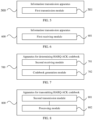
- an embodiment of this application further provides an information processing apparatus 500, applied to a network side device and including:
- the assistance information includes at least one of the following:
- the information about serving cell(s) corresponding to the one-shot HARQ-ACK codebook to be reported includes at least one of the following:
- the information about HARQ process(s) corresponding to the one-shot HARQ-ACK codebook to be reported includes at least one of the following:
- the information about transport block TB(s) corresponding to the one-shot HARQ-ACK codebook to be reported includes at least one of the following:
- the information about code block group CBG(s) corresponding to the one-shot HARQ-ACK codebook to be reported includes: a maximum index of the CBG(s) corresponding to the one-shot HARQ-ACK codebook to be reported.
- the high-level configuration parameter(s) for the one-shot HARQ-ACK codebook to be reported includes at least one of the following:
- the assistance information is carried in the DCI through a first indicator field; and the first indicator field satisfies at least one of the following conditions:
- the first indicator field includes at least one of the following:
- the assistance information is carried in the DCI through at least one second indicator field.
- the information transmission apparatus provided in the embodiments of this application is an apparatus that can perform the foregoing information transmission method, all embodiments of the foregoing information transmission method are applicable to the apparatus, and same or similar beneficial effects can all be achieved.
- an embodiment of this application further provides an information transmission apparatus 600, applied to a terminal and including:
- the assistance information includes at least one of the following:
- the information about serving cell(s) corresponding to the one-shot HARQ-ACK codebook to be reported includes at least one of the following:
- the information about HARQ process(s) corresponding to the one-shot HARQ-ACK codebook to be reported includes at least one of the following:
- the information about transport block TB(s) corresponding to the one-shot HARQ-ACK codebook to be reported includes at least one of the following:
- the information about code block group CBG(s) corresponding to the one-shot HARQ-ACK codebook to be reported includes: a maximum index of the CBG(s) corresponding to the one-shot HARQ-ACK codebook to be reported.
- the high-level configuration parameter(s) for the one-shot HARQ-ACK codebook to be reported includes at least one of the following:
- the assistance information is carried in the DCI through a first indicator field; and the first indicator field satisfies at least one of the following conditions:
- the first indicator field includes at least one of the following:
- the assistance information is carried in the DCI through at least one second indicator field.
- the information transmission apparatus provided in the embodiments of this application is an apparatus that can perform the foregoing information transmission method, all embodiments of the foregoing information transmission method are applicable to the apparatus, and same or similar beneficial effects can all be achieved.
- an embodiment of this application further provides an apparatus 700 for determining a hybrid automatic repeat request acknowledgement HARQ-ACK codebook, applied to a terminal and including:
- the codebook generation module includes:
- the codebook generation module includes: a third submodule, configured to set HARQ-ACK information of each HARQ process according to a PDSCH decoding result of each HARQ process.
- the first priority index set includes at least one priority index; and the first priority index set is determined by a priority index indicated by the priority indicator field in the DCI.
- the apparatus further includes: a first transmission module, configured to transmit, according to the configuration parameter corresponding to the priority indicated by the priority indicator field in the DCI, a physical uplink control channel PUCCH or a physical uplink shared channel PUSCH carrying the one-shot HARQ-ACK codebook.
- a first transmission module configured to transmit, according to the configuration parameter corresponding to the priority indicated by the priority indicator field in the DCI, a physical uplink control channel PUCCH or a physical uplink shared channel PUSCH carrying the one-shot HARQ-ACK codebook.
- the configuration parameter includes at least one of the following:
- the codebook generation module includes:
- the one-shot HARQ-ACK codebook is generated and transmitted according to the configuration parameter for the priority indicated by the priority indicator field, so that the efficiency and reliability of codebook generation and reporting can be improved.
- the apparatus for determining a HARQ-ACK codebook is an apparatus that can perform the foregoing method for determining a HARQ-ACK codebook, all embodiments of the method for determining a HARQ-ACK codebook are applicable to the apparatus, and same or similar beneficial effects can all be achieved.
- an embodiment of this application further provides an apparatus 800 for transmitting a hybrid automatic repeat request acknowledgement HARQ-ACK codebook, applied to a network side device and including:
- the processing module includes: a processing submodule, configured to receive, according to the configuration parameter corresponding to the priority indicated by the priority indicator field, a physical uplink control channel PUCCH or a physical uplink shared channel PUSCH carrying the one-shot HARQ-ACK codebook.
- the configuration parameter includes at least one of the following:
- the DCI further includes overriding parameter(s), each of which will overrid the corresponding configuration parameter.
- the one-shot HARQ-ACK codebook is received and parsed according to the configuration parameter for the priority indicated by the priority indicator field, so that the efficiency and reliability of codebook transmission can be improved.
- the apparatus for transmitting a HARQ-ACK codebook is an apparatus that can perform the foregoing method for transmitting a HARQ-ACK codebook, all embodiments of the method for transmitting a HARQ-ACK codebook are applicable to the apparatus, and same or similar beneficial effects can all be achieved.
- the information transmission apparatus, the apparatus for determining a HARQ-ACK codebook, and the apparatus for transmitting a HARQ-ACK codebook in the embodiments of this application may be apparatuses, or may be components, integrated circuits, or chips in the terminal.
- the apparatus may be a mobile electronic device or may be a non-mobile electronic device.
- the mobile electronic device may be a mobile phone, a tablet computer, a notebook computer, a palmtop computer, an in-vehicle electronic device, a wearable device, an ultra-mobile personal computer (ultra-mobile personal computer, UMPC), a netbook, or a personal digital assistant (personal digital assistant, PDA); and the non-mobile electronic device may be a server, a network attached storage (Network Attached Storage, NAS), a personal computer (personal computer, PC), a television (television, TV), a teller machine, or an automatic teller machine, which are not specifically limited in the embodiments of this application.
- Network Attached Storage Network Attached Storage
- NAS Network Attached Storage
- personal computer personal computer
- TV television
- teller machine teller machine
- automatic teller machine automatic teller machine
- the information transmission apparatus, the apparatus for determining a HARQ-ACK codebook, and the apparatus for transmitting a HARQ-ACK codebook in the embodiments of this application may be apparatuses including an operating system.
- the operating system may be an Android (Android) operating system, an ios operating system, or another possible operating system, which is not specifically limited in the embodiments of this application.
- an embodiment of this application further provides an electronic device, and the electronic device is a terminal or a network side device and includes a processor, a memory, and a program or instruction stored in the memory and executable on the process.
- the program or instruction is executed by the processor, the processes of embodiments of the foregoing information transmission method are implemented, and same technical effects can be achieved. To avoid repetition, details are not described herein again.
- an embodiment of this application further provides an electronic device, and the electronic device is a terminal and includes a processor, a memory, and a program or instruction stored in the memory and executable on the processor.
- the program or instruction is executed by the processor, the processes of the embodiments of the method for determining a HARQ-ACK codebook are implemented, and same technical effects can be achieved. To avoid repetition, details are not described herein again.
- an embodiment of this application further provides an electronic device, and the electronic device is a network side device and includes a processor, a memory, and a program or instruction stored in the memory and executable on the processor.
- the program or instruction is executed by the processor, the processes of the embodiments of the method for transmitting a HARQ-ACK codebook are implemented, and same technical effects can be achieved. To avoid repetition, details are not described herein again.
- the electronic device in the embodiments of this application includes the foregoing mobile electronic device and the non-mobile electronic device.
- FIG. 9 is a schematic diagram of hardware structure of an electronic device (the electronic device is a terminal) implementing embodiments of this application.
- the electronic device 900 includes, but not limited to: components such as a radio frequency unit 901, a network module 902, an audio output unit 903, an input unit 904, a sensor 905, a display unit 906, a user input unit 907, an interface unit 908, a memory 909, and a processor 910.
- components such as a radio frequency unit 901, a network module 902, an audio output unit 903, an input unit 904, a sensor 905, a display unit 906, a user input unit 907, an interface unit 908, a memory 909, and a processor 910.
- the electronic device 900 may further include a power supply (such as a battery) for supplying power to the components.
- a power supply such as a battery
- the power supply may be logically connected to the processor 910 by using a power supply management system, thereby implementing functions, such as charging, discharging, and power consumption management by using the power supply management system.
- the electronic device structure shown in FIG. 9 constitutes no limitation on the electronic device, and the electronic device may include more or fewer components than those shown in the figure, or some components may be combined, or a different component deployment may be used, which is not described herein again.
- the radio frequency unit 901 is configured to receive downlink control information DCI used for triggering a one-shot hybrid automatic repeat request acknowledgement HARQ-ACK codebook to report, where the DCI carries assistance information instructing a terminal to perform one-shot HARQ-ACK codebook reporting.
- the radio frequency unit 901 is also configured to receive downlink control information DCI used for triggering a one-shot hybrid automatic repeat request acknowledgement HARQ-ACK codebook to report, where the DCI includes a priority indicator field; and the processor 910 is configured to generate the one-shot HARQ-ACK codebook according to a configuration parameter for a priority indicated by the priority indicator field.
- DCI downlink control information
- the processor 910 is configured to generate the one-shot HARQ-ACK codebook according to a configuration parameter for a priority indicated by the priority indicator field.
- the one-shot HARQ-ACK codebook is generated and transmitted according to the configuration parameter for the priority indicated by the priority indicator field, so that the efficiency and reliability of codebook generation and reporting can be improved.
- the radio frequency unit 901 may be configured to receive and transmit signals during an information receiving and sending process or a call process. Specifically, after downlink data from a base station is received, the radio frequency unit sends the downlink data to the processor 910 for processing. In addition, the radio frequency unit sends uplink data to the base station.
- the radio frequency unit 901 usually includes but is not limited to an antenna, at least one amplifier, a transceiver, a coupler, a low noise amplifier, or a duplexer. In addition, the radio frequency unit 901 may further communicate with a network device and another device through a wireless communication system.
- the electronic device may help, by using the network module 902, a user to receive and send an email, browse a webpage, and access stream media, which provides wireless broadband Internet access for the user.
- the audio output unit 903 may convert audio data received by the radio frequency unit 901 or the network module 902 or stored in the memory 909 into an audio signal and output the audio signal as sound.
- the audio output unit 903 may further provide an audio output that is related to a particular function executed by the electronic device 900 (for example, call signal receiving sound or message receiving sound).
- the audio output unit 903 includes a speaker, a buzzer, and a receiver.
- the input unit 904 is configured to receive an audio signal or a video signal.
- the input unit 904 may include a graphics processing unit (Graphics Processing Unit, GPU) 9041 and a microphone 9042.
- the graphics processing unit 9041 processes image data of a static picture or a video that is obtained by an image acquisition apparatus (for example, a camera) in a video acquisition mode or an image acquisition mode. An image frame that has been processed may be displayed on the display unit 906. An image frame that has been processed by the graphics processing unit 9041 may be stored in the memory 909 (or another storage medium) or transmitted through the radio frequency unit 901 or the network module 902.
- the microphone 9042 may receive sound and can process the sound into audio data.
- the processed audio data may be converted, in a phone talk mode, to a format that may be sent to a mobile communication base station through the radio frequency unit 901 to output.
- the electronic device 900 may further include at least one sensor 905, such as an optical sensor, a motion sensor, and other sensors.
- the optical sensor includes an ambient light sensor and a proximity sensor.
- the ambient light sensor may adjust luminance of a display panel 9061 according to brightness of the ambient light.
- the proximity sensor may switch off the display panel 9061 and/or backlight when the electronic device 900 is moved to the ear.
- an acceleration sensor may detect a magnitude of acceleration in various directions (generally three axes), and may detect a magnitude and a direction of gravity when static, which may be configured to recognize electronic device gestures (such as switching between landscape orientation and portrait orientation, a related game, and magnetometer posture calibration), vibration recognition related functions (such as a pedometer and a knock), and the like.
- the sensor 905 may further include a fingerprint sensor, a pressure sensor, an iris sensor, a molecular sensor, a gyroscope, a barometer, a hygrometer, a thermometer, or an infrared sensor, which is not described herein again.
- the display unit 906 is configured to display information input by the user or information provided for the user.
- the display unit 906 may include a display panel 9061.
- the display panel 9061 may be configured in a form such as a liquid crystal display (Liquid Crystal Display, LCD) or an organic light-emitting diode (Organic Light-Emitting Diode, OLED).
- the user input unit 907 may be configured to receive input numeral or character information, and generate a key signal input related to a user setting and function control of the electronic device.
- the user input unit 907 includes a touch panel 9071 and another input device 9072.
- the touch panel 9071 also referred to as a touchscreen, may collect a touch operation of a user on or near the touch panel (such as an operation of a user on or near the touch panel 9071 by using any suitable object or attachment, such as a finger or a stylus).
- the touch panel 9071 may include two parts: a touch detection apparatus and a touch controller.
- the touch detection apparatus detects a touch orientation of the user, detects a signal brought by the touch operation, and transmits the signal to the touch controller.
- the touch controller receives touch information from the touch detection apparatus, converts the touch information into contact coordinates, then sends the contact coordinates to the processor 910, and receives and executes a command sent by the processor 910.
- the touch panel 9071 may be implemented by using various types, such as a resistive type, a capacitance type, an infrared type, and a surface acoustic wave type.
- the user input unit 907 may further include the another input device 9072.
- the another input device 9072 may include, but is not limited to, a physical keyboard, a functional key (such as a volume control key or a switch key), a track ball, a mouse, and a joystick, which is not described herein again.
- the touch panel 9071 may cover on the display panel 9061. After detecting a touch operation on or near the touch panel 9071, the touch panel transmits the touch operation to the processor 910, to determine a type of a touch event. Then, the processor 910 provides a corresponding visual output on the display panel 9061 according to the type of the touch event.
- the touch panel 9071 and the display panel 9061 implement, as two independent components, input and output functions of the electronic device. However, in some embodiments, the touch panel 9071 and the display panel 9061 may be integrated to implement the input and output functions of the electronic device, which is not specifically limited herein.
- the interface unit 908 is an interface through which an external apparatus and the electronic device 900 are connected.
- the external apparatus may include a wired or wireless headset port, an external power supply (or a battery charger) port, a wired or wireless data port, a storage card port, a port used to connect an apparatus having an identification module, an audio input/output (I/O) port, a video I/O port, or an earphone port.
- the interface unit 908 may be configured to receive an input (for example, data information or power) from the external apparatus, and transmit the received input to one or more elements in the electronic device 900, or may be configured to transmit data between the electronic device 900 and the external apparatus.
- the memory 909 may be configured to store a software program and data.
- the memory 909 may mainly include a program storage area and a data storage area.
- the program storage area may store an operating system, an application program required by at least one function (for example, a sound playing function and an image playing function), or the like.
- the data storage area may store data (for example, audio data and a phone book) created according to use of the mobile phone.
- the memory 909 may include a high speed random access memory, and may further include a non-volatile memory, such as at least one magnetic disk storage device, a flash memory device, or other volatile solid state storage devices.
- the processor 910 is a control center of the electronic device, and connects various parts of the entire electronic device by using various interfaces and lines. By running or executing the software program and/or module stored in the memory 909, and invoking data stored in the memory 909, the processor performs various functions of the electronic device and processes data, thereby performing overall monitoring on the electronic device.
- the processor 910 may include one or more processing units.
- the processor 910 may integrate an application processor and a modem processor.
- the application processor mainly processes an operating system, a user interface, and an application program.
- the modem processor mainly processes wireless communication. It may be understood that the foregoing modem processor may alternatively not be integrated into the processor 910.
- the electronic device 900 may further include the power supply (for example, a battery) for supplying power to the components.
- the power supply may be logically connected to the processor 910 by using a power management system, thereby implementing functions such as charging management, discharging management, and power consumption management by using the power management system.
- the electronic device 900 includes some functional modules that are not shown, and details are not described herein again.
- FIG. 10 is a structural diagram of an electronic device (the electronic device is a network side device) according to an embodiment of this application, which can realize details of the foregoing information transmission method and achieve same effects.
- the network side device 1300 includes a processor 1301, a transceiver 1302, a memory 1303, and a bus system.
- the processor 1301 is configured to read a program stored in the memory 1303, to perform the following procedure: transmitting downlink control information DCI used for triggering a one-shot hybrid automatic repeat request acknowledgement HARQ-ACK codebook to report, where the DCI carries assistance information instructing a terminal to perform one-shot HARQ-ACK codebook reporting.
- the processor 1301 is configured to read a program stored in the memory 1303, to perform the following procedure:
- the one-shot HARQ-ACK codebook is received and parsed according to the configuration parameter for the priority indicated by the priority indicator field, so that the efficiency and reliability of codebook transmission can be improved.
- a bus architecture may include any quantity of interconnected buses and bridges, and specifically connects together circuits that are of one or more processors represented by the processor 1301 and of a memory represented by the memory 1303.
- the bus architecture may further connect various other circuits of a peripheral device, a voltage regulator, or a power management circuit. This is well known in the art, and therefore, no further description is provided in this specification.
- the bus interface provides an interface.
- the transceiver 1302 may be a plurality of components, including a transmitter and a transceiver, and providing units for communicating with various other apparatuses on a transmission medium.
- An embodiment of this application further provides a readable storage medium, and the readable storage medium stores a program or instruction.
- the program or instruction is executed by a processor, the processes of embodiments of the foregoing information transmission method are implemented, and same technical effects can be achieved. To avoid repetition, details are not described herein again.
- An embodiment of this application further provides a readable storage medium, and the readable storage medium stores a program or instruction.
- the program or instruction is executed by a processor, the processes of the embodiments of the method for determining a HARQ-ACK codebook are implemented, and same technical effects can be achieved. To avoid repetition, details are not described herein again.
- An embodiment of this application further provides a readable storage medium, and the readable storage medium stores a program or instruction.
- the program or instruction is executed by a processor, the processes of the embodiments of the method for transmitting a HARQ-ACK codebook are implemented, and same technical effects can be achieved. To avoid repetition, details are not described herein again.
- the processor is the processor in the electronic device described in the foregoing embodiments.
- the readable storage medium may include a computer-readable storage medium such as a computer read-only memory (Read-Only Memory, ROM), a random access memory (Random Access Memory, RAM), a magnetic disk, and an optical disc.
- An embodiment of this application further provides a chip, including a processor and a communication interface, the communication interface being coupled to the processor, the processor being configured to execute a program or instruction, to implement the processes of the embodiments of the foregoing information transmission method and achieve same technical effects. To avoid repetition, details are not described herein again.
- An embodiment of this application further provides a chip, including a processor and a communication interface, the communication interface being coupled to the processor, the processor being configured to execute a program or instruction, to implement the processes of the embodiments of the method for determining a HARQ-ACK codebook and achieve same technical effects. To avoid repetition, details are not described herein again.
- An embodiment of this application further provides a chip, including a processor and a communication interface, the communication interface being coupled to the processor, the processor being configured to execute a program or instruction, to implement the processes of the embodiments of the method for transmitting a HARQ-ACK codebook and achieve same technical effects. To avoid repetition, details are not described herein again.
- the chip mentioned in this embodiment of this application may also be referred to as a system-level chip, a system chip, a chip system, or a system on chip.
- the foregoing embodiment methods may be implemented by using software in combination with a necessary universal hardware platform.
- the embodiment methods may also be implemented by using hardware, but the former is a better implementation in many cases.
- the technical solutions in this application essentially or the part contributing to the related art may be implemented in the form of a software product.
- the computer software product is stored in a storage medium (for example, a ROM/RAM, a magnetic disk, or an optical disc), and includes several instructions for instructing a terminal (which may be a mobile phone, a computer, a server, an air conditioner, or a network device) to perform the method described in the embodiments of this application.
Landscapes
- Engineering & Computer Science (AREA)
- Signal Processing (AREA)
- Computer Networks & Wireless Communication (AREA)
- Mobile Radio Communication Systems (AREA)
Applications Claiming Priority (2)
| Application Number | Priority Date | Filing Date | Title |
|---|---|---|---|
| CN202010415393.8A CN113676292B (zh) | 2020-05-15 | 2020-05-15 | 信息传输、harq-ack码本的生成、传输方法及设备 |
| PCT/CN2021/093020 WO2021228080A1 (zh) | 2020-05-15 | 2021-05-11 | 信息传输、harq-ack码本的生成、传输方法及设备 |
Publications (2)
| Publication Number | Publication Date |
|---|---|
| EP4138323A1 true EP4138323A1 (de) | 2023-02-22 |
| EP4138323A4 EP4138323A4 (de) | 2023-10-11 |
Family
ID=78525292
Family Applications (1)
| Application Number | Title | Priority Date | Filing Date |
|---|---|---|---|
| EP21804517.7A Pending EP4138323A4 (de) | 2020-05-15 | 2021-05-11 | Verfahren und vorrichtung zur informationsübertragung und erzeugung und übertragung eines codebuchs für hybride automatische wiederholungsanfragen (harq) |
Country Status (4)
| Country | Link |
|---|---|
| US (1) | US12531660B2 (de) |
| EP (1) | EP4138323A4 (de) |
| CN (1) | CN113676292B (de) |
| WO (1) | WO2021228080A1 (de) |
Families Citing this family (4)
| Publication number | Priority date | Publication date | Assignee | Title |
|---|---|---|---|---|
| CN114070524B (zh) * | 2020-08-07 | 2023-04-28 | 维沃移动通信有限公司 | 信息处理方法、装置及用户设备 |
| WO2022205103A1 (zh) * | 2021-03-31 | 2022-10-06 | 北京小米移动软件有限公司 | 一种传输harq-ack的方法、装置及可读存储介质 |
| CN117337549A (zh) * | 2021-05-10 | 2024-01-02 | 联想(新加坡)私人有限公司 | 用于由单个dci调度多个pdsch的动态harq-ack码本 |
| CN118487722A (zh) * | 2023-02-10 | 2024-08-13 | 大唐移动通信设备有限公司 | 确定动态harq-ack码本的方法、装置及通信设备 |
Family Cites Families (31)
| Publication number | Priority date | Publication date | Assignee | Title |
|---|---|---|---|---|
| CN105050122A (zh) * | 2015-08-28 | 2015-11-11 | 宇龙计算机通信科技(深圳)有限公司 | 无线资源管理的测量方法及装置、终端和基站 |
| CN106535335B (zh) * | 2015-09-14 | 2019-11-08 | 上海无线通信研究中心 | 一种优化上行harq的下行控制信息实现方法 |
| US10630410B2 (en) * | 2016-05-13 | 2020-04-21 | Telefonaktiebolaget Lm Ericsson (Publ) | Network architecture, methods, and devices for a wireless communications network |
| KR102035918B1 (ko) * | 2017-02-10 | 2019-10-23 | 아서스테크 컴퓨터 인코포레이션 | 무선 통신 시스템에서 제어 채널 전송을 위한 방법 및 장치 |
| CN108809543B (zh) * | 2017-05-05 | 2021-12-31 | 华为技术有限公司 | 用于传输数据的方法和设备 |
| CN109152004B (zh) * | 2017-06-15 | 2023-07-28 | 中国移动通信有限公司研究院 | 微时隙指示及确定方法、通信设备及计算机存储介质 |
| CN110546911B (zh) * | 2017-08-04 | 2022-03-25 | Lg电子株式会社 | 在无线通信系统中发送和接收参考信号的方法及其设备 |
| CN109905211B (zh) * | 2017-12-08 | 2020-10-27 | 电信科学技术研究院 | 一种传输、接收方法、终端及基站 |
| CN112910613B (zh) * | 2018-02-13 | 2022-05-17 | 中兴通讯股份有限公司 | 一种信息处理方法、装置、用户设备、基站和存储介质 |
| EP3528398A1 (de) * | 2018-02-15 | 2019-08-21 | Comcast Cable Communications LLC | Strahlausfallbericht |
| CN112042142A (zh) * | 2018-06-28 | 2020-12-04 | Oppo广东移动通信有限公司 | 传输反馈信息的方法和计算机可读存储介质 |
| CN112655257B (zh) * | 2018-07-26 | 2024-07-30 | 夏普株式会社 | 基站和方法 |
| US11963180B2 (en) * | 2018-08-10 | 2024-04-16 | Lg Electronics Inc. | Method and device for transmitting and receiving signals in wireless communication system |
| WO2020047806A1 (zh) * | 2018-09-06 | 2020-03-12 | 北京小米移动软件有限公司 | 反馈信息传输方法、装置、设备及系统 |
| WO2020060367A1 (ko) * | 2018-09-21 | 2020-03-26 | 엘지전자 주식회사 | 무선 통신 시스템에서 무선 신호 송수신 방법 및 장치 |
| WO2020067782A1 (en) * | 2018-09-28 | 2020-04-02 | Samsung Electronics Co., Ltd. | Method and device for transmitting or receiving groupcast feedback in wireless cellular communication system |
| CN112913172A (zh) * | 2018-09-28 | 2021-06-04 | 联想(北京)有限公司 | 在非授权频谱上触发harq-ack报告 |
| CN111130735B (zh) * | 2019-04-30 | 2021-11-23 | 维沃移动通信有限公司 | 一种反馈控制方法、ue及网络设备 |
| CN110708145B (zh) * | 2019-09-30 | 2021-11-30 | 展讯通信(上海)有限公司 | Harq进程管理方法、装置、终端及存储介质 |
| WO2021091258A1 (ko) * | 2019-11-06 | 2021-05-14 | 엘지전자 주식회사 | 무선 통신 시스템에서 신호 송수신 방법 및 장치 |
| CN114616780B (zh) * | 2019-11-08 | 2024-05-24 | 捷开通讯(深圳)有限公司 | 用于处理混合自动重复请求(harq)反馈的装置和方法 |
| US12184430B2 (en) * | 2019-11-08 | 2024-12-31 | Lenovo (Beijing) Ltd. | Method and apparatus for determining one shot HARQ-ACK codebook |
| WO2021092399A1 (en) * | 2019-11-08 | 2021-05-14 | Qualcomm Incorporated | Acknowledgment feedback techniques in wireless communications |
| CN114365567A (zh) * | 2019-11-21 | 2022-04-15 | Oppo广东移动通信有限公司 | 用于混合自动报告请求确认反馈的配置的方法 |
| CN110708146B (zh) * | 2019-11-22 | 2022-06-21 | 北京紫光展锐通信技术有限公司 | Harq-ack信息反馈方法及装置 |
| BR112022015981A2 (pt) * | 2020-02-12 | 2022-10-25 | Idac Holdings Inc | Unidade de transmissão/recepção sem fio, método implementado em uma unidade de transmissão/recepção sem fio, e, estação-base |
| JP2023043889A (ja) * | 2020-02-13 | 2023-03-30 | シャープ株式会社 | 端末装置および通信方法 |
| EP4459902A3 (de) * | 2020-02-14 | 2024-12-25 | Guangdong Oppo Mobile Telecommunications Corp., Ltd. | Verfahren und vorrichtung zur bestimmung eines codebuchs für hybride automatische wiederholungsanfragen und vorrichtung dafür |
| JP2023078485A (ja) * | 2020-03-31 | 2023-06-07 | シャープ株式会社 | 端末装置、および、通信方法 |
| WO2021230333A1 (en) * | 2020-05-14 | 2021-11-18 | Sharp Kabushiki Kaisha | User equipments, base stations, and methods |
| WO2021230334A1 (en) * | 2020-05-14 | 2021-11-18 | Sharp Kabushiki Kaisha | User equipments, base stations, and methods |
-
2020
- 2020-05-15 CN CN202010415393.8A patent/CN113676292B/zh active Active
-
2021
- 2021-05-11 EP EP21804517.7A patent/EP4138323A4/de active Pending
- 2021-05-11 WO PCT/CN2021/093020 patent/WO2021228080A1/zh not_active Ceased
-
2022
- 2022-11-14 US US17/986,881 patent/US12531660B2/en active Active
Also Published As
| Publication number | Publication date |
|---|---|
| EP4138323A4 (de) | 2023-10-11 |
| KR20230002759A (ko) | 2023-01-05 |
| US20230075353A1 (en) | 2023-03-09 |
| US12531660B2 (en) | 2026-01-20 |
| WO2021228080A1 (zh) | 2021-11-18 |
| CN113676292B (zh) | 2023-04-07 |
| CN113676292A (zh) | 2021-11-19 |
Similar Documents
| Publication | Publication Date | Title |
|---|---|---|
| US11825451B2 (en) | Sidelink transmission method and terminal | |
| US11968676B2 (en) | Uplink control information transmission method and terminal | |
| US12531660B2 (en) | Information transmission method and device, and HARQ-ACK codebook generation and transmission method and device | |
| EP3965335B1 (de) | Verfahren zum senden einer rückkopplungsnachricht und endgerät | |
| CN111277388A (zh) | Harq-ack码本生成方法、信息发送方法及设备 | |
| CN111181706B (zh) | 混合自动重传请求确认的发送方法和终端 | |
| CN113573256A (zh) | 信息反馈、资源调度方法、终端及网络设备 | |
| CN111835489B (zh) | 一种传输方法、配置方法、终端及网络侧设备 | |
| CN111278124B (zh) | 资源配置方法、资源确定方法、网络侧设备和终端 | |
| WO2020119243A1 (zh) | 物理上行控制信道传输方法、网络侧设备和终端 | |
| EP4017179B1 (de) | Rückkopplungsverfahren und endgerät für einen halb-persistenten, physikalischen gemeinsam genutzten downlink-kanal | |
| CN111800864B (zh) | 物理上行链路控制信道传输方法、装置、设备及介质 | |
| EP3952182B1 (de) | Verfahren zur bestimmung eines downlink-zuweisungsindex, endgerät und netzwerkvorrichtung | |
| EP4145737A1 (de) | Dai-zählverfahren, dai-zählsteuerverfahren, endgerät und netzwerkvorrichtung | |
| CN112787769B (zh) | 确定nfi的方法、装置、设备和存储介质 | |
| EP4044472A1 (de) | Erfassung und übertragung der rückkopplung einer automatischen wiederholungsaufforderungsbestätigung (harq-ack), endgerät und netzseitige vorrichtung | |
| CN111277370B (zh) | 上行控制信息的传输方法及终端 | |
| CN113225162A (zh) | 信道状态信息csi上报方法、终端及计算机可读存储介质 | |
| CN115150026B (zh) | 信息上报方法、装置及终端 | |
| CN113541879B (zh) | 信息传输方法及设备 | |
| KR102958225B1 (ko) | 정보 전송, harq-ack 코드북의 생성, 전송 방법 및 장치 | |
| CN116234031A (zh) | 信息传输方法及设备 | |
| CN109803420B (zh) | Csi传输资源的配置方法及装置 | |
| CN110972298B (zh) | 资源指示方法、确定方法、终端及网络设备 | |
| HK40081958A (en) | Dai counting method, dai counting control method, terminal and network device |
Legal Events
| Date | Code | Title | Description |
|---|---|---|---|
| STAA | Information on the status of an ep patent application or granted ep patent |
Free format text: STATUS: THE INTERNATIONAL PUBLICATION HAS BEEN MADE |
|
| PUAI | Public reference made under article 153(3) epc to a published international application that has entered the european phase |
Free format text: ORIGINAL CODE: 0009012 |
|
| STAA | Information on the status of an ep patent application or granted ep patent |
Free format text: STATUS: REQUEST FOR EXAMINATION WAS MADE |
|
| 17P | Request for examination filed |
Effective date: 20221117 |
|
| AK | Designated contracting states |
Kind code of ref document: A1 Designated state(s): AL AT BE BG CH CY CZ DE DK EE ES FI FR GB GR HR HU IE IS IT LI LT LU LV MC MK MT NL NO PL PT RO RS SE SI SK SM TR |
|
| DAV | Request for validation of the european patent (deleted) | ||
| DAX | Request for extension of the european patent (deleted) | ||
| A4 | Supplementary search report drawn up and despatched |
Effective date: 20230908 |
|
| RIC1 | Information provided on ipc code assigned before grant |
Ipc: H04W 72/12 20230101ALI20230904BHEP Ipc: H04L 1/18 20230101AFI20230904BHEP |
|
| STAA | Information on the status of an ep patent application or granted ep patent |
Free format text: STATUS: EXAMINATION IS IN PROGRESS |
|
| 17Q | First examination report despatched |
Effective date: 20241212 |