EP4137635A1 - Verfahren zur herstellung eines antibakteriellen und desodorierenden mittels unter verwendung eines umweltfreundlichen biopolymers - Google Patents
Verfahren zur herstellung eines antibakteriellen und desodorierenden mittels unter verwendung eines umweltfreundlichen biopolymers Download PDFInfo
- Publication number
- EP4137635A1 EP4137635A1 EP20930689.3A EP20930689A EP4137635A1 EP 4137635 A1 EP4137635 A1 EP 4137635A1 EP 20930689 A EP20930689 A EP 20930689A EP 4137635 A1 EP4137635 A1 EP 4137635A1
- Authority
- EP
- European Patent Office
- Prior art keywords
- aqueous solution
- chitosan
- processing agent
- weight
- fabric
- Prior art date
- Legal status (The legal status is an assumption and is not a legal conclusion. Google has not performed a legal analysis and makes no representation as to the accuracy of the status listed.)
- Pending
Links
- 238000000034 method Methods 0.000 title claims abstract description 55
- 238000004519 manufacturing process Methods 0.000 title claims abstract description 20
- 229920001222 biopolymer Polymers 0.000 title abstract description 3
- 230000000844 anti-bacterial effect Effects 0.000 title description 32
- 230000001877 deodorizing effect Effects 0.000 title description 12
- 239000004744 fabric Substances 0.000 claims abstract description 147
- 239000007864 aqueous solution Substances 0.000 claims abstract description 119
- 238000012545 processing Methods 0.000 claims abstract description 96
- 239000003795 chemical substances by application Substances 0.000 claims abstract description 86
- 229920001661 Chitosan Polymers 0.000 claims abstract description 57
- 150000007524 organic acids Chemical class 0.000 claims abstract description 41
- XLYOFNOQVPJJNP-UHFFFAOYSA-N water Chemical compound O XLYOFNOQVPJJNP-UHFFFAOYSA-N 0.000 claims abstract description 26
- 239000012153 distilled water Substances 0.000 claims abstract description 22
- 239000000843 powder Substances 0.000 claims description 53
- 238000002156 mixing Methods 0.000 claims description 51
- KRKNYBCHXYNGOX-UHFFFAOYSA-N citric acid Chemical compound OC(=O)CC(O)(C(O)=O)CC(O)=O KRKNYBCHXYNGOX-UHFFFAOYSA-N 0.000 claims description 42
- QTBSBXVTEAMEQO-UHFFFAOYSA-N Acetic acid Chemical compound CC(O)=O QTBSBXVTEAMEQO-UHFFFAOYSA-N 0.000 claims description 27
- 235000002639 sodium chloride Nutrition 0.000 claims description 25
- 239000000919 ceramic Substances 0.000 claims description 21
- FAPWRFPIFSIZLT-UHFFFAOYSA-M Sodium chloride Chemical compound [Na+].[Cl-] FAPWRFPIFSIZLT-UHFFFAOYSA-M 0.000 claims description 18
- 235000015165 citric acid Nutrition 0.000 claims description 14
- 150000003839 salts Chemical class 0.000 claims description 13
- 239000003929 acidic solution Substances 0.000 claims description 12
- 229910052751 metal Inorganic materials 0.000 claims description 12
- 239000002184 metal Substances 0.000 claims description 12
- 239000011780 sodium chloride Substances 0.000 claims description 12
- 229910021536 Zeolite Inorganic materials 0.000 claims description 10
- MCMNRKCIXSYSNV-UHFFFAOYSA-N Zirconium dioxide Chemical compound O=[Zr]=O MCMNRKCIXSYSNV-UHFFFAOYSA-N 0.000 claims description 10
- HNPSIPDUKPIQMN-UHFFFAOYSA-N dioxosilane;oxo(oxoalumanyloxy)alumane Chemical compound O=[Si]=O.O=[Al]O[Al]=O HNPSIPDUKPIQMN-UHFFFAOYSA-N 0.000 claims description 10
- JVTAAEKCZFNVCJ-UHFFFAOYSA-N lactic acid Chemical compound CC(O)C(O)=O JVTAAEKCZFNVCJ-UHFFFAOYSA-N 0.000 claims description 10
- 239000010457 zeolite Substances 0.000 claims description 10
- 235000011054 acetic acid Nutrition 0.000 claims description 9
- PEDCQBHIVMGVHV-UHFFFAOYSA-N Glycerine Chemical compound OCC(O)CO PEDCQBHIVMGVHV-UHFFFAOYSA-N 0.000 claims description 8
- TWRXJAOTZQYOKJ-UHFFFAOYSA-L Magnesium chloride Chemical compound [Mg+2].[Cl-].[Cl-] TWRXJAOTZQYOKJ-UHFFFAOYSA-L 0.000 claims description 8
- 230000006196 deacetylation Effects 0.000 claims description 8
- 238000003381 deacetylation reaction Methods 0.000 claims description 8
- LZCLXQDLBQLTDK-UHFFFAOYSA-N ethyl 2-hydroxypropanoate Chemical compound CCOC(=O)C(C)O LZCLXQDLBQLTDK-UHFFFAOYSA-N 0.000 claims description 8
- 239000005909 Kieselgur Substances 0.000 claims description 7
- VYPSYNLAJGMNEJ-UHFFFAOYSA-N Silicium dioxide Chemical compound O=[Si]=O VYPSYNLAJGMNEJ-UHFFFAOYSA-N 0.000 claims description 7
- OKTJSMMVPCPJKN-UHFFFAOYSA-N Carbon Chemical compound [C] OKTJSMMVPCPJKN-UHFFFAOYSA-N 0.000 claims description 6
- WCUXLLCKKVVCTQ-UHFFFAOYSA-M Potassium chloride Chemical compound [Cl-].[K+] WCUXLLCKKVVCTQ-UHFFFAOYSA-M 0.000 claims description 6
- 239000010445 mica Substances 0.000 claims description 6
- 229910052618 mica group Inorganic materials 0.000 claims description 6
- QBYIENPQHBMVBV-HFEGYEGKSA-N (2R)-2-hydroxy-2-phenylacetic acid Chemical compound O[C@@H](C(O)=O)c1ccccc1.O[C@@H](C(O)=O)c1ccccc1 QBYIENPQHBMVBV-HFEGYEGKSA-N 0.000 claims description 5
- IWYDHOAUDWTVEP-UHFFFAOYSA-N R-2-phenyl-2-hydroxyacetic acid Natural products OC(=O)C(O)C1=CC=CC=C1 IWYDHOAUDWTVEP-UHFFFAOYSA-N 0.000 claims description 5
- GUJOJGAPFQRJSV-UHFFFAOYSA-N dialuminum;dioxosilane;oxygen(2-);hydrate Chemical compound O.[O-2].[O-2].[O-2].[Al+3].[Al+3].O=[Si]=O.O=[Si]=O.O=[Si]=O.O=[Si]=O GUJOJGAPFQRJSV-UHFFFAOYSA-N 0.000 claims description 5
- 229910052900 illite Inorganic materials 0.000 claims description 5
- 239000004310 lactic acid Substances 0.000 claims description 5
- 235000014655 lactic acid Nutrition 0.000 claims description 5
- 229960002510 mandelic acid Drugs 0.000 claims description 5
- 229910052901 montmorillonite Inorganic materials 0.000 claims description 5
- VGIBGUSAECPPNB-UHFFFAOYSA-L nonaaluminum;magnesium;tripotassium;1,3-dioxido-2,4,5-trioxa-1,3-disilabicyclo[1.1.1]pentane;iron(2+);oxygen(2-);fluoride;hydroxide Chemical compound [OH-].[O-2].[O-2].[O-2].[O-2].[O-2].[F-].[Mg+2].[Al+3].[Al+3].[Al+3].[Al+3].[Al+3].[Al+3].[Al+3].[Al+3].[Al+3].[K+].[K+].[K+].[Fe+2].O1[Si]2([O-])O[Si]1([O-])O2.O1[Si]2([O-])O[Si]1([O-])O2.O1[Si]2([O-])O[Si]1([O-])O2.O1[Si]2([O-])O[Si]1([O-])O2.O1[Si]2([O-])O[Si]1([O-])O2.O1[Si]2([O-])O[Si]1([O-])O2.O1[Si]2([O-])O[Si]1([O-])O2 VGIBGUSAECPPNB-UHFFFAOYSA-L 0.000 claims description 5
- BJEPYKJPYRNKOW-REOHCLBHSA-N (S)-malic acid Chemical compound OC(=O)[C@@H](O)CC(O)=O BJEPYKJPYRNKOW-REOHCLBHSA-N 0.000 claims description 4
- MRABAEUHTLLEML-UHFFFAOYSA-N Butyl lactate Chemical compound CCCCOC(=O)C(C)O MRABAEUHTLLEML-UHFFFAOYSA-N 0.000 claims description 4
- 239000000783 alginic acid Substances 0.000 claims description 4
- 235000010443 alginic acid Nutrition 0.000 claims description 4
- 229920000615 alginic acid Polymers 0.000 claims description 4
- 229960001126 alginic acid Drugs 0.000 claims description 4
- 150000004781 alginic acids Chemical class 0.000 claims description 4
- BJEPYKJPYRNKOW-UHFFFAOYSA-N alpha-hydroxysuccinic acid Natural products OC(=O)C(O)CC(O)=O BJEPYKJPYRNKOW-UHFFFAOYSA-N 0.000 claims description 4
- 239000001191 butyl (2R)-2-hydroxypropanoate Substances 0.000 claims description 4
- XQKKWWCELHKGKB-UHFFFAOYSA-L calcium acetate monohydrate Chemical compound O.[Ca+2].CC([O-])=O.CC([O-])=O XQKKWWCELHKGKB-UHFFFAOYSA-L 0.000 claims description 4
- 229940067460 calcium acetate monohydrate Drugs 0.000 claims description 4
- 229940116333 ethyl lactate Drugs 0.000 claims description 4
- 235000011187 glycerol Nutrition 0.000 claims description 4
- 229910001629 magnesium chloride Inorganic materials 0.000 claims description 4
- 235000011147 magnesium chloride Nutrition 0.000 claims description 4
- 239000001630 malic acid Substances 0.000 claims description 4
- 235000011090 malic acid Nutrition 0.000 claims description 4
- AEQDJSLRWYMAQI-UHFFFAOYSA-N 2,3,9,10-tetramethoxy-6,8,13,13a-tetrahydro-5H-isoquinolino[2,1-b]isoquinoline Chemical compound C1CN2CC(C(=C(OC)C=C3)OC)=C3CC2C2=C1C=C(OC)C(OC)=C2 AEQDJSLRWYMAQI-UHFFFAOYSA-N 0.000 claims description 3
- UXVMQQNJUSDDNG-UHFFFAOYSA-L Calcium chloride Chemical compound [Cl-].[Cl-].[Ca+2] UXVMQQNJUSDDNG-UHFFFAOYSA-L 0.000 claims description 3
- 229960000583 acetic acid Drugs 0.000 claims description 3
- 239000001110 calcium chloride Substances 0.000 claims description 3
- 229910001628 calcium chloride Inorganic materials 0.000 claims description 3
- 235000011148 calcium chloride Nutrition 0.000 claims description 3
- 229960004106 citric acid Drugs 0.000 claims description 3
- 229940099690 malic acid Drugs 0.000 claims description 3
- 239000001103 potassium chloride Substances 0.000 claims description 3
- 235000011164 potassium chloride Nutrition 0.000 claims description 3
- 239000000176 sodium gluconate Substances 0.000 claims description 3
- 235000012207 sodium gluconate Nutrition 0.000 claims description 3
- 229940005574 sodium gluconate Drugs 0.000 claims description 3
- 239000000243 solution Substances 0.000 abstract description 18
- 239000000126 substance Substances 0.000 abstract description 12
- 229910052500 inorganic mineral Inorganic materials 0.000 abstract description 4
- 239000011707 mineral Substances 0.000 abstract description 4
- 238000003756 stirring Methods 0.000 abstract description 2
- 239000013557 residual solvent Substances 0.000 abstract 1
- QGZKDVFQNNGYKY-UHFFFAOYSA-N Ammonia Chemical compound N QGZKDVFQNNGYKY-UHFFFAOYSA-N 0.000 description 42
- 238000004332 deodorization Methods 0.000 description 36
- 238000011056 performance test Methods 0.000 description 22
- 229910021529 ammonia Inorganic materials 0.000 description 21
- 238000012360 testing method Methods 0.000 description 21
- 239000000523 sample Substances 0.000 description 20
- 230000000052 comparative effect Effects 0.000 description 14
- 230000005855 radiation Effects 0.000 description 10
- -1 silver ions Chemical class 0.000 description 10
- 238000011156 evaluation Methods 0.000 description 9
- 229920002620 polyvinyl fluoride Polymers 0.000 description 9
- 229910052709 silver Inorganic materials 0.000 description 8
- 239000004332 silver Substances 0.000 description 8
- 241000191967 Staphylococcus aureus Species 0.000 description 7
- 230000006870 function Effects 0.000 description 7
- 239000004753 textile Substances 0.000 description 7
- 239000003242 anti bacterial agent Substances 0.000 description 6
- 239000006185 dispersion Substances 0.000 description 6
- 230000000694 effects Effects 0.000 description 6
- 239000000463 material Substances 0.000 description 6
- 239000000203 mixture Substances 0.000 description 6
- 239000011230 binding agent Substances 0.000 description 5
- 238000001816 cooling Methods 0.000 description 5
- 241000894006 Bacteria Species 0.000 description 4
- 238000005033 Fourier transform infrared spectroscopy Methods 0.000 description 4
- 238000005259 measurement Methods 0.000 description 4
- 241000222122 Candida albicans Species 0.000 description 3
- 230000000845 anti-microbial effect Effects 0.000 description 3
- 229940095731 candida albicans Drugs 0.000 description 3
- 210000001072 colon Anatomy 0.000 description 3
- 239000000645 desinfectant Substances 0.000 description 3
- 238000005516 engineering process Methods 0.000 description 3
- 229910001385 heavy metal Inorganic materials 0.000 description 3
- 235000010755 mineral Nutrition 0.000 description 3
- 238000010998 test method Methods 0.000 description 3
- 238000005406 washing Methods 0.000 description 3
- 238000009941 weaving Methods 0.000 description 3
- 241000193830 Bacillus <bacterium> Species 0.000 description 2
- ZRALSGWEFCBTJO-UHFFFAOYSA-N Guanidine Chemical compound NC(N)=N ZRALSGWEFCBTJO-UHFFFAOYSA-N 0.000 description 2
- BQCADISMDOOEFD-UHFFFAOYSA-N Silver Chemical compound [Ag] BQCADISMDOOEFD-UHFFFAOYSA-N 0.000 description 2
- 239000004599 antimicrobial Substances 0.000 description 2
- 230000033228 biological regulation Effects 0.000 description 2
- 239000013068 control sample Substances 0.000 description 2
- 239000002781 deodorant agent Substances 0.000 description 2
- 239000004615 ingredient Substances 0.000 description 2
- 230000005764 inhibitory process Effects 0.000 description 2
- 150000002500 ions Chemical class 0.000 description 2
- 238000000691 measurement method Methods 0.000 description 2
- 239000007800 oxidant agent Substances 0.000 description 2
- 150000003904 phospholipids Chemical class 0.000 description 2
- 229920000139 polyethylene terephthalate Polymers 0.000 description 2
- 239000005020 polyethylene terephthalate Substances 0.000 description 2
- 238000002360 preparation method Methods 0.000 description 2
- 241000304886 Bacilli Species 0.000 description 1
- 241000222120 Candida <Saccharomycetales> Species 0.000 description 1
- ZAMOUSCENKQFHK-UHFFFAOYSA-N Chlorine atom Chemical compound [Cl] ZAMOUSCENKQFHK-UHFFFAOYSA-N 0.000 description 1
- JPVYNHNXODAKFH-UHFFFAOYSA-N Cu2+ Chemical compound [Cu+2] JPVYNHNXODAKFH-UHFFFAOYSA-N 0.000 description 1
- 201000004624 Dermatitis Diseases 0.000 description 1
- 241000588724 Escherichia coli Species 0.000 description 1
- JOYRKODLDBILNP-UHFFFAOYSA-N Ethyl urethane Chemical compound CCOC(N)=O JOYRKODLDBILNP-UHFFFAOYSA-N 0.000 description 1
- 241000233866 Fungi Species 0.000 description 1
- 241000282412 Homo Species 0.000 description 1
- 241000588747 Klebsiella pneumoniae Species 0.000 description 1
- CHJJGSNFBQVOTG-UHFFFAOYSA-N N-methyl-guanidine Natural products CNC(N)=N CHJJGSNFBQVOTG-UHFFFAOYSA-N 0.000 description 1
- 239000004677 Nylon Substances 0.000 description 1
- 229910019142 PO4 Inorganic materials 0.000 description 1
- 206010035664 Pneumonia Diseases 0.000 description 1
- 241000191940 Staphylococcus Species 0.000 description 1
- HCHKCACWOHOZIP-UHFFFAOYSA-N Zinc Chemical compound [Zn] HCHKCACWOHOZIP-UHFFFAOYSA-N 0.000 description 1
- 229920005822 acrylic binder Polymers 0.000 description 1
- 230000001070 adhesive effect Effects 0.000 description 1
- 230000002924 anti-infective effect Effects 0.000 description 1
- 239000003899 bactericide agent Substances 0.000 description 1
- 229910052626 biotite Inorganic materials 0.000 description 1
- 230000017531 blood circulation Effects 0.000 description 1
- 230000036760 body temperature Effects 0.000 description 1
- 230000001413 cellular effect Effects 0.000 description 1
- 239000003610 charcoal Substances 0.000 description 1
- 239000000460 chlorine Substances 0.000 description 1
- 229910052801 chlorine Inorganic materials 0.000 description 1
- 229910001431 copper ion Inorganic materials 0.000 description 1
- 230000003247 decreasing effect Effects 0.000 description 1
- SWSQBOPZIKWTGO-UHFFFAOYSA-N dimethylaminoamidine Natural products CN(C)C(N)=N SWSQBOPZIKWTGO-UHFFFAOYSA-N 0.000 description 1
- YGANSGVIUGARFR-UHFFFAOYSA-N dipotassium dioxosilane oxo(oxoalumanyloxy)alumane oxygen(2-) Chemical compound [O--].[K+].[K+].O=[Si]=O.O=[Al]O[Al]=O YGANSGVIUGARFR-UHFFFAOYSA-N 0.000 description 1
- 238000003912 environmental pollution Methods 0.000 description 1
- 229910052732 germanium Inorganic materials 0.000 description 1
- GNPVGFCGXDBREM-UHFFFAOYSA-N germanium atom Chemical compound [Ge] GNPVGFCGXDBREM-UHFFFAOYSA-N 0.000 description 1
- 239000010439 graphite Substances 0.000 description 1
- 229910002804 graphite Inorganic materials 0.000 description 1
- 239000000383 hazardous chemical Substances 0.000 description 1
- 231100000086 high toxicity Toxicity 0.000 description 1
- 231100000016 inhalation toxicity Toxicity 0.000 description 1
- 238000011081 inoculation Methods 0.000 description 1
- 238000007689 inspection Methods 0.000 description 1
- SZVJSHCCFOBDDC-UHFFFAOYSA-N iron(II,III) oxide Inorganic materials O=[Fe]O[Fe]O[Fe]=O SZVJSHCCFOBDDC-UHFFFAOYSA-N 0.000 description 1
- 210000004088 microvessel Anatomy 0.000 description 1
- 229910052627 muscovite Inorganic materials 0.000 description 1
- 229920001778 nylon Polymers 0.000 description 1
- 230000008447 perception Effects 0.000 description 1
- 239000010452 phosphate Substances 0.000 description 1
- NBIIXXVUZAFLBC-UHFFFAOYSA-K phosphate Chemical compound [O-]P([O-])([O-])=O NBIIXXVUZAFLBC-UHFFFAOYSA-K 0.000 description 1
- 229920000642 polymer Polymers 0.000 description 1
- 239000003755 preservative agent Substances 0.000 description 1
- 230000002335 preservative effect Effects 0.000 description 1
- 239000012266 salt solution Substances 0.000 description 1
- 230000008591 skin barrier function Effects 0.000 description 1
- 239000002904 solvent Substances 0.000 description 1
- 239000007921 spray Substances 0.000 description 1
- 230000001954 sterilising effect Effects 0.000 description 1
- 238000004659 sterilization and disinfection Methods 0.000 description 1
- 229910052613 tourmaline Inorganic materials 0.000 description 1
- 229940070527 tourmaline Drugs 0.000 description 1
- 239000011032 tourmaline Substances 0.000 description 1
- 231100000419 toxicity Toxicity 0.000 description 1
- 230000001988 toxicity Effects 0.000 description 1
- 238000004804 winding Methods 0.000 description 1
- 229910052725 zinc Inorganic materials 0.000 description 1
- 239000011701 zinc Substances 0.000 description 1
Images
Classifications
-
- D—TEXTILES; PAPER
- D06—TREATMENT OF TEXTILES OR THE LIKE; LAUNDERING; FLEXIBLE MATERIALS NOT OTHERWISE PROVIDED FOR
- D06M—TREATMENT, NOT PROVIDED FOR ELSEWHERE IN CLASS D06, OF FIBRES, THREADS, YARNS, FABRICS, FEATHERS OR FIBROUS GOODS MADE FROM SUCH MATERIALS
- D06M16/00—Biochemical treatment of fibres, threads, yarns, fabrics, or fibrous goods made from such materials, e.g. enzymatic
-
- D—TEXTILES; PAPER
- D06—TREATMENT OF TEXTILES OR THE LIKE; LAUNDERING; FLEXIBLE MATERIALS NOT OTHERWISE PROVIDED FOR
- D06M—TREATMENT, NOT PROVIDED FOR ELSEWHERE IN CLASS D06, OF FIBRES, THREADS, YARNS, FABRICS, FEATHERS OR FIBROUS GOODS MADE FROM SUCH MATERIALS
- D06M11/00—Treating fibres, threads, yarns, fabrics or fibrous goods made from such materials, with inorganic substances or complexes thereof; Such treatment combined with mechanical treatment, e.g. mercerising
- D06M11/07—Treating fibres, threads, yarns, fabrics or fibrous goods made from such materials, with inorganic substances or complexes thereof; Such treatment combined with mechanical treatment, e.g. mercerising with halogens; with halogen acids or salts thereof; with oxides or oxyacids of halogens or salts thereof
- D06M11/11—Treating fibres, threads, yarns, fabrics or fibrous goods made from such materials, with inorganic substances or complexes thereof; Such treatment combined with mechanical treatment, e.g. mercerising with halogens; with halogen acids or salts thereof; with oxides or oxyacids of halogens or salts thereof with halogen acids or salts thereof
- D06M11/13—Ammonium halides or halides of elements of Groups 1 or 11 of the Periodic Table
-
- D—TEXTILES; PAPER
- D06—TREATMENT OF TEXTILES OR THE LIKE; LAUNDERING; FLEXIBLE MATERIALS NOT OTHERWISE PROVIDED FOR
- D06M—TREATMENT, NOT PROVIDED FOR ELSEWHERE IN CLASS D06, OF FIBRES, THREADS, YARNS, FABRICS, FEATHERS OR FIBROUS GOODS MADE FROM SUCH MATERIALS
- D06M11/00—Treating fibres, threads, yarns, fabrics or fibrous goods made from such materials, with inorganic substances or complexes thereof; Such treatment combined with mechanical treatment, e.g. mercerising
- D06M11/07—Treating fibres, threads, yarns, fabrics or fibrous goods made from such materials, with inorganic substances or complexes thereof; Such treatment combined with mechanical treatment, e.g. mercerising with halogens; with halogen acids or salts thereof; with oxides or oxyacids of halogens or salts thereof
- D06M11/11—Treating fibres, threads, yarns, fabrics or fibrous goods made from such materials, with inorganic substances or complexes thereof; Such treatment combined with mechanical treatment, e.g. mercerising with halogens; with halogen acids or salts thereof; with oxides or oxyacids of halogens or salts thereof with halogen acids or salts thereof
- D06M11/155—Halides of elements of Groups 2 or 12 of the Periodic Table
-
- D—TEXTILES; PAPER
- D06—TREATMENT OF TEXTILES OR THE LIKE; LAUNDERING; FLEXIBLE MATERIALS NOT OTHERWISE PROVIDED FOR
- D06M—TREATMENT, NOT PROVIDED FOR ELSEWHERE IN CLASS D06, OF FIBRES, THREADS, YARNS, FABRICS, FEATHERS OR FIBROUS GOODS MADE FROM SUCH MATERIALS
- D06M11/00—Treating fibres, threads, yarns, fabrics or fibrous goods made from such materials, with inorganic substances or complexes thereof; Such treatment combined with mechanical treatment, e.g. mercerising
- D06M11/32—Treating fibres, threads, yarns, fabrics or fibrous goods made from such materials, with inorganic substances or complexes thereof; Such treatment combined with mechanical treatment, e.g. mercerising with oxygen, ozone, ozonides, oxides, hydroxides or percompounds; Salts derived from anions with an amphoteric element-oxygen bond
- D06M11/36—Treating fibres, threads, yarns, fabrics or fibrous goods made from such materials, with inorganic substances or complexes thereof; Such treatment combined with mechanical treatment, e.g. mercerising with oxygen, ozone, ozonides, oxides, hydroxides or percompounds; Salts derived from anions with an amphoteric element-oxygen bond with oxides, hydroxides or mixed oxides; with salts derived from anions with an amphoteric element-oxygen bond
- D06M11/46—Oxides or hydroxides of elements of Groups 4 or 14 of the Periodic Table; Titanates; Zirconates; Stannates; Plumbates
-
- D—TEXTILES; PAPER
- D06—TREATMENT OF TEXTILES OR THE LIKE; LAUNDERING; FLEXIBLE MATERIALS NOT OTHERWISE PROVIDED FOR
- D06M—TREATMENT, NOT PROVIDED FOR ELSEWHERE IN CLASS D06, OF FIBRES, THREADS, YARNS, FABRICS, FEATHERS OR FIBROUS GOODS MADE FROM SUCH MATERIALS
- D06M11/00—Treating fibres, threads, yarns, fabrics or fibrous goods made from such materials, with inorganic substances or complexes thereof; Such treatment combined with mechanical treatment, e.g. mercerising
- D06M11/77—Treating fibres, threads, yarns, fabrics or fibrous goods made from such materials, with inorganic substances or complexes thereof; Such treatment combined with mechanical treatment, e.g. mercerising with silicon or compounds thereof
- D06M11/79—Treating fibres, threads, yarns, fabrics or fibrous goods made from such materials, with inorganic substances or complexes thereof; Such treatment combined with mechanical treatment, e.g. mercerising with silicon or compounds thereof with silicon dioxide, silicic acids or their salts
-
- D—TEXTILES; PAPER
- D06—TREATMENT OF TEXTILES OR THE LIKE; LAUNDERING; FLEXIBLE MATERIALS NOT OTHERWISE PROVIDED FOR
- D06M—TREATMENT, NOT PROVIDED FOR ELSEWHERE IN CLASS D06, OF FIBRES, THREADS, YARNS, FABRICS, FEATHERS OR FIBROUS GOODS MADE FROM SUCH MATERIALS
- D06M13/00—Treating fibres, threads, yarns, fabrics or fibrous goods made from such materials, with non-macromolecular organic compounds; Such treatment combined with mechanical treatment
- D06M13/10—Treating fibres, threads, yarns, fabrics or fibrous goods made from such materials, with non-macromolecular organic compounds; Such treatment combined with mechanical treatment with compounds containing oxygen
- D06M13/184—Carboxylic acids; Anhydrides, halides or salts thereof
-
- D—TEXTILES; PAPER
- D06—TREATMENT OF TEXTILES OR THE LIKE; LAUNDERING; FLEXIBLE MATERIALS NOT OTHERWISE PROVIDED FOR
- D06M—TREATMENT, NOT PROVIDED FOR ELSEWHERE IN CLASS D06, OF FIBRES, THREADS, YARNS, FABRICS, FEATHERS OR FIBROUS GOODS MADE FROM SUCH MATERIALS
- D06M13/00—Treating fibres, threads, yarns, fabrics or fibrous goods made from such materials, with non-macromolecular organic compounds; Such treatment combined with mechanical treatment
- D06M13/10—Treating fibres, threads, yarns, fabrics or fibrous goods made from such materials, with non-macromolecular organic compounds; Such treatment combined with mechanical treatment with compounds containing oxygen
- D06M13/184—Carboxylic acids; Anhydrides, halides or salts thereof
- D06M13/207—Substituted carboxylic acids, e.g. by hydroxy or keto groups; Anhydrides, halides or salts thereof
-
- D—TEXTILES; PAPER
- D06—TREATMENT OF TEXTILES OR THE LIKE; LAUNDERING; FLEXIBLE MATERIALS NOT OTHERWISE PROVIDED FOR
- D06M—TREATMENT, NOT PROVIDED FOR ELSEWHERE IN CLASS D06, OF FIBRES, THREADS, YARNS, FABRICS, FEATHERS OR FIBROUS GOODS MADE FROM SUCH MATERIALS
- D06M15/00—Treating fibres, threads, yarns, fabrics, or fibrous goods made from such materials, with macromolecular compounds; Such treatment combined with mechanical treatment
- D06M15/01—Treating fibres, threads, yarns, fabrics, or fibrous goods made from such materials, with macromolecular compounds; Such treatment combined with mechanical treatment with natural macromolecular compounds or derivatives thereof
- D06M15/03—Polysaccharides or derivatives thereof
-
- D—TEXTILES; PAPER
- D10—INDEXING SCHEME ASSOCIATED WITH SUBLASSES OF SECTION D, RELATING TO TEXTILES
- D10B—INDEXING SCHEME ASSOCIATED WITH SUBLASSES OF SECTION D, RELATING TO TEXTILES
- D10B2401/00—Physical properties
- D10B2401/13—Physical properties anti-allergenic or anti-bacterial
Definitions
- the present invention relates to a method for manufacturing a biopolymer-based fabric processing agent that is eco-friendly, renewable, and biodegradable, and more particularly, to a method for manufacturing a fabric processing agent that can maintain comfort by emitting far-infrared rays while having antibacterial and deodorizing functions when applied to clothes, by mixing a mineral substance and a ceramic dispersion solution in an aqueous solution of chitosan dissolved in an organic acid.
- a zeolite-based antibacterial agent containing heavy metal ions such as zinc, silver, and copper ions is known as an antibacterial agent whose antibacterial effect against bacteria and fungi lasts for a long period of time.
- heavy metal ions such as zinc, silver, and copper ions
- silver ions are widely used in recent years due to their superiority, particularly in the area of safety.
- the bactericidal power efficacy and deodorizing power efficacy immediately after the treatment silver ions do not provide sufficient bactericidal performance compared to oxidizing agents such as chlorine-based bactericides, and to solve this problem, in place of a zeolite-based antibacterial agent, an antibacterial agent is proposed that contains a silver-chloro complex salt and oxidizing agent.
- polyhexamethyleneguanidine polyhexamethyleneguanidine phosphate, hereinafter PHMG
- ethoxyethylguanine chloride oligo-[2-(2-ethoxy)-ethoxyeth-yl)-guanidinium-chlorid, hereafter PGH
- PGH ethoxyethylguanine chloride
- Substances such as PGH and PHMG have excellent bactericidal power efficacy, but several problems have been reported. Since they are not biodegradable, there is concern about environmental pollution, and aquatic toxicity is serious, showing very high toxicity even at 10 ⁇ g/L (0.000001 %, 0.054 ⁇ M, 0.01 ppm). In addition, the substances are prohibited to use as a spray due to inhalation toxicity, and it can be very dangerous if the substances are manufactured and used as a product by arbitrarily and indiscriminately applied without regulation.
- the PGH and PHMG ingredients show a sterilization efficacy by destroying phospholipid bilayers, there is a possibility of destroying cellular phospholipids in humans, and there is a risk of destroying the skin barrier. Therefore, if these ingredients are used frequently on the skin, such as wet wipes, they are more likely to cause dermatitis. Therefore, it is necessary to continuously study the harmfulness related to antibacterial and deodorant.
- synthetic binder having adhesive properties in order to provide semi-permanent durability even after washing is essential for a fabric processing agent used for fabrics.
- synthetic binders used there are acrylic binders, urethane binders, and the like, but the harmfulness of these synthetic binders in the manufacturing process has not been properly verified.
- An object of the present invention is to provide a fabric processing agent that can maintain comfort by emitting far-infrared rays while having antibacterial and deodorizing functions when applied to clothes by mixing a mineral substance and a ceramic dispersion solution in an aqueous solution of chitosan dissolved in an organic acid.
- a fabric processing agent is manufactured by including the steps of preparing a first aqueous solution containing an organic acid and chitosan and a second aqueous solution containing a metal salt or an acidic solution; preparing a third aqueous solution in which a mixing ratio of the first aqueous solution to the second aqueous solution is a ratio of 2:1 to 10:1 by weight; preparing a fourth aqueous solution in which a mixing ratio of ceramic powder to the organic acid is a ratio of 1:20 to 1:1000 by weight; and preparing a fabric processing agent in which a mixing ratio of the third aqueous solution to the fourth aqueous solution is a ratio of 1:5 to 5:1 by weight.
- a fabric processing agent is manufactured by including the steps of preparing a first aqueous solution containing an organic acid and chitosan; preparing a fourth aqueous solution in which a mixing ratio of ceramic powder to the organic acid is a ratio of 1:20 to 1:1000 by weight; and preparing a fabric processing agent in which a mixing ratio of the first aqueous solution to the fourth aqueous solution is a ratio of 1:5 to 5:1 by weight.
- a fabric processing agent is manufactured in characterized in that the organic acid is at least one selected from the group consisting of lactic acid, citric acid, mandelic acid, and acetic acid.
- a fabric processing agent is manufactured in characterized in that in the first aqueous solution, a mixing ratio of the organic acid to the chitosan is a ratio of 1:5 to 5:1 by weight.
- a fabric processing agent is manufactured in characterized in that a viscosity of the chitosan is 500 to 1200 cps.
- a fabric processing agent is manufactured in characterized in that a deacetylation degree of the chitosan is 80 to 99.99 %.
- a fabric processing agent is manufactured in characterized in that a molecular weight of the chitosan is 10,000 to 1,000,000 g/mol.
- a fabric processing agent is manufactured in characterized in that the ceramic powder is at least one selected from the group consisting of zeolite powder, illite powder, montmorillonite powder, mica powder, diatomaceous earth powder, zirconia powder, and carbon powder.
- a fabric processing agent is manufactured in characterized in that in the step of preparing a first aqueous solution, an aqueous solution containing 0.01 to 5 % by weight of the organic acid and an aqueous solution containing 0.01 to 5% by weight of the chitosan are stirred at room temperature at a speed of 100 to 1,000 rpm.
- a fabric processing agent is manufactured in characterized in that in the second aqueous solution, a mixing ratio of the metal salt or the acidic solution to distilled water is a ratio of 1:10 to 1:1000 by weight.
- a fabric processing agent is manufactured in characterized in that the metal salt is at least one selected from sodium chloride, calcium chloride, potassium chloride, sodium gluconate, and magnesium chloride.
- a fabric processing agent is manufactured in characterized in that the acidic solution is at least one selected from the group consisting of alginic acid, malic acid, acetic acid, citric acid, calcium acetate monohydrate, butyl lactate, ethyl lactate, and glycerin.
- a fabric treated with the above fabric processing agent has a far-infrared emissivity of 87 to 90 % at a wavelength of 5 to 20 ⁇ m, and a far-infrared radiation energy of 3.35 ⁇ 10 2 to 3.63 ⁇ 10 2 W/m 2 • ⁇ m at 30 to 45 °C.
- the present invention can provide a fabric processing agent that is much more eco-friendly and safer than conventional antibacterial agents or chemicals by manufacturing a fabric processing agent using substances such as chitosan, an organic acid, and ceramic powder.
- the fabric processing agent has an effect of maintaining comfort by emitting far-infrared rays as well as antibacterial and deodorizing functions when applied to clothes.
- the present invention maximizes antibacterial and deodorizing functions by mixing chitosan in an organic acid aqueous solution to prepare a solution, and then mixing ceramic powder with the solution to prepare an eco-friendly fabric processing agent.
- a first aqueous solution of the present invention may include an organic acid and chitosan, and the mixing ratio of organic acid to chitosan may be a ratio of 1:5 to 5:1 by weight.
- the first aqueous solution of the present invention may be produced by stirring the organic acid aqueous solution and the chitosan aqueous solution at room temperature at a speed of 100 to 1000 rpm.
- the temperature range of room temperature may be 0 to 80 °C, preferably 15 to 50 °C.
- the organic acid aqueous solution and the chitosan aqueous solution are stirred at room temperature at a speed of 100 to 1000 rpm, the chitosan of high viscosity and high molecular weight is completely dispersed and dissolved in the organic acid aqueous solution.
- the organic acid aqueous solution may contain 0.01 to 5 % by weight of an organic acid, preferably 0.01 to 1 % by weight of an organic acid.
- the aqueous solution contains 0.01 to 5 % by weight of the organic acid, as a functional fabric processing agent, it is processed into fabrics, making the change of touch appropriate, and can be commercialized as a product.
- the organic acid may be at least one selected from the group consisting of lactic acid, citric acid, mandelic acid, and acetic acid, and the organic acid may be preferably citric acid.
- the organic acid is used to dissolve chitosan in water, and among them, citric acid is combined with chitosan to maximize antibacterial properties.
- the chitosan aqueous solution may contain 0.01 to 5 % by weight of chitosan, preferably 0.01 to 1 % by weight of chitosan.
- the chitosan aqueous solution contains 0.01 to 5 % by weight of chitosan, the antibacterial, deodorizing, and far-infrared emission effects can be maximized.
- the deacetylation degree of the chitosan may be 50 to 99.99 %, preferably 80 to 99.99 %.
- the antibacterial property is increased when the deacetylation degree of the chitosan is 80 to 99.99 %, and when the deacetylation degree of the chitosan is lower than 80 %, there may be a problem in that the antibacterial and deodorizing properties of a product are lowered.
- the viscosity of the chitosan may be 500 to 1200 cps, preferably 700 to 1200 cps.
- the viscosity of the chitosan is lower than 500 cps, there may be a problem in durability during fabric processing, and when the viscosity of the chitosan is higher than 1200 cps, the compatibility that can be applied to fabrics is lowered.
- the molecular weight of the chitosan may be 1,000 to 2,000,000 g/mol.
- the molecular weight of the chitosan is 1,000 g/mol or less, the properties of chitosan as a polymer inevitably decrease, and when the molecular weight is 2,000,000 g/mol or more, the bonding between the chitosan and the organic acid is not formed well.
- the molecular weight of the chitosan may be preferably 10,000 to 1,000,000 g/mol.
- the molecular weight of the chitosan may be preferably 10,000 to 1,000,000 g/mol.
- the molecular weight of the chitosan is lower than 10,000, there may be a problem in the role as a natural binder during processing of fabrics, and when the molecular weight of the chitosan is higher than 1,000,000, there may be a problem in the touch performance of fabrics.
- the second aqueous solution of the present invention may include a metal salt or an acidic solution, and the mixing ratio of the metal salt or the acidic solution to distilled water may be a ratio of 1:10 to 1:1000 by weight.
- the metal salt or the acidic solution can be sufficiently dissolved in the distilled water.
- the metal salt or acidic solution may be added to the first aqueous solution to further maximize the antibacterial and deodorant functions, and may also serve as a preservative of the first aqueous solution.
- the metal salt may be at least one selected from sodium chloride, calcium chloride, potassium chloride, sodium gluconate, and magnesium chloride.
- the acidic solution may be at least one selected from the group consisting of alginic acid, malic acid, acetic acid, citric acid, calcium acetate monohydrate, butyl lactate, ethyl lactate, and glycerin.
- the third aqueous solution of the present invention may be a solution in which the mixing ratio of the first aqueous solution to the second aqueous solution is a ratio of 2:1 to 10:1 by weight.
- the fourth aqueous solution of the present invention may be a solution in which the mixing ratio of ceramic powder to organic acid or distilled water is a ratio of 1:20 to 1:1000 by weight.
- the ceramic powder can be dispersed in a solvent so that the solution can be mixed with the aqueous chitosan solution.
- the ceramic powder may be at least one selected from the group consisting of zeolite powder, illite powder, montmorillonite powder, mica powder, diatomaceous earth powder, zirconia powder, and carbon powder.
- the mica and diatomaceous earth powder may be at least one selected from the group consisting of diatomaceous earth, sericite, biotite, muscovite, tourmaline, germanium, magnetite, charcoal, and graphite.
- the fabric processing agent of the present invention may be prepared by mixing the fourth aqueous solution with the first aqueous solution in a ratio of 1:5 to 5:1, or by mixing the fourth aqueous solution with the third aqueous solution in a ratio of 1:5 to 5:1.
- the chitosan aqueous solution and the ceramic dispersion solution are properly mixed, so that the ceramic powder does not sink even after a sufficient time has elapsed and can be stably maintained.
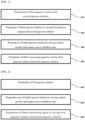
- FIG. 1 is a flowchart illustrating a method for manufacturing a fabric processing agent according to an embodiment of the present invention.
- a method for manufacturing a fabric processing agent includes the steps of preparing a first aqueous solution and a second aqueous solution (S10), preparing a third aqueous solution by mixing the first aqueous solution and the second aqueous solution (S20), preparing a fourth aqueous solution by mixing ceramic powder and an organic acid or distilled water (S30), and preparing a fabric processing agent by mixing the third aqueous solution and the fourth aqueous solution (S40).
- step (S10) after sufficiently dissolving 0.01 to 5 % by weight of an organic acid such as lactic acid, citric acid, mandelic acid, and acetic acid in distilled water at room temperature of 15 to 50 °C, 0.01 to 5 % by weight of high molecular weight chitosan with a deacetylation degree of 80 to 99.99% and a viscosity of 500 to 1200 CPS are sufficiently dissolved in distilled water while being stirred at 200 to 300 rpm at room temperature for 24 hours, thereby preparing the first aqueous solution.
- an organic acid such as lactic acid, citric acid, mandelic acid, and acetic acid
- 0.01 to 5 % by weight of high molecular weight chitosan with a deacetylation degree of 80 to 99.99% and a viscosity of 500 to 1200 CPS are sufficiently dissolved in distilled water while being stirred at 200 to 300 rpm at room temperature for 24 hours, thereby preparing the first aqueous solution
- the second aqueous solution is prepared by dissolving distilled water and a sea salt containing 98% or more of sodium chloride in a ratio of 2:1 to 10:1 by weight at room temperature of 15 to 50 °C for about 30 minutes.
- the sea salt may be replaced with at least one substance selected from the group consisting of magnesium chloride, alginic acid, malic acid, acetic acid, citric acid, calcium acetate monohydrate, butyl lactate, ethyl lactate, and glycerin.
- the third aqueous solution in which a mixing ratio of the first aqueous solution to the second aqueous solution is a ratio of 2:1 to 10:1 by weight is prepared.
- the fourth aqueous solution is prepared by mixing the zeolite powder with the organic acid in a ratio of 1:20 to 1:1000 by weight and dissolving the mixture at room temperature of 15 to 50 °C.
- the mixing ratio of the fourth aqueous solution to the third aqueous solution may be a ratio of 1:5 to 5:1 by weight to prepare a fabric processing agent.
- the zeolite powder may be replaced with at least one substance selected from the group consisting of illite powder, montmorillonite powder, mica powder, diatomaceous earth powder, zirconia powder, and carbon powder.
- the mixture is stirred at room temperature of 15 to 50 °C to finally prepare a fabric processing agent.
- FIG. 2 is a flowchart showing a method for manufacturing a fabric processing agent according to another embodiment of the present invention.
- a method for manufacturing a fabric processing agent includes the steps of preparing a first aqueous solution (S10'), preparing a fourth aqueous solution by mixing the ceramic powder and the organic acid or distilled water (S20'), and preparing a fabric processing agent by mixing the first aqueous solution and the fourth aqueous solution (S30').
- step (S10') after sufficiently dissolving 0.01 to 5 % by weight of an organic acid such as lactic acid, citric acid, mandelic acid, and acetic acid in distilled water at room temperature of 15 to 50 °C, 0.01 to 5 % by weight of high molecular weight chitosan with a deacetylation degree of 80 to 99.99 % and a viscosity of 500 to 1200 CPS are sufficiently dissolved in distilled water while being stirred at room temperature for 24 hours at 200 to 300 rpm, thereby preparing the first aqueous solution.
- an organic acid such as lactic acid, citric acid, mandelic acid, and acetic acid
- 0.01 to 5 % by weight of high molecular weight chitosan with a deacetylation degree of 80 to 99.99 % and a viscosity of 500 to 1200 CPS are sufficiently dissolved in distilled water while being stirred at room temperature for 24 hours at 200 to 300 rpm, thereby preparing the first
- the fourth aqueous solution is prepared by mixing zeolite powder with the organic acid in a ratio of 1:20 to 1:1000 by weight and dissolving the mixture at room temperature of 15 to 50 °C.
- the mixing ratio of the first aqueous solution to the fourth aqueous solution may be a ratio of 1:5 to 5:1 by weight to prepare a fabric processing agent.
- the zeolite powder may be replaced with at least one substance selected from the group consisting of illite powder, montmorillonite powder, mica powder, diatomaceous earth powder, zirconia powder, and carbon powder.
- the mixture is stirred at room temperature of 15 to 50 °C, thereby finally preparing a fabric processing agent.
- the fabric treated with the above fabric processing agent has a far-infrared emissivity of 87 to 90 % at a wavelength of 5 to 20 ⁇ m, and a far-infrared radiation energy of 3.35 ⁇ 10 2 to 3.63 ⁇ 10 2 W/m 2 • ⁇ m at 30 to 45 °C.
- the fabric processing agent of the present invention is prepared by a relatively simple method of mixing the fourth aqueous solution with the first aqueous solution in a ratio of 1:5 to 5:1, or mixing the fourth aqueous solution with the third aqueous solution in a ratio of 1:5 to 5:1. After the first aqueous solution or the third aqueous solution is completely reacted, the fourth aqueous solution is finally added, so that chitosan is completely dispersed and dissolved in the organic acid aqueous solution, and the ceramic powder does not sink even after a sufficient time has elapsed and can maintain a stable state.
- the chitosan and the ceramic powder are evenly dispersed throughout the fabric, thereby maximizing the antibacterial, deodorizing and far-infrared emission effects.
- the amount of far-infrared radiation may be increased due to direct contact and friction with the human body.
- the far-infrared radiation energy absorbed by the skin expands micro-vessels to promote blood circulation, and the far-infrared wavelength that penetrates deep into the body raises the body temperature evenly throughout our body, so that the effect of exercising just by wearing clothes made of fabrics treated with the fabric processing agent can be achieved.
- the fabric to which the fabric processing agent is applied is washed 50 times or more, it has an excellent characteristic that antibacterial properties are not inhibited, which is due to the fact that the antibacterial function is maintained semi-permanently by optimizing the uniform mixing and dispersing by the manufacturing method of finally adding the fourth aqueous solution after completely reacting the first aqueous solution or the third aqueous solution.
- Comparative Example 1 Fabric processing without an application of a fabric processing agent
- Example 1 or Example 2 the processing process was finished by cooling the fabric that was subject to the tendering process without processing the final processing agent using a cooling cylinder and then winding the cooled fabric.
- Comparative Example 2 Fabric processing with a fabric processing agent containing no ceramic powder
- the antibacterial performance test of the fabric treated with the fabric processing agent prepared in Example 1 was performed. Swiss Universal Standard Technical Service Co., Ltd. (abbreviated as SGS) was requested to test the antibacterial performance, and the results were shown in Table 1.
- SGS Swiss Universal Standard Technical Service Co., Ltd.
- the test strains were Staphylococcus aureus ATCC 6538 and Klebsiella pneumoniae ATCC 4352, and were tested according to the antimicrobial finishing method for textile materials (AATCC 100-2012). 1mL of the strain was inoculated into a circular fabric sample with a diameter of 4.8 cm.
- the antibacterial performance test of the fabric treated with the fabric processing agent prepared in Example 2 was conducted.
- the antibacterial performance was tested by the Guang inspection testing and certification group, a nationally-accredited testing institution in China, and the results were listed in Table 2.
- the test strains were Staphylococcus aureus, Colon bacilli, and Candida albicans. It was tested by the Shaking flask method specified in FZ/T 73023-2006 ANNEX D, an industry standard for antibacterial knitwear in China, and the decrease rate was measured after the fabrics to which the fabric processing agent was applied were washed 50 times.
- the size of the fabric sample was 70 cm wide and 70 cm long, and the weight of the fabric sample was 98 g.
- Staphylococcus aureus showed a decrease rate of 97.0 9%
- Escherichia coli showed a decrease rate of 97 %
- Candida albicans showed a decrease rate of 91.52 %.
- Test item Test method Requirement Test result Conclusion ANTIMICRO BIAL ACTIVITY FZ/T 73023-2006 ANNEX DSHAKE FLASK METHODAFTE R50 WASHING CYCLES INHIBITION: Staph ylococcus aureus >80% Colon bacillus ⁇ 70% Cand ida albicans ⁇ 60% INHIBITION: Sta phylococcus aureus 97.07% Colon bacillus 97.00% Candida albicans 91.52% PASS
- the antibacterial performance test was performed on the fabric of Comparative Example 1.
- the antibacterial performance was tested by the FITI test lab, and the results were listed in Table 3.
- the test strain was Staphylococcus aureus ATCC 6538, and the test was conducted according to an antimicrobial finishing method for fabric materials (AATCC 100-2012). As a result of recovering live cells from the fabric sample after 18 hours, it was found that the number of bacteria hardly decreased. [Table 3] Control 1.7X10 5 2.0X10 8 -
- the deodorization performance test of ammonia was performed with the fabric treated with the fabric processing agent prepared in Example 1.
- the ammonia deodorization performance was tested by the Swiss Universal Standard Technical Service Co., Ltd. (abbreviated as SGS).
- Ammonia deodorization evaluation was measured according to ISO 17299-2 by a detector tube method.
- Example 2 The fabric treated with the fabric processing agent prepared in Example 2 was also subjected to a deodorization performance test in the same manner as in Example 1.
- Table 4 shows the deodorization performance test results of Examples 1 and 2. [Table 4] Deodorization rate of sample 87.0% 79.8%
- the deodorization performance test of ammonia was performed with the fabric prepared in Comparative Example 1.
- the ammonia deodorization performance was tested by the Swiss Universal Standard Technical Service Co., Ltd. (abbreviated as SGS).
- Ammonia deodorization evaluation was measured according to ISO 17299-2 by a detector tube method.
- Table 5 shows the deodorization performance test result of Comparative Example 1.
- Table 5 Deodorization rate of sample Acceptability criterion for deodorization test (Washing according to JIS L-0217103 method) Comparative Example 1 10.1% 70%
- the far-infrared emissivity performance test was performed with the fabric treated with the fabric processing agent prepared in Example 1.
- the far-infrared emissivity performance was tested by the Korea Far Infrared Application Evaluation Institute (KIFA).
- the emissivity and radiant energy measurement tests were performed using the textile of the fabric product treated with the fabric processing agent prepared in Example 1 as a specimen by the KFIA-FI-1005 method of the Korea Far Infrared Application Evaluation Institute.
- This test was carried out at 37 °C and was measured against a black body using a Fourier transform infrared spectroscopy (FT-IR) spectrometer.
- FT-IR Fourier transform infrared spectroscopy
- the fabric treated with the fabric processing agent prepared in Example 1 had an emissivity of 0.888 in a wavelength range of 5 to 20 ⁇ m, and a radiation energy of 3.42 ⁇ 10 2 W/m 2 ⁇ ⁇ m.
- Example 2 The fabric treated with the fabric processing agent prepared in Example 2 was also subjected to the far-infrared emissivity performance test in the same manner as in Example 1.
- the fabric treated with the fabric processing agent prepared in Example 2 had an emissivity of 0.886 in a wavelength range of 5 to 20 ⁇ m, and a radiation energy of 3.42 ⁇ 10 2 W/m 2 ⁇ ⁇ m.
- Table 6 shows the far-infrared emissivity performance tests of Examples 1 and 2 [Table 6] Emissivity (5 to 20 ⁇ m) Radiation energy (W/m 2 • ⁇ m, 37 °C) Example 1 0.888 3.42 ⁇ 10 2 Example 2 0.886 3.42 ⁇ 10 2 * Note 1) Test method: KFIA-FI-1005, 2) Test temperature: 37 °C, 3) Measurement method: Blackbody contrast measurement using FT-IR spectrometer
- the far-infrared emissivity performance test was performed with the fabric prepared in Comparative Example 2.
- the far-infrared emissivity performance was tested by the Korea Far Infrared Application Evaluation Institute (KIFA).
- the emissivity and radiant energy measurement tests were performed using the textile of the fabric product treated with the fabric processing agent prepared in the Example as a specimen by the KFIA-FI-1005 method of the Korea Far Infrared Application Evaluation Institute.
- Table 7 below shows the far-infrared emissivity performance test of Comparative Example 2.
- Emissivity (5 to 20 ⁇ m) Radiation energy (W/m 2 • ⁇ m, 37 °C) Comparative Example 1 0.844 3.25 ⁇ 10 2 * Note 1) Test method: KFIA-FI-1005, 2) Test temperature: 37 °C, 3) Measurement method: Blackbody contrast measurement using FT-IR spectrometer
Landscapes
- Engineering & Computer Science (AREA)
- Textile Engineering (AREA)
- Life Sciences & Earth Sciences (AREA)
- Chemical & Material Sciences (AREA)
- Biochemistry (AREA)
- Chemical Kinetics & Catalysis (AREA)
- General Chemical & Material Sciences (AREA)
- Microbiology (AREA)
- Treatments For Attaching Organic Compounds To Fibrous Goods (AREA)
- Chemical Or Physical Treatment Of Fibers (AREA)
Applications Claiming Priority (2)
| Application Number | Priority Date | Filing Date | Title |
|---|---|---|---|
| KR1020200046311A KR102188508B1 (ko) | 2020-04-16 | 2020-04-16 | 친환경 바이오폴리머를 활용한 항균 및 소취 가공제의 제조방법 |
| PCT/KR2020/005547 WO2021210714A1 (ko) | 2020-04-16 | 2020-04-28 | 친환경 바이오폴리머를 활용한 항균 및 소취 가공제의 제조방법 |
Publications (2)
| Publication Number | Publication Date |
|---|---|
| EP4137635A1 true EP4137635A1 (de) | 2023-02-22 |
| EP4137635A4 EP4137635A4 (de) | 2024-12-18 |
Family
ID=73787403
Family Applications (1)
| Application Number | Title | Priority Date | Filing Date |
|---|---|---|---|
| EP20930689.3A Pending EP4137635A4 (de) | 2020-04-16 | 2020-04-28 | Verfahren zur herstellung eines antibakteriellen und desodorierenden mittels unter verwendung eines umweltfreundlichen biopolymers |
Country Status (4)
| Country | Link |
|---|---|
| US (1) | US12338573B2 (de) |
| EP (1) | EP4137635A4 (de) |
| KR (1) | KR102188508B1 (de) |
| WO (1) | WO2021210714A1 (de) |
Family Cites Families (12)
| Publication number | Priority date | Publication date | Assignee | Title |
|---|---|---|---|---|
| JPH08268821A (ja) | 1995-04-03 | 1996-10-15 | Sangi Co Ltd | 抗菌剤組成物 |
| KR0144507B1 (ko) * | 1995-09-19 | 1998-07-15 | 전동원 | 직물의 촉감을 개선하는 방법 |
| KR20020072253A (ko) * | 2002-03-30 | 2002-09-14 | (주)성호바이오텍 | 다기능성 코팅제 및 이에 의해 도포된 섬유 |
| KR20040049369A (ko) * | 2002-12-03 | 2004-06-12 | 이영환 | 기능성을 갖는 안대 |
| KR100581192B1 (ko) * | 2003-03-05 | 2006-05-22 | 최창호 | 액상의 섬유용 바이오 처리제 제조방법 |
| KR100767336B1 (ko) * | 2006-04-19 | 2007-10-18 | 서평원 | 키틴/키토산계 기능성 유무기 복합물질 및 그 제조방법, 및그러한 복합물질의 용도 |
| JP2008081876A (ja) | 2006-09-27 | 2008-04-10 | Ohara Palladium Kagaku Kk | 繊維用加工剤、ならびにそれを用いた繊維製品 |
| KR101750400B1 (ko) | 2014-06-26 | 2017-06-23 | 군산대학교산학협력단 | 보습성 및 항균활성을 갖는 기능성 원단 및 이의 제조방법 |
| KR101591470B1 (ko) | 2014-11-19 | 2016-02-03 | 제너럴바이오(주) | 키토산 수용액 조성물 |
| SE1651136A1 (en) | 2016-08-24 | 2018-02-25 | Organoclick Ab | Bio-based pec compositions as binders for fiber based materials, textiles, woven and nonwoven materials |
| CN109576988A (zh) * | 2018-11-22 | 2019-04-05 | 辽东学院 | 一种负氧离子远红外柞蚕丝纤维整理液、负氧离子远红外柞蚕丝纤维及其制备方法 |
| KR102176052B1 (ko) * | 2020-04-29 | 2020-11-10 | 주식회사 지클로 | 피부 저자극성 섬유가공제 조성물 |
-
2020
- 2020-04-16 KR KR1020200046311A patent/KR102188508B1/ko active Active
- 2020-04-28 WO PCT/KR2020/005547 patent/WO2021210714A1/ko not_active Ceased
- 2020-04-28 EP EP20930689.3A patent/EP4137635A4/de active Pending
- 2020-04-28 US US17/918,885 patent/US12338573B2/en active Active
Also Published As
| Publication number | Publication date |
|---|---|
| US20230257930A1 (en) | 2023-08-17 |
| EP4137635A4 (de) | 2024-12-18 |
| KR102188508B1 (ko) | 2020-12-09 |
| US12338573B2 (en) | 2025-06-24 |
| WO2021210714A1 (ko) | 2021-10-21 |
Similar Documents
| Publication | Publication Date | Title |
|---|---|---|
| Nayak et al. | Antimicrobial finishes for textiles | |
| EP2694721A1 (de) | Verfahren zur behandlung von synthetischen textilien mit kationischen bioziden | |
| CA2946109C (en) | Improved biocide compositions based on calcium fluoride as well as uses thereof | |
| CN111657299A (zh) | 一种复合纳米离子抑菌剂 | |
| US20210137105A1 (en) | Antitoxic fibers and fibrous media and methods for manufacturing same | |
| US20130149367A1 (en) | Processes for producing antitoxic fibers and fabrics | |
| HK1253404A1 (zh) | 具有抗内生孢子功效的抗微生物组合物 | |
| KR102176052B1 (ko) | 피부 저자극성 섬유가공제 조성물 | |
| US20240337066A1 (en) | Composition and method for odor reduction and bacterial control on a textile | |
| KR101798978B1 (ko) | 라우릴피리디늄클로라이드를 포함하는 물티슈 원단에서의 확산성이 증가된 물티슈 조성물 및 이를 함유하고 있는 물티슈 | |
| EP4137635A1 (de) | Verfahren zur herstellung eines antibakteriellen und desodorierenden mittels unter verwendung eines umweltfreundlichen biopolymers | |
| JP6388684B2 (ja) | ラウリルピリジニウムクロリドを含むウェットティッシュ原緞における拡散性が増加したウェットティッシュ組成物及びそのウェットティッシュ | |
| KR101880558B1 (ko) | 천연친환경, 고내구성, 방오성, 피부무자극성의 항균대전방지 기능 구현을 위한 섬유가공제 | |
| KR102030590B1 (ko) | 유산균 생존력과 항균력이 우수한 항균 조성물을 포함하는 항균 섬유 제품 및 이의 제조방법 | |
| Montazer et al. | Antibacterial nanocoatings | |
| KR102176712B1 (ko) | 방부제 조성물 및 이를 포함하는 물티슈 | |
| TW200306373A (en) | Antimicrobial polyeter-containing articles and process for their preparation | |
| JPH1161639A (ja) | 洗濯用抗菌仕上げ剤 | |
| MX2012002711A (es) | Composiciones y productos antimicrobianos. | |
| Sundrarajan et al. | Durable antibacterial finishing on organic cotton by inclusion of thymol into cyclodextrin derivative | |
| CN102440265A (zh) | 一种纳米银防霉喷剂 | |
| JP2007138343A (ja) | 天然物由来の抗菌剤の処理方法および抗菌性繊維素材 | |
| Shin et al. | Influence of acetylation on the antimicrobial properties of Chitosan non-woven fabrics | |
| Rodríguez-Hernández | Applications and current status of antimicrobial polymers | |
| KR20170112698A (ko) | 점성을 나타내는 고분자를 주성분으로 포함하는 섬유 유연제 조성물 |
Legal Events
| Date | Code | Title | Description |
|---|---|---|---|
| STAA | Information on the status of an ep patent application or granted ep patent |
Free format text: STATUS: THE INTERNATIONAL PUBLICATION HAS BEEN MADE |
|
| PUAI | Public reference made under article 153(3) epc to a published international application that has entered the european phase |
Free format text: ORIGINAL CODE: 0009012 |
|
| STAA | Information on the status of an ep patent application or granted ep patent |
Free format text: STATUS: REQUEST FOR EXAMINATION WAS MADE |
|
| 17P | Request for examination filed |
Effective date: 20221013 |
|
| AK | Designated contracting states |
Kind code of ref document: A1 Designated state(s): AL AT BE BG CH CY CZ DE DK EE ES FI FR GB GR HR HU IE IS IT LI LT LU LV MC MK MT NL NO PL PT RO RS SE SI SK SM TR |
|
| DAV | Request for validation of the european patent (deleted) | ||
| DAX | Request for extension of the european patent (deleted) | ||
| A4 | Supplementary search report drawn up and despatched |
Effective date: 20241114 |
|
| RIC1 | Information provided on ipc code assigned before grant |
Ipc: D06M 11/155 20060101ALI20241108BHEP Ipc: D06M 11/13 20060101ALI20241108BHEP Ipc: D06M 11/46 20060101ALI20241108BHEP Ipc: D06M 11/79 20060101ALI20241108BHEP Ipc: D06M 13/207 20060101ALI20241108BHEP Ipc: D06M 13/184 20060101ALI20241108BHEP Ipc: D06M 15/03 20060101AFI20241108BHEP |