EP4135035A1 - Halbleiterstruktur und herstellungsverfahren dafür - Google Patents
Halbleiterstruktur und herstellungsverfahren dafür Download PDFInfo
- Publication number
- EP4135035A1 EP4135035A1 EP22792740.7A EP22792740A EP4135035A1 EP 4135035 A1 EP4135035 A1 EP 4135035A1 EP 22792740 A EP22792740 A EP 22792740A EP 4135035 A1 EP4135035 A1 EP 4135035A1
- Authority
- EP
- European Patent Office
- Prior art keywords
- layer
- bandgap
- material layer
- forming
- tunable material
- Prior art date
- Legal status (The legal status is an assumption and is not a legal conclusion. Google has not performed a legal analysis and makes no representation as to the accuracy of the status listed.)
- Withdrawn
Links
Images




Classifications
-
- H—ELECTRICITY
- H10—SEMICONDUCTOR DEVICES; ELECTRIC SOLID-STATE DEVICES NOT OTHERWISE PROVIDED FOR
- H10D—INORGANIC ELECTRIC SEMICONDUCTOR DEVICES
- H10D84/00—Integrated devices formed in or on semiconductor substrates that comprise only semiconducting layers, e.g. on Si wafers or on GaAs-on-Si wafers
- H10D84/80—Integrated devices formed in or on semiconductor substrates that comprise only semiconducting layers, e.g. on Si wafers or on GaAs-on-Si wafers characterised by the integration of at least one component covered by groups H10D12/00 or H10D30/00, e.g. integration of IGFETs
- H10D84/82—Integrated devices formed in or on semiconductor substrates that comprise only semiconducting layers, e.g. on Si wafers or on GaAs-on-Si wafers characterised by the integration of at least one component covered by groups H10D12/00 or H10D30/00, e.g. integration of IGFETs of only field-effect components
- H10D84/83—Integrated devices formed in or on semiconductor substrates that comprise only semiconducting layers, e.g. on Si wafers or on GaAs-on-Si wafers characterised by the integration of at least one component covered by groups H10D12/00 or H10D30/00, e.g. integration of IGFETs of only field-effect components of only insulated-gate FETs [IGFET]
- H10D84/85—Complementary IGFETs, e.g. CMOS
- H10D84/859—Complementary IGFETs, e.g. CMOS comprising both N-type and P-type wells, e.g. twin-tub
-
- H—ELECTRICITY
- H10—SEMICONDUCTOR DEVICES; ELECTRIC SOLID-STATE DEVICES NOT OTHERWISE PROVIDED FOR
- H10D—INORGANIC ELECTRIC SEMICONDUCTOR DEVICES
- H10D30/00—Field-effect transistors [FET]
- H10D30/01—Manufacture or treatment
- H10D30/021—Manufacture or treatment of FETs having insulated gates [IGFET]
- H10D30/0223—Manufacture or treatment of FETs having insulated gates [IGFET] having source and drain regions or source and drain extensions self-aligned to sides of the gate
-
- H—ELECTRICITY
- H10—SEMICONDUCTOR DEVICES; ELECTRIC SOLID-STATE DEVICES NOT OTHERWISE PROVIDED FOR
- H10D—INORGANIC ELECTRIC SEMICONDUCTOR DEVICES
- H10D30/00—Field-effect transistors [FET]
- H10D30/60—Insulated-gate field-effect transistors [IGFET]
-
- H—ELECTRICITY
- H10—SEMICONDUCTOR DEVICES; ELECTRIC SOLID-STATE DEVICES NOT OTHERWISE PROVIDED FOR
- H10D—INORGANIC ELECTRIC SEMICONDUCTOR DEVICES
- H10D64/00—Electrodes of devices having potential barriers
- H10D64/01—Manufacture or treatment
-
- H—ELECTRICITY
- H10—SEMICONDUCTOR DEVICES; ELECTRIC SOLID-STATE DEVICES NOT OTHERWISE PROVIDED FOR
- H10D—INORGANIC ELECTRIC SEMICONDUCTOR DEVICES
- H10D64/00—Electrodes of devices having potential barriers
- H10D64/01—Manufacture or treatment
- H10D64/013—Manufacture or treatment of electrodes having a conductor capacitively coupled to a semiconductor by an insulator
- H10D64/01302—Manufacture or treatment of electrodes having a conductor capacitively coupled to a semiconductor by an insulator the insulator being formed after the semiconductor body, the semiconductor being silicon
- H10D64/01304—Manufacture or treatment of electrodes having a conductor capacitively coupled to a semiconductor by an insulator the insulator being formed after the semiconductor body, the semiconductor being silicon characterised by the conductor
- H10D64/01314—Manufacture or treatment of electrodes having a conductor capacitively coupled to a semiconductor by an insulator the insulator being formed after the semiconductor body, the semiconductor being silicon characterised by the conductor the conductor comprising a layer of Ge, C or of compounds of Si, Ge or C contacting the insulator
-
- H—ELECTRICITY
- H10—SEMICONDUCTOR DEVICES; ELECTRIC SOLID-STATE DEVICES NOT OTHERWISE PROVIDED FOR
- H10D—INORGANIC ELECTRIC SEMICONDUCTOR DEVICES
- H10D64/00—Electrodes of devices having potential barriers
- H10D64/60—Electrodes characterised by their materials
- H10D64/66—Electrodes having a conductor capacitively coupled to a semiconductor by an insulator, e.g. MIS electrodes
-
- H—ELECTRICITY
- H10—SEMICONDUCTOR DEVICES; ELECTRIC SOLID-STATE DEVICES NOT OTHERWISE PROVIDED FOR
- H10D—INORGANIC ELECTRIC SEMICONDUCTOR DEVICES
- H10D84/00—Integrated devices formed in or on semiconductor substrates that comprise only semiconducting layers, e.g. on Si wafers or on GaAs-on-Si wafers
- H10D84/01—Manufacture or treatment
- H10D84/0123—Integrating together multiple components covered by H10D12/00 or H10D30/00, e.g. integrating multiple IGBTs
- H10D84/0126—Integrating together multiple components covered by H10D12/00 or H10D30/00, e.g. integrating multiple IGBTs the components including insulated gates, e.g. IGFETs
- H10D84/0165—Integrating together multiple components covered by H10D12/00 or H10D30/00, e.g. integrating multiple IGBTs the components including insulated gates, e.g. IGFETs the components including complementary IGFETs, e.g. CMOS devices
- H10D84/0172—Manufacturing their gate conductors
-
- H—ELECTRICITY
- H10—SEMICONDUCTOR DEVICES; ELECTRIC SOLID-STATE DEVICES NOT OTHERWISE PROVIDED FOR
- H10D—INORGANIC ELECTRIC SEMICONDUCTOR DEVICES
- H10D84/00—Integrated devices formed in or on semiconductor substrates that comprise only semiconducting layers, e.g. on Si wafers or on GaAs-on-Si wafers
- H10D84/01—Manufacture or treatment
- H10D84/02—Manufacture or treatment characterised by using material-based technologies
- H10D84/03—Manufacture or treatment characterised by using material-based technologies using Group IV technology, e.g. silicon technology or silicon-carbide [SiC] technology
- H10D84/038—Manufacture or treatment characterised by using material-based technologies using Group IV technology, e.g. silicon technology or silicon-carbide [SiC] technology using silicon technology, e.g. SiGe
-
- H—ELECTRICITY
- H10—SEMICONDUCTOR DEVICES; ELECTRIC SOLID-STATE DEVICES NOT OTHERWISE PROVIDED FOR
- H10D—INORGANIC ELECTRIC SEMICONDUCTOR DEVICES
- H10D84/00—Integrated devices formed in or on semiconductor substrates that comprise only semiconducting layers, e.g. on Si wafers or on GaAs-on-Si wafers
- H10D84/80—Integrated devices formed in or on semiconductor substrates that comprise only semiconducting layers, e.g. on Si wafers or on GaAs-on-Si wafers characterised by the integration of at least one component covered by groups H10D12/00 or H10D30/00, e.g. integration of IGFETs
- H10D84/82—Integrated devices formed in or on semiconductor substrates that comprise only semiconducting layers, e.g. on Si wafers or on GaAs-on-Si wafers characterised by the integration of at least one component covered by groups H10D12/00 or H10D30/00, e.g. integration of IGFETs of only field-effect components
- H10D84/83—Integrated devices formed in or on semiconductor substrates that comprise only semiconducting layers, e.g. on Si wafers or on GaAs-on-Si wafers characterised by the integration of at least one component covered by groups H10D12/00 or H10D30/00, e.g. integration of IGFETs of only field-effect components of only insulated-gate FETs [IGFET]
- H10D84/85—Complementary IGFETs, e.g. CMOS
-
- H—ELECTRICITY
- H10—SEMICONDUCTOR DEVICES; ELECTRIC SOLID-STATE DEVICES NOT OTHERWISE PROVIDED FOR
- H10D—INORGANIC ELECTRIC SEMICONDUCTOR DEVICES
- H10D64/00—Electrodes of devices having potential barriers
- H10D64/60—Electrodes characterised by their materials
- H10D64/66—Electrodes having a conductor capacitively coupled to a semiconductor by an insulator, e.g. MIS electrodes
- H10D64/68—Electrodes having a conductor capacitively coupled to a semiconductor by an insulator, e.g. MIS electrodes characterised by the insulator, e.g. by the gate insulator
- H10D64/681—Electrodes having a conductor capacitively coupled to a semiconductor by an insulator, e.g. MIS electrodes characterised by the insulator, e.g. by the gate insulator having a compositional variation, e.g. multilayered
- H10D64/685—Electrodes having a conductor capacitively coupled to a semiconductor by an insulator, e.g. MIS electrodes characterised by the insulator, e.g. by the gate insulator having a compositional variation, e.g. multilayered being perpendicular to the channel plane
Definitions
- the present application relates to the field of semiconductor technology, and more particularly, to a semiconductor structure and a fabrication method thereof.
- the high-k dielectrics and traditional gate material polysilicon have problems such as Fermi pinning and boron penetration, and polysilicon gates also suffer from unavoidable depletion effect, which increases the thicknesses of the gate dielectric layers and reduces gate capacitance values, and thus leads to decline of drive capability of components.
- metal gates are utilized to replace the traditional polysilicon gates, which has become inevitable for the further development of the devices.
- a work function of the metal gate needs to be about 4.1eV; and for a PMOS transistor, a work function of the metal gate needs to be about 5.1 eV.
- due to presence of effects such as Fermi pinning it is difficult for the metal gate to adjust a threshold voltage of the devices by adjusting a work function difference of a metal-semiconductor contact.
- a semiconductor structure and a fabrication method thereof are provided.
- a semiconductor structure which includes: a semiconductor substrate; a dielectric layer positioned on the semiconductor substrate; and a gate structure comprising a bandgap-tunable material layer, wherein the bandgap-tunable material layer is positioned on the dielectric layer, a Fermi level of the bandgap-tunable material layer shifts to a conduction band when electrons inflow, and the Fermi level of the bandgap-tunable material layer shifts to a valence band when the electrons outflow.
- the semiconductor structure may include an NMOS transistor and a PMOS transistor, and both the NMOS transistor and the PMOS transistor may include the gate structure.
- the bandgap-tunable material layer may include a graphene film layer.
- the dielectric layer may include an interface film layer and a high-k dielectric film layer, the interface film layer being positioned on a surface of the semiconductor substrate, the high-k dielectric film layer being positioned on a surface of the interface film layer, and the bandgap-tunable material layer being positioned on a surface of the high-k dielectric film layer.
- the gate structure may further include a gate electrode positioned on the bandgap-tunable material layer.
- a material of the gate electrode may include any one or more of metals, metal nitrides, metal silicides, and metal alloys.
- the semiconductor structure may further include a sidewall protection layer, the sidewall protection layer being positioned on a sidewall of the gate structure and a sidewall of the dielectric layer, and the sidewall protection layer being configured to seal up the bandgap-tunable material layer jointly with the gate electrode.
- the semiconductor substrate positioned on two opposite sides of the gate structure may form a source region and a drain region.
- the semiconductor structure may further include a source electrode and a drain electrode, the source electrode being positioned on the source region, and the drain electrode being positioned on the drain region.
- a method for fabricating a semiconductor structure including: providing a semiconductor substrate; forming a dielectric layer on the semiconductor substrate; and forming a gate structure on the dielectric layer, where the gate structure includes a bandgap-tunable material layer positioned on the dielectric layer, a Fermi level of the bandgap-tunable material layer shifts to a conduction band when electrons inflow, and the Fermi level of the bandgap-tunable material layer shifts to a valence band when the electrons outflow.
- the semiconductor substrate may include a shallow trench isolation structure and a plurality of device regions isolated by the shallow trench isolation structure, each of the plurality of device regions comprising an N-type well region and a P-type well region, the P-type well region being configured to form an NMOS transistor, the N-type well region being configured to form a PMOS transistor, and the dielectric layer and the gate structure being formed on both the N-type well region and the P-type well region.
- the forming a gate structure on the dielectric layer may include: forming a graphene film layer on the dielectric layer.
- the forming a dielectric layer on the semiconductor substrate may include: forming an interface material layer on a surface of the semiconductor substrate; forming a high-k material layer on a surface of the interface material layer; and patterning the interface material layer and the high-k material layer to form an interface film layer and a high-k dielectric film layer positioned on a surface of the interface film layer.
- the forming a gate structure on the dielectric layer may include: forming the bandgap-tunable material layer on a surface of the high-k dielectric film layer.
- the forming a gate structure on the dielectric layer may include: forming a gate electrode on the bandgap-tunable material layer.
- the method may further include: forming a sidewall protection layer on a sidewall of the gate structure and on a sidewall of the dielectric layer, the sidewall protection layer being configured to seal up the bandgap-tunable material layer jointly with the gate electrode.
- the method may further include: performing ion implantation on the semiconductor substrate positioned on two opposite sides of the gate structure to form a source region and a drain region on the two opposite sides of the gate structure; and forming a source electrode on the source region, and forming a drain electrode on the drain region.
- the embodiments of the present application may/at least have following advantages.
- the gate structure includes a bandgap-tunable material layer.
- the bandgap-tunable material layer is positioned on the dielectric layer. Moreover, a Fermi level of the bandgap-tunable material layer shifts to a conduction band when electrons inflow, and the Fermi level of the bandgap-tunable material layer shifts to a valence band when the electrons outflow.
- the NMOS transistor when its gate structure receives a high-level gate voltage signal, the electrons flow from the semiconductor substrate into the bandgap-tunable material layer, such that the Fermi level of the bandgap-tunable material layer shifts to the conduction band. Therefore, when an appropriate gate voltage signal is applied, the Fermi level of the bandgap-tunable material layer may exhibit characteristics of an N-type semiconductor.
- the Fermi level of the bandgap-tunable material layer may exhibit characteristics of a P-type semiconductor.
- the gate structure of the embodiments of the present application can adjust the gate voltage while meeting work function requirements of the NMOS transistor and the PMOS transistor for the gate structure, thereby effectively reducing manufacturing difficulty of the gate structure in the fabrication process a semiconductor device.
- the graphene film layer may be used as the bandgap-tunable material layer.
- graphene because graphene has a special Dirac-cone band structure, it can effectively eliminate the Fermi pinning effect generated when a metal gate structure is in direct contact with the dielectric layer, thereby avoiding its adverse effects on the threshold voltage of the device.
- a first conductivity type may become a second conductivity type, and similarly, the second conductivity type may become the first conductivity type.
- the first conductivity type and the second conductivity type are different conductivity types.
- the first conductivity type may be P-type and the second conductivity type may be N-type, or the first conductivity type may be N-type and the second conductivity type may be P-type.
- spatially relative terms such as “below”, “under”, “lower”, “beneath”, “above”, “upper” and the like may be used herein to describe relationships between one element or feature as shown in the figures and another element(s) or feature(s). It should be understood that the spatially relative terms may be intended to encompass different orientations of a device in use or operation in addition to the orientation depicted in the figures. For example, if the device in the figures is turned over, elements or features described as “under”, “beneath” or “below” other elements would then be oriented “above” the other elements or features. Thus, the example term “under”, “below” or “beneath” may encompass both an orientation of above and below. In addition, the device may also be otherwise oriented (for example, rotated 90 degrees or at other orientations) and the spatially relative descriptors used herein should be interpreted accordingly.
- Embodiments of the present application are described herein with reference to cross-sectional illustrations serving as schematic illustrations of idealized embodiments (and intermediate structures) of the present application. As such, variations from the shapes of the illustrations as a result, for example, of manufacturing techniques and/or tolerances, may be expected. Thus, the embodiments of the present application should not be construed as being limited to particular shapes of regions illustrated herein but may include deviations in shapes that result, for example, from the manufacturing techniques. Thus, regions illustrated in the figures are schematic in nature and their shapes neither illustrate an actual shape of a region of the device nor limit the scope of the present application.
- the metal gates have become inevitable for the further development of semiconductor devices.
- the present application provides a semiconductor structure and a fabrication method thereof.
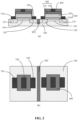
- a semiconductor structure which includes a semiconductor substrate 100, a dielectric layer 200, and a gate structure 300.
- the semiconductor substrate 100 may include, but is not limited to, a silicon substrate.
- a source region 110, a drain region 120 and a channel region 130 may be formed in the semiconductor substrate 100.
- the source region 110 and the drain region 120 may be formed by heavily doping the semiconductor substrate 100 with inversion-type ions.
- the channel region 130 is a conductive channel formed between the source region 110 and the drain region 120 when a voltage is applied to a gate of a transistor to turn on the transistor.
- the dielectric layer 200 is positioned on the semiconductor substrate 100 and is positioned above the channel region 130.
- the dielectric layer 200 may include a high-k dielectric film layer 220 to reduce gate leakage current in small-sized devices.
- the dielectric layer 200 may also not include the high-k dielectric film layer. The present application is not limited thereto.
- the gate structure 300 includes a bandgap-tunable material layer 310.
- the bandgap-tunable material layer 310 is positioned on the dielectric layer 200. Moreover, a Fermi level of the bandgap-tunable material layer 310 shifts to a conduction band when electrons inflow, and the Fermi level of the bandgap-tunable material layer 310 shifts to a valence band when the electrons outflow.
- the NMOS transistor when its gate structure 300 receives a high-level gate voltage signal, the electrons flow from the semiconductor substrate 100 into the bandgap-tunable material layer 310, such that the Fermi level of the bandgap-tunable material layer 310 shifts to the conduction band. Therefore, when an appropriate gate voltage signal is applied, the Fermi level of the bandgap-tunable material layer 310 may exhibit characteristics of an N-type semiconductor.
- a metal-semiconductor work function difference between the gate structure 300 and the channel region 130 forming an N-type conductive channel can be effectively reduced, such that a barrier between the gate structure 300 and the channel region 130 forming the N-type conductive channel is reduced, thereby forming a good ohmic contact and effectively improving device performance.
- the Fermi level of the bandgap-tunable material layer 310 may exhibit characteristics of a P-type semiconductor.
- a metal-semiconductor work function difference between the gate structure 300 and the channel region 130 forming a P-type conductive channel can be effectively reduced, such that a barrier between the gate structure 300 and the channel region 130 forming the P-type conductive channel is reduced, thereby forming a good ohmic contact and effectively improving device performance.
- the gate structure 300 can meet the requirements of the NMOS transistor and the PMOS transistor by applying different voltages, such that difficulty of manufacturing the gate structure in the fabrication process of the semiconductor device can be effectively reduced.
- the conductivity type of the bandgap-tunable material layer 310 may be N-type, P-type, or intrinsic non-doped type, which is not limited in the present application.
- the semiconductor structure includes an NMOS transistor and a PMOS transistor, and both the NMOS transistor and the PMOS transistor include the gate structure.
- the NMOS transistor and the PMOS transistor may form a CMOS device.
- the CMOS device is a complementary MOS device comprising the PMOS transistor and the NMOS transistor.
- each CMOS subcircuit includes a pair of PMOS transistors and NMOS transistors.
- the NMOS transistor and the PMOS transistor in this embodiment may not form the CMOS device.
- the semiconductor structure may also only include the NMOS transistors or only include the PMOS transistors.
- the semiconductor structure may also include other types of field effect transistors. The present application is not limited thereto.
- the bandgap-tunable material layer 310 includes a graphene film layer.
- graphene As an emerging two-dimensional material, graphene has advantages of higher melting point and higher mobility, etc. Moreover, as shown in FIG. 3 , graphene has a special Dirac-cone band structure, such that bandgap of the graphene is tunable, and thus graphene may be used as the bandgap-tunable material layer 310.
- graphene has the special Dirac-cone band structure, it can effectively eliminate the Fermi pinning effect generated when a metal gate structure is in direct contact with the dielectric layer, thereby avoiding its adverse effects on the threshold voltage of the device.
- the bandgap-tunable material layer 310 may be a P-type graphene film layer.
- the conductivity type of the bandgap-tunable material layer 310 corresponding to the NMOS transistor may be changed from P-type to N-type, referring to FIG. 4(a) , to meet energy level requirements of the NMOS transistor.
- the conductivity type of the bandgap-tunable material layer 310 corresponding to the PMOS transistor is still P-type, to meet the energy level requirements of the PMOS transistor.
- the bandgap-tunable material layer 310 may also be an N-type graphene film layer or an intrinsic non-doped graphene film layer or the like.
- the bandgap-tunable material layer 310 is the N-type graphene film layer
- the PMOS transistor after an appropriate gate voltage signal is applied to its gate structure, the electrons flow out of the bandgap-tunable material layer 310, and the Fermi level of the gap-tunable material layer 310 shifts to the valence band. Therefore, the conductivity type of the bandgap-tunable material layer 310 corresponding to the PMOS transistor may be changed from N-type to P-type, to meet the energy level requirements of the PMOS transistor.
- the conductivity type of the bandgap-tunable material layer 310 corresponding to the NMOS transistor is still N-type, referring to FIG. 4(b) , to meet the energy level requirements of the NMOS transistor.
- the Fermi level is near a Dirac point.
- the conductivity type of the bandgap-tunable material layer 310 corresponding to the PMOS transistor may be changed to P-type, to meet the energy level requirements of the PMOS transistor.
- the Fermi level of the corresponding bandgap-tunable material layer 310 shifts from the Dirac point to the conduction band. Therefore, the conductivity type of the bandgap-tunable material layer 310 corresponding to the NMOS transistor is changed to N-type, to meet the energy level requirements of the NMOS transistor.
- the dielectric layer 200 includes an interface film layer 210 and a high-k dielectric film layer 220.
- the interface film layer 210 is positioned on a surface of the semiconductor substrate 100
- the high-k dielectric film layer 220 is positioned on a surface of the interface film layer 210
- the bandgap-tunable material layer 310 is positioned on a surface of the high-k dielectric film layer 220.
- an oxygen vacancy or the like may be generated, which may lead to interface defects between the high-k dielectric film layer and the semiconductor substrate 100.
- the formation of the interface film layer 210 can effectively reduce the interface defects.
- the interface film layer 210 can also improve thermal stability, reduce tunneling of the high-k dielectric film layer 220, and improve carrier mobility through the channel region of the transistor.
- the bandgap-tunable material layer 310 is positioned on the surface of the high-k dielectric film layer 220, such that the barrier between the gate structure 300 and the semiconductor substrate 100 can be effectively reduced.
- the gate structure 300 further includes a gate electrode 320.
- the gate electrode 320 is positioned on the bandgap-tunable material layer 310.
- the arrangement of the gate electrode 320 may facilitate applying an external gate voltage signal to the bandgap-tunable material layer 310.
- a width of the gate electrode 320 may be equal to that of the bandgap-tunable material layer 310, referring to FIG. 1 ; and the width of the gate electrode 320 also may be smaller than that of the bandgap-tunable material layer 310, referring to FIG. 2(a) .
- the present application does not limit a relationship between the width of the gate electrode 320 and the width of the bandgap-tunable material layer 310.
- a material of the gate electrode 320 may include metal, metal nitride, metal silicide, and metal alloy, etc.
- a material may be selected for the gate electrode 320 such that a work function of the gate electrode 320 ranges between 4.1 eV and 5.1 eV.
- a work function of the gate electrode 320 ranges between 4.1 eV and 5.1 eV.
- TiN titanium nitride
- adjustment of metal work functions of NMOS and PMOS can be satisfied.
- the semiconductor structure may further include a sidewall protection layer 400.
- a material of the sidewall protection layer 400 is an insulating material, and the sidewall protection layer 400 is positioned on a sidewall of the gate structure 300 and a sidewall of the dielectric layer 200 to protect the sidewalls.
- the sidewall protection layer 400 is configured to seal up the bandgap-tunable material layer 310 jointly with the gate electrode 320, to effectively protect the bandgap-tunable material layer 310.
- the semiconductor substrate 100 positioned on two opposite sides of the gate structure 300 forms the source region 110 and the drain region 120.
- the semiconductor structure further includes a source electrode 510 and a drain electrode 520.
- the source electrode 510 is positioned on the source region 110, and is configured to apply a source voltage signal to the source region 110.
- the drain electrode 520 is positioned on the drain region 120, and is configured to apply a drain voltage signal to the drain region 120.
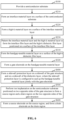
- a method for fabricating a semiconductor structure including following steps:
- the gate structure 300 in this embodiment includes the bandgap-tunable material layer 310, so it can meet the requirements of both the NMOS transistors and the PMOS transistors, such that the difficulty of manufacturing the gate structure in the fabrication process of the semiconductor device can be effectively reduced.
- the bandgap-tunable material layer 310 of the gate structure 300 in this embodiment can effectively avoid the Fermi pinning by utilizing the feature of bandgap tunability.
- the conductivity type of the bandgap-tunable material layer 310 may be N-type, P-type, or non-doped type, which is not limited in the present application.
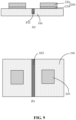
- the semiconductor substrate 100 includes a shallow trench isolation structure STI and a plurality of device regions isolated by the shallow trench isolation structure STI.
- Each of the plurality of device regions includes an N-type well region and a P-type well region.
- the P-type well region is configured to form an NMOS transistor
- the N-type well region is configured to form a PMOS transistor.
- the method for fabricating the semiconductor substrate 100 may include:
- the first conductivity type is N-type or P-type.
- the second conductivity type is P-type.
- the first conductivity type is P-type
- the second conductivity type is N-type.
- the shallow trench isolation structure STI formed in Step S112 can effectively prevent ions having the second conductivity type from entering the active area having the first conductivity type when the ion implantation of the second conductivity type is performed in Step S113.
- the method for fabricating the semiconductor substrate 100 is not limited thereto.
- the method for fabricating the semiconductor substrate 100 may also include:
- the dielectric layer 200 and the gate structure 300 are formed on both the N-type well region and the P-type well region, such that the NMOS transistor and the PMOS transistor may be formed through the same dielectric layer and gate structure process, thereby effectively reducing difficulty and complexity of the process.
- Step S300 includes: Step S311, forming a graphene film layer on the dielectric layer 200.
- the graphene film layer constitutes the bandgap-tunable material layer 310.
- Step S200 also includes:
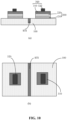
- Step S300 includes: Step S310, forming the bandgap-tunable material layer 310 on a surface of the high-k dielectric film layer 220, referring to FIG. 10(a) and FIG. 10(b) .
- Step S300 includes: Step S320, forming a gate electrode 320 on the bandgap-tunable material layer, with continued reference to FIG. 10(a) and FIG. 10(b) .
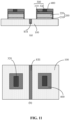
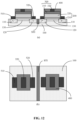
- the method also includes: Step S400, forming a sidewall protection layer 400 on a sidewall of the gate structure 300 and on a sidewall of the dielectric layer 200, where the sidewall protection layer 400 is configured to seal up the bandgap-tunable material layer 310 jointly with the gate electrode 320, referring to FIG. 11 (a) and FIG. 11 (b) .
- Step S400 the method also includes:
- Step S400 because the sidewall protection layer 400 and the gate electrode 320 jointly seal up the bandgap-tunable material layer 310 in Step S400, it can effectively prevent from causing adverse effects to a band structure of the bandgap-tunable material layer 310 when ion implantation is performed in Step S500.
- steps in the flowchart of FIG. 1 are sequentially displayed as indicated by the arrows, these steps are not necessarily sequentially performed in the order indicated by the arrows. Unless expressly stated herein, the execution of these steps is not strictly restrictive and may be performed in other order. Moreover, at least a part of the steps in FIG. 1 may include a plurality of steps or a plurality of stages, which are not necessarily performed at the same moment, but may be executed at different moments, and the order of execution of these steps or stages is not necessarily performed sequentially, but may be performed alternately or alternately with at least a part of the steps or stages of other steps or other steps.
Landscapes
- Metal-Oxide And Bipolar Metal-Oxide Semiconductor Integrated Circuits (AREA)
- Engineering & Computer Science (AREA)
- Manufacturing & Machinery (AREA)
Applications Claiming Priority (2)
| Application Number | Priority Date | Filing Date | Title |
|---|---|---|---|
| CN202110750664.XA CN115566023B (zh) | 2021-07-01 | 2021-07-01 | 半导体结构及其制作方法 |
| PCT/CN2022/100389 WO2023273979A1 (zh) | 2021-07-01 | 2022-06-22 | 半导体结构及其制作方法 |
Publications (2)
| Publication Number | Publication Date |
|---|---|
| EP4135035A1 true EP4135035A1 (de) | 2023-02-15 |
| EP4135035A4 EP4135035A4 (de) | 2023-12-20 |
Family
ID=84691341
Family Applications (1)
| Application Number | Title | Priority Date | Filing Date |
|---|---|---|---|
| EP22792740.7A Withdrawn EP4135035A4 (de) | 2021-07-01 | 2022-06-22 | Halbleiterstruktur und herstellungsverfahren dafür |
Country Status (4)
| Country | Link |
|---|---|
| US (1) | US20230036754A1 (de) |
| EP (1) | EP4135035A4 (de) |
| CN (1) | CN115566023B (de) |
| WO (1) | WO2023273979A1 (de) |
Family Cites Families (10)
| Publication number | Priority date | Publication date | Assignee | Title |
|---|---|---|---|---|
| US7170120B2 (en) * | 2005-03-31 | 2007-01-30 | Intel Corporation | Carbon nanotube energy well (CNEW) field effect transistor |
| KR101830782B1 (ko) * | 2011-09-22 | 2018-04-05 | 삼성전자주식회사 | 그래핀을 포함하는 전극 구조체 및 전계효과 트랜지스터 |
| CN103077947A (zh) * | 2011-10-26 | 2013-05-01 | 中国科学院微电子研究所 | 具有双金属栅的cmos器件及其制造方法 |
| US8815739B2 (en) * | 2012-07-10 | 2014-08-26 | Globalfoundries Inc. | FinFET device with a graphene gate electrode and methods of forming same |
| CN104517840A (zh) * | 2013-09-27 | 2015-04-15 | 中芯国际集成电路制造(上海)有限公司 | 一种半导体器件的制造方法 |
| US9595585B2 (en) * | 2014-09-19 | 2017-03-14 | Semiconductor Manufacturing International (Beijing) Corporation | Methods for high-k metal gate CMOS with SiC and SiGe source/drain regions |
| US10319847B2 (en) * | 2016-07-28 | 2019-06-11 | International Business Machines Corporation | Semiconductor device with a steep sub-threshold slope |
| KR102775734B1 (ko) * | 2016-11-25 | 2025-03-07 | 삼성전자주식회사 | 반도체 장치의 제조 방법 |
| JP6985596B2 (ja) * | 2017-11-30 | 2021-12-22 | 富士通株式会社 | 電子デバイス、電子デバイスの製造方法及び電子機器 |
| CN110323277B (zh) * | 2018-03-28 | 2021-01-29 | 华为技术有限公司 | 场效应晶体管及其制备方法 |
-
2021
- 2021-07-01 CN CN202110750664.XA patent/CN115566023B/zh active Active
-
2022
- 2022-06-22 EP EP22792740.7A patent/EP4135035A4/de not_active Withdrawn
- 2022-06-22 WO PCT/CN2022/100389 patent/WO2023273979A1/zh not_active Ceased
- 2022-08-31 US US17/899,636 patent/US20230036754A1/en not_active Abandoned
Also Published As
| Publication number | Publication date |
|---|---|
| US20230036754A1 (en) | 2023-02-02 |
| CN115566023B (zh) | 2024-11-15 |
| WO2023273979A1 (zh) | 2023-01-05 |
| EP4135035A4 (de) | 2023-12-20 |
| CN115566023A (zh) | 2023-01-03 |
Similar Documents
| Publication | Publication Date | Title |
|---|---|---|
| US8994119B2 (en) | Semiconductor device with gate stacks having stress and method of manufacturing the same | |
| US8643090B2 (en) | Semiconductor devices and methods for manufacturing a semiconductor device | |
| KR100903383B1 (ko) | 일함수가 조절된 게이트전극을 구비한 트랜지스터 및 그를구비하는 메모리소자 | |
| US20060091490A1 (en) | Self-aligned gated p-i-n diode for ultra-fast switching | |
| US7678636B2 (en) | Selective formation of stress memorization layer | |
| US20030141525A1 (en) | Doubly asymmetric double gate transistor and method for forming | |
| US20070178634A1 (en) | Cmos semiconductor devices having dual work function metal gate stacks | |
| US20030178689A1 (en) | Asymmetric semiconductor device having dual work function gate and method of fabrication | |
| US7001818B2 (en) | MIS semiconductor device and manufacturing method thereof | |
| US11527644B2 (en) | Switching LDMOS device and method for making the same | |
| CN101772839B (zh) | 具有金属栅极和高k电介质的电路结构 | |
| US20220231141A1 (en) | High dielectric constant metal gate mos transistor | |
| JP2007088400A (ja) | 相補型mos装置およびその製造方法 | |
| US6501134B1 (en) | Ultra thin SOI devices with improved short-channel control | |
| US7812400B2 (en) | Gate strip with reduced thickness | |
| EP4135035A1 (de) | Halbleiterstruktur und herstellungsverfahren dafür | |
| CN113809012B (zh) | 半导体器件及其制造方法 | |
| US20140084388A1 (en) | Semiconductor device and method for producing the same | |
| US10475708B2 (en) | Semiconductor structure and method for forming the same | |
| CN108807382B (zh) | 具有hkmg的半导体集成电路 | |
| US12471325B2 (en) | Transistor structure, semiconductor structure and fabrication method thereof | |
| CN111415934B (zh) | Pmos和nmos的集成结构及其制造方法 | |
| US20240021484A1 (en) | Semiconductor structure and preparation method | |
| US20250204026A1 (en) | Semiconductor device with lateral diodes and stacked fets | |
| JP2001176985A (ja) | 半導体装置 |
Legal Events
| Date | Code | Title | Description |
|---|---|---|---|
| STAA | Information on the status of an ep patent application or granted ep patent |
Free format text: STATUS: UNKNOWN |
|
| STAA | Information on the status of an ep patent application or granted ep patent |
Free format text: STATUS: THE INTERNATIONAL PUBLICATION HAS BEEN MADE |
|
| PUAI | Public reference made under article 153(3) epc to a published international application that has entered the european phase |
Free format text: ORIGINAL CODE: 0009012 |
|
| STAA | Information on the status of an ep patent application or granted ep patent |
Free format text: STATUS: REQUEST FOR EXAMINATION WAS MADE |
|
| 17P | Request for examination filed |
Effective date: 20221031 |
|
| AK | Designated contracting states |
Kind code of ref document: A1 Designated state(s): AL AT BE BG CH CY CZ DE DK EE ES FI FR GB GR HR HU IE IS IT LI LT LU LV MC MK MT NL NO PL PT RO RS SE SI SK SM TR |
|
| A4 | Supplementary search report drawn up and despatched |
Effective date: 20231116 |
|
| RIC1 | Information provided on ipc code assigned before grant |
Ipc: H01L 21/28 20060101ALI20231110BHEP Ipc: H01L 29/49 20060101ALI20231110BHEP Ipc: H01L 29/78 20060101ALI20231110BHEP Ipc: H01L 27/092 20060101AFI20231110BHEP |
|
| STAA | Information on the status of an ep patent application or granted ep patent |
Free format text: STATUS: THE APPLICATION IS DEEMED TO BE WITHDRAWN |
|
| DAV | Request for validation of the european patent (deleted) | ||
| DAX | Request for extension of the european patent (deleted) | ||
| 18D | Application deemed to be withdrawn |
Effective date: 20240606 |