EP4134067B1 - Lamellares gel enthaltende zusammensetzung, emulgierte zusammensetzung und zusammensetzung für mittel zur äusserlichen anwendung auf der haut - Google Patents
Lamellares gel enthaltende zusammensetzung, emulgierte zusammensetzung und zusammensetzung für mittel zur äusserlichen anwendung auf der haut Download PDFInfo
- Publication number
- EP4134067B1 EP4134067B1 EP21783999.2A EP21783999A EP4134067B1 EP 4134067 B1 EP4134067 B1 EP 4134067B1 EP 21783999 A EP21783999 A EP 21783999A EP 4134067 B1 EP4134067 B1 EP 4134067B1
- Authority
- EP
- European Patent Office
- Prior art keywords
- mass
- nonionic surfactant
- lamellar gel
- gel phase
- composition
- Prior art date
- Legal status (The legal status is an assumption and is not a legal conclusion. Google has not performed a legal analysis and makes no representation as to the accuracy of the status listed.)
- Active
Links
Images




Classifications
-
- A—HUMAN NECESSITIES
- A61—MEDICAL OR VETERINARY SCIENCE; HYGIENE
- A61K—PREPARATIONS FOR MEDICAL, DENTAL OR TOILETRY PURPOSES
- A61K8/00—Cosmetics or similar toiletry preparations
- A61K8/02—Cosmetics or similar toiletry preparations characterised by special physical form
- A61K8/0295—Liquid crystals
-
- A—HUMAN NECESSITIES
- A61—MEDICAL OR VETERINARY SCIENCE; HYGIENE
- A61K—PREPARATIONS FOR MEDICAL, DENTAL OR TOILETRY PURPOSES
- A61K8/00—Cosmetics or similar toiletry preparations
- A61K8/02—Cosmetics or similar toiletry preparations characterised by special physical form
- A61K8/04—Dispersions; Emulsions
- A61K8/042—Gels
-
- A—HUMAN NECESSITIES
- A61—MEDICAL OR VETERINARY SCIENCE; HYGIENE
- A61K—PREPARATIONS FOR MEDICAL, DENTAL OR TOILETRY PURPOSES
- A61K8/00—Cosmetics or similar toiletry preparations
- A61K8/18—Cosmetics or similar toiletry preparations characterised by the composition
- A61K8/30—Cosmetics or similar toiletry preparations characterised by the composition containing organic compounds
- A61K8/33—Cosmetics or similar toiletry preparations characterised by the composition containing organic compounds containing oxygen
- A61K8/34—Alcohols
- A61K8/342—Alcohols having more than seven atoms in an unbroken chain
-
- A—HUMAN NECESSITIES
- A61—MEDICAL OR VETERINARY SCIENCE; HYGIENE
- A61K—PREPARATIONS FOR MEDICAL, DENTAL OR TOILETRY PURPOSES
- A61K8/00—Cosmetics or similar toiletry preparations
- A61K8/18—Cosmetics or similar toiletry preparations characterised by the composition
- A61K8/30—Cosmetics or similar toiletry preparations characterised by the composition containing organic compounds
- A61K8/33—Cosmetics or similar toiletry preparations characterised by the composition containing organic compounds containing oxygen
- A61K8/39—Derivatives containing from 2 to 10 oxyalkylene groups
-
- A—HUMAN NECESSITIES
- A61—MEDICAL OR VETERINARY SCIENCE; HYGIENE
- A61K—PREPARATIONS FOR MEDICAL, DENTAL OR TOILETRY PURPOSES
- A61K8/00—Cosmetics or similar toiletry preparations
- A61K8/18—Cosmetics or similar toiletry preparations characterised by the composition
- A61K8/72—Cosmetics or similar toiletry preparations characterised by the composition containing organic macromolecular compounds
- A61K8/84—Cosmetics or similar toiletry preparations characterised by the composition containing organic macromolecular compounds obtained by reactions otherwise than those involving only carbon-carbon unsaturated bonds
- A61K8/86—Polyethers
-
- A—HUMAN NECESSITIES
- A61—MEDICAL OR VETERINARY SCIENCE; HYGIENE
- A61Q—SPECIFIC USE OF COSMETICS OR SIMILAR TOILETRY PREPARATIONS
- A61Q17/00—Barrier preparations; Preparations brought into direct contact with the skin for affording protection against external influences, e.g. sunlight, X-rays or other harmful rays, corrosive materials, bacteria or insect stings
- A61Q17/04—Topical preparations for affording protection against sunlight or other radiation; Topical sun tanning preparations
-
- A—HUMAN NECESSITIES
- A61—MEDICAL OR VETERINARY SCIENCE; HYGIENE
- A61Q—SPECIFIC USE OF COSMETICS OR SIMILAR TOILETRY PREPARATIONS
- A61Q19/00—Preparations for care of the skin
-
- A—HUMAN NECESSITIES
- A61—MEDICAL OR VETERINARY SCIENCE; HYGIENE
- A61Q—SPECIFIC USE OF COSMETICS OR SIMILAR TOILETRY PREPARATIONS
- A61Q19/00—Preparations for care of the skin
- A61Q19/007—Preparations for dry skin
-
- A—HUMAN NECESSITIES
- A61—MEDICAL OR VETERINARY SCIENCE; HYGIENE
- A61K—PREPARATIONS FOR MEDICAL, DENTAL OR TOILETRY PURPOSES
- A61K2800/00—Properties of cosmetic compositions or active ingredients thereof or formulation aids used therein and process related aspects
- A61K2800/10—General cosmetic use
-
- A—HUMAN NECESSITIES
- A61—MEDICAL OR VETERINARY SCIENCE; HYGIENE
- A61K—PREPARATIONS FOR MEDICAL, DENTAL OR TOILETRY PURPOSES
- A61K2800/00—Properties of cosmetic compositions or active ingredients thereof or formulation aids used therein and process related aspects
- A61K2800/40—Chemical, physico-chemical or functional or structural properties of particular ingredients
- A61K2800/48—Thickener, Thickening system
-
- A—HUMAN NECESSITIES
- A61—MEDICAL OR VETERINARY SCIENCE; HYGIENE
- A61K—PREPARATIONS FOR MEDICAL, DENTAL OR TOILETRY PURPOSES
- A61K2800/00—Properties of cosmetic compositions or active ingredients thereof or formulation aids used therein and process related aspects
- A61K2800/40—Chemical, physico-chemical or functional or structural properties of particular ingredients
- A61K2800/59—Mixtures
- A61K2800/596—Mixtures of surface active compounds
-
- A—HUMAN NECESSITIES
- A61—MEDICAL OR VETERINARY SCIENCE; HYGIENE
- A61Q—SPECIFIC USE OF COSMETICS OR SIMILAR TOILETRY PREPARATIONS
- A61Q15/00—Anti-perspirants or body deodorants
-
- A—HUMAN NECESSITIES
- A61—MEDICAL OR VETERINARY SCIENCE; HYGIENE
- A61Q—SPECIFIC USE OF COSMETICS OR SIMILAR TOILETRY PREPARATIONS
- A61Q5/00—Preparations for care of the hair
- A61Q5/02—Preparations for cleaning the hair
Definitions
- lamellar gel-containing external-use skin preparations employing a lamellar gel ( ⁇ -gel) formed by higher aliphatic alcohols/higher fatty acids and hydrophilic surfactants have been used with the aim of maintaining emulsion stability of external-use skin preparations such as cosmetic products, quasi-pharmaceutical products, pharmaceutical products, etc. (see, for example, Patent Literature 1 and Non-Patent Literature 1).
- Patent Literature 1 discloses an ⁇ -gel forming composition including (A) 25 to 50% by mass of at least one type of component selected from higher aliphatic alcohols and/or higher fatty acids having at least 16 carbon atoms, (B) 40 to 70% by mass of a polyoxyethylene sterol ether represented by a specific formula, and (C) 5 to 20% by mass of polyoxyethylene dialkyl ester(s) and/or ether(s) represented by a specific formula, wherein the composition is produced by adding water.
- EP3409264A1 and US2019/350833 A1 also disclose similar compositions.
- ⁇ -gels formed by higher aliphatic alcohols such as the composition disclosed in Patent Literature 1 generally exhibit high solubility with respect to oily components with high polarity. Hence, such ⁇ -gel-forming compositions, as those disclosed in Patent Literature 1, are not suitable as emulsifiers for highly polar oily components.
- R 1 is a C 16-24 linear acyl group or linear alkyl group.
- R 2 is a C 2-4 alkylene group.
- R 3 is a C 16-24 linear acyl group or linear alkyl group.
- k represents an integer from 4 to 15.
- an emulsified composition containing the composition according to the first aspect, an oily component, and water.
- the oily component or the water is emulsified by the lamellar gel phase.
- composition(s) according to the first aspect and/or the second aspect is provided.
- composition of the present disclosure can offer a refreshing feel upon use when applied to the skin.
- the lamellar gel phase of the present disclosure has low solubility with respect to polar oils.
- the lamellar gel-containing composition of the present disclosure can stably emulsify even polar oils.
- the first nonionic surfactant is polyethylene glycol distearate in which k shown in the formula of Chem. 1 is from 4 to 8.
- a content of the first nonionic surfactant is from 0.1 to 40% by mass relative to the mass of the composition.
- the composition further comprises a second nonionic surfactant having an HLB of from 7 to 15, and water.
- the first nonionic surfactant, the second nonionic surfactant, and the water constitute at least a portion of the lamellar gel phase.
- the second nonionic surfactant is at least one selected from the group consisting of compounds represented by formulas shown in Chem. 3 to Chem. 5 below.
- R 6 , R 10 and R 14 are each a C 2-4 alkylene group.
- R 7 , R 11 and R 15 are each a C 8-12 alkylene group.
- R 8 , R 12 and R 16 are each a C 4-8 alkyl group.
- R 9 , R 13 and R 17 are each a polymer of 12-hydroxystearic acid or polymer of an alkylene polyol.
- m, n and o are each a natural number. The sum of m, n and o is from 10 to 60.
- R 18 is a C 16-24 linear acyl group or linear alkyl group.
- R 19 and R 20 are each a C 2-4 alkylene group.
- p and q are each a natural number. The sum of p and q is from 5 to 20.
- R 21 , R 22 , R 23 and R 25 are each a C 2-4 alkylene group.
- r, s, t and u are each a natural number. The sum of r, s, t and u is from 5 to 30.
- R 24 is a C 16-24 linear acyl group or linear alkyl group.
- the lamellar gel phase has a higher eutectic point and enthalpy of fusion than a lamellar gel phase formed singly by any one of the second nonionic surfactants represented by the respective formulas of Chem. 3 to Chem. 5.
- the content of the second nonionic surfactant is from 0.5 to 6 parts by mass relative to 1 part by mass of the first nonionic surfactant.
- PEG is an abbreviation of polyethylene glycol
- POE is an abbreviation of polyoxyethylene
- POP is an abbreviation of polyoxypropylene.
- the number in parentheses after PEG, POE or POP indicates the average number of moles of PEG, POE groups or POP groups added in the compound in question.
- substantially amount refers to an amount capable of bringing about effects due to addition of the compound in question.
- a lamellar gel-containing composition according to a first embodiment of the present disclosure will be described.
- the composition according to the first embodiment includes a lamellar gel phase.
- the composition contains a first nonionic surfactant.
- the nonionic surfactant constitutes at least a portion of the lamellar gel phase.
- lamellar gel phase refers to a gel substance constituted by an assembly of a lamellar bilayer membrane formed by a hydrophilic surfactant in the coexistence of water. Note, however, that generally speaking, a gel that is an assembly formed by a higher aliphatic alcohol and a hydrophilic surfactant in water and that has an ⁇ -structure (Shoji FUKUSHIMA, "Physical Chemistry of Cetyl Alcohol", Fragrance Journal Ltd.) is called a “lamellar gel”.
- the lamellar gel-containing composition of the present disclosure contains a first nonionic surfactant which is considered to constitute at least a portion of the lamellar gel phase.
- the first nonionic surfactant is preferably a nonionic surfactant having hydrophobic moieties respectively on both sides of a hydrophilic moiety.
- the first nonionic surfactant may be a nonionic surfactant having a structure as shown in Chem. 6 below.
- R 1 is a C 16-24 linear acyl group or linear alkyl group.
- R 2 is a C 2-4 alkylene group.
- R 3 is a C 16-24 linear acyl group or linear alkyl group.
- the letter k is an integer from 4 to 15.
- Examples of the first nonionic surfactant may include polyoxyethylene (4 mol) distearate (e.g., Emalex 200DIS from Nihon Emulsion Co., Ltd.), polyoxyethylene (6 mol) distearate (e.g., Emalex 300DIS from Nihon Emulsion Co., Ltd.), polyoxyethylene (8 mol) distearate (e.g., Emalex 400DIS from Nihon Emulsion Co., Ltd.), polyoxyethylene (12 mol) distearate (e.g., Emalex 600DIS from Nihon Emulsion Co., Ltd.), steareth-4 stearate (e.g., Emalex SWS-4 from Nihon Emulsion Co., Ltd.), steareth-6 stearate (e.g., Emalex SWS-6 from Nihon Emulsion Co., Ltd.), steareth-9 stearate (e.g., Emalex SWS-9 from Nihon Emulsion Co., Ltd.),
- the content by percentage of the first nonionic surfactant relative to the mass of the composition is preferably 0.05% by mass or greater.
- the content by percentage of the first nonionic surfactant may be 0.1 % by mass or greater, 0.5% by mass or greater, 1% by mass or greater, 2% by mass or greater, 5% by mass or greater, 10% by mass or greater, 15% by mass or greater, 20% by mass or greater, or 25% by mass or greater. If the content by percentage of the first nonionic surfactant is less than 0.05% by mass, it becomes difficult to form a gel that has stability with respect to polar oils.
- the content by percentage of the first nonionic surfactant relative to the mass of the composition is preferably 40% by mass or less.
- the content by percentage of the first nonionic surfactant may be 30% by mass or less, 25% by mass or less, 20% by mass or less, 15% by mass or less, 10% by mass or less, or 5% by mass or less. If the content by percentage of the first surfactant exceeds 40% by mass, the viscosity will become extremely high, thus impairing the feel upon use.
- the lamellar gel-containing composition according to the first embodiment of the present disclosure further contain a second nonionic surfactant.
- the second nonionic surfactant is considered to constitute at least a portion of the lamellar gel phase together with the first nonionic surfactant.
- the second nonionic surfactant has an HLB of 7 or greater.
- the second nonionic surfactant has an HLB of 15 or less.
- the second nonionic surfactant may be at least one nonionic surfactant selected from the group consisting of compounds represented by the formulas shown in Chem. 8 to Chem. 10 below. A plurality of types of second nonionic surfactants may be used in combination.
- R 6 , R 10 and R 14 are each a C 2-4 alkylene group.
- R 7 , R 11 and R 15 are each a C 8-12 alkylene group.
- R 8 , R 12 and R 16 are each a C 4-8 alkyl group.
- R 9 , R 13 and R 17 are each a polymer of 12-hydroxystearic acid or a polymer of an alkylene polyol.
- the degree of polymerization of the polymer of 12-hydroxystearic acid or the polymer of an alkylene polyol may be, for example, from 1 to 3.
- the letters m, n and o are each a natural number. The sum of m, n and o is from 10 to 60.
- Examples of the second nonionic surfactant shown in Chem. 8 may include polyoxyethylene (20 mol) glyceryl hydrogenated castor oil (e.g., Nikkol HCO-20 from Nikko Chemicals Co., Ltd.), polyoxyethylene (60 mol) glyceryl hydrogenated castor oil (e.g., Nikkol HCO-60 from Nikko Chemicals Co., Ltd.), etc.
- R 18 is a C 16-24 linear acyl group or linear alkyl group.
- R 19 and R 20 are each a C 2-4 alkylene group.
- the letters p and q are each a natural number. The sum of p and q is from 5 to 20.
- Examples of the second nonionic surfactant shown in Chem. 9 may include polyoxyethylene (5 mol) glyceryl monostearate (e.g., Emalex GM-5 from Nihon Emulsion Co., Ltd.), polyoxyethylene (10 mol) glyceryl monostearate (e.g., Emalex GM-10 from Nihon Emulsion Co., Ltd.), etc.
- R 21 , R 22 , R 23 and R 25 are each a C 2-4 alkylene group.
- the letters r, s, t and u are each a natural number. The sum of r, s, t and u is from 5 to 30.
- R 24 is a C 16-24 linear acyl group or linear alkyl group.
- Examples of the second nonionic surfactant shown in Chem. 10 may include polyoxyethylene (20 mol) sorbitan monostearate (e.g., Nikkol TS-10V from Nikko Chemicals Co., Ltd.), etc.
- the content by percentage of the second nonionic surfactant relative to the mass of the composition is preferably 0.05% by mass or greater.
- the content by percentage of the second nonionic surfactant may be 0.1% by mass or greater, 0.5% by mass or greater, 1% by mass or greater, 2% by mass or greater, 5% by mass or greater, 10% by mass or greater, 15% by mass or greater, 20% by mass or greater, or 25% by mass or greater. If the content by percentage of the second nonionic surfactant is less than 0.05% by mass, it becomes difficult to form a lamellar gel.
- the content by percentage of the second nonionic surfactant relative to the mass of the composition is preferably 60% by mass or less.
- the content by percentage of the second nonionic surfactant may be 50% by mass or less, 40% by mass or less, 30% by mass or less, 25% by mass or less, 20% by mass or less, 15% by mass or less, 10% by mass or less, or 5% by mass or less.
- the mass ratio between the first nonionic surfactant and the second nonionic surfactant may preferably be at least 0.5 parts by mass of the second nonionic surfactant relative to 1 part by mass of the first nonionic surfactant.
- the ratio of the second nonionic surfactant relative to 1 part by mass of the first nonionic surfactant may be 1 part by mass or greater, 1.5 parts by mass or greater, 2 parts by mass or greater, 2.5 parts by mass or greater, or 3 parts by mass or greater.
- the mass ratio between the first nonionic surfactant and the second nonionic surfactant may preferably be at most 5 parts by mass of the second nonionic surfactant relative to 1 part by mass of the first nonionic surfactant.
- the ratio of the second nonionic surfactant relative to 1 part by mass of the first nonionic surfactant may be 4 parts by mass or less, 3 parts by mass or less, or 2 parts by mass or less. If the ratio of the second nonionic surfactant relative to 1 part by mass of the first nonionic surfactant exceeds 5 parts by mass, it becomes difficult to form a lamellar gel that has high stability with respect to polar oils.
- the lamellar gel-containing composition of the present disclosure may further contain water.
- water examples include water used in such products as cosmetics, quasi-pharmaceutical products, etc., with usable examples including purified water, ion-exchanged water, tap water, etc.
- the content by percentage of water relative to the mass of the composition may be 10% by mass or greater, 15% by mass or greater, 20% by mass or greater, 25% by mass or greater, 30% by mass or greater, 35% by mass or greater, or 40% by mass or greater.
- the content by percentage of water relative to the mass of the composition may be 90% by mass or less, 80% by mass or less, 70% by mass or less, 60% by mass or less, 50% by mass or less, 40% by mass or less, 30% by mass or less, 25% by mass or less, or 20% by mass or less.
- Examples of the higher alcohol that may be used may include linear alcohol (such as lauryl alcohol, cetyl alcohol, stearyl alcohol, behenyl alcohol, myristyl alcohol, oleyl alcohol, and cetostearyl alcohol); branched-chain alcohol (such as monostearylglycerin ether (batyl alcohol), 2-decyltetradecinol, lanolin alcohol, cholesterol, phytosterol, hexyldodecanol, isostearyl alcohol, and octyldodecanol) and the like.
- linear alcohol such as lauryl alcohol, cetyl alcohol, stearyl alcohol, behenyl alcohol, myristyl alcohol, oleyl alcohol, and cetostearyl alcohol
- branched-chain alcohol such as monostearylglycerin ether (batyl alcohol), 2-decyltetradecinol, lanolin alcohol, cholesterol, phytosterol, hexyldodecanol, isoste
- dihydric alcohol examples include ethylene glycol, propylene glycol, trimethylene glycol, 1,2-butylene glycol, 1,3-butylene glycol, tetramethylene glycol, 2,3-butylene glycol, pentamethylene glycol, 2-butene-1,4-diol, hexylene glycol, octylene glycolhol, and the like.
- polyhydric alcohol may include dihydric alcohol (such as ethylene glycol, propylen glycol, trimethylene glycol, 1,2-butylene glycol, 1,3-butylene glycol, tetramethylene glycol, 2,3-butylene glycol, pentamethylene glycol, 2-butene-1,4-diol, hexylene glycol, octylene glycol, etc); trihydric alcohol (such as glycerin, trimethylolpropane, etc); tetrahydric alcohol (such as such as pentaerythritol such as 1,2,6-hexanetriol, etc); pentahydric alcohol (such as xylitol, etc); hexahydric alcohol (such as sorbitol, mannitol, etc); polyhydric alcohol polymer (such as diethylene glycol, dipropylene glycol, triethylene glycol, polypropylene glycol, tetraethylene glycol, diglycerin, polyethylene
- Examples of the monosaccharides may include at least one selected from triose (such as D-glyceryl aldehyde, dihydroxyacetone, etc); tetrose (such as D-erythrose, D-erythrulose, D-threose, erythritol, etc); pentaose (such as L-arabinose, D-xylose, L-lyxose, D-arabinose, D-ribose, D-ribulose, D-xylulose, L-xylulose, etc); hexalose (such as D-glucose, D-talose, D-psicose, D-galactose, D-fructose, L-galactose, L-mannose, D-tagatose, etc); heptose (such as aldoheptose, heptulose, etc); octose (such as octu
- oligosaccharide may include at least one selected from sucrose, guntianose, umbelliferose, lactose, planteose, isolignoses, ⁇ , ⁇ -trehalose, raffinose, lignoses, umbilicin, stachyose, verbascoses, and the like.
- Examples of the cationic surfactants may include alkyltrimethyl ammonium salt (such as stearyltrimethyl ammonium chloride, lauryltrimethyl ammonium chloride); alkylpyridinium salt (such as cetylpyridinium chloride); dialkyldimethyl ammonium salt (such as distearyldimethyl ammonium chloride); poly (N,N'-dimethyl-3,5-methylenepiperidinium) chloride; alkyl quaternary ammonium salt; alkyldimethylbenzyl ammonium salt; alkylisoquinolinium salt; dialkylmorphonium salt; POE alkylamine; alkylamine salt; polyamine fatty acid derivative; amyl alcohol fatty acid derivative; benzalkonium chloride; benzethonium chloride, and the like.
- alkyltrimethyl ammonium salt such as stearyltrimethyl ammonium chloride, lauryltrimethyl ammonium chloride
- lipophilic nonionic surfactants may include sorbitan fatty acid ester (such as sorbitan monooleate, sorbitan monoisostearate, sorbitan monolaurate, sorbitan monopalmitate, sorbitan monostearate, sorbitan sesquioleate, sorbitan trioleate, diglycerol sorbitan penta-2 ethylhexylate, diglycerol sorbitan tetra-2 ethylhexylate, etc); glyceryl polyglyceryl fatty acid (such as glyceryl monocotton oil fatty acid, glyceryl monoerucate, glyceryl sesquioleate, glyceryl monostearate, glyceryl ⁇ , ⁇ '-oleate pyroglutamate, glyceryl monostearate malate, etc); propylene glycol fatty acid ester (such as propylene glycol monostearate,
- Examples of the natural water-soluble polymer may include plant-based polymer (such as gum Arabic, gum tragacanth, galactan, guar gum, locust bean gum, gum karaya, carrageenan, pectine, agar, quince seed (cydonia oblonga), algae colloid (brown algae extract), starch (rice, corn, potato, wheat) ,glicyrrhizic acid); microorganism based polymer (such as xanthan gum, dextran, succinoglycan, pullulan, etc), animal-based polymer (such as collagen, casein, albumin, gelatine, etc) and the like.
- plant-based polymer such as gum Arabic, gum tragacanth, galactan, guar gum, locust bean gum, gum karaya, carrageenan, pectine, agar, quince seed (cydonia oblonga), algae colloid (brown algae extract), starch (rice, corn, potato, wheat
- Examples of the semisynthetic water-soluble polymer may include starch-based polymer (such as carboxymethyl starch, methylhydroxypropyl starch, etc); cellulose-based polymer (such as methylcellulose, ethylcellulose, methylhydroxypropylcellulose, hydroxyethylcellulose, cellulose sodium sulfate, hydroxypropylcellulose, carboxymethylcellulose, sodium calboxymethyl cellulose, crystalline cellulose, cellulose powder, etc); algin acid-based polymer (such as sodium alginate, propylene glycol alginate ester, etc), and the like.
- starch-based polymer such as carboxymethyl starch, methylhydroxypropyl starch, etc
- cellulose-based polymer such as methylcellulose, ethylcellulose, methylhydroxypropylcellulose, hydroxyethylcellulose, cellulose sodium sulfate, hydroxypropylcellulose, carboxymethylcellulose, sodium calboxymethyl cellulose, crystalline cellulose, cellulose powder, etc
- thickeners may include gum arabic, carrageenan, karaya gum, tragacanth gum, carob gum, quince seed (marmelo), casein, dextrin, gelatin, sodium pectate, sodium alginate, methyl cellulose, ethyl cellulose, carboxymethyl cellulose (CMC), hydroxyethyl cellulose, hydroxypropyl cellulose, polyvinyl alcohol (PVA), polyvinylmethyl ether (PVM), PVP (polyvinyl pyrrolidone), polysodium acrylate, carboxyvinyl polymer, locust bean gum, guar gum, tamarind gum, dialkyldimethylammonium sulfate cellulose, xanthan gum, aluminum magnesium silicate, bentonite, hectorite, aluminum magnesium silicate (Veegum), sodium magnesium silicate (Laponite), silicic acid anhydride, taurate-based synthetic polymers, and acrylate-based synthetic polymers.
- moisturizers may include polyethylene glycol, propylene glycol, glycerin, 1,3-butylene glycol, xylitol, sorbitol, maltitol, chondroitin sulfate, hyaluronic acid, mucoitin sulfate, charonic acid, atelocollagen, cholesteryl 12-hydroxystearate, sodium lactate, bile salt, dl-pyrrolidone carboxylate, alkyleneoxide derivative, short-chain soluble collagen, diglycerin (EO)PO adduct, chestnut rose extract, yarrow extract, melilot extract, and the like.
- EO diglycerin
- the film-forming agent may include an anionic film-forming agent (such as (meta)acrylic acid/(meta)acrylic acid ester copolymer, methyl vinyl ether/maleic anhydride coplymer, etc), a cationic film-forming agent (such as cationic cellulose, diallyldimethylammonium chloride polymer, diallyldimethylammonium chloride/acrylic amide copolymer, etc), a nonionc film-forming agent (such as polyvinyl alcohol, polyvinylpyrrolidone, polyvinyl acetate, polyacrylic ester copolymer, (meta)acrylamide, polymeric silicone, silicone resin, trimethylsiloxysilicate, etc), and the like.
- an anionic film-forming agent such as (meta)acrylic acid/(meta)acrylic acid ester copolymer, methyl vinyl ether/maleic anhydride coplymer, etc
- a cationic film-forming agent such as cationic cellulose
- oil-soluble UV absorbers may include: benzoic acid-based UV absorbers (e.g., para-aminobenzoic acid (abbreviated as PABA hereinbelow), PABA monoglycerin ester, N,N-dipropoxy PABA ethyl ester, N,N-diethoxy PABA ethyl ester, N,N-dimethyl PABA ethyl ester, N,N-dimethyl PABA butyl ester, N,N-dimethyl PABA ethyl ester, etc.); anthranilic acid-based UV absorbers (e.g., homomenthyl-N-acetylanthranilate, etc.); salicylic acid-based UV absorbers (e.g., amyl salicylate, menthyl salicylate, homomenthyl salicylate, octyl salicylate, phenyl salicylate, benzyl salicylate, p-isopropano
- organic amine examples include monoethanolamine, diethanolamine, triethanolamine, morpholine, triisopropanolamine, 2-amino-2-methyl-1,3-propanediol, 2-amino-2-methyl-1-propanol, and the like.
- polymer emulsion may include acrylic resin emulsion, ethyl polyacrylate emulsion, solution of acrylic resin, polyacrylalkylester emulsion, polyvinyl acetate resin emulsion, natural rubber latex, and the like.
- anti-oxidant examples include tocopherols, dibutyl hydroxy toluene, butyl hydroxy anisole, and gallic acid esters, and the like.
- composition of the present disclosure further may inculde, as necessary, caffeine, tannin, verapamil, tranexamic acid and derivatives thereof; various crude drug extracts such as licorice, Chinese quince, Pyrola japonica and the like; drugs such as tocopherol acetate, glycyrrhetinic acid, glycyrrhizic acid and derivatives thereof, or salts thereof; skin-whitening agents such as vitamin C, magnesium ascorbyl phosphate, ascorbic acid glucoside, arbutin, kojic acid and the like; amino acids such as arginine and lysine and the like and derivatives thereof.
- Polyoxyethylene (6 mol) distearate was used as the first nonionic surfactant, which was a double-chained nonionic surfactant.
- the second nonionic surfactant having an HLB of from 7 to 15 the following components were used, respectively: polyoxyethylene (7 mol) cetyl ether (HLB: 10); a 3:2 mixture of polyoxyethylene (20 mol) glyceryl hydrogenated castor oil (HLB: 10.5) and polyoxyethylene (10 mol) glyceryl hydrogenated castor oil (HLB: 7); polyoxyethylene (10 mol) glyceryl monostearate (HLB: 11); and polyoxyethylene (20 mol) sorbitan monostearate (HLB: 14.9).
- composition of the present disclosure was prepared by melting the nonionic surfactants shown in the Tables below at a temperature of from 70°C to 80°C into a single phase, adding thereto ion-exchanged water having a temperature of 70°C to 80°C, stirring the mixture, and then cooling the same.
- Small angle/wide angle X-ray scattering was measured with respect to a 25°C lamellar gel.
- differential scanning calorimetry the change in heat quantity was measured for when the temperature was raised from 30°C to 70°C at a rate of 2°C per minute (DSC measurement).
- a sample to which the first nonionic surfactant was added and a sample to which the first nonionic surfactant was not added were compared.
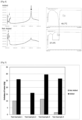
- FIGS. 1 to 4 respectively show small angle/wide angle X-ray scattering charts and DSC charts for Test Examples 1 to 4.
- the charts on the upper side are for the composition to which the first nonionic surfactant has been added
- the charts on the lower side are for the composition to which the first nonionic surfactant has not been added.
- FIG. 5 shows comparisons between the enthalpy of fusion ("Added") of compositions each containing a mixture of the first nonionic surfactant and the second nonionic surfactant of Test Examples 1 to 4, and the enthalpy of fusion ("Not Added") of compositions each containing a lamellar gel or lamellar liquid crystal constituted singly by the respective second nonionic surfactant.
- adding polyoxyethylene (6 mol) distearate caused a significant increase in the enthalpy of fusion of each self-assembled structure of the nonionic surfactant aqueous dispersion.
- adding polyoxyethylene (6 mol) distearate increases the regularity of the self-assembled structure of the nonionic surfactants, thereby making the lamellar gel firmer.
- Test Example 1-1 Polyoxyethylene (6 mol) distearate * 1 20 - Polyoxyethylene (7 mol) cetyl ether * 2 30 50 Ion-exchanged water 50 50 Total 100 100 Enthalpy of fusion (J/g) 26.0 10.1 *1: Emalex 300DIS (from Nihon Emulsion Co., Ltd.) *2: Emalex 107 (from Nihon Emulsion Co., Ltd.) [Table 2] Test Example 2-1 2-2 Polyoxyethylene (6 mol) distearate * 1 30.8 - Polyoxyethylene (20 mol) glyceryl hydrogenated castor oil * 3 27.7 46.1 Polyoxyethylene (10 mol) glyceryl hydrogenated castor oil * 4 18.4 30.8 Ion-exchanged water 23.1 23.1 Total 100 100 Enthalpy of fusion (J/g) 16.0 0 *3: Nikkol HCO-20 (from Nikko Chemicals Co., Ltd.) *4: Emalex HC -
- Lamellar gel phases including the components shown in Table 6 were prepared, and then, tripropylene glycol dipivalate was emulsified. The emulsified composition was stored at 50°C for 1 month, to observe whether the emulsified oil droplets became unified or not.
- Test Examples 6-5 to 6-7 Polyoxyethylene (6 mol) distearate * 1 2 2 2 2 - - - Polyoxyethylene (10 mol) glyceryl monostearate * 5 3 - - - 5 3 3 Polyoxyethylene (7 mol) cetyl ether * 2 - 3 - - - - - Polyoxyethylene (20 mol) glyceryl hydrogenated castor oil * 3 - - 2 - - - - Polyoxyethylene (10 mol) glyceryl hydrogenated castor oil * 4 - - 1 - - - - Polyoxyethylene (20 mol) sorbitan monostearate * 6 - - - 3 - - - Behenyl alcohol - - - - - - 2 - Stearyl alcohol
- Test Examples 7-1 and 7-2 are moisturizers each employing the lamellar gel phase of the present disclosure.
- Test Example 7-3 used as a control for comparison, is a lamellar gel phase-containing moisturizer employing behenic acid soap, stearic acid soap, polyoxyethylene (5 mol) glyceryl monostearate, glyceryl monostearate and behenyl alcohol.
- the moisturizers employing the respective lamellar gel phases of the present disclosure had good spreadability and permeating feel, and also offered excellent softness and resilience to the skin after application despite having a refreshing feel.
- the results of FIGS. 7 and 8 show that the lamellar gel phases of the present disclosure had a better feel upon use than the lamellar gel phase of Test
- a sun-block cream as shown in Table 11 was obtained by emulsification according to an ordinary method.
- the obtained sun-block cream quickly conformed to the skin, had a refreshing feel, and had excellent stability.
- Formulation Example 4 (1) Polyoxyethylene (4 mol) distearate 0.5 (2) Polyoxyethylene (20 mol) sorbitan monostearate 0.5 (3) Perfume 0.08 (4) Glyceryl tri-2-ethylhexanoate 2.0 (5) Di-2-ethylhexyl succinate 3.0 (6) 2-ethylhexyl p-methoxycinnamate 5.0 (7) Avobenzone 3.0 (8) Bis-ethylhexyloxyphenol methoxyphenyl triazine 1.0 (9) Dipropylene glycol 6.0 (10) 1,3-Butylene glycol 5.0 (11) Phenoxyethanol 0.5 (12) Glycerin 9.0 (13) EDTA-3Na 0.1 (14) Erythritol 0.1 (15) Citric acid 0.
- lamellar gel phase-containing compositions, emulsified compositions, and compositions for external-use skin preparations, and the methods for producing thereof according to the present invention have been described according to the foregoing embodiments and examples, but the invention is not limited to the foregoing embodiments and examples and may encompass various transformations, modifications, and improvements made to the various disclosed elements (including elements disclosed in the Claims, Description, and Drawings) within the scope of the invention and according to the fundamental technical idea of the present invention. Further, various combinations, substitutions, and selections of the various disclosed elements are possible within the scope of the claims of the invention.
- the lamellar gel phase-containing composition, the emulsified composition and the composition for an external-use skin preparation of the present disclosure are applicable, for example, to cosmetics applicable to the skin, cosmetics applicable to the hair, cleansers, etc.
- the composition for an external-use skin preparation of the present disclosure is applicable, for example, to antiperspirants, deodorants, sun-block cosmetics, skin-care agents, makeup cosmetics, makeup cleansers, hair cleansers, hairdressing agents, etc.
Landscapes
- Health & Medical Sciences (AREA)
- Life Sciences & Earth Sciences (AREA)
- Veterinary Medicine (AREA)
- Animal Behavior & Ethology (AREA)
- General Health & Medical Sciences (AREA)
- Public Health (AREA)
- Birds (AREA)
- Epidemiology (AREA)
- Dermatology (AREA)
- Chemical & Material Sciences (AREA)
- Emergency Medicine (AREA)
- Dispersion Chemistry (AREA)
- Crystallography & Structural Chemistry (AREA)
- Cosmetics (AREA)
Claims (7)
- Zusammensetzung, die eine lamellare Gelphase einschließt, umfassend (a) ein erstes nichtionisches Tensid, (b) ein zweites nichtionisches Tensid mit einem HLB-Wert von 7 bis 15 und (c) Wasser, worin:das erste nichtionische Tensid durch die folgende chemische Formel (1) dargestellt wird:
 worin R1 eine lineare C16-24-Acylgruppe oder eine lineare Alkylgruppe ist, R2 eine C2-4-Alkylengruppe ist, R3 eine lineare C16-24-Acylgruppe oder eine lineare Alkylgruppe ist und k eine ganze Zahl von 4 bis 15 darstellt;das zweite nichtionische Tensid mindestens eines ist, ausgewählt aus der Gruppe bestehend aus Verbindungen, die durch die folgenden chemischen Formeln (3) bis (5) dargestellt werden:
 worin R6, R10 und R14 jeweils eine C2-4-Alkylengruppe sind, R7, R11 und R15 jeweils eine C8-12-Alkylengruppe sind, R8, R12 und R16 jeweils eine C4-8-Alkylgruppe sind, R9, R13 und R17 jeweils ein Polymer von 12-Hydroxystearinsäure oder ein Polymer eines Alkylenpolyols sind, m, n und o jeweils eine natürliche Zahl sind und die Summe von m, n und o von 10 bis 60 beträgt;
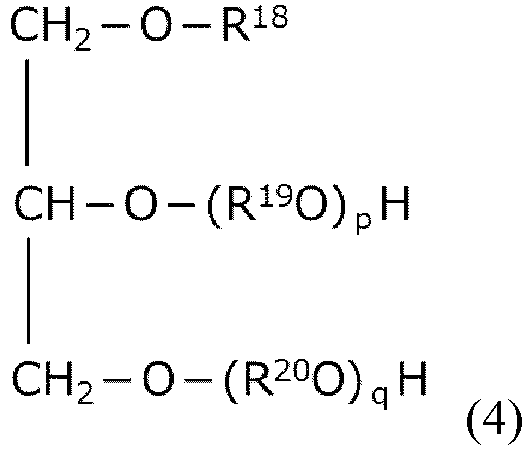 worin R18 eine lineare C16-24-Acylgruppe oder eine lineare Alkylgruppe ist, R19 und R20 jeweils eine C2-4-Alkylengruppe sind, p und q jeweils eine natürliche Zahl sind und die Summe von p und q 5 bis 20 beträgt; und
 worin R21, R22, R23 und R25 jeweils eine C2-4-Alkylengruppe sind, r, s, t und u jeweils eine natürliche Zahl sind, die Summe von r, s, t und u 5 bis 30 beträgt und R24 eine lineare C16-24-Acylgruppe oder lineare Alkylgruppe ist;das erste nichtionische Tensid, das zweite nichtionische Tensid und das Wasser mindestens einen Teil der lamellaren Gelphase bilden; undein prozentualer Gehalt an aliphatischen Alkoholen mit mindestens 16 Kohlenstoffatomen oder Fettsäuren mit mindestens 16 Kohlenstoffatomen 1 Masse-% oder weniger, bezogen auf die Masse der Zusammensetzung, beträgt.
 - Zusammensetzung, die eine lamellare Gelphase einschließt, nach Anspruch 1, wobei das erste nichtionische Tensid Polyethylenglykoldistearat ist, bei dem k in der chemischen Formel (1) 4 bis 8 beträgt.
- Zusammensetzung, die eine lamellare Gelphase einschließt, nach Anspruch 1 oder 2, wobei der Gehalt an dem ersten nichtionischen Tensid 0,1 bis 40 Masse-%, bezogen auf die Masse der Zusammensetzung, beträgt.
- Zusammensetzung, die eine lamellare Gelphase einschließt, nach einem der Ansprüche 1 bis 3, wobei die lamellare Gelphase einen höheren eutektischen Punkt und eine höhere Schmelzenthalpie aufweist als eine lamellare Gelphase, die allein durch eines der zweiten nichtionischen Tenside, die durch die jeweiligen chemischen Formeln (3) bis (5) dargestellt sind, gebildet wird.
- Zusammensetzung, die eine lamellare Gelphase einschließt, nach einem der Ansprüche 1 bis 4, wobei der Gehalt des zweiten nichtionischen Tensids 0,5 bis 6 Massenteile, bezogen auf 1 Massenteil des ersten nichtionischen Tensids, beträgt.
- Emulgierte Zusammensetzung, umfassend:die Zusammensetzung, die eine lamellare Gelphase einschließt, nach einem der Ansprüche 1 bis 5;eine ölige Komponente; undWasser,wobei die ölige Komponente oder das Wasser durch die lamellare Gelphase emulgiert wird, die in der die Zusammensetzung, die eine lamellare Gelphase einschließt, nach einem der Ansprüche 1 bis 5 enthalten ist.
- Zusammensetzung für ein äußerlich anzuwendendes Hautpräparat, umfassend die Zusammensetzung, die eine lamellare Gelphase einschließt, nach einem der Ansprüche 1 bis 5 oder die emulgierte Zusammensetzung nach Anspruch 6.
Applications Claiming Priority (2)
| Application Number | Priority Date | Filing Date | Title |
|---|---|---|---|
| JP2020068416 | 2020-04-06 | ||
| PCT/JP2021/012808 WO2021205902A1 (ja) | 2020-04-06 | 2021-03-26 | ラメラゲル含有組成物、乳化組成物、及び皮膚外用剤組成物 |
Publications (3)
| Publication Number | Publication Date |
|---|---|
| EP4134067A1 EP4134067A1 (de) | 2023-02-15 |
| EP4134067A4 EP4134067A4 (de) | 2024-04-24 |
| EP4134067B1 true EP4134067B1 (de) | 2025-07-09 |
Family
ID=78023049
Family Applications (1)
| Application Number | Title | Priority Date | Filing Date |
|---|---|---|---|
| EP21783999.2A Active EP4134067B1 (de) | 2020-04-06 | 2021-03-26 | Lamellares gel enthaltende zusammensetzung, emulgierte zusammensetzung und zusammensetzung für mittel zur äusserlichen anwendung auf der haut |
Country Status (5)
| Country | Link |
|---|---|
| US (1) | US20230190590A1 (de) |
| EP (1) | EP4134067B1 (de) |
| JP (1) | JP7696334B2 (de) |
| CN (1) | CN115279332A (de) |
| WO (1) | WO2021205902A1 (de) |
Families Citing this family (3)
| Publication number | Priority date | Publication date | Assignee | Title |
|---|---|---|---|---|
| WO2023042687A1 (ja) * | 2021-09-16 | 2023-03-23 | 株式会社 資生堂 | 水中油型洗浄料組成物 |
| WO2024247734A1 (ja) * | 2023-05-29 | 2024-12-05 | 株式会社 資生堂 | 水中油型化粧料 |
| CN117582377B (zh) * | 2023-11-01 | 2024-05-14 | 完美(广东)日用品有限公司 | 一种可形成稳定α-凝胶的乳化剂组合物 |
Family Cites Families (6)
| Publication number | Priority date | Publication date | Assignee | Title |
|---|---|---|---|---|
| JP2000001423A (ja) * | 1998-06-15 | 2000-01-07 | New Japan Chem Co Ltd | 化粧料用油剤及び化粧料 |
| JP6426635B2 (ja) * | 2016-01-27 | 2018-11-21 | 株式会社 資生堂 | αゲル形成用組成物及びαゲル組成物 |
| EP3409264B1 (de) * | 2016-01-27 | 2022-03-09 | Shiseido Company, Ltd. | Alpha-gelbildungszusammensetzung, externe hautpflegezusammensetzung mit alpha-gelbildungszusammensetzung und alpha-gelzusammensetzung mit alpha-gelbildungszusammensetzung |
| US10898426B2 (en) * | 2016-01-27 | 2021-01-26 | Shiseido Company, Ltd. | Alpha-gel formation composition, external skin care composition using alpha-gel formation composition, and alpha-gel composition using alpha-gel formation composition |
| JP7412068B2 (ja) * | 2016-12-16 | 2024-01-12 | 株式会社 資生堂 | 水中油型組成物 |
| CN110037981A (zh) * | 2019-06-06 | 2019-07-23 | 大连樱凝科技有限公司 | 一种护肤品及其制备方法与应用 |
-
2021
- 2021-03-26 EP EP21783999.2A patent/EP4134067B1/de active Active
- 2021-03-26 US US17/909,669 patent/US20230190590A1/en active Pending
- 2021-03-26 CN CN202180019958.3A patent/CN115279332A/zh active Pending
- 2021-03-26 JP JP2022514405A patent/JP7696334B2/ja active Active
- 2021-03-26 WO PCT/JP2021/012808 patent/WO2021205902A1/ja not_active Ceased
Also Published As
| Publication number | Publication date |
|---|---|
| US20230190590A1 (en) | 2023-06-22 |
| CN115279332A (zh) | 2022-11-01 |
| JP7696334B2 (ja) | 2025-06-20 |
| EP4134067A1 (de) | 2023-02-15 |
| WO2021205902A1 (ja) | 2021-10-14 |
| JPWO2021205902A1 (de) | 2021-10-14 |
| EP4134067A4 (de) | 2024-04-24 |
Similar Documents
| Publication | Publication Date | Title |
|---|---|---|
| JP5241011B2 (ja) | 水中油型乳化日焼け止め化粧料 | |
| US11730684B2 (en) | Cleansing composition | |
| US20090197948A1 (en) | Skin External Preparation | |
| US20220023160A1 (en) | Oil-water separating composition and article | |
| EP4134067B1 (de) | Lamellares gel enthaltende zusammensetzung, emulgierte zusammensetzung und zusammensetzung für mittel zur äusserlichen anwendung auf der haut | |
| US20100075882A1 (en) | External Skin Preparation And Skin Cleanser | |
| JPWO2003026698A1 (ja) | 皮膚外用剤 | |
| EP3539532B1 (de) | Hautpflegezusammensetzung | |
| JP7114164B2 (ja) | 粉体含有水系組成物及び皮膚外用剤 | |
| JP5121527B2 (ja) | 皮膚外用剤 | |
| JP4571833B2 (ja) | ゲル状洗浄組成物 | |
| EP3851094A1 (de) | Wasser-in-öl-zusammensetzung zur äusserlichen anwendung auf der haut | |
| US20220023176A1 (en) | Cleansing composition | |
| WO2023042687A1 (ja) | 水中油型洗浄料組成物 | |
| WO2022196480A1 (ja) | 2層化粧料 | |
| JP5154904B2 (ja) | 皮膚外用剤 | |
| EP3892337A1 (de) | Emulgierte kosmetische zusammensetzung | |
| JP2003327505A (ja) | 皮膚外用剤 | |
| JP2006045133A (ja) | 水中油型乳化組成物 | |
| EP4599819A1 (de) | Gelzusammensetzung und öl-in-wasser-zusammensetzung | |
| JP2002047122A (ja) | 化粧料 | |
| WO2023042688A1 (ja) | 水中油型組成物 | |
| US20230404877A1 (en) | Powder-containing composition | |
| EP4233835A1 (de) | Öl-in-wasser-zusammensetzung | |
| JP2001206812A (ja) | メーキャップ化粧料 |
Legal Events
| Date | Code | Title | Description |
|---|---|---|---|
| STAA | Information on the status of an ep patent application or granted ep patent |
Free format text: STATUS: THE INTERNATIONAL PUBLICATION HAS BEEN MADE |
|
| PUAI | Public reference made under article 153(3) epc to a published international application that has entered the european phase |
Free format text: ORIGINAL CODE: 0009012 |
|
| STAA | Information on the status of an ep patent application or granted ep patent |
Free format text: STATUS: REQUEST FOR EXAMINATION WAS MADE |
|
| 17P | Request for examination filed |
Effective date: 20221006 |
|
| AK | Designated contracting states |
Kind code of ref document: A1 Designated state(s): AL AT BE BG CH CY CZ DE DK EE ES FI FR GB GR HR HU IE IS IT LI LT LU LV MC MK MT NL NO PL PT RO RS SE SI SK SM TR |
|
| DAV | Request for validation of the european patent (deleted) | ||
| DAX | Request for extension of the european patent (deleted) | ||
| A4 | Supplementary search report drawn up and despatched |
Effective date: 20240321 |
|
| RIC1 | Information provided on ipc code assigned before grant |
Ipc: A61K 8/34 20060101ALI20240315BHEP Ipc: A61Q 19/10 20060101ALI20240315BHEP Ipc: A61Q 19/00 20060101ALI20240315BHEP Ipc: A61Q 17/00 20060101ALI20240315BHEP Ipc: A61Q 15/00 20060101ALI20240315BHEP Ipc: A61Q 5/06 20060101ALI20240315BHEP Ipc: A61Q 5/02 20060101ALI20240315BHEP Ipc: A61K 8/86 20060101ALI20240315BHEP Ipc: A61K 8/06 20060101ALI20240315BHEP Ipc: A61K 8/02 20060101ALI20240315BHEP Ipc: A61K 8/39 20060101AFI20240315BHEP |
|
| GRAP | Despatch of communication of intention to grant a patent |
Free format text: ORIGINAL CODE: EPIDOSNIGR1 |
|
| STAA | Information on the status of an ep patent application or granted ep patent |
Free format text: STATUS: GRANT OF PATENT IS INTENDED |
|
| RIC1 | Information provided on ipc code assigned before grant |
Ipc: A61Q 19/00 20060101ALI20250130BHEP Ipc: A61K 8/86 20060101ALI20250130BHEP Ipc: A61K 8/34 20060101ALI20250130BHEP Ipc: A61K 8/02 20060101ALI20250130BHEP Ipc: A61K 8/39 20060101AFI20250130BHEP |
|
| INTG | Intention to grant announced |
Effective date: 20250218 |
|
| P01 | Opt-out of the competence of the unified patent court (upc) registered |
Free format text: CASE NUMBER: APP_11507/2025 Effective date: 20250310 |
|
| GRAS | Grant fee paid |
Free format text: ORIGINAL CODE: EPIDOSNIGR3 |
|
| GRAA | (expected) grant |
Free format text: ORIGINAL CODE: 0009210 |
|
| STAA | Information on the status of an ep patent application or granted ep patent |
Free format text: STATUS: THE PATENT HAS BEEN GRANTED |
|
| AK | Designated contracting states |
Kind code of ref document: B1 Designated state(s): AL AT BE BG CH CY CZ DE DK EE ES FI FR GB GR HR HU IE IS IT LI LT LU LV MC MK MT NL NO PL PT RO RS SE SI SK SM TR |
|
| REG | Reference to a national code |
Ref country code: GB Ref legal event code: FG4D |
|
| REG | Reference to a national code |
Ref country code: CH Ref legal event code: EP |
|
| REG | Reference to a national code |
Ref country code: IE Ref legal event code: FG4D |
|
| REG | Reference to a national code |
Ref country code: DE Ref legal event code: R096 Ref document number: 602021033867 Country of ref document: DE |
|
| REG | Reference to a national code |
Ref country code: NL Ref legal event code: MP Effective date: 20250709 |
|
| PG25 | Lapsed in a contracting state [announced via postgrant information from national office to epo] |
Ref country code: PT Free format text: LAPSE BECAUSE OF FAILURE TO SUBMIT A TRANSLATION OF THE DESCRIPTION OR TO PAY THE FEE WITHIN THE PRESCRIBED TIME-LIMIT Effective date: 20251110 |
|
| PG25 | Lapsed in a contracting state [announced via postgrant information from national office to epo] |
Ref country code: NL Free format text: LAPSE BECAUSE OF FAILURE TO SUBMIT A TRANSLATION OF THE DESCRIPTION OR TO PAY THE FEE WITHIN THE PRESCRIBED TIME-LIMIT Effective date: 20250709 |
|
| REG | Reference to a national code |
Ref country code: AT Ref legal event code: MK05 Ref document number: 1811171 Country of ref document: AT Kind code of ref document: T Effective date: 20250709 |
|
| PG25 | Lapsed in a contracting state [announced via postgrant information from national office to epo] |
Ref country code: IS Free format text: LAPSE BECAUSE OF FAILURE TO SUBMIT A TRANSLATION OF THE DESCRIPTION OR TO PAY THE FEE WITHIN THE PRESCRIBED TIME-LIMIT Effective date: 20251109 |
|
| PG25 | Lapsed in a contracting state [announced via postgrant information from national office to epo] |
Ref country code: NO Free format text: LAPSE BECAUSE OF FAILURE TO SUBMIT A TRANSLATION OF THE DESCRIPTION OR TO PAY THE FEE WITHIN THE PRESCRIBED TIME-LIMIT Effective date: 20251009 |
|
| REG | Reference to a national code |
Ref country code: LT Ref legal event code: MG9D |
|
| PG25 | Lapsed in a contracting state [announced via postgrant information from national office to epo] |
Ref country code: AT Free format text: LAPSE BECAUSE OF FAILURE TO SUBMIT A TRANSLATION OF THE DESCRIPTION OR TO PAY THE FEE WITHIN THE PRESCRIBED TIME-LIMIT Effective date: 20250709 |
|
| PG25 | Lapsed in a contracting state [announced via postgrant information from national office to epo] |
Ref country code: FI Free format text: LAPSE BECAUSE OF FAILURE TO SUBMIT A TRANSLATION OF THE DESCRIPTION OR TO PAY THE FEE WITHIN THE PRESCRIBED TIME-LIMIT Effective date: 20250709 |
|
| PG25 | Lapsed in a contracting state [announced via postgrant information from national office to epo] |
Ref country code: HR Free format text: LAPSE BECAUSE OF FAILURE TO SUBMIT A TRANSLATION OF THE DESCRIPTION OR TO PAY THE FEE WITHIN THE PRESCRIBED TIME-LIMIT Effective date: 20250709 |
|
| PG25 | Lapsed in a contracting state [announced via postgrant information from national office to epo] |
Ref country code: GR Free format text: LAPSE BECAUSE OF FAILURE TO SUBMIT A TRANSLATION OF THE DESCRIPTION OR TO PAY THE FEE WITHIN THE PRESCRIBED TIME-LIMIT Effective date: 20251010 |
|
| PG25 | Lapsed in a contracting state [announced via postgrant information from national office to epo] |
Ref country code: SE Free format text: LAPSE BECAUSE OF FAILURE TO SUBMIT A TRANSLATION OF THE DESCRIPTION OR TO PAY THE FEE WITHIN THE PRESCRIBED TIME-LIMIT Effective date: 20250709 |
|
| PG25 | Lapsed in a contracting state [announced via postgrant information from national office to epo] |
Ref country code: LV Free format text: LAPSE BECAUSE OF FAILURE TO SUBMIT A TRANSLATION OF THE DESCRIPTION OR TO PAY THE FEE WITHIN THE PRESCRIBED TIME-LIMIT Effective date: 20250709 |
|
| PG25 | Lapsed in a contracting state [announced via postgrant information from national office to epo] |
Ref country code: BG Free format text: LAPSE BECAUSE OF FAILURE TO SUBMIT A TRANSLATION OF THE DESCRIPTION OR TO PAY THE FEE WITHIN THE PRESCRIBED TIME-LIMIT Effective date: 20250709 Ref country code: PL Free format text: LAPSE BECAUSE OF FAILURE TO SUBMIT A TRANSLATION OF THE DESCRIPTION OR TO PAY THE FEE WITHIN THE PRESCRIBED TIME-LIMIT Effective date: 20250709 |
|
| PG25 | Lapsed in a contracting state [announced via postgrant information from national office to epo] |
Ref country code: RS Free format text: LAPSE BECAUSE OF FAILURE TO SUBMIT A TRANSLATION OF THE DESCRIPTION OR TO PAY THE FEE WITHIN THE PRESCRIBED TIME-LIMIT Effective date: 20251009 |
|
| PG25 | Lapsed in a contracting state [announced via postgrant information from national office to epo] |
Ref country code: ES Free format text: LAPSE BECAUSE OF FAILURE TO SUBMIT A TRANSLATION OF THE DESCRIPTION OR TO PAY THE FEE WITHIN THE PRESCRIBED TIME-LIMIT Effective date: 20250709 |