EP4131886B1 - Positionierungsverfahren, -vorrichtung und -system sowie speichermedium - Google Patents
Positionierungsverfahren, -vorrichtung und -system sowie speichermedium Download PDFInfo
- Publication number
- EP4131886B1 EP4131886B1 EP21782057.0A EP21782057A EP4131886B1 EP 4131886 B1 EP4131886 B1 EP 4131886B1 EP 21782057 A EP21782057 A EP 21782057A EP 4131886 B1 EP4131886 B1 EP 4131886B1
- Authority
- EP
- European Patent Office
- Prior art keywords
- server
- terminal
- location information
- differential data
- information
- Prior art date
- Legal status (The legal status is an assumption and is not a legal conclusion. Google has not performed a legal analysis and makes no representation as to the accuracy of the status listed.)
- Active
Links
Images






Classifications
-
- H—ELECTRICITY
- H04—ELECTRIC COMMUNICATION TECHNIQUE
- H04W—WIRELESS COMMUNICATION NETWORKS
- H04W64/00—Locating users or terminals or network equipment for network management purposes, e.g. mobility management
-
- H—ELECTRICITY
- H04—ELECTRIC COMMUNICATION TECHNIQUE
- H04L—TRANSMISSION OF DIGITAL INFORMATION, e.g. TELEGRAPHIC COMMUNICATION
- H04L67/00—Network arrangements or protocols for supporting network services or applications
- H04L67/50—Network services
- H04L67/52—Network services specially adapted for the location of the user terminal
-
- G—PHYSICS
- G01—MEASURING; TESTING
- G01S—RADIO DIRECTION-FINDING; RADIO NAVIGATION; DETERMINING DISTANCE OR VELOCITY BY USE OF RADIO WAVES; LOCATING OR PRESENCE-DETECTING BY USE OF THE REFLECTION OR RERADIATION OF RADIO WAVES; ANALOGOUS ARRANGEMENTS USING OTHER WAVES
- G01S19/00—Satellite radio beacon positioning systems; Determining position, velocity or attitude using signals transmitted by such systems
- G01S19/01—Satellite radio beacon positioning systems transmitting time-stamped messages, e.g. GPS [Global Positioning System], GLONASS [Global Orbiting Navigation Satellite System] or GALILEO
- G01S19/03—Cooperating elements; Interaction or communication between different cooperating elements or between cooperating elements and receivers
-
- G—PHYSICS
- G01—MEASURING; TESTING
- G01S—RADIO DIRECTION-FINDING; RADIO NAVIGATION; DETERMINING DISTANCE OR VELOCITY BY USE OF RADIO WAVES; LOCATING OR PRESENCE-DETECTING BY USE OF THE REFLECTION OR RERADIATION OF RADIO WAVES; ANALOGOUS ARRANGEMENTS USING OTHER WAVES
- G01S5/00—Position-fixing by co-ordinating two or more direction or position line determinations; Position-fixing by co-ordinating two or more distance determinations
- G01S5/0009—Transmission of position information to remote stations
- G01S5/009—Transmission of differential positioning data to mobile
-
- H—ELECTRICITY
- H04—ELECTRIC COMMUNICATION TECHNIQUE
- H04L—TRANSMISSION OF DIGITAL INFORMATION, e.g. TELEGRAPHIC COMMUNICATION
- H04L63/00—Network architectures or network communication protocols for network security
- H04L63/08—Network architectures or network communication protocols for network security for authentication of entities
- H04L63/083—Network architectures or network communication protocols for network security for authentication of entities using passwords
-
- H—ELECTRICITY
- H04—ELECTRIC COMMUNICATION TECHNIQUE
- H04L—TRANSMISSION OF DIGITAL INFORMATION, e.g. TELEGRAPHIC COMMUNICATION
- H04L63/00—Network architectures or network communication protocols for network security
- H04L63/08—Network architectures or network communication protocols for network security for authentication of entities
- H04L63/0876—Network architectures or network communication protocols for network security for authentication of entities based on the identity of the terminal or configuration, e.g. MAC address, hardware or software configuration or device fingerprint
-
- H—ELECTRICITY
- H04—ELECTRIC COMMUNICATION TECHNIQUE
- H04L—TRANSMISSION OF DIGITAL INFORMATION, e.g. TELEGRAPHIC COMMUNICATION
- H04L67/00—Network arrangements or protocols for supporting network services or applications
- H04L67/01—Protocols
- H04L67/10—Protocols in which an application is distributed across nodes in the network
- H04L67/1095—Replication or mirroring of data, e.g. scheduling or transport for data synchronisation between network nodes
-
- H—ELECTRICITY
- H04—ELECTRIC COMMUNICATION TECHNIQUE
- H04L—TRANSMISSION OF DIGITAL INFORMATION, e.g. TELEGRAPHIC COMMUNICATION
- H04L67/00—Network arrangements or protocols for supporting network services or applications
- H04L67/14—Session management
-
- H—ELECTRICITY
- H04—ELECTRIC COMMUNICATION TECHNIQUE
- H04L—TRANSMISSION OF DIGITAL INFORMATION, e.g. TELEGRAPHIC COMMUNICATION
- H04L67/00—Network arrangements or protocols for supporting network services or applications
- H04L67/14—Session management
- H04L67/141—Setup of application sessions
-
- H—ELECTRICITY
- H04—ELECTRIC COMMUNICATION TECHNIQUE
- H04L—TRANSMISSION OF DIGITAL INFORMATION, e.g. TELEGRAPHIC COMMUNICATION
- H04L67/00—Network arrangements or protocols for supporting network services or applications
- H04L67/14—Session management
- H04L67/143—Termination or inactivation of sessions, e.g. event-controlled end of session
-
- H—ELECTRICITY
- H04—ELECTRIC COMMUNICATION TECHNIQUE
- H04W—WIRELESS COMMUNICATION NETWORKS
- H04W12/00—Security arrangements; Authentication; Protecting privacy or anonymity
- H04W12/06—Authentication
-
- H—ELECTRICITY
- H04—ELECTRIC COMMUNICATION TECHNIQUE
- H04W—WIRELESS COMMUNICATION NETWORKS
- H04W12/00—Security arrangements; Authentication; Protecting privacy or anonymity
- H04W12/60—Context-dependent security
- H04W12/63—Location-dependent; Proximity-dependent
-
- G—PHYSICS
- G01—MEASURING; TESTING
- G01S—RADIO DIRECTION-FINDING; RADIO NAVIGATION; DETERMINING DISTANCE OR VELOCITY BY USE OF RADIO WAVES; LOCATING OR PRESENCE-DETECTING BY USE OF THE REFLECTION OR RERADIATION OF RADIO WAVES; ANALOGOUS ARRANGEMENTS USING OTHER WAVES
- G01S19/00—Satellite radio beacon positioning systems; Determining position, velocity or attitude using signals transmitted by such systems
- G01S19/01—Satellite radio beacon positioning systems transmitting time-stamped messages, e.g. GPS [Global Positioning System], GLONASS [Global Orbiting Navigation Satellite System] or GALILEO
- G01S19/03—Cooperating elements; Interaction or communication between different cooperating elements or between cooperating elements and receivers
- G01S19/07—Cooperating elements; Interaction or communication between different cooperating elements or between cooperating elements and receivers providing data for correcting measured positioning data, e.g. DGPS [differential GPS] or ionosphere corrections
- G01S19/073—Cooperating elements; Interaction or communication between different cooperating elements or between cooperating elements and receivers providing data for correcting measured positioning data, e.g. DGPS [differential GPS] or ionosphere corrections involving a network of fixed stations
-
- H—ELECTRICITY
- H04—ELECTRIC COMMUNICATION TECHNIQUE
- H04L—TRANSMISSION OF DIGITAL INFORMATION, e.g. TELEGRAPHIC COMMUNICATION
- H04L61/00—Network arrangements, protocols or services for addressing or naming
- H04L61/45—Network directories; Name-to-address mapping
- H04L61/4505—Network directories; Name-to-address mapping using standardised directories; using standardised directory access protocols
- H04L61/4511—Network directories; Name-to-address mapping using standardised directories; using standardised directory access protocols using domain name system [DNS]
-
- H—ELECTRICITY
- H04—ELECTRIC COMMUNICATION TECHNIQUE
- H04W—WIRELESS COMMUNICATION NETWORKS
- H04W4/00—Services specially adapted for wireless communication networks; Facilities therefor
- H04W4/02—Services making use of location information
Definitions
- the application relates to the technical field of communications, and particularly relates to a positioning method, apparatus and system, and a storage medium.
- the high-precision positioning technology mainly adopts a "cloud + end” positioning mode.
- the "cloud + end” positioning mode includes a cloud server and a satellite positioning terminal. Through the cloud server, differential data obtained by a ground reference station and global satellite ephemeris are combined to determine a differential positioning result of the satellite positioning terminal, which is fed back to the satellite positioning terminal.
- CN 109541655 A relates to a differential positioning system, which at least includes: multiple base stations, multiple mobile edge computing MEC nodes, multiple continuously operating reference station, CORS, systems. Each CORS system includes at least one CORS, and each MEC connects at least one base station, and each MEC node is connected to at least one CORS system.
- US 10506543 B1 relates to supporting periodic or triggered location of a user equipment (UE) using Early Data Transmission (EDT).
- UE user equipment
- EDT Early Data Transmission
- WO 2006/043123 A1 relates to a positioning of an assembly (1).
- An assembly (1) comprises a Global Navigation Satellite System (GNSS) receiver (3) and a wireless communication module (2) and may exchange GNSS information with other assemblies (1) using cellular or non-cellular links.
- GNSS Global Navigation Satellite System
- Embodiments of the application provide a positioning method, apparatus and system and a storage medium, which can greatly reduce a network delay and quickly return a terminal positioning result.
- the invention is set out in the appended set of claims.
- first location information sent by a terminal is received through a first server.
- the first location information includes the identity of the terminal.
- a differential data request is sent to a second server.
- the differential data request includes the first location information, and the differential data request is used for the second server to determine the differential data of the terminal.
- Differential data sent by a second server is received.
- the first location information is calculated to obtain the second location information.
- the second location information is sent to the terminal, and then a terminal positioning result is quickly returned, so that a network delay is greatly reduced when the terminal determines the precise location.
- the high-precision positioning technology mainly adopts a "cloud + end” positioning mode.
- the "cloud + end” positioning mode includes a cloud server and a satellite positioning terminal. Through the cloud server, differential data obtained by a ground reference station and global satellite ephemeris are combined to determine a differential positioning result of the satellite positioning terminal, which is fed back to the satellite positioning terminal.
- the communication between the cloud server and the satellite positioning terminal in the "cloud + end" positioning mode may lead to a large network delay and cannot support applications in the automatic driving field.
- Multi-access Mobile Edge Computing is a key technology to integrate services and networks in the 5G era.
- MEC extends the computing, resources such as storage, and capability platforms of a cloud computing center to the edge of the network side of an operator, and provides network capability opening, Internet Technology (IT) services, environment and cloud computing capabilities at the position close to a mobile user.
- IT Internet Technology
- the feature of nearby service of MEC meets the requirements of real-time data processing in business level and data security and reliability in customer level.
- MEC provides cloud computing capability for application developers and content, and IT service environment at the edge of the network.
- the environment is characterized by ultra-low delay and high bandwidth, and an application may make use of the real-time access of wireless network information.
- a plurality of Internet of Things devices need to provide a positioning service, and the positioning need is more obvious especially for a moving object.
- high-precision positioning with ultra-low time delay is required as a navigation basis.
- high-precision positioning with ultra-low time delay may occupy a large amount of real-time bandwidth. Then, combined with an edge computing module, rapid data reporting, and real-time processing and synchronization of information may be achieved.
- the method of deploying a differential positioning system using an MEC node mainly relies on multiple Continuously Operating Reference Stations (CORS) systems and multiple MEC nodes, and each CORS system is relatively independent, so data roaming and differential data synchronization of a terminal device cannot be performed, and the goal of quick response when switching areas cannot be achieved for services with strict low delay requirements.
- CORS Continuously Operating Reference Stations
- the embodiments of the application provide a positioning method, apparatus and system and a storage medium, which can greatly reduce a network delay and quickly return a terminal positioning result.
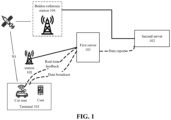
- FIG. 1 is a structural schematic diagram of a positioning system according to an embodiment of the application.
- the positioning system provided in the embodiment of the application includes a first server 101, a second server 102 and a terminal 103.
- the second server 102 is connected to a plurality of first servers 101 to form a star-based network structure, all information flow synchronization and data interaction are performed through the second server 102, and the second server 102 keeps a high availability state. Meanwhile, all data are synchronized based on the data of the second server 102, which ensures the timeliness and uniformity of data, and coordinates all the first servers 101 to jointly provide a terminal differential calculation service.
- the first server may be an edge server
- the second server may be a central server.
- the first server 101 is mainly configured to perform differential calculation on first location information of the terminal using the differential data sent by the second server 102.
- the first server 101 may include a terminal differential calculation module, a MEC module and a UPF function shunting module, as shown in FIG. 3 .
- the MEC module is configured to perform differential calculation on the differential data and manage a shunting service of the UPF shunting module.
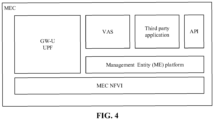
- the MEC module may include: Gateway-UPF (GW-U) UPF, Value-Added Services (VAS), 3rd Application, Application Programming Interface (API) and MEC Network Functions Virtualization Infrastructure (NFVI), as shown in FIG. 4 .
- GW-U UPF consists of a control panel network element of which the 5G core network sinks to edge computing.
- VAS is integrated on a MEP platform and consists of a value-added service provided by an operator to an APP.
- 3rd Apps are edge applications, and are integrated on a Management Entity (ME) platform.
- API is responsible for opening of network capabilities and opening of platform capabilities.
- MEC NFVI is responsible for providing MEC hardware infrastructure and Infrastructure as a Service (IaaS) device.
- the UPF shunting module is configured to shunt a corresponding identity, terminal type information and the like when the terminal requests the second location information.
- the UPF shunting module includes an Authentication Management Function (AMF) as access and mobility management, a Session Management Function (SMF) as session management, a Wireless Access Network (RAN) as a wireless side, and a Domain Name (DN) as a domain name resolution service.
- AMF Authentication Management Function
- SMF Session Management Function
- RAN Wireless Access Network
- DN Domain Name
- UPF is divided into an uplink class filter and a Protocol Data Unit (PDU) session anchor, as shown in FIG. 5 .
- AMF is responsible for the access authentication between the terminal and the MEC node, and the authentication is based on a user name, a password and a security key uploaded by the terminal.
- the AMF node may upload device information to the second server after the authentication is passed, which is used as the basis for re-access when switching the first server across areas.
- the SMF is responsible for session management, automatic allocation and management of client addresses, as well as responsible for selection and control of upload of some part of data streams.
- the RAN is the wireless side, which consists of a series of transmission entity locks between a switch and a related user network interface, and provides the required transmission carrying capacity and wireless implementation system for transmitting a business data stream.
- DN domain name resolution service For the DN domain name resolution service, all domain name resolution services of the UPF node are abstracted as a node, which is responsible for resolving a conversion process from domain name to IP address, and a subdirectory is linked with a domain name in the annotation of the IP address.
- the data flow interaction of the UPF shunting module is as follows.
- N1 a data packet and life cycle management data are applied, and the life cycle is divided into four stages: activation, readiness, operation and death.
- a single data interaction process may be flexibly switched before death among the other three states.
- N2 a Domain Name System (DNS) activates and wakes up, and at the same time, shunting of some DNS-based requests may be implemented.
- DNS Domain Name System
- N3 the connection between the first server and the second server is connected, and interaction of all MEC communication conditions and data stream transmission conditions is achieved in the middle.
- N4 a data stream is transmitted upstream and downstream through a session, including business data, device information, newly defined differential data format, etc.
- N9 after the uplink classification by a UPF uplink classifier node, tasks in different queues enter different UPF nodes to implement serial classification of uplink data. Meanwhile, the classified tasks may be executed in parallel to improve the efficiency.
- the terminal differential calculation module is configured to plan computing resources, which can reduce the power consumption of the terminal and avoid the problem of insufficient power of the terminal. And the limitation of insufficient computing power of the terminal can be broken, and the calculation speed and precision of the differential data are improved.
- the terminal differential resolution module is further configured to maintain the connection state between the first server 101 and the terminal 103, interact the first location information of the terminal in real time, and return the second location information of the terminal. Meanwhile, the terminal within the connection range of the first server may be verified by the user name and password. When the verification passes, the terminal can connect to the first server. During the time of establishing the connection, the terminal may use the terminal differential calculation service through the terminal differential calculation module.
- the first server may upload the identity of the terminal and terminal type information to the second server after establishing a connection with the terminal.
- the first server may also send connection information to the second server.
- the second server stores the identity of the terminal, terminal type information connection information such as the time when the terminal establishes connection with the first server, and request information. If the terminal connected to the first server is disconnected or out of the connection range, when connected to another first server again, the first server device may query the second server whether the connection information of the terminal already exists. If yes, a connection may be established directly, a terminal differential calculation service is provided, and the second server synchronizes the latest historical information of the terminal, such as second coordinate information of the terminal within the historical time. If not, the terminal may be verified by the user name and password, and when the verification passes, the terminal can connect to the first server.
- the first server provides terminal differential calculation service to the terminal.
- the second server 102 is mainly configured to manage a plurality of first servers connected to the second server, integrate and synchronize the data of the plurality of first servers, and process and distribute the differential data of a designated area.
- the second server includes an edge hybrid cloud management module, an edge computing network element arrangement module, a Beidou differential calculation module, an edge computing application container platform, a heterogeneous edge computing management module and the like.
- a platform is built based on Docker and Kubernetes, which facilitates containerized management of the first server and dynamic adjustment of the network and server resources of the first server, as shown in FIG. 6 .
- the Beidou differential calculation module is configured to measure a positioning and navigation satellite signal and determine the differential data of the terminal according to the measured positioning and navigation satellite signal. For each managed first server, a differential data model is established for the calculation within the service range of the first server, and the differential data of each first server is calculated, stored and updated.
- the positioning system provided by the embodiment of the application further includes a Beidou reference station 104 and a base station 105.
- the Beidou reference station is configured to receive the positioning and navigation satellite signal sent by a satellite.
- the Beidou reference station sends the positioning and navigation satellite signal to the second server.
- the base station 105 is configured to provide an interface for the first server to access the Internet.
- the method of positioning implemented by the first server 101, the second server 102 and the terminal 103 in the positioning system is described in detail below.
- Establishing a connection between the terminal 103 and the first server 101 includes establishing a connection for the first time and establishing a connection for the non-first time.
- the terminal 103 establishes a connection with the first server 101 for the first time, including the following operations.
- the terminal 103 sends a connection request to the first server 101.
- the connection request includes the user name and password of the terminal.
- the first server 101 After receiving the connection request sent by the terminal 103, the first server 101 verifies the terminal according to the user name and password.
- the first server 101 When the verification of the terminal passes, the first server 101 establishes a connection with the terminal 103.
- the connection request refers to a request that the terminal 103 initiates a connection to the first server 101.
- the connection request includes the user name and password of the terminal.
- the first server 101 may verify whether the user name and password of the terminal 103 match or not. When the user name and password of the terminal do not match, the terminal 103 cannot connect to the first server 101. When the user name and password of the terminal match, the terminal 103 can connect to the first server 101.
- the connection request also includes an identity of the terminal and terminal type information.
- the first server 101 may send the identity of the terminal and terminal type information in the connection request to the second server 102.
- the second server 102 receives the identity of the terminal and terminal type information, the identity of the terminal and terminal type information are stored.
- the terminal 103 establishes a connection with the first server 101 for the non-first time, including the following operations.
- the first server 101 sends a query request to the second server 102.
- the query request includes the identity of the terminal and a time stamp of the terminal.
- the second server determines whether the terminal corresponding to the identity of the terminal is stored in the second server.
- the second server sends a connection instruction to the first server.
- the first server receives the connection instruction and establishes a communication connection with the terminal according to the connection instruction.
- the time stamp of the terminal refers to the time stamp of the last time when the terminal disconnects from the first server 101.
- the second server 102 stores the identity of the terminal, and when the terminal is disconnected from the first server, the time stamp of the disconnection of the terminal from the first server is stored in the second server.
- the second server stores the terminal corresponding to the identity of the terminal and the time stamp of the last disconnection of the terminal from the first server, so that the terminal switches among the plurality of first server devices.
- the terminal may establish connections with the plurality of first servers. Every time a connection is established with a first server, the first server may query related information of the terminal in the second server. If the related information of the terminal, such as the identity of the terminal, is stored, and the time when the terminal is disconnected from the first server does not exceed a preset time threshold, the connection may be directly established and the service is restored. Meanwhile, the differential calculation data of the mobile terminal within a preset time period is synchronized to the first server where the terminal re-establishes the connection.
- the second server is connected to a first server A and a second server B.
- the network connection with the first server A may be automatically shut off, and a connection with the first server B may be established.
- the connection process is as follows.
- the terminal sends a connection request to the first server B, and the connection request may include the identity of the terminal and the time stamp of the terminal.
- the connection request may also include terminal location information, user name and password of the terminal.
- the first server B sends a query request to the second server.
- the query request includes the identity of the terminal and a time stamp of the terminal.
- the second server queries a database, and queries whether the terminal corresponding to the identity is stored in the database according to the identity of the terminal in a stored connection history table. If the terminal exists, a connection permission instruction is returned. If not, a verification instruction is returned.
- the first server B judges whether the communication connection can be directly established according to the instruction returned by the second server. If the instruction is a connection instruction, the first server B establishes a communication connection with the terminal and may receive the first location information of the terminal. If the instruction is a verification instruction, the first server B verifies the user name and password of the terminal in the connection request. After the verification passes, the first server B establishes a communication connection with the terminal.
- the positioning system provided by the embodiment of the application implements high-precision positioning through the following steps.
- the terminal 103 sends first location information to the first server 101.
- the first location information includes the identity of the terminal.
- the first location information refers to information that can indicate an approximate location of the terminal.
- the precision of the first location information cannot meet the terminal or device having high-precision positioning requirements.
- a data format in the Global Positioning System (GPS) protocol may be employed to indicate the approximate location of the terminal.
- GPS Global Positioning System
- the first location information may further include terminal type information and/or terminal location information.
- the terminal type information includes a mobile terminal, a fixed terminal and a delay calculation terminal.
- the mobile terminal refers to a terminal that requires the first server 101 to respond to the requested differential data thereof in real time.
- the fixed terminal refers to a terminal that requests the second location information from the first server 101 according to a preset frequency, for example, requesting the second location information from the first server every half hour.
- the delay calculation terminal refers to a terminal with poor time sensitivity. For example, when the delay calculation terminal requests the second location information from the first server 101, the first server 101 and the second server 102 may respond to the request of the delay calculation terminal when the first server 101 and the second server 102 are in an idle state or the calculation pressure is low.
- Terminal location information may include statement identifier information, world time information, latitude information, latitude hemisphere information, longitude information and longitude hemisphere information.
- the statement identifier information is identifier information used to identify a message sequence.
- the latitude information, the latitude hemisphere information, the longitude information and the longitude hemisphere information can indicate the current location of the terminal.
- the first server 10 receives the first location information sent by the terminal and sends a differential data request to the second server 102.
- the differential data request includes the first location information.
- the first server 101 may generate the differential data request according to the first location information.
- the first server 101 sends the differential data request to the second server 102.
- the first location information includes the identity of the terminal.
- the second server can determine the terminal that acquires the second location information according to the identity of the terminal.
- the first location information also includes terminal type information.
- the first server 101 may mark the terminal according to the terminal type information.
- the terminal type information is the mobile terminal
- the UPF shunting module in the first server 101 may mark the information flow of the terminal as the information flow of an emergency queue, and save the identity of the terminal and the terminal type information to a mobile terminal-device database.
- the terminal type information is the fixed terminal
- the UPF shunting module in the first server 101 may mark the information flow of the terminal as the information flow of a conventional queue, and save the identity of the terminal and the terminal type information to a fixed terminal-device database.
- the UPF shunting module in the first server 101 may mark the information flow of the terminal as the information flow of a suspended queue, and save the identity of the terminal and the terminal type information to a delay calculation terminal-device database.
- the UPF shunting module Based on the terminal type information, the UPF shunting module enables the terminal to transmit messages in an independent queue, thus avoiding the congestion of all messages in a peak period of information transmission.
- the corresponding terminals in different independent queues request a positioning service with different frequencies.
- the frequency of the mobile terminal requesting the positioning service may be once per second, and real-time analysis is required to obtain the second location information. Therefore, the mobile terminal needs to enter the emergency queue for information processing, and the first server's local resources are given priority in scheduling. When the local resources are insufficient, the second server is requested for resources, and the second server expands related computing resources to the first server to implement dynamic allocation and management of the computing resources.
- the frequency of the fixed terminal requesting the positioning service is generally once every 30 minutes, once every 60 minutes, or a longer time interval.
- the connection between the first server and the terminal does not need to be maintained for a long time, so the terminal may request to re-establish the connection with the first server every time requesting the positioning service, thus saving the memory resources and network resources of the first server.
- the fixed terminal enters the conventional queue, and messages in the conventional queue are sent to the second server to request differential data after being simple filtered by the first server according to a rule, thus alleviating the computing pressure of the first server.
- the delay calculation terminal is used to analyze the weather forecast and other related positions, and the frequency of analysis is once or twice a year, since the data volume is large, it is put into the suspended queue by the first server, the request is forwarded to the second server, and the second server is responsible for caching all historical data and unified analysis.
- the request queue is reasonably allocated, the terminal location calculation capability of the whole system is improved using the difference between the computing power of the first server and the computing power of the second server, the computing resources and network resources are reasonably used, and network delay is reduced.
- the second server 102 receives the differential data request sent by the first server, and determines the differential data of the terminal according to the differential data request.
- the differential data request includes the first location information, the time stamp of the first server and the identity of the first server.
- the second server 102 can determine the differential data of the terminal according to the differential data request.
- the second server may determine service area information of the first server according to the identity of the first server, and determine the differential data according to the first location information and the service area information of the first server.
- the service area information of the first server is determined according to the identity of the first server.
- the database of the second server 102 stores the information of the first server, such as the identity of the first server and the service area information corresponding to the first server.
- the service area information of the first server is essentially divided by the location of the first server 101.
- an area with a radius of 10 Km and with the location coordinates of the first server as the center is the service area of the first server.
- the service area information of the first server is centered at 39 "26' north latitude and has a radius of 10 Km.
- the second server 102 needs to determine the sensitivity of the terminal to time according to the terminal type information.
- the terminal type information is the mobile terminal, the terminal is highly sensitive to time, and the second server may send the pre-calculated differential data to the first server, thus reducing the time delay.
- the terminal type information is the fixed terminal, the sensitivity of the terminal to time is low, and the second server may calculate the differential data after receiving the differential data request.
- the terminal type information is the delay calculation terminal, the sensitivity of the terminal to time is very low, and the second server may determine the differential data when the second server is idle or the computing resources of the second server are sufficient.
- the terminal type information is combined to determine the differential data, so that the terminal location calculation capability of the whole positioning system can be improved, the computing resources and network resources are reasonably used, and network delay is greatly reduced.
- the first server 101 receives the differential data sent by the second server 102.
- the first server 101 calculates the first location information according to the differential data to determine second location information of the terminal.
- the second location information refers to information that can indicate a precise location of the terminal.
- the precision of the second location information is higher than the precision of the first location information.
- the process of calculating the first location information by the first server may be that the terminal location information in the first location information of the terminal is corrected according to the differential data, so as to obtain the second location information with higher precision.
- the terminal 103 receives the second location information sent by the first server 101.
- the first server 101 may back up the second location information of the terminal 103 corresponding to the identity of the terminal, and send the second location information of the terminal to the second server 102.
- the second server 102 stores the second location information of the terminal 103 as the historical positioning information of the terminal.
- the historical positioning information also includes the identity of the terminal, positioning time of the second location information, and the terminal type information.
- the second server 102 stores the historical positioning information of the terminal, so that other first servers 101 connected to the second server 102 may query or synchronize the historical positioning information of the terminal.
- the positioning system provided by the embodiment of the application utilizes the high-precision positioning platform based on edge computing constructed by a "cloud + edge + end" mode, which reduces the bandwidth pressure on the cloud side and disperses the computing pressure on the cloud side.
- Using the first server to calculate the differential data may greatly improve the computing power and the calculation precision.
- the differential data is determined by shortened physical distance between the first server and the terminal and the type of the terminal, which reduces the interaction delay caused by network communication.
- FIG. 8 is a flowchart of a positioning method according to an embodiment of the application.
- the positioning method provided in the embodiment of the application is applied to a first server 101 and includes the following operations.
- first location information sent by a terminal is received.
- the first location information includes an identity of the terminal.
- the first location information refers to information that can indicate an approximate location of the terminal.
- the precision of the first location information cannot meet the terminal or device having high-precision positioning requirements.
- a data format in a GPS protocol may be employed to indicate the approximate location of the terminal.
- the first location information may further include terminal type information and/or terminal location information.
- the terminal type information includes a mobile terminal, a fixed terminal and a delay calculation terminal.
- the mobile terminal refers to a terminal that requires the first server 101 to respond to the requested differential data thereof in real time.
- the fixed terminal refers to a terminal that requests the second location information from the first server 101 according to a preset frequency, for example, requesting the second location information from the first server every half hour.
- the delay calculation terminal refers to a terminal with poor time sensitivity. For example, when the delay calculation terminal requests the second location information from the first server 101, the first server 101 and the second server 102 may respond to the request of the delay calculation terminal when the first server 101 and the second server 102 are in an idle state or the calculation pressure is low.
- Terminal location information may include statement identifier information, world time information, latitude information, latitude hemisphere information, longitude information and longitude hemisphere information.
- the statement identifier information is identifier information used to identify a message sequence.
- the latitude information, the latitude hemisphere information, the longitude information and the longitude hemisphere information can indicate the current location of the terminal.
- the differential data request may be generated according to the first location information.
- the differential data request is sent to the second server 102.
- the first location information includes the identity of the terminal.
- the second server can determine the terminal that acquires the second location information according to the identity of the terminal.
- the first location information also includes terminal type information.
- the first server 101 may mark the terminal according to the terminal type information.
- the terminal type information is the mobile terminal
- the UPF shunting module in the first server 101 may mark the information flow of the terminal as the information flow of an emergency queue, and save the identity of the terminal and the terminal type information to a mobile terminal-device database.
- the terminal type information is the fixed terminal
- the UPF shunting module in the first server 101 may mark the information flow of the terminal as the information flow of a conventional queue, and save the identity of the terminal and the terminal type information to a fixed terminal-device database.
- the UPF shunting module in the first server 101 may mark the information flow of the terminal as the information flow of a suspended queue, and save the identity of the terminal and the terminal type information to a delay calculation terminal-device database.
- the UPF shunting module Based on the terminal type information, the UPF shunting module enables the terminal to transmit messages in an independent queue, thus avoiding the congestion of all messages in a peak period of information transmission.
- the corresponding terminals in different independent queues request a positioning service with different frequencies.
- the frequency of the mobile terminal requesting the positioning service may be once per second, and real-time analysis is required to obtain the second location information. Therefore, the mobile terminal needs to enter the emergency queue for information processing, and the first server's local resources are given priority in scheduling. When the local resources are insufficient, the second server is requested for resources, and the second server expands related computing resources to the first server to implement dynamic allocation and management of the computing resources.
- the frequency of the fixed terminal requesting the positioning service is generally once every 30 minutes, once every 60 minutes, or a longer time interval.
- the connection between the first server and the terminal does not need to be maintained for a long time, so the terminal may request to re-establish the connection with the first server every time requesting the positioning service, thus saving the memory resources and network resources of the first server.
- the fixed terminal enters the conventional queue, and messages in the conventional queue are sent to the second server to request differential data after being simple filtered by the first server according to a rule, thus alleviating the computing pressure of the first server.
- the delay calculation terminal is used to analyze the weather forecast and other related positions, and the frequency of analysis is once or twice a year, since the data volume is large, it is put into the suspended queue by the first server, the request is forwarded to the second server, and the second server is responsible for caching all historical data and unified analysis.
- the request queue is reasonably allocated, the terminal location calculation capability of the whole system is improved using the difference between the computing power of the first server and the computing power of the second server, the computing resources and network resources are reasonably used, and network delay is reduced.
- a differential data request is sent to the second server.
- the differential data request includes the first location information, and the differential data request is used for the second server to determine the differential data of the terminal.
- the differential data request includes the identity of the terminal, terminal type information and location information of the first server.
- the differential data request is sent to the second server according to the identity of the terminal and the terminal type information.
- the second server can determine the differential data of the terminal according to the identity information of the terminal, the terminal type information and the location information of the first server in the differential data request.
- the first location information is calculated according to the differential data to determine second location information of the terminal.
- the second location information is sent to the terminal.
- the first server 101 may back up the second location information of the terminal 103 corresponding to the identity of the terminal, and send the second location information of the terminal to the second server 102.
- the second server 102 stores the second location information of the terminal 103 as the historical positioning information of the terminal.
- the historical positioning information also includes the identity of the terminal, positioning time of the second location information, and the terminal type information.
- the second server 102 stores the historical positioning information of the terminal, so that other first servers connected to the second server may query or synchronize the historical positioning information of the terminal.
- a connection to the first server 101 needs to be established before the terminal 103 communicates with the first server 101.
- the way to establish a connection between the terminal 103 and the first server 101 includes establishing a connection for the first time and establishing a connection for the non-first time.
- the terminal 103 may send a connection request to the first server 101.
- the connection request includes a user name and password of the terminal.
- the first server 101 After receiving the connection request sent by the terminal 103, the first server 101 verifies the terminal according to the user name and password.
- the first server 101 When the verification of the terminal passes, the first server 101 establishes a connection with the terminal 103.
- the connection request refers to a request that the terminal 103 initiates a connection to the first server 101.
- the connection request includes the user name and password of the terminal.
- the first server 101 may verify whether the user name and password of the terminal 103 match or not. When the user name and password of the terminal do not match, the terminal 103 cannot connect to the first server 101. When the user name and password of the terminal match, the terminal 103 can connect to the first server 101.
- the connection request also includes an identity of the terminal and terminal type information.
- the first server 101 may send the identity of the terminal and terminal type information in the connection request to the second server 102.
- the second server 102 receives the identity of the terminal and terminal type information, the identity of the terminal and terminal type information are stored.
- the terminal 103 establishes a connection with the first server 101 for the non-first time, including the following operations.
- the first server 101 sends a query request to the second server 102.
- the query request includes the identity of the terminal and a time stamp of the terminal.
- the second server determines whether the terminal corresponding to the identity of the terminal is stored in the second server.
- the second server sends a connection instruction to the first server.
- the first server receives the connection instruction and establishes a communication connection with the terminal according to the connection instruction.
- the time stamp of the terminal refers to the time stamp of the last time when the terminal disconnects from the first server 101.
- the second server 102 stores the identity of the terminal, and when the terminal is disconnected from the first server, the time stamp of the disconnection of the terminal from the first server is stored in the second server.
- the second server stores the terminal corresponding to the identity of the terminal and the time stamp of the last disconnection of the terminal from the first server, so that the terminal switches among the plurality of first server devices.
- the terminal may establish connections with the plurality of first servers. Every time a connection is established with the first server, the first server may query related information of the terminal in the second server. If the related information of the terminal, such as the identity of the terminal, is stored, and the time when the terminal is disconnected from the first server does not exceed a preset time threshold, the connection may be directly established and the service is restored. Meanwhile, the differential calculation data of the mobile terminal within a preset time period is synchronized to the first server where the terminal re-establishes the connection.
- the second server is connected to a first server A and a second server B.
- the network connection with the first server A may be automatically shut off, and a connection with the first server B may be established.
- the connection process is as follows.
- the terminal sends a connection request to the first server B, and the connection request may include the identity of the terminal and the time stamp of the terminal.
- the connection request may also include terminal location information, user name and password of the terminal.
- the first server B sends a query request to the second server.
- the query request includes the identity of the terminal and a time stamp of the terminal.
- the second server queries a database, and queries whether the terminal corresponding to the identity is stored in the database according to the identity of the terminal in a stored connection history table. If the terminal exists, a connection permission instruction is returned. If not, a verification instruction is returned.
- the first server B judges whether the communication connection can be directly established according to the instruction returned by the second server. If the instruction is a connection instruction, the first server B establishes a communication connection with the terminal and may receive the first location information of the terminal. If the instruction is a verification instruction, the first server B verifies the user name and password of the terminal in the connection request. After the verification passes, the first server B establishes a communication connection with the terminal.
- first location information sent by a terminal is received by a first server.
- the first location information includes the identity of the terminal.
- a differential data request is sent to a second server.
- the differential data request includes the first location information, and the differential data request is used for the second server to determine the differential data of the terminal.
- Differential data sent by the second server is received.
- the first location information is calculated to obtain the second location information.
- the second location information is sent to the terminal, and then a terminal positioning result is quickly returned, so that a network delay is greatly reduced when the terminal determines the precise location.
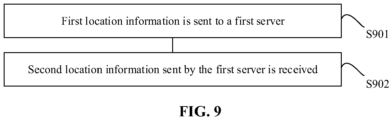
- FIG. 9 is a flowchart of a positioning method according to an embodiment of the application.
- the positioning method provided in the embodiment of the application is applied to a terminal 103 and includes the following operations.
- first location information is sent to a first server.
- the first location information includes an identity of the terminal.
- the first location information refers to information that can indicate an approximate location of the terminal.
- the precision of the first location information cannot meet the terminal or device having high-precision positioning requirements.
- a data format in a GPS protocol may be employed to indicate the approximate location of the terminal.
- the first location information may further include terminal type information and/or terminal location information.
- the terminal type information includes a mobile terminal, a fixed terminal and a delay calculation terminal.
- the mobile terminal refers to a terminal that requires the first server 101 to respond to the requested differential data thereof in real time.
- the fixed terminal refers to a terminal that requests the second location information from the first server 101 according to a preset frequency, for example, requesting the second location information from the first server every half hour.
- the delay calculation terminal refers to a terminal with poor time sensitivity. For example, when the delay calculation terminal requests the second location information from the first server 101, the first server 101 and the second server 102 may respond to the request of the delay calculation terminal when the first server 101 and the second server 102 are in an idle state or the calculation pressure is low.
- Terminal location information may include statement identifier information, world time information, latitude information, latitude hemisphere information, longitude information and longitude hemisphere information.
- the statement identifier information is identifier information used to identify a message sequence.
- the latitude information, the latitude hemisphere information, the longitude information and the longitude hemisphere information can indicate the current location of the terminal.
- the first server 101 may generate the differential data request according to the first location information.
- the differential data request is sent to the second server 102.
- the first location information includes the identity of the terminal.
- the second server can determine the terminal that acquires the second location information according to the identity of the terminal.
- the first location information also includes terminal type information.
- the first server 101 may mark the terminal according to the terminal type information.
- the terminal type information is the mobile terminal
- the UPF shunting module in the first server 101 may mark the information flow of the terminal as the information flow of an emergency queue, and save the identity of the terminal and the terminal type information to a mobile terminal-device database.
- the terminal type information is the fixed terminal
- the UPF shunting module in the first server 101 may mark the information flow of the terminal as the information flow of a conventional queue, and save the identity of the terminal and the terminal type information to a fixed terminal-device database.
- the UPF shunting module in the first server 101 may mark the information flow of the terminal as the information flow of a suspended queue, and save the identity of the terminal and the terminal type information to a delay calculation terminal-device database.
- the UPF shunting module Based on the terminal type information, the UPF shunting module enables the terminal to transmit messages in an independent queue, thus avoiding the congestion of all messages in a peak period of information transmission.
- the corresponding terminals in different independent queues request a positioning service with different frequencies.
- the frequency of the mobile terminal requesting the positioning service may be once per second, and real-time analysis is required to obtain the second location information. Therefore, the mobile terminal needs to enter the emergency queue for information processing, and the first server's local resources are given priority in scheduling. When the local resources are insufficient, the second server is requested for resources, and the second server expands related computing resources to the first server to implement dynamic allocation and management of the computing resources.
- the frequency of the fixed terminal requesting the positioning service is generally once every 30 minutes, once every 60 minutes, or a longer time interval.
- the connection between the first server and the terminal does not need to be maintained for a long time, so the terminal may request to re-establish the connection with the first server every time requesting the positioning service, thus saving the memory resources and network resources of the first server.
- the fixed terminal enters the conventional queue, and messages in the conventional queue are sent to the second server to request differential data after being simple filtered by the first server according to a rule, thus alleviating the computing pressure of the first server.
- the delay calculation terminal is used to analyze the weather forecast and other related positions, and the frequency of analysis is once or twice a year, since the data volume is large, it is put into the suspended queue by the first server, the request is forwarded to the second server, and the second server is responsible for caching all historical data and unified analysis.
- the request queue is reasonably allocated, the terminal location calculation capability of the whole system is improved using the difference between the computing power of the first server and the computing power of the second server, the computing resources and network resources are reasonably used, and network delay is reduced.
- the first location information is sent to the first server.
- the first location information includes the identity of the terminal.
- the second location information sent by the first server is received, and then a terminal positioning result is quickly returned, so that a network delay is greatly reduced when the terminal determines the precise location.
- the first server sends a target message to the second server, and the target message includes the identity of the terminal, terminal type information and second location information, so that the second server can store the target message.
- the first server may send the target message to the second server, so that the second target server can save the target information.
- the target information includes the identity of the terminal, terminal type information and second location information.
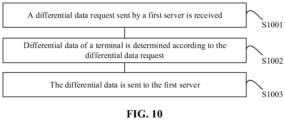
- FIG. 10 is a flowchart of a positioning method according to an embodiment of the application.
- the positioning method provided in the embodiment of the application is applied to a second server 102 and includes the following operations.
- a differential data request sent by a first server is received.
- the differential data request includes first location information, and the first location information includes an identity of a terminal.
- the differential data request includes the first location information.
- the differential data request may further include a time stamp of the first server and an identity of the first server.
- differential data of the terminal is determined according to the differential data request.
- the second server may determine the differential data of the terminal according to the differential data request.
- the second server may determine service area information of the first server according to the identity of the first server, and determine the differential data according to the first location information and the service area information of the first server.
- the service area information of the first server is determined according to the identity of the first server.
- the database of the second server 102 stores the information of the first server, such as the identity of the first server and the service area information corresponding to the first server.
- the service area information of the first server is essentially divided according to the location of the first server 101. For example, an area with a radius of 10 Km and with the location coordinates of the first server as the center is the service area of the first server. For example, the service area information of the first server is centered at 39 "26' north latitude and has a radius of 10 Km.
- the second server determines the differential data
- the area information corresponding to the differential data needs to correspond to the service area information of the first server.
- the second server 102 needs to determine the sensitivity of the terminal to time according to the terminal type information.
- the terminal type information is the mobile terminal, the terminal is highly sensitive to time, and the second server may send the pre-calculated differential data to the first server, thus reducing the time delay.
- the terminal type information is the fixed terminal, the sensitivity of the terminal to time is low, and the second server may calculate the differential data after receiving the differential data request.
- the terminal type information is the delay calculation terminal, the sensitivity of the terminal to time is very low, and the second server may determine the differential data when the second server is idle or the computing resources of the second server are sufficient.
- the terminal type information is combined to determine the differential data, so that the terminal location calculation capability of the whole positioning system can be improved, the computing resources and network resources are reasonably used, and network delay is greatly reduced.
- the differential data is sent to the first server.
- the differential data request sent by the first server is received.
- the differential data request includes the first location information.
- the first location information includes the identity of the terminal.
- the differential data of the terminal is determined according to the differential data request.
- the differential data is sent to the first server for the first server to calculate the first location information of the terminal according to the differential data and determine the second location information of the terminal.
- the first location information of the terminal is the first location information sent by the terminal to the first server, and the second location information is sent to the terminal for the terminal to perform positioning according to the second location information, so that the terminal positioning result can be quickly returned, and the network delay is greatly reduced when the terminal determines a precise location.
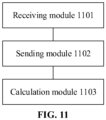
- FIG. 11 is a structural schematic diagram of a positioning apparatus according to an embodiment of the application.
- the positioning apparatus provided in the embodiment of the application is applied to a first server and may include: a receiving module 1101, a sending module 1102, and a calculation module 1103.
- the receiving module 1101 is configured to receive first location information sent by a terminal.
- the first location information includes an identity of the terminal.
- the sending module 1102 is configured to send a differential data request to a second server.
- the differential data request includes the first location information, and the differential data request is used for the second server to determine the differential data of the terminal.
- the receiving module 1101 is further configured to receive the differential data sent by the second server.
- the calculation module 1103 is configured to calculate, according to the differential data, the first location information to obtain second location information.
- the sending module 1102 is further configured to send the second location information to the terminal.
- the first location information further includes terminal type information and/or terminal location information.
- Terminal location information includes statement identifier information, world time information, latitude information, latitude hemisphere information, longitude information and longitude hemisphere information.
- the differential data request includes a time stamp of the first server and an identity of the first server.
- the terminal type information includes a mobile terminal, a fixed terminal and a delay calculation terminal.
- the sending module 1102 is further configured to perform the following operations.
- the differential data request is sent to the second server according to a first frequency.
- the differential data request is sent to the second server according to a second frequency.
- the differential data request is sent to the second server according to a third frequency.
- the apparatus further includes: a verification module and a first connection module.
- the receiving module 1101 is further configured to receive a connection request sent by the terminal.
- the connection request includes a user name and password of the terminal.
- the verification module is configured to verify the terminal according to the user name and the password.
- the first connection module is configured to establish a communication connection between the first server and the terminal when the verification of the terminal passes.
- the sending module 1102 is further configured to send a query request to the second server.
- the query request includes the identity of the terminal and the time stamp of the terminal.
- the query request is used for the second server to determine whether the terminal corresponding to the identity of the terminal is stored, so that the second server sends a connection instruction to the first server when the terminal corresponding to the identity of the terminal is stored in the second server and the time stamp of the terminal is not less than a preset time stamp.
- the receiving module 1101 is also configured to receive the connection instruction.
- the first connection module is also configured to establish a communication connection with the terminal according to the connection instruction.
- the first connection module is further configured to perform the following operations.
- the first server When the disconnection time between the first server and the terminal is not greater than a preset time threshold, the first server establishes a communication connection with the terminal.
- the sending module 1102 is further configured to perform the following operations.
- a target message is sent to the second server.
- the target message includes the identity of the terminal, the terminal type information and the second location information, so that the second server stores the target message.
- the first server is an edge server
- the second server is a central server
- the receiving module is configured to receive the first location information sent by a terminal.
- the first location information includes the identity of the terminal.
- the sending module is configured to send a differential data request to a second server.
- the differential data request includes the first location information, and the differential data request is used for the second server to determine the differential data of the terminal.
- the receiving module is also configured to receive differential data sent by the second server.
- the calculation module is configured to calculate, according to the differential data, the first location information to obtain the second location information.
- the sending module is also configured to send the second location information to the terminal, so that a terminal positioning result can be quickly returned, and a network delay is greatly reduced when the terminal determines a precise location.
- the positioning apparatus executeds all steps in the method shown in FIG. 8 , and can achieve the technical effect that the terminal positioning result can be quickly returned and the network delay is greatly reduced when the terminal determines the precise location. For the sake of concise description, no elaboration is made here.
- FIG. 12 is a structural schematic diagram of a positioning apparatus according to an embodiment of the application.
- the positioning apparatus As shown in FIG. 12 , the positioning apparatus provided in the embodiment of the application is applied to a terminal and may include: a sending module 1201 and a receiving module 1202.
- the sending module 1201 is configured to send first location information to a first server.
- the first location information includes an identity of the terminal.
- the receiving module 1202 is configured to receive second location information sent by the first server.
- the apparatus further includes: a second connection module.
- the sending module 1201 is configured to send a connection request to the first server.
- the connection request includes a user name and password of the terminal for the first server to verify the terminal according to the user name and password.
- the second connection module is configured to establish a communication connection between the terminal and the first server when the verification of the terminal passes.
- the terminal type information includes a mobile terminal, a fixed terminal and a delay calculation terminal.
- the sending module is configured to send the first location information to a first server.
- the first location information includes the identity of the terminal.
- the receiving module is configured to receive second location information sent by the first server, so that a terminal positioning result can be quickly returned, and the network delay is greatly reduced when the terminal determines a precise location.
- the positioning apparatus executeds all steps in the method shown in FIG. 9 , and can achieve the technical effect that the terminal positioning result can be quickly returned and the network delay is greatly reduced when the terminal determines the precise location. For the sake of concise description, no elaboration is made here.
- FIG. 13 is a structural schematic diagram of a positioning apparatus according to an embodiment of the application.
- the positioning apparatus provided in the embodiment of the application is applied to a second server and may include: a receiving module 1301, a determination module 1302, and a sending module 1303.
- the receiving module 1301 is configured to receive a differential data request sent by a first server.
- the differential data request includes first location information, and the first location information includes an identity of a terminal.
- the determination module 1302 is configured to determine differential data of the terminal according to the differential data request.
- the sending module 1303 is configured to send the differential data to the first server.
- the first location information further includes terminal type information and/or terminal location information.
- the differential data request also includes a time stamp of the first server and an identity of the first server.
- the determination module 1302 is also configured to perform the following operations.
- Service area information of the first server is determined according to the identity of the first server.
- the differential data is determined according to the first location information and the service area information of the first server.
- the terminal type information includes a mobile terminal, a fixed terminal and a delay calculation terminal.
- the receiving module is configured to receive the differential data request sent by a first server.
- the differential data request includes the first location information.
- the first location information includes the identity of the terminal.
- the determination module is configured to determine the differential data of the terminal according to the differential data request.
- the sending module is configured to send the differential data to the first server for the first server to calculate the first location information of the terminal according to the differential data and determine the second location information of the terminal, and send the second location information to the terminal for the terminal to perform positioning according to the second location information, so that a terminal positioning result can be quickly returned, and the network delay is greatly reduced when the terminal determines a precise location.
- the positioning apparatus executeds all steps in the method shown in FIG. 10 , and can achieve the technical effect that the terminal positioning result can be quickly returned and the network delay is greatly reduced when the terminal determines the precise location. For the sake of concise description, no elaboration is made here.
- the embodiment of the application may provide a computer storage medium for implementation.
- a computer program instruction is stored on the computer storage medium.
- the computer program instruction implements any positioning method in the above-mentioned embodiments.
- the function block shown in the structure block diagram may be implemented as hardware, software, firmware, or a combination thereof.
- the function block may be, for example, an electronic circuit, an ASIC, and suitable firmware, plug-in, and functional card.
- the element of the application is a program or code segment for executing a required task.
- the program or code segment may be stored in a machine-readable medium, or transmitted on a transmission medium or communication link by a data signal contained in a carrier.
- the "machine-readable medium” may include any medium capable of storing or transmitting information.
- Examples of the machine-readable medium include an electronic circuit, a semiconductor memory device, a ROM, a flash memory, an Erasable ROM (EROM), a floppy disk, a Compact Disc ROM (CD-ROM), an optical disk, a hard disk, an optical fiber medium, an RF link, etc.
- the code segment may be downloaded through a computer network, such as the Internet and an intranet.
- first location information sent by a terminal is received through a first server.
- the first location information includes an identity of the terminal.
- a differential data request is sent to a second server.
- the differential data request includes the first location information, and the differential data request is used for the second server to determine differential data of the terminal.
- the differential data sent by the second server is received.
- the first location information is calculated to obtain second location information.
- the second location information is sent to the terminal, and then a terminal positioning result is quickly returned, so that the network delay is greatly reduced when the terminal determines a precise location.
Landscapes
- Engineering & Computer Science (AREA)
- Computer Networks & Wireless Communication (AREA)
- Signal Processing (AREA)
- Computer Security & Cryptography (AREA)
- General Engineering & Computer Science (AREA)
- Computing Systems (AREA)
- Computer Hardware Design (AREA)
- Radar, Positioning & Navigation (AREA)
- Remote Sensing (AREA)
- Physics & Mathematics (AREA)
- General Physics & Mathematics (AREA)
- Power Engineering (AREA)
- Mobile Radio Communication Systems (AREA)
Claims (14)
- Positionierungsverfahren, das auf einen ersten Server ausgeübt wird, umfassend:Empfangen von ersten Standortinformationen, die von einem Endgerät (S801) gesendet werden, wobei die ersten Standortinformationen eine Identität des Endgeräts umfassen;Senden einer Differentialdatenanforderung an einen zweiten Server, wobei die Differentialdatenanforderung die ersten Standortinformationen umfasst und wobei die Differentialdatenanforderung für den zweiten Server konfiguriert ist, die Differentialdaten des Endgeräts (S802) zu bestimmen;Empfangen der Differentialdaten, die von dem zweiten Server (S803) gesendet werden;Berechnen, gemäß den Differentialdaten, der ersten Standortinformationen, um zweite Standortinformationen (S804) zu erhalten; undSenden der zweiten Standortinformationen an das Endgerät (S805),wobei der erste Server ein Edge-Server ist, der zweite Server ein Zentralserver ist und der zweite Server konfiguriert ist, um Daten der Vielzahl von ersten Servern, die mit dem zweiten Server verbunden sind, zu synchronisieren, wenn die Vielzahl von ersten Servern mit dem zweiten Server verbunden ist, sodass das Endgerät unter der Vielzahl von ersten Servern umschaltet.
- Verfahren nach Anspruch 1, wobei die ersten Standortinformationen ferner Endgerät-Typinformationen und/oder Endgerät-Standortinformationen umfassen,
wobei die Endgerät-Standortinformationen Folgendes umfassen: Anweiserbezeichnungsinformationen, Weltzeitinformationen, Breitengradinformationen, Breitengradhemisphäreinformationen, Längengradinformationen und Längengradhemisphäreinformationen. - Verfahren nach Anspruch 2, wobei die Differentialdatenanforderung ferner einen Zeitstempel des ersten Servers und eine Identität des ersten Servers umfasst.
- Verfahren nach Anspruch 2, wobei die Endgerät-Typinformationen ein mobiles Endgerät, ein festes Endgerät und ein Endgerät für Verzögerungsberechnung umfassen.
- Verfahren nach Anspruch 4, wobei das Senden einer Differentialdatenanforderung an einen zweiten Server Folgendes umfasst:wenn die Endgerät-Typinformationen das mobile Endgerät sind, Senden der Differentialdatenanforderung an den zweiten Server gemäß einer ersten Frequenz, oderwenn die Endgerät-Typinformationen das feste Endgerät sind, Senden der Differentialdatenanforderung an den zweiten Server gemäß einer zweiten Frequenz, oderwenn die Endgerät-Typinformationen das Endgerät für Verzögerungsberechnung sind, Senden der Differentialdatenanforderung an den zweiten Server gemäß einer dritten Frequenz.
- Verfahren nach Anspruch 1, das, vor dem Empfangen der ersten Standortinformationen, die von einem Endgerät gesendet werden, ferner Folgendes umfasst:Empfangen einer Verbindungsanforderung, die von dem Endgerät gesendet wird, wobei die Verbindungsanforderung einen Benutzernamen und ein Passwort des Endgeräts umfasst,Verifizieren des Endgeräts gemäß dem Benutzernamen und dem Passwort undHerstellen einer Kommunikationsverbindung zwischen dem ersten Server und dem Endgerät, wenn die Verifizierung des Endgeräts bestanden wurde.
- Verfahren nach Anspruch 6, das, vor dem Empfangen der ersten Standortinformationen, die von einem Endgerät gesendet werden, ferner Folgendes umfasst:Senden einer Abfrageanforderung an den zweiten Server, wobei die Abfrageanforderung die Identität des Endgeräts und den Zeitstempel des Endgeräts umfasst, und wobei die Abfrageanforderung für den zweiten Server konfiguriert ist, zu bestimmen, ob ein Endgerät, das der Identität des Endgeräts entspricht, gespeichert ist, sodass der zweite Server eine Verbindungsanweisung an den ersten Server sendet, wenn das Endgerät, das der Identität des Endgeräts entspricht, im zweiten Server gespeichert ist und der Zeitstempel des Endgeräts nicht weniger als ein voreingestellter Zeitstempel ist;Empfangen der Verbindungsanweisung; undHerstellen einer Kommunikationsverbindung mit dem Endgerät gemäß der Verbindungsanweisung.
- Verfahren nach Anspruch 1, das, vor dem Empfangen der ersten Standortinformationen, die von einem Endgerät gesendet werden, ferner Folgendes umfasst:
wenn die Trennzeit zwischen dem ersten Server und dem Endgerät nicht größer als ein voreingestellter Zeitschwellenwert ist, Herstellen einer Kommunikationsverbindung zwischen dem ersten Server und dem Endgerät. - Verfahren nach Anspruch 1, ferner umfassend:
Senden einer Zielnachricht an den zweiten Server, wobei die Zielnachricht die Identität des Endgeräts, die Endgerät-Typinformationen und die zweiten Standortinformationen umfasst, sodass der zweite Server die Zielnachricht speichert. - Positionierungsverfahren, das auf ein Endgerät ausgeübt wird, umfassend:Senden von ersten Standortinformationen an einen ersten Server, wobei die ersten Standortinformationen eine Identität des Endgeräts (S901) umfassen, undEmpfangen von zweiten Standortinformationen, die von dem ersten Server (S902) gesendet werden,wobei, vor dem Senden der ersten Standortinformationen an einen ersten Server, das Verfahren ferner Folgendes umfasst:Senden einer Verbindungsanforderung an den ersten Server, wobei die Verbindungsanforderung einen Benutzernamen und ein Passwort des Endgeräts umfasst, sodass der erste Server das Endgerät gemäß dem Benutzernamen und Passwort verifizieren kann; undHerstellen einer Kommunikationsverbindung zwischen dem Endgerät und dem ersten Server, wenn die Verifizierung des Endgeräts bestanden wurde,wobei die ersten Standortinformationen ferner Endgerät-Typinformationen und/oder Endgerät-Standortinformationen umfassen,wobei die Endgerät-Typinformationen ein mobiles Endgerät, ein festes Endgerät und ein Endgerät für Verzögerungsberechnung umfassen,wobei, wenn eine Vielzahl von ersten Servern mit einem zweiten Server verbunden ist, der zweite Server konfiguriert ist, um Daten einer Vielzahl von ersten Servern, die mit dem zweiten Server verbunden sind, zu synchronisieren, sodass das Endgerät unter der Vielzahl von ersten Servern umschaltet, wobei der erste Sever ein Edge-Server ist und der zweite Server ein Zentralserver ist.
- Positionierungsverfahren, das auf einen zweiten Server ausgeübt wird, umfassend:Empfangen einer Differentialdatenanforderung, die von einem ersten Server (S1001) gesendet wird, wobei die Differentialdatenanforderung erste Standortinformationen umfassen und wobei die ersten Standortinformationen eine Identität eines Endgeräts umfassen;Bestimmen von Differentialdaten des Endgeräts gemäß der Differentialdatenanforderung (S 1002); undSenden der Differentialdaten an den ersten Server (S 1003),wobei die ersten Standortinformationen ferner Endgerät-Typinformationen und/oder Endgerät-Standortinformationen umfassen, und die Differentialdatenanforderung ferner einen Zeitstempel des ersten Servers und eine Identität des ersten Servers umfasst,wobei das Bestimmen von Differentialdaten des Endgeräts gemäß der Differentialdatenanforderung Folgendes umfasst:Bestimmen von Dienstbereichsinformationen des ersten Servers gemäß der Identität des ersten Servers; undBestimmen der Differentialdaten gemäß den ersten Standortinformationen und den Dienstbereichsinformationen des ersten Servers,wobei die Endgerät-Typinformationen ein mobiles Endgerät, ein festes Endgerät und ein Endgerät für Verzögerungsberechnung umfassen,wobei der erste Server ein Edge-Server ist, der zweite Server ein Zentralserver ist und der zweite Server konfiguriert ist, um Daten einer Vielzahl von ersten Servern, die mit dem zweiten Server verbunden sind, zu synchronisieren, wenn die Vielzahl von ersten Servern mit dem zweiten Server verbunden ist, sodass das Endgerät unter der Vielzahl von ersten Servern umschaltet.
- Positionierungsgerät, das auf einen ersten Server angewendet wird, umfassend:ein Empfangsmodul (1101), das konfiguriert ist, um erste Standortinformationen zu empfangen, die von einem Endgerät gesendet werden, wobei die ersten Standortinformationen eine Identität des Endgeräts umfassen;ein Sendemodul (1102), das konfiguriert ist, um eine Differentialdatenanforderung an einen zweiten Server zu senden, wobei die Differentialdatenanforderung die ersten Standortinformationen umfasst und wobei die Differentialdatenanforderung für den zweiten Server konfiguriert ist, die Differentialdaten des Endgeräts zu bestimmen;wobei das Empfangsmodul (1101) ferner konfiguriert ist, um die Differentialdaten, die von dem zweiten Server gesendet werden, zu empfangen;ein Berechnungsmodul (1103), das konfiguriert ist, um, gemäß den Differentialdaten, die ersten Standortinformationen zu berechnen, um zweite Standortinformationen zu erhalten; undwobei das Sendemodul (1102) ferner konfiguriert ist, um die zweiten Standortinformationen an das Endgerät zu senden,wobei der erste Server ein Edge-Server ist, der zweite Server ein Zentralserver ist und der zweite Server konfiguriert ist, um Daten einer Vielzahl von ersten Servern, die mit dem zweiten Server verbunden sind, zu synchronisieren, wenn die Vielzahl von ersten Servern mit dem zweiten Server verbunden ist, sodass das Endgerät unter der Vielzahl von ersten Servern umschaltet.
- Positionierungsgerät, das auf ein Endgerät angewendet wird, umfassend:ein Sendemodul (1201), das konfiguriert ist, um erste Standortinformationen an einen ersten Server zu senden, wobei die ersten Standortinformationen eine Identität des Endgeräts umfassen, undein Empfangsmodul (1202), das konfiguriert ist, um zweite Standortinformationen, die von dem ersten Server gesendet werden, zu empfangen,wobei, wenn eine Vielzahl von ersten Servern mit einem zweiten Server verbunden ist, der zweite Server konfiguriert ist, um Daten einer Vielzahl von ersten Servern, die mit dem zweiten Server verbunden sind, zu synchronisieren, sodass das Endgerät unter der Vielzahl von ersten Servern umschaltet, wobei der erste Server ein Edge-Server ist und der zweite Server ein Zentralserver ist.
- Positionierungsgerät, das auf einen zweiten Server angewendet wird, umfassend:ein Empfangsmodul (1301), das konfiguriert ist, um eine Differentialdatenanforderung zu empfangen, die von einem ersten Server gesendet wird, wobei die Differentialdatenanforderung erste Standortinformationen umfasst und die ersten Standortinformationen eine Identität eines Endgeräts umfassen;ein Bestimmungsmodul (1302), das konfiguriert ist, um Differentialdaten des Endgeräts gemäß der Differentialdatenanforderung zu bestimmen; undein Sendemodul (1303), das konfiguriert ist, um die Differentialdaten an den ersten Server zu senden,wobei der erste Server ein Edge-Server ist, der zweite Server ein Zentralserver ist und der zweite Server konfiguriert ist, um Daten einer Vielzahl von ersten Servern, die mit dem zweiten Server verbunden sind, zu synchronisieren, wenn die Vielzahl von ersten Servern mit dem zweiten Server verbunden ist, sodass das Endgerät unter der Vielzahl von ersten Servern umschaltet.
Applications Claiming Priority (2)
| Application Number | Priority Date | Filing Date | Title |
|---|---|---|---|
| CN202010260719.4A CN113079191B (zh) | 2020-04-03 | 2020-04-03 | 定位方法、装置、系统和存储介质 |
| PCT/CN2021/085010 WO2021197446A1 (zh) | 2020-04-03 | 2021-04-01 | 定位方法、装置、系统和存储介质 |
Publications (4)
| Publication Number | Publication Date |
|---|---|
| EP4131886A1 EP4131886A1 (de) | 2023-02-08 |
| EP4131886A4 EP4131886A4 (de) | 2023-09-06 |
| EP4131886B1 true EP4131886B1 (de) | 2024-08-07 |
| EP4131886C0 EP4131886C0 (de) | 2024-08-07 |
Family
ID=76609000
Family Applications (1)
| Application Number | Title | Priority Date | Filing Date |
|---|---|---|---|
| EP21782057.0A Active EP4131886B1 (de) | 2020-04-03 | 2021-04-01 | Positionierungsverfahren, -vorrichtung und -system sowie speichermedium |
Country Status (4)
| Country | Link |
|---|---|
| US (1) | US20230164733A1 (de) |
| EP (1) | EP4131886B1 (de) |
| CN (1) | CN113079191B (de) |
| WO (1) | WO2021197446A1 (de) |
Families Citing this family (1)
| Publication number | Priority date | Publication date | Assignee | Title |
|---|---|---|---|---|
| CN114173285B (zh) * | 2022-02-11 | 2022-07-22 | 荣耀终端有限公司 | 一种蓝牙回连方法、系统、电子设备、服务器及存储介质 |
Family Cites Families (15)
| Publication number | Priority date | Publication date | Assignee | Title |
|---|---|---|---|---|
| CN101048671B (zh) * | 2004-10-21 | 2012-08-29 | 诺基亚公司 | 基于卫星的定位 |
| US7496717B2 (en) * | 2006-09-12 | 2009-02-24 | Inventec Corporation | System for sharing storage device among controllers and method thereof |
| CN105282841A (zh) * | 2014-06-12 | 2016-01-27 | 中兴通讯股份有限公司 | 一种定位方法、装置、定位中心和终端 |
| CN104168028A (zh) * | 2014-08-08 | 2014-11-26 | 中国人民解放军装甲兵工程学院 | 用于北斗车载系统的定位数据压缩方法和系统 |
| CN104977596B (zh) * | 2015-06-08 | 2018-08-17 | 深圳北斗应用技术研究院有限公司 | 基于云计算的高精度位置修正定位系统 |
| EP3361757B1 (de) * | 2015-10-29 | 2020-09-16 | Huawei Technologies Co., Ltd. | Positionierungsverfahren in einem mobilen netzwerk und server |
| CN106982463B (zh) * | 2016-07-31 | 2021-01-29 | 曾华明 | 基于多信息的定位方法、定位装置、定位终端和服务端 |
| US11019487B2 (en) * | 2017-12-11 | 2021-05-25 | Qualcomm Incorporated | Systems and methods for uplink high efficiency location in a wireless network |
| US10506543B1 (en) * | 2018-06-25 | 2019-12-10 | Qualcomm Incorporated | Low power periodic and triggered location of a mobile device using early data transmission |
| CN111090111A (zh) * | 2018-10-23 | 2020-05-01 | 千寻位置网络有限公司 | 基于边缘计算的动态差分定位方法及系统 |
| CN109597109B (zh) * | 2018-11-20 | 2023-03-24 | 腾讯科技(深圳)有限公司 | 一种定位方法、定位装置及定位系统 |
| CN109541655B (zh) * | 2018-11-20 | 2020-09-11 | 腾讯科技(深圳)有限公司 | 一种差分定位系统、方法 |
| CN109862519A (zh) * | 2019-01-18 | 2019-06-07 | 深圳高新兴物联科技有限公司 | 定位方法、定位信息计算方法、系统、终端和存储介质 |
| CN109814137B (zh) * | 2019-02-26 | 2023-07-14 | 腾讯科技(深圳)有限公司 | 定位方法、装置和计算设备 |
| CN110895343A (zh) * | 2019-08-19 | 2020-03-20 | 腾讯科技(深圳)有限公司 | 一种数据处理方法、系统以及相关设备 |
-
2020
- 2020-04-03 CN CN202010260719.4A patent/CN113079191B/zh active Active
-
2021
- 2021-04-01 WO PCT/CN2021/085010 patent/WO2021197446A1/zh not_active Ceased
- 2021-04-01 EP EP21782057.0A patent/EP4131886B1/de active Active
- 2021-04-01 US US17/995,306 patent/US20230164733A1/en active Pending
Also Published As
| Publication number | Publication date |
|---|---|
| WO2021197446A1 (zh) | 2021-10-07 |
| CN113079191A (zh) | 2021-07-06 |
| CN113079191B (zh) | 2022-04-05 |
| EP4131886C0 (de) | 2024-08-07 |
| EP4131886A1 (de) | 2023-02-08 |
| US20230164733A1 (en) | 2023-05-25 |
| EP4131886A4 (de) | 2023-09-06 |
Similar Documents
| Publication | Publication Date | Title |
|---|---|---|
| US12425804B2 (en) | Method and apparatus for obtaining and managing location information of mobile terminal in edge computing system | |
| US12316515B2 (en) | Network performance reporting method and apparatus | |
| KR102502984B1 (ko) | 애플리케이션의 서비스 수준 협약을 보장하는 방법, 기기 및 시스템 | |
| CN113596863B (zh) | 确定用户面功能及信息提供的方法、设备及介质 | |
| CN110198516B (zh) | 网络连接的建立方法及装置 | |
| US8781475B1 (en) | Method for switching from a first cellular network to a second cellular network | |
| US20220408272A1 (en) | Application instance deployment method and apparatus, and readable storage medium | |
| US9699760B2 (en) | Positioning processing method, apparatus, and system | |
| EP2112837B1 (de) | Synchronisationsverfahren und einrichtung für ortstriggerinformationen | |
| KR101176964B1 (ko) | 연속 포지셔닝 과정에서 포지셔닝 시스템 성능을 향상시키는 방법 및 시스템 | |
| EP4131886B1 (de) | Positionierungsverfahren, -vorrichtung und -system sowie speichermedium | |
| US12207168B2 (en) | Power management of movable edge computing servers | |
| JP2025510370A (ja) | 情報伝送方法及びネットワークエレメント | |
| CN113791899A (zh) | 一种面向移动Web增强现实的边缘服务器管理系统 | |
| KR20230086726A (ko) | Prs 설정을 요청하는 방법, 통신 기기 및 저장 매체 | |
| US12160350B2 (en) | Dynamic quality of service traffic steering in a multi-access edge computing environment | |
| CN112055307B (zh) | 位置信息的上报、upf的重选方法、装置、设备及介质 | |
| CN112449398B (zh) | 一种路径选择方法和核心网设备 | |
| US20250380128A1 (en) | Provision and collection methods, base station, data collection and analysis device, and system | |
| JP6494535B2 (ja) | 近距離無線ネットワークの輻輳に応じて広域無線ネットワークへの制御信号を抑制する無線ゲートウェイ、プログラム及び方法 | |
| CN114845241B (zh) | 一种定位方法及装置 | |
| RU2815087C1 (ru) | Способ и устройство для запроса конфигурации опорного сигнала позиционирования (prs), а также устройство связи и носитель данных | |
| Kafle et al. | Directory service for connected vehicles | |
| CN119316933A (zh) | 寻呼方法、系统以及网络设备、电子设备 | |
| WO2024234144A1 (zh) | 信息提供方法、信息获取方法、装置、设备及存储介质 |
Legal Events
| Date | Code | Title | Description |
|---|---|---|---|
| STAA | Information on the status of an ep patent application or granted ep patent |
Free format text: STATUS: THE INTERNATIONAL PUBLICATION HAS BEEN MADE |
|
| PUAI | Public reference made under article 153(3) epc to a published international application that has entered the european phase |
Free format text: ORIGINAL CODE: 0009012 |
|
| STAA | Information on the status of an ep patent application or granted ep patent |
Free format text: STATUS: REQUEST FOR EXAMINATION WAS MADE |
|
| 17P | Request for examination filed |
Effective date: 20221027 |
|
| AK | Designated contracting states |
Kind code of ref document: A1 Designated state(s): AL AT BE BG CH CY CZ DE DK EE ES FI FR GB GR HR HU IE IS IT LI LT LU LV MC MK MT NL NO PL PT RO RS SE SI SK SM TR |
|
| DAV | Request for validation of the european patent (deleted) | ||
| DAX | Request for extension of the european patent (deleted) | ||
| REG | Reference to a national code |
Ref country code: DE Ref legal event code: R079 Free format text: PREVIOUS MAIN CLASS: H04L0029080000 Ref country code: DE Ref legal event code: R079 Ref document number: 602021016961 Country of ref document: DE Free format text: PREVIOUS MAIN CLASS: H04L0029080000 Ipc: G01S0019070000 |
|
| A4 | Supplementary search report drawn up and despatched |
Effective date: 20230803 |
|
| RIC1 | Information provided on ipc code assigned before grant |
Ipc: G01S 19/03 20100101ALI20230728BHEP Ipc: G01S 5/00 20060101ALI20230728BHEP Ipc: H04W 12/63 20210101ALI20230728BHEP Ipc: H04W 12/06 20210101ALI20230728BHEP Ipc: H04L 67/52 20220101ALI20230728BHEP Ipc: H04L 67/14 20220101ALI20230728BHEP Ipc: H04L 9/40 20220101ALI20230728BHEP Ipc: G01S 19/41 20100101ALI20230728BHEP Ipc: H04W 4/02 20180101ALI20230728BHEP Ipc: G01S 19/09 20100101ALI20230728BHEP Ipc: G01S 19/07 20100101AFI20230728BHEP |
|
| GRAP | Despatch of communication of intention to grant a patent |
Free format text: ORIGINAL CODE: EPIDOSNIGR1 |
|
| STAA | Information on the status of an ep patent application or granted ep patent |
Free format text: STATUS: GRANT OF PATENT IS INTENDED |
|
| INTG | Intention to grant announced |
Effective date: 20240515 |
|
| RAP3 | Party data changed (applicant data changed or rights of an application transferred) |
Owner name: CHINA MOBILE COMMUNICATIONS GROUP CO., LTD Owner name: CHINA MOBILE SHANGHAI ICT CO., LTD |
|
| GRAS | Grant fee paid |
Free format text: ORIGINAL CODE: EPIDOSNIGR3 |
|
| GRAA | (expected) grant |
Free format text: ORIGINAL CODE: 0009210 |
|
| STAA | Information on the status of an ep patent application or granted ep patent |
Free format text: STATUS: THE PATENT HAS BEEN GRANTED |
|
| AK | Designated contracting states |
Kind code of ref document: B1 Designated state(s): AL AT BE BG CH CY CZ DE DK EE ES FI FR GB GR HR HU IE IS IT LI LT LU LV MC MK MT NL NO PL PT RO RS SE SI SK SM TR |
|
| REG | Reference to a national code |
Ref country code: GB Ref legal event code: FG4D |
|
| REG | Reference to a national code |
Ref country code: CH Ref legal event code: EP |
|
| REG | Reference to a national code |
Ref country code: IE Ref legal event code: FG4D |
|
| REG | Reference to a national code |
Ref country code: DE Ref legal event code: R096 Ref document number: 602021016961 Country of ref document: DE |
|
| U01 | Request for unitary effect filed |
Effective date: 20240813 |
|
| U07 | Unitary effect registered |
Designated state(s): AT BE BG DE DK EE FI FR IT LT LU LV MT NL PT RO SE SI Effective date: 20240902 |
|
| PG25 | Lapsed in a contracting state [announced via postgrant information from national office to epo] |
Ref country code: NO Free format text: LAPSE BECAUSE OF FAILURE TO SUBMIT A TRANSLATION OF THE DESCRIPTION OR TO PAY THE FEE WITHIN THE PRESCRIBED TIME-LIMIT Effective date: 20241107 |
|
| PG25 | Lapsed in a contracting state [announced via postgrant information from national office to epo] |
Ref country code: GR Free format text: LAPSE BECAUSE OF FAILURE TO SUBMIT A TRANSLATION OF THE DESCRIPTION OR TO PAY THE FEE WITHIN THE PRESCRIBED TIME-LIMIT Effective date: 20241108 Ref country code: PL Free format text: LAPSE BECAUSE OF FAILURE TO SUBMIT A TRANSLATION OF THE DESCRIPTION OR TO PAY THE FEE WITHIN THE PRESCRIBED TIME-LIMIT Effective date: 20240807 |
|
| PG25 | Lapsed in a contracting state [announced via postgrant information from national office to epo] |
Ref country code: IS Free format text: LAPSE BECAUSE OF FAILURE TO SUBMIT A TRANSLATION OF THE DESCRIPTION OR TO PAY THE FEE WITHIN THE PRESCRIBED TIME-LIMIT Effective date: 20241207 |
|
| PG25 | Lapsed in a contracting state [announced via postgrant information from national office to epo] |
Ref country code: HR Free format text: LAPSE BECAUSE OF FAILURE TO SUBMIT A TRANSLATION OF THE DESCRIPTION OR TO PAY THE FEE WITHIN THE PRESCRIBED TIME-LIMIT Effective date: 20240807 |
|
| PG25 | Lapsed in a contracting state [announced via postgrant information from national office to epo] |
Ref country code: RS Free format text: LAPSE BECAUSE OF FAILURE TO SUBMIT A TRANSLATION OF THE DESCRIPTION OR TO PAY THE FEE WITHIN THE PRESCRIBED TIME-LIMIT Effective date: 20241107 Ref country code: ES Free format text: LAPSE BECAUSE OF FAILURE TO SUBMIT A TRANSLATION OF THE DESCRIPTION OR TO PAY THE FEE WITHIN THE PRESCRIBED TIME-LIMIT Effective date: 20240807 |
|
| PG25 | Lapsed in a contracting state [announced via postgrant information from national office to epo] |
Ref country code: RS Free format text: LAPSE BECAUSE OF FAILURE TO SUBMIT A TRANSLATION OF THE DESCRIPTION OR TO PAY THE FEE WITHIN THE PRESCRIBED TIME-LIMIT Effective date: 20241107 Ref country code: PL Free format text: LAPSE BECAUSE OF FAILURE TO SUBMIT A TRANSLATION OF THE DESCRIPTION OR TO PAY THE FEE WITHIN THE PRESCRIBED TIME-LIMIT Effective date: 20240807 Ref country code: NO Free format text: LAPSE BECAUSE OF FAILURE TO SUBMIT A TRANSLATION OF THE DESCRIPTION OR TO PAY THE FEE WITHIN THE PRESCRIBED TIME-LIMIT Effective date: 20241107 Ref country code: IS Free format text: LAPSE BECAUSE OF FAILURE TO SUBMIT A TRANSLATION OF THE DESCRIPTION OR TO PAY THE FEE WITHIN THE PRESCRIBED TIME-LIMIT Effective date: 20241207 Ref country code: HR Free format text: LAPSE BECAUSE OF FAILURE TO SUBMIT A TRANSLATION OF THE DESCRIPTION OR TO PAY THE FEE WITHIN THE PRESCRIBED TIME-LIMIT Effective date: 20240807 Ref country code: GR Free format text: LAPSE BECAUSE OF FAILURE TO SUBMIT A TRANSLATION OF THE DESCRIPTION OR TO PAY THE FEE WITHIN THE PRESCRIBED TIME-LIMIT Effective date: 20241108 Ref country code: ES Free format text: LAPSE BECAUSE OF FAILURE TO SUBMIT A TRANSLATION OF THE DESCRIPTION OR TO PAY THE FEE WITHIN THE PRESCRIBED TIME-LIMIT Effective date: 20240807 |
|
| PG25 | Lapsed in a contracting state [announced via postgrant information from national office to epo] |
Ref country code: SM Free format text: LAPSE BECAUSE OF FAILURE TO SUBMIT A TRANSLATION OF THE DESCRIPTION OR TO PAY THE FEE WITHIN THE PRESCRIBED TIME-LIMIT Effective date: 20240807 |
|
| PG25 | Lapsed in a contracting state [announced via postgrant information from national office to epo] |
Ref country code: CZ Free format text: LAPSE BECAUSE OF FAILURE TO SUBMIT A TRANSLATION OF THE DESCRIPTION OR TO PAY THE FEE WITHIN THE PRESCRIBED TIME-LIMIT Effective date: 20240807 |
|
| PG25 | Lapsed in a contracting state [announced via postgrant information from national office to epo] |
Ref country code: SK Free format text: LAPSE BECAUSE OF FAILURE TO SUBMIT A TRANSLATION OF THE DESCRIPTION OR TO PAY THE FEE WITHIN THE PRESCRIBED TIME-LIMIT Effective date: 20240807 |
|
| PGFP | Annual fee paid to national office [announced via postgrant information from national office to epo] |
Ref country code: GB Payment date: 20250306 Year of fee payment: 5 |
|
| U20 | Renewal fee for the european patent with unitary effect paid |
Year of fee payment: 5 Effective date: 20250324 |
|
| PLBE | No opposition filed within time limit |
Free format text: ORIGINAL CODE: 0009261 |
|
| STAA | Information on the status of an ep patent application or granted ep patent |
Free format text: STATUS: NO OPPOSITION FILED WITHIN TIME LIMIT |
|
| 26N | No opposition filed |
Effective date: 20250508 |
|
| REG | Reference to a national code |
Ref country code: CH Ref legal event code: H13 Free format text: ST27 STATUS EVENT CODE: U-0-0-H10-H13 (AS PROVIDED BY THE NATIONAL OFFICE) Effective date: 20251125 |