EP4131318A2 - Sicherungsanordnung mit verdrehsicherung - Google Patents
Sicherungsanordnung mit verdrehsicherung Download PDFInfo
- Publication number
- EP4131318A2 EP4131318A2 EP22185057.1A EP22185057A EP4131318A2 EP 4131318 A2 EP4131318 A2 EP 4131318A2 EP 22185057 A EP22185057 A EP 22185057A EP 4131318 A2 EP4131318 A2 EP 4131318A2
- Authority
- EP
- European Patent Office
- Prior art keywords
- wall
- distance
- securement device
- operable
- support post
- Prior art date
- Legal status (The legal status is an assumption and is not a legal conclusion. Google has not performed a legal analysis and makes no representation as to the accuracy of the status listed.)
- Granted
Links
Images




Classifications
-
- H—ELECTRICITY
- H01—ELECTRIC ELEMENTS
- H01H—ELECTRIC SWITCHES; RELAYS; SELECTORS; EMERGENCY PROTECTIVE DEVICES
- H01H85/00—Protective devices in which the current flows through a part of fusible material and this current is interrupted by displacement of the fusible material when this current becomes excessive
- H01H85/02—Details
- H01H85/0241—Structural association of a fuse and another component or apparatus
-
- H—ELECTRICITY
- H01—ELECTRIC ELEMENTS
- H01H—ELECTRIC SWITCHES; RELAYS; SELECTORS; EMERGENCY PROTECTIVE DEVICES
- H01H85/00—Protective devices in which the current flows through a part of fusible material and this current is interrupted by displacement of the fusible material when this current becomes excessive
- H01H85/02—Details
- H01H85/04—Fuses, i.e. expendable parts of the protective device, e.g. cartridges
- H01H85/05—Component parts thereof
- H01H85/055—Fusible members
-
- H—ELECTRICITY
- H01—ELECTRIC ELEMENTS
- H01H—ELECTRIC SWITCHES; RELAYS; SELECTORS; EMERGENCY PROTECTIVE DEVICES
- H01H85/00—Protective devices in which the current flows through a part of fusible material and this current is interrupted by displacement of the fusible material when this current becomes excessive
- H01H85/02—Details
- H01H85/04—Fuses, i.e. expendable parts of the protective device, e.g. cartridges
- H01H85/05—Component parts thereof
- H01H85/165—Casings
-
- H—ELECTRICITY
- H01—ELECTRIC ELEMENTS
- H01H—ELECTRIC SWITCHES; RELAYS; SELECTORS; EMERGENCY PROTECTIVE DEVICES
- H01H85/00—Protective devices in which the current flows through a part of fusible material and this current is interrupted by displacement of the fusible material when this current becomes excessive
- H01H85/02—Details
- H01H85/20—Bases for supporting the fuse; Separate parts thereof
- H01H85/2045—Mounting means or insulating parts of the base, e.g. covers, casings
-
- H—ELECTRICITY
- H01—ELECTRIC ELEMENTS
- H01H—ELECTRIC SWITCHES; RELAYS; SELECTORS; EMERGENCY PROTECTIVE DEVICES
- H01H85/00—Protective devices in which the current flows through a part of fusible material and this current is interrupted by displacement of the fusible material when this current becomes excessive
- H01H85/02—Details
- H01H85/0241—Structural association of a fuse and another component or apparatus
- H01H2085/025—Structural association with a binding post of a storage battery
-
- Y—GENERAL TAGGING OF NEW TECHNOLOGICAL DEVELOPMENTS; GENERAL TAGGING OF CROSS-SECTIONAL TECHNOLOGIES SPANNING OVER SEVERAL SECTIONS OF THE IPC; TECHNICAL SUBJECTS COVERED BY FORMER USPC CROSS-REFERENCE ART COLLECTIONS [XRACs] AND DIGESTS
- Y02—TECHNOLOGIES OR APPLICATIONS FOR MITIGATION OR ADAPTATION AGAINST CLIMATE CHANGE
- Y02E—REDUCTION OF GREENHOUSE GAS [GHG] EMISSIONS, RELATED TO ENERGY GENERATION, TRANSMISSION OR DISTRIBUTION
- Y02E60/00—Enabling technologies; Technologies with a potential or indirect contribution to GHG emissions mitigation
- Y02E60/10—Energy storage using batteries
Definitions
- the disclosure relates generally to the field of circuit protection devices and, more particularly, to a fuse assembly including an anti-rotation device.
- Fuses are used as a circuit protection device and can provide an electrical connection between a power source and a circuit to be protected. Fuses can be designed to provide protection to the circuit during an overcurrent and/or an overvoltage condition. In particular, the fuse can be constructed to physically open or interrupt the electrical connection when a specified overcurrent and/or an overvoltage condition occurs, thereby isolating the circuit and preventing damage.
- pre-fuse boxes In the automotive market there has been a trend toward implementing so-called "pre-fuse boxes" that are disposed within automobile engine compartments and connected to automobile battery terminals.
- the primary purpose of a pre-fuse box in an automobile is to prevent electrical damage that may result from short-circuiting in high-current-conducting wires, such as may occur in the event of an accident.
- the fuse may be connected to the battery terminal by a busbar and a central post (e.g., stud or screw) coupled to the fuse element.
- the central post may be tightened or loosened (e.g., via a nut) to attach and detach the pre-fuse box.
- vibration to the battery may cause the fuse and the busbar to rotate and potentially touch other nearby components, which could cause a short circuit.
- a fuse assembly may include a fusible device connected to a conductive component, wherein the conductive component is operable to connect to a terminal of a power source.
- the fuse assembly further includes a securement device coupled to the fusible device.
- the securement device may include a body including a recess operable to receive the fusible device, and a support post extending from the body, wherein the support post is operable to engage the power source to reduce rotation of the securement device and the fusible device relative to the power source.
- a securement device may include a body including a first end opposite a second end, a first side opposite a second side, and a first main side opposite a second main side, wherein the first main side is operable to receive a fusible device within a recess.
- the securement device may further include a wall extending from the second main side of the body, wherein the wall includes a first wall end and a second wall end, and wherein the first wall end and the second wall end are offset relative to one another such that a first distance between the first wall end and the first side of the body is different than a second distance between the second wall end and the first side of the body.
- a fuse assembly may include a fusible device connected to a busbar and base member by a central support, wherein the conductive component is operable to connect to a terminal of a battery, and a securement device coupled to the fusible device.
- the securement device may include a body including a recess operable to receive the fusible device, and a support post extending from the body, wherein the support post is operable to engage a case of the battery to reduce rotation of the securement device and the fusible device relative to the battery.
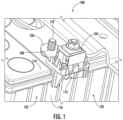
- FIG. 1 illustrates a fuse assembly (hereinafter “assembly”) 100 according to embodiments of the present disclosure.
- the assembly 100 may be secured to a power source 102, such as a battery, which may be used for vehicles or heavy machinery.
- the assembly may include a fusible device (hereinafter “fuse”) 104 coupled to the power source 102 by a conductive component, such as a busbar 106. More specifically, an opening 108 of the busbar 106 may receive a terminal 110 of the power supply 102.
- a fusible device hereinafter "fuse”
- the fuse 104 may be further coupled to a securement device 112, which may be in contact with an upper surface 114 and a side surface 116 of a case 120 of the power source 102 to prevent rotation of the fuse 104 and the busbar 106.
- the assembly may include a cover over the fuse 104.
- the fuse 104 can be a high-current Zcase fuse manufactured by Littelfuse, Inc. In general, the fuse 104 provides protection against overvoltage and/or overcurrent conditions.
- the fuse 102 can include an aperture to accommodate positioning on or around a conductive central support 124.
- the aperture of the fuse 104 can be a central aperture and can be of any size and shape.
- the fuse 104 can further include an input terminal and an output terminal. As an example, a top portion of the fuse 104 can provide the input terminal and a bottom portion of the fuse 104 can provide the output terminal.
- FIGs. 2A and 2B demonstrate the assembly 100 in greater detail.
- the assembly 100 may further include a base member 122 operable to receive the busbar 106.
- the fuse 104, the busbar 106, and the base member 122 may be coupled together by the central support (e.g., stud or screw) 124 and a fastener/nut 126.
- the central support 124 and the nut 126 may be engaged with one another by complimentary threading.
- the fuse 104, the busbar 106, and the base member 122 may be received within a recess 128 of a body 130 of the securement device 112.
- the recess 128 may be defined, in part, by one or more sidewalls 132 extending along a perimeter of the body 130.
- the body 130 may include a plurality of fasteners 169, such as press-fit or snap-fit tabs, extending above the recess 128.
- the fasteners 169 may be operable to engage an upper wall or surface 136 of the base member 122 to retain the two components together.
- the body 130 and the base member 122 may be clipped on during installation.
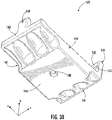
- the securement device 112 may include a support post 140 and a wall 180 extending from the body 130.
- the support post 140 and the wall 180 are operable to engage the case 120 ( FIG. 1 ) of the power source 102 to restrict rotation of the busbar 106 and the fuse 104 relative to the case 120.
- the base member 122 may include a base body 139 having a first end 141 opposite a second end 142, a first side 143 opposite a second side 144, and an interior surface 145 opposite an exterior surface 146.
- the interior surface 145 may be adjacent to, and/or in direct contact with, the busbar 106, while the exterior surface 146 may be adjacent to and/or in direct contact with the securement device 112.
- the features defining the exterior surface 146 may generally complement the surfaces or features defining the recess 128 of the body 130 of the securement device 112.
- the base member 122 may include a central cylinder 147 defining an opening 148 operable to receive the central support 124.
- the base member 122 may further include a plurality of fasteners 149, such as press-fit or snap-fit tabs.
- each of the fasteners 149 may include a sloped engagement surface 150 extending to a retention surface 151.
- the busbar 106 may be forced against each engagement surface 150, which causes the fasteners 149 to deflect away from the central cylinder 147.
- the fasteners 149 will relax and move towards the central cylinder 147 until a top surface of the busbar 106 is adjacent to, or in contact with, the retention surface 151.
- the retention surface 151 in abutment with the top surface of the busbar 106 maintains the busbar 106 within an internal area 153 of the base member 122.
- the body 130 of the securement device 112 may include a first end 161 opposite a second end 162, a first side 163 opposite a second side 164, and first main surface 165 opposite a second main surface 166.
- the first main surface 165 may generally correspond to an upper side of the body 130, while the second main surface 166 may generally correspond to a lower or underside of the body 130.
- the securement device 112 may be made from a non-conductive material.
- the securement device 112 includes the plurality of fasteners 169, such as press-fit or snap-fit tabs.
- each of the fasteners 169 may include a sloped engagement surface 170 extending to a retention surface 171.
- the base member 122 which is secured to the fuse 104 and the busbar 106, may be forced against each engagement surface 170, which causes the fasteners 169 to deflect outwardly from the recess 128.
- the fasteners 169 will relax and move back towards an original position until the top surface 136 of the base member 122 is adjacent to, or in contact with, the retention surface 171.
- the retention surface 171 in abutment with the top surface 136 of the base member 122 maintains the fuse 104 within the recess 128 of the base member 122.
- the fasteners 169 extend upwardly from the sidewall 132 of the body 130 (e.g., along the y-direction).
- the sidewall 132 may further include one or more openings 174 operable to receive tabs 175 ( FIGs. 2A-2B ) of the busbar 106.
- the sidewall 132 may extend farther from the fuse 104 (e.g., along the z-direction) than the tabs 175 of the busbar 106 to protect the busbar 106 from inadvertently making contact with conductive components in close proximity thereto.
- the securement device 112 may further include the wall 180 extending from the body 130. More specifically, the wall 180 may be coupled to, or integrally formed with, the second main surface 166.
- the wall 180 may generally extend perpendicular from a plane (e.g., x-z plane) defined by the second main surface 166.
- the wall 180 may include a main section 181 having a first wall end 182 opposite a second wall end 183.
- the main section 181 may include one or more support ribs 184 connected with the second main surface 166. In some embodiments, the support ribs 184 may extend to a free edge 185 of the main section 181.
- the wall 180 may be integrally formed with the support post 140. In other embodiments, the wall 180 and the support post 140 are separated from one another by a gap.
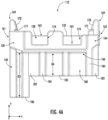
- the first wall end 182 may be offset (e.g., along the z-direction) relative to the second wall end 183 such that a first distance 'D1' between the first wall end 182 and the first side 163 of the body 130 is different (e.g., less) than a second distance 'D2' between the second wall end 183 and the first side 163 of the body 130. Additionally, a distance 'PD' between the support post 140 and the first side 163 of the body 130 may be less than D1 and D2. As a result, various battery tolerances can be accommodated by a same securement device 112.
- FIG. 5 shows the support post 140 in direct contact with the side surface 116 of the case 120 in position (a).
- the support post 140 disengages from the side surface 116, while the second wall end 183 begins to rotate/move towards the side surface 116.
- a gap 'G' between the support post 140 and the side surface 116 may be approximately equal to the distance between the wall 180 and the side surface 116.
- the gap allows the securement device 112 to be mounted to batteries with various dimensions.
- the securement device 112 may then continue to rotate until second wall end 183 directly engages the side surface 116.
- the wall 180 restricts further movement of the fuse 104 and the busbar 106 during torqueing and/or vibration.
- a free end 186 of the support post 140 may extend down from the second main surface 166 by a third distance 'D3', while the free edge 185 of the wall 180 may extend down from the second main surface 166 by a fourth distance 'D4'.
- D3 and D4 may be equal. Making the support post 140 longer than the wall 180 may ensure contact between the support post 140 and the case 120 of the power supply 102 should the fuse 104 and securement device 112 rotate slightly.
- the terms “substantial” or “substantially,” as well as the terms “approximate” or “approximately,” can be used interchangeably in some embodiments, and can be described using any relative measures acceptable by one of ordinary skill in the art. For example, these terms can serve as a comparison to a reference parameter, to indicate a deviation capable of providing the intended function. Although non-limiting, the deviation from the reference parameter can be, for example, in an amount of less than 1%, less than 3%, less than 5%, less than 10%, less than 15%, less than 20%, and so on.
Landscapes
- Engineering & Computer Science (AREA)
- Power Engineering (AREA)
- Fuses (AREA)
Applications Claiming Priority (1)
| Application Number | Priority Date | Filing Date | Title |
|---|---|---|---|
| US17/395,757 US12020882B2 (en) | 2021-08-06 | 2021-08-06 | Fuse assembly including anti-rotation device |
Publications (3)
| Publication Number | Publication Date |
|---|---|
| EP4131318A2 true EP4131318A2 (de) | 2023-02-08 |
| EP4131318A3 EP4131318A3 (de) | 2023-04-05 |
| EP4131318B1 EP4131318B1 (de) | 2025-07-23 |
Family
ID=82608019
Family Applications (1)
| Application Number | Title | Priority Date | Filing Date |
|---|---|---|---|
| EP22185057.1A Active EP4131318B1 (de) | 2021-08-06 | 2022-07-14 | Sicherungsanordnung mit verdrehsicherung |
Country Status (3)
| Country | Link |
|---|---|
| US (1) | US12020882B2 (de) |
| EP (1) | EP4131318B1 (de) |
| CN (1) | CN115910720A (de) |
Family Cites Families (8)
| Publication number | Priority date | Publication date | Assignee | Title |
|---|---|---|---|---|
| JP4083991B2 (ja) | 2000-02-09 | 2008-04-30 | 矢崎総業株式会社 | ヒューズユニットとその製造方法 |
| JP4959507B2 (ja) * | 2007-10-31 | 2012-06-27 | 矢崎総業株式会社 | ヒュージブルリンクユニットの組み付け構造 |
| JP5189920B2 (ja) * | 2008-07-25 | 2013-04-24 | 矢崎総業株式会社 | ヒュージブルリンクユニット |
| JP5422429B2 (ja) | 2010-02-10 | 2014-02-19 | 矢崎総業株式会社 | ヒューズユニット |
| JP5505113B2 (ja) * | 2010-06-15 | 2014-05-28 | 住友電装株式会社 | バッテリー端子直付け用ヒューズユニット |
| JP6178652B2 (ja) | 2013-07-26 | 2017-08-09 | 矢崎総業株式会社 | カバー |
| JP6232001B2 (ja) * | 2015-01-14 | 2017-11-15 | 矢崎総業株式会社 | ヒューズユニット |
| JP7033595B2 (ja) | 2016-12-05 | 2022-03-10 | リテルヒューズ・インク | バッテリー端子ヒューズモジュール |
-
2021
- 2021-08-06 US US17/395,757 patent/US12020882B2/en active Active
-
2022
- 2022-07-14 EP EP22185057.1A patent/EP4131318B1/de active Active
- 2022-08-05 CN CN202210937951.6A patent/CN115910720A/zh active Pending
Also Published As
| Publication number | Publication date |
|---|---|
| EP4131318B1 (de) | 2025-07-23 |
| EP4131318A3 (de) | 2023-04-05 |
| US20230037990A1 (en) | 2023-02-09 |
| CN115910720A (zh) | 2023-04-04 |
| US12020882B2 (en) | 2024-06-25 |
Similar Documents
| Publication | Publication Date | Title |
|---|---|---|
| US12355108B2 (en) | Inter-terminal connection structure | |
| US8636550B2 (en) | Protective cap for prevention of oblique tightening of fusible link directly mounted on battery | |
| US10510507B2 (en) | Fuse unit | |
| US7192319B1 (en) | Insulated cable termination assembly and method of fabrication | |
| WO2016114069A1 (ja) | ヒューズユニット | |
| US20140374139A1 (en) | Booster cable holding structure | |
| US11025016B2 (en) | Electrical assembly to prevent improper installation | |
| EP4131318A2 (de) | Sicherungsanordnung mit verdrehsicherung | |
| EP3685418B1 (de) | Integriertes sicherungsmodul | |
| AU2018201864B2 (en) | High amp circuit breaker with terminal isolation fastener cap | |
| JP2002133979A (ja) | 安全プラグボックス | |
| US20210296797A1 (en) | Terminal cap | |
| US20230162940A1 (en) | Fuse module with clamped fuse installation | |
| US12470051B2 (en) | Junction box assembly with recessed key features | |
| JP7845924B2 (ja) | 蓄電装置 | |
| WO2026079331A1 (ja) | 電気接続ユニット | |
| US20250007224A1 (en) | Through-aperture electrical connector | |
| US20250191867A1 (en) | Jump stud fuse module | |
| JP6643889B2 (ja) | ヒュージブルリンクユニット | |
| JP2026067455A (ja) | 電気接続ユニット | |
| JP2025172439A (ja) | 端子間接続構造 | |
| JP2024150191A (ja) | ヒューズユニット保護カバー | |
| JPH10255876A (ja) | 電気接続箱における丸形板端子の取付構造 |
Legal Events
| Date | Code | Title | Description |
|---|---|---|---|
| PUAI | Public reference made under article 153(3) epc to a published international application that has entered the european phase |
Free format text: ORIGINAL CODE: 0009012 |
|
| STAA | Information on the status of an ep patent application or granted ep patent |
Free format text: STATUS: THE APPLICATION HAS BEEN PUBLISHED |
|
| AK | Designated contracting states |
Kind code of ref document: A2 Designated state(s): AL AT BE BG CH CY CZ DE DK EE ES FI FR GB GR HR HU IE IS IT LI LT LU LV MC MK MT NL NO PL PT RO RS SE SI SK SM TR |
|
| PUAL | Search report despatched |
Free format text: ORIGINAL CODE: 0009013 |
|
| AK | Designated contracting states |
Kind code of ref document: A3 Designated state(s): AL AT BE BG CH CY CZ DE DK EE ES FI FR GB GR HR HU IE IS IT LI LT LU LV MC MK MT NL NO PL PT RO RS SE SI SK SM TR |
|
| RIC1 | Information provided on ipc code assigned before grant |
Ipc: H01H 85/02 20060101AFI20230224BHEP |
|
| STAA | Information on the status of an ep patent application or granted ep patent |
Free format text: STATUS: REQUEST FOR EXAMINATION WAS MADE |
|
| 17P | Request for examination filed |
Effective date: 20231004 |
|
| RBV | Designated contracting states (corrected) |
Designated state(s): AL AT BE BG CH CY CZ DE DK EE ES FI FR GB GR HR HU IE IS IT LI LT LU LV MC MK MT NL NO PL PT RO RS SE SI SK SM TR |
|
| STAA | Information on the status of an ep patent application or granted ep patent |
Free format text: STATUS: EXAMINATION IS IN PROGRESS |
|
| 17Q | First examination report despatched |
Effective date: 20240422 |
|
| GRAP | Despatch of communication of intention to grant a patent |
Free format text: ORIGINAL CODE: EPIDOSNIGR1 |
|
| STAA | Information on the status of an ep patent application or granted ep patent |
Free format text: STATUS: GRANT OF PATENT IS INTENDED |
|
| INTG | Intention to grant announced |
Effective date: 20250217 |
|
| GRAS | Grant fee paid |
Free format text: ORIGINAL CODE: EPIDOSNIGR3 |
|
| GRAA | (expected) grant |
Free format text: ORIGINAL CODE: 0009210 |
|
| STAA | Information on the status of an ep patent application or granted ep patent |
Free format text: STATUS: THE PATENT HAS BEEN GRANTED |
|
| AK | Designated contracting states |
Kind code of ref document: B1 Designated state(s): AL AT BE BG CH CY CZ DE DK EE ES FI FR GB GR HR HU IE IS IT LI LT LU LV MC MK MT NL NO PL PT RO RS SE SI SK SM TR |
|
| REG | Reference to a national code |
Ref country code: GB Ref legal event code: FG4D |
|
| REG | Reference to a national code |
Ref country code: CH Ref legal event code: EP |
|
| P01 | Opt-out of the competence of the unified patent court (upc) registered |
Free format text: CASE NUMBER: APP_31436/2025 Effective date: 20250630 |
|
| REG | Reference to a national code |
Ref country code: IE Ref legal event code: FG4D |
|
| REG | Reference to a national code |
Ref country code: DE Ref legal event code: R096 Ref document number: 602022017932 Country of ref document: DE |
|
| REG | Reference to a national code |
Ref country code: NL Ref legal event code: MP Effective date: 20250723 |
|
| PG25 | Lapsed in a contracting state [announced via postgrant information from national office to epo] |
Ref country code: PT Free format text: LAPSE BECAUSE OF FAILURE TO SUBMIT A TRANSLATION OF THE DESCRIPTION OR TO PAY THE FEE WITHIN THE PRESCRIBED TIME-LIMIT Effective date: 20251124 |
|
| PG25 | Lapsed in a contracting state [announced via postgrant information from national office to epo] |
Ref country code: NL Free format text: LAPSE BECAUSE OF FAILURE TO SUBMIT A TRANSLATION OF THE DESCRIPTION OR TO PAY THE FEE WITHIN THE PRESCRIBED TIME-LIMIT Effective date: 20250723 |
|
| REG | Reference to a national code |
Ref country code: AT Ref legal event code: MK05 Ref document number: 1817357 Country of ref document: AT Kind code of ref document: T Effective date: 20250723 |
|
| PG25 | Lapsed in a contracting state [announced via postgrant information from national office to epo] |
Ref country code: IS Free format text: LAPSE BECAUSE OF FAILURE TO SUBMIT A TRANSLATION OF THE DESCRIPTION OR TO PAY THE FEE WITHIN THE PRESCRIBED TIME-LIMIT Effective date: 20251123 |
|
| PG25 | Lapsed in a contracting state [announced via postgrant information from national office to epo] |
Ref country code: NO Free format text: LAPSE BECAUSE OF FAILURE TO SUBMIT A TRANSLATION OF THE DESCRIPTION OR TO PAY THE FEE WITHIN THE PRESCRIBED TIME-LIMIT Effective date: 20251023 |
|
| REG | Reference to a national code |
Ref country code: LT Ref legal event code: MG9D |
|
| PG25 | Lapsed in a contracting state [announced via postgrant information from national office to epo] |
Ref country code: AT Free format text: LAPSE BECAUSE OF FAILURE TO SUBMIT A TRANSLATION OF THE DESCRIPTION OR TO PAY THE FEE WITHIN THE PRESCRIBED TIME-LIMIT Effective date: 20250723 |
|
| PG25 | Lapsed in a contracting state [announced via postgrant information from national office to epo] |
Ref country code: FI Free format text: LAPSE BECAUSE OF FAILURE TO SUBMIT A TRANSLATION OF THE DESCRIPTION OR TO PAY THE FEE WITHIN THE PRESCRIBED TIME-LIMIT Effective date: 20250723 |
|
| PG25 | Lapsed in a contracting state [announced via postgrant information from national office to epo] |
Ref country code: HR Free format text: LAPSE BECAUSE OF FAILURE TO SUBMIT A TRANSLATION OF THE DESCRIPTION OR TO PAY THE FEE WITHIN THE PRESCRIBED TIME-LIMIT Effective date: 20250723 |
|
| PG25 | Lapsed in a contracting state [announced via postgrant information from national office to epo] |
Ref country code: GR Free format text: LAPSE BECAUSE OF FAILURE TO SUBMIT A TRANSLATION OF THE DESCRIPTION OR TO PAY THE FEE WITHIN THE PRESCRIBED TIME-LIMIT Effective date: 20251024 |
|
| PG25 | Lapsed in a contracting state [announced via postgrant information from national office to epo] |
Ref country code: SE Free format text: LAPSE BECAUSE OF FAILURE TO SUBMIT A TRANSLATION OF THE DESCRIPTION OR TO PAY THE FEE WITHIN THE PRESCRIBED TIME-LIMIT Effective date: 20250723 |
|
| PG25 | Lapsed in a contracting state [announced via postgrant information from national office to epo] |
Ref country code: LV Free format text: LAPSE BECAUSE OF FAILURE TO SUBMIT A TRANSLATION OF THE DESCRIPTION OR TO PAY THE FEE WITHIN THE PRESCRIBED TIME-LIMIT Effective date: 20250723 |
|
| PG25 | Lapsed in a contracting state [announced via postgrant information from national office to epo] |
Ref country code: BG Free format text: LAPSE BECAUSE OF FAILURE TO SUBMIT A TRANSLATION OF THE DESCRIPTION OR TO PAY THE FEE WITHIN THE PRESCRIBED TIME-LIMIT Effective date: 20250723 Ref country code: PL Free format text: LAPSE BECAUSE OF FAILURE TO SUBMIT A TRANSLATION OF THE DESCRIPTION OR TO PAY THE FEE WITHIN THE PRESCRIBED TIME-LIMIT Effective date: 20250723 |
|
| PG25 | Lapsed in a contracting state [announced via postgrant information from national office to epo] |
Ref country code: RS Free format text: LAPSE BECAUSE OF FAILURE TO SUBMIT A TRANSLATION OF THE DESCRIPTION OR TO PAY THE FEE WITHIN THE PRESCRIBED TIME-LIMIT Effective date: 20251023 |
|
| PG25 | Lapsed in a contracting state [announced via postgrant information from national office to epo] |
Ref country code: ES Free format text: LAPSE BECAUSE OF FAILURE TO SUBMIT A TRANSLATION OF THE DESCRIPTION OR TO PAY THE FEE WITHIN THE PRESCRIBED TIME-LIMIT Effective date: 20250723 |
|
| PG25 | Lapsed in a contracting state [announced via postgrant information from national office to epo] |
Ref country code: SM Free format text: LAPSE BECAUSE OF FAILURE TO SUBMIT A TRANSLATION OF THE DESCRIPTION OR TO PAY THE FEE WITHIN THE PRESCRIBED TIME-LIMIT Effective date: 20250723 |
|
| PG25 | Lapsed in a contracting state [announced via postgrant information from national office to epo] |
Ref country code: DK Free format text: LAPSE BECAUSE OF FAILURE TO SUBMIT A TRANSLATION OF THE DESCRIPTION OR TO PAY THE FEE WITHIN THE PRESCRIBED TIME-LIMIT Effective date: 20250723 |
|
| PG25 | Lapsed in a contracting state [announced via postgrant information from national office to epo] |
Ref country code: CZ Free format text: LAPSE BECAUSE OF FAILURE TO SUBMIT A TRANSLATION OF THE DESCRIPTION OR TO PAY THE FEE WITHIN THE PRESCRIBED TIME-LIMIT Effective date: 20250723 |
|
| PG25 | Lapsed in a contracting state [announced via postgrant information from national office to epo] |
Ref country code: EE Free format text: LAPSE BECAUSE OF FAILURE TO SUBMIT A TRANSLATION OF THE DESCRIPTION OR TO PAY THE FEE WITHIN THE PRESCRIBED TIME-LIMIT Effective date: 20250723 Ref country code: SK Free format text: LAPSE BECAUSE OF FAILURE TO SUBMIT A TRANSLATION OF THE DESCRIPTION OR TO PAY THE FEE WITHIN THE PRESCRIBED TIME-LIMIT Effective date: 20250723 |