EP4125962B1 - Biomaterial mit einer porösen resorbierbaren matrix und zugehöriges herstellungsverfahren - Google Patents
Biomaterial mit einer porösen resorbierbaren matrix und zugehöriges herstellungsverfahren Download PDFInfo
- Publication number
- EP4125962B1 EP4125962B1 EP21714215.7A EP21714215A EP4125962B1 EP 4125962 B1 EP4125962 B1 EP 4125962B1 EP 21714215 A EP21714215 A EP 21714215A EP 4125962 B1 EP4125962 B1 EP 4125962B1
- Authority
- EP
- European Patent Office
- Prior art keywords
- porous matrix
- cells
- biological cells
- type
- biomaterial
- Prior art date
- Legal status (The legal status is an assumption and is not a legal conclusion. Google has not performed a legal analysis and makes no representation as to the accuracy of the status listed.)
- Active
Links
Images


Classifications
-
- A—HUMAN NECESSITIES
- A61—MEDICAL OR VETERINARY SCIENCE; HYGIENE
- A61K—PREPARATIONS FOR MEDICAL, DENTAL OR TOILETRY PURPOSES
- A61K35/00—Medicinal preparations containing materials or reaction products thereof with undetermined constitution
- A61K35/12—Materials from mammals; Compositions comprising non-specified tissues or cells; Compositions comprising non-embryonic stem cells; Genetically modified cells
- A61K35/36—Skin; Hair; Nails; Sebaceous glands; Cerumen; Epidermis; Epithelial cells; Keratinocytes; Langerhans cells; Ectodermal cells
-
- A—HUMAN NECESSITIES
- A61—MEDICAL OR VETERINARY SCIENCE; HYGIENE
- A61K—PREPARATIONS FOR MEDICAL, DENTAL OR TOILETRY PURPOSES
- A61K35/00—Medicinal preparations containing materials or reaction products thereof with undetermined constitution
- A61K35/12—Materials from mammals; Compositions comprising non-specified tissues or cells; Compositions comprising non-embryonic stem cells; Genetically modified cells
- A61K35/33—Fibroblasts
-
- A—HUMAN NECESSITIES
- A61—MEDICAL OR VETERINARY SCIENCE; HYGIENE
- A61K—PREPARATIONS FOR MEDICAL, DENTAL OR TOILETRY PURPOSES
- A61K8/00—Cosmetics or similar toiletry preparations
- A61K8/18—Cosmetics or similar toiletry preparations characterised by the composition
- A61K8/30—Cosmetics or similar toiletry preparations characterised by the composition containing organic compounds
- A61K8/64—Proteins; Peptides; Derivatives or degradation products thereof
- A61K8/65—Collagen; Gelatin; Keratin; Derivatives or degradation products thereof
-
- A—HUMAN NECESSITIES
- A61—MEDICAL OR VETERINARY SCIENCE; HYGIENE
- A61K—PREPARATIONS FOR MEDICAL, DENTAL OR TOILETRY PURPOSES
- A61K8/00—Cosmetics or similar toiletry preparations
- A61K8/18—Cosmetics or similar toiletry preparations characterised by the composition
- A61K8/96—Cosmetics or similar toiletry preparations characterised by the composition containing materials, or derivatives thereof of undetermined constitution
- A61K8/98—Cosmetics or similar toiletry preparations characterised by the composition containing materials, or derivatives thereof of undetermined constitution of animal origin
- A61K8/981—Cosmetics or similar toiletry preparations characterised by the composition containing materials, or derivatives thereof of undetermined constitution of animal origin of mammals or bird
- A61K8/985—Skin or skin outgrowth, e.g. hair, nails
-
- A—HUMAN NECESSITIES
- A61—MEDICAL OR VETERINARY SCIENCE; HYGIENE
- A61L—METHODS OR APPARATUS FOR STERILISING MATERIALS OR OBJECTS IN GENERAL; DISINFECTION, STERILISATION OR DEODORISATION OF AIR; CHEMICAL ASPECTS OF BANDAGES, DRESSINGS, ABSORBENT PADS OR SURGICAL ARTICLES; MATERIALS FOR BANDAGES, DRESSINGS, ABSORBENT PADS OR SURGICAL ARTICLES
- A61L24/00—Surgical adhesives or cements; Adhesives for colostomy devices
- A61L24/001—Use of materials characterised by their function or physical properties
- A61L24/0015—Medicaments; Biocides
-
- A—HUMAN NECESSITIES
- A61—MEDICAL OR VETERINARY SCIENCE; HYGIENE
- A61L—METHODS OR APPARATUS FOR STERILISING MATERIALS OR OBJECTS IN GENERAL; DISINFECTION, STERILISATION OR DEODORISATION OF AIR; CHEMICAL ASPECTS OF BANDAGES, DRESSINGS, ABSORBENT PADS OR SURGICAL ARTICLES; MATERIALS FOR BANDAGES, DRESSINGS, ABSORBENT PADS OR SURGICAL ARTICLES
- A61L24/00—Surgical adhesives or cements; Adhesives for colostomy devices
- A61L24/001—Use of materials characterised by their function or physical properties
- A61L24/0036—Porous materials, e.g. foams or sponges
-
- A—HUMAN NECESSITIES
- A61—MEDICAL OR VETERINARY SCIENCE; HYGIENE
- A61L—METHODS OR APPARATUS FOR STERILISING MATERIALS OR OBJECTS IN GENERAL; DISINFECTION, STERILISATION OR DEODORISATION OF AIR; CHEMICAL ASPECTS OF BANDAGES, DRESSINGS, ABSORBENT PADS OR SURGICAL ARTICLES; MATERIALS FOR BANDAGES, DRESSINGS, ABSORBENT PADS OR SURGICAL ARTICLES
- A61L24/00—Surgical adhesives or cements; Adhesives for colostomy devices
- A61L24/001—Use of materials characterised by their function or physical properties
- A61L24/0042—Materials resorbable by the body
-
- A—HUMAN NECESSITIES
- A61—MEDICAL OR VETERINARY SCIENCE; HYGIENE
- A61L—METHODS OR APPARATUS FOR STERILISING MATERIALS OR OBJECTS IN GENERAL; DISINFECTION, STERILISATION OR DEODORISATION OF AIR; CHEMICAL ASPECTS OF BANDAGES, DRESSINGS, ABSORBENT PADS OR SURGICAL ARTICLES; MATERIALS FOR BANDAGES, DRESSINGS, ABSORBENT PADS OR SURGICAL ARTICLES
- A61L24/00—Surgical adhesives or cements; Adhesives for colostomy devices
- A61L24/04—Surgical adhesives or cements; Adhesives for colostomy devices containing macromolecular materials
- A61L24/10—Polypeptides; Proteins
- A61L24/102—Collagen
-
- A—HUMAN NECESSITIES
- A61—MEDICAL OR VETERINARY SCIENCE; HYGIENE
- A61L—METHODS OR APPARATUS FOR STERILISING MATERIALS OR OBJECTS IN GENERAL; DISINFECTION, STERILISATION OR DEODORISATION OF AIR; CHEMICAL ASPECTS OF BANDAGES, DRESSINGS, ABSORBENT PADS OR SURGICAL ARTICLES; MATERIALS FOR BANDAGES, DRESSINGS, ABSORBENT PADS OR SURGICAL ARTICLES
- A61L27/00—Materials for grafts or prostheses or for coating grafts or prostheses
- A61L27/36—Materials for grafts or prostheses or for coating grafts or prostheses containing ingredients of undetermined constitution or reaction products thereof, e.g. transplant tissue, natural bone, extracellular matrix
- A61L27/38—Materials for grafts or prostheses or for coating grafts or prostheses containing ingredients of undetermined constitution or reaction products thereof, e.g. transplant tissue, natural bone, extracellular matrix containing added animal cells
- A61L27/3886—Materials for grafts or prostheses or for coating grafts or prostheses containing ingredients of undetermined constitution or reaction products thereof, e.g. transplant tissue, natural bone, extracellular matrix containing added animal cells comprising two or more cell types
-
- A—HUMAN NECESSITIES
- A61—MEDICAL OR VETERINARY SCIENCE; HYGIENE
- A61L—METHODS OR APPARATUS FOR STERILISING MATERIALS OR OBJECTS IN GENERAL; DISINFECTION, STERILISATION OR DEODORISATION OF AIR; CHEMICAL ASPECTS OF BANDAGES, DRESSINGS, ABSORBENT PADS OR SURGICAL ARTICLES; MATERIALS FOR BANDAGES, DRESSINGS, ABSORBENT PADS OR SURGICAL ARTICLES
- A61L27/00—Materials for grafts or prostheses or for coating grafts or prostheses
- A61L27/50—Materials characterised by their function or physical properties, e.g. injectable or lubricating compositions, shape-memory materials, surface modified materials
- A61L27/54—Biologically active materials, e.g. therapeutic substances
-
- A—HUMAN NECESSITIES
- A61—MEDICAL OR VETERINARY SCIENCE; HYGIENE
- A61L—METHODS OR APPARATUS FOR STERILISING MATERIALS OR OBJECTS IN GENERAL; DISINFECTION, STERILISATION OR DEODORISATION OF AIR; CHEMICAL ASPECTS OF BANDAGES, DRESSINGS, ABSORBENT PADS OR SURGICAL ARTICLES; MATERIALS FOR BANDAGES, DRESSINGS, ABSORBENT PADS OR SURGICAL ARTICLES
- A61L27/00—Materials for grafts or prostheses or for coating grafts or prostheses
- A61L27/50—Materials characterised by their function or physical properties, e.g. injectable or lubricating compositions, shape-memory materials, surface modified materials
- A61L27/56—Porous materials, e.g. foams or sponges
-
- A—HUMAN NECESSITIES
- A61—MEDICAL OR VETERINARY SCIENCE; HYGIENE
- A61L—METHODS OR APPARATUS FOR STERILISING MATERIALS OR OBJECTS IN GENERAL; DISINFECTION, STERILISATION OR DEODORISATION OF AIR; CHEMICAL ASPECTS OF BANDAGES, DRESSINGS, ABSORBENT PADS OR SURGICAL ARTICLES; MATERIALS FOR BANDAGES, DRESSINGS, ABSORBENT PADS OR SURGICAL ARTICLES
- A61L27/00—Materials for grafts or prostheses or for coating grafts or prostheses
- A61L27/50—Materials characterised by their function or physical properties, e.g. injectable or lubricating compositions, shape-memory materials, surface modified materials
- A61L27/58—Materials at least partially resorbable by the body
-
- A—HUMAN NECESSITIES
- A61—MEDICAL OR VETERINARY SCIENCE; HYGIENE
- A61L—METHODS OR APPARATUS FOR STERILISING MATERIALS OR OBJECTS IN GENERAL; DISINFECTION, STERILISATION OR DEODORISATION OF AIR; CHEMICAL ASPECTS OF BANDAGES, DRESSINGS, ABSORBENT PADS OR SURGICAL ARTICLES; MATERIALS FOR BANDAGES, DRESSINGS, ABSORBENT PADS OR SURGICAL ARTICLES
- A61L27/00—Materials for grafts or prostheses or for coating grafts or prostheses
- A61L27/50—Materials characterised by their function or physical properties, e.g. injectable or lubricating compositions, shape-memory materials, surface modified materials
- A61L27/60—Materials for use in artificial skin
-
- A—HUMAN NECESSITIES
- A61—MEDICAL OR VETERINARY SCIENCE; HYGIENE
- A61P—SPECIFIC THERAPEUTIC ACTIVITY OF CHEMICAL COMPOUNDS OR MEDICINAL PREPARATIONS
- A61P17/00—Drugs for dermatological disorders
- A61P17/02—Drugs for dermatological disorders for treating wounds, ulcers, burns, scars, keloids, or the like
-
- A—HUMAN NECESSITIES
- A61—MEDICAL OR VETERINARY SCIENCE; HYGIENE
- A61Q—SPECIFIC USE OF COSMETICS OR SIMILAR TOILETRY PREPARATIONS
- A61Q19/00—Preparations for care of the skin
-
- A—HUMAN NECESSITIES
- A61—MEDICAL OR VETERINARY SCIENCE; HYGIENE
- A61K—PREPARATIONS FOR MEDICAL, DENTAL OR TOILETRY PURPOSES
- A61K2800/00—Properties of cosmetic compositions or active ingredients thereof or formulation aids used therein and process related aspects
- A61K2800/20—Chemical, physico-chemical or functional or structural properties of the composition as a whole
- A61K2800/30—Characterized by the absence of a particular group of ingredients
-
- A—HUMAN NECESSITIES
- A61—MEDICAL OR VETERINARY SCIENCE; HYGIENE
- A61L—METHODS OR APPARATUS FOR STERILISING MATERIALS OR OBJECTS IN GENERAL; DISINFECTION, STERILISATION OR DEODORISATION OF AIR; CHEMICAL ASPECTS OF BANDAGES, DRESSINGS, ABSORBENT PADS OR SURGICAL ARTICLES; MATERIALS FOR BANDAGES, DRESSINGS, ABSORBENT PADS OR SURGICAL ARTICLES
- A61L2300/00—Biologically active materials used in bandages, wound dressings, absorbent pads or medical devices
- A61L2300/60—Biologically active materials used in bandages, wound dressings, absorbent pads or medical devices characterised by a special physical form
- A61L2300/64—Animal cells
-
- A—HUMAN NECESSITIES
- A61—MEDICAL OR VETERINARY SCIENCE; HYGIENE
- A61L—METHODS OR APPARATUS FOR STERILISING MATERIALS OR OBJECTS IN GENERAL; DISINFECTION, STERILISATION OR DEODORISATION OF AIR; CHEMICAL ASPECTS OF BANDAGES, DRESSINGS, ABSORBENT PADS OR SURGICAL ARTICLES; MATERIALS FOR BANDAGES, DRESSINGS, ABSORBENT PADS OR SURGICAL ARTICLES
- A61L2400/00—Materials characterised by their function or physical properties
- A61L2400/04—Materials for stopping bleeding
Definitions
- the present invention relates to the field of biomaterials comprising collagen and their manufacture. It finds particularly advantageous application in the field of dermo-epidermal substitutes.
- Chronic wounds represent a major public health problem affecting more than 2 million people in metropolitan France alone. This includes physical burns, for example induced by ultraviolet radiation, and chemical burns, for example induced by detergents or acids, ulcers, and in particular pressure ulcers, venous ulcers and diabetic ulcers. These chronic wounds generally require the replacement of damaged tissues, for example by a skin graft.
- tissue substitutes that best mimic the properties and reactions of a native tissue.
- biomaterial comprising a compound consisting of collagen, acetylated chitosan and glycosaminoglycans.
- This biomaterial can constitute the dermal layer of an artificial skin, and be associated with a biodegradable pseudo epidermis, for example a chitosan film.
- this biomaterial remains perfectible to mimic a native skin.
- US 5,945,101 A describes a material comprising a cross-linked collagen sponge into which fibroblasts and keratinocytes have been seeded as well as the method of manufacturing a skin model comprising a collagen matrix comprising fibroblasts and stratified layers of differentiated epidermal cells.
- An object of the present invention is therefore to prepare a biomaterial which is closer to a native tissue.
- a biomaterial comprising a resorbable porous matrix formed from a material comprising collagen, and having an interior volume and an exterior surface.
- the biomaterial comprises at least one type of living biological cells of a tissue, arranged in the interior volume and, alternatively or in addition, on the surface of the porous matrix.
- the biomaterial comprises a matrix giving it a structure allowing its manipulation, and biological cells of a tissue seeded in the porous matrix.
- the biomaterial therefore forms a tissue substitute approaching a native tissue, in particular in terms of biological structure present in the tissue, and physiological functions.
- the porous matrix can be degraded to facilitate the integration of a portion of the biomaterial into the organism, and more particularly of a tissue formed by biological cells, for example following a graft of the biomaterial.
- the biomaterial therefore forms a tissue substitute that can be grafted onto an organism and then act directly to perform its tissue function, without further requiring the removal of the biomaterial, and more particularly of the porous matrix.
- the at least one type of living biological cells of a tissue are arranged in the interior volume of the porous matrix.
- the method thus makes it possible to obtain the biomaterial according to the first aspect of the invention.
- By seeding and growth it is also possible to form a biomaterial of variable size and shape depending on the dimensions of the porous matrix.
- a biomaterial forming a tissue substitute approaching a native tissue is thus obtained.
- resorbable matrix designates the fact that the matrix is biodegradable from cells, for example from an organism.
- a biological matrix it is meant that the matrix is configured so as not to interfere with, or even degrade, a biological medium in contact with which the matrix is placed. More particularly, the matrix is tolerated by an organism in or on which the matrix is in contact, for example by grafting. More particularly, the organism exhibits a low level of inflammatory reaction, or even an absence of inflammatory reaction induced by contact with the matrix, for example by grafting.
- a parameter that is “substantially equal to/greater than/less than” a given value means that this parameter is equal to/greater than/less than the given value, to within plus or minus 10%, or even plus or minus 5%, of this value.
- matrix porosity we mean the proportion of void or gas in the matrix.
- the process 2 for manufacturing the biomaterial 1 is now described with reference to the Figures 1 to 6 .
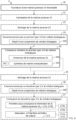
- the process is illustrated by the figure 6 , where optional steps are indicated in dotted lines.
- the method 2 comprises providing 20 a porous matrix 20.
- the porous matrix 20 has pores delimiting an interior volume 100, as for example illustrated in figure 1 . Equivalently, the interior volume 100 represents the volume of void or gas inside the matrix 20, and therefore the porosity of the matrix.
- the porous matrix 20 has an exterior surface 101, comprising an upper face 1010, and a lower face 1012.
- the exterior surface 100 of the porous matrix 10 may further comprise at least one lateral face 1011, or even a plurality of lateral faces 1011, as for example illustrated in figure 1 .
- the porosity of the porous matrix 10 is homogeneous, that is to say that the porosity per unit volume is substantially identical in any portion of the same determined size of the porous matrix 10.
- the interior volume is arranged in the porous matrix in the form of a cavity.
- the dimension of the pores of the porous matrix 10 is preferably greater than the dimension of biological cells 11, and in particular of eukaryotic biological cells.
- the pores of the porous matrix 10 allow the migration of the biological cells 11 in the interior volume 100. Additional characteristics of the porous matrix 10 are described later.
- the porous matrix 10 can be prepared for seeding 23 of biological cells 11.
- the method 2 comprises a hydration 21 configured to balance the pH and osmolarity of the porous matrix around values corresponding to the native environment of the cells. This makes it possible to obtain a homogeneous osmolarity in the porous matrix 10, and thus a better migration and colonization of the seeded cells 11. This is particularly advantageous when the porous matrix 10 is thick, for example when the porous matrix 10 is a sponge.
- this pH can be between 6.8 and 7.5
- the osmolarity can be between 270 and 360 mmol/kg.
- the porous matrix 10 may be immersed in a buffered solution for several hours or even several days.
- the porous matrix 10 may further be immersed in a culture medium 3 configured to correspond to the native environment of the cells.
- the culture medium 3 can be a medium equivalent to the medium of the dermis.
- the method 2 comprises a drying 22 of the porous matrix 2 to promote the adhesion of the biological cells 11 on the porous matrix during their seeding 23, and therefore their subsequent cell growth 24.
- the drying of the porous matrix 10 can be carried out by suction of the hydration solution.
- the method 2 then comprises a first seeding 23 of the porous matrix with living biological cells 11 of a tissue, and more particularly with at least a first type 110 of biological cells 11.
- biological cells 11 are added to the porous matrix 10 to form a biomaterial 11 approaching a native tissue, compared to a biomaterial formed solely from an inert material.
- the biological cells 11 may be eukaryotic, human or animal cells. In the following, reference is made to the non-limiting example where the biological cells 11 are human cells.
- the biological cells 11 may be selected from cells derived from standard cell line cultures and cells isolated from a biological sample of an organism.
- a biomaterial 1 comprising cells 11 derived from standard cell line cultures makes it possible to form a high-performance tissue substitute, while remaining low in cost, which is particularly advantageous for pharmaceutical or cosmetic applications.
- the standard cell line cells may be available on the market from vendors known to those skilled in the art.
- the biological cells may be autologous or allogeneic.
- the allogeneic biological cells may for example be isolated from surgical residues, in particular independently of a skin graft.
- a biomaterial 1 comprising autologous cells 11 can be personalized for a given person, which is particularly advantageous for medical applications such as for example a graft of the biomaterial 1.
- the biological cells may be isolated from a biological sample of a person, for example following one or more biopsies and in particular a skin biopsy.
- the biological cells 11 may comprise cells selected from connective tissue cells and epithelial cells.
- connective tissue includes the dermis, subcutaneous adipose tissue, corneal stroma, bone, and as epithelial tissue, the epidermis and the corneal epithelium.
- the connective tissue cells are dermal cells called fibroblasts.
- the epithelial cells are epidermal cells called keratinocytes.
- the biomaterial 1 can form a dermal, or even dermo-epidermal, substitute for in vitro or in vivo applications.
- the second type of biological cells may further include melanocytes, to obtain a pigmented epidermis.
- the biomaterial is thus made more complex and becomes even closer to native skin, particularly in terms of the diversity of biological cells present in the tissue, and of physiological functions.
- the fibroblasts 1100 can be seeded 23 by depositing 230 a cell suspension, for example drop by drop on the surface 101 of the porous matrix, and in particular on its upper face 1010 according to the example illustrated in figure 2 .
- the fibroblasts 1100 may be seeded at a cell density of between 500,000 and 1,000,000 cells/cm 2 , or even substantially 800,000 cells/cm 2 . Note that depending on the type of biological cells seeded, the cell density may be adapted. Thus, the fibroblasts 1100 may penetrate into the interior volume 100 of the porous matrix 10.
- the method may further comprise a step of adhesion of the cells 11, during which the porous matrix 10 is left in the open air for a determined time, for example several minutes, or even an hour, or even preferably in an atmosphere containing 5% CO 2 .
- Method 2 then comprises a cellular growth 24 of the seeded fibroblasts 1100 23.
- the fibroblasts 1100 can multiply by cell division at least in the interior volume 100 of the porous matrix 10 to colonize at least part of the interior volume 100, or even its entirety, as illustrated by the figure 3 .
- the fibroblasts can further synthesize 241, or equivalently secrete, an extracellular matrix 112 at least in the interior volume 100.
- the biological cells 11, and in particular the fibroblasts 1100, and their extracellular matrix 112 make it possible to form a tissue in the porous matrix 10, and to further approach the properties of a native tissue, and in particular of native skin.
- the fibroblasts 1100 in the interior volume 100 of the porous matrix 10, or even the fibroblasts 1100 and their extracellular matrix 112, thus form a dermal substitute equivalent to the native dermis.
- the porous matrix 10 with the seeded fibroblasts 1100 23 may be immersed at least partially, and preferably completely, in a culture medium 3 configured to mimic the native environment of the fibroblasts 1100, as illustrated in figure 3 .
- the matrix 10 being porous, the culture medium 3 is thus distributed homogeneously in the porous matrix 10 to facilitate cell growth 24.
- the culture medium is a medium equivalent to the medium of the dermis, that is to say whose properties, or even composition, is substantially equivalent to the medium of the dermis.
- the culture medium 3 can also be renewed 242, typically at a frequency of several times per week.
- the subsequent renewals 242 of medium can be carried out with a culture medium 3 comprising ascorbic acid and EGF.
- the first renewal 242 of media takes place 24 to 48 hours after seeding 23 of the fibroblasts 1100.
- the medium can be configured to adapt and mimic the environment more favorable to the cell types seeded.
- the method 2 may further comprise a second seeding 26, for example carried out after one or more weeks of cell growth 24 of the fibroblasts 1100.
- the porous matrix 10 Prior to the second seeding 26, the porous matrix 10 may be dried 25 in a manner similar to the drying 22 described above. Then, a second type 111 of biological cells 11 may be seeded 26, notably comprising keratinocytes 1110.
- the drying operations 22, 25 prior to seeding make it possible to promote the cellular adhesion of the cells 11 seeded on the porous matrix, and therefore their subsequent cellular growth, as indicated previously for the drying 22.
- the culture medium can be renewed or changed.
- the drying of the porous matrix 10 can comprise a suction of the solution or of the cellular medium present in the porous matrix 10.
- the porous matrix 10 can also be deposited on an absorbent support.
- the porous matrix 10 can for example be deposited on a sterile compress, preferably deposited on sterile blotting paper.
- the porous matrix 10 is deposited on the absorbent support after the suction.
- the suction makes it possible to remove the solution or the medium present in the porous matrix 10 in a controlled and precise manner.
- the deposition on the absorbent support makes it possible to finalize the drying of the porous matrix 10 and thus to further improve the cellular adhesion of the cells 11 seeded on the porous matrix 10.
- the keratinocytes 1110 can be seeded 26 by the deposition 260 of a cell suspension, for example drop by drop on the surface 101 of the porous matrix 10, and in particular on its upper face 1010 according to the example illustrated in figure 4 .
- the deposition of the cell suspension on the lateral faces 1011 of the porous matrix 10 is avoided in order to avoid the propagation of the keratinocytes 1110 on these faces.
- the keratinocytes 1110 can be seeded at a cell density of between 500,000 and 1,000,000 cells/cm 2 , or even substantially 800,000 cells/cm 2 . Note again that depending on the type of biological cells seeded, the cell density can be adapted.
- the seeded keratinocytes 1110 26 remain on the outer surface 101 of the porous matrix 10 due to the presence of extracellular matrix secreted by the fibroblasts and by the presence of the fibroblasts themselves.
- the method may further comprise a step of adhesion of the cells 11, during which the porous matrix 10 is left for a determined time, for example several minutes, or even an hour, and preferably in an atmosphere containing 5% CO 2 and at 37°C.
- the method 2 then comprises a cell growth 27 of the seeded keratinocytes 1110 26.
- the keratinocytes 1110 multiply by cell division on the outer surface 101 of the porous matrix 10 until the confluence 2702 of the keratinocytes 1110, as illustrated by the figure 4 .
- the cell growth 27 of the keratinocytes 1110 may comprise a first undergrowth 270 during which the porous matrix 10 with the seeded cells 23, 26 is immersed in a culture medium 3 configured to mimic the native environment of the keratinocytes 1110, for example a medium called MC2, adapted from the “Green” medium as described later.
- the addition of the culture medium 3 is preferably carried out without the incident medium flow 3 directly touching the surface 101 of the porous matrix 10, so as not to disturb the adhered keratinocytes 1110, and until covering the porous matrix and the cells, including the keratinocytes 1110.
- the matrix 10 being porous, the culture medium 3 is thus distributed homogeneously in the porous matrix 10 to facilitate cell growth 27.
- the culture medium 3 can also be renewed 2701, typically at a frequency of several times per week.
- subsequent renewals 2701 of medium can be carried out with a culture medium 3 comprising ascorbic acid and EGF.
- the first renewal 2701 of media takes place 24 to 48 hours after seeding 26 of the keratinocytes 1110.
- the porous matrix 10 with the seeded cells 23, 26 can be arranged on an absorbent support 7, placed on a grid 6, for example made of stainless steel and sterilizable by autoclave.
- a suitable culture medium 3, designated Air/liquid medium can then be added so as to be flush with the absorbent support 7, for example blotting paper.
- the porous matrix is kept hydrated while allowing the induction of the differentiation of the keratinocytes 1110.
- the level of the culture medium 3 is adjusted so as to avoid the presence of bubbles under the grid 6, or even between the absorbent support 7 and the grid 6.
- the Air/liquid culture medium preferably supplemented only with vitamin C, can also be renewed 2711, typically at a frequency of several times per week.
- a chronology of the steps of manufacturing process 2 is given with reference to the figure 7 .
- the porous matrix 10 is provided 20, then prepared by hydration 21 and drying 22.
- the fibroblasts 1100 can then be seeded 23 on a day designated D0.
- the cell growth 24 of the fibroblasts can be carried out, after which the keratinocytes 1110 can be seeded 26, 14 days to 21 days after D0.
- the first undergrowth 270 of the keratinocytes 1110 can be carried out.
- the porous matrix 10 can be arranged at the interface 5 between the air and the culture medium 5 to allow cell differentiation 2710 in a phase D, for example for 7 to 21 days. Note that the indicated durations can vary according to the needs and the quantity of cells available.
- the biomaterial 1 can be obtained according to the first aspect of the invention, comprising in particular at least one type 110 of living biological cells 11 of a tissue, arranged in the interior volume 100.
- the type 110 of living biological cells 11 of a tissue can be arranged on the surface 101 of the porous matrix 10.
- the arrangement of the cells 11 in the porous matrix 10 can depend on the nature of the seeded biological cells 11.
- corneal stromal cells can be deposited in the porous matrix 10 to form the stroma
- keratocytes can be deposited on the surface of the porous matrix 10 to form the epithelium of the cornea.
- biomaterial 1 can form a dermo-epidermal substitute for native skin, as illustrated in Figure 5B .
- the biomaterial 1 can in particular be used for in vitro application of pharmaceutical substances or cosmetic substances. During the development of the invention, it was demonstrated that the method described makes it possible to obtain the material 1 in a reproducible manner. Furthermore, the biomaterial 1 can be used as a model tissue, for example for basic and dermatological research.
- Biomaterial 1 Due to the characteristics described above, biomaterial 1 has a regenerative activity. Biomaterial 1 is thus particularly suitable for the treatment of lesions and/or for a graft, for example on the skin, on the eye or on a bone.
- biomaterial 1 can form a reproducible dermo-epidermal substitute for native skin, biomaterial 1 is particularly suitable for testing new products in the pharmaceutical industry.
- skin reconstructed from patient cells can represent an alternative model for modeling dermatological diseases, such as vitiligo, psoriasis, atopic dermatitis and Xeroderma Pigmentosum, and for the development of therapeutic molecules.
- Biomaterial 1 forming a dermo-epidermal substitute for native skin is particularly suitable for the treatment of chronic wounds or burns because it minimizes, or even avoids, the addition of iatrogenic trauma, linked to the removal of skin from a donor area.
- biological cells 11 can be autologous, biomaterial 1 minimizes the risk of immune rejection of biomaterial 1.
- a skin biopsy can be performed, on a healthy surface and reduced compared to the surface required for the treatment of a wound or burn.
- the cells 11 can be multiplied by cell proliferation in the manufacturing method 2 in order to obtain a sufficient quantity to allow the cell growths 24 and/or 27. It is therefore possible to obtain a biomaterial 1 having a surface adapted to the surface of the injured area.
- the biomaterial 1 and its manufacturing method 2 make it possible to minimize the risks and trauma linked to the removal of skin from a person, compared to existing solutions.
- the biomaterial 1 can be used as a skin substitute for in vitro testing of pharmaceutical substances, for example dermatological drugs, and dermo-cosmetic products. Tests of the efficacy and safety of dermatological drugs and dermo-cosmetic products can thus be carried out on a biomaterial that approximates native skin.
- biomaterial 1 Characteristics of biomaterial 1 were described during the description of method 2. In the following, additional characteristics of biomaterial 1 are detailed.
- the porous matrix 10 of the biomaterial 1 is now described in detail.
- the porous matrix 10 can be elastically deformable, for example under the pressure of a user's finger.
- the barrier properties of the biomaterial 1 can for example be improved.
- the porous matrix 20 is resorbable.
- the porous matrix 20 may further be biocompatible, in particular by being made of biocompatible materials.
- the porous matrix may more particularly be formed of a material comprising collagen.
- the collagen may be bovine or porcine collagen type I.
- the material of the porous matrix 10 may comprise at least 90%, preferably at least 95%, and more preferably at least 99% by mass of collagen, relative to the dry mass of the porous matrix 10.
- the material of the porous matrix 10 may be free of chitosan.
- Chitosan has a lower degradation rate in an organism than collagen. Since the biomaterial 1 comprises biological cells 11, it is not necessary to wait for the cells of a person to colonize the biomaterial following its implantation, for example by grafting, as for existing solutions. Therefore, it is possible to use a porous matrix based on a material having a faster degradation rate. It may even be advantageous to accelerate the degradation of the porous matrix to accelerate the integration of the tissue formed by biological cells.
- the porous matrix 10 is in the form of a sponge.
- the porous matrix 10 can be shaped in two or even three dimensions as required.
- the porous matrix 10 is a hemostatic sponge.
- a hemostatic sponge can easily be shaped by cutting and has a hardness allowing it to retain the desired shape, while remaining sufficiently deformable to be able to be applied to a support, for example on a person's body.
- a hemostatic sponge is a synthetic sponge generally composed of materials of biological origin, and resorbable by the body. The porosity of these sponges allows for a high absorption of incoming fluid, typically up to 35 times their weight.
- a hemostatic sponge is in the form of a dry, flexible, porous material and is commercially available in various forms and trademarks. Thus, the porous matrix 10 can be commercially available and at a reduced cost.
- a hemostatic sponge can absorb blood from the human and animal body, for example from a wound on which the biomaterial is deposited.
- a hemostatic sponge can absorb a weight of blood substantially greater than or equal to 10 times, preferably substantially greater than or equal to 20 times, and more preferably substantially greater than or equal to 30 times the weight of the sponge before absorption.
- the hemostatic sponge thus produces pressure on the bleeding site, inducing platelet aggregation and therefore activating the fibrin coagulation pathways to achieve hemostasis.
- the aspirated blood would degrade the cells of the biomaterial.
- the porous matrix 10 provided 20 is preferably sterile, in order to avoid the proliferation of unwanted organisms in the biomaterial 1.
- the porous matrix 10 is a product following Good Manufacturing Practices (abbreviated GMP).
- GMP Good Manufacturing Practices
- the porous matrix 10 can be used clinically on an animal or a person, for example for its application to a wound. Thus, the process of placing the biomaterial on the market is simplified.
- the porous matrix 10 is a BPF hemostatic sponge selected from the following brand hemostatic sponges: Spongostan TM , CuraSpon® , Gelfoam® and Surgifoam® .
- immunohistological characterizations by fluorescence microscopy of biomaterial 1 are illustrated by the figures 8 to 10 .
- antibodies specific to certain cellular structures, and coupled to a fluorescent probe are applied to the biomaterial 1.
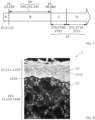
- FIG 8 shows a cross-sectional fluorescence microscopy image of the biomaterial, in which the nuclei 11' of the biological cells 11 and the cytokeratin 14 1111 are labeled.
- the arrangement of the fibroblasts in the porous matrix 10 and that of the keratinocytes above the upper face 1010 of the porous matrix 10 can be observed.
- the differentiated keratinocytes 1110' further have a cytokeratin cytoskeleton 1111.
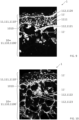
- FIG 9 represents a cross-sectional fluorescence microscopy image of the biomaterial 1, in which the nuclei 11' of the biological cells 11, the filaggrin 1120 and the type I collagen 1121 are labeled.
- the secreted extracellular matrix 112 can be observed, by the labeling of the proteins listed, respectively below and above the upper face 1010 of the porous matrix 10.
- FIG 10 represents a cross-sectional fluorescence microscopy image of the biomaterial 1, in which the nuclei 11 of the biological cells, fibrillin 1 1122 and elastin 1123 are labeled.
- the extracellular matrix 112 secreted by the fibroblasts 1100 can be observed in the porous matrix 10, by the labeling of the stated proteins.
- composition of the culture media 3 used is given in the following tables.
- the abbreviation "qsp" means quantity sufficient for the desired volume of solution.
- the percentages are given in volume relative to the desired volume of solution.
- the MC2 medium can be adapted by those skilled in the art to be compatible with clinical use.
- the skin biopsy is incubated for 3 hours at 37°C in sterile dispase II solution.
- the dermis and epidermis are then separated using sterile forceps and rinsed in sterile 1X PBS.
- the pieces of dermis obtained are then placed in a sterile solution of collagenase A at 0.5 mg/mL, with stirring, for 4 to 6 hours at 37°C. Then the solution is filtered through a 70 ⁇ m porosity sieve and centrifuged at 1200 rotations per minute (abbreviated rpm in the following) for 5 to 10 minutes. After resuspension of the pellet, the cell count and viability are evaluated. The fibroblasts are seeded at a density of 8,000 cells/cm 2 .
- Keratinocyte extraction epidermal pieces are incubated in 0.25% trypsin-EDTA at 37°C for 15 minutes. After adding trypsin inhibitor solution, the keratinocyte suspension is then filtered through a 70 ⁇ m porosity sieve, centrifuged at 1200 rpm for 5 to 10 minutes and the cell pellet thus obtained is resuspended in culture medium for assessment of cell count and viability. Keratinocytes are seeded at a density of 8000 cells/cm 2 .
- Fibroblasts and keratinocytes are cultured at 37°C in a humid atmosphere with 5% CO2 , the media are renewed 3 times a week and the cells are passed to sub-confluence by the action of EDTA trypsin.
- the porous matrix is hydrated for 6 to 48 hours prior to seeding the cells by a 1X PBS bath whose volume is sufficient to cover the upper face of the matrix.
- the PBS can then be aspirated.
- the porous matrix can be hydrated by a 2 to 3 hour bath in 1X PBS.
- fibroblasts are detached and dissociated by enzymatic action and counted.
- a cell suspension to obtain a cell density of 0.5.10 6 cells/cells/cm 2 is prepared.
- the fibroblast suspension is deposited drop by drop homogeneously on the upper face of the porous matrix. The fibroblasts are left to adhere for 1 hour in the incubator at 37°C and in an atmosphere of 5% CO2 .
- a sufficient volume to cover the upper surface of the porous matrix of MC1 medium with antibiotics but without EGF or vitamin C is added for fibroblast growth.
- the medium is renewed 3 times a week for 2-3 weeks with MC1 medium with the addition of antibiotics, EGF and vitamin C.
- keratinocytes are detached by enzymatic action and counted.
- a cell suspension at 0.5.10 6 cellscm 2 ) is prepared. After aspirating the culture medium from the formed dermal substitute, the latter can be transferred to a sterile compress to absorb maximum moisture.
- the keratinocyte cell suspension is deposited drop by drop homogeneously on the surface of the matrix, taking care that the cell suspension does not overflow onto the lateral faces of the porous matrix.
- the keratinocytes are left to adhere for 1 hour in the incubator at 37°C and in an atmosphere of 5% CO2 .
- a volume sufficient to cover the upper face of the MC2 medium matrix with antibiotics but without EGF or vitamin C is added to the matrix very delicately without touching the samples.
- the culture medium is renewed 3 times a week for 1 week with MC2 medium with the addition of antibiotics, EGF and vitamin C.
- the porous matrix is deposited after aspiration of the culture medium and drying on a sterile compress on sterile blotting paper itself placed on a metal grid.
- the volume of A/L medium supplemented with antibiotics and vitamin C is adjusted so that it is flush with the level of the blotting paper, avoiding the presence of bubbles trapped under the metal grid.
- the medium is renewed 3 times a week with the A/L medium containing antibiotics and vitamin C.
- the invention provides a biomaterial which more closely resembles a native tissue.
- the growth times and/or the composition of the media are adapted for other types of biological cells.
Landscapes
- Health & Medical Sciences (AREA)
- Life Sciences & Earth Sciences (AREA)
- Chemical & Material Sciences (AREA)
- Veterinary Medicine (AREA)
- Public Health (AREA)
- General Health & Medical Sciences (AREA)
- Animal Behavior & Ethology (AREA)
- Epidemiology (AREA)
- Engineering & Computer Science (AREA)
- Medicinal Chemistry (AREA)
- Dermatology (AREA)
- Biomedical Technology (AREA)
- Cell Biology (AREA)
- Zoology (AREA)
- Surgery (AREA)
- Transplantation (AREA)
- Oral & Maxillofacial Surgery (AREA)
- Pharmacology & Pharmacy (AREA)
- Chemical Kinetics & Catalysis (AREA)
- Materials Engineering (AREA)
- Biotechnology (AREA)
- Developmental Biology & Embryology (AREA)
- Immunology (AREA)
- Virology (AREA)
- Dispersion Chemistry (AREA)
- General Chemical & Material Sciences (AREA)
- Nuclear Medicine, Radiotherapy & Molecular Imaging (AREA)
- Organic Chemistry (AREA)
- Bioinformatics & Cheminformatics (AREA)
- Botany (AREA)
- Birds (AREA)
- Molecular Biology (AREA)
- Materials For Medical Uses (AREA)
- Micro-Organisms Or Cultivation Processes Thereof (AREA)
Claims (9)
- Verfahren (2) zum Herstellen eines Biomaterials (1), das Folgendes umfasst:• Bereitstellen (20) einer resorbierbaren porösen Matrix (10), die aus einem Kollagen enthaltenden Material gebildet ist, wobei die poröse Matrix (10) ein blutstillender Schwamm ist und ein Innenvolumen (100) und eine Außenoberfläche (101) aufweist, anschließend• Hydratisieren (20) der porösen Matrix (10), um den pH-Wert und die Osmolarität der porösen Matrix (10) auszugleichen,• nach dem Hydratisieren (20) der porösen Matrix (10), Trocknen (22) der porösen Matrix (10),• nach dem Trocknen (22) der porösen Matrix (10), Beimpfen (23) der porösen Matrix (10) mit mindestens einer Art (110) lebender biologischer Zellen (11) aus einem Gewebe, anschließend• ein Zellwachstum (24) von mindestens einer Art (110) biologischer Zellen (10),um ein Biomaterial (1) zu bilden, das Folgendes umfasst:• die poröse Matrix (10),• die mindestens eine Art (110) lebender biologischer Zellen (11) aus einem Gewebe, die im Innenvolumen (100) oder alternativ oder zusätzlich auf der Oberfläche (101) der porösen Matrix (10) angeordnet sind.
- Verfahren (2) nach dem vorhergehenden Anspruch, wobei das Beimpfen (23) der porösen Matrix (10) durch das Abscheiden (230) einer Suspension der mindestens einen Art (110) biologischer Zellen (11) auf der porösen Matrix (10) durchgeführt wird.
- Verfahren (2) nach einem der vorhergehenden Ansprüche, das ferner nach einem ersten Beimpfen (23) mit einer ersten Art (110) biologischer Zellen (11) bzw. nach dem ersten Beimpfen (23) und einem Teil mindestens eines Zellwachstums (24) der ersten Art (110) biologischer Zellen (11) ein zweites Beimpfen (26) der porösen Matrix (10) mit mindestens einer zweiten Art (111) biologischer Zellen (11), die sich von der ersten Art (110) ausgesäter biologischer Zellen (11) unterscheidet, und anschließend ein Zellwachstum (27) der mindestens einen zweiten Art (111) biologischer Zellen (11) umfasst.
- Verfahren (2) nach dem vorhergehenden Anspruch, das ferner ein Trocknen (25) der porösen Matrix (10) vor dem zweiten Beimpfen (26) der porösen Matrix (10) umfasst, wobei das zweite Beimpfen (26) durch das Abscheiden (260) einer Suspension der mindestens einen zweiten Art (111) biologischer Zellen (11) auf der porösen Matrix (10) durchgeführt wird.
- Verfahren (2) nach einem der vorhergehenden Ansprüche, wobei die biologischen Zellen (11) Zellen umfassen, die aus Bindegewebszellen und Epithelzellen ausgewählt sind.
- Verfahren (2) nach dem vorhergehenden Anspruch, wobei, wenn die biologischen Zellen (10) Bindegewebszellen sind, das Zellwachstum (24) ein Eintauchen (240) der porösen Matrix (10) in ein Kulturmedium (3) umfasst.
- Verfahren (2) nach einem der beiden vorhergehenden Ansprüche, wobei, wenn die biologischen Zellen (10) Epithelgewebezellen sind, das Zellwachstum (27) ein erstes Teilwachstum (270) umfasst, bei dem die poröse Matrix bis zu einer Konfluenz der biologischen Zellen (10) auf der Oberfläche der porösen Matrix (10) in ein Kulturmedium (3) eingetaucht wird (270a).
- Verfahren (2) nach dem vorhergehenden Anspruch, wobei das Wachstum (27) nach dem ersten Teilwachstum (270) eine Reifung (271) umfasst, bei der die poröse Matrix (10) an einer Grenzfläche zwischen Luft (4) und einem Kulturmedium (3) platziert wird.
- Verwendung eines Biomaterials (1), das durch das Verfahren nach einem der vorhergehenden Ansprüche hergestellt wird, wobei das Biomaterial (1) Folgendes umfasst:• eine resorbierbare poröse Matrix (10), die aus einem Kollagen enthaltenden Material gebildet ist, wobei die poröse Matrix (10) ein blutstillender Schwamm ist und ein Innenvolumen (100) und eine Außenoberfläche (101) aufweist, und• mindestens eine Art (110) lebender biologischer Zellen (11) aus einem Gewebe, die im Innenvolumen (100) und/oder auf der Oberfläche (101) der porösen Matrix (10) angeordnet sind,für eine In-vitro-Anwendung mindestens einer Substanz, die aus einer pharmazeutischen Substanz und einer kosmetischen Substanz ausgewählt ist.
Applications Claiming Priority (2)
| Application Number | Priority Date | Filing Date | Title |
|---|---|---|---|
| FR2003125A FR3108505B1 (fr) | 2020-03-30 | 2020-03-30 | Biomatériau comprenant une matrice poreuse résorbable et procédé de fabrication associé |
| PCT/EP2021/058151 WO2021198177A1 (fr) | 2020-03-30 | 2021-03-29 | Biomatériau comprenant une matrice poreuse résorbable et procédé de fabrication associé |
Publications (2)
| Publication Number | Publication Date |
|---|---|
| EP4125962A1 EP4125962A1 (de) | 2023-02-08 |
| EP4125962B1 true EP4125962B1 (de) | 2025-02-19 |
Family
ID=72560658
Family Applications (1)
| Application Number | Title | Priority Date | Filing Date |
|---|---|---|---|
| EP21714215.7A Active EP4125962B1 (de) | 2020-03-30 | 2021-03-29 | Biomaterial mit einer porösen resorbierbaren matrix und zugehöriges herstellungsverfahren |
Country Status (5)
| Country | Link |
|---|---|
| US (1) | US20230120975A1 (de) |
| EP (1) | EP4125962B1 (de) |
| CA (1) | CA3173560A1 (de) |
| FR (1) | FR3108505B1 (de) |
| WO (1) | WO2021198177A1 (de) |
Citations (1)
| Publication number | Priority date | Publication date | Assignee | Title |
|---|---|---|---|---|
| FR2809313B1 (fr) * | 2000-05-26 | 2005-11-18 | Coletica | Procedes de preparation de nouveaux supports a base de collagene pour l'ingenieurie tissulaire et biomateriaux obtenus |
Family Cites Families (6)
| Publication number | Priority date | Publication date | Assignee | Title |
|---|---|---|---|---|
| FR2616318A1 (fr) | 1987-06-15 | 1988-12-16 | Centre Nat Rech Scient | Peau artificielle et son procede de preparation |
| FI924773L (fi) * | 1990-04-24 | 1992-10-21 | Mark Eisenberg | Kompositionssubstituter av levande hud |
| CA2119064A1 (en) * | 1993-03-17 | 1994-09-18 | Richard A. Berg | Dermal-epidermal in vitro test system |
| US5891558A (en) * | 1994-11-22 | 1999-04-06 | Tissue Engineering, Inc. | Biopolymer foams for use in tissue repair and reconstruction |
| WO2005004928A2 (en) * | 2003-04-04 | 2005-01-20 | W.R. Grace & Co.-Conn. | Porous particulate collagen sponges |
| US20080281431A1 (en) * | 2007-05-10 | 2008-11-13 | Biomet Manufacturing Corp. | Resorbable bone graft materials |
-
2020
- 2020-03-30 FR FR2003125A patent/FR3108505B1/fr active Active
-
2021
- 2021-03-29 CA CA3173560A patent/CA3173560A1/fr active Pending
- 2021-03-29 US US17/915,676 patent/US20230120975A1/en active Pending
- 2021-03-29 EP EP21714215.7A patent/EP4125962B1/de active Active
- 2021-03-29 WO PCT/EP2021/058151 patent/WO2021198177A1/fr not_active Ceased
Patent Citations (1)
| Publication number | Priority date | Publication date | Assignee | Title |
|---|---|---|---|---|
| FR2809313B1 (fr) * | 2000-05-26 | 2005-11-18 | Coletica | Procedes de preparation de nouveaux supports a base de collagene pour l'ingenieurie tissulaire et biomateriaux obtenus |
Also Published As
| Publication number | Publication date |
|---|---|
| US20230120975A1 (en) | 2023-04-20 |
| CA3173560A1 (fr) | 2021-10-07 |
| FR3108505B1 (fr) | 2025-03-07 |
| WO2021198177A1 (fr) | 2021-10-07 |
| FR3108505A1 (fr) | 2021-10-01 |
| EP4125962A1 (de) | 2023-02-08 |
Similar Documents
| Publication | Publication Date | Title |
|---|---|---|
| KINIKOGLU et al. | Evolution of three dimensional skin equivalent models reconstructed in vitro by tissue engineering | |
| US6110208A (en) | Artificial skin containing as support biocompatible materials based on hyaluronic acid derivatives | |
| RU2461622C2 (ru) | Биоинженерный конструкт для имплантации ткани и способ изготовления названного биоинженерного конструкта (варианты) | |
| US10953140B2 (en) | Tissue graft | |
| Kinikoglu et al. | Reconstruction of a full-thickness collagen-based human oral mucosal equivalent | |
| JPH05506169A (ja) | 合成生体皮膚等価物 | |
| Lee et al. | Three-dimensional artificial skin construct bioprinted with a marine-based biocomposite | |
| CN1333818A (zh) | 生物工程化的组织构建物、其制备方法及其应用 | |
| JPWO2006075602A1 (ja) | 羊膜を用いたシート状組成物及びその作製方法 | |
| JP2009528856A (ja) | 口腔組織の再生および修復 | |
| JP2002526204A (ja) | 中和キトサンスポンジまたは中和キトサン/コラーゲン混合スポンジを用いる人工真皮構造物 | |
| US20200078492A1 (en) | Process for obtaining a functional dermal substitute of decellurized amniotic membrane from the placenta combination with keratinocytes and its use as an agent for tissue regeneration of the skin | |
| CN107261216A (zh) | 一种明胶海绵支架的制备方法 | |
| Qi et al. | Construction and characterization of human oral mucosa equivalent using hyper-dry amniotic membrane as a matrix | |
| KR20010072553A (ko) | 살아있는 키메릭 피부 대체물 | |
| JP3333108B2 (ja) | 上皮性組織移植片およびその製造方法 | |
| EP4125962B1 (de) | Biomaterial mit einer porösen resorbierbaren matrix und zugehöriges herstellungsverfahren | |
| Matoušková et al. | Human allogeneic keratinocytes cultured on acellular xenodermis: the use in healing of burns and other skin defects | |
| EP2714893B1 (de) | Rekonstruiertes kopfhautmodell und verfahren zum screening aktiver moleküle | |
| FR2927632A1 (fr) | Cornee et muqueuse reconstruites. | |
| CA2894811C (fr) | Pansement contenant des fibroblastes et des keratinocytes foetaux | |
| Scuderi et al. | The bioengineered organoid skin in plastic and reconstructive surgery |
Legal Events
| Date | Code | Title | Description |
|---|---|---|---|
| STAA | Information on the status of an ep patent application or granted ep patent |
Free format text: STATUS: UNKNOWN |
|
| STAA | Information on the status of an ep patent application or granted ep patent |
Free format text: STATUS: THE INTERNATIONAL PUBLICATION HAS BEEN MADE |
|
| PUAI | Public reference made under article 153(3) epc to a published international application that has entered the european phase |
Free format text: ORIGINAL CODE: 0009012 |
|
| STAA | Information on the status of an ep patent application or granted ep patent |
Free format text: STATUS: REQUEST FOR EXAMINATION WAS MADE |
|
| 17P | Request for examination filed |
Effective date: 20220926 |
|
| AK | Designated contracting states |
Kind code of ref document: A1 Designated state(s): AL AT BE BG CH CY CZ DE DK EE ES FI FR GB GR HR HU IE IS IT LI LT LU LV MC MK MT NL NO PL PT RO RS SE SI SK SM TR |
|
| DAV | Request for validation of the european patent (deleted) | ||
| DAX | Request for extension of the european patent (deleted) | ||
| GRAP | Despatch of communication of intention to grant a patent |
Free format text: ORIGINAL CODE: EPIDOSNIGR1 |
|
| STAA | Information on the status of an ep patent application or granted ep patent |
Free format text: STATUS: GRANT OF PATENT IS INTENDED |
|
| INTG | Intention to grant announced |
Effective date: 20240911 |
|
| RAP3 | Party data changed (applicant data changed or rights of an application transferred) |
Owner name: CENTRE NATIONAL DE LA RECHERCHE SCIENTIFIQUE Owner name: COMMISSARIAT A L'ENERGIE ATOMIQUE ET AUX ENERGIESALTERNATIVES Owner name: UNIVERSITE GRENOBLE ALPES |
|
| GRAS | Grant fee paid |
Free format text: ORIGINAL CODE: EPIDOSNIGR3 |
|
| GRAA | (expected) grant |
Free format text: ORIGINAL CODE: 0009210 |
|
| STAA | Information on the status of an ep patent application or granted ep patent |
Free format text: STATUS: THE PATENT HAS BEEN GRANTED |
|
| AK | Designated contracting states |
Kind code of ref document: B1 Designated state(s): AL AT BE BG CH CY CZ DE DK EE ES FI FR GB GR HR HU IE IS IT LI LT LU LV MC MK MT NL NO PL PT RO RS SE SI SK SM TR |
|
| REG | Reference to a national code |
Ref country code: GB Ref legal event code: FG4D Free format text: NOT ENGLISH |
|
| REG | Reference to a national code |
Ref country code: CH Ref legal event code: EP |
|
| REG | Reference to a national code |
Ref country code: IE Ref legal event code: FG4D Free format text: LANGUAGE OF EP DOCUMENT: FRENCH |
|
| REG | Reference to a national code |
Ref country code: DE Ref legal event code: R096 Ref document number: 602021026355 Country of ref document: DE |
|
| PGFP | Annual fee paid to national office [announced via postgrant information from national office to epo] |
Ref country code: AT Payment date: 20250417 Year of fee payment: 5 |
|
| REG | Reference to a national code |
Ref country code: NL Ref legal event code: MP Effective date: 20250219 |
|
| PG25 | Lapsed in a contracting state [announced via postgrant information from national office to epo] |
Ref country code: RS Free format text: LAPSE BECAUSE OF FAILURE TO SUBMIT A TRANSLATION OF THE DESCRIPTION OR TO PAY THE FEE WITHIN THE PRESCRIBED TIME-LIMIT Effective date: 20250519 |
|
| PG25 | Lapsed in a contracting state [announced via postgrant information from national office to epo] |
Ref country code: FI Free format text: LAPSE BECAUSE OF FAILURE TO SUBMIT A TRANSLATION OF THE DESCRIPTION OR TO PAY THE FEE WITHIN THE PRESCRIBED TIME-LIMIT Effective date: 20250219 |
|
| PG25 | Lapsed in a contracting state [announced via postgrant information from national office to epo] |
Ref country code: PL Free format text: LAPSE BECAUSE OF FAILURE TO SUBMIT A TRANSLATION OF THE DESCRIPTION OR TO PAY THE FEE WITHIN THE PRESCRIBED TIME-LIMIT Effective date: 20250219 |
|
| PG25 | Lapsed in a contracting state [announced via postgrant information from national office to epo] |
Ref country code: ES Free format text: LAPSE BECAUSE OF FAILURE TO SUBMIT A TRANSLATION OF THE DESCRIPTION OR TO PAY THE FEE WITHIN THE PRESCRIBED TIME-LIMIT Effective date: 20250219 |
|
| REG | Reference to a national code |
Ref country code: LT Ref legal event code: MG9D |
|
| PG25 | Lapsed in a contracting state [announced via postgrant information from national office to epo] |
Ref country code: IS Free format text: LAPSE BECAUSE OF FAILURE TO SUBMIT A TRANSLATION OF THE DESCRIPTION OR TO PAY THE FEE WITHIN THE PRESCRIBED TIME-LIMIT Effective date: 20250619 Ref country code: NO Free format text: LAPSE BECAUSE OF FAILURE TO SUBMIT A TRANSLATION OF THE DESCRIPTION OR TO PAY THE FEE WITHIN THE PRESCRIBED TIME-LIMIT Effective date: 20250519 |
|
| PG25 | Lapsed in a contracting state [announced via postgrant information from national office to epo] |
Ref country code: NL Free format text: LAPSE BECAUSE OF FAILURE TO SUBMIT A TRANSLATION OF THE DESCRIPTION OR TO PAY THE FEE WITHIN THE PRESCRIBED TIME-LIMIT Effective date: 20250219 |
|
| PG25 | Lapsed in a contracting state [announced via postgrant information from national office to epo] |
Ref country code: HR Free format text: LAPSE BECAUSE OF FAILURE TO SUBMIT A TRANSLATION OF THE DESCRIPTION OR TO PAY THE FEE WITHIN THE PRESCRIBED TIME-LIMIT Effective date: 20250219 |
|
| PG25 | Lapsed in a contracting state [announced via postgrant information from national office to epo] |
Ref country code: PT Free format text: LAPSE BECAUSE OF FAILURE TO SUBMIT A TRANSLATION OF THE DESCRIPTION OR TO PAY THE FEE WITHIN THE PRESCRIBED TIME-LIMIT Effective date: 20250620 Ref country code: LV Free format text: LAPSE BECAUSE OF FAILURE TO SUBMIT A TRANSLATION OF THE DESCRIPTION OR TO PAY THE FEE WITHIN THE PRESCRIBED TIME-LIMIT Effective date: 20250219 |
|
| PG25 | Lapsed in a contracting state [announced via postgrant information from national office to epo] |
Ref country code: BG Free format text: LAPSE BECAUSE OF FAILURE TO SUBMIT A TRANSLATION OF THE DESCRIPTION OR TO PAY THE FEE WITHIN THE PRESCRIBED TIME-LIMIT Effective date: 20250219 Ref country code: GR Free format text: LAPSE BECAUSE OF FAILURE TO SUBMIT A TRANSLATION OF THE DESCRIPTION OR TO PAY THE FEE WITHIN THE PRESCRIBED TIME-LIMIT Effective date: 20250520 |
|
| PGFP | Annual fee paid to national office [announced via postgrant information from national office to epo] |
Ref country code: CH Payment date: 20250424 Year of fee payment: 5 |
|
| REG | Reference to a national code |
Ref country code: AT Ref legal event code: MK05 Ref document number: 1767669 Country of ref document: AT Kind code of ref document: T Effective date: 20250219 |
|
| PG25 | Lapsed in a contracting state [announced via postgrant information from national office to epo] |
Ref country code: SE Free format text: LAPSE BECAUSE OF FAILURE TO SUBMIT A TRANSLATION OF THE DESCRIPTION OR TO PAY THE FEE WITHIN THE PRESCRIBED TIME-LIMIT Effective date: 20250219 |
|
| PG25 | Lapsed in a contracting state [announced via postgrant information from national office to epo] |
Ref country code: SM Free format text: LAPSE BECAUSE OF FAILURE TO SUBMIT A TRANSLATION OF THE DESCRIPTION OR TO PAY THE FEE WITHIN THE PRESCRIBED TIME-LIMIT Effective date: 20250219 |
|
| PG25 | Lapsed in a contracting state [announced via postgrant information from national office to epo] |
Ref country code: DK Free format text: LAPSE BECAUSE OF FAILURE TO SUBMIT A TRANSLATION OF THE DESCRIPTION OR TO PAY THE FEE WITHIN THE PRESCRIBED TIME-LIMIT Effective date: 20250219 |
|
| PG25 | Lapsed in a contracting state [announced via postgrant information from national office to epo] |
Ref country code: IT Free format text: LAPSE BECAUSE OF FAILURE TO SUBMIT A TRANSLATION OF THE DESCRIPTION OR TO PAY THE FEE WITHIN THE PRESCRIBED TIME-LIMIT Effective date: 20250219 |
|
| PG25 | Lapsed in a contracting state [announced via postgrant information from national office to epo] |
Ref country code: AT Free format text: LAPSE BECAUSE OF FAILURE TO SUBMIT A TRANSLATION OF THE DESCRIPTION OR TO PAY THE FEE WITHIN THE PRESCRIBED TIME-LIMIT Effective date: 20250219 |
|
| PG25 | Lapsed in a contracting state [announced via postgrant information from national office to epo] |
Ref country code: EE Free format text: LAPSE BECAUSE OF FAILURE TO SUBMIT A TRANSLATION OF THE DESCRIPTION OR TO PAY THE FEE WITHIN THE PRESCRIBED TIME-LIMIT Effective date: 20250219 Ref country code: CZ Free format text: LAPSE BECAUSE OF FAILURE TO SUBMIT A TRANSLATION OF THE DESCRIPTION OR TO PAY THE FEE WITHIN THE PRESCRIBED TIME-LIMIT Effective date: 20250219 |
|
| PG25 | Lapsed in a contracting state [announced via postgrant information from national office to epo] |
Ref country code: RO Free format text: LAPSE BECAUSE OF FAILURE TO SUBMIT A TRANSLATION OF THE DESCRIPTION OR TO PAY THE FEE WITHIN THE PRESCRIBED TIME-LIMIT Effective date: 20250219 |
|
| PG25 | Lapsed in a contracting state [announced via postgrant information from national office to epo] |
Ref country code: SK Free format text: LAPSE BECAUSE OF FAILURE TO SUBMIT A TRANSLATION OF THE DESCRIPTION OR TO PAY THE FEE WITHIN THE PRESCRIBED TIME-LIMIT Effective date: 20250219 |
|
| PG25 | Lapsed in a contracting state [announced via postgrant information from national office to epo] |
Ref country code: LU Free format text: LAPSE BECAUSE OF NON-PAYMENT OF DUE FEES Effective date: 20250329 |
|
| REG | Reference to a national code |
Ref country code: DE Ref legal event code: R097 Ref document number: 602021026355 Country of ref document: DE |
|
| PG25 | Lapsed in a contracting state [announced via postgrant information from national office to epo] |
Ref country code: MC Free format text: LAPSE BECAUSE OF FAILURE TO SUBMIT A TRANSLATION OF THE DESCRIPTION OR TO PAY THE FEE WITHIN THE PRESCRIBED TIME-LIMIT Effective date: 20250219 |
|
| PLBE | No opposition filed within time limit |
Free format text: ORIGINAL CODE: 0009261 |
|
| STAA | Information on the status of an ep patent application or granted ep patent |
Free format text: STATUS: NO OPPOSITION FILED WITHIN TIME LIMIT |
|
| REG | Reference to a national code |
Ref country code: CH Ref legal event code: L10 Free format text: ST27 STATUS EVENT CODE: U-0-0-L10-L00 (AS PROVIDED BY THE NATIONAL OFFICE) Effective date: 20251231 |
|
| PG25 | Lapsed in a contracting state [announced via postgrant information from national office to epo] |
Ref country code: IE Free format text: LAPSE BECAUSE OF NON-PAYMENT OF DUE FEES Effective date: 20250329 |
|
| 26N | No opposition filed |
Effective date: 20251120 |
|
| REG | Reference to a national code |
Ref country code: CH Ref legal event code: U11 Free format text: ST27 STATUS EVENT CODE: U-0-0-U10-U11 (AS PROVIDED BY THE NATIONAL OFFICE) Effective date: 20260401 |
|
| PGFP | Annual fee paid to national office [announced via postgrant information from national office to epo] |
Ref country code: GB Payment date: 20260323 Year of fee payment: 6 |
|
| PGFP | Annual fee paid to national office [announced via postgrant information from national office to epo] |
Ref country code: DE Payment date: 20260313 Year of fee payment: 6 |
|
| PGFP | Annual fee paid to national office [announced via postgrant information from national office to epo] |
Ref country code: BE Payment date: 20260324 Year of fee payment: 6 |
|
| PGFP | Annual fee paid to national office [announced via postgrant information from national office to epo] |
Ref country code: FR Payment date: 20260312 Year of fee payment: 6 |