EP4125470B1 - Verfahren zur herstellung eines kleidungsstücks - Google Patents
Verfahren zur herstellung eines kleidungsstücks Download PDFInfo
- Publication number
- EP4125470B1 EP4125470B1 EP21713767.8A EP21713767A EP4125470B1 EP 4125470 B1 EP4125470 B1 EP 4125470B1 EP 21713767 A EP21713767 A EP 21713767A EP 4125470 B1 EP4125470 B1 EP 4125470B1
- Authority
- EP
- European Patent Office
- Prior art keywords
- textile article
- tubular textile
- garment
- cutting
- trunk
- Prior art date
- Legal status (The legal status is an assumption and is not a legal conclusion. Google has not performed a legal analysis and makes no representation as to the accuracy of the status listed.)
- Active
Links
Images


Classifications
-
- A—HUMAN NECESSITIES
- A41—WEARING APPAREL
- A41D—OUTERWEAR; PROTECTIVE GARMENTS; ACCESSORIES
- A41D1/00—Garments
- A41D1/04—Vests, jerseys, sweaters or the like
-
- A—HUMAN NECESSITIES
- A41—WEARING APPAREL
- A41D—OUTERWEAR; PROTECTIVE GARMENTS; ACCESSORIES
- A41D27/00—Details of garments or of their making
- A41D27/10—Sleeves; Armholes
-
- A—HUMAN NECESSITIES
- A41—WEARING APPAREL
- A41D—OUTERWEAR; PROTECTIVE GARMENTS; ACCESSORIES
- A41D27/00—Details of garments or of their making
- A41D27/24—Hems; Seams
-
- A—HUMAN NECESSITIES
- A41—WEARING APPAREL
- A41H—APPLIANCES OR METHODS FOR MAKING CLOTHES, e.g. FOR DRESS-MAKING OR FOR TAILORING, NOT OTHERWISE PROVIDED FOR
- A41H3/00—Patterns for cutting-out; Methods of drafting or marking-out such patterns, e.g. on the cloth
- A41H3/08—Patterns on the cloth, e.g. printed
-
- D—TEXTILES; PAPER
- D04—BRAIDING; LACE-MAKING; KNITTING; TRIMMINGS; NON-WOVEN FABRICS
- D04B—KNITTING
- D04B1/00—Weft knitting processes for the production of fabrics or articles not dependent on the use of particular machines; Fabrics or articles defined by such processes
- D04B1/22—Weft knitting processes for the production of fabrics or articles not dependent on the use of particular machines; Fabrics or articles defined by such processes specially adapted for knitting goods of particular configuration
- D04B1/24—Weft knitting processes for the production of fabrics or articles not dependent on the use of particular machines; Fabrics or articles defined by such processes specially adapted for knitting goods of particular configuration wearing apparel
- D04B1/246—Upper torso garments, e.g. sweaters, shirts, leotards
-
- A—HUMAN NECESSITIES
- A41—WEARING APPAREL
- A41D—OUTERWEAR; PROTECTIVE GARMENTS; ACCESSORIES
- A41D2500/00—Materials for garments
- A41D2500/10—Knitted
Definitions
- the present invention relates to a process for making a garment, in particular, a sweater, from a tubular textile article.
- This garment is provided at least with a trunk and two sleeves and is designed to be worn on a person's torso.
- the tubular textile article used in the process of the present invention is preferably made with a circular knitting machine, in particular for knitted or hosiery items.
- the invention further relates to a garment obtained with this process.
- the present invention falls into the technical field of making and manufacturing garments, in particular sweaters, shirts, T-shirts and in general garments designed to be worn onto one's torso.
- the present invention falls into the technical field of circular textile machines for knitted items, seamless knitted items, hosiery items and the like.
- a typical example of a process for making a sweater or T-shirt i.e. a garment provided with a trunk, two sleeves and an opening for one's neck, by means of tubular textile items (i.e. made with circular, and not linear, textile machines) usually includes making at least three distinct tubular elements: a first tubular element makes up the body of the sweater, i.e. is designed to cover the user's torso, whereas a third and a fourth tubular element make up the two sleeves of the sweater.
- further elements such as a collar, pockets, etc. can be added.
- the two tubular elements making up the sleeves can also be obtained from one longer tubular element, which is then divided into the two elements.
- the diameter of the needle-holding cylinder of the circular textile machines determines the sweater size, since the diameter of the tubular article that can be obtained, and thus the size of the sweater trunk, are related to it.
- Document CN101653295A proposes a method for manufacturing multiple garments, in particular T-shirts, from a large roll of tubular textile material that is properly cut so that the final garment is then obtained with few stitching operations.
- Document EP3856964A1 discloses a method for making garments, and garments, in line with some aspects of the present disclosure.
- a further drawback of known processes is the small volume of garments that can be made pro time unit, due to the long time required for making the various fabric portions and to the complexity of manufacturing operations.
- a further drawback of known processes is also the difficulty of obtaining products with uniform features and quality, due to the complexity of manufacturing operations.
- seams reduce the comfort and wearability of the garment, and this is particularly important for underwear articles or sports shirts (i.e. sports shirts made of technical fabric), which adhere to the user's skin.
- seams especially in some areas of the garment, can cause irritations or anyhow reduce the comfort of the garment during use, especially long use.
- the aim underlying the present invention in its various aspects and/or embodiments is to provide a process for making a garment and a garment obtained by means of this process, which can obviate one or more of the drawbacks referred to above.
- a further aim of the present invention is to provide a process for making a garment, characterized by a reduced complexity of operations and by lower costs than known solutions.
- a further aim of the present invention is to provide a process for making a garment, which allows to reduce the time needed for producing a garment with respect to known solutions.
- a further aim of the present invention is to provide a process for making a garment, which can be automated and implemented by means of an automated manufacturing line.
- a further aim of the present invention is to provide a process for making a garment, which allows to reduce processing scraps.
- a further aim of the present invention is to provide a process for making a garment, characterized by lower costs for the finished article than known solutions.
- a further aim of the present invention is to provide a process for making a garment, which allows to reduce errors during production and manufacturing, in order to obtain garments without inaccuracies.
- a further aim of the present invention is to provide a process for making a garment, which allows to obtain products with high quality and uniform features.
- a further aim of the present invention is to provide a process for making a garment, which allows to obtain garments characterized by a better wearability and comfort for the user, in particular for garments such as underwear and sports shirts or sweaters.
- Another aim of the present invention is to propose a process that enables to make garments, and in particular sweaters, with specific aesthetic features.
- Another aim of the present invention is to propose a process that enables to make garments, and in particular sweaters, in an economically competitive manner.
- a further aim of the present invention is to create alternative solutions to the prior art for designing, making and manufacturing garments, in particular of the type provided with a trunk and two sleeves, and/or to open new design possibilities.
- the invention relates to a process for making a garment, said garment being in particular a sweater or similar garment provided with at least one trunk, a right sleeve and a left sleeve.
- the process comprises the following steps:
- a front side and a rear side are definable, divided from each other with respect to a median plane.
- the median plane vertically divides the tubular textile article substantially in two halves, corresponding to said front and rear side.
- the process comprises the step of defining or identifying a plurality of cutting lines on said tubular textile article.
- the process comprises the step of cutting the tubular textile article along said plurality of cutting lines so as to define and separate from one another a plurality of fabric portions of the tubular textile article, each fabric portion belonging to said front side, or to said rear side, or partially to the front side and partially to the rear side.
- said fabric portions are divided from one another, by means of the cutting lines, though at least partially joined (i.e. connected) in the tubular textile article (which remains as one piece).
- the process comprises the step of joining said fabric portions of the tubular textile article in order to obtain the trunk of the garment, the right sleeve and the left sleeve.
- the garment obtained from the tubular article exhibits zones of passage between the trunk and the right and left sleeves lacking seams or discontinuities in the fabric, i.e. the passage from the fabric of the trunk to the fabric of the right and left sleeves occurs at least partially without interruptions (i.e. seamlessly).
- the aforesaid zones of passage between the trunk and the right and left sleeves are the zones of the garment located, both on the front and on the rear side, between the shoulders and the armpits.
- the garment does not exhibits seams, discontinuities or joints, either on the right armhole or on the left armhole. In one aspect, both on the front and on the back of the garment there is a direct (continuous) passage of the fabric from the trunk to the sleeves, without the presence of right or left armhole.
- the garment is without right and left armholes.
- said fabric portions comprise at least:
- said step of joining said fabric portions comprises:
- said front trunk portion and said rear trunk portion are separated from one another by said left sleeve portion and said right sleeve portion.
- said step of cutting the tubular textile article creates, by following a circumferential extension of the tubular textile article around the central axis, an alternation between a trunk portion and a sleeve portion.
- said step of cutting the tubular textile article creates, by following a circumferential extension of the tubular textile article around the central axis, the following alternation of portions: front trunk portion, right sleeve portion, rear trunk portion, left sleeve portion.
- said median plane of the tubular textile article passes through said central axis or is parallel thereto.
- said front side and said rear side develop continuously one after the other, thus forming said cylindrical surface of the tubular textile article.
- the lower edge and the upper edge have a substantially circumferential shape.
- a single tubular textile article is produced, which allows to make trunk and sleeves of the garment as one piece.
- the trunk, the right sleeve and the left sleeve are globally at least partially joined and continuous one after the other in a one-piece fabric.
- said trunk, said right sleeve and said left sleeve, belonging to the same tubular textile article, are never detached or separate from one another, said garment being made as one piece starting from the tubular textile article.
- said fabric portions as a result of said step of cutting the tubular textile article, are not divided or separated completely from one another, but remain at least partially joined within the one-piece tubular textile article.
- the front side is always at least partially connected in a continuous manner to the rear side of the tubular article, also as a result of the cuts made along said cutting lines.
- the front side and the rear side remain connected in the high part of the torso and in the areas around the shoulders of the garment.
- said tubular textile article is a single layer fabric.
- said tubular textile article is a double layer fabric.
- said step of defining or identifying, on said tubular textile article, a plurality of cutting lines comprises one or more of the following operations:
- said step of defining or identifying a plurality of cutting lines on said tubular textile article can be carried out directly during the step of cutting the tubular textile article, e.g. manually by an operator.
- said cutting lines all start from said lower edge of the tubular textile article and develop towards said upper edge.
- said cutting lines developing from said lower edge end into the tubular textile article before reaching the upper edge, i.e. they do not end or lead onto the upper edge.
- said cutting lines are interrupted in an intermediate portion of the tubular textile article between the lower edge and the upper edge.
- said cutting lines do not (never) cause said tubular article to be opened, i.e. the textile article maintains at least one continuous tubular fabric portion which is closed all around the central axis.
- said cutting lines are never such as to make the textile article a sheet fabric, i.e. no longer tubular.
- none of said cutting lines develops between, or joins, said lower edge and said upper edge.
- said cutting lines develop longitudinally from said lower edge of the tubular textile article following a direction that substantially corresponds to the longitudinal development of the tubular textile article from the lower edge to the upper edge, i.e. corresponding or parallel to the central axis of the tubular textile article.
- said step of joining said fabric portions occurs by means of seams, or the like, made between the fabric portions to be joined.
- each of said cutting lines creates two fabric margins belonging to two adjacent fabric portions, the two margins being at the sides of the cutting line.
- said plurality of cutting lines comprises at least one first cutting line, one second cutting line, one third cutting line and one fourth cutting line, wherein:
- each of said first, second, third and fourth cutting lines has a linear development, possibly with curves, from its beginning on the lower edge to its end point in the respective side of the tubular textile article.
- one or more of said first, second, third and fourth cutting lines can be shaped as an elongated upside down "V", wherein said "V” is obtained starting from the lower edge of the tubular article, up towards said upper edge as far as a given point and then down until ending again onto the lower edge, in a point at a lateral distance from the starting point, so as to create a "V-shaped fabric piece corresponding to the shape defined by the cutting line.
- one or more of the cutting lines can be variously shaped or undulated in order to obtain a specific three-dimensional shape of the trunk and of the sleeves in the finished garment.
- said first junction line and said third junction line are located in series to one another, in a continuous manner, so as to form a continuous (seamless) right junction line, i.e. an upper end of the first junction line coincides with an upper end of the third junction line, so that one can pass seamlessly from the first junction line to the third junction line (or vice versa).
- this point of passage from the first junction line to the third junction line is designed to be in a position corresponding, with the garment in use, to the user's right armhole.
- the upper end of the first junction line and the upper end of the third junction line correspond to the respective terminal points both of the first cutting line and of the third cutting line.
- the lower end of the first junction line connects the lower point of the right margin of the front trunk portion and the lower point of the right margin of the rear trunk portion, both these lower points being placed on the lower edge of the tubular textile article.
- the lower end of the third junction line connects the lower point of the front margin of the right sleeve portion and the lower point of the rear margin of the right sleeve portion, both these lower points being placed on the lower edge of the tubular textile article.
- said right junction line develops, preferably in a seamless manner, starting from the lower end of the first junction line, proceeds (up towards the upper edge of the tubular textile article) as far as said point of passage from the first junction line to the third junction line, then further proceeds (down towards the lower edge of the tubular textile article) as far as said lower end of the third junction line, where it ends.
- said second junction line and said fourth junction line are located in series to one another, in a continuous manner, so as to form a continuous (seamless) left junction line, i.e. an upper end of the second junction line coincides with an upper end of the fourth junction line, so that one can pass seamlessly from the second junction line to the fourth junction line (or vice versa).
- this point of passage from the second junction line to the fourth junction line is designed to be in a position corresponding, with the garment in use, to the user's left armhole.
- the upper end of the second junction line and the upper beginning of the fourth junction line correspond to respective terminal points of the second cutting line and of the fourth cutting line.
- the lower end of the second junction line connects the lower point of the left margin of the front trunk portion and the lower point of the left margin of the rear trunk portion, both these lower points being placed on the lower edge of the tubular textile article.
- the lower end of the fourth junction line connects the lower point of the front margin of the left sleeve portion and the lower point of the rear margin of the left sleeve portion, both these lower points being placed on the lower edge of the tubular textile article.
- said left junction line develops, preferably in a seamless manner, starting from the lower end of the second junction line, proceeds (up towards the upper edge of the tubular textile article) as far as said point of passage from the second junction line to the fourth junction line, then further proceeds (down towards the lower edge of the tubular textile article) as far as said lower end of the fourth junction line, where it ends.
- the process comprises the step of applying a right insert to the tubular textile article, in a position comprised between said first junction line and said third junction line, in a manner such that the right insert is interposed between, and connecting, said first junction line (in particular the upper end of the first junction line) and said third junction line (in particular the upper end of the third junction line), said right insert being intended to be, with garment in use, on the user's right armhole.
- the process comprises the step of applying a left insert to the tubular textile article, in a position comprised between said second junction line and said fourth junction line, in a manner such that the left insert is interposed between, and connecting, said second first junction line (in particular the upper end of the second junction line) and said fourth junction line (in particular the upper end of the fourth junction line), said left insert being intended to be, with garment in use, on the user's left armhole.
- said right insert and said left insert are configured for eliminating discontinuities that can be present between the first and the third junction line and between the second and the fourth junction line, respectively.
- said right insert and said left insert are configured for avoiding the presence of junction lines, e.g. seams, in the two zones of the garment intended to be, with the garment in use, on the user's armholes.
- said right insert and said left insert are configured for suitably shaping the garment in the two zones of the garment itself intended to be with the garment in use, on the user's armholes.
- said right insert and said left insert are obtained from the same tubular textile article on which the fabric portions forming the trunk, the right and left sleeves are defined, e.g. from waste portions obtained after the cutting step.
- said right insert and said left insert are made of breathable fabric.
- said right insert and said left insert are made of reinforcing fabric.
- the process comprises the step of applying to the tubular textile article one or more inserts in specific positions along one or more junction lines.
- each of said inserts is intended to be interposed along a specific junction line, locally interrupting, on the position where it is located, the continuity of such junction line.
- such insert can locally interrupt or open the seam; in particular is interrupted at the beginning of the insert, proceeds on the sides of the itself and is resumed at the end of the insert.
- said insert is configured for suitably shaping the garment in the zone of the garment itself where it is positioned, and/or for providing such zone with particular characteristics of elasticity or compression or breathability and/or specific aesthetic or technical characteristics.
- the process includes a step of suitably sizing the trunk and the right and left sleeves in a manner such that the right and left sleeves are longer than the trunk of the garment.
- the respective lower ends of the right sleeve and of the left sleeve have a lengthwise extension that terminates, once the garment is completed, lower than the lower end of the trunk.
- the two sleeves proceed, in the lower part of the garment, as far as a point, at a distance from the top of the garment (with shoulders and neck), that is higher than the point reached by the end of the trunk (always referred to the top of the garment).
- said sizing step is executed in said step of producing a tubular textile article, in a manner such that the parts of the tubular textile article intended, following the cuts, to form the right sleeve portion and the left sleeve portion are longer than the parts of the tubular textile article intended, following the cuts, to form the front trunk portion and the rear trunk portion.
- said sizing step comprises a step of removing a lower section of the front trunk portion and a lower section of the rear trunk portion, in a manner such to shorten such portions with respect to the right sleeve and left sleeve portions, obtaining a trunk that is shorter than the sleeves.
- the length reduction of the front trunk portion and the length reduction of the rear trunk portion are identical to one another; in this case, the two lower sections removed from the two trunk portions are substantially identical.
- the sections removed are horizontal strips cut starting from the lower edge of the tubular textile article.
- the original lower edge of the textile article, as obtained from the step for producing the same is left only on the lower ends of the right sleeve and of the left sleeve.
- the process comprises a step of making a double hem on the lower edge of the trunk of the garment and comprises a step of making respective double hems on the respective lower ends of each of the two right and left sleeves.
- Said step of making a double hem is performed simultaneously with the step of producing the tubular textile article, by making a double fabric, or cuff, on the lower edge of the tubular textile article.
- the tubular textile article is already produced with the entire lower edge made of double fabric for the entire circumferential extension thereof and, following the steps of cutting the tubular textile article and joining the fabric portions obtained, the trunk and/or the right sleeve and/or the left sleeve are already provided with a respective double hem on the lower end thereof.
- the front side and the rear side represent two halves of the tubular textile article.
- the front side and the rear side may not be exactly two halves of the tubular textile article; in this case the median plane does not go through the central axis.
- said plurality of cutting lines comprises a fifth cutting line and a sixth cutting line, wherein:
- the fifth cutting line and the sixth cutting line intersect said median plane, preferably on two diametrically opposite points with respect to the central axis.
- said specific heights to which the fifth cutting line and the sixth cutting line descend are the lowest points, i.e. closer to the lower edge and farther apart from the upper edge, reached by the fifth and sixth cutting line.
- said specific heights to which the fifth cutting line and the sixth cutting line descend are located substantially on the median plane.
- the fifth cutting line and the sixth cutting line are identical to one another and specular to a plane orthogonal to the median plane.
- the fifth cutting line and the sixth cutting line are made up each of two halves identical to one another and specular to the median plane, wherein a first half is extended from the upper edge of the front side to said specific lower height, and a second half is extended from the upper edge of the rear side to said specific height, said two halves meeting in the point at said specific height.
- the opening for the neck is present between the fifth junction line and the sixth junction line.
- such machine is a circular textile machine for seamless knitted items.
- the present invention relates to a garment, in particular a sweater or similar garment provided at least with a trunk, a right sleeve and a left sleeve, made by the process according to any one of the aspects and/or of the claims.
- the present invention relates to a garment, in particular a sweater or similar garment provided with at least a trunk, a right sleeve and a left sleeve, obtained from a tubular textile article, preferably by means of a circular textile machine, wherein the tubular textile article with which the garment is made has a shape substantially with cylindrical surface extended continuously a central axis of the article between an upper edge and a lower edge, and wherein on said tubular textile article a front side and a rear side are definable, divided from each other with respect to a median plane vertically dividing the tubular textile article substantially into two halves, corresponding to said front side and said rear side.
- the tubular textile article of the garment is cut along a plurality of cutting lines in order to define and separate a plurality of fabric portions of the tubular textile article from each other, each fabric portion belonging to said front side, or to said rear side, or partially to the front side and partially to the rear side; wherein said fabric portions are separate from each other, by means of the cutting lines, but at least partially connected in the tubular textile article.
- said fabric portions of the garment are joined, for example by means of seams, in order to obtain the trunk of the garment, the right sleeve and the left sleeve.
- the garment obtained as a result of the joining of the fabric portions has passage zones between the trunk and the right and left sleeves lacking seams or discontinuities in the fabric, i.e. the passage from the fabric of the trunk to the fabric of the right and left sleeves occurs without interruptions.
- the garment has its right and left sleeves that are longer than the trunk.
- the respective lower ends of the right sleeve and of the left sleeve have a lengthwise extension that terminates, once the garment is completed, lower than the lower end of the trunk.
- the numeral 1 globally designates a garment according to the present invention.
- the same numeral is used for identical or similar elements, if applicable in their variants of embodiment.
- Such garment 1 is in particular a sweater provided at least with a trunk T, a right sleeve MD and a left sleeve MS.
- the garment can take the most various embodiments (T-shirts, sweaters, short or long sleeve shirts, etc.) having in common the structural presence of a trunk and two sleeves.
- the garment 1 shown in the figures is preferably made by the process forming the object of the present invention.
- This method comprises at least the following steps:
- the process can further comprise the following steps:
- each fabric portion belongs either to the front side 6 or to the rear side 7, or partially to the front side 6 and partially to the rear side. In the latter case, the fabric portion is divided on both sides 6 and 7, i.e. it is made up of a part belonging to the front side 6 and of a part belonging to the rear side 7.
- the garment 1 obtained from the tubular textile article 3 has zones of passage between the trunk T and the right MD and left MS sleeves lacking seams or discontinuities in the fabric, i.e. the passage from the fabric of the trunk T to the fabric of the right MD and left MS sleeves occurs without interruptions.
- the aforesaid zones of passage between the trunk T and the right MD and left MS sleeves are the zones of the garment located both on the front side, between shoulder and armpit, and similarly on the rear side.
- the garment 1 does not exhibits seams, discontinuities or joints, either on the right armhole or on the left armhole.
- the garment according to the present invention does not have armholes as typically present in known solutions. This means that, both on the front and on the back of the garment, there is a direct (continuous) passage of the fabric from the trunk to the sleeves, without the presence of right or left armhole.
- the tubular textile article 3 is preferably made by means of a circular textile machine, provided with a needle-holding cylinder housing a plurality of needles and able to rotate around a main axis of the needle-holding cylinder.
- the needle-holding cylinder can exhibit a variable diameter depending on the textile needs or on the size to be obtained for the tubular textile article (e.g. the diameter thereof). More to the point, the diameter of the needle-holding cylinder can be selected based on the size of the garment to be made starting from the tubular textile article.
- the diameter of the needle-holding cylinder can be 10.16 cm, 20.32 cm, 40.64 cm, 60.96 cm etc. ( 4 inches, 8 inches, 16 inches, 24 inches, etc. ).
- the needle-holder cylinder can also be a needle-holder plate.
- the knitting machine and its components are not shown in detail in the figures, since they are known per se and of conventional type. From the point of view of the textile technology, the operation of the whole textile machine (e.g. the interaction of control elements and needles, the cooperation between needles and threads, etc.) is not described in detail since it is known in the technical field of the present invention.
- such machine is a circular textile machine for seamless knitted items.
- the aforesaid portions comprise at least:
- the step of joining the fabric portions comprises the following steps:
- the front trunk portion 11 and the rear trunk portion 21 are separated from one another by the left sleeve portion MS and the right sleeve portion MD.
- the step of cutting the tubular textile article 3 creates, by following a circumferential extension of the tubular textile article around the central axis X, an alternation between a trunk portion (11 or 21) and a sleeve portion (31 or 41).
- the step of cutting the tubular textile article 3 creates, by following a circumferential extension of the tubular textile article around the central axis X, the following alternation of portions: front trunk portion 11, right sleeve portion 31, rear trunk portion 21, left sleeve portion 41.
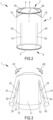
- the median plane A of the tubular textile article 3 passes through the central axis X (as shown by way of example in Figure 1B ) or is parallel thereto. It should be noted that both the central axis X and the median plane A are oriented in the same direction as the longitudinal development of the tubular textile article, i.e. from the upper edge to the lower edge (or vice versa).
- the front side 6 and the rear side 7 develop in a continuous manner one after the other, thus forming the aforesaid cylindrical surface of the tubular textile article 3.
- the lower edge 5 and the upper edge 4 have a substantially circumferential shape.
- the lower edge 5 is above and the upper edge 4 is below: however, the tubular textile article 3 can be turned upside down (i.e. rotated of 180°), i.e. the two edges can be inserted without consequences on the implementation of the invention.
- the lower edge can correspond to the part which the production of the tubular textile article begins with, whereas the upper edge corresponds to the terminal part of the tubular textile article; or vice versa.
- a single tubular textile article 3 is produced, which allows to make trunk T and right MD and left MS sleeves of the garment 1 as one piece.
- the trunk T, the right sleeve MD and the left sleeve MS are globally at least partially joined and continuous one after the other in a one-piece fabric.
- the trunk T, the right sleeve MD and the left sleeve MS, belonging to the same tubular textile article 3, are never detached or separate from one another; the garment is made as one piece starting from the tubular textile article.
- the fabric portions 11, 21, 31 and 41 as a result of the step of cutting the tubular textile article 3, are not divided or separated completely from one another, but remain at least partially joined in the one-piece tubular textile article.
- the front side 6 is always at least partially connected in a continuous manner to the rear side 7 of the tubular article 3, also as a result of the cuts made along the cutting lines.
- the front side 6 and the rear side 7 remain connected in the high part of the torso and in the areas around the shoulders of the garment.
- the step of producing the tubular textile article to the end of the step of making or manufacturing the garment, there is never a step of longitudinally cutting the tubular textile article from the lower edge to the upper edge (or vice versa) or a step of opening the tubular textile article obtaining a flat (and not a cylindrical) piece of fabric.
- such tubular textile article 3 is a single layer fabric.
- the tubular textile article can be a double layer fabric.
- the step of defining or identifying on the tubular textile article 3 a plurality of cutting lines (51, 52, 53, 54) is implemented by executing one or more of the following operations:
- the step of defining or identifying a plurality of cutting lines on the tubular textile article can be carried out directly during the step of cutting the tubular textile article, e.g. manually by an operator.
- the cutting lines (51, 52, 53, 54) all start from the lower edge 5 of the tubular textile article 3 and develop towards the upper edge 4.
- the cutting lines developing from the lower edge 5 end into the tubular textile article 3 before reaching the upper edge, i.e. they do not end or lead onto the upper edge 4.
- the cutting lines (51, 52, 53, 54) are interrupted in an intermediate portion of the tubular textile article 3 between the lower edge 5 and the upper edge 4.
- the cutting lines do not (never) cause the tubular article to be opened, i.e. the textile article maintains at least one continuous tubular fabric portion which is closed all around the central axis X.
- the cutting lines are never such as to make the textile article a sheet fabric, i.e. no longer tubular.
- none of the cutting lines (51, 52, 53, 54) develops between or joins the lower edge 5 and the upper edge 4.
- the cutting lines (51, 52, 53, 54) develop longitudinally from the lower edge 5 of the tubular textile article 3 following a direction that substantially corresponds to the longitudinal development of the tubular textile article from the lower edge to the upper edge 4, i.e. corresponding or parallel to the central axis X of the tubular textile article.
- the step of joining the fabric portions (11, 21, 31, 41) occurs by means of several seams, or similar, between the fabric portions to be joined.
- each of the cutting lines creates, as a result of the cutting operation executed along the line, two fabric margins belonging to two adjacent fabric portions, the two margins being at the sides of the cutting line.
- the plurality of cutting lines comprises at least one first cutting line 51, one second cutting line 52, one third cutting line 53 and one fourth cutting line 54, wherein:
- “Laterally extended” means perpendicularly to the direction of development of the tubular article, or according to a circumferential (or angular) direction around the central axis.
- each of said first 51, second 52, third 53 and fourth 54 cutting lines has a linear development, possibly with curves, from its beginning on the lower edge 5 to its end point in the respective side of the tubular textile article 3.
- one or more of said first, second, third and fourth cutting lines can be shaped as an elongated upside down “V", wherein said "V” is obtained starting from the lower edge of the tubular article, up towards the upper edge as far as a given (maximum) point and then down until ending again onto the lower edge, in a point at a lateral distance from the starting point, so as to create a "V"-shaped fabric piece corresponding to the shape defined by the cutting line.
- the cut when the cutting line is linear, the cut creates directly the two margins on the right and left of the line itself, whereas when the cutting line is "V" shaped, the cut, while creating the two right and left margins, removes the V-shaped fabric piece contained inside the "V-shaped cutting line and comprised between the two margins thus obtained.
- V instead of linear cutting lines, and the subsequent removal of the material included in the "V”s during the cutting operation, allows to obtain specific shaped in the garment once manufactured.
- the "V" shape of the cutting lines allows to obtain side cuts on the trunk, i.e. hollows on the sides which make the garment adhering and well fitted to the person, in particular to the part adhering to the waist.
- V shape of the cutting lines can also allow to obtain a specific narrowing of the diameter of the sleeves towards the wrists.
- one or more of the cutting lines can be variously shaped or undulated in order to obtain a specific three-dimensional shape of the trunk and of the sleeves in the finished garment.
- first 61 and the second 62 junction line complete the connection of the front trunk portion 11 with the rear trunk portion 21, thus making the trunk T of the garment 1.
- the third junction line 63 closes and completes the right sleeve MD of the garment
- the fourth junction line 64 closes and completes the left sleeve MS of the garment.
- the first junction line 61, the second junction line 62, the third junction line 63 and the fourth junction line 64 are seams made between the two involved fabric margins.
- each junction line can be obtained with analogous methods, e.g. as taping, gluing or welding.
- first junction line 61 represents a right side line (or seam) of the trunk T
- second junction line 62 presents a left side line (or seam) of the trunk T.
- junction line 63 represents an inner line (or seam) of the right sleeve MD (pointing to the right side of the trunk)
- fourth junction line 64 represents an inner line (or seam) of the left sleeve MS (pointing to the left side of the trunk).
- the first junction line 61 and the third junction line 63 are located in series to one another, in a continuous manner, so as to form a continuous (seamless) right junction line 71.
- an upper end of the first junction line 61 coincides with an upper end of the third junction line 63, so that one can pass seamlessly from the first junction line to the third junction line (or vice versa).
- this point of passage (identified with numeral 72 in Figure 4 ) from the first junction line 61 to the third junction line 63 is designed to be in a position corresponding, with the garment in use, to the user's right armhole.
- the upper end of the first junction line 61 and the upper end of the third junction line 63 correspond to the respective terminal points both of the first cutting line 51 and of the third cutting line 53 (as can be seen from the sequence of operations shown in Figures 2, 3 and 4 ).
- the lower end of the first junction line 61 connects the lower point of the right margin 12 of the front trunk portion 11 and the lower point of the right margin 22 of the rear trunk portion 21, both these lower points being placed on the lower edge 5 of the tubular textile article 3.
- the lower end of the third junction line 61 connects the lower point of the front margin 32 of the right sleeve portion 31 and the lower point of the rear margin 33 of the right sleeve portion 31, both these lower points being placed on the lower edge 5 of the tubular textile article 3.
- the right junction line 71 develops, preferably in a seamless manner, starting from the lower end of the first junction line 61, proceeds (up towards the upper edge 4 of the tubular textile article) as far as said point of passage 72 from the first junction line to the third junction line, then further proceeds (down towards the lower edge 5 of the tubular textile article) as far as said lower end of the third junction line 63, where it ends.
- the second junction line 62 and the fourth junction line 64 are located in series to one another, in a continuous manner, so as to form a continuous (seamless) left junction line 73.
- an upper end of the second junction line 62 coincides with an upper end of the fourth junction line 64, so that one can pass seamlessly from the second junction line to the fourth junction line (or vice versa).
- this point of passage (identified with numeral 74 in Figure 4 ) from the second junction line 62 to the fourth junction line 64 is designed to be in a position corresponding, with the garment in use, to the user's left armhole.
- the upper end of the second junction line 62 and the upper beginning of the fourth junction line 64 correspond to the respective terminal points both of the second cutting line 52 and of the fourth cutting line 54 (as can be seen from the sequence of operations shown in Figures 2, 3 and 4 ).
- the lower end of the second junction line 62 connects the lower point of the left margin 13 of the front trunk portion 11 and the lower point of the left margin 23 of the rear trunk portion 21, both these lower points being placed on the lower edge 5 of the tubular textile article 3.
- the lower end of the fourth junction line 64 connects the lower point of the front margin 42 of the left sleeve portion 41 and the lower point of the rear margin 43 of the left sleeve portion 41, both these lower points being placed on the lower edge 5 of the tubular textile article 3.
- the left junction line 73 develops, preferably in a seamless manner, starting from the lower end of the second junction line 62, proceeds (up towards the upper edge 4 of the tubular textile article) as far as said point of passage 74 from the second junction line to the fourth junction line, then further proceeds (down towards the lower edge 5 of the tubular textile article) as far as said lower end of the fourth junction line 64, where it ends.
- the process comprises the steps of:
- the right insert and the left insert are configured for eliminating discontinuities that can be present between the first 61 and the third 63 junction line and between the second 62 and the fourth 64 junction line, respectively.
- the right insert and the left insert are configured for avoiding the presence of junction lines, e.g. seams, in the two zones of the garment intended to be, with the garment in use, on the user's armholes.
- junction lines e.g. seams
- the right insert and the left insert are configured for suitably shaping the garment 1 in the two zones of the garment itself intended to be with the garment in use, on the user's armholes.
- a three-dimensional, more ergonomic or comfortable shape of the garment in its portions corresponding to the user's armholes can be obtained.
- the right insert and the left insert are configured for widening the zones corresponding to the user's armholes.
- the right insert and the left insert can be obtained from the same tubular textile article on which the fabric portions forming the trunk, the right and left sleeves are defined, e.g. from waste portions obtained after the cutting step.
- the right insert and the left insert are made of breathable fabric.
- the right insert and the left insert are made of reinforcing fabric.
- the process comprises the step of applying to the tubular textile article one or more inserts in specific positions along one or more junction lines.
- each of said inserts is intended to be interposed along a specific junction line, locally interrupting, on the position where it is located, the continuity of such junction line.
- such insert can locally interrupt or open the seam; in particular is interrupted at the beginning of the insert, proceeds on the sides of the itself and is resumed at the end of the insert.
- a first insert can be inserted along the first junction line 61 so as to provide the garment with a right side insert.
- a second insert can be inserted along the third junction line 63 so as to provide the garment with a left side insert.
- Similar inserts can be positioned and inserted e.g. on the junction lines on the shoulders (fifth 65 and sixth 66 junction line) or on the inner junction lines of the sleeves (second 62 and fourth 64 junction line).
- said insert is configured for suitably shaping the garment 1 in the zone of the garment itself where it is positioned, and/or for providing such zone with particular characteristics of elasticity or compression or breathability and/or specific aesthetic or technical characteristics.
- inserts in the garment can increase comfort or wearability and/or improve its aesthetic and/or technical features (e.g. body support, transpiration, etc.).
- the process includes a step of suitably sizing the trunk T and the right MD and left MS sleeves in a manner such that the right and left sleeves are longer than the trunk of the garment.
- the respective lower ends of the right sleeve MD and of the left sleeve MS have a lengthwise extension that terminates, once the garment 1 is completed, lower than the lower end of the trunk T.
- sleeves that are longer than the trunk means that the two right and left sleeves MD and MS proceed, in the lower part of the garment 1, as far as a point, at a distance from the top of the garment (with shoulders and neck), that is higher than the point reached by the lower end of the trunk T (always referred to the top of the garment).
- the sizing step can be executed in the step of producing the tubular textile article 3, in a manner such that the parts (31, 41) of the tubular textile article intended, following the cuts, to form the right sleeve portion 31 and the left sleeve portion 41 are longer than the parts (11, 21) of the tubular textile article intended, following the cuts, to form the front trunk portion 11 and the rear trunk portion 21.
- the sizing step can comprise a step of removing a lower section 15 of the front trunk portion 11 and a lower section 25 of the rear trunk portion 21, in a manner such to shorten such portions with respect to the right sleeve 31 and left 41 sleeve portions, obtaining a trunk T that is shorter than the right MD and left MS sleeves.
- the length reduction of the front trunk portion 11 and the length reduction of the rear trunk portion 21 are identical to one another; in this case, the two lower sections 15 and 25 removed from the two trunk portions are substantially identical.
- the sections removed are horizontal strips cut starting from the lower edge 5 of the tubular textile article 3.
- the original lower edge 5 of the textile article is left only on the lower ends of the right sleeve MD and of the left sleeve MS.
- the process comprises a step of making a double hem 81 on the lower edge of the trunk T of the garment.
- the process comprises a step of making respective double hems 82 and 83 on the respective lower ends of each of the two right MD and left MS sleeves.
- a double hem, or double edge is also known as a "cuff' in the field, and is typically obtained by folding the fabric of an edge onto itself and joining with stitches the folded part, so as to obtain a strip or band made of double fabric on the edge.
- the step of making a double hem is performed simultaneously with the step of producing the tubular textile article 3, by making a double fabric, or cuff, on the lower edge 5 of the tubular textile article.
- the tubular textile article is already produced with the entire lower edge made of double fabric for the entire circumferential extension thereof and, following the steps of cutting the tubular textile article 3 and joining the fabric portions obtained, the trunk T and/or the right sleeve MD and/or the left sleeve MS are already provided with a respective double hem on the lower end thereof.
- a double hem made simultaneously with the step of producing the tubular textile article allows to obtain a sweater that is already provided with a lower edge for the trunk and with two cuffs for the sleeves, without the need for these finishing operations to be added in following manufacturing steps.
- the front side 6 and the rear side 7 represent two halves of the tubular textile article.
- the front side 6 and the rear side 7 may not be exactly two halves of the tubular textile article; in this case the median plane A does not go through the central axis X.
- the median plane A vertically cuts the tubular textile article (having a cylindrical shape) and sections it on two longitudinal lines 8 and 9 developing parallel to the central axis X.
- the two longitudinal lines 8 and 9 are placed between and connect the two front and rear sides of the tubular textile article and are shared between them.
- the plurality of cutting lines comprises a fifth cutting line 55 and a sixth cutting line 56, wherein:
- the fifth cutting line 55 and the sixth cutting line 56 are preferably defined on opposite sides of the tubular textile article 3 with respect to the central axis X.
- the fifth cutting line 55 and the sixth cutting line 56 intersect the median plane A, preferably on two diametrically opposite points with respect to the central axis X.
- the specific lower heights 75 and 76 to which the fifth cutting line 55 and the sixth cutting line 56 descend are the lowest points, i.e. closer to the lower edge 5 and farther apart from the upper edge 4, reached by the fifth 55 and sixth 56 cutting line.
- the specific heights to which the fifth cutting line 55 and the sixth cutting line 56 descend are located substantially on the median plane A.
- the fifth cutting line 55 and the sixth cutting line 56 are identical to one another and specular to a plane orthogonal to the median plane A.
- the fifth cutting line 55 and the sixth cutting line 56 are made up each of two halves identical to one another and specular to the median plane A, wherein a first half is extended from the upper edge 4 of the front side 6 to said specific height (75 or 76), and a second half is extended from the upper edge 4 of the rear side 7 to said specific height (75 or 76), and these two halves meet in the point at said specific height.
- the fifth junction line 65 and the sixth junction line 66 complete the connection of the upper parts of the front trunk portion 11 and of the rear trunk portion 21, thus attaining the shoulders at the top of the trunk T of the garment 1.
- the opening for the neck is present between the fifth junction line 65 and the sixth junction line 66.
- the fifth 55 and the sixth 56 cutting lines which define the margins which once joined form the shoulders of the sweater, are located substantially above the right and left sleeves MD and MS, so that shoulders and sleeves are in the correct positions once the sweater is completed.
- the bottom points 75 and 76 of the fifth cutting line 55 and of the sixth cutting line 56 are substantially aligned above a median zone of the sleeves (right and left, respectively), i.e. vertically half way between the front margin and the rear margin of the respective sleeve portion (right and left, respectively).
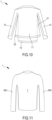
- FIG. 1 Various types of garments 1, provided at least with a trunk (T), a right sleeve (MD) and a left sleeve (MS), and made by the process of the present invention, are shown in the figures.
- T trunk
- MD right sleeve
- MS left sleeve
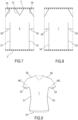
- Figure 5 shows in a schematic manner a tubular textile article 3 with the front side 6 stretched and "flattened” on the rear side 7; basically, it is as if the tubular textile article 3 had been “flattened” along the median plane A, thus being planar and "double layer” (front side on rear side).
- This figure shows the "design" of the tubular textile article (in particular the definition of the cutting lines) and corresponds to what is shown in Figures 2 and 3 (process steps) and in Figure 4 (garment).
- Figure 6 shows, still in a schematic manner, a tubular textile article 3 according to a different embodiment: in this case it is a "mock turtleneck” or “turtleneck” sweater, i.e. with a high (or elongated) neck.
- the process is the same as described before, with the difference that the fifth cutting line 55 and the sixth cutting line 56 are shaped differently and reach a deeper level, starting from the upper edge 4 towards the lower edge 5 of the tubular textile article 3.
- Figures 7 and 8 show in a schematic manner a further variant of embodiment of the tubular textile article 3 in accordance with the present invention.
- the plurality of cutting line comprises a seventh cutting line 57, which begins from the upper edge 4 of the front side 6 of the tubular textile article, descends towards the lower edge 5 as far as to a specific lower height and ascends until terminating again on the upper edge 4 of the rear side 6.
- the seventh cutting line 57 has a shape defined based on the result to be obtained for the neck, and is preferably symmetrical with the center of the front trunk portion.
- a neck piece extended between the upper edge 4 of the tubular textile article and the seventh cutting line 57 is removed.
- the desired shape for the neck e.g. a "V"-shaped neck
- the plurality of cutting lines can further include an eighth cutting line 58 and a ninth cutting line 59. arranged transversally to the development of the tubular textile article (i.e. substantially perpendicular to the central axis X) and comprised between the first 51 and third 53 cutting line and between the second 52 and the fourth 54 cutting line, respectively.
- the eighth cutting line 58 is located on the right sleeve portion 31 and the ninth cutting line 59 is located on the left sleeve portion 41.
- the eighth cutting line 58 and the ninth cutting line 59 develop between two respective ends that terminate (i.e. end) on the first 51 and on the third 53 cutting line and on the second 52 and on the fourth 54 cutting line, respectively.
- the cuts made along the eighth cutting line 58 and along the ninth cutting line 59 cause the detachment or removal of the sleeve portions comprised between the cutting line and the lower end of the sleeve portion.
- a short-sleeved garment 1 can be obtained.
- the garment 1 obtained from the tubular textile article of Figures 7 and 8 (by way of example with V neck and short sleeves) is shown in Figure 9 .
- the various structures are independent from one another and can be variously combined in different embodiments of garments according to the present invention.
- the present invention encompasses also alternative embodiments of garments, differing from the exemplary embodiments shown in the figures, having in common the fact of being made from one single tubular textile article and by the operations described above.
- the invention achieves important advantages. First of all, the invention allows to overcome at least some of the drawbacks of prior art.
- the process forming the object of the present invention allows to make a complete garment, provided with a trunk and two sleeves, using one single tubular textile article.
- the process of the present invention further allows to reduce the complexity of operations with respect to known solutions.
- the process of the present invention allows to highly reduce cost and time required for making a complete garment, with respect to known solutions.
- the invention since it makes it possible to obtain a garment directly from one single tubular article suitably processed, allows to reduce complexity and costs typically related to the manufacturing steps of a garment in the prior art (cutting, moving, piece handling, etc.).
- the process of the present invention allows to reduce the intervention of operators and can be advantageously automated and implemented by means of an automated production line.
- the process of the present invention further allows to make a garment reducing processing scraps.
- the process of the present invention further allows to reduce errors during production and manufacturing.
- the process of the present invention allows to obtain series of garments with high quality and uniform features.
- the garments according to the present invention are characterized by a better wearability and better comfort for the user.
- the present invention can be particularly implemented for making garments such as underwear and sports shirts, which typically require high features as far as comfort of use is concerned.
- the invention allows in general to make a garment with specific features, imparting to it given technical and aesthetic properties.
Landscapes
- Engineering & Computer Science (AREA)
- Textile Engineering (AREA)
- Details Of Garments (AREA)
- Outer Garments And Coats (AREA)
- Treatment Of Fiber Materials (AREA)
Claims (12)
- Verfahren zum Herstellen eines Kleidungsstücks (1), wobei das Kleidungsstück insbesondere ein Gestrick oder ein entsprechendes Kleidungsstück ist, welches wenigstens mit einem Torso (T), mit einem rechten Ärmel (MD) und mit einem linken Ärmel (MS) bereitgestellt ist, wobei das Verfahren die folgenden Schritte umfasst:- Anordnen einer Rundstrickmaschine;- Erzeugen eines röhrenförmigen Textilartikels (3) mittels der Rundstrickmaschine, welcher eine Form mit im Wesentlichen zylindrischer Oberfläche aufweist, welche kontinuierlich um eine zentrale Achse (X) des Artikels zwischen einem oberen Rand (4) und einem unteren Rand (5) erstreckt ist, und wobei an dem röhrenförmigen Textilartikel (3) eine vordere Seite (6) und eine hintere Seite (7) definierbar ist, welche voneinander in Bezug auf eine Mittelebene (A) aufgeteilt sind;- Definieren oder Identifizieren, an dem röhrenförmigen Textilartikel (3), einer Mehrzahl von Schneidlinien (51, 52, 53, 54);- Schneiden des röhrenförmigen Textilartikels (3) entlang der Mehrzahl von Schneidlinien, um eine Mehrzahl von Stoffabschnitten (11, 21, 31, 41) des röhrenförmigen Textilartikels (3) zu definieren und diese voneinander zu trennen, wobei jeder Stoffabschnitt zu der vorderen Seite (6) oder zu der hinteren Seite (7) oder partial zu der vorderen Seite und partial zu der hinteren Seite gehört; wobei die Stoffabschnitte mittels der Schneidlinien voneinander getrennt werden, sie verbleiben in dem röhrenförmigen Textilartikel (3) jedoch wenigstens teilweise verbunden;- Verbinden der Stoffabschnitte des röhrenförmigen Textilartikels (3), um den Torso (T) des Kleidungsstücks, den rechten Ärmel (MD) und den linken Ärmel (MS) zu erhalten;wobei, im Anschluss an den Verbindungsschritt, das Kleidungsstück (1), welches aus dem röhrenförmigen Textilartikel (3) erhalten wird, Übergangszonen zwischen dem Torso (T) und dem rechten (MD) sowie dem linken (MS) Ärmel aufweist, welchen eine Naht oder Diskontinuitäten in dem Stoff fehlt, d.h. der Übergang von dem Stoff des Torsos (T) zu dem Stoff des rechten (MD) sowie des linken (MS) Ärmels tritt wenigstens teilweise ohne Unterbrechung auf;wobei das Verfahren dadurch gekennzeichnet ist, dass es umfasst, gleichzeitig mit dem Schritt eines Erzeugens des röhrenförmigen Textilartikels (3), einen Schritt eines Herstellens eines Doppelsaums (81, 82, 83) durch Herstellen eines Doppelstoffs oder Bündchens an dem unteren Rand (5), sodass der röhrenförmige Textilartikel (3) mit dem gesamten unteren Rand (5) aus Doppelstoff erzeugt wird, über die gesamte Umfangserstreckung davon; wobei die Schritte eines Schneidens des röhrenförmigen Textilartikels (3) und eines Verbindens der Stoffabschnitte den Torso (T) und/oder den rechten Ärmel (MD) und/oder den linken Ärmel (MS) bereits mit einem jeweiligen Doppelsaum (81, 82, 83) an dem unteren Ende davon bereitstellen.
- Verfahren nach Anspruch 1, wobei die zuvor genannten Übergangszonen zwischen dem Torso (T) und dem rechten (MD) sowie linken (MS) Ärmel Zonen des Kleidungsstücks sind, welche sowohl an der vorderen Seite (6) als auch an der hinteren Seite (7) zwischen den Schultern und den Achseln platziert sind, oder wobei das Kleidungsstück (1) keine Naht, Diskontinuitäten oder Verbindungen aufweist - weder an dem rechten Armloch, noch an dem linken Armloch -, oder wobei die Mittelebene (A) den röhrenförmigen Textilartikel (3) im Wesentlichen in zwei Hälften aufteilt, welche der vorderen Seite (6) und der hinteren Seite (7) entsprechen.
- Verfahren nach Anspruch 1 oder 2, wobei die Stoffabschnitte wenigstens folgendes umfasst:- einen vorderen Torsoabschnitt (11), welcher zu der vorderen Seite (6) des röhrenförmigen Textilartikels (3) gehört;- einen hinteren Torsoabschnitt (21, welcher zu der hinteren Seite (7) des röhrenförmigen Textilartikels (3) gehört;- einen rechten Ärmelabschnitt (31), welcher sowohl den Stoff der vorderen Seite (6) als auch der hinteren Seite (7) umfasst und welcher die Mittelebene (A) schneidet;- einen linken Ärmelabschnitt (41), welcher sowohl den Stoff der vorderen Seite (6) als auch der hinteren Seite (7) umfasst und welcher die Mittelebene (A) an der entgegengesetzten Seite der zentralen Achse (X) in Bezug auf den rechten Ärmelabschnitt (31) schneidet;und wobei der Schritt eines Verbindens der Stoffabschnitte umfasst:- Verbinden des vorderen Torsoabschnitts (11) mit dem hinteren Torsoabschnitt (21), um den Torso (T) des Kleidungsstücks herzustellen, wobei der Torso wenigstens teilweise eine röhrenförmige Form aufweist;- Schließen des rechten Ärmelabschnitts (31) zum Herstellen eines rechten Ärmels (MD), wobei der rechte Ärmel wenigstens teilweise eine röhrenförmige Form aufweist;- Schließen des linken Ärmelabschnitts (41) zum Herstellen eines linken Ärmels (MS), wobei der linke Ärmel wenigstens teilweise eine röhrenförmige Form aufweist,oder wobei der Schritt eines Schneidens des röhrenförmigen Textilartikels (3) durch Folgen einer Umfangserstreckung des röhrenförmigen Textilartikels um die zentrale Achse (X) eine Wechselfolge zwischen einem Torsoabschnitt (11; 21) und einem Ärmelabschnitt (31; 41) erlangt.
- Verfahren nach einem der vorhergehenden Ansprüche, wobei, in dem Schritt eines Erzeugens eines röhrenförmigen Textilartikels (3), ein einzelner röhrenförmiger Textilartikel (3) erzeugt wird, wodurch ein vollständiges Herstellen des Torsos (T) und der Ärmel (MD, MS) des Kleidungsstücks (1) ermöglicht wird, oder wobei der Torso (T), der rechte Ärmel (MD) und der linke Ärmel (MS) insgesamt wenigstens teilweise verbunden werden und in Bezug auf einander in einem einzelnen Stoffstück kontinuierlich sind, und sie niemals voneinander gelöst oder getrennt werden, oder wobei die Stoffabschnitte (11, 21, 31, 41) im Anschluss an den Schritt eines Schneidens des röhrenförmigen Textilartikels (3) nicht vollständig aufgeteilt oder voneinander getrennt werden, sondern stattdessen wenigstens teilweise in dem einstückigen röhrenförmigen Textilartikel verbunden bleiben, oder wobei - von dem Schritt eines Erzeugens eines röhrenförmigen Textilartikels (3) zu dem Ende der Erzeugung oder Verpackung des Kleidungsstücks (1) - niemals ein Schritt eines longitudinalen Schneidens des röhrenförmigen Textilartikels von dem unteren Rand (5) zu dem oberen Rand (3), oder umgekehrt, vorhanden ist, und auch kein Schritt eines Öffnens des röhrenförmigen Textilartikels (3), wodurch er ein flaches Stück Stoff wird, oder wobei, in dem Schritt eines Schneidens des röhrenförmigen Textilartikels (3), die Schneidlinien eine Öffnung des röhrenförmigen Textilartikels selbst nicht verursachen, d.h. der röhrenförmige Textilartikel (3) behält wenigstens einen um die gesamte zentrale Achse (X) kontinuierlichen und geschlossenen röhrenförmigen Stoffabschnitt bei.
- Verfahren nach einem der vorhergehenden Ansprüche, wobei der Schritt eines Definierens oder Identifizierens einer Mehrzahl von Schneidlinien an dem röhrenförmigen Textilartikel (3) einen oder mehrere der folgenden Vorgänge umfasst:- Ausgestalten der Schneidlinien (51, 52, 53, 54) an dem röhrenförmigen Textilartikel (3) in einem Konstruktionsschritt, zum Beispiel mittels Fäden verschiedener Farben in Bezug auf die benachbarten Abschnitte des röhrenförmigen Textilartikels;- Zeigen oder Projizieren der Schneidlinien (51, 52, 53, 54) an dem röhrenförmigen Textilartikel (3), vor oder während dem Schritt eines Schneidens des röhrenförmigen Textilartikels, zum Beispiel mittels einer optischen Licht- oder Laservorrichtung, welche dazu in der Lage ist, die Schneidlinien zu definieren und diese sichtbar zu machen;- Programmieren einer Maschine für automatisiertes Schneiden, welche in ihrem Inneren die Schneidlinien (51, 52, 53, 54) definiert, zum Beispiel in einer Steuersoftware für solch eine Maschine, sodass sie an dem röhrenförmigen Textilartikel (3) arbeiten und die Schneidlinien automatisch herstellen kann;- Aufzeichnen der Schneidlinien (51, 52, 53, 54) an dem röhrenförmigen Textilartikel, vor und/oder während dem Schritt eines Schneidens des röhrenförmigen Textilartikels,oder wobei der Schritt eines Definierens oder Identifizierens einer Mehrzahl von Schneidlinien (51, 52, 53, 54) an dem röhrenförmigen Textilartikel (3) direkt während dem Schritt eines Schneidens des röhrenförmigen Textilartikels durchgeführt werden kann, zum Beispiel manuell durch einen Operator.
- Verfahren nach einem der vorhergehenden Ansprüche, wobei die Schneidlinien (51, 52, 53, 54) alle von dem unteren Rand (5) des röhrenförmigen Textilartikels (3) beginnen und in Richtung des oberen Rands (4) erstreckt sind, und wobei die Schneidlinien, welche von dem unteren Rand (5) erstreckt sind, in dem röhrenförmigen Textilartikel abschließen, bevor sie den oberen Rand (4) erreichen, d.h. sie schließen nicht an dem oberen Rand ab oder führen nicht zu dem oberen Rand, oder wobei der Schritt eines Verbindens der Stoffabschnitte mittels des Erlangens einer Naht, oder dergleichen, zwischen den zu verbindenden Stoffabschnitten auftritt, oder wobei jede der Schneidlinien zwei Stoffsäume erzeugt, welche zu zwei benachbarten Stoffabschnitten gehören, wobei die zwei Säume an den Seiten der Schneidlinien sind, und wobei die Mehrzahl von Schneidlinien wenigstens eine erste Schneidlinie (51), eine zweite Schneidlinie (52), eine dritte Schneidlinie (53) und eine vierte Schneidlinie (54) umfasst, wobei:- die erste Schneidlinie (51) an der vorderen Seite (6) des röhrenförmigen Textilartikels (3) positioniert ist und den vorderen Torsoabschnitt (11) und den rechten Ärmelabschnitt (31) voneinander trennt, wodurch ein rechter Saum (12) des vorderen Torsoabschnitts (11) und ein vorderer Saum (32) des rechten Ärmelabschnitts (31) erlangt wird;- die zweite Schneidlinie (52) an der vorderen Seite (6) des röhrenförmigen Textilartikels (3) positioniert ist und den vorderen Torsoabschnitt (11) und den linken Ärmelabschnitt (41) voneinander trennt, wodurch ein linker Saum (13) des vorderen Torsoabschnitts (11) und ein vorderer Saum (42) des linken Ärmelabschnitts (41) erlangt wird;- die dritte Schneidlinie (53) an der hinteren Seite (7) des röhrenförmigen Textilartikels (3) positioniert ist und den hinteren Torsoabschnitt (21) und den rechten Ärmelabschnitt (31) voneinander trennt, wodurch ein rechter Saum (22) des hinteren Torsoabschnitts (21) und ein hinterer Saum (33) des rechten Ärmelabschnitts (31) erlangt wird;- die vierte Schneidlinie (54) an der hinteren Seite (7) des röhrenförmigen Textilartikels (3) positioniert ist und den hinteren Torsoabschnitt (21) und den linken Ärmelabschnitt (41) voneinander trennt, wodurch ein linker Saum (23) des hinteren Torsoabschnitts (21) und ein hinterer Saum (43) des linken Ärmelabschnitts (41) erlangt wird,
oder wobei eine oder mehrere der Schneidlinien (51, 52, 53, 54) verschiedenartig geformt oder gewellt sein kann/können, um eine spezifische dreidimensionale Form des Torsos (T) und/oder der Ärmel (MD, MS) in dem fertigen Kleidungsstück zu erhalten. - Verfahren nach dem vorhergehenden Anspruch, wobei im Anschluss an den Schritt eines Schneidens des röhrenförmigen Textilartikels entlang der ersten (51), zweiten (52), dritten (53) und vierten Schneidlinie (54):- der vordere Torsoabschnitt (11) lateral zwischen seinem rechten Saum (12) und seinem linken Saum (13) erstreckt ist und vollständig an der vorderen Seite (6) ist;- der hintere Torsoabschnitt (21) lateral zwischen seinem rechten Saum (22) und seinem linken Saum (23) erstreckt ist und vollständig an der hinteren Seite (7) ist;- der rechte Ärmelabschnitt (31) lateral zwischen seinem vorderen Saum (32) und seinem hinteren Saum (33) erstreckt ist und dadurch vollständig von der vorderen Seite (6) und der hinteren Seite (7) geteilt wird;- der linke Ärmelabschnitt (41) lateral zwischen seinem vorderen Saum (42) und seinem hinteren Saum (43) erstreckt ist und dadurch vollständig von der vorderen Seite (6) und der hinteren Seite (7) geteilt wird;oder wobei, in dem Schritt eines Verbindens der Stoffabschnitte des röhrenförmigen Textilartikels:- der rechte Saum (12) des vorderen Torsoabschnitts (11) mittels einer ersten Verbindungslinie (61) mit dem jeweiligen rechten Saum (22) des hinteren Torsoabschnitts (21) verbunden ist;- der linke Saum (13) des vorderen Torsoabschnitts (11) mittels einer zweiten Verbindungslinie (62) mit dem jeweiligen linken Saum (23) des hinteren Torsoabschnitts (21) verbunden ist;auf solch eine Weise, dass die erste (61) und die zweite (62) Verbindungslinie die Verbindung des vorderen Torsoabschnitts (11) mit dem hinteren Torsoabschnitt (21) abschließt, wodurch der Torso (T) des Kleidungsstücks erzeugt wird;- der vordere Saum (32) des rechten Ärmelabschnitts (31) mittels einer dritten Verbindungslinie (63) mit dem hinteren Saum (33) des gleichen rechten Ärmelabschnitts (31) verbunden ist;- der vordere Saum (42) des linken Ärmelabschnitts (41) mittels einer vierten Verbindungslinie (64) mit dem hinteren Saum (43) des gleichen linken Ärmelabschnitts (41) verbunden ist;auf solch eine Weise, dass die dritte Verbindungslinie (63) den rechten Ärmel (MD) des Kleidungsstücks verschließt und abschließt, und die vierte Verbindungslinie (64) den linken Ärmel (MS) des Kleidungsstücks verschließt und abschließt,und wobei die erste Verbindungslinie (61), die zweite Verbindungslinie (62), die dritte Verbindungslinie (63) und die vierte Verbindungslinie (64) Nähte sind, welche zwischen zwei involvierten Stoffsäumen hergestellt werden, oder sie werden mit entsprechenden Verfahren, beispielsweise Umwicklung, Kleben oder Schweißen, erlangt werden.
- Verfahren nach einem der vorhergehenden Ansprüche, umfassend die nachfolgenden Schritte:- Anbringen eines rechten Einsatzes an dem röhrenförmigen Textilartikel (3) in einer Position, welche zwischen der ersten Verbindungslinie (61) und der dritten Verbindungslinie (63) umfasst ist, auf solch eine Weise, dass der rechte Einsatz zwischen der ersten Verbindungslinie und der dritten Verbindungslinie eingefügt ist und diese verbindet, wobei der rechte Einsatz dazu vorgesehen ist, bei Verwendung des Kleidungsstücks an der rechten Achsel des Benutzers zu sein;- Anbringen eines linken Einsatzes an dem röhrenförmigen Textilartikel (3) in einer Position, welche zwischen der zweiten Verbindungslinie (62) und der vierten Verbindungslinie (64) umfasst ist, auf solch eine Weise, dass der linke Einsatz zwischen der zweiten Verbindungslinie und der vierten Verbindungslinie eingefügt ist und diese verbindet, wobei der linke Einsatz dazu vorgesehen ist, bei Verwendung des Kleidungsstücks an der linken Achsel des Benutzers zu sein;und wobei der rechte Einsatz und der linke Einsatz eingerichtet sind, zum:- Beheben von Diskontinuitäten, welche jeweils zwischen der ersten und der dritten Verbindungslinie sowie zwischen der zweiten und der vierten Verbindungslinie vorhanden sind; und/oder zum- Verhindern des Vorhandenseins von Verbindungslinien, z.B. einer Naht, in den zwei Zonen des Kleidungsstücks, welche bei Verwendung des Kleidungsstücks dazu vorgesehen sind, an den Achseln des Benutzers zu sein; und/oder zum- geeignetem Formen des Kleidungsstücks in den zwei Bereichen des Kleidungsstücks, welche bei Verwendung des Kleidungsstücks selbst dazu vorgesehen sind, an den Achseln des Benutzers zu sein;und wobei der rechte Einsatz und der linke Einsatz aus einem atmungsaktiven Stoff und/oder einem verstärkenden Stoff hergestellt sind.
- Verfahren nach einem der vorhergehenden Ansprüche, umfassend den Schritt eines Anbringens eines oder mehrerer Einsätze an dem röhrenförmigen Textilartikel (3) in spezifischen Positionen entlang einer oder mehrerer Verbindungslinien, und wobei jeder der Einsätze dazu vorgesehen ist, entlang einer spezifischen Verbindungslinie eingefügt zu sein, um an der Position, an welcher er gelegen ist, die Kontinuität einer solchen Verbindungslinie lokal zu unterbrechen, oder wobei ein erster Einsatz entlang der ersten Verbindungslinie (61) eingeführt werden kann, um dem Kleidungsstück einen rechten Seiteneinsatz bereitzustellen, oder wobei ein zweiter Einsatz entlang der dritten Verbindungslinie (63) eingeführt werden kann, um dem Kleidungsstück einen linken Seiteneinsatz bereitzustellen, oder wobei der Einsatz dazu eingerichtet ist, das Kleidungsstück (1) in der Zone des Kleidungsstücks selbst geeignet zu formen, an welcher er positioniert ist, und/oder eine solche Zone mit besonderen Eigenschaften an Elastizität oder Kompression oder Atmungsaktivität und/oder spezifischen ästhetischen oder technischen Eigenschaften bereitzustellen.
- Verfahren nach einem der vorhergehenden Ansprüche, umfassend einen Schritt eines geeigneten Dimensionierens des Torsos (T) and des rechten (MD) sowie des linken (MS) Ärmels auf solch eine Weise, dass der rechte und der linke Ärmel länger als der Torso des Kleidungsstücks ist, und wobei die jeweiligen unteren Enden des rechten Ärmels (MD) und des linken Ärmels (MS) eine Längserstreckung aufweisen, welche bei abgeschlossenem Kleidungsstück (1) unter dem unteren Ende des Torsos (T) abschließen, und wobei der Dimensionierungsschritt in dem Schritt eines Erzeugens eines röhrenförmigen Textilartikels ausgeführt wird, auf solch eine Weise, dass die Teile des röhrenförmigen Textilartikels, welche dazu vorgesehen sind, im Anschluss an die Schnitte den rechten Ärmelabschnitt (31) und den linken Ärmelabschnitt (41) zu bilden, länger als die Teile des röhrenförmigen Textilartikels sind, welche dazu vorgesehen sind, im Anschluss an die Schnitte den vorderen Torsoabschnitt (11) und den hinteren Torsoabschnitt (21) zu bilden, oder wobei der Dimensionierungsschritt einen Schritt eines Entfernens eines unteren Bereichs (15) des vorderen Torsoabschnitts (11) und eines jeweiligen unteren Bereichs (25) des hinteren Torsoabschnitts (21) umfasst, auf solch eine Weise, dass solche Abschnitte in Bezug auf den rechten Ärmelabschnitt (31) und den linken Ärmelabschnitt (41) gekürzt werden, wodurch ein Torso (T) erhalten wird, welcher kürzer als die Ärmel ist, und wobei, in dem Schritt eines Entfernens eines unteren Bereichs (15) des vorderen Torsoabschnitts (11) und eines unteren Bereichs (25) des hinteren Torsoabschnitts (21), die entfernten Bereiche horizontale Streifen sind, welche beginnend von dem unteren Rand (5) des röhrenförmigen Textilartikels (3) geschnitten werden.
- Verfahren nach einem der vorhergehenden Ansprüche, wobei die Mehrzahl von Schneidlinien eine fünfte Schneidlinie (55) und eine sechste Schneidlinie (56) umfasst, wobei:- die fünfte Schneidlinie (56) von dem oberen Rand (4) der vorderen Seite (6) des röhrenförmigen Textilartikels (3) beginnt, in Richtung des unteren Rands (5) zu einer spezifischen Höhe (75) absteigt und zum Abschließen wieder nach oben zu dem oberen Rand (4) der hinteren Seite (7) des röhrenförmigen Textilartikels (3) aufsteigt, wobei die fünfte Schneidlinie (55) wenigstens teilweise vertikal an dem rechten Ärmelabschnitt (31) aufgebracht ist;- die sechste Schneidlinie (6) von dem oberen Rand (4) der vorderen Seite (6) des röhrenförmigen Textilartikels (3) beginnt, in Richtung des unteren Rands (5) zu einer spezifischen Höhe (76) absteigt und zum Abschließen wieder nach oben zu dem oberen Rand (4) der hinteren Seite (7) des röhrenförmigen Textilartikels (3) aufsteigt, wobei die sechste Schneidlinie (56) wenigstens teilweise vertikal an dem linken Ärmelabschnitt (41) aufgebracht ist;wobei die fünfte Schneidlinie (55) und die sechste Schneidlinie (56) in Bezug auf die zentrale Achse (X) an entgegengesetzten Seiten des röhrenförmigen Textilartikels (3) definiert sind,und wobei, im Anschluss an den Schritt eines Schneidens des röhrenförmigen Textilartikels entlang der fünften (55) und sechsten (56) Schneidlinie:- ein vorderer, rechter Schultersaum an der vorderen Seite (6) erhalten wird, und ein hinterer, rechter Schultersaum an der hinteren Seite (7) erhalten wird,- ein vorderer, linker Schultersaum an der vorderen Seite (6) erhalten wird, und ein hinterer, linker Schultersaum an der hinteren Seite (7) erhalten wird,oder wobei, in dem Schritt eines Verbindens der Stoffabschnitte des röhrenförmigen Textilartikels:- der vordere, rechte Schultersaum mit dem hinteren, rechten Schultersaum mittels einer fünften Verbindungslinie (65) verbunden wird, welche die rechte Schulter erzeugt;- der vordere, linke Schultersaum mit dem hinteren, linken Schultersaum mittels einer sechsten Verbindungslinie (66) verbunden wird, welche die linke Schulter erzeugt;auf solch eine Weise, dass die fünfte und die sechste Verbindungslinie die Verbindung der oberen Teile des vorderen Torsoabschnitts (11) und des hinteren Torsoabschnitts (21) vervollständigen, wodurch die Schultern an dem oberen Ende des Torsos (T) des Kleidungsstücks erlangt werden,oder wobei, zwischen der fünften Verbindungslinie (65) und der sechsten Verbindungslinie (66), die Öffnung für den Hals vorhanden ist.
- Kleidungsstück (1), insbesondere ein Gestrick oder ein entsprechendes Kleidungsstück, welches wenigstens mit einem Torso (T), mit einem rechten Ärmel (MD) und mit einem linken Ärmel (MS) bereitgestellt ist, hergestellt mittels des Verfahrens nach einem der vorhergehenden Ansprüche.
Applications Claiming Priority (2)
| Application Number | Priority Date | Filing Date | Title |
|---|---|---|---|
| IT102020000006514A IT202000006514A1 (it) | 2020-03-27 | 2020-03-27 | Procedimento per realizzare un indumento |
| PCT/IB2021/052386 WO2021191785A1 (en) | 2020-03-27 | 2021-03-23 | Process for making a garment |
Publications (2)
| Publication Number | Publication Date |
|---|---|
| EP4125470A1 EP4125470A1 (de) | 2023-02-08 |
| EP4125470B1 true EP4125470B1 (de) | 2025-03-05 |
Family
ID=70918902
Family Applications (1)
| Application Number | Title | Priority Date | Filing Date |
|---|---|---|---|
| EP21713767.8A Active EP4125470B1 (de) | 2020-03-27 | 2021-03-23 | Verfahren zur herstellung eines kleidungsstücks |
Country Status (7)
| Country | Link |
|---|---|
| US (1) | US12484646B2 (de) |
| EP (1) | EP4125470B1 (de) |
| KR (1) | KR102916174B1 (de) |
| CN (1) | CN115334919A (de) |
| IT (1) | IT202000006514A1 (de) |
| TW (1) | TW202142753A (de) |
| WO (1) | WO2021191785A1 (de) |
Citations (1)
| Publication number | Priority date | Publication date | Assignee | Title |
|---|---|---|---|---|
| EP3856964A1 (de) * | 2018-09-28 | 2021-08-04 | SANTONI S.p.A. | Verfahren zur herstellung eines unterhemds und mit diesem verfahren hergestelltes unterhemd |
Family Cites Families (18)
| Publication number | Priority date | Publication date | Assignee | Title |
|---|---|---|---|---|
| US2126186A (en) * | 1938-01-20 | 1938-08-09 | Champion Knitwear Company Inc | Athletic shirt and method of making the same |
| US2588606A (en) * | 1950-12-26 | 1952-03-11 | William W Artzt | Shirt and method of making same |
| US4939844A (en) * | 1986-07-18 | 1990-07-10 | Shikibo Ltd. | Master pattern for upper garments |
| JP3582580B2 (ja) * | 1998-12-28 | 2004-10-27 | 住友ゴム工業株式会社 | 上衣 |
| JP3191215B2 (ja) * | 1999-10-04 | 2001-07-23 | 株式会社三宅デザイン事務所 | 丸編による編物及び丸編による編物からの衣類の形成方法 |
| JP3286787B2 (ja) * | 1999-10-04 | 2002-05-27 | 株式会社三宅デザイン事務所 | 長尺布帛よりの衣類の形成方法 |
| JP3718793B2 (ja) * | 1999-12-27 | 2005-11-24 | 株式会社三宅デザイン事務所 | 衣類の提供方法 |
| JP3778884B2 (ja) * | 2002-08-30 | 2006-05-24 | セーレン株式会社 | 経編による無縫製製品用生地とその加工処理方法および無縫製製品 |
| WO2005032288A2 (en) * | 2003-09-29 | 2005-04-14 | Sheerworks Llc | Hosiery-type garments and method of making |
| JP2006200048A (ja) * | 2005-01-18 | 2006-08-03 | Nippon Mayer Ltd | 経編筒編衣料の構造及びその製造方法 |
| EP1876274A4 (de) * | 2005-03-31 | 2014-11-19 | Seiren Co Ltd | Kettengewirk und verfahren zu seiner herstellung |
| CN101653295B (zh) * | 2008-03-26 | 2014-06-04 | 刘岗 | 改良的衣衫及其裁剪 |
| JP2012180620A (ja) * | 2011-03-02 | 2012-09-20 | Yoshida Sangyo Kk | 筒状部分を有する分割可能なダブルラッシェル編地 |
| US10100445B2 (en) * | 2014-04-03 | 2018-10-16 | Nike, Inc. | Method of forming a unitary knit article using flat-knit construction |
| US10273606B2 (en) * | 2015-03-06 | 2019-04-30 | Nike, Inc. | Circular knitted garment for lower torso |
| US20160366948A1 (en) * | 2015-06-19 | 2016-12-22 | Gustavo Diaz | Support band apparatus to reinforce shirt collars and hems |
| US10925338B2 (en) * | 2017-03-01 | 2021-02-23 | Nike, Inc. | Knit garment with reduced seams |
| IT201800002946U1 (it) * | 2018-07-03 | 2020-01-03 | Articoli di abbigliamento prodotti su macchine tessili lineari |
-
2020
- 2020-03-27 IT IT102020000006514A patent/IT202000006514A1/it unknown
-
2021
- 2021-03-17 TW TW110109590A patent/TW202142753A/zh unknown
- 2021-03-23 CN CN202180024060.5A patent/CN115334919A/zh active Pending
- 2021-03-23 EP EP21713767.8A patent/EP4125470B1/de active Active
- 2021-03-23 KR KR1020227036257A patent/KR102916174B1/ko active Active
- 2021-03-23 WO PCT/IB2021/052386 patent/WO2021191785A1/en not_active Ceased
- 2021-03-23 US US17/914,084 patent/US12484646B2/en active Active
Patent Citations (1)
| Publication number | Priority date | Publication date | Assignee | Title |
|---|---|---|---|---|
| EP3856964A1 (de) * | 2018-09-28 | 2021-08-04 | SANTONI S.p.A. | Verfahren zur herstellung eines unterhemds und mit diesem verfahren hergestelltes unterhemd |
Also Published As
| Publication number | Publication date |
|---|---|
| US12484646B2 (en) | 2025-12-02 |
| KR102916174B1 (ko) | 2026-01-21 |
| IT202000006514A1 (it) | 2021-09-27 |
| WO2021191785A1 (en) | 2021-09-30 |
| KR20220156586A (ko) | 2022-11-25 |
| CN115334919A (zh) | 2022-11-11 |
| US20230124736A1 (en) | 2023-04-20 |
| EP4125470A1 (de) | 2023-02-08 |
| TW202142753A (zh) | 2021-11-16 |
Similar Documents
| Publication | Publication Date | Title |
|---|---|---|
| EP3518698B1 (de) | Gestricktes bekleidungsstück mit reduzierten nähten | |
| JPH0551803A (ja) | 男女共用スクラブシヤツおよびその製造方法 | |
| US4635301A (en) | Upper body garment construction | |
| EP4125470B1 (de) | Verfahren zur herstellung eines kleidungsstücks | |
| KR102823965B1 (ko) | 언더 셔츠 제조 방법 및 상기 방법을 통해 얻은 언더 셔츠 | |
| PL178603B1 (pl) | Sposób produkcji dzianej gotowej odzieży | |
| Khanna et al. | Innovation and technology of knitted apparels | |
| US11812805B2 (en) | Article of apparel and related manufacturing methods | |
| CN112030331B (zh) | 一种双层结构针织产品的无缝成形制备方法 | |
| CN110512343B (zh) | 一种全成形横向沿背中心分片编织方法及编织织物 | |
| CN109315864B (zh) | 一种服装上装装里子后开衩结构及制作方法 | |
| KR101666772B1 (ko) | 의복의 개선된 트임구조 및 의복 트임부의 제작 방법 | |
| CN201323878Y (zh) | 针织无缝连帽运动服 | |
| Seram et al. | Threadless seaming-Application of ultrasonic technology in fashion | |
| JP6260050B2 (ja) | バストダーツにしわが無いtシャツとカットソーおよびその作製方法 | |
| EP4365344A1 (de) | Automatisiertes verfahren zum stricken eines massgeschneiderten dreidimensionalen kleidungsstücks, strickkleidung und musterdesign | |
| JP4066075B2 (ja) | 5本指タイプのストッキング類の製造方法及び5本指タイプのストッキング類 | |
| HU221067B1 (hu) | Eljárás zseb készítésére kötött ruházaton | |
| Ng | A review of the techniques of knitting and moulding pertinent to seamless fashion creation | |
| CN211048403U (zh) | 一种衬衫 | |
| US3009161A (en) | Unitary insert structure for shirts and the like | |
| CN210988242U (zh) | 一种衬衫 | |
| CN100544621C (zh) | 无缝制针织衣服 | |
| WO1997047794A1 (en) | Shirt blank, shirt and methods of making same | |
| CN120477436A (zh) | 一种袍服的制作方法 |
Legal Events
| Date | Code | Title | Description |
|---|---|---|---|
| STAA | Information on the status of an ep patent application or granted ep patent |
Free format text: STATUS: UNKNOWN |
|
| STAA | Information on the status of an ep patent application or granted ep patent |
Free format text: STATUS: THE INTERNATIONAL PUBLICATION HAS BEEN MADE |
|
| PUAI | Public reference made under article 153(3) epc to a published international application that has entered the european phase |
Free format text: ORIGINAL CODE: 0009012 |
|
| STAA | Information on the status of an ep patent application or granted ep patent |
Free format text: STATUS: REQUEST FOR EXAMINATION WAS MADE |
|
| 17P | Request for examination filed |
Effective date: 20221010 |
|
| AK | Designated contracting states |
Kind code of ref document: A1 Designated state(s): AL AT BE BG CH CY CZ DE DK EE ES FI FR GB GR HR HU IE IS IT LI LT LU LV MC MK MT NL NO PL PT RO RS SE SI SK SM TR |
|
| DAV | Request for validation of the european patent (deleted) | ||
| P01 | Opt-out of the competence of the unified patent court (upc) registered |
Effective date: 20230529 |
|
| STAA | Information on the status of an ep patent application or granted ep patent |
Free format text: STATUS: EXAMINATION IS IN PROGRESS |
|
| 17Q | First examination report despatched |
Effective date: 20240212 |
|
| GRAP | Despatch of communication of intention to grant a patent |
Free format text: ORIGINAL CODE: EPIDOSNIGR1 |
|
| STAA | Information on the status of an ep patent application or granted ep patent |
Free format text: STATUS: GRANT OF PATENT IS INTENDED |
|
| INTG | Intention to grant announced |
Effective date: 20241028 |
|
| GRAS | Grant fee paid |
Free format text: ORIGINAL CODE: EPIDOSNIGR3 |
|
| GRAA | (expected) grant |
Free format text: ORIGINAL CODE: 0009210 |
|
| STAA | Information on the status of an ep patent application or granted ep patent |
Free format text: STATUS: THE PATENT HAS BEEN GRANTED |
|
| AK | Designated contracting states |
Kind code of ref document: B1 Designated state(s): AL AT BE BG CH CY CZ DE DK EE ES FI FR GB GR HR HU IE IS IT LI LT LU LV MC MK MT NL NO PL PT RO RS SE SI SK SM TR |
|
| REG | Reference to a national code |
Ref country code: GB Ref legal event code: FG4D |
|
| REG | Reference to a national code |
Ref country code: CH Ref legal event code: EP |
|
| REG | Reference to a national code |
Ref country code: IE Ref legal event code: FG4D |
|
| REG | Reference to a national code |
Ref country code: DE Ref legal event code: R096 Ref document number: 602021027137 Country of ref document: DE |
|
| PGFP | Annual fee paid to national office [announced via postgrant information from national office to epo] |
Ref country code: DE Payment date: 20250327 Year of fee payment: 5 |
|
| PGFP | Annual fee paid to national office [announced via postgrant information from national office to epo] |
Ref country code: AT Payment date: 20250417 Year of fee payment: 5 |
|
| PG25 | Lapsed in a contracting state [announced via postgrant information from national office to epo] |
Ref country code: RS Free format text: LAPSE BECAUSE OF FAILURE TO SUBMIT A TRANSLATION OF THE DESCRIPTION OR TO PAY THE FEE WITHIN THE PRESCRIBED TIME-LIMIT Effective date: 20250605 |
|
| PG25 | Lapsed in a contracting state [announced via postgrant information from national office to epo] |
Ref country code: FI Free format text: LAPSE BECAUSE OF FAILURE TO SUBMIT A TRANSLATION OF THE DESCRIPTION OR TO PAY THE FEE WITHIN THE PRESCRIBED TIME-LIMIT Effective date: 20250305 |
|
| REG | Reference to a national code |
Ref country code: NL Ref legal event code: MP Effective date: 20250305 |
|
| PG25 | Lapsed in a contracting state [announced via postgrant information from national office to epo] |
Ref country code: ES Free format text: LAPSE BECAUSE OF FAILURE TO SUBMIT A TRANSLATION OF THE DESCRIPTION OR TO PAY THE FEE WITHIN THE PRESCRIBED TIME-LIMIT Effective date: 20250305 |
|
| REG | Reference to a national code |
Ref country code: LT Ref legal event code: MG9D |
|
| PG25 | Lapsed in a contracting state [announced via postgrant information from national office to epo] |
Ref country code: NO Free format text: LAPSE BECAUSE OF FAILURE TO SUBMIT A TRANSLATION OF THE DESCRIPTION OR TO PAY THE FEE WITHIN THE PRESCRIBED TIME-LIMIT Effective date: 20250605 |
|
| PGFP | Annual fee paid to national office [announced via postgrant information from national office to epo] |
Ref country code: IT Payment date: 20250430 Year of fee payment: 5 |
|
| PG25 | Lapsed in a contracting state [announced via postgrant information from national office to epo] |
Ref country code: HR Free format text: LAPSE BECAUSE OF FAILURE TO SUBMIT A TRANSLATION OF THE DESCRIPTION OR TO PAY THE FEE WITHIN THE PRESCRIBED TIME-LIMIT Effective date: 20250305 |
|
| PG25 | Lapsed in a contracting state [announced via postgrant information from national office to epo] |
Ref country code: LV Free format text: LAPSE BECAUSE OF FAILURE TO SUBMIT A TRANSLATION OF THE DESCRIPTION OR TO PAY THE FEE WITHIN THE PRESCRIBED TIME-LIMIT Effective date: 20250305 |
|
| PG25 | Lapsed in a contracting state [announced via postgrant information from national office to epo] |
Ref country code: BG Free format text: LAPSE BECAUSE OF FAILURE TO SUBMIT A TRANSLATION OF THE DESCRIPTION OR TO PAY THE FEE WITHIN THE PRESCRIBED TIME-LIMIT Effective date: 20250305 Ref country code: GR Free format text: LAPSE BECAUSE OF FAILURE TO SUBMIT A TRANSLATION OF THE DESCRIPTION OR TO PAY THE FEE WITHIN THE PRESCRIBED TIME-LIMIT Effective date: 20250606 |
|
| PGFP | Annual fee paid to national office [announced via postgrant information from national office to epo] |
Ref country code: TR Payment date: 20250529 Year of fee payment: 5 |
|
| REG | Reference to a national code |
Ref country code: AT Ref legal event code: MK05 Ref document number: 1772038 Country of ref document: AT Kind code of ref document: T Effective date: 20250305 |
|
| PG25 | Lapsed in a contracting state [announced via postgrant information from national office to epo] |
Ref country code: NL Free format text: LAPSE BECAUSE OF FAILURE TO SUBMIT A TRANSLATION OF THE DESCRIPTION OR TO PAY THE FEE WITHIN THE PRESCRIBED TIME-LIMIT Effective date: 20250305 |
|
| PG25 | Lapsed in a contracting state [announced via postgrant information from national office to epo] |
Ref country code: SE Free format text: LAPSE BECAUSE OF FAILURE TO SUBMIT A TRANSLATION OF THE DESCRIPTION OR TO PAY THE FEE WITHIN THE PRESCRIBED TIME-LIMIT Effective date: 20250305 |
|
| PG25 | Lapsed in a contracting state [announced via postgrant information from national office to epo] |
Ref country code: SM Free format text: LAPSE BECAUSE OF FAILURE TO SUBMIT A TRANSLATION OF THE DESCRIPTION OR TO PAY THE FEE WITHIN THE PRESCRIBED TIME-LIMIT Effective date: 20250305 |
|
| PG25 | Lapsed in a contracting state [announced via postgrant information from national office to epo] |
Ref country code: PT Free format text: LAPSE BECAUSE OF FAILURE TO SUBMIT A TRANSLATION OF THE DESCRIPTION OR TO PAY THE FEE WITHIN THE PRESCRIBED TIME-LIMIT Effective date: 20250707 |
|
| PG25 | Lapsed in a contracting state [announced via postgrant information from national office to epo] |
Ref country code: PL Free format text: LAPSE BECAUSE OF FAILURE TO SUBMIT A TRANSLATION OF THE DESCRIPTION OR TO PAY THE FEE WITHIN THE PRESCRIBED TIME-LIMIT Effective date: 20250305 |
|
| PG25 | Lapsed in a contracting state [announced via postgrant information from national office to epo] |
Ref country code: AT Free format text: LAPSE BECAUSE OF FAILURE TO SUBMIT A TRANSLATION OF THE DESCRIPTION OR TO PAY THE FEE WITHIN THE PRESCRIBED TIME-LIMIT Effective date: 20250305 |
|
| PG25 | Lapsed in a contracting state [announced via postgrant information from national office to epo] |
Ref country code: EE Free format text: LAPSE BECAUSE OF FAILURE TO SUBMIT A TRANSLATION OF THE DESCRIPTION OR TO PAY THE FEE WITHIN THE PRESCRIBED TIME-LIMIT Effective date: 20250305 Ref country code: CZ Free format text: LAPSE BECAUSE OF FAILURE TO SUBMIT A TRANSLATION OF THE DESCRIPTION OR TO PAY THE FEE WITHIN THE PRESCRIBED TIME-LIMIT Effective date: 20250305 |
|
| PG25 | Lapsed in a contracting state [announced via postgrant information from national office to epo] |
Ref country code: RO Free format text: LAPSE BECAUSE OF FAILURE TO SUBMIT A TRANSLATION OF THE DESCRIPTION OR TO PAY THE FEE WITHIN THE PRESCRIBED TIME-LIMIT Effective date: 20250305 |
|
| REG | Reference to a national code |
Ref country code: CH Ref legal event code: H13 Free format text: ST27 STATUS EVENT CODE: U-0-0-H10-H13 (AS PROVIDED BY THE NATIONAL OFFICE) Effective date: 20251024 |
|
| PG25 | Lapsed in a contracting state [announced via postgrant information from national office to epo] |
Ref country code: SK Free format text: LAPSE BECAUSE OF FAILURE TO SUBMIT A TRANSLATION OF THE DESCRIPTION OR TO PAY THE FEE WITHIN THE PRESCRIBED TIME-LIMIT Effective date: 20250305 |
|
| PG25 | Lapsed in a contracting state [announced via postgrant information from national office to epo] |
Ref country code: IS Free format text: LAPSE BECAUSE OF FAILURE TO SUBMIT A TRANSLATION OF THE DESCRIPTION OR TO PAY THE FEE WITHIN THE PRESCRIBED TIME-LIMIT Effective date: 20250705 |
|
| PG25 | Lapsed in a contracting state [announced via postgrant information from national office to epo] |
Ref country code: LU Free format text: LAPSE BECAUSE OF NON-PAYMENT OF DUE FEES Effective date: 20250323 |
|
| REG | Reference to a national code |
Ref country code: DE Ref legal event code: R097 Ref document number: 602021027137 Country of ref document: DE |
|
| REG | Reference to a national code |
Ref country code: BE Ref legal event code: MM Effective date: 20250331 |
|
| PG25 | Lapsed in a contracting state [announced via postgrant information from national office to epo] |
Ref country code: MC Free format text: LAPSE BECAUSE OF FAILURE TO SUBMIT A TRANSLATION OF THE DESCRIPTION OR TO PAY THE FEE WITHIN THE PRESCRIBED TIME-LIMIT Effective date: 20250305 |
|
| PLBE | No opposition filed within time limit |
Free format text: ORIGINAL CODE: 0009261 |
|
| STAA | Information on the status of an ep patent application or granted ep patent |
Free format text: STATUS: NO OPPOSITION FILED WITHIN TIME LIMIT |
|
| PG25 | Lapsed in a contracting state [announced via postgrant information from national office to epo] |
Ref country code: DK Free format text: LAPSE BECAUSE OF FAILURE TO SUBMIT A TRANSLATION OF THE DESCRIPTION OR TO PAY THE FEE WITHIN THE PRESCRIBED TIME-LIMIT Effective date: 20250305 |
|
| REG | Reference to a national code |
Ref country code: CH Ref legal event code: L10 Free format text: ST27 STATUS EVENT CODE: U-0-0-L10-L00 (AS PROVIDED BY THE NATIONAL OFFICE) Effective date: 20260114 |
|
| PG25 | Lapsed in a contracting state [announced via postgrant information from national office to epo] |
Ref country code: BE Free format text: LAPSE BECAUSE OF NON-PAYMENT OF DUE FEES Effective date: 20250331 |
|
| PG25 | Lapsed in a contracting state [announced via postgrant information from national office to epo] |
Ref country code: CH Free format text: LAPSE BECAUSE OF NON-PAYMENT OF DUE FEES Effective date: 20250331 |
|
| PG25 | Lapsed in a contracting state [announced via postgrant information from national office to epo] |
Ref country code: IE Free format text: LAPSE BECAUSE OF NON-PAYMENT OF DUE FEES Effective date: 20250323 |
|
| 26N | No opposition filed |
Effective date: 20251208 |
|
| GBPC | Gb: european patent ceased through non-payment of renewal fee |
Effective date: 20250605 |