EP4123554A1 - Informationsverarbeitungsvorrichtung, arbeitsplanbestimmungsverfahren und arbeitsplanbestimmungsprogramm - Google Patents
Informationsverarbeitungsvorrichtung, arbeitsplanbestimmungsverfahren und arbeitsplanbestimmungsprogramm Download PDFInfo
- Publication number
- EP4123554A1 EP4123554A1 EP20925644.5A EP20925644A EP4123554A1 EP 4123554 A1 EP4123554 A1 EP 4123554A1 EP 20925644 A EP20925644 A EP 20925644A EP 4123554 A1 EP4123554 A1 EP 4123554A1
- Authority
- EP
- European Patent Office
- Prior art keywords
- individuals
- objects
- order
- feeding
- processes
- Prior art date
- Legal status (The legal status is an assumption and is not a legal conclusion. Google has not performed a legal analysis and makes no representation as to the accuracy of the status listed.)
- Pending
Links
Images


Classifications
-
- G—PHYSICS
- G05—CONTROLLING; REGULATING
- G05B—CONTROL OR REGULATING SYSTEMS IN GENERAL; FUNCTIONAL ELEMENTS OF SUCH SYSTEMS; MONITORING OR TESTING ARRANGEMENTS FOR SUCH SYSTEMS OR ELEMENTS
- G05B19/00—Program-control systems
- G05B19/02—Program-control systems electric
- G05B19/418—Total factory control, i.e. centrally controlling a plurality of machines, e.g. direct or distributed numerical control [DNC], flexible manufacturing systems [FMS], integrated manufacturing systems [IMS] or computer integrated manufacturing [CIM]
- G05B19/41865—Total factory control, i.e. centrally controlling a plurality of machines, e.g. direct or distributed numerical control [DNC], flexible manufacturing systems [FMS], integrated manufacturing systems [IMS] or computer integrated manufacturing [CIM] characterised by job scheduling, process planning, material flow
-
- G—PHYSICS
- G05—CONTROLLING; REGULATING
- G05B—CONTROL OR REGULATING SYSTEMS IN GENERAL; FUNCTIONAL ELEMENTS OF SUCH SYSTEMS; MONITORING OR TESTING ARRANGEMENTS FOR SUCH SYSTEMS OR ELEMENTS
- G05B19/00—Program-control systems
- G05B19/02—Program-control systems electric
- G05B19/418—Total factory control, i.e. centrally controlling a plurality of machines, e.g. direct or distributed numerical control [DNC], flexible manufacturing systems [FMS], integrated manufacturing systems [IMS] or computer integrated manufacturing [CIM]
- G05B19/41815—Total factory control, i.e. centrally controlling a plurality of machines, e.g. direct or distributed numerical control [DNC], flexible manufacturing systems [FMS], integrated manufacturing systems [IMS] or computer integrated manufacturing [CIM] characterised by the cooperation between machine tools, manipulators and conveyor or other workpiece supply system, workcell
-
- G—PHYSICS
- G05—CONTROLLING; REGULATING
- G05B—CONTROL OR REGULATING SYSTEMS IN GENERAL; FUNCTIONAL ELEMENTS OF SUCH SYSTEMS; MONITORING OR TESTING ARRANGEMENTS FOR SUCH SYSTEMS OR ELEMENTS
- G05B19/00—Program-control systems
- G05B19/02—Program-control systems electric
- G05B19/418—Total factory control, i.e. centrally controlling a plurality of machines, e.g. direct or distributed numerical control [DNC], flexible manufacturing systems [FMS], integrated manufacturing systems [IMS] or computer integrated manufacturing [CIM]
- G05B19/4183—Total factory control, i.e. centrally controlling a plurality of machines, e.g. direct or distributed numerical control [DNC], flexible manufacturing systems [FMS], integrated manufacturing systems [IMS] or computer integrated manufacturing [CIM] characterised by data acquisition, e.g. workpiece identification
-
- G—PHYSICS
- G05—CONTROLLING; REGULATING
- G05B—CONTROL OR REGULATING SYSTEMS IN GENERAL; FUNCTIONAL ELEMENTS OF SUCH SYSTEMS; MONITORING OR TESTING ARRANGEMENTS FOR SUCH SYSTEMS OR ELEMENTS
- G05B2219/00—Program-control systems
- G05B2219/30—Nc systems
- G05B2219/32—Operator till task planning
- G05B2219/32252—Scheduling production, machining, job shop
-
- G—PHYSICS
- G06—COMPUTING OR CALCULATING; COUNTING
- G06Q—INFORMATION AND COMMUNICATION TECHNOLOGY [ICT] SPECIALLY ADAPTED FOR ADMINISTRATIVE, COMMERCIAL, FINANCIAL, MANAGERIAL OR SUPERVISORY PURPOSES; SYSTEMS OR METHODS SPECIALLY ADAPTED FOR ADMINISTRATIVE, COMMERCIAL, FINANCIAL, MANAGERIAL OR SUPERVISORY PURPOSES, NOT OTHERWISE PROVIDED FOR
- G06Q10/00—Administration; Management
- G06Q10/04—Forecasting or optimisation specially adapted for administrative or management purposes, e.g. linear programming or "cutting stock problem"
-
- G—PHYSICS
- G06—COMPUTING OR CALCULATING; COUNTING
- G06Q—INFORMATION AND COMMUNICATION TECHNOLOGY [ICT] SPECIALLY ADAPTED FOR ADMINISTRATIVE, COMMERCIAL, FINANCIAL, MANAGERIAL OR SUPERVISORY PURPOSES; SYSTEMS OR METHODS SPECIALLY ADAPTED FOR ADMINISTRATIVE, COMMERCIAL, FINANCIAL, MANAGERIAL OR SUPERVISORY PURPOSES, NOT OTHERWISE PROVIDED FOR
- G06Q50/00—Information and communication technology [ICT] specially adapted for implementation of business processes of specific business sectors, e.g. utilities or tourism
- G06Q50/04—Manufacturing
Definitions
- the present application relates to an information processing device, a work plan determination method, and a work plan determination program.
- Patent Document 1 A technique for generating a production plan for producing a plurality of types of production items through a plurality of works has been disclosed (for example, refer to Patent Document 1).
- Patent Document 1 Japanese Laid-open Patent Publication No. 2003-84819
- a technique of applying a model predictive control technique and using sequential optimization in a multi-objective optimization technique is conceivable.
- an approach is being considered in which a computable small number of products are calculated by an optimization solver such as a line simulator, and the feed products are successively determined.
- the model predictive control which is the basis of the method of sequentially determining the products, is based on single-objective optimization
- the solution is supposed to be uniquely extracted from the Pareto solution group extracted by the multi-objective optimization.
- a long computation time is taken to perform sequential optimization on each objective function.
- the information processing device is an information processing device that specifies a predetermined order under conditions that a plurality of objects is processed in a work line in the predetermined order, a plurality of works is performed in order on each of the plurality of objects in the work line, and at least part of the works among the plurality of works are different from each other between the plurality of objects, and includes a solution extraction unit that executes a series of processes that include: a process of generating child individuals by assigning a defined number of individuals to which a feeding order of part of the plurality of objects to the work line is given as input variables, as parent individuals, and evolving generations from the parent individuals by a genetic algorithm; a process of calculating evaluation functions according to a plurality of objective functions for simulation results when the part of the objects are fed to the work line in each feeding order of the parent individuals and the child individuals; and a process of extracting the defined number of individuals of which the evaluation functions satisfy a predetermined condition, as solutions, in which, when repeatedly executing the series of processes while raising a number
- an information processing device that specifies a predetermined order under conditions that a plurality of objects is processed in a work line in the predetermined order, a plurality of works is performed in order on each of the plurality of objects in the work line, and at least part of the works among the plurality of works are different from each other between the plurality of objects
- the information processing device includes a solution extraction unit that executes a series of processes that include: a process of generating child individuals by assigning a defined number of individuals to which a feeding order of part of the plurality of objects to the work line is given as input variables, as parent individuals, and evolving generations from the parent individuals by a genetic algorithm; a process of calculating evaluation functions according to a plurality of objective functions for simulation results when the part of the objects are fed to the work line in each feeding order of the parent individuals and the child individuals; and a process of extracting the defined number of individuals of which the evaluation functions satisfy a predetermined condition, as solutions, wherein when repeatedly executing the series of processes while raising
- the optimum solution determination accuracy may be improved while an increase in computation time is suppressed.
- a technique of applying a model predictive control technique and using sequential optimization in a multi-objective optimization technique is conceivable. Specifically, a computable small number of products are calculated by an optimization solver (such as a line simulator), and a first feed product is determined.
- an optimization solver such as a line simulator
- the manufacturing line model contains branches and merges, and a plurality of products is fed one by one. For each of the plurality of products, a plurality of works is performed in order. At least part of the works are different between the plurality of products.
- the manufacturing line model includes equipment belonging to a process A (three units), equipment belonging to a process B (two units), a storage, and equipment belonging to a process C (12 units).
- a belt conveyor is provided between the respective processes.
- the belt conveyor has branches and merges, and the product reaches the goal via any pieces of the equipment in the process A, any piece of the equipment in the process B, and any piece of the equipment in the process C.
- the manufacturing line model may automatically control the direction in which the product travels, based on the product feeding plan, or a worker in charge of the branch may manipulate the direction in which the product travels, based on the product feeding plan.
- product assembly, inspection, packaging, or the like is executed.
- the line simulator divides such a manufacturing line model into slight spaces, and executes a simple model computation such as flowing the product into the space instantly ahead when the space becomes vacant.
- the line simulator reads information on each product from a production master that stores information about each product.
- the production master stores, for example, a list of model numbers of products that have to be fed into the manufacturing line model, as illustrated in FIG. 2A .
- the production master stores, for example, information on equipment that allows the product of each model number to pass in each process.
- the product fed into the manufacturing line model stays in the equipment in each process for a staying time in accordance with the information stored in the production master and passes through the equipment.
- optimization indices object functions
- the throughput time the time from the start of feeding to when all products reach the goal
- the maximum number of stores in the storage the maximum number of stores in the storage
- the cost of each process the operation rate of each piece of equipment, the delivery date compliance rate, and the like may be used.
- the concept of the real-time optimization algorithm includes the following processes.
- the optimum solution is found for a product A, a product B, a product C, and a product D. It is assumed that this designates the product A as a first feed product.
- the optimum solution is found for the product B, the product C, the product D, and a product E. It is assumed that this designates the product C as a second feed product. By repeating this procedure, the feeding order of the products will be designated in order from the first feed product.
- the following embodiments will describe an information processing device, a work plan determination method, and a work plan determination program capable of improving the optimum solution determination accuracy by expanding a search space for the optimum solution while suppressing an increase in computation time.
- a product feeding history for a multi-objective solution determined in the optimization is taken over as an initial condition for determining the feeding order of the products.
- individual numbers forming the Pareto solution that records the feeding order determined by the time of determining an instantly previous feed product is assigned as the input variable and will be reflected when the feeding order for the next generation is determined.
- FIG. 3A is a diagram schematically illustrating a result of multi-objective optimization calculation when the first feed product is determined.
- a genetic algorithm is used as an optimization approach.
- two types of the objective functions are assumed as an objective function 1 and an objective function 2, and the number of individuals in the initial generation is assumed as four.
- the group of individuals of the optimum solutions at the top of the Pareto ranking includes four individuals surrounded by the ellipse.
- the Pareto ranking may be designated by an evaluation function obtained from the objective function 1 and the objective function 2 for each individual.
- Each optimum solution includes the feeding order of respective products, such as the first feed product and the second feed product.
- One of the individual numbers (1 to 4) is attached to each optimum solution and saved in a database in association with information on the first feed product, as history information. In this case, it is arbitrary to which optimum solution the individual numbers 1 to 4 are attached.
- the history information at the time of determining the first feed product is used.
- the first feed products of the individuals forming a Pareto solution are determined as illustrated in FIG. 3B .
- the first feed product number is determined to be #1.
- the first feed product number is determined to be #2.
- the first feed product number is determined to be #4.
- the first feed product number is determined to be #6.
- the history information at the time of determining the first feed product is taken over to and reflected in optimization calculation at the time of determining the second feed product.
- the determined feeding order linked with the individual number as an input variables is given as a hidden input variable to the optimization calculation at the time of determining the second feed product and is joined as an input variable at the time of the optimization calculation.
- the input variable explicitly given is assumed as the feeding order
- an input variable intended to make feeds in the order of (#1, #2, #3, #4, #5, #6) is given as the input variable that determines the feeding order, as a certain initial condition for the initial generation.
- the hidden input variable assigned as the individual number in the Pareto solution at the time of determining the previous feed product is imparted as the hidden input variable.
- the feeding order is determined such that the product with #1 as the number of the first feed product is to be fed as the history at the time of determining the first feed product. Therefore, the remaining six products determined by the explicitly indicated input variable are assumed to be fed successively after #1. In this case, the product with #7 is added by assigning the feeding order as the order of #1, #2, #3, #4, #5, #6, and #7.
- the history of the individual number 4 assigns the product with #6 as the first feed product.
- the product with #7 is added by assigning the feeding order as the order of #6, #1, #2, #3, #7, #4, and #5 with the product numbers subsequent to #6 incremented by one.
- the product with #7 is added similarly, and the feeding order is determined as an input variable.
- a simulation using a line simulator is performed on each of these individuals. This allows the objective functions to be calculated for each individual, and the evaluation function may be obtained. In the present embodiment, these are each assumed as the evaluation function of the parent individual.
- FIG. 4 is a diagram schematically illustrating a generation evolution method at the time of determining the feeding order for the second feed products.
- a child generation is formed from two individuals, namely, a parent 1 (individual number: 1) and a parent 2 (individual number: 4), will be described.
- the feeding order of #1, #2, #3, #4, #5, and #6 is given as the input variable representing the feeding order of the parent 1, and the hidden input variable indicating the history is 1.
- the feeding order of #1, #2, #3, #6, #4, and #5 is given as the input variable representing the feeding order of the parent 2, and the hidden input variable indicating the history is 4.
- the next generation is determined for each input variable. For example, by mating the order of #1, #2, #3, #4, #5, and #6 and the order of #1, #2, #3, #6, #4, and #5, it is assumed that the order of #1, #2, #3, #6, #5, and #4 is determined as the input variable representing the feeding order.
- the history of the child generation is calculated by mating directly the individual number as well, instead of making a determination by the feeding order history left in the history.
- the hidden input variables of the parent 1 and the parent 2 are 1 and 4, respectively, and the individual number of the child determined from this information is 3.
- the history coupled with the individual number 3 is assigned as the feeding order of the child generation.
- the first feed product feeding history of the individual number 3 supposes to feed #4, #4 is assigned as the first feed product, and thereafter, #1, #2, #3, #6, #5, and #4 in which the order has been adjusted are joined. Since the first feed product is #4, the order of products subsequent to #4 is incremented by one, and the feeding order of this child individual is assigned as #4, #1, #2, #3, #7, #6, and #5.
- a simulation using a line simulator is performed on each child individual. This allows the objective functions to be calculated for each child individual, and the evaluation function may be obtained. In the present embodiment, these are each assumed as the evaluation function of the child individual.
- Pareto solution group From among all the parent individuals and all the child individuals, four individuals for which the best evaluation function was obtained are extracted as a Pareto solution (optimum solution group).
- the individual numbers (1 to 4) are attached to each of these individuals.
- Each optimum solution includes the feeding order of respective products, such as the first feed product and the second feed product.
- the individual number and the feeding order of the first feed product and the second feed product included in the individual with the individual number are saved in a database as history information. In this manner, by repeating the evolution of generations, the first feed product and the second feed product may be determined.
- FIG. 5A is a diagram illustrating a conceptual diagram of a computation result at this time.
- a product that was not selected at the time of determining the first feed product will not be selected as the first feed product.
- feed products listed as candidates for the optimized feeding order at the time of determining the first feed product will not be chosen.
- the individual number 3 which was a candidate at the time of determining the first feed product, will be deleted from the history candidates at the time of determining the second feed product when the individual number 3 does not give the optimum solution at the time of determining the second feed product compared with any other individuals.
- the determined feeding order is updated as in FIG. 5B , and the history information allocated to the individual number will be augmented up to the second feed product.
- the feeding history is continuously updated on the individual number.
- the feeding histories linked with the individual numbers as in FIG. 5C are obtained.
- the n-th feed product is determined. In this manner, by taking over the history information to the next generation and reflecting the history information in the next generation by the individual number as the hidden input variable, undesired feeding order will not be taken into account.
- the optimum feeding history information may be widely and comprehensively obtained with a smaller number of calculation trials. That is, the optimum solution determination accuracy may be improved by expanding the search space for the optimum solution while the computation time is shortened.
- FIG. 6 is a diagram schematically illustrating a calculation result at the time of determining the n-th feed product.
- FIG. 7A is a functional block diagram representing an overall configuration of an information processing device 100 according to a first embodiment.
- the information processing device 100 includes an input device 10, an optimization condition storage unit 20, an optimum solution extraction unit 30, an initial feeding order storage unit 40, a determined feeding order storage unit 50, a line simulator 60, a production master 70, a display device 80, and the like.
- the input device 10 is an input device such as a keyboard, a mouse, or a touch panel.
- the display device 80 is a liquid crystal display or the like and is a device that displays the result and the like of a work plan determination process by the information processing device 100.
- FIG. 7B is a block diagram illustrating a hardware configuration of the optimization condition storage unit 20, the optimum solution extraction unit 30, the initial feeding order storage unit 40, the determined feeding order storage unit 50, the line simulator 60, and the production master 70 of the information processing device 100.
- the information processing device 100 includes a central processing unit (CPU) 101, a random access memory (RAM) 102, a storage device 103, an interface 104, and the like.
- the central processing unit (CPU) 101 is a central processing unit.
- the CPU 101 includes one or more cores.
- the random access memory (RAM) 102 is a volatile memory that temporarily stores a program to be executed by the CPU 101, data to be processed by the CPU 101, and the like.
- the storage device 103 is a nonvolatile storage device. For example, a read only memory (ROM), a solid state drive (SSD) such as a flash memory, a hard disk to be driven by a hard disk drive, or the like may be used as the storage device 103.
- the storage device 103 stores the work plan determination program.
- the interface 104 is an interface device between the input device 10, the display device 80, and the like.
- the optimization condition storage unit 20 When the CPU 101 executes the work plan determination program, the optimization condition storage unit 20, the optimum solution extraction unit 30, the initial feeding order storage unit 40, the line simulator 60, the determined feeding order storage unit 50, and the production master 70 are implemented. Note that hardware such as a dedicated circuit may be used as the optimization condition storage unit 20, the optimum solution extraction unit 30, the initial feeding order storage unit 40, the line simulator 60, the determined feeding order storage unit 50, and the production master 70.
- FIG. 8 is a flowchart representing an example of the work plan determination process executed by the information processing device 100.
- the work plan determination process will be described with reference to the flowchart in FIG. 8 .
- the optimum solution extraction unit 30 reads optimization conditions from the optimization condition storage unit 20 (step S1).
- FIG. 9A is a table illustrating the optimization conditions.
- the optimization conditions include the number of generation evolutions, the number of individuals, the number of product determination blocks, and the like. For example, it is assumed that the number of generation evolutions is ten, the number of individuals is four, and the number of product determination blocks is six. These optimization conditions have been input in advance by a user, for example, using the input device 10.
- the number of product determination blocks refers to the number of products as to how many feed products will be altered to find the optimum solution.
- FIG. 9B is a table illustrating the initial feeding order.
- the initial feeding order includes a number of orders equal to the number of individuals (four). Each order includes a number of products equal to the number of product determination blocks.
- the order of #1, #2, #3, #4, #5, and #6, the order of #6, #5, #4, #3, #2, and #1, the order of #1, #2, #3, #6, #4, and #5, and the order of #6, #5, #4, #1, #2, and #3 are included.
- These orders may be any order as long as at least part of the orders do not overlap.
- These orders may be input in advance by the user using the input device 10, or may be generated by random numbers.
- the line simulator 60 simulates, for example, the manufacturing line model illustrated in FIG. 1 .
- the line simulator 60 uses information on each product stored in the production master 70.
- the production master 70 stores, for example, the product information illustrated in FIGs. 2A and 2B .
- the product information may be input in advance by the user using the input device 10.
- the optimum solution extraction unit 30 assigns these simulation results (four individuals) as parent individuals and obtains an evaluation function by calculating the objective function 1 and the objective function 2.
- the optimum solution extraction unit 30 evolves the obtained four parent individuals by the input number of generation evolutions.
- the optimum solution extraction unit 30 obtains the evaluation function by calculating the objective function 1 and the objective function 2 for each child individual.
- the optimum solution extraction unit 30 extracts the optimum solution group (Pareto solution) by extracting a number of optimum solutions equal to the number of individuals (four), for which the best evaluation function was obtained, from among all the parent individuals and all the child individuals (step S3).
- a genetic algorithm or the like may be used for evolution.
- the optimum solution extraction unit 30 attaches the individual numbers of 1 to 4 to each individual included in the Pareto solution and stores the first feed product and the individual number in the determined feeding order storage unit 50 as history information for each individual (step S4).
- FIG. 9C is a table illustrating determined order information stored in the determined feeding order storage unit 50.
- the first feed product number has been determined to be #1 for the individual number 1.
- the first feed product number has been determined to be #2 for the individual number 2.
- the first feed product number has been determined to be #4 for the individual number 3.
- the first feed product number has been determined to be #6 for the individual number 4.
- the optimum solution extraction unit 30 increases the number of input variables for the optimization calculation by one (step S5).
- the input variable here is the individual number. That is, the optimum solution extraction unit 30 joins the individual number to the input variables used for the optimization calculation.
- the optimum solution extraction unit 30 reads the initial feeding order from the initial feeding order storage unit 40 and causes the line simulator 60 to execute the simulation using the initial feeding order and the individual number as initial input variables (step S6).
- the optimum solution extraction unit 30 assigns the feeding order including the following product (#7 at the first execution of step S6) as the initial input variables using the individual number, as described with reference to FIGs. 3A and 3B .
- the following product is #7 when step S6 is executed for the first time.
- the optimum solution extraction unit 30 assigns the simulation results obtained in step S6 as parent individuals and calculates the objective function 1 and the objective function 2 for each parent individual to obtain the evaluation function.
- the optimum solution extraction unit 30 creates the input variables by evolving the generation from the parent individual obtained as a result of step S6 to the child individual (step S7).
- the optimum solution extraction unit 30 reads the determined order information (the individual number and the determined feeding order) from the determined feeding order storage unit 50 and, as described with reference to FIG. 4 , creates the input variables by joining the individual number to the feeding order and mating the joined individual number as well when the child individual is created. In this case, the optimum solution extraction unit 30 mates directly the individual number as well.
- the optimum solution extraction unit 30 causes the line simulator 60 to execute the simulation using the input variables created in step S7 (step S8).
- the optimum solution extraction unit 30 obtains the evaluation function by calculating the objective function 1 and the objective function 2 for each simulation result.
- the optimum solution extraction unit 30 verifies whether or not the evolution has been completed by the number of generation evolutions included in the optimization conditions (step S9). In the present embodiment, it is verified whether or not the evolution for ten generations has been completed.
- step S9 When it is verified as "No” in step S9, the process is executed again from step S7. At the second and subsequent executions of step S7, the input variables for the next generation of the child individual are created. This will allow a simulation be performed for the next generation of the child individual.
- step S10 the Pareto solution
- the optimum solution extraction unit 30 extracts a number of optimum solutions equal to the number of individuals (four), for which the best evaluation function was obtained, from among all the parent individuals and all the child individuals.
- the optimum solution extraction unit 30 attaches the individual numbers 1 to 4 to each in the Pareto solution extracted in step S10 and stores the individual number and the feeding order of the first feed product and the second feed product included in the individual with the individual number, in the table of the determined feeding order storage unit 50 as history information. By performing in this manner, the newly determined feed product number is joined to the already determined order, and the determined order is added to the table of the determined feeding order storage unit 50 (step S11).
- step S12 the optimum solution extraction unit 30 verifies whether or not the order of all the products has been determined.
- step S12 it is verified whether or not the order has been determined for all the products stored in the production master 70.
- step S12 the process is executed again from step S6.
- the product with #8 is added at the second execution of step S6, and the product with #9 is added at the third execution of step S6.
- step S12 the execution of the flowchart ends.
- the display device 80 displays the feeding order of each individual stored in the determined feeding order storage unit 50.
- the value of each objective function may be displayed for each individual.
- the user may understand which objective function is allowed to be prioritized.
- the optimum solution extraction unit 30 when repeatedly executing a series of processes for determining one product feeding order by evolving the generation of the parent individual and extracting the optimum solution while raising the number of products one by one, the optimum solution extraction unit 30 ensures the feeding history information to be taken over to the next generation by linking the history traced by the extracted optimum solution with one of a number of individual numbers equal to the number of individuals, adding the individual number to the parent individual as an input variable, and mating directly the individual number by a genetic algorithm when the generations evolve.
- the optimum solution determination accuracy may be improved by expanding the search space for the optimum solution while the computation time is shortened.
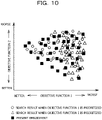
- FIG. 10 is a diagram illustrating a case where the Pareto solution of the n-th feed product is worked out from the Pareto solution of the first feed product by the approach of the present embodiment.
- the black rectangles represent the result of the present embodiment.
- the search space for the optimum solution is expanded in terms of both of the objective function 1 and the objective function 2.
- the search space is biased such that the result of the objective function 1 becomes better.
- the search space is biased such that the result of the objective function 2 becomes better.
- the manufacturing line is an example of a work line in which a plurality of objects is processed in a predetermined order, a plurality of works is performed in order on each of the plurality of objects, and at least part of the works among the plurality of works are different from each other between the plurality of objects.
- the product is an example of the object.
- the optimum solution extraction unit 30 functions as an example of a solution extraction unit that executes a series of processes including: a process of generating child individuals by assigning a defined number of individuals to which a feeding order of part of the plurality of objects to the work line is given as input variables, as parent individuals, and evolving generations from the parent individuals by a genetic algorithm; a process of calculating evaluation functions according to a plurality of objective functions for simulation results when the part of the objects are fed to the work line in each feeding order of the parent individuals and the child individuals; and a process of extracting the defined number of individuals of which the evaluation functions satisfy a predetermined condition, as solutions.
Landscapes
- Engineering & Computer Science (AREA)
- Physics & Mathematics (AREA)
- General Physics & Mathematics (AREA)
- Manufacturing & Machinery (AREA)
- Quality & Reliability (AREA)
- General Engineering & Computer Science (AREA)
- Automation & Control Theory (AREA)
- Business, Economics & Management (AREA)
- Strategic Management (AREA)
- Human Resources & Organizations (AREA)
- Economics (AREA)
- Tourism & Hospitality (AREA)
- Theoretical Computer Science (AREA)
- General Business, Economics & Management (AREA)
- Marketing (AREA)
- Development Economics (AREA)
- Operations Research (AREA)
- Entrepreneurship & Innovation (AREA)
- Game Theory and Decision Science (AREA)
- Health & Medical Sciences (AREA)
- General Health & Medical Sciences (AREA)
- Primary Health Care (AREA)
- Management, Administration, Business Operations System, And Electronic Commerce (AREA)
- General Factory Administration (AREA)
Applications Claiming Priority (1)
| Application Number | Priority Date | Filing Date | Title |
|---|---|---|---|
| PCT/JP2020/011727 WO2021186551A1 (ja) | 2020-03-17 | 2020-03-17 | 情報処理装置、作業計画決定方法、および作業計画決定プログラム |
Publications (2)
| Publication Number | Publication Date |
|---|---|
| EP4123554A1 true EP4123554A1 (de) | 2023-01-25 |
| EP4123554A4 EP4123554A4 (de) | 2023-04-19 |
Family
ID=77770869
Family Applications (1)
| Application Number | Title | Priority Date | Filing Date |
|---|---|---|---|
| EP20925644.5A Pending EP4123554A4 (de) | 2020-03-17 | 2020-03-17 | Informationsverarbeitungsvorrichtung, arbeitsplanbestimmungsverfahren und arbeitsplanbestimmungsprogramm |
Country Status (5)
| Country | Link |
|---|---|
| US (1) | US20220350316A1 (de) |
| EP (1) | EP4123554A4 (de) |
| JP (1) | JP7303474B2 (de) |
| CN (1) | CN115053248A (de) |
| WO (1) | WO2021186551A1 (de) |
Families Citing this family (3)
| Publication number | Priority date | Publication date | Assignee | Title |
|---|---|---|---|---|
| JP7791425B2 (ja) * | 2022-01-17 | 2025-12-24 | 富士通株式会社 | 立案プログラム、立案方法、および情報処理装置 |
| JP2023104033A (ja) * | 2022-01-17 | 2023-07-28 | 富士通株式会社 | 立案プログラム、立案方法、および情報処理装置 |
| WO2024047682A1 (ja) * | 2022-08-29 | 2024-03-07 | 富士通株式会社 | 演算プログラム、演算方法、および情報処理装置 |
Family Cites Families (13)
| Publication number | Priority date | Publication date | Assignee | Title |
|---|---|---|---|---|
| JP2003084819A (ja) | 2001-09-07 | 2003-03-19 | Technova Kk | 生産計画生成方法、生産計画生成装置、コンピュータプログラム、及び記録媒体 |
| JP3735079B2 (ja) * | 2002-03-15 | 2006-01-11 | 株式会社日立製作所 | 自動車製造ラインの投入順計画立案装置および方法 |
| JP4960479B2 (ja) * | 2010-06-03 | 2012-06-27 | 株式会社東芝 | 製造計画作成装置及びプログラム |
| CN102354311A (zh) * | 2011-09-09 | 2012-02-15 | 河海大学常州校区 | 面向大批量定制的可重构装配线平衡方法 |
| TWI502523B (zh) * | 2013-09-11 | 2015-10-01 | Nat Univ Tsing Hua | 半導體產品多目標產能規劃系統及其方法 |
| CN104463394A (zh) * | 2013-09-18 | 2015-03-25 | Sap欧洲公司 | 生产资源管理 |
| JP5954750B2 (ja) * | 2014-06-30 | 2016-07-20 | インターナショナル・ビジネス・マシーンズ・コーポレーションInternational Business Machines Corporation | 情報処理装置、情報処理方法、及びプログラム |
| CN105550751B (zh) * | 2015-12-15 | 2018-05-29 | 重庆大学 | 利用优先级策略混合遗传算法的炼钢连铸生产调度方法 |
| JP6593194B2 (ja) * | 2016-01-27 | 2019-10-23 | 東芝三菱電機産業システム株式会社 | 自動車生産ラインのpbs出庫順列決定装置 |
| JP6969611B2 (ja) * | 2017-09-27 | 2021-11-24 | 日本電気株式会社 | 情報処理システム、制御方法、及びプログラム |
| JP6841339B2 (ja) * | 2017-09-27 | 2021-03-10 | 富士通株式会社 | 人員配置策定装置、人員配置策定方法及び人員配置策定プログラム |
| JP7067240B2 (ja) * | 2018-04-24 | 2022-05-16 | 富士通株式会社 | 最適化計算方法、最適化計算プログラム及び最適化計算装置 |
| CN108880663B (zh) * | 2018-07-20 | 2020-09-22 | 大连大学 | 基于改进遗传算法的天地一体化网络资源分配方法 |
-
2020
- 2020-03-17 WO PCT/JP2020/011727 patent/WO2021186551A1/ja not_active Ceased
- 2020-03-17 JP JP2022508656A patent/JP7303474B2/ja active Active
- 2020-03-17 CN CN202080095435.2A patent/CN115053248A/zh active Pending
- 2020-03-17 EP EP20925644.5A patent/EP4123554A4/de active Pending
-
2022
- 2022-07-13 US US17/863,436 patent/US20220350316A1/en active Pending
Also Published As
| Publication number | Publication date |
|---|---|
| JPWO2021186551A1 (de) | 2021-09-23 |
| WO2021186551A1 (ja) | 2021-09-23 |
| JP7303474B2 (ja) | 2023-07-05 |
| US20220350316A1 (en) | 2022-11-03 |
| EP4123554A4 (de) | 2023-04-19 |
| CN115053248A (zh) | 2022-09-13 |
Similar Documents
| Publication | Publication Date | Title |
|---|---|---|
| US20220350316A1 (en) | Information processing device, work plan determination method, and storage medium | |
| Hui et al. | A genetic algorithm for product disassembly sequence planning | |
| JP7177801B2 (ja) | 工程編成の装置、その方法およびそのプログラム | |
| US10969764B2 (en) | Support device, design support method and computer-readable non-transitory medium | |
| aDaimler et al. | Intelligent utilization of digital manufacturing data in modern product emergence processes | |
| Wang et al. | Automatic preference based multi-objective evolutionary algorithm on vehicle fleet maintenance scheduling optimization | |
| Garzia et al. | Discrete-event simulation: When prototyping of large, complex systems is impossible, this technique, based on known behaviors of interacting elements, is useful | |
| CN110244659A (zh) | 控制装置、数据制作装置、控制方法以及控制程序 | |
| Illmer et al. | Synchronizing Digital Process Twins between virtual products and resources–A virtual design method | |
| JP2016110592A (ja) | 生産・物流スケジュール作成方法、装置及びプログラム | |
| Mahmood et al. | Layout planning and analysis of a Flexible Manufacturing System based on 3D Simulation and Virtual Reality | |
| CN112654943A (zh) | 制造系统设计辅助装置 | |
| Kruczyk et al. | Random reducts: A monte carlo rough set-based method for feature selection in large datasets | |
| Gaspar et al. | Implicit material modelling using artificial intelligence techniques | |
| Lee et al. | Petri-net based scheduling strategy for semiconductor manufacturing processes | |
| Leißau et al. | Breaking barriers in semiconductor simulations: An automated low-code framework for model-structure synchronisation and large-scale simulation studies | |
| JP7839431B2 (ja) | 演算プログラム、演算方法、および情報処理装置 | |
| Ciszak | Computer aided determination of the assembly sequence of machine parts and sets | |
| JP2021170239A (ja) | 工程設計の支援装置、支援方法および支援プログラム | |
| Khalid et al. | Leveraging bio-inspired knowledge-intensive optimization algorithm in the assembly line balancing problem | |
| Breckle et al. | Multi-criteria evaluation within concept planning phase of assembly system design | |
| Abdul Rahman et al. | An Integrated Systematic Approach for Reconfiguration of Facilities Layout in a Stochastic Product Demand. | |
| Ma et al. | AI Assembly: Object Recognition, Computer Vision, and Digital Twin for Mixed Reality Assembly | |
| Kamenszka et al. | THE USE OF DATABASE IN THE PLANNING OF ASSEMBLY WORKPLACES AND SYSTEMS | |
| Taha et al. | Job sequencing and layout optimization in virtual production line |
Legal Events
| Date | Code | Title | Description |
|---|---|---|---|
| STAA | Information on the status of an ep patent application or granted ep patent |
Free format text: STATUS: THE INTERNATIONAL PUBLICATION HAS BEEN MADE |
|
| PUAI | Public reference made under article 153(3) epc to a published international application that has entered the european phase |
Free format text: ORIGINAL CODE: 0009012 |
|
| STAA | Information on the status of an ep patent application or granted ep patent |
Free format text: STATUS: REQUEST FOR EXAMINATION WAS MADE |
|
| 17P | Request for examination filed |
Effective date: 20220803 |
|
| AK | Designated contracting states |
Kind code of ref document: A1 Designated state(s): AL AT BE BG CH CY CZ DE DK EE ES FI FR GB GR HR HU IE IS IT LI LT LU LV MC MK MT NL NO PL PT RO RS SE SI SK SM TR |
|
| REG | Reference to a national code |
Ref country code: DE Ref legal event code: R079 Free format text: PREVIOUS MAIN CLASS: G06Q0050040000 Ipc: G06Q0010040000 |
|
| A4 | Supplementary search report drawn up and despatched |
Effective date: 20230317 |
|
| RIC1 | Information provided on ipc code assigned before grant |
Ipc: G05B 19/418 20060101ALI20230313BHEP Ipc: G06Q 50/04 20120101ALI20230313BHEP Ipc: G06Q 10/04 20230101AFI20230313BHEP |
|
| DAV | Request for validation of the european patent (deleted) | ||
| DAX | Request for extension of the european patent (deleted) | ||
| STAA | Information on the status of an ep patent application or granted ep patent |
Free format text: STATUS: EXAMINATION IS IN PROGRESS |
|
| 17Q | First examination report despatched |
Effective date: 20250923 |