EP4122835B1 - Waschmittelproduktbehälter mit schloss und verfahren zum betreiben des verschlossenen behälters - Google Patents
Waschmittelproduktbehälter mit schloss und verfahren zum betreiben des verschlossenen behälters Download PDFInfo
- Publication number
- EP4122835B1 EP4122835B1 EP22185324.5A EP22185324A EP4122835B1 EP 4122835 B1 EP4122835 B1 EP 4122835B1 EP 22185324 A EP22185324 A EP 22185324A EP 4122835 B1 EP4122835 B1 EP 4122835B1
- Authority
- EP
- European Patent Office
- Prior art keywords
- specific
- lid
- additional
- centroid
- actuation area
- Prior art date
- Legal status (The legal status is an assumption and is not a legal conclusion. Google has not performed a legal analysis and makes no representation as to the accuracy of the status listed.)
- Active
Links
Images

Classifications
-
- B—PERFORMING OPERATIONS; TRANSPORTING
- B65—CONVEYING; PACKING; STORING; HANDLING THIN OR FILAMENTARY MATERIAL
- B65D—CONTAINERS FOR STORAGE OR TRANSPORT OF ARTICLES OR MATERIALS, e.g. BAGS, BARRELS, BOTTLES, BOXES, CANS, CARTONS, CRATES, DRUMS, JARS, TANKS, HOPPERS, FORWARDING CONTAINERS; ACCESSORIES, CLOSURES, OR FITTINGS THEREFOR; PACKAGING ELEMENTS; PACKAGES
- B65D5/00—Rigid or semi-rigid containers of polygonal cross-section, e.g. boxes, cartons or trays, formed by folding or erecting one or more blanks made of paper
- B65D5/42—Details of containers or of foldable or erectable container blanks
- B65D5/64—Lids
- B65D5/66—Hinged lids
- B65D5/6626—Hinged lids formed by folding extensions of a side panel of a container body formed by erecting a "cross-like" blank
- B65D5/665—Hinged lids formed by folding extensions of a side panel of a container body formed by erecting a "cross-like" blank the lid being held in closed position by self-locking integral flaps or tabs
- B65D5/6661—Flaps provided over the total length of the lid edge opposite to the hinge
- B65D5/6664—Flaps provided over the total length of the lid edge opposite to the hinge combined with flaps or tabs provided at the side edges of the lid
- B65D5/6667—Flaps provided over the total length of the lid edge opposite to the hinge combined with flaps or tabs provided at the side edges of the lid and connected to one another in order to form an uninterrupted telescoping flange
-
- B—PERFORMING OPERATIONS; TRANSPORTING
- B65—CONVEYING; PACKING; STORING; HANDLING THIN OR FILAMENTARY MATERIAL
- B65D—CONTAINERS FOR STORAGE OR TRANSPORT OF ARTICLES OR MATERIALS, e.g. BAGS, BARRELS, BOTTLES, BOXES, CANS, CARTONS, CRATES, DRUMS, JARS, TANKS, HOPPERS, FORWARDING CONTAINERS; ACCESSORIES, CLOSURES, OR FITTINGS THEREFOR; PACKAGING ELEMENTS; PACKAGES
- B65D43/00—Lids or covers for rigid or semi-rigid containers
- B65D43/02—Removable lids or covers
- B65D43/0202—Removable lids or covers without integral tamper element
- B65D43/0233—Removable lids or covers without integral tamper element secured by rolling or other plastic deformation
-
- B—PERFORMING OPERATIONS; TRANSPORTING
- B65—CONVEYING; PACKING; STORING; HANDLING THIN OR FILAMENTARY MATERIAL
- B65D—CONTAINERS FOR STORAGE OR TRANSPORT OF ARTICLES OR MATERIALS, e.g. BAGS, BARRELS, BOTTLES, BOXES, CANS, CARTONS, CRATES, DRUMS, JARS, TANKS, HOPPERS, FORWARDING CONTAINERS; ACCESSORIES, CLOSURES, OR FITTINGS THEREFOR; PACKAGING ELEMENTS; PACKAGES
- B65D5/00—Rigid or semi-rigid containers of polygonal cross-section, e.g. boxes, cartons or trays, formed by folding or erecting one or more blanks made of paper
- B65D5/02—Rigid or semi-rigid containers of polygonal cross-section, e.g. boxes, cartons or trays, formed by folding or erecting one or more blanks made of paper by folding or erecting a single blank to form a tubular body with or without subsequent folding operations, or the addition of separate elements, to close the ends of the body
-
- B—PERFORMING OPERATIONS; TRANSPORTING
- B65—CONVEYING; PACKING; STORING; HANDLING THIN OR FILAMENTARY MATERIAL
- B65D—CONTAINERS FOR STORAGE OR TRANSPORT OF ARTICLES OR MATERIALS, e.g. BAGS, BARRELS, BOTTLES, BOXES, CANS, CARTONS, CRATES, DRUMS, JARS, TANKS, HOPPERS, FORWARDING CONTAINERS; ACCESSORIES, CLOSURES, OR FITTINGS THEREFOR; PACKAGING ELEMENTS; PACKAGES
- B65D5/00—Rigid or semi-rigid containers of polygonal cross-section, e.g. boxes, cartons or trays, formed by folding or erecting one or more blanks made of paper
- B65D5/42—Details of containers or of foldable or erectable container blanks
- B65D5/56—Linings or internal coatings, e.g. pre-formed trays provided with a blow- or thermoformed layer
- B65D5/563—Laminated linings; Coatings
-
- B—PERFORMING OPERATIONS; TRANSPORTING
- B65—CONVEYING; PACKING; STORING; HANDLING THIN OR FILAMENTARY MATERIAL
- B65D—CONTAINERS FOR STORAGE OR TRANSPORT OF ARTICLES OR MATERIALS, e.g. BAGS, BARRELS, BOTTLES, BOXES, CANS, CARTONS, CRATES, DRUMS, JARS, TANKS, HOPPERS, FORWARDING CONTAINERS; ACCESSORIES, CLOSURES, OR FITTINGS THEREFOR; PACKAGING ELEMENTS; PACKAGES
- B65D5/00—Rigid or semi-rigid containers of polygonal cross-section, e.g. boxes, cartons or trays, formed by folding or erecting one or more blanks made of paper
- B65D5/42—Details of containers or of foldable or erectable container blanks
- B65D5/64—Lids
- B65D5/66—Hinged lids
- B65D5/6602—Hinged lids formed by folding one or more extensions hinged to the upper edge of a tubular container body
- B65D5/6608—Hinged lids formed by folding one or more extensions hinged to the upper edge of a tubular container body the lid being held in closed position by self-locking integral flaps
-
- B—PERFORMING OPERATIONS; TRANSPORTING
- B65—CONVEYING; PACKING; STORING; HANDLING THIN OR FILAMENTARY MATERIAL
- B65D—CONTAINERS FOR STORAGE OR TRANSPORT OF ARTICLES OR MATERIALS, e.g. BAGS, BARRELS, BOTTLES, BOXES, CANS, CARTONS, CRATES, DRUMS, JARS, TANKS, HOPPERS, FORWARDING CONTAINERS; ACCESSORIES, CLOSURES, OR FITTINGS THEREFOR; PACKAGING ELEMENTS; PACKAGES
- B65D5/00—Rigid or semi-rigid containers of polygonal cross-section, e.g. boxes, cartons or trays, formed by folding or erecting one or more blanks made of paper
- B65D5/42—Details of containers or of foldable or erectable container blanks
- B65D5/64—Lids
- B65D5/68—Telescope flanged lids
- B65D5/685—Telescope flanged lids having an inwardly or upwardly extending tab on the lid side wall cooperating with a tab on, or an opening in, the container side wall
-
- B—PERFORMING OPERATIONS; TRANSPORTING
- B65—CONVEYING; PACKING; STORING; HANDLING THIN OR FILAMENTARY MATERIAL
- B65D—CONTAINERS FOR STORAGE OR TRANSPORT OF ARTICLES OR MATERIALS, e.g. BAGS, BARRELS, BOTTLES, BOXES, CANS, CARTONS, CRATES, DRUMS, JARS, TANKS, HOPPERS, FORWARDING CONTAINERS; ACCESSORIES, CLOSURES, OR FITTINGS THEREFOR; PACKAGING ELEMENTS; PACKAGES
- B65D50/00—Closures with means for discouraging unauthorised opening or removal thereof, with or without indicating means, e.g. child-proof closures
- B65D50/02—Closures with means for discouraging unauthorised opening or removal thereof, with or without indicating means, e.g. child-proof closures openable or removable by the combination of plural actions
- B65D50/04—Closures with means for discouraging unauthorised opening or removal thereof, with or without indicating means, e.g. child-proof closures openable or removable by the combination of plural actions requiring the combination of simultaneous actions, e.g. depressing and turning, lifting and turning, maintaining a part and turning another one
- B65D50/045—Closures with means for discouraging unauthorised opening or removal thereof, with or without indicating means, e.g. child-proof closures openable or removable by the combination of plural actions requiring the combination of simultaneous actions, e.g. depressing and turning, lifting and turning, maintaining a part and turning another one where one action elastically deforms or deflects at least part of the closure, the container or an intermediate element, e.g. a ring
- B65D50/046—Closures with means for discouraging unauthorised opening or removal thereof, with or without indicating means, e.g. child-proof closures openable or removable by the combination of plural actions requiring the combination of simultaneous actions, e.g. depressing and turning, lifting and turning, maintaining a part and turning another one where one action elastically deforms or deflects at least part of the closure, the container or an intermediate element, e.g. a ring and such deformation causes the disengagement of locking means, e.g. the release of a pawl-like element from a tooth or abutment, to allow removal of the closure by simultaneous rotation
-
- B—PERFORMING OPERATIONS; TRANSPORTING
- B65—CONVEYING; PACKING; STORING; HANDLING THIN OR FILAMENTARY MATERIAL
- B65D—CONTAINERS FOR STORAGE OR TRANSPORT OF ARTICLES OR MATERIALS, e.g. BAGS, BARRELS, BOTTLES, BOXES, CANS, CARTONS, CRATES, DRUMS, JARS, TANKS, HOPPERS, FORWARDING CONTAINERS; ACCESSORIES, CLOSURES, OR FITTINGS THEREFOR; PACKAGING ELEMENTS; PACKAGES
- B65D81/00—Containers, packaging elements, or packages, for contents presenting particular transport or storage problems, or adapted to be used for non-packaging purposes after removal of contents
- B65D81/24—Adaptations for preventing deterioration or decay of contents; Applications to the container or packaging material of food preservatives, fungicides, pesticides or animal repellants
- B65D81/26—Adaptations for preventing deterioration or decay of contents; Applications to the container or packaging material of food preservatives, fungicides, pesticides or animal repellants with provision for draining away, or absorbing, or removing by ventilation, fluids, e.g. exuded by contents; Applications of corrosion inhibitors or desiccators
- B65D81/264—Adaptations for preventing deterioration or decay of contents; Applications to the container or packaging material of food preservatives, fungicides, pesticides or animal repellants with provision for draining away, or absorbing, or removing by ventilation, fluids, e.g. exuded by contents; Applications of corrosion inhibitors or desiccators for absorbing liquids
-
- B—PERFORMING OPERATIONS; TRANSPORTING
- B65—CONVEYING; PACKING; STORING; HANDLING THIN OR FILAMENTARY MATERIAL
- B65D—CONTAINERS FOR STORAGE OR TRANSPORT OF ARTICLES OR MATERIALS, e.g. BAGS, BARRELS, BOTTLES, BOXES, CANS, CARTONS, CRATES, DRUMS, JARS, TANKS, HOPPERS, FORWARDING CONTAINERS; ACCESSORIES, CLOSURES, OR FITTINGS THEREFOR; PACKAGING ELEMENTS; PACKAGES
- B65D2215/00—Child-proof means
- B65D2215/02—Child-proof means requiring the combination of simultaneous actions
-
- B—PERFORMING OPERATIONS; TRANSPORTING
- B65—CONVEYING; PACKING; STORING; HANDLING THIN OR FILAMENTARY MATERIAL
- B65D—CONTAINERS FOR STORAGE OR TRANSPORT OF ARTICLES OR MATERIALS, e.g. BAGS, BARRELS, BOTTLES, BOXES, CANS, CARTONS, CRATES, DRUMS, JARS, TANKS, HOPPERS, FORWARDING CONTAINERS; ACCESSORIES, CLOSURES, OR FITTINGS THEREFOR; PACKAGING ELEMENTS; PACKAGES
- B65D2251/00—Details relating to container closures
- B65D2251/04—Orienting or positioning means
-
- B—PERFORMING OPERATIONS; TRANSPORTING
- B65—CONVEYING; PACKING; STORING; HANDLING THIN OR FILAMENTARY MATERIAL
- B65D—CONTAINERS FOR STORAGE OR TRANSPORT OF ARTICLES OR MATERIALS, e.g. BAGS, BARRELS, BOTTLES, BOXES, CANS, CARTONS, CRATES, DRUMS, JARS, TANKS, HOPPERS, FORWARDING CONTAINERS; ACCESSORIES, CLOSURES, OR FITTINGS THEREFOR; PACKAGING ELEMENTS; PACKAGES
- B65D2543/00—Lids or covers essentially for box-like containers
- B65D2543/00009—Details of lids or covers for rigid or semi-rigid containers
- B65D2543/00018—Overall construction of the lid
- B65D2543/00064—Shape of the outer periphery
- B65D2543/00074—Shape of the outer periphery curved
- B65D2543/00101—Shape of the outer periphery curved square-like or rectangular-like
-
- B—PERFORMING OPERATIONS; TRANSPORTING
- B65—CONVEYING; PACKING; STORING; HANDLING THIN OR FILAMENTARY MATERIAL
- B65D—CONTAINERS FOR STORAGE OR TRANSPORT OF ARTICLES OR MATERIALS, e.g. BAGS, BARRELS, BOTTLES, BOXES, CANS, CARTONS, CRATES, DRUMS, JARS, TANKS, HOPPERS, FORWARDING CONTAINERS; ACCESSORIES, CLOSURES, OR FITTINGS THEREFOR; PACKAGING ELEMENTS; PACKAGES
- B65D2543/00—Lids or covers essentially for box-like containers
- B65D2543/00009—Details of lids or covers for rigid or semi-rigid containers
- B65D2543/00018—Overall construction of the lid
- B65D2543/00259—Materials used
- B65D2543/00268—Paper
-
- B—PERFORMING OPERATIONS; TRANSPORTING
- B65—CONVEYING; PACKING; STORING; HANDLING THIN OR FILAMENTARY MATERIAL
- B65D—CONTAINERS FOR STORAGE OR TRANSPORT OF ARTICLES OR MATERIALS, e.g. BAGS, BARRELS, BOTTLES, BOXES, CANS, CARTONS, CRATES, DRUMS, JARS, TANKS, HOPPERS, FORWARDING CONTAINERS; ACCESSORIES, CLOSURES, OR FITTINGS THEREFOR; PACKAGING ELEMENTS; PACKAGES
- B65D2543/00—Lids or covers essentially for box-like containers
- B65D2543/00009—Details of lids or covers for rigid or semi-rigid containers
- B65D2543/00444—Contact between the container and the lid
- B65D2543/00481—Contact between the container and the lid on the inside or the outside of the container
- B65D2543/00537—Contact between the container and the lid on the inside or the outside of the container on the outside, or a part turned to the outside of the mouth of the container
-
- B—PERFORMING OPERATIONS; TRANSPORTING
- B65—CONVEYING; PACKING; STORING; HANDLING THIN OR FILAMENTARY MATERIAL
- B65D—CONTAINERS FOR STORAGE OR TRANSPORT OF ARTICLES OR MATERIALS, e.g. BAGS, BARRELS, BOTTLES, BOXES, CANS, CARTONS, CRATES, DRUMS, JARS, TANKS, HOPPERS, FORWARDING CONTAINERS; ACCESSORIES, CLOSURES, OR FITTINGS THEREFOR; PACKAGING ELEMENTS; PACKAGES
- B65D2543/00—Lids or covers essentially for box-like containers
- B65D2543/00009—Details of lids or covers for rigid or semi-rigid containers
- B65D2543/00444—Contact between the container and the lid
- B65D2543/00574—Contact between the container and the lid secured locally, i.e. a lot less than half the periphery
Definitions
- Detergent products are sensitive to humidity and should as such be contained in specific containers, in particular containers which may be locked to reduce risks of an accidental opening.
- a lock of such a container should be configured to be actuated by an ample variety of adult consumers or users. The lock should thereby both reliably prevent accidental opening and provide for reliable unlocking when desired by an adult consumer. While such objectives may appear contradictory, it is important to get them both resolved. This apparent contradiction is particularly acute when applied to cardboard containers which, while offering desirable recyclability, introduce challenges related to their mechanical characteristics.
- the consumer product according to this disclosure aims at taking these different aspects into account.
- Precision pinch is a specific human hand gesture whereby a human pinches an object between thumb and at least one or more other finger of the same hand. It was found that human beings are particularly precise when exerting such a movement. Precision may be described in this respect by considering the alignment of the direction of forces applied by the thumb and by the one or more other fingers of the same hand.
- the thumb When applying a precision pinch, the thumb generates a first force on a first side of the pinch, the one or more other finger generating a second force on a second side of the pinch.
- the first and the second forces are substantially along the same axis, in opposite senses.
- the key point of the precision pinch is that the first and the second force will naturally align each other if there is a reciprocal feedback response between the thumb and the one or more other fingers from the same hand.
- the configurations proposed will enable such reciprocal feedback, leading to relying on a precision permitting reliable lock opening of an otherwise robust locking mechanism.
- specific dimensioning enables such configurations, in particular corresponding to an adult hand. It should indeed be understood that, in the present description, a hand corresponds to a human adult hand.
- Detergent products are products which may be relatively heavy, for example when a container for such product is carrying the full weight of such detergent products, in particular when the consumer product is recently acquired and thereby holds a significant quantity of detergent product. While some consumers may lift and transport such a consumer product holding a base of a box containing such detergent product, such lifting and transport may also occur by holding such consumer product by a lid, without holding the base. In such cases, it is possible that the lid, submitted to the force of gravity of the detergent product, gets released and opens the box, the box falling and possibly spreading its content. Such situations should be avoided.
- the structure of the container of a consumer product should preserve or improve opening ergonomics and prevent or reduce a permanent side wall deformation upon excessive or repetitive application of forces applied to the consumer product, for example during transport, in a grocery shopping bag against other objects, when submitted to external pressure, or when dropped.
- containers may be elaborated in order to preserve the environment.
- the consumer product according to this disclosure aims at taking these different aspects into account.
- a consumer product should in this disclosure be understood as a product which is provided, among others, to end consumers. Such consumer products may for example be available for purchase in supermarkets and end consumers may store such consumer products in their homes. Consumer products may be provided in large quantities and should thereby be designed taking environmental concerns into account. Consumer products should also be designed taking transportation to a retail store into account. Consumer products should also be robust to withstand transportation as part of an e-commerce shipment. Consumer products should also be designed taking on the shelf storage in a retail store into account. Consumer products should also be designed taking transportation from a retail store to a consumer home into account. Consumer products should also be designed taking storage at a private end-consumer home into account. Consumer products should also be designed taking use of the consumer product at a private end consumer home into account. Consumer products should also be designed taking disposal into account.
- the consumer product according to this disclosure comprises a detergent product.
- Detergent products should be understood in this disclosure as products comprising a surfactant.
- Detergent products may also comprise a bleach or other ingredients.
- Example detergent product compositions are described in more detail herein.
- the detergent product comprises unit dose detergent pouches, preferably water soluble unit dose detergent pouches, more preferably flexible water soluble unit dose detergent pouches.
- Example unit dose detergent pouches are described in more detail herein.
- the consumer product according to this disclosure further comprises a container.
- a container should be understood in this disclosure as an object housing a content, for example in a cavity of the container.
- the container facilitates protection, transport, storage, access and disposal of the consumer product.
- the container comprises a box.
- a box should be understood as a generally parallelepiped, barrel shaped, cylindrical, round, oval or cubical three dimensional object defining a cavity. The use of parallelepiped boxes may facilitate storage and transportation by permitting piling up boxes in a space efficient manner.
- a box may be a parallelepiped provided with some rounded, tapered trapezium or chamfered edges.
- the box according to this disclosure comprises the detergent product. It should be understood that the detergent product is contained or stored in the box.
- the box according to this disclosure comprises a base, sidewalls and an opening opposite the base.
- a base according to this disclosure should be understood as a surface on which the box may lie when placed on a supporting surface such as a shelf or a floor.
- the base is rectangular and has four sides, four sidewalls extending perpendicular from the base, each sidewall being rectangular, each side wall being connected by a sidewall side to a side of the base, and by two other sidewall sides to two other of the four sidewalls.
- the base is oval or circular and the sidewalls form a generally cylindrical wall extending from the base in a direction normal or perpendicular to the base.
- sidewalls have a shape corresponding to one of a square, a rectangle, a trapeze, a polygon, a section of a sphere, a section of an ovoid, or a section of an ellipsoid.
- the opening according to this disclosure should be understood as an aperture providing access to the detergent product comprised in the box.
- the opening faces the base.
- the opening has a surface of less than the surface of the base.
- the opening has a surface larger than the surface of the base in order to provide an improved access, for example using sidewalls extending from the base at angle of more than 90 degrees from the base.
- the opening is provided after removal of a tamper proof feature, for example comprising a perforated piece to be removed at first use or a tamper evident sticker locking a lid to the box.
- a tamper evident sticker is glued on the lid and on the box, whereby the tamper evident sticker should be broken, teared or perforated at first opening to indicate to a consumer that the container has not been tempered with before purchase.
- This temper evident sticker may for example be in paper or in plastic.
- the opening is placed on a top panel of the box, the top panel of the box facing, i.e.
- the opening covers a portion of the top panel, the top panel comprising a peripheral section surrounding the opening, the peripheral section being a transition piece between a sidewall and the opening for example.
- the opening is rectangular.
- the opening is rectangular with rounded edges. In some examples, the opening is round or oval.
- the container comprises a lid for the box.
- the lid according to this disclosure should be understood as an element permitting to repeatedly close or open the opening of the box.
- the lid may be connected to the box, for example by a hinge, or may be separated from the box.
- the lid according to this disclosure comprises a top or lid top and flanks or lid flanks. It should be understood that the top of the lid is aimed at covering the opening of the box when the lid is in a closed position.
- the top of the lid is rectangular.
- the top of the lid is round, hexagonal, octagonal, polygonal or oval, structures such as round or oval being for example approximated by multiplying a number of side panels and lid flaps.
- the lid comprises beveled edges.
- the force or pressure leading to the displacement will take a specific direction defined by the precision pinching, such specific direction contributing to the displacement in a direction normal to the specific portion of the side wall.
- Such force or pressure may also comprise a minor component which may be parallel to the side wall, due to the fact that the hand is a human hand which does not necessarily align force completely perfectly, even when applying a precision pinch.
- the actuation is however triggered by a component of such force or pressure being normal to the portion of the side wall.
- Such presence of a component normal to the portion of the sidewall participates in the role of the lock of avoiding an accidental opening, whereas desired opening would take place by the consumer "pushing" the specific actuator and apply the unlocking force or pressure permitting opening of the lid.
- the flanks comprise a specific actuation area in a specific flank, the actuation area facing the specific actuator.
- the fact that such actuation area faces the specific actuator indeed permits locating either the thumb or one or more of the other fingers on exactly the area on which a lock opening force should be applied.
- the actuation area should be understood as defining a localised discontinuity on the specific flank, whereby a user or consumer may perceive such discontinuity in order to correctly locate the thumb or one or more other fingers and apply the precision pinch.
- Such discontinuity may comprise one or more of an actuation aperture, an actuation flap, an actuation slit or an actuation membrane.
- the actuation area meaning either one or both of the specific or additional actuation area, the specific portion, or the additional portion, comprises a visual indication indicating the location of the actuation area.
- the actuation area is an aperture
- the specific portion, respectively additional portion comprises a visual indication visible through the aperture, respectively apertures, when the lid is closed.
- the visual indication may be printed on an external surface of the flanks and may comprise one or more arrows or one or more areas printed in a striking colour or a specific text providing instructions such as "push here to open" for example, or a combination of any of these indications, in order to further increase precision of pinching.
- the actuation area is configured to permit displacing the specific actuator from the locking position to the opening position by applying the actuation pressure at the specific actuation area when the lid is in the closed position.
- the specific actuation area spans less than 8 cm 2 and more than 0.2 cm 2 . It was found that a larger area would lead to lack of precision in finger placement, and that a smaller area would lead to the actuation area being difficult to locate for a user or consumer.
- the specific actuation area has a circular shape in order to ease positioning. Other shapes may be considered such as, for example, elliptical, oval, square, triangular, square with rounded corners, triangular with rounded corners, other polygonal shapes or other polygonal shapes with rounded corners.
- the thumb should perceive a reaction force from the one or more fingers of the same hand, and the one or more fingers should perceive a reaction force from the thumb.
- This reciprocal feedback will lead to aligning the forces produced during the precision pinch leading to the opening of the lock.
- Such feedback should be transmitted by some structure which would directly or indirectly connect the specific actuation area with the flank opposite the specific flank. It was found that the role of such a structure transmitting the feedback forces could be fulfilled by the top of the lid when the specific actuation area was located in a specific manner, such specific manner permitting that the thumb and one or more other fingers enter in contact simultaneously with the specific flank and with the flank opposite the specific flank which are linked through the top of the lid.
- Such location of the specific area may be defined by the location of a specific centroid of the specific actuation area.
- the specific actuation area indeed defines a specific centroid, a centroid corresponding for example to a geometric centre of the actuation area or arithmetic mean position of all the points comprised in the specific actuation area.
- the specific centroid is separated from the top of the lid by less than 5 cm and by more than 0.5 cm and the specific centroid is separated from a distal end of the specific flank by more than 0.5 cm.
- the distal end should be understood as the end of the flank away from the top of the lid along the direction of the box sidewalls.
- the top of the lid spans less than 13 cm and more than 6 cm along a direction normal to the specific portion at the specific centroid. It was found that a larger span would prevent pinching, and that a smaller span would not permit providing a sufficient opening size to access the detergent contained in the box. Without wishing to be bound by theory, it is believed that a shorter span may not provide a precision pinch offering an appropriate balance of power and precision for the purpose of opening the lock according to this disclosure. In some examples, the top of the lid spans less than 12 cm and more than 7 cm along a direction normal to the specific portion at the specific centroid.
- the top of the lid spans less than 11 cm and more than 8 cm along a direction normal to the specific portion at the specific centroid. In some examples, the top of the lid spans less than 10 cm and more than 9 cm along a direction normal to the specific portion at the specific centroid.
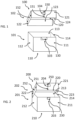
- Figure 1 illustrates an example consumer product 100 comprising a detergent product (not visible) and a container, the container comprising a box 101 comprising the detergent product, a lid 102 for the box 101, and a lock 103 to maintain the lid 101 in a closed position.
- the box comprising a base 110, sidewalls 111-114 and an opening opposite the base, the lid 102 comprising a top 120 and flanks 121-124, the top 120 covering the opening and the flanks 121-124 covering at least a specific portion of a specific sidewall of the sidewalls 111-114 of the box 101 when the lid 102 is in the closed position
- the lock 103 comprises a specific actuator 130 moveable from a locking position to an opening position by applying an actuation pressure onto the specific actuator 130 when the lid is 102 in the closed position, the specific actuator 130 being connected to the specific portion, the flanks 121-124 comprising a specific actuation area 104 in a specific flank 121, the actuation area 104 facing the specific actuator 130 and permitting displacing the specific actuator 130 from the locking position to the opening position by applying the actuation pressure at the specific actuation area 104 when the lid 102 is in the closed position.
- the box has a rectangular base and the lid has a rectangular top.
- the sidewalls and flanks are also rectangular.
- the lid is illustrated in the open position in order to visualize the various elements.
- the actuation area 104 is a round aperture having a 2.4 cm diameter which defines a specific actuation area of about 4.5 cm 2 .
- Actuation area 104 defines a specific centroid which corresponds to the center of the round aperture.
- the center of the aperture is separated from the top of the lid by about 20 mm as illustrated by distance 150 which is the shortest distance between the specific centroid and a point comprised in the top of the lid, the distance in this case being along a direction perpendicular to the top of the lid and along flank 121 into which the aperture 104 is cut out.
- the specific centroid, or center of round actuation area 104 is in this example separated from a distal end of the specific flank by 50 mm as illustrated by distance 151 which is the shortest distance between the specific centroid and a point comprised in the distal end of flank 121 of the lid, the distance in this case being along a direction perpendicular to the top of the lid and along flank 121 into which the aperture 104 is cut out.
- the top of the lid spans 94 mm along a direction normal to the specific portion at the specific centroid, as illustrated by distance 152 which in this case is parallel to the top of the lid and normal to the specific flank 121 where the specific actuation area is located.
- the lock 103 comprises a flap 130 which may be pushed through the aperture 104 when the lid is in the closed position.
- Lid 102 may be removed by, with a first adult hand, placing either the thumb or any other finger on the actuation area 104, and the opposite finger or fingers of the same adult hand on the flank 123 opposite the specific flank, the first adult hand thereby pinching the lid 102 across its top 120 and pushing onto flap 130 while holding the box 101 with the other adult hand to lifting the lid open as the flap 130 remains pressed against the specific portion of sidewall 111.
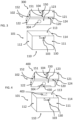
- Figure 2 illustrates an example consumer product 200 comprising a detergent product (not visible) and a container, the container comprising a box 201 comprising the detergent product, a lid 202 for the box 201, and a lock 203 to maintain the lid 201 in a closed position.
- the box comprising a base 210, sidewalls 211-214 and an opening opposite the base, the lid 202 comprising a top 220 and flanks 221-223, the top 220 covering the opening and the flanks 221-223 covering at least a specific portion of a specific sidewall of the sidewalls 211-214 of the box 201 when the lid 202 is in the closed position
- the lock 203 comprises a specific actuator 230 moveable from a locking position to an opening position by applying an actuation pressure onto the specific actuator 230 when the lid is 202 in the closed position, the specific actuator 230 being connected to the specific portion, the flanks 221-223 comprising a specific actuation area 204 in a specific flank 221, the actuation area 204 facing the specific actuator 230 and permitting displacing the specific actuator 230 from the locking position to the opening position by applying the actuation pressure at the specific actuation area 204 when the lid 202 is in the closed position.
- the box has a rectangular base and the lid has a rectangular top.
- the lid is a hinged lid connected by a fold line to sidewall 213 opposite side wall 211 comprising the specific portion.
- the sidewalls and flanks are also rectangular.
- the lid is illustrated in the open position in order to visualize the various elements.
- the actuation area 204 is a rectangular membrane having rounded edged and covering an underlying aperture, the rectangular membrane having a 1cm height along a direction normal to the top of the lid and a length of 3cm in a direction perpendicular to the height direction, thereby defining a specific actuation area of about 3 cm 2 .
- Actuation area 204 defines a specific centroid which corresponds to the center of the rectangle membrane.
- the specific centroid is separated from the top of the lid by 30 mm as illustrated by distance 250 which is the shortest distance between the specific centroid and a point comprised in the top of the lid, the distance in this case being along a direction perpendicular to the top of the lid and along flank 221 where the actuation area is located.
- the specific centroid is in this example separated from a distal end of the specific flank 221 by 30 mm as illustrated by distance 251 which is the shortest distance between the specific centroid and a point comprised in the distal end of flank 221 of the lid, the distance in this case being along a direction perpendicular to the top of the lid and along flank 221 into which the actuation area 204 is cut out.
- the top of the lid spans 100 mm along a direction normal to the specific portion at the specific centroid, as illustrated by distance 252 which in this case is parallel to the top of the lid and normal to the specific flank 221 where the specific actuation area is located.
- the lock 203 comprises a spring loaded push button 230 which may be actuated through the membrane of actuation area 204 when the lid is closed.
- Lid 202 may be opened by, with a first adult hand, placing either the thumb or any other finger on the actuation area 204, and the opposite finger or fingers of the same adult hand on the sidewall 223 opposite the sidewall 211 comprising the actuation area, the first adult hand thereby pinching the lid 202 across its top 220 and pushing onto button 230 while holding the box 201 with the other adult hand, to hinge the lid open as the button 230 remains pressed against the specific portion of sidewall 211.
- the additional centroid is separated from a distal end of the opposite flank by a distance of about 5 cm.
- a configuration according to the invention is such that the specific actuation area is placed so that it is not placed exactly opposite the specific actuation area.
- using an additional actuation area may for example enable use of a same box by right handed or left handed people regardless of the box location.
- a tab (not visible) is provided on the inside of flap 121 to interact with flap 130 and contribute to the locking.
- additional actuator 403 is represented as symmetrically opposed to the specific actuator 130 and as having the same nature and dimensions, such actuators may take in other examples different natures and dimensions, and may not necessarily be symmetrical.
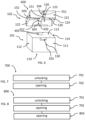
- FIG. 5 illustrates an example consumer product 500.
- This example consumer product 500 comprises the elements of consumer product 100 which are numbered using the same reference numerals.
- example consumer product 500 comprises a transversal support element 505 of the lid 102 extended from a first end 551 of the support element to a second end 552 of the support element along the direction normal to the specific portion at the specific centroid, the support element 505 being attached or integrated to the top of the lid, whereby the specific portion is, when the lid is closed, located between the first 551 end and the specific actuation area 104, the first end 551 being separated from the specific actuation area 104 by a clearance of less than 1cm and of more than 0.5 mm along the direction normal to the specific portion at the specific centroid.
- the combination of a lock and of a support element in addition to increasing the precision of pinching, would participate in suppressing or reducing the risk of accidental opening of the lid while permitting desired opening by a consumer.
- the avoidance or reduction of the risk of accidental opening would for example apply to a force being applied in a direction parallel to the sidewalls for example by friction with another box located side to side with a box according to this disclosure, or by a box falling over during transportation, or by internal movements of the content of the box pushing the lid during transportation.
- the specific centroid, and respectively additional centroid when present is located in a central region of a flank of the lid along a horizontal direction parallel to the top of the lid.
- a central area should be understood as substantially equidistant from opposite edges of the flank concerned, such edges being along a direction normal to the top of the lid.
- the present disclosure also aims at resolving an apparent contradiction between, on one hand, the use of materials for the sidewalls which would resist accidental opening, and the use of materials for the sidewalls which are particularly environmentally friendly.
- the container may indeed be made from paper or cardboard material, in particular rigid cardboard material, flexible cardboard material or a mixture thereof.
- the material forming the box or the lid has a wall thickness of more than 220 microns and of less than 3mm.
- the material forming the box or the lid has a wall thickness of more than 1mm and of less than 2mm.
- the material forming the box or the lid is folded on itself, for example to reinforce parts of or the whole of the box or the lid.
- the container may be made from paper materials, bio based material, bamboo fibres, cellulose fibres, cellulose based or fibre based materials, or a mixture thereof.
- the container may be made from materials comprising recycled materials, for example recycled cellulose fiber based materials.
- the lid in order to facilitate opening, may be entirely separated from the box when open, and the lid weighs less than 200g, preferably less than 100g, even more preferably less than 80g, and more than 10g, more preferably more than 30g, even more preferably more than 40g, in order to obtain a sufficiently robust lid structure.
- the lid comprises a support element structure permitting rendering the pinching more precise, the support element structure entering the opening of the box when the lid is in the closed position, at least part of the specific portion of the sidewalls being located between the flanks and the support element structure when the lid is in the closed position, a clearance distance separating the sidewalls from the support element structure in a direction normal to the specific portion of the sidewalls when the lid is in the closed position and when no actuation pressure is applied, the clearance distance being reduced to zero by flexing of the specific portion of the sidewalls when the actuation pressure is applied above a pressure threshold when the lid is in the closed position.
- Both the support element structure and the flanks are structurally part of the lid, the support element structure and the flanks permitting sandwiching the specific portion of the sidewall, thereby preventing sinking in of the specific portion of the sidewall and undesired disengagement of the specific actuator from the locking tab. It is important to take note of the fact that in case of an actuation pressure being applied while lifting the box through the lid, the pressure applied will catch the sandwiched specific portion of the sidewall against the support element structure, thereby compensating a force of gravity which would otherwise disconnect the lid from the box, such compensation of the gravity force being through a resisting static friction force between the specific portion of the sidewall and the support element structure.
- the use of the support element structure permits using for making the box a relatively flexible material, whereby such flexible material would flex in the absence of the support element structure to the point that the box would fall off if lifted by its lid. Permitting using a relatively flexible material also permits using a lesser quantity of such material due to the presence of the support element structure which compensates for such flexibility. The presence of such support element structure thereby prevents or reduces the risk of accidental opening even if the actuation pressure is applied onto the specific actuator of the lock, for example as the box is lifted while applying pressure on the specific actuator of the lock.
- This structure permits capturing the specific portion of the sidewall between the flanks and the support element structure, the specific portion of the sidewall getting inserted between the flanks and the support element structure when the lid moves from the open to the closed position, the specific portion of the side wall being released from between the flanks and the support element structure when the lid moves from the closed to the open position.
- a clearance distance separates the sidewalls from the support element structure in a direction normal to the specific portion of the sidewalls when the lid is in the closed position, such direction corresponding for example to a direction of a linear ridge of the support element, and when no actuation pressure is applied. Such clearance distance would exist on a first side, and be repeated additionally on a second side of the support element structure.
- Such clearance distance permits insertion of the support element structure through the opening as the lid gets closed, such that the support element structure does not collide with the specific portion of the sidewall when the lid gets closed.
- the clearance is reduced to zero by flexing of the specific portion of the sidewalls when the actuation pressure is applied above a pressure threshold when the lid is in the closed position.
- a pressure threshold when the lid is in the closed position.
- the sidewall lays against the support element structure through the clearance distance being reduced to zero, the sidewall thereby being prevented from being exceedingly distorted and being prevented from sinking in to the point of the specific actuator releasing the locking tab, and permitting feedback force being transmitted from one side of the pinch to the other side of the pinch.
- the clearance distance according to such examples relates in some examples to a tolerance distance between the lid and the box which both permits placing the lid onto the box without undue difficulty, while avoiding that the lid be loose when in the closed position. While the clearance distance according to this disclosure is considered in a region of the lock, the tolerance distance between the lid and the box may be considered along an entire perimeter of the opening of the box. In some examples, the tolerance is of at least 0.1 mm and of less than 5 mm. In some examples the tolerance is of at least 0.5mm and of less than 3 mm. Such tolerance would for example be measured when the lid is in the closed position and between an internal surface of the flanks and an external surface of the sidewalls, understanding that such tolerance may take a different value in a region of the lock.
- the clearance distance is of at least 1mm and of less than 1cm when the lid is in the closed position and no actuation pressure is applied. Such a range permits both easing the closing of the lid and preventing sinking of the specific portion of the sidewall leading to undesired unlocking.
- the clearance distance is of at least 1.5mm and of less than 0.5cm when the lid is in the closed position and no actuation pressure is applied. In some examples, the clearance distance is of at least 2mm and of less than 0.4cm when the lid is in the closed position and no actuation pressure is applied.
- the lid comprises a corrugated cardboard layer, the corrugated cardboard layer comprising flutes, the flutes preferably running parallel to the direction normal to the specific portion at the specific centroid and parallel to the top of the lid, and whereby the specific actuation area, and respectively additional actuation area, preferably intersect at least some of the flutes.
- a corrugated cardboard layer comprising flutes, the flutes preferably running parallel to the direction normal to the specific portion at the specific centroid and parallel to the top of the lid, and whereby the specific actuation area, and respectively additional actuation area, preferably intersect at least some of the flutes.
- Example non-soap anionic surfactants comprises linear alkylbenzene sulphonate, alkyl sulphate or a mixture thereof.
- Example weight ratio of linear alkylbenzene sulphonate to alkyl sulphate are from 1:2 to 9:1, from 1:1 to 7:1, from 1:1 to 5:1, or from 1:1 to 4:1.
- Example linear alkylbenzene sulphonates are C 10 -C 16 alkyl benzene sulfonic acids, or C 11 -C 14 alkyl benzene sulfonic acids.
- 'linear' we herein mean the alkyl group is linear.
- Example alkyl sulphate anionic surfactant may comprise a non-ethoxylated alkyl sulphate and an ethoxylated alkyl sulphate wherein the mol average degree of ethoxylation of the alkyl sulphate anionic surfactant is from 1 to 5, from 1 to 3, or from 2 to 3.
- Example alkyl fraction of the alkyl sulphate anionic surfactant are derived from fatty alcohols, oxo-synthesized alcohols, Guerbet alcohols, or mixtures thereof.
- the laundry detergent composition comprises between 10% and 50%, between 15% and 45%, between 20% and 40%, or between 30% and 40% by weight of the laundry detergent composition of the non-soap anionic surfactant.
- the non-ionic surfactant is selected from alcohol alkoxylate, an oxo-synthesised alcohol alkoxylate, Guerbet alcohol alkoxylates, alkyl phenol alcohol alkoxylates, or a mixture thereof.
- the laundry detergent composition comprises between 0.01% and 10%, between 0.01% and 8%, between 0.1% and 6%, or between 0.15% and 5% by weight of the liquid laundry detergent composition of a non-ionic surfactant.
- the liquid laundry detergent composition is non-Newtonian.
- a non-Newtonian liquid has properties that differ from those of a Newtonian liquid, more specifically, the viscosity of non-Newtonian liquids is dependent on shear rate, while a Newtonian liquid has a constant viscosity independent of the applied shear rate. The decreased viscosity upon shear application for non-Newtonian liquids is thought to further facilitate liquid detergent dissolution.
- the liquid laundry detergent composition described herein can have any suitable viscosity depending on factors such as formulated ingredients and purpose of the composition.
- the consumer product comprises at least one water-soluble unit dose article and the container.
- the consumer product can be sold 'as is', in other words the consumer product is the item that the consumer picks up from the shelf.
- the consumer product could be housed as one unit of a multi-component product.
- more than one consumer product could be housed within an outer package and the multiple packaged consumer products sold together in a single purchase.
- the consumer product may comprise aesthetic elements, for example shrink sleeves or labels attached to the container.
- the container may be coloured or printed with aesthetic elements or informative print such as usage instructions.
- a water-soluble unit dose article comprises at least one water-soluble film orientated to create at least one-unit dose internal compartment, wherein the at least one-unit dose internal compartment comprises a detergent composition.
- the water-soluble film and the detergent composition are described in more detail below.
- the consumer product comprises at least one water-soluble unit dose article, in some cases at least two water-soluble unit dose articles, in some cases at least 10 water-soluble unit dose articles, in some cases at least 20 water-soluble unit dose articles, in some cases at least 30 water-soluble unit dose articles, in some cases at least 40 water-soluble unit dose articles, in some cases at least 45 water-soluble unit dose articles.
- a water-soluble unit dose article is in some examples in the form of a pouch.
- a water-soluble unit dose article comprises in some examples a unitary dose of a composition as a volume sufficient to provide a benefit in an end application.
- the water-soluble unit dose article comprises in some examples one water-soluble film shaped such that the unit-dose article comprises at least one internal compartment surrounded by the water-soluble film.
- the at least one compartment comprises a cleaning composition.
- the water-soluble film is sealed such that the cleaning composition does not leak out of the compartment during storage. However, upon addition of the water-soluble unit dose article to water, the water-soluble film dissolves and releases the contents of the internal compartment into the wash liquor.
- the unit dose article may comprise more than one compartment, at least two compartments, or at least three compartments, or at least four compartments, or even at least five compartments.
- the compartments may be arranged in superposed orientation, i.e. one positioned on top of the other.
- the compartments may be positioned in a side-by-side orientation, i.e. one orientated next to the other.
- the compartments may be orientated in a 'tyre and rim' arrangement, i.e. a first compartment is positioned next to a second compartment, but the first compartment at least partially surrounds the second compartment, but does not completely enclose the second compartment.
- one compartment may be completely enclosed within another compartment.
- the unit dose article comprises at least two compartments, one of the compartments being smaller than the other compartment.
- one or more flank of the flanks comprising a respective actuation area covers at least 30% of one or more respective sidewall of the sidewalls when the lid is in the closed position.
- the respective actuation area is an aperture, such aperture will to some degree permit evacuating air comprised in the lid while closing the lid as the lid slides onto the box.
- the lid defines a lid internal volume delimited by the top of the lid and the flanks. In some examples the lid internal volume is comprised between 200 and 2000 cm 3 , preferably between 750 cm 3 and 1500 cm 3 .
Landscapes
- Engineering & Computer Science (AREA)
- Mechanical Engineering (AREA)
- Food Science & Technology (AREA)
- Closures For Containers (AREA)
- Cartons (AREA)
- Packages (AREA)
- Packaging Of Annular Or Rod-Shaped Articles, Wearing Apparel, Cassettes, Or The Like (AREA)
Claims (17)
- Endprodukt, umfassend ein Waschmittelprodukt und einen Behälter, der Behälter umfassend eine rechteckige Dose (101), einen rechteckigen Deckel (102) für die Dose und eine Verriegelung (103), um den Deckel in einer geschlossenen Position zu halten, die Dose umfassend das Waschmittelprodukt, die Dose umfassend eine Basis (110), Seitenwände (111-114) und eine Öffnung, die der Basis gegenüberliegt, der Deckel umfassend ein Oberteil (120) und Flanken (121-124), wobei das Oberteil die Öffnung abdeckt und die Flanken wenigstens einen spezifischen Abschnitt einer spezifischen Seitenwand der Seitenwände der Dose abdecken, wenn sich der Deckel in der geschlossener Position befindet, die Verriegelung umfassend ein spezifisches Betätigungselement (130), das von einer Verriegelungsposition in eine Öffnungsposition bewegbar ist, durch Ausüben eines Betätigungsdrucks auf das spezifische Betätigungselement, wenn sich der Deckel in der geschlossenen Position befindet, wobei das spezifische Betätigungselement mit dem spezifischen Abschnitt verbunden ist, die Flanken umfassend einen spezifischen Betätigungsbereich (104) in einer spezifischen Flanke, wobei der Betätigungsbereich dem spezifischen Betätigungselement zugewandt ist und ein Verschieben des spezifischen Betätigungselements von der Verriegelungsposition in die Öffnungsposition durch Ausüben des Betätigungsdruck an dem spezifischen Betätigungsbereich ermöglicht, wenn sich der Deckel in der geschlossenen Position befindet, wobei die Verriegelung ein zusätzliches Betätigungselement (403) in einer gegenüberliegenden Flanke, die der spezifischen Flanke gegenüberliegt, umfasst, wobei das zusätzliche Betätigungselement mit dem zusätzlichen Abschnitt der Seitenwand, die der spezifischen Seitenwand gegenüberliegt, verbunden ist, wobei das zusätzliche Betätigungselement dem zusätzlichen Betätigungsbereich zugewandt ist, wobei:- der spezifische Betätigungsbereich weniger als 8 cm2 und mehr als 0,2 cm2 überspannt, wobei der spezifische Betätigungsbereich einen spezifischen Schwerpunkt als eine arithmetische Mittelposition aller der in dem spezifischen Betätigungsbereich enthaltenen Punkte definiert;- der spezifische Schwerpunkt um weniger als 5 cm und um mehr als 0,5 cm von dem Oberteil des Deckels getrennt ist;- der spezifische Schwerpunkt um mehr als 0,5 cm von einem distalen Ende der spezifischen Flanke getrennt ist;- der zusätzliche Betätigungsbereich weniger als 8 cm2 und mehr als 0,2 cm2 überspannt, wobei der zusätzliche Betätigungsbereich einen zusätzlichen Schwerpunkt als eine arithmetische Mittelposition aller der in dem zusätzlichen Betätigungsbereich enthaltenen Punkte definiert;- der zusätzliche Schwerpunkt um weniger als 5 cm und um mehr als 0,5 cm von dem Oberteil des Deckels getrennt ist; und- der zusätzliche Schwerpunkt von einem distalen Ende der gegenüberliegenden Flanke um mehr als 0,5 cm getrennt ist;wobei das Endprodukt dadurch gekennzeichnet ist, dass:- das Oberteil des Deckels weniger als 13 cm und mehr als 6 cm entlang einer Richtung senkrecht zu dem spezifischen Abschnitt an dem spezifischen Schwerpunkt überspannt;- der zusätzliche Schwerpunkt und der spezifische Schwerpunkt um mehr als 6 cm und um weniger als 13 cm getrennt sind; und- der spezifische Betätigungsbereich platziert ist, sodass er dem zusätzlichen Betätigungsbereich nicht genau gegenüberliegt, wobei sich ein Abstand, der den spezifischen Schwerpunkt von dem distalen Ende der spezifischen Flanke trennt, von einem Abstand, der den zusätzlichen Schwerpunkt des zusätzlichen Betätigungsbereichs von dem distalen Ende der gegenüberliegenden Flanke trennt, um mehr als 5 % des Abstands, der den spezifischen Schwerpunkt von dem distalen Ende der spezifischen Flanke trennt, unterscheidet.
- Endprodukt nach Anspruch 1, wobei ein kürzester Abstand zwischen dem zusätzlichen Schwerpunkt und dem spezifischen Schwerpunkt entlang der spezifischen Flanke, des Oberteils des Deckels und der gegenüberliegenden Flanke weniger als 18 cm beträgt.
- Endprodukt nach einem der vorstehenden Ansprüche, wobei der Deckel ein querverlaufendes Trägerelement umfasst, das sich von einem ersten Ende des Trägerelements zu einem zweiten Ende des Trägerelements entlang der Richtung senkrecht zu dem spezifischen Abschnitt an dem spezifischen Schwerpunkt erstreckt, wobei das Trägerelement an dem Oberteil des Deckels angebracht oder in dieses integriert ist, wobei der spezifische Abschnitt zwischen dem ersten Ende und dem spezifischen Betätigungsbereich angeordnet ist, wenn sich der Deckel in der geschlossenen Position befindet, wobei das erste Ende um ein Spiel von weniger als 1 cm und von mehr als 0,5 mm entlang der Richtung senkrecht zu dem spezifischen Abschnitt an dem spezifischen Schwerpunkt von dem spezifischen Betätigungsbereich getrennt ist.
- Endprodukt nach Anspruch 3, wobei der zusätzliche Abschnitt zwischen dem zweiten Ende und dem zusätzlichen Betätigungsbereich angeordnet ist, wenn sich der Deckel in der geschlossenen Position befindet, wobei das zweite Ende um ein Spiel von weniger als 1 cm und von mehr als 0,5 mm entlang einer Richtung senkrecht zu dem zusätzlichen Abschnitt an dem zusätzlichen Schwerpunkt von dem zusätzlichen Betätigungsbereich getrennt ist.
- Endprodukt nach einem der vorstehenden Ansprüche, wobei einer oder mehrere der Betätigungsbereiche ein Durchlass sind.
- Endprodukt nach Anspruch 5, wobei das Waschmittelprodukt in der Form von Einheitsgebrauchsmengenwaschmittelbeuteln, vorzugsweise in der Form von elastischen wasserlöslichen Einheitsgebrauchsmengenwaschmittelbeuteln, vorliegt, wobei der Durchlass konfiguriert ist, um zu verhindern, dass ein Einheitsgebrauchsmengenwaschmittelbeutel durch den Durchlass hindurchgeht.
- Endprodukt nach einem der Ansprüche 5 oder 6, wobei der spezifische Abschnitt, beziehungsweise der zusätzliche Abschnitt, eine visuelle Angabe umfasst, die durch den Durchlass, beziehungsweise die Durchlässe, hindurch sichtbar ist, wenn der Deckel geschlossen ist.
- Endprodukt nach einem der vorstehenden Ansprüche, wobei eine oder mehrere Flanken der Flanken, umfassend einen jeweiligen Betätigungsbereich, wenigstens 30 % einer oder mehrerer jeweiliger Seitenwände der Seitenwände abdecken, wenn sich der Deckel in der geschlossenen Position befindet.
- Endprodukt nach einem der vorstehenden Ansprüche, wobei der Deckel von der Dose vollständig getrennt werden kann, wenn sie offen ist, und wobei der Deckel weniger als 200 g und mehr als 10 g wiegt.
- Endprodukt nach einem der vorstehenden Ansprüche, wobei der spezifische Schwerpunkt, beziehungsweise der zusätzliche Schwerpunkt, um mehr als 1 cm und um weniger als 3 cm von dem Oberteil des Deckels getrennt ist.
- Endprodukt nach einem der vorstehenden Ansprüche, wobei der spezifische Schwerpunkt, beziehungsweise der zusätzliche Schwerpunkt, in einem Zentralbereich einer Flanke des Deckels entlang einer horizontalen Richtung parallel zu dem Oberteil des Deckels angeordnet ist.
- Endprodukt nach einem der vorstehenden Ansprüche, wobei der spezifische Betätigungsbereich, beziehungsweise der zusätzliche Betätigungsbereich, eine kreisförmige Form aufweist.
- Endprodukt nach einem der vorstehenden Ansprüche, wobei der spezifische Betätigungsbereich, beziehungsweise der zusätzliche Betätigungsbereich, weniger als 6 cm2 und mehr als 1 cm2 abdeckt.
- Endprodukt nach einem der vorstehenden Ansprüche, wobei der Behälter aus Papier- oder Pappmaterialien hergestellt ist.
- Endprodukt nach dem vorstehenden Anspruch, wobei der Deckel eine Wellpappenschicht umfasst, die Wellpappenschicht umfassend Riffel, wobei die Riffel vorzugsweise parallel zu der Richtung senkrecht zu dem spezifischen Abschnitt an dem spezifischen Schwerpunkt und parallel zu dem Oberteil des Deckels verlaufen und wobei der spezifische Betätigungsbereich, beziehungsweise der zusätzliche Betätigungsbereich, vorzugsweise wenigstens einige der Riffel schneiden.
- Endprodukt nach einem der vorstehenden Ansprüche, die Flanken umfassend zwei kurze Flanken und zwei lange Flanken, wobei sich der spezifische Betätigungsbereich, beziehungsweise der zusätzliche Betätigungsbereich, falls vorhanden, auf einer langen Flanke befindet.
- Verfahren, um ein verriegeltes Endprodukt zu bedienen, wobei das Endprodukt nach einem der vorstehenden Ansprüche vorliegt, das Verfahren umfassend:- Entriegeln (701) des Behälters durch Zusammendrücken des Deckels mit einer ersten Erwachsenenhand zwischen einem Daumen der ersten Erwachsenenhand und einem oder mehreren anderen Fingern der ersten Erwachsenenhand, der eine oder die mehreren anderen Finger vorzugsweise umfassend einen oder mehrere des Zeigefingers oder des Mittelfingers, wobei das Zusammendrücken über das Oberteil des Deckels erfolgt, wobei entweder der Daumen oder der eine oder die mehreren anderen Finger den Betätigungsdruck auf den spezifischen Betätigungsbereich, beziehungsweise auf den zusätzlichen Betätigungsbereich, ausüben, wobei der Daumen und der eine oder die mehreren anderen Finger gleichzeitig mit der spezifischen Flanke und mit der Flanke, die der spezifischen Flanke gegenüberliegt, in einem Bereich zwischen dem spezifischen Schwerpunkt, beziehungsweise dem zusätzlichen Schwerpunkt, und dem Oberteil des Deckels in Kontakt kommen; und- Öffnen (702) des Behälters durch Weggleiten des zusammengedrückten Deckels von der Dose in eine Richtung senkrecht zu dem Oberteil des Deckels, während die Dose mit einer zweiten Erwachsenenhand festgehalten wird,ferner umfassend ein Schließen des Behälters durch Platzieren des Deckels auf der Dose, bis sich der Deckel in der verriegelten Position befindet.
Priority Applications (1)
| Application Number | Priority Date | Filing Date | Title |
|---|---|---|---|
| EP22185324.5A EP4122835B1 (de) | 2020-12-11 | 2020-12-11 | Waschmittelproduktbehälter mit schloss und verfahren zum betreiben des verschlossenen behälters |
Applications Claiming Priority (2)
| Application Number | Priority Date | Filing Date | Title |
|---|---|---|---|
| EP22185324.5A EP4122835B1 (de) | 2020-12-11 | 2020-12-11 | Waschmittelproduktbehälter mit schloss und verfahren zum betreiben des verschlossenen behälters |
| EP20213631.3A EP4011795B1 (de) | 2020-12-11 | 2020-12-11 | Waschmittelproduktbehälter mit schloss |
Related Parent Applications (2)
| Application Number | Title | Priority Date | Filing Date |
|---|---|---|---|
| EP20213631.3A Division EP4011795B1 (de) | 2020-12-11 | 2020-12-11 | Waschmittelproduktbehälter mit schloss |
| EP20213631.3A Division-Into EP4011795B1 (de) | 2020-12-11 | 2020-12-11 | Waschmittelproduktbehälter mit schloss |
Publications (2)
| Publication Number | Publication Date |
|---|---|
| EP4122835A1 EP4122835A1 (de) | 2023-01-25 |
| EP4122835B1 true EP4122835B1 (de) | 2025-07-09 |
Family
ID=73835332
Family Applications (6)
| Application Number | Title | Priority Date | Filing Date |
|---|---|---|---|
| EP23188116.0A Pending EP4257499A3 (de) | 2020-12-11 | 2020-12-11 | Waschmittelproduktbehälter mit schloss |
| EP22185324.5A Active EP4122835B1 (de) | 2020-12-11 | 2020-12-11 | Waschmittelproduktbehälter mit schloss und verfahren zum betreiben des verschlossenen behälters |
| EP23193196.5A Pending EP4257500A3 (de) | 2020-12-11 | 2020-12-11 | Waschmittelproduktbehälter mit schloss |
| EP23188113.7A Pending EP4257498A3 (de) | 2020-12-11 | 2020-12-11 | Waschmittelproduktbehälter mit schloss |
| EP20213631.3A Active EP4011795B1 (de) | 2020-12-11 | 2020-12-11 | Waschmittelproduktbehälter mit schloss |
| EP21162534.8A Active EP4011796B1 (de) | 2020-12-11 | 2021-03-15 | Reinigungsmittelbehälter mit verriegelung und oberer platte |
Family Applications Before (1)
| Application Number | Title | Priority Date | Filing Date |
|---|---|---|---|
| EP23188116.0A Pending EP4257499A3 (de) | 2020-12-11 | 2020-12-11 | Waschmittelproduktbehälter mit schloss |
Family Applications After (4)
| Application Number | Title | Priority Date | Filing Date |
|---|---|---|---|
| EP23193196.5A Pending EP4257500A3 (de) | 2020-12-11 | 2020-12-11 | Waschmittelproduktbehälter mit schloss |
| EP23188113.7A Pending EP4257498A3 (de) | 2020-12-11 | 2020-12-11 | Waschmittelproduktbehälter mit schloss |
| EP20213631.3A Active EP4011795B1 (de) | 2020-12-11 | 2020-12-11 | Waschmittelproduktbehälter mit schloss |
| EP21162534.8A Active EP4011796B1 (de) | 2020-12-11 | 2021-03-15 | Reinigungsmittelbehälter mit verriegelung und oberer platte |
Country Status (8)
| Country | Link |
|---|---|
| US (3) | US12116184B2 (de) |
| EP (6) | EP4257499A3 (de) |
| JP (1) | JP7670821B2 (de) |
| CN (1) | CN116547212A (de) |
| ES (1) | ES2966103T3 (de) |
| HU (2) | HUE064013T2 (de) |
| PL (2) | PL4011795T3 (de) |
| WO (1) | WO2022125330A1 (de) |
Families Citing this family (18)
| Publication number | Priority date | Publication date | Assignee | Title |
|---|---|---|---|---|
| ES2932508T3 (es) | 2020-05-08 | 2023-01-20 | Procter & Gamble | Recipiente de producto detergente con cierre |
| PL3936451T3 (pl) | 2020-07-09 | 2024-09-02 | The Procter & Gamble Company | Pojemnik na produkt detergentowy |
| EP4596437A3 (de) | 2020-07-09 | 2025-11-12 | The Procter & Gamble Company | Kartonträgerelement |
| HUE064933T2 (hu) | 2020-07-09 | 2024-05-28 | Procter & Gamble | Mosószertermék és tároló |
| WO2022027047A1 (en) | 2020-07-30 | 2022-02-03 | The Procter & Gamble Company | Biodegradable paper barrier laminate |
| CN115768821A (zh) * | 2020-07-30 | 2023-03-07 | 宝洁公司 | 水溶性阻隔膜 |
| EP4257499A3 (de) | 2020-12-11 | 2024-01-24 | The Procter & Gamble Company | Waschmittelproduktbehälter mit schloss |
| EP4039607B1 (de) * | 2021-02-09 | 2023-08-16 | The Procter & Gamble Company | Behälter mit abdeckung, schloss und ausrichtmarkierung |
| EP4039606A1 (de) * | 2021-02-09 | 2022-08-10 | The Procter & Gamble Company | Verbraucherprodukt |
| EP4059857B1 (de) | 2021-03-15 | 2023-07-12 | The Procter & Gamble Company | Reinigungsmittelbehälter mit verriegelung und querwand |
| IT202100025892A1 (it) * | 2021-10-08 | 2023-04-08 | Igb Srl | Contenitore a prova di bambino |
| RS66654B1 (sr) | 2022-01-14 | 2025-05-30 | Procter & Gamble | Proces za formiranje haube za posudu |
| CN118103296A (zh) | 2022-02-11 | 2024-05-28 | 宝洁公司 | 盒和罩盖的高速套装装配 |
| US12275546B2 (en) | 2022-02-11 | 2025-04-15 | The Procter & Gamble Company | High speed filling of a tray |
| DE202022104856U1 (de) * | 2022-08-29 | 2023-12-01 | Gpi Frankfurt & Augsburg Gmbh | Faltschachtel mit Klick-Laschen |
| IT202300005976A1 (it) * | 2023-03-28 | 2024-09-28 | Igb Srl | Contenitore a prova di bambino e procedimento per la realizzazione dello stesso |
| USD1100654S1 (en) | 2023-11-14 | 2025-11-04 | Graphic Packaging International, Llc | Carton |
| EP4570685A1 (de) * | 2023-12-11 | 2025-06-18 | The Procter & Gamble Company | Verbraucherprodukte und verfahren zum betrieb davon |
Family Cites Families (98)
| Publication number | Priority date | Publication date | Assignee | Title |
|---|---|---|---|---|
| US1130271A (en) | 1914-03-26 | 1915-03-02 | James B Stoddard | Self-locking box. |
| US2412402A (en) * | 1944-10-30 | 1946-12-10 | Joseph G Huye | Automatically locked fiberboard shipping box |
| US2456841A (en) * | 1945-06-22 | 1948-12-21 | Gaylord Container Corp | Container |
| US2559320A (en) | 1946-03-14 | 1951-07-03 | Gaylord Container Corp | Container having cover locking means |
| US2615613A (en) | 1949-03-25 | 1952-10-28 | Patent & Licensing Corp | Container with telescoping closure |
| US2711282A (en) | 1951-12-14 | 1955-06-21 | Container Corp | Container with locking cover |
| US2745589A (en) * | 1953-01-29 | 1956-05-15 | Ottawa River Paper Company | Carton |
| US2777630A (en) | 1953-11-05 | 1957-01-15 | Arvid F Moberger | Flexible container |
| US3116007A (en) * | 1962-10-26 | 1963-12-31 | Container Corp | Container with interlocking tray and cover |
| US3275219A (en) | 1964-08-05 | 1966-09-27 | Dennison Mfg Co | Self-locking box |
| GB1173046A (en) | 1967-05-12 | 1969-12-03 | London Fancy Box Company Ltd | Improvements in or relating to Containers such as Cardboard Boxes |
| USRE26557E (en) | 1968-03-26 | 1969-03-25 | Houston container | |
| US3512699A (en) * | 1968-05-15 | 1970-05-19 | Allied Container Corp | Container with locking cover |
| US3692231A (en) | 1970-12-18 | 1972-09-19 | Weyerhaeuser Co | Means for locking a lid to a container |
| US3971505A (en) | 1973-01-31 | 1976-07-27 | Hachiro Ohkubo | Container |
| AT334276B (de) * | 1973-02-13 | 1976-01-10 | Neusiedler Wiener Wellpappe | Verpackung |
| US4053100A (en) * | 1976-09-01 | 1977-10-11 | International Paper Company | Shipping carton |
| JPS54142223U (de) * | 1978-03-22 | 1979-10-03 | ||
| US4196843A (en) * | 1978-12-13 | 1980-04-08 | Champion International Corporation | Two-piece container with self-locking cover |
| US4304355A (en) * | 1979-04-23 | 1981-12-08 | Field Container Corp. | Container assembly for ice-cream products |
| US4531669A (en) * | 1983-07-06 | 1985-07-30 | Westvaco Corporation | Interlock between telescoping cover and tray |
| FR2655951B2 (fr) | 1989-05-12 | 1992-03-13 | Bull Sa | Boite d'emballage a fermeture autoverrouillable et procede d'emballage. |
| FR2646830B1 (fr) * | 1989-05-12 | 1991-09-06 | Bull Sa | Boite d'emballage a fermeture autoverrouillable et procede d'emballage |
| JPH0355362U (de) | 1989-10-05 | 1991-05-28 | ||
| US5050794A (en) * | 1989-12-12 | 1991-09-24 | Rock-Tenn Company | Tamper-resistant leakproof container |
| EP0454506A1 (de) | 1990-04-24 | 1991-10-30 | Hugues Nicollet S.A. | Aus Pappe, Wellpappe oder anderen passend geschnittenem und gefaltetem Folienmaterial hergestellte Verpackung mit einem ineinandergreifenden wiederverschliessbaren Verschluss und entsprechender Zuschnitt |
| US5161734A (en) | 1991-05-10 | 1992-11-10 | Procter & Gamble | Reclosable carton for granular materials |
| US5148973A (en) * | 1992-01-09 | 1992-09-22 | Paperboard Industries Corporation | Interlocking carton and lid |
| US5205477A (en) * | 1992-01-09 | 1993-04-27 | Paperboard Industries Corporation | Interlocking carton and lid |
| DE9214914U1 (de) * | 1992-11-03 | 1993-01-14 | Albert Frey Verpackungsentwicklungen und Vertriebs-GmbH, 8949 Dirlewang | Verpackung mit Originalitätsverschluß |
| JPH0728015U (ja) * | 1993-11-04 | 1995-05-23 | 花王株式会社 | 容 器 |
| JP3055362U (ja) * | 1998-06-26 | 1999-01-12 | 本州インターナショナル・パッケージング株式会社 | 包装容器 |
| JP2000118528A (ja) | 1998-08-12 | 2000-04-25 | Daiwa Shiko Kk | 商品包装用折り箱 |
| US6484931B1 (en) | 1999-03-04 | 2002-11-26 | The Procter & Gamble Company | Sift-resistant cartons having slotted closure structures |
| US6604676B2 (en) | 1999-12-29 | 2003-08-12 | Unilever Home & Personal Care Usa, Division Of Conopco, Inc. | Lip-lock carton for powders |
| GB2358391B (en) | 2000-01-19 | 2003-09-24 | Field Group Plc | Containers |
| US6296175B1 (en) | 2000-03-17 | 2001-10-02 | Mpc Packaging Corporation | Tamper resistant container |
| JP3585162B2 (ja) * | 2000-05-09 | 2004-11-04 | 花王株式会社 | 紙容器 |
| JP4536881B2 (ja) | 2000-07-19 | 2010-09-01 | ザ・パック株式会社 | 蓋付き包装用紙箱 |
| JP2002104382A (ja) * | 2000-09-26 | 2002-04-10 | Tanaka Shiko:Kk | 紙製保冷魚箱 |
| JP4509422B2 (ja) | 2001-05-25 | 2010-07-21 | 花王株式会社 | 紙容器 |
| WO2003093119A1 (en) * | 2002-04-29 | 2003-11-13 | The Procter & Gamble Company | Paperboard carton having an audible locking sound |
| JP2004035049A (ja) * | 2002-07-03 | 2004-02-05 | Toyota Dan Booru Kogyo Kk | 段ボール箱 |
| US7658318B2 (en) * | 2002-12-13 | 2010-02-09 | Graphic Packaging International, Inc. | Packages, blanks for making packages and associated methods |
| JP2004250071A (ja) * | 2003-02-21 | 2004-09-09 | The Pack Corp | 蓋付き包装用箱 |
| US7757843B2 (en) | 2004-04-20 | 2010-07-20 | Nick Katsis | Childproof package having pairs of latch arrangements |
| GB0414631D0 (en) | 2004-06-30 | 2004-08-04 | Reckitt Benckiser Nv | Packaging for moisture sensitive material |
| JP4871503B2 (ja) * | 2004-12-03 | 2012-02-08 | 花王株式会社 | 粉状洗剤用紙容器 |
| JP4876503B2 (ja) * | 2005-09-26 | 2012-02-15 | 凸版印刷株式会社 | 粉体用カートン |
| DE202005017363U1 (de) | 2005-11-07 | 2007-03-15 | Gustav Stabernack Gmbh | Verpackungsbehälter, insbesondere kindersicherer Verpackungsbehälter |
| US7726552B2 (en) * | 2006-08-30 | 2010-06-01 | Mike Chadima | System for secure collection and disposal of large volumes of documents |
| GB0716146D0 (en) | 2006-12-19 | 2007-09-26 | Duff Design Ltd | Improvements relating to packaging |
| JP2008265010A (ja) | 2007-04-16 | 2008-11-06 | Hisanori Nanba | 印刷装置 |
| US20080265010A1 (en) * | 2007-04-24 | 2008-10-30 | Raymond George Montague Kisch | Multifunctional container with reinforcing structural columns |
| JP2009029481A (ja) | 2007-07-30 | 2009-02-12 | Kyocera Mita Corp | 紙製の収納箱 |
| ITBO20100368A1 (it) | 2010-06-11 | 2011-12-12 | Gd Spa | Confezione di articoli da fumo con apertura a scorrimento. |
| US20150136619A1 (en) | 2012-05-07 | 2015-05-21 | William Mitchell Scott | Container with improved locking ports |
| US9352888B2 (en) * | 2012-09-07 | 2016-05-31 | William Mitchell Scott | Shipping container with grips and locking ports |
| JP2014227194A (ja) | 2013-05-22 | 2014-12-08 | ライオン株式会社 | 包装容器 |
| DE102013105394A1 (de) | 2013-05-27 | 2014-11-27 | Van Genechten Packaging N.V. | Verpackung |
| FR3020349B1 (fr) | 2014-04-24 | 2016-05-13 | Thiolat | Boite avec couvercle presentant un systeme de verrouillage ameliore |
| US9881788B2 (en) | 2014-05-22 | 2018-01-30 | Lam Research Corporation | Back side deposition apparatus and applications |
| US9981788B2 (en) | 2014-07-01 | 2018-05-29 | Ingersoll Paper Box Co., Limited | Child-resistant package |
| CH710519B1 (de) | 2014-12-16 | 2019-07-15 | Dividella Ag | Schachtel mit einer Öffnungssicherung. |
| US9783335B2 (en) | 2015-02-27 | 2017-10-10 | Munson Whitman Everett | Child-resistant packaging systems and methods |
| WO2016138305A1 (en) | 2015-02-27 | 2016-09-01 | Everett Munson Whitman | Child-resistant packaging systems and methods |
| US10017291B2 (en) | 2015-05-04 | 2018-07-10 | Multi Packaging Solutions, Inc. | Child resistant locking packaging |
| US11225348B2 (en) | 2015-05-22 | 2022-01-18 | The Procter & Gamble Company | Process of making a water soluble pouch |
| HUE049553T2 (hu) | 2016-04-13 | 2020-10-28 | Procter & Gamble | Polivinil-alkohol polimer keverékeket tartalmazó, vízben oldódó filmbõl készült tasakok |
| WO2017218443A1 (en) | 2016-06-13 | 2017-12-21 | The Procter & Gamble Company | Water-soluble unit dose articles made from a combination of different films and containing household care compositions |
| MX2019000731A (es) | 2016-07-25 | 2019-05-02 | Graphic Packaging Int Llc | Caja de carton con dispensador. |
| US10730671B2 (en) | 2017-03-07 | 2020-08-04 | JohnsByrne Company | Child resistant packaging |
| US10934072B2 (en) | 2017-08-31 | 2021-03-02 | Lantz Packaging, LLC | Child-resistant senior-friendly packaging |
| US10934064B2 (en) | 2017-11-08 | 2021-03-02 | The Procter & Gamble Company | Consumer product that includes a container and unit dose articles |
| WO2019144244A1 (en) | 2018-01-29 | 2019-08-01 | Jempak Corporation | Multi-chamber unit dose detergent products, and machines and methods for manufacturing same |
| EP4289757A3 (de) | 2018-06-29 | 2024-03-06 | Van Genechten Packaging N.V. | Faltschachtel |
| USD877614S1 (en) * | 2018-07-05 | 2020-03-10 | Pratt Corrugated Holdings, Inc. | Box with securable tray |
| US10913568B2 (en) * | 2018-07-05 | 2021-02-09 | Pratt Corrugated Holdings, Inc. | Storage box with securable tray |
| DK3753856T3 (da) | 2019-06-19 | 2024-01-08 | Dalli Werke Gmbh & Co Kg | Børnesikker emballageenhed |
| US20210047072A1 (en) | 2019-08-14 | 2021-02-18 | The Procter & Gamble Company | Consumer product |
| IT201900015354A1 (it) | 2019-09-02 | 2021-03-02 | Igb Srl | Confezione a prova di bambino e procedimento per la realizzazione della stessa, metodo di chiusura ed apertura di detta confezione |
| ES2932508T3 (es) | 2020-05-08 | 2023-01-20 | Procter & Gamble | Recipiente de producto detergente con cierre |
| EP4012774B1 (de) | 2020-05-15 | 2025-06-25 | BOE Technology Group Co., Ltd. | Anzeigetafel und elektronische vorrichtung |
| HUE064933T2 (hu) | 2020-07-09 | 2024-05-28 | Procter & Gamble | Mosószertermék és tároló |
| PL3936451T3 (pl) | 2020-07-09 | 2024-09-02 | The Procter & Gamble Company | Pojemnik na produkt detergentowy |
| EP4596437A3 (de) | 2020-07-09 | 2025-11-12 | The Procter & Gamble Company | Kartonträgerelement |
| EP3967617B1 (de) | 2020-09-15 | 2023-07-05 | The Procter & Gamble Company | Kartondeckel, kartonzuschnitt, verfahren zur herstellung eines konsumguts |
| EP4257499A3 (de) | 2020-12-11 | 2024-01-24 | The Procter & Gamble Company | Waschmittelproduktbehälter mit schloss |
| EP4039606A1 (de) | 2021-02-09 | 2022-08-10 | The Procter & Gamble Company | Verbraucherprodukt |
| EP4039607B1 (de) | 2021-02-09 | 2023-08-16 | The Procter & Gamble Company | Behälter mit abdeckung, schloss und ausrichtmarkierung |
| PL4039604T3 (pl) | 2021-02-09 | 2025-01-27 | The Procter & Gamble Company | Pokrywa z nieciągłością dotykową |
| PL4039605T3 (pl) | 2021-02-09 | 2024-04-15 | The Procter & Gamble Company | Pokrywka z pierwszym, drugim i trzecim obszarem uruchamiania |
| EP4059857B1 (de) | 2021-03-15 | 2023-07-12 | The Procter & Gamble Company | Reinigungsmittelbehälter mit verriegelung und querwand |
| IT202100025892A1 (it) | 2021-10-08 | 2023-04-08 | Igb Srl | Contenitore a prova di bambino |
| RS66654B1 (sr) | 2022-01-14 | 2025-05-30 | Procter & Gamble | Proces za formiranje haube za posudu |
| US12275546B2 (en) | 2022-02-11 | 2025-04-15 | The Procter & Gamble Company | High speed filling of a tray |
| CN118103296A (zh) | 2022-02-11 | 2024-05-28 | 宝洁公司 | 盒和罩盖的高速套装装配 |
| EP4269266A1 (de) | 2022-04-12 | 2023-11-01 | The Procter & Gamble Company | Prismenbildendes kartonträgerelement mit faltbereichen |
-
2020
- 2020-12-11 EP EP23188116.0A patent/EP4257499A3/de active Pending
- 2020-12-11 EP EP22185324.5A patent/EP4122835B1/de active Active
- 2020-12-11 HU HUE20213631A patent/HUE064013T2/hu unknown
- 2020-12-11 EP EP23193196.5A patent/EP4257500A3/de active Pending
- 2020-12-11 EP EP23188113.7A patent/EP4257498A3/de active Pending
- 2020-12-11 PL PL20213631.3T patent/PL4011795T3/pl unknown
- 2020-12-11 ES ES20213631T patent/ES2966103T3/es active Active
- 2020-12-11 EP EP20213631.3A patent/EP4011795B1/de active Active
-
2021
- 2021-03-15 HU HUE21162534A patent/HUE063965T2/hu unknown
- 2021-03-15 PL PL21162534.8T patent/PL4011796T3/pl unknown
- 2021-03-15 EP EP21162534.8A patent/EP4011796B1/de active Active
- 2021-11-30 WO PCT/US2021/061158 patent/WO2022125330A1/en not_active Ceased
- 2021-11-30 JP JP2023528701A patent/JP7670821B2/ja active Active
- 2021-11-30 CN CN202180078808.XA patent/CN116547212A/zh active Pending
- 2021-12-07 US US17/543,883 patent/US12116184B2/en active Active
-
2022
- 2022-08-08 US US17/883,094 patent/US12195246B2/en active Active
-
2023
- 2023-06-08 US US18/207,262 patent/US20230331447A1/en active Pending
Also Published As
| Publication number | Publication date |
|---|---|
| PL4011796T3 (pl) | 2024-03-11 |
| EP4122835A1 (de) | 2023-01-25 |
| US12116184B2 (en) | 2024-10-15 |
| EP4011796A1 (de) | 2022-06-15 |
| EP4257500A2 (de) | 2023-10-11 |
| PL4011795T3 (pl) | 2024-02-05 |
| EP4257500A3 (de) | 2024-02-14 |
| JP7670821B2 (ja) | 2025-04-30 |
| EP4011796B1 (de) | 2023-10-25 |
| HUE063965T2 (hu) | 2024-02-28 |
| CN116547212A (zh) | 2023-08-04 |
| EP4257499A2 (de) | 2023-10-11 |
| EP4011795B1 (de) | 2023-10-18 |
| ES2966103T3 (es) | 2024-04-18 |
| US20220185534A1 (en) | 2022-06-16 |
| EP4257498A3 (de) | 2024-01-03 |
| HUE064013T2 (hu) | 2024-02-28 |
| EP4257498A2 (de) | 2023-10-11 |
| US20230331447A1 (en) | 2023-10-19 |
| JP2023549858A (ja) | 2023-11-29 |
| WO2022125330A1 (en) | 2022-06-16 |
| EP4011795A1 (de) | 2022-06-15 |
| EP4257499A3 (de) | 2024-01-24 |
| US20220380086A1 (en) | 2022-12-01 |
| US12195246B2 (en) | 2025-01-14 |
Similar Documents
| Publication | Publication Date | Title |
|---|---|---|
| EP4122835B1 (de) | Waschmittelproduktbehälter mit schloss und verfahren zum betreiben des verschlossenen behälters | |
| EP4039605B1 (de) | Abdeckung mit ersten, zweiten und dritten betätigungsbereichen | |
| EP4039604B1 (de) | Abdeckung mit taktiler diskontinuität | |
| US12304707B2 (en) | Detergent product container with lock | |
| EP3936450B1 (de) | Verwendung eines trägerelements aus karton, deckel mit einem trägerelement, zuschnitt für einen deckel und verfahren zur herstellung eines deckels aus diesem zuschnitt | |
| EP4039607B1 (de) | Behälter mit abdeckung, schloss und ausrichtmarkierung | |
| EP3967617B1 (de) | Kartondeckel, kartonzuschnitt, verfahren zur herstellung eines konsumguts | |
| US20230322455A1 (en) | Prism forming cardboard support element with folding regions | |
| EP4424607A1 (de) | Behälter mit stützelement, verbraucherprodukt damit und verfahren zu seiner herstellung |
Legal Events
| Date | Code | Title | Description |
|---|---|---|---|
| PUAI | Public reference made under article 153(3) epc to a published international application that has entered the european phase |
Free format text: ORIGINAL CODE: 0009012 |
|
| STAA | Information on the status of an ep patent application or granted ep patent |
Free format text: STATUS: THE APPLICATION HAS BEEN PUBLISHED |
|
| AC | Divisional application: reference to earlier application |
Ref document number: 4011795 Country of ref document: EP Kind code of ref document: P |
|
| AK | Designated contracting states |
Kind code of ref document: A1 Designated state(s): AL AT BE BG CH CY CZ DE DK EE ES FI FR GB GR HR HU IE IS IT LI LT LU LV MC MK MT NL NO PL PT RO RS SE SI SK SM TR |
|
| P01 | Opt-out of the competence of the unified patent court (upc) registered |
Effective date: 20230429 |
|
| STAA | Information on the status of an ep patent application or granted ep patent |
Free format text: STATUS: REQUEST FOR EXAMINATION WAS MADE |
|
| 17P | Request for examination filed |
Effective date: 20230724 |
|
| RBV | Designated contracting states (corrected) |
Designated state(s): AL AT BE BG CH CY CZ DE DK EE ES FI FR GB GR HR HU IE IS IT LI LT LU LV MC MK MT NL NO PL PT RO RS SE SI SK SM TR |
|
| STAA | Information on the status of an ep patent application or granted ep patent |
Free format text: STATUS: EXAMINATION IS IN PROGRESS |
|
| 17Q | First examination report despatched |
Effective date: 20231127 |
|
| GRAP | Despatch of communication of intention to grant a patent |
Free format text: ORIGINAL CODE: EPIDOSNIGR1 |
|
| STAA | Information on the status of an ep patent application or granted ep patent |
Free format text: STATUS: GRANT OF PATENT IS INTENDED |
|
| INTG | Intention to grant announced |
Effective date: 20250211 |
|
| GRAS | Grant fee paid |
Free format text: ORIGINAL CODE: EPIDOSNIGR3 |
|
| GRAA | (expected) grant |
Free format text: ORIGINAL CODE: 0009210 |
|
| STAA | Information on the status of an ep patent application or granted ep patent |
Free format text: STATUS: THE PATENT HAS BEEN GRANTED |
|
| AC | Divisional application: reference to earlier application |
Ref document number: 4011795 Country of ref document: EP Kind code of ref document: P |
|
| AK | Designated contracting states |
Kind code of ref document: B1 Designated state(s): AL AT BE BG CH CY CZ DE DK EE ES FI FR GB GR HR HU IE IS IT LI LT LU LV MC MK MT NL NO PL PT RO RS SE SI SK SM TR |
|
| REG | Reference to a national code |
Ref country code: GB Ref legal event code: FG4D |
|
| REG | Reference to a national code |
Ref country code: CH Ref legal event code: EP |
|
| REG | Reference to a national code |
Ref country code: IE Ref legal event code: FG4D |
|
| REG | Reference to a national code |
Ref country code: DE Ref legal event code: R096 Ref document number: 602020054440 Country of ref document: DE |
|
| REG | Reference to a national code |
Ref country code: NL Ref legal event code: MP Effective date: 20250709 |
|
| PG25 | Lapsed in a contracting state [announced via postgrant information from national office to epo] |
Ref country code: PT Free format text: LAPSE BECAUSE OF FAILURE TO SUBMIT A TRANSLATION OF THE DESCRIPTION OR TO PAY THE FEE WITHIN THE PRESCRIBED TIME-LIMIT Effective date: 20251110 |
|
| PG25 | Lapsed in a contracting state [announced via postgrant information from national office to epo] |
Ref country code: NL Free format text: LAPSE BECAUSE OF FAILURE TO SUBMIT A TRANSLATION OF THE DESCRIPTION OR TO PAY THE FEE WITHIN THE PRESCRIBED TIME-LIMIT Effective date: 20250709 |
|
| REG | Reference to a national code |
Ref country code: AT Ref legal event code: MK05 Ref document number: 1811675 Country of ref document: AT Kind code of ref document: T Effective date: 20250709 |
|
| PG25 | Lapsed in a contracting state [announced via postgrant information from national office to epo] |
Ref country code: IS Free format text: LAPSE BECAUSE OF FAILURE TO SUBMIT A TRANSLATION OF THE DESCRIPTION OR TO PAY THE FEE WITHIN THE PRESCRIBED TIME-LIMIT Effective date: 20251109 |
|
| PGFP | Annual fee paid to national office [announced via postgrant information from national office to epo] |
Ref country code: DE Payment date: 20251104 Year of fee payment: 6 |
|
| PGFP | Annual fee paid to national office [announced via postgrant information from national office to epo] |
Ref country code: GB Payment date: 20251030 Year of fee payment: 6 |
|
| PG25 | Lapsed in a contracting state [announced via postgrant information from national office to epo] |
Ref country code: NO Free format text: LAPSE BECAUSE OF FAILURE TO SUBMIT A TRANSLATION OF THE DESCRIPTION OR TO PAY THE FEE WITHIN THE PRESCRIBED TIME-LIMIT Effective date: 20251009 |
|
| REG | Reference to a national code |
Ref country code: LT Ref legal event code: MG9D |
|
| PG25 | Lapsed in a contracting state [announced via postgrant information from national office to epo] |
Ref country code: AT Free format text: LAPSE BECAUSE OF FAILURE TO SUBMIT A TRANSLATION OF THE DESCRIPTION OR TO PAY THE FEE WITHIN THE PRESCRIBED TIME-LIMIT Effective date: 20250709 |
|
| PG25 | Lapsed in a contracting state [announced via postgrant information from national office to epo] |
Ref country code: FI Free format text: LAPSE BECAUSE OF FAILURE TO SUBMIT A TRANSLATION OF THE DESCRIPTION OR TO PAY THE FEE WITHIN THE PRESCRIBED TIME-LIMIT Effective date: 20250709 |
|
| PG25 | Lapsed in a contracting state [announced via postgrant information from national office to epo] |
Ref country code: HR Free format text: LAPSE BECAUSE OF FAILURE TO SUBMIT A TRANSLATION OF THE DESCRIPTION OR TO PAY THE FEE WITHIN THE PRESCRIBED TIME-LIMIT Effective date: 20250709 |
|
| PGFP | Annual fee paid to national office [announced via postgrant information from national office to epo] |
Ref country code: FR Payment date: 20251110 Year of fee payment: 6 |
|
| PG25 | Lapsed in a contracting state [announced via postgrant information from national office to epo] |
Ref country code: GR Free format text: LAPSE BECAUSE OF FAILURE TO SUBMIT A TRANSLATION OF THE DESCRIPTION OR TO PAY THE FEE WITHIN THE PRESCRIBED TIME-LIMIT Effective date: 20251010 |
|
| PG25 | Lapsed in a contracting state [announced via postgrant information from national office to epo] |
Ref country code: SE Free format text: LAPSE BECAUSE OF FAILURE TO SUBMIT A TRANSLATION OF THE DESCRIPTION OR TO PAY THE FEE WITHIN THE PRESCRIBED TIME-LIMIT Effective date: 20250709 |
|
| PG25 | Lapsed in a contracting state [announced via postgrant information from national office to epo] |
Ref country code: LV Free format text: LAPSE BECAUSE OF FAILURE TO SUBMIT A TRANSLATION OF THE DESCRIPTION OR TO PAY THE FEE WITHIN THE PRESCRIBED TIME-LIMIT Effective date: 20250709 |
|
| PG25 | Lapsed in a contracting state [announced via postgrant information from national office to epo] |
Ref country code: BG Free format text: LAPSE BECAUSE OF FAILURE TO SUBMIT A TRANSLATION OF THE DESCRIPTION OR TO PAY THE FEE WITHIN THE PRESCRIBED TIME-LIMIT Effective date: 20250709 Ref country code: PL Free format text: LAPSE BECAUSE OF FAILURE TO SUBMIT A TRANSLATION OF THE DESCRIPTION OR TO PAY THE FEE WITHIN THE PRESCRIBED TIME-LIMIT Effective date: 20250709 |
|
| PG25 | Lapsed in a contracting state [announced via postgrant information from national office to epo] |
Ref country code: RS Free format text: LAPSE BECAUSE OF FAILURE TO SUBMIT A TRANSLATION OF THE DESCRIPTION OR TO PAY THE FEE WITHIN THE PRESCRIBED TIME-LIMIT Effective date: 20251009 |
|
| PG25 | Lapsed in a contracting state [announced via postgrant information from national office to epo] |
Ref country code: ES Free format text: LAPSE BECAUSE OF FAILURE TO SUBMIT A TRANSLATION OF THE DESCRIPTION OR TO PAY THE FEE WITHIN THE PRESCRIBED TIME-LIMIT Effective date: 20250709 |