EP4122780B1 - Verfahren zum nivellieren eines fahrzeugs, insbesondere eines wohnwagens oder eines wohnmobils - Google Patents
Verfahren zum nivellieren eines fahrzeugs, insbesondere eines wohnwagens oder eines wohnmobils Download PDFInfo
- Publication number
- EP4122780B1 EP4122780B1 EP22186043.0A EP22186043A EP4122780B1 EP 4122780 B1 EP4122780 B1 EP 4122780B1 EP 22186043 A EP22186043 A EP 22186043A EP 4122780 B1 EP4122780 B1 EP 4122780B1
- Authority
- EP
- European Patent Office
- Prior art keywords
- vehicle
- mobile terminal
- deviation
- mobile
- data
- Prior art date
- Legal status (The legal status is an assumption and is not a legal conclusion. Google has not performed a legal analysis and makes no representation as to the accuracy of the status listed.)
- Active
Links
Images

Classifications
-
- G—PHYSICS
- G01—MEASURING; TESTING
- G01C—MEASURING DISTANCES, LEVELS OR BEARINGS; SURVEYING; NAVIGATION; GYROSCOPIC INSTRUMENTS; PHOTOGRAMMETRY OR VIDEOGRAMMETRY
- G01C9/00—Measuring inclination, e.g. by clinometers, by levels
-
- H—ELECTRICITY
- H04—ELECTRIC COMMUNICATION TECHNIQUE
- H04W—WIRELESS COMMUNICATION NETWORKS
- H04W4/00—Services specially adapted for wireless communication networks; Facilities therefor
- H04W4/30—Services specially adapted for particular environments, situations or purposes
- H04W4/40—Services specially adapted for particular environments, situations or purposes for vehicles, e.g. vehicle-to-pedestrians [V2P]
-
- B—PERFORMING OPERATIONS; TRANSPORTING
- B60—VEHICLES IN GENERAL
- B60S—SERVICING, CLEANING, REPAIRING, SUPPORTING, LIFTING, OR MANOEUVRING OF VEHICLES, NOT OTHERWISE PROVIDED FOR
- B60S9/00—Ground-engaging vehicle fittings for supporting, lifting, or manoeuvring the vehicle, wholly or in part, e.g. built-in jacks
- B60S9/02—Ground-engaging vehicle fittings for supporting, lifting, or manoeuvring the vehicle, wholly or in part, e.g. built-in jacks for only lifting or supporting
Definitions
- the present invention relates to a method for leveling a vehicle, in particular a caravan or a mobile home.
- Leveling which is also referred to as leveling, is to be understood as horizontally aligning the vehicle, in particular a floor of the vehicle, the floor of which limits the interior of the vehicle in the vertical direction of the vehicle.
- Leveling is to be understood in particular as aligning the vehicle or its floor in such a way, i.e. positioning it, that the vehicle or its floor does not deviate from the horizontal, i.e. from a horizontal plane, or deviates as little as possible.
- This can, for example, ensure or guarantee that surfaces arranged in the interior of the vehicle on which objects are to be placed and/or work such as kitchen work is to be carried out are not or as little as possible deviate from the horizontal, i.e. from the horizontal plane.
- This can prevent objects placed on the surfaces from sliding off the surfaces or liquids from flowing off the surfaces.
- the respective surface runs parallel to the floor.
- the respective surface is, for example, a surface of a table arranged in an interior space or a cupboard arranged in an interior space. It has been shown that leveling a vehicle is usually very strenuous and time-consuming.
- the WO 2016/000041 A1 discloses a vehicle level information system. From the US 2008/142768 A1 A leveling system in combination with a camping vehicle is known. Furthermore, the US 7 786 883 B1 a device for indicating a level status of a levelable object. In addition, the US 2020/355498 A1 a system for leveling a selected surface of a structure as known.
- the object of the present invention is therefore to provide a method by means of which a vehicle can be leveled in a particularly simple and time-efficient manner.
- a first aspect of the invention relates to a method for leveling a vehicle, in particular a caravan or a mobile home.
- Leveling is also referred to as leveling.
- leveling is understood to mean a horizontal alignment of the vehicle, in particular of at least one surface of the vehicle.
- the horizontal alignment of the vehicle, in particular of the surface is understood to mean that the vehicle, in particular the surface, is aligned or positioned in such a way that the vehicle, in particular the surface, does not deviate or deviates as little as possible from the horizontal, i.e. from a horizontal plane.
- leveling is to be understood in particular as meaning that any difference between the vehicle, in particular the surface, and the horizontal or the horizontal plane is at least reduced or eliminated.
- the surface is, for example, a surface arranged in an interior of the vehicle, wherein the interior of the vehicle can be delimited by a structure of the vehicle.
- the surface can be a surface of a floor of the vehicle, in particular the structure, arranged in the interior, wherein the interior of the vehicle is delimited downwards in the vertical direction of the vehicle by the floor.
- the surface can be a surface arranged in the interior of a piece of furniture or furnishing arranged in the interior, wherein the piece of furniture or furnishing is, for example, a table or a cupboard.
- the surface can be a work surface or a surface of a worktop, wherein objects can be placed on the work surface or on the worktop.
- leveling the vehicle can prevent objects placed on the surface from sliding or rolling down the surface due to gravity or from undesirably sliding or rolling around on the surface. Furthermore, leveling can prevent liquids on the surface from flowing or dripping down the surface due to gravity or from undesirably flowing around and thus becoming undesirably distributed over the surface due to gravity.
- the method uses a first mobile terminal which has a mobile radio module by means of which the first mobile terminal is or can be connected wirelessly, i.e. without a physical or physically present line, to a mobile radio network.
- the first mobile terminal can be, for example, a particularly mobile, i.e. portable PC (personal computer), whereby the PC can in particular be a tablet, also referred to as a tablet computer, tablet PC or flat computer.
- a tablet is to be understood as a portable, flat computer, in particular in the form of a writing pad.
- the first mobile terminal very preferably has at least or exactly one electrical or electronic display, also referred to as a screen, which is particularly preferably designed as a Touch screen or touchscreen.
- a mobile radio network or the aforementioned mobile radio network is to be understood as a technical infrastructure via which or on which signals for mobile radio are transmitted.
- the mobile radio network also includes mobile radio masts known as transmission masts, which form cells known simply as radio cells, which preferably overlap one another.
- the first mobile terminal can use the mobile radio module to wirelessly connect to the respective radio cell and thus to the mobile radio network via the respective radio cell, for example to exchange data via the mobile radio network, for example with at least one other computing unit connected to the mobile radio network.
- the mobile radio module and thus the first mobile terminal are separated from the first cell and wirelessly connected to the second cell.
- the first mobile terminal can be moved over long distances of, for example, one hundred or a thousand kilometers relative to the earth's surface in a country in which the mobile radio network is established, with the second mobile terminal, which is preferably designed as a mobile radio device, remaining wirelessly connected to the mobile radio network, in particular by the mobile radio module alternately disconnecting from one of the cells and wirelessly connecting to another of the cells.
- the mobile radio network is GSM (Global System for Mobile Communications), GPRS (General Packet Radio Service), UMTS (Universal Mobile Telecommunications System), LTE (Long Term Evolution) or 5G.
- the first mobile terminal has at least one loudspeaker, also referred to as a sound transducer, for reproducing sounds that are acoustically perceptible in particular to the human ear.
- the first mobile terminal can be wirelessly connected to the mobile network by means of the mobile radio module or the first mobile terminal is disconnected from the mobile radio network during the method, but in both cases the first mobile terminal has the mobile radio module which is or can be connected wirelessly to the mobile radio network.
- data is sent to a second mobile terminal, in particular wirelessly, by means of the first mobile terminal.
- the second mobile terminal does not necessarily have to be part of the method, although the second mobile terminal can be part of the method.
- the feature that data is sent to the second mobile terminal by means of the first mobile terminal is therefore to be understood in particular that the first mobile terminal provides the data, in particular wirelessly, in such a way that the second mobile terminal receives or can receive the data, in particular wirelessly.
- the first mobile terminal very preferably has at least one processor, which is also referred to or can be designed as a central processing unit (CPU).
- the processor is or comprises an electronic circuit by means of which data processing can be carried out.
- the processor and thus the first mobile terminal are designed to execute a program, also referred to as a computer program or software program.
- the program is, for example, an application, which is also referred to as an app.
- the method is carried out by means of the program, in particular in that the program, which is stored, for example, in a particularly electrical or electronic memory of the first mobile terminal, operates the first mobile terminal, in particular controls or regulates it and thereby causes it to carry out or execute the method.
- the data characterize, i.e. define, a current alignment of the vehicle relative to the horizontal plane.
- the data characterize a deviation of the alignment of the vehicle from the horizontal plane and/or the data characterize at least one measure by which the deviation of the alignment of the vehicle from the horizontal plane can at least be reduced or eliminated.
- the first mobile terminal can be placed on the surface arranged, in particular placed on the surface, and transmit the data to the second mobile terminal, while, for example, a person, also referred to as the user, uses the second mobile terminal, which preferably receives the data, and in particular handles it and/or carries it with him, in particular in such a way that the person with the second mobile terminal moves relative to the first mobile terminal and in particular relative to the vehicle, in particular while the first mobile terminal is arranged on the surface and in particular is immobile relative to the surface, and therefore does not move relative to the surface.
- the person can therefore move as needed and thus almost freely relative to the first mobile terminal and in particular relative to the vehicle and thereby, for example, take or carry out at least one measure to at least reduce or eliminate any deviation in the alignment of the vehicle, in particular the surface, relative to the horizontal plane.
- the person does not have to keep moving to the first mobile device in order to check or analyze the data using the first mobile device, for example, but the person can carry or handle or wear the second mobile device and use the data, in particular analyze or check it, using the second mobile device in order to at least reduce or eliminate the deviation.
- the method according to the invention thus makes it possible to at least reduce or eliminate the deviation in a particularly simple and time-efficient manner.
- the aforementioned measure to at least reduce or eliminate the deviation of the alignment of the vehicle, in particular the surface, relative to the horizontal plane can in particular comprise the following in order to at least reduce or eliminate the deviation:
- a surface or ground surface also referred to simply as the ground, on which the vehicle is standing, in particular standing still, and is thus supported downwards in the vertical direction of the vehicle.
- the vehicle or the structure is moved relative to the ground in such a way, in particular while the vehicle is standing still, and therefore not moving relative to the ground, that the structure moves upwards in the vertical direction at least at one point and is thus separated from the ground. moved away, and thus raised, or moved vertically downwards and thus moved towards the ground, and thus lowered.
- the structure is raised or lowered at at least one other, second location.
- the person can move outside the vehicle relative to the vehicle and thus go to multiple locations at which the structure is to be raised or lowered in order to reduce or eliminate the deviation, without having to move to the first mobile terminal and consult the first mobile terminal after each raising or lowering of a location and before raising or lowering another location.
- the method according to the invention also enables a particularly simple, cost-effective and convenient leveling of the vehicle because the method does not use a device specially manufactured for leveling the vehicle and designed or usable exclusively for leveling the vehicle, but the method according to the invention uses the first mobile terminal, which can not only be used for leveling the vehicle, but the first mobile terminal can also connect wirelessly to the mobile network and thus be used to wirelessly exchange further data via the mobile network with at least one other unit that is at least indirectly connected to the mobile network.
- the data provided by the first mobile terminal and transmitted to the second mobile terminal characterize the deviation.
- the data already characterize the measure by which, i.e. by the implementation of which, the deviation can be at least reduced or eliminated.
- the second mobile terminal which preferably receives the data, is already informed of the deviation and not the measure or even the measure itself based on the data.
- the second mobile terminal it would also be possible for the second mobile terminal to use the data, which for example first characterize the current alignment in particular and not the deviation and not the measure, the deviation and/or the measure are determined, in particular calculated.
- the deviation is determined by at least or exactly one of the mobile terminals, and preferably the measure is determined by at least or exactly one of the mobile terminals, so that on the basis of the deviation and the measure, the deviation can at least be reduced or eliminated and thus the vehicle can be leveled.
- the invention provides that the first mobile terminal is designed to carry out voice communication, i.e. a telephone conversation, with the second mobile terminal and/or a third mobile terminal via the mobile network in a state in which the first mobile terminal is wirelessly connected to the mobile network by means of the mobile radio module.
- the first mobile terminal is a mobile phone, also referred to as a cell phone.
- the first mobile terminal is a so-called smartphone (smart phone), thus a cell phone with extensive computer functionalities and connectivity.
- the first mobile terminal very preferably has at least one microphone by means of which the voice communication can be carried out.
- the first mobile terminal comprises the aforementioned loudspeaker and the microphone, which is provided in addition to the loudspeaker.
- the invention thus avoids using a device intended and manufactured only for leveling the vehicle. Instead, the invention uses the first mobile terminal device, which was also designed, intended and manufactured for purposes other than leveling the vehicle and was thus manufactured anyway, whereby the vehicle can be leveled particularly conveniently and cost-effectively.
- a further embodiment is characterized in that, depending on the data, at least one signal characterizing the alignment and/or the deviation and/or the measure is output to an environment of the second mobile terminal by means of a playback device of the second mobile terminal.
- the second mobile terminal belongs to the method or the method also uses the second mobile terminal, which preferably receives the data.
- the previous and following statements on the first mobile terminal can also be easily transferred to the second mobile terminal and vice versa. It is therefore particularly conceivable that the second mobile terminal has at least one further processor, by means of which the aforementioned program, in particular a copy of the program, or another program can be executed, which causes the second mobile terminal or its further processor to execute or carry out the method.
- the playback device of the second mobile terminal comprises a further electrical or electronic display, which can be designed as a further touch-sensitive screen, for example.
- the playback device of the second mobile terminal comprises at least one further loudspeaker. Since the second mobile terminal preferably outputs the signal characterizing the orientation and/or the deviation and/or the measure and also referred to as the output signal to the environment of the second mobile terminal by means of the playback device, the output signal or the orientation and/or the deviation and/or the measure can be communicated to the aforementioned person particularly easily and conveniently. By issuing the output signal, the person can be instructed particularly easily to go to the respective location and lower or raise the structure at that location, so that the vehicle can be leveled particularly easily and conveniently.
- the second mobile terminal is an external terminal with respect to the first mobile terminal, and the first mobile terminal is an external terminal with respect to the second mobile terminal. Furthermore, it is preferably provided that the second mobile terminal has a second mobile radio module, by means of which the second mobile terminal is or can be connected wirelessly, i.e. without a physical or physically present line, to the mobile radio network.
- the second mobile terminal can be, for example, a particularly mobile, i.e. portable, second PC (personal computer - personal computer or personal computer), wherein the second PC can in particular be a second tablet, also referred to as a tablet computer, tablet PC or flat-screen computer.
- the second mobile terminal also has the at least or exactly one second or further screen, also referred to as a second or further screen.
- the second mobile terminal can preferably connect wirelessly to the respective radio cell by means of the second mobile radio module and thus to the mobile radio network via the respective radio cell in order to exchange data via the mobile radio network, for example with at least one other computing unit connected to the mobile radio network. If the second mobile terminal is moved relative to the earth's surface, for example in such a way that the second mobile terminal is moved out of the first radio cell and into the second radio cell, the second mobile radio module and thus the second mobile terminal are separated from the first cell and connected wirelessly to the second cell.
- the second mobile terminal can be moved, for example, over long distances of, for example, a hundred or a thousand kilometers relative to the earth's surface in the country in which the mobile radio network is formed, wherein the second mobile terminal, preferably designed as a mobile radio device, remains wirelessly connected to the mobile radio network, in particular by the second mobile radio module alternately disconnecting from one of the cells and wirelessly connecting to another of the cells.
- the second mobile terminal can be wirelessly connected to the mobile radio network by means of the second mobile radio module or the second mobile terminal is disconnected from the mobile radio network during the method, but in both cases the second mobile terminal has the second mobile radio module, which is or can be connected wirelessly to the mobile radio network.
- the second mobile terminal is designed to carry out the aforementioned voice communication, i.e. the telephone conversation, with the first mobile terminal and/or the third mobile terminal via the mobile network in a state in which the second mobile terminal is wirelessly connected to the mobile network by means of the second mobile radio module.
- the second mobile terminal is a second mobile phone, also referred to as a cell phone.
- the second mobile terminal is a so-called smartphone (smart phone), i.e. a mobile phone with extensive computer functionalities and connectivity.
- the second mobile terminal has at least one second microphone, by means of which voice communication can be carried out.
- the second mobile terminal comprises the aforementioned additional loudspeaker and the second microphone, which is provided in addition to the additional loudspeaker.
- the invention thus avoids using a device that is only intended and manufactured for leveling the vehicle. Instead, the invention uses the second mobile terminal that is also designed, intended and manufactured for other purposes other than leveling the vehicle and is therefore manufactured anyway, whereby the vehicle can be leveled particularly conveniently and inexpensively.
- the output signal comprises at least one optical signal characterizing the orientation and/or the deviation and/or the measure, which is displayed on the electrical or electronic display of the playback device of the second mobile terminal.
- the output signal and thus the orientation and/or the deviation and/or the measure is thus communicated to the person in a particularly simple and comprehensible manner, so that the person can, for example, carry out the measure at the respective location easily and comfortably.
- the output signal can be communicated to the person while the person and the second mobile terminal are outside the vehicle, while the first mobile terminal is inside the vehicle, in particular inside the interior, and while the first mobile terminal is arranged on, in particular on, the surface and relative movements between the first mobile terminal and the surface are avoided.
- the output signal includes at least one voice output characterizing the alignment and/or the deviation and/or the measure, which is output to the environment by means of at least one loudspeaker such as the aforementioned loudspeaker of the playback device.
- a further embodiment of the invention provides that the output signal is used to communicate optically and thus, for example, via the electrical or electronic display of the playback device and/or acoustically and thus via the loudspeaker of the playback device of the second mobile terminal, at which point, in particular on which axle and/or on which vehicle wheel, also simply referred to as a wheel, the measure for reducing or eliminating the deviation, in particular from the person, is to be carried out, i.e. taken or implemented.
- the axle and wheel mentioned are to be understood in particular as the following:
- the vehicle is a land vehicle which has at least or exactly one axle in the form of the axle mentioned above.
- the axle has at least or exactly two wheels, in particular spaced apart from one another in the transverse direction of the vehicle and arranged on opposite sides of the vehicle in the transverse direction of the vehicle, one of which wheel is the wheel of the vehicle mentioned above.
- the respective wheel is a ground contact element, whereby the vehicle can be supported or is supported on the aforementioned ground via the ground contact elements in the vertical direction of the vehicle downwards, in particular in such a way that the ground contact elements directly touch the ground.
- the wheels can be rotated about a respective wheel rotation axis relative to the structure. In this case, it is particularly provided that the wheels are arranged coaxially to one another, so that the wheel rotation axes preferably coincide.
- the wheels roll on the ground.
- the vehicle can be leveled particularly effectively and efficiently in particular by the aforementioned point being the axle, in particular one of the wheels, i.e. that the aforementioned point is a point on the axle, in particular the wheel.
- the background to this embodiment is, for example, that the axle or the wheel can be moved vertically relative to the ground by means of a lifting device and can thus be raised and lowered.
- the axle or the wheel represents an advantageous and particularly stable point of attack, at which a possibly high force can be exerted on the vehicle in order to level the vehicle or the body, i.e.
- the output signal is used to communicate optically and/or acoustically at least one point, in particular the previously mentioned point, on the vehicle and at least one dimension by which at least a partial area of the vehicle is to be moved up and down in the vertical direction in order to at least reduce or eliminate the deviation.
- the partial area of the vehicle can be the structure or a partial area of the structure.
- This embodiment is based on the idea of using the output signal to communicate to the person not only the measure and the point at which the measure is to be implemented or carried out, but also the dimension and thus also an extent of the measure.
- the measure or extent of the measure is to be understood in particular as a path and/or distance indication, i.e. a length indication, by which, for example, the sub-area is to be moved up or down in the vertical direction.
- the measure can include a period of time during which, for example, the aforementioned lifting device is to be operated, in particular continuously, in order to thereby move the sub-area up or down in the vertical direction.
- the measure can include a number of work steps or work processes that are to be carried out in order to move the sub-area up or down in the vertical direction.
- the work processes can, for example, be work processes to be carried out by the person, for example to move an actuating element, in particular of the lifting device, in particular to rotate and/or move it in a translational manner in order to thereby move the sub-area up or down in the vertical direction.
- the person can thus be precisely instructed to level the vehicle, so that the vehicle can be leveled easily, comfortably and precisely.
- a further embodiment of the invention provides that the data is transmitted via a wireless Data connection can be sent using the first mobile terminal and received using the second mobile terminal. This allows the person outside the vehicle to move relative to the vehicle and relative to the first mobile terminal while carrying the second mobile terminal with them, without the person being hindered in their movement by cables, lines or the like.
- the data is sent via the wireless data connection and via the mobile network using the first mobile terminal.
- the data is sent via a wireless data connection established directly between the mobile devices and without using the mobile network using the first mobile device and received by the second mobile device.
- the wireless data connection established directly between the mobile devices is made, for example, via Bluetooth or another similar technology that enables data to be exchanged between the mobile devices over a short distance.
- the first mobile terminal comprises a determination module, which is, for example, a so-called electronic spirit level. It is preferably provided that the method or the aforementioned program uses the determination module and thus the electronic spirit level of the first mobile terminal.
- the electronic spirit level (determination module) of the first mobile terminal for example, a deviation of a particularly current orientation of the first mobile terminal relative to the horizontal plane is determined, in particular recorded, i.e. measured.
- the particularly current orientation of the first mobile terminal relative to the horizontal plane determined by means of the determination module corresponds to the particularly current orientation of the vehicle, in particular the surface, relative to the horizontal Level.
- the current orientation of the vehicle relative to the horizontal plane can be determined by means of the first mobile terminal.
- a deviation of the current orientation of the first mobile terminal relative to the horizontal plane can be determined by means of the determination module, wherein, in particular when the first mobile terminal is arranged on the vehicle, in particular on and especially on the surface, the deviation of the orientation of the first mobile terminal relative to the horizontal plane corresponds to the deviation of the vehicle relative to the horizontal plane.
- the orientation of the vehicle relative to the horizontal plane and the deviation of the orientation of the vehicle from the horizontal plane can be determined by means of the first mobile terminal.
- the data can characterize the orientation determined by means of the first mobile terminal and/or the deviation determined by means of the first mobile terminal, so that when the second mobile terminal receives the data, the orientation and/or the deviation is immediately communicated to the second mobile terminal.
- the second mobile terminal does not have to determine the deviation and/or the orientation itself.
- the first mobile device also determines the measure, in particular calculates it, so that the data already preferably characterizes the measure.
- the second mobile device is already informed of the measure, so that the second mobile device no longer has to determine the measure. This makes it particularly easy and time-efficient to level the vehicle.
- a second aspect of the invention relates to a method for leveling a vehicle.
- Advantages and advantageous embodiments of the first aspect of the invention are to be regarded as advantages and advantageous embodiments of the second aspect of the invention and vice versa.
- the previous and following statements on the first aspect of the invention can also be easily transferred to the second aspect of the invention and vice versa.
- data are received by means of at least one leveling device that is external to the vehicle and designed as a module that is completely assembled independently of the vehicle, in particular while the leveling device is outside the vehicle and thus is arranged outside the aforementioned interior space.
- the leveling device receives at least one, in particular electrical or electronic, signal which characterizes or includes the data.
- the leveling device can be the aforementioned lifting device.
- the data which are received by means of, i.e. from, the leveling device characterize a particular current alignment of the vehicle relative to a horizontal plane. Alternatively or additionally, the data characterize a deviation of the alignment from the horizontal plane, and/or the data characterize at least one measure by which the deviation can at least be reduced or eliminated.
- the method of the second aspect of the invention provides that the deviation is automatically at least reduced or eliminated by means of the leveling device by operating at least one actuator of the leveling device as a function of the received data, whereby at least one actuating element of the leveling device is moved relative to the at least one base element of the leveling device and thereby at least a partial area of the vehicle is moved at least in the vertical direction and/or in the vertical direction of the vehicle and in particular relative to the aforementioned ground.
- the leveling device is supported at least indirectly, in particular directly, on the aforementioned ground via the base element, in particular in such a way that the base element is at least indirectly, in particular directly, supported on the ground.
- a force intended to raise or lower the partial area of the vehicle can be transmitted on the one hand from the actuating element to the vehicle or the partial area and on the other hand supported on the ground via the base element and in particular transmitted from the actuating element to the base element and from the base element to the ground, whereby the partial area can advantageously be raised or lowered.
- the leveling device is a module that is completely assembled independently of the vehicle and is external to the vehicle, the leveling device is not a component of the vehicle and in particular is not permanently installed on or in the vehicle. Instead, the leveling device can, for example, can be arranged on the vehicle as required and subsequently level the vehicle.
- the vehicle By leveling the vehicle, the vehicle is brought into a leveled state in which the alignment of the vehicle does not deviate or only deviates slightly from the horizontal plane.
- the vehicle is held in the leveled state by means of the leveling device.
- the leveled state is canceled and the leveling device is removed from the vehicle.
- the leveling device can then be stowed in the vehicle, for example, and transported by means of the vehicle.
- the second aspect of the invention enables particularly simple, convenient and precise leveling of the vehicle, since the vehicle can be leveled automatically by means of the leveling device and thus, in particular as far as leveling itself is concerned, without any human intervention.
- the data received by means of the leveling device already include at least one period of time during which the actuator is to be operated without interruption, i.e. continuously, and/or at least one current strength of an electric current with which the actuator is to be supplied in order to thereby operate the actuator.
- the leveling device itself to be designed to be particularly simple and thus cost-effective and lightweight, so that it can be handled particularly easily by one or the aforementioned person, for example. This allows the vehicle to be leveled particularly easily, quickly and comfortably.
- one embodiment of the second aspect of the invention provides that the actuator is operated by means of electrical energy, which is stored in an electrical energy storage device of the leveling device itself.
- the electronic energy storage device is thus preferably designed as a battery, in particular as a secondary battery.
- the leveling device can thus be operated at least almost completely independently of the vehicle or autonomously, so that the vehicle can be leveled particularly easily, comfortably and quickly.
- a further embodiment of the second aspect of the invention is characterized in that the leveling device receives the data via a wireless data connection and thus wirelessly. This makes it particularly easy to handle the leveling device and thus move it relative to the vehicle without this being impaired by physical cables.
- the data received by means of the leveling device already comprise at least one control signal, by means of which the actuator is controlled and thus operated, in particular without the data having to be processed by the leveling device and converted into a control signal for controlling the actuator.
- control logic or electronics of the leveling device can be avoided or designed to be particularly simple and thus cost-effective, so that the leveling device can be handled particularly easily and thus conveniently and quickly.
- the invention also includes a computer program product, also simply referred to as a computer program, comprising instructions which, when the computer program product is executed by a computer, such as the respective mobile terminal or the respective processor, cause the computer to carry out the respective method according to the first or second aspect.
- a computer program product also simply referred to as a computer program
- the invention also includes a computer program product, also simply referred to as a computer program, comprising instructions which, when the computer program product is executed by a computer, such as the respective mobile terminal or the respective processor, cause the computer to carry out the respective method according to the first or second aspect.
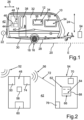
- Fig.1 shows a schematic side view of a vehicle 10, which is used in the Fig.1 shown embodiment is designed as a caravan, also referred to as a caravan.
- the vehicle 10 has a structure 12 through which a Fig.1 partially visible interior 14 of the vehicle 10.
- the vehicle 10 comprises at least or exactly one axle 16, which has at least or exactly two vehicle wheels, also referred to simply as wheels, spaced apart from one another in the transverse direction of the vehicle and arranged on opposite sides of the vehicle 10 in the transverse direction of the vehicle.
- Fig.1 a wheel of axle 16 marked 18 can be seen.
- the previous and following statements on wheel 18 can easily be transferred to the other wheel of axle 16 and vice versa.
- Fig.1 It can also be seen that the wheel 18 is a ground contact element which is supported downwards in the vertical direction of the vehicle directly on a surface 20, also referred to as the ground.
- the vertical direction of the vehicle 10 is in Fig.1 illustrated by a double arrow 24.
- Fig.1 a double arrow 26 indicates the longitudinal direction of the vehicle 10, the longitudinal direction of which is perpendicular to the vertical direction of the vehicle and perpendicular to the transverse direction of the vehicle.
- the vehicle 10 is supported downwards on the ground 20 in the vertical direction of the vehicle via its ground contact elements.
- the Vehicle wheels are rotatably mounted on a chassis 28 of the vehicle 10, so that the vehicle wheels can rotate about a respective wheel rotation axis relative to the chassis 28 and also relative to the body 12.
- the vehicle wheels are arranged coaxially to each other so that the wheel rotation axes coincide.
- the body 12 is designed separately from the chassis 28 and is attached to the chassis 28.
- the body 12 has a floor 30, also referred to as the body floor, by which the interior 14 is limited downwards in the vertical direction of the vehicle.
- the body 12 also has side walls, of which in Fig.1 a side wall designated 32 can be seen.
- the side walls are spaced apart from one another in the transverse direction of the vehicle and delimit the interior 14 in the transverse direction of the vehicle.
- the side wall 32 has spaced apart and separate window openings 34 which can be closed or are closed with transparent panes 36 made, for example, from plastic.
- the side wall 32 also has a door opening 38 which can be closed or closed by means of a door 40.
- the door 40 is held on the side wall 32 so as to be movable, in particular pivotable. A person can get into the interior 14 and out of the interior 14 via the door opening 38 and can thereby get from the interior 14 to an area 42 of the vehicle 10.
- a Fig.1 A particularly schematically illustrated component 44 of the vehicle 10 is arranged.
- the component 44 is, for example, a piece of furniture, in particular a piece of furniture.
- the component 44 can be a table. It can be seen that the component 44 has a surface 46 on which, for example, objects such as beverage containers can be arranged and thus placed.
- the vehicle 10 In order to be able to use the vehicle 10 particularly well over a longer period of time, for example, to lie in the vehicle 10, i.e. in the interior 14, i.e. to be able to sleep and/or eat, it is advantageous to level the vehicle 10, i.e. to align it relative to a horizontal plane E, for example in such a way that a deviation of the alignment of the vehicle 10 from the horizontal plane E is as small as possible or non-existent.
- the base 20 runs horizontally, so that in this case the horizontal plane E coincides with the base 20.
- the vehicle 10 and in particular the structure 12 in such a way, that is to align it to the horizontal plane E in such a way that the surface 46 of the component 44 runs horizontally, thus parallel to the plane E.
- This can prevent objects placed on the surface 46 from sliding off the surface 46 due to gravity.
- it can be prevented that, for example, liquids located on the surface 46 flow down from the surface 46 due to gravity and, for example, drip onto the floor 30.
- a first method for leveling the vehicle 10 is described.
- a first mobile terminal 48 is used, which has a mobile radio module 50, by means of which the first mobile terminal 48 can be wirelessly connected to a Fig. 2 is connected or connectable to the particularly schematically illustrated mobile radio network 52.
- the mobile terminal 48 By means of the first mobile terminal 48, data 56 is sent to a second mobile terminal 54, in particular wirelessly, in particular while the mobile terminal 48 is in the interior 14 and the mobile terminal 54 is outside the vehicle 10 and thereby in its surroundings 42.
- the mobile terminal 54 is also part of the first method, wherein it is particularly provided that the mobile terminal receives the data 56.
- a first processor of the mobile terminal 48 executes a computer program which operates the mobile terminal 48 such that the mobile terminal 48 provides the data 56.
- the mobile terminal 54 in particular another processor of the mobile terminal 54, executes the computer program, also simply referred to as a program, or a copy of the computer program, so that the computer program operates the mobile terminal 54 such that the mobile terminal 54 receives the data 56.
- the data 56 provided by the mobile terminal 48 and thereby sent to the mobile terminal 54 characterize in the Fig. 1 and 2 shown embodiment at least one measure by which a deviation of a current alignment of the vehicle 10 from the horizontal plane E can be at least reduced or eliminated.
- a person not shown in the figures places the mobile terminal 48 on the surface 46 in such a way that the person places the mobile terminal 48 directly on the surface 46.
- the mobile terminal 48 has, for example, a so-called electronic spirit level, by means of which a particular current orientation of the mobile terminal 48 relative to the horizontal plane E is determined. Since the mobile terminal 48 is arranged on the surface 46, and therefore lies directly on the surface 46, the current orientation of the mobile terminal 48 relative to the horizontal plane E corresponds to the aforementioned, in particular current orientation of the vehicle 10 relative to the horizontal plane E. In particular, the electronic spirit level of the mobile terminal 48 can determine a deviation of the orientation of the mobile terminal 48 from the horizontal plane E, wherein the deviation of the orientation of the mobile terminal 48 from the horizontal plane E corresponds to the deviation of the orientation of the vehicle 10 from the horizontal plane E.
- the mobile terminal 48 in particular its processor, is operated by the computer program, for example, in such a way that the said measure is determined, in particular calculated, which is to be carried out in order to at least reduce or eliminate the deviation.
- the first mobile terminal 48 is designed to carry out voice communication with the second mobile terminal 54 and/or with a third mobile terminal, which is not shown in the figures, via the mobile network 52 in a state in which the first mobile terminal 48 is wirelessly connected to the mobile network 52 by means of the mobile radio module 50.
- the mobile terminal 48 has, for example, a loudspeaker 58 for reproducing sounds, and the mobile terminal 48 has at least one microphone 60 for receiving sounds.
- the aforementioned voice communication can be carried out via the loudspeaker 58 and the microphone 60, in particular in such a way that the aforementioned person can speak into the microphone 60.
- the loudspeaker 58 can be used, for example, to carry out sounds and thus words and sentences from another person who is carrying out voice communication with the aforementioned first person via the mobile radio network 52.
- the terminal 54 receives the data 56, wherein, depending on the data 56 received by the terminal 54, a playback device 62 of the Terminal 54 at least one signal characterizing the orientation of the surface 46 and thus of the vehicle 10 and/or the deviation and/or the measure, also referred to as output signal 64, is output to the environment 42.
- the output signal 64 is or comprises at least one optical signal 66, which is displayed on an electrical or electronic display 68 of the terminal 54 and is thereby output to the environment 42 of the terminal 54 and the vehicle 10.
- the output signal 64 thus visualizes, for example, the aforementioned measure, which is thus displayed on the display 68.
- the aforementioned person can thus look at the display 68 and thus visually perceive the measure, whereupon the person can easily implement the measure. This at least reduces or eliminates the deviation.
- the output signal 64 can comprise at least one voice output characterizing the alignment and/or the deviation and/or the measure, which is reproduced, for example, by means of a loudspeaker 70 of the playback device 62 and thus of the terminal 54 and thus output to the environment 42. This makes it particularly easy to instruct the person to carry out the measure.
- the data 56 are sent wirelessly by means of the terminal 48 to the terminal 54 and received by the terminal 54.
- the person can therefore move in the environment 42 relative to the vehicle 10 and relative to the terminal 48 lying on the surface 46 with the terminal 54, which is carried by the person, and can carry out the measure without being hindered by physical cables.
- the person can remain in the environment 42 and does not have to go into the interior 14 in order to have the measures communicated by means of the terminal 48, for example, but rather the measure is communicated to the person by means of the terminal 54, whereby the person can level the vehicle 10 particularly easily, conveniently and quickly.
- the output signal 64 communicates to the person mentioned, for example, visually and/or acoustically, i.e. by voice output, which of the vehicle wheels is to be raised or lowered and/or which of the lifting devices is to be operated, in particular in which manner, in order to raise or lower the respective wheel on which the respective lifting device is arranged, in order to at least reduce or eliminate the deviation.
- the respective lifting device has a crank which can be cranked by the person in order to raise or lower the respective wheel.
- the output signal 64 communicates a direction of rotation and/or a number of revolutions by which the respective crank, in particular in the respective direction of rotation, is to be turned by the person in order to raise or lower the respective wheel and thus at least eliminate or reduce the deviation. If the person follows the measure, i.e., the person carries out the measure, the deviation is thereby reduced or eliminated.
- the first method thus makes it possible to level the vehicle 10 in a particularly simple, comfortable and time-efficient manner.
- the data 56 are sent via a wireless data connection 72 by means of the terminal 48 and received by means of the terminal 54, wherein the wireless data connection 72 is preferably a wireless data connection established directly between the mobile terminals 48 and 54.
- the terminal 48 has a connection module 74 provided in addition to the mobile radio module 50
- the terminal 54 has a connection module 76, wherein the data connection 72 is or will be established directly between the connection modules 74 and 76.
- Fig.3 shows the vehicle 10 in another side view.
- Fig.3 A second method for leveling the vehicle 10 is described.
- at least one leveling device external to the vehicle 10 and a leveling device 78 which is designed as a module that is completely assembled independently of the vehicle 10 and is in this case arranged on the wheel 18, receives data 80 that characterize, for example, the current alignment of the vehicle 10 relative to the horizontal plane E and/or the deviation of the alignment of the vehicle 10 from the horizontal plane E and/or the measure by which the deviation can be at least reduced or eliminated.
- the deviation is automatically at least reduced or eliminated by operating at least one actuator of the leveling device 78 depending on the data 80 received from the leveling device 78, as a result of which at least one actuating element of the leveling device 78 is moved relative to the at least one base element of the leveling device 78 and thereby at least a partial area of the vehicle 10 is moved at least in the vertical direction and/or in the vertical direction of the vehicle.
- at least the partial area of the vehicle 10 is automatically raised or lowered depending on the data 80 in order to at least reduce the deviation.
- the data 80 are provided by the terminal 48, by means of which, for example, the alignment and/or the deviation and/or the measure is determined.
- the vehicle 10 can be leveled particularly easily, conveniently and quickly.
Landscapes
- Engineering & Computer Science (AREA)
- Computer Networks & Wireless Communication (AREA)
- Signal Processing (AREA)
- Physics & Mathematics (AREA)
- General Physics & Mathematics (AREA)
- Radar, Positioning & Navigation (AREA)
- Remote Sensing (AREA)
- Mobile Radio Communication Systems (AREA)
- Machines For Laying And Maintaining Railways (AREA)
Description
- Die vorliegende Erfindung betrifft ein Verfahren zum Nivellieren eines Fahrzeugs, insbesondere eines Wohnwagens oder eines Wohnmobils.
- Die Beliebtheit von Fahrzeugen, die für Urlaubs- und Wohnzwecke verwendet werden und somit beispielsweise als Wohnwagen oder Wohnmobile ausgebildet sind, nimmt zur Zeit sehr stark zu. Personen nutzen diese Fahrzeuge, um ihre Freizeit und ihren Urlaub und somit eine recht lange Zeit darin zu verbringen. Hierzu wird das jeweilige Fahrzeug beispielsweise auf einem Parkplatz oder einem Campingplatz abgestellt, wobei das Fahrzeug auf dem Parkplatz oder Campingplatz eine recht lange Zeit abgestellt bleibt, um darin wohnen zu können. Dabei ist es wünschenswert, das Fahrzeug so gut wie möglich zu nivellieren, das heißt horizontal auszurichten. Unter "Nivellieren", was auch als Nivellierung bezeichnet wird, ist ein horizontales Ausrichten des Fahrzeugs, insbesondere eines Bodens des Fahrzeugs, zu verstehen, dessen Boden den Innenraum des Fahrzeugs in Fahrzeughochrichtung nach unten hin begrenzt. Dabei ist unter dem Nivellieren insbesondere zu verstehen, dass das Fahrzeug beziehungsweise dessen Boden derart ausgerichtet, das heißt positioniert wird, dass das Fahrzeug beziehungsweise dessen Boden nicht oder möglichst wenig von der Horizontalen, das heißt von einer horizontalen Ebene, abweicht. Dadurch kann beispielsweise sichergestellt oder gewährleistet werden, dass beispielsweise im Innenraum des Fahrzeugs angeordnete Oberflächen, auf denen Objekte abgestellt und/oder Arbeiten wie beispielsweise Küchenarbeiten verrichtet werden sollen, nicht oder möglich wenig von der Horizontalen, das heißt von der horizontalen Ebene abweichen. Dadurch kann vermieden werden, dass auf den Oberflächen abgestellte Objekte von den Oberflächen herunterrutschen oder Flüssigkeiten von den Oberflächen herunterfließen. Beispielsweise verläuft die jeweilige Oberfläche dabei parallel zum Boden. Die jeweilige Oberfläche ist beispielsweise eine Oberfläche eines in einem Innenraum angeordneten Tisches oder eines in einem Innenraum angeordneten Schranks. Es hat sich gezeigt, dass das Nivellieren eines Fahrzeugs üblicherweise sehr anstrengend und zeitaufwändig ist.
- Die
WO 2016/000041 A1 offenbart ein Fahrzeugniveauinformationssystem. Aus derUS 2008/142768 A1 ist ein Nivellierungssystem in Kombination mit einem Campingfahrzeug bekannt. Des Weiteren offenbart dieUS 7 786 883 B1 eine Einrichtung zum Anzeigen eines Niveauzustands eines nivellierbaren Objekts. Außerdem ist derUS 2020/355498 A1 ein System zum Nivellieren einer ausgewählten Oberfläche einer Struktur als bekannt zu entnehmen. - Aufgabe der vorliegenden Erfindung ist es daher, ein Verfahren zu schaffen, mittels welchem ein Fahrzeug auf besonders einfache und zeitgünstige Weise nivelliert werden kann.
- Diese Aufgabe wird durch ein Verfahren mit den Merkmalen des Patentanspruchs 1 sowie durch ein Verfahren mit den Merkmalen des Patentanspruchs 10 gelöst. Vorteilhafte Ausgestaltungen mit zweckmäßigen Weiterbildungen der Erfindung sind in den übrigen Ansprüchen angegeben.
- Ein erster der Aspekt der Erfindung betrifft ein Verfahren zum Nivellieren eines Fahrzeugs, insbesondere eines auch als Caravan bezeichneten Wohnwagens oder eines Wohnmobils. Das Nivellieren wird auch als Nivellierung bezeichnet. Unter dem Nivellieren ist im Rahmen der vorliegenden Erfindung ein horizontales Ausrichten des Fahrzeugs, insbesondere zumindest einer Oberfläche des Fahrzeugs, zu verstehen. Unter dem horizontalen Ausrichten des Fahrzeugs, insbesondere der Oberfläche, ist zu verstehen, dass das Fahrzeug, insbesondere die Oberfläche, derart ausgerichtet oder positioniert wird, dass das Fahrzeug, insbesondere die Oberfläche nicht oder möglichst wenig von der Horizontalen, das heißt von einer horizontalen Ebene abweicht. Mit anderen Worten ist unter dem Nivellieren insbesondere zu verstehen, dass ein insbesondere etwaiger Unterschied zwischen dem Fahrzeug, insbesondere der Oberfläche, und der Horizontalen beziehungsweise der horizontalen Ebene zumindest reduziert oder aufgehoben wird. Bei der Oberfläche handelt es sich beispielsweise um eine in einem Innenraum des Fahrzeugs angeordnete Oberfläche, wobei der Innenraum des Fahrzeugs durch einen Aufbau des Fahrzeugs begrenzt sein kann. Insbesondere kann die Oberfläche eine im Innenraum angeordnete Oberfläche eines Bodens des Fahrzeugs, insbesondere des Aufbaus, sein, wobei der Innenraum des Fahrzeugs in Fahrzeughochrichtung nach unten hin durch den Boden begrenzt ist. Ferner kann es sich bei der Oberfläche um eine in dem Innenraum angeordnete Oberfläche eines in dem Innenraum angeordneten Möbelstücks oder Einrichtungsgegenstands handeln, wobei das Möbelstück oder der Einrichtungsgegenstand beispielsweise ein Tisch oder ein Schrank ist. Beispielsweise kann es sich bei der Oberfläche um eine Arbeitsfläche oder um eine Oberfläche einer Arbeitsplatte handeln, wobei auf der Arbeitsfläche beziehungsweise auf der Arbeitsplatte Objekte abgestellt werden können. Durch das Nivellieren des Fahrzeugs kann beispielsweise vermieden werden, dass auf der Oberfläche abgestellte Objekte schwerkraftbedingt von der Oberfläche herabrutschen oder herabrollen oder unerwünschter Weise auf der Oberfläche herumrutschen oder herumrollen. Ferner kann durch das Nivellieren beispielsweise vermieden werden, dass auf der Oberfläche befindliche Flüssigkeiten schwerkraftbedingt von der Oberfläche herabfließen oder herabtropfen oder unerwünschter Weise umherfließen und sich somit unerwünschterweise schwerkraftbedingt auf der Oberfläche übermäßig verteilen.
- Bei dem Verfahren wird ein erstes mobiles Endgerät verwendet, welches ein Mobilfunkmodul aufweist, mittels welchem das erste mobile Endgerät leitungslos, das heißt ohne eine körperliche beziehungsweise physisch vorhandene Leitung mit einem Mobilfunknetz verbunden oder verbindbar ist. Bei dem ersten mobilen Endgerät kann es sich beispielsweise um einen insbesondere mobilen, das heißt tragbaren PC (Personal Computer - persönlicher Computer oder persönlicher Rechner) handeln, wobei der PC insbesondere ein auch als Tabletcomputer, Tablet-PC oder Flachrechner bezeichnetes Tablet sein kann. Unter einem solchen Tablet ist ein tragbarer, flacher Computer, insbesondere in Form eines Schreibblocks zu verstehen. Ganz vorzugsweise weist das erste mobile Endgerät wenigstens oder genau eine auch als Bildschirm bezeichnete, elektrische oder elektronische Anzeige auf, die besonders bevorzugt als ein auch als Berührbildschirm oder Touchscreen bezeichneter, berührungsempfindlicher Bildschirm ausgebildet ist. Im Rahmen der vorliegenden Erfindung ist unter einem beziehungsweise dem zuvor genannten Mobilfunknetz eine technische Infrastruktur zu verstehen, über die oder auf der eine Übertragung von Signalen für Mobilfunk stattfindet. Insbesondere umfasst das Mobilfunknetz auch als Sendemasten bezeichnete Mobilfunkmasten, durch welche einfach auch als Funkzellen bezeichnete Zellen gebildet sind, die sich vorzugsweise gegenseitig überlappen. Das erste mobile Endgerät kann sich dabei mittels des Mobilfunkmoduls leitungslos mit der jeweiligen Funkzelle und somit über die jeweilige Funkzelle mit dem Mobilfunknetz verbinden, um beispielsweise über das Mobilfunknetz Daten beispielsweise mit wenigstens einer anderen, mit dem Mobilfunknetz verbundenen Recheneinheit auszutauschen. Wird das erste mobile Endgerät relativ zu der Erdoberfläche bewegt, beispielsweise derart, dass das mobile Endgerät aus einer ersten der Funkzellen herausbewegt und in eine zweite der Funkzellen hineinbewegt wird, so werden das Mobilfunkmodul und somit das erste mobile Endgerät von der ersten Zelle getrennt und mit der zweiten Zelle leitungslos verbunden. Dadurch kann das erste mobile Endgerät beispielsweise in einem Land, in welchem das Mobilfunknetz gebildet ist, große Strecken von beispielsweise hundert oder tausend Kilometern relativ zu der Erdoberfläche umherbewegt werden, wobei das vorzugsweise als Mobilfunkgerät ausgebildete, zweite mobile Endgerät mit dem Mobilfunknetz leitungslos verbunden bleibt, insbesondere dadurch, dass sich das Mobilfunkmodul abwechselnd von einer der Zellen trennt und mit einer anderen der Zellen leitungslos verbindet. Beispielsweise handelt es sich bei dem Mobilfunknetz um GSM (Global System for Mobile Communications), GPRS (General Packet Radio Service), UMTS (Universal Mobile Telecommunications System), LTE (Long Term Evolution) oder 5G. Ganz insbesondere ist es denkbar, dass das erste mobile Endgerät wenigstens einen auch als Schallwandler bezeichneten Lautsprecher zum Wiedergeben von insbesondere mit dem menschlichen Gehör akustisch wahrnehmbaren Tönen aufweist. Bei dem Verfahren kann das erste mobile Endgerät mittels des Mobilfunkmoduls leitungslos mit dem Mobilfunknetz verbunden sein oder das erste mobile Endgerät ist während des Verfahrens von dem Mobilfunknetz getrennt, jedoch weist in beiden Fällen das erste mobile Endgerät das Mobilfunkmodul auf, welches leitungslos mit dem Mobilfunknetz verbunden oder verbindbar ist.
- Bei dem Verfahren werden mittels des ersten mobilen Endgeräts Daten an ein zweites mobiles Endgerät, insbesondere leitungslos, gesendet. Das zweite mobile Endgerät muss zunächst nicht notwendigerweise Bestandteil des Verfahrens sein, wobei das zweite mobile Endgerät Bestandteil des Verfahrens sein kann. Unter dem Merkmal, dass mittels des ersten mobilen Endgeräts Daten an das zweite mobile Endgerät gesendet werden, ist somit zunächst insbesondere zu verstehen, dass das erste mobile Endgerät die Daten, insbesondere leitungslos, bereitstellt, derart, dass das zweite mobile Endgerät die Daten, insbesondere leitungslos, empfängt oder empfangen kann. Ganz vorzugsweise weist das erste mobile Endgerät wenigstens einen Prozessor auf, welcher auch als zentrale Recheneinheit oder Zentraleinheit (CPU - Central Processing Unit) bezeichnet wird oder ausgebildet sein kann. Insbesondere ist oder umfasst der Prozessor eine elektronische Schaltung, mittels welcher eine Datenverarbeitung durchgeführt werden kann. Insbesondere sind der Prozessor und somit das erste mobile Endgerät dazu ausgebildet, ein auch als Computerprogramm oder Softwareprogramm bezeichnetes Programm auszuführen. Das Programm ist beispielsweise eine Applikation, welche auch als App bezeichnet wird. Dabei ist es insbesondere vorgesehen, dass das Verfahren mittels des Programms durchgeführt wird, insbesondere dadurch, dass das Programm, welches beispielsweise in einem insbesondere elektrischen oder elektronischen Speicher des ersten mobilen Endgeräts gespeichert ist, das erste mobile Endgerät betreibt, insbesondere steuert oder regelt und dadurch veranlasst, das Verfahren durchzuführen oder auszuführen.
- Bei dem Verfahren charakterisieren, das heißt definieren die Daten eine insbesondere aktuelle Ausrichtung des Fahrzeugs relativ zu der horizontalen Ebene. Alternativ oder zusätzlich charakterisieren die Daten eine Abweichung der Ausrichtung des Fahrzeugs von der horizontalen Ebene und/oder die Daten charakterisieren wenigstens eine Maßnahme, durch welche die Abweichung der Ausrichtung des Fahrzeugs von der horizontalen Ebene zumindest zu verringern oder aufhebbar ist. Dadurch, dass das erste mobile Endgerät die Daten, vorzugsweise leitungslos, bereitstellt und hierdurch an das zweite mobile Endgerät überträgt, ermöglicht es das erfindungsgemäße Verfahren, das erste mobile Endgerät, insbesondere direkt, auf der zuvor genannten, zu nivellierenden Oberfläche anzuordnen, insbesondere derart, dass das erste mobile Endgerät, insbesondere direkt, auf die Oberfläche gelegt und somit direkt an der Oberfläche abgestützt wird. Des Weiteren kann das erste mobile Endgerät an der Oberfläche angeordnet, insbesondere auf die Oberfläche aufgelegt, bleiben und dabei die Daten an das zweite mobile Endgerät übermitteln, während beispielsweise eine auch als Nutzer bezeichnete Person das vorzugsweise die Daten empfangende, zweite mobile Endgerät nutzt und hierbei insbesondere handhabt und/oder mit sich führt, insbesondere derart, dass sich die Person mit dem zweiten mobilen Endgerät relativ zu dem ersten mobilen Endgerät und insbesondere relativ zu dem Fahrzeug bewegt, insbesondere während das erste mobile Endgerät auf der Oberfläche angeordnet und insbesondere relativ zu der Oberfläche unbeweglich ist, mithin sich nicht relativ zu der Oberfläche bewegt. Somit kann sich die Person bedarfsgerecht und somit nahezu frei relativ zu dem ersten mobilen Endgerät und insbesondere relativ zu dem Fahrzeug bewegen und dadurch beispielsweise wenigstens eine Maßnahme ergreifen oder durchführen, um die etwaige Abweichung der Ausrichtung des Fahrzeugs, insbesondere der Oberfläche, relativ zu der horizontalen Ebene zumindest zu verringern oder aufzuheben. Die Person muss sich dabei nicht immer wieder zu dem ersten mobilen Endgerät bewegen, um beispielsweise über das erste mobile Endgerät die Daten zu prüfen oder zu analysieren, sondern die Person kann das zweite mobile Endgerät mit sich führen oder handhaben oder tragen und mittels des zweiten mobilen Endgeräts die Daten nutzen, insbesondere analysieren oder prüfen, um die Abweichung zumindest zu verringern oder aufzuheben. Das erfindungsgemäße Verfahren ermöglicht es somit, die Abweichung besonders einfach und zeitgünstig zumindest zu verringern oder aufzuheben.
- Die zuvor genannte Maßnahme, um die Abweichung der Ausrichtung des Fahrzeugs, insbesondere der Oberfläche, relativ zu der horizontalen Ebene zumindest zu verringern oder aufzuheben, kann insbesondere Folgendes umfassen um die Abweichung zumindest zu verringern oder aufzuheben: Um die Abweichung zu verringern oder aufzuheben, wird beispielsweise zumindest ein Teil des Fahrzeugs, insbesondere zumindest ein Teilbereich des Aufbaus, relativ zu einer einfach auch als Untergrund bezeichneten Untergrund- oder Bodenfläche bewegt, auf welcher das Fahrzeug steht, insbesondere stillsteht, und somit in Fahrzeughochrichtung nach unten hin abgestützt. Beispielsweise wird zum Verringern oder Aufheben der Abweichung das Fahrzeug oder der Aufbau derart relativ zu dem Untergrund bewegt, insbesondere während das Fahrzeug stillsteht, mithin sich nicht relativ zu dem Untergrund bewegt, dass der Aufbau an wenigstens einer Stelle in vertikaler Richtung nach oben bewegt und somit von dem Untergrund wegbewegt, mithin angehoben wird oder in vertikaler Richtung nach unten bewegt und somit auf den Untergrund zubewegt, mithin abgesenkt wird. Alternativ oder zusätzlich wird beispielsweise zum Verringern oder Aufheben der Abweichung der Aufbau an wenigstens einer anderen, zweiten Stelle angehoben oder abgesenkt. Durch das erfindungsgemäße Verfahren kann sich die Person nun außerhalb des Innenraums und somit außerhalb des Fahrzeugs zu der jeweiligen Stelle begeben und den Aufbau an der Stelle anheben oder absenken, insbesondere während das erste mobile Endgerät in dem Innenraum und dabei insbesondere auf der Oberfläche angeordnet ist und die Daten bereitstellt. Insbesondere kann sich die Person außerhalb des Fahrzeugs relativ zu dem Fahrzeug bewegen und sich dadurch zu jeweiligen, mehreren Stellen, an denen der Aufbau anzuheben oder abzusenken ist, um die Abweichung zu verringern oder aufzuheben, begeben, ohne sich nach jedem Anheben oder Absenken einer Stelle und vor dem Anheben oder Absenken einer anderen Stelle zu dem ersten mobilen Endgerät bewegen und das erste mobile Endgerät konsultieren zu müssen.
- Das erfindungsgemäße Verfahren ermöglicht auch deswegen eine besonders einfache, kostengünstige und komfortable Nivellierung des Fahrzeugs, da das Verfahren nicht eine spezielle für das Nivellieren des Fahrzeugs hergestellte und ausschließlich für das Nivellieren des Fahrzeugs ausgebildete oder verwendbare Einrichtung verwendet, sondern das erfindungsgemäße Verfahren verwendet das erste mobile Endgerät, welches eben nicht nur zum Nivellieren des Fahrzeugs verwendbar ist, sondern das erste mobile Endgerät kann sich auch leitungslos mit dem Mobilfunknetz verbinden und somit dazu genutzt werden, um über das Mobilfunknetz leitungslos weitere Daten mit wenigstens einer weiteren, mit dem Mobilfunknetz zumindest mittelbar verbundenen Einheit auszutauschen.
- Vorzugsweise charakterisieren die von dem ersten mobilen Endgerät bereitgestellten und an das zweite mobile Endgerät übermittelten Daten die Abweichung. Ganz vorzugsweise charakterisieren die Daten bereits die Maßnahme, durch welche, das heißt durch deren Durchführung die Abweichung zumindest verringert oder aufgehoben werden kann. Somit ist es denkbar, dass dem zweiten mobilen Endgerät, welches vorzugsweise die Daten empfängt, anhand der Daten bereits die Abweichung und nicht die Maßnahme oder gar bereits die Maßnahme mitgeteilt wird. Möglich wäre jedoch ebenfalls, dass das zweite mobile Endgerät anhand der Daten, welche beispielsweise zunächst die insbesondere aktuelle Ausrichtung und nicht die Abweichung und nicht die Maßnahme charakterisieren, die Abweichung und/oder die Maßnahme ermittelt, insbesondere berechnet. Vorzugsweise wird durch wenigstens oder genau eines der mobilen Endgeräte die Abweichung ermittelt, und vorzugsweise wird durch wenigstens oder genau eines der mobilen Endgeräte die Maßnahme ermittelt, sodass auf Basis der Abweichung und der Maßnahme die Abweichung zumindest verringert oder aufgehoben und somit das Fahrzeug nivelliert werden kann.
- Um das Fahrzeug besonders einfach, zeit- und kostengünstig und besonders komfortabel nivellieren zu können, ist es bei der Erfindung vorgesehen, dass das erste mobile Endgerät dazu ausgebildet ist, in einem Zustand, in welchem das erste mobile Endgerät mittels des Mobilfunkmoduls leitungslos mit dem Mobilfunknetz verbunden ist, über das Mobilfunknetz eine Sprachkommunikation, das heißt ein Telefongespräch, mit dem zweiten mobilen Endgerät und/oder einem dritten mobilen Endgerät durchzuführen. Somit ist es vorzugsweise vorgesehen, dass das erste mobile Endgerät ein auch als Handy bezeichnetes Mobiltelefon ist. Insbesondere ist das erste mobile Endgerät ein sogenanntes Smartphone (schlaues Telefon), mithin ein Mobiltelefon mit umfangreichen Computer-Funktionalitäten und Konnektivitäten. Ganz vorzugsweise weist das erste mobile Endgerät wenigstens ein Mikrofon auf, mittels welchem die Sprachkommunikation durchgeführt werden kann. Insbesondere umfasst das erste mobile Endgerät den zuvor genannten Lautsprecher und das Mikrofon, welches zusätzlich zu dem Lautsprecher vorgesehen ist. Die Erfindung vermeidet es somit, ein nur für das Nivellieren des Fahrzeugs vorgesehenes und hergestelltes Gerät zu verwenden. Stattdessen nutzt die Erfindung das auch für andere, von dem Nivellieren des Fahrzeugs unterschiedliche Zwecke ausgebildete, vorgesehene und hergestellte und somit ohnehin hergestellte, erste mobile Endgerät, wodurch das Fahrzeug besonders komfortabel und kostengünstig nivelliert werden kann.
- Eine weitere Ausführungsform zeichnet sich dadurch aus, dass in Abhängigkeit von den Daten mittels einer Wiedergabeeinrichtung des zweiten mobilen Endgeräts wenigstens ein die Ausrichtung und/oder die Abweichung und/oder die Maßnahme charakterisierendes Signal an eine Umgebung des zweiten mobilen Endgeräts ausgegeben wird. Zumindest bei dieser Ausführungsform gehört das zweite mobile Endgerät zu dem Verfahren beziehungsweise das Verfahren verwendet auch das zweite mobile Endgerät, welches vorzugsweise die Daten empfängt. Die vorigen und folgenden Ausführungen zu dem ersten mobilen Endgerät können ohne Weiteres auch das zweite mobile Endgerät übertragen werden und umgekehrt. Somit ist es insbesondere denkbar, dass das zweite mobile Endgerät wenigstens einen weiteren Prozessor aufweist, mittels welchem das zuvor genannte Programm, insbesondere eine Kopie des Programms, oder ein anderes Programm ausgeführt werden kann, die das zweite mobile Endgerät beziehungsweise dessen weiteren Prozessor dazu veranlassen, das Verfahren auszuführen oder durchzuführen. Beispielsweise umfasst die Wiedergabeeinrichtung des zweiten mobilen Endgeräts eine weitere, elektrische oder elektronische Anzeige, welche beispielsweise als weiterer, berührungsempfindlicher Bildschirm ausgebildet sein kann. Alternativ oder zusätzlich umfasst beispielsweise die Wiedergabeeinrichtung des zweiten mobilen Endgeräts wenigstens einen weiteren Lautsprecher. Da vorzugsweise das zweite mobile Endgerät mittels der Wiedergabeeinrichtung das die Ausrichtung und/oder die Abweichung und/oder die Maßnahme charakterisierende und auch als Ausgabesignal bezeichnete Signal an die Umgebung des zweiten mobilen Endgeräts ausgibt, kann das Ausgabesignal beziehungsweise die Ausrichtung und/oder die Abweichung und/oder die Maßnahme der zuvor genannten Person besonders einfach und komfortabel kommuniziert werden. Durch das Ausgeben des Ausgabesignals kann die Person besonders einfach dazu angeleitet werden, sich zu der jeweiligen Stelle zu begeben und den Aufbau an der Stelle abzusenken oder anzuheben, sodass das Fahrzeug besonders einfach und komfortabel nivelliert werden kann.
- Das zweite mobile Endgerät ist ein bezüglich des ersten mobilen Endgeräts externe Endgerät, und das erste mobile Endgerät ist ein bezüglich des zweiten mobilen Endgeräts externe Endgerät. Ferner ist es vorzugsweise vorgesehen, dass das zweite mobile Endgerät ein zweites Mobilfunkmodul aufweist, mittels welchem das zweite mobile Endgerät leitungslos, das heißt ohne eine körperliche beziehungsweise physisch vorhandene Leitung mit dem Mobilfunknetz verbunden oder verbindbar ist. Bei dem zweiten mobilen Endgerät kann es sich beispielsweise um einen insbesondere mobilen, das heißt tragbaren, zweiten PC (Personal Computer - persönlicher Computer oder persönlicher Rechner) handeln, wobei der zweite PC insbesondere ein auch als Tabletcomputer, Tablet-PC oder Flachrechner bezeichnetes, zweites Tablet sein kann. Ganz vorzugsweise weist auch das zweite mobile Endgerät die wenigstens oder genau eine auch als zweiter oder weiterer Bildschirm bezeichnete, zweite oder weitere elektrische oder elektronische Anzeige auf, die besonders bevorzugt als ein auch als Berührbildschirm oder Touchscreen bezeichneter, berührungsempfindlicher Bildschirm ausgebildet ist. Das zweite mobile Endgerät kann sich dabei vorzugsweise mittels des zweiten Mobilfunkmoduls leitungslos mit der jeweiligen Funkzelle und somit über die jeweilige Funkzelle mit dem Mobilfunknetz verbinden, um beispielsweise über das Mobilfunknetz Daten beispielsweise mit wenigstens einer anderen, mit dem Mobilfunknetz verbundenen Recheneinheit auszutauschen. Wird das zweite mobile Endgerät relativ zu der Erdoberfläche bewegt, beispielsweise derart, dass das zweite mobile Endgerät aus der ersten Funkzelle herausbewegt und in die zweite Funkzelle hineinbewegt wird, so werden das zweite Mobilfunkmodul und somit das zweite mobile Endgerät von der ersten Zelle getrennt und mit der zweiten Zelle leitungslos verbunden. Dadurch kann das zweite mobile Endgerät beispielsweise in dem Land, in welchem das Mobilfunknetz gebildet ist, große Strecken von beispielsweise hundert oder tausend Kilometern relativ zu der Erdoberfläche umherbewegt werden, wobei das vorzugsweise als Mobilfunkgerät ausgebildete, zweite mobile Endgerät mit dem Mobilfunknetz leitungslos verbunden bleibt, insbesondere dadurch, dass sich das zweite Mobilfunkmodul abwechselnd von einer der Zellen trennt und mit einer anderen der Zellen leitungslos verbindet. Bei dem Verfahren kann das zweite mobile Endgerät mittels des zweiten Mobilfunkmoduls leitungslos mit dem Mobilfunknetz verbunden sein oder das zweite mobile Endgerät ist während des Verfahrens von dem Mobilfunknetz getrennt, jedoch weist in beiden Fällen das zweite mobile Endgerät das zweite Mobilfunkmodul auf, welches leitungslos mit dem Mobilfunknetz verbunden oder verbindbar ist.
- Um das Fahrzeug besonders einfach, zeit- und kostengünstig und besonders komfortabel nivellieren zu können, ist es bei einer Ausführungsform der Erfindung vorgesehen, dass das zweite mobile Endgerät dazu ausgebildet ist, in einem Zustand, in welchem das zweite mobile Endgerät mittels des zweiten Mobilfunkmoduls leitungslos mit dem Mobilfunknetz verbunden ist, über das Mobilfunknetz die zuvor genannte Sprachkommunikation, das heißt das Telefongespräch, mit dem ersten mobilen Endgerät und/oder dem dritten mobilen Endgerät durchzuführen. Somit ist es vorzugsweise vorgesehen, dass das zweite mobile Endgerät ein auch als Handy bezeichnetes, zweites Mobiltelefon ist. Insbesondere ist das zweite mobile Endgerät ein sogenanntes Smartphone (schlaues Telefon), mithin ein Mobiltelefon mit umfangreichen Computer-Funktionalitäten und Konnektivitäten. Ganz vorzugsweise weist das zweite mobile Endgerät wenigstens ein zweites Mikrofon auf, mittels welchem die Sprachkommunikation durchgeführt werden kann. Insbesondere umfasst das zweite mobile Endgerät den zuvor genannten, weiteren Lautsprecher und das zweite Mikrofon, welches zusätzlich zu dem weiteren Lautsprecher vorgesehen ist. Die Erfindung vermeidet es somit, ein nur für das Nivellieren des Fahrzeugs vorgesehenes und hergestelltes Gerät zu verwenden. Stattdessen nutzt die Erfindung das auch für andere, von dem Nivellieren des Fahrzeugs unterschiedliche Zwecke ausgebildete, vorgesehene und hergestellte und somit ohnehin hergestellte, zweite mobile Endgerät, wodurch das Fahrzeug besonders komfortabel und kostengünstig nivelliert werden kann.
- Bei einer weiteren, besonders vorteilhaften Ausführungsform der Erfindung umfasst das Ausgabesignal wenigstens ein die Ausrichtung und/oder die Abweichung und/oder die Maßnahme charakterisierendes, optisches Signal, welches auf der elektrischen oder elektronischen Anzeige der Wiedergabeeinrichtung des zweiten mobilen Endgeräts angezeigt wird. Das Ausgabesignal und somit die Ausrichtung und/oder die Abweichung und/oder die Maßnahme wird somit der Person besonders einfach und nachvollziehbar kommuniziert, sodass die Person beispielsweise die Maßnahme an der jeweiligen Stelle einfach und komfortabel durchführen kann. Insbesondere kann der Person das Ausgabesignal kommuniziert werden, während sich die Person und das zweite mobile Endgerät außerhalb des Fahrzeugs befinden, während sich das erste mobile Endgerät innerhalb des Fahrzeugs, insbesondere innerhalb des Innenraums, befindet und während das erste mobile Endgerät an, insbesondere auf, der Oberfläche angeordnet ist und Relativbewegungen zwischen dem ersten mobilen Endgerät und der Oberfläche unterbleiben.
- Als besonders vorteilhaft hat es sich gezeigt, wenn das Ausgabesignal wenigstens eine die Ausrichtung und/oder die Abweichung und/oder die Maßnahme charakterisierende Sprachausgabe umfasst, welche mittels wenigstens eines Lautsprechers wie beispielsweise des zuvor genannten Lautsprechers der Wiedergabeeinrichtung an die Umgebung ausgegeben wird. Hierdurch kann die Person, insbesondere während sie sich außerhalb des Fahrzeugs befindet, zu der Maßnahme angeleitet werden, ohne dass die Person das zweite mobile Endgerät oder das erste mobile Endgerät aufwendig handhaben oder anschauen muss. Hierdurch kann das Fahrzeug besonders einfach und komfortabel nivelliert werden.
- Um das Fahrzeug besonders einfach und komfortabel nivellieren zu können, ist es in weiterer Ausgestaltung der Erfindung vorgesehen, dass mittels des Ausgabesignals optisch und somit beispielsweise über die elektrische oder elektronische Anzeige der Wiedergabeeinrichtung und/oder akustisch und somit über den Lautsprecher der Wiedergabeeinrichtung des zweiten mobilen Endgeräts kommuniziert wird, an welcher Stelle, insbesondere an welcher Achse und/oder an welchem einfach auch als Rad bezeichneten Fahrzeugrad des Fahrzeugs die Maßnahme zum Verringern oder Aufheben der Abweichung, insbesondere von der Person, durchzuführen, das heißt zu ergreifen oder umzusetzen ist. Unter der genannten Achse und dem genannten Rad ist insbesondere Folgendes zu verstehen: Beispielsweise ist das Fahrzeug ein Landfahrzeug, welches wenigstens oder genau eine Achse in Form der zuvor genannten Achse aufweist. Die Achse weist wenigstens oder genau zwei insbesondere in Fahrzeugquerrichtung voneinander beabstandete und auf in Fahrzeugquerrichtung einander gegenüberliegenden Seiten des Fahrzeugs angeordnete Räder auf, von denen ein Rad das zuvor genannte Rad des Fahrzeugs ist. Das jeweilige Rad ist ein Bodenkontaktelement, wobei das Fahrzeug über die Bodenkontaktelemente in Fahrzeughochrichtung nach unten hin an dem zuvor genannten Untergrund abstützbar oder abgestützt ist, insbesondere derart, dass die Bodenkontaktelemente den Untergrund direkt berühren. Die Räder sind um eine jeweilige Raddrehachse relativ zu dem Aufbau drehbar. Dabei ist es insbesondere vorgesehen, dass die Räder koaxial zueinander angeordnet sind, sodass die Raddrehachsen vorzugsweise zusammenfallen. Wird das Fahrzeug entlang des Untergrunds und somit relativ zu dem Untergrund bewegt, insbesondere gefahren, während das Fahrzeug über seine Bodenkontaktelemente in Fahrzeughochrichtung nach unten hin an dem Untergrund abgestützt ist, so rollen die Räder an dem Boden ab. Das Fahrzeug kann insbesondere dadurch besonders effektiv und effizient nivelliert werden, dass die zuvor genannte Stelle die Achse, insbesondere eines der Räder, ist, das heißt, dass die zuvor genannte Stelle eine Stelle der Achse, insbesondere des Rads, ist. Hintergrund dieser Ausführungsform ist beispielsweise, dass mittels einer Hebeeinrichtung die Achse beziehungsweise das Rad in vertikaler Richtung relativ zu dem Untergrund bewegt und somit angehoben und abgesenkt werden kann. Die Achse beziehungsweise das Rad stellt dabei einen vorteilhaften und insbesondere stabilen Angriffspunkt dar, an welchem eine gegebenenfalls auch hohe Kraft auf das Fahrzeug ausgeübt werden kann, um das Fahrzeug beziehungsweise den Aufbau zu nivellieren, das heißt anzuheben oder abzusenken. Dadurch, dass mittels des Ausgabesignals optisch und/oder akustisch kommuniziert, das heißt an die Umgebung ausgegeben wird, an welcher Stelle des Fahrzeugs die Maßnahme durchzuführen ist, kann die Person besonders präzise angeleitet werden, um die Maßnahme durchzuführen. Dadurch kann die Person präzise, einfach und komfortabel und mit einem geringen Kraftaufwand und/oder mit einer nur geringen Anzahl an Arbeitsschritten das Fahrzeug nivellieren. In weiterer, besonders vorteilhafter Ausgestaltung der Erfindung ist es vorgesehen, dass mittels des Ausgabesignals optisch und/oder akustisch wenigstens eine Stelle, insbesondere die zuvor genannte Stelle, des Fahrzeugs sowie wenigstens ein Maß kommuniziert werden, um welches zumindest ein Teilbereich des Fahrzeugs in vertikaler Richtung nach oben und unten zu bewegen ist, um die Abweichung zumindest zu verringern oder aufzuheben. Bei dem Teilbereich des Fahrzeugs kann es sich um den Aufbau oder um einen Teilbereich des Aufbaus handeln. Dieser Ausführungsform liegt die Idee zugrunde, der Person mittels des Ausgabesignals nicht nur die Maßnahme und die Stelle, an welcher die Maßnahme umsetzen beziehungsweise durchzuführen ist, zu kommunizieren, sondern auch das Maß und somit auch einen Umfang der Maßnahme. Unter dem Maß beziehungsweise dem Umfang der Maßnahme ist insbesondere eine Weg- und/oder Streckenangabe, das heißt eine Längenangabe zu verstehen, um welche beispielsweise der Teilbereich in vertikaler Richtung nach oben oder unten zu bewegen ist. Alternativ oder zusätzlich kann das Maß eine Zeitdauer umfassen, während welcher beispielsweise die zuvor genannte Hebeeinrichtung, insbesondere durchgängig, zu betreiben ist, um dadurch den Teilbereich in vertikaler Richtung nach oben oder unten zu bewegen. Alternativ oder zusätzlich kann das Maß eine Anzahl an Arbeitsschritten oder Arbeitsvorgängen umfassen, die durchzuführen sind, um den Teilbereich in vertikaler Richtung nach oben oder unten zu bewegen. Bei den Arbeitsvorgängen kann es sich beispielsweise um von der Person durchzuführende Arbeitsvorgänge handeln, um beispielsweise ein Betätigungselement, insbesondere der Hebeeinrichtung, zu bewegen, insbesondere zu drehen und/oder translatorisch zu bewegen, um dadurch den Teilbereich in vertikaler Richtung nach oben oder unten zu bewegen. Somit kann die Person präzise angeleitet werden, um das Fahrzeug zu nivellieren, sodass das Fahrzeug einfach und komfortabel und präzise nivelliert werden kann.
- Um das Fahrzeug besonders einfach und komfortabel nivellieren zu können, ist es in weiterer Ausgestaltung der Erfindung vorgesehen, dass die Daten über eine leitungslos Datenverbindung mittels des ersten mobilen Endgeräts gesendet und mittels des zweiten mobilen Endgeräts empfangen werden. Hierdurch kann sich die Person außerhalb des Fahrzeugs relativ zu dem Fahrzeug und relativ zu dem ersten mobilen Endgerät bewegen und dabei das zweite mobile Endgerät mit sich führen, ohne dass die Person in ihrer Bewegung durch Kabel, Leitungen oder dergleichen behindert wird. Beispielsweise werden die Daten über die leitungslose Datenverbindung und dabei über das Mobilfunknetz mittels des ersten mobilen Endgeräts gesendet.
- Als besonders vorteilhaft hat es sich jedoch gezeigt, wenn die Daten über eine direkt zwischen den mobilen Endgeräten hergestellte, leitungslose Datenverbindung und dabei ohne Verwendung des Mobilfunknetzes mittels des ersten mobilen Endgeräts gesendet und mittels des zweiten mobilen Endgeräts empfangen werden. Dadurch können die Daten besonders schnell an das zweite mobile Endgerät gesendet und von diesem empfangen werden, sodass die Person das Fahrzeug besonders einfach, komfortabel und zeitgünstig nivellieren kann. Die direkt zwischen den mobilen Endgeräten hergestellte, leitungslose Datenverbindung erfolgt beispielsweise über Bluetooth oder eine andere, ähnlich Technik, die einen Datenaustausch zwischen den mobilen Endgeräten über eine geringe Entfernung hinweg ermöglicht.
- Schließlich hat es sich als besonders vorteilhaft gezeigt, wenn mittels des ersten mobilen Endgeräts zumindest die Ausrichtung des Fahrzeugs relativ zu der horizontalen Ebene und/oder die Abweichung ermittelt wird. Beispielsweise umfasst das erste mobile Endgerät ein Ermittlungsmodul, welches beispielsweise eine sogenannte elektronische Wasserwaage ist. Dabei ist es vorzugsweise vorgesehen, dass das Verfahren beziehungsweise das zuvor genannte Programm das Ermittlungsmodul und somit die elektronische Wasserwaage des ersten mobilen Endgeräts nutzt. Mittels der elektronischen Wasserwaage (Ermittlungsmodul) des ersten mobilen Endgeräts wird beispielsweise eine Abweichung einer insbesondere aktuellen Ausrichtung des ersten mobilen Endgeräts relativ zu der horizontalen Ebene ermittelt, insbesondere erfasst, das heißt gemessen. Insbesondere dann, wenn das erste mobile Endgerät an dem Fahrzeug, insbesondere an und ganz insbesondere auf der Oberfläche, angeordnet ist, entspricht die mittels des Ermittlungsmoduls ermittelte, insbesondere aktuelle, Ausrichtung des ersten mobilen Endgeräts relativ zu der horizontalen Ebene der, insbesondere aktuellen, Ausrichtung des Fahrzeugs, insbesondere der Oberfläche, relativ zu der horizontalen Ebene. Hierdurch kann die insbesondere aktuelle Ausrichtung des Fahrzeugs relativ zu der horizontalen Ebene mittels des ersten mobilen Endgeräts ermittelt werden. Insbesondere kann mittels des Ermittlungsmoduls eine Abweichung der insbesondere aktuellen Ausrichtung des ersten mobilen Endgeräts relativ zur horizontalen Ebene ermittelt werden, wobei insbesondere dann, wenn das erste mobile Endgerät an dem Fahrzeug, insbesondere an und ganz insbesondere auf der Oberfläche, angeordnet ist, die Abweichung der Ausrichtung des ersten mobilen Endgeräts relativ zu der horizontalen Ebene der Abweichung des Fahrzeugs relativ zu der horizontalen Ebene entspricht. Somit können mittels des ersten mobilen Endgeräts die Ausrichtung des Fahrzeugs relativ zu der horizontalen Ebene und die Abweichung der Ausrichtung des Fahrzeugs von der horizontalen Ebene ermittelt werden. In der Folge können die Daten die mittels des ersten mobilen Endgeräts ermittelte Ausrichtung und/oder die mittels des ersten mobilen Endgeräts ermittelte Abweichung charakterisieren, sodass dann, wenn das zweite mobile Endgerät die Daten empfängt, dem zweiten mobilen Endgerät gleich die Ausrichtung und/oder die Abweichung mitgeteilt wird. Somit muss das zweite mobile Endgerät die Abweichung und/oder die Ausrichtung nicht selbst ermitteln. Insbesondere ist es denkbar, dass das erste mobile Endgerät auch die Maßnahme ermittelt, insbesondere berechnet, sodass die Daten auch bereits vorzugsweise die Maßnahme charakterisieren. Somit wird beispielsweise dem zweiten mobilen Endgerät bereits die Maßnahme mitgeteilt, sodass das zweite mobile Endgerät die Maßnahme nicht mehr ermitteln muss. Dadurch kann das Fahrzeug besonders einfach und zeitgünstig nivelliert werden.
- Ein zweiter Aspekt der Erfindung betrifft ein Verfahren zum Nivellieren eines Fahrzeugs. Vorteile und vorteilhafte Ausgestaltungen des ersten Aspekts der Erfindung sind als Vorteile und vorteilhafte Ausgestaltungen des zweiten Aspekts der Erfindung anzusehen und umgekehrt. Somit können die vorigen und folgenden Ausführungen zum ersten Aspekt der Erfindung ohne Weiteres auch auf den zweiten Aspekt der Erfindung übertragen werden und umgekehrt.
- Bei dem Verfahren des zweiten Aspekts der Erfindung werden mittels wenigstens einer bezüglich des Fahrzeugs externen und als ein unabhängig von dem Fahrzeug vollständig zusammengebautes Modul ausgebildeten Nivelliervorrichtung Daten empfangen, insbesondere während die Nivelliervorrichtung außerhalb des Fahrzeugs und somit außerhalb des zuvor genannten Innenraums angeordnet ist. Insbesondere empfängt die Nivelliervorrichtung wenigstens ein insbesondere elektrisches oder elektronisches Signal, welches die Daten charakterisiert oder umfasst. Beispielsweise kann es sich bei der Nivelliervorrichtung um die zuvor genannte Hebeeinrichtung handeln. Die Daten, die mittels, das heißt von der Nivelliervorrichtung empfangen werden, charakterisieren eine insbesondere aktuelle Ausrichtung des Fahrzeugs relativ zu einer horizontalen Ebene. Alternativ oder zusätzlich charakterisieren die Daten eine Abweichung der Ausrichtung von der horizontalen Ebene, und/oder die Daten charakterisieren wenigstens eine Maßnahme, durch welche die Abweichung zumindest verringert oder aufgehoben werden kann.
- Des Weiteren ist es bei dem Verfahren des zweiten Aspekts der Erfindung vorgesehen, dass mittels der Nivelliervorrichtung die Abweichung automatisch zumindest verringert oder aufgehoben wird, indem in Abhängigkeit von den empfangenen Daten wenigstens ein Aktor der Nivelliervorrichtung betrieben wird, wodurch wenigstens ein Betätigungselement der Nivelliervorrichtung relativ zum wenigstens einen Basiselement der Nivelliervorrichtung und dadurch zumindest ein Teilbereich des Fahrzeugs zumindest in vertikaler Richtung und/oder in Fahrzeughochrichtung und dabei insbesondere relativ zu dem zuvor genannten Untergrund bewegt werden. Beispielsweise ist die Nivelliervorrichtung über das Basiselement zumindest mittelbar, insbesondere direkt, an dem zuvor genannten Untergrund abgestützt, insbesondere derart, dass das Basiselement zumindest mittelbar, insbesondere direkt, an dem Untergrund abgestützt ist. Hierdurch kann beispielsweise eine zum Anheben oder Absenken des Teilbereichs des Fahrzeugs vorgesehene Kraft einerseits von dem Betätigungselement auf das Fahrzeug beziehungsweise den Teilbereich übertragen und andererseits über das Basiselement an dem Untergrund abgestützt und dabei insbesondere von dem Betätigungselement an das Basiselement und von dem Basiselement an den Untergrund übertragen werden, wodurch der Teilbereich vorteilhaft angehoben oder abgesenkt werden kann.
- Da die Nivelliervorrichtung ein unabhängig von dem Fahrzeug vollständig zusammengebautes und bezüglich des Fahrzeugs externes Modul ist, ist die Nivelliervorrichtung kein Bestandteil des Fahrzeugs und insbesondere nicht fest an oder in dem Fahrzeug verbaut, sondern die Nivelliervorrichtung kann beispielsweise bedarfsgerecht an dem Fahrzeug angeordnet werden und in der Folge das Fahrzeug nivellieren. Durch das Nivellieren des Fahrzeugs wird das Fahrzeug in einen nivellierten Zustand gebracht, in welchem die Ausrichtung des Fahrzeugs nicht oder nur geringfügig von der horizontalen Ebene abweicht. Insbesondere wird beispielsweise nach dem Nivellieren des Fahrzeugs das Fahrzeug in dem nivellierten Zustand mittels der Nivelliervorrichtung gehalten. Um beispielsweise das Fahrzeug wieder entlang des Untergrunds fahren zu können, wird der nivellierte Zustand aufgehoben, und die Nivelliervorrichtung wird von dem Fahrzeug entfernt. Daraufhin kann die Nivelliervorrichtung beispielsweise in dem Fahrzeug verstaut werden und mittels des Fahrzeugs transportiert werden. Der zweite Aspekt der Erfindung ermöglicht eine besonders einfache, komfortable und präzise Nivellierung des Fahrzeugs, da das Fahrzeug mittels der Nivelliervorrichtung automatisch und somit, insbesondere was das Nivellieren an sich angeht, ohne Zutun einer Person nivelliert werden kann.
- Bei dem zweiten Aspekt der Erfindung ist es vorgesehen, dass bereits die mittels der Nivelliervorrichtung empfangenen Daten wenigstens eine Zeitspanne, während welcher der Aktor unterbrechungsfrei, das heißt durchgängig zu betreiben ist, und/oder wenigstens eine Stromstärke eines elektrischen Stroms, mit welchem der Aktor zu versorgen ist, um dadurch den Aktor zu betreiben, umfassen. Dadurch kann die Nivelliervorrichtung an sich besonders einfach und somit kosten- und gewichtsgünstig ausgestaltet werden, sodass sie beispielsweise von einer oder der zuvor genannten Person besonders einfach gehandhabt werden kann. Dadurch kann das Fahrzeug besonders einfach, zeitgünstig und komfortabel nivelliert werden.
- Um das Fahrzeug besonders einfach und zeitgünstig nivellieren zu können, ist es bei einer Ausführungsform des zweiten Aspekts der Erfindung vorgesehen, dass der Aktor mittels elektrischer Energie betrieben wird, welche in einem elektrischen Energiespeicher der Nivelliervorrichtung selbst gespeichert ist. Somit ist der elektronische Energiespeicher vorzugsweise als eine Batterie, insbesondere als eine Sekundärbatterie, ausgebildet. Die Nivelliervorrichtung kann somit zumindest nahezu vollständig unabhängig von dem Fahrzeug beziehungsweise autark betrieben werden, sodass das Fahrzeug besonders einfach, komfortabel und zeitgünstig nivelliert werden kann.
- Eine weitere Ausführungsform des zweiten Aspekts der Erfindung zeichnet sich dadurch aus, dass mittels der Nivelliervorrichtung die Daten über eine leitungslose Datenverbindung und somit leitungslos empfangen werden. Dadurch kann die Nivelliervorrichtung besonders einfach gehandhabt, mithin relativ zu dem Fahrzeug bewegt werden, ohne dass dies durch körperliche Leitungen beeinträchtigt wird.
- In weiterer, besonders vorteilhafter Ausgestaltung des zweiten Aspekts der Erfindung umfassen bereits die mittels der Nivelliervorrichtung empfangenen Daten wenigstens ein Ansteuersignal, mittels welchen der Aktor angesteuert und dadurch betrieben wird, insbesondere ohne die Daten durch die Nivelliervorrichtung verarbeiten und in ein Ansteuersignal zum Ansteuern des Aktors umwandeln zu müssen. Hierdurch kann beispielsweise eine Ansteuerlogik oder Elektronik der Nivelliervorrichtung vermieden oder besonders einfach und somit kostengünstig ausgestaltet werden, sodass die Nivelliervorrichtung besonders einfach und somit komfortabel und zeitgünstig gehandhabt werden kann.
- Vorzugsweise gehört zur Erfindung auch ein einfach auch als Computerprogramm bezeichnetes Computerprogrammprodukt, umfassend Befehle, die bei der Ausführung des Computerprogrammprodukts durch einen Computer, wie beispielsweise das jeweilige mobile Endgerät beziehungsweise den jeweiligen Prozessor, den Computer veranlassen, das jeweilige Verfahren gemäß dem ersten beziehungsweise zweiten Aspekt auszuführen.
- Weitere Vorteile, Merkmale und Einzelheiten der Erfindung ergeben sich aus der nachfolgenden Beschreibung bevorzugter Ausführungsbeispiele sowie anhand der Zeichnung. Die vorstehend in der Beschreibung genannten Merkmale und Merkmalskombinationen sowie die nachfolgend in der Figurenbeschreibung genannten und/oder in den Figuren alleine gezeigten Merkmale und Merkmalskombinationen sind nicht nur in der jeweils angegebenen Kombination, sondern auch in anderen Kombinationen oder in Alleinstellung verwendbar, ohne den Rahmen der Erfindung zu verlassen.
- Die Zeichnung zeigt in:
- Fig. 1
- eine schematische Seitenansicht eines Fahrzeugs, welches mittels eines ersten Verfahrens nivelliert, das heißt relativ zu einer horizontalen Ebene ausgerichtet wird;
- Fig. 2
- eine schematische Darstellung von zwei mobilen Endgeräten, die bei dem ersten Verfahren verwendet werden; und
- Fig. 3
- eine weitere schematische Seitenansicht des Fahrzeugs, welches gemäß einem zweiten Verfahren nivelliert wird.
- In den Figuren sind gleiche oder funktionsgleiche Elemente mit gleichen Bezugszeichen versehen.
-
Fig. 1 zeigt in einer schematischen Seitenansicht ein Fahrzeug 10, welches bei dem inFig. 1 gezeigten Ausführungsbeispiel als ein auch als Caravan bezeichneter Wohnwagen ausgebildet ist. Das Fahrzeug 10 weist einen Aufbau 12 auf, durch welchen ein inFig. 1 teilweise erkennbarer Innenraum 14 des Fahrzeugs 10 begrenzt ist. Das Fahrzeug 10 umfasst wenigstens oder genau eine Achse 16, welche wenigstens oder genau zwei in Fahrzeugquerrichtung voneinander beabstandete und auf in Fahrzeugquerrichtung einander gegenüberliegenden Seiten des Fahrzeugs 10 angeordnete, einfach auch als Räder bezeichnete Fahrzeugräder aufweist. Von den Rädern des Fahrzeugs 10 ist inFig. 1 ein mit 18 bezeichnetes Rad der Achse 16 erkennbar. Die vorigen und folgenden Ausführungen zum Rad 18 können ohne Weiteres auch auf das andere Rad der Achse 16 übertragen werden und umgekehrt. AusFig. 1 ist außerdem erkennbar, dass das Rad 18 ein Bodenkontaktelement ist, welches in Fahrzeughochrichtung nach unten direkt an einem auch als Boden bezeichneten Untergrund 20 abgestützt ist. Die Fahrzeughochrichtung des Fahrzeugs 10 ist inFig. 1 durch einen Doppelpfeil 24 veranschaulicht. Außerdem veranschaulicht inFig. 1 ein Doppelpfeil 26 die Fahrzeuglängsrichtung des Fahrzeugs 10, dessen Fahrzeuglängsrichtung senkrecht zur Fahrzeughochrichtung und senkrecht zur Fahrzeugquerrichtung verläuft. Das Fahrzeug 10 ist über seine Bodenkontaktelemente in Fahrzeughochrichtung nach unten hin an dem Untergrund 20 abgestützt. Die Fahrzeugräder sind drehbar an einem Fahrgestell 28 des Fahrzeugs 10 gehalten, sodass sich die Fahrzeugräder um eine jeweilige Raddrehachse relativ zu dem Fahrgestell 28 und auch relativ zu dem Aufbau 12 drehen können. Bei dem inFig. 1 gezeigten Ausführungsbeispiel sind die Fahrzeugräder koaxial zueinander angeordnet, sodass die Raddrehachsen zusammenfallen. Bei dem inFig. 1 gezeigten Ausführungsbeispiel ist der Aufbau 12 separat von dem Fahrgestell 28 ausgebildet und an dem Fahrgestell 28 befestigt. Insbesondere weist der Aufbau 12 einen auch als Aufbauboden bezeichneten Boden 30 auf, durch welchen der Innenraum 14 in Fahrzeughochrichtung nach unten hin begrenzt ist. Der Aufbau 12 weist auch Seitenwände auf, von denen inFig. 1 eine mit 32 bezeichnete Seitenwand erkennbar ist. Die Seitenwände sind in Fahrzeugquerrichtung voneinander beabstandet und begrenzen den Innenraum 14 in Fahrzeugquerrichtung. Dabei weist die Seitenwand 32 voneinander beabstandete und voneinander getrennte Fensteröffnungen 34 auf, welche mit transparenten und beispielsweise als Kunststoff gebildeten Scheiben 36 verschließbar oder verschlossen sind. Außerdem weist die Seitenwand 32 eine Türöffnung 38 auf, welche mittels einer Tür 40 verschließbar oder verschlossen ist. Die Tür 40 ist bewegbar, insbesondere verschwenkbar, an der Seitenwand 32 gehalten. Über die Türöffnung 38 kann eine Person in den Innenraum 14 einsteigen und aus dem Innenraum 14 aussteigen und hierdurch aus dem Innenraum 14 an eine Umgebung 42 des Fahrzeugs 10 gelangen. - Beispielsweise ist in dem Innenraum 14 ein in
Fig. 1 besonders schematisch dargestelltes Bauelement 44 des Fahrzeugs 10 angeordnet. Bei dem Bauelement 44 handelt es sich beispielsweise um einen Einrichtungsgegenstand, insbesondere um ein Möbelstück. Insbesondere kann es sich bei dem Bauelement 44 um einen Tisch handeln. Es ist erkennbar, dass das Bauelement 44 eine Oberfläche 46 aufweist, auf welcher beispielsweise Gegenstände, wie beispielsweise Getränkebehälter, angeordnet, mithin abgestellt werden können. - Um beispielsweise das Fahrzeug 10 während einer längeren Zeitspanne besonders gut verwenden zu können, um in dem Fahrzeug 10, das heißt in dem Innenraum 14 liegen, das heißt beispielsweise schlafen und/oder essen zu können, ist es vorteilhaft, das Fahrzeug 10 zu nivellieren, mithin relativ zu einer horizontale Ebene E auszurichten, beispielsweise derart, dass eine Abweichung einer Ausrichtung des Fahrzeugs 10 von der horizontalen Ebene E möglichst gering oder nicht vorhanden ist. Bei dem in
Fig. 1 gezeigten Ausführungsbeispiel verläuft der Untergrund 20 horizontal, sodass vorliegend die horizontale Ebene E mit dem Untergrund 20 zusammenfällt. Insbesondere ist es wünschenswert, das Fahrzeug 10 und dabei insbesondere den Aufbau 12 derart zu nivellieren, das heißt derart zur horizontalen Ebene E auszurichten, dass die Oberfläche 46 des Bauelements 44 horizontal, mithin parallel zur Ebene E verläuft. Dadurch kann vermieden werden, dass auf der Oberfläche 46 abgestellte Gegenstände schwerkraftbedingt von der Oberfläche 46 herunterrutschen. Ferner kann vermieden werden, dass beispielsweise auf der Oberfläche 46 befindliche Flüssigkeiten schwerkraftbedingt von der Oberfläche 46 herabströmen und beispielsweise auf den Boden 30 tropfen. - Im Folgenden wird anhand von
Fig. 1 und 2 ein erstes Verfahren zum Nivellieren des Fahrzeugs 10 beschrieben. Bei dem ersten Verfahren wird ein erstes mobiles Endgerät 48 verwendet, welches ein Mobilfunkmodul 50 aufweist, mittels welchem das erste mobile Endgerät 48 leitungslos mit einem inFig. 2 besonders schematisch dargestellten Mobilfunknetz 52 verbunden oder verbindbar ist. - Mittels des ersten mobilen Endgeräts 48 werden an ein zweites mobiles Endgerät 54 Daten 56, insbesondere leitungslos, gesendet, insbesondere während sich das mobile Endgerät 48 in dem Innenraum 14 und das mobile Endgerät 54 außerhalb des Fahrzeugs 10 und dabei in dessen Umgebung 42 befindet. Vorzugsweise ist auch das mobile Endgerät 54 Bestandteil des ersten Verfahrens, wobei es insbesondere vorgesehen ist, dass das mobile Endgerät die Daten 56 empfängt. Insbesondere führt ein erster Prozessor des mobilen Endgeräts 48 ein Computerprogramm aus, welches das mobile Endgerät 48 derart betreibt, dass das mobile Endgerät 48 die Daten 56 bereitstellt. Ferner ist es denkbar, dass das mobile Endgerät 54, insbesondere ein weiterer Prozessor des mobilen Endgeräts 54, das einfach auch als Programm bezeichnete Computerprogramm beziehungsweise eine Kopie des Computerprogramms ausführt, sodass das Computerprogramm das mobile Endgerät 54 derart betreibt, dass das mobile Endgerät 54 die Daten 56 empfängt. Die von dem mobilen Endgerät 48 bereitgestellten und hierdurch an das mobile Endgerät 54 gesendeten Daten 56 charakterisieren bei dem in
Fig. 1 und 2 gezeigten Ausführungsbeispiel wenigstens eine Maßnahme, durch welche eine Abweichung einer insbesondere aktuellen Ausrichtung des Fahrzeugs 10 von der horizontalen Ebene E zumindest verringert oder aufgehoben werden kann. Hierzu ordnet beispielsweise eine in den Figuren nicht dargestellte Person das mobile Endgerät 48 derart auf der Oberfläche 46 an, dass die Person das mobile Endgerät 48 direkt auf die Oberfläche 46 auflegt. Das mobile Endgerät 48 weist beispielsweise eine sogenannte, elektronische Wasserwaage auf, mittels welcher eine insbesondere aktuelle Ausrichtung des mobilen Endgeräts 48 relativ zu der horizontalen Ebene E ermittelt wird. Da das mobile Endgerät 48 auf der Oberfläche 46 angeordnet ist, mithin direkt auf der Oberfläche 46 liegt, entspricht die aktuelle Ausrichtung des mobilen Endgeräts 48 relativ zu der horizontalen Ebene E der zuvor genannten, insbesondere aktuellen Ausrichtung des Fahrzeugs 10 relativ zu der horizontalen Ebene E. Insbesondere kann die elektronische Wasserwaage des mobilen Endgeräts 48 eine Abweichung der Ausrichtung des mobilen Endgeräts 48 von der horizontalen Ebene E ermitteln, wobei die Abweichung der Ausrichtung des mobilen Endgeräts 48 von der horizontalen Ebene E der Abweichung der Ausrichtung des Fahrzeugs 10 von der horizontalen Ebene E entspricht. Das mobile Endgerät 48, insbesondere dessen Prozessor, wird durch das Computerprogramm beispielsweise derart betrieben, dass die genannte Maßnahme ermittelt, insbesondere berechnet, wird, welche durchzuführen ist, um die Abweichung zumindest zu verringern oder aufzuheben. - Insbesondere ist das erste mobile Endgerät 48 dazu ausgebildet, in einem Zustand, in welchem das erste mobile Endgerät 48 mittels des Mobilfunkmoduls 50 leitungslos mit dem Mobilfunknetz 52 verbunden ist, über das Mobilfunknetz 52 eine Sprachkommunikation mit dem zweiten mobilen Endgerät 54 und/oder mit einem dritten mobilen Endgerät, welches in den Figuren nicht dargestellt ist, durchzuführen. Hierzu weist beispielsweise das mobile Endgerät 48 einen Lautsprecher 58 zum Wiedergeben von Tönen auf, und das mobile Endgerät 48 weist wenigstens ein Mikrofon 60 zum Empfangen von Tönen auf. Über den Lautsprecher 58 und das Mikrofon 60 kann die zuvor genannte Sprachkommunikation durchgeführt werden, insbesondere derart, dass die zuvor genannte Person in das Mikrofon 60 sprechen kann. Mittels des Lautsprechers 58 können beispielsweise Töne und somit Wörter und Sätze einer anderen Person durchgeführt werden, die mit der zuvor genannten, ersten Person die Sprachkommunikation über das Mobilfunknetz 52 durchführt.
- Das Endgerät 54 empfängt die Daten 56, wobei in Abhängigkeit von den mittels des Endgeräts 54 empfangenen Daten 56 mittels einer Wiedergabeeinrichtung 62 des Endgeräts 54 wenigstens ein die Ausrichtung der Oberfläche 46 und somit des Fahrzeugs 10 und/oder die Abweichung und/oder die Maßnahme charakterisierendes, auch als Ausgabesignal 64 bezeichnetes Signal an die Umgebung 42 ausgegeben wird. Bei dem in den
Fig. 1 und 2 gezeigten Ausführungsbeispiel ist oder umfasst das Ausgabesignal 64 wenigstens ein optisches Signal 66, welches auf einer elektrischen oder elektronischen Anzeige 68 des Endgeräts 54 angezeigt und dadurch an die Umgebung 42 des Endgeräts 54 und des Fahrzeugs 10 ausgegeben wird. Dadurch visualisiert das Ausgabesignal 64 beispielsweise die zuvor genannte Maßnahme, welches somit auf der Anzeige 68 angezeigt wird. Die zuvor genannte Person kann somit auf die Anzeige 68 blicken und somit die Maßnahme optisch wahrnehmen, woraufhin die Person die Maßnahme einfach umsetzen kann. Hierdurch wird die Abweichung zumindest verringert oder aber aufgehoben. - Alternativ oder zusätzlich kann das Ausgabesignal 64 wenigstens eine die Ausrichtung und/oder die Abweichung und/oder die Maßnahme charakterisierende Sprachausgabe umfassen, welche beispielsweise mittels eines Lautsprechers 70 der Wiedergabeeinrichtung 62 und somit des Endgeräts 54 wiedergegeben und somit an die Umgebung 42 ausgegeben wird. Hierdurch kann die Person besonders einfach angeleitet werden, um die Maßnahme durchzuführen.
- Die Daten 56 werden leitungslos mittels des Endgeräts 48 an das Endgerät 54 gesendet und von dem Endgerät 54 empfangen. Somit kann sich die Person mit dem Endgerät 54, welches von der Person mitgeführt wird, in der Umgebung 42 relativ zu dem Fahrzeug 10 und relativ zu dem auf der Oberfläche 46 liegenden Endgerät 48 bewegen und die Maßnahme durchführen, ohne durch physische Leitungen behindert zu werden. Insbesondere kann die Person in der Umgebung 42 verbleiben und muss nicht in den Innenraum 14 hineingehen, um beispielsweise die Maßnahmen mittels des Endgeräts 48 kommuniziert zu bekommen, sondern die Maßnahme wird der Person mittels des Endgeräts 54 kommuniziert, wodurch die Person das Fahrzeug 10 besonders einfach, komfortabel und zeitgünstig nivellieren kann.
- Insbesondere werden mittels des Ausgabesignals 64 optisch und/oder akustisch wenigstens eine Stelle des Fahrzeugs 10 und wenigstens ein Maß kommuniziert, um welches zumindest ein Teilbereich des Fahrzeugs 10 in vertikaler Richtung und/oder in Fahrzeughochrichtung nach oben oder unten zu bewegen ist, um die Abweichung zumindest zu verringern oder aufzuheben. Beispielsweise ist an dem jeweiligen Rad eine jeweilige Hebeeinrichtung angeordnet, mittels welcher das jeweilige Rad in vertikaler Richtung und/oder in Fahrzeughochrichtung nach oben bewegt und somit angehoben sowie in Fahrzeughochrichtung und/oder in vertikaler Richtung nach unten bewegt und somit abgesenkt werden kann. Das Ausgabesignal 64 kommuniziert beispielsweise der genannten Person optisch und/oder akustisch, mithin per Sprachausgabe, welches der Fahrzeugräder anzuheben oder abzusenken ist und/oder welche der Hebeeinrichtungen, insbesondere auf welche Art, zu betätigen ist, um das jeweilige Rad, an welchem die jeweilige Hebeeinrichtung angeordnet ist, anzuheben oder abzusenken, um dadurch die Abweichung aufzuheben oder zumindest zu verringern. Beispielsweise weist die jeweilige Hebeeinrichtung eine Kurbel auf, die von der Person gekurbelt werden kann, um dadurch das jeweilige Rad anzuheben oder abzusenken. Beispielsweise kommuniziert das Ausgabesignal 64 eine Drehrichtung und/oder eine Anzahl an Umdrehungen, um die die jeweilige Kurbel, insbesondere in die jeweilige Drehrichtung, von der Person zu drehen ist, um dadurch das jeweilige Rad anzuheben oder abzusenken und somit die Abweichung zumindest aufzuheben oder zu verringern. Befolgt die Person die Maßnahme, das heißt, führt die Person die Maßnahme durch, so wird dadurch die Abweichung verringert oder aufgehoben. Das erste Verfahren ermöglicht es somit, das Fahrzeug 10 besonders einfach, komfortabel und zeitgünstig zu nivellieren.
- Vorzugsweise ist es vorgesehen, dass die Daten 56 über eine leitungslos Datenverbindung 72 mittels des Endgeräts 48 gesendet und mittels des Endgeräts 54 empfangen werden, wobei vorzugsweise die leitungslose Datenverbindung 72 eine direkt zwischen den mobilen Endgeräten 48 und 54 hergestellte, leitungslose Datenverbindung ist. Hierzu weist beispielsweise das Endgerät 48 ein zusätzlich zu dem Mobilfunkmodul 50 vorgesehenes Verbindungsmodul 74 auf, und das Endgerät 54 weist ein Verbindungsmodul 76 auf, wobei die Datenverbindung 72 direkt zwischen den Verbindungsmodulen 74 und 76 hergestellt ist beziehungsweise wird.
-
Fig. 3 zeigt das Fahrzeug 10 in einer weiteren Seitenansicht. Anhand vonFig. 3 wird ein zweites Verfahren zum Nivellieren des Fahrzeugs 10 beschrieben. Bei dem zweiten Verfahren werden mittels wenigstens einer bezüglich des Fahrzeugs 10 externen und als ein unabhängig von dem Fahrzeug 10 vollständig zusammengebautes Modul ausgebildeten und vorliegend an dem Rad 18 angeordneten Nivelliervorrichtung 78 Daten 80 empfangen, welche beispielsweise die aktuelle Ausrichtung des Fahrzeugs 10 relativ zu der horizontalen Ebene E und/oder die Abweichung der Ausrichtung des Fahrzeugs 10 von der horizontalen Ebene E und/oder die Maßnahme charakterisieren, durch welche die Abweichung zumindest zu verringern oder aufhebbar ist. Mittels der Nivelliervorrichtung 78 wird die Abweichung automatisch zumindest verringert oder aufgehoben, indem in Abhängigkeit von den von der Nivelliervorrichtung 78 empfangenen Daten 80 wenigstens ein Aktor der Nivelliervorrichtung 78 betrieben wird, wodurch wenigstens ein Betätigungselement der Nivelliervorrichtung 78 relativ zum wenigstens einen Basiselement der Nivelliervorrichtung 78 und dadurch zumindest ein Teilbereich des Fahrzeugs 10 zumindest in vertikaler Richtung und/oder in Fahrzeughochrichtung bewegt werden. Mit anderen Worten wird mittels der Nivelliervorrichtung 78 automatisch in Abhängigkeit von den Daten 80 zumindest der Teilbereich des Fahrzeugs 10 aufgehoben oder abgesenkt, um dadurch die Abweichung zumindest zu verringern. - Beispielsweise werden die Daten 80 von dem Endgerät 48 bereitgestellt, mittels welchen beispielsweise die Ausrichtung und/oder die Abweichung und/oder die Maßnahme ermittelt wird. Mittels des zweiten Verfahrens kann das Fahrzeug 10 besonders einfach, komfortabel und zeitgünstig nivelliert werden.
Claims (13)
- Verfahren zum Nivellieren eines Fahrzeugs (10), bei welchem mittels eines ersten mobilen Endgeräts (48), welches ein Mobilfunkmodul (50) aufweist, mittels welchem das erste mobile Endgerät (48) leitungslos mit einem Mobilfunknetz (52) verbunden oder verbindbar ist, an ein zweites mobiles Endgerät (54) Daten (56) gesendet werden, welche eine Ausrichtung des Fahrzeugs (10) relativ zu einer horizontalen Ebene (E) und/oder eine Abweichung der Ausrichtung von der horizontalen Ebene (E) und/oder wenigstens eine Maßnahme charakterisieren, durch welche die Abweichung zumindest zu verringern oder aufhebbar ist,
dadurch gekennzeichnet, dass
das erste mobile Endgerät (48) dazu ausgebildet ist, in einem Zustand, in welchem das erste mobile Endgerät (48) mittels des Mobilfunkmoduls (50) leitungslos mit dem Mobilfunknetz (52) verbunden ist, über das Mobilfunknetz (52) eine Sprachkommunikation mit dem zweiten mobilen Endgerät (54) und/oder einem dritten mobilen Endgerät durchzuführen. - Verfahren nach Anspruch 1,
dadurch gekennzeichnet, dass
in Abhängigkeit von den Daten (56) mittels einer Wiedergabeeinrichtung (62) des zweiten mobilen Endgeräts (54) wenigstens ein die Ausrichtung und/oder die Abweichung und/oder die Maßnahme charakterisierendes Signal (64) an eine Umgebung (42) des zweiten mobilen Endgeräts (54) ausgegeben wird. - Verfahren nach Anspruch 2,
dadurch gekennzeichnet, dass
das Signal (64) wenigstens ein die Ausrichtung und/oder die Abweichung und/oder die Maßnahme charakterisierendes, optisches Signal (66) umfasst, welches auf einer elektrischen oder elektronischen Anzeige (68) der Wiedergabeeinrichtung (62) angezeigt wird. - Verfahren nach Anspruch 2 oder 3,
dadurch gekennzeichnet, dass
das Signal (64) wenigstens eine die Ausrichtung und/oder die Abweichung und/oder die Maßnahme charakterisierende Sprachausgabe umfasst, welche mittels wenigstens eines Lautsprechers (70) der Wiedergabeeinrichtung (62) an die Umgebung (42) ausgegeben wird. - Verfahren nach einem der Ansprüche 2 bis 4,
dadurch gekennzeichnet, dass
mittels des Signals (64) optisch und/oder akustisch kommuniziert wird, an welcher Stelle des Fahrzeugs (10) die Maßnahme zum Verringern oder Aufheben der Abweichung durchzuführen ist. - Verfahren nach einem der Ansprüche 2 bis 5,
dadurch gekennzeichnet, dass
mittels des Signals (64) optisch und/oder akustisch wenigstens eine Stelle des Fahrzeugs (10) und wenigstens ein Maß kommuniziert werden, um welches zumindest ein Teilbereich des Fahrzeugs (10) in vertikaler Richtung und/oder in Fahrzeughochrichtung (24) nach oben oder unten zu bewegen ist, um die Abweichung zumindest zu verringern oder aufzuheben. - Verfahren nach einem der vorhergehenden Ansprüche,
dadurch gekennzeichnet, dass
die Daten (56) über eine leitungslose Datenverbindung (72) mittels des ersten mobilen Endgeräts (48) gesendet und mittels des zweiten mobilen Endgeräts (54) empfangen werden. - Verfahren nach einem der vorhergehenden Ansprüche,
dadurch gekennzeichnet, dass
die Daten (56) über eine direkt zwischen den mobilen Endgeräten (48, 54) hergestellte, leitungslose Datenverbindung (72) mittels des ersten mobilen Endgeräts (48) gesendet und mittels des zweiten mobilen Endgeräts (54) empfangen werden. - Verfahren nach einem der vorhergehenden Ansprüche,
dadurch gekennzeichnet, dass
mittels des ersten mobilen Endgeräts (48) zumindest die Ausrichtung des Fahrzeugs (10) relativ zu der horizontalen Ebene (E) und/oder die Abweichung von der horizontalen Ebene ermittelt wird. - Verfahren zum Nivellieren eines Fahrzeugs (10), bei welchem:- mittels wenigstens einer bezüglich des Fahrzeugs (10) externen und als ein unabhängig von dem Fahrzeug (10) vollständig zusammengebautes Modul ausgebildeten Nivelliervorrichtung (78) Daten (80) empfangen werden, welche eine Ausrichtung des Fahrzeugs (10) relativ zu einer horizontalen Ebene (E) und/oder eine Abweichung der Ausrichtung von der horizontalen Ebene (E) und/oder wenigstens eine Maßnahme charakterisieren, durch welche die Abweichung zumindest zu verringern oder aufhebbar ist, und- mittels der Nivelliervorrichtung (78) die Abweichung automatisch zumindest verringert oder aufgehoben wird, indem in Abhängigkeit von den empfangenen Daten (80) wenigstens ein Aktor der Nivelliervorrichtung (78) betrieben wird, wodurch wenigstens ein Betätigungselement relativ zu wenigstens einem Basiselement der Nivelliervorrichtung (78) und dadurch zumindest ein Teilbereich des Fahrzeugs (10) zumindest in vertikaler Richtung und/oder in Fahrzeughochrichtung (24) bewegt werden;dadurch gekennzeichnet, dass
bereits die empfangenen Daten (80) wenigstens eine Zeitspanne, während welcher der Aktor unterbrechungsfrei zu betreiben ist, und/oder wenigstens eine Stromstärke eines elektrischen Stroms, mit welchem der Aktor zu versorgen ist, um dadurch den Aktor zu betreiben, umfassen. - Verfahren nach Anspruch 10,
dadurch gekennzeichnet, dass
der Aktor mittels elektrischer Energie betrieben wird, welche in einem elektrischen Energiespeicher der Nivelliervorrichtung (78) gespeichert ist. - Verfahren nach Anspruch 10 oder 11,
dadurch gekennzeichnet, dass
mittels der Nivelliervorrichtung (78) die Daten (80) über eine leitungslose Datenverbindung empfangen werden. - Verfahren nach einem der Ansprüche 10 bis 12,
dadurch gekennzeichnet, dass
bereits die empfangenen Daten (80) wenigstens ein Ansteuersignal umfassen, mittels welchem der Aktor angesteuert und dadurch betrieben wird.
Priority Applications (1)
| Application Number | Priority Date | Filing Date | Title |
|---|---|---|---|
| EP24197801.4A EP4446167A3 (de) | 2021-07-22 | 2022-07-20 | Verfahren zum nivellieren eines fahrzeugs, insbesondere eines wohnwagens oder eines wohnmobils |
Applications Claiming Priority (1)
| Application Number | Priority Date | Filing Date | Title |
|---|---|---|---|
| DE102021118947.0A DE102021118947A1 (de) | 2021-07-22 | 2021-07-22 | Verfahren zum nivellieren eines fahrzeugs, insbesondere eines wohnwagens oder eines wohnmobils |
Related Child Applications (1)
| Application Number | Title | Priority Date | Filing Date |
|---|---|---|---|
| EP24197801.4A Division EP4446167A3 (de) | 2021-07-22 | 2022-07-20 | Verfahren zum nivellieren eines fahrzeugs, insbesondere eines wohnwagens oder eines wohnmobils |
Publications (2)
| Publication Number | Publication Date |
|---|---|
| EP4122780A1 EP4122780A1 (de) | 2023-01-25 |
| EP4122780B1 true EP4122780B1 (de) | 2024-09-04 |
Family
ID=83049803
Family Applications (2)
| Application Number | Title | Priority Date | Filing Date |
|---|---|---|---|
| EP24197801.4A Pending EP4446167A3 (de) | 2021-07-22 | 2022-07-20 | Verfahren zum nivellieren eines fahrzeugs, insbesondere eines wohnwagens oder eines wohnmobils |
| EP22186043.0A Active EP4122780B1 (de) | 2021-07-22 | 2022-07-20 | Verfahren zum nivellieren eines fahrzeugs, insbesondere eines wohnwagens oder eines wohnmobils |
Family Applications Before (1)
| Application Number | Title | Priority Date | Filing Date |
|---|---|---|---|
| EP24197801.4A Pending EP4446167A3 (de) | 2021-07-22 | 2022-07-20 | Verfahren zum nivellieren eines fahrzeugs, insbesondere eines wohnwagens oder eines wohnmobils |
Country Status (2)
| Country | Link |
|---|---|
| EP (2) | EP4446167A3 (de) |
| DE (1) | DE102021118947A1 (de) |
Families Citing this family (1)
| Publication number | Priority date | Publication date | Assignee | Title |
|---|---|---|---|---|
| CN116182798A (zh) * | 2023-04-24 | 2023-05-30 | 如果新能源科技(江苏)股份有限公司 | 用于确定车辆水平姿态的检测系统和方法 |
Family Cites Families (7)
| Publication number | Priority date | Publication date | Assignee | Title |
|---|---|---|---|---|
| NL1011181C2 (nl) * | 1999-02-01 | 2000-08-03 | Letec Level Technology B V | Systeem en werkwijze voor het in een bepaalde positie brengen van een chassis van een in hoofdzaak in het midden door één of meer assen ondersteund voertuig, zoals een caravan. |
| US20080142768A1 (en) * | 2006-12-13 | 2008-06-19 | Jim Thorpe | Leveling system for recreational vehicles |
| US7786883B1 (en) * | 2007-12-26 | 2010-08-31 | Cipa Usa | RV level indicator |
| EP2907707B1 (de) | 2014-02-17 | 2020-04-08 | Paul Voithofer | Nivellierungssystem |
| WO2016000041A1 (en) * | 2014-07-04 | 2016-01-07 | Tris Innovations Pty Ltd | Vehicle level remote information system |
| IT201700084735A1 (it) * | 2017-07-25 | 2019-01-25 | Hyva Holding Bv | Sistema di livellamento per macchine operatrici. |
| US11105623B2 (en) | 2019-05-07 | 2021-08-31 | Lippert Components, Inc. | Vehicle leveling using handheld mobile device |
-
2021
- 2021-07-22 DE DE102021118947.0A patent/DE102021118947A1/de active Pending
-
2022
- 2022-07-20 EP EP24197801.4A patent/EP4446167A3/de active Pending
- 2022-07-20 EP EP22186043.0A patent/EP4122780B1/de active Active
Also Published As
| Publication number | Publication date |
|---|---|
| DE102021118947A1 (de) | 2023-01-26 |
| EP4446167A3 (de) | 2025-01-15 |
| EP4446167A2 (de) | 2024-10-16 |
| EP4122780A1 (de) | 2023-01-25 |
Similar Documents
| Publication | Publication Date | Title |
|---|---|---|
| EP1599991B1 (de) | Anordnung und schnittstellenmodul zur anbindung unterschiedlicher mobiler funktelefone an bedienkomponenten in einem kfz | |
| DE102018221169B4 (de) | Parkroboter für ein Kraftfahrzeug mit wenigstens zwei Radachsen sowie Verfahren zum Betreiben eines derartigen Parkroboters | |
| DE102015016093A1 (de) | Einrichtung zum Verringern von Ablenkung des Fahrers über Nahbereichs- Fahrzeugkommunikation | |
| DE102017200148B4 (de) | Verfahren zur Verwendung von Sensoren eines mobilen Endgeräts mit einem Fahrzeug, Fahrzeug, Computerprogramm und computerlesbares Medium | |
| EP4122780B1 (de) | Verfahren zum nivellieren eines fahrzeugs, insbesondere eines wohnwagens oder eines wohnmobils | |
| EP2844512A2 (de) | Fahrzeug mit einer durch einen fahrer bedienbaren und elektronisch gesteuerten fahrzeugeinrichtung | |
| DE102014015853A1 (de) | Verfahren und Steuerungssystem zum Betreiben wenigstens einer in einem Gebäude angeordneten Vorrichtung | |
| EP2419361B1 (de) | Hebevorrichtung zum anheben von lasten, insbesondere fahrzeugen | |
| EP1690409B1 (de) | Freisprecheinrichtung zum betreiben von mobilfunkgeräten unterschiedlichen typs | |
| EP3760472A1 (de) | Elektrische ladevorrichtung | |
| EP3602535B1 (de) | Transportbehälter und verfahren zur anzeige von daten an einem transportbehälter | |
| DE202019106629U1 (de) | Wagenheber | |
| DE102014014136B3 (de) | Verfahren und System zum Fernsteuern eines Kraftwagens | |
| DE102020000784A1 (de) | Vorrichtung mit einem WLAN-Router, Fahrzeug mit einer derartigen Vorrichtung und Verfahren zur Integration von Informationsquellen in einem Fahrzeug | |
| EP4417494A1 (de) | Verfahren zum nivellieren eines anhängers, insbesondere eines wohnwagens oder eines wohnmobils | |
| DE102016114845A1 (de) | Hubladebühne bei einem Kraftfahrzeug und Verfahren zum Betreiben einer Hubladebühne | |
| DE102011075957B4 (de) | Verfahren und System zur drahtlosen Datenübertragung | |
| EP1900156B1 (de) | Kommunikationssystem und verfahren zum betrieb eines kommunikationssystems | |
| DE102021106700B4 (de) | Steuerungssystem für ein Hubsystem sowie Hubsystem | |
| EP1763967B1 (de) | Vorrichtung zur kommunikation über ein funknetz | |
| DE102022107376A1 (de) | System zum Fernsteuern einer Vielzahl von Funktionskomponenten eines Kraftfahrzeugs | |
| DE10212571B4 (de) | Freisprecheinrichtung und Verfahren zum Betreiben einer Freisprecheinrichtung | |
| DE102020207345A1 (de) | Verfahren zur Erstellung eines Informationsprodukts über zumindest einen Aktivitätszustand von zumindest einem Funknetz, Informationsprodukt | |
| EP1645044A1 (de) | Halterung für ein mobiletelefon und verfahren zum betrieb eines derart gehaltenen mobiletelefons in einem fahrzeug | |
| DE102024126602A1 (de) | Verfahren und Vorrichtung zur Lokalisierung eines Kraftfahrzeugs mithilfe eines Nutzerendgeräts an einem Abstellort |
Legal Events
| Date | Code | Title | Description |
|---|---|---|---|
| PUAI | Public reference made under article 153(3) epc to a published international application that has entered the european phase |
Free format text: ORIGINAL CODE: 0009012 |
|
| STAA | Information on the status of an ep patent application or granted ep patent |
Free format text: STATUS: THE APPLICATION HAS BEEN PUBLISHED |
|
| AK | Designated contracting states |
Kind code of ref document: A1 Designated state(s): AL AT BE BG CH CY CZ DE DK EE ES FI FR GB GR HR HU IE IS IT LI LT LU LV MC MK MT NL NO PL PT RO RS SE SI SK SM TR |
|
| STAA | Information on the status of an ep patent application or granted ep patent |
Free format text: STATUS: REQUEST FOR EXAMINATION WAS MADE |
|
| 17P | Request for examination filed |
Effective date: 20230719 |
|
| RBV | Designated contracting states (corrected) |
Designated state(s): AL AT BE BG CH CY CZ DE DK EE ES FI FR GB GR HR HU IE IS IT LI LT LU LV MC MK MT NL NO PL PT RO RS SE SI SK SM TR |
|
| GRAP | Despatch of communication of intention to grant a patent |
Free format text: ORIGINAL CODE: EPIDOSNIGR1 |
|
| STAA | Information on the status of an ep patent application or granted ep patent |
Free format text: STATUS: GRANT OF PATENT IS INTENDED |
|
| INTG | Intention to grant announced |
Effective date: 20240419 |
|
| GRAS | Grant fee paid |
Free format text: ORIGINAL CODE: EPIDOSNIGR3 |
|
| GRAA | (expected) grant |
Free format text: ORIGINAL CODE: 0009210 |
|
| STAA | Information on the status of an ep patent application or granted ep patent |
Free format text: STATUS: THE PATENT HAS BEEN GRANTED |
|
| P01 | Opt-out of the competence of the unified patent court (upc) registered |
Free format text: CASE NUMBER: APP_40535/2024 Effective date: 20240709 |
|
| AK | Designated contracting states |
Kind code of ref document: B1 Designated state(s): AL AT BE BG CH CY CZ DE DK EE ES FI FR GB GR HR HU IE IS IT LI LT LU LV MC MK MT NL NO PL PT RO RS SE SI SK SM TR |
|
| REG | Reference to a national code |
Ref country code: GB Ref legal event code: FG4D Free format text: NOT ENGLISH |
|
| REG | Reference to a national code |
Ref country code: CH Ref legal event code: EP |
|
| REG | Reference to a national code |
Ref country code: IE Ref legal event code: FG4D Free format text: LANGUAGE OF EP DOCUMENT: GERMAN |
|
| REG | Reference to a national code |
Ref country code: DE Ref legal event code: R096 Ref document number: 502022001602 Country of ref document: DE |
|
| REG | Reference to a national code |
Ref country code: NL Ref legal event code: FP |
|
| REG | Reference to a national code |
Ref country code: LT Ref legal event code: MG9D |
|
| REG | Reference to a national code |
Ref country code: SE Ref legal event code: TRGR |
|
| PG25 | Lapsed in a contracting state [announced via postgrant information from national office to epo] |
Ref country code: NO Free format text: LAPSE BECAUSE OF FAILURE TO SUBMIT A TRANSLATION OF THE DESCRIPTION OR TO PAY THE FEE WITHIN THE PRESCRIBED TIME-LIMIT Effective date: 20241204 |
|
| PG25 | Lapsed in a contracting state [announced via postgrant information from national office to epo] |
Ref country code: GR Free format text: LAPSE BECAUSE OF FAILURE TO SUBMIT A TRANSLATION OF THE DESCRIPTION OR TO PAY THE FEE WITHIN THE PRESCRIBED TIME-LIMIT Effective date: 20241205 Ref country code: FI Free format text: LAPSE BECAUSE OF FAILURE TO SUBMIT A TRANSLATION OF THE DESCRIPTION OR TO PAY THE FEE WITHIN THE PRESCRIBED TIME-LIMIT Effective date: 20240904 |
|
| PG25 | Lapsed in a contracting state [announced via postgrant information from national office to epo] |
Ref country code: BG Free format text: LAPSE BECAUSE OF FAILURE TO SUBMIT A TRANSLATION OF THE DESCRIPTION OR TO PAY THE FEE WITHIN THE PRESCRIBED TIME-LIMIT Effective date: 20240904 |
|
| PG25 | Lapsed in a contracting state [announced via postgrant information from national office to epo] |
Ref country code: LV Free format text: LAPSE BECAUSE OF FAILURE TO SUBMIT A TRANSLATION OF THE DESCRIPTION OR TO PAY THE FEE WITHIN THE PRESCRIBED TIME-LIMIT Effective date: 20240904 |
|
| PG25 | Lapsed in a contracting state [announced via postgrant information from national office to epo] |
Ref country code: HR Free format text: LAPSE BECAUSE OF FAILURE TO SUBMIT A TRANSLATION OF THE DESCRIPTION OR TO PAY THE FEE WITHIN THE PRESCRIBED TIME-LIMIT Effective date: 20240904 |
|
| PG25 | Lapsed in a contracting state [announced via postgrant information from national office to epo] |
Ref country code: ES Free format text: LAPSE BECAUSE OF FAILURE TO SUBMIT A TRANSLATION OF THE DESCRIPTION OR TO PAY THE FEE WITHIN THE PRESCRIBED TIME-LIMIT Effective date: 20240904 Ref country code: RS Free format text: LAPSE BECAUSE OF FAILURE TO SUBMIT A TRANSLATION OF THE DESCRIPTION OR TO PAY THE FEE WITHIN THE PRESCRIBED TIME-LIMIT Effective date: 20241204 |
|
| PG25 | Lapsed in a contracting state [announced via postgrant information from national office to epo] |
Ref country code: RS Free format text: LAPSE BECAUSE OF FAILURE TO SUBMIT A TRANSLATION OF THE DESCRIPTION OR TO PAY THE FEE WITHIN THE PRESCRIBED TIME-LIMIT Effective date: 20241204 Ref country code: NO Free format text: LAPSE BECAUSE OF FAILURE TO SUBMIT A TRANSLATION OF THE DESCRIPTION OR TO PAY THE FEE WITHIN THE PRESCRIBED TIME-LIMIT Effective date: 20241204 Ref country code: LV Free format text: LAPSE BECAUSE OF FAILURE TO SUBMIT A TRANSLATION OF THE DESCRIPTION OR TO PAY THE FEE WITHIN THE PRESCRIBED TIME-LIMIT Effective date: 20240904 Ref country code: HR Free format text: LAPSE BECAUSE OF FAILURE TO SUBMIT A TRANSLATION OF THE DESCRIPTION OR TO PAY THE FEE WITHIN THE PRESCRIBED TIME-LIMIT Effective date: 20240904 Ref country code: GR Free format text: LAPSE BECAUSE OF FAILURE TO SUBMIT A TRANSLATION OF THE DESCRIPTION OR TO PAY THE FEE WITHIN THE PRESCRIBED TIME-LIMIT Effective date: 20241205 Ref country code: FI Free format text: LAPSE BECAUSE OF FAILURE TO SUBMIT A TRANSLATION OF THE DESCRIPTION OR TO PAY THE FEE WITHIN THE PRESCRIBED TIME-LIMIT Effective date: 20240904 Ref country code: ES Free format text: LAPSE BECAUSE OF FAILURE TO SUBMIT A TRANSLATION OF THE DESCRIPTION OR TO PAY THE FEE WITHIN THE PRESCRIBED TIME-LIMIT Effective date: 20240904 Ref country code: BG Free format text: LAPSE BECAUSE OF FAILURE TO SUBMIT A TRANSLATION OF THE DESCRIPTION OR TO PAY THE FEE WITHIN THE PRESCRIBED TIME-LIMIT Effective date: 20240904 |
|
| PG25 | Lapsed in a contracting state [announced via postgrant information from national office to epo] |
Ref country code: PT Free format text: LAPSE BECAUSE OF FAILURE TO SUBMIT A TRANSLATION OF THE DESCRIPTION OR TO PAY THE FEE WITHIN THE PRESCRIBED TIME-LIMIT Effective date: 20250106 Ref country code: IS Free format text: LAPSE BECAUSE OF FAILURE TO SUBMIT A TRANSLATION OF THE DESCRIPTION OR TO PAY THE FEE WITHIN THE PRESCRIBED TIME-LIMIT Effective date: 20250104 |
|
| PG25 | Lapsed in a contracting state [announced via postgrant information from national office to epo] |
Ref country code: RO Free format text: LAPSE BECAUSE OF FAILURE TO SUBMIT A TRANSLATION OF THE DESCRIPTION OR TO PAY THE FEE WITHIN THE PRESCRIBED TIME-LIMIT Effective date: 20240904 Ref country code: SM Free format text: LAPSE BECAUSE OF FAILURE TO SUBMIT A TRANSLATION OF THE DESCRIPTION OR TO PAY THE FEE WITHIN THE PRESCRIBED TIME-LIMIT Effective date: 20240904 |
|
| PG25 | Lapsed in a contracting state [announced via postgrant information from national office to epo] |
Ref country code: EE Free format text: LAPSE BECAUSE OF FAILURE TO SUBMIT A TRANSLATION OF THE DESCRIPTION OR TO PAY THE FEE WITHIN THE PRESCRIBED TIME-LIMIT Effective date: 20240904 |
|
| PG25 | Lapsed in a contracting state [announced via postgrant information from national office to epo] |
Ref country code: PL Free format text: LAPSE BECAUSE OF FAILURE TO SUBMIT A TRANSLATION OF THE DESCRIPTION OR TO PAY THE FEE WITHIN THE PRESCRIBED TIME-LIMIT Effective date: 20240904 Ref country code: CZ Free format text: LAPSE BECAUSE OF FAILURE TO SUBMIT A TRANSLATION OF THE DESCRIPTION OR TO PAY THE FEE WITHIN THE PRESCRIBED TIME-LIMIT Effective date: 20240904 |
|
| PG25 | Lapsed in a contracting state [announced via postgrant information from national office to epo] |
Ref country code: SK Free format text: LAPSE BECAUSE OF FAILURE TO SUBMIT A TRANSLATION OF THE DESCRIPTION OR TO PAY THE FEE WITHIN THE PRESCRIBED TIME-LIMIT Effective date: 20240904 Ref country code: IT Free format text: LAPSE BECAUSE OF FAILURE TO SUBMIT A TRANSLATION OF THE DESCRIPTION OR TO PAY THE FEE WITHIN THE PRESCRIBED TIME-LIMIT Effective date: 20240904 |
|
| REG | Reference to a national code |
Ref country code: DE Ref legal event code: R097 Ref document number: 502022001602 Country of ref document: DE |
|
| PG25 | Lapsed in a contracting state [announced via postgrant information from national office to epo] |
Ref country code: DK Free format text: LAPSE BECAUSE OF FAILURE TO SUBMIT A TRANSLATION OF THE DESCRIPTION OR TO PAY THE FEE WITHIN THE PRESCRIBED TIME-LIMIT Effective date: 20240904 |
|
| PLBE | No opposition filed within time limit |
Free format text: ORIGINAL CODE: 0009261 |
|
| STAA | Information on the status of an ep patent application or granted ep patent |
Free format text: STATUS: NO OPPOSITION FILED WITHIN TIME LIMIT |
|
| 26N | No opposition filed |
Effective date: 20250605 |
|
| PGFP | Annual fee paid to national office [announced via postgrant information from national office to epo] |
Ref country code: NL Payment date: 20250723 Year of fee payment: 4 |
|
| PGFP | Annual fee paid to national office [announced via postgrant information from national office to epo] |
Ref country code: DE Payment date: 20250724 Year of fee payment: 4 |
|
| PGFP | Annual fee paid to national office [announced via postgrant information from national office to epo] |
Ref country code: FR Payment date: 20250723 Year of fee payment: 4 Ref country code: AT Payment date: 20251020 Year of fee payment: 4 |
|
| PGFP | Annual fee paid to national office [announced via postgrant information from national office to epo] |
Ref country code: SE Payment date: 20250723 Year of fee payment: 4 |
|
| REG | Reference to a national code |
Ref country code: CH Ref legal event code: H13 Free format text: ST27 STATUS EVENT CODE: U-0-0-H10-H13 (AS PROVIDED BY THE NATIONAL OFFICE) Effective date: 20260224 |
|
| PG25 | Lapsed in a contracting state [announced via postgrant information from national office to epo] |
Ref country code: LU Free format text: LAPSE BECAUSE OF NON-PAYMENT OF DUE FEES Effective date: 20250720 |
|
| REG | Reference to a national code |
Ref country code: BE Ref legal event code: MM Effective date: 20250731 |
|
| PG25 | Lapsed in a contracting state [announced via postgrant information from national office to epo] |
Ref country code: BE Free format text: LAPSE BECAUSE OF NON-PAYMENT OF DUE FEES Effective date: 20250731 |
|
| PG25 | Lapsed in a contracting state [announced via postgrant information from national office to epo] |
Ref country code: CH Free format text: LAPSE BECAUSE OF NON-PAYMENT OF DUE FEES Effective date: 20250731 |