EP4112349A1 - Antriebssystem für ein fahrzeug - Google Patents
Antriebssystem für ein fahrzeug Download PDFInfo
- Publication number
- EP4112349A1 EP4112349A1 EP22181249.8A EP22181249A EP4112349A1 EP 4112349 A1 EP4112349 A1 EP 4112349A1 EP 22181249 A EP22181249 A EP 22181249A EP 4112349 A1 EP4112349 A1 EP 4112349A1
- Authority
- EP
- European Patent Office
- Prior art keywords
- drive
- wheel
- shaft
- vehicle
- electric
- Prior art date
- Legal status (The legal status is an assumption and is not a legal conclusion. Google has not performed a legal analysis and makes no representation as to the accuracy of the status listed.)
- Granted
Links
Images

Classifications
-
- B—PERFORMING OPERATIONS; TRANSPORTING
- B60—VEHICLES IN GENERAL
- B60K—ARRANGEMENT OR MOUNTING OF PROPULSION UNITS OR OF TRANSMISSIONS IN VEHICLES; ARRANGEMENT OR MOUNTING OF PLURAL DIVERSE PRIME-MOVERS IN VEHICLES; AUXILIARY DRIVES FOR VEHICLES; INSTRUMENTATION OR DASHBOARDS FOR VEHICLES; ARRANGEMENTS IN CONNECTION WITH COOLING, AIR INTAKE, GAS EXHAUST OR FUEL SUPPLY OF PROPULSION UNITS IN VEHICLES
- B60K17/00—Arrangement or mounting of transmissions in vehicles
- B60K17/04—Arrangement or mounting of transmissions in vehicles characterised by arrangement, location or kind of gearing
- B60K17/14—Arrangement or mounting of transmissions in vehicles characterised by arrangement, location or kind of gearing the motor of fluid or electric gearing being disposed in, or adjacent to, traction wheel
- B60K17/145—Arrangement or mounting of transmissions in vehicles characterised by arrangement, location or kind of gearing the motor of fluid or electric gearing being disposed in, or adjacent to, traction wheel the electric gearing being disposed in or adjacent to traction wheel
-
- B—PERFORMING OPERATIONS; TRANSPORTING
- B60—VEHICLES IN GENERAL
- B60K—ARRANGEMENT OR MOUNTING OF PROPULSION UNITS OR OF TRANSMISSIONS IN VEHICLES; ARRANGEMENT OR MOUNTING OF PLURAL DIVERSE PRIME-MOVERS IN VEHICLES; AUXILIARY DRIVES FOR VEHICLES; INSTRUMENTATION OR DASHBOARDS FOR VEHICLES; ARRANGEMENTS IN CONNECTION WITH COOLING, AIR INTAKE, GAS EXHAUST OR FUEL SUPPLY OF PROPULSION UNITS IN VEHICLES
- B60K7/00—Disposition of motor in, or adjacent to, traction wheel
- B60K7/0007—Disposition of motor in, or adjacent to, traction wheel the motor being electric
-
- B—PERFORMING OPERATIONS; TRANSPORTING
- B60—VEHICLES IN GENERAL
- B60K—ARRANGEMENT OR MOUNTING OF PROPULSION UNITS OR OF TRANSMISSIONS IN VEHICLES; ARRANGEMENT OR MOUNTING OF PLURAL DIVERSE PRIME-MOVERS IN VEHICLES; AUXILIARY DRIVES FOR VEHICLES; INSTRUMENTATION OR DASHBOARDS FOR VEHICLES; ARRANGEMENTS IN CONNECTION WITH COOLING, AIR INTAKE, GAS EXHAUST OR FUEL SUPPLY OF PROPULSION UNITS IN VEHICLES
- B60K1/00—Arrangement or mounting of electrical propulsion units
-
- B—PERFORMING OPERATIONS; TRANSPORTING
- B60—VEHICLES IN GENERAL
- B60K—ARRANGEMENT OR MOUNTING OF PROPULSION UNITS OR OF TRANSMISSIONS IN VEHICLES; ARRANGEMENT OR MOUNTING OF PLURAL DIVERSE PRIME-MOVERS IN VEHICLES; AUXILIARY DRIVES FOR VEHICLES; INSTRUMENTATION OR DASHBOARDS FOR VEHICLES; ARRANGEMENTS IN CONNECTION WITH COOLING, AIR INTAKE, GAS EXHAUST OR FUEL SUPPLY OF PROPULSION UNITS IN VEHICLES
- B60K17/00—Arrangement or mounting of transmissions in vehicles
- B60K17/04—Arrangement or mounting of transmissions in vehicles characterised by arrangement, location or kind of gearing
- B60K17/16—Arrangement or mounting of transmissions in vehicles characterised by arrangement, location or kind of gearing of differential gearing
- B60K17/165—Arrangement or mounting of transmissions in vehicles characterised by arrangement, location or kind of gearing of differential gearing provided between independent half axles
-
- B—PERFORMING OPERATIONS; TRANSPORTING
- B60—VEHICLES IN GENERAL
- B60K—ARRANGEMENT OR MOUNTING OF PROPULSION UNITS OR OF TRANSMISSIONS IN VEHICLES; ARRANGEMENT OR MOUNTING OF PLURAL DIVERSE PRIME-MOVERS IN VEHICLES; AUXILIARY DRIVES FOR VEHICLES; INSTRUMENTATION OR DASHBOARDS FOR VEHICLES; ARRANGEMENTS IN CONNECTION WITH COOLING, AIR INTAKE, GAS EXHAUST OR FUEL SUPPLY OF PROPULSION UNITS IN VEHICLES
- B60K1/00—Arrangement or mounting of electrical propulsion units
- B60K1/02—Arrangement or mounting of electrical propulsion units comprising more than one electric motor
-
- B—PERFORMING OPERATIONS; TRANSPORTING
- B60—VEHICLES IN GENERAL
- B60K—ARRANGEMENT OR MOUNTING OF PROPULSION UNITS OR OF TRANSMISSIONS IN VEHICLES; ARRANGEMENT OR MOUNTING OF PLURAL DIVERSE PRIME-MOVERS IN VEHICLES; AUXILIARY DRIVES FOR VEHICLES; INSTRUMENTATION OR DASHBOARDS FOR VEHICLES; ARRANGEMENTS IN CONNECTION WITH COOLING, AIR INTAKE, GAS EXHAUST OR FUEL SUPPLY OF PROPULSION UNITS IN VEHICLES
- B60K1/00—Arrangement or mounting of electrical propulsion units
- B60K2001/001—Arrangement or mounting of electrical propulsion units one motor mounted on a propulsion axle for rotating right and left wheels of this axle
-
- B—PERFORMING OPERATIONS; TRANSPORTING
- B60—VEHICLES IN GENERAL
- B60K—ARRANGEMENT OR MOUNTING OF PROPULSION UNITS OR OF TRANSMISSIONS IN VEHICLES; ARRANGEMENT OR MOUNTING OF PLURAL DIVERSE PRIME-MOVERS IN VEHICLES; AUXILIARY DRIVES FOR VEHICLES; INSTRUMENTATION OR DASHBOARDS FOR VEHICLES; ARRANGEMENTS IN CONNECTION WITH COOLING, AIR INTAKE, GAS EXHAUST OR FUEL SUPPLY OF PROPULSION UNITS IN VEHICLES
- B60K7/00—Disposition of motor in, or adjacent to, traction wheel
- B60K2007/003—Disposition of motor in, or adjacent to, traction wheel with two or more motors driving a single wheel
-
- B—PERFORMING OPERATIONS; TRANSPORTING
- B60—VEHICLES IN GENERAL
- B60K—ARRANGEMENT OR MOUNTING OF PROPULSION UNITS OR OF TRANSMISSIONS IN VEHICLES; ARRANGEMENT OR MOUNTING OF PLURAL DIVERSE PRIME-MOVERS IN VEHICLES; AUXILIARY DRIVES FOR VEHICLES; INSTRUMENTATION OR DASHBOARDS FOR VEHICLES; ARRANGEMENTS IN CONNECTION WITH COOLING, AIR INTAKE, GAS EXHAUST OR FUEL SUPPLY OF PROPULSION UNITS IN VEHICLES
- B60K7/00—Disposition of motor in, or adjacent to, traction wheel
- B60K2007/0038—Disposition of motor in, or adjacent to, traction wheel the motor moving together with the wheel axle
Definitions
- This invention relates to a drive system for a vehicle.
- this invention relates to a drive system for an electric or hybrid vehicle.
- Figure 1 shows a vehicle.
- Figure 1 shows a perspective view of vehicle 1.
- Vehicle 1 may be referred to as an automobile.
- Vehicle 1 may be referred to as a car.
- the front of vehicle 1 is defined with reference to the primary direction of motion of vehicle 1.
- the front of vehicle 1 points in the primary direction of motion of vehicle 1.
- a vehicle has a primary motion direction that is in forward direction 5.
- the terms "front” and “rear” used herein are defined relative to, or with reference to, forward direction 5.
- Vehicle 1 comprises a plurality of wheels.
- Figure 1 shows wheels 2 and 4.
- Wheel 2 may be referred to as a front wheel.
- Wheel 4 may be referred to as a rear wheel.
- Figure 1 primarily shows the left-hand-side of vehicle 1. The right-hand-side of vehicle 1 can be a mirror image.
- Vehicle 1 comprises a front axle (not shown) by which the front wheels rotate.
- Vehicle 1 comprises a rear axle (not shown) by which the rear wheels rotate.
- Electric and hybrid vehicles are well known and are becoming increasingly prevalent as the desire to reduce carbon emissions increases.
- An electric vehicle may be defined as a vehicle having a drive system that comprises one or more electric drive motors for driving one or more wheels of that vehicle.
- a hybrid vehicle may be defined as a vehicle having a drive system that comprises one or more electric drive motors and an internal combustion engine for driving one or more wheels of that vehicle.
- a vehicle's drive system is vital in determining the performance of that vehicle (e.g. its handling, acceleration, top speed and range). Thus, it would be desirable if there was an improved drive system for a vehicle.
- a drive system for a vehicle having a maximum speed comprising: a first electric drive motor configured to drive both a first wheel and a second wheel of the vehicle; a differential coupled to the first electric drive motor, the differential being configured to split drive provided by the first electric drive motor so as to form a first drive path from the differential to the first wheel and a second drive path from the differential to the second wheel; a second electric drive motor positioned along the first drive path and configured to drive the first wheel; and a third electric drive motor positioned along the second drive path and configured to drive the second wheel; wherein each of the first, second and third electric drive motors are configured to provide drive up to the maximum speed of the vehicle.
- the differential may be configured to allow the first wheel to rotate at a different speed to the second wheel.
- the drive system may comprise an input drive shaft along which the first electric drive motor is coupled; a first axle half-shaft along which the second electric drive motor is coupled; and a second axle half-shaft along which the third electric drive motor is coupled; wherein the differential connects the input drive shaft, the first axle half-shaft, and the second axle half-shaft.
- the differential may be configured to transfer rotary motion of the input drive shaft driven by the first electric drive motor to the first axle half-shaft and the second axle half-shaft so as to, respectively, drive the first wheel and the second wheel.
- the first axle half-shaft may be configured to transfer drive along the first drive path from the differential to the first wheel
- the second axle half-shaft is configured to transfer drive along the second drive path from the differential to the second wheel
- the first electric drive motor may be configured to drive: the input drive shaft; and via the differential, the first axle half-shaft and the second axle half-shaft; the second electric motor is configured to drive the first axle half-shaft; and the third electric motor is configured to drive the second axle half-shaft.
- the drive system may not comprise a disengagement mechanism for disengaging the first electric drive motor from the input drive shaft.
- the drive system may not comprise a disengagement mechanism for disengaging the second electric drive motor from the first axle half-shaft.
- the drive system may not comprise a disengagement mechanism for disengaging the third electric drive motor from the second axle half-shaft.
- the first, second and third electric drive motors may be packaged together with the differential.
- a vehicle comprising a first wheel and a second wheel, and a drive system as described herein being configured to drive the first wheel and the second wheel.
- the first wheel and the second wheel may be rear wheels of the vehicle.
- the first wheel and the second wheel may be front wheels of the vehicle.
- the first wheel may be coupled to the first axle half-shaft, and the second wheel may be coupled to the second axle half-shaft.
- the vehicle may be an electric vehicle or a hybrid vehicle.
- FIG. 2 shows the layout of a vehicle.
- Vehicle 1 comprises a plurality of wheels 2a, 2b, 4a and 4b.
- Vehicle 1 comprises a drive system 24 for driving wheels 4a and 4b.
- drive system 24 comprises a first electric drive motor 26-1, a second electric drive motor 26-2, a third electric drive motor 26-3 and a differential 20.
- Vehicle 1 also comprises vehicle control system 12, motor control system 14 and an energy storage system 16.
- Vehicle control system 12 may receive control inputs.
- control inputs may include user inputs, such as throttle pedal inputs, brake pedal inputs, vehicle setting selections (such as the selection of a sport or economy mode, a launch control mode, or a level of traction control), or any other user inputs.
- Control inputs may also include other inputs, such as conditions sensed by the vehicle (e.g. external temperature, road condition, tyre condition, or current vehicle weight), or the level of available energy remaining in energy storage system 16.
- Vehicle control unit may forward said control inputs onto motor control system 14.
- Vehicle control system 12 may comprise a processor and a non-volatile memory. Vehicle control system 12 may comprise more than one processor and more than one memory.
- the memory stores a set of program instructions that are executable by the processor, and reference data such as look-up tables that can be referenced by the processor in response to those instructions.
- the processor may be configured to operate in accordance with a computer program stored in non-transitory form on a machine readable storage medium.
- the computer program may store instructions for causing the processor to perform the operations of vehicle control system 12 in the manner described herein.
- Motor control system 14 may control each of the first, second and/or third electric drive motors 26-1, 26-2 and 26-3.
- Motor control system 14 may comprise one or more motor control units (MCUs).
- motor control system may comprise a separate motor control unit (MCU) for controlling each of first electric drive motor 26-1, second electric drive motor 26-2 and third electric drive motor 26-3.
- Each motor control unit (MCU) may receive control inputs for processing in order to determine appropriate control outputs for the respective electric drive motor that it controls.
- a motor control unit may receive a torque demand from vehicle control system 12 (e.g. the torque demand being based on a measured throttle pedal position), calculate a control output for the electric drive motor it controls in dependence on the torque demand, and send the calculated control output to that electric drive motor so as to respond to the torque demand.
- Motor control system 14 may comprise a processor and a non-volatile memory. Motor control system 14 may comprise more than one processor and more than one memory.
- the memory stores a set of program instructions that are executable by the processor, and reference data such as look-up tables that can be referenced by the processor in response to those instructions.
- the processor may be configured to operate in accordance with a computer program stored in non-transitory form on a machine readable storage medium.
- the computer program may store instructions for causing the processor to perform the operations of motor control system 14 in the manner described herein.
- Energy storage system 16 may be configured to store electrical energy.
- energy storage system 16 may comprise one or more batteries, supercapacitors and/or fuel cells.
- the motor control system 14 is connected to the energy storage system 16 to draw electrical energy from the energy storage system 16 to power each of the first, second and third electric drive motors 26-1, 26-2 and 26-3.
- Each of the first, second and third electric drive motors 26-1, 26-2 and 26-3 are configured to convert electrical energy into mechanical energy.
- electric motors operate through the interaction between a magnetic field and an electric current in a wire winding to generate force in the form of rotation of a shaft.
- the first, second and third electric drive motors 26-1, 26-2 and 26-3 may be multiphase (e.g. two-phase, three-phase or higher) electric drive motors.
- the first, second and third electric drive motors 26-1, 26-2 and 26-3 may be alternating current (AC) or direct current (DC) electric drive motors.
- the first, second and third electric drive motors 26-1, 26-2 and 26-3 need not be identical, and so one or more of those drive motors may be alternating current (AC) electric drive motors whilst the other(s) are direct current (DC) electric drive motors.
- the energy storage system 16 may output electrical energy in the form of direct current (DC) electricity.
- the motor control system 14 may convert the electrical energy output from the energy storage system 16 to a form that can be used to power those electric drive motor.
- the motor control system 14 may comprise one or more DC/AC converters.
- the motor control system 14 may convert DC to three-phase AC.
- electrical energy may also be returned to the energy storage system 16 when the first, second and/or third electric drive motors 26-1, 26-2 and 26-3 are acting as generators.
- wheels 2a and 2b are front wheels, and wheels 4a and 4b are rear wheels.
- vehicle 1 may be referred to as a rear-wheel drive vehicle.
- wheels 2a and 2b are rear wheels, and wheels 4a and 4b are front wheels.
- vehicle 1 may be referred to as a front-wheel drive vehicle.
- wheels 2a and 2b may be coupled to a non-driven axle.
- a non-driven axle may passively rotate when motion of the vehicle on a drive surface causes a wheel coupled to that non-driven axle to rotate.
- wheels 2a and 2b may also be driven by a drive system having the same architecture as drive system 24.
- wheels 2a and 2b may be driven by a drive system having a different architecture - such as a drive system comprising a single electric drive motor configured to drive both wheels 2a and 2b, or a drive system comprising first and second electric drive motors configured to drive wheels 2a and 2b, respectively.
- the vehicle may comprise fewer than four wheels.
- the vehicle may be a motorcycle comprising three wheels.
- the vehicle may comprise more than four wheels and/or more than two axles.
- the vehicle may be a lorry.
- vehicle 1 may additionally comprise an internal combustion engine (not shown), and optionally one or more further electric drive motors (also not shown), for driving wheels 2a and 2b.
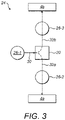
- Drive system 24 comprises a first electric drive motor 26-1, a second electric drive motor 26-2, a third electric drive motor 26-3 and a differential 20.
- First electric drive motor 26-1 is configured to drive both wheel 4a and wheel 4b.
- Differential 20 may permit drive to be delivered from first electric drive motor 26-1 to each of wheels 4a and 4b. Differential 20 may also permit wheel 4a to rotate at a different speed to wheel 4b (e.g. when vehicle 1 is cornering).
- Second electric drive motor 26-2 is configured to drive wheel 4a. That is, the primary purpose of second electric drive motor 26-2 is to drive wheel 4a - although it could also drive wheel 4b if differential 20 were a locking differential..
- Third electric drive motor 26-3 is configured to drive wheel 4b. That is, the primary purpose of third electric drive motor 26-3 is to drive wheel 4b - although it could also drive wheel 4a if differential 20 were a locking differential.
- Drive system 24 may comprise an input drive shaft 27 along which the first electric drive motor 26-1 is coupled, a first axle half-shaft 28a along which the second electric drive motor 26-2 is coupled, and a second axle half-shaft 28b along which the third electric drive motor 26-3 is coupled.
- Differential 20 may connect input drive shaft 27, first axle half-shaft 28a, and the second axle half-shaft 28b.
- Wheel 4a may be coupled to the first axle half-shaft 28a
- wheel 4b may be coupled to the second axle half-shaft 28b.
- First electric drive motor 26-1 may be configured to drive input drive shaft 27.
- Differential 20 may be configured to transfer rotary motion of the input drive shaft 27 driven by the first electric drive motor 26-1 to the first axle half-shaft 28a and the second axle half-shaft 28b so as to, respectively, drive wheel 4a and wheel 4b. That is, first electric drive motor 26-1 may be configured to drive, via differential 20, first axle half-shaft 28a and second axle half-shaft 28b.
- Second electric motor 26-2 may be configured to drive first axle half-shaft 28a.
- Third electric motor 26-2 may be configured to drive second axle half-shaft 28b.
- differential 20 is coupled to the first electric drive motor 36-1.
- Differential 20 is configured to split drive 30 provided by the first electric drive motor 36-1 so as to form a first drive path 32a from the differential 20 to wheel 4a and a second drive path 32b from the differential 20 to wheel 4b.
- Second electric drive motor 26-2 is positioned along the first drive path 32a and configured to drive wheel 4a.
- Third electric drive motor 26-3 is positioned along the second drive path 32b and configured to drive wheel 4b.
- An input drive shaft (e.g. input drive shaft 27 shown in Figure 2 ) may be configured to transfer drive 30 from the first electric drive motor 36-1 to the differential 20.
- a first axle half-shaft (e.g. axle half-shaft 28a shown in Figure 2 ) may be configured to transfer drive along the first drive path 32a from the differential 20 to wheel 4a.
- a second axle half-shaft (e.g. axle half-shaft 28b shown in Figure 2 ) may be configured to transfer drive along the second drive path 32b from the differential 20 to the wheel 4b.
- Arranging the first, second and third electric drive motors 26-1, 26-2 and 26-3 of drive system 24 in this way is advantageous because it enables large amounts of torque to be delivered to wheels 4a and 4b, whilst also enabling motor control system 14 to exert fine control over the torque applied to each of wheels 4a and 4b.
- drive system 24 enables motor control system 14 to perform torque vectoring by using second and third electric drive motors 26-2 and 26-3 to apply different torques to each of wheels 4a and 4b respectively. This can significantly improve the handling of vehicle 1.
- Another advantage of this arrangement is that, in the event of a fault or failure of any one of the first, second and third electric drive motors 26-1, 26-2 and/or 26-3, both of wheels 4a and 4b can be driven by the remaining two motors.
- Each of the first, second and third electric drive motors 26-1, 26-2 and 26-3 may have the same properties. That is, each of the first, second and third electric drive motors 26-1, 26-2 and 26-3 may be capable of delivering the same torque. Alternatively, the first, second and third electric drive motors 26-1, 26-2 and 26-3 may not have the same properties.
- the first electric drive motors 26-1 may be capable of delivering greater torques so as to provide the majority of the drive to wheels 4a and 4b - whilst the second and third electric drive motors 26-2 and 26-3 may be capable of delivering lesser torques, and may be primarily used for applying torque adjustments to each of wheels 4a and 4b, respectively (e.g. during torque vectoring, as described herein).
- vehicle 1 has a maximum speed.
- the maximum speed of vehicle 1 may be electronically limited to a predefined maximum speed. This may be a speed below a threshold speed at which vehicle 1 becomes unstable.
- Each of the first, second and third electric drive motors 26-1, 26-2 and 26-3 are configured to provide drive up to the maximum speed of vehicle 1. That is, each of the first, second and third electric drive motors 26-1, 26-2 and 26-3 are configured to provide drive across the full speed range of vehicle 1 (i.e. from stationary to the maximum speed of vehicle 1, in both the forward and reverse directions).
- drive system 24 may not comprise a disengagement mechanism for disengaging the first electric drive motor 26-1 from input drive shaft 27.
- An example of a typical disengagement mechanism is a clutch (e.g. a mechanical clutch). That is, in normal use, first electric drive motor 26-1 may remain continually mechanically engaged with input drive shaft 27. Put another way, the first electric drive motor 26-1 may be directly coupled to input drive shaft 27, or may be connected to a gearing between the input drive shaft 27 and first electric drive motor 26-1, the gearing having an appropriate fixed (e.g. single speed) gear ratio.
- Drive system 24 may not comprise a disengagement mechanism for disengaging the second electric drive motor 26-2 from first axle half-shaft 28a. That is, in normal use, second electric drive motor 26-2 may remain continually mechanically engaged with first axle half-shaft 28a. In other words, no disengagement mechanism may be present along the first drive path 32a between the second electric drive motor 26-2 and wheel 4a. Put another way, the second electric drive motor 26-2 may be directly coupled to first axle half-shaft 28a, or may be connected to a gearing between the first axle half-shaft 28a and second electric drive motor 26-2, the gearing having an appropriate fixed (e.g. single speed) gear ratio.
- second electric drive motor 26-2 may be directly coupled to first axle half-shaft 28a, or may be connected to a gearing between the first axle half-shaft 28a and second electric drive motor 26-2, the gearing having an appropriate fixed (e.g. single speed) gear ratio.
- Drive system 24 may not comprise a disengagement mechanism for disengaging the third electric drive motor 26-3 from second axle half-shaft 28b. That is, in normal use, third electric drive motor 26-3 may remain continually mechanically engaged with second axle half-shaft 28b. In other words, no disengagement mechanism may be present along the second drive path 32b between the third electric drive motor 26-3 and wheel 4b. Put another way, the third electric drive motor 26-3 may be directly coupled to second axle half-shaft 28b, or may be connected to a gearing between the second axle half-shaft 28b and the third electric drive motor 26-3, the gearing having an appropriate fixed (e.g. single speed) gear ratio.
- third electric drive motor 26-3 may be directly coupled to second axle half-shaft 28b, or may be connected to a gearing between the second axle half-shaft 28b and the third electric drive motor 26-3, the gearing having an appropriate fixed (e.g. single speed) gear ratio.
- Each of the first, second and third electric drive motors 26-1, 26-2 and 26-3 being configured to provide drive up to the maximum speed of vehicle 1 as described herein is advantageous because all three electric drive motors can be used simultaneously. This increases the efficiency of drive system 24 - e.g. relative to a drive system having a plurality of electric drive motors but where each electric drive motor is only capable of providing drive within a sub-range of the vehicle's full speed range, and thus must be disengaged from the driven axle outside that sub-range (e.g. using a clutch). In addition, the absence of a disengagement mechanism (e.g.
- a clutch associated with each of the first, second and third electric drive motors 26-1, 26-2 and 26-3 - made possible by configuring each of the electric drive motors to provide drive across the full speed range of vehicle 1 - reduces the weight of drive system 24. Desirable vehicle performance benefits (e.g. greater acceleration, greater top speed, and greater range) can be achieved by reducing the weight of drive system 24.
- first, second and third electric drive motors 26-1, 26-2 and 26-3 may be disconnected from their shafts during maintenance of the vehicle by detaching the mechanical connection between each electric drive motor and its respective shaft.
- each of the first, second and third electric drive motors 26-1, 26-2 and 26-3 cannot be disengaged from driving its respective shaft.
- the first, second and third electric drive motors 26-1, 26-2 and 26-3 may be packaged together with differential 20. That is, the first, second and third electric drive motors 26-1, 26-2 and 26-3 and differential 20 may be included within the same physical container. This can advantageously reduce the weight of the drive system 24 for a vehicle, relative to a drive system in which the electric drive motors and the differential are individually (e.g. separately) packaged in multiple physical containers.
- less packaging material e.g. magnesium or aluminium
- weight can be saved by virtue of having a single physical container, rather than multiple physical containers.
- Second, weight can be saved by using the same cooling circuit (e.g.
- radiators, cooling fluids, common sections of piping etc. for the first, second and third electric drive motors 26-1, 26-2 and 26-3 and differential 20 - rather than requiring each component to have its own cooling circuit.
- desirable vehicle performance benefits e.g. greater acceleration, greater top speed, and greater range
- Drive system 24 may include input drive shaft 27, and/or first axle half-shaft 28a and second axle half-shaft 28a.
- first, second and third electric drive motors 26-1, 26-2 and 26-3 and differential 20 could be packaged together as described herein and sold separately, and appropriate shafts (e.g. input drive shaft 27, first axle half-shaft 28a and second axle half-shaft 28b) subsequently inserted into appropriate inputs/outputs during vehicle assembly.
Landscapes
- Engineering & Computer Science (AREA)
- Chemical & Material Sciences (AREA)
- Combustion & Propulsion (AREA)
- Transportation (AREA)
- Mechanical Engineering (AREA)
- Electric Propulsion And Braking For Vehicles (AREA)
Applications Claiming Priority (1)
| Application Number | Priority Date | Filing Date | Title |
|---|---|---|---|
| GBGB2109409.9A GB202109409D0 (en) | 2021-06-30 | 2021-06-30 | Drive system for a vehicle |
Publications (2)
| Publication Number | Publication Date |
|---|---|
| EP4112349A1 true EP4112349A1 (de) | 2023-01-04 |
| EP4112349B1 EP4112349B1 (de) | 2025-12-17 |
Family
ID=77179587
Family Applications (1)
| Application Number | Title | Priority Date | Filing Date |
|---|---|---|---|
| EP22181249.8A Active EP4112349B1 (de) | 2021-06-30 | 2022-06-27 | Antriebssystem für ein fahrzeug |
Country Status (3)
| Country | Link |
|---|---|
| US (1) | US12030378B2 (de) |
| EP (1) | EP4112349B1 (de) |
| GB (1) | GB202109409D0 (de) |
Families Citing this family (1)
| Publication number | Priority date | Publication date | Assignee | Title |
|---|---|---|---|---|
| JP2020019328A (ja) * | 2018-07-31 | 2020-02-06 | マツダ株式会社 | 車両駆動装置 |
Citations (5)
| Publication number | Priority date | Publication date | Assignee | Title |
|---|---|---|---|---|
| US20110259657A1 (en) * | 2010-04-23 | 2011-10-27 | Dr. Ing. H.C.F. Porsche Aktiengesellschaft | Vehicle having electric drive |
| EP3140144A1 (de) * | 2014-05-06 | 2017-03-15 | BorgWarner TorqTransfer Systems AB | Drehmomentvektorisierungsvorrichtung |
| WO2019217619A1 (en) * | 2018-05-10 | 2019-11-14 | Arvinmeritor Technology, Llc | Axle assembly having an electric motor module and a terminal box |
| DE102019202994A1 (de) * | 2019-03-06 | 2020-09-10 | Zf Friedrichshafen Ag | Antriebseinheit für ein Elektrofahrzeug und Antriebsachse mit einer Antriebseinheit |
| CN112477570A (zh) * | 2020-12-15 | 2021-03-12 | 浙江吉利控股集团有限公司 | 一种驱动合成装置以及电动车辆 |
Family Cites Families (18)
| Publication number | Priority date | Publication date | Assignee | Title |
|---|---|---|---|---|
| US1984830A (en) * | 1933-05-05 | 1934-12-18 | Frank R Higley | Vehicle drive |
| US5453930A (en) | 1991-02-08 | 1995-09-26 | Nissan Motor Co., Ltd. | Drive system for electric automobiles |
| US5168946A (en) * | 1991-09-09 | 1992-12-08 | General Electric Company | Track-laying vehicle electric drive system |
| GB0109336D0 (en) * | 2001-04-17 | 2001-05-30 | Secr Defence | Drive configuration for a skid steered vehicle |
| ATE409635T1 (de) * | 2003-12-04 | 2008-10-15 | Renk Ag | Elektrisches lenk- und antriebssystem für ein fahrzeug mit radseitenlenkung |
| EP2097283A2 (de) * | 2006-10-13 | 2009-09-09 | The Ohio State University Research Foundation | Getriebestrang, fahrzeug und verfahren |
| JP4135030B1 (ja) | 2007-02-13 | 2008-08-20 | トヨタ自動車株式会社 | 車両の制御装置、制御方法、その方法を実現するプログラムおよびそのプログラムを記録した記録媒体 |
| JP4566233B2 (ja) | 2007-12-25 | 2010-10-20 | トヨタ自動車株式会社 | ハイブリッド駆動装置の制御装置 |
| FR2954252B1 (fr) | 2009-12-21 | 2012-05-04 | Motor Development Int Sa | Vehicule automobile a economie d'energie |
| FR2998528B1 (fr) | 2012-11-26 | 2015-02-06 | Renault Sa | Systeme et procede de commande d'un vehicule automobile a machines electriques arrieres independantes |
| CN205059312U (zh) | 2015-06-29 | 2016-03-02 | 徐州百事利电动车业有限公司 | 一种电动汽车驱动系统 |
| CN105480069B (zh) | 2015-12-30 | 2018-07-31 | 北京新能源汽车股份有限公司 | 动力系统以及具有其的车辆 |
| CN106080157A (zh) | 2016-06-30 | 2016-11-09 | 杨勇 | 接力式多电机多速比电动车自动变速装置 |
| CN105966223A (zh) | 2016-07-04 | 2016-09-28 | 杨勇 | 一种交错设置电机的多电机电动车 |
| CN206394423U (zh) | 2016-12-12 | 2017-08-11 | 郑州宇通客车股份有限公司 | 混合动力系统及使用该混合动力系统的车辆 |
| CN108297676A (zh) | 2018-03-07 | 2018-07-20 | 武汉理工大学 | 一种带轮毂电机的混合动力汽车驱动系统 |
| CN108394271A (zh) | 2018-03-07 | 2018-08-14 | 武汉理工大学 | 一种分布式三电机驱动动力系统 |
| CN112356647B (zh) | 2020-11-10 | 2022-04-08 | 浙江吉利控股集团有限公司 | 一种多电机灵活扭矩集中驱动合成箱和电动车辆 |
-
2021
- 2021-06-30 GB GBGB2109409.9A patent/GB202109409D0/en not_active Ceased
-
2022
- 2022-06-27 EP EP22181249.8A patent/EP4112349B1/de active Active
- 2022-06-29 US US17/852,666 patent/US12030378B2/en active Active
Patent Citations (5)
| Publication number | Priority date | Publication date | Assignee | Title |
|---|---|---|---|---|
| US20110259657A1 (en) * | 2010-04-23 | 2011-10-27 | Dr. Ing. H.C.F. Porsche Aktiengesellschaft | Vehicle having electric drive |
| EP3140144A1 (de) * | 2014-05-06 | 2017-03-15 | BorgWarner TorqTransfer Systems AB | Drehmomentvektorisierungsvorrichtung |
| WO2019217619A1 (en) * | 2018-05-10 | 2019-11-14 | Arvinmeritor Technology, Llc | Axle assembly having an electric motor module and a terminal box |
| DE102019202994A1 (de) * | 2019-03-06 | 2020-09-10 | Zf Friedrichshafen Ag | Antriebseinheit für ein Elektrofahrzeug und Antriebsachse mit einer Antriebseinheit |
| CN112477570A (zh) * | 2020-12-15 | 2021-03-12 | 浙江吉利控股集团有限公司 | 一种驱动合成装置以及电动车辆 |
Also Published As
| Publication number | Publication date |
|---|---|
| US20230001786A1 (en) | 2023-01-05 |
| EP4112349B1 (de) | 2025-12-17 |
| US12030378B2 (en) | 2024-07-09 |
| GB202109409D0 (en) | 2021-08-11 |
Similar Documents
| Publication | Publication Date | Title |
|---|---|---|
| EP3088237B1 (de) | Fahrzeug und fahrzeugsteuerungsverfahren | |
| KR100229340B1 (ko) | 동력전달장치 및 이것을 사용한 4륜구동차량 및 동력전달방법 및4륜구동 방법 | |
| US20220024306A1 (en) | Manual torque vectoring | |
| EP2522541B1 (de) | Fahrzeug mit vorder- und hinterradantrieb | |
| US11590841B2 (en) | Electric axle assembly | |
| EP2258569A2 (de) | Fahrzeugantriebseinheit in Form einer nachrüstbaren Achse mit Elektromotoren und Verbindungskupplung | |
| US9248741B2 (en) | Torque indicating device and vehicle including same | |
| CN105848961A (zh) | 车辆 | |
| US20230085556A1 (en) | Vehicle braking controls and methods | |
| US20140343770A1 (en) | Powertrain for electric vehicles | |
| JP7025164B2 (ja) | ハイブリッド車両のパワーユニット | |
| JP6997584B2 (ja) | ハイブリッド車両のパワーユニット | |
| CN115402290A (zh) | 将动力传动系统扭矩分布到副车桥的电动化车辆控制 | |
| US12017634B2 (en) | Systems and methods for disconnecting tandem axles | |
| US20250222785A1 (en) | Electric drive unit with disconnect clutches and electric drive unit operating method | |
| EP4112349A1 (de) | Antriebssystem für ein fahrzeug | |
| CN2925948Y (zh) | 混合动力汽车的多桥驱动系统 | |
| US12485748B2 (en) | Electric drive unit with parking gear assembly and operating method | |
| JPH09322311A (ja) | 動力出力装置 | |
| JP6969956B2 (ja) | ハイブリッド車両のパワーユニット | |
| US20150060174A1 (en) | In-wheel system for hybrid electric vehicle | |
| JP6969952B2 (ja) | ハイブリッド車両のパワーユニット | |
| EP4088960B1 (de) | Fahrzeugantriebsstrang | |
| JP5792789B2 (ja) | 四輪車両のスリップ制御装置 | |
| CN117284072A (zh) | 混合动力变速器直流电源(断连)连接件 |
Legal Events
| Date | Code | Title | Description |
|---|---|---|---|
| PUAI | Public reference made under article 153(3) epc to a published international application that has entered the european phase |
Free format text: ORIGINAL CODE: 0009012 |
|
| STAA | Information on the status of an ep patent application or granted ep patent |
Free format text: STATUS: THE APPLICATION HAS BEEN PUBLISHED |
|
| AK | Designated contracting states |
Kind code of ref document: A1 Designated state(s): AL AT BE BG CH CY CZ DE DK EE ES FI FR GB GR HR HU IE IS IT LI LT LU LV MC MK MT NL NO PL PT RO RS SE SI SK SM TR |
|
| P01 | Opt-out of the competence of the unified patent court (upc) registered |
Effective date: 20230522 |
|
| STAA | Information on the status of an ep patent application or granted ep patent |
Free format text: STATUS: REQUEST FOR EXAMINATION WAS MADE |
|
| 17P | Request for examination filed |
Effective date: 20230628 |
|
| RBV | Designated contracting states (corrected) |
Designated state(s): AL AT BE BG CH CY CZ DE DK EE ES FI FR GB GR HR HU IE IS IT LI LT LU LV MC MK MT NL NO PL PT RO RS SE SI SK SM TR |
|
| GRAP | Despatch of communication of intention to grant a patent |
Free format text: ORIGINAL CODE: EPIDOSNIGR1 |
|
| STAA | Information on the status of an ep patent application or granted ep patent |
Free format text: STATUS: GRANT OF PATENT IS INTENDED |
|
| INTG | Intention to grant announced |
Effective date: 20250908 |
|
| GRAS | Grant fee paid |
Free format text: ORIGINAL CODE: EPIDOSNIGR3 |
|
| GRAA | (expected) grant |
Free format text: ORIGINAL CODE: 0009210 |
|
| STAA | Information on the status of an ep patent application or granted ep patent |
Free format text: STATUS: THE PATENT HAS BEEN GRANTED |
|
| AK | Designated contracting states |
Kind code of ref document: B1 Designated state(s): AL AT BE BG CH CY CZ DE DK EE ES FI FR GB GR HR HU IE IS IT LI LT LU LV MC MK MT NL NO PL PT RO RS SE SI SK SM TR |
|
| REG | Reference to a national code |
Ref country code: CH Ref legal event code: F10 Free format text: ST27 STATUS EVENT CODE: U-0-0-F10-F00 (AS PROVIDED BY THE NATIONAL OFFICE) Effective date: 20251217 Ref country code: GB Ref legal event code: FG4D |
|
| REG | Reference to a national code |
Ref country code: DE Ref legal event code: R096 Ref document number: 602022026885 Country of ref document: DE |
|
| REG | Reference to a national code |
Ref country code: LT Ref legal event code: MG9D |
|
| PG25 | Lapsed in a contracting state [announced via postgrant information from national office to epo] |
Ref country code: NO Free format text: LAPSE BECAUSE OF FAILURE TO SUBMIT A TRANSLATION OF THE DESCRIPTION OR TO PAY THE FEE WITHIN THE PRESCRIBED TIME-LIMIT Effective date: 20260317 |
|
| PG25 | Lapsed in a contracting state [announced via postgrant information from national office to epo] |
Ref country code: FI Free format text: LAPSE BECAUSE OF FAILURE TO SUBMIT A TRANSLATION OF THE DESCRIPTION OR TO PAY THE FEE WITHIN THE PRESCRIBED TIME-LIMIT Effective date: 20251217 Ref country code: HR Free format text: LAPSE BECAUSE OF FAILURE TO SUBMIT A TRANSLATION OF THE DESCRIPTION OR TO PAY THE FEE WITHIN THE PRESCRIBED TIME-LIMIT Effective date: 20251217 |
|
| PG25 | Lapsed in a contracting state [announced via postgrant information from national office to epo] |
Ref country code: RS Free format text: LAPSE BECAUSE OF FAILURE TO SUBMIT A TRANSLATION OF THE DESCRIPTION OR TO PAY THE FEE WITHIN THE PRESCRIBED TIME-LIMIT Effective date: 20260317 |
|
| REG | Reference to a national code |
Ref country code: NL Ref legal event code: MP Effective date: 20251217 |
|
| PG25 | Lapsed in a contracting state [announced via postgrant information from national office to epo] |
Ref country code: LV Free format text: LAPSE BECAUSE OF FAILURE TO SUBMIT A TRANSLATION OF THE DESCRIPTION OR TO PAY THE FEE WITHIN THE PRESCRIBED TIME-LIMIT Effective date: 20251217 |