EP4112342B1 - Klimagerät - Google Patents
Klimagerät Download PDFInfo
- Publication number
- EP4112342B1 EP4112342B1 EP22181485.8A EP22181485A EP4112342B1 EP 4112342 B1 EP4112342 B1 EP 4112342B1 EP 22181485 A EP22181485 A EP 22181485A EP 4112342 B1 EP4112342 B1 EP 4112342B1
- Authority
- EP
- European Patent Office
- Prior art keywords
- casing
- air
- conditioning
- connection interface
- air flow
- Prior art date
- Legal status (The legal status is an assumption and is not a legal conclusion. Google has not performed a legal analysis and makes no representation as to the accuracy of the status listed.)
- Active
Links
Images

Classifications
-
- B—PERFORMING OPERATIONS; TRANSPORTING
- B60—VEHICLES IN GENERAL
- B60H—ARRANGEMENTS OF HEATING, COOLING, VENTILATING OR OTHER AIR-TREATING DEVICES SPECIALLY ADAPTED FOR PASSENGER OR GOODS SPACES OF VEHICLES
- B60H1/00—Heating, cooling or ventilating devices
- B60H1/00507—Details, e.g. mounting arrangements, desaeration devices
- B60H1/00514—Details of air conditioning housings
- B60H1/00542—Modular assemblies
-
- B—PERFORMING OPERATIONS; TRANSPORTING
- B60—VEHICLES IN GENERAL
- B60H—ARRANGEMENTS OF HEATING, COOLING, VENTILATING OR OTHER AIR-TREATING DEVICES SPECIALLY ADAPTED FOR PASSENGER OR GOODS SPACES OF VEHICLES
- B60H1/00—Heating, cooling or ventilating devices
- B60H1/00507—Details, e.g. mounting arrangements, desaeration devices
- B60H1/00514—Details of air conditioning housings
- B60H1/00528—Connections between housing parts
-
- B—PERFORMING OPERATIONS; TRANSPORTING
- B60—VEHICLES IN GENERAL
- B60H—ARRANGEMENTS OF HEATING, COOLING, VENTILATING OR OTHER AIR-TREATING DEVICES SPECIALLY ADAPTED FOR PASSENGER OR GOODS SPACES OF VEHICLES
- B60H1/00—Heating, cooling or ventilating devices
- B60H1/32—Cooling devices
- B60H1/3233—Cooling devices characterised by condensed liquid drainage means
Definitions
- the present invention relates to an air conditioning device for conditioning the air present in an inner environment of a means of transport.
- the present invention is advantageously but not exclusively applied for conditioning a passenger compartment of a vehicle or a commercial transport means or work vehicle, to which the present description will refer without losing its generality.
- such devices comprise a fluidic circuit configured to circulate an operative fluid, e.g. Freon ® or similar, and known conditioning means cooperating with the fluidic circuit to condition the operative fluid and, through this, cool the air in the passenger compartment.
- an operative fluid e.g. Freon ® or similar
- known conditioning means cooperating with the fluidic circuit to condition the operative fluid and, through this, cool the air in the passenger compartment.
- a typical conditioning device also comprises a radiator mass (commonly known as a "heater”) configured to receive an operative fluid other than the one mentioned above, e.g. water heated by the vehicle engine, and defining a heat exchange interface between the operative fluid received and the air, in order to heat the passenger compartment.
- a radiator mass commonly known as a "heater”
- a typical conditioning device also comprises forced ventilation means, e.g. an electric fan, configured to convey and direct an air flow to be conditioned (cooled or heated) towards the conditioning means and the radiator mass.
- forced ventilation means e.g. an electric fan
- the conditioning means and radiator mass can be selectively switched on and off, depending on whether the air in the passenger compartment is to be heated or cooled.
- Examples of known air conditioning devices for conditioning the air present in an inner environment of a means of transport are disclosed in DE-A-102007023249 , FR-A-2274465 and DE-A-19645776 .
- HVAC devices of the aforementioned type generally comprise a single casing within which all the components described above are housed, so that a compact, integrated HVAC unit is defined.
- the conditioning means typically comprise an evaporator and a condenser, the operation of which is known in itself and defining (together with other typical components arranged within the fluidic circuit such as a compressor, an expansion valve, a dryer, an accumulator, etc.) a refrigerant circuit for air conditioning.
- integrated conditioning devices of the type described above are susceptible to further improvement, in particular regarding their operative flexibility and their adaptability to different operative conditions and, more specifically, to different construction requirements.
- integrated conditioning devices of the known type are also susceptible to further improvement also with regard to the management of the condensation produced, in use, by conditioning means, in particular in the light of the adaptability of the devices to different operative conditions and construction requirements.
- Aim of the present invention is to realise an air conditioning device for conditioning the air present in an inner environment of a means of transport, which is of high reliability and cheap, and enables to fulfil at least some of the requirements specified above and related to the conditioning devices of the known type.
- a device for conditioning the air present in an inner room 2 of a means of transport (not illustrated) is referred to as a whole with 1.
- the present invention is advantageously but not exclusively applied for conditioning a passenger compartment 2 (partially and schematically illustrated in Figure 1 ) of a motor vehicle or a commercial transport means or work vehicle, to which the present description will refer without losing generality.
- the device 1 comprises:
- the conditioning means 3 comprise a condenser, an evaporator, a dryer, an accumulator and, preferably, other components such as a compressor, an expansion valve, etc. (not illustrated), the operation of which is known in itself and is not herein disclosed.
- the aforementioned components define, together with the fluidic circuit, a refrigeration circuit for conditioning (cooling) the air present in the passenger compartment 2.
- the radiator mass 4 comprises a set of heat exchange fins (known and not illustrated) defining the aforementioned interface and receiving, in a known and not detailed manner, the second operative fluid, preferably heated water.
- the radiator mass 4 comprises an inlet 4b for the second operative fluid and an outlet 4a for the second operative fluid that has exchanged heat.
- the fins are lapped/crossed by the air in order to release the heat carried by the second operative fluid and thus heat the passenger compartment 2.
- the conditioning means 3 are configured to cool the air present in passenger compartment 2 and the radiator mass 4 is configured to heat the air present in passenger compartment 2.
- the conditioning means 3 and the radiator mass 4 are selectively switchable on and off to heat or cool the air in the passenger compartment 2, depending on certain ambient conditions (summer or winter) or depending on the desired temperature inside the passenger compartment 2.
- radiator mass 4 when the conditioning means 3 is on, radiator mass 4 is off, and vice versa.
- the conditioning means 3 and the radiator mass 4 may be activated simultaneously for conditioning in a combined way the air of the passenger compartment 2.
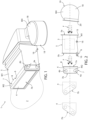
- the device 1 is of the modular type and the conditioning means 3 and the radiator mass 4 are housed in respective, separate casings 5, 7 which can be connected in a releasable manner directly to each other or with interposition of parts.
- the device 1 comprises:
- the first interface 6 may be coupled to the second interface 8 by means of releasable fastening means 10, either directly or with the interposition of parts (illustrated in Figure 4 ).
- the first connection interface is defined by a connection flange 6 carried by the first casing 5 at the first outlet opening 5b
- the second connection interface is defined by a connection flange 8 carried by the second casing 7 at the second inlet opening 7a.
- the fastening means 10 are defined by threaded members, such as screws and bolts, rivets, clamps, or the like, configured to determine the releasable coupling of the flange 6 with the flange 8 and, therefore, of the first module M1 with the second module M2.
- the first casing 5 and the second casing 7, i.e. the first module M1 and the second module M2 are connected in series and in a releasable manner, so that they can be coupled together directly or with interposition of parts.
- the radiator mass 4 may be releasably coupled in series with the conditioning means 3, so that it can be coupled with it directly or with the interposition of parts.
- the radiator mass 4 may be selected from a plurality of configurations (illustrated in a dotted line in Figures 2 , 4 and 6 ) or types that differ from each other only with regard to the arrangement of outlet opening 7b.
- radiator mass 4 differs from each other in the angle of the outlet opening 7b, as illustrated in the above figures.
- the modules M1 and M2 may be releasably coupled directly to each other or with interposition of parts, and, in addition, an appropriate radiator mass 4 may be selected depending on the desired angle of the outlet opening 7b, without having to replace and redesign the entire device 1.
- the first casing 5 further houses the fluidic circuit.
- condensation is not unlikely to form, in use, inside the evaporator of the conditioning means 3, mainly due to the temperature difference between the evaporator and the air to be conditioned lapping it. Such temperature difference causes the condensation of the moisture housed in the air to be conditioned.
- the device 1 comprises condensation collection means 11 fluidically connectable to the conditioning means 3 to receive the condensation produced, in use, by the latter, or rather by the aforementioned evaporator.
- the device 1 is selectively available in:
- the platform could be defined by the platform of the wheels (or rails) of the means of transport).
- the aforesaid positions are horizontal and inclined (vertical) relative to the force of gravity, when the means of transport advances on a level surface.
- the device 1 comprises a third casing 12 housing the means 11 for collecting the condensation produced, in use, by the conditioning means 3, defining a third module M3 of the device 1 and configured to be crossed by an air flow F in forced ventilation.
- the third casing 12 is interposed between the first casing 5 and the second casing 7 when the device 1 is placed, in use, in said inclined position, in particular in a vertical position, and the aforesaid air flow F is directed, in forced ventilation, downwards relative to a horizontal direction with respect to the aforesaid plane ( Figures 3 and 4 ) .
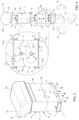
- the third casing 12 is arranged upstream of the first inlet opening 5a, relative to the direction of the air flow F, when the device 1 is placed, in use, in said inclined position relative to the horizontal direction, in particular in a vertical position, and the air flow F is directed, in forced ventilation, upwards relative to said horizontal direction ( Figures 5 and 6 ).
- the third casing 12 has two openings 12a for the passage of the air flow arranged at opposite walls of the third casing 12 transverse to the direction of the air flow.
- the third casing 12 comprises a third connection interface 13 and a fourth connection interface 14 each one arranged at one of the openings 12a.
- the third interface 13 and the fourth interface 14 are also defined by respective connection flanges.
- the third interface 13 is releasably coupled to the first interface 6 and the fourth interface 14 is releasably coupled to the second interface 8, e.g. by means of the aforementioned releasable fastening means 10.
- the third casing 12 is interposed between the first casing 5 and the second casing 7.
- the first casing 5 and the second casing 7 are connected to each other in a releasable manner by interposition of parts, where these parts are defined by the third casing 12 and by the collection means 11.
- the third interface 13 is releasably coupled with a fifth interface 15 of the first casing 5 arranged at the inlet opening 5a, while the fourth interface 14 is free or releasably couplable to a component described below for receiving the air flow F in forced ventilation.
- the third casing 12 is placed upstream of the inlet opening 5a.
- the third casing 12, and therefore the collection means 11, in the optimal position for collecting the condensation produced, within the first casing 5 by the conditioning means 3 and thus avoid such condensation from escaping from the outlet opening 7b (in the case of the inclined arrangement with air flow F directed downwards) or from the inlet opening 5a (in the case of the inclined arrangement with the air flow F directed upwards).
- the condensation produced tends to fall downwards under the action of gravity and, therefore, to drip out of the first casing 5 downwards.
- the first casing 5 is connected to the second casing 7 directly without interposition of parts by releasable coupling of the flange 6 (i.e. the first interface) with the flange 8 (i.e. the second interface).
- This operative condition is illustrated in Figures 1 and 2 .
- the first casing 5 comprises ducts 16 arranged at one of the walls constituting the first casing 5, in particular the lower wall when it is arranged in a horizontal position, and placing the interior of the first casing 5 in fluidic communication with the outside, in order to collect the condensation produced by the conditioning means 3 and discharge it outside the first casing 5.
- the ducts 16 receive, by gravity, the condensation produced by the conditioning means 3 and convey it outside the first casing 5.
- the device 1 is highly flexible and adaptable to construction and project requirements. In this case, it is in fact possible to omit the third casing 12 or third module M3 without having to redesign the entire device 1.
- the modularity of the device 1 it is possible to appropriately recombine the modules M1, M2, M3 constituting the device 1 itself according to the different operative and construction requirements, which most often depend on the spatial configuration of the means of transport on which the device 1 is to be installed.
- the first casing 5 has the aforementioned fifth connection interface 15 arranged at the inlet opening 5a.
- the fifth interface 15 is defined by a connection flange of the type described above.
- the device 1 comprises:
- the fifth interface 15 may be coupled to the sixth interface 20 by means of the aforementioned releasable fastening means 10, either directly or by interposition of parts.
- the fourth casing 19, i.e. the fourth module M4 is suitably arranged upstream of every other casing or module of the device 1, so as to direct the air flow F towards all the existing casings and modules, so that the air flow F passes through them in succession.
- the fourth casing 19 is coupled in a releasable manner directly to the first casing 5, i.e. the sixth interface 20 is coupled in a releasable manner directly to the fifth interface 15, e.g. by means of the fastening means 10, and thus without interposition of parts.
- the fourth casing 19 is coupled in a releasable manner directly to the first casing 5, and thus without interposition of parts.
- the fourth casing 19 is releasably coupled to the third casing 12, i.e. the sixth interface 20 is coupled directly to the fourth interface 14, e.g. by means of fastening means 10. Therefore, in this case the sixth interface 20 (the fourth casing 19) is coupled to the fifth interface 15 (the first casing 5) with interposition of parts, these parts being defined by the third casing 12.
- the modules M1, M2, M3 and M4 of the device can be rearranged according to operative and construction requirements.
- the collection means 11 comprise at least two inclined surfaces 21 for collecting the condensation produced, in use, by the conditioning means 3, the collection surfaces 21 extending cantilevered from opposite inner walls 12b of the third casing 12 towards the interior of the third casing 12 itself.
- each collection surface is defined by a chute 21 configured to receive (in particular by gravity) the moisture within the air flow F condensed by the conditioning means 3, and extending cantilevered from the corresponding inner wall 12b towards the opposite inner wall 12b.
- the inner walls 12b are contiguous with the walls on which the openings 12a are obtained. In practice, the inner walls 12b are essentially parallel to the advancement direction of the air flow F within the third casing 12.
- the chutes 21, i.e. the collection surfaces, are arranged staggered within the third casing 12 in such a way that the air flow F performs an S-shaped path therein.
- chutes 21 are staggered with respect to the forward direction of the air flow F within the third casing 12.
- each chute 21 has, at its free end, a basin 22 for collecting the condensed moisture fluidically connectable to a relative outlet duct 23 configured to convey the condensed moisture out of the third casing 12.
- an upper chute 21 and a lower chute 21 may be identified, relative to the direction of the force of gravity.
- the fourth module M4 i.e. the forced ventilation means 18, is selectable from a plurality of types differing from each other and having the same sixth interface 20 that can be selectively coupled to the fifth interface 15, either directly or with interposition of parts, as described above.
- the modules M1 and M2 may be releasably coupled directly to each other or with interposition of parts, and, in addition, an appropriate radiator mass 4 may be selected depending on the desired angle of the outlet opening 7b, without having to replace and redesign the entire device 1.
- the third casing 12, and therefore the collection means 11, in the optimal position for collecting the condensation produced, within the first casing 5, by the conditioning means 3 and thus to avoid the leakage of this condensation from the outlet opening 7b (in the case of the inclined arrangement with air flow F directed downwards) or from the inlet opening 5a (in the case of the inclined arrangement with an air flow F directed upwards).
- the modules M1, M2, M3 and M4 of the device may be rearranged according to operative and construction requirements.
- the device 1 defines an HVAC unit of the modular type, i.e. an HVAC unit not defined by a single compact and integrated casing housing all the components organised in a static and unchangeable configuration except by means of a redesign, rearrangement, reorganisation or non-immediate reassembly of the parts, as is possible in the case of the device 1 made according to the present invention.
- collection means 11 of the type described above i.e. including chutes 21 arranged staggered and extending cantilevered from opposite walls, could be implemented in an integrated conditioning device of the non-modular type, which does not belong to the present invention, that needs to be arranged at an angle to the vertical direction in order to effectively collect the condensation produced.
- collection means 11 of the type described above i.e. comprising the aforesaid chutes 21 could be implemented in an air conditioning device, which does not belong to the present invention, merely comprising: the aforementioned fluidic circuit configured to circulate the operative fluid, the conditioning means 3, and the collection means 11 comprising a casing 12 configured to be crossed by the air flow and at least two inclined surfaces 21 for collecting the condensation produced, in use, by the conditioning means 3, the collection surfaces 21 extending cantilevered from opposing inner walls 12b of the casing 12 towards the interior of the casing 12, the collection surfaces (21) being arranged staggered within the casing 12 so that the air flow completes, therein, an S-shaped path.
- each collection surface is defined by an aforesaid chute 21, which is configured to receive condensed moisture from the conditioning means 3, extends cantilevered from the relative inner wall 12b towards the opposite inner wall 12b and has, at its free end, a basin 22 for collecting condensed moisture fluidically connectable to a relative outlet duct 23 configured to convey the condensed moisture out of the casing 12.
Landscapes
- Physics & Mathematics (AREA)
- Thermal Sciences (AREA)
- Engineering & Computer Science (AREA)
- Mechanical Engineering (AREA)
- Air-Conditioning For Vehicles (AREA)
- Central Air Conditioning (AREA)
Claims (8)
- Klimatisierungsvorrichtung (1), um die in einer Innenumgebung (2) eines Transportmittels vorhandene Luft zu konditionieren, wobei die Vorrichtung (1) aufweist:- einen Fluidkreislauf, der dafür konfiguriert ist, ein erstes Betriebsfluid zirkulieren zu lassen;- ein Konditionierungsmittel (3), das im Einsatz mit dem Kreislauf zusammenarbeitet, um das erste Betriebsfluid und dadurch die in der Innenumgebung (2) des Transportmittels vorhandene Luft zu konditionieren; und- eine Radiatormasse (4), die dafür konfiguriert ist, ein zweites Betriebsfluid aufzunehmen, und eine Wärmeaustauschschnittstelle zwischen dem aufgenommenen zweiten Betriebsfluid und der Luft, die im Einsatz die Radiatormasse (4) umspült/durchquert, definiert;wobei die Klimatisierungsvorrichtung (1) vom modularen Typ ist und das Konditionierungsmittel (3) und die Radiatormasse (4) in jeweiligen separaten Gehäusen (5, 7) untergebracht sind, die in lösbarer Art und Weise direkt oder unter Zwischenschaltung von Teilen miteinander verbindbar sind;wobei die Klimatisierungsvorrichtung (1) aufweist:- ein erstes Gehäuse (5), das das Konditionierungsmittel (3) beherbergt, ein erstes Modul (M1) der Vorrichtung (1) definiert, eine erste Einlassöffnung (5a) für die zu konditionierende Luft und eine erste Auslassöffnung (5b) für die konditionierte Luft aufweist; und- ein zweites Gehäuse (7), das die Radiatormasse (4) beherbergt, ein zweites Modul (M2) der Vorrichtung (1) definiert, eine zweite Einlassöffnung (7a) für die Luft und eine zweite Auslassöffnung (7b) für die Luft aufweist;dadurch gekennzeichnet, dass das erste Gehäuse (5) eine erste Verbindungsschnittstelle (6) enthält, die an der ersten Auslassöffnung (5b) angeordnet ist, dass das zweite Gehäuse (7) eine zweite Verbindungsschnittstelle (8) enthält, die an der zweiten Einlassöffnung (7a) angeordnet ist, und dass die erste Verbindungsschnittstelle (6) mittels eines lösbaren Befestigungsmittels (10) direkt oder unter Zwischenschaltung von Teilen mit der zweiten Verbindungsschnittstelle (8) gekoppelt werden kann.
- Vorrichtung (1) nach Anspruch 1, wobei die Vorrichtung (1) selektiv angeordnet werden kann in:- einer horizontalen Position in Bezug auf eine Plattform des Transportmittels, die parallel zu dem Boden ist, auf dem sich das Transportmittel vorwärtsbewegt, im Einsatz; und ineiner in Bezug auf die horizontale Position geneigten Position, insbesondere einer vertikalen Position in Bezug auf die Plattform.
- Vorrichtung (1) nach Anspruch 2, wobei, wenn die Vorrichtung (1) im Einsatz in der horizontalen Position in Bezug auf die Plattform angeordnet ist, das erste Gehäuse (5) mit dem zweiten Gehäuse (7) durch eine lösbare Kopplung der ersten Verbindungsschnittstelle (6) mit der zweiten Verbindungsschnittstelle (8) ohne Zwischenschaltung von Teilen direkt verbunden ist.
- Vorrichtung (1) nach Anspruch 2, und aufweisend ein drittes Gehäuse (12), das ein Sammelmittel (11) zum Sammeln der im Einsatz durch das Konditioniermittel (3) erzeugten Kondensation beherbergt, das ein drittes Modul (M3) der Vorrichtung (1) definiert und so konfiguriert ist, dass es von einem Luftstrom in einer Zwangsbelüftung durchquert wird;
und wobei das dritte Gehäuse (12) in einer Kopplung zwischen dem ersten Gehäuse (5) und dem zweiten Gehäuse (7) zwischengeschaltet ist, wenn die Vorrichtung (1) im Einsatz in der in Bezug auf die horizontale Position geneigten Position angeordnet ist und der Luftstrom in der Zwangsbelüftung in Bezug auf eine bezüglich der Plattform horizontalen Richtung nach unten geleitet wird. - Vorrichtung (1) nach Anspruch 2, und aufweisend ein drittes Gehäuse (12), das ein Sammelmittel (11) zum Sammeln der im Einsatz durch das Konditioniermittel (3) erzeugten Kondensation beherbergt, das ein drittes Modul (M3) der Vorrichtung (1) definiert und so konfiguriert ist, dass es von einem Luftstrom in einer Zwangsbelüftung durchquert wird;
und wobei das dritte Gehäuse (12) stromaufwärts der ersten Einlassöffnung (5a) in Bezug auf die Richtung des Luftstroms angeordnet ist, wenn die Vorrichtung (1) im Einsatz in der in Bezug auf die horizontale Position geneigten Position angeordnet ist und der Luftstrom in der Zwangsbelüftung in Bezug auf eine bezüglich der Plattform horizontalen Richtung nach oben geleitet wird. - Vorrichtung (1) nach Anspruch 4 oder 5, wobei das Sammelmittel (11) zumindest zwei geneigte Sammeloberflächen (21) zum Sammeln der im Einsatz durch das Konditioniermittel (3) erzeugten Kondensation beherbergt, wobei sich die Sammeloberflächen (21) von gegenüberliegenden Innenwänden (12b) des dritten Gehäuses (12) freitragend in Richtung des Innenraums des dritten Gehäuses (12) selbst erstrecken
und wobei die Sammeloberflächen (21) innerhalb des dritten Gehäuses (12) gestaffelt angeordnet sind, so dass der Luftstrom darin einen S-förmigen Weg definiert. - Vorrichtung (1) nach Anspruch 6, wobei jede Sammeloberfläche durch eine Rinne (21) definiert ist, die dafür konfiguriert ist, kondensierte Feuchtigkeit vom Konditioniermittel (3) aufzunehmen, von der jeweiligen Innenwand (12b) in Richtung der gegenüberliegenden Innenwand (12b) vorragt und an ihrem freien Ende ein Bassin (22) zum Sammeln der kondensierten Feuchtigkeit aufweist, das mit einem jeweiligen Auslasskanal (23) fluidisch verbindbar ist, der dafür konfiguriert ist, die kondensierte Feuchtigkeit aus dem dritten Gehäuse (12) zu befördern.
- Vorrichtung (1) nach einem der Ansprüche 1 bis 6, wobei das erste Gehäuse (5) eine dritte Verbindungsschnittstelle (15) aufweist, die an der ersten Einlassöffnung (5a) angeordnet ist;
wobei die Vorrichtung (1) aufweist:- ein Zwangsbelüftungsmittel (18), das so konfiguriert ist, dass es einen Luftstrom befördert und in Richtung der ersten Einlassöffnung (5a) und durch das erste Gehäuse (5) in Richtung der ersten Auslassöffnung (5b) und dann in Richtung der zweiten Einlassöffnung (7a) leitet; und- ein viertes Gehäuse (19), das das Zwangsbelüftungsmittel (18) beherbergt, ein viertes Modul (M4) der Vorrichtung (1) definiert und eine vierte Verbindungsschnittstelle (20) aufweist;- wobei die dritte Verbindungsschnittstelle (15) mittels eines lösbaren Befestigungsmittels (10) direkt oder unter Zwischenschaltung von Teilen mit der vierten Verbindungsschnittstelle (20) gekoppelt werden kann.
Applications Claiming Priority (1)
| Application Number | Priority Date | Filing Date | Title |
|---|---|---|---|
| IT102021000017069A IT202100017069A1 (it) | 2021-06-29 | 2021-06-29 | Dispositivo di condizionamento dell'aria |
Publications (3)
| Publication Number | Publication Date |
|---|---|
| EP4112342A1 EP4112342A1 (de) | 2023-01-04 |
| EP4112342C0 EP4112342C0 (de) | 2024-01-24 |
| EP4112342B1 true EP4112342B1 (de) | 2024-01-24 |
Family
ID=77802118
Family Applications (1)
| Application Number | Title | Priority Date | Filing Date |
|---|---|---|---|
| EP22181485.8A Active EP4112342B1 (de) | 2021-06-29 | 2022-06-28 | Klimagerät |
Country Status (2)
| Country | Link |
|---|---|
| EP (1) | EP4112342B1 (de) |
| IT (1) | IT202100017069A1 (de) |
Family Cites Families (3)
| Publication number | Priority date | Publication date | Assignee | Title |
|---|---|---|---|---|
| CA1016747A (en) * | 1974-06-13 | 1977-09-06 | Marvin L. Schneider | Modular environmental conditioning system for vehicles |
| JPH09132023A (ja) * | 1995-11-09 | 1997-05-20 | Zexel Corp | 空調ユニット |
| DE102007023249B4 (de) * | 2007-05-18 | 2014-02-13 | Ingersoll-Rand Klimasysteme Deutschland Gmbh | Aufdachklimaanlage für ein Fahrzeug, insbesondere einen Omnibus |
-
2021
- 2021-06-29 IT IT102021000017069A patent/IT202100017069A1/it unknown
-
2022
- 2022-06-28 EP EP22181485.8A patent/EP4112342B1/de active Active
Also Published As
| Publication number | Publication date |
|---|---|
| EP4112342C0 (de) | 2024-01-24 |
| EP4112342A1 (de) | 2023-01-04 |
| IT202100017069A1 (it) | 2022-12-29 |
Similar Documents
| Publication | Publication Date | Title |
|---|---|---|
| KR200342074Y1 (ko) | 공기조화기용 벽 매입형 실외기 | |
| KR101397217B1 (ko) | 열원 유닛 | |
| JP5768205B2 (ja) | 乗物キャビン用空調システム及び該システムを含むモジュール | |
| US9151507B2 (en) | Air conditioner | |
| CA2781366C (en) | Modular heating, ventilating, air conditioning, and refrigeration systems and methods | |
| CN104737361B (zh) | 电池温度调整单元及搭载该单元的车辆 | |
| EP2400230B1 (de) | Innenraumeinheit einer Klimaanlage | |
| CN107635803B (zh) | 顶部安装式空气调节系统的冷凝器单元 | |
| US20050126216A1 (en) | Self-contained flush-mount bulkhead air conditioning unit with novel evaporator/blower assembly housing | |
| KR20180111270A (ko) | 천장 매입형 공기조화기 | |
| EP4112342B1 (de) | Klimagerät | |
| US11982462B2 (en) | Air conditioner | |
| CN100594343C (zh) | 用于蒸发器单元的凝结水排水配置 | |
| KR102174514B1 (ko) | 공기조화 시스템 | |
| CN101283228B (zh) | 用于蒸发器单元的凝结水排水盘 | |
| JP2012117755A (ja) | 空気調和機 | |
| KR102054306B1 (ko) | 하이브리드 공기조화 시스템 | |
| JP7835613B2 (ja) | ダクト構造及びそれを備えた空気調和装置 | |
| JP2016159684A (ja) | 屋根搭載ユニットおよび屋根搭載ユニットを含む車両空調システム | |
| US12416417B1 (en) | Multifunctional dehumidifier | |
| RU37343U1 (ru) | Система кондиционирования воздуха пассажирского вагона | |
| KR20230036780A (ko) | 전투차량용 양압냉방장치 | |
| KR20250023427A (ko) | 전열교환 환기장치 | |
| CN100513900C (zh) | 空调器室外机的上面面板结合结构 | |
| KR20030040338A (ko) | 전면 흡토출 방식의 공기조화기용 실외기 |
Legal Events
| Date | Code | Title | Description |
|---|---|---|---|
| PUAI | Public reference made under article 153(3) epc to a published international application that has entered the european phase |
Free format text: ORIGINAL CODE: 0009012 |
|
| STAA | Information on the status of an ep patent application or granted ep patent |
Free format text: STATUS: THE APPLICATION HAS BEEN PUBLISHED |
|
| AK | Designated contracting states |
Kind code of ref document: A1 Designated state(s): AL AT BE BG CH CY CZ DE DK EE ES FI FR GB GR HR HU IE IS IT LI LT LU LV MC MK MT NL NO PL PT RO RS SE SI SK SM TR |
|
| STAA | Information on the status of an ep patent application or granted ep patent |
Free format text: STATUS: REQUEST FOR EXAMINATION WAS MADE |
|
| 17P | Request for examination filed |
Effective date: 20230622 |
|
| RBV | Designated contracting states (corrected) |
Designated state(s): AL AT BE BG CH CY CZ DE DK EE ES FI FR GB GR HR HU IE IS IT LI LT LU LV MC MK MT NL NO PL PT RO RS SE SI SK SM TR |
|
| GRAP | Despatch of communication of intention to grant a patent |
Free format text: ORIGINAL CODE: EPIDOSNIGR1 |
|
| STAA | Information on the status of an ep patent application or granted ep patent |
Free format text: STATUS: GRANT OF PATENT IS INTENDED |
|
| INTG | Intention to grant announced |
Effective date: 20230811 |
|
| GRAS | Grant fee paid |
Free format text: ORIGINAL CODE: EPIDOSNIGR3 |
|
| GRAA | (expected) grant |
Free format text: ORIGINAL CODE: 0009210 |
|
| STAA | Information on the status of an ep patent application or granted ep patent |
Free format text: STATUS: THE PATENT HAS BEEN GRANTED |
|
| AK | Designated contracting states |
Kind code of ref document: B1 Designated state(s): AL AT BE BG CH CY CZ DE DK EE ES FI FR GB GR HR HU IE IS IT LI LT LU LV MC MK MT NL NO PL PT RO RS SE SI SK SM TR |
|
| REG | Reference to a national code |
Ref country code: GB Ref legal event code: FG4D |
|
| REG | Reference to a national code |
Ref country code: CH Ref legal event code: EP |
|
| REG | Reference to a national code |
Ref country code: DE Ref legal event code: R096 Ref document number: 602022001678 Country of ref document: DE |
|
| REG | Reference to a national code |
Ref country code: IE Ref legal event code: FG4D |
|
| U01 | Request for unitary effect filed |
Effective date: 20240209 |
|
| U07 | Unitary effect registered |
Designated state(s): AT BE BG DE DK EE FI FR IT LT LU LV MT NL PT SE SI Effective date: 20240220 |
|
| PG25 | Lapsed in a contracting state [announced via postgrant information from national office to epo] |
Ref country code: IS Free format text: LAPSE BECAUSE OF FAILURE TO SUBMIT A TRANSLATION OF THE DESCRIPTION OR TO PAY THE FEE WITHIN THE PRESCRIBED TIME-LIMIT Effective date: 20240524 |
|
| PG25 | Lapsed in a contracting state [announced via postgrant information from national office to epo] |
Ref country code: GR Free format text: LAPSE BECAUSE OF FAILURE TO SUBMIT A TRANSLATION OF THE DESCRIPTION OR TO PAY THE FEE WITHIN THE PRESCRIBED TIME-LIMIT Effective date: 20240425 |
|
| PG25 | Lapsed in a contracting state [announced via postgrant information from national office to epo] |
Ref country code: RS Free format text: LAPSE BECAUSE OF FAILURE TO SUBMIT A TRANSLATION OF THE DESCRIPTION OR TO PAY THE FEE WITHIN THE PRESCRIBED TIME-LIMIT Effective date: 20240424 Ref country code: HR Free format text: LAPSE BECAUSE OF FAILURE TO SUBMIT A TRANSLATION OF THE DESCRIPTION OR TO PAY THE FEE WITHIN THE PRESCRIBED TIME-LIMIT Effective date: 20240124 |
|
| PG25 | Lapsed in a contracting state [announced via postgrant information from national office to epo] |
Ref country code: ES Free format text: LAPSE BECAUSE OF FAILURE TO SUBMIT A TRANSLATION OF THE DESCRIPTION OR TO PAY THE FEE WITHIN THE PRESCRIBED TIME-LIMIT Effective date: 20240124 |
|
| U20 | Renewal fee for the european patent with unitary effect paid |
Year of fee payment: 3 Effective date: 20240618 |
|
| PG25 | Lapsed in a contracting state [announced via postgrant information from national office to epo] |
Ref country code: RS Free format text: LAPSE BECAUSE OF FAILURE TO SUBMIT A TRANSLATION OF THE DESCRIPTION OR TO PAY THE FEE WITHIN THE PRESCRIBED TIME-LIMIT Effective date: 20240424 Ref country code: NO Free format text: LAPSE BECAUSE OF FAILURE TO SUBMIT A TRANSLATION OF THE DESCRIPTION OR TO PAY THE FEE WITHIN THE PRESCRIBED TIME-LIMIT Effective date: 20240424 Ref country code: IS Free format text: LAPSE BECAUSE OF FAILURE TO SUBMIT A TRANSLATION OF THE DESCRIPTION OR TO PAY THE FEE WITHIN THE PRESCRIBED TIME-LIMIT Effective date: 20240524 Ref country code: HR Free format text: LAPSE BECAUSE OF FAILURE TO SUBMIT A TRANSLATION OF THE DESCRIPTION OR TO PAY THE FEE WITHIN THE PRESCRIBED TIME-LIMIT Effective date: 20240124 Ref country code: GR Free format text: LAPSE BECAUSE OF FAILURE TO SUBMIT A TRANSLATION OF THE DESCRIPTION OR TO PAY THE FEE WITHIN THE PRESCRIBED TIME-LIMIT Effective date: 20240425 Ref country code: ES Free format text: LAPSE BECAUSE OF FAILURE TO SUBMIT A TRANSLATION OF THE DESCRIPTION OR TO PAY THE FEE WITHIN THE PRESCRIBED TIME-LIMIT Effective date: 20240124 |
|
| PG25 | Lapsed in a contracting state [announced via postgrant information from national office to epo] |
Ref country code: PL Free format text: LAPSE BECAUSE OF FAILURE TO SUBMIT A TRANSLATION OF THE DESCRIPTION OR TO PAY THE FEE WITHIN THE PRESCRIBED TIME-LIMIT Effective date: 20240124 |
|
| PG25 | Lapsed in a contracting state [announced via postgrant information from national office to epo] |
Ref country code: PL Free format text: LAPSE BECAUSE OF FAILURE TO SUBMIT A TRANSLATION OF THE DESCRIPTION OR TO PAY THE FEE WITHIN THE PRESCRIBED TIME-LIMIT Effective date: 20240124 |
|
| PG25 | Lapsed in a contracting state [announced via postgrant information from national office to epo] |
Ref country code: SM Free format text: LAPSE BECAUSE OF FAILURE TO SUBMIT A TRANSLATION OF THE DESCRIPTION OR TO PAY THE FEE WITHIN THE PRESCRIBED TIME-LIMIT Effective date: 20240124 |
|
| PG25 | Lapsed in a contracting state [announced via postgrant information from national office to epo] |
Ref country code: CZ Free format text: LAPSE BECAUSE OF FAILURE TO SUBMIT A TRANSLATION OF THE DESCRIPTION OR TO PAY THE FEE WITHIN THE PRESCRIBED TIME-LIMIT Effective date: 20240124 |
|
| REG | Reference to a national code |
Ref country code: DE Ref legal event code: R097 Ref document number: 602022001678 Country of ref document: DE |
|
| PG25 | Lapsed in a contracting state [announced via postgrant information from national office to epo] |
Ref country code: SK Free format text: LAPSE BECAUSE OF FAILURE TO SUBMIT A TRANSLATION OF THE DESCRIPTION OR TO PAY THE FEE WITHIN THE PRESCRIBED TIME-LIMIT Effective date: 20240124 |
|
| PG25 | Lapsed in a contracting state [announced via postgrant information from national office to epo] |
Ref country code: SM Free format text: LAPSE BECAUSE OF FAILURE TO SUBMIT A TRANSLATION OF THE DESCRIPTION OR TO PAY THE FEE WITHIN THE PRESCRIBED TIME-LIMIT Effective date: 20240124 Ref country code: SK Free format text: LAPSE BECAUSE OF FAILURE TO SUBMIT A TRANSLATION OF THE DESCRIPTION OR TO PAY THE FEE WITHIN THE PRESCRIBED TIME-LIMIT Effective date: 20240124 Ref country code: CZ Free format text: LAPSE BECAUSE OF FAILURE TO SUBMIT A TRANSLATION OF THE DESCRIPTION OR TO PAY THE FEE WITHIN THE PRESCRIBED TIME-LIMIT Effective date: 20240124 |
|
| PLBE | No opposition filed within time limit |
Free format text: ORIGINAL CODE: 0009261 |
|
| STAA | Information on the status of an ep patent application or granted ep patent |
Free format text: STATUS: NO OPPOSITION FILED WITHIN TIME LIMIT |
|
| 26N | No opposition filed |
Effective date: 20241025 |
|
| PG25 | Lapsed in a contracting state [announced via postgrant information from national office to epo] |
Ref country code: MC Free format text: LAPSE BECAUSE OF FAILURE TO SUBMIT A TRANSLATION OF THE DESCRIPTION OR TO PAY THE FEE WITHIN THE PRESCRIBED TIME-LIMIT Effective date: 20240124 |
|
| PG25 | Lapsed in a contracting state [announced via postgrant information from national office to epo] |
Ref country code: IE Free format text: LAPSE BECAUSE OF NON-PAYMENT OF DUE FEES Effective date: 20240628 |
|
| U20 | Renewal fee for the european patent with unitary effect paid |
Year of fee payment: 4 Effective date: 20250627 |
|
| PG25 | Lapsed in a contracting state [announced via postgrant information from national office to epo] |
Ref country code: RO Free format text: LAPSE BECAUSE OF FAILURE TO SUBMIT A TRANSLATION OF THE DESCRIPTION OR TO PAY THE FEE WITHIN THE PRESCRIBED TIME-LIMIT Effective date: 20240124 |
|
| PG25 | Lapsed in a contracting state [announced via postgrant information from national office to epo] |
Ref country code: CY Free format text: LAPSE BECAUSE OF FAILURE TO SUBMIT A TRANSLATION OF THE DESCRIPTION OR TO PAY THE FEE WITHIN THE PRESCRIBED TIME-LIMIT; INVALID AB INITIO Effective date: 20220628 |
|
| REG | Reference to a national code |
Ref country code: CH Ref legal event code: H13 Free format text: ST27 STATUS EVENT CODE: U-0-0-H10-H13 (AS PROVIDED BY THE NATIONAL OFFICE) Effective date: 20260127 |
|
| PG25 | Lapsed in a contracting state [announced via postgrant information from national office to epo] |
Ref country code: HU Free format text: LAPSE BECAUSE OF FAILURE TO SUBMIT A TRANSLATION OF THE DESCRIPTION OR TO PAY THE FEE WITHIN THE PRESCRIBED TIME-LIMIT; INVALID AB INITIO Effective date: 20220628 |
|
| PG25 | Lapsed in a contracting state [announced via postgrant information from national office to epo] |
Ref country code: CH Free format text: LAPSE BECAUSE OF NON-PAYMENT OF DUE FEES Effective date: 20250630 |