EP4105146B1 - Garbage disposal assistance device and garbage disposal assistance method - Google Patents
Garbage disposal assistance device and garbage disposal assistance method Download PDFInfo
- Publication number
- EP4105146B1 EP4105146B1 EP22764635.3A EP22764635A EP4105146B1 EP 4105146 B1 EP4105146 B1 EP 4105146B1 EP 22764635 A EP22764635 A EP 22764635A EP 4105146 B1 EP4105146 B1 EP 4105146B1
- Authority
- EP
- European Patent Office
- Prior art keywords
- garbage
- disposal
- information
- person
- mobile terminal
- Prior art date
- Legal status (The legal status is an assumption and is not a legal conclusion. Google has not performed a legal analysis and makes no representation as to the accuracy of the status listed.)
- Active
Links
Images







Classifications
-
- G—PHYSICS
- G01—MEASURING; TESTING
- G01C—MEASURING DISTANCES, LEVELS OR BEARINGS; SURVEYING; NAVIGATION; GYROSCOPIC INSTRUMENTS; PHOTOGRAMMETRY OR VIDEOGRAMMETRY
- G01C21/00—Navigation; Navigational instruments not provided for in groups G01C1/00 - G01C19/00
- G01C21/26—Navigation; Navigational instruments not provided for in groups G01C1/00 - G01C19/00 specially adapted for navigation in a road network
- G01C21/34—Route searching; Route guidance
- G01C21/3453—Special cost functions, i.e. other than distance or default speed limit of road segments
- G01C21/3476—Special cost functions, i.e. other than distance or default speed limit of road segments using point of interest [POI] information, e.g. a route passing visible POIs
-
- G—PHYSICS
- G06—COMPUTING OR CALCULATING; COUNTING
- G06V—IMAGE OR VIDEO RECOGNITION OR UNDERSTANDING
- G06V20/00—Scenes; Scene-specific elements
- G06V20/50—Context or environment of the image
-
- G—PHYSICS
- G01—MEASURING; TESTING
- G01C—MEASURING DISTANCES, LEVELS OR BEARINGS; SURVEYING; NAVIGATION; GYROSCOPIC INSTRUMENTS; PHOTOGRAMMETRY OR VIDEOGRAMMETRY
- G01C21/00—Navigation; Navigational instruments not provided for in groups G01C1/00 - G01C19/00
- G01C21/26—Navigation; Navigational instruments not provided for in groups G01C1/00 - G01C19/00 specially adapted for navigation in a road network
- G01C21/34—Route searching; Route guidance
- G01C21/3407—Route searching; Route guidance specially adapted for specific applications
-
- G—PHYSICS
- G06—COMPUTING OR CALCULATING; COUNTING
- G06Q—INFORMATION AND COMMUNICATION TECHNOLOGY [ICT] SPECIALLY ADAPTED FOR ADMINISTRATIVE, COMMERCIAL, FINANCIAL, MANAGERIAL OR SUPERVISORY PURPOSES; SYSTEMS OR METHODS SPECIALLY ADAPTED FOR ADMINISTRATIVE, COMMERCIAL, FINANCIAL, MANAGERIAL OR SUPERVISORY PURPOSES, NOT OTHERWISE PROVIDED FOR
- G06Q10/00—Administration; Management
- G06Q10/04—Forecasting or optimisation specially adapted for administrative or management purposes, e.g. linear programming or "cutting stock problem"
- G06Q10/047—Optimisation of routes or paths, e.g. travelling salesman problem
-
- G—PHYSICS
- G06—COMPUTING OR CALCULATING; COUNTING
- G06Q—INFORMATION AND COMMUNICATION TECHNOLOGY [ICT] SPECIALLY ADAPTED FOR ADMINISTRATIVE, COMMERCIAL, FINANCIAL, MANAGERIAL OR SUPERVISORY PURPOSES; SYSTEMS OR METHODS SPECIALLY ADAPTED FOR ADMINISTRATIVE, COMMERCIAL, FINANCIAL, MANAGERIAL OR SUPERVISORY PURPOSES, NOT OTHERWISE PROVIDED FOR
- G06Q10/00—Administration; Management
- G06Q10/30—Administration of product recycling or disposal
-
- G—PHYSICS
- G06—COMPUTING OR CALCULATING; COUNTING
- G06Q—INFORMATION AND COMMUNICATION TECHNOLOGY [ICT] SPECIALLY ADAPTED FOR ADMINISTRATIVE, COMMERCIAL, FINANCIAL, MANAGERIAL OR SUPERVISORY PURPOSES; SYSTEMS OR METHODS SPECIALLY ADAPTED FOR ADMINISTRATIVE, COMMERCIAL, FINANCIAL, MANAGERIAL OR SUPERVISORY PURPOSES, NOT OTHERWISE PROVIDED FOR
- G06Q30/00—Commerce
- G06Q30/02—Marketing; Price estimation or determination; Fundraising
- G06Q30/0283—Price estimation or determination
-
- G—PHYSICS
- G06—COMPUTING OR CALCULATING; COUNTING
- G06Q—INFORMATION AND COMMUNICATION TECHNOLOGY [ICT] SPECIALLY ADAPTED FOR ADMINISTRATIVE, COMMERCIAL, FINANCIAL, MANAGERIAL OR SUPERVISORY PURPOSES; SYSTEMS OR METHODS SPECIALLY ADAPTED FOR ADMINISTRATIVE, COMMERCIAL, FINANCIAL, MANAGERIAL OR SUPERVISORY PURPOSES, NOT OTHERWISE PROVIDED FOR
- G06Q50/00—Information and communication technology [ICT] specially adapted for implementation of business processes of specific business sectors, e.g. utilities or tourism
- G06Q50/10—Services
- G06Q50/26—Government or public services
-
- G—PHYSICS
- G06—COMPUTING OR CALCULATING; COUNTING
- G06V—IMAGE OR VIDEO RECOGNITION OR UNDERSTANDING
- G06V10/00—Arrangements for image or video recognition or understanding
- G06V10/70—Arrangements for image or video recognition or understanding using pattern recognition or machine learning
- G06V10/74—Image or video pattern matching; Proximity measures in feature spaces
-
- G—PHYSICS
- G06—COMPUTING OR CALCULATING; COUNTING
- G06V—IMAGE OR VIDEO RECOGNITION OR UNDERSTANDING
- G06V10/00—Arrangements for image or video recognition or understanding
- G06V10/70—Arrangements for image or video recognition or understanding using pattern recognition or machine learning
- G06V10/764—Arrangements for image or video recognition or understanding using pattern recognition or machine learning using classification, e.g. of video objects
-
- G—PHYSICS
- G06—COMPUTING OR CALCULATING; COUNTING
- G06Q—INFORMATION AND COMMUNICATION TECHNOLOGY [ICT] SPECIALLY ADAPTED FOR ADMINISTRATIVE, COMMERCIAL, FINANCIAL, MANAGERIAL OR SUPERVISORY PURPOSES; SYSTEMS OR METHODS SPECIALLY ADAPTED FOR ADMINISTRATIVE, COMMERCIAL, FINANCIAL, MANAGERIAL OR SUPERVISORY PURPOSES, NOT OTHERWISE PROVIDED FOR
- G06Q20/00—Payment architectures, schemes or protocols
- G06Q20/30—Payment architectures, schemes or protocols characterised by the use of specific devices or networks
- G06Q20/32—Payment architectures, schemes or protocols characterised by the use of specific devices or networks using wireless devices
- G06Q20/322—Aspects of commerce using mobile devices [M-devices]
-
- G—PHYSICS
- G06—COMPUTING OR CALCULATING; COUNTING
- G06V—IMAGE OR VIDEO RECOGNITION OR UNDERSTANDING
- G06V40/00—Recognition of biometric, human-related or animal-related patterns in image or video data
- G06V40/10—Human or animal bodies, e.g. vehicle occupants or pedestrians; Body parts, e.g. hands
- G06V40/16—Human faces, e.g. facial parts, sketches or expressions
- G06V40/172—Classification, e.g. identification
-
- Y—GENERAL TAGGING OF NEW TECHNOLOGICAL DEVELOPMENTS; GENERAL TAGGING OF CROSS-SECTIONAL TECHNOLOGIES SPANNING OVER SEVERAL SECTIONS OF THE IPC; TECHNICAL SUBJECTS COVERED BY FORMER USPC CROSS-REFERENCE ART COLLECTIONS [XRACs] AND DIGESTS
- Y02—TECHNOLOGIES OR APPLICATIONS FOR MITIGATION OR ADAPTATION AGAINST CLIMATE CHANGE
- Y02W—CLIMATE CHANGE MITIGATION TECHNOLOGIES RELATED TO WASTEWATER TREATMENT OR WASTE MANAGEMENT
- Y02W90/00—Enabling technologies or technologies with a potential or indirect contribution to greenhouse gas [GHG] emissions mitigation
Definitions
- the present disclosure relates to a garbage disposal support apparatus and a garbage disposal support method.
- a garbage can in Patent Literature 1 has a configuration of automatically opening a movable lid when the presence of a person is detected by a weight sensor arranged in front of the garbage can.
- the garbage can in Patent Literature 1 has a configuration where if garbage other than plastic garbage as a disposal target is disposed of, a person having disposed of the garbage is warned.
- a garbage collection apparatus in Patent Literature 2 has a configuration of assigning points to a person having disposed of the garbage in accordance with the weight and quantity of discarded garbage.
- the garbage can in Patent Literature 1 has a configuration where, to reduce the load on a person disposing of garbage, the movable lid is automatically opened when the presence of a person is detected in front of the garbage can (i.e., a disposal place). It is desired to further reduce the load on a person disposing of garbage.
- Patent Literature 2 provides a person with an incentive for disposing of garbage, by assigning points to a person having disposed of the garbage, but has a problem in that a person disposing of garbage does not know the position of the garbage collection apparatus (i.e., disposal place) and the load on the person disposing of garbage is high.
- Patent Literature 3 discloses the features of the preamble of claims 1 and 6.
- An object of the present disclosure is to solve the problem described above, and to achieve a garbage disposal support apparatus and a garbage disposal support method that are capable of reducing the load on a person disposing of garbage Claims 1, 6 disclose the present invention.
- Preferred embodiments are disclosed in claims 2-5, 7-11.
- a garbage disposal support apparatus incudes:
- a garbage disposal support method incudes:
- a garbage disposal support apparatus incudes:
- a garbage disposal support method incudes:
- a garbage disposal support apparatus and a garbage disposal support method that are capable of reducing the load on a person disposing of garbage can be achieved.
- Fig. 1 is a block diagram showing a configuration of a garbage disposal support system using a garbage disposal support apparatus according to this embodiment.
- the garbage disposal support system 1 of this embodiment is suitable for guiding a person having an object that is garbage to a disposal place arranged in a facility, for example.
- the garbage disposal support system 1 includes an authentication apparatus 2, an imaging apparatus 3, a display apparatus 4, a garbage disposal support apparatus 5 and a database 6, which are connected to each other by a network 7.
- the network 7 is, for example, the Internet, which is constructed by a telephone network, a wireless communication path, Ethernet (R) and the like.
- the authentication apparatus 2, the imaging apparatus 3, the display apparatus 4, the garbage disposal support apparatus 5 and the database 6 may be connected to each other wiredly or wirelessly.
- the authentication apparatus 2 is arranged at an entrance of a facility, for example. As shown in Fig. 1 , the authentication apparatus 2 includes an ID reading unit 21 and an imaging unit 22.
- the ID reading unit 21 reads ID information about the mobile terminal 8 owned by a person entering the facility.
- the imaging unit 22 includes a camera and the like.
- the imaging unit 22 takes a face image of the person entering the facility, and associates the taken face image information with the ID information about the mobile terminal 8.
- the mobile terminal 8 is a smartphone or a tablet PC (Personal Computer) connected to the network 7.
- the authentication apparatus 2 is only required to be capable of obtaining the ID information about the mobile terminal 8, and the face image information about the person owing the mobile terminal 8, and may obtain, for example, the ID information about the mobile terminal 8 preliminarily registered in the support application installed in the mobile terminal 8, and the face image information about the person owing the mobile terminal 8.
- the imaging apparatus 3 includes a camera or the like, and images the inside of the facility.
- the imaging apparatuses 3 are arranged along a passage of the facility so as to allow a person walking on the passage to be imaged, and is arranged around the disposal place of garbage arranged in the facility so as to be capable of imaging the disposal place and therearound.
- the multiple imaging apparatuses 3 are provided in the facility.
- the display apparatus 4 displays at least one of disposal place information described later (i.e., position information about the disposal place) or route information.
- the display apparatus 4 includes, for example, a projecting apparatus, such as a projector, and is arranged along the passage of the facility so as to allow disposal place information or route information to be displayed on the passage, a wall or the like for a person walking on the passage.
- the garbage disposal support apparatus 5 includes an ID obtaining unit 51, a face image obtaining unit 52, a position obtaining unit 53, an object image obtaining unit 54, a garbage determination unit 55, a route generation unit 56, a transceiver unit 57, a disposal image obtaining unit 58, a disposal confirmation unit 59, and a payment assigning unit 60.
- the ID obtaining unit 51 obtains the ID information about the mobile terminal 8 read by the ID reading unit 21 of the authentication apparatus 2. Note that the ID obtaining unit 51 is only required to be capable of obtaining the ID information about the mobile terminal 8, and may include the ID reading unit 21, for example.
- the face image obtaining unit 52 obtains the face image information about the person owing the mobile terminal 8 taken by the imaging unit 22 of the authentication apparatus 2. Note that the face image obtaining unit 52 is only required to be capable of obtaining the face image of the person owning the mobile terminal 8, and may include the imaging unit 22, for example.
- the position obtaining unit 53 obtains position information about the person owing the mobile terminal 8 in the facility, based on the face image information about the person owning the mobile terminal 8 and on the image information about the inside of the facility taken by the imaging apparatus 3. For example, the position obtaining unit 53 checks the image information about the person captured in the image information about the inside of the facility taken by each imaging apparatus 3 against the face image information about the person owning the mobile terminal 8, and identifies the person owning the mobile terminal 8 in the image information, thereby obtaining the position information about the person. Note that the position obtaining unit 53 may obtain the position information about the person, based on position information through a GPS (Global Positioning System) receiver mounted on the mobile terminal 8.
- GPS Global Positioning System
- the object image obtaining unit 54 obtains (extracts) image information about the object that the person owning the mobile terminal 8 has, by applying image processing to the image information about the inside of the facility taken by the imaging apparatus 3.
- the garbage determination unit 55 checks the image information about the object obtained by the object image obtaining unit 54 against garbage image information stored in the database 6, and determines whether the object is garbage or not. Preferably, at this time, the garbage determination unit 55 checks the image information about the object against type-specific garbage image information stored in the database 6, and determines the type of the object.
- the route generation unit 56 identifies the disposal place of the object, based on the position information about the person owning the mobile terminal 8, on the disposal place information stored in the database 6 and on the facility passage information stored in the database 6, and generates the passage information to the disposal place.
- the route generation unit 56 identifies a disposal place that makes the distance from the current position of the person to the disposal place of the object be that of the shortest route.
- the route generation unit 56 identifies the disposal place of the object in consideration of object type information, garbage-type-specific disposal place information stored in the database. Note that the route generation unit 56 may generate the route information in response to a request by the person owning the mobile terminal 8.
- the transceiver unit 57 is an interface with the network 7.
- the transceiver unit 57 receives the ID information about the mobile terminal 8 and the face image information about the person owning the mobile terminal 8 from the authentication apparatus 2, and receives the image information about the inside of the facility from the imaging apparatus 3.
- the transceiver unit 57 transmits the disposal place information identified by the route generation unit 56, or the route information generated by the route generation unit 56, to the display apparatus 4 or the mobile terminal 8.
- the disposal image obtaining unit 58 obtains image information around the disposal place from the imaging apparatus 3 disposed at the disposal place so as to be capable of imaging the disposal place and therearound. Note that the disposal image obtaining unit 58 is only required to obtain image information around the disposal place, and may include, for example, an imaging apparatus 3 that images the disposal place and therearound.
- the disposal confirmation unit 59 confirms whether the person owning the mobile terminal 8 has disposed of the object at the disposal place or not based on the image information around the disposal place.
- the payment assigning unit 60 assigns a payment to the person. For example, the payment assigning unit 60 transmits payment information for adding points or the like to the support application of the mobile terminal 8, through the transceiver unit 57.
- the payment assigning unit 60 increases or reduces the amount of payment, based on the size of the object to be disposed of, whether the object is recyclable or not, the distance to the disposal place, the amount of baggage, the weather, or a time period after transmission of the disposal place information to disposal of the object.
- the payment assigning unit 60 may transmit the payment information to a server or the like operated by a typical point site.
- the database 6 stores the garbage image information, the disposal place information, and the facility passage information.
- the database 6 stores the type-specific garbage image information, and the garbage-type-specific disposal place information.
- the garbage image information can be generated by supervised machine learning, based on the shape, color, material, recyclability and the like of garbage.
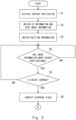
- FIGS. 2 and 3 are flowcharts showing the flow of disposing of the object using the garbage disposal support system of this embodiment.
- Figs. 4 to 13 are diagrams conceptually showing the situation of each step.
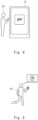
- a person P1 owning the mobile terminal 8 activates the support application of the mobile terminal 8 (S1).
- the situation of the person P1 owning the mobile terminal 8 is shown on the left side, and the situation where the support application of the mobile terminal 8 is shown on the right side.
- the ID reading unit 21 of the authentication apparatus 2 reads the ID information about the mobile terminal 8 from the mobile terminal 8.
- the imaging unit 22 of the authentication apparatus 2 takes a face image of the person P1, and associates face image information about the person P1 with the ID information about the mobile terminal 8.
- the authentication apparatus 2 transmits the ID information about the mobile terminal 8 and the face image information about the person P1 owning the mobile terminal 8, to the garbage disposal support apparatus 5.
- the ID obtaining unit 51 of the garbage disposal support apparatus 5 obtains the ID information about the mobile terminal 8 (S2).
- the face image obtaining unit 52 of the garbage disposal support apparatus 5 obtains the face image information about the person P1 owning the mobile terminal 8 associated with the ID information about the mobile terminal 8.
- the imaging apparatus 3 takes an image in the facility, and transmits the image information about the inside of the facility to the garbage disposal support apparatus 5.
- the position obtaining unit 53 of the garbage disposal support apparatus 5 checks the face image information about the person P1 against the image information about the inside of the facility taken by the imaging apparatus 3, and obtains position information about the person P1 in the facility (S3). Note that obtainment of the position information about the person P1 by the position obtaining unit 53 is continued until the person P1 disposes of the object.
- the object image obtaining unit 54 of the garbage disposal support apparatus 5 tries to obtain the image information about the object that the person P1 has, by applying image processing to the image information about the inside of the facility taken by the imaging apparatus 3 (S4).
- the garbage disposal support apparatus 5 returns the processing to step S4.
- the garbage determination unit 55 of the garbage disposal support apparatus 5 checks the image information about the object O taken by the object image obtaining unit 54 against the garbage image information stored in the database 6, and determines whether the object O is garbage or not (S5).
- the garbage determination unit 55 of the garbage disposal support apparatus 5 checks the image information about the object O against the type-specific garbage image information stored in the database 6, and not only determines whether the object O is garbage or not but also determines the garbage type of the object O, as shown in Fig. 8 .
- Fig. 8 shows the situation of determining that the object O is first type garbage D 1, as a result of checking image information about first type (e.g., non-combustible garbage) garbage D1, image information about second type (e.g., PET bottle) garbage D2, and image information about third type (e.g., combustible garbage) garbage D3 stored in the database 6, against the image information about the object O.
- first type e.g., non-combustible garbage
- second type e.g., PET bottle
- third type e.g., combustible garbage
- the garbage disposal support apparatus 5 When the object O is not garbage (NO in S5), the garbage disposal support apparatus 5 returns the processing to S4. On the other hand, when the object O is garbage (YES in S5), the route generation unit 56 of the garbage disposal support apparatus 5 identifies the disposal place of the object O, based on the position information about the person P1, on the disposal place information stored in the database 6 and on the facility passage information stored in the database 6.
- the route generation unit 56 identifies the disposal place S 1 in consideration of type information about the object O, garbage-type-specific disposal place information stored in the database 6, as shown in Fig. 9 .
- the transceiver unit 57 of the garbage disposal support apparatus 5 transmits the disposal place information to the mobile terminal 8 owned by the person P1 (S7).
- the mobile terminal 8 displays the disposal place information about the object on a display apparatus 81, and prompts the person P1 to input whether a route guide to the disposal place S1 is required or not (S8).
- the garbage disposal support apparatus 5 may transmit the disposal place information to the display apparatus 4, and transmit, to the mobile terminal 8, the information for urging input of whether the route guide to the disposal place S1 is required or not.
- the route generation unit 56 of the garbage disposal support apparatus 5 when the person P1 inputs a reply that the route guide is required, through the support application of the mobile terminal 8 (in Fig. 10 , for example, contact with a "Route" part displayed on the display apparatus 81 of the mobile terminal 8) (YES in S8), the route generation unit 56 of the garbage disposal support apparatus 5 generates the route information from the current position of the person P1 to the disposal place S1, and transmits the route information to the display apparatus 4 through the transceiver unit 57 (S9).
- the display apparatus 4 displays route information M1. Accordingly, the person P1 can recognize the position and the route of the disposal place S 1 of the object O. Preferably, here, as shown in Fig. 11 , besides the route guide connecting a point of start of the route guide and the disposal place S1, the current position of the person P1 on the guide route is shown in the route information M1.
- the transceiver unit 57 transmits the route information M1 to the display apparatus 4 arranged close to the person P1 on the movement direction side of the person P1 among display apparatuses 4, thus causing the display apparatus 4 to display the route information M1 depending on the movement of the person P1. Accordingly, depending on the movement of the person P1, the disposal place information and the route information can be displayed on the display apparatus 4.
- the transceiver unit 57 may transmit the route information M1 to the display apparatus 81 of the mobile terminal 8, thus causing the display apparatus 81 to display the route information M1, as shown in Fig. 10 . Note that the transceiver unit 57 may transmit the disposal place information or the route information M1 to any one of the display apparatus 4 or the display apparatus 81 of the mobile terminal 8.
- the disposal image obtaining unit 58 of the garbage disposal support apparatus 5 obtains image information around the disposal place S1 from the imaging apparatus 3 disposed at the disposal place S1 so as to be capable of imaging the disposal place S1 and therearound (S10).
- the garbage disposal support apparatus 5 makes the process transit to step S10.
- the disposal confirmation unit 59 of the garbage disposal support apparatus 5 confirms whether the person P1 has disposed of the object O at the disposal place S1, based on the obtained image information around the disposal place S1 (S11). That is, the disposal confirmation unit 59 confirms whether the person P1 captured in the image around the disposal place S1 has disposed of the object O at the disposal place S1 or not, based on the position information about the person P1, on the image information about the object O and on the image information around the disposal place S1.
- the disposal confirmation unit 59 checks the face image information about the person P1 against the image information around the disposal place S1, and confirms that the person having disposed of the object O is the person P1 owning the mobile terminal 8 in consideration of the check result.
- the garbage disposal support apparatus 5 finishes the support process.
- the disposal confirmation unit 59 transmits demand notice information for urging disposal of the object O to the mobile terminal 8 through the transceiver unit 57.
- the second time period is shorter time period in comparison with the first time period.
- the payment assigning unit 60 of the garbage disposal support apparatus 5 assigns a payment to the person P1 (S12).
- the payment assigning unit 60 transmits payment information for adding points or the like to the support application of the mobile terminal 8, through the transceiver unit 57.
- the payment assigning unit 60 generates payment information to be assigned, based on the garbage type information about the object O, on the image information about the inside of the facility and on weather information obtained from the outside.
- the situation of the person P1 owning the mobile terminal 8 is shown on the left side, and the mobile terminal 8 when points are assigned is shown on the right side.
- the garbage disposal support apparatus 5 and the garbage disposal support method in this embodiment can allow the person P1 having the object O to recognize the position of the disposal place S1 of the object O.
- the load on the person P1 disposing of the object O can be reduced.
- the route information M1 is displayed on the display apparatus. Accordingly, the load on the person P1 disposing of the object O can be further reduced.
- the garbage disposal support apparatus 5 and the garbage disposal support method in this embodiment transmit the demand notice information for urging disposal of the object O to the mobile terminal 8 owned by the person P1, which can prevent illegal dumping of the object O.
- the garbage disposal support apparatus 5 and the garbage disposal support method in this embodiment check the face image information about the person P1 owning the mobile terminal 8 against the image information around the disposal place S1, and confirm that the person having disposed of the object O is the person P1 owning the mobile terminal 8 in consideration of the check result. Accordingly, it can be securely confirmed whether the person P1 owning the mobile terminal 8 has disposed of the object O or not.
- the garbage disposal support apparatus 5 and the garbage disposal support method in this embodiment can cause the display apparatus 4 arranged close to the person P1 on the movement direction side of the person P1 having the object O among the display apparatuses 4 to display route information M1, and thus cause not all the display apparatuses 4 to display the route information, thereby contributing to reduction in power consumption.
- the garbage disposal support apparatus 5 and the garbage disposal support method in this embodiment assign a payment to the person P1 having disposed of the object O at the disposal place S1. Accordingly, the person P1 can enjoyably dispose of the object O with game feeling.
- the garbage disposal support apparatus 5 and the garbage disposal support method in this embodiment determine the type of the object O, and identify the disposal place S1 in accordance with the type of the object O, thereby allowing the object O to be disposed of in a segregated manner.
- the garbage disposal support apparatus 5 of the embodiment described above includes the ID obtaining unit 51, the face image obtaining unit 52, the disposal image obtaining unit 58, the disposal confirmation unit 59 and the payment assigning unit 60. Some or all of the ID obtaining unit 51, the face image obtaining unit 52, the disposal image obtaining unit 58, the disposal confirmation unit 59 and the payment assigning unit 60 may be omitted.
- the route information M1 is generated after the person P1 is prompted to reply about whether the route guide is required or not.
- the route information M1 may be generated without prompting the person P1 to reply about whether the route guide is required or not.
- the description is made assuming that the person moving in the facility disposes of the object.
- the inside of the facility Even at the outside, implementation can be achieved in a substantially similar manner.
- Fig. 14 is a block diagram showing a configuration of a garbage disposal support system using a garbage disposal support apparatus according to this embodiment.
- the garbage disposal support system 101 of this embodiment provides a person with an incentive to dispose of garbage at a disposal place in a facility that is a type of a preset environment, and can be used to allow a person disposing of garbage to recognize the position of the disposal place at this opportunity.
- the garbage disposal support system 101 includes an imaging apparatus 102, a display apparatus 103, a garbage disposal support apparatus 104 and a database 105, which are connected to each other by a network 106.
- the imaging apparatus 102 images the inside of the facility.
- the imaging apparatuses 102 are arranged along a passage of the facility so as to allow the passage to be imaged, and is arranged around the disposal place of garbage arranged in the facility so as to be capable of imaging the disposal place and therearound.
- the multiple imaging apparatuses 102 are provided in the facility.
- the display apparatus 103 displays disposal place information about garbage or route information, which will be described later.
- the garbage disposal support apparatus 104 includes, for example, a terminal information obtaining unit 141, an image obtaining unit 142, a garbage detection unit 143, a disposal place identification unit 144, a participant recruiting unit 145, a route generation unit 146, a transceiver unit 147, a disposal confirmation unit 148, and a payment assigning unit 149.
- the terminal information obtaining unit 141 obtains ID information and position information about a mobile terminal 107 in the facility, from the mobile terminal 107.
- the mobile terminal 107 is a smartphone or a tablet PC connected to the network 106.
- the position information about the mobile terminal 107 can be obtained based on position information, such as about a GPS receiver mounted on the mobile terminal 107, and is associated with the ID information about the mobile terminal 107.
- the image obtaining unit 142 obtains image information about the inside of the facility taken by the imaging apparatus 102. Note that the image obtaining unit 142 is only required to be capable of obtaining the image information about the inside of the facility, and may include the imaging apparatus 102, for example.
- the garbage detection unit 143 checks the image information about the inside of the facility against garbage image information stored in the database 105, and detects the garbage in the facility and obtains position information about the garbage.
- the garbage detection unit 143 detects the garbage by applying image processing to the image information about the inside of the facility taken by imaging apparatuses 102, and obtains the position information about the garbage in the facility, based on the position information about the imaging apparatuses 102 having taken the image information where the garbage has been detected and on the position information about the garbage in the image information.
- the garbage detection unit 143 checks the image information about the garbage extracted from the image information about the inside of the facility against type-specific garbage image information stored in the database 105, and determines the type of the garbage.
- the disposal place identification unit 144 identifies the disposal place of the garbage, based on the position information about the garbage in the facility and on the disposal place information stored in a database 105. Preferably, at this time, the disposal place identification unit 144 identifies the disposal place closest to the garbage in consideration of the route information in the facility stored in the database 105. Preferably, the disposal place identification unit 144 identifies the disposal place of the garbage in consideration of garbage type information and on garbage-type-specific disposal place information stored in the database 105.
- the participant recruiting unit 145 generates recruiting information for recruiting participation applicants for a garbage disposal operation, and transmits the recruiting information to the mobile terminal 107 in the facility through the transceiver unit 147.
- the participant recruiting unit 145 selects a person to dispose of garbage from among applying participation applicants.
- the participant recruiting unit 145 transmits the recruiting information to the mobile terminal 107 that is present in a range preset for the garbage, based on the position information about the mobile terminal 107 and on the position information about the garbage.
- the participant recruiting unit 145 selects a person owning the mobile terminal 107 that is present closest to the garbage as a person to dispose of garbage from among the participation applicants, based on the position information about the mobile terminal 107 and on the position information about the garbage in the facility.
- the recruiting information is displayed on a display apparatus 171 by a support application installed in the mobile terminal 107, and the participation applicant for the garbage disposal operation inputs a reply about wishing participation through the mobile terminal 107, thus transmitting participation application information to the garbage disposal support apparatus 104.
- the route generation unit 146 generates route information for disposal of garbage, based on the position information about the mobile terminal 107 owned by the selected person, on the route information stored in the database 105 and on the identified disposal place information. Note that the route generation unit 146 may generate the route information in response to a request by the selected person, for example.
- the transceiver unit 147 is an interface with the network 106.
- the transceiver unit 147 receives the ID information and the position information from the mobile terminal 107, receives the image information about the inside of the facility from the imaging apparatus 102, and receives the participation application information from the mobile terminal 107.
- the transceiver unit 147 transmits the disposal place information or the route information to the display apparatus 103 or the mobile terminal 107, and transmits the position information about the garbage and the recruiting information to the mobile terminal 107.
- the disposal confirmation unit 148 confirms the mobile terminal 107 owned by the person having disposed of the garbage at the disposal place, based on the image information about the inside of the facility and on the position information about the mobile terminal 107 owned by the selected person.
- the disposal confirmation unit 148 confirms the mobile terminal 107 of which position information indicates the disposal place and therearound and which is owned by the person having disposed of the garbage at the disposal place from the image around the disposal place, based on the position information about the mobile terminal 107 owned by the selected person, on the image information about the garbage and on the image information around the disposal place in the facility.
- the payment assigning unit 149 assigns a payment to the mobile terminal 107 owned by the person. For example, the payment assigning unit 149 transmits payment information for adding points or the like, to the support application of the mobile terminal 107, through the transceiver unit 147.
- the payment assigning unit 149 increases or reduces the amount of payment, based on the size of the garbage, whether the object is recyclable or not, the distance to the disposal place, the amount of baggage of the selected person, the weather, or a time period after transmission of the position information about the garbage to disposal of the garbage.
- the payment assigning unit 149 may transmit the payment information to a server or the like operated by a typical point site.
- the database 105 stores the garbage image information, the disposal place information, and the facility passage information.
- the database 105 stores the type-specific garbage image information, and the garbage-type-specific disposal place information.
- the garbage image information can be generated by supervised machine learning, based on the shape, color, material, recyclability and the like of garbage.
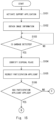
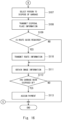
- FIGs. 15 and 16 are flowcharts showing the flow of disposing of the garbage using the garbage disposal support system of this embodiment.
- Figs. 17 to 25 are diagrams conceptually showing the situation of each step.
- a person P2 owning the mobile terminal 107 activates the support application of the mobile terminal 107 (S101).
- the situation of the person P2 owning the mobile terminal 107 is shown on the left side, and the situation where the support application of the mobile terminal 107 is activated is shown on the right side.
- the terminal information obtaining unit 141 of the garbage disposal support apparatus 104 obtains the ID information and the position information about the mobile terminal 107.
- the imaging apparatus 102 takes an image in the facility, and transmits the image information about the inside of the facility to the garbage disposal support apparatus 104. Accordingly, the image obtaining unit 142 of the garbage disposal support apparatus 104 obtains the image information about the inside of the facility (S102). Here, the obtainment of the image in the facility continues while the facility is open.
- the garbage detection unit 143 of the garbage disposal support apparatus 104 checks the image information about the inside of the facility against garbage image information stored in the database 105, and determines whether garbage in the facility is detected or not (S103). When garbage is not detected (NO in S103), the garbage disposal support apparatus 104 returns the processing to S103.
- the garbage detection unit 143 obtains position information about the garbage D.
- the garbage detection unit 143 checks the image information about the garbage D extracted from the image information about the inside of the facility against type-specific garbage image information stored in the database 105, and determines the type of the garbage D as shown in Fig. 19 .
- Fig. 19 shows the situation of determining that the garbage D is first type garbage d1, as a result of checking image information about first type (e.g., combustible garbage) garbage d1, image information about second type (e.g., PET bottle) garbage d2, and image information about third type (e.g., non-combustible garbage) garbage d3 stored in the database 105, against image information about the garbage D.
- first type e.g., combustible garbage
- second type e.g., PET bottle
- third type e.g., non-combustible garbage
- the disposal place identification unit 144 of the garbage disposal support apparatus 104 identifies the disposal place of the garbage D, based on the position information about the garbage D in the facility and on the disposal place information stored in the database 105 (S104).
- a disposal place S2 of the garbage D is identified in consideration of type information about the garbage D, and garbage-type-specific disposal place information stored in the database 105, as shown in Fig. 20 .
- the participant recruiting unit 145 of the garbage disposal support apparatus 104 generates recruiting information for recruiting participation applicants for a disposal operation for the garbage D, and transmits the recruiting information to the mobile terminal 107 in the facility through the transceiver unit 147 (S105).
- the participant recruiting unit 145 determines whether there is an application of a participation applicant or not (S106).
- the garbage disposal support apparatus 104 finishes the support process. Note that if there is no application by the participation applicant, the participant recruiting unit 145 may recruit participation applicants again. On the other hand, if there is a participation applicant has applied (YES in S106), the participant recruiting unit 145 selects the person P2 to dispose of the garbage D from among the applying participation applicants as shown in Fig. 21 (S107).
- the transceiver unit 147 of the garbage disposal support apparatus 104 transmits the position information about the garbage and the disposal place information about the garbage D to the mobile terminal 107 owned by the person P2 (S108).
- the mobile terminal 107 displays the disposal place information about the object D on the display apparatus 171, and prompts the person P2 to input whether a route guide to the disposal place is required or not (S109).
- the garbage disposal support apparatus 104 may transmit the disposal place information to the display apparatus 103, and transmit, to the mobile terminal 107, the information for prompting input of whether the route guide to the disposal place S2 is required or not.
- the route generation unit 146 of the garbage disposal support apparatus 104 generates the route information M2 from the current position of the person P2 to the disposal place S2, and transmits the route information M2 to the display apparatus 103 through the transceiver unit 147 (S110).
- the display apparatus 103 displays route information M2. Accordingly, the person P2 can recognize the position and the route of the disposal place S2.
- the route information M2 is shown in the route information M2.
- the transceiver unit 147 transmits the route information M2 to the display apparatus 103 arranged close to the person P2 on the movement direction side of the person P2 among display apparatuses 103, and causes the display apparatus 103 to display the route information M2 depending on the movement of the person P2. Accordingly, depending on the movement of the person P2, the disposal place information and the route information can be displayed on the display apparatus 103.
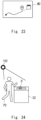
- the transceiver unit 147 may transmit the route information M2 to the mobile terminal 107, thus causing the display apparatus 171 of the mobile terminal 107 to display the route information M2, as shown in Fig. 22 . Note that the transceiver unit 147 may transmit the disposal place information or the route information M2 to any one of the display apparatus 103 or the display apparatus 171 of the mobile terminal 107.
- the image obtaining unit 142 of the garbage disposal support apparatus 104 obtains image information around the disposal place S2 from the imaging apparatus 102 disposed at the disposal place S2 so as to be capable of imaging the disposal place S2 and therearound (S111).
- the garbage disposal support apparatus 104 makes the process transit to step S111.
- the disposal confirmation unit 148 of the garbage disposal support apparatus 104 confirms the mobile terminal 107 owned by the person P2 having disposed of the garbage D at the disposal place S2, based on the obtained image information around the disposal place S2 (S112). If the mobile terminal 107 owned by the person P2 having disposed of the garbage D at the disposal place S2 cannot be confirmed until the preset first time period elapses after transmission of the route information M2 by the transceiver unit 147 to the display apparatus 103 (NO in S112), the garbage disposal support apparatus 104 finishes the support process.
- the disposal confirmation unit 148 transmits demand notice information for urging disposal of the garbage D to the mobile terminal 107 through the transceiver unit 147.
- the second time period is shorter time period in comparison with the first time period.
- the payment assigning unit 149 of the garbage disposal support apparatus 104 assigns a payment to the mobile terminal 107 owned by the person P2 (S113).
- the payment assigning unit 149 transmits payment information for adding points or the like to the support application of the mobile terminal 107, through the transceiver unit 147.
- the payment assigning unit 149 generates payment information to be assigned, based on the garbage type information about the garbage D, on the image information about the inside of the facility and on weather information obtained from the outside.
- the situation of the person P2 owning the mobile terminal 107 is shown on the left side, and the mobile terminal 107 when points are assigned is shown on the right side.
- the garbage disposal support apparatus 104 and the garbage disposal support method in this embodiment can provide the person P2 with an incentive for disposing of the garbage D by assigning the payment to the person P2 having disposed of the garbage D, and allow the person P2 to recognize the position of the disposal place S2 of the garbage D when the person P2 disposes of the garbage D, thus allowing the load on the person P2 disposing the garbage D to be reduced.
- the garbage disposal support apparatus 104 and the garbage disposal support method in this embodiment recruit participation applicants for the disposal operation of the garbage D. Accordingly, the participation applicants can apply for the disposal operation of the garbage D with game feeling to obtain a payment. At this time, if the person P2 owning the mobile terminal 107 that is present closest to the garbage is selected as the person to dispose of the garbage D, the garbage D can be effectively disposed of.
- the garbage disposal support apparatus 104 and the garbage disposal support method in this embodiment determine the type of the garbage D, and identify the disposal place in accordance with the type of the garbage D, thereby allowing the garbage D to be disposed of in a segregated manner.
- the garbage disposal support apparatus 104 and the garbage disposal support method in this embodiment generate the route information M2 to the disposal place of the garbage D in response to the request by the person P2 to dispose of the garbage D, and cause the display apparatus 103 or the display apparatus 171 of the mobile terminal 107 to display the information, which can further reduce the load on the person P2 disposing of the garbage D.
- the display apparatus 103 arranged close to the person P2 on the movement direction side of the person P2 is caused to display the route information M2, which can contribute to reduction in power consumption in comparison with a case where the route information M2 is displayed on all the display apparatuses 103 at the same time.
- the garbage disposal support apparatus 104 and the garbage disposal support method in this embodiment transmit the demand notice information for urging disposal of the garbage D to the mobile terminal 107 owned by the person P2, which can prevent illegal dumping of the garbage D.
- the garbage disposal support apparatus 104 of the embodiment described above includes the participant recruiting unit 145 and the route generation unit 146. However, one or both of the participant recruiting unit 145 and the route generation unit 146 may be omitted.
- the route information M2 is generated after the person P2 is prompted to reply about whether the route guide is required or not.
- the route information M2 may be generated without prompting the person P2 to reply about whether the route guide is required or not.
- the description is made assuming that the garbage in the facility is disposed of.
- the inside of the facility Even at the outside, implementation can be achieved in a substantially similar manner.
- the mobile terminal owned by the person having disposed of the garbage at the disposal place is confirmed, and the payment is assigned when the selected person disposes of the garbage at the disposal place.
- these may be omitted, or any of them may be omitted.
- the present disclosure is not limited to the embodiments described above, and can be appropriately changed in a range.
- the present disclosure is described as the hardware configuration.
- the present disclosure is not limited thereto.
- any process can also be achieved by causing a CPU (Central Processing Unit) to execute a computer program.
- a CPU Central Processing Unit
- the programs are stored using various types of non-transitory computer-readable media, and can be supplied to computers.
- the non-transitory computer-readable media include various types of tangible storage media. Examples of the non-transitory computer-readable media include a magnetic recording medium (e.g., a flexible disk, a magnetic tape, and a hard disk drive), a magnetooptical recording medium (e.g., a magnetooptical disk), a CD-ROM (Read Only Memory), a CD-R, a CD-R/W, a semiconductor memory (e.g., a mask ROM, a PROM (Programmable ROM), an EPROM (Erasable PROM), a flash ROM, and a RAM (random access memory)).
- a magnetic recording medium e.g., a flexible disk, a magnetic tape, and a hard disk drive
- a magnetooptical recording medium e.g., a magnetooptical disk
- CD-ROM Read Only Memory
- CD-R Compact Only
- the programs may be provided for the computer through various types of transitory computer readable media.
- Examples of transitory computer readable media include an electric signal, an optical signal, and electromagnetic waves.
- the transitory computer readable media can provide programs for the computer via a wired communication path, such as an electric wire or an optical fiber, or a wireless communication path.
- the present disclosure can be used as a garbage disposal support apparatus and a garbage disposal support method for allowing a person to recognize the position of a disposal place of garbage.
Landscapes
- Engineering & Computer Science (AREA)
- Business, Economics & Management (AREA)
- Theoretical Computer Science (AREA)
- General Physics & Mathematics (AREA)
- Physics & Mathematics (AREA)
- Remote Sensing (AREA)
- Radar, Positioning & Navigation (AREA)
- Human Resources & Organizations (AREA)
- Strategic Management (AREA)
- Economics (AREA)
- Development Economics (AREA)
- Tourism & Hospitality (AREA)
- Marketing (AREA)
- General Business, Economics & Management (AREA)
- Multimedia (AREA)
- Computer Vision & Pattern Recognition (AREA)
- General Health & Medical Sciences (AREA)
- Health & Medical Sciences (AREA)
- Entrepreneurship & Innovation (AREA)
- Software Systems (AREA)
- Medical Informatics (AREA)
- Evolutionary Computation (AREA)
- Databases & Information Systems (AREA)
- Computing Systems (AREA)
- Artificial Intelligence (AREA)
- Automation & Control Theory (AREA)
- Operations Research (AREA)
- Quality & Reliability (AREA)
- Accounting & Taxation (AREA)
- Finance (AREA)
- Game Theory and Decision Science (AREA)
- Primary Health Care (AREA)
- Sustainable Development (AREA)
- Life Sciences & Earth Sciences (AREA)
- Educational Administration (AREA)
- Management, Administration, Business Operations System, And Electronic Commerce (AREA)
- Refuse Collection And Transfer (AREA)
Description
- The present disclosure relates to a garbage disposal support apparatus and a garbage disposal support method.
- To reduce illegal disposal of garbage, reduction in load on a person disposing of garbage is important. For example, a garbage can in
Patent Literature 1 has a configuration of automatically opening a movable lid when the presence of a person is detected by a weight sensor arranged in front of the garbage can. The garbage can inPatent Literature 1 has a configuration where if garbage other than plastic garbage as a disposal target is disposed of, a person having disposed of the garbage is warned. - For example, a garbage collection apparatus in
Patent Literature 2 has a configuration of assigning points to a person having disposed of the garbage in accordance with the weight and quantity of discarded garbage. -
- Patent Literature 1:
Japanese Unexamined Patent Application Publication No. 2008-168951 - Patent Literature 2:
Japanese Unexamined Patent Application Publication No. 2016-18290 - Patent Literature 3:
CN111553354A . Summary of Invention - The garbage can in
Patent Literature 1 has a configuration where, to reduce the load on a person disposing of garbage, the movable lid is automatically opened when the presence of a person is detected in front of the garbage can (i.e., a disposal place). It is desired to further reduce the load on a person disposing of garbage. - On the other hand, the garbage collection apparatus in
Patent Literature 2 provides a person with an incentive for disposing of garbage, by assigning points to a person having disposed of the garbage, but has a problem in that a person disposing of garbage does not know the position of the garbage collection apparatus (i.e., disposal place) and the load on the person disposing of garbage is high.Patent Literature 3 discloses the features of the preamble ofclaims - An object of the present disclosure is to solve the problem described above, and to achieve a garbage disposal support apparatus and a garbage disposal support method that are capable of reducing the load on a person disposing of
garbage Claims - A garbage disposal support apparatus according to an aspect of the present disclosure incudes:
- a position obtaining unit configured to obtain position information about a person having an object;
- an object image obtaining unit configured to obtain image information about the object that the person has;
- a garbage determination unit configured to check the image information about the object that the person has against garbage image information stored in a database, and determine whether the object is garbage or not;
- a route generation unit configured to generate route information to a disposal place of the garbage, based on the position information about the person and on disposal place information stored in the database, if the object is garbage; and
- a transmitter unit configured to transmit the route information to a display apparatus.
- A garbage disposal support method according to an aspect of the present disclosure incudes:
- a step of obtaining position information about a person having an object;
- a step of obtaining image information about the object that the person has;
- a step of checking the image information about the object that the person has against garbage image information stored in a database, and determining whether the object is garbage or not;
- a step of generating route information to a disposal place of the garbage, based on the position information about the person and on disposal place information stored in the database, if the object is garbage; and
- a step of transmitting the route information to a display apparatus.
- A garbage disposal support apparatus according to an aspect of the present disclosure incudes:
- a terminal information obtaining unit configured to obtain ID information about a mobile terminal in a preset environment, and position information about the mobile terminal;
- an image obtaining unit configured to obtain image information in the environment;
- a garbage detection unit configured to detect garbage based on the image information in the environment, and obtain position information about the garbage;
- a disposal place identification unit configured to identify a disposal place of the garbage, based on the position information about the garbage and on disposal place information stored in a database; and
- a transmitter unit configured to transmit the position information about the garbage and the disposal place information to the mobile terminal.
- A garbage disposal support method according to an aspect of the present disclosure incudes:
- a step of obtaining ID information and position information about a mobile terminal in a preset environment;
- a step of obtaining image information in the environment;
- a step of detecting garbage based on the image information in the environment, and obtaining position information about the garbage;
- a step of identifying a disposal place of the garbage, based on the position information about the garbage and on disposal place information stored in a database;
- a step of transmitting the position information about the garbage and the disposal place information to the mobile terminal;
- a step of confirming the mobile terminal owned by a person having disposed of the garbage at the disposal place, based on the image information in the environment and on the position information about the mobile terminal; and
- a step of assigning a payment to the mobile terminal owned by the person having disposed of the garbage.
- According to the present disclosure, a garbage disposal support apparatus and a garbage disposal support method that are capable of reducing the load on a person disposing of garbage can be achieved.
-
-
Fig. 1 is a block diagram showing a configuration of a garbage disposal support system using a garbage disposal support apparatus according to a first embodiment. -
Fig. 2 is a flowchart showing a flow of disposing of an object using the garbage disposal support system of the first embodiment. -
Fig. 3 is a flowchart showing the flow of disposing of an object using the garbage disposal support system of the first embodiment. -
Fig. 4 is a diagram conceptually showing a state where a person activates a support application of a mobile terminal. -
Fig. 5 is a diagram conceptually showing a state where ID information about the mobile terminal and face image information about the person are obtained. -
Fig. 6 is a diagram conceptually showing a state where a person entering a facility is imaged. -
Fig. 7 is a diagram conceptually showing image information about the object extracted from image information about the inside of the facility. -
Fig. 8 is a diagram conceptually showing a situation of checking the image information about the object against type-specific garbage image information and determining the type of the object. -
Fig. 9 is a diagram conceptually showing a situation of identifying a disposal place based on object type information and garbage-type-specific disposal place information. -
Fig. 10 is a diagram conceptually showing the mobile terminal when input of whether a route guide is required or not is prompted. -
Fig. 11 is a diagram conceptually showing route information displayed on a display apparatus. -
Fig. 12 is a diagram conceptually showing image information around the disposal place. -
Fig. 13 is a diagram conceptually showing the mobile terminal when points are assigned. -
Fig. 14 is a block diagram showing a configuration of a garbage disposal support system using a garbage disposal support apparatus according to a second embodiment. -
Fig. 15 is a flowchart showing the flow of disposing of garbage using the garbage disposal support system of the second embodiment. -
Fig. 16 is a flowchart showing the flow of disposing of garbage using the garbage disposal support system of the second embodiment. -
Fig. 17 is a diagram conceptually showing a state where a person activates a support application of a mobile terminal. -
Fig. 18 is a diagram conceptually showing a situation of detecting garbage from image information about the inside of a facility. -
Fig. 19 is a diagram conceptually showing a situation of checking image information about garbage against type-specific garbage image information and determining the type of the garbage. -
Fig. 20 is a diagram conceptually showing a situation of identifying a disposal place based on garbage type information and garbage-type-specific disposal place information. -
Fig. 21 is a diagram conceptually showing a situation of selecting a participation applicant. -
Fig. 22 is a diagram conceptually showing the mobile terminal when input of whether a route guide is required or not is prompted. -
Fig. 23 is a diagram conceptually showing route information displayed on a display apparatus. -
Fig. 24 is a diagram conceptually showing image information around the disposal place. -
Fig. 25 is a diagram conceptually showing the mobile terminal when points are assigned. - Hereinafter, specific embodiments to which the present disclosure is applied are described in detail with reference to the drawings. Note that the present disclosure is not limited to the following embodiments. To clarify the description, the following description and drawings are appropriately simplified.
-
Fig. 1 is a block diagram showing a configuration of a garbage disposal support system using a garbage disposal support apparatus according to this embodiment. The garbagedisposal support system 1 of this embodiment is suitable for guiding a person having an object that is garbage to a disposal place arranged in a facility, for example. - For example, as shown in
Fig. 1 , the garbagedisposal support system 1 includes anauthentication apparatus 2, animaging apparatus 3, adisplay apparatus 4, a garbagedisposal support apparatus 5 and adatabase 6, which are connected to each other by a network 7. - Here, the network 7 is, for example, the Internet, which is constructed by a telephone network, a wireless communication path, Ethernet (R) and the like. Note that the
authentication apparatus 2, theimaging apparatus 3, thedisplay apparatus 4, the garbagedisposal support apparatus 5 and thedatabase 6 may be connected to each other wiredly or wirelessly. - The
authentication apparatus 2 is arranged at an entrance of a facility, for example. As shown inFig. 1 , theauthentication apparatus 2 includes anID reading unit 21 and animaging unit 22. TheID reading unit 21 reads ID information about themobile terminal 8 owned by a person entering the facility. Theimaging unit 22 includes a camera and the like. Theimaging unit 22 takes a face image of the person entering the facility, and associates the taken face image information with the ID information about themobile terminal 8. Here, themobile terminal 8 is a smartphone or a tablet PC (Personal Computer) connected to the network 7. - Note that the
authentication apparatus 2 is only required to be capable of obtaining the ID information about themobile terminal 8, and the face image information about the person owing themobile terminal 8, and may obtain, for example, the ID information about themobile terminal 8 preliminarily registered in the support application installed in themobile terminal 8, and the face image information about the person owing themobile terminal 8. - The
imaging apparatus 3 includes a camera or the like, and images the inside of the facility. For example, theimaging apparatuses 3 are arranged along a passage of the facility so as to allow a person walking on the passage to be imaged, and is arranged around the disposal place of garbage arranged in the facility so as to be capable of imaging the disposal place and therearound. Thus, themultiple imaging apparatuses 3 are provided in the facility. - The
display apparatus 4 displays at least one of disposal place information described later (i.e., position information about the disposal place) or route information. Thedisplay apparatus 4 includes, for example, a projecting apparatus, such as a projector, and is arranged along the passage of the facility so as to allow disposal place information or route information to be displayed on the passage, a wall or the like for a person walking on the passage. - For example, as shown in
Fig. 1 , the garbagedisposal support apparatus 5 includes anID obtaining unit 51, a faceimage obtaining unit 52, aposition obtaining unit 53, an objectimage obtaining unit 54, a garbage determination unit 55, aroute generation unit 56, atransceiver unit 57, a disposalimage obtaining unit 58, adisposal confirmation unit 59, and apayment assigning unit 60. - The
ID obtaining unit 51 obtains the ID information about themobile terminal 8 read by theID reading unit 21 of theauthentication apparatus 2. Note that theID obtaining unit 51 is only required to be capable of obtaining the ID information about themobile terminal 8, and may include theID reading unit 21, for example. - The face
image obtaining unit 52 obtains the face image information about the person owing themobile terminal 8 taken by theimaging unit 22 of theauthentication apparatus 2. Note that the faceimage obtaining unit 52 is only required to be capable of obtaining the face image of the person owning themobile terminal 8, and may include theimaging unit 22, for example. - The
position obtaining unit 53 obtains position information about the person owing themobile terminal 8 in the facility, based on the face image information about the person owning themobile terminal 8 and on the image information about the inside of the facility taken by theimaging apparatus 3. For example, theposition obtaining unit 53 checks the image information about the person captured in the image information about the inside of the facility taken by eachimaging apparatus 3 against the face image information about the person owning themobile terminal 8, and identifies the person owning themobile terminal 8 in the image information, thereby obtaining the position information about the person. Note that theposition obtaining unit 53 may obtain the position information about the person, based on position information through a GPS (Global Positioning System) receiver mounted on themobile terminal 8. - The object
image obtaining unit 54 obtains (extracts) image information about the object that the person owning themobile terminal 8 has, by applying image processing to the image information about the inside of the facility taken by theimaging apparatus 3. The garbage determination unit 55 checks the image information about the object obtained by the objectimage obtaining unit 54 against garbage image information stored in thedatabase 6, and determines whether the object is garbage or not. Preferably, at this time, the garbage determination unit 55 checks the image information about the object against type-specific garbage image information stored in thedatabase 6, and determines the type of the object. - When the object is garbage, the
route generation unit 56 identifies the disposal place of the object, based on the position information about the person owning themobile terminal 8, on the disposal place information stored in thedatabase 6 and on the facility passage information stored in thedatabase 6, and generates the passage information to the disposal place. - Preferably, at this time, for example, the
route generation unit 56 identifies a disposal place that makes the distance from the current position of the person to the disposal place of the object be that of the shortest route. Preferably, theroute generation unit 56 identifies the disposal place of the object in consideration of object type information, garbage-type-specific disposal place information stored in the database. Note that theroute generation unit 56 may generate the route information in response to a request by the person owning themobile terminal 8. - The
transceiver unit 57 is an interface with the network 7. Thetransceiver unit 57 receives the ID information about themobile terminal 8 and the face image information about the person owning themobile terminal 8 from theauthentication apparatus 2, and receives the image information about the inside of the facility from theimaging apparatus 3. Thetransceiver unit 57 transmits the disposal place information identified by theroute generation unit 56, or the route information generated by theroute generation unit 56, to thedisplay apparatus 4 or themobile terminal 8. - The disposal
image obtaining unit 58 obtains image information around the disposal place from theimaging apparatus 3 disposed at the disposal place so as to be capable of imaging the disposal place and therearound. Note that the disposalimage obtaining unit 58 is only required to obtain image information around the disposal place, and may include, for example, animaging apparatus 3 that images the disposal place and therearound. Thedisposal confirmation unit 59 confirms whether the person owning themobile terminal 8 has disposed of the object at the disposal place or not based on the image information around the disposal place. - When the person owning the
mobile terminal 8 disposes of the object at the disposal place, thepayment assigning unit 60 assigns a payment to the person. For example, thepayment assigning unit 60 transmits payment information for adding points or the like to the support application of themobile terminal 8, through thetransceiver unit 57. - Preferably, at this time, for example, the
payment assigning unit 60 increases or reduces the amount of payment, based on the size of the object to be disposed of, whether the object is recyclable or not, the distance to the disposal place, the amount of baggage, the weather, or a time period after transmission of the disposal place information to disposal of the object. Note that thepayment assigning unit 60 may transmit the payment information to a server or the like operated by a typical point site. - The
database 6 stores the garbage image information, the disposal place information, and the facility passage information. Preferably, at this time, as described above, thedatabase 6 stores the type-specific garbage image information, and the garbage-type-specific disposal place information. Here, for example, the garbage image information can be generated by supervised machine learning, based on the shape, color, material, recyclability and the like of garbage. - Next, a flow of disposing of an object using the garbage
disposal support system 1 of this embodiment is described.Figs. 2 and3 are flowcharts showing the flow of disposing of the object using the garbage disposal support system of this embodiment.Figs. 4 to 13 are diagrams conceptually showing the situation of each step. - First, as shown in
Fig. 4 , a person P1 owning themobile terminal 8 activates the support application of the mobile terminal 8 (S1). Here, inFig. 4 , the situation of the person P1 owning themobile terminal 8 is shown on the left side, and the situation where the support application of themobile terminal 8 is shown on the right side. After the person P1 enters the range preset for the entrance of the facility, theID reading unit 21 of theauthentication apparatus 2 reads the ID information about themobile terminal 8 from themobile terminal 8. - The
imaging unit 22 of theauthentication apparatus 2 takes a face image of the person P1, and associates face image information about the person P1 with the ID information about themobile terminal 8. Theauthentication apparatus 2 transmits the ID information about themobile terminal 8 and the face image information about the person P1 owning themobile terminal 8, to the garbagedisposal support apparatus 5. - Accordingly, as shown in
Fig. 5 , theID obtaining unit 51 of the garbagedisposal support apparatus 5 obtains the ID information about the mobile terminal 8 (S2). The faceimage obtaining unit 52 of the garbagedisposal support apparatus 5 obtains the face image information about the person P1 owning themobile terminal 8 associated with the ID information about themobile terminal 8. - Next, as shown in
Fig. 6 , theimaging apparatus 3 takes an image in the facility, and transmits the image information about the inside of the facility to the garbagedisposal support apparatus 5. Theposition obtaining unit 53 of the garbagedisposal support apparatus 5 checks the face image information about the person P1 against the image information about the inside of the facility taken by theimaging apparatus 3, and obtains position information about the person P1 in the facility (S3). Note that obtainment of the position information about the person P1 by theposition obtaining unit 53 is continued until the person P1 disposes of the object. - Next, the object
image obtaining unit 54 of the garbagedisposal support apparatus 5 tries to obtain the image information about the object that the person P1 has, by applying image processing to the image information about the inside of the facility taken by the imaging apparatus 3 (S4). When the image information about the object is not obtained from the image information about the inside of the facility taken by the imaging apparatus 3 (NO in S4), the garbagedisposal support apparatus 5 returns the processing to step S4. - On the other hand, as shown in
Fig. 7 , when the image information about the object O is obtained from the image information about the inside of the facility taken by theimaging apparatus 3, the garbage determination unit 55 of the garbagedisposal support apparatus 5 checks the image information about the object O taken by the objectimage obtaining unit 54 against the garbage image information stored in thedatabase 6, and determines whether the object O is garbage or not (S5). - Preferably, at this time, as described above, the garbage determination unit 55 of the garbage
disposal support apparatus 5 checks the image information about the object O against the type-specific garbage image information stored in thedatabase 6, and not only determines whether the object O is garbage or not but also determines the garbage type of the object O, as shown inFig. 8 . -
Fig. 8 shows the situation of determining that the object O is firsttype garbage D 1, as a result of checking image information about first type (e.g., non-combustible garbage) garbage D1, image information about second type (e.g., PET bottle) garbage D2, and image information about third type (e.g., combustible garbage) garbage D3 stored in thedatabase 6, against the image information about the object O. - When the object O is not garbage (NO in S5), the garbage
disposal support apparatus 5 returns the processing to S4. On the other hand, when the object O is garbage (YES in S5), theroute generation unit 56 of the garbagedisposal support apparatus 5 identifies the disposal place of the object O, based on the position information about the person P1, on the disposal place information stored in thedatabase 6 and on the facility passage information stored in thedatabase 6. - Preferably, as described above, when the type of the object O is determined, the
route generation unit 56 identifies thedisposal place S 1 in consideration of type information about the object O, garbage-type-specific disposal place information stored in thedatabase 6, as shown inFig. 9 . - Next, the
transceiver unit 57 of the garbagedisposal support apparatus 5 transmits the disposal place information to themobile terminal 8 owned by the person P1 (S7). Themobile terminal 8 then displays the disposal place information about the object on adisplay apparatus 81, and prompts the person P1 to input whether a route guide to the disposal place S1 is required or not (S8). Note that the garbagedisposal support apparatus 5 may transmit the disposal place information to thedisplay apparatus 4, and transmit, to themobile terminal 8, the information for urging input of whether the route guide to the disposal place S1 is required or not. - As shown in
Fig. 10 , when the person P1 inputs a reply that the route guide is required, through the support application of the mobile terminal 8 (inFig. 10 , for example, contact with a "Route" part displayed on thedisplay apparatus 81 of the mobile terminal 8) (YES in S8), theroute generation unit 56 of the garbagedisposal support apparatus 5 generates the route information from the current position of the person P1 to the disposal place S1, and transmits the route information to thedisplay apparatus 4 through the transceiver unit 57 (S9). - Here, in
Fig. 10 , the situation of the person P1 owning themobile terminal 8 is shown on the left side, and themobile terminal 8 when input of whether the route guide is required or not is prompted is shown on the right side. As shown inFig. 11 , thedisplay apparatus 4 displays route information M1. Accordingly, the person P1 can recognize the position and the route of thedisposal place S 1 of the object O. Preferably, here, as shown inFig. 11 , besides the route guide connecting a point of start of the route guide and the disposal place S1, the current position of the person P1 on the guide route is shown in the route information M1. - Preferably, at this time, based on the position information about the person P1 in the facility, the
transceiver unit 57 transmits the route information M1 to thedisplay apparatus 4 arranged close to the person P1 on the movement direction side of the person P1 amongdisplay apparatuses 4, thus causing thedisplay apparatus 4 to display the route information M1 depending on the movement of the person P1. Accordingly, depending on the movement of the person P1, the disposal place information and the route information can be displayed on thedisplay apparatus 4. - The
transceiver unit 57 may transmit the route information M1 to thedisplay apparatus 81 of themobile terminal 8, thus causing thedisplay apparatus 81 to display the route information M1, as shown inFig. 10 . Note that thetransceiver unit 57 may transmit the disposal place information or the route information M1 to any one of thedisplay apparatus 4 or thedisplay apparatus 81 of themobile terminal 8. - Next, the disposal
image obtaining unit 58 of the garbagedisposal support apparatus 5 obtains image information around the disposal place S1 from theimaging apparatus 3 disposed at the disposal place S1 so as to be capable of imaging the disposal place S1 and therearound (S10). Here, when the person P1 inputs a reply that the route guide is not required through the support application of the mobile terminal 8 (NO in S8), the garbagedisposal support apparatus 5 makes the process transit to step S10. - Next, the
disposal confirmation unit 59 of the garbagedisposal support apparatus 5 confirms whether the person P1 has disposed of the object O at the disposal place S1, based on the obtained image information around the disposal place S1 (S11). That is, thedisposal confirmation unit 59 confirms whether the person P1 captured in the image around the disposal place S1 has disposed of the object O at the disposal place S1 or not, based on the position information about the person P1, on the image information about the object O and on the image information around the disposal place S1. - Preferably, at this time, the
disposal confirmation unit 59 checks the face image information about the person P1 against the image information around the disposal place S1, and confirms that the person having disposed of the object O is the person P1 owning themobile terminal 8 in consideration of the check result. - If it cannot be confirmed that the person P1 has disposed of the object O at the disposal place S1 until a preset first time period elapses after transmission of the route information M1 by the
transceiver unit 57 to the display apparatus 4 (NO in S11), the garbagedisposal support apparatus 5 finishes the support process. - Preferably, at this time, if the person P1 does not dispose of the object O at the disposal place S1 until a preset second time period elapses after transmission of the route information M1 by the
transceiver unit 57 to thedisplay apparatus 4, thedisposal confirmation unit 59 transmits demand notice information for urging disposal of the object O to themobile terminal 8 through thetransceiver unit 57. Preferably, here, the second time period is shorter time period in comparison with the first time period. - On the other hand, as shown in
Fig. 12 , if it is confirmed that the object O has been disposed of at the disposal place (YES in S11), thepayment assigning unit 60 of the garbagedisposal support apparatus 5 assigns a payment to the person P1 (S12). - For example, as shown in
Fig. 13 , thepayment assigning unit 60 transmits payment information for adding points or the like to the support application of themobile terminal 8, through thetransceiver unit 57. Preferably, at this time, thepayment assigning unit 60 generates payment information to be assigned, based on the garbage type information about the object O, on the image information about the inside of the facility and on weather information obtained from the outside. Here, inFig. 13 , the situation of the person P1 owning themobile terminal 8 is shown on the left side, and themobile terminal 8 when points are assigned is shown on the right side. - As described above, the garbage
disposal support apparatus 5 and the garbage disposal support method in this embodiment can allow the person P1 having the object O to recognize the position of the disposal place S1 of the object O. Thus, the load on the person P1 disposing of the object O can be reduced. In particular, when the person P1 wishes a route guide, the route information M1 is displayed on the display apparatus. Accordingly, the load on the person P1 disposing of the object O can be further reduced. - Furthermore, when the person P1 having the object O does not dispose of the object O at the disposal place S1, the garbage
disposal support apparatus 5 and the garbage disposal support method in this embodiment transmit the demand notice information for urging disposal of the object O to themobile terminal 8 owned by the person P1, which can prevent illegal dumping of the object O. - The garbage
disposal support apparatus 5 and the garbage disposal support method in this embodiment check the face image information about the person P1 owning themobile terminal 8 against the image information around the disposal place S1, and confirm that the person having disposed of the object O is the person P1 owning themobile terminal 8 in consideration of the check result. Accordingly, it can be securely confirmed whether the person P1 owning themobile terminal 8 has disposed of the object O or not. - The garbage
disposal support apparatus 5 and the garbage disposal support method in this embodiment can cause thedisplay apparatus 4 arranged close to the person P1 on the movement direction side of the person P1 having the object O among thedisplay apparatuses 4 to display route information M1, and thus cause not all thedisplay apparatuses 4 to display the route information, thereby contributing to reduction in power consumption. - The garbage
disposal support apparatus 5 and the garbage disposal support method in this embodiment assign a payment to the person P1 having disposed of the object O at the disposal place S1. Accordingly, the person P1 can enjoyably dispose of the object O with game feeling. - The garbage
disposal support apparatus 5 and the garbage disposal support method in this embodiment determine the type of the object O, and identify the disposal place S1 in accordance with the type of the object O, thereby allowing the object O to be disposed of in a segregated manner. - Note that for example, the garbage
disposal support apparatus 5 of the embodiment described above includes theID obtaining unit 51, the faceimage obtaining unit 52, the disposalimage obtaining unit 58, thedisposal confirmation unit 59 and thepayment assigning unit 60. Some or all of theID obtaining unit 51, the faceimage obtaining unit 52, the disposalimage obtaining unit 58, thedisposal confirmation unit 59 and thepayment assigning unit 60 may be omitted. - For example, according to the embodiment described above, the route information M1 is generated after the person P1 is prompted to reply about whether the route guide is required or not. Alternatively, the route information M1 may be generated without prompting the person P1 to reply about whether the route guide is required or not.
- For example, according to the embodiment described above, the description is made assuming that the person moving in the facility disposes of the object. However, there is no limitation to the inside of the facility. Even at the outside, implementation can be achieved in a substantially similar manner.
-
Fig. 14 is a block diagram showing a configuration of a garbage disposal support system using a garbage disposal support apparatus according to this embodiment. For example, the garbagedisposal support system 101 of this embodiment provides a person with an incentive to dispose of garbage at a disposal place in a facility that is a type of a preset environment, and can be used to allow a person disposing of garbage to recognize the position of the disposal place at this opportunity. - For example, as shown in
Fig. 14 , the garbagedisposal support system 101 includes animaging apparatus 102, adisplay apparatus 103, a garbagedisposal support apparatus 104 and adatabase 105, which are connected to each other by anetwork 106. - The
imaging apparatus 102 images the inside of the facility. For example, theimaging apparatuses 102 are arranged along a passage of the facility so as to allow the passage to be imaged, and is arranged around the disposal place of garbage arranged in the facility so as to be capable of imaging the disposal place and therearound. Thus, themultiple imaging apparatuses 102 are provided in the facility. - Similar to the
display apparatus 4 of the first embodiment, thedisplay apparatus 103 displays disposal place information about garbage or route information, which will be described later. As shown inFig. 14 , the garbagedisposal support apparatus 104 includes, for example, a terminal information obtaining unit 141, animage obtaining unit 142, agarbage detection unit 143, a disposalplace identification unit 144, aparticipant recruiting unit 145, aroute generation unit 146, atransceiver unit 147, adisposal confirmation unit 148, and apayment assigning unit 149. - The terminal information obtaining unit 141 obtains ID information and position information about a
mobile terminal 107 in the facility, from themobile terminal 107. Here, themobile terminal 107 is a smartphone or a tablet PC connected to thenetwork 106. For example, the position information about themobile terminal 107 can be obtained based on position information, such as about a GPS receiver mounted on themobile terminal 107, and is associated with the ID information about themobile terminal 107. - The
image obtaining unit 142 obtains image information about the inside of the facility taken by theimaging apparatus 102. Note that theimage obtaining unit 142 is only required to be capable of obtaining the image information about the inside of the facility, and may include theimaging apparatus 102, for example. Thegarbage detection unit 143 checks the image information about the inside of the facility against garbage image information stored in thedatabase 105, and detects the garbage in the facility and obtains position information about the garbage. - Preferably, for example, the
garbage detection unit 143 detects the garbage by applying image processing to the image information about the inside of the facility taken byimaging apparatuses 102, and obtains the position information about the garbage in the facility, based on the position information about theimaging apparatuses 102 having taken the image information where the garbage has been detected and on the position information about the garbage in the image information. - Preferably, here, the
garbage detection unit 143 checks the image information about the garbage extracted from the image information about the inside of the facility against type-specific garbage image information stored in thedatabase 105, and determines the type of the garbage. - The disposal
place identification unit 144 identifies the disposal place of the garbage, based on the position information about the garbage in the facility and on the disposal place information stored in adatabase 105. Preferably, at this time, the disposalplace identification unit 144 identifies the disposal place closest to the garbage in consideration of the route information in the facility stored in thedatabase 105. Preferably, the disposalplace identification unit 144 identifies the disposal place of the garbage in consideration of garbage type information and on garbage-type-specific disposal place information stored in thedatabase 105. - The
participant recruiting unit 145 generates recruiting information for recruiting participation applicants for a garbage disposal operation, and transmits the recruiting information to themobile terminal 107 in the facility through thetransceiver unit 147. Theparticipant recruiting unit 145 then selects a person to dispose of garbage from among applying participation applicants. Preferably, for example, theparticipant recruiting unit 145 transmits the recruiting information to themobile terminal 107 that is present in a range preset for the garbage, based on the position information about themobile terminal 107 and on the position information about the garbage. - Preferably, the
participant recruiting unit 145 selects a person owning themobile terminal 107 that is present closest to the garbage as a person to dispose of garbage from among the participation applicants, based on the position information about themobile terminal 107 and on the position information about the garbage in the facility. - Preferably, at this time, the recruiting information is displayed on a
display apparatus 171 by a support application installed in themobile terminal 107, and the participation applicant for the garbage disposal operation inputs a reply about wishing participation through themobile terminal 107, thus transmitting participation application information to the garbagedisposal support apparatus 104. - The
route generation unit 146 generates route information for disposal of garbage, based on the position information about themobile terminal 107 owned by the selected person, on the route information stored in thedatabase 105 and on the identified disposal place information. Note that theroute generation unit 146 may generate the route information in response to a request by the selected person, for example. - The
transceiver unit 147 is an interface with thenetwork 106. Thetransceiver unit 147 receives the ID information and the position information from themobile terminal 107, receives the image information about the inside of the facility from theimaging apparatus 102, and receives the participation application information from themobile terminal 107. Thetransceiver unit 147 transmits the disposal place information or the route information to thedisplay apparatus 103 or themobile terminal 107, and transmits the position information about the garbage and the recruiting information to themobile terminal 107. - The
disposal confirmation unit 148 confirms themobile terminal 107 owned by the person having disposed of the garbage at the disposal place, based on the image information about the inside of the facility and on the position information about themobile terminal 107 owned by the selected person. Preferably, for example, thedisposal confirmation unit 148 confirms themobile terminal 107 of which position information indicates the disposal place and therearound and which is owned by the person having disposed of the garbage at the disposal place from the image around the disposal place, based on the position information about themobile terminal 107 owned by the selected person, on the image information about the garbage and on the image information around the disposal place in the facility. - When the selected person disposes of the garbage at the disposal place, the
payment assigning unit 149 assigns a payment to themobile terminal 107 owned by the person. For example, thepayment assigning unit 149 transmits payment information for adding points or the like, to the support application of themobile terminal 107, through thetransceiver unit 147. - Preferably, at this time, for example, the
payment assigning unit 149 increases or reduces the amount of payment, based on the size of the garbage, whether the object is recyclable or not, the distance to the disposal place, the amount of baggage of the selected person, the weather, or a time period after transmission of the position information about the garbage to disposal of the garbage. Note that thepayment assigning unit 149 may transmit the payment information to a server or the like operated by a typical point site. - The
database 105 stores the garbage image information, the disposal place information, and the facility passage information. Preferably, at this time, as described above, thedatabase 105 stores the type-specific garbage image information, and the garbage-type-specific disposal place information. Here, for example, the garbage image information can be generated by supervised machine learning, based on the shape, color, material, recyclability and the like of garbage. - Next, a flow of disposing of garbage using the garbage
disposal support system 101 of this embodiment is described.Figs. 15 and16 are flowcharts showing the flow of disposing of the garbage using the garbage disposal support system of this embodiment.Figs. 17 to 25 are diagrams conceptually showing the situation of each step. - First, as shown in
Fig. 17 , a person P2 owning themobile terminal 107 activates the support application of the mobile terminal 107 (S101). Here, inFig. 17 , the situation of the person P2 owning themobile terminal 107 is shown on the left side, and the situation where the support application of themobile terminal 107 is activated is shown on the right side. When the person P2 owning themobile terminal 107 enters the facility, the terminal information obtaining unit 141 of the garbagedisposal support apparatus 104 obtains the ID information and the position information about themobile terminal 107. - Next, the
imaging apparatus 102 takes an image in the facility, and transmits the image information about the inside of the facility to the garbagedisposal support apparatus 104. Accordingly, theimage obtaining unit 142 of the garbagedisposal support apparatus 104 obtains the image information about the inside of the facility (S102). Here, the obtainment of the image in the facility continues while the facility is open. - Next, the
garbage detection unit 143 of the garbagedisposal support apparatus 104 checks the image information about the inside of the facility against garbage image information stored in thedatabase 105, and determines whether garbage in the facility is detected or not (S103). When garbage is not detected (NO in S103), the garbagedisposal support apparatus 104 returns the processing to S103. - On the other hand, when garbage D is detected as shown in
Fig. 18 (YES in S103), thegarbage detection unit 143 obtains position information about the garbage D. Preferably, as described above, thegarbage detection unit 143 checks the image information about the garbage D extracted from the image information about the inside of the facility against type-specific garbage image information stored in thedatabase 105, and determines the type of the garbage D as shown inFig. 19 . -
Fig. 19 shows the situation of determining that the garbage D is first type garbage d1, as a result of checking image information about first type (e.g., combustible garbage) garbage d1, image information about second type (e.g., PET bottle) garbage d2, and image information about third type (e.g., non-combustible garbage) garbage d3 stored in thedatabase 105, against image information about the garbage D. - The disposal
place identification unit 144 of the garbagedisposal support apparatus 104 identifies the disposal place of the garbage D, based on the position information about the garbage D in the facility and on the disposal place information stored in the database 105 (S104). Preferably, as described above, a disposal place S2 of the garbage D is identified in consideration of type information about the garbage D, and garbage-type-specific disposal place information stored in thedatabase 105, as shown inFig. 20 . - The
participant recruiting unit 145 of the garbagedisposal support apparatus 104 generates recruiting information for recruiting participation applicants for a disposal operation for the garbage D, and transmits the recruiting information to themobile terminal 107 in the facility through the transceiver unit 147 (S105). Theparticipant recruiting unit 145 determines whether there is an application of a participation applicant or not (S106). - If there is not an application of a participation applicant (NO in S106), the garbage
disposal support apparatus 104 finishes the support process. Note that if there is no application by the participation applicant, theparticipant recruiting unit 145 may recruit participation applicants again. On the other hand, if there is a participation applicant has applied (YES in S106), theparticipant recruiting unit 145 selects the person P2 to dispose of the garbage D from among the applying participation applicants as shown inFig. 21 (S107). - Next, the
transceiver unit 147 of the garbagedisposal support apparatus 104 transmits the position information about the garbage and the disposal place information about the garbage D to themobile terminal 107 owned by the person P2 (S108). Themobile terminal 107 then displays the disposal place information about the object D on thedisplay apparatus 171, and prompts the person P2 to input whether a route guide to the disposal place is required or not (S109). Note that the garbagedisposal support apparatus 104 may transmit the disposal place information to thedisplay apparatus 103, and transmit, to themobile terminal 107, the information for prompting input of whether the route guide to the disposal place S2 is required or not. - As shown in
Fig. 22 , when the person P2 inputs a reply that the route guide is required, through the support application of the mobile terminal 107 (inFig. 22 , contact with a "Route" part displayed on thedisplay apparatus 171 of the mobile terminal 107) (YES in S109), theroute generation unit 146 of the garbagedisposal support apparatus 104 generates the route information M2 from the current position of the person P2 to the disposal place S2, and transmits the route information M2 to thedisplay apparatus 103 through the transceiver unit 147 (S110). - Here, in
Fig. 22 , the situation of the person P2 owning themobile terminal 107 is shown on the left side, and themobile terminal 107 when input of whether the route guide is required or not is prompted is shown on the right side. As shown inFig. 23 , thedisplay apparatus 103 displays route information M2. Accordingly, the person P2 can recognize the position and the route of the disposal place S2. Preferably, here, as shown inFig. 23 , besides the route guide connecting the point of start of the route guide and the disposal place S2, the current position of the person P2 on the guide route is shown in the route information M2. - Preferably, at this time, based on the position information about the person P2 in the facility, the
transceiver unit 147 transmits the route information M2 to thedisplay apparatus 103 arranged close to the person P2 on the movement direction side of the person P2 amongdisplay apparatuses 103, and causes thedisplay apparatus 103 to display the route information M2 depending on the movement of the person P2. Accordingly, depending on the movement of the person P2, the disposal place information and the route information can be displayed on thedisplay apparatus 103. - The
transceiver unit 147 may transmit the route information M2 to themobile terminal 107, thus causing thedisplay apparatus 171 of themobile terminal 107 to display the route information M2, as shown inFig. 22 . Note that thetransceiver unit 147 may transmit the disposal place information or the route information M2 to any one of thedisplay apparatus 103 or thedisplay apparatus 171 of themobile terminal 107. - Next, the
image obtaining unit 142 of the garbagedisposal support apparatus 104 obtains image information around the disposal place S2 from theimaging apparatus 102 disposed at the disposal place S2 so as to be capable of imaging the disposal place S2 and therearound (S111). Here, when the person P2 inputs a reply that the route guide is not required through the support application of the mobile terminal 107 (NO in S109), the garbagedisposal support apparatus 104 makes the process transit to step S111. - Next, the
disposal confirmation unit 148 of the garbagedisposal support apparatus 104 confirms themobile terminal 107 owned by the person P2 having disposed of the garbage D at the disposal place S2, based on the obtained image information around the disposal place S2 (S112). If themobile terminal 107 owned by the person P2 having disposed of the garbage D at the disposal place S2 cannot be confirmed until the preset first time period elapses after transmission of the route information M2 by thetransceiver unit 147 to the display apparatus 103 (NO in S112), the garbagedisposal support apparatus 104 finishes the support process. - Preferably, at this time, if the
mobile terminal 107 owned by the person P2 having disposed of the garbage D at the disposal place S2 cannot be confirmed until the preset second time period elapses after transmission of the route information M2 by thetransceiver unit 147 to thedisplay apparatus 103, thedisposal confirmation unit 148 transmits demand notice information for urging disposal of the garbage D to themobile terminal 107 through thetransceiver unit 147. Preferably, here, the second time period is shorter time period in comparison with the first time period. - On the other hand, as shown in
Fig. 24 , if themobile terminal 107 owned by the person P2 having disposed of the garbage D at the disposal place S2 is confirmed (YES in S112), thepayment assigning unit 149 of the garbagedisposal support apparatus 104 assigns a payment to themobile terminal 107 owned by the person P2 (S113). - For example, as shown in
Fig. 25 , thepayment assigning unit 149 transmits payment information for adding points or the like to the support application of themobile terminal 107, through thetransceiver unit 147. Preferably, at this time, thepayment assigning unit 149 generates payment information to be assigned, based on the garbage type information about the garbage D, on the image information about the inside of the facility and on weather information obtained from the outside. Here, inFig. 25 , the situation of the person P2 owning themobile terminal 107 is shown on the left side, and themobile terminal 107 when points are assigned is shown on the right side. - As described above, the garbage
disposal support apparatus 104 and the garbage disposal support method in this embodiment can provide the person P2 with an incentive for disposing of the garbage D by assigning the payment to the person P2 having disposed of the garbage D, and allow the person P2 to recognize the position of the disposal place S2 of the garbage D when the person P2 disposes of the garbage D, thus allowing the load on the person P2 disposing the garbage D to be reduced. - Furthermore, the garbage
disposal support apparatus 104 and the garbage disposal support method in this embodiment recruit participation applicants for the disposal operation of the garbage D. Accordingly, the participation applicants can apply for the disposal operation of the garbage D with game feeling to obtain a payment. At this time, if the person P2 owning themobile terminal 107 that is present closest to the garbage is selected as the person to dispose of the garbage D, the garbage D can be effectively disposed of. - The garbage
disposal support apparatus 104 and the garbage disposal support method in this embodiment determine the type of the garbage D, and identify the disposal place in accordance with the type of the garbage D, thereby allowing the garbage D to be disposed of in a segregated manner. - For example, the garbage
disposal support apparatus 104 and the garbage disposal support method in this embodiment generate the route information M2 to the disposal place of the garbage D in response to the request by the person P2 to dispose of the garbage D, and cause thedisplay apparatus 103 or thedisplay apparatus 171 of themobile terminal 107 to display the information, which can further reduce the load on the person P2 disposing of the garbage D. - At this time, among the
display apparatuses 103, thedisplay apparatus 103 arranged close to the person P2 on the movement direction side of the person P2 is caused to display the route information M2, which can contribute to reduction in power consumption in comparison with a case where the route information M2 is displayed on all thedisplay apparatuses 103 at the same time. - Furthermore, when the person P2 to dispose of the garbage D does not actually dispose of the garbage D at the disposal place S2, the garbage
disposal support apparatus 104 and the garbage disposal support method in this embodiment transmit the demand notice information for urging disposal of the garbage D to themobile terminal 107 owned by the person P2, which can prevent illegal dumping of the garbage D. - Note that for example, the garbage
disposal support apparatus 104 of the embodiment described above includes theparticipant recruiting unit 145 and theroute generation unit 146. However, one or both of theparticipant recruiting unit 145 and theroute generation unit 146 may be omitted. - For example, according to the embodiment described above, the route information M2 is generated after the person P2 is prompted to reply about whether the route guide is required or not. Alternatively, the route information M2 may be generated without prompting the person P2 to reply about whether the route guide is required or not.
- For example, according to the embodiments described above, the description is made assuming that the garbage in the facility is disposed of. However, there is no limitation to the inside of the facility. Even at the outside, implementation can be achieved in a substantially similar manner.
- For example, according to the embodiments described above, the mobile terminal owned by the person having disposed of the garbage at the disposal place is confirmed, and the payment is assigned when the selected person disposes of the garbage at the disposal place. However, these may be omitted, or any of them may be omitted.
- The present disclosure is not limited to the embodiments described above, and can be appropriately changed in a range.
- For example, according to the embodiments described above, the present disclosure is described as the hardware configuration. However, the present disclosure is not limited thereto. According to the present disclosure, any process can also be achieved by causing a CPU (Central Processing Unit) to execute a computer program.
- The programs are stored using various types of non-transitory computer-readable media, and can be supplied to computers. The non-transitory computer-readable media include various types of tangible storage media. Examples of the non-transitory computer-readable media include a magnetic recording medium (e.g., a flexible disk, a magnetic tape, and a hard disk drive), a magnetooptical recording medium (e.g., a magnetooptical disk), a CD-ROM (Read Only Memory), a CD-R, a CD-R/W, a semiconductor memory (e.g., a mask ROM, a PROM (Programmable ROM), an EPROM (Erasable PROM), a flash ROM, and a RAM (random access memory)). The programs may be provided for the computer through various types of transitory computer readable media. Examples of transitory computer readable media include an electric signal, an optical signal, and electromagnetic waves. The transitory computer readable media can provide programs for the computer via a wired communication path, such as an electric wire or an optical fiber, or a wireless communication path.
- This application claims the priority of
Japanese Patent Application Nos. 2021-42271 2021-42272, filed March. 16, 2021 - The present disclosure can be used as a garbage disposal support apparatus and a garbage disposal support method for allowing a person to recognize the position of a disposal place of garbage.
-
- 1 GARBAGE DISPOSAL SUPPORT SYSTEM
- 2 AUTHENTICATION APPARATUS, 21 ID READING UNIT, 22 IMAGING UNIT
- 3 IMAGING APPARATUS
- 4 DISPLAY APPARATUS
- 5 GARBAGE DISPOSAL SUPPORT APPARATUS
- 51 ID OBTAINING UNIT, 52 FACE IMAGE OBTAINING UNIT, 53 POSITION OBTAINING UNIT, 54 OBJECT IMAGE OBTAINING UNIT, 55 GARBAGE DETERMINATION UNIT, 56 ROUTE GENERATION UNIT, 57 TRANSCEIVER UNIT, 58 DISPOSAL IMAGE OBTAINING UNIT, 59 DISPOSAL CONFIRMATION UNIT, 60 PAYMENT ASSIGNING UNIT
- 6 DATABASE
- 7 NETWORK
- 8 MOBILE TERMINAL, 81 DISPLAY APPARATUS
- 101 GARBAGE DISPOSAL SUPPORT SYSTEM
- 102 IMAGING APPARATUS
- 103 DISPLAY APPARATUS
- 104 GARBAGE DISPOSAL SUPPORT APPARATUS, 141 TERMINAL INFORMATION OBTAINING UNIT, 142 IMAGE OBTAINING UNIT, 143 GARBAGE DETECTION UNIT, 144 DISPOSAL PLACE IDENTIFICATION UNIT, 145 PARTICIPANT RECRUITING UNIT, 146 ROUTE GENERATION UNIT, 147 TRANSCEIVER UNIT, 148 DISPOSAL CONFIRMATION UNIT, 149 PAYMENT ASSIGNING UNIT
- 105 DATABASE
- 106 NETWORK
- 107 MOBILE TERMINAL, 171 DISPLAY APPARATUS
- M1, M2 ROUTE INFORMATION
- O OBJECT
- P1, P2 PERSON
- S1, S2 DISPOSAL PLACE
- D GARBAGE
Claims (11)
- A garbage disposal support (5) apparatus, comprising:a position obtaining unit (53) configured to obtain position information about a person (P1) having an object (O);an object image obtaining unit (54) configured to obtain image information about the object (O) that the person (P1) has;a garbage determination unit (55) configured to check the image information about the object (O) that the person (P1) has against garbage image information stored in a database (6) and determine whether the object (O) is garbage or not;a route generation unit (56) configured to generate route information (M1) to a disposal place (S1) of the garbage, based on the position information about the person (P1) and on disposal place information stored in the database (6), if the object (O) is garbage; anda transmitter unit (57) configured to transmit the route information (M1) to a display apparatus (4,81);the apparatus characterized in that:a disposal image obtaining unit (58) configured to obtain image information about the disposal place (S1); anda disposal confirmation unit (59) configured to confirm whether the person (P1) has disposed of the object (O) at the disposal place (S1) or not, based on the position information about the person (P1) and on the image information about the disposal place (S1).
- The garbage disposal support apparatus according to Claim 1, further comprising an ID obtaining unit (51) configured to obtain ID information about a mobile terminal (8) owned by the person (P1),
wherein if the person (P1) does not dispose of the object (O) at the disposal place (S1) in a preset time period, the disposal confirmation unit (59) transmits demand notice information for urging disposal of the object (O), to the mobile terminal (8) through the transmitter unit (57). - The garbage disposal support apparatus (1) according to Claim 2, further comprising a face image obtaining unit (52) configured to obtain face image information about the person (P1) in association with the ID information about the mobile terminal (8),
wherein the disposal confirmation unit (59) confirms whether the person (P1) has disposed of the object (O) at the disposal place (S1) or not in consideration of the image information about the disposal place (S1) and the face image information about the person (P1). - The garbage disposal support apparatus (1) according to Claim 2 or 3, wherein the transmitter unit (57) transmits the route information (M1) to a display apparatus (4) arranged in an environment where the disposal place (S1) is arranged or to a display apparatus (81) of the mobile terminal (8).
- The garbage disposal support apparatus (1) according to any one of Claims 1 to 3, further comprising a payment assigning unit (60) configured to assign a payment to the person (P1) having disposed of the garbage at the disposal place (S1).
- A garbage disposal support method, comprising: obtaining position information about a person (P1) having an object (O) by a position obtaining unit; obtaining image information about the object (O) that the person (P1) has by an object image obtaining unit; checking the image information about the object (O) that the person (P1) has against garbage image information stored in a database and determine whether the object (O) is garbage or not by a garbage determination unit; generating route information (M1) by a route generation unit to a disposal place (S1) of the garbage, based on the position information about the person (P1) and on disposal place information stored in the database, if the object (O) is garbage; transmitting the route information (M1) by a transmitter unit to a display apparatus; the method characterized in that: obtaining image information about the disposal place (S1) by a disposal image obtaining unit; confirming by a disposal confirmation unit whether the person (P1) has disposed of the object (O) at the disposal place (S1) or not, based on the position information about the person (P1) and on the image information about the disposal place (S1).
- The garbage disposal support method according to Claim 6, further comprising a step of assigning a payment to the person (P2) having disposed of the garbage (D).
- The garbage disposal support method according to Claim 6 or 7, further comprising a step of generating recruiting information for recruiting participation applicants for a disposal operation of the garbage (D), transmitting the recruiting information to a mobile terminal, and selecting a person (P2) to dispose of the garbage (D) from among the applying participation applicants,
wherein the position information about the garbage (D) and the disposal place information are transmitted to the mobile terminal (107) owned by the selected person (P2) to dispose of the garbage (D). - The garbage disposal support method according to any one of Claims 6 to 8, further comprising:a step of checking the image information about the garbage (D) against type-specific garbage image information stored in the database (105), and determining a type of the garbage (D); anda step of identifying the disposal place (S2), based on the position information about the garbage (D), on type information about the garbage (D), and on garbage-type-specific disposal place information stored in the database (105).
- The garbage disposal support method according to any one of Claims 6 to 9, further comprising a step of generating route information to the disposal place (S2), based on the position information about the mobile terminal (107), on the position information about the garbage (D), and on the disposal place information stored in the database (105).
- The garbage disposal support method according to Claim 10, wherein the route information is transmitted to a display apparatus (103) arranged in an environment where the disposal place (S2) is arranged or to a display apparatus (171) of the mobile terminal (107).
Applications Claiming Priority (3)
| Application Number | Priority Date | Filing Date | Title |
|---|---|---|---|
| JP2021042272A JP7655023B2 (en) | 2021-03-16 | 2021-03-16 | Garbage disposal support device and garbage disposal support method |
| JP2021042271A JP7567583B2 (en) | 2021-03-16 | 2021-03-16 | Garbage disposal support device and garbage disposal support method |
| PCT/JP2022/004073 WO2022196152A1 (en) | 2021-03-16 | 2022-02-02 | Garbage disposal assistance device and garbage disposal assistance method |
Publications (3)
| Publication Number | Publication Date |
|---|---|
| EP4105146A1 EP4105146A1 (en) | 2022-12-21 |
| EP4105146A4 EP4105146A4 (en) | 2023-08-23 |
| EP4105146B1 true EP4105146B1 (en) | 2024-11-06 |
Family
ID=83320275
Family Applications (1)
| Application Number | Title | Priority Date | Filing Date |
|---|---|---|---|
| EP22764635.3A Active EP4105146B1 (en) | 2021-03-16 | 2022-02-02 | Garbage disposal assistance device and garbage disposal assistance method |
Country Status (4)
| Country | Link |
|---|---|
| US (1) | US20230019417A1 (en) |
| EP (1) | EP4105146B1 (en) |
| CN (1) | CN115349134A (en) |
| WO (1) | WO2022196152A1 (en) |
Families Citing this family (2)
| Publication number | Priority date | Publication date | Assignee | Title |
|---|---|---|---|---|
| GB202305186D0 (en) * | 2023-04-06 | 2023-05-24 | Landaware Ltd | Waste management system and method |
| US12609927B1 (en) * | 2024-11-22 | 2026-04-21 | Motorola Mobility Llc | Secure attestation based access to remote services |
Family Cites Families (14)
| Publication number | Priority date | Publication date | Assignee | Title |
|---|---|---|---|---|
| JP2008168951A (en) | 2007-01-05 | 2008-07-24 | Fujifilm Corp | Trash can |
| JP2016018290A (en) | 2014-07-07 | 2016-02-01 | 株式会社 Jnesys | Recyclable-refuse collection device |
| JP6590310B2 (en) * | 2015-07-31 | 2019-10-16 | 株式会社ノエックス | Garbage collection system |
| JP7095691B2 (en) * | 2017-05-26 | 2022-07-05 | ソニーグループ株式会社 | Information processing equipment, information processing methods, and storage media |
| JP6560305B2 (en) * | 2017-07-19 | 2019-08-14 | エスゼット ディージェイアイ テクノロジー カンパニー リミテッドSz Dji Technology Co.,Ltd | Method for guiding a target object and UAV |
| JP2020087134A (en) * | 2018-11-28 | 2020-06-04 | 本田技研工業株式会社 | Waste collection management system, waste collection management method and program |
| JP7463676B2 (en) | 2019-09-06 | 2024-04-09 | Toppanホールディングス株式会社 | Composite particles, methods for producing composite particles, and personal care products containing composite particles |
| CN110386376A (en) * | 2019-07-27 | 2019-10-29 | 李建卫 | A kind of intelligent garbage bin based on voice control and image recognition |
| CN110427869A (en) * | 2019-07-30 | 2019-11-08 | 东莞弓叶互联科技有限公司 | A kind of distal end visual selection recognition methods for garbage disposal |
| CN110406839A (en) * | 2019-08-30 | 2019-11-05 | 湘潭大学 | Method, device, intelligent trash can and storage medium for sorting and recycling garbage |
| JP7356004B2 (en) | 2019-09-06 | 2023-10-04 | 横浜ゴム株式会社 | Rubber composition for studless tires and studless tires using the same |
| CN212333579U (en) * | 2020-02-25 | 2021-01-12 | 佛山科学技术学院 | Garbage classification system based on machine learning |
| CN111217047A (en) * | 2020-02-25 | 2020-06-02 | 陕西科技大学 | Artificial intelligence garbage classification device and method based on IC card management |
| CN111553354B (en) * | 2020-05-14 | 2024-11-08 | 深圳市捷大医疗器械有限公司 | Medical waste treatment method, device and storage medium |
-
2022
- 2022-02-02 EP EP22764635.3A patent/EP4105146B1/en active Active
- 2022-02-02 CN CN202280003226.XA patent/CN115349134A/en active Pending
- 2022-02-02 WO PCT/JP2022/004073 patent/WO2022196152A1/en not_active Ceased
- 2022-09-13 US US17/943,999 patent/US20230019417A1/en not_active Abandoned
Also Published As
| Publication number | Publication date |
|---|---|
| EP4105146A1 (en) | 2022-12-21 |
| CN115349134A (en) | 2022-11-15 |
| WO2022196152A1 (en) | 2022-09-22 |
| EP4105146A4 (en) | 2023-08-23 |
| US20230019417A1 (en) | 2023-01-19 |
Similar Documents
| Publication | Publication Date | Title |
|---|---|---|
| EP4105146B1 (en) | Garbage disposal assistance device and garbage disposal assistance method | |
| US10535036B2 (en) | Systems and methods for delivering products to a customer via another customer and an autonomous transport vehicle | |
| US20150183618A1 (en) | Elevator-landing device | |
| US12056974B2 (en) | Method and system for access to a secured building and a secured locker system | |
| KR20190111997A (en) | Information processing apparatus, information processing method and information processing program | |
| US11455835B2 (en) | Information processing apparatus and information processing method | |
| JP7266058B2 (en) | Delivery robot and notification method | |
| KR101556934B1 (en) | Smart parking control system using a mobile phone | |
| US11277741B2 (en) | Authentication system for an at least partly autonomous vehicle | |
| KR102928358B1 (en) | Courier delivery robot and method of providing courier delivery service using the same | |
| US20210397188A1 (en) | Moving body, control method for moving body, and program | |
| KR20090091985A (en) | Control terminal and method for management of visit vehicles | |
| JP7265404B2 (en) | Information processing device and information processing method | |
| US12603002B2 (en) | Method and system for providing parking service | |
| CN111464590A (en) | Delivery control method for shopping cart, server, and storage medium | |
| JP2007031153A (en) | Method for transporting user by transport means, particularly, elevator | |
| KR20180059102A (en) | Security system of apartment complex using drone and method thereof | |
| US20230271806A1 (en) | Method and an apparatus for allocating an elevator | |
| US11087564B2 (en) | Person display control device, person display control system and person display control method | |
| KR20220136626A (en) | Admission customer management system and management method | |
| CN116580510B (en) | Voice guidance method | |
| WO2020170643A1 (en) | Information processing device, information processing system, information processing method, and program | |
| US20210049547A1 (en) | Method for Gas Station-Based Parcel Delivery Service and System for Implementing Same | |
| CN114227683B (en) | Robot control method, system, terminal device and storage medium | |
| CN119072444A (en) | Delivering packages in buildings with elevators |
Legal Events
| Date | Code | Title | Description |
|---|---|---|---|
| STAA | Information on the status of an ep patent application or granted ep patent |
Free format text: STATUS: UNKNOWN |
|
| STAA | Information on the status of an ep patent application or granted ep patent |
Free format text: STATUS: THE INTERNATIONAL PUBLICATION HAS BEEN MADE |
|
| PUAI | Public reference made under article 153(3) epc to a published international application that has entered the european phase |
Free format text: ORIGINAL CODE: 0009012 |
|
| STAA | Information on the status of an ep patent application or granted ep patent |
Free format text: STATUS: REQUEST FOR EXAMINATION WAS MADE |
|
| 17P | Request for examination filed |
Effective date: 20220913 |
|
| AK | Designated contracting states |
Kind code of ref document: A1 Designated state(s): AL AT BE BG CH CY CZ DE DK EE ES FI FR GB GR HR HU IE IS IT LI LT LU LV MC MK MT NL NO PL PT RO RS SE SI SK SM TR |
|
| A4 | Supplementary search report drawn up and despatched |
Effective date: 20230725 |
|
| RIC1 | Information provided on ipc code assigned before grant |
Ipc: G06Q 50/10 20120101ALI20230719BHEP Ipc: G06Q 30/02 20120101ALI20230719BHEP Ipc: G01C 21/34 20060101ALI20230719BHEP Ipc: G01C 21/26 20060101ALI20230719BHEP Ipc: B65F 5/00 20060101AFI20230719BHEP |
|
| GRAP | Despatch of communication of intention to grant a patent |
Free format text: ORIGINAL CODE: EPIDOSNIGR1 |
|
| STAA | Information on the status of an ep patent application or granted ep patent |
Free format text: STATUS: GRANT OF PATENT IS INTENDED |
|
| DAV | Request for validation of the european patent (deleted) | ||
| DAX | Request for extension of the european patent (deleted) | ||
| INTG | Intention to grant announced |
Effective date: 20240605 |
|
| GRAS | Grant fee paid |
Free format text: ORIGINAL CODE: EPIDOSNIGR3 |
|
| GRAA | (expected) grant |
Free format text: ORIGINAL CODE: 0009210 |
|
| STAA | Information on the status of an ep patent application or granted ep patent |
Free format text: STATUS: THE PATENT HAS BEEN GRANTED |
|
| AK | Designated contracting states |
Kind code of ref document: B1 Designated state(s): AL AT BE BG CH CY CZ DE DK EE ES FI FR GB GR HR HU IE IS IT LI LT LU LV MC MK MT NL NO PL PT RO RS SE SI SK SM TR |
|
| REG | Reference to a national code |
Ref country code: GB Ref legal event code: FG4D |
|
| REG | Reference to a national code |
Ref country code: CH Ref legal event code: EP |
|
| REG | Reference to a national code |
Ref country code: DE Ref legal event code: R096 Ref document number: 602022007551 Country of ref document: DE |
|
| REG | Reference to a national code |
Ref country code: IE Ref legal event code: FG4D |
|
| REG | Reference to a national code |
Ref country code: LT Ref legal event code: MG9D |
|
| REG | Reference to a national code |
Ref country code: NL Ref legal event code: MP Effective date: 20241106 |
|
| PG25 | Lapsed in a contracting state [announced via postgrant information from national office to epo] |
Ref country code: HR Free format text: LAPSE BECAUSE OF FAILURE TO SUBMIT A TRANSLATION OF THE DESCRIPTION OR TO PAY THE FEE WITHIN THE PRESCRIBED TIME-LIMIT Effective date: 20241106 Ref country code: IS Free format text: LAPSE BECAUSE OF FAILURE TO SUBMIT A TRANSLATION OF THE DESCRIPTION OR TO PAY THE FEE WITHIN THE PRESCRIBED TIME-LIMIT Effective date: 20250306 Ref country code: PT Free format text: LAPSE BECAUSE OF FAILURE TO SUBMIT A TRANSLATION OF THE DESCRIPTION OR TO PAY THE FEE WITHIN THE PRESCRIBED TIME-LIMIT Effective date: 20250306 |
|
| PG25 | Lapsed in a contracting state [announced via postgrant information from national office to epo] |
Ref country code: FI Free format text: LAPSE BECAUSE OF FAILURE TO SUBMIT A TRANSLATION OF THE DESCRIPTION OR TO PAY THE FEE WITHIN THE PRESCRIBED TIME-LIMIT Effective date: 20241106 Ref country code: NL Free format text: LAPSE BECAUSE OF FAILURE TO SUBMIT A TRANSLATION OF THE DESCRIPTION OR TO PAY THE FEE WITHIN THE PRESCRIBED TIME-LIMIT Effective date: 20241106 |
|
| REG | Reference to a national code |
Ref country code: AT Ref legal event code: MK05 Ref document number: 1739167 Country of ref document: AT Kind code of ref document: T Effective date: 20241106 |
|
| PG25 | Lapsed in a contracting state [announced via postgrant information from national office to epo] |
Ref country code: BG Free format text: LAPSE BECAUSE OF FAILURE TO SUBMIT A TRANSLATION OF THE DESCRIPTION OR TO PAY THE FEE WITHIN THE PRESCRIBED TIME-LIMIT Effective date: 20241106 |
|
| PG25 | Lapsed in a contracting state [announced via postgrant information from national office to epo] |
Ref country code: ES Free format text: LAPSE BECAUSE OF FAILURE TO SUBMIT A TRANSLATION OF THE DESCRIPTION OR TO PAY THE FEE WITHIN THE PRESCRIBED TIME-LIMIT Effective date: 20241106 |
|
| PG25 | Lapsed in a contracting state [announced via postgrant information from national office to epo] |
Ref country code: NO Free format text: LAPSE BECAUSE OF FAILURE TO SUBMIT A TRANSLATION OF THE DESCRIPTION OR TO PAY THE FEE WITHIN THE PRESCRIBED TIME-LIMIT Effective date: 20250206 |
|
| PG25 | Lapsed in a contracting state [announced via postgrant information from national office to epo] |
Ref country code: AT Free format text: LAPSE BECAUSE OF FAILURE TO SUBMIT A TRANSLATION OF THE DESCRIPTION OR TO PAY THE FEE WITHIN THE PRESCRIBED TIME-LIMIT Effective date: 20241106 Ref country code: LV Free format text: LAPSE BECAUSE OF FAILURE TO SUBMIT A TRANSLATION OF THE DESCRIPTION OR TO PAY THE FEE WITHIN THE PRESCRIBED TIME-LIMIT Effective date: 20241106 Ref country code: GR Free format text: LAPSE BECAUSE OF FAILURE TO SUBMIT A TRANSLATION OF THE DESCRIPTION OR TO PAY THE FEE WITHIN THE PRESCRIBED TIME-LIMIT Effective date: 20250207 |
|
| PG25 | Lapsed in a contracting state [announced via postgrant information from national office to epo] |
Ref country code: PL Free format text: LAPSE BECAUSE OF FAILURE TO SUBMIT A TRANSLATION OF THE DESCRIPTION OR TO PAY THE FEE WITHIN THE PRESCRIBED TIME-LIMIT Effective date: 20241106 |
|
| PG25 | Lapsed in a contracting state [announced via postgrant information from national office to epo] |
Ref country code: RS Free format text: LAPSE BECAUSE OF FAILURE TO SUBMIT A TRANSLATION OF THE DESCRIPTION OR TO PAY THE FEE WITHIN THE PRESCRIBED TIME-LIMIT Effective date: 20250206 |
|
| PG25 | Lapsed in a contracting state [announced via postgrant information from national office to epo] |
Ref country code: SM Free format text: LAPSE BECAUSE OF FAILURE TO SUBMIT A TRANSLATION OF THE DESCRIPTION OR TO PAY THE FEE WITHIN THE PRESCRIBED TIME-LIMIT Effective date: 20241106 |
|
| PG25 | Lapsed in a contracting state [announced via postgrant information from national office to epo] |
Ref country code: DK Free format text: LAPSE BECAUSE OF FAILURE TO SUBMIT A TRANSLATION OF THE DESCRIPTION OR TO PAY THE FEE WITHIN THE PRESCRIBED TIME-LIMIT Effective date: 20241106 |
|
| PG25 | Lapsed in a contracting state [announced via postgrant information from national office to epo] |
Ref country code: EE Free format text: LAPSE BECAUSE OF FAILURE TO SUBMIT A TRANSLATION OF THE DESCRIPTION OR TO PAY THE FEE WITHIN THE PRESCRIBED TIME-LIMIT Effective date: 20241106 |
|
| PG25 | Lapsed in a contracting state [announced via postgrant information from national office to epo] |
Ref country code: RO Free format text: LAPSE BECAUSE OF FAILURE TO SUBMIT A TRANSLATION OF THE DESCRIPTION OR TO PAY THE FEE WITHIN THE PRESCRIBED TIME-LIMIT Effective date: 20241106 |
|
| PG25 | Lapsed in a contracting state [announced via postgrant information from national office to epo] |
Ref country code: SK Free format text: LAPSE BECAUSE OF FAILURE TO SUBMIT A TRANSLATION OF THE DESCRIPTION OR TO PAY THE FEE WITHIN THE PRESCRIBED TIME-LIMIT Effective date: 20241106 |
|
| PG25 | Lapsed in a contracting state [announced via postgrant information from national office to epo] |
Ref country code: CZ Free format text: LAPSE BECAUSE OF FAILURE TO SUBMIT A TRANSLATION OF THE DESCRIPTION OR TO PAY THE FEE WITHIN THE PRESCRIBED TIME-LIMIT Effective date: 20241106 |
|
| PG25 | Lapsed in a contracting state [announced via postgrant information from national office to epo] |
Ref country code: IT Free format text: LAPSE BECAUSE OF FAILURE TO SUBMIT A TRANSLATION OF THE DESCRIPTION OR TO PAY THE FEE WITHIN THE PRESCRIBED TIME-LIMIT Effective date: 20241106 |
|
| REG | Reference to a national code |
Ref country code: DE Ref legal event code: R097 Ref document number: 602022007551 Country of ref document: DE |
|
| PG25 | Lapsed in a contracting state [announced via postgrant information from national office to epo] |
Ref country code: SE Free format text: LAPSE BECAUSE OF FAILURE TO SUBMIT A TRANSLATION OF THE DESCRIPTION OR TO PAY THE FEE WITHIN THE PRESCRIBED TIME-LIMIT Effective date: 20241106 |
|
| PLBE | No opposition filed within time limit |
Free format text: ORIGINAL CODE: 0009261 |
|
| STAA | Information on the status of an ep patent application or granted ep patent |
Free format text: STATUS: NO OPPOSITION FILED WITHIN TIME LIMIT |
|
| PG25 | Lapsed in a contracting state [announced via postgrant information from national office to epo] |
Ref country code: MC Free format text: LAPSE BECAUSE OF FAILURE TO SUBMIT A TRANSLATION OF THE DESCRIPTION OR TO PAY THE FEE WITHIN THE PRESCRIBED TIME-LIMIT Effective date: 20241106 |
|
| REG | Reference to a national code |
Ref country code: CH Ref legal event code: PL |
|
| 26N | No opposition filed |
Effective date: 20250807 |
|
| PG25 | Lapsed in a contracting state [announced via postgrant information from national office to epo] |
Ref country code: LU Free format text: LAPSE BECAUSE OF NON-PAYMENT OF DUE FEES Effective date: 20250202 |
|
| PG25 | Lapsed in a contracting state [announced via postgrant information from national office to epo] |
Ref country code: CH Free format text: LAPSE BECAUSE OF NON-PAYMENT OF DUE FEES Effective date: 20250228 |
|
| REG | Reference to a national code |
Ref country code: BE Ref legal event code: MM Effective date: 20250228 |
|
| PG25 | Lapsed in a contracting state [announced via postgrant information from national office to epo] |
Ref country code: FR Free format text: LAPSE BECAUSE OF NON-PAYMENT OF DUE FEES Effective date: 20250228 |
|
| PG25 | Lapsed in a contracting state [announced via postgrant information from national office to epo] |
Ref country code: BE Free format text: LAPSE BECAUSE OF NON-PAYMENT OF DUE FEES Effective date: 20250228 |
|
| PG25 | Lapsed in a contracting state [announced via postgrant information from national office to epo] |
Ref country code: IE Free format text: LAPSE BECAUSE OF NON-PAYMENT OF DUE FEES Effective date: 20250202 |
|
| PGFP | Annual fee paid to national office [announced via postgrant information from national office to epo] |
Ref country code: DE Payment date: 20251230 Year of fee payment: 5 |