EP4100465B1 - Herstellung von geschäumten silikonelastomeren - Google Patents
Herstellung von geschäumten silikonelastomeren Download PDFInfo
- Publication number
- EP4100465B1 EP4100465B1 EP21708831.9A EP21708831A EP4100465B1 EP 4100465 B1 EP4100465 B1 EP 4100465B1 EP 21708831 A EP21708831 A EP 21708831A EP 4100465 B1 EP4100465 B1 EP 4100465B1
- Authority
- EP
- European Patent Office
- Prior art keywords
- composition
- alternatively
- partially
- foam
- blowing agent
- Prior art date
- Legal status (The legal status is an assumption and is not a legal conclusion. Google has not performed a legal analysis and makes no representation as to the accuracy of the status listed.)
- Active
Links
Images

Classifications
-
- C—CHEMISTRY; METALLURGY
- C08—ORGANIC MACROMOLECULAR COMPOUNDS; THEIR PREPARATION OR CHEMICAL WORKING-UP; COMPOSITIONS BASED THEREON
- C08J—WORKING-UP; GENERAL PROCESSES OF COMPOUNDING; AFTER-TREATMENT NOT COVERED BY SUBCLASSES C08B, C08C, C08F, C08G or C08H
- C08J9/00—Working-up of macromolecular substances to porous or cellular articles or materials; After-treatment thereof
- C08J9/04—Working-up of macromolecular substances to porous or cellular articles or materials; After-treatment thereof using blowing gases generated by a previously added blowing agent
- C08J9/12—Working-up of macromolecular substances to porous or cellular articles or materials; After-treatment thereof using blowing gases generated by a previously added blowing agent by a physical blowing agent
-
- B—PERFORMING OPERATIONS; TRANSPORTING
- B29—WORKING OF PLASTICS; WORKING OF SUBSTANCES IN A PLASTIC STATE IN GENERAL
- B29B—PREPARATION OR PRETREATMENT OF THE MATERIAL TO BE SHAPED; MAKING GRANULES OR PREFORMS; RECOVERY OF PLASTICS OR OTHER CONSTITUENTS OF WASTE MATERIAL CONTAINING PLASTICS
- B29B7/00—Mixing; Kneading
- B29B7/74—Mixing; Kneading using other mixers or combinations of mixers, e.g. of dissimilar mixers ; Plant
- B29B7/7404—Mixing devices specially adapted for foamable substances
-
- B—PERFORMING OPERATIONS; TRANSPORTING
- B29—WORKING OF PLASTICS; WORKING OF SUBSTANCES IN A PLASTIC STATE IN GENERAL
- B29B—PREPARATION OR PRETREATMENT OF THE MATERIAL TO BE SHAPED; MAKING GRANULES OR PREFORMS; RECOVERY OF PLASTICS OR OTHER CONSTITUENTS OF WASTE MATERIAL CONTAINING PLASTICS
- B29B7/00—Mixing; Kneading
- B29B7/74—Mixing; Kneading using other mixers or combinations of mixers, e.g. of dissimilar mixers ; Plant
- B29B7/7476—Systems, i.e. flow charts or diagrams; Plants
- B29B7/7485—Systems, i.e. flow charts or diagrams; Plants with consecutive mixers, e.g. with premixing some of the components
- B29B7/749—Systems, i.e. flow charts or diagrams; Plants with consecutive mixers, e.g. with premixing some of the components with stirring means for the individual components before they are mixed together
-
- B—PERFORMING OPERATIONS; TRANSPORTING
- B29—WORKING OF PLASTICS; WORKING OF SUBSTANCES IN A PLASTIC STATE IN GENERAL
- B29C—SHAPING OR JOINING OF PLASTICS; SHAPING OF MATERIAL IN A PLASTIC STATE, NOT OTHERWISE PROVIDED FOR; AFTER-TREATMENT OF THE SHAPED PRODUCTS, e.g. REPAIRING
- B29C44/00—Shaping by internal pressure generated in the material, e.g. swelling or foaming ; Producing porous or cellular expanded plastics articles
- B29C44/34—Auxiliary operations
- B29C44/3442—Mixing, kneading or conveying the foamable material
-
- C—CHEMISTRY; METALLURGY
- C08—ORGANIC MACROMOLECULAR COMPOUNDS; THEIR PREPARATION OR CHEMICAL WORKING-UP; COMPOSITIONS BASED THEREON
- C08G—MACROMOLECULAR COMPOUNDS OBTAINED OTHERWISE THAN BY REACTIONS ONLY INVOLVING UNSATURATED CARBON-TO-CARBON BONDS
- C08G77/00—Macromolecular compounds obtained by reactions forming a linkage containing silicon with or without sulfur, nitrogen, oxygen or carbon in the main chain of the macromolecule
- C08G77/04—Polysiloxanes
- C08G77/12—Polysiloxanes containing silicon bound to hydrogen
-
- C—CHEMISTRY; METALLURGY
- C08—ORGANIC MACROMOLECULAR COMPOUNDS; THEIR PREPARATION OR CHEMICAL WORKING-UP; COMPOSITIONS BASED THEREON
- C08G—MACROMOLECULAR COMPOUNDS OBTAINED OTHERWISE THAN BY REACTIONS ONLY INVOLVING UNSATURATED CARBON-TO-CARBON BONDS
- C08G77/00—Macromolecular compounds obtained by reactions forming a linkage containing silicon with or without sulfur, nitrogen, oxygen or carbon in the main chain of the macromolecule
- C08G77/04—Polysiloxanes
- C08G77/20—Polysiloxanes containing silicon bound to unsaturated aliphatic groups
-
- C—CHEMISTRY; METALLURGY
- C08—ORGANIC MACROMOLECULAR COMPOUNDS; THEIR PREPARATION OR CHEMICAL WORKING-UP; COMPOSITIONS BASED THEREON
- C08J—WORKING-UP; GENERAL PROCESSES OF COMPOUNDING; AFTER-TREATMENT NOT COVERED BY SUBCLASSES C08B, C08C, C08F, C08G or C08H
- C08J9/00—Working-up of macromolecular substances to porous or cellular articles or materials; After-treatment thereof
- C08J9/04—Working-up of macromolecular substances to porous or cellular articles or materials; After-treatment thereof using blowing gases generated by a previously added blowing agent
- C08J9/12—Working-up of macromolecular substances to porous or cellular articles or materials; After-treatment thereof using blowing gases generated by a previously added blowing agent by a physical blowing agent
- C08J9/14—Working-up of macromolecular substances to porous or cellular articles or materials; After-treatment thereof using blowing gases generated by a previously added blowing agent by a physical blowing agent organic
- C08J9/143—Halogen containing compounds
-
- C—CHEMISTRY; METALLURGY
- C08—ORGANIC MACROMOLECULAR COMPOUNDS; THEIR PREPARATION OR CHEMICAL WORKING-UP; COMPOSITIONS BASED THEREON
- C08J—WORKING-UP; GENERAL PROCESSES OF COMPOUNDING; AFTER-TREATMENT NOT COVERED BY SUBCLASSES C08B, C08C, C08F, C08G or C08H
- C08J9/00—Working-up of macromolecular substances to porous or cellular articles or materials; After-treatment thereof
- C08J9/04—Working-up of macromolecular substances to porous or cellular articles or materials; After-treatment thereof using blowing gases generated by a previously added blowing agent
- C08J9/12—Working-up of macromolecular substances to porous or cellular articles or materials; After-treatment thereof using blowing gases generated by a previously added blowing agent by a physical blowing agent
- C08J9/14—Working-up of macromolecular substances to porous or cellular articles or materials; After-treatment thereof using blowing gases generated by a previously added blowing agent by a physical blowing agent organic
- C08J9/143—Halogen containing compounds
- C08J9/144—Halogen containing compounds containing carbon, halogen and hydrogen only
- C08J9/146—Halogen containing compounds containing carbon, halogen and hydrogen only only fluorine as halogen atoms
-
- C—CHEMISTRY; METALLURGY
- C08—ORGANIC MACROMOLECULAR COMPOUNDS; THEIR PREPARATION OR CHEMICAL WORKING-UP; COMPOSITIONS BASED THEREON
- C08L—COMPOSITIONS OF MACROMOLECULAR COMPOUNDS
- C08L83/00—Compositions of macromolecular compounds obtained by reactions forming in the main chain of the macromolecule a linkage containing silicon with or without sulfur, nitrogen, oxygen or carbon only; Compositions of derivatives of such polymers
- C08L83/04—Polysiloxanes
-
- B—PERFORMING OPERATIONS; TRANSPORTING
- B29—WORKING OF PLASTICS; WORKING OF SUBSTANCES IN A PLASTIC STATE IN GENERAL
- B29B—PREPARATION OR PRETREATMENT OF THE MATERIAL TO BE SHAPED; MAKING GRANULES OR PREFORMS; RECOVERY OF PLASTICS OR OTHER CONSTITUENTS OF WASTE MATERIAL CONTAINING PLASTICS
- B29B7/00—Mixing; Kneading
- B29B7/30—Mixing; Kneading continuous, with mechanical mixing or kneading devices
- B29B7/32—Mixing; Kneading continuous, with mechanical mixing or kneading devices with non-movable mixing or kneading devices
- B29B7/325—Static mixers
-
- C—CHEMISTRY; METALLURGY
- C08—ORGANIC MACROMOLECULAR COMPOUNDS; THEIR PREPARATION OR CHEMICAL WORKING-UP; COMPOSITIONS BASED THEREON
- C08J—WORKING-UP; GENERAL PROCESSES OF COMPOUNDING; AFTER-TREATMENT NOT COVERED BY SUBCLASSES C08B, C08C, C08F, C08G or C08H
- C08J2201/00—Foams characterised by the foaming process
- C08J2201/02—Foams characterised by the foaming process characterised by mechanical pre- or post-treatments
- C08J2201/022—Foams characterised by the foaming process characterised by mechanical pre- or post-treatments premixing or pre-blending a part of the components of a foamable composition, e.g. premixing the polyol with the blowing agent, surfactant and catalyst and only adding the isocyanate at the time of foaming
-
- C—CHEMISTRY; METALLURGY
- C08—ORGANIC MACROMOLECULAR COMPOUNDS; THEIR PREPARATION OR CHEMICAL WORKING-UP; COMPOSITIONS BASED THEREON
- C08J—WORKING-UP; GENERAL PROCESSES OF COMPOUNDING; AFTER-TREATMENT NOT COVERED BY SUBCLASSES C08B, C08C, C08F, C08G or C08H
- C08J2203/00—Foams characterized by the expanding agent
- C08J2203/14—Saturated hydrocarbons, e.g. butane; Unspecified hydrocarbons
- C08J2203/142—Halogenated saturated hydrocarbons, e.g. H3C-CF3
-
- C—CHEMISTRY; METALLURGY
- C08—ORGANIC MACROMOLECULAR COMPOUNDS; THEIR PREPARATION OR CHEMICAL WORKING-UP; COMPOSITIONS BASED THEREON
- C08J—WORKING-UP; GENERAL PROCESSES OF COMPOUNDING; AFTER-TREATMENT NOT COVERED BY SUBCLASSES C08B, C08C, C08F, C08G or C08H
- C08J2383/00—Characterised by the use of macromolecular compounds obtained by reactions forming in the main chain of the macromolecule a linkage containing silicon with or without sulfur, nitrogen, oxygen, or carbon only; Derivatives of such polymers
- C08J2383/04—Polysiloxanes
- C08J2383/05—Polysiloxanes containing silicon bound to hydrogen
-
- C—CHEMISTRY; METALLURGY
- C08—ORGANIC MACROMOLECULAR COMPOUNDS; THEIR PREPARATION OR CHEMICAL WORKING-UP; COMPOSITIONS BASED THEREON
- C08J—WORKING-UP; GENERAL PROCESSES OF COMPOUNDING; AFTER-TREATMENT NOT COVERED BY SUBCLASSES C08B, C08C, C08F, C08G or C08H
- C08J2383/00—Characterised by the use of macromolecular compounds obtained by reactions forming in the main chain of the macromolecule a linkage containing silicon with or without sulfur, nitrogen, oxygen, or carbon only; Derivatives of such polymers
- C08J2383/04—Polysiloxanes
- C08J2383/07—Polysiloxanes containing silicon bound to unsaturated aliphatic groups
-
- C—CHEMISTRY; METALLURGY
- C08—ORGANIC MACROMOLECULAR COMPOUNDS; THEIR PREPARATION OR CHEMICAL WORKING-UP; COMPOSITIONS BASED THEREON
- C08J—WORKING-UP; GENERAL PROCESSES OF COMPOUNDING; AFTER-TREATMENT NOT COVERED BY SUBCLASSES C08B, C08C, C08F, C08G or C08H
- C08J2483/00—Characterised by the use of macromolecular compounds obtained by reactions forming in the main chain of the macromolecule a linkage containing silicon with or without sulfur, nitrogen, oxygen, or carbon only; Derivatives of such polymers
- C08J2483/04—Polysiloxanes
- C08J2483/05—Polysiloxanes containing silicon bound to hydrogen
Definitions
- This disclosure relates to continuous methods of making foamed silicone elastomers, compositions used for forming foamed silicone elastomers in said methods, and the resulting foamed silicone elastomers formed from such compositions.
- the methods described are continuous methods utilizing physical foaming agents.
- Room temperature vulcanization (RTV) silicone foams are almost exclusively chemically blown using the dehydro-condensation reaction between silicone hydride and hydroxyl-functional components. Specifically, hydrogen gas is generated via reaction of Si-H and Si-OH groups, which foams the RTV reaction mixture.
- An alternate blowing mechanism to form silicone foams involves the application of heat to facilitate foaming. In some situations, heating to foam and cure the silicone polymer composition is undesirable, and an RTV solution is preferred. This presents the aforementioned hazard potential. While hydrogen gas generation may not always be problematic, conventional blowing mechanisms (such as hydrogen blown RTV silicone foams) do not have desirable physical properties for certain applications.
- US 5574073 refers to curable silicone compositions which provide high strength foams or elastomers. These foams or elastomers have high strength properties which are provided by a combination of non-resinous organopolysiloxanes as the base polymer.
- US 5744507 refers to a foamable, curable organosiloxane composition
- a foamable, curable organosiloxane composition comprising an alkenyl-functional polyorganosiloxane, an organohydrogensiloxane, a blowing agent, a platinum catalyst and an adhesion promoter comprising an epoxy-functional compound, a hydroxyl-functional compound, a tetraalkylorthosilicate, an organotitanate and an aluminum or zirconium compound.
- US 5436274 refers to silicone foams having low density and small cell size are prepared by blending a mixture of at least one polyorganosiloxane, at least one hydride polysiloxane, a mixture of at least one monohydroxyaliphatic compound and at least one dihydroxyaliphatic compound.
- EP0691365 refers to a method for producing a foamed or non-foamed silicone elastomer with high elastic resilience, in particular for producing sealing elements from such a silicone elastomer, using a two-component, addition-crosslinking and platinum-catalyzed silicone system, wherein component (A), containing a silicone polymer with at least 2 vinyl groups per molecule, an organic platinum catalyst, and possibly other additives, such as B. pyrogenic silica, color pigments and the like.
- composition a composition comprising
- the part A composition does not include any of component (ii) and the part B composition does not include any of component (iii) in order to avoid premature curing and foam formation prior to step (d).
- a silicone elastomer composition is generated with foaming taking place as a consequence of the physical liquid blowing agent (iv) vaporising. Vaporisation and the consequent resulting foaming takes place during step (d) or steps (d) and (e), but may not be completed until after step (e).
- Hydrosilylation catalyst (iii) is present in a catalytically effective amount.
- the composition is generally classified as a hydrosilylation reaction composition, and the foam is cured via hydrosilylation reaction of at least components (i) and (ii).
- the physical blowing agent (iv) undergoes a phase change from a liquid to a gaseous state during exposure to atmospheric pressure and a temperature greater than or equal to ( ⁇ ) 0°C.
- the physical blowing agent alternatively undergoes a phase change from a liquid to a gaseous state during exposure to a reduced pressure and a temperature ⁇ 0°C.
- the blowing agent (iv) blows the reaction mixture of the composition to form the foam.
- the foam comprises the reaction product of the composition.
- the foam comprises the reaction product of parts A) and B), formed in the presence of components (iii), and (iv).
- the reaction product may also be formed in the presence of one or more optional additives. Such additives, if utilized, may be inert to, or reactive with, other components of the composition.
- component (iv) is classified as a liquid blowing agent (LBA), which undergoes a phase change at the temperature of foam formation or application.
- LBA liquid blowing agent
- component (iv) produced a foam, at room temperature, with a desirable density, pore size, and pore size distribution. It is thought that the benefit of a substantial reduction in foam density far outweighs a minimal (if not negligible) increase in hydrogen gas generation. This is described in greater detailed further below, and generally illustrated in Figure 1 .
- ambient temperature or “room temperature” refers to a temperature between about 20°C and about 30°C. Usually, room temperature ranges from about 20°C to about 25°C.
- ambient pressure or “atmospheric pressure” refers to a pressure of about 101 kPa.
- the resinous organopolysiloxane may be exemplified by an organopolysiloxane that comprises only T units, an organopolysiloxane that comprises T units in combination with other siloxy units (e.g. M, D, and/or Q siloxy units), or an organopolysiloxane comprising Q units in combination with other siloxy units (i.e., M, D, and/or T siloxy units).
- the resinous organopolysiloxane comprises T and/or Q units.
- a specific example of the resinous organopolysiloxane is a vinyl-terminated silsesquioxane.
- component (ii) comprises an organohydrogensiloxane, which can be a disiloxane, trisiloxane, or polysiloxane.
- organohydrogensiloxanes suitable for use as component (ii) include, but are not limited to, siloxanes having the following formulae: PhSi(OSiMe 2 H) 3 , Si(OSiMe 2 H) 4 , MeSi(OSiMe 2 H) 3 , and Ph 2 Si(OSiMe 2 H) 2 , wherein Me is methyl, and Ph is phenyl.
- organohydrogensiloxanes that are suitable for purposes of component (ii) include 1,1,3,3-tetramethyldisiloxane, 1,1,3,3-tetraphenyldisiloxane, phenyltris(dimethylsiloxy)silane, 1,3,5-trimethylcyclotrisiloxane, a trimethylsiloxy-terminated poly(methylhydrogensiloxane), a trimethylsiloxy-terminated poly(dimethylsiloxane/methylhydrogensiloxane), and a dimethylhydrogensiloxy-terminated poly(methylhydrogensiloxane).
- component (ii) may comprise any combination of M, D, T and/or Q siloxy units, so long as component (ii) includes at least two silicon-bonded hydrogen atoms.
- siloxy units can be combined in various manners to form cyclic, linear, branched and/or resinous (three-dimensional networked) structures.
- Component (ii) may be monomeric, polymeric, oligomeric, linear, branched, cyclic, and/or resinous depending on the selection of M, D, T, and/or Q units.
- component (ii) includes at least two silicon-bonded hydrogen atoms, with reference to the siloxy units set forth above, component (ii) may comprise any of the following siloxy units including silicon-bonded hydrogen atoms, optionally in combination with siloxy units which do not include any silicon-bonded hydrogen atoms: (R 9 2 HSiO 1/2 ), (R 9 H 2 SiO 1/2 ), (H 3 SiO 1/2 ), (R 9 HSiO 2/2 ), (H 2 SiO 2/2 ), and/or (HSiO 3/2 ), where R 9 is independently selected and defined above.
- component (ii) may have the average formula: (R 11 3 SiO 1/2 ) e" (R 9 2 SiO 2/2 ) f"' (R 9 HSiO 2/2 ) g" , wherein each R 11 is independently hydrogen or R 9 , each R 9 is independently selected and defined above, and e" ⁇ 2, f′′′ ⁇ 0, and g" ⁇ 2.
- e" is from 2 to 10, alternatively from 2 to 8, alternatively from 2 to 6.
- f′′′ is from 0 to 1,000, alternatively from 1 to 500, alternatively from 1 to 200.
- g" is from 2 to 500, alternatively from 2 to 200, alternatively from 2 to 100.
- component (ii) is linear and includes two or more pendent silicon-bonded hydrogen atoms.
- component (ii) may be a dimethyl, methyl-hydrogen polysiloxane having the average formula; (CH 3 ) 3 SiO[(CH 3 ) 2 SiO] f′′′ [(CH 3 )HSiO] g" Si(CH 3 ) 3 where f′′′ and g" are defined above.
- component (ii) is linear and includes terminal silicon-bonded hydrogen atoms.
- component (ii) may be an SiH terminal dimethyl polysiloxane having the average formula: H(CH 3 ) 2 SiO[(CH 3 ) 2 SiO] f′′′ Si(CH 3 ) 2 H where f′′′ is as defined above.
- the SiH terminal dimethyl polysiloxane may be utilized alone or in combination with the dimethyl, methyl-hydrogen polysiloxane disclosed immediately above. Further, the SiH terminal dimethyl polysiloxane may have one trimethylsiloxy terminal such that the SiH terminal dimethyl polysiloxane may have only one silicon-bonded hydrogen atom.
- component (ii) may include both pendent and terminal silicon-bonded hydrogen atoms.
- the substantially linear organohydrogenpolysiloxane is typically a flowable liquid or is in the form of an uncured rubber.
- the substantially linear organohydrogenpolysiloxane has a viscosity of from 10 to 30,000,000 mPa.s, alternatively from 10 to 10,000,000 mPa.s, alternatively from 100 to 1,000,000 mPa.s, alternatively from 100 to 100,000 mPa.s, at 25 °C. Viscosity may be measured at 25 °C via a Brookfield LV DV-E viscometer, as understood in the art. As discussed above high viscosity gums may be defined in terms of their Williams plasticity values as opposed to by way of viscosity.
- component (ii) may have one of the following average formulas: (R 11 3 SiO 1/2 ) e" (R 9 2 SiO 2/2 ) f′′′ (R 9 HSiO 2/2 ) g" (R 9 SiO 3/2 ) h , (R 11 3 SiO 1/2 ) e" (R 9 2 SiO 2/2 ) f′′′ (R 9 HSiO 2/2 ) g (SiO 4/2 ) i , (R 11 3 SiO 1/2 ) e" (R 9 2 SiO 2/2 ) f′′′ (R 9 HSiO 2/2 ) g" (R 9 SiO 3/2 ) h (SiO 4/2 ) i , wherein each R 11 and R 9 is independently selected and defined above, e", f", and g" are defined above, and h ⁇ 0, and i is ⁇ 0.
- component (ii) Some of the average formulas above for component (ii) are resinous when component (ii) includes T siloxy units (indicated by subscript h) and/or Q siloxy units (indicated by subscript i).
- component (ii) is resinous, component (ii) is typically a copolymer including T siloxy units and/or Q siloxy units, in combination with M siloxy units and/or D siloxy units.
- the organohydrogenpolysiloxane resin can be a DT resin, an MT resin, an MDT resin, a DTQ resin, an MTQ resin, an MDTQ resin, a DQ resin, an MQ resin, a DTQ resin, an MTQ resin, or an MDQ resin.
- component (ii) is resinous, or comprises an organopolysiloxane resin
- component (ii) may comprise an alkylhydrogen cyclosiloxane or an alkylhydrogen dialkyl cyclosiloxane copolymer, represented in general by the formula (R 12 2 SiO) r' (R 12 HSiO) s' , where R 12 is independently selected and defined above, and where r' is an integer from 0-7 and s' is an integer from 3-10.
- organohydrogensiloxanes of this type include (OSiMeH) 4 , (OSiMeH) 3 (OSiMeC 6 H 13 ), (OSiMeH) 2 (OSiMeC 6 H 13 ) 2 , and (OSiMeH)(OSiMeC 6 H 13 ) 3 , where Me represents methyl (-CH 3 ).
- Component (ii) can be a single silicon hydride compound or a combination comprising two or more different silicon hydride compounds.
- the composition may comprise components (i) and (ii) in varying amounts or ratios contingent on desired properties of the composition and foams formed therefrom.
- the composition comprises components (i) and (ii) in an amount to provide a mole ratio of silicon-bonded hydrogen atoms to aliphatically unsaturated groups of from 0.3 : 1 to 5 : 1, alternatively from 0.6 : 1 to 3 : 1.
- the hydrosilylation (or addition) reaction takes place in the presence of the hydrosilylation catalyst (hereinafter the "catalyst").
- the catalyst may be conventional to the art.
- the catalyst may be a platinum group metal-containing catalyst.
- platinum group it is meant ruthenium, rhodium, palladium, osmium, iridium and platinum and complexes thereof.
- the catalyst can be platinum metal, platinum metal deposited on a carrier, such as silica gel or powdered charcoal, or a compound or complex of a platinum group metal.
- Typical catalysts include chloroplatinic acid, either in hexahydrate form or anhydrous form, and/or a platinum-containing catalyst which is obtained by a method comprising reacting chloroplatinic acid with an aliphatically unsaturated organosilicon compound, such as divinyltetramethyldisiloxane, or alkene-platinum-silyl complexes as described in US Pat. No. 6,605,734 .
- alkene-platinum-silyl complexes may be prepared, e.g. by mixing 0.015 mole (COD)PtCl 2 with 0.045 mole COD and 0.0612 moles HMeSiCl 2 .
- Karstedt's catalyst is a platinum divinyl tetramethyl disiloxane complex typically containing about 1 wt.% of platinum in a solvent, such as toluene.
- Another suitable platinum catalyst type is a reaction product of chloroplatinic acid and an organosilicon compound containing terminal aliphatic unsaturation (described in US Pat. No. 3,419,593 ).
- the catalyst is present in the composition in a catalytic amount, i.e., an amount or quantity sufficient to promote a reaction or curing thereof at desired conditions. Varying levels of the catalyst can be used to tailor reaction rate and cure kinetics.
- the catalytic amount of the catalyst may be greater than 0.01 ppm, and may be greater than 1,000 ppm (e.g., up to 10,000 ppm or more). In certain embodiments, the catalytic amount of catalyst is less than 5,000 ppm, alternatively less than 2,000 ppm, and alternatively less than 1,000 ppm (but in any case, greater than 0 ppm).
- the catalytic amount of the catalyst may range from 0.01 to 1,000 ppm, alternatively 0.01 to 100 ppm, and alternatively 0.01 to 50 ppm, of metal based on the weight of the composition.
- the ranges may relate solely to the metal content within the catalyst or to the catalyst altogether (including its ligands). In certain embodiments, these ranges relate solely to the metal content within the catalyst.
- the catalyst may be added as a single species or as a mixture of two or more different species.
- Component (iv) is a physical liquid blowing agent.
- the physical liquid blowing agent is tailored to undergo a phase change at the temperature of application.
- the physical blowing agent is the main source for the gas that leads to the formation of the foam by replacing all or most of the hydrogen gas typically used to blow foam.
- the reaction between the components (i) and (ii) essentially does not lead to the production of gas that leads to or aids in the formation of the foam.
- the physical blowing agent chosen is selected in accordance with its boiling point such that it undergoes a phase change from a liquid to a gaseous state during exposure which is typically at atmospheric pressure but which might alternatively be during exposure to a reduced pressure and the temperature of the cure process, e.g. a temperature ⁇ 10°C, alternatively ⁇ 20°C, alternatively ⁇ 30°C, alternatively ⁇ 40°C, alternatively ⁇ 50°C, alternatively ⁇ 60°C, alternatively ⁇ 70°C, alternatively ⁇ 80°C, alternatively ⁇ 90°C, alternatively ⁇ 100°C.
- the physical blowing agent may alternatively or additionally be chosen based on its solubility in the part A composition or part B composition in which it is stored and/or the elastomer composition after part A and part B are mixed in step (d).
- the better the solubility the better the foam generated.
- the physical blowing agent chosen may have a boiling point of between 10 and 30°C, i.e. such that it undergoes a phase change from a liquid to a gaseous state during exposure to atmospheric pressure or, if preferred a reduced pressure within this temperature range but may be at least partially maintained in liquid form during step (d) or steps (d) and (e).
- the amount of physical blowing agent utilized can vary depending on the desired outcome. For example, the amount of physical blowing agent can be varied to tailor final foam density and foam rise profile.
- Useful physical blowing agents include hydrocarbons, such as pentane, hexane, halogenated, more particularly chlorinated and/or fluorinated, hydrocarbons, for example methylene chloride, chloroform, trichloroethane, chlorofluorocarbons, hydrochlorofluorocarbons (HCFCs), ethers, ketones and esters, for example methyl formate, ethyl formate, methyl acetate or ethyl acetate, in liquid form or air, nitrogen or carbon dioxide as gases.
- hydrocarbons such as pentane, hexane, halogenated, more particularly chlorinated and/or fluorinated
- hydrocarbons for example methylene chloride, chloroform, trichloroethane, chlorofluorocarbons, hydrochlorofluorocarbons (HCFCs), ethers, ketones and esters, for example methyl formate, ethyl formate, methyl a
- the physical blowing agent comprises a compound selected from the group consisting of propane, butane, isobutane, isobutene, isopentane, dimethylether or mixtures thereof. In many embodiments, the blowing agent comprises a compound that is inert.
- the physical blowing agent comprises a hydrofluorocarbon (HFC).
- HFC hydrofluorocarbon
- “Hydrofluorocarbon” and “HFC” are interchangeable terms and refer to an organic compound containing hydrogen, carbon, and fluorine. The compound is substantially free of halogens other than fluorine.
- HFCs include aliphatic compounds such as 1,1,1,3,3-pentafluoropropane (HFC-245fa), 1,1,1,3,3-pentafluorobutane (HFC-365mfc), 1-fluorobutane, nonafluorocyclopentane, perfluoro-2-methylbutane, 1-fluorohexane, perfluoro-2,3-dimethylbutane, perfluoro-1,2-dimethylcyclobutane, perfluorohexane, perfluoroisohexane, perfluorocyclohexane, perfluoroheptane, perfluoroethylcyclohexane, perfluoro-1,3-dimethyl cyclohexane, and perfluorooctane; as well as aromatic compounds such as fluorobenzene, 1,2-difluorobenzene; 1,4-difluorobenzene, 1,3-
- HFC-365mfc and HFC-245fa may be preferred due to their increasing availability and ease of use, with HFC-365mfc having a higher boiling point than HFC-245fa which may be useful in certain applications.
- HFCs having a boiling point higher than 30° C, such as HFC-365mfc may be desirable although they will require more heating in order to vaporize at atmospheric pressure or if preferred a reduced pressure, otherwise, if less of the physical blowing agent is vaporized a denser foam will be generated.
- component (iv) comprises 1,1,1,3,3-pentafluoropropane (HFC-245fa).
- composition herein does not include a chemical blowing agent.
- inhibitor concentrations as low as 1 mole of inhibitor per mole of the metal of catalyst (iii) will in some instances impart satisfactory storage stability and cure rate. In other instances, inhibitor concentrations of up to 500 moles of inhibitor per mole of the metal of catalyst (iii) are required.
- the optimum concentration for a given inhibitor in a given composition is readily determined by routine experimentation. Dependent on the concentration and form in which the inhibitor selected is provided/available commercially, when present in the composition, the inhibitor is typically present in an amount of from 0.0125 to 10% by weight of the composition. Mixtures of the above may also be used.
- various properties of foam produced using the process as described herein may be controlled by controlling different aspects of the process. This can be very important for a continuous process as described herein as the physical properties of the foam produced can effect a variety of the properties sought after by end users of the foams produced by the continuous process herein such as, for the sake of example, thermal conductivity, acoustic impedance, and foam density.
- having the ability to control physical characteristics of a foam resulting from a continuous process as described herein is critical for the process to be successful.
- the rise of the resulting elastomer foam, amongst other properties may be controlled in the above continuous process by varying the dispense temperature, flow rate and/or varying the concentration of the physical blowing agent.
- the dispense temperature of the physically blown silicone RTV foam may be used to control the timing and amount of the rise of the foam because when the formulation containing a liquid blowing agent is dispensed at a temperature below the boiling point of the blowing agent, foaming is delayed until the blowing agent warms (via conduction of heat from the environment) and vaporizes. This has several desirable effects, such as:
- the amount of liquid blowing agent used with the foam composition may be utilised to tune the amount of rise of the foam as well as the volume and density of the physically blown silicone foam, in particular a physically blown silicone RTV foam.
- the amount of liquid blowing agent introduced into the silicone formulation via any of the combinations described above directly affects how much physical blowing agent remains in the formulation upon dispensing and eventually vaporizing. It was found that lower levels of the physical liquid blowing agent tend to produce lower volume foams due to the addition of a smaller volume of the physical liquid blowing agent capable of expanding into bubbles during foam formation whilst higher loadings of the physical liquid blowing agent provided a more volatile material which is capable of creating a larger foam cell structure, and a foam with a comparatively lower volume.
- the density of the physically-blown silicone foam can be tuned by altering the physical liquid blowing agent level within the range of liquid solubility in the silicone components of the formulation providing a means controlling foam density dependent on the target application.
- volume rise of the foam as well as the foam density of a foam produced using the continuously process for providing physically blown silicone RTV foam herein may be achieved by controlling dispensing flow rate of the foam. It was identified that said dispensing flow rate directly affects the final character of the foam, providing a further alternative means for tuning the characteristics of the foam produced. Without being tied to current theories it is believed that this is caused by the rate of vaporization of the liquid blowing agent as it boils near room temperature. It was determined that continuous dispensing of an RTV silicone foam, in accordance with the process herein, with a given physical liquid blowing agent loading at lower flow rates lead to production of a foam having a lower volume expansion.
- control of the dispensing flow rates can directly impact the density of the fully cured foam because the volume expansion and foam density were found to be intrinsically linked, hence by controlling volume expansion one can vary the end product foam density such that a foam with low volume expansion results in a foam product having a higher foam density. Conversely, using a higher flow rate yields a foam having a relatively larger volume expansion and a lower foam density.
- the dispensing means herein may include a suitable dispensing tip.
- the dispensing tip may be utilised to control the cell size of the silicone elastomer foam generated herein by varying the dispensing tip gauge.
- each blend/composition of part A, part B and the resulting combination thereof can have a wide viscosity range dependent on the ingredients used.
- the composition has a viscosity of from about 1,000 to about 100,000 mPa.s, alternatively about 1,000 to about 50,000 mPa.s, alternatively about 1,000 to about 25,000 mPa.s, alternatively about 1,000 to about 10,000 mPa.s, alternatively about 1,000 to about 7,500 mPa.s, and alternatively about 2,500 to about 5,000 mPa.s. Viscosity can be determined via methods understood in the art.
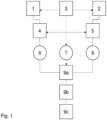
- Fig.1 there is provided a schematic view of a continuous process for making a silicone foam as described herein in which there is provided a receiving means (1) for receiving the ingredient of a part A composition as defined herein and a receiving means (2) for receiving the ingredient of a part B composition as defined herein. There is also provided a stirred tank (4) provided to mix the ingredients of the part A composition and a stirred tank (5) provided to mix the ingredients of the part B composition.
- a pumping means (6) adapted to pump mixed part A composition into a mixing unit ((9a) and optionally (9b) and/or (9c)) as well as a pumping means (8) adapted to pump mixed part B composition into said mixing unit ((9a) and optionally (9b) and/or (9c)).
- Mixing unit ((9a) and optionally (9b) and/or (9c)) comprises mixing block (9a) and optionally additionally comprises a static mixer (9b) and/or a dispensing tip (9c) and is provided to mix the part A composition and part B composition together and to dispense the resulting silicone foam.
- the foam is generated using a physical liquid blowing agent.
- a reservoir of said physical liquid blowing agent is contained in container (3).
- the physical liquid blowing agent may be supplied during the continuous process to any one or more of receiving means (1), receiving means (2), stirred tank (4), stirred tank (5) and/or directly into mixing block (9a) so that it is thoroughly mixed with the other ingredients in order to continuously produce a silicone foam.
- the physical liquid blowing agent may if desired be transported thereto by way of a pump (7) to aid addition into the mixing block (9a).
- One or more of receiving means (1), receiving means (2), stirred tank (4), stirred tank (5) and/or mixing unit may be temperature and pressure controlled. Given the nature of the physical liquid blowing agent it may be desired to vary the temperature in regions pre or post addition of the physical liquid blowing agent as a means of controlling when and where the blowing agent changes state from a liquid to a vapour or gas. Such temperature control must be able to both heat and cool the respective blend and/or composition so that it can be adapted for use with a variety of physical liquid blowing agents dependent on their boiling points.
- compositions, foams, and methods of this disclosure are useful for a variety of end applications, and are not limited to a particular one. Examples of suitable applications include space filling applications, automotive applications (e.g. for control modules), and the like.
- the foams can be used to at least partially cover or encapsulate articles, such as batteries and other electronic components.
- the foams can also be used for thermal insulation.
- the foams can be used as a fire block.
- the foams may be used for water exclusion applications, i.e. as a moisture seal.
- the foams of this disclosure provide a combination of desirable physical properties relative to conventional foams, including one or more of the following: reduced weight, lowered density, increased thermal resistance, increased stability, etc.
- the foams can be formed in environments where the formation of hydrogen gas is a concern.
- the foams can be foamed at room temperature or thereabout, which is useful for temperature sensitive applications.
- compositions, foams, and methods are intended to illustrate and not to limit the invention.
- compositions were generated utilizing different types and amounts of components. These are detailed below. All amounts are in weight % unless indicated otherwise. As discussed above all viscosities are measured at 25°C using a Brookfield LV DV-E viscometer. The alkenyl and/or alkynyl content of polymers as well as the silicon-bonded hydrogen (Si-H) content of polymers was determined using quantitative infra-red analysis in accordance with ASTM E168. Table 1-A: Standard part A composition used in the Examples (excluding Blowing Agent) Part A Wt. % Dimethylvinylsiloxy-terminated dimethyl siloxane, having a viscosity of ⁇ 430 mPa.s and ⁇ 0.46 wt.% Vi.
- 64.80 a blend of Dimethylvinylsiloxy-terminated dimethyl siloxane, having a viscosity of ⁇ 430 mPa.s and ⁇ 0.46 wt.% Vi; and a Vi MMQ resin, having a viscosity of ⁇ 45,000 mPa.s and ⁇ 0.39 wt.% Vi. 32.00 methylhydrogen siloxane, trimethylsiloxy-terminated, having a viscosity of ⁇ 30 mPa.s and ⁇ 1.6 wt.% SiH. 3.00 Tetramethyltetravinylcyclotetrasiloxane, having a viscosity of ⁇ 3 mPa.s and ⁇ 31.40 wt.% Vi. 0.20 total 100.00
- the physical blowing agent used in the examples unless otherwise indicated was 1,1,1,3,3-pentafluoropropane (HFC-245fa) which has a boiling point of about 15.3°C.
- Foams were produced at the laboratory bench scale in a non-continuous mode using a hand-stirring method involving mixing the two-part formulation with the desired amount of liquid blowing agent.
- the liquid blowing agent was added in equal amounts to both Part A and Part B of the composition then mixed together and stirred vigorously by hand for 30 seconds, after which the foam formulation was allowed to cure.
- a pneumatic gun was additionally utilised. This used air pressure to push two pistons, which deliver both parts with the liquid blowing agent to a static mixer.
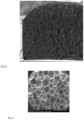
- FIG. 3a An example of a foam product produced in accordance with the above example is shown in Fig. 3a and an SEM image thereof is provided as Fig. 3b . It can be easily seen that the continuous process as described herein provides a similar product to that of the batch process but given the continuous Nature of the process a much greater throughput may be achieved.
- Example 2 Controlling rise of silicone elastomer foam by varying dispense temperature
- a series of examples to show it is possible to use dispense temperature to control the timing and amount of the rise of a physically blown silicone RTV foam were undertaken.
- foaming is delayed until the blowing agent warms (e.g. via conduction of heat from the environment) and vaporizes.
- the blowing agent used in this series of examples was HFC-245fa, which boils at 15.3C.
- tests were run at two dispense temperatures: about 25°C for the 'warm' trials, and 10 -12°C for the 'cold' trials.
- Table 2a shows foam volume as a function of time for a set of experiments which was carried out by dispensing room temperature reactants (warm trials) with a fixed amount of blowing agent, following the process described with respect to Ex. 1 above with the final mixer unit being the mixing block, static mixer and dispense tip, combination.
- the resulting foam was dispensed into a calibrated vial.
- the initial volume dispensed was 15 ml.
- Table 2a Rise Time (min) Sample ID Tip Gauge Flow Rate (mL/min) 0 2 4 6 8 10 12 14 Comp.2-1 20 10 14.5 17 19 20 21 22 22 22 Comp.2-2 20 10 15 17.5 20 20.5 22 22.5 23 22.5 Comp. 2-3 20 20 17 19 21 22.5 24 24 24 Comp.
Landscapes
- Chemical & Material Sciences (AREA)
- Health & Medical Sciences (AREA)
- Chemical Kinetics & Catalysis (AREA)
- Medicinal Chemistry (AREA)
- Polymers & Plastics (AREA)
- Organic Chemistry (AREA)
- Engineering & Computer Science (AREA)
- Materials Engineering (AREA)
- Mechanical Engineering (AREA)
- Silicon Polymers (AREA)
- Compositions Of Macromolecular Compounds (AREA)
Claims (12)
- Kontinuierliches Verfahren zum Ausbilden eines geschäumten Silikonelastomers aus einer Zusammensetzung, umfassend:i) ein Organopolysiloxan, das mindestens zwei siliziumgebundene ethylenisch ungesättigte Gruppen pro Molekül aufweist;ii) ein Organohydrogensiloxan, das mindestens zwei siliziumgebundene Wasserstoffatome pro Molekül aufweist;iii) einen Hydrosilylierungskatalysator; undiv) ein physikalisches flüssiges Treibmittel;das Verfahren umfassend die Schritte:(a) Mischen einer Teil A-Teil A-Zusammensetzung, die die Komponenten (i) und (iii) umfasst, und separates Mischen einer Teil B-Zusammensetzung, die die Komponenten (i) und (ii) umfasst; Zusammensetzung;(b) Einbringen der Teil A-Zusammensetzung und der Teil B-Zusammensetzung in jeweilige Mischbehälter und Mischen;(c) Überführen der resultierenden Mischungen von Teil A und Teil B aus Schritt (b) in jeweilige Pumpeinrichtungen;(d) Pumpen der resultierenden Mischungen aus Teil A und Teil B aus den Schritten (b) und (c) in eine Mischeinheit und Mischen zum Bilden eines Schaumstoffs; und(e) Ausgeben des entstandenen Schaumstoffs; wobei(f) Komponente (iv) während Schritt (a) oder Schritt (b) in die Teil A-Zusammensetzung und/oder Teil B-Zusammensetzung eingebracht wird und/oder während Schritt (d) in den statischen Mischer eingebracht wird.
- Verfahren nach Anspruch 1, wobei einer oder mehrere der Schritte (a) bis (f) unter Temperatur- und/oder Druckkontrolle durchgeführt werden.
- Verfahren nach Anspruch 1 oder 2, wobei kein chemisches Treibmittel verwendet wird.
- Verfahren nach einem der vorstehenden Ansprüche, wobei Schritt (f) bei einer Temperatur ≤ dem Siedepunkt des physikalischen Treibmittels stattfindet. (iv).
- Verfahren nach einem der vorstehenden Ansprüche, wobei Komponente (iv) Fluorkohlenwasserstoff (HFC) umfasst.
- Verfahren nach einem der vorstehenden Ansprüche, wobei Komponente (iv) 1,1,1,3,3-Pentafluorpropan (HFC-245fa) umfasst.
- Verfahren nach einem der vorstehenden Ansprüche, ferner umfassend mindestens ein Additiv, das aus der Gruppe ausgewählt ist bestehend aus Tensiden, Organopolysiloxanharzen, Füllstoffen, Reaktionsinhibitoren, Farbstoffen und Kombinationen davon.
- Verfahren nach einem der vorstehenden Ansprüche, wobei das Aufsteigen des resultierenden Elastomerschaums durch Variieren der Abgabetemperatur, der Durchflussrate und/oder Variieren der Konzentration des physikalischen Treibmittels gesteuert wird.
- Verfahren nach einem der vorstehenden Ansprüche, wobei während Schritt (f) das physikalische Treibmittel in die Mischung oder Zusammensetzung eingebracht wird durch:-(1) Vollständiges Zuführen während Schritt (a) in die Teil A-Mischung; oder alternativ(2) Vollständiges Zuführen während Schritt (b) in die Teil A-Zusammensetzung; oder alternativ(3) Vollständiges Zuführen während Schritt (a) in die Teil B-Mischung; oder alternativ(4) Vollständiges Zuführen während Schritt (b) in die Teil B-Zusammensetzung; oder alternativ(5) Teilweises Zuführen während Schritt (a) in die Teil A-Mischung und teilweises Zuführen in die Teil B-Mischung; oder alternativ(6) Teilweises Zuführen während Schritt (b) in die Teil A-Zusammensetzung und teilweises Zuführen in die Teil B-Zusammensetzung; oder alternativ(7) Teilweises Zuführen während Schritt (b) in die Teil A-Zusammensetzung und teilweises Zuführen in die Teil B-Zusammensetzung; oder alternativ(8) Vollständiges Zuführen direkt in die Mischeinheit aus Schritt (d);(9) Teilweises Zuführen während Schritt (a) in die Teil A-Mischung und teilweises Zuführen direkt in die Mischeinheit von Schritt (d); oder alternativ(10) Teilweises Zuführen während Schritt (b) in die Teil A-Zusammensetzung und teilweises Zuführen direkt in die Mischeinheit von Schritt (d); oder alternativ(11) Teilweises Zuführen während Schritt (a) in die Teil B-Mischung und teilweises Zuführen direkt in die Mischeinheit von Schritt (d); oder alternativ(12) Teilweises Zuführen während Schritt (b) in die Teil B-Zusammensetzung und teilweises Zuführen direkt in die Mischeinheit von Schritt (d); oder alternativ(13) Teilweises Zuführen in die Teil A-Mischung, teilweises Zuführen in die Teil B-Mischung während Schritt (a) und teilweises Zuführen direkt in die Mischeinheit von Schritt (d); oder alternativ(14) Teilweises Zuführen in die Teil A-Zusammensetzung, teilweises Zuführen in die Teil B-Zusammensetzung während Schritt (b) und teilweises Zuführen direkt in die Mischeinheit von Schritt (d); oder alternativ(15) Teilweises Zuführen in die Teil A-Zusammensetzung, teilweises Zuführen in die Teil B-Zusammensetzung während Schritt (b) und teilweises Zuführen direkt in die Mischeinheit von Schritt (d).
- Verfahren nach einem der vorstehenden Ansprüche, wobei das Zweikomponentensystem einen Teil A umfasst, der mindestens Komponente (i) umfasst, und Teil B mindestens Komponente (ii) umfasst, wobei Teil A optional ferner Komponente (iii) umfasst und Teil B frei von Komponente (iii) ist.
- Verfahren nach einem der vorstehenden Ansprüche, wobei die Teil B-Zusammensetzung Komponente (iii) und einen Reaktionsinhibitor umfasst.
- Verfahren nach einem der vorstehenden Ansprüche, wobei die ausgewählte Komponente (iv) einen Siedepunkt zwischen 10 und 30 °C aufweist, so dass sie bei Einwirkung von Atmosphärendruck in diesem Temperaturbereich einen Phasenübergang von einem flüssigen in einen gasförmigen Zustand durchläuft, jedoch während Schritt (d) oder Schritt (d) und (e) zumindest teilweise in flüssiger Form verbleibt.
Applications Claiming Priority (2)
| Application Number | Priority Date | Filing Date | Title |
|---|---|---|---|
| US202062970382P | 2020-02-05 | 2020-02-05 | |
| PCT/US2021/016279 WO2021158579A1 (en) | 2020-02-05 | 2021-02-03 | The preparation of foamed silicone elastomers |
Publications (2)
| Publication Number | Publication Date |
|---|---|
| EP4100465A1 EP4100465A1 (de) | 2022-12-14 |
| EP4100465B1 true EP4100465B1 (de) | 2025-06-25 |
Family
ID=74798057
Family Applications (1)
| Application Number | Title | Priority Date | Filing Date |
|---|---|---|---|
| EP21708831.9A Active EP4100465B1 (de) | 2020-02-05 | 2021-02-03 | Herstellung von geschäumten silikonelastomeren |
Country Status (4)
| Country | Link |
|---|---|
| US (1) | US20230073487A1 (de) |
| EP (1) | EP4100465B1 (de) |
| CN (1) | CN115135705A (de) |
| WO (1) | WO2021158579A1 (de) |
Families Citing this family (10)
| Publication number | Priority date | Publication date | Assignee | Title |
|---|---|---|---|---|
| MX2021006372A (es) | 2018-11-29 | 2021-08-11 | Ethicon Inc | Revestimientos lubricantes de silicona curada a baja temperatura. |
| US12465577B2 (en) | 2020-05-28 | 2025-11-11 | Ethicon, Inc. | Antimicrobial topical skin closure compositions and systems |
| US12528913B2 (en) | 2020-05-28 | 2026-01-20 | Ethicon, Inc. | Antimicrobial anhydrous topical skin closure compositions and systems |
| US11718753B2 (en) | 2020-05-28 | 2023-08-08 | Ethicon, Inc. | Topical skin closure compositions and systems |
| EP4384569A1 (de) * | 2021-08-11 | 2024-06-19 | Dow Global Technologies LLC | Herstellung von geschäumten silikonprodukten |
| WO2023205050A1 (en) * | 2022-04-20 | 2023-10-26 | Elkem Silicones USA Corp. | New silicone foam which is air foamed and syntactic and article such as a secondary battery pack comprising said foam |
| US12202228B2 (en) | 2023-02-07 | 2025-01-21 | Siplast Inc. | Flashing assemblies and related systems and methods |
| CN121127538A (zh) * | 2023-05-15 | 2025-12-12 | 美国陶氏有机硅公司 | 包含聚硅氧烷复合材料的电池组及其生产方法 |
| CA3240634A1 (en) | 2023-06-06 | 2025-06-10 | Bmic Llc | Adhesive-less roofing systems and related methods |
| US12352040B2 (en) | 2023-06-08 | 2025-07-08 | Siplast, Inc. | Barrier systems for building structures and related methods |
Family Cites Families (16)
| Publication number | Priority date | Publication date | Assignee | Title |
|---|---|---|---|---|
| NL131800C (de) | 1965-05-17 | |||
| NL129346C (de) | 1966-06-23 | |||
| US3814730A (en) | 1970-08-06 | 1974-06-04 | Gen Electric | Platinum complexes of unsaturated siloxanes and platinum containing organopolysiloxanes |
| US3715334A (en) | 1970-11-27 | 1973-02-06 | Gen Electric | Platinum-vinylsiloxanes |
| US4929669A (en) * | 1988-12-27 | 1990-05-29 | Dow Corning Corporation | Organosiloxane compositions yielding elastomers with improved recovery following prolonged compression |
| ES2115812T3 (es) * | 1994-07-02 | 1998-07-01 | Sonderhoff Ernst Fa | Procedimiento de preparacion de elastomero de silicona, espumoso o no espumoso, en particular para la estanqueidad. |
| US5436274A (en) * | 1994-09-30 | 1995-07-25 | General Electric Company | Preparation of silicone foams of low density and small cell size |
| US5574073A (en) * | 1996-01-17 | 1996-11-12 | Dow Corning Corporation | Curable silicone compositions which are foams or elastomers |
| US5683527A (en) * | 1996-12-30 | 1997-11-04 | Dow Corning Corporation | Foamable organosiloxane compositions curable to silicone foams having improved adhesion |
| US6605734B2 (en) | 2001-12-07 | 2003-08-12 | Dow Corning Corporation | Alkene-platinum-silyl complexes |
| JP2006056986A (ja) * | 2004-08-19 | 2006-03-02 | Shin Etsu Chem Co Ltd | 二液硬化型シリコーン組成物 |
| TWI382918B (zh) * | 2005-04-19 | 2013-01-21 | Sulzer Chemtech Ag | 液態聚矽氧烷橡膠之發泡成形的聚合物元件之製法 |
| US20100183814A1 (en) * | 2005-08-02 | 2010-07-22 | Victor Rios | Silicone compositions, methods of manufacture, and articles formed therefrom |
| DE102007040853A1 (de) * | 2007-08-29 | 2009-03-05 | Wacker Chemie Ag | Siliconhaltige Schaumstoffe |
| BR112019016363B1 (pt) * | 2017-02-08 | 2023-03-28 | Elkem Silicones Usa Corp | Composição de organopolissiloxano e espuma sintática de borracha de silicone |
| CN108129692B (zh) * | 2017-12-25 | 2020-11-10 | 广东标美硅氟新材料有限公司 | 一种发泡硅橡胶材料及其制备方法和应用 |
-
2021
- 2021-02-03 EP EP21708831.9A patent/EP4100465B1/de active Active
- 2021-02-03 CN CN202180014656.7A patent/CN115135705A/zh active Pending
- 2021-02-03 US US17/796,998 patent/US20230073487A1/en active Pending
- 2021-02-03 WO PCT/US2021/016279 patent/WO2021158579A1/en not_active Ceased
Also Published As
| Publication number | Publication date |
|---|---|
| EP4100465A1 (de) | 2022-12-14 |
| CN115135705A (zh) | 2022-09-30 |
| WO2021158579A1 (en) | 2021-08-12 |
| US20230073487A1 (en) | 2023-03-09 |
Similar Documents
| Publication | Publication Date | Title |
|---|---|---|
| EP4100465B1 (de) | Herstellung von geschäumten silikonelastomeren | |
| US11339266B2 (en) | Composition, foamed silicone elastomer formed therefrom, and methods of formation | |
| KR101060138B1 (ko) | 실리콘 고무 스폰지용 에멀젼 조성물, 이의 제조방법, 및실리콘 고무 스폰지의 제조방법 | |
| JP2005521782A (ja) | 導電性ポリマフォームおよびエラストマ、ならびにそれらの製造方法 | |
| JP7799632B2 (ja) | 組成物、それから形成されるシリコーンポリエーテル界面活性剤、並びに関連する方法及び物品 | |
| CN115667342A (zh) | 组合物和由其形成的发泡聚氨酯制品 | |
| JP6830866B2 (ja) | 低密度シリコーンゴムを製造する方法 | |
| WO2022067597A1 (en) | Silicone foam elastomers and their uses | |
| US20240343875A1 (en) | The preparation of foamed silicone products | |
| JP2024511331A (ja) | 発泡体を調製するための組成物、それに関連する方法、及びそれから形成された発泡体 | |
| US20230302491A1 (en) | Method for the in-situ encapsulation and/or insulation of piping | |
| JP7409339B2 (ja) | 機械発泡用硬化性液状シリコーンゴム発泡体組成物及びシリコーンゴム発泡体の製造方法 | |
| US20240400779A1 (en) | Silicone foam composition | |
| JP2019026765A (ja) | シリコーンスポンジの製造方法 | |
| JP2024500046A (ja) | イソシアネート反応性成分、それを含む組成物、及びそれを用いて形成された発泡体 | |
| KR20240038012A (ko) | 실리콘 폼 조성물 |
Legal Events
| Date | Code | Title | Description |
|---|---|---|---|
| STAA | Information on the status of an ep patent application or granted ep patent |
Free format text: STATUS: UNKNOWN |
|
| STAA | Information on the status of an ep patent application or granted ep patent |
Free format text: STATUS: THE INTERNATIONAL PUBLICATION HAS BEEN MADE |
|
| PUAI | Public reference made under article 153(3) epc to a published international application that has entered the european phase |
Free format text: ORIGINAL CODE: 0009012 |
|
| STAA | Information on the status of an ep patent application or granted ep patent |
Free format text: STATUS: REQUEST FOR EXAMINATION WAS MADE |
|
| 17P | Request for examination filed |
Effective date: 20220817 |
|
| AK | Designated contracting states |
Kind code of ref document: A1 Designated state(s): AL AT BE BG CH CY CZ DE DK EE ES FI FR GB GR HR HU IE IS IT LI LT LU LV MC MK MT NL NO PL PT RO RS SE SI SK SM TR |
|
| DAV | Request for validation of the european patent (deleted) | ||
| DAX | Request for extension of the european patent (deleted) | ||
| P01 | Opt-out of the competence of the unified patent court (upc) registered |
Effective date: 20230526 |
|
| GRAP | Despatch of communication of intention to grant a patent |
Free format text: ORIGINAL CODE: EPIDOSNIGR1 |
|
| STAA | Information on the status of an ep patent application or granted ep patent |
Free format text: STATUS: GRANT OF PATENT IS INTENDED |
|
| INTG | Intention to grant announced |
Effective date: 20250214 |
|
| GRAS | Grant fee paid |
Free format text: ORIGINAL CODE: EPIDOSNIGR3 |
|
| GRAA | (expected) grant |
Free format text: ORIGINAL CODE: 0009210 |
|
| STAA | Information on the status of an ep patent application or granted ep patent |
Free format text: STATUS: THE PATENT HAS BEEN GRANTED |
|
| AK | Designated contracting states |
Kind code of ref document: B1 Designated state(s): AL AT BE BG CH CY CZ DE DK EE ES FI FR GB GR HR HU IE IS IT LI LT LU LV MC MK MT NL NO PL PT RO RS SE SI SK SM TR |
|
| REG | Reference to a national code |
Ref country code: GB Ref legal event code: FG4D |
|
| REG | Reference to a national code |
Ref country code: CH Ref legal event code: EP |
|
| REG | Reference to a national code |
Ref country code: CH Ref legal event code: EP |
|
| REG | Reference to a national code |
Ref country code: IE Ref legal event code: FG4D |
|
| REG | Reference to a national code |
Ref country code: DE Ref legal event code: R096 Ref document number: 602021032799 Country of ref document: DE |
|
| PG25 | Lapsed in a contracting state [announced via postgrant information from national office to epo] |
Ref country code: FI Free format text: LAPSE BECAUSE OF FAILURE TO SUBMIT A TRANSLATION OF THE DESCRIPTION OR TO PAY THE FEE WITHIN THE PRESCRIBED TIME-LIMIT Effective date: 20250625 |
|
| REG | Reference to a national code |
Ref country code: LT Ref legal event code: MG9D |
|
| PG25 | Lapsed in a contracting state [announced via postgrant information from national office to epo] |
Ref country code: NO Free format text: LAPSE BECAUSE OF FAILURE TO SUBMIT A TRANSLATION OF THE DESCRIPTION OR TO PAY THE FEE WITHIN THE PRESCRIBED TIME-LIMIT Effective date: 20250925 Ref country code: GR Free format text: LAPSE BECAUSE OF FAILURE TO SUBMIT A TRANSLATION OF THE DESCRIPTION OR TO PAY THE FEE WITHIN THE PRESCRIBED TIME-LIMIT Effective date: 20250926 |
|
| PG25 | Lapsed in a contracting state [announced via postgrant information from national office to epo] |
Ref country code: BG Free format text: LAPSE BECAUSE OF FAILURE TO SUBMIT A TRANSLATION OF THE DESCRIPTION OR TO PAY THE FEE WITHIN THE PRESCRIBED TIME-LIMIT Effective date: 20250625 |
|
| PG25 | Lapsed in a contracting state [announced via postgrant information from national office to epo] |
Ref country code: HR Free format text: LAPSE BECAUSE OF FAILURE TO SUBMIT A TRANSLATION OF THE DESCRIPTION OR TO PAY THE FEE WITHIN THE PRESCRIBED TIME-LIMIT Effective date: 20250625 |
|
| PG25 | Lapsed in a contracting state [announced via postgrant information from national office to epo] |
Ref country code: RS Free format text: LAPSE BECAUSE OF FAILURE TO SUBMIT A TRANSLATION OF THE DESCRIPTION OR TO PAY THE FEE WITHIN THE PRESCRIBED TIME-LIMIT Effective date: 20250925 |
|
| PG25 | Lapsed in a contracting state [announced via postgrant information from national office to epo] |
Ref country code: LV Free format text: LAPSE BECAUSE OF FAILURE TO SUBMIT A TRANSLATION OF THE DESCRIPTION OR TO PAY THE FEE WITHIN THE PRESCRIBED TIME-LIMIT Effective date: 20250625 |
|
| REG | Reference to a national code |
Ref country code: NL Ref legal event code: MP Effective date: 20250625 |
|
| PG25 | Lapsed in a contracting state [announced via postgrant information from national office to epo] |
Ref country code: NL Free format text: LAPSE BECAUSE OF FAILURE TO SUBMIT A TRANSLATION OF THE DESCRIPTION OR TO PAY THE FEE WITHIN THE PRESCRIBED TIME-LIMIT Effective date: 20250625 |
|
| PG25 | Lapsed in a contracting state [announced via postgrant information from national office to epo] |
Ref country code: PT Free format text: LAPSE BECAUSE OF FAILURE TO SUBMIT A TRANSLATION OF THE DESCRIPTION OR TO PAY THE FEE WITHIN THE PRESCRIBED TIME-LIMIT Effective date: 20251027 |
|
| REG | Reference to a national code |
Ref country code: AT Ref legal event code: MK05 Ref document number: 1806409 Country of ref document: AT Kind code of ref document: T Effective date: 20250625 |
|
| PG25 | Lapsed in a contracting state [announced via postgrant information from national office to epo] |
Ref country code: IS Free format text: LAPSE BECAUSE OF FAILURE TO SUBMIT A TRANSLATION OF THE DESCRIPTION OR TO PAY THE FEE WITHIN THE PRESCRIBED TIME-LIMIT Effective date: 20251025 |
|
| PG25 | Lapsed in a contracting state [announced via postgrant information from national office to epo] |
Ref country code: AT Free format text: LAPSE BECAUSE OF FAILURE TO SUBMIT A TRANSLATION OF THE DESCRIPTION OR TO PAY THE FEE WITHIN THE PRESCRIBED TIME-LIMIT Effective date: 20250625 Ref country code: SM Free format text: LAPSE BECAUSE OF FAILURE TO SUBMIT A TRANSLATION OF THE DESCRIPTION OR TO PAY THE FEE WITHIN THE PRESCRIBED TIME-LIMIT Effective date: 20250625 |
|
| PG25 | Lapsed in a contracting state [announced via postgrant information from national office to epo] |
Ref country code: CZ Free format text: LAPSE BECAUSE OF FAILURE TO SUBMIT A TRANSLATION OF THE DESCRIPTION OR TO PAY THE FEE WITHIN THE PRESCRIBED TIME-LIMIT Effective date: 20250625 |
|
| PG25 | Lapsed in a contracting state [announced via postgrant information from national office to epo] |
Ref country code: PL Free format text: LAPSE BECAUSE OF FAILURE TO SUBMIT A TRANSLATION OF THE DESCRIPTION OR TO PAY THE FEE WITHIN THE PRESCRIBED TIME-LIMIT Effective date: 20250625 |
|
| PG25 | Lapsed in a contracting state [announced via postgrant information from national office to epo] |
Ref country code: EE Free format text: LAPSE BECAUSE OF FAILURE TO SUBMIT A TRANSLATION OF THE DESCRIPTION OR TO PAY THE FEE WITHIN THE PRESCRIBED TIME-LIMIT Effective date: 20250625 |
|
| PG25 | Lapsed in a contracting state [announced via postgrant information from national office to epo] |
Ref country code: SK Free format text: LAPSE BECAUSE OF FAILURE TO SUBMIT A TRANSLATION OF THE DESCRIPTION OR TO PAY THE FEE WITHIN THE PRESCRIBED TIME-LIMIT Effective date: 20250625 |
|
| PG25 | Lapsed in a contracting state [announced via postgrant information from national office to epo] |
Ref country code: ES Free format text: LAPSE BECAUSE OF FAILURE TO SUBMIT A TRANSLATION OF THE DESCRIPTION OR TO PAY THE FEE WITHIN THE PRESCRIBED TIME-LIMIT Effective date: 20250625 |