EP4098467B1 - Verfahren und vorrichtung zur schätzung der geschwindigkeit eines fahrzeugs - Google Patents
Verfahren und vorrichtung zur schätzung der geschwindigkeit eines fahrzeugs Download PDFInfo
- Publication number
- EP4098467B1 EP4098467B1 EP22175245.4A EP22175245A EP4098467B1 EP 4098467 B1 EP4098467 B1 EP 4098467B1 EP 22175245 A EP22175245 A EP 22175245A EP 4098467 B1 EP4098467 B1 EP 4098467B1
- Authority
- EP
- European Patent Office
- Prior art keywords
- vehicle body
- body speed
- estimated vehicle
- condition
- estimated
- Prior art date
- Legal status (The legal status is an assumption and is not a legal conclusion. Google has not performed a legal analysis and makes no representation as to the accuracy of the status listed.)
- Active
Links
Images




Classifications
-
- B—PERFORMING OPERATIONS; TRANSPORTING
- B60—VEHICLES IN GENERAL
- B60W—CONJOINT CONTROL OF VEHICLE SUB-UNITS OF DIFFERENT TYPE OR DIFFERENT FUNCTION; CONTROL SYSTEMS SPECIALLY ADAPTED FOR HYBRID VEHICLES; ROAD VEHICLE DRIVE CONTROL SYSTEMS FOR PURPOSES NOT RELATED TO THE CONTROL OF A PARTICULAR SUB-UNIT
- B60W30/00—Purposes of road vehicle drive control systems not related to the control of a particular sub-unit, e.g. of systems using conjoint control of vehicle sub-units
- B60W30/18—Propelling the vehicle
- B60W30/18009—Propelling the vehicle related to particular drive situations
- B60W30/18109—Braking
-
- B—PERFORMING OPERATIONS; TRANSPORTING
- B60—VEHICLES IN GENERAL
- B60W—CONJOINT CONTROL OF VEHICLE SUB-UNITS OF DIFFERENT TYPE OR DIFFERENT FUNCTION; CONTROL SYSTEMS SPECIALLY ADAPTED FOR HYBRID VEHICLES; ROAD VEHICLE DRIVE CONTROL SYSTEMS FOR PURPOSES NOT RELATED TO THE CONTROL OF A PARTICULAR SUB-UNIT
- B60W10/00—Conjoint control of vehicle sub-units of different type or different function
- B60W10/119—Conjoint control of vehicle sub-units of different type or different function including control of all-wheel-driveline means, e.g. transfer gears or clutches for dividing torque between front and rear axle
-
- B—PERFORMING OPERATIONS; TRANSPORTING
- B60—VEHICLES IN GENERAL
- B60K—ARRANGEMENT OR MOUNTING OF PROPULSION UNITS OR OF TRANSMISSIONS IN VEHICLES; ARRANGEMENT OR MOUNTING OF PLURAL DIVERSE PRIME-MOVERS IN VEHICLES; AUXILIARY DRIVES FOR VEHICLES; INSTRUMENTATION OR DASHBOARDS FOR VEHICLES; ARRANGEMENTS IN CONNECTION WITH COOLING, AIR INTAKE, GAS EXHAUST OR FUEL SUPPLY OF PROPULSION UNITS IN VEHICLES
- B60K17/00—Arrangement or mounting of transmissions in vehicles
- B60K17/34—Arrangement or mounting of transmissions in vehicles for driving both front and rear wheels, e.g. four wheel drive vehicles
-
- B—PERFORMING OPERATIONS; TRANSPORTING
- B60—VEHICLES IN GENERAL
- B60T—VEHICLE BRAKE CONTROL SYSTEMS OR PARTS THEREOF; BRAKE CONTROL SYSTEMS OR PARTS THEREOF, IN GENERAL; ARRANGEMENT OF BRAKING ELEMENTS ON VEHICLES IN GENERAL; PORTABLE DEVICES FOR PREVENTING UNWANTED MOVEMENT OF VEHICLES; VEHICLE MODIFICATIONS TO FACILITATE COOLING OF BRAKES
- B60T8/00—Arrangements for adjusting wheel-braking force to meet varying vehicular or ground-surface conditions, e.g. limiting or varying distribution of braking force
- B60T8/17—Using electrical or electronic regulation means to control braking
- B60T8/176—Brake regulation specially adapted to prevent excessive wheel slip during vehicle deceleration, e.g. ABS
-
- B—PERFORMING OPERATIONS; TRANSPORTING
- B60—VEHICLES IN GENERAL
- B60T—VEHICLE BRAKE CONTROL SYSTEMS OR PARTS THEREOF; BRAKE CONTROL SYSTEMS OR PARTS THEREOF, IN GENERAL; ARRANGEMENT OF BRAKING ELEMENTS ON VEHICLES IN GENERAL; PORTABLE DEVICES FOR PREVENTING UNWANTED MOVEMENT OF VEHICLES; VEHICLE MODIFICATIONS TO FACILITATE COOLING OF BRAKES
- B60T8/00—Arrangements for adjusting wheel-braking force to meet varying vehicular or ground-surface conditions, e.g. limiting or varying distribution of braking force
- B60T8/32—Arrangements for adjusting wheel-braking force to meet varying vehicular or ground-surface conditions, e.g. limiting or varying distribution of braking force responsive to a speed condition, e.g. acceleration or deceleration
-
- B—PERFORMING OPERATIONS; TRANSPORTING
- B60—VEHICLES IN GENERAL
- B60W—CONJOINT CONTROL OF VEHICLE SUB-UNITS OF DIFFERENT TYPE OR DIFFERENT FUNCTION; CONTROL SYSTEMS SPECIALLY ADAPTED FOR HYBRID VEHICLES; ROAD VEHICLE DRIVE CONTROL SYSTEMS FOR PURPOSES NOT RELATED TO THE CONTROL OF A PARTICULAR SUB-UNIT
- B60W30/00—Purposes of road vehicle drive control systems not related to the control of a particular sub-unit, e.g. of systems using conjoint control of vehicle sub-units
- B60W30/18—Propelling the vehicle
- B60W30/18172—Preventing, or responsive to skidding of wheels
-
- B—PERFORMING OPERATIONS; TRANSPORTING
- B60—VEHICLES IN GENERAL
- B60W—CONJOINT CONTROL OF VEHICLE SUB-UNITS OF DIFFERENT TYPE OR DIFFERENT FUNCTION; CONTROL SYSTEMS SPECIALLY ADAPTED FOR HYBRID VEHICLES; ROAD VEHICLE DRIVE CONTROL SYSTEMS FOR PURPOSES NOT RELATED TO THE CONTROL OF A PARTICULAR SUB-UNIT
- B60W40/00—Estimation or calculation of non-directly measurable driving parameters for road vehicle drive control systems not related to the control of a particular sub unit, e.g. by using mathematical models
- B60W40/10—Estimation or calculation of non-directly measurable driving parameters for road vehicle drive control systems not related to the control of a particular sub unit, e.g. by using mathematical models related to vehicle motion
- B60W40/101—Side slip angle of tyre
-
- B—PERFORMING OPERATIONS; TRANSPORTING
- B60—VEHICLES IN GENERAL
- B60W—CONJOINT CONTROL OF VEHICLE SUB-UNITS OF DIFFERENT TYPE OR DIFFERENT FUNCTION; CONTROL SYSTEMS SPECIALLY ADAPTED FOR HYBRID VEHICLES; ROAD VEHICLE DRIVE CONTROL SYSTEMS FOR PURPOSES NOT RELATED TO THE CONTROL OF A PARTICULAR SUB-UNIT
- B60W40/00—Estimation or calculation of non-directly measurable driving parameters for road vehicle drive control systems not related to the control of a particular sub unit, e.g. by using mathematical models
- B60W40/10—Estimation or calculation of non-directly measurable driving parameters for road vehicle drive control systems not related to the control of a particular sub unit, e.g. by using mathematical models related to vehicle motion
- B60W40/105—Speed
-
- B—PERFORMING OPERATIONS; TRANSPORTING
- B60—VEHICLES IN GENERAL
- B60W—CONJOINT CONTROL OF VEHICLE SUB-UNITS OF DIFFERENT TYPE OR DIFFERENT FUNCTION; CONTROL SYSTEMS SPECIALLY ADAPTED FOR HYBRID VEHICLES; ROAD VEHICLE DRIVE CONTROL SYSTEMS FOR PURPOSES NOT RELATED TO THE CONTROL OF A PARTICULAR SUB-UNIT
- B60W40/00—Estimation or calculation of non-directly measurable driving parameters for road vehicle drive control systems not related to the control of a particular sub unit, e.g. by using mathematical models
- B60W40/10—Estimation or calculation of non-directly measurable driving parameters for road vehicle drive control systems not related to the control of a particular sub unit, e.g. by using mathematical models related to vehicle motion
- B60W40/107—Longitudinal acceleration
-
- B—PERFORMING OPERATIONS; TRANSPORTING
- B60—VEHICLES IN GENERAL
- B60W—CONJOINT CONTROL OF VEHICLE SUB-UNITS OF DIFFERENT TYPE OR DIFFERENT FUNCTION; CONTROL SYSTEMS SPECIALLY ADAPTED FOR HYBRID VEHICLES; ROAD VEHICLE DRIVE CONTROL SYSTEMS FOR PURPOSES NOT RELATED TO THE CONTROL OF A PARTICULAR SUB-UNIT
- B60W50/00—Details of control systems for road vehicle drive control not related to the control of a particular sub-unit, e.g. process diagnostic or vehicle driver interfaces
- B60W2050/0001—Details of the control system
- B60W2050/0019—Control system elements or transfer functions
- B60W2050/002—Integrating means
-
- B—PERFORMING OPERATIONS; TRANSPORTING
- B60—VEHICLES IN GENERAL
- B60W—CONJOINT CONTROL OF VEHICLE SUB-UNITS OF DIFFERENT TYPE OR DIFFERENT FUNCTION; CONTROL SYSTEMS SPECIALLY ADAPTED FOR HYBRID VEHICLES; ROAD VEHICLE DRIVE CONTROL SYSTEMS FOR PURPOSES NOT RELATED TO THE CONTROL OF A PARTICULAR SUB-UNIT
- B60W2520/00—Input parameters relating to overall vehicle dynamics
- B60W2520/10—Longitudinal speed
- B60W2520/105—Longitudinal acceleration
-
- B—PERFORMING OPERATIONS; TRANSPORTING
- B60—VEHICLES IN GENERAL
- B60W—CONJOINT CONTROL OF VEHICLE SUB-UNITS OF DIFFERENT TYPE OR DIFFERENT FUNCTION; CONTROL SYSTEMS SPECIALLY ADAPTED FOR HYBRID VEHICLES; ROAD VEHICLE DRIVE CONTROL SYSTEMS FOR PURPOSES NOT RELATED TO THE CONTROL OF A PARTICULAR SUB-UNIT
- B60W2520/00—Input parameters relating to overall vehicle dynamics
- B60W2520/26—Wheel slip
-
- B—PERFORMING OPERATIONS; TRANSPORTING
- B60—VEHICLES IN GENERAL
- B60W—CONJOINT CONTROL OF VEHICLE SUB-UNITS OF DIFFERENT TYPE OR DIFFERENT FUNCTION; CONTROL SYSTEMS SPECIALLY ADAPTED FOR HYBRID VEHICLES; ROAD VEHICLE DRIVE CONTROL SYSTEMS FOR PURPOSES NOT RELATED TO THE CONTROL OF A PARTICULAR SUB-UNIT
- B60W2520/00—Input parameters relating to overall vehicle dynamics
- B60W2520/28—Wheel speed
-
- B—PERFORMING OPERATIONS; TRANSPORTING
- B60—VEHICLES IN GENERAL
- B60W—CONJOINT CONTROL OF VEHICLE SUB-UNITS OF DIFFERENT TYPE OR DIFFERENT FUNCTION; CONTROL SYSTEMS SPECIALLY ADAPTED FOR HYBRID VEHICLES; ROAD VEHICLE DRIVE CONTROL SYSTEMS FOR PURPOSES NOT RELATED TO THE CONTROL OF A PARTICULAR SUB-UNIT
- B60W2720/00—Output or target parameters relating to overall vehicle dynamics
- B60W2720/30—Wheel torque
-
- B—PERFORMING OPERATIONS; TRANSPORTING
- B60—VEHICLES IN GENERAL
- B60W—CONJOINT CONTROL OF VEHICLE SUB-UNITS OF DIFFERENT TYPE OR DIFFERENT FUNCTION; CONTROL SYSTEMS SPECIALLY ADAPTED FOR HYBRID VEHICLES; ROAD VEHICLE DRIVE CONTROL SYSTEMS FOR PURPOSES NOT RELATED TO THE CONTROL OF A PARTICULAR SUB-UNIT
- B60W2720/00—Output or target parameters relating to overall vehicle dynamics
- B60W2720/40—Torque distribution
- B60W2720/403—Torque distribution between front and rear axle
Definitions
- the invention relates to a vehicle body speed estimation method and a vehicle body speed estimation apparatus.
- JP 2003-002079 A describes a driving force controller for a four-wheel drive vehicle.
- the four-wheel drive vehicle includes a friction clutch provided in the middle of an engine drive-train to rear wheels.
- the driving force controller variably controls the driving force distribution ratio between front wheels and the rear wheels by controlling the clutch engagement force of the friction clutch.
- the driving force controller detects an acceleration slip of the wheels and executes traction control for reducing the driving force of drive wheels.
- JP 05-185922 A describes a method of calculating an estimated vehicle body speed. In a state where no excessive slip or spin is occurring in wheels, the estimated vehicle body speed is calculated from wheel speeds. On the other hand, when an excessive slip or spin is occurring in the wheels, the estimated vehicle body speed is calculated based on an output of a gravity accelerometer.
- JP 2016-103867 A describes a vehicle body speed estimation apparatus for a vehicle.
- the vehicle includes a braking and driving force generator capable of generating a driving force and a braking force applied to all the wheels.
- the vehicle body speed estimation apparatus estimates a vehicle body speed from the wheel speeds of the wheels.
- the estimated vehicle body speed is used in traction control and anti-lock brake control.
- EP 0314453 A2 discloses a transmission control system including a torque distribution control unit, a differential and clutch.
- Estimating the vehicle body speed of a four-wheel drive vehicle will be considered. When, for example, all the four wheels are in a slip, an estimated vehicle body speed that is estimated based on wheel speeds is higher than an actual vehicle body speed. In other words, an apparent increase of the estimated vehicle body speed occurs. Such a deviation of an estimated vehicle body speed from an actual vehicle body speed leads to a decrease in the accuracy of vehicle control or information processing using the estimated vehicle body speed.
- the invention provides a vehicle body speed estimation method and a vehicle body speed estimation apparatus for ensuring the accuracy of an estimated vehicle body speed of a four-wheel drive vehicle.
- a first aspect relates to a vehicle body speed estimation method applied to a four-wheel drive vehicle.
- the vehicle body speed estimation method includes: acquiring an estimated vehicle body speed based on wheel speeds or a longitudinal acceleration of the vehicle; determining whether an operation condition that includes at least a condition that the estimated vehicle body speed is higher than an operation determination speed is satisfied; performing torque limitation to reduce a torque of a portion of wheels of the vehicle when the operation condition is satisfied; determining whether a stop condition that includes a condition that the estimated vehicle body speed is lower than or equal to a stop determination speed or a condition that a duration of a state where a wheel acceleration of the portion of the wheels is higher than zero is longer than or equal to a set period of time; and stopping the torque limitation when the stop condition is satisfied.
- a second aspect relates to a vehicle body speed estimation apparatus applied to a four-wheel drive vehicle.
- the vehicle body speed estimation apparatus includes one or plurality of processors.
- the one or plurality of processors is programmed to acquire an estimated vehicle body speed based on wheel speeds or a longitudinal acceleration of the vehicle; determine whether an operation condition that includes at least a condition that the estimated vehicle body speed is higher than an operation determination speed is satisfied; perform torque limitation to reduce a torque of a portion of wheels of the vehicle when the operation condition is satisfied; determine whether a stop condition that includes a condition that the estimated vehicle body speed is lower than or equal to a stop determination speed or a condition that a duration of a state where a wheel acceleration of the portion of the wheels is higher than zero is longer than or equal to a set period of time; and stop the torque limitation when the stop condition is satisfied.
- the torque limitation may reduce the torque of rear wheels without reducing the torque of front wheels.
- the operation determination speed may be calculated based on an integral of the longitudinal acceleration.
- the stop determination speed may be calculated based on an integral of the longitudinal acceleration.
- the stop determination speed may be the sum of a set value and a value calculated based on the integral of the longitudinal acceleration.
- the estimated vehicle body speed may be a first estimated vehicle body speed that is estimated based on the wheel speeds.
- the estimated vehicle body speed may be a second estimated vehicle body speed that is estimated based on an integral of the sum of the longitudinal acceleration and an offset.
- the vehicle body speed estimation method may further include acquiring a first estimated vehicle body speed based on the wheel speeds; calculating a second estimated vehicle body speed based on an integral of the sum of the longitudinal acceleration and an offset; determining whether a slip determination condition that includes at least a condition that the first estimated vehicle body speed is higher than the second estimated vehicle body speed is satisfied; setting the first estimated vehicle body speed for the estimated vehicle body speed when the slip determination condition is not satisfied; and setting the second estimated vehicle body speed for the estimated vehicle body speed when the slip determination condition is not satisfied.
- the vehicle body speed estimation method or the one or plurality of processors of the vehicle body speed estimation apparatus may further include determining whether a wheel slip is occurring, and the operation condition may include at least a condition that the wheel slip is occurring and a condition that the estimated vehicle body speed is higher than the operation determination speed.
- the operation condition may include a condition that the wheel slip occurs and a duration of a state where the estimated vehicle body speed is higher than the operation determination speed is longer than or equal to a set period of time.
- the determining whether the wheel slip is occurring may include: acquiring a first estimated vehicle body speed based on the wheel speeds; calculating a second estimated vehicle body speed based on an integral of the sum of the longitudinal acceleration and an offset; determining whether a slip determination condition that includes at least a condition that the first estimated vehicle body speed is higher than the second estimated vehicle body speed is satisfied; and determining that the wheel slip is occurring when the slip determination condition is satisfied.
- an estimated vehicle body speed is acquired based on wheel speeds or a longitudinal acceleration.
- torque limitation to reduce a torque of a portion of wheels is performed.
- the torque limitation stops.
- an apparent increase of the estimated vehicle body speed is eliminated, and the accuracy of the estimated vehicle body speed is recovered. In other words, the accuracy of the estimated vehicle body speed is ensured.
- FIG. 1 is a conceptual view for illustrating the outline of a vehicle 1 and a vehicle body speed estimation apparatus 10 according to a first embodiment.
- the vehicle 1 includes a plurality of wheels 5.
- the wheels 5 include front wheels 5F and rear wheels 5R.
- the vehicle 1 is configured to be able to run in four-wheel drive.
- the vehicle 1 is configured to be capable of driving the front wheels 5F and the rear wheels 5R.
- the vehicle 1 is capable of driving the front wheels 5F and the rear wheels 5R independently of each other.
- the vehicle body speed estimation apparatus 10 estimates the vehicle body speed of the vehicle 1.
- a vehicle body speed estimated is, hereinafter, referred to as "estimated vehicle body speed Ve".
- the estimated vehicle body speed Ve is estimated based on a vehicle status detected by sensors mounted on the vehicle 1. Examples of the vehicle status of the vehicle 1 include wheel speeds and a longitudinal acceleration.
- the vehicle body speed estimation apparatus 10 is mounted on the vehicle 1 and acquires the estimated vehicle body speed Ve based on the vehicle status detected by the sensors.
- the vehicle body speed estimation apparatus 10 may be disposed in a distributed manner in the vehicle 1 and an external system.
- the estimated vehicle body speed Ve can be used in various vehicle control and information processing. To accurately perform vehicle control or information processing, it is required to acquire a high-accuracy estimated vehicle body speed Ve.
- the estimated vehicle body speed Ve is used in traction control over the vehicle 1.
- Traction control (hereinafter, which may be abbreviated as "TRC") is vehicle running control for reducing a spin of the wheels 5 (drive wheels) at the start or acceleration of the vehicle 1. More specifically, a slip ratio of each wheel 5 is calculated based on the wheel speed of the wheel 5 and the estimated vehicle body speed Ve.
- TRC target wheel 5t The wheel 5 of which the slip ratio exceeds the threshold is, hereinafter, referred to as "TRC target wheel 5t”. TRC reduces the torque of the TRC target wheel 5t such that the slip ratio of the TRC target wheel 5t decreases to a target slip ratio.
- An actual torque of the TRC target wheel 5t is able to be reduced by reducing the output of a drive device or applying a braking force. Thus, a spin of the TRC target wheel 5t is suppressed. In this way, the estimated vehicle body speed Ve is used to calculate the slip ratio of each wheel 5. To highly accurately perform TRC, it is required to acquire a high-accuracy estimated vehicle body speed Ve.
- the estimated vehicle body speed Ve estimated based on the wheel speeds of the wheels 5 will be considered.
- the estimated vehicle body speed Ve that is estimated based on the wheel speeds is, hereinafter, referred to as "first estimated vehicle body speed Ve1".
- the first estimated vehicle body speed Ve1 based on the wheel speeds is known, and an estimation method therefor is not limited in the present embodiment.
- the lowest one of the wheel speeds of the wheels 5 is acquired as the first estimated vehicle body speed Ve1.
- the second lowest one of the wheel speeds of the wheels 5 may be acquired as the first estimated vehicle body speed Ve1.
- the accuracy of the first estimated vehicle body speed Ve1 is high.
- the first estimated vehicle body speed Ve1 that is estimated based on the wheel speeds is higher than an actual vehicle body speed Vt.
- an apparent increase of the first estimated vehicle body speed Ve1 occurs.
- Such a deviation of the first estimated vehicle body speed Ve1 from the actual vehicle body speed Vt undesirably leads to a decrease in the accuracy of vehicle control or information processing using the first estimated vehicle body speed Ve1.
- the vehicle body speed estimation apparatus 10 has a function of reducing a deviation of the first estimated vehicle body speed Ve1 from the actual vehicle body speed Vt. More specifically, the vehicle body speed estimation apparatus 10 determines whether an apparent increase of the first estimated vehicle body speed Ve1 is occurring. When the vehicle body speed estimation apparatus 10 determines that an apparent increase of the first estimated vehicle body speed Ve1 is occurring, the vehicle body speed estimation apparatus 10 performs torque limitation to reduce the torque of a portion of the wheels 5. As a result of performing torque limitation, the wheel speed of a portion of the wheels 5 decreases, and the apparent increase of the first estimated vehicle body speed Ve1 is eliminated.
- FIG. 2 is a conceptual view for illustrating the details of torque limitation according to the first embodiment.
- the vehicle body speed estimation apparatus 10 determines whether the operation condition of torque limitation is satisfied.
- the operation condition of torque limitation is that there is an apparent increase of the first estimated vehicle body speed Ve1.
- an operation determination speed Va is used.
- the operation determination speed Va is set so as to be higher than the first estimated vehicle body speed Ve1 in a state where no wheel slip is occurring and lower than the first estimated vehicle body speed Ve1 in a state where a wheel slip is occurring. At least the operation determination speed Va is not dependent on the wheel speeds.
- the vehicle body speed estimation apparatus 10 calculates the operation determination speed Va based on an integral of the longitudinal acceleration of the vehicle 1.
- Gx is a longitudinal acceleration (after filtering) detected by an acceleration sensor mounted on the vehicle 1.
- ⁇ is a gain greater than one.
- the gain ⁇ is set in advance in consideration of an error of the acceleration sensor.
- the operation determination speed Va expressed by the mathematical expression (1) may be regarded as an estimated vehicle body speed that is estimated based on the integral of the longitudinal acceleration Gx.
- the operation determination speed Va may be expressed by the following mathematical expression (2).
- Va Gx ⁇ ⁇ ⁇ Actual period of time + ⁇
- ⁇ is a set value (positive value).
- the set value ⁇ is a value corresponding to a wheel slip amount by which an adequate grip is generated in the wheels 5.
- the operation determination speed Va expressed by the mathematical expression (2) may be regarded as the sum of "the estimated vehicle body speed that is estimated based on the integral of the longitudinal acceleration Gx" and "the set value ⁇ corresponding to a set slip amount”.
- the operation determination speed Va described above is lower, that is, closer to the actual vehicle body speed Vt, than the first estimated vehicle body speed Ve1 in a state where a wheel slip is occurring.
- the fact that the first estimated vehicle body speed Ve1 exceeds the operation determination speed Va means that an apparent increase of the first estimated vehicle body speed Ve1 is occurring.
- the operation condition of torque limitation is set so as to include at least a condition that the first estimated vehicle body speed Ve1 is higher than the operation determination speed Va.
- the operation condition of torque limitation may include a condition that the duration of a state where the first estimated vehicle body speed Ve1 is higher than or equal to the operation determination speed Va is longer than or equal to a set period of time.
- the vehicle body speed estimation apparatus 10 When the operation condition is satisfied, the vehicle body speed estimation apparatus 10 performs torque limitation.
- torque limitation the vehicle body speed estimation apparatus 10 reduces the torque of a portion of the wheels 5 as compared to the torque before performing torque limitation.
- the vehicle body speed estimation apparatus 10 performs torque limitation by multiplying the torque of a portion of the wheels 5 by a gain less than one.
- the vehicle body speed estimation apparatus 10 reduces the torque of the rear wheels 5R without reducing the torque of the front wheels 5F. Reducing the torque of the rear wheels 5R not the front wheels 5F is desirable from the viewpoint of vehicle stability.
- the vehicle body speed estimation apparatus 10 may reduce the torque of the front wheels 5F without reducing the torque of the rear wheels 5R.
- the wheel speed of a portion of the wheels 5 decreases and a slip of the portion of the wheels 5 is reduced.
- the first estimated vehicle body speed Ve1 also decreases and approaches the actual vehicle body speed Vt.
- the vehicle body speed estimation apparatus 10 determines whether a stop condition of torque limitation is satisfied.
- the stop condition of torque limitation is that the apparent increase of the first estimated vehicle body speed Ve1 is eliminated.
- the stop condition of torque limitation includes a condition that the first estimated vehicle body speed Ve1 is lower than or equal to a stop determination speed Vb.
- the stop determination speed Vb is set based on a similar viewpoint to the operation determination speed Va.
- the stop determination speed Vb is expressed by the following mathematical expression (3) or mathematical expression (4).
- Vb Gx ⁇ ⁇ ⁇ Actual period of time
- Vb Gx ⁇ ⁇ ⁇ Actual period of time + ⁇
- the vehicle body speed estimation apparatus 10 calculates the stop determination speed Vb based on an integral of the longitudinal acceleration Gx of the vehicle 1.
- the stop determination speed Vb expressed by the mathematical expression (3) may be regarded as an estimated vehicle body speed that is estimated based on the integral of the longitudinal acceleration Gx.
- the stop determination speed Vb expressed by the mathematical expression (4) may be regarded as the sum of "the estimated vehicle body speed that is estimated based on the integral of the longitudinal acceleration Gx" and "the set value ⁇ corresponding to a set slip amount".
- the operation determination speed Va and the stop determination speed Vb may be the same or may be different.
- the gain ⁇ in the mathematical expression (1) or the mathematical expression (2) and the gain ⁇ in the mathematical expression (3) or the mathematical expression (4) may be the same or may be different.
- the set value ⁇ in the mathematical expression (2) and the set value ⁇ in the mathematical expression (4) may be the same or may be different. It is possible to adjust the operation determination speed Va and the stop determination speed Vb as needed by adjusting the gain ⁇ or the set value ⁇ . In any case, the operation determination speed Va and the stop determination speed Vb are lower, that is, closer to the actual vehicle body speed Vt, than the first estimated vehicle body speed Ve1 in a state where a wheel slip is occurring.
- the vehicle body speed estimation apparatus 10 stops (cancels) torque limitation. For example, the vehicle body speed estimation apparatus 10 stops multiplying the torque of a portion of the wheels 5 subjected to torque limitation by the gain less than one. As a result, the first estimated vehicle body speed Ve1 returns to the stop determination speed Vb close to the actual vehicle body speed Vt. In other words, the accuracy of the first estimated vehicle body speed Ve1 improves (recovers). In other words, the accuracy of the first estimated vehicle body speed Ve1 is ensured. Torque limitation is not continued more than necessary, so a stall of the vehicle 1 is also prevented.
- the stop determination speed Vb expressed by the mathematical expression (4) includes the set value ⁇ corresponding to a wheel slip amount by which an adequate grip is generated in the wheels 5. It is possible to prevent an excessive return of the first estimated vehicle body speed Ve1 by using the stop determination speed Vb expressed by the mathematical expression (4). In other words, it is possible to reliably prevent a stall of the vehicle 1 while appropriately recovering the accuracy of the first estimated vehicle body speed Ve1.
- the stop determination speed Vb can be lower than the actual vehicle body speed Vt due to factors, such as an acceleration sensor error and a road grade change. In this case, there is a possibility that the stop condition that the first estimated vehicle body speed Ve1 is lower than or equal to the stop determination speed Vb is not satisfied and torque limitation is continued. Therefore, as a modification to the stop condition of torque limitation, a condition that the duration of a state where the wheel acceleration of a portion of the wheels 5, to which torque limitation is applied, is higher than zero is longer than or equal to a set period of time may be added. The fact that the duration of the state where the wheel acceleration is higher than zero is longer than or equal to a set period of time means that a wheel slip has stopped.
- the stop condition of torque limitation includes the condition that the first estimated vehicle body speed Ve1 is lower than or equal to the stop determination speed Vb or the condition that the duration of the state where the wheel acceleration of a portion of the wheels 5, to which torque limitation is applied, is higher than zero is longer than or equal to a set period of time. Since such a stop condition is provided, unnecessary continuation of torque limitation is prevented. As a result, a stall of the vehicle 1 is prevented.
- FIG. 3 is a timing chart showing an example of torque limitation.
- the abscissa axis represents time, and the ordinate axis represents various vehicle body speeds (first estimated vehicle body speed Ve1, operation determination speed Va, stop determination speed Vb, and actual vehicle body speed Vt).
- first estimated vehicle body speed Ve1 While the vehicle 1 is accelerating, a wheel slip occurs, and an apparent increase of the first estimated vehicle body speed Ve1 occurs.
- torque limitation is activated.
- the first estimated vehicle body speed Ve1 decreases.
- the first estimated vehicle body speed Ve1 is lower than or equal to the stop determination speed Vb, torque limitation stops.
- the first estimated vehicle body speed Ve1 returns to a value close to the actual vehicle body speed Vt.
- the first estimated vehicle body speed Ve1 is acquired based on wheel speeds.
- the operation condition that includes at least the condition that the first estimated vehicle body speed Ve1 is higher than the operation determination speed Va is satisfied, torque limitation to reduce the torque of a portion of the wheels 5 is performed. After that, when the stop condition is satisfied, the torque limitation stops.
- an apparent increase of the first estimated vehicle body speed Ve1 is eliminated, and the accuracy of the first estimated vehicle body speed Ve1 improves (recovers). In other words, the accuracy of the first estimated vehicle body speed Ve1 is ensured.
- the stop condition of torque limitation is provided. Therefore, continuation of torque limitation more than necessary is prevented. As a result, a stall of the vehicle 1 is prevented. Particularly, it is possible to prevent an excessive return of the first estimated vehicle body speed Ve1 by using the stop determination speed Vb expressed by the mathematical expression (4). In other words, it is possible to reliably prevent a stall of the vehicle 1 while appropriately recovering the accuracy of the first estimated vehicle body speed Ve1.
- a portion of the wheels 5, to which torque limitation is applied may be not the front wheels 5F and may be the rear wheels 5R. Reducing the torque of the rear wheels 5R not the front wheels 5F is desirable from the viewpoint of vehicle stability.
- the accuracy of the first estimated vehicle body speed Ve1 is ensured, the accuracy of vehicle control or information processing using the first estimated vehicle body speed Ve1 is also ensured.
- the first estimated vehicle body speed Ve1 is used in TRC. Specifically, the slip ratio of each wheel 5 is calculated based on the wheel speed of the wheel 5 and the first estimated vehicle body speed Ve1. Since the accuracy of the first estimated vehicle body speed Ve1 is ensured, the accuracy of TRC is also ensured. This is preferable from the viewpoint of acceleration performance and vehicle stability.
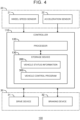
- FIG. 4 is a block diagram showing an example of the configuration of a vehicle control system 100 according to the first embodiment.
- the vehicle control system 100 controls the vehicle 1.
- the vehicle control system 100 is mounted on the vehicle 1.
- at least part of the vehicle control system 100 may be included in a remote system outside the vehicle 1, and the vehicle 1 may be remotely controlled.
- the vehicle control system 100 may be disposed in a distributed manner in the vehicle 1 and the remote system.
- the vehicle control system 100 includes a sensor group 20, a traveling apparatus 30, and a controller 110.
- the sensor group 20 is mounted on the vehicle 1 and detects the vehicle status of the vehicle 1.
- the sensor group 20 includes a wheel speed sensor 21, an acceleration sensor 22, and other sensors.
- the wheel speed sensor 21 detects the wheel speed of each wheel 5.
- the acceleration sensor 22 detects various accelerations including the longitudinal acceleration Gx of the vehicle 1.
- the traveling apparatus 30 is mounted on the vehicle 1.
- the traveling apparatus 30 includes a drive device 31 and a braking device 32.
- the drive device 31 drives the wheels 5.
- the drive device 31 is capable of driving the front wheels 5F and the rear wheels 5R independently of each other.
- the drive device 31 includes a front wheel motor that drives the front wheels 5F and a rear wheel motor that drives the rear wheels 5R.
- the drive device 31 may include in-wheel motors respectively provided in the wheels 5.
- the braking device 32 applies a braking force to each of the wheels 5 independently of one another.
- the controller 110 is a computer that controls the vehicle 1.
- the controller 110 includes one or plurality of processors 120 (hereinafter, simply referred to as processor 120) and one or plurality of storage devices 130 (hereinafter, simply referred to as storage device 130).
- the processor 120 executes various processing.
- the processor 120 includes a central processing unit (CPU).
- the storage device 130 stores various pieces of information. Examples of the storage device 130 include a volatile memory, a nonvolatile memory, a hard disk drive (HDD), and a solid state drive (SSD).
- the controller 110 may include one or plurality of electronic control units (ECUs). Part of the controller 110 may be an information processing apparatus outside the vehicle 1. In this case, part of the controller 110 communicates with the vehicle 1 and remotely controls the vehicle 1.
- Vehicle status information 200 indicates a vehicle status detected by the sensor group 20.
- the vehicle status information 200 includes the wheel speeds of the wheels 5, detected by the wheel speed sensor 21, the longitudinal acceleration Gx detected by the acceleration sensor 22, and the like.
- the controller 110 acquires the vehicle status information 200 from the sensor group 20.
- the vehicle status information 200 is stored in the storage device 130.
- a vehicle control program 300 is a computer program that is run by the processor 120.
- the controller 110 (processor 120) implements various processing by running the vehicle control program 300.
- the vehicle control program 300 is stored in the storage device 130.
- the vehicle control program 300 may be recorded in a computer-readable recording medium.
- the controller 110 executes torque control (driving force control) over the wheels 5. More specifically, the controller 110 calculates a target torque of each wheel 5. The controller 110 controls the operations of the drive device 31 and braking device 32 such that the target torque of each wheel 5 is obtained.
- the controller 110 performs traction control (TRC) as needed. More specifically, the controller 110 acquires an estimated vehicle body speed Ve based on the vehicle status information 200. The controller 110 calculates the slip ratio of each wheel 5 based on the wheel speeds of the wheels 5 and the estimated vehicle body speed Ve. When the slip ratio of any one or some of the wheels 5 exceeds a threshold, the controller 110 activates TRC.
- the TRC target wheel 5t is the wheel 5 of which the slip ratio exceeds the threshold.
- the controller 110 executes torque control such that the slip ratio of the TRC target wheel 5t decreases to a target slip ratio (for example, 10% to 15%).
- the controller 110 also has a function of the vehicle body speed estimation apparatus 10 according to the present embodiment.
- the controller 110 acquires an estimated vehicle body speed Ve based on the vehicle status information 200.
- the controller 110 performs the above-described torque limitation as needed.
- an example of a process related to torque limitation, executed by the controller 110, according to the present embodiment will be described.
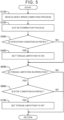
- FIG. 5 is a flowchart showing an example of a process related to torque limitation, executed by the controller 110, according to the first embodiment. The process flow shown in FIG. 5 is repeatedly executed at every predetermined cycle.
- Gx is a longitudinal acceleration (after filtering) detected by the acceleration sensor 22.
- the gain ⁇ is set in consideration of an error of the acceleration sensor 22.
- the offset OFST is added such that the second estimated vehicle body speed Ve2 is not undervalued at the time when the vehicle 1 runs from a flat road to a downhill road.
- the second estimated vehicle body speed Ve2 expressed by the mathematical expression (5) may be regarded as an estimated vehicle body speed that is estimated based on the integral of the sum of the longitudinal acceleration Gx and the offset OFST.
- step S200 the controller 110 executes a slip determination process to determine whether a wheel slip is occurring.
- the slip determination condition includes at least the condition that the first estimated vehicle body speed Ve1 based on wheel speeds is higher than the second estimated vehicle body speed Ve2 based on the longitudinal acceleration.
- the slip determination condition may include the condition that the duration of a state where the first estimated vehicle body speed Ve1 is higher than the second estimated vehicle body speed Ve2 is longer than or equal to a set period of time.
- the controller 110 determines that no wheel slip is occurring. On the other hand, when the slip determination condition is satisfied, the controller 110 determines that a wheel slip is occurring. The result of the slip determination process is used later.
- step S300 the controller 110 executes an operation condition determination process to determine whether the operation condition of torque limitation is satisfied.
- the process proceeds to step S400.
- the process skips step S400 and proceeds to step S500.
- the operation condition of torque limitation is defined based on the relationship between the estimated vehicle body speed Ve and the operation determination speed Va.
- FIG. 6 is a flowchart for illustrating a first example of the operation condition of torque limitation.
- the first example of the operation condition of torque limitation is a condition that a wheel slip is occurring and the estimated vehicle body speed Ve is higher than the operation determination speed Va.
- the controller 110 determines whether a wheel slip is occurring and the estimated vehicle body speed Ve is higher than the operation determination speed Va.
- the operation condition is not satisfied (No in step S300).
- the result of step S310 is affirmative (Yes in step S310), the operation condition is satisfied (Yes in step S300).
- FIG. 7 is a flowchart for illustrating a second example of the operation condition of torque limitation.
- the second example of the operation condition of torque limitation is a condition that TRC is in operation, a wheel slip is occurring, and the estimated vehicle body speed Ve is higher than the operation determination speed Va.
- the controller 110 determines whether TRC is in operation, a wheel slip is occurring, and the estimated vehicle body speed Ve is higher than the operation determination speed Va.
- the operation condition is not satisfied (No in step S300).
- the operation condition is satisfied (Yes in step S300).
- FIG. 8 is a flowchart for illustrating a third example of the operation condition of torque limitation.
- the third example is a modification of the first example.
- the third example of the operation condition of torque limitation is a condition that a wheel slip is occurring and the duration of a state where the estimated vehicle body speed Ve is higher than the operation determination speed Va is longer than or equal to a set period of time.
- the controller 110 increments a timer (step S330).
- the controller 110 resets the timer (step S340).
- the timer is less than a threshold (No in step S350)
- the operation condition is not satisfied (No step S300).
- the timer is greater than or equal to the threshold (Yes in step S350)
- the operation condition is satisfied (Yes in step S300).
- FIG. 9 is a flowchart for illustrating a fourth example of the operation condition of torque limitation.
- the fourth example is a modification of the second example.
- the fourth example of the operation condition of torque limitation is a condition that TRC is in operation, a wheel slip is occurring, and the duration of a state where the estimated vehicle body speed Ve is higher than the operation determination speed Va is longer than or equal to a set period of time.
- the controller 110 increments the timer (step S330).
- the controller 110 resets the timer (step S340).
- the timer is less than a threshold (No in step S350)
- the operation condition is not satisfied (No step S300).
- the timer is greater than or equal to the threshold (Yes in step S350)
- the operation condition is satisfied (Yes in step S300).
- step S400 the controller 110 performs torque limitation. Specifically, the controller 110 reduces the torque of a portion of the wheels 5 as compared to that before performing torque limitation. For example, the controller 110 reduces the torque of the rear wheels 5R without reducing the torque of the front wheels 5F. Reducing the torque of the rear wheels 5R not the front wheels 5F is desirable from the viewpoint of vehicle stability. As another example, the controller 110 may reduce the torque of the front wheels 5F without reducing the torque of the rear wheels 5R.
- FIG. 10 is a conceptual view for illustrating examples of limit torques at the time when torque limitation is performed.
- a front torque Tf and a rear torque Tr are respectively a target torque of the front wheels 5F and a target torque of the rear wheels 5R when TRC is not in operation.
- the front torque Tf and the rear torque Tr are calculated from an accelerator depression amount or the like.
- a front TRC torque Tf_trc and a rear TRC torque Tr_trc are respectively a target torque of the front wheels 5 and a target torque of the rear wheels 5R when TRC is in operation.
- the front TRC torque Tf_trc and the rear TRC torque Tr_trc are required from TRC.
- the front TRC torque Tf_trc and the rear TRC torque Tr_trc are respectively less than the front torque Tf and the rear torque Tr.
- a limit rear torque TRr is a target torque of torque limitation for the rear wheels 5R.
- the limit rear torque TRr is a product of the front torque Tf and a gain ⁇ or a product of the rear torque Tr and the gain ⁇ .
- the gain ⁇ is a constant greater than zero and less than one (0 ⁇ ⁇ ⁇ 1).
- TRC is in operation (see FIG. 7 and FIG. 9 )
- coordination is performed.
- the limit rear torque TRr may be the product of the rear TRC torque Tr_trc and the gain ⁇ .
- a limit front torque TRf is a target torque of torque limitation for the front wheels 5F.
- the limit front torque TRf is a product of the rear torque Tr and the gain ⁇ or a product of the front torque Tf and the gain ⁇ .
- TRC is in operation (see FIG. 7 and FIG. 9 )
- coordination is performed. For example, a smaller one of the product of the rear TRC torque Tr_trc and the gain ⁇ and the front TRC torque Tf_trc is output.
- the limit front torque TRf may be the product of the front TRC torque Tf_trc and the gain ⁇ .
- step S500 the controller 110 determines whether torque limitation is in operation. When torque limitation is in operation (Yes in step S500), the process proceeds to step S600. When torque limitation is not in operation (No in step S500), the process in this cycle ends.
- step S600 the controller 110 executes the stop condition determination process to determine whether the stop condition of torque limitation is satisfied.
- the stop condition of torque limitation is satisfied (Yes in step S600)
- the process proceeds to step S700.
- the stop condition of torque limitation is not satisfied (No in step S600)
- the process in this cycle ends.
- FIG. 11 is a flowchart for illustrating an example of the stop condition of torque limitation.
- the stop condition of torque limitation includes a condition that the estimated vehicle body speed Ve is lower than or equal to the stop determination speed Vb or a condition that the duration of a state where the wheel acceleration of a portion of the wheels 5, to which torque limitation is applied, is higher than zero is longer than or equal to a set period of time (see Section 1-2).
- the controller 110 determines whether the stop condition is satisfied.
- step S700 the controller 110 stops torque limitation.
- the accuracy of the estimated vehicle body speed Ve is ensured.
- FIG. 12 is a conceptual view for illustrating torque limitation according to a second embodiment.
- the second estimated vehicle body speed Ve2 expressed by the mathematical expression (5) is used as the estimated vehicle body speed Ve.
- the second estimated vehicle body speed Ve2 is an estimated vehicle body speed that is estimated based on the integral of the sum of the longitudinal acceleration Gx and the offset OFST.
- the offset OFST is added such that the second estimated vehicle body speed Ve2 is not undervalued at the time when the vehicle 1 runs from a flat road to a downhill road. Since the offset OFST is added, the second estimated vehicle body speed Ve2 also tends to be estimated to be higher. In other words, there is a possibility that an apparent increase also occurs in the second estimated vehicle body speed Ve2.
- a torque limitation process is also effective to the second estimated vehicle body speed Ve2.
- the operation determination speed Va and the stop determination speed Vb are similar to those in the case of the first embodiment.
- the configuration of the vehicle control system 100 is also similar to that in the case of the first embodiment.
- the description overlapping that of the first embodiment is omitted as needed.
- FIG. 13 is a flowchart showing a process related to torque limitation according to the second embodiment. Step S250 is added between step S200 and step S300 shown in FIG. 5 .
- the controller 110 determines whether a wheel slip is occurring.
- the slip determination condition includes the condition that the first estimated vehicle body speed Ve1 is higher than the second estimated vehicle body speed Ve2.
- the slip determination condition may include the condition that the duration of a state where the first estimated vehicle body speed Ve1 is higher than the second estimated vehicle body speed Ve2 is longer than or equal to a set period of time.
- step S250 the controller 110 switches the estimated vehicle body speed Ve in accordance with the result of step S200. More specifically, when a wheel slip is not occurring (No in step S251), the controller 110 sets the first estimated vehicle body speed Ve1 for the estimated vehicle body speed Ve. On the other hand, when a wheel slip is occurring (Yes in step S251), the controller 110 sets the second estimated vehicle body speed Ve2 for the estimated vehicle body speed Ve.
- the accuracy of the first estimated vehicle body speed Ve1 is high.
- the accuracy of the first estimated vehicle body speed Ve1 that depends on wheel speeds decreases, and the accuracy of the second estimated vehicle body speed Ve2 that does not depend on wheel speeds is higher than that of the first estimated vehicle body speed Ve1. Therefore, the accuracy of the estimated vehicle body speed Ve improves by switching the estimated vehicle body speed Ve from the first estimated vehicle body speed Ve1 to the second estimated vehicle body speed Ve2.
- the accuracy of the second estimated vehicle body speed Ve2 is also not always high. Since the offset OFST is added, there is a possibility that an apparent increase also occurs in the second estimated vehicle body speed Ve2. Therefore, torque limitation is also applied to the second estimated vehicle body speed Ve2. As a result of torque limitation, when the wheel speed of a portion of the wheels 5 decreases, a wheel slip is eliminated. When the wheel slip is eliminated (No in step S251), the estimated vehicle body speed Ve switches from the second estimated vehicle body speed Ve2 to the first estimated vehicle body speed Ve1 (step S252). In other words, the estimated vehicle body speed Ve is reset to the high-accuracy first estimated vehicle body speed Ve1. Thus, the accuracy of the estimated vehicle body speed Ve is ensured.
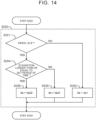
- FIG. 14 shows a modification of the second embodiment.
- two-type second estimated vehicle body speeds Ve21, Ve22 are used.
- the second estimated vehicle body speeds Ve21, Ve22 are respectively expressed by the following mathematical expressions (6) and (7).
- Ve21 Gx ⁇ ⁇ 1 + OFST 1 ⁇ Actual period of time
- Ve22 Gx ⁇ ⁇ 2 + OFST 2 ⁇ Actual period of time
- the gain ⁇ 2 in the mathematical expression (7) is less than the gain ⁇ 1 in the mathematical expression (6).
- the offset OFST2 in the mathematical expression (7) is less than the offset OFST1 in the mathematical expression (6).
- the second estimated vehicle body speed Ve22 is further lower than the second estimated vehicle body speed Ve21.
- step S200 the second estimated vehicle body speed Ve21 is used.
- the controller 110 sets the second estimated vehicle body speed Ve21 for the estimated vehicle body speed Ve (step S255).
- the controller 110 sets the second estimated vehicle body speed Ve22 for the estimated vehicle body speed Ve (step S256).
Landscapes
- Engineering & Computer Science (AREA)
- Transportation (AREA)
- Mechanical Engineering (AREA)
- Automation & Control Theory (AREA)
- Physics & Mathematics (AREA)
- Mathematical Physics (AREA)
- Chemical & Material Sciences (AREA)
- Combustion & Propulsion (AREA)
- Regulating Braking Force (AREA)
- Control Of Driving Devices And Active Controlling Of Vehicle (AREA)
- Arrangement And Driving Of Transmission Devices (AREA)
Claims (15)
- Fahrzeugkarosseriegeschwindigkeits-Schätzverfahren, das auf ein Fahrzeug (1) mit Vierradantrieb angewendet wird, wobei das Fahrzeugkarosseriegeschwindigkeits-Schätzverfahren Folgendes umfasst:Erfassen einer ersten geschätzten Fahrzeugkarosseriegeschwindigkeit auf der Grundlage der Raddrehzahlen;Berechnen einer zweiten geschätzten Fahrzeugkarosseriegeschwindigkeit auf der Grundlage eines Integrals über die Summe einer Längsbeschleunigung des Fahrzeugs (1) und eines Versatzes;Bestimmen, ob eine Schlupfbestimmungsbedingung erfüllt ist, die zumindest die Bedingung, dass die erste geschätzte Fahrzeugkarosseriegeschwindigkeit höher als die zweite geschätzte Fahrzeugkarosseriegeschwindigkeit ist, enthält;Einstellen der ersten geschätzten Fahrzeugkarosseriegeschwindigkeit für eine geschätzte Fahrzeugkarosseriegeschwindigkeit, wenn die Schlupfbestimmungsbedingung nicht erfüllt ist;Einstellen der zweiten geschätzten Fahrzeugkarosseriegeschwindigkeit für die geschätzte Fahrzeugkarosseriegeschwindigkeit, wenn die Schlupfbestimmungsbedingung erfüllt ist;Bestimmen, ob eine Betriebsbedingung erfüllt ist, die zumindest die Bedingung, dass die geschätzte Fahrzeugkarosseriegeschwindigkeit höher als eine Betriebsbestimmungsgeschwindigkeit ist, enthält;Durchführen einer Drehmomentbegrenzung, um ein Drehmoment eines Teils der Räder (5) des Fahrzeugs (1) zu verringern, wenn die Betriebsbedingung erfüllt ist;Bestimmen, ob eine Beendigungsbedingung erfüllt ist, die die Bedingung, dass die geschätzte Fahrzeugkarosseriegeschwindigkeit kleiner oder gleich einer Beendigungsbestimmungsgeschwindigkeit ist, oder die Bedingung, dass eine Dauer eines Zustands, in dem eine Radbeschleunigung des Teils der Räder (5) größer als null ist, länger als oder so lange wie ein eingestellter Zeitraum ist, enthält; undBeenden der Drehmomentbegrenzung, wenn die Beendigungsbedingung erfüllt ist.
- Fahrzeugkarosseriegeschwindigkeits-Schätzverfahren nach Anspruch 1, wobei die Drehmomentbegrenzung das Drehmoment der Hinterräder (5R) verringert, ohne das Drehmoment der Vorderräder (5F) zu verringern.
- Fahrzeugkarosseriegeschwindigkeits-Schätzverfahren nach Anspruch 1 oder 2, wobei die Betriebsbestimmungsgeschwindigkeit auf der Grundlage eines Integrals der Längsbeschleunigung berechnet wird.
- Fahrzeugkarosseriegeschwindigkeits-Schätzverfahren nach einem der Ansprüche 1 bis 3, wobei die Beendigungsbestimmungsgeschwindigkeit auf der Grundlage eines Integrals über die Längsbeschleunigung berechnet wird.
- Fahrzeugkarosseriegeschwindigkeits-Schätzverfahren nach Anspruch 4, wobei die Beendigungsbestimmungsgeschwindigkeit die Summe eines eingestellten Wertes und eines Wertes, der auf der Grundlage des Integrals über die Längsbeschleunigung berechnet wird, ist.
- Fahrzeugkarosseriegeschwindigkeits-Schätzverfahren nach einem der Ansprüche 1 bis 5, wobei die geschätzte Fahrzeugkarosseriegeschwindigkeit eine erste geschätzte Fahrzeugkarosseriegeschwindigkeit ist, die auf der Grundlage der Raddrehzahlen geschätzt wird.
- Fahrzeugkarosseriegeschwindigkeits-Schätzverfahren nach einem der Ansprüche 1 bis 5, wobei die geschätzte Fahrzeugkarosseriegeschwindigkeit eine zweite geschätzte Fahrzeugkarosseriegeschwindigkeit ist, die auf der Grundlage eines Integrals über die Summe aus der Längsbeschleunigung und einem Versatz geschätzt wird.
- Fahrzeugkarosseriegeschwindigkeits-Schätzverfahren nach Anspruch 1, wobei der Versatz ein erster Versatz ist, wobei das Verfahren ferner Folgendes umfasst:Berechnen einer dritten geschätzten Fahrzeugkarosseriegeschwindigkeit auf der Grundlage eines Integrals über die Summe aus der Längsbeschleunigung des Fahrzeugs und einem zweiten Versatz, der kleiner als der erste Versatz ist,wobei die dritte geschätzte Fahrzeugkarosseriegeschwindigkeit kleiner als die zweite geschätzte Fahrzeugkarosseriegeschwindigkeit ist;Einstellen der zweiten geschätzten Fahrzeugkarosseriegeschwindigkeit für die geschätzte Fahrzeugkarosseriegeschwindigkeit, wenn die Schlupfbestimmungsbedingung nicht länger als oder so lange wie ein eingestellter Zeitraum erfüllt ist;Einstellen der dritten geschätzten Fahrzeugkarosseriegeschwindigkeit für die geschätzte Fahrzeugkarosseriegeschwindigkeit, wenn die Schlupfbestimmungsbedingung länger als oder so lange wie der eingestellte Zeitraum erfüllt ist.
- Fahrzeugkarosseriegeschwindigkeits-Schätzverfahren nach einem der Ansprüche 1 bis 8, das ferner das Bestimmen, ob ein Radschlupf auftritt, umfasst, wobei die Betriebsbedingung zumindest die Bedingung, dass der Radschlupf auftritt, und die Bedingung, dass die geschätzte Fahrzeugkarosseriegeschwindigkeit höher als die Betriebsbestimmungsgeschwindigkeit ist, enthält.
- Fahrzeugkarosseriegeschwindigkeits-Schätzverfahren nach Anspruch 9, wobei die Betriebsbedingung die Bedingung, dass der Radschlupf auftritt und eine Dauer eines Zustands, in dem die geschätzte Fahrzeugkarosseriegeschwindigkeit höher als die Betriebsbestimmungsgeschwindigkeit ist, länger als oder so lange wie ein eingestellter Zeitraum ist, enthält.
- Fahrzeugkarosseriegeschwindigkeits-Schätzverfahren nach Anspruch 9 oder 10, wobei das Bestimmen, ob der Radschlupf auftritt, Folgendes enthält:Erfassen einer ersten geschätzten Fahrzeugkarosseriegeschwindigkeit auf der Grundlage der Raddrehzahlen;Berechnen einer zweiten geschätzten Fahrzeugkarosseriegeschwindigkeit auf der Grundlage eines Integrals über die Summe aus der Längsbeschleunigung und einem Versatz;Bestimmen, ob eine Schlupfbestimmungsbedingung erfüllt ist, die zumindest die Bedingung, dass die erste geschätzte Fahrzeugkarosseriegeschwindigkeit höher als die zweite geschätzte Fahrzeugkarosseriegeschwindigkeit ist, enthält; undBestimmen, dass der Radschlupf auftritt, wenn die Schlupfbestimmungsbedingung erfüllt ist.
- Fahrzeugkarosseriegeschwindigkeits-Schätzvorrichtung (10), die auf ein Fahrzeug (1) mit Vierradantrieb angewendet wird, wobei die Fahrzeugkarosseriegeschwindigkeits-Schätzvorrichtung (10) einen oder mehrere Prozessoren (120) umfasst, wobei der eine oder die mehreren Prozessoren (120) programmiert sind zum:Erfassen einer ersten geschätzten Fahrzeugkarosseriegeschwindigkeit auf der Grundlage der Raddrehzahlen;Berechnen einer zweiten geschätzten Fahrzeugkarosseriegeschwindigkeit auf der Grundlage eines Integrals über die Summe aus einer Längsbeschleunigung des Fahrzeugs (1) und einem Versatz; Bestimmen, ob eine Schlupfbestimmungsbedingung erfüllt ist, die zumindest die Bedingung, dass die erste geschätzte Fahrzeugkarosseriegeschwindigkeit höher als die zweite geschätzte Fahrzeugkarosseriegeschwindigkeit ist, enthält;Einstellen der ersten geschätzten Fahrzeugkarosseriegeschwindigkeit für eine geschätzte Fahrzeugkarosseriegeschwindigkeit, wenn die Schlupfbestimmungsbedingung nicht erfüllt ist;Einstellen der zweiten geschätzten Fahrzeugkarosseriegeschwindigkeit für die geschätzte Fahrzeugkarosseriegeschwindigkeit, wenn die Schlupfbestimmungsbedingung erfüllt ist;Bestimmen, ob eine Betriebsbedingung erfüllt ist, die zumindest die Bedingung, dass die geschätzte Fahrzeugkarosseriegeschwindigkeit höher als eine Betriebsbestimmungsgeschwindigkeit ist, enthält;Durchführen einer Drehmomentbegrenzung, um ein Drehmoment eines Teils der Räder (5) des Fahrzeugs (1) zu verringern, wenn die Betriebsbedingung erfüllt ist;Bestimmen, ob eine Beendigungsbedingung erfüllt ist, die die Bedingung, dass die geschätzte Fahrzeugkarosseriegeschwindigkeit kleiner oder gleich einer Beendigungsbestimmungsgeschwindigkeit ist, oder die Bedingung, dass eine Dauer eines Zustands, in dem eine Radbeschleunigung des Teils der Räder (5) größer als null ist, länger als oder so lange wie ein eingestellter Zeitraum ist, enthält; undAnhalten der Drehmomentbegrenzung, wenn die Beendigungsbedingung erfüllt ist.
- Fahrzeugkarosseriegeschwindigkeits-Schätzvorrichtung (10) nach Anspruch 12, wobei:der eine oder die mehreren Prozessoren (120) programmiert sind zu bestimmen, ob ein Radschlupf auftritt, unddie Betriebsbedingung zumindest die Bedingung, dass der Radschlupf auftritt, und die Bedingung, dass die geschätzte Fahrzeugkarosseriegeschwindigkeit höher als die Betriebsbestimmungsgeschwindigkeit ist, enthält.
- Fahrzeugkarosseriegeschwindigkeits-Schätzvorrichtung (10) nach Anspruch 13, wobei die Betriebsbedingung die Bedingung, dass der Radschlupf auftritt und eine Dauer eines Zustands, in dem die geschätzte Fahrzeugkarosseriegeschwindigkeit höher als die Betriebsbestimmungsgeschwindigkeit ist, länger als oder so lange wie ein eingestellter Zeitraum ist, enthält.
- Fahrzeugkarosseriegeschwindigkeits-Schätzvorrichtung (10) nach Anspruch 13 oder 14, wobei der eine oder die mehreren Prozessoren (120) ferner programmiert sind zum:Erfassen einer ersten geschätzten Fahrzeugkarosseriegeschwindigkeit auf der Grundlage der Raddrehzahlen;Berechnen einer zweiten geschätzten Fahrzeugkarosseriegeschwindigkeit auf der Grundlage eines Integrals über die Summe aus der Längsbeschleunigung und einem Versatz;Bestimmen, ob eine Schlupfbestimmungsbedingung erfüllt ist, die zumindest die Bedingung, dass die erste geschätzte Fahrzeugkarosseriegeschwindigkeit höher als die zweite geschätzte Fahrzeugkarosseriegeschwindigkeit ist, enthält; undBestimmen, dass der Radschlupf auftritt, wenn die Schlupfbestimmungsbedingung erfüllt ist.
Applications Claiming Priority (1)
| Application Number | Priority Date | Filing Date | Title |
|---|---|---|---|
| JP2021093199A JP7633093B2 (ja) | 2021-06-02 | 2021-06-02 | 車体速度推定方法及び車体速度推定装置 |
Publications (2)
| Publication Number | Publication Date |
|---|---|
| EP4098467A1 EP4098467A1 (de) | 2022-12-07 |
| EP4098467B1 true EP4098467B1 (de) | 2025-01-01 |
Family
ID=82156515
Family Applications (1)
| Application Number | Title | Priority Date | Filing Date |
|---|---|---|---|
| EP22175245.4A Active EP4098467B1 (de) | 2021-06-02 | 2022-05-24 | Verfahren und vorrichtung zur schätzung der geschwindigkeit eines fahrzeugs |
Country Status (4)
| Country | Link |
|---|---|
| US (1) | US12071133B2 (de) |
| EP (1) | EP4098467B1 (de) |
| JP (1) | JP7633093B2 (de) |
| CN (1) | CN115431992B (de) |
Family Cites Families (13)
| Publication number | Priority date | Publication date | Assignee | Title |
|---|---|---|---|---|
| JP2662959B2 (ja) * | 1987-10-27 | 1997-10-15 | 富士重工業株式会社 | 4輪駆動車用のスリップ検出装置 |
| JP2615085B2 (ja) * | 1987-10-27 | 1997-05-28 | 富士重工業株式会社 | 4輪駆動車のトラクション制御装置 |
| JP3318942B2 (ja) | 1992-01-14 | 2002-08-26 | 住友電気工業株式会社 | 推定車体速度等の算出装置 |
| JP3409439B2 (ja) * | 1994-06-17 | 2003-05-26 | 日産自動車株式会社 | 左右輪と前後輪の駆動力配分総合制御装置 |
| JP3642041B2 (ja) | 2001-06-26 | 2005-04-27 | 日産自動車株式会社 | 4輪駆動車の駆動力制御装置 |
| JP2006218921A (ja) * | 2005-02-09 | 2006-08-24 | Nissin Kogyo Co Ltd | 前後輪駆動車のトラクション制御装置 |
| JP4713408B2 (ja) * | 2006-06-07 | 2011-06-29 | トヨタ自動車株式会社 | 車両の制御装置 |
| JP2008261303A (ja) | 2007-04-13 | 2008-10-30 | Toyota Motor Corp | 車両のトラクションコントロール装置 |
| JP6396188B2 (ja) | 2014-11-27 | 2018-09-26 | Ntn株式会社 | 車両の車体速度推定装置 |
| CN108116233A (zh) * | 2016-11-29 | 2018-06-05 | 比亚迪股份有限公司 | 车辆及其车速计算方法和装置 |
| CN108248455B (zh) * | 2016-12-29 | 2020-07-10 | 比亚迪股份有限公司 | 四驱电动汽车的驱动防滑控制方法和装置 |
| US11584352B2 (en) * | 2018-10-09 | 2023-02-21 | Ford Global Technologies, Llc | Estimation of vehicle speed in all-wheel-drive vehicle |
| JP2021066336A (ja) * | 2019-10-24 | 2021-04-30 | 株式会社ジェイテクト | 4輪駆動車の制御装置 |
-
2021
- 2021-06-02 JP JP2021093199A patent/JP7633093B2/ja active Active
-
2022
- 2022-05-24 EP EP22175245.4A patent/EP4098467B1/de active Active
- 2022-05-24 US US17/751,805 patent/US12071133B2/en active Active
- 2022-05-25 CN CN202210575835.4A patent/CN115431992B/zh active Active
Also Published As
| Publication number | Publication date |
|---|---|
| CN115431992B (zh) | 2025-10-28 |
| US12071133B2 (en) | 2024-08-27 |
| EP4098467A1 (de) | 2022-12-07 |
| CN115431992A (zh) | 2022-12-06 |
| JP7633093B2 (ja) | 2025-02-19 |
| JP2022185479A (ja) | 2022-12-14 |
| US20220388513A1 (en) | 2022-12-08 |
Similar Documents
| Publication | Publication Date | Title |
|---|---|---|
| EP0270092A2 (de) | Radschlupf-Steuer-Vorrichtung | |
| CN102791544A (zh) | 车辆的制动力控制装置 | |
| US11648933B2 (en) | Method for controlling wheel slip of vehicle | |
| CN114291053B (zh) | 车辆的车轮滑动控制方法 | |
| KR102923143B1 (ko) | 노면 마찰계수 추정 장치 및 방법 | |
| US11858345B2 (en) | Apparatus for controlling wheel slip of vehicle and method thereof | |
| CN111770863B (zh) | 车辆控制方法及设备 | |
| JP2016178758A (ja) | 車両の制御装置及び車両の制御方法 | |
| US11332143B2 (en) | Method for controlling wheel slip of vehicle | |
| CN119037447A (zh) | 车辆纵向车速获取方法及系统、计算机程序产品 | |
| EP0274397B1 (de) | Kraftfahrzeug-Radgeschwindigkeitssteuervorrichtung | |
| KR20210014822A (ko) | 차량의 휠 슬립 제어 장치 및 제어 방법 | |
| WO2015079553A1 (ja) | トラクション制御装置及びトラクション制御方法 | |
| US20050082911A1 (en) | Slip regulation algorithm for an automotive vehicle using a normal force estimate and a predetermined peak wheel slip value | |
| EP4098467B1 (de) | Verfahren und vorrichtung zur schätzung der geschwindigkeit eines fahrzeugs | |
| US20250206291A1 (en) | Vehicle control unit, motor control unit, and related device | |
| JP2002104158A (ja) | 路面摩擦状態演算装置、タイヤ種別判定装置、タイヤ摩耗判定装置、路面傾斜推定装置及び加速度センサのオフセット補正装置 | |
| JP7169461B2 (ja) | 制御装置 | |
| CN120056943A (zh) | 车辆的制动能量回收与防抱死协同控制方法、装置及车辆 | |
| CN117842059A (zh) | 估计车辆速度的方法与系统 | |
| JP3651271B2 (ja) | 車両速度制御装置 | |
| US20260116374A1 (en) | Method for improving stability of a vehicle comprising dual clutches | |
| JP7600968B2 (ja) | 車両制御方法及び車両制御装置 | |
| CN120024338B (zh) | 车速的估算方法、估算装置及车辆 | |
| JP2020158028A (ja) | 電気自動車の重量推定装置および重量推定方法 |
Legal Events
| Date | Code | Title | Description |
|---|---|---|---|
| PUAI | Public reference made under article 153(3) epc to a published international application that has entered the european phase |
Free format text: ORIGINAL CODE: 0009012 |
|
| STAA | Information on the status of an ep patent application or granted ep patent |
Free format text: STATUS: REQUEST FOR EXAMINATION WAS MADE |
|
| 17P | Request for examination filed |
Effective date: 20220610 |
|
| AK | Designated contracting states |
Kind code of ref document: A1 Designated state(s): AL AT BE BG CH CY CZ DE DK EE ES FI FR GB GR HR HU IE IS IT LI LT LU LV MC MK MT NL NO PL PT RO RS SE SI SK SM TR |
|
| GRAP | Despatch of communication of intention to grant a patent |
Free format text: ORIGINAL CODE: EPIDOSNIGR1 |
|
| STAA | Information on the status of an ep patent application or granted ep patent |
Free format text: STATUS: GRANT OF PATENT IS INTENDED |
|
| INTG | Intention to grant announced |
Effective date: 20240726 |
|
| GRAS | Grant fee paid |
Free format text: ORIGINAL CODE: EPIDOSNIGR3 |
|
| GRAA | (expected) grant |
Free format text: ORIGINAL CODE: 0009210 |
|
| STAA | Information on the status of an ep patent application or granted ep patent |
Free format text: STATUS: THE PATENT HAS BEEN GRANTED |
|
| AK | Designated contracting states |
Kind code of ref document: B1 Designated state(s): AL AT BE BG CH CY CZ DE DK EE ES FI FR GB GR HR HU IE IS IT LI LT LU LV MC MK MT NL NO PL PT RO RS SE SI SK SM TR |
|
| REG | Reference to a national code |
Ref country code: GB Ref legal event code: FG4D |
|
| REG | Reference to a national code |
Ref country code: DE Ref legal event code: R096 Ref document number: 602022009245 Country of ref document: DE |
|
| REG | Reference to a national code |
Ref country code: CH Ref legal event code: EP |
|
| REG | Reference to a national code |
Ref country code: IE Ref legal event code: FG4D |
|
| REG | Reference to a national code |
Ref country code: LT Ref legal event code: MG9D |
|
| REG | Reference to a national code |
Ref country code: NL Ref legal event code: MP Effective date: 20250101 |
|
| REG | Reference to a national code |
Ref country code: AT Ref legal event code: MK05 Ref document number: 1755913 Country of ref document: AT Kind code of ref document: T Effective date: 20250101 |
|
| PG25 | Lapsed in a contracting state [announced via postgrant information from national office to epo] |
Ref country code: NL Free format text: LAPSE BECAUSE OF FAILURE TO SUBMIT A TRANSLATION OF THE DESCRIPTION OR TO PAY THE FEE WITHIN THE PRESCRIBED TIME-LIMIT Effective date: 20250101 |
|
| PG25 | Lapsed in a contracting state [announced via postgrant information from national office to epo] |
Ref country code: FI Free format text: LAPSE BECAUSE OF FAILURE TO SUBMIT A TRANSLATION OF THE DESCRIPTION OR TO PAY THE FEE WITHIN THE PRESCRIBED TIME-LIMIT Effective date: 20250101 |
|
| PG25 | Lapsed in a contracting state [announced via postgrant information from national office to epo] |
Ref country code: PL Free format text: LAPSE BECAUSE OF FAILURE TO SUBMIT A TRANSLATION OF THE DESCRIPTION OR TO PAY THE FEE WITHIN THE PRESCRIBED TIME-LIMIT Effective date: 20250101 |
|
| PGFP | Annual fee paid to national office [announced via postgrant information from national office to epo] |
Ref country code: DE Payment date: 20250402 Year of fee payment: 4 |
|
| PG25 | Lapsed in a contracting state [announced via postgrant information from national office to epo] |
Ref country code: ES Free format text: LAPSE BECAUSE OF FAILURE TO SUBMIT A TRANSLATION OF THE DESCRIPTION OR TO PAY THE FEE WITHIN THE PRESCRIBED TIME-LIMIT Effective date: 20250101 |
|
| PG25 | Lapsed in a contracting state [announced via postgrant information from national office to epo] |
Ref country code: NO Free format text: LAPSE BECAUSE OF FAILURE TO SUBMIT A TRANSLATION OF THE DESCRIPTION OR TO PAY THE FEE WITHIN THE PRESCRIBED TIME-LIMIT Effective date: 20250401 Ref country code: IS Free format text: LAPSE BECAUSE OF FAILURE TO SUBMIT A TRANSLATION OF THE DESCRIPTION OR TO PAY THE FEE WITHIN THE PRESCRIBED TIME-LIMIT Effective date: 20250501 |
|
| PG25 | Lapsed in a contracting state [announced via postgrant information from national office to epo] |
Ref country code: HR Free format text: LAPSE BECAUSE OF FAILURE TO SUBMIT A TRANSLATION OF THE DESCRIPTION OR TO PAY THE FEE WITHIN THE PRESCRIBED TIME-LIMIT Effective date: 20250101 |
|
| PG25 | Lapsed in a contracting state [announced via postgrant information from national office to epo] |
Ref country code: PT Free format text: LAPSE BECAUSE OF FAILURE TO SUBMIT A TRANSLATION OF THE DESCRIPTION OR TO PAY THE FEE WITHIN THE PRESCRIBED TIME-LIMIT Effective date: 20250502 Ref country code: LV Free format text: LAPSE BECAUSE OF FAILURE TO SUBMIT A TRANSLATION OF THE DESCRIPTION OR TO PAY THE FEE WITHIN THE PRESCRIBED TIME-LIMIT Effective date: 20250101 |
|
| PG25 | Lapsed in a contracting state [announced via postgrant information from national office to epo] |
Ref country code: GR Free format text: LAPSE BECAUSE OF FAILURE TO SUBMIT A TRANSLATION OF THE DESCRIPTION OR TO PAY THE FEE WITHIN THE PRESCRIBED TIME-LIMIT Effective date: 20250402 Ref country code: BG Free format text: LAPSE BECAUSE OF FAILURE TO SUBMIT A TRANSLATION OF THE DESCRIPTION OR TO PAY THE FEE WITHIN THE PRESCRIBED TIME-LIMIT Effective date: 20250101 |
|
| PG25 | Lapsed in a contracting state [announced via postgrant information from national office to epo] |
Ref country code: AT Free format text: LAPSE BECAUSE OF FAILURE TO SUBMIT A TRANSLATION OF THE DESCRIPTION OR TO PAY THE FEE WITHIN THE PRESCRIBED TIME-LIMIT Effective date: 20250101 |
|
| PG25 | Lapsed in a contracting state [announced via postgrant information from national office to epo] |
Ref country code: CZ Free format text: LAPSE BECAUSE OF FAILURE TO SUBMIT A TRANSLATION OF THE DESCRIPTION OR TO PAY THE FEE WITHIN THE PRESCRIBED TIME-LIMIT Effective date: 20250101 |
|
| PG25 | Lapsed in a contracting state [announced via postgrant information from national office to epo] |
Ref country code: SE Free format text: LAPSE BECAUSE OF FAILURE TO SUBMIT A TRANSLATION OF THE DESCRIPTION OR TO PAY THE FEE WITHIN THE PRESCRIBED TIME-LIMIT Effective date: 20250101 |
|
| REG | Reference to a national code |
Ref country code: DE Ref legal event code: R097 Ref document number: 602022009245 Country of ref document: DE |
|
| PG25 | Lapsed in a contracting state [announced via postgrant information from national office to epo] |
Ref country code: SM Free format text: LAPSE BECAUSE OF FAILURE TO SUBMIT A TRANSLATION OF THE DESCRIPTION OR TO PAY THE FEE WITHIN THE PRESCRIBED TIME-LIMIT Effective date: 20250101 |
|
| PG25 | Lapsed in a contracting state [announced via postgrant information from national office to epo] |
Ref country code: DK Free format text: LAPSE BECAUSE OF FAILURE TO SUBMIT A TRANSLATION OF THE DESCRIPTION OR TO PAY THE FEE WITHIN THE PRESCRIBED TIME-LIMIT Effective date: 20250101 |
|
| PG25 | Lapsed in a contracting state [announced via postgrant information from national office to epo] |
Ref country code: IT Free format text: LAPSE BECAUSE OF FAILURE TO SUBMIT A TRANSLATION OF THE DESCRIPTION OR TO PAY THE FEE WITHIN THE PRESCRIBED TIME-LIMIT Effective date: 20250101 |
|
| PG25 | Lapsed in a contracting state [announced via postgrant information from national office to epo] |
Ref country code: EE Free format text: LAPSE BECAUSE OF FAILURE TO SUBMIT A TRANSLATION OF THE DESCRIPTION OR TO PAY THE FEE WITHIN THE PRESCRIBED TIME-LIMIT Effective date: 20250101 |
|
| PG25 | Lapsed in a contracting state [announced via postgrant information from national office to epo] |
Ref country code: RO Free format text: LAPSE BECAUSE OF FAILURE TO SUBMIT A TRANSLATION OF THE DESCRIPTION OR TO PAY THE FEE WITHIN THE PRESCRIBED TIME-LIMIT Effective date: 20250101 |
|
| PG25 | Lapsed in a contracting state [announced via postgrant information from national office to epo] |
Ref country code: SK Free format text: LAPSE BECAUSE OF FAILURE TO SUBMIT A TRANSLATION OF THE DESCRIPTION OR TO PAY THE FEE WITHIN THE PRESCRIBED TIME-LIMIT Effective date: 20250101 |
|
| PLBE | No opposition filed within time limit |
Free format text: ORIGINAL CODE: 0009261 |
|
| STAA | Information on the status of an ep patent application or granted ep patent |
Free format text: STATUS: NO OPPOSITION FILED WITHIN TIME LIMIT |
|
| REG | Reference to a national code |
Ref country code: CH Ref legal event code: L10 Free format text: ST27 STATUS EVENT CODE: U-0-0-L10-L00 (AS PROVIDED BY THE NATIONAL OFFICE) Effective date: 20251112 |
|
| 26N | No opposition filed |
Effective date: 20251002 |
|
| REG | Reference to a national code |
Ref country code: CH Ref legal event code: H13 Free format text: ST27 STATUS EVENT CODE: U-0-0-H10-H13 (AS PROVIDED BY THE NATIONAL OFFICE) Effective date: 20251223 |
|
| PG25 | Lapsed in a contracting state [announced via postgrant information from national office to epo] |
Ref country code: LU Free format text: LAPSE BECAUSE OF NON-PAYMENT OF DUE FEES Effective date: 20250524 |
|
| PG25 | Lapsed in a contracting state [announced via postgrant information from national office to epo] |
Ref country code: CH Free format text: LAPSE BECAUSE OF NON-PAYMENT OF DUE FEES Effective date: 20250531 |
|
| REG | Reference to a national code |
Ref country code: BE Ref legal event code: MM Effective date: 20250531 |
|
| PG25 | Lapsed in a contracting state [announced via postgrant information from national office to epo] |
Ref country code: MC Free format text: LAPSE BECAUSE OF FAILURE TO SUBMIT A TRANSLATION OF THE DESCRIPTION OR TO PAY THE FEE WITHIN THE PRESCRIBED TIME-LIMIT Effective date: 20250101 |
|
| REG | Reference to a national code |
Ref country code: DE Ref legal event code: R084 Ref document number: 602022009245 Country of ref document: DE |
|
| PG25 | Lapsed in a contracting state [announced via postgrant information from national office to epo] |
Ref country code: IE Free format text: LAPSE BECAUSE OF NON-PAYMENT OF DUE FEES Effective date: 20250524 |
|
| PG25 | Lapsed in a contracting state [announced via postgrant information from national office to epo] |
Ref country code: BE Free format text: LAPSE BECAUSE OF NON-PAYMENT OF DUE FEES Effective date: 20250531 |
|
| PG25 | Lapsed in a contracting state [announced via postgrant information from national office to epo] |
Ref country code: FR Free format text: LAPSE BECAUSE OF NON-PAYMENT OF DUE FEES Effective date: 20250531 |