EP4097418B1 - Baumaschine mit einem messsystem - Google Patents
Baumaschine mit einem messsystem Download PDFInfo
- Publication number
- EP4097418B1 EP4097418B1 EP20704443.9A EP20704443A EP4097418B1 EP 4097418 B1 EP4097418 B1 EP 4097418B1 EP 20704443 A EP20704443 A EP 20704443A EP 4097418 B1 EP4097418 B1 EP 4097418B1
- Authority
- EP
- European Patent Office
- Prior art keywords
- sensor
- connecting element
- construction machine
- screed
- measuring system
- Prior art date
- Legal status (The legal status is an assumption and is not a legal conclusion. Google has not performed a legal analysis and makes no representation as to the accuracy of the status listed.)
- Active
Links
Images










Classifications
-
- G—PHYSICS
- G01—MEASURING; TESTING
- G01B—MEASURING LENGTH, THICKNESS OR SIMILAR LINEAR DIMENSIONS; MEASURING ANGLES; MEASURING AREAS; MEASURING IRREGULARITIES OF SURFACES OR CONTOURS
- G01B5/00—Measuring arrangements characterised by the use of mechanical techniques
- G01B5/0002—Arrangements for supporting, fixing or guiding the measuring instrument or the object to be measured
-
- E—FIXED CONSTRUCTIONS
- E02—HYDRAULIC ENGINEERING; FOUNDATIONS; SOIL SHIFTING
- E02F—DREDGING; SOIL-SHIFTING
- E02F9/00—Component parts of dredgers or soil-shifting machines, not restricted to one of the kinds covered by groups E02F3/00 - E02F7/00
- E02F9/26—Indicating devices
- E02F9/264—Sensors and their calibration for indicating the position of the work tool
- E02F9/265—Sensors and their calibration for indicating the position of the work tool with follow-up actions (e.g. control signals sent to actuate the work tool)
-
- E—FIXED CONSTRUCTIONS
- E01—CONSTRUCTION OF ROADS, RAILWAYS, OR BRIDGES
- E01C—CONSTRUCTION OF, OR SURFACES FOR, ROADS, SPORTS GROUNDS, OR THE LIKE; MACHINES OR AUXILIARY TOOLS FOR CONSTRUCTION OR REPAIR
- E01C19/00—Machines, tools or auxiliary devices for preparing or distributing paving materials, for working the placed materials, or for forming, consolidating, or finishing the paving
- E01C19/22—Machines, tools or auxiliary devices for preparing or distributing paving materials, for working the placed materials, or for forming, consolidating, or finishing the paving for consolidating or finishing laid-down unset materials
- E01C19/43—Machines or arrangements for roughening or patterning freshly-laid paving courses, e.g. indenting rollers
-
- E—FIXED CONSTRUCTIONS
- E01—CONSTRUCTION OF ROADS, RAILWAYS, OR BRIDGES
- E01C—CONSTRUCTION OF, OR SURFACES FOR, ROADS, SPORTS GROUNDS, OR THE LIKE; MACHINES OR AUXILIARY TOOLS FOR CONSTRUCTION OR REPAIR
- E01C19/00—Machines, tools or auxiliary devices for preparing or distributing paving materials, for working the placed materials, or for forming, consolidating, or finishing the paving
- E01C19/48—Machines, tools or auxiliary devices for preparing or distributing paving materials, for working the placed materials, or for forming, consolidating, or finishing the paving for laying-down the materials and consolidating them, or finishing the surface, e.g. slip forms therefor, forming kerbs or gutters in a continuous operation in situ
-
- E—FIXED CONSTRUCTIONS
- E01—CONSTRUCTION OF ROADS, RAILWAYS, OR BRIDGES
- E01C—CONSTRUCTION OF, OR SURFACES FOR, ROADS, SPORTS GROUNDS, OR THE LIKE; MACHINES OR AUXILIARY TOOLS FOR CONSTRUCTION OR REPAIR
- E01C23/00—Auxiliary devices or arrangements for constructing, repairing, reconditioning, or taking-up road or like surfaces
- E01C23/01—Devices or auxiliary means for setting-out or checking the configuration of new surfacing, e.g. templates, screed or reference line supports; Applications of apparatus for measuring, indicating, or recording the surface configuration of existing surfacing, e.g. profilographs
-
- G—PHYSICS
- G01—MEASURING; TESTING
- G01B—MEASURING LENGTH, THICKNESS OR SIMILAR LINEAR DIMENSIONS; MEASURING ANGLES; MEASURING AREAS; MEASURING IRREGULARITIES OF SURFACES OR CONTOURS
- G01B17/00—Measuring arrangements characterised by the use of infrasonic, sonic or ultrasonic vibrations
-
- G—PHYSICS
- G01—MEASURING; TESTING
- G01B—MEASURING LENGTH, THICKNESS OR SIMILAR LINEAR DIMENSIONS; MEASURING ANGLES; MEASURING AREAS; MEASURING IRREGULARITIES OF SURFACES OR CONTOURS
- G01B21/00—Measuring arrangements or details thereof, where the measuring technique is not covered by the other groups of this subclass, unspecified or not relevant
- G01B21/02—Measuring arrangements or details thereof, where the measuring technique is not covered by the other groups of this subclass, unspecified or not relevant for measuring length, width, or thickness
- G01B21/04—Measuring arrangements or details thereof, where the measuring technique is not covered by the other groups of this subclass, unspecified or not relevant for measuring length, width, or thickness by measuring coordinates of points
- G01B21/045—Correction of measurements
-
- G—PHYSICS
- G01—MEASURING; TESTING
- G01B—MEASURING LENGTH, THICKNESS OR SIMILAR LINEAR DIMENSIONS; MEASURING ANGLES; MEASURING AREAS; MEASURING IRREGULARITIES OF SURFACES OR CONTOURS
- G01B21/00—Measuring arrangements or details thereof, where the measuring technique is not covered by the other groups of this subclass, unspecified or not relevant
- G01B21/02—Measuring arrangements or details thereof, where the measuring technique is not covered by the other groups of this subclass, unspecified or not relevant for measuring length, width, or thickness
- G01B21/04—Measuring arrangements or details thereof, where the measuring technique is not covered by the other groups of this subclass, unspecified or not relevant for measuring length, width, or thickness by measuring coordinates of points
- G01B21/047—Accessories, e.g. for positioning, for tool-setting, for measuring probes
-
- G—PHYSICS
- G01—MEASURING; TESTING
- G01B—MEASURING LENGTH, THICKNESS OR SIMILAR LINEAR DIMENSIONS; MEASURING ANGLES; MEASURING AREAS; MEASURING IRREGULARITIES OF SURFACES OR CONTOURS
- G01B21/00—Measuring arrangements or details thereof, where the measuring technique is not covered by the other groups of this subclass, unspecified or not relevant
- G01B21/02—Measuring arrangements or details thereof, where the measuring technique is not covered by the other groups of this subclass, unspecified or not relevant for measuring length, width, or thickness
- G01B21/08—Measuring arrangements or details thereof, where the measuring technique is not covered by the other groups of this subclass, unspecified or not relevant for measuring length, width, or thickness for measuring thickness
-
- E—FIXED CONSTRUCTIONS
- E01—CONSTRUCTION OF ROADS, RAILWAYS, OR BRIDGES
- E01C—CONSTRUCTION OF, OR SURFACES FOR, ROADS, SPORTS GROUNDS, OR THE LIKE; MACHINES OR AUXILIARY TOOLS FOR CONSTRUCTION OR REPAIR
- E01C19/00—Machines, tools or auxiliary devices for preparing or distributing paving materials, for working the placed materials, or for forming, consolidating, or finishing the paving
- E01C19/004—Devices for guiding or controlling the machines along a predetermined path
- E01C19/006—Devices for guiding or controlling the machines along a predetermined path by laser or ultrasound
-
- G—PHYSICS
- G01—MEASURING; TESTING
- G01B—MEASURING LENGTH, THICKNESS OR SIMILAR LINEAR DIMENSIONS; MEASURING ANGLES; MEASURING AREAS; MEASURING IRREGULARITIES OF SURFACES OR CONTOURS
- G01B21/00—Measuring arrangements or details thereof, where the measuring technique is not covered by the other groups of this subclass, unspecified or not relevant
- G01B21/22—Measuring arrangements or details thereof, where the measuring technique is not covered by the other groups of this subclass, unspecified or not relevant for measuring angles or tapers; for testing the alignment of axes
Definitions
- Examples of implementation relate to a construction machine with a measuring system.
- Fig. 4 shows a well-known road paver, such as the one used in the EP 0 542 297 A1 is described.
- the road paver is designated as a whole by the reference numeral 1 and comprises a crawler chassis 2 with which the road paver 1 travels on the prepared subsurface 4.
- a height-adjustable screed 10 which is articulated on the road paver 1 by means of a traction arm 12 at a traction point 14 ZP.
- the height of the traction point 14 ZP is adjustable by means of the cylinder 14 (not shown).
- the screed 10 In front of the screed 10 there is a supply 3 of asphalt material, this supply being kept constant essentially over the entire width range of the screed 10 by appropriate, known control of the speed of a screw-like conveyor device 4.
- the screed 10 floats on the asphalt of the road surface 16 to be finished.
- the thickness of the road surface to be finished before its final consolidation by road rollers is adjusted by regulating the height of the rear edge 10k of the screed 10. This height adjustment is achieved by changing the angle of attack of the screed 10 and is typically carried out by controlling adjusting cylinders that engage the front ends of the tension arms 12.
- the road paver comprises three ultrasonic sensors 5a, 5b, 5c, which are attached to a bracket 5h.
- the bracket 5h is attached to the towing arm 12.
- the three ultrasonic sensors 5a, 5b, 5c are used to scan a reference surface, which can be formed, for example, by an already completed or old road surface.
- the distance to the subsoil or to a reference is measured at one or more points.
- ultrasonic sensors have become established on the market for this purpose. These sensors are attached by means of booms, e.g., to a road paver's screed, a road paver's drawbar, and/or a road paver's chassis. In some applications, a so-called sonic ski is used, which combines several parallel measuring heads into one distance sensor.
- a plurality of distance sensors such as ultrasonic measuring heads or sensors based on a different measuring principle, such as lasers, are attached to the towing arm via a common rod.
- the rod extends in the direction of travel approximately along the length of the machine or even beyond it and is arranged in such a way that a distance to the ground can be measured at two, three or more measuring points along this rod or direction of travel.
- one sensor can be aligned to the applied layer, while another sensor is aligned to the ground for the layer to be applied.
- two or more More sensor heads are provided, with one sensor head being arranged in front of the screed and one sensor head being arranged behind the screed.
- This so-called Big Sonic Ski (or Big Ski) application has a number of advantages, such as the ability to suppress or average out systematic measurement errors, e.g., caused by stones on the ground.
- the disadvantage of this so-called Big Sonic Ski is that the assembly effort for the rods and the individual sensor heads is quite high. Given that such measuring systems are dismantled overnight to prevent possible theft, this assembly effort is cannot be ignored in daily workflows. Therefore, there is a need for an improved approach.
- the object of the present invention is to create a concept that enables measurement at at least two positions relative to the ground, whereby overall an improved compromise between installation effort, measuring range (in the sense of a large distance between the individual measuring points) and reliability.
- One embodiment provides a construction machine with a measuring system according to claim 1.
- the measuring system comprises a support that can be connected to the construction machine (or a component, such as the screed or the towing arm of the construction machine), e.g., such that the support extends along a subsurface.
- the support can extend laterally along a longitudinal axis of the construction machine.
- the support comprises at least a first section, wherein the first section has a plurality of sensor heads attached to or integrated with the first section for contactless measurement relative to a subsurface or, in general, a reference. These are, e.g., aligned parallel, i.e., have a scanning range that extends parallel or substantially parallel.
- the first section has a second connecting element on a second end face, wherein the second connecting element can be connected to a first connecting element in such a way that both a mechanical and an electrical connection is formed.
- an electrical connection is understood to mean a direct contact, an inductive connection or a contactless connection.
- the measuring system comprises a second section of the carrier, wherein the second section also has a plurality of attached/integrated (parallel) sensor heads.
- the second section has the first connecting element on a first end face, so that the second connecting element of the first section can be connected to the first connecting element of the second section.
- a second section can have a second connecting element on a second end face and/or the first section can have a first connecting element on a first end face.
- these two sections can be identical be designed so that not only two sections can be plugged together to form a carrier, but also a plurality of sections.
- Embodiments of the present invention are based on the finding that the use of attached/integrated sensor heads in a support that is divided into one or more sections can significantly reduce assembly effort. Because the connecting elements form a mechanical and an electrical connection simultaneously, no cabling is necessary. According to embodiments, the connection between the section and the construction machine can also be established via a corresponding connecting element. For example, the first section can be connected to the construction machine (which has a corresponding second section as a counterpart) using its first connecting element. Here, too, an electrical connection can be formed in addition to the mechanical connection. According to embodiments, the measuring system can be extended by the additional sections with attached/integrated sensor heads in order to be able to scan a large area simultaneously.
- a type of hook connection can be used.
- the first and/or the second connecting element can have a hook, so that the first connecting element and the second connecting element can be engaged by a rotational movement.
- the hook of the first or the second connecting element or the hooks of the first and the second connecting element can have an engagement surface that is open substantially perpendicular to the longitudinal direction of the respective section.
- the rotational movement is defined by an end stop, which requires contact between the first and the second end face or end surface.
- the first and/or the second connecting element may comprise an electrical coupler which extends substantially along the longitudinal direction of the respective section.
- a shearing movement of the two sections or of one section relative to a further connecting element can also form the connection.
- the first and/or the second connecting element can comprise a profile extending substantially perpendicular to the longitudinal direction of the respective section and having an end stop, so that the two connecting elements can be connected by a translational movement substantially perpendicular to the longitudinal direction of the respective section.
- the first connecting element has a lever mechanism, e.g., with an eccentric, in order to translationally fix the first connecting element to the second connecting element.
- the first and/or the second connecting element can each have an electrical coupler extending substantially perpendicular to the longitudinal direction of the respective section.
- the first connecting element can have a sleeve that extends substantially in the longitudinal direction of the respective section, and wherein the two connecting elements can be connected by inserting the second connecting element into the sleeve.
- the first and/or the second connecting element can have a respective electrical coupler that extends substantially longitudinally to the longitudinal direction of the respective section.
- the measuring system comprises a fastening element.
- This fastening element can be connected to the construction machine or a component of the construction machine and, for this purpose, has a first and/or a second connecting element. This can be done, for example, in such a way that the first section can be connected to the construction machine or the component of the construction machine.
- the first and/or the second section may have sensor heads aligned perpendicular to the longitudinal axis of the first and second sections on one longitudinal side.
- the sensor heads are directed towards the substrate (in the installed state), ie the sensor heads are directed towards the already applied layer or aligned to the substrate for the layer to be applied.
- the sensor heads are mounted or integrated, with a large number of them (i.e., at least three) per section.
- the measuring principles of the sensor heads can differ, i.e., the sensor heads can be designed, for example, as ultrasonic sensors, laser sensors, radar sensors, or the like.
- the sensor heads are spaced apart from one another, e.g., 10 cm, 20 cm, 33 cm, 40 cm, or generally in the range from 5 cm to 50 cm or 2 cm to 100 cm.
- the spacing can be adjusted accordingly depending on the measuring principle of the sensor heads.
- the spacing can, for example, be selected such that there is an even distribution across the respective section or across the carrier.
- the distance from sensor/sensor head to sensor/sensor head can change, for example, increase. This is advantageous for compensating for unevenness in the layer to be applied with certain frequencies/wavelengths.
- the measuring system can have at least one first further sensor head for each first and/or second section or each carrier, which is aligned parallel to the longitudinal axis and/or which is arranged on the first and/or second end face; and/or wherein the first further sensor head is designed to carry out a reference measurement.
- the measuring system can have a second sensor head for each first and/or second section, which is arranged along the longitudinal axis of the respective first and/or second section or of the carrier and is located on the opposite end face to the first further sensor head.
- the measuring system can have a reflector (e.g. parallel to the longitudinal axis) or an inclined reflector (e.g. inclined at 135° to the longitudinal axis) on the first and/or second end face.
- the reflector can also be integrated/formed in the receptacle of one and/or more sensor heads.
- the measuring system it would also be conceivable for the measuring system to have at least one additional sensor head per first and/or second section or per carrier, which is aligned parallel to the longitudinal axis and/or which is arranged on the first and/or second end face; the additional sensor head is designed to determine a distance to an object that performs a relative movement with respect to the construction machine or a component of the construction machine.
- measurements by the sensor heads are carried out essentially simultaneously, i.e., for example, within a time window of 3 s, 1 s, 0.5 s, 0.1 s, or less.
- Distance measurements to the substrate (reference, to the layer already applied or to the substrate for the layer to be applied) and/or to the object, and/or as reference measurement(s) are carried out essentially simultaneously (synchronous measurement within a time window, as stated above). This means that it is possible for all sensor heads arranged in the measuring system to carry out measurements essentially simultaneously.
- the first and/or the second section comprises a display, such as an LED, LED display.
- the display or LED display is designed to display a connection status between the first and second or each further section or to display information, e.g., regarding a deviation of the Measuring system or a control and/or regulation system connected to the measuring system.
- An LCD display or the like is also conceivable as a display, on which, for example, text and/or symbols are displayed.
- the measuring system can have a GNSS sensor, an inclination sensor, an infrared sensor, a temperature sensor, an attitude sensor (inertial measurement unit), or another sensor.
- each section can include lighting.
- the measuring system has a first connecting element on a (first) end face, wherein the first connecting element is connected to a second connecting element, which is fastened to the machine, for example, and on the second end face to which a further measuring system, e.g. a distance measuring system, is attached.
- a further measuring system e.g. a distance measuring system
- a calculation unit is designed to use the first measured value and the second measured value to determine a regression line together with a gradient of the regression line relative to the ground or the reference and, based on the gradient, to determine an angle which describes the gradient of the regression line and the position of the component of the construction machine relative to the ground or the reference.
- Components of construction machinery such as a screed, are monitored for their position. For example, there are angle or inclination sensors that measure the rotation of the screed around its longitudinal axis, i.e., the tilt of the screed relative to the ground. Since the screed, or components of construction machinery in general, are subject to significant disturbances, such as vibrations, mechanisms are required to compensate for these disturbances.
- the inclination is determined using different measuring principles in order to combine the advantages of different measuring principles in terms of "immunity to interference", accuracy, etc.
- Comparative examples which do not fall within the scope of the claims, provide a measuring system for a construction machine, wherein the measuring system has a carrier that can be connected to a component of the construction machine.
- the measuring system comprises at least a first, second, and third sensor head and a calculation unit.
- the first, second, and third sensor heads are connected to the carrier.
- a parallel alignment can again be achieved; the system according to aspect 1 can also be used.
- the sensor heads are designed to measure a first distance from the first sensor head to the ground or a reference in order to obtain a first measured value, or to measure a second distance from the second sensor head to a ground or a reference in order to obtain a second measured value, or to measure a third distance from the third sensor head to a ground or a reference in order to obtain a third measured value.
- the calculation unit is designed to determine, based on the first, second and third measured values, a regression line together with a gradient of the regression line relative to the ground or the reference and, based on the gradient, to determine an angle which describes the gradient of the regression line and thus the position of the component of the construction machine relative to the ground or the reference.
- the component may comprise a tension arm or a plank or a plank that is firmly, rigidly and/or at least rigidly connected via the tension arm during the working process, i.e. in particular with a firmly defined relationship or at least a relationship that is firmly defined during the working process.
- Comparative examples are based on the finding that a regression line, and in particular the position of the regression line in space, can be determined using three measured values. Assuming that the sensors (which are spaced apart from each other, for example) are arranged on a support that is arranged or attached at a known or fixed position relative to the component, the three measured values can be used to determine a regression line that is at a fixed angle to the component. For example, the regression line can be arranged parallel to the position of the component.
- a conclusion about a change in the position of the component can be drawn by observing the change in the position of the regression line.
- the regression line or the position of the sensor heads relative to the component (e.g., distance along the support and offset)
- the results of the regression line are particularly stable and robust. Furthermore, due to the rigid coupling via the carrier, the values change evenly, so that the position can advantageously be detected even despite disturbances (objects on the ground or vibrations). By determining the position of the regression line, the position, such as the inclination of a component, can be detected in a robust manner.
- the support can be arranged behind the screed, e.g., firmly connected to the screed.
- the support is then directed towards the layer just laid and, using the layer as a reference, enables the position of the screed to be determined.
- the support it would be conceivable for the support to extend along the longitudinal axis in order to determine the rotation of the screed about its longitudinal axis (Note: The longitudinal axis of the screed, for a road paver as described above, extends transversely to its direction of travel). If the support is arranged transversely to the longitudinal direction or at an angle (e.g., 45°), a profile and/or additionally a lateral inclination (in addition to the profile) can be determined.
- an angle e.g. 45°
- the measuring system can also be considered using an additional support with additional (three) sensors.
- This can, for example, be arranged behind the screed.
- two regression lines are determined, with a lateral offset of the first regression line relative to the second regression line corresponding to a layer thickness.
- This layer thickness measuring system is robust against rotations of the screed because, assuming that, for example, the two supports are aligned or parallel to each other, the regression lines also run parallel.
- the parallel offset corresponds to the layer thickness, regardless of the solid angle of the regression lines.
- a further comparative example provides a layer thickness measuring system.
- the layer thickness measuring system for a construction machine has a support and a further support that can be connected to a screed of the construction machine such that the support extends in front of the screed and the further support extends behind the screed. It further comprises a first, second, and third sensor head that is connected to the support and is designed to measure a first distance from the first sensor head to a subsurface or a reference in order to obtain a first measured value, and to measure a second distance from the second sensor head to a subsurface or a reference in order to obtain a second measured value; and to measure a third distance from the third sensor head to a subsurface or a reference in order to obtain a third measured value.
- first, second, and third sensor heads are provided, which are connected to a further support and are designed to measure a further first, second, and third distance from the further first, second, and third sensor heads to the subsurface/reference in order to obtain a further first, second, and third measured value.
- a calculation unit is configured to determine a regression line based on the first, second, and third measured values, and to determine a further regression line based on the further first, second, and third measured values.
- the calculation unit is configured to determine a layer thickness based on the position of the regression line relative to the further regression line.
- the layer thickness measuring system can be designed such that the relative positions of the carrier and the additional carrier are known, and thus the regression line and the additional regression line can be aligned so that they run parallel.
- the offset of the regression lines relative to each other represents or corresponds to the layer thickness or, more generally, allows for a conclusion.
- the measuring system can also be attached to another component, such as the chassis itself, in order to determine a position there.
- the measuring system can comprise four sensor heads, which are arranged, for example, on a common carrier.
- the calculation unit can be designed to define a regression line starting from a point cloud in order to determine the first, second, third, and fourth measured values.
- the regression line is thus Space arranged so that the distances to the points of the point cloud are minimal, for example.
- the measuring system can be extended by an inclination sensor, wherein the calculation unit is then designed, for example, to determine an absolute inclination of the component of the construction machine based on the absolute inclination determined by the inclination sensor, together with the angle determined via the regression line.
- a temporal averaging is performed for each measurement point or a temporal averaging of the regression parameters after repeated determination of these parameters.
- the averaging can also be performed locally or in a different way.
- the first and second sensor heads are typically spaced apart.
- the calculation unit can be configured to take the distance between the sensor heads into account. This is particularly important for determining the slope of the regression line.
- the calculation unit can be configured to generate a distance-related/position-related measurement from a time-related measurement using a speed signal, which can be generated from a distance signal or position signal, e.g., a GNSS signal. This makes it possible to react to stationary disturbances.
- Another comparative example is a construction machine, such as in particular a road construction machine with a measuring system or a layer thickness measuring system.
- a further comparative example provides a method for determining a position of a component of a construction machine using a measuring system with a carrier that can be connected to a component of the construction machine.
- the method has the following steps: determining, based on the first measured value, the second measured value, and the third measured value, a regression line together with a slope of the regression line relative to the ground; and determining, based on the slope an angle that describes the slope of the regression line and the position of the component of the construction machine relative to the ground.
- the method can also comprise the following steps: determining a further regression line together with a gradient of the further regression line relative to the subsurface based on the further first, second and third measured values; determining an angle that describes the gradient of the further regression line and the position of the component of the construction machine relative to the subsurface, based on the gradient; and determining a layer thickness based on the regression line and the further regression line.
- Another method relates to the determination of a layer thickness. This method comprises three steps: determining a regression line based on the first, second, and third measured values; and determining another regression line based on another first, second, and third measured values; and determining a layer thickness based on the position of the regression line relative to the other regression line.
- the method can also be computer-implemented according to comparative examples. Therefore, another comparative example relates to a computer program for carrying out the method according to one of the previous aspects.
- the main task of the road paver is to ensure continuous evenness during the paving process. However, due to a variety of different disturbances, this can be so influenced that the desired evenness is at least compromised.
- a crucial disadvantage of screed height leveling is that the measurement of the screed height information does not take place near the rear edge of the screed, but rather in the area of the screed auger. This ultimately represents a compromise solution so that, despite the screed's very sluggish behavior, a necessary dynamic reaction takes place at the traction point as soon as a control deviation in height occurs.
- the height leveling system adjusts the screed's traction point in such a way that the height deviation from the reference at the height sensing position (in the area of the screed auger) is corrected as quickly as possible. At this position, The height is precisely maintained relative to the reference.
- the reference height at the trailing edge of the screed can change beyond this point (height sensor in the area of the screed auger), so that over time, a different height is established at the trailing edge of the screed compared to the desired height target.
- the height of the trailing edge of the screed changes relative to the reference, which in turn represents a deviation from the desired height, which is not compensated for by the leveling system.
- a measuring system for a leveling system is, for example, in the US 5,356,238 shown.
- Comparative examples which do not fall within the scope of the claims, provide a control system for a road machine having a screed which is designed to adjust a pulling point of the screed.
- the control system comprises a first and a second control loop.
- the first control loop varies the pulling point depending on a first sensor value
- the second control loop varies the pulling point depending on a second sensor value.
- the first sensor value represents a distance (from the sensor) to a subsurface or a reference in the area of the screed
- the second sensor value represents a distance (from the sensor) to the subsurface or a reference in the area of the pulling point.
- the first control loop takes a first target value into account during the variation
- the second control loop takes a second target value into account during the variation.
- Comparative examples are based on the realization that splitting the control system into two control loops takes into account the situation in which different disturbances affect leveling.
- the control loop that controls the traction point area compensates for disturbances that directly affect the chassis. For example, this control loop can be designed with less lag than the other control loop to counteract the disturbance accordingly.
- the control loop that determines its measured values in the screed area essentially compensates for the disturbances that affect the screed. These disturbances interact not only between the chassis and traction point, as in the so-called second control loop, but also via the screed, including the "asphalt" mechanism, so that a more lagging control loop can be used here.
- the division of the two control loops increases the complexity of the control system, disturbances can be regulated more individually and significantly better.
- the first control loop is designed to be slower than the second control loop.
- each control loop can include a filter (first control loop, first filter, and/or second control loop, second filter).
- the first control loop is designed for low-frequency control and has, for example, a low-pass filter with a low cutoff frequency.
- the second control loop can, for example, be designed for high-frequency or higher-frequency control and include a low-pass filter with a higher cutoff frequency.
- a model is used to model the transfer behavior of the screed, as shown in the comparative examples.
- This model can take into account a speed or distance traveled by the construction machine, as shown in the comparative examples.
- the model can take into account a screed rotation around the longitudinal axis, a screed weight, and/or a tamper or vibration frequency of the screed.
- the model can take into account a viscosity and/or a temperature of the layer or road surface to be applied. Furthermore, factors such as angle of repose or material height in front of the screed can also be taken into account.
- the first control loop uses the model that has a speed, a screed rotation around the longitudinal axis, a viscosity, and/or a temperature as input variables.
- the first control loop and the second control loop are configured according to further comparative examples to account for the transfer behavior of the traction point adjustment and/or the transfer behavior of the screed.
- the transfer behavior of the traction point adjustment can be described by an IT behavior (integral behavior with a time component).
- the transfer behavior of the screed can be described, for example, approximately by a PT2 behavior (proportional behavior with a time component and a second-order delay).
- sensors can be designed as ultrasonic sensors, laser sensors, radar sensors, or more generally as distance sensors, which in the simplest case measure the distance to the substrate or the applied layer.
- a reference e.g., a rope, edge or curb, or a line.
- a total station as a sensor or laser receiver in combination with a central transmitter (3D control).
- Another comparison example relates to a screed control system with a control as explained above and an actuator for adjusting the towing point.
- the screed control system has a first sensor in the area of the screed and a second sensor in the area of the pulling point or is connected to it.
- Another comparison example relates to a construction machine, in particular a road construction machine with a corresponding control or screed control.
- Another comparative example provides a method for controlling a road construction machine with a screed.
- the method comprises the following steps: adjusting a pulling point of the screed using a first and second control loop, varying the pulling point in the first control loop as a function of a first sensor value; and varying the pulling point in the second control loop as a function of a second sensor value.
- the first sensor value represents a distance to the ground or to a reference.
- the second sensor value represents a distance to the ground or to the reference.
- the method can be computer-implemented.
- a sensor arrangement 100 is explained below with reference to aspect 1.
- this comprises a carrier 110, which comprises at least one section 111. At least two sensors 121, 122 are integrated (generally fastened) in this section 111. These sensors are arranged at a distance from one another.
- the carrier 110 comprises a second connecting element 132, which can be connected to a first connecting element (not shown).
- the connecting element 132 as well as the first connecting element (not shown) are designed to form, firstly, a mechanical connection and, secondly, an electrical connection.
- An electrical connection is understood to mean, for example, a contact connection, a contactless connection, such as, for example, an inductive connection.
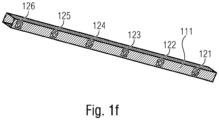
- the carrier 110 and thus also the section 111 can, for example, have a square shape (cf. carrier section 111 from Fig. 1f ). As can be seen in particular from Fig. 1f As can be seen, the integrated sensor elements 121, 122 ff. are integrated into the carrier and are all aligned in the same direction.
- all sensor heads 121, 122 et seq. are oriented toward the ground. In other words, this means that they have a scanning range that extends perpendicular to the longitudinal axis of the support 110 or section 111.
- sensor heads 121 and 122 can be transported together with section 111.
- Section 111 of the support can be connected via interface 132 either to a mounting device on the construction machine or to another section, as in Fig. 1b is shown.
- Fig. 1b shows a carrier 110' with a section 111 and a section 112.
- Each section comprises embedded sensor heads 121 and 122.
- the connection between the two sections 111 and 112 is established via connecting elements 131 and 132, which are compatible with each other and are each arranged on the end face.
- connecting elements 131 and 132 which are compatible with each other and are each arranged on the end face.
- each section 111 and 112 can also have further connecting elements 131 and 132 on the respective opposite end face.
- the carrier 110 may, for example, consist of a section 111 or of a plurality of sections 111 and 112. The following are described with reference to Fig. 1c and 1d different installation situations are explained.
- Fig. 1c shows section 111, which here includes connecting element 131.
- Connecting element 131 is connected to a connector 135, which has connecting element 132.
- Connector 135 is coupled to the machine.
- connector 135 extends in an S-shape below footboard 10t of screed 10, longitudinally rearward in the direction of travel.
- Sensor heads 121 and 122 are shown as examples. As can be seen, they are oriented such that the subsurface 16', or here the applied material layer 16', is scanned.
- the section 111 can be one or two meters long, or generally in the range of 50 to 300 cm.
- a cascading of the carrier 110 by connecting two sections 111 and 112 is possible. Fig. 1d shown.
- Fig. 1d shows a section 111 that is connected in alignment with a section 112.
- the two sections 111 and 112 together form the support 110 of the sensor arrangement.
- the sensor arrangement 110 is connected to the screed 10 via a connector 135', so that the sensor arrangement 110 extends rearward from the screed approximately in the direction of travel.
- a longer area can be scanned, optimizing handling, particularly during assembly and disassembly. This is achieved by making sections 111 and 112 separable from one another. and can thus be stored individually.
- the connecting elements 131 and 132 are designed in such a way that, in addition to the mechanical connection, an electrical connection is also formed. Therefore, no additional wiring is required to contact section 112, which significantly reduces the assembly effort.
- Fig. 1d shows a further exemplary installation situation on the pulling arm 12.
- a further holder 135' is arranged, which has both a first connecting element 131 and a second connecting element 132.
- the sensor arrangement 110' in turn comprises two sections 111 and 112, wherein both the section 111 is connected via its connecting element 132 to the connector 135' and the section 112 is connected to its connecting element 131.
- the element 135' which is firmly connected to the machine or the pulling arm 12 of the machine, lies between the two sections 111 and 112 of the carrier. Both sections are, as in the sensor arrangement 110 of Fig. 1d oriented in the same way, so that the substrate or the applied layer is scanned.
- This exemplary embodiment has therefore shown that not only cascading as in the arrangement 110 by series connection is possible, but also cascading by common connection with a common connector 135'.
- the measuring system it is of course also possible for the measuring system to have a third section, which is arranged in series, for example.
- this exemplary embodiment has shown that different attachment positions, e.g. on the screed 10 itself or on the tension arm 12, are possible. It is important that the element 135' is fixedly connected to the screed 10 or the tension arm 12. Screw connections, welded connections, or other connections are suitable for this. For example, this element 135' can remain directly connected to the machine, while the technology-bearing sensor elements/sections 111 and 112 are dismantled at night.
- the element 135' of the sensor arrangement 110' is in Fig. 1e shown.
- Fig. 1e shows the element 135', in which the section 111 is connected on the first side and the section 112 on the second side.
- the connecting element 135 is shaped as a type of sleeve, which corresponds in cross-sectional shape to the cross-section of the profiles 111 and 112 (here rectangular, alternatively other e.g. round cross-section), wherein the dimensioning, in particular the internal dimensioning of the sleeve of the element 135' is formed in such a way that the elements 111 and 112 can be inserted.
- the elements 111 and 112 can be secured using the screws 135s' shown here.
- the electrical connection is not shown.
- the element 135' is or can be rotated relative to the tension arm 12 in order to align the sensor arrangement 110 or 110' parallel to the ground. It should be noted at this point that this is not absolutely necessary, since the principle of using a regression line, which will be explained in connection with aspect 2, also allows for computational corrections.
- the sections 111 and 112 extend substantially in alignment in both the sensor arrangement 110 and the sensor arrangement 110', so that all sensors 121 and 122 have a substantially parallel scanning lobe.
- the section 111 can have a plurality of sensor heads 121 and 122, such as six sensor heads here. These are marked with the reference numerals 121 to 126.
- the arrangement can be equidistant, although another arrangement is also useful, as described below with reference to Fig. 1m The number may also vary accordingly (see explanations in connection with Fig. 1k and 11).
- the sensor heads 121 to 126 are embedded on one side of the rectangular profile, as shown in Fig. 1f and in Fig. 1g is shown.
- Fig. 1g represents an exemplary profile measuring 60 x 80 mm, with a sensor head 126 embedded on the narrower side 60. This can, for example, be clicked in or screwed in.
- the sensor head 126 is approximately flush, i.e., +/- 3 mm, +/- 10 mm, or +/- 20 mm, with the surface of the profile.
- the sensor head is an ultrasonic sensor, although other sensor technologies, such as laser or capacitive sensors, can also be used. Different measuring principles can also be used for the different sensor heads for each section 111 or each sensor arrangement 110.
- Fig. 1h shows the two sections 111 and 112, which are connected to each other by a connector 138.
- the sections 111 and 112 are simple profiles that are inserted into the connector 138 and connected on each side by means of the eccentric 138e.
- the profiles have the connecting elements 131 and 132 on the corresponding end faces, at which the connection to the connector 138 is made, whereby the connector 138 has the corresponding counterparts in order to form not only the mechanical but also the electrical connection.
- the electrical connector can be realized, for example, by a plug integrated into the connector 138, which is closed in the longitudinal direction of the sections 111 and 112.
- FIG. 1i Another example of a slide-in connector is shown in Fig. 1i shown.
- a modified connecting element 138' with the eccentric 138e is shown, into which the section 111 is inserted.
- the connecting element 138' can, for example, belong to the further section of the carrier or be firmly connected to the machine.
- a screw connection with a knurled screw instead of the eccentric 138e a screw connection with a knurled screw, as in Fig. 1e shown.
- profile 111 or 112 is inserted and secured by another means, such as an eccentric or a screw.
- a type of quick-release fastener, as is common on bicycles, or a bayonet lock would also be possible.
- section 111 can, for example, be designed with a closure cap 111v on one end face.
- Fig. 1j represents a further connection concept.
- the section 112 has a type of hook 131h' as the connecting element 131', so that the hook can be connected to an engagement section of the connecting element 132'.
- the engagement section of the element 132' is provided with the reference numeral 132e'.
- Element 112 in turn, has a cap on the opposite end face.
- the cap is designated by reference numeral 112v.
- connection options are also conceivable.
- the respective connecting element could also have guides extending orthogonally to the longitudinal direction, forming a type of dovetail joint.
- each section may comprise a plurality of sensor elements 121 ff.
- Fig. 1k It is assumed that section 100 has a length of 2 m (200 cm) and that the sensor heads 121-126 (here, six sensor heads) are evenly distributed. This results in a distance of 33 cm between the sensor heads, with 33/2 cm being provided from the front side to the first sensor head 121 or to the last sensor head 126.
- Fig. 1l shows a section 100 with a length of 2 m (200 cm), with five sensor heads 121-125 provided. The spacing is again equidistant, resulting in a distance of 40 cm between the sensor heads and 20 cm from the front to the first or last sensor head 121/125.
- Fig. 1o shows a comparison between a classic Big Sonic Ski (Big Ski for short) with a 12 m extension using three, four, and five sensors.
- the Big Sonic Ski with three sensors has problems in the 6 m range
- the Big Sonic Ski with four sensors has problems in the 4 m range
- the Big Sonic Ski with five sensors has problems in the 3 m range.
- the Big Sonic Ski with three sensors also has the same problems. By increasing the sensor density, these high-frequency problems (compared to vibrations) can be reduced in the range of 20 m and beyond.
- the improvement through the use of the Fig. 1 described (and according to the invention) sensor arrangement is shown in Fig. 1p This example assumes an 8 m long beam with three to six sensors. As the number of sensors increases, the control gaps become more frequent, but this is less critical given the lower probability of high-frequency interference.
- a non-equidistant sensor pattern can also be used per section according to further embodiments. Such examples are shown for a distance with five sensor heads 121-125 in Fig. 1m Here, the distance between the front face and the first sensor 121 increases from 20 cm. The distances are, for example, 32, 40, 46, and 58, as well as 4 cm.
- Fig. 1n shows another illustration, where equidistant sensors with a spacing of 44 cm are used again, but the distance between the front end and the first sensor 121 is selected such that an equidistance is maintained across two sections.
- the section between the front end and the first sensor is selected such that half the distance between the further sensor, or in particular, sensors 121 and 122, is present.
- Fig. 1q shows a section 111 with sensor heads 121 ff.
- One or each sensor head has a bracket 171 arranged at a defined distance in front of the sensor 121.
- This bracket 171 is located at least partially within the entire measuring field and can be folded in or rigid according to embodiments.
- the bracket 171 reflects the measurement signal, as shown here by the dashed line.
- a bracket is also provided for a sensor, here the sensor 125.
- the bracket has a reflector 172.
- the bracket is inserted into the holder 131', here a hook holder (cf. Fig. 1j ) integrated.
- the reflector 172 is located at a defined distance from the sensor 126 and can thus be used for reference measurement.
- Fig. 1s shows a further variant, wherein a further reflector 173 is provided in a laterally arranged bracket, which extends approximately perpendicular to the longitudinal extent of the section 111.
- This reflector 173 is again arranged at a distance from the sensor 126, but serves not only as a reference for the nearest sensor 126, but also for the sensors 125, ... 121 arranged adjacently.
- the reflector 173 can be arranged at an angle, e.g., 45° with respect to the measuring direction of the individual sensor heads 121 to 126.
- the reflector surface 173 can be curved in order to serve as a reflector for all channels 121 to 126.
- the bracket connecting the reflector 173 to the section 111 can either be attached directly to the section 111 or can be integrated into the connecting element, as for example in connection with Fig. 1r is shown.
- Fig. 1t is essentially comparable to the embodiment from Fig. 1s , where the reflector 174 has an active mirror which aligns itself depending on which channel (sensor head) is to be calibrated.
- the sensor heads 121 to 126 can be calibrated one after the other in order not to interfere with each other.
- the active reflector 174 it would also be conceivable for the active reflector 174 to be designed as an active transmitting unit, which then directs an ultrasonic signal to the receivers 121 to 126.
- an ultrasonic sensor 176 is used for reference measurement by means of a bracket 175 arranged below the sensor heads 121 to 126. Below here means between the support/section 111 and the road surface.
- the ultrasonic sensor 176 is arranged parallel to the support/section 111 and can be arranged, for example, by means of an additional reflector 177 on the other end face or between the end faces, for example in the middle (see dashed element 177').
- the active transmitter 176 which is arranged on the bracket 175, can cooperate with an active receiver 178, which is arranged on a bracket 175 on the other end.
- the reference measurement takes place in the area of the ultrasonic sensors 121 to 126. This has the advantage that the same ambient conditions, e.g., ambient temperature and infrared radiation, prevail here.
- Fig. 1i The measuring principle shown with active transmitter 176 and active receiver 178 is shown in Fig. 1i
- an active transmitter 176 is integrated into the element 138', while the receiver 178 is integrated into the closure cap 111v.
- a reflector 177 instead of the receiver 178.
- Fig. 1j A similar variant is shown in Fig. 1j shown.
- the transmitter 176 is integrated into the element 131', while the receiver or reflector 177 and 178 is integrated into the closure cap 112v.
- 176 with 177/178 in the embodiments of Fig. 1i and 1 year has been exchanged.
- measurements of the sensor heads are carried out essentially simultaneously (synchronous measurement within a time window, e.g., within a time window of 3 s, 1 s, 0.5 s, 0.1 s, or less).
- a simultaneous measurement a snapshot is essentially taken of, for example, the substrate or reference profile (the layer already applied or the substrate for the layer to be applied) and the reference measurement(s) under the same conditions (e.g., environmental conditions such as ambient temperature).
- Essentially simultaneous measurement is also advantageous in terms of a high measurement rate (sampling rate), as is required today for leveling in road construction (for example, leveling the height of the screed).
- Fig. 1g Another feature is explained.
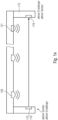
- Fig. 1g An LED 181 is also displayed on one end face. This can indicate, for example, by color coding or flashing, whether the electrical connections between the sections or from the section to the machine are correct. Furthermore, information such as necessary readjustments can also be displayed. Furthermore, it would also be conceivable that the LED, if it is, for example, on the ending end face at Fig. 1d the measuring arrangement 110, provides a signal regarding the distance to a vehicle traveling behind it, such as a roller.
- a further distance sensor can be aligned in the other direction on the front side, similar to the distance sensor for reference measurement 176, which then measures the distance to a following vehicle.
- a complex display such as an LCD display, can also be provided in order to display, for example, text and/or symbols.
- the following describes a measuring system 200 that uses a regression line to determine the position.
- the measuring system 200 comprises a support 210, which is arranged, for example, on a component, such as the screed 10 of the construction machine. As shown here, the component 10 is tilted, for example, by the angle ⁇ .
- the support extends, for example, from the component 10 backwards or forwards (not shown).
- the support 10 is also firmly connected to the component and thus changes its angular orientation in space according to the angle ⁇ .
- the sensor head 221 is arranged closer to the screed edge 10k, which represents a pivot point 10 of the screed, than sensor 223.
- the sensor head 222 is located in the middle or in between.
- A the distance to the perpendicular base point on the screed edge 10k
- B the distance from the perpendicular base point of the screed edge 10k to the sensor 223.
- the screed 10 can also have another pivot point, e.g., in front of the screed rear edge 10k (especially when it rests on hot asphalt), as an alternative to the pivot point around the screed rear edge 10k.
- the distances to the pivot point are taken into account accordingly.
- the sensors 221, 222 and 223 are arranged substantially parallel and measure a distance from the carrier 110 to the substrate, here the applied layer 16'.
- distance H1 is greater than distance H3.
- the sensor values can be recorded, for example, in a two-dimensional space, here height versus distance. Based on the sensor values, it can be seen that the regression line RG also runs according to angle ⁇ .
- the regression line RG when located in two-dimensional space, can be determined in such a way that angle ⁇ can be calculated. By determining angle ⁇ , the position of component 10 relative to the ground is also known.
- the position ⁇ does not necessarily have to be an absolute position, but can in particular be a relative position to the ground.
- the values H1 and H3 also change, although, assuming a parallel displacement, the angle ⁇ remains constant. Therefore, if slight fluctuations in the values occur, for example due to vibrations, these values can be plotted in the common space and a regression line RG determined. This represents an average. Using more than three sensors results in averaging if all sensors are arranged exactly on the carrier 210.
- the determination of the regression line RG for a point cloud is explained.
- the sensor array from aspect 1 can be used.
- the deviations, as shown here using the height points H1 to Hn, can arise, for example, from unevenness in the ground.
- the height values essentially increase from a to n, so that this can be inserted into the regression line RG here.
- the regression line RG is inserted, for example, in such a way that the distance between the regression line RG, shown here by small arrows, and the measuring points is minimal overall.
- the regression line is angled relative to the distance axis, e.g., by the angle ⁇ . This position can be determined and provides an indication of the angle of the component.
- the roll angle of the screed around its longitudinal axis can be determined. If, in addition to the longitudinal component, a transverse component is also present, a combination of the roll angle and the transverse inclination angle is determined. Knowing the transverse component to the longitudinal component, these two angles can be separated.
- the transverse component can, for example, be determined using the support from Fig. 2a with the sensors 221, 222 and 223 when it is arranged in the longitudinal direction of the screed (ie transverse to the direction of travel of the machine).
- the carrier runs without an angular offset relative to the component.
- An offset can also be taken into account.
- a calibration can be performed at the beginning or a comparison can be made with an optional angle sensor, such as an inclination sensor.
- the plank could also be fastened to the tension arm, for example.
- An example of such a fastening is explained in aspect 1, since here a beam comprising a plurality of of sections.
- This carrier has a plurality of integrated sensors, which then generates an averaging regression line according to the design of Fig. 2b corresponds.
- Fig. 2c shows the use of the sensors 221 and 223 by means of the carrier 210 and the use of another carrier 215 which houses the sensors 225 and 227.
- the sensor array 210 is as in Fig. 2a arranged behind the screed, while the sensor array 215 is arranged in front of the screed. A reversed arrangement would, of course, also be conceivable. It is assumed that both extend in the longitudinal direction.
- the resulting sensor values H1, H3, H4 and H6 are in two-dimensional space in Fig. 2d
- both regression lines RG1 and RG2 are tilted around the pivot point of the plank, namely the rear edge 10k of the plank, the regression lines are mapped to the corresponding RG1' and RG2', as shown in Fig. 2e
- the center distance in Fig. 2e runs parallel to the background or to the reference against which the measurement is made.
- the tilted regression lines RG1' and RG2' are no longer as in Fig. 2d They are not aligned with each other, but have an offset V.
- This offset V results from the fact that the array 210, associated with the regression line RG1, measures the layer 16' to be applied, while the sensor array 215 measures the substrate 17. This offset is therefore dependent on the layer thickness of the layer 16' to be applied. Conversely, this means that the layer thickness can be determined, i.e., calculated, using this approach.
- the distances A, B, C and D between the respective sensor 221, 223, 225 and 227 to the plumb line base point on the plank edge 10k are used during the rotation to perform the rotation.
- an ultrasound measurement measures the perpendicular to the ground, not the vertical line from the support to the ground.
- the variant shown represents a measurement using a laser or similar device.
- Fig. 3a shows a conventional control loop 300 (flatness control loop) used for leveling the screed 10, which is pulled by the towing arm 12.
- the towing arm 12 is fixedly connected to the screed 10, or at least during operation.
- the screed is towed by a tractor (not shown), for which purpose the towing arm 12 is connected to the tractor via the towing point.
- the towing point is typically adjustable in height, as illustrated here by arrow 14. This height adjustment is controlled by the flatness control loop 300.
- the screed smooths the asphalt or the material for the layer 16' to be applied, which is provided by the auger 18 in front of the screed (see material 16).
- the flatness control loop 300 includes a flatness controller 310, which controls the traction point cylinder (see reference numeral 14) based on a target/actual comparison 320. The result is a changed height, which is detected by the height sensor 330. The height sensor signal from the height sensor 330 is then fed to the target/actual comparison 320.
- a filter 335 can also be provided. This filter is designed either as a low-pass filter, a low-pass filter with a low/increased cutoff frequency, a band-pass filter, or a high-pass filter, depending on how the transmission behavior is to be corrected. Other frequency filters, such as Chebyshev filters or similar, are also conceivable in this context.
- the transmission behavior of the traction cylinder can be described using an IT 1 control loop (see block 342).
- the transmission behavior of the screed can be described as follows: in the sensor position, it is represented by a P behavior (see 344).
- the screed itself can be represented by a PT 2 element (see 346).
- Fig. 3b illustrates the thus interpreted transmission behavior of the controlled system from the trailing edge of the screed to the cylinder.
- Fig. 3b again shows the screed 10, which is pulled or adjusted in height via the pulling arm 12 at the pulling point 14 ZP by means of the pulling point cylinder 14.
- the basic idea behind optimizing the height leveling of screed 10 is the targeted monitoring of the paver screed, and in particular the trailing edge, using an additional control loop or the implementation of a control loop overlay to the existing height leveling.
- the control loop for normal height leveling acts as a subordinate control loop. This new control loop structure can be applied to all leveling tasks and will be discussed in detail below.
- control loop 350 shown here comprises two individual control loops 360 and 370.
- the control loop 360 is referred to as the first control loop or superimposed control loop.
- the control loop 370 is referred to as the second control loop.
- the control loop 370 is comparable to the control loop 300 as it is in relation to Fig. 3a explained, whereby the sensor 330 is positioned differently (see reference numeral 331).
- the sensor 331 is in the area of the pulling point 14 ZP and no longer in the area of the screw 18 (see arrangement Fig. 3b ).
- control loop 370 corresponds to control loop 300, i.e., it includes comparison 320, evenness controller 310, and optional filter 335.
- control loop 370 A significant difference, based on the positioning of the height sensor, is that in control loop 370, the transmission behavior of screed 344 no longer needs to be taken into account, but only the transmission behavior of the traction point cylinder (see reference numeral 342).
- the behavior of the screed, described by PT 2 (see reference numeral 346), is also taken into account by control loop 360.
- the control loop 360 also includes a height sensor 362 and an optional filter 364.
- the sensor 362 is arranged in the area of the screed 10 or, for example, in the area of the rear edge of the screed 10.
- the behavior of point 10k in response to a change in height at the traction point 14 ZP is relatively sluggish. This becomes quite clear when considering the arrangement of the screed 10, traction arm 12, and traction point 14 ZP, since the height cylinder 14 shifts the traction point 14 ZP around the pivot point 10k, so that a change in height only occurs gradually. This behavior is simulated by the Model Predictive Control 365.
- the input variable for the MPC 365 is the result of a target-actual comparison (see reference numeral 367), whereby the same signal from the sensor 362 is used as the actual signal.
- the result of the MPC is a target signal, which serves as the input for the comparison 320.
- control circuit 370 which is located in Fig. 3a shown, is extended by a control loop 360 superimposed on it, which is Fig. 3d
- This measure changes the structure of control loop 350 such that the disturbances acting on traction point 14 ZP and screed 10 can be compensated separately.
- the higher-level control loop compensates for the disturbances acting on screed 10, and the lower-level control loop 360 compensates for the disturbances that change the height of the traction point.
- the control system 350 structured in this way can be optimized separately, resulting in improved control behavior overall.
- a further optimization of the control loop structure results from shifting the sampling point of the height sensor for the subordinate flatness control loop 370 towards the pulling point 14 ZP.
- Fig. 3d shows a control loop 350 composed of two control loops 370 and 360.
- Each control loop includes at least one sensor, which in the case of control loop 360 is the height sensor 362, while in the case of control loop 370 it is the pull point sensor 331.
- the sensors are arranged in the area of the pulling point (see sensor 331) and on the screed (see sensor 361).
- Each control loop also includes a corresponding processor, which outputs the control signal for the traction point cylinder based on the actual value from sensors 331 and 362 and a target value.
- the processors are labeled 379 and 369, respectively.
- processors 369 and 379 can also be combined into one processor, which then receives the actual signals from the two sensors 331 and 362 and processes them separately before outputting the common control signal.
- the disturbances at the pulling point are compensated by the subordinate control loop 370 (evenness control loop)
- the disturbances of the screed 10 are compensated by the superimposed control loop 360. Due to the different transfer functions (see also Fig. 3b ) of the partial control system Werige (IT1) and the partial control system Bohle (PT2), the controllers used for this purpose are also structured and optimized differently.
- control deviations will be corrected extremely quickly, whereas the controller for the higher-level control loop 360 corrects control deviations more slowly and takes into account the knowledge of the influencing disturbances.
- An example of disturbances that influence the floating behavior of screed 10 is the effect of material temperature changes. If a temperature change in the material is already known before a temperature-dependent effect on the screed height occurs, the controller can avoid or reduce a height deviation of the screed based on a model.
- the model of screed 10 which describes the dependence of a height change on material temperature changes, must be known. This would also typically be an example of an MPC controller for the higher-level control loop 360.
- control loop structure 350 Different application cases of the control loop structure 350 are explained below.
- the single-head sonic sensor without a reference is suitable because the measurement distance to the existing asphalt surface at the trailing edge of the screed can be minimized. This significantly reduces the measurement error compared to larger distances. Minimizing the measurement distance is possible because the measurement distance to the ground is always approximately the same. In this application, the sensors focus as closely as possible on the ground.
- the Fig. 3f shows the mounting area and thus also the possible and useful scanning positions to realize the control loop structure.
- Fig. 3f shows the road paver from above with the screed 10, the applied layer 16' or existing layer 16*, the auger 18 and the tractor 11.
- the screed is connected to the traction point 14 ZP via the traction arm 12.
- a so-called Big Sonic Ski (short: Big Ski, see aspect 1) 100 can be connected to the towing arm 14 or the screed 10 (not shown).
- the Big Sonic Ski has the sensor 361 located in the area of the screed's trailing edge 10k.
- the sensor 331 can also be arranged on the Big Sonic Ski 100 at the height of the towing point.
- the scanning of the trailing edge of the screed for the screed control loop and the scanning for the traction point control loop can also be carried out on the side of an existing asphalt track 16*.
- a Sonic Ski 331* is provided via a side plate 10s for scanning at the level of the traction point 14 ZP.
- a screed trailing edge sensor 361* is also provided on the side plate. As shown, the Sonic Ski 331* is slightly offset with its scanning area outside the subgrade to scan the existing asphalt track 16*.
- sensor 331* on the side of the existing asphalt track 16* serves the purpose of using the existing asphalt track as a reference.
- sensor 331* scans the distance to the existing asphalt track 16*.
- the purpose of scanning the existing asphalt track 16* with the traction point control loop is to directly compensate for disturbances (e.g., material under the tractor's crawler track) that affect the traction point.
- sensor 361* is preferably directed at the existing asphalt layer 16* and monitors the height of the screed in relation to the existing asphalt track 16*, compensating for deviations from the set target value of the superimposed control loop 360.
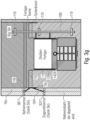
- Fig. 3g shows a road paver with a tractor 11, a screed 10, and a screed trailing edge 10k.
- the screed 10 is connected to the paver 11 via a towing arm 12.
- the Big Sonic Ski 100 with three sensors is provided on one of the towing arms 12.
- the sensors are marked with the reference numeral 110 for example; depending on the application, they can be evenly distributed along the Big Sonic Ski 100 or arranged in the area of the towing point 14 ZP or in the area of the screed trailing edge 10k.
- a sensor system can also be provided via the side plates 10s of the screed 10.
- a screed sensor 361* and a towing point sensor 331* can be provided. Both are directed towards a cable 16s in order to scan the cable 16s.
- the cable scanning at the trailing edge 10k of the plank can be carried out contactlessly with an ultrasonic sensor (sonic ski) or with a mechanical rotary encoder, as is usual in practice with the scanning methods currently used.
- the sensors 331*, 361* are guided over the reference cable 16s with a corresponding sensor mount 10k.
- the control deviation measured relative to the reference cable 16s at the trailing edge 10k of the plank also provides information about the installed evenness over the path.
- a second height sensor can be guided over the rope using an additional sensor mount.
- a Big Sonic-Ski system Big Ski for short
- a tension arm sensor See Fig. 3h .
- Fig. 3h shows the comparable structure as Fig. 3g of the road paver 11 with the screed 10.
- Sensor 361* is used as the screed sensor on the left side.
- the Big Sonic-Ski 100R is used as the towing point sensor on the left side. As previously explained, this is permanently connected to the towing arm 12 and has a plurality of sensors 110.
- Fig. 3i shows the screed 10 with the screed trailing edge 10k and the pulling arm 12, which is connected to the pulling cylinder 14 at the pulling point 14 ZP. Furthermore, a Big Sonic Ski 100, which is connected to the pulling arm 12, is also provided. The Big Sonic Ski 100 comprises three distance sensors 110, which in this embodiment together determine the distance at the pulling point 14 ZP.
- the screed trailing edge 10k is monitored using a total station 50 and a reflector 52 attached to the screed. This sensor, consisting of the elements 50+52, is referred to as a 3D sensor.
- 3D leveling with a total station 50 consists of a prism 52, which is mounted on the paver 11 or the screed 10 so that it is visible to the total station 50. The total station 50 then determines the 3D position of the prism in space and transmits this information wirelessly to the 3D control system on the paver.
- a major disadvantage of 3D control is that the installed height level must be checked repeatedly. In practice, this task is performed by a surveyor who uses an additional total station 50 to check the installed height and, if necessary, makes manual adjustments. This is necessary because the installation location of the prism (a 3D point in space, precisely determined by the total station via the reflection of a laser beam) is not at the rear edge of the screed, but rather, as is usually the case with other height sensors, on the drawbar at the height of the screed auger. This means that over a certain period of time, a change in the height at the rear edge of the screed occurs, which the surveyor must then correct.
- the control of the built-in height measurement could be avoided by placing the height sensor (prism) on the screed's rear edge 10k.
- the sensor then functions as a height sensor for the screed and is thus used in the superimposed 360 control loop as a supplier of height information.
- a Big Sonic Ski system Big Ski for short, which provides the altitude value for the subordinate control loop 370.
- two total stations 50 are required for leveling (one total station for each side). This is necessary because in this configuration, the sampling rate of the 3D height measurement must be high in order to compensate for all influencing disturbances.
- the sampling rate can be reduced so that one total station is sufficient for both sides, which then continuously and successively determines the left prism 52l and the right prism 52r in the position at the rear edge 10k of the pile.
- Fig. 3k is now used instead of the left Big Sonic-Ski 100 L, which is Fig. 3j served as a traction point control, the traction point sensor is also implemented as a laser sensor.
- a laser transmitter 54 provides a height reference, which can be received via the receivers 56z at the traction point 14 ZP and 56b on the screed 10.
- the new 350 control loop structure can also be applied when using a laser plane as a height reference.
- a laser receiver is mounted on both the towing arm and the trailing edge of the screed, acting as a height sensor in both cases.
- the projected laser plane precisely represents the desired position of the road with a corresponding height offset.
- Fig. 3k shows the basic leveling setup with a laser height reference on the left.
- the right side is leveled with a Big Sonic Ski System 100.
- other measuring elements such as inclination sensors or Sonic Skis can also be used to level the screed.
- Model Predictive Control extends the control loop structure as follows.
- a further improvement for the control system is that the controller for the higher-level control loop, whose associated sensor is mounted near the trailing edge of the screed, takes the respective process state into account.
- Each state is assigned a control value, which is responsible for calculating the controller output.
- the process state is predetermined using a process model.
- the process model is the foundation of Model Predictive Control, where the model comprehensively captures the process dynamics and can thus calculate predictions of the future process state.
- the process model is necessary to calculate the predicted output variables in a future instance.
- the various MPC strategies can use numerous models to demonstrate the relationship between the output variables and the measurable input variables.
- aspects have been described in connection with a device, it should be understood that these aspects also represent a description of the corresponding method, so that a block or component of a device can also be understood as a corresponding method step or as a feature of a method step. Analogously, aspects described in connection with or as a method step also represent a description of a corresponding block, detail, or feature of a corresponding device.
- Some or all of the method steps may be performed by (or using) a hardware apparatus, such as a microprocessor, a programmable computer, or an electronic circuit. In some embodiments, some or more of the key method steps may be performed by such an apparatus.
- embodiments of the invention may be implemented in hardware or software.
- the implementation may be performed using a digital storage medium, such as a floppy disk, a DVD, a Blu-ray Disc, a CD, a ROM, a PROM, an EPROM, an EEPROM, or a FLASH memory, a hard disk, or other magnetic or optical storage device storing electronically readable control signals that can interact or cooperate with a programmable computer system to perform the respective method. Therefore, the digital storage medium may be computer-readable.
- Some embodiments according to the invention thus comprise a data carrier having electronically readable control signals capable of interacting with a programmable computer system such that one of the methods described herein is carried out.
- embodiments of the present invention may be implemented as a computer program product having program code, wherein the program code is operable to perform one of the methods when the computer program product is run on a computer.
- the program code can, for example, also be stored on a machine-readable medium.
- inventions include the computer program for performing one of the methods described herein, wherein the computer program is stored on a machine-readable carrier.
- an embodiment of the method according to the invention is thus a computer program which has a program code for carrying out one of the methods described herein when the computer program runs on a computer.
- a further embodiment of the method according to the invention is thus a data carrier (or a digital storage medium or a computer-readable medium) on which the computer program for performing one of the methods described herein is recorded.
- the data carrier, the digital storage medium, or the computer-readable medium are typically tangible and/or non-perishable or non-transient.
- a further embodiment of the method according to the invention is thus a data stream or a sequence of signals that represents the computer program for carrying out one of the methods described herein.
- the data stream or the sequence of signals can be configured, for example, to be transferred via a data communication connection, for example, via the Internet.
- a further embodiment comprises a processing device, for example a computer or a programmable logic device, which is configured or adapted to perform one of the methods described herein.
- a processing device for example a computer or a programmable logic device, which is configured or adapted to perform one of the methods described herein.
- a further embodiment comprises a computer on which the computer program for performing one of the methods described herein is installed.
- a further embodiment according to the invention comprises a device or a system designed to transmit a computer program for performing at least one of the methods described herein to a recipient.
- the transmission can be electronic or optical, for example.
- the recipient can be, for example, a computer, a mobile device, a storage device, or a similar device.
- the device or system can, for example, comprise a file server for transmitting the computer program to the recipient.
- a programmable logic device e.g., a field-programmable gate array, an FPGA
- a field-programmable gate array may interact with a microprocessor to perform any of the methods described herein.
- the methods are performed by any hardware device. This may be general-purpose hardware such as a computer processor (CPU) or method-specific hardware such as an ASIC.
- the devices described herein may be implemented, for example, using a hardware apparatus, or using a computer, or using a combination of a hardware apparatus and a computer.
- the devices described herein, or any components of the devices described herein may be implemented at least partially in hardware and/or in software (computer program).
- the methods described herein may be implemented, for example, using a hardware apparatus, or using a computer, or using a combination of a hardware apparatus and a computer.
Landscapes
- Physics & Mathematics (AREA)
- General Physics & Mathematics (AREA)
- Engineering & Computer Science (AREA)
- Civil Engineering (AREA)
- Structural Engineering (AREA)
- Architecture (AREA)
- Mining & Mineral Resources (AREA)
- General Engineering & Computer Science (AREA)
- Road Paving Machines (AREA)
- Agricultural Chemicals And Associated Chemicals (AREA)
- Operation Control Of Excavators (AREA)
Priority Applications (3)
| Application Number | Priority Date | Filing Date | Title |
|---|---|---|---|
| EP23166085.3A EP4220070A1 (de) | 2020-01-31 | 2020-01-31 | Messsystem und steuerung |
| EP23166086.1A EP4224112B1 (de) | 2020-01-31 | 2020-01-31 | Baumaschine und verfahren zum steuern einer baumaschine |
| PL20704443.9T PL4097418T3 (pl) | 2020-01-31 | 2020-01-31 | Maszyna budowlana z układem pomiarowym |
Applications Claiming Priority (1)
| Application Number | Priority Date | Filing Date | Title |
|---|---|---|---|
| PCT/EP2020/052497 WO2021151511A1 (de) | 2020-01-31 | 2020-01-31 | Messsystem und steuerung |
Related Child Applications (4)
| Application Number | Title | Priority Date | Filing Date |
|---|---|---|---|
| EP23166086.1A Division EP4224112B1 (de) | 2020-01-31 | 2020-01-31 | Baumaschine und verfahren zum steuern einer baumaschine |
| EP23166086.1A Division-Into EP4224112B1 (de) | 2020-01-31 | 2020-01-31 | Baumaschine und verfahren zum steuern einer baumaschine |
| EP23166085.3A Division EP4220070A1 (de) | 2020-01-31 | 2020-01-31 | Messsystem und steuerung |
| EP23166085.3A Division-Into EP4220070A1 (de) | 2020-01-31 | 2020-01-31 | Messsystem und steuerung |
Publications (3)
| Publication Number | Publication Date |
|---|---|
| EP4097418A1 EP4097418A1 (de) | 2022-12-07 |
| EP4097418C0 EP4097418C0 (de) | 2025-03-12 |
| EP4097418B1 true EP4097418B1 (de) | 2025-03-12 |
Family
ID=69528784
Family Applications (3)
| Application Number | Title | Priority Date | Filing Date |
|---|---|---|---|
| EP23166085.3A Pending EP4220070A1 (de) | 2020-01-31 | 2020-01-31 | Messsystem und steuerung |
| EP23166086.1A Active EP4224112B1 (de) | 2020-01-31 | 2020-01-31 | Baumaschine und verfahren zum steuern einer baumaschine |
| EP20704443.9A Active EP4097418B1 (de) | 2020-01-31 | 2020-01-31 | Baumaschine mit einem messsystem |
Family Applications Before (2)
| Application Number | Title | Priority Date | Filing Date |
|---|---|---|---|
| EP23166085.3A Pending EP4220070A1 (de) | 2020-01-31 | 2020-01-31 | Messsystem und steuerung |
| EP23166086.1A Active EP4224112B1 (de) | 2020-01-31 | 2020-01-31 | Baumaschine und verfahren zum steuern einer baumaschine |
Country Status (6)
| Country | Link |
|---|---|
| US (1) | US12385231B2 (pl) |
| EP (3) | EP4220070A1 (pl) |
| CN (1) | CN115917245A (pl) |
| ES (1) | ES3030275T3 (pl) |
| PL (1) | PL4097418T3 (pl) |
| WO (1) | WO2021151511A1 (pl) |
Families Citing this family (8)
| Publication number | Priority date | Publication date | Assignee | Title |
|---|---|---|---|---|
| ES3030275T3 (en) | 2020-01-31 | 2025-06-27 | Moba Mobile Automation Ag | Construction machine with a measuring system |
| ES3029161T3 (en) | 2021-03-23 | 2025-06-23 | Moba Mobile Automation Ag | Measuring system |
| DE102022201294A1 (de) | 2022-02-08 | 2023-08-10 | Moba Mobile Automation Aktiengesellschaft | Nivelliersystem für eine Baumaschine |
| EP4303365A1 (de) * | 2022-07-04 | 2024-01-10 | Joseph Vögele AG | Strassenfertiger und verfahren zum regeln des betriebs |
| EP4495323A1 (en) | 2023-07-17 | 2025-01-22 | MOBA Mobile Automation AG | Sensor system for a construction machine |
| CN117661411B (zh) * | 2024-01-31 | 2024-04-02 | 淄博政达建设项目管理有限公司 | 一种城市道路的平整度检测设备 |
| EP4667657A1 (de) * | 2024-06-17 | 2025-12-24 | MOBA Mobile Automation AG | Verfahren und vorrichtung zur nivellierung einer strasse |
| CN118376145B (zh) * | 2024-06-26 | 2024-08-30 | 淄博展祥建筑安装有限公司 | 一种建筑工程用的建筑面积测量装置 |
Family Cites Families (67)
| Publication number | Priority date | Publication date | Assignee | Title |
|---|---|---|---|---|
| US3334560A (en) | 1964-05-25 | 1967-08-08 | George E Long | Control system for establishing predetermined surfaces |
| US3908765A (en) * | 1973-03-01 | 1975-09-30 | Honeywell Inc | Floating position proportional control system |
| GB8313339D0 (en) | 1983-05-14 | 1983-06-22 | Gen Electric Co Plc | Vehicle guidance |
| JPH02136405A (ja) * | 1988-11-15 | 1990-05-25 | Sumitomo Heavy Ind Ltd | 舗装厚検出装置 |
| JPH0749642B2 (ja) * | 1990-11-14 | 1995-05-31 | 株式会社新潟鐵工所 | 敷均し機械における舗装厚制御方法 |
| JPH0749641B2 (ja) * | 1990-11-14 | 1995-05-31 | 株式会社新潟鐵工所 | 敷均し機械における舗装厚制御方法 |
| WO1992008847A1 (fr) | 1990-11-14 | 1992-05-29 | Niigata Engineering Co., Ltd. | Procede pour reguler l'epaisseur d'un revetement de chaussee dans une niveleuse a moteur et procede pour selectionner les conditions permettant une commande automatique |
| US5327345A (en) | 1991-02-15 | 1994-07-05 | Laser Alignment, Inc. | Position control system for a construction implement such as a road grader |
| DE9214769U1 (de) | 1991-11-15 | 1993-04-01 | MOBA - Electronic Gesellschaft für Mobil-Automation mbH, 65604 Elz | Ultraschallsensor-Regeleinrichtung für einen Straßenfertiger |
| US5356238A (en) | 1993-03-10 | 1994-10-18 | Cedarapids, Inc. | Paver with material supply and mat grade and slope quality control apparatus and method |
| JP2505210Y2 (ja) | 1993-04-09 | 1996-07-24 | 建設省東北地方建設局長 | 舗装作業車の自動操向装置 |
| US5484227A (en) | 1993-04-09 | 1996-01-16 | Niigata Engineering Co., Ltd. | Control device for asphalt finisher |
| US5721685A (en) | 1995-06-29 | 1998-02-24 | Holland; Robert E. | Digi-track digital roadway and railway analyzer |
| US6287048B1 (en) | 1996-08-20 | 2001-09-11 | Edmund D. Hollon | Uniform compaction of asphalt concrete |
| DE29723171U1 (de) | 1997-03-06 | 1998-04-23 | ABG Allgemeine Baumaschinen-Gesellschaft mbH, 31785 Hameln | Walzeneinrichtung zur Verdichtung von Asphaltdecken |
| DE19755324A1 (de) | 1997-12-12 | 1999-06-17 | Michael Dipl Ing Sartori | Verfahren und Vorrichtung zum Steuern eines Fahrzeugs |
| US5975473A (en) * | 1998-03-12 | 1999-11-02 | Topcon Laser Systems, Inc. | Mounting device for non-contacting sensors |
| US5984420A (en) | 1998-05-29 | 1999-11-16 | Wirtgen America, Inc. | Grade averaging system with floating boom and method of using the same |
| DE19951296C2 (de) | 1999-10-25 | 2003-09-25 | Moba Mobile Automation Gmbh | Vorrichtung und Verfahren zum Steuern eines Strassenfertigers |
| ATE279584T1 (de) | 2000-01-19 | 2004-10-15 | Joseph Voegele Ag | Verfahren zum steuern einer baumaschine bzw. eines strassenfertigers und strassenfertiger |
| DE10038943A1 (de) * | 2000-08-09 | 2002-02-21 | Joseph Voegele Ag | Strassenfertiger und Einbauverfahren |
| DE10060903C2 (de) | 2000-12-07 | 2002-10-31 | Moba Mobile Automation Gmbh | Laser-Höhenregeleinrichtung für eine Baumaschine |
| DE10138563B4 (de) | 2001-08-06 | 2010-01-14 | Joseph Voegele Ag | Rad-Straßenfertiger und Verfahren zum Lenken eines Rad-Straßenfertigers |
| DE10234217B4 (de) | 2002-07-27 | 2009-02-05 | Hermann Kirchner Gmbh & Co Kg | Verfahren und Vorrichtung zur Ermittlung der Dicke einer Asphaltschicht |
| DE10242645A1 (de) | 2002-09-13 | 2004-03-25 | Magcode Ag | Verfahren und Vorrichtung zur Herstellung einer elektrischen Verbindung von Baugruppen und Modulen |
| ES2307717T3 (es) * | 2002-09-25 | 2008-12-01 | Tecnologia, Maquinaria Y Componentes, S.L. | Estructura de soporte y regulacion posicional para sistemas de nivelacion automatica. |
| US7172363B2 (en) * | 2004-08-31 | 2007-02-06 | Caterpillar Paving Products Inc | Paving machine output monitoring system |
| DE102005022266A1 (de) * | 2005-05-10 | 2006-11-16 | Abg Allgemeine Baumaschinen-Gesellschaft Mbh | Fertiger zum bodenseitigen Einbau von Schichten für Straßen oder dgl. |
| DE102006039799B3 (de) | 2006-08-24 | 2007-11-22 | Tyco Electronics Amp Gmbh | Elektrischer Stecker |
| EP2006448A1 (de) | 2007-06-21 | 2008-12-24 | Leica Geosystems AG | Einbauzug zum erstellen einer Belagschicht aus Beton- oder Asphalt-Material |
| US8132935B2 (en) * | 2008-09-01 | 2012-03-13 | Samsung Led Co., Ltd. | Light emitting module |
| CN201660836U (zh) | 2010-02-02 | 2010-12-01 | 德国Moba自动控制股份有限公司 | 非接触式平衡梁机械支架 |
| US8371769B2 (en) * | 2010-04-14 | 2013-02-12 | Caterpillar Trimble Control Technologies Llc | Paving machine control and method |
| CN201770931U (zh) | 2010-06-13 | 2011-03-23 | 江苏四明工程机械有限公司 | 用于路面机械的非接触超声波平均找平梁 |
| TWI415332B (zh) * | 2010-12-31 | 2013-11-11 | Lextar Electronics Corp | 電子電路模組及電性連接器 |
| EP2511781A1 (de) | 2011-04-14 | 2012-10-17 | Hexagon Technology Center GmbH | System und Verfahren zur Steuerung eines unbemannten Fluggeräts |
| EP2535458B2 (de) | 2011-06-15 | 2020-04-29 | Joseph Vögele AG | Straßenfertiger mit Schichtdickenmessvorrichtung |
| EP2535456B1 (de) * | 2011-06-15 | 2013-12-18 | Joseph Vögele AG | Straßenfertiger mit Schichtdickenmessvorrichtung |
| US10566753B2 (en) | 2011-09-16 | 2020-02-18 | Amphenol Fci Asia Pte. Ltd. | Hingeable connector assembly |
| DE102011113752B4 (de) | 2011-09-19 | 2021-05-06 | Bomag Gmbh | Fräsvorrichtung mit einer Sensoreinrichtung zur Fräskantenerkennung, Verfahren zur Fräskantenerkennung und Sensoreneinrichtung zur Fräskantenerkennung. |
| DE102011119272A1 (de) | 2011-11-24 | 2013-05-29 | Thomas Tennagels | Magnetischer Entkupplungsmechanismus für aneinander zu reihende leistenförmige Profile sowie Leisten mit einem derartigen Entkupplungsmechanismus |
| US8944719B2 (en) | 2012-11-09 | 2015-02-03 | Caterpillar Paving Products Inc. | Tracking of machine system movements in paving machine |
| PL2743399T3 (pl) | 2012-12-14 | 2016-03-31 | Joseph Voegele Ag | Maszyna budowlana z regulującym systemem pomocniczym dla jednostki sensorowej |
| DE102013008701B3 (de) | 2013-05-22 | 2014-10-09 | Audi Ag | Verfahren zum Betreiben einer Getriebeeinrichtung sowie entsprechende Getriebeeinrichtung |
| JP5709185B2 (ja) | 2013-08-22 | 2015-04-30 | 鹿島道路株式会社 | 敷き均し方法 |
| EP2869095B1 (de) * | 2013-10-29 | 2016-12-07 | Sick Ag | Optoelektronischer Sensor |
| US9529087B2 (en) | 2014-07-24 | 2016-12-27 | GM Global Technology Operations LLC | Curb detection using lidar with sparse measurements |
| CN104833367A (zh) | 2015-05-11 | 2015-08-12 | 京东方科技集团股份有限公司 | 车载投影系统 |
| JP6656673B2 (ja) | 2015-06-10 | 2020-03-04 | 株式会社Doog | 自律移動システム |
| EP3106562A1 (en) | 2015-06-19 | 2016-12-21 | TF-Technologies A/S | Correction unit |
| DE102015008315A1 (de) * | 2015-06-30 | 2017-01-05 | Dynapac Gmbh | Einbaubohle und Straßenfertiger |
| EP3130939A1 (de) * | 2015-08-13 | 2017-02-15 | Joseph Vögele AG | Strassenfertiger mit einer radarbasierten nivelliereinrichtung und steuerverfahren |
| DE102015216060A1 (de) * | 2015-08-21 | 2017-02-23 | Mts Maschinentechnik Schrode Ag | Verbindungsanordnung |
| DE202016100093U1 (de) | 2016-01-12 | 2017-04-20 | Joseph Vögele AG | Straßenfertiger mit Projektor als Navigationshilfe |
| EP3228747B1 (de) | 2016-04-08 | 2018-07-04 | Joseph Vögele AG | Strassenfertiger mit haltevorrichtung zum tragen und positionieren einer sensoreinheit |
| EP3382098B1 (de) * | 2017-03-29 | 2019-03-27 | Joseph Vögele AG | Strassenfertiger mit haltevorrichtung zum tragen und positionieren einer sensoreinheit |
| DE102017010238A1 (de) | 2017-11-03 | 2019-05-09 | Bomag Gmbh | Messung der Einbauschichtdicke durch Straßenwalze |
| EP3874296B1 (de) | 2018-11-02 | 2025-02-26 | MOBA Mobile Automation AG | Sensorsystem für einen strassenfertiger |
| CN109356005A (zh) * | 2018-12-07 | 2019-02-19 | 石家庄辰启科技有限公司 | 摊铺机熨平板平衡测控系统及摊铺机 |
| EP3712328B1 (de) | 2019-03-20 | 2022-11-23 | MOBA Mobile Automation AG | Baumaschine mit messsystem |
| EP3835485B1 (de) | 2019-12-11 | 2022-08-24 | MOBA Mobile Automation AG | Messsystem für eine baumaschine |
| ES3030275T3 (en) | 2020-01-31 | 2025-06-27 | Moba Mobile Automation Ag | Construction machine with a measuring system |
| US11550058B2 (en) | 2020-04-10 | 2023-01-10 | Caterpillar Paving Products Inc. | Perception system three lidar coverage |
| US11810364B2 (en) | 2020-08-10 | 2023-11-07 | Volvo Car Corporation | Automated road damage detection |
| WO2022037764A1 (de) | 2020-08-18 | 2022-02-24 | Moba Mobile Automation Ag | MESSSYSTEM FÜR EINE STRAßENBAUMASCHINE |
| CN113152215A (zh) | 2021-06-01 | 2021-07-23 | 山推工程机械股份有限公司 | 一种压路机贴边系统 |
| US11810370B2 (en) | 2021-06-30 | 2023-11-07 | Zoox, Inc. | Techniques for identifying curbs |
-
2020
- 2020-01-31 ES ES20704443T patent/ES3030275T3/es active Active
- 2020-01-31 EP EP23166085.3A patent/EP4220070A1/de active Pending
- 2020-01-31 EP EP23166086.1A patent/EP4224112B1/de active Active
- 2020-01-31 EP EP20704443.9A patent/EP4097418B1/de active Active
- 2020-01-31 CN CN202080099134.7A patent/CN115917245A/en active Pending
- 2020-01-31 WO PCT/EP2020/052497 patent/WO2021151511A1/de not_active Ceased
- 2020-01-31 PL PL20704443.9T patent/PL4097418T3/pl unknown
-
2022
- 2022-07-26 US US17/815,138 patent/US12385231B2/en active Active
Also Published As
| Publication number | Publication date |
|---|---|
| EP4220070A1 (de) | 2023-08-02 |
| EP4097418C0 (de) | 2025-03-12 |
| EP4224112C0 (de) | 2025-08-20 |
| EP4097418A1 (de) | 2022-12-07 |
| EP4224112B1 (de) | 2025-08-20 |
| EP4224112A3 (de) | 2023-08-23 |
| EP4224112A2 (de) | 2023-08-09 |
| WO2021151511A1 (de) | 2021-08-05 |
| CN115917245A (en) | 2023-04-04 |
| US12385231B2 (en) | 2025-08-12 |
| US20220364338A1 (en) | 2022-11-17 |
| ES3030275T3 (en) | 2025-06-27 |
| PL4097418T3 (pl) | 2025-07-07 |
Similar Documents
| Publication | Publication Date | Title |
|---|---|---|
| EP4097418B1 (de) | Baumaschine mit einem messsystem | |
| EP3739122B1 (de) | Strassenfertiger und verfahren zum bestimmen einer schichtdicke einer hergestellten einbauschicht | |
| EP2514871B1 (de) | Verfahren zum Einbauen und Verdichten einer Asphaltschicht | |
| EP3048199B2 (de) | Strassenfertiger mit schichtdickenerfassungsvorrichtung und verfahren zum erfassen der dicke einer eingebauten materialschicht | |
| EP2562309B1 (de) | Straßenfertiger mit Messvorrichtung | |
| EP1339920B1 (de) | Laser-höhenregeleinrichtung für eine baumaschine | |
| EP2025811B1 (de) | Verfahren zum einbauen einer deckschicht sowie strassenfertiger zur durchführung des verfahrens | |
| EP1118713B1 (de) | Verfahren zum Steuern einer Baumaschine bzw. eines Strassenfertigers und Strassenfertiger | |
| EP3498914B1 (de) | Anpassung der nivellierzylindereinstellung bei einem strassenfertiger | |
| EP3835485B1 (de) | Messsystem für eine baumaschine | |
| DE102008058481A1 (de) | Asphaltierungssystem und Asphaltierungsverfahren | |
| DE112009001610T5 (de) | Pflastersystem und Pflasterverfahren | |
| DE102011001542A1 (de) | Steuerung und entsprechendes Verfahren für eine Teermaschine | |
| EP2006448A1 (de) | Einbauzug zum erstellen einer Belagschicht aus Beton- oder Asphalt-Material | |
| EP3124698A1 (de) | Strassenfertiger mit walzhinweisanzeigeeinrichtung | |
| DE102017206050A1 (de) | Glättbohlen-baueinheit für eine strassenbaumaschine | |
| WO2022037764A1 (de) | MESSSYSTEM FÜR EINE STRAßENBAUMASCHINE | |
| EP4063564B1 (de) | Messsystem | |
| EP3712328B1 (de) | Baumaschine mit messsystem | |
| DE102016207841B4 (de) | Schichtdickenmessvorrichtung und Verfahren zur Schichtdickenmessung | |
| WO2018114669A1 (de) | Messsystem zur schichtdickenerfassung | |
| EP4223932B1 (de) | Nivelliersystem für eine baumaschine | |
| DE10038943A1 (de) | Strassenfertiger und Einbauverfahren | |
| EP4056760B1 (de) | Strassenfertiger mit nivellierkaskadenregelung | |
| DE102014010837A1 (de) | Verfahren zur Herstellung eines Straßenbelags und Straßenfertiger |
Legal Events
| Date | Code | Title | Description |
|---|---|---|---|
| STAA | Information on the status of an ep patent application or granted ep patent |
Free format text: STATUS: UNKNOWN |
|
| STAA | Information on the status of an ep patent application or granted ep patent |
Free format text: STATUS: THE INTERNATIONAL PUBLICATION HAS BEEN MADE |
|
| PUAI | Public reference made under article 153(3) epc to a published international application that has entered the european phase |
Free format text: ORIGINAL CODE: 0009012 |
|
| STAA | Information on the status of an ep patent application or granted ep patent |
Free format text: STATUS: REQUEST FOR EXAMINATION WAS MADE |
|
| 17P | Request for examination filed |
Effective date: 20220729 |
|
| AK | Designated contracting states |
Kind code of ref document: A1 Designated state(s): AL AT BE BG CH CY CZ DE DK EE ES FI FR GB GR HR HU IE IS IT LI LT LU LV MC MK MT NL NO PL PT RO RS SE SI SK SM TR |
|
| DAV | Request for validation of the european patent (deleted) | ||
| DAX | Request for extension of the european patent (deleted) | ||
| GRAP | Despatch of communication of intention to grant a patent |
Free format text: ORIGINAL CODE: EPIDOSNIGR1 |
|
| STAA | Information on the status of an ep patent application or granted ep patent |
Free format text: STATUS: GRANT OF PATENT IS INTENDED |
|
| RIC1 | Information provided on ipc code assigned before grant |
Ipc: E01C 19/00 20060101ALI20240403BHEP Ipc: E01C 19/48 20060101ALI20240403BHEP Ipc: G01B 21/04 20060101ALI20240403BHEP Ipc: G01B 21/08 20060101ALI20240403BHEP Ipc: G01B 21/22 20060101ALI20240403BHEP Ipc: G01B 5/00 20060101AFI20240403BHEP |
|
| INTG | Intention to grant announced |
Effective date: 20240506 |
|
| GRAJ | Information related to disapproval of communication of intention to grant by the applicant or resumption of examination proceedings by the epo deleted |
Free format text: ORIGINAL CODE: EPIDOSDIGR1 |
|
| STAA | Information on the status of an ep patent application or granted ep patent |
Free format text: STATUS: REQUEST FOR EXAMINATION WAS MADE |
|
| INTC | Intention to grant announced (deleted) | ||
| GRAP | Despatch of communication of intention to grant a patent |
Free format text: ORIGINAL CODE: EPIDOSNIGR1 |
|
| STAA | Information on the status of an ep patent application or granted ep patent |
Free format text: STATUS: GRANT OF PATENT IS INTENDED |
|
| INTG | Intention to grant announced |
Effective date: 20241010 |
|
| GRAS | Grant fee paid |
Free format text: ORIGINAL CODE: EPIDOSNIGR3 |
|
| GRAA | (expected) grant |
Free format text: ORIGINAL CODE: 0009210 |
|
| STAA | Information on the status of an ep patent application or granted ep patent |
Free format text: STATUS: THE PATENT HAS BEEN GRANTED |
|
| AK | Designated contracting states |
Kind code of ref document: B1 Designated state(s): AL AT BE BG CH CY CZ DE DK EE ES FI FR GB GR HR HU IE IS IT LI LT LU LV MC MK MT NL NO PL PT RO RS SE SI SK SM TR |
|
| REG | Reference to a national code |
Ref country code: GB Ref legal event code: FG4D Free format text: NOT ENGLISH |
|
| REG | Reference to a national code |
Ref country code: CH Ref legal event code: EP |
|
| REG | Reference to a national code |
Ref country code: DE Ref legal event code: R096 Ref document number: 502020010581 Country of ref document: DE |
|
| REG | Reference to a national code |
Ref country code: IE Ref legal event code: FG4D Free format text: LANGUAGE OF EP DOCUMENT: GERMAN |
|
| U01 | Request for unitary effect filed |
Effective date: 20250407 |
|
| U07 | Unitary effect registered |
Designated state(s): AT BE BG DE DK EE FI FR IT LT LU LV MT NL PT RO SE SI Effective date: 20250411 |
|
| REG | Reference to a national code |
Ref country code: ES Ref legal event code: FG2A Ref document number: 3030275 Country of ref document: ES Kind code of ref document: T3 Effective date: 20250627 |
|
| PG25 | Lapsed in a contracting state [announced via postgrant information from national office to epo] |
Ref country code: RS Free format text: LAPSE BECAUSE OF FAILURE TO SUBMIT A TRANSLATION OF THE DESCRIPTION OR TO PAY THE FEE WITHIN THE PRESCRIBED TIME-LIMIT Effective date: 20250612 |
|
| PG25 | Lapsed in a contracting state [announced via postgrant information from national office to epo] |
Ref country code: NO Free format text: LAPSE BECAUSE OF FAILURE TO SUBMIT A TRANSLATION OF THE DESCRIPTION OR TO PAY THE FEE WITHIN THE PRESCRIBED TIME-LIMIT Effective date: 20250612 |
|
| PG25 | Lapsed in a contracting state [announced via postgrant information from national office to epo] |
Ref country code: HR Free format text: LAPSE BECAUSE OF FAILURE TO SUBMIT A TRANSLATION OF THE DESCRIPTION OR TO PAY THE FEE WITHIN THE PRESCRIBED TIME-LIMIT Effective date: 20250312 |
|
| PG25 | Lapsed in a contracting state [announced via postgrant information from national office to epo] |
Ref country code: GR Free format text: LAPSE BECAUSE OF FAILURE TO SUBMIT A TRANSLATION OF THE DESCRIPTION OR TO PAY THE FEE WITHIN THE PRESCRIBED TIME-LIMIT Effective date: 20250613 |
|
| PG25 | Lapsed in a contracting state [announced via postgrant information from national office to epo] |
Ref country code: SM Free format text: LAPSE BECAUSE OF FAILURE TO SUBMIT A TRANSLATION OF THE DESCRIPTION OR TO PAY THE FEE WITHIN THE PRESCRIBED TIME-LIMIT Effective date: 20250312 |
|
| PG25 | Lapsed in a contracting state [announced via postgrant information from national office to epo] |
Ref country code: CZ Free format text: LAPSE BECAUSE OF FAILURE TO SUBMIT A TRANSLATION OF THE DESCRIPTION OR TO PAY THE FEE WITHIN THE PRESCRIBED TIME-LIMIT Effective date: 20250312 |
|
| PG25 | Lapsed in a contracting state [announced via postgrant information from national office to epo] |
Ref country code: SK Free format text: LAPSE BECAUSE OF FAILURE TO SUBMIT A TRANSLATION OF THE DESCRIPTION OR TO PAY THE FEE WITHIN THE PRESCRIBED TIME-LIMIT Effective date: 20250312 |
|
| PG25 | Lapsed in a contracting state [announced via postgrant information from national office to epo] |
Ref country code: IS Free format text: LAPSE BECAUSE OF FAILURE TO SUBMIT A TRANSLATION OF THE DESCRIPTION OR TO PAY THE FEE WITHIN THE PRESCRIBED TIME-LIMIT Effective date: 20250712 |
|
| PLBE | No opposition filed within time limit |
Free format text: ORIGINAL CODE: 0009261 |
|
| STAA | Information on the status of an ep patent application or granted ep patent |
Free format text: STATUS: NO OPPOSITION FILED WITHIN TIME LIMIT |
|
| REG | Reference to a national code |
Ref country code: CH Ref legal event code: L10 Free format text: ST27 STATUS EVENT CODE: U-0-0-L10-L00 (AS PROVIDED BY THE NATIONAL OFFICE) Effective date: 20260121 |
|
| PGFP | Annual fee paid to national office [announced via postgrant information from national office to epo] |
Ref country code: PL Payment date: 20251229 Year of fee payment: 7 |
|
| U20 | Renewal fee for the european patent with unitary effect paid |
Year of fee payment: 7 Effective date: 20251222 |
|
| 26N | No opposition filed |
Effective date: 20251215 |