EP4095954A1 - Procédé de préparation d'un matériau carboné poreux et azoté avec dopant métallique, notamment utile à titre de catalyseur pour la réduction de l'oxygène (orr) - Google Patents
Procédé de préparation d'un matériau carboné poreux et azoté avec dopant métallique, notamment utile à titre de catalyseur pour la réduction de l'oxygène (orr) Download PDFInfo
- Publication number
- EP4095954A1 EP4095954A1 EP22175330.4A EP22175330A EP4095954A1 EP 4095954 A1 EP4095954 A1 EP 4095954A1 EP 22175330 A EP22175330 A EP 22175330A EP 4095954 A1 EP4095954 A1 EP 4095954A1
- Authority
- EP
- European Patent Office
- Prior art keywords
- process according
- nitrogenous
- metal
- chosen
- solvent medium
- Prior art date
- Legal status (The legal status is an assumption and is not a legal conclusion. Google has not performed a legal analysis and makes no representation as to the accuracy of the status listed.)
- Pending
Links
- 238000000034 method Methods 0.000 title claims abstract description 52
- 229910052751 metal Inorganic materials 0.000 title claims abstract description 47
- 239000002184 metal Substances 0.000 title claims abstract description 47
- 239000002019 doping agent Substances 0.000 title claims abstract description 45
- 239000000463 material Substances 0.000 title claims description 34
- 239000003054 catalyst Substances 0.000 title claims description 18
- QVGXLLKOCUKJST-UHFFFAOYSA-N atomic oxygen Chemical compound [O] QVGXLLKOCUKJST-UHFFFAOYSA-N 0.000 title claims description 9
- 239000001301 oxygen Substances 0.000 title claims description 9
- 229910052760 oxygen Inorganic materials 0.000 title claims description 9
- 230000009467 reduction Effects 0.000 title claims description 8
- QJGQUHMNIGDVPM-UHFFFAOYSA-N nitrogen group Chemical group [N] QJGQUHMNIGDVPM-UHFFFAOYSA-N 0.000 claims abstract description 45
- 239000002904 solvent Substances 0.000 claims abstract description 38
- 239000002243 precursor Substances 0.000 claims abstract description 34
- 230000008569 process Effects 0.000 claims abstract description 33
- 238000006116 polymerization reaction Methods 0.000 claims abstract description 32
- 125000004433 nitrogen atom Chemical group N* 0.000 claims abstract description 31
- 150000002430 hydrocarbons Chemical class 0.000 claims abstract description 27
- 239000003575 carbonaceous material Substances 0.000 claims abstract description 23
- OKTJSMMVPCPJKN-UHFFFAOYSA-N Carbon Chemical compound [C] OKTJSMMVPCPJKN-UHFFFAOYSA-N 0.000 claims abstract description 16
- 229910052799 carbon Inorganic materials 0.000 claims abstract description 16
- 150000005204 hydroxybenzenes Chemical class 0.000 claims abstract description 15
- 239000002253 acid Substances 0.000 claims abstract description 13
- 230000015572 biosynthetic process Effects 0.000 claims abstract description 12
- 238000002360 preparation method Methods 0.000 claims abstract description 5
- 230000003213 activating effect Effects 0.000 claims abstract description 4
- IJGRMHOSHXDMSA-UHFFFAOYSA-N Atomic nitrogen Chemical compound N#N IJGRMHOSHXDMSA-UHFFFAOYSA-N 0.000 claims description 36
- ISWSIDIOOBJBQZ-UHFFFAOYSA-N Phenol Chemical compound OC1=CC=CC=C1 ISWSIDIOOBJBQZ-UHFFFAOYSA-N 0.000 claims description 35
- 239000000495 cryogel Substances 0.000 claims description 34
- 239000000499 gel Substances 0.000 claims description 33
- XEEYBQQBJWHFJM-UHFFFAOYSA-N Iron Chemical compound [Fe] XEEYBQQBJWHFJM-UHFFFAOYSA-N 0.000 claims description 28
- 150000001299 aldehydes Chemical class 0.000 claims description 24
- 229910052757 nitrogen Inorganic materials 0.000 claims description 23
- GHMLBKRAJCXXBS-UHFFFAOYSA-N resorcinol Chemical compound OC1=CC=CC(O)=C1 GHMLBKRAJCXXBS-UHFFFAOYSA-N 0.000 claims description 20
- -1 cyclic aldehydes Chemical class 0.000 claims description 18
- 229910052723 transition metal Inorganic materials 0.000 claims description 17
- 150000003624 transition metals Chemical class 0.000 claims description 17
- 239000011572 manganese Substances 0.000 claims description 16
- 229960003742 phenol Drugs 0.000 claims description 15
- VEXZGXHMUGYJMC-UHFFFAOYSA-N Hydrochloric acid Chemical compound Cl VEXZGXHMUGYJMC-UHFFFAOYSA-N 0.000 claims description 12
- PXHVJJICTQNCMI-UHFFFAOYSA-N Nickel Chemical compound [Ni] PXHVJJICTQNCMI-UHFFFAOYSA-N 0.000 claims description 12
- 125000004429 atom Chemical group 0.000 claims description 11
- 239000000203 mixture Substances 0.000 claims description 11
- RWRDLPDLKQPQOW-UHFFFAOYSA-N Pyrrolidine Chemical compound C1CCNC1 RWRDLPDLKQPQOW-UHFFFAOYSA-N 0.000 claims description 9
- 239000000446 fuel Substances 0.000 claims description 9
- 229910052742 iron Inorganic materials 0.000 claims description 9
- 239000010936 titanium Substances 0.000 claims description 9
- IKHGUXGNUITLKF-UHFFFAOYSA-N Acetaldehyde Chemical compound CC=O IKHGUXGNUITLKF-UHFFFAOYSA-N 0.000 claims description 8
- WSFSSNUMVMOOMR-UHFFFAOYSA-N Formaldehyde Chemical compound O=C WSFSSNUMVMOOMR-UHFFFAOYSA-N 0.000 claims description 8
- PWHULOQIROXLJO-UHFFFAOYSA-N Manganese Chemical compound [Mn] PWHULOQIROXLJO-UHFFFAOYSA-N 0.000 claims description 8
- NBBJYMSMWIIQGU-UHFFFAOYSA-N Propionic aldehyde Chemical compound CCC=O NBBJYMSMWIIQGU-UHFFFAOYSA-N 0.000 claims description 8
- 230000004913 activation Effects 0.000 claims description 8
- 229910017052 cobalt Inorganic materials 0.000 claims description 8
- 239000010941 cobalt Substances 0.000 claims description 8
- GUTLYIVDDKVIGB-UHFFFAOYSA-N cobalt atom Chemical compound [Co] GUTLYIVDDKVIGB-UHFFFAOYSA-N 0.000 claims description 8
- 239000010949 copper Substances 0.000 claims description 8
- 229910052748 manganese Inorganic materials 0.000 claims description 8
- 238000001035 drying Methods 0.000 claims description 7
- 239000012528 membrane Substances 0.000 claims description 7
- 150000003839 salts Chemical class 0.000 claims description 7
- 229920000877 Melamine resin Polymers 0.000 claims description 6
- KYQCOXFCLRTKLS-UHFFFAOYSA-N Pyrazine Chemical compound C1=CN=CC=N1 KYQCOXFCLRTKLS-UHFFFAOYSA-N 0.000 claims description 6
- JDSHMPZPIAZGSV-UHFFFAOYSA-N melamine Chemical compound NC1=NC(N)=NC(N)=N1 JDSHMPZPIAZGSV-UHFFFAOYSA-N 0.000 claims description 6
- WSFSSNUMVMOOMR-NJFSPNSNSA-N methanone Chemical compound O=[14CH2] WSFSSNUMVMOOMR-NJFSPNSNSA-N 0.000 claims description 6
- RTAQQCXQSZGOHL-UHFFFAOYSA-N Titanium Chemical compound [Ti] RTAQQCXQSZGOHL-UHFFFAOYSA-N 0.000 claims description 5
- 150000004032 porphyrins Chemical class 0.000 claims description 5
- 229910052719 titanium Inorganic materials 0.000 claims description 5
- RYGMFSIKBFXOCR-UHFFFAOYSA-N Copper Chemical compound [Cu] RYGMFSIKBFXOCR-UHFFFAOYSA-N 0.000 claims description 4
- JUJWROOIHBZHMG-UHFFFAOYSA-N Pyridine Chemical compound C1=CC=NC=C1 JUJWROOIHBZHMG-UHFFFAOYSA-N 0.000 claims description 4
- KJTLSVCANCCWHF-UHFFFAOYSA-N Ruthenium Chemical compound [Ru] KJTLSVCANCCWHF-UHFFFAOYSA-N 0.000 claims description 4
- 150000001412 amines Chemical group 0.000 claims description 4
- YCIMNLLNPGFGHC-UHFFFAOYSA-N catechol Chemical compound OC1=CC=CC=C1O YCIMNLLNPGFGHC-UHFFFAOYSA-N 0.000 claims description 4
- 229910052802 copper Inorganic materials 0.000 claims description 4
- HYBBIBNJHNGZAN-UHFFFAOYSA-N furfural Chemical compound O=CC1=CC=CO1 HYBBIBNJHNGZAN-UHFFFAOYSA-N 0.000 claims description 4
- 229910052759 nickel Inorganic materials 0.000 claims description 4
- 229910052762 osmium Inorganic materials 0.000 claims description 4
- SYQBFIAQOQZEGI-UHFFFAOYSA-N osmium atom Chemical compound [Os] SYQBFIAQOQZEGI-UHFFFAOYSA-N 0.000 claims description 4
- 230000001590 oxidative effect Effects 0.000 claims description 4
- 229910052707 ruthenium Inorganic materials 0.000 claims description 4
- JBQYATWDVHIOAR-UHFFFAOYSA-N tellanylidenegermanium Chemical compound [Te]=[Ge] JBQYATWDVHIOAR-UHFFFAOYSA-N 0.000 claims description 4
- 238000004438 BET method Methods 0.000 claims description 3
- PMVSDNDAUGGCCE-TYYBGVCCSA-L Ferrous fumarate Chemical compound [Fe+2].[O-]C(=O)\C=C\C([O-])=O PMVSDNDAUGGCCE-TYYBGVCCSA-L 0.000 claims description 3
- PCNDJXKNXGMECE-UHFFFAOYSA-N Phenazine Natural products C1=CC=CC2=NC3=CC=CC=C3N=C21 PCNDJXKNXGMECE-UHFFFAOYSA-N 0.000 claims description 3
- 239000010406 cathode material Substances 0.000 claims description 3
- UWYHEGBHZPUZEE-UHFFFAOYSA-N 2,3-dihydroxy-4-methylbenzoic acid Chemical compound CC1=CC=C(C(O)=O)C(O)=C1O UWYHEGBHZPUZEE-UHFFFAOYSA-N 0.000 claims description 2
- WXTMDXOMEHJXQO-UHFFFAOYSA-N 2,5-dihydroxybenzoic acid Chemical compound OC(=O)C1=CC(O)=CC=C1O WXTMDXOMEHJXQO-UHFFFAOYSA-N 0.000 claims description 2
- LYIIBVSRGJSHAV-UHFFFAOYSA-N 2-aminoacetaldehyde Chemical compound NCC=O LYIIBVSRGJSHAV-UHFFFAOYSA-N 0.000 claims description 2
- 150000007824 aliphatic compounds Chemical group 0.000 claims description 2
- 150000001491 aromatic compounds Chemical group 0.000 claims description 2
- 235000017168 chlorine Nutrition 0.000 claims description 2
- 125000001309 chloro group Chemical class Cl* 0.000 claims description 2
- 150000004038 corrins Chemical class 0.000 claims description 2
- 238000001704 evaporation Methods 0.000 claims description 2
- 230000008020 evaporation Effects 0.000 claims description 2
- 239000012530 fluid Substances 0.000 claims description 2
- 230000008014 freezing Effects 0.000 claims description 2
- 238000007710 freezing Methods 0.000 claims description 2
- 150000003141 primary amines Chemical class 0.000 claims description 2
- UMJSCPRVCHMLSP-UHFFFAOYSA-N pyridine Natural products COC1=CC=CN=C1 UMJSCPRVCHMLSP-UHFFFAOYSA-N 0.000 claims description 2
- 150000003335 secondary amines Chemical group 0.000 claims description 2
- 150000003918 triazines Chemical class 0.000 claims description 2
- 125000002485 formyl group Chemical class [H]C(*)=O 0.000 abstract 1
- 239000002609 medium Substances 0.000 description 31
- 239000000243 solution Substances 0.000 description 16
- 239000000017 hydrogel Substances 0.000 description 11
- XKRFYHLGVUSROY-UHFFFAOYSA-N Argon Chemical compound [Ar] XKRFYHLGVUSROY-UHFFFAOYSA-N 0.000 description 8
- CDBYLPFSWZWCQE-UHFFFAOYSA-L Sodium Carbonate Chemical compound [Na+].[Na+].[O-]C([O-])=O CDBYLPFSWZWCQE-UHFFFAOYSA-L 0.000 description 8
- 230000003197 catalytic effect Effects 0.000 description 8
- XLYOFNOQVPJJNP-UHFFFAOYSA-N water Chemical compound O XLYOFNOQVPJJNP-UHFFFAOYSA-N 0.000 description 8
- 238000006722 reduction reaction Methods 0.000 description 7
- CURLTUGMZLYLDI-UHFFFAOYSA-N Carbon dioxide Chemical compound O=C=O CURLTUGMZLYLDI-UHFFFAOYSA-N 0.000 description 4
- 229910052786 argon Inorganic materials 0.000 description 4
- 238000006243 chemical reaction Methods 0.000 description 4
- 238000011068 loading method Methods 0.000 description 4
- 238000004519 manufacturing process Methods 0.000 description 4
- 229910000510 noble metal Inorganic materials 0.000 description 4
- BASFCYQUMIYNBI-UHFFFAOYSA-N platinum Chemical compound [Pt] BASFCYQUMIYNBI-UHFFFAOYSA-N 0.000 description 4
- 238000000197 pyrolysis Methods 0.000 description 4
- 229910000029 sodium carbonate Inorganic materials 0.000 description 4
- 238000003756 stirring Methods 0.000 description 4
- QTBSBXVTEAMEQO-UHFFFAOYSA-N Acetic acid Chemical compound CC(O)=O QTBSBXVTEAMEQO-UHFFFAOYSA-N 0.000 description 3
- HEMHJVSKTPXQMS-UHFFFAOYSA-M Sodium hydroxide Chemical compound [OH-].[Na+] HEMHJVSKTPXQMS-UHFFFAOYSA-M 0.000 description 3
- 238000012512 characterization method Methods 0.000 description 3
- 150000001875 compounds Chemical class 0.000 description 3
- 238000005520 cutting process Methods 0.000 description 3
- 238000004090 dissolution Methods 0.000 description 3
- 238000000921 elemental analysis Methods 0.000 description 3
- 238000004108 freeze drying Methods 0.000 description 3
- 125000002887 hydroxy group Chemical group [H]O* 0.000 description 3
- 239000007788 liquid Substances 0.000 description 3
- 238000006068 polycondensation reaction Methods 0.000 description 3
- 239000011148 porous material Substances 0.000 description 3
- 239000006228 supernatant Substances 0.000 description 3
- KMVWNDHKTPHDMT-UHFFFAOYSA-N 2,4,6-tripyridin-2-yl-1,3,5-triazine Chemical compound N1=CC=CC=C1C1=NC(C=2N=CC=CC=2)=NC(C=2N=CC=CC=2)=N1 KMVWNDHKTPHDMT-UHFFFAOYSA-N 0.000 description 2
- QGZKDVFQNNGYKY-UHFFFAOYSA-N Ammonia Chemical compound N QGZKDVFQNNGYKY-UHFFFAOYSA-N 0.000 description 2
- ABLZXFCXXLZCGV-UHFFFAOYSA-N Phosphorous acid Chemical group OP(O)=O ABLZXFCXXLZCGV-UHFFFAOYSA-N 0.000 description 2
- NQRYJNQNLNOLGT-UHFFFAOYSA-N Piperidine Chemical compound C1CCNCC1 NQRYJNQNLNOLGT-UHFFFAOYSA-N 0.000 description 2
- DTQVDTLACAAQTR-UHFFFAOYSA-N Trifluoroacetic acid Chemical compound OC(=O)C(F)(F)F DTQVDTLACAAQTR-UHFFFAOYSA-N 0.000 description 2
- DGEZNRSVGBDHLK-UHFFFAOYSA-N [1,10]phenanthroline Chemical compound C1=CN=C2C3=NC=CC=C3C=CC2=C1 DGEZNRSVGBDHLK-UHFFFAOYSA-N 0.000 description 2
- 238000010521 absorption reaction Methods 0.000 description 2
- 150000001408 amides Chemical class 0.000 description 2
- 125000000129 anionic group Chemical group 0.000 description 2
- 125000003118 aryl group Chemical group 0.000 description 2
- 239000002585 base Substances 0.000 description 2
- 125000004432 carbon atom Chemical group C* 0.000 description 2
- 239000001569 carbon dioxide Substances 0.000 description 2
- 229910002092 carbon dioxide Inorganic materials 0.000 description 2
- 125000002091 cationic group Chemical group 0.000 description 2
- 238000009833 condensation Methods 0.000 description 2
- 230000005494 condensation Effects 0.000 description 2
- 238000009792 diffusion process Methods 0.000 description 2
- XBDQKXXYIPTUBI-UHFFFAOYSA-N dimethylselenoniopropionate Natural products CCC(O)=O XBDQKXXYIPTUBI-UHFFFAOYSA-N 0.000 description 2
- 239000006185 dispersion Substances 0.000 description 2
- 239000012153 distilled water Substances 0.000 description 2
- 239000008098 formaldehyde solution Substances 0.000 description 2
- 238000010438 heat treatment Methods 0.000 description 2
- MVFCKEFYUDZOCX-UHFFFAOYSA-N iron(2+);dinitrate Chemical compound [Fe+2].[O-][N+]([O-])=O.[O-][N+]([O-])=O MVFCKEFYUDZOCX-UHFFFAOYSA-N 0.000 description 2
- BDAGIHXWWSANSR-UHFFFAOYSA-N methanoic acid Natural products OC=O BDAGIHXWWSANSR-UHFFFAOYSA-N 0.000 description 2
- 230000007935 neutral effect Effects 0.000 description 2
- 230000003647 oxidation Effects 0.000 description 2
- 238000007254 oxidation reaction Methods 0.000 description 2
- VLTRZXGMWDSKGL-UHFFFAOYSA-N perchloric acid Chemical compound OCl(=O)(=O)=O VLTRZXGMWDSKGL-UHFFFAOYSA-N 0.000 description 2
- 229920000642 polymer Polymers 0.000 description 2
- 239000000843 powder Substances 0.000 description 2
- 239000010970 precious metal Substances 0.000 description 2
- 239000010453 quartz Substances 0.000 description 2
- 238000004626 scanning electron microscopy Methods 0.000 description 2
- 238000000926 separation method Methods 0.000 description 2
- VYPSYNLAJGMNEJ-UHFFFAOYSA-N silicon dioxide Inorganic materials O=[Si]=O VYPSYNLAJGMNEJ-UHFFFAOYSA-N 0.000 description 2
- 238000003786 synthesis reaction Methods 0.000 description 2
- DOBUSJIVSSJEDA-UHFFFAOYSA-L 1,3-dioxa-2$l^{6}-thia-4-mercuracyclobutane 2,2-dioxide Chemical compound [Hg+2].[O-]S([O-])(=O)=O DOBUSJIVSSJEDA-UHFFFAOYSA-L 0.000 description 1
- OSWFIVFLDKOXQC-UHFFFAOYSA-N 4-(3-methoxyphenyl)aniline Chemical compound COC1=CC=CC(C=2C=CC(N)=CC=2)=C1 OSWFIVFLDKOXQC-UHFFFAOYSA-N 0.000 description 1
- UHOVQNZJYSORNB-UHFFFAOYSA-N Benzene Chemical compound C1=CC=CC=C1 UHOVQNZJYSORNB-UHFFFAOYSA-N 0.000 description 1
- LSNNMFCWUKXFEE-UHFFFAOYSA-M Bisulfite Chemical compound OS([O-])=O LSNNMFCWUKXFEE-UHFFFAOYSA-M 0.000 description 1
- MYMOFIZGZYHOMD-UHFFFAOYSA-N Dioxygen Chemical compound O=O MYMOFIZGZYHOMD-UHFFFAOYSA-N 0.000 description 1
- LFQSCWFLJHTTHZ-UHFFFAOYSA-N Ethanol Chemical compound CCO LFQSCWFLJHTTHZ-UHFFFAOYSA-N 0.000 description 1
- PIICEJLVQHRZGT-UHFFFAOYSA-N Ethylenediamine Chemical compound NCCN PIICEJLVQHRZGT-UHFFFAOYSA-N 0.000 description 1
- 239000002202 Polyethylene glycol Substances 0.000 description 1
- QAOWNCQODCNURD-UHFFFAOYSA-N Sulfuric acid Chemical compound OS(O)(=O)=O QAOWNCQODCNURD-UHFFFAOYSA-N 0.000 description 1
- DHKHKXVYLBGOIT-UHFFFAOYSA-N acetaldehyde Diethyl Acetal Natural products CCOC(C)OCC DHKHKXVYLBGOIT-UHFFFAOYSA-N 0.000 description 1
- 150000001241 acetals Chemical class 0.000 description 1
- 150000001242 acetic acid derivatives Chemical class 0.000 description 1
- 230000002378 acidificating effect Effects 0.000 description 1
- 150000007513 acids Chemical class 0.000 description 1
- 230000009471 action Effects 0.000 description 1
- 239000003463 adsorbent Substances 0.000 description 1
- 150000001298 alcohols Chemical class 0.000 description 1
- 125000005210 alkyl ammonium group Chemical group 0.000 description 1
- 229910021529 ammonia Inorganic materials 0.000 description 1
- QGZKDVFQNNGYKY-UHFFFAOYSA-O ammonium group Chemical group [NH4+] QGZKDVFQNNGYKY-UHFFFAOYSA-O 0.000 description 1
- 239000012736 aqueous medium Substances 0.000 description 1
- JXLHNMVSKXFWAO-UHFFFAOYSA-N azane;7-fluoro-2,1,3-benzoxadiazole-4-sulfonic acid Chemical compound N.OS(=O)(=O)C1=CC=C(F)C2=NON=C12 JXLHNMVSKXFWAO-UHFFFAOYSA-N 0.000 description 1
- 239000003637 basic solution Substances 0.000 description 1
- 238000003763 carbonization Methods 0.000 description 1
- 150000007942 carboxylates Chemical class 0.000 description 1
- 150000005829 chemical entities Chemical class 0.000 description 1
- 239000003153 chemical reaction reagent Substances 0.000 description 1
- 150000001805 chlorine compounds Chemical class 0.000 description 1
- 230000008021 deposition Effects 0.000 description 1
- 229910001882 dioxygen Inorganic materials 0.000 description 1
- 238000009826 distribution Methods 0.000 description 1
- 239000007772 electrode material Substances 0.000 description 1
- 239000003792 electrolyte Substances 0.000 description 1
- 229940082150 encore Drugs 0.000 description 1
- 238000005516 engineering process Methods 0.000 description 1
- 150000002170 ethers Chemical class 0.000 description 1
- 238000011156 evaluation Methods 0.000 description 1
- 235000019253 formic acid Nutrition 0.000 description 1
- 125000005843 halogen group Chemical group 0.000 description 1
- 150000002373 hemiacetals Chemical class 0.000 description 1
- 125000005842 heteroatom Chemical group 0.000 description 1
- MTNDZQHUAFNZQY-UHFFFAOYSA-N imidazoline Chemical group C1CN=CN1 MTNDZQHUAFNZQY-UHFFFAOYSA-N 0.000 description 1
- 238000002955 isolation Methods 0.000 description 1
- 230000002045 lasting effect Effects 0.000 description 1
- 239000003446 ligand Substances 0.000 description 1
- 150000002678 macrocyclic compounds Chemical class 0.000 description 1
- 150000007522 mineralic acids Chemical class 0.000 description 1
- 239000002105 nanoparticle Substances 0.000 description 1
- 150000002823 nitrates Chemical class 0.000 description 1
- 229910017464 nitrogen compound Inorganic materials 0.000 description 1
- 150000002830 nitrogen compounds Chemical class 0.000 description 1
- 238000006902 nitrogenation reaction Methods 0.000 description 1
- 150000007524 organic acids Chemical class 0.000 description 1
- 235000005985 organic acids Nutrition 0.000 description 1
- 150000002894 organic compounds Chemical class 0.000 description 1
- 238000010979 pH adjustment Methods 0.000 description 1
- 125000001997 phenyl group Chemical group [H]C1=C([H])C([H])=C(*)C([H])=C1[H] 0.000 description 1
- 229910052697 platinum Inorganic materials 0.000 description 1
- 229920001223 polyethylene glycol Polymers 0.000 description 1
- 239000002685 polymerization catalyst Substances 0.000 description 1
- 235000019260 propionic acid Nutrition 0.000 description 1
- JUJWROOIHBZHMG-UHFFFAOYSA-O pyridinium Chemical compound C1=CC=[NH+]C=C1 JUJWROOIHBZHMG-UHFFFAOYSA-O 0.000 description 1
- IUVKMZGDUIUOCP-BTNSXGMBSA-N quinbolone Chemical compound O([C@H]1CC[C@H]2[C@H]3[C@@H]([C@]4(C=CC(=O)C=C4CC3)C)CC[C@@]21C)C1=CCCC1 IUVKMZGDUIUOCP-BTNSXGMBSA-N 0.000 description 1
- 150000003254 radicals Chemical class 0.000 description 1
- 159000000000 sodium salts Chemical class 0.000 description 1
- 239000007787 solid Substances 0.000 description 1
- 230000003381 solubilizing effect Effects 0.000 description 1
- 230000006641 stabilisation Effects 0.000 description 1
- 238000011105 stabilization Methods 0.000 description 1
- 239000000126 substance Substances 0.000 description 1
- 150000003467 sulfuric acid derivatives Chemical class 0.000 description 1
- 235000011149 sulphuric acid Nutrition 0.000 description 1
- 150000003573 thiols Chemical class 0.000 description 1
Images
Classifications
-
- H—ELECTRICITY
- H01—ELECTRIC ELEMENTS
- H01M—PROCESSES OR MEANS, e.g. BATTERIES, FOR THE DIRECT CONVERSION OF CHEMICAL ENERGY INTO ELECTRICAL ENERGY
- H01M4/00—Electrodes
- H01M4/86—Inert electrodes with catalytic activity, e.g. for fuel cells
- H01M4/90—Selection of catalytic material
- H01M4/9075—Catalytic material supported on carriers, e.g. powder carriers
- H01M4/9083—Catalytic material supported on carriers, e.g. powder carriers on carbon or graphite
-
- B—PERFORMING OPERATIONS; TRANSPORTING
- B01—PHYSICAL OR CHEMICAL PROCESSES OR APPARATUS IN GENERAL
- B01J—CHEMICAL OR PHYSICAL PROCESSES, e.g. CATALYSIS OR COLLOID CHEMISTRY; THEIR RELEVANT APPARATUS
- B01J13/00—Colloid chemistry, e.g. the production of colloidal materials or their solutions, not otherwise provided for; Making microcapsules or microballoons
- B01J13/0091—Preparation of aerogels, e.g. xerogels
-
- C—CHEMISTRY; METALLURGY
- C04—CEMENTS; CONCRETE; ARTIFICIAL STONE; CERAMICS; REFRACTORIES
- C04B—LIME, MAGNESIA; SLAG; CEMENTS; COMPOSITIONS THEREOF, e.g. MORTARS, CONCRETE OR LIKE BUILDING MATERIALS; ARTIFICIAL STONE; CERAMICS; REFRACTORIES; TREATMENT OF NATURAL STONE
- C04B35/00—Shaped ceramic products characterised by their composition; Ceramics compositions; Processing powders of inorganic compounds preparatory to the manufacturing of ceramic products
- C04B35/515—Shaped ceramic products characterised by their composition; Ceramics compositions; Processing powders of inorganic compounds preparatory to the manufacturing of ceramic products based on non-oxide ceramics
- C04B35/52—Shaped ceramic products characterised by their composition; Ceramics compositions; Processing powders of inorganic compounds preparatory to the manufacturing of ceramic products based on non-oxide ceramics based on carbon, e.g. graphite
- C04B35/524—Shaped ceramic products characterised by their composition; Ceramics compositions; Processing powders of inorganic compounds preparatory to the manufacturing of ceramic products based on non-oxide ceramics based on carbon, e.g. graphite obtained from polymer precursors, e.g. glass-like carbon material
-
- C—CHEMISTRY; METALLURGY
- C04—CEMENTS; CONCRETE; ARTIFICIAL STONE; CERAMICS; REFRACTORIES
- C04B—LIME, MAGNESIA; SLAG; CEMENTS; COMPOSITIONS THEREOF, e.g. MORTARS, CONCRETE OR LIKE BUILDING MATERIALS; ARTIFICIAL STONE; CERAMICS; REFRACTORIES; TREATMENT OF NATURAL STONE
- C04B35/00—Shaped ceramic products characterised by their composition; Ceramics compositions; Processing powders of inorganic compounds preparatory to the manufacturing of ceramic products
- C04B35/622—Forming processes; Processing powders of inorganic compounds preparatory to the manufacturing of ceramic products
- C04B35/624—Sol-gel processing
-
- C—CHEMISTRY; METALLURGY
- C04—CEMENTS; CONCRETE; ARTIFICIAL STONE; CERAMICS; REFRACTORIES
- C04B—LIME, MAGNESIA; SLAG; CEMENTS; COMPOSITIONS THEREOF, e.g. MORTARS, CONCRETE OR LIKE BUILDING MATERIALS; ARTIFICIAL STONE; CERAMICS; REFRACTORIES; TREATMENT OF NATURAL STONE
- C04B35/00—Shaped ceramic products characterised by their composition; Ceramics compositions; Processing powders of inorganic compounds preparatory to the manufacturing of ceramic products
- C04B35/622—Forming processes; Processing powders of inorganic compounds preparatory to the manufacturing of ceramic products
- C04B35/626—Preparing or treating the powders individually or as batches ; preparing or treating macroscopic reinforcing agents for ceramic products, e.g. fibres; mechanical aspects section B
- C04B35/63—Preparing or treating the powders individually or as batches ; preparing or treating macroscopic reinforcing agents for ceramic products, e.g. fibres; mechanical aspects section B using additives specially adapted for forming the products, e.g.. binder binders
- C04B35/632—Organic additives
- C04B35/6325—Organic additives based on organo-metallic compounds
-
- C—CHEMISTRY; METALLURGY
- C04—CEMENTS; CONCRETE; ARTIFICIAL STONE; CERAMICS; REFRACTORIES
- C04B—LIME, MAGNESIA; SLAG; CEMENTS; COMPOSITIONS THEREOF, e.g. MORTARS, CONCRETE OR LIKE BUILDING MATERIALS; ARTIFICIAL STONE; CERAMICS; REFRACTORIES; TREATMENT OF NATURAL STONE
- C04B38/00—Porous mortars, concrete, artificial stone or ceramic ware; Preparation thereof
- C04B38/0022—Porous mortars, concrete, artificial stone or ceramic ware; Preparation thereof obtained by a chemical conversion or reaction other than those relating to the setting or hardening of cement-like material or to the formation of a sol or a gel, e.g. by carbonising or pyrolysing preformed cellular materials based on polymers, organo-metallic or organo-silicon precursors
-
- H—ELECTRICITY
- H01—ELECTRIC ELEMENTS
- H01M—PROCESSES OR MEANS, e.g. BATTERIES, FOR THE DIRECT CONVERSION OF CHEMICAL ENERGY INTO ELECTRICAL ENERGY
- H01M4/00—Electrodes
- H01M4/86—Inert electrodes with catalytic activity, e.g. for fuel cells
- H01M4/90—Selection of catalytic material
- H01M4/9041—Metals or alloys
-
- C—CHEMISTRY; METALLURGY
- C04—CEMENTS; CONCRETE; ARTIFICIAL STONE; CERAMICS; REFRACTORIES
- C04B—LIME, MAGNESIA; SLAG; CEMENTS; COMPOSITIONS THEREOF, e.g. MORTARS, CONCRETE OR LIKE BUILDING MATERIALS; ARTIFICIAL STONE; CERAMICS; REFRACTORIES; TREATMENT OF NATURAL STONE
- C04B2111/00—Mortars, concrete or artificial stone or mixtures to prepare them, characterised by specific function, property or use
- C04B2111/00474—Uses not provided for elsewhere in C04B2111/00
- C04B2111/00793—Uses not provided for elsewhere in C04B2111/00 as filters or diaphragms
- C04B2111/00801—Membranes; Diaphragms
-
- C—CHEMISTRY; METALLURGY
- C04—CEMENTS; CONCRETE; ARTIFICIAL STONE; CERAMICS; REFRACTORIES
- C04B—LIME, MAGNESIA; SLAG; CEMENTS; COMPOSITIONS THEREOF, e.g. MORTARS, CONCRETE OR LIKE BUILDING MATERIALS; ARTIFICIAL STONE; CERAMICS; REFRACTORIES; TREATMENT OF NATURAL STONE
- C04B2111/00—Mortars, concrete or artificial stone or mixtures to prepare them, characterised by specific function, property or use
- C04B2111/00474—Uses not provided for elsewhere in C04B2111/00
- C04B2111/0081—Uses not provided for elsewhere in C04B2111/00 as catalysts or catalyst carriers
-
- C—CHEMISTRY; METALLURGY
- C04—CEMENTS; CONCRETE; ARTIFICIAL STONE; CERAMICS; REFRACTORIES
- C04B—LIME, MAGNESIA; SLAG; CEMENTS; COMPOSITIONS THEREOF, e.g. MORTARS, CONCRETE OR LIKE BUILDING MATERIALS; ARTIFICIAL STONE; CERAMICS; REFRACTORIES; TREATMENT OF NATURAL STONE
- C04B2235/00—Aspects relating to ceramic starting mixtures or sintered ceramic products
- C04B2235/02—Composition of constituents of the starting material or of secondary phases of the final product
- C04B2235/30—Constituents and secondary phases not being of a fibrous nature
- C04B2235/32—Metal oxides, mixed metal oxides, or oxide-forming salts thereof, e.g. carbonates, nitrates, (oxy)hydroxides, chlorides
- C04B2235/3231—Refractory metal oxides, their mixed metal oxides, or oxide-forming salts thereof
- C04B2235/3232—Titanium oxides or titanates, e.g. rutile or anatase
-
- C—CHEMISTRY; METALLURGY
- C04—CEMENTS; CONCRETE; ARTIFICIAL STONE; CERAMICS; REFRACTORIES
- C04B—LIME, MAGNESIA; SLAG; CEMENTS; COMPOSITIONS THEREOF, e.g. MORTARS, CONCRETE OR LIKE BUILDING MATERIALS; ARTIFICIAL STONE; CERAMICS; REFRACTORIES; TREATMENT OF NATURAL STONE
- C04B2235/00—Aspects relating to ceramic starting mixtures or sintered ceramic products
- C04B2235/02—Composition of constituents of the starting material or of secondary phases of the final product
- C04B2235/30—Constituents and secondary phases not being of a fibrous nature
- C04B2235/32—Metal oxides, mixed metal oxides, or oxide-forming salts thereof, e.g. carbonates, nitrates, (oxy)hydroxides, chlorides
- C04B2235/3262—Manganese oxides, manganates, rhenium oxides or oxide-forming salts thereof, e.g. MnO
-
- C—CHEMISTRY; METALLURGY
- C04—CEMENTS; CONCRETE; ARTIFICIAL STONE; CERAMICS; REFRACTORIES
- C04B—LIME, MAGNESIA; SLAG; CEMENTS; COMPOSITIONS THEREOF, e.g. MORTARS, CONCRETE OR LIKE BUILDING MATERIALS; ARTIFICIAL STONE; CERAMICS; REFRACTORIES; TREATMENT OF NATURAL STONE
- C04B2235/00—Aspects relating to ceramic starting mixtures or sintered ceramic products
- C04B2235/02—Composition of constituents of the starting material or of secondary phases of the final product
- C04B2235/30—Constituents and secondary phases not being of a fibrous nature
- C04B2235/32—Metal oxides, mixed metal oxides, or oxide-forming salts thereof, e.g. carbonates, nitrates, (oxy)hydroxides, chlorides
- C04B2235/327—Iron group oxides, their mixed metal oxides, or oxide-forming salts thereof
- C04B2235/3272—Iron oxides or oxide forming salts thereof, e.g. hematite, magnetite
-
- C—CHEMISTRY; METALLURGY
- C04—CEMENTS; CONCRETE; ARTIFICIAL STONE; CERAMICS; REFRACTORIES
- C04B—LIME, MAGNESIA; SLAG; CEMENTS; COMPOSITIONS THEREOF, e.g. MORTARS, CONCRETE OR LIKE BUILDING MATERIALS; ARTIFICIAL STONE; CERAMICS; REFRACTORIES; TREATMENT OF NATURAL STONE
- C04B2235/00—Aspects relating to ceramic starting mixtures or sintered ceramic products
- C04B2235/02—Composition of constituents of the starting material or of secondary phases of the final product
- C04B2235/30—Constituents and secondary phases not being of a fibrous nature
- C04B2235/32—Metal oxides, mixed metal oxides, or oxide-forming salts thereof, e.g. carbonates, nitrates, (oxy)hydroxides, chlorides
- C04B2235/327—Iron group oxides, their mixed metal oxides, or oxide-forming salts thereof
- C04B2235/3275—Cobalt oxides, cobaltates or cobaltites or oxide forming salts thereof, e.g. bismuth cobaltate, zinc cobaltite
-
- C—CHEMISTRY; METALLURGY
- C04—CEMENTS; CONCRETE; ARTIFICIAL STONE; CERAMICS; REFRACTORIES
- C04B—LIME, MAGNESIA; SLAG; CEMENTS; COMPOSITIONS THEREOF, e.g. MORTARS, CONCRETE OR LIKE BUILDING MATERIALS; ARTIFICIAL STONE; CERAMICS; REFRACTORIES; TREATMENT OF NATURAL STONE
- C04B2235/00—Aspects relating to ceramic starting mixtures or sintered ceramic products
- C04B2235/02—Composition of constituents of the starting material or of secondary phases of the final product
- C04B2235/30—Constituents and secondary phases not being of a fibrous nature
- C04B2235/32—Metal oxides, mixed metal oxides, or oxide-forming salts thereof, e.g. carbonates, nitrates, (oxy)hydroxides, chlorides
- C04B2235/327—Iron group oxides, their mixed metal oxides, or oxide-forming salts thereof
- C04B2235/3279—Nickel oxides, nickalates, or oxide-forming salts thereof
-
- C—CHEMISTRY; METALLURGY
- C04—CEMENTS; CONCRETE; ARTIFICIAL STONE; CERAMICS; REFRACTORIES
- C04B—LIME, MAGNESIA; SLAG; CEMENTS; COMPOSITIONS THEREOF, e.g. MORTARS, CONCRETE OR LIKE BUILDING MATERIALS; ARTIFICIAL STONE; CERAMICS; REFRACTORIES; TREATMENT OF NATURAL STONE
- C04B2235/00—Aspects relating to ceramic starting mixtures or sintered ceramic products
- C04B2235/02—Composition of constituents of the starting material or of secondary phases of the final product
- C04B2235/30—Constituents and secondary phases not being of a fibrous nature
- C04B2235/32—Metal oxides, mixed metal oxides, or oxide-forming salts thereof, e.g. carbonates, nitrates, (oxy)hydroxides, chlorides
- C04B2235/3281—Copper oxides, cuprates or oxide-forming salts thereof, e.g. CuO or Cu2O
-
- C—CHEMISTRY; METALLURGY
- C04—CEMENTS; CONCRETE; ARTIFICIAL STONE; CERAMICS; REFRACTORIES
- C04B—LIME, MAGNESIA; SLAG; CEMENTS; COMPOSITIONS THEREOF, e.g. MORTARS, CONCRETE OR LIKE BUILDING MATERIALS; ARTIFICIAL STONE; CERAMICS; REFRACTORIES; TREATMENT OF NATURAL STONE
- C04B2235/00—Aspects relating to ceramic starting mixtures or sintered ceramic products
- C04B2235/02—Composition of constituents of the starting material or of secondary phases of the final product
- C04B2235/30—Constituents and secondary phases not being of a fibrous nature
- C04B2235/32—Metal oxides, mixed metal oxides, or oxide-forming salts thereof, e.g. carbonates, nitrates, (oxy)hydroxides, chlorides
- C04B2235/3284—Zinc oxides, zincates, cadmium oxides, cadmiates, mercury oxides, mercurates or oxide forming salts thereof
-
- C—CHEMISTRY; METALLURGY
- C04—CEMENTS; CONCRETE; ARTIFICIAL STONE; CERAMICS; REFRACTORIES
- C04B—LIME, MAGNESIA; SLAG; CEMENTS; COMPOSITIONS THEREOF, e.g. MORTARS, CONCRETE OR LIKE BUILDING MATERIALS; ARTIFICIAL STONE; CERAMICS; REFRACTORIES; TREATMENT OF NATURAL STONE
- C04B2235/00—Aspects relating to ceramic starting mixtures or sintered ceramic products
- C04B2235/02—Composition of constituents of the starting material or of secondary phases of the final product
- C04B2235/30—Constituents and secondary phases not being of a fibrous nature
- C04B2235/32—Metal oxides, mixed metal oxides, or oxide-forming salts thereof, e.g. carbonates, nitrates, (oxy)hydroxides, chlorides
- C04B2235/3289—Noble metal oxides
-
- C—CHEMISTRY; METALLURGY
- C04—CEMENTS; CONCRETE; ARTIFICIAL STONE; CERAMICS; REFRACTORIES
- C04B—LIME, MAGNESIA; SLAG; CEMENTS; COMPOSITIONS THEREOF, e.g. MORTARS, CONCRETE OR LIKE BUILDING MATERIALS; ARTIFICIAL STONE; CERAMICS; REFRACTORIES; TREATMENT OF NATURAL STONE
- C04B2235/00—Aspects relating to ceramic starting mixtures or sintered ceramic products
- C04B2235/70—Aspects relating to sintered or melt-casted ceramic products
- C04B2235/72—Products characterised by the absence or the low content of specific components, e.g. alkali metal free alumina ceramics
- C04B2235/722—Nitrogen content
-
- H—ELECTRICITY
- H01—ELECTRIC ELEMENTS
- H01M—PROCESSES OR MEANS, e.g. BATTERIES, FOR THE DIRECT CONVERSION OF CHEMICAL ENERGY INTO ELECTRICAL ENERGY
- H01M4/00—Electrodes
- H01M4/86—Inert electrodes with catalytic activity, e.g. for fuel cells
- H01M2004/8678—Inert electrodes with catalytic activity, e.g. for fuel cells characterised by the polarity
- H01M2004/8689—Positive electrodes
-
- H—ELECTRICITY
- H01—ELECTRIC ELEMENTS
- H01M—PROCESSES OR MEANS, e.g. BATTERIES, FOR THE DIRECT CONVERSION OF CHEMICAL ENERGY INTO ELECTRICAL ENERGY
- H01M8/00—Fuel cells; Manufacture thereof
- H01M8/10—Fuel cells with solid electrolytes
- H01M2008/1095—Fuel cells with polymeric electrolytes
Definitions
- the present invention relates to a process for the manufacture of a porous and nitrogenous carbonaceous material with a metallic dopant, advantageously different from a noble metal, very particularly interesting for its catalytic efficiency on the reduction of oxygen (ORR) and therefore useful in a proton exchange membrane fuel cell (PEMFC) system.
- ORR oxygen
- PEMFC proton exchange membrane fuel cell
- PEMFC Proton exchange membrane fuel cells
- ORR oxygen
- Pt/C platinum on carbon
- NPMC non-precious metals
- they are in the form of a carbonaceous porous support on which transition metals and/or nitrogen atoms are immobilized.
- the carbon support structures derive from the carbonization of hydrogels, conventionally obtained by sol-gel polymerization reactions between at least one hydroxybenzene and at least one aldehyde. These structures indeed have unique properties, namely low density, continuous and adjustable porosity, high specific surface and good conductivity and chemical stability.
- NPMC non-precious metals
- the two gelled phases of nitrogenous carbon, doped and having different densities are formed in said solvent medium activated in step (a). More particularly, the first gelled phase formed has a lower density than that of the gelled phase formed subsequent to this first gelled phase.
- the porous, nitrogenous carbonaceous material charged at least to the core with at least one metallic dopant obtained according to the invention is an airgel, cryogel or xerogel. More particularly, the activation of the sol-gel polymerization is carried out at a pH value varying from 4 to 5.
- the method according to the invention comprises, prior to step (a), a step of adjusting the pH of a solvent medium, precursor of the solvent medium of step (a), and containing in solution, at least one hydrocarbon compound source of nitrogen atoms and at least one metal precursor of said metal dopant, but devoid of hydroxybenzene derivative or aldehyde, at a value varying from 4 to 5, in particular using a hydrochloric acid solution.
- the inventors have, against all expectations, found that the activation of the sol-gel polymerization as carried out according to the invention, that is to say at a specific pH, in l occurrence varying from 4 to 5 leads to the formation of a particular hydrogel.
- the hydrogel, formed at the end of a sol-gel polymerization activated at this pH range is heterogeneous since it comprises two gelled phases distinct from each other in particular by their density.
- its gelled phase of lower density which is the first gelled phase formed chronologically, proves advantageously enriched in nitrogen atoms, has a significantly increased porosity and contains macropores, compared to the single gelled phase of a homogeneous hydrogel, obtained during non-activated sol-gel polymerization at the pH range required according to the invention.
- the present invention also relates to a porous carbonaceous material, nitrogenous and loaded with metallic dopant, obtained according to the method of the invention.
- this porous, nitrogenous carbonaceous material charged at least to the core with at least one metallic dopant is in the form of an airgel, cryogel or xerogel, preferably an airgel or a cryogel. It advantageously has a specific surface assessed according to the BET method of greater than 400 m 2 /g, in particular greater than 450 m 2 /g or even greater than 500 m 2 /g.
- the present invention relates to the use of a porous carbonaceous material, nitrogenous and charged at least at the heart with at least one metallic dopant and in accordance with the invention, as a catalyst, in particular of self-supporting catalyst, for oxygen reduction (ORR).
- ORR oxygen reduction
- the present invention relates to the use of a porous carbonaceous material, nitrogenous and charged at least to the core with at least one metallic dopant, in accordance with the invention, as cathode material in a proton exchange membrane fuel cell (PEMFC) system.
- PEMFC proton exchange membrane fuel cell
- a material according to the invention can in particular be implemented as a cathode catalyst for a fuel cell with a proton exchange membrane, for example for use in light transport of the car type.
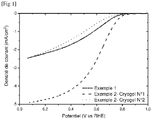
- FIG 1 illustrates the electrochemical performance of cryogels conforming and not conforming to the invention prepared in Examples 1 and 2.
- the carbon/nitrogen structure forming the carbonaceous material according to the invention is produced by sol-gel polymerization in the presence of a precursor of the metallic dopant and at a specific pH range since it varies from 4 to 5. .
- This sol-gel polymerization or polycondensation reaction is activated in a solvent medium having an acid pH value in accordance with the invention and containing at least one aldehyde, at least one hydroxybenzene derivative and at least one hydrocarbon compound source of atoms of nitrogen under conditions conducive to triggering the reaction.
- this imposed acid pH value is conducive to the formation, during sol-gel polymerization, of a heterogeneous hydrogel because it is characterized by the fact that it has two carbon phases, nitrogenous and doped, gelled. More precisely, at such a pH, the formation of a first gelled phase is observed, which is deposited at the bottom of the receptacle in which the sol-gel polymerization is carried out, then the formation, within the supernatant containing this first gelled phase , of a second gelled phase of different morphology.
- the process of the invention therefore requires at least the formation of the first gelled phase of carbon, nitrogenous and doped in its step (a) and the isolation of this first gelled phase formed, in step (b).
- the method of the invention covers the alternative embodiment in which the second gelled phase is not formed in step (a) and the preferred alternative embodiment in which the second gelled phase is also formed in step (a), following the first gelled phase,
- the solvent medium considered in step (a) comprises in solution at least one aldehyde, at least one hydroxybenzene derivative, at least one hydrocarbon compound that is a source of nitrogen atoms and at least one metal precursor of said metal dopant .
- the pH can be adjusted directly on such a medium, preferably simultaneously with the activation of the polymerization or at the very beginning of the start of the polymerization.
- the method comprises, prior to the activation of the sol-gel polymerization, the adjustment of the pH to a value suitable for the invention on a solvent medium precursor of the solvent medium considered in step (a) because not conducive in the state to the start of the polymerization
- this precursor medium may be a medium containing in solution, at least one hydroxybenzene derivative, at least one hydrocarbon compound source of nitrogen atoms and at least one metallic precursor of said metallic dopant but devoid of aldehyde component or a medium containing solution, at least one aldehyde, at least one hydrocarbon compound source of nitrogen atoms and at least one metal precursor of said metal dopant but devoid of hydroxybenzene derivative.
- the pH adjustment it is carried out by adding either an acid solution or a basic solution depending on the pH value of the solvent medium considered before starting. of polymerization. As emerges from the foregoing, the activation of the polymerization must take place in the pH range required according to the invention.
- the acid or the base is of course chosen so as not to affect the sol-gel polymerization reaction which must take place. In other words, it must be inert with respect to the components of the solvent medium considered in step (a).
- bases which are most particularly suitable for the invention, mention may in particular be made of sodium carbonate and sodium hydroxide.
- organic acids such as for example acetic acid, trifluoroacetic acid, formic acid, propionic acid and sulfonic acid and inorganic acids chosen in particular from perchloric acid and hydrochloric acid.
- hydrochloric acid As an acid, hydrochloric acid.
- the solvent medium of step (a) comprises at least one aldehyde chosen in particular from linear chain aldehydes such as formaldehyde, ethanal, propanal, cyclic aldehydes such as furfural, aldehydes containing one or more functions amines such as pyrrolidine, aminoacetaldehyde, and mixtures thereof, preferably chosen from formaldehyde, ethanal, propanal and mixtures thereof, and more preferably comprises at least formaldehyde.
- the aldehyde can also be generated there from a so-called precursor form, for example an acetal or hemiacetal.
- the solvent medium in step (a) also comprises at least one hydroxybenzene derivative chosen in particular from phenol, resorcinol, catechol, di-hydroxy-4-methylbenzoic acid, 2,6-dihydroxybenzamine, dihydroxybenzoic acid, their derivatives and their mixtures, preferably chosen from resorcinol and its derivatives, and more preferably comprises at least resorcinol.
- hydrocarbon compound source of nitrogen atoms it is advantageously polymerizable.
- it comprises at least two primary and/or secondary, and more preferably primary, amine functions. It is capable of reacting according to a sol-gel polymerization reaction.
- the hydrocarbon compound that is a source of nitrogen atoms is different from a nitrogenous aromatic macrocycle as defined below.
- the solvent medium in step (a) comprises at least one hydrocarbon compound that is a source of nitrogen atoms chosen from aliphatic and/or aromatic compounds substituted by primary or secondary amine functions and their derivatives, and preferably comprises at least 2 carbon atoms, in particular from 2 to 20 carbon atoms.
- the solvent medium in step (a) may in particular comprise at least one hydrocarbon compound which is a source of nitrogen atoms chosen from derivatives of triazine, phenanthroline, pyridine and pyrazine, and preferably comprises at least minus the melamine.
- the combination of an aldehyde, a hydroxybenzene derivative and a source hydrocarbon compound in nitrogen atoms advantageously makes it possible, during the sol-gel polymerization, to integrate the nitrogen atoms of the source hydrocarbon compound in atoms of nitrogen in a polymeric structure also comprising units derived from the hydroxybenzene derivative.
- the hydroxybenzene derivative(s) and the aldehyde(s) are brought together in a hydroxybenzene derivative(s)/aldehyde(s) molar ratio ranging from 0.05 to 2.0, preferably from 0 .1 to 1.0, and more preferably from 0.2 to 0.4.
- the hydroxybenzene derivative(s) and the hydrocarbon compound(s) source(s) of nitrogen atoms are brought together in a hydroxybenzene derivative(s)/hydrocarbon compound(s) molar ratio (s) varying from 0.2 to 5.0, preferably from 0.5 to 2.0, and more preferably from 0.8 to 1.5.
- the sol-gel polymerization brings together formaldehyde, melamine and resorcinol.
- the sol-gel polymerization or alternatively polycondensation, is initiated and carried out in the presence of at least one metal precursor of metal dopant, which has at least one transition metal.
- the metal precursors suitable for the invention are preferably chosen from metal salts and complexes of transition metals.
- the transition metal can be chosen from manganese (Mn), cobalt (Co), titanium (Ti), iron (Fe), ruthenium (Ru), osmium (Os), nickel (Ni) , copper (Cu), and zinc (Zn), preferably from manganese (Mn), cobalt (Co), and iron (Fe), and more preferably is at least one iron II or III salt or complex.
- the transition metal as defined above can be present at any oxidation state depending on the choice of transition metal used.
- the transition metal used is the iron atom, it can be at an oxidation state of 0, +2 or +3.
- metal salts can most particularly be mentioned acetates, nitrates, chlorides, ammoniums and sulphates.
- the metal precursor is at least one iron III or II salt or complex.
- complex-type iron structures suitable for the invention mention may very particularly be made of ferrocene-type structures, and iron III and iron II complexes, comprising one or more bidentate or tetradentate nitrogen-containing ligands with a particular pyrridine motif. , phenanthroline, pyrazine, ethylene diamine or even 2,4,6-tris(2-pyridyl)-s-triazine (TPTZ).
- TPTZ 2,4,6-tris(2-pyridyl)-s-triazine
- the method according to the invention can be carried out with a single metal dopant precursor or a mixture of metal precursors.
- the amount of metallic dopant is adjusted to obtain a loading rate at the level of the airgel obtained sufficient to condition its effectiveness as a catalyst for the oxygen reduction reaction (ORR).
- the metal precursor is advantageously implemented in a dissolved form.
- the metallic precursor of metallic dopant can possess at least one transition metal coordinated with at least one nitrogenous aromatic macrocycle, also called metallomacrocycle.
- the aromatic metallomacrocycles suitable for the process of the invention comprise a nitrogenous aromatic macrocycle whose nitrogen atoms are coordinated with the transition metal.
- aromatic macrocycle an organic compound in which at least some of the electrons are delocalized, the delocalization involving at least 12 common electrons, preferably at least 16 common electrons. This aromatic character gives these macrocycles significant thermodynamic stability.
- the nitrogenous aromatic macrocycle that is to say without the metal atom, has a molecular mass of between 100 and 5000 g/mol, preferably between 200 and 2000 g/mol.
- the mass proportion of nitrogen present in the nitrogenous aromatic macrocycle is between 3 and 80% by weight, preferably between 5 and 50%, preferably between 8 and 40% .
- the nitrogenous aromatic macrocycle is chosen from phthalocyanines, porphyrins, chlorines and corrins, substituted or unsubstituted, preferably from phthalocyanines and porphyrins, substituted or unsubstituted.
- the nitrogenous aromatic macrocycle is water-soluble or water-dispersible and preferably water-soluble.
- this nitrogenous aromatic macrocycle is substituted by one or more hydrophilic groups.
- Such groups are advantageous for facilitating the dispersion or dissolution of the metallomacrocycle in the solvent medium, in particular in water.
- the nitrogenous aromatic macrocycle is substituted by at least one function chosen from electrically neutral anionic, cationic and hydrophilic functions. Mention may be made, among the anionic functions, of the sulphonate, carboxylate and phosphonate functions. By way of example of cationic functions, mention may be made of the alkylammonium, pyridinium and imidazolinium functions.
- the electrically neutral hydrophilic functions can be chosen in particular from sulphonic, carboxylic, phosphonic acid functions, or from chains of the polyethylene glycol type and their derivatives.
- nitrogenous aromatic macrocycles is advantageous for optimizing the immobilization of the transition metal within the carbonaceous support structure.
- the metal may also be coordinated, covalently or not, with one or more distinct chemical entities of a nitrogenous aromatic macrocycle, for example with at least one dioxygen molecule, a halogen atom or a heteroatom of a thiol, pyrrolidine, piperidine, alcohol or ether derivative.
- the nitrogenous aromatic metallomacrocycle can be chosen from water-soluble or unsubstituted substituted phthalocyanines coordinating a transition metal, and substituted or unsubstituted, preferably substituted, porphyrins coordinating a transition metal, the transition metal being especially iron.
- the nitrogenous aromatic metallomacrocycle is chosen from the compounds of formula (A), (B) and (C):
- a process of the invention uses a metal precursor, in a ratio of 0.01 to 1 and preferably of 0.02 to 0.2 expressed as equivalent metal/nitrogen atom(s) present. in the nitrogen atom source hydrocarbon compound.
- an iron nitrate can be used at a rate of 0.01 mole of iron nitrate, i.e. in a metal precursor per nitrogen atom ratio of 0.055.
- this metallic precursor contains one or more nitrogenous aromatic macrocycles
- such a metallic precursor and the polymerizable hydrocarbon compound(s) and nitrogen atom source(s) are brought together in a nitrogenous aromatic macrocycle/hydrocarbon compound(s) molar ratio ranging from 0.001 to 1.0 and preferably from 0.005 to 0.5.
- the compounds used in the process according to the invention are formulated in a solvent capable of dispersing them or even solubilizing them, if necessary with heating.
- This solvent is preferably an aqueous medium. It may in particular be water or a hydroalcoholic medium.
- the hydroalcoholic medium is a mixture of water and one or more alcohols in variable proportions.
- the dissolution of the hydroxybenzene(s) and hydrocarbon compound(s) source of nitrogen atoms, or even aldehyde(s), and the dispersion or dissolution of the metal precursor(s) in the solvent medium can be obtained by heating this solvent medium containing them, in particular at a temperature varying from 60°C to 80°C.
- the solvent medium in step (a) further comprises at least one polymerization catalyst, more particularly a sodium salt, in particular sodium carbonate.
- the catalyst advantageously makes it possible to stimulate the sol-gel polymerization reaction.
- the sol-gel polymerization is advantageously carried out at a temperature of approximately 85°C.
- the activation in step (a) can be carried out by exposing said solvent medium to a temperature varying from 60°C to 95°C, and preferably from 80°C to 90°C.
- the sol-gel polymerization carried out under the acid pH conditions according to the invention and therefore at a pH varying from 4 to 5, is capable of forming, within the solvent medium, two gelled phases of nitrogenous carbon and doped which are distinguished from each other in particular by their density.
- the first gelled phase formed which is the one having the lowest density, is isolated from the polymerization medium.
- this separation can be carried out by mechanical action, for example cutting of the phases from each other using for example a thin cutting blade.
- the first gelled phase formed is then dried. Depending on the method of drying chosen, it is then transformed into cryogel, airgel or xerogel.
- the dry form of step (c) is obtained by drying the gelled phase isolated in step (b), in contact with a supercritical fluid, in particular water or carbon dioxide, in particular carbon dioxide and is a nitrogenous organic airgel.
- a supercritical fluid in particular water or carbon dioxide, in particular carbon dioxide and is a nitrogenous organic airgel.
- the drying transforms the gelled phase isolated in step (b) into a nitrogenous organic airgel containing an active site precursor.
- This dry form is dedicated to forming a nitrogenous carbon airgel and charged at least to the core with at least one metallic dopant at the end of the process.
- the dry form of step (c) is obtained by freezing the gelled phase isolated in step b), in particular in contact with liquid nitrogen, and lyophilization of the frozen gelled phase and is a nitrogenous organic cryogel .
- this drying mode transforms the gelled phase isolated in step (b) into a nitrogenous organic cryogel containing an active site precursor.
- This dry form of step (c) is dedicated to forming a cryogel of nitrogenous carbon and charged at least to the core with at least one metal dopant at the end of the process.
- the dry form of step (c) is obtained by evaporation of the solvent from the gelled phase isolated in step b), at controlled temperature and pressure and is a nitrogenous organic xerogel.
- the dry form can be formed by reducing the pressure from 10 5 to 10 3 Pa in 5 days at 60°C in an oven, then by maintaining the samples at 150°C and 10 3 Pa for 3 days.
- This drying mode therefore transforms the gelled phase isolated in step (b) into a nitrogenous organic xerogel containing an active site precursor.
- This dry form of step (c) is more particularly dedicated to forming a nitrogenous carbon xerogel and charged at least to the core with at least one metal dopant at the end of the process.
- cryogel, airgel or nitrogenous organic xerogel containing an active site precursor thus obtained is then pyrolyzed to form a cryogel, airgel or nitrogenous carbon xerogel respectively.
- Pyrolysis advantageously makes it possible to transform an organic structure into a “graphitic” carbonaceous structure.
- the temperature and the duration of the pyrolysis it is possible to control the size of the pores and the structure of the porous, nitrogenous and doped carbonaceous materials obtained according to the invention.
- the pyrolysis is carried out at a temperature varying from 750°C to 1200°C, in particular from 750°C to 850°C, or even around 800°C.
- This atmosphere may in particular comprise ammonia and/or nitrogen compounds.
- This pyrolysis can be carried out by imposing a rise and a fall in temperature in stages, like for example the process described in the examples below.
- the temperature profile may include a rise in temperature lasting from 2h to 6h, followed by a stabilization in temperature for 1h to 4h, preferably between 2h and 3h, then decrease in temperature by inertia from the oven.
- the present invention relates to porous, nitrogenous carbonaceous materials charged at least to the core with at least one metallic dopant obtained according to the process of the invention.
- It relates in particular to porous, nitrogenous carbonaceous materials charged at least to the core with at least one metallic dopant in the form of an airgel, cryogel or xerogel.
- At least one metal dopant chosen from the transition metals manganese (Mn), cobalt (Co), titanium (Ti), iron (Fe), ruthenium (Ru), osmium (Os), nickel (Ni ), copper (Cu), and zinc (Zn), preferably manganese (Mn), cobalt (Co), and iron (Fe).
- Mn transition metals
- Co cobalt
- Ti titanium
- Fe iron
- Ru ruthenium
- Os osmium
- Ni nickel
- Cu copper
- Zn zinc
- manganese (Mn), cobalt (Co), and iron (Fe) are doped with Iron II and/or Iron III atoms.
- the porous, nitrogenous carbonaceous material charged at least to the core is devoid of metallic nanoparticles, in particular of iron, in particular with a diameter of at least 1 nm.
- the rate of mass charge of metal dopants of a material in accordance with the invention can vary from 0.001% to 15%, preferably from 0.01% to 5% expressed as mass of metal atoms relative to the mass total of said material.
- the rate of loading of metallic dopants can for example be characterized by atomic absorption.
- the nitrogen mass charge rate of a material in accordance with the invention may be at least 3%, preferably at least 5% and more preferably from 6% to 15%, expressed as mass of atoms of nitrogen relative to the total mass of said material.
- the level of charge in nitrogen atoms can for example be characterized by elemental analysis.
- the materials according to the invention have a hierarchical porosity, that is to say a mixture of mesoporosity and microporosity inside a macroporous structure.
- they have a large pore volume, in particular with a pore size distribution characterized by a peak between 2 and 20 nm characteristic of the mesoporous.
- the porous, nitrogenous and charged carbonaceous material may have a specific surface area assessed according to the BET method greater than 400 m 2 /g, in particular greater than 450 m 2 /g or even greater than 500 m 2 /g.
- porous, nitrogenous carbonaceous materials according to the invention advantageously have active sites, or catalytic sites, at the level of the metallic dopants, which are accessible to reagents due to the high porosity of the material. Consequently, and as illustrated in the examples, the porous, nitrogenous carbonaceous materials according to the invention have catalytic performances superior to those obtained when the sol-gel polymerization is not carried out at an acid pH value in accordance with the invention.
- porous, nitrogenous carbonaceous materials loaded at least to the core with at least one metallic dopant in accordance with the invention are very particularly useful as catalysts for the reduction of oxygen.
- these materials are useful as self-supporting catalysts for oxygen reduction.
- These materials can also be used as adsorbents, advanced catalyst supports and electrode materials for supercapacitors, rechargeable batteries, fuel cells, etc.
- PEMFC proton exchange membrane fuel cell system
- PEMFC proton exchange membrane fuel cell
- the porosity of the materials is characterized by measuring their specific surface by the Brunauer-Emmet-Teller (BET) method from the nitrogen absorption isotherm at 77K of the materials.
- BET Brunauer-Emmet-Teller
- the electrochemical performances of the materials are evaluated by deposition (catalyst loading of 0.3 mg/cm 2 ) on a rotating electrode in acid electrolyte (H2SO4 0.1M) with a titanium counter electrode and a mercury sulphate electrode as reference.
- the nitrogen content is characterized by elemental analysis.
- the morphology of the materials is characterized by scanning electron microscopy with a voltage of 15 kV and the apparatus FEG SEM Leo 1530 from Zeiss.
- a homogeneous hydrogel is obtained. Its supernatant is eliminated and the “solid” gelled phase thus isolated is immersed in liquid nitrogen. The frozen form thus obtained is then introduced into a freeze-drying jar which is connected to the freeze-dryer (0.01 mbar with condensation at -88° C.) for 5 days.
- the recovered organic cryogel placed in a quartz boat is then pyrolyzed in a tubular furnace under a flow of argon (80 NL/h) with a slope of 3.3 K/min up to 800°C then maintained for 2 hours at 800 °C before returning to room temperature.
- a heterogeneous hydrogel is formed which comprises two gelled phases of different densities.
- the supernatant is eliminated and the two gelled phases separated from each other by cutting the block with a scalpel at the level of the demarcation between the two phases in order to then be immersed separately in liquid nitrogen.
- the less dense phase is indexed N°1 and the densest N°2.
- Each of the frozen forms thus obtained is then introduced into a freeze-drying jar which is connected to the freeze-dryer (0.01 mbar with condensation at -88° C.) for 5 days.
- Each of the two recovered organic cryogels is then placed in a quartz boat and pyrolyzed in a tubular furnace under a flow of argon (80 NL/h) with a slope of 3.3 K/min up to 800°C then maintained for 2 hours at 800°C before dropping to room temperature.
- cryogel No. 1 As emerges from Table 1, the porosity of cryogel No. 1, prepared according to the process of the invention, is significantly the highest. It obviously offers better accessibility to its reaction sites. [Table 1] Cryogel BET specific surface (m 2 /g) Example 1 Control Cryogel 348 Example 2-Cryogel No. 1 538 Example 2-Cryogel No. 2 359
- cryogel No. 1 prepared according to the method of the invention is the most effective.
- cryogel No. 1 prepared according to the method of the invention is more than double that of the other two cryogels.
- cryogel No. 1 in accordance with the invention, advantageously exhibits a hierarchical porosity, that is to say mesoporosity and microporosity inside a macroporous structure. This structure allows good diffusion of the species inside the materials.
Landscapes
- Chemical & Material Sciences (AREA)
- Engineering & Computer Science (AREA)
- Ceramic Engineering (AREA)
- Organic Chemistry (AREA)
- Materials Engineering (AREA)
- Manufacturing & Machinery (AREA)
- Structural Engineering (AREA)
- Chemical Kinetics & Catalysis (AREA)
- Dispersion Chemistry (AREA)
- Electrochemistry (AREA)
- General Chemical & Material Sciences (AREA)
- Inorganic Chemistry (AREA)
- Catalysts (AREA)
Abstract
La présente invention concerne un procédé de préparation d'un matériau carboné poreux, azoté et chargé à cœur par au moins un dopant métallique comprenant au moins les étapes consistant à activer une polymérisation sol-gel, au sein d'un milieu solvant contenant en solution au moins un aldéhyde, au moins un dérivé hydroxybenzène, au moins un composé hydrocarboné source en atomes d'azote et au moins un précurseur métallique dudit dopant métallique, et à une valeur de pH acide ajustée pour permettre la formation dans ledit milieu solvant, de deux phases gélifiées de carbone azotées, dopées et possédant des densités différentes et à isoler la phase gélifiée de densité inférieure.
Description
- La présente invention concerne un procédé de fabrication d'un matériau carboné poreux et azoté avec un dopant métallique, avantageusement différent d'un métal noble, tout particulièrement intéressant pour son efficacité catalytique sur la réduction de l'oxygène (ORR) et donc utile dans un système de pile à combustible à membrane échangeuse de protons (PEMFC).
- Les piles à combustible à membrane échangeuse de protons (PEMFC) représentent aujourd'hui des dispositifs de conversion d'énergie de grand intérêt au regard de leur efficacité en termes de conversion, de leur importante densité d'énergie et de leur faible impact sur l'environnement. Malheureusement, elles mettent généralement en œuvre, à titre d'espèce catalytique, des métaux nobles. Ainsi, le catalyseur de référence pour la réduction de l'oxygène (ORR) est du platine sur carbone (Pt/C) avec un chargement d'environ 20% massique en platine. Au regard de la rareté et du coût de ces métaux nobles, il a été essentiel de trouver des matériaux catalytiques alternatifs à faible coût et possédant une activité catalytique du même ordre de grandeur, voire améliorée, en vue d'accroître le développement de la technologie PEMFC.
- Il a ainsi été mis au point de nouveaux catalyseurs à base de métaux non précieux (NPMC). Pour l'essentiel, ils se présentent sous la forme d'un support poreux carboné sur lequel sont immobilisés des métaux de transition et/ou des atomes d'azote. Selon une variante avantageuse, les structures support carbonées dérivent de la carbonisation d'hydrogels, classiquement obtenus par des réactions de polymérisation sol-gel entre au moins un hydroxybenzène et au moins un aldéhyde. Ces structures possèdent en effet des propriétés uniques, à savoir faible masse volumique, porosité continue et ajustable, surface spécifique élevée et bonnes conductivité et stabilité chimique.
- A titre représentatifs de ces catalyseurs à base de métaux non précieux (NPMC) peuvent notamment être cités les matériaux à base de carbone, azote et de sels métalliques décrits dans les documents [1] et [2]. Toutefois, ces matériaux ne donnent pas totale satisfaction notamment en termes de procédé de préparation et/ou d'efficacité. Certains matériaux ont en effet des procédés de préparation contraignants car requérant un nombre trop significatif d'étapes opérationnelles. Quant à leur niveau d'efficacité jugé insuffisant, il est le plus souvent dû à une surface spécifique insuffisante du matériau obtenu, liée également au procédé de fabrication considéré pour l'élaboration de la forme carbonée de ces catalyseurs. La présente invention a donc pour objectif principal de proposer un procédé simple, efficace et de bas coût permettant d'obtenir, facilement des catalyseurs pour la réduction de l'oxygène, sans métal noble, et qui soient néanmoins dotés d'une efficacité améliorée.
- Elle vise en outre à proposer un procédé permettant d'obtenir des catalyseurs possédant une densité élevée de sites catalytiques.
- Elle vise ainsi à proposer un matériau permettant une puissance améliorée des PEMFC grâce précisément à cette densité accrue en sites catalytiques,
- Plus précisément, la présente invention concerne un procédé de préparation d'un matériau carboné poreux, azoté et chargé au moins à cœur avec au moins un dopant métallique comprenant au moins les étapes consistant à
- (a) activer une polymérisation sol-gel, au sein d'un milieu solvant contenant en solution au moins un aldéhyde, au moins un dérivé hydroxybenzène, au moins un composé hydrocarboné source en atomes d'azote et au moins un précurseur métallique dudit dopant métallique, et à une valeur de pH acide et ajustée pour permettre la formation,, dans ledit milieu solvant, de deux phases gélifiées de carbone azotées, dopées et possédant des densités différentes,
- (b) isoler la première phase gélifiée formée,
- (c) disposer d'une forme sèche de ladite phase gélifiée isolée en étape (b) et
- (d) pyrolyser ladite forme sèche de l'étape (c) en atmosphère non oxydante pour former ledit matériau carboné poreux, azoté et chargé au moins à cœur avec au moins un dopant métallique et le cas échéant le récupérer.
- Selon une variante du procédé, les deux phases gélifiées de carbone azotées, dopées et possédant des densités différentes sont formées dans ledit milieu solvant activé en étape (a). Plus particulièrement, la première phase gélifiée formée possède une densité inférieure à celle de la phase gélifiée formée consécutivement à cette première phase gélifiée.
- Le procédé selon l'invention comprend alors les étapes consistant à
- (a) activer une polymérisation sol-gel, au sein d'un milieu solvant contenant en solution au moins un aldéhyde, au moins un dérivé hydroxybenzène, au moins un composé hydrocarboné source en atomes d'azote et au moins un précurseur métallique dudit dopant métallique, et à une valeur de pH acide ajustée pour former dans ledit milieu solvant, deux phases gélifiées de carbone azotées et dopées, et possédant des densités différentes,
- (b) isoler la première phase gélifiée formée
- (c) disposer d'une forme sèche de ladite phase gélifiée isolée en étape (b),
- (d) pyrolyser ladite forme sèche de l'étape (c) en atmosphère non oxydante pour former ledit matériau carboné poreux, azoté et chargé au moins à cœur avec au moins un dopant métallique et le cas échéant le récupérer.
- Avantageusement, le matériau carboné poreux, azoté et chargé au moins à cœur avec au moins un dopant métallique obtenu selon l'invention est un aérogel, cryogel ou xérogel. Plus particulièrement, l'activation de la polymérisation sol-gel est réalisée à une valeur de pH variant de 4 à 5.
- Selon un mode de réalisation particulier, le procédé selon l'invention comprend préalablement à l'étape (a), une étape d'ajustement du pH d'un milieu solvant, précurseur du milieu solvant de l'étape (a), et contenant en solution, au moins un composé hydrocarboné source en atomes d'azote et au moins un précurseur métallique dudit dopant métallique, mais dénué de dérivé hydroxybenzène ou d'aldéhyde, à une valeur variant de 4 à 5, notamment à l'aide d'une solution d'acide chlorhydrique.
- Comme illustré dans les exemples ci-après, les inventeurs ont, contre toute attente, constaté que l'activation de la polymérisation sol-gel telle que réalisée selon l'invention, c'est-à-dire à un pH spécifique, en l'occurrence variant de 4 à 5 conduit à la formation d'un hydrogel particulier.
- De manière surprenante, l'hydrogel, formé à la fin d'une polymérisation sol-gel activée à cette gamme de pH, est hétérogène car il comprend deux phases gélifiées distinctes l'une de l'autre notamment par leur densité.
- Par ailleurs, sa phase gélifiée de densité inférieure, qui est la première phase gélifiée formée chronologiquement, s'avère avantageusement enrichie en atomes d'azote, posséder une porosité significativement augmentée et contenir des macropores, comparativement à l'unique phase gélifiée d'un hydrogel homogène, obtenu lors d'une polymérisation sol-gel non activée à la gamme de pH requise selon l'invention.
- Or, ces spécificités originales sont précisément avantageuses pour accéder à un matériau doté de sites actifs nombreux et accessibles et donc ayant des performances électrochimiques accrues et apte à produire de forts courants à de faibles surtensions.
- Ainsi, la présente invention vise également un matériau carboné poreux, azoté et chargé en dopant métallique, obtenu selon le procédé de l'invention.
- En particulier, ce matériau carboné poreux, azoté et chargé au moins à cœur avec au moins un dopant métallique se présente sous la forme d'un aérogel, cryogel ou xérogel, de préférence un aérogel ou un cryogel. Il possède avantageusement une surface spécifique appréciée selon la méthode BET supérieure à 400 m2/g, en particulier supérieure à 450 m2/g voire supérieure à 500 m2/g.
- Selon un autre de ses objets, la présente invention se rapporte à l'utilisation d'un matériau carboné poreux, azoté et chargé au moins à cœur avec au moins un dopant métallique et conforme à l'invention, à titre de catalyseur, notamment de catalyseur autosupporté, pour la réduction de l'oxygène (ORR).
- Selon encore un autre de ses objets, la présente invention se rapporte à l'utilisation d'un matériau carboné poreux, azoté et chargé au moins à cœur avec au moins un dopant métallique, conforme à l'invention, à titre de matériau cathodique dans un système de pile à combustible à membrane échangeuse de protons (PEMFC). Ce matériau permet avantageusement une bonne accessibilité de ses sites actifs dans un système de pile à combustible.
- Un matériau selon l'invention peut notamment être mis en œuvre comme catalyseur de cathode pour pile à combustible à membrane échangeuse de proton, par exemple pour une utilisation en transport léger de type voiture.
- [
Fig 1 ] illustre les performances électrochimiques de cryogels conforme et non conformes à l'invention préparés en exemples 1 et 2. - Au sens de l'invention,
- Un hydrogel homogène est un gel aqueux dont l'aspect macroscopique est uniforme et lisse
- Un hydrogel hétérogène est un gel aqueux dans lequel deux phases d'aspects macroscopiques différents sont superposées
- Une phase gélifiée désigne un bloc de polymère poreux à l'intérieur duquel de l'eau est contenue,
- Un pH acide est un pH de valeur inférieure à 7 et
- La dénomination « dérivé hydroxybenzène » dit encore « hydroxybenzène » désigne un composé chimique constitué d'un cycle benzène porteur d'au moins une fonction hydroxyle, de préférence deux fonctions hydroxyles et pouvant être en outre substitué, notamment par une fonction carboxylique, amide et/ou un radical alkyle en C1 à C3. Avantageusement, le dérivé hydroxybenzène est apte à réagir selon une réaction de polymérisation sol-gel.
- Comme il ressort de ce qui précède, la structure carbone/azote formant le matériau carboné selon l'invention est réalisée par polymérisation sol-gel en présence d'un précurseur du dopant métallique et à une gamme de pH spécifique car variant de 4 à 5.
- Cette réaction de polymérisation sol-gel ou encore de polycondensation est activée dans un milieu solvant possédant une valeur de pH acide conforme à l'invention et contenant au moins un aldéhyde, au moins un dérivé hydroxybenzène et au moins un composé hydrocarboné source en atomes d'azote dans des conditions propices au déclenchement de la réaction.
- Comme précisé ci-dessus, cette valeur de pH acide imposée est propice à la formation, au cours de la polymérisation sol-gel, d'un hydrogel hétérogène car caractérisé par le fait qu'il possède deux phases de carbone, azotées et dopées, gélifiées. Plus précisément, à un tel pH, il est observé la formation d'une première phase gélifiée, qui se dépose au fond du réceptacle dans lequel est réalisée la polymérisation sol-gel, puis la formation, au sein du surnageant contenant cette première phase gélifiée, d'une seconde phase gélifiée de morphologie différente.
- Le procédé de l'invention requiert donc au moins la formation de la première phase gélifiée de carbone, azotée et dopée en son étape (a) et l'isolement de cette première phase gélifiée formée, en étape (b).
- Ainsi, le procédé de l'invention couvre la variante de réalisation dans laquelle la seconde phase gélifiée n'est pas formée en étape (a) et la variante de réalisation préférée dans laquelle la seconde phase gélifiée est également formée en étape (a), consécutivement à la première phase gélifiée,
- En ce qui concerne, le milieu solvant considéré en étape (a), il comprend en solution au moins un aldéhyde, au moins un dérivé hydroxybenzène, au moins un composé hydrocarboné source en atomes d'azote et au moins un précurseur métallique dudit dopant métallique.
- Selon une variante, le pH peut être ajusté directement sur un tel milieu, de préférence simultanément à l'activation de la polymérisation ou au tout début du démarrage de la polymérisation.
- Selon une autre variante privilégiée, le procédé comprend, préalablement à l'activation de la polymérisation sol-gel, l'ajustement du pH à une valeur convenant à l'invention sur un milieu solvant précurseur du milieu solvant considéré en étape (a) car non propice en l'état au démarrage de la polymérisation
- Par exemple, ce milieu précurseur peut être un milieu contenant en solution, au moins un dérivé hydroxybenzène, au moins un composé hydrocarboné source en atomes d'azote et au moins un précurseur métallique dudit dopant métallique mais dénué en composant aldéhyde ou un milieu contenant en solution, au moins un aldéhyde, au moins un composé hydrocarboné source en atomes d'azote et au moins un précurseur métallique dudit dopant métallique mais dénué de dérivé hydroxybenzène.
- En ce qui concerne l'ajustement du pH, il est réalisé par ajout soit d'une solution acide soit d'une solution basique selon la valeur de pH du milieu solvant considéré avant démarrage de la polymérisation. Comme il ressort de ce qui précède, l'activation de la polymérisation doit se réaliser dans la gamme de pH requise selon l'invention.
- L'acide ou la base est bien entendu choisi pour ne pas affecter la réaction de polymérisation sol-gel qui doit se réaliser. En d'autres termes, il doit être inerte à l'égard des composants du milieu solvant considéré en étape (a).
- A titre illustratif des bases convenant tout particulièrement à l'invention peuvent notamment être cités le carbonate de sodium et l'hydroxyde de sodium.
- A titre illustratif des acides convenant tout particulièrement à l'invention peuvent notamment être cités les acides organiques tels que par exemple les acide acétique, acide trifluoroacétique, acide formique, acide propionique et acide sulfonique et les acides inorganiques notamment choisis parmi l'acide perchlorique et l'acide chlorhydrique.
- Convient tout particulièrement à l'invention, à titre d'acide, l'acide chlorhydrique.
- Par ailleurs le milieu solvant de l'étape (a) comprend au moins un aldéhyde notamment choisi parmi les aldéhydes à chaine linéaire comme le formaldéhyde, l'éthanal, le propanal, les aldéhydes cycliques comme le furfural, les aldéhydes contenant une ou des fonctions aminées comme la pyrrolidine, l'aminoacétaldéhyde, et leurs mélanges, de préférence choisi parmi le formaldéhyde, l'éthanal, le propanal et leurs mélanges, et plus préférentiellement comprend au moins le formaldéhyde. L'aldéhyde peut également y être généré à partir d'une forme dite précurseur, par exemple un acétal ou hémiacétal.
- Le milieu solvant en étape (a) comprend également au moins un dérivé hydroxybenzène notamment choisi parmi le phénol, le résorcinol, le catéchol, l'acide di-hydroxy-4-méthylbenzoïque, le 2,6-dihydroxybenzamine, l'acide dihydroxybenzoïque, leurs dérivés et leurs mélanges, de préférence choisi parmi le résorcinol et ses dérivés, et plus préférentiellement comprend au moins le résorcinol.
- En ce qui concerne le composé hydrocarboné source en atomes d'azote, il est avantageusement polymérisable.
- En particulier, il comprend au moins deux fonctions amines primaires et/ou secondaires, et plus préférentiellement primaires. Il est apte à réagir selon une réaction de polymérisation sol-gel.
- En particulier, le composé hydrocarboné source en atomes d'azote est différent d'un macrocycle aromatique azoté tel que défini ci-après.
- Ainsi, le milieu solvant en étape (a) comprend au moins un composé hydrocarboné source en atomes d'azote choisi parmi les composés aliphatiques et/ou aromatiques substitués par des fonctions amines primaires ou secondaires et leurs dérivés, et comprend de préférence au moins 2 atomes de carbone, notamment de 2 à 20 atomes de carbone.
- Plus particulièrement, le milieu solvant en étape (a) peut notamment comprendre au moins un composé hydrocarboné source en atomes d'azote choisi parmi les dérivés de la triazine, de la phénantroline, de la pyridine et de la pyrazine, et de préférence comprend au moins la mélamine.
- La combinaison d'un aldéhyde, d'un dérivé hydroxybenzène et d'un composé hydrocarboné source en atomes d'azote permet avantageusement, lors de la polymérisation sol-gel, d'intégrer les atomes d'azote du composé hydrocarboné source en atomes d'azote dans une structure polymérique comprenant également des unités issues du dérivé hydroxybenzène. Avantageusement, le ou les dérivé(s) hydroxybenzène et le ou les aldéhyde(s) sont mis en présence dans un rapport molaire dérivé(s) hydroxybenzène / aldéhyde(s) variant de 0,05 à 2,0, de préférence de 0,1 à 1,0, et plus préférentiellement de 0,2 à 0,4. Avantageusement, le ou les dérivé(s) hydroxybenzène et le ou les composé(s) hydrocarboné(s) source(s) en atome d'azote sont mis en présence dans un rapport molaire dérivé(s) hydroxybenzène / composé(s) hydrocarboné(s) variant de 0,2 à 5,0, de préférence de 0,5 à 2,0, et plus préférentiellement de 0,8 à 1,5.
- Selon un mode de réalisation préféré, la polymérisation sol-gel met en présence du formaldéhyde, de la mélamine et du résorcinol.
- Comme requis selon l'invention, la polymérisation sol-gel, ou encore polycondensation, est initiée et réalisée en présence d'au moins un précurseur métallique de dopant métallique, qui possède au moins un métal de transition.
- Les précurseurs métalliques convenant à l'invention sont de préférence choisis parmi les sels et complexes métalliques de métaux de transition.
- Le métal de transition peut être choisi parmi le manganèse (Mn), le cobalt (Co), le titane (Ti), le fer (Fe), le ruthénium (Ru), l'osmium (Os), le nickel (Ni), le cuivre (Cu), et le zinc (Zn), de préférence parmi le manganèse (Mn), le cobalt (Co), et le fer (Fe), et plus préférentiellement est au moins un sel ou complexe de fer II ou III.
- Le métal de transition tel que défini ci-dessus peut être présent à n'importe quel degré d'oxydation selon le choix du métal de transition mis en œuvre. Par exemple, lorsque le métal de transition mis en œuvre est l'atome de fer, il peut se trouver à un degré d'oxydation 0, +2 ou +3.
- A titre illustratif, des sels métalliques peuvent tout particulièrement être cités les acétates, les nitrates, les chlorures, les ammoniums et les sulfates.
- Avantageusement, le précurseur métallique est au moins un sel ou complexe de fer III ou II. A titre illustratif des structure de fer de type complexe convenant à l'invention, peuvent tout particulièrement être citées les structures de type ferrocène, et les complexes de fer III et fer II, comprenant un ou plusieurs ligands azotés bidentés ou tétradentés à motif notamment pyrridine, phénanthroline, pyrazine, éthylène diamine ou encore 2,4,6-tris(2-pyridyl)-s-triazine (TPTZ).
- Le procédé selon l'invention peut être réalisé avec un unique précurseur de dopant métallique ou un mélange de précurseurs métalliques.
- La quantité en dopant métallique est ajustée pour obtenir un taux de charge au niveau de l'aérogel obtenu suffisant pour conditionner son efficacité à titre de catalyseur pour la réaction de réduction de l'oxygène (ORR).
- Le précurseur métallique est avantageusement mis en œuvre sous une forme solubilisée.
- Dans une variante de réalisation, le précurseur métallique de dopant métallique, peut posséder au moins un métal de transition coordonné à au moins un macrocycle aromatique azoté, également nommé métallomacrocycle. En d'autres termes, les métallomacrocycles aromatiques convenant au procédé de l'invention comportent un macrocycle aromatique azoté dont les atomes d'azote sont coordonnés au métal de transition.
- Par macrocycle aromatique, on entend un composé organique dont au moins une partie des électrons sont délocalisés, la délocalisation faisant intervenir au moins 12 électrons en commun, de préférence au moins 16 électrons en commun. Ce caractère aromatique confère à ces macrocycles une stabilité thermodynamique importante.
- Le macrocycle aromatique azoté, c'est-à-dire sans l'atome métallique, possède une masse moléculaire comprise entre 100 et 5000 g/mol, de préférence entre 200 et 2000 g/mol.
- La proportion massique en azote présente dans le macrocycle aromatique azoté, c'est-à-dire sans l'atome métallique, est comprise entre 3 et 80% en poids, de préférence entre 5 et 50%, de préférence entre 8 et 40%.
- En particulier, le macrocycle aromatique azoté est choisi parmi les phtalocyanines, les porphyrines, les chlorines, et les corrines, substituées ou non, de préférence parmi les phtalocyanines et les porphyrines, substituées ou non.
- Avantageusement, le macrocycle aromatique azoté est hydrosoluble ou hydrodispersible et de préférence hydrosoluble.
- Selon un mode de réalisation particulier, ce macrocycle aromatique azoté est substitué par un ou plusieurs groupements hydrophiles. De tels groupements sont avantageux pour faciliter la dispersion ou la dissolution du métallomacrocycle dans le milieu solvant, notamment dans l'eau. En particulier, le macrocycle aromatique azoté est substitué par au moins une fonction choisie parmi les fonctions anioniques, cationiques et hydrophiles électriquement neutres. Parmi les fonctions anioniques peuvent être citées les fonctions sulfonates, carboxylates et phosphonates. A titre d'exemple de fonctions cationiques peuvent être citées les fonctions alkylammonium, pyridinium et imidazolinium. Les fonctions hydrophiles électriquement neutres peuvent être notamment choisies parmi les fonctions acides sulfoniques, carboxyliques, phosphoniques, ou parmi les chaines de type polyethylèneglycol et leurs dérivés.
- La mise en œuvre de macrocycles aromatiques azotés est avantageuse pour optimiser l'immobilisation du métal de transition au sein de la structure carbonée support.
- Il est entendu que le métal peut être coordonné en outre, de manière covalente ou non, à une ou plusieurs entités chimiques distinctes d'un macrocycle aromatique azoté, par exemple à au moins une molécule de dioxygène, un atome d'halogène ou un hétéroatome d'un dérivé thiol, pyrrolidine, pipéridine, alcool ou éther.
- Selon un mode de réalisation particulier, le métallomacrocycle aromatique azoté peut être choisi parmi les phtalocyanines substituées hydrosolubles ou non substituées coordonnant un métal de transition, et les porphyrines substituées ou non, de préférence substituées, coordonnant un métal de transition, le métal de transition étant notamment le fer.
- De préférence, le métallomacrocycle aromatique azoté est choisi parmi les composés de formule (A), (B) et (C) :

- Avantageusement, un procédé de l'invention met en œuvre un précurseur métallique, dans un rapport 0,01 à 1 et de préférence de 0,02 à 0,2 exprimé en équivalent métal/ atome(s) d'azote présent(s) dans le composé hydrocarboné source en atome d'azote.
- Par exemple dans le cas d'une polycondensation mettant en œuvre 0,2 mole d'aldéhyde pour 0,06 mole d'hydroxybenzène et 0,03 mole de composé hydrocarboné source de 6 atomes d'azote, un nitrate de Fer pourra être utilisé à raison 0,01 mole de nitrate de Fer soit dans un rapport précurseur métallique par atome d'azote de 0,055.
- Dans le cas où ce précurseur métallique contient un ou plusieurs macrocycles aromatiques azotés, un tel précurseur métallique et le ou les composé(s) hydrocarboné(s) polymérisable(s) et source(s) en atome d'azote sont mis en présence dans un rapport molaire macrocycle aromatique azoté / composé(s) hydrocarboné(s) variant de 0,001 à 1,0 et de préférence de 0,005 à 0,5.
- Les composés mis en œuvre dans le procédé selon l'invention sont formulés dans un solvant apte à les disperser voire les solubiliser, si nécessaire avec chauffage.
- Ce solvant est de préférence un milieu aqueux. Il peut notamment être l'eau ou un milieu hydroalcoolique. En particulier, le milieu hydroalcoolique est un mélange d'eau et d'un ou plusieurs alcools dans des proportions variables.
- La dissolution des hydroxybenzène(s) et composé(s) hydrocarboné(s) source en atomes d'azote, voire aldéhyde(s), et la dispersion ou la dissolution du ou des précurseurs métalliques dans le milieu solvant peut être obtenue par chauffage de ce milieu solvant les contenant, en particulier à une température variant de 60°C à 80°C.
- En particulier, le milieu solvant en étape (a) comprend en outre au moins un catalyseur de la polymérisation, plus particulièrement un sel de sodium, notamment du carbonate de sodium. Le catalyseur permet avantageusement de stimuler la réaction de polymérisation sol-gel. La polymérisation sol-gel est avantageusement réalisée à une température d'environ 85°C. En particulier, l'activation en étape (a) peut être réalisée en exposant ledit milieu solvant à une température variant de 60°C à 95°C, et de préférence de 80°C à 90°C.
- Comme énoncé ci-dessus, la polymérisation sol-gel, réalisée dans les conditions de pH acide selon l'invention et donc à un pH variant de 4 à 5, est apte à former au sein du milieu solvant, deux phases gélifiées de carbone azotées et dopées qui se distinguent l'une de l'autre notamment par leur densité. La première phase gélifiée formée, qui est celle possédant la densité la plus faible, est isolée du milieu de polymérisation.
- Sa séparation des autres composants du milieu solvant relève des compétences de l'homme du métier.
- Lorsqu'elle doit être séparée de la seconde phase gélifiée de densité supérieure, formée consécutivement à elle, cette séparation peut être réalisée par action mécanique, par exemple découpage des phases l'une de l'autre à l'aide par exemple d'une lame fine coupante.
- Comme énoncé ci-dessus, la première phase gélifiée formée, ainsi isolée, est ensuite séchée. Selon le mode de séchage retenu, elle est alors transformée en cryogel, en aérogel ou en xérogel.
- Selon une première variante, la forme sèche de l'étape (c) est obtenue par séchage de la phase gélifiée isolée en étape (b), au contact d'un fluide supercritique, notamment de l'eau ou du dioxyde de carbone, en particulier du dioxyde de carbone et est un aérogel organique azoté. Selon cette variante, le séchage transforme la phase gélifiée isolée en étape (b) en un aérogel organique azoté contenant un précurseur de site actif. Cette forme sèche est dédiée à former un aérogel de carbone azoté et chargé au moins à cœur avec au moins un dopant métallique à l'issue du procédé.
- Selon une seconde variante, la forme sèche de l'étape (c) est obtenue par congélation de la phase gélifiée isolée en étape b), notamment au contact d'azote liquide, et lyophilisation de la phase gélifiée congelée et est un cryogel organique azoté. En d'autres termes, ce mode de séchage transforme la phase gélifiée isolée en étape (b) en un cryogel organique azoté contenant un précurseur de site actif. Cette forme sèche de l'étape (c) est dédiée à former un cryogel de carbone azoté et chargé au moins à cœur avec au moins un dopant métallique à l'issue du procédé.
- Selon une troisième variante, la forme sèche de l'étape (c) est obtenue par évaporation du solvant de la phase gélifiée isolée en étape b), à température et pression contrôlées et est un xérogel organique azoté. Par exemple, selon cette variante, la forme sèche peut être formée par réduction de la pression de 105 à 103 Pa en 5 jours à 60°C dans une étuve, puis par maintien des échantillons à 150 °C et 103 Pa pendant 3 jours. Ce mode de séchage transforme donc la phase gélifiée isolée en étape (b) en un xérogel organique azoté contenant un précurseur de site actif. Cette forme sèche de l'étape (c) est plus particulièrement dédiée à former un xérogel de carbone azoté et chargé au moins à cœur avec au moins un dopant métallique à l'issue du procédé.
- Le cryogel, aérogel ou xérogel organique azoté contenant un précurseur de site actif ainsi obtenu est ensuite pyrolysé pour former respectivement un cryogel, aérogel ou xérogel de carbone azoté. La pyrolyse permet avantageusement de transformer une structure organique en une structure carbonée « graphitique ».
- Selon le procédé de séchage du gel, la température et la durée de la pyrolyse, il est possible de contrôler la taille des pores et la structure des matériaux carbonés poreux, azotés et dopés obtenus selon l'invention.
- Avantageusement, la pyrolyse est réalisée à une température variant de 750°C à 1200°C, notamment de 750°C à 850°C, voire d'environ 800°C.
- Elle est notamment réalisée sous atmosphère inerte, en particulier non oxydante, par exemple sous azote ou argon, et de préférence sous argon. Cette atmosphère peut notamment comprendre de l'ammoniac et/ou des composés azotés.
- Cette pyrolyse peut être réalisée en imposant une montée et une descente en température par paliers à l'image par exemple du processus décrit dans les exemples ci-après. En particulier, le profil de température peut comprendre une montée en température d'une durée de 2h à 6h, suivie d'une stabilisation en température pendant 1h à 4h, de préférence entre 2h et 3h, puis diminution de la température par l'inertie du four.
- Selon un autre de ses aspects, la présente invention vise des matériaux carbonés poreux, azotés et chargés au moins à cœur avec au moins un dopant métallique obtenus selon le procédé de l'invention.
- Elle vise en particulier des matériaux carbonés poreux, azotés et chargés au moins à cœur avec au moins un dopant métallique se présentant sous la forme d'un aérogel, cryogel ou xérogel.
- Ils sont chargés à cœur avec au moins un dopant métallique choisi parmi les métaux de transition manganèse (Mn), cobalt (Co), titane (Ti), fer (Fe), ruthénium (Ru), osmium (Os), nickel (Ni), cuivre (Cu), et zinc (Zn), de préférence manganèse (Mn), cobalt (Co), et fer (Fe). Selon un mode de réalisation préféré, ils sont dopés en atomes de Fer II et/ou Fer III.
- De préférence, le matériau carboné poreux, azoté et chargé au moins à cœur est dénué de nanoparticules métalliques, notamment de fer, en particulier de diamètre d'au moins 1 nm.
- Le taux de charge massique en dopants métalliques d'un matériau conforme à l'invention, peut varier de 0,001% à 15%, de préférence de 0,01% à 5% exprimé en masse d'atomes de métal par rapport à la masse totale dudit matériau. Le taux de charge en dopants métallique peut par exemple être caractérisé par absorption atomique.
- Le taux de charge massique en azote d'un matériau conforme à l'invention, peut être d'au moins 3% de préférence au moins de 5% et plus préférentiellement de 6% à 15%, exprimé en masse d'atomes d'azote par rapport à la masse totale dudit matériau. Le taux de charge en atomes d'azote peut par exemple être caractérisé par analyse élémentaire.
- Comme illustré dans les exemples ci-après, les matériaux selon l'invention possèdent une porosité hiérarchique c'est-à-dire un mixte de mésoporosité et microporosité à l'intérieur d'une structure macroporeuse.
- Ils possèdent en particulier un grand volume de pores, notamment avec une distribution de taille de pores caractérisée par un pic entre 2 et 20 nm caractéristique du mésoporeux.
- La formation de structure en éponge macroporeuse de ces polymères conduit donc à l'obtention de matériaux « micro-meso-macro-poreux » qui permettent une bonne diffusion des espèces à l'intérieur des matériaux.
- Ainsi, le matériau carboné poreux, azoté et chargé peut posséder une surface spécifique appréciée selon la méthode BET supérieure à 400 m2/g, en particulier supérieure à 450 m2/g voire supérieure à 500 m2/g.
- Les matériaux carbonés poreux, azotés selon l'invention possèdent avantageusement des sites actifs, ou sites catalytiques, au niveau des dopants métalliques, qui sont accessibles à des réactifs du fait de la porosité élevée du matériau. En conséquence, et comme illustré en exemples, les matériaux carbonés poreux, azotés selon l'invention ont des performances catalytiques supérieures à celles obtenues lorsque la polymérisation sol-gel n'est pas réalisée à une valeur de pH acide conforme à l'invention.
- Les matériaux carbonés poreux, azotés et chargés au moins à cœur avec au moins un dopant métallique conformes à l'invention sont tout particulièrement utiles à titre de catalyseurs pour la réduction de l'oxygène. En particulier, ces matériaux sont utiles à titre de catalyseurs autosupportés pour la réduction de l'oxygène.
- Ces matériaux peuvent également être utilisés comme adsorbants, supports de catalyseur avancés et matériaux d'électrode pour supercondensateurs, batteries rechargeables, piles à combustible, etc.
- En particulier ils peuvent être utilisés à titre de matériau cathodique dans un système de pile à combustible à membrane échangeuse de protons (PEMFC). Ils peuvent également être utilisés à titre de cathode dans un système de pile à combustible à membrane échangeuse de protons (PEMFC).
- La porosité des matériaux est caractérisée par la mesure de leur surface spécifique par la méthode Brunauer-Emmet-Teller (BET) à partir de l'isotherme d'absorption d'azote à 77K des matériaux.
- Les performances électrochimiques des matériaux sont évaluées par dépôt (chargement en catalyseur de 0,3 mg/cm2) sur électrode tournante en électrolyte acide (H2SO4 0,1M) avec une contre électrode en titane et une électrode au sulfate mercureux comme référence.
- La teneur en azote est caractérisée par analyse élémentaire.
- La morphologie des matériaux est caractérisée par microscopie électronique à balayage avec une tension de 15 kV et l'appareillage FEG SEM Leo 1530 de Zeiss.
- 0,630 g de Résorcinol et 0,550 g de Mélamine sont ajoutés ensemble dans 52 ml d'eau distillée avec 0,010 g de carbonate de sodium. Le mélange est agité à 70°C jusqu'à complète dissolution des poudres. On ajoute ensuite à la solution 0,200 g de Fe(NO3)3 en agitant. Le pH est ensuite ajusté à 3,3 par ajout d'acide chlorhydrique concentré à 3 molaire. On ajoute ensuite à la solution 1,622 g d'une solution de formaldéhyde à 37% en masse, en agitant. On place ensuite la solution à 85°C dans un récipient fermé pendant 120h.
- Un hydrogel homogène est obtenu. Son surnageant est éliminé et la phase gélifiée « solide » ainsi isolée est plongée dans l'azote liquide. La forme congelée ainsi obtenue est ensuite introduite dans un bocal de lyophilisation qui est raccordé au lyophilisateur (0,01 mbar avec condensation à -88°C) pendant 5 jours.
- Le cryogel organique récupéré placé dans une nacelle en quartz est ensuite pyrolysé dans un four tubulaire sous flux d'argon (80 NL/h) avec une pente de 3,3 K/min jusqu'à 800°C puis maintien pendant 2h à 800°C avant redescente à température ambiante.
- 0,630 g de Résorcinol et 0,550 g de Mélamine sont ajoutés ensemble dans 52 mL d'eau distillée avec 0,010 g de carbonate de sodium. Le mélange est agité à 70°C jusqu'à complète dissolution des poudres. On ajoute ensuite à la solution 0,200 g de Fe(NO3)3 en agitant. Le pH est ensuite ajusté à 4,9 par ajout d'acide chlorhydrique concentré à 3 molaire. On ajoute ensuite à la solution 1,622 g d'une solution de formaldéhyde à 37% en masse, sous agitation. On place ensuite la solution à 85°C dans un récipient fermé pendant 120h.
- Un hydrogel hétérogène est formé qui comprend deux phases gélifiées de densités différentes. Le surnageant est éliminé et les deux phases gélifiées séparées l'une de l'autre par découpage au scalpel du bloc au niveau de la démarcation entre les deux phases pour être ensuite plongées de manière séparée dans de l'azote liquide. La phase la moins dense est indexée N°1 et la plus dense N°2. Chacune des formes congelées ainsi obtenues est ensuite introduite dans un bocal de lyophilisation qui est raccordé au lyophilisateur (0,01 mbar avec condensation à -88°C) pendant 5 jours.
- Chacun des deux cryogels organiques récupérés est ensuite placé dans une nacelle en quartz et pyrolysé dans un four tubulaire sous flux d'argon (80 NL/h) avec une pente de 3,3 K/min jusqu'à 800°C puis maintien pendant 2h à 800°C avant redescente à température ambiante.
- Caractérisation des cryogels obtenus en exemples 1 à 2.
- La surface spécifique des cryogels obtenus en exemples 1 et 2 est caractérisée selon la méthode détaillée dans le chapitre matériels et méthodes, et les valeurs obtenues sont reportées en tableau 1.
- Comme il ressort du tableau 1, la porosité du cryogel N°1, préparé selon le procédé de l'invention, est significativement la plus élevée. Il offre manifestement une meilleure accessibilité à ses sites réactionnels.
[Tableau 1] Cryogel Surface spécifique BET (m2/g) Exemple 1 Cryogel témoin 348 Exemple 2-Cryogel N°1 538 Exemple 2-Cryogel N°2 359 - Les performances électrochimiques des cryogels obtenus en exemples 1 et 2 sont évaluées selon la méthode détaillée dans le chapitre matériels et méthodes, et les résultats sont représentés en
figure 1 . - La
figure 1 révèle que le cryogel N°1 préparé selon le procédé de l'invention est le plus performant. - Les valeurs déterminées par analyse élémentaire de chacun des cryogels sont présentées dans le tableau 2 ci-après.
[Tableau 2] Cryogel Taux d'azote (pds%) Exemple 1 Cryogel témoin 1,9 Exemple 2-Cryogel N°1 5,7 Exemple 2-Cryogel N°2 1,7 - La teneur en azote du cryogel N°1 préparé selon le procédé de l'invention est plus du double de celles des deux autres cryogels.
- Seul, le cryogel N°1, conforme à l'invention, présente avantageusement une porosité hiérarchique c'est-à-dire de la mesoporosité et microporosité à l'intérieur d'une structure macroporeuse. Cette structure permet une bonne diffusion des espèces à l'intérieur des matériaux.
-
- [1] L. Zhang et al, Electrochimica Acta, 2018, vol. 262, p. 326-336,
- [2] Y. Wang et al., Electrocatalysis, nov. 2020, 10.1007/s12678-.
Claims (23)
- Procédé de préparation d'un matériau carboné poreux, azoté et chargé au moins à cœur avec au moins un dopant métallique comprenant au moins les étapes consistant à(a) activer une polymérisation sol-gel, au sein d'un milieu solvant contenant en solution au moins un aldéhyde, au moins un dérivé hydroxybenzène, au moins un composé hydrocarboné source en atomes d'azote et au moins un précurseur métallique dudit dopant métallique, et à une valeur de pH acide et ajustée pour permettre la formation, dans ledit milieu solvant, de deux phases gélifiées de carbone azotées, dopées et possédant des densités différentes, ladite activation étant notamment réalisée en exposant ledit milieu solvant à une température variant de 60°C à 95°C, et de préférence de 80°C à 90°C,(b) isoler la première phase gélifiée formée,(c) disposer d'une forme sèche de ladite phase gélifiée isolée en étape (b),(d) pyrolyser ladite forme sèche de l'étape (c) en atmosphère non oxydante pour former ledit matériau carboné poreux, azoté et chargé au moins à cœur avec au moins un dopant métallique et le cas échéant le récupérer.
- Procédé selon la revendication précédente dans lequel les deux phases gélifiées de carbone azotées, dopées, et possédant des densités différentes sont formées dans ledit milieu solvant activé en étape (a).
- Procédé selon la revendication 1 ou 2 dans lequel la première phase gélifiée formée possède une densité inférieure à celle de la phase gélifiée formée consécutivement à cette première phase gélifiée.
- Procédé selon l'une quelconque des revendications précédentes ledit matériau carboné poreux, azoté et chargé au moins à cœur avec au moins un dopant métallique est un aérogel, cryogel ou xérogel.
- Procédé selon l'une quelconque des revendications précédentes dans lequel l'activation de ladite polymérisation sol-gel est réalisée à un pH variant de 4 à 5.
- Procédé selon l'une quelconque des revendications précédentes comprenant préalablement à l'étape (a) une étape d'ajustement du pH d'un milieu solvant, précurseur du milieu solvant de l'étape (a), et contenant en solution au moins un composé hydrocarboné source en atomes d'azote et au moins un précurseur métallique dudit dopant métallique, mais dénué de dérivé hydroxybenzène ou d'aldéhyde, à une valeur variant de 4 à 5, notamment à l'aide d'une solution d'acide chlorhydrique.
- Procédé selon l'une quelconque des revendications précédentes dans lequel ledit milieu solvant en étape (a) comprend au moins un aldéhyde choisi parmi les aldéhydes à chaine linéaire comme le formaldéhyde, l'éthanal, le propanal, les aldéhydes cycliques comme le furfural, les aldéhydes contenant une ou des fonctions aminées comme la pyrrolidine, l'aminoacétaldéhyde, et leurs mélanges, de préférence choisi parmi le formaldéhyde, l'éthanal, le propanal et leurs mélanges, et plus préférentiellement comprend au moins le formaldéhyde.
- Procédé selon l'une quelconque des revendications précédentes dans lequel ledit milieu solvant en étape (a) comprend au moins un dérivé hydroxybenzène choisi parmi le phénol, le résorcinol, le catéchol, l'acide di-hydroxy-4-méthylbenzoïque, le 2,6-dihydroxybenzamine, l'acide dihydroxybenzoïque, leurs dérivés et leurs mélanges, de préférence choisi parmi le résorcinol et ses dérivés, et plus préférentiellement comprend au moins le résorcinol.
- Procédé selon l'une quelconque des revendications précédentes, dans lequel le composé hydrocarboné polymérisable et source en atomes d'azote comprend au moins deux fonctions amines primaires et/ou secondaires et notamment choisi parmi les composés aliphatiques et/ou aromatiques substitués par des fonctions amines primaires ou secondaires et leurs dérivés, notamment choisi parmi les dérivés de la triazine, de la phénantroline, de la pyridine et de la pyrazine et de préférence comprend au moins la mélamine.
- Procédé selon l'une quelconque des revendications précédentes dans lequel le ou les dérivé(s) hydroxybenzène et le ou les aldéhyde(s) sont mis en présence dans un rapport molaire dérivé(s) hydroxybenzène / aldéhyde(s) variant de 0,05 à 2,0, de préférence de 0,1 à 1,0, et plus préférentiellement de 0,2 à 0,4.
- Procédé selon l'une quelconque des revendications précédentes dans lequel le ou les dérivé(s) hydroxybenzène et le ou les composé(s) hydrocarboné(s) source(s) en atome d'azote sont mis en présence dans un rapport molaire dérivé(s) hydroxybenzène / composé(s) hydrocarboné(s) variant de 0,2 à 5,0, de préférence de 0,5 à 2,0 et plus préférentiellement de 0,8 à 1,5.
- Procédé selon l'une quelconque des revendications précédentes dans lequel ladite polymérisation sol-gel met en présence du formaldéhyde, de la mélamine et du résorcinol.
- Procédé selon l'une quelconque des revendications précédentes dans lequel ledit précurseur métallique est choisi parmi les sels et complexes métalliques des métaux de transition parmi le manganèse (Mn), le cobalt (Co), le titane (Ti), le fer (Fe), le ruthénium (Ru), l'osmium (Os), le nickel (Ni), le cuivre (Cu), et le zinc (Zn), de préférence parmi le manganèse (Mn), le cobalt (Co), et le fer (Fe), et plus préférentiellement est au moins un sel ou complexe de fer II ou III.
- Procédé selon l'une quelconque des revendications précédentes dans lequel ledit précurseur métallique comprend au moins un métal de transition coordonné à au moins un macrocycle aromatique azoté notamment choisi parmi les phtalocyanines, les porphyrines, les chlorines, et les corrines, substituées ou non, et de préférence parmi les phtalocyanines et les porphyrines, substituées ou non.
- Procédé selon l'une quelconque des revendications précédentes dans lequel le précurseur métallique est mis en œuvre dans un rapport de 0,01 à 1 et de préférence de 0,02 à 0,2 exprimé en équivalent métal/ atome(s) d'azote présent(s) dans le composé hydrocarboné source en atome d'azote.
- Procédé selon l'une quelconque des revendications précédentes, dans lequel la forme sèche de l'étape (c) est obtenue par séchage de la phase gélifiée isolée en étape (b), au contact d'un fluide supercritique et est un aérogel organique azoté.
- Procédé selon l'une quelconque des revendications 1 à 15 dans lequel ladite forme sèche de l'étape (c) est formée par congélation de la phase gélifiée, isolée en étape (b), et lyophilisation de ladite phase congelée et est un cryogel organique azoté.
- Procédé selon l'une quelconque des revendications 1 à 15 dans lequel la forme sèche de l'étape (c) est formée par évaporation du solvant de la phase gélifiée, isolée en étape (b), à température et pression contrôlées et est un xérogel organique azoté.
- Matériau carboné poreux, azoté et chargé au moins à cœur avec au moins un dopant métallique préparé selon l'une quelconque des revendications 1 à 18, possédant en particulier une surface spécifique appréciée selon la méthode BET supérieure à 400 m2/g, plus particulièrement supérieure à 450 m2/g voire supérieure à 500 m2/g.
- Matériau selon la revendication 19 dont la teneur en azote est d'au moins 3% de préférence au moins de 5% et plus préférentiellement de 6% à 15%, exprimé en masse d'atomes d'azote par rapport à la masse totale dudit matériau.
- Matériau selon l'une quelconque des revendications 19 ou 20 dont le taux de charge massique en dopants métalliques varie de 0,001% à 15%, de préférence de 0,01% à 5% exprimé en masse d'atomes de métal par rapport à la masse totale dudit matériau, ledit dopant métallique étant en particulier choisi parmi les métaux de transition manganèse (Mn), cobalt (Co), titane (Ti), fer (Fe), ruthénium (Ru), osmium (Os), nickel (Ni), cuivre (Cu), et zinc (Zn), de préférence manganèse (Mn), cobalt (Co), et fer (Fe), et plus préférentiellement dopé en atomes de Fer II et/ou Fer III.
- Utilisation d'un matériau selon l'une quelconque des revendications 19 à 21 à titre de catalyseur, notamment de catalyseur autosupporté, pour la réduction de l'oxygène.
- Utilisation d'un matériau selon l'une quelconque des revendications 19 à 21 à titre de matériau cathodique dans un système de pile à combustible à membrane échangeuse de protons (PEMFC).
Applications Claiming Priority (1)
| Application Number | Priority Date | Filing Date | Title |
|---|---|---|---|
| FR2105570A FR3123229B1 (fr) | 2021-05-28 | 2021-05-28 | Procédé de préparation d’un matériau carboné poreux et azoté avec dopant métallique, notamment utile à titre de catalyseur pour la réduction de l’oxygène (ORR) |
Publications (1)
| Publication Number | Publication Date |
|---|---|
| EP4095954A1 true EP4095954A1 (fr) | 2022-11-30 |
Family
ID=76730828
Family Applications (1)
| Application Number | Title | Priority Date | Filing Date |
|---|---|---|---|
| EP22175330.4A Pending EP4095954A1 (fr) | 2021-05-28 | 2022-05-25 | Procédé de préparation d'un matériau carboné poreux et azoté avec dopant métallique, notamment utile à titre de catalyseur pour la réduction de l'oxygène (orr) |
Country Status (2)
| Country | Link |
|---|---|
| EP (1) | EP4095954A1 (fr) |
| FR (1) | FR3123229B1 (fr) |
Citations (3)
| Publication number | Priority date | Publication date | Assignee | Title |
|---|---|---|---|---|
| CN103682379A (zh) * | 2012-09-07 | 2014-03-26 | 中国科学院大连化学物理研究所 | 一种燃料电池用金属掺杂的含氮炭基催化剂及其应用 |
| CN109003825A (zh) * | 2018-07-27 | 2018-12-14 | 青岛科技大学 | 一种氮掺杂碳/镍/氧化镍纳米复合材料制备方法 |
| EP3780197A1 (fr) * | 2019-08-14 | 2021-02-17 | Commissariat à l'Energie Atomique et aux Energies Alternatives | Procédé de préparation d'un matériau carboné poreux et azoté avec dopant métallique, notamment utile à titre de catalyseur pour la réduction de l'oxygène (orr) |
-
2021
- 2021-05-28 FR FR2105570A patent/FR3123229B1/fr active Active
-
2022
- 2022-05-25 EP EP22175330.4A patent/EP4095954A1/fr active Pending
Patent Citations (3)
| Publication number | Priority date | Publication date | Assignee | Title |
|---|---|---|---|---|
| CN103682379A (zh) * | 2012-09-07 | 2014-03-26 | 中国科学院大连化学物理研究所 | 一种燃料电池用金属掺杂的含氮炭基催化剂及其应用 |
| CN109003825A (zh) * | 2018-07-27 | 2018-12-14 | 青岛科技大学 | 一种氮掺杂碳/镍/氧化镍纳米复合材料制备方法 |
| EP3780197A1 (fr) * | 2019-08-14 | 2021-02-17 | Commissariat à l'Energie Atomique et aux Energies Alternatives | Procédé de préparation d'un matériau carboné poreux et azoté avec dopant métallique, notamment utile à titre de catalyseur pour la réduction de l'oxygène (orr) |
Non-Patent Citations (2)
| Title |
|---|
| L. ZHANG ET AL., ELECTROCHIMICA ACTA, vol. 262, 2018, pages 326 - 336 |
| Y. WANG ET AL., ELECTROCATALYSIS, November 2020 (2020-11-01) |
Also Published As
| Publication number | Publication date |
|---|---|
| FR3123229B1 (fr) | 2023-09-01 |
| FR3123229A1 (fr) | 2022-12-02 |
Similar Documents
| Publication | Publication Date | Title |
|---|---|---|
| FR3099885A1 (fr) | Procédé de préparation d’un matériau carboné poreux et azoté avec dopant métallique, notamment utile à titre de catalyseur pour la réduction de l’oxygène (ORR) | |
| FR3067023B1 (fr) | Materiau poreux sous la forme de microspheres a base d'iridium et/ou d'oxyde d'iridium, son procede de preparation et ses utilisations | |
| EP2880202B1 (fr) | Electrodes composites pour l'electrolyse de l'eau | |
| EP3937280A1 (fr) | Procédé de préparation d'un matériau carboné poreux et azoté avec dopant métallique, notamment utile à titre de catalyseur pour la réduction de l'oxygène (orr) | |
| FR3041163A1 (fr) | Catalyseur hybride de type p/metal-n-c | |
| FR3089133A1 (fr) | Procédé de préparation d’une couche active d’électrode pour des réactions de réduction électrochimique | |
| FR3089134A1 (fr) | Procédé de préparation d’un matériau catalytique d’électrode pour des réactions de réduction électrochimique préparé par électroréduction. | |
| EP2909137A1 (fr) | Composition thermiquement isolante pour gel monolithique organique, son utilisation et son procede de preparation | |
| FR2964331A1 (fr) | Membrane chimiquement stabilisee, son procede de preparation et ses utilisations | |
| EP2776482B1 (fr) | Procede de preparation de particules aptes a catalyser la reduction de l'oxygene ou l'oxydation de l'hydrogene conductrices de protons | |
| EP4237371A1 (fr) | Dispositif pour la preparation d'un fluide par reaction catalytique comprenant un recuperateur | |
| EP4419477B1 (fr) | Melanges de liquides organiques porteurs d'hydrogene, leurs utilisations pour le transport et le stockage d'hydrogene, et les procedes de generation d'hydrogene les utilisant | |
| EP4095954A1 (fr) | Procédé de préparation d'un matériau carboné poreux et azoté avec dopant métallique, notamment utile à titre de catalyseur pour la réduction de l'oxygène (orr) | |
| WO2013144163A1 (fr) | Cathode pour la réduction du co2 par électrocatalyse | |
| EP3440727B1 (fr) | Procede de preparation de particules de platine conductrices de protons a forte surface active greffees a leur surface par des polymeres conducteurs de protons specifiques | |
| FR3089132A1 (fr) | Procédé de préparation d’un matériau catalytique pour des réactions de réduction électrochimique comportant un métal du groupe VI et du groupe VIII obtenu par réduction chimique | |
| WO2015007741A1 (fr) | Procede de preparation d'un materiau carbone aromatique par voie hydrothermale | |
| WO2020109064A1 (fr) | Procede de preparation d'un materiau catalytique a base de precurseur mononucleaire de type w ou mo pour des reactions de reduction electrochimique | |
| WO2008103074A1 (fr) | Catalyseur de cathode possédant une faible teneur en platine pour électrode de pile à combustible | |
| EP3570353B1 (fr) | Couches catalytiques comprenant un fullerene | |
| FR3162008A1 (fr) | Procédé de préparation d’une couche active d’électrode à base de MoS2 fluoré pour des réactions de réduction électrochimique | |
| WO2020260064A1 (fr) | Procede de reduction photocatalytique du co2 mettant en oeuvre un photocatalyseur de type sulfure metallique cristallise microporeux | |
| WO2023006963A1 (fr) | Couples lohc/lohc deshydrogene de liquides organiques porteurs d'hydrogene azotes et les procedes de generation d hydrogene les utilisant | |
| FR2944032A1 (fr) | Systeme catalytique pour membrane echangeuse de protons utilisee dans des cellules electrolytiques | |
| FR2988395A1 (fr) | Suspension aqueuse comprenant des particules de catalyseur metallique et des particules de polymere specifique conducteur de protons utilisable pour la fabrication de couche active d'electrode |
Legal Events
| Date | Code | Title | Description |
|---|---|---|---|
| PUAI | Public reference made under article 153(3) epc to a published international application that has entered the european phase |
Free format text: ORIGINAL CODE: 0009012 |
|
| STAA | Information on the status of an ep patent application or granted ep patent |
Free format text: STATUS: REQUEST FOR EXAMINATION WAS MADE |
|
| 17P | Request for examination filed |
Effective date: 20220525 |
|
| AK | Designated contracting states |
Kind code of ref document: A1 Designated state(s): AL AT BE BG CH CY CZ DE DK EE ES FI FR GB GR HR HU IE IS IT LI LT LU LV MC MK MT NL NO PL PT RO RS SE SI SK SM TR |
|
| RAP3 | Party data changed (applicant data changed or rights of an application transferred) |
Owner name: COMMISSARIAT A L'ENERGIE ATOMIQUE ET AUX ENERGIESALTERNATIVES |