EP4095367B1 - System und verfahren zur wartung von lufteinlassgittern für fahrzeuge - Google Patents
System und verfahren zur wartung von lufteinlassgittern für fahrzeuge Download PDFInfo
- Publication number
- EP4095367B1 EP4095367B1 EP22175142.3A EP22175142A EP4095367B1 EP 4095367 B1 EP4095367 B1 EP 4095367B1 EP 22175142 A EP22175142 A EP 22175142A EP 4095367 B1 EP4095367 B1 EP 4095367B1
- Authority
- EP
- European Patent Office
- Prior art keywords
- fan
- radiator
- cycle
- full
- vehicle
- Prior art date
- Legal status (The legal status is an assumption and is not a legal conclusion. Google has not performed a legal analysis and makes no representation as to the accuracy of the status listed.)
- Active
Links
Images


Classifications
-
- F—MECHANICAL ENGINEERING; LIGHTING; HEATING; WEAPONS; BLASTING
- F01—MACHINES OR ENGINES IN GENERAL; ENGINE PLANTS IN GENERAL; STEAM ENGINES
- F01P—COOLING OF MACHINES OR ENGINES IN GENERAL; COOLING OF INTERNAL-COMBUSTION ENGINES
- F01P5/00—Pumping cooling-air or liquid coolants
- F01P5/02—Pumping cooling-air; Arrangements of cooling-air pumps, e.g. fans or blowers
- F01P5/04—Pump-driving arrangements
- F01P5/043—Pump reversing arrangements
-
- F—MECHANICAL ENGINEERING; LIGHTING; HEATING; WEAPONS; BLASTING
- F01—MACHINES OR ENGINES IN GENERAL; ENGINE PLANTS IN GENERAL; STEAM ENGINES
- F01P—COOLING OF MACHINES OR ENGINES IN GENERAL; COOLING OF INTERNAL-COMBUSTION ENGINES
- F01P7/00—Controlling of coolant flow
- F01P7/02—Controlling of coolant flow the coolant being cooling-air
- F01P7/04—Controlling of coolant flow the coolant being cooling-air by varying pump speed, e.g. by changing pump-drive gear ratio
- F01P7/048—Controlling of coolant flow the coolant being cooling-air by varying pump speed, e.g. by changing pump-drive gear ratio using electrical drives
-
- B—PERFORMING OPERATIONS; TRANSPORTING
- B60—VEHICLES IN GENERAL
- B60K—ARRANGEMENT OR MOUNTING OF PROPULSION UNITS OR OF TRANSMISSIONS IN VEHICLES; ARRANGEMENT OR MOUNTING OF PLURAL DIVERSE PRIME-MOVERS IN VEHICLES; AUXILIARY DRIVES FOR VEHICLES; INSTRUMENTATION OR DASHBOARDS FOR VEHICLES; ARRANGEMENTS IN CONNECTION WITH COOLING, AIR INTAKE, GAS EXHAUST OR FUEL SUPPLY OF PROPULSION UNITS IN VEHICLES
- B60K11/00—Arrangement in connection with cooling of propulsion units
-
- F—MECHANICAL ENGINEERING; LIGHTING; HEATING; WEAPONS; BLASTING
- F01—MACHINES OR ENGINES IN GENERAL; ENGINE PLANTS IN GENERAL; STEAM ENGINES
- F01P—COOLING OF MACHINES OR ENGINES IN GENERAL; COOLING OF INTERNAL-COMBUSTION ENGINES
- F01P5/00—Pumping cooling-air or liquid coolants
- F01P5/02—Pumping cooling-air; Arrangements of cooling-air pumps, e.g. fans or blowers
- F01P5/04—Pump-driving arrangements
- F01P2005/046—Pump-driving arrangements with electrical pump drive
Definitions
- the present disclosure relates to systems and methods for cleaning a hood air intake screen of a turf-care vehicle to prevent blockage of airflow into the radiator of the vehicle.
- a method may include cooling the engine system via selecting whether to rotate a cooling fan in a first direction or a second direction based on an indication of whether temperature of the engine system decays at a faster rate under conditions where the cooling fan is rotated in the first direction as compared to the second direction, or vice versa.
- diagnostics that rely on static, low-noise conditions may be conducted for vehicle-off conditions that are not sufficiently long to allow for sufficient engine system cooling in a timeframe of the vehicle-off condition.
- ICE internal combustion engine
- radiator cooling systems typically include a coolant filled radiator fluidly connected to an engine block of the ICE and/or to the hydraulic system, and a radiator fan that is operable to draw air through the radiator to cool the coolant and hence cool the ICE and/or the hydraulic system.
- the ICEs, hydraulic systems and radiator cooling systems of such turf-care vehicles are typically disposed under a hood or engine housing within an engine compartment of the vehicles.
- the vehicle hood typically comprises one or more air intake screen disposed adjacent the radiator such that air can be drawn through the hood air intake screen(s) and through the radiator, via a cooling airflow generated by the radiator fan, in order to cool the coolant flowing through the radiator, engine block and/or hydraulic system.
- debris such as dirt, dust, grass clippings, leaves, twigs, chaff, etc.
- debris gets drawn into the cooling airflow and are thereafter retained against the hood air intake screen(s) by the cooling airflow.
- the debris tends to collect and build-up on the hood air intake screen(s) and cause blockage or diminishment of the cooling air flow needed to dissipate heat from the ICE and/or hydraulic system, thereby decreasing the ability of the radiator to efficiently cool the engine coolant.
- Such a decrease in the cooling efficiency and capacity of radiator can cause the operating temperature(s) of ICE and/or hydraulic system to increase to an undesired temperature (e.g., cause the ICE and/or hydraulic system to overheat) resulting in damage to the ICE and/or hydraulic system.
- an undesired temperature e.g., cause the ICE and/or hydraulic system to overheat
- At least some known turf-care vehicles include computer based controller modules that control various operations of the vehicle, including operations ICE, the hydraulic, and the cooling system.
- Such known vehicles program the controllers to periodically implement full reverse cycles where the rotation of the radiator fan slowed, stopped and then reversed for a period of time in order to blow, clean or clear the debris off the air intake screen(s). Thereafter, the controller slows, stops, and reverses the rotation of the radiator fan such that the fan in again rotating in an air intake/radiator cooling direction.
- the radiator fan the actually blowing hot air into the radiator of the cooling system, thereby increasing the heat load in the ICE and hydraulic system.
- data from heat testing shows that every time the controller executed a full reverse cycle, the bulk oil temperature of the ICE and/or hydraulic system would increase 1°C to 2°C, ultimately resulting in exceeding maximum allowed bulk oil temperatures.
- the invention is directed to a radiator air intake screen maintenance system according to claim 1 and to a method for maintaining cleanliness of a radiator air intake screen according to claim 7. Further developments of the invention are according to dependent claims 2-6 and 8-12.
- Empirical testing has shown the rotational direction of radiator fan does not need to be reversed and blow hot air through the radiator and intake screens for debris to fall off the intake screen(s). Rather, simply slowing the radiator fan down, in in various instances, briefly stopping the fan, to reduce the suction drawing and holding the debris on the intake screen(s) is adequate to allow the debris to fall off and clear the intake screen(s). Furthermore, testing has shown the debris on the intake screen(s) needs to be removed/cleared much more often than debris that has reached the fins of the radiator needs to be blown off/out.
- the word "exemplary” or “illustrative” means “serving as an example, instance, or illustration.” Any implementation described herein as “exemplary” or “illustrative” is not necessarily to be construed as preferred or advantageous over other implementations. All of the implementations described below are exemplary implementations provided to enable persons skilled in the art to practice the disclosure and are not intended to limit the scope of the appended claims.
- operably connected to will be understood to mean two are more elements, objects, devices, apparatuses, components, etc., that are directly or indirectly connected to each other in an operational and/or cooperative manner such that operation or function of at least one of the elements, objects, devices, apparatuses, components, etc., imparts are causes operation or function of at least one other of the elements, objects, devices, apparatuses, components, etc.
- imparting or causing of operation or function can be unilateral or bilateral.
- a and/or B includes A alone, or B alone, or both A and B.
- first, second, third, etc. can be used herein to describe various elements, objects, devices, apparatuses, components, regions or sections, etc.
- these elements, objects, devices, apparatuses, components, regions or sections, etc. should not be limited by these terms. These terms may be used only to distinguish one element, object, device, apparatus, component, region or section, etc., from another element, object, device, apparatus, component, region or section, etc., and do not necessarily imply a sequence or order unless clearly indicated by the context.
- the apparatuses/systems and methods described herein can be implemented at least in part by one or more computer program products comprising one or more non-transitory, tangible, computer-readable mediums storing computer programs with instructions that may be performed by one or more processors.
- the computer programs may include processor executable instructions and/or instructions that may be translated or otherwise interpreted by a processor such that the processor may perform the instructions.
- the computer programs can also include stored data.
- Non-limiting examples of the non-transitory, tangible, computer readable medium are nonvolatile memory, magnetic storage, and optical storage.
- module can refer to, be part of, or include an application specific integrated circuit (ASIC); an electronic circuit; a combinational logic circuit; a field programmable gate array (FPGA); a processor (shared, dedicated, or group) that performs instructions included in code, including for example, execution of executable code instructions and/or interpretation/translation of uncompiled code; other suitable hardware components that provide the described functionality; or a combination of some or all of the above, such as in a system-on-chip.
- the term module can include memory (shared, dedicated, or group) that stores code executed by the processor.
- code can include software, firmware, and/or microcode, and can refer to one or more programs, routines, functions, classes, and/or objects.
- shared means that some or all code from multiple modules can be executed using a single (shared) processor. In addition, some or all code from multiple modules can be stored by a single (shared) memory.
- group means that some or all code from a single module can be executed using a group of processors. In addition, some or all code from a single module can be stored using a group of memories.
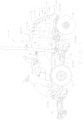
- the present disclosure generally provides a system and method for controlling the rotational speed and rotational direction of a radiator fan 10 of a turf mower 14 to maintain cleanliness of one or more radiator air intake screen(s) 18 disposed in a hood 20 of the mower 14. Maintaining the cleanliness of the radiator air intake screen(s) 18 (i.e., maintaining the absence of or minimalization of debris on intake screen(s) 18) allows the radiator fan to draw sufficient air through a radiator 22 of the mower 14 such that cooling fluid and/or hydraulic fluid flowing through radiator 22 is/are properly cooled, thereby preventing overheating of an internal combustion engine (ICE) 26 and/or a hydraulic system 30 of the mower 14.
- ICE internal combustion engine
- the present disclosure provides a radiator air intake screen maintenance system 34 that is structured and operable to remove and/or minimalize debris such as dirt, dust, grass clippings, leaves, twigs, chaff, etc., collected on the radiator air intake screen(s) 18, and maintain the cleanliness of the radiator air intake screen(s) 18, by controlling the rotational speed and rotational direction of the radiator fan 10.
- a radiator air intake screen maintenance system 34 that is structured and operable to remove and/or minimalize debris such as dirt, dust, grass clippings, leaves, twigs, chaff, etc.
- the mower 14 generally includes the ICE 26, that provides motive force to one or more wheels 42, via a mechanical, hydraulic or electric drivetrain 46.
- the motive force is utilized to propel the mower 14 across a ground surface, e.g., golf course greens, collars, tee-boxes, approaches, fairways, roughs, parks, other turfgrass, etc., for cutting the grass of the respective ground surface.
- the mower 14 additionally includes an engine and/or hydraulic system cooling system that comprises the radiator 22 fluidly connected to an engine block of the ICE 26 and/or to a hydraulic fluid tank 30A of the hydraulic system 30, and the radiator fan 10.
- the ICE 26, radiator 22, radiator fan 10, fan motor 50, and hydraulic system are disposed beneath and encompassed by the hood 20, and as described above, the intake screen(s) 18 is/are disposed within the hood 20 to provide portals for ambient air to be drawn into the space beneath the hood 20 and for air within the space beneath the hood to be ported to the ambient environment.
- the radiator fan 10 is structured and operable rotate in a forward direction to draw a cooling air flow F+ from an exterior environment (i.e., an environment exterior to the hood 20) through the radiator air intake screen(s) 18 and then through the radiator 22 to cool an engine coolant (i.e., cooling fluid) and/or a hydraulic fluid flowing through the radiator 22, thereby cooing the engine coolant and/or hydraulic fluid, and hence cooling the ICE 26 and/or hydraulic system 30. More specifically, the radiator fan 10 is controlled by a computer based control module 38, which is programmed to control the rotational speed and direction of the radiator fan 10, and thereby control the volume and flow rate of the cooling airflow F+ that is drawn in from the exterior environment.
- a computer based control module 38 which is programmed to control the rotational speed and direction of the radiator fan 10, and thereby control the volume and flow rate of the cooling airflow F+ that is drawn in from the exterior environment.
- the hydraulic system 30 comprises an oil reservoir or tank 30A, that is fluidly connected to a hydraulic pump 30B, which is fluidly connected to one or more hydraulic device 30C, such as one or more hydraulic actuator that is structured and operable to raise and lower one or more mower blade deck 36, or hydraulic steering system components, or hydraulic traction systems components, etc.
- the radiator fan 10 can be hydraulically operated.
- the pump 30B is structured and operable to pump the hydraulic fluid to the hydraulic device(s) 30C which is utilized to operate the hydraulic devices 30C.
- the radiator air intake screen maintenance system 34 comprises the radiator fan 10, a fan motor 50 operable to drive/rotate the fan 10 and a computer based control module 38 that is communicatively (wired or wirelessly) connected to the fan motor 50 and is structured and operable to control operation of the fan motor 50 to thereby control the rotational speed and direction of the radiator fan 10.
- the mower 14 can be absent the hydraulic system 30 whereby the one or more mower blade deck 36, steering system components, or traction systems components, etc., can be electrically operated and driven.
- the mower 14 can comprises a hybrid hydraulic and electric system, wherein various systems, devices and components such as the one or more mower blade deck 36, steering system components, and/or traction systems components, etc., can be operated and driven by either the hydraulic system 30 and/or an electric power system.
- various systems, devices and components such as the one or more mower blade deck 36, steering system components, and/or traction systems components, etc., can be operated and driven by either the hydraulic system 30 and/or an electric power system.
- the control module 38 can be any control module of the mower 14.
- it can be a standalone module specifically programmed with one or more fan control algorithm, program code and/or software (referred to herein as fan control software) that is executable to control the rotational speed and direction of the radiator fan 10.
- the control module 38 can be any computer based module of the mower 14 that is programmed to control the operation of various other devices and systems of the mower 14, and programmed with the fan control software to control the rotational speed and direction of the radiator fan 10.
- control module 38 can be an engine control module (ECM) and/or a master control unit (MCU) of the mower 14 that is/are programmed, independently or in combination, to control various functions and operations of the ICE 26, and is also programmed with the fan control software to control the rotational speed and direction of the radiator fan 10.
- ECM engine control module
- MCU master control unit
- the control module 38 can be a hardware based module that is structured and operable to implement the fan control software functionality as described herein.
- control module 38 can comprise one or more, or be part of, application specific integrated circuit(s) (e.g., ASIC(s)), combinational logic circuit(s); field programmable gate array(s) (FPGA); processor(s) (shared, dedicated, or group) that execute the fan control software; and/or other suitable hardware components that provide the functionality described herein; or a combination of some or all of the above, such as in a system-on-chip, and remain within the scope of the present disclosure.
- application specific integrated circuit e.g., ASIC(s)
- combinational logic circuit(s) e.g., combinational logic circuit(s); field programmable gate array(s) (FPGA); processor(s) (shared, dedicated, or group) that execute the fan control software; and/or other suitable hardware components that provide the functionality described herein; or a combination of some or all of the above, such as in a system-on-chip, and remain within the scope of the present disclosure.
- FPGA field programmable gate array
- control module 38 is sometimes described herein as directly controlling the various automated, or robotic, operations of the radiator fan 10, it is the execution of the fan control software by at least one processor of the control module 38, in various instances using inputs from a user interface, various electronically stored data tables, databases, lookup tables, etc., and/or various other components, sensors, systems and assemblies of the mower 14 that actually control the various automated, or robotic, operations of the radiator fan 10 described herein. Additionally, in various instances the control module 38 may indirectly perform and/or control performance of such operations and functionality of the radiator fan 10 by generating commands and control signals that can cause other elements to carry out the control operations and functionality of the radiator fan described herein. Or, in the various hardware embodiments, it is the operation of the various control module 38 hardware components that can generate the fan control commands that are then output by the control module 38 to control the operations and functions of the radiator fan as described herein.
- the radiator 22 can be a split radiator with the hydraulic fluid flowing through a hydraulic fluid (e.g., oil) cooler section of the radiator 22 (e.g., a first half of the radiator 22) and the engine coolant flowing through a coolant cooler section (e.g., a second half of the radiator 22).
- a hydraulic fluid e.g., oil
- the hydraulic fluid and coolant cooler sections are completely sealed from one another to prevent fluid intermixing.
- the hydraulic fluid enters the hydraulic fluid cooler section of the radiator 22 (e.g., enters from the top or bottom of hydraulic fluid cooler section of the radiator 22) and is directly cooled by the forced air flow F+ generated by the radiator fan 10 that is drawn over the fins of the radiator 22.
- the hydraulic fluid and engine coolant sections are separate closed loop systems that only extracts heat from the respective hydraulic fluid and engine coolant and each section plays no part in cooling the opposing hydraulic fluid and engine coolant flowing through the other section.
- the radiator 22 can be structured to cool only one of the engine coolant or the hydraulic fluid.
- the radiator 22 can be structure and operable only to cool the engine coolant.
- the mower 14 can be configured to include a first radiator 22 and fan 10 combination for cooling the hydraulic fluid, and a second and independent radiator 22 and fan 10 combination for cooling the engine coolant.
- the mower 14 can include one or more control module 38 structured an operable to control the rotational speed and direction of the first and or second fans 10.
- the mower 14 will be described herein to comprise the single split radiator 22 structured to comprise the hydraulic fluid cooler section and the engine coolant cooler section as described above.
- the radiator air intake screen maintenance system 34 comprising the respective radiator fan(s) 10 and control module(s) 38, will function and be operable as described herein.
- the radiator air intake screen maintenance system 34 is described herein as being implemented in the turf mower 14, it should be understood that the radiator air intake screen maintenance system 34 described herein can be implemented in any vehicle having a radiator and radiator air intake screen, wherein the radiator air intake screen is prone to collecting debris (e.g., dirt, dust, grass clippings, leaves, twigs, chaff, etc.) during operation of the respective vehicle, and remain within the scope of the present disclosure.
- the radiator air intake screen maintenance system 34 comprises the radiator fan 10, the fan motor 50 and the programmable computer based control module 38.
- the control module 38 is communicatively (wired or wirelessly) connected the fan motor 50 and is structured and operable to execute the fan control software in order to control the rotational speed and direction of the radiator fan 22.
- the control module 38 is programmable with the fan control software that is executable to implement an intake screen clearing routine that includes a predetermined sequence of debris drop cycles to maintain and clean the air intake screen(s) and maintain proper cooling of the engine cooling fluid and/or hydraulic system hydraulic fluid.
- execution of the fan control software by the control module 38 controls the rotational speed and direction of the radiator fan 10 in accordance with a predetermined sequence of debris drop cycle fan operation parameters that comprise the timing, rotational direction, duration, and rotational speed of the radiator fan 10.
- the control module 38 is programmable with the fan control software that is executable to implement an intake screen clearing routine that includes a predetermined sequence of debris drop cycles and full reverse cycles to maintain and clean the air intake screen(s) and maintain proper cooling of the engine cooling fluid and/or hydraulic system hydraulic fluid.
- execution of the fan control software by the control module 38 controls the rotational speed and direction of the radiator fan 10 in accordance with a predetermined sequence of debris drop cycle fan operation parameters and full reverse cycle fan operation parameters.
- the debris drop cycle fan operation parameters and full reverse cycle fan operation parameters each comprise the timing, rotational direction, duration, and rotational speed of the radiator fan 10.
- control module 38 can be programmable with the fan control software to implement an intake screen clearing routine that includes a predetermined sequence of only debris drop cycles, in the exemplary embodiments described below the control module 38 will be described as being programmable with the fan control software designed to implement an intake screen clearing routine that includes a predetermined sequence of both debris drop cycles and full reverse cycles.
- Figure 3 provides a flow chart 200 that exemplarily illustrates the steps of a drop cycle commanded by the control module 38.
- a drop cycle as controlled by the control module 38, comprises controlling rotational speed and direction of the radiator fan 10 such that the radiator fan 10 is slowed down and/or stopped (but the rotational direction is not reversed) to allow debris collected on the intake screen(s) 18 to fall off.
- Full forward operating speed is a predetermined programed rotational speed (e.g., predetermined programed RPM) of the radiator fan 10 that is predetermined to provide maximum cooling of the radiator 22.
- the control module 38 commands commencement of a drop cycle, as indicated at 204.
- the control module 38 commands the fan motor 50 to slow, or ramp down, the rotational speed of the radiator fan 10 to a certain programmed drop cycle speed or commands the fan motor 50 to stop rotation of the fan 10, as indicated a 206.
- control module 38 does not command the rotational direction of fan 10 to be reversed such that the fan 10 is rotating in a backward or reverse direction (i.e., rotating in non-cooling direction such that an expulsion air flow F- is generated that is opposite of the cooling air flow F+).
- This reduces and/or ceases the cooling air flow F+, which in turn reduces and/or ceases a suction force present at the intake screen(s) 18 that is generated by the cooling air flow F+ being drawn through the air intake screen(s) 18, as indicated at 208.
- Reducing and/or ceasing the suction force at the intake screen(s) 18 allows the debris to fall off the air intake screen(s) 18 via gravitational force as indicated at 210.
- the ambient environment wind or breeze can aid the gravitational force to remove the debris from the intake screen(s) 18.
- the control module 38 maintains the rotational speed of the radiator fan 10 at the programmed drop cycle speed for a particular programmed duration of time Y referred to herein as dwell time Y (e.g., 2.0 to 10.0 seconds), as indicated at 212. Subsequently, after the dwell time Y has elapsed the control module 38 commands the radiator fan 10 to begin or increase (e.g., ramp up) rotation of the fan 10 in the forward or cooling direction until the rotational speed of the fan 10 is at the desired programmed full forward operating speed for proper cooling of the radiator 22 and the coolant and/or pneumatic fluid flowing therethrough, as indicated at 214.
- dwell time Y e.g. 2.0 to 10.0 seconds
- drop cycle counter is restarted and upon the passage of the drop cycle interval X (e.g., 2 to 15 minutes or longer) a subsequent drop cycle is carried out, and drop cycles are similarly repeated until execution of the fan control software ceases and/or when operation of the mower is ceased, as indicated at 216.
- drop cycle interval X e.g. 2 to 15 minutes or longer
- the radiator fan 10 would only cease generating the cooling air flow F+ for short periods and will not cause the engine coolant and/or hydraulic fluid temperature to increase or only increase minimally compared to the temperature increase caused by full reverse cycles.
- the ramp down portion of the drop cycle indicated at 204 and 206 can take 1.0 to 3.0 seconds (e.g., 2.15 seconds)
- the dwell time portion of drop cycle indicated at 208, 210 and 212 can take 2.0 to 6.0 seconds or longer (e.g., 3.0 seconds)
- the ramp up portion of the drop cycle indicated at 214 can take 1.0 to 4.0 seconds (e.g., 2.15 seconds).
- an entire drop cycle can take only 4.0 to 13.0 second (e.g., 7.3 seconds). That is, in an exemplary embodiment, the duration of a drop cycle, i.e., the time elapsed between commanding the radiator fan 10 to cease operating/rotating in the forward direction to generate the cooling air flow F+ for cooling the engine coolant and/or hydraulic fluid and the fan 10 speed is ramped back up to full forward operating speed, is only 4.0 to 13.0 second (e.g., 7.3 seconds).
- the drop cycle interval X i.e., time between drop cycles
- the drop cycle interval X can be between 2 to 10 minutes or longer. For example, in various instances the drop cycle interval X can be 5 minutes.
- Full reverse cycles are performed at certain programed intervals, referred to herein as a full reverse cycle interval M, between and intermixed with the drop cycles.
- the full reverse cycle interval M can be 10 to 90 minutes (e.g., 30 minutes).
- the full reverse cycles are included in the fan control software routines such that the full reverse cycles are intermixed with the drop cycles during execution of the fan control software by the control module 38.
- the drop cycles are performed frequently and are performed to clear debris from the hood intake screen(s) 18, while the full reverse cycles are performed much less frequently than the drop cycles and are performed to blow debris out of the radiator 22.
- Figure 4 provides a flow chart 300 that exemplarily illustrates the steps of a full reverse cycle commanded by the control module 38.
- a full reverse cycle as controlled by the control module 38, comprises controlling rotational speed and direction of the radiator fan 10 such that the radiator fan 10, when rotating in the forward direction at full forward operating speed, is slowed down and stopped, the direction of rotation is reversed and increased to a full reverse cycle or expulsion speed such that debris collected on a front side 22A of the radiator 22 (i.e., the side of the radiator opposite the side on which the fan 10 is disposed), and debris caught within the cooling fins of the radiator 22, and debris collected on the intake screen(s) 18 is blown or forced off and out of the radiator 22 and the intake screen(s) 18 by the expulsion air flow F- generated by the fan 10.
- control module 38 Upon commencement of the full reverse cycle the control module 38 commands the fan motor 50 to slow and ramp down the forward rotational speed of the radiator fan 10, as indicated at 306. The control module 38 then commands the fan motor 50 to cease driving the fan 10 to allow the fan 10 to coast to a full stop, as indicated at 308.
- control module 38 commands the rotational direction of fan 10 to be reversed such that the fan 10 is rotated in a backward or reverse direction and the expulsion air flow F- is generated, as indicated at 310.
- the control module 38 then commands the fan 10 to ramp up and increase rotational speed in the reverse direction until the programed full reverse cycle or expulsion speed, is reached, as indicated at 312.
- the fan 10 In the reverse direction the fan 10 generates the expulsion air flow F- which blows and forces air through the radiator 22 in the F- direction.
- the control module 38 maintains the reverse rotational speed of the fan 10 at the programmed full reverse cycle speed for a particular programmed duration of time N referred to herein as full reverse duration time N (e.g., 5.0 to 20.0 seconds), as indicated at 316. After the full reverse duration time N has elapsed the control module 38 commands the fan motor 50 to slow and ramp down the reverse rotational speed of the radiator fan 10, as indicated a 318. The control module 38 then commands the fan motor 50 to cease driving the fan 10 to allow the fan 10 to coast to a full stop, as indicated a 320.
- full reverse duration time N e.g., 5.0 to 20.0 seconds
- the control module 38 commands the fan 10 to begin rotation in the forward direction again and increase or ramp up to the programed full forward operating speed for proper cooling of the radiator 22 and the coolant and/or pneumatic fluid flowing therethrough, as indicated at 322.
- the full reverse cycle counter is restarted and upon the passage of the full reverse cycle interval M (e.g., 10 to 90 minutes or longer) a subsequent full reverse cycle is carried out, and full reverse cycles are similarly repeated until execution of the fan control software ceases and/or when operation of the mower 14 is ceased, as indicated at 324.
- each full reverse cycle would take a several seconds.
- the ramp down portion of the full reverse cycle indicated at 304 and 306 can take 2.0 to 5.0 seconds (e.g., 3.4 seconds)
- the coast to full stop portion indicated at 308 can take 1.0 to 2.0 seconds (e.g., 1.0 second)
- the ramp up to full reverse speed indicated at 310 and 312 can take 2.0 to 5.0 seconds (e.g., 3.4 seconds)
- the full reverse duration time during which the expulsion air flow F- blows and forces debris off of and out of the radiator and the air intake screen(s) 18 indicated at 314 and 316 can take 5.0 to 15.0 seconds (e.g., 10.0 seconds)
- the ramp down from full reverse speed indicated at 318 can take 2.0 to 5.0 seconds (e.g., 3.4 seconds)
- the coast to full stop portion indicated at 320 can take 1.0 to 2.0 seconds (e.g., 1.0 second)
- an entire full reverse cycle can take 15.0 to 40.0 seconds (e.g., 25.6 seconds). That is, in an exemplary embodiment, the duration of a full reverse cycle, i.e., the time elapsed from commanding the radiator fan 10 to cease operating/rotating in the forward direction to generate the cooling air flow F+ for cooling the engine coolant and/or hydraulic fluid, to the fan 10 rotational direction is reversed and ramped up to full reverse speed for the reverse duration time N, to the fan rotation direction is reversed again and ramped back up to full forward operating speed, can consume 15.0 to 40.0 seconds (e.g., 25.6 seconds).
- the full reverse cycle interval M i.e., time between full reverse cycles
- the full reverse cycle interval M can be between 10 and 90 minutes or longer.
- the full reverse cycle interval M can be 30 minutes.
- the control module 38 can be a computer based module that is a standalone module or any control module of the mower 14 that is programmed with one or more fan control algorithm, program code and/or software that is executable to control the rotational speed and direction of the radiator fan 10, and in various instances can be additionally programmed to control other mower 14 operations.
- the control module 38 generally comprises at least one processor 58 suitable to execute the fan control software as described herein and at least one electronic storage device 62 on which the fan control software is stored.
- the electronic storage device(s) 62 comprises a computer readable medium, e.g., non-transitory, tangible, computer-readable medium, such as a hard drive, erasable programmable read-only memory (EPROM), electronically erasable programmable read-only memory (EEPROM), read-write memory (RWM), etc.
- a computer readable medium e.g., non-transitory, tangible, computer-readable medium, such as a hard drive, erasable programmable read-only memory (EPROM), electronically erasable programmable read-only memory (EEPROM), read-write memory (RWM), etc.
- Other, non-limiting examples of the non-transitory, tangible, computer-readable medium are nonvolatile memory, magnetic storage, and optical storage.
- the computer readable memory can be any electronic data storage device for storing such things as the various software, programs, algorithms, code, digital information, data, look-up tables, spreadsheets and/or databases, etc., used and executed during operation of the mower 14,
- control module 38 can be connectable (wired or wirelessly) to a display 66 for displaying such things as information, data and/or graphical representations, and/or at least one user interface device 70, such as a keyboard, mouse, stylus, and/or an interactive touch-screen on the display 66 for inputting data and information such as drop cycle and full reverse cycle parameters and settings such as the timing and duration of the various steps of the drop cycle and full reverse cycle, and the drop cycle and full reverse cycle intervals X and M, described above.
- a display 66 for displaying such things as information, data and/or graphical representations, and/or at least one user interface device 70, such as a keyboard, mouse, stylus, and/or an interactive touch-screen on the display 66 for inputting data and information such as drop cycle and full reverse cycle parameters and settings such as the timing and duration of the various steps of the drop cycle and full reverse cycle, and the drop cycle and full reverse cycle intervals X and M, described above.
- control module 38 can include a removable media reader 74 for reading information and data from and/or writing information and data to removable electronic storage media such as flash drives or any other computer readable removable and portable electronic storage media. Still further, it is envisioned that in various embodiments the control module 38 can be communicatively connectable (wired or wirelessly) to a remote server network 78, e.g., a local area network (LAN), via a wired or wireless link such that control module 38 can communicate with the remote server network 78 to upload and/or download data, information, algorithms, software programs, etc. Still further yet, it is envisioned that in various embodiments the control module 38 can be structured and operable to access the Internet to upload and/or download data, information, algorithms, software programs, etc., to and from Internet sites and network servers.
- a remote server network 78 e.g., a local area network (LAN)
- LAN local area network
- control module 38 can be structured and operable to access the Internet to upload and/or download data, information, algorithms, software programs,
- the fan control software and the drop cycle and full reverse cycle parameters and settings such as the timing a duration of the various steps of the drop cycle and full reverse cycle described above can be hard coded into the control module 38 (e.g., into the electronic storage 62) by the software vendor such that the drop cycle and full reverse cycle parameters and settings cannot be modified by the mower manufacturer, the mower dealer or the mower end user.
- the one or more of the drop cycle and/or full reverse cycle parameters and settings such as the timing a duration of the various steps of the drop cycle and full reverse cycle described above can be modified, via use of the display 66, user interface 70 removable media reader 74, remote server network 78 and/or Internet, by one or more of the mower manufacturer, the mower dealer and/or the mower end user.
- the radiator air intake screen maintenance system 34 can comprise one or more sensor, such as engine oil temperature sensor, hydraulic fluid temperature sensor, ambient environment temperature, ambient environment humidity sensor, etc., that is/are communicatively connected (wired or wirelessly) to the control module 38, and the fan control software comprises one or more automated drop and/or full reverse cycle parameter adjustment routine.
- the control module 38 monitors inputs/reading from one or more of the sensors and can automatically adjust the drop and/or full reverse cycle parameters based on such inputs.
Landscapes
- Engineering & Computer Science (AREA)
- Chemical & Material Sciences (AREA)
- Combustion & Propulsion (AREA)
- Mechanical Engineering (AREA)
- General Engineering & Computer Science (AREA)
- Cooling, Air Intake And Gas Exhaust, And Fuel Tank Arrangements In Propulsion Units (AREA)
Claims (12)
- Ein System zur Wartung eines Kühlerlufteinlassgitters (34) für ein Fahrzeug (14), wobei das System Folgendes umfasst:einen Kühlerlüfter (10) für das Fahrzeug (14), wobei der Kühlerlüfter (10) so aufgebaut und betreibbar ist, dass er durch einen Kühler (22) für das Fahrzeug strömendes Fluid kühlt;einen Lüftermotor (50), der so aufgebaut und betreibbar ist, dass er den Kühlerlüfter (10) in Drehung versetzt; undein computergestütztes Steuermodul (38), das kommunikativ mit dem Lüftermotor (50) verbunden und so aufgebaut und betreibbar ist, dass es:den Abwurfzyklus periodisch zu wiederholen, bis der Betrieb des Fahrzeugs eingestellt wird.
während des Betriebs des Fahrzeugs den Betrieb des Lüftermotors (50) zu steuern, um dadurch die Drehzahl und die Richtung des Kühlerlüfters (10) so zu steuern, dass der Lüfter während des Betriebs des Fahrzeugs so betrieben wird, dass er einen Abwurfzyklus durchführt, wobei beim Durchführen eines Abwurfzyklus während des Betriebs des Fahrzeugs eine Vorwärtsdrehung des Lüfters zur Kühlung des Kühlers von einer vollen Vorwärtsbetriebsdrehzahl auf eine Abwurfzyklusdrehzahl für eine vorbestimmte Verweilzeit verlangsamt wird, so dass Schmutz, der sich auf einem Kühlerlufteinlassgitter (18) des Fahrzeugs (14) angesammelt hat, aufgrund der Schwerkraft vom Kühlerlufteinlassgitter (18) abfällt, dann die Steuerung des Lüfters abwesend ist, um die Drehung des Lüfters umzukehren, und das Lüfter nach Ablauf der Verweilzeit wieder auf die volle Vorwärtsbetriebsdrehzahl gebracht wird; und - Das System (34) nach Anspruch 1, wobei das Steuermodul (38) ferner so aufgebaut und betreibbar ist, dass es den Betrieb des Lüftermotors (50) steuert, um dadurch die Drehzahl und die Drehrichtung des Kühlerlüfters (10) so zu steuern, dass der Lüfter periodisch betrieben wird, um einen vollständigen Rückwärtszyklus durchzuführen, wobei beim Durchführen eines vollständigen Rückwärtszyklus die Vorwärtsdrehung des Lüfters zur Kühlung des Kühlers von der vollen Vorwärtsbetriebsdrehzahl verlangsamt und gestoppt wird, wonach die Drehrichtung des Lüfters umgekehrt wird und der Lüfter mit einer vollen Rückwärtsdrehungsgeschwindigkeit für eine vorbestimmte Rückwärtsdrehungsdauer betrieben wird, so dass Ablagerungen, die sich auf dem Kühler und dem Lufteinlassgitter (18) angesammelt haben, vom Kühler (22) und dem Kühlerlufteinlassgitter (18) durch einen Ausstoßluftstrom, der durch den Lüfter erzeugt wird, der mit der vollen Rückwärtsdrehungsgeschwindigkeit betrieben wird, weggeblasen werden, und dann, nachdem die Rückwärtsdrehungsdauer verstrichen ist, der Lüfter verlangsamt, gestoppt und auf die volle Vorwärtsdrehungsgeschwindigkeit zurückgebracht wird.
- Das System (34) nach Anspruch 2, wobei das computergestützte Modul (38) den Betrieb des Lüftermotors (50) so steuert, dass die regelmäßigen Tropfenzyklen in einem vorbestimmten Tropfenzyklusintervall und die vollen Rückwärtszyklen in einem vorbestimmten vollen Rückwärtszyklusintervall durchgeführt werden.
- Das System (34) nach Anspruch 3, wobei mindestens eine der folgenden Bedingungen erfüllt ist: das Intervall für den Tropfenzyklus liegt zwischen 2 Minuten und 15 Minuten; und das Intervall für den vollständigen Rückwärtszyklus liegt zwischen 1 Minute und 90 Minuten.
- Das System (34) nach Anspruch 2, wobei die Dauer jedes Tropfenzyklus kürzer ist als die Dauer jedes vollen Rückwärtszyklus.
- Das System (34) nach Anspruch 5, wobei mindestens eines von Folgendem gilt: die Dauer des Tropfenzyklus liegt zwischen 4,0 Sekunden und 13,0 Sekunden; und die Dauer des vollständigen Rückwärtszyklus liegt zwischen 15,0 Sekunden und 40,0 Sekunden.
- Ein Verfahren zur Erhaltung der Sauberkeit eines Kühlerlufteinlassschirms (18), der in einer Motorhaube eines Fahrzeugs (14) während des Betriebs des Fahrzeugs angeordnet ist, um die Ansammlung von Schmutz auf dem Kühlerlufteinlassschirm (18) während des Betriebs des Fahrzeugs zu minimieren und dadurch zu ermöglichen, dass ein Kühlerlüfter (10) des Fahrzeugs (14) ausreichend Luft durch einen Kühler (22) des Fahrzeugs ansaugt, um die durch den Kühler (22) fließende Flüssigkeit zu kühlen und eine ordnungsgemäße Kühlung eines Verbrennungsmotors des Fahrzeugs während des Betriebs des Fahrzeugs bereitzustellen, wobei das Fahrzeug ein Kühlerlufteinlassschirm-Wartungssystem (34) umfasst, das Folgendes umfasst:den Kühlerlüfter (10);einen Lüftermotor (50), der so strukturiert und betreibbar ist, dass er den Kühlerlüfter (10) dreht; undein computergestütztes Steuermodul (34), das kommunikativ mit dem Lüftermotor (50) verbunden ist und so strukturiert und betreibbar ist, dass es während des Betriebs des Fahrzeugs den Betrieb des Lüftermotors (50) steuert, um dadurch die Drehzahl und die Richtung des Kühlerlüfters (10) zu steuern, wobei das Verfahren Folgendes umfasst:
während des Betriebs des Fahrzeugs über das Steuermodul (34) periodisch einen Abwärtszyklus durchzuführen, wobei die Durchführung eines Abwärtszyklus Folgendes umfasst:Verlangsamen der Vorwärtsdrehung des Lüfters für die Kühlung des Kühlers von einer vollen Vorwärtsdrehzahl auf eine Abwurfdrehzahl;Beibehalten der Drehung des Lüfters bei der Abwurfdrehzahl für eine vorbestimmte Verweilzeit, so dass die auf dem Kühlerlufteinlassgitter (18) angesammelten Ablagerungen aufgrund der Schwerkraft vom Kühlerlufteinlassgitter abfallen; undAbwesenheit einer Umkehr der Drehung des Lüfters, nachdem die Verweilzeit verstrichen ist, Wiedereinschalten des Lüfters auf die volle Vorwärtsdrehzahl; undWiederholen der Durchführung des Abwurfzyklus, bis der Betrieb des Fahrzeugs beendet ist. - Das Verfahren nach Anspruch 7, bei dem über das Steuermodul (34) periodisch ein vollständiger Umkehrzyklus durchgeführt wird, wobei die Durchführung eines vollständigen Umkehrzyklus Folgendes umfasst:Verlangsamen der Vorwärtsdrehung des Lüfters zur Kühlung des Kühlers von der vollen Vorwärtsbetriebsdrehzahl;Anhalten der Vorwärtsdrehung des Lüfters zur Kühlung des Kühlers;Umkehren der Drehrichtung des Lüfters; Erhöhen der Drehrichtung des Lüfters in umgekehrter Richtung auf eine volle Rückwärtszyklusgeschwindigkeit;Aufrechterhalten der Drehung des Lüfters bei der vollen Rückwärtsdrehzahl für eine vorbestimmte Rückwärtsdrehzeitdauer, so dass Ablagerungen, die sich auf dem Kühler und dem Lufteinlassgitter angesammelt haben, durch einen Ausstoßluftstrom, der durch den mit der vollen Rückwärtsdrehzahl betriebenen Lüfter erzeugt wird, vom Kühler und dem Kühlerlufteinlassgitter weggeblasen und aus diesen herausgetragen werden;und nach Ablauf der Rückwärtsdrehungsdauer die Rückwärtsdrehung des Lüfters verlangsamt und gestoppt wird, die Drehrichtung des Lüfters in die Vorwärtskühlungsrichtung des Kühlers zurückkehrt und der Lüfter wieder die volle Vorwärtsdrehzahl erreicht.
- Das Verfahren nach Anspruch 8, wobei die regelmäßigen Tropfenzyklen in einem vorbestimmten Tropfenzyklusintervall und die vollen Umkehrzyklen in einem vorbestimmten vollen Umkehrzyklusintervall durchgeführt werden.
- Das Verfahren nach Anspruch 9, wobei mindestens eines der folgenden Merkmale zutrifft:das Intervall für den Tropfenzyklus liegt zwischen 2 Minuten und 15 Minuten; unddas Intervall für den vollen Rückwärtszyklus liegt zwischen 10 Minuten und 90 Minuten.
- Das Verfahren nach Anspruch 8, wobei die Dauer jedes Tropfenzyklus geringer ist als die Dauer jedes vollen Umkehrzyklus.
- Das Verfahren nach Anspruch 11, wobei mindestens eines der folgenden Merkmale zutrifft:die Dauer des Tropfenzyklus liegt zwischen 4,0 Sekunden und 13,0 Sekunden; unddie Dauer des vollständigen Umkehrzyklus liegt zwischen 15,0 Sekunden und 40,0 Sekunden.
Applications Claiming Priority (1)
| Application Number | Priority Date | Filing Date | Title |
|---|---|---|---|
| US17/333,295 US11585261B2 (en) | 2021-05-28 | 2021-05-28 | Vehicle air intake screen maintenance systems and methods |
Publications (2)
| Publication Number | Publication Date |
|---|---|
| EP4095367A1 EP4095367A1 (de) | 2022-11-30 |
| EP4095367B1 true EP4095367B1 (de) | 2024-06-12 |
Family
ID=81846473
Family Applications (1)
| Application Number | Title | Priority Date | Filing Date |
|---|---|---|---|
| EP22175142.3A Active EP4095367B1 (de) | 2021-05-28 | 2022-05-24 | System und verfahren zur wartung von lufteinlassgittern für fahrzeuge |
Country Status (2)
| Country | Link |
|---|---|
| US (2) | US11585261B2 (de) |
| EP (1) | EP4095367B1 (de) |
Family Cites Families (24)
| Publication number | Priority date | Publication date | Assignee | Title |
|---|---|---|---|---|
| US2886016A (en) * | 1956-11-07 | 1959-05-12 | Massey Ferguson Inc | Harvester air intake |
| DD129540A1 (de) * | 1976-12-31 | 1978-01-25 | Dieter Kunze | Luftleiteinrichtung am motorkuehlsystem einer selbstfahrenden landmaschine |
| US5199521A (en) * | 1990-07-18 | 1993-04-06 | Kubota Corporation | Lawn mower having passages for engine cooling air |
| US6126079A (en) * | 1999-07-15 | 2000-10-03 | Deere & Company | Fan control |
| US6634448B2 (en) * | 2001-07-20 | 2003-10-21 | Mark Bland | Riding lawn mower with improved radiator system |
| US6750623B1 (en) * | 2002-12-17 | 2004-06-15 | Caterpillar Inc. | Reversible automatic fan control system |
| JP4651467B2 (ja) * | 2005-07-06 | 2011-03-16 | 株式会社小松製作所 | 冷却用油圧駆動ファンの制御装置および制御方法 |
| US7134406B1 (en) * | 2005-09-08 | 2006-11-14 | Deere & Company | Cooling fan control for improved engine load acceptance |
| US20080056887A1 (en) * | 2006-06-09 | 2008-03-06 | Entire Interest | Hydraulic gear motor with integrated filter |
| US20120304944A1 (en) * | 2011-05-31 | 2012-12-06 | Nelson Bryan E | Engine system with reversible fan |
| US8984872B2 (en) * | 2011-07-08 | 2015-03-24 | Caterpillar Inc. | Hydraulic accumulator fluid charge estimation system and method |
| US8967092B1 (en) * | 2012-10-18 | 2015-03-03 | Promanpto, Llc | Inline cooling fan reverser |
| US10036456B2 (en) * | 2013-11-29 | 2018-07-31 | Transmission Cvtcorp Inc. | Drive assembly provided with a continuously variable transmission and a direction reversing mechanism |
| GB2521350B (en) * | 2013-12-06 | 2016-01-27 | Jaguar Land Rover Ltd | Vehicle cooling system |
| US20170342988A1 (en) * | 2014-12-12 | 2017-11-30 | Agco International Gmbh | A Fan Drive Assembly |
| FR3031765B1 (fr) * | 2015-01-16 | 2018-08-24 | Manitou Bf | Dispositif d'evacuation de particules et debris |
| US20170096931A1 (en) * | 2015-10-06 | 2017-04-06 | Cnh Industrial America Llc | Agricultural harvester |
| US10450939B2 (en) | 2016-04-28 | 2019-10-22 | Deere & Company | Multiple plane recirculation fan control for a cooling package |
| WO2018208965A1 (en) | 2017-05-09 | 2018-11-15 | Applied Industrial Technologies, Inc. | Fan speed control system for engine cooling |
| US10479191B2 (en) | 2017-12-19 | 2019-11-19 | Cnh Industrial America Llc | Cooling systems and methods for an agricultural harvester |
| US20190292975A1 (en) | 2018-03-20 | 2019-09-26 | Oshkosh Corporation | Hydraulic fan arrangement |
| US10801392B2 (en) * | 2018-05-25 | 2020-10-13 | Ford Global Technologies, Llc | Systems and methods for expedited vehicle soak |
| JP7160646B2 (ja) * | 2018-11-22 | 2022-10-25 | キャタピラー エス エー アール エル | 建設機械 |
| US11286843B2 (en) * | 2019-08-20 | 2022-03-29 | Engineered Machined Products, Inc. | System for fan control |
-
2021
- 2021-05-28 US US17/333,295 patent/US11585261B2/en active Active
-
2022
- 2022-05-24 EP EP22175142.3A patent/EP4095367B1/de active Active
-
2023
- 2023-02-03 US US18/163,917 patent/US11761370B2/en active Active
Also Published As
| Publication number | Publication date |
|---|---|
| US11585261B2 (en) | 2023-02-21 |
| EP4095367A1 (de) | 2022-11-30 |
| US20230184155A1 (en) | 2023-06-15 |
| US11761370B2 (en) | 2023-09-19 |
| US20220381177A1 (en) | 2022-12-01 |
Similar Documents
| Publication | Publication Date | Title |
|---|---|---|
| US20120247752A1 (en) | Controller for work vehicle cooling package | |
| CN105928071B (zh) | 空调器及其清洁控制方法 | |
| CN111852644A (zh) | 具有可调节百叶窗的冷却系统进气口 | |
| EP3726955B1 (de) | Kühlsysteme und verfahren für eine landwirtschaftliche erntemaschine | |
| CN106016520B (zh) | 空调器及其清洁控制方法 | |
| SU1047753A1 (ru) | Воздухонаправл ющее устройство в системе охлаждени двигател самоходной сельскохоз йственной машины | |
| CN113738686B (zh) | 可变桨距风扇控制系统 | |
| CN112119743A (zh) | 一种自动割草机器人及割草装置、调整割草高度的方法 | |
| AU2016234898B2 (en) | Harvester reversing engine fan | |
| EP4095367B1 (de) | System und verfahren zur wartung von lufteinlassgittern für fahrzeuge | |
| EP2792796A2 (de) | Arbeitsmaschine mit einer verbesserten Hydraulikflüssigkeitserwärmung mithilfe Hydrauliklüfterumkehrung | |
| BR102013005538A2 (pt) | Sistema de controle de refrigeração de ceifeira-debulhadora | |
| CN103273899A (zh) | 一种可转动式车辆前格栅及具有该前格栅的车辆 | |
| CN103031796B (zh) | 具有自动风扇转速调节的建筑机械 | |
| CN106150662A (zh) | 发动机冷却液温度控制方法、控制器和控制系统 | |
| CN105944466A (zh) | 空调器及其清洁控制方法 | |
| CN111485986B (zh) | 发动机冷却系统的控制方法、控制装置及发动机冷却系统 | |
| CN105953361A (zh) | 空调器及其清洁控制方法 | |
| CN216805379U (zh) | 收割机散热水箱的自动除尘水箱罩 | |
| AU2012236115A1 (en) | Pusher airflow for work vehicle cooling system | |
| BR112013025293B1 (pt) | Método para administrar uma pluralidade de sistemas de resfriamento e veículo de trabalho | |
| CN210143331U (zh) | 一种割草动力装置及具有该割草动力装置的割草机 | |
| CN112421878B (zh) | 风扇换向控制系统、控制方法及设备 | |
| JP6751531B2 (ja) | コンバインの原動部構造 | |
| JP5862057B2 (ja) | コンバインの原動部構造 |
Legal Events
| Date | Code | Title | Description |
|---|---|---|---|
| PUAI | Public reference made under article 153(3) epc to a published international application that has entered the european phase |
Free format text: ORIGINAL CODE: 0009012 |
|
| STAA | Information on the status of an ep patent application or granted ep patent |
Free format text: STATUS: THE APPLICATION HAS BEEN PUBLISHED |
|
| AK | Designated contracting states |
Kind code of ref document: A1 Designated state(s): AL AT BE BG CH CY CZ DE DK EE ES FI FR GB GR HR HU IE IS IT LI LT LU LV MC MK MT NL NO PL PT RO RS SE SI SK SM TR |
|
| RAP1 | Party data changed (applicant data changed or rights of an application transferred) |
Owner name: TEXTRON INNOVATIONS INC. |
|
| STAA | Information on the status of an ep patent application or granted ep patent |
Free format text: STATUS: REQUEST FOR EXAMINATION WAS MADE |
|
| 17P | Request for examination filed |
Effective date: 20230530 |
|
| RBV | Designated contracting states (corrected) |
Designated state(s): AL AT BE BG CH CY CZ DE DK EE ES FI FR GB GR HR HU IE IS IT LI LT LU LV MC MK MT NL NO PL PT RO RS SE SI SK SM TR |
|
| GRAP | Despatch of communication of intention to grant a patent |
Free format text: ORIGINAL CODE: EPIDOSNIGR1 |
|
| STAA | Information on the status of an ep patent application or granted ep patent |
Free format text: STATUS: GRANT OF PATENT IS INTENDED |
|
| RIC1 | Information provided on ipc code assigned before grant |
Ipc: B60K 11/00 20060101ALI20231205BHEP Ipc: F01P 7/04 20060101ALI20231205BHEP Ipc: B60K 11/02 20060101ALI20231205BHEP Ipc: F01P 5/04 20060101AFI20231205BHEP |
|
| INTG | Intention to grant announced |
Effective date: 20240104 |
|
| GRAS | Grant fee paid |
Free format text: ORIGINAL CODE: EPIDOSNIGR3 |
|
| GRAA | (expected) grant |
Free format text: ORIGINAL CODE: 0009210 |
|
| STAA | Information on the status of an ep patent application or granted ep patent |
Free format text: STATUS: THE PATENT HAS BEEN GRANTED |
|
| AK | Designated contracting states |
Kind code of ref document: B1 Designated state(s): AL AT BE BG CH CY CZ DE DK EE ES FI FR GB GR HR HU IE IS IT LI LT LU LV MC MK MT NL NO PL PT RO RS SE SI SK SM TR |
|
| REG | Reference to a national code |
Ref country code: GB Ref legal event code: FG4D |
|
| REG | Reference to a national code |
Ref country code: CH Ref legal event code: EP |
|
| REG | Reference to a national code |
Ref country code: IE Ref legal event code: FG4D |
|
| REG | Reference to a national code |
Ref country code: DE Ref legal event code: R096 Ref document number: 602022003878 Country of ref document: DE |
|
| PG25 | Lapsed in a contracting state [announced via postgrant information from national office to epo] |
Ref country code: BG Free format text: LAPSE BECAUSE OF FAILURE TO SUBMIT A TRANSLATION OF THE DESCRIPTION OR TO PAY THE FEE WITHIN THE PRESCRIBED TIME-LIMIT Effective date: 20240612 |
|
| PG25 | Lapsed in a contracting state [announced via postgrant information from national office to epo] |
Ref country code: FI Free format text: LAPSE BECAUSE OF FAILURE TO SUBMIT A TRANSLATION OF THE DESCRIPTION OR TO PAY THE FEE WITHIN THE PRESCRIBED TIME-LIMIT Effective date: 20240612 Ref country code: HR Free format text: LAPSE BECAUSE OF FAILURE TO SUBMIT A TRANSLATION OF THE DESCRIPTION OR TO PAY THE FEE WITHIN THE PRESCRIBED TIME-LIMIT Effective date: 20240612 |
|
| REG | Reference to a national code |
Ref country code: LT Ref legal event code: MG9D |
|
| PG25 | Lapsed in a contracting state [announced via postgrant information from national office to epo] |
Ref country code: GR Free format text: LAPSE BECAUSE OF FAILURE TO SUBMIT A TRANSLATION OF THE DESCRIPTION OR TO PAY THE FEE WITHIN THE PRESCRIBED TIME-LIMIT Effective date: 20240913 |
|
| REG | Reference to a national code |
Ref country code: NL Ref legal event code: MP Effective date: 20240612 |
|
| PG25 | Lapsed in a contracting state [announced via postgrant information from national office to epo] |
Ref country code: ES Free format text: LAPSE BECAUSE OF FAILURE TO SUBMIT A TRANSLATION OF THE DESCRIPTION OR TO PAY THE FEE WITHIN THE PRESCRIBED TIME-LIMIT Effective date: 20240612 |
|
| PG25 | Lapsed in a contracting state [announced via postgrant information from national office to epo] |
Ref country code: LV Free format text: LAPSE BECAUSE OF FAILURE TO SUBMIT A TRANSLATION OF THE DESCRIPTION OR TO PAY THE FEE WITHIN THE PRESCRIBED TIME-LIMIT Effective date: 20240612 |
|
| PG25 | Lapsed in a contracting state [announced via postgrant information from national office to epo] |
Ref country code: NO Free format text: LAPSE BECAUSE OF FAILURE TO SUBMIT A TRANSLATION OF THE DESCRIPTION OR TO PAY THE FEE WITHIN THE PRESCRIBED TIME-LIMIT Effective date: 20240912 Ref country code: LV Free format text: LAPSE BECAUSE OF FAILURE TO SUBMIT A TRANSLATION OF THE DESCRIPTION OR TO PAY THE FEE WITHIN THE PRESCRIBED TIME-LIMIT Effective date: 20240612 Ref country code: HR Free format text: LAPSE BECAUSE OF FAILURE TO SUBMIT A TRANSLATION OF THE DESCRIPTION OR TO PAY THE FEE WITHIN THE PRESCRIBED TIME-LIMIT Effective date: 20240612 Ref country code: GR Free format text: LAPSE BECAUSE OF FAILURE TO SUBMIT A TRANSLATION OF THE DESCRIPTION OR TO PAY THE FEE WITHIN THE PRESCRIBED TIME-LIMIT Effective date: 20240913 Ref country code: FI Free format text: LAPSE BECAUSE OF FAILURE TO SUBMIT A TRANSLATION OF THE DESCRIPTION OR TO PAY THE FEE WITHIN THE PRESCRIBED TIME-LIMIT Effective date: 20240612 Ref country code: ES Free format text: LAPSE BECAUSE OF FAILURE TO SUBMIT A TRANSLATION OF THE DESCRIPTION OR TO PAY THE FEE WITHIN THE PRESCRIBED TIME-LIMIT Effective date: 20240612 Ref country code: BG Free format text: LAPSE BECAUSE OF FAILURE TO SUBMIT A TRANSLATION OF THE DESCRIPTION OR TO PAY THE FEE WITHIN THE PRESCRIBED TIME-LIMIT Effective date: 20240612 Ref country code: RS Free format text: LAPSE BECAUSE OF FAILURE TO SUBMIT A TRANSLATION OF THE DESCRIPTION OR TO PAY THE FEE WITHIN THE PRESCRIBED TIME-LIMIT Effective date: 20240912 |
|
| PG25 | Lapsed in a contracting state [announced via postgrant information from national office to epo] |
Ref country code: NL Free format text: LAPSE BECAUSE OF FAILURE TO SUBMIT A TRANSLATION OF THE DESCRIPTION OR TO PAY THE FEE WITHIN THE PRESCRIBED TIME-LIMIT Effective date: 20240612 |
|
| REG | Reference to a national code |
Ref country code: AT Ref legal event code: MK05 Ref document number: 1694445 Country of ref document: AT Kind code of ref document: T Effective date: 20240612 |
|
| PG25 | Lapsed in a contracting state [announced via postgrant information from national office to epo] |
Ref country code: NL Free format text: LAPSE BECAUSE OF FAILURE TO SUBMIT A TRANSLATION OF THE DESCRIPTION OR TO PAY THE FEE WITHIN THE PRESCRIBED TIME-LIMIT Effective date: 20240612 |
|
| PG25 | Lapsed in a contracting state [announced via postgrant information from national office to epo] |
Ref country code: PT Free format text: LAPSE BECAUSE OF FAILURE TO SUBMIT A TRANSLATION OF THE DESCRIPTION OR TO PAY THE FEE WITHIN THE PRESCRIBED TIME-LIMIT Effective date: 20241014 |
|
| PG25 | Lapsed in a contracting state [announced via postgrant information from national office to epo] |
Ref country code: PT Free format text: LAPSE BECAUSE OF FAILURE TO SUBMIT A TRANSLATION OF THE DESCRIPTION OR TO PAY THE FEE WITHIN THE PRESCRIBED TIME-LIMIT Effective date: 20241014 |
|
| REG | Reference to a national code |
Ref country code: DE Ref legal event code: R082 Ref document number: 602022003878 Country of ref document: DE Representative=s name: LECOMTE, DIDIER, LU |
|
| PG25 | Lapsed in a contracting state [announced via postgrant information from national office to epo] |
Ref country code: PL Free format text: LAPSE BECAUSE OF FAILURE TO SUBMIT A TRANSLATION OF THE DESCRIPTION OR TO PAY THE FEE WITHIN THE PRESCRIBED TIME-LIMIT Effective date: 20240612 |
|
| PG25 | Lapsed in a contracting state [announced via postgrant information from national office to epo] |
Ref country code: EE Free format text: LAPSE BECAUSE OF FAILURE TO SUBMIT A TRANSLATION OF THE DESCRIPTION OR TO PAY THE FEE WITHIN THE PRESCRIBED TIME-LIMIT Effective date: 20240612 |
|
| PG25 | Lapsed in a contracting state [announced via postgrant information from national office to epo] |
Ref country code: IS Free format text: LAPSE BECAUSE OF FAILURE TO SUBMIT A TRANSLATION OF THE DESCRIPTION OR TO PAY THE FEE WITHIN THE PRESCRIBED TIME-LIMIT Effective date: 20241012 Ref country code: AT Free format text: LAPSE BECAUSE OF FAILURE TO SUBMIT A TRANSLATION OF THE DESCRIPTION OR TO PAY THE FEE WITHIN THE PRESCRIBED TIME-LIMIT Effective date: 20240612 |
|
| PG25 | Lapsed in a contracting state [announced via postgrant information from national office to epo] |
Ref country code: CZ Free format text: LAPSE BECAUSE OF FAILURE TO SUBMIT A TRANSLATION OF THE DESCRIPTION OR TO PAY THE FEE WITHIN THE PRESCRIBED TIME-LIMIT Effective date: 20240612 |
|
| PG25 | Lapsed in a contracting state [announced via postgrant information from national office to epo] |
Ref country code: SK Free format text: LAPSE BECAUSE OF FAILURE TO SUBMIT A TRANSLATION OF THE DESCRIPTION OR TO PAY THE FEE WITHIN THE PRESCRIBED TIME-LIMIT Effective date: 20240612 Ref country code: RO Free format text: LAPSE BECAUSE OF FAILURE TO SUBMIT A TRANSLATION OF THE DESCRIPTION OR TO PAY THE FEE WITHIN THE PRESCRIBED TIME-LIMIT Effective date: 20240612 |
|
| PG25 | Lapsed in a contracting state [announced via postgrant information from national office to epo] |
Ref country code: SM Free format text: LAPSE BECAUSE OF FAILURE TO SUBMIT A TRANSLATION OF THE DESCRIPTION OR TO PAY THE FEE WITHIN THE PRESCRIBED TIME-LIMIT Effective date: 20240612 |
|
| PG25 | Lapsed in a contracting state [announced via postgrant information from national office to epo] |
Ref country code: SM Free format text: LAPSE BECAUSE OF FAILURE TO SUBMIT A TRANSLATION OF THE DESCRIPTION OR TO PAY THE FEE WITHIN THE PRESCRIBED TIME-LIMIT Effective date: 20240612 Ref country code: SK Free format text: LAPSE BECAUSE OF FAILURE TO SUBMIT A TRANSLATION OF THE DESCRIPTION OR TO PAY THE FEE WITHIN THE PRESCRIBED TIME-LIMIT Effective date: 20240612 Ref country code: RO Free format text: LAPSE BECAUSE OF FAILURE TO SUBMIT A TRANSLATION OF THE DESCRIPTION OR TO PAY THE FEE WITHIN THE PRESCRIBED TIME-LIMIT Effective date: 20240612 Ref country code: PL Free format text: LAPSE BECAUSE OF FAILURE TO SUBMIT A TRANSLATION OF THE DESCRIPTION OR TO PAY THE FEE WITHIN THE PRESCRIBED TIME-LIMIT Effective date: 20240612 Ref country code: IS Free format text: LAPSE BECAUSE OF FAILURE TO SUBMIT A TRANSLATION OF THE DESCRIPTION OR TO PAY THE FEE WITHIN THE PRESCRIBED TIME-LIMIT Effective date: 20241012 Ref country code: EE Free format text: LAPSE BECAUSE OF FAILURE TO SUBMIT A TRANSLATION OF THE DESCRIPTION OR TO PAY THE FEE WITHIN THE PRESCRIBED TIME-LIMIT Effective date: 20240612 Ref country code: CZ Free format text: LAPSE BECAUSE OF FAILURE TO SUBMIT A TRANSLATION OF THE DESCRIPTION OR TO PAY THE FEE WITHIN THE PRESCRIBED TIME-LIMIT Effective date: 20240612 Ref country code: AT Free format text: LAPSE BECAUSE OF FAILURE TO SUBMIT A TRANSLATION OF THE DESCRIPTION OR TO PAY THE FEE WITHIN THE PRESCRIBED TIME-LIMIT Effective date: 20240612 |
|
| PG25 | Lapsed in a contracting state [announced via postgrant information from national office to epo] |
Ref country code: IT Free format text: LAPSE BECAUSE OF FAILURE TO SUBMIT A TRANSLATION OF THE DESCRIPTION OR TO PAY THE FEE WITHIN THE PRESCRIBED TIME-LIMIT Effective date: 20240612 |
|
| REG | Reference to a national code |
Ref country code: DE Ref legal event code: R097 Ref document number: 602022003878 Country of ref document: DE |
|
| PG25 | Lapsed in a contracting state [announced via postgrant information from national office to epo] |
Ref country code: DK Free format text: LAPSE BECAUSE OF FAILURE TO SUBMIT A TRANSLATION OF THE DESCRIPTION OR TO PAY THE FEE WITHIN THE PRESCRIBED TIME-LIMIT Effective date: 20240612 |
|
| PLBE | No opposition filed within time limit |
Free format text: ORIGINAL CODE: 0009261 |
|
| STAA | Information on the status of an ep patent application or granted ep patent |
Free format text: STATUS: NO OPPOSITION FILED WITHIN TIME LIMIT |
|
| 26N | No opposition filed |
Effective date: 20250313 |
|
| PGFP | Annual fee paid to national office [announced via postgrant information from national office to epo] |
Ref country code: DE Payment date: 20250529 Year of fee payment: 4 |
|
| PGFP | Annual fee paid to national office [announced via postgrant information from national office to epo] |
Ref country code: FR Payment date: 20250526 Year of fee payment: 4 |
|
| PGFP | Annual fee paid to national office [announced via postgrant information from national office to epo] |
Ref country code: IE Payment date: 20250527 Year of fee payment: 4 |
|
| PG25 | Lapsed in a contracting state [announced via postgrant information from national office to epo] |
Ref country code: SE Free format text: LAPSE BECAUSE OF FAILURE TO SUBMIT A TRANSLATION OF THE DESCRIPTION OR TO PAY THE FEE WITHIN THE PRESCRIBED TIME-LIMIT Effective date: 20240612 |
|
| REG | Reference to a national code |
Ref country code: CH Ref legal event code: H13 Free format text: ST27 STATUS EVENT CODE: U-0-0-H10-H13 (AS PROVIDED BY THE NATIONAL OFFICE) Effective date: 20251223 |
|
| PG25 | Lapsed in a contracting state [announced via postgrant information from national office to epo] |
Ref country code: LU Free format text: LAPSE BECAUSE OF NON-PAYMENT OF DUE FEES Effective date: 20250524 |
|
| PG25 | Lapsed in a contracting state [announced via postgrant information from national office to epo] |
Ref country code: CH Free format text: LAPSE BECAUSE OF NON-PAYMENT OF DUE FEES Effective date: 20250531 |
|
| REG | Reference to a national code |
Ref country code: BE Ref legal event code: MM Effective date: 20250531 |
|
| PG25 | Lapsed in a contracting state [announced via postgrant information from national office to epo] |
Ref country code: MC Free format text: LAPSE BECAUSE OF FAILURE TO SUBMIT A TRANSLATION OF THE DESCRIPTION OR TO PAY THE FEE WITHIN THE PRESCRIBED TIME-LIMIT Effective date: 20240612 |
|
| PG25 | Lapsed in a contracting state [announced via postgrant information from national office to epo] |
Ref country code: BE Free format text: LAPSE BECAUSE OF NON-PAYMENT OF DUE FEES Effective date: 20250531 |