EP4092999B1 - Elektronisches gerät und funktionsmodul dafür - Google Patents
Elektronisches gerät und funktionsmodul dafür Download PDFInfo
- Publication number
- EP4092999B1 EP4092999B1 EP21776276.4A EP21776276A EP4092999B1 EP 4092999 B1 EP4092999 B1 EP 4092999B1 EP 21776276 A EP21776276 A EP 21776276A EP 4092999 B1 EP4092999 B1 EP 4092999B1
- Authority
- EP
- European Patent Office
- Prior art keywords
- limiting
- output shaft
- limiting portion
- installation space
- functional component
- Prior art date
- Legal status (The legal status is an assumption and is not a legal conclusion. Google has not performed a legal analysis and makes no representation as to the accuracy of the status listed.)
- Active
Links
Images


Classifications
-
- H—ELECTRICITY
- H04—ELECTRIC COMMUNICATION TECHNIQUE
- H04N—PICTORIAL COMMUNICATION, e.g. TELEVISION
- H04N23/00—Cameras or camera modules comprising electronic image sensors; Control thereof
- H04N23/50—Constructional details
- H04N23/51—Housings
-
- G—PHYSICS
- G06—COMPUTING OR CALCULATING; COUNTING
- G06F—ELECTRIC DIGITAL DATA PROCESSING
- G06F1/00—Details not covered by groups G06F3/00 - G06F13/00 and G06F21/00
- G06F1/16—Constructional details or arrangements
- G06F1/1613—Constructional details or arrangements for portable computers
- G06F1/1633—Constructional details or arrangements of portable computers not specific to the type of enclosures covered by groups G06F1/1615 - G06F1/1626
- G06F1/1684—Constructional details or arrangements related to integrated I/O peripherals not covered by groups G06F1/1635 - G06F1/1675
- G06F1/1686—Constructional details or arrangements related to integrated I/O peripherals not covered by groups G06F1/1635 - G06F1/1675 the I/O peripheral being an integrated camera
-
- H—ELECTRICITY
- H04—ELECTRIC COMMUNICATION TECHNIQUE
- H04M—TELEPHONIC COMMUNICATION
- H04M1/00—Substation equipment, e.g. for use by subscribers
- H04M1/02—Constructional features of telephone sets
- H04M1/0202—Portable telephone sets, e.g. cordless phones, mobile phones or bar type handsets
- H04M1/0254—Portable telephone sets, e.g. cordless phones, mobile phones or bar type handsets comprising one or a plurality of mechanically detachable modules
- H04M1/0256—Portable telephone sets, e.g. cordless phones, mobile phones or bar type handsets comprising one or a plurality of mechanically detachable modules wherein the modules are operable in the detached state, e.g. one module for the user interface and one module for the transceiver
-
- H—ELECTRICITY
- H04—ELECTRIC COMMUNICATION TECHNIQUE
- H04M—TELEPHONIC COMMUNICATION
- H04M1/00—Substation equipment, e.g. for use by subscribers
- H04M1/02—Constructional features of telephone sets
- H04M1/0202—Portable telephone sets, e.g. cordless phones, mobile phones or bar type handsets
- H04M1/026—Details of the structure or mounting of specific components
- H04M1/0264—Details of the structure or mounting of specific components for a camera module assembly
-
- H—ELECTRICITY
- H04—ELECTRIC COMMUNICATION TECHNIQUE
- H04N—PICTORIAL COMMUNICATION, e.g. TELEVISION
- H04N23/00—Cameras or camera modules comprising electronic image sensors; Control thereof
- H04N23/50—Constructional details
- H04N23/55—Optical parts specially adapted for electronic image sensors; Mounting thereof
-
- H—ELECTRICITY
- H04—ELECTRIC COMMUNICATION TECHNIQUE
- H04N—PICTORIAL COMMUNICATION, e.g. TELEVISION
- H04N23/00—Cameras or camera modules comprising electronic image sensors; Control thereof
- H04N23/57—Mechanical or electrical details of cameras or camera modules specially adapted for being embedded in other devices
-
- H—ELECTRICITY
- H04—ELECTRIC COMMUNICATION TECHNIQUE
- H04N—PICTORIAL COMMUNICATION, e.g. TELEVISION
- H04N23/00—Cameras or camera modules comprising electronic image sensors; Control thereof
- H04N23/60—Control of cameras or camera modules
-
- H—ELECTRICITY
- H04—ELECTRIC COMMUNICATION TECHNIQUE
- H04M—TELEPHONIC COMMUNICATION
- H04M1/00—Substation equipment, e.g. for use by subscribers
- H04M1/02—Constructional features of telephone sets
- H04M1/0202—Portable telephone sets, e.g. cordless phones, mobile phones or bar type handsets
- H04M1/026—Details of the structure or mounting of specific components
-
- H—ELECTRICITY
- H04—ELECTRIC COMMUNICATION TECHNIQUE
- H04M—TELEPHONIC COMMUNICATION
- H04M2250/00—Details of telephonic subscriber devices
- H04M2250/20—Details of telephonic subscriber devices including a rotatable camera
Definitions
- the present invention relates to the field of communications device technologies, and in particular, to an electronic device and a functional module thereof.
- an electronic device such as a mobile phone has penetrated people's work and life, which brings great convenience to people.
- a camera is usually disposed on the electronic device, to facilitate work such as photographing, video recording, and a video call.
- a camera is usually integrated with a body in the electronic.
- the electronic device needs to be held by hand, thereby limiting a scenario of using a photographing function of the camera.
- expansion of other functional components such as a telephone receiver also encounters such problem.
- D1 discloses a camera lens module pop-up device.
- the device includes a terminal housing formed with a lens hole, a camera lens module coupled through the lens hole in such a fashion that it can be inserted into or extracted from the lens hole as it is pushed laterally, and can rotate about a hinge axis thereof when being extracted, a rotation cam unit provided at an end surface of the camera lens module for adjusting or restraining a rotation angle of the camera lens module in a stepwise manner when the camera lens module is extracted from the lens hole, and a lens pop-up module coupled to the camera lens module so as to extend in a hinge axis direction for enabling the camera lens module to be inserted and extracted through the lens hole when the camera lens module is pushed laterally, and for enabling the camera lens module to rotate upon extraction thereof.
- the attachment may have an attachment feature designed to be attached to a mobile device such as a smartphone, tablet, or smartphone/tablet with a camera.
- the attachment may also include an optics system and/or an illumination system that cooperates with the camera to facilitate the capture of decodable barcodes.
- the illumination system may include a targeting illumination system that facilitates proper positioning of the article and/or an exposure illumination system that helps illuminate the article during capture.
- the optics system may include a lens that modifies the depth of field and/or the size of the field of view of the camera, an aperture that helps define the field of view, a filter that prevents light of undesired wavelengths from reaching the camera, and/or a mirror that redirects the camera's optical pathway.
- D3 discloses a mobile terminal, including a host and an image collection device.
- the host includes an outer shell, a display screen and an ejection mechanism, the outer shell including a rear wall and a side wall which enclose a receiving space, the display screen covering the receiving space, the ejection mechanism being arranged inside the receiving space, and a mounting hole being provided on the side wall; and the image collection device includes a camera module and a first connection end, which are connected to each other, the camera module having a light incident face, where the image collection device can be received inside the mounting hole and can be ejected by means of the ejection mechanism so as to be detached; after being detached, the image collection device can be connected to the host by means of the first connection end, so that the light incident face is exposed at one side of the display screen and the image collection device can have a communication connection with the host.
- D4 ( CN 207968581U ) discloses a mobile terminal including a left side surface, a right side surface, a front side surface, a rear side surface, and a top side surface.
- the mobile terminal is provided with a groove which is recessed from the top side surface toward the inside of the mobile terminal, and the groove extends to the rear side surface.
- the mobile terminal includes a first display screen, a movable member, a camera assemble and a driving assembly.
- the first display screen is disposed on the front side surface.
- the movable member is telescopically slidably in the groove.
- the movable member has a left side wall, a right side wall, a front side wall, a rear side wall and a top side wall.
- the camera assembly is disposed on the movable member.
- the driving assembly is configured to drive the movable member to move relative to the groove.
- the driving assembly drives the movable member to carry the camera assembly into the groove
- the top side wall constitutes a portion of the top side surface
- the rear side wall constitutes a portion of the rear side surface.
- D5 discloses a direction-turning device for the lens of a camera phone that is contained in a chamber dug through the front side of to the rear side of the camera phone and covered with a transparent window at its front and rear opening respectively, including a lens base fitted in the chamber and having a lens in the sidewall for shooting pictures, and a driving unit able to activate the lens base to rotate to let the lens to face toward the front side or the rear side of the phone through the transparent windows. Therefore, the invention is totally hidden in the chamber and able to optionally shift the lens to face toward the front side of the phone for self-shooting or the rear side of the phone for shooting normally.
- the present invention discloses an electronic device and a functional module thereof, to resolve a problem that in a current electronic device, a functional component such as a camera is integrated with a body, thereby limiting a scenario of using the functional component.
- a first aspect of the present invention discloses an electronic device, which is defined in claim 1.
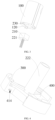
- an embodiment of the present invention discloses an electronic device and a functional module thereof, where the functional module includes a functional component 100 and a drive apparatus 200, and the functional component 100 may include at least one of a camera, a fill light, a telephone receiver, a sensor, and a fingerprint recognition module.
- the electronic device includes a body 500 and the foregoing functional module.
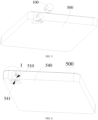
- the body 500 has a first installation space 510, and a second limiting portion 520 is disposed in the first installation space 510.
- the drive apparatus 200 is connected to the functional component 100, the drive apparatus 200 includes an output shaft 221, and the output shaft 221 is connected to a first limiting portion 300. In a working process of the electronic device, the output shaft 221 can drive the first limiting portion 300 to rotate between a first position and a second position.
- the first limiting portion 300 is fitted with the second limiting portion 520 to restrict detachment of the functional module from the first installation space 510, so that the functional module is installed on the body 500, and is integrated with the body 500, to facilitate carrying of the electronic device.
- the first limiting portion 300 is in the second position, a fitting relationship between the first limiting portion 300 and the second limiting portion 520 can be released, so that the functional module can be detached from the body 500. This enables a user to separately grasp the functional module to perform corresponding work. Compared with grasping the entire electronic device, the functional module is not easily limited by a use scenario, thereby expanding an applicable scope of the functional component 100.
- the functional module may be connected to the body 500 through a wire, or an energy supply component such as a charging battery may be further disposed in the functional module, to ensure that the functional component 100 in the functional module can still work normally in a case that the functional module is detached from the body 500.
- a communication connection relationship may be established between the functional module and the body 500 in a wired or wireless manner or the like. In this way, data may be transmitted between the functional component 100 and the body 500, and in addition, the body 500 can control the functional component 100 to work.
- the functional component 100 may be controlled by the body 500 to work, and in a case that the functional module is detached from the body 500, the functional component 100 may be controlled by or independent of the body 500 to work.
- a size of the first installation space 510 may be correspondingly set according to an overall size of the functional module.
- the functional module in a case that the first limiting portion 300 is in the first position, the functional module may be flush with a surface of the body 500, to prevent portability of the electronic device from being reduced by protruding of the functional module relative to the body 500, and may further make an appearance of the electronic device more regular and aesthetic.
- the first limiting portion 300 and the second limiting portion 520 are a fitted clamping structure.
- both the first limiting portion 300 and the second limiting portion 520 may be fasteners.
- the first limiting portion 300 When the first limiting portion 300 is rotated to the first position, the first limiting portion 300 may be fitted with the second limiting portion 520 to connect the body 500 and the functional module, to restrict detachment of the functional module from the first installation space 510.
- the fitting relationship between the first limiting portion 300 and the second limiting portion 520 may be released, so that the first limiting portion 300 is detached from the second limiting portion 520, and the body 500 can also be detached from the functional module.
- the first limiting portion 300 and the second limiting portion 520 may be respectively a rod-like structure and a hole-like structure.
- the rod-like structure is rotated and is penetrated into the hole-like structure, or the first limiting portion 300 is fitted with the second limiting portion 520 to restrict motion of the body 500 and the functional module.
- the rod-like structure is rotated again to be protruded from the hole-like structure, so that the fitting relationship between the first limiting portion 300 and the second limiting portion 520 can be released.
- the drive apparatus 200 may be a component such as a motor, and the drive apparatus 200 may be connected to a power supply in the electronic device, or the drive apparatus 200 may be connected to a charging battery in the functional module.
- the drive apparatus 200 may include a drive body 210 and an output shaft 221.
- the output shaft 221 can rotate relative to the drive body 210, and the functional component 100 may be installed on the drive body 210.
- the first limiting portion 300 may be directly fixed to the output shaft 221 through bonding or welding; or the first limiting portion 300 may be indirectly installed on the output shaft 221 by using another structure. Certainly, a motion form between the first limiting portion 300 and the output shaft 221 may be added by using another structure.
- first limiting portion 300 there may be a plurality of first limiting portion 300 and a plurality of second limiting portion 520, and the plurality of includes two or more.
- the plurality of first limiting portions 300 are disposed at intervals in a circumferential direction of the output shaft 221, the plurality of second limiting portions 520 are disposed at intervals in the first installation space 510, the plurality of first limiting portions 300 are a one-to-one correspondence with the plurality of second limiting portions 520, and in a case that the plurality of first limiting portion 300 is in the first position, each of the plurality of first limiting portions 300 is in limiting fitting with one corresponding second limiting portion 520.
- the plurality of first limiting portions 300 may be disposed uniformly and at intervals in the circumferential direction of the output shaft 221.
- a distribution situation of the plurality of second limiting portions 520 corresponds to a distribution situation of the plurality of first limiting portions 300, so that each first limiting portion 300 can be fitted with one corresponding second limiting portion 520.
- structures and sizes of the plurality of first limiting portions 300 may be the same, to reduce processing difficulty of the electronic device.
- one first limiting portion 300 can be fitted with any one of the plurality of second limiting portions 520, thereby reducing fitting difficulty between the functional module and the body 500 and improving user experience.
- a limiting gap may be formed between two adjacent second limiting portions 520, that is, the two adjacent second limiting portions 520 are disposed at intervals and the limiting gap is clamped.
- the functional module may further include a limiting base 400, and the limiting base 400 is rotatablely installed on the output shaft 221.
- the limiting base 400 includes a limiting convex portion. In a case that the first limiting portion 300 is rotated to the first position, the limiting convex portion 410 is located in a limiting gap, and the limiting convex portion 410 is fitted with two adjacent second limiting portions 520, so that the limiting base 400 is in limiting fitting with the second limiting portion 520 in the circumferential direction of the output shaft 221, thereby further improving stability of a fitting relationship between the functional module and the body 500.
- the limiting convex portion 410 and the first limiting portion 300 may be disposed at intervals in the circumferential direction of the output shaft 221.
- a portion of the first limiting portion 300 may be disposed in the limiting convex portion 410, so that a quantity of limiting convex portions 410 is equal to a quantity of first limiting portions 300, the plurality of first limiting portions 300 and the plurality of second limiting portions 520 are disposed in a one-to-one correspondence, and a limiting gap may be sandwiched between any two adjacent second limiting portions 520 among the plurality of second limiting portions 520, so that a plurality of limiting convex portions 410 are in one-to-one fitting with a plurality of limiting gaps.
- a size of the limiting convex portion 410 in an axial direction of the output shaft 221 may be equal to a size of the second limiting portion 520 in the foregoing axial direction, so that in a case that the functional module is installed in the first installation space 510, the limiting convex portion 410 and the second limiting portion 520 may provide a support function for the functional component 100, thereby further improving stability of a fitting relationship between the functional module and the body 500.
- a portion of the first limiting portion 300 may be installed in the limiting convex portion 410.
- an accommodating space 411 is disposed in the limiting convex portion 410, and a portion of the first limiting portion 300 may be accommodated by using the accommodating space 411.
- a perforation 414 or a through groove connected to the accommodating space 411 may be further disposed in the limiting convex portion 410.
- a portion of the first limiting portion 300 is protruded out of the accommodating space through the perforation 414 or the through groove and is fitted with the second limiting portion 520, so that it is ensured that the first limiting portion 300 can still be in the first position to restrict detachment of the functional module from the first installation space 510.
- a direction of rotating the first limiting portion 300 from the first position to the second position may be the same as a direction of rotating the first limiting portion 300 from the second position to the first position.
- the direction of rotating the first limiting portion 300 from the first position to the second position may be opposite to the direction of rotating the first limiting portion 300 from the second position to the first position, thereby further improving a response speed of the first limiting portion 300.
- the limiting convex portion 410 may include a first limiting inner wall 412 and a second limiting inner wall 413, where the first limiting inner wall 412 and the second limiting inner wall 413 are disposed at intervals, and an accommodating space 411 is disposed between the first limiting inner wall 412 and the second limiting inner wall 413.
- a portion of the first limiting portion 300 may be rotated in the accommodating space 411 as the output shaft 221 is rotated.
- the first limiting portion 300 is fitted with the first limiting inner wall 412, so that the first limiting portion 300 is prevented from being detached from the second limiting portion 520 due to excessive rotation, thereby ensuring that the first limiting portion 300 can form a stable fitting relationship with the second limiting portion 520.
- the first limiting portion 300 When the first limiting portion 300 is rotated reversely from the first position to the second position, the first limiting portion 300 may be fitted with the second limiting inner wall 413. In a case that there are a plurality of second limiting portions 520, the first limiting portion 300 is prevented from being fitted with the other second limiting portion 520 after being detached from one second limiting portion 520 due to excessive rotation, and consequently, the functional module cannot be normally detached from the body 500.
- the first limiting inner wall 412 and the second limiting inner wall 413 are located on two opposite sides of the accommodating space 411, and a portion of the first limiting portion 300 needs to be installed in the accommodating space 411.
- the limiting convex portion 410 may be provided with an installation hole, and the installation hole is connected to the accommodating space 411.
- the first limiting portion 300 may be protruded out of the accommodating space 411 through the installation hole and is connected to the output shaft 221, so that the first limiting portion 300 can be rotated under driving of the output shaft 221 relative to the limiting convex portion 410. Accordingly, in the circumferential direction of the output shaft 221, the first limiting inner wall 412 and the second limiting inner wall 413 are respectively located on two opposite sides of the installation hole.
- one of the first limiting portion 300 and the second limiting portion 520 may include a fitting portion 310 and the other may be provided with a locking groove 521, and in a case that the first limiting portion 300 is in the first position, at least a portion of the fitting portion 310 is clamped into the locking groove 521 and is fitted with the locking groove 521.
- the foregoing structure is used for the first limiting portion 300 and the second limiting portion 520, difficulty in forming and releasing the fitting relationship between the first limiting portion 300 and the second limiting portion 520 can be reduced to some extent.
- the foregoing structure is also easy to process and easy to assemble.
- the fitting portion 310 may be a straight rod-like structural member.
- the fitting portion 310 may be an arc-like structural member, and the fitting portion 310 may extend in a circumferential direction of the output shaft 221.
- the locking groove 521 may also be formed by extending in the circumferential direction of the output shaft 221.
- the locking groove 521 in the foregoing structure is more prone to form a fitting relationship with the fitting portion 310.
- a shape of the locking groove 521 matches a motion track of the fitting portion 310, a size of the locking groove 521 does not need to be too large. Therefore, strength of a structure in which the locking groove 521 is formed is relatively large, and deformation does not easily occur.
- the first limiting portion 300 may include the fitting portion 310, thereby facilitating design and assembly of corresponding components on the functional module and the body 500.
- the fitting portion 310 may also be disposed on the second limiting portion 520.
- the body 500 includes a power supply
- the functional module includes a charging battery.
- the fitting portion 310 may be communicated with a structure having the locking groove 521, so that the power supply of the body 500 can form an electrical connection relationship with the charging battery in the functional module, and the charging battery is charged by using the power supply.
- the functional component 100 is electrically connected to the charging battery, so that it can be ensured that the functional module can work normally in a case that the functional module is detached from the body 500.
- the first limiting portion 300 may include the fitting portion 310, the first limiting portion 300 may be made of a conductive material, and the first limiting portion 300 is connected to the charging battery.
- the locking groove 521 is located on the second limiting portion 520, and the second limiting portion 520 is made of a conductive material such as metal, or a metal connector is additionally disposed in the locking groove 521, so that it can be ensured that the first limiting portion 300 clamped into the locking groove 521 can be connected to the power supply, and the charging battery is charged by using the power supply.
- the first limiting portion 300 may include a fitting portion 310 and a connection portion 320.
- the fitting portion 310 extends in a circumferential direction of the output shaft 221
- the fitting portion 310 and the output shaft 221 are disposed at intervals in a radial direction of the output shaft 221
- the fitting portion 310 is connected to the output shaft 221 through the connection portion 320, so that it can be ensured that the fitting portion 310 can be rotated as the output shaft 221 rotates.
- the first limiting portion 300 is rotated to the first position, it is ensured that the fitting portion 310 can be normally fitted with the second limiting portion 520 to restrict detachment of the functional module from the first installation space 510.
- connection portion 320 may be selected according to an actual situation such as a position of the second limiting portion 520. This is not limited herein.
- connection portion 320 may extend in the radial direction of the output shaft 221. In this case, the connection portion 320 and the fitting portion 310 are flush with each other, and both are located on a periphery of the output shaft 221.
- the limiting base 400 may be rotatablely installed on an end of the output shaft 221, and the connection portion 320 may be connected to a middle of the output shaft 221, so that the connection portion 320 is located between the limiting base 400 and the drive body 210.
- the connection portion 320 is located outside the limiting base 400, there is no need to set an active space for the connection portion 320 on the limiting base 400, thereby reducing a processing step and reducing processing difficulty.
- connection portion 320 is disposed obliquely relative to the output shaft 221, so that the fitting portion 310 can be located on one side that is of the connection portion 320 and that is away from the drive body 210, and the connection portion 320 can be located outside the limiting base 400.
- the accommodating space 411 is disposed on the limiting base 400, at least a portion of the fitting portion 310 may be accommodated in the accommodating space 411, and an installation hole may be formed on the limiting base 400, so that one of the fitting portion 310 and the connection portion 320 can be communicated with the other through the installation hole.
- connection portion 320 may further extend in the radial direction of the output shaft 221.
- the first limiting portion 300 may further include a connection pillar 330, the connection pillar 330 extends along an axial direction of the output shaft 221, the fitting portion 310 is located on one side of the connection portion 320 away from the drive body 210, and the fitting portion 310 is connected to the connection portion 320 through the connection pillar 330.
- connection pillar 330 of the foregoing structure When the connection pillar 330 of the foregoing structure is connected to the fitting portion 310 and the connection portion 320, an axial direction of the installation hole that needs to be formed on the limiting base 400 is the same as the axial direction of the output shaft 221, and a shape of the installation hole is regular, thereby facilitating processing.
- connection pillar 330 and the fitting portion 310 may be formed through integrated molding, thereby reducing a connection step between components.
- a size of the installation hole may be slightly greater than a size of the fitting portion 310 in a corresponding direction, so that the fitting portion 310 can be installed in the installation hole from outside the installation hole.
- the first limiting portion 300 (and the limiting base 400) may be directly connected to the output shaft 221 in a fastening manner, or may be indirectly installed on the output shaft 221 by using another component.
- the output shaft 221 is a threaded shaft
- the output shaft 221 is connected to the first limiting portion 300 by using a threaded sleeve rod 222
- the threaded sleeve rod 222 is sleeved on the output shaft 221 and is in threaded fitting with the output shaft 221
- the first limiting portion 300 is connected to the threaded sleeve rod 222.
- the body 500 is provided with a first opening communicated with the first installation space 510.
- the functional component 100 may move with rotation of the output shaft 221, so that at least a portion of the functional component 100 is protruded out of the first installation space 510 through the first opening.
- a direction of rotating the first limiting portion 300 from the first position to the second position is opposite to a direction of rotating the first limiting portion 300 from the second position to the first position, and because there is a specified friction force between the output shaft 221 and the threaded sleeve rod 222, a priority of an action of the first limiting portion 300 is greater than a priority of an action of the threaded sleeve rod 222.
- the first limiting portion 300 may be rotated forward from the second position to the first position.
- the first limiting portion 300 is fitted with the second limiting portion 520, even if the output shaft 221 continues to rotate forward, the first limiting portion 300 cannot continue to be rotated forward with the output shaft 221.
- the output shaft 221 may interact with the threaded sleeve rod 222, so that a rotation motion of the output shaft 221 can be converted into a straight motion.
- a thread of the threaded sleeve rod 222 is designed, and in a case that the output shaft 221 continues to rotate forward, the output shaft 221 may move in an axial direction of the output shaft 221 away from the threaded sleeve rod 222. Because the functional component 100 is connected to the drive body 210, driven by the output shaft 221, the functional device 100 can move in the axial direction of the output shaft 221 and at least part of the functional component 100 is protruded out of the first installation space 510 through the first opening.
- the functional component 100 can be still protruded out of the first installation space 510, so that manners of using the electronic device are more diversified, to apply more use scenarios.
- the functional component 100 is a telephone receiver
- the functional component 100 is protruded out of the first installation space 510, and a relative position between the functional component 100 and the body 500 may be changed, so that the telephone receiver is closer to an ear of the user, and it is ensured that users with different face lengths can obtain better call experience, privacy protection, and the like.
- the functional component 100 may be a camera, and at least a portion of the functional component 100 is protruded out of the first installation space 510, so that the camera can be used as a camera of the electronic device, and the camera is located outside the body 500, and has a relatively large view range.
- the limiting base 400 may also be in rotation fitting with the output shaft 221 through the threaded sleeve rod 222. A depth at which the output shaft 221 is penetrated into the threaded sleeve rod 222, so that the limiting base 400 can be in contact with the functional component 100.
- the connection portion 320 of the first limiting portion 300 is located between the fitting portion 310 and the drive body 210, optionally, as shown in FIG.
- the limiting base 400 may further include a limiting edge 420, and the limiting edge 420 is connected to one side that is of the limiting convex portion 410 and that faces the drive body 410, so that an installation space can be formed between the limiting convex portion 410 and the functional component 100, and the connection portion 320 can be installed in the foregoing installation space.
- a limiting block 230 may be further disposed on the functional module, the limiting block 230 may be fixed on one side that is of the functional component 100 and that faces the limiting base 400, and the limiting block 230 may also be located in the installation space between the limiting convex portion 410 and the functional component 100.
- the limiting block 230 When the limiting edge 420 is in contact with the functional component 100 in the axial direction of the output shaft 221, the limiting block 230 may be fitted with the limiting edge 420 to limit each other in the radial direction of the output shaft 221.
- interaction between the limiting block 230 and the limiting edge 420 can prevent a radial force generated between the functional component 100 and the limiting base 400 from being directly acted on the output shaft 221 and the threaded sleeve rod 222, and the output shaft 221 and the threaded sleeve rod 222 are bent or even broken by a radial shear force.
- a quantity of limiting edges 420 may be the same as a quantity of limiting blocks 230, and are in a one-to-one correspondence.
- a chamfered structure may be formed on the limiting block 230, thereby reducing difficulty when the limiting block 230 is fitted with the limiting edge 420.
- structures of the first installation space 510 and the functional component 100 are the same, and are prism-like structures.
- the first installation space 510 and the functional component 100 may be a triangular prism, a quadruple prism, or a pentagonal prism.
- the functional component 100 and the first installation space 510 may limit each other in the circumferential direction of the output shaft 221, so that in a case that the first limiting portion 300 is fitted with the second limiting portion 520, if the output shaft 221 continues to rotate, under a limiting action of the limit of the first installation space 510, the functional component 100 may move linearly only in the axial direction of the output shaft 221, and at least a portion of the functional component 100 is protruded out of the first installation space 510.
- the functional component 100 is a component such as a telephone receiver or a camera, and the foregoing technical solution is used, because the functional component 100 only moves linearly in a protruding process, it can be ensured that an orientation of the functional component 100 before and after the protruding process remains unchanged. Therefore, in a process in which the user uses the functional component 100, the orientation of the functional component 100 does not need to be additionally determined for a plurality of times, thereby facilitating use by the user. It should be noted that the orientation of the functional component 100 is an orientation of a main structure of the functional component 100.
- the orientation of the functional component 100 may be an orientation of a sound amplification month in the telephone receiver
- the orientation of the functional component 100 may be an orientation of a lens in the camera
- the functional component 100 may continue to move outside the first installation space 510.
- the functional component 100 is wholly outside the first installation space 510, a limiting relationship between the functional component 100 and the first installation space 510 in the circumferential direction of the output shaft 221 is released.
- the functional component 100 may rotate with rotation of the output shaft 221, thereby changing the orientation of the functional component 100. This can further expand an applicable scope of the functional component 100.
- the functional component 100 is a camera
- the functional component 100 is located outside the first installation space 510, a view range of the camera can be greatly improved by changing the orientation of the functional component 100.
- the functional component 100 is respectively directed toward a side on which a display module of the electronic device is located or a side on which a rear cover of the electronic device is located, so that the functional component 100 can serve as a front camera of the electronic device, and can also serve as a rear camera of the electronic device. Therefore, the front camera and the rear camera may not be additionally disposed in the electronic device. In this way, a screen-to-body ratio can be improved, a quantity of components in the electronic device can be reduced, and further, a degree of integration of the rear cover of the electronic device can be increased.
- the functional component 100 may be a cylindrical structure, so that a volume of the functional component 100 can be greatly expanded in a case that a size of the functional component 100 is slightly enlarged.
- the functional component 100 is a cylindrical structure, a contact area during grasping of the user, to prevent the functional module from falling when the functional module is used alone.
- a feeling when the user grasps the functional module can be further improved to some extent.
- the first installation space 510 may also be a cylindrical structure, and a radius of the first installation space 510 may be slightly greater than a radius of the functional component 100, to ensure that the functional component 100 can be installed in the first installation space 510, so that a gap between the functional component 100 and the first installation space 510 is as small as possible, and external impurities are prevented from entering the electronic device.
- a waterproof ring may be further added to the functional component 100 and the first installation space 510, to further improve air tightness of the electronic device.
- the output shaft 221 drives the first limiting portion 300 and the second limiting portion 520 to continue to rotate after the first limiting portion 300 is fitted with the second limiting portion 520, so that at least a portion of the functional component 100 can be protruded out of the first installation space 510.
- both the functional component 100 and the first installation space 510 are cylindrical structures, in a process in which the functional component 100 is protruded out of the first installation space 510, the functional component 100 may rotate relative to the body 500 as the output shaft 221 rotates.
- a guide protrusion 530 may be disposed on one of an inner wall of the first installation space 510 and the functional component 100 and a guide groove 110 may be disposed on the other, both the guide protrusion 530 and the guide groove 110 may extend in the axial direction of the output shaft 221, and the guide protrusion 530 can be fitted in the guide groove 110 to restrict rotation of the functional component 100 in the circumferential direction of the output shaft 221.
- the guide protrusion 530 may be worn in a process in which the functional component 100 is used alone, and consequently the guide protrusion 530 may not continue to be fitted with the guide groove 110. Therefore, as shown in FIG. 2 , the guide groove 110 may be disposed on the functional component 100. Correspondingly, as shown in FIG. 7 , the guide protrusion 530 may be disposed in the first installation space 510, and the guide protrusion 530 may be specifically fixed on the body 500.
- the output shaft 221 continues to rotate, and the guide protrusion 530 is fitted with the guide groove 110, so that the functional component 100 can move linearly in the axial direction of the output shaft 221, and at least a portion of the functional component 100 is protruded out of the first installation space 510.
- the guide protrusion 530 is located in the first installation space 510, as shown in FIG. 7 , there may be a preset spacing between the guide protrusion 530 and the first opening in the axial direction of the output shaft 221.
- a specific size of the preset spacing may be determined according to an actual situation of the functional component 100. For example, when the functional component 100 moves to the end of the guide protrusion 530, a structure such as a lens or a loudspeaker of the functional component 100 may be protruded out of the first installation space 510, so that in a process in which the functional component 100 is rotated as the output shaft 221 rotates, an applicable scope of the functional component 100 can be expanded.
- a portion of the structure of the functional component 100 may still be located in the first installation space 510, so that the body 500 can provide a limiting function and a support function for the functional component 100, to prevent the functional component 100 from being connected to the body 500 only through the rod-like structures such as the output shaft 221 and the threaded sleeve rod 222.
- the functional component 100 when the electronic device is inclined, the functional component 100 is skewed relative to the body 500, and a radial shear force received by the output shaft 221 and the threaded sleeve rod 222 when the electronic device is inclined can be reduced, thereby ensuring a relatively high service life of the output shaft 221 and the threaded sleeve rod 222, and further improving a service life of the electronic device.
- the functional component 100 may be provided with a second installation space 120 and a second opening communicated with the second installation space 120, and the drive body 210 of the drive apparatus 200 may be installed in the second installation space 120, so that a specified protection function is provided for the drive body 210 through the functional component 100.
- the drive body 210 may be fixed in the second installation space 120 through bonding or the like, or the drive body 210 may be installed on the functional component 100 through a screwed connection member.
- the second installation space 120 and the drive body 210 may have a same appearance and are all of a prism-like structure. Therefore, in a process of rotating the output shaft 221, the functional component 100 is fitted with the drive body 210 in the circumferential direction of the output shaft 221, to prevent a case in which the functional component 100 and the drive body 210 skid from affecting normal working of the electronic device.
- the functional component 100 may be an optical component such as a camera.
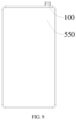
- the body 500 may include a rear cover 540 and a display screen 550, and the rear cover 540 is disposed opposite to the display screen 550.
- the rear cover 540 is provided with a translucent structure 541, and in a case that the first limiting portion 300 is in the first position, the functional component 100 faces the translucent structure 541, so that the functional module can work normally in a case that the functional module is installed in the first installation space 510, and can serve as a rear camera of the electronic device.
- the translucent structure 541 may be a through hole, so that the through hole faces the functional component 100, and the functional component 100 can obtain an image outside the electronic device.
- a translucent cover plate may be disposed on the through hole, and the translucent cover plate may be made of a hard transparent material such as a tempered glass, to ensure that the translucent cover plate has relatively high structural strength.
- a translucent structure may be further formed on a side on which the display module of the electronic device is located, or a translucent structure may be formed on a side between the display module and the rear cover.
- a charging battery may be disposed in the functional module, to further reduce restriction on the use of the functional device 100 alone.
- the power supply on the body 500 may charge the charging battery through fitting between the fitting portion 310 and the locking groove 521.
- the body 500 may further include a wireless charging coil, and in a case that the first limiting portion 300 is in the first position, the charging battery may be fitted with the wireless charging coil to charge the charging battery.
- the functional module may include a first charging contact, the first charging contact is electrically connected to the charging battery, a second charging contact may be disposed in the first installation space 510, and in a case that the first limiting portion 300 is in the first position, the first charging contact is in electrical contact with the second charging contact, so that the power supply can charge the charging battery.
- a charging connector may be disposed in one of the first installation space 510 and the functional module and a charging interface may be disposed in the other, and in a case that the first limiting portion 300 is in the first position, the charging connector is plugged and electrically connected to the charging interface, so that it can also be ensured that the power supply can charge the charging battery.
- the functional module may be installed in the first installation space 510, and the functional component 100 faces the translucent structure 541 on the rear cover 540, so that the functional component 100 can serve as a rear camera of the electronic device.
- the output shaft 221 is rotated forward, and the first limiting portion 300 is driven to be fitted with the second limiting portion 520 to restrict detachment of the functional module from the first installation space 510, thereby ensuring a stable fixing relationship between the functional module and the body 500.
- the output shaft 221 continues to rotate forward, so that at least a portion of the functional component 100 can be protruded out of the first installation space 510 through the first opening under the fitting between the guide protrusion 530 and the guide groove 110. Because the functional component 100 only moves linearly in a protruding process, the orientation of the functional component 100 can remain unchanged, and the functional component 100 still faces the side on which the rear cover 540 in the electronic device is located. In this case, a view range of the functional component 100 is no longer limited by the body 500, and the view range of the functional component 100 can be expanded.
- first limiting portion 300 is still fitted with the second limiting portion 520, and a portion of the structure of the functional component 100 is still located in the first installation space 510, so that a relative fixed relationship between the functional component 100 and the body 500 is still relatively stable, and the functional component 100 works normally as a rear camera of the electronic device.
- the output shaft 221 continues to rotate forward, so that the functional component 100 rotates forward along with the output shaft 221.
- the output shaft 221 is controlled to stop rotating, so that the functional component 100 hovers to any angle toward the electronic device, to perform photographing at an angle toward the functional component 100.
- the functional component 100 may serve as a front camera of the electronic device.
- the output shaft 221 may further rotate reversely. Because of a friction force between the threaded sleeve rod 222 and the output shaft 221, the output shaft 221 preferably drives the first limiting portion 300 to rotate from the first position to the second position, thereby releasing the fitting relationship between the first limiting portion 300 and the second limiting portion 520, so that the functional module can be detached from the body 500.
- the user may remove the whole functional module from the first installation space 510 by grasping a portion that is of the functional component 100 and that is located outside the first installation space 510, and operation difficulty of this removal manner is relatively low.
- the functional module may be used as a separate device to perform photographing, and the functional module is not easily limited by a use scenario, so that an applicable scope of the electronic device can be expanded.
- the functional module is detached from the body 500 and is used alone, the position of the first limiting portion 300 is limited, and the output shaft 221 is rotated reversely, so that the output shaft can be retracted into the threaded sleeve rod 222, and the limiting base 400 is in contact with the functional component 100, thereby reducing a size of the entire functional module in the axial direction of the output shaft 221 and facilitating use by the user.
- the output shaft 221 may be rotated reversely first, to ensure that the first limiting portion 300 is in a retracted state. Then, the functional component 100 faces a direction of the rear cover 540, and the functional module is installed in the first installation space 510.
- the limiting convex portion 410 in the limiting base 400 is located between two second limiting portions 520, so that it can be determined that the functional module is aligned with the second limiting portion 520. Then, the output shaft 221 continues to rotate reversely.
- the output shaft 221 can be fitted only with the threaded sleeve rod 222, and under a limiting action of the guide protrusion 530 and the guide groove 110, the output shaft 221 continuously rotates reversely, so that the functional component 100 can be driven to move linearly and retract to the first installation space 510.
- the output shaft 221 is controlled to rotate forward, to drive the first limiting portion 300 to rotate forward.
- the first limiting portion 300 and the first limiting inner wall 412 in the limiting base 400 perform limiting, it may be determined that the first limiting portion 300 is in the first position. In this case, the first limiting portion 300 is fitted with the second limiting portion 520 to restrict detachment of the functional module from the first installation space 510, thereby ensuring that the functional module can form a stable relative fixed relationship with the body 500.
- the electronic device disclosed in this embodiment of the present invention may be a smartphone, a tablet computer, an e-book reader, or a wearable device. Certainly, the electronic device may be another device. This is not limited in this embodiment of the present invention.
- the present invention further discloses a functional module, and the functional module may be the functional module in the foregoing electronic device.
- the functional module may be installed on the electronic device.
- the electronic device includes a body 500, the body 500 has a first installation space 510, a second limiting portion 520 is disposed in the first installation space 510, the functional module in this embodiment of the present invention is adapted to be installed in the first installation space 510, and the functional module includes a functional component 100 and a drive apparatus 200,where the drive apparatus 200 is connected to the functional component 100, the drive apparatus 200 includes an output shaft 221, the output shaft 221 is connected to a first limiting portion 300, and the output shaft 221 drives the first limiting portion 300 to rotate between a first position and a second position.
- the first limiting portion 300 is fitted with the second limiting portion 520, to restrict detachment of the functional module from the first installation space 510.
- the first limiting portion 300 is in the second position, fitting between the first limiting portion 300 and the second limiting portion 520 is released, and the functional module can be detached from the body 500.
- the functional component 100 in the functional module in this embodiment of the present invention may work independently, or may be controlled by the body 500 of the electronic device to work, and therefore there are a plurality of working manners.
- the functional module may be installed on the body 500 of the electronic device or may be detached from the body 500, and therefore a connection manner is flexible, and can meet a plurality of use requirements.
- the functional component 100 includes a camera
- the functional module adapts to a plurality of photographing scenarios, so that photographing experience of a user can be improved.
Landscapes
- Engineering & Computer Science (AREA)
- Signal Processing (AREA)
- Multimedia (AREA)
- Computer Hardware Design (AREA)
- Theoretical Computer Science (AREA)
- Human Computer Interaction (AREA)
- Physics & Mathematics (AREA)
- General Engineering & Computer Science (AREA)
- General Physics & Mathematics (AREA)
- Telephone Set Structure (AREA)
- Casings For Electric Apparatus (AREA)
Claims (13)
- Eine elektronische Vorrichtung, die Folgendes beinhaltet:einen Körper (500), wobei der Körper (500) einen ersten Installationsraum (510) aufweist und ein zweiter Begrenzungsabschnitt (520) in dem ersten Installationsraum (510) angeordnet ist; undein Funktionsmodul, wobei das Funktionsmodul eine Ladebatterie, eine Funktionskomponente (100) und eine Antriebseinrichtung (200) beinhaltet, wobei die Antriebseinrichtung (200) mit der Funktionskomponente (100) verbunden ist, wobei die Antriebseinrichtung (200) eine Ausgangswelle (221) beinhaltet, wobei die Ausgangswelle (221) mit einem ersten Begrenzungsabschnitt (300) verbunden ist und wobei die Ausgangswelle (221) den ersten Begrenzungsabschnitt (300) antreibt, um sich zwischen einer ersten Position und einer zweiten Position zu drehen, wobei die elektronische Vorrichtung dadurch gekennzeichnet ist, dass in einem Fall, in dem der erste Begrenzungsabschnitt (300) in der ersten Position befindlich ist, der erste Begrenzungsabschnitt (300) mit dem zweiten Begrenzungsabschnitt (520) in Passung gebracht wird, um das Lösen des Funktionsmoduls aus dem ersten Installationsraum (510) einzuschränken; undin einem Fall, in dem der erste Begrenzungsabschnitt (300) in der zweiten Position befindlich ist, die Passung zwischen dem ersten Begrenzungsabschnitt (300) und dem zweiten Begrenzungsabschnitt (520) freigegeben wird und das Funktionsmodul von dem Körper (500) gelöst werden kann; und in einem Fall, in dem das Funktionsmodul von dem Körper (500) gelöst ist, das Funktionsmodul so konfiguriert ist, dass es mit dem Körper (500) auf eine verdrahtete oder drahtlose Weise kommuniziert; unddie Ausgangswelle (221) eine Gewindewelle ist, die Ausgangswelle (221) mit dem ersten Begrenzungsabschnitt (300) durch eine Gewindehülsenstange (222) verbunden ist, die Gewindehülsenstange (222) auf die Ausgangswelle (221) geschoben ist und mit der Ausgangswelle (221) in Gewindepassung ist, der erste Begrenzungsabschnitt (300) mit der Gewindehülsenstange (222) verbunden ist, der Körper (500) mit einer ersten Öffnung bereitgestellt ist, die mit dem ersten Installationsraum (510) in Kommunikation steht, und in einem Fall, in dem der erste Begrenzungsabschnitt (300) in der ersten Position befindlich ist, sich die Funktionskomponente (100) in einer axialen Richtung der Ausgangswelle (221) mit einer Drehung der Ausgangswelle (221) bewegt, sodass mindestens ein Abschnitt der Funktionskomponente (100) aus dem ersten Installationsraum (510) durch die erste Öffnung herausragt.
- Elektronische Vorrichtung gemäß Anspruch 1, wobei eine Vielzahl von ersten Begrenzungsabschnitten (300) und eine Vielzahl von zweiten Begrenzungsabschnitten (520) vorhanden ist, wobei die Vielzahl von ersten Begrenzungsabschnitten (300) in einer Umfangsrichtung der Ausgangswelle (221) in Abständen angeordnet ist, wobei die Vielzahl von zweiten Begrenzungsabschnitten (520) in dem ersten Installationsraum (510) in Abständen angeordnet ist, wobei die Vielzahl von ersten Begrenzungsabschnitten (300) in einer Eins-zu-Eins-Entsprechung mit der Vielzahl von zweiten Begrenzungsabschnitten (520) ist, und in einem Fall, in dem die Vielzahl von ersten Begrenzungsabschnitten (300) in der ersten Position ist, jeder der Vielzahl von ersten Begrenzungsabschnitten (300) in einer Begrenzungspassung mit einem entsprechenden zweiten Begrenzungsabschnitt (520) ist.
- Elektronische Vorrichtung gemäß Anspruch 2, wobei ein Begrenzungsspalt zwischen zwei benachbarten zweiten Begrenzungsabschnitten (520) gebildet ist, wobei das Funktionsmodul ferner eine Begrenzungsbasis (400) beinhaltet, wobei die Begrenzungsbasis (400) drehbar mit der Ausgangswelle (221) in Passung gebracht wird, wobei die Begrenzungsbasis (400) einen konvexen Begrenzungsabschnitt (410) beinhaltet, und in einem Fall, in dem der erste Begrenzungsabschnitt (300) in der ersten Position befindlich ist, sich der konvexe Begrenzungsabschnitt (410) in dem Begrenzungsspalt befindet, und der konvexe Begrenzungsabschnitt (410) mit dem zweiten Begrenzungsabschnitt (520) in Passung gebracht wird, um in der Umfangsrichtung der Ausgangswelle (221) zu begrenzen.
- Elektronische Vorrichtung gemäß Anspruch 3, wobei ein Aufnahmeraum (411) in dem konvexen Begrenzungsabschnitt (410) angeordnet ist und eine Perforation (414) oder eine mit dem Aufnahmeraum (411) verbundene Durchgangsnut in dem konvexen Begrenzungsabschnitt (410) angeordnet ist, wobei mindestens ein Abschnitt des ersten Begrenzungsabschnitts (300) sich in dem Aufnahmeraum (411) befindet und durch die Perforation (414) oder die Durchgangsnut aus dem Aufnahmeraum (411) herausragt, und in einem Fall, in dem der erste Begrenzungsabschnitt (300) in der ersten Position befindlich ist, ein Abschnitt des ersten Begrenzungsabschnitts (300) durch die Perforation (414) oder die Durchgangsnut hindurchdringt und mit dem zweiten Begrenzungsabschnitt (520) in Passung gebracht wird.
- Elektronische Vorrichtung gemäß Anspruch 1, wobei einer von dem ersten Begrenzungsabschnitt (300) und dem zweiten Begrenzungsabschnitt (520) einen Passungsabschnitt (310) beinhaltet und ein anderer mit einer Verriegelungsnut (521) bereitgestellt ist, und in einem Fall, in dem der erste Begrenzungsabschnitt (300) in der ersten Position befindlich ist, mindestens ein Abschnitt des Passungsabschnitts (310) in die Verriegelungsnut (521) eingeklemmt ist und in Begrenzungspassung mit der Verriegelungsnut (521) ist.
- Elektronische Vorrichtung gemäß Anspruch 5, wobei der Körper (500) eine Stromversorgung beinhaltet und in einem Fall, in dem der erste Begrenzungsabschnitt (300) in der ersten Position befindlich ist, der Passungsabschnitt (310) mit einer Struktur in Kommunikation steht, die die Verriegelungsnut (521) aufweist, um mit der Stromversorgung und der Ladebatterie elektrisch verbunden zu werden.
- Elektronische Vorrichtung gemäß Anspruch 1, wobei der erste Begrenzungsabschnitt (300) einen Passungsabschnitt (310) und einen Verbindungsabschnitt (320) beinhaltet, wobei der Passungsabschnitt (310) sich in einer Umfangsrichtung der Ausgangswelle (221) erstreckt, wobei der Passungsabschnitt (310) und die Ausgangswelle (221) in Abständen in einer radialen Richtung der Ausgangswelle (221) angeordnet sind, wobei der Passungsabschnitt (310) mit der Ausgangswelle (221) durch den Verbindungsabschnitt (320) verbunden ist, und in einem Fall, in dem der erste Begrenzungsabschnitt (300) in der ersten Position befindlich ist, der Passungsabschnitt (310) mit dem zweiten Begrenzungsabschnitt (520) in Passung gebracht wird, um das Lösen des Funktionsmoduls aus dem ersten Installationsraum (510) einzuschränken.
- Elektronische Vorrichtung gemäß Anspruch 7, wobei sich der Verbindungsabschnitt (320) in der radialen Richtung der Ausgangswelle (221) erstreckt, wobei der erste Begrenzungsabschnitt (300) ferner eine Verbindungssäule (330) beinhaltet, wobei die Verbindungssäule (330) sich in der axialen Richtung der Ausgangswelle (221) erstreckt, wobei der Passungsabschnitt (310) sich auf einer Seite des Verbindungsabschnitts (320) von der Funktionskomponente (100) entfernt befindet und wobei der Passungsabschnitt (310) mit dem Verbindungsabschnitt (320) durch die Verbindungssäule (330) verbunden ist.
- Elektronische Vorrichtung gemäß Anspruch 1, wobei ein Führungsvorsprung (530) an einer Innenwand des ersten Installationsraums (510) und der Funktionskomponente (100) angeordnet ist und eine Führungsnut (110) an einer anderen angeordnet ist, wobei sich sowohl der Führungsvorsprung (530) als auch die Führungsnut (110) in der axialen Richtung der Ausgangswelle (221) erstrecken und der Führungsvorsprung (530) in die Führungsnut (110) gepasst ist, um die Drehung der Funktionskomponente (100) in einer Umfangsrichtung der Ausgangswelle (221) zu begrenzen.
- Elektronische Vorrichtung gemäß Anspruch 9, wobei sich der Führungsvorsprung (530) in dem ersten Installationsraum (510) befindet und zwischen dem Führungsvorsprung (530) und der ersten Öffnung in der axialen Richtung der Ausgangswelle (221) ein vorgegebener Abstand vorhanden ist.
- Elektronische Vorrichtung gemäß Anspruch 1, wobei die Funktionskomponente (100) mit einem zweiten Installationsraum (120) und einer mit dem zweiten Installationsraum (120) in Kommunikation stehenden zweiten Öffnung bereitgestellt ist und in dem zweiten Installationsraum (120) ein Antriebskörper (210) der Antriebseinrichtung (200) installiert ist.
- Elektronische Vorrichtung gemäß Anspruch 1, wobei die Funktionskomponente (100) eine optische Komponente ist, wobei der Körper (500) eine hintere Abdeckung (540) und einen Anzeigeschirm (550) beinhaltet, wobei die hintere Abdeckung (540) dem Anzeigeschirm (550) gegenüber angeordnet ist, wobei die hintere Abdeckung (540) mit einer lichtdurchlässigen Struktur (541) bereitgestellt ist und in einem Fall, in dem der erste Begrenzungsabschnitt (300) in der ersten Position befindlich ist, die Funktionskomponente (100) der lichtdurchlässigen Struktur (541) gegenübersteht.
- Elektronische Vorrichtung gemäß Anspruch 1, wobeider Körper (500) eine drahtlose Ladespule beinhaltet und in einem Fall, in dem der erste Begrenzungsabschnitt (300) in der ersten Position befindlich ist, die Ladebatterie mit der drahtlosen Ladespule in Passung gebracht wird, um das Laden zu implementieren;
oderdas Funktionsmodul einen ersten Ladekontakt beinhaltet, wobei der erste Ladekontakt mit der Ladebatterie elektrisch verbunden ist, wobei ein zweiter Ladekontakt in dem ersten Installationsraum (510) angeordnet ist und in einem Fall, in dem der erste Begrenzungsabschnitt (300) in der ersten Position befindlich ist, der erste Ladekontakt mit dem zweiten Ladekontakt in elektrischem Kontakt steht;
oderein Ladestecker in einem von dem ersten Installationsraum (510) und dem Funktionsmodul angeordnet ist und eine Ladeschnittstelle in einem anderen angeordnet ist und in einem Fall, in dem der erste Begrenzungsabschnitt (300) in der ersten Position befindlich ist, der Ladestecker eingesteckt und mit der Ladeschnittstelle elektrisch verbunden ist.
Applications Claiming Priority (2)
| Application Number | Priority Date | Filing Date | Title |
|---|---|---|---|
| CN202010209076.0A CN111314523B (zh) | 2020-03-23 | 2020-03-23 | 电子设备及其功能模块 |
| PCT/CN2021/082370 WO2021190499A1 (zh) | 2020-03-23 | 2021-03-23 | 电子设备及其功能模块 |
Publications (3)
| Publication Number | Publication Date |
|---|---|
| EP4092999A1 EP4092999A1 (de) | 2022-11-23 |
| EP4092999A4 EP4092999A4 (de) | 2023-07-19 |
| EP4092999B1 true EP4092999B1 (de) | 2024-08-28 |
Family
ID=71162382
Family Applications (1)
| Application Number | Title | Priority Date | Filing Date |
|---|---|---|---|
| EP21776276.4A Active EP4092999B1 (de) | 2020-03-23 | 2021-03-23 | Elektronisches gerät und funktionsmodul dafür |
Country Status (6)
| Country | Link |
|---|---|
| US (1) | US12177545B2 (de) |
| EP (1) | EP4092999B1 (de) |
| JP (1) | JP7391233B2 (de) |
| CN (1) | CN111314523B (de) |
| ES (1) | ES2991770T3 (de) |
| WO (1) | WO2021190499A1 (de) |
Families Citing this family (3)
| Publication number | Priority date | Publication date | Assignee | Title |
|---|---|---|---|---|
| CN111314523B (zh) * | 2020-03-23 | 2021-05-14 | 维沃移动通信有限公司 | 电子设备及其功能模块 |
| CN111933853B (zh) * | 2020-08-14 | 2023-04-07 | 维沃移动通信有限公司 | 电池组件、链式电池及电子设备 |
| CN113438833B (zh) * | 2021-06-04 | 2022-07-01 | 深圳市蓝游网络科技有限公司 | 一种交通警察执勤执法占道信息vr采集终端 |
Family Cites Families (31)
| Publication number | Priority date | Publication date | Assignee | Title |
|---|---|---|---|---|
| JPH1075287A (ja) * | 1996-08-30 | 1998-03-17 | Kokusai Electric Co Ltd | 携帯テレビ電話 |
| US7066708B1 (en) * | 1999-10-19 | 2006-06-27 | Micron Technology, Inc. | Methods and apparatus for retaining a tray stack having a plurality of trays for carrying microelectric devices |
| JP2001298516A (ja) | 2000-04-12 | 2001-10-26 | Matsushita Electric Ind Co Ltd | 携帯型無線通信装置 |
| JP3830025B2 (ja) | 2000-06-30 | 2006-10-04 | 松下電器産業株式会社 | 描画装置 |
| JP2003281755A (ja) | 2002-03-25 | 2003-10-03 | Sanyo Electric Co Ltd | 対物レンズ駆動装置 |
| KR100561279B1 (ko) * | 2003-08-09 | 2006-03-14 | 엘지전자 주식회사 | 이동통신 단말기의 카메라 회전장치 |
| KR100689386B1 (ko) * | 2004-03-15 | 2007-03-02 | 삼성전자주식회사 | 휴대 단말기의 카메라 렌즈 모듈 팝업 장치 |
| JP4160920B2 (ja) | 2004-03-29 | 2008-10-08 | 富士フイルム株式会社 | カメラシステムおよびカメラ本体 |
| KR101063408B1 (ko) * | 2004-10-11 | 2011-09-07 | 삼성전자주식회사 | 힌지장치 및 이를 가지는 전자기기 |
| TWI260905B (en) * | 2005-05-17 | 2006-08-21 | Jin-Chiuan Huang | Lens turning device for mobile phone with camera function |
| US7475484B2 (en) * | 2005-12-15 | 2009-01-13 | Hoya Corporation | Lock mechanism for stage apparatus |
| US8161681B2 (en) * | 2008-06-30 | 2012-04-24 | Treihaft Michael T | Releasable arm assembly for a swing gate |
| KR101604820B1 (ko) * | 2009-10-28 | 2016-03-18 | 엘지전자 주식회사 | 이동 단말기 |
| KR101084651B1 (ko) | 2010-03-05 | 2011-11-17 | 엘지전자 주식회사 | 확장 모듈 및 이를 구비한 휴대 전자기기 |
| TW201245850A (en) * | 2011-02-28 | 2012-11-16 | Hoya Corp | Position controller for image-stabilizing insertable/removable optical element |
| US8912746B2 (en) * | 2011-10-26 | 2014-12-16 | Intuitive Surgical Operations, Inc. | Surgical instrument motor pack latch |
| US9858460B2 (en) * | 2012-10-04 | 2018-01-02 | The Code Corporation | Barcode-reading system having circuitry for generating a barcode read signal on a microphone input connector of a mobile device |
| US10569868B2 (en) * | 2013-04-02 | 2020-02-25 | Hood Technology Corporation | Multicopter-assisted system and method for launching and retrieving a fixed-wing aircraft |
| CN105813426A (zh) * | 2014-12-31 | 2016-07-27 | 鸿富锦精密工业(深圳)有限公司 | 电子装置 |
| JP6825575B2 (ja) * | 2015-12-15 | 2021-02-03 | ソニー株式会社 | 羽根開閉装置及び撮像装置 |
| US10530982B2 (en) * | 2017-12-21 | 2020-01-07 | Brian Anthony DAULTON | Detachable mini-camera device |
| CN207968581U (zh) * | 2018-02-09 | 2018-10-12 | 广东欧珀移动通信有限公司 | 移动终端 |
| ES2836710T3 (es) * | 2018-05-14 | 2021-06-28 | Vorwerk Co Interholding | Dispositivo de preparación de alimentos con herramienta amovible |
| CN110519418A (zh) * | 2018-05-22 | 2019-11-29 | Oppo广东移动通信有限公司 | 功能组件和电子设备 |
| WO2019228324A1 (zh) * | 2018-05-31 | 2019-12-05 | Oppo广东移动通信有限公司 | 移动终端 |
| CN110557470B (zh) * | 2018-05-31 | 2024-07-26 | Oppo广东移动通信有限公司 | 移动终端 |
| CN210093261U (zh) * | 2018-07-12 | 2020-02-18 | Oppo广东移动通信有限公司 | 电子装置 |
| CN209677549U (zh) * | 2018-08-30 | 2019-11-26 | 浙江伟星实业发展股份有限公司 | 一种可拆卸组合部件 |
| CN109756599B (zh) * | 2019-02-26 | 2020-09-29 | 维沃移动通信有限公司 | 摄像头模组及终端设备 |
| CN111314523B (zh) * | 2020-03-23 | 2021-05-14 | 维沃移动通信有限公司 | 电子设备及其功能模块 |
| CN111464677B (zh) * | 2020-03-30 | 2022-07-15 | 维沃移动通信有限公司 | 电子设备及其控制方法和控制装置 |
-
2020
- 2020-03-23 CN CN202010209076.0A patent/CN111314523B/zh active Active
-
2021
- 2021-03-23 WO PCT/CN2021/082370 patent/WO2021190499A1/zh not_active Ceased
- 2021-03-23 ES ES21776276T patent/ES2991770T3/es active Active
- 2021-03-23 EP EP21776276.4A patent/EP4092999B1/de active Active
- 2021-03-23 JP JP2022549767A patent/JP7391233B2/ja active Active
-
2022
- 2022-09-20 US US17/949,197 patent/US12177545B2/en active Active
Also Published As
| Publication number | Publication date |
|---|---|
| JP7391233B2 (ja) | 2023-12-04 |
| WO2021190499A1 (zh) | 2021-09-30 |
| US20230013000A1 (en) | 2023-01-19 |
| CN111314523A (zh) | 2020-06-19 |
| ES2991770T3 (es) | 2024-12-04 |
| EP4092999A4 (de) | 2023-07-19 |
| US12177545B2 (en) | 2024-12-24 |
| CN111314523B (zh) | 2021-05-14 |
| JP2023515460A (ja) | 2023-04-13 |
| EP4092999A1 (de) | 2022-11-23 |
Similar Documents
| Publication | Publication Date | Title |
|---|---|---|
| EP4092999B1 (de) | Elektronisches gerät und funktionsmodul dafür | |
| EP3525426B1 (de) | Mobiles endgerät | |
| CN113411421B (zh) | 电子设备 | |
| US10601966B2 (en) | Mobile terminal | |
| CN118018827A (zh) | 一种摄像头模组和电子设备 | |
| CN111050047B (zh) | 电子设备 | |
| CN208128325U (zh) | 移动终端 | |
| KR20040093251A (ko) | 소형 디지탈 줌 카메라 및, 그것을 구비한 휴대 전화 | |
| CN109005266B (zh) | 一种移动终端 | |
| US12375594B2 (en) | Electronic device | |
| EP3581981B1 (de) | Kameraanordnung und elektronische vorrichtung damit | |
| CN112637483B (zh) | 电子设备及其拍摄控制方法、控制装置 | |
| WO2019242468A1 (zh) | 电子装置 | |
| US9488366B2 (en) | Light emission device for imaging apparatus | |
| CN110266927B (zh) | 移动终端 | |
| CN111866228B (zh) | 电子设备 | |
| CN112954092A (zh) | 电子设备 | |
| KR102149517B1 (ko) | 교환형 렌즈 모듈을 구비한 휴대 단말기 | |
| CN210839654U (zh) | 一种电子设备 | |
| CN211509139U (zh) | 一种旋转装置、电子设备 | |
| CN109962995B (zh) | 功能组件、电子装置及其控制方法 | |
| CN217305631U (zh) | 透镜组件的调焦装置及手机投影仪 | |
| KR20050074769A (ko) | 휴대용 단말기의 삼각대 | |
| HK40009369B (en) | Mobile terminal | |
| HK40009369A (en) | Mobile terminal |
Legal Events
| Date | Code | Title | Description |
|---|---|---|---|
| STAA | Information on the status of an ep patent application or granted ep patent |
Free format text: STATUS: THE INTERNATIONAL PUBLICATION HAS BEEN MADE |
|
| PUAI | Public reference made under article 153(3) epc to a published international application that has entered the european phase |
Free format text: ORIGINAL CODE: 0009012 |
|
| STAA | Information on the status of an ep patent application or granted ep patent |
Free format text: STATUS: REQUEST FOR EXAMINATION WAS MADE |
|
| 17P | Request for examination filed |
Effective date: 20220816 |
|
| AK | Designated contracting states |
Kind code of ref document: A1 Designated state(s): AL AT BE BG CH CY CZ DE DK EE ES FI FR GB GR HR HU IE IS IT LI LT LU LV MC MK MT NL NO PL PT RO RS SE SI SK SM TR |
|
| DAV | Request for validation of the european patent (deleted) | ||
| DAX | Request for extension of the european patent (deleted) | ||
| A4 | Supplementary search report drawn up and despatched |
Effective date: 20230619 |
|
| RIC1 | Information provided on ipc code assigned before grant |
Ipc: H04N 23/57 20230101ALI20230613BHEP Ipc: H05K 5/00 20060101ALI20230613BHEP Ipc: H04M 1/02 20060101AFI20230613BHEP |
|
| GRAP | Despatch of communication of intention to grant a patent |
Free format text: ORIGINAL CODE: EPIDOSNIGR1 |
|
| STAA | Information on the status of an ep patent application or granted ep patent |
Free format text: STATUS: GRANT OF PATENT IS INTENDED |
|
| INTG | Intention to grant announced |
Effective date: 20240524 |
|
| GRAS | Grant fee paid |
Free format text: ORIGINAL CODE: EPIDOSNIGR3 |
|
| GRAA | (expected) grant |
Free format text: ORIGINAL CODE: 0009210 |
|
| STAA | Information on the status of an ep patent application or granted ep patent |
Free format text: STATUS: THE PATENT HAS BEEN GRANTED |
|
| AK | Designated contracting states |
Kind code of ref document: B1 Designated state(s): AL AT BE BG CH CY CZ DE DK EE ES FI FR GB GR HR HU IE IS IT LI LT LU LV MC MK MT NL NO PL PT RO RS SE SI SK SM TR |
|
| REG | Reference to a national code |
Ref country code: CH Ref legal event code: EP |
|
| REG | Reference to a national code |
Ref country code: DE Ref legal event code: R096 Ref document number: 602021018019 Country of ref document: DE |
|
| REG | Reference to a national code |
Ref country code: IE Ref legal event code: FG4D |
|
| REG | Reference to a national code |
Ref country code: NL Ref legal event code: FP |
|
| REG | Reference to a national code |
Ref country code: ES Ref legal event code: FG2A Ref document number: 2991770 Country of ref document: ES Kind code of ref document: T3 Effective date: 20241204 |
|
| REG | Reference to a national code |
Ref country code: LT Ref legal event code: MG9D |
|
| PG25 | Lapsed in a contracting state [announced via postgrant information from national office to epo] |
Ref country code: NO Free format text: LAPSE BECAUSE OF FAILURE TO SUBMIT A TRANSLATION OF THE DESCRIPTION OR TO PAY THE FEE WITHIN THE PRESCRIBED TIME-LIMIT Effective date: 20241128 |
|
| REG | Reference to a national code |
Ref country code: AT Ref legal event code: MK05 Ref document number: 1719188 Country of ref document: AT Kind code of ref document: T Effective date: 20240828 |
|
| PG25 | Lapsed in a contracting state [announced via postgrant information from national office to epo] |
Ref country code: PT Free format text: LAPSE BECAUSE OF FAILURE TO SUBMIT A TRANSLATION OF THE DESCRIPTION OR TO PAY THE FEE WITHIN THE PRESCRIBED TIME-LIMIT Effective date: 20241230 Ref country code: PL Free format text: LAPSE BECAUSE OF FAILURE TO SUBMIT A TRANSLATION OF THE DESCRIPTION OR TO PAY THE FEE WITHIN THE PRESCRIBED TIME-LIMIT Effective date: 20240828 Ref country code: FI Free format text: LAPSE BECAUSE OF FAILURE TO SUBMIT A TRANSLATION OF THE DESCRIPTION OR TO PAY THE FEE WITHIN THE PRESCRIBED TIME-LIMIT Effective date: 20240828 Ref country code: GR Free format text: LAPSE BECAUSE OF FAILURE TO SUBMIT A TRANSLATION OF THE DESCRIPTION OR TO PAY THE FEE WITHIN THE PRESCRIBED TIME-LIMIT Effective date: 20241129 |
|
| PG25 | Lapsed in a contracting state [announced via postgrant information from national office to epo] |
Ref country code: BG Free format text: LAPSE BECAUSE OF FAILURE TO SUBMIT A TRANSLATION OF THE DESCRIPTION OR TO PAY THE FEE WITHIN THE PRESCRIBED TIME-LIMIT Effective date: 20240828 |
|
| PG25 | Lapsed in a contracting state [announced via postgrant information from national office to epo] |
Ref country code: LV Free format text: LAPSE BECAUSE OF FAILURE TO SUBMIT A TRANSLATION OF THE DESCRIPTION OR TO PAY THE FEE WITHIN THE PRESCRIBED TIME-LIMIT Effective date: 20240828 |
|
| PG25 | Lapsed in a contracting state [announced via postgrant information from national office to epo] |
Ref country code: IS Free format text: LAPSE BECAUSE OF FAILURE TO SUBMIT A TRANSLATION OF THE DESCRIPTION OR TO PAY THE FEE WITHIN THE PRESCRIBED TIME-LIMIT Effective date: 20241228 Ref country code: AT Free format text: LAPSE BECAUSE OF FAILURE TO SUBMIT A TRANSLATION OF THE DESCRIPTION OR TO PAY THE FEE WITHIN THE PRESCRIBED TIME-LIMIT Effective date: 20240828 |
|
| PG25 | Lapsed in a contracting state [announced via postgrant information from national office to epo] |
Ref country code: HR Free format text: LAPSE BECAUSE OF FAILURE TO SUBMIT A TRANSLATION OF THE DESCRIPTION OR TO PAY THE FEE WITHIN THE PRESCRIBED TIME-LIMIT Effective date: 20240828 |
|
| PG25 | Lapsed in a contracting state [announced via postgrant information from national office to epo] |
Ref country code: RS Free format text: LAPSE BECAUSE OF FAILURE TO SUBMIT A TRANSLATION OF THE DESCRIPTION OR TO PAY THE FEE WITHIN THE PRESCRIBED TIME-LIMIT Effective date: 20241128 |
|
| PG25 | Lapsed in a contracting state [announced via postgrant information from national office to epo] |
Ref country code: RS Free format text: LAPSE BECAUSE OF FAILURE TO SUBMIT A TRANSLATION OF THE DESCRIPTION OR TO PAY THE FEE WITHIN THE PRESCRIBED TIME-LIMIT Effective date: 20241128 Ref country code: PT Free format text: LAPSE BECAUSE OF FAILURE TO SUBMIT A TRANSLATION OF THE DESCRIPTION OR TO PAY THE FEE WITHIN THE PRESCRIBED TIME-LIMIT Effective date: 20241230 Ref country code: PL Free format text: LAPSE BECAUSE OF FAILURE TO SUBMIT A TRANSLATION OF THE DESCRIPTION OR TO PAY THE FEE WITHIN THE PRESCRIBED TIME-LIMIT Effective date: 20240828 Ref country code: NO Free format text: LAPSE BECAUSE OF FAILURE TO SUBMIT A TRANSLATION OF THE DESCRIPTION OR TO PAY THE FEE WITHIN THE PRESCRIBED TIME-LIMIT Effective date: 20241128 Ref country code: LV Free format text: LAPSE BECAUSE OF FAILURE TO SUBMIT A TRANSLATION OF THE DESCRIPTION OR TO PAY THE FEE WITHIN THE PRESCRIBED TIME-LIMIT Effective date: 20240828 Ref country code: IS Free format text: LAPSE BECAUSE OF FAILURE TO SUBMIT A TRANSLATION OF THE DESCRIPTION OR TO PAY THE FEE WITHIN THE PRESCRIBED TIME-LIMIT Effective date: 20241228 Ref country code: HR Free format text: LAPSE BECAUSE OF FAILURE TO SUBMIT A TRANSLATION OF THE DESCRIPTION OR TO PAY THE FEE WITHIN THE PRESCRIBED TIME-LIMIT Effective date: 20240828 Ref country code: GR Free format text: LAPSE BECAUSE OF FAILURE TO SUBMIT A TRANSLATION OF THE DESCRIPTION OR TO PAY THE FEE WITHIN THE PRESCRIBED TIME-LIMIT Effective date: 20241129 Ref country code: FI Free format text: LAPSE BECAUSE OF FAILURE TO SUBMIT A TRANSLATION OF THE DESCRIPTION OR TO PAY THE FEE WITHIN THE PRESCRIBED TIME-LIMIT Effective date: 20240828 Ref country code: BG Free format text: LAPSE BECAUSE OF FAILURE TO SUBMIT A TRANSLATION OF THE DESCRIPTION OR TO PAY THE FEE WITHIN THE PRESCRIBED TIME-LIMIT Effective date: 20240828 Ref country code: AT Free format text: LAPSE BECAUSE OF FAILURE TO SUBMIT A TRANSLATION OF THE DESCRIPTION OR TO PAY THE FEE WITHIN THE PRESCRIBED TIME-LIMIT Effective date: 20240828 |
|
| PGFP | Annual fee paid to national office [announced via postgrant information from national office to epo] |
Ref country code: DE Payment date: 20250128 Year of fee payment: 5 |
|
| PG25 | Lapsed in a contracting state [announced via postgrant information from national office to epo] |
Ref country code: RO Free format text: LAPSE BECAUSE OF FAILURE TO SUBMIT A TRANSLATION OF THE DESCRIPTION OR TO PAY THE FEE WITHIN THE PRESCRIBED TIME-LIMIT Effective date: 20240828 Ref country code: DK Free format text: LAPSE BECAUSE OF FAILURE TO SUBMIT A TRANSLATION OF THE DESCRIPTION OR TO PAY THE FEE WITHIN THE PRESCRIBED TIME-LIMIT Effective date: 20240828 Ref country code: SM Free format text: LAPSE BECAUSE OF FAILURE TO SUBMIT A TRANSLATION OF THE DESCRIPTION OR TO PAY THE FEE WITHIN THE PRESCRIBED TIME-LIMIT Effective date: 20240828 |
|
| PG25 | Lapsed in a contracting state [announced via postgrant information from national office to epo] |
Ref country code: EE Free format text: LAPSE BECAUSE OF FAILURE TO SUBMIT A TRANSLATION OF THE DESCRIPTION OR TO PAY THE FEE WITHIN THE PRESCRIBED TIME-LIMIT Effective date: 20240828 |
|
| PG25 | Lapsed in a contracting state [announced via postgrant information from national office to epo] |
Ref country code: CZ Free format text: LAPSE BECAUSE OF FAILURE TO SUBMIT A TRANSLATION OF THE DESCRIPTION OR TO PAY THE FEE WITHIN THE PRESCRIBED TIME-LIMIT Effective date: 20240828 |
|
| PGFP | Annual fee paid to national office [announced via postgrant information from national office to epo] |
Ref country code: FR Payment date: 20250210 Year of fee payment: 5 |
|
| PG25 | Lapsed in a contracting state [announced via postgrant information from national office to epo] |
Ref country code: SK Free format text: LAPSE BECAUSE OF FAILURE TO SUBMIT A TRANSLATION OF THE DESCRIPTION OR TO PAY THE FEE WITHIN THE PRESCRIBED TIME-LIMIT Effective date: 20240828 |
|
| PGFP | Annual fee paid to national office [announced via postgrant information from national office to epo] |
Ref country code: IT Payment date: 20250211 Year of fee payment: 5 Ref country code: GB Payment date: 20250130 Year of fee payment: 5 |
|
| REG | Reference to a national code |
Ref country code: DE Ref legal event code: R097 Ref document number: 602021018019 Country of ref document: DE |
|
| PLBE | No opposition filed within time limit |
Free format text: ORIGINAL CODE: 0009261 |
|
| STAA | Information on the status of an ep patent application or granted ep patent |
Free format text: STATUS: NO OPPOSITION FILED WITHIN TIME LIMIT |
|
| PGFP | Annual fee paid to national office [announced via postgrant information from national office to epo] |
Ref country code: ES Payment date: 20250414 Year of fee payment: 5 |
|
| 26N | No opposition filed |
Effective date: 20250530 |
|
| PG25 | Lapsed in a contracting state [announced via postgrant information from national office to epo] |
Ref country code: SE Free format text: LAPSE BECAUSE OF FAILURE TO SUBMIT A TRANSLATION OF THE DESCRIPTION OR TO PAY THE FEE WITHIN THE PRESCRIBED TIME-LIMIT Effective date: 20240828 |
|
| PG25 | Lapsed in a contracting state [announced via postgrant information from national office to epo] |
Ref country code: MC Free format text: LAPSE BECAUSE OF FAILURE TO SUBMIT A TRANSLATION OF THE DESCRIPTION OR TO PAY THE FEE WITHIN THE PRESCRIBED TIME-LIMIT Effective date: 20240828 |
|
| REG | Reference to a national code |
Ref country code: CH Ref legal event code: H13 Free format text: ST27 STATUS EVENT CODE: U-0-0-H10-H13 (AS PROVIDED BY THE NATIONAL OFFICE) Effective date: 20251023 |
|
| PG25 | Lapsed in a contracting state [announced via postgrant information from national office to epo] |
Ref country code: LU Free format text: LAPSE BECAUSE OF NON-PAYMENT OF DUE FEES Effective date: 20250323 |
|
| REG | Reference to a national code |
Ref country code: BE Ref legal event code: MM Effective date: 20250331 |
|
| PG25 | Lapsed in a contracting state [announced via postgrant information from national office to epo] |
Ref country code: BE Free format text: LAPSE BECAUSE OF NON-PAYMENT OF DUE FEES Effective date: 20250331 |
|
| PG25 | Lapsed in a contracting state [announced via postgrant information from national office to epo] |
Ref country code: CH Free format text: LAPSE BECAUSE OF NON-PAYMENT OF DUE FEES Effective date: 20250331 |
|
| PG25 | Lapsed in a contracting state [announced via postgrant information from national office to epo] |
Ref country code: IE Free format text: LAPSE BECAUSE OF NON-PAYMENT OF DUE FEES Effective date: 20250323 |
|
| PGFP | Annual fee paid to national office [announced via postgrant information from national office to epo] |
Ref country code: NL Payment date: 20260213 Year of fee payment: 6 |