EP4089381B1 - Temperatursensor und temperatursensoranordnung - Google Patents
Temperatursensor und temperatursensoranordnung Download PDFInfo
- Publication number
- EP4089381B1 EP4089381B1 EP21779344.7A EP21779344A EP4089381B1 EP 4089381 B1 EP4089381 B1 EP 4089381B1 EP 21779344 A EP21779344 A EP 21779344A EP 4089381 B1 EP4089381 B1 EP 4089381B1
- Authority
- EP
- European Patent Office
- Prior art keywords
- temperature sensor
- temperature
- sensor unit
- thickness
- thermistor
- Prior art date
- Legal status (The legal status is an assumption and is not a legal conclusion. Google has not performed a legal analysis and makes no representation as to the accuracy of the status listed.)
- Active
Links
Images





Classifications
-
- G—PHYSICS
- G01—MEASURING; TESTING
- G01K—MEASURING TEMPERATURE; MEASURING QUANTITY OF HEAT; THERMALLY-SENSITIVE ELEMENTS NOT OTHERWISE PROVIDED FOR
- G01K1/00—Details of thermometers not specially adapted for particular types of thermometer
- G01K1/14—Supports; Fastening devices; Arrangements for mounting thermometers in particular locations
- G01K1/143—Supports; Fastening devices; Arrangements for mounting thermometers in particular locations for measuring surface temperatures
-
- G—PHYSICS
- G01—MEASURING; TESTING
- G01K—MEASURING TEMPERATURE; MEASURING QUANTITY OF HEAT; THERMALLY-SENSITIVE ELEMENTS NOT OTHERWISE PROVIDED FOR
- G01K1/00—Details of thermometers not specially adapted for particular types of thermometer
- G01K1/02—Means for indicating or recording specially adapted for thermometers
- G01K1/026—Means for indicating or recording specially adapted for thermometers arrangements for monitoring a plurality of temperatures, e.g. by multiplexing
-
- G—PHYSICS
- G01—MEASURING; TESTING
- G01K—MEASURING TEMPERATURE; MEASURING QUANTITY OF HEAT; THERMALLY-SENSITIVE ELEMENTS NOT OTHERWISE PROVIDED FOR
- G01K7/00—Measuring temperature based on the use of electric or magnetic elements directly sensitive to heat ; Power supply therefor, e.g. using thermoelectric elements
- G01K7/16—Measuring temperature based on the use of electric or magnetic elements directly sensitive to heat ; Power supply therefor, e.g. using thermoelectric elements using resistive elements
- G01K7/22—Measuring temperature based on the use of electric or magnetic elements directly sensitive to heat ; Power supply therefor, e.g. using thermoelectric elements using resistive elements the element being a non-linear resistance, e.g. thermistor
-
- H—ELECTRICITY
- H01—ELECTRIC ELEMENTS
- H01C—RESISTORS
- H01C1/00—Details
- H01C1/14—Terminals or tapping points or electrodes specially adapted for resistors; Arrangements of terminals or tapping points or electrodes on resistors
-
- H—ELECTRICITY
- H01—ELECTRIC ELEMENTS
- H01C—RESISTORS
- H01C7/00—Non-adjustable resistors formed as one or more layers or coatings; Non-adjustable resistors made from powdered conducting material or powdered semi-conducting material with or without insulating material
- H01C7/008—Thermistors
-
- H—ELECTRICITY
- H01—ELECTRIC ELEMENTS
- H01C—RESISTORS
- H01C1/00—Details
- H01C1/14—Terminals or tapping points or electrodes specially adapted for resistors; Arrangements of terminals or tapping points or electrodes on resistors
- H01C1/1406—Terminals or electrodes formed on resistive elements having positive temperature coefficient
-
- H—ELECTRICITY
- H01—ELECTRIC ELEMENTS
- H01C—RESISTORS
- H01C1/00—Details
- H01C1/14—Terminals or tapping points or electrodes specially adapted for resistors; Arrangements of terminals or tapping points or electrodes on resistors
- H01C1/1413—Terminals or electrodes formed on resistive elements having negative temperature coefficient
Definitions
- the present invention relates to a temperature sensor and a temperature sensor array including a plurality of the temperature sensors.
- a temperature sensor including a sensor unit formed on a flexible substrate is known.
- Such a temperature sensor can be configured to be flexible and thin as a whole, and is used in various applications for detecting a temperature of an object whose temperature is to be detected.
- Patent Document 1 discloses a temperature sensor in which an opening is provided in a flexible substrate, a flexible thermistor is embedded and mounted as a sensor unit in the opening, and a height of a surface around the opening of the flexible substrate and a height of an exposed surface of the flexible thermistor are substantially the same. More specifically, for example, referring to FIG.
- a flexible thermistor 1A having a metal substrate 11, a thermistor layer 15, and a pair of divided electrodes 21 and 22 is embedded in an opening of a flexible substrate 5A having a base layer 51, a wiring conductor layer 52, and a cover layer 53, and mounted on the wiring conductor layer 52 by a solder layer 54, and a height of a surface of the cover layer 53 and a height of an exposed surface of the flexible thermistor 1A are made substantially the same.
- Patent Document 2 discloses a temperature sensor in which a thin film thermistor section and a pair of comb-shaped electrodes are provided as sensor units on a surface of an insulating film that is a flexible substrate, and at least a part of the insulating film immediately below the thin film thermistor section is formed to be thinner than the other part of the insulating film. More specifically, for example, with reference to FIG. 1 of Patent Document 2, a thin film thermistor section 3 and a pair of comb-shaped electrodes 4 are provided on a surface of an insulating film 2, covered with a protective film 6, and a recess 2a is provided immediately below the thin film thermistor section 3 in the insulating film 2.
- Patent Document 3 discloses a temperature sensor unit 20 comprising a temperature sensor 40 mounted on a flexible printed circuit (FPC) 30.
- a first metal plate member 60 is fixed on the lower surface of the FPC 30, an elastic member 50 is disposed close to the periphery of the temperature sensor 40 and a second metal plate 70 is bonded to the upper surface of the elastic member 50.
- the elastic force of the elastic member 50 presses the temperature sensor 40 against the surface of the object 10 whose temperature is to be measured.
- a load can be applied in a thickness direction of the temperature sensor including the sensor unit formed on the flexible substrate.
- a stress generated in the sensor unit (more specifically, the thermistor layer) may cause a change in resistance due to deformation of the sensor unit and deterioration due to occurrence of a crack in the sensor unit, which may rather cause a decrease in temperature detection accuracy.
- a temperature sensor that is excellent in load bearing capability and can obtain high temperature detection accuracy.
- the load is applied to the flexible thermistor (in particular, the thermistor layer) according to a ratio of an area of the exposed surface of the flexible thermistor to the entire area of the contact region, it is not possible to eliminate generation of stress in the thermistor layer, sufficient load bearing capability cannot be necessarily obtained, the change in resistance due to deformation of the thermistor layer and deterioration due to occurrence of a crack in the thermistor layer may occur, and it is difficult to obtain high temperature detection accuracy. Focusing only on the improvement of the load bearing capability, it is conceivable to considerably increase the area of the contact region of the other portion with respect to the area of the exposed surface of the flexible thermistor.
- the area of the contact region of the other portion becomes too large, and heat of the object whose temperature is to be detected (heat source) is conducted to wire, a surface opposite to the contact surface, and the like via the other portion and lost, so that high temperature detection accuracy cannot be obtained still.
- the load acts on the thin film thermistor section in a direction horizontal to the in-plane direction of the insulating film (in particular, when the upper surfaces and the entire peripheries of the thin film thermistor section and the pair of comb-shaped electrodes are covered with the protective film, the load remarkably acts in the horizontal direction), it is not possible to eliminate the generation of stress in the thin film thermistor section, sufficient load bearing capability cannot be necessarily obtained, the change in resistance due to deformation of the thin film thermistor section and deterioration due to generation of a crack in the thin film thermistor section may occur, and it is difficult to obtain high temperature detection accuracy.
- the heat of the object whose temperature is to be detected may be conducted through the entire temperature sensor and lost, and high temperature detection accuracy cannot be obtained.
- An object of the present invention is to provide a temperature sensor that is excellent in load bearing capability and can obtain high temperature detection accuracy.
- a further object of the present invention is to provide a temperature sensor array including a plurality of such temperature sensors.
- a temperature sensor including a sensor unit formed on a flexible substrate, in which the flexible substrate includes a first portion which is located at an end portion of the flexible substrate and in which the sensor unit is formed, and a second portion adjacent to the first portion in a distal direction from the end portion and having a maximum thickness between a first surface and a second surface facing each other, a surface of the first portion opposite to the sensor unit and the first surface of the second portion are on the same plane, at least the first surface of the second portion forms a detection surface in contact with an object whose temperature is to be detected, and a total thickness of the first portion and the sensor unit is smaller than the maximum thickness of the second portion.
- a temperature sensor array including a plurality of the temperature sensors of the present invention, the plurality of temperature sensors being connected to a common connection at or near an end portion of the flexible substrate opposite to the first portion.
- a temperature sensor that is excellent in load bearing capability and can obtain high temperature detection accuracy. Furthermore, according to the present invention, there is provided a temperature sensor array including a plurality of such temperature sensors, and the same effects as those described above can be obtained.
- the present embodiment relates to a temperature sensor including a sensor unit formed on a flexible substrate.
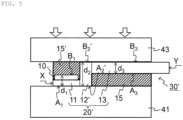
- a flexible substrate 20 includes a first portion 11 which is located at one end portion X of the flexible substrate 20 and on which a sensor unit 10 is formed, and a second portion 12 which is adjacent to the first portion 11 in a distal direction from the end portion X and has a maximum thickness d 2 between a first surface A 2 and a second surface B 2 facing each other.
- the "maximum thickness” means the maximum thickness in the entire temperature sensor.
- the phrase that the second portion is "adjacent to" the first portion "in the distal direction" from the end portion X means that the second portion is adjacent to the first portion in a direction from one end portion X where the first portion exists toward the other end portion Y. In other words, there is no second portion having the maximum thickness d 2 in a direction other than the distal direction with respect to the first portion.
- the sensor unit 10 is formed on the first portion 11, and the surface A 1 of the first portion 11 opposite to the sensor unit 10 and the first surface A 2 of the second portion 12 are on the same plane.
- the fact that the two surfaces are "on the same plane” means that a common plane is formed in a state where no load (or external force) is applied to the temperature sensor, this shall not apply in a state where a load is applied, and the surface may be curved and/or bent, for example.
- the total thickness d 1 of the first portion 11 and the sensor unit 10 is a thickness direction dimension between the surface A 1 of the first portion 11 and an exposed surface B 1 of the sensor unit 10 facing the surface A 1 .
- the sensor unit 10 is not particularly limited as long as it has a function of detecting a temperature, and may include, for example, a thermistor layer and two electrodes that are in contact with the thermistor layer and are arranged to be spaced apart from each other, and may or may not further include a cover layer (or a protective film).
- a thermistor layer and the two electrodes may be formed from any suitable material, and any suitable structure and arrangement, etc. may be used.
- a material disclosed in Patent Document 4 and the like can be used as the thermistor layer.
- the electrode may be, for example, a pair of comb-shaped electrodes formed in contact with the thermistor layer, a pair of split electrodes arranged in contact with the thermistor layer (and preferably facing a non-connection type internal electrode), or a pair of planar electrodes sandwiching the thermistor layer therebetween.
- the first portion 11 and the second portion 12 may appropriately include two extended electrode portions extended from the two electrodes of the sensor unit 10, two wires electrically connected to these extended electrode portions, and the like.
- the electrode and the extended electrode portion may be formed separately, and preferably may be formed integrally. The number of thermistor layers, electrodes, extended electrode portions, and wires may be larger.
- the temperature sensor 30 of the present embodiment can be configured to be flexible and thin as a whole.
- the material and the thickness of the flexible substrate 20 responsible for flexibility can be appropriately selected, the maximum thickness d 2 may be preferably 200 um or less, more preferably 100 um or less, and the lower limit is not particularly limited, and may be, for example, 60 um or more.
- a length L 1 (dimension between one end portion X (end surface in the illustrated aspect) of the flexible substrate 20 and a boundary between the first portion 11 and the second portion 12) of the first portion 11 is preferably small, and may be, for example, 30 mm or less, particularly 20 mm or less, more preferably 10 mm or less, and optionally 5 mm or less, and the lower limit is not particularly limited, and may be, for example, 1 mm or more.
- L 1 may be 9.5 mm or less.
- a length L 2 in the present embodiment, a dimension between the boundary between the first portion 11 and the second portion 12 and the other end portion Y (end surface in the illustrated aspect) of the flexible substrate 20) of the second portion 12 is not particularly limited, and may vary depending on the application of the temperature sensor 30.
- the temperature sensor 30 of the present embodiment is used such that at least the first surface A 2 of the second portion 12 is in contact with an object 41 whose temperature is to be detected.
- at least the first surface A 2 of the second portion 12 forms a detection surface that comes into contact with the object 41 whose temperature is to be detected (more specifically, the detection surface is pressed against and brought into close contact with the object 41).
- the surface A 1 of the first portion 11 opposite to the sensor unit 10 can also come into contact with the object 41 whose temperature is to be detected (can form a detection surface), the surface A 1 does not necessarily have to come into contact with the object 41, and may "float" from the object 41, for example.
- the temperature sensor 30 can be used in a state of being pressed between the object 41 whose temperature is to be detected and an object 43 facing the object 41.
- the second surface B 2 of the second portion 12 may be in contact with the opposing object 43.
- the opposing object 43 is not particularly limited, and may be, for example, a metal plate or the like.
- a load (pressing force) is applied to the temperature sensor 30 in a thickness direction thereof.
- the second portion 12 where the sensor unit 10 is not formed has the maximum thickness d 2 , when a load is applied in the thickness direction of the temperature sensor 30, the load is applied to the second portion 12, and is not directly applied to the sensor unit 10 formed in the first portion 11.
- stress can propagate to the first portion 11 adjacent to the second portion 12; however, since the first portion 11 is located at the end portion X of the flexible substrate 20 and is free, the stress can be effectively relaxed. As a result, generation of stress in the sensor unit 10 can be substantially eliminated, and excellent load bearing capability can be obtained.
- the temperature sensor 30 of the present embodiment it is possible to prevent a decrease in temperature detection accuracy due to generation of stress in the sensor unit 10. Furthermore, according to the temperature sensor 30 of the present embodiment, the first surface A 2 of the second portion 12 forms a detection surface in contact with the object 41 whose temperature is to be detected, the first surface A 2 is pressed against the object 41 by a load (pressing force) and brought into close contact with the object 41, and the sensor unit 10 is formed in the first portion 11 adjacent to the second portion 12, so that the temperature of the object 41 can be detected by the sensor unit 10 with high accuracy. That is, according to the present embodiment, the temperature sensor 30 that is excellent in load bearing capability and can obtain high temperature detection accuracy is provided.
- the present embodiment relates to a modification example of the temperature sensor of Embodiment 1, and the same description as that in Embodiment 1 can be applied unless otherwise specified.
- a flexible substrate 20' includes a first portion 11 which is located at one end portion X of the flexible substrate 20' and on which a sensor unit 10 is formed, a second portion 12' which is adjacent to the first portion 11 in a distal direction from the end portion X and has a maximum thickness d 2 between a first surface A 2 ' and a second surface B 2 ' facing each other, and a third portion 13 which is adjacent to the second portion 12' in the distal direction from the end portion X and has, between a third surface A 3 and a fourth surface B 3 facing each other, a thickness d 3 which is smaller than the maximum thickness d 2 .
- the first portion 11, the second portion 12', and the third portion 13 may appropriately include two extended electrode portions extended from the two electrodes of the sensor unit 10, two wires electrically connected to these extended electrode portions, and the like.
- the fourth surface B 3 of the third portion 13 and the second surface B 2 ' of the second portion 12' are on the same plane.
- the third surface A 3 of the third portion 13 is positioned at an inner position from the first surface A 2 ' of the second portion 12'.
- Such a flexible substrate 20' may be understood as having a generally S-shaped cross-sectional shape including the first portion 11, the second portion 12' and the third portion 13 as a whole.
- a length L 2 ' (in the present embodiment, a dimension between a boundary of the first portion 11 and the second portion 12' and a boundary of the second portion 12' and the third portion 13) of the second portion 12' can be appropriately selected within equal to or more than a dimension that provides a minimum area necessary for a detection surface to be described later and a dimension that can achieve higher temperature detection accuracy.
- a length L 3 (a dimension between the boundary between the second portion 12' and the third portion 13 and the other end portion Y of the flexible substrate 20') of the third portion 13 is not particularly limited, and may vary depending on the application of the temperature sensor 30' .
- the temperature sensor 30' of the present embodiment is used such that at least the first surface A 2 ' of the second portion 12' is in contact with an object 41 whose temperature is to be detected.
- at least the first surface A 2 ' of the second portion 12' forms a detection surface that comes into contact with the object 41 whose temperature is to be detected (more specifically, the detection surface is pressed against and brought into close contact with the object 41).
- the surface A 1 of the first portion 11 opposite to the sensor unit 10 can also come into contact with the object 41 whose temperature is to be detected (can form a detection surface), the surface A 1 does not necessarily have to come into contact with the object 41, and may "float" from the object 41, for example.
- the third surface A 3 of the third portion 13 is spaced apart from (not in contact with) the object 41 whose temperature is to be detected, for example, when the third portion 13 is curved, a part of the third surface A 3 may come into contact with the object 41 whose temperature is to be detected.
- the temperature sensor 30' can be used in a state of being pressed between the object 41 whose temperature is to be detected and an object 43 facing the object 41.
- the fourth surface B 3 of the third portion 13 may also come into contact with the opposing object 43.
- the temperature sensor 30' When the temperature sensor 30' is used, a load (pressing force) is applied to the temperature sensor 30' in a thickness direction thereof.
- a load pressing force
- the temperature sensor 30' of the present embodiment since the first surface A 2 ' pressed against and brought into close contact with the object 41 whose temperature is to be detected by the load (pressing force) is smaller than the first surface A 2 in the temperature sensor 30 of Embodiment 1, the heat of the object 41 (heat source) is less likely to be conducted to the second surface B 2 ', the fourth surface B 3 (further the opposing object 43), and the like, and can be more efficiently conducted to the sensor 10, and the temperature of the object 41 can be detected with higher accuracy by the sensor unit 10. That is, according to the present embodiment, the temperature sensor 30' capable of obtaining higher temperature detection accuracy in addition to the same effects as those in Embodiment 1 is provided.
- an area of the first surface A 2 ' is 3% or less with respect to an area of an object to be measured of the object 41 whose temperature is to be detected.
- heat insulating properties and heat dissipation properties of the temperature sensor 30' it is preferable to adjust heat insulating properties and heat dissipation properties of the temperature sensor 30' according to the object 41 whose temperature is to be detected (heat source).
- the heat source of the object 41 whose temperature is to be detected is small, thermal conduction is suppressed as much as possible (heat insulating properties are secured), whereby a change in temperature of the object 41 whose temperature is to be detected due to insertion of the temperature sensor 30' between the object 41 and the opposing object 43 can be reduced, and the temperature detection accuracy can be further improved.
- the thermal conduction is increased (heat dissipation properties are secured), whereby the change in temperature of the object 41 whose temperature is to be detected due to insertion of the temperature sensor 30' between the object 41 and the opposing object 43 can be reduced, and the temperature detection accuracy can be further improved.
- the third surface A 3 of the third portion 13 may be exposed as in the temperature sensor 30' illustrated in FIGS. 3 to 4 . This can provide air (or other gas in some cases) heat insulation in a gap between the object 41 whose temperature is to be detected and the third surface A 3 .
- the third surface A 3 of the third portion 13 may be covered with a heat insulating material 15 that comes into contact with the object 41 whose temperature is to be detected.
- the gap between the object 41 whose temperature is to be detected and the third surface A 3 can be filled with the heat insulating material 15 to provide heat insulation.
- the gap between the sensor unit 10 and the opposing object 43 may also be filled with a heat insulating material 15' to provide further heat insulation.
- the heat insulating material may be a material having a low thermal conductivity, and may be, for example, a material having a thermal conductivity of 1 W/(m ⁇ K) or less.
- the third surface A 3 of the third portion 13 may be covered with the heat dissipating material 15 that comes into contact with the object 41 whose temperature is to be detected. Accordingly, the gap between the object 41 whose temperature is to be detected and the third surface A 3 can be filled with the heat dissipating material 15 to provide heat dissipation.
- the gap between the sensor unit 10 and the opposing object 43 may also be filled with the heat dissipating material 15' to provide further heat insulation.
- the heat dissipating material may be a material having a high thermal conductivity, and may be, for example, a material having a thermal conductivity of 10 W/(m ⁇ K) or more.
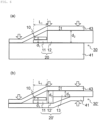
- the load may be increased to deform the opposing object 43 and/or the object 41 whose temperature is to be detected, and the opposing object 43 (for example, a metal plate) may be brought into contact with the object 41 ( FIG. 6 (a) illustrates a case of the temperature sensor 30 of Embodiment 1, and FIG. 6 (b) illustrates a case of the temperature sensor 30' of Embodiment 2).
- a contact area between the opposing object 43 and the object 41 whose temperature is to be detected may be appropriately adjusted.
- the heat of the object 41 whose temperature is to be detected can be released to the opposing object 43 to provide heat dissipation (cooling).
- a thickness t of the opposing object 43, the maximum thickness d 2 of the second portion 12 or 12', and the length L 1 of the first portion 11 it is possible to prevent a load from being applied to the sensor unit 10 (for example, it is possible to prevent the opposing object 43 from being deformed and prevent a load from being directly applied to the sensor unit 10).
- the change in temperature of the object 41 whose temperature is to be detected caused by inserting the temperature sensor 30' between the object 41 and the opposing object 43 can be suppressed to ⁇ 0.5°C or less.
- the present embodiment relates to a specific example of the temperature sensor of Embodiment 2, and the same description as that in Embodiments 1 to 2 can be applied unless otherwise specified.
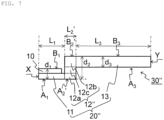
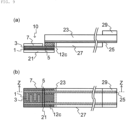
- a second portion 12" includes a first partial expansion portion 12a from a first portion 11, a third partial expansion portion 12b from a third portion 13, and a joint 12c joining the expansion portions 12a and 12b.
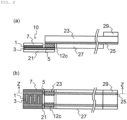
- the sensor unit 10 includes a thermistor layer 1 and two electrodes 3 that are in contact with the thermistor layer 1 and are arranged to be spaced apart from each other, and may or may not further include a cover layer (or a protective film) 7.
- the two electrodes 3 are a pair of comb-shaped electrodes formed in contact with the thermistor layer 1
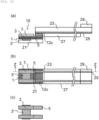
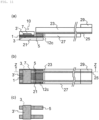
- the two electrodes 3 are a pair of divided electrodes arranged in contact with the thermistor layer 1 and facing a non-connection type internal electrode 3'.
- the electrode 3 is integrally formed with an extended electrode portion 5, and it is difficult to clearly define a boundary between the electrode 3 and the extended electrode portion 5; however, the electrode 3 may include a region facing the non-connection type internal electrode 3', and the boundary is indicated by a dotted line in FIGS. 10 (c) and 11 (d) for convenience.
- FIGS. 8 to 11 reference numerals of the first portion 11, the second portion 12", the first partial expansion portion 12a, the third partial expansion portion 12b, the third portion 13, and the like are omitted; however, by contrast with FIG. 7 , it can be grasped which part of FIGS. 8 to 11 the reference numerals of these omitted members refer to. It should be noted that in FIGS.
- a portion of the thermistor layer 1 is present over the first partial expansion portion 12 of the second portion 12"; however, a portion of the thermistor layer 1 present in the first partial expansion portion 12 is not provided with the electrode 3, therefore does not function as a sensor, and is therefore not included in the sensor unit 10.
- the first portion 11 and the first partial expansion portion 12a include a first substrate 21 and the two extended electrode portions 5 formed on the first substrate 21 and extended from the two electrodes 3 of the sensor unit 10.
- the third portion 13 and the third partial expansion portion 12b include a second substrate 23 and two wires 25 formed on the second substrate 23.
- the two extended electrode portions 5 and the two wires 25 are electrically connected to each other with the joint 12c interposed therebetween.
- the cover layer 7 covering the thermistor layer 1 and/or the electrode 3 may be provided.
- a cover layer 27 covering the wire 25 may be provided.
- the cover layer 27 may be removed to expose the wire 25 at the end portion Y of the third portion 13 and in the vicinity thereof, and a reinforcing plate 29 may be provided on a surface of the second substrate 23 on the opposite side thereto to enable connection to a connection (not illustrated) such as a connector.
- a connection such as a connector
- the connection such as the connector and the joint 12c can be understood as a secondary connection and a primary connection, respectively.
- any suitable material and method can be used for the joint 12c as long as the two extended electrode portions 5 and the two wires 25 can be electrically connected to each other (preferably, as long as the extended electrode portions 5 and the wires 25 can be thinly joined and sufficiently electrically and strongly joined).
- the joint 12c include an anisotropic conductive film (ACF), a solder material, a conductive paste, sealing of a contact portion with a curable resin (a periphery of the extended electrode portion and the wire is covered with a curable resin in a state where the extended electrode portion and the wire are in contact with each other, and the resin is cured for sealing), and ultrasonic bonding.
- ACF anisotropic conductive film
- solder material a solder material
- a conductive paste sealing of a contact portion with a curable resin
- sealing of a contact portion with a curable resin a periphery of the extended electrode portion and the wire is covered with a curable resin in a state where the extended electrode portion and the wire are
- the second portion 12" since the second portion 12" includes the extended electrode portion 5, the wire 25, and the joint 12c joining the extended electrode portion 5 and the wire 25 in a concentrated manner, relatively high rigidity is obtained, and the load bearing capability is further improved.
- the temperature sensor 30' of Embodiment 2 can be easily embodied.
- the temperature sensor 30" of the present embodiment can be manufactured by forming the sensor unit 10 in the first portion 11 and the first partial expansion portion 12a, separately preparing the third portion and the third partial expansion portion 12c, and joining them at the joint 12c.
- the present embodiment provides the temperature sensor 30" which is excellent in load bearing capability, can obtain high temperature detection accuracy, and is suitable for mass production at low cost by a simple manufacturing method.
- the present embodiment relates to a temperature sensor array including a plurality of the temperature sensors of Embodiment 3, and the same description as that in Embodiments 1 to 3 can be applied unless otherwise specified.
- a temperature sensor array 40 of the present embodiment includes a plurality of temperature sensors 30A to 30C, and the plurality of temperature sensors 30A to 30C are connected to a common connection 31 at or near an end portion Y opposite to a first portion 11 (located at an end portion X) of a flexible substrate.
- the common connection 31 and the joint 12c can be understood as a secondary connection and a primary connection, respectively.
- the end portions Y of the temperature sensors 30A to 30C are inserted into the common connection (for example, a connector) 31; however, the present invention is not limited thereto.
- the plurality of temperature sensors 30A to 30C are separated from each other, and the plurality of temperature sensors 30A to 30C may be manufactured by integrally and simultaneously preparing and then individually cutting, and the cutting may be performed either before or after connection of the plurality of temperature sensors 30A to C to the common connection 31.
- the temperature sensor array 40 includes the three temperature sensors 30A to 30C as an example as the plurality of temperature sensors; however, the number of the plurality of temperature sensors is not particularly limited as long as it is two or more, and may be selected according to the application of the temperature sensor array 40.
- the temperature sensor array 40 includes the plurality of temperature sensors of Embodiment 3; however, any of the temperature sensors of Embodiments 1 to 3 may be used.
- each temperature can be detected by bringing the plurality of temperature sensors 30A to 30C into contact with different objects whose temperature is to be detected.
- the plurality of temperature sensors 30A to 30C are connected to the common connection 31, only by connecting the common connection 31 to an external device (not illustrated) such as a measurement circuit, the plurality of temperature sensors 30A to 30C can be connected to the external device at a time
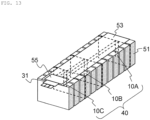
- the temperature sensor array 40 of the present embodiment can be used for any suitable application, for example, as illustrated in FIG. 13 , for a plurality of cells (batteries) 51 of a lithium ion battery module, the temperature sensor array 40 can be used by sandwiching the temperature sensors 30A to 30C one by one between the two cells 51 adjacent to each other, whereby the temperature of each of the cells 51 can be detected.
- a temperature sensor array circuit board 55 is incorporated in the battery module circuit board 53 placed on a stack of the plurality of cells 51, and the temperature sensor array 40 is connected to the temperature sensor array circuit board 55 via the common connection (for example, a connector) 31. More specifically, in the temperature sensor array 40, as illustrated in FIG.
- the present invention is not limited to the aspect illustrated in FIG. 13 .
- sensor units 10A to 10C of the temperature sensors 30A to 30C sandwiched between the two adjacent cells 51 can be in a state where a load is applied (state of being pressed) between the cells 51, and it is desirable that the temperature sensor exhibits high temperature detection accuracy while withstanding an assumed load (pressing force) in such a state.
- Each of the temperature sensors 30A to 30C of the temperature sensor array 40 of the present embodiment is excellent in load bearing capability and can obtain high temperature detection accuracy, and thus can be suitably used to detect the temperature of each cell in the lithium ion battery module.
- Comparative Example 1 relates to the temperature sensor having a uniform thickness as a whole including the sensor unit.
- the precursor structure was annealed at 250°C for 10 hours to remove unnecessary organic substances that may remain, and thus to obtain a structure. Thereafter, a precursor liquid of polyamide-imide was applied in a thickness of 10 um onto a film (metal oxide-containing composite layer capable of functioning as the thermistor layer) derived from the sheet in the obtained structure, and heated at 200°C for 1 hour to thermally cure the polyamide-imide, and thus to obtain a resin substrate.
- a precursor liquid of polyamide-imide was applied in a thickness of 10 um onto a film (metal oxide-containing composite layer capable of functioning as the thermistor layer) derived from the sheet in the obtained structure, and heated at 200°C for 1 hour to thermally cure the polyamide-imide, and thus to obtain a resin substrate.
- a resist was applied to the surface of the copper foil opposite to the resin substrate in a predetermined pattern, exposed and developed, a predetermined portion of the copper foil was removed by etching, and the remaining resist was removed to pattern-form two comb-shaped electrodes and an extended electrode portion extended from each of the comb-shaped electrodes.
- a resist was applied to the surface of the copper foil opposite to the resin substrate in a predetermined pattern, exposed and developed, a predetermined portion of the copper foil was removed by etching, and the remaining resist was removed to pattern-form two comb-shaped electrodes and an extended electrode portion extended from each of the comb-shaped electrodes.
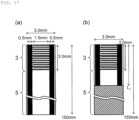
- an external dimension of a comb tooth portion of the comb-shaped electrode 3 as viewed from above was set to a width of 1.5 mm and a length of 3.0 mm, and a pattern portion of the comb-shaped electrode 3 and the extended electrode portion 5 were set to a width of 0.5 mm and a length of 150 mm on both outer sides in a width direction of the comb tooth portion, respectively (area of the sensor unit was 3.0 mm in width and 3.0 mm in length, and the extended electrode portion was sufficiently long, so that the extended electrode portion could be understood as a wire).
- FIG. 14 (a) is a schematic example, and the details of the comb-shaped electrode (the dimension, the number, the pitch, and the like of each comb tooth of the comb-shaped electrode) can be different from those of FIG. 14 (a) (the same applies to the following Comparative Examples and Examples).
- a laminate of the resin substrate (thickness: about 10 ⁇ m) and the metal oxide-containing composite layer (thermistor layer: thickness of about 10 ⁇ m) thus obtained, the laminate having a copper layer (comb-shaped electrode and extended electrode portion: thickness of about 10 ⁇ m) pattern-formed on an upper surface thereof, a polyimide tape (polyimide film having an adhesive layer: thickness of about 30 ⁇ m) was attached as a cover layer so as to cover the copper layer (in FIG.
- the cover layer is indicated by a hatched region).
- the structure thus obtained was cut with a dicing saw to prepare a temperature sensor having a width of about 3 mm, a length of about 150 mm, and a uniform thickness of 60 um over the whole as illustrated in FIGS. 14 (a) to (b) .
- the prepared temperature sensor was subjected to a load test. More specifically, the temperature sensor was sandwiched between two iron plates having a diameter of 50 mm and a thickness of 25 mm, and pressure application at 0.5 tons (about 5000 N) was repeated five times to measure a resistance value change ( ⁇ R (-)) at the same temperature.
- a pressure sensitive film manufactured by Fujifilm Corporation, "Prescale” for medium pressures, detection sensitivity: 10 MPa, and the same applies hereinafter
- the comb-shaped electrode corresponding to the sensor unit
- 10 MPa detection sensitivity
- Comparative Example 2 relates to a temperature sensor in which both outer portions in the longitudinal direction excluding the sensor unit have a uniform thickness as a whole.
- a temperature sensor (cover layer thickness: about 30 ⁇ m) was prepared in the same manner as in Comparative Example 1 except that a dummy portion D having a length of 3.0 mm and having no comb-shaped portion was provided adjacent to the comb-shaped electrode 3, and the sensor unit corresponding to the comb-shaped electrode 3 was not covered with the cover layer (in FIG. 16 (b) , the cover layer was indicated by a hatched region).
- the dummy portion D and the extended electrode portion 5 were covered with the cover layer except for the sensor unit corresponding to the comb-shaped electrode 3.
- a thickness from a back surface of the resin substrate to the highest exposed surface of the comb-shaped electrode 3 was 30 um, whereas a thickness from the back surface of the resin substrate to an outer surface of the cover layer was 60 ⁇ m.
- the prepared temperature sensor was subjected to the same load test as in Comparative Example 1.
- the pressure sensitive film was sandwiched between the comb-shaped electrode (corresponding to the sensor unit) of the temperature sensor and the iron plate, and the pressure was measured, so that it was confirmed that a load of 10 MPa or more was applied to the sensor unit also in Comparative Example 2.
- the resistance change rate in the load test was 5% or more, satisfactory temperature detection accuracy was not obtained, and the sensor was unsuitable as a temperature sensor.
- this temperature sensor has a structure in which a load is not directly applied to the sensor unit, it is considered that the cover layer is deformed in a horizontal direction by the load, the stress in the horizontal direction is propagated to the thermistor layer, and as a result, a resistance change occurs.
- a load of 10 MPa or more was applied to the sensor unit as described above was considered that stress was applied to the sensor unit in the horizontal direction, and the sensor unit was deformed, so that the load was measured in a vertical direction.
- Example 1 relates to the temperature sensor of Embodiment 1 described above with reference to FIGS. 1 to 2 .
- a temperature sensor (cover layer thickness: about 30 ⁇ m) was prepared in the same manner as in Comparative Example 1 except that the cover layer cut from an end portion where the comb-shaped electrode existed by the length L 1 was used, and the first portion having the length L 1 from the end portion was not covered with the cover layer (indicated by a hatched region in FIG. 17 (b) ) as illustrated in FIGS. 17 (a) to 17 (b) .
- the length L 1 was 5.0 mm.
- the thickness from the back surface of the resin substrate to the highest exposed surface of the comb-shaped electrode was 30 um, whereas the thickness from the back surface of the resin substrate to the outer surface of the cover layer (maximum thickness d 2 of the second portion) was 60 um.
- the prepared temperature sensor was subjected to the same load test as in Comparative Example 1.
- the pressure sensitive film was sandwiched between the comb-shaped electrode (corresponding to the sensor unit) of the temperature sensor and the iron plate, and the pressure was measured, so that it was confirmed that a load of 10 MPa or more was not applied to the sensor unit.
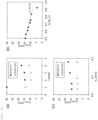
- the results are shown in FIG. 15 (b) .
- the resistance change rate in the load test was 1% or less, and the error in temperature detection was within 1°C.
- Example 2 relates to the temperature sensor of Embodiment 1 described above with reference to FIGS. 1 to 2 , and more particularly to a usage mode of FIG. 6 (a) .
- a temperature sensor was prepared in the same manner as in Example 1 except that the thickness of the resin substrate, a position where the cover layer was attached, and the thickness of the cover layer (stacking one or two or more sheets on the front surface side, optionally stacking one or two or more sheets on the entire back surface of the resin substrate, or the like) were variously changed. As a result, the total thickness d 1 of the first portion and the sensor unit, the maximum thickness d 2 of the second portion, and the length L 1 of the first portion were changed.
- a metal plate (60 mm square SUS plate) having a thickness t was disposed as an opposing object (indicated by reference numeral 43 in FIG. 6 (a) ) on the prepared temperature sensor, fluororubber having a thickness of 1 mm was further disposed on the outer side of the metal plate, a pressure of 0.5 tons was applied by sandwiching the metal plate and the fluororubber between upper and lower flat plates of a pressing machine, and the application of the load to the sensor unit accompanying the deformation of the metal plate as illustrated in FIG. 6 (a) was examined.
- This is understood as follows. For example, as illustrated in FIG. 2 , when it is assumed that a metal plate having a sufficiently large thickness t is used as the opposing object (indicated by reference numeral 43 in FIG.
- the metal plate is not substantially deformed when pressure is applied to the metal plate, all the pressure is applied to the second portion (portion having the thickness d 2 ), irrespective of the extent to which L 1 is increased, a load of 10 MPa or more is not applied to the sensor unit, and L 1MAX is theoretically understood to be infinite.
- the thickness t of the metal plate decreases, the metal plate is easily deformed, and shifts from a state schematically illustrated in FIG. 2 to a state schematically illustrated in FIG. 6 (a) .
- a degree of deformation of the metal plate can also depend on the pressure (load) and material characteristics of metal in addition to the thickness t of the metal plate, but is not greatly affected by these in the conditions of Example 2 (and use applications assumed in Example 2 to be described later), and thus it is sufficient to consider only the influence by the thickness t. It is easily understood that a deformation amount of the metal plate gradually increases as the thickness t of the metal plate decreases, L 1MAX appears when the load applied to the sensor unit becomes 10 MPa or more, and the value of L 1MAX gradually decreases as the load applied to the sensor unit increases.
- L 1MAX indicated the minimum value
- L 1MAX was 9.5 (No. 3 in Table 1).
- L 1MAX (mm) -15 ⁇ d 1 /d 2 + 22 was obtained (in FIG. 18 (b) , an approximate straight line was indicated by a dotted line, and a linear approximate formula in which d 1 /d 2 (-) and L 1MAX (mm) were x and y, respectively, was indicated together).
- L 1MAX (mm) is the largest L 1 at which a load of 10 MPa or more is not applied to the sensor unit
- L 1MAX indicated the minimum value
- L 1MAX was substantially constant (substantially flat) regardless of d 1 when d 1 /d 2 was constant (0.5 or 0.83 in the illustrated example).
- Example 2 assuming the case where the temperature sensor was used by being sandwiched between adjacent cells in the battery module, an 60 mm square SUS plate which was considered to be minimum in such use application was used, a pressure of 0.5 tons (it was preferable to assume an actual load instead of a pressure per area) which was considered to be maximum in such use application was applied, and the above result was obtained under the condition that the load applied to the sensor unit was 10 MPa or less with the width of the sensor unit typically set to 3.0 mm (see FIG. 17 ).
- the metal plate SUS plate
- the applied pressure is larger than 0.5 tons
- the width of the sensor unit is smaller than 3 mm
- the upper limit of the load applied to the sensor unit is smaller than 10 MPa
- Example 3 relates to the temperature sensor of Embodiment 3 described above with reference to FIG. 7 , and more particularly to the temperature sensor of the specific example illustrated in FIG. 8 .
- a flexible printed circuit board was prepared in which a copper foil having a thickness of 10 um was formed in a predetermined pattern on a polyimide substrate having a thickness of 10 um.
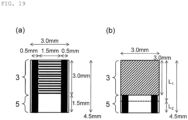
- the external dimension of the comb tooth portion of the comb-shaped electrode 3 as viewed from above was set to a width of 1.5 mm and a length of 3.0 mm, and the pattern portion of the comb-shaped electrode 3 and the extended electrode portion 5 were formed with a width of 0.5 mm and a length of 4.5 mm on both outer sides in the width direction of the comb tooth portion, respectively (area of the sensor unit was 3.0 mm in width and 3.0 mm in length).
- a thermistor layer was formed on the FPC in such a thickness that a height from an upper surface of the comb-shaped electrode 3 was 10 um in the same manner as in the method of forming the metal oxide-containing composite layer described above in Comparative Example 1 so as to embed and cover the comb-shaped electrode 3.
- the external dimensions of the thermistor layer as viewed from the top surface were about 3.0 mm in width and about 3.0 mm in length.
- a polyimide tape polyimide film having an adhesive layer: thickness of about 30 ⁇ m
- FIGS. 19 (a) to 19 (b) a thermistor element was prepared in which the sensor unit was covered with the cover layer (indicated by a hatched region in FIG. 19 (b) ), and the extended electrode portion 5 was exposed.
- a flexible flat cable (FFC) having a total thickness of 135 um was prepared, in which two copper wires having a thickness of 10 um were formed at a pitch of 2 mm on a polyimide substrate having a thickness of 100 um, and a cover layer of a polyimide film was formed so as to cover the copper wires. At one end portion of the FFC, the cover layer was not provided with a length of 3 mm from the end portion, and two wires were exposed.
- FFC flexible flat cable
- an anisotropic conductive film having a width of 3 mm and a length of 1 mm was disposed and superposed between a wiring exposed region of the FFC and a region not covered with the cover layer of the thermistor element prepared as described above (in a region having a length L 2 illustrated in FIG. 19 (b) ), and joined at 180°C while a load of 2 MPa was applied.
- the two extended electrode portions 5 of the thermistor element and the two wires of the FFC were electrically connected to each other to prepare a temperature sensor.
- a thickness of a portion between the extended electrode portion 5 and the wire in the joint derived from the ACF was 10 um.
- a thickness (the total thickness d 1 of the first portion and the sensor unit) from a back surface of the polyimide substrate of the thermistor element to the outer surface of the cover layer of the thermistor element was 60 um
- a thickness (the maximum thickness d 2 of the second portion) from the back surface of the polyimide substrate of the thermistor element to an outer surface of the polyimide substrate of the FFC including the joint was 140 um.
- the length L 1 of the first portion was 3.5 mm
- the length L 2 of the second portion was 1.0 mm
- the area of the joint area of a first surface A' of the second portion in contact with the object whose temperature was to be detected
- the prepared temperature sensor was subjected to the same load test as in Comparative Example 1.
- the resistance change rate in the load test was 1% or less, and the error in temperature detection was within 1°C.
- the back surface of the polyimide substrate of the thermistor element of the temperature sensor was attached to a heater surface of 10 mm square set at 50°C (actual temperature T h of the heater), and a surface of the polyimide substrate of the FFC of the temperature sensor was brought into contact with an aluminum plate of 10 mm square and 10 mm thick to acquire a measurement value of the temperature sensor as the temperature of the heater surface (measurement temperature T m1 ).
- T m1 measured temperature
- the area (heating area in this example) of the object to be measured of the heater as the object whose temperature was to be detected was 100 mm 2
- the area of the first surface A' of the second portion of the temperature sensor in contact with the object whose temperature was to be detected was 3 mm 2 .
- the back surface of the polyimide substrate of the thermistor element of the temperature sensor was attached to the heater surface of 60 mm square set at 50°C, the surface of the polyimide substrate of the FFC of the temperature sensor was brought into contact with an aluminum plate of 60 mm square and 1 mm in thickness, fluororubber of 1 mm in thickness was further disposed outside the aluminum plate, and a pressure of 0.5 tons was applied by sandwiching the aluminum plate and the fluororubber by a pressing machine (as illustrated in FIG.
- the aluminum plate was deformed and brought into contact with the heater surface) to acquire a measurement value of the temperature sensor as the temperature of the heater surface (measurement temperature T m1 ) and measure a temperature of a surface of the aluminum plate with another temperature measuring instrument (measurement temperature T m2 ).
- each of these four temperature sensors was evaluated in the same manner as described above. That is, in the temperature sensor, the back surface of the polyimide substrate of the thermistor element was attached to the heater surface of 60 mm square set at 50°C, the surface of the polyimide substrate of the FFC of the temperature sensor was brought into contact with an aluminum plate of 60 mm square and 1 mm in thickness, fluororubber of 1 mm in thickness was further disposed outside the aluminum plate, and a pressure of 0.5 tons was applied by sandwiching the aluminum plate and the fluororubber by a pressing machine (as illustrated in FIG.
- the aluminum plate was deformed and brought into contact with the heater surface) to acquire a measurement value of the temperature sensor as the temperature of the heater surface (measurement temperature T m1 ) and measure the temperature of the surface of the aluminum plate with another temperature measuring instrument (measurement temperature T m2 ).
- T m1 the temperature of the heater surface
- T m2 the temperature of the surface of the aluminum plate with another temperature measuring instrument
- the thickness of the polyimide substrate (the thickness of the first portion (and the first partial expansion portion)) existing between the sensor unit and the object whose temperature is to be detected does not substantially affect the temperature detection accuracy.
- Example 3 It is considered that the effect shown in Example 3 can be similarly obtained in a case where the arrangement of the thermistor layer and the electrode is changed as in Example 1 in the structure of the sensor unit, or in a case where a divided electrode or a planar electrode is applied instead of the comb-shaped electrode.
- Example 4 relates to the temperature sensor array of Embodiment 4 described above with reference to FIG. 12 .
- thermistor elements were prepared in the same manner as in Example 3.
- a flexible flat cable (FFC) having a total thickness of 135 um was prepared, in which six copper wires having a thickness of 10 um were formed at alternating pitches of 2 mm and 1 mm on a polyimide substrate, and a cover layer of a polyimide film was formed so as to cover the copper wires.
- the cover layer was not provided with a length of 3 mm from the end portion, and six wires were exposed.
- a reinforcing plate was provided on the surface of the polyimide substrate opposite to the wiring exposed region
- an anisotropic conductive film having a width of 9 mm and a length of 1 mm was disposed and superposed between the wiring exposed region of the FFC (one end portion without the reinforcing plate) and a region not covered with the cover layer of the three thermistor elements prepared as described above, and joined at 180°C while a load of 2 MPa was applied.
- ACF anisotropic conductive film
- the two extended electrode portions 5 of each of the three thermistor elements and the six wires of the FFC were electrically connected to each other.
- the structure thus obtained was divided into three portions, leaving the other end side portion where the reinforcing plate existed, such that the six wires of the FFC were two by two. Thereafter, the other end side portion where the reinforcing plate existed was inserted into and connected to a commercially available 9-pin connector with a pitch of 1 mm.
- a temperature sensor array as schematically illustrated in FIG. 12 was prepared.
- the connector can be connected to a measurement circuit board, and high temperature detection accuracy was obtained in all of the three sensor units as in Example 3.
- Example 3 can also be applied to the temperature sensor array of Example 4.
- the temperature sensor and the temperature sensor array of the present invention can be configured to be flexible and thin as a whole, and can be used in various applications for detecting a temperature of an object whose temperature is to be detected.
- the present invention can be suitably used when the temperature of the object whose temperature is to be detected is detected in a state where the temperature sensor is brought into contact with and pressed against the object whose temperature is to be detected (in particular, a state where the temperature sensor is pressed between the object whose temperature is to be detected and an object facing the object whose temperature is to be detected).
Landscapes
- Physics & Mathematics (AREA)
- General Physics & Mathematics (AREA)
- Engineering & Computer Science (AREA)
- Microelectronics & Electronic Packaging (AREA)
- Nonlinear Science (AREA)
- Electromagnetism (AREA)
- Measuring Temperature Or Quantity Of Heat (AREA)
- Thermistors And Varistors (AREA)
Claims (9)
- Temperatursensor (30), umfassend eine Sensoreinheit (10), die auf einem flexiblen Substrat (20) ausgebildet ist, wobei das flexible Substrat (20) einen ersten Abschnitt (11) beinhaltet, der sich an einem Endabschnitt (x) des flexiblen Substrats (20) befindet und in dem die Sensoreinheit (10) ausgebildet ist, und einen zweiten Abschnitt (12) beinhaltet, der benachbart zu dem ersten Abschnitt (11) in einer distalen Richtung von dem Endabschnitt (x) liegt und eine maximale Dicke (d2) zwischen einer ersten Oberfläche (A2) und einer zweiten Oberfläche (B2) aufweist, die einander gegenüberliegen, eine Oberfläche (A1) des ersten Abschnitts (11) gegenüber der Sensoreinheit (10) und die erste Oberfläche (A2) des zweiten Abschnitts (12) in derselben Ebene liegen, wobei zumindest die erste Oberfläche (A2) des zweiten Abschnitts (12) eine Erkennungsoberfläche in Kontakt mit einem Objekt bildet, dessen Temperatur erkannt werden soll, und eine Gesamtdicke (d1) des ersten Abschnitts (11) und der Sensoreinheit (10) kleiner als die maximale Dicke (d2) des zweiten Abschnitts (12) ist.
- Temperatursensor (30) nach Anspruch 1, wobei ein Verhältnis der Gesamtdicke (d1) des ersten Abschnitts (11) und der Sensoreinheit (10) zu der maximalen Dicke (d2) des zweiten Abschnitts (12) 0,83 oder weniger beträgt und eine Länge (L1) des ersten Abschnitts (11) 9,5 mm oder weniger beträgt.
- Temperatursensor (30) nach Anspruch 1 oder 2, wobei das flexible Substrat (20) ferner einen dritten Abschnitt (13) beinhaltet, der benachbart zu dem zweiten Abschnitt (12) in distaler Richtung von dem Endabschnitt (x) liegt und eine Dicke (d3) aufweist, die kleiner als die maximale Dicke (d2) zwischen einer dritten Oberfläche (A3) und einer vierten Oberfläche (B3) ist, die einander zugewandt sind, und wobei die vierte Oberfläche (B3) des dritten Abschnitts (13) und die zweite Oberfläche (B2) des zweiten Abschnitts (12) in derselben Ebene liegen.
- Temperatursensor (30) nach Anspruch 3, wobei die dritte Oberfläche (A3) des dritten Abschnitt (13) freiliegt.
- Temperatursensor (30) nach Anspruch 3, wobei die dritte Oberfläche (A3) des dritten Abschnitts (13) mit einem wärmeisolierenden Material (15) oder einem wärmeableitenden Material (15) bedeckt ist, das mit dem Objekt, dessen Temperatur erkannt werden soll, in Kontakt steht.
- Temperatursensor (30) nach einem der Ansprüche 3 bis 5, wobei der zweite Abschnitt (12) einen Ausdehnungsabschnitt (12a) aus dem ersten Abschnitt (11), einen Ausdehnungsabschnitt (12b) aus dem dritten Abschnitt (13) und ein Verbindungsstück (12c) beinhaltet, das diese Ausdehnungsabschnitte (12a, 12b) miteinander verbindet.
- Temperatursensor (30) nach Anspruch 6, wobei der erste Abschnitt (11) und der Ausdehnungsabschnitt (12a) des ersten Abschnitts (11) ein erstes Substrat (21) und zwei Elektrodenabschnitte (5) beinhalten, die auf dem ersten Substrat (21) ausgebildet sind und sich von der Sensoreinheit (10) aus erstrecken, der dritte Abschnitt (13) und der Ausdehnungsabschnitt (12b) von dem dritten Abschnitt (13) ein zweites Substrat (23) und zwei Drähte (25) beinhalten, die auf dem zweiten Substrat (23) ausgebildet sind, und die zwei Elektrodenabschnitte (5) und die zwei Drähte (25) elektrisch miteinander verbunden sind, wobei das Verbindungsstück (12c) dazwischen geschaltet ist.
- Temperatursensor (30) nach einem der Ansprüche 1 bis 7, wobei die Sensoreinheit (10) eine Thermistorschicht (1), zwei Elektroden (3), die in Kontakt mit der Thermistorschicht (1) stehen und voneinander beabstandet sind, und eine Deckschicht (7), falls vorhanden, beinhaltet.
- Temperatursensoranordnung (40), umfassend eine Vielzahl von Temperatursensoren (30) nach einem der Ansprüche 1 bis 8, wobei die Vielzahl von Temperatursensoren (30) mit einer gemeinsamen Verbindung (31) an oder nahe einem Endabschnitt (Y) des flexiblen Substrats (20) gegenüber dem ersten Abschnitt (11) verbunden sind.
Applications Claiming Priority (2)
| Application Number | Priority Date | Filing Date | Title |
|---|---|---|---|
| JP2020064343 | 2020-03-31 | ||
| PCT/JP2021/003499 WO2021199647A1 (ja) | 2020-03-31 | 2021-02-01 | 温度センサおよび温度センサアレイ |
Publications (3)
| Publication Number | Publication Date |
|---|---|
| EP4089381A1 EP4089381A1 (de) | 2022-11-16 |
| EP4089381A4 EP4089381A4 (de) | 2023-07-26 |
| EP4089381B1 true EP4089381B1 (de) | 2024-01-24 |
Family
ID=77928971
Family Applications (1)
| Application Number | Title | Priority Date | Filing Date |
|---|---|---|---|
| EP21779344.7A Active EP4089381B1 (de) | 2020-03-31 | 2021-02-01 | Temperatursensor und temperatursensoranordnung |
Country Status (4)
| Country | Link |
|---|---|
| EP (1) | EP4089381B1 (de) |
| JP (1) | JP7306571B2 (de) |
| CN (1) | CN115398192B (de) |
| WO (1) | WO2021199647A1 (de) |
Families Citing this family (1)
| Publication number | Priority date | Publication date | Assignee | Title |
|---|---|---|---|---|
| WO2024262079A1 (ja) * | 2023-06-22 | 2024-12-26 | 株式会社村田製作所 | 排泄検知装置 |
Family Cites Families (13)
| Publication number | Priority date | Publication date | Assignee | Title |
|---|---|---|---|---|
| JP2528396Y2 (ja) * | 1990-04-25 | 1997-03-12 | 石塚電子株式会社 | 温度センサ |
| JP5044296B2 (ja) * | 2007-06-12 | 2012-10-10 | 株式会社日本自動車部品総合研究所 | 温度センサ素子及び温度センサ |
| JP2010043930A (ja) * | 2008-08-12 | 2010-02-25 | Tateyama Kagaku Kogyo Kk | 非接触温度センサ |
| DE112011104686B4 (de) | 2011-01-07 | 2017-09-28 | Murata Manufacturing Co., Ltd. | Temperatursensor und struktur, an die ein temperatursensor angebracht ist |
| CN103207032A (zh) * | 2012-01-13 | 2013-07-17 | 热敏碟公司 | 低型面温度传感器探针 |
| JP5776941B2 (ja) * | 2012-03-29 | 2015-09-09 | 三菱マテリアル株式会社 | 温度センサ及びその製造方法 |
| CN203070853U (zh) * | 2013-01-30 | 2013-07-17 | 株式会社村田制作所 | 热敏电阻阵列及温度传感器 |
| JP2015129731A (ja) * | 2014-01-09 | 2015-07-16 | 株式会社村田製作所 | 温度センサ |
| JP2016090262A (ja) | 2014-10-30 | 2016-05-23 | 三菱マテリアル株式会社 | 温度センサ及びその製造方法 |
| WO2017047512A1 (ja) * | 2015-09-16 | 2017-03-23 | Semitec株式会社 | 抵抗器及び温度センサ |
| WO2019008711A1 (ja) | 2017-07-05 | 2019-01-10 | 株式会社村田製作所 | 焼結体の製造方法 |
| JP6799518B2 (ja) * | 2017-10-12 | 2020-12-16 | 株式会社オートネットワーク技術研究所 | センサユニット |
| JP2020064343A (ja) | 2018-10-15 | 2020-04-23 | 株式会社ニッセイコム | 離職要因提示装置、離職要因提示方法及び離職要因提示プログラム |
-
2021
- 2021-02-01 EP EP21779344.7A patent/EP4089381B1/de active Active
- 2021-02-01 WO PCT/JP2021/003499 patent/WO2021199647A1/ja not_active Ceased
- 2021-02-01 JP JP2022511587A patent/JP7306571B2/ja active Active
- 2021-02-01 CN CN202180026810.2A patent/CN115398192B/zh active Active
Also Published As
| Publication number | Publication date |
|---|---|
| JPWO2021199647A1 (de) | 2021-10-07 |
| JP7306571B2 (ja) | 2023-07-11 |
| EP4089381A4 (de) | 2023-07-26 |
| EP4089381A1 (de) | 2022-11-16 |
| WO2021199647A1 (ja) | 2021-10-07 |
| CN115398192A (zh) | 2022-11-25 |
| CN115398192B (zh) | 2025-08-26 |
Similar Documents
| Publication | Publication Date | Title |
|---|---|---|
| CN103282754B (zh) | 温度传感器及温度传感器安装结构 | |
| CN102473755B (zh) | 太阳能电池组件 | |
| US20140011390A1 (en) | Wiring body connection structure | |
| JP2012247372A (ja) | 圧力センサ及びその製造方法並びに圧力検出モジュール | |
| CN101449138A (zh) | 阵列型电容式传感器 | |
| CN114846311B (zh) | 温度传感器及温度传感器的制造方法 | |
| CN110709680B (zh) | 压力传感器和压力传感器的制造方法 | |
| EP4089381B1 (de) | Temperatursensor und temperatursensoranordnung | |
| TW201247050A (en) | Improvements for electrical circuits | |
| CN110325832A (zh) | 应变体及具备该应变体的力传感器 | |
| CN108811523A (zh) | 柔性印刷电路板、连接体的制造方法和连接体 | |
| JPH0868699A (ja) | サーミスタセンサ | |
| JP2014168037A (ja) | 電子部品 | |
| WO2017010216A1 (ja) | 電子部品 | |
| WO2021220540A1 (ja) | 温度センサアレイおよびその取付構造体 | |
| CN110325831A (zh) | 应变体及具备该应变体的力传感器 | |
| JP5343477B2 (ja) | グラファイト複合シートおよびその製造方法 | |
| US20050173731A1 (en) | Anisotropic conductive sheet and its manufacturing method | |
| US20200321144A1 (en) | Electric connector and method for manufacturing the same | |
| EP1487055A1 (de) | Anisotropes leitfähiges blattmaterial und verfahren zu seiner herstellung | |
| KR102703791B1 (ko) | 압력센서와 온도센서가 결합된 필름형 복합센서 | |
| EP1487057A1 (de) | Anisotropes leitfähiges blattmaterial und verfahren zu seiner herstellung | |
| JP2012112685A (ja) | フレキシブルセンサ及びセンサの評価用コントローラ | |
| CN117769125A (zh) | 柔性电路板及其制作方法 | |
| CN111867234B (zh) | 一种柔性电路板和磁共振表面线圈 |
Legal Events
| Date | Code | Title | Description |
|---|---|---|---|
| STAA | Information on the status of an ep patent application or granted ep patent |
Free format text: STATUS: THE INTERNATIONAL PUBLICATION HAS BEEN MADE |
|
| PUAI | Public reference made under article 153(3) epc to a published international application that has entered the european phase |
Free format text: ORIGINAL CODE: 0009012 |
|
| STAA | Information on the status of an ep patent application or granted ep patent |
Free format text: STATUS: REQUEST FOR EXAMINATION WAS MADE |
|
| 17P | Request for examination filed |
Effective date: 20220811 |
|
| AK | Designated contracting states |
Kind code of ref document: A1 Designated state(s): AL AT BE BG CH CY CZ DE DK EE ES FI FR GB GR HR HU IE IS IT LI LT LU LV MC MK MT NL NO PL PT RO RS SE SI SK SM TR |
|
| REG | Reference to a national code |
Ref country code: DE Ref legal event code: R079 Free format text: PREVIOUS MAIN CLASS: G01K0007220000 Ipc: G01K0001143000 Ref country code: DE Ref legal event code: R079 Ref document number: 602021008794 Country of ref document: DE Free format text: PREVIOUS MAIN CLASS: G01K0007220000 Ipc: G01K0001143000 |
|
| DAV | Request for validation of the european patent (deleted) | ||
| DAX | Request for extension of the european patent (deleted) | ||
| A4 | Supplementary search report drawn up and despatched |
Effective date: 20230622 |
|
| RIC1 | Information provided on ipc code assigned before grant |
Ipc: H01C 7/04 20060101ALI20230616BHEP Ipc: H01C 7/02 20060101ALI20230616BHEP Ipc: H01C 7/00 20060101ALI20230616BHEP Ipc: G01K 1/02 20210101ALI20230616BHEP Ipc: G01K 7/22 20060101ALI20230616BHEP Ipc: G01K 1/143 20210101AFI20230616BHEP |
|
| RIC1 | Information provided on ipc code assigned before grant |
Ipc: H01C 7/00 20060101ALI20230810BHEP Ipc: H01C 1/14 20060101ALI20230810BHEP Ipc: G01K 1/02 20210101ALI20230810BHEP Ipc: G01K 7/22 20060101ALI20230810BHEP Ipc: G01K 1/143 20210101AFI20230810BHEP |
|
| GRAP | Despatch of communication of intention to grant a patent |
Free format text: ORIGINAL CODE: EPIDOSNIGR1 |
|
| STAA | Information on the status of an ep patent application or granted ep patent |
Free format text: STATUS: GRANT OF PATENT IS INTENDED |
|
| INTG | Intention to grant announced |
Effective date: 20230922 |
|
| GRAS | Grant fee paid |
Free format text: ORIGINAL CODE: EPIDOSNIGR3 |
|
| GRAA | (expected) grant |
Free format text: ORIGINAL CODE: 0009210 |
|
| STAA | Information on the status of an ep patent application or granted ep patent |
Free format text: STATUS: THE PATENT HAS BEEN GRANTED |
|
| AK | Designated contracting states |
Kind code of ref document: B1 Designated state(s): AL AT BE BG CH CY CZ DE DK EE ES FI FR GB GR HR HU IE IS IT LI LT LU LV MC MK MT NL NO PL PT RO RS SE SI SK SM TR |
|
| REG | Reference to a national code |
Ref country code: GB Ref legal event code: FG4D |
|
| REG | Reference to a national code |
Ref country code: CH Ref legal event code: EP |
|
| REG | Reference to a national code |
Ref country code: IE Ref legal event code: FG4D |
|
| REG | Reference to a national code |
Ref country code: DE Ref legal event code: R096 Ref document number: 602021008794 Country of ref document: DE |
|
| REG | Reference to a national code |
Ref country code: LT Ref legal event code: MG9D |
|
| REG | Reference to a national code |
Ref country code: NL Ref legal event code: MP Effective date: 20240124 |
|
| PG25 | Lapsed in a contracting state [announced via postgrant information from national office to epo] |
Ref country code: NL Free format text: LAPSE BECAUSE OF FAILURE TO SUBMIT A TRANSLATION OF THE DESCRIPTION OR TO PAY THE FEE WITHIN THE PRESCRIBED TIME-LIMIT Effective date: 20240124 |
|
| PG25 | Lapsed in a contracting state [announced via postgrant information from national office to epo] |
Ref country code: NL Free format text: LAPSE BECAUSE OF FAILURE TO SUBMIT A TRANSLATION OF THE DESCRIPTION OR TO PAY THE FEE WITHIN THE PRESCRIBED TIME-LIMIT Effective date: 20240124 |
|
| PG25 | Lapsed in a contracting state [announced via postgrant information from national office to epo] |
Ref country code: IS Free format text: LAPSE BECAUSE OF FAILURE TO SUBMIT A TRANSLATION OF THE DESCRIPTION OR TO PAY THE FEE WITHIN THE PRESCRIBED TIME-LIMIT Effective date: 20240524 |
|
| PG25 | Lapsed in a contracting state [announced via postgrant information from national office to epo] |
Ref country code: LT Free format text: LAPSE BECAUSE OF FAILURE TO SUBMIT A TRANSLATION OF THE DESCRIPTION OR TO PAY THE FEE WITHIN THE PRESCRIBED TIME-LIMIT Effective date: 20240124 |
|
| PG25 | Lapsed in a contracting state [announced via postgrant information from national office to epo] |
Ref country code: GR Free format text: LAPSE BECAUSE OF FAILURE TO SUBMIT A TRANSLATION OF THE DESCRIPTION OR TO PAY THE FEE WITHIN THE PRESCRIBED TIME-LIMIT Effective date: 20240425 |
|
| REG | Reference to a national code |
Ref country code: AT Ref legal event code: MK05 Ref document number: 1652522 Country of ref document: AT Kind code of ref document: T Effective date: 20240124 |
|
| PG25 | Lapsed in a contracting state [announced via postgrant information from national office to epo] |
Ref country code: RS Free format text: LAPSE BECAUSE OF FAILURE TO SUBMIT A TRANSLATION OF THE DESCRIPTION OR TO PAY THE FEE WITHIN THE PRESCRIBED TIME-LIMIT Effective date: 20240424 Ref country code: HR Free format text: LAPSE BECAUSE OF FAILURE TO SUBMIT A TRANSLATION OF THE DESCRIPTION OR TO PAY THE FEE WITHIN THE PRESCRIBED TIME-LIMIT Effective date: 20240124 |
|
| PG25 | Lapsed in a contracting state [announced via postgrant information from national office to epo] |
Ref country code: ES Free format text: LAPSE BECAUSE OF FAILURE TO SUBMIT A TRANSLATION OF THE DESCRIPTION OR TO PAY THE FEE WITHIN THE PRESCRIBED TIME-LIMIT Effective date: 20240124 |
|
| PG25 | Lapsed in a contracting state [announced via postgrant information from national office to epo] |
Ref country code: AT Free format text: LAPSE BECAUSE OF FAILURE TO SUBMIT A TRANSLATION OF THE DESCRIPTION OR TO PAY THE FEE WITHIN THE PRESCRIBED TIME-LIMIT Effective date: 20240124 |
|
| PG25 | Lapsed in a contracting state [announced via postgrant information from national office to epo] |
Ref country code: RS Free format text: LAPSE BECAUSE OF FAILURE TO SUBMIT A TRANSLATION OF THE DESCRIPTION OR TO PAY THE FEE WITHIN THE PRESCRIBED TIME-LIMIT Effective date: 20240424 Ref country code: NO Free format text: LAPSE BECAUSE OF FAILURE TO SUBMIT A TRANSLATION OF THE DESCRIPTION OR TO PAY THE FEE WITHIN THE PRESCRIBED TIME-LIMIT Effective date: 20240424 Ref country code: LT Free format text: LAPSE BECAUSE OF FAILURE TO SUBMIT A TRANSLATION OF THE DESCRIPTION OR TO PAY THE FEE WITHIN THE PRESCRIBED TIME-LIMIT Effective date: 20240124 Ref country code: IS Free format text: LAPSE BECAUSE OF FAILURE TO SUBMIT A TRANSLATION OF THE DESCRIPTION OR TO PAY THE FEE WITHIN THE PRESCRIBED TIME-LIMIT Effective date: 20240524 Ref country code: HR Free format text: LAPSE BECAUSE OF FAILURE TO SUBMIT A TRANSLATION OF THE DESCRIPTION OR TO PAY THE FEE WITHIN THE PRESCRIBED TIME-LIMIT Effective date: 20240124 Ref country code: GR Free format text: LAPSE BECAUSE OF FAILURE TO SUBMIT A TRANSLATION OF THE DESCRIPTION OR TO PAY THE FEE WITHIN THE PRESCRIBED TIME-LIMIT Effective date: 20240425 Ref country code: FI Free format text: LAPSE BECAUSE OF FAILURE TO SUBMIT A TRANSLATION OF THE DESCRIPTION OR TO PAY THE FEE WITHIN THE PRESCRIBED TIME-LIMIT Effective date: 20240124 Ref country code: ES Free format text: LAPSE BECAUSE OF FAILURE TO SUBMIT A TRANSLATION OF THE DESCRIPTION OR TO PAY THE FEE WITHIN THE PRESCRIBED TIME-LIMIT Effective date: 20240124 Ref country code: BG Free format text: LAPSE BECAUSE OF FAILURE TO SUBMIT A TRANSLATION OF THE DESCRIPTION OR TO PAY THE FEE WITHIN THE PRESCRIBED TIME-LIMIT Effective date: 20240124 Ref country code: AT Free format text: LAPSE BECAUSE OF FAILURE TO SUBMIT A TRANSLATION OF THE DESCRIPTION OR TO PAY THE FEE WITHIN THE PRESCRIBED TIME-LIMIT Effective date: 20240124 |
|
| PG25 | Lapsed in a contracting state [announced via postgrant information from national office to epo] |
Ref country code: PL Free format text: LAPSE BECAUSE OF FAILURE TO SUBMIT A TRANSLATION OF THE DESCRIPTION OR TO PAY THE FEE WITHIN THE PRESCRIBED TIME-LIMIT Effective date: 20240124 Ref country code: PT Free format text: LAPSE BECAUSE OF FAILURE TO SUBMIT A TRANSLATION OF THE DESCRIPTION OR TO PAY THE FEE WITHIN THE PRESCRIBED TIME-LIMIT Effective date: 20240524 |
|
| PG25 | Lapsed in a contracting state [announced via postgrant information from national office to epo] |
Ref country code: SE Free format text: LAPSE BECAUSE OF FAILURE TO SUBMIT A TRANSLATION OF THE DESCRIPTION OR TO PAY THE FEE WITHIN THE PRESCRIBED TIME-LIMIT Effective date: 20240124 Ref country code: PT Free format text: LAPSE BECAUSE OF FAILURE TO SUBMIT A TRANSLATION OF THE DESCRIPTION OR TO PAY THE FEE WITHIN THE PRESCRIBED TIME-LIMIT Effective date: 20240524 Ref country code: PL Free format text: LAPSE BECAUSE OF FAILURE TO SUBMIT A TRANSLATION OF THE DESCRIPTION OR TO PAY THE FEE WITHIN THE PRESCRIBED TIME-LIMIT Effective date: 20240124 Ref country code: LV Free format text: LAPSE BECAUSE OF FAILURE TO SUBMIT A TRANSLATION OF THE DESCRIPTION OR TO PAY THE FEE WITHIN THE PRESCRIBED TIME-LIMIT Effective date: 20240124 |
|
| REG | Reference to a national code |
Ref country code: CH Ref legal event code: PL |
|
| PG25 | Lapsed in a contracting state [announced via postgrant information from national office to epo] |
Ref country code: DK Free format text: LAPSE BECAUSE OF FAILURE TO SUBMIT A TRANSLATION OF THE DESCRIPTION OR TO PAY THE FEE WITHIN THE PRESCRIBED TIME-LIMIT Effective date: 20240124 |
|
| PG25 | Lapsed in a contracting state [announced via postgrant information from national office to epo] |
Ref country code: SM Free format text: LAPSE BECAUSE OF FAILURE TO SUBMIT A TRANSLATION OF THE DESCRIPTION OR TO PAY THE FEE WITHIN THE PRESCRIBED TIME-LIMIT Effective date: 20240124 |
|
| PG25 | Lapsed in a contracting state [announced via postgrant information from national office to epo] |
Ref country code: LU Free format text: LAPSE BECAUSE OF NON-PAYMENT OF DUE FEES Effective date: 20240201 |
|
| PG25 | Lapsed in a contracting state [announced via postgrant information from national office to epo] |
Ref country code: CH Free format text: LAPSE BECAUSE OF NON-PAYMENT OF DUE FEES Effective date: 20240229 |
|
| PG25 | Lapsed in a contracting state [announced via postgrant information from national office to epo] |
Ref country code: CZ Free format text: LAPSE BECAUSE OF FAILURE TO SUBMIT A TRANSLATION OF THE DESCRIPTION OR TO PAY THE FEE WITHIN THE PRESCRIBED TIME-LIMIT Effective date: 20240124 Ref country code: EE Free format text: LAPSE BECAUSE OF FAILURE TO SUBMIT A TRANSLATION OF THE DESCRIPTION OR TO PAY THE FEE WITHIN THE PRESCRIBED TIME-LIMIT Effective date: 20240124 |
|
| REG | Reference to a national code |
Ref country code: DE Ref legal event code: R097 Ref document number: 602021008794 Country of ref document: DE |
|
| PG25 | Lapsed in a contracting state [announced via postgrant information from national office to epo] |
Ref country code: SK Free format text: LAPSE BECAUSE OF FAILURE TO SUBMIT A TRANSLATION OF THE DESCRIPTION OR TO PAY THE FEE WITHIN THE PRESCRIBED TIME-LIMIT Effective date: 20240124 |
|
| PG25 | Lapsed in a contracting state [announced via postgrant information from national office to epo] |
Ref country code: SM Free format text: LAPSE BECAUSE OF FAILURE TO SUBMIT A TRANSLATION OF THE DESCRIPTION OR TO PAY THE FEE WITHIN THE PRESCRIBED TIME-LIMIT Effective date: 20240124 Ref country code: SK Free format text: LAPSE BECAUSE OF FAILURE TO SUBMIT A TRANSLATION OF THE DESCRIPTION OR TO PAY THE FEE WITHIN THE PRESCRIBED TIME-LIMIT Effective date: 20240124 Ref country code: LU Free format text: LAPSE BECAUSE OF NON-PAYMENT OF DUE FEES Effective date: 20240201 Ref country code: EE Free format text: LAPSE BECAUSE OF FAILURE TO SUBMIT A TRANSLATION OF THE DESCRIPTION OR TO PAY THE FEE WITHIN THE PRESCRIBED TIME-LIMIT Effective date: 20240124 Ref country code: DK Free format text: LAPSE BECAUSE OF FAILURE TO SUBMIT A TRANSLATION OF THE DESCRIPTION OR TO PAY THE FEE WITHIN THE PRESCRIBED TIME-LIMIT Effective date: 20240124 Ref country code: CZ Free format text: LAPSE BECAUSE OF FAILURE TO SUBMIT A TRANSLATION OF THE DESCRIPTION OR TO PAY THE FEE WITHIN THE PRESCRIBED TIME-LIMIT Effective date: 20240124 Ref country code: CH Free format text: LAPSE BECAUSE OF NON-PAYMENT OF DUE FEES Effective date: 20240229 |
|
| PG25 | Lapsed in a contracting state [announced via postgrant information from national office to epo] |
Ref country code: MC Free format text: LAPSE BECAUSE OF FAILURE TO SUBMIT A TRANSLATION OF THE DESCRIPTION OR TO PAY THE FEE WITHIN THE PRESCRIBED TIME-LIMIT Effective date: 20240124 |
|
| PG25 | Lapsed in a contracting state [announced via postgrant information from national office to epo] |
Ref country code: MC Free format text: LAPSE BECAUSE OF FAILURE TO SUBMIT A TRANSLATION OF THE DESCRIPTION OR TO PAY THE FEE WITHIN THE PRESCRIBED TIME-LIMIT Effective date: 20240124 |
|
| PLBE | No opposition filed within time limit |
Free format text: ORIGINAL CODE: 0009261 |
|
| STAA | Information on the status of an ep patent application or granted ep patent |
Free format text: STATUS: NO OPPOSITION FILED WITHIN TIME LIMIT |
|
| PG25 | Lapsed in a contracting state [announced via postgrant information from national office to epo] |
Ref country code: IT Free format text: LAPSE BECAUSE OF FAILURE TO SUBMIT A TRANSLATION OF THE DESCRIPTION OR TO PAY THE FEE WITHIN THE PRESCRIBED TIME-LIMIT Effective date: 20240124 |
|
| REG | Reference to a national code |
Ref country code: BE Ref legal event code: MM Effective date: 20240229 |
|
| PG25 | Lapsed in a contracting state [announced via postgrant information from national office to epo] |
Ref country code: IT Free format text: LAPSE BECAUSE OF FAILURE TO SUBMIT A TRANSLATION OF THE DESCRIPTION OR TO PAY THE FEE WITHIN THE PRESCRIBED TIME-LIMIT Effective date: 20240124 |
|
| 26N | No opposition filed |
Effective date: 20241025 |
|
| PG25 | Lapsed in a contracting state [announced via postgrant information from national office to epo] |
Ref country code: BE Free format text: LAPSE BECAUSE OF NON-PAYMENT OF DUE FEES Effective date: 20240229 |
|
| PG25 | Lapsed in a contracting state [announced via postgrant information from national office to epo] |
Ref country code: FR Free format text: LAPSE BECAUSE OF NON-PAYMENT OF DUE FEES Effective date: 20240324 |
|
| PG25 | Lapsed in a contracting state [announced via postgrant information from national office to epo] |
Ref country code: IE Free format text: LAPSE BECAUSE OF NON-PAYMENT OF DUE FEES Effective date: 20240201 |
|
| PG25 | Lapsed in a contracting state [announced via postgrant information from national office to epo] |
Ref country code: IE Free format text: LAPSE BECAUSE OF NON-PAYMENT OF DUE FEES Effective date: 20240201 Ref country code: FR Free format text: LAPSE BECAUSE OF NON-PAYMENT OF DUE FEES Effective date: 20240324 Ref country code: BE Free format text: LAPSE BECAUSE OF NON-PAYMENT OF DUE FEES Effective date: 20240229 |
|
| PGFP | Annual fee paid to national office [announced via postgrant information from national office to epo] |
Ref country code: DE Payment date: 20250218 Year of fee payment: 5 |
|
| PG25 | Lapsed in a contracting state [announced via postgrant information from national office to epo] |
Ref country code: SI Free format text: LAPSE BECAUSE OF FAILURE TO SUBMIT A TRANSLATION OF THE DESCRIPTION OR TO PAY THE FEE WITHIN THE PRESCRIBED TIME-LIMIT Effective date: 20240124 |
|
| PG25 | Lapsed in a contracting state [announced via postgrant information from national office to epo] |
Ref country code: RO Free format text: LAPSE BECAUSE OF FAILURE TO SUBMIT A TRANSLATION OF THE DESCRIPTION OR TO PAY THE FEE WITHIN THE PRESCRIBED TIME-LIMIT Effective date: 20240124 |
|
| PG25 | Lapsed in a contracting state [announced via postgrant information from national office to epo] |
Ref country code: CY Free format text: LAPSE BECAUSE OF FAILURE TO SUBMIT A TRANSLATION OF THE DESCRIPTION OR TO PAY THE FEE WITHIN THE PRESCRIBED TIME-LIMIT; INVALID AB INITIO Effective date: 20210201 |
|
| PG25 | Lapsed in a contracting state [announced via postgrant information from national office to epo] |
Ref country code: HU Free format text: LAPSE BECAUSE OF FAILURE TO SUBMIT A TRANSLATION OF THE DESCRIPTION OR TO PAY THE FEE WITHIN THE PRESCRIBED TIME-LIMIT; INVALID AB INITIO Effective date: 20210201 |
|
| GBPC | Gb: european patent ceased through non-payment of renewal fee |
Effective date: 20250201 |
|
| PG25 | Lapsed in a contracting state [announced via postgrant information from national office to epo] |
Ref country code: TR Free format text: LAPSE BECAUSE OF FAILURE TO SUBMIT A TRANSLATION OF THE DESCRIPTION OR TO PAY THE FEE WITHIN THE PRESCRIBED TIME-LIMIT Effective date: 20240124 |
|
| PG25 | Lapsed in a contracting state [announced via postgrant information from national office to epo] |
Ref country code: GB Free format text: LAPSE BECAUSE OF NON-PAYMENT OF DUE FEES Effective date: 20250201 |