EP4088903B1 - Abdeckelement für sensoren, sowie verfahren zur herstellung des abdeckelements - Google Patents
Abdeckelement für sensoren, sowie verfahren zur herstellung des abdeckelements Download PDFInfo
- Publication number
- EP4088903B1 EP4088903B1 EP22170504.9A EP22170504A EP4088903B1 EP 4088903 B1 EP4088903 B1 EP 4088903B1 EP 22170504 A EP22170504 A EP 22170504A EP 4088903 B1 EP4088903 B1 EP 4088903B1
- Authority
- EP
- European Patent Office
- Prior art keywords
- cover element
- film
- plate
- heating plate
- carrier plate
- Prior art date
- Legal status (The legal status is an assumption and is not a legal conclusion. Google has not performed a legal analysis and makes no representation as to the accuracy of the status listed.)
- Active
Links
Images

Classifications
-
- F—MECHANICAL ENGINEERING; LIGHTING; HEATING; WEAPONS; BLASTING
- F21—LIGHTING
- F21V—FUNCTIONAL FEATURES OR DETAILS OF LIGHTING DEVICES OR SYSTEMS THEREOF; STRUCTURAL COMBINATIONS OF LIGHTING DEVICES WITH OTHER ARTICLES, NOT OTHERWISE PROVIDED FOR
- F21V19/00—Fastening of light sources or lamp holders
- F21V19/001—Fastening of light sources or lamp holders the light sources being semiconductors devices, e.g. LEDs
- F21V19/003—Fastening of light source holders, e.g. of circuit boards or substrates holding light sources
- F21V19/0035—Fastening of light source holders, e.g. of circuit boards or substrates holding light sources the fastening means being capable of simultaneously attaching of an other part, e.g. a housing portion or an optical component
-
- H—ELECTRICITY
- H01—ELECTRIC ELEMENTS
- H01Q—ANTENNAS, i.e. RADIO AERIALS
- H01Q1/00—Details of, or arrangements associated with, antennas
- H01Q1/42—Housings not intimately mechanically associated with radiating elements, e.g. radome
- H01Q1/422—Housings not intimately mechanically associated with radiating elements, e.g. radome comprising two or more layers of dielectric material
-
- B—PERFORMING OPERATIONS; TRANSPORTING
- B29—WORKING OF PLASTICS; WORKING OF SUBSTANCES IN A PLASTIC STATE IN GENERAL
- B29C—SHAPING OR JOINING OF PLASTICS; SHAPING OF MATERIAL IN A PLASTIC STATE, NOT OTHERWISE PROVIDED FOR; AFTER-TREATMENT OF THE SHAPED PRODUCTS, e.g. REPAIRING
- B29C45/00—Injection moulding, i.e. forcing the required volume of moulding material through a nozzle into a closed mould; Apparatus therefor
- B29C45/16—Making multilayered or multicoloured articles
-
- B—PERFORMING OPERATIONS; TRANSPORTING
- B29—WORKING OF PLASTICS; WORKING OF SUBSTANCES IN A PLASTIC STATE IN GENERAL
- B29C—SHAPING OR JOINING OF PLASTICS; SHAPING OF MATERIAL IN A PLASTIC STATE, NOT OTHERWISE PROVIDED FOR; AFTER-TREATMENT OF THE SHAPED PRODUCTS, e.g. REPAIRING
- B29C45/00—Injection moulding, i.e. forcing the required volume of moulding material through a nozzle into a closed mould; Apparatus therefor
- B29C45/16—Making multilayered or multicoloured articles
- B29C45/1671—Making multilayered or multicoloured articles with an insert
-
- B—PERFORMING OPERATIONS; TRANSPORTING
- B29—WORKING OF PLASTICS; WORKING OF SUBSTANCES IN A PLASTIC STATE IN GENERAL
- B29C—SHAPING OR JOINING OF PLASTICS; SHAPING OF MATERIAL IN A PLASTIC STATE, NOT OTHERWISE PROVIDED FOR; AFTER-TREATMENT OF THE SHAPED PRODUCTS, e.g. REPAIRING
- B29C45/00—Injection moulding, i.e. forcing the required volume of moulding material through a nozzle into a closed mould; Apparatus therefor
- B29C45/16—Making multilayered or multicoloured articles
- B29C45/1679—Making multilayered or multicoloured articles applying surface layers onto injection-moulded substrates inside the mould cavity, e.g. in-mould coating [IMC]
-
- B—PERFORMING OPERATIONS; TRANSPORTING
- B60—VEHICLES IN GENERAL
- B60R—VEHICLES, VEHICLE FITTINGS, OR VEHICLE PARTS, NOT OTHERWISE PROVIDED FOR
- B60R16/00—Electric or fluid circuits specially adapted for vehicles and not otherwise provided for; Arrangement of elements of electric or fluid circuits specially adapted for vehicles and not otherwise provided for
- B60R16/02—Electric or fluid circuits specially adapted for vehicles and not otherwise provided for; Arrangement of elements of electric or fluid circuits specially adapted for vehicles and not otherwise provided for electric constitutive elements
-
- B—PERFORMING OPERATIONS; TRANSPORTING
- B60—VEHICLES IN GENERAL
- B60R—VEHICLES, VEHICLE FITTINGS, OR VEHICLE PARTS, NOT OTHERWISE PROVIDED FOR
- B60R19/00—Wheel guards; Radiator guards, e.g. grilles; Obstruction removers; Fittings damping bouncing force in collisions
- B60R19/02—Bumpers, i.e. impact receiving or absorbing members for protecting vehicles or fending off blows from other vehicles or objects
- B60R19/48—Bumpers, i.e. impact receiving or absorbing members for protecting vehicles or fending off blows from other vehicles or objects combined with, or convertible into, other devices or objects, e.g. bumpers combined with road brushes, bumpers convertible into beds
- B60R19/483—Bumpers, i.e. impact receiving or absorbing members for protecting vehicles or fending off blows from other vehicles or objects combined with, or convertible into, other devices or objects, e.g. bumpers combined with road brushes, bumpers convertible into beds with obstacle sensors of electric or electronic type
-
- F—MECHANICAL ENGINEERING; LIGHTING; HEATING; WEAPONS; BLASTING
- F21—LIGHTING
- F21V—FUNCTIONAL FEATURES OR DETAILS OF LIGHTING DEVICES OR SYSTEMS THEREOF; STRUCTURAL COMBINATIONS OF LIGHTING DEVICES WITH OTHER ARTICLES, NOT OTHERWISE PROVIDED FOR
- F21V19/00—Fastening of light sources or lamp holders
- F21V19/0075—Fastening of light sources or lamp holders of tubular light sources, e.g. ring-shaped fluorescent light sources
-
- F—MECHANICAL ENGINEERING; LIGHTING; HEATING; WEAPONS; BLASTING
- F21—LIGHTING
- F21V—FUNCTIONAL FEATURES OR DETAILS OF LIGHTING DEVICES OR SYSTEMS THEREOF; STRUCTURAL COMBINATIONS OF LIGHTING DEVICES WITH OTHER ARTICLES, NOT OTHERWISE PROVIDED FOR
- F21V23/00—Arrangement of electric circuit elements in or on lighting devices
- F21V23/003—Arrangement of electric circuit elements in or on lighting devices the elements being electronics drivers or controllers for operating the light source, e.g. for a LED array
- F21V23/004—Arrangement of electric circuit elements in or on lighting devices the elements being electronics drivers or controllers for operating the light source, e.g. for a LED array arranged on a substrate, e.g. a printed circuit board
- F21V23/005—Arrangement of electric circuit elements in or on lighting devices the elements being electronics drivers or controllers for operating the light source, e.g. for a LED array arranged on a substrate, e.g. a printed circuit board the substrate is supporting also the light source
-
- F—MECHANICAL ENGINEERING; LIGHTING; HEATING; WEAPONS; BLASTING
- F21—LIGHTING
- F21V—FUNCTIONAL FEATURES OR DETAILS OF LIGHTING DEVICES OR SYSTEMS THEREOF; STRUCTURAL COMBINATIONS OF LIGHTING DEVICES WITH OTHER ARTICLES, NOT OTHERWISE PROVIDED FOR
- F21V23/00—Arrangement of electric circuit elements in or on lighting devices
- F21V23/06—Arrangement of electric circuit elements in or on lighting devices the elements being coupling devices, e.g. connectors
-
- F—MECHANICAL ENGINEERING; LIGHTING; HEATING; WEAPONS; BLASTING
- F21—LIGHTING
- F21V—FUNCTIONAL FEATURES OR DETAILS OF LIGHTING DEVICES OR SYSTEMS THEREOF; STRUCTURAL COMBINATIONS OF LIGHTING DEVICES WITH OTHER ARTICLES, NOT OTHERWISE PROVIDED FOR
- F21V29/00—Protecting lighting devices from thermal damage; Cooling or heating arrangements specially adapted for lighting devices or systems
- F21V29/90—Heating arrangements
-
- G—PHYSICS
- G01—MEASURING; TESTING
- G01S—RADIO DIRECTION-FINDING; RADIO NAVIGATION; DETERMINING DISTANCE OR VELOCITY BY USE OF RADIO WAVES; LOCATING OR PRESENCE-DETECTING BY USE OF THE REFLECTION OR RERADIATION OF RADIO WAVES; ANALOGOUS ARRANGEMENTS USING OTHER WAVES
- G01S13/00—Systems using the reflection or reradiation of radio waves, e.g. radar systems; Analogous systems using reflection or reradiation of waves whose nature or wavelength is irrelevant or unspecified
- G01S13/88—Radar or analogous systems specially adapted for specific applications
- G01S13/93—Radar or analogous systems specially adapted for specific applications for anti-collision purposes
- G01S13/931—Radar or analogous systems specially adapted for specific applications for anti-collision purposes of land vehicles
-
- G—PHYSICS
- G01—MEASURING; TESTING
- G01S—RADIO DIRECTION-FINDING; RADIO NAVIGATION; DETERMINING DISTANCE OR VELOCITY BY USE OF RADIO WAVES; LOCATING OR PRESENCE-DETECTING BY USE OF THE REFLECTION OR RERADIATION OF RADIO WAVES; ANALOGOUS ARRANGEMENTS USING OTHER WAVES
- G01S7/00—Details of systems according to groups G01S13/00, G01S15/00, G01S17/00
- G01S7/02—Details of systems according to groups G01S13/00, G01S15/00, G01S17/00 of systems according to group G01S13/00
- G01S7/027—Constructional details of housings, e.g. form, type, material or ruggedness
-
- H—ELECTRICITY
- H01—ELECTRIC ELEMENTS
- H01Q—ANTENNAS, i.e. RADIO AERIALS
- H01Q1/00—Details of, or arrangements associated with, antennas
- H01Q1/42—Housings not intimately mechanically associated with radiating elements, e.g. radome
-
- B—PERFORMING OPERATIONS; TRANSPORTING
- B05—SPRAYING OR ATOMISING IN GENERAL; APPLYING FLUENT MATERIALS TO SURFACES, IN GENERAL
- B05D—PROCESSES FOR APPLYING FLUENT MATERIALS TO SURFACES, IN GENERAL
- B05D1/00—Processes for applying liquids or other fluent materials
- B05D1/02—Processes for applying liquids or other fluent materials performed by spraying
-
- B—PERFORMING OPERATIONS; TRANSPORTING
- B05—SPRAYING OR ATOMISING IN GENERAL; APPLYING FLUENT MATERIALS TO SURFACES, IN GENERAL
- B05D—PROCESSES FOR APPLYING FLUENT MATERIALS TO SURFACES, IN GENERAL
- B05D1/00—Processes for applying liquids or other fluent materials
- B05D1/18—Processes for applying liquids or other fluent materials performed by dipping
-
- B—PERFORMING OPERATIONS; TRANSPORTING
- B05—SPRAYING OR ATOMISING IN GENERAL; APPLYING FLUENT MATERIALS TO SURFACES, IN GENERAL
- B05D—PROCESSES FOR APPLYING FLUENT MATERIALS TO SURFACES, IN GENERAL
- B05D2201/00—Polymeric substrate or laminate
-
- B—PERFORMING OPERATIONS; TRANSPORTING
- B29—WORKING OF PLASTICS; WORKING OF SUBSTANCES IN A PLASTIC STATE IN GENERAL
- B29C—SHAPING OR JOINING OF PLASTICS; SHAPING OF MATERIAL IN A PLASTIC STATE, NOT OTHERWISE PROVIDED FOR; AFTER-TREATMENT OF THE SHAPED PRODUCTS, e.g. REPAIRING
- B29C45/00—Injection moulding, i.e. forcing the required volume of moulding material through a nozzle into a closed mould; Apparatus therefor
- B29C45/0053—Injection moulding, i.e. forcing the required volume of moulding material through a nozzle into a closed mould; Apparatus therefor combined with a final operation, e.g. shaping
- B29C2045/0079—Injection moulding, i.e. forcing the required volume of moulding material through a nozzle into a closed mould; Apparatus therefor combined with a final operation, e.g. shaping applying a coating or covering
-
- B—PERFORMING OPERATIONS; TRANSPORTING
- B29—WORKING OF PLASTICS; WORKING OF SUBSTANCES IN A PLASTIC STATE IN GENERAL
- B29C—SHAPING OR JOINING OF PLASTICS; SHAPING OF MATERIAL IN A PLASTIC STATE, NOT OTHERWISE PROVIDED FOR; AFTER-TREATMENT OF THE SHAPED PRODUCTS, e.g. REPAIRING
- B29C45/00—Injection moulding, i.e. forcing the required volume of moulding material through a nozzle into a closed mould; Apparatus therefor
- B29C45/14—Injection moulding, i.e. forcing the required volume of moulding material through a nozzle into a closed mould; Apparatus therefor incorporating preformed parts or layers, e.g. injection moulding around inserts or for coating articles
-
- B—PERFORMING OPERATIONS; TRANSPORTING
- B29—WORKING OF PLASTICS; WORKING OF SUBSTANCES IN A PLASTIC STATE IN GENERAL
- B29L—INDEXING SCHEME ASSOCIATED WITH SUBCLASS B29C, RELATING TO PARTICULAR ARTICLES
- B29L2031/00—Other particular articles
- B29L2031/34—Electrical apparatus, e.g. sparking plugs or parts thereof
- B29L2031/3456—Antennas, e.g. radomes
-
- F—MECHANICAL ENGINEERING; LIGHTING; HEATING; WEAPONS; BLASTING
- F21—LIGHTING
- F21Y—INDEXING SCHEME ASSOCIATED WITH SUBCLASSES F21K, F21L, F21S and F21V, RELATING TO THE FORM OR THE KIND OF THE LIGHT SOURCES OR OF THE COLOUR OF THE LIGHT EMITTED
- F21Y2115/00—Light-generating elements of semiconductor light sources
- F21Y2115/10—Light-emitting diodes [LED]
-
- G—PHYSICS
- G01—MEASURING; TESTING
- G01S—RADIO DIRECTION-FINDING; RADIO NAVIGATION; DETERMINING DISTANCE OR VELOCITY BY USE OF RADIO WAVES; LOCATING OR PRESENCE-DETECTING BY USE OF THE REFLECTION OR RERADIATION OF RADIO WAVES; ANALOGOUS ARRANGEMENTS USING OTHER WAVES
- G01S13/00—Systems using the reflection or reradiation of radio waves, e.g. radar systems; Analogous systems using reflection or reradiation of waves whose nature or wavelength is irrelevant or unspecified
- G01S13/88—Radar or analogous systems specially adapted for specific applications
- G01S13/93—Radar or analogous systems specially adapted for specific applications for anti-collision purposes
- G01S13/931—Radar or analogous systems specially adapted for specific applications for anti-collision purposes of land vehicles
- G01S2013/9327—Sensor installation details
- G01S2013/93275—Sensor installation details in the bumper area
Definitions
- the invention relates to a cover element with a housing of a film molded and injected between a front plate and a carrier plate, which serves to represent three-dimensional structures and a carrier plate which is connected to a heating plate on the back.
- the invention also relates to a method for producing the cover element.
- radar sensors for detecting the driving environment must be installed in highly design-relevant positions, especially inside the front or rear of the vehicle. Due to the currently very different frequency ranges of short- and long-range radar sensors, different situations arise when integrating them: Radar sensors operate in the frequency range between 76 and 81 GHz.
- the sensors are often placed in an opening in the lower part of the bumper.
- the other approach is a largely unobtrusive installation, which requires a cover for the radar sensor.
- a common installation location for these covered sensors is the area of the radiator grille.
- the radiator grille is an essential design element with a high recognition value for a brand.
- Such a radar cover, a so-called radome should ideally adapt to the requirements of the vehicle design and behave as neutrally as possible with regard to wave propagation. This can lead to competing requirements that do not allow for an optimal installation in every respect.
- ice may form on the radome. Due to the additional layer of ice on the radome, proper operation of the radar device is not possible or only possible to a limited extent.
- Radomes are covers for transmitters and/or receivers of electromagnetic radiation, for example radar devices and/or their antennas.
- a radome is designed to prevent the radar device from being affected by environmental influences, for example.
- Radomes are made of a material, usually plastic, through which the respective radiation, for example radar radiation, can be emitted and reflected radar radiation can be received.
- a radome in the form of a multi-layer covering element wherein at least a first layer is made of a transparent plastic. Between the first layer and a second layer, a boundary layer is formed, which is made of a scattering structure and a metallic structure. The scattering structure is interrupted in sections by the metallic structure. The radome can be illuminated by means of light coupled into the scattering layer.
- a radome which has a front side and a back side and comprises at least one coupling structure for coupling light into the radome.
- the radome has at least one heating element.
- the radome represents a vehicle manufacturer emblem.
- the symbol is formed by a metallic structure. This enhances the vehicle design while maintaining the same performance of the radar device. It should be noted that this metallic structure, at least if it is in the area of the Radar radiation must be so thin that it is still radar-permeable. For example, indium is vapor-deposited onto the radome in just a few ⁇ m.
- DE 10 2018 220997 A1 shows a cover element with a housing of a film molded and overmolded between a front plate and a carrier plate, which serves to represent multi-dimensional structures, since it is deep-drawn), whereby the housing consists of a ring-shaped housing base and a full-surface circular housing front, and a circuit board ring with LEDs is installed in the housing base.
- the DE 10 2017 214 129 A1 relates to an emblem for a vehicle which can be illuminated and is additionally equipped with radar functionality.
- the invention further relates to a motor vehicle with such an emblem.
- the emblem comprises a surface light guide which can be arranged in a housing and fed with light from an LED.
- the light can be coupled out on an output side of the light guide in the direction of a light disk, whereby the light disk closes the housing to the outside.
- a radar sensor is arranged in such a way that its radar radiation can pass through the components of the radar-capable illuminated emblem and exit from the light disk.
- Between the light disk and the surface light guide there is an element with opaque and translucent areas which forms the emblem visible from the outside. By backlighting this element in the area of the translucent areas, a light emblem is created on the outside.
- DE 10 2016 007 119 A1 relates to a radome comprising a front side, a rear side and at least one coupling structure formed in the rear side for coupling in light.
- At least one light guide for transmitting the coupled-in light is arranged on the rear side, wherein at least one light exit region of the at least one light guide is translucent and wherein the The light exit area is completely covered by an optically non-active component, at least in the direction of the light exit.
- DE 10 2015 004 204 A1 relates to a radome having a front side, a rear side and at least one coupling structure for coupling light into the radome.
- the radome has at least one heating element.
- a cover element with a housing of a film molded and injected between a front plate and a carrier plate, which serves to represent three-dimensional structures and the carrier plate, which is connected to a heating plate on the back, wherein the housing consists of an annular housing base and an annular housing front, and a circuit board ring with LEDs and connectors is installed in the housing base.
- the advantage of this design is that all electrical components and their supply lines are located inside the housing, as in a ring-shaped area.
- the housing therefore covers these components from the outside.
- the middle area of the cover element remains undisturbed by components that negatively affect the passage of radar beams.
- the light from the LEDs is coupled into the carrier plate via an optic, whereby this coupling takes place within the ring structure of the housing and is therefore not perceived from the outside and does not interfere with the radar beams.
- the optics are part of the carrier plate and can therefore be easily manufactured.
- the optics are a cone that extends from the carrier plate towards the LEDs.
- the film extends towards the optics at an angle to the plane of the film. This means that the light from the LEDs is optimally coupled into the carrier plate and can be distributed in the light guide structure of the carrier plate.
- the light is guided between the foil and the top of the heating plate in the carrier plate as a light guide.
- the total reflection is interrupted by choosing the material of the top of the heating plate or by incorporating geometric structures and the light is partially coupled out through the foil and the front plate.
- the circuit board ring is attached using pins formed on the heating plate. This attachment is located outside the central area of the cover element, so that the penetration of radar signals is not hindered here either.
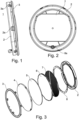
- the cover element 1 is shown from the side.
- the cover element 1 has a housing which consists of a housing front 3 and a housing base 2.
- the two ring-shaped housing parts are connected to one another via hooks 3a which are clipped into recesses 2a.
- several hooks 3a are arranged distributed along the radius of the housing front 3.
- the housing base 2 also has the corresponding recesses 2a over its radius.
- Figure 3 shows the entire structure of the cover element 1 with all individual layers, some of which are manufactured directly connected to one another.
- the housing front 3 can be seen together with a front plate 4.
- the front plate 4 covers a film 5, which is a metallized or partially metallized film.
- the film 5 can also be partially or completely coated with paint.
- the film 5 is supported by a carrier plate 6, on the side of which facing the interior of the vehicle a heating plate 7 is attached.
- the components front plate 4, film 5, carrier plate 6 and heating plate 7 are components of a combined injection molding process, which will be discussed later.
- a circuit board ring 8 can be seen as a further component of the cover element 1. The entire component is closed off with the ring-shaped housing base 2.
- the film 5 and the carrier plate 6 can have a geometrically multi-dimensional structure, i.e. two or three-dimensional. This allows for expanded design options independent of the pure coatings.
- FIG 2 a view of the cover element 1 from the vehicle interior is shown.
- the back of the heating plate 7 is visible.
- the horizontal lines that intersect the circular heating plate as secants define an inner surface that is intended for the unhindered passage of the radar beams.
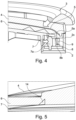
- FIG 4 a section through an edge area of the cover element 1 is shown.
- the structure of the individual components can be seen, starting with the housing front 3, the front plate 4, the film 5, and the carrier plate 6.
- the heating plate 7 has pins 7a, which are distributed along the outer edge of the heating plate 7. These pins 7a engage in recesses in the circuit board ring 8 and are suitably connected to the circuit board ring. Alternatively, the pins 7a can also extend through the circuit board ring 8 to the housing base 2 and be connected there. For example, the connection is made using ultrasonic riveting. LEDs 8b are distributed along the edge of the circuit board ring 8 on the circuit board ring 8. The circuit board ring 8 is held in the housing base 2.
- the LEDs radiate into the carrier plate 6 via an optic 9, which extends above the circuit board ring 8 to the outer wall of the housing base 2 with a leg 2c.
- the light from the LEDs is totally reflected by the foil 5 and the surface of the heating plate 7.
- the light is thus distributed along the carrier plate 6.
- Part of the light that does not hit the foil 5 is emitted as scattered light into the front plate, where it is then is deflected on the surface by total reflection.
- the scattered light is in the area of the ring-shaped housing front, which shields this area and thus makes scattered light from outside invisible.
- the film 5 In the area of the direct beam path of the LEDs, the film 5 has an inclined surface 5a which optimizes the coupling. An inclination of 45° is optimal, with the surface 5a bending away from the plane of the film 5.
- FIG. 5 An alternative way of coupling light out of the carrier plate is shown.
- ribs 14 are designed on the heating plate 7.
- the ribs are formed underneath a structure that represents an emblem, so that a particularly large amount of light is coupled out at these points.
- the coupling-out structures are ribs of different shapes and sizes as well as groupings of ribs.
- FIG 6 shows an alternative embodiment.
- the heating plate 7 is designed such that the pins 7a engage in recesses in the housing base 2.
- the circuit board ring 8 is embedded in the housing base 2 between two legs 2b and 2c.
- the optics 9 are part of the carrier plate 6, which extends to the legs 2c of the housing base 2.
- the film 5 ends with the bent surface 5a in the area in which the optics 9 runs as a cone-like formation of the carrier plate 6.
- circuit board ring 8 which is glued or welded directly to the housing base 2.
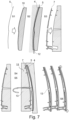
- Figure 7 shows the manufacturing process in successive steps S1 to S5.
- Film 5 is produced using a high-pressure forming process and has a two- or three-dimensional structure.
- a plastic film which is usually decorated by printing on the back, is formed and contoured before it is placed in an injection molding tool.
- a first step S1 the film 5 is inserted into a first tool half of the injection molding tool.
- the film is overmolded transparently and the first component is produced as a transparent overmolded film.
- the transparent area forms the front panel 4.
- the sprue point 12 of the injection molding process is located at the edge of the tool.
- step S3 the heating plate 7 with the heating wire and the contact pins is inserted into the second tool half 11 of the injection molding tool and the tool is rotated in step S4 so that injection can take place from the same side as the first component.
- the heating plate 7 has a central opening that serves as a sprue opening 13.
- the carrier plate 6 is then injected in step S5 with a transparent material between the first component film 5 + carrier plate 6 and the heating plate 7.
- the result is a composite of layers with the exclusion of air.
- the composite is tight and can be easily processed further.
- the sprayed package is hard-coated on the front or dipped in a hard lacquer.
- the housing front 3 designed as a chrome ring, is clipped on.
Landscapes
- Engineering & Computer Science (AREA)
- General Engineering & Computer Science (AREA)
- Radar, Positioning & Navigation (AREA)
- Remote Sensing (AREA)
- Mechanical Engineering (AREA)
- Physics & Mathematics (AREA)
- Computer Networks & Wireless Communication (AREA)
- General Physics & Mathematics (AREA)
- Manufacturing & Machinery (AREA)
- Microelectronics & Electronic Packaging (AREA)
- Electromagnetism (AREA)
- Injection Moulding Of Plastics Or The Like (AREA)
Description
- Die Erfindung betrifft ein Abdeckelement mit einem Gehäuse einer zwischen einer Frontplatte und einer Trägerplatte eingeformten und eingespritzten Folie, die zur Darstellung von dreidimensionalen Strukturen dient und einer Trägerplatte, die rückseitig mit einer Heizplatte verbunden ist.
- Die Erfindung betriff auch ein Verfahren zum Herstellen des Abdeckelements.
- Funktionsbedingt müssen Radarsensoren für die Fahrumfelderfassung an hochgradig designrelevanten Positionen, insbesondere innerhalb der Fahrzeugfront oder des Fahrzeughecks, verbaut werden. Aufgrund der derzeit stark unterschiedlichen Frequenzbereiche von Nah- und Fernbereichsradarsensoren ergeben sich bei deren Integration unterschiedliche Situationen:
Radarsensoren werden im Frequenzbereich zwischen 76 und 81 GHz betrieben. - In diesem Frequenzbereich ist bei einigen Lackfarben (z. B. Silber-Metallic), die eine hohe Konzentration an Metallpartikeln aufweisen, eine Platzierung hinter lackierten Kunststoffflächen mit hohen Reflexionen verbunden. Deshalb wird eine Integration dieser Sensoren hinter in Wagenfarbe lackierten Flächen weitgehend vermieden.
- Einige Hersteller favorisieren offen sichtbare Sensoren. Häufig werden die Sensoren in einer Öffnung im unteren Teil des Stoßfängers platziert.
- Der andere Ansatz besteht in einem weitgehend unauffälligen Einbau, der eine Abdeckung des Radarsensors notwendig macht. Ein verbreiteter Einbauort dieser abgedeckten Sensoren stellt der Bereich des Kühlergrills dar. Aber gerade der Kühlergrill ist ein wesentliches Gestaltungselement mit hohem Wiedererkennungswert für eine Marke. Eine solche Radarabdeckung, ein sogenanntes Radom, soll sich idealerweise den Erfordernissen des Fahrzeugdesigns anpassen sowie hinsichtlich der Wellenausbreitung möglichst neutral verhalten. Hier kann es zu konkurrierenden Forderungen kommen, die keinen in jeder Hinsicht optimalen Einbau zulassen.
- Werden Radargeräte bei Umgebungsbedingungen mit Temperaturen um und unter dem Gefrierpunkt eingesetzt, kann es zu einer Eisbildung auf dem Radom kommen. Aufgrund der zusätzlichen Eisschicht auf dem Radom ist ein ordnungsgemäßer Betrieb des Radargeräts nicht oder nur eingeschränkt möglich.
- Radome sind Abdeckungen von Sendern und/oder Empfängern elektromagnetischer Strahlung, beispielsweise von Radargeräten und/oder deren Antennen. Durch ein Radom soll eine Beeinträchtigung beispielsweise des Radargeräts durch Umwelteinflüsse vermieden werden. Radome bestehen aus einem Material, zumeist Kunststoff, durch das hindurch die jeweilige Strahlung, beispielsweise Radarstrahlung abgestrahlt und reflektierte Radarstrahlung empfangen werden kann.
- Aus der
DE 10 2013 016 667 A1 ist ein Radom in Form eines mehrlagigen Abdeckelements bekannt, wobei zumindest eine erste Lage aus einem transparenten Kunststoff gebildet ist. Zwischen der ersten Lage und einer zweiten Lage ist eine Grenzschicht ausgebildet, die aus einer Streustruktur und einer metallischen Struktur gebildet ist. Die Streustruktur ist abschnittsweise von der metallischen Struktur unterbrochen. Das Radom ist mittels in die Streuschicht eingekoppelten Lichts beleuchtbar. - Aus der
DE 10 2015 004 204 A1 ist ein Radom bekannt, das eine Frontseite und eine Rückseite aufweist und mindestens eine Einkoppelstruktur zum Einkoppeln von Licht in das Radom umfasst. Zudem weist das Radom mindestens ein Heizelement auf. Das Radom stellt ein Fahrzeugherstelleremblem dar. Das Zeichen wird durch eine metallische Struktur gebildet. Hierbei wird ein Fahrzeugdesign bei gleichbleibender Leistungsfähigkeit des Radargeräts aufgewertet. Dabei ist zu beachten, dass diese metallische Struktur, zumindest wenn sie im Bereich der Radarstrahlung ist, so dünn sein muss, dass sie noch radardurchlässig ist. So wird beispielsweise Indium in nur wenigen µm auf das Radom aufgedampft. -
DE 10 2018 220997 A1 zeigt ein Abdeckelement mit einem Gehäuse einer zwischen einer Frontplatte und einer Trägerplatte eingeformten und umspritzten Folie, die zur Darstellung von mehrdimensionalen Strukturen dient, da tiefgezogen), wobei das Gehäuse aus einer ringförmigen Gehäusebasis und einer vollflächigen. kreisförmigen Gehäusefront besteht, und in der Gehäusebasis ein Leiterplattenring mit LEDs eingebaut ist. -
DE 10 2017 214 129 A1 betrifft ein Emblem für ein Fahrzeug, welches beleuchtbar und zusätzlich mit einer Radarfunktionalität ausgestattet ist. Ferner betrifft die Erfindung ein Kraftfahrzeug mit einem solchen Emblem. Das Emblem umfasst einen Flächenlichtleiter, der in einem Gehäuse angeordnet und mit Licht einer LED gespeist werden kann. Das Licht kann an einer Auskoppelseite des Lichtleiters in Richtung einer Lichtscheibe ausgekoppelt werden, wobei die Lichtscheibe das Gehäuse nach außen hin schließt. Ein Radarsensor ist derart angeordnet, dass seine Radarstrahlung durch die Bauteile des radarfähigen Leuchtemblems hindurch und aus der Lichtscheibe austreten kann. Zwischen der Lichtscheibe und dem Flächenlichtleiter ist ein Element mit lichtundurchlässigen und lichtdurchlässigen Bereichen angeordnet, welches das nach außen hin sichtbare Emblem bildet. Durch Hinterleuchtung dieses Elements im Bereich der lichtdurchlässigen Bereiche ergibt sich nach außen hin ein Leuchtemblem. -
DE 10 2016 007 119 A1 betrifft ein Radom, umfassend eine Frontseite, eine Rückseite und zumindest eine in der Rückseite ausgebildete Einkoppelstruktur zum Einkoppeln von Licht. An der Rückseite ist mindestens ein Lichtleiter zur Übertragung des eingekoppelten Lichts angeordnet, wobei zumindest ein Lichtaustrittsbereich des zumindest einen Lichtleiters transluzent ausgebildet ist und wobei der Lichtaustrittsbereich zumindest in Richtung des Lichtaustritts vollständig von einer optisch nicht aktiven Komponente bedeckt ist. -
DE 10 2015 004 204 A1 betrifft ein Radom, aufweisend eine Frontseite, eine Rückseite und mindestens eine Einkoppelstruktur zum Einkoppeln von Licht in das Radom. Das Radom weist mindestens ein Heizelement auf. - Es ist Aufgabe der Erfindung, ein verbessertes Abdeckelement vorzuschlagen, das die Vorteile von Beleuchtung und Heizung umfasst, aber die Radardurchstrahlung nicht behindert.
- Die Aufgabe wird gelöst mit einem Abdeckelement mit einem Gehäuse einer zwischen einer Frontplatte und einer Trägerplatte eingeformten und eingespritzten Folie, die zur Darstellung von dreidimensionalen Strukturen dient und der Trägerplatte, die rückseitig mit einer Heizplatte verbunden ist, wobei das Gehäuse aus einer ringförmigen Gehäusebasis und einer ringförmigen Gehäusefront besteht, und in der Gehäusebasis ein Leiterplattenring mit LEDs und Stecker eingebaut ist.
- Der Vorteil dieser Ausgestaltung liegt darin, dass alle elektrischen Komponenten und deren Zuleitungen sich innerhalb des Gehäuses, als innerhalb eines ringförmigen Bereichs befinden. Dadurch deckt das Gehäuse diese Komponenten nach außen hin ab. Der mittlere Bereich des Abdeckelements bleibt ungestört von Komponenten, die einen Durchtritt von Radarstrahlen negativ beeinflussen.
- Das Licht der LEDs koppelt über eine Optik in die Trägerplatte ein, wobei diese Einkopplung eben innerhalb der Ringstruktur des Gehäuses stattfindet und so von außen nicht wahrgenommen wird und auch die Radarstrahlen nicht stört.
- Es ist dabei von Vorteil, dass die Optik ein Teil der Trägerplatte ist und so einfach hergestellt werden kann.
- Die Optik ist ein Konus, der sich von der Trägerplatte aus auf die LEDs hin erstreckt.
- Es ist von Vorteil, dass die Folie sich im Bereich der Optik in einem Winkel gegen die Ebene der Folie auf die Optik hin erstreckt. Dadurch wird das Licht der LEDs auf optimale Weise in die Trägerplatte eingekoppelt und kann sich in der Lichtleiterstruktur der Trägerplatte verteilen.
- Dabei wird das Licht zwischen der Folie und der Oberseite der Heizplatte in der Trägerplatte als Lichtleiter geführt.
- Um das Licht auszukoppeln wird durch Wahl des Materials der Oberseite der Heizplatte oder durch Einbauten von geometrischen Strukturen die Totalreflexion unterbrochen und das Licht durch die Folie und die Frontplatte partiell ausgekoppelt.
- Die Befestigung des Leiterplattenringes erfolgt über an der Heizplatte umgeformte Stifte. Diese Befestigung liegt außerhalb des mittigen Bereichs des Abdeckelement, sodass auch hier die Durchdringung durch Radarsignale nicht behindert wird.
- Die Aufgabe wird des Weiteren gelöst mit einem Verfahren zur Herstellung eines Abdeckelements durch folgende Schritte gekennzeichnet:
- in einem ersten Schritt wird die im HPF Verfahren vorgeformte Folie in die erste Kavität des 2k Werkzeugs eingelegt und transparent überspritzt,
- im zweiten Schritt wird die Heizplatte in die zweite Werkzeughälfte des Spritzgusswerkzeugs eingelegt,
- das Werkzeug wird gedreht. Danach wird das transparente Material der Trägerplatte zwischen die erste Komponente und der Heizplatte eingespritzt,
- im dritten Schritt wird das gespritzte Paket hartlackiert oder in einen Hartlack getaucht.
-
-
Figur 1 zeigt eine Seitenansicht eines Abdeckelements, -
Fig. 2 zeigt eine Aufsicht auf die im Fahrzeuginneren liegenden Seite des Abdeckelements, -
Fig. 3 ist einen Explosionsdarstellung des Abdeckelements, -
Fig. 4 zeigt eine Schnittdarstellung durch den Rand des Abdeckelements, -
Fig. 5 zeigt einen Schnitt, -
Fig. 6 zeigt einen Schnitt durch den Randbereich, -
Fig. 7 zeit die Herstellungsschritte des Abdeckelements. - In der
Figur 1 ist das Abdeckelement 1 von der Seite dargestellt. Das Abdeckelement 1 weist ein Gehäuse auf, das aus einer Gehäusefront 3 und einer Gehäusebasis 2 besteht. Die beiden ringförmig ausgestalten Gehäuseteile sind über Haken 3a, die in Eingriffe 2a verklipst sind, miteinander verbunden. Wie auch aus der Figur 3 zu erkennen ist, sind dabei mehrere Haken 3a entlang des Radius der Gehäusefront 3 verteilt angeordnet. Die Gehäusebasis 2 weist ebenfalls über ihren Radius hinweg die entsprechenden Eingriffe 2a auf. -
Figur 3 zeigt den gesamten Aufbau des Abdeckelements 1 mit allen einzelnen Schichten, die zum Teil direkt miteinander verbunden hergestellt werden. - Vom Fahrzeugäußeren gesehen ist die Gehäusefront 3 zusammen mit einer Frontplatte 4 erkennbar. Die Frontplatte 4 deckt eine Folie 5 ab, bei der es sich um eine metallisierte oder eine teilmetallisierte Folie handelt. Die Folie 5 kann auch teilweise oder komplett mit einem Farbauftrag versehen sein. Die Folie 5 wird von einer Trägerplatte 6 getragen, auf deren in das Fahrzeuginnere gerichteten Seite eine Heizplatte 7 angebracht ist. Die Bauteile Frontplatte 4, Folie 5, Trägerplatte 6 und Heizplatte 7 sind Bestandteile eines kombinierten Spritzguss Verfahrens, auf das später noch eingegangen wird.
- Als weiteres Bauteil des Abdeckelements 1 ist ein Leiterplattenring 8 zu erkennen. Das gesamte Bauteil wird mit der ringförmigen Gehäusebasis 2 abgeschlossen.
- Zur Darstellung eines Emblems im Abdeckelement kann die Folie 5 sowie die Trägerplatte 6 eine geometrisch mehrdimensionale Struktur, also zwei oder dreidimensional, aufweisen. Damit sind erweiterte Gestaltungsmöglichkeiten unabhängig von den reinen Beschichtungen möglich.
- In
Figur 2 ist eine Sicht aus dem Fahrzeuginneren auf das Abdeckelement 1 dargestellt. Dabei ist die Rückseite der Heizplatte 7 sichtbar. Die horizontalen Linien, die als Sekanten die kreisförmige Heizplatte schneiden, definieren eine Innenfläche, die für den ungestörten Durchtritt der Radarstrahlen vorgesehen ist. - An einer Stelle der Gehäusebasis 2 ist ein Ausschnitt vorhanden, durch den ein Stecker 8a von dem Leiterplattenring 8 nach außen geführt ist.
- In
Figur 4 sowie in derFigur 6 ist ein Schnitt durch einen Randbereich des Abdeckelements 1 dargestellt. Zu erkennen ist der Aufbau der einzelnen Komponenten beginnend von der Gehäusefront 3, der Frontplatte 4, der Folie 5, und der Trägerplatte 6. Die Heizplatte 7 weist Stifte 7a auf, die entlang des Außenrandes der Heizplatte 7 verteilt angeordnet sind. Diese Stifte 7a greifen in Ausnehmungen des Leiterplattenrings 8 ein und werden geeignet mit dem Leiterplattenring verbunden. Alternativ dazu können sich die Stifte 7a auch durch den Leiterplattenring 8 hindurch bis zur Gehäusebasis 2 erstrecken und dort verbunden werden. Beispielsweise erfolgt das Verbinden mit Ultraschallvernietung. Auf dem Leiterplattenring 8 sind LEDs 8b entlang des Randes des Leiterplattenrings 8 verteilt. Der Leiterplattenring 8 wird in der Gehäusebasis 2 gehalten. Die LEDs strahlen über jeweils eine Optik 9 in die Trägerplatte 6 ein, die sich oberhalb des Leiterplattenrings 8 bis zur äußeren Wandung der Gehäusebasis 2 einen Schenkel 2c erstreckt. Das Licht der LEDs wird an der Folie 5 und an der Oberfläche der Heizplatte 7 totalreflektiert. So verteilt sich das Licht entlang der Trägerplatte 6. Ein Teil des Lichts, das die Folie 5 nicht trifft, wird als Streulicht in die Frontplatte abgegeben, wo es dann an der Oberfläche durch Totalreflexion abgelenkt wird. Das Streulicht befindet sich aber im Bereich der ringförmigen Gehäusefront, diesen Bereich abschirmt und so Streulicht von außen unsichtbar werden lässt. - Die Folie 5 weist im Bereich des direkten Strahlengangs der LEDs eine geneigte Fläche 5a auf, die die Einkopplung optimiert. Optimal ist dabei ein Neigungsgrad von 45°, die die Fläche 5a abknickend von der Ebene der Folie 5 aufweist.
- Da das eingekoppelte Licht über Totalreflexion entlang der Trägerplatte 6 wandert, muss man Vorkehrungen treffen, um Licht auch nach außen austreten zu lassen.
- Dazu dient entweder die Beschichtung oder Farbe oder Metallisierung der Heizplatte 7, die den Effekt der Totalreflexion geeignet über die gesamte Fläche oder in den Abschnitten, die deinem Emblem entsprechen, vermindert.
- In der
Figur 5 wird eine alternative Möglichkeit aufgezeigt, um Licht aus der Trägerplatte aus zu koppeln. Dazu werden auf der Heizplatte 7 Rippen 14 ausgestaltet. Die Rippen werden unterhalb einer Struktur, die ein Emblem darstellt, ausgebildet, sodass an diesen Stellen besonders viel Licht ausgekoppelt wird. Die Auskoppelstrukturen sind dabei Rippen unterschiedlicher Form und Ausdehnung sowie Gruppierungen von Rippen. -
Figur 6 zeigt eine alternative Ausführungsform. Die Heizplatte 7 ist dabei so ausgestaltet, dass die Stifte 7a in Ausnehmungen der Gehäusebasis 2 eingreifen. In der Gehäusebasis 2 ist der Leiterplattenring 8 zwischen zwei Schenkeln 2b und 2c eingebettet. - Die Optik 9 ist ein Teil der Trägerplatte 6, die sich bis an den Schenkeln 2c der Gehäusebasis 2 hin erstreckt. Die Folie 5 endet mit der abknickenden Fläche 5a in dem Bereich, in dem die Optik 9 als konusartige Ausbildung der Trägerplatte 6 verläuft.
- Eine weitere Alternative stellt ein Leiterplattenring 8 dar, der direkt mit der Gehäusebasis 2 verklebt oder verschweißt ist.
-
Figur 7 zeigt den Herstellungsprozesse in aufeinanderfolgenden Schritten S1 bis S5. Folie 5 ist in einem Hochdruckverformverfahren hergestellt und weist einen zwei- oder dreidimensionale Struktur auf. Bei diesem Verfahren wird eine Kunststofffolie, die in der Regel durch Bedrucken der Rückseite dekoriert wird, geformt und in Kontur gebracht, bevor sie in ein Spritzgusswerkzeug gegeben wird. - In einem ersten Schritt S1 wird die Folie 5 in eine erste Werkzeughälfte des Spritzgusswerkzeugs eingelegt.
- Im zweiten Schritt S2 wird die Folie transparent überspritzt und so die erste Komponente als transparent überspritzte Folie hergestellt. Der transparente Bereich bildet die Frontplatte 4. Die Angussstelle 12 des Spritzgussverfahrens liegt am Rand des Werkzeugs.
- Im Schritt S3 wird die Heizplatte 7 mit dem Heizdraht und den Kontaktpins in die zweite Werkzeughälfte 11 des Spritzgusswerkzeugs eingelegt und das Werkzeug im Schritt S4 gedreht, so dass von derselben Seite wie bei der ersten Komponente das Einspritzen erfolgen kann. Die Heizplatte 7 weist eine mittige Öffnung auf, die als Angussöffnung 13 dient.
- Die Trägerplatte 6 wird dann im Schritt S5 mit einem transparenten Material zwischen der ersten Komponente Folie 5 + Trägerplatte 6 und der Heizplatte 7 gespritzt.
- Als Resultat erhält man einen Verbund von Schichten unter Luftausschluss. Der Verbund ist dicht und kann einfach weiterverarbeitet werden.
- Im letzten Schritt S6 wird das gespritzte Paket frontseitig hartlackiert oder in einen Hartlack getaucht. In einem letzten Schritt wird die Gehäusefront 3, als Chromring ausgestaltet, aufgeklipst.
-
- 1 Abdeckelement
- 2 Gehäusebasis
- 2a Eingriffe
- 2b, 2c Schenkel
- 3 Gehäusefront
- 3a Haken
- 4 Frontplatte
- 5 Folie
- 5a Fläche
- 6 Trägerplatte
- 7 Heizplatte
- 7a Stift
- 8 Leiterplattenring
- 8a Stecker
- 8b LED
- 9 Optik
- 10 Erste Werkzeughälfte
- 11 zweite Werkzeughälfte
- 12 Randnaher Anguss
- 13 mittiger Anguss
- 14 Rippe
Claims (9)
- Abdeckelement (1) mit einem Gehäuse einer zwischen einer Frontplatte (4) und einer Trägerplatte (6) eingeformten und umspritzten Folie (5), die zur Darstellung von mehrdimensionalen Strukturen dient, wobei die Trägerplatte (6) rückseitig mit einer Heizplatte (7) verbunden ist, dadurch gekennzeichnet, dass das Gehäuse aus einer ringförmigen Gehäusebasis (2) und einer ringförmigen Gehäusefront (3) besteht, und in der Gehäusebasis (2) ein Leiterplattenring (8) mit LEDs (8b) und Stecker (8a) eingebaut ist.
- Abdeckelement (1) nach Anspruch 1, dadurch gekennzeichnet, dass das Licht der LEDs über eine Optik (9) in die Trägerplatte einkoppelt.
- Abdeckelement (1) nach Anspruch 2, dadurch gekennzeichnet, dass die Optik (9) ein Teil der Trägerplatte (6) ist.
- Abdeckelement (1) nach Anspruch 2 oder 3, dadurch gekennzeichnet, dass die Optik (9) ein Konus ist, der sich von der Trägerplatte (6) aus auf die LEDs (8b) hin erstreckt.
- Abdeckelement (1) nach einem der vorhergehenden Ansprüche 2 bis 4, dadurch gekennzeichnet, dass die Folie (5) sich im Bereich der Optik (9) in einem Winkel gegen die Ebene der Folie (5) auf die Optik (9) hin erstreckt.
- Abdeckelement (1) nach einem der vorhergehenden Ansprüche, dadurch gekennzeichnet, dass das Licht der LEDs (8b) zwischen der Folie (5) und der Oberseite der Heizplatte (7) geführt ist.
- Abdeckelement (1) nach einem der vorhergehenden Ansprüche, dadurch gekennzeichnet, dass das Licht der LEDs (8b) durch Wahl des Materials der Oberseite der Heizplatte (7) oder durch Einbauten von geometrischen Strukturen auf der Heizplatte (7) durch die Folie (5) und die Frontplatte (4) ausgekoppelt wird.
- Abdeckelement (1) nach einem der vorhergehenden Ansprüche, dadurch gekennzeichnet, dass die Heizplatte (7) über Stifte (7a) in Aussparungen des Leiterplattenrings (8) oder in Aufnahmen der Gehäusebasis (2) befestigt ist.
- Verfahren zur Herstellung eines Abdeckelements (1) nach den Ansprüchen 1 bis 8 durch folgende Schritte gekennzeichnet:- in einem ersten Schritt (S1) wird die Folie (5) in eine erste Werkzeughälfte (10) des Spritzgusswerkzeugs eingelegt,- im zweiten Schritt (S2) wird die Folie (5) transparent überspritzt und so die Frontplatte (4) hergestellt,- im dritten Schritt (S3) wird die Heizplatte (7) in die zweite Werkzeughälfte (11) des Spritzgusswerkzeugs eingelegt,- das Werkzeug wird im vierten Schritt (S4) gedreht und die Heizplatte (7) wird dann mit einem transparenten Material der Trägerplatte (6) überspritzt (S5),- im Schritt S6 wird das gespritzte Paket hartlackiert oder in einen Hartlack getaucht.
Applications Claiming Priority (1)
| Application Number | Priority Date | Filing Date | Title |
|---|---|---|---|
| DE102021204629.0A DE102021204629B4 (de) | 2021-05-06 | 2021-05-06 | Abdeckelement für Sensoren, sowie Verfahren zur Herstellung des Abdeckelements |
Publications (2)
| Publication Number | Publication Date |
|---|---|
| EP4088903A1 EP4088903A1 (de) | 2022-11-16 |
| EP4088903B1 true EP4088903B1 (de) | 2024-11-20 |
Family
ID=81392652
Family Applications (1)
| Application Number | Title | Priority Date | Filing Date |
|---|---|---|---|
| EP22170504.9A Active EP4088903B1 (de) | 2021-05-06 | 2022-04-28 | Abdeckelement für sensoren, sowie verfahren zur herstellung des abdeckelements |
Country Status (4)
| Country | Link |
|---|---|
| US (1) | US11608965B2 (de) |
| EP (1) | EP4088903B1 (de) |
| CN (1) | CN115313040A (de) |
| DE (1) | DE102021204629B4 (de) |
Families Citing this family (9)
| Publication number | Priority date | Publication date | Assignee | Title |
|---|---|---|---|---|
| FR3105352B1 (fr) * | 2019-12-19 | 2022-03-04 | Valeo Vision | Elément lumineux d’un véhicule |
| DE102023203211A1 (de) * | 2023-04-06 | 2024-10-10 | Magna Exteriors Gmbh | Beleuchtete Radomabdeckung |
| DE102023206762A1 (de) * | 2023-07-17 | 2025-01-23 | Magna Exteriors Gmbh | Optische Baugruppe und Herstellen eines Fahrzeugbauteils mit optischer Baugruppe |
| EP4506717A1 (de) * | 2023-08-11 | 2025-02-12 | Ulbrichts GmbH | Radom |
| DE102023122471A1 (de) * | 2023-08-22 | 2025-02-27 | Magna Exteriors Gmbh | Beleuchtungseinrichtung mit radartransparentem Abschnitt und Heizelement |
| EP4557518A1 (de) * | 2023-11-17 | 2025-05-21 | HELLA Saturnus Slovenija d.o.o. | Radom für ein radargerät oder für ein fahrzeug, radargerät mit einem solchen radom, verkleidungsbauteil und fahrzeug mit einem solchen radargerät |
| CN120120511A (zh) * | 2023-12-07 | 2025-06-10 | 法雷奥照明公司 | 照明装置和机动车辆 |
| FR3158139A1 (fr) * | 2024-01-04 | 2025-07-11 | Stellantis Auto Sas | Calandre lumineuse à éclairage homogène du logo, pour un véhicule |
| FR3167105A1 (fr) * | 2024-10-07 | 2026-04-10 | Flex-N-Gate France | Element de garnissage comprenant un logo rétroéclairé et un radar |
Family Cites Families (14)
| Publication number | Priority date | Publication date | Assignee | Title |
|---|---|---|---|---|
| DE102006046436B3 (de) | 2006-09-25 | 2008-04-30 | Decoma (Germany) Gmbh | Abdeckelement |
| WO2013044636A1 (zh) * | 2011-09-30 | 2013-04-04 | Yang Dongzuo | 一种led灯 |
| US10011215B2 (en) * | 2012-06-19 | 2018-07-03 | Ford Global Technologies, Llc | Illuminated chromatic emblem assembly with micro LEDs |
| DE102013016667A1 (de) | 2013-10-08 | 2014-07-03 | Daimler Ag | Mehrlagiges Abdeckelement und Fahrzeugbauteil mit einem Abdeckelement |
| DE102015004204A1 (de) | 2015-03-31 | 2015-08-27 | Daimler Ag | Radom, Radargerät und Fahrzeug mit dem Radom sowie Verfahren zum Betrieb des Radoms |
| DE102016007119A1 (de) * | 2015-10-20 | 2017-02-16 | Daimler Ag | Radom |
| DE102017201660B4 (de) * | 2017-02-02 | 2025-07-17 | Robert Bosch Gmbh | Verfahren zur Herstellung einer leuchtenden 3D-Radarmodulabdeckung und Spritzgieß-Anordnung |
| DE102017214129A1 (de) * | 2017-08-14 | 2019-02-14 | Volkswagen Aktiengesellschaft | Radarfähiges Leuchtemblem für ein Fahrzeug |
| EP3476658B1 (de) * | 2017-10-26 | 2020-05-13 | International Automotive Components Group GmbH | Verkleidungsteil |
| US11420577B2 (en) * | 2017-12-28 | 2022-08-23 | Prima Sole Components S.P.A. | Radar transparent decorative plate for the front grille of a motor vehicle |
| CN111071165B (zh) * | 2018-10-22 | 2023-04-21 | 丰田合成株式会社 | 毫米波雷达单元及其安装方法 |
| DE102018220997A1 (de) * | 2018-12-05 | 2020-06-10 | Volkswagen Aktiengesellschaft | Emblemanordnung für ein Kraftfahrzeug |
| CA3093914C (en) * | 2019-09-26 | 2024-05-14 | Google Llc | Access point device |
| FR3104834B1 (fr) * | 2019-12-16 | 2023-12-29 | Cie Plastic Omnium Se | Radôme rétroéclairé, avec dispositif de dégivrage |
-
2021
- 2021-05-06 DE DE102021204629.0A patent/DE102021204629B4/de active Active
-
2022
- 2022-04-28 EP EP22170504.9A patent/EP4088903B1/de active Active
- 2022-05-05 US US17/737,210 patent/US11608965B2/en active Active
- 2022-05-06 CN CN202210485152.XA patent/CN115313040A/zh active Pending
Also Published As
| Publication number | Publication date |
|---|---|
| DE102021204629B4 (de) | 2023-07-13 |
| US11608965B2 (en) | 2023-03-21 |
| DE102021204629A1 (de) | 2022-11-10 |
| US20220357021A1 (en) | 2022-11-10 |
| CN115313040A (zh) | 2022-11-08 |
| EP4088903A1 (de) | 2022-11-16 |
Similar Documents
| Publication | Publication Date | Title |
|---|---|---|
| DE102021204629B4 (de) | Abdeckelement für Sensoren, sowie Verfahren zur Herstellung des Abdeckelements | |
| DE102006046436B3 (de) | Abdeckelement | |
| EP3140097B1 (de) | Mehrschichtkörper und verfahren zu dessen herstellung | |
| DE102017201660B4 (de) | Verfahren zur Herstellung einer leuchtenden 3D-Radarmodulabdeckung und Spritzgieß-Anordnung | |
| DE102018009270B4 (de) | Radomelement für ein Abstandswarnradar eines Fahrzeuges | |
| DE102014214329A1 (de) | Radarvorrichtung | |
| DE102017214129A1 (de) | Radarfähiges Leuchtemblem für ein Fahrzeug | |
| EP3651266A1 (de) | Abdeckelement | |
| DE102013223244A1 (de) | Vorrichtung zur Anzeige zumindest eines Symbols und Verfahren zum Herstellen einer Vorrichtung zur Anzeige zumindest eines Symbols | |
| EP3150442A1 (de) | Zierteil für ein fahrzeug | |
| EP3421278B1 (de) | Beleuchtete zierleiste | |
| DE102021003615A1 (de) | Beleuchtetes Bauteil für ein Fahrzeug | |
| EP3326863A1 (de) | Bauteil | |
| EP3788298B1 (de) | Kraftfahrzeugbeleuchtungsmodul | |
| DE102014105271A1 (de) | Radarsensor und Verfahren zur Herstellung eines Radarsensors | |
| WO2018104045A1 (de) | Bauteil mit einer deckschicht sowie verfahren zur herstellung eines solchen bauteils | |
| EP3472936A1 (de) | Einrichtung mit mindestens einem beleuchtbaren bereich | |
| DE102016216276B4 (de) | Innenraumverkleidung für ein Kraftfahrzeug | |
| DE102021101288B4 (de) | Bauteil mit integrierter sensor-linseneinheit | |
| DE102023000719B3 (de) | Bauteil für ein Fahrzeug sowie Kühlergrill mit einem solchen Bauteil | |
| EP1431142B1 (de) | Regensensor, insbesondere für ein Kraftfahrzeug und Verfahren zu dessen Herstellung | |
| DE102020201645A1 (de) | Beleuchtungsvorrichtung für ein Kraftfahrzeug | |
| WO2023222817A1 (de) | Radom, fahrzeugradarmodul mit einem radom und verfahren zum betrieb eines fahrzeugradarmoduls | |
| EP4443649A1 (de) | Beleuchtete radomabdeckung | |
| EP4074486B1 (de) | Verfahren zum herstellen von bauteilen einer aussenhaut eines fahrzeugs |
Legal Events
| Date | Code | Title | Description |
|---|---|---|---|
| PUAI | Public reference made under article 153(3) epc to a published international application that has entered the european phase |
Free format text: ORIGINAL CODE: 0009012 |
|
| STAA | Information on the status of an ep patent application or granted ep patent |
Free format text: STATUS: THE APPLICATION HAS BEEN PUBLISHED |
|
| STAA | Information on the status of an ep patent application or granted ep patent |
Free format text: STATUS: REQUEST FOR EXAMINATION WAS MADE |
|
| AK | Designated contracting states |
Kind code of ref document: A1 Designated state(s): AL AT BE BG CH CY CZ DE DK EE ES FI FR GB GR HR HU IE IS IT LI LT LU LV MC MK MT NL NO PL PT RO RS SE SI SK SM TR |
|
| 17P | Request for examination filed |
Effective date: 20221025 |
|
| RBV | Designated contracting states (corrected) |
Designated state(s): AL AT BE BG CH CY CZ DE DK EE ES FI FR GB GR HR HU IE IS IT LI LT LU LV MC MK MT NL NO PL PT RO RS SE SI SK SM TR |
|
| REG | Reference to a national code |
Ref country code: DE Ipc: B29C0045160000 Ref legal event code: R079 Ref document number: 502022002151 Country of ref document: DE Free format text: PREVIOUS MAIN CLASS: B29C0045140000 |
|
| GRAP | Despatch of communication of intention to grant a patent |
Free format text: ORIGINAL CODE: EPIDOSNIGR1 |
|
| STAA | Information on the status of an ep patent application or granted ep patent |
Free format text: STATUS: GRANT OF PATENT IS INTENDED |
|
| RIC1 | Information provided on ipc code assigned before grant |
Ipc: B29L 31/34 20060101ALN20240712BHEP Ipc: B05D 1/18 20060101ALN20240712BHEP Ipc: B05D 1/02 20060101ALN20240712BHEP Ipc: B29C 45/00 20060101ALN20240712BHEP Ipc: B29C 45/14 20060101ALN20240712BHEP Ipc: H01Q 1/42 20060101ALI20240712BHEP Ipc: G01S 13/931 20200101ALI20240712BHEP Ipc: G01S 7/02 20060101ALI20240712BHEP Ipc: B29C 45/16 20060101AFI20240712BHEP |
|
| INTG | Intention to grant announced |
Effective date: 20240726 |
|
| GRAS | Grant fee paid |
Free format text: ORIGINAL CODE: EPIDOSNIGR3 |
|
| GRAA | (expected) grant |
Free format text: ORIGINAL CODE: 0009210 |
|
| STAA | Information on the status of an ep patent application or granted ep patent |
Free format text: STATUS: THE PATENT HAS BEEN GRANTED |
|
| AK | Designated contracting states |
Kind code of ref document: B1 Designated state(s): AL AT BE BG CH CY CZ DE DK EE ES FI FR GB GR HR HU IE IS IT LI LT LU LV MC MK MT NL NO PL PT RO RS SE SI SK SM TR |
|
| REG | Reference to a national code |
Ref country code: GB Ref legal event code: FG4D Free format text: NOT ENGLISH |
|
| REG | Reference to a national code |
Ref country code: CH Ref legal event code: EP |
|
| REG | Reference to a national code |
Ref country code: DE Ref legal event code: R096 Ref document number: 502022002151 Country of ref document: DE |
|
| REG | Reference to a national code |
Ref country code: IE Ref legal event code: FG4D Free format text: LANGUAGE OF EP DOCUMENT: GERMAN |
|
| REG | Reference to a national code |
Ref country code: LT Ref legal event code: MG9D |
|
| REG | Reference to a national code |
Ref country code: NL Ref legal event code: MP Effective date: 20241120 |
|
| PG25 | Lapsed in a contracting state [announced via postgrant information from national office to epo] |
Ref country code: IS Free format text: LAPSE BECAUSE OF FAILURE TO SUBMIT A TRANSLATION OF THE DESCRIPTION OR TO PAY THE FEE WITHIN THE PRESCRIBED TIME-LIMIT Effective date: 20250320 Ref country code: PT Free format text: LAPSE BECAUSE OF FAILURE TO SUBMIT A TRANSLATION OF THE DESCRIPTION OR TO PAY THE FEE WITHIN THE PRESCRIBED TIME-LIMIT Effective date: 20250320 Ref country code: HR Free format text: LAPSE BECAUSE OF FAILURE TO SUBMIT A TRANSLATION OF THE DESCRIPTION OR TO PAY THE FEE WITHIN THE PRESCRIBED TIME-LIMIT Effective date: 20241120 |
|
| PG25 | Lapsed in a contracting state [announced via postgrant information from national office to epo] |
Ref country code: FI Free format text: LAPSE BECAUSE OF FAILURE TO SUBMIT A TRANSLATION OF THE DESCRIPTION OR TO PAY THE FEE WITHIN THE PRESCRIBED TIME-LIMIT Effective date: 20241120 Ref country code: NL Free format text: LAPSE BECAUSE OF FAILURE TO SUBMIT A TRANSLATION OF THE DESCRIPTION OR TO PAY THE FEE WITHIN THE PRESCRIBED TIME-LIMIT Effective date: 20241120 |
|
| PG25 | Lapsed in a contracting state [announced via postgrant information from national office to epo] |
Ref country code: BG Free format text: LAPSE BECAUSE OF FAILURE TO SUBMIT A TRANSLATION OF THE DESCRIPTION OR TO PAY THE FEE WITHIN THE PRESCRIBED TIME-LIMIT Effective date: 20241120 |
|
| PG25 | Lapsed in a contracting state [announced via postgrant information from national office to epo] |
Ref country code: ES Free format text: LAPSE BECAUSE OF FAILURE TO SUBMIT A TRANSLATION OF THE DESCRIPTION OR TO PAY THE FEE WITHIN THE PRESCRIBED TIME-LIMIT Effective date: 20241120 |
|
| PG25 | Lapsed in a contracting state [announced via postgrant information from national office to epo] |
Ref country code: NO Free format text: LAPSE BECAUSE OF FAILURE TO SUBMIT A TRANSLATION OF THE DESCRIPTION OR TO PAY THE FEE WITHIN THE PRESCRIBED TIME-LIMIT Effective date: 20250220 |
|
| PG25 | Lapsed in a contracting state [announced via postgrant information from national office to epo] |
Ref country code: LV Free format text: LAPSE BECAUSE OF FAILURE TO SUBMIT A TRANSLATION OF THE DESCRIPTION OR TO PAY THE FEE WITHIN THE PRESCRIBED TIME-LIMIT Effective date: 20241120 Ref country code: GR Free format text: LAPSE BECAUSE OF FAILURE TO SUBMIT A TRANSLATION OF THE DESCRIPTION OR TO PAY THE FEE WITHIN THE PRESCRIBED TIME-LIMIT Effective date: 20250221 |
|
| PG25 | Lapsed in a contracting state [announced via postgrant information from national office to epo] |
Ref country code: PL Free format text: LAPSE BECAUSE OF FAILURE TO SUBMIT A TRANSLATION OF THE DESCRIPTION OR TO PAY THE FEE WITHIN THE PRESCRIBED TIME-LIMIT Effective date: 20241120 |
|
| PG25 | Lapsed in a contracting state [announced via postgrant information from national office to epo] |
Ref country code: RS Free format text: LAPSE BECAUSE OF FAILURE TO SUBMIT A TRANSLATION OF THE DESCRIPTION OR TO PAY THE FEE WITHIN THE PRESCRIBED TIME-LIMIT Effective date: 20250220 |
|
| REG | Reference to a national code |
Ref country code: DE Ref legal event code: R082 Ref document number: 502022002151 Country of ref document: DE Representative=s name: EULER, MATTHIAS, DR., DE |
|
| PG25 | Lapsed in a contracting state [announced via postgrant information from national office to epo] |
Ref country code: SM Free format text: LAPSE BECAUSE OF FAILURE TO SUBMIT A TRANSLATION OF THE DESCRIPTION OR TO PAY THE FEE WITHIN THE PRESCRIBED TIME-LIMIT Effective date: 20241120 |
|
| PGFP | Annual fee paid to national office [announced via postgrant information from national office to epo] |
Ref country code: DE Payment date: 20250422 Year of fee payment: 4 |
|
| PG25 | Lapsed in a contracting state [announced via postgrant information from national office to epo] |
Ref country code: DK Free format text: LAPSE BECAUSE OF FAILURE TO SUBMIT A TRANSLATION OF THE DESCRIPTION OR TO PAY THE FEE WITHIN THE PRESCRIBED TIME-LIMIT Effective date: 20241120 |
|
| PG25 | Lapsed in a contracting state [announced via postgrant information from national office to epo] |
Ref country code: EE Free format text: LAPSE BECAUSE OF FAILURE TO SUBMIT A TRANSLATION OF THE DESCRIPTION OR TO PAY THE FEE WITHIN THE PRESCRIBED TIME-LIMIT Effective date: 20241120 |
|
| PGFP | Annual fee paid to national office [announced via postgrant information from national office to epo] |
Ref country code: FR Payment date: 20250425 Year of fee payment: 4 |
|
| PG25 | Lapsed in a contracting state [announced via postgrant information from national office to epo] |
Ref country code: RO Free format text: LAPSE BECAUSE OF FAILURE TO SUBMIT A TRANSLATION OF THE DESCRIPTION OR TO PAY THE FEE WITHIN THE PRESCRIBED TIME-LIMIT Effective date: 20241120 |
|
| PGFP | Annual fee paid to national office [announced via postgrant information from national office to epo] |
Ref country code: AT Payment date: 20250721 Year of fee payment: 4 |
|
| PG25 | Lapsed in a contracting state [announced via postgrant information from national office to epo] |
Ref country code: SK Free format text: LAPSE BECAUSE OF FAILURE TO SUBMIT A TRANSLATION OF THE DESCRIPTION OR TO PAY THE FEE WITHIN THE PRESCRIBED TIME-LIMIT Effective date: 20241120 |
|
| PG25 | Lapsed in a contracting state [announced via postgrant information from national office to epo] |
Ref country code: CZ Free format text: LAPSE BECAUSE OF FAILURE TO SUBMIT A TRANSLATION OF THE DESCRIPTION OR TO PAY THE FEE WITHIN THE PRESCRIBED TIME-LIMIT Effective date: 20241120 |
|
| PG25 | Lapsed in a contracting state [announced via postgrant information from national office to epo] |
Ref country code: IT Free format text: LAPSE BECAUSE OF FAILURE TO SUBMIT A TRANSLATION OF THE DESCRIPTION OR TO PAY THE FEE WITHIN THE PRESCRIBED TIME-LIMIT Effective date: 20241120 |
|
| REG | Reference to a national code |
Ref country code: DE Ref legal event code: R097 Ref document number: 502022002151 Country of ref document: DE |
|
| PG25 | Lapsed in a contracting state [announced via postgrant information from national office to epo] |
Ref country code: SE Free format text: LAPSE BECAUSE OF FAILURE TO SUBMIT A TRANSLATION OF THE DESCRIPTION OR TO PAY THE FEE WITHIN THE PRESCRIBED TIME-LIMIT Effective date: 20241120 |
|
| PLBE | No opposition filed within time limit |
Free format text: ORIGINAL CODE: 0009261 |
|
| STAA | Information on the status of an ep patent application or granted ep patent |
Free format text: STATUS: NO OPPOSITION FILED WITHIN TIME LIMIT |
|
| 26N | No opposition filed |
Effective date: 20250821 |
|
| REG | Reference to a national code |
Ref country code: CH Ref legal event code: H13 Free format text: ST27 STATUS EVENT CODE: U-0-0-H10-H13 (AS PROVIDED BY THE NATIONAL OFFICE) Effective date: 20251125 |
|
| PG25 | Lapsed in a contracting state [announced via postgrant information from national office to epo] |
Ref country code: LU Free format text: LAPSE BECAUSE OF NON-PAYMENT OF DUE FEES Effective date: 20250428 |
|
| PG25 | Lapsed in a contracting state [announced via postgrant information from national office to epo] |
Ref country code: MC Free format text: LAPSE BECAUSE OF FAILURE TO SUBMIT A TRANSLATION OF THE DESCRIPTION OR TO PAY THE FEE WITHIN THE PRESCRIBED TIME-LIMIT Effective date: 20241120 |
|
| REG | Reference to a national code |
Ref country code: BE Ref legal event code: MM Effective date: 20250430 |
|
| PG25 | Lapsed in a contracting state [announced via postgrant information from national office to epo] |
Ref country code: BE Free format text: LAPSE BECAUSE OF NON-PAYMENT OF DUE FEES Effective date: 20250430 |
|
| PG25 | Lapsed in a contracting state [announced via postgrant information from national office to epo] |
Ref country code: CH Free format text: LAPSE BECAUSE OF NON-PAYMENT OF DUE FEES Effective date: 20250430 |
|
| PG25 | Lapsed in a contracting state [announced via postgrant information from national office to epo] |
Ref country code: IE Free format text: LAPSE BECAUSE OF NON-PAYMENT OF DUE FEES Effective date: 20250428 |