EP4087707B1 - Verbesserungen an oder im zusammenhang mit einem betätigungssystem - Google Patents
Verbesserungen an oder im zusammenhang mit einem betätigungssystem Download PDFInfo
- Publication number
- EP4087707B1 EP4087707B1 EP21738117.7A EP21738117A EP4087707B1 EP 4087707 B1 EP4087707 B1 EP 4087707B1 EP 21738117 A EP21738117 A EP 21738117A EP 4087707 B1 EP4087707 B1 EP 4087707B1
- Authority
- EP
- European Patent Office
- Prior art keywords
- chamber
- dose
- dump
- high pressure
- valve member
- Prior art date
- Legal status (The legal status is an assumption and is not a legal conclusion. Google has not performed a legal analysis and makes no representation as to the accuracy of the status listed.)
- Active
Links
Images






Classifications
-
- B—PERFORMING OPERATIONS; TRANSPORTING
- B25—HAND TOOLS; PORTABLE POWER-DRIVEN TOOLS; MANIPULATORS
- B25C—HAND-HELD NAILING OR STAPLING TOOLS; MANUALLY OPERATED PORTABLE STAPLING TOOLS
- B25C1/00—Hand-held nailing tools; Nail feeding devices
- B25C1/04—Hand-held nailing tools; Nail feeding devices operated by fluid pressure, e.g. by air pressure
-
- B—PERFORMING OPERATIONS; TRANSPORTING
- B25—HAND TOOLS; PORTABLE POWER-DRIVEN TOOLS; MANIPULATORS
- B25C—HAND-HELD NAILING OR STAPLING TOOLS; MANUALLY OPERATED PORTABLE STAPLING TOOLS
- B25C1/00—Hand-held nailing tools; Nail feeding devices
- B25C1/04—Hand-held nailing tools; Nail feeding devices operated by fluid pressure, e.g. by air pressure
- B25C1/047—Mechanical details
-
- F—MECHANICAL ENGINEERING; LIGHTING; HEATING; WEAPONS; BLASTING
- F16—ENGINEERING ELEMENTS AND UNITS; GENERAL MEASURES FOR PRODUCING AND MAINTAINING EFFECTIVE FUNCTIONING OF MACHINES OR INSTALLATIONS; THERMAL INSULATION IN GENERAL
- F16K—VALVES; TAPS; COCKS; ACTUATING-FLOATS; DEVICES FOR VENTING OR AERATING
- F16K24/00—Devices, e.g. valves, for venting or aerating enclosures
- F16K24/04—Devices, e.g. valves, for venting or aerating enclosures for venting only
Definitions
- the present invention relates to actuation systems for high-pressure fluid powered devices.
- the present invention is directed to valves and methods of actuating them to release or impart energy.
- high pressure fluids such as compressed gas, for example air, or carbon dioxide
- compressed air may be valved to drive a piston or similar in a work chamber to do work, such as drive a fastener, for example in tools such as, but not limited to a nail gun.
- One such system utilises a combustible gas, such as butane, to provide an explosion that drives the tool's operation.
- a combustible gas such as butane
- Such combustion systems have safety issues of their own given that the tool usually includes a storage device for combustible gas and a combustion source close to each other.
- the gas and gas cartridges tend to be expensive and only available from select suppliers.
- the gas cartridges are a waste stream, and may not always be recycled.
- they typically need batteries for the ignition source. Again, when these fail they may not be recycled, even if they are rechargeable ones.
- the heat and impact of the explosions tend to be hard wearing on the tool causing them to require frequent maintenance.
- the electrical components are susceptible to failure if the tool is exposed to moisture such as rain.
- such compressed gas driven tools are inefficient at least because, to simplify their manufacture and assembly, they have an architecture where one of the valves supplying compressed gas to the driven piston that does the work, performs two functions. As a result there is at least a short time where there is a flow path between the main pressurized fluid supply and atmosphere via the chamber within which the driven piston reciporcates. While the pressure areas will generally be designed to quickly stop this flow path, it may be a considerable contributor to inefficiency in some designs as effectively, even if for a short period, there is a direct path to atmospheric from the high pressure source, thus wasting the energy that is present in this high pressure fluid. In these established designs, even where this temporary leak path is minimized effectively, the mechanism still operates in a way which exhausts a large amount of full pressure gas to atmosphere, gas that has not done any work and is therefore wasted. Thermodynamically this is very inefficient.
- valving and actuation system disclosed in our own patent NZ 573990 .
- This valving and actuation system can be used in many applications including impact nailers for wood, concrete and related building materials.
- same actuation and valving system can find use in many other applications, including, but not limited to, pest control, air motors, or anywhere high efficiency valve control is desired.
- an impact tool and method are disclosed.
- the impact tool has a barrel and a handle secured to the barrel.
- a plunger is slidably mounted in the barrel and a member is disposed between the plunger and the rear end of the barrel and is fixedly secured to the barrel to form a reservoir in the barrel.
- a valve element is movably mounted in the barrel and a chamber is formed between the valve element and the member.
- the present invention consists in a device, comprising or including,
- the high pressure fluid flowing into the working chamber then performs work on a workload therein to expel it from, or move it to or toward, an opposing end of the working chamber.
- the work load is driven from the first end (or inlet end) to the second end (or opposing end) there is no fluid connection available from any high pressure fluid source to the work load driving assembly or chambers.
- the dose valve member slides linearly.
- the dose valve member slides along a linear axis parallel to the major axis of the device.
- the work load whether captive, such as a piston, or expelled, such as a projectile, slides linearly along the working chamber from the inlet end, to or towards the opposing, distal end, parallel to the major axis.
- the dump chamber, dose chamber, and working chamber lie concentric with, or parallel with, the major axis.
- an exhaust valve that is biased open, at or toward the inlet end, and which closes off an exhaust port under actuation from the high pressure fluid leaving the dose chamber.
- the exhaust port opens when the work load is at or near the opposing end, under the action of the bias.
- the exhaust valve is a piston or diaphragm which is at least partially encircled by the dose valve
- the dose valve is at least in part biased in the closed condition.
- the dose chamber is a hollow volume radially outward or inward from the working chamber.
- the flow path is via the dose valve.
- the flow path is in a skirt of the dose valve.
- the dump chamber Preferably there is a restriction in the flow path from the dump chamber to the dose chamber, such that the dump chamber will add to the closing pressure of the dose valve even when filling the dose chamber.
- the dump chamber is an hollow cylindrical volume, such as an annular chamber.
- the pressure in the dump chamber is reduced by a trigger mechanism or similar.
- the trigger mechanism dumps the pressure in the dump chamber to atmosphere.
- the workload is returned to the inlet end by a fluid cushion on a back side thereof, or a spring on a back side or front side, or a tensile member connected from a front side to or towards the inlet end.
- the bias on the exhaust valve is a spring.
- the bias on the exhaust valve is a tensile member connected between the workload and the exhaust valve.
- a safety valve to selectively dump pressure from the dose chamber to prevent operation of the device.
- a slow leak safety valve that releases fluid pressure from the dose chamber should the high pressure fluid supply pressure drop below that of the dose chamber.
- the present invention consists in a method of operating a high pressure fluid device, comprising or including the steps of,
- the dump chamber and dose chamber when filled prior to reducing the pressure are at nearly the same pressure.
- an exhaust valve is moved to a position where it closes off an exhaust port from the working chamber, until the work is done on the work load, at which time the exhaust port opens, for example under a bias.
- the method includes the step of allowing the work load to return to the inlet end of the working chamber, any fluid between the work load and the inlet end exiting through the exhaust port.
- the exhaust port is biased open save for when the high pressure fluid exits the dose chamber such that the bias is over come and the exhaust valve moves to the closing position of the exhaust port(s).
- the dose valve member moves to the closed position once the work load moves to or toward the opposing end.
- a trigger mechanism reduces the pressure in the dump chamber.
- the work load is returned to the inlet end by a bias, such as, but not limited to a fluid cushion/pressure bias, or compressive member on a back, non-working side of the work load, and or a tensile member on a front working side of the work load.
- a bias such as, but not limited to a fluid cushion/pressure bias, or compressive member on a back, non-working side of the work load, and or a tensile member on a front working side of the work load.
- the dump chamber, and dose chamber are free to fill again once the dose valve member is in a closed position.
- the filling of the dump chamber aids in closing the dose valve member.
- the method includes the step of optionally dumping the high pressure fluid in the dose chamber to atmosphere to prevent the device from operating.
- the present invention consists in a device as described herein with reference to any one or more of the accompanying drawings.
- the present invention consists in a method of operating a high pressure fluid device, as described herein with reference to any one or more of the accompanying drawings.
- a novel pneumatic force actuation valve design utilises a pressure dump triggering a force actuation valve to generate high efficiency energy extraction from a high pressure fluid, for example a compressed gas such as, but not limited to, air, or carbon dioxide.
- a high pressure fluid for example a compressed gas such as, but not limited to, air, or carbon dioxide.
- a novel pressure based piston return and exhaust flow control system to allow pressure behind the workload to vent is also proposed which integrates tightly with the force actuation valve which is useful in high cycle rate systems that also have high efficiency use of the high pressure fluid.
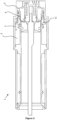
- the device 1 has a supply of high pressure fluid 3 from a fluid source 4.
- the fluid source 4 is connected to, and unitary with, a tool or similar that the device 1 is part of, for example a hand held nail or fastening gun, pest trap, rescue floatation device launcher, or gas pulse cleaning system, or other assembly that requires a valving arrangement of the present invention.
- the high pressure fluid source 4 in this case is a pressurised container or tank holding the high pressure fluid.
- the fluid source 4 may be remotely situated and fluidly connected, for example in a valve system or similar.
- the high pressure fluid 3 supplies, directly, or through a regulator, safety valve or similar, a dump chamber 2.
- a regulator is required, which in addition to its safety aspect and any safety valves, ensures a constant operating pressure is supplied to any trigger system and the dump chamber.
- the high pressure fluid is in a tank or container and holds the high pressure fluid at 4500 psi or higher, and regulates it down to the an operating pressure, for example of around 400 to 600 psi.
- the pressure in the source of high pressure fluid may of course be as high as needed, for example desired capacity when the device is an untethered one.
- the regulator, or a valve down stream therefrom will prevent the dump chamber being supplied with pressure which is too low to ensure correct operation of the device.
- the dump chamber 2 is an annular volume as shown and this conveys several advantages. It provides a more compact system. Further, given the ring like nature of the dose valve member 11 and that it slides linearly along the major longitudinal axis of the device, then the dump chamber 2 is formed at least in part by the annular space the dose valve member 11 will slide into when fired, and out from when moving to the closed position 13. Further having the dump chamber 2 as an annular ring volume then allows for the independent exhaust valve 20 and exhaust port(s) 21 (described later) to lie within, preferably concentrically within (though it may be offset from the axis of the dose valve member 11 if necessary). This provides simplified and optimised exhaust timing and control.
- a dose chamber 5 Downstream from the dump chamber 2 is a dose chamber 5.
- the two are separated by a dose valve member 11.
- the dose chamber 5 is also an annular ring chamber, which could also be described as a hollow cylindrical volume or void. Between the two is the dose valve member 11, described shortly.
- the flow path 6 may be through the dose valve member 11 body, or may flow through a separate flow path to dose chamber 5 for example through one or multiple ports in the walls of each of said chambers, fluidly connecting the chambers.
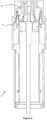
- the flow path is provided at least in part by the dose valve member 11 as shown in Figure 3 .
- the flow path 6 is open all the time between the dump chamber 2 and the dose chamber 5. However, in other forms it may only open when the dose valve member 11 is in the closed position sealing off the dose chamber 5.
- a check valve may be formed by an o-ring in a groove on the periphery of the dose valve member 2, which sits over a single or series of holes in the groove.
- Air can flow out the holes by displacing the o-ring, but is prevented from moving back through the holes by the o-ring, for example from the dump chamber to the dose chamber.
- the check valve may be formed by any other means, such as a poppet valve or ball-check valve. In designs where the flow path 6 linking the dump chamber 2 and dose chamber 5 are not via the dose valve member 11, these alternative check valve options are likely to be more suitable.
- the dose chamber 5 is also a ring or annular chamber, which could also be described as a hollow cylindrical volume, similar to the dump chamber 2. In the preferred form as shown in Figure 1 this is along from the dump chamber 2.
- a safety feature is the ability to independently dump the pressure from the dose chamber 5, and possibly also the dump chamber 2. In this way, the valve and actuation system 1 can be put into a safe or non-operative mode. In the absence of any other lock out system of the dose valve member 11, then dumping the pressure from at least the dose chamber 5 will prevent firing of the dose valve member 11, and hence prevent firing of the working load 17.
- dumping the dose chamber 5 pressure will also dump the dump chamber 2 pressure as this is connected by the flow path, but is done sequentially, of the dose chamber first and then the dump chamber, or in any other controlled way where the pressure in the dose chamber cannot override that in the dump chamber and hence the dose valve member is kept closed and thus the device is unable to fire.
- dumping the dose chamber 5 pressure will disarm the nail gun and prevent its firing.
- the central axis of the dump chamber 2, and the central axis of the dose chamber 5 are parallel with the major axis 18 of the device, and in the preferred form they are all concentric. However, in some forms whilst parallel, they may also be of set from one another.
- the first of these is a catastrophic supply failure check valve 29A.
- An in-line check valve where the supply enters the dump chamber 2 from the dump chamber stops the dump chamber 2 from dumping back through the leak and triggering a fire event.
- this safety function is not necessary, though that would have to be a very well-considered decision.
- the second of these is a slow leak safety check valve 29B.
- the dose chamber 5 must not be allowed to be at significantly higher pressure than the dump chamber 2, as this would result in a fire event.
- a check valve upstream of the catastrophic supply failure check valve achieves this. As the supply pressure drops below the dose chamber pressure, air flows from the dose chamber and out the leak safety check valve, and eventually out of the failure leak point to atmosphere.
- the trigger mechanism could utilise a spool valve that will dump the pressure in the dump chamber 2.
- a spool valve could be used that interrupts the flow of operating fluid 3 to the dump chamber 2, and connects the dump chamber 2 to an exhaust to atmospheric.
- the spool valve may then revert to the first state where it closes the exhaust and reconnects the supply to the dump chamber 2. This would have the effect of supplying high pressure fluid to charge the dump chamber and dose chamber, in a first position, and then when moved to a second position cuts off supply of high pressure fluid completely, and then connects the dump chamber to atmospheric or reference or lower pressure. This then allows the dump chamber to release its pressure, and thus the dose chamber to open the dose valve, and charge the working chamber or work load 31 to then do work.
- the dose valve member 11 Between the dump chamber 2 and the dose chamber 5 there is the dose valve member 11.
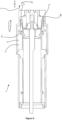
- the dose valve member 11 has a closed position 13 as shown in Figure 2 and an open position 15 as shown in Figure 7 . In one form the dose valve member 11 is biased closed.
- the dose valve member 11 has an annular sealing surface 12, which in the preferred form is, or is substantially, a blunt or rounded knife edge, as shown. This annular sealing surface 12 in turn, in the closed position 13, seals on a sealing member 34.
- the sealing member 34 is an O-ring, square section ring, X (or "quad") ring, or integrated co-moulded sealing element, or similar cross section rubber or rubber like materials as shown, though other forms are acceptable as long as they can seal as necessary to the sealing surface 12, the opposite arrangement could also be utilised as described below.
- the sealing member 34 is for example on a wall of the dose chamber or proximal thereto, as shown in Figure 2 .
- the sealing member 34 may be on the dose valve member 11, and the sealing surface 12 may be on the wall of the dose chamber, or proximal thereto.
- a gap 16 is presented or created, or formed between the annular sealing surface 12 and the sealing member 34. This forms an outlet 7 from the dose chamber 5 to the working chamber 8. This allows the operating fluid under pressure to enter the working chamber 8.
- the dose valve member 11 is biased closed, for example by a dose spring 35.
- the dose valve member 11 as shown has an elongate skirt 23 extending along and parallel to its linear axis 18. This elongate skirt 23 is received into the dump chamber 2 when in the open position 15. In the preferred form the elongate skirt 23 fills the entire dump chamber 2. When in the closed position 13, the elongate skirt forms in part a wall of an annular void which is the dump chamber 2. The fluid pressure in the dump chamber acts on the back surface(s) 36 of the dose valve member 11 to in part hold it closed. This fluid pressure therefore acts to further force the dump valve member 11 into the closed position 13, increasing the sealing between the annular sealing surface 12 and the sealing member 34. This is in conjunction with, or instead of, the dose spring 35.
- the front surface(s) 37 of the dose valve member 11 are also subject to pressure from the operating fluid 3 in the dose chamber. However, the dose valve member is held in the closed position by the pressure and or area differential from the dump chamber. It is only when this pressure in the dump chamber is reduced that the dose valve member 11 then opens. Due to the high pressures this opening is very fast and happens within 0.01 to 2 seconds, and preferably less than 0.5 of a second.
- the pressures between the dose chamber 5 and the dump chamber 2 will be substantially the same, and typically for most fast firing situations they will be also.
- the dump chamber 2 has a greater area on the back surface 36 for the pressure to act on, than the front side presented to the dose chamber 5, thus the dose valve member 11 remains closed. It is only when pressure in the dump chamber 2 is reduced, dumped, vented or released, for example by a trigger system such as earlier described, will the dose chamber 5 have sufficient force to open the dose valve member 11.
- the working chamber 8 Downstream from the dose chamber 5 and its outlet 7 is the working chamber 8. This has an inlet 9 at an inlet end 10 which receives the working fluid 3 from the dose chamber 5 as the dose valve member 11 moves to the open position 15.
- the working chamber 8 contains a work load 17.
- This may be a captive workload, such as, but not limited to a piston which reciprocates within the piston, or may be a non-captive work load, such as a projectile or similar that is ejected from the working chamber 8.
- a non-captive work load such as a projectile or similar that is ejected from the working chamber 8.
- there may not be any physical item, such as a piston or projectile, in the working chamber, it may be a pressure wave then is released into, and or from the chamber to do work.
- the workload is located at the inlet end 10 with preferably no void or volume present behind it prior to opening of the dose valve member 11.
- an exhaust valve 20 Present also downstream from the dose chamber 5 and dose valve member 11 is an exhaust valve 20. This could be upstream of the working chamber 8, or maybe in the same stream location as the working chamber 8 that is the working fluid 3 will operate on both at the same or similar time.
- the exhaust valve 20 also has an open position as shown in Figure 3 and a closed position as shown in Figure 7 . When in the open position it exposes one or more exhaust ports 21, and when closed it closes these.
- the exhaust valve 20 is biased to the open position, for example by an exhaust spring 38, or in addition or instead, a tensile member 28 as described below.
- the exhaust valve 20 moves to the closed position by the operating fluid 3 as the dose valve member 11 opens, to thus close the exhaust ports 21 to provide a closed volume for the working chamber 8.
- the workload there in receives the energy from the operating fluid and is acted on, for example it moves to the opposing end 22 of the working chamber 8. It may then be expelled therefrom, for example as a projectile, or it may then return for example when a piston.
- one method to return the work load to the firing position, that is near the dose valve end or inlet end is to use an air cushion on the front side 31 of the workload, for example on the front side 31 of the piston. This is formed by the return chamber 39.
- a spring or similar could be used on the back side also.
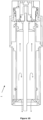
- a tensile member 28 on the back side 32 of the workload, for example the piston, as shown in Figure 11A-C .
- the tensile member 28 could for example be a resilient elastic element, such as, but not limited to, a silicone rubber, or similar material, that in its relaxed or near relaxed state holds the workload close to, or against the inlet end, of the working chamber.
- the tensile element 28 extends.
- the workload needs to return to the valve end or inlet end 10 of the working chamber 8, and the pressure on the working side or back side of the work load is reduced.
- the tensile member itself, or in conjunction with an air cushion or other stored energy on the front side 31 of the workload, will then want to contract again. In this way it will pull the work load back towards the inlet end 10 of the working chamber 8 while the air cushion pushes it.
- the tensile member 28 may be connected to an interior of the working chamber 8 or may extend through a wall of the working chamber and be connected or restrained by an exterior surface, body, securing, or fastening method.
- the tensile member may be connected to the exhaust valve 20 for example the seat, piston or moving element, as shown in Figure 11A-C .
- the exhaust valve 20, on firing, will, as described above, close off the exhaust port 21 as the work load travels down the working chamber 8.
- the exhaust valve 20 is timed to open the exhaust port(s) 21 to reduce the pressure on the front of the work load to thus ease its return to the starting position at the inlet end 10 of the working chamber 8.
- the tensile member 28 When the tensile member 28 is connected to the exhaust valve 20, the tensile member 28 is tuned such that it will help, at least in part, or in full, to control the movement of the exhaust valve 20 and open the exhaust port(s) 21. This is an additional way to tune and time the exhaust port 21 opening by way of imparting force on an exhaust element based on the position of the work load. This may provide an advantage as it can be used to remove the piston return chamber 39 altogether (thus reducing part counts, potential for seal failures, and or complexity), or remove some of its components, for example the one way check valve, or at least allows a reduction in the piston return chamber 39 size or will allow the piston return chamber to be operated effectively at lower pressure.
- the tensile member 28 is an elastic material, at least for the extension it will experience, then typically it will reduce in cross sectional area as it extends and expand in cross sectional area as it expands. This is clearly shown in Figure 11A-C .
- the tensile member 28 as shown in Figure 11 may be connected through, at least in part, the exhaust valve 20.
- the tensile member 28 When the tensile member 28 extends it will reduce its cross sectional area, visible in Figure 11B , and open that portion of the exhaust valve 20 that it is connected through, typically when the workload is at the extreme of its stroke and so the work has been done by the high pressure fluid, and the workload is ready to return.
- the exhaust valve 20, will then open under the actions described above, and optionally also due to the pull, and thinning from the tensile member 20, and will move to the open position, free of the ports 21.
- the thinning of the tensile member 28 then allows a further evacuation path through the body, in this case the centre, of the exhaust valve 20.
- This feature can be further used to time the opening of the exhaust valve 20, and exhaust ports 21. In this way it can reduce the linear motion needed for the exhaust valve 20 to open and close the ports 21.
- the device is contained, at least in part, and which forms some of the structures described by a housing 33.
- the device has a major axis 18 running its major length.
- the dump chamber 2 fills faster than the dose chamber 5, creating or adding to dose valve member 11 closing and sealing force bias.
- This fill speed differential is unavoidable due to the dose chamber 5 being supplied by the dump chamber 2, via the flow path 6, and any restriction 25 of valve 26 in that flow path, the amount of pressure differential produced is dependent on the flow capacities of the flow paths into and out of the dump chamber 2.
- the dose chamber 5 may also be filled through a one way valve.
- the dose chamber 5 is shown charged.
- the dump chamber 2 is exhausted or released, in this case to a lower pressure, for example atmosphere or reference pressure, when the trigger mechanism 27 is actuated.
- the force balance on the dose valve member 11 is swapped due to the pressure areas of the inner, outer and face seals.
- the dump chamber may exhaust to the working chamber 8 (will slightly increase efficiency, and will partially mitigate the need to make the dose chamber 5 extremely small for efficiency)
- the dose valve 5 then opens in Figure 6 , pressurised gas flows to fill the small space behind the workload 17, in this case as shown, a piston.
- the operating fluid 3 in the dose chamber 5 expands, shown in Figure 7 , dropping in pressure and pushing the workload 17 down the working chamber 8.
- the exhaust valve 20, which as shown is piston shaped, is sealed against it's face seal to seal the exhaust ports 21, and thus the working chamber behind the work load.
- the workload in this case a piston, as it moves, passes the return chamber one way valve 40 in Figure 8 , allowing working chamber pressure on the front side 31 of the work load to expand into the piston return chamber 39. If the dose valve member 11 is fitted with a force bias spring 35 (not shown), it will close the dose valve member 11 now, slightly before, or slightly after depending on tuning.
- the exhausting pressure is reached as shown in Figure 9 , allowing the exhaust spring 38 to overcome the pressure force to open the exhaust valve 20, and thus the exhaust ports 21. This allows for workload return, or loading, driven by operating fluid 3 in the piston return chamber 39, and or tensile member 28. If a dose spring 35 is included, the dose valve member 11 moves to the closed position 13 at this stage - but if it is absent, the dose valve member 11 will sit open, and dose chamber 5 will be fully exhausted to the working chamber, and subsequently to atmosphere after the exhaust is opened.
- the remaining operating fluid 3 behind the workload 17 is exhausted to atmosphere through the ports 21 and the workload 17 returns as shown in Figure 10 to the inlet end 10.
- the trigger 27 release may be automated, latched, or sprung in some manner to allow refilling while the trigger is still depressed, that is to say the trigger is only effective for a short time, or dependent on another triggering element such a safety element used in nail guns which ensures the tool is held against the work piece as part of the triggering action.
- the present invention may have potential applications in penetrative fastening tools, pneumatic motors, projectile launchers, fast pulse air or fluid valves, and the like.
- the operating fluid may be a compressed gas, and preferably highly compressed, using 4500 PSI or higher as a source, though this may be regulated down, for example air, carbon dioxide, nitrogen or similar.
- the operating fluid may be a hydraulic fluid, a supercritical fluid or similar.
Landscapes
- Engineering & Computer Science (AREA)
- Mechanical Engineering (AREA)
- Physics & Mathematics (AREA)
- Fluid Mechanics (AREA)
- General Engineering & Computer Science (AREA)
- Portable Nailing Machines And Staplers (AREA)
- Fluid-Driven Valves (AREA)
- Transition And Organic Metals Composition Catalysts For Addition Polymerization (AREA)
- Control Of Fluid Pressure (AREA)
- Reciprocating Pumps (AREA)
- Jet Pumps And Other Pumps (AREA)
- Exhaust-Gas Circulating Devices (AREA)
- Percussion Or Vibration Massage (AREA)
- Regulating Braking Force (AREA)
Claims (20)
- Vorrichtung (1), Folgendes aufweisend oder umfassend:eine Druckentleerkammer (2) mit einer ringförmigen Form, wobei die Druckentleerkammer (2) dazu ausgelegt ist, Hochdruckfluid von einer Hochdruckfluidquelle zu empfangen,eine Dosierkammer (5), die dazu ausgelegt ist, eine Strömung des Hochdruckfluids von der Druckentleerkammer (2) über einen Strömungspfad (6) von der Druckentleerkammer (2) zur Dosierkammer (5) zu empfangen, wobei die Dosierkammer (5) einen Auslass (7) aufweist,eine Arbeitskammer (8) mit einem Einlass (9) an einem Einlassende (10) derselben undein Dosierventilelement (11) mit einer ringförmigen Dichtungsfläche (12), welche das Einlassende (10) umgibt,wobei die ringförmige Dichtungsfläche (12), wenn sich das Dosierventilelement (11) in einem geschlossenen Zustand befindet, und ein ringförmiger Sitz aneinanderstoßen, um den Auslass (7) abzudichten; und, wenn sich das Dosierventilelement (11) in einem offenen Zustand befindet, ein Spalt (16) zwischen der ringförmigen Dichtungsfläche (12) und dem Sitz vorhanden ist, um ein Bewegen von Hochdruckfluid vom Auslass (7) zum Einlass (9) zu erlauben, und das Eintreten von einer Hochdruckfluidströmung in die Dosierkammer (5) oder die Druckentleerkammer (2) verhindert wird, undwobei das Hochdruckfluid in der Druckentleerkammer (2) zumindest teilweise das Dosierventilelement (11) im geschlossenen Zustand hält, bis der Hochdruckfluiddruck in der Druckentleerkammer (2) reduziert wird, wodurch das Hochdruckfluid in der Dosierkammer (5) das Dosierventilelement (11) aus dem Sitz in die offene Position löst.
- Vorrichtung nach Anspruch 1, wobei, wenn das Dosierventilelement offen ist, das Eintreten einer Hochdruckfluidströmung in die Druckentleerkammer verhindert wird.
- Vorrichtung nach einem der Ansprüche 1 oder 2, wobei das in die Arbeitskammer strömende Hochdruckfluid anschließend Arbeit an einer Arbeitslast darin durchführt, um sie aus einem entgegengesetzten Ende der Arbeitskammer auszustoßen oder hin zu diesem oder in Richtung desselben zu bewegen, wobei, wenn die Arbeitslast vom ersten Ende (oder Einlassende) zum zweiten Ende (oder entgegengesetzten Ende) getrieben wird, keine verfügbare Fluidverbindung von einer Hochdruckfluidquelle zu der Arbeitslastantriebsanordnung oder den -kammern existiert.
- Vorrichtung nach einem der Ansprüche 1 bis 3, wobei das Dosierventilelement dazu ausgerichtet ist, linear entlang einer linearen Achse parallel zu einer Hauptachse der Vorrichtung zu gleiten, wobei die Arbeitslast, sei sie unverlierbar wie ein Kolben, oder ausgestoßen wie ein Projektil, dazu ausgelegt ist, parallel zur Hauptachse linear entlang der Arbeitskammer vom Einlassende hin zum entgegengesetzten distalen Ende oder in Richtung desselben zu gleiten, und wobei die Druckentleerkammer, Dosierkammer und Arbeitskammer konzentrisch mit oder parallel zu der Hauptachse angeordnet sind.
- Vorrichtung nach einem der Ansprüche 1 bis 4, wobei ein Auslassventil existiert, das am Einlassende oder in Richtung desselben in offene Position vorgespannt ist und das dazu ausgelegt ist, einen Auslassanschluss durch Betätigung durch das Hochdruckfluid, das die Dosierkammer verlässt, zu verschließen, wobei der Auslassanschluss dazu ausgelegt ist, sich unter der Wirkung der Vorspannung zu öffnen, wenn sich die Arbeitslast am entgegengesetzten Ende oder nahe davon befindet, wobei die Vorspannung auf dem Auslassventil eine Feder ist, wobei das Auslassventil ein Kolben oder eine Membran ist, der/die zumindest teilweise vom Dosierventilelement umgeben ist, wobei oder wobei zusätzlich dazu die Vorspannung auf dem Auslassventil ein Zugelement ist, das zwischen der Arbeitslast und dem Auslassventil verbunden ist.
- Vorrichtung nach einem der Ansprüche 1 bis 5, wobei das Dosierventilelement zumindest teilweise in die geschlossene Position vorgespannt ist.
- Vorrichtung nach einem der Ansprüche 1 bis 6, wobei die Dosierkammer ein Hohlvolumen radial auswärts oder einwärts von der Arbeitskammer ist.
- Vorrichtung nach einem der Ansprüche 1 bis 7, wobei der Strömungspfad über das Dosierventilelement in einer Schürze des Dosierventilelements verläuft.
- Vorrichtung nach einem der Ansprüche 1 bis 8, wobei im Strömungspfad von der Druckentleerkammer zur Dosierkammer eine Einschränkung, wie etwa ein Einwegventil, vorhanden ist, sodass die Druckentleerkammer sogar beim Befüllen der Dosierkammer den Verschließdruck des Dosierventilelements erhöhen wird.
- Vorrichtung nach einem der Ansprüche 1 bis 9, wobei der Druck in der Druckentleerkammer durch einen Auslösemechanismus oder Ähnliches verringert wird, wobei der Auslösemechanismus dazu ausgelegt ist, den Druck in der Druckentleerkammer in die Atmosphäre auszustoßen.
- Vorrichtung nach einem der Ansprüche 1 bis 10, wobei die Arbeitslast zum Einlassende durch ein Fluidkissen auf einer Rückseite desselben oder eine Feder auf einer Rückseite oder Vorderseite oder ein Zugelement, das von einer Vorderseite hin zum Einlassende oder in Richtung desselben verbunden ist, zurückgeführt wird.
- Vorrichtung nach einem der Ansprüche 1 bis 11, wobei ein Sicherheitsventil vorhanden ist, das dazu ausgelegt ist, selektiv Druck aus der Dosierkammer auszustoßen, um einen Betrieb der Vorrichtung zu verhindern, und ein Sicherheitsventil mit schleichendem Druckverlust vorhanden ist, das dazu ausgelegt ist, Fluiddruck aus der Dosierkammer auszulassen, falls der Hochdruckfluidzufuhrdruck unter den der Dosierkammer fällt.
- Verfahren zum Betreiben einer Hochdruckfluidvorrichtung (1), das folgende Schritte aufweist oder umfasstBefüllen einer Druckentleerkammer (2), die eine ringförmige Form aufweist, mit einem Hochdruckfluid,Erhöhen eines Dichtungsdrucks eines Dosierventilelements (11) durch Wirken des Hochdruckfluids auf einer Rückseite des Dosierventilelements (11), um das Dosierventilelement (11) in einer geschlossenen Position zu halten, wobei das Dosierventilelement (11) eine ringförmige Dichtungsfläche (12) zwischen einem Auslass (7) aus einer Dosierkammer (5) und einem Einlass (9) zu einer Arbeitskammer (8) an einem Einlassende (10) der Arbeitskammer (8) aufweist,Leiten von Hochdruckfluid von der Druckentleerkammer (2) zur Dosierkammer (5) über einen Strömungspfad (6),Verringern des Drucks der Druckentleerkammer (2), sodass das Hochdruckfluid in der Dosierkammer (5), welches auf eine Vorderseite des Dosierventilelements (11) wirkt, das Dosierventilelement (11) in eine offene Position drückt, die einen Spalt (16) zwischen dem Einlass (9) und dem Auslass (7) aufweist,Verhindern des Eintretens von Hochdruckfluid in die Dosierkammer (5) oder die Druckentleerkammer (2), wenn das Dosierventilelement (11) offen ist,wobei daraufhin das Hochdruckfluid von der Dosierkammer (5) in die Arbeitskammer (8) eintritt, um Arbeit an einer Arbeitslast (17) innerhalb der Arbeitskammer (8) durchzuführen.
- Verfahren nach Anspruch 13, wobei die Druckentleerkammer und die Dosierkammer, wenn sie befüllt sind, vor dem Reduzieren des Drucks beinahe den gleichen Druck aufweisen.
- Verfahren nach einem der Ansprüche 13 oder 14, wobei ein Auslassventil in eine Position bewegt wird, in der es einen Auslassanschluss von der Arbeitskammer verschließt, bis die Arbeit an der Arbeitslast abgeschlossen ist, woraufhin sich der Auslassanschluss öffnet, etwa unter einer Vorspannung, und es der Arbeitslast ermöglicht, zum Einlassende der Arbeitskammer zurückzukehren, wobei allfälliges Fluid zwischen der Arbeitslast und dem Einlassende durch den Auslassanschluss austritt, wobei der Auslassanschluss in eine offene Position vorgespannt wird, außer wenn das Hochdruckfluid aus der Dosierkammer austritt, sodass die Vorspannung überwunden wird und sich das Auslassventil zur Schließposition des Auslassanschlusses/der Auslassanschlüsse bewegt.
- Verfahren nach einem der Ansprüche 13 bis 15, wobei das Dosierventilelement sich in die geschlossene Position bewegt, sobald sich die Arbeitslast hin zum entgegengesetzten Ende oder in Richtung desselben bewegt.
- Verfahren nach einem der Ansprüche 13 bis 16, wobei ein Auslösemechanismus den Druck in der Druckentleerkammer reduziert.
- Verfahren nach einem der Ansprüche 13 bis 17, wobei die Arbeitslast durch eine Vorspannung, wie etwa, aber nicht beschränkt auf, eine Fluidkissen/Druckvorspannung oder ein Druckelement auf einer hinteren, nicht arbeitenden Seite der Arbeitslast, und/oder ein Zugelement auf einer vorderen Arbeitsseite der Arbeitslast, zum Einlassende zurückgeführt wird.
- Verfahren nach einem der Ansprüche 13 bis 18, wobei die Druckentleerkammer und die Dosierkammer frei zur Wiederbefüllung sind, sobald sich das Dosierventilelement in einer geschlossenen Position befindet, wobei oder wobei zusätzlich das Befüllen der Druckkammer zum Schließen des Dosierventilelements beiträgt.
- Verfahren nach einem der Ansprüche 13 bis 19, wobei das Verfahren den Schritt des Ausstoßens des Hochdruckfluids in der Dosierkammer in die Atmosphäre zum Verhindern des Betriebs der Vorrichtung umfasst.
Applications Claiming Priority (3)
| Application Number | Priority Date | Filing Date | Title |
|---|---|---|---|
| US202062958292P | 2020-01-07 | 2020-01-07 | |
| NZ76242820 | 2020-03-06 | ||
| PCT/NZ2021/050002 WO2021141503A1 (en) | 2020-01-07 | 2021-01-07 | Improvements in, or relating to, an actuation system |
Publications (4)
| Publication Number | Publication Date |
|---|---|
| EP4087707A1 EP4087707A1 (de) | 2022-11-16 |
| EP4087707A4 EP4087707A4 (de) | 2024-02-21 |
| EP4087707B1 true EP4087707B1 (de) | 2025-04-30 |
| EP4087707C0 EP4087707C0 (de) | 2025-04-30 |
Family
ID=76788217
Family Applications (1)
| Application Number | Title | Priority Date | Filing Date |
|---|---|---|---|
| EP21738117.7A Active EP4087707B1 (de) | 2020-01-07 | 2021-01-07 | Verbesserungen an oder im zusammenhang mit einem betätigungssystem |
Country Status (14)
| Country | Link |
|---|---|
| US (1) | US20230347487A1 (de) |
| EP (1) | EP4087707B1 (de) |
| JP (1) | JP7620989B2 (de) |
| KR (1) | KR20220124733A (de) |
| CN (1) | CN115135455B (de) |
| AU (1) | AU2021206494A1 (de) |
| BR (1) | BR112022013501A2 (de) |
| CA (1) | CA3164015A1 (de) |
| ES (1) | ES3034268T3 (de) |
| IL (1) | IL294570A (de) |
| MX (1) | MX2022008468A (de) |
| PL (1) | PL4087707T3 (de) |
| SA (1) | SA522433246B1 (de) |
| WO (1) | WO2021141503A1 (de) |
Families Citing this family (1)
| Publication number | Priority date | Publication date | Assignee | Title |
|---|---|---|---|---|
| US12202108B2 (en) * | 2021-02-24 | 2025-01-21 | Illinois Tool Works Inc. | Fastener driving apparatus and methods |
Family Cites Families (31)
| Publication number | Priority date | Publication date | Assignee | Title |
|---|---|---|---|---|
| US2960067A (en) * | 1957-10-28 | 1960-11-15 | Inv S Man Corp | Single stroke air hammer |
| US3055344A (en) * | 1960-03-22 | 1962-09-25 | Bostitch Inc | Fastener applying implement |
| US3088440A (en) | 1960-08-01 | 1963-05-07 | Ingersoll Rand Co | Impact tools |
| US3850359A (en) * | 1973-05-11 | 1974-11-26 | Fastener Corp | Fastener driving tool |
| GB1510752A (en) * | 1975-02-05 | 1978-05-17 | Haytayan H | Pneumatic fastener driving or impacting apparatus |
| US4039113A (en) * | 1976-04-16 | 1977-08-02 | Textron, Inc. | Pneumatically operated fastener driving device with improved main valve assembly |
| DE2811339C2 (de) * | 1978-03-16 | 1979-09-20 | Heinrich Buehnen Kg, Maschinenfabrik, Im- Und Export, 2800 Bremen | Auslösesicherung an einem Druckluftnagler |
| US4194644A (en) * | 1978-04-05 | 1980-03-25 | Narvaez Henry R | Electrical junction access device |
| US4253598A (en) * | 1979-02-23 | 1981-03-03 | Haytayan Harry M | Fluid powered impact tool |
| JPS601153B2 (ja) * | 1979-02-28 | 1985-01-12 | マックス株式会社 | 空気圧駆動型打撃工具における安全装置 |
| US4566619A (en) * | 1980-07-24 | 1986-01-28 | The Kiesel Co. | Pneumatic fastener-driving tool and method |
| US4549344A (en) * | 1980-11-19 | 1985-10-29 | Signode Corporation | Method of driving fasteners with a bumperless pneumatic gun |
| US5628444A (en) * | 1995-11-16 | 1997-05-13 | Stanley-Bostitch, Inc. | Fastener driving device with main valve/frame valve arrangement |
| US5829660A (en) * | 1995-12-07 | 1998-11-03 | Stanley-Bostitch, Inc. | Automatic-type fastener driving device |
| JP3966080B2 (ja) * | 2002-05-31 | 2007-08-29 | 日立工機株式会社 | エアダスタ付き釘打機 |
| US6783050B2 (en) * | 2002-05-31 | 2004-08-31 | Hitachi Koki Co., Ltd. | Nail gun provided with duster function |
| US20050200087A1 (en) * | 2004-03-15 | 2005-09-15 | Vasudeva Kailash C. | Rotary tool with quick connect means and attachments thereto |
| US7296721B1 (en) * | 2006-08-18 | 2007-11-20 | De Poan Pneumatic Corp. | Pneumatic nail gun having nail pusher |
| US20080078799A1 (en) * | 2006-10-03 | 2008-04-03 | Wan-Fu Wen | Nail Gun with Electric Power Generating Unit |
| US7802500B2 (en) * | 2007-12-26 | 2010-09-28 | Illinois Tool Works, Inc. | Pneumatic fastener driving tool |
| JP5397835B2 (ja) * | 2009-09-14 | 2014-01-22 | 日立工機株式会社 | 打込機 |
| US8523035B2 (en) * | 2009-11-11 | 2013-09-03 | Tricord Solutions, Inc. | Fastener driving apparatus |
| NZ573990A (en) | 2010-03-23 | 2011-10-28 | Globalforce Ip Ltd | Actuation system comprising a dose chamber,a working chamber, a valve member and a triggering mechanism |
| US8215529B2 (en) * | 2010-05-31 | 2012-07-10 | De Poan Pneumatic Corp. | Pneumatic device |
| US8931178B2 (en) * | 2011-02-24 | 2015-01-13 | Albert Beam | Clipper deflector for deflecting air and cuttings away from operator |
| EP2747945B1 (de) * | 2011-08-23 | 2015-08-12 | Hitachi Koki Co., Ltd. | Befestigungswerkzeug |
| US9463560B2 (en) * | 2011-10-03 | 2016-10-11 | Illinois Tool Works Inc. | Portable pressurized power source for fastener driving tool |
| US10464196B2 (en) * | 2012-10-12 | 2019-11-05 | Patrick Hale | Board fastening tool |
| US9511416B2 (en) * | 2013-01-18 | 2016-12-06 | Gage Bilt, Inc. | Feed devices for swagable lockbolt collars |
| US10040183B2 (en) * | 2013-10-11 | 2018-08-07 | Illinois Tool Works Inc. | Powered nailer with positive piston return |
| CN115135454A (zh) * | 2020-02-03 | 2022-09-30 | 全球力量Ip有限公司 | 加压流体操作装置的排气阀的改进或与之相关的改进 |
-
2021
- 2021-01-07 EP EP21738117.7A patent/EP4087707B1/de active Active
- 2021-01-07 JP JP2022542060A patent/JP7620989B2/ja active Active
- 2021-01-07 US US17/791,348 patent/US20230347487A1/en not_active Abandoned
- 2021-01-07 BR BR112022013501A patent/BR112022013501A2/pt unknown
- 2021-01-07 KR KR1020227026516A patent/KR20220124733A/ko not_active Withdrawn
- 2021-01-07 WO PCT/NZ2021/050002 patent/WO2021141503A1/en not_active Ceased
- 2021-01-07 AU AU2021206494A patent/AU2021206494A1/en active Pending
- 2021-01-07 ES ES21738117T patent/ES3034268T3/es active Active
- 2021-01-07 CA CA3164015A patent/CA3164015A1/en active Pending
- 2021-01-07 CN CN202180011454.7A patent/CN115135455B/zh active Active
- 2021-01-07 MX MX2022008468A patent/MX2022008468A/es unknown
- 2021-01-07 PL PL21738117.7T patent/PL4087707T3/pl unknown
- 2021-01-07 IL IL294570A patent/IL294570A/en unknown
-
2022
- 2022-07-06 SA SA522433246A patent/SA522433246B1/ar unknown
Also Published As
| Publication number | Publication date |
|---|---|
| US20230347487A1 (en) | 2023-11-02 |
| EP4087707A1 (de) | 2022-11-16 |
| IL294570A (en) | 2022-09-01 |
| ES3034268T3 (en) | 2025-08-14 |
| KR20220124733A (ko) | 2022-09-14 |
| CN115135455B (zh) | 2026-02-03 |
| MX2022008468A (es) | 2022-12-13 |
| EP4087707C0 (de) | 2025-04-30 |
| CA3164015A1 (en) | 2021-07-15 |
| JP7620989B2 (ja) | 2025-01-24 |
| PL4087707T3 (pl) | 2025-11-24 |
| SA522433246B1 (ar) | 2024-04-04 |
| BR112022013501A2 (pt) | 2022-09-13 |
| AU2021206494A1 (en) | 2022-08-11 |
| JP2023514949A (ja) | 2023-04-12 |
| EP4087707A4 (de) | 2024-02-21 |
| CN115135455A (zh) | 2022-09-30 |
| WO2021141503A1 (en) | 2021-07-15 |
Similar Documents
| Publication | Publication Date | Title |
|---|---|---|
| US20080217372A1 (en) | Fastener Driving Tool | |
| CN102292192B (zh) | 致动系统 | |
| MXPA03000175A (es) | Herramienta impulsora de sujetadores que posee fuente de energia presurizada. | |
| EP4087707B1 (de) | Verbesserungen an oder im zusammenhang mit einem betätigungssystem | |
| KR102869812B1 (ko) | 가압 유체 작동식 장치를 위한 트리거 밸브의 개선 또는 관련 개선 | |
| TWI832204B (zh) | 高壓流體閥控之壓力回應、設備及其方法的改進或相關改進 | |
| CN109926982B (zh) | 天花板施工用击钉器 | |
| CN100439042C (zh) | 紧固件推进工具 | |
| HK40080217A (en) | Improvements in, or relating to, an actuation system | |
| AU2004308538B2 (en) | Fastener driving tool | |
| US10618152B2 (en) | All-direction valve and handheld power tool having same |
Legal Events
| Date | Code | Title | Description |
|---|---|---|---|
| STAA | Information on the status of an ep patent application or granted ep patent |
Free format text: STATUS: THE INTERNATIONAL PUBLICATION HAS BEEN MADE |
|
| PUAI | Public reference made under article 153(3) epc to a published international application that has entered the european phase |
Free format text: ORIGINAL CODE: 0009012 |
|
| STAA | Information on the status of an ep patent application or granted ep patent |
Free format text: STATUS: REQUEST FOR EXAMINATION WAS MADE |
|
| 17P | Request for examination filed |
Effective date: 20220725 |
|
| AK | Designated contracting states |
Kind code of ref document: A1 Designated state(s): AL AT BE BG CH CY CZ DE DK EE ES FI FR GB GR HR HU IE IS IT LI LT LU LV MC MK MT NL NO PL PT RO RS SE SI SK SM TR |
|
| DAV | Request for validation of the european patent (deleted) | ||
| DAX | Request for extension of the european patent (deleted) | ||
| A4 | Supplementary search report drawn up and despatched |
Effective date: 20240123 |
|
| RIC1 | Information provided on ipc code assigned before grant |
Ipc: B25C 1/04 20060101AFI20240117BHEP |
|
| GRAP | Despatch of communication of intention to grant a patent |
Free format text: ORIGINAL CODE: EPIDOSNIGR1 |
|
| STAA | Information on the status of an ep patent application or granted ep patent |
Free format text: STATUS: GRANT OF PATENT IS INTENDED |
|
| INTG | Intention to grant announced |
Effective date: 20240711 |
|
| GRAJ | Information related to disapproval of communication of intention to grant by the applicant or resumption of examination proceedings by the epo deleted |
Free format text: ORIGINAL CODE: EPIDOSDIGR1 |
|
| STAA | Information on the status of an ep patent application or granted ep patent |
Free format text: STATUS: REQUEST FOR EXAMINATION WAS MADE |
|
| INTC | Intention to grant announced (deleted) | ||
| GRAP | Despatch of communication of intention to grant a patent |
Free format text: ORIGINAL CODE: EPIDOSNIGR1 |
|
| STAA | Information on the status of an ep patent application or granted ep patent |
Free format text: STATUS: GRANT OF PATENT IS INTENDED |
|
| INTG | Intention to grant announced |
Effective date: 20241218 |
|
| GRAS | Grant fee paid |
Free format text: ORIGINAL CODE: EPIDOSNIGR3 |
|
| GRAA | (expected) grant |
Free format text: ORIGINAL CODE: 0009210 |
|
| STAA | Information on the status of an ep patent application or granted ep patent |
Free format text: STATUS: THE PATENT HAS BEEN GRANTED |
|
| AK | Designated contracting states |
Kind code of ref document: B1 Designated state(s): AL AT BE BG CH CY CZ DE DK EE ES FI FR GB GR HR HU IE IS IT LI LT LU LV MC MK MT NL NO PL PT RO RS SE SI SK SM TR |
|
| REG | Reference to a national code |
Ref country code: CH Ref legal event code: EP Ref country code: GB Ref legal event code: FG4D |
|
| REG | Reference to a national code |
Ref country code: IE Ref legal event code: FG4D |
|
| REG | Reference to a national code |
Ref country code: DE Ref legal event code: R096 Ref document number: 602021030024 Country of ref document: DE |
|
| U01 | Request for unitary effect filed |
Effective date: 20250507 |
|
| U07 | Unitary effect registered |
Designated state(s): AT BE BG DE DK EE FI FR IT LT LU LV MT NL PT RO SE SI Effective date: 20250514 |
|
| REG | Reference to a national code |
Ref country code: ES Ref legal event code: FG2A Ref document number: 3034268 Country of ref document: ES Kind code of ref document: T3 Effective date: 20250814 |
|
| PG25 | Lapsed in a contracting state [announced via postgrant information from national office to epo] |
Ref country code: GR Free format text: LAPSE BECAUSE OF FAILURE TO SUBMIT A TRANSLATION OF THE DESCRIPTION OR TO PAY THE FEE WITHIN THE PRESCRIBED TIME-LIMIT Effective date: 20250731 |
|
| PG25 | Lapsed in a contracting state [announced via postgrant information from national office to epo] |
Ref country code: HR Free format text: LAPSE BECAUSE OF FAILURE TO SUBMIT A TRANSLATION OF THE DESCRIPTION OR TO PAY THE FEE WITHIN THE PRESCRIBED TIME-LIMIT Effective date: 20250430 |
|
| PG25 | Lapsed in a contracting state [announced via postgrant information from national office to epo] |
Ref country code: RS Free format text: LAPSE BECAUSE OF FAILURE TO SUBMIT A TRANSLATION OF THE DESCRIPTION OR TO PAY THE FEE WITHIN THE PRESCRIBED TIME-LIMIT Effective date: 20250731 |
|
| PG25 | Lapsed in a contracting state [announced via postgrant information from national office to epo] |
Ref country code: IS Free format text: LAPSE BECAUSE OF FAILURE TO SUBMIT A TRANSLATION OF THE DESCRIPTION OR TO PAY THE FEE WITHIN THE PRESCRIBED TIME-LIMIT Effective date: 20250830 |
|
| PG25 | Lapsed in a contracting state [announced via postgrant information from national office to epo] |
Ref country code: SM Free format text: LAPSE BECAUSE OF FAILURE TO SUBMIT A TRANSLATION OF THE DESCRIPTION OR TO PAY THE FEE WITHIN THE PRESCRIBED TIME-LIMIT Effective date: 20250430 |
|
| PG25 | Lapsed in a contracting state [announced via postgrant information from national office to epo] |
Ref country code: CZ Free format text: LAPSE BECAUSE OF FAILURE TO SUBMIT A TRANSLATION OF THE DESCRIPTION OR TO PAY THE FEE WITHIN THE PRESCRIBED TIME-LIMIT Effective date: 20250430 |
|
| PGFP | Annual fee paid to national office [announced via postgrant information from national office to epo] |
Ref country code: PL Payment date: 20251230 Year of fee payment: 6 |
|
| PG25 | Lapsed in a contracting state [announced via postgrant information from national office to epo] |
Ref country code: SK Free format text: LAPSE BECAUSE OF FAILURE TO SUBMIT A TRANSLATION OF THE DESCRIPTION OR TO PAY THE FEE WITHIN THE PRESCRIBED TIME-LIMIT Effective date: 20250430 |
|
| REG | Reference to a national code |
Ref country code: CH Ref legal event code: U11 Free format text: ST27 STATUS EVENT CODE: U-0-0-U10-U11 (AS PROVIDED BY THE NATIONAL OFFICE) Effective date: 20260201 |