EP4081738B1 - Strömungsleitelement, strömungsleitsystem und heizvorrichtung - Google Patents
Strömungsleitelement, strömungsleitsystem und heizvorrichtung Download PDFInfo
- Publication number
- EP4081738B1 EP4081738B1 EP20817339.3A EP20817339A EP4081738B1 EP 4081738 B1 EP4081738 B1 EP 4081738B1 EP 20817339 A EP20817339 A EP 20817339A EP 4081738 B1 EP4081738 B1 EP 4081738B1
- Authority
- EP
- European Patent Office
- Prior art keywords
- flow
- directing
- guide element
- directing element
- heating apparatus
- Prior art date
- Legal status (The legal status is an assumption and is not a legal conclusion. Google has not performed a legal analysis and makes no representation as to the accuracy of the status listed.)
- Active
Links
Images



Classifications
-
- B—PERFORMING OPERATIONS; TRANSPORTING
- B60—VEHICLES IN GENERAL
- B60H—ARRANGEMENTS OF HEATING, COOLING, VENTILATING OR OTHER AIR-TREATING DEVICES SPECIALLY ADAPTED FOR PASSENGER OR GOODS SPACES OF VEHICLES
- B60H1/00—Heating, cooling or ventilating devices
- B60H1/22—Heating, cooling or ventilating devices the heat source being other than the propulsion plant
- B60H1/2203—Heating, cooling or ventilating devices the heat source being other than the propulsion plant the heat being derived from burners
-
- B—PERFORMING OPERATIONS; TRANSPORTING
- B60—VEHICLES IN GENERAL
- B60H—ARRANGEMENTS OF HEATING, COOLING, VENTILATING OR OTHER AIR-TREATING DEVICES SPECIALLY ADAPTED FOR PASSENGER OR GOODS SPACES OF VEHICLES
- B60H1/00—Heating, cooling or ventilating devices
- B60H1/00314—Arrangements permitting a rapid heating of the heating liquid
-
- F—MECHANICAL ENGINEERING; LIGHTING; HEATING; WEAPONS; BLASTING
- F23—COMBUSTION APPARATUS; COMBUSTION PROCESSES
- F23D—BURNERS
- F23D3/00—Burners using capillary action
- F23D3/40—Burners using capillary action the capillary action taking place in one or more rigid porous bodies
-
- F—MECHANICAL ENGINEERING; LIGHTING; HEATING; WEAPONS; BLASTING
- F23—COMBUSTION APPARATUS; COMBUSTION PROCESSES
- F23L—SUPPLYING AIR OR NON-COMBUSTIBLE LIQUIDS OR GASES TO COMBUSTION APPARATUS IN GENERAL ; VALVES OR DAMPERS SPECIALLY ADAPTED FOR CONTROLLING AIR SUPPLY OR DRAUGHT IN COMBUSTION APPARATUS; INDUCING DRAUGHT IN COMBUSTION APPARATUS; TOPS FOR CHIMNEYS OR VENTILATING SHAFTS; TERMINALS FOR FLUES
- F23L1/00—Passages or apertures for delivering primary air for combustion
- F23L1/02—Passages or apertures for delivering primary air for combustion by discharging the air below the fire
-
- F—MECHANICAL ENGINEERING; LIGHTING; HEATING; WEAPONS; BLASTING
- F23—COMBUSTION APPARATUS; COMBUSTION PROCESSES
- F23M—CASINGS, LININGS, WALLS OR DOORS SPECIALLY ADAPTED FOR COMBUSTION CHAMBERS, e.g. FIREBRIDGES; DEVICES FOR DEFLECTING AIR, FLAMES OR COMBUSTION PRODUCTS IN COMBUSTION CHAMBERS; SAFETY ARRANGEMENTS SPECIALLY ADAPTED FOR COMBUSTION APPARATUS; DETAILS OF COMBUSTION CHAMBERS, NOT OTHERWISE PROVIDED FOR
- F23M9/00—Baffles or deflectors for air or combustion products; Flame shields
- F23M9/02—Baffles or deflectors for air or combustion products; Flame shields in air inlets
-
- F—MECHANICAL ENGINEERING; LIGHTING; HEATING; WEAPONS; BLASTING
- F23—COMBUSTION APPARATUS; COMBUSTION PROCESSES
- F23D—BURNERS
- F23D2900/00—Special features of, or arrangements for burners using fluid fuels or solid fuels suspended in a carrier gas
- F23D2900/05002—Use of porous members to convert liquid fuel into vapor
-
- F—MECHANICAL ENGINEERING; LIGHTING; HEATING; WEAPONS; BLASTING
- F23—COMBUSTION APPARATUS; COMBUSTION PROCESSES
- F23D—BURNERS
- F23D2900/00—Special features of, or arrangements for burners using fluid fuels or solid fuels suspended in a carrier gas
- F23D2900/21—Burners specially adapted for a particular use
- F23D2900/21002—Burners specially adapted for a particular use for use in car heating systems
Definitions
- the invention relates to a flow guiding element, a flow guiding system and a heating device, in particular a mobile heating device for vehicles.
- Heating devices with an evaporator burner are used in liquid fuel-operated auxiliary and/or auxiliary heaters, which are used in particular for vehicles.
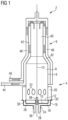
- Fig. 1 is a heating device with an evaporator burner according to the state of the art according to DE 10 2012 100 173 B4 shown.
- This heating device 2 is designed as a mobile, fuel-operated heater for a parking heater of a motor-driven land vehicle.
- the evaporator burner 4 itself has, among other things, a combustion chamber 8, an evaporator receptacle 10, and an evaporator element 12 for evaporating liquid fuel.
- Combustion chamber 8, evaporator receptacle 10, and evaporator element 12 are designed to be essentially rotationally symmetrical.
- the combustion chamber 8 is delimited in the circumferential direction by a surrounding combustion chamber wall 14. At the front end, in the area of the fuel supply, which is provided by a fuel supply pipe 36 and a combustion air inlet 24, the combustion chamber 8 is delimited by the evaporator receptacle 10.
- the evaporator element 12 is accommodated in the evaporator receptacle 10 on the side facing the combustion chamber 8.
- the evaporator burner 4 further has, on the side facing away from the combustion chamber 8
- a combustion air guide element 16 is located on the side of the evaporator holder 10.
- the combustion air guide element 16 is bowl-shaped and is placed over the evaporator holder 10 like a cap.
- a combustion air pre-chamber 20 is formed in a ring around the combustion chamber 8.
- a gap 18 between the bottom wall 26 and the evaporator receptacle 10 opens into the combustion air pre-chamber 20.
- a fluid connection to the combustion chamber 8 is established via combustion air through-openings 22 formed in the combustion chamber wall 14.
- the gap 18 between the bottom wall 26 of the evaporator receptacle 10 and the combustion air guide element 16 extends continuously over the entire surface of the bottom wall 26 (apart from the area of the combustion air inlet 24), so that the bottom wall 26 is cooled essentially over its entire surface (apart from a central area).
- the fuel supply pipe 36 is arranged within the nozzle-shaped combustion air inlet 24 so that, during use, combustion air flows around it and is thereby cooled to prevent the fuel from evaporating and igniting prematurely upon entering the evaporator element 12, which can lead to pulsating combustion.
- a first flow path 42 for the exhaust gases is formed in a heat exchanger 6. The exhaust gases flow within the heat exchanger 6 along the first flow path 42 to an exhaust gas discharge line 44, via which the exhaust gases are guided to the outside.
- a second flow path 46 is provided within the heat exchanger 6, through which the cooling fluid of the motor vehicle is guided. The first 42 and the second 46 flow paths are arranged such that, during use, heat is effectively transferred from the exhaust gases to the cooling fluid.
- the bell-shaped combustion air guide element 16 must be interrupted at least once. This interruption can be used to install a fuel supply pipe 16 or a glow plug of the burner.
- DE 10 2013 214 387 A1 is already a flow guide element in the form of an inflow element comprising a first base area and a and extending essentially in the direction of a longitudinal center axis of the inflow element, a first inner circumferential wall arranged at a radial distance from the outer circumferential wall and defining a spatial region therewith, and an inflow opening arrangement for the inflow of air into the inflow element. It is provided that the inflow opening arrangement is provided in the first base region and is designed to generate a vortex flow.
- DE 195 07 556 A1 discloses another flow guiding element.
- a disadvantage of the previously described solution is that the bowl-shaped geometry limits the size of an evaporator receptacle if a fan pre-chamber is specified. Furthermore, such a flow element can only be arranged, centered and fixed on the burner with great effort. Due to the proximity to the hot burner parts, only a limited selection of materials is possible. Furthermore, especially with an eccentric fan, there is the problem that the air is guided laterally into the heating device at one point and uniform cooling can therefore not be achieved or can only be achieved with great effort.
- the object of the invention is to provide an improved flow guide element, flow guide system and an improved heating device, in particular a mobile heating device for vehicles.
- the flow guide element according to the invention for a heating device comprises a body which has a laterally arranged inflow region on an underside of the flow guide element, a centrally arranged outflow region which comprises an opening from an underside of the flow guide element to an upper side of the flow guide element opposite the underside, and at least one guide element which is arranged in such a way that it enables flow guidance from the inflow region to the outflow region.
- the underside and top side of the flow guide element are two opposite sides of the flow guide element.
- the underside is expediently designed with a support surface, while the top side is designed to be aligned with an evaporator burner receptacle when installed in the heating device.
- the top surface of the flow guide element is adapted to the shape of the receiving heating device, in particular a combustion air pre-chamber.
- the flow guide element according to the invention is particularly suitable for a heating device with a fan arranged outside a central axis, i.e., eccentrically. The flow guide element thus directs an air flow from the fan to the central outflow area in a simple and cost-effective manner.
- the air guiding elements can expediently be formed by projections or walls arranged on the underside of the flow guiding element, so that channels open toward the underside are formed on the flow guiding element.
- the flow guiding elements can also be formed by closed channels.
- the flow guide element is expediently a molded plastic part, in particular an injection-molded plastic part.
- a molded plastic part is cost-effective to manufacture and simplifies assembly.
- Suitable plastics include, for example, polyphenylene sulfite (PPS) or glass fiber-reinforced PPS, in particular PPS GF 40.
- PPS polyphenylene sulfite
- the flow guide element is formed at least partially or exclusively from a metallic material or from a metallic material and one of the aforementioned plastics.
- the flow guide element has a recess for inserting a glow plug, which is arranged in particular on a side opposite the inflow area.
- the inflow area is designed to accommodate a fan.
- the inflow area is formed as a bulge.
- the bulge is curved toward the top of the flow guide element.
- the underside of the bulge is open.
- the guide element(s) are expediently designed to expand the air flow from the inflow area to the outflow area in a fan-like manner and/or to divide the air flow from the inflow area and to form a first Part to the outflow area and another part to be guided further around the outflow area in the circumferential direction and then directed radially inward to the outflow area through one or more openings.
- a targeted flow profile can be created by the one or more guide elements.
- a circumferential wall having one or more openings can be provided at the outflow area.
- the flow guide element has, on a side facing away from the guide element(s), i.e. the top side of the flow guide element, recesses for inserting a fastening element for fixing in a fan antechamber of an evaporator burner.
- the flow guidance system according to the invention for a heating device comprises a flow guidance element according to the invention and a fastening element.
- the fastening element can be easily fastened in the heating device, in particular in a fan antechamber or combustion antechamber.
- the fastening element is suitable for being clamped against the wall of the fan antechamber or combustion antechamber in order to fasten the flow guidance element and fix it in place.
- the fastening element can have projections that engage in the recesses of the wall or are supported against a smooth wall.
- the fastening element is suitable for clamping the flow guidance element such that the flow guidance element itself is clamped against the fan antechamber or combustion antechamber.
- the fastening element is a spring element, in particular a spring element formed from spring steel, preferably a one-piece spring element.
- the spring element is formed at least partially from plastic, from spring steel and plastic, or exclusively from plastic.
- Such a spring element can in particular have two, three, four or more projections in the direction of a circumferential wall and an equal number of projections directed inwards towards the outflow area. of the flow guide element.
- the spring element does not have a closed shape in the circumferential direction, but rather an opening which can be used to position the fastening element by means of deformation. This opening is arranged in particular in alignment with a recess in the flow guide element.
- the flow guide element has recesses, in particular on the upper side, into which the fastening element is inserted and which are designed in particular for the tongues and/or projections such that the flow guide element and fastening element fit together in exactly one orientation.
- the fastening element in particular the spring element, in particular the tongues of the spring element, can be designed to come into contact with an evaporator burner receptacle or evaporator holder, in particular a bottom-side projection of the evaporator burner receptacle or evaporator holder, in the installed state.
- the spring element can be advantageously tensioned by the pressure of the bottom-side projection on the tongues.
- the heating device according to the invention with an evaporator burner with a fan pre-chamber and an eccentric fan comprises a flow guidance system according to the invention.
- the flow guide element is self-centering and accommodated in the blower chamber.
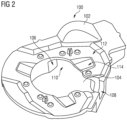
- Fig. 2 shows a first view of a flow guide element.
- This flow guide element 100 has an outer border that is adapted to a receiving area in a combustion air prechamber.
- the flow guide element 100 has an inflow area 102 in an outer area that is adapted to the position of a fan. This fan is eccentrically arranged.
- the flow guide element 100 has a central outflow area 104, which allows the air to pass from a bottom side of the flow guide element 100 to a top side of the flow guide element.
- Guide elements 106 are arranged on the bottom side of the flow guide element 100.
- the flow guide element 100 can, for example, be a molded plastic part.
- the flow guide element 100 has a recess 108 for receiving a glow plug. Furthermore, in the Fig. 2 shown top side, a first recess 112 and a second recess 114 are shown. The first recess has a peripheral shape of the Fig. 3 shown fastening element 120. The fastening element 120 can be inserted into the first recess 112 and second recesses 114. With the fastening element 120, the flow guide element can be easily fastened in the heating device, in particular a fan antechamber or combustion antechamber. This fastening element 120 has three projections that extend radially outward. The second recesses 114 are designed for the three inwardly directed tongues 122 of the fastening element 120.
- the fastening element 120 does not have a closed shape in the circumferential direction, but rather an opening, which can be used to Fastening element 120 is deformed to position it. This opening is designed to be aligned with the recess 108 of the flow guide element 100.
- the fastening element is suitable both for bracing the flow guide element 100 and for supporting it with two of the projections against a wall of the blower chamber 20.
- the fastening element 120 is preferably a spring element, which can be made, for example, from spring steel.
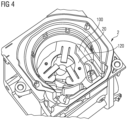
- Fig. 4 shows a view of an open heating device with a flow guide element 100 inserted in a combustion air prechamber 20 and a fastening element 120.
- An underside of the flow guide element 100 rests on an upper side of a floor of the combustion air prechamber 20.
- the fastening element 120 is arranged on the upper side of the flow guide element 100.
- the fastening element 120 is thus arranged towards an evaporator-combustor receptacle or evaporator holder (not shown).
- the tongues 122 of the fastening element 120 are designed in particular to come into contact with a dome or bottom-side projection of the evaporator-combustor receptacle or evaporator holder when installed.
- the pressure of the bottom-side projection of the evaporator-combustor receptacle or evaporator holder on the tongues 122 advantageously tensions the fastening element 120, which is designed as a spring element. With the help of the fastening element 120, the flow guide element 100 is thus held in the desired position.
- Fig. 5 to 7 show different designs of the underside of a flow guide element.
- Fig. 5 The embodiment shown has, on the one hand, the upper recess for the tongue 122 of the fastening element 120 as a guide element 106. Furthermore, it has a guide element 106 which is designed as a circumferential wall around the outflow area 104.
- the guide elements 106 of this embodiment are designed to guide the air from the inflow area 102 to the outflow area 104 over relatively short paths, thereby expanding the air flow. This embodiment guides air over very short paths to an evaporator receptacle arranged above the outflow area 104, thus achieving strong cooling.
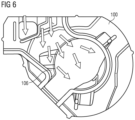
- Fig. 6 shows a further embodiment of the flow guide element 100 from a bottom side.
- This flow guide element 100 differs in particular in a different design of the guide element 106 arranged around the outflow area 104, which is also closed in the area of the recess 108.
- Fig. 7 shows a further embodiment of the flow guide element 100.
- This embodiment differs in that a guide element 106 arranged around the outflow area 104 forms a circumferential flow channel provided with openings 110.
- This flow channel with the openings 110 is suitable for directing the air from different sides to the outflow area 104. This achieves a very uniform flow through the outflow area 104, and an evaporator receptacle arranged above the outflow area 104 can be cooled particularly uniformly.
Landscapes
- Engineering & Computer Science (AREA)
- Mechanical Engineering (AREA)
- Chemical & Material Sciences (AREA)
- Combustion & Propulsion (AREA)
- General Engineering & Computer Science (AREA)
- Physics & Mathematics (AREA)
- Thermal Sciences (AREA)
- Direct Air Heating By Heater Or Combustion Gas (AREA)
- Air-Conditioning For Vehicles (AREA)
Description
- Die Erfindung betrifft ein Strömungsleitelement, ein Strömungsleitsystem und eine Heizvorrichtung, insbesondere eine mobile Heizvorrichtung für Fahrzeuge.
- Heizvorrichtungen mit einem Verdampferverbrenner finden Anwendung in mit flüssigem Kraftstoff betriebenen Stand- und /oder Zusatzheizungen, welche insbesondere für Fahrzeuge eingesetzt werden. In
Fig. 1 ist eine Heizvorrichtung mit einem Verdampferverbrenner nach dem Stand der Technik gemäß derDE 10 2012 100 173 B4 gezeigt. Diese Heizvorrichtung 2 ist als mobiles, brennstoffbetriebenes Heizgerät für eine Standheizung eines motorbetriebenes Landfahrzeugs ausgelegt. Der Verdampferbrenner 4 selbst weist unter anderem eine Brennkammer 8, eine Verdampferaufnahme 10 und ein Verdampferelement 12 zur Verdampfung von flüssigem Brennstoff auf. Brennkammer 8, Verdampferaufnahme 10 und Verdampferelement 12 sind im Wesentlichen rotationssymmetrisch ausgelegt. Die Brennkammer 8 wird in Umfangsrichtung durch eine umlaufende Brennkammerwandung 14 begrenzt. Stirnseitig im Bereich der Brennstoffzuführung, die durch ein Brennstoffzuführrohr 36 und eine Brennluft-Einlass 24 gegeben ist, wird die Brennkammer 8 durch die Verdampferaufnahme 10 begrenzt. In der Verdampferaufnahme 10 ist auf der Seite, die der Brennkammer 8 zugewandt ist, das Verdampferelement 12 aufgenommen. Der Verdampferbrenner 4 weist ferner auf der von der Brennkammer 8 abgewandten Seite der Verdampferaufnahme 10 ein Brennluftleitelement 16 auf. Das Brennluftleitelement 16 ist schalenförmig ausgebildet und ist ähnlich wie eine Kappe über die Verdampferaufnahme 10 gestülpt. - Ringförmig um die Brennkammer 8 ist ein Brennluft-Vorraum 20 ausgebildet. Ein Spalt 18 zwischen Bodenwand 26 und Verdampferaufnahme 10 mündet in den Brennluft-Vorraum 20. Von dem Brennluft-Vorraum 20 wird wiederum über Brennluft-Durchgangsöffnungen 22, die in der Brennkammerwandung 14 ausgebildet sind, eine Fluidverbindung mit der Brennkammer 8 hergestellt. Der Spalt 18 zwischen der Bodenwand 26 der Verdampferaufnahme 10 und dem Brennluftleitelement 16 erstreckt sich durchgehend über die gesamte Fläche der Bodenwand 26 (abgesehen von dem Bereich des Brennluft-Einlasses 24), so dass die Bodenwand 26 im Wesentlichen über deren gesamte Fläche (abgesehen von einem zentralen Bereich) gekühlt wird.
- Das Brennstoff-Zuführrohr 36 ist innerhalb des stutzenförmigen Brennluft-Einlasses 24 angeordnet, so dass es im Einsatz von Brennluft umströmt und dadurch gekühlt wird, um zu verhindern, dass der Brennstoff direkt bei Eintritt in das Verdampferelement 12 frühzeitig verdampft und gezündet wird, was zu einem Pulsieren der Verbrennung führen kann. In einem Wärmetauscher 6 wird ein erster Strömungspfad 42 für die Abgase gebildet. Die Abgase strömen innerhalb des Wärmetauschers 6 entlang des ersten Strömungspfads 42 zu einer Abgas-Ableitung 44, über welche die Abgase nach Außen geführt werden. Ferner ist ein zweiter Strömungspfad 46 innerhalb des Wärmetauschers 6 vorgesehen, in dem Kühlfluid des Kraftfahrzeuges geführt wird. Der erste 42 und der zweite 46 Strömungspfad sind dabei derart angeordnet, dass im Einsatz Wärme effektiv von den Abgasen auf das Kühlfluid übertragen wird.
- Aus Montagegründen muss das glockenförmige Brennluftleitelement 16 an zumindest einer Stelle unterbrochen sein. Diese Unterbrechung kann dafür genutzt werden, ein Brennstoffzufuhrrohr 16 oder einen Glühstift des Brenners anzuordnen. Aus der
DE 10 2013 214 387 A1 ist bereits ein Strömungsleitelement in Form eines Einströmelementes umfassend einen ersten Bodenbereich und eine an den ersten Bodenbereich anschließende und sich im Wesentlichen in Richtung einer Längsmittenachse des Einströmelements erstreckende Außenumfangswandung, eine in radialem Abstand zur Außenumfangswandlung angeordnete und mit dieser einen Raumbereich begrenzende erste Innenumfangswandung sowie eine Einströmöffnungsanordnung zum Einströmen von Luft in das Einströmelement bekannt. Dabei ist vorgesehen, dass die Einströmungsöffnungsanordnung im ersten Bodenbereich vorgesehen und zur Erzeugung einer Wirbelströmung ausgebildet ist. DieDE 195 07 556 A1 offenbart ein anderes Strömungsleitelement. - Nachteilig an der vorherigen beschriebenen Lösung ist, dass die schalenförmige Geometrie die Größe einer Verdampferaufnahme beschränkt, soweit ein Gebläsevorraum vorgegeben ist. Weiterhin kann ein solches Strömungselement nur aufwändig am Brenner angeordnet, zentriert und fixiert werden. Durch die Nähe zu den heißen Brennerteilen kommt hier nur eine eingeschränkte Materialauswahl in Frage. Weiterhin besteht insbesondere bei einem exzentrischen Gebläse das Problem, dass die Luft an einer Stelle seitlich in die Heizvorrichtung geführt wird und eine gleichmäßige Kühlung somit nicht oder nur sehr aufwändig realisiert werden kann. Aufgabe der Erfindung ist es ein verbessertes Strömungsleitelement, Strömungsleitsystem und eine verbesserte Heizvorrichtung, insbesondere eine mobile Heizvorrichtung für Fahrzeuge anzugeben.
- Die Aufgabe der Erfindung wird hinsichtlich des Strömungsleitelement durch die Merkmale des Anspruchs 1 gelöst, hinsichtlich des Strömungsleitsystem durch die Merkmale des Anspruchs 6 und hinsichtlich der Heizvorrichtung durch die Merkmale des Anspruchs 8 gelöst. Zweckdienliche Ausgestaltungen ergeben sich aus den jeweiligen Unteransprüchen.
- Das erfindungsgemäße Strömungsleitelement für eine Heizvorrichtung, insbesondere eine Heizvorrichtung mit einem Verdampferverbrenner, umfasst einen Körper, welcher einen seitlich angeordneten Anströmbereich auf einer Unterseite des Strömungsleitelements, einen zentral angeordneten Ausströmbereich, der einen Durchbruch von einer Unterseite des Strömungsleitelements zu einer der Unterseite gegenüberliegenden Oberseite des Strömungsleitelements umfasst, und zumindest ein Führungselement aufweist, welches so angeordnet ist, dass es eine Strömungsführung vom Anströmbereich zum Ausströmbereich ermöglicht.
- Unterseite und Oberseite des Strömungsleitelements sind zwei sich gegenüberliegende Seiten des Strömungsleitelements. Dabei ist die Unterseite zweckmäßigerweise mit einer Auflagefläche ausgestaltet, die Oberseite ist dazu ausgelegt, in einem in die Heizvorrichtung eingebauten Zustand zu einer Verdampferverbrenneraufnahme ausgerichtet zu sein. Eine äußere Form, insbesondere gesehen in Projektion auf die Oberseite des Strömungsleitelements ist an die Form der aufnehmenden Heizvorrichtung, insbesondere eines Brennluftvorraums angepasst. Das erfindungsgemäße Strömungsleitelement ist insbesondere für eine Heizvorrichtung mit einem außerhalb einer Mittelachse angeordnetem, also exzentrischen, Gebläse geeignet. Das Strömungsleitelement leitet somit in einfacher und kostengünstiger Weise eine Luftströmung vom Gebläse zum zentralen Ausströmbereich.
- Die Luftleitelemente können zweckmäßigerweise durch auf der Unterseite des Strömungsleitelements angeordnete Vorsprünge oder Wände gebildet sein, so dass auf dem Strömungsleitelement auf zur Unterseite hin offene Kanäle gebildet sind. Alternativ können die Strömungsleitelemente auch durch geschlossene Kanäle gebildet werden.
- Zweckmäßigerweise ist das Strömungsleitelement ein Kunststoffformteil, insbesondere ein Kunststoffspritzgussteil. Ein solches Kunststoffformteil ist kostengünstig herzustellen und vereinfacht die Montage. Als Kunststoffe kommen zum Beispiel Polyphenylensulfit (PPS) oder mit Glasfasern verstärktes PPS, insbesondere PPS GF 40 in Frage. In einer weiteren Ausgestaltung ist das Strömungsleitelement zumindest teilweise oder ausschließlich aus einem metallischen Material gebildet oder aus metallischem Material und einem der vorgenannten Kunststoffe gebildet.
- In Ausgestaltung weist das Strömungsleitelement eine Aussparung zum Einsetzen eines Glühstiftes auf, welche insbesondere auf einer dem Anströmbereich gegenüberliegenden Seite angeordnet ist.
- In einer weiteren Ausgestaltung ist der Anströmbereich zur Aufnahme eines Gebläses ausgelegt. Erfindungsgemäß, ist der Anströmbereich als Auswölbung ausgebildet.
- Die Auswölbung ist zur Oberseite des Strömungsleitelements gewölbt. Die Unterseite der Auswölbung ist offen ausgestaltet.
- Das oder die Führungselemente sind zweckmäßigerweise dazu ausgebildet, die Luftströmung vom Anströmbereich zum Ausströmbereich fächerartig auszuweiten, und/oder die die Luftströmung vom Anströmbereich aufzuteilen und einen ersten Teil zum Ausströmbereich zu leiten und einen weiteren Teil um den Ausströmbereich in Umfangsrichtung weiter zu führen und dann an einer oder mehreren Öffnungen radial nach innen zum Ausströmbereich zu leiten. Durch das eine oder die mehreren Führungselemente kann ein gezieltes Strömungsprofil erzeugt werden. Um einen Teil der Luftströmung in Umfangsrichtung zu führen kann eine umlaufende Wand am Ausströmbereich, welche einen oder mehrere Durchbrüche aufweist, vorgesehen sein.
- In weiterer Ausgestaltung weist das Strömungsleitelement auf einer der oder den Führungselementen abgewandten Seite, d.h. der Oberseite des Strömungsleitelements, Vertiefungen zur Einlage eines Befestigungselements zur Fixierung in einem Gebläsevorraum eines Verdampferverbrenners auf.
- Das erfindungsgemäße Strömungsleitsystem für eine Heizvorrichtung, insbesondere eine Heizvorrichtung mit einem Verdampferverbrenner, umfasst ein erfindungsgemäßes Strömungsleitelement und ein Befestigungselement. Mit dem Befestigungselement lässt sich in einfacher Weise das Strömungsleitelement in der Heizvorrichtung, insbesondere einem Gebläsevorraum bzw. Brennvorraum, befestigen. In einer ersten Ausgestaltung ist das Befestigungselement geeignet, selbst gegen die Wandung des Gebläsevorraum bzw. Brennvorraum verspannt zu werden, um so das Strömungsleitelement zu befestigen und ortsfest zu fixieren. Dazu kann das Befestigungselement Vorsprünge aufweisen, welche in die Vertiefungen der Wandung eingreifen oder gegen eine glatte Wandung gestützt sind. Alternativ oder zusätzlich ist das Befestigungselement geeignet, das Strömungsleitelement so zu spannen, dass das Strömungsleitelement selbst gegen Gebläsevorraum bzw. Brennvorraum verspannt wird.
- In Ausgestaltung ist das Befestigungselement ein Federelement, insbesondere ein aus einem Federstahl ausgebildetes, vorzugsweise einstückiges, Federelement. In einer weiteren Ausgestaltung ist das Federelement zumindest teilweise aus Kunststoff, aus Federstahl und Kunststoff oder ausschließlich aus Kunststoff gebildet. Ein solches Federelement kann insbesondere zwei, drei, vier oder mehr Vorsprünge in Richtung einer Umfangswandung und eine gleiche Anzahl von nach innen zum Ausströmbereich des Strömungsleitelements gerichtete Zungen aufweisen. In Ausgestaltung weist das Federelement in Umfangsrichtung keine geschlossene Form auf, sondern eine Öffnung, welche genutzt werden kann, um das Befestigungselement mittels einer Verformung in Position zu bringen. Diese Öffnung ist insbesondere mit einer Aussparung des Strömungsleitelements fluchtend angeordnet. Das Strömungsleitelement hat insbesondere auf der Oberseite Vertiefungen, in welche das Befestigungselement eingelegt wird, und die insbesondere für die Zungen und/oder Vorsprüngen so ausgelegt sind, dass Strömungsleitelement und Befestigungselement in genau einer Orientierung zueinander passen. Weiterhin kann das Befestigungselement, insbesondere das Federelement, insbesondere die Zungen des Federelement dazu ausgelegt sein, mit einer Verdampferverbrenneraufnahme bzw. Verdampferhalterung, insbesondere einem bodenseitigen Vorsprung der Verdampferverbrenneraufnahme bzw. Verdampferhalterung, im eingebauten Zustand in Kontakt zu kommen. Durch den Druck des bodenseitigen Vorsprungs auf die Zungen kann das Federelement vorteilhaft verspannt werden.
- Die erfindungsgemäße Heizvorrichtung mit einem Verdampferverbrenner mit einem Gebläsevorraum und einem exzentrischen Gebläse umfasst ein erfindungsgemäßes Strömungsleitsystem.
- In Ausgestaltung wird das Strömungsleitelement selbstzentrierend im Gebläseraum aufgenommen.
- Die Erfindung wird nachstehend auch hinsichtlich weiterer Merkmale und Vorteile anhand der Beschreibung von Ausführungsbeispielen und unter Bezugnahme auf die beiliegenden Zeichnungen näher erläutert. Es zeigen jeweils in einer Prinzipskizze:
- Fig. 1
- Heizvorrichtung nach dem Stand der Technik;
- Fig. 2
- erste Ansicht eines Strömungsleitelements;
- Fig. 3
- Befestigungselement;
- Fig. 4
- Ansicht einer offenen Heizvorrichtung;
- Fig. 5
- zweite Ansicht einer ersten Ausgestaltung eines Strömungsleitelements;
- Fig. 6
- zweite Ansicht einer zweiten Ausgestaltung eines Strömungsleitelements und
- Fig. 7
- zweite Ansicht einer dritten Ausgestaltung eines Strömungsleitelements.
-
Fig. 2 zeigt eine erste Ansicht eines Strömungsleitelements. Dieses Strömungsleitelement 100 weist eine äußere Umrandung auf, welche an einen Aufnahmebereich in einem Brennluftvorraum angepasst ist. Das Strömungsleitelement 100 weist in einem äußeren Bereich einen Anströmbereich 102 auf, welcher auf die Position eines Gebläses abgestimmt ist. Es handelt sich um ein exzentrisch angeordnetes Gebläse. - Weiterhin weist das Strömungsleitelement 100 einen zentralen Ausströmbereich 104 auf, welcher es erlaubt, dass die Luft von einer Unterseite des Strömungsleitelements 100 zu einer Oberseite des Strömungsleitelements durchtritt. Auf der Unterseite des Strömungsleitelements 100 sind Führungselemente 106 angeordnet. Das Strömungsleitelement 100 kann z.B. ein Kunststoffformteil sein.
- Das Strömungsleitelement 100 weist eine Aussparung 108 zur Aufnahme eines Glühstiftes auf. Weiterhin sind in der in
Fig. 2 gezeigten Oberseite eine erste Vertiefung 112 und eine zweite Vertiefung 114 gezeigt. Die erste Vertiefung weist eine Umfangsform des inFig. 3 gezeigten Befestigungselements 120 auf. Das Befestigungselement 120 kann in die erste Vertiefung 112 und zweiten Vertiefungen 114 eingelegt werden. Mit dem Befestigungselement 120 lässt sich in einfacher Weise das Strömungsleitelement in der Heizvorrichtung, insbesondere einem Gebläsevorraum bzw. Brennvorraum, befestigen. Dieses Befestigungselement 120 weist drei Vorsprünge, die sich radial nach außen erstrecken auf. Die zweiten Vertiefungen 114 sind für die drei nach innen gerichteten Zungen 122 des Befestigungselements 120 ausgelegt. Das Befestigungselement 120 weist in Umfangsrichtung keine geschlossene Form auf, sondern eine Öffnung, welche genutzt werden kann, um das Befestigungselement 120 mittels einer Verformung in Position zu bringen. Diese Öffnung ist zur fluchtenden Anordnung mit der Aussparung 108 des Strömungsleitelements 100 ausgelegt. Das Befestigungselement ist hier sowohl geeignet das Strömungsleitelement 100 zu verspannen als auch mit zweien der Vorsprünge gegen eine Wandung des Gebläseraums 20 abzustützen. Das Befestigungselement 120 ist vorzugsweise ein Federelement, welches z.B. aus einem Federstahl hergestellt sein kann. -
Fig. 4 zeigt eine Ansicht einer offenen Heizvorrichtung mit einem in einem Brennluftvorraum 20 eingelegten Strömungsleitelement 100 und einem Befestigungselement 120. Eine Unterseite des Strömungsleitelements 100 liegt auf einer Oberseite eines Boden des Brennluftvorraums 20 auf. Das Befestigungselement 120 ist auf der Oberseite des Strömungsleitelements 100 angeordnet. Das Befestigungselement 120 ist somit zu einer nicht dargestellten Verdampferverbrenneraufnahme bzw. Verdampferhalterung hin angeordnet. Die Zungen 122 des Befestigungselements 120 sind insbesondere dazu ausgelegt mit einem Dom oder bodenseitigen Vorsprung der Verdampferverbrenneraufnahme bzw. Verdampferhalterung, im eingebauten Zustand in Kontakt zu kommen. Durch den Druck des bodenseitigen Vorsprungs der Verdampferverbrenneraufnahme bzw. Verdampferhalterung auf die Zungen 122 kann als das Federelement ausgestaltete Befestigungselement 120 vorteilhaft verspannt werden. Mit Hilfe des Befestigungselements 120 wird somit das Strömungsleitelement 100 in der gewünschten Position gehalten. -
Fig. 5 bis 7 zeigen verschiedene Ausgestaltungen einer Unterseite eines Strömungsleitelements. Die inFig. 5 gezeigte Ausgestaltung weist zum einem die oberseitige Vertiefung für die Zunge 122 des Befestigungselements 120 als Führungselement 106 aus. Des Weiteren weist sie ein Führungselement 106 auf, welche um den Ausströmbereich 104 als umlaufende Wand ausgestaltet ist. Die Führungselemente 106 dieser Ausgestaltung sind dazu ausgelegt, die Luft von dem Anströmbereich 102 zum Ausströmbereich 104 auf relativ kurzen Wege zu leiten und dabei die Luftströmung aufzuweiten. Durch diese Ausgestaltung wird Luft auf sehr kurzen Wege zu einer oberhalb des Ausströmbereichs 104 angeordneten Verdampferaufnahme geleitet, so dass eine starke Kühlung erreicht wird. -
Fig. 6 zeigt eine weitere Ausgestaltung des Strömungsleitelements 100 von einer Unterseite. Dieses Strömungsleitelement 100 unterscheidet sich insbesondere in einer abweichenden Ausgestaltung des um den Ausströmbereich 104 angeordneten Führungselements 106, welches auch im Bereich der Aussparung 108 geschlossen ist. -
Fig. 7 zeigt eine weitere Ausgestaltung des Strömungsleitelements 100. Diese Ausgestaltung unterscheidet sich darin, dass ein um den Ausströmbereich 104 angeordneten Führungselements 106 einen umlaufenden Strömungskanal bildet, der mit Öffnungen 110 versehen ist. Dieser Strömungskanal mit den Öffnungen 110 ist geeignet, die Luft von verschiedenen Seiten zum Ausströmbereich 104 zu leiten. Dadurch wird eine sehr gleichmäßige Strömung durch den Ausströmbereich 104 erzielt und eine oberhalb des Ausströmbereichs 104 angeordneten Verdampferaufnahme kann besonders gleichmäßig gekühlt werden. -
- 2
- Heizvorrichtung
- 4
- Verdampferverbrenner
- 8
- Brennkammer
- 10
- Verdampferaufnahme
- 12
- Verdampferelement
- 16
- Brennluftleitelement
- 14
- Brennkammerwandung
- 18
- Spalt
- 20
- Brennluftvorraum
- 22
- Brennluft-Durchgangsöffnungen
- 26
- Bodenwand
- 24
- Brennluft-Einlass
- 36
- Zuführrohr
- 42
- erster Strömungspfad
- 44
- Abgas-Ableitung
- 46
- zweiter Strömungspfad
- 100
- Strömungsleitelement
- 102
- Anströmbereich
- 104
- Ausströmbereich
- 106
- Führungselement
- 108
- Aussparung
- 110
- Öffnung
- 112
- erste Vertiefung
- 114
- zweite Vertiefung
- 120
- Befestigungselement
- 122
- Zunge
- t
- Dicke
Claims (9)
- Strömungsleitelement (100) für eine Heizvorrichtung (2), insbesondere eine Heizvorrichtung (2) mit einem Verdampferverbrenner (4), umfassend einen Körper, welcher einen seitlich angeordneten Anströmbereich (102) auf einer Unterseite des Strömungsleitelements, einen zentral angeordneten Ausströmbereich (104), der einen Durchbruch von einer Unterseite des Strömungsleitelements zu einer der Unterseite gegenüberliegenden Oberseite des Strömungsleitelements umfasst, und zumindest ein Führungselement (106) aufweist, welches so angeordnet ist, dass es eine Strömungsführung vom Anströmbereich zum Ausströmbereich ermöglicht, wobei der Anströmbereich (102) als Auswölbung ausgebildet ist.
- Strömungsleitelement nach Anspruch 1, wobei das Strömungsleitelement (100) ein Kunststoffformteil, insbesondere ein Kunststoffspritzgussteil, ist.
- Strömungsleitelement (100) nach Anspruch 1 oder 2, wobei das Strömungsleitelement (100) eine Aussparung (108) zum Einsetzen eines Glühstiftes aufweist, welche insbesondere auf einer dem Anströmbereich (102) gegenüberliegenden Seite angeordnet ist.
- Strömungsleitelement (100) nach einem der vorhergehenden Ansprüche, wobei das oder die Führungselemente (106) dazu ausgebildet sind, die Luftströmung vom Anströmbereich (102) zum Ausströmbereich (104) fächerartig auszuweiten, und/oder die die Luftströmung vom Anströmbereich (102) aufzuteilen und einen ersten Teil zum Ausströmbereich (104) zu leiten und einen weiteren Teil um den Ausströmbereich (104) in Umfangsrichtung weiter zu führen und dann an einer oder mehreren Öffnungen (110) radial nach innen zum Ausströmbereich (104) zu leiten.
- Strömungsleitelement (100) nach einem der vorhergehenden Ansprüche, wobei das Strömungsleitelement (100) auf einer dem oder den Führungselementen (106) abgewandten Seite Vertiefungen (112, 114) zur Einlage eines Befestigungselements (120) zur Fixierung in einem Gebläsevorraum oder Brennluftvorraum (20) eines Verdampferverbrenners (4) aufweist.
- Strömungsleitsystem für eine Heizvorrichtung (2), insbesondere eine Heizvorrichtung mit einem Verdampferverbrenner (4), umfassend ein Strömungsleitelement (100) nach einem der Ansprüche 1 bis 5 und ein Befestigungselement (120).
- Strömungsleitsystem nach Anspruch 6, wobei das Befestigungselement (120) ein Federelement, insbesondere ein aus einem Federstahl ausgebildetes Federelement, ist.
- Heizvorrichtung (2) mit einem Verdampferverbrenner (4) mit einem Gebläsevorraum oder Brennluftvorraum (20) und einem exzentrischen Gebläse, umfassend ein Strömungsleitsystem nach Anspruch 6 oder 7.
- Heizvorrichtung (2) nach Anspruch 8, wobei das Strömungsleitelement selbstzentrierend im Gebläseraum oder Brennluftvorraum (20) aufgenommen wird.
Applications Claiming Priority (2)
| Application Number | Priority Date | Filing Date | Title |
|---|---|---|---|
| DE102019135786.1A DE102019135786A1 (de) | 2019-12-24 | 2019-12-24 | Strömungsleitelement, Strömungsleitsystem und Heizvorrichtung |
| PCT/EP2020/084297 WO2021130000A1 (de) | 2019-12-24 | 2020-12-02 | Strömungsleitelement, strömungsleitsystem und heizvorrichtung |
Publications (2)
| Publication Number | Publication Date |
|---|---|
| EP4081738A1 EP4081738A1 (de) | 2022-11-02 |
| EP4081738B1 true EP4081738B1 (de) | 2025-06-18 |
Family
ID=73695059
Family Applications (1)
| Application Number | Title | Priority Date | Filing Date |
|---|---|---|---|
| EP20817339.3A Active EP4081738B1 (de) | 2019-12-24 | 2020-12-02 | Strömungsleitelement, strömungsleitsystem und heizvorrichtung |
Country Status (5)
| Country | Link |
|---|---|
| US (1) | US12246581B2 (de) |
| EP (1) | EP4081738B1 (de) |
| CN (1) | CN114901996A (de) |
| DE (1) | DE102019135786A1 (de) |
| WO (1) | WO2021130000A1 (de) |
Family Cites Families (12)
| Publication number | Priority date | Publication date | Assignee | Title |
|---|---|---|---|---|
| DE19507556B4 (de) | 1994-10-20 | 2004-12-30 | J. Eberspächer GmbH & Co. KG | Verfahren zum Starten eines Brenners für ein Fahrzeugheizgerät oder einen Partikelfilter-Regenerator |
| DE19907264C1 (de) | 1999-02-20 | 2000-10-05 | Webasto Thermosysteme Gmbh | Luftansaug-Schalldämpfer mit Wasserabscheider |
| DE102006024221A1 (de) | 2006-05-23 | 2007-11-29 | J. Eberspächer GmbH & Co. KG | Verdampferbaugruppe, insbesondere für ein Fahrzeugheizgerät oder eine Reformeranordnung eines Brennstoffzellensystems |
| DE102007030606A1 (de) * | 2007-07-02 | 2009-01-08 | J. Eberspächer GmbH & Co. KG | Fahrzeugheizgerät |
| DE102010043222B4 (de) * | 2010-11-02 | 2014-02-27 | Eberspächer Climate Control Systems GmbH & Co. KG | Brennkammerbaugruppe und Zündorgan dafür |
| DE102011084868C5 (de) * | 2011-10-20 | 2020-07-23 | Eberspächer Climate Control Systems GmbH & Co. KG | Verdampferbrenner, insbesondere für ein Fahrzeugheizgerät |
| DE102012100173B4 (de) | 2012-01-10 | 2014-09-04 | Webasto Ag | Verdampferbrenner für ein mobiles Heizgerät |
| DE102012207960B3 (de) * | 2012-05-11 | 2013-08-08 | Eberspächer Exhaust Technology GmbH & Co. KG | Partikelfilter |
| DE102013214387B4 (de) * | 2013-07-23 | 2020-10-22 | Eberspächer Climate Control Systems GmbH | Einströmelement, insbesondere für einen Verbrennungsluftströmungsweg im Fahrzeugheizgerät |
| DE102014103813A1 (de) * | 2014-03-20 | 2015-09-24 | Webasto SE | Verdampferbrenneranordnung für ein mobiles, mit flüssigem Brennstoff betriebenes Heizgerät |
| DE102016116687B4 (de) * | 2016-09-07 | 2019-12-05 | Eberspächer Climate Control Systems GmbH & Co. KG | Brennkammerbaugruppe für einen Verdampferbrenner |
| DE102018131253A1 (de) * | 2018-12-07 | 2020-06-10 | Eberspächer Climate Control Systems GmbH & Co. KG | Brennkammerbaugruppe |
-
2019
- 2019-12-24 DE DE102019135786.1A patent/DE102019135786A1/de active Pending
-
2020
- 2020-12-02 WO PCT/EP2020/084297 patent/WO2021130000A1/de not_active Ceased
- 2020-12-02 US US17/788,580 patent/US12246581B2/en active Active
- 2020-12-02 CN CN202080090218.4A patent/CN114901996A/zh active Pending
- 2020-12-02 EP EP20817339.3A patent/EP4081738B1/de active Active
Also Published As
| Publication number | Publication date |
|---|---|
| DE102019135786A1 (de) | 2021-06-24 |
| CN114901996A (zh) | 2022-08-12 |
| EP4081738A1 (de) | 2022-11-02 |
| WO2021130000A1 (de) | 2021-07-01 |
| US20230051497A1 (en) | 2023-02-16 |
| US12246581B2 (en) | 2025-03-11 |
Similar Documents
| Publication | Publication Date | Title |
|---|---|---|
| EP1774180B1 (de) | Radialgebläserad | |
| EP1214514B1 (de) | Fluideinleitung für ein heisses fluid in einer hohlraumstruktur | |
| EP3447378A1 (de) | Fahrzeugheizgerät | |
| EP1196687A1 (de) | Fluideinleitung für ein heissles fluid in einer hohlraumstruktur | |
| EP2686609B1 (de) | Mischvorrichtung zur mischung von verbrennungsluft und gas für ein gasgerät | |
| DE102006051000A1 (de) | Wärmetauscher, Verfahren zur Herstellung eines Wärmetauschers | |
| EP3529538B1 (de) | Bogenelement für ein lüftungssystem | |
| EP4081738B1 (de) | Strömungsleitelement, strömungsleitsystem und heizvorrichtung | |
| DE102011004159A1 (de) | Wärmetauscheranordnung, insbesondere für ein brennstoffbetriebenes Fahrzeugheizgerät | |
| EP3611354A1 (de) | Mischer | |
| EP2117860B1 (de) | Luftausströmer, insbesondere für ein kraftfahrzeug | |
| DE102012211932B3 (de) | Brennkammerbaugruppe, insbesondere für ein Fahrzeugheizgerät | |
| EP3128233B1 (de) | Mischanordnung mit kraftstoffverdampfungsanordnung | |
| DE102020134333B4 (de) | Strömungsleiteinsatz, Befestigungselement, Strömungsleitsystem und Heizvorrichtung | |
| EP1970233B1 (de) | Einrichtung zum Konditionieren von in einen Fahrzeuginnenraum einzuleitender Luft | |
| DE102012101576A1 (de) | Verdampferbrenner mit Abdeckung für ein mobiles Heizgerät | |
| DE19634936C2 (de) | Düsenauslaß | |
| DE102021112943A1 (de) | Heizgerätegehäuse für ein brennstoffbetriebenes Fahrzeugheizgerät | |
| EP1382808B1 (de) | Einfülleinrichtung, insbesondere Öleinfülleinrichtung an einer Brennkraftmaschine | |
| DE202008016461U1 (de) | Strömungsauslassvorrichtung | |
| DE3502648A1 (de) | Vorrichtung zur mischung eines haupt-gasstroms mit mindestens einem neben-gasstrom | |
| EP1571021B1 (de) | Heizluftein- und Ausströmbaugruppe für ein Heizgerät | |
| EP2863121B1 (de) | Düse für einen Gasbrenner | |
| DE102023110056A1 (de) | Strahlpumpe | |
| DE102021101418A1 (de) | Brenner für gasförmige Gemische mit niedrigem Heizwert |
Legal Events
| Date | Code | Title | Description |
|---|---|---|---|
| STAA | Information on the status of an ep patent application or granted ep patent |
Free format text: STATUS: UNKNOWN |
|
| STAA | Information on the status of an ep patent application or granted ep patent |
Free format text: STATUS: THE INTERNATIONAL PUBLICATION HAS BEEN MADE |
|
| PUAI | Public reference made under article 153(3) epc to a published international application that has entered the european phase |
Free format text: ORIGINAL CODE: 0009012 |
|
| STAA | Information on the status of an ep patent application or granted ep patent |
Free format text: STATUS: REQUEST FOR EXAMINATION WAS MADE |
|
| 17P | Request for examination filed |
Effective date: 20220721 |
|
| AK | Designated contracting states |
Kind code of ref document: A1 Designated state(s): AL AT BE BG CH CY CZ DE DK EE ES FI FR GB GR HR HU IE IS IT LI LT LU LV MC MK MT NL NO PL PT RO RS SE SI SK SM TR |
|
| DAV | Request for validation of the european patent (deleted) | ||
| DAX | Request for extension of the european patent (deleted) | ||
| GRAP | Despatch of communication of intention to grant a patent |
Free format text: ORIGINAL CODE: EPIDOSNIGR1 |
|
| STAA | Information on the status of an ep patent application or granted ep patent |
Free format text: STATUS: GRANT OF PATENT IS INTENDED |
|
| INTG | Intention to grant announced |
Effective date: 20241122 |
|
| GRAJ | Information related to disapproval of communication of intention to grant by the applicant or resumption of examination proceedings by the epo deleted |
Free format text: ORIGINAL CODE: EPIDOSDIGR1 |
|
| STAA | Information on the status of an ep patent application or granted ep patent |
Free format text: STATUS: REQUEST FOR EXAMINATION WAS MADE |
|
| GRAP | Despatch of communication of intention to grant a patent |
Free format text: ORIGINAL CODE: EPIDOSNIGR1 |
|
| STAA | Information on the status of an ep patent application or granted ep patent |
Free format text: STATUS: GRANT OF PATENT IS INTENDED |
|
| INTC | Intention to grant announced (deleted) | ||
| INTG | Intention to grant announced |
Effective date: 20250307 |
|
| GRAS | Grant fee paid |
Free format text: ORIGINAL CODE: EPIDOSNIGR3 |
|
| GRAA | (expected) grant |
Free format text: ORIGINAL CODE: 0009210 |
|
| STAA | Information on the status of an ep patent application or granted ep patent |
Free format text: STATUS: THE PATENT HAS BEEN GRANTED |
|
| AK | Designated contracting states |
Kind code of ref document: B1 Designated state(s): AL AT BE BG CH CY CZ DE DK EE ES FI FR GB GR HR HU IE IS IT LI LT LU LV MC MK MT NL NO PL PT RO RS SE SI SK SM TR |
|
| REG | Reference to a national code |
Ref country code: GB Ref legal event code: FG4D Free format text: NOT ENGLISH |
|
| REG | Reference to a national code |
Ref country code: CH Ref legal event code: EP |
|
| REG | Reference to a national code |
Ref country code: DE Ref legal event code: R096 Ref document number: 502020011259 Country of ref document: DE |
|
| REG | Reference to a national code |
Ref country code: CH Ref legal event code: EP |
|
| REG | Reference to a national code |
Ref country code: IE Ref legal event code: FG4D Free format text: LANGUAGE OF EP DOCUMENT: GERMAN |
|
| PG25 | Lapsed in a contracting state [announced via postgrant information from national office to epo] |
Ref country code: FI Free format text: LAPSE BECAUSE OF FAILURE TO SUBMIT A TRANSLATION OF THE DESCRIPTION OR TO PAY THE FEE WITHIN THE PRESCRIBED TIME-LIMIT Effective date: 20250618 |
|
| REG | Reference to a national code |
Ref country code: LT Ref legal event code: MG9D |
|
| PG25 | Lapsed in a contracting state [announced via postgrant information from national office to epo] |
Ref country code: NO Free format text: LAPSE BECAUSE OF FAILURE TO SUBMIT A TRANSLATION OF THE DESCRIPTION OR TO PAY THE FEE WITHIN THE PRESCRIBED TIME-LIMIT Effective date: 20250918 Ref country code: GR Free format text: LAPSE BECAUSE OF FAILURE TO SUBMIT A TRANSLATION OF THE DESCRIPTION OR TO PAY THE FEE WITHIN THE PRESCRIBED TIME-LIMIT Effective date: 20250919 |
|
| PG25 | Lapsed in a contracting state [announced via postgrant information from national office to epo] |
Ref country code: BG Free format text: LAPSE BECAUSE OF FAILURE TO SUBMIT A TRANSLATION OF THE DESCRIPTION OR TO PAY THE FEE WITHIN THE PRESCRIBED TIME-LIMIT Effective date: 20250618 |
|
| PG25 | Lapsed in a contracting state [announced via postgrant information from national office to epo] |
Ref country code: HR Free format text: LAPSE BECAUSE OF FAILURE TO SUBMIT A TRANSLATION OF THE DESCRIPTION OR TO PAY THE FEE WITHIN THE PRESCRIBED TIME-LIMIT Effective date: 20250618 |
|
| PG25 | Lapsed in a contracting state [announced via postgrant information from national office to epo] |
Ref country code: RS Free format text: LAPSE BECAUSE OF FAILURE TO SUBMIT A TRANSLATION OF THE DESCRIPTION OR TO PAY THE FEE WITHIN THE PRESCRIBED TIME-LIMIT Effective date: 20250918 |
|
| REG | Reference to a national code |
Ref country code: NL Ref legal event code: MP Effective date: 20250618 |
|
| PG25 | Lapsed in a contracting state [announced via postgrant information from national office to epo] |
Ref country code: LV Free format text: LAPSE BECAUSE OF FAILURE TO SUBMIT A TRANSLATION OF THE DESCRIPTION OR TO PAY THE FEE WITHIN THE PRESCRIBED TIME-LIMIT Effective date: 20250618 |
|
| PG25 | Lapsed in a contracting state [announced via postgrant information from national office to epo] |
Ref country code: NL Free format text: LAPSE BECAUSE OF FAILURE TO SUBMIT A TRANSLATION OF THE DESCRIPTION OR TO PAY THE FEE WITHIN THE PRESCRIBED TIME-LIMIT Effective date: 20250618 |
|
| PG25 | Lapsed in a contracting state [announced via postgrant information from national office to epo] |
Ref country code: PT Free format text: LAPSE BECAUSE OF FAILURE TO SUBMIT A TRANSLATION OF THE DESCRIPTION OR TO PAY THE FEE WITHIN THE PRESCRIBED TIME-LIMIT Effective date: 20251020 |
|
| PG25 | Lapsed in a contracting state [announced via postgrant information from national office to epo] |
Ref country code: IS Free format text: LAPSE BECAUSE OF FAILURE TO SUBMIT A TRANSLATION OF THE DESCRIPTION OR TO PAY THE FEE WITHIN THE PRESCRIBED TIME-LIMIT Effective date: 20251018 |
|
| PG25 | Lapsed in a contracting state [announced via postgrant information from national office to epo] |
Ref country code: SM Free format text: LAPSE BECAUSE OF FAILURE TO SUBMIT A TRANSLATION OF THE DESCRIPTION OR TO PAY THE FEE WITHIN THE PRESCRIBED TIME-LIMIT Effective date: 20250618 |
|
| PG25 | Lapsed in a contracting state [announced via postgrant information from national office to epo] |
Ref country code: CZ Free format text: LAPSE BECAUSE OF FAILURE TO SUBMIT A TRANSLATION OF THE DESCRIPTION OR TO PAY THE FEE WITHIN THE PRESCRIBED TIME-LIMIT Effective date: 20250618 |
|
| PG25 | Lapsed in a contracting state [announced via postgrant information from national office to epo] |
Ref country code: PL Free format text: LAPSE BECAUSE OF FAILURE TO SUBMIT A TRANSLATION OF THE DESCRIPTION OR TO PAY THE FEE WITHIN THE PRESCRIBED TIME-LIMIT Effective date: 20250618 |
|
| PG25 | Lapsed in a contracting state [announced via postgrant information from national office to epo] |
Ref country code: EE Free format text: LAPSE BECAUSE OF FAILURE TO SUBMIT A TRANSLATION OF THE DESCRIPTION OR TO PAY THE FEE WITHIN THE PRESCRIBED TIME-LIMIT Effective date: 20250618 |
|
| REG | Reference to a national code |
Ref country code: DE Ref legal event code: R082 Ref document number: 502020011259 Country of ref document: DE Representative=s name: PUSCHMANN BORCHERT KAISER KLETTNER PATENTANWAE, DE Ref country code: DE Ref legal event code: R082 Ref document number: 502020011259 Country of ref document: DE Representative=s name: PATCARE PATENTANWAELTE PARTNERSCHAFT MBB, DE |
|
| PG25 | Lapsed in a contracting state [announced via postgrant information from national office to epo] |
Ref country code: SK Free format text: LAPSE BECAUSE OF FAILURE TO SUBMIT A TRANSLATION OF THE DESCRIPTION OR TO PAY THE FEE WITHIN THE PRESCRIBED TIME-LIMIT Effective date: 20250618 |
|
| PG25 | Lapsed in a contracting state [announced via postgrant information from national office to epo] |
Ref country code: ES Free format text: LAPSE BECAUSE OF FAILURE TO SUBMIT A TRANSLATION OF THE DESCRIPTION OR TO PAY THE FEE WITHIN THE PRESCRIBED TIME-LIMIT Effective date: 20250618 |
|
| PG25 | Lapsed in a contracting state [announced via postgrant information from national office to epo] |
Ref country code: RO Free format text: LAPSE BECAUSE OF FAILURE TO SUBMIT A TRANSLATION OF THE DESCRIPTION OR TO PAY THE FEE WITHIN THE PRESCRIBED TIME-LIMIT Effective date: 20250618 |
|
| PG25 | Lapsed in a contracting state [announced via postgrant information from national office to epo] |
Ref country code: DK Free format text: LAPSE BECAUSE OF FAILURE TO SUBMIT A TRANSLATION OF THE DESCRIPTION OR TO PAY THE FEE WITHIN THE PRESCRIBED TIME-LIMIT Effective date: 20250618 |
|
| PGFP | Annual fee paid to national office [announced via postgrant information from national office to epo] |
Ref country code: DE Payment date: 20251222 Year of fee payment: 6 |
|
| PG25 | Lapsed in a contracting state [announced via postgrant information from national office to epo] |
Ref country code: IT Free format text: LAPSE BECAUSE OF FAILURE TO SUBMIT A TRANSLATION OF THE DESCRIPTION OR TO PAY THE FEE WITHIN THE PRESCRIBED TIME-LIMIT Effective date: 20250618 |
|
| PLBE | No opposition filed within time limit |
Free format text: ORIGINAL CODE: 0009261 |
|
| STAA | Information on the status of an ep patent application or granted ep patent |
Free format text: STATUS: NO OPPOSITION FILED WITHIN TIME LIMIT |
|
| REG | Reference to a national code |
Ref country code: CH Ref legal event code: L10 Free format text: ST27 STATUS EVENT CODE: U-0-0-L10-L00 (AS PROVIDED BY THE NATIONAL OFFICE) Effective date: 20260430 |