EP4079686B1 - Stoffzusammensetzung zur herstellung von graphitpulver - Google Patents
Stoffzusammensetzung zur herstellung von graphitpulver Download PDFInfo
- Publication number
- EP4079686B1 EP4079686B1 EP22168293.3A EP22168293A EP4079686B1 EP 4079686 B1 EP4079686 B1 EP 4079686B1 EP 22168293 A EP22168293 A EP 22168293A EP 4079686 B1 EP4079686 B1 EP 4079686B1
- Authority
- EP
- European Patent Office
- Prior art keywords
- graphite
- mixture
- composition
- metal
- biochar
- Prior art date
- Legal status (The legal status is an assumption and is not a legal conclusion. Google has not performed a legal analysis and makes no representation as to the accuracy of the status listed.)
- Active
Links
Images



Classifications
-
- B—PERFORMING OPERATIONS; TRANSPORTING
- B01—PHYSICAL OR CHEMICAL PROCESSES OR APPARATUS IN GENERAL
- B01J—CHEMICAL OR PHYSICAL PROCESSES, e.g. CATALYSIS OR COLLOID CHEMISTRY; THEIR RELEVANT APPARATUS
- B01J19/00—Chemical, physical or physico-chemical processes in general; Their relevant apparatus
- B01J19/0006—Controlling or regulating processes
- B01J19/0013—Controlling the temperature of the process
-
- B—PERFORMING OPERATIONS; TRANSPORTING
- B01—PHYSICAL OR CHEMICAL PROCESSES OR APPARATUS IN GENERAL
- B01J—CHEMICAL OR PHYSICAL PROCESSES, e.g. CATALYSIS OR COLLOID CHEMISTRY; THEIR RELEVANT APPARATUS
- B01J3/00—Processes of utilising sub-atmospheric or super-atmospheric pressure to effect chemical or physical change of matter; Apparatus therefor
- B01J3/03—Pressure vessels, or vacuum vessels, having closure members or seals specially adapted therefor
-
- B—PERFORMING OPERATIONS; TRANSPORTING
- B01—PHYSICAL OR CHEMICAL PROCESSES OR APPARATUS IN GENERAL
- B01J—CHEMICAL OR PHYSICAL PROCESSES, e.g. CATALYSIS OR COLLOID CHEMISTRY; THEIR RELEVANT APPARATUS
- B01J3/00—Processes of utilising sub-atmospheric or super-atmospheric pressure to effect chemical or physical change of matter; Apparatus therefor
- B01J3/04—Pressure vessels, e.g. autoclaves
-
- B—PERFORMING OPERATIONS; TRANSPORTING
- B01—PHYSICAL OR CHEMICAL PROCESSES OR APPARATUS IN GENERAL
- B01J—CHEMICAL OR PHYSICAL PROCESSES, e.g. CATALYSIS OR COLLOID CHEMISTRY; THEIR RELEVANT APPARATUS
- B01J31/00—Catalysts comprising hydrides, coordination complexes or organic compounds
- B01J31/16—Catalysts comprising hydrides, coordination complexes or organic compounds containing coordination complexes
- B01J31/22—Organic complexes
- B01J31/2204—Organic complexes the ligands containing oxygen or sulfur as complexing atoms
- B01J31/2208—Oxygen, e.g. acetylacetonates
- B01J31/2226—Anionic ligands, i.e. the overall ligand carries at least one formal negative charge
- B01J31/223—At least two oxygen atoms present in one at least bidentate or bridging ligand
- B01J31/2239—Bridging ligands, e.g. OAc in Cr2(OAc)4, Pt4(OAc)8 or dicarboxylate ligands
-
- B—PERFORMING OPERATIONS; TRANSPORTING
- B01—PHYSICAL OR CHEMICAL PROCESSES OR APPARATUS IN GENERAL
- B01J—CHEMICAL OR PHYSICAL PROCESSES, e.g. CATALYSIS OR COLLOID CHEMISTRY; THEIR RELEVANT APPARATUS
- B01J6/00—Heat treatments such as Calcining; Fusing ; Pyrolysis
- B01J6/001—Calcining
-
- B—PERFORMING OPERATIONS; TRANSPORTING
- B01—PHYSICAL OR CHEMICAL PROCESSES OR APPARATUS IN GENERAL
- B01J—CHEMICAL OR PHYSICAL PROCESSES, e.g. CATALYSIS OR COLLOID CHEMISTRY; THEIR RELEVANT APPARATUS
- B01J6/00—Heat treatments such as Calcining; Fusing ; Pyrolysis
- B01J6/008—Pyrolysis reactions
-
- C—CHEMISTRY; METALLURGY
- C01—INORGANIC CHEMISTRY
- C01B—NON-METALLIC ELEMENTS; COMPOUNDS THEREOF; METALLOIDS OR COMPOUNDS THEREOF NOT COVERED BY SUBCLASS C01C
- C01B32/00—Carbon; Compounds thereof
- C01B32/20—Graphite
- C01B32/205—Preparation
-
- C—CHEMISTRY; METALLURGY
- C01—INORGANIC CHEMISTRY
- C01B—NON-METALLIC ELEMENTS; COMPOUNDS THEREOF; METALLOIDS OR COMPOUNDS THEREOF NOT COVERED BY SUBCLASS C01C
- C01B32/00—Carbon; Compounds thereof
- C01B32/20—Graphite
- C01B32/21—After-treatment
- C01B32/215—Purification; Recovery or purification of graphite formed in iron making, e.g. kish graphite
-
- H—ELECTRICITY
- H01—ELECTRIC ELEMENTS
- H01M—PROCESSES OR MEANS, e.g. BATTERIES, FOR THE DIRECT CONVERSION OF CHEMICAL ENERGY INTO ELECTRICAL ENERGY
- H01M10/00—Secondary cells; Manufacture thereof
- H01M10/05—Accumulators with non-aqueous electrolyte
- H01M10/052—Li-accumulators
- H01M10/0525—Rocking-chair batteries, i.e. batteries with lithium insertion or intercalation in both electrodes; Lithium-ion batteries
-
- H—ELECTRICITY
- H01—ELECTRIC ELEMENTS
- H01M—PROCESSES OR MEANS, e.g. BATTERIES, FOR THE DIRECT CONVERSION OF CHEMICAL ENERGY INTO ELECTRICAL ENERGY
- H01M4/00—Electrodes
- H01M4/02—Electrodes composed of, or comprising, active material
- H01M4/04—Processes of manufacture in general
- H01M4/0471—Processes of manufacture in general involving thermal treatment, e.g. firing, sintering, backing particulate active material, thermal decomposition, pyrolysis
-
- H—ELECTRICITY
- H01—ELECTRIC ELEMENTS
- H01M—PROCESSES OR MEANS, e.g. BATTERIES, FOR THE DIRECT CONVERSION OF CHEMICAL ENERGY INTO ELECTRICAL ENERGY
- H01M4/00—Electrodes
- H01M4/02—Electrodes composed of, or comprising, active material
- H01M4/13—Electrodes for accumulators with non-aqueous electrolyte, e.g. for lithium-accumulators; Processes of manufacture thereof
- H01M4/133—Electrodes based on carbonaceous material, e.g. graphite-intercalation compounds or CFx
-
- H—ELECTRICITY
- H01—ELECTRIC ELEMENTS
- H01M—PROCESSES OR MEANS, e.g. BATTERIES, FOR THE DIRECT CONVERSION OF CHEMICAL ENERGY INTO ELECTRICAL ENERGY
- H01M4/00—Electrodes
- H01M4/02—Electrodes composed of, or comprising, active material
- H01M4/13—Electrodes for accumulators with non-aqueous electrolyte, e.g. for lithium-accumulators; Processes of manufacture thereof
- H01M4/139—Processes of manufacture
- H01M4/1393—Processes of manufacture of electrodes based on carbonaceous material, e.g. graphite-intercalation compounds or CFx
-
- H—ELECTRICITY
- H01—ELECTRIC ELEMENTS
- H01M—PROCESSES OR MEANS, e.g. BATTERIES, FOR THE DIRECT CONVERSION OF CHEMICAL ENERGY INTO ELECTRICAL ENERGY
- H01M4/00—Electrodes
- H01M4/02—Electrodes composed of, or comprising, active material
- H01M4/36—Selection of substances as active materials, active masses, active liquids
- H01M4/362—Composites
- H01M4/364—Composites as mixtures
-
- H—ELECTRICITY
- H01—ELECTRIC ELEMENTS
- H01M—PROCESSES OR MEANS, e.g. BATTERIES, FOR THE DIRECT CONVERSION OF CHEMICAL ENERGY INTO ELECTRICAL ENERGY
- H01M4/00—Electrodes
- H01M4/02—Electrodes composed of, or comprising, active material
- H01M4/36—Selection of substances as active materials, active masses, active liquids
- H01M4/362—Composites
- H01M4/366—Composites as layered products
-
- H—ELECTRICITY
- H01—ELECTRIC ELEMENTS
- H01M—PROCESSES OR MEANS, e.g. BATTERIES, FOR THE DIRECT CONVERSION OF CHEMICAL ENERGY INTO ELECTRICAL ENERGY
- H01M4/00—Electrodes
- H01M4/02—Electrodes composed of, or comprising, active material
- H01M4/36—Selection of substances as active materials, active masses, active liquids
- H01M4/38—Selection of substances as active materials, active masses, active liquids of elements or alloys
-
- H—ELECTRICITY
- H01—ELECTRIC ELEMENTS
- H01M—PROCESSES OR MEANS, e.g. BATTERIES, FOR THE DIRECT CONVERSION OF CHEMICAL ENERGY INTO ELECTRICAL ENERGY
- H01M4/00—Electrodes
- H01M4/02—Electrodes composed of, or comprising, active material
- H01M4/36—Selection of substances as active materials, active masses, active liquids
- H01M4/58—Selection of substances as active materials, active masses, active liquids of inorganic compounds other than oxides or hydroxides, e.g. sulfides, selenides, tellurides, halogenides or LiCoFy; of polyanionic structures, e.g. phosphates, silicates or borates
- H01M4/583—Carbonaceous material, e.g. graphite-intercalation compounds or CFx
- H01M4/587—Carbonaceous material, e.g. graphite-intercalation compounds or CFx for inserting or intercalating light metals
-
- H—ELECTRICITY
- H01—ELECTRIC ELEMENTS
- H01M—PROCESSES OR MEANS, e.g. BATTERIES, FOR THE DIRECT CONVERSION OF CHEMICAL ENERGY INTO ELECTRICAL ENERGY
- H01M4/00—Electrodes
- H01M4/02—Electrodes composed of, or comprising, active material
- H01M4/62—Selection of inactive substances as ingredients for active masses, e.g. binders, fillers
- H01M4/624—Electric conductive fillers
- H01M4/625—Carbon or graphite
-
- H—ELECTRICITY
- H01—ELECTRIC ELEMENTS
- H01M—PROCESSES OR MEANS, e.g. BATTERIES, FOR THE DIRECT CONVERSION OF CHEMICAL ENERGY INTO ELECTRICAL ENERGY
- H01M4/00—Electrodes
- H01M4/02—Electrodes composed of, or comprising, active material
- H01M4/62—Selection of inactive substances as ingredients for active masses, e.g. binders, fillers
- H01M4/624—Electric conductive fillers
- H01M4/626—Metals
-
- B—PERFORMING OPERATIONS; TRANSPORTING
- B01—PHYSICAL OR CHEMICAL PROCESSES OR APPARATUS IN GENERAL
- B01J—CHEMICAL OR PHYSICAL PROCESSES, e.g. CATALYSIS OR COLLOID CHEMISTRY; THEIR RELEVANT APPARATUS
- B01J2219/00—Chemical, physical or physico-chemical processes in general; Their relevant apparatus
- B01J2219/00049—Controlling or regulating processes
- B01J2219/00051—Controlling the temperature
- B01J2219/00132—Controlling the temperature using electric heating or cooling elements
-
- B—PERFORMING OPERATIONS; TRANSPORTING
- B01—PHYSICAL OR CHEMICAL PROCESSES OR APPARATUS IN GENERAL
- B01J—CHEMICAL OR PHYSICAL PROCESSES, e.g. CATALYSIS OR COLLOID CHEMISTRY; THEIR RELEVANT APPARATUS
- B01J2219/00—Chemical, physical or physico-chemical processes in general; Their relevant apparatus
- B01J2219/00049—Controlling or regulating processes
- B01J2219/00051—Controlling the temperature
- B01J2219/00132—Controlling the temperature using electric heating or cooling elements
- B01J2219/00135—Electric resistance heaters
-
- B—PERFORMING OPERATIONS; TRANSPORTING
- B01—PHYSICAL OR CHEMICAL PROCESSES OR APPARATUS IN GENERAL
- B01J—CHEMICAL OR PHYSICAL PROCESSES, e.g. CATALYSIS OR COLLOID CHEMISTRY; THEIR RELEVANT APPARATUS
- B01J2219/00—Chemical, physical or physico-chemical processes in general; Their relevant apparatus
- B01J2219/00049—Controlling or regulating processes
- B01J2219/00051—Controlling the temperature
- B01J2219/00139—Controlling the temperature using electromagnetic heating
- B01J2219/00141—Microwaves
-
- C—CHEMISTRY; METALLURGY
- C01—INORGANIC CHEMISTRY
- C01P—INDEXING SCHEME RELATING TO STRUCTURAL AND PHYSICAL ASPECTS OF SOLID INORGANIC COMPOUNDS
- C01P2002/00—Crystal-structural characteristics
- C01P2002/70—Crystal-structural characteristics defined by measured X-ray, neutron or electron diffraction data
- C01P2002/72—Crystal-structural characteristics defined by measured X-ray, neutron or electron diffraction data by d-values or two theta-values, e.g. as X-ray diagram
-
- C—CHEMISTRY; METALLURGY
- C01—INORGANIC CHEMISTRY
- C01P—INDEXING SCHEME RELATING TO STRUCTURAL AND PHYSICAL ASPECTS OF SOLID INORGANIC COMPOUNDS
- C01P2006/00—Physical properties of inorganic compounds
- C01P2006/11—Powder tap density
-
- C—CHEMISTRY; METALLURGY
- C01—INORGANIC CHEMISTRY
- C01P—INDEXING SCHEME RELATING TO STRUCTURAL AND PHYSICAL ASPECTS OF SOLID INORGANIC COMPOUNDS
- C01P2006/00—Physical properties of inorganic compounds
- C01P2006/12—Surface area
-
- C—CHEMISTRY; METALLURGY
- C01—INORGANIC CHEMISTRY
- C01P—INDEXING SCHEME RELATING TO STRUCTURAL AND PHYSICAL ASPECTS OF SOLID INORGANIC COMPOUNDS
- C01P2006/00—Physical properties of inorganic compounds
- C01P2006/40—Electric properties
-
- H—ELECTRICITY
- H01—ELECTRIC ELEMENTS
- H01M—PROCESSES OR MEANS, e.g. BATTERIES, FOR THE DIRECT CONVERSION OF CHEMICAL ENERGY INTO ELECTRICAL ENERGY
- H01M4/00—Electrodes
- H01M4/02—Electrodes composed of, or comprising, active material
- H01M2004/026—Electrodes composed of, or comprising, active material characterised by the polarity
- H01M2004/027—Negative electrodes
-
- Y—GENERAL TAGGING OF NEW TECHNOLOGICAL DEVELOPMENTS; GENERAL TAGGING OF CROSS-SECTIONAL TECHNOLOGIES SPANNING OVER SEVERAL SECTIONS OF THE IPC; TECHNICAL SUBJECTS COVERED BY FORMER USPC CROSS-REFERENCE ART COLLECTIONS [XRACs] AND DIGESTS
- Y02—TECHNOLOGIES OR APPLICATIONS FOR MITIGATION OR ADAPTATION AGAINST CLIMATE CHANGE
- Y02E—REDUCTION OF GREENHOUSE GAS [GHG] EMISSIONS, RELATED TO ENERGY GENERATION, TRANSMISSION OR DISTRIBUTION
- Y02E60/00—Enabling technologies; Technologies with a potential or indirect contribution to GHG emissions mitigation
- Y02E60/10—Energy storage using batteries
Definitions
- the present invention relates to a composition of matter suitable for the production of a graphite powder, suitable for making high performance lithium-ion battery anodes and other applications.
- the composition of matter comprises a biochar, a metal and graphite.
- the invention also relates to a method of producing a mixture.
- Lithium-ion batteries have become ubiquitous in society, being used in anything from portable electronic equipment to power tools to electrical vehicles.
- the rise in utilisation of lithium-ion batteries has driven the development to explore new and improved materials of construction to increase performance.
- certain lithium-ion battery components are limited in supply and will only increase in scarcity as demand grows with the global transition to an electrical infrastructure rather than a fossil fuel based one. For this reason, there is a concerted effort to find alternative raw material sources, most suitably from renewable resources to ensure sustainability.
- One of the components in the lithium-ion battery that is in short supply is graphite.
- Graphite is either synthesised from petroleum-based precursors or obtained from natural deposits. Some carbon materials, such as coke and mesophase pitch can be transformed to graphite simply by heating and such materials are termed graphitizable. Other carbon materials, for example char and some carbonised polymers, require the addition of other components in order to facilitate the transformation into graphite [1,2]. However, for application in lithium-ion batteries very specific requirements must be met. Only graphite materials with a very narrow range of properties are capable of delivering the performance essential for modern applications. Innumerable possibilities exist for arriving at a mixture of graphite, catalyst and residual char. However, only a small subset of such mixtures result in a composition of matter suitable for further processing into graphite and eventual use in lithium-ion batteries.
- EP3578512 A1 describes a method for production of graphite from biomass, char or tar.
- M. Demir et al. Industrial & Engineering Chemistry Research, 54(43), (2015), 10731-10739 ) describes graphitic biocarbon from metal-catalyzed hydrothermal carbonization of lignin.
- T.M. Huggins et al. describes graphitic biochar as a cathode electrocatalyst support for microbial fuel cells.
- the present invention specifically discloses a composition of matter appropriate for producing a graphite powder suitable for use in commercial, high performance lithium-ion batteries.
- the disclosure lays down the ranges required, not only of the elemental composition but also the relative amounts of the distinguishable carbon allotropes. Furthermore, the properties associated with the structure and crystalline state of each of the components are definable.
- the present disclosure provides a composition of matter comprising a mixture of biochar, a metal and graphite.
- This mixture has a set of unique properties which allows it to be processed into a high performance lithium-ion battery anode powder.
- the mixture may also be processed into graphite powders for use in other applications. Methods for producing this composition of matter are also disclosed.
- composition of matter comprising a mixture of biochar, a metal and graphite.
- the mixture has (a) a graphite content of between about 25 to 65 percent by weight, (b) a metal content of between about 15 to 75 percent by weight and (c) a biochar content of between 1 and 35 percent by weight.
- the graphite has a d-spacing of between about 0.3354 and about 0.3401 nm.
- the electrochemical capacity of the graphite is at least 200 mAh/g, more preferably the electrochemical capacity of the graphite is greater than 300 mAh/g.
- the specific surface area of the graphite is between about 0.2 to about 50 m 2 /g. More preferably the specific surface area of the graphite is less than about 20 m 2 /g.
- the graphite content in the mixture is in particulate form.
- the particulate sizes of the metal component are less than about 1 millimetre.
- amorphous means a material with no long- or short-range structural ordering, as opposed to a crystal which has an atomic arrangement in the form of a regular lattice, comprised of repetitions of a defined unit cell.
- thermal treated means any thermal treatment process that is applied to biomass at a temperature sufficient to create a biochar, including hydrothermal and dry pyrolysis.
- high performance in relation to lithium-ion battery anode powder, means a graphite powder with a d-spacing of between 0.3354 and 0.3401 nm which results in an electrochemical capacity of at least 200 mAh/g and a specific surface area of between about 0.2 to 50 m 2 /g which results in a "Coulombic" or first cycle efficiency of greater than 60%.
- the novel composition of matter described in this specification is comprised of biochar, a metal and graphite.
- the biochar is typically derived from the pyrolysis of woody biomass.
- the metal is typically a transition metal derived from the decomposition and reduction of an organic or inorganic metallic compound.
- the graphite is highly crystalline and has a wide range of morphologies or structures.
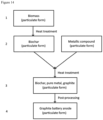
- the required precursors biochar and metallic compound
- a heat treatment procedure at a temperature of between 400 and 3000 degrees Celsius for soak time periods of between 60 seconds and 20 hours.
- a biochar is produced by pyrolyzing a biomass starting material, such as wood chips, saw dust, forestry residue or waste, or any plant derived feedstock, under an inert atmosphere, for example nitrogen, at temperatures of between 200 and 1000 degrees Celsius, for time periods of between a few seconds ("fast" pyrolysis) up to several hours.
- the biomass can be converted into char using a hydrothermal approach.
- the char and water can be placed in an autoclave at around 360 degrees Celsius and a pressure of approximately 200 bar for the same time periods as pyrolysis, followed by drying.
- the resulting char is comprised mainly of the element carbon, with a so-called fixed carbon content above at least 40% but more usually above 60%.
- the remainder is comprised of a set of heteroatoms, mainly hydrogen, oxygen, nitrogen and sulphur.
- the char may contain volatile matter, defined as hydrocarbons, aliphatic or aromatic, which are of high enough molecular weight to not have been vaporised during the heat treatment. The exact composition will depend on the pyrolysis conditions and the selected biomass starting material. This material is conventionally referred to as a "green" char.
- any of the described biochar materials could be selected for the creation of the aforementioned precursor mixture. It is even possible to use raw biomass directly, which is then transformed into char during the heat treatment procedure. Following subjection of the precursor mixture (biochar and metallic compound) to the stated heat treatment procedure, the char is altered in two ways. Firstly, practically all of the residual heteroatoms and volatile matter have been removed, resulting in a material that is virtually exclusively carbon and has a fixed carbon content in excess of ⁇ 99%. This material is conventionally referred to as a "calcined" or "fully carbonized” char. Secondly, the mass of carbon has been reduced. The carbon acts as a reductant for the organic or inorganic metallic compound that makes up a part of the precursor mixture.
- the metallic precursor may be any one of the innumerable organic or inorganic metallic compounds which are possible.
- the metal component of the compound is preferably a transition metal, such as but not limited to chromium, zirconium, molybdenum, ruthenium, rhodium, palladium, silver, cadmium, zinc, copper, nickel, cobalt, iron, manganese, chromium, vanadium or any combination thereof.
- the metal component may also be comprised of non-transition metals such as: sodium, magnesium, potassium, calcium, tin, lead and others.
- the only critical prerequisite is that the original compound or formed intermediate compound(s) can be reduced to its metallic state during the heat treatment process.
- the reduction is typically achieved under an inert atmosphere, in the presence of the aforementioned carbon (char) component.
- This process results in a reduction in solid mass as well as particle size, due to the loss of non-metallic elements as gas and an increase in density of the metal relative to the compound (in most cases).
- the current novel composition of matter can be defined in terms of its elemental composition.
- the biochar component is fully carbonized to contain in excess of ⁇ 99% carbon and graphite is also an allotrope of pure carbon
- the composite is a binary mixture with an elemental composition of between 25 to 75 percent carbon and the difference being made up of a selected pure metal (when an alloy is not used).
- the carbon may be subdivided into its two allotropes namely the residual char and formed graphite.
- the relative amount of graphite (as a percentage of the carbon present) may be between about 55 and about 99.9 %wt, with residual char making up the remaining about 45% down to about 0.1 %wt. For graphitic materials this percentage is also known as the "total graphitic carbon" or "TGC”.
- d-spacing or interlayer distance of the graphene layers comprising the graphite structure.
- Rosalind Franklin [3] defined the interlayer spacing of non-graphitic (i.e. amorphous) carbons as 0.3440 nm and graphite having an interlayer spacing of 0.3354 nm. Practical graphitic materials fall somewhere in between.
- the achieved d-spacing will vary.
- the required d-spacing may be specified as 0.3354 nm to 0.3401 nm.
- the novel composition of matter can be further defined in terms of the structure of each element.
- the metal particles tend to agglomerate and grow in size.
- the particle sizes of all the components in the mixture are required to be less than 1 millimetre.
- the selected biochar and chosen metallic compound may be milled, if required, to ensure an even distribution.
- the two precursors biochar and metal component
- the two precursors are then mixed in a ratio of between about 0.1 up to about 10 wt/wt. This can be done under wet or dry conditions.
- the mixture is heated to a temperature of between 400 and 3000 degrees Celsius in a furnace, oven, kiln, reactor vessel or similar.
- the heating may be achieved by resistively heated electrical elements, microwaves or the inductive coupling of high frequency electromagnetic fields.
- the selected heating method however must ensure homogenous heating of the entire material mass to ensure sufficient conversion and a consistent product quality throughout. Thus, surface heating techniques such as lasers or electromagnetic waves with limited sample penetration are excluded.
- the aforementioned properties of the mixture are desirable for achieving the final set of physical properties and performance characteristics to allow the resulting graphite to be used as a high-performance anode in lithium-ion batteries.
- the composite can be further processed to enable the measurement of some of these properties.
- One such step is the removal of the metal component.
- the relative amount and size of the metal allows for its rapid removal using acid leaching.
- the small particles ( ⁇ 1 mm) enable efficient exposure to the acid, while the chosen mass loading of between 25 to 75 % wt ensures that leaching times do not become excessive. Very high purities exceeding 99.5 % wt carbon can be achieved within hours. If the metal content is reduced, fast leaching is also possible but conversion into graphite will be inadequate, thereby compromising other battery anode properties.
- first cycle efficiency or “Coulombic efficiency”. It has been demonstrated that the "Coulombic efficiency” is directly correlated to the graphite powder specific surface area [5].
- the specific surface area depends on a wide range of factors, including the choice of biomass source. The structure and intrinsic porosity present in the biomass structure will, to a large extent, persist all the way through the process to the graphite present in the mixture.
- a graphite surface area range of 0.2 to 50 m 2 /g or less is desirable for achieving an acceptable "Coulombic efficiency”.
- the high purity, high density graphite derived from this novel mixture composition of matter composite has achieved "Coulombic efficiencies" of greater than 60% and as high as 99%, thereby satisfying the requirements for lithium-ion batteries.
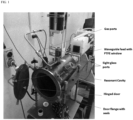
- the unit is sealed and purged using nitrogen gas (99.9% pure) at a high flowrate for approximately 1 hour to establish an inert atmosphere and then a lower purge flowrate is used to maintain it.
- the power is gradually applied at a rate of 30 W/min to allow the sample to heat up slowly and rapidly achieve steady state at the desired final power.
- the steady power setting is chosen to achieve a desired temperature.
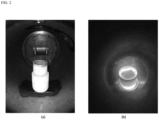
- the final power level is then held for a specific time, depending on the desired outcome. At this point the sample is glowing red and the crucible surface temperature can be measured using a handheld pyrometer through the sight glass, as shown in Figure 2 b. Pyrometer readings demonstrated a high level of fluctuation and uncertainty, thus a temperature band is reported in the applicable Examples below. Power is then maintained steady for a given time frame, after which the generator is turned off and the resulting mixture sample allowed to cool for removal.
- Sawdust 50 g from pine trees (pinus radiata) was hydrothermally treated with deionised water at a temperature of 360 degrees Celsius for 20 min in an autoclave. The sample was allowed to cool and then filtered using a Buchner funnel; the resulting char was dried in a conventional oven. The dry char (17.5 g) with carbon content around 80%, was combined with 9.4 g of Manganese Acetate (tetrahydrate). The resulting mixture was placed in a crucible and transferred to the microwave applicator. Inert conditions were established using nitrogen gas as described above and power was gradually increased at a rate of approximately 30 W/min up to 1.9 kW. Temperature was measured to be between 1700-1900 degrees Celsius.
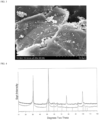
- the mixed sample was analysed using XRD and found to have a d-spacing of around 0.3378 nm as shown in Figure 10 .
- Surface area was measured as 52.85 m 2 /g.
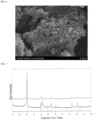
- the particle size distribution was verified and the material was found to have an average particle size of 29.22 micron as demonstrated in Figure 11 .
- the lithium-ion battery performance was verified as follows: graphite was coated onto a copper foil using a suitable binder. After drying circular discs were cut using a punch and mallet. These were combined with lithium metal foil to form a coin cell.
- FIG. 12 shows first charge and discharge cycles at C/20 (C being the theoretical capacity of graphite which is 372 mAh/g) at constant current rate.
- C being the theoretical capacity of graphite which is 372 mAh/g
- the specific capacity obtained from the first discharge cycle for the CarbonScape graphite in the half cell is 410.87 mAh/g while the charge capacity is 275 mAh/g. This gives a first cycle or "Coloumbic" efficiency of 66.46%, thus the graphite exhibits properties which are suitable for use in lithium-ion batteries.
Landscapes
- Chemical & Material Sciences (AREA)
- Chemical Kinetics & Catalysis (AREA)
- General Chemical & Material Sciences (AREA)
- Electrochemistry (AREA)
- Organic Chemistry (AREA)
- Engineering & Computer Science (AREA)
- Composite Materials (AREA)
- Inorganic Chemistry (AREA)
- General Life Sciences & Earth Sciences (AREA)
- Geology (AREA)
- Life Sciences & Earth Sciences (AREA)
- Materials Engineering (AREA)
- Manufacturing & Machinery (AREA)
- Environmental & Geological Engineering (AREA)
- Physics & Mathematics (AREA)
- Thermal Sciences (AREA)
- Battery Electrode And Active Subsutance (AREA)
- Carbon And Carbon Compounds (AREA)
- Catalysts (AREA)
Claims (16)
- Stoffzusammensetzung, umfassend eine Mischung aus Biokohle, einem Metall und Graphit, mit (a) einem Graphitgehalt zwischen 25 und 65 Gew.-%, (b) einem Metallgehalt zwischen 15 und 75 Gew.-% und (c) einem Biokohlegehalt zwischen 1 und 35 Gew.-%.
- Zusammensetzung nach Anspruch 1, wobei der Graphit einen d-Abstand zwischen 0,3354 und 0,3401 nm aufweist.
- Zusammensetzung nach Anspruch 1, wobei die elektrochemische Kapazität des Graphits mindestens 200 mAh/g oder vorzugsweise mindestens 300 mAh/g beträgt.
- Zusammensetzung nach Anspruch 1, wobei die spezifische Oberfläche des Graphits zwischen 0,2 und 50 m2/g oder vorzugsweise zwischen 0,5 und 20 m2/g beträgt.
- Zusammensetzung nach Anspruch 1, wobei der Graphit einen "Coulomb"- oder Erstzyklus-Wirkungsgrad von über 60 % oder vorzugsweise einen "Coulomb"- oder Erstzyklus-Wirkungsgrad von über 80 % aufweist.
- Zusammensetzung nach einem der Ansprüche 1 bis 5, wobei einer oder mehrere der folgenden zutreffen:(i) der Graphitgehalt in der Mischung liegt in Partikelform vor;(ii) der Metallgehalt in der Mischung liegt in Partikelform vor;(iii) der Biokohlegehalt in der Mischung liegt in Partikelform vor; und(iv) der Graphit-, Metall- und Biokohlegehalt liegen alle in Partikelform vor.
- Zusammensetzung nach einem der Ansprüche 1 bis 6, wobei die Mischung eine binäre Mischung mit einer Elementzusammensetzung zwischen 25 und 75 Prozent Kohlenstoff aus Biokohle und Graphit und zwischen 75 und 25 Prozent eines ausgewählten Metalls ist.
- Zusammensetzung nach einem der Ansprüche 1 bis 7, wobei der Biokohlegehalt aus Holzbiomasse stammt, die auf Temperaturen zwischen 200 und 1000 Grad Celsius erhitzt wurde.
- Zusammensetzung nach einem der Ansprüche 1 bis 8, wobei das Metall ein Übergangsmetall ist, vorzugsweise wobei das Übergangsmetall aus Chrom, Zirkonium, Molybdän, Ruthenium, Rhodium, Palladium, Silber, Cadmium, Zink, Kupfer, Nickel, Kobalt, Eisen, Mangan, Chrom, Vanadium oder einer beliebigen Kombination davon ausgewählt ist.
- Zusammensetzung nach einem der Ansprüche 1 bis 9, wobei einer oder mehrere der folgenden zutreffen:(i) die Partikelgröße der Biokohlekomponente beträgt weniger als 1 Millimeter;(ii) die Partikelgröße der Metallkomponente beträgt weniger als 1 Millimeter;(iii) die Partikelgröße der Graphitkomponente beträgt weniger als 1 Millimeter; und(iv) die Partikelgröße aller Bestandteile beträgt weniger als 1 Millimeter.
- Zusammensetzung nach einem der Ansprüche 1 bis 10, wobei die Mischung einen Gesamtgehalt an graphitischem Kohlenstoff von über 55 Gew.-% aufweist.
- Verfahren zum Herstellen einer Mischung nach einem der Ansprüche 1 bis 11, wobei das Verfahren die Schritte umfasst:i) thermisches Behandeln von Biomasse in Partikelform bei einer Temperatur zwischen 200 und 1000 Grad Celsius, um eine partikelförmige Biokohle zu bilden;ii) Kombinieren der resultierenden Biokohle mit einer partikelförmigen Metallverbindung Kombinieren der resultierenden Biokohle mit einer partikelförmigen Metallverbindung in nasser oder trockener Form, um eine Vorläufermischung zu erzeugen;iii) Erhitzen der Vorläufermischung auf 400 bis 3000 Grad Celsius unter inerten Bedingungen, um eine graphithaltige Mischung zu bilden;iv) Sieben der endgültigen Mischung auf eine Partikelgröße von unter 1 mm, um eine Mischung mit (a) einem Graphitgehalt zwischen 25 und 65 Gew.-%, (b) einem Metallgehalt zwischen 15 und 75 Gew.-% und (c) einem Biokohlegehalt zwischen 1 und 35 Gew.-% zu erzeugen.
- Verfahren nach Anspruch 12, wobei die Biomasse in einem hydrothermalen Schritt in Wasser thermisch behandelt wird.
- Verfahren nach Anspruch 13, wobei die Biomasse in einem Trockenpyrolyseschritt unter inerten Bedingungen thermisch behandelt wird.
- Verfahren nach einem der Ansprüche 12 bis 14, wobei die Biomasse aus Forstrückständen, Sägemehl, Holzspänen oder anderem Holzmaterial ausgewählt ist.
- Verfahren nach einem der Ansprüche 12 bis 15, wobei die Biomassepartikel kleiner als 10 mm oder noch bevorzugter kleiner als 1 mm sind.
Priority Applications (4)
| Application Number | Priority Date | Filing Date | Title |
|---|---|---|---|
| SI202230136T SI4079686T1 (sl) | 2021-04-21 | 2022-04-14 | Sestava snovi za proizvodnjo grafitnega prahu |
| RS20250513A RS66826B1 (sr) | 2021-04-21 | 2022-04-14 | Sastav materije za proizvodnju grafitnog praha |
| HRP20250653TT HRP20250653T1 (hr) | 2021-04-21 | 2022-04-14 | Sastav tvari za proizvodnju grafitnog praha |
| SM20250223T SMT202500223T1 (it) | 2021-04-21 | 2022-04-14 | Composizione di materia per la produzione di polvere di grafite |
Applications Claiming Priority (2)
| Application Number | Priority Date | Filing Date | Title |
|---|---|---|---|
| US202163177705P | 2021-04-21 | 2021-04-21 | |
| PCT/NZ2021/050146 WO2022225405A1 (en) | 2021-04-21 | 2021-08-25 | Composition of matter for the production of graphite powder |
Publications (3)
| Publication Number | Publication Date |
|---|---|
| EP4079686A1 EP4079686A1 (de) | 2022-10-26 |
| EP4079686B1 true EP4079686B1 (de) | 2025-04-09 |
| EP4079686B8 EP4079686B8 (de) | 2025-06-04 |
Family
ID=81328542
Family Applications (1)
| Application Number | Title | Priority Date | Filing Date |
|---|---|---|---|
| EP22168293.3A Active EP4079686B8 (de) | 2021-04-21 | 2022-04-14 | Stoffzusammensetzung zur herstellung von graphitpulver |
Country Status (22)
| Country | Link |
|---|---|
| US (3) | US11518679B2 (de) |
| EP (1) | EP4079686B8 (de) |
| JP (1) | JP2024515117A (de) |
| KR (1) | KR20240042582A (de) |
| CN (1) | CN114744175A (de) |
| AU (1) | AU2021441476A1 (de) |
| BR (1) | BR112023021619A2 (de) |
| CA (1) | CA3214830A1 (de) |
| DK (1) | DK4079686T3 (de) |
| ES (1) | ES3032056T3 (de) |
| FI (1) | FI4079686T3 (de) |
| HR (1) | HRP20250653T1 (de) |
| HU (1) | HUE071464T2 (de) |
| IL (1) | IL307893B2 (de) |
| LT (1) | LT4079686T (de) |
| MX (1) | MX2023012502A (de) |
| PH (1) | PH12023552831A1 (de) |
| PL (1) | PL4079686T3 (de) |
| PT (1) | PT4079686T (de) |
| RS (1) | RS66826B1 (de) |
| SI (1) | SI4079686T1 (de) |
| SM (1) | SMT202500223T1 (de) |
Families Citing this family (1)
| Publication number | Priority date | Publication date | Assignee | Title |
|---|---|---|---|---|
| WO2025248162A1 (en) | 2024-05-31 | 2025-12-04 | Funktiomat Oy | Method for producing 2h graphite from a carbon source |
Family Cites Families (9)
| Publication number | Priority date | Publication date | Assignee | Title |
|---|---|---|---|---|
| CN102751500B (zh) * | 2012-07-17 | 2015-12-16 | 中国科学院苏州纳米技术与纳米仿生研究所 | 具有石墨化特性的无定型碳材料及其制造方法 |
| MX2017010415A (es) * | 2015-02-13 | 2017-12-20 | Carbonscape Ltd | Producción de grafito a partir de biomasa. |
| CN104909363B (zh) * | 2015-05-18 | 2017-03-08 | 陕西科技大学 | 一种网络状纳米结构碳材料的制备方法 |
| CN108155351B (zh) * | 2016-12-06 | 2021-06-22 | 宁德时代新能源科技股份有限公司 | 锂离子电池及其负极材料 |
| WO2018186958A1 (en) * | 2017-04-03 | 2018-10-11 | The George Washington University | Methods and systems for the production of crystalline flake graphite from biomass or other carbonaceous materials |
| CN109950520B (zh) * | 2019-03-15 | 2022-05-31 | 深圳市本征方程石墨烯技术股份有限公司 | 一种含氮石墨烯包覆生物质碳负极材料及其制备方法 |
| CN112397764A (zh) * | 2019-08-15 | 2021-02-23 | 上海超法新能源技术有限公司 | 一种新能源电池及其制备方法 |
| CN112279235B (zh) * | 2020-09-25 | 2022-07-01 | 湘潭大学 | 一种金属掺杂的三维框架结构分级多孔生物炭及其制备方法 |
| CN112250063A (zh) * | 2020-10-14 | 2021-01-22 | 西安工程大学 | 一种低温促进木质生物碳石墨化的方法 |
-
2021
- 2021-08-25 JP JP2023565157A patent/JP2024515117A/ja active Pending
- 2021-08-25 CA CA3214830A patent/CA3214830A1/en active Pending
- 2021-08-25 KR KR1020237039934A patent/KR20240042582A/ko active Pending
- 2021-08-25 IL IL307893A patent/IL307893B2/en unknown
- 2021-08-25 BR BR112023021619A patent/BR112023021619A2/pt unknown
- 2021-08-25 PH PH1/2023/552831A patent/PH12023552831A1/en unknown
- 2021-08-25 AU AU2021441476A patent/AU2021441476A1/en active Pending
- 2021-08-25 MX MX2023012502A patent/MX2023012502A/es unknown
-
2022
- 2022-04-14 RS RS20250513A patent/RS66826B1/sr unknown
- 2022-04-14 PL PL22168293.3T patent/PL4079686T3/pl unknown
- 2022-04-14 SI SI202230136T patent/SI4079686T1/sl unknown
- 2022-04-14 HU HUE22168293A patent/HUE071464T2/hu unknown
- 2022-04-14 PT PT221682933T patent/PT4079686T/pt unknown
- 2022-04-14 HR HRP20250653TT patent/HRP20250653T1/hr unknown
- 2022-04-14 LT LTEP22168293.3T patent/LT4079686T/lt unknown
- 2022-04-14 SM SM20250223T patent/SMT202500223T1/it unknown
- 2022-04-14 FI FIEP22168293.3T patent/FI4079686T3/fi active
- 2022-04-14 DK DK22168293.3T patent/DK4079686T3/da active
- 2022-04-14 ES ES22168293T patent/ES3032056T3/es active Active
- 2022-04-14 EP EP22168293.3A patent/EP4079686B8/de active Active
- 2022-04-20 CN CN202210417077.3A patent/CN114744175A/zh active Pending
- 2022-04-20 US US17/659,985 patent/US11518679B2/en active Active
- 2022-09-26 US US17/935,213 patent/US20230017630A1/en not_active Abandoned
-
2024
- 2024-02-27 US US18/588,546 patent/US20240199429A1/en active Pending
Also Published As
| Publication number | Publication date |
|---|---|
| PH12023552831A1 (en) | 2024-05-20 |
| HRP20250653T1 (hr) | 2025-07-18 |
| MX2023012502A (es) | 2023-11-28 |
| SMT202500223T1 (it) | 2025-07-22 |
| JP2024515117A (ja) | 2024-04-04 |
| SI4079686T1 (sl) | 2025-07-31 |
| US20230017630A1 (en) | 2023-01-19 |
| EP4079686B8 (de) | 2025-06-04 |
| AU2021441476A1 (en) | 2023-10-26 |
| BR112023021619A2 (pt) | 2023-12-19 |
| PL4079686T3 (pl) | 2025-07-07 |
| FI4079686T3 (fi) | 2025-07-07 |
| US20240199429A1 (en) | 2024-06-20 |
| US11518679B2 (en) | 2022-12-06 |
| KR20240042582A (ko) | 2024-04-02 |
| ES3032056T3 (en) | 2025-07-15 |
| CA3214830A1 (en) | 2022-10-27 |
| EP4079686A1 (de) | 2022-10-26 |
| HUE071464T2 (hu) | 2025-08-28 |
| PT4079686T (pt) | 2025-06-03 |
| RS66826B1 (sr) | 2025-06-30 |
| IL307893A (en) | 2023-12-01 |
| US20220340427A1 (en) | 2022-10-27 |
| CN114744175A (zh) | 2022-07-12 |
| DK4079686T3 (da) | 2025-06-30 |
| IL307893B1 (en) | 2025-05-01 |
| LT4079686T (lt) | 2025-06-25 |
| IL307893B2 (en) | 2025-09-01 |
Similar Documents
| Publication | Publication Date | Title |
|---|---|---|
| KR101433720B1 (ko) | 고밀도 바이오매스를 이용한 리튬이차전지용 하드카본 제조방법 및 이에 의하여 제조되는 리튬이차전지용 하드카본 | |
| Dey et al. | Catalytic graphitization of pyrolysis oil for anode application in lithium-ion batteries | |
| US20240199429A1 (en) | Composition of matter for the production of graphite powder | |
| JP5230117B2 (ja) | 黒鉛粒子の製造方法 | |
| KR101568022B1 (ko) | 리튬 이차 전지용 인조흑연 음극재의 제조 방법 및 이로부터 제조된 리튬 이차 전지용 인조흑연 음극재 | |
| Jiang et al. | Synthesis of pitch-derived carbon anodes for high-performance potassium-ion batteries | |
| Othman et al. | The effect of changing graphitization temperature toward bio-graphite from palm kernel shell | |
| EP4484374A2 (de) | Verfahren zur herstellung von synthetischem graphitmaterial | |
| HK40081867B (en) | Composition of matter for the production of graphite powder | |
| HK40081867A (en) | Composition of matter for the production of graphite powder | |
| WO2022225405A1 (en) | Composition of matter for the production of graphite powder | |
| KR102608029B1 (ko) | 난흑연화 탄소로부터 고결정성 인조흑연의 제조 방법 및 이에 의해 제조된 인조흑연 | |
| TW202419397A (zh) | 用於將生物炭轉化成低表面積石墨之物質之組成物 | |
| EA050439B1 (ru) | Композиция для производства графитового порошка | |
| KR20170095622A (ko) | 마이크로웨이브를 이용한 전지 음극제용 흑연 제조 방법 | |
| KR101562961B1 (ko) | 리튬 이차 전지용 탄소계 음극재의 제조 방법 및 이로부터 제조된 리튬 이차 전지용 탄소계 음극재 | |
| CN120527377B (zh) | 一种负极活性材料及其制备方法和钠离子电池 | |
| Vook | Catalytic Graphitization of Biocarbon for Green Battery Anodes | |
| WO2025248162A1 (en) | Method for producing 2h graphite from a carbon source | |
| EP4638359A1 (de) | Neues bioraffinerieverfahren zur herstellung von produkten aus grünem graphit | |
| KR20260001108A (ko) | 탄소/실리콘 복합체, 그 제조방법, 이를 포함하는 음극 활물질 및 전고체 전지 | |
| KR20250040878A (ko) | 탄소 입자 및 이의 제조 방법 | |
| Li et al. | Synergistic Regulation of Closed‑Pore and Mesoporous Structures in Orange‑Peel‑Derived Hard Carbon via Temperature‑Controlled Carbonization and NH₄Cl Activation for High‑Performance Sodium‑Ion Batteries | |
| Othman et al. | PRODUCTION ENGINEERING ARCHIVES |
Legal Events
| Date | Code | Title | Description |
|---|---|---|---|
| REG | Reference to a national code |
Ref country code: HR Ref legal event code: TUEP Ref document number: P20250653T Country of ref document: HR |
|
| PUAI | Public reference made under article 153(3) epc to a published international application that has entered the european phase |
Free format text: ORIGINAL CODE: 0009012 |
|
| STAA | Information on the status of an ep patent application or granted ep patent |
Free format text: STATUS: THE APPLICATION HAS BEEN PUBLISHED |
|
| AK | Designated contracting states |
Kind code of ref document: A1 Designated state(s): AL AT BE BG CH CY CZ DE DK EE ES FI FR GB GR HR HU IE IS IT LI LT LU LV MC MK MT NL NO PL PT RO RS SE SI SK SM TR |
|
| STAA | Information on the status of an ep patent application or granted ep patent |
Free format text: STATUS: REQUEST FOR EXAMINATION WAS MADE |
|
| 17P | Request for examination filed |
Effective date: 20230418 |
|
| RBV | Designated contracting states (corrected) |
Designated state(s): AL AT BE BG CH CY CZ DE DK EE ES FI FR GB GR HR HU IE IS IT LI LT LU LV MC MK MT NL NO PL PT RO RS SE SI SK SM TR |
|
| REG | Reference to a national code |
Ref country code: HK Ref legal event code: DE Ref document number: 40081867 Country of ref document: HK |
|
| STAA | Information on the status of an ep patent application or granted ep patent |
Free format text: STATUS: EXAMINATION IS IN PROGRESS |
|
| 17Q | First examination report despatched |
Effective date: 20231114 |
|
| GRAP | Despatch of communication of intention to grant a patent |
Free format text: ORIGINAL CODE: EPIDOSNIGR1 |
|
| STAA | Information on the status of an ep patent application or granted ep patent |
Free format text: STATUS: GRANT OF PATENT IS INTENDED |
|
| RIC1 | Information provided on ipc code assigned before grant |
Ipc: H01M 4/02 20060101ALI20240920BHEP Ipc: H01M 10/0525 20100101ALI20240920BHEP Ipc: H01M 4/62 20060101ALI20240920BHEP Ipc: H01M 4/587 20100101ALI20240920BHEP Ipc: H01M 4/38 20060101ALI20240920BHEP Ipc: H01M 4/36 20060101ALI20240920BHEP Ipc: H01M 4/1393 20100101ALI20240920BHEP Ipc: H01M 4/133 20100101ALI20240920BHEP Ipc: H01M 4/04 20060101ALI20240920BHEP Ipc: C01B 32/205 20170101ALI20240920BHEP Ipc: H01M 10/00 20060101ALI20240920BHEP Ipc: H01M 4/00 20060101ALI20240920BHEP Ipc: B01J 19/12 20060101ALI20240920BHEP Ipc: C01B 32/20 20170101AFI20240920BHEP |
|
| INTG | Intention to grant announced |
Effective date: 20241011 |
|
| GRAS | Grant fee paid |
Free format text: ORIGINAL CODE: EPIDOSNIGR3 |
|
| GRAA | (expected) grant |
Free format text: ORIGINAL CODE: 0009210 |
|
| STAA | Information on the status of an ep patent application or granted ep patent |
Free format text: STATUS: THE PATENT HAS BEEN GRANTED |
|
| AK | Designated contracting states |
Kind code of ref document: B1 Designated state(s): AL AT BE BG CH CY CZ DE DK EE ES FI FR GB GR HR HU IE IS IT LI LT LU LV MC MK MT NL NO PL PT RO RS SE SI SK SM TR |
|
| REG | Reference to a national code |
Ref country code: GB Ref legal event code: FG4D |
|
| REG | Reference to a national code |
Ref country code: CH Ref legal event code: EP |
|
| RAP4 | Party data changed (patent owner data changed or rights of a patent transferred) |
Owner name: CARBONSCAPE LIMITED |
|
| REG | Reference to a national code |
Ref country code: DE Ref legal event code: R096 Ref document number: 602022012768 Country of ref document: DE |
|
| REG | Reference to a national code |
Ref country code: IE Ref legal event code: FG4D Ref country code: DE Ref legal event code: R081 Ref document number: 602022012768 Country of ref document: DE Owner name: CARBONSCAPE LTD., NZ Free format text: FORMER OWNER: CARBONSCAPE LTD., CHRISTCHURCH, NZ |
|
| PGFP | Annual fee paid to national office [announced via postgrant information from national office to epo] |
Ref country code: NL Payment date: 20250415 Year of fee payment: 4 |
|
| REG | Reference to a national code |
Ref country code: CH Ref legal event code: PK Free format text: BERICHTIGUNG B8 |
|
| PGFP | Annual fee paid to national office [announced via postgrant information from national office to epo] |
Ref country code: LU Payment date: 20250415 Year of fee payment: 4 |
|
| REG | Reference to a national code |
Ref country code: PT Ref legal event code: SC4A Ref document number: 4079686 Country of ref document: PT Date of ref document: 20250603 Kind code of ref document: T Free format text: AVAILABILITY OF NATIONAL TRANSLATION Effective date: 20250528 |
|
| REG | Reference to a national code |
Ref country code: SE Ref legal event code: TRGR |
|
| REG | Reference to a national code |
Ref country code: DK Ref legal event code: T3 Effective date: 20250625 |
|
| PGFP | Annual fee paid to national office [announced via postgrant information from national office to epo] |
Ref country code: SM Payment date: 20250613 Year of fee payment: 4 |
|
| REG | Reference to a national code |
Ref country code: HR Ref legal event code: ODRP Ref document number: P20250653T Country of ref document: HR Payment date: 20250602 Year of fee payment: 4 |
|
| PGFP | Annual fee paid to national office [announced via postgrant information from national office to epo] |
Ref country code: MC Payment date: 20250416 Year of fee payment: 4 |
|
| REG | Reference to a national code |
Ref country code: FI Ref legal event code: FGE |
|
| PGFP | Annual fee paid to national office [announced via postgrant information from national office to epo] |
Ref country code: FI Payment date: 20250415 Year of fee payment: 4 |
|
| PGFP | Annual fee paid to national office [announced via postgrant information from national office to epo] |
Ref country code: DE Payment date: 20250415 Year of fee payment: 4 |
|
| PGFP | Annual fee paid to national office [announced via postgrant information from national office to epo] |
Ref country code: ES Payment date: 20250508 Year of fee payment: 4 |
|
| PGFP | Annual fee paid to national office [announced via postgrant information from national office to epo] |
Ref country code: LT Payment date: 20250411 Year of fee payment: 4 |
|
| PGFP | Annual fee paid to national office [announced via postgrant information from national office to epo] |
Ref country code: IS Payment date: 20250602 Year of fee payment: 4 Ref country code: RS Payment date: 20250527 Year of fee payment: 4 Ref country code: NO Payment date: 20250423 Year of fee payment: 4 |
|
| PGFP | Annual fee paid to national office [announced via postgrant information from national office to epo] |
Ref country code: BE Payment date: 20250415 Year of fee payment: 4 Ref country code: AL Payment date: 20250527 Year of fee payment: 4 |
|
| REG | Reference to a national code |
Ref country code: ES Ref legal event code: FG2A Ref document number: 3032056 Country of ref document: ES Kind code of ref document: T3 Effective date: 20250715 |
|
| PGFP | Annual fee paid to national office [announced via postgrant information from national office to epo] |
Ref country code: HR Payment date: 20250602 Year of fee payment: 4 |
|
| REG | Reference to a national code |
Ref country code: NL Ref legal event code: FP |
|
| PGFP | Annual fee paid to national office [announced via postgrant information from national office to epo] |
Ref country code: PT Payment date: 20250528 Year of fee payment: 4 Ref country code: LV Payment date: 20250603 Year of fee payment: 4 |
|
| PGFP | Annual fee paid to national office [announced via postgrant information from national office to epo] |
Ref country code: FR Payment date: 20250422 Year of fee payment: 4 Ref country code: HU Payment date: 20250527 Year of fee payment: 4 |
|
| REG | Reference to a national code |
Ref country code: HR Ref legal event code: T1PR Ref document number: P20250653 Country of ref document: HR |
|
| PGFP | Annual fee paid to national office [announced via postgrant information from national office to epo] |
Ref country code: MT Payment date: 20250410 Year of fee payment: 4 Ref country code: BG Payment date: 20250411 Year of fee payment: 4 |
|
| PGFP | Annual fee paid to national office [announced via postgrant information from national office to epo] |
Ref country code: CH Payment date: 20250501 Year of fee payment: 4 |
|
| PGFP | Annual fee paid to national office [announced via postgrant information from national office to epo] |
Ref country code: RO Payment date: 20250527 Year of fee payment: 4 Ref country code: AT Payment date: 20250721 Year of fee payment: 4 |
|
| PGFP | Annual fee paid to national office [announced via postgrant information from national office to epo] |
Ref country code: SK Payment date: 20250527 Year of fee payment: 4 Ref country code: TR Payment date: 20250513 Year of fee payment: 4 |
|
| PGFP | Annual fee paid to national office [announced via postgrant information from national office to epo] |
Ref country code: CZ Payment date: 20250527 Year of fee payment: 4 |
|
| PGFP | Annual fee paid to national office [announced via postgrant information from national office to epo] |
Ref country code: IE Payment date: 20250422 Year of fee payment: 4 |
|
| PGFP | Annual fee paid to national office [announced via postgrant information from national office to epo] |
Ref country code: SE Payment date: 20250422 Year of fee payment: 4 Ref country code: SI Payment date: 20250527 Year of fee payment: 4 |
|
| REG | Reference to a national code |
Ref country code: SK Ref legal event code: T3 Ref document number: E 46538 Country of ref document: SK |
|
| REG | Reference to a national code |
Ref country code: GR Ref legal event code: EP Ref document number: 20250401238 Country of ref document: GR Effective date: 20250707 |
|
| REG | Reference to a national code |
Ref country code: HU Ref legal event code: AG4A Ref document number: E071464 Country of ref document: HU |
|
| REG | Reference to a national code |
Ref country code: EE Ref legal event code: FG4A Ref document number: E025146 Country of ref document: EE Effective date: 20250526 |
|
| PGFP | Annual fee paid to national office [announced via postgrant information from national office to epo] |
Ref country code: DK Payment date: 20250822 Year of fee payment: 4 |
|
| PGFP | Annual fee paid to national office [announced via postgrant information from national office to epo] |
Ref country code: GR Payment date: 20250709 Year of fee payment: 4 |
|
| PGFP | Annual fee paid to national office [announced via postgrant information from national office to epo] |
Ref country code: IT Payment date: 20250430 Year of fee payment: 4 Ref country code: PL Payment date: 20250722 Year of fee payment: 4 |
|
| PGFP | Annual fee paid to national office [announced via postgrant information from national office to epo] |
Ref country code: MK Payment date: 20250530 Year of fee payment: 4 |
|
| PGFP | Annual fee paid to national office [announced via postgrant information from national office to epo] |
Ref country code: CY Payment date: 20250411 Year of fee payment: 4 |
|
| PLBE | No opposition filed within time limit |
Free format text: ORIGINAL CODE: 0009261 |
|
| STAA | Information on the status of an ep patent application or granted ep patent |
Free format text: STATUS: NO OPPOSITION FILED WITHIN TIME LIMIT |