EP4078138B1 - A cell counter and diagnostic device - Google Patents
A cell counter and diagnostic device Download PDFInfo
- Publication number
- EP4078138B1 EP4078138B1 EP21824634.6A EP21824634A EP4078138B1 EP 4078138 B1 EP4078138 B1 EP 4078138B1 EP 21824634 A EP21824634 A EP 21824634A EP 4078138 B1 EP4078138 B1 EP 4078138B1
- Authority
- EP
- European Patent Office
- Prior art keywords
- light
- sample
- cells
- central axis
- concentration
- Prior art date
- Legal status (The legal status is an assumption and is not a legal conclusion. Google has not performed a legal analysis and makes no representation as to the accuracy of the status listed.)
- Active
Links
Images




Classifications
-
- G—PHYSICS
- G01—MEASURING; TESTING
- G01N—INVESTIGATING OR ANALYSING MATERIALS BY DETERMINING THEIR CHEMICAL OR PHYSICAL PROPERTIES
- G01N15/00—Investigating characteristics of particles; Investigating permeability, pore-volume or surface-area of porous materials
- G01N15/02—Investigating particle size or size distribution
- G01N15/0205—Investigating particle size or size distribution by optical means
-
- A—HUMAN NECESSITIES
- A61—MEDICAL OR VETERINARY SCIENCE; HYGIENE
- A61B—DIAGNOSIS; SURGERY; IDENTIFICATION
- A61B5/00—Measuring for diagnostic purposes; Identification of persons
- A61B5/145—Measuring characteristics of blood in vivo, e.g. gas concentration or pH-value ; Measuring characteristics of body fluids or tissues, e.g. interstitial fluid or cerebral tissue
- A61B5/14546—Measuring characteristics of blood in vivo, e.g. gas concentration or pH-value ; Measuring characteristics of body fluids or tissues, e.g. interstitial fluid or cerebral tissue for measuring analytes not otherwise provided for, e.g. ions, cytochromes
-
- A—HUMAN NECESSITIES
- A61—MEDICAL OR VETERINARY SCIENCE; HYGIENE
- A61B—DIAGNOSIS; SURGERY; IDENTIFICATION
- A61B5/00—Measuring for diagnostic purposes; Identification of persons
- A61B5/145—Measuring characteristics of blood in vivo, e.g. gas concentration or pH-value ; Measuring characteristics of body fluids or tissues, e.g. interstitial fluid or cerebral tissue
- A61B5/1455—Measuring characteristics of blood in vivo, e.g. gas concentration or pH-value ; Measuring characteristics of body fluids or tissues, e.g. interstitial fluid or cerebral tissue using optical sensors, e.g. spectral photometrical oximeters
-
- A—HUMAN NECESSITIES
- A61—MEDICAL OR VETERINARY SCIENCE; HYGIENE
- A61B—DIAGNOSIS; SURGERY; IDENTIFICATION
- A61B5/00—Measuring for diagnostic purposes; Identification of persons
- A61B5/41—Detecting, measuring or recording for evaluating the immune or lymphatic systems
- A61B5/412—Detecting or monitoring sepsis
-
- A—HUMAN NECESSITIES
- A61—MEDICAL OR VETERINARY SCIENCE; HYGIENE
- A61B—DIAGNOSIS; SURGERY; IDENTIFICATION
- A61B5/00—Measuring for diagnostic purposes; Identification of persons
- A61B5/74—Details of notification to user or communication with user or patient; User input means
- A61B5/746—Alarms related to a physiological condition, e.g. details of setting alarm thresholds or avoiding false alarms
-
- G—PHYSICS
- G01—MEASURING; TESTING
- G01N—INVESTIGATING OR ANALYSING MATERIALS BY DETERMINING THEIR CHEMICAL OR PHYSICAL PROPERTIES
- G01N15/00—Investigating characteristics of particles; Investigating permeability, pore-volume or surface-area of porous materials
- G01N15/06—Investigating concentration of particle suspensions
-
- G—PHYSICS
- G01—MEASURING; TESTING
- G01N—INVESTIGATING OR ANALYSING MATERIALS BY DETERMINING THEIR CHEMICAL OR PHYSICAL PROPERTIES
- G01N21/00—Investigating or analysing materials by the use of optical means, i.e. using sub-millimetre waves, infrared, visible or ultraviolet light
- G01N21/01—Arrangements or apparatus for facilitating the optical investigation
- G01N21/03—Cuvette constructions
- G01N21/05—Flow-through cuvettes
-
- G—PHYSICS
- G01—MEASURING; TESTING
- G01N—INVESTIGATING OR ANALYSING MATERIALS BY DETERMINING THEIR CHEMICAL OR PHYSICAL PROPERTIES
- G01N21/00—Investigating or analysing materials by the use of optical means, i.e. using sub-millimetre waves, infrared, visible or ultraviolet light
- G01N21/17—Systems in which incident light is modified in accordance with the properties of the material investigated
- G01N21/47—Scattering, i.e. diffuse reflection
-
- G—PHYSICS
- G01—MEASURING; TESTING
- G01N—INVESTIGATING OR ANALYSING MATERIALS BY DETERMINING THEIR CHEMICAL OR PHYSICAL PROPERTIES
- G01N21/00—Investigating or analysing materials by the use of optical means, i.e. using sub-millimetre waves, infrared, visible or ultraviolet light
- G01N21/84—Systems specially adapted for particular applications
- G01N21/88—Investigating the presence of flaws or contamination
- G01N21/90—Investigating the presence of flaws or contamination in a container or its contents
-
- A—HUMAN NECESSITIES
- A61—MEDICAL OR VETERINARY SCIENCE; HYGIENE
- A61M—DEVICES FOR INTRODUCING MEDIA INTO, OR ONTO, THE BODY; DEVICES FOR TRANSDUCING BODY MEDIA OR FOR TAKING MEDIA FROM THE BODY; DEVICES FOR PRODUCING OR ENDING SLEEP OR STUPOR
- A61M1/00—Suction or pumping devices for medical purposes; Devices for carrying-off, for treatment of, or for carrying-over, body-liquids; Drainage systems
- A61M1/14—Dialysis systems; Artificial kidneys; Blood oxygenators ; Reciprocating systems for treatment of body fluids, e.g. single needle systems for hemofiltration or pheresis
- A61M1/28—Peritoneal dialysis ; Other peritoneal treatment, e.g. oxygenation
-
- A—HUMAN NECESSITIES
- A61—MEDICAL OR VETERINARY SCIENCE; HYGIENE
- A61M—DEVICES FOR INTRODUCING MEDIA INTO, OR ONTO, THE BODY; DEVICES FOR TRANSDUCING BODY MEDIA OR FOR TAKING MEDIA FROM THE BODY; DEVICES FOR PRODUCING OR ENDING SLEEP OR STUPOR
- A61M2202/00—Special media to be introduced, removed or treated
- A61M2202/04—Liquids
- A61M2202/0413—Blood
- A61M2202/0439—White blood cells; Leucocytes
-
- A—HUMAN NECESSITIES
- A61—MEDICAL OR VETERINARY SCIENCE; HYGIENE
- A61M—DEVICES FOR INTRODUCING MEDIA INTO, OR ONTO, THE BODY; DEVICES FOR TRANSDUCING BODY MEDIA OR FOR TAKING MEDIA FROM THE BODY; DEVICES FOR PRODUCING OR ENDING SLEEP OR STUPOR
- A61M2205/00—General characteristics of the apparatus
- A61M2205/33—Controlling, regulating or measuring
- A61M2205/3306—Optical measuring means
-
- G—PHYSICS
- G01—MEASURING; TESTING
- G01N—INVESTIGATING OR ANALYSING MATERIALS BY DETERMINING THEIR CHEMICAL OR PHYSICAL PROPERTIES
- G01N15/00—Investigating characteristics of particles; Investigating permeability, pore-volume or surface-area of porous materials
- G01N15/01—Investigating characteristics of particles; Investigating permeability, pore-volume or surface-area of porous materials specially adapted for biological cells, e.g. blood cells
-
- G—PHYSICS
- G01—MEASURING; TESTING
- G01N—INVESTIGATING OR ANALYSING MATERIALS BY DETERMINING THEIR CHEMICAL OR PHYSICAL PROPERTIES
- G01N15/00—Investigating characteristics of particles; Investigating permeability, pore-volume or surface-area of porous materials
- G01N15/06—Investigating concentration of particle suspensions
- G01N15/075—Investigating concentration of particle suspensions by optical means
-
- G—PHYSICS
- G01—MEASURING; TESTING
- G01N—INVESTIGATING OR ANALYSING MATERIALS BY DETERMINING THEIR CHEMICAL OR PHYSICAL PROPERTIES
- G01N15/00—Investigating characteristics of particles; Investigating permeability, pore-volume or surface-area of porous materials
- G01N15/01—Investigating characteristics of particles; Investigating permeability, pore-volume or surface-area of porous materials specially adapted for biological cells, e.g. blood cells
- G01N2015/016—White blood cells
-
- G—PHYSICS
- G01—MEASURING; TESTING
- G01N—INVESTIGATING OR ANALYSING MATERIALS BY DETERMINING THEIR CHEMICAL OR PHYSICAL PROPERTIES
- G01N21/00—Investigating or analysing materials by the use of optical means, i.e. using sub-millimetre waves, infrared, visible or ultraviolet light
- G01N21/01—Arrangements or apparatus for facilitating the optical investigation
- G01N21/03—Cuvette constructions
- G01N21/05—Flow-through cuvettes
- G01N2021/052—Tubular type; cavity type; multireflective
-
- G—PHYSICS
- G01—MEASURING; TESTING
- G01N—INVESTIGATING OR ANALYSING MATERIALS BY DETERMINING THEIR CHEMICAL OR PHYSICAL PROPERTIES
- G01N21/00—Investigating or analysing materials by the use of optical means, i.e. using sub-millimetre waves, infrared, visible or ultraviolet light
- G01N21/17—Systems in which incident light is modified in accordance with the properties of the material investigated
- G01N21/47—Scattering, i.e. diffuse reflection
- G01N2021/4704—Angular selective
- G01N2021/4711—Multiangle measurement
-
- G—PHYSICS
- G01—MEASURING; TESTING
- G01N—INVESTIGATING OR ANALYSING MATERIALS BY DETERMINING THEIR CHEMICAL OR PHYSICAL PROPERTIES
- G01N21/00—Investigating or analysing materials by the use of optical means, i.e. using sub-millimetre waves, infrared, visible or ultraviolet light
- G01N21/17—Systems in which incident light is modified in accordance with the properties of the material investigated
- G01N21/47—Scattering, i.e. diffuse reflection
- G01N2021/4733—Discriminating different types of scatterers
Definitions
- the plurality of displacements are in the range of substantially 1° to 15°, measured from the central axis.
- the container is arranged such that light from the light source strikes it an angle sufficient to reduce reflection of light back to the light source.
- the cuvette has a male connector at a first end and a female connector at a second end to couple to an effluent line.
- an exterior of the surface of the container is opaque, except for the pair of windows.
- Embodiments of the present invention operate to detect the presence of cells in the effluent fluid 20 during peritoneal dialysis.
- the cells in question are typically leukocytes.
- a subset of leukocytes includes neutrophils. Neutrophils above a certain concentration are indicative of the patient fighting an infection. If left unchecked, such an infection can develop into a serious, potentially life threatening, occurrence of peritonitis.
- Early detection of infection by the indirect detection of a certain concentration of neutrophils, can be lifesaving. At the very least, it can provide an opportunity for the patient to be treated early, thereby avoiding possible hospital admission and the associated costs and risks of complication. If a bacterial infection is detected, then prompt treatment by a suitable antibiotic can be arranged.
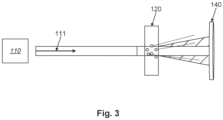
- Light from the laser or LED 110 passes through the cuvette 120, including the sample, and is detected by a detector 140 located at an opposite side of the cuvette 120.
- the detector 140 comprises one or more photodiodes which is/are sensitive to light at or about the wavelength transmitted by the laser or LED 110.
- the detector produces an electrical signal indicative of the strength of the received light.
- the electrical signal also provides position/angular information indicative of the angular displacement from a central axis 111. In this way, the intensity of light at one or more displacements can be analysed.
- the detector is arranged to be exposed to light scattered through the sample.
- One way to achieve this is to provide a detector in the form of an array of photodiodes, where the number of photodiodes gives a certain detection resolution.
- An alternative technique employs a CMOS array.
- the detector may be arranged to travel along a defined track, measuring light intensity at various points.
- the signal recorded at particular locations along the detector 140 gives a measure of the degree of scatter experienced by the light from source 110.
- the degree of scatter is indicative of the size and concentration of particles in the effluent.
- larger particles tend to result in a larger displacement from the axis 111, and the intensity of light at a particular angle is indicative of the number of particles of a particular size.
- the particles of interest are leukocytes having a particular size. The number of such particles determined by measured light intensity at one or more given angular displacements may be compared to a defined threshold to indicate a potential issue for the user in question.
- FIG. 3 shows a further illustration of the principle involved, whereby light from source 110 illuminates sample cuvette 120, including effluent.
- sample is in the form of a continuous flow and, in the second embodiment, the sample is static.
- the mode of operation of both embodiments is identical.
- the light is scattered by the presence of the leukocytes in the sample and causes the light to be scattered, as shown.
- the degree of scattering is recorded by the detector 140. The degree and intensity of scattering correlates with the concentration of leukocytes in the sample, as described previously.
- the angular displacement tends to fall in the range of 0 to 15° from the central axis 111.
- the range 0 to 12° is found to offer the best range, since readings at displacements above this range tend to be too small to be distinguishable.
- Figures 4a to 4c show details of a configuration of certain parts of the device according to an embodiment of the present invention.
- a clinical diagnosis of peritonitis is associated with a concentration of 10 5 cells/ml.
- Embodiments of the present invention are able to detect a concentration of cells in the region of 10 4 cells/ml. While such a concentration may be present in a healthy user, the ability to detect changes in the range 10 4 to 10 5 cells/ml, offers an opportunity to provide an early warning of infection.
- Figure 5a shows a particular form of cuvette 200, which may be employed in place of cuvette 120 shown previously, for use in the first (dynamic) embodiment.
- the cuvette 200 is connected at one end to a male connector 220 and at a second end to a female connector 230.
- a flow path 201 is defined within the cuvette in which the effluent or other sample fluid runs.
- Each of the male and female connectors is attached to the effluent line so that effluent runs through the cuvette 200 and into the reservoir 20.
- the kinks 202 also have the effect of inhibiting the production of bubbles in the flow path which could otherwise interfere with the analysis.
- the cuvette 200 is intended to be disposable and used once only.
- Figure 5b shows a cuvette 250 for use in the static system, where there is no flow of effluent through the cuvette.
- an effluent sample is introduced into the cuvette via cap 256 located at the top of the cuvette. This ensures that no sample can escape once introduced and the cap is closed.
- the cuvette 250 takes the form of a cartridge, for insertion into the diagnostic device.
- the majority of the cuvette is formed from an opaque plastics material so as to inhibit any stray light from entering the interior of the cuvette and to minimise any internal reflections.
- there are pairs of windows in the opaque plastic which expose the substantially transparent inner container of the cuvette.
- the first pair of windows 254 are located towards the top of the cuvette and are provided to permit a simple visual inspection to ensure that sample is present and to an appropriate level. They serve no operational role beyond this.
- the cuvette 250 is provided with a relatively flared front surface 260, whereby the outer diameter of this surface is greater than the outer diameter of the opposing surface. This allows the cuvette to be “keyed” such that it can only be inserted into the diagnostic device in a single orientation. This is since the inner container of the cuvette, which contains the sample does not necessarily have symmetrical optical properties and should be used in a single orientation only, hence the "keyed" arrangement.
- a label 258 which may comprise an identification symbol, such as a barcode or a QR code.
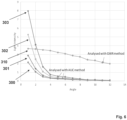
- Figure 6 shows a graph illustrating the effect of scattering of the light, from light source 110, through a sample in cases having different concentrations of leukocytes.
- the x-axis is a measure of the displacement (i.e. the angle of scatter, in degrees) from axis 111. In Figure 6 , this runs from 0° to 12°.
- the y-axis records the intensity of the signal provided by detector 140 and so is a measure of the intensity of light at a particular displacement.
- the curves shown represent five different concentrations of leukocytes: 5,000 cells/ml (300); 10,000 cells/ml (301); 25,000 cells/ml (302); 45,000 cells/ml (303); and 10,000,000 cells/ml (310).
- the absolute value of the threshold may differ, depending upon the particular setup of the apparatus and a threshold value between 10% and 40% may be appropriate with 25% being a preferred value in a particular case only.
- the threshold in terms of a percentage decrease per degree of displacement.
- the threshold may be considered as 25% per degree of displacement.
- intensity readings are taken at intervals of other than 1°, then the calculation may be adjusted accordingly.
- An alternative and in, some ways, complementary, technique examines the gradients at two locations on each curve and by means of a comparison therebetween, the correct technique is selected.
- an embodiment of the invention is arranged to examine a gradient at one end of the range and compare this with a gradient at another end of the range.
- the gradient at a first end of the range may be determined by examining the readings from the photodetectors arranged at 1° and 2°, determining a gradient from these two results, and then repeating the process with the readings from the photodetectors arranged at 11° and 12°.
- gradient is defined as the difference between two readings, divided the angular displacement between the same readings. The units of intensity are not relevant to this calculation, since a comparison of numerical values is all that is required,
- the first gradient is relatively steep and so indicative of a relatively lower concentration
- the second gradient is relatively flat, which acts to confirm this first approximation.
- the first gradient is relatively flat, as is the second one, and so the similarity between them is indicative of this much higher concentration.
- the GWR method uses the light intensity recorded at 4 or more scatter angles/displacements and calculates a weighted average intensity.
- the weighting given to each angle can be found by a number of empirical and computational methods, such as regression analysis, based on measurements of known standards.
- the weighted average of the light intensities can then be used to calculate the cell concentration in unknown samples within the applicable range of concentrations.
- the comparison of gradients referred to above, which determines which method is to be used involves a switching point or threshold. For instance, if the first and second gradients do not differ by more than 25% then this is determined to be substantially the same for the purposes of determining the concentration and so the GWR method is used. However, if the first and second gradients differ by more than the same percentage, then this is determined to be substantially different and so the AUC method is used.
- the profile across all photodetectors is compared with one or more pre-stored profiles to better match the observed result with pre-calculated or pre-modelled concentration values.
- the device 100 may be provided with a display to indicate information to the user regarding the ongoing analysis. In a simple case, this could be in the form of an alert if the cell level is above a predefined threshold. More complex displays may return detailed results, although these may not be suitable or required in all cases.
- the device 100 may be provided with a form of communication interface whereby the user's results are uploaded to a remote computer system, which may comprise the user's personal records and/or a remote monitoring station whereby problematic results may be reviewed by a physician who may contact the patient in case of concern for theirwellbeing.
- a remote computer system which may comprise the user's personal records and/or a remote monitoring station whereby problematic results may be reviewed by a physician who may contact the patient in case of concern for theirwellbeing.
- the communication interface may comprise a local wireless connection (such as Bluetooth) to a PC, which is then further connected via the internet to the remote computer system.
- a local wireless connection such as Bluetooth
- the device 100 may be able to communicate directly with the remote computer system via an integral cellular technology, for instance.
- Embodiments of the present invention provide many advantages over prior art solutions. For instance, use of the device requires no specialist knowledge on the part of the user, who is able to use it as an integral part of their dialysis set up.
- test is performed entirely in situ as part of the process it is monitoring. This means that there is no requirement to send samples to a lab for subsequent analysis.
- the options available to a user may be slightly different to those presented to a patient, since the laboratory worker will typically have a higher skill level in the use of the equipment and may require a different level of detail to a patient.
- the apparatus is arranged to measure a concentration of leukocytes in particular.
- the user may be interested in analysing other cell types. These may include, for instance, HL60 and Jurkat cells. Measurement of the concentration of these cell types may require an adjustment in the operation of the device, so that different result profiles will require a different processing to that applied to leukocytes. To facilitate this, an additional menu option may be provided so that the user is able to select the most appropriate processing to apply to the particular sample being analysed.
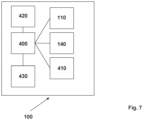
- FIG. 7 shows, for completeness, a schematic representation of certain functional parts of the device 100 according to an embodiment of the present invention.
- the device 100 is controlled by processor 400.
- Processor 400 is any suitable microprocessor or microcontroller, which is programmed to perform the operations required in order to perform the functions set out above.
- the program which causes the processor 400 to operate is stored in memory 420.
- the same memory 420 can provide working memory as well as data, such as pre-stored profiles and thresholds used in the analysis of a sample.
- the device 100 is operated via power supply 420.
- This may comprise an internal battery supply or an external mains-operated supply, as required.
- the processor 400 is arranged to drive the optical source 110 and to receive signals from the optical detector 140, as set out above.
- At least some of the example embodiments described herein may be constructed, partially or wholly, using dedicated special-purpose hardware.
- Terms such as 'component', 'module' or 'unit' used herein may include, but are not limited to, a hardware device, such as circuitry in the form of discrete or integrated components, a Field Programmable Gate Array (FPGA) or Application Specific Integrated Circuit (ASIC), which performs certain tasks or provides the associated functionality.
- FPGA Field Programmable Gate Array
- ASIC Application Specific Integrated Circuit
- the described elements may be configured to reside on a tangible, persistent, addressable storage medium and may be configured to execute on one or more processors.
- These functional elements may in some embodiments include, by way of example, components, such as software components, object-oriented software components, class components and task components, processes, functions, attributes, procedures, subroutines, segments of program code, drivers, firmware, microcode, circuitry, data, databases, data structures, tables, arrays, and variables.
- components such as software components, object-oriented software components, class components and task components, processes, functions, attributes, procedures, subroutines, segments of program code, drivers, firmware, microcode, circuitry, data, databases, data structures, tables, arrays, and variables.
- components such as software components, object-oriented software components, class components and task components, processes, functions, attributes, procedures, subroutines, segments of program code, drivers, firmware, microcode, circuitry, data, databases, data structures, tables, arrays, and variables.
Landscapes
- Health & Medical Sciences (AREA)
- Life Sciences & Earth Sciences (AREA)
- Physics & Mathematics (AREA)
- General Health & Medical Sciences (AREA)
- Pathology (AREA)
- Chemical & Material Sciences (AREA)
- Heart & Thoracic Surgery (AREA)
- Immunology (AREA)
- Public Health (AREA)
- Veterinary Medicine (AREA)
- Biomedical Technology (AREA)
- Animal Behavior & Ethology (AREA)
- Engineering & Computer Science (AREA)
- General Physics & Mathematics (AREA)
- Biochemistry (AREA)
- Analytical Chemistry (AREA)
- Medical Informatics (AREA)
- Biophysics (AREA)
- Surgery (AREA)
- Molecular Biology (AREA)
- Dispersion Chemistry (AREA)
- Emergency Medicine (AREA)
- Urology & Nephrology (AREA)
- Vascular Medicine (AREA)
- Optics & Photonics (AREA)
- Anesthesiology (AREA)
- Hematology (AREA)
- Physiology (AREA)
- Spectroscopy & Molecular Physics (AREA)
- Investigating Or Analysing Materials By Optical Means (AREA)
- Investigating Or Analysing Biological Materials (AREA)
- Apparatus Associated With Microorganisms And Enzymes (AREA)
- Investigating Materials By The Use Of Optical Means Adapted For Particular Applications (AREA)
- Optical Measuring Cells (AREA)
Applications Claiming Priority (2)
| Application Number | Priority Date | Filing Date | Title |
|---|---|---|---|
| GB2018831.4A GB2601380A (en) | 2020-11-30 | 2020-11-30 | A diagnostic device |
| PCT/GB2021/053122 WO2022112803A1 (en) | 2020-11-30 | 2021-11-30 | A cell counter and diagnostic device |
Publications (3)
| Publication Number | Publication Date |
|---|---|
| EP4078138A1 EP4078138A1 (en) | 2022-10-26 |
| EP4078138B1 true EP4078138B1 (en) | 2024-07-10 |
| EP4078138C0 EP4078138C0 (en) | 2024-07-10 |
Family
ID=74099817
Family Applications (1)
| Application Number | Title | Priority Date | Filing Date |
|---|---|---|---|
| EP21824634.6A Active EP4078138B1 (en) | 2020-11-30 | 2021-11-30 | A cell counter and diagnostic device |
Country Status (12)
| Country | Link |
|---|---|
| US (1) | US20240035948A1 (https=) |
| EP (1) | EP4078138B1 (https=) |
| JP (1) | JP2023553307A (https=) |
| KR (1) | KR20230112669A (https=) |
| CN (1) | CN116601477A (https=) |
| AU (1) | AU2021386517A1 (https=) |
| CA (1) | CA3202372A1 (https=) |
| CO (1) | CO2023008053A2 (https=) |
| GB (1) | GB2601380A (https=) |
| IL (1) | IL303194A (https=) |
| MX (1) | MX2023006174A (https=) |
| WO (1) | WO2022112803A1 (https=) |
Families Citing this family (2)
| Publication number | Priority date | Publication date | Assignee | Title |
|---|---|---|---|---|
| GB202304863D0 (en) * | 2023-03-31 | 2023-05-17 | Microbiosensor Ltd | A cell counter and diagnostic device |
| US20260092855A1 (en) * | 2024-10-02 | 2026-04-02 | Gambro Lundia Ab | Optical determination of white blood cell concentration in fluids |
Family Cites Families (15)
| Publication number | Priority date | Publication date | Assignee | Title |
|---|---|---|---|---|
| US4375334A (en) * | 1981-06-18 | 1983-03-01 | The United States Of America As Represented By The Secretary Of The Navy | Nephelometer |
| AU719048B2 (en) * | 1995-04-06 | 2000-05-04 | Alfa Laval Agri Ab | Method and apparatus for quantitative particle determination in fluids |
| JP3659726B2 (ja) * | 1996-03-08 | 2005-06-15 | テルモ株式会社 | 濁度測定機能付き自動腹膜透析装置および腹膜透析用回路 |
| AT403412B (de) * | 1996-04-02 | 1998-02-25 | Avl Verbrennungskraft Messtech | Vorrichtung und verfahren zur bestimmung der konzentration von hämoglobinderivaten in einer unverdünnten, unhämolysierten vollblutprobe |
| SE9804142D0 (sv) * | 1998-11-30 | 1998-11-30 | Gambro Ab | Method and device for providing a signal |
| EP1161670B1 (en) * | 1999-02-19 | 2008-12-10 | Metron Instruments, Inc. | Measurement systems and methods for determining component particle concentrations in a liquid |
| US7724150B2 (en) * | 2007-09-04 | 2010-05-25 | Venturedyne, Ltd. | Environmental sensor, particle counting system having an environmental sensor, and methods of operating the same |
| CN101678162B (zh) * | 2008-01-25 | 2013-10-09 | 弗雷塞尼斯医疗保健控股公司 | 包括自清洁流出物室的用于早期腹膜炎检测的设备和方法 |
| DE102011002421A1 (de) * | 2011-01-04 | 2012-07-05 | Robert Bosch Gmbh | Messgerät zur Messung von Partikelkonzentrationen mittels Streulicht und Verfahren zur Überwachung des Messgerätes |
| CN102692396B (zh) * | 2012-06-14 | 2014-04-02 | 南京中医药大学 | 一种内毒素检测系统及其定量检测方法 |
| EP2869056B1 (en) * | 2013-11-05 | 2020-05-20 | Malvern Panalytical Limited | Improvements relating to particle characterisation |
| CN107075437B (zh) * | 2014-10-22 | 2019-12-03 | 株式会社日立高新技术 | 细胞测量机构和具有该细胞测量机构的细胞培养装置以及细胞测量方法 |
| BR112020011772A2 (pt) * | 2017-12-15 | 2020-11-17 | Gastroklenz Inc. | sistema de monitoramento do sensor para tratamen-tos com base em cateter permanentes |
| PL3521810T3 (pl) * | 2018-01-31 | 2020-05-18 | Sick Engineering Gmbh | Analizator do oznaczania pyłu drobnego |
| CN109443445B (zh) * | 2018-12-18 | 2023-10-27 | 苏州同阳科技发展有限公司 | 一种颗粒物在线监测装置与方法 |
-
2020
- 2020-11-30 GB GB2018831.4A patent/GB2601380A/en not_active Withdrawn
-
2021
- 2021-11-30 JP JP2023531107A patent/JP2023553307A/ja active Pending
- 2021-11-30 CN CN202180080209.1A patent/CN116601477A/zh active Pending
- 2021-11-30 US US18/254,910 patent/US20240035948A1/en active Pending
- 2021-11-30 CA CA3202372A patent/CA3202372A1/en active Pending
- 2021-11-30 MX MX2023006174A patent/MX2023006174A/es unknown
- 2021-11-30 KR KR1020237020874A patent/KR20230112669A/ko active Pending
- 2021-11-30 AU AU2021386517A patent/AU2021386517A1/en active Pending
- 2021-11-30 IL IL303194A patent/IL303194A/en unknown
- 2021-11-30 WO PCT/GB2021/053122 patent/WO2022112803A1/en not_active Ceased
- 2021-11-30 EP EP21824634.6A patent/EP4078138B1/en active Active
-
2023
- 2023-06-21 CO CONC2023/0008053A patent/CO2023008053A2/es unknown
Also Published As
| Publication number | Publication date |
|---|---|
| WO2022112803A1 (en) | 2022-06-02 |
| IL303194A (en) | 2023-07-01 |
| EP4078138A1 (en) | 2022-10-26 |
| CA3202372A1 (en) | 2022-06-02 |
| CN116601477A (zh) | 2023-08-15 |
| MX2023006174A (es) | 2023-07-06 |
| GB2601380A (en) | 2022-06-01 |
| GB202018831D0 (en) | 2021-01-13 |
| KR20230112669A (ko) | 2023-07-27 |
| CO2023008053A2 (es) | 2023-06-30 |
| EP4078138C0 (en) | 2024-07-10 |
| JP2023553307A (ja) | 2023-12-21 |
| AU2021386517A9 (en) | 2025-03-20 |
| AU2021386517A1 (en) | 2023-06-22 |
| US20240035948A1 (en) | 2024-02-01 |
Similar Documents
| Publication | Publication Date | Title |
|---|---|---|
| CA2501360C (en) | Method and device for measurements in blood | |
| JP5266334B2 (ja) | 自己洗浄排出物チャンバを含む早期の腹膜炎検出のための装置並びに方法 | |
| US8801652B2 (en) | Early stage peritonitis detection apparatus and methods | |
| EP4078138B1 (en) | A cell counter and diagnostic device | |
| NO880891L (no) | Fremgangsmaate og apparat for maaling eller deteksjon av konsentrasjonen av en substans. | |
| CN107106095A (zh) | 用于尿液分析的设备、系统及方法 | |
| CN109498854A (zh) | 一种引流监测装置 | |
| EP4199988A1 (en) | Peritonitis sensors, including peritonitis sensors for automated peritoneal dialysis systems, and associated systems, devices, and methods | |
| US20110060199A1 (en) | Determination of blood pump system performance and sample dilution using a property of fluid being transported | |
| HK40083555B (en) | A cell counter and diagnostic device | |
| HK40083555A (en) | A cell counter and diagnostic device | |
| JP2024517605A (ja) | 腹膜透析からの感染を検出するためのデバイス | |
| EP4689599A1 (en) | A cell counter and diagnostic device | |
| JP5596558B2 (ja) | 早期の腹膜炎検出及び体液の生体内検査のための装置 | |
| CN102608119B (zh) | 管道药液中的运动异物检测装置及方法 | |
| EP4516921A3 (en) | Apparatus, system and method for measuring properties of a sample | |
| Cortés et al. | Bward: An optical approach for reliable in-situ early blood leakage detection at catheter extraction points | |
| US20230293018A1 (en) | Whole blood sampling and monitoring device, method and software | |
| CN202676605U (zh) | 管道药液中的运动异物检测装置 | |
| WO2026024810A1 (en) | Methods and apparatus for facilitating sample movement and placement within test cards | |
| WO2022009222A1 (en) | System and method of measuring urinary oxygen tension | |
| IT201900017402A1 (it) | Un apparato ed un metodo per la misurazione in continuo della concentrazione di un analita in un flusso di un fluido biologico |
Legal Events
| Date | Code | Title | Description |
|---|---|---|---|
| STAA | Information on the status of an ep patent application or granted ep patent |
Free format text: STATUS: UNKNOWN |
|
| STAA | Information on the status of an ep patent application or granted ep patent |
Free format text: STATUS: THE INTERNATIONAL PUBLICATION HAS BEEN MADE |
|
| PUAI | Public reference made under article 153(3) epc to a published international application that has entered the european phase |
Free format text: ORIGINAL CODE: 0009012 |
|
| STAA | Information on the status of an ep patent application or granted ep patent |
Free format text: STATUS: REQUEST FOR EXAMINATION WAS MADE |
|
| STAA | Information on the status of an ep patent application or granted ep patent |
Free format text: STATUS: EXAMINATION IS IN PROGRESS |
|
| 17P | Request for examination filed |
Effective date: 20220721 |
|
| AK | Designated contracting states |
Kind code of ref document: A1 Designated state(s): AL AT BE BG CH CY CZ DE DK EE ES FI FR GB GR HR HU IE IS IT LI LT LU LV MC MK MT NL NO PL PT RO RS SE SI SK SM TR |
|
| 17Q | First examination report despatched |
Effective date: 20221012 |
|
| REG | Reference to a national code |
Ref country code: HK Ref legal event code: DE Ref document number: 40083555 Country of ref document: HK |
|
| GRAP | Despatch of communication of intention to grant a patent |
Free format text: ORIGINAL CODE: EPIDOSNIGR1 |
|
| STAA | Information on the status of an ep patent application or granted ep patent |
Free format text: STATUS: GRANT OF PATENT IS INTENDED |
|
| INTG | Intention to grant announced |
Effective date: 20231114 |
|
| DAV | Request for validation of the european patent (deleted) | ||
| DAX | Request for extension of the european patent (deleted) | ||
| GRAS | Grant fee paid |
Free format text: ORIGINAL CODE: EPIDOSNIGR3 |
|
| GRAA | (expected) grant |
Free format text: ORIGINAL CODE: 0009210 |
|
| STAA | Information on the status of an ep patent application or granted ep patent |
Free format text: STATUS: THE PATENT HAS BEEN GRANTED |
|
| AK | Designated contracting states |
Kind code of ref document: B1 Designated state(s): AL AT BE BG CH CY CZ DE DK EE ES FI FR GB GR HR HU IE IS IT LI LT LU LV MC MK MT NL NO PL PT RO RS SE SI SK SM TR |
|
| REG | Reference to a national code |
Ref country code: CH Ref legal event code: EP |
|
| REG | Reference to a national code |
Ref country code: DE Ref legal event code: R096 Ref document number: 602021015628 Country of ref document: DE |
|
| U01 | Request for unitary effect filed |
Effective date: 20240710 |
|
| U07 | Unitary effect registered |
Designated state(s): AT BE BG DE DK EE FI FR IT LT LU LV MT NL PT SE SI Effective date: 20240719 |
|
| U20 | Renewal fee for the european patent with unitary effect paid |
Year of fee payment: 4 Effective date: 20241107 |
|
| PG25 | Lapsed in a contracting state [announced via postgrant information from national office to epo] |
Ref country code: NO Free format text: LAPSE BECAUSE OF FAILURE TO SUBMIT A TRANSLATION OF THE DESCRIPTION OR TO PAY THE FEE WITHIN THE PRESCRIBED TIME-LIMIT Effective date: 20241010 |
|
| PG25 | Lapsed in a contracting state [announced via postgrant information from national office to epo] |
Ref country code: PL Free format text: LAPSE BECAUSE OF FAILURE TO SUBMIT A TRANSLATION OF THE DESCRIPTION OR TO PAY THE FEE WITHIN THE PRESCRIBED TIME-LIMIT Effective date: 20240710 Ref country code: GR Free format text: LAPSE BECAUSE OF FAILURE TO SUBMIT A TRANSLATION OF THE DESCRIPTION OR TO PAY THE FEE WITHIN THE PRESCRIBED TIME-LIMIT Effective date: 20241011 |
|
| PG25 | Lapsed in a contracting state [announced via postgrant information from national office to epo] |
Ref country code: IS Free format text: LAPSE BECAUSE OF FAILURE TO SUBMIT A TRANSLATION OF THE DESCRIPTION OR TO PAY THE FEE WITHIN THE PRESCRIBED TIME-LIMIT Effective date: 20241110 |
|
| PG25 | Lapsed in a contracting state [announced via postgrant information from national office to epo] |
Ref country code: HR Free format text: LAPSE BECAUSE OF FAILURE TO SUBMIT A TRANSLATION OF THE DESCRIPTION OR TO PAY THE FEE WITHIN THE PRESCRIBED TIME-LIMIT Effective date: 20240710 |
|
| PG25 | Lapsed in a contracting state [announced via postgrant information from national office to epo] |
Ref country code: RS Free format text: LAPSE BECAUSE OF FAILURE TO SUBMIT A TRANSLATION OF THE DESCRIPTION OR TO PAY THE FEE WITHIN THE PRESCRIBED TIME-LIMIT Effective date: 20241010 Ref country code: ES Free format text: LAPSE BECAUSE OF FAILURE TO SUBMIT A TRANSLATION OF THE DESCRIPTION OR TO PAY THE FEE WITHIN THE PRESCRIBED TIME-LIMIT Effective date: 20240710 |
|
| PG25 | Lapsed in a contracting state [announced via postgrant information from national office to epo] |
Ref country code: RS Free format text: LAPSE BECAUSE OF FAILURE TO SUBMIT A TRANSLATION OF THE DESCRIPTION OR TO PAY THE FEE WITHIN THE PRESCRIBED TIME-LIMIT Effective date: 20241010 Ref country code: PL Free format text: LAPSE BECAUSE OF FAILURE TO SUBMIT A TRANSLATION OF THE DESCRIPTION OR TO PAY THE FEE WITHIN THE PRESCRIBED TIME-LIMIT Effective date: 20240710 Ref country code: NO Free format text: LAPSE BECAUSE OF FAILURE TO SUBMIT A TRANSLATION OF THE DESCRIPTION OR TO PAY THE FEE WITHIN THE PRESCRIBED TIME-LIMIT Effective date: 20241010 Ref country code: IS Free format text: LAPSE BECAUSE OF FAILURE TO SUBMIT A TRANSLATION OF THE DESCRIPTION OR TO PAY THE FEE WITHIN THE PRESCRIBED TIME-LIMIT Effective date: 20241110 Ref country code: HR Free format text: LAPSE BECAUSE OF FAILURE TO SUBMIT A TRANSLATION OF THE DESCRIPTION OR TO PAY THE FEE WITHIN THE PRESCRIBED TIME-LIMIT Effective date: 20240710 Ref country code: GR Free format text: LAPSE BECAUSE OF FAILURE TO SUBMIT A TRANSLATION OF THE DESCRIPTION OR TO PAY THE FEE WITHIN THE PRESCRIBED TIME-LIMIT Effective date: 20241011 Ref country code: ES Free format text: LAPSE BECAUSE OF FAILURE TO SUBMIT A TRANSLATION OF THE DESCRIPTION OR TO PAY THE FEE WITHIN THE PRESCRIBED TIME-LIMIT Effective date: 20240710 |
|
| PG25 | Lapsed in a contracting state [announced via postgrant information from national office to epo] |
Ref country code: SM Free format text: LAPSE BECAUSE OF FAILURE TO SUBMIT A TRANSLATION OF THE DESCRIPTION OR TO PAY THE FEE WITHIN THE PRESCRIBED TIME-LIMIT Effective date: 20240710 |
|
| PG25 | Lapsed in a contracting state [announced via postgrant information from national office to epo] |
Ref country code: CZ Free format text: LAPSE BECAUSE OF FAILURE TO SUBMIT A TRANSLATION OF THE DESCRIPTION OR TO PAY THE FEE WITHIN THE PRESCRIBED TIME-LIMIT Effective date: 20240710 |
|
| PG25 | Lapsed in a contracting state [announced via postgrant information from national office to epo] |
Ref country code: SK Free format text: LAPSE BECAUSE OF FAILURE TO SUBMIT A TRANSLATION OF THE DESCRIPTION OR TO PAY THE FEE WITHIN THE PRESCRIBED TIME-LIMIT Effective date: 20240710 |
|
| PLBE | No opposition filed within time limit |
Free format text: ORIGINAL CODE: 0009261 |
|
| STAA | Information on the status of an ep patent application or granted ep patent |
Free format text: STATUS: NO OPPOSITION FILED WITHIN TIME LIMIT |
|
| 26N | No opposition filed |
Effective date: 20250411 |
|
| REG | Reference to a national code |
Ref country code: CH Ref legal event code: PL |
|
| PG25 | Lapsed in a contracting state [announced via postgrant information from national office to epo] |
Ref country code: MC Free format text: LAPSE BECAUSE OF FAILURE TO SUBMIT A TRANSLATION OF THE DESCRIPTION OR TO PAY THE FEE WITHIN THE PRESCRIBED TIME-LIMIT Effective date: 20240710 |
|
| REG | Reference to a national code |
Ref country code: CH Ref legal event code: PL |
|
| PG25 | Lapsed in a contracting state [announced via postgrant information from national office to epo] |
Ref country code: CH Free format text: LAPSE BECAUSE OF NON-PAYMENT OF DUE FEES Effective date: 20241130 |
|
| PG25 | Lapsed in a contracting state [announced via postgrant information from national office to epo] |
Ref country code: IE Free format text: LAPSE BECAUSE OF NON-PAYMENT OF DUE FEES Effective date: 20241130 |
|
| PG25 | Lapsed in a contracting state [announced via postgrant information from national office to epo] |
Ref country code: RO Free format text: LAPSE BECAUSE OF FAILURE TO SUBMIT A TRANSLATION OF THE DESCRIPTION OR TO PAY THE FEE WITHIN THE PRESCRIBED TIME-LIMIT Effective date: 20240710 |
|
| PG25 | Lapsed in a contracting state [announced via postgrant information from national office to epo] |
Ref country code: CY Free format text: LAPSE BECAUSE OF FAILURE TO SUBMIT A TRANSLATION OF THE DESCRIPTION OR TO PAY THE FEE WITHIN THE PRESCRIBED TIME-LIMIT; INVALID AB INITIO Effective date: 20211130 |