EP4074754B1 - Bioelektrodenzusammensetzung, bioelektrode und verfahren zur herstellung einer bioelektrode - Google Patents
Bioelektrodenzusammensetzung, bioelektrode und verfahren zur herstellung einer bioelektrode Download PDFInfo
- Publication number
- EP4074754B1 EP4074754B1 EP22167517.6A EP22167517A EP4074754B1 EP 4074754 B1 EP4074754 B1 EP 4074754B1 EP 22167517 A EP22167517 A EP 22167517A EP 4074754 B1 EP4074754 B1 EP 4074754B1
- Authority
- EP
- European Patent Office
- Prior art keywords
- group
- bio
- electrode
- carbon atoms
- polymer
- Prior art date
- Legal status (The legal status is an assumption and is not a legal conclusion. Google has not performed a legal analysis and makes no representation as to the accuracy of the status listed.)
- Active
Links
Images

Classifications
-
- C—CHEMISTRY; METALLURGY
- C09—DYES; PAINTS; POLISHES; NATURAL RESINS; ADHESIVES; COMPOSITIONS NOT OTHERWISE PROVIDED FOR; APPLICATIONS OF MATERIALS NOT OTHERWISE PROVIDED FOR
- C09J—ADHESIVES; NON-MECHANICAL ASPECTS OF ADHESIVE PROCESSES IN GENERAL; ADHESIVE PROCESSES NOT PROVIDED FOR ELSEWHERE; USE OF MATERIALS AS ADHESIVES
- C09J183/00—Adhesives based on macromolecular compounds obtained by reactions forming in the main chain of the macromolecule a linkage containing silicon, with or without sulfur, nitrogen, oxygen, or carbon only; Adhesives based on derivatives of such polymers
- C09J183/10—Block or graft copolymers containing polysiloxane sequences
-
- A—HUMAN NECESSITIES
- A61—MEDICAL OR VETERINARY SCIENCE; HYGIENE
- A61B—DIAGNOSIS; SURGERY; IDENTIFICATION
- A61B5/00—Measuring for diagnostic purposes; Identification of persons
- A61B5/02—Detecting, measuring or recording for evaluating the cardiovascular system, e.g. pulse, heart rate, blood pressure or blood flow
- A61B5/024—Measuring pulse rate or heart rate
- A61B5/0245—Measuring pulse rate or heart rate by using sensing means generating electric signals, i.e. ECG signals
-
- A—HUMAN NECESSITIES
- A61—MEDICAL OR VETERINARY SCIENCE; HYGIENE
- A61B—DIAGNOSIS; SURGERY; IDENTIFICATION
- A61B5/00—Measuring for diagnostic purposes; Identification of persons
- A61B5/24—Detecting, measuring or recording bioelectric or biomagnetic signals of the body or parts thereof
- A61B5/25—Bioelectric electrodes therefor
- A61B5/251—Means for maintaining electrode contact with the body
- A61B5/256—Wearable electrodes, e.g. having straps or bands
-
- A—HUMAN NECESSITIES
- A61—MEDICAL OR VETERINARY SCIENCE; HYGIENE
- A61B—DIAGNOSIS; SURGERY; IDENTIFICATION
- A61B5/00—Measuring for diagnostic purposes; Identification of persons
- A61B5/02—Detecting, measuring or recording for evaluating the cardiovascular system, e.g. pulse, heart rate, blood pressure or blood flow
- A61B5/024—Measuring pulse rate or heart rate
- A61B5/02444—Details of sensor
-
- A—HUMAN NECESSITIES
- A61—MEDICAL OR VETERINARY SCIENCE; HYGIENE
- A61B—DIAGNOSIS; SURGERY; IDENTIFICATION
- A61B5/00—Measuring for diagnostic purposes; Identification of persons
- A61B5/24—Detecting, measuring or recording bioelectric or biomagnetic signals of the body or parts thereof
- A61B5/25—Bioelectric electrodes therefor
- A61B5/251—Means for maintaining electrode contact with the body
- A61B5/257—Means for maintaining electrode contact with the body using adhesive means, e.g. adhesive pads or tapes
- A61B5/259—Means for maintaining electrode contact with the body using adhesive means, e.g. adhesive pads or tapes using conductive adhesive means, e.g. gels
-
- A—HUMAN NECESSITIES
- A61—MEDICAL OR VETERINARY SCIENCE; HYGIENE
- A61B—DIAGNOSIS; SURGERY; IDENTIFICATION
- A61B5/00—Measuring for diagnostic purposes; Identification of persons
- A61B5/24—Detecting, measuring or recording bioelectric or biomagnetic signals of the body or parts thereof
- A61B5/25—Bioelectric electrodes therefor
- A61B5/263—Bioelectric electrodes therefor characterised by the electrode materials
- A61B5/265—Bioelectric electrodes therefor characterised by the electrode materials containing silver or silver chloride
-
- A—HUMAN NECESSITIES
- A61—MEDICAL OR VETERINARY SCIENCE; HYGIENE
- A61B—DIAGNOSIS; SURGERY; IDENTIFICATION
- A61B5/00—Measuring for diagnostic purposes; Identification of persons
- A61B5/24—Detecting, measuring or recording bioelectric or biomagnetic signals of the body or parts thereof
- A61B5/25—Bioelectric electrodes therefor
- A61B5/263—Bioelectric electrodes therefor characterised by the electrode materials
- A61B5/266—Bioelectric electrodes therefor characterised by the electrode materials containing electrolytes, conductive gels or pastes
-
- A—HUMAN NECESSITIES
- A61—MEDICAL OR VETERINARY SCIENCE; HYGIENE
- A61B—DIAGNOSIS; SURGERY; IDENTIFICATION
- A61B5/00—Measuring for diagnostic purposes; Identification of persons
- A61B5/24—Detecting, measuring or recording bioelectric or biomagnetic signals of the body or parts thereof
- A61B5/25—Bioelectric electrodes therefor
- A61B5/263—Bioelectric electrodes therefor characterised by the electrode materials
- A61B5/268—Bioelectric electrodes therefor characterised by the electrode materials containing conductive polymers, e.g. PEDOT:PSS polymers
-
- C—CHEMISTRY; METALLURGY
- C08—ORGANIC MACROMOLECULAR COMPOUNDS; THEIR PREPARATION OR CHEMICAL WORKING-UP; COMPOSITIONS BASED THEREON
- C08F—MACROMOLECULAR COMPOUNDS OBTAINED BY REACTIONS ONLY INVOLVING CARBON-TO-CARBON UNSATURATED BONDS
- C08F212/00—Copolymers of compounds having one or more unsaturated aliphatic radicals, each having only one carbon-to-carbon double bond, and at least one being terminated by an aromatic carbocyclic ring
- C08F212/02—Monomers containing only one unsaturated aliphatic radical
- C08F212/04—Monomers containing only one unsaturated aliphatic radical containing one ring
- C08F212/14—Monomers containing only one unsaturated aliphatic radical containing one ring substituted by heteroatoms or groups containing heteroatoms
- C08F212/30—Sulfur
-
- C—CHEMISTRY; METALLURGY
- C08—ORGANIC MACROMOLECULAR COMPOUNDS; THEIR PREPARATION OR CHEMICAL WORKING-UP; COMPOSITIONS BASED THEREON
- C08F—MACROMOLECULAR COMPOUNDS OBTAINED BY REACTIONS ONLY INVOLVING CARBON-TO-CARBON UNSATURATED BONDS
- C08F220/00—Copolymers of compounds having one or more unsaturated aliphatic radicals, each having only one carbon-to-carbon double bond, and only one being terminated by only one carboxyl radical or a salt, anhydride ester, amide, imide or nitrile thereof
- C08F220/02—Monocarboxylic acids having less than ten carbon atoms; Derivatives thereof
- C08F220/10—Esters
- C08F220/12—Esters of monohydric alcohols or phenols
- C08F220/16—Esters of monohydric alcohols or phenols of phenols or of alcohols containing two or more carbon atoms
- C08F220/18—Esters of monohydric alcohols or phenols of phenols or of alcohols containing two or more carbon atoms with acrylic or methacrylic acids
- C08F220/1808—C8-(meth)acrylate, e.g. isooctyl (meth)acrylate or 2-ethylhexyl (meth)acrylate
-
- C—CHEMISTRY; METALLURGY
- C08—ORGANIC MACROMOLECULAR COMPOUNDS; THEIR PREPARATION OR CHEMICAL WORKING-UP; COMPOSITIONS BASED THEREON
- C08F—MACROMOLECULAR COMPOUNDS OBTAINED BY REACTIONS ONLY INVOLVING CARBON-TO-CARBON UNSATURATED BONDS
- C08F220/00—Copolymers of compounds having one or more unsaturated aliphatic radicals, each having only one carbon-to-carbon double bond, and only one being terminated by only one carboxyl radical or a salt, anhydride ester, amide, imide or nitrile thereof
- C08F220/02—Monocarboxylic acids having less than ten carbon atoms; Derivatives thereof
- C08F220/10—Esters
- C08F220/12—Esters of monohydric alcohols or phenols
- C08F220/16—Esters of monohydric alcohols or phenols of phenols or of alcohols containing two or more carbon atoms
- C08F220/18—Esters of monohydric alcohols or phenols of phenols or of alcohols containing two or more carbon atoms with acrylic or methacrylic acids
- C08F220/1809—C9-(meth)acrylate
-
- C—CHEMISTRY; METALLURGY
- C08—ORGANIC MACROMOLECULAR COMPOUNDS; THEIR PREPARATION OR CHEMICAL WORKING-UP; COMPOSITIONS BASED THEREON
- C08G—MACROMOLECULAR COMPOUNDS OBTAINED OTHERWISE THAN BY REACTIONS ONLY INVOLVING UNSATURATED CARBON-TO-CARBON BONDS
- C08G77/00—Macromolecular compounds obtained by reactions forming a linkage containing silicon with or without sulfur, nitrogen, oxygen or carbon in the main chain of the macromolecule
- C08G77/04—Polysiloxanes
- C08G77/12—Polysiloxanes containing silicon bound to hydrogen
-
- C—CHEMISTRY; METALLURGY
- C08—ORGANIC MACROMOLECULAR COMPOUNDS; THEIR PREPARATION OR CHEMICAL WORKING-UP; COMPOSITIONS BASED THEREON
- C08G—MACROMOLECULAR COMPOUNDS OBTAINED OTHERWISE THAN BY REACTIONS ONLY INVOLVING UNSATURATED CARBON-TO-CARBON BONDS
- C08G77/00—Macromolecular compounds obtained by reactions forming a linkage containing silicon with or without sulfur, nitrogen, oxygen or carbon in the main chain of the macromolecule
- C08G77/04—Polysiloxanes
- C08G77/20—Polysiloxanes containing silicon bound to unsaturated aliphatic groups
-
- C—CHEMISTRY; METALLURGY
- C08—ORGANIC MACROMOLECULAR COMPOUNDS; THEIR PREPARATION OR CHEMICAL WORKING-UP; COMPOSITIONS BASED THEREON
- C08G—MACROMOLECULAR COMPOUNDS OBTAINED OTHERWISE THAN BY REACTIONS ONLY INVOLVING UNSATURATED CARBON-TO-CARBON BONDS
- C08G77/00—Macromolecular compounds obtained by reactions forming a linkage containing silicon with or without sulfur, nitrogen, oxygen or carbon in the main chain of the macromolecule
- C08G77/42—Block-or graft-polymers containing polysiloxane sequences
- C08G77/442—Block-or graft-polymers containing polysiloxane sequences containing vinyl polymer sequences
-
- C—CHEMISTRY; METALLURGY
- C08—ORGANIC MACROMOLECULAR COMPOUNDS; THEIR PREPARATION OR CHEMICAL WORKING-UP; COMPOSITIONS BASED THEREON
- C08K—Use of inorganic or non-macromolecular organic substances as compounding ingredients
- C08K3/00—Use of inorganic substances as compounding ingredients
- C08K3/02—Elements
- C08K3/04—Carbon
- C08K3/041—Carbon nanotubes
-
- C—CHEMISTRY; METALLURGY
- C08—ORGANIC MACROMOLECULAR COMPOUNDS; THEIR PREPARATION OR CHEMICAL WORKING-UP; COMPOSITIONS BASED THEREON
- C08K—Use of inorganic or non-macromolecular organic substances as compounding ingredients
- C08K3/00—Use of inorganic substances as compounding ingredients
- C08K3/02—Elements
- C08K3/08—Metals
-
- C—CHEMISTRY; METALLURGY
- C08—ORGANIC MACROMOLECULAR COMPOUNDS; THEIR PREPARATION OR CHEMICAL WORKING-UP; COMPOSITIONS BASED THEREON
- C08L—COMPOSITIONS OF MACROMOLECULAR COMPOUNDS
- C08L101/00—Compositions of unspecified macromolecular compounds
- C08L101/02—Compositions of unspecified macromolecular compounds characterised by the presence of specified groups, e.g. terminal or pendant functional groups
-
- C—CHEMISTRY; METALLURGY
- C08—ORGANIC MACROMOLECULAR COMPOUNDS; THEIR PREPARATION OR CHEMICAL WORKING-UP; COMPOSITIONS BASED THEREON
- C08L—COMPOSITIONS OF MACROMOLECULAR COMPOUNDS
- C08L101/00—Compositions of unspecified macromolecular compounds
- C08L101/12—Compositions of unspecified macromolecular compounds characterised by physical features, e.g. anisotropy, viscosity or electrical conductivity
-
- C—CHEMISTRY; METALLURGY
- C08—ORGANIC MACROMOLECULAR COMPOUNDS; THEIR PREPARATION OR CHEMICAL WORKING-UP; COMPOSITIONS BASED THEREON
- C08L—COMPOSITIONS OF MACROMOLECULAR COMPOUNDS
- C08L83/00—Compositions of macromolecular compounds obtained by reactions forming in the main chain of the macromolecule a linkage containing silicon with or without sulfur, nitrogen, oxygen or carbon only; Compositions of derivatives of such polymers
- C08L83/04—Polysiloxanes
-
- C—CHEMISTRY; METALLURGY
- C08—ORGANIC MACROMOLECULAR COMPOUNDS; THEIR PREPARATION OR CHEMICAL WORKING-UP; COMPOSITIONS BASED THEREON
- C08L—COMPOSITIONS OF MACROMOLECULAR COMPOUNDS
- C08L83/00—Compositions of macromolecular compounds obtained by reactions forming in the main chain of the macromolecule a linkage containing silicon with or without sulfur, nitrogen, oxygen or carbon only; Compositions of derivatives of such polymers
- C08L83/10—Block- or graft-copolymers containing polysiloxane sequences
-
- C—CHEMISTRY; METALLURGY
- C09—DYES; PAINTS; POLISHES; NATURAL RESINS; ADHESIVES; COMPOSITIONS NOT OTHERWISE PROVIDED FOR; APPLICATIONS OF MATERIALS NOT OTHERWISE PROVIDED FOR
- C09D—COATING COMPOSITIONS, e.g. PAINTS, VARNISHES OR LACQUERS; FILLING PASTES; CHEMICAL PAINT OR INK REMOVERS; INKS; CORRECTING FLUIDS; WOODSTAINS; PASTES OR SOLIDS FOR COLOURING OR PRINTING; USE OF MATERIALS THEREFOR
- C09D133/00—Coating compositions based on homopolymers or copolymers of compounds having one or more unsaturated aliphatic radicals, each having only one carbon-to-carbon double bond, and at least one being terminated by only one carboxyl radical, or of salts, anhydrides, esters, amides, imides, or nitriles thereof; Coating compositions based on derivatives of such polymers
- C09D133/04—Homopolymers or copolymers of esters
- C09D133/14—Homopolymers or copolymers of esters of esters containing halogen, nitrogen, sulfur or oxygen atoms in addition to the carboxy oxygen
-
- C—CHEMISTRY; METALLURGY
- C09—DYES; PAINTS; POLISHES; NATURAL RESINS; ADHESIVES; COMPOSITIONS NOT OTHERWISE PROVIDED FOR; APPLICATIONS OF MATERIALS NOT OTHERWISE PROVIDED FOR
- C09D—COATING COMPOSITIONS, e.g. PAINTS, VARNISHES OR LACQUERS; FILLING PASTES; CHEMICAL PAINT OR INK REMOVERS; INKS; CORRECTING FLUIDS; WOODSTAINS; PASTES OR SOLIDS FOR COLOURING OR PRINTING; USE OF MATERIALS THEREFOR
- C09D183/00—Coating compositions based on macromolecular compounds obtained by reactions forming in the main chain of the macromolecule a linkage containing silicon, with or without sulfur, nitrogen, oxygen, or carbon only; Coating compositions based on derivatives of such polymers
- C09D183/04—Polysiloxanes
-
- C—CHEMISTRY; METALLURGY
- C09—DYES; PAINTS; POLISHES; NATURAL RESINS; ADHESIVES; COMPOSITIONS NOT OTHERWISE PROVIDED FOR; APPLICATIONS OF MATERIALS NOT OTHERWISE PROVIDED FOR
- C09J—ADHESIVES; NON-MECHANICAL ASPECTS OF ADHESIVE PROCESSES IN GENERAL; ADHESIVE PROCESSES NOT PROVIDED FOR ELSEWHERE; USE OF MATERIALS AS ADHESIVES
- C09J9/00—Adhesives characterised by their physical nature or the effects produced, e.g. glue sticks
- C09J9/02—Electrically-conducting adhesives
-
- A—HUMAN NECESSITIES
- A61—MEDICAL OR VETERINARY SCIENCE; HYGIENE
- A61B—DIAGNOSIS; SURGERY; IDENTIFICATION
- A61B2562/00—Details of sensors; Constructional details of sensor housings or probes; Accessories for sensors
- A61B2562/12—Manufacturing methods specially adapted for producing sensors for in-vivo measurements
- A61B2562/125—Manufacturing methods specially adapted for producing sensors for in-vivo measurements characterised by the manufacture of electrodes
-
- A—HUMAN NECESSITIES
- A61—MEDICAL OR VETERINARY SCIENCE; HYGIENE
- A61B—DIAGNOSIS; SURGERY; IDENTIFICATION
- A61B5/00—Measuring for diagnostic purposes; Identification of persons
- A61B5/24—Detecting, measuring or recording bioelectric or biomagnetic signals of the body or parts thereof
- A61B5/25—Bioelectric electrodes therefor
- A61B5/279—Bioelectric electrodes therefor specially adapted for particular uses
- A61B5/28—Bioelectric electrodes therefor specially adapted for particular uses for electrocardiography [ECG]
-
- C—CHEMISTRY; METALLURGY
- C08—ORGANIC MACROMOLECULAR COMPOUNDS; THEIR PREPARATION OR CHEMICAL WORKING-UP; COMPOSITIONS BASED THEREON
- C08G—MACROMOLECULAR COMPOUNDS OBTAINED OTHERWISE THAN BY REACTIONS ONLY INVOLVING UNSATURATED CARBON-TO-CARBON BONDS
- C08G77/00—Macromolecular compounds obtained by reactions forming a linkage containing silicon with or without sulfur, nitrogen, oxygen or carbon in the main chain of the macromolecule
- C08G77/70—Siloxanes defined by use of the MDTQ nomenclature
-
- C—CHEMISTRY; METALLURGY
- C08—ORGANIC MACROMOLECULAR COMPOUNDS; THEIR PREPARATION OR CHEMICAL WORKING-UP; COMPOSITIONS BASED THEREON
- C08K—Use of inorganic or non-macromolecular organic substances as compounding ingredients
- C08K3/00—Use of inorganic substances as compounding ingredients
- C08K3/02—Elements
- C08K3/08—Metals
- C08K2003/0806—Silver
-
- C—CHEMISTRY; METALLURGY
- C08—ORGANIC MACROMOLECULAR COMPOUNDS; THEIR PREPARATION OR CHEMICAL WORKING-UP; COMPOSITIONS BASED THEREON
- C08K—Use of inorganic or non-macromolecular organic substances as compounding ingredients
- C08K2201/00—Specific properties of additives
- C08K2201/001—Conductive additives
-
- C—CHEMISTRY; METALLURGY
- C08—ORGANIC MACROMOLECULAR COMPOUNDS; THEIR PREPARATION OR CHEMICAL WORKING-UP; COMPOSITIONS BASED THEREON
- C08K—Use of inorganic or non-macromolecular organic substances as compounding ingredients
- C08K2201/00—Specific properties of additives
- C08K2201/011—Nanostructured additives
-
- Y—GENERAL TAGGING OF NEW TECHNOLOGICAL DEVELOPMENTS; GENERAL TAGGING OF CROSS-SECTIONAL TECHNOLOGIES SPANNING OVER SEVERAL SECTIONS OF THE IPC; TECHNICAL SUBJECTS COVERED BY FORMER USPC CROSS-REFERENCE ART COLLECTIONS [XRACs] AND DIGESTS
- Y02—TECHNOLOGIES OR APPLICATIONS FOR MITIGATION OR ADAPTATION AGAINST CLIMATE CHANGE
- Y02E—REDUCTION OF GREENHOUSE GAS [GHG] EMISSIONS, RELATED TO ENERGY GENERATION, TRANSMISSION OR DISTRIBUTION
- Y02E60/00—Enabling technologies; Technologies with a potential or indirect contribution to GHG emissions mitigation
- Y02E60/30—Hydrogen technology
- Y02E60/50—Fuel cells
Definitions
- the present invention relates to: a bio-electrode that is used in contact with the skin of a living body and capable of detecting physical conditions such as heart rate by an electric signal transmitted from the skin; a method for manufacturing the bio-electrode; and a bio-electrode composition desirably used for a bio-electrode.
- IoT Internet of Things
- Medical wearable devices are classified into two types: a type which is directly attached to body and a type which is incorporated into clothes.
- a type which is attached to a body there has been proposed a bio-electrode using water-soluble gel containing water and electrolyte, which are materials of the foregoing electro-conductive paste (Patent Document 1).
- the water-soluble gel contains sodium, potassium, or calcium as the electrolyte in a water-soluble polymer for retaining water, and converts changes of ion concentration from skin into electricity.
- Patent Documents 3, 4, and 5 By taking advantage of excellent electric conductivity, the use of metal nanowire, carbon black, carbon nanotube, and the like as electrode materials has been examined (Patent Documents 3, 4, and 5). With higher contact probability among metal nanowires, the wires can conduct electricity even when added in small quantities. The metal nanowire, however, can cause skin allergies since they are thin material with sharp tips. Even if these electrode materials themselves cause no allergic reaction in the manners described above, the biocompatibility may be degraded depending on the shape of a material and its inherent stimulation, thereby making it hard to satisfy both electric conductivity and biocompatibility.
- metal films seem to function as excellent bio-electrodes thanks to extremely high electric conductivity, this is not always the case.
- the human skin Upon heartbeat, the human skin releases not only extremely weak current, but also sodium ion, potassium ion, and calcium ion. It is thus necessary to convert changes in ion concentration into current.
- Noble metals however, are difficult to ionize and are inefficient in converting ions from skin to current. Therefore, the resulting bio-electrode using a noble metal is characterized by high impedance and high resistance to the skin during electrical conduction.
- bio-electrode composed of: silver chloride at a portion which comes into contact with skin; and silver deposited at a portion through which electricity is conducted to a device.
- Solid silver chloride has neither adhesive strength to skin nor stretchability, so that the ability to collect biological signals is lowered particularly when the user moves.
- a laminate film of silver chloride and silver is used as a bio-electrode with a water-soluble gel deposited between the bio-electrode and the skin. In this case, the aforementioned deterioration occurs when the gel is dried.
- bio-electrode compositions containing salt-pendant silsesquioxane have been proposed: for example, a bio-electrode composition containing a fluorosulfonic acid salt-pendant silsesquioxane (Patent Document 7), a bio-electrode composition containing a fluorosulfonimide-pendant silsesquioxane (Patent Document 8), and a bio-electrode composition containing a fluorosulfonamide-pendant silsesquioxane (Patent Document 9).
- Such salts with silsesquioxane pendant have high polarization ability and high ionic conductivity, and the sensitivity as a bio-electrode is high.
- silsesquioxane is hard and poor in stretchability.
- the required properties in the application for wearable devices attached to stretchable skin include not only high sensitivity as a bio-electrode, but also softness and high stretchability.
- POSS is one type of silsesquioxanes and has hard cage-like structure, but never has high adhesion (tackiness).
- a bio-electrode material has been proposed in which an ionic polymer is mixed with a soft polyurethane having a silsesquioxane pendant (Patent Document 13).
- This silsesquioxane is formed after polymerization of the polymer, and has no cage-like structure but has ladder-type or random-type structure.
- Soft polyurethanes with ladder-type or random-type silsesquioxane pendant are adherent and have such advantage of enhanced adhesiveness to skin.
- An object of the present invention is to provide: a bio-electrode composition capable of forming a living body contact layer for a bio-electrode which is excellent in electric conductivity, biocompatibility, stretchability, and adhesion, soft, light-weight, and manufacturable at low cost, and which prevents significant reduction in the electric conductivity even when the bio-electrode is wetted with water or dried; a bio-electrode including a living body contact layer formed from the bio-electrode composition; and a method for manufacturing the bio-electrode.
- the present invention provides a bio-electrode composition as claimed comprising
- the structure selected from the group consisting of salts of ammonium, lithium, sodium, potassium, and silver formed with any of fluorosulfonic acid, fluorosulfonimide, and N-carbonyl-fluorosulfonamide comprises at least one selected from the group consisting of repeating units (2-1) to (2-7) shown in the following general formula (2), wherein R 1 , R 3 , R 5 , R 8 , R 10 , R 11 , and R 13 each independently represent a hydrogen atom or a methyl group; R 2 , R 4 , R 6 , R 9 , R 12 , and R 14 each independently represent any of a single bond, and a linear, branched, or cyclic hydrocarbon group having 1 to 13 carbon atoms optionally having either or both of an ester group and an ether group; R 7 represents a linear or branched alkylene group having 1 to 4 carbon atoms, and one or two hydrogen atoms in R 7 are optionally substituted with a fluor
- the ionic polymer having such a repeating unit(s) enables the bio-electrode composition to form a living body contact layer capable of obtaining a biological signal within a short time after attachment to a body.
- the component (A) is according to the invention a condensation reaction product of an ionic intermediate polymer which is a copolymer of the repeating unit shown in the general formula (2) and a repeating unit having an alkoxysilyl group shown by the following general formula (3), wherein R 20 represents a hydrogen atom or a methyl group; X 8 represents any of a single bond, a phenylene group, a naphthylene group, an ether group, an ester group, and an amide group; R 21 represents a single bond, a linear, branched, or cyclic alkylene group having 1 to 10 carbon atoms, or a phenylene group, and optionally contains an oxygen atom or a nitrogen atom; each R 22 is identical to or different from one another and represents an alkyl group having 1 to 4 carbon atoms; and b1 satisfies 0 ⁇ b1 ⁇ 1.0.
- the condensation reaction product preferably comprises a repeating unit shown by the following general formula (4), wherein R 20 , X 8 , R 21 , and b1 are as defined above.
- Such components (A) can be synthesized easily.
- the component (A) preferably comprises an ammonium ion shown by the following general formula (5) as an ammonium ion for forming the ammonium salts, wherein R 101d , R 101e , R 101f , and R 101g each represent a hydrogen atom, a linear, branched, or cyclic alkyl group having 1 to 13 carbon atoms, a linear, branched, or cyclic alkenyl group or alkynyl group having 2 to 12 carbon atoms, or an aromatic group having 4 to 20 carbon atoms, and optionally have one or more selected from the group consisting of an ether group, a carbonyl group, an ester group, a hydroxy group, an amino group, a nitro group, a sulfonyl group, a sulfinyl group, a halogen atom, and a sulfur atom; and R 101d and R 101e , or R 101d , R 101e , and R 101f ,
- Such an ammonium ion as described above can be used when the ionic polymer in the component (A) has an ammonium salt structure.
- Such materials enable constant adhesion to skin and stable electric-signal collection for a long time.
- the bio-electrode composition preferably further comprises a component (C) which is a polymer compound having an ionic repeating unit.
- the bio-electrode composition preferably further comprises a component (D) which is a carbon powder and/or a metal powder.
- the carbon powder is preferably one or both of carbon black and carbon nanotube.
- the metal powder is preferably a powder of a metal selected from the group consisting of gold, silver, platinum, copper, tin, titanium, nickel, aluminum, tungsten, molybdenum, ruthenium, chromium, and indium.
- the metal powder is preferably a silver powder.
- Such materials further improve the electric conductivity.
- the bio-electrode composition preferably further comprises a component (E) which is an organic solvent.
- the present invention also provides a bio-electrode comprising an electro-conductive base material and a living body contact layer formed on the electro-conductive base material, wherein the living body contact layer is a cured product of the above-described bio-electrode composition.
- the inventive bio-electrode is soft, light-weight, manufacturable at low cost, and excellent in electric conductivity, biocompatibility, stretchability, and adhesion. Even when wetted with water or dried, the bio-electrode prevents significant reduction in the electric conductivity.
- the electro-conductive base material preferably comprises one or more selected from the group consisting of gold, silver, silver chloride, platinum, aluminum, magnesium, tin, tungsten, iron, copper, nickel, stainless steel, chromium, titanium, carbon, and electro-conductive polymer.
- the present invention provides a method for manufacturing a bio-electrode having an electro-conductive base material and a living body contact layer formed on the electro-conductive base material, comprising:
- the inventive method for manufacturing a bio-electrode it is possible to easily manufacture a bio-electrode which is excellent in electric conductivity, biocompatibility, stretchability, and adhesion, soft, light-weight, and manufacturable at low cost, and which prevents significant reduction in the electric conductivity even when the bio-electrode is wetted with water or dried.
- the electro-conductive base material preferably comprises one or more selected from the group consisting of gold, silver, silver chloride, platinum, aluminum, magnesium, tin, tungsten, iron, copper, nickel, stainless steel, chromium, titanium, carbon, and electro-conductive polymer.
- such electro-conductive base materials are particularly suitably usable.
- the present invention makes it possible to provide: a bio-electrode composition capable of forming a living body contact layer for a bio-electrode which is excellent in electric conductivity, biocompatibility, stretchability, and adhesion, soft, light-weight, and manufacturable at low cost, and which prevents significant reduction in the electric conductivity even when the bio-electrode is wetted with water or dried; a bio-electrode including a living body contact layer formed from the bio-electrode composition; and a method for manufacturing the bio-electrode.
- a bio-electrode composition that can form a living body contact layer for a bio-electrode which is excellent in electric conductivity and biocompatibility, light-weight, manufacturable at low cost, soft, and stretchable, which has adhesive strength and enables long-period skin attachment and stable biological-signal collection even when the bio-electrode is dried or wetted with water in a bath or by other occasions, and which prevents residue from remaining on skin after peeling from the skin; a bio-electrode including a living body contact layer formed from the bio-electrode composition; and a method for manufacturing the bio-electrode.
- an ionic polymer material therein needs to have adhesion by itself.
- the present invention has been devised, considering that this purpose is effectively achieved by preparing a silicone resin in a form of ladder-type T unit (RSiO 3/2 ) bonded to an ionic polymer material.
- the inventive bio-electrode composition contains (A) a silicone bonded to an ionic polymer and having a structure containing a T unit but not a cage-like structure, and preferably contains (B) an adhesive resin.
- A a silicone bonded to an ionic polymer and having a structure containing a T unit but not a cage-like structure
- B an adhesive resin
- the component (A) is, for example, a composite (combined salt) of an ionic polymer and a silicone of ladder-type or random-type T unit (RSiO 3/2 ).
- Such component (A) is obtained as claimed by condensation reaction of a polymer compound (ionic intermediate polymer) which is a copolymer of a repeating unit having a trialkoxysilyl group and the repeating unit having a structure selected from the group consisting of salts of ammonium, lithium, sodium, potassium, and silver formed with any of fluorosulfonic acid, fluorosulfonimide, and N-carbonyl-fluorosulfonamide.
- the repeating unit having a structure selected from the group consisting of salts of ammonium, lithium, sodium, potassium, and silver formed with fluorosulfonic acid are according to the invention at least one selected from the group consisting of repeating units (2-1) to (2-7) (repeating units-a1 to -a7) shown in the following general formula (2).
- R 1 , R 3 , R 5 , R 8 , R 10 , R 11 , and R 13 each independently represent a hydrogen atom or a methyl group.
- R 2 , R 4 , R 6 , R 9 , R 12 , and R 14 each independently represent any of a single bond, and a linear, branched, or cyclic hydrocarbon group having 1 to 13 carbon atoms optionally having either or both of an ester group and an ether group.
- R 7 represents a linear or branched alkylene group having 1 to 4 carbon atoms, and one or two hydrogen atoms in R 7 are optionally substituted with a fluorine atom.
- X 1 , X 2 , X 3 , X 4 , X 6 , and X 7 each independently represent any of a single bond, a phenylene group, a naphthylene group, an ether group, an ester group, and an amide group.
- X 5 represents any of a single bond, an ether group, and an ester group.
- Y represents an oxygen atom or a -NR 19 - group.
- R 19 represents a hydrogen atom, or a linear or branched alkyl group having 1 to 4 carbon atoms and optionally bonded to R 4 to form a ring.
- "m" represents an integer of 1 to 4.
- M + represents an ion selected from the group consisting of an ammonium ion, a lithium ion, a sodium ion, a potassium ion, and a silver ion.
- Rf 5 , Rf 6 , and Rf 7 each represent a fluorine atom, or a linear or branched alkyl group having 1 to 4 carbon atoms, and have at least one fluorine atom.
- repeating units-a1 to -a7 shown by the general formula (2) the repeating units-a1 to -a5 can be obtained from fluorosulfonic acid salt monomers specifically exemplified below.
- R 101d , R 101e , R 101f , and R 101g each represent a hydrogen atom, a linear, branched, or cyclic alkyl group having 1 to 13 carbon atoms, a linear, branched, or cyclic alkenyl group or alkynyl group having 2 to 12 carbon atoms, or an aromatic group having 4 to 20 carbon atoms, and optionally have one or more selected from the group consisting of an ether group, a carbonyl group, an ester group, a hydroxy group, an amino group, a nitro group, a sulfonyl group, a sulfinyl group, a halogen atom, and a sulfur atom.
- R 101d and R 101e , or R 101d , R 101e , and R 101f are optionally bonded to each other together with a nitrogen atom bonded therewith to form a ring in which R 101d and R 101e , or R 101d , R 101e , and R 101f , represent an alkylene group having 3 to 10 carbon atoms, or to form a heteroaromatic ring having the nitrogen atom in the formula within the ring.
- ammonium ion shown by the general formula (5) can include the following.
- R represents a hydrogen atom or a methyl group.
- crosslinkable repeating unit-f examples include repeating units having an oxirane ring or an oxetane ring.
- R represents a methyl group or a hydrogen atom.
- a copolymer compound can be obtained, for example, by a method in which desired monomer(s) among the monomers to give the repeating units-a1 to -a7, -b1, -c, -d, -e, -f, -g, and -h undergo heat polymerization in an organic solvent to which a radical polymerization initiator is added.
- the inventive bio-electrode composition may also contain a catalyst for crosslinking the epoxy groups or the oxetane groups.
- a catalyst for crosslinking the epoxy groups or the oxetane groups As this catalyst, ones described in paragraphs 0027 to 0029 of JP 2019-503406A can be used.
- the amount of the catalyst added is preferably 0.01 to 10 parts by mass relative to 100 parts by mass of the resin of the component (B).
- the inventive bio-electrode composition may contain an ionic additive to enhance the ionic conductivity.
- the ionic additive include sodium chloride, potassium chloride, calcium chloride, magnesium chloride, saccharin sodium salt, acesulfame potassium, sodium carboxylate, potassium carboxylate, calcium carboxylate, sodium sulfonate, potassium sulfonate, calcium sulfonate, sodium phosphate, potassium phosphate, calcium phosphate, magnesium phosphate, betaine, and salts disclosed in JP 2018-44147A , JP 2018-59050A , JP 2018-59052A , and JP 2018-130534A .
- the inventive bio-electrode composition may contain a silicone compound having a polyglycerin structure to enhance the sensitivity to ions released from skin and the ionic conductivity by enhancing the moisture-holding property of the film.
- the silicone compound having a polyglycerin structure is blended in an amount of preferably 0.01 to 100 parts by mass, more preferably 0.5 to 60 parts by mass, relative to 100 parts by mass of a total of the components (A) and (B). Additionally, one kind of the silicone compound having a polyglycerin structure may be used singly, or two or more kinds thereof may be used in mixture.
- the silicone compound having a polyglycerin structure is preferably shown by any of the following general formulae (4)' and (5)'.
- each R 1 ' is identical to or different from one another, and independently represents a hydrogen atom, a phenyl group, a linear or branched alkyl group having 1 to 50 carbon atoms, or a silicone chain shown by a general formula (6)', and optionally contains an ether group.
- R 2 ' represents a group having a polyglycerin group structure shown by the formula (4)'-1 or (4)'-2.
- Each R 3 ' is identical to or different from the other, and independently represents the R 1 ' group or the R 2 ' group.
- Each R 4 ' is identical to or different from the other, and independently represents the R 1 ' group, the R 2 ' group, or an oxygen atom.
- R 4 ' represents an oxygen atom
- the R 4 ' moieties bond to each other and optionally constitute an ether group to form a ring together with silicon atoms.
- Each a' is identical to or different from one another and represents 0 to 100
- b' represents 0 to 100
- a'+b' is 0 to 200. Nevertheless, when b' is 0, at least one R 3 ' is the R 2 ' group.
- R 5 ' represents an alkylene group having 2 to 10 carbon atoms or an aralkylene group having 7 to 10 carbon atoms
- R 6 ' and R 7 ' each represent an alkylene group having 2 to 6 carbon atoms, but R 7 ' may represent an ether bond.
- c' represents 0 to 20.
- d' represents 1 to 20.
- silicone compound having a polyglycerin structure can include the following.
- a', b', c', and d' are as defined above.
- the resulting bio-electrode composition is capable of forming a living body contact layer that can exhibit more excellent moisture-holding property and consequently exhibit more excellent sensitivity to ions released from skin.
- the inventive bio-electrode composition makes it possible to form a living body contact layer for a bio-electrode that is highly adherent and has sufficient adhesion even after peeled from skin and attached again.
- the bio-electrode is capable of efficiently conducting electric signals from skin to a device (i.e., excellent in electric conductivity), free from a risk of causing allergies even when the bio-electrode is attached to skin for a long period (i.e., excellent in biocompatibility), light-weight, manufacturable at low cost, and free from significant reduction in the electric conductivity even when the bio-electrode is wetted with water or dried.
- bio-electrode with particularly high adhesive strength and high stretchability by combining the inventive bio-electrode composition with a resin having adhesion and stretchability.
- stretchability and adhesion to skin can be enhanced with an additive and so forth.
- the stretchability and adhesion can also be controlled by appropriately adjusting the composition of the resin and the thickness of the living body contact layer.
- the present invention also provides a bio-electrode including an electro-conductive base material and a living body contact layer formed on the electro-conductive base material, the living body contact layer being a cured product of the inventive bio-electrode composition described above.
- FIG. 1 is a schematic sectional view showing an example of the inventive bio-electrode.
- a bio-electrode 1 has an electro-conductive base material 2 and a living body contact layer 3 formed on the electro-conductive base material 2.
- the living body contact layer 3 is formed from a cured product of the inventive bio-electrode composition.
- the living body contact layer 3 is constituted of a composite 5 of an ionic polymer with a silicone having a T unit and a Q unit.
- the living body contact layer 3 can further contain an electro-conductive powder 4, and an adhesive resin 6 other than the composite 5 of an ionic polymer with a silicone having a T unit and a Q unit.
- the living body contact layer 3 is described as a layer in which the electro-conductive powder 4 and the composite 5 of an ionic polymer with a silicone having a T unit and a Q unit are dispersed in the adhesive resin 6.
- the inventive bio-electrode is not limited to this embodiment.
- the inventive bio-electrode is capable of coping with both electric conductivity and biocompatibility by using the composite of an ionic polymer with a silicone having a T unit and a Q unit described above, and obtaining electric signals from skin stably in high sensitivity because the contact area with the skin is kept constant due to the adhesion thereof.
- the electro-conductive base material may be a hard electro-conductive substrate, an electro-conductive film having flexibility, a cloth with the surface being coated with electro-conductive paste, a cloth into which electro-conductive polymer is kneaded, or the like without being limited to particular substrates.
- the electro-conductive base material may be flat, uneven, or mesh-form of woven metal wires, which can be appropriately selected in accordance with the use of the bio-electrode, and so forth.
- the inventive bio-electrode has a living body contact layer formed on the electro-conductive base material.
- This living body contact layer is a part to be actually in contact with a living body when using the bio-electrode.
- the living body contact layer has electric conductivity and adhesion.
- the living body contact layer is a cured product of the inventive bio-electrode composition described above; that is, an adherent resin layer formed from a cured composition containing: the component (A); and as necessary the component (B), the component (C), the component (D), the component (E), and the other component(s) (F).
- the living body contact layer preferably has an adhesive strength in a range of 0.01 N/25mm or more and 20 N/25mm or less.
- the adhesive strength is commonly measured by the method described in JIS Z 0237, in which a metal substrate such as a stainless steel (SUS) substrate or a polyethylene terephthalate (PET) substrate can be used as a base material.
- a metal substrate such as a stainless steel (SUS) substrate or a polyethylene terephthalate (PET) substrate can be used as a base material.
- SUS stainless steel
- PET polyethylene terephthalate
- human skin can be used for measuring. Human skin has lower surface energy than metals and various plastics, and the energy is as low as that of Teflon (registered trademark). Human skin is hard to adhere.
- the inventive bio-electrode may be additionally provided with an adherent film on the living body contact layer as in conventional bio-electrodes (e.g., the bio-electrode described in JP 2004-033468A ) in order to prevent peeling off of the bio-electrode from a living body during the use.
- the adherent film may be formed by using a raw material for the adherent film such as an acrylic type, a urethane type, and a silicone type.
- the present invention also provides a method for manufacturing a bio-electrode having an electro-conductive base material and a living body contact layer formed on the electro-conductive base material, the method including:
- the method for applying the bio-electrode composition onto the electro-conductive base material is not particularly limited.
- suitable method include dip coating, spray coating, spin coating, roll coating, flow coating, doctor coating, screen printing, flexographic printing, gravure printing, inkjet printing, etc.
- Blend ionic polymer 1, Comparative ionic intermediate polymer 1 for Comparative Examples, and Comparative ionic polymer-composite silicone 2-1 are shown below.
- Siloxane compounds 1 to 4 which were blended as silicone-based resin to the bio-electrode composition solutions, are shown below.
- Siloxane compound 1 was vinyl group-containing polydimethylsiloxane having an alkenyl group-content of 0.007 mol/100 g in which the terminals of molecular chain were capped with SiMe 2 Vi groups, with the 30% solution in toluene having a viscosity of 27,000 mPa ⁇ s.
- a solution composed of 40 parts by mass of vinyl group-containing polydimethylsiloxane having an alkenyl group-content of 0.007 mol/100 g in which the terminals of molecular chain were capped with
- Silicone pendant urethane acrylate 1 which was blended to the bio-electrode composition solution, is shown below. Each repeating number in the formula shows the average value.
- Acrylic polymer 1 blended as acrylic-based resin to the bio-electrode composition solution is shown below.
- Polyglycerin silicone compound 1 is shown below.
- Lithium titanate powder, radical generator, platinum catalyst, and electric conductivity improver carbon black, carbon nanotube, graphite, metal powder, which were blended as additives to the bio-electrode composition solutions, are shown below.
- compositions shown in Tables 1 to 3 the ionic polymer-composite silicones, resins, ionic polymer, organic solvents, and additives (radical generator, platinum catalyst, electric conductivity improver, etc.) were blended to prepare bio-electrode composition solutions (Bio-electrode composition solutions 1 to 26, Comparative bio-electrode composition solutions 1 to 3).
- Bio-electrode solution Ionic polymer-composite silicone (parts by mass) Resin (parts by mass) Ionic polymer (parts by mass) Organic solvent (parts by mass) Additive (parts by mass) Bio-electrode solution 1 Ionic polymer-composite silicone 1-1(20) Siloxane compound 1(40) - ISOPAR G(60) CAT-PL-50T(0.7) Siloxane compound 2(100) lithium titanate powder (12) Siloxane compound 4(3) cyclopentanone (47) silver flake (8) Bio-electrode solution 2 Ionic polymer-composite silicone 2-1(20) Siloxane compound 3(126) n-octane(40) CAT-PL-50T(1.
- Bio-electrode composition solutions 1 to 15, 17 to 26 and Comparative bio-electrode composition solutions 1 to 3 were respectively applied onto PEN (polyethylene naphthalate) substrates each having a thickness of 100 ⁇ m by using an applicator. This was air-dried at room temperature for 30 minutes and then cured by baking at 120°C for 10 minutes under a nitrogen atmosphere by using an oven. In this manner, adhesive films were produced. Regarding the bio-electrode composition solution 16, after the application, air-drying, and baking, the resultant was irradiated with light from a 1,000-W xenon lamp at 500 mJ/cm 2 under a nitrogen atmosphere to cure the applied composition film. Thereby, an adhesive film was prepared.
- PEN polyethylene naphthalate
- thermoplastic urethane (TPU) film ST-604 (manufactured by Bemis Associates Inc.) designated by 20 was coated with an electro-conductive paste DOTITE FA-333 (manufactured by Fujikura Kasei Co., Ltd.) by screen printing.
- the coating film was baked in an oven at 120°C for 10 minutes to print a keyhole-shaped electro-conductive pattern 2 including a circular portion with a diameter of 2 cm.
- one of the bio-electrode composition solutions shown in Tables 1 to 3 was applied onto the circular portion by screen printing.
- bio-electrodes 1 were prepared. Further, in Example 16, the resultant was irradiated with light from a xenon lamp at 200 mJ/cm 2 under a nitrogen atmosphere for curing. Next, as shown in FIG. 4 , the thermoplastic urethane film 20 having the bio-electrode 1 printed thereon was cut out and pasted on a double-sided tape 21. In this manner, three bio-electrode samples 10 were prepared for each of the composition solutions.
- the electro-conductive wiring pattern formed from the electro-conductive paste of each bio-electrode sample was connected to a portable electrocardiograph HCG-901 (manufactured by OMRON HEALTHCARE Co., Ltd.) through an electro-conductive wire.
- a positive electrode of the electrocardiograph was attached to the location LA in FIG. 5 on a human body, a negative electrode was attached to the location LL, and an earth was attached to the location RA.
- the electrocardiogram measurement was started to measure the time until an electrocardiogram waveform (ECG signal) including P, Q, R, S, and T waves appeared as shown in FIG. 6 . Table 4 shows the result.
- ECG signal electrocardiogram waveform
- Bio-electrode solution 9 41 2.5 3
- Example 10 Bio-electrode solution 10 31 2.6
- Example 11 Bio-electrode solution 11 30 2.7 6
- Example 12 Bio-electrode solution 12 33 3.5 5
- Example 13 Bio-electrode solution 13 38 2.
- Example 14 Bio-electrode solution 14 38 2.7 7
- Example 15 Bio-electrode solution 15 39 3.1 7
- Example 16 Bio-electrode solution 16 36 2.
Landscapes
- Health & Medical Sciences (AREA)
- Life Sciences & Earth Sciences (AREA)
- Chemical & Material Sciences (AREA)
- Organic Chemistry (AREA)
- Engineering & Computer Science (AREA)
- Chemical Kinetics & Catalysis (AREA)
- Medicinal Chemistry (AREA)
- Polymers & Plastics (AREA)
- Molecular Biology (AREA)
- Veterinary Medicine (AREA)
- Biophysics (AREA)
- Biomedical Technology (AREA)
- Heart & Thoracic Surgery (AREA)
- Medical Informatics (AREA)
- Physics & Mathematics (AREA)
- Surgery (AREA)
- Animal Behavior & Ethology (AREA)
- General Health & Medical Sciences (AREA)
- Public Health (AREA)
- Pathology (AREA)
- Cardiology (AREA)
- Materials Engineering (AREA)
- Physiology (AREA)
- Wood Science & Technology (AREA)
- Nanotechnology (AREA)
- Dispersion Chemistry (AREA)
- Signal Processing (AREA)
- Measurement And Recording Of Electrical Phenomena And Electrical Characteristics Of The Living Body (AREA)
- Materials For Medical Uses (AREA)
- Compositions Of Macromolecular Compounds (AREA)
- Immobilizing And Processing Of Enzymes And Microorganisms (AREA)
Claims (12)
- Bioelektrodenzusammensetzung, die Folgendes umfasst(A) ein Silikon, das an ein ionisches Polymer gebunden ist und eine Struktur umfasst, die eine T-Einheit der folgenden allgemeinen Formel (T1) enthält, wobei die Struktur eine käfigartige Struktur ausschließt,worin R0 eine Bindungsgruppe zu dem ionischen Polymer darstellt, worin
(R0SiO3/2) (T1)
das ionische Polymer ein Polymer ist, das eine sich wiederholende Einheit umfasst, die mindestens eine Einheit umfasst, die aus der Gruppe ausgewählt ist, die aus den in der folgenden allgemeinen Formel (2) dargestellten sich wiederholenden Einheiten (2-1) bis (2-7) besteht,
wobei
die Komponente (A) ein Kondensationsreaktionsprodukt eines ionischen Zwischenproduktpolymers ist, das ein Copolymer aus der in der allgemeinen Formel (2) gezeigten sich wiederholenden Einheit und einer sich wiederholenden Einheit mit einer Alkoxysilylgruppe der folgenden allgemeinen Formel (3) ist,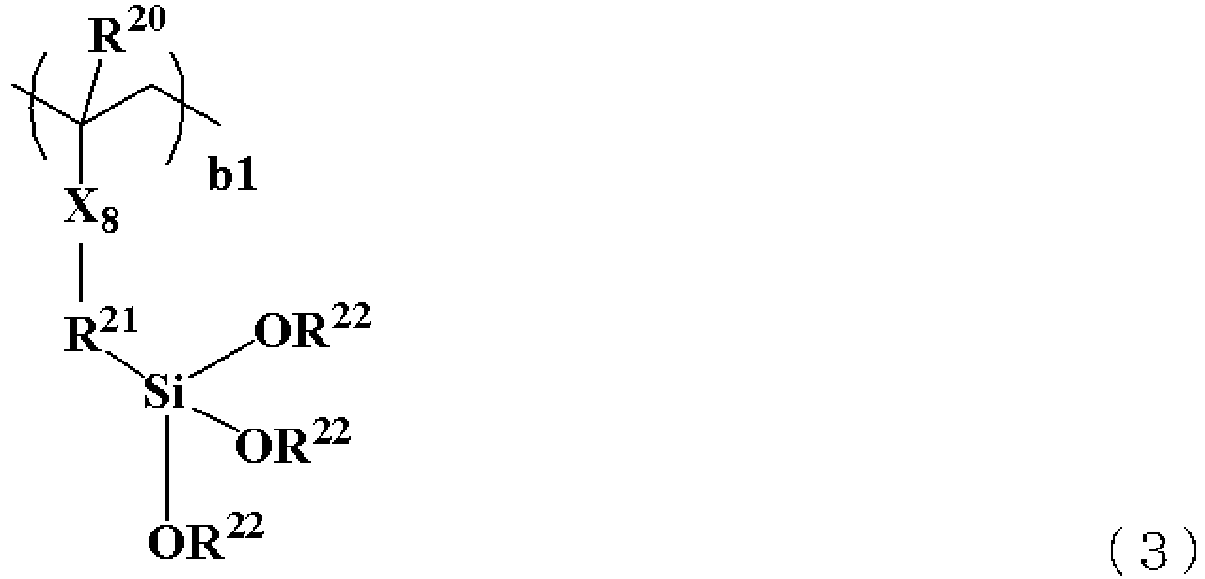
- Bioelektrodenzusammensetzung nach Anspruch 1, wobei
das Kondensationsreaktionsprodukt eine sich wiederholende Einheit der folgenden allgemeinen Formel (4) umfasst,
- Bioelektrodenzusammensetzung nach Anspruch 1 oder 2, wobei
die Komponente (A) ein durch die folgende allgemeine Formel (5) dargestelltes Ammoniumion als Ammoniumion zur Bildung der Ammoniumsalze umfasst,
- Bioelektrodenzusammensetzung nach einem der Ansprüche 1 bis 3, die ferner eine Komponente (B) umfasst, die vorzugsweise ein Klebstoffharz ist,
wobei die Komponente (B) eine oder mehrere aus der Gruppe bestehend aus einem Silikonharz, einem (Meth)acrylatharz und einem Urethanharz ausgewählt ist. - Bioelektrodenzusammensetzung nach Anspruch 4, wobei die Komponente (B) Diorganosiloxan mit einer Alkenylgruppe und Organohydrogenpolysiloxan mit einer SiH-Gruppe umfasst, vorzugsweise, wobeidie Komponente (B) ferner ein Silikonharz mit einer SiO2 Einheit und einer RxSiO(4-x)/2 Einheit umfasst, wobeiR eine substituierte oder unsubstituierte einwertige Kohlenwasserstoffgruppe mit 1 bis 10 Kohlenstoffatomen darstellt und"x" steht für eine Zahl in einem Bereich von 2,5 bis 3,5.
- Bioelektrodenzusammensetzung nach einem der Ansprüche 1 bis 5, die ferner eine Komponente (C) umfasst, bei der es sich um eine Polymerverbindung mit einer ionischen Wiederholungseinheit handelt, vorzugsweise,
wobei die ionische Wiederholungseinheit der Komponente (C) eine Wiederholungseinheit mit einer Struktur umfasst, die aus der Gruppe ausgewählt ist, die aus Salzen von Ammonium, Lithium, Natrium, Kalium und Silber besteht, die mit einem der in der folgenden allgemeinen Formel (2) dargestellten Fluorsulfonsäure, Fluorsulfonimid und N-Carbonylfluorsulfonamid gebildet werden,
- Bioelektrodenzusammensetzung nach einem der Ansprüche 1 bis 6, die ferner eine Komponente (D) umfasst, die ein Kohlenstoffpulver und/oder ein Metallpulver ist.
- Bioelektrodenzusammensetzung nach Anspruch 7, wobei es sich bei dem Kohlenstoffpulver um Ruß oder Kohlenstoffnanoröhren oder beides handelt.
- Bioelektrodenzusammensetzung nach Anspruch 7 oder 8, wobei das Metallpulver ein Pulver eines Metalls ist, das vorzugsweise aus der Gruppe ausgewählt ist, die aus Gold, Silber, Platin, Kupfer, Zinn, Titan, Nickel, Aluminium, Wolfram, Molybdän, Ruthenium, Chrom und Indium besteht,
wobei das Metallpulver ein Silberpulver ist. - Bioelektrodenzusammensetzung nach einem der Ansprüche 1 bis 9, die ferner eine Komponente (E) enthält, die ein organisches Lösungsmittel ist.
- Bioelektrode, die ein elektrisch leitendes Basismaterial und eine auf dem elektrisch leitenden Basismaterial ausgebildete Lebendkörperkontaktschicht umfasst, wobeidie Lebendkörperkontaktschicht ein gehärtetes Produkt der Bioelektrodenzusammensetzung nach einem der Ansprüche 1 bis 10 ist, vorzugsweise,wobei das elektrisch leitende Basismaterial eines oder mehrere aus der Gruppe bestehend aus Gold, Silber, Silberchlorid, Platin, Aluminium, Magnesium, Zinn, Wolfram, Eisen, Kupfer, Nickel, rostfreiem Stahl, Chrom, Titan, Kohlenstoff und elektrisch leitendem Polymer umfasst.
- Verfahren zur Herstellung einer Bioelektrode mit einem elektrisch leitenden Basismaterial und einer auf dem elektrisch leitenden Basismaterial gebildeten Lebendkörperkontaktschicht, umfassend:Aufbringen der Bioelektrodenzusammensetzung nach einem der Ansprüche 1 bis 10 auf das elektrisch leitende Basismaterial; undAushärten der Bioelektrodenzusammensetzung, um vorzugsweise die Lebendkörperkontaktschicht zu bilden,wobei das elektrisch leitende Basismaterial eines oder mehrere aus der Gruppe bestehend aus Gold, Silber, Silberchlorid, Platin, Aluminium, Magnesium, Zinn, Wolfram, Eisen, Kupfer, Nickel, rostfreiem Stahl, Chrom, Titan, Kohlenstoff und elektrisch leitendem Polymer umfasst.
Applications Claiming Priority (1)
| Application Number | Priority Date | Filing Date | Title |
|---|---|---|---|
| JP2021069975 | 2021-04-16 |
Publications (2)
| Publication Number | Publication Date |
|---|---|
| EP4074754A1 EP4074754A1 (de) | 2022-10-19 |
| EP4074754B1 true EP4074754B1 (de) | 2025-04-09 |
Family
ID=81846346
Family Applications (1)
| Application Number | Title | Priority Date | Filing Date |
|---|---|---|---|
| EP22167517.6A Active EP4074754B1 (de) | 2021-04-16 | 2022-04-10 | Bioelektrodenzusammensetzung, bioelektrode und verfahren zur herstellung einer bioelektrode |
Country Status (6)
| Country | Link |
|---|---|
| US (1) | US11926766B2 (de) |
| EP (1) | EP4074754B1 (de) |
| JP (1) | JP7627671B2 (de) |
| KR (1) | KR102778851B1 (de) |
| CN (1) | CN115211861B (de) |
| TW (1) | TWI820672B (de) |
Families Citing this family (3)
| Publication number | Priority date | Publication date | Assignee | Title |
|---|---|---|---|---|
| JP2025011039A (ja) | 2023-07-10 | 2025-01-23 | 信越化学工業株式会社 | 生体電極組成物、生体電極、及び生体電極の製造方法 |
| JP2025174080A (ja) | 2024-05-16 | 2025-11-28 | 信越化学工業株式会社 | 生体電極組成物、生体電極、及び生体電極の製造方法 |
| WO2026004967A1 (ja) * | 2024-06-28 | 2026-01-02 | 住友化学株式会社 | 重合体、電解質組成物、及び電池、並びに化合物 |
Family Cites Families (45)
| Publication number | Priority date | Publication date | Assignee | Title |
|---|---|---|---|---|
| JPH07106197B2 (ja) | 1991-10-09 | 1995-11-15 | 日本メクトロン株式会社 | 導電性ミラブルウレタンゴム電極 |
| US5981680A (en) | 1998-07-13 | 1999-11-09 | Dow Corning Corporation | Method of making siloxane-based polyamides |
| KR20040014444A (ko) | 2000-12-23 | 2004-02-14 | 웬 루 | 이온성 액체를 구비한 긴 수명 공명 폴리머 전기화학 장치 |
| JP3865046B2 (ja) | 2001-05-08 | 2007-01-10 | 信越化学工業株式会社 | 無溶剤型ポリイミドシリコーン系樹脂組成物 |
| JP2003225217A (ja) | 2002-02-01 | 2003-08-12 | Shin Etsu Chem Co Ltd | 生体電極用シリコーンゴム組成物及び生体用電極 |
| JP3923861B2 (ja) | 2002-07-03 | 2007-06-06 | フクダ電子株式会社 | 生体電極 |
| JP2005320418A (ja) | 2004-05-07 | 2005-11-17 | Shin Etsu Chem Co Ltd | 紫外線硬化型オルガノポリシロキサン組成物 |
| JP5646153B2 (ja) | 2009-10-06 | 2014-12-24 | 東レ・ダウコーニング株式会社 | ポリアミドシリコーンコポリマーの製造方法 |
| JP2013016455A (ja) | 2011-01-13 | 2013-01-24 | Jnc Corp | 透明導電膜の形成に用いられる塗膜形成用組成物 |
| WO2013039151A1 (ja) | 2011-09-15 | 2013-03-21 | 積水化成品工業株式会社 | 生体用電極被覆パッド |
| CN104871595B (zh) | 2012-12-19 | 2018-10-19 | Lg电子株式会社 | 支持多址接入网络的无线通信系统中的通信方法以及支持该方法的设备 |
| JP6296530B2 (ja) | 2013-07-18 | 2018-03-20 | 国立研究開発法人科学技術振興機構 | 生体適合性電極構造体及びその製造方法、並びに、デバイス及びその製造方法 |
| KR20150019806A (ko) | 2013-08-16 | 2015-02-25 | 현대모비스 주식회사 | 벌브 홀더 및 이를 포함하는 차량용 램프 |
| JP6073776B2 (ja) | 2013-11-28 | 2017-02-01 | 日本電信電話株式会社 | 生体電気信号モニタ用衣類 |
| JP6348434B2 (ja) | 2014-03-28 | 2018-06-27 | 信越化学工業株式会社 | シリコーン粘着剤組成物、その製造法及び粘着フィルム |
| JP6358874B2 (ja) | 2014-06-27 | 2018-07-18 | ニチバン株式会社 | アクリル系粘着剤組成物、及び、粘着テープまたはシート |
| US20170275510A1 (en) | 2014-09-19 | 2017-09-28 | Cosmed Pharmaceutical Co., Ltd. | Urethane-based adhesive composition |
| EP3170877B1 (de) | 2015-11-19 | 2020-11-18 | 3M Innovative Properties Company | Strukturklebstoff mit verbessertem fehlermodus |
| CN108883379B (zh) | 2016-04-08 | 2022-04-05 | 株式会社大赛璐 | 半透膜 |
| ITUA20162518A1 (it) | 2016-04-12 | 2017-10-12 | Redox S R L | Dispositivo riscaldante istantaneo per solidi, liquidi, gas e vapori |
| JP6744848B2 (ja) | 2016-09-13 | 2020-08-19 | 信越化学工業株式会社 | 粘着剤組成物、生体電極、及び生体電極の製造方法 |
| JP6761386B2 (ja) | 2016-09-29 | 2020-09-23 | 信越化学工業株式会社 | 粘着剤組成物、生体電極、生体電極の製造方法、及び塩 |
| JP6761384B2 (ja) | 2016-09-29 | 2020-09-23 | 信越化学工業株式会社 | 粘着剤組成物、生体電極、及び生体電極の製造方法 |
| JP6792538B2 (ja) | 2016-12-21 | 2020-11-25 | 信越化学工業株式会社 | 生体電極組成物、生体電極、及び生体電極の製造方法 |
| JP6919993B2 (ja) | 2017-01-06 | 2021-08-18 | 信越化学工業株式会社 | 生体電極組成物、生体電極及び生体電極の製造方法 |
| JP6802779B2 (ja) | 2017-01-06 | 2020-12-23 | 信越化学工業株式会社 | 重合性モノマー、高分子化合物、生体電極組成物、生体電極及び生体電極の製造方法 |
| JP6919992B2 (ja) | 2017-01-30 | 2021-08-18 | 信越化学工業株式会社 | 伸縮性膜及びその形成方法 |
| JP6966310B2 (ja) | 2017-02-06 | 2021-11-10 | 信越化学工業株式会社 | 生体電極組成物、生体電極、生体電極の製造方法、及び高分子化合物 |
| JP6892376B2 (ja) | 2017-02-14 | 2021-06-23 | 信越化学工業株式会社 | 生体電極組成物、生体電極、生体電極の製造方法、及び高分子化合物 |
| JP6836520B2 (ja) | 2017-02-14 | 2021-03-03 | 信越化学工業株式会社 | 生体電極組成物、生体電極、及び生体電極の製造方法 |
| JP6742287B2 (ja) | 2017-02-28 | 2020-08-19 | 東京エレクトロン株式会社 | 半導体製造方法及びプラズマ処理装置 |
| DE102017208031A1 (de) | 2017-05-12 | 2018-11-15 | Putzmeister Engineering Gmbh | Gekröpfter Auslegerarm mit veränderlichem Querschnitt für mobile Betonpumpen |
| JP6882236B2 (ja) | 2017-10-10 | 2021-06-02 | 信越化学工業株式会社 | 珪素含有化合物、ウレタン樹脂、伸縮性膜、及びその形成方法 |
| JP6850279B2 (ja) | 2017-11-21 | 2021-03-31 | 信越化学工業株式会社 | 生体電極組成物、生体電極、及び生体電極の製造方法 |
| JP6839107B2 (ja) * | 2018-01-09 | 2021-03-03 | 信越化学工業株式会社 | 生体電極組成物、生体電極、及び生体電極の製造方法 |
| CN111386074A (zh) * | 2018-01-15 | 2020-07-07 | Nok株式会社 | 生物电极 |
| JP7043128B2 (ja) | 2018-01-31 | 2022-03-29 | 住友重機械工業株式会社 | レーザ制御装置及びレーザ加工方法 |
| JP6839125B2 (ja) | 2018-04-02 | 2021-03-03 | 信越化学工業株式会社 | 生体電極組成物、生体電極、及び生体電極の製造方法 |
| JP7158335B2 (ja) * | 2018-06-25 | 2022-10-21 | 信越化学工業株式会社 | 生体電極組成物、生体電極、及び生体電極の製造方法 |
| JP6966389B2 (ja) | 2018-07-12 | 2021-11-17 | 信越化学工業株式会社 | 生体電極組成物、生体電極、及び生体電極の製造方法 |
| JP6966396B2 (ja) | 2018-08-23 | 2021-11-17 | 信越化学工業株式会社 | 生体電極組成物、生体電極、及び生体電極の製造方法 |
| JP6966397B2 (ja) | 2018-08-27 | 2021-11-17 | 信越化学工業株式会社 | 生体電極組成物、生体電極、及び生体電極の製造方法 |
| KR102645447B1 (ko) | 2018-09-06 | 2024-03-12 | 주식회사 아이앤나 | 카메라장치 등록 방법 |
| KR102495331B1 (ko) | 2018-09-14 | 2023-02-03 | 삼성디스플레이 주식회사 | 로봇암 장치 |
| JP7045768B2 (ja) | 2019-04-03 | 2022-04-01 | 信越化学工業株式会社 | 生体電極組成物、生体電極、及び生体電極の製造方法 |
-
2022
- 2022-03-25 JP JP2022049558A patent/JP7627671B2/ja active Active
- 2022-03-31 US US17/710,166 patent/US11926766B2/en active Active
- 2022-04-10 EP EP22167517.6A patent/EP4074754B1/de active Active
- 2022-04-12 KR KR1020220045165A patent/KR102778851B1/ko active Active
- 2022-04-13 TW TW111113955A patent/TWI820672B/zh active
- 2022-04-13 CN CN202210388028.1A patent/CN115211861B/zh active Active
Also Published As
| Publication number | Publication date |
|---|---|
| CN115211861A (zh) | 2022-10-21 |
| TWI820672B (zh) | 2023-11-01 |
| US20220363966A1 (en) | 2022-11-17 |
| KR20220143581A (ko) | 2022-10-25 |
| TW202247821A (zh) | 2022-12-16 |
| US11926766B2 (en) | 2024-03-12 |
| JP2022164579A (ja) | 2022-10-27 |
| KR102778851B1 (ko) | 2025-03-07 |
| CN115211861B (zh) | 2026-03-03 |
| JP7627671B2 (ja) | 2025-02-06 |
| EP4074754A1 (de) | 2022-10-19 |
Similar Documents
| Publication | Publication Date | Title |
|---|---|---|
| EP3854303B1 (de) | Bioelektrodenzusammensetzung, bioelektrode und verfahren zur herstellung einer bioelektrode | |
| EP3984456B1 (de) | Bioelektrodenzusammensetzung, bioelektrode, verfahren zur herstellung einer bioelektrode, polymerverbindung und verbundstoff | |
| EP3587473B1 (de) | Bioelektrodenzusammensetzung, bioelektrode und verfahren zur herstellung einer bioelektrode | |
| EP3718471B1 (de) | Bioelektrodenzusammensetzung, bioelektrode und verfahren zur herstellung einer bioelektrode | |
| EP3995548A1 (de) | Bioelektrodenzusammensetzung, bioelektrode, verfahren zur herstellung der bioelektrode und reaktionskomposit | |
| EP3587474B1 (de) | Bioelektrodenzusammensetzung, bioelektrode und verfahren zur herstellung der bioelektrode | |
| EP3881766B1 (de) | Bio-elektrode, verfahren zur herstellung einer bio-elektrode und verfahren zur messung biologischer signale | |
| EP4026860A1 (de) | Bioelektrodenzusammensetzung, bioelektrode und verfahren zur herstellung einer bioelektrode | |
| EP4074754B1 (de) | Bioelektrodenzusammensetzung, bioelektrode und verfahren zur herstellung einer bioelektrode | |
| US11965095B2 (en) | Bio-electrode composition, bio-electrode, and method for manufacturing bio-electrode | |
| EP4006921B1 (de) | Bioelektrodenzusammensetzung, bioelektrode, verfahren zur herstellung der bioelektrode und reaktionskomposit | |
| US12262980B2 (en) | Bio-electrode composition, bio-electrode, method for manufacturing bio-electrode, and silicon material particle | |
| US20220087559A1 (en) | Bio-electrode composition, bio-electrode, method for manufacturing bio-electrode, and silicon material particle | |
| EP4309582B1 (de) | Bioelektrodenzusammensetzung, bioelektrode und verfahren zur herstellung davon | |
| EP4651157A1 (de) | Bioelektrodenzusammensetzung, bioelektrode und verfahren zur herstellung der bioelektrode | |
| EP4492406B1 (de) | Bioelektrodenzusammensetzung, bioelektrode, verfahren zur herstellung der bioelektrode | |
| EP4654222A1 (de) | Niedrigschmelzende eutektische flüssigkeit, bioelektrodenzusammensetzung, bioelektrode und verfahren zur herstellung der bioelektrode |
Legal Events
| Date | Code | Title | Description |
|---|---|---|---|
| PUAI | Public reference made under article 153(3) epc to a published international application that has entered the european phase |
Free format text: ORIGINAL CODE: 0009012 |
|
| STAA | Information on the status of an ep patent application or granted ep patent |
Free format text: STATUS: THE APPLICATION HAS BEEN PUBLISHED |
|
| AK | Designated contracting states |
Kind code of ref document: A1 Designated state(s): AL AT BE BG CH CY CZ DE DK EE ES FI FR GB GR HR HU IE IS IT LI LT LU LV MC MK MT NL NO PL PT RO RS SE SI SK SM TR |
|
| STAA | Information on the status of an ep patent application or granted ep patent |
Free format text: STATUS: REQUEST FOR EXAMINATION WAS MADE |
|
| 17P | Request for examination filed |
Effective date: 20230413 |
|
| RBV | Designated contracting states (corrected) |
Designated state(s): AL AT BE BG CH CY CZ DE DK EE ES FI FR GB GR HR HU IE IS IT LI LT LU LV MC MK MT NL NO PL PT RO RS SE SI SK SM TR |
|
| GRAP | Despatch of communication of intention to grant a patent |
Free format text: ORIGINAL CODE: EPIDOSNIGR1 |
|
| STAA | Information on the status of an ep patent application or granted ep patent |
Free format text: STATUS: GRANT OF PATENT IS INTENDED |
|
| INTG | Intention to grant announced |
Effective date: 20241111 |
|
| GRAS | Grant fee paid |
Free format text: ORIGINAL CODE: EPIDOSNIGR3 |
|
| GRAA | (expected) grant |
Free format text: ORIGINAL CODE: 0009210 |
|
| STAA | Information on the status of an ep patent application or granted ep patent |
Free format text: STATUS: THE PATENT HAS BEEN GRANTED |
|
| AK | Designated contracting states |
Kind code of ref document: B1 Designated state(s): AL AT BE BG CH CY CZ DE DK EE ES FI FR GB GR HR HU IE IS IT LI LT LU LV MC MK MT NL NO PL PT RO RS SE SI SK SM TR |
|
| REG | Reference to a national code |
Ref country code: GB Ref legal event code: FG4D |
|
| REG | Reference to a national code |
Ref country code: CH Ref legal event code: EP |
|
| REG | Reference to a national code |
Ref country code: DE Ref legal event code: R096 Ref document number: 602022012765 Country of ref document: DE |
|
| REG | Reference to a national code |
Ref country code: IE Ref legal event code: FG4D |
|
| REG | Reference to a national code |
Ref country code: NL Ref legal event code: FP |
|
| PGFP | Annual fee paid to national office [announced via postgrant information from national office to epo] |
Ref country code: DE Payment date: 20250514 Year of fee payment: 4 |
|
| PGFP | Annual fee paid to national office [announced via postgrant information from national office to epo] |
Ref country code: AT Payment date: 20250721 Year of fee payment: 4 |
|
| REG | Reference to a national code |
Ref country code: AT Ref legal event code: MK05 Ref document number: 1783492 Country of ref document: AT Kind code of ref document: T Effective date: 20250409 |
|
| PG25 | Lapsed in a contracting state [announced via postgrant information from national office to epo] |
Ref country code: FI Free format text: LAPSE BECAUSE OF FAILURE TO SUBMIT A TRANSLATION OF THE DESCRIPTION OR TO PAY THE FEE WITHIN THE PRESCRIBED TIME-LIMIT Effective date: 20250409 Ref country code: ES Free format text: LAPSE BECAUSE OF FAILURE TO SUBMIT A TRANSLATION OF THE DESCRIPTION OR TO PAY THE FEE WITHIN THE PRESCRIBED TIME-LIMIT Effective date: 20250409 Ref country code: PT Free format text: LAPSE BECAUSE OF FAILURE TO SUBMIT A TRANSLATION OF THE DESCRIPTION OR TO PAY THE FEE WITHIN THE PRESCRIBED TIME-LIMIT Effective date: 20250811 |
|
| REG | Reference to a national code |
Ref country code: LT Ref legal event code: MG9D |
|
| PG25 | Lapsed in a contracting state [announced via postgrant information from national office to epo] |
Ref country code: NO Free format text: LAPSE BECAUSE OF FAILURE TO SUBMIT A TRANSLATION OF THE DESCRIPTION OR TO PAY THE FEE WITHIN THE PRESCRIBED TIME-LIMIT Effective date: 20250709 Ref country code: GR Free format text: LAPSE BECAUSE OF FAILURE TO SUBMIT A TRANSLATION OF THE DESCRIPTION OR TO PAY THE FEE WITHIN THE PRESCRIBED TIME-LIMIT Effective date: 20250710 |
|
| PG25 | Lapsed in a contracting state [announced via postgrant information from national office to epo] |
Ref country code: PL Free format text: LAPSE BECAUSE OF FAILURE TO SUBMIT A TRANSLATION OF THE DESCRIPTION OR TO PAY THE FEE WITHIN THE PRESCRIBED TIME-LIMIT Effective date: 20250409 |
|
| PG25 | Lapsed in a contracting state [announced via postgrant information from national office to epo] |
Ref country code: BG Free format text: LAPSE BECAUSE OF FAILURE TO SUBMIT A TRANSLATION OF THE DESCRIPTION OR TO PAY THE FEE WITHIN THE PRESCRIBED TIME-LIMIT Effective date: 20250409 |
|
| PG25 | Lapsed in a contracting state [announced via postgrant information from national office to epo] |
Ref country code: HR Free format text: LAPSE BECAUSE OF FAILURE TO SUBMIT A TRANSLATION OF THE DESCRIPTION OR TO PAY THE FEE WITHIN THE PRESCRIBED TIME-LIMIT Effective date: 20250409 Ref country code: AT Free format text: LAPSE BECAUSE OF FAILURE TO SUBMIT A TRANSLATION OF THE DESCRIPTION OR TO PAY THE FEE WITHIN THE PRESCRIBED TIME-LIMIT Effective date: 20250409 |
|
| PG25 | Lapsed in a contracting state [announced via postgrant information from national office to epo] |
Ref country code: RS Free format text: LAPSE BECAUSE OF FAILURE TO SUBMIT A TRANSLATION OF THE DESCRIPTION OR TO PAY THE FEE WITHIN THE PRESCRIBED TIME-LIMIT Effective date: 20250709 |
|
| PG25 | Lapsed in a contracting state [announced via postgrant information from national office to epo] |
Ref country code: IS Free format text: LAPSE BECAUSE OF FAILURE TO SUBMIT A TRANSLATION OF THE DESCRIPTION OR TO PAY THE FEE WITHIN THE PRESCRIBED TIME-LIMIT Effective date: 20250809 |
|
| PG25 | Lapsed in a contracting state [announced via postgrant information from national office to epo] |
Ref country code: LV Free format text: LAPSE BECAUSE OF FAILURE TO SUBMIT A TRANSLATION OF THE DESCRIPTION OR TO PAY THE FEE WITHIN THE PRESCRIBED TIME-LIMIT Effective date: 20250409 |
|
| REG | Reference to a national code |
Ref country code: CH Ref legal event code: H13 Free format text: ST27 STATUS EVENT CODE: U-0-0-H10-H13 (AS PROVIDED BY THE NATIONAL OFFICE) Effective date: 20251125 |
|
| PG25 | Lapsed in a contracting state [announced via postgrant information from national office to epo] |
Ref country code: LU Free format text: LAPSE BECAUSE OF NON-PAYMENT OF DUE FEES Effective date: 20250410 |
|
| REG | Reference to a national code |
Ref country code: DE Ref legal event code: R097 Ref document number: 602022012765 Country of ref document: DE |
|
| PG25 | Lapsed in a contracting state [announced via postgrant information from national office to epo] |
Ref country code: SM Free format text: LAPSE BECAUSE OF FAILURE TO SUBMIT A TRANSLATION OF THE DESCRIPTION OR TO PAY THE FEE WITHIN THE PRESCRIBED TIME-LIMIT Effective date: 20250409 Ref country code: DK Free format text: LAPSE BECAUSE OF FAILURE TO SUBMIT A TRANSLATION OF THE DESCRIPTION OR TO PAY THE FEE WITHIN THE PRESCRIBED TIME-LIMIT Effective date: 20250409 |
|
| PG25 | Lapsed in a contracting state [announced via postgrant information from national office to epo] |
Ref country code: CH Free format text: LAPSE BECAUSE OF NON-PAYMENT OF DUE FEES Effective date: 20250430 |
|
| PG25 | Lapsed in a contracting state [announced via postgrant information from national office to epo] |
Ref country code: CZ Free format text: LAPSE BECAUSE OF FAILURE TO SUBMIT A TRANSLATION OF THE DESCRIPTION OR TO PAY THE FEE WITHIN THE PRESCRIBED TIME-LIMIT Effective date: 20250409 |
|
| PG25 | Lapsed in a contracting state [announced via postgrant information from national office to epo] |
Ref country code: EE Free format text: LAPSE BECAUSE OF FAILURE TO SUBMIT A TRANSLATION OF THE DESCRIPTION OR TO PAY THE FEE WITHIN THE PRESCRIBED TIME-LIMIT Effective date: 20250409 |
|
| PG25 | Lapsed in a contracting state [announced via postgrant information from national office to epo] |
Ref country code: SK Free format text: LAPSE BECAUSE OF FAILURE TO SUBMIT A TRANSLATION OF THE DESCRIPTION OR TO PAY THE FEE WITHIN THE PRESCRIBED TIME-LIMIT Effective date: 20250409 |
|
| PG25 | Lapsed in a contracting state [announced via postgrant information from national office to epo] |
Ref country code: IT Free format text: LAPSE BECAUSE OF FAILURE TO SUBMIT A TRANSLATION OF THE DESCRIPTION OR TO PAY THE FEE WITHIN THE PRESCRIBED TIME-LIMIT Effective date: 20250409 |
|
| PG25 | Lapsed in a contracting state [announced via postgrant information from national office to epo] |
Ref country code: MC Free format text: LAPSE BECAUSE OF FAILURE TO SUBMIT A TRANSLATION OF THE DESCRIPTION OR TO PAY THE FEE WITHIN THE PRESCRIBED TIME-LIMIT Effective date: 20250409 |
|
| PG25 | Lapsed in a contracting state [announced via postgrant information from national office to epo] |
Ref country code: RO Free format text: LAPSE BECAUSE OF FAILURE TO SUBMIT A TRANSLATION OF THE DESCRIPTION OR TO PAY THE FEE WITHIN THE PRESCRIBED TIME-LIMIT Effective date: 20250409 |
|
| PLBE | No opposition filed within time limit |
Free format text: ORIGINAL CODE: 0009261 |
|
| STAA | Information on the status of an ep patent application or granted ep patent |
Free format text: STATUS: NO OPPOSITION FILED WITHIN TIME LIMIT |
|
| REG | Reference to a national code |
Ref country code: CH Ref legal event code: L10 Free format text: ST27 STATUS EVENT CODE: U-0-0-L10-L00 (AS PROVIDED BY THE NATIONAL OFFICE) Effective date: 20260218 |
|
| 26N | No opposition filed |
Effective date: 20260112 |
|
| PGFP | Annual fee paid to national office [announced via postgrant information from national office to epo] |
Ref country code: GB Payment date: 20260316 Year of fee payment: 5 |
|
| PG25 | Lapsed in a contracting state [announced via postgrant information from national office to epo] |
Ref country code: IE Free format text: LAPSE BECAUSE OF NON-PAYMENT OF DUE FEES Effective date: 20250410 |
|
| PGFP | Annual fee paid to national office [announced via postgrant information from national office to epo] |
Ref country code: BE Payment date: 20260317 Year of fee payment: 5 |
|
| PGFP | Annual fee paid to national office [announced via postgrant information from national office to epo] |
Ref country code: NL Payment date: 20260317 Year of fee payment: 5 |
|
| PGFP | Annual fee paid to national office [announced via postgrant information from national office to epo] |
Ref country code: FR Payment date: 20260309 Year of fee payment: 5 |