EP4073409B1 - A fire resistant ventilation duct and a method of manufacturing and installing such ventilation duct - Google Patents
A fire resistant ventilation duct and a method of manufacturing and installing such ventilation duct Download PDFInfo
- Publication number
- EP4073409B1 EP4073409B1 EP20820989.0A EP20820989A EP4073409B1 EP 4073409 B1 EP4073409 B1 EP 4073409B1 EP 20820989 A EP20820989 A EP 20820989A EP 4073409 B1 EP4073409 B1 EP 4073409B1
- Authority
- EP
- European Patent Office
- Prior art keywords
- ventilation duct
- duct
- stiffening members
- wall penetration
- fire rated
- Prior art date
- Legal status (The legal status is an assumption and is not a legal conclusion. Google has not performed a legal analysis and makes no representation as to the accuracy of the status listed.)
- Active
Links
Images


Classifications
-
- F—MECHANICAL ENGINEERING; LIGHTING; HEATING; WEAPONS; BLASTING
- F16—ENGINEERING ELEMENTS AND UNITS; GENERAL MEASURES FOR PRODUCING AND MAINTAINING EFFECTIVE FUNCTIONING OF MACHINES OR INSTALLATIONS; THERMAL INSULATION IN GENERAL
- F16L—PIPES; JOINTS OR FITTINGS FOR PIPES; SUPPORTS FOR PIPES, CABLES OR PROTECTIVE TUBING; MEANS FOR THERMAL INSULATION IN GENERAL
- F16L57/00—Protection of pipes or objects of similar shape against external or internal damage or wear
- F16L57/04—Protection of pipes or objects of similar shape against external or internal damage or wear against fire or other external sources of extreme heat
-
- F—MECHANICAL ENGINEERING; LIGHTING; HEATING; WEAPONS; BLASTING
- F16—ENGINEERING ELEMENTS AND UNITS; GENERAL MEASURES FOR PRODUCING AND MAINTAINING EFFECTIVE FUNCTIONING OF MACHINES OR INSTALLATIONS; THERMAL INSULATION IN GENERAL
- F16L—PIPES; JOINTS OR FITTINGS FOR PIPES; SUPPORTS FOR PIPES, CABLES OR PROTECTIVE TUBING; MEANS FOR THERMAL INSULATION IN GENERAL
- F16L5/00—Devices for use where pipes, cables or protective tubing pass through walls or partitions
- F16L5/02—Sealing
- F16L5/04—Sealing to form a firebreak device
-
- F—MECHANICAL ENGINEERING; LIGHTING; HEATING; WEAPONS; BLASTING
- F16—ENGINEERING ELEMENTS AND UNITS; GENERAL MEASURES FOR PRODUCING AND MAINTAINING EFFECTIVE FUNCTIONING OF MACHINES OR INSTALLATIONS; THERMAL INSULATION IN GENERAL
- F16L—PIPES; JOINTS OR FITTINGS FOR PIPES; SUPPORTS FOR PIPES, CABLES OR PROTECTIVE TUBING; MEANS FOR THERMAL INSULATION IN GENERAL
- F16L59/00—Thermal insulation in general
- F16L59/04—Arrangements using dry fillers, e.g. using slag wool
-
- F—MECHANICAL ENGINEERING; LIGHTING; HEATING; WEAPONS; BLASTING
- F16—ENGINEERING ELEMENTS AND UNITS; GENERAL MEASURES FOR PRODUCING AND MAINTAINING EFFECTIVE FUNCTIONING OF MACHINES OR INSTALLATIONS; THERMAL INSULATION IN GENERAL
- F16L—PIPES; JOINTS OR FITTINGS FOR PIPES; SUPPORTS FOR PIPES, CABLES OR PROTECTIVE TUBING; MEANS FOR THERMAL INSULATION IN GENERAL
- F16L59/00—Thermal insulation in general
- F16L59/12—Arrangements for supporting insulation from the wall or body insulated, e.g. by means of spacers between pipe and heat-insulating material; Arrangements specially adapted for supporting insulated bodies
- F16L59/121—Arrangements for supporting insulation from the wall or body insulated, e.g. by means of spacers between pipe and heat-insulating material; Arrangements specially adapted for supporting insulated bodies for pipes passing through walls or partitions
-
- F—MECHANICAL ENGINEERING; LIGHTING; HEATING; WEAPONS; BLASTING
- F16—ENGINEERING ELEMENTS AND UNITS; GENERAL MEASURES FOR PRODUCING AND MAINTAINING EFFECTIVE FUNCTIONING OF MACHINES OR INSTALLATIONS; THERMAL INSULATION IN GENERAL
- F16L—PIPES; JOINTS OR FITTINGS FOR PIPES; SUPPORTS FOR PIPES, CABLES OR PROTECTIVE TUBING; MEANS FOR THERMAL INSULATION IN GENERAL
- F16L59/00—Thermal insulation in general
- F16L59/14—Arrangements for the insulation of pipes or pipe systems
- F16L59/143—Pre-insulated pipes
-
- F—MECHANICAL ENGINEERING; LIGHTING; HEATING; WEAPONS; BLASTING
- F16—ENGINEERING ELEMENTS AND UNITS; GENERAL MEASURES FOR PRODUCING AND MAINTAINING EFFECTIVE FUNCTIONING OF MACHINES OR INSTALLATIONS; THERMAL INSULATION IN GENERAL
- F16L—PIPES; JOINTS OR FITTINGS FOR PIPES; SUPPORTS FOR PIPES, CABLES OR PROTECTIVE TUBING; MEANS FOR THERMAL INSULATION IN GENERAL
- F16L59/00—Thermal insulation in general
- F16L59/14—Arrangements for the insulation of pipes or pipe systems
- F16L59/145—Arrangements for the insulation of pipes or pipe systems providing fire-resistance
-
- F—MECHANICAL ENGINEERING; LIGHTING; HEATING; WEAPONS; BLASTING
- F16—ENGINEERING ELEMENTS AND UNITS; GENERAL MEASURES FOR PRODUCING AND MAINTAINING EFFECTIVE FUNCTIONING OF MACHINES OR INSTALLATIONS; THERMAL INSULATION IN GENERAL
- F16L—PIPES; JOINTS OR FITTINGS FOR PIPES; SUPPORTS FOR PIPES, CABLES OR PROTECTIVE TUBING; MEANS FOR THERMAL INSULATION IN GENERAL
- F16L9/00—Rigid pipes
- F16L9/003—Rigid pipes with a rectangular cross-section
-
- F—MECHANICAL ENGINEERING; LIGHTING; HEATING; WEAPONS; BLASTING
- F16—ENGINEERING ELEMENTS AND UNITS; GENERAL MEASURES FOR PRODUCING AND MAINTAINING EFFECTIVE FUNCTIONING OF MACHINES OR INSTALLATIONS; THERMAL INSULATION IN GENERAL
- F16L—PIPES; JOINTS OR FITTINGS FOR PIPES; SUPPORTS FOR PIPES, CABLES OR PROTECTIVE TUBING; MEANS FOR THERMAL INSULATION IN GENERAL
- F16L9/00—Rigid pipes
- F16L9/17—Rigid pipes obtained by bending a sheet longitudinally and connecting the edges
-
- F—MECHANICAL ENGINEERING; LIGHTING; HEATING; WEAPONS; BLASTING
- F24—HEATING; RANGES; VENTILATING
- F24F—AIR-CONDITIONING; AIR-HUMIDIFICATION; VENTILATION; USE OF AIR CURRENTS FOR SCREENING
- F24F11/00—Control or safety arrangements
- F24F11/30—Control or safety arrangements for purposes related to the operation of the system, e.g. for safety or monitoring
- F24F11/32—Responding to malfunctions or emergencies
- F24F11/33—Responding to malfunctions or emergencies to fire, excessive heat or smoke
-
- F—MECHANICAL ENGINEERING; LIGHTING; HEATING; WEAPONS; BLASTING
- F24—HEATING; RANGES; VENTILATING
- F24F—AIR-CONDITIONING; AIR-HUMIDIFICATION; VENTILATION; USE OF AIR CURRENTS FOR SCREENING
- F24F13/00—Details common to, or for air-conditioning, air-humidification, ventilation or use of air currents for screening
- F24F13/02—Ducting arrangements
- F24F13/0245—Manufacturing or assembly of air ducts; Methods therefor
-
- F—MECHANICAL ENGINEERING; LIGHTING; HEATING; WEAPONS; BLASTING
- F24—HEATING; RANGES; VENTILATING
- F24F—AIR-CONDITIONING; AIR-HUMIDIFICATION; VENTILATION; USE OF AIR CURRENTS FOR SCREENING
- F24F13/00—Details common to, or for air-conditioning, air-humidification, ventilation or use of air currents for screening
- F24F13/02—Ducting arrangements
- F24F13/0263—Insulation for air ducts
-
- F—MECHANICAL ENGINEERING; LIGHTING; HEATING; WEAPONS; BLASTING
- F24—HEATING; RANGES; VENTILATING
- F24F—AIR-CONDITIONING; AIR-HUMIDIFICATION; VENTILATION; USE OF AIR CURRENTS FOR SCREENING
- F24F2221/00—Details or features not otherwise provided for
- F24F2221/30—Details or features not otherwise provided for comprising fireproof material
Definitions
- the present disclosure relates to a ventilation duct for a fire rated ventilation duct wall penetration, said ventilation duct comprising one or more metal sheets forming said duct, wherein said metal sheet duct is covered on the outside by a heat insulating material, and said duct includes elongated stiffening members located on the outside of the duct and attached to said metal sheets.
- a ventilation duct of such kind is known from EP 2 024 689 B1 .
- DIN 4102 Part 4 requires the provision of vertical internal stiffening pipes and, as the case may be, a round-going stiffening frame made up from an L-shaped profile with one leg lying flatly against the metal sheet outer surface. The mounting of the aforementioned vertical pipes inside the duct is time-consuming and also restricts the free flow of air through the ventilation/smoke exhaust duct in normal operation.
- a metal sheet ventilation duct is known from document GB-2394541-A .
- EP 2 024 689 B1 describes a solution wherein bar members are arranged at a distance from the ventilation duct itself, so that they are less exposed to the heat of fire if it occurs inside the ventilation duct.
- the L-shaped profile tends to be heated un-evenly and thereby tends to force the ventilation duct wall to bend inwardly with a risk of providing an opening through the wall and/or deck.
- DE 28 41 651 A1 and US 2012/100319 A1 also relates to heat insulated ventilation ducts for improving fire resistance.
- a disadvantage with this arrangement is that often there is little room for installation of the stiffening bar members, in particularly if the ventilation duct is located close to the ceiling and/or a wall. Sometimes it is even impossible, and another solution must be chosen.
- the disclosure consists of a ventilation duct of the initially mentioned kind, wherein the stiffening members each comprise a metal profile and at least one non-combustible bar of inorganic material, wherein the metal profile is fixed to the metal sheet of the duct and retaining the non-combustible bar of inorganic material.
- the metal profile is retaining the non-combustible bar by at least partly encircling the bar.
- inorganic materials means a non-metallic material having a main component of a mineral material.
- a ventilation duct in a fire rated ventilation duct wall penetration comprising the steps of:
- the stiffening members are attached to the ventilation duct itself before it is finally installed through the building opening.
- the stiffening bar members comprise steel profiles combined with bars made of a non-combustible inorganic material, such as gypsum, calcium silicate, cement or other fire rated mineral materials.
- a non-combustible inorganic material such as gypsum, calcium silicate, cement or other fire rated mineral materials.
- the stiffening members extend transversely to the longitudinal extension of the duct.
- other orientations may be provided, such as at an oblique angle, if the ventilation duct extends through the deck or wall at such an oblique angle.
- the orientation of the stiffening members is parallel to the deck and/or wall.
- the metal profile is U-shaped with exterior mounting flanges so that a longitudinal groove is provided which is configured to tightly receiving the at least one non-combustible bar, preferably two non-combustible bars.
- the stiffening members are fastened to the metal sheet duct preferably by a plurality of rivets and/or screws.
- a simple mounting of the stiffening bars may be provided which is quick to apply and inexpensive.
- the at least one non-combustible bar is glued to the metal profile. The stiffening bar is hereby easier to handle during mounting when the components making up the stiffening bar are secured to each other.
- the metal profile is a steel profile.
- the at least one non-combustible bar is preferably based on gypsum, calcium silicate or cement. Stiffening members comprising steel profiles and gypsum bars are preferred, since gypsum comprises a high amount of water that is liberated during a fire and thereby adds in cooling the structure in case of fire.
- the non-combustible bar is advantageously made of a solid material, essentially without porosity or with limited porosity, which is different from a heat insulating material, such as the heat insulating material surrounding the duct.
- the at least one non-combustible bar does not comprise a heat insulation material.
- the heat insulating material is also arranged on the outside of the stiffening members. This ensures better thermal insulation and thereby better fire retarding properties, in particular if the heat insulating material is mineral wool, and preferably stone wool.
- the penetration of the ventilation duct may be through a separating building structure, which is either vertical or horizontal in orientation.
- the ventilation duct may be essentially horizontally oriented and penetrate a vertically oriented building structure, such as a partitioning wall.
- the ventilation duct may be essentially vertically oriented and penetrate a horizontally oriented building structure, such as a deck, floor or ceiling.
- ventilation duct includes all kinds of duct for transferring gasses, including a smoke exhaust duct.
- wall penetration is meant to mean penetration through an opening of any building structure, such as a partitioning wall, a deck or a floor or ceiling.
- the ventilation duct may have any suitable shape, such as circular, flat oval, oval, square, or rectangular in cross-sectional view.
- the ventilation duct advantageously has a square or rectangular cross-section.
- the number and location of the stiffening members affect the efficiency of the stiffening members. For example, increasing the number of stiffening members, and/or locating the stiffening members around a larger fraction of the perimeter of the duct, may further reduce the risk of bending/twisting of the duct wall during fire, and thereby reduce the risk of creating an opening around the penetrated wall, deck, floor or ceiling. It was found advantageously that the ventilation duct comprises at least one, and more preferably at least two or more stiffening members. In a further preferred embodiment, the stiffening members extend around the entire perimeter of the duct, such that for a square or rectangular cross-sectional duct, the duct comprises four stiffening members.
- the stiffening member is located or extends along at least one of the longer rectangular sides, and preferably the duct comprises at least two stiffening members located along the two opposing longer sides of the rectangular duct.
- the stiffening members are advantageously located on both sides of the wall penetration.
- the one or more stiffening members are located on only one side of the wall penetration, such as on the upper side of the wall penetration.
- the ventilation duct is essentially vertically oriented, and the at least one stiffening member, or preferably the at least two stiffening members, are located on the upper side of the wall penetration.
- the penetration is likely through a deck, floor or ceiling.
- a ventilation duct according to an embodiment of the disclosure is shown.
- the ventilation duct section shown in fig. 1 is installed penetrating a vertically oriented light wall 3 of a building structure.
- the ventilation duct 1 has a rectangular cross-sectional shape formed with one or more metal sheets bent into shape for forming the duct.
- On each of the side walls of the ventilation duct 1 there are mounted stiffening members 4.
- the stiffening members are provided on the ventilation duct positioned on each side of the wall 3 as shown in fig. 1 .
- the ventilation duct 1 is covered by heat insulation slabs 2 that also extends through the wall opening.
- the heat insulating material is mineral wool, preferably stone wool.
- a gap will occur between the outer surface of the insulation material 2 and the opening in a building structure. This gap is filled with a strip of loose insulation fibrous wool material 5 and sealed on both sides with an intumescent material 6, which is capable of swelling when exposed to heat.
- the insulation slabs 2 abutting each other longitudinally in the section of wall penetration are glued together for providing an airtight seal 7 between two abutting insulation slabs 2.
- This is advantageous since an airtight seal will prevent any draft of air and gasses to pass through the insulation material in case of a fire.
- the airtight seal 7 can prevent a fire from spreading from one side of the wall to the other.
- the glue is a non-combustible adhesive, based on e.g. cement or a ceramic adhesive.
- the stiffening members 4 each comprise a metal profile 41 and one or more non-combustible bars 42 of inorganic material and that the metal profile 41 is fixed to the metal sheet of the ventilation duct 1 by rivets 8 or the like and thereby retaining the non-combustible bars 42 by partly encircling the bars.
- the metal profile 41 is preferably a steel profile.
- the stiffening member 4 comprises a metal profile 41, which is U-shaped with exterior mounting flanges 44 so that a longitudinal groove is provided.
- the metal profile 41 is shaped and configured to receive one or more non-combustible bars 42, that essentially fill out the groove.
- the non-combustible bars 42 are attached to the metal profile respectively to each other by glue 43.
- a layer of insulation material 2a is provided so that the outer surface thereof is essentially flush with the outer surface of the insulation material 2 surrounding the other portions of the ventilation duct.
- the metal profile 41 has a height similar to the insulation material 2 surrounding the ventilation duct metal plates 1.
- two non-combustible bars 42 are provided in a tightly fit and in the remaining space in the groove there is provided a strip of insulation material 2a.
- the metal profile 41 is fixed to the metal plates of the ventilation duct 1 by fasteners 8, such as rivets.
- the duct section may be prepared for installation off-site where there is plenty of space.
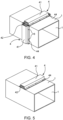
- the metal ventilation duct 1 is provided with stiffening members 4 by assembling the components of the stiffening members 4, whereby the metal profile 41 is fitted with the non-combustible bars 42 and then positioned on the outer metal sheet of the ventilation duct 1. Through the metal flanges 44 and the metal sheet of the ventilation duct 1, holes may be drilled for the fasteners 8 to obtain a ventilation duct section as shown in fig. 4 .
- This ventilation duct section is then fitted in the building structure opening and finally provided with insulation material (not shown in fig. 4 ).
- FIG 5 shows a perspective view of another embodiment of a section of a ventilation duct according to the present disclosure.
- the ventilation duct 1 has a rectangular cross-section, and comprises two stiffening members 4 located along the two opposing longitudinal sides of the duct (only the stiffening member on the upper side is seen in Figure 5 ).
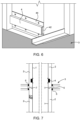
- Figure 6 also shows a perspective view of a section of a ventilation duct according to the present disclosure, where the duct has a rectangular cross-section.
- the duct is further exemplified to be vertically oriented and installed in a wall 3, more specifically a deck, floor or ceiling, which is penetrated by the duct.
- the ventilation duct 1 comprises two stiffening members 4 located along the two opposing longitudinal sides of the duct (only the stiffening member on the front side is seen in Figure 6 ).
- one or more constructional profiles may be provided on the two opposing short sides of the duct.
- the constructional profiles may be any L-shaped profile with one leg abutting the metal sheet outer surface. Those profiles form part of the mounting and bearing system for the duct to be installed in the penetration.
- Figure 7 shows a schematic cross-sectional side view of the ventilation duct shown in Figure 6 , which is installed in a wall 3, more specifically penetrating a deck, floor or ceiling.
- the stiffening members 4 are seen to be arranged on only one side of the wall, which is exemplified as being horizontally oriented, whereby the stiffening members are located at the upper side of the penetrated deck.
- the wall may be any separating building structure, such as a partition wall, a deck, floor or ceiling.
- the present disclosure was implemented in a wall penetration and passed a standard fire test in accordance with DS/EN 1363-1:2012 in conjunction with EN 1366-1:2014 Part 1.
- the tested horizontal ventilation duct was a standard type from Lindab type LKR with a width of 1000 mm and a height of 250 mm.
- the ventilation duct was outwardly insulated with stone wool boards with a black aluminium foil and having a nominal density of 120 kg/m 3 and a thickness of 60 mm.
- the ventilation duct was provided with stiffening members as shown in figs 1 , 2 and 4 .
- the stiffening members were U-shaped steel profile with a wall thickness of 1.2 mm and having a height of 26 mm and a width of 60 mm with exterior mounting flanges extending further 25 mm outwards.
- the stiffening members were attached to the ventilation duct by rivets at each 150 mm.
- the stiffening members were arranged on all four sides of the ventilation duct approximately 45 mm from each side of a light partition wall with an opening through which the ventilation duct extended.
- Each stiffening member comprised two fibre gypsum bars, each with a thickness of 12.5 mm. The fibre gypsum bars were glued to the steel profile and to each other by a ceramic glue.
- the present disclosure was implemented in a deck or floor penetration and passed a standard fire test in accordance with DS/EN 1363-1:2012 in conjunction with EN 1366-1:2014 Part 1.
- the tested vertical ventilation duct was a standard type from Lindab type LKR with a width of 1000 mm and a height of 250 mm.
- the ventilation duct was outwardly insulated with stone wool boards with a black aluminium foil and having a nominal density of 70 kg/m 3 and a thickness of 60 mm.
- the ventilation duct was provided with stiffening members as shown in figs 2 , 6 and 7 at its long sides above the floor surface, i.e. above the upper side of the deck.
- the stiffening members were arranged approximately 50 mm above a deck of aerated concrete elements with an opening through which the ventilation duct extended.
- the stiffening members were U-shaped steel profiles with a wall thickness of 1.2 mm and having a height of 26 mm and a width of 60 mm with exterior mounting flanges extending further 25 mm outwards.
- the stiffening members were attached to the ventilation duct by rivets at each 150 mm.
- Each stiffening member comprised two fibre gypsum bars, each with a thickness of 12.5 mm. The fibre gypsum bars were glued to the steel profile and to each other by a ceramic glue.
- the ventilation duct was secured and fixed to the deck at the short sides; angle profiles (L-profiles) of 40 x 40 x 3 mm were attached to the metal sheet by means of rivets, and to the deck using concrete screws.
Landscapes
- Engineering & Computer Science (AREA)
- General Engineering & Computer Science (AREA)
- Mechanical Engineering (AREA)
- Chemical & Material Sciences (AREA)
- Combustion & Propulsion (AREA)
- Manufacturing & Machinery (AREA)
- Building Environments (AREA)
- Duct Arrangements (AREA)
Applications Claiming Priority (2)
| Application Number | Priority Date | Filing Date | Title |
|---|---|---|---|
| EP19215568 | 2019-12-12 | ||
| PCT/EP2020/085771 WO2021116411A1 (en) | 2019-12-12 | 2020-12-11 | A fire resistant ventilation duct and a method of manufacturing and installing such ventilation duct |
Publications (3)
| Publication Number | Publication Date |
|---|---|
| EP4073409A1 EP4073409A1 (en) | 2022-10-19 |
| EP4073409C0 EP4073409C0 (en) | 2025-04-02 |
| EP4073409B1 true EP4073409B1 (en) | 2025-04-02 |
Family
ID=68887286
Family Applications (1)
| Application Number | Title | Priority Date | Filing Date |
|---|---|---|---|
| EP20820989.0A Active EP4073409B1 (en) | 2019-12-12 | 2020-12-11 | A fire resistant ventilation duct and a method of manufacturing and installing such ventilation duct |
Country Status (7)
| Country | Link |
|---|---|
| US (1) | US12247689B2 (pl) |
| EP (1) | EP4073409B1 (pl) |
| CN (1) | CN114867959A (pl) |
| CA (1) | CA3163189A1 (pl) |
| ES (1) | ES3022933T3 (pl) |
| PL (1) | PL4073409T3 (pl) |
| WO (1) | WO2021116411A1 (pl) |
Families Citing this family (3)
| Publication number | Priority date | Publication date | Assignee | Title |
|---|---|---|---|---|
| WO2024180162A1 (en) | 2023-03-01 | 2024-09-06 | Rockwool A/S | A fire-rated ventilation duct and a method of manufacturing and/or installing such ventilation duct in a fire-rated ventilation duct structure penetration arrangement |
| GB202114425D0 (en) | 2021-10-08 | 2021-11-24 | Knauf Insulation Doo Skofja Loka | Thermally insulated metal duct systems |
| SE546108C2 (en) * | 2021-12-09 | 2024-05-21 | Climate Recovery Ind Ab | Wall through connection for ventilation duct system and method for mounting such connection |
Family Cites Families (9)
| Publication number | Priority date | Publication date | Assignee | Title |
|---|---|---|---|---|
| DE2841651A1 (de) * | 1978-09-25 | 1980-04-03 | Mabag Luft & Klimatechnik | Feuerbestaendiges luftkanalteilstueck |
| CN2233059Y (zh) * | 1995-08-07 | 1996-08-14 | 张志强 | 镶嵌框架式复合板风道 |
| RU2151965C1 (ru) * | 1999-10-28 | 2000-06-27 | АОЗТ "Лот-Вентсервис" | Способ и система защиты вентиляционных воздуховодов от пожара |
| GB0219140D0 (en) | 2002-08-16 | 2002-09-25 | Mackay Donald | Improved ventilation duct and method of producing same |
| DE202005003370U1 (de) * | 2005-02-25 | 2005-05-19 | M + S Metallschutz Gmbh | Vorrichtung zur Wandversteifung von Luftkanalabschnitten |
| EP1865271A1 (en) | 2006-06-08 | 2007-12-12 | Rockwool International A/S | Metal sheet ventilation/smoke duct section and manufacturing method thereof |
| DE102007037243A1 (de) * | 2007-08-08 | 2009-02-12 | Saint-Gobain Isover G+H Ag | Dämmung eines Lüftungskanals gegen einen Wand-/Deckendurchbruch |
| GB0818679D0 (en) * | 2008-10-11 | 2008-11-19 | Mccann Jamie | fire retardant structures |
| CN204512705U (zh) * | 2015-02-05 | 2015-07-29 | 杭州科创风管有限公司 | 纵向防火通风管道 |
-
2020
- 2020-12-11 PL PL20820989.0T patent/PL4073409T3/pl unknown
- 2020-12-11 EP EP20820989.0A patent/EP4073409B1/en active Active
- 2020-12-11 ES ES20820989T patent/ES3022933T3/es active Active
- 2020-12-11 US US17/783,751 patent/US12247689B2/en active Active
- 2020-12-11 CA CA3163189A patent/CA3163189A1/en active Pending
- 2020-12-11 CN CN202080086642.1A patent/CN114867959A/zh active Pending
- 2020-12-11 WO PCT/EP2020/085771 patent/WO2021116411A1/en not_active Ceased
Also Published As
| Publication number | Publication date |
|---|---|
| US20230003333A1 (en) | 2023-01-05 |
| EP4073409C0 (en) | 2025-04-02 |
| WO2021116411A1 (en) | 2021-06-17 |
| CA3163189A1 (en) | 2021-06-17 |
| PL4073409T3 (pl) | 2025-05-05 |
| ES3022933T3 (en) | 2025-05-29 |
| CN114867959A (zh) | 2022-08-05 |
| EP4073409A1 (en) | 2022-10-19 |
| US12247689B2 (en) | 2025-03-11 |
Similar Documents
| Publication | Publication Date | Title |
|---|---|---|
| EP4073409B1 (en) | A fire resistant ventilation duct and a method of manufacturing and installing such ventilation duct | |
| EP1989362B1 (en) | Insulation system comprising interconnected insulation panels disposed against a wall | |
| US20120137610A1 (en) | Modular system for cladding exterior walls of a structure and insulating the structure walls | |
| EP3303718B1 (en) | Thermal insulating and sealing means for a safing slot in a curtain wall | |
| EP3130721B1 (en) | Multilayered renovation building element and outer surface of building | |
| US8276622B2 (en) | Metal sheet ventilation/smoke duct section and manufacturing method thereof | |
| RU97147U1 (ru) | Многослойная наружная стена с облицовкой | |
| JP2020200657A (ja) | 木造軸組工法住宅の遮熱断熱構造 | |
| KR101536475B1 (ko) | 세라믹 화이버 블랭킷을 활용한 건식벽체시스템 | |
| US20250189164A1 (en) | Fire-rated ventilation duct and a method of manufacturing and/or installing such ventilation duct in a fire-rated ventilation duct structure penetration arrangement | |
| JP2003171988A (ja) | 耐火構造の耐力壁としての外壁および床 | |
| WO2024180162A1 (en) | A fire-rated ventilation duct and a method of manufacturing and/or installing such ventilation duct in a fire-rated ventilation duct structure penetration arrangement | |
| EA044202B1 (ru) | Огнестойкий вентиляционный воздуховод и способ изготовления и установки такого вентиляционного воздуховода | |
| JP4375809B2 (ja) | 鉄筋コンクリート造外断熱建物の外壁構造、及び外壁の構築方法 | |
| JP7844310B2 (ja) | 耐火気密構造及び耐火建築物 | |
| EP4696916A1 (en) | System for passive fire protection for air intake ducts or flue extraction ducts | |
| EP4290033B1 (en) | A tubular smoke shaft section and a smoke shaft | |
| JP2017040077A (ja) | 建物構造 | |
| JP7812685B2 (ja) | 耐火ボード枠、天井埋込装置の設置構造、及び天井埋込装置の設置方法 | |
| RU2823948C1 (ru) | Способ сборки противопожарной защиты инженерных коммуникаций | |
| JP2012172370A (ja) | 竪穴区画の耐火構造及び竪穴区画の施工方法 | |
| EP4606967A1 (en) | System and method for building a house | |
| JP5010361B2 (ja) | 大型壁パネルの設置構造 | |
| US20220396949A1 (en) | Fire resistant fascia gutter system and coverings using the same | |
| AU2005100434A4 (en) | Fire-proofing device |
Legal Events
| Date | Code | Title | Description |
|---|---|---|---|
| STAA | Information on the status of an ep patent application or granted ep patent |
Free format text: STATUS: UNKNOWN |
|
| STAA | Information on the status of an ep patent application or granted ep patent |
Free format text: STATUS: THE INTERNATIONAL PUBLICATION HAS BEEN MADE |
|
| PUAI | Public reference made under article 153(3) epc to a published international application that has entered the european phase |
Free format text: ORIGINAL CODE: 0009012 |
|
| STAA | Information on the status of an ep patent application or granted ep patent |
Free format text: STATUS: REQUEST FOR EXAMINATION WAS MADE |
|
| 17P | Request for examination filed |
Effective date: 20220624 |
|
| AK | Designated contracting states |
Kind code of ref document: A1 Designated state(s): AL AT BE BG CH CY CZ DE DK EE ES FI FR GB GR HR HU IE IS IT LI LT LU LV MC MK MT NL NO PL PT RO RS SE SI SK SM TR |
|
| DAV | Request for validation of the european patent (deleted) | ||
| DAX | Request for extension of the european patent (deleted) | ||
| STAA | Information on the status of an ep patent application or granted ep patent |
Free format text: STATUS: EXAMINATION IS IN PROGRESS |
|
| 17Q | First examination report despatched |
Effective date: 20231211 |
|
| GRAP | Despatch of communication of intention to grant a patent |
Free format text: ORIGINAL CODE: EPIDOSNIGR1 |
|
| STAA | Information on the status of an ep patent application or granted ep patent |
Free format text: STATUS: GRANT OF PATENT IS INTENDED |
|
| INTG | Intention to grant announced |
Effective date: 20241212 |
|
| GRAS | Grant fee paid |
Free format text: ORIGINAL CODE: EPIDOSNIGR3 |
|
| GRAA | (expected) grant |
Free format text: ORIGINAL CODE: 0009210 |
|
| STAA | Information on the status of an ep patent application or granted ep patent |
Free format text: STATUS: THE PATENT HAS BEEN GRANTED |
|
| AK | Designated contracting states |
Kind code of ref document: B1 Designated state(s): AL AT BE BG CH CY CZ DE DK EE ES FI FR GB GR HR HU IE IS IT LI LT LU LV MC MK MT NL NO PL PT RO RS SE SI SK SM TR |
|
| REG | Reference to a national code |
Ref country code: GB Ref legal event code: FG4D |
|
| REG | Reference to a national code |
Ref country code: CH Ref legal event code: EP |
|
| REG | Reference to a national code |
Ref country code: IE Ref legal event code: FG4D |
|
| REG | Reference to a national code |
Ref country code: DE Ref legal event code: R096 Ref document number: 602020048831 Country of ref document: DE |
|
| U01 | Request for unitary effect filed |
Effective date: 20250409 |
|
| U07 | Unitary effect registered |
Designated state(s): AT BE BG DE DK EE FI FR IT LT LU LV MT NL PT RO SE SI Effective date: 20250416 |
|
| REG | Reference to a national code |
Ref country code: ES Ref legal event code: FG2A Ref document number: 3022933 Country of ref document: ES Kind code of ref document: T3 Effective date: 20250529 |
|
| PG25 | Lapsed in a contracting state [announced via postgrant information from national office to epo] |
Ref country code: GR Free format text: LAPSE BECAUSE OF FAILURE TO SUBMIT A TRANSLATION OF THE DESCRIPTION OR TO PAY THE FEE WITHIN THE PRESCRIBED TIME-LIMIT Effective date: 20250703 |
|
| PG25 | Lapsed in a contracting state [announced via postgrant information from national office to epo] |
Ref country code: HR Free format text: LAPSE BECAUSE OF FAILURE TO SUBMIT A TRANSLATION OF THE DESCRIPTION OR TO PAY THE FEE WITHIN THE PRESCRIBED TIME-LIMIT Effective date: 20250402 |
|
| PG25 | Lapsed in a contracting state [announced via postgrant information from national office to epo] |
Ref country code: RS Free format text: LAPSE BECAUSE OF FAILURE TO SUBMIT A TRANSLATION OF THE DESCRIPTION OR TO PAY THE FEE WITHIN THE PRESCRIBED TIME-LIMIT Effective date: 20250702 |
|
| PG25 | Lapsed in a contracting state [announced via postgrant information from national office to epo] |
Ref country code: IS Free format text: LAPSE BECAUSE OF FAILURE TO SUBMIT A TRANSLATION OF THE DESCRIPTION OR TO PAY THE FEE WITHIN THE PRESCRIBED TIME-LIMIT Effective date: 20250802 |
|
| REG | Reference to a national code |
Ref country code: CH Ref legal event code: U11 Free format text: ST27 STATUS EVENT CODE: U-0-0-U10-U11 (AS PROVIDED BY THE NATIONAL OFFICE) Effective date: 20260101 |
|
| PGFP | Annual fee paid to national office [announced via postgrant information from national office to epo] |
Ref country code: GB Payment date: 20251229 Year of fee payment: 6 |
|
| PGFP | Annual fee paid to national office [announced via postgrant information from national office to epo] |
Ref country code: NO Payment date: 20251231 Year of fee payment: 6 |
|
| PG25 | Lapsed in a contracting state [announced via postgrant information from national office to epo] |
Ref country code: SM Free format text: LAPSE BECAUSE OF FAILURE TO SUBMIT A TRANSLATION OF THE DESCRIPTION OR TO PAY THE FEE WITHIN THE PRESCRIBED TIME-LIMIT Effective date: 20250402 |
|
| PG25 | Lapsed in a contracting state [announced via postgrant information from national office to epo] |
Ref country code: CZ Free format text: LAPSE BECAUSE OF FAILURE TO SUBMIT A TRANSLATION OF THE DESCRIPTION OR TO PAY THE FEE WITHIN THE PRESCRIBED TIME-LIMIT Effective date: 20250402 |
|
| PGFP | Annual fee paid to national office [announced via postgrant information from national office to epo] |
Ref country code: PL Payment date: 20251119 Year of fee payment: 6 |
|
| PG25 | Lapsed in a contracting state [announced via postgrant information from national office to epo] |
Ref country code: SK Free format text: LAPSE BECAUSE OF FAILURE TO SUBMIT A TRANSLATION OF THE DESCRIPTION OR TO PAY THE FEE WITHIN THE PRESCRIBED TIME-LIMIT Effective date: 20250402 |
|
| U20 | Renewal fee for the european patent with unitary effect paid |
Year of fee payment: 6 Effective date: 20251229 |
|
| PLBE | No opposition filed within time limit |
Free format text: ORIGINAL CODE: 0009261 |
|
| STAA | Information on the status of an ep patent application or granted ep patent |
Free format text: STATUS: NO OPPOSITION FILED WITHIN TIME LIMIT |
|
| REG | Reference to a national code |
Ref country code: CH Ref legal event code: L10 Free format text: ST27 STATUS EVENT CODE: U-0-0-L10-L00 (AS PROVIDED BY THE NATIONAL OFFICE) Effective date: 20260211 |
|
| 26N | No opposition filed |
Effective date: 20260105 |
|
| PGFP | Annual fee paid to national office [announced via postgrant information from national office to epo] |
Ref country code: ES Payment date: 20260102 Year of fee payment: 6 |
|
| PGFP | Annual fee paid to national office [announced via postgrant information from national office to epo] |
Ref country code: CH Payment date: 20260101 Year of fee payment: 6 |