EP4070880B1 - Verbessertes verfahren zur herstellung von hohlfasermembranen eines kohlenstoffmolekularsiebs - Google Patents
Verbessertes verfahren zur herstellung von hohlfasermembranen eines kohlenstoffmolekularsiebs Download PDFInfo
- Publication number
- EP4070880B1 EP4070880B1 EP22176998.7A EP22176998A EP4070880B1 EP 4070880 B1 EP4070880 B1 EP 4070880B1 EP 22176998 A EP22176998 A EP 22176998A EP 4070880 B1 EP4070880 B1 EP 4070880B1
- Authority
- EP
- European Patent Office
- Prior art keywords
- polyimide
- hollow fiber
- dianhydride
- rotational freedom
- temperature
- Prior art date
- Legal status (The legal status is an assumption and is not a legal conclusion. Google has not performed a legal analysis and makes no representation as to the accuracy of the status listed.)
- Active
Links
Images

Classifications
-
- B—PERFORMING OPERATIONS; TRANSPORTING
- B01—PHYSICAL OR CHEMICAL PROCESSES OR APPARATUS IN GENERAL
- B01D—SEPARATION
- B01D53/00—Separation of gases or vapours; Recovering vapours of volatile solvents from gases; Chemical or biological purification of waste gases, e.g. engine exhaust gases, smoke, fumes, flue gases, aerosols
- B01D53/22—Separation of gases or vapours; Recovering vapours of volatile solvents from gases; Chemical or biological purification of waste gases, e.g. engine exhaust gases, smoke, fumes, flue gases, aerosols by diffusion
- B01D53/228—Separation of gases or vapours; Recovering vapours of volatile solvents from gases; Chemical or biological purification of waste gases, e.g. engine exhaust gases, smoke, fumes, flue gases, aerosols by diffusion characterised by specific membranes
-
- B—PERFORMING OPERATIONS; TRANSPORTING
- B01—PHYSICAL OR CHEMICAL PROCESSES OR APPARATUS IN GENERAL
- B01D—SEPARATION
- B01D67/00—Processes specially adapted for manufacturing semi-permeable membranes for separation processes or apparatus
- B01D67/0002—Organic membrane manufacture
- B01D67/0009—Organic membrane manufacture by phase separation, sol-gel transition, evaporation or solvent quenching
-
- B—PERFORMING OPERATIONS; TRANSPORTING
- B01—PHYSICAL OR CHEMICAL PROCESSES OR APPARATUS IN GENERAL
- B01D—SEPARATION
- B01D67/00—Processes specially adapted for manufacturing semi-permeable membranes for separation processes or apparatus
- B01D67/0002—Organic membrane manufacture
- B01D67/0009—Organic membrane manufacture by phase separation, sol-gel transition, evaporation or solvent quenching
- B01D67/0011—Casting solutions therefor
- B01D67/00111—Polymer pretreatment in the casting solutions
-
- B—PERFORMING OPERATIONS; TRANSPORTING
- B01—PHYSICAL OR CHEMICAL PROCESSES OR APPARATUS IN GENERAL
- B01D—SEPARATION
- B01D67/00—Processes specially adapted for manufacturing semi-permeable membranes for separation processes or apparatus
- B01D67/0002—Organic membrane manufacture
- B01D67/0009—Organic membrane manufacture by phase separation, sol-gel transition, evaporation or solvent quenching
- B01D67/0013—Casting processes
- B01D67/00135—Air gap characteristics
-
- B—PERFORMING OPERATIONS; TRANSPORTING
- B01—PHYSICAL OR CHEMICAL PROCESSES OR APPARATUS IN GENERAL
- B01D—SEPARATION
- B01D67/00—Processes specially adapted for manufacturing semi-permeable membranes for separation processes or apparatus
- B01D67/0039—Inorganic membrane manufacture
- B01D67/0067—Inorganic membrane manufacture by carbonisation or pyrolysis
-
- B—PERFORMING OPERATIONS; TRANSPORTING
- B01—PHYSICAL OR CHEMICAL PROCESSES OR APPARATUS IN GENERAL
- B01D—SEPARATION
- B01D69/00—Semi-permeable membranes for separation processes or apparatus characterised by their form, structure or properties; Manufacturing processes specially adapted therefor
- B01D69/02—Semi-permeable membranes for separation processes or apparatus characterised by their form, structure or properties; Manufacturing processes specially adapted therefor characterised by their properties
-
- B—PERFORMING OPERATIONS; TRANSPORTING
- B01—PHYSICAL OR CHEMICAL PROCESSES OR APPARATUS IN GENERAL
- B01D—SEPARATION
- B01D69/00—Semi-permeable membranes for separation processes or apparatus characterised by their form, structure or properties; Manufacturing processes specially adapted therefor
- B01D69/08—Hollow fibre membranes
-
- B—PERFORMING OPERATIONS; TRANSPORTING
- B01—PHYSICAL OR CHEMICAL PROCESSES OR APPARATUS IN GENERAL
- B01D—SEPARATION
- B01D71/00—Semi-permeable membranes for separation processes or apparatus characterised by the material; Manufacturing processes specially adapted therefor
- B01D71/02—Inorganic material
- B01D71/021—Carbon
-
- B—PERFORMING OPERATIONS; TRANSPORTING
- B01—PHYSICAL OR CHEMICAL PROCESSES OR APPARATUS IN GENERAL
- B01D—SEPARATION
- B01D71/00—Semi-permeable membranes for separation processes or apparatus characterised by the material; Manufacturing processes specially adapted therefor
- B01D71/02—Inorganic material
- B01D71/021—Carbon
- B01D71/0211—Graphene or derivates thereof
-
- B—PERFORMING OPERATIONS; TRANSPORTING
- B01—PHYSICAL OR CHEMICAL PROCESSES OR APPARATUS IN GENERAL
- B01D—SEPARATION
- B01D71/00—Semi-permeable membranes for separation processes or apparatus characterised by the material; Manufacturing processes specially adapted therefor
- B01D71/06—Organic material
- B01D71/58—Other polymers having nitrogen in the main chain, with or without oxygen or carbon only
- B01D71/62—Polycondensates having nitrogen-containing heterocyclic rings in the main chain
- B01D71/64—Polyimides; Polyamide-imides; Polyester-imides; Polyamide acids or similar polyimide precursors
-
- C—CHEMISTRY; METALLURGY
- C08—ORGANIC MACROMOLECULAR COMPOUNDS; THEIR PREPARATION OR CHEMICAL WORKING-UP; COMPOSITIONS BASED THEREON
- C08G—MACROMOLECULAR COMPOUNDS OBTAINED OTHERWISE THAN BY REACTIONS ONLY INVOLVING UNSATURATED CARBON-TO-CARBON BONDS
- C08G73/00—Macromolecular compounds obtained by reactions forming a linkage containing nitrogen with or without oxygen or carbon in the main chain of the macromolecule, not provided for in groups C08G12/00 - C08G71/00
- C08G73/06—Polycondensates having nitrogen-containing heterocyclic rings in the main chain of the macromolecule
- C08G73/10—Polyimides; Polyester-imides; Polyamide-imides; Polyamide acids or similar polyimide precursors
- C08G73/1039—Polyimides; Polyester-imides; Polyamide-imides; Polyamide acids or similar polyimide precursors comprising halogen-containing substituents
-
- C—CHEMISTRY; METALLURGY
- C08—ORGANIC MACROMOLECULAR COMPOUNDS; THEIR PREPARATION OR CHEMICAL WORKING-UP; COMPOSITIONS BASED THEREON
- C08G—MACROMOLECULAR COMPOUNDS OBTAINED OTHERWISE THAN BY REACTIONS ONLY INVOLVING UNSATURATED CARBON-TO-CARBON BONDS
- C08G73/00—Macromolecular compounds obtained by reactions forming a linkage containing nitrogen with or without oxygen or carbon in the main chain of the macromolecule, not provided for in groups C08G12/00 - C08G71/00
- C08G73/06—Polycondensates having nitrogen-containing heterocyclic rings in the main chain of the macromolecule
- C08G73/10—Polyimides; Polyester-imides; Polyamide-imides; Polyamide acids or similar polyimide precursors
- C08G73/1042—Copolyimides derived from at least two different tetracarboxylic compounds or two different diamino compounds
-
- C—CHEMISTRY; METALLURGY
- C08—ORGANIC MACROMOLECULAR COMPOUNDS; THEIR PREPARATION OR CHEMICAL WORKING-UP; COMPOSITIONS BASED THEREON
- C08G—MACROMOLECULAR COMPOUNDS OBTAINED OTHERWISE THAN BY REACTIONS ONLY INVOLVING UNSATURATED CARBON-TO-CARBON BONDS
- C08G73/00—Macromolecular compounds obtained by reactions forming a linkage containing nitrogen with or without oxygen or carbon in the main chain of the macromolecule, not provided for in groups C08G12/00 - C08G71/00
- C08G73/06—Polycondensates having nitrogen-containing heterocyclic rings in the main chain of the macromolecule
- C08G73/10—Polyimides; Polyester-imides; Polyamide-imides; Polyamide acids or similar polyimide precursors
- C08G73/1067—Wholly aromatic polyimides, i.e. having both tetracarboxylic and diamino moieties aromatically bound
-
- B—PERFORMING OPERATIONS; TRANSPORTING
- B01—PHYSICAL OR CHEMICAL PROCESSES OR APPARATUS IN GENERAL
- B01D—SEPARATION
- B01D53/00—Separation of gases or vapours; Recovering vapours of volatile solvents from gases; Chemical or biological purification of waste gases, e.g. engine exhaust gases, smoke, fumes, flue gases, aerosols
- B01D53/22—Separation of gases or vapours; Recovering vapours of volatile solvents from gases; Chemical or biological purification of waste gases, e.g. engine exhaust gases, smoke, fumes, flue gases, aerosols by diffusion
- B01D2053/221—Devices
- B01D2053/223—Devices with hollow tubes
- B01D2053/224—Devices with hollow tubes with hollow fibres
-
- B—PERFORMING OPERATIONS; TRANSPORTING
- B01—PHYSICAL OR CHEMICAL PROCESSES OR APPARATUS IN GENERAL
- B01D—SEPARATION
- B01D2256/00—Main component in the product gas stream after treatment
- B01D2256/12—Oxygen
-
- B—PERFORMING OPERATIONS; TRANSPORTING
- B01—PHYSICAL OR CHEMICAL PROCESSES OR APPARATUS IN GENERAL
- B01D—SEPARATION
- B01D2256/00—Main component in the product gas stream after treatment
- B01D2256/16—Hydrogen
-
- B—PERFORMING OPERATIONS; TRANSPORTING
- B01—PHYSICAL OR CHEMICAL PROCESSES OR APPARATUS IN GENERAL
- B01D—SEPARATION
- B01D2256/00—Main component in the product gas stream after treatment
- B01D2256/24—Hydrocarbons
-
- B—PERFORMING OPERATIONS; TRANSPORTING
- B01—PHYSICAL OR CHEMICAL PROCESSES OR APPARATUS IN GENERAL
- B01D—SEPARATION
- B01D2257/00—Components to be removed
- B01D2257/30—Sulfur compounds
- B01D2257/304—Hydrogen sulfide
-
- B—PERFORMING OPERATIONS; TRANSPORTING
- B01—PHYSICAL OR CHEMICAL PROCESSES OR APPARATUS IN GENERAL
- B01D—SEPARATION
- B01D2257/00—Components to be removed
- B01D2257/50—Carbon oxides
- B01D2257/504—Carbon dioxide
-
- B—PERFORMING OPERATIONS; TRANSPORTING
- B01—PHYSICAL OR CHEMICAL PROCESSES OR APPARATUS IN GENERAL
- B01D—SEPARATION
- B01D2257/00—Components to be removed
- B01D2257/70—Organic compounds not provided for in groups B01D2257/00 - B01D2257/602
- B01D2257/702—Hydrocarbons
- B01D2257/7022—Aliphatic hydrocarbons
-
- B—PERFORMING OPERATIONS; TRANSPORTING
- B01—PHYSICAL OR CHEMICAL PROCESSES OR APPARATUS IN GENERAL
- B01D—SEPARATION
- B01D2323/00—Details relating to membrane preparation
- B01D2323/219—Specific solvent system
- B01D2323/22—Specific non-solvents or non-solvent system
-
- B—PERFORMING OPERATIONS; TRANSPORTING
- B01—PHYSICAL OR CHEMICAL PROCESSES OR APPARATUS IN GENERAL
- B01D—SEPARATION
- B01D2325/00—Details relating to properties of membranes
- B01D2325/02—Details relating to pores or porosity of the membranes
- B01D2325/022—Asymmetric membranes
- B01D2325/0231—Dense layers being placed on the outer side of the cross-section
-
- B—PERFORMING OPERATIONS; TRANSPORTING
- B01—PHYSICAL OR CHEMICAL PROCESSES OR APPARATUS IN GENERAL
- B01D—SEPARATION
- B01D2325/00—Details relating to properties of membranes
- B01D2325/04—Characteristic thickness
-
- B—PERFORMING OPERATIONS; TRANSPORTING
- B01—PHYSICAL OR CHEMICAL PROCESSES OR APPARATUS IN GENERAL
- B01D—SEPARATION
- B01D2325/00—Details relating to properties of membranes
- B01D2325/52—Crystallinity
-
- Y—GENERAL TAGGING OF NEW TECHNOLOGICAL DEVELOPMENTS; GENERAL TAGGING OF CROSS-SECTIONAL TECHNOLOGIES SPANNING OVER SEVERAL SECTIONS OF THE IPC; TECHNICAL SUBJECTS COVERED BY FORMER USPC CROSS-REFERENCE ART COLLECTIONS [XRACs] AND DIGESTS
- Y02—TECHNOLOGIES OR APPLICATIONS FOR MITIGATION OR ADAPTATION AGAINST CLIMATE CHANGE
- Y02C—CAPTURE, STORAGE, SEQUESTRATION OR DISPOSAL OF GREENHOUSE GASES [GHG]
- Y02C20/00—Capture or disposal of greenhouse gases
- Y02C20/20—Capture or disposal of greenhouse gases of methane
-
- Y—GENERAL TAGGING OF NEW TECHNOLOGICAL DEVELOPMENTS; GENERAL TAGGING OF CROSS-SECTIONAL TECHNOLOGIES SPANNING OVER SEVERAL SECTIONS OF THE IPC; TECHNICAL SUBJECTS COVERED BY FORMER USPC CROSS-REFERENCE ART COLLECTIONS [XRACs] AND DIGESTS
- Y02—TECHNOLOGIES OR APPLICATIONS FOR MITIGATION OR ADAPTATION AGAINST CLIMATE CHANGE
- Y02C—CAPTURE, STORAGE, SEQUESTRATION OR DISPOSAL OF GREENHOUSE GASES [GHG]
- Y02C20/00—Capture or disposal of greenhouse gases
- Y02C20/40—Capture or disposal of greenhouse gases of CO2
-
- Y—GENERAL TAGGING OF NEW TECHNOLOGICAL DEVELOPMENTS; GENERAL TAGGING OF CROSS-SECTIONAL TECHNOLOGIES SPANNING OVER SEVERAL SECTIONS OF THE IPC; TECHNICAL SUBJECTS COVERED BY FORMER USPC CROSS-REFERENCE ART COLLECTIONS [XRACs] AND DIGESTS
- Y02—TECHNOLOGIES OR APPLICATIONS FOR MITIGATION OR ADAPTATION AGAINST CLIMATE CHANGE
- Y02P—CLIMATE CHANGE MITIGATION TECHNOLOGIES IN THE PRODUCTION OR PROCESSING OF GOODS
- Y02P20/00—Technologies relating to chemical industry
- Y02P20/151—Reduction of greenhouse gas [GHG] emissions, e.g. CO2
Definitions
- the invention relates to carbon molecular sieve (CMS) membranes for use in gas separation.
- CMS carbon molecular sieve
- the invention relates to a method for producing CMS membranes from particular polyimides.
- Membranes are widely used for the separation of gases and liquids, including for example, separating acid gases, such as CO 2 and H 2 S from natural gas, and the removal of O 2 from air. Gas transport through such membranes is commonly modeled by the sorption-diffusion mechanism.
- acid gases such as CO 2 and H 2 S from natural gas
- O 2 oxygen species
- Polymeric membranes are well studied and widely available for gaseous separations due to easy process-ability and low cost. CMS membranes, however, have been shown to have attractive separation performance properties exceeding that of polymeric membranes.
- WO2015/100161 discloses a carbon molecular sieve made by pyrolyzing a hollow fiber membrane made of a polyimide polymer. At least 50% of the dianhydride-derived units are derived from 6FDA and at least 50% of the diamine-derived units are derived from DETDA.
- a first aspect of the invention is a method of making an asymmetric hollow fiber carbon molecular sieve comprising,
- the method of the invention allows the realization of a CMS asymmetric membrane that has reduced or no structural collapse, which can result in improved combinations of selectivity and permeability for desired gas pairs.
- the method allows for CMS membrane having good selectivity for similar sized gas molecules (e.g., hydrogen/ethylene; ethylene/ethane; propylene/propane and butylene/butane) while still having higher permeance of the target permeate gas molecule (e.g., hydrogen in gases containing hydrogen/ethylene). That is, the selectivity/permeance characteristics (productivity) are substantially improved relative to CMS asymmetric hollow fiber membranes made using polyimides that do not display the storage modulus behavior above 250°C.
- a process for separating a gas molecule from a gas feed comprised of the gas molecule and at least one other gas molecule can be undertaken, said process comprising
- a gas separating module comprising a sealable enclosure comprised of: a plurality of asymmetric hollow fiber carbon molecular sieves, comprising at least one asymmetric hollow fiber carbon molecular sieve of the invention, contained within the sealable enclosure; an inlet for introducing a gas feed comprised of at least two differing gas molecules; a first outlet for permitting egress of a permeate gas stream; and a second outlet for egress of a retentate gas stream.
- the gas separation method is particularly useful for separating gas molecules in gas feeds that have very similar molecular sizes such as ethane/ethylene and propane/propylene. It may also be used to separate gases from atmospheric air such as oxygen or separating gases (e.g., methane) in natural gas feeds.
- the asymmetric hollow fiber carbon molecular sieve (hollow fiber CMS) is formed from a polyimide hollow fiber having a thin dense layer on the outer surface of the fiber and a thicker porous support layer on the inner surface of the fiber.
- the hollow fibers are substantially defect-free. "Defect-free" is determined to be when the selectivity of a gas pair, typically oxygen (O 2 ) and nitrogen (N 2 ), through a hollow fiber membrane is at least 90 percent of the selectivity for the same gas pair through a dense film prepared from the same composition as that used to make the polymeric precursor hollow fiber membrane.
- a dope solution is prepared for the spinning process where the dope solution is comprised of a polyimide and solvents.
- the dope solution is a mixture of solvents that solubilize the polyimide and a second solvent that does not solubilize (or solubilizes to a limited extent) the polyimide, but is soluble with the solvent that solubilizes the polyimide are used.
- Exemplary solvents that are useful to solubilize the polyimide include polar aprotic solvents such as N-Methyl-2-pyrrolidone (NMP), tetrahydrofuran (THF), dimethylacetamide (DMAc) and dimethylformamide (DMF).
- Exemplary solvents that do not solubilize the polyimide, but are soluble with the solvents that do solubilize the polyimide include methanol, ethanol, water, and 1-propanol.
- the polyimide needs to be dissolved in an amount of at least about 10% to 40% by weight of the dope solution. Desirably the amount of polyimide solubilized is at least 12%, 15%, 18% or 20%.
- Such dope solution consists of both non-volatile solvents (e.g., NMP) and volatile solvents (e.g., THF and ethanol).
- NMP non-volatile solvents
- volatile solvents e.g., THF and ethanol
- the polyimide is a polyimide that has a storage modulus minimum at a temperature greater than 250°C that is less than the storage modulus at a temperature of 250°C, but no more than ten times less measured using dynamic mechanical thermal analysis from 250°C to a temperature where the polyimide carbonizes.
- the storage modulus minimum above 250°C may be or could be correlated or attributed with the polyimide undergoing glass transition or the like prior to carbonizing.
- the temperature where the polyimide carbonizes may vary, but in general the temperature is above 400°C and inevitably will carbonize at a temperature at or above 500°C or 550°C.
- the polyimide preferably is a thermoplastic.
- the dynamic mechanical thermal analysis is performed using a thin film sample of the polyimide having general dimensions that are 15 mm long, 5 mm wide, and 0.022 mm thick.
- the samples are kept under N 2 purge during the measurements.
- the films are first heated to 250°C and equilibrated at this temperature for 15 minutes. Thereafter temperature is ramped to 535°C at the rate of 4°C/minute, and finally to 550°C at the rate of 0.25°C/minute.
- the oscillation frequency is set at 6.28 rad/s and the strain amplitude is set at 0.1%.
- An exemplary dynamic mechanical thermal analyzer that may be used is RSA III rheometer from TA Instruments, New Castle, DE.
- the aromatic polyimides are a reaction product of a dianhydride and a diamine, which is understood to proceed by forming a polyamic acid intermediate that is subsequently ring-closed to form the polyimide by chemical and/or thermal dehydration.
- the dianhydride is comprised of an aromatic dianhydride having no rotational freedom within the dianhydride, which means that only one aromatic ring is present or there are no single bonds between aromatic moieties, which would allow the aromatic rings to rotate in relation to each other, and a dianhydride that has rotational freedom within the dianhydride.
- the dianhydride having no rotational freedom is 1,4,5,8-naphthalene tetracarboxylic dianhydride (NTDA), benzoquinonetetracarboxylic dianhydride or combinations thereof.
- a dianhydride having rotational freedom include benzophenone-3,3',4,4'-tetracarboxylic dianhydride (BTDA), 5,5'-[2,2,2-trifluoro-1-(trifluoromethyl)ethylidene]-1,3-isobenzofurandione (6FDA) and 3,3',4,4'-biphenyl tetracarboxylic dianhydride (BPDA). Combinations of aromatic dianhydrides are contemplated.
- the polyimide is the reaction product of a combination of dianhydrides with some having rotational freedom and some not having rotational freedom and a diamine having no rotational freedom and in particular an aromatic diamine that has only one aromatic ring.
- a polyimide not according to the present invention is exemplified by the polyimide 6FDA/PMDA-DAM as represented in below Formula 2: where X and Y represent the mole fraction of each dianhydride used to make the polyimide with X and Y adding up to 1 and n represents an integer representing the number of repeat units and n may be any value to realize the weight average molecular weight described herein. Desirably, Y is from 0.25, 0.3 or 0.4 to 0.9, 0.8 or 0.75.
- Each of the monomers used to make 6FDA/PMDA-DAM is commercially available for example from Sigma-Aldrich Co. LLC, St. Louis, MO or TCI America, Portland, OR.
- the polyimide of the invention has a molecular weight sufficient to form a polyimide fiber having the requisite strength to be handled and subsequently pyrolyzed, but not so high that it becomes impractical to dissolve to make a dope solution able to form the hollow fiber.
- the weight average (M w ) molecular weight of the polyimide is 30 to 200 kDa, but desirably the molecular weight of 40 to 70 kDa.
- Polymer molecular weight may be controlled by stoichiometry of dianhydride to diamine monomers, monomer purity, as well as use of monofunctional endcapping agents such as monoamines (i.e., aniline, 3-ethynylaniline) and monoanhydrides (i.e., phthalic anhydride, succinic anhydride, maleic anhydride).
- monoamines i.e., aniline, 3-ethynylaniline
- monoanhydrides i.e., phthalic anhydride, succinic anhydride, maleic anhydride
- the solution is shaped into a hollow fiber as described above.
- the solvents may be exchanged with other solvents (such as methanol and hexane) to prevent, for example, pore collapse, and the solvents are further removed by any convenient method such as application of heat, vacuum, flowing gases or combination thereof and include those known in the art.
- the formed hollow polyimide fiber is pyrolyzed to form the asymmetric hollow fiber carbon molecular sieve.
- the hollow polyimide fibers may be pyrolyzed under various inert gas purge or vacuum conditions, preferably under inert gas purge conditions, for the vacuum pyrolysis, preferably at low pressures (e.g., less than 0.1 millibar).
- U.S. Pat. No. 6,565,631 and co-pending US provisional application 62/310836 describe a suitable heating method for pyrolysis of the polyimide fibers to form the CMS hollow fibers.
- a pyrolysis temperature of between about 450°C to about 800°C may advantageously be used.
- the pyrolysis utilizes a controlled purge gas atmosphere during pyrolysis in which low levels of oxygen are present in an inert gas.
- an inert gas such as argon is used as the purge gas atmosphere.
- suitable inert gases include, but are not limited to, nitrogen, helium, or any combinations thereof.
- the inert gas containing a specific concentration of oxygen may be introduced into the pyrolysis atmosphere.
- the amount of oxygen in the purge atmosphere may be less than about 50 ppm (parts per million) O 2 /Ar.
- the amount of oxygen in the purge atmosphere may be less than 40 ppm O 2 /Ar.
- Embodiments include pyrolysis atmospheres with about 8 ppm, 7 ppm, or 4 ppm O 2 /Ar.
- the CMS membrane that has formed is cooled to a temperature where no further pyrolysis occurs.
- this is a temperature where no decomposition products would be evolved from the precursor polymer and may vary from polymer to polymer.
- the temperature is 200°C or less and typically the temperature is taken as 100°C, 50°C or essentially typical ambient temperatures (20 to 40°C).
- the cooling may be at any useful rate, such as passively cooling (e.g., turning off the power to furnace and allowing to cool naturally). Alternatively, it may be desirable to more rapidly cool such as using known techniques to realize faster cooling such as removing insulation, or using cooling fans or employment of water cooled jackets.
- the CMS hollow fiber membrane may be subjected to a further treatment, for example, to make the fiber more stable or improve particular permeance/selectivity for particular gases.
- a further treatment for example, to make the fiber more stable or improve particular permeance/selectivity for particular gases.
- the method enables the formation of an asymmetric hollow fiber carbon molecular sieve CMS that has a wall that is defined by an inner surface and outer surface of said fiber and the wall has an inner porous support region (support layer) extending from the inner surface to an outer microporous region (separation layer) that extends from the inner porous support region to the outer surface.
- the separation layer in the hollow fiber CMS has a thickness that is within 100%, 75%, 50%, 25%, or 10% of the corresponding separation layer of the polyimide fiber.
- the corresponding CMS fiber separation layer thickness may be 10, 8.75, 7.5, 6.25 or 5.5 micrometers.
- the CMS separation layer may be essentially (-within 5% or less) the same thickness as the corresponding polyimide separation layer.
- the outer separation layer has a thickness of at most 10% of the wall extending from the inner surface to the outer surface.
- the outer separation layer typically has a thickness of 0.05 micrometers to 15 micrometers, desirably 0.05 micrometers to 5 micrometers, more desirably 0.05 to 1 micrometer.
- microporous shall mean pores ⁇ 2 nm in diameter; mesoporous shall mean 2-50 nm in diameter and macroporous shall mean >50 nm in diameter.
- the microstructure of the separation layer in CMS is generally characterized with microporous pores.
- the support layer is generally characterized by a microstructure where the pores are microporous, macroporous or both.
- the gas permeation properties of a membrane can be determined by gas permeation experiments.
- Two intrinsic properties have utility in evaluating the separation performance of a membrane material: its "permeability,” a measure of the membrane's intrinsic productivity; and its “selectivity,” a measure of the membrane's separation efficiency.
- One typically determines "permeability” in Barrer (1 Barrer 10 -10 [cm 3 (STP) cm]/[cm 2 s cmHg], calculated as the flux ( n i ) divided by the partial pressure difference between the membrane upstream and downstream ( ⁇ p i ), and multiplied by the thickness of the membrane ( l ).
- P i n i l ⁇ p i
- the asymmetric hollow CMS membrane produced by the method enables a carbon hollow fiber CMS membrane that has a permeance of at least 5 GPU for a target gas molecule (permeate) and a selectivity of at least 10.
- the permeate/retentate gas molecule pairs may be ethylene/ethane, propylene/propane, butylene/butane, hydrogen/ethylene, methane/carbon dioxide, methane/water, oxygen/nitrogen, or methane/hydrogen sulfide.
- the feed gas generally is comprised of at least 50% of the permeate gas molecule (e.g., ethylene or propylene) and 25% of the retentate gas molecule (e.g., ethane or propane).
- the CMS membrane produced has a permeance of at least 5 GPU for propylene (permeate) and a selectivity of at least 20 for propylene/propane. Desirably, in this embodiment the permeance is at least 12, 15 or even 18 GPU for propylene. Likewise, in this embodiment the selectivity is at least 30, 40, 45 or even 50 for propylene/propane.
- the CMS membrane produced has a permeance of at least 5 GPU for ethylene (permeate) and a selectivity of at least 6 ethylene/ethane. Desirably, in this embodiment the permeance is at least 10, 15, 18 or even 20 GPU for ethylene.
- the selectivity is at least 8, 10 or even 12 for ethylene/ethane.
- the CMS membrane produced has a permeance of at least 5 GPU for butylene (permeate) and a selectivity of at least 5 butylene/butane. Desirably, in this embodiment the permeance is at least 10, 20, 30 or even 40 GPU for butylene. Likewise, in this embodiment the selectivity is at least 10, 15 or even 30 for butylene/butane.
- the CMS membranes are particularly suitable for separating gases that are similar in size such as described above, which involves feeding a gas feed containing a desired gas molecule and at least one other gas molecule through the CMS membrane. The flowing of the gas results in a first stream having an increased concentration of the desired gas molecule and, a second stream having an increased concentration of the other gas molecule.
- the process may be utilized to separate any of the aforementioned gas pairs and in particular is suitable for separating ethylene and ethane or propylene and propylene.
- the CMS membrane is desirably fabricated into a module comprising a sealable enclosure comprised of a plurality of carbon molecular sieve membranes that is comprised of at least one carbon molecular sieve membrane produced by the method of the invention that are contained within the sealable enclosure.
- the sealable enclosure has an inlet for introducing a gas feed comprised of at least two differing gas molecules; a first outlet for permitting egress of a permeate gas stream; and a second outlet for egress of a retentate gas stream.
- the CMS of Comparative Example 1 was made using 6FDA:BPDA-DAM (1:1) polymer.
- the 6FDA:BPDA-DAM was acquired from Akron Polymer Systems, Akron, OH. Gel permeation chromatography was performed to evaluate the molecular weight. Tosoh TSKgel Alpha-M columns were used with 0.5 mL/min eluent of dimethylformamide (DMF) with 4 g/L lithium nitrate. Waters 2695 separation module/Viscotek TDA 302 interface/ Waters 2414 RI detector was used as the detector and was at 40°C. The polymer was dissolved in DMF at 0.25 wt%, and the sample injection volume was 100 ⁇ L.
- DMF dimethylformamide
- the polymer had a weight average molecular weight (M w ) of 83 kDa and polydispersity index (PDI) of 5.2.
- M w weight average molecular weight
- PDI polydispersity index
- the polymer was dried under vacuum at 110°C for 24 hours and then a dope was formed.
- the dope was made by mixing the 6FDA:BPDA-DAM polymer with solvents and compounds in Table 1 and roll mixed in a Qorpak TM glass bottle sealed with a polytetrafluoroethylene (TEFLON TM ) cap and a rolling speed of 5 revolutions per minute (rpm) for a period of about 3 weeks to form a homogeneous dope.
- TEFLON TM polytetrafluoroethylene
- the homogeneous dope was loaded into a 500 milliliter (mL) syringe pump and allowed to degas overnight by heating the pump to a set point temperature of 50°C using a heating tape.
- Bore fluid 80 wt% NMP and 20 wt% water, based on total bore fluid weight
- the dope and bore fluid were coextruded through a spinneret operating at a flow rate of 100 milliliters per hour (mL/hr) for the dope, and 100 mL/hr for the bore fluid, filtering both the bore fluid and the dope in line between delivery pumps and the spinneret using 40 ⁇ m and 2 ⁇ m metal filters.
- the temperature was controlled using thermocouples and heating tape placed on the spinneret, dope filters and dope pump at a set point temperature of 70°C.
- the nascent fibers that were formed by the spinneret were quenched in a water bath (50°C) and the fibers were allowed to phase separate.
- the fibers were collected using a 0.32 meter (m) diameter polyethylene drum passing over TEFLON guides and operating at a take-up rate of 5 meters per minute (m/min).
- the fibers were cut from the drum and rinsed at least four times in separate water baths over a span of 48 hours.
- the rinsed fibers in glass containers and effect solvent exchange three times with methanol for 20 minutes and then hexane for 20 minutes before recovering the fibers and drying them under argon purge at a set point temperature of 100°C for two hours.
- a sample quantity of the above fibers Prior to pyrolyzing the fibers, a sample quantity of the above fibers (also known as "precursor fibers") were tested for skin integrity.
- One or more hollow precursor fibers were potted into 1 ⁇ 4 inch (0.64 cm) (outside diameter, OD) stainless steel tubing. Each tubing end was connected to a 1 ⁇ 4 inch (0.64 cm) stainless steel tee; and each tee was connected to 1 ⁇ 4 inch (0.64 cm) female and male NPT tube adapters, which were sealed to NPT connections with epoxy.
- the membrane modules were tested using a constant pressure permeation system. Argon was used as sweep gas in the permeate side.
- the flow rate of the combined sweep gas and permeate gas was measured by a Bios Drycal flowmeter, while the composition was measured by gas chromatography. The flow rate and composition were then used for calculating gas permeance. The selectivity of each gas pair as a ratio of the individual gas permeance was calculated.
- the mixed gas feed used for precursor defect-free property examination was 10 mol% CO 2 /90 mol% N 2 .
- the permeation unit was maintained at 35°C, and the feed and permeate/sweep pressures were kept at 52 and 2 psig, respectively.
- the polyimide was cast into a film and cut into pieces of having dimensions that are 15 mm long, 5 mm wide, and 0.022 mm thick and dynamic mechanical thermal analysis was performed on the film as follows.
- DMTA was carried out on the polyimide films in tension mode using a RSA III rheometer from TA Instruments. The films were kept under a N 2 purge during the measurements. The films were first heated to 250°C and equilibrated at this temperature for 15 minutes. Thereafter temperature was ramped to 535°C at the rate of 4°C/minute, and finally to 550°C at the rate of 0.25°C/minute. The oscillation frequency was set at 6.28 rad/s and strain amplitude at 0.1%. The results of the DMTA tests are shown in Figure 1 and in Table 3.
- the hollow fibers were pyrolyzed to form the CMS membranes by placing the precursor fibers on a stainless steel wire mesh plate each of them bound separately to the plate using stainless steel wire or in a bundle containing multiple hollow fibers contacting each other.
- the combination of hollow fibers and mesh plate were placed into a quartz tube that sits in a tube furnace.
- the fibers were pyrolyzed under an inert gas (argon flowing at a rate of 200 standard cubic centimeters per minute (sccm)). Prior to pyrolyzing the furnace was purged of oxygen by evacuating and then purging the tube furnace for a minimum of six hours to reduce the oxygen level to less than 5 ppm.
- All of the fibers were preheated to 70°C at a ramp rate of 2°C/min, then heated to 250°C at a ramp rate of 13.3°C/min, followed by heating to 535 °C at a ramp rate of 3.85°C/min, and to 550°C at 0.25°C/min, finally soak at 550°C for 2 hours. After the soak time, the furnace was shut off, cooled under the flowing argon (passively cooled), which typically cooled in about 4 to 6 hours.
- the fibers that were separated on the mesh prior to pyrolysis were used. Afterwards they were removed from the furnace and potted into modules as described above. The modules were allowed at least 2 hours to set before being loaded into the permeation testing system for initial tests. All permeation tests were determined using a 50:50 mixture of propylene and propane, or ethylene and ethane, or hydrogen and ethylene in a constant pressure system described above with 52 psig (460 kPa) upstream and downstream at 2 psig ((115 kPa) argon purge at 35°C. The stage cut was maintained at less than 1%. For stable performance, the membranes were allowed to sit in the lab for at least 3 months and tested for stable performance. For each test, the permeation was run multiple hours and most of time more than 20 hours. The permeance and selectivity results are shown in Table 4.
- Vacuum sublimed pyromellitic dianhydride (40.887 grams, 0.18745 mol), vacuum sublimed 4,4'-(hexafluoroisopropylidene)diphthalic anhydride (27.751 grams, 62.468 mmol), vacuum sublimed maleic anhydride (0.574 gram, 5.85 mmol), and 2,4,6-trimethyl-m-phenylene diamine (37.976 grams, 0.25280 mol) were added to the flask with 10 mL of dry 1-methyl-2-pyrrolidinone used to rinse down monomers.
- the polyimide of this example was formed into hollow fibers as described in Comparative Example 1 except that the dope composition was as shown in Table 2 and the following differences.
- the dope and bore fluid flow rates were both 100 mL/hr.
- the spinneret temperature was 70°C, and the quench bath temperature was 28.6°C.
- the air gap was 15 cm and the take-up rate was 10 m/min.
- the polyimide was cast into films and DMTA was performed with the results shown in Figure 1 and Table 3. After forming the polyimide fibers they were pyrolyzed as described in Comparative Example 1.
- Inherent viscosity of the polyimide was 0.98 dL/g (0.1024 g/dL, 30.0°C, 1-methyl-2-pyrrolidinone). Using the same GPC condition, the Mw was measured to be 55.2 kDa and PDI was 3.8.
- Inherent viscosity of the polyimide was 0.90 dL/g (0.1056 g/dL, 30.0°C, 1-methyl-2-pyrrolidinone). Using the same GPC condition, the Mw was measured to be 40.5 kDa and PDI was 3.3.
- the first and second polyimide of this Example 3 were blended in 50/50 wt% to form asymmetric hollow fibers.
- the blended polyimide of the fiber had an M w of 47.3 kDa and PDI of 3.9.
- the polyimide was formed into hollow fibers as described in Example 1 except that the dope composition was as shown in Table 5 and the following noted differences.
- the dope and bore fluid flow rates are both 100 mL/hr.
- the spinneret temperature was 50°C, and the quench bath temperature was at 25.5°C.
- the air gap was 5 cm and take-up rate was 15 m/min.
- the CMS fibers were obtained by pyrolyzing the polymer fibers as described in Comparative example 1 except for the following differences.
- the heating protocol was as follows: preheat to 70°C/min, 2°C/min; heat to 250°C/min, 13.3°C/min; heat to 585°C, 3.85°C/min, heat to 600°C, 0.25°C/min; soak at 600°C for 2 hours.
- the hollow CMS fibers were not stuck together and were easily separated.
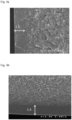
- Figure 4a and 4b are scanning electron micrographs of the hollow polyimide fiber prior to pyrolyzing and the corresponding CMS fiber made therefrom.
- Example 3 Dope formulation Dope Component wt % mass (g) Example 3 1 st Polyimide 10 20 Example 3 2 nd Polyimide 10 20 NMP 63 126 THF 10 20 EtOH 7 14 Total 100 200
Landscapes
- Chemical & Material Sciences (AREA)
- Chemical Kinetics & Catalysis (AREA)
- Engineering & Computer Science (AREA)
- Manufacturing & Machinery (AREA)
- Health & Medical Sciences (AREA)
- Medicinal Chemistry (AREA)
- Polymers & Plastics (AREA)
- Organic Chemistry (AREA)
- Inorganic Chemistry (AREA)
- Dispersion Chemistry (AREA)
- Analytical Chemistry (AREA)
- General Chemical & Material Sciences (AREA)
- Oil, Petroleum & Natural Gas (AREA)
- Separation Using Semi-Permeable Membranes (AREA)
- Macromolecular Compounds Obtained By Forming Nitrogen-Containing Linkages In General (AREA)
- Inorganic Fibers (AREA)
- Carbon And Carbon Compounds (AREA)
- Solid-Sorbent Or Filter-Aiding Compositions (AREA)
- Silicates, Zeolites, And Molecular Sieves (AREA)
- Artificial Filaments (AREA)
Claims (6)
- Verfahren zum Herstellen eines asymmetrischen Hohlfaserkohlenstoffmolekularsiebs, umfassend,(i) Bereitstellen einer Dotierlösung, die aus einem Polyimid und einem Lösungsmittel besteht, wobei das Polyimid bei einer Temperatur über 250 °C ein Speichermodulminimum aufweist, das kleiner als der Speichermodul bei einer Temperatur von 250 °C, aber nicht mehr als zehnmal kleiner ist, wobei das Speichermodulminimum unter Verwendung einer dynamisch-mechanischen thermischen Analyse wie hierin beschrieben von 250 °C bis zu einer Temperatur gemessen wird, bei der das Polyimid in Kohlenstoff umgewandelt wird,(ii) Formen der Dotierlösung, um eine Hohlfaser auszubilden;(iii) Entfernen des Lösungsmittels aus der Hohlfaser, um eine Polyimidhohlfaser auszubilden; und(iv) Erhitzen der Polyimidhohlfaser in einer Atmosphäre, die nicht oxidierend ist, um das asymmetrische Hohlfaserkohlenstoffmolekularsieb auszubilden;wobei das Polyimid das Reaktionsprodukt eines Dianhydrids und eines Diamins ist, wobei das Diamin keine Rotationsfreiheit aufweist und das Dianhydrid aus einem aromatischen Dianhydrid, das innerhalb des Dianhydrids keine Rotationsfreiheit aufweist, und einem Dianhydrid, das innerhalb des Dianhydrids Rotationsfreiheit aufweist, besteht;wobei keine Rotationsfreiheit bedeutet, dass nur ein aromatischer Ring vorhanden ist oder keine Einfachbindungen zwischen aromatischen Ringen vorhanden sind, die den aromatischen Ringen ermöglichen würde, in Bezug zueinander zu rotieren, und Rotationsfreiheit bedeutet, dass Einfachbindungen zwischen aromatischen Ringen vorhanden sind, die den aromatischen Ringen ermöglichen würde, in Bezug zueinander zu rotieren; undwobei das Dianhydrid, das keine Rotationsfreiheit aufweist, Naphthalintetracarbonsäuredianhydrid, Benzochinontetracarbonsäuredianhydrid oder eine Kombination davon ist.
- Verfahren nach Anspruch 1, wobei das Diamin nur einen aromatischen Ring aufweist.
- Verfahren nach Anspruch 1, wobei das Diamin, das keine Rotationsfreiheit aufweist, aus 2,4,6-Trimethyl-1,3-phenylendiamin, 3,5-Diaminobenzoesäure, 2,3,5,6-Tetramethyl-1,4-phenylendiamin, Dimethyl-3,7-diaminodiphenylthiophen-5,5'-dioid, meta-Phenylendiamin, para-Phenylendiamin und 2,4-Diaminotoluol ausgewählt ist.
- Verfahren nach Anspruch 1, wobei die Polyimidhohlfaser vor dem Erhitzen nicht voroxidiert oder mit einer Sol-Gel-Kieselsäure in Kontakt gebracht wird, um die Steifigkeit der Polyimidhohlfaser zu erhöhen.
- Verfahren nach Anspruch 1, wobei der minimale Speichermodul höchstens 7,5-mal kleiner als der Speichermodul bei einer Temperatur von 250 °C ist.
- Verfahren nach Anspruch 5, wobei der minimale Speichermodul höchstens 5-mal kleiner als der Speichermodul bei einer Temperatur von 250 °C ist.
Applications Claiming Priority (3)
| Application Number | Priority Date | Filing Date | Title |
|---|---|---|---|
| US201662420285P | 2016-11-10 | 2016-11-10 | |
| PCT/US2017/053153 WO2018089114A1 (en) | 2016-11-10 | 2017-09-25 | Improved method to make carbon molecular sieve hollow fiber membranes |
| EP17792224.2A EP3538251B1 (de) | 2016-11-10 | 2017-09-25 | Verbessertes verfahren zur herstellung von hohlfasermembranen eines kohlenstoffmolekularsiebs |
Related Parent Applications (2)
| Application Number | Title | Priority Date | Filing Date |
|---|---|---|---|
| EP17792224.2A Division EP3538251B1 (de) | 2016-11-10 | 2017-09-25 | Verbessertes verfahren zur herstellung von hohlfasermembranen eines kohlenstoffmolekularsiebs |
| EP17792224.2A Division-Into EP3538251B1 (de) | 2016-11-10 | 2017-09-25 | Verbessertes verfahren zur herstellung von hohlfasermembranen eines kohlenstoffmolekularsiebs |
Publications (2)
| Publication Number | Publication Date |
|---|---|
| EP4070880A1 EP4070880A1 (de) | 2022-10-12 |
| EP4070880B1 true EP4070880B1 (de) | 2024-10-02 |
Family
ID=60201649
Family Applications (2)
| Application Number | Title | Priority Date | Filing Date |
|---|---|---|---|
| EP17792224.2A Active EP3538251B1 (de) | 2016-11-10 | 2017-09-25 | Verbessertes verfahren zur herstellung von hohlfasermembranen eines kohlenstoffmolekularsiebs |
| EP22176998.7A Active EP4070880B1 (de) | 2016-11-10 | 2017-09-25 | Verbessertes verfahren zur herstellung von hohlfasermembranen eines kohlenstoffmolekularsiebs |
Family Applications Before (1)
| Application Number | Title | Priority Date | Filing Date |
|---|---|---|---|
| EP17792224.2A Active EP3538251B1 (de) | 2016-11-10 | 2017-09-25 | Verbessertes verfahren zur herstellung von hohlfasermembranen eines kohlenstoffmolekularsiebs |
Country Status (8)
| Country | Link |
|---|---|
| US (1) | US11167248B2 (de) |
| EP (2) | EP3538251B1 (de) |
| JP (1) | JP7053605B2 (de) |
| KR (1) | KR102447406B1 (de) |
| CN (1) | CN109937084B (de) |
| CA (1) | CA3043164C (de) |
| ES (2) | ES2926162T3 (de) |
| WO (1) | WO2018089114A1 (de) |
Families Citing this family (10)
| Publication number | Priority date | Publication date | Assignee | Title |
|---|---|---|---|---|
| US11130098B2 (en) * | 2015-12-17 | 2021-09-28 | Dow Global Technologies Llc | Method of making carbon molecular sieve membranes |
| BR112020002664B1 (pt) | 2017-08-14 | 2024-03-12 | Dow Global Technologies Llc | Método para produzir uma membrana de peneira molecular de carbono de fibra oca, processo para separar uma molécula de gás de uma alimentação de gás compreendida da molécula de gás e pelo menos uma outra molécula de gás e módulo de separação de gás |
| CN110508165A (zh) * | 2019-08-09 | 2019-11-29 | 大连理工大学 | 天然气提浓氦气多孔碳纳米球混合基质复合膜及其制备方法 |
| US20230347302A1 (en) * | 2020-05-04 | 2023-11-02 | Atom H2O, Llc | Carbon Nanotube Based Membrane and Methods of Manufacturing |
| CN112547007A (zh) * | 2020-11-08 | 2021-03-26 | 中贞(上海)环境能源科技有限公司 | 新型炭分子筛废气脱氨剂 |
| KR102491272B1 (ko) * | 2020-12-29 | 2023-01-26 | 한국화학연구원 | 수소분리용 탄소분자체 분리막 및 암모니아 분해 반응을 이용한 수소 생산 방법 |
| CN120435340A (zh) * | 2023-01-20 | 2025-08-05 | 陶氏环球技术有限责任公司 | 反向选择性碳膜及其制造方法 |
| US20240390860A1 (en) * | 2023-05-24 | 2024-11-28 | King Fahd University Of Petroleum And Minerals | Polyimide-based membranes for desalination |
| CN119455684B (zh) * | 2024-11-11 | 2025-11-28 | 宁夏大学 | 一种中空纤维支撑的碳分子筛复合膜及其制备方法 |
| CN119680406B (zh) * | 2024-12-17 | 2025-09-23 | 大连理工大学 | 一种具备高气体分离性能的含氟特罗格碱基炭分子筛膜制备方法 |
Family Cites Families (32)
| Publication number | Priority date | Publication date | Assignee | Title |
|---|---|---|---|---|
| FR2193634A1 (en) | 1972-07-20 | 1974-02-22 | Du Pont | Polyimide semi-permeable membranes |
| US4113628A (en) | 1974-06-05 | 1978-09-12 | E. I. Du Pont De Nemours And Company | Asymmetric polyimide membranes |
| US4127625A (en) | 1975-03-27 | 1978-11-28 | Daicel Ltd. | Process for preparing hollow fiber having selective gas permeability |
| EP0023406B1 (de) | 1979-07-26 | 1983-04-13 | Ube Industries, Ltd. | Verfahren zur Herstellung semipermeabler, aromatischer Polyimidmembranen |
| JPS57167414A (en) | 1981-04-03 | 1982-10-15 | Ube Ind Ltd | Production of polyimide hollow fiber |
| JPS57170936A (en) | 1981-04-14 | 1982-10-21 | Ube Ind Ltd | Preparation of porous polyimide film |
| GB2101137B (en) | 1981-04-14 | 1984-09-26 | Ube Industries | Producing porous aromatic imide polymer membranes |
| JPS57209607A (en) | 1981-06-22 | 1982-12-23 | Ube Ind Ltd | Preparation of polyimide separation film |
| US4705540A (en) | 1986-04-17 | 1987-11-10 | E. I. Du Pont De Nemours And Company | Polyimide gas separation membranes |
| US4717394A (en) | 1986-10-27 | 1988-01-05 | E. I. Du Pont De Nemours And Company | Polyimide gas separation membranes |
| US4867934A (en) | 1987-12-23 | 1989-09-19 | Cuno, Inc. | Production of hollow nylon fibers |
| US4983191A (en) | 1989-10-10 | 1991-01-08 | E. I. Du Pont De Nemours And Company | Production of aromatic polyimide membranes |
| DE69102350T2 (de) | 1990-04-27 | 1995-01-19 | Ube Industries | Asymmetrische Hohlfadenmembran aus Kohlenstoff und Verfahren zu deren Herstellung. |
| US5085774A (en) | 1990-08-30 | 1992-02-04 | E. I. Du Pont De Nemours And Company | Polymeric membranes |
| US5288304A (en) | 1993-03-30 | 1994-02-22 | The University Of Texas System | Composite carbon fluid separation membranes |
| US5468430A (en) | 1994-05-19 | 1995-11-21 | L'air Liquide S.A. | Process of making multicomponent or asymmetric gas separation membranes |
| JP4081956B2 (ja) * | 1999-03-05 | 2008-04-30 | 宇部興産株式会社 | 部分炭素化された非対称性中空糸分離膜とその製法およびガス分離方法 |
| US6299669B1 (en) | 1999-11-10 | 2001-10-09 | The University Of Texas System | Process for CO2/natural gas separation |
| JP2004514546A (ja) * | 2000-09-20 | 2004-05-20 | シェブロン ユー.エス.エー. インコーポレイテッド | 熱分解炭素ふるい粒子を混合したマトリックス膜及びその製法と使用法 |
| CN101816899B (zh) * | 2010-04-14 | 2012-03-21 | 南京工业大学 | 吸附分离用分子筛/聚酰亚胺复合薄膜及其制备方法 |
| KR102106747B1 (ko) * | 2010-07-22 | 2020-05-04 | 우베 고산 가부시키가이샤 | 폴리이미드 전구체, 폴리이미드 및 그 제조에 사용되는 재료 |
| CN102041577B (zh) * | 2010-12-03 | 2012-05-30 | 中国科学院长春应用化学研究所 | 一种聚酰亚胺纤维及其制备方法 |
| US8911534B2 (en) * | 2011-03-07 | 2014-12-16 | Georgia Tech Research Corporation | Polyimide-based carbon molecular sieve membrane for ethylene/ethane separations |
| KR102062413B1 (ko) | 2011-12-20 | 2020-01-03 | 조지아 테크 리서치 코오포레이션 | 고성능 탄소 분자체 중공 섬유막의 다공성 형태의 안정화 |
| EP2844368B1 (de) | 2012-05-01 | 2019-08-07 | Dow Global Technologies LLC | Verwendung von einer hohlfaser-kohlenstoff-molekularsiebmembran |
| KR102130876B1 (ko) * | 2013-09-30 | 2020-07-09 | 조지아 테크 리서치 코오포레이션 | 개선된 투과성을 갖는 비대칭 개질된 탄소 분자체 중공사막 |
| WO2015100161A1 (en) | 2013-12-26 | 2015-07-02 | L'air Liquide, Societe Anonyme Pour L'etude Et Exploitation Des Procedes Georges Claude | Carbon molecular sieve membranes made from 6fda and detda-based precursor polymers |
| US20150185363A1 (en) | 2013-12-26 | 2015-07-02 | Baker Hughes Incorporated | Data visualization in borehole systems |
| JP6733177B2 (ja) * | 2014-07-24 | 2020-07-29 | 東レ株式会社 | 流体分離用炭素膜、流体分離膜モジュールおよび、流体分離用炭素膜の製造方法 |
| ES2798126T3 (es) | 2014-09-24 | 2020-12-09 | Dow Global Technologies Llc | Preparación de membranas de fibra hueca de tamiz molecular de carbono (CMS) y su preparación a partir de poliimidas pre-oxidadas |
| US10086337B2 (en) * | 2014-11-30 | 2018-10-02 | L'air Liquide Societe Anonyme Pour L'etude Et L'exploitation Des Procedes Georges Claude | Composite carbon molecular sieve membranes having anti-substructure collapse particles loaded in a core thereof |
| US11130098B2 (en) | 2015-12-17 | 2021-09-28 | Dow Global Technologies Llc | Method of making carbon molecular sieve membranes |
-
2017
- 2017-09-25 WO PCT/US2017/053153 patent/WO2018089114A1/en not_active Ceased
- 2017-09-25 KR KR1020197014174A patent/KR102447406B1/ko active Active
- 2017-09-25 EP EP17792224.2A patent/EP3538251B1/de active Active
- 2017-09-25 US US16/333,919 patent/US11167248B2/en active Active
- 2017-09-25 JP JP2019522997A patent/JP7053605B2/ja active Active
- 2017-09-25 CA CA3043164A patent/CA3043164C/en active Active
- 2017-09-25 EP EP22176998.7A patent/EP4070880B1/de active Active
- 2017-09-25 ES ES17792224T patent/ES2926162T3/es active Active
- 2017-09-25 ES ES22176998T patent/ES3000860T3/es active Active
- 2017-09-25 CN CN201780067407.8A patent/CN109937084B/zh active Active
Also Published As
| Publication number | Publication date |
|---|---|
| WO2018089114A1 (en) | 2018-05-17 |
| EP3538251A1 (de) | 2019-09-18 |
| ES2926162T3 (es) | 2022-10-24 |
| EP4070880A1 (de) | 2022-10-12 |
| CN109937084A (zh) | 2019-06-25 |
| US11167248B2 (en) | 2021-11-09 |
| KR20190075967A (ko) | 2019-07-01 |
| CA3043164C (en) | 2025-05-20 |
| JP7053605B2 (ja) | 2022-04-12 |
| JP2020514011A (ja) | 2020-05-21 |
| EP3538251B1 (de) | 2022-07-13 |
| ES3000860T3 (en) | 2025-03-03 |
| KR102447406B1 (ko) | 2022-09-28 |
| US20190275471A1 (en) | 2019-09-12 |
| CA3043164A1 (en) | 2018-05-17 |
| BR112019008922A2 (pt) | 2019-07-16 |
| CN109937084B (zh) | 2022-05-24 |
Similar Documents
| Publication | Publication Date | Title |
|---|---|---|
| EP4070880B1 (de) | Verbessertes verfahren zur herstellung von hohlfasermembranen eines kohlenstoffmolekularsiebs | |
| EP3197592B1 (de) | Herstellung von hohlfasermembranen mit kohlenstoffmolekularsieb (cms) aus voroxidierten polyimiden | |
| WO2015100161A1 (en) | Carbon molecular sieve membranes made from 6fda and detda-based precursor polymers | |
| WO2017165098A1 (en) | Improved method of making carbon molecular sieve membranes | |
| US20210324142A1 (en) | Cross-linked polyimide membranes and carbon molecular sieve hollow fiber membranes made therefrom | |
| EP3668633B1 (de) | Verbessertes verfahren zur herstellung von hohlfasermembranen eines kohlenstoffmolekularsiebs | |
| US20240325985A1 (en) | Methods for manufacturing hollow fiber carbon membranes | |
| BR112019008922B1 (pt) | Método para produzir uma peneira molecular de carbono de fibra oca assimétrica, processo para separar uma molécula de gás de uma alimentação de gás, e, módulo de separação de gás |
Legal Events
| Date | Code | Title | Description |
|---|---|---|---|
| PUAI | Public reference made under article 153(3) epc to a published international application that has entered the european phase |
Free format text: ORIGINAL CODE: 0009012 |
|
| STAA | Information on the status of an ep patent application or granted ep patent |
Free format text: STATUS: THE APPLICATION HAS BEEN PUBLISHED |
|
| AC | Divisional application: reference to earlier application |
Ref document number: 3538251 Country of ref document: EP Kind code of ref document: P |
|
| AK | Designated contracting states |
Kind code of ref document: A1 Designated state(s): AL AT BE BG CH CY CZ DE DK EE ES FI FR GB GR HR HU IE IS IT LI LT LU LV MC MK MT NL NO PL PT RO RS SE SI SK SM TR |
|
| STAA | Information on the status of an ep patent application or granted ep patent |
Free format text: STATUS: REQUEST FOR EXAMINATION WAS MADE |
|
| 17P | Request for examination filed |
Effective date: 20230411 |
|
| RBV | Designated contracting states (corrected) |
Designated state(s): AL AT BE BG CH CY CZ DE DK EE ES FI FR GB GR HR HU IE IS IT LI LT LU LV MC MK MT NL NO PL PT RO RS SE SI SK SM TR |
|
| P01 | Opt-out of the competence of the unified patent court (upc) registered |
Effective date: 20230526 |
|
| STAA | Information on the status of an ep patent application or granted ep patent |
Free format text: STATUS: EXAMINATION IS IN PROGRESS |
|
| 17Q | First examination report despatched |
Effective date: 20230828 |
|
| GRAP | Despatch of communication of intention to grant a patent |
Free format text: ORIGINAL CODE: EPIDOSNIGR1 |
|
| STAA | Information on the status of an ep patent application or granted ep patent |
Free format text: STATUS: GRANT OF PATENT IS INTENDED |
|
| INTG | Intention to grant announced |
Effective date: 20240503 |
|
| GRAS | Grant fee paid |
Free format text: ORIGINAL CODE: EPIDOSNIGR3 |
|
| GRAA | (expected) grant |
Free format text: ORIGINAL CODE: 0009210 |
|
| STAA | Information on the status of an ep patent application or granted ep patent |
Free format text: STATUS: THE PATENT HAS BEEN GRANTED |
|
| AC | Divisional application: reference to earlier application |
Ref document number: 3538251 Country of ref document: EP Kind code of ref document: P |
|
| AK | Designated contracting states |
Kind code of ref document: B1 Designated state(s): AL AT BE BG CH CY CZ DE DK EE ES FI FR GB GR HR HU IE IS IT LI LT LU LV MC MK MT NL NO PL PT RO RS SE SI SK SM TR |
|
| REG | Reference to a national code |
Ref country code: GB Ref legal event code: FG4D |
|
| REG | Reference to a national code |
Ref country code: CH Ref legal event code: EP |
|
| REG | Reference to a national code |
Ref country code: DE Ref legal event code: R096 Ref document number: 602017085303 Country of ref document: DE |
|
| REG | Reference to a national code |
Ref country code: IE Ref legal event code: FG4D Ref country code: NL Ref legal event code: FP |
|
| REG | Reference to a national code |
Ref country code: LT Ref legal event code: MG9D |
|
| REG | Reference to a national code |
Ref country code: ES Ref legal event code: FG2A Ref document number: 3000860 Country of ref document: ES Kind code of ref document: T3 Effective date: 20250303 |
|
| REG | Reference to a national code |
Ref country code: AT Ref legal event code: MK05 Ref document number: 1728060 Country of ref document: AT Kind code of ref document: T Effective date: 20241002 |
|
| PG25 | Lapsed in a contracting state [announced via postgrant information from national office to epo] |
Ref country code: PT Free format text: LAPSE BECAUSE OF FAILURE TO SUBMIT A TRANSLATION OF THE DESCRIPTION OR TO PAY THE FEE WITHIN THE PRESCRIBED TIME-LIMIT Effective date: 20250203 Ref country code: HR Free format text: LAPSE BECAUSE OF FAILURE TO SUBMIT A TRANSLATION OF THE DESCRIPTION OR TO PAY THE FEE WITHIN THE PRESCRIBED TIME-LIMIT Effective date: 20241002 Ref country code: IS Free format text: LAPSE BECAUSE OF FAILURE TO SUBMIT A TRANSLATION OF THE DESCRIPTION OR TO PAY THE FEE WITHIN THE PRESCRIBED TIME-LIMIT Effective date: 20250202 |
|
| PG25 | Lapsed in a contracting state [announced via postgrant information from national office to epo] |
Ref country code: FI Free format text: LAPSE BECAUSE OF FAILURE TO SUBMIT A TRANSLATION OF THE DESCRIPTION OR TO PAY THE FEE WITHIN THE PRESCRIBED TIME-LIMIT Effective date: 20241002 |
|
| PG25 | Lapsed in a contracting state [announced via postgrant information from national office to epo] |
Ref country code: BG Free format text: LAPSE BECAUSE OF FAILURE TO SUBMIT A TRANSLATION OF THE DESCRIPTION OR TO PAY THE FEE WITHIN THE PRESCRIBED TIME-LIMIT Effective date: 20241002 |
|
| PG25 | Lapsed in a contracting state [announced via postgrant information from national office to epo] |
Ref country code: NO Free format text: LAPSE BECAUSE OF FAILURE TO SUBMIT A TRANSLATION OF THE DESCRIPTION OR TO PAY THE FEE WITHIN THE PRESCRIBED TIME-LIMIT Effective date: 20250102 |
|
| PG25 | Lapsed in a contracting state [announced via postgrant information from national office to epo] |
Ref country code: AT Free format text: LAPSE BECAUSE OF FAILURE TO SUBMIT A TRANSLATION OF THE DESCRIPTION OR TO PAY THE FEE WITHIN THE PRESCRIBED TIME-LIMIT Effective date: 20241002 Ref country code: LV Free format text: LAPSE BECAUSE OF FAILURE TO SUBMIT A TRANSLATION OF THE DESCRIPTION OR TO PAY THE FEE WITHIN THE PRESCRIBED TIME-LIMIT Effective date: 20241002 Ref country code: GR Free format text: LAPSE BECAUSE OF FAILURE TO SUBMIT A TRANSLATION OF THE DESCRIPTION OR TO PAY THE FEE WITHIN THE PRESCRIBED TIME-LIMIT Effective date: 20250103 |
|
| PG25 | Lapsed in a contracting state [announced via postgrant information from national office to epo] |
Ref country code: PL Free format text: LAPSE BECAUSE OF FAILURE TO SUBMIT A TRANSLATION OF THE DESCRIPTION OR TO PAY THE FEE WITHIN THE PRESCRIBED TIME-LIMIT Effective date: 20241002 Ref country code: CZ Free format text: LAPSE BECAUSE OF FAILURE TO SUBMIT A TRANSLATION OF THE DESCRIPTION OR TO PAY THE FEE WITHIN THE PRESCRIBED TIME-LIMIT Effective date: 20241002 |
|
| PG25 | Lapsed in a contracting state [announced via postgrant information from national office to epo] |
Ref country code: RS Free format text: LAPSE BECAUSE OF FAILURE TO SUBMIT A TRANSLATION OF THE DESCRIPTION OR TO PAY THE FEE WITHIN THE PRESCRIBED TIME-LIMIT Effective date: 20250102 |
|
| PG25 | Lapsed in a contracting state [announced via postgrant information from national office to epo] |
Ref country code: SM Free format text: LAPSE BECAUSE OF FAILURE TO SUBMIT A TRANSLATION OF THE DESCRIPTION OR TO PAY THE FEE WITHIN THE PRESCRIBED TIME-LIMIT Effective date: 20241002 |
|
| REG | Reference to a national code |
Ref country code: DE Ref legal event code: R097 Ref document number: 602017085303 Country of ref document: DE |
|
| PG25 | Lapsed in a contracting state [announced via postgrant information from national office to epo] |
Ref country code: DK Free format text: LAPSE BECAUSE OF FAILURE TO SUBMIT A TRANSLATION OF THE DESCRIPTION OR TO PAY THE FEE WITHIN THE PRESCRIBED TIME-LIMIT Effective date: 20241002 |
|
| PG25 | Lapsed in a contracting state [announced via postgrant information from national office to epo] |
Ref country code: EE Free format text: LAPSE BECAUSE OF FAILURE TO SUBMIT A TRANSLATION OF THE DESCRIPTION OR TO PAY THE FEE WITHIN THE PRESCRIBED TIME-LIMIT Effective date: 20241002 |
|
| PG25 | Lapsed in a contracting state [announced via postgrant information from national office to epo] |
Ref country code: RO Free format text: LAPSE BECAUSE OF FAILURE TO SUBMIT A TRANSLATION OF THE DESCRIPTION OR TO PAY THE FEE WITHIN THE PRESCRIBED TIME-LIMIT Effective date: 20241002 |
|
| PG25 | Lapsed in a contracting state [announced via postgrant information from national office to epo] |
Ref country code: SK Free format text: LAPSE BECAUSE OF FAILURE TO SUBMIT A TRANSLATION OF THE DESCRIPTION OR TO PAY THE FEE WITHIN THE PRESCRIBED TIME-LIMIT Effective date: 20241002 |
|
| PG25 | Lapsed in a contracting state [announced via postgrant information from national office to epo] |
Ref country code: IT Free format text: LAPSE BECAUSE OF FAILURE TO SUBMIT A TRANSLATION OF THE DESCRIPTION OR TO PAY THE FEE WITHIN THE PRESCRIBED TIME-LIMIT Effective date: 20241002 |
|
| PLBE | No opposition filed within time limit |
Free format text: ORIGINAL CODE: 0009261 |
|
| STAA | Information on the status of an ep patent application or granted ep patent |
Free format text: STATUS: NO OPPOSITION FILED WITHIN TIME LIMIT |
|
| PGFP | Annual fee paid to national office [announced via postgrant information from national office to epo] |
Ref country code: NL Payment date: 20250704 Year of fee payment: 9 |
|
| PG25 | Lapsed in a contracting state [announced via postgrant information from national office to epo] |
Ref country code: SE Free format text: LAPSE BECAUSE OF FAILURE TO SUBMIT A TRANSLATION OF THE DESCRIPTION OR TO PAY THE FEE WITHIN THE PRESCRIBED TIME-LIMIT Effective date: 20241002 |
|
| 26N | No opposition filed |
Effective date: 20250703 |
|
| PGFP | Annual fee paid to national office [announced via postgrant information from national office to epo] |
Ref country code: DE Payment date: 20250702 Year of fee payment: 9 |
|
| PGFP | Annual fee paid to national office [announced via postgrant information from national office to epo] |
Ref country code: ES Payment date: 20251015 Year of fee payment: 9 |