EP4069237B1 - Bifunktionelle verbindungen zum abbau von btk über den ubiquitin-proteosom-signalweg - Google Patents
Bifunktionelle verbindungen zum abbau von btk über den ubiquitin-proteosom-signalweg Download PDFInfo
- Publication number
- EP4069237B1 EP4069237B1 EP20829249.0A EP20829249A EP4069237B1 EP 4069237 B1 EP4069237 B1 EP 4069237B1 EP 20829249 A EP20829249 A EP 20829249A EP 4069237 B1 EP4069237 B1 EP 4069237B1
- Authority
- EP
- European Patent Office
- Prior art keywords
- alkyl
- compound
- membered
- heterocycloalkyl
- bond
- Prior art date
- Legal status (The legal status is an assumption and is not a legal conclusion. Google has not performed a legal analysis and makes no representation as to the accuracy of the status listed.)
- Active
Links
Images





Classifications
-
- C—CHEMISTRY; METALLURGY
- C07—ORGANIC CHEMISTRY
- C07D—HETEROCYCLIC COMPOUNDS
- C07D405/00—Heterocyclic compounds containing both one or more hetero rings having oxygen atoms as the only ring hetero atoms, and one or more rings having nitrogen as the only ring hetero atom
- C07D405/14—Heterocyclic compounds containing both one or more hetero rings having oxygen atoms as the only ring hetero atoms, and one or more rings having nitrogen as the only ring hetero atom containing three or more hetero rings
-
- A—HUMAN NECESSITIES
- A61—MEDICAL OR VETERINARY SCIENCE; HYGIENE
- A61K—PREPARATIONS FOR MEDICAL, DENTAL OR TOILETRY PURPOSES
- A61K31/00—Medicinal preparations containing organic active ingredients
- A61K31/33—Heterocyclic compounds
- A61K31/395—Heterocyclic compounds having nitrogen as a ring hetero atom, e.g. guanethidine or rifamycins
- A61K31/435—Heterocyclic compounds having nitrogen as a ring hetero atom, e.g. guanethidine or rifamycins having six-membered rings with one nitrogen as the only ring hetero atom
- A61K31/44—Non condensed pyridines; Hydrogenated derivatives thereof
- A61K31/445—Non condensed piperidines, e.g. piperocaine
- A61K31/4523—Non condensed piperidines, e.g. piperocaine containing further heterocyclic ring systems
- A61K31/454—Non condensed piperidines, e.g. piperocaine containing further heterocyclic ring systems containing a five-membered ring with nitrogen as a ring hetero atom, e.g. pimozide, domperidone
-
- A—HUMAN NECESSITIES
- A61—MEDICAL OR VETERINARY SCIENCE; HYGIENE
- A61K—PREPARATIONS FOR MEDICAL, DENTAL OR TOILETRY PURPOSES
- A61K31/00—Medicinal preparations containing organic active ingredients
- A61K31/33—Heterocyclic compounds
- A61K31/395—Heterocyclic compounds having nitrogen as a ring hetero atom, e.g. guanethidine or rifamycins
- A61K31/435—Heterocyclic compounds having nitrogen as a ring hetero atom, e.g. guanethidine or rifamycins having six-membered rings with one nitrogen as the only ring hetero atom
- A61K31/44—Non condensed pyridines; Hydrogenated derivatives thereof
- A61K31/445—Non condensed piperidines, e.g. piperocaine
- A61K31/4523—Non condensed piperidines, e.g. piperocaine containing further heterocyclic ring systems
- A61K31/4545—Non condensed piperidines, e.g. piperocaine containing further heterocyclic ring systems containing a six-membered ring with nitrogen as a ring hetero atom, e.g. pipamperone, anabasine
-
- A—HUMAN NECESSITIES
- A61—MEDICAL OR VETERINARY SCIENCE; HYGIENE
- A61K—PREPARATIONS FOR MEDICAL, DENTAL OR TOILETRY PURPOSES
- A61K31/00—Medicinal preparations containing organic active ingredients
- A61K31/33—Heterocyclic compounds
- A61K31/395—Heterocyclic compounds having nitrogen as a ring hetero atom, e.g. guanethidine or rifamycins
- A61K31/495—Heterocyclic compounds having nitrogen as a ring hetero atom, e.g. guanethidine or rifamycins having six-membered rings with two or more nitrogen atoms as the only ring heteroatoms, e.g. piperazine or tetrazines
- A61K31/4965—Non-condensed pyrazines
- A61K31/497—Non-condensed pyrazines containing further heterocyclic rings
-
- A—HUMAN NECESSITIES
- A61—MEDICAL OR VETERINARY SCIENCE; HYGIENE
- A61K—PREPARATIONS FOR MEDICAL, DENTAL OR TOILETRY PURPOSES
- A61K31/00—Medicinal preparations containing organic active ingredients
- A61K31/33—Heterocyclic compounds
- A61K31/395—Heterocyclic compounds having nitrogen as a ring hetero atom, e.g. guanethidine or rifamycins
- A61K31/495—Heterocyclic compounds having nitrogen as a ring hetero atom, e.g. guanethidine or rifamycins having six-membered rings with two or more nitrogen atoms as the only ring heteroatoms, e.g. piperazine or tetrazines
- A61K31/4985—Pyrazines or piperazines ortho- or peri-condensed with heterocyclic ring systems
-
- A—HUMAN NECESSITIES
- A61—MEDICAL OR VETERINARY SCIENCE; HYGIENE
- A61K—PREPARATIONS FOR MEDICAL, DENTAL OR TOILETRY PURPOSES
- A61K31/00—Medicinal preparations containing organic active ingredients
- A61K31/33—Heterocyclic compounds
- A61K31/395—Heterocyclic compounds having nitrogen as a ring hetero atom, e.g. guanethidine or rifamycins
- A61K31/535—Heterocyclic compounds having nitrogen as a ring hetero atom, e.g. guanethidine or rifamycins having six-membered rings with at least one nitrogen and one oxygen as the ring hetero atoms, e.g. 1,2-oxazines
- A61K31/5375—1,4-Oxazines, e.g. morpholine
- A61K31/5377—1,4-Oxazines, e.g. morpholine not condensed and containing further heterocyclic rings, e.g. timolol
-
- A—HUMAN NECESSITIES
- A61—MEDICAL OR VETERINARY SCIENCE; HYGIENE
- A61P—SPECIFIC THERAPEUTIC ACTIVITY OF CHEMICAL COMPOUNDS OR MEDICINAL PREPARATIONS
- A61P35/00—Antineoplastic agents
-
- A—HUMAN NECESSITIES
- A61—MEDICAL OR VETERINARY SCIENCE; HYGIENE
- A61P—SPECIFIC THERAPEUTIC ACTIVITY OF CHEMICAL COMPOUNDS OR MEDICINAL PREPARATIONS
- A61P37/00—Drugs for immunological or allergic disorders
-
- C—CHEMISTRY; METALLURGY
- C07—ORGANIC CHEMISTRY
- C07D—HETEROCYCLIC COMPOUNDS
- C07D401/00—Heterocyclic compounds containing two or more hetero rings, having nitrogen atoms as the only ring hetero atoms, at least one ring being a six-membered ring with only one nitrogen atom
- C07D401/14—Heterocyclic compounds containing two or more hetero rings, having nitrogen atoms as the only ring hetero atoms, at least one ring being a six-membered ring with only one nitrogen atom containing three or more hetero rings
-
- C—CHEMISTRY; METALLURGY
- C07—ORGANIC CHEMISTRY
- C07D—HETEROCYCLIC COMPOUNDS
- C07D413/00—Heterocyclic compounds containing two or more hetero rings, at least one ring having nitrogen and oxygen atoms as the only ring hetero atoms
- C07D413/14—Heterocyclic compounds containing two or more hetero rings, at least one ring having nitrogen and oxygen atoms as the only ring hetero atoms containing three or more hetero rings
-
- C—CHEMISTRY; METALLURGY
- C07—ORGANIC CHEMISTRY
- C07D—HETEROCYCLIC COMPOUNDS
- C07D417/00—Heterocyclic compounds containing two or more hetero rings, at least one ring having nitrogen and sulfur atoms as the only ring hetero atoms, not provided for by group C07D415/00
- C07D417/14—Heterocyclic compounds containing two or more hetero rings, at least one ring having nitrogen and sulfur atoms as the only ring hetero atoms, not provided for by group C07D415/00 containing three or more hetero rings
-
- C—CHEMISTRY; METALLURGY
- C07—ORGANIC CHEMISTRY
- C07D—HETEROCYCLIC COMPOUNDS
- C07D471/00—Heterocyclic compounds containing nitrogen atoms as the only ring hetero atoms in the condensed system, at least one ring being a six-membered ring with one nitrogen atom, not provided for by groups C07D451/00 - C07D463/00
- C07D471/02—Heterocyclic compounds containing nitrogen atoms as the only ring hetero atoms in the condensed system, at least one ring being a six-membered ring with one nitrogen atom, not provided for by groups C07D451/00 - C07D463/00 in which the condensed system contains two hetero rings
- C07D471/04—Ortho-condensed systems
-
- C—CHEMISTRY; METALLURGY
- C07—ORGANIC CHEMISTRY
- C07D—HETEROCYCLIC COMPOUNDS
- C07D471/00—Heterocyclic compounds containing nitrogen atoms as the only ring hetero atoms in the condensed system, at least one ring being a six-membered ring with one nitrogen atom, not provided for by groups C07D451/00 - C07D463/00
- C07D471/02—Heterocyclic compounds containing nitrogen atoms as the only ring hetero atoms in the condensed system, at least one ring being a six-membered ring with one nitrogen atom, not provided for by groups C07D451/00 - C07D463/00 in which the condensed system contains two hetero rings
- C07D471/10—Spiro-condensed systems
-
- C—CHEMISTRY; METALLURGY
- C07—ORGANIC CHEMISTRY
- C07D—HETEROCYCLIC COMPOUNDS
- C07D487/00—Heterocyclic compounds containing nitrogen atoms as the only ring hetero atoms in the condensed system, not provided for by groups C07D451/00 - C07D477/00
- C07D487/02—Heterocyclic compounds containing nitrogen atoms as the only ring hetero atoms in the condensed system, not provided for by groups C07D451/00 - C07D477/00 in which the condensed system contains two hetero rings
- C07D487/04—Ortho-condensed systems
-
- C—CHEMISTRY; METALLURGY
- C07—ORGANIC CHEMISTRY
- C07D—HETEROCYCLIC COMPOUNDS
- C07D487/00—Heterocyclic compounds containing nitrogen atoms as the only ring hetero atoms in the condensed system, not provided for by groups C07D451/00 - C07D477/00
- C07D487/02—Heterocyclic compounds containing nitrogen atoms as the only ring hetero atoms in the condensed system, not provided for by groups C07D451/00 - C07D477/00 in which the condensed system contains two hetero rings
- C07D487/10—Spiro-condensed systems
-
- C—CHEMISTRY; METALLURGY
- C07—ORGANIC CHEMISTRY
- C07D—HETEROCYCLIC COMPOUNDS
- C07D491/00—Heterocyclic compounds containing in the condensed ring system both one or more rings having oxygen atoms as the only ring hetero atoms and one or more rings having nitrogen atoms as the only ring hetero atoms, not provided for by groups C07D451/00 - C07D459/00, C07D463/00, C07D477/00 or C07D489/00
- C07D491/02—Heterocyclic compounds containing in the condensed ring system both one or more rings having oxygen atoms as the only ring hetero atoms and one or more rings having nitrogen atoms as the only ring hetero atoms, not provided for by groups C07D451/00 - C07D459/00, C07D463/00, C07D477/00 or C07D489/00 in which the condensed system contains two hetero rings
- C07D491/10—Spiro-condensed systems
- C07D491/107—Spiro-condensed systems with only one oxygen atom as ring hetero atom in the oxygen-containing ring
-
- C—CHEMISTRY; METALLURGY
- C07—ORGANIC CHEMISTRY
- C07D—HETEROCYCLIC COMPOUNDS
- C07D498/00—Heterocyclic compounds containing in the condensed system at least one hetero ring having nitrogen and oxygen atoms as the only ring hetero atoms
- C07D498/02—Heterocyclic compounds containing in the condensed system at least one hetero ring having nitrogen and oxygen atoms as the only ring hetero atoms in which the condensed system contains two hetero rings
- C07D498/10—Spiro-condensed systems
-
- A—HUMAN NECESSITIES
- A61—MEDICAL OR VETERINARY SCIENCE; HYGIENE
- A61K—PREPARATIONS FOR MEDICAL, DENTAL OR TOILETRY PURPOSES
- A61K9/00—Medicinal preparations characterised by special physical form
- A61K9/0012—Galenical forms characterised by the site of application
- A61K9/0053—Mouth and digestive tract, i.e. intraoral and peroral administration
Definitions
- kits for degrading a mutant Bruton's tyrosine kinase comprise the step of contacting a cell expressing the mutant Bruton's tyrosine kinase with an amount of a bifunctional compound capable of inducing proteolytic degradation of Bruton's tyrosine kinase. In certain embodiments, the amount is effective to degrade the mutant Bruton's tyrosine kinase. In certain embodiments, the mutant Bruton's tyrosine kinase is a C481 mutant. In certain embodiments, the mutant Bruton's tyrosine kinase is a C481S mutant.
- BTK Bruton's tyrosine kinase
- an “amido” encompasses both "aminocarbonyl” and “carbonylamino.” These terms when used alone or in connection with another group refer to an amido group such as -N( R X )-C(O)- R Y or -C(O)-N( R X ) 2 , when used terminally, and -C(O)-N( R X )- or -N( R X )-C(O)- when used internally, wherein R X and R Y can be aliphatic, cycloaliphatic, aryl, araliphatic, heterocycloaliphatic, heteroaryl, or heteroaraliphatic.
- amino groups examples include alkylamino, dialkylamino, or arylamino.
- amino is not the terminal group (e.g., alkylcarbonylamino), it is represented by -N R X - , where R X has the same meaning as defined above.
- the bicyclic and tricyclic groups include benzofused 2-3 membered carbocyclic rings.
- a benzofused group includes phenyl fused with two or more C 4-8 carbocyclic moieties.
- An aryl is optionally substituted with one or more substituents including aliphatic (e.g., alkyl, alkenyl, or alkynyl); cycloaliphatic; (cycloaliphatic)aliphatic; heterocycloaliphatic; (heterocycloaliphatic)aliphatic; aryl; heteroaryl; alkoxy; (cycloaliphatic)oxy; (heterocycloaliphatic)oxy; aryloxy; heteroaryloxy; (araliphatic)oxy; (heteroaraliphatic)oxy; aroyl; heteroaroyl; amino; oxo (on a non-aromatic carbocyclic ring of a benzofused bicyclic or tricyclic aryl); nitro; carboxy
- Non-limiting examples of substituted aryls include haloaryl (e.g., mono-, di- (such as p,m -dihaloaryl), and (trihalo)aryl); (carboxy)aryl (e.g., (alkoxycarbonyl)aryl, ((aralkyl)carbonyloxy)aryl, and (alkoxycarbonyl)aryl); (amido)aryl (e.g., (aminocarbonyl)aryl, (((alkylamino)alkyl)aminocarbonyl)aryl, (alkylcarbonyl)aminoaryl, (arylaminocarbonyl)aryl, and (((heteroaryl)amino)carbonyl)aryl); aminoaryl (e.g., ((alkylsulfonyl)amino)aryl or ((dialkyl)amino)aryl); (cyanoalkyl)aryl; (alkoxy)
- an "araliphatic” such as an “aralkyl” group refers to an aliphatic group (e.g., a C 1-4 alkyl group) that is substituted with an aryl group.
- "Aliphatic,” “alkyl,” and “aryl” are defined herein.
- An example of an araliphatic such as an aralkyl group is benzyl.
- cycloalkenyl refers to a non-aromatic carbocyclic ring of 3-10 (e.g., 4-8) carbon atoms having one or more double bonds.
- cycloalkenyl groups include cyclopentenyl, 1,4-cyclohexa-di-enyl, cycloheptenyl, cyclooctenyl, hexahydro-indenyl, octahydro-naphthyl, cyclohexenyl, bicyclo[2.2.2]octenyl, or bicyclo[3.3.1]nonenyl.
- a heteroaryl is optionally substituted with one or more substituents such as aliphatic (e.g., alkyl, alkenyl, or alkynyl); cycloaliphatic; (cycloaliphatic)aliphatic; heterocycloaliphatic; (heterocycloaliphatic)aliphatic; aryl; heteroaryl; alkoxy; (cycloaliphatic)oxy; (heterocycloaliphatic)oxy; aryloxy; heteroaryloxy; (araliphatic)oxy; (heteroaraliphatic)oxy; aroyl; heteroaroyl; amino; oxo (on a non-aromatic carbocyclic or heterocyclic ring of a bicyclic or tricyclic heteroaryl); carboxy; amido; acyl (e.g., aliphaticcarbonyl; (cycloaliphatic)carbonyl; ((cycloaliphatic)aliphatic)carbonyl; (araliphatic)carbonyl; (
- substituted heteroaryls include (halo)heteroaryl (e.g., mono- and di-(halo)heteroaryl); (carboxy)heteroaryl (e.g., (alkoxycarbonyl)heteroaryl); cyanoheteroaryl; aminoheteroaryl (e.g., ((alkylsulfonyl)amino)heteroaryl and ((dialkyl)amino)heteroaryl); (amido)heteroaryl (e.g., aminocarbonylheteroaryl, ((alkylcarbonyl)amino)heteroaryl, ((((alkyl)amino)alkyl)aminocarbonyl)heteroaryl, (((heteroaryl)amino)carbonyl)heteroaryl, ((heteroaryl)amino)carbonyl)heteroaryl, ((heterocycloalipha
- heteroaralkyl refers to an aliphatic group (e.g., a C 1-4 alkyl group) that is substituted with a heteroaryl group.
- aliphatic group e.g., a C 1-4 alkyl group
- heteroaryl e.g., a C 1-4 alkyl group
- heteroarylkyl refers to an alkyl group (e.g., a C 1-4 alkyl group) that is substituted with a heteroaryl group. Both “alkyl” and “heteroaryl” have been defined above.
- cyclic moiety and “cyclic group” refer to mono-, bi-, and tri-cyclic ring systems including cycloaliphatic, heterocycloaliphatic, aryl, or heteroaryl, each of which has been previously defined.
- a bridged bicyclic ring system can be optionally substituted with one or more substituents such as alkyl (including carboxyalkyl, hydroxyalkyl, and haloalkyl such as trifluoromethyl), alkenyl, alkynyl, cycloalkyl, (cycloalkyl)alkyl, heterocycloalkyl, (heterocycloalkyl)alkyl, aryl, heteroaryl, alkoxy, cycloalkyloxy, heterocycloalkyloxy, aryloxy, heteroaryloxy, aralkyloxy, heteroaralkyloxy, aroyl, heteroaroyl, nitro, carboxy, alkoxycarbonyl, alkylcarbonyloxy, aminocarbonyl, alkylcarbonylamino, cycloalkylcarbonylamino, (cycloalkylalkyl)carbonylamino, arylcarbonylamino, aralkylcarbonylamino, (heter
- an "acyl” group refers to a formyl group or R X -C(O)- (such as alkyl-C(O)-, also referred to as “alkylcarbonyl”) where R X and "alkyl” have been defined previously.
- Acetyl and pivaloyl are examples of acyl groups.
- a "carboxy” group refers to -COOH, when used as a terminal group; or -OC(O)- or -C(O)O- when used as an internal group.
- a formate refers to -OC(O)H.
- an acetate refers to -OC(O) R X , wherein R X has been defined above.
- a "sulfamide” group refers to the structure -N R X -S(O) 2 -N R Y R Z when used terminally and -N R X -S(O) 2 -N R Y - when used internally, wherein R X , R Y , and R Z have been defined above.
- a "sulfamoyl” group refers to the structure -O-S(O) 2 -N R Y R Z wherein R Y and R Z have been defined above.
- alkoxycarbonyl which is encompassed by the term carboxy, used alone or in connection with another group refers to a group such as alkyl-O-C(O)-.
- phospho refers to phosphinates and phosphonates.
- phosphinates and phosphonates include -P(O)( R P ) 2 , wherein R P is aliphatic, alkoxy, aryloxy, heteroaryloxy, (cycloaliphatic)oxy, (heterocycloaliphatic)oxy, aryl, heteroaryl, cycloaliphatic or amino.
- the term "geminal” generally refers to the placement of substituents on a group that includes two or more carbon atoms, wherein the substituents are attached to the same carbon atom.
- Alkylcarboxy e.g., alkyl-C(O)O- or alkyl-OC(O)-
- alkylcarboxyaryl e.g., alkyl-C(O)O-aryl- or alkyl-O(CO)-aryl-
- an "aliphatic chain” refers to a branched or straight aliphatic group (e.g., alkyl groups, alkenyl groups, or alkynyl groups).
- a straight aliphatic chain has the structure -[CH 2 ] v -, where v is 1-12.
- a branched aliphatic chain is a straight aliphatic chain that is substituted with one or more aliphatic groups.
- a branched aliphatic chain has the structure -[C QQ ] v - where each Q is independently a hydrogen (H or -H) or an aliphatic group; however, Q shall be an aliphatic group in at least one instance.
- the term aliphatic chain includes alkyl chains, alkenyl chains, and alkynyl chains, where alkyl, alkenyl, and alkynyl are defined above.
- each of the specific groups for the variables R, R 10 , R A , R 1 , R 2 , L, L 1 , D, W, E, V, G, Y, and Z, and other variables contained therein can be optionally substituted with one or more substituents described herein.
- Each substituent of a specific group is further optionally substituted with one to three of halo, cyano, oxo, alkoxy, hydroxy, amino, nitro, aryl, cycloaliphatic, heterocycloaliphatic, heteroaryl, haloalkyl, and alkyl.
- an alkyl group can be substituted with alkylsulfanyl and the alkylsulfanyl can be optionally substituted with one to three of halo, cyano, oxo, alkoxy, hydroxy, amino, nitro, aryl, haloalkyl, and alkyl.
- the cycloalkyl portion of a (cycloalkyl)carbonylamino can be optionally substituted with one to three of halo, cyano, alkoxy, hydroxy, nitro, haloalkyl, and alkyl.
- stable or chemically feasible refers to compounds that are not substantially altered when subjected to conditions to allow for their production, detection, and their recovery, purification, and use for one or more of the purposes disclosed herein.
- a stable compound or chemically feasible compound is one that is not substantially altered when kept at a temperature of 40 °C or less, in the absence of moisture or other chemically reactive conditions, for at least a week.
- enantiomeric excess refers to a dimensionless mol ratio describing the purity of chiral substances that contain, for example, a single stereogenic center. For instance, an enantiomeric excess of zero would indicate a racemic (e.g., 50:50 mixture of enantiomers, or no excess of one enantiomer over the other). By way of further example, an enantiomeric excess of ninety-nine would indicate a nearly stereopure enantiomeric compound (i.e., large excess of one enantiomer over the other).
- the ee, de, % ee, or % de is six. In one embodiment of a compound or inhibitor described herein, the ee, de, % ee, or % de is seven. In one embodiment of a compound or inhibitor described herein, the ee, de, % ee, or % de is eight. In one embodiment of a compound or inhibitor described herein, the ee, de, % ee, or % de is nine. In one embodiment of a compound or inhibitor described herein, the ee, de, % ee, or % de is ten.
- the ee, de, % ee, or % de is eleven. In one embodiment of a compound or inhibitor described herein, the ee, de, % ee, or % de is twelve. In one embodiment of a compound or inhibitor described herein, the ee, de, % ee, or % de is thirteen. In one embodiment of a compound or inhibitor described herein, the ee, de, % ee, or % de is fourteen. In one embodiment of a compound or inhibitor described herein, the ee, de, % ee, or % de is fifteen.
- the ee, de, % ee, or % de is twenty-one. In one embodiment of a compound or inhibitor described herein, the ee, de, % ee, or % de is twenty-two. In one embodiment of a compound or inhibitor described herein, the ee, de, % ee, or % de is twenty-three. In one embodiment of a compound or inhibitor described herein, the ee, de, % ee, or % de is twenty-four. In one embodiment of a compound or inhibitor described herein, the ee, de, % ee, or % de is twenty-five.
- the ee, de, % ee, or % de is thirty-six. In one embodiment of a compound or inhibitor described herein, the ee, de, % ee, or % de is thirty-seven. In one embodiment of a compound or inhibitor described herein, the ee, de, % ee, or % de is thirty-eight. In one embodiment of a compound or inhibitor described herein, the ee, de, % ee, or % de is thirty-nine. In one embodiment of a compound or inhibitor described herein, the ee, de, % ee, or % de is forty.
- the ee, de, % ee, or % de is fifty-one. In one embodiment of a compound or inhibitor described herein, the ee, de, % ee, or % de is fifty-two. In one embodiment of a compound or inhibitor described herein, the ee, de, % ee, or % de is fifty-three. In one embodiment of a compound or inhibitor described herein, the ee, de, % ee, or % de is fifty-four. In one embodiment of a compound or inhibitor described herein, the ee, de, % ee, or % de is fifty-five.
- the ee, de, % ee, or % de is fifty-six. In one embodiment of a compound or inhibitor described herein, the ee, de, % ee, or % de is fifty-seven. In one embodiment of a compound or inhibitor described herein, the ee, de, % ee, or % de is fifty-eight. In one embodiment of a compound or inhibitor described herein, the ee, de, % ee, or % de is fifty-nine. In one embodiment of a compound or inhibitor described herein, the ee, de, % ee, or % de is sixty.
- the ee, de, % ee, or % de is sixty-six. In one embodiment of a compound or inhibitor described herein, the ee, de, % ee, or % de is sixty-seven. In one embodiment of a compound or inhibitor described herein, the ee, de, % ee, or % de is sixty-eight. In one embodiment of a compound or inhibitor described herein, the ee, de, % ee, or % de is sixty-nine. In one embodiment of a compound or inhibitor described herein, the ee, de, % ee, or % de is seventy.
- the ee, de, % ee, or % de is ninety-six. In one embodiment of a compound or inhibitor described herein, the ee, de, % ee, or % de is ninety-seven. In one embodiment of a compound or inhibitor described herein, the ee, de, % ee, or % de is ninety-eight. In one embodiment of a compound or inhibitor described herein, the ee, de, % ee, or % de is ninety-nine In one embodiment of a compound or inhibitor described herein, the ee, de, % ee, or % de is one hundred.
- compounds or inhibitors described within Table 1 herein have an ee, de, % ee, or % de as described within this paragraph.
- compound or inhibitor 32, 34, 44, 57, 72, 121, 130, 149, 194, 195, 196, 197, 198, 199, 200, 201, 202, 203, 204, 205, 206, 207, 208, 209, 210, 211, 212, 213, 214, 215, 216, 217, 218, as described in the Examples and/or Biological Examples have an ee, de, % ee, or % de as described within this paragraph.
- &1 means that a compound including the "&1" notation at a particular chemical element or atom (e.g., carbon) within the compound was prepared as a mixture of two stereoisomers at the noted chemical element or atom (e.g., a diastereomeric mixture having a de or % de as described above).
- kits for treating or preventing cancer in a subject in need thereof comprise the step of orally administering to the subject an amount of a bifunctional compound capable of inducing proteolytic degradation of Bruton's tyrosine kinase. In certain embodiments, the amount is effective to treat or prevent the cancer.
- kits for degrading a mutant Bruton's tyrosine kinase comprise the step of contacting a cell expressing the mutant Bruton's tyrosine kinase with an amount of a bifunctional compound capable of inducing proteolytic degradation of Bruton's tyrosine kinase. In certain embodiments, the amount is effective to degrade the mutant Bruton's tyrosine kinase. In certain embodiments, the mutant Bruton's tyrosine kinase is a C481 mutant. In certain embodiments, the mutant Bruton's tyrosine kinase is a C481S mutant.
- the bifunctional compounds comprise a moiety capable of specifically binding BTK and further comprise a moiety capable of recruiting an ubiquitin ligase to degrade the BTK.
- Particular compounds are described herein.
- the compounds can be administered in any form, including pharmaceutically acceptable salts and pharmaceutical compositions.
- the bifunctional compound can be administered in any dose deemed suitable by the practitioner of skill.
- the dose is 0.1-1000 mg/kg. In certain embodiments, the dose is 0.1-900 mg/kg. In certain embodiments, the dose is 0.1-800 mg/kg. In certain embodiments, the dose is 0.1-700 mg/kg. In certain embodiments, the dose is 0.1-600 mg/kg. In certain embodiments, the dose is 0.1-500 mg/kg. In certain embodiments, the dose is 0.1-400 mg/kg. In certain embodiments, the dose is 0.1-300 mg/kg. In certain embodiments, the dose is 0.1-200 mg/kg. In certain embodiments, the dose is 0.1-100 mg/kg.
- the dose is selected from the group consisting of 100 mg/kg, 200 mg/kg, 300 mg/kg, 450 mg/kg, 600 mg/kg, 800 mg/kg, and 1000 mg/kg. In certain embodiments, the dose is about 25 mg/kg. In certain embodiments, the dose is about 50 mg/kg. In certain embodiments, the dose is about 75 mg/kg. In certain embodiments, the dose is about 100 mg/kg. In certain embodiments, the dose is about 150 mg/kg. In certain embodiments, the dose is about 200 mg/kg. In certain embodiments, the dose is about 250 mg/kg. In certain embodiments, the dose is about 300 mg/kg. In certain embodiments, the dose is about 400 mg/kg.
- the dose is about 450 mg/kg. In certain embodiments, the dose is about 500 mg/kg. In certain embodiments, the dose is about 600 mg/kg. In certain embodiments, the dose is about 700 mg/kg. In certain embodiments, the dose is about 750 mg/kg. In certain embodiments, the dose is about 800 mg/kg. In certain embodiments, the dose is about 900 mg/kg. In certain embodiments, the dose is about 1000 mg/kg.
- the dose is administered daily for fourteen days. In certain embodiments, the dose is administered daily for thirteen days. In certain embodiments, the dose is administered daily for twelve days. In certain embodiments, the dose is administered daily for eleven days. In certain embodiments, the dose is administered daily for ten days. In certain embodiments, the dose is administered daily for nine days. In certain embodiments, the dose is administered daily for eight days. In certain embodiments, the dose is administered daily for seven days. In certain embodiments, the dose is administered daily for six days. In certain embodiments, the dose is administered daily for five days. In certain embodiments, the dose is administered daily for four days. In certain embodiments, the dose is administered daily for three days. In certain embodiments, the dose is administered daily for two days. In certain embodiments, the dose is administered for one day.
- the doses can be administered on consecutive days or cyclicly, according to the judgment of the practioner of skill. In certain embodiments, the doses are administered on consecutive days. In certain embodiments, the doses are administered with an interval between doses. In certain embodiments, the interval is one day. In certain embodiments, the interval is two days. In certain embodiments, the interval is three days. In certain embodiments, the interval is four days. In certain embodiments, the interval is five days. In certain embodiments, the interval is six days.
- the methods provided herein comprise administration of a bifunctional compound.
- the bifunctional compound can be any compound described herein.
- the bifunctional compound comprises at least two moieties.
- One moiety is capable of specifically binding Bruton's tyrosine kinase (BTK).
- BTK Bruton's tyrosine kinase
- the other moiety is capable of recruiting an ubiquitin ligase to degrade the BTK.
- the ubiquitin ligase is an E3 ligase.
- the ubiquitin ligase is cereblon (CRBN) or comprises cereblon as a component.
- the compound can be a compound of Formula (A) or a pharmaceutically acceptable salt thereof, wherein W is CH or N; D is a bond or -NH-; Ring A is phenyl, a 9-10 membered bicyclic aryl, a 5-6 membered partially or fully unsaturated monocyclic heterocycle, or a 9-10 membered bicyclic heteroaryl, wherein the monocyclic heterocycle and bicyclic heteroaryl of Ring A each possess one to three heteroatoms independently selected from N, O, or S, wherein Ring A is optionally and independently substituted with up to three substituents selected from halo, -CN, -COOH, NH 2 , and optionally substituted C 1-6 alkyl; Ring B is a phenyl, a 5-6 membered heteroaryl, a 4-6 membered heterocycloalkyl, or a 8-10 membered (e.g., 8-9 membered or 9-10 membered) spiro bicyclic hetero
- any alkyl e.g., n -propyl, n -buytl, n -hexyl, and the like
- aryl e.g., phenyl
- cycloalkyl e.g., cyclopropyl, cyclohexyl, and the like
- heteroaryl e.g., heterocylcoalkyl (e.g., piperidine, piperazine, and the like) that is present in L is bivalent unless otherwise specified.
- Ring B is an optionally substituted 5-6 membered heteroaryl having one to two heteroatoms independently selected from N and S.
- Ring B is pyridine-yl, pyrazine-yl, or pyrimidine, any of which is optionally substituted.
- Ring B is wherein R 10 is halo, -H, -C 1-5 alkyl (e.g., -C 1-3 alkyl), 3-6 membered cycloalkyl, 5-6 membered heterocycloalkyl, -CN, -OH, -CF 3 , -CH 2 OH, -CH 2 CH 2 OH, -C(O)OH,
- X 2 is -(O-CH 2 -CH 2 ) n -, -(CH 2 -CH 2 -O) n -, or -C 1-5 alkyl-.
- X 3 is a bond, -C ⁇ C-, -C 1-4 alkyl-, or -N( R )-.
- X 4 is a bond, -CH 2 -, or -N( R )-.
- X 5 is a bond
- X 1 is -CH 2 -, -C(O)-,
- X 3 is a bond, -C 1-4 alkyl-, -NH-, or -C ⁇ C-.
- X 5 is a bond, -C 1-4 alkyl-, -N( R )-, or -C(O)-N( R )-.
- L is N
- Y is
- W is N.
- D is a bond
- Ring B1 is and Ring B1 is optionally substituted one to three groups selected from -CH 3 , -CH 2 OH, -CH 2 CH 2 OH, -C(O)OH, -CF 3 , -F,
- Ring B1 is In other examples, Ring B1 is
- X 2 is a bond, -C 1-5 alkyl-, 4-6 membered monocyclic cycloalkyl, or 4-6 membered monocyclic heterocycloalkyl having one to two heteroatoms independently selected from N, O, or S.
- X 2 is a bond, -C 1-3 alkyl-, -C(O)-,
- X 3 is a bond, -C 1-4 alkyl-, -N(R)-, -(O-CH 2 -CH 2 ) p -, -(CH 2 -CH 2 -O) p -, or a 4-6 membered heterocycloalkyl having one to two heteroatoms independently selected from N, O, or S, wherein the heterocycloalkyl is optionally substituted with -CH 3 .
- X 3 is a bond,
- W is N and D is a bond.
- This disclosure also provides a compound of Formula (C) or a pharmaceutically acceptable salt thereof, wherein W is CH or N; Ring C is phenyl or a saturated, partially unsaturated, or fully unsaturated 5-6 membered monocyclic heterocycle having one to two heteroatoms independently selected from N, O, or S, wherein each of the phenyl and heterocycle of Ring C is optionally substituted; L is -X 1 -X 2 -X 3 - ; X 1 is -C(O)-N( R )-, -N( R )-C(O)-, -(O-CH 2 -CH 2 ) m -, -O-(C 6 H 4 )-, -(O-CH 2 -CH 2 -CH 2 ) m -, -C 1-5 alkyl-, 7-12 membered spiro bicyclic heterocycloalkyl having one to three heteroatoms independently selected from N, O, or S, or 4-6 membered mono
- W is N.
- X 1 is a 4-6 membered monocyclic heterocycloalkyl having one to two heteroatoms independently selected from N, O, or S.
- X 1 is In some examples, X 1 is
- X 2 is a bond, -C 1-5 alkyl-, 4-6 membered monocyclic cycloalkyl, or 4-6 membered monocyclic heterocycloalkyl having one to two heteroatoms independently selected from N, O, or S.
- X 2 is a bond or -C 1-3 alkyl- (e.g., -CH 2 -).
- X 3 is a 4-6 membered cycloalkyl, -N( R )-, or a 4-6 membered heterocycloalkyl having one to two heteroatoms independently selected from N, O, or S, wherein the heterocycloalkyl is optionally substituted with -CH 3 .
- X 3 is In other embodiments, X 3 is
- This disclosure also provides a compound of Formula (D) or a pharmaceutically acceptable salt thereof, wherein W is CH or N; Ring A is L is -X 1 -X 2 -X 3 - ; X 1 is -C 1-5 alkyl or 4-6 membered monocyclic heterocycloalkyl having one to two heteroatoms independently selected from N, O, or S, wherein the monocyclic heterocycloalkyl of X 1 is optionally substituted with -CH 3 ; X 2 is a bond, -C 1-5 alkyl-, or 4-6 membered monocyclic heterocycloalkyl having one to two heteroatoms independently selected from N, O, or S, wherein the monocyclic heterocycloalkyl of X 1 is optionally substituted with -CH 3 ; X 3 is a bond, -C 1-4 alkyl-, 4-6 membered monocyclic cycloalkyl, or 4-6 membered heterocycloalkyl having one to two heteroatoms independently selected
- Ring A is N-(2-aminoethyl)-2-aminoethyl-N-(2-aminoethyl)-2-aminoethyl-N-(2-aminoethyl)-2-aminoethyl-N-(2-aminoethyl)-2-aminoethyl-N-(2-aminoethyl)-2-aminoethyl
- X 1 is a 4-6 membered monocyclic heterocycloalkyl having one to two heteroatoms independently selected from N, O, or S, wherein the monocyclic heterocycloalkyl of X 1 is optionally substituted with -CH 3 .
- X 1 is or
- L is or
- R 10 is
- the compound of Formula (D) is a compound of (D-1) or a pharmaceutically acceptable salt thereof, wherein W is CH or N; Ring A is L is -X 1 -X 2 -X 3 - ; X 1 is -C 1-5 alkyl or 4-6 membered monocyclic heterocycloalkyl having one to two heteroatoms independently selected from N, O, or S, wherein the monocyclic heterocycloalkyl of X 1 is optionally substituted with -CH 3 ; X 2 is a bond, -C 1-5 alkyl-, or 4-6 membered monocyclic heterocycloalkyl having one to two heteroatoms independently selected from N, O, or S, wherein the monocyclic heterocycloalkyl of X 1 is optionally substituted with -CH 3 ; X 3 is a bond, -C 1-4 alkyl-, 4-6 membered monocyclic cycloalkyl, or 4-6 membered heterocycloalkyl having
- Ring A is N-(2-aminoethyl)-2-aminoethyl-N-(2-aminoethyl)-2-aminoethyl-N-(2-aminoethyl)-2-aminoethyl-N-(2-aminoethyl)-2-aminoethyl-N-(2-aminoethyl)-2-aminoethyl
- X 1 is a 4-6 membered monocyclic heterocycloalkyl having one to two heteroatoms independently selected from N, O, or S, wherein the monocyclic heterocycloalkyl of X 1 is optionally substituted with -CH 3 .
- X 1 is or
- X 2 is a bond, -C 1-5 alkyl-, 4-6 membered monocyclic cycloalkyl, or 4-6 membered monocyclic heterocycloalkyl having one to two heteroatoms independently selected from N, O, or S.
- X 2 is a bond or -C 1-4 alkyl-.
- X 3 is a bond, a 4-6 membered monocyclic cycloalkyl, or 4-6 membered monocyclic heterocycloalkyl having one to two heteroatoms independently selected from N, O, or S.
- X 3 is
- Ring A is N-(2-aminoethyl)-2-aminoethyl-N-(2-aminoethyl)-2-aminoethyl-N-(2-aminoethyl)-2-aminoethyl-N-(2-aminoethyl)-2-aminoethyl-N-(2-aminoethyl)-2-aminoethyl
- This disclosure also provides a compound of Formula (E) or a pharmaceutically acceptable salt thereof, wherein D is a bond or -NH-; W is N or CH; Ring A is phenyl, a 9-10 membered bicyclic aryl, a 5-6 membered partially or fully unsaturated monocyclic heterocycle, or a 9-10 membered bicyclic heteroaryl, wherein the monocyclic heterocycle and bicyclic heteroaryl of Ring A each possess one to three heteroatoms independently selected from N, O, or S; Ring B is an optionally substituted 5-6 membered saturated, partially unsaturated, or fully unsaturated monocyclic heterocycle, or an optionally substituted 8-10 membered (e.g., 8-9 membered or 9-10 membered) spiro bicyclic heterocycle, wherein Ring B has one to three heteroatoms independently selected from N, O, or S; L is - X 1 -X 2 -X 3 -X 4 -X 5 - ; X 1 is
- Ring B is or wherein R 10 is and wherein R 1 is a C 1-4 alkyl group.
- Ring B is wherein R 10 is In other examples, Ring B is
- Ring A is N-(2-aminoethyl)-2-aminoethyl-N-(2-aminoethyl)-2-aminoethyl-N-(2-aminoethyl)-2-aminoethyl-N-(2-aminoethyl)-2-aminoethyl-N-(2-aminoethyl)-2-aminoethyl
- W is N.
- Y is
- X 1 is a 4-6 membered monocyclic heterocycloalkyl having one to two heteroatoms independently selected from N, O, or S, wherein each of the monocyclic heterocycloalkyl of X 1 is optionally substituted with -CH 3 .
- X 1 is or In some instances, X 1 is
- X 3 is a 4-6 membered monocyclic heterocycloalkyl having one to two heteroatoms independently selected from N, O, or S.
- X 3 is or In some instances, X 3 is
- L is or
- W is N; and L is or
- This disclosure also provides a compound of Formula ( G ) or a pharmaceutically acceptable salt thereof, wherein R 1 , L, and Y are as defined for compounds of Formula (A).
- R 1 is methyl
- Y is
- W is N.
- q is zero.
- This disclosure also provides a compound of Formula ( J ) or a pharmaceutically acceptable salt thereof, wherein Ring B, D, W, R 2 , q, and L are as defined in the compound of Formula ( A ).
- This disclosure also provides a compound of Formula ( K ) or a pharmaceutically acceptable salt thereof, wherein Ring A is or wherein Ring A is optionally and independently substituted with up to three substituents selected from halo, -CN, -carboxyl, -NH 2 , and optionally substituted -C 1-6 alkyl (e.g., optionally substituted -C 1-3 alkyl); V is a bond or -CH 2 -; and E and G are each independently a 5-6 membered heterocycloalkyl, wherein each heterocycloalkyl contains at least one nitrogen atom.
- Ring B, W, R 2 , q, R", R′′′, and Ring A' are as defined in the compound of Formula ( A ).
- D is a bond and W is nitrogen.
- This disclosure also provides a compound of Formula ( M ) or a pharmaceutically acceptable salt thereof, wherein R 10A is -H, or wherein R 1 is C 1-4 alkyl; X 1 is -C 1-5 alkyl-; Ring C-1 is a 5-6 membered heterocycloalkyl having one nitrogen atom; and Y is or
- R 10A is -H or
- Z is -CH 2 - or -C(O)-.
- Y is
- X 1 is -C(O)-N( R )-, -N( R )-C(O)-, -(O-CH 2 -CH 2 ) m -, -O(C 6 H 4 )-, -(O-CH 2 -CH 2 -CH 2 ) m -, -C 1-5 alkyl-, 7-12 membered spiro bicyclic heterocycloalkyl having one to three heteroatoms independently selected from N, O, or S, or 4-6 membered heterocycloalkyl having one to two heteroatoms independently selected from N, O, or S, wherein the heterocycloalkyl is optionally substituted with -CH 3 .
- X 1 is -C(O)-N( R )-.
- X 1 is -C(O)-N(H)-, -C(O)-N(CH 3 )-, or -C(O)-N(CH 2 CH 3 )-.
- X 1 is a 5-6 membered heterocycloalkyl having one to two heteroatoms independently selected from N, O, or S, wherein the heterocycloalkyl is optionally substituted with -CH 3 .
- X 1 is -(O-CH 2 -CH 2 ) m - or -(O-CH 2 -CH 2 -CH 2 ).-, and m is two. In some embodiments, X 1 is -C 1-5 alkyl-. For example, X 1 is methylene (-CH 2 -), ethylene (-CH 2 CH 2 -), propylene (-CH 2 CH 2 CH 2 -), butylene (-CH 2 CH 2 CH 2 CH 2 -), or the like. In some embodiments, X 1 is -CH 2 -, -C(O)-,
- X 2 is 4-6 membered cycloalkyl.
- X 2 is In other examples X 2 is 4-6 membered heterocycloalkyl having one to two heteroatoms independently selected from N, O, or S.
- X 2 is
- X 3 is cyclopently or cyclohexyl. In some embodiments, X 3 -N(H)-. And, in other embodiments, X 3 is -(O-CH 2 -CH 2 ) p - or -(CH 2 -CH 2 -O) p -, wherein p is one or two.
- L is selected from
- This disclosure also provides a compound of Formula (I-A): or a pharmaceutically acceptable salt thereof, wherein R 1 is C 1-3 alkyl; L is -X 1 -X 2 -X 3 -X 4 -X 5 -; X 1 is -C(O)-N( R )-, -N( R )-C(O)-, -(O-CH 2 -CH 2 ) m -, -O(C 6 H 4 )-, -(O-CH 2 -CH 2 -CH 2 ) m -, -C 1-5 alkyl-, 7-12 membered spiro bicyclic heterocycloalkyl having one to three heteroatoms independently selected from N, O, or S, wherein the heterocycloalkyl is optionally substituted with -CH 3 , or 4-6 membered heterocycloalkyl having one to two heteroatoms independently selected from N, O, or S, wherein the heterocycloalkyl is optionally substituted
- each of the variables in Formula (I-A) is as defined herein for the compound of Formula (X) or (I).
- each of the variables in Formula (I-B) is as defined herein for the compound of Formula (X) or (I).
- This disclosure also provides a compound of Formula ( II ) or a pharmaceutically acceptable salt thereof, wherein each of R 1 , R 2 , L, and Z are as defined herein for the compound of Formula (X), (I), (I-A), or (I-B).
- the compound of Formula (II) is a compound of Formulae ( II-A) or ( II-B ) or or a pharmaceutically acceptable salt thereof, wherein each of X 2 , X 3 , X 4 , and X 5 are as defined herein for the compound of Formula (X), (I), (I-A), (I-B), or (II).
- This disclosure also provides a compound of Formula (III) or a pharmaceutically acceptable salt thereof, wherein R 1 is C 1-3 alkyl; L is -X 1 -X 2 -X 3 -; X 1 is 7-12 membered spiro bicyclic heterocycloalkyl having one to three heteroatoms independently selected from N, O, or S, wherein the heterocycloalkyl is optionally substituted with -CH 3 , or 4-6 membered heterocycloalkyl having one to two heteroatoms independently selected from N, O, or S, wherein the heterocycloalkyl is optionally substituted with -CH 3 ; X 2 is a bond or -C 1-5 alkyl-; X 3 is a bond, -C 1-4 alkyl-, 4-6 membered heterocycloalkyl having one to two heteroatoms independently selected from N, O, or S, wherein the heterocycloalkyl is optionally substituted with -CH 3 ; Y is wherein each R 2 is
- This disclosure also provides a compound of Formula (IV) or a pharmaceutically acceptable salt thereof, wherein R 1 is C 1-3 alkyl; L is -X 1 -X 2 -X 3 -X 4 -X 5 -; X 1 is -C(O)-N( R )-, -N( R )-C(O)-, -(O-CH 2 -CH 2 ) m -, -O(C 6 H 4 )-, -(O-CH 2 -CH 2 -CH 2 ) m -, -C 1-5 alkyl-, 7-12 membered spiro bicyclic heterocycloalkyl having one to three heteroatoms independently selected from N, O, or S, wherein the heterocycloalkyl is optionally substituted with -CH 3 , or 4-6 membered heterocycloalkyl having one to two heteroatoms independently selected from N, O, or S, wherein the heterocycloalkyl is optionally substituted with -
- the term "measurably degrade,” means a measurable reduction in (a) BTK activity, between a sample comprising a compound of this description and a BTK and an equivalent sample comprising a BTK in the absence of said compound; or (b) the concentration of the BTK in a sample over time.
- Solid compositions of a similar type also may be employed as fillers in soft and hard-filled gelatin capsules using such excipients as lactose or milk sugar as well as high molecular weight polyethylene glycols and the like.
- the solid dosage forms of tablets, dragees, capsules, pills, and granules can be prepared with coatings and shells such as enteric coatings and other coatings well known in the pharmaceutical formulating art.
- Solid dosage forms optionally may contain opacifying agents. These solid dosage forms also can be of a composition such that they release the active ingredient(s) only, for example, in a certain part of the intestinal tract, optionally, in a delayed manner. Examples of embedding compositions that can be used include polymeric substances and waxes.
- Solid compositions of a similar type also may be employed as fillers in soft and hard-filled gelatin capsules using such excipients as lactose or milk sugar as well as high molecular weight polethylene glycols and the like.
- chemotherapeutic agents or other anti-proliferative agents may be combined with the compounds of this disclosure to treat proliferative diseases and cancer.
- known chemotherapeutic agents include, but are not limited to, PI3K inhibitors (e.g., idelalisib and copanlisib), BCL-2 inhibitors (e.g., venetoclax), BTK inhibitors (e.g., ibrutinib and acalabrutinib), etoposide, CD20 antibodies (e.g., rituximab, ocrelizumab, obinutuzumab, ofatumumab, ibritumomab tiuxetan, tositumomab, and ublituximab), aletuzumab, bendamustine, cladribine, doxorubicin, chlorambucil, prednisone, midostaurin, lenalidomide
- radiation therapy is administered during the treatment course wherein a compound of this disclosure (or a pharmaceutically acceptable salt thereof) is administered to a patient in need thereof.
- agents with which the compounds or inhibitors of this disclosure also may be combined include, without limitation, treatments for Alzheimer's Disease such as Aricept ® and Excelon ® ; treatments for Parkinson's Disease such as L-DOPA/carbidopa, entacapone, ropinrole, pramipexole, bromocriptine, pergolide, trihexephendyl, and amantadine; agents for treating Multiple Sclerosis (MS) such as beta interferon (e.g., Avonex ® and Rebif ® ), Copaxone ® , and mitoxantrone; treatments for asthma such as albuterol and Singulair ® ; agents for treating schizophrenia such as zyprexa, risperdal, seroquel, and haloperidol; anti-inflammatory agents such as corticosteroids, TNF blockers, IL-1 RA, azathioprine, cyclophosphamide, and sulfasalazine; immunomodulatory agents such
- 3,5-dichloropyrazine-2-carbonitrile (21.6 g, 124 mmol) was added to an ice-cold mixture of 1-methyl-3-[(3 R )-piperidin-3-yl]imidazolidin-2-one hydrochloride (27.2 g, 124 mmol) and N,N -diisopropylethylamine (86.3 mL, 495 mmol) in DMF (300 mL). After 15 minutes, the cooling bath was removed. After stirring for 16 hours, the mixture was diluted with 800 mL water. The mixture was extracted with ethyl acetate. The organic layer was washed twice with water and washed once with brine.
- H 2 O 2 (30% in water, 2.50 mL, 0.24 mmol) was added to a mixture of tert-butyl 4-[4-( ⁇ 3-cyano-6-[(3R)-3-(3-methyl-2-oxoimidazolidin-1-yl)piperidin-1-yl]pyrazin-2-yl ⁇ amino)phenyl]piperidine-1-carboxylate (259 mg, 0.46 mmol), Cs 2 CO 3 (150.5 mg, 0.46 mmol), MeOH (9 mL), and DMSO (0.5 mL). The mixture was allowed to stir at rt for 30 min. The mixture was concentrated. EtOAc was added and the organic phase was washed with H 2 O and brine.
- Procedure E was used with piperidin-4-ylmethanol to afford 2-(2,6-dioxopiperidin-3-yl)-5-(4-(hydroxymethyl)piperidin-1-yl)isoindoline-1,3-dione (939 mg, 70%) as a yellow solid.
- R A mixture of 1-(tert-butoxycarbonyl)piperidine-4-carboxylic acid (22.35 mg, 100 ⁇ mol) and (1,2,3-benzotriazol-1-yloxy)tris(dimethylamino)phosphanium; hexafluoro-lambda5-phosphanuide (50 mg, 110 ⁇ mol), and i -Pr 2 NEt (65 ⁇ L, 370 ⁇ mol) was added at rt.
- Ramos cells were obtained from American Type Culture Collection. TMD8 cells were obtained from Tokyo Medical and Dental University. Ramos cells were grown in RPMI-1640 media (ATCC, 30-2001) supplemented with 10% heat-inactivated FBS (Corning Premium Fetal Bovine Serum from Fisher, MT35015CV). TMD8 cells were grown in MEM alpha media (Fisher, 12571063) supplemented with 10% heat-inactivated FBS (Corning Premium Fetal Bovine Serum from Fisher, MT35015CV). All cells were cultured at 37 °C and 5% CO 2 .
- PBMC Human peripheral blood mononuclear cells
- Cas9 RNP with a specific gRNA was introduced into cells by electroporation. Gene editing was assessed in polyclonal cell populations by sequencing. Monoclonal cell lines were made by diluting single cells into single wells, and mutation was confirmed by sequencing.
- Cells were plated in 6-well plates and treated with DMSO or CTM with a final DMSO concentration of >0.2%. At indicated timepoints after treatment, cells were harvested, washed once with PBS and lysed. Western blot analysis was performed using a BTK-specific antibody (Cell Signaling, 8547).
- BTK CTMs were added to cells in round-bottom 96-well plates with a final DMSO concentration of >0.2% and were incubated at 37 °C and 5% CO 2 for four hours.
- BTK levels were determined using Cisbio Total-BTK HTRF (Homologous Time-Resolved Fluorescence) kit (63ADK064PEG) according to the manufacturer's protocol. Briefly, cells were incubated in 1X supplied lysis buffer for 30 minutes. In an opaque white low volume 96-well plate (Cisbio, 66PL96005), cell lysate was combined with two different specific BTK antibodies, one conjugated with Eu 3+ -Cryptate FRET donor and one conjugated with d2 FRET acceptor.
- Assay controls include wells containing cell lysate with only the Eu 3+ -Cryptate FRET donor antibody and wells containing both HTRF antibodies and lysis buffer without cells or control lysate provided by Cisbio.
- HTRF ratio was calculated as (acceptor signal at 665 nm / donor signal at 620 nm) ⁇ 10 4 .
- Background HTRF levels were determined from the control well containing the donor, but no acceptor, antibody. Background HTRF levels were subtracted from all samples. Readouts were reported as HTRF levels relative to HTRF levels of DMSO-treated cells. Four-parameter non-linear regressions were performed in GraphPad Prism 7.02 to obtain DC50 values.
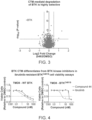
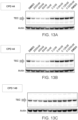
- FIG. 1 robust, time-dependent degradation of BTK was observed in multiple cell lines and primary human B cells in the presence of a compound provided herein.
- FIG. 2 several compounds provided herein induced degradation of BTK in Ramos cells expressing wild-type BTK or ibrutinib-resistant C481S mutant BTK.
- a compound provided herein selectively degraded BTK in TMD8 cells.
- Controls included cells treated with DMSO and wells that contained no cells, only media. Background luminescence signal was determined by control wells containing no cells, only media, and was then subtracted from all sample wells. Luminescence values were then normalized to DMSO-treated wells and reported at proportion viable cells.
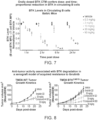
- wild-type BTK cells were sensitive to a compound provided herein and to ibrutinib.
- Mutant C4813 BTK cells retained sensitivity to the compound provided herein but were less sensitive to ibrutinib.
- compound-mediated degradation of BTK prevented anti-IgM-induced upregulation of activation markers CD69 and CD86 on B cells.
- Tumor growth inhibition were calculated on the final day of measurement using the equation [1 - (T - T 0 /C - T 0 )] ⁇ 100, where T and C represent the mean size of tumors in the treated (T) and control (C) groups, and T 0 refers to the tumor size at randomization.
- This example evaluates the potency of CTM in degrading BTK-C481S.
- the BTK binding moieties utilized in CTMs bind to the BTK active site.
- This example evaluates whether the active site mutation C481S affects CTM-induced degradation of BTK.
- the CTMs are potent towards Bruton's tyrosine kinase-C481S, but they are generally two- to three-fold more potent towards WT BTK compared to BTK-C481S.
- This example evaluates the potency of CTMs in a model of Mantle Cell Lymphoma (MCL).
- BTK CTMs were assayed in models of Mantle Cell Lymphoma as with the TMD8 cells (ABC-DLBCL) above.
- Tested CTMs had similar potencies for BTK degradation in the MCL cell lines (Mino and Rec-1) and TMD8 cells.
- Compound ID Treatment Time (h) Cells DC 50 ( ⁇ M) 44 4 Mino 0.00056 149 4 Mino 0.0059 130 4 Mino 0.00058 44 4 Rec-1 0.001 149 4 Rec-1 0.004 130 4 Rec-1 0.002
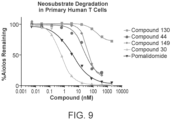
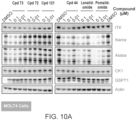
- compound 121 has minimal effects on CRBN neo-substrates and ITK at twenty-four hours.
- compounds 44 and 149 have some effect on CRBN neo-substrate and ITK levels in cells.
- BCR B cell receptor
- This example evaluates effects of CTM-mediated degradation on cell viability. Certain B cell malignancies have been shown to be dependent on BCR signaling and thus BTK for survival. Here, the ability of CTMs to affect viability in BTK-dependent cell lines was assessed. Mino and Rec-1 are models of Mantle Cell Lymphoma, which is sensitive to IMiDs. In these MCL cell lines, BTK CTMs affected degradation, and CTMs with IMiD activity (compounds 44 and 149 ) were more potent than a CTM with minimal IMiD activity (compound 130 ).
- This example evaluates the effects of CTM-mediated degradation on cell viability. Certain B cell malignancies have been shown to be dependent on BCR signaling and thus BTK for survival. Here, the ability of CTMs to affect viability in BTK-dependent cell lines was assessed.
- the ABC-DLBCL cell line TMD8 was very sensitive to BTK degradation or inhibition, while the TMD8 cell line expressing the ibrutinib-resistant mutant BTK-C481S retained sensitivity to BTK degradation ( ⁇ 2-5 fold less sensitive than WT) but were not sensitive to BTK inhibition.
- BTK CTMs demonstrate robust BTK degradation activity in vivo ; activity varies from inactive compounds to compounds with sustained BTK degradation even twenty-four hours after a single oral dose; this data helped understand BTK degradation/resynthesis rates in vivo. Screens were completed at 90 mg/kg for six hours, and then changed to lower doses/longer time points after seeing strong BTK degradation activity with an initial set of compounds. This assay was useful in selecting compounds for in vivo efficacy experiments. The assay showed a good correlation between mouse PD results and in vivo efficacy in mouse tumor models.
- This example evaluates potency and tolerability of BTK CTMs following multiple, consecutive days of dosing and evaluates potency of compounds for BTK degradation.
- This example evaluates compound plasma concentration which results in in vivo BTK and/or Aiolos degradation in cyno.
- BTK CTMs demonstrate significant efficacy in both WT and C481S tumor models.
- Compd Model Route of Admin. Dose (mg/kg) Dosing Frequency Days of Dosing Tumor Growth Inhibition (relative to vehicle) BTK Remaining (% relative to vehicle) 17 TMD8 WT IP 10 QD 14 14% 20 17 TMD8 WT IP 30 QD 14 66% 15 44 TMD8 WT PO 30 QD 23 83% Not determined 44 TMD8 WT PO 90 QD 23 93% Not determined 44 TMD8 WT PO 30 BID 23 99% Not determined 44 TMD8 WT PO 90 BID 23 100% Not determined Ibrutinib TMD8 WT PO 30 QD 23 80% Not determined Ibrutinib TMD8 WT PO 90 QD 23 99% Not determined Ibrutinib TMD8 WT PO 30 BID 23 100% Not determined Ibrutinib TMD8 WT PO 90 BID 23 100% Not determined 17 TMD8 WT IP 30 QD 21 81%
- the present example evaluates in vivo plasma concentrations of BTK CTMs to develop PK-PD-efficacy relationship and predict human exposure.
Landscapes
- Chemical & Material Sciences (AREA)
- Organic Chemistry (AREA)
- Health & Medical Sciences (AREA)
- Public Health (AREA)
- Veterinary Medicine (AREA)
- Medicinal Chemistry (AREA)
- Pharmacology & Pharmacy (AREA)
- Life Sciences & Earth Sciences (AREA)
- Animal Behavior & Ethology (AREA)
- General Health & Medical Sciences (AREA)
- Epidemiology (AREA)
- Nuclear Medicine, Radiotherapy & Molecular Imaging (AREA)
- General Chemical & Material Sciences (AREA)
- Chemical Kinetics & Catalysis (AREA)
- Engineering & Computer Science (AREA)
- Bioinformatics & Cheminformatics (AREA)
- Immunology (AREA)
- Pharmaceuticals Containing Other Organic And Inorganic Compounds (AREA)
- Nitrogen Condensed Heterocyclic Rings (AREA)
- Luminescent Compositions (AREA)
- Medicines Containing Antibodies Or Antigens For Use As Internal Diagnostic Agents (AREA)
- Heat Sensitive Colour Forming Recording (AREA)
- Plural Heterocyclic Compounds (AREA)
- Medicines That Contain Protein Lipid Enzymes And Other Medicines (AREA)
Claims (15)
- Bifunktionelle Verbindung zur Verwendung in einem Verfahren zur Behandlung oder Vorbeugung einer Autoimmunkrankheit oder Krebserkrankung bei einem Subjekt mit Bedarf daran, wobei die bifunktionelle Verbindung oral verabreicht wird und in der Lage ist, den proteolytischen Abbau der Bruton-Tyrosinkinase zu induzieren, und die Menge der bifunktionellen Verbindung wirksam ist zur Behandlung oder Vorbeugung der Autoimmunkrankheit oder Krebserkrankung;wobei die bifunktionelle Verbindung eine Verbindung der Formel (A)
 oder ein pharmazeutisch verträgliches Salz davon ist, wobei giltW ist CH oder N;D ist eine Bindung oder -NH-;Ring A ist Phenyl, ein 9-10-gliedriges bicyclisches Aryl, ein 5-6-gliedriger teilweise oder vollständig ungesättigter monocyclischer Heterocyclus oder ein 9-10-gliedriges bicyclisches Heteroaryl, wobei der monocyclische Heterocyclus und das bicyclische Heteroaryl von Ring A jeweils ein bis drei Heteroatome besitzen, die unabhängig ausgewählt sind aus N, O oder S, wobei Ring A optional und unabhängig mit bis zu drei Substituenten substituiert ist, die ausgewählt sind aus Halo, -CN, -COOH, NH2 und optional substituiertem C1-6-Alkyl;Ring B ist ein Phenyl, ein 5- bis 6-gliedriges Heteroaryl, ein 4- bis 6-gliedriges Heterocycloalkyl oder ein 8- bis 10-gliedriger spirobicyclischer Heterocyclus, wobei Ring B optional substituiert ist und wobei das Heteroaryl und Heterocycloalkyl von Ring B ein bis drei Heteroatome aufweist, die unabhängig ausgewählt sind aus N, O oder S;L ist -X1-X2-X3-X4-X5-;X1 ist eine Bindung, -C(O)-N(R)-, -N(R)-C(O)-, -(O-CH2-CH2) m -, -O(C6H4)-, -(O-CH2-CH2-CH2) m -, -C1-5-Alkyl-, 7-12-gliedriges spiro- oder kondensiertes bicyclisches Heterocycloalkyl mit ein bis drei Heteroatomen, die unabhängig ausgewählt sind aus N, O oder S, oder 4-6-gliedriges monocyclisches Heterocycloalkyl mit ein bis zwei Heteroatomen, die unabhängig ausgewählt sind aus N, O oder S, wobei jedes der monocyclischen und bicyclischen Heterocycloalkyle von X1 optional substituiert ist mit -CH3;X2 ist eine Bindung, -(O-CH2-CH2)n-, -(CH2-CH2-O)n-, -N(R)-C(O)-, -N(R)-, -C(O)-, -C1-5-Alkyl-, 4-6-gliedriges monocyclisches Cycloalkyl oder 4-6-gliedriges monocyclisches Heterocycloalkyl mit ein bis zwei Heteroatomen, die unabhängig ausgewählt sind aus N, O oder S;X3 ist eine Bindung, -C1-8-Alkyl-, -c≡c-., 4-6-gliedriges Cycloalkyl, -N(R)-, -N(R)-C(O)-, -(O-CH2-CH2)p-, -(CH2-CH2-O)p, 4-6-gliedriges Heterocycloalkyl mit ein bis zwei Heteroatomen, die unabhängig ausgewählt sind aus N, O oder S, wobei das Heterocycloalkyl optional substituiert ist mit -CH3;X4 ist eine Bindung, -CH2-CH2-N(R)-, -N(R)-, -C1-4-Alkyl-, -(O-CH2-CH2-CH2) m -, ein 5-6-gliedriger gesättigter, teilweise ungesättigter oder vollständig ungesättigter Carbocyclus oder ein 5-6-gliedriger gesättigter, teilweise ungesättigter oder vollständig ungesättigter Heterocyclus mit ein bis drei Heteroatomen, die unabhängig ausgewählt sind aus N, O oder S;X5 ist eine Bindung, -C1-4-Alkyl-, -N(R)-, -O-, -C(O)- oder -C(O)-N(R)-;jedes R ist unabhängig Wasserstoff oder -C1-3-Alkyl; undjedes von m, n und p ist unabhängig eine ganze Zahl von eins bis drei; undY is




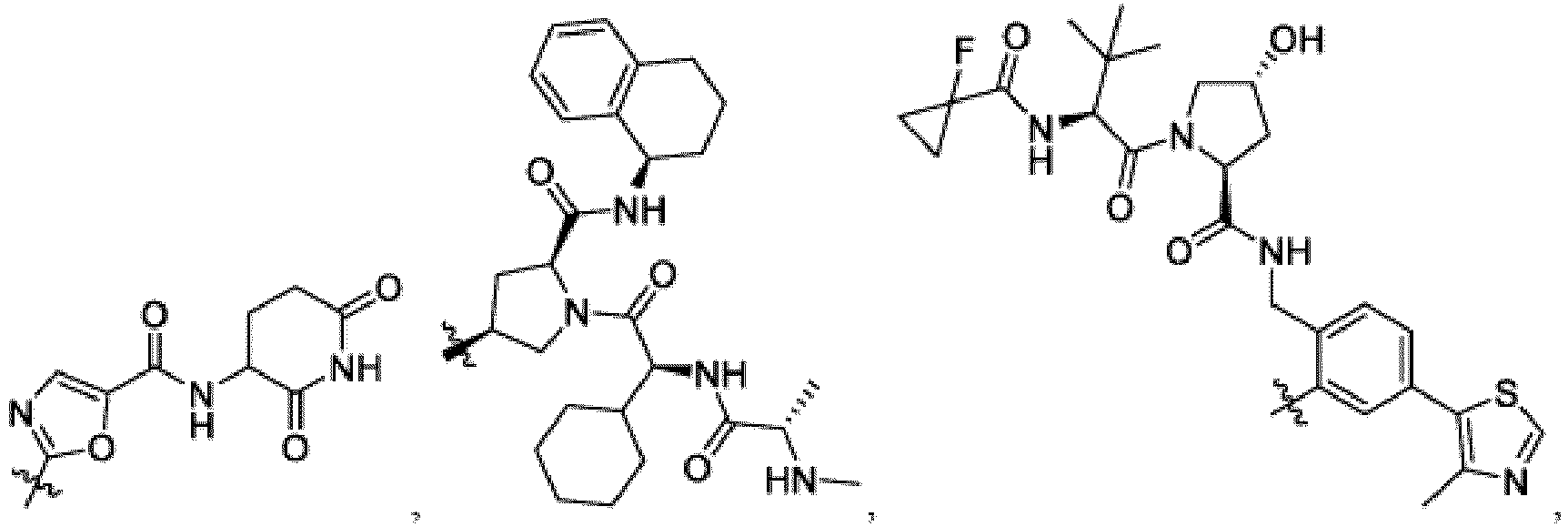
 jedes R2 ist unabhängig Halo, -CN oder C1-4-Alkyl, wobei jedes C1-4-Alkyl optional und unabhängig mit bis zu drei Instanzen von Halo, -CN, -COOH, -COONH2, -NH2 oder -CF3 substituiert ist;jedes R" und R‴ sind unabhängig Wasserstoff oder bilden zusammen mit den Atomen, an die sie gebunden sind, einen 5-6-gliedrigen teilweise ungesättigten oder vollständig ungesättigten benzokondensierten Heterocyclus;jedes Z ist -C(RA)2- oder -C(O)-;jedes RA ist unabhängig Wasserstoff oder -C1-4-Alkyl; und q ist null, eins oder zwei.
 - Bifunktionelle Verbindung zur Verwendung nach Anspruch 1, wobei der Krebs:- einen soliden Tumor umfasst;- eine B-Zell-Malignität ist; oder- ausgewählt ist aus der Gruppe bestehend aus chronischer lymphozytischer Leukämie (CLL), kleinem lymphozytischem Lymphom (SLL), transformierter CLL oder Richter-Transformation, kleinzelligem Lymphom, follikulärem Lymphom (FL), diffusem großzelligem B-Zell-Lymphom (DLBCL), Non-Hodgkin-Lymphom, Mantelzell-Lymphom (MCL), Marginalzonen-Lymphom (MZL), Waldenström-Makroglobulinämie (WM), Lymphom des zentralen Nervensystems (ZNS), metastasiertem Melanom, Plattenepithelkarzinom des Kopfes und Halses (HNSCC), nichtkleinzelligem Lungenkrebs (NSCLC), platinresistentem epithelialem Eierstockkrebs (EOC), Magenkrebs, metastasiertem kastrationsresistentem Prostatakrebs (mCRPC), dreifach negativem Brustkrebs (TNBC), muskelinvasivem Urothelkrebs, Mesotheliom, Gebärmutterhalskrebs, mikrosatellitenstabilem kolorektalem Krebs (MSS CRC) und multiplem Myelom (MM).
- Bifunktionelle Verbindung zur Verwendung nach Anspruch 1, wobei die Autoimmunkrankheit ausgewählt ist aus der Gruppe bestehend aus Graft-versus-Host-Krankheit (GvHD), akuter Graft-versus-Host-Krankheit und immunthrombozytopenischer Purpura (ITP).
- Bifunktionelle Verbindung zur Verwendung nach einem beliebigen der vorhergehenden Ansprüche, wobei das Subjekt eine C481-mutierte Bruton-Tyrosinkinase hat oder wobei das Subjekt eine C481-mutierte Bruton-Tyrosinkinase hat und es sich bei dem Krebs um chronische lymphozytische Leukämie (CLL) handelt.
- Bifunktionelle Verbindung zur Verwendung nach einem beliebigen der vorhergehenden Ansprüche, wobei der Krebs Ibrutinib-resistent ist.
- Bifunktionelle Verbindung zur Verwendung nach einem beliebigen der vorhergehenden Ansprüche, wobei die bifunktionelle Verbindung in einer Dosis von 0,1-500 mg/kg an das Subjekt verabreicht wird.
- Bifunktionelle Verbindung zur Verwendung nach einem beliebigen der vorhergehenden Ansprüche, wobei die bifunktionelle Verbindung verabreicht wird:- an das Subjekt in einer Dosis, die ausgewählt ist aus der Gruppe bestehend aus 100 mg/kg, 200 mg/kg, 300 mg/kg, 450 mg/kg, 600 mg/kg, 800 mg/kg und 1000 mg/kg;- ein-, zwei-, drei- oder viermal pro Tag;- täglich für einen, zwei, drei, vier, fünf, sechs, sieben, acht, neun, zehn, elf, zwölf, dreizehn oder vierzehn Tage; und/oder- cyclisch.
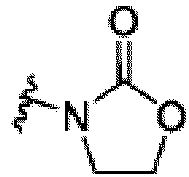
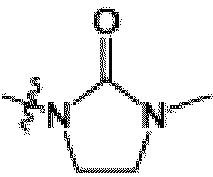
- Bifunktionelle Verbindung zur Verwendung nach einem beliebigen der vorhergehenden Ansprüche, wobei gilt:- Ring B ist



 - Ring A ist



- Bifunktionelle Verbindung zur Verwendung nach einem beliebigen der vorhergehenden Ansprüche oder pharmazeutisch verträgliches Salz davon, wobei mindestens eines von X1, X2 und X5 -N(R)-, -C(O)-N(R)- oder -CH2- ist; und/oder- X1 -C(O)-N(R)- ist;- X2 -(O-CH2-CH2)n-, -(CH2-CH2-O) n - oder -C1-5-Alkyl- ist;- X3 eine Bindung, -c≡c-, -C1-4-Alkyl- oder -N(R)- ist; und/oder- X4 eine Bindung, -CH2- oder -N(R)- ist.
- Bifunktionelle Verbindung zur Verwendung nach einem beliebigen der vorhergehenden Ansprüche, wobei gilt:- X1 ist -CH2-, -C(O)-,


 - X2 ist eine Bindung, -C(O)-, -C1-5-Alkyl-,
 - X3 ist eine Bindung, -C1-4-Alkyl-, -NH-,
 - X4 ist eine Bindung,
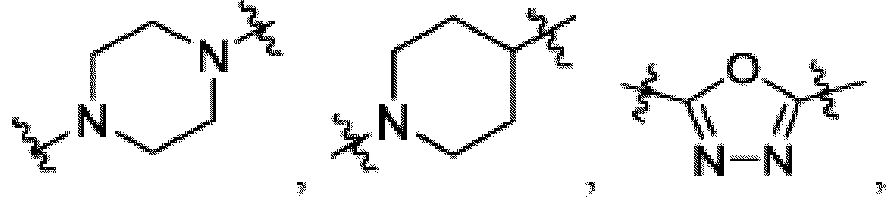 - X5 ist eine Bindung, -C1-4-Alkyl-, -N(R)- oder -C(O)-N(R)-;- L ist


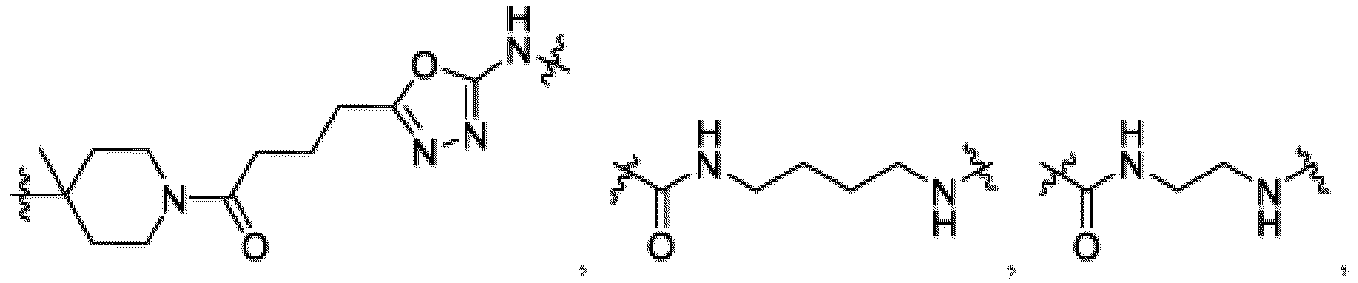


















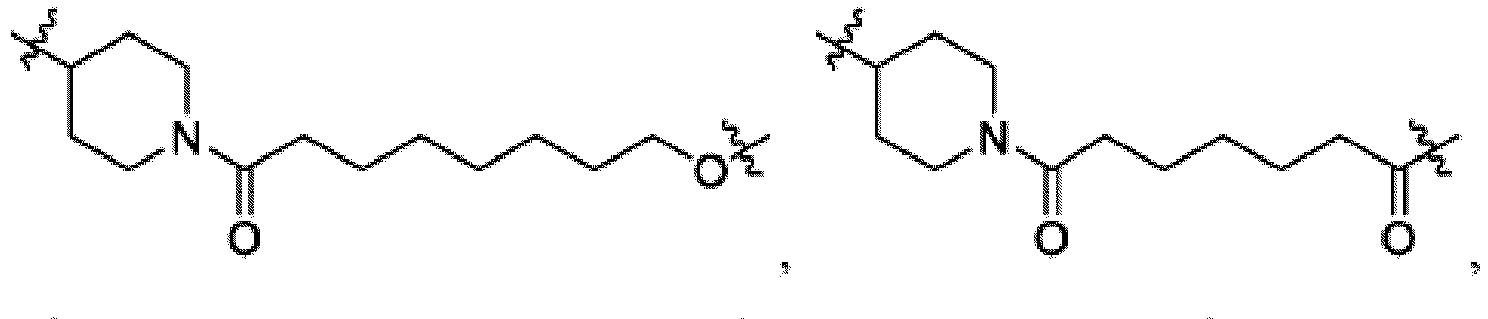


 - Y ist




 - W ist N; und/oder- D ist eine Bindung.
 - Bifunktionelle Verbindung zur Verwendung nach einem beliebigen der Ansprüche 1-7, wobei die Verbindung der Formel (A) eine Verbindung der Formel (C)
 oder ein pharmazeutisch verträgliches Salz davon ist, wobei giltW ist CH oder N;Ring C ist Phenyl oder ein gesättigter, teilweise ungesättigter oder vollständig ungesättigter 5- bis 6-gliedriger monocyclischer Heterocyclus mit ein bis zwei Heteroatomen, die unabhängig ausgewählt sind aus N, O oder S, wobei jedes des Phenyls und Heterocyclus des Rings C optional substituiert ist;L ist -X1-X2-X3-;X1 ist -C(O)-N(R)-, -N(R)-C(O)-, -(O-CH2-CH2) m -, -O-(C6H4)-, -(O-CH2-CH2-CH2) m -, -C1-5-Alkyl-, 7-12-gliedriges spirobicyclisches Heterocycloalkyl mit ein bis drei Heteroatomen, die unabhängig ausgewählt sind aus N, O oder S, oder 4-6-gliedriges monocyclisches Heterocycloalkyl mit ein bis zwei Heteroatomen, die unabhängig ausgewählt sind aus N, O oder S, wobei jedes des bicyclischen Heterocycloalkyls und des monocyclischen Heterocycloalkyls von X1 optional substituiert ist mit -CH3;X2 ist eine Bindung, -(O-CH2-CH2)n-, -(CH2-CH2-O) n -, -N(R)-C(O)-, -N(R)-, -C(O)-, -C1-5-Alkyl-, 4-6-gliedriges monocyclisches Cycloalkyl oder 4-6-gliedriges monocyclisches Heterocycloalkyl mit ein bis zwei Heteroatomen, die unabhängig ausgewählt sind aus N, O oder S;X3 ist eine Bindung, -C1-4-Alkyl-, -c≡c-, 4-6-gliedriges Cycloalkyl, -N(R)-, -(O-CH2-CH2) p -, -(CH2-CH2-O) p -, 4-6-gliedriges Heterocycloalkyl mit ein bis zwei Heteroatomen, die unabhängig ausgewählt sind aus N, O oder S, wobei das Heterocycloalkyl optional substituiert ist mit -CH3;jedes R ist unabhängig Wasserstoff oder -C1-3-Alkyl; undjedes von m, n und p ist unabhängig ganze Zahl von eins bis drei.
 - Bifunktionelle Verbindung zur Verwendung nach einem beliebigen der Ansprüche 1-7, wobei die Verbindung der Formel (A) eine Verbindung ist aus:- Formel (G)
 - Formel (H)
 - Formel (J)
 - Formel (K)

 - Formel (M)


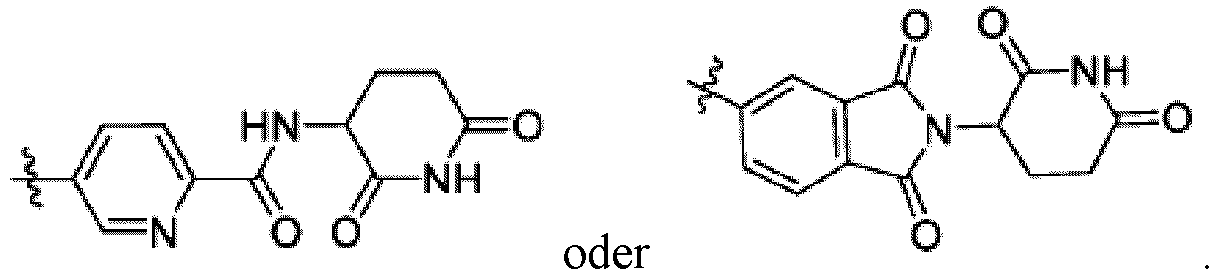
- Bifunktionelle Verbindung zur Verwendung nach Anspruch 1, wobei die Verbindung ausgewählt ist aus Tabelle 1, oder ein pharmazeutisch verträgliches Salz davon:
Tabelle 1 Verbindung Nummer Struktur 1 
2 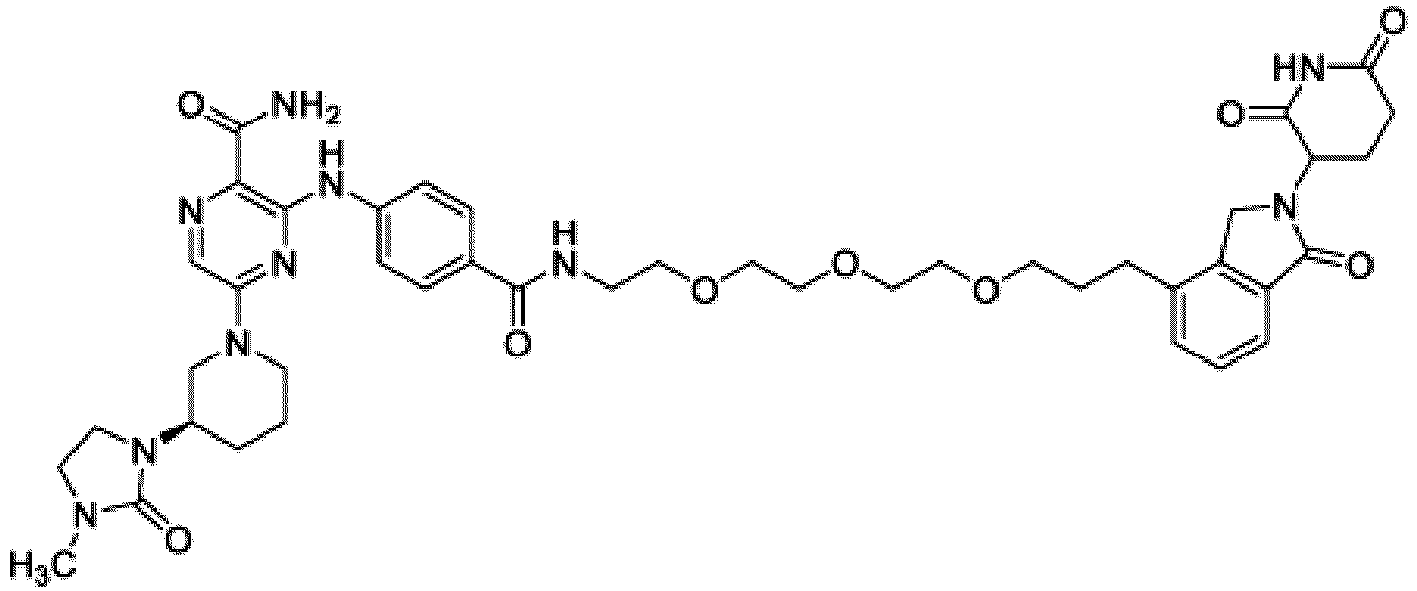
3 
4 
5 
6 
7 
8 
9 
10 
11 
12 
13 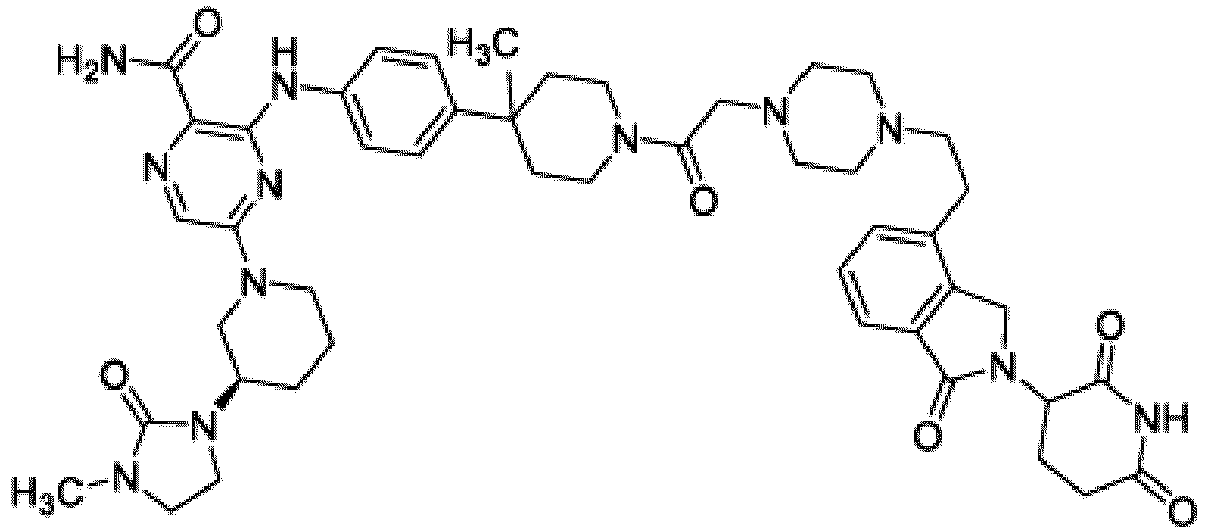
14 
15 
16 
17 
18 
19 
20 
21 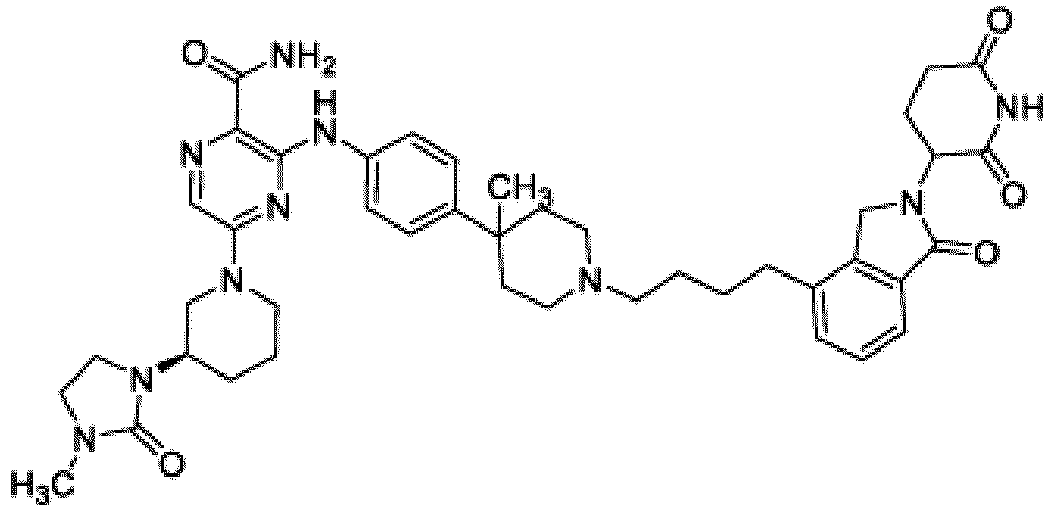
22 
23 
24 
25 
26 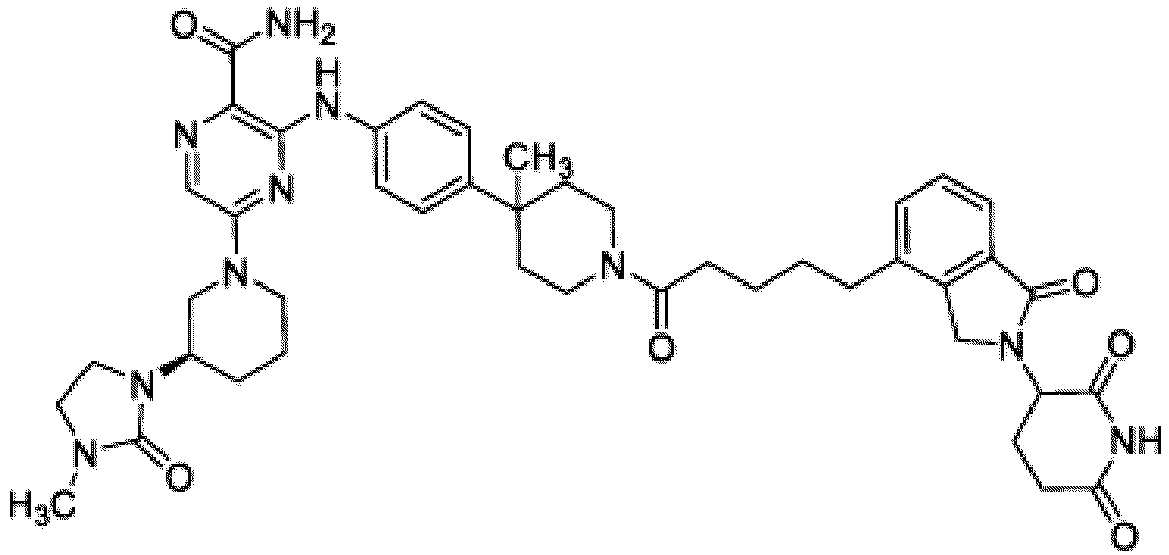
27 
28 
29 
30 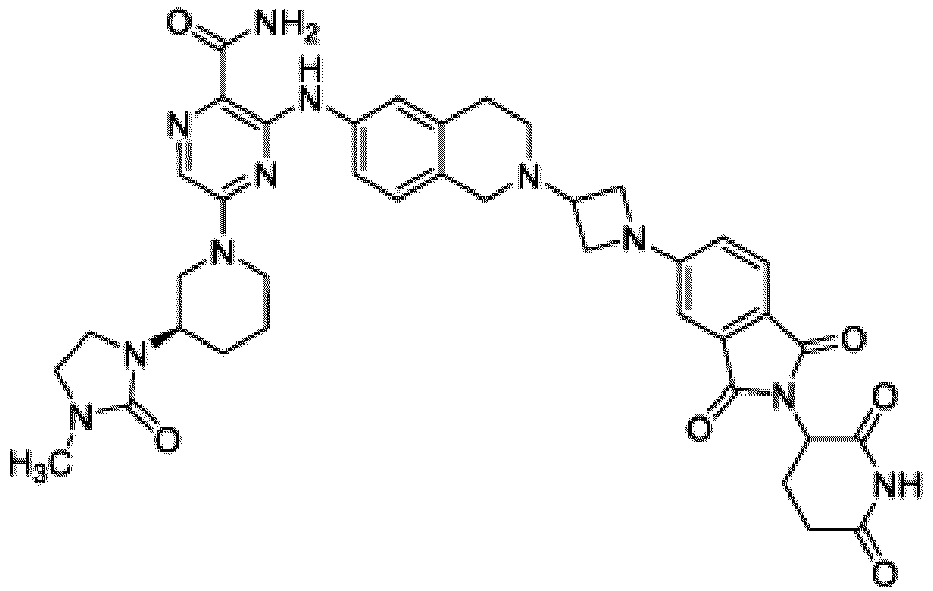
31 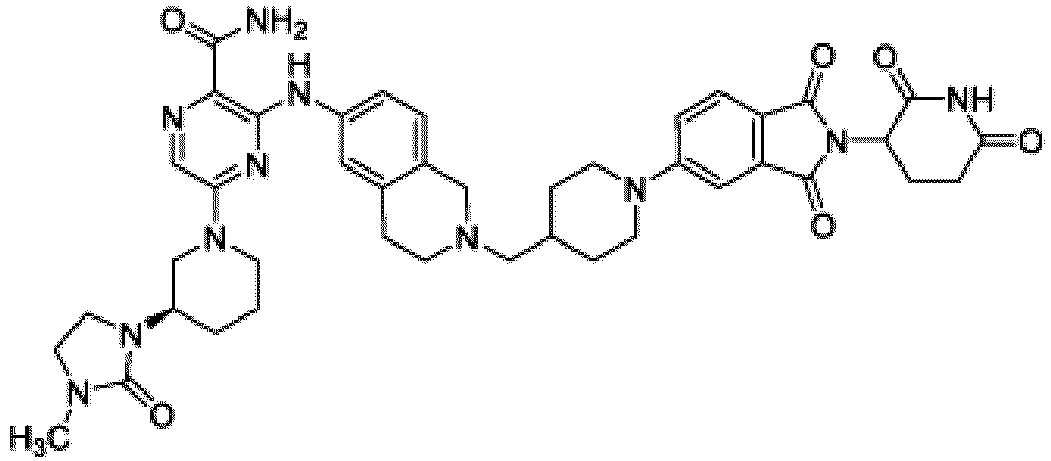
32 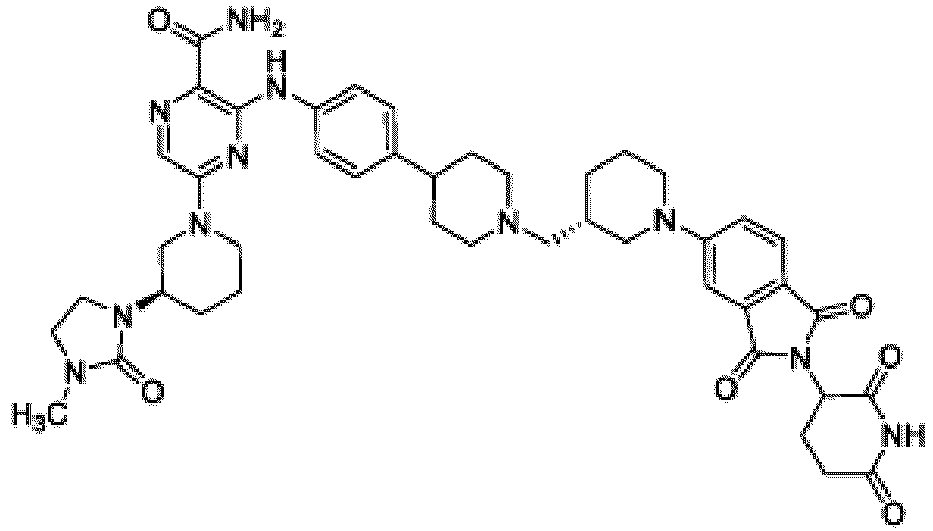
33 
34 
35 
36 
37 
38 
39 
40 
41 
42 
43 
44 
45 
46 
47 
48 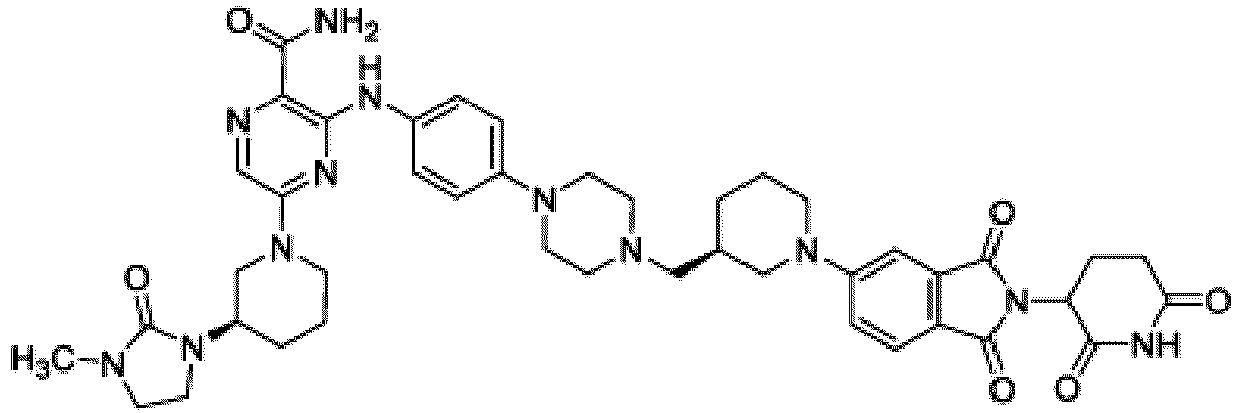
49 
50 
51 
52 
53 
54 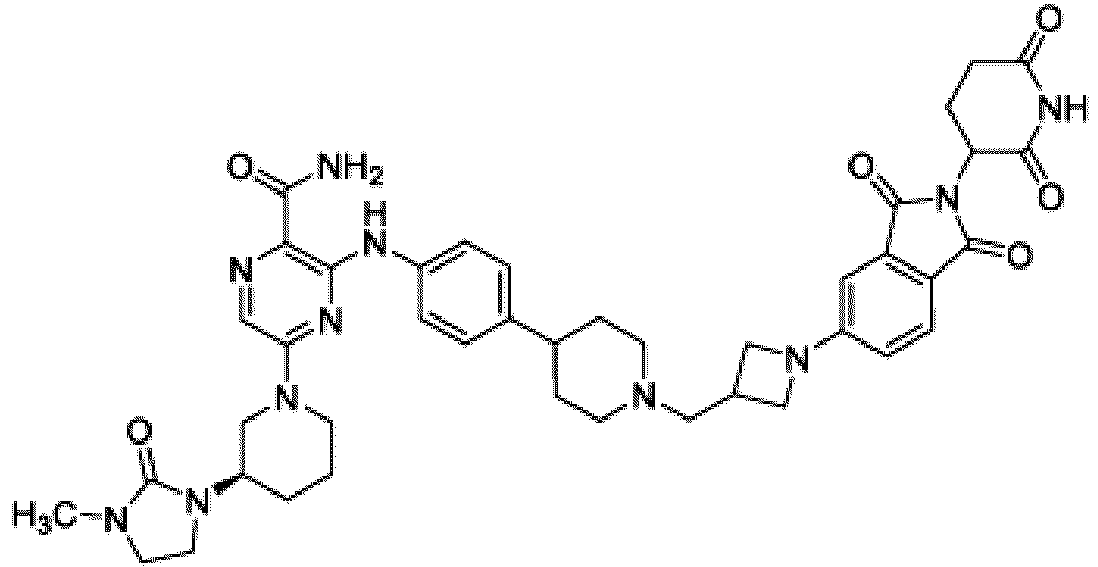
55 
56 
57 
58 
59 
60 
61 
62 
63 
64 
65 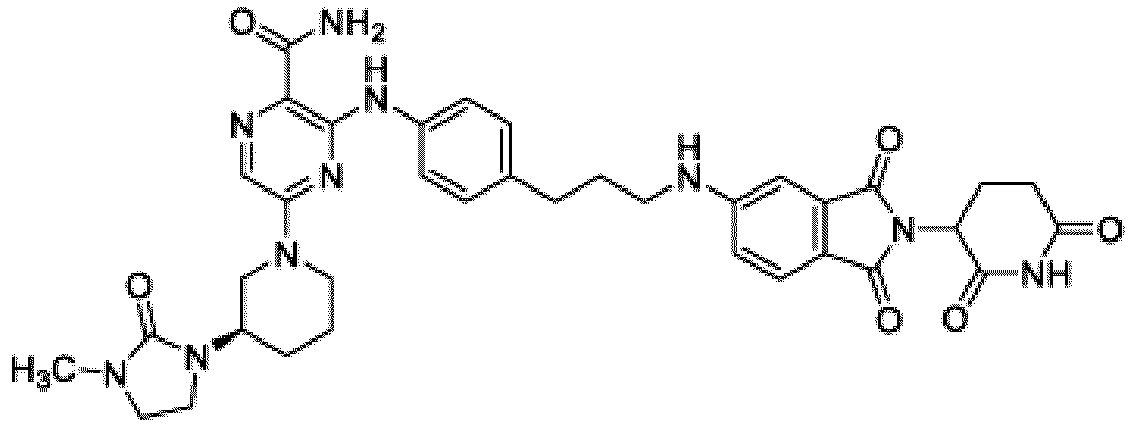
66 
67 
68 
69 
70 
71 
72 
73 
74 
75 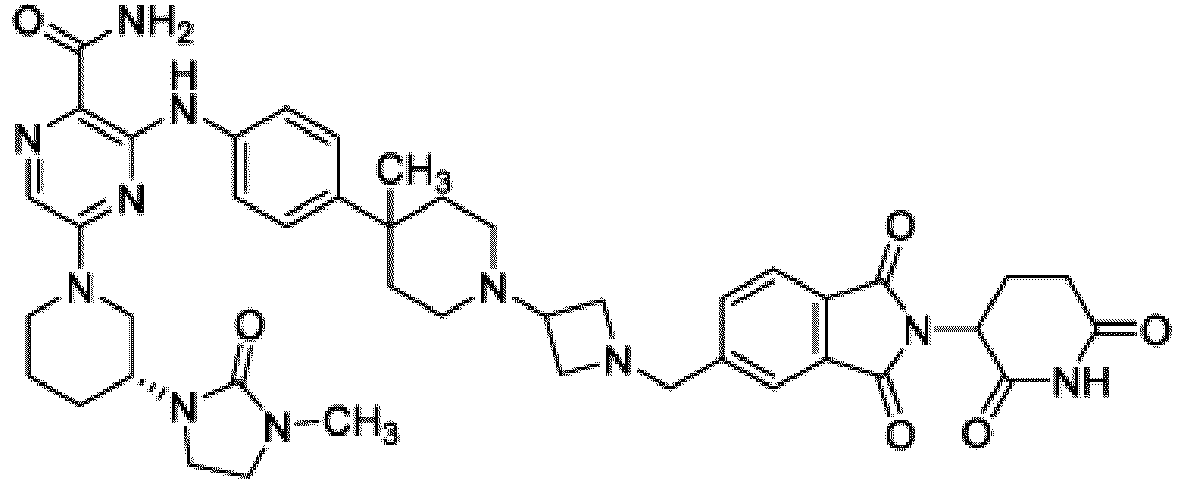
76 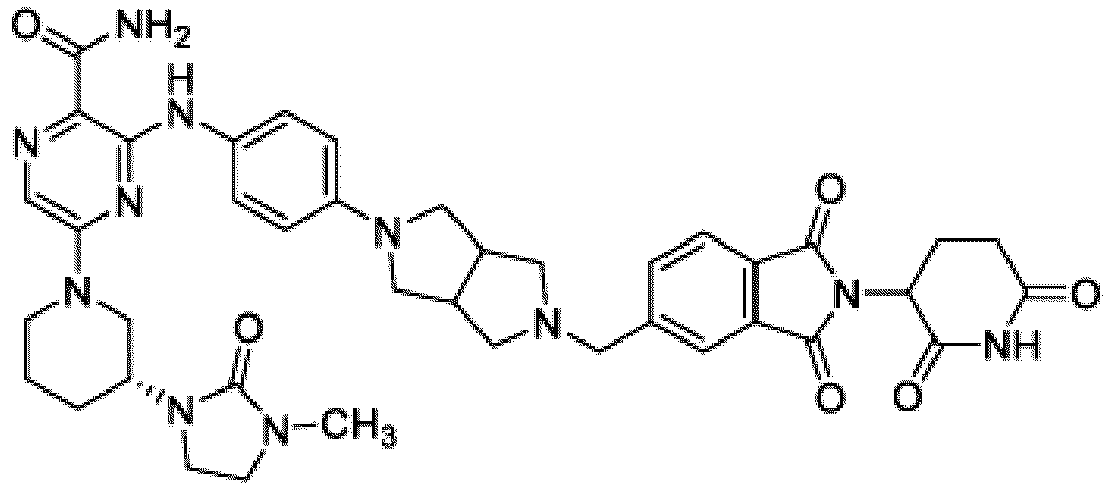
77 
78 
79 
80 
81 
82 
83 
84 
85 
86 
87 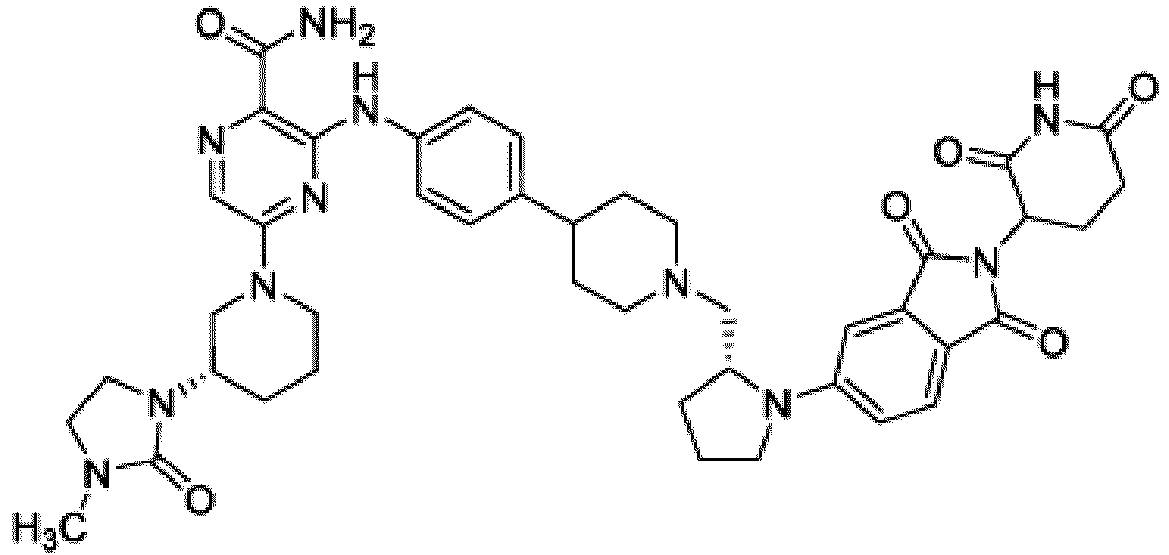
88 
89 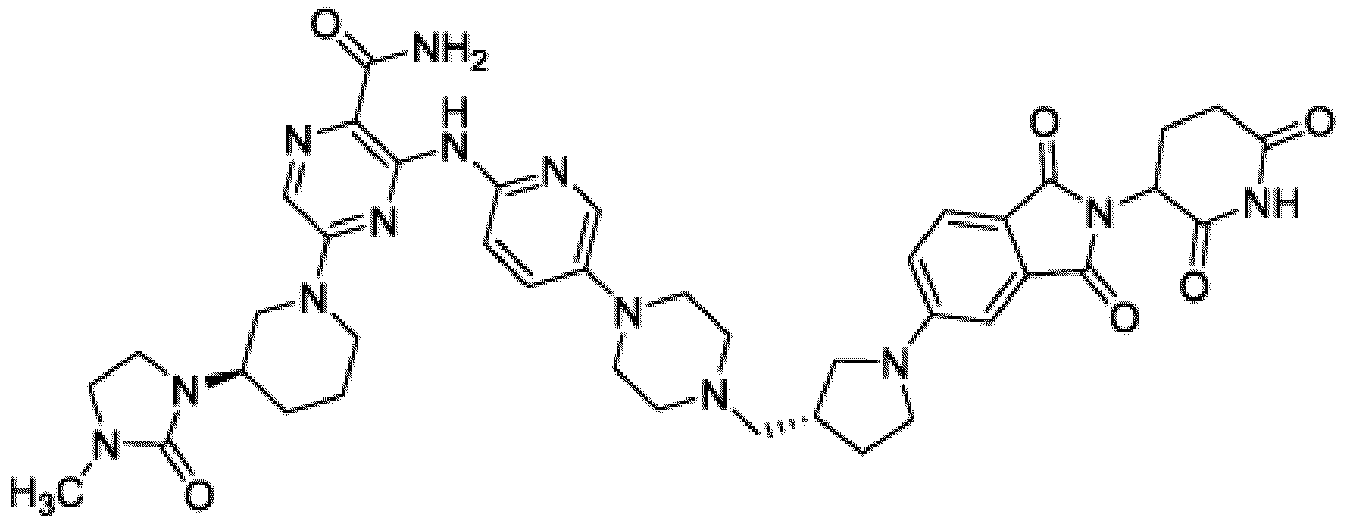
90 
91 
92 
93 
94 
95 
96 
97 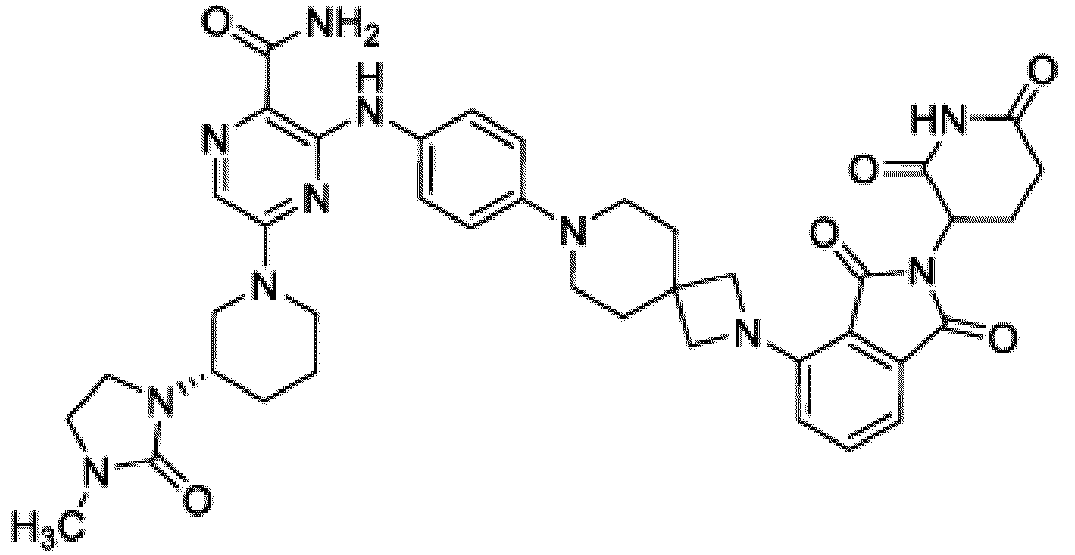
98 
99 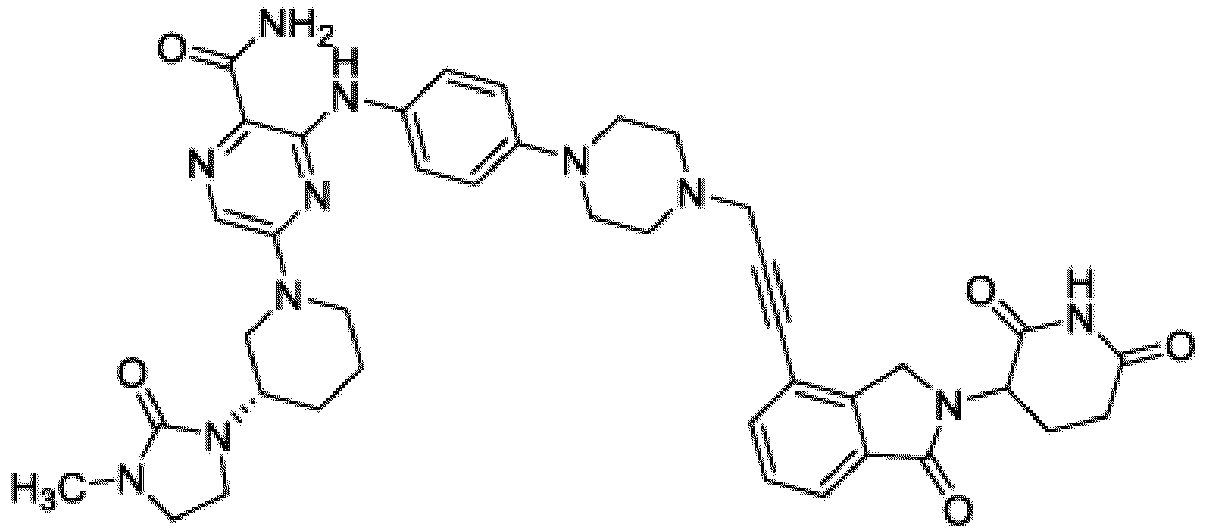
100 
101 
102 
103 
104 
105 
106 
107 
108 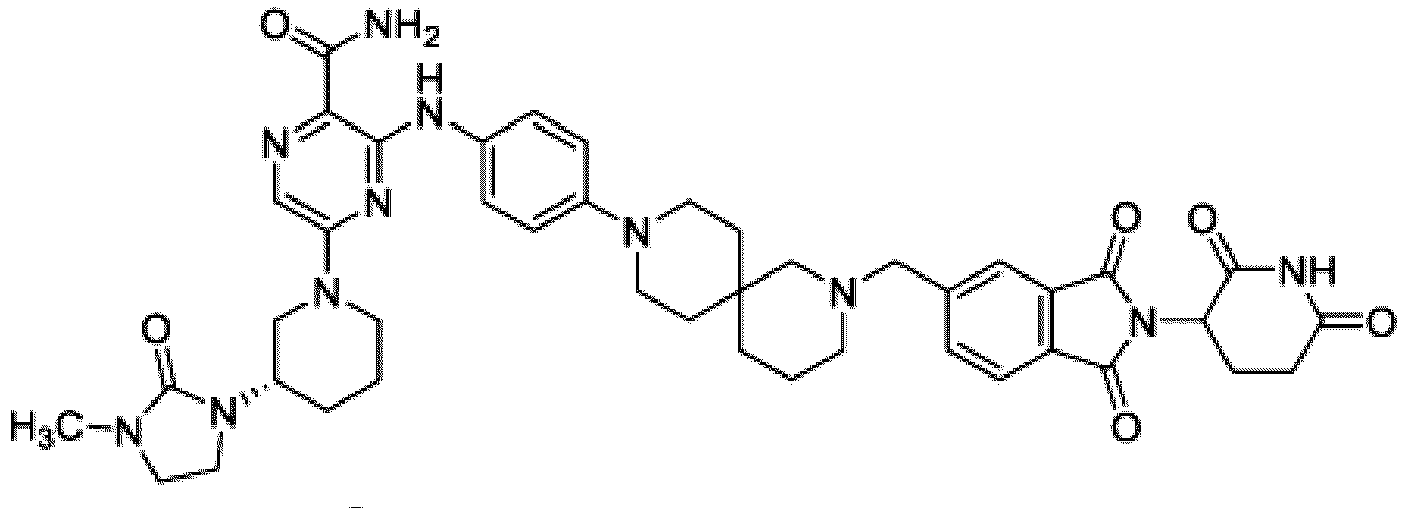
109 
110 
111 
112 
113 
114 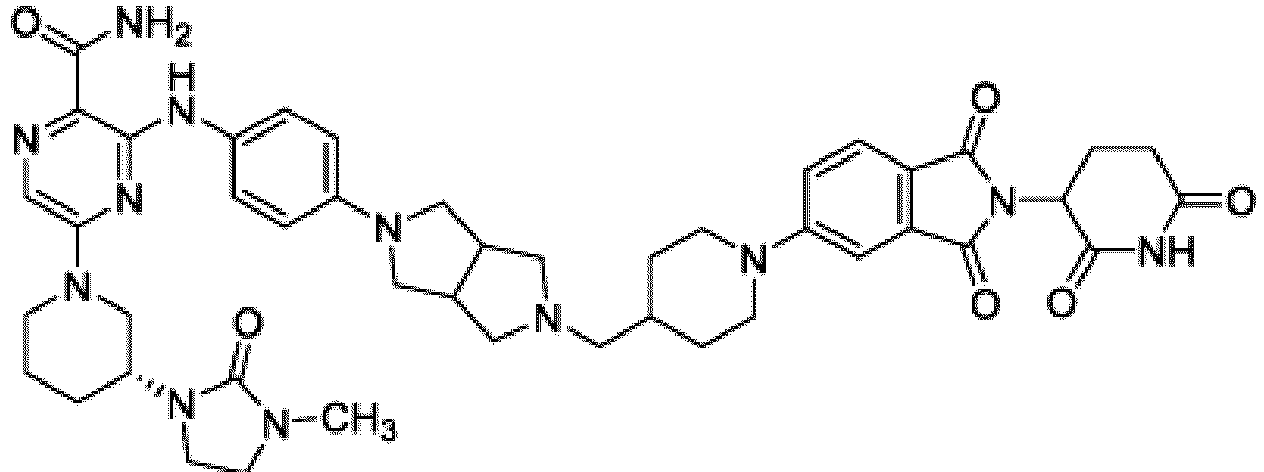
115 
116 
117 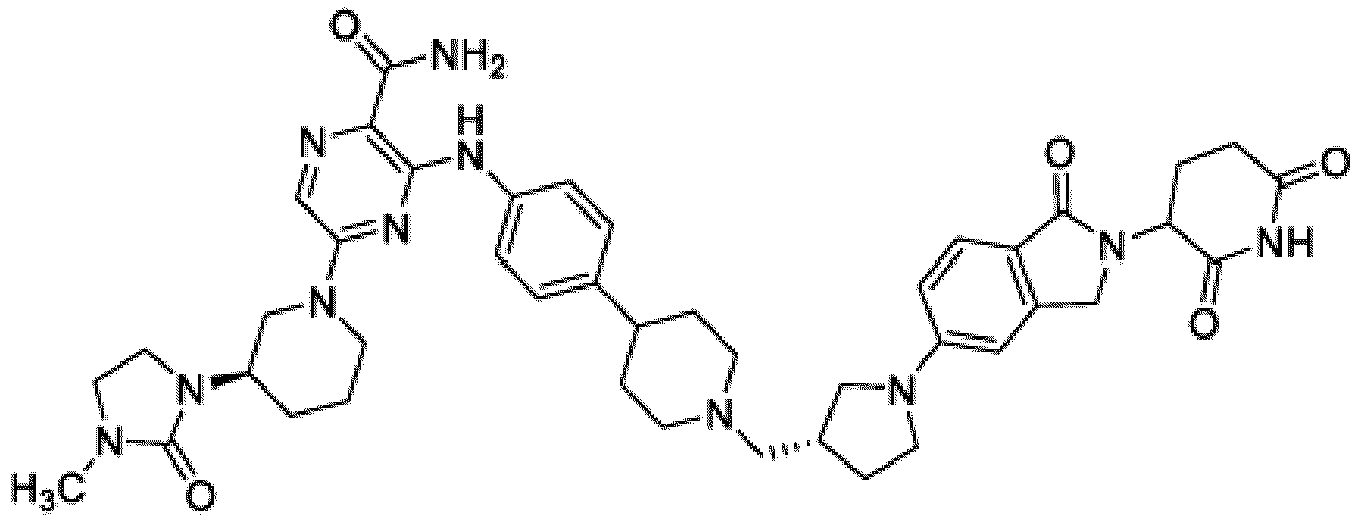
118 
119 
120 
121 
122 
123 
124 
125 
126 
127 
128 
129 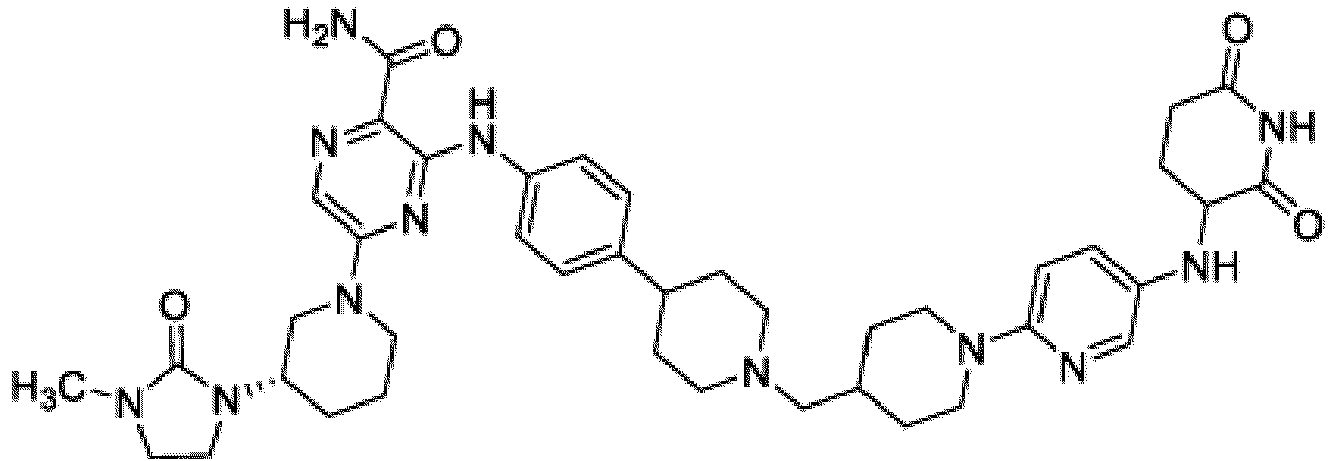
130 
131 
132 
133 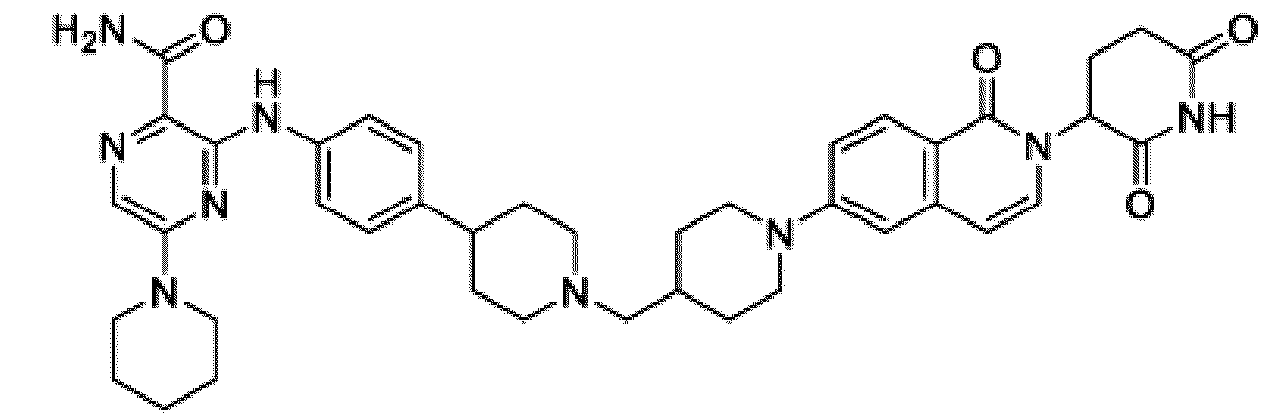
134 
135 
136 
137 
138 
139 
140 
141 
142 
143 
144 
145 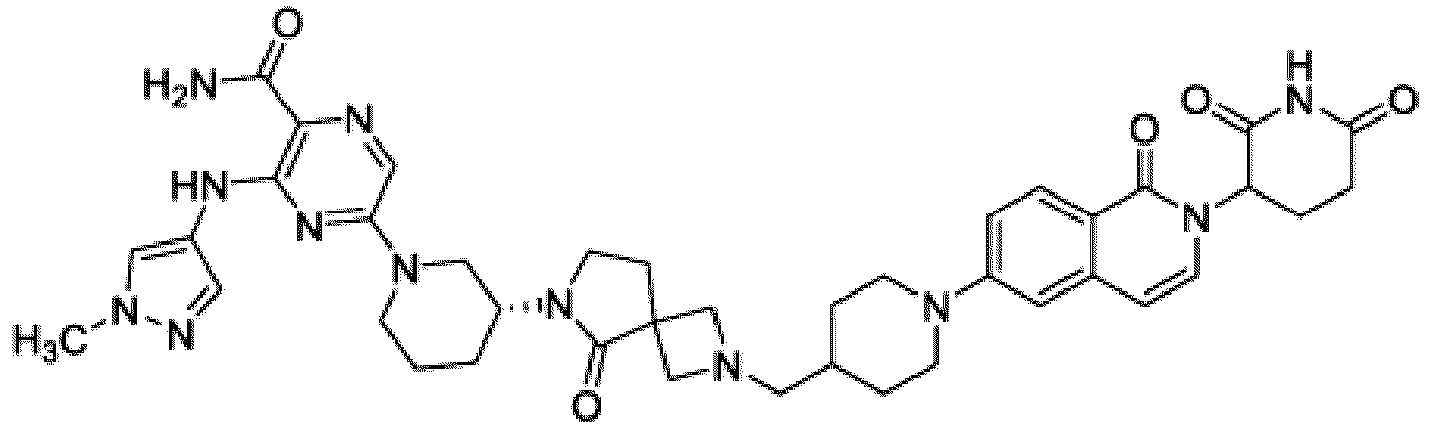
146 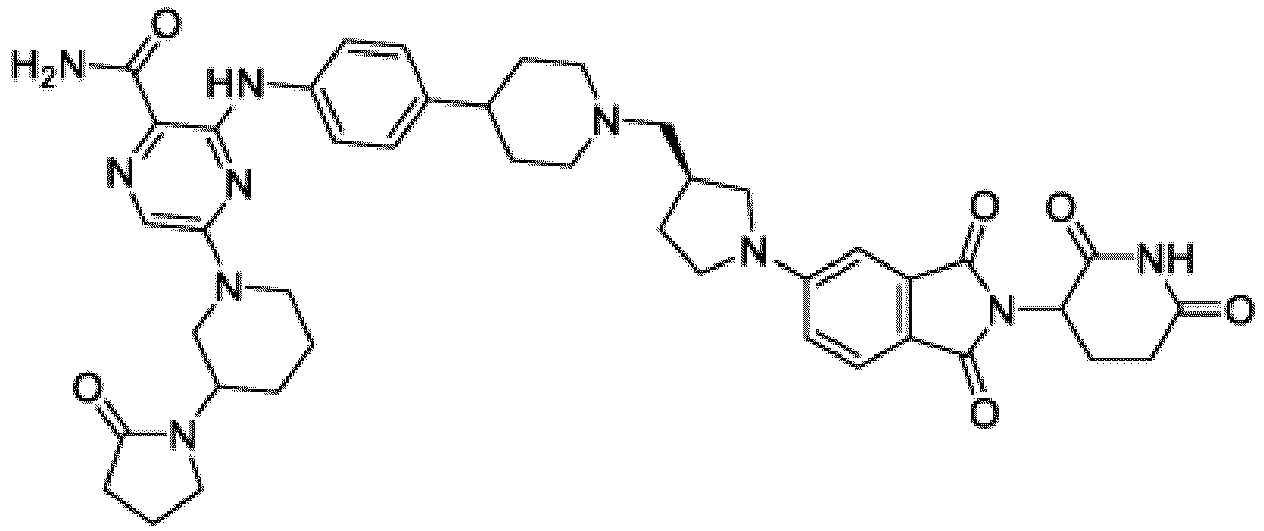
147 
148 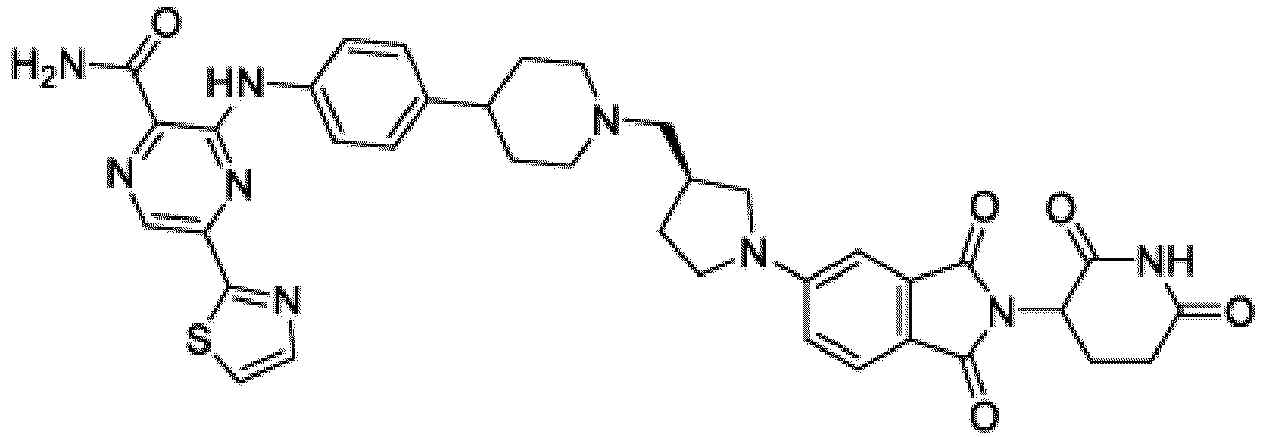
149 
150 
151 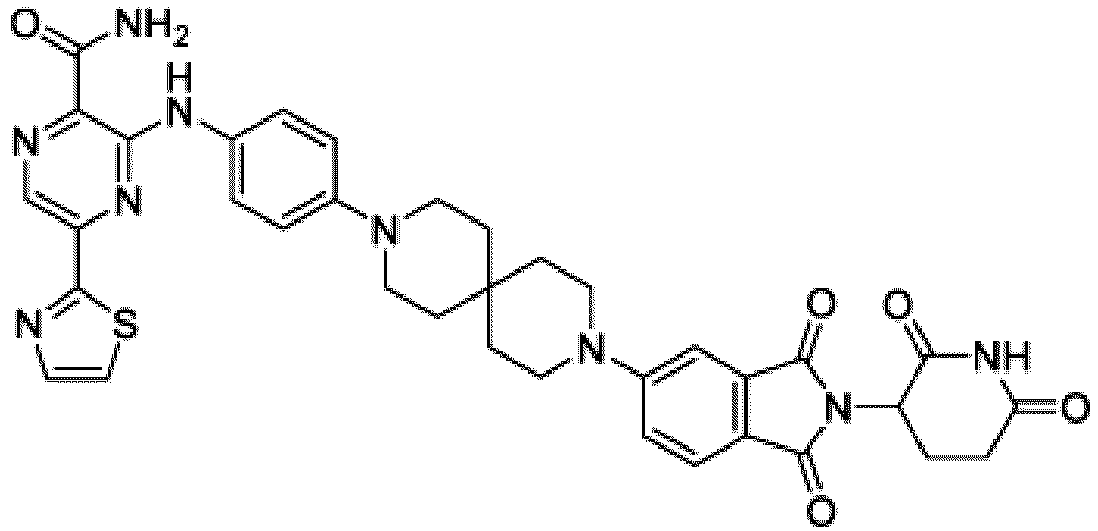
152 
153 
154 
155 
156 
157 
158 
159 
160 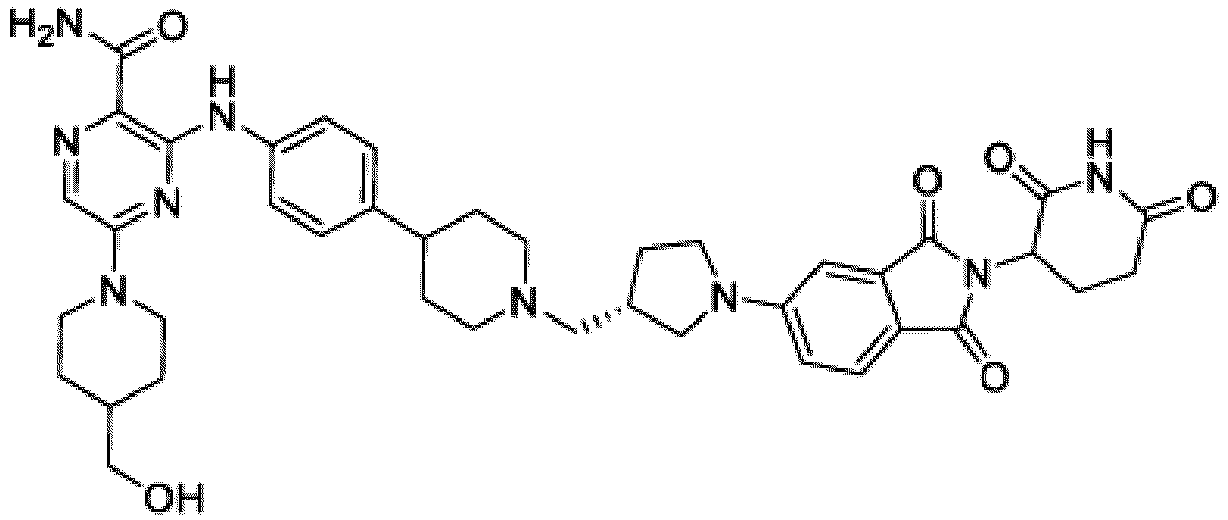
161 
162 
163 
164 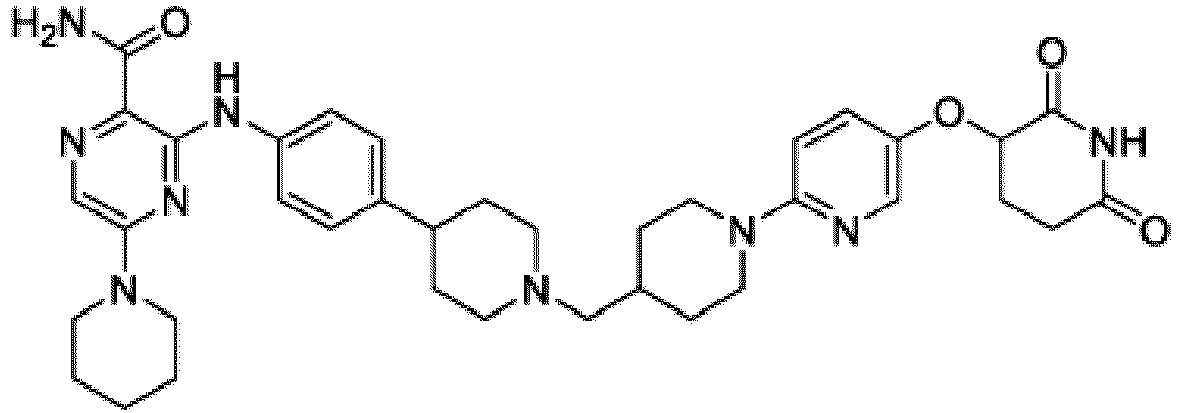
165 
166 
167 
168 
169 
170 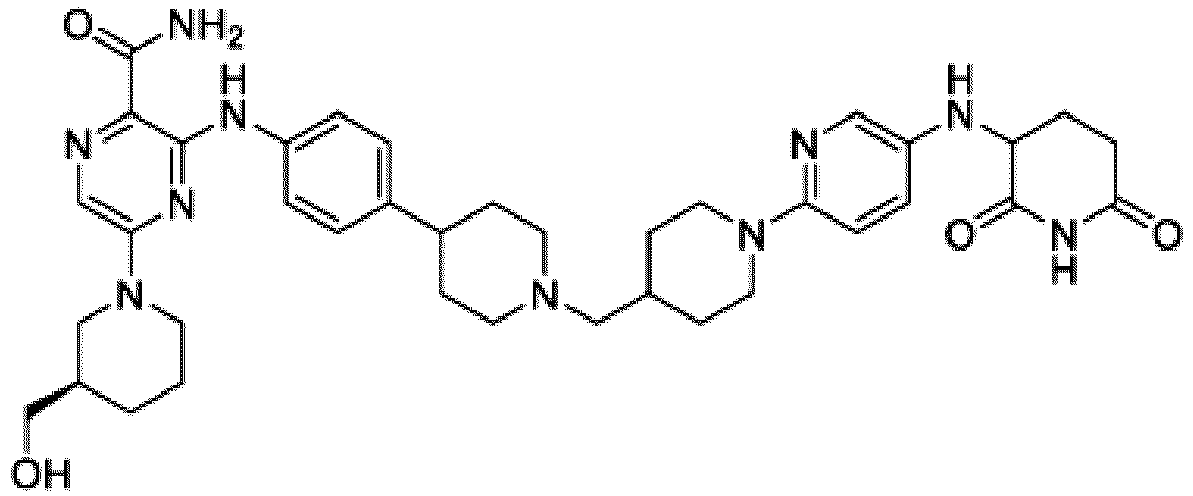
171 
172 
173 
174 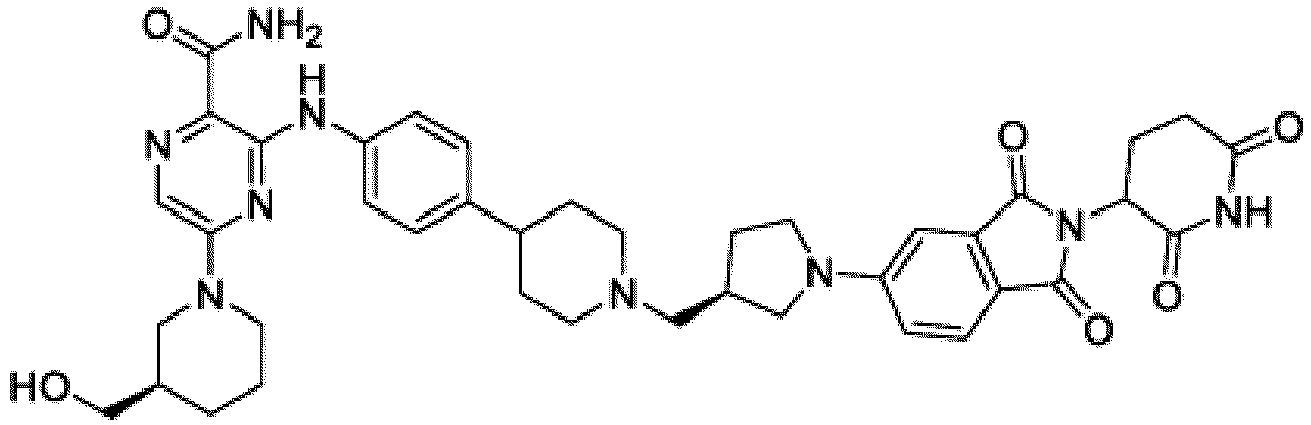
175 
176 
177 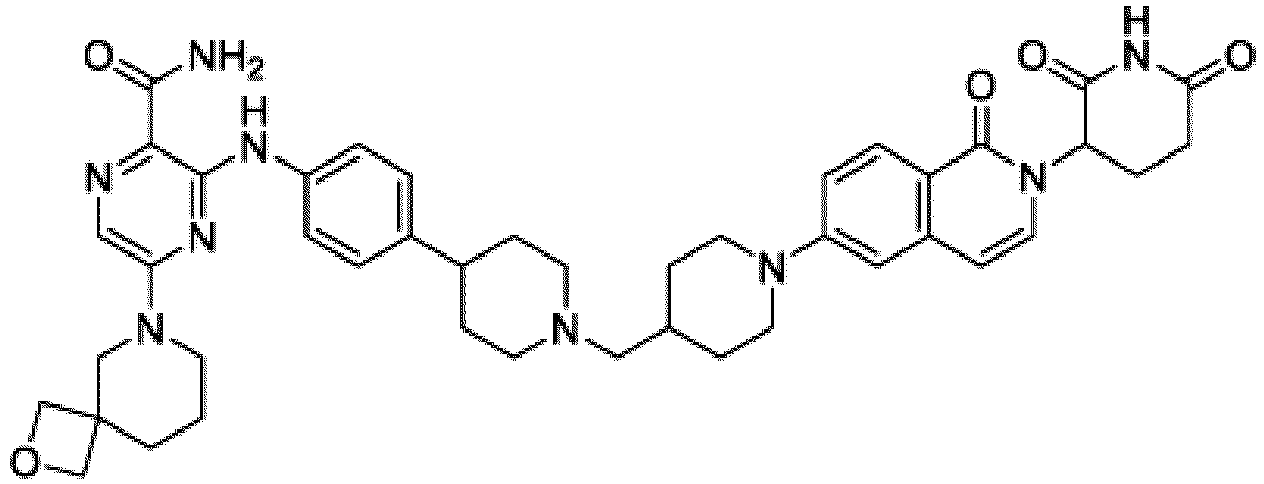
178 
179 
180 
181 
182 
183 
184 
185 
186 
187 
188 
189 
190 
191 
192 
193 
194 
195 
196 
197 
198 
199 
200 
201 
202 
203 
204 
205 
206 
207 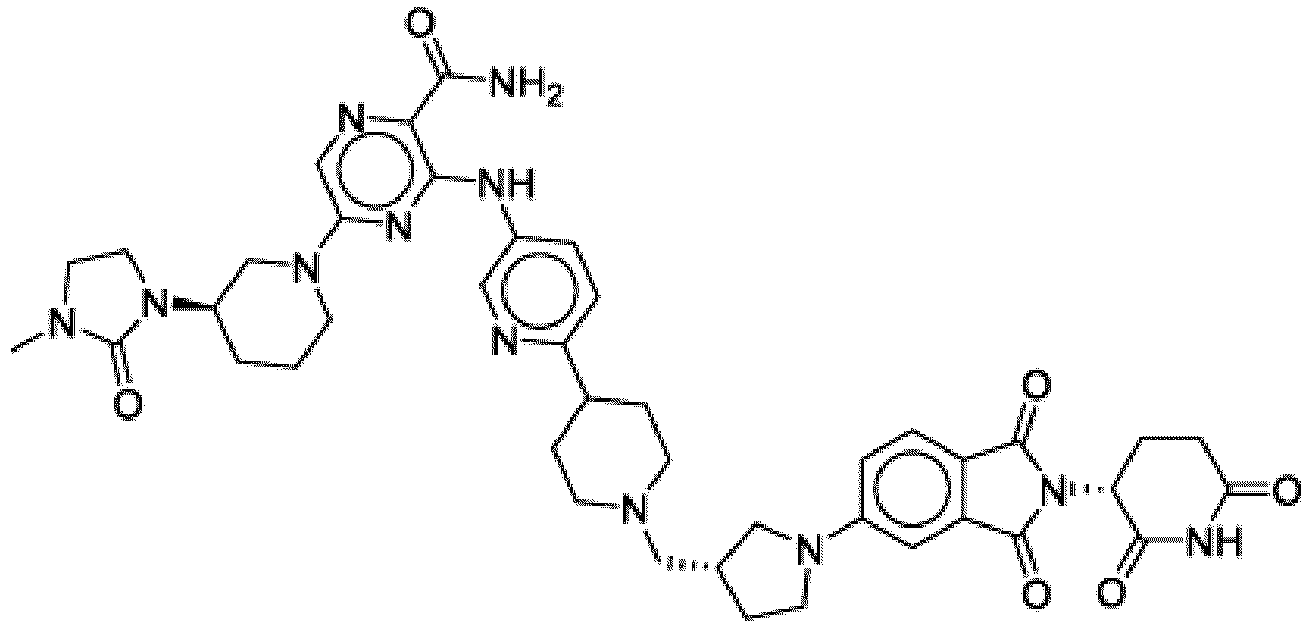
208 
209 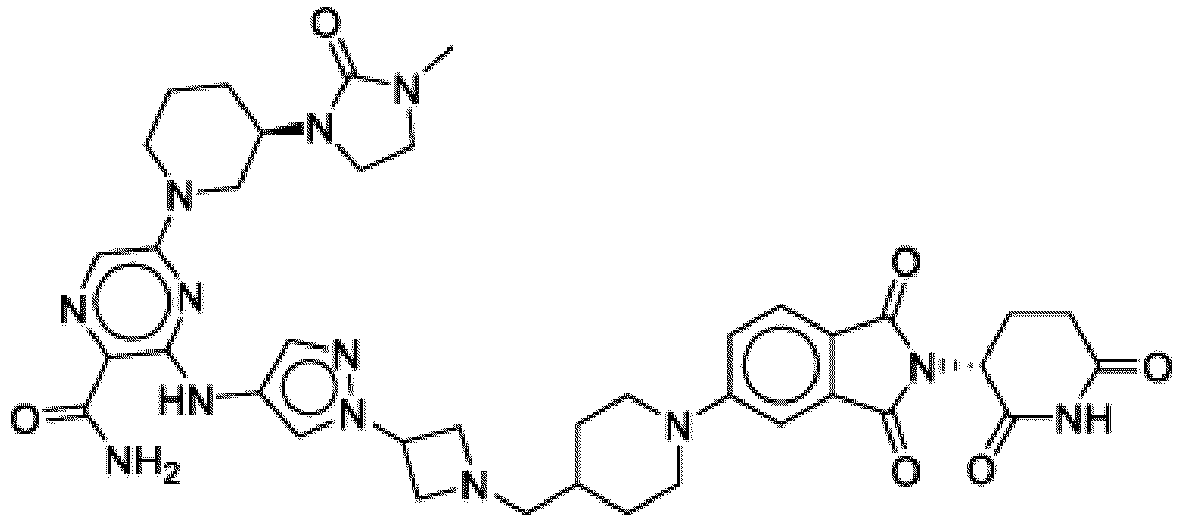
210 
211 
212 
213 
214 
215 
216 
217 
218 
- Bifunktionelle Verbindung zur Verwendung nach einem beliebigen der vorhergehenden Ansprüche, wobei die Verbindung in Form einer pharmazeutischen Zusammensetzung verabreicht wird, die die Verbindung oder ein pharmazeutisch verträgliches Salz davon und einen pharmazeutisch verträglichen Träger, ein pharmazeutisch verträgliches Vehikel oder ein pharmazeutisch verträgliches Adjuvans umfasst.
- Verbindung, die ausgewählt ist aus Tabelle 2, oder pharmazeutisch verträgliches Salz davon:
Tabelle 2 Verbindung Nummer Struktur 104 
105 
106 
107 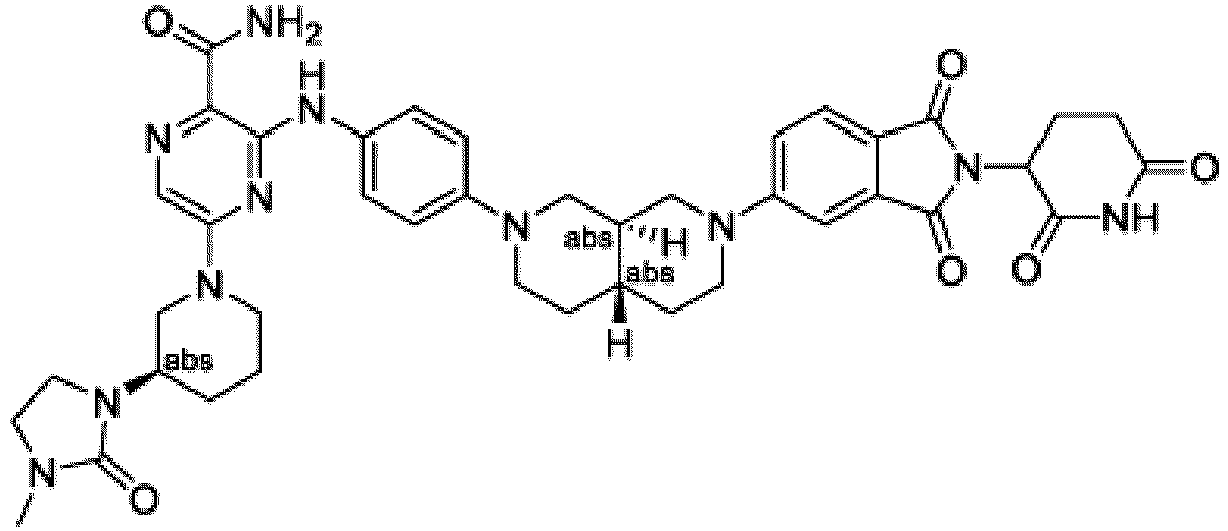
194 
195 
196 
197 
198 
199 
200 
201 
202 
203 
204 
205 
206 
207 
208 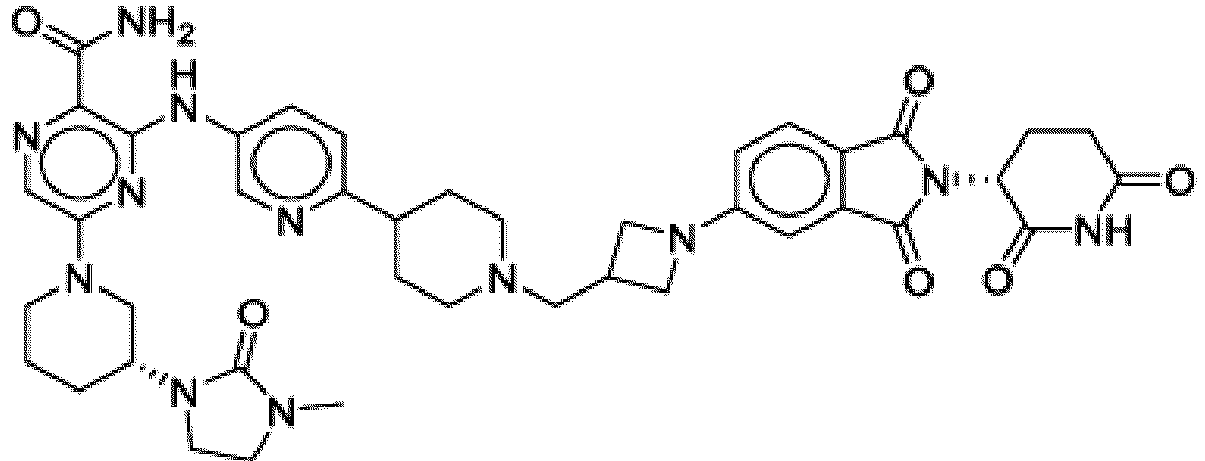
209 
210 
211 
212 
213 
214 
215 
216 
217 
218 
Priority Applications (1)
| Application Number | Priority Date | Filing Date | Title |
|---|---|---|---|
| EP25161134.9A EP4570320A3 (de) | 2019-12-04 | 2020-12-03 | Bifunktionelle verbindungen zum abbau von btk über den ubiquitin-proteosom-signalweg |
Applications Claiming Priority (3)
| Application Number | Priority Date | Filing Date | Title |
|---|---|---|---|
| US201962943720P | 2019-12-04 | 2019-12-04 | |
| US202063010524P | 2020-04-15 | 2020-04-15 | |
| PCT/US2020/063176 WO2021113557A1 (en) | 2019-12-04 | 2020-12-03 | Bifunctional compounds for degrading btk via ubiquitin proteosome pathway |
Related Child Applications (2)
| Application Number | Title | Priority Date | Filing Date |
|---|---|---|---|
| EP25161134.9A Division EP4570320A3 (de) | 2019-12-04 | 2020-12-03 | Bifunktionelle verbindungen zum abbau von btk über den ubiquitin-proteosom-signalweg |
| EP25161134.9A Division-Into EP4570320A3 (de) | 2019-12-04 | 2020-12-03 | Bifunktionelle verbindungen zum abbau von btk über den ubiquitin-proteosom-signalweg |
Publications (2)
| Publication Number | Publication Date |
|---|---|
| EP4069237A1 EP4069237A1 (de) | 2022-10-12 |
| EP4069237B1 true EP4069237B1 (de) | 2025-04-09 |
Family
ID=74004152
Family Applications (2)
| Application Number | Title | Priority Date | Filing Date |
|---|---|---|---|
| EP25161134.9A Pending EP4570320A3 (de) | 2019-12-04 | 2020-12-03 | Bifunktionelle verbindungen zum abbau von btk über den ubiquitin-proteosom-signalweg |
| EP20829249.0A Active EP4069237B1 (de) | 2019-12-04 | 2020-12-03 | Bifunktionelle verbindungen zum abbau von btk über den ubiquitin-proteosom-signalweg |
Family Applications Before (1)
| Application Number | Title | Priority Date | Filing Date |
|---|---|---|---|
| EP25161134.9A Pending EP4570320A3 (de) | 2019-12-04 | 2020-12-03 | Bifunktionelle verbindungen zum abbau von btk über den ubiquitin-proteosom-signalweg |
Country Status (16)
| Country | Link |
|---|---|
| US (2) | US11820781B2 (de) |
| EP (2) | EP4570320A3 (de) |
| JP (1) | JP2023504147A (de) |
| KR (1) | KR20220112273A (de) |
| CN (1) | CN115003304A (de) |
| AU (1) | AU2020397920A1 (de) |
| BR (1) | BR112022010349A2 (de) |
| CA (1) | CA3160713A1 (de) |
| DK (1) | DK4069237T3 (de) |
| ES (1) | ES3033520T3 (de) |
| FI (1) | FI4069237T3 (de) |
| HU (1) | HUE072392T2 (de) |
| IL (1) | IL293797A (de) |
| MX (1) | MX2022006672A (de) |
| PL (1) | PL4069237T3 (de) |
| WO (1) | WO2021113557A1 (de) |
Families Citing this family (36)
| Publication number | Priority date | Publication date | Assignee | Title |
|---|---|---|---|---|
| EP3867242A1 (de) | 2018-10-15 | 2021-08-25 | Nurix Therapeutics, Inc. | Bifunktionelle verbindungen zum abbau von btk über den ubiquitin-proteosom-signalweg |
| EP3876939A4 (de) | 2018-11-07 | 2022-08-10 | Dana-Farber Cancer Institute, Inc. | Benzothiazolderivate und 7-aza-benzothiazol-derivate als inhibitoren der janus-kinase-2 und verwendungen davon |
| US11098025B2 (en) | 2019-01-30 | 2021-08-24 | Montelino Therapeutics, Inc. | Bi-functional compounds and methods for targeted ubiquitination of androgen receptor |
| US11464802B2 (en) | 2019-04-09 | 2022-10-11 | Nurix Therapeutics, Inc. | 3-substituted piperidine compounds for Cbl-b inhibition, and use thereof |
| AU2020278592B2 (en) | 2019-05-17 | 2024-10-10 | Nurix Therapeutics, Inc. | Cyano cyclobutyl compounds for Cbl-b inhibition and uses thereof |
| CN114364670B (zh) | 2019-06-26 | 2025-06-13 | 纽力克斯治疗公司 | 用于Cbl-b抑制的取代苄基-三唑类化合物及其进一步用途 |
| JP2022549303A (ja) | 2019-09-24 | 2022-11-24 | ニューリックス セラピューティクス,インコーポレイテッド | 免疫細胞を拡大増殖するためのcbl阻害剤および組成物 |
| EP4570320A3 (de) | 2019-12-04 | 2025-08-27 | Nurix Therapeutics, Inc. | Bifunktionelle verbindungen zum abbau von btk über den ubiquitin-proteosom-signalweg |
| EP4112614A4 (de) * | 2020-02-25 | 2023-09-06 | Shanghaitech University | Verbindungen auf glutarimidgerüstbasis und anwendung davon |
| BR112022022409A2 (pt) | 2020-05-06 | 2023-02-07 | Ajax Therapeutics Inc | 6-heteroarilóxi benzimidazóis e azabenzimidazóis como inibidores de jak2 |
| EP4267574B1 (de) | 2020-12-23 | 2025-04-23 | Ajax Therapeutics, Inc. | 6-heteroaryloxybenzimidazole und azabenzimidazole als jak2-inhibitoren |
| AU2022254104A1 (en) | 2021-04-08 | 2023-10-26 | Nurix Therapeutics, Inc. | Combination therapies with cbl-b inhibitor compounds |
| EP4334302A1 (de) * | 2021-05-03 | 2024-03-13 | Nurix Therapeutics, Inc. | Verbindungen zur hemmung oder zum abbau von zielproteinen, zusammensetzungen damit, verfahren zu ihrer herstellung und verfahren zu ihrer verwendung |
| US12097261B2 (en) | 2021-05-07 | 2024-09-24 | Kymera Therapeutics, Inc. | CDK2 degraders and uses thereof |
| CN117545752A (zh) * | 2021-06-25 | 2024-02-09 | 细胞基因公司 | Cereblon结合化合物、其组合物及其用于治疗的方法 |
| US20240360146A1 (en) * | 2021-07-01 | 2024-10-31 | Hangzhou Healzen Therapeutics Co., Ltd. | Bruton's tyrosine kinase and mutant degrader, composition and application thereof |
| WO2023287928A1 (en) | 2021-07-14 | 2023-01-19 | Nurix Therapeutics, Inc. | Bifunctional compounds for degrading btk with diminished imid activity |
| EP4373493A1 (de) | 2021-07-23 | 2024-05-29 | Nurix Therapeutics, Inc. | Bifunktionelle verbindungen zum abbau von btk mit verbesserter imidaktivität |
| WO2023009709A1 (en) * | 2021-07-29 | 2023-02-02 | Ajax Therapeutics, Inc. | Pyrazolo piperazines as jak2 inhibitors |
| US11976071B2 (en) * | 2021-08-18 | 2024-05-07 | Gilead Sciences, Inc. | Substituted pyrrolo[1,2-b]pyridazines as bifunctional degraders of interleukin-1 receptor-associated kinases |
| CA3231240A1 (en) * | 2021-09-08 | 2023-03-16 | Sarat CHANDARLAPATY | Ink4 tumor suppressor proteins mediate resistance to cdk4/6 kinase inhibitors |
| WO2023039603A2 (en) * | 2021-09-13 | 2023-03-16 | Montelino Therapeutics, Inc. | Bi-functional compounds and methods for targeted ubiquitination of androgen receptor |
| WO2023059582A1 (en) * | 2021-10-04 | 2023-04-13 | Halda Therapeutics Opco, Inc. | Heterobifunctional compounds and their use in treating disease |
| KR20240090898A (ko) * | 2021-10-26 | 2024-06-21 | 누릭스 테라퓨틱스 인코포레이티드 | 암을 치료 및 예방하고 btk를 분해하기 위한 피페리디닐피라진-카복스아미드 화합물 |
| US11970494B2 (en) | 2021-11-09 | 2024-04-30 | Ajax Therapeutics, Inc. | 6-heteroaryloxy benzimidazoles and azabenzimidazoles as JAK2 inhibitors |
| WO2023086320A1 (en) | 2021-11-09 | 2023-05-19 | Ajax Therapeutics, Inc. | Forms and compositions of inhibitors of jak2 |
| CA3238118A1 (en) * | 2021-11-18 | 2023-05-25 | Chia Tai Tianqing Pharmaceutical Group Co., Ltd. | Fused imide derivative |
| CN118598858A (zh) * | 2021-11-22 | 2024-09-06 | 杭州和正医药有限公司 | 一种可降解btk激酶的多功能化合物、组合物及应用 |
| CN119343341A (zh) | 2022-06-02 | 2025-01-21 | 西藏海思科制药有限公司 | 一种抑制或降解Bcl6的化合物及其在医药中的应用 |
| WO2023239629A1 (en) | 2022-06-06 | 2023-12-14 | Plexium, Inc. | Compounds and pharmaceutical compositions that degrade cdk2 |
| CN117384161A (zh) * | 2022-07-04 | 2024-01-12 | 华东理工大学 | 靶向降解cdk蛋白的化合物及其应用 |
| KR20250037565A (ko) * | 2022-07-25 | 2025-03-17 | 셀진 코포레이션 | Irak3의 리간드 지정 분해제로서의 치환된 이미다조피라진 화합물 |
| EP4578849A4 (de) * | 2022-08-26 | 2025-11-26 | Fujifilm Corp | Neuartiges piperazinderivat oder salz davon und pharmazeutische zusammensetzung |
| WO2024102970A1 (en) * | 2022-11-11 | 2024-05-16 | Kronos Bio, Inc. | Compounds for modulating syk activity and e3 ubiquitin ligase activity |
| US20250136579A1 (en) * | 2023-10-23 | 2025-05-01 | Nurix Therapeutics, Inc. | Salts and free bases of bifunctional compound and polymorph forms thereof |
| WO2025162210A1 (zh) * | 2024-02-04 | 2025-08-07 | 上海超阳药业有限公司 | 一种具备降解酪氨酸蛋白激酶btk活性的化合物及其制备方法和用途 |
Family Cites Families (34)
| Publication number | Priority date | Publication date | Assignee | Title |
|---|---|---|---|---|
| US20070054355A1 (en) | 2003-03-05 | 2007-03-08 | Yuval Reiss | Cbl-b polypeptides, complexes and related methods |
| JP5984324B2 (ja) | 2005-12-01 | 2016-09-06 | メディカル プログノシス インスティテュート エー/エス | 治療反応のバイオマーカーを同定するための方法および装置、ならびに治療効果を推定するためのその使用 |
| ES2566502T3 (es) | 2006-09-13 | 2016-04-13 | The Trustees Of Columbia University In The City Of New York | Agentes y métodos para provocar una respuesta inmune antitumoral |
| AT506041A1 (de) | 2007-12-10 | 2009-05-15 | Univ Innsbruck | Verfahren zur erhöhung der immunreaktivität |
| WO2009098144A1 (en) | 2008-02-05 | 2009-08-13 | F. Hoffmann-La Roche Ag | Novel pyridinones and pyridazinones |
| SG185462A1 (en) | 2010-05-07 | 2012-12-28 | Gilead Connecticut Inc | Pyridone and aza-pyridone compounds and methods of use |
| AR082590A1 (es) | 2010-08-12 | 2012-12-19 | Hoffmann La Roche | Inhibidores de la tirosina-quinasa de bruton |
| EP2471548A1 (de) | 2010-12-28 | 2012-07-04 | Apeiron Biologics AG | siRNA gegen Cbl-b und optional IL2 und IL12 zur Verwendung in der Behandlung von Krebs |
| US20130110678A1 (en) | 2011-11-02 | 2013-05-02 | Apple Inc. | Purchasing a product in a store using a mobile device |
| TWI553004B (zh) | 2011-11-03 | 2016-10-11 | 建南德克公司 | 8-氟基呔-1(2h)-酮化合物 |
| UA111756C2 (uk) | 2011-11-03 | 2016-06-10 | Ф. Хоффманн-Ля Рош Аг | Сполуки гетероарилпіридону та азапіридону як інгібітори тирозинкінази брутона |
| EP3608317A1 (de) | 2012-01-12 | 2020-02-12 | Yale University | Verbindungen und verfahren für den verstärkten abbau von gezielten proteinen und anderen polypeptiden durch eine e3-ubiquitinligase |
| RU2015111133A (ru) | 2012-09-13 | 2016-11-10 | Ф. Хоффманн-Ля Рош Аг | Ингибиторы тирозинкиназы брутона |
| US10308707B2 (en) | 2013-12-02 | 2019-06-04 | Aaron Diamond Aids Research Center | Bispecific HIV-1-neutralizing antibodies |
| MX375752B (es) * | 2013-12-05 | 2025-03-06 | Pharmacyclics Llc | Inhibidores de tirosina quinasa de bruton. |
| SG10201911523YA (en) | 2015-06-02 | 2020-02-27 | Pharmacyclics Llc | Inhibitors of bruton's tyrosine kinase |
| BR112018000906A2 (pt) | 2015-07-17 | 2018-09-11 | Takeda Pharmaceuticals Co | ?composto, medicamento, métodos de inibição da histona desacetilase em um mamífero, e para a profilaxia ou o tratamento de doenças, e, uso de um composto? |
| SI3532607T1 (sl) | 2016-10-26 | 2024-06-28 | Iovance Biotherapeutics, Inc. | Restimulacija limfocitov, ki infiltrirajo kriokonzervirani tumor |
| TWI788307B (zh) | 2016-10-31 | 2023-01-01 | 美商艾歐凡斯生物治療公司 | 用於擴增腫瘤浸潤性淋巴細胞之工程化人造抗原呈現細胞 |
| US10842878B2 (en) | 2016-11-22 | 2020-11-24 | Dana-Farber Cancer Institute, Inc. | Degradation of Bruton's tyrosine kinase (BTK) by conjugation of BTK inhibitors with E3 ligase ligand and methods of use |
| JOP20190224A1 (ar) | 2017-03-29 | 2019-09-26 | Iovance Biotherapeutics Inc | عمليات من أجل إنتاج الخلايا اللمفاوية المرتشحة للأورام واستخداماتها في العلاج المناعي |
| EP3743063A4 (de) | 2018-01-26 | 2021-10-20 | Nurix Therapeutics, Inc. | Inhibitoren von cbl-b und verfahren zu deren verwendung |
| EP3867242A1 (de) * | 2018-10-15 | 2021-08-25 | Nurix Therapeutics, Inc. | Bifunktionelle verbindungen zum abbau von btk über den ubiquitin-proteosom-signalweg |
| WO2020167518A1 (en) | 2019-02-13 | 2020-08-20 | Nurix Therapeutics, Inc. | Bifunctional compounds for degrading btk via ubiquitin proteosome pathway |
| US11464802B2 (en) | 2019-04-09 | 2022-10-11 | Nurix Therapeutics, Inc. | 3-substituted piperidine compounds for Cbl-b inhibition, and use thereof |
| AU2020278592B2 (en) | 2019-05-17 | 2024-10-10 | Nurix Therapeutics, Inc. | Cyano cyclobutyl compounds for Cbl-b inhibition and uses thereof |
| CN114364670B (zh) | 2019-06-26 | 2025-06-13 | 纽力克斯治疗公司 | 用于Cbl-b抑制的取代苄基-三唑类化合物及其进一步用途 |
| CN114450271B (zh) | 2019-07-30 | 2024-09-20 | 纽力克斯治疗公司 | 用于Cbl-b抑制的脲类、氨基类和取代的杂芳基类化合物 |
| JP2022549303A (ja) | 2019-09-24 | 2022-11-24 | ニューリックス セラピューティクス,インコーポレイテッド | 免疫細胞を拡大増殖するためのcbl阻害剤および組成物 |
| WO2021091575A1 (en) | 2019-11-08 | 2021-05-14 | Nurix Therapeutics, Inc. | Bifunctional compounds for degrading btk via ubiquitin proteosome pathway |
| EP4570320A3 (de) | 2019-12-04 | 2025-08-27 | Nurix Therapeutics, Inc. | Bifunktionelle verbindungen zum abbau von btk über den ubiquitin-proteosom-signalweg |
| WO2023287928A1 (en) | 2021-07-14 | 2023-01-19 | Nurix Therapeutics, Inc. | Bifunctional compounds for degrading btk with diminished imid activity |
| EP4373493A1 (de) | 2021-07-23 | 2024-05-29 | Nurix Therapeutics, Inc. | Bifunktionelle verbindungen zum abbau von btk mit verbesserter imidaktivität |
| KR20240090898A (ko) | 2021-10-26 | 2024-06-21 | 누릭스 테라퓨틱스 인코포레이티드 | 암을 치료 및 예방하고 btk를 분해하기 위한 피페리디닐피라진-카복스아미드 화합물 |
-
2020
- 2020-12-03 EP EP25161134.9A patent/EP4570320A3/de active Pending
- 2020-12-03 IL IL293797A patent/IL293797A/en unknown
- 2020-12-03 BR BR112022010349A patent/BR112022010349A2/pt unknown
- 2020-12-03 ES ES20829249T patent/ES3033520T3/es active Active
- 2020-12-03 AU AU2020397920A patent/AU2020397920A1/en active Pending
- 2020-12-03 CN CN202080091041.XA patent/CN115003304A/zh active Pending
- 2020-12-03 HU HUE20829249A patent/HUE072392T2/hu unknown
- 2020-12-03 KR KR1020227022322A patent/KR20220112273A/ko active Pending
- 2020-12-03 PL PL20829249.0T patent/PL4069237T3/pl unknown
- 2020-12-03 DK DK20829249.0T patent/DK4069237T3/da active
- 2020-12-03 MX MX2022006672A patent/MX2022006672A/es unknown
- 2020-12-03 JP JP2022532148A patent/JP2023504147A/ja active Pending
- 2020-12-03 EP EP20829249.0A patent/EP4069237B1/de active Active
- 2020-12-03 WO PCT/US2020/063176 patent/WO2021113557A1/en not_active Ceased
- 2020-12-03 US US17/111,454 patent/US11820781B2/en active Active
- 2020-12-03 CA CA3160713A patent/CA3160713A1/en active Pending
- 2020-12-03 FI FIEP20829249.0T patent/FI4069237T3/fi active
-
2023
- 2023-03-10 US US18/120,341 patent/US20230227471A1/en active Pending
Also Published As
| Publication number | Publication date |
|---|---|
| PL4069237T3 (pl) | 2025-08-04 |
| EP4069237A1 (de) | 2022-10-12 |
| EP4570320A3 (de) | 2025-08-27 |
| IL293797A (en) | 2022-08-01 |
| US11820781B2 (en) | 2023-11-21 |
| JP2023504147A (ja) | 2023-02-01 |
| DK4069237T3 (da) | 2025-06-23 |
| US20210198280A1 (en) | 2021-07-01 |
| MX2022006672A (es) | 2022-08-08 |
| FI4069237T3 (fi) | 2025-06-17 |
| KR20220112273A (ko) | 2022-08-10 |
| EP4570320A2 (de) | 2025-06-18 |
| AU2020397920A1 (en) | 2022-06-16 |
| HUE072392T2 (hu) | 2025-11-28 |
| ES3033520T3 (en) | 2025-08-05 |
| CN115003304A (zh) | 2022-09-02 |
| US20230227471A1 (en) | 2023-07-20 |
| WO2021113557A1 (en) | 2021-06-10 |
| BR112022010349A2 (pt) | 2022-08-16 |
| CA3160713A1 (en) | 2021-06-10 |
Similar Documents
| Publication | Publication Date | Title |
|---|---|---|
| EP4069237B1 (de) | Bifunktionelle verbindungen zum abbau von btk über den ubiquitin-proteosom-signalweg | |
| US11866442B2 (en) | Bifunctional compounds for degrading BTK via ubiquitin proteosome pathway | |
| EP4055019B1 (de) | Bifunktionelle verbindungen zum abbau von btk über den ubiquitin-proteosom-signalweg | |
| EP4334302A1 (de) | Verbindungen zur hemmung oder zum abbau von zielproteinen, zusammensetzungen damit, verfahren zu ihrer herstellung und verfahren zu ihrer verwendung | |
| US20220143195A1 (en) | Bifunctional compounds for degrading btk via ubiquitin proteosome pathway | |
| US20240336595A1 (en) | Bifunctional compounds for degrading btk with diminished imid activity | |
| KR20240039001A (ko) | 향상된 imid 활성으로 btk를 분해하기 위한 이작용성 화합물 | |
| US20240279202A1 (en) | Compounds for inhibiting or degrading itk, compositions, comprising the same methods of their making and methods of their use | |
| BR122023025072A2 (pt) | Usos de compostos bifuncionais para degradar btk por meio da via da ubiquitina-proteossoma | |
| HK40081936A (en) | Bifunctional compounds for degrading btk via ubiquitin proteosome pathway |
Legal Events
| Date | Code | Title | Description |
|---|---|---|---|
| STAA | Information on the status of an ep patent application or granted ep patent |
Free format text: STATUS: UNKNOWN |
|
| STAA | Information on the status of an ep patent application or granted ep patent |
Free format text: STATUS: THE INTERNATIONAL PUBLICATION HAS BEEN MADE |
|
| PUAI | Public reference made under article 153(3) epc to a published international application that has entered the european phase |
Free format text: ORIGINAL CODE: 0009012 |
|
| STAA | Information on the status of an ep patent application or granted ep patent |
Free format text: STATUS: REQUEST FOR EXAMINATION WAS MADE |
|
| 17P | Request for examination filed |
Effective date: 20220607 |
|
| AK | Designated contracting states |
Kind code of ref document: A1 Designated state(s): AL AT BE BG CH CY CZ DE DK EE ES FI FR GB GR HR HU IE IS IT LI LT LU LV MC MK MT NL NO PL PT RO RS SE SI SK SM TR |
|
| DAV | Request for validation of the european patent (deleted) | ||
| DAX | Request for extension of the european patent (deleted) | ||
| STAA | Information on the status of an ep patent application or granted ep patent |
Free format text: STATUS: EXAMINATION IS IN PROGRESS |
|
| 17Q | First examination report despatched |
Effective date: 20240624 |
|
| GRAP | Despatch of communication of intention to grant a patent |
Free format text: ORIGINAL CODE: EPIDOSNIGR1 |
|
| STAA | Information on the status of an ep patent application or granted ep patent |
Free format text: STATUS: GRANT OF PATENT IS INTENDED |
|
| RIC1 | Information provided on ipc code assigned before grant |
Ipc: A61P 37/00 20060101ALI20241022BHEP Ipc: A61P 35/00 20060101ALI20241022BHEP Ipc: A61K 31/5377 20060101ALI20241022BHEP Ipc: A61K 31/497 20060101AFI20241022BHEP |
|
| INTG | Intention to grant announced |
Effective date: 20241105 |
|
| GRAS | Grant fee paid |
Free format text: ORIGINAL CODE: EPIDOSNIGR3 |
|
| GRAA | (expected) grant |
Free format text: ORIGINAL CODE: 0009210 |
|
| STAA | Information on the status of an ep patent application or granted ep patent |
Free format text: STATUS: THE PATENT HAS BEEN GRANTED |
|
| AK | Designated contracting states |
Kind code of ref document: B1 Designated state(s): AL AT BE BG CH CY CZ DE DK EE ES FI FR GB GR HR HU IE IS IT LI LT LU LV MC MK MT NL NO PL PT RO RS SE SI SK SM TR |
|
| P01 | Opt-out of the competence of the unified patent court (upc) registered |
Free format text: CASE NUMBER: APP_10310/2025 Effective date: 20250228 |
|
| REG | Reference to a national code |
Ref country code: GB Ref legal event code: FG4D |
|
| REG | Reference to a national code |
Ref country code: CH Ref legal event code: EP |
|
| REG | Reference to a national code |
Ref country code: DE Ref legal event code: R096 Ref document number: 602020049229 Country of ref document: DE |
|
| REG | Reference to a national code |
Ref country code: IE Ref legal event code: FG4D |
|
| REG | Reference to a national code |
Ref country code: FI Ref legal event code: FGE |
|
| REG | Reference to a national code |
Ref country code: DK Ref legal event code: T3 Effective date: 20250617 |
|
| REG | Reference to a national code |
Ref country code: SE Ref legal event code: TRGR |
|
| REG | Reference to a national code |
Ref country code: ES Ref legal event code: FG2A Ref document number: 3033520 Country of ref document: ES Kind code of ref document: T3 Effective date: 20250805 |
|
| REG | Reference to a national code |
Ref country code: NL Ref legal event code: MP Effective date: 20250409 |
|
| REG | Reference to a national code |
Ref country code: GR Ref legal event code: EP Ref document number: 20250401189 Country of ref document: GR Effective date: 20250707 |
|
| PG25 | Lapsed in a contracting state [announced via postgrant information from national office to epo] |
Ref country code: NL Free format text: LAPSE BECAUSE OF FAILURE TO SUBMIT A TRANSLATION OF THE DESCRIPTION OR TO PAY THE FEE WITHIN THE PRESCRIBED TIME-LIMIT Effective date: 20250409 |
|
| PG25 | Lapsed in a contracting state [announced via postgrant information from national office to epo] |
Ref country code: PT Free format text: LAPSE BECAUSE OF FAILURE TO SUBMIT A TRANSLATION OF THE DESCRIPTION OR TO PAY THE FEE WITHIN THE PRESCRIBED TIME-LIMIT Effective date: 20250811 |
|
| REG | Reference to a national code |
Ref country code: LT Ref legal event code: MG9D |
|
| PG25 | Lapsed in a contracting state [announced via postgrant information from national office to epo] |
Ref country code: BG Free format text: LAPSE BECAUSE OF FAILURE TO SUBMIT A TRANSLATION OF THE DESCRIPTION OR TO PAY THE FEE WITHIN THE PRESCRIBED TIME-LIMIT Effective date: 20250409 |
|
| PG25 | Lapsed in a contracting state [announced via postgrant information from national office to epo] |
Ref country code: HR Free format text: LAPSE BECAUSE OF FAILURE TO SUBMIT A TRANSLATION OF THE DESCRIPTION OR TO PAY THE FEE WITHIN THE PRESCRIBED TIME-LIMIT Effective date: 20250409 |
|
| PGFP | Annual fee paid to national office [announced via postgrant information from national office to epo] |
Ref country code: FR Payment date: 20250930 Year of fee payment: 6 |
|
| PG25 | Lapsed in a contracting state [announced via postgrant information from national office to epo] |
Ref country code: RS Free format text: LAPSE BECAUSE OF FAILURE TO SUBMIT A TRANSLATION OF THE DESCRIPTION OR TO PAY THE FEE WITHIN THE PRESCRIBED TIME-LIMIT Effective date: 20250709 |
|
| PG25 | Lapsed in a contracting state [announced via postgrant information from national office to epo] |
Ref country code: LV Free format text: LAPSE BECAUSE OF FAILURE TO SUBMIT A TRANSLATION OF THE DESCRIPTION OR TO PAY THE FEE WITHIN THE PRESCRIBED TIME-LIMIT Effective date: 20250409 |
|
| REG | Reference to a national code |
Ref country code: HU Ref legal event code: AG4A Ref document number: E072392 Country of ref document: HU |