EP4054366B1 - Am körper tragbare schutzvorrichtung - Google Patents
Am körper tragbare schutzvorrichtung Download PDFInfo
- Publication number
- EP4054366B1 EP4054366B1 EP20796849.6A EP20796849A EP4054366B1 EP 4054366 B1 EP4054366 B1 EP 4054366B1 EP 20796849 A EP20796849 A EP 20796849A EP 4054366 B1 EP4054366 B1 EP 4054366B1
- Authority
- EP
- European Patent Office
- Prior art keywords
- protection device
- inflator
- designed
- wearable protection
- inflatable member
- Prior art date
- Legal status (The legal status is an assumption and is not a legal conclusion. Google has not performed a legal analysis and makes no representation as to the accuracy of the status listed.)
- Active
Links
Images


Classifications
-
- A—HUMAN NECESSITIES
- A41—WEARING APPAREL
- A41D—OUTERWEAR; PROTECTIVE GARMENTS; ACCESSORIES
- A41D13/00—Professional, industrial or sporting protective garments, e.g. surgeons' gowns or garments protecting against blows or punches
- A41D13/015—Professional, industrial or sporting protective garments, e.g. surgeons' gowns or garments protecting against blows or punches with shock-absorbing means
- A41D13/018—Professional, industrial or sporting protective garments, e.g. surgeons' gowns or garments protecting against blows or punches with shock-absorbing means inflatable automatically
-
- A—HUMAN NECESSITIES
- A41—WEARING APPAREL
- A41D—OUTERWEAR; PROTECTIVE GARMENTS; ACCESSORIES
- A41D1/00—Garments
- A41D1/002—Garments adapted to accommodate electronic equipment
-
- A—HUMAN NECESSITIES
- A41—WEARING APPAREL
- A41D—OUTERWEAR; PROTECTIVE GARMENTS; ACCESSORIES
- A41D13/00—Professional, industrial or sporting protective garments, e.g. surgeons' gowns or garments protecting against blows or punches
- A41D13/05—Professional, industrial or sporting protective garments, e.g. surgeons' gowns or garments protecting against blows or punches protecting only a particular body part
- A41D13/0518—Chest
-
- G—PHYSICS
- G01—MEASURING; TESTING
- G01L—MEASURING FORCE, STRESS, TORQUE, WORK, MECHANICAL POWER, MECHANICAL EFFICIENCY, OR FLUID PRESSURE
- G01L5/00—Apparatus for, or methods of, measuring force, work, mechanical power, or torque, specially adapted for specific purposes
- G01L5/0028—Force sensors associated with force applying means
-
- G—PHYSICS
- G08—SIGNALLING
- G08B—SIGNALLING OR CALLING SYSTEMS; ORDER TELEGRAPHS; ALARM SYSTEMS
- G08B21/00—Alarms responsive to a single specified undesired or abnormal condition and not otherwise provided for
- G08B21/18—Status alarms
- G08B21/182—Level alarms, e.g. alarms responsive to variables exceeding a threshold
-
- B—PERFORMING OPERATIONS; TRANSPORTING
- B60—VEHICLES IN GENERAL
- B60R—VEHICLES, VEHICLE FITTINGS, OR VEHICLE PARTS, NOT OTHERWISE PROVIDED FOR
- B60R21/00—Arrangements or fittings on vehicles for protecting or preventing injuries to occupants or pedestrians in case of accidents or other traffic risks
- B60R21/01—Electrical circuits for triggering passive safety arrangements, e.g. airbags, safety belt tighteners, in case of vehicle accidents or impending vehicle accidents
- B60R2021/01122—Prevention of malfunction
Definitions
- the present invention relates to a wearable protection device.
- the present invention relates to a wearable protection device which comprises an inflatable member.
- the present invention relates to a wearable protection device provided with an inflatable member, suitable for being used in all the fields where an effective protection against impacts and/or falls must be obtained.
- the wearable protection device is suitable for being worn by motorcyclists, cyclists, skiers or during working activities.
- the wearable protection device consists in a protection garment, like for example a jacket, a suit, a vest, a belt, which contains an inflatable member, suitable for moving from a rest condition, wherein it is in a deflated status, to an operating condition, wherein it is in an inflated status.
- a protection garment like for example a jacket, a suit, a vest, a belt, which contains an inflatable member, suitable for moving from a rest condition, wherein it is in a deflated status, to an operating condition, wherein it is in an inflated status.
- US 2019/0223525 discloses such a wearable device.
- the inflatable member is in fluid communication with an inflation device, like for example a gas cartridge, which is adapted to introduce into the inflatable member a predefined quantity of an inflation fluid, like for example compressed gas, so as to inflate, and therefore expand, the inflatable member.
- an inflation device like for example a gas cartridge
- an inflation fluid like for example compressed gas
- the releasing of the inflation fluid can be controlled by a mechanical or electronic system.
- the gas cartridges usually consist in a cylindrical housing having a first end connected to an opening of the inflatable member and, in case of a system electronically activated, a second end connected to the control unit of the wearable device by means of a specific connector.
- connection of the gas cartridge to the inflatable member can be carried out by directly clamping an end of the cartridge inside the opening of the inflatable member.
- the end of the gas cartridge can be provided with an external thread suitable for being screwed inside a corresponding thread of a cap, arranged at the opening of the inflatable member.
- the end of the gas cartridge can be connected to the inflatable member by means of a bayonet mount, wherein the male element is provided at the end of the gas cartridge and a female receptor is provided at a cap arranged at the opening of the inflatable member.
- the inflatable member after having been inflated, the inflatable member can be reused, if it has not undergone damages, like tearings or punctures.
- the latter in order to assure high performances in terms of pressure and deployment time, without increasing the dimensions of the gas cartridge, the latter usually contains a pyrotechnic charge.
- the pyrotechnic charge is fired by means of an electronic impulse coming from the control unit; in case of airbag mechanically activated, the pyrotechnic charge boosts a mechanical firing pin.
- the electronic connector to the control unit firstly needs to be released from the gas cartridge and then the end of the gas cartridge connected to the inflatable member needs to be removed from the inflatable member.
- the shipment of the wearable protective device is costly since the garment is bulky.
- the user for at least a certain period of time usually two or three weeks, is deprived of the additional protection offered by the inflatable wearable protection device, unless he/she has at his/her disposal a further inflatable protection garment, with the related not negligibly costs.
- the main object of the present invention is therefore to provide a wearable protection device with an inflatable member and configured to overcome or at least reduce the drawbacks above mentioned with reference to the known wearable airbag devices.
- the main object of the present invention is to provide a wearable protection device with an inflatable member and configured to permit a safe and proper replacement of the gas cartridge without needing to return the wearable protection device to a customer service center after the deployment of the inflatable member.
- Another object of the present invention is to provide a wearable protection device with an inflatable member and configured to allow the safer and proper replacement of the gas cartridge by person not having a specific technical training.
- a further object of the present invention is to provide a wearable protection device with an inflatable member and configured not to permit the triggering of the inflatable member, in case the gas cartridge is not connected or not properly connected to the inflatable member.
- Another object of the present invention is to provide a wearable protection device with an inflatable member and configured to provide a reliable feedback to the final user about the mutual positioning between the gas cartridge and the inflatable member.
- an object of the present invention is to provide a wearable protection device with an inflatable member suitable for being used more than once, offering the same safety level in any subsequent activation.
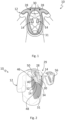
- the wearable protection device 10 can be a garment, like for example a jacket or a suit, or alternatively can be an undergarment suitable for being used in combination with an outer protection garment.
- the wearable protection device 10 can be a harness designed to be worn on top or under a further garment.
- the wearable protection device 10 is preferably designed for being worn by motorcyclists. Nevertheless, as it will appear more clearly from the following description, the wearable protection device 10 can also be advantageously used by cyclists or in other fields where an effective protection of the user's body must be obtained.
- the wearable protection device 10 comprises at least one inflatable member 12.
- the inflatable member 12 is designed to move between a rest condition, wherein it is in a deflated status, and an operating condition, wherein it is in an inflated status.
- the inflatable member 12 is inflated with a fluid, like for example air or gas, so as to expand for protecting the wearer of the wearable protection device 10 against impacts, falls or slidings.
- the wearable protection device 10 is provided with a single inflatable member 12 designed for protecting chest, back and shoulders of the user.
- the inflatable member 12 is shown in transparency for convenience, the inflatable member is designed to also cover the sides of the user.
- the wearable protection device 10 can be provided with a single inflatable member 12 or a plurality of inflatable members suitable for covering different portions of the user's body.
- the inflatable member 12 has a bag-like shape.
- the wearable protection device 10 also comprises at least one inflator device 14 designed to be coupled to the inflatable member 12 for inflating the latter when the inflator device 14 is triggered.
- the inflator device 14 is chosen from the group comprising pyrotechnic inflators, compressed gas inflators and hybrid inflators.
- pyrotechnic inflators a pyrotechnic charge is used to ignite the combustion of a gas generating material to provide inflation gas.
- Compressed gas inflators in turn use a minimal amount of pyrotechnic material to open a sealed chamber to release the inflation gas from a compressed state.
- Hybrid inflators use a combination of combustion and compressed gas storage to provide the inflation gas needed to fill the inflatable member 12.
- the inflator device 14 can comprise a plurality of inflation charges so as to be able to inflate the inflatable member 12 more than once so that the inflations of the inflatable member 12 take place in a chronological order.
- the replacement of the inflator device 14 is carried out once all the inflation charges have been triggered.
- the inflator device 14 is preferably in the form of a cylindrical gas cartridge having a connecting end 16 designed to be connected to the inflatable member 12.
- the connecting end 16 is preferably inserted and blocked in a gas tightly manner into an opening 18 of the inflatable member 12.
- the connecting end 16 of the gas cartridge 14 can be clamped inside the opening 18 by means of a holding ring 20 (see for example figures 5 and 6 ).
- the connecting end 16 of the gas cartridge 14 can be inserted inside a corresponding cap 22 fastened at the opening 18 of the inflatable member 12 (see for example figures 3 and 4 ).
- the connecting end 16 of the gas cartridge 14 can be inserted by pressure into the cap 22.
- the connecting end 16 of the gas cartridge 14 can be provided with an external thread 24 suitable for being screwed into a corresponding internal thread 26 provided inside the cap 22.
- the inflator device 14 can be triggered by means of an electronic or mechanical mechanism.
- the wearable protection device 10 comprises at least one sensor 28 designed to detect forces acting on the wearable protection device 10.
- two sensors 28 are, for example, applied at the shoulder portion of the wearable protection device 10.
- one or more sensors 28 are applied, for example, in a housing 29 positioned at the upper back portion of the wearable protection device 10.
- the housing 29 is shown in detail in figures 7 and 8 .
- At least one sensor can be directly applied on the wearable protection device and at least one sensor can be positioned inside a protection applied on the wearable protection device.
- the wearable protection device 10 comprises at least one accelerometer, designed to detect the accelerations acting on the wearable protection device, and/or at least one gyroscope, designed to detect movements and orientation of the wearable protection device.
- the wearable protection device 10 can further comprise a control unit 30 designed to process the data detected by the sensor 28 and to send a triggering signal to the inflator device 14, when a crash situation is identified.
- a "crash situation” should be intended a situation wherein the wearable protective device undergoes a sudden acceleration/deceleration and/or a sudden variation in its orientation and in its angular velocity.
- a sudden acceleration or deceleration undergone by the wearable protection device can identify that the motorcycle has hit an obstacle or that the wearer has lost the control of the motorcycle being thrown from the saddle.
- the control unit 30 is preferably housed in a protected zone of the wearable protection device 10, like for example a back protector 31 applied to the wearable protection device (see for example figure 1 ) or the housing 29 also used for housing the sensor 28 and the gas cartridge 14.
- the control unit 30 is designed to process at regular time intervals (for example 1ms) the data received from the sensor 28 so as to obtain an information about the forces acting on the wearable protection device 10.
- control unit 30 If the control unit 30 detects, on the basis of an algorithm implemented therein, that a crash situation is occurring, a triggering signal is sent from the control unit 30 to the inflator device 14 so that the inflatable member 12 can be inflated.
- the inflator device 14 can be triggered by using an activation cable or tether connecting the wearable protection device to the motorcycle.
- the activation cable has a first end connected to the motorcycle and a second end fixed to a triggering device, designed to trigger a firing pin, which in turn is configured to activate the inflator device.
- the activation cable or the tether by means of the triggering device triggers the firing pin causing the inflator's deployment.
- the inflator device 14 is electronically connected to the control unit 30.
- the inflator device 14 is connected to the control unit 30 by means of a cable 32 having at its end an electronic connector 34 (see figures 2 , 3 , 5 , 5A , 6 ).
- the electronic connector 34 is designed to be coupled to a corresponding slot 36 provided in the inflator device 14 (see figure 4 ).
- the slot 36 is positioned at the opposite end with respect to the connecting end 16 of the gas cartridge 14.
- the wearable protection device 10 comprises a safety device 40 designed to signal an unsafe state of the wearable protection device 10 if the inflator device 14 is decoupled or not properly coupled to the inflatable member 12.
- "unsafe state” should be intended a state of the wearable protection device 10 which does not permit a proper inflation of the inflatable member 12 or represents a potential hazard for the wearer.
- the safety device 40 is able to signal when the inflator device 14 is not properly connected to the inflatable member 12 so as to avoid malfunctioning of the wearable protection device 10.
- the inflator device 14 is not properly connected to the inflatable member 12 if the connection is not gas tight. Such an occurrence can happen, for example, if the connecting end 16 of the inflator device 14 is spaced apart from the corresponding receiving opening/seat 18 provided in the inflatable member 12.
- the gas cartridge 14 is not properly fixed to the cap 22 of the inflatable member 12, if it is not screwed in the cap 22 until the gas cartridge 14 abuts against the cap 22 of the inflatable member 12.
- the safety device 40 is able to assist who carries out the replacement of the inflator device 14, once exhausted, so as to permit a safe handling of the inflator device 14, limiting the risk that the inflator device 14, and in particular the pyrotechnic charge, is activated by mistake.
- the safety device 40 comprises a safety or positioning sensor 42, connected to the control unit 30, and designed to automatically switch off the control unit 30 or not to permit the switching on of the control unit 30 if the wearable protection device 10 is in an unsafe state.
- the safety sensor 42 can be connected to a signaling device of the wearable protection device 10. Such a signaling device can be applied at the outer surface of the wearable protection device.
- the safety device can provide a visual signal to the wearer, for example by switching off the signaling device, or it can provide an audible alarm.
- the safety device 40 can comprise a positioning sensor 42 designed to signal the unsafe state of the wearable protection device 10 if a distance between reference marks provided respectively on the inflator device 14 and on the inflatable member 12 exceeds a predetermined distance value, which is set up by assuming that the inflator device is properly connected to the inflatable member. When the detected distance is greater than the reference value it means that the inflator device is not properly connected to the inflatable member.
- a positioning sensor 42 connected to the control unit 30, can be applied in proximity of the opening 18 of the inflatable member 12 to which the inflator device 14 is connected.
- the positioning sensor 42 is able to detect the presence of the inflator device 14 and/or the contact with a facing surface 43 of the inflator device 14.
- the positioning sensor 42 is preferably applied at the rim of the cap 22 fastened to the inflatable member 12, so as to be able to detect the presence and/or the contact with the facing surface 43 of the gas cartridge 14.
- a facing surface 43 is designed to be placed in close proximity or to abut against the rim of the cap 22 if the gas cartridge 14 is properly connected to the inflatable member 12. If the gas cartridge 14 is not properly connected to the inflatable member 12, the positioning sensor 42 does not detect the presence of the gas cartridge 14 or the contact between the facing surfaces of rim and gas cartridge and thus it automatically switches off the control unit 30 or keeps the control unit 30 in a switched off status.
- the positioning sensor 42 can be applied at the connecting end 16 of the inflator device 14.
- the positioning sensor can be an electronic switch, like for example a contact sensor, or a proximity sensor, like for example a Hall effect sensor.
- the positioning sensor 42 can be connected to a signaling device able to signal to the wearer that the gas cartridge is not properly fixed to the inflatable member.
- the positioning sensor 42 can be a mechanical switch preferably applied at the rim of the cap 22 and suitable to signal an unsafe state of the wearable protection device when it is not pressed by a facing surface 43 of the gas cartridge 14.
- the inflator device 14 can be designed to be inserted in a holding seat 46 (see figures 4 , 6 and 7 ).
- the holding seat 46 can be fastened to an inner or an outer surface of the wearable protection device 10.
- the holding seat 46 is provided in the housing 29 positioned at the upper portion of the back (see figure 2 ).
- the safety device 40 comprises a mechanical device configured to allow the insertion of the inflator device 14 inside the holding seat 46 only if the inflator device 14 is properly connected to the inflatable member 12.
- the safety device 40 is able to provide the wearer with a direct visual information, since the wearer will see that the gas cartridge 14 is at least partially spaced apart from the holding seat 46 or not inserted therein.
- Such a safety device 40 can be used both in wearable protection device 10 electronically activated and in wearable protection device mechanically activated.
- the safety device 40 can comprise at least one abutment surface 48, 50, 52 designed to define in the holding seat 46 a geometry complementary to the assembly formed by the inflator device 14 and the cap 22 of the inflatable member 12, once the connecting end 16 of the inflator device 14 is properly inserted inside the cap 22.
- the safety device 40 comprises a front abutment surface 50 and a rear abutment surface 48.
- the front abutment surface 50 which preferably has a recess on which the cap 22 can be laid, is designed to be positioned in proximity of the junction between cap and connecting end, while the rear abutment surface 48 is opposite to the front abutment surface 50.
- the distance between the front abutment surface 50 and the rear abutment surface 48 is set so as to coincide with the length of the assembly formed by the inflator device 14 and the cap 22 once the connecting end 16 is properly inserted inside the cap 22 (see figure 4 ).
- the distance between the front abutment surface 50 and the rear abutment surface 48 is set so that the front abutment surface 50 can engage corresponding notches 54 provided in the cap 22 (see figures 5 , 5A and 6 ) or in the gas cartridge 14 only if the connecting end 16 is properly inserted inside the cap 22 and the rear end of the gas cartridge 14 is abutting against the rear abutment surface 48.
- the rear abutment surface 48 can be shaped so as to be able to engage corresponding notches provided at the rear end of the gas cartridge only if the gas cartridge is properly connected to the inflatable member.
- the rear abutment surface 48 can be shaped so as to be complementary to the electronic connector 34 by means of which the gas cartridge 14 is connected to the control unit 30.
- the gas cartridge cannot be inserted inside the holding seat 46 since the rear portion of the gas cartridge 14 will hit the rear abutment surface 48 or the front and rear abutment surfaces 48, 50 will not be able to match the reference notches 54.
- the wearer has thus an immediate feedback about the mutual positioning between the gas cartridge 14 and the inflatable member 12 and he is induced to act on the gas cartridge 14 so as to properly connect it to the inflatable member 12.
- the mechanical safety device 40 is also useful to block the gas cartridge 14 in the proper position with respect to the inflatable member 12 once it is connected to it.
- the front and rear abutment surfaces 48, 50 preferably in combination with side surfaces 52 extending from the front abutment surface 50 to the rear abutment surface 48, allow to firmly detain the gas cartridge 14 inside its seat 46, so as to avoid that following vibrations or shocks occurring during the use of the wearable protection device the gas cartridge 14 can move from its proper position.
- a safety sensor connected to the control unit 30, can be applied on an inner surface of the holding seat 46, namely on a surface which is designed to be in contact with the inflator device 14 when the inflator device is inserted in the holding seat 46.
- the safety sensor can be a mechanical switch or a pressure sensor.
- the wearable protection device can comprise two holding seats 46 each designed for housing one inflator device 14; said holding seats 46 being both provided with a safety sensor connected to the control unit 30 on their inner surface.
- control unit 30 will be switched off or will be kept switched off if one of the inflator devices is not properly inserted inside its holding seat.
- the holding seat 46 can comprise a cover 56 suitable for protecting the gas cartridge 14 (see figures 4 , 7 and 8 ).
- the cover 56 can be provided with first fastening means 58 designed to be coupled with corresponding second fastening means 60 of the holding seat 46 so as to permit the fastening of the cover 56 to the holding seat 46.
- First and second fastening means 58, 60 are designed to be matched to each other only if the safety device 40 permits the insertion of the inflator device 14 inside the holding seat 46.
- the wearer in this case clearly understands that the wearable protection device is in an unsafe state being the cover 56 spaced apart from the holding seat 46.
- the safety device 40 can be designed to switch off the control unit 30 or to keep the control unit 30 switched off if the wearable protection device is in an unsafe state.
- the safety device 40 can comprise a safety or contact sensor 42, connected to the control unit 30, which can be positioned on a top edge of the holding seat 46 or on a bottom edge of the cover 56 (see figure 4 ).
- a safety or contact sensor 42 is designed to switch on the control unit 30 once the cover 56 is properly fixed to the holding seat 46 and to switch off or to keep the control unit switched off when the cover 56 is removed from the seat.
- a not properly fastening of the cover 56 to the holding seat 46 signals an unsafe state of the wearable protection device since the inflator device 14 is not properly coupled to the inflatable member 12.
- the safety device 40 in case the gas cartridge 14 must be replaced, is able to re-activate the control unit 30 only if the gas cartridge 14 is correctly positioned inside its holding seat 46 and/or the cover 56 is properly fastened to the holding seat 46.
- the wearable protection device 10 can be provided with two holding seats 46, each seat being suitable for housing a corresponding gas cartridge 14. These holding seats 46 can be arranged on a supporting plate 62, suitable for being fixed to the outer surface of the wearable protection device 10.
- Both seats can be provided with the above mentioned safety device 40 and with a corresponding cover 56.
- both safety devices 40 comprise a contact sensor 42 positioned on the cover 56 or on the seat 46
- the control unit 30 will be switched off or it will be kept switched off, if one of the gas cartridges 14 is not properly inserted inside its holding seat 46, so as not to permit the correct positioning of the cover over the holding seat.
- the supporting plate 62 can have a single cover 56 suitable for covering both holding seats 46.
- a contact sensor 42 can be applied at the bottom rim of the cover 56 or at a top surface of the supporting plate 62.
- the cover 56 can be properly fixed to the supporting plate 62, only if both gas cartridges are properly inserted inside their holding seats 46.
- a proper connection between cover and supporting plate causes the pressing of the contact sensor 42 which emits a corresponding signal to the control unit.
- the safety device allows a safe and proper replacement of the gas cartridge without needing to return the wearable protection device to a customer service.
- the safety device offers a reliable feedback about the connection between the gas cartridge and the inflatable member, so that also a final user not having a specific training is able to understand whether the gas cartridge, used in replacement of an exhausted gas cartridge, has been properly connected to the inflatable member.
- the safety device offers a protection against possible hazards occurring during the replacement of the gas cartridge since it is able to switch off or to keep in a switched off status the control unit until the gas cartridge is not connected or not properly connected to the inflatable member, so as to avoid that the pyrotechnic charge of the gas cartridge can be inadvertently activated.
Landscapes
- Textile Engineering (AREA)
- Health & Medical Sciences (AREA)
- Engineering & Computer Science (AREA)
- General Health & Medical Sciences (AREA)
- Physical Education & Sports Medicine (AREA)
- General Physics & Mathematics (AREA)
- Physics & Mathematics (AREA)
- Business, Economics & Management (AREA)
- Emergency Management (AREA)
- Heart & Thoracic Surgery (AREA)
- Chemical & Material Sciences (AREA)
- Analytical Chemistry (AREA)
- Professional, Industrial, Or Sporting Protective Garments (AREA)
- Emergency Lowering Means (AREA)
Claims (19)
- Tragbare Schutzvorrichtung (10), umfassend:- mindestens ein aufblasbares Element (12), das ausgebildet ist, sich zwischen einem Ruhezustand, in dem es sich in einem entleerten Zustand befindet, und einem Betriebszustand, in dem es sich in einem aufgepumpten Zustand befindet, zu bewegen;- eine Aufpumpvorrichtung (14), die ausgebildet ist, mit dem mindestens einen aufblasbaren Element (12) gekoppelt zu sein, um das mindestens eine aufblasbare Element (12) aufzupumpen, wenn die Aufpumpvorrichtung (14) ausgelöst wird; dadurch gekennzeichnet, dass sie weiter eine Sicherheitsvorrichtung (40) umfasst, die ausgebildet ist, einen unsicheren Zustand der tragbaren Schutzvorrichtung (10) anzuzeigen, wenn die Aufpumpvorrichtung (14) von dem mindestens einen aufblasbaren Element (12) entkoppelt oder nicht richtig mit diesem gekoppelt ist.
- Tragbare Schutzvorrichtung (10) nach Anspruch 1, dadurch gekennzeichnet, dass sie weiter umfasst:- mindestens einen Sensor (28), der ausgebildet ist, auf die tragbare Schutzvorrichtung (10) wirkende Kräfte zu erfassen;- eine Steuereinheit (30), die ausgebildet ist, die von dem mindestens einen Sensor (28) erfassten Daten zu verarbeiten und ein Auslösesignal an die Aufpumpvorrichtung (14) zu senden, wenn eine Unfallsituation identifiziert wird,wobei die Sicherheitsvorrichtung (40) einen Sicherheitssensor (42) umfasst, der mit der Steuereinheit (30) verbunden ist und ausgebildet ist, die Steuereinheit (30) automatisch auszuschalten oder das Einschalten der Steuereinheit (30) nicht zuzulassen, wenn sich die tragbare Schutzvorrichtung (10) in einem unsicheren Zustand befindet.
- Tragbare Schutzvorrichtung (10) nach Anspruch 1, dadurch gekennzeichnet, dass die Sicherheitsvorrichtung (40) einen Sicherheitssensor (42) umfasst, der ausgebildet ist, den unsicheren Zustand der tragbaren Schutzvorrichtung (10) anzuzeigen, wenn ein Abstand zwischen Referenzmarkierungen, die jeweils an der Aufpumpvorrichtung (14) und an dem mindestens einen aufblasbaren Element (12) vorgesehen sind, einen vorab festgelegten Wert überschreitet.
- Tragbare Schutzvorrichtung (10) nach Anspruch 2, dadurch gekennzeichnet, dass die Sicherheitsvorrichtung (40) einen Sicherheitssensor (42) umfasst, der mit der Steuereinheit (30) verbunden ist und in der Nähe einer Öffnung (18) des aufblasbaren Elements (12) angebracht ist, mit der die Aufpumpvorrichtung (14) verbunden ist; wobei der Sicherheitssensor (42) in der Lage ist, das Vorhandensein der Aufpumpvorrichtung (14) und/oder den Kontakt mit einer zugewandten Fläche (43) der Aufpumpvorrichtung (14) zu erfassen.
- Tragbare Schutzvorrichtung (10) nach Anspruch 2, dadurch gekennzeichnet, dass die Aufpumpvorrichtung (14) mit einem Verbindungsende (16) versehen ist, das ausgebildet ist, in eine entsprechende Kappe (22) eingeführt zu sein, die an der Öffnung (18) des mindestens einen aufblasbaren Elements (12) befestigt ist; wobei der Sicherheitssensor (42) am Verbindungsende (16) der Aufpumpvorrichtung (14) oder an der am aufblasbaren Element (12) befestigten Kappe (22) angebracht ist.
- Tragbare Schutzvorrichtung (10) nach Anspruch 2, dadurch gekennzeichnet, dass der Sicherheitssensor (42) ein elektronischer oder mechanischer Schalter oder ein Näherungssensor ist.
- Tragbare Schutzvorrichtung (10) nach Anspruch 1, dadurch gekennzeichnet, dass die Aufpumpvorrichtung (14) ausgebildet ist, in einen Haltesitz (46) eingesetzt zu sein; die Sicherheitsvorrichtung (40) eine mechanische Vorrichtung umfasst, die ausgebildet ist, das Einsetzen der Aufpumpvorrichtung (14) in den Haltesitz (46) nur dann zu erlauben, wenn die Aufpumpvorrichtung (14) ordnungsgemäß mit dem mindestens einen aufblasbaren Element (12) verbunden ist.
- Tragbare Schutzvorrichtung (10) nach Anspruch 7, dadurch gekennzeichnet, dass die Aufpumpvorrichtung (14) mit einem Verbindungsende (16) versehen ist, das ausgebildet ist, in eine entsprechende Kappe (22) eingeführt zu sein, die an einer Öffnung (18) des mindestens einen aufblasbaren Elements (14) angeordnet ist; wobei die Sicherheitsvorrichtung (40) mindestens eine Anschlagfläche (48, 50, 52) umfasst, die ausgebildet ist, in dem Haltesitz (46) eine Geometrie zu definieren, die komplementär zu der durch die Aufpumpvorrichtung (14) und die Kappe (22) gebildeten Anordnung ist, wenn das Verbindungsende (16) ordnungsgemäß in die Kappe (22) eingeführt ist.
- Tragbare Schutzvorrichtung (10) nach Anspruch 8, dadurch gekennzeichnet, dass die Sicherheitsvorrichtung (40) eine vordere Anschlagfläche (50) und eine hintere Anschlagfläche (48) umfasst; der Abstand zwischen der vorderen Anschlagfläche (50) und der hinteren Anschlagfläche (48) mit der Länge der Anordnung übereinstimmt, die durch die Aufpumpvorrichtung (14) und die Kappe (22) gebildet ist, wenn das Verbindungsende (16) ordnungsgemäß in die Kappe (22) eingeführt ist.
- Tragbare Schutzvorrichtung (10) nach Anspruch 8, dadurch gekennzeichnet, dass die Sicherheitsvorrichtung (40) eine vordere Anschlagfläche (50) und eine hintere Anschlagfläche (48) umfasst; der Abstand zwischen der vorderen Anschlagfläche (50) und der hinteren Anschlagfläche (48) so festgelegt ist, dass die vordere Anschlagfläche (50) nur dann in entsprechende Nuten (54) eingreift, die in der Kappe (22) oder in der Aufpumpvorrichtung (14) vorgesehen sind, wenn das Verbindungsende (16) ordnungsgemäß in die Kappe (22) eingeführt ist und ein hinteres Ende der Aufpumpvorrichtung (14) an der hinteren Anschlagfläche (48) anliegt.
- Tragbare Schutzvorrichtung (10) nach den Ansprüchen 2 und 8, dadurch gekennzeichnet, dass die Sicherheitsvorrichtung (40) eine hintere Anschlagfläche (48) umfasst, die so ausgebildet ist, dass sie zu einem elektronischen Anschluss (34) komplementär ist, über den die Aufpumpvorrichtung (14) mit der Steuereinheit (30) verbunden ist.
- Tragbare Schutzvorrichtung (10) nach Anspruch 7, dadurch gekennzeichnet, dass der Haltesitz (46) eine Abdeckung (56) umfasst, die zum Schutz der Aufpumpvorrichtung (14) geeignet ist; wobei die Abdeckung (56) mit einem ersten Befestigungselement (58) versehen ist, das ausgebildet ist mit einem entsprechenden zweiten Befestigungselement (60) des Haltesitzes (46) gekoppelt zu sein, um die Befestigung der Abdeckung am Haltesitz (46) zu ermöglichen; wobei das erste und zweite Befestigungselement so ausgebildet ist, dass sie nur dann zusammenpassen, wenn die Sicherheitsvorrichtung (40) das Einsetzen der Aufpumpvorrichtung (14) in den Haltesitz (46) erlaubt.
- Tragbare Schutzvorrichtung (10) nach den Ansprüchen 2 und 12, dadurch gekennzeichnet, dass der Sicherheitssensor (42) an einer Oberkante des Haltesitzes (46) oder an einer Unterkante der Abdeckung (56) positioniert ist.
- Tragbare Schutzvorrichtung (10) nach Anspruch 13, dadurch gekennzeichnet, dass sie zwei Haltesitze (46) umfasst, wobei jeder Haltesitz (46) zur Aufnahme einer entsprechenden Aufpumpvorrichtung (14) geeignet ist.
- Tragbare Schutzvorrichtung (10) nach Anspruch 14, dadurch gekennzeichnet, dass die Haltesitze (46) auf einer Trägerplatte (62) angeordnet sind, die zur Befestigung an einer Außenfläche der tragbaren Schutzvorrichtung (10) ausgebildet ist; wobei die Trägerplatte (62) eine einzelne Abdeckung (56) aufweist, die zum Abdecken der Haltesitze (46) geeignet ist.
- Tragbare Schutzvorrichtung (10) nach Anspruch 14, dadurch gekennzeichnet, dass jeder Haltesitz (46) eine entsprechende Abdeckung (56) und einen entsprechenden Sicherheitssensor (42) umfasst; wobei der Sicherheitssensor (42) ausgebildet ist, die Steuereinheit (30) automatisch abzuschalten oder das Einschalten der Steuereinheit (30) nicht zuzulassen, wenn eine der Aufpumpvorrichtungen (14) nicht ordnungsgemäß in ihren Haltesitz (46) eingesetzt ist, so dass eine korrekte Positionierung der Abdeckung (56) über dem entsprechenden Haltesitz (46) nicht möglich ist.
- Tragbare Schutzvorrichtung (10) nach den Ansprüchen 2 und 7, dadurch gekennzeichnet, dass der Sicherheitssensor (42) auf einer Innenfläche des Haltesitzes (46) positioniert ist; wobei die Innenfläche so ausgebildet ist, dass sie mit der Aufpumpvorrichtung (14) in Kontakt ist, wenn die Aufpumpvorrichtung (14) in den Haltesitz (46) eingesetzt ist.
- Tragbare Schutzvorrichtung (10) nach Anspruch 17, dadurch gekennzeichnet, dass sie zwei Haltesitze (46) umfasst, wobei jeder Haltesitz (46) zur Aufnahme einer entsprechenden Aufpumpvorrichtung (14) geeignet ist.
- Tragbare Schutzvorrichtung (10) nach Anspruch 2, dadurch gekennzeichnet, dass die Aufpumpvorrichtung (14) ausgebildet ist, in einen Haltesitz (46) eingesetzt zu sein, der eine Abdeckung (56) umfasst, die zum Schutz der Aufpumpvorrichtung (14) geeignet ist; wobei der Sicherheitssensor (42) ausgebildet ist, die Steuereinheit (30) einzuschalten, wenn die Abdeckung (56) ordnungsgemäß an dem Haltesitz (46) befestigt ist, und die Steuereinheit (30) auszuschalten, wenn die Abdeckung (56) von dem Haltesitz (46) entfernt ist.
Priority Applications (1)
| Application Number | Priority Date | Filing Date | Title |
|---|---|---|---|
| EP24210728.2A EP4529794A1 (de) | 2019-11-04 | 2020-10-30 | Tragbare schutzvorrichtung |
Applications Claiming Priority (2)
| Application Number | Priority Date | Filing Date | Title |
|---|---|---|---|
| IT102019000020298A IT201900020298A1 (it) | 2019-11-04 | 2019-11-04 | Dispositivo di protezione indossabile |
| PCT/EP2020/080569 WO2021089439A1 (en) | 2019-11-04 | 2020-10-30 | Wearable protection device |
Related Child Applications (1)
| Application Number | Title | Priority Date | Filing Date |
|---|---|---|---|
| EP24210728.2A Division EP4529794A1 (de) | 2019-11-04 | 2020-10-30 | Tragbare schutzvorrichtung |
Publications (3)
| Publication Number | Publication Date |
|---|---|
| EP4054366A1 EP4054366A1 (de) | 2022-09-14 |
| EP4054366B1 true EP4054366B1 (de) | 2024-11-27 |
| EP4054366C0 EP4054366C0 (de) | 2024-11-27 |
Family
ID=69701452
Family Applications (2)
| Application Number | Title | Priority Date | Filing Date |
|---|---|---|---|
| EP24210728.2A Pending EP4529794A1 (de) | 2019-11-04 | 2020-10-30 | Tragbare schutzvorrichtung |
| EP20796849.6A Active EP4054366B1 (de) | 2019-11-04 | 2020-10-30 | Am körper tragbare schutzvorrichtung |
Family Applications Before (1)
| Application Number | Title | Priority Date | Filing Date |
|---|---|---|---|
| EP24210728.2A Pending EP4529794A1 (de) | 2019-11-04 | 2020-10-30 | Tragbare schutzvorrichtung |
Country Status (8)
| Country | Link |
|---|---|
| US (1) | US12108816B2 (de) |
| EP (2) | EP4529794A1 (de) |
| JP (2) | JP2023502884A (de) |
| KR (1) | KR102843907B1 (de) |
| CN (1) | CN114980765A (de) |
| ES (1) | ES3006907T3 (de) |
| IT (1) | IT201900020298A1 (de) |
| WO (1) | WO2021089439A1 (de) |
Families Citing this family (6)
| Publication number | Priority date | Publication date | Assignee | Title |
|---|---|---|---|---|
| FR3103085B1 (fr) * | 2019-11-15 | 2022-03-25 | Livbag Sas | Dispositif d'interface d'un dispositif de sécurité gonflable individuel |
| IT202100021860A1 (it) * | 2021-08-13 | 2023-02-13 | Dainese Spa | Dispositivo di gonfiaggio |
| US12071335B2 (en) * | 2021-10-28 | 2024-08-27 | Toyota Research Institute, Inc. | Sensor devices including force sensors and robots incorporating the same |
| EP4193861A1 (de) * | 2021-12-13 | 2023-06-14 | Dainese S.p.A. | Ausgestattete kleidung |
| IT202200018723A1 (it) | 2022-09-13 | 2024-03-13 | Alpinestars Res Spa | Dispositivo di protezione indossabile comprendente un elemento gonfiabile e metodo per attivare in sicurezza l'elemento gonfiabile di detto dispositivo di protezione indossabile |
| IT202300005097A1 (it) | 2023-03-17 | 2024-09-17 | D Air Lab S R L | Dispositivo di gonfiaggio |
Family Cites Families (25)
| Publication number | Priority date | Publication date | Assignee | Title |
|---|---|---|---|---|
| US4161797A (en) * | 1976-03-15 | 1979-07-24 | Ruscigno Harry G | Detonator assembly |
| EP1379147A4 (de) * | 2000-09-04 | 2006-05-17 | Merhav A A P Ltd | Selbstauslösendes aufprallschutzsystem |
| JP2004105620A (ja) * | 2002-09-20 | 2004-04-08 | Kazuo Shimizu | ガス発生装置用ケースとガス発生装置 |
| JP4548729B2 (ja) * | 2005-09-21 | 2010-09-22 | 本田技研工業株式会社 | 着用式エアバッグ装置 |
| US8419058B2 (en) * | 2008-03-21 | 2013-04-16 | Trw Vehicle Safety Systems Inc. | Dual volume air bag |
| JP5421166B2 (ja) * | 2010-03-24 | 2014-02-19 | 本田技研工業株式会社 | エアバッグジャケット作動システム |
| US8400308B2 (en) * | 2010-04-30 | 2013-03-19 | Oleg Aronov | System and method for identifying object and releasing its security |
| US9629399B2 (en) * | 2011-02-03 | 2017-04-25 | Hip Hope Technologies Ltd. | Hip protector system and method for hip fracture prevention |
| ITTV20120084A1 (it) * | 2012-05-15 | 2013-11-16 | Alpinestars Res Srl | Dispositivo di protezione autonomo ed indossabile e complesso di abbigliamento protettivo |
| ITTV20120124A1 (it) * | 2012-06-26 | 2013-12-27 | Alpinestars Res Srl | Dispositivo di protezione gonfiabile montato su fodera e assieme d'abbigliamento protettivo |
| US9563244B2 (en) * | 2013-01-08 | 2017-02-07 | Hzo, Inc. | Apparatuses, systems, and methods for reducing power to ports of electronic devices |
| ES2680345T3 (es) * | 2013-02-21 | 2018-09-06 | Andras FENYVES | Sistema de protección contra impactos |
| TW201521615A (zh) * | 2014-06-10 | 2015-06-16 | Cheng-Mao Lee | 充氣式防護衣 |
| US10300975B2 (en) * | 2014-07-22 | 2019-05-28 | Alpinestars Research Srl | Protective garment provided with an inflatable protective device and associated inflating method |
| FR3031908B1 (fr) * | 2015-01-28 | 2018-07-27 | In&Motion | Dispositif de detection de la perte d'un ski |
| US9928386B1 (en) * | 2015-06-08 | 2018-03-27 | Amazon Technologies, Inc. | Data protection system |
| CN105004495B (zh) * | 2015-07-02 | 2017-07-18 | 高田(长兴)汽车安全装置有限公司 | 气体发生器出气口铝箔贴附密封性检测装置及其检测方法 |
| KR102586012B1 (ko) * | 2016-01-27 | 2023-10-10 | 삼성전자주식회사 | 청소기 및 그 제어 방법 |
| JP6987772B2 (ja) * | 2016-02-29 | 2022-01-05 | アクティブ プロテクティブ テクノロジーズ,インク. | 個人衝撃保護システム用のカスタムバックルに取り付けられるエアバッグアクチュエータ |
| US10102768B2 (en) * | 2016-03-19 | 2018-10-16 | Fujitsu Limited | Behavior variability and complexity modeling using a construction toy |
| IT201600068775A1 (it) * | 2016-07-01 | 2018-01-01 | Alpinestars Res Srl | Garment provided with an inflatable protective device |
| GB201707645D0 (en) * | 2017-05-12 | 2017-06-28 | Playfinity As | Electronic sensing devices |
| CN110081236B (zh) * | 2019-05-10 | 2024-05-28 | 成都霍姆赛福科技有限公司 | 一种燃气安全阀、燃气安全检测报警系统及方法 |
| SE543986C2 (en) * | 2019-01-17 | 2021-10-19 | Hoevding Sverige Ab | Airbag system comprising control unit arranged to control inflation of the airbag based on a measured magnetic field |
| US20210058105A1 (en) * | 2019-08-19 | 2021-02-25 | Jonathan Philip Landry | Privacy apparatus for electronics and related methods |
-
2019
- 2019-11-04 IT IT102019000020298A patent/IT201900020298A1/it unknown
-
2020
- 2020-10-30 KR KR1020227018552A patent/KR102843907B1/ko active Active
- 2020-10-30 WO PCT/EP2020/080569 patent/WO2021089439A1/en not_active Ceased
- 2020-10-30 EP EP24210728.2A patent/EP4529794A1/de active Pending
- 2020-10-30 EP EP20796849.6A patent/EP4054366B1/de active Active
- 2020-10-30 CN CN202080090195.7A patent/CN114980765A/zh active Pending
- 2020-10-30 JP JP2022525970A patent/JP2023502884A/ja active Pending
- 2020-10-30 ES ES20796849T patent/ES3006907T3/es active Active
- 2020-10-30 US US17/773,515 patent/US12108816B2/en active Active
-
2024
- 2024-12-06 JP JP2024213845A patent/JP2025026588A/ja active Pending
Also Published As
| Publication number | Publication date |
|---|---|
| ES3006907T3 (en) | 2025-03-19 |
| EP4054366A1 (de) | 2022-09-14 |
| US12108816B2 (en) | 2024-10-08 |
| WO2021089439A1 (en) | 2021-05-14 |
| JP2025026588A (ja) | 2025-02-21 |
| JP2023502884A (ja) | 2023-01-26 |
| EP4054366C0 (de) | 2024-11-27 |
| KR20220108065A (ko) | 2022-08-02 |
| IT201900020298A1 (it) | 2021-05-04 |
| KR102843907B1 (ko) | 2025-08-08 |
| EP4529794A1 (de) | 2025-04-02 |
| CN114980765A (zh) | 2022-08-30 |
| US20220361599A1 (en) | 2022-11-17 |
Similar Documents
| Publication | Publication Date | Title |
|---|---|---|
| EP4054366B1 (de) | Am körper tragbare schutzvorrichtung | |
| EP2863767B1 (de) | Auskleidungsmontierte aufblasbare schutzeinrichtung und schutzbekleidungsanordnung | |
| EP3171723B1 (de) | Schutzkleidung mit einem aufblasbarer schutzvorrichtung und zugehöriges aufblasverfahren | |
| US10046726B2 (en) | Airbag safety system for a two-wheeled vehicle | |
| US6139050A (en) | Safety device for motorcyclists | |
| KR20210136080A (ko) | 임박한 충격으로부터 사용자의 두개골 및 경부 영역을 보호하기 위한 보호 장치 | |
| EP3326476B1 (de) | An einen helm anpassbarer airbag | |
| WO2016132255A1 (en) | Inflatable protection system | |
| US20220273067A1 (en) | Emergency protective helmet | |
| EP4178392B1 (de) | Tragbare schutzvorrichtung | |
| US7073819B2 (en) | Device for individual protection, comprising an airbag | |
| EP3237272B1 (de) | Aufpumpbarer schutz für einen kindersitz | |
| US12486009B2 (en) | Interface device for an inflatable individual safety device | |
| EP4054367B1 (de) | Am körper tragbare schutzvorrichtung | |
| KR20250066470A (ko) | 팽창 가능 부재를 포함하는 웨어러블 보호 디바이스 및 상기 웨어러블 보호 디바이스의 팽창 가능 부재를 안전하게 활성화하기 위한 방법 | |
| KR20220086199A (ko) | 오토바이 보호구 | |
| KR101305700B1 (ko) | 차량용 운전석 에어백장치 및 구동방법 | |
| KR20200061461A (ko) | 인플레이터를 구비한 안전 디바이스 |
Legal Events
| Date | Code | Title | Description |
|---|---|---|---|
| STAA | Information on the status of an ep patent application or granted ep patent |
Free format text: STATUS: UNKNOWN |
|
| STAA | Information on the status of an ep patent application or granted ep patent |
Free format text: STATUS: THE INTERNATIONAL PUBLICATION HAS BEEN MADE |
|
| PUAI | Public reference made under article 153(3) epc to a published international application that has entered the european phase |
Free format text: ORIGINAL CODE: 0009012 |
|
| STAA | Information on the status of an ep patent application or granted ep patent |
Free format text: STATUS: REQUEST FOR EXAMINATION WAS MADE |
|
| 17P | Request for examination filed |
Effective date: 20220503 |
|
| AK | Designated contracting states |
Kind code of ref document: A1 Designated state(s): AL AT BE BG CH CY CZ DE DK EE ES FI FR GB GR HR HU IE IS IT LI LT LU LV MC MK MT NL NO PL PT RO RS SE SI SK SM TR |
|
| DAV | Request for validation of the european patent (deleted) | ||
| DAX | Request for extension of the european patent (deleted) | ||
| GRAP | Despatch of communication of intention to grant a patent |
Free format text: ORIGINAL CODE: EPIDOSNIGR1 |
|
| STAA | Information on the status of an ep patent application or granted ep patent |
Free format text: STATUS: GRANT OF PATENT IS INTENDED |
|
| INTG | Intention to grant announced |
Effective date: 20240619 |
|
| GRAS | Grant fee paid |
Free format text: ORIGINAL CODE: EPIDOSNIGR3 |
|
| GRAA | (expected) grant |
Free format text: ORIGINAL CODE: 0009210 |
|
| STAA | Information on the status of an ep patent application or granted ep patent |
Free format text: STATUS: THE PATENT HAS BEEN GRANTED |
|
| AK | Designated contracting states |
Kind code of ref document: B1 Designated state(s): AL AT BE BG CH CY CZ DE DK EE ES FI FR GB GR HR HU IE IS IT LI LT LU LV MC MK MT NL NO PL PT RO RS SE SI SK SM TR |
|
| REG | Reference to a national code |
Ref country code: GB Ref legal event code: FG4D |
|
| RIN1 | Information on inventor provided before grant (corrected) |
Inventor name: NARDO, LORENZO Inventor name: MAZZAROLO, GIOVANNI |
|
| REG | Reference to a national code |
Ref country code: CH Ref legal event code: EP |
|
| REG | Reference to a national code |
Ref country code: DE Ref legal event code: R096 Ref document number: 602020042144 Country of ref document: DE |
|
| REG | Reference to a national code |
Ref country code: IE Ref legal event code: FG4D |
|
| U01 | Request for unitary effect filed |
Effective date: 20241216 |
|
| U07 | Unitary effect registered |
Designated state(s): AT BE BG DE DK EE FI FR IT LT LU LV MT NL PT RO SE SI Effective date: 20250108 |
|
| REG | Reference to a national code |
Ref country code: ES Ref legal event code: FG2A Ref document number: 3006907 Country of ref document: ES Kind code of ref document: T3 Effective date: 20250319 |
|
| PG25 | Lapsed in a contracting state [announced via postgrant information from national office to epo] |
Ref country code: HR Free format text: LAPSE BECAUSE OF FAILURE TO SUBMIT A TRANSLATION OF THE DESCRIPTION OR TO PAY THE FEE WITHIN THE PRESCRIBED TIME-LIMIT Effective date: 20241127 Ref country code: IS Free format text: LAPSE BECAUSE OF FAILURE TO SUBMIT A TRANSLATION OF THE DESCRIPTION OR TO PAY THE FEE WITHIN THE PRESCRIBED TIME-LIMIT Effective date: 20250327 |
|
| PG25 | Lapsed in a contracting state [announced via postgrant information from national office to epo] |
Ref country code: NO Free format text: LAPSE BECAUSE OF FAILURE TO SUBMIT A TRANSLATION OF THE DESCRIPTION OR TO PAY THE FEE WITHIN THE PRESCRIBED TIME-LIMIT Effective date: 20250227 |
|
| PG25 | Lapsed in a contracting state [announced via postgrant information from national office to epo] |
Ref country code: GR Free format text: LAPSE BECAUSE OF FAILURE TO SUBMIT A TRANSLATION OF THE DESCRIPTION OR TO PAY THE FEE WITHIN THE PRESCRIBED TIME-LIMIT Effective date: 20250228 |
|
| PG25 | Lapsed in a contracting state [announced via postgrant information from national office to epo] |
Ref country code: PL Free format text: LAPSE BECAUSE OF FAILURE TO SUBMIT A TRANSLATION OF THE DESCRIPTION OR TO PAY THE FEE WITHIN THE PRESCRIBED TIME-LIMIT Effective date: 20241127 |
|
| PG25 | Lapsed in a contracting state [announced via postgrant information from national office to epo] |
Ref country code: RS Free format text: LAPSE BECAUSE OF FAILURE TO SUBMIT A TRANSLATION OF THE DESCRIPTION OR TO PAY THE FEE WITHIN THE PRESCRIBED TIME-LIMIT Effective date: 20250227 |
|
| PG25 | Lapsed in a contracting state [announced via postgrant information from national office to epo] |
Ref country code: SM Free format text: LAPSE BECAUSE OF FAILURE TO SUBMIT A TRANSLATION OF THE DESCRIPTION OR TO PAY THE FEE WITHIN THE PRESCRIBED TIME-LIMIT Effective date: 20241127 |
|
| PG25 | Lapsed in a contracting state [announced via postgrant information from national office to epo] |
Ref country code: SK Free format text: LAPSE BECAUSE OF FAILURE TO SUBMIT A TRANSLATION OF THE DESCRIPTION OR TO PAY THE FEE WITHIN THE PRESCRIBED TIME-LIMIT Effective date: 20241127 |
|
| PG25 | Lapsed in a contracting state [announced via postgrant information from national office to epo] |
Ref country code: CZ Free format text: LAPSE BECAUSE OF FAILURE TO SUBMIT A TRANSLATION OF THE DESCRIPTION OR TO PAY THE FEE WITHIN THE PRESCRIBED TIME-LIMIT Effective date: 20241127 |
|
| PLBE | No opposition filed within time limit |
Free format text: ORIGINAL CODE: 0009261 |
|
| STAA | Information on the status of an ep patent application or granted ep patent |
Free format text: STATUS: NO OPPOSITION FILED WITHIN TIME LIMIT |
|
| 26N | No opposition filed |
Effective date: 20250828 |
|
| U20 | Renewal fee for the european patent with unitary effect paid |
Year of fee payment: 6 Effective date: 20251009 |