EP4053017B1 - Energieabsorptionsvorrichtung für einen sitz eines fahrzeugs und sitzsystem mit einer solchen energieabsorptionsvorrichtung - Google Patents
Energieabsorptionsvorrichtung für einen sitz eines fahrzeugs und sitzsystem mit einer solchen energieabsorptionsvorrichtung Download PDFInfo
- Publication number
- EP4053017B1 EP4053017B1 EP21159925.3A EP21159925A EP4053017B1 EP 4053017 B1 EP4053017 B1 EP 4053017B1 EP 21159925 A EP21159925 A EP 21159925A EP 4053017 B1 EP4053017 B1 EP 4053017B1
- Authority
- EP
- European Patent Office
- Prior art keywords
- energy
- impact device
- energy absorber
- energy absorption
- seat
- Prior art date
- Legal status (The legal status is an assumption and is not a legal conclusion. Google has not performed a legal analysis and makes no representation as to the accuracy of the status listed.)
- Active
Links
Images

Classifications
-
- B—PERFORMING OPERATIONS; TRANSPORTING
- B64—AIRCRAFT; AVIATION; COSMONAUTICS
- B64D—EQUIPMENT FOR FITTING IN OR TO AIRCRAFT; FLIGHT SUITS; PARACHUTES; ARRANGEMENT OR MOUNTING OF POWER PLANTS OR PROPULSION TRANSMISSIONS IN AIRCRAFT
- B64D11/00—Passenger or crew accommodation; Flight-deck installations not otherwise provided for
- B64D11/06—Arrangements of seats, or adaptations or details specially adapted for aircraft seats
- B64D11/0619—Arrangements of seats, or adaptations or details specially adapted for aircraft seats with energy absorbing means specially adapted for mitigating impact loads for passenger seats, e.g. at a crash
-
- B—PERFORMING OPERATIONS; TRANSPORTING
- B60—VEHICLES IN GENERAL
- B60N—SEATS SPECIALLY ADAPTED FOR VEHICLES; VEHICLE PASSENGER ACCOMMODATION NOT OTHERWISE PROVIDED FOR
- B60N2/00—Seats specially adapted for vehicles; Arrangement or mounting of seats in vehicles
- B60N2/24—Seats specially adapted for vehicles; Arrangement or mounting of seats in vehicles for particular purposes or particular vehicles
- B60N2/42—Seats specially adapted for vehicles; Arrangement or mounting of seats in vehicles for particular purposes or particular vehicles the seat constructed to protect the occupant from the effect of abnormal g-forces, e.g. crash or safety seats
- B60N2/4207—Seats specially adapted for vehicles; Arrangement or mounting of seats in vehicles for particular purposes or particular vehicles the seat constructed to protect the occupant from the effect of abnormal g-forces, e.g. crash or safety seats characterised by the direction of the g-forces
- B60N2/4242—Seats specially adapted for vehicles; Arrangement or mounting of seats in vehicles for particular purposes or particular vehicles the seat constructed to protect the occupant from the effect of abnormal g-forces, e.g. crash or safety seats characterised by the direction of the g-forces vertical
-
- B—PERFORMING OPERATIONS; TRANSPORTING
- B60—VEHICLES IN GENERAL
- B60N—SEATS SPECIALLY ADAPTED FOR VEHICLES; VEHICLE PASSENGER ACCOMMODATION NOT OTHERWISE PROVIDED FOR
- B60N2/00—Seats specially adapted for vehicles; Arrangement or mounting of seats in vehicles
- B60N2/24—Seats specially adapted for vehicles; Arrangement or mounting of seats in vehicles for particular purposes or particular vehicles
- B60N2/42—Seats specially adapted for vehicles; Arrangement or mounting of seats in vehicles for particular purposes or particular vehicles the seat constructed to protect the occupant from the effect of abnormal g-forces, e.g. crash or safety seats
- B60N2/427—Seats or parts thereof displaced during a crash
- B60N2/42709—Seats or parts thereof displaced during a crash involving residual deformation or fracture of the structure
Definitions
- the present invention relates to an energy absorption device for a seat of a vehicle, in particular of an aircraft such as a helicopter, with at least one impact device and at least one energy absorber connected to the impact device, wherein the impact device acts on the energy absorber for energy absorption at least in the case of high load such as in the event of a helicopter crash.
- the invention also relates to a seat system for vehicles, in particular for aircraft such as helicopters, with a frame that can be fastened in the vehicle, a seat that is displaceably mounted on the frame and an energy absorption device with the aforementioned features, wherein the seat is firmly connected to an element of the energy absorption device in such a way that in the event of an acceleration caused, for example, by a crash (high load case), a displacement of the seat along the frame is dampened by the energy absorption device in that the energy absorption device acts on the energy absorber.
- the energy absorber can be designed, for example, as a tube, square profile or T-profile, which is preferably supported by the impact device
- the energy absorber can also be designed as a steel strip, rod or similar.
- the impact device can, for example, comprise a cage in which preferably at least one roller is rotatably mounted as part of the impact device.
- the impact device can alternatively comprise a matrix, which is preferably arranged in a cage.
- a gap with a gap width is formed by the cage, the matrix or between a roller and the cage or preferably between two rollers rotatably mounted in the cage, through which gap the energy absorber is guided.
- the energy absorber which is designed as a tube, for example, has a cross-sectional width that is greater than the gap width.
- the tube has notches in which the rollers are arranged in the initial state.
- the seat which is slidably mounted on the frame, is firmly connected, for example, to the cage of the impact device or to the energy absorber, whereby the energy absorber is firmly connected to the frame or the impact device is firmly connected to the frame.
- the energy absorption device and its components are designed in such a way that in a high-load case such as a crash, at least when an occupant is sitting on the seat, the seat is moved along the frame. During this movement of the seat caused by the impact of the vehicle, the energy absorber is moved relative to the impact device, whereby the energy absorber dissipates the energy, in particular by deformation.
- the energy absorber is designed as a tube, this tube is placed between two bearings mounted on the cage. Rolls are rolled flat. In this way, an occupant can be protected from excessive force.
- An energy absorption device is made, for example, of EP3 183 171 B1
- An energy absorption device with the features of the preamble of claim 1 is also known, for example, from EP 1 197 429 A2 known.
- the force at which the energy absorber is moved relative to the impact device and thus the energy absorption begins is usually set via the properties of the components of the energy absorption device that are also involved in the energy absorption.
- the critical trigger force can be set via the gap width, the wall thickness of the pipe or the material of the pipe.
- the critical trigger force must be set in particular so that the energy absorption is not exceeded in relatively low load cases (such as hard landings or in regular operation). Another example can be found in the document US5699984A .
- the object of the present invention is therefore to eliminate the disadvantages described with reference to the prior art and in particular to provide an energy absorption device with which the critical triggering force is not changed by the influences occurring during normal use.
- a solution to this problem is provided by an energy absorption device with the features of claim 1
- Advantageous further developments of the energy absorption device are specified in the dependent claims and in the above and following description, whereby individual features of the advantageous further developments can be combined with one another in a technically expedient manner.
- the energy absorption device is used in particular in a seat system for vehicles, as described in claim 8 and the corresponding description.
- the energy absorption device thus comprises in particular at least one impact device and an energy absorber coupled to the impact device, wherein the impact device acts on the energy absorber for energy absorption at least in the case of high load (such as in the event of a helicopter crash).
- the energy absorber and the impact device are connected to one another in the initial state via a fixing element in such a way that a relative movement between the energy absorber and the impact device is minimized or prevented during normal operation.
- the separate fixing element is therefore arranged in particular directly between the energy absorber and the impact device so that they cannot move relative to one another (except for minimal dimensions due to tolerances).
- This preferably also makes it possible for the energy absorber and the section of the impact device that is directly adjacent to the energy absorber in the event of a high load to be spaced apart from one another in the initial state. This also prevents the impact device and the energy absorber from acting on one another during normal operation (for example due to vibrations or hard landings). A change in the critical triggering force during normal operation is thus avoided.
- the fixing element has at least one predetermined breaking point at which the fixing element in the case of high load breaks so that the impact device and the energy absorber can move relative to one another under high load.
- the predetermined breaking point is therefore a deliberately intended weakening of the fixing element, which is dimensioned so that the fixing element can absorb the loads during normal operation.
- the predetermined breaking point can, for example, be a notch in the material of the fixing element or any deliberately intended weakening. Such a weakening can be achieved in particular by a suitable material combination (solid/brittle) or speed-dependent material parameters.
- the critical triggering force can also be specified directly by dimensioning the predetermined breaking point. When the critical triggering force is reached under high load, the fixing element breaks at the predetermined breaking point so that the energy absorber can move relative to the impact device, with energy being dissipated by the energy absorber during this movement.
- the fixing element with a predetermined breaking point is a component with which the critical triggering force can be set independently of the properties of the components involved in energy absorption. This also means that the critical triggering force can be specifically set for different seat models and the weights of the occupants without affecting the rest of the energy absorption by the energy absorber.
- the rollers or matrices of the impact device can have a smaller diameter or the energy absorber itself can have a different material or a smaller thickness, which can optimize energy absorption.
- the energy absorption device can therefore be easily adapted to different seat systems using the fixing element.
- the fixing element has at least two or exactly two has predetermined breaking points.
- the fixing element can thus be firmly connected with both ends to the impact device (for example to the cage of the impact device), while the fixing element reaches through the energy absorber (for example the pipe) with a middle section.
- the predetermined breaking points are arranged on the fixing element in such a way that it breaks outside the energy absorber in the event of high load.
- the fixing element can be designed as a shear bolt, which is mounted with its ends in the cage of the impact device and penetrates the pipe (as an energy absorber).
- the energy absorption device for a seat system of a helicopter shown in the figures comprises an energy absorber 1 designed as a tube, an impact device and a connecting element 6.
- the connecting element 6 is attached to a seat shell not shown in the figures, while the impact device described in more detail below is connected to a frame of a seat system to which the energy absorber 1 runs parallel.
- the energy absorber 1 is in any case connected via a screw 11 to a bracket 5 of the connecting element 6.
- the action device comprises a cage 2 and two rollers 4 rotatably mounted on the cage 2.
- the rollers 4 are rotatably mounted in the cage 2 by means of screws 10, wherein the screws 10 can also be used at the same time to attach the cage 2 to a frame of a seating system (not shown).
- a gap is formed between the rollers 4.
- the energy absorber 1 is embedded in the cage 2 such that the rollers 4 are each arranged in a recess in the energy absorber 1.
- a fixing element 3 is provided, the two predetermined breaking points 7 in Figure 3 are recognizable.
- the fixing element 3 designed as a shear bolt, passes through an opening in the energy absorber 1, while the fixing element 3 is mounted with its ends in the cage 2.
- the fixing element 3 is dimensioned such that the energy absorber 1 and the cage 2 cannot move relative to each other during normal operation of the helicopter (vibrations or hard landings).
- the predetermined breaking points 7 on the fixing element 3, however, are dimensioned in such a way that in the event of a fall, the fixing element 3 can break at the predetermined breaking points 7.
- the predetermined breaking points 7 therefore predetermine a critical triggering force.
Landscapes
- Engineering & Computer Science (AREA)
- Aviation & Aerospace Engineering (AREA)
- Transportation (AREA)
- Mechanical Engineering (AREA)
- Seats For Vehicles (AREA)
Description
- Die vorliegende Erfindung betrifft eine Energieabsorptionsvorrichtung für einen Sitz eines Fahrzeugs, insbesondere eines Luftfahrzeuges wie Hubschrauber, mit mindestens einer Einwirkungseinrichtung und mindestens einem mit der Einwirkungseinrichtung verbundenen Energieabsorber, wobei die Einwirkungseinrichtung zumindest im Hochlastfall wie bei einem Absturz eines Hubschraubers zur Energieabsorption auf den Energieabsorber einwirkt.
- Die Erfindung betrifft zudem ein Sitzsystem für Fahrzeuge, insbesondere für Luftfahrzeuge wie Hubschrauber, mit einem in dem Fahrzeug befestigbaren Rahmen, einen an dem Rahmen verschiebbar gelagerten Sitz und eine Energieabsorptionsvorrichtung mit den vorgenannten Merkmalen, wobei der Sitz so mit einem Element der Energieabsorptionsvorrichtung fest verbunden ist, dass im Falle einer beispielsweise durch einen Absturz (Hochlastfall) verursachten Beschleunigung eine Verschiebung des Sitzes entlang des Rahmens durch die Energieabsorptionsvorrichtung gedämpft wird, indem die Einwirkungseinrichtung zur Energieabsorption auf den Energieabsorber einwirkt.
- Der Energieabsorber kann beispielsweise als ein Rohr, Vierkantprofil oder T-Profil ausgebildet sein, welches bevorzugt durch die Einwirkungseinrichtung geführt ist. Der Energieabsorber kann auch als Stahlband, Stab oder ähnlichem ausgebildet sein.
- Die Einwirkungseinrichtung kann beispielsweise einen Käfig umfassen, in dem bevorzugt mindestens eine Rolle als Bestandteil der Einwirkungseinrichtung drehbar gelagert ist. Die Einwirkungsvorrichtung kann alternativ eine Matrize umfassen, die bevorzugt in einem Käfig angeordnet ist. Von dem Käfig, der Matrize oder zwischen einer Rolle und dem Käfig oder bevorzugt zwischen zwei in dem Käfig drehbar gelagerten Rollen wird ein Spalt mit einer Spaltbreite ausgebildet, durch welchen Spalt der Energieabsorber hindurchgeführt ist. Außerhalb des Spalts weist der beispielsweise als Rohr ausgebildete Energieabsorber eine Querschnittsbreite auf, die größer ist als die Spaltbreite. Im Falle der Ausbildung von zwei Rollen, zwischen denen der Energieabsorber angeordnet ist, ist beispielsweise bekannt, dass das Rohr Auskerbungen aufweist, in denen die Rollen im Ausgangszustand angeordnet sind.
- Es kann vorgesehen sein, dass der an dem Rahmen verschiebbar gelagerte Sitz beispielsweise mit dem Käfig der Einwirkungseinrichtung oder mit dem Energieabsorber fest verbunden ist, wobei entsprechend der Energieabsorber fest mit dem Rahmen oder die Einwirkungseinrichtung fest mit dem Rahmen verbunden ist.
- Die Energieabsorptionsvorrichtung ist mit ihren Komponenten so ausgebildet, dass in einem Hochlastfall wie bei einem Absturz, zumindest wenn ein Insasse auf dem Sitz sitzt, der Sitz entlang des Rahmens bewegt wird. Während dieser durch den Aufprall des Fahrzeugs verursachten Bewegung des Sitzes wird der Energieabsorber relativ zu der Einwirkungseinrichtung bewegt, wobei der Energieabsorber insbesondere durch Verformung die Energie abbaut. So wird beispielsweise im Falle der Ausbildung des Energieabsorbers als Rohr dieses Rohr zwischen zwei am Käfig gelagerten Rollen platt gewalzt. Auf diese Weise kann ein Insasse vor zu hohen Krafteinwirkungen geschützt werden.
- Eine Energieabsorptionsvorrichtung ist beispielsweise aus
EP 3 183 171 B1 bekannt. Eine Energieabsorptionsvorrichtung mit den Merkmalen des Oberbegriffs des Anspruchs 1 ist beispielsweise zudem ausEP 1 197 429 A2 bekannt. Die Kraft, ab der die der Energieabsorber relativ zu der Einwirkungseinrichtung bewegt wird und somit auch die Energieabsorption beginnt, wird in der Regel über Eigenschaften der auch bei der Energieabsorption beteiligten Bauteile der Energieabsorptionsvorrichtung eingestellt. So kann beispielsweise über die Spaltbreite, die Wandstärke des Rohres oder das Material des Rohres die kritische Auslösekraft eingestellt werden. Die kritische Auslösekraft ist dabei insbesondere so einzustellen, dass die Energieabsorption bei relativ geringen Lastfällen (wie beispielsweise bei harten Landungen oder im regulären Betrieb) noch nicht überschritten wird. Ein weiteres Beispiel findet sich im DokumentUS5699984A . - Es hat sich gezeigt, dass sich während des normalen Betriebs die Eigenschaften (beispielsweise durch Vibrationen oder harte Landungen) der Bauteile des Energieabsorbers und/oder der Einwirkungseinrichtung verändern. So hat sich gezeigt, dass es zu Kaltverschweißungen der Rollen und des Rohres kommen kann. Insbesondere kann es an dem Rand der Auskerbung an dem Rohr zu Materialaufbau kommen, wodurch die kritische Auslösekraft verändert wird. Diese steht aber in direkter Korrelation zu den Lasten, die auf die Wirbelsäule eines Insassen wirken.
- Aufgabe der vorliegenden Erfindung ist es daher, die mit Bezug zum Stand der Technik geschilderten Nachteile zu beseitigen und insbesondere eine Energieabsorptionsvorrichtung anzugeben, mit der die kritische Auslösekraft durch die während eines normalen Einsatzes auftretenden Einflüsse nicht verändert wird. Eine Lösung für diese Aufgabe wird durch eine Energieabsorptionsvorrichtung mit den Merkmalen des Anspruchs 1 angegeben. Vorteilhafte Weiterbildungen der Energieabsorptionsvorrichtung sind in den abhängigen Ansprüchen und in der vorstehenden und nachfolgenden Beschreibung angegeben, wobei einzelne Merkmale der vorteilhaften Weiterbildungen in technisch sinnvoller Weise miteinander kombinierbar sind. Die Energieabsorptionsvorrichtung wird insbesondere in einem Sitzsystem für Fahrzeuge eingesetzt, wie es im Anspruch 8 sowie der entsprechenden Beschreibung beschrieben ist.
- Die Energieabsorptionsvorrichtung umfasst also insbesondere mindestens eine Einwirkungseinrichtung sowie einen mit der Einwirkungseinrichtung gekoppelten Energieabsorber, wobei die Einwirkungseinrichtung zumindest im Hochlastfall (wie bei einem Absturz eines Hubschraubers) zur Energieabsorption auf den Energieabsorber einwirkt.
- Es wird vorgeschlagen, dass der Energieabsorber und die Einwirkungseinrichtung im Ausgangszustand über ein Fixierungselement so miteinander verbunden sind, dass eine Relativbewegung zwischen dem Energieabsorber und der Einwirkungseinrichtung im Normalbetrieb minimiert oder verhindert ist. Das separate Fixierungselement ist also insbesondere direkt zwischen dem Energieabsorber und der Einwirkungseinrichtung angeordnet, sodass sich diese (bis auf durch Toleranzen bedingte minimalste Dimensionen) nicht zueinander bewegen können. Somit wird bevorzugt auch ermöglicht, dass der Energieabsorber und der in einem Hochlastfall an dem Energieabsorber unmittelbar anliegende Abschnitt der Einwirkungseinrichtung im Ausgangszustand voneinander beabstandet sein können. Somit wird aber auch verhindert, dass die Einwirkungseinrichtung und der Energieabsorber im Normalbetrieb (beispielsweise durch Vibrationen oder durch harte Landungen) aufeinander einwirken. Eine Veränderung der kritischen Auslösekraft während des Normalbetriebs ist somit vermieden.
- Es wird insbesondere vorgeschlagen, dass das Fixierungselement mindestens eine Sollbruchstelle aufweist, an der das Fixierungselement im Hochlastfall bricht, sodass die Einwirkungseinrichtung und der Energieabsorber im Hochlastfall relativ zueinander bewegbar sind. Die Sollbruchstelle ist also eine bewusst vorgesehene Schwächung des Fixierungselements, die so dimensioniert ist, dass das Fixierungselement die Belastungen im normalen Betrieb aufnimmt. Die Sollbruchstellen kann beispielsweise eine Einkerbung im Material des Fixierungselements sein oder jede beliebige bewusst vorgesehene Schwächung. Eine solche Schwächung kann insbesondere durch eine geeignete Materialkombination (fest/spröde) oder geschwindigkeitsabhängige Materialparameter erreicht werden. Durch die Dimensionierung der Sollbruchstelle kann aber auch unmittelbar die kritische Auslösekraft vorgegeben werden. Bei Erreichen der kritischen Auslösekraft in einem Hochlastfall bricht das Fixierungselement an der Sollbruchstelle, sodass sich der Energieabsorber relativ zu der Einwirkungseinrichtung bewegen kann, wobei bei dieser Bewegung Energie durch den Energieabsorber abgebaut wird.
- Mit dem eine Sollbruchstelle aufweisenden Fixierungselement ist ein Bauteil gegeben, mit welchem die kritische Auslösekraft unabhängig von den Eigenschaften der an der Energieabsorption beteiligten Bauteile eingestellt werden kann. Somit kann aber auch die kritische Auslösekraft gezielt auf verschiedene Sitzmodelle und Gewichte der Insassen eingestellt werden, ohne dabei den restlichen Verlauf des Energieabsorption durch den Energieabsorber zu beeinflussen. Beispielsweise können auch die Rollen oder die Matrizen der Einwirkungseinrichtung einen geringeren Durchmesser oder auch der Energieabsorber selbst ein anderes Material oder eine geringere Dicke aufweisen, wodurch die Energieabsorption optimiert werden kann. Die Energieabsorptionsvorrichtung kann somit über das Fixierungselement einfach an unterschiedliche Sitzsysteme angepasst werden.
- Während es prinzipiell ausreichend ist, dass das Fixierungselement nur genau eine Sollbruchstelle aufweist, ist in einer bevorzugten Ausführungsform vorgesehen, dass das Fixierungselement mindestens zwei oder genau zwei Sollbruchstellen aufweist. Somit kann das Fixierungselement mit seinen beiden Enden fest mit der Einwirkungseinrichtung (beispielsweise mit dem Käfig der Einwirkungseinrichtung) verbunden sein, während das Fixierungselement mit einem mittleren Abschnitt den Energieabsorber (beispielsweise das Rohr) durchgreift. Dabei sind die Sollbruchstellen so an dem Fixierungselement angeordnet, dass dieses im Hochlastfall außerhalb des Energieabsorbers bricht.
- Beispielsweise kann das Fixierungselement als Scherbolzen ausgebildet sein, welcher mit seinen Enden im Käfig der Einwirkungseinrichtung gelagert ist und das Rohr (als Energieabsorber) durchgreift.
- Die Erfindung sowie das technische Umfeld werden im Nachfolgenden anhand der Figuren beispielhaft erläutert. Es zeigen schematisch
- Figur 1:
- eine Energieabsorptionsvorrichtung in einer Perspektivansicht,
- Figur 2:
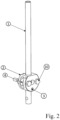
- Bestandteile der Energieabsorptionsvorrichtung in einer Perspektivansicht und
- Figur 3:
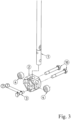
- eine Explosionsdarstellung der Energieabsorptionsvorrichtung.
- Die in den Figuren dargestellte Energieabsorptionsvorrichtung für ein Sitzsystem eines Hubschraubers umfasst einen als Rohr ausgebildeten Energieabsorber 1, eine Einwirkungseinrichtung sowie ein Verbindungselement 6.
- Das Verbindungselement 6 wird an eine in den Figuren nicht dargestellte Sitzschale angebracht, während die noch nachfolgend näher beschriebene Einwirkungseinrichtung mit einem Rahmen eines Sitzsystems verbunden wird, zu dem der Energieabsorber 1 parallel verläuft. Der Energieabsorber 1 ist jedenfalls über eine Schraube 11 mit einem Bügel 5 des Verbindungselements 6 verbunden.
- Wie insbesondere aus der Explosionsdarstellung der
Figur 3 hervorgeht, umfasst die Einwirkungseinrichtung einen Käfig 2 sowie zwei drehbar an dem Käfig 2 gelagerte Rollen 4. Die Rollen 4 werden mittels Schrauben 10 in dem Käfig 2 drehbar gelagert, wobei die Schrauben 10 auch gleichzeitig zur Anbringung des Käfigs 2 an einem nicht dargestellten Rahmen eines Sitzsystems verwendet werden können. Zwischen den Rollen 4 ist ein Spalt ausgebildet. Im montierten Zustand ist der Energieabsorber 1 in dem Käfig 2 so eingelassen, dass die Rollen 4 jeweils in einer Auskerbung im Energieabsorber 1 angeordnet sind. - Darüber hinaus ist ein Fixierungselement 3 vorgesehen, dessen zwei Sollbruchstellen 7 in
Figur 3 erkennbar sind. In dem in denFiguren 1 und2 dargestellten Montagezustand durchgreift das als Scherbolzen ausgebildete Fixierungselement 3 eine Öffnung in dem Energieabsorber 1, während das Fixierungselement 3 mit seinen Enden im Käfig 2 gelagert ist. Das Fixierungselement 3 ist so dimensioniert, dass sich der Energieabsorber 1 und der Käfig 2 während eines normalen Betriebs des Hubschraubers (Vibrationen oder harte Landungen) nicht relativ zueinander bewegen können. - Die Sollbruchstellen 7 am Fixierungselement 3 sind hingegen so dimensioniert, dass im Falle eines Absturzes das Fixierungselement 3 an den Sollbruchstellen 7 brechen kann. Durch die Sollbruchstellen 7 wird also eine kritische Auslösekraft vorgegeben. Nach dem Auslösen/Brechen wird dann der über das Verbindungselement 6 mit einer Sitzschale verbundene Energieabsorber 1 durch den Käfig 2 gezogen, wobei während dieser Relativbewegung zwischen Energieabsorber 1 und Käfig 2 die Rollen 4 den Energieabsorber 1 platt walzen, sodass die von einem auf der Sitzschale sitzenden Insassen aufgebrachte Energie absorbiert wird.
- Mit dem Sollbruchstellen 7 aufweisenden Fixierungselement 3 wird also ein separates Bauteil bereitgestellt, über welches die kritische Auslösekraft unabhängig von den bei der Energieabsorption mitwirkenden Bauteilen eingestellt werden kann.
-
- 1
- Energieabsorber
- 2
- Käfig
- 3
- Fixierungselement
- 4
- Rolle
- 5
- Bügel
- 6
- Verbindungselement
- 7
- Sollbruchstelle
- 10
- Schraube
- 11
- Schraube
Claims (7)
- Energieabsorptionsvorrichtung für einen Sitz eines Fahrzeugs, insbesondere eines Luftfahrzeuges wie Hubschrauber, mit- mindestens einer Einwirkungseinrichtung (2, 4) und- mindestens einem mit der Einwirkungseinrichtung (2, 4) gekoppelten Energieabsorber (1), wobei die Einwirkungseinrichtung (2, 4) zumindest im Hochlastfall zur Energieabsorption auf den Energieabsorber (1) einwirkt, wobeidie Einwirkungseinrichtung (2, 4) einen Spalt mit einer Spaltbreite ausbildet und der Energieabsorber (1) durch den Spalt hindurchgeführt ist und außerhalb der Einwirkungseinrichtung (2, 4) eine Querschnittsbreite aufweist, die größer als die Spaltbreite ist, wobei in einem Hochlastfall sich der Energieabsorber (1) relativ zu der Einwirkungseinrichtung (2, 4) bewegt, wobei der Energieabsorber (1) durch Verformung Energie abbaut,dadurch gekennzeichnet, dassder Energieabsorber (1) und die Einwirkungseinrichtung (2, 4) im Ausgangszustand über ein Fixierungselement (3) so miteinander verbunden sind, dass eine Relativbewegung zwischen dem Energieabsorber (1) und der Einwirkungseinrichtung (2, 4) im Normalbetrieb minimiert oder verhindert ist, wobei das Fixierungselement (3) mindestens eine Sollbruchstelle (7) aufweist, an der das Fixierungselement (3) im Hochlastfall bricht, so dass die Einwirkungseinrichtung (2, 4) und der Energieabsorber (1) im Hochlastfall relativ zueinander bewegbar sind.
- Energieabsorptionsvorrichtung nach Anspruch 1, wobei das Fixierungselement (3) als Scherbolzen ausgebildet ist.
- Energieabsorptionsvorrichtung nach Anspruch 1 oder 2, wobei der Energieabsorber (1) als Rohr ausgebildet ist.
- Energieabsorptionsvorrichtung nach einem der vorhergehenden Ansprüche, wobei die Einwirkungseinrichtung einen Käfig (2) umfasst.
- Energieabsorptionsvorrichtung nach Anspruch 4, wobei mindestens eine Rolle (4) als Bestandteil der Einwirkungseinrichtung drehbar an dem Käfig (2) gelagert ist.
- Energieabsorptionsvorrichtung nach Anspruch 3 oder einem auf den Anspruch 3 rückbezogenen Anspruch, wobei ein Durchmesser des Rohrs außerhalb der Einwirkungseinrichtung (2, 4) größer ist als innerhalb der Einwirkungseinrichtung (2, 4).
- Sitzsystem für Fahrzeuge, insbesondere für Luftfahrzeuge wie Hubschrauber, mit- einem in dem Fahrzeug befestigbaren Rahmen,- einem an dem Rahmen verschiebbar gelagerten Sitz und- einer Energieabsorptionsvorrichtung nach einem der vorhergehenden Ansprüche, wobeider Sitz so mit einem Element der Energieabsorptionsvorrichtung fest verbundenen ist, dass im Falle einer durch einen Hochlastfall verursachten Beschleunigung eine Verschiebung des Sitzes entlang des Rahmens durch die Energieabsorptionsvorrichtung gedämpft wird, indem die Einwirkungseinrichtung (2, 4) zur Energieabsorption auf den Energieabsorber (1) einwirkt.
Priority Applications (2)
| Application Number | Priority Date | Filing Date | Title |
|---|---|---|---|
| EP21159925.3A EP4053017B1 (de) | 2021-03-01 | 2021-03-01 | Energieabsorptionsvorrichtung für einen sitz eines fahrzeugs und sitzsystem mit einer solchen energieabsorptionsvorrichtung |
| US17/682,090 US11845556B2 (en) | 2021-03-01 | 2022-02-28 | Energy absorption device for a seat of a vehicle and seating system with such an energy absorption device |
Applications Claiming Priority (1)
| Application Number | Priority Date | Filing Date | Title |
|---|---|---|---|
| EP21159925.3A EP4053017B1 (de) | 2021-03-01 | 2021-03-01 | Energieabsorptionsvorrichtung für einen sitz eines fahrzeugs und sitzsystem mit einer solchen energieabsorptionsvorrichtung |
Publications (3)
| Publication Number | Publication Date |
|---|---|
| EP4053017A1 EP4053017A1 (de) | 2022-09-07 |
| EP4053017C0 EP4053017C0 (de) | 2024-07-31 |
| EP4053017B1 true EP4053017B1 (de) | 2024-07-31 |
Family
ID=74844820
Family Applications (1)
| Application Number | Title | Priority Date | Filing Date |
|---|---|---|---|
| EP21159925.3A Active EP4053017B1 (de) | 2021-03-01 | 2021-03-01 | Energieabsorptionsvorrichtung für einen sitz eines fahrzeugs und sitzsystem mit einer solchen energieabsorptionsvorrichtung |
Country Status (2)
| Country | Link |
|---|---|
| US (1) | US11845556B2 (de) |
| EP (1) | EP4053017B1 (de) |
Families Citing this family (3)
| Publication number | Priority date | Publication date | Assignee | Title |
|---|---|---|---|---|
| CN117246203B (zh) * | 2023-10-08 | 2025-10-31 | 安道拓(重庆)汽车部件有限公司 | 一种零重力座椅溃缩机构 |
| DE202024104503U1 (de) | 2024-08-09 | 2024-08-23 | Autoflug Gmbh | Energieabsorptionsvorrichtung für einen Sitz eines Fahrzeugs |
| DE102024130468A1 (de) * | 2024-10-21 | 2026-04-23 | Volocopter Technologies Gmbh | Absturzerkennungsvorrichtung, Luftfahrzeug mit einer solchen Absturzerkennungsvorrichtung und Verfahren zur Erkennung eines Luftfahrzeugabsturzes |
Family Cites Families (15)
| Publication number | Priority date | Publication date | Assignee | Title |
|---|---|---|---|---|
| FR2734876B1 (fr) * | 1995-05-31 | 1997-07-11 | Sicma Aero Seat | Piece de liaison a absorption d'energie et siege d'aeronef equipe d'une telle piece |
| US5657950A (en) * | 1995-08-14 | 1997-08-19 | Industrial Technology Research Intitute | Backward-leaning-movement seat leg structure |
| GB0025188D0 (en) * | 2000-10-13 | 2000-11-29 | Baker Martin Aircraft Co | Energy absorber |
| US7878312B2 (en) * | 2006-05-31 | 2011-02-01 | University Of Maryland | Adaptive energy absorption system for a vehicle seat |
| US7822522B2 (en) * | 2006-05-31 | 2010-10-26 | Techno-Sciences, Inc. (corporation) | Adaptive energy absorption system for a vehicle seat |
| US8469400B2 (en) * | 2009-02-23 | 2013-06-25 | Amsafe, Inc. (Phoenix Group) | Seat harness pretensioner |
| FR2950607B1 (fr) * | 2009-09-30 | 2011-08-26 | Eurocopter France | Siege pour appareils volants motorises, integrant des moyens de protection du passager en cas de crash |
| EP2566720B1 (de) * | 2010-05-03 | 2017-09-06 | Zodiac Seats US LLC | Sitzt montagegestell |
| CA2706298A1 (en) * | 2010-06-01 | 2011-12-01 | Allen-Vanguard Corporation | Improved vehicle seat |
| EP2790959B1 (de) * | 2011-12-16 | 2018-05-16 | Wichita State University | Energieabsorbierende sitzvorrichtung |
| DE102014111994A1 (de) | 2014-08-21 | 2016-02-25 | Autoflug Gmbh | Sitzsystem für Hubschrauber mit einstellbarer Energieabsorptionsanordnung |
| US10272863B1 (en) * | 2014-10-31 | 2019-04-30 | Safe, Inc. | Structure and method for protecting a passenger during a crash |
| US10093203B1 (en) * | 2015-09-17 | 2018-10-09 | Armorworks Holdings, Inc. | Seating system with automatic weight compensating energy attenuation |
| CN108248868B (zh) * | 2017-12-18 | 2020-11-03 | 江西冠一通用飞机有限公司 | 一种通航飞机用飞行员座椅防撞保护装置 |
| US20200339264A1 (en) * | 2019-04-25 | 2020-10-29 | Crane Co. | Piston device for use with aircraft seat |
-
2021
- 2021-03-01 EP EP21159925.3A patent/EP4053017B1/de active Active
-
2022
- 2022-02-28 US US17/682,090 patent/US11845556B2/en active Active
Also Published As
| Publication number | Publication date |
|---|---|
| EP4053017C0 (de) | 2024-07-31 |
| US11845556B2 (en) | 2023-12-19 |
| EP4053017A1 (de) | 2022-09-07 |
| US20220274710A1 (en) | 2022-09-01 |
Similar Documents
| Publication | Publication Date | Title |
|---|---|---|
| EP2509867B1 (de) | Sitzvorrichtung mit energieabsorptionseinheit | |
| DE69506311T2 (de) | Fahrzeugsitz | |
| DE60107793T2 (de) | Energieabsorber | |
| DE10003853B4 (de) | Fahrzeugsitz mit einer beweglichen Sicherheitstraverse | |
| EP2195192B1 (de) | Kopfstütze für ein fahrzeug | |
| EP3164331B1 (de) | Flugzeugsitzvorrichtung | |
| DE102021202560B4 (de) | Hebel für einen Fahrzeugsitz | |
| DE3152570C2 (de) | ||
| EP3672830B1 (de) | Fahrzeugsitzkonsole | |
| EP2188149B1 (de) | Kopfstütze für ein fahrzeug | |
| EP4053017A1 (de) | Energieabsorptionsvorrichtung für einen sitz eines fahrzeugs und sitzsystem mit einer solchen energieabsorptionsvorrichtung | |
| DE60206695T2 (de) | Kraftfahrzeug Insassenschutzsystem | |
| WO2013079185A1 (de) | Fahrzeugsitz mit deformationseinrichtung | |
| DE102016217405B3 (de) | Energieabsorber für einen fahrzeugsitz sowie lineareinsteller für einen fahrzeugsitz mit einem energieabsorber | |
| EP3183171B1 (de) | Sitzsystem für hubschrauber mit einstellbarer energieabsorptionsanordnung | |
| EP1202871B1 (de) | Rückenlehne für einen Fahrzeugsitz mit einer integrierten Schutzeinrichtung | |
| DE102017117175A1 (de) | Flugzeugsitzvorrichtung | |
| EP3609735B1 (de) | Stossabsorbierender sitz mit boden- oder deckenmontierten dämpfungsgliedern | |
| DE102013113393A1 (de) | Verbindungsanordnung und Struktur | |
| DE102013202609A1 (de) | Fahrzeugträgeranordnung | |
| EP3484768B1 (de) | Flugzeugsitz mit einer sitzbaugruppe | |
| DE20107765U1 (de) | Schutzeinrichtung gegen unfallbedingte Verletzungen eines Benutzers eines Fahrzeugsitzes und mechanisches System zur Detektierung eines Fahrzeugaufpralls | |
| DE202024104503U1 (de) | Energieabsorptionsvorrichtung für einen Sitz eines Fahrzeugs | |
| DE102012022235B4 (de) | Kopfstütze für einen Fahrzeugsitz und Antriebseinrichtung | |
| DE29915719U1 (de) | Fahrzeugsitz mit integrierter Schutzeinrichtung |
Legal Events
| Date | Code | Title | Description |
|---|---|---|---|
| PUAI | Public reference made under article 153(3) epc to a published international application that has entered the european phase |
Free format text: ORIGINAL CODE: 0009012 |
|
| STAA | Information on the status of an ep patent application or granted ep patent |
Free format text: STATUS: THE APPLICATION HAS BEEN PUBLISHED |
|
| AK | Designated contracting states |
Kind code of ref document: A1 Designated state(s): AL AT BE BG CH CY CZ DE DK EE ES FI FR GB GR HR HU IE IS IT LI LT LU LV MC MK MT NL NO PL PT RO RS SE SI SK SM TR |
|
| STAA | Information on the status of an ep patent application or granted ep patent |
Free format text: STATUS: REQUEST FOR EXAMINATION WAS MADE |
|
| 17P | Request for examination filed |
Effective date: 20220909 |
|
| RBV | Designated contracting states (corrected) |
Designated state(s): AL AT BE BG CH CY CZ DE DK EE ES FI FR GB GR HR HU IE IS IT LI LT LU LV MC MK MT NL NO PL PT RO RS SE SI SK SM TR |
|
| STAA | Information on the status of an ep patent application or granted ep patent |
Free format text: STATUS: EXAMINATION IS IN PROGRESS |
|
| 17Q | First examination report despatched |
Effective date: 20230817 |
|
| GRAP | Despatch of communication of intention to grant a patent |
Free format text: ORIGINAL CODE: EPIDOSNIGR1 |
|
| STAA | Information on the status of an ep patent application or granted ep patent |
Free format text: STATUS: GRANT OF PATENT IS INTENDED |
|
| INTG | Intention to grant announced |
Effective date: 20240527 |
|
| GRAS | Grant fee paid |
Free format text: ORIGINAL CODE: EPIDOSNIGR3 |
|
| GRAA | (expected) grant |
Free format text: ORIGINAL CODE: 0009210 |
|
| STAA | Information on the status of an ep patent application or granted ep patent |
Free format text: STATUS: THE PATENT HAS BEEN GRANTED |
|
| AK | Designated contracting states |
Kind code of ref document: B1 Designated state(s): AL AT BE BG CH CY CZ DE DK EE ES FI FR GB GR HR HU IE IS IT LI LT LU LV MC MK MT NL NO PL PT RO RS SE SI SK SM TR |
|
| REG | Reference to a national code |
Ref country code: CH Ref legal event code: EP Ref country code: GB Ref legal event code: FG4D Free format text: NOT ENGLISH |
|
| REG | Reference to a national code |
Ref country code: DE Ref legal event code: R096 Ref document number: 502021004540 Country of ref document: DE |
|
| REG | Reference to a national code |
Ref country code: IE Ref legal event code: FG4D Free format text: LANGUAGE OF EP DOCUMENT: GERMAN |
|
| U01 | Request for unitary effect filed |
Effective date: 20240826 |
|
| U07 | Unitary effect registered |
Designated state(s): AT BE BG DE DK EE FI FR IT LT LU LV MT NL PT RO SE SI Effective date: 20240904 |
|
| PG25 | Lapsed in a contracting state [announced via postgrant information from national office to epo] |
Ref country code: NO Free format text: LAPSE BECAUSE OF FAILURE TO SUBMIT A TRANSLATION OF THE DESCRIPTION OR TO PAY THE FEE WITHIN THE PRESCRIBED TIME-LIMIT Effective date: 20241031 |
|
| PG25 | Lapsed in a contracting state [announced via postgrant information from national office to epo] |
Ref country code: GR Free format text: LAPSE BECAUSE OF FAILURE TO SUBMIT A TRANSLATION OF THE DESCRIPTION OR TO PAY THE FEE WITHIN THE PRESCRIBED TIME-LIMIT Effective date: 20241101 Ref country code: PL Free format text: LAPSE BECAUSE OF FAILURE TO SUBMIT A TRANSLATION OF THE DESCRIPTION OR TO PAY THE FEE WITHIN THE PRESCRIBED TIME-LIMIT Effective date: 20240731 |
|
| PG25 | Lapsed in a contracting state [announced via postgrant information from national office to epo] |
Ref country code: IS Free format text: LAPSE BECAUSE OF FAILURE TO SUBMIT A TRANSLATION OF THE DESCRIPTION OR TO PAY THE FEE WITHIN THE PRESCRIBED TIME-LIMIT Effective date: 20241130 |
|
| PG25 | Lapsed in a contracting state [announced via postgrant information from national office to epo] |
Ref country code: HR Free format text: LAPSE BECAUSE OF FAILURE TO SUBMIT A TRANSLATION OF THE DESCRIPTION OR TO PAY THE FEE WITHIN THE PRESCRIBED TIME-LIMIT Effective date: 20240731 |
|
| PG25 | Lapsed in a contracting state [announced via postgrant information from national office to epo] |
Ref country code: ES Free format text: LAPSE BECAUSE OF FAILURE TO SUBMIT A TRANSLATION OF THE DESCRIPTION OR TO PAY THE FEE WITHIN THE PRESCRIBED TIME-LIMIT Effective date: 20240731 Ref country code: RS Free format text: LAPSE BECAUSE OF FAILURE TO SUBMIT A TRANSLATION OF THE DESCRIPTION OR TO PAY THE FEE WITHIN THE PRESCRIBED TIME-LIMIT Effective date: 20241031 |
|
| PG25 | Lapsed in a contracting state [announced via postgrant information from national office to epo] |
Ref country code: RS Free format text: LAPSE BECAUSE OF FAILURE TO SUBMIT A TRANSLATION OF THE DESCRIPTION OR TO PAY THE FEE WITHIN THE PRESCRIBED TIME-LIMIT Effective date: 20241031 Ref country code: PL Free format text: LAPSE BECAUSE OF FAILURE TO SUBMIT A TRANSLATION OF THE DESCRIPTION OR TO PAY THE FEE WITHIN THE PRESCRIBED TIME-LIMIT Effective date: 20240731 Ref country code: NO Free format text: LAPSE BECAUSE OF FAILURE TO SUBMIT A TRANSLATION OF THE DESCRIPTION OR TO PAY THE FEE WITHIN THE PRESCRIBED TIME-LIMIT Effective date: 20241031 Ref country code: IS Free format text: LAPSE BECAUSE OF FAILURE TO SUBMIT A TRANSLATION OF THE DESCRIPTION OR TO PAY THE FEE WITHIN THE PRESCRIBED TIME-LIMIT Effective date: 20241130 Ref country code: HR Free format text: LAPSE BECAUSE OF FAILURE TO SUBMIT A TRANSLATION OF THE DESCRIPTION OR TO PAY THE FEE WITHIN THE PRESCRIBED TIME-LIMIT Effective date: 20240731 Ref country code: GR Free format text: LAPSE BECAUSE OF FAILURE TO SUBMIT A TRANSLATION OF THE DESCRIPTION OR TO PAY THE FEE WITHIN THE PRESCRIBED TIME-LIMIT Effective date: 20241101 Ref country code: ES Free format text: LAPSE BECAUSE OF FAILURE TO SUBMIT A TRANSLATION OF THE DESCRIPTION OR TO PAY THE FEE WITHIN THE PRESCRIBED TIME-LIMIT Effective date: 20240731 |
|
| PG25 | Lapsed in a contracting state [announced via postgrant information from national office to epo] |
Ref country code: SM Free format text: LAPSE BECAUSE OF FAILURE TO SUBMIT A TRANSLATION OF THE DESCRIPTION OR TO PAY THE FEE WITHIN THE PRESCRIBED TIME-LIMIT Effective date: 20240731 |
|
| PG25 | Lapsed in a contracting state [announced via postgrant information from national office to epo] |
Ref country code: CZ Free format text: LAPSE BECAUSE OF FAILURE TO SUBMIT A TRANSLATION OF THE DESCRIPTION OR TO PAY THE FEE WITHIN THE PRESCRIBED TIME-LIMIT Effective date: 20240731 |
|
| PG25 | Lapsed in a contracting state [announced via postgrant information from national office to epo] |
Ref country code: SK Free format text: LAPSE BECAUSE OF FAILURE TO SUBMIT A TRANSLATION OF THE DESCRIPTION OR TO PAY THE FEE WITHIN THE PRESCRIBED TIME-LIMIT Effective date: 20240731 |
|
| U20 | Renewal fee for the european patent with unitary effect paid |
Year of fee payment: 5 Effective date: 20250325 |
|
| PLBE | No opposition filed within time limit |
Free format text: ORIGINAL CODE: 0009261 |
|
| STAA | Information on the status of an ep patent application or granted ep patent |
Free format text: STATUS: NO OPPOSITION FILED WITHIN TIME LIMIT |
|
| 26N | No opposition filed |
Effective date: 20250501 |
|
| PGFP | Annual fee paid to national office [announced via postgrant information from national office to epo] |
Ref country code: CH Payment date: 20250401 Year of fee payment: 5 |
|
| PG25 | Lapsed in a contracting state [announced via postgrant information from national office to epo] |
Ref country code: MC Free format text: LAPSE BECAUSE OF FAILURE TO SUBMIT A TRANSLATION OF THE DESCRIPTION OR TO PAY THE FEE WITHIN THE PRESCRIBED TIME-LIMIT Effective date: 20240731 |
|
| GBPC | Gb: european patent ceased through non-payment of renewal fee |
Effective date: 20250301 |
|
| PG25 | Lapsed in a contracting state [announced via postgrant information from national office to epo] |
Ref country code: GB Free format text: LAPSE BECAUSE OF NON-PAYMENT OF DUE FEES Effective date: 20250301 |
|
| PG25 | Lapsed in a contracting state [announced via postgrant information from national office to epo] |
Ref country code: IE Free format text: LAPSE BECAUSE OF NON-PAYMENT OF DUE FEES Effective date: 20250301 |
|
| U1N | Appointed representative for the unitary patent procedure changed after the registration of the unitary effect |
Representative=s name: FEUCKER, MAX MARTIN; DE |
|
| REG | Reference to a national code |
Ref country code: CH Ref legal event code: U11 Free format text: ST27 STATUS EVENT CODE: U-0-0-U10-U11 (AS PROVIDED BY THE NATIONAL OFFICE) Effective date: 20260401 |
|
| U20 | Renewal fee for the european patent with unitary effect paid |
Year of fee payment: 6 Effective date: 20260327 |