EP4047248B1 - Achsanordnung mit sektornocken - Google Patents
Achsanordnung mit sektornocken Download PDFInfo
- Publication number
- EP4047248B1 EP4047248B1 EP22157703.4A EP22157703A EP4047248B1 EP 4047248 B1 EP4047248 B1 EP 4047248B1 EP 22157703 A EP22157703 A EP 22157703A EP 4047248 B1 EP4047248 B1 EP 4047248B1
- Authority
- EP
- European Patent Office
- Prior art keywords
- shift
- shaft
- gear
- axis
- drive gear
- Prior art date
- Legal status (The legal status is an assumption and is not a legal conclusion. Google has not performed a legal analysis and makes no representation as to the accuracy of the status listed.)
- Active
Links
Images



Classifications
-
- F—MECHANICAL ENGINEERING; LIGHTING; HEATING; WEAPONS; BLASTING
- F16—ENGINEERING ELEMENTS AND UNITS; GENERAL MEASURES FOR PRODUCING AND MAINTAINING EFFECTIVE FUNCTIONING OF MACHINES OR INSTALLATIONS; THERMAL INSULATION IN GENERAL
- F16H—GEARING
- F16H63/00—Control outputs from the control unit to change-speed- or reversing-gearings for conveying rotary motion or to other devices than the final output mechanism
- F16H63/02—Final output mechanisms therefor; Actuating means for the final output mechanisms
- F16H63/30—Constructional features of the final output mechanisms
- F16H63/32—Gear shift yokes, e.g. shift forks
-
- F—MECHANICAL ENGINEERING; LIGHTING; HEATING; WEAPONS; BLASTING
- F16—ENGINEERING ELEMENTS AND UNITS; GENERAL MEASURES FOR PRODUCING AND MAINTAINING EFFECTIVE FUNCTIONING OF MACHINES OR INSTALLATIONS; THERMAL INSULATION IN GENERAL
- F16H—GEARING
- F16H3/00—Toothed gearings for conveying rotary motion with variable gear ratio or for reversing rotary motion
- F16H3/02—Toothed gearings for conveying rotary motion with variable gear ratio or for reversing rotary motion without gears having orbital motion
- F16H3/08—Toothed gearings for conveying rotary motion with variable gear ratio or for reversing rotary motion without gears having orbital motion exclusively or essentially with continuously meshing gears, that can be disengaged from their shafts
- F16H3/087—Toothed gearings for conveying rotary motion with variable gear ratio or for reversing rotary motion without gears having orbital motion exclusively or essentially with continuously meshing gears, that can be disengaged from their shafts characterised by the disposition of the gears
-
- B—PERFORMING OPERATIONS; TRANSPORTING
- B60—VEHICLES IN GENERAL
- B60K—ARRANGEMENT OR MOUNTING OF PROPULSION UNITS OR OF TRANSMISSIONS IN VEHICLES; ARRANGEMENT OR MOUNTING OF PLURAL DIVERSE PRIME-MOVERS IN VEHICLES; AUXILIARY DRIVES FOR VEHICLES; INSTRUMENTATION OR DASHBOARDS FOR VEHICLES; ARRANGEMENTS IN CONNECTION WITH COOLING, AIR INTAKE, GAS EXHAUST OR FUEL SUPPLY OF PROPULSION UNITS IN VEHICLES
- B60K17/00—Arrangement or mounting of transmissions in vehicles
- B60K17/02—Arrangement or mounting of transmissions in vehicles characterised by arrangement, location, or kind of clutch
-
- B—PERFORMING OPERATIONS; TRANSPORTING
- B60—VEHICLES IN GENERAL
- B60K—ARRANGEMENT OR MOUNTING OF PROPULSION UNITS OR OF TRANSMISSIONS IN VEHICLES; ARRANGEMENT OR MOUNTING OF PLURAL DIVERSE PRIME-MOVERS IN VEHICLES; AUXILIARY DRIVES FOR VEHICLES; INSTRUMENTATION OR DASHBOARDS FOR VEHICLES; ARRANGEMENTS IN CONNECTION WITH COOLING, AIR INTAKE, GAS EXHAUST OR FUEL SUPPLY OF PROPULSION UNITS IN VEHICLES
- B60K17/00—Arrangement or mounting of transmissions in vehicles
- B60K17/04—Arrangement or mounting of transmissions in vehicles characterised by arrangement, location or kind of gearing
- B60K17/06—Arrangement or mounting of transmissions in vehicles characterised by arrangement, location or kind of gearing of change-speed gearing
- B60K17/08—Arrangement or mounting of transmissions in vehicles characterised by arrangement, location or kind of gearing of change-speed gearing of mechanical type
-
- F—MECHANICAL ENGINEERING; LIGHTING; HEATING; WEAPONS; BLASTING
- F16—ENGINEERING ELEMENTS AND UNITS; GENERAL MEASURES FOR PRODUCING AND MAINTAINING EFFECTIVE FUNCTIONING OF MACHINES OR INSTALLATIONS; THERMAL INSULATION IN GENERAL
- F16H—GEARING
- F16H63/00—Control outputs from the control unit to change-speed- or reversing-gearings for conveying rotary motion or to other devices than the final output mechanism
- F16H63/02—Final output mechanisms therefor; Actuating means for the final output mechanisms
- F16H63/08—Multiple final output mechanisms being moved by a single common final actuating mechanism
- F16H63/16—Multiple final output mechanisms being moved by a single common final actuating mechanism the final output mechanisms being successively actuated by progressive movement of the final actuating mechanism
- F16H63/18—Multiple final output mechanisms being moved by a single common final actuating mechanism the final output mechanisms being successively actuated by progressive movement of the final actuating mechanism the final actuating mechanism comprising cams
-
- B—PERFORMING OPERATIONS; TRANSPORTING
- B60—VEHICLES IN GENERAL
- B60K—ARRANGEMENT OR MOUNTING OF PROPULSION UNITS OR OF TRANSMISSIONS IN VEHICLES; ARRANGEMENT OR MOUNTING OF PLURAL DIVERSE PRIME-MOVERS IN VEHICLES; AUXILIARY DRIVES FOR VEHICLES; INSTRUMENTATION OR DASHBOARDS FOR VEHICLES; ARRANGEMENTS IN CONNECTION WITH COOLING, AIR INTAKE, GAS EXHAUST OR FUEL SUPPLY OF PROPULSION UNITS IN VEHICLES
- B60K1/00—Arrangement or mounting of electrical propulsion units
-
- B—PERFORMING OPERATIONS; TRANSPORTING
- B60—VEHICLES IN GENERAL
- B60K—ARRANGEMENT OR MOUNTING OF PROPULSION UNITS OR OF TRANSMISSIONS IN VEHICLES; ARRANGEMENT OR MOUNTING OF PLURAL DIVERSE PRIME-MOVERS IN VEHICLES; AUXILIARY DRIVES FOR VEHICLES; INSTRUMENTATION OR DASHBOARDS FOR VEHICLES; ARRANGEMENTS IN CONNECTION WITH COOLING, AIR INTAKE, GAS EXHAUST OR FUEL SUPPLY OF PROPULSION UNITS IN VEHICLES
- B60K1/00—Arrangement or mounting of electrical propulsion units
- B60K2001/001—Arrangement or mounting of electrical propulsion units one motor mounted on a propulsion axle for rotating right and left wheels of this axle
-
- F—MECHANICAL ENGINEERING; LIGHTING; HEATING; WEAPONS; BLASTING
- F16—ENGINEERING ELEMENTS AND UNITS; GENERAL MEASURES FOR PRODUCING AND MAINTAINING EFFECTIVE FUNCTIONING OF MACHINES OR INSTALLATIONS; THERMAL INSULATION IN GENERAL
- F16H—GEARING
- F16H63/00—Control outputs from the control unit to change-speed- or reversing-gearings for conveying rotary motion or to other devices than the final output mechanism
- F16H63/02—Final output mechanisms therefor; Actuating means for the final output mechanisms
- F16H63/30—Constructional features of the final output mechanisms
- F16H2063/3079—Shift rod assembly, e.g. supporting, assembly or manufacturing of shift rails or rods; Special details thereof
-
- F—MECHANICAL ENGINEERING; LIGHTING; HEATING; WEAPONS; BLASTING
- F16—ENGINEERING ELEMENTS AND UNITS; GENERAL MEASURES FOR PRODUCING AND MAINTAINING EFFECTIVE FUNCTIONING OF MACHINES OR INSTALLATIONS; THERMAL INSULATION IN GENERAL
- F16H—GEARING
- F16H63/00—Control outputs from the control unit to change-speed- or reversing-gearings for conveying rotary motion or to other devices than the final output mechanism
- F16H63/02—Final output mechanisms therefor; Actuating means for the final output mechanisms
- F16H63/30—Constructional features of the final output mechanisms
- F16H63/32—Gear shift yokes, e.g. shift forks
- F16H2063/321—Gear shift yokes, e.g. shift forks characterised by the interface between fork body and shift rod, e.g. fixing means, bushes, cams or pins
-
- F—MECHANICAL ENGINEERING; LIGHTING; HEATING; WEAPONS; BLASTING
- F16—ENGINEERING ELEMENTS AND UNITS; GENERAL MEASURES FOR PRODUCING AND MAINTAINING EFFECTIVE FUNCTIONING OF MACHINES OR INSTALLATIONS; THERMAL INSULATION IN GENERAL
- F16H—GEARING
- F16H2200/00—Transmissions for multiple ratios
- F16H2200/0021—Transmissions for multiple ratios specially adapted for electric vehicles
-
- F—MECHANICAL ENGINEERING; LIGHTING; HEATING; WEAPONS; BLASTING
- F16—ENGINEERING ELEMENTS AND UNITS; GENERAL MEASURES FOR PRODUCING AND MAINTAINING EFFECTIVE FUNCTIONING OF MACHINES OR INSTALLATIONS; THERMAL INSULATION IN GENERAL
- F16H—GEARING
- F16H2200/00—Transmissions for multiple ratios
- F16H2200/003—Transmissions for multiple ratios characterised by the number of forward speeds
- F16H2200/0039—Transmissions for multiple ratios characterised by the number of forward speeds the gear ratios comprising three forward speeds
-
- F—MECHANICAL ENGINEERING; LIGHTING; HEATING; WEAPONS; BLASTING
- F16—ENGINEERING ELEMENTS AND UNITS; GENERAL MEASURES FOR PRODUCING AND MAINTAINING EFFECTIVE FUNCTIONING OF MACHINES OR INSTALLATIONS; THERMAL INSULATION IN GENERAL
- F16H—GEARING
- F16H2702/00—Combinations of two or more transmissions
- F16H2702/02—Mechanical transmissions with planetary gearing combined with one or more other mechanical transmissions
- F16H2702/04—Combinations of a speed-change mechanism without planetary gearing with a differential for driving a vehicle drive axle
-
- F—MECHANICAL ENGINEERING; LIGHTING; HEATING; WEAPONS; BLASTING
- F16—ENGINEERING ELEMENTS AND UNITS; GENERAL MEASURES FOR PRODUCING AND MAINTAINING EFFECTIVE FUNCTIONING OF MACHINES OR INSTALLATIONS; THERMAL INSULATION IN GENERAL
- F16H—GEARING
- F16H3/00—Toothed gearings for conveying rotary motion with variable gear ratio or for reversing rotary motion
- F16H3/02—Toothed gearings for conveying rotary motion with variable gear ratio or for reversing rotary motion without gears having orbital motion
- F16H3/08—Toothed gearings for conveying rotary motion with variable gear ratio or for reversing rotary motion without gears having orbital motion exclusively or essentially with continuously meshing gears, that can be disengaged from their shafts
- F16H3/087—Toothed gearings for conveying rotary motion with variable gear ratio or for reversing rotary motion without gears having orbital motion exclusively or essentially with continuously meshing gears, that can be disengaged from their shafts characterised by the disposition of the gears
- F16H3/089—Toothed gearings for conveying rotary motion with variable gear ratio or for reversing rotary motion without gears having orbital motion exclusively or essentially with continuously meshing gears, that can be disengaged from their shafts characterised by the disposition of the gears all of the meshing gears being supported by a pair of parallel shafts, one being the input shaft and the other the output shaft, there being no countershaft involved
-
- F—MECHANICAL ENGINEERING; LIGHTING; HEATING; WEAPONS; BLASTING
- F16—ENGINEERING ELEMENTS AND UNITS; GENERAL MEASURES FOR PRODUCING AND MAINTAINING EFFECTIVE FUNCTIONING OF MACHINES OR INSTALLATIONS; THERMAL INSULATION IN GENERAL
- F16H—GEARING
- F16H37/00—Combinations of mechanical gearings, not provided for in groups F16H1/00 - F16H35/00
- F16H37/02—Combinations of mechanical gearings, not provided for in groups F16H1/00 - F16H35/00 comprising essentially only toothed or friction gearings
- F16H37/04—Combinations of toothed gearings only
- F16H37/042—Combinations of toothed gearings only change gear transmissions in group arrangement
Definitions
- This relates to an axle assembly that has a sector cam that controls movement of at least one shift collar.
- a drivetrain assembly having a shift mechanism that includes a sector cam is disclosed in U.S. Patent No. 10,900,564 .
- GB723073A discloses, in the opinion of the Examining Division of the European Patent Office, an assembly comprising: a first shaft that is rotatable about a first axis; a second shaft that is rotatable about a second axis; a first set of gears that is rotatable about the first axis; and a second set of gears that is rotatable about the second axis, wherein each member of the second set of gears meshes with a different member of the first set of gears; a first shift collar that is rotatable about the first axis with the first shaft and moveable along the first axis with respect to the first shaft to selectively connect a member of the first set of gears to the first shaft; a second shift collar that is rotatable about the second axis with the second shaft and moveable along the second axis with respect to the second shaft to selectively connect a member of the second set of gears to the second shaft; and a sector cam that is rotatable
- EP 2 752 325 A1 discloses, in the opinion of the Examining Division of the European Patent Office, an axle assembly comprising: a first shaft that is rotatable about a first axis; a second shaft that is rotatable about a second axis; a first set of gears that is rotatable about the first axis; and a second set of gears that is rotatable about the second axis, wherein each member of the second set of gears meshes with a different member of the first set of gears; a first shift collar that is rotatable about the first axis with the first shaft and moveable along the first axis with respect to the first shaft to selectively connect a member of the first set of gears to the first shaft; a second shift collar that is rotatable about the second axis with the second shaft and moveable along the second axis with respect to the second shaft to selectively connect a member of the second set of gears to the second shaft.
- An axle assembly is provided as set out in claim 1.
- the axle assembly 10 may be provided with a vehicle like a truck, bus, farm equipment, mining equipment, military transport or weaponry vehicle, or cargo loading equipment for land, air, or marine vessels.
- the vehicle may include a trailer for transporting cargo in one or more embodiments.
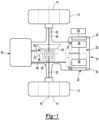
- the axle assembly 10 may provide torque to one or more traction wheel assemblies that may include a tire 12 mounted on a wheel 14.
- the wheel 14 may be mounted to a wheel hub that may be rotatable about a wheel axis 16.
- the axle assembly 10 may include or may be operatively connected to a torque source 20.
- the torque source 20 may be of any suitable type.
- the torque source 20 may be a non-electrical torque source, an electrical torque source, or combinations thereof.
- An example of a non-electrical torque source is an internal combustion engine.
- An example of an electrical torque source is an electric motor 22.
- An electric motor 22 may include a stator 24 and a rotor 26 that may be rotatable about an axis.
- An electrical power source 28 such as a battery, capacitor, generator, or the like, may be electrically connected to an electric motor 22 in a manner known by those skilled in the art.
- the axle assembly 10 may include a differential assembly 30, at least one axle shaft 32, and a transmission 34.
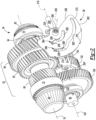
- the axle assembly 10 may also include a shift mechanism 36 as shown in Figure 2 .
- the differential assembly 30 may transmit torque to the vehicle traction wheel assemblies and permit the traction wheel assemblies to rotate at different velocities.
- the differential assembly 30 may be operatively connected to the axle shafts 32 and may permit the axle shafts 32 to rotate at different rotational speeds in a manner known by those skilled in the art.
- the differential assembly 30 may be rotatable about a differential axis 40 and may transmit torque to the axle shafts 32 and wheels.
- the differential axis 40 may be coaxially disposed with the wheel axis 16 in one or more configurations.
- the differential assembly 30 may have a ring gear 42 that may have teeth that mate or mesh with the teeth of a gear portion 44 of a drive pinion 46 that may be associated with the transmission 34. Accordingly, the differential assembly 30 may receive torque from the drive pinion 46 via the ring gear 42 and transmit torque to the axle shafts 32.
- the axle shafts 32 may transmit torque between the differential assembly 30 and the traction wheel assemblies.
- Two axle shafts 32 may be provided that may extend in opposite directions from the differential assembly 30.
- Each axle shaft 32 may have a first end and a second end. The first end may be operatively connected to the differential assembly 30. The second end may be disposed opposite the first end and may be operatively connected to a wheel.
- the axle shafts 32 or a portion thereof may extend along and may be rotatable about an axis, such as the differential axis 40.
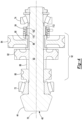
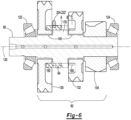
- the transmission 34 may transmit torque between the torque source 20 and the differential assembly 30. Torque transmission may be bidirectional. In at least one configuration such as is shown in Figures 3 and 4 , the transmission 34 may include a first shaft 50, a first set of gears 52, and a first shift collar 54. The transmission 34 may also include a second shaft 60, a second set of gears 62, and a second shift collar 64 as is best shown in Figures 5 and 6 .
- the first shaft 50 is rotatable about a first axis 70.
- the first axis 70 may be substantially perpendicular to the differential axis 40.
- the term "substantially perpendicular” is used herein to designate features such as axes that are the perpendicular or very close to perpendicular with respect to each other and includes features that are within ⁇ 2° of being perpendicular each other.
- the first shaft 50 may be rotatably supported by one or more bearings, such as a first bearing 72 and a second bearing 74.
- the first bearing 72 and the second bearing 74 may have any suitable configuration.
- first bearing 72 and the second bearing 74 may be configured as roller bearing assemblies that may encircle the first shaft 50.
- the first shaft 50 may be part of the drive pinion 46 or may be rotatable with the drive pinion 46.
- the first set of gears 52 includes a plurality of gears that are rotatable about the first axis 70.
- the first set of gears 52 includes a first drive gear 80, a second drive gear 82, and a third drive gear 84; however, it is to be understood that a greater or lesser number of gears may be provided.
- a member of the first set of gears 52 may be rotatable about the first axis 70 with the first shaft 50 when that gear is coupled to the first shaft 50.
- the first shaft 50 may be rotatable about the first axis 70 with respect to a member of the first set of gears 52 that is decoupled from or not coupled to the first shaft 50.
- a member of the first set of gears 52 may be selectively coupled to the first shaft 50 with the first shift collar 54 as will be discussed in more detail below.
- the first drive gear 80 may receive the first shaft 50.
- the first drive gear 80 may have a through hole through which the first shaft 50 may extend.
- the first drive gear 80 may extend around the first axis 70 and the first shaft 50 and may have a plurality of teeth that may be arranged around and may face away from the first axis 70.
- the teeth of the first drive gear 80 may contact and may mate or mesh with teeth of a first gear of the second set of gears 62 as will be discussed in more detail below.
- the first drive gear 80 is fixedly coupled to the first shaft 50 such that the first drive gear 80 is rotatable about the first axis 70 with the first shaft 50 and such that the first drive gear 80 does not rotate about the first axis 70 with respect to the first shaft 50.
- the first drive gear 80 may be axially positioned along the first axis 70 between the gear portion 44 and the second drive gear 82.
- the first drive gear 80 may be axially positioned between the first bearing 72 and a spacer 86.
- the second drive gear 82 may receive the first shaft 50.
- the second drive gear 82 may have a through hole through which the first shaft 50 may extend.
- the second drive gear 82 may extend around the first axis 70 and the first shaft 50 and may have a plurality of teeth that may be arranged around and may face away from the first axis 70.
- the teeth of the second drive gear 82 may contact and may mate or mesh with teeth of a second gear of the second set of gears 62 as will be discussed in more detail below.
- the second drive gear 82 is fixedly coupled to the first shaft 50 such that the second drive gear 82 is rotatable about the first axis 70 with the first shaft 50 and such that the second drive gear 82 does not rotate about the first axis 70 with respect to the first shaft 50.
- the second drive gear 82 may be axially positioned along the first axis 70 between the first drive gear 80 and the third drive gear 84.
- the second drive gear 82 may be axially positioned closer to the third drive gear 84 than to the first drive gear 80.
- the spacer 86 may be positioned between the first drive gear 80 and the second drive gear 82 to separate or increase the axial distance between the first drive gear 80 and the second drive gear 82 to provide alignment with a corresponding member of the second set of gears 62, which may be arranged to accommodate the second shift collar 64 as will be discussed in more detail below.
- the second drive gear 82 may have a different diameter than the first drive gear 80.
- the second drive gear 82 may have a larger diameter than the first drive gear 80.
- the third drive gear 84 may receive the first shaft 50.
- the third drive gear 84 may have a through hole through which the first shaft 50 may extend.
- the third drive gear 84 may extend around the first axis 70 and the first shaft 50 and may have a plurality of teeth that may be arranged around and may face away from the first axis 70.
- the teeth of the third drive gear 84 may contact and may mate or mesh with teeth of a third gear of the second set of gears 62 as will be discussed in more detail below.
- the third drive gear 84 is rotatably disposed on the first shaft 50.
- a bearing or bushing 88 may be received in the hole of the third drive gear 84 to rotatably support the third drive gear 84 on the first shaft 50.
- the bushing 88 may also have a flange that may extend away from the first axis 70 and that may help separate the third drive gear 84 from the second drive gear 82.
- the third drive gear 84 may include clutch engagement teeth 90 that may be engaged by the first shift collar 54 to selectively couple the third drive gear 84 to the first shaft 50 as will be discussed in more detail below.
- the clutch engagement teeth 90 may have any suitable configuration.
- the clutch engagement teeth 90 are configured as a spline gear or spline teeth in which teeth may be arranged around the first axis 70 and may face away from and extend radially away from the first axis 70.
- the clutch engagement teeth 90 may be configured as a face gear in which teeth may the arranged around the first axis 70 and may extend axially from a side of the third drive gear 84 toward the first shift collar 54.
- the third drive gear 84 may be axially positioned along the first axis 70 between the second drive gear 82 and the first shift collar 54.
- the third drive gear 84 may have a different diameter than the first drive gear 80 and the second drive gear 82.
- the third drive gear 84 may have a larger diameter than the second drive gear 82.
- the first shift collar 54 may be axially positioned between the third drive gear 84 and the second bearing 74.
- the first shift collar 54 may receive the first shaft 50 and is rotatable about the first axis 70 with the first shaft 50.
- the first shift collar 54 is moveable along the first axis 70 with respect to the first shaft 50 to selectively couple or selectively connect a member of the first set of gears 52 to the first shaft 50.
- the first shift collar 54 selectively couples the third drive gear 84 to the first shaft 50 as is shown in phantom in Figure 4 and as will be discussed in more detail below.
- the first shift collar 54 may include a first shift collar hole 100 and a first shift collar spline 102.
- the first shift collar hole 100 may extend along the first axis 70.
- the first shift collar hole 100 may be a through hole through which the first shaft 50 may extend.
- the first shift collar spline 102 may operatively connect the first shift collar 54 to the first shaft 50.
- the first shift collar spline 102 may be disposed in the first shift collar hole 100 and may include spline teeth that may extend toward the first axis 70.
- the spline teeth may mesh or mate with corresponding spline teeth on the first shaft 50 or that are disposed on an intervening component that may be fixedly mounted to the first shaft 50, such as a first annular ring 110, which is best shown in Figure 4 .
- the first annular ring 110 may have spline teeth 112 that may extend away from the first axis 70 and that may mesh with the teeth of the first shift collar spline 102.
- the first annular ring 110 may at least partially encircle the first shaft 50 and may extend axially between the second bearing 74 and the third drive gear 84 and/or its bushing 88.
- the first shift collar spline 102 may selectively engage the third drive gear 84 to permit or inhibit rotation of the third drive gear 84 with respect to the first shaft 50.
- the third drive gear 84 may be rotatable about the first axis 70 with respect to the first shaft 50 when the first shift collar 54 is disengaged from the third drive gear 84.
- the third drive gear 84 may be rotatable with respect to the first shaft 50 when the first shift collar spline 102 does not mate or mesh with the clutch engagement teeth 90 of the third drive gear 84 and thus the first shift collar 54 does not connect the third drive gear 84 to the first shaft 50.
- the third drive gear 84 may be rotatable about the first axis 70 with the first shaft 50 when the first shift collar 54 connects the third drive gear 84 to the first shaft 50, such as when the first shift collar spline 102 mates or meshes with the clutch engagement teeth 90 of the third drive gear 84. It is also contemplated that the first shift collar 54 may be provided with a face gear that may mate or mesh with clutch engagement teeth 90 of the third drive gear 84 that may also be configured as a face gear. In such a configuration, the first shift collar spline 102 may not mate or mesh with the clutch engagement teeth 90.
- the second shaft 60 may be spaced apart from the first shaft 50 and is rotatable about a second axis 120.
- the second axis 120 may be disposed substantially parallel to the first axis 70.
- the term "substantially parallel” is used herein to designate features such as axes that are the parallel or very close to parallel with respect to each other and includes features that are within ⁇ 2° of being parallel each other.
- the second shaft 60 may be rotatably supported by one or more bearings, such as a first bearing 122 and a second bearing 124.
- the first bearing 122 and the second bearing 124 may have any suitable configuration.
- first bearing 122 and the second bearing 124 may be configured as roller bearing assemblies that may encircle the second shaft 60.
- the second shaft 60 may be operatively connected to the torque source 20.
- torque may be transmitted from the torque source 20 to the second shaft 60, and then torque may be transmitted from the second shaft 60 to the first shaft 50 via gears.
- the second shaft 60 may be operatively connected to the rotor 26, such as by directly connecting a rotor shaft to the second shaft 60 or by using a connecting gear set 126, an example of which is best shown in Figure 1 .
- the connecting gear set 126 may have a first connecting gear that is rotatable with the rotor 26 and that meshes with a second connecting gear that is rotatable with the second shaft 60.
- the transmission 34 may be positioned on an opposite side of the differential assembly 30 from the torque source 20.
- the second set of gears 62 includes a plurality of gears that are rotatable about the second axis 120. Each member of the second set of gears 62 meshes with a different member of the first set of gears 52.
- the second set of gears 62 includes first gear 130, a second gear 132, and a third gear 134; however, it is to be understood that a greater or lesser number of gears may be provided.
- a member of the second set of gears 62 may be rotatable about the second axis 120 with the second shaft 60 when that gear is coupled to the second shaft 60.
- the second shaft 60 may be rotatable about the second axis 120 with respect to a member of the second set of gears 62 that is decoupled from or not coupled to the second shaft 60.
- a member of the second set of gears 62 may be selectively coupled to the second shaft 60 with the second shift collar 64 as will be discussed in more detail below.
- the first gear 130 may receive the second shaft 60.
- the first gear 130 may have a through hole through which the second shaft 60 may extend.
- the first gear 130 may extend around the second axis 120 and the second shaft 60 and may have a plurality of teeth that may be arranged around and may face away from the second axis 120.
- the teeth of the first gear 130 may contact and may mate or mesh with teeth of the first drive gear 80 of the first set of gears 52.
- the first gear 130 is rotatably disposed on the second shaft 60.
- a bearing or bushing 140 may be received in the hole of the first gear 130 and may rotatably support the first gear 130 on the second shaft 60.
- the first gear 130 may include clutch engagement teeth 150 that may be engaged by the second shift collar 64 to selectively couple the first gear 130 to the second shaft 60 as will be discussed in more detail below.
- the clutch engagement teeth 150 may have any suitable configuration.
- the clutch engagement teeth 150 are configured as a spline gear or spline teeth in which teeth may be arranged around the second axis 120 and may face away from and extend radially away from the second axis 120.
- the clutch engagement teeth 150 may be configured as a face gear in which teeth may the arranged around the second axis 120 and may extend axially from a side of the first gear 130 toward the second shift collar 64.
- the first gear 130 may be axially positioned along the second axis 120 between the first bearing 122 and the second gear 132.
- the second gear 132 may receive the second shaft 60.
- the second gear 132 may have a through hole through which the second shaft 60 may extend.
- the second gear 132 may extend around the second axis 120 and the second shaft 60 and may have a plurality of teeth that may be arranged around and may face away from the second axis 120.
- the teeth of the second gear 132 may contact and may mate or mesh with teeth of a second drive gear 82 of the first set of gears 52.
- the second gear 132 is rotatably disposed on the second shaft 60.
- a bearing or bushing 140 may be received in the hole of the second gear 132 and may rotatably support the second gear 132 on the second shaft 60.
- the second gear 132 may include second clutch engagement teeth 160 that may be engaged by the second shift collar 64 to selectively couple the second gear 132 to the second shaft 60 as will be discussed in more detail below.
- the second clutch engagement teeth 160 may have any suitable configuration.
- the second clutch engagement teeth 160 are configured as a spline gear or spline teeth in which teeth may be arranged around the second axis 120 and may face away from and extend radially away from the second axis 120.
- the second clutch engagement teeth 160 may be configured as a face gear in which teeth may the arranged around the second axis 120 and may extend axially from a side of the second gear 132 toward the second shift collar 64.
- the second gear 132 may be axially positioned along the second axis 120 between the first gear 130 and the third gear 134.
- the second gear 132 may be axially positioned between the second shift collar 64 and the third gear 134.
- the second gear 132 may be axially positioned closer to the third gear 134 than to the first gear 130.
- a spacer 170 may be positioned between the first gear 130 and the second gear 132 to separate or increase the axial distance between the first gear 130 and the second gear 132 to provide sufficient room for moving the second shift collar 64 as will be discussed in more detail below.
- the spacer 170 may be integrally formed with the second shaft 60 or may be provided as a separate component that may extend from the second shaft 60.
- the second gear 132 may have a different diameter than the first gear 130.
- the second gear 132 may have a smaller diameter than the first gear 130.
- the third gear 134 may receive the second shaft 60.
- the third gear 134 may have a through hole through which the second shaft 60 may extend.
- the third gear 134 may extend around the second axis 120 and the second shaft 60 and may have a plurality of teeth that may be arranged around and may face away from the second axis 120.
- the teeth of the third gear 134 may contact and may mate or mesh with teeth of the third drive gear 84 of the first set of gears 52 as will be discussed in more detail below.
- the third gear 134 is fixedly coupled to the second shaft 60 such that the third gear 134 is rotatable about the second axis 120 with the second shaft 60 and such that the third gear 134 does not rotate about the second axis 120 with respect to the second shaft 60.
- the third gear 134 may be axially positioned along the second axis 120 between the second bearing 124 and the second drive gear 82.
- the third gear 134 may have a different diameter than the first gear 130 and the second gear 132. For instance, the third gear 134 may have a smaller diameter than the second gear 132.
- the second shift collar 64 may be axially positioned between the first gear 130 and the second gear 132.
- the second shift collar 64 may receive the second shaft 60 and is rotatable about the second axis 120 with the second shaft 60.
- the second shift collar 64 is moveable along the second axis 120 with respect to the second shaft 60 to may selectively couple or selectively connect a member of the second set of gears 62 to the second shaft 60.
- the second shift collar 64 selectively couples the first gear 130 or the second gear 132 to the second shaft 60 as will be discussed in more detail below.
- the second shift collar 64 may also decouple the first gear 130 and the second gear 132 from the second shaft 60 in an intermediate portion that is shown in phantom on Figure 6 .
- the second shift collar 64 may include a second shift collar hole 180 and a second shift collar spline 182.
- the second shift collar hole 180 may extend along the second axis 120.
- the second shift collar hole 180 may be a through hole through which the second shaft 60 may extend.
- the second shift collar spline 182 may operatively connect the second shift collar 64 to the second shaft 60.
- the second shift collar spline 182 may be disposed in the second shift collar hole 180 and may include spline teeth that may extend toward the second axis 120.
- the spline teeth may mesh or mate with corresponding spline teeth on the second shaft 60 or and intervening component that may be fixedly mounted to the second shaft 60.
- the second shift collar spline 182 may selectively engage the first gear 130 or the second gear 132 to permit or inhibit rotation of the first gear 130 or the second gear 132 with respect to the second shaft 60.
- the second shift collar spline 182 may mate or mesh with the clutch engagement teeth 150 of the first gear 130 to rotatably couple the first gear 130 to the second shaft 60 as shown in solid lines at position A in Figure 6 .
- the first gear 130 may be rotatable about the second axis 120 with respect to the second shaft 60 when the second shift collar 64 is disengaged from the first gear 130 or does not connect the first gear 130 to the second shaft 60.
- the first gear 130 may be rotatable about the second axis 120 with respect to the second shaft 60 when the second shift collar spline 182 does not mate or mesh with the clutch engagement teeth 150 of the first gear 130.
- the second shift collar spline 182 may not mate or mesh with the clutch engagement teeth 150 of the first gear 130 and the second clutch engagement teeth 160 of the second gear 132 when in the intermediate position shown with phantom lines at position B, thereby permitting the second shaft 60 to rotate with respect to the first gear 130 and the second gear 132.
- the second shift collar spline 182 may mate or mesh with the second clutch engagement teeth 160 of the second gear 132 to rotatably couple the second gear 132 to the second shaft 60 when the second shift collar 64 is moved to the right from the perspective shown in Figure 6 to position C.
- the second gear 132 may be rotatable about the second axis 120 with respect to the second shaft 60 when the second shift collar 64 is disengaged from the second gear 132 or does not connect the second gear 132 to the second shaft 60.
- the second gear 132 may be rotatable about the second axis 120 with respect to the second shaft 60 when the second shift collar spline 182 does not mate or mesh with the second clutch engagement teeth 160 of the second gear 132.
- the second shift collar 64 may be provided with a face gear that may mate or mesh with clutch engagement teeth 150 of the first gear 130 that may also be configured as a face gear, may be provided with a face gear that may mate or mesh with the second clutch engagement teeth 160 of the second gear 132 that may be configured as a face gear, or combinations thereof.
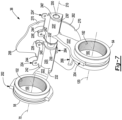
- the shift mechanism 36 may control positioning of a shift collar, such as the first shift collar 54 and the second shift collar 64.
- the shift mechanism 36 may include a shift rail 200, a first shift fork 202, a second shift fork 204, a sector cam 206, or combinations thereof.
- the shift rail 200 may extend along a shift rail axis 210.
- the shift rail axis 210 may be disposed substantially parallel to the first axis 70, the second axis 120, or both. In at least one configuration, the shift rail axis 210 may be disposed closer to the first axis 70 than to the second axis 120.
- the shift rail 200 may be fixedly positioned such that the shift rail 200 may not move along or rotate about the shift rail axis 210.
- the shift rail 200 may be spaced apart from the sector cam 206 and may support the first shift fork 202 and the second shift fork 204.
- the first shift fork 202 may operatively connect the first shift collar 54 to the sector cam 206.
- the first shift fork 202 may be slidable along the shift rail axis 210 with respect to the shift rail 200.
- the first shift fork 202 may include a tubular portion 220 and a fork arm 222.
- a shift bracket 224 may be associated with the first shift fork 202.
- the tubular portion 220 may receive the shift rail 200.
- the tubular portion 220 may have a first end 230, a second end 232, and a shift fork hole 234.
- the first end 230 may face toward the second shift fork 204.
- the second end 232 may be disposed opposite the first end 230. As such, the second end 232 may face away from the second shift fork 204.
- the shift fork hole 234 may extend from the first end 230 to the second end 232.
- the shift rail 200 may extend through the shift fork hole 234.
- the fork arm 222 may extend from the tubular portion 220 to the first shift collar 54.
- the fork arm 222 may have any suitable configuration.
- the fork arm 222 may have a pair of prongs that may be received in a groove of the first shift collar 54 and that may allow the first shift collar 54 to rotate about the first axis 70 with respect to the prongs.
- the fork arm 222 may be disposed proximate the second end 232 of the tubular portion 220.
- the shift bracket 224 may operatively connect the first shift fork 202 to the sector cam 206.
- the shift bracket 224 may be slidable along the shift rail 200 with the first shift fork 202 and may support a guide feature 226 that may engage the sector cam 206.
- the shift bracket 224 may have a first flange 240, a second flange 242, and a body portion 244.
- the first flange 240 may be disposed at a first end of the body portion 244.
- the first flange 240 may define a hole through which the shift rail 200 may extend.
- the first flange 240 may engage the first end 230 of the tubular portion 220.
- the second flange 242 may be disposed at a second end of the body portion 244 that may be disposed opposite the first end.
- the second flange 242 may define a hole through which the shift rail 200 may extend.
- the second flange 242 may engage the second end 232 of the tubular portion 220.
- the first flange 240 and the second flange 242 may engage opposite ends of the first shift fork 202 and the first shift fork 202 may be positioned between the first flange 240 and the second flange 242 to inhibit relative axial movement of the shift bracket 224 with respect to first shift fork 202.
- the body portion 244 may extend from the first flange 240 to the second flange 242.
- the body portion 244 may extend generally parallel to the shift rail 200 and may be spaced apart from the shift rail 200 and the sector cam 206.
- the guide feature 226 may operatively connect the first shift fork 202 to the sector cam 206.
- the guide feature 226, which may be referred to as a first guide feature, may extend from the body portion 244 in a direction that extends toward the sector cam 206.
- the guide feature 226 may have any suitable configuration.
- the guide feature 226 may be a roller that may be received in a first groove of the sector cam 206 as will be discussed in more detail below.
- the guide feature 226 may be disposed closer to the first flange 240 than to the second flange 242. It is also contemplated that the shift bracket 224 may be omitted and that the guide feature 226 may be provided with the first shift fork 202.
- the second shift fork 204 may be spaced apart from the first shift fork 202.
- the second shift fork 204 may operatively connect the second shift collar 64 to the sector cam 206.
- the second shift fork 204 may have a similar configuration as the first shift fork 202.
- the second shift fork 204 may be slidable along the shift rail axis 210 with respect to the shift rail 200.
- the second shift fork 204 may include a tubular portion 220' and a fork arm 222'.
- a shift bracket 224' may be associated with the second shift fork 204.
- the tubular portion 220' may receive the shift rail 200.
- the tubular portion 220' may have a first end 230', a second end 232', and a shift fork hole 234'.
- the first end 230' may face away from the first shift fork 202.
- the second end 232' may be disposed opposite the first end 230'. As such, the second end 232' may face toward the first shift fork 202.
- the shift fork hole 234' may extend from the first end 230' to the second end 232'.
- the shift rail 200 may extend through the shift fork hole 234'.
- the fork arm 222' may extend from the tubular portion 220' of the second shift fork 204 to the second shift collar 64.
- the fork arm 222' may have any suitable configuration.
- the fork arm 222' may have a pair of prongs that may be received in a groove of the second shift collar 64 and that may allow the second shift collar 64 to rotate about the second axis 120 with respect to the prongs.
- the fork arm 222' may be disposed closer to the first end 230' of the tubular portion 220' than to the second end 232'.
- the shift bracket 224' may operatively connect the second shift fork 204 to the sector cam 206.
- the shift bracket 224' may be slidable along the shift rail 200 with the second shift fork 204 and may support a guide feature 226' that may engage the sector cam 206.
- the shift bracket 224' may have the same configuration as the shift bracket 224.
- the shift bracket 224' may have a first flange 240', a second flange 242', and a body portion 244'.
- the first flange 240' may be disposed at a first end of the body portion 244'.
- the first flange 240' may define a hole through which the shift rail 200 may extend.
- the first flange 240' may engage the first end 230' of the tubular portion 220'.
- the second flange 242' may be disposed at a second end of the body portion 244' that may be disposed opposite the first end.
- the second flange 242' may define a hole through which the shift rail 200 may extend.
- the second flange 242' may engage the second end 232' of the tubular portion 220'.
- the first flange 240' and the second flange 242' may engage opposite ends of the second shift fork 204 and the second shift fork 204 may be positioned between the first flange 240' and the second flange 242' to inhibit relative axial movement of the shift bracket 224' with respect to second shift fork 204.
- the body portion 244' may extend from the first flange 240' to the second flange 242'.
- the body portion 244' may extend generally parallel to the shift rail 200 and may be spaced apart from the shift rail 200 and the sector cam 206.
- the guide feature 226' may operatively connect the second shift fork 204 to the sector cam 206.
- the guide feature 226' which may be referred to as a second guide feature, may extend from the body portion 244' in a direction that extends toward the sector cam 206.
- the guide feature 226' may have the same configuration as the guide feature 226 that is associated with the first shift fork 202.
- the guide feature 226' may be a roller that may be received in a second groove of the sector cam 206 as will be discussed in more detail below.
- the guide feature 226' may be axially positioned closer to the second flange 242' than to the first flange 240'. It is also contemplated that the shift bracket 224' may be omitted and that the guide feature 226' may be provided with the second shift fork 204.
- the sector cam 206 is operatively connected to the first shift collar 54 and to the second shift collar 64.
- the sector cam 206 may be spaced apart from the transmission 34 and the shift rail 200.
- the sector cam 206 may have a generally flat or planar configuration.
- the sector cam 206 is rotatable about a sector cam axis 250.
- the sector cam axis 250 may be disposed substantially perpendicular to the first axis 70, the second axis 120, the shift rail axis 210, or combinations thereof. Rotation of the sector cam 206 about the sector cam axis 250 controls movement of the first shift collar 54 along the first axis 70 and controls movement of the second shift collar 64 along the second axis 120.
- the sector cam 206 may have a coupling feature 260 and an arcuate exterior side 262.
- the sector cam 206 may define one or more grooves, such as a first groove 264 and a second groove 266.
- the coupling feature 260 may facilitate coupling of the sector cam 206 to an actuator that may rotate the sector cam 206 about the sector cam axis 250.
- the coupling feature 260 may have any suitable configuration.
- the coupling feature 260 may have a male configuration, a female configuration, or combinations thereof.
- the actuator may have any suitable configuration.
- the actuator may be an electrical actuator, mechanical actuator, electromechanical actuator, or the like.
- the arcuate exterior side 262 may face away from the sector cam axis 250.
- the arcuate exterior side 262 or a portion thereof may extend along an arc, such as an arc that may be radially disposed with respect to the sector cam axis 250.
- a plurality of detent features 270 may be provided with the arcuate exterior side 262.
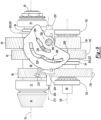
- the detent features 270 may be spaced apart from each other and may be positioned to correspond with rotational positions of the sector cam 206, such as the positions shown in Figures 8-11 .
- the detent features 270 may have any suitable configuration. For instance, a detent feature 270 may be configured as an indentation that may extend toward the sector cam axis 250.
- a detent feature 270 may be engaged by a detent mechanism 272, which is best shown in Figures 8-11 .
- the detent feature 270 may be mounted to a stationary component, such as a housing of the axle assembly 10.
- the detent feature 270 may help hold the sector cam 206 in a desired rotational position.
- the detent mechanism 272 may slide along the arcuate exterior side 262 when the sector cam 206 is rotated about the sector cam axis 250 between different rotational positions and their associated detent features 270.
- the first groove 264 may guide movement of the first shift fork 202 and thus guide movement of the first shift collar 54.
- the first groove 264 may be defined by the sector cam 206 such that the first groove 264 may be completely disposed inside the sector cam 206 or encircled by the sector cam 206.
- the first groove 264 may be spaced apart from the sector cam axis 250 and the second groove 266 and may receive the guide feature 226 of the first shift fork 202.
- the guide feature 226 may extend into the first groove 264.
- the first groove 264 may be radially positioned between the sector cam axis 250 and the arcuate exterior side 262.
- first groove 264 may be radially positioned between the coupling feature 260 and the second groove 266. As such, the first groove 264 may be positioned closer to the sector cam axis 250 than the second groove 266 is positioned to the sector cam axis 250.
- the first groove 264 may extend in a nonlinear manner between a first end and a second end. In at least one configuration, the first groove 264 may have a first groove side 280 and a second groove side 282.
- the first groove side 280 and the second groove side 282 may be spaced apart from each other and may extend between the first end and the second end of the first groove 264.
- the first groove side 280 and the second groove side 282 may be mirror images of each other and may be equidistantly spaced from each other.
- the first groove side 280 and the second groove side 282 may be disposed substantially parallel to each other in one or more embodiments.
- the first groove side 280 and the second groove side 282 may cooperate to constrain and control axial movement of the first shift fork 202.
- the guide feature 226 of the first shift fork 202 may engage the first groove side 280 to inhibit movement of the first shift fork 202 to the right from the perspective shown while the guide feature 226 may engage the second groove side 282 to inhibit movement of the first shift fork 202 to the left from the perspective shown.
- the second groove 266 may guide movement of the second shift fork 204 and thus guide movement of the second shift collar 64.
- the second groove 266 may be defined by the sector cam 206 such that the second groove 266 may be completely disposed inside the sector cam 206 or encircled by the sector cam 206.
- the second groove 266 may be spaced apart from the first groove 264 and the arcuate exterior side 262 and may receive the guide feature 226' of the second shift fork 204.
- the guide feature 226' may extend into the second groove 266.
- the second groove 266 may be radially positioned between the sector cam axis 250 and the arcuate exterior side 262.
- the second groove 266 may be radially positioned between the first groove 264 and the arcuate exterior side 262.
- the second groove 266 may extend in a nonlinear manner between a first end and a second end.
- the second groove 266 may have a greater length between the first end and the second end than the first groove 264.
- the second groove 266 may have a first groove side 280' and a second groove side 282'.
- the first groove side 280' and the second groove side 282' may be spaced apart from each other and may extend between the first end and the second end of the second groove 266.
- the first groove side 280' and the second groove side 282' may be mirror images of each other and may be equidistantly spaced from each other.
- the first groove side 280' and the second groove side 282' may be disposed substantially parallel to each other in one or more embodiments.
- the first groove side 280' and the second groove side 282' may cooperate to constrain and control axial movement of the second shift fork 204.
- the guide feature 226' of the second shift fork 204 may engage the first groove side 280' to inhibit movement of the second shift fork 204 to the right from the perspective shown while the guide feature 226' may engage the second groove side 282' to inhibit movement of the second shift fork 204 to the left from the perspective shown.
- Rotation of the sector cam 206 and shifting of a shift collar may occur in response to an operator command, may be automated, or combinations thereof.
- a shift may be executed when the rotational speed of a shift collar and the gear that is being engaged or disengaged are sufficiently synchronized.
- Sufficient synchronization to permit shifting or movement of a collar may be attained using a synchronizer, by controlling the rotational speed of the first shaft 50, by controlling the rotational speed of the second shaft 60, or combinations thereof.
- shift collar positions are shown; however, it is to be understood that the shift collar positions may be rearranged or additional shift collar positions may be added, in which case the length of the first groove 264, the length of the second groove 266, the manner in which the first groove 264 and the second groove 266 bend or jog with respect to each other, or combinations thereof, may differ from the example shown.
- the sector cam 206 is shown in a low-speed position.
- the first shift collar 54 couples the third drive gear 84 to the first shaft 50 such that the third drive gear 84 is rotatable with the first shaft 50.
- the second shift collar 64 does not couple the first gear 130 or the second gear 132 to the second shaft 60.
- torque may be transmitted between the first shaft 50 and the second shaft 60 via the third drive gear 84 and the third gear 134.
- the guide feature 226 of the first shift fork 202 may be disposed adjacent to the first end of the first groove 264 and the guide feature 226' of the second shift fork 204 may be disposed adjacent to the first end of the second groove 266 when the sector cam 206 is in the low-speed position.
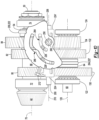
- the sector cam 206 is shown in a mid-speed position.
- the first shift collar 54 may not couple the third drive gear 84 to the first shaft 50 and is moved to the right from the position shown in Figure 8 .
- the second shift collar 64 is moved to the right from the position shown in Figure 8 and may couple the second gear 132 to the second shaft 60 but may not couple the first gear 130 to the second shaft 60. As such, torque may be transmitted between the first shaft 50 and the second shaft 60 via the second drive gear 82 and the second gear 132.
- the guide feature 226 of the first shift fork 202 and the guide feature 226' of the second shift fork 204 may be disposed closer to the sector cam axis 250 when the sector cam 206 is in the mid-speed position as compared to the low-speed position.
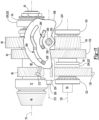
- the sector cam 206 is shown in a neutral position.
- the first shift collar 54 is in the same position as in Figure 9 may not couple the third drive gear 84 to the first shaft 50.
- the second shift collar 64 is in the same position as Figure 8 and may not couple the first gear 130 or the second gear 132 to the second shaft 60. As such, torque may not be transmitted between the first shaft 50 and the second shaft 60.
- the guide feature 226 of the first shift fork 202 may be disposed at the same distance from the sector cam axis 250 in the neutral and mid-speed positions.
- the guide feature 226' of the second shift fork 204 may be disposed further from the sector cam axis 250 in the neutral position as compared to the mid-speed position.
- the sector cam 206 is shown in a high-speed position.
- the first shift collar 54 is in the same position as in Figure 9 and may not couple the third drive gear 84 to the first shaft 50.
- the second shift collar 64 is moved to the left from the position shown in Figure 8 to couple the first gear 130 to the second shaft 60 but does not couple the second gear 132 to the second shaft 60. As such, torque may be transmitted between the first shaft 50 and the second shaft 60 via the first drive gear 80 and the first gear 130.
- the guide feature 226 of the first shift fork 202 may be disposed adjacent to the second end of the first groove 264 and the guide feature 226' of the second shift fork 204 may be disposed adjacent to the second end of the second groove 266 when the sector cam 206 is in the high-speed position.
- An axle assembly as discussed above may allow a torque source and a transmission to be arranged on opposite sides of a differential assembly.
- the torque source is an electric motor
- such a configuration may help thermally separate the electric motor and heat generated by its fast-spinning rotor bearings (which may rotate at speeds greater than 50,000 rpm) from other components of the axle assembly, such as the transmission and lubricant of the axle assembly.
- This thermal separation may improve thermal management of the axle assembly and may reduce lubricant heating, which may help improve lubricant life.
- such an arrangement may provide better weight distribution by locating the center of mass of the axle assembly closer to the axle shafts as compared to a configuration in which the electric motor and transmission extend from the same side of the housing assembly.
- axle assembly having a sector cam as described above may allow a compact shift mechanism to be provided, which may help reduce package space, weight, associated cost, or combinations thereof.
- a sector cam may allow shift collars to be actuated simultaneously or independently and with a high degree of accuracy.
Landscapes
- Engineering & Computer Science (AREA)
- General Engineering & Computer Science (AREA)
- Mechanical Engineering (AREA)
- Chemical & Material Sciences (AREA)
- Combustion & Propulsion (AREA)
- Transportation (AREA)
- Gear-Shifting Mechanisms (AREA)
- Arrangement And Mounting Of Devices That Control Transmission Of Motive Force (AREA)
Claims (15)
- Achsenanordnung (10), Folgendes umfassend:eine erste Welle (50), die um eine erste Achse (70) drehbar ist;eine zweite Welle (60), die um eine zweite Achse (120) drehbar ist;einen ersten Satz Zahnräder (52), der um die erste Achse (70) drehbar ist, wobei der erste Satz Zahnräder (52) ein erstes Antriebsrad (80), ein zweites Antriebsrad (82) und ein drittes Antriebsrad (84) umfasst; undeinen zweiten Satz Zahnräder (62), der um die zweite Achse (120) drehbar ist, wobei der zweite Satz Zahnräder (62) ein erstes Zahnrad (130), ein zweites Zahnrad (132) und ein drittes Zahnrad (134) umfasst, die in das erste Antriebsrad (80), das zweite Antriebsrad (82) bzw. das dritte Antriebsrad (84) eingreifen, und wobei jedes Element des zweiten Satzes Zahnräder (62) in ein anderes Element des ersten Satzes Zahnräder (52) eingreift;eine erste Schaltmuffe (54), die mit der ersten Welle (50) um die erste Achse (70) drehbar und in Bezug zur ersten Welle (50) entlang der ersten Achse (70) beweglich ist, um selektiv ein Element des ersten Satzes Zahnräder (52) mit der ersten Welle (50) zu verbinden;eine zweite Schaltmuffe (64), die mit der zweiten Welle (60) um die zweite Achse (120) drehbar und in Bezug zur zweiten Welle (60) entlang der zweiten Achse (120) beweglich ist, um selektiv ein Element des zweiten Satzes Zahnräder (62) mit der zweiten Welle (60) zu verbinden; undeinen Sektornocken (206), der um eine im Sektornockenachse (250) drehbar ist und mit der ersten Schaltmuffe (54) und der zweiten Schaltmuffe (64) wirkverbunden ist, wobei die Drehung des Sektornockens (206) um die Sektornockenachse (250) die Bewegung der ersten Schaltmuffe (54) entlang der ersten Achse (70) steuert und die Bewegung der zweiten Schaltmuffe (64) entlang der zweiten Achse (120) steuert;wobei das erste Antriebsrad (80) und das zweite Antriebsrad (82) fest mit der ersten Welle (50) gekoppelt sind und das dritte Antriebsrad (84) drehbar auf der ersten Welle (50) angeordnet ist, sodass das dritte Antriebsrad (84) in Bezug zur ersten Welle (50) um die erste Achse (70) drehbar ist, wenn die erste Schaltmuffe (54) das dritte Antriebsrad (84) nicht mit der ersten Welle (50) verbindet, und das dritte Antriebsrad (84) mit der ersten Welle (50) drehbar ist, wenn die erste Schaltmuffe (54) das dritte Antriebsrad (84) mit der ersten Welle (50) verbindet;wobei das dritte Zahnrad (134) fest mit der zweiten Welle (60) gekoppelt ist und das erste Zahnrad (130) und das zweite Zahnrad (132) drehbar auf der zweiten Welle (60) angeordnet und mittels der zweiten Schaltmuffe (64) mit der zweiten Welle (60) selektiv koppelbar sind undwobei die erste Schaltmuffe (54) das dritte Antriebsrad (84) derart mit der ersten Welle (50) koppelt, dass das dritte Antriebsrad (84) mit der ersten Welle (50) drehbar ist, und die zweite Schaltmuffe (64) das erste Zahnrad (130) oder das zweite Zahnrad (132) nicht mit der zweiten Welle (60) koppelt, wenn sich der Sektornocken (206) in einer Niedriggeschwindigkeitsposition befindet.
- Achsenanordnung nach Anspruch 1, wobei die erste Schaltmuffe (54) das dritte Antriebsrad (84) nicht mit der ersten Welle (50) koppelt und die zweite Schaltmuffe (64) das zweite Zahnrad (132) mit der zweiten Welle (60) koppelt, wenn sich der Sektornocken (206) in einer Mittelgeschwindigkeitsposition befindet.
- Achsenanordnung nach Anspruch 1, wobei die erste Schaltmuffe (54) das dritte Antriebsrad (84) nicht mit der ersten Welle (50) koppelt und die zweite Schaltmuffe (64) das erste Zahnrad (130) mit der zweiten Welle (60) koppelt, wenn sich der Sektornocken (206) in einer Hochgeschwindigkeitsposition befindet.
- Achsenanordnung nach Anspruch 1, wobei die erste Schaltmuffe (54) das dritte Antriebsrad (84) nicht mit der ersten Welle (50) koppelt und die zweite Schaltmuffe (64) das erste Zahnrad (130) oder das zweite Zahnrad (132) nicht mit der zweiten Welle (60) koppelt, wenn sich der Sektornocken (206) in einer Neutralposition befindet.
- Achsenanordnung nach Anspruch 1, wobei das zweite Antriebsrad (82) axial entlang der ersten Welle (50) zwischen dem ersten Antriebsrad (80) und dem dritten Antriebsrad (84) positioniert ist und das dritte Antriebsrad (84) axial entlang der ersten Welle (50) zwischen dem zweiten Antriebsrad (82) und der ersten Schaltmuffe (54) positioniert ist.
- Achsenanordnung nach Anspruch 5, wobei die zweite Schaltmuffe (64) axial zwischen dem ersten Zahnrad (130) und dem zweiten Zahnrad (132) positioniert ist und das zweite Zahnrad (132) axial zwischen der zweiten Schaltmuffe (64) und dem dritten Zahnrad (134) positioniert ist.
- Achsenanordnung nach Anspruch 1, wobei eine erste Schaltgabel (202) die erste Schaltmuffe (54) mit dem Sektornocken (206) koppelt und der Sektornocken (206) eine erste Nut (264) definiert, die vollständig innerhalb des Sektornockens (206) angeordnet ist und ein erstes Führungsmerkmal (226) aufnimmt, das mit der ersten Schaltgabel (202) wirkverbunden ist.
- Achsenanordnung nach Anspruch 7, wobei die erste Nut (264) eine erste Nutseite (280) und eine der ersten Nutseite (280) entgegengesetzt angeordnete zweite Nutseite (282) aufweist, wobei das erste Führungsmerkmal (226) in die erste Nutseite (280) und die zweite Nutseite (282) eingreift, um die Axialbewegung der ersten Schaltgabel (202) einzuschränken.
- Achsenanordnung nach Anspruch 7, wobei eine zweite Schaltgabel (204) die zweite Schaltmuffe (64) mit dem Sektornocken (206) koppelt und der Sektornocken (206) eine zweite Nut (266) definiert, die vollständig innerhalb des Sektornockens (206) angeordnet ist, die ein zweites Führungsmerkmal (226) aufnimmt, das mit der zweiten Schaltgabel (204) wirkverbunden ist.
- Achsenanordnung nach Anspruch 9, wobei die erste Nut (264) näher an der Sektornockenachse (250) positioniert ist als die zweite Nut (266) an der Sektornockenachse (250) positioniert ist und die zweite Nut (266) eine größere Länge als die erste Nut (264) aufweist.
- Achsenanordnung nach Anspruch 9 oder Anspruch 10, wobei die zweite Nut (266) eine erste Nutseite (280') und eine der ersten Nutseite (280') entgegengesetzt angeordnete zweite Nutseite (282') aufweist, wobei das zweite Führungsmerkmal (226') in die erste Nutseite (280') der zweiten Nut (266) und die zweite Nutseite (282') der zweiten Nut (266) eingreift, um die Axialbewegung der zweiten Schaltgabel (204) einzuschränken.
- Achsenanordnung nach Anspruch 9 oder Anspruch 10, wobei die erste Schaltgabel (202) und die zweite Schaltgabel (204) entlang einer Schaltstange (200) verschiebbar sind, die vom Sektornocken (206) beabstandet ist, wobei sich die Schaltstange (200) entlang einer Schaltstangenachse (210) erstreckt, die sich im Wesentlichen parallel zur ersten Achse (70) und zweiten Achse (120) erstreckt.
- Achsenanordnung nach Anspruch 12, wobei die Schaltstangenachse (210) näher an der ersten Achse (70) angeordnet ist als die Schaltstangenachse (210) an der zweiten Achse (120) angeordnet ist.
- Achsenanordnung nach Anspruch 8, ferner umfassend eine erste Schaltklammer (224), die einen ersten und zweiten Flansch (240, 242) aufweist, die Bohrungen definieren, durch welche sich eine Schaltstange (200) erstreckt, wobei die erste Schaltgabel (202) zwischen dem ersten und zweiten Flansch (240, 242) positioniert ist und derart in den ersten und zweiten Flansch (240, 242) eingreift, dass die erste Schaltgabel (202) und die erste Schaltklammer (224) zusammen entlang der Schaltstangenachse (250) beweglich sind, wobei sich das erste Führungsmerkmal (226) vorzugsweise von der ersten Schaltklammer (224) erstreckt und in der ersten Nut (264) aufgenommen ist.
- Achsenanordnung nach Anspruch 9, ferner umfassend eine zweite Schaltklammer (224'), die einen ersten und zweiten Flansch (240', 242') aufweist, die Bohrungen definieren, durch welche sich eine Schaltstange (200) erstreckt, wobei die zweite Schaltgabel (204) zwischen dem ersten und zweiten Flansch (240', 242') positioniert ist und derart in den ersten und zweiten Flansch (240', 242') eingreift, dass die zweite Schaltgabel (204) und die zweite Schaltklammer (224') zusammen entlang der Schaltstangenachse (250) beweglich sind, wobei sich das zweite Führungsmerkmal (226') vorzugsweise von der zweiten Schaltklammer (224') erstreckt und in der zweiten Nut (266) aufgenommen ist.
Priority Applications (1)
| Application Number | Priority Date | Filing Date | Title |
|---|---|---|---|
| EP22205341.5A EP4155585A1 (de) | 2021-02-22 | 2022-02-21 | Achsanordnung mit sektornocken |
Applications Claiming Priority (1)
| Application Number | Priority Date | Filing Date | Title |
|---|---|---|---|
| US17/181,641 US11608877B2 (en) | 2021-02-22 | 2021-02-22 | Axle assembly having a sector cam |
Related Child Applications (2)
| Application Number | Title | Priority Date | Filing Date |
|---|---|---|---|
| EP22205341.5A Division-Into EP4155585A1 (de) | 2021-02-22 | 2022-02-21 | Achsanordnung mit sektornocken |
| EP22205341.5A Division EP4155585A1 (de) | 2021-02-22 | 2022-02-21 | Achsanordnung mit sektornocken |
Publications (2)
| Publication Number | Publication Date |
|---|---|
| EP4047248A1 EP4047248A1 (de) | 2022-08-24 |
| EP4047248B1 true EP4047248B1 (de) | 2024-12-11 |
Family
ID=80775218
Family Applications (2)
| Application Number | Title | Priority Date | Filing Date |
|---|---|---|---|
| EP22157703.4A Active EP4047248B1 (de) | 2021-02-22 | 2022-02-21 | Achsanordnung mit sektornocken |
| EP22205341.5A Withdrawn EP4155585A1 (de) | 2021-02-22 | 2022-02-21 | Achsanordnung mit sektornocken |
Family Applications After (1)
| Application Number | Title | Priority Date | Filing Date |
|---|---|---|---|
| EP22205341.5A Withdrawn EP4155585A1 (de) | 2021-02-22 | 2022-02-21 | Achsanordnung mit sektornocken |
Country Status (4)
| Country | Link |
|---|---|
| US (1) | US11608877B2 (de) |
| EP (2) | EP4047248B1 (de) |
| CN (1) | CN114962563B (de) |
| BR (1) | BR102022003234A2 (de) |
Families Citing this family (1)
| Publication number | Priority date | Publication date | Assignee | Title |
|---|---|---|---|---|
| CN118030787B (zh) * | 2024-04-11 | 2024-06-14 | 四川省能源地质调查研究所 | 一种地质施工用变速动力头换挡装置 |
Family Cites Families (69)
| Publication number | Priority date | Publication date | Assignee | Title |
|---|---|---|---|---|
| US1981236A (en) | 1932-12-22 | 1934-11-20 | Charles H Logue | Variable speed power transmitting mechanism |
| US2338154A (en) | 1939-01-16 | 1944-01-04 | Allis Chalmers Mfg Co | Fluid-cooled dynamoelectric machine |
| GB723073A (en) | 1952-10-30 | 1955-02-02 | Edward Turner | Improvements relating to lever-actuated change-speed gearings, particularly for motor-cycles |
| DE2005047A1 (de) | 1970-02-04 | 1971-08-19 | Janich H | Getriebemotor |
| DE2841330C3 (de) | 1978-09-21 | 1981-06-19 | Mannesmann AG, 4000 Düsseldorf | Planetengetriebe mit Leistungsverzweigung |
| DE3036465A1 (de) | 1980-09-24 | 1982-05-19 | Siemens AG, 1000 Berlin und 8000 München | Elektrische maschine |
| JPS5759124U (de) | 1980-09-26 | 1982-04-07 | ||
| US4531423A (en) * | 1983-10-06 | 1985-07-30 | Borg-Warner Corporation | Spring-assisted shift apparatus |
| US4770280A (en) * | 1987-06-05 | 1988-09-13 | Chrysler Motors Corporation | Snap-action arrangement for transfer case synchronizer |
| JP3093782B2 (ja) | 1990-11-20 | 2000-10-03 | アイシン・エイ・ダブリュ株式会社 | 減速機付ホィールモータ |
| GB2250142B (en) | 1990-11-20 | 1994-11-09 | Aisin Aw Co | Drive gear disposition in a wheel motor |
| US5482512A (en) | 1994-04-12 | 1996-01-09 | General Motors Corporation | Electro-mechanical hybrid powertrain with self-engaging brakes for starting the engine |
| US5603671A (en) | 1995-08-08 | 1997-02-18 | General Motors Corporation | Three prime mover bus transmission |
| US5609540A (en) * | 1995-08-17 | 1997-03-11 | New Venture Gear, Inc. | Full-time double offset transfer case |
| US5713243A (en) * | 1995-11-01 | 1998-02-03 | New Venture Gear, Inc. | Two-piece sector plate for a transfer case |
| US6314730B1 (en) | 1997-01-09 | 2001-11-13 | Kanzaki Kokyukoki Mfg. Co., Ltd. | Axle driving apparatus |
| DE19827756A1 (de) | 1998-06-23 | 1999-12-30 | Umbach Hans | Antrieb |
| DE19915926B4 (de) | 1998-09-05 | 2004-05-13 | Zf Sachs Ag | Antriebsanordnung für ein Kraftfahrzeug |
| US6176146B1 (en) | 1998-11-12 | 2001-01-23 | Zf Meritor, Llc | Output shaft arrangement for manual transmission auxiliary boxes |
| DE19952625B4 (de) | 1999-11-02 | 2006-02-23 | Zf Sachs Ag | Antriebssystem |
| DE10049197B4 (de) | 2000-10-05 | 2017-02-09 | Daimler Ag | Hybridfahrzeug |
| JP3651847B2 (ja) | 2001-07-09 | 2005-05-25 | 株式会社日立製作所 | ハイブリッド車両の動力伝達装置 |
| US20030125150A1 (en) | 2001-12-28 | 2003-07-03 | Visteon Global Technologies, Inc. | Enhanced shift couplers for shift-on-the-go transmission |
| US6974400B2 (en) * | 2002-02-05 | 2005-12-13 | American Axle & Manufacturing, Inc. | Transfer case with a tri-mode bi-directional clutch assembly |
| DE10226572A1 (de) | 2002-06-14 | 2004-01-08 | Robert Bosch Gmbh | Verfahren zur Herstellung eines Rotors für einen Elektromotor sowie Rotor für einen Elektromotor |
| US7211019B2 (en) | 2003-02-21 | 2007-05-01 | Magna Powertrain Usa, Inc. | Torque vectoring drive mechanism having a power sharing control system |
| DE102004038882A1 (de) | 2003-08-11 | 2005-03-31 | General Motors Corp., Detroit | Verbesserte Kühlung und Behandlung eines Gegendrehmoments für einen Axialflussmotor |
| JP4038460B2 (ja) | 2003-09-04 | 2008-01-23 | 株式会社日立製作所 | アクティブシフト変速機,変速機制御装置、および自動車 |
| US6991571B2 (en) | 2003-12-09 | 2006-01-31 | Arvinmeritor Technology, Llc | Variable ratio drive system |
| JP2005238913A (ja) | 2004-02-25 | 2005-09-08 | Tochigi Fuji Ind Co Ltd | 回転駆動装置 |
| US7004875B2 (en) * | 2004-03-29 | 2006-02-28 | Magna Powertrain, Inc. | Torque coupling with tri-mode overrunning clutch assembly |
| US7115058B2 (en) | 2004-10-29 | 2006-10-03 | American Axle & Manufacturing, Inc. | Power-assisted differential assembly |
| US7530912B2 (en) | 2005-04-27 | 2009-05-12 | Arvinmeritor Technology, Llc | Driveline motor with planetary gear system |
| DE102005020606A1 (de) | 2005-05-03 | 2006-12-14 | Daimlerchrysler Ag | Getriebe mit im Direktgang abkoppelbarer Vorgelegewelle |
| US20070275816A1 (en) | 2006-05-26 | 2007-11-29 | Windflow Technology Ltd. | Noise reduction in epicyclic gear systems |
| US7837587B2 (en) | 2006-12-15 | 2010-11-23 | American Axle & Manufacturing, Inc. | Electrohydraulic torque transfer device with integrated clutch and actuator unit |
| JP4572956B2 (ja) | 2008-06-03 | 2010-11-04 | トヨタ自動車株式会社 | 車両の駆動装置 |
| US8113308B2 (en) | 2008-07-02 | 2012-02-14 | Illinois Institute Of Technology | Integrated electric motor differential for hybrid electric vehicles |
| US8479851B2 (en) | 2009-10-27 | 2013-07-09 | Magna Powertrain Of America, Inc. | Electric drive unit with modular motor assembly |
| EP2444265B1 (de) | 2009-12-09 | 2013-06-05 | Kanzaki Kokyukoki Mfg. Co., Ltd. | Elektrische Getriebeeinheit |
| JP2011208681A (ja) | 2010-03-29 | 2011-10-20 | Jatco Ltd | 車両用減速装置 |
| DE102010061217A1 (de) | 2010-12-14 | 2012-06-14 | Dr. Ing. H.C. F. Porsche Aktiengesellschaft | Verfahren zum Einbau eines elektrischen Achsmoduls in ein Kraftfahrzeug, Verwendung eines elektrischen Achsmoduls in einem Kraftfahrzeug und Antriebssystem für ein Kraftfahrzeug |
| US8523738B2 (en) | 2011-01-21 | 2013-09-03 | Dana Heavy Vehicle Systems Group, Llc | Method of shifting a tandem drive axle having an inter-axle differential |
| US8597145B2 (en) | 2011-03-17 | 2013-12-03 | American Axle & Manufacturing, Inc. | Torque transfer unit with integrated electric drive motor |
| DE102011007268A1 (de) | 2011-04-13 | 2012-10-18 | Schaeffler Technologies AG & Co. KG | Antriebsvorrichtung mit einer elektrischen Maschine |
| DE102011007257A1 (de) | 2011-04-13 | 2012-10-18 | Schaeffler Technologies AG & Co. KG | Antriebsvorrichtung mit wenigstens einer elektrischen Maschine |
| DE102011007253A1 (de) | 2011-04-13 | 2012-10-18 | Schaeffler Technologies AG & Co. KG | Getriebeeinrichtung z.B. für eine elektrische Achse sowie elektrische Achse mit der Getriebeeinrichtung |
| WO2013029682A1 (de) | 2011-09-01 | 2013-03-07 | Schaeffler Technologies AG & Co. KG | Antriebsvorrichtung |
| JP5751342B2 (ja) | 2011-11-26 | 2015-07-22 | トヨタ自動車株式会社 | 車両用電動駆動装置 |
| DE102012208926B4 (de) | 2012-05-29 | 2020-03-12 | Schaeffler Technologies AG & Co. KG | Elektroachse für ein Fahrzeug |
| ITTO20120565A1 (it) | 2012-06-26 | 2013-12-27 | Oerlikon Graziano Spa | Trasmissione ibrida per veicolo a motore |
| US8858379B2 (en) | 2012-09-21 | 2014-10-14 | Arvinmeritor Technology, Llc | Axle assembly having an electric motor module |
| CN104854382B (zh) * | 2012-11-30 | 2017-11-17 | 康斯博格汽车股份公司 | 用于线控换挡变速器的旋转换挡致动器 |
| DE202014002039U1 (de) | 2013-03-13 | 2014-06-17 | Eaton Corporation | Drehmoment-Managementeinheit mit integriertem hydraulischem Aktuator |
| JP6278332B2 (ja) | 2013-04-22 | 2018-02-14 | スズキ株式会社 | 変速機の制御装置 |
| WO2014186466A2 (en) | 2013-05-14 | 2014-11-20 | Gkn Driveline North America, Inc. | Vehicle differential disconnect assembly |
| US9797509B2 (en) * | 2013-09-03 | 2017-10-24 | Arvinmeritor Technology, Llc | Transfer case having a shift mechanism |
| US9707834B2 (en) | 2014-05-13 | 2017-07-18 | GM Global Technology Operations LLC | Vehicle transmission with common carrier planetary gear set |
| JP2016151347A (ja) | 2015-02-19 | 2016-08-22 | Ntn株式会社 | 2モータ車両駆動装置 |
| JP6613318B2 (ja) | 2015-05-04 | 2019-11-27 | ボルボトラックコーポレーション | デュアルクラッチトランスミッションの非活動ギアを切り離すための方法及び対応トランスミッション |
| JP2017044237A (ja) | 2015-08-25 | 2017-03-02 | アイシン精機株式会社 | 車両駆動装置 |
| KR101755833B1 (ko) | 2015-09-02 | 2017-07-10 | 현대자동차주식회사 | 차량용 변속기 |
| WO2017114423A1 (en) | 2015-12-31 | 2017-07-06 | Byd Company Limited | Electric drive axle assembly and vehicle having the electric drive axle assembly |
| US20180015816A1 (en) | 2016-07-12 | 2018-01-18 | GM Global Technology Operations LLC | Parallel-shaft transmission assembly with selectable electrification |
| US10500940B2 (en) | 2017-08-18 | 2019-12-10 | Arvinmeritor Technology, Llc | Axle assembly having an electric motor module and a gear reduction module |
| US11273700B2 (en) | 2017-08-18 | 2022-03-15 | Arvinmeritor Technology, Llc | Axle assembly having an electric motor module |
| US10500941B2 (en) | 2017-08-18 | 2019-12-10 | Arvinmeritor Technology, Llc | Axle assembly having an electric motor module and a shift mechanism |
| US10900564B2 (en) * | 2017-11-03 | 2021-01-26 | Arvinmeritor Technology, Llc | Drivetrain assembly having a shift mechanism |
| CN212685116U (zh) | 2018-09-25 | 2021-03-12 | 德纳汽车系统集团有限责任公司 | 电驱动桥 |
-
2021
- 2021-02-22 US US17/181,641 patent/US11608877B2/en active Active
-
2022
- 2022-02-21 EP EP22157703.4A patent/EP4047248B1/de active Active
- 2022-02-21 CN CN202210158555.3A patent/CN114962563B/zh active Active
- 2022-02-21 EP EP22205341.5A patent/EP4155585A1/de not_active Withdrawn
- 2022-02-21 BR BR102022003234-3A patent/BR102022003234A2/pt not_active Application Discontinuation
Also Published As
| Publication number | Publication date |
|---|---|
| US11608877B2 (en) | 2023-03-21 |
| EP4047248A1 (de) | 2022-08-24 |
| CN114962563A (zh) | 2022-08-30 |
| CN114962563B (zh) | 2025-08-19 |
| EP4155585A1 (de) | 2023-03-29 |
| BR102022003234A2 (pt) | 2022-09-06 |
| US20220268340A1 (en) | 2022-08-25 |
Similar Documents
| Publication | Publication Date | Title |
|---|---|---|
| EP3805605B1 (de) | Achsanordnung mit einem vorgelegewellengetriebe mit mehreren gängen | |
| EP3805604B1 (de) | Achsanordnung mit einem vorgelegewellengetriebe mit mehreren gängen | |
| EP3805026B1 (de) | Achsanordnung mit mehrganggetriebe | |
| EP4047247B1 (de) | Achsanordnung, die einen trommelnocken aufweist | |
| EP3805012B1 (de) | Achsanordnung mit achsgehäuse | |
| EP3805603B1 (de) | Achsanordnung mit einem mehrganggetriebe und einem absenkradsatz | |
| EP3845406B1 (de) | Achsanordnung mit rotorlageranordnung | |
| EP4067703B1 (de) | Achsanordnung und schaltmechanismus für eine schaltmuffe | |
| EP4047248B1 (de) | Achsanordnung mit sektornocken |
Legal Events
| Date | Code | Title | Description |
|---|---|---|---|
| PUAI | Public reference made under article 153(3) epc to a published international application that has entered the european phase |
Free format text: ORIGINAL CODE: 0009012 |
|
| STAA | Information on the status of an ep patent application or granted ep patent |
Free format text: STATUS: THE APPLICATION HAS BEEN PUBLISHED |
|
| AK | Designated contracting states |
Kind code of ref document: A1 Designated state(s): AL AT BE BG CH CY CZ DE DK EE ES FI FR GB GR HR HU IE IS IT LI LT LU LV MC MK MT NL NO PL PT RO RS SE SI SK SM TR |
|
| STAA | Information on the status of an ep patent application or granted ep patent |
Free format text: STATUS: REQUEST FOR EXAMINATION WAS MADE |
|
| 17P | Request for examination filed |
Effective date: 20230216 |
|
| RBV | Designated contracting states (corrected) |
Designated state(s): AL AT BE BG CH CY CZ DE DK EE ES FI FR GB GR HR HU IE IS IT LI LT LU LV MC MK MT NL NO PL PT RO RS SE SI SK SM TR |
|
| P01 | Opt-out of the competence of the unified patent court (upc) registered |
Effective date: 20230531 |
|
| RIC1 | Information provided on ipc code assigned before grant |
Ipc: F16H 3/089 20060101ALN20240521BHEP Ipc: F16H 63/30 20060101ALI20240521BHEP Ipc: B60K 1/00 20060101ALI20240521BHEP Ipc: F16H 63/18 20060101ALI20240521BHEP Ipc: F16H 63/32 20060101AFI20240521BHEP |
|
| GRAP | Despatch of communication of intention to grant a patent |
Free format text: ORIGINAL CODE: EPIDOSNIGR1 |
|
| STAA | Information on the status of an ep patent application or granted ep patent |
Free format text: STATUS: GRANT OF PATENT IS INTENDED |
|
| INTG | Intention to grant announced |
Effective date: 20240729 |
|
| GRAS | Grant fee paid |
Free format text: ORIGINAL CODE: EPIDOSNIGR3 |
|
| GRAA | (expected) grant |
Free format text: ORIGINAL CODE: 0009210 |
|
| STAA | Information on the status of an ep patent application or granted ep patent |
Free format text: STATUS: THE PATENT HAS BEEN GRANTED |
|
| AK | Designated contracting states |
Kind code of ref document: B1 Designated state(s): AL AT BE BG CH CY CZ DE DK EE ES FI FR GB GR HR HU IE IS IT LI LT LU LV MC MK MT NL NO PL PT RO RS SE SI SK SM TR |
|
| REG | Reference to a national code |
Ref country code: GB Ref legal event code: FG4D |
|
| REG | Reference to a national code |
Ref country code: CH Ref legal event code: EP |
|
| REG | Reference to a national code |
Ref country code: DE Ref legal event code: R096 Ref document number: 602022008514 Country of ref document: DE |
|
| REG | Reference to a national code |
Ref country code: IE Ref legal event code: FG4D |
|
| REG | Reference to a national code |
Ref country code: LT Ref legal event code: MG9D |
|
| PG25 | Lapsed in a contracting state [announced via postgrant information from national office to epo] |
Ref country code: HR Free format text: LAPSE BECAUSE OF FAILURE TO SUBMIT A TRANSLATION OF THE DESCRIPTION OR TO PAY THE FEE WITHIN THE PRESCRIBED TIME-LIMIT Effective date: 20241211 |
|
| PG25 | Lapsed in a contracting state [announced via postgrant information from national office to epo] |
Ref country code: FI Free format text: LAPSE BECAUSE OF FAILURE TO SUBMIT A TRANSLATION OF THE DESCRIPTION OR TO PAY THE FEE WITHIN THE PRESCRIBED TIME-LIMIT Effective date: 20241211 |
|
| PG25 | Lapsed in a contracting state [announced via postgrant information from national office to epo] |
Ref country code: BG Free format text: LAPSE BECAUSE OF FAILURE TO SUBMIT A TRANSLATION OF THE DESCRIPTION OR TO PAY THE FEE WITHIN THE PRESCRIBED TIME-LIMIT Effective date: 20241211 |
|
| REG | Reference to a national code |
Ref country code: NL Ref legal event code: MP Effective date: 20241211 |
|
| PG25 | Lapsed in a contracting state [announced via postgrant information from national office to epo] |
Ref country code: ES Free format text: LAPSE BECAUSE OF FAILURE TO SUBMIT A TRANSLATION OF THE DESCRIPTION OR TO PAY THE FEE WITHIN THE PRESCRIBED TIME-LIMIT Effective date: 20241211 |
|
| PG25 | Lapsed in a contracting state [announced via postgrant information from national office to epo] |
Ref country code: NO Free format text: LAPSE BECAUSE OF FAILURE TO SUBMIT A TRANSLATION OF THE DESCRIPTION OR TO PAY THE FEE WITHIN THE PRESCRIBED TIME-LIMIT Effective date: 20250311 |
|
| PG25 | Lapsed in a contracting state [announced via postgrant information from national office to epo] |
Ref country code: LV Free format text: LAPSE BECAUSE OF FAILURE TO SUBMIT A TRANSLATION OF THE DESCRIPTION OR TO PAY THE FEE WITHIN THE PRESCRIBED TIME-LIMIT Effective date: 20241211 Ref country code: GR Free format text: LAPSE BECAUSE OF FAILURE TO SUBMIT A TRANSLATION OF THE DESCRIPTION OR TO PAY THE FEE WITHIN THE PRESCRIBED TIME-LIMIT Effective date: 20250312 |
|
| PG25 | Lapsed in a contracting state [announced via postgrant information from national office to epo] |
Ref country code: RS Free format text: LAPSE BECAUSE OF FAILURE TO SUBMIT A TRANSLATION OF THE DESCRIPTION OR TO PAY THE FEE WITHIN THE PRESCRIBED TIME-LIMIT Effective date: 20250311 |
|
| PG25 | Lapsed in a contracting state [announced via postgrant information from national office to epo] |
Ref country code: NL Free format text: LAPSE BECAUSE OF FAILURE TO SUBMIT A TRANSLATION OF THE DESCRIPTION OR TO PAY THE FEE WITHIN THE PRESCRIBED TIME-LIMIT Effective date: 20241211 |
|
| REG | Reference to a national code |
Ref country code: AT Ref legal event code: MK05 Ref document number: 1750586 Country of ref document: AT Kind code of ref document: T Effective date: 20241211 |
|
| PG25 | Lapsed in a contracting state [announced via postgrant information from national office to epo] |
Ref country code: SM Free format text: LAPSE BECAUSE OF FAILURE TO SUBMIT A TRANSLATION OF THE DESCRIPTION OR TO PAY THE FEE WITHIN THE PRESCRIBED TIME-LIMIT Effective date: 20241211 |
|
| PG25 | Lapsed in a contracting state [announced via postgrant information from national office to epo] |
Ref country code: PL Free format text: LAPSE BECAUSE OF FAILURE TO SUBMIT A TRANSLATION OF THE DESCRIPTION OR TO PAY THE FEE WITHIN THE PRESCRIBED TIME-LIMIT Effective date: 20241211 |
|
| PG25 | Lapsed in a contracting state [announced via postgrant information from national office to epo] |
Ref country code: IS Free format text: LAPSE BECAUSE OF FAILURE TO SUBMIT A TRANSLATION OF THE DESCRIPTION OR TO PAY THE FEE WITHIN THE PRESCRIBED TIME-LIMIT Effective date: 20250411 |
|
| PG25 | Lapsed in a contracting state [announced via postgrant information from national office to epo] |
Ref country code: PT Free format text: LAPSE BECAUSE OF FAILURE TO SUBMIT A TRANSLATION OF THE DESCRIPTION OR TO PAY THE FEE WITHIN THE PRESCRIBED TIME-LIMIT Effective date: 20250411 |
|
| PG25 | Lapsed in a contracting state [announced via postgrant information from national office to epo] |
Ref country code: EE Free format text: LAPSE BECAUSE OF FAILURE TO SUBMIT A TRANSLATION OF THE DESCRIPTION OR TO PAY THE FEE WITHIN THE PRESCRIBED TIME-LIMIT Effective date: 20241211 |
|
| PG25 | Lapsed in a contracting state [announced via postgrant information from national office to epo] |
Ref country code: AT Free format text: LAPSE BECAUSE OF FAILURE TO SUBMIT A TRANSLATION OF THE DESCRIPTION OR TO PAY THE FEE WITHIN THE PRESCRIBED TIME-LIMIT Effective date: 20241211 Ref country code: RO Free format text: LAPSE BECAUSE OF FAILURE TO SUBMIT A TRANSLATION OF THE DESCRIPTION OR TO PAY THE FEE WITHIN THE PRESCRIBED TIME-LIMIT Effective date: 20241211 |
|
| PG25 | Lapsed in a contracting state [announced via postgrant information from national office to epo] |
Ref country code: SK Free format text: LAPSE BECAUSE OF FAILURE TO SUBMIT A TRANSLATION OF THE DESCRIPTION OR TO PAY THE FEE WITHIN THE PRESCRIBED TIME-LIMIT Effective date: 20241211 |
|
| PG25 | Lapsed in a contracting state [announced via postgrant information from national office to epo] |
Ref country code: CZ Free format text: LAPSE BECAUSE OF FAILURE TO SUBMIT A TRANSLATION OF THE DESCRIPTION OR TO PAY THE FEE WITHIN THE PRESCRIBED TIME-LIMIT Effective date: 20241211 |
|
| PG25 | Lapsed in a contracting state [announced via postgrant information from national office to epo] |
Ref country code: IT Free format text: LAPSE BECAUSE OF FAILURE TO SUBMIT A TRANSLATION OF THE DESCRIPTION OR TO PAY THE FEE WITHIN THE PRESCRIBED TIME-LIMIT Effective date: 20241211 |
|
| PG25 | Lapsed in a contracting state [announced via postgrant information from national office to epo] |
Ref country code: SE Free format text: LAPSE BECAUSE OF FAILURE TO SUBMIT A TRANSLATION OF THE DESCRIPTION OR TO PAY THE FEE WITHIN THE PRESCRIBED TIME-LIMIT Effective date: 20241211 |
|
| REG | Reference to a national code |
Ref country code: DE Ref legal event code: R097 Ref document number: 602022008514 Country of ref document: DE |
|
| PG25 | Lapsed in a contracting state [announced via postgrant information from national office to epo] |
Ref country code: MC Free format text: LAPSE BECAUSE OF FAILURE TO SUBMIT A TRANSLATION OF THE DESCRIPTION OR TO PAY THE FEE WITHIN THE PRESCRIBED TIME-LIMIT Effective date: 20241211 |
|
| REG | Reference to a national code |
Ref country code: CH Ref legal event code: PL |
|
| PG25 | Lapsed in a contracting state [announced via postgrant information from national office to epo] |
Ref country code: DK Free format text: LAPSE BECAUSE OF FAILURE TO SUBMIT A TRANSLATION OF THE DESCRIPTION OR TO PAY THE FEE WITHIN THE PRESCRIBED TIME-LIMIT Effective date: 20241211 |
|
| PG25 | Lapsed in a contracting state [announced via postgrant information from national office to epo] |
Ref country code: LU Free format text: LAPSE BECAUSE OF NON-PAYMENT OF DUE FEES Effective date: 20250221 |
|
| PLBE | No opposition filed within time limit |
Free format text: ORIGINAL CODE: 0009261 |
|
| STAA | Information on the status of an ep patent application or granted ep patent |
Free format text: STATUS: NO OPPOSITION FILED WITHIN TIME LIMIT |
|
| PG25 | Lapsed in a contracting state [announced via postgrant information from national office to epo] |
Ref country code: CH Free format text: LAPSE BECAUSE OF NON-PAYMENT OF DUE FEES Effective date: 20250228 |
|
| 26N | No opposition filed |
Effective date: 20250912 |
|
| REG | Reference to a national code |
Ref country code: BE Ref legal event code: MM Effective date: 20250228 |
|
| PG25 | Lapsed in a contracting state [announced via postgrant information from national office to epo] |
Ref country code: FR Free format text: LAPSE BECAUSE OF NON-PAYMENT OF DUE FEES Effective date: 20250228 |
|
| PG25 | Lapsed in a contracting state [announced via postgrant information from national office to epo] |
Ref country code: BE Free format text: LAPSE BECAUSE OF NON-PAYMENT OF DUE FEES Effective date: 20250228 |
|
| PG25 | Lapsed in a contracting state [announced via postgrant information from national office to epo] |
Ref country code: IE Free format text: LAPSE BECAUSE OF NON-PAYMENT OF DUE FEES Effective date: 20250221 |
|
| PGFP | Annual fee paid to national office [announced via postgrant information from national office to epo] |
Ref country code: GB Payment date: 20260227 Year of fee payment: 5 |
|
| PGFP | Annual fee paid to national office [announced via postgrant information from national office to epo] |
Ref country code: DE Payment date: 20260227 Year of fee payment: 5 |