EP4040134A1 - System zur vorhersage der restlebensdauer, vorrichtung zur vorhersage der restlebensdauer und programm zur vorhersage der restlebensdauer - Google Patents
System zur vorhersage der restlebensdauer, vorrichtung zur vorhersage der restlebensdauer und programm zur vorhersage der restlebensdauer Download PDFInfo
- Publication number
- EP4040134A1 EP4040134A1 EP20870692.9A EP20870692A EP4040134A1 EP 4040134 A1 EP4040134 A1 EP 4040134A1 EP 20870692 A EP20870692 A EP 20870692A EP 4040134 A1 EP4040134 A1 EP 4040134A1
- Authority
- EP
- European Patent Office
- Prior art keywords
- training
- remaining life
- evaluation
- operation mechanism
- regression model
- Prior art date
- Legal status (The legal status is an assumption and is not a legal conclusion. Google has not performed a legal analysis and makes no representation as to the accuracy of the status listed.)
- Withdrawn
Links
Images
Classifications
-
- G—PHYSICS
- G06—COMPUTING OR CALCULATING; COUNTING
- G06F—ELECTRIC DIGITAL DATA PROCESSING
- G06F30/00—Computer-aided design [CAD]
- G06F30/10—Geometric CAD
- G06F30/17—Mechanical parametric or variational design
-
- G—PHYSICS
- G06—COMPUTING OR CALCULATING; COUNTING
- G06N—COMPUTING ARRANGEMENTS BASED ON SPECIFIC COMPUTATIONAL MODELS
- G06N20/00—Machine learning
- G06N20/20—Ensemble learning
-
- G—PHYSICS
- G01—MEASURING; TESTING
- G01M—TESTING STATIC OR DYNAMIC BALANCE OF MACHINES OR STRUCTURES; TESTING OF STRUCTURES OR APPARATUS, NOT OTHERWISE PROVIDED FOR
- G01M13/00—Testing of machine parts
-
- G—PHYSICS
- G01—MEASURING; TESTING
- G01M—TESTING STATIC OR DYNAMIC BALANCE OF MACHINES OR STRUCTURES; TESTING OF STRUCTURES OR APPARATUS, NOT OTHERWISE PROVIDED FOR
- G01M13/00—Testing of machine parts
- G01M13/04—Bearings
- G01M13/045—Acoustic or vibration analysis
-
- G—PHYSICS
- G06—COMPUTING OR CALCULATING; COUNTING
- G06F—ELECTRIC DIGITAL DATA PROCESSING
- G06F30/00—Computer-aided design [CAD]
- G06F30/20—Design optimisation, verification or simulation
- G06F30/27—Design optimisation, verification or simulation using machine learning, e.g. artificial intelligence, neural networks, support vector machines [SVM] or training a model
-
- G—PHYSICS
- G06—COMPUTING OR CALCULATING; COUNTING
- G06N—COMPUTING ARRANGEMENTS BASED ON SPECIFIC COMPUTATIONAL MODELS
- G06N20/00—Machine learning
-
- G—PHYSICS
- G06—COMPUTING OR CALCULATING; COUNTING
- G06F—ELECTRIC DIGITAL DATA PROCESSING
- G06F2119/00—Details relating to the type or aim of the analysis or the optimisation
- G06F2119/04—Ageing analysis or optimisation against ageing
-
- G—PHYSICS
- G06—COMPUTING OR CALCULATING; COUNTING
- G06N—COMPUTING ARRANGEMENTS BASED ON SPECIFIC COMPUTATIONAL MODELS
- G06N20/00—Machine learning
- G06N20/10—Machine learning using kernel methods, e.g. support vector machines [SVM]
-
- G—PHYSICS
- G06—COMPUTING OR CALCULATING; COUNTING
- G06N—COMPUTING ARRANGEMENTS BASED ON SPECIFIC COMPUTATIONAL MODELS
- G06N3/00—Computing arrangements based on biological models
- G06N3/02—Neural networks
- G06N3/08—Learning methods
- G06N3/09—Supervised learning
-
- G—PHYSICS
- G06—COMPUTING OR CALCULATING; COUNTING
- G06N—COMPUTING ARRANGEMENTS BASED ON SPECIFIC COMPUTATIONAL MODELS
- G06N5/00—Computing arrangements using knowledge-based models
- G06N5/01—Dynamic search techniques; Heuristics; Dynamic trees; Branch-and-bound
Definitions
- the present invention relates to a remaining life prediction system, a remaining life prediction device, and a remaining life prediction program that predict an amount of time until an operation mechanism operates to an operating limit.
- the operation mechanism includes two components that operate relative to each other in a state in which the two components are in contact with each other.
- An amount of time until the limit of use is estimated for an operation mechanism in which a first component and a second component operate relative to each other, such as an outer ring and a rolling element, and an inner ring and a rolling element of a rolling bearing.
- Patent Literature (PTL) 1 describes a method for estimating a level of a defect and a remaining life of a bearing, based on features obtained from a vibration sensor.
- PTL 2 describes a method for predicting a fault. In this method, a state variable calculated from data output from a sensor is associated with a degree of fault and training by machine learning is performed.
- the present invention has been conceived in view of the above, and aims to provide a remaining life prediction system, a remaining life prediction device, and a remaining life prediction program that can estimate a remaining life until an operating limit with high accuracy, even for an operation mechanism whose speed of progress of deterioration changes.
- a remaining life prediction system that is one aspect of the present invention is a remaining life prediction system that predicts a remaining life that is an amount of time until an operation mechanism operates to an operating limit, the operation mechanism including a first component and a second component that operate relative to each other.
- the remaining life prediction system includes: a training information obtaining unit configured to obtain, through operation of an operation mechanism for training to an operating limit, (i) training deterioration amount information indicating a deterioration amount due to operation of at least one of a first component for training or a second component for training at each of points of time until the operating limit, (ii) a training feature vector obtained through operation of the operation mechanism for training, and (iii) a training remaining life, the training remaining life being an amount of time from a point of time of obtainment of information until the operating limit; a first regression model training unit configured to train a first regression model that estimates a deterioration amount based on the training feature vector and the training deterioration amount information; a second regression model training unit configured to train a second regression model that estimates a remaining life based on the training deterioration amount information and the training remaining life; an evaluation information obtaining unit configured to obtain an evaluation feature vector obtained through operation of an operation mechanism for evaluation that is of a same type as the operation mechanism for training; and
- a remaining life prediction device that is one aspect of the present invention is a remaining life prediction device that predicts a remaining life that is an amount of time until an operation mechanism operates to an operating limit, the operation mechanism including a first component and a second component that operate relative to each other.
- the remaining life prediction device includes: an evaluation information obtaining unit configured to obtain an evaluation feature vector obtained through operation of an operation mechanism for evaluation; and a remaining life derivation unit configured to: estimate evaluation deterioration amount information of the operation mechanism for evaluation by a first regression model that is trained by inputting the evaluation feature vector and is trained based on (i) a training feature vector obtained through operation of an operation mechanism for training and (ii) training deterioration amount information indicating a deterioration amount due to operation of at least one of a first component for training or a second component for training at each of points of time until an operating limit; and derive a remaining life of the operation mechanism for evaluation by a second regression model that is trained by inputting the evaluation deterioration amount information obtained and is trained based on the training deterioration amount information and a training remaining life, the training remaining life being an amount of time from a point of time of obtainment of information until the operating limit.
- a remaining life prediction program that is one aspect of the present invention is a remaining life prediction program for predicting a remaining life that is an amount of time until an operation mechanism operates to an operating limit, the operation mechanism including a first component and a second component that operate relative to each other.
- the remaining life prediction program is configured to cause a computer to cause : an evaluation information obtaining unit to obtain an evaluation feature vector obtained through operation of an operation mechanism for evaluation; and a remaining life derivation unit to: estimate evaluation deterioration amount information of the operation mechanism for evaluation by a first regression model that is trained by inputting the evaluation feature vector and is trained based on (i) a training feature vector obtained through operation of an operation mechanism for training and (ii) training deterioration amount information indicating a deterioration amount due to operation of at least one of a first component for training or a second component for training at each of points of time until an operating limit; and derive a remaining life of the operation mechanism for evaluation by a second regression model that is trained by inputting the evaluation deterioration amount information obtained and is trained based on the training deterioration amount information and a training remaining life, the training remaining life being an amount of time from a point of time of obtainment of information until the operating limit.
- the present invention makes it possible to estimate a remaining life until an operating limit with high accuracy, based on feature vectors obtained through operation of an operation mechanism, even for an operation mechanism whose speed of progress of deterioration changes.
- Remaining life prediction system 100 is a system that predicts a remaining life.
- a remaining life is an amount of time until an operation mechanism operates to an operating limit at which the operation mechanism cannot perform a predetermined function as a mechanical element.
- Any type of operation mechanism is may be used, as long as a first component and a second component operate relative to each other in a state in which the first component and the second component are in contact with each other.
- a rolling bearing is used as an example of the operation mechanism.
- an example of the first component is a rolling element of a rolling bearing
- an example of the second component is an inner ring of the rolling bearing.
- the rolling bearing also includes a plurality of components, such as an outer ring and a cage, in addition to the rolling element and the inner ring.
- a plurality of components such as an outer ring and a cage
- any combination of components may be used as the first component and the second component, it is desirable to use a combination of components whose defect indicating deterioration due to the operation of the operation mechanism is clearly apparent and the amount of defect is easily measured.
- the inner ring of the rolling bearing is suitable as the second component because a defect occurs on its outer circumference surface and the amount of defect is easily measured.
- an operation mechanism to be used to obtain data for training is referred to as operation mechanism for training 200.
- a first component included in operation mechanism for training 200 is referred to as first component for training 201.
- a second component included in operation mechanism for training 200 is referred to as second component for training 202.
- an operation mechanism to be predicted is referred to as an operation mechanism for evaluation (not illustrated).
- a first component included in the operation mechanism for evaluation is referred to as a first component for evaluation.
- a second component included in the operation mechanism for evaluation is referred to as a second component for evaluation.
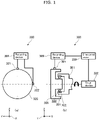
- FIG. 1 illustrates main parts of the training information generation device according to the embodiment.
- (a) is a front view of the training information generation device and (b) is a sectional side view corresponding to (a).
- training information generation device 300 includes fixing component 305 that holds and fixes second component for training 202, and shaft 301.
- Shaft 301 includes drive device 302 and drive control device 330.
- Fixing component 305 is a structure that supports second component for training 202 and is independent of shaft 301.
- Shaft 301 may be made of any material and have any length, etc., as long as shaft 301 has a shape that fits to the inner ring of operation mechanism for training 200. However, it is desirable to match the material and length of shaft 301 with an actual material and length of an operation mechanism for evaluation as much as possible.
- Operation mechanism for training 200 is a rolling bearing to be measured. Operation mechanism for training 200 is not limited as described above. In the present embodiment, operation mechanism for training 200 is a roller bearing.
- deterioration is used to mean that “deterioration” occurring by using an operation mechanism and “deterioration” is an event related to a remaining life of the operating mechanism, and “defect” is described as one type of “deterioration”.
- examples of deterioration include fatigue exfoliation, fatigue damage, lubricant deterioration, and surface roughness due to seal failure.
- a "deterioration amount" quantitatively indicates a defect that occurs on the surface of the first component or the surface of the second component, such as exfoliation, wear, indentation, flaking, and burning. Such a defect occurs due to, for example, sliding motion or rolling-sliding motion between the first component and the second component.
- the "deterioration amount" is one-dimensional information such as a length and width of a region where the defect occurs, two-dimensional information such as an area, three-dimensional information such as a size, or information related to these items of information.
- Deterioration of a component other than the operation mechanism, such as grease, which deteriorates due to sliding motion between the first component and the second component, is also included in the meaning of the term "degradation amount", as long as the deterioration can be quantified and correlates with the deterioration of the operation mechanism.
- Drive device 302 is a device that causes shaft 301 to rotate. Any type of drive device 302 may be used, for example.
- drive device 302 is a servomotor, and the rotary shaft of the servomotor is connected to shaft 301 via a joint.
- Drive device 302 is controlled by drive control device 330.
- Operation mechanism for training 200 is subject to a load from outside via fixing component 305. It is desirable to apply a load similar to a load to be applied when the operation mechanism for evaluation is used.
- any sensor may be used, and a sensor that measures sound may be used, for example.
- a sensor that measures vibration (vibration acceleration) caused by operation mechanism for training 200 by rotation of shaft 301 is used.
- vibration sensor is attached to fixing component 305 and vibration caused by other factors is also measured in addition to vibration caused by operation mechanism for training 200.
- any type of sensor may be used. It is desirable to use a sensor of the same type as the sensor attached to actual device 400. In the present embodiment, a sensor that measures vibration acceleration in a uniaxial direction is used.
- the number of sensors attached to training information generation device 300 is not limited, nor is the location of each sensor.
- the present embodiment includes first sensor 321 and second sensor 322.
- First sensor 321 measures vibration in a direction in which a load is applied to operation mechanism for training 200 (the Z-axis direction in the figure), which is a radial direction with respect to the axial direction of shaft 301.
- Second sensor 322 measures vibration in a direction that is subject to less constraining force (the Y-axis direction in the figure) from outside of the device, extends in the horizontal plane, and is a radial direction perpendicular to the direction of vibration measured by first sensor 321.
- the operation mechanisms including the operation mechanism for evaluation are roller bearings, it is assumed that there is no strong correlation between vibration in the axial direction (the Z-axis direction in the figure) and a remaining life. Therefore, a sensor that detects vibration in the axial direction of shaft 301 is not disposed. However, for example, when the operation mechanism is a ball bearing or a cross roller bearing, a third sensor that detects vibration in the axial direction may be disposed.
- Recording device 306 is a device that records a signal from a sensor.
- a signal from first sensor 321 and a signal from second sensor 322 are recorded separately.
- recording device 306 digitizes an analog signal from a sensor with a sampling rate of 50 kHz and records the digitized signal.
- recording device 306 records, for example, a value indicating output torque of drive device 302, such as a command value for controlling drive device 302 by drive control device 330.
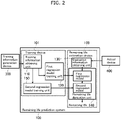
- FIG. 2 is a block diagram of a configuration of a remaining life prediction system according to the embodiment.
- remaining life prediction system 100 includes training information obtaining unit 110, first regression model training unit 120, second regression model training unit 150, evaluation information obtaining unit 130, and remaining life derivation unit 140.
- training information obtaining unit 110, first regression model training unit 120, and second regression model training unit 150 function as training device 101.
- Evaluation information obtaining unit 130 and remaining life derivation unit 140 function as remaining life estimation device 109.
- a new operation mechanism for training 200 is caused to operate until an operating limit using training information generation device 300, and training information obtaining unit 110 obtains (i) training deterioration amount information indicating a deterioration amount due to operation of at least one of first component for training 201 or second component for training 202 at each of points of time until the operating limit, (ii) a training feature vector obtained through operation of operation mechanism for training 200, and (iii) a training remaining life.
- the training remaining life is an amount of time from a point of time of obtainment of information until the operating limit.
- the method of obtaining training deterioration amount information, a training feature vector, and a training remaining life may be any method.
- training deterioration amount information, a training feature vector, and a training remaining life are obtained as described below.
- Training deterioration amount information is obtained by training information obtaining unit 110.
- an inner ring which is second component for training 202, is taken out.
- a worker measures the deterioration amount and inputs the measured deterioration amount, and thereby training information obtaining unit 110 obtains the deterioration amount that has been input.
- a circumferential length of a defect is used as the training deterioration amount information.
- an amount of time for which training information generation device 300 operates is associated with the training deterioration amount information and input as a point of time to training information obtaining unit 110.
- operation mechanism for training 200 is returned to training information generation device 300 and caused to operate for a predetermined time.
- Training deterioration amount information and a point of time is input to training information obtaining unit 110 in the same manner.
- Such operation for a predetermined time and inputting are repeated until the operating limit, and training information obtaining unit 110 obtains training deterioration amount information at each of points of time.
- a point of time at which operation mechanism for training 200 reaches the operating limit is also input to training information obtaining unit 110.
- the "point of time” used in the present description and claims does not mean each moment in actual time, but means each moment (for example, a moment immediately before the operation stops) in accumulated time during which an operation mechanism actually operates.
- a training remaining life is obtained by calculating, by training information obtaining unit 110, a difference between a point of time at which the operating limit is reached, which is input by the worker, and a point of time associated with the training deterioration amount information that has been input.
- a training feature vector is obtained by training information obtaining unit 110.
- Training information obtaining unit 110 generates a training feature vector based on, for example, values of a sensor attached to training information generation device 300.
- training information obtaining unit 110 generates a training feature vector based on features that are obtained from, for example, first sensor 321 and second sensor 322, and stored in recording device 306.
- training information obtaining unit 110 Based on a waveform indicating vibration obtained from each of first sensor 321 and second sensor 322 for a predetermined time (e.g., 20 seconds) immediately before training information generation device 300 is stopped to measure a deterioration amount, training information obtaining unit 110 generates a training feature vector based on the following three types of information: (i) time domain information that is a measurement value, (ii) frequency domain information obtained by performing fast Fourier transformation on the time domain information on which envelope processing is performed, and (iii) quefrency domain information obtained by performing fast Fourier transformation on the time domain information on which envelope processing is performed.
- features may be used, and any number of features may be generated. For example, a variety of statistics may be selected and used. Examples of statistics to be used as specific features include an effective value, a maximum value, a crest factor, peakedness, and skewness. Moreover, features may also be statistics each calculated from frequency domain information and quefrency domain information that are generated for each of the frequency bands obtained by dividing time domain information into frequency bands using a bandpass filter, for example.
- first sensor 321 and second sensor 322 may be used as a feature.
- information related to operation of the operation mechanism such as a current value indicating torque obtained from drive control device 330.
- First regression model training unit 120 trains a first regression model for estimating a deterioration amount based on training feature vectors and training deterioration amount information corresponding to the training feature vectors.
- a training feature vector is a feature vector obtained by training information obtaining unit 110 through operation of operation mechanism for training 200 at each of points of time.
- First regression model may be any model.
- Examples of the first regression model include a random forest, a support vector machine, kernel ridge, and a deep neural network. Moreover, any combination of these is possible.
- Second regression model training unit 150 trains a second regression model that estimates a remaining life, based on the training deterioration amount information obtained through operation mechanism for training 200 at each of points of time and based on a training remaining life corresponding to a point of time of obtainment of the training deterioration amount information.
- the second regression model may be any model.
- Examples of the second regression model include a random forest, a support vector machine, kernel ridge, and a deep neural network. Moreover, any combination of these is possible. Moreover, different models may be used as the first regression model and the second regression model, or the same model may be used as the first regression model and the second regression model.
- Evaluation information obtaining unit 130 obtains an evaluation feature vector obtained through operation of an operation mechanism for evaluation that is of the same type as operation mechanism for training 200.
- An evaluation feature vector is obtained by causing the operation mechanism for evaluation included in actual device 400 to operate. Specifically, a measurement value is obtained by each of (i) a sensor that is of the same type as first sensor 321 and attached to a location on actual device 400 corresponding to the location of first sensor 321 attached to training information generation device 300, and (ii) a sensor that is of the same type as second sensor 322 and attached to a location on actual device 400 corresponding to the location of second sensor 322 attached to training information generation device 300.
- An evaluation feature vector is obtained based on the obtained measurement values.
- the types of features included in each evaluation feature vector is the same as the types of features used for training the first regression model.
- Remaining life derivation unit 140 estimates evaluation deterioration amount information of the operation mechanism for evaluation included in actual device 400 by the first regression model trained by first regression model training unit 120 by inputting the evaluation feature vector obtained and generated by evaluation information obtaining unit 130 based on actual device 400. Remaining life derivation unit 140 derives a remaining life of the operation mechanism for evaluation by the second regression model trained by second regression model training unit 150 by inputting the evaluation deterioration amount information estimated using the first regression model.
- the first regression model trained by inputting feature vectors based on operation of the operation mechanism estimates with high accuracy a deterioration amount of an operation mechanism.
- the second regression model trained by inputting the estimated deterioration amounts estimates a remaining life. With this, a remaining life of the operation mechanism can be estimated with high accuracy and the operation mechanism can be used until a last possible moment until the operation mechanism reaches the operating limit.
- the operation mechanism may be continued to be used after a defect occurs.
- the displacement of the first component and the second component increases as the defect progresses due to a continued use after the defect occurs.
- a device having the operation mechanism attached thereto may reach the operating limit at which the device itself may be destroyed.
- remaining life prediction system 100 even when the state of progress of deterioration changes, a remaining life can be estimated accurately for all periods from an initial stage of the progress of deterioration to an end stage of the progress of deterioration that is close to the limit of use.
- training information generation device 300 is not limited to the training information generation device described in the embodiment.
- Training information generation device 300 may be actual device 400 to which a target operation mechanism is attached whose remaining life is to be predicted or a model imitating actual device 400.
- the features included in the feature vector need not include all of the features described in the embodiment.
- one or more features that strongly contribute to estimation of a remaining life may be selected and included in the feature vector.
- the method of extracting a highly contributing feature may be any method.
- a contribution degree of each feature may be calculated by artificial intelligence and a predetermined number of features (e.g., 10 features) may be selected in order starting from a feature having the highest contribution degree.
- examples of the features may include output torque of drive device 302, a current value related to the output torque, a power value, and an adulteration amount in grease, for example.
- the operation mechanism is not limited to a rolling bearing, and may be a ball screw or a linear guide device, for example.
- remaining life prediction system 100 has been described, but training device 101 and remaining life estimation device 109 may be separate devices.
- the content executed by training device 101 is a method of producing a first regression model for estimating a remaining life of an operation mechanism and a second model that has been trained.
- each processing unit included in remaining life prediction system 100 and remaining life estimation device 109 may be achieved by executing a program by a computer.
- a signal measured by a sensor is not limited to vibration acceleration, and may be a displacement of vibration or a speed of vibration, for example. Not only vibration but also, for example, sound may be measured and used as a signal.
- the present invention is applicable to estimation of a remaining life of any type of operation mechanism in which a first component and a second component operate relative to each other, such as a bearing, a ball screw, a linear motion mechanism, and a speed reducer.
Landscapes
- Physics & Mathematics (AREA)
- Engineering & Computer Science (AREA)
- General Physics & Mathematics (AREA)
- Theoretical Computer Science (AREA)
- Software Systems (AREA)
- Evolutionary Computation (AREA)
- General Engineering & Computer Science (AREA)
- Geometry (AREA)
- Acoustics & Sound (AREA)
- Artificial Intelligence (AREA)
- Computer Vision & Pattern Recognition (AREA)
- Medical Informatics (AREA)
- Computing Systems (AREA)
- Mathematical Physics (AREA)
- Data Mining & Analysis (AREA)
- Computer Hardware Design (AREA)
- Computational Mathematics (AREA)
- Mathematical Analysis (AREA)
- Mathematical Optimization (AREA)
- Pure & Applied Mathematics (AREA)
- Testing Of Devices, Machine Parts, Or Other Structures Thereof (AREA)
Applications Claiming Priority (2)
| Application Number | Priority Date | Filing Date | Title |
|---|---|---|---|
| JP2019180234A JP7290221B2 (ja) | 2019-09-30 | 2019-09-30 | 余寿命予測システム、余寿命予測装置、および余寿命予測プログラム |
| PCT/JP2020/034760 WO2021065449A1 (ja) | 2019-09-30 | 2020-09-14 | 余寿命予測システム、余寿命予測装置、および余寿命予測プログラム |
Publications (2)
| Publication Number | Publication Date |
|---|---|
| EP4040134A1 true EP4040134A1 (de) | 2022-08-10 |
| EP4040134A4 EP4040134A4 (de) | 2023-10-18 |
Family
ID=75270503
Family Applications (1)
| Application Number | Title | Priority Date | Filing Date |
|---|---|---|---|
| EP20870692.9A Withdrawn EP4040134A4 (de) | 2019-09-30 | 2020-09-14 | System zur vorhersage der restlebensdauer, vorrichtung zur vorhersage der restlebensdauer und programm zur vorhersage der restlebensdauer |
Country Status (5)
| Country | Link |
|---|---|
| US (1) | US20220364955A1 (de) |
| EP (1) | EP4040134A4 (de) |
| JP (1) | JP7290221B2 (de) |
| CN (1) | CN114450688A (de) |
| WO (1) | WO2021065449A1 (de) |
Families Citing this family (8)
| Publication number | Priority date | Publication date | Assignee | Title |
|---|---|---|---|---|
| EP3855153A1 (de) * | 2020-01-23 | 2021-07-28 | Siemens Aktiengesellschaft | Verfahren zur bestimmung einer restlebensdauer eines lagers |
| US20230222394A1 (en) * | 2022-01-07 | 2023-07-13 | Applied Materials, Inc. | Predictive modeling for chamber condition monitoring |
| CN115753049B (zh) * | 2022-11-13 | 2025-03-28 | 重庆大学 | 基于概率流学习的金属构件疲劳状态评估方法 |
| CN116150901A (zh) * | 2022-12-24 | 2023-05-23 | 北京工业大学 | 一种基于注意力增强时频Transformer的滚动轴承剩余寿命预测方法 |
| US12530022B2 (en) | 2023-01-23 | 2026-01-20 | Applied Materials, Inc. | Process chamber qualification for maintenance process endpoint detection |
| CN119720391B (zh) * | 2025-02-25 | 2025-05-02 | 中国航发四川燃气涡轮研究院 | 一种考虑测试分散性的锥齿轮行波振动疲劳强度设计方法 |
| CN121211571B (zh) * | 2025-11-25 | 2026-04-10 | 北京市市政工程研究院 | 一种数字孪生的纤维复材拱加固隧道结构评估方法 |
| CN121615521B (zh) * | 2026-02-02 | 2026-05-05 | 浙江中实安全科技有限公司 | 消防阀门的使用寿命预测方法、系统及存储介质 |
Family Cites Families (12)
| Publication number | Priority date | Publication date | Assignee | Title |
|---|---|---|---|---|
| JPS54148428A (en) | 1978-05-15 | 1979-11-20 | Nec Corp | Phase converter circuit |
| JP3880455B2 (ja) * | 2002-05-31 | 2007-02-14 | 中国電力株式会社 | 転がり軸受の余寿命診断方法及びこの余寿命診断装置 |
| US7395188B1 (en) * | 2006-12-07 | 2008-07-01 | General Electric Company | System and method for equipment life estimation |
| US8781982B1 (en) * | 2011-09-23 | 2014-07-15 | Lockheed Martin Corporation | System and method for estimating remaining useful life |
| CN103115789B (zh) * | 2013-01-17 | 2015-01-21 | 西安交通大学 | 金属结构损伤剩余寿命的第二代小波支持向量机评估方法 |
| US10139311B2 (en) * | 2014-09-26 | 2018-11-27 | Palo Alto Research Center Incorporated | Computer-implemented method and system for machine tool damage assessment, prediction, and planning in manufacturing shop floor |
| JP2017219469A (ja) | 2016-06-09 | 2017-12-14 | 日本精工株式会社 | 状態監視装置及び状態監視方法 |
| JP2018004473A (ja) | 2016-07-04 | 2018-01-11 | ファナック株式会社 | 軸受の予測寿命を学習する機械学習装置、寿命予測装置および機械学習方法 |
| JP2019045241A (ja) | 2017-08-31 | 2019-03-22 | Ntn株式会社 | 転がり軸受の状態監視方法および状態監視装置 |
| CN108536938A (zh) * | 2018-03-29 | 2018-09-14 | 上海交通大学 | 一种机床刀具寿命预测系统及预测方法 |
| CN108776017B (zh) * | 2018-04-12 | 2020-04-24 | 无锡信捷电气股份有限公司 | 一种改进chsmm的滚动轴承剩余寿命预测方法 |
| CN109460618B (zh) | 2018-11-13 | 2023-02-10 | 华中科技大学 | 一种滚动轴承剩余寿命在线预测方法及系统 |
-
2019
- 2019-09-30 JP JP2019180234A patent/JP7290221B2/ja active Active
-
2020
- 2020-09-14 CN CN202080067107.1A patent/CN114450688A/zh active Pending
- 2020-09-14 US US17/763,334 patent/US20220364955A1/en active Pending
- 2020-09-14 WO PCT/JP2020/034760 patent/WO2021065449A1/ja not_active Ceased
- 2020-09-14 EP EP20870692.9A patent/EP4040134A4/de not_active Withdrawn
Also Published As
| Publication number | Publication date |
|---|---|
| CN114450688A (zh) | 2022-05-06 |
| EP4040134A4 (de) | 2023-10-18 |
| JP7290221B2 (ja) | 2023-06-13 |
| WO2021065449A1 (ja) | 2021-04-08 |
| US20220364955A1 (en) | 2022-11-17 |
| JP2021056124A (ja) | 2021-04-08 |
Similar Documents
| Publication | Publication Date | Title |
|---|---|---|
| US20220364955A1 (en) | Remaining life prediction system, remaining life prediction device, and remaining life prediction program | |
| Orhan et al. | Vibration monitoring for defect diagnosis of rolling element bearings as a predictive maintenance tool: Comprehensive case studies | |
| JP6196093B2 (ja) | 軸受装置の振動解析方法、軸受装置の振動解析装置、および転がり軸受の状態監視装置 | |
| EP4058771B1 (de) | Verfahren zur bestimmung einer restlebensdauer eines lagers | |
| JP4771334B2 (ja) | 状態検出装置及び状態検出方法並びに状態検出用プログラム及び情報記録媒体、状態表示装置及び状態表示方法並びに状態表示用プログラム及び情報記録媒体 | |
| CN113027703A (zh) | 包括传动系统、齿轮箱和发电机的旋转机械的损害和剩余使用寿命的确定 | |
| JP2017173321A (ja) | 状態監視システムおよび風力発電装置 | |
| Wang et al. | Lévy process-based stochastic modeling for machine performance degradation prognosis | |
| WO2021117752A1 (ja) | 転がり軸受の状態監視方法及び転がり軸受の状態監視装置 | |
| JP2017181500A (ja) | 状態監視システムおよび風力発電装置 | |
| CN112557036B (zh) | 诊断装置与方法以及计算机可读取存储媒介 | |
| KR102343793B1 (ko) | 데이터 처리 장치, 데이터 처리 시스템, 데이터 처리 방법, 데이터 처리 프로그램 및 기억 매체 | |
| Pichler et al. | Detecting wear in a ball screw using a data-driven approach | |
| US20210063275A1 (en) | Method for predicting damage to a component of a roller bearing | |
| JP2021032769A (ja) | 転がり軸受の状態監視方法及び状態監視装置 | |
| Mütze et al. | On inverter induced bearing currents, bearing maintenance scheduling, and prognosis | |
| Dang et al. | Fault prediction of rolling bearing based on ARMA model | |
| Klausen et al. | Novel threshold calculations for remaining useful lifetime estimation of rolling element bearings | |
| JP5751606B2 (ja) | 機械設備における異常診断システム | |
| Shutin et al. | Prediction of remaining useful life of passive and adjustable fluid film bearings using Physics-Based models of their degradation | |
| JP7430317B2 (ja) | 余寿命予測システム、余寿命予測装置、および余寿命予測プログラム | |
| JP2021096102A (ja) | 転がり軸受の状態監視方法及び転がり軸受の状態監視装置 | |
| JP2023138012A (ja) | 劣化状況予測システム、および劣化状況予測方法 | |
| JP7601123B2 (ja) | 軸受の軌道輪のはく離進展解析方法、はく離解析装置、およびプログラム | |
| Evanchalin et al. | Thrust ball bearing fault identification from visualized data using optimized deep network |
Legal Events
| Date | Code | Title | Description |
|---|---|---|---|
| STAA | Information on the status of an ep patent application or granted ep patent |
Free format text: STATUS: THE INTERNATIONAL PUBLICATION HAS BEEN MADE |
|
| PUAI | Public reference made under article 153(3) epc to a published international application that has entered the european phase |
Free format text: ORIGINAL CODE: 0009012 |
|
| STAA | Information on the status of an ep patent application or granted ep patent |
Free format text: STATUS: REQUEST FOR EXAMINATION WAS MADE |
|
| 17P | Request for examination filed |
Effective date: 20220324 |
|
| AK | Designated contracting states |
Kind code of ref document: A1 Designated state(s): AL AT BE BG CH CY CZ DE DK EE ES FI FR GB GR HR HU IE IS IT LI LT LU LV MC MK MT NL NO PL PT RO RS SE SI SK SM TR |
|
| DAV | Request for validation of the european patent (deleted) | ||
| DAX | Request for extension of the european patent (deleted) | ||
| REG | Reference to a national code |
Ref country code: DE Ref legal event code: R079 Free format text: PREVIOUS MAIN CLASS: G01M0013000000 Ipc: G06N0020200000 |
|
| A4 | Supplementary search report drawn up and despatched |
Effective date: 20230918 |
|
| RIC1 | Information provided on ipc code assigned before grant |
Ipc: G01M 13/045 20190101ALI20230912BHEP Ipc: G06N 20/20 20190101AFI20230912BHEP |
|
| STAA | Information on the status of an ep patent application or granted ep patent |
Free format text: STATUS: THE APPLICATION HAS BEEN WITHDRAWN |
|
| 18W | Application withdrawn |
Effective date: 20251106 |