EP4058771B1 - Verfahren zur bestimmung einer restlebensdauer eines lagers - Google Patents
Verfahren zur bestimmung einer restlebensdauer eines lagers Download PDFInfo
- Publication number
- EP4058771B1 EP4058771B1 EP20824112.5A EP20824112A EP4058771B1 EP 4058771 B1 EP4058771 B1 EP 4058771B1 EP 20824112 A EP20824112 A EP 20824112A EP 4058771 B1 EP4058771 B1 EP 4058771B1
- Authority
- EP
- European Patent Office
- Prior art keywords
- bearing
- determining
- useful life
- model
- remaining useful
- Prior art date
- Legal status (The legal status is an assumption and is not a legal conclusion. Google has not performed a legal analysis and makes no representation as to the accuracy of the status listed.)
- Active
Links
Images

Classifications
-
- G—PHYSICS
- G01—MEASURING; TESTING
- G01M—TESTING STATIC OR DYNAMIC BALANCE OF MACHINES OR STRUCTURES; TESTING OF STRUCTURES OR APPARATUS, NOT OTHERWISE PROVIDED FOR
- G01M13/00—Testing of machine parts
- G01M13/04—Bearings
- G01M13/045—Acoustic or vibration analysis
Definitions
- the present invention relates to bearings and in particular rolling bearings.
- Rolling bearings are commonly and widely used subassemblies in rotary machinery systems (RMS). They are used in the bearing arrangements of small and precise devices as well as in large industrial machines.
- the elements of bearings, such as balls, rollers, or raceways are exposed to multiaxial and non-proportional low and high-cycle fatigue loadings, which are usually the source of the rolling contact fatigue (RCF).
- the fatigue life of bearings depends on many factors and variables, such as the size and direction of the contact forces, the geometry and roughness of the contact surfaces, the kind of material, the operating temperature, applied lubricant, lubrication conditions, rolling speed, and sliding in the contact area.
- the possible damage of the rolling bearing determines the operation of the RMS
- the proper estimation of the fatigue life or loading capacity of a rolling bearing becomes a crucial task in the machine design process.
- difficulties with the detection of bearing element damages at the initial stages (damage detection is possible when damage achieves a certain size) justify the fatigue life prediction of rolling bearings.
- EP 1 510 805 A1 discloses a method to determine a bearing indentation size and the bearing remaining life based on bearing vibration analysis.
- a bearing in a machine will eventually fail, and the most common reason for failure is the formation of surface defects from the propagation of fatigue cracks or the removal of surface grains during operation. These defects occur due to insufficient lubrication and high contact stresses between the rolling element and the raceway of the bearing, causing spalls, dents, and pits to form on the contact surfaces.
- the potential damage can be avoided by maintenance implementations, e.g., to a achieve a maximum lifetime and minimum maintenance costs for the rotatory machinery system.
- an improved method for determining a remaining useful life of a bearing having a surface defect is proposed as defined in independent claim 1.
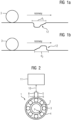
- Figure 1a and 1b show a schematic illustration of a rolling element 3 of a bearing. Therein balls are used as rollingelements 3 to maintain the separation between the bearing races.
- a defect size d1, d2 may be measured and/or classified according to surface defect's length and/or width.
- different edge discontinuities on the inner race and/or outer race of the roller bearing may be considered.
- the length may be measured along the direction of the rolling element's motion, i.e. the raceway.
- a surface defect 12 may correspond to one or more of the following: one or more spall, one or more dents, and one or more pits.
- Figure 2 shows a bearing 1 comprising a bearing inner ring 2, rolling elements 3 (for example bearing balls), and a bearing outer ring 4.
- a sensor module 5 which may comprise a vibration sensor 6. Additionally or alternatively, a sound emission sensor 7, and/or a so-called acoustic emission sensor 8 may also be provided.
- the sensor module 5 is connected to an apparatus 11 for performing diagnosis, such as determining a remaining useful life of the bearing.
- the sensor generated signals, which are picked up by the sensor module 5 and/or the sensors 6, 7, and/or 8 are forwarded to the apparatus 11.
- the signals which are generated by the vibration sensor 6 are evaluated within the apparatus 11, e.g., with the aid of vibration analysis.
- the vibration analysis may comprise a Fourier transformation of the time series sampled by the vibration sensor 6.
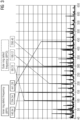
- FIG. 3 the frequency spectrum and corresponding amplitudes of a bearing having different types of defects is shown.
- outer ring defects i.e. surface defects on the outer race
- the spectrum is characterized by the presence of harmonic peaks of the outer race failing frequency, e.g., between 8 and 10 harmonics of the ball pass frequency of the outer ring
- the spectrum shows several harmonic peaks of the inner race failing frequency, e.g., between 8 and 10 ball pass frequency of the inner ring harmonics.
- Rolling element defects are characterized by the presence in the spectrum of harmonics of the rolling element deterioration frequency, e.g., according to the ball spin frequency.
- Determining the remaining useful life, RUL, of rolling bearings is of great importance for machine operators.
- the exact calculation of the remaining service life of the rolling bearings, which are used in, e.g., a motor, is always difficult to perform since the necessary simulation models are very complex and are only applicable for the respective motor.
- the effort to validate such models is very large.
- Existing methods calculate the remaining useful life without taking into account bearing defects that have arisen during operation of the bearing or calculate the remaining useful life up to the formation of the first defects. In practice, it is important to calculate the remaining useful life of a bearing after the formation of one or more defects and thereby consider the evolution and change of the defect size during the further operation of the bearing.
- RUL Remaining Useful Life
- PLM Prognostics and Health Management
- CNN Convolutional Neural Network
- HMMs Hidden Markov Models
- LSTM Long Short-Term Memory
- the entire service life for a new rolling bearing is calculated and a maintenance interval is recommended based thereon.
- a maintenance interval is recommended based thereon.
- the harmonious amplitudes of the bearing are evaluated and a damage class is determined.
- the remaining useful life is estimated based on experience.
- a size of the surface defect of the bearing is determined.
- one or more of the following frequencies may be used: The Ball Pass Frequency Inner raceway (BPFI), the Ball Pass Frequency Outer raceway (BPFO) and/or the Fundamental Train Frequency (FTF).
- BPFI Ball Pass Frequency Inner raceway
- BPFO Ball Pass Frequency Outer raceway
- FTF Fundamental Train Frequency
- 1 st , 2 nd and 3 rd harmonics of the BPFI, BPFO and/or FTF may be used.
- the maximum amplitude of those harmonics may be used.
- Higher order harmonics may be neglected or filtered out.
- the principal stresses caused by the surface defect in the bearing are determined, preferably taking into account the specific operating conditions of the bearing.
- the maximum, i.e. the largest, of the principal stresses is determined and used for calculating the remaining useful life.
- the principal stresses are the eigenvalues of the stress tensor and the eigen value of maximum magnitude is the maximum principal stress.
- the remaining useful life of the bearing is calculated based on at least one of the principal stresses.
- a simulation model which is, e.g., based on a finite element method, FEM, or a substitute model for the FEM method may be used in order to determine the principal stresses of the bearing.
- the principal stress may then be used to determine the remaining useful life based on a "hight cycle fatigue", HCF, algorithm.
- the size of the one or more surface defects is determined with the help of a machine learning algorithm, such as a trained artificial neural network.
- a machine learning algorithm such as a trained artificial neural network.
- an artificial neural network ML is trained, e.g. with data from the numerical simulations.
- the hyperparameters of the artificial neural network ML such as the number of epochs may be set, e.g., to 500, and the learning rate may be set, e.g., to 0,2.
- the training data may be obtained as a result of a simulation of a bearing having one or more surface defects - as will be described later in connection with Figure 10 .
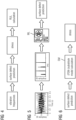
- time series data of the bearing's vibrations are generated, e.g. by sampling the vibration sensor data, e.g. according to the embodiment of Figure 2 .
- the sampled data may be stored in a memory of a gateway such as an edge device or in a cloud-computing environment.
- the time-series data may be Fourier transformed into frequency space yielding a frequency spectrum of the bearing's vibrations.
- the frequencies and amplitudes may be characteristic for specific bearing damages, e.g., whether a damage is present on the inner ring, outer ring and/or the rolling element itself, cf. as described in connection with Figure 3 .
- the frequency spectrum or only part thereof is then be input into a machine learning algorithm, such as a trained neural network ML.
- the trained artificial neural network ML is operative to infer a surface defect size (on the inner ring, the outer ring or the rolling element) based on the input frequencies and/or their amplitude values.
- a bearing stress may be determined. This can be achieved by a finite element method or as shown in Figure 6 by a substitute model of said finite element method.
- the coefficients a k of the polynomial may be determined by polynomial interpolation of the stress calculated by the bearing simulation as a function of the input parameters.
- the contact force or load may be determined based on the geometry and contact stress of bearing.
- the coefficients a k of the polynomial may be determined by polynomial interpolation of the contact force calculated by the bearing simulation as a function of the input parameters.
- the principal stress or the contact force as determined in accordance with the previous embodiments may be used as input for a calculation which yields a RUL as a result.
- the RUL calculation may be performed according to a high cycle fatigue, HCF, model.
- the RUL as a number of cycles to failure may be obtained.
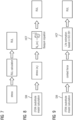
- Figure 9 shows exemplary steps for determining the remaining useful life of a bearing based on the contact force.
- the contact force caused by the surface defect may be obtained in accordance with a substitute model for determining the contact force as explained earlier.
- Figure 10 shows a schematic illustration of exemplary steps for training an artificial neural network.
- a finite element method FEM is used.
- a data set comprising vibration frequencies and corresponding amplitudes on the one hand and surface defect sizes on the other hand is obtained.
- a data set is obtained that connects the vibration frequencies of surface defects, such as ball pass frequency of the outer ring or inner ring, with different surface defect sizes.
- This data set may be used to train an artificial neural network ML.
- This trained artificial neural network ML may then be used for determining the surface defect size. Accordingly the trained artificial neural network ML may be used to determined principal stresses and/or the remaining useful life of the bearing as described in the above.
- the FEM calculation may be based on input parameters such as static input parameters and dynamic input parameters.
- the static input parameters may comprise the geometry, material properties and weight of the bearing, whereas the dynamic properties -which are varied while the static properties remain the same- may comprise different surface defect sizes and/or different rotor speeds.
- the FEM calculation yields vibration frequencies and corresponding amplitudes dependent on different surface defect sizes.
Landscapes
- Physics & Mathematics (AREA)
- Acoustics & Sound (AREA)
- General Physics & Mathematics (AREA)
- Testing Of Devices, Machine Parts, Or Other Structures Thereof (AREA)
Claims (7)
- Verfahren zum Bestimmen einer Restnutzungsdauer (RUL) für ein Lager (1) mit einem Oberflächendefekt (12), das folgende Schritte umfasst:Bestimmen einer Defektgröße (d1, d2) des Oberflächendefekts (12) auf der Grundlage vorzugsweise abgetasteter Schwingungen des Lagers (1), z.B. harmonischer Schwingungen eines Innenrings (2) und/oder eines Außenrings (4) des Lagers (1),dadurch gekennzeichnet, dassdie Größe (d1, d2) des Oberflächendefekts (12) auf der Grundlage eines Verknüpfens der abgetasteten Schwingungen des Lagers (1) mit der Defektgröße (d1, d2) des Oberflächendefekts (12) mithilfe eines trainierten Maschinenlernmodells (ML) bestimmt wird,Bestimmen mindestens einer Hauptbelastung (σ) oder einer Kontaktkraft (F) des Lagers (1), die von dem Oberflächendefekt (12) verursacht werden, auf der Grundlage der Defektgröße (d1, d2), wobei das Bestimmen mindestens einer der Hauptbelastungen (σ) oder der Kontaktkraft auf einem Ersatzmodell (SM) von dem Lager basiert,wobei die Größe (d1, d2) des Oberflächendefekts (12) als Eingabedaten für das Ersatzmodell (SM) dient, undwobei das Ersatzmodell Defektgrößen mit der Hauptbelastung oder der Kontaktkraft des Lagers verknüpft, undBestimmen der Restnutzungsdauer (RUL) für das Lager (1) auf der Grundlage der Hauptbelastungen (σ) und/oder der Kontaktkraft (F).
- Verfahren nach dem vorhergehenden Anspruch,
wobei das Bestimmen der Restnutzungsdauer (RUL) für das Lager (1) auf der maximalen Hauptbelastung (σ) basiert. - Verfahren nach den vorhergehenden Ansprüchen,
wobei das Bestimmen der Restnutzungsdauer (RUL) für das Lager (1) auf einem Zeitschwingfestigkeitsmodell basiert. - Verfahren nach dem vorhergehenden Anspruch, das ferner Folgendes umfasst:
Laden des Ersatzmodells (SM) für das Lager (1), wobei ein oder mehrere Parameter des Ersatzmodells (SM) auf den Betriebsbedingungen des Lagers (1) und/oder modellspezifischen Lagerdaten basieren. - Verfahren nach dem vorhergehenden Anspruch, das ferner Folgendes umfasst:wobei die Restnutzungsdauer (RUL) auf der Grundlage des Zeitschwingfestigkeitsmodells (HCF) bestimmt wird und die mindestens eine der Hauptbelastungen (σ) als Eingabedaten für das Zeitschwingfestigkeitsmodell (HCF) dient,wobei vorzugsweise die Lastspielzahl und die Materialermüdung als Parameter für das Zeitschwingfestigkeitsmodell (HCF) dienen.
- Computerprogramm zum Durchführen der Verfahrensschritte nach einem der vorhergehenden Ansprüche.
- Datenverarbeitungsvorrichtung (11), die Mittel zum Durchführen der Verfahrensschritte nach einem der vorhergehenden Ansprüche 1-5 umfasst.
Applications Claiming Priority (2)
| Application Number | Priority Date | Filing Date | Title |
|---|---|---|---|
| EP20153396.5A EP3855153A1 (de) | 2020-01-23 | 2020-01-23 | Verfahren zur bestimmung einer restlebensdauer eines lagers |
| PCT/EP2020/083581 WO2021148170A1 (en) | 2020-01-23 | 2020-11-27 | Method for determining a remaining useful life of a bearing |
Publications (3)
| Publication Number | Publication Date |
|---|---|
| EP4058771A1 EP4058771A1 (de) | 2022-09-21 |
| EP4058771C0 EP4058771C0 (de) | 2025-02-12 |
| EP4058771B1 true EP4058771B1 (de) | 2025-02-12 |
Family
ID=69190697
Family Applications (2)
| Application Number | Title | Priority Date | Filing Date |
|---|---|---|---|
| EP20153396.5A Withdrawn EP3855153A1 (de) | 2020-01-23 | 2020-01-23 | Verfahren zur bestimmung einer restlebensdauer eines lagers |
| EP20824112.5A Active EP4058771B1 (de) | 2020-01-23 | 2020-11-27 | Verfahren zur bestimmung einer restlebensdauer eines lagers |
Family Applications Before (1)
| Application Number | Title | Priority Date | Filing Date |
|---|---|---|---|
| EP20153396.5A Withdrawn EP3855153A1 (de) | 2020-01-23 | 2020-01-23 | Verfahren zur bestimmung einer restlebensdauer eines lagers |
Country Status (4)
| Country | Link |
|---|---|
| US (1) | US11885708B2 (de) |
| EP (2) | EP3855153A1 (de) |
| CN (1) | CN115023598A (de) |
| WO (1) | WO2021148170A1 (de) |
Families Citing this family (9)
| Publication number | Priority date | Publication date | Assignee | Title |
|---|---|---|---|---|
| EP3961335B1 (de) * | 2020-08-28 | 2024-07-17 | Siemens Aktiengesellschaft | System, vorrichtung und verfahren zur schätzung der restlebensdauer eines lagers |
| CN113916535B (zh) * | 2021-10-27 | 2022-08-09 | 河北建投能源投资股份有限公司 | 基于时频和cnn的轴承诊断方法、系统、设备及介质 |
| CN115098962A (zh) * | 2022-06-16 | 2022-09-23 | 江苏理工学院 | 一种基于隐半马尔夫模型的机械设备退化态下剩余寿命的预测方法 |
| CN115470630B (zh) * | 2022-09-13 | 2025-10-17 | 浙江理工大学 | 一种基于vmd-ssa-lstm的滚动轴承剩余使用寿命预测方法 |
| FR3140944B1 (fr) * | 2022-10-14 | 2025-05-02 | Safran Aircraft Engines | Procédé de détermination de la fiabilité d’un roulement |
| WO2024247532A1 (ja) * | 2023-05-31 | 2024-12-05 | 日本精工株式会社 | 軸受残存寿命診断方法及び軸受残存寿命診断装置 |
| CN117451489B (zh) * | 2023-12-26 | 2024-03-08 | 集美大学 | 一种接触疲劳失效特征振动信号识别装置与方法 |
| JP7756825B1 (ja) | 2024-03-27 | 2025-10-20 | Ntn株式会社 | 損傷状態診断システムおよび損傷状態診断方法 |
| WO2025205439A1 (ja) * | 2024-03-27 | 2025-10-02 | Ntn株式会社 | 損傷状態診断システムおよび損傷状態診断方法 |
Family Cites Families (10)
| Publication number | Priority date | Publication date | Assignee | Title |
|---|---|---|---|---|
| JP3880455B2 (ja) * | 2002-05-31 | 2007-02-14 | 中国電力株式会社 | 転がり軸受の余寿命診断方法及びこの余寿命診断装置 |
| NL1023948C2 (nl) * | 2003-07-18 | 2005-01-19 | Skf Ab | Werkwijze en sensoropstelling voor belastingsmeting op een lager met rolelementen. |
| KR20150004848A (ko) * | 2012-04-24 | 2015-01-13 | 아크티에볼라게트 에스케이에프 | 베어링 모니터링 방법 및 시스템 |
| CN103927414B (zh) * | 2014-04-04 | 2017-02-15 | 北京工业大学 | 含单点故障的滚动轴承振动响应仿真分析方法 |
| GB2543521A (en) * | 2015-10-20 | 2017-04-26 | Skf Ab | Method and data processing device for severity assessment of bearing defects using vibration energy |
| JP2019045241A (ja) * | 2017-08-31 | 2019-03-22 | Ntn株式会社 | 転がり軸受の状態監視方法および状態監視装置 |
| MX2020008239A (es) * | 2018-02-15 | 2020-09-22 | Amsted Rail Co Inc | Sistema, metodo y aparato para monitorear el buen funcionamiento de los conjuntos de ruedas de vagones. |
| CN110243603B (zh) * | 2019-05-30 | 2020-11-24 | 沈阳化工大学 | 基于Welch转换-径向基神经网的滚动轴承故障诊断方法 |
| EP3757539A1 (de) * | 2019-06-26 | 2020-12-30 | Siemens Aktiengesellschaft | System, vorrichtung und verfahren zur bestimmung des zustands eines lagers |
| JP7290221B2 (ja) * | 2019-09-30 | 2023-06-13 | 国立大学法人大阪大学 | 余寿命予測システム、余寿命予測装置、および余寿命予測プログラム |
-
2020
- 2020-01-23 EP EP20153396.5A patent/EP3855153A1/de not_active Withdrawn
- 2020-11-27 WO PCT/EP2020/083581 patent/WO2021148170A1/en not_active Ceased
- 2020-11-27 US US17/794,953 patent/US11885708B2/en active Active
- 2020-11-27 CN CN202080094250.XA patent/CN115023598A/zh active Pending
- 2020-11-27 EP EP20824112.5A patent/EP4058771B1/de active Active
Also Published As
| Publication number | Publication date |
|---|---|
| EP4058771C0 (de) | 2025-02-12 |
| WO2021148170A1 (en) | 2021-07-29 |
| US20230112604A1 (en) | 2023-04-13 |
| US11885708B2 (en) | 2024-01-30 |
| EP3855153A1 (de) | 2021-07-28 |
| EP4058771A1 (de) | 2022-09-21 |
| CN115023598A (zh) | 2022-09-06 |
Similar Documents
| Publication | Publication Date | Title |
|---|---|---|
| EP4058771B1 (de) | Verfahren zur bestimmung einer restlebensdauer eines lagers | |
| US11599103B2 (en) | Method and system for data driven machine diagnostics | |
| JP6140331B1 (ja) | 主軸または主軸を駆動するモータの故障予知を学習する機械学習装置および機械学習方法、並びに、機械学習装置を備えた故障予知装置および故障予知システム | |
| Elforjani et al. | Prognosis of bearing acoustic emission signals using supervised machine learning | |
| Shao et al. | Prognosis of remaining bearing life using neural networks | |
| Gupta et al. | Fault detection analysis in rolling element bearing: A review | |
| EP2710438B1 (de) | Bestimmung der schäden und verbleibenden nutzungsdauer von drehmaschinen einschliesslich antriebssträngen, getrieben und generatoren | |
| Ayhan et al. | Adaptive remaining useful life prediction algorithm for bearings | |
| Klausen et al. | RMS based health indicators for remaining useful lifetime estimation of bearings | |
| Zhang et al. | A multi-fault modeling approach for fault diagnosis and failure prognosis of engineering systems | |
| Dang et al. | Fault prediction of rolling bearing based on ARMA model | |
| Castilla-Gutiérrez et al. | Control and prediction protocol for bearing failure through spectral power density | |
| Pathiran et al. | Performance and predict the ball bearing faults using wavelet packet decomposition and ANFIS | |
| Shinde et al. | Dynamic behavior and numerical investigation of contact characteristics of rotor bearing system using dimensional analysis and finite element model | |
| Ramananda et al. | Virtual Sensor Conceptualization for Rotation Speed and Torque Prediction: A Case Study of Two-Stage Reduction Gearbox | |
| Çalışkan et al. | Machine Learning-Based Failure Detection Using Internet of Things: A Case Study for Proactive Maintenance | |
| Heya et al. | Failure acceleration and condition diagnosis of ball bearings by an excitation mechanism using piezo actuators | |
| Vinokur et al. | Diagnostics of rolling bearings using artificial neural networks | |
| Behzad et al. | Prognostics of rolling element bearings using shock pulse method and vibration method records and employing feedforward neural-network | |
| Evanchalin et al. | Thrust ball bearing fault identification from visualized data using optimized deep network | |
| Guerti et al. | A Reliable Neural Network Approach for Monitoring and Diagnosing Bearing Faults in Induction Motors | |
| Larizza et al. | Modelling and defect size estimation of a defective bearing | |
| Tajiani et al. | Remaining Useful Life Estimation Using Vibration-based Degradation Signals | |
| Mbagaya | Failure Prediction of Rolling Element Bearings Operated Under Non-Stationary Conditions | |
| Knap et al. | Deep Learning Damage Forecasting for Rotating Devices Using Bayesian Sub-predictors |
Legal Events
| Date | Code | Title | Description |
|---|---|---|---|
| STAA | Information on the status of an ep patent application or granted ep patent |
Free format text: STATUS: UNKNOWN |
|
| STAA | Information on the status of an ep patent application or granted ep patent |
Free format text: STATUS: THE INTERNATIONAL PUBLICATION HAS BEEN MADE |
|
| PUAI | Public reference made under article 153(3) epc to a published international application that has entered the european phase |
Free format text: ORIGINAL CODE: 0009012 |
|
| STAA | Information on the status of an ep patent application or granted ep patent |
Free format text: STATUS: REQUEST FOR EXAMINATION WAS MADE |
|
| 17P | Request for examination filed |
Effective date: 20220617 |
|
| AK | Designated contracting states |
Kind code of ref document: A1 Designated state(s): AL AT BE BG CH CY CZ DE DK EE ES FI FR GB GR HR HU IE IS IT LI LT LU LV MC MK MT NL NO PL PT RO RS SE SI SK SM TR |
|
| DAV | Request for validation of the european patent (deleted) | ||
| DAX | Request for extension of the european patent (deleted) | ||
| GRAP | Despatch of communication of intention to grant a patent |
Free format text: ORIGINAL CODE: EPIDOSNIGR1 |
|
| STAA | Information on the status of an ep patent application or granted ep patent |
Free format text: STATUS: GRANT OF PATENT IS INTENDED |
|
| INTG | Intention to grant announced |
Effective date: 20241014 |
|
| GRAS | Grant fee paid |
Free format text: ORIGINAL CODE: EPIDOSNIGR3 |
|
| GRAA | (expected) grant |
Free format text: ORIGINAL CODE: 0009210 |
|
| STAA | Information on the status of an ep patent application or granted ep patent |
Free format text: STATUS: THE PATENT HAS BEEN GRANTED |
|
| AK | Designated contracting states |
Kind code of ref document: B1 Designated state(s): AL AT BE BG CH CY CZ DE DK EE ES FI FR GB GR HR HU IE IS IT LI LT LU LV MC MK MT NL NO PL PT RO RS SE SI SK SM TR |
|
| REG | Reference to a national code |
Ref country code: GB Ref legal event code: FG4D |
|
| REG | Reference to a national code |
Ref country code: CH Ref legal event code: EP |
|
| REG | Reference to a national code |
Ref country code: DE Ref legal event code: R096 Ref document number: 602020046032 Country of ref document: DE |
|
| REG | Reference to a national code |
Ref country code: IE Ref legal event code: FG4D |
|
| U01 | Request for unitary effect filed |
Effective date: 20250221 |
|
| U07 | Unitary effect registered |
Designated state(s): AT BE BG DE DK EE FI FR IT LT LU LV MT NL PT RO SE SI Effective date: 20250228 |
|
| PG25 | Lapsed in a contracting state [announced via postgrant information from national office to epo] |
Ref country code: RS Free format text: LAPSE BECAUSE OF FAILURE TO SUBMIT A TRANSLATION OF THE DESCRIPTION OR TO PAY THE FEE WITHIN THE PRESCRIBED TIME-LIMIT Effective date: 20250512 |
|
| PG25 | Lapsed in a contracting state [announced via postgrant information from national office to epo] |
Ref country code: PL Free format text: LAPSE BECAUSE OF FAILURE TO SUBMIT A TRANSLATION OF THE DESCRIPTION OR TO PAY THE FEE WITHIN THE PRESCRIBED TIME-LIMIT Effective date: 20250212 |
|
| PG25 | Lapsed in a contracting state [announced via postgrant information from national office to epo] |
Ref country code: ES Free format text: LAPSE BECAUSE OF FAILURE TO SUBMIT A TRANSLATION OF THE DESCRIPTION OR TO PAY THE FEE WITHIN THE PRESCRIBED TIME-LIMIT Effective date: 20250212 |
|
| PG25 | Lapsed in a contracting state [announced via postgrant information from national office to epo] |
Ref country code: IS Free format text: LAPSE BECAUSE OF FAILURE TO SUBMIT A TRANSLATION OF THE DESCRIPTION OR TO PAY THE FEE WITHIN THE PRESCRIBED TIME-LIMIT Effective date: 20250612 Ref country code: NO Free format text: LAPSE BECAUSE OF FAILURE TO SUBMIT A TRANSLATION OF THE DESCRIPTION OR TO PAY THE FEE WITHIN THE PRESCRIBED TIME-LIMIT Effective date: 20250512 |
|
| PG25 | Lapsed in a contracting state [announced via postgrant information from national office to epo] |
Ref country code: HR Free format text: LAPSE BECAUSE OF FAILURE TO SUBMIT A TRANSLATION OF THE DESCRIPTION OR TO PAY THE FEE WITHIN THE PRESCRIBED TIME-LIMIT Effective date: 20250212 |
|
| PG25 | Lapsed in a contracting state [announced via postgrant information from national office to epo] |
Ref country code: GR Free format text: LAPSE BECAUSE OF FAILURE TO SUBMIT A TRANSLATION OF THE DESCRIPTION OR TO PAY THE FEE WITHIN THE PRESCRIBED TIME-LIMIT Effective date: 20250513 |
|
| PG25 | Lapsed in a contracting state [announced via postgrant information from national office to epo] |
Ref country code: SM Free format text: LAPSE BECAUSE OF FAILURE TO SUBMIT A TRANSLATION OF THE DESCRIPTION OR TO PAY THE FEE WITHIN THE PRESCRIBED TIME-LIMIT Effective date: 20250212 |
|
| PG25 | Lapsed in a contracting state [announced via postgrant information from national office to epo] |
Ref country code: CZ Free format text: LAPSE BECAUSE OF FAILURE TO SUBMIT A TRANSLATION OF THE DESCRIPTION OR TO PAY THE FEE WITHIN THE PRESCRIBED TIME-LIMIT Effective date: 20250212 |
|
| PG25 | Lapsed in a contracting state [announced via postgrant information from national office to epo] |
Ref country code: SK Free format text: LAPSE BECAUSE OF FAILURE TO SUBMIT A TRANSLATION OF THE DESCRIPTION OR TO PAY THE FEE WITHIN THE PRESCRIBED TIME-LIMIT Effective date: 20250212 |