EP4037950B1 - Batterietrog für ein schienenfahrzeug - Google Patents
Batterietrog für ein schienenfahrzeug Download PDFInfo
- Publication number
- EP4037950B1 EP4037950B1 EP20816098.6A EP20816098A EP4037950B1 EP 4037950 B1 EP4037950 B1 EP 4037950B1 EP 20816098 A EP20816098 A EP 20816098A EP 4037950 B1 EP4037950 B1 EP 4037950B1
- Authority
- EP
- European Patent Office
- Prior art keywords
- battery
- battery receptacle
- receptacle
- box
- hinge
- Prior art date
- Legal status (The legal status is an assumption and is not a legal conclusion. Google has not performed a legal analysis and makes no representation as to the accuracy of the status listed.)
- Active
Links
Images


Classifications
-
- H—ELECTRICITY
- H01—ELECTRIC ELEMENTS
- H01M—PROCESSES OR MEANS, e.g. BATTERIES, FOR THE DIRECT CONVERSION OF CHEMICAL ENERGY INTO ELECTRICAL ENERGY
- H01M50/00—Constructional details or processes of manufacture of the non-active parts of electrochemical cells other than fuel cells, e.g. hybrid cells
- H01M50/20—Mountings; Secondary casings or frames; Racks, modules or packs; Suspension devices; Shock absorbers; Transport or carrying devices; Holders
- H01M50/204—Racks, modules or packs for multiple batteries or multiple cells
- H01M50/207—Racks, modules or packs for multiple batteries or multiple cells characterised by their shape
-
- B—PERFORMING OPERATIONS; TRANSPORTING
- B60—VEHICLES IN GENERAL
- B60L—PROPULSION OF ELECTRICALLY-PROPELLED VEHICLES; SUPPLYING ELECTRIC POWER FOR AUXILIARY EQUIPMENT OF ELECTRICALLY-PROPELLED VEHICLES; ELECTRODYNAMIC BRAKE SYSTEMS FOR VEHICLES IN GENERAL; MAGNETIC SUSPENSION OR LEVITATION FOR VEHICLES; MONITORING OPERATING VARIABLES OF ELECTRICALLY-PROPELLED VEHICLES; ELECTRIC SAFETY DEVICES FOR ELECTRICALLY-PROPELLED VEHICLES
- B60L50/00—Electric propulsion with power supplied within the vehicle
- B60L50/50—Electric propulsion with power supplied within the vehicle using propulsion power supplied by batteries or fuel cells
- B60L50/60—Electric propulsion with power supplied within the vehicle using propulsion power supplied by batteries or fuel cells using power supplied by batteries
- B60L50/64—Constructional details of batteries specially adapted for electric vehicles
-
- B—PERFORMING OPERATIONS; TRANSPORTING
- B60—VEHICLES IN GENERAL
- B60L—PROPULSION OF ELECTRICALLY-PROPELLED VEHICLES; SUPPLYING ELECTRIC POWER FOR AUXILIARY EQUIPMENT OF ELECTRICALLY-PROPELLED VEHICLES; ELECTRODYNAMIC BRAKE SYSTEMS FOR VEHICLES IN GENERAL; MAGNETIC SUSPENSION OR LEVITATION FOR VEHICLES; MONITORING OPERATING VARIABLES OF ELECTRICALLY-PROPELLED VEHICLES; ELECTRIC SAFETY DEVICES FOR ELECTRICALLY-PROPELLED VEHICLES
- B60L50/00—Electric propulsion with power supplied within the vehicle
- B60L50/50—Electric propulsion with power supplied within the vehicle using propulsion power supplied by batteries or fuel cells
- B60L50/60—Electric propulsion with power supplied within the vehicle using propulsion power supplied by batteries or fuel cells using power supplied by batteries
- B60L50/66—Arrangements of batteries
-
- B—PERFORMING OPERATIONS; TRANSPORTING
- B60—VEHICLES IN GENERAL
- B60R—VEHICLES, VEHICLE FITTINGS, OR VEHICLE PARTS, NOT OTHERWISE PROVIDED FOR
- B60R16/00—Electric or fluid circuits specially adapted for vehicles and not otherwise provided for; Arrangement of elements of electric or fluid circuits specially adapted for vehicles and not otherwise provided for
- B60R16/02—Electric or fluid circuits specially adapted for vehicles and not otherwise provided for; Arrangement of elements of electric or fluid circuits specially adapted for vehicles and not otherwise provided for electric constitutive elements
- B60R16/04—Arrangement of batteries
-
- B—PERFORMING OPERATIONS; TRANSPORTING
- B61—RAILWAYS
- B61C—LOCOMOTIVES; MOTOR RAILCARS
- B61C17/00—Arrangement or disposition of parts; Details or accessories not otherwise provided for; Use of control gear and control systems
- B61C17/06—Power storing devices
-
- H—ELECTRICITY
- H01—ELECTRIC ELEMENTS
- H01M—PROCESSES OR MEANS, e.g. BATTERIES, FOR THE DIRECT CONVERSION OF CHEMICAL ENERGY INTO ELECTRICAL ENERGY
- H01M50/00—Constructional details or processes of manufacture of the non-active parts of electrochemical cells other than fuel cells, e.g. hybrid cells
- H01M50/20—Mountings; Secondary casings or frames; Racks, modules or packs; Suspension devices; Shock absorbers; Transport or carrying devices; Holders
- H01M50/244—Secondary casings; Racks; Suspension devices; Carrying devices; Holders characterised by their mounting method
-
- H—ELECTRICITY
- H01—ELECTRIC ELEMENTS
- H01M—PROCESSES OR MEANS, e.g. BATTERIES, FOR THE DIRECT CONVERSION OF CHEMICAL ENERGY INTO ELECTRICAL ENERGY
- H01M50/00—Constructional details or processes of manufacture of the non-active parts of electrochemical cells other than fuel cells, e.g. hybrid cells
- H01M50/20—Mountings; Secondary casings or frames; Racks, modules or packs; Suspension devices; Shock absorbers; Transport or carrying devices; Holders
- H01M50/249—Mountings; Secondary casings or frames; Racks, modules or packs; Suspension devices; Shock absorbers; Transport or carrying devices; Holders specially adapted for aircraft or vehicles, e.g. cars or trains
-
- H—ELECTRICITY
- H01—ELECTRIC ELEMENTS
- H01M—PROCESSES OR MEANS, e.g. BATTERIES, FOR THE DIRECT CONVERSION OF CHEMICAL ENERGY INTO ELECTRICAL ENERGY
- H01M50/00—Constructional details or processes of manufacture of the non-active parts of electrochemical cells other than fuel cells, e.g. hybrid cells
- H01M50/20—Mountings; Secondary casings or frames; Racks, modules or packs; Suspension devices; Shock absorbers; Transport or carrying devices; Holders
- H01M50/256—Carrying devices, e.g. belts
-
- H—ELECTRICITY
- H01—ELECTRIC ELEMENTS
- H01M—PROCESSES OR MEANS, e.g. BATTERIES, FOR THE DIRECT CONVERSION OF CHEMICAL ENERGY INTO ELECTRICAL ENERGY
- H01M50/00—Constructional details or processes of manufacture of the non-active parts of electrochemical cells other than fuel cells, e.g. hybrid cells
- H01M50/20—Mountings; Secondary casings or frames; Racks, modules or packs; Suspension devices; Shock absorbers; Transport or carrying devices; Holders
- H01M50/258—Modular batteries; Casings provided with means for assembling
-
- H—ELECTRICITY
- H01—ELECTRIC ELEMENTS
- H01M—PROCESSES OR MEANS, e.g. BATTERIES, FOR THE DIRECT CONVERSION OF CHEMICAL ENERGY INTO ELECTRICAL ENERGY
- H01M50/00—Constructional details or processes of manufacture of the non-active parts of electrochemical cells other than fuel cells, e.g. hybrid cells
- H01M50/20—Mountings; Secondary casings or frames; Racks, modules or packs; Suspension devices; Shock absorbers; Transport or carrying devices; Holders
- H01M50/262—Mountings; Secondary casings or frames; Racks, modules or packs; Suspension devices; Shock absorbers; Transport or carrying devices; Holders with fastening means, e.g. locks
-
- B—PERFORMING OPERATIONS; TRANSPORTING
- B60—VEHICLES IN GENERAL
- B60K—ARRANGEMENT OR MOUNTING OF PROPULSION UNITS OR OF TRANSMISSIONS IN VEHICLES; ARRANGEMENT OR MOUNTING OF PLURAL DIVERSE PRIME-MOVERS IN VEHICLES; AUXILIARY DRIVES FOR VEHICLES; INSTRUMENTATION OR DASHBOARDS FOR VEHICLES; ARRANGEMENTS IN CONNECTION WITH COOLING, AIR INTAKE, GAS EXHAUST OR FUEL SUPPLY OF PROPULSION UNITS IN VEHICLES
- B60K1/00—Arrangement or mounting of electrical propulsion units
- B60K1/04—Arrangement or mounting of electrical propulsion units of the electric storage means for propulsion
- B60K2001/0455—Removal or replacement of the energy storages
- B60K2001/0488—Removal or replacement of the energy storages with arrangements for pivoting
-
- B—PERFORMING OPERATIONS; TRANSPORTING
- B60—VEHICLES IN GENERAL
- B60L—PROPULSION OF ELECTRICALLY-PROPELLED VEHICLES; SUPPLYING ELECTRIC POWER FOR AUXILIARY EQUIPMENT OF ELECTRICALLY-PROPELLED VEHICLES; ELECTRODYNAMIC BRAKE SYSTEMS FOR VEHICLES IN GENERAL; MAGNETIC SUSPENSION OR LEVITATION FOR VEHICLES; MONITORING OPERATING VARIABLES OF ELECTRICALLY-PROPELLED VEHICLES; ELECTRIC SAFETY DEVICES FOR ELECTRICALLY-PROPELLED VEHICLES
- B60L2200/00—Type of vehicles
- B60L2200/26—Rail vehicles
-
- H—ELECTRICITY
- H01—ELECTRIC ELEMENTS
- H01M—PROCESSES OR MEANS, e.g. BATTERIES, FOR THE DIRECT CONVERSION OF CHEMICAL ENERGY INTO ELECTRICAL ENERGY
- H01M2220/00—Batteries for particular applications
- H01M2220/20—Batteries in motive systems, e.g. vehicle, ship, plane
-
- Y—GENERAL TAGGING OF NEW TECHNOLOGICAL DEVELOPMENTS; GENERAL TAGGING OF CROSS-SECTIONAL TECHNOLOGIES SPANNING OVER SEVERAL SECTIONS OF THE IPC; TECHNICAL SUBJECTS COVERED BY FORMER USPC CROSS-REFERENCE ART COLLECTIONS [XRACs] AND DIGESTS
- Y02—TECHNOLOGIES OR APPLICATIONS FOR MITIGATION OR ADAPTATION AGAINST CLIMATE CHANGE
- Y02E—REDUCTION OF GREENHOUSE GAS [GHG] EMISSIONS, RELATED TO ENERGY GENERATION, TRANSMISSION OR DISTRIBUTION
- Y02E60/00—Enabling technologies; Technologies with a potential or indirect contribution to GHG emissions mitigation
- Y02E60/10—Energy storage using batteries
-
- Y—GENERAL TAGGING OF NEW TECHNOLOGICAL DEVELOPMENTS; GENERAL TAGGING OF CROSS-SECTIONAL TECHNOLOGIES SPANNING OVER SEVERAL SECTIONS OF THE IPC; TECHNICAL SUBJECTS COVERED BY FORMER USPC CROSS-REFERENCE ART COLLECTIONS [XRACs] AND DIGESTS
- Y02—TECHNOLOGIES OR APPLICATIONS FOR MITIGATION OR ADAPTATION AGAINST CLIMATE CHANGE
- Y02T—CLIMATE CHANGE MITIGATION TECHNOLOGIES RELATED TO TRANSPORTATION
- Y02T10/00—Road transport of goods or passengers
- Y02T10/60—Other road transportation technologies with climate change mitigation effect
- Y02T10/70—Energy storage systems for electromobility, e.g. batteries
-
- Y—GENERAL TAGGING OF NEW TECHNOLOGICAL DEVELOPMENTS; GENERAL TAGGING OF CROSS-SECTIONAL TECHNOLOGIES SPANNING OVER SEVERAL SECTIONS OF THE IPC; TECHNICAL SUBJECTS COVERED BY FORMER USPC CROSS-REFERENCE ART COLLECTIONS [XRACs] AND DIGESTS
- Y02—TECHNOLOGIES OR APPLICATIONS FOR MITIGATION OR ADAPTATION AGAINST CLIMATE CHANGE
- Y02T—CLIMATE CHANGE MITIGATION TECHNOLOGIES RELATED TO TRANSPORTATION
- Y02T10/00—Road transport of goods or passengers
- Y02T10/60—Other road transportation technologies with climate change mitigation effect
- Y02T10/7072—Electromobility specific charging systems or methods for batteries, ultracapacitors, supercapacitors or double-layer capacitors
Definitions
- the invention relates to a battery tray for a rail vehicle and a rail vehicle with a battery tray.
- Rail vehicles are equipped with an on-board electrical system that is designed to be powered by batteries of any type in the event of a primary energy source failure.
- the batteries of rail vehicles usually consist of several battery cells that are arranged in a battery tray and connected or wired together there.
- the battery cells are usually connected in series, whereby the battery cells usually have the same design and the same electrical output.
- the battery cells of the battery tray are usually wired together on their top side.
- the total voltage of a battery tray is generally the sum of the battery cells multiplied by the voltage of a single battery cell.
- Rail vehicle batteries need to be maintained. This requires good accessibility to the battery trays and also to the battery cells. The state of the art is therefore for the associated battery box to be located in an easily accessible location on the rail vehicle.
- the underfloor area of the rail vehicle, where the battery boxes are mounted on the rail vehicle comes into consideration here.
- Such a battery box is, for example, equipped with telescopic rails, with the help of which a battery tray arranged in the battery box can be moved out of the battery box in a straight line.
- the fact that the battery cells in a battery tray are moved in a straight line into and out of the battery box means that the battery boxes have a cuboid shape or basic form.
- FIG 6 and FIG 7 show this relationship at two positions or positions of a battery tray BAT-TR in relation to the associated battery box BAT-KA.
- FIG 6 shows the battery tray BAT-TR, which is completely retracted into the associated battery box BAT-KA.
- FIG 7 shows the battery tray BAT-TR, which is extended from the associated battery box BAT-KA.
- Telescopic rails TSS are provided to extend the battery tray BAT-TR, which connect the battery tray BAT-TR to the battery box BAT-KA.
- the telescopic rails TSS enable the above-described translational movement of the battery tray BAT-TR in relation to the battery box BAT-KA.
- the use of telescopic rails dictates a cuboid geometry of the battery box.
- the battery tray BAT-TR contains a number of battery cells BAT-ZE, which are electrically connected to each other at their top.
- the document CN 206789598 U discloses a battery tray for a rail vehicle, with a volume shape that has a cuboid shape, with a box, with connecting means that are designed such that the battery tray can be linearly connected to the associated battery box of the rail vehicle and that the shape of the battery box is similar or the same as the cuboid shape of the battery tray, so that the battery tray is completely accommodated by the battery box without leaving existing volume unused.
- the document US 2015/071747 A discloses a construction vehicle with a battery tray with associated battery box, with a volume shape of the battery tray that deviates from a cuboid shape, with connecting means that are designed such that the battery tray is rotatably connected to the associated battery box of the mining vehicle, so that the battery tray can be rotated into the battery box or rotated out of the battery box by rotating about an axis.
- Battery cells for rail vehicles are very heavy, so that the assembly of a battery tray filled with battery cells must be carried out using lifting equipment or lifting devices. Accordingly, battery trays with a cuboid shape, which are intended for corresponding cuboid battery boxes, are equipped with holders for forks or stacker forks or other lifting devices. The battery trays are then assembled using a forklift or similar equipment.
- the cuboid shape of the battery box and battery tray in conjunction with the prong-shaped holder on the battery tray enables easier assembly and disassembly.
- the disadvantage is that one is limited to this specific design or shape when designing rail vehicles. It is therefore the object of the present invention to design a battery tray with associated battery box in such a way that the above-mentioned limitation is overcome and at the same time, easy maintenance of the battery cells in the battery tray is possible.
- the invention relates to a battery tray for a rail vehicle with an associated battery box.
- the battery tray has a volume shape that deviates from a cuboid shape.
- the battery tray has connecting means that are designed such that the battery tray is rotatably connected to the associated battery box of the rail vehicle, so that the battery tray can be rotated into the battery box or rotated out of the battery box by rotating about an axis.
- the shape of the battery box is similar or the same as the shape of the battery tray, so that the battery tray is completely accommodated by the battery box without leaving any existing volume unused.
- the battery tray has a volume which is determined by a base surface and by associated side surfaces, wherein the base surface is triangular-like or is a triangle or is trapezoid-like or is a trapezoid and wherein the associated side surfaces are substantially perpendicular to the base surface.
- the battery tray contains battery cells which are arranged in the battery tray in an electrically connected manner.
- the lifting assembly has a crane eyelet which is designed to move the battery tray together with the battery cells located therein by means of lifting or hoisting devices.
- the crane eye is arranged vertically above the center of gravity of the battery tray or above the center of gravity of the battery tray filled with battery cells.
- the battery tray has a hinge half as a connecting means.
- a rail vehicle has a battery tray and a battery box as described above.
- the battery tray is connected to the battery box of the rail vehicle via connecting means in such a way that the battery tray can be rotated into the battery box or rotated out of the battery box by rotating about an axis.
- the hinge half When assembled, the hinge half engages with the hinge axis, and once the hinge half has engaged with the hinge axis, it is connected to a loose hinge half.
- the shape of the battery box is similar or the same as the shape of the battery tray, so that the battery tray is completely accommodated by the battery box without leaving any existing volume unused.
- the invention enables battery cells to be arranged in battery trays whose shape is no longer limited to the previously common battery tray cuboid shape.
- the invention makes it possible to assemble the "battery tray with battery cells” assembly using lifting or hoisting equipment, despite its high weight.
- the invention enables maintenance work on the battery tray or on the battery cells arranged therein to be carried out with little effort.
- the invention enables a compact design of the battery trays or battery tray modules.
- the invention enables the integration of several battery trays in a battery box.
- the battery trays are preferably arranged vertically one above the other in the battery box.
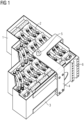
- FIG 1 shows an embodiment of a battery tray 1 according to the invention.
- the battery tray 1 has a triangular base area that continues evenly upwards in a vertical direction.
- the battery tray 1 contains a number of interconnected battery cells 2, which preferably have the same design.
- the battery tray 1 is preferably made of steel.
- the battery tray 1 also has stiffeners 3, a lifting assembly 4, a crane eye 5 and a hinge half 6, the function of which is described below.
- the battery tray 1 together with the pre-assembled battery cells 2 can be moved with lifting or hoisting equipment.
- the crane eye is preferably arranged above the center of gravity of the battery tray 1 filled with battery cells 2 in order to simplify its movement during assembly, disassembly or when maintenance work is to be carried out on the battery cells.
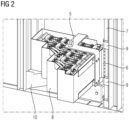
- FIG 2 shows with reference to FIG 1 a positioning of the battery tray 1 in a battery box 10 of a rail vehicle.
- the hinge half 6 of the battery tray 1 engages in a hinge axis 7.
- the hinge axis 7 is connected to the battery box 10 with the help of the hinge axis holder 9, as described below.
- a so-called battery tray module 8 which is described in more detail below, is formed at least from the battery tray 1, the battery cells 2, the hinge half 6 and the stiffeners 3.
- the battery tray module 8 can also additionally comprise the lifting assembly 4 and the crane eye 5 - although these can also optionally be designed to be separable or detachable from the battery tray module 8.
- the battery tray module 8 is positioned on the hinge axis 7 by means of the hinge half 6.
- the connection is created by screwing on a loose hinge half described below (see FIG 3 the loose hinge half 11).
- the battery tray 1 is rotatably connected to the battery box 10 via the loose hinge half 11. This allows the battery tray 1 to be rotated into the battery box 10 or the battery tray 1 to be rotated out of the battery box 10.
- stiffeners 3 described above are designed in such a way that forces from both the interacting hinge halves 6, 7 and the lifting assembly 4 are transferred to the battery tray 1 in a stress-optimized manner.
- the battery tray 1 with the FIG 1 The elements described above are lifted using lifting or hoisting equipment at the crane eye 5 and installed in the battery box 10.
- the battery tray 1 is preferably made of steel.
- FIG 3 and FIG 4 show with reference to FIG 1 and FIG 2 Details of a screw connection of a battery tray module 8 in the battery box 10.
- the following components are located on the rail vehicle: the hinge axle 7 with hinge axle holders 9 and the battery box 10, which holds the battery tray 8 in the fully assembled condition or operating state of the rail vehicle against external influences.
- the battery tray module 8 is designed in such a way that the battery tray module 8 can be suspended from the crane eye 5 and brought closer to the battery box 10 in such a way that the hinge half 6 engages the hinge axis 7 located in the vehicle.
- the hinge axis 7 can be permanently connected to the rail vehicle or, as in this example, can be designed to be removable or mountable.
- a hinge axis 7 that can be dismantled or assembled has the advantage that additional bearing elements (not shown here) can be used to make it easier to rotate the battery tray module 8.
- the hinge half 6 is connected to a loose hinge half 11 - in this example, screwed.
- the connected hinge halves 6 and 11 form a bore in which the hinge axis 7 is located.
- the battery tray module 8 is then rotated about the hinge, which consists of the hinge halves 6, 11 and the hinge axis 7.
- the "bore inner sides" of the hinge halves 6 and 11 are equipped with low-friction materials.
- the battery tray module 8 is slowly lowered.
- the battery tray module 8 slides downwards on the hinge axis 7 until the two hinge halves 6 and 11 rest on the lower of the two hinge axis holders 9.
- the lower of the two hinge axis holders 9 absorbs the complete weight of the battery tray module 8.
- a friction-reducing intermediate layer (not shown here) can be inserted between the hinge halves 6 and 11 and the lower hinge axis holder 9.
- a bearing (not shown here) could also be used at this point.
- the contact surfaces between the hinge halves 6 and 11 and the lower hinge axis holder 9 could be designed to be low-friction. This is preferably achieved using coatings or inserts.
- the lifting assembly 4 including the crane eye 5 can also be removed or it can remain on the battery tray 1 for later use.
- the battery tray module 8 is then screwed into the battery box 10, fixed there and wired - compare FIG 5 .
- FIG 5 shows with reference to the figures FIG 1 to FIG 4 a fully equipped battery box 10, which contains several battery tray modules 8 arranged one above the other.
- FIG 5 shows an area 12 in the lower part of the battery box 10, which is intended for fuses.
Landscapes
- Engineering & Computer Science (AREA)
- General Chemical & Material Sciences (AREA)
- Chemical & Material Sciences (AREA)
- Chemical Kinetics & Catalysis (AREA)
- Electrochemistry (AREA)
- Mechanical Engineering (AREA)
- Transportation (AREA)
- Aviation & Aerospace Engineering (AREA)
- Life Sciences & Earth Sciences (AREA)
- Sustainable Development (AREA)
- Sustainable Energy (AREA)
- Power Engineering (AREA)
- Automation & Control Theory (AREA)
- Battery Mounting, Suspending (AREA)
- Arrangement Or Mounting Of Propulsion Units For Vehicles (AREA)
Description
- Die Erfindung betrifft einen Batterietrog für ein Schienenfahrzeug sowie ein Schienenfahrzeug mit einem Batterietrog.
- Schienenfahrzeuge sind mit einem elektrischen Bordnetzsystem ausgestattet, das beim Ausfall einer primären Energiequelle auch von Batterien jeglicher Bauart gespeist werden soll.
- Diese Batterien werden im Schienenfahrzeug entweder unterflur oder im Schienenfahrzeug verstaut. Die Stauräume für die Batterien werden Batteriekästen genannt.
- Die Batterien von Schienenfahrzeugen bestehen üblicherweise aus mehreren Batteriezellen, die in einem Batterietrog angeordnet und dort miteinander verbunden bzw. verschaltet sind. Üblicherweise werden die Batteriezellen in Reihe geschaltet, wobei die Batteriezellen üblicherweise eine gleiche Bauform sowie eine gleiche elektrische Leistung aufweisen.
- Die Batteriezellen des Batterietrogs werden üblicherweise auf ihrer Oberseite miteinander verkabelt. Die Gesamtspannung eines Batterietrogs ergibt sich im Allgemeinen aus der Summe der Batteriezellen multipliziert mit der Spannung einer einzelnen Batteriezelle.
- Batterien von Schienenfahrzeugen müssen gewartet werden. Dies setzt eine gute Zugänglichkeit zu den Batterietrögen und auch zu den Batteriezellen voraus. Stand der Technik ist es daher, dass der zugehörige Batteriekasten an einer gut zugänglichen Schienenfahrzeug-Stelle angeordnet ist.
- Beispielsweise kommt hier der Unterflurbereich des Schienenfahrzeugs in Betracht, in dem die Batteriekästen am Schienenfahrzeug montiert sind.
- Ein derartiger Batteriekasten ist beispielsweise mit Teleskopschienen ausgestattet, mit deren Hilfe ein im Batteriekasten angeordneter Batterietrog translatorisch geradlinig aus dem Batteriekasten herausgefahren werden kann.
- In der ausgefahrenen Stellung des Batterietroges werden Wartungsarbeiten an den Batteriezellen durchgeführt - beispielsweise wird in dieser Stellung bzw. Position das Batteriewasser nachgefüllt.
- Der Umstand, dass die Batteriezellen in einem Batterietrog translatorisch geradlinig in den und aus dem Batteriekasten bewegt werden, bewirkt, dass die Batteriekästen eine quaderförmige Gestalt bzw. Grundform haben.
-
FIG 6 und FIG 7 zeigen diesen Zusammenhang an zwei Positionen bzw. Stellungen eines Batterietrogs BAT-TR in Bezug zum zugehörigen Batteriekasten BAT-KA. -
FIG 6 zeigt den Batterietrog BAT-TR, der vollständig in den zugeordneten Batteriekasten BAT-KA eingefahren ist. -
FIG 7 zeigt den Batterietrog BAT-TR, der aus dem zugeordneten Batteriekasten BAT-KA ausgefahren ist. - Zum Ausfahren des Batterietrogs BAT-TR sind Teleskopschienen TSS vorgesehen, die den Batterietrog BAT-TR mit dem Batteriekasten BAT-KA verbinden. Mit Hilfe der Teleskopschienen TSS wird die oben beschriebene translatorische Bewegung des Batterietrogs BAT-TR im Bezug zum Batteriekasten BAT-KA ermöglicht. Der Einsatz von Teleskopschienen gibt eine quaderförmige Geometrie des Batteriekastens vor.
- Der Batterietrog BAT-TR beinhaltet eine Anzahl an Batteriezellen BAT-ZE, die an ihrer Oberseite elektrisch miteinander verbunden sind.
- Das Dokument
CN 206789598 U offenbart einen Batterietrog für ein Schienenfahrzeug, mit einer Volumenform, die eine Quaderform hat, mit einem Kasten, mit Verbindungsmitteln, die derart ausgebildet sind, dass der Batterietrog linear mit dem zugeordneten Batteriekasten des Schienenfahrzeugs verbindbar ist und dass die Form des Batteriekastens ähnlich bzw. gleich zur Quaderform des Batterietrogs ist, so dass der Batterietrog vom Batteriekasten vollständig aufgenommen wird, ohne dabei vorhandenes Volumen ungenutzt zu lassen. - Das Dokument
US 2015/071747 A offenbart ein Werkbaufahrzeug mit einem Batterietrog mit zugehörigem Batteriekasten, mit einer Volumenform des Batterietrogs, die von einer Quaderform abweicht, mit Verbindungsmitteln, die derart ausgebildet sind, dass der Batterietrog drehbar mit dem zugeordneten Batteriekasten des Bergbaufahrzeugs verbunden ist, so dass durch eine um eine Achse erfolgende Drehung der Batterietrog in den Batteriekasten drehbar ist bzw. aus dem Batteriekasten herausdrehbar ist. - Batteriezellen für Schienenfahrzeuge sind sehr schwer, so dass die Montage eines mit Batteriezellen befüllten Batterietrogs mit Hebegeräten oder Hubgeräten erfolgen muss. Entsprechend werden Batterietröge mit quaderförmiger Gestalt, die für entsprechende quaderförmige Batteriekästen vorgesehen sind, mit Aufnahmen für Gabelzinken bzw. Staplerzinken oder anderen Hubgeräten ausgestattet. Die Montage der Batterietröge erfolgt dann mit Hilfe eines Gabelstaplers oder mit Hilfe ähnlicher Gerätschaften.
- Zusammengefasst ermöglicht die quaderförmige Gestalt von Batteriekasten und Batterietrog in Verbindung mit der Zinkenförmigen Aufnahme am Batterietrog eine erleichterte Montage bzw. Demontage.
- Nachteilig ist, dass man auf diese konkrete Bauform bzw. Gestalt beim Entwurf von Schienenfahrzeugen eingeschränkt ist. Es ist daher die Aufgabe der vorliegenden Erfindung, einen Batterietrog mit zugehörigem Batteriekasten derart zu gestalten, dass die oben genannte Einschränkung überwunden wird und gleichzeitig eine einfache Wartung der Batteriezellen des Batterietrogs ermöglicht wird.
- Diese Aufgabe wird durch die Merkmale des Anspruchs 1 und des Anspruchs 8 gelöst.
- Vorteilhafte Weiterbildungen sind in den jeweiligen abhängigen Ansprüchen angegeben.
- Die Erfindung betrifft einen Batterietrog für ein Schienenfahrzeug mit zugehörigem Batteriekasten. Der Batterietrog weist dabei eine Volumenform auf, die von einer Quaderform abweicht. Der Batterietrog weist Verbindungsmittel auf, die derart ausgebildet sind, dass der Batterietrog drehbar mit dem zugeordneten Batteriekasten des Schienenfahrzeugs verbunden ist, so dass durch eine um eine Achse erfolgende Drehung der Batterietrog in den Batteriekasten drehbar ist bzw. aus dem Batteriekasten herausdrehbar ist.
- Die Form des Batteriekastens ist ähnlich bzw. gleich zur Form des Batterietrogs, so dass der Batterietrog vom Batteriekasten vollständig aufgenommen wird, ohne dabei vorhandenes Volumen ungenutzt zu lassen.
- In einer bevorzugten Ausgestaltung weist der Batterietrog ein Volumen auf, das durch eine Grundfläche und durch zugehörige Seitenflächen bestimmt ist, wobei die Grundfläche dreieckig-ähnlich ist oder ein Dreieck ist oder trapez-ähnlich ist oder ein Trapez ist und wobei die zugehörigen Seitenflächen im Wesentlichen senkrecht zur Grundfläche sind.
- In einer bevorzugten Ausgestaltung beinhaltet der Batterietrog Batteriezellen, die elektrisch miteinander verbunden im Batterietrog angeordnet sind.
- In einer bevorzugten Ausgestaltung weist der Batterietrog einer Anhebe-Baugruppe auf, die für eine vertikale Bewegung des Batterietrogs ausgebildet und mit diesem verbunden ist, wobei die Anhebe-Baugruppe dazu ausgebildet ist, den Batterietrog samt den darin befindlichen Batteriezellen mittels Hub- bzw. Hebegeräten zu bewegen.
- In einer bevorzugten Ausgestaltung weist die Anhebe-Baugruppe eine Kranöse auf, die dazu ausgebildet ist, den Batterietrog samt den darin befindlichen Batteriezellen mittels Hub- bzw. Hebegeräten zu bewegen.
- In einer bevorzugten Ausgestaltung ist die Kranöse senkrecht über dem Schwerpunkt des Batterietrogs bzw. über dem Schwerpunkt des mit Batteriezellen befüllten Batterietrogs angeordnet.
- In einer bevorzugten Ausgestaltung weist der Batterietrog eine Scharnierhälfte als Verbindungsmittel auf.
- Ein Schienenfahrzeug weist in einer bevorzugten Ausgestaltung einen wie vorstehend beschriebenen Batterietrog und einen Batteriekasten auf. Der Batterietrog ist über Verbindungsmittel derart drehbar mit dem Batteriekasten des Schienenfahrzeugs verbunden, dass durch eine um eine Achse erfolgende Drehung der Batterietrog in den Batteriekasten drehbar ist bzw. aus dem Batteriekasten herausdrehbar ist.
- In einer bevorzugten Ausgestaltung umfassen die Verbindungsmittel folgende Elemente:
- eine Scharnierhälfte, die mit dem Batterietrog verbunden ist,
- eine Scharnierachse und einen Scharnierachsenhalter, wobei die Scharnierachse über den Scharnierachsenhalter mit dem Batteriekasten verbunden ist.
- Die Scharnierhälfte greift im montierten Zustand in die Scharnierachse ein, wobei die Scharnierhälfte nach erfolgtem Eingriff in die Scharnierachse mit einer losen Scharnierhälfte verbunden wird.
- Die Form des Batteriekastens ist ähnlich bzw. gleich zur Form des Batterietrogs, so dass der Batterietrog vom Batteriekasten vollständig aufgenommen wird, ohne dabei vorhandenes Volumen ungenutzt zu lassen.
- Die Erfindung ermöglicht, dass Batteriezellen in Batterietrögen angeordnet werden, deren Form nicht länger auf die bislang übliche Batterietrog-Quaderform beschränkt ist.
- Damit werden vorhandene, bislang ungenutzte Volumen beliebiger Form im Schienenfahrzeug zur Aufnahme von Batteriekästen nutzbar gemacht.
- Die Erfindung ermöglicht, dass trotz dem hohen Gewicht der Baugruppe "Batterietrog mit Batteriezellen" diese mit Hilfe von Hebe- oder Hubgeräten montierbar ist.
- Die Erfindung ermöglicht, dass Wartungsarbeiten am Batterietrog bzw. an den darin angeordneten Batteriezellen mit geringem Aufwand durchführbar sind.
- Insbesondere wird zum Herausdrehen des Batterietrogs kein schweres Gerät (z.B. Flurförderfahrzeug oder Gabelstapler) benötigt.
- Die Erfindung ermöglicht den freien und einfachen Zugriff bzw. Zugang zu den Batteriezellen des Batterietrogs.
- Die Erfindung ermöglicht eine kompakte Bauweise der Batterietröge bzw. der Batterietrogmodule.
- Die Erfindung ermöglicht eine Integration von mehreren Batterietrögen in einem Batteriekasten. Die Batterietröge sind bevorzugt vertikal übereinander im Batteriekasten angeordnet.
- Nachfolgend wird die vorliegende Erfindung beispielhaft anhand einer Zeichnung näher erläutert. Dabei zeigt:
- FIG 1
- ein Ausführungsbeispiel eines erfindungsgemäßen Batterietrogs,
- FIG 2
- mit Bezug auf
FIG 1 eine Positionierung des Batterietrogs in einem Batteriekasten eines Schienenfahrzeugs, - FIG 3
- und
FIG 4 zeigen mit Bezug aufFIG 1 undFIG 2 Details einer Verschraubung eines Batterietrogs im Batteriekasten, - FIG 5
- mit Bezug auf
FIG 1 bis FIG 4 einen komplett bestückten Batteriekasten, - FIG 6
- und
FIG 7 den in der Einleitung beschriebenen Batterietrog mit zugehörigen Batteriekasten des Stands der Technik. -
FIG 1 zeigt ein Ausführungsbeispiel eines erfindungsgemäßen Batterietrogs 1. - Der Batterietrog 1 weist eine dreieck-ähnliche Grundfläche auf, die sich gleichmäßig in vertikaler Richtung nach oben fortsetzt.
- Der Batterietrogs 1 beinhaltet dabei eine Anzahl miteinander verschalteter Batteriezellen 2, die bevorzugt eine gleiche Bauform aufweisen.
- Der Batterietrog 1 ist aus Stabilitätsgründen bevorzugt aus Stahl gefertigt.
- Der Batterietrog 1 weist außerdem Versteifungen 3, eine Anhebe-Baugruppe 4, eine Kranöse 5 sowie eine Scharnierhälfte 6 auf, deren Funktion nachfolgend beschrieben wird.
- Mit Hilfe der Anhebe-Baugruppe 4 sowie mit Hilfe der Kranöse 5 kann der Batterietrog 1 samt der vormontierten Batteriezellen 2 mit Hub- bzw. Hebegeräten bewegt werden.
- Die Kranöse ist dabei bevorzugt über dem Schwerpunkt des mit Batteriezellen 2 befüllten Batterietrogs 1 angeordnet, um dessen Bewegung bei Montage, Demontage bzw. bei durchzuführenden Wartungsarbeiten an den Batteriezellen zu vereinfachen.
-
FIG 2 zeigt mit Bezug aufFIG 1 eine Positionierung des Batterietrogs 1 in einem Batteriekasten 10 eines Schienenfahrzeugs. - Die Scharnierhälfte 6 des Batterietrogs 1 greift im montierten Zustand in eine Scharnierachse 7 ein. Die Scharnierachse 7 ist - wie nachfolgend beschrieben - unter Mitwirkung von Scharnierachsenhalter 9 mit dem Batteriekasten 10 verbunden.
- Ein sogenanntes Batterietrogmodul 8, das nachfolgend näher beschrieben wird, wird zumindest aus dem Batterietrog 1, aus den Batteriezellen 2, aus der Scharnierhälfte 6 und aus den Versteifungen 3 gebildet.
- Das Batterietrogmodul 8 kann zusätzlich auch die Anhebe-Baugruppe 4 sowie die Kranöse 5 umfassen - wobei diese jedoch auch wahlweise vom Batterietrogmodul 8 separierbar bzw. trennbar ausgeführt sein können.
- Das Batterietrogmodul 8 wird mittels der Scharnierhälfte 6 an der Scharnierachse 7 positioniert. Die Verbindung entsteht mit dem Aufschrauben einer nachfolgend beschriebenen losen Scharnierhälfte (vgl. hierzu in
FIG 3 die lose Scharnierhälfte 11). - Über die Scharnierhälfte 6, die Scharnierachse 7, den Scharbierachsenhalter 9 sowie über die lose Scharnierhälfte (vgl. hierzu in
FIG 3 die lose Scharnierhälfte 11) ist der Batterietrog 1 drehbar mit dem Batteriekasten 10 verbunden. Damit kann der Batterietrog 1 in den Batteriekasten 10 gedreht werden bzw. kann der Batterietrog 1 aus dem Batteriekasten 10 herausgedreht werden. - Die oben beschriebenen Versteifungen 3 sind derart ausgestaltet, dass Kräfte sowohl von den zusammenwirkenden Scharnierhälften 6, 7 als auch von der Anhebe-Baugruppe 4 in den Batterietrog 1 spannungsoptimiert übergeben werden.
- Der Batterietrog 1 mit den in
FIG 1 beschriebenen Elementen wird mit Hub- oder Hebegeräten an der Kranöse 5 angehoben und in den Batteriekasten 10 moniert. - Der Batterietrog 1 ist aus Stabilitätsgründen bevorzugt aus Stahl gefertigt.
-
FIG 3 undFIG 4 zeigen mit Bezug aufFIG 1 undFIG 2 Details einer Verschraubung eines Batterietrogmoduls 8 im Batteriekasten 10. - Am Schienenfahrzeug befinden sich die folgende Baugruppen: die Scharnierachse 7 mit Scharnierachsenhaltern 9 und der Batteriekasten 10, der den Batterietrog 8 im fertig montierten Zustand bzw. im Betriebszustand des Schienenfahrzeugs vor äußeren Einflüssen schützt.
- Das Batterietrogmodul 8 ist so konzipiert, dass das Batterietrogmodul 8 hängend an der Kranöse 5 derart an den Batteriekasten 10 angenähert werden kann, dass die Scharnierhälfte 6 an die im Fahrzeug befindliche Scharnierachse 7 eingreift.
- Die Scharnierachse 7 kann permanent mit dem Schienenfahrzeug verbunden sein oder, wie in diesem Beispiel, demontierbar bzw. montierbar ausgeführt sein.
- Eine demontierbar bzw. montierbar ausgeführte Scharnierachse 7 hat den Vorteil, dass zusätzliche Lagerelemente (hier nicht dargestellt) zum einfacheren Drehen der Batterietrogmoduls 8 eingesetzt werden können.
- Ist das Batterietrogmodul 8 so positioniert, dass die Scharnierhälfte 6 in die Scharnierachse 7 eingreift, dann wird die Scharnierhälfte 6 mit einer losen Scharnierhälfte 11 verbunden - in diesem Beispiel verschraubt.
- Die verbundenen Scharnierhälften 6 und 11 bilden eine Bohrung, in der sich die Scharnierachse 7 befindet.
- Das Batterietrogmodul 8 ist dann um das Scharnier, das aus den Scharnierhälften 6, 11 und aus der Scharnierachse 7 besteht, gedreht werden.
- Um diese Drehung zu ermöglichen, muss eine Spielpassung zwischen der Scharnierachse 7 und der Bohrung, die aus den Scharnierhälften 6 und 11 entsteht, vorgesehen sein.
- Um die Drehung des Batterietrogmoduls 8 zusätzlich zu erleichtern, sind die "Bohrungsinnenseiten" der Scharnierhälften 6 und 11 mit reibungsarmen Materialien ausgestattet.
- Sind die beiden Scharnierhälften 6 und 11 verbunden, wird das Batterietrogmodul 8 langsam abgesenkt. Das Batterietrogmodul 8 gleitet an der Scharnierachse 7 nach unten, bis die beiden Scharnierhälften 6 und 11 auf dem unteren der beiden Scharnierachsenhalter 9 aufliegen.
- Der untere der beiden Scharnierachsenhalter 9 nimmt die komplette Gewichtskraft des Batterietrogmoduls 8 auf.
- Um die Drehung des Batterietrogmoduls 8 um die Scharnierachse 7 weiter zu erleichtern, kann zwischen den Scharnierhälften 6 und 11 und dem unteren Scharnierachsenhalter 9 eine reibungsvermindernde Zwischenlage (hier nicht dargestellt) eingebracht werden.
- Ebenso wäre an dieser Stelle ein Lager (hier nicht dargestellt) einsetzbar.
- Ebenso könnten die Kontaktflächen zwischen den Scharnierhälften 6 und 11 und dem unteren Scharnierachsenhalter 9 reibungsarm konzipiert werden. Dies wird bevorzugt über Beschichtungen oder Einsätze realisiert.
- Sobald das Batterietrogmodul 8 vollständig auf dem Scharnierachsenhalter 9 aufliegt, wird das Hubmittel bzw. Hebemittel entfernt.
- Bedarfsweise kann auch die Anhebe-Baugruppe 4 samt Kranöse 5 entfernt werden oder sie verbleibt zur späteren Verwendung am Batterietrog 1.
- Das Batterietrogmodul 8 wird dann in den Batteriekasten 10 eingedreht, dort fixiert und verkabelt - vergleiche hierzu
FIG 5 . -
FIG 5 zeigt mit Bezug auf die FigurenFIG 1 bis FIG 4 einen komplett bestückten Batteriekasten 10, der mehrere übereinander angeordnete Batterietrogmodule 8 beinhaltet. - Nachdem ein erstes Batterietrogmodul 8 montiert wurde, werden weitere Batterietrogmodule 8 auf die oben beschriebene Art und Weise in den Batteriekasten 10 eingebaut bzw. geschwenkt.
-
FIG 5 zeigt im unteren Bereich des Batteriekastens 10 einen Bereich 12, der für Sicherungen vorgesehen ist.
Claims (9)
- Batterietrog (1) mit zugehörigem Batteriekasten (10) für ein Schienenfahrzeug,- mit einer Volumenform des Batterietrogs, die von einer Quaderform abweicht,- mit Verbindungsmitteln (6) des Batterietrogs, die derart ausgebildet sind, dass der Batterietrog (1) drehbar mit dem zugeordneten Batteriekasten (10) des Schienenfahrzeugs verbunden ist, so dass durch eine um eine Achse erfolgende Drehung der Batterietrog (1) in den Batteriekasten (10) drehbar ist bzw. aus dem Batteriekasten (10) herausdrehbar ist,- mit einer Form des Batteriekastens, die ähnlich oder gleich zur Form des Batterietrogs ist, so dass der Batterietrog vom Batteriekasten vollständig aufgenommen wird, ohne dabei vorhandenes Volumen ungenutzt zu lassen.
- Batterietrog (1) nach Anspruch 1, mit einem Volumen, das durch eine Grundfläche und durch zugehörige Seitenflächen bestimmt ist, wobei die Grundfläche dreieckig-ähnlich ist oder ein Dreieck ist oder trapez-ähnlich ist oder ein Trapez ist und wobei die zugehörigen Seitenflächen im Wesentlichen senkrecht zur Grundfläche sind.
- Batterietrog (1) nach Anspruch 1 oder 2, mit Batteriezellen (2), die elektrisch miteinander verbunden im Batterietrog (1) angeordnet sind.
- Batterietrog (1) nach Anspruch 1, mit einer Anhebe-Baugruppe (4), die für eine vertikale Bewegung des Batterietrogs (1) ausgebildet und mit diesem verbunden ist, wobei die Anhebe-Baugruppe (4) dazu ausgebildet ist, den Batterietrog (1) samt den darin befindlichen Batteriezellen (2) mittels Hub- bzw. Hebegeräten zu bewegen.
- Batterietrog nach Anspruch 4, bei der die Anhebe-Baugruppe (4) eine Kranöse (5) aufweist, die dazu ausgebildet ist, den Batterietrog (1) samt den darin befindlichen Batteriezellen (2) mittels Hub- bzw. Hebegeräten zu bewegen.
- Batterietrog nach Anspruch 5, bei der die Kranöse (5) senkrecht über dem Schwerpunkt des mit Batteriezellen (4) befüllten Batterietrogs (1) angeordnet ist.
- Batterietrog nach Anspruch 1, mit einer Scharnierhälfte (6) als Verbindungsmittel (6).
- Schienenfahrzeug mit einem Batterietrog (1) und mit einem zugehörigen Batteriekasten (10),- bei dem der Batterietrog (1) mit dem zugehörigen Batteriekasten (10) nach einem der vorhergehenden Ansprüche ausgebildet ist,- bei dem der Batterietrog (1) über die Verbindungsmittel (6) derart drehbar mit dem Batteriekasten (10) des Schienenfahrzeugs verbunden ist, dass durch eine um eine Achse erfolgende Drehung der Batterietrog (1) in den Batteriekasten (10) drehbar ist bzw. aus dem Batteriekasten (10) herausdrehbar ist.
- Schienenfahrzeug nach Anspruch 8, bei dem die Verbindungsmittel folgende Elemente umfassen:- eine Scharnierhälfte (6), die mit dem Batterietrog (1) verbunden ist,- eine Scharnierachse (7) und Scharnierachsenhalter (9), wobei die Scharnierachse (7) über einen Scharnierachsenhalter (9) mit dem Batteriekasten (10) verbunden ist,- wobei die Scharnierhälfte (6) im montierten Zustand in die Scharnierachse (7) eingreift, und- wobei die Scharnierhälfte (6) nach erfolgtem Eingriff in die Scharnierachse (7) mit einer losen Scharnierhälfte (11) verbunden ist.
Applications Claiming Priority (2)
| Application Number | Priority Date | Filing Date | Title |
|---|---|---|---|
| DE102019217975.4A DE102019217975A1 (de) | 2019-11-21 | 2019-11-21 | Batterietrog für ein Schienenfahrzeug |
| PCT/EP2020/081574 WO2021099176A1 (de) | 2019-11-21 | 2020-11-10 | Batterietrog für ein schienenfahrzeug |
Publications (2)
| Publication Number | Publication Date |
|---|---|
| EP4037950A1 EP4037950A1 (de) | 2022-08-10 |
| EP4037950B1 true EP4037950B1 (de) | 2024-10-16 |
Family
ID=73642851
Family Applications (1)
| Application Number | Title | Priority Date | Filing Date |
|---|---|---|---|
| EP20816098.6A Active EP4037950B1 (de) | 2019-11-21 | 2020-11-10 | Batterietrog für ein schienenfahrzeug |
Country Status (6)
| Country | Link |
|---|---|
| US (1) | US20220416349A1 (de) |
| EP (1) | EP4037950B1 (de) |
| DE (1) | DE102019217975A1 (de) |
| ES (1) | ES2996897T3 (de) |
| PL (1) | PL4037950T3 (de) |
| WO (1) | WO2021099176A1 (de) |
Families Citing this family (1)
| Publication number | Priority date | Publication date | Assignee | Title |
|---|---|---|---|---|
| DE102023204962A1 (de) * | 2023-05-26 | 2024-11-28 | Siemens Mobility GmbH | Regal zur Aufnahme einer Batterie in einem Schienenfahrzeug |
Citations (2)
| Publication number | Priority date | Publication date | Assignee | Title |
|---|---|---|---|---|
| US5275525A (en) * | 1992-01-21 | 1994-01-04 | Tamrock World Corporation, N.V. | Battery changer on a mobile machine |
| US20150071747A1 (en) * | 2013-09-10 | 2015-03-12 | General Electric Company | Battery changing system and method |
Family Cites Families (16)
| Publication number | Priority date | Publication date | Assignee | Title |
|---|---|---|---|---|
| JPS58102686A (ja) * | 1981-12-02 | 1983-06-18 | 株式会社豊田自動織機製作所 | 積込み装置 |
| JP2000294941A (ja) * | 1999-04-08 | 2000-10-20 | Nippon Antenna Co Ltd | 電気機器ケースの引き出しユニット |
| DE202004001879U1 (de) * | 2004-02-07 | 2004-04-29 | Rheinmetall Landsysteme Gmbh | Vorrichtung für ein Fahrzeug, insbesondere gepanzertes Transportfahrzeug |
| DE102006016801A1 (de) * | 2006-04-10 | 2007-10-11 | Linde Material Handling Gmbh & Co. Kg | Flurförderzeug mit Führungsrolle für einen Batterietrog |
| DE102006031461A1 (de) * | 2006-07-07 | 2008-01-10 | Jungheinrich Aktiengesellschaft | Batteriewechselsystem für ein batteriebetriebenes Flurförderzeug |
| US8316976B2 (en) * | 2008-11-20 | 2012-11-27 | Mission Motor Company | Frame for a ride-on vehicle having a plurality of battery packs |
| DE102014203506A1 (de) * | 2013-03-05 | 2014-09-11 | Volkswagen Aktiengesellschaft | Batterieanordnung und Fahrzeug mit einer solchen |
| EP2988345B1 (de) * | 2014-08-21 | 2018-12-26 | Modern Times Ltd. | Batterieanordnung zur montage eines batteriepacks an einem rahmen eines fahrrads |
| DE102015108657B4 (de) * | 2015-06-01 | 2017-10-12 | Bombardier Transportation Gmbh | Fahrzeug mit einem Tragsystem |
| JP6960593B2 (ja) * | 2015-11-20 | 2021-11-05 | パナソニックIpマネジメント株式会社 | 収納盤、蓄電装置、及び蓄電システム |
| DE102015122455A1 (de) * | 2015-12-21 | 2017-06-22 | Kion Warehouse Systems Gmbh | Flurförderzeug |
| CN206789598U (zh) * | 2017-05-25 | 2017-12-22 | 中车株洲电力机车有限公司 | 一种蓄电池柜 |
| CN207021322U (zh) * | 2017-08-01 | 2018-02-16 | 新誉轨道交通科技有限公司 | 应急牵引蓄电池箱总成 |
| KR101940136B1 (ko) * | 2018-09-28 | 2019-01-18 | 주식회사 경신 | 차량의 배터리용 캡 |
| GB2572466B (en) * | 2019-01-03 | 2020-05-20 | Aubrey Searles Mark | Battery holder |
| CN110654405A (zh) * | 2019-10-17 | 2020-01-07 | 株洲市兴华轨道交通配件有限公司 | 一种可折叠轨道式动车组蓄电池箱 |
-
2019
- 2019-11-21 DE DE102019217975.4A patent/DE102019217975A1/de not_active Withdrawn
-
2020
- 2020-11-10 US US17/778,881 patent/US20220416349A1/en active Pending
- 2020-11-10 PL PL20816098.6T patent/PL4037950T3/pl unknown
- 2020-11-10 EP EP20816098.6A patent/EP4037950B1/de active Active
- 2020-11-10 WO PCT/EP2020/081574 patent/WO2021099176A1/de not_active Ceased
- 2020-11-10 ES ES20816098T patent/ES2996897T3/es active Active
Patent Citations (2)
| Publication number | Priority date | Publication date | Assignee | Title |
|---|---|---|---|---|
| US5275525A (en) * | 1992-01-21 | 1994-01-04 | Tamrock World Corporation, N.V. | Battery changer on a mobile machine |
| US20150071747A1 (en) * | 2013-09-10 | 2015-03-12 | General Electric Company | Battery changing system and method |
Also Published As
| Publication number | Publication date |
|---|---|
| WO2021099176A1 (de) | 2021-05-27 |
| CA3162157A1 (en) | 2021-05-27 |
| DE102019217975A1 (de) | 2021-05-27 |
| US20220416349A1 (en) | 2022-12-29 |
| PL4037950T3 (pl) | 2025-02-10 |
| ES2996897T3 (en) | 2025-02-13 |
| EP4037950A1 (de) | 2022-08-10 |
Similar Documents
| Publication | Publication Date | Title |
|---|---|---|
| DE112011103641B4 (de) | Bewegungsapparat und Andockverfahren für Bewegungsapparate | |
| EP2039646B1 (de) | Batteriebetriebenes Flurförderzeug | |
| DE102016008822B4 (de) | Mobilkran mit verstellbarer Ballastaufnahmevorrichtung | |
| DE102015113253B4 (de) | Hebevorrichtung und daraus gebildete Hebebühne | |
| EP3351352B1 (de) | Arbeitszelle für einen fertigungsroboter | |
| EP2551412A1 (de) | Drehbühnenelement für eine Baumaschine | |
| DE102017121103A1 (de) | Flurförderzeug mit mehrteiligem Fahrzeugrahmen | |
| DE1481872A1 (de) | Lasthebevorrichtung | |
| EP2199247A2 (de) | Drehverbindung | |
| WO2007056969A1 (de) | Mobiler grosskran | |
| DE69300582T2 (de) | Elektrischer Hubwagen mit einem teleskopischen Arm. | |
| DE102019217975A1 (de) | Batterietrog für ein Schienenfahrzeug | |
| DE102013113957A1 (de) | Batteriewechseladapter | |
| DE202017005428U1 (de) | Wartungsgleisanlage | |
| DE102013110811A1 (de) | Flurförderzeug mit einem ein- und ausfahrbaren Wechselschlitten einer Energieversorgungseinheit | |
| DE102006062245B4 (de) | Wartungsgleisanlage | |
| EP3364096B1 (de) | Stapelbares druckgasflaschenbündel | |
| DE2240774A1 (de) | Loetvorrichtung fuer akkumulatorzellen mit mehreren arbeitsstationen | |
| DE102021123505A1 (de) | Transportfahrzeug | |
| DE102021001301A1 (de) | Vorrichtung zum Halten eines Endes eines länglichen Objekts, insbesondere einer selbsttragenden Last, sowie ein Fahrzeug zum Transport eines derartigen länglichen Objekts | |
| DE102018127125A1 (de) | Hafenkran mit einem verbesserten Antriebssystem | |
| EP2868600B1 (de) | Magazin und Magazinierverfahren | |
| DE102016100695B4 (de) | Teleskopmast für eine Hubarbeitsbühne | |
| DE19535102C1 (de) | Andockvorrichtung für an ein Fahrzeug mit Elektroantrieb anzuschließende Batterien | |
| EP4613601A1 (de) | Wagenanordnung für einen eisenbahngüterzug |
Legal Events
| Date | Code | Title | Description |
|---|---|---|---|
| STAA | Information on the status of an ep patent application or granted ep patent |
Free format text: STATUS: UNKNOWN |
|
| STAA | Information on the status of an ep patent application or granted ep patent |
Free format text: STATUS: THE INTERNATIONAL PUBLICATION HAS BEEN MADE |
|
| PUAI | Public reference made under article 153(3) epc to a published international application that has entered the european phase |
Free format text: ORIGINAL CODE: 0009012 |
|
| STAA | Information on the status of an ep patent application or granted ep patent |
Free format text: STATUS: REQUEST FOR EXAMINATION WAS MADE |
|
| 17P | Request for examination filed |
Effective date: 20220503 |
|
| AK | Designated contracting states |
Kind code of ref document: A1 Designated state(s): AL AT BE BG CH CY CZ DE DK EE ES FI FR GB GR HR HU IE IS IT LI LT LU LV MC MK MT NL NO PL PT RO RS SE SI SK SM TR |
|
| DAV | Request for validation of the european patent (deleted) | ||
| DAX | Request for extension of the european patent (deleted) | ||
| STAA | Information on the status of an ep patent application or granted ep patent |
Free format text: STATUS: EXAMINATION IS IN PROGRESS |
|
| 17Q | First examination report despatched |
Effective date: 20230519 |
|
| RIC1 | Information provided on ipc code assigned before grant |
Ipc: B60L 50/64 20190101ALI20230512BHEP Ipc: H01M 50/244 20210101ALI20230512BHEP Ipc: H01M 50/207 20210101ALI20230512BHEP Ipc: B60R 16/04 20060101ALI20230512BHEP Ipc: B60L 53/80 20190101ALI20230512BHEP Ipc: H01M 50/262 20210101ALI20230512BHEP Ipc: H01M 50/256 20210101ALI20230512BHEP Ipc: B60L 50/60 20190101ALI20230512BHEP Ipc: H05K 7/16 20060101ALI20230512BHEP Ipc: H01M 50/249 20210101ALI20230512BHEP Ipc: H01M 10/42 20060101ALI20230512BHEP Ipc: B61C 17/06 20060101AFI20230512BHEP |
|
| GRAP | Despatch of communication of intention to grant a patent |
Free format text: ORIGINAL CODE: EPIDOSNIGR1 |
|
| GRAP | Despatch of communication of intention to grant a patent |
Free format text: ORIGINAL CODE: EPIDOSNIGR1 |
|
| STAA | Information on the status of an ep patent application or granted ep patent |
Free format text: STATUS: GRANT OF PATENT IS INTENDED |
|
| INTG | Intention to grant announced |
Effective date: 20240614 |
|
| GRAS | Grant fee paid |
Free format text: ORIGINAL CODE: EPIDOSNIGR3 |
|
| GRAA | (expected) grant |
Free format text: ORIGINAL CODE: 0009210 |
|
| STAA | Information on the status of an ep patent application or granted ep patent |
Free format text: STATUS: THE PATENT HAS BEEN GRANTED |
|
| AK | Designated contracting states |
Kind code of ref document: B1 Designated state(s): AL AT BE BG CH CY CZ DE DK EE ES FI FR GB GR HR HU IE IS IT LI LT LU LV MC MK MT NL NO PL PT RO RS SE SI SK SM TR |
|
| REG | Reference to a national code |
Ref country code: GB Ref legal event code: FG4D Free format text: NOT ENGLISH |
|
| REG | Reference to a national code |
Ref country code: CH Ref legal event code: EP Ref country code: DE Ref legal event code: R096 Ref document number: 502020009523 Country of ref document: DE |
|
| REG | Reference to a national code |
Ref country code: IE Ref legal event code: FG4D Free format text: LANGUAGE OF EP DOCUMENT: GERMAN |
|
| REG | Reference to a national code |
Ref country code: LT Ref legal event code: MG9D |
|
| REG | Reference to a national code |
Ref country code: ES Ref legal event code: FG2A Ref document number: 2996897 Country of ref document: ES Kind code of ref document: T3 Effective date: 20250213 |
|
| REG | Reference to a national code |
Ref country code: NL Ref legal event code: MP Effective date: 20241016 |
|
| PG25 | Lapsed in a contracting state [announced via postgrant information from national office to epo] |
Ref country code: NL Free format text: LAPSE BECAUSE OF FAILURE TO SUBMIT A TRANSLATION OF THE DESCRIPTION OR TO PAY THE FEE WITHIN THE PRESCRIBED TIME-LIMIT Effective date: 20241016 |
|
| PG25 | Lapsed in a contracting state [announced via postgrant information from national office to epo] |
Ref country code: NL Free format text: LAPSE BECAUSE OF FAILURE TO SUBMIT A TRANSLATION OF THE DESCRIPTION OR TO PAY THE FEE WITHIN THE PRESCRIBED TIME-LIMIT Effective date: 20241016 |
|
| PG25 | Lapsed in a contracting state [announced via postgrant information from national office to epo] |
Ref country code: PT Free format text: LAPSE BECAUSE OF FAILURE TO SUBMIT A TRANSLATION OF THE DESCRIPTION OR TO PAY THE FEE WITHIN THE PRESCRIBED TIME-LIMIT Effective date: 20250217 Ref country code: HR Free format text: LAPSE BECAUSE OF FAILURE TO SUBMIT A TRANSLATION OF THE DESCRIPTION OR TO PAY THE FEE WITHIN THE PRESCRIBED TIME-LIMIT Effective date: 20241016 Ref country code: IS Free format text: LAPSE BECAUSE OF FAILURE TO SUBMIT A TRANSLATION OF THE DESCRIPTION OR TO PAY THE FEE WITHIN THE PRESCRIBED TIME-LIMIT Effective date: 20250216 |
|
| PG25 | Lapsed in a contracting state [announced via postgrant information from national office to epo] |
Ref country code: FI Free format text: LAPSE BECAUSE OF FAILURE TO SUBMIT A TRANSLATION OF THE DESCRIPTION OR TO PAY THE FEE WITHIN THE PRESCRIBED TIME-LIMIT Effective date: 20241016 |
|
| PG25 | Lapsed in a contracting state [announced via postgrant information from national office to epo] |
Ref country code: BG Free format text: LAPSE BECAUSE OF FAILURE TO SUBMIT A TRANSLATION OF THE DESCRIPTION OR TO PAY THE FEE WITHIN THE PRESCRIBED TIME-LIMIT Effective date: 20241016 |
|
| PG25 | Lapsed in a contracting state [announced via postgrant information from national office to epo] |
Ref country code: NO Free format text: LAPSE BECAUSE OF FAILURE TO SUBMIT A TRANSLATION OF THE DESCRIPTION OR TO PAY THE FEE WITHIN THE PRESCRIBED TIME-LIMIT Effective date: 20250116 |
|
| PG25 | Lapsed in a contracting state [announced via postgrant information from national office to epo] |
Ref country code: GR Free format text: LAPSE BECAUSE OF FAILURE TO SUBMIT A TRANSLATION OF THE DESCRIPTION OR TO PAY THE FEE WITHIN THE PRESCRIBED TIME-LIMIT Effective date: 20250117 Ref country code: LV Free format text: LAPSE BECAUSE OF FAILURE TO SUBMIT A TRANSLATION OF THE DESCRIPTION OR TO PAY THE FEE WITHIN THE PRESCRIBED TIME-LIMIT Effective date: 20241016 |
|
| PG25 | Lapsed in a contracting state [announced via postgrant information from national office to epo] |
Ref country code: RS Free format text: LAPSE BECAUSE OF FAILURE TO SUBMIT A TRANSLATION OF THE DESCRIPTION OR TO PAY THE FEE WITHIN THE PRESCRIBED TIME-LIMIT Effective date: 20250116 |
|
| PG25 | Lapsed in a contracting state [announced via postgrant information from national office to epo] |
Ref country code: SM Free format text: LAPSE BECAUSE OF FAILURE TO SUBMIT A TRANSLATION OF THE DESCRIPTION OR TO PAY THE FEE WITHIN THE PRESCRIBED TIME-LIMIT Effective date: 20241016 |
|
| PG25 | Lapsed in a contracting state [announced via postgrant information from national office to epo] |
Ref country code: MC Free format text: LAPSE BECAUSE OF FAILURE TO SUBMIT A TRANSLATION OF THE DESCRIPTION OR TO PAY THE FEE WITHIN THE PRESCRIBED TIME-LIMIT Effective date: 20241016 |
|
| PG25 | Lapsed in a contracting state [announced via postgrant information from national office to epo] |
Ref country code: DK Free format text: LAPSE BECAUSE OF FAILURE TO SUBMIT A TRANSLATION OF THE DESCRIPTION OR TO PAY THE FEE WITHIN THE PRESCRIBED TIME-LIMIT Effective date: 20241016 |
|
| PG25 | Lapsed in a contracting state [announced via postgrant information from national office to epo] |
Ref country code: LU Free format text: LAPSE BECAUSE OF NON-PAYMENT OF DUE FEES Effective date: 20241110 |
|
| REG | Reference to a national code |
Ref country code: DE Ref legal event code: R097 Ref document number: 502020009523 Country of ref document: DE |
|
| PG25 | Lapsed in a contracting state [announced via postgrant information from national office to epo] |
Ref country code: EE Free format text: LAPSE BECAUSE OF FAILURE TO SUBMIT A TRANSLATION OF THE DESCRIPTION OR TO PAY THE FEE WITHIN THE PRESCRIBED TIME-LIMIT Effective date: 20241016 |
|
| PG25 | Lapsed in a contracting state [announced via postgrant information from national office to epo] |
Ref country code: RO Free format text: LAPSE BECAUSE OF FAILURE TO SUBMIT A TRANSLATION OF THE DESCRIPTION OR TO PAY THE FEE WITHIN THE PRESCRIBED TIME-LIMIT Effective date: 20241016 |
|
| PG25 | Lapsed in a contracting state [announced via postgrant information from national office to epo] |
Ref country code: SK Free format text: LAPSE BECAUSE OF FAILURE TO SUBMIT A TRANSLATION OF THE DESCRIPTION OR TO PAY THE FEE WITHIN THE PRESCRIBED TIME-LIMIT Effective date: 20241016 |
|
| PLBE | No opposition filed within time limit |
Free format text: ORIGINAL CODE: 0009261 |
|
| STAA | Information on the status of an ep patent application or granted ep patent |
Free format text: STATUS: NO OPPOSITION FILED WITHIN TIME LIMIT |
|
| REG | Reference to a national code |
Ref country code: DE Ref legal event code: R081 Ref document number: 502020009523 Country of ref document: DE Owner name: SIEMENS MOBILITY GMBH, DE Free format text: FORMER OWNER: SIEMENS MOBILITY GMBH, 81739 MUENCHEN, DE |
|
| REG | Reference to a national code |
Ref country code: BE Ref legal event code: MM Effective date: 20241130 |
|
| PG25 | Lapsed in a contracting state [announced via postgrant information from national office to epo] |
Ref country code: SE Free format text: LAPSE BECAUSE OF FAILURE TO SUBMIT A TRANSLATION OF THE DESCRIPTION OR TO PAY THE FEE WITHIN THE PRESCRIBED TIME-LIMIT Effective date: 20241016 |
|
| 26N | No opposition filed |
Effective date: 20250717 |
|
| GBPC | Gb: european patent ceased through non-payment of renewal fee |
Effective date: 20250116 |
|
| PG25 | Lapsed in a contracting state [announced via postgrant information from national office to epo] |
Ref country code: GB Free format text: LAPSE BECAUSE OF NON-PAYMENT OF DUE FEES Effective date: 20250116 Ref country code: BE Free format text: LAPSE BECAUSE OF NON-PAYMENT OF DUE FEES Effective date: 20241130 |
|
| PG25 | Lapsed in a contracting state [announced via postgrant information from national office to epo] |
Ref country code: IE Free format text: LAPSE BECAUSE OF NON-PAYMENT OF DUE FEES Effective date: 20241110 |
|
| PGFP | Annual fee paid to national office [announced via postgrant information from national office to epo] |
Ref country code: AT Payment date: 20251014 Year of fee payment: 6 |
|
| PGFP | Annual fee paid to national office [announced via postgrant information from national office to epo] |
Ref country code: IT Payment date: 20251125 Year of fee payment: 6 |
|
| PGFP | Annual fee paid to national office [announced via postgrant information from national office to epo] |
Ref country code: FR Payment date: 20251114 Year of fee payment: 6 |
|
| PGFP | Annual fee paid to national office [announced via postgrant information from national office to epo] |
Ref country code: CZ Payment date: 20251105 Year of fee payment: 6 |
|
| PGFP | Annual fee paid to national office [announced via postgrant information from national office to epo] |
Ref country code: PL Payment date: 20251030 Year of fee payment: 6 |
|
| REG | Reference to a national code |
Ref country code: CH Ref legal event code: U11 Free format text: ST27 STATUS EVENT CODE: U-0-0-U10-U11 (AS PROVIDED BY THE NATIONAL OFFICE) Effective date: 20260209 |
|
| PG25 | Lapsed in a contracting state [announced via postgrant information from national office to epo] |
Ref country code: HU Free format text: LAPSE BECAUSE OF FAILURE TO SUBMIT A TRANSLATION OF THE DESCRIPTION OR TO PAY THE FEE WITHIN THE PRESCRIBED TIME-LIMIT; INVALID AB INITIO Effective date: 20201110 |
|
| PG25 | Lapsed in a contracting state [announced via postgrant information from national office to epo] |
Ref country code: CY Free format text: LAPSE BECAUSE OF FAILURE TO SUBMIT A TRANSLATION OF THE DESCRIPTION OR TO PAY THE FEE WITHIN THE PRESCRIBED TIME-LIMIT; INVALID AB INITIO Effective date: 20201110 |
|
| PGFP | Annual fee paid to national office [announced via postgrant information from national office to epo] |
Ref country code: ES Payment date: 20260220 Year of fee payment: 6 |
|
| PGFP | Annual fee paid to national office [announced via postgrant information from national office to epo] |
Ref country code: DE Payment date: 20260119 Year of fee payment: 6 |
|
| PGFP | Annual fee paid to national office [announced via postgrant information from national office to epo] |
Ref country code: CH Payment date: 20260209 Year of fee payment: 6 |