EP4037403B1 - Kommunikationsverfahren, netzwerkseitige vorrichtung und endgerät - Google Patents
Kommunikationsverfahren, netzwerkseitige vorrichtung und endgerät Download PDFInfo
- Publication number
- EP4037403B1 EP4037403B1 EP21215188.0A EP21215188A EP4037403B1 EP 4037403 B1 EP4037403 B1 EP 4037403B1 EP 21215188 A EP21215188 A EP 21215188A EP 4037403 B1 EP4037403 B1 EP 4037403B1
- Authority
- EP
- European Patent Office
- Prior art keywords
- values
- transmission parameter
- transmission
- parameter set
- group
- Prior art date
- Legal status (The legal status is an assumption and is not a legal conclusion. Google has not performed a legal analysis and makes no representation as to the accuracy of the status listed.)
- Active
Links
Images




Classifications
-
- H—ELECTRICITY
- H04—ELECTRIC COMMUNICATION TECHNIQUE
- H04L—TRANSMISSION OF DIGITAL INFORMATION, e.g. TELEGRAPHIC COMMUNICATION
- H04L1/00—Arrangements for detecting or preventing errors in the information received
-
- H—ELECTRICITY
- H04—ELECTRIC COMMUNICATION TECHNIQUE
- H04L—TRANSMISSION OF DIGITAL INFORMATION, e.g. TELEGRAPHIC COMMUNICATION
- H04L1/00—Arrangements for detecting or preventing errors in the information received
- H04L1/0001—Systems modifying transmission characteristics according to link quality, e.g. power backoff
- H04L1/0023—Systems modifying transmission characteristics according to link quality, e.g. power backoff characterised by the signalling
- H04L1/0025—Transmission of mode-switching indication
-
- H—ELECTRICITY
- H04—ELECTRIC COMMUNICATION TECHNIQUE
- H04L—TRANSMISSION OF DIGITAL INFORMATION, e.g. TELEGRAPHIC COMMUNICATION
- H04L1/00—Arrangements for detecting or preventing errors in the information received
- H04L1/0001—Systems modifying transmission characteristics according to link quality, e.g. power backoff
- H04L1/0023—Systems modifying transmission characteristics according to link quality, e.g. power backoff characterised by the signalling
- H04L1/0027—Scheduling of signalling, e.g. occurrence thereof
-
- H—ELECTRICITY
- H04—ELECTRIC COMMUNICATION TECHNIQUE
- H04W—WIRELESS COMMUNICATION NETWORKS
- H04W28/00—Network traffic management; Network resource management
- H04W28/16—Central resource management; Negotiation of resources or communication parameters, e.g. negotiating bandwidth or QoS [Quality of Service]
- H04W28/24—Negotiating SLA [Service Level Agreement]; Negotiating QoS [Quality of Service]
-
- H—ELECTRICITY
- H04—ELECTRIC COMMUNICATION TECHNIQUE
- H04W—WIRELESS COMMUNICATION NETWORKS
- H04W52/00—Power management, e.g. Transmission Power Control [TPC] or power classes
- H04W52/04—Transmission power control [TPC]
- H04W52/54—Signalisation aspects of the TPC commands, e.g. frame structure
-
- H—ELECTRICITY
- H04—ELECTRIC COMMUNICATION TECHNIQUE
- H04W—WIRELESS COMMUNICATION NETWORKS
- H04W72/00—Local resource management
- H04W72/20—Control channels or signalling for resource management
- H04W72/23—Control channels or signalling for resource management in the downlink direction of a wireless link, i.e. towards a terminal
-
- H—ELECTRICITY
- H04—ELECTRIC COMMUNICATION TECHNIQUE
- H04W—WIRELESS COMMUNICATION NETWORKS
- H04W72/00—Local resource management
- H04W72/50—Allocation or scheduling criteria for wireless resources
- H04W72/52—Allocation or scheduling criteria for wireless resources based on load
-
- H—ELECTRICITY
- H04—ELECTRIC COMMUNICATION TECHNIQUE
- H04L—TRANSMISSION OF DIGITAL INFORMATION, e.g. TELEGRAPHIC COMMUNICATION
- H04L1/00—Arrangements for detecting or preventing errors in the information received
- H04L1/0001—Systems modifying transmission characteristics according to link quality, e.g. power backoff
- H04L1/0002—Systems modifying transmission characteristics according to link quality, e.g. power backoff by adapting the transmission rate
- H04L1/0003—Systems modifying transmission characteristics according to link quality, e.g. power backoff by adapting the transmission rate by switching between different modulation schemes
-
- H—ELECTRICITY
- H04—ELECTRIC COMMUNICATION TECHNIQUE
- H04L—TRANSMISSION OF DIGITAL INFORMATION, e.g. TELEGRAPHIC COMMUNICATION
- H04L1/00—Arrangements for detecting or preventing errors in the information received
- H04L1/0001—Systems modifying transmission characteristics according to link quality, e.g. power backoff
- H04L1/0009—Systems modifying transmission characteristics according to link quality, e.g. power backoff by adapting the channel coding
-
- H—ELECTRICITY
- H04—ELECTRIC COMMUNICATION TECHNIQUE
- H04L—TRANSMISSION OF DIGITAL INFORMATION, e.g. TELEGRAPHIC COMMUNICATION
- H04L1/00—Arrangements for detecting or preventing errors in the information received
- H04L2001/0092—Error control systems characterised by the topology of the transmission link
-
- H—ELECTRICITY
- H04—ELECTRIC COMMUNICATION TECHNIQUE
- H04W—WIRELESS COMMUNICATION NETWORKS
- H04W92/00—Interfaces specially adapted for wireless communication networks
- H04W92/16—Interfaces between hierarchically similar devices
- H04W92/18—Interfaces between hierarchically similar devices between terminal devices
Definitions
- the present invention relates to the field of communications technologies, and in particular, to a communication method, a network side device, and a terminal.
- terminal-to-terminal Device to Device
- vehicle-to-vehicle Vehicle to Vehicle
- V2V vehicle-to-infrastructure
- V2I Vehicle-to-Infrastructure
- V2I vehicle-to-pedestrian communication
- terminals can directly perform communication without using a network side device.
- the network side device may perform resource configuration, scheduling, and coordination, and the like, to assist direct communication between the terminals.
- the network side device allocates a transmission resource pool to device-to-device communications terminals, to transmit device-to-device communication data.
- the resource pool may be understood as a set of a group of time-frequency resources, and includes a resource pool used for transmission and a resource pool used for receiving.
- the network side device configures, in a broadcast mode, different resource pools, for example, a scheduling assignment (Scheduling Assignment, SA) resource pool and a data (data) resource pool, and each resource pool has a fixed period.
- SA scheduling assignment
- WO2015/069051A1 discloses that an eNB may determine a resource set to be used by the cluster of each tier, and the header of each cluster or relay UE may transfer information about the determined resource set configuration to the cluster header or relay UE of a next tier through a relay operation. More specifically, if four resource sets may be allocated, an eNB of a cell to which a main cluster belongs, that is, an eNB to which the UE 1 belongs, may configure resource set configurations to be used by the respective clusters like 10, 1, 2, 3 ⁇ . The eNB may transmit information about the set resource set configurations to the UE 1, that is, the header of a main cluster. The UE 1 that has selected the resource set may transmit information related to the resource set configuration received from the eNB or the specific information to the UE 2, that is, the cluster header of a next tier, through a relaying channel.
- Embodiments of the present invention provide communication methods, wireless apparatuses and a computer program according to independent claims 1, 8, 15, 21, 22 and 23, to provide a more efficient data transmission method, thereby improving transmission performance.
- a communication method provided in the embodiments of the present invention may be applied to a communication scenario of direct communication between two devices, for example, a terminal-to-terminal (Device to Device, D2D) communication scenario, or a vehicle-to-vehicle (Vehicle to Vehicle, V2V) communication scenario, or a vehicle-to-everything (V2X) communication scenario.
- D2D Terminal to Device
- V2V Vehicle to Vehicle
- V2X vehicle-to-everything
- a device that performs direct communication may include various handheld devices having a wireless communication function, an in-vehicle device, a wearable device, a computing device, another processing device connected to a wireless modem, user equipments (User Equipment, UE) in various forms, a mobile station (Mobile station, MS), a terminal (terminal), a terminal device (Terminal Equipment).
- UE User Equipment
- a terminal a terminal below.
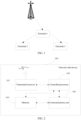
- FIG. 1 is a schematic diagram of a scenario of direct communication between terminals.
- a network side device configures various transmission parameters for data transmission for a terminal 1, and the terminal 1, serving as a data transmitter, performs terminal-to-terminal communication with a terminal 2 and a terminal 3.
- the network side device is an apparatus deployed in a radio access network and providing a wireless communication function for a terminal, and may be a base station (base station, BS), for example, may include macro base stations, micro base stations, relay stations, and access points in various forms.
- base station base station
- devices having a function of a base station may have different names, for example, in a Long Term Evolution (Long Term Evolution, LTE) network, the device is referred to as an evolved NodeB (evolved NodeB, eNB or eNodeB for short), and in a third generation 3G network, the device is referred to as a NodeB (Node B).
- LTE Long Term Evolution
- eNB evolved NodeB
- NodeB NodeB
- Node B NodeB
- the network side device configures at least two groups of values for a transmission parameter set.
- the transmission parameter set includes at least one element. If the transmission parameter set includes one element, namely, includes one item, each group of values of the at least two groups of values includes a value corresponding to the item. If the transmission parameter set includes more than one element, namely, more than one item, each group of values of the at least two groups of values includes a plurality of values respectively corresponding to various items in the transmission set.
- One transmission parameter set may have different values at different time points, and the network side device selects one group of values from the at least two groups of values, as a value of the transmission parameter set, and sends the group of values.
- the present invention can adapt to different system statuses and service requirements, thereby improving transmission performance.
- a function of the network side device may be implemented by hardware, or may be implemented by executing corresponding software by hardware.
- FIG. 2 is a schematic structural diagram of a network side device 100 according to an embodiment of the present invention.
- the network side device 100 includes a transmitter/receiver 101, a controller/processor 102, a memory 103, and a communications unit 104.
- the network side device 100 includes a transmitter/receiver 101, a controller/processor 102, a memory 103, and a communications unit 104.
- the network side device 100 includes a transmitter/receiver 101, a controller/processor 102, a memory 103, and a communications unit 104.
- Each group of values of the at least two groups of values includes a value of each transmission parameter in the transmission parameter set; and at least one transmission parameter in the transmission parameter set has at least two values.
- One transmission parameter set may have different values at different time points. Therefore, the network side device can adapt to different system statuses and service requirements, thereby improving transmission performance.
- the controller/processor 102 of the network side device 100 is further configured to obtain sidelink congestion information by using the transmitter/receiver 101, to select the value based on the sidelink congestion information, thereby alleviating congestion.
- the controller/processor 102 of the network side device 100 is further configured to send a transmission requirement set by using the transmitter/receiver 101.
- the transmission requirement set includes at least one of a data packet length, a transmission delay, a transmission rate, a packet loss rate, a priority, and a QCI level; at least one transmission requirement in the transmission requirement set has at least two levels; and each transmission requirement level corresponds to one group of values of the transmission parameter set, so that differentiated transmission specific to different transmission requirements can be implemented.
- the hardware or software, used for performing a corresponding function, in the network side device in this embodiment of the present invention includes one or more modules corresponding to the foregoing function.
- the module may be software and/or hardware.
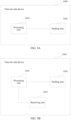
- FIG. 3A is a schematic structural diagram of a network side device 1000 according to an embodiment of the present invention.
- the network side device 1000 includes a processing unit 1001 and a sending unit 1002.
- the processing unit 1001 is configured to select one group of values from at least two preset groups of values for a transmission parameter set.
- the sending unit 1002 is configured to send the group of values that is selected by the processing unit 1001.
- the transmission parameter set may be the transmission parameter set described in the foregoing embodiment, for example, the transmission parameter set used for the network side device 100.
- One transmission parameter set may have different values at different time points. Therefore, the network side device can adapt to different system statuses and service requirements, thereby improving transmission performance.
- the network side device 1000 further includes a receiving unit 1003, as shown in FIG. 3B .
- the receiving unit 1003 is configured to: before the processing unit 1001 selects the group of values from the at least two preset groups of values for the transmission parameter set, obtain sidelink congestion information, to select the value based on the sidelink congestion information, thereby alleviating congestion.
- the sending unit 1002 is further configured to: after the processing unit 1001 selects the group of values from the at least two preset groups of values for the transmission parameter set, send a transmission requirement set.
- the transmission requirement set may be the transmission requirement set described in the foregoing embodiment, for example, the transmission requirement set used for the network side device 100.
- At least one transmission requirement in the transmission requirement set has at least two levels; and each transmission requirement level corresponds to one group of values of the transmission parameter set, so that differentiated transmission specific to different transmission requirements can be implemented.
- An embodiment of the present invention further provides a terminal.
- the terminal has functions of receiving one group of values that is of a transmission parameter set and that is sent by a network side device, and sending communication data based on the received group of values of the transmission parameter set.
- the function of the terminal in this embodiment of the present invention may be implemented by hardware, or may be implemented by executing corresponding software by hardware.
- FIG. 4 is a schematic structural diagram of a terminal 200 according to an embodiment of the present invention.
- the terminal 200 includes a transmitter 201, a receiver 202, a controller/processor 203, and a memory 204.
- the memory 204 is configured to store program code to be executed by the controller/processor 203.
- the controller/processor 203 is configured to: invoke a program stored in the memory 204, receive, by using the receiver 202, one group of values that is of a transmission parameter set and that is sent by a network side device, and send communication data based on the received group of values of the transmission parameter set by using the transmitter 201.
- the group of values is selected by the network side device from at least two groups of values that are preset for the transmission parameter set.
- the transmission parameter set may be the transmission parameter set described in the foregoing embodiment, for example, the transmission parameter set used for the network side device 100.
- One transmission parameter set may have different values at different time points. Therefore, the terminal can adapt to different system statuses and service requirements, thereby improving transmission performance.
- the receiver 202 is configured to receive the group of values that is of the transmission parameter set and that is sent by the network side device.
- the transmitter 201 is configured to send the communication data based on the received group of values of the transmission parameter set.
- the hardware or software, used for performing a corresponding function, in the terminal in this embodiment of the present invention includes one or more modules corresponding to the foregoing function.
- the module may be software and/or hardware.
- the group of values is selected by the network side device from at least two groups of values that are preset for the transmission parameter set.
- the transmission parameter set may be the transmission parameter set described in the foregoing embodiment, for example, the transmission parameter set used for the network side device 100.
- One transmission parameter set may have different values at different time points. Therefore, the terminal can adapt to different system statuses and service requirements, thereby improving transmission performance.
- the sending unit 2002 is further configured to: before the receiving unit 2001 receives the group of values that is of the transmission parameter set and that is sent by the network side device, send sidelink congestion information, so that the received value of the transmission parameter set is selected based on the sidelink congestion information, thereby alleviating congestion.
- the function of the terminal in this embodiment of the present invention may be implemented by hardware, or may be implemented by executing corresponding software by hardware.
- FIG. 6 is a schematic structural diagram of another terminal 300 according to an embodiment of the present invention. As shown in FIG. 6 , the terminal 300 includes a transmitter 301, a controller/processor 302, and a memory 303.
- the memory 303 is configured to store program code to be executed by the controller/processor 302.
- the controller/processor 302 is configured to: invoke a program stored in the memory 303, select one group of values from at least two groups of values that are preset for a transmission parameter set, and send, by using the transmitter 301, communication data based on the selected group of values of the transmission parameter set.
- the transmission parameter included in the transmission parameter set includes at least one of transmit power, a transmit power offset, a sending probability weight, a sending period, a quantity of retransmissions, a modulation and coding scheme MCS level, and a resource pool configuration parameter; and the resource pool configuration parameter includes a resource pool period, a resource pool offset, and time-frequency resource information.
- the controller/processor 302 of the terminal 300 is further configured to: before selecting the group of values from the at least two groups of values that are preset for the transmission parameter set, measure a status of a sidelink; and determine, based on a measurement result, whether the sidelink is in a congested state.
- the controller/processor 302 is specifically configured to select, in the following manner, the group of values from the at least two groups of values that are preset for the transmission parameter set: selecting, based on a preconfigured transmission requirement set, the group of values from the at least two groups of values that are preset for the transmission parameter set, where the transmission requirement set includes at least one of a data packet length, a transmission delay, a transmission rate, a packet loss rate, a priority, and a quality of service class identifier QCI level; at least one transmission requirement in the transmission requirement set has at least two levels; and each transmission requirement level corresponds to one group of values of the transmission parameter set.
- the hardware or software, used for performing a corresponding function, in the terminal in this embodiment of the present invention includes one or more modules corresponding to the foregoing function.
- the module may be software and/or hardware.
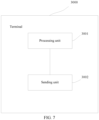
- FIG. 7 is a schematic structural diagram of a terminal 3000 according to an embodiment of the present invention.
- the terminal 3000 includes a processing unit 3001 and a sending unit 3002.
- the processing unit 3001 is configured to select one group of values from at least two groups of values that are preset for a transmission parameter set.
- the sending unit 3002 is configured to send communication data based on the group of values of the transmission parameter set.
- Each group of values of the at least two groups of values includes a value of each transmission parameter in the transmission parameter set; and at least one transmission parameter in the transmission parameter set has at least two values.
- the transmission parameter set may be the transmission parameter set described in the foregoing embodiment, for example, the transmission parameter set used for the network side device 300.
- One transmission parameter set may have different values at different time points. Therefore, the terminal can adapt to different system statuses and service requirements, thereby improving transmission performance.
- the processing unit 3001 is specifically configured to select, in the following manner, the group of values from the at least two groups of values that are preset for the transmission parameter set: selecting, based on a preconfigured transmission requirement set, the group of values from the at least two groups of values that are preset for the transmission parameter set, where the transmission requirement set includes at least one of a data packet length, a transmission delay, a transmission rate, a packet loss rate, a priority, and a quality of service class identifier QCI level; at least one transmission requirement in the transmission requirement set has at least two levels; and each transmission requirement level corresponds to one group of values of the transmission parameter set.
- the controller/processor of the foregoing network side device and terminal may be a general central processing unit (CPU), a microprocessor, an application-specific integrated circuit (application-specific integrated circuit, ASIC), or one or more integrated circuits configured to control execution of a program in the solutions of the present invention.
- One or more memories included in a computer system may be a read-only memory (read-only memory, ROM) or another type of static storage device that can store static information and an instruction, a random access memory (random access memory, RAM) or another type of dynamic storage device that can store information and an instruction, or may be a magnetic disk storage. These memories are connected to the processor by using a bus.
- the network side device may include any quantity of transmitters, receivers, processors, controllers, memories, communications units, and the like; and the terminal may further include a coder, a modulator, a demodulator, a decoder, and the like.
- Values of the transmit power and the sending period may be as follows: The transmit power has at least two values, and the sending period has one value; or the transmit power has one value, and the sending period has at least two values; or both the transmit power and the sending period have at least two values.
- Various combinations of the value of the transmit power and the value of the sending period form a plurality of groups of values of the transmission parameter set. For example, if the transmit power has at least two values A and B, and the sending period has one value C, two groups of values may be preset for the transmission parameter set, where the value A of the transmit power and the value C of the sending period are used as one group of values, and the value B of the transmit power and the value C of the sending period are used as the other group of values.
- the transmission parameter set includes more than two transmission parameters is similar to this, and details are not described herein again.
- a value for the transmission parameter in the transmission parameter set, a value may be set and a value may be selected in the following manner: Preset values of the transmit power include at least two values, for example, include P1 and P2, and the network side device selects one value from the at least two values, for example, may select the value P1 from P1 and P2.
- preset values of the resource pool configuration parameter include at least two groups of values, for example, include C1 and C2. Each group of values of the at least two groups of values is a group of resource pool configuration related parameters.
- a resource pool corresponding to the value C1 has a period of 20 ms and an offset of 0, available subframes in the resource pool are all subframes, and available frequency domain resources are all physical resource blocks corresponding to a system bandwidth;
- a resource pool corresponding to the value C2 has a period of 40 ms and an offset of 0, available subframes are all subframes, and available frequency domain resources are six physical resource blocks corresponding to a system bandwidth.
- the network side device selects one value from the at least two values, for example, may select C1 from C1 and C2.
- the selecting one group of values from at least two preset groups of values may be understood as selecting one of at least two values of one of the foregoing various transmission parameters. For example, if the transmission parameter set includes the transmit power, and a value is selected for the transmit power in the manner in the foregoing example, the selected group of values is P1. If the transmission parameter set includes a plurality of transmission parameters, the selecting one group of values from at least two preset groups of values may be understood as selecting one group from a plurality of groups of values obtained by randomly combining different values of at least two of the foregoing various transmission parameters.
- the network side device may select one group of values from the at least two preset groups of values depending on an actual requirement.
- the network side device may send the transmission parameter in a broadcast mode, or send the transmission parameter by using Radio Resource Control (Radio Resource Control, RRC) signaling, or send the transmission parameter by using control signaling.
- RRC Radio Resource Control
- the control signaling is classified into common control signaling and user-specific control signaling.
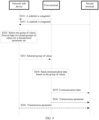
- S103 A first terminal receives the selected group of values, and sends communication data based on the received group of values of the transmission parameter set.
- a terminal serving as a transmit end is referred to as the first terminal, and a terminal serving as a receive end is referred to as a second terminal.
- S104 A second terminal receives communication data sent by the first terminal.
- the method may further include the following step: S105: The second terminal obtains a transmission parameter.
- the second terminal may obtain the required transmission parameter from the network side device, or may obtain the required transmission parameter from the first terminal.
- the network side device preconfigures at least two groups of values for a same transmission parameter set, selects one group of values from the at least two groups of values as a value of the transmission parameter set, and sends the group of values.
- One transmission parameter may have different values at different time points, thereby improving transmission performance.
- a typical application scenario of the communication method provided in this embodiment of the present invention may be a scenario in which during direct communication between two terminals, congestion occurs on a sidelink (sidelink).
- the network side device before selecting the group of values from the at least two groups of values that are preset for the transmission parameter, the network side device obtains sidelink congestion information, and selects the value based on the sidelink congestion information, thereby alleviating congestion.
- An implementation process is shown in FIG. 9 .
- S202, S203, S204, and S205 are respectively the same as S101, S102, S103, and S104 in FIG. 8 .
- a difference from FIG. 8 lies in that, before the selecting a value for a transmission parameter set, the method further includes the following step: S201: The network side device obtains sidelink congestion information.
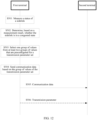
- FIG. 10 is still another schematic flowchart of a communication method according to an embodiment of the present invention. As shown in FIG. 10 , the method includes the following steps.
- the network side device selects one group of values from at least two preset groups of values for a transmission parameter set based on a transmission requirement set.
- the transmission requirement set may include one or more of the following: a data packet length, a transmission delay, a transmission rate, a packet loss rate, a priority, and a QCI, and the transmission requirement includes, but is not limited to, the transmission requirements listed above.
- Different values of each of the foregoing transmission requirements form different levels of the transmission requirement.
- a data packet whose value of a data packet length is greater than or equal to 300 bytes and a data packet whose value of a data packet length is less than or equal to 300 bytes form two levels of the data packet lengths.
- At least one transmission requirement in the transmission requirement set has at least two levels, and different transmission requirement levels correspond to different groups of values.
- the transmission requirement set includes one transmission requirement: the data packet length
- the data packet length forms the transmission requirement set.
- the data packet length has at least two levels, and each level of the data packet length corresponds to one group of values of the parameter set.
- the data packet length and the transmission delay form the transmission requirement set.
- Levels of the data packet length and the transmission delay may be as follows: The data packet length has at least two levels, and the transmission delay has one level; or the data packet length has one level, and the transmission delay has at least two levels; or both the data packet length and the transmission delay have at least two levels.
- Various combinations of the level of the data packet length and the level of the transmission delay respectively correspond to different groups of values of the transmission parameter set.
- the large data packet and the service requiring a low delay correspond to one group of values of the transmission parameter set;
- the large data packet and the service requiring a high delay correspond to one group of values of the transmission parameter set;
- the small data packet and the service requiring a low delay correspond to one group of values of the transmission parameter set;
- the small data packet and the service requiring a low delay correspond to one group of values of the transmission parameter set.
- the transmission requirement set includes more than two transmission requirements is similar to this, and details are not described herein again.
- the transmission requirement set includes the data packet length.
- the network side device may classify data packets into at least two types of data packets based on data packet lengths, and select a transmission parameter from the transmission parameter set for each type of data packet.
- the transmission parameter set may be the transmission parameter set described in the foregoing embodiment, for example, the transmission parameter set used in S101.
- the network side device may classify data packets into two types of data packets.
- a data packet whose data packet length is greater than or equal to 300 bytes is referred to as a large data packet
- a data packet whose data packet length is less than 300 bytes is referred to as a small data packet.
- the network side device selects the transmission parameter, that is, transmit power, for the large data packet and the small data packet, and selects one of at least two values that are preset for the transmit power, for example, selects the value P1 from P1 and P2 for the large data packet, and selects the value P2 from P1 and P2 for the small data packet.
- the network side device selects the transmission parameter, that is, transmit power, for the large data packet, and selects the transmission parameter, that is, a transmit power offset, for the small data packet, for example, selects the value P1 from P1 and P2 for the large data packet, and selects ⁇ P1 from ⁇ P1 and ⁇ P2 for the small data packet.
- the network side device selects the transmission parameter, that is, a transmit power offset, for the large data packet, and selects the transmission parameter, that is, transmit power, for the small data packet, for example, selects ⁇ P2 from ⁇ P1 and ⁇ P2 for the large data packet, and selects the value P2 from P1 and P2 for the small data packet.
- the transmission parameter that is, a sending probability weight
- the transmission parameter that is, a quantity of retransmissions
- the network side device selects the transmission parameter, that is, a resource pool configuration parameter, for the large data packet and the small data packet, selects a resource pool configuration parameter for the large data packet, for example, selects C1 from C1 and C2, and selects another resource pool configuration parameter for the small data packet, for example, selects C2 from C1 and C2.
- transmission parameters selected by the network side device for the large data packet and the small data packet are at least two of the foregoing transmission parameters
- one group of values that is corresponding to the at least two transmission parameters may be selected for the large data packet.
- the network side device selects the transmission parameters: the transmit power and the resource pool configuration parameter for the large data packet and the small data packet
- one group of values of the transmit power and the resource pool configuration parameter may be selected for the large data packet, for example, one group of values of the transmit power P1 and the resource pool configuration parameter C1 is selected
- another group of values of the transmit power and the resource pool configuration parameter may be selected for the small data packet, for example, one group of values of the transmit power P2 and the resource pool configuration parameter C2 is selected.
- the transmission requirement set includes the transmission delay.
- the network side device may define at least two delay requirements, and select, specific to each delay requirement, a transmission parameter from the transmission parameter set.
- the transmission parameter set may be the transmission parameter set in the foregoing embodiment, for example, the transmission parameter set used in S101.
- the network side device may classify delay requirements into two types, for example, a service whose delay is required to be less than or equal to 100 ms is used as a service requiring a low delay, and a service whose delay is required to be less than or equal to 500 ms is used as a service requiring a high delay.
- the network side device may select a same transmission parameter for the service requiring a low delay and the service requiring a high delay, where the transmission parameter corresponds to different values.
- the network side device may select different transmission parameters for the service requiring a low delay and the service requiring a high delay.
- For a specific selection method refer to a process for selecting a transmission parameter and a value of the transmission parameter for the large data packet and the small data packet in the foregoing embodiment, and details are not described herein again.
- the transmission requirement set includes a transmission rate requirement.
- the network side device may define at least two transmission rate requirements, and select a transmission parameter from the transmission parameter set for each transmission rate requirement.
- the transmission parameter set may be the transmission parameter set in the foregoing embodiment, for example, the transmission parameter set used in S101.
- the network side device may classify transmission rate requirements into two types, for example, a service requiring ten transmissions per second is used as a service requiring a high transmission rate, and a service requiring two transmissions per second is used as a service requiring a low transmission rate.
- the network side device may select a same transmission parameter for the service requiring a high transmission rate and the service requiring a low transmission rate, where the transmission parameter corresponds to different values.
- the network side device may select different transmission parameters for the service requiring a high transmission rate and the service requiring a low transmission rate.
- For a specific selection method refer to a process for selecting a transmission parameter and selecting a value of the transmission parameter for the large data packet and the small data packet in the foregoing embodiment, and details are not described herein again.
- the transmission requirement set includes a packet loss rate requirement.
- the network side device may define at least two packet loss rate requirements, and select a transmission parameter from the transmission parameter set for each packet loss rate requirement.
- the transmission parameter set may be the transmission parameter set in the foregoing embodiment, for example, the transmission parameter set used in S101.
- the network side device may classify packet loss rate requirements into two types, for example, a service whose packet loss rate is less than or equal to 1% is used as a service with a high requirement on a packet loss rate, and a service whose packet loss rate is less than or equal to 10% is used as a service with a low requirement on a packet loss rate.
- the network side device may select a same transmission parameter for the service with a high requirement on a packet loss rate and the service with a low requirement on a packet loss rate, where the transmission parameter corresponds to different values.
- the network side device may select different transmission parameters for the service with a high requirement on a packet loss rate and the service with a low requirement on a packet loss rate.
- For a specific selection method refer to a process for selecting a transmission parameter and a value of the transmission parameter for the large data packet and the small data packet in the foregoing embodiment, and details are not described herein again.
- the network side device may define at least two priority requirements, and select a transmission parameter from the transmission parameter set for each priority requirement.
- the transmission parameter set may be the transmission parameter set in the foregoing embodiment, for example, the transmission parameter set used in S101.
- the transmission requirement set includes a QCI level requirement.
- the network side device may define at least two QCI level requirements, and select a transmission parameter from the transmission parameter set for each QCI level requirement.
- the transmission parameter set may be the transmission parameter set in the foregoing embodiment, for example, the transmission parameter set used in S101.
- the transmission requirement set may include at least two of the foregoing various transmission requirements. Specific to each transmission requirement, a process for selecting a transmission parameter and a value of the transmission parameter may be performed in the foregoing manner.
- the network side device sends the transmission requirement set and a value of a transmission parameter corresponding to the transmission requirement set.
- the network side device may broadcast a transmission requirement based on which the group of values is selected for the transmission parameter set, so that a terminal receiving the transmission requirement and the corresponding transmission parameter transmits data based on the value of the transmission parameter set corresponding to the transmission requirement set.
- the network side device may set a classification threshold for classifying a transmission requirement level, for example, a classification threshold for classifying a large data packet and a small data packet is 300 bytes, and the classification threshold is broadcast in the cell.
- a classification threshold for classifying a transmission requirement level for example, a classification threshold for classifying a large data packet and a small data packet is 300 bytes, and the classification threshold is broadcast in the cell.
- a first terminal receives the transmission requirement set and the value of the transmission parameter set corresponding to the transmission requirement set that are sent by the network side device.
- S304 and S305 are respectively the same as S104 and S105 in FIG. 8 , and details are not described herein again.
- the first terminal serving as a sending terminal may obtain the group of values of the at least two groups of values of the transmission parameter set from the network side device in the foregoing embodiment, or may select the group of values from the at least two preconfigured groups of values of the transmission parameter set, and send communication data based on the selected group of values.
- the first terminal serving as a sending terminal may obtain the group of values of the at least two groups of values of the transmission parameter set from the network side device in the foregoing embodiment, or may select the group of values from the at least two preconfigured groups of values of the transmission parameter set, and send communication data based on the selected group of values.
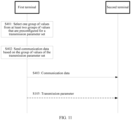
- FIG. 11 For an implementation process, refer to FIG. 11 .
- FIG. 11 is still another schematic flowchart of a communication method according to an embodiment of the present invention. As shown in FIG. 11 , the method includes the following steps.
- Each group of values of the at least two groups of values includes a value of each transmission parameter in the transmission parameter set.
- the transmission parameter set may be the transmission parameter set in the foregoing embodiment, for example, the transmission parameter set used in S101.
- the first terminal may select, based on a preconfigured transmission requirement set, the group of values from the at least two groups of values that are preset for the transmission parameter set, to implement differentiated transmission specific to different transmission requirements.
- a difference between the transmission requirement set and the transmission requirement set in the foregoing embodiment lies in that the transmission requirement set is preconfigured by the terminal, and the other part is the same as the transmission requirement set in the foregoing embodiment, for example, the transmission requirement set used in S301.
- S402 The first terminal sends communication data based on the group of values of the transmission parameter set.
- S403 and S404 are respectively the same as S104 and S105 in FIG. 8 , and details are not described herein again.
- the first terminal may measure a link status of a sidelink, and determine, based on a measurement result, whether the sidelink is in a congested state, and if the sidelink is in a congested state, select a value based on sidelink congestion information, thereby alleviating congestion.
- An implementation process is shown in FIG. 12 .
- S503, S504, S505, and S506 are respectively the same as S401, S402, S403, and S404 in FIG. 11 , and a difference from FIG. 11 lies in that, before the selecting one group of values from at least two preconfigured groups of values for a transmission parameter set, the method further includes the following step.
- the status of the sidelink that is measured by the first terminal may be, for example, an interference level, an energy level, a reference signal received power (Reference Signal Receiving Power, RSRP) value, or resource usage.
- RSRP Reference Signal Receiving Power
- S502 Determine, based on a measurement result, whether the sidelink is in a congested state.
- the determining, based on a measurement result, whether the sidelink is congested may be determining whether a specified parameter exceeds a specified threshold. For example, the first terminal determines whether the resource usage of the sidelink exceeds a threshold, for example, whether the resource usage exceeds 50% or 80%; and if the threshold is exceeded, it is considered that the sidelink is in a congested state; otherwise, the sidelink is not congested.
- Differentiated data transmission provided in the embodiments of the present invention may be applied to a scenario in which the foregoing two application scenarios are combined, that is, when network congestion occurs, the value of the transmission parameter set may be selected based on the transmission requirement set.
- the value of the transmission parameter set may be selected based on the transmission requirement set.
- plural of means two or more than two.
- the term “and/or” describes an association relationship for describing associated objects and represents that three relationships may exist.
- a and/or B may represent the following three cases: Only A exists, both A and B exist, and only B exists.
- the character "/” generally indicates an "or” relationship between the associated objects.
- a person of ordinary skill in the art may understand that all or some of the steps in each of the foregoing method of the embodiments may be implemented by a program instructing a processor.
- the foregoing program may be stored in a computer readable storage medium.
- the storage medium may be a non-transitory (English: non-transitory) medium, such as a random-access memory, a read-only memory, a flash memory, a hard disk, a solid state drive, a magnetic tape (English: magnetic tape), a floppy disk (English: floppy disk), an optical disc (English: optical disc), or any combination thereof.
- a non-transitory (English: non-transitory) medium such as a random-access memory, a read-only memory, a flash memory, a hard disk, a solid state drive, a magnetic tape (English: magnetic tape), a floppy disk (English: floppy disk), an optical disc (English: optical disc), or any combination thereof.
Landscapes
- Engineering & Computer Science (AREA)
- Computer Networks & Wireless Communication (AREA)
- Signal Processing (AREA)
- Quality & Reliability (AREA)
- Mobile Radio Communication Systems (AREA)
- Communication Control (AREA)
Claims (23)
- Kommunikationsverfahren, das Folgendes umfasst:Auswählen (S101, S202, S301), durch eine netzseitige Vorrichtung, einer Gruppe von Werten für einen Übertragungsparametersatz gemäß "Sidelink"-Überlastungsinformationen, wobei der Übertragungsparametersatz eine Modulations- und Codierungsschema-bzw. MCS-Stufe umfasst; undSenden (S102, S203), durch die netzseitige Vorrichtung an ein erstes Endgerät, der ausgewählten Gruppe von Werten, wobei die ausgewählte Gruppe von Werten für das erste Endgerät bestimmt ist, das Kommunikationsdaten an ein zweites Endgerät sendet.
- Verfahren nach Anspruch 1, wobei das Verfahren ferner Folgendes umfasst:
Erhalten (S201), durch die netzseitige Vorrichtung, der "Sidelink"-Überlastungsinformationen von dem ersten Endgerät. - Verfahren nach Anspruch 1, wobei das Verfahren ferner Folgendes umfasst:
Senden (S302), durch die netzseitige Vorrichtung, einer Priorität an das erste Endgerät, wobei die Priorität mindestens zwei Stufen aufweist und jede Prioritätsstufe einer Gruppe von Werten des Übertragungsparametersatzes entspricht. - Verfahren nach Anspruch 3, wobei das Verfahren ferner Folgendes umfasst:
Auswählen (S101, S202, S301), durch die netzseitige Vorrichtung, der Gruppe von Werten für einen Übertragungsparametersatz gemäß den "Sidelink"-Überlastungsinformationen und der Priorität. - Verfahren nach Anspruch 1, wobei
der Übertragungsparametersatz ferner Informationen umfasst, die eine Anzahl von Neuübertragungen angeben. - Verfahren nach Anspruch 1, wobei
der Übertragungsparametersatz ferner eine Übertragungsleistung umfasst. - Verfahren nach Anspruch 1, wobei
die Gruppe von Werten aus mindestens zwei vorgegebenen Gruppen von Werten für einen Übertragungsparameter stammt und jede Gruppe von Werten der mindestens zwei Gruppen von Werten einen Wert jedes Übertragungsparameters in dem Übertragungsparametersatz umfasst. - Kommunikationsverfahren, das Folgendes umfasst:Empfangen, durch ein erstes Endgerät, einer Gruppe von Werten für einen Übertragungsparametersatz von einer netzseitigen Vorrichtung, wobei die Gruppe von Werten gemäß "Sidelink"-Überlastungsinformationen ausgewählt wird, wobei der Übertragungsparametersatz eine Modulations- und Codierungsschema- bzw. MCS-Stufe umfasst; undSenden (S103, S204), durch das erste Endgerät, von Kommunikationsdaten basierend auf der empfangenen Gruppe von Werten des Übertragungsparametersatzes an ein zweites Endgerät.
- Verfahren nach Anspruch 8, wobei das Verfahren ferner Folgendes umfasst:
Senden (S201), durch das erste Endgerät, der "Sidelink"-Überlastungsinformationen an die netzseitige Vorrichtung. - Verfahren nach Anspruch 8, wobei das Verfahren ferner Folgendes umfasst:
Empfangen (S303), durch das erste Endgerät, einer Priorität von der netzseitigen Vorrichtung, wobei die Priorität mindestens zwei Stufen aufweist und jede Prioritätsstufe einer Gruppe von Werten des Übertragungsparametersatzes entspricht. - Verfahren nach Anspruch 10, wobei
die Gruppe von Werten gemäß den "Sidelink"-Überlastungsinformationen und der Priorität ausgewählt wird. - Verfahren nach Anspruch 8, wobei
der Übertragungsparametersatz ferner Informationen umfasst, die eine Anzahl von Neuübertragungen angeben. - Verfahren nach Anspruch 8, wobei
der Übertragungsparametersatz ferner eine Übertragungsleistung umfasst. - Verfahren nach Anspruch 8, wobei
die Gruppe von Werten aus mindestens zwei vorgegebenen Gruppen von Werten für einen Übertragungsparameter stammt und jede Gruppe von Werten der mindestens zwei Gruppen von Werten einen Wert jedes Übertragungsparameters in dem Übertragungsparametersatz umfasst. - Kommunikationsverfahren, das Folgendes umfasst:Auswählen (S401, S503), durch ein erstes Endgerät, einer Gruppe von Werten für einen Übertragungsparametersatz gemäß "Sidelink"-Überlastungsinformationen, wobei der Übertragungsparametersatz eine Modulations- und Codierungsschema-bzw. MCS-Stufe umfasst; undSenden (S402, S504), durch das erste Endgerät, von Kommunikationsdaten basierend auf der Gruppe von Werten an ein zweites Endgerät.
- Verfahren nach Anspruch 15, wobei das Verfahren ferner Folgendes umfasst:Messen (S501), durch das erste Endgerät, eines Status eines "Sidelink"; undBestimmen (S502), basierend auf einem Messergebnis, der "Sidelink"-Überlastungsinformationen.
- Verfahren nach Anspruch 15, wobei das Verfahren ferner Folgendes umfasst:
Auswählen, gemäß den "Sidelink"-Überlastungsinformationen und einer vorkonfigurierten Priorität, der Gruppe von Werten für den Übertragungsparametersatz, wobei die Priorität mindestens zwei Stufen aufweist und jede Stufe der Priorität einer jeweiligen Gruppe von Werten des Übertragungsparametersatzes entspricht. - Verfahren nach Anspruch 15, wobei
der Übertragungsparametersatz ferner Informationen umfasst, die eine Anzahl von Neuübertragungen angeben. - Verfahren nach Anspruch 15, wobei
der Übertragungsparametersatz ferner eine Übertragungsleistung umfasst. - Verfahren nach Anspruch 15, wobei
die Gruppe von Werten aus mindestens zwei vorgegebenen Gruppen von Werten für einen Übertragungsparameter stammt und jede Gruppe von Werten der mindestens zwei Gruppen von Werten einen Wert jedes Übertragungsparameters in dem Übertragungsparametersatz umfasst. - Drahtloseinrichtung, die dazu ausgelegt ist, zu bewirken, dass eine zugangsnetzseitige Vorrichtung eines der Verfahren nach den Ansprüchen 1 bis 7 durchführt.
- Drahtloseinrichtung, die dazu ausgelegt ist, zu bewirken, dass ein Endgerät eines der Verfahren nach den Ansprüchen 8 bis 14 oder 15 bis 20 durchführt.
- Computerprogramm, das bei Ausführung durch einen Prozessor bewirkt, dass das Verfahren nach einem der Ansprüche 1 bis 7 oder 8 bis 14 oder 15 bis 20 durchgeführt wird.
Priority Applications (1)
| Application Number | Priority Date | Filing Date | Title |
|---|---|---|---|
| EP24173319.5A EP4436077A3 (de) | 2016-01-27 | 2016-02-03 | Kommunikationsverfahren, netzwerkseitige vorrichtung und endgerät |
Applications Claiming Priority (4)
| Application Number | Priority Date | Filing Date | Title |
|---|---|---|---|
| CNPCT/CN2016/072409 | 2016-01-27 | ||
| EP20157553.7A EP3761739B1 (de) | 2016-01-27 | 2016-02-03 | Kommunikationsverfahren, endgerät und computerprogramm |
| PCT/CN2016/073365 WO2017128454A1 (zh) | 2016-01-27 | 2016-02-03 | 通信方法、网络侧设备及终端 |
| EP16887338.8A EP3402268B1 (de) | 2016-01-27 | 2016-02-03 | Kommunikationsverfahren, netzwerkseitige vorrichtung und endgerät |
Related Parent Applications (3)
| Application Number | Title | Priority Date | Filing Date |
|---|---|---|---|
| EP20157553.7A Division-Into EP3761739B1 (de) | 2016-01-27 | 2016-02-03 | Kommunikationsverfahren, endgerät und computerprogramm |
| EP20157553.7A Division EP3761739B1 (de) | 2016-01-27 | 2016-02-03 | Kommunikationsverfahren, endgerät und computerprogramm |
| EP16887338.8A Division EP3402268B1 (de) | 2016-01-27 | 2016-02-03 | Kommunikationsverfahren, netzwerkseitige vorrichtung und endgerät |
Related Child Applications (2)
| Application Number | Title | Priority Date | Filing Date |
|---|---|---|---|
| EP24173319.5A Division EP4436077A3 (de) | 2016-01-27 | 2016-02-03 | Kommunikationsverfahren, netzwerkseitige vorrichtung und endgerät |
| EP24173319.5A Division-Into EP4436077A3 (de) | 2016-01-27 | 2016-02-03 | Kommunikationsverfahren, netzwerkseitige vorrichtung und endgerät |
Publications (3)
| Publication Number | Publication Date |
|---|---|
| EP4037403A1 EP4037403A1 (de) | 2022-08-03 |
| EP4037403C0 EP4037403C0 (de) | 2024-10-16 |
| EP4037403B1 true EP4037403B1 (de) | 2024-10-16 |
Family
ID=59397264
Family Applications (4)
| Application Number | Title | Priority Date | Filing Date |
|---|---|---|---|
| EP21215188.0A Active EP4037403B1 (de) | 2016-01-27 | 2016-02-03 | Kommunikationsverfahren, netzwerkseitige vorrichtung und endgerät |
| EP16887338.8A Active EP3402268B1 (de) | 2016-01-27 | 2016-02-03 | Kommunikationsverfahren, netzwerkseitige vorrichtung und endgerät |
| EP20157553.7A Active EP3761739B1 (de) | 2016-01-27 | 2016-02-03 | Kommunikationsverfahren, endgerät und computerprogramm |
| EP24173319.5A Pending EP4436077A3 (de) | 2016-01-27 | 2016-02-03 | Kommunikationsverfahren, netzwerkseitige vorrichtung und endgerät |
Family Applications After (3)
| Application Number | Title | Priority Date | Filing Date |
|---|---|---|---|
| EP16887338.8A Active EP3402268B1 (de) | 2016-01-27 | 2016-02-03 | Kommunikationsverfahren, netzwerkseitige vorrichtung und endgerät |
| EP20157553.7A Active EP3761739B1 (de) | 2016-01-27 | 2016-02-03 | Kommunikationsverfahren, endgerät und computerprogramm |
| EP24173319.5A Pending EP4436077A3 (de) | 2016-01-27 | 2016-02-03 | Kommunikationsverfahren, netzwerkseitige vorrichtung und endgerät |
Country Status (6)
| Country | Link |
|---|---|
| US (3) | US10873933B2 (de) |
| EP (4) | EP4037403B1 (de) |
| JP (1) | JP6789302B2 (de) |
| CN (3) | CN112491502B (de) |
| ES (1) | ES2908867T3 (de) |
| WO (1) | WO2017128454A1 (de) |
Families Citing this family (16)
| Publication number | Priority date | Publication date | Assignee | Title |
|---|---|---|---|---|
| US20190124489A1 (en) * | 2016-03-30 | 2019-04-25 | Interdigital Patent Holdings, Inc. | Method and wireless unit for v2x communication |
| US11082994B2 (en) * | 2016-04-01 | 2021-08-03 | Lg Electronics Inc. | Method for V2X communication performed by means of terminal in wireless communication system and terminal using same |
| CN110692279B (zh) | 2017-05-01 | 2023-08-25 | Lg电子株式会社 | 无线通信系统中的终端的d2d操作方法及其终端 |
| CN110650461B (zh) * | 2018-06-27 | 2022-05-31 | 华为技术有限公司 | 通信方法、装置和存储介质 |
| EP3629660A1 (de) * | 2018-09-26 | 2020-04-01 | FRAUNHOFER-GESELLSCHAFT zur Förderung der angewandten Forschung e.V. | Verfahren und system zum teilen/verwalten von ressourcen |
| US11375530B2 (en) * | 2019-06-28 | 2022-06-28 | Kt Corporation | Method and apparatus for transmitting and receiving information regarding modulation and demodulation in sidelink communication |
| CN110366136B (zh) * | 2019-07-17 | 2022-08-02 | 西安高新兴物联软件有限公司 | V2X SideLink通信的调度以及参数配置方法、装置及存储介质 |
| EP4048006B1 (de) | 2019-11-15 | 2025-02-19 | Huawei Technologies Co., Ltd. | Verfahren und kommunikationsvorrichtung zum senden und empfangen eines sidelink-datenpakets |
| US11234254B2 (en) | 2019-12-26 | 2022-01-25 | Intel Corporation | Network component, system and method |
| CN114830803B (zh) * | 2019-12-26 | 2025-06-03 | 华为技术有限公司 | 一种侧行链路通信方法及装置 |
| KR20220144832A (ko) * | 2020-02-21 | 2022-10-27 | 엘지전자 주식회사 | 무선통신시스템에서 재전송에 관련된 릴레이 ue의 동작 방법 |
| CN111432376B (zh) * | 2020-06-11 | 2020-09-04 | 之江实验室 | 一种协作式v2x无线资源分配和调度方法 |
| CN115152287B (zh) * | 2020-12-08 | 2025-07-04 | 北京小米移动软件有限公司 | 一种参数配置方法、参数配置装置及存储介质 |
| EP4344148A4 (de) * | 2021-06-30 | 2024-05-08 | Huawei Technologies Co., Ltd. | Parameterkonfigurationsverfahren und -vorrichtung, steuerung, kommunikationsvorrichtung und kommunikationssystem |
| US12063626B2 (en) * | 2021-10-12 | 2024-08-13 | Qualcomm Incorporated | Indicating full duplex use of reserved sidelink resources |
| WO2025071475A1 (en) * | 2023-09-29 | 2025-04-03 | Panasonic Intellectual Property Corporation Of America | Communication apparatuses and communication methods for congestion control of sidelink signal |
Family Cites Families (30)
| Publication number | Priority date | Publication date | Assignee | Title |
|---|---|---|---|---|
| JP3984799B2 (ja) * | 2001-04-19 | 2007-10-03 | 松下電器産業株式会社 | 無線送信装置及び無線通信方法 |
| JP2006211017A (ja) * | 2005-01-25 | 2006-08-10 | Matsushita Electric Ind Co Ltd | 基地局装置、通信端末装置及びリソース割り当て方法 |
| CN101409921B (zh) * | 2007-10-10 | 2011-08-10 | 北京信威通信技术股份有限公司 | 一种无线通信系统中信道和信号发送参数联合分配的方法 |
| WO2010002775A2 (en) * | 2008-06-30 | 2010-01-07 | Interdigital Patent Holdings, Inc. | Mac multiplexing for uplink mimo |
| JP2010219748A (ja) * | 2009-03-16 | 2010-09-30 | Sharp Corp | 送信装置、通信システム、受信装置、送信方法、受信方法、送信制御プログラム及び受信制御プログラム |
| US20110194419A1 (en) * | 2010-02-06 | 2011-08-11 | Korea Advanced Institute Of Science And Technology | Wireless communication system for efficient multicast transmission using adaptive modulation and coding mechanism |
| US8625415B2 (en) * | 2010-04-02 | 2014-01-07 | Nokia Siemens Networks Oy | Dynamic buffer status report selection for carrier aggregation |
| CN102271389B (zh) * | 2010-06-04 | 2014-03-19 | 中兴通讯股份有限公司 | 一种上行功率控制方法及系统 |
| CN102056306B (zh) * | 2011-01-14 | 2013-10-16 | 大唐移动通信设备有限公司 | 上行共享信道资源分配的方法、装置及一种通信系统 |
| JP2011166806A (ja) * | 2011-04-04 | 2011-08-25 | Mitsubishi Electric Corp | 移動体通信システム、基地局制御装置及び移動端末 |
| US9265078B2 (en) * | 2011-05-02 | 2016-02-16 | Lg Electronics Inc. | Method for performing device-to-device communication in wireless access system and apparatus therefor |
| CN102790948B (zh) * | 2011-05-17 | 2017-04-05 | 中兴通讯股份有限公司 | 一种指示mbms业务中断的方法、装置及用户设备 |
| US8761100B2 (en) * | 2011-10-11 | 2014-06-24 | CBF Networks, Inc. | Intelligent backhaul system |
| CN103096355B (zh) * | 2011-11-02 | 2015-11-25 | 华为技术有限公司 | 一种处理随机接入参数的方法及设备 |
| US9521664B2 (en) * | 2012-11-02 | 2016-12-13 | Qualcomm Incorporated | EPDCCH resource and quasi-co-location management in LTE |
| CN103856263B (zh) * | 2012-12-07 | 2016-09-14 | 华为技术有限公司 | 一种测试高速链路的方法及装置 |
| CN104067551B (zh) * | 2013-01-18 | 2017-10-17 | 华为技术有限公司 | 数据传输方法、基站和用户设备 |
| US10361831B2 (en) * | 2013-04-16 | 2019-07-23 | Telefonaktiebolaget Lm Ericsson (Publ) | Wireless device and method for selecting uplink transmission parameters |
| KR102231056B1 (ko) * | 2013-08-07 | 2021-03-25 | 인터디지탈 패튼 홀딩스, 인크 | 디바이스 대 디바이스 통신을 위한 분산형 스케줄링 |
| KR102262724B1 (ko) | 2013-09-25 | 2021-06-09 | 엘지전자 주식회사 | 무선 자원의 용도 변경을 지원하는 무선 통신 시스템에서 스케쥴링 정보의 유효성 판단 방법 및 이를 위한 장치 |
| WO2015069051A1 (ko) * | 2013-11-08 | 2015-05-14 | 엘지전자(주) | 무선 통신시스템에서 단말 간 직접통신을 수행하기 위한 자원할당 방법 및 장치 |
| KR101821691B1 (ko) | 2014-05-05 | 2018-01-24 | 후아웨이 디바이스 (둥관) 컴퍼니 리미티드 | 전력 제어 방법, 사용자 기기, 및 기지국 |
| JP6426760B2 (ja) * | 2014-05-27 | 2018-11-21 | エルジー エレクトロニクス インコーポレイティド | 無線通信システムにおける装置対装置端末のデータ伝送方法及び装置 |
| WO2015200607A1 (en) * | 2014-06-27 | 2015-12-30 | Sharp Laboratories Of America, Inc. | Resource pool access for device to device communications |
| CN104703224B (zh) * | 2015-04-09 | 2018-05-15 | 宇龙计算机通信科技(深圳)有限公司 | 用于d2d通信的资源配置方法、装置和终端 |
| US10616864B2 (en) * | 2015-08-07 | 2020-04-07 | Sharp Kabushiki Kaisha | Allocating resources for wireless sidelink direct communications |
| WO2017030520A1 (en) * | 2015-08-20 | 2017-02-23 | Intel IP Corporation | Machine type communication relaying |
| US10779189B2 (en) * | 2015-09-24 | 2020-09-15 | Apple Inc. | Congestion control for vehicular-to-anything services |
| US9847849B2 (en) * | 2015-10-14 | 2017-12-19 | Intel IP Corporation | Modulation and coding scheme codes |
| US10383147B2 (en) * | 2015-12-28 | 2019-08-13 | Samsung Electronics Co., Ltd. | Methods and apparatus for resource collision avoidance in vehicle to vehicle communication |
-
2016
- 2016-02-03 EP EP21215188.0A patent/EP4037403B1/de active Active
- 2016-02-03 CN CN202011240850.0A patent/CN112491502B/zh active Active
- 2016-02-03 EP EP16887338.8A patent/EP3402268B1/de active Active
- 2016-02-03 EP EP20157553.7A patent/EP3761739B1/de active Active
- 2016-02-03 ES ES20157553T patent/ES2908867T3/es active Active
- 2016-02-03 CN CN201680079382.9A patent/CN108513731A/zh active Pending
- 2016-02-03 EP EP24173319.5A patent/EP4436077A3/de active Pending
- 2016-02-03 WO PCT/CN2016/073365 patent/WO2017128454A1/zh not_active Ceased
- 2016-02-03 JP JP2018539104A patent/JP6789302B2/ja active Active
- 2016-02-03 CN CN201910482202.7A patent/CN110267311B/zh active Active
-
2018
- 2018-07-24 US US16/044,251 patent/US10873933B2/en active Active
-
2020
- 2020-12-01 US US17/108,721 patent/US11792809B2/en active Active
-
2023
- 2023-09-18 US US18/469,190 patent/US12156235B2/en active Active
Also Published As
| Publication number | Publication date |
|---|---|
| EP3761739B1 (de) | 2022-01-19 |
| EP4037403A1 (de) | 2022-08-03 |
| US10873933B2 (en) | 2020-12-22 |
| JP2019503626A (ja) | 2019-02-07 |
| EP3761739A1 (de) | 2021-01-06 |
| CN110267311A (zh) | 2019-09-20 |
| CN112491502B (zh) | 2021-08-20 |
| US20240080852A1 (en) | 2024-03-07 |
| US12156235B2 (en) | 2024-11-26 |
| EP3402268A4 (de) | 2019-01-09 |
| CN108513731A (zh) | 2018-09-07 |
| CN112491502A (zh) | 2021-03-12 |
| US20180343644A1 (en) | 2018-11-29 |
| EP4037403C0 (de) | 2024-10-16 |
| ES2908867T3 (es) | 2022-05-04 |
| EP4436077A3 (de) | 2024-12-18 |
| WO2017128454A1 (zh) | 2017-08-03 |
| EP3402268B1 (de) | 2020-05-13 |
| US20210084632A1 (en) | 2021-03-18 |
| US11792809B2 (en) | 2023-10-17 |
| EP4436077A2 (de) | 2024-09-25 |
| CN110267311B (zh) | 2020-06-19 |
| JP6789302B2 (ja) | 2020-11-25 |
| EP3402268A1 (de) | 2018-11-14 |
Similar Documents
| Publication | Publication Date | Title |
|---|---|---|
| US12156235B2 (en) | Communication method, network side device, and terminal | |
| US11234236B2 (en) | Communication method and communications apparatus | |
| CN108605362B (zh) | 用于确定资源选择技术的系统与方法 | |
| CN111096015B (zh) | 用于资源选择的方法和设备 | |
| KR20200050848A (ko) | Nr v2x 시스템에서 harq 피드백 절차 수행 방법 및 그 장치 | |
| CN112385280A (zh) | 用于副链路反馈发送的技术 | |
| EP3962155B1 (de) | Verfahren und vorrichtung zur übertragungsmodusbestimmung | |
| WO2017193350A1 (zh) | 信息传输的方法及用户设备 | |
| CN105451164A (zh) | 一种数据传输控制方法、装置、系统及相关设备 | |
| HK1250296A1 (zh) | 用於车辆传输的取决於速度的传输格式 | |
| WO2023137768A1 (zh) | 侧行反馈信道的传输方法、装置、终端及存储介质 | |
| CN105812092A (zh) | 重复发送处理方法、装置及节点 | |
| US11889474B2 (en) | Method for carrier selection in vehicle to everything system and terminal device | |
| US11716635B2 (en) | Creating protocol data unit for early data transmission | |
| US20240422799A1 (en) | Coexistence of different sidelink protocols | |
| EP4075874A1 (de) | Csi-meldeverfahren für mehrwegstrecken und zugehöriges gerät | |
| KR20220050056A (ko) | 사이드링크 통신에서 자원의 센싱 및 선택을 위한 방법 및 장치 | |
| EP4462701A1 (de) | Strahltrainingsverfahren und kommunikationsvorrichtung |
Legal Events
| Date | Code | Title | Description |
|---|---|---|---|
| PUAI | Public reference made under article 153(3) epc to a published international application that has entered the european phase |
Free format text: ORIGINAL CODE: 0009012 |
|
| STAA | Information on the status of an ep patent application or granted ep patent |
Free format text: STATUS: REQUEST FOR EXAMINATION WAS MADE |
|
| 17P | Request for examination filed |
Effective date: 20211216 |
|
| AC | Divisional application: reference to earlier application |
Ref document number: 3402268 Country of ref document: EP Kind code of ref document: P Ref document number: 3761739 Country of ref document: EP Kind code of ref document: P |
|
| AK | Designated contracting states |
Kind code of ref document: A1 Designated state(s): AL AT BE BG CH CY CZ DE DK EE ES FI FR GB GR HR HU IE IS IT LI LT LU LV MC MK MT NL NO PL PT RO RS SE SI SK SM TR |
|
| GRAP | Despatch of communication of intention to grant a patent |
Free format text: ORIGINAL CODE: EPIDOSNIGR1 |
|
| STAA | Information on the status of an ep patent application or granted ep patent |
Free format text: STATUS: GRANT OF PATENT IS INTENDED |
|
| RIC1 | Information provided on ipc code assigned before grant |
Ipc: H04W 72/23 20230101ALN20231204BHEP Ipc: H04W 92/18 20090101ALN20231204BHEP Ipc: H04W 28/18 20090101ALN20231204BHEP Ipc: H04L 1/00 20060101ALI20231204BHEP Ipc: H04W 72/04 20090101AFI20231204BHEP |
|
| INTG | Intention to grant announced |
Effective date: 20231220 |
|
| RIC1 | Information provided on ipc code assigned before grant |
Ipc: H04W 72/23 20230101ALN20231211BHEP Ipc: H04W 92/18 20090101ALN20231211BHEP Ipc: H04W 28/18 20090101ALN20231211BHEP Ipc: H04L 1/00 20060101ALI20231211BHEP Ipc: H04W 72/04 20090101AFI20231211BHEP |
|
| GRAS | Grant fee paid |
Free format text: ORIGINAL CODE: EPIDOSNIGR3 |
|
| GRAJ | Information related to disapproval of communication of intention to grant by the applicant or resumption of examination proceedings by the epo deleted |
Free format text: ORIGINAL CODE: EPIDOSDIGR1 |
|
| GRAL | Information related to payment of fee for publishing/printing deleted |
Free format text: ORIGINAL CODE: EPIDOSDIGR3 |
|
| STAA | Information on the status of an ep patent application or granted ep patent |
Free format text: STATUS: REQUEST FOR EXAMINATION WAS MADE |
|
| GRAP | Despatch of communication of intention to grant a patent |
Free format text: ORIGINAL CODE: EPIDOSNIGR1 |
|
| STAA | Information on the status of an ep patent application or granted ep patent |
Free format text: STATUS: GRANT OF PATENT IS INTENDED |
|
| INTC | Intention to grant announced (deleted) | ||
| RIC1 | Information provided on ipc code assigned before grant |
Ipc: H04W 72/23 20230101ALN20240430BHEP Ipc: H04W 92/18 20090101ALN20240430BHEP Ipc: H04W 28/18 20090101ALN20240430BHEP Ipc: H04L 1/00 20060101ALI20240430BHEP Ipc: H04W 72/04 20090101AFI20240430BHEP |
|
| INTG | Intention to grant announced |
Effective date: 20240515 |
|
| GRAA | (expected) grant |
Free format text: ORIGINAL CODE: 0009210 |
|
| STAA | Information on the status of an ep patent application or granted ep patent |
Free format text: STATUS: THE PATENT HAS BEEN GRANTED |
|
| AC | Divisional application: reference to earlier application |
Ref document number: 3402268 Country of ref document: EP Kind code of ref document: P Ref document number: 3761739 Country of ref document: EP Kind code of ref document: P |
|
| AK | Designated contracting states |
Kind code of ref document: B1 Designated state(s): AL AT BE BG CH CY CZ DE DK EE ES FI FR GB GR HR HU IE IS IT LI LT LU LV MC MK MT NL NO PL PT RO RS SE SI SK SM TR |
|
| REG | Reference to a national code |
Ref country code: GB Ref legal event code: FG4D |
|
| REG | Reference to a national code |
Ref country code: CH Ref legal event code: EP |
|
| REG | Reference to a national code |
Ref country code: IE Ref legal event code: FG4D |
|
| REG | Reference to a national code |
Ref country code: DE Ref legal event code: R096 Ref document number: 602016089916 Country of ref document: DE |
|
| U01 | Request for unitary effect filed |
Effective date: 20241016 |
|
| U07 | Unitary effect registered |
Designated state(s): AT BE BG DE DK EE FI FR IT LT LU LV MT NL PT RO SE SI Effective date: 20241023 |
|
| U20 | Renewal fee for the european patent with unitary effect paid |
Year of fee payment: 10 Effective date: 20250228 |
|
| PG25 | Lapsed in a contracting state [announced via postgrant information from national office to epo] |
Ref country code: IS Free format text: LAPSE BECAUSE OF FAILURE TO SUBMIT A TRANSLATION OF THE DESCRIPTION OR TO PAY THE FEE WITHIN THE PRESCRIBED TIME-LIMIT Effective date: 20250216 Ref country code: HR Free format text: LAPSE BECAUSE OF FAILURE TO SUBMIT A TRANSLATION OF THE DESCRIPTION OR TO PAY THE FEE WITHIN THE PRESCRIBED TIME-LIMIT Effective date: 20241016 |
|
| PG25 | Lapsed in a contracting state [announced via postgrant information from national office to epo] |
Ref country code: ES Free format text: LAPSE BECAUSE OF FAILURE TO SUBMIT A TRANSLATION OF THE DESCRIPTION OR TO PAY THE FEE WITHIN THE PRESCRIBED TIME-LIMIT Effective date: 20241016 |
|
| PG25 | Lapsed in a contracting state [announced via postgrant information from national office to epo] |
Ref country code: NO Free format text: LAPSE BECAUSE OF FAILURE TO SUBMIT A TRANSLATION OF THE DESCRIPTION OR TO PAY THE FEE WITHIN THE PRESCRIBED TIME-LIMIT Effective date: 20250116 |
|
| PG25 | Lapsed in a contracting state [announced via postgrant information from national office to epo] |
Ref country code: GR Free format text: LAPSE BECAUSE OF FAILURE TO SUBMIT A TRANSLATION OF THE DESCRIPTION OR TO PAY THE FEE WITHIN THE PRESCRIBED TIME-LIMIT Effective date: 20250117 |
|
| PG25 | Lapsed in a contracting state [announced via postgrant information from national office to epo] |
Ref country code: PL Free format text: LAPSE BECAUSE OF FAILURE TO SUBMIT A TRANSLATION OF THE DESCRIPTION OR TO PAY THE FEE WITHIN THE PRESCRIBED TIME-LIMIT Effective date: 20241016 |
|
| PG25 | Lapsed in a contracting state [announced via postgrant information from national office to epo] |
Ref country code: RS Free format text: LAPSE BECAUSE OF FAILURE TO SUBMIT A TRANSLATION OF THE DESCRIPTION OR TO PAY THE FEE WITHIN THE PRESCRIBED TIME-LIMIT Effective date: 20250116 |
|
| PG25 | Lapsed in a contracting state [announced via postgrant information from national office to epo] |
Ref country code: SM Free format text: LAPSE BECAUSE OF FAILURE TO SUBMIT A TRANSLATION OF THE DESCRIPTION OR TO PAY THE FEE WITHIN THE PRESCRIBED TIME-LIMIT Effective date: 20241016 |
|
| PG25 | Lapsed in a contracting state [announced via postgrant information from national office to epo] |
Ref country code: SK Free format text: LAPSE BECAUSE OF FAILURE TO SUBMIT A TRANSLATION OF THE DESCRIPTION OR TO PAY THE FEE WITHIN THE PRESCRIBED TIME-LIMIT Effective date: 20241016 |
|
| PG25 | Lapsed in a contracting state [announced via postgrant information from national office to epo] |
Ref country code: CZ Free format text: LAPSE BECAUSE OF FAILURE TO SUBMIT A TRANSLATION OF THE DESCRIPTION OR TO PAY THE FEE WITHIN THE PRESCRIBED TIME-LIMIT Effective date: 20241016 |
|
| PLBE | No opposition filed within time limit |
Free format text: ORIGINAL CODE: 0009261 |
|
| STAA | Information on the status of an ep patent application or granted ep patent |
Free format text: STATUS: NO OPPOSITION FILED WITHIN TIME LIMIT |
|
| PG25 | Lapsed in a contracting state [announced via postgrant information from national office to epo] |
Ref country code: MC Free format text: LAPSE BECAUSE OF FAILURE TO SUBMIT A TRANSLATION OF THE DESCRIPTION OR TO PAY THE FEE WITHIN THE PRESCRIBED TIME-LIMIT Effective date: 20241016 |
|
| 26N | No opposition filed |
Effective date: 20250717 |
|
| REG | Reference to a national code |
Ref country code: CH Ref legal event code: PL |
|
| PG25 | Lapsed in a contracting state [announced via postgrant information from national office to epo] |
Ref country code: CH Free format text: LAPSE BECAUSE OF NON-PAYMENT OF DUE FEES Effective date: 20250228 |
|
| GBPC | Gb: european patent ceased through non-payment of renewal fee |
Effective date: 20250203 |
|
| PG25 | Lapsed in a contracting state [announced via postgrant information from national office to epo] |
Ref country code: GB Free format text: LAPSE BECAUSE OF NON-PAYMENT OF DUE FEES Effective date: 20250203 |
|
| PG25 | Lapsed in a contracting state [announced via postgrant information from national office to epo] |
Ref country code: IE Free format text: LAPSE BECAUSE OF NON-PAYMENT OF DUE FEES Effective date: 20250203 |