EP4036635B1 - Procédé de conception de verre de lunettes, procédé de fabrication de verre de lunettes, et système de conception de verre de lunettes - Google Patents
Procédé de conception de verre de lunettes, procédé de fabrication de verre de lunettes, et système de conception de verre de lunettes Download PDFInfo
- Publication number
- EP4036635B1 EP4036635B1 EP22152316.0A EP22152316A EP4036635B1 EP 4036635 B1 EP4036635 B1 EP 4036635B1 EP 22152316 A EP22152316 A EP 22152316A EP 4036635 B1 EP4036635 B1 EP 4036635B1
- Authority
- EP
- European Patent Office
- Prior art keywords
- spectacle lens
- wearer
- aberration
- eye
- designing
- Prior art date
- Legal status (The legal status is an assumption and is not a legal conclusion. Google has not performed a legal analysis and makes no representation as to the accuracy of the status listed.)
- Active
Links
Images


Classifications
-
- G—PHYSICS
- G02—OPTICS
- G02C—SPECTACLES; SUNGLASSES OR GOGGLES INSOFAR AS THEY HAVE THE SAME FEATURES AS SPECTACLES; CONTACT LENSES
- G02C7/00—Optical parts
- G02C7/02—Lenses; Lens systems ; Methods of designing lenses
- G02C7/024—Methods of designing ophthalmic lenses
- G02C7/027—Methods of designing ophthalmic lenses considering wearer's parameters
-
- G—PHYSICS
- G02—OPTICS
- G02C—SPECTACLES; SUNGLASSES OR GOGGLES INSOFAR AS THEY HAVE THE SAME FEATURES AS SPECTACLES; CONTACT LENSES
- G02C7/00—Optical parts
- G02C7/02—Lenses; Lens systems ; Methods of designing lenses
- G02C7/024—Methods of designing ophthalmic lenses
-
- G—PHYSICS
- G02—OPTICS
- G02C—SPECTACLES; SUNGLASSES OR GOGGLES INSOFAR AS THEY HAVE THE SAME FEATURES AS SPECTACLES; CONTACT LENSES
- G02C7/00—Optical parts
- G02C7/02—Lenses; Lens systems ; Methods of designing lenses
- G02C7/024—Methods of designing ophthalmic lenses
- G02C7/028—Special mathematical design techniques
-
- G—PHYSICS
- G02—OPTICS
- G02C—SPECTACLES; SUNGLASSES OR GOGGLES INSOFAR AS THEY HAVE THE SAME FEATURES AS SPECTACLES; CONTACT LENSES
- G02C7/00—Optical parts
- G02C7/02—Lenses; Lens systems ; Methods of designing lenses
- G02C7/06—Lenses; Lens systems ; Methods of designing lenses bifocal; multifocal ; progressive
-
- G—PHYSICS
- G02—OPTICS
- G02C—SPECTACLES; SUNGLASSES OR GOGGLES INSOFAR AS THEY HAVE THE SAME FEATURES AS SPECTACLES; CONTACT LENSES
- G02C7/00—Optical parts
- G02C7/02—Lenses; Lens systems ; Methods of designing lenses
- G02C7/06—Lenses; Lens systems ; Methods of designing lenses bifocal; multifocal ; progressive
- G02C7/061—Spectacle lenses with progressively varying focal power
-
- G—PHYSICS
- G02—OPTICS
- G02C—SPECTACLES; SUNGLASSES OR GOGGLES INSOFAR AS THEY HAVE THE SAME FEATURES AS SPECTACLES; CONTACT LENSES
- G02C2202/00—Generic optical aspects applicable to one or more of the subgroups of G02C7/00
- G02C2202/22—Correction of higher order and chromatic aberrations, wave front measurement and calculation
Definitions
- the present invention relates to a method for designing a spectacle lens, a method for manufacturing a spectacle lens, and a system for designing a spectacle lens.
- JP 5096662B2 A method for manufacturing a lens that compensates aberrations of an eye of an ametropic person is known ( JP 5096662B2 ).
- JP 5096662B2 describes correcting at least one higher order aberration in at least one direction of view.
- JP 5096662B2 is an example of related art.
- Document EP 1262815 A2 describes a method for the design and construction of a spectacle lens for the correction of human vision, including the correction of high order aberrations.
- the lens enables the provision of super-normal vision using spectacles. Different lenses are described for use at a partial or a fuller field of view.
- the method applies corrective measures based on data obtained from high order wave front measurements of the subject's eye.
- the Modulation Transfer Function (MTF) of the overall eye and lens optical system is optimized.
- the optimization is performed on the wavefront of the overall eye and lens optical system. Both methods use weighted functions in the optimization procedure.
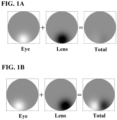
- This method of high order aberration correction is also applicable for the design of contact lenses and intra-ocular lenses, and for the execution of refractive eye surgery. proceeds fast), and black portions are portions in which a wavefront proceeds slowly (light proceeds slowly). Portions in which a wavefront proceeds neither fast nor slow are shown as gray portions. The same also applies to FIGS. 2 and 6 , which will be described later.
- JP 5096662B2 which is a conventional technology
- the compensation does not always work effectively because the wearer usually turns the eye about an optical axis and turning of the eye also occurs as a reflex movement that compensates turning of the head.
- an optimized field of view can be achieved when turning of the eye and rotation of the spectacle lens about the optical axis are not considered.
- the eye usually turns about the optical axis.
- aberration can be considered as being disturbance of a wavefront of light from an eye or a lens.
- the aberrations are offset due to characteristics of waves.
- the aberrations may be offset or may not be offset.
- FIG. 1B shows a state in which aberrations cannot be offset because the eye turned about the optical axis. In FIG. 1B , maldistribution of aberrations based on respective wavefronts is remarkable. The present invention was made focusing on this point.
- the present invention has an object of providing a technology that makes a change in the amount of aberration that is a combination of aberration in an eye and aberration in a spectacle lens robust, with respect to rotation.
- "robust" means that even when the rotation occurs, when aberration in the eye and aberration in the spectacle lens are combined, the amount of aberration is less likely to change when compared to conventional cases.
- the inventor of the present invention carried out intensive studies on the issues described above, and considered the following logic.
- the spectacle lens has a rotationally symmetrical aberration distribution.
- the amount of aberration does not change when aberration in the eye of the wearer and aberration in the spectacle lens are combined, irrespective of whether rotationally asymmetrical aberration occurs or does not occur in the eye.
- This also applies to a case where the eye of the wearer has a rotationally symmetrical aberration distribution.
- the inventor found that, if either the eye or the spectacle lens (for example, the eye) has an aberration distribution that is rotationally symmetrical or approximately rotationally symmetrical, even when the above-described rotation occurs, a change in the amount of aberration is small (i.e., robust) when aberration in the eye and aberration in the spectacle lens are combined, even if the other of the eye and the spectacle lens (for example, the spectacle lens) has an aberration distribution that is far from being rotationally symmetrical.
- an aberration distribution that is far from being rotationally symmetrical will also be described as being “rotationally asymmetrical”.
- the inventor of the present invention conceived a technology that reduces a change in the amount of aberration that is a combination of aberration in the eye and aberration in the spectacle lens even when the above-described rotation occurs, by accepting and considering a wavefront of the eye, rather than determining a wavefront of the spectacle lens such that maldistribution of aberration based on the wavefront of the eye is suppressed as in the conventional technology.
- a first aspect is a method for designing a spectacle lens, including:
- a second aspect is the method for designing a spectacle lens according to the first aspect
- a third aspect is the method for designing a spectacle lens according to the second aspect, wherein obtaining the spectacle lens as a design solution includes selecting a design solution from a plurality of design solutions that have different values of Li.
- a fourth aspect is the method for designing a spectacle lens according to the second or the third aspect, wherein Ei represents an index that is obtained by quantifying at least rotational asymmetry of an aberration distribution of a portion of a cornea corresponding to a pupil of the eye of the wearer, about the optical axis.
- a fifth aspect is the method for designing a spectacle lens according to the fourth aspect
- a sixth aspect is the method for designing a spectacle lens according to any one of the second to fifth aspects, wherein Es is determined based on at least one of a standard or average aberration that is obtained statistically or academically with respect to an eye of a spectacle wearer, a degree of turning of the eye of the wearer, a degree of a change in a pupil diameter of the wearer, the age of the wearer, an environment in which the wearer uses spectacles or an intended use of the spectacles for the wearer, and a time elapsed from the last visit of the wearer to an optician's store.
- Es is determined based on at least one of a standard or average aberration that is obtained statistically or academically with respect to an eye of a spectacle wearer, a degree of turning of the eye of the wearer, a degree of a change in a pupil diameter of the wearer, the age of the wearer, an environment in which the wearer uses spectacles or an intended use of the spectacles for the wearer, and a time elapsed
- An seventh aspect is the method for designing a spectacle lens according to any one of the second to sixth aspects, wherein a spectacle lens is obtained as a design solution according to a difference between Ei and Es.
- a eighth aspect is the method for designing a spectacle lens according to any one of the first to seventh aspects, wherein the spectacle lens is a progressive refractive power lens.
- a ninth aspect is a method for manufacturing a spectacle lens that is designed using the method for designing a spectacle lens according to any one of the first tc eighth aspects.
- a tenth aspect is a system for designing a spectacle lens, including: a design unit configured to:
- An eleventh aspect is the system for designing a spectacle lens according to the tenth aspect
- a twelfth aspect is the system for designing a spectacle lens according to the eleventh aspect, wherein obtaining the spectacle lens as a design solution includes selecting a design solution from a plurality of design solutions that have different values of Li.
- a 13th aspect is the system for designing a spectacle lens according to the eleventh or the twelfth wherein Ei represents an index that is obtained by quantifying at least rotational asymmetry of an aberration distribution of a portion of a cornea corresponding to a pupil of the eye of the wearer, about the optical axis.
- a 14th aspect is the system for designing a spectacle lens according to the 13th aspect
- a 15th aspect is the system for designing a spectacle lens according to any one of the eleventh to 14th aspects, wherein Es is determined based on at least one of a standard or average aberration that is obtained statistically or academically with respect to an eye of a spectacle wearer, a degree of turning of the eye of the wearer, a degree of a change in a pupil diameter of the wearer, the age of the wearer, an environment in which the wearer uses spectacles or an intended use of the spectacles for the wearer, and a time elapsed from the last visit of the wearer to an optician's store.
- Es is determined based on at least one of a standard or average aberration that is obtained statistically or academically with respect to an eye of a spectacle wearer, a degree of turning of the eye of the wearer, a degree of a change in a pupil diameter of the wearer, the age of the wearer, an environment in which the wearer uses spectacles or an intended use of the spectacles for the wearer, and a time
- An 16th aspect of the present invention is the system for designing a spectacle lens according to any one of eleventh to 15th wherein a spectacle lens is obtained as a design solution according to a difference between Ei and Es.
- a 17th aspect is the system for designing a spectacle lens according to any one of the tenth to 16th aspects, wherein the spectacle lens is a progressive refractive power lens.
- An amount of aberration for which
- An aspect may be applied to a progressive refractive power lens in which transmission astigmatism is added to an intermediate region and a near-vision region, rather than a far-vision region.
- the aspect may be adopted to determine the degree of transmission astigmatism to be added.
- to between values means “at least a predetermined value and not larger than a predetermined value”.
- the following is a method for designing a spectacle lens according to an aspect
- a method for designing a spectacle lens including:
- optical axis corresponds to the normal line at the center of each optical surface.
- the “center” described in the above paragraph will also be referred to as a "lens center”.
- the “lens center” means a geometric center, an optical center, or an alignment center of the spectacle lens.
- the alignment center will be described as an example.
- a case where a line of sight passes through the lens center when the wearer views straight forward will be described as an example.
- a change in the amount of aberration is small (i.e., robust) when aberration in the eye and aberration in the spectacle lens are combined.
- the present disclosure is intended to be applied preferably to a higher order aberration, i.e., a three or higher order aberration.
- the "predetermined width" of the region described above is a horizontal width that is smaller than the radius of the lens, and is preferably about 10 mm (for example), and more preferably a width corresponding to a pupil diameter projected to the lens surface. This may be a length on the lens surface corresponding to a pupil diameter of 2 mm (maximum diameter: 5mm).
- Any point refers to every (suitable) point on the main meridian.
- Rotational asymmetry of an aberration distribution of the eye of the wearer about the optical axis and rotational asymmetry of an aberration distribution of the spectacle lens is quantified.
- E and L respectively represent polar coordinate expressions of Zernike aberration coefficients of the eye of the wearer and the spectacle lens
- m represents a value indicating an order in a circumferential direction
- n represents a value indicating an order in a radial direction
- ⁇ represents a turning angle of the eye of the wearer about the optical axis
- ⁇ represents a rotation angle of the spectacle lens about the optical axis.
- a spot is a range from a peak to the first dark ring in a distribution of light generated on the retina by light that is emitted from an object point and passed through a portion of the spectacle lens and an ocular optical system. Also, in the present specification, a total energy in this range will be referred to as a "spot intensity”.
- the following Expression 4 is obtained by partially differentiating the above Expression 3 in terms of each turning angle.
- the following Expression 4 expresses fluctuation of the sum of squares of aberration in the eye and aberration in the spectacle lens due to turning.
- dRMS total 2 ⁇ m , n 2 mE m , n L m , n sin m ⁇ m , n ⁇ ⁇ m , n d ⁇ m , n ⁇ d ⁇ m , n
- a parameter relating to the eye and a parameter relating to the spectacle lens are extracted from the above Expression 4. Then, the parameter relating to the eye in Expression 4 is taken to be an index Ei of rotational asymmetry of an aberration distribution of the eye of the wearer about the optical axis. The parameter relating to the spectacle lens in Expression 4 is taken to be an index Li of rotational asymmetry of an aberration distribution of the spectacle lens.
- Ei is an index expressed by the following Expression 1. ⁇ m , n mE m , n
- Li is an index expressed by the following Expression 2. ⁇ m , n mL m , n
- the following describes a specific example of a customer, who is a subject (who is to be a wearer).
- portion of the cornea corresponding to the pupil refers to a portion of the cornea in a range having a diameter of at least 2 mm (maximum diameter: 5 mm) with respect to a pupil center.
- a wavefront and aberration in the eye can be acquired using methods described in conventional technologies or a known method.
- a wavefront and aberration in the spectacle lens can also be acquired using methods described in conventional technologies or a known method.
- interference fringes of light that passed through the spectacle lens from an object side surface of the lens to an eye side surface of the lens can be measured using FUJINON F601, which is a compact laser interferometer manufactured by FUJIFILM Corporation and in which a Fizeau interferometric method is used.
- data that specifies a wavefront of light that passed through each point on the spectacle lens can be calculated by applying a known fringe analysis algorithm to the measurement result of the interference fringes.
- a collection of data specifying wavefronts at respective points corresponds to wavefront data of light that passed through the spectacle lens. Accordingly, the wavefront data can be obtained by plotting the data specifying wavefronts at respective points, with respect to the points.
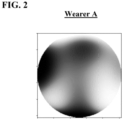
- FIG. 2 is a diagram showing the aberration distribution of the portion of the cornea corresponding to the pupil of the eye of the wearer A around the optical axis. It should be noted that the dimensions are 4 mm ⁇ 4 mm.
- a standard value of Ei is represented by Es.
- an average value of Ei of customers of the applicant was adopted as Es.
- Es is not limited to the average value, and it is also possible to adopt an average value or the most frequent value of wearers collected in big data using Internet lines, for example.
- Standard values are as follows (unit is omitted).
- Ei of the wearer A is larger than the standard value Es. That is, rotational asymmetry of the aberration distribution of the portion of the cornea corresponding to the pupil of the wearer A is stronger than the average.
- effects of the present invention are achieved by obtaining a spectacle lens of which Li is low, as a design solution for the wearer A. If Ei is not larger than Es, a spectacle lens of which Li is high is obtained as a design solution.
- Li is high when Ei>Es means that Li is higher than the value of Li when Ei ⁇ Es. That is, “Li is high” and “Li is low” may respectively mean that “higher than the value in the other case” and “lower than the value in the other case”.
- Ls of Li similarly to the standard value Es of Ei, and evaluate whether Li is higher or lower than Ls.
- Ls may be an average value of Li of customers of the applicant, or an average value or the most frequent value of wearers collected in big data using Internet lines, for example. It is also possible to adopt a design solution of a spectacle lens included in a predetermined product lineup of spectacle lenses, the design solution having the median value of a plurality of values of Li in the lineup.
- cases are separated according to which of Ei>Es and Ei ⁇ Es applies to each case, but it is also possible to separate cases according to which of Ei ⁇ Es and Ei ⁇ Es applies.
- a value that is a little smaller than the value of Es may be set as a new Es.
- Es is used as the threshold value for separating cases.
- Designing a spectacle lens may mean designing an aberration distribution (and a refractive power distribution, which will be omitted hereinafter) of the spectacle lens or correcting an existing aberration distribution, based on the above result (Ei>Es).
- designing a spectacle lens also encompasses a case where a plurality of basic designs (design solutions) of the aberration distribution are prepared, and a design solution is selected from the plurality of basic designs that have different values of Li. In this case, the amount of calculation can be reduced and the cost and time required for designing can be saved.
- obtaining, as a design solution includes designing the aberration distribution described above, correcting an existing aberration distribution, and selecting a design solution from a plurality of basic designs that have different values of Li. It is also possible to output content of the designed aberration distribution, the corrected aberration distribution, or the selected design solution, as data. This can be said as "outputting data of a spectacle lens of which Li is low, as a design solution", for example.
- the term "basic design" refers to an aberration distribution before an inset amount in a progressive refractive power lens is considered. That is, when the lens center of the spectacle lens is taken to be the origin, the Y axis corresponds to the main meridian. At this time, the X axis corresponds to the horizontal direction, and the Z axis corresponds to the optical axis direction (forward).
- Three basic designs that have different values of Li will be described later, and aberration amounts listed for each of the basic designs are aberration amounts in a region having a predetermined width and a center at any point on the main meridian of the spectacle lens. However, aberration amounts of the eye are not added to the aberration amounts listed for the basic designs. As for the above-described region, a width of 10 mm is described above as an example, but the present invention is not limited to this case.
- the present invention is not limited to the aspect in which basic designs are aberration distributions before an inset amount is considered, and it is also possible to prepare a plurality of design solutions after setting the main meridian by taking the inset amount into consideration in advance.
- the spectacle lens to be designed in the present invention is not limited to a progressive refractive power lens that includes a near-vision region for seeing a near distance, a far-vision region for seeing a distance farther than the near distance, and an intermediate region that connects the near-vision region and the far-vision region and in which the power changes progressively.
- the spectacle lens may be a spectacle lens (progressive refractive power lens) in which only a near-vision region for seeing a near distance is set and the power changes progressively in the other region of the lens, a bifocal lens, or a fixed focal lens.
- the main meridian is a straight line (e.g., the Y axis) that extends in the vertical (length) direction and passes through an axis of rotational symmetry.
- the main meridian that is set by taking an inset amount into consideration is also called a main gaze line.
- the main gaze line may be a straight line or a curved line, and is only required to pass through a fitting point FP, a far-vision power measurement reference point F, and a near-vision power measurement reference point N. These positions can be determined based on hidden marks provided on the spectacle lens.
- FIG. 3B is a diagram showing an astigmatism distribution (
- FIG. 3C is a diagram showing a coma aberration distribution (
- FIG. 3D is a diagram showing a Trefoil aberration distribution (
- white portions are high aberration portions and black portions are low aberration portions.
- black portions are low aberration portions. The same applies hereinafter to diagrams showing aberration distributions.
- Aberration amounts of the lens 1 are as follows (unit is omitted).
- FIG. 4B is a diagram showing an astigmatism distribution (
- FIG. 4C is a diagram showing a coma aberration distribution (
- FIG. 4D is a diagram showing a Trefoil aberration distribution (
- FIG. 5B is a diagram showing an astigmatism distribution (
- FIG. 5C is a diagram showing a coma aberration distribution (
- FIG. 5D is a diagram showing a Trefoil aberration distribution (
- FIG. 6 is a diagram showing an aberration distribution of a portion of the cornea corresponding to the pupil of an eye of a wearer B around the optical axis. It should be noted that the dimensions are 4 mm ⁇ 4 mm.
- Aberration amounts of the eye of the wearer B are as follows (unit is omitted).
- Ei of the wearer B is smaller than the standard value Es. Accordingly, it is necessary to obtain a spectacle lens of which Li is high as a design solution for the wearer B. As a result, the lens 3 is selected for the wearer B.
- the technical scope of the present invention is not limited to the above embodiment, and also includes configurations in which various changes or modifications are made within a scope in which particular effects achieved by constitutional elements of the present invention or a combination of the constitutional elements can be achieved.
- the degree of turning of the eye of the wearer and/or the degree of a change in the pupil diameter of the wearer are/is small, a change in the amount of aberration is small when aberration in the eye and aberration in the spectacle lens are combined, and therefore, the value of Ei may be reduced according to the degree of turning of the eye.
- Es may also be defined based on at least one of: a standard or average aberration that is obtained statistically or academically with respect to an eye of a spectacle wearer; a degree of turning of the eye of the wearer; a degree of a change in the pupil diameter of the wearer; the age of the wearer; an environment in which the wearer uses spectacles or an intended use of the spectacles for the wearer; and a time elapsed from the last visit of the wearer to an optician's store. For example, when the age of the wearer is high, it is highly likely that Ei is high.
- a progressive refractive power lens including the far-vision region, the near-vision region, and the intermediate region is described as an example of the spectacle lens.
- An aspect of the present invention may be applied to a progressive refractive power lens ( WO2020/067522 , WO2020/067523 ) in which transmission astigmatism is added to the intermediate region and the near-vision region, rather than the far-vision region, among such progressive refractive power lenses.
- the aspect of the present invention may be adopted to determine the degree of transmission astigmatism to be added. The entire contents of both documents can be incorporated in the present specification.
- the present invention can also be applied to a method for manufacturing a spectacle lens.
- a spectacle lens can be designed in accordance with the method for designing a spectacle lens described above, and the spectacle lens can be manufactured using a known method.
- a "method for supplying a spectacle lens” may be used as an expression that means at least one of the design method and the manufacturing method described above.
- the following system may also be called a "system for supplying a spectacle lens”.
- a system for designing a spectacle lens including: a design unit configured to:
- the system for designing a spectacle lens according to the aspect of the present invention is only required to include the design unit.
- the design unit may be installed in a computer that executes a predetermined program as necessary.
- the system for designing a spectacle lens according to the aspect of the present invention preferably includes the following units in addition to the design unit.
- a calculation unit that calculates Ei, Li, and the like.
- a storage unit that stores a plurality of design solutions having different values of Li (including Li values, other examples include basic designs, design data, etc.,), Ei of the wearer, the standard value Es, and the like.
- An eyeball measurement device for determining Ei An eyeball measurement device for determining Ei.
- a spectacle lens measurement device for determining Li A spectacle lens measurement device for determining Li.
- a determination unit that determines which of Ei>Es and Ei ⁇ Es applies.
- FIG. 7 is a block diagram showing a configuration of the system for designing a spectacle lens according to an aspect of the present invention.
- the calculation unit has a function of performing calculations of the above Expressions 1 to 4.
- the function of the calculation unit can be realized by a unit that executes a predetermined program as necessary in the computer.
- the storage unit may store at least any of: a standard or average aberration that is obtained statistically or academically with respect to an eye of a spectacle wearer; a degree of turning of the eye of the wearer; a degree of a change in the pupil diameter of the wearer; the age of the wearer; an environment in which the wearer uses spectacles or an intended use of the spectacles for the wearer; and a time elapsed from the last visit of the wearer to an optician's store, in addition to the plurality of design solutions of lenses, Ei, and Es.
- the storage unit may be an HDD or the like installed in the computer.
- the eyeball measurement device so long as information for determining Ei can be collected.
- the spectacle lens measurement device so long as information for determining Li can be collected.
- FUJINON F601 which is a compact laser interferometer manufactured by FUJIFILM Corporation and in which a Fizeau interferometric method is used, to obtain wavefront data and an aberration distribution.
- the calculation unit, the storage unit, the eyeball measurement device, and/or the spectacle lens measurement device do not always have to be installed in the system.
- the system may be connected to any of these units provided in a network outside the system.
- FIG. 8 is a flowchart of the system for designing a spectacle lens according to an aspect of the present invention.
- an aberration amount is measured using the eyeball measurement device with respect to each set of m and n in a polar coordinate expression of a Zernike aberration coefficient of the subject (who is to be a wearer) (eyeball measurement step).
- Ei is calculated by the calculation unit (Ei calculation step).
- Ei is stored in the storage unit (Ei storing step).
- Li1 to Lin of lens design solutions 1 to n (n is an integer of at least 2) that are prepared in advance are obtained (Li preparation step). Li1 to Lin are stored in the storage unit.
- the Li preparation step it is also possible to prepare a plurality of lens design solutions, and measure an aberration amount with respect to each set of m and n in a polar coordinate expression of a Zernike aberration coefficient of each spectacle lens using the spectacle lens measurement device (spectacle lens measurement step).
- the expression "spectacle lens measurement step” is also used for lens design solutions that are prepared before spectacle lenses are actually manufactured.
- Li is calculated by the calculation unit (Li calculation step). Li is stored in the storage unit (Li storing step).
- a standard value Es is calculated by the calculation unit using data of wearers stored in the storage unit (Es calculation step). Es is stored in the storage unit (Es storing step).
- the determination unit determines which of Ei>Es and Ei ⁇ Es applies.
- the design unit selects a design solution of a lens that has a low value of Li among Li1 to Lin (design step).
- the design solution may be selected from among Li1 to Lin of the plurality of lens design solutions, according to a difference between Ei and Es. For example, when Ei>Es applies and the difference between Ei and Es is extremely large, a design solution of which Li is the lowest among Li1 to Lin may be selected.
- a configuration is also possible in which a standard value Ls is calculated by the calculation unit using the method described as a variation of the aspect of the present invention (Ls calculation step).
- Ls may be stored in the storage unit (Ls storing step). Then, whether Li is higher or lower than the standard value Ls may be evaluated and Li of a predetermined value may be selected in the design step.
Landscapes
- Physics & Mathematics (AREA)
- Health & Medical Sciences (AREA)
- Ophthalmology & Optometry (AREA)
- General Health & Medical Sciences (AREA)
- General Physics & Mathematics (AREA)
- Optics & Photonics (AREA)
- Mathematical Physics (AREA)
- Eyeglasses (AREA)
- Lenses (AREA)
Claims (11)
- Un procédé mis en œuvre par ordinateur pour concevoir un verre de lunettes en vue de fabriquer ledit verre, qui, lorsqu'il est exécuté sur un ordinateur, comprend les étapes suivantes :lorsque l'asymétrie rotationnelle d'une distribution d'aberration d'un œil d'un porteur autour d'un axe optique est forte, obtenir, en tant que solution de conception, un verre de lunettes qui présente une distribution d'aberration dont l'asymétrie rotationnelle est faible dans une zone ayant une largeur prédéterminée et un centre à n'importe quel point sur un méridien principal du verre de lunettes ;lorsque l'asymétrie rotationnelle de la distribution d'aberration de l'œil du porteur autour de l'axe optique est faible, obtenir, en tant que solution de conception, un verre de lunettes dont l'asymétrie rotationnelle est forte dans la zone ; caractérisé en ce que,lorsqu'un indice qui est obtenu en quantifiant l'asymétrie rotationnelle concernant la distribution d'aberration de l'œil est représenté par Ei,une valeur standard de Ei est représentée par Es, etun indice qui est obtenu en quantifiant l'asymétrie rotationnelle d'une distribution d'aberration d'un verre de lunettes est représenté par Li,un verre de lunettes dont Li est faible est obtenu en tant que solution de conception lorsque Ei est supérieur à Es, etun verre de lunettes dont Li est élevé est obtenu en tant que solution de conception lorsque Ei n'est pas supérieur à Es,Ei représentant un indice qui est obtenu en quantifiant au moins l'asymétrie rotationnelle d'une distribution d'aberration d'une partie d'une cornée correspondant à une pupille de l'œil du porteur, autour de l'axe optique, etEi étant un indice exprimé par l'expression 1 suivante
 Li étant un indice exprimé par l'expression 2 suivante, et
 dans lesquelles E et L représentent respectivement des expressions de coordonnées polaires des coefficients d'aberration de Zernike de l'œil du porteur et des lunettes, m représente une valeur indiquant un ordre dans une direction circonférentielle, et n représente une valeur indiquant un ordre dans une direction radiale.
 - Le procédé de conception d'un verre de lunettes selon la revendication 1,
dans lequel l'obtention du verre de lunettes en tant que solution de conception comprend le fait de sélectionner une solution de conception parmi une pluralité de solutions de conception qui ont des valeurs différentes de Li. - Le procédé de conception d'un verre de lunettes selon l'une quelconque des revendications 1 ou 2,
dans lequel Es est déterminé sur la base d'au moins une aberration standard ou moyenne qui est obtenue statistiquement ou académiquement par rapport à un œil d'un porteur de lunettes, un degré de rotation de l'œil du porteur, un degré de changement du diamètre de la pupille du porteur, l'âge du porteur, un environnement dans lequel le porteur utilise des lunettes ou une utilisation prévue des lunettes pour le porteur, et un temps écoulé depuis la dernière visite du porteur dans un magasin d'optique. - Le procédé de conception d'un verre de lunettes selon l'une quelconque des revendications 1 à 3,
dans lequel un verre de lunettes est obtenu en tant que solution de conception en fonction d'une différence entre Ei et Es. - Le procédé de conception d'un verre de lunettes selon l'une quelconque des revendications 1 à 4,
dans lequel le verre de lunettes est un verre à réfraction progressive. - Un procédé de fabrication d'un verre de lunettes qui est conçu en utilisant le procédé de conception d'un verre de lunettes selon l'une quelconque des revendications 1 à 5.
- Un système de conception d'un verre de lunettes dans le but de fabriquer ledit verre, comprenant :
une unité de conception configurée pour :obtenir, en tant que solution de conception, un verre de lunettes qui a une distribution d'aberration dont l'asymétrie rotationnelle est faible dans une zone ayant une largeur prédéterminée et un centre en tout point sur un méridien principal du verre de lunettes, lorsque l'asymétrie rotationnelle d'une distribution d'aberration d'un œil d'un porteur autour d'un axe optique est forte ;obtenir, en tant que solution de conception, un verre de lunettes dont l'asymétrie de rotation est forte dans la zone, lorsque l'asymétrie de rotation de la distribution d'aberration de l'œil du porteur autour de l'axe optique est faible, caractérisée en ce que,lorsqu'un indice qui est obtenu en quantifiant l'asymétrie de rotation concernant la distribution d'aberration de l'œil est représenté par Ei,une valeur standard de Ei est représentée par Es, etun indice qui est obtenu en quantifiant l'asymétrie de rotation d'une distribution d'aberration d'un verre de lunettes est représenté par Li,l'unité de conceptionobtient un verre de lunettes dont Li est faible en tant que solution de conception lorsque Ei est supérieur à Es, etobtient un verre de lunettes dont Li est élevé en tant que solution de conception lorsque Ei n'est pas supérieur à Es,Ei représentant un indice qui est obtenu en quantifiant au moins l'asymétrie de rotation d'une distribution d'aberration d'une partie d'une cornée correspondant à une pupille de l'œil du porteur, autour de l'axe optique ;Ei est un indice exprimé par l'expression 1 suivante Li est un indice exprimé par l'expression 2 suivante
 dans lesquelles E et L représentent respectivement les expressions en coordonnées polaires des coefficients d'aberration de Zernike de l'œil du porteur et du verre de lunettes, m représente une valeur indiquant un ordre dans une direction circonférentielle, et n représente une valeur indiquant un ordre dans une direction radiale.
 - Le système de conception d'un verre de lunettes selon la revendication 7,
dans lequel l'obtention du verre de lunettes en tant que solution de conception comprend le fait de sélectionner une solution de conception parmi une pluralité de solutions de conception qui ont des valeurs différentes de Li. - Le système de conception d'un verre de lunettes selon l'une quelconque des revendications 7 à 8,
dans lequel Es est déterminé sur la base d'au moins une valeur parmi une aberration standard ou moyenne qui est obtenue statistiquement ou académiquement par rapport à un œil d'un porteur de lunettes, un degré de rotation de l'œil du porteur, un degré de changement du diamètre de la pupille du porteur, l'âge du porteur, un environnement dans lequel le porteur utilise des lunettes ou une utilisation prévue des lunettes pour le porteur, et un temps écoulé depuis la dernière visite du porteur dans un magasin d'optique. - Le système de conception d'un verre de lunettes selon l'une quelconque des revendications 7 à 9,
dans lequel un verre de lunettes est obtenu en tant que solution de conception en fonction d'une différence entre Ei et Es. - Le système de conception d'un verre de lunettes selon l'une quelconque des revendications 7 à 10,
dans lequel le verre de lunettes est un verre à réfraction progressive.
Applications Claiming Priority (1)
| Application Number | Priority Date | Filing Date | Title |
|---|---|---|---|
| JP2021010739A JP7505995B2 (ja) | 2021-01-27 | 2021-01-27 | 眼鏡レンズの設計方法、製造方法、及び設計システム |
Publications (2)
| Publication Number | Publication Date |
|---|---|
| EP4036635A1 EP4036635A1 (fr) | 2022-08-03 |
| EP4036635B1 true EP4036635B1 (fr) | 2025-02-26 |
Family
ID=79730288
Family Applications (1)
| Application Number | Title | Priority Date | Filing Date |
|---|---|---|---|
| EP22152316.0A Active EP4036635B1 (fr) | 2021-01-27 | 2022-01-19 | Procédé de conception de verre de lunettes, procédé de fabrication de verre de lunettes, et système de conception de verre de lunettes |
Country Status (4)
| Country | Link |
|---|---|
| US (1) | US20220236590A1 (fr) |
| EP (1) | EP4036635B1 (fr) |
| JP (1) | JP7505995B2 (fr) |
| CN (1) | CN114815303A (fr) |
Family Cites Families (19)
| Publication number | Priority date | Publication date | Assignee | Title |
|---|---|---|---|---|
| IL143503A0 (en) * | 2001-05-31 | 2002-04-21 | Visionix Ltd | Aberration correction spectacle lens |
| JP5096662B2 (ja) | 2002-10-04 | 2012-12-12 | カール ツアイス ヴィジョン ゲーエムベーハー | レンズを製造する方法およびこの方法により製造されたレンズ |
| AR045370A1 (es) | 2003-08-15 | 2005-10-26 | E Vision Llc | Sistema de lente electro-activo |
| US7090348B2 (en) * | 2003-10-28 | 2006-08-15 | Essilor International (Compagnie Generale D'optique) | Method for designing spectacle lenses taking into account an individual's head and eye movement |
| WO2006116820A1 (fr) * | 2005-05-05 | 2006-11-09 | Carl Zeiss Vision Australia Holdings Ltd | Reseau d'elements de verres ophtalmiques progressifs |
| US8154804B2 (en) * | 2008-03-25 | 2012-04-10 | E-Vision Smart Optics, Inc. | Electro-optic lenses for correction of higher order aberrations |
| EP2407815B1 (fr) * | 2009-03-12 | 2018-08-15 | Hoya Corporation | Procédé de compilation de données de forme d'une lentille de lunettes, dispositif de compilation de données de forme d'une lentille de lunettes et lentille de lunettes |
| JP5098094B2 (ja) | 2010-03-23 | 2012-12-12 | 東海光学株式会社 | 眼鏡レンズの設計方法及び眼鏡レンズ又はレンズデータの選択方法 |
| JP2012013742A (ja) * | 2010-06-29 | 2012-01-19 | Seiko Epson Corp | 累進屈折力眼鏡レンズ及びその設計方法 |
| WO2012127538A1 (fr) | 2011-03-24 | 2012-09-27 | 株式会社メニコン | Lentille de contact et procédé de fabrication pour celle-ci |
| US10613347B2 (en) * | 2012-01-11 | 2020-04-07 | Rodenstock Gmbh | Population of an eye model for optimizing spectacle lenses with measurement data |
| WO2015125868A1 (fr) | 2014-02-20 | 2015-08-27 | 株式会社ニコン | Procédé de conception de verres de lunettes, procédé de production de verres de lunettes , verres de lunettes, système de conception de verres de lunettes, programme de conception de verres de lunettes, et support d'enregistrement |
| IT201600097763A1 (it) | 2016-09-29 | 2018-03-29 | Sifi Medtech Srl | Lente per astigmatismo |
| EP3550356A4 (fr) * | 2016-11-30 | 2020-08-12 | Nikon-Essilor Co., Ltd. | Procédé de conception de verre de lunettes, procédé de fabrication de verre de lunettes, dispositif de commande de verre de lunettes, un dispositif de commande et de réception de l'ordre du verre de lunettes, un système de commande et de réception de l'ordre du verre de lunettes, de la lentille progressive, et de la lentille monofocale |
| PT3352001T (pt) * | 2017-01-20 | 2023-06-16 | Zeiss Carl Vision Int Gmbh | Lente de óculos progressiva com índice de refração variável e método para a sua conceção e produção |
| JP7126842B2 (ja) * | 2018-03-27 | 2022-08-29 | ホヤ レンズ タイランド リミテッド | 一対の眼鏡レンズの設計方法、製造方法、および一対の眼鏡レンズ |
| JP2019211543A (ja) * | 2018-05-31 | 2019-12-12 | 伊藤光学工業株式会社 | 累進屈折力レンズの設計方法 |
| US12099260B2 (en) | 2018-09-28 | 2024-09-24 | Hoya Lens Thailand Ltd. | Progressive addition lens and design method therefor |
| US12140821B2 (en) | 2018-09-28 | 2024-11-12 | Hoya Lens Thailand Ltd. | Progressive addition lens and design method therefor |
-
2021
- 2021-01-27 JP JP2021010739A patent/JP7505995B2/ja active Active
-
2022
- 2022-01-19 EP EP22152316.0A patent/EP4036635B1/fr active Active
- 2022-01-26 CN CN202210092218.9A patent/CN114815303A/zh active Pending
- 2022-01-27 US US17/586,250 patent/US20220236590A1/en active Pending
Also Published As
| Publication number | Publication date |
|---|---|
| JP7505995B2 (ja) | 2024-06-25 |
| EP4036635A1 (fr) | 2022-08-03 |
| JP2022114478A (ja) | 2022-08-08 |
| US20220236590A1 (en) | 2022-07-28 |
| CN114815303A (zh) | 2022-07-29 |
Similar Documents
| Publication | Publication Date | Title |
|---|---|---|
| JP5369121B2 (ja) | 眼鏡レンズの評価方法、眼鏡レンズの設計方法、眼鏡レンズの製造方法、眼鏡レンズの製造システム、及び眼鏡レンズ | |
| JP5997351B2 (ja) | 眼鏡レンズの製造方法 | |
| EP3271779B1 (fr) | Procédé de détermination d'une lentille ophtalmique ayant un astigmatisme non voulu | |
| CN102186408B (zh) | 用于视觉辅助装置的验光单的系统和方法 | |
| KR102042554B1 (ko) | 안경 렌즈 결정 방법 | |
| AU2012216985B2 (en) | A method for determining target optical functions | |
| JP2007256957A (ja) | 累進焦点眼鏡レンズの決定方法 | |
| JP5747279B2 (ja) | 視力矯正用レンズの設計方法 | |
| EP3037869A1 (fr) | Procédé permettant de comparer une première lentille ophtalmique avec une seconde lentille ophtalmique | |
| CA3095519C (fr) | Procede pour determiner une lentille ophtalmique uni-focale | |
| CN105339833B (zh) | 用于确定镜片验光单的方法和系统 | |
| EP4036635B1 (fr) | Procédé de conception de verre de lunettes, procédé de fabrication de verre de lunettes, et système de conception de verre de lunettes | |
| EP4036636B1 (fr) | Procédé de conception de verre de lunettes, procédé de fabrication de verre de lunettes, et système de conception de verre de lunettes | |
| EP4386470A1 (fr) | Conception optique et optimisation de transmission spectrale | |
| JP2004333669A (ja) | 眼鏡用レンズの調整方法および眼鏡用レンズ | |
| Plakitsi | Optical and Visual Performance with Varifocal Contact Lenses for the Presbyope |
Legal Events
| Date | Code | Title | Description |
|---|---|---|---|
| PUAI | Public reference made under article 153(3) epc to a published international application that has entered the european phase |
Free format text: ORIGINAL CODE: 0009012 |
|
| STAA | Information on the status of an ep patent application or granted ep patent |
Free format text: STATUS: THE APPLICATION HAS BEEN PUBLISHED |
|
| AK | Designated contracting states |
Kind code of ref document: A1 Designated state(s): AL AT BE BG CH CY CZ DE DK EE ES FI FR GB GR HR HU IE IS IT LI LT LU LV MC MK MT NL NO PL PT RO RS SE SI SK SM TR |
|
| STAA | Information on the status of an ep patent application or granted ep patent |
Free format text: STATUS: REQUEST FOR EXAMINATION WAS MADE |
|
| 17P | Request for examination filed |
Effective date: 20221114 |
|
| RBV | Designated contracting states (corrected) |
Designated state(s): AL AT BE BG CH CY CZ DE DK EE ES FI FR GB GR HR HU IE IS IT LI LT LU LV MC MK MT NL NO PL PT RO RS SE SI SK SM TR |
|
| GRAP | Despatch of communication of intention to grant a patent |
Free format text: ORIGINAL CODE: EPIDOSNIGR1 |
|
| STAA | Information on the status of an ep patent application or granted ep patent |
Free format text: STATUS: GRANT OF PATENT IS INTENDED |
|
| INTG | Intention to grant announced |
Effective date: 20241119 |
|
| GRAS | Grant fee paid |
Free format text: ORIGINAL CODE: EPIDOSNIGR3 |
|
| P01 | Opt-out of the competence of the unified patent court (upc) registered |
Free format text: CASE NUMBER: APP_66715/2024 Effective date: 20241217 |
|
| GRAA | (expected) grant |
Free format text: ORIGINAL CODE: 0009210 |
|
| STAA | Information on the status of an ep patent application or granted ep patent |
Free format text: STATUS: THE PATENT HAS BEEN GRANTED |
|
| AK | Designated contracting states |
Kind code of ref document: B1 Designated state(s): AL AT BE BG CH CY CZ DE DK EE ES FI FR GB GR HR HU IE IS IT LI LT LU LV MC MK MT NL NO PL PT RO RS SE SI SK SM TR |
|
| REG | Reference to a national code |
Ref country code: GB Ref legal event code: FG4D |
|
| REG | Reference to a national code |
Ref country code: CH Ref legal event code: EP |
|
| REG | Reference to a national code |
Ref country code: DE Ref legal event code: R096 Ref document number: 602022010962 Country of ref document: DE |
|
| REG | Reference to a national code |
Ref country code: IE Ref legal event code: FG4D |
|
| REG | Reference to a national code |
Ref country code: NL Ref legal event code: MP Effective date: 20250226 |
|
| PG25 | Lapsed in a contracting state [announced via postgrant information from national office to epo] |
Ref country code: RS Free format text: LAPSE BECAUSE OF FAILURE TO SUBMIT A TRANSLATION OF THE DESCRIPTION OR TO PAY THE FEE WITHIN THE PRESCRIBED TIME-LIMIT Effective date: 20250526 |
|
| PG25 | Lapsed in a contracting state [announced via postgrant information from national office to epo] |
Ref country code: FI Free format text: LAPSE BECAUSE OF FAILURE TO SUBMIT A TRANSLATION OF THE DESCRIPTION OR TO PAY THE FEE WITHIN THE PRESCRIBED TIME-LIMIT Effective date: 20250226 |
|
| PG25 | Lapsed in a contracting state [announced via postgrant information from national office to epo] |
Ref country code: PL Free format text: LAPSE BECAUSE OF FAILURE TO SUBMIT A TRANSLATION OF THE DESCRIPTION OR TO PAY THE FEE WITHIN THE PRESCRIBED TIME-LIMIT Effective date: 20250226 |
|
| PG25 | Lapsed in a contracting state [announced via postgrant information from national office to epo] |
Ref country code: ES Free format text: LAPSE BECAUSE OF FAILURE TO SUBMIT A TRANSLATION OF THE DESCRIPTION OR TO PAY THE FEE WITHIN THE PRESCRIBED TIME-LIMIT Effective date: 20250226 |
|
| REG | Reference to a national code |
Ref country code: LT Ref legal event code: MG9D |
|
| PG25 | Lapsed in a contracting state [announced via postgrant information from national office to epo] |
Ref country code: NO Free format text: LAPSE BECAUSE OF FAILURE TO SUBMIT A TRANSLATION OF THE DESCRIPTION OR TO PAY THE FEE WITHIN THE PRESCRIBED TIME-LIMIT Effective date: 20250526 Ref country code: IS Free format text: LAPSE BECAUSE OF FAILURE TO SUBMIT A TRANSLATION OF THE DESCRIPTION OR TO PAY THE FEE WITHIN THE PRESCRIBED TIME-LIMIT Effective date: 20250626 |
|
| PG25 | Lapsed in a contracting state [announced via postgrant information from national office to epo] |
Ref country code: NL Free format text: LAPSE BECAUSE OF FAILURE TO SUBMIT A TRANSLATION OF THE DESCRIPTION OR TO PAY THE FEE WITHIN THE PRESCRIBED TIME-LIMIT Effective date: 20250226 |
|
| PG25 | Lapsed in a contracting state [announced via postgrant information from national office to epo] |
Ref country code: HR Free format text: LAPSE BECAUSE OF FAILURE TO SUBMIT A TRANSLATION OF THE DESCRIPTION OR TO PAY THE FEE WITHIN THE PRESCRIBED TIME-LIMIT Effective date: 20250226 |
|
| PG25 | Lapsed in a contracting state [announced via postgrant information from national office to epo] |
Ref country code: LV Free format text: LAPSE BECAUSE OF FAILURE TO SUBMIT A TRANSLATION OF THE DESCRIPTION OR TO PAY THE FEE WITHIN THE PRESCRIBED TIME-LIMIT Effective date: 20250226 Ref country code: PT Free format text: LAPSE BECAUSE OF FAILURE TO SUBMIT A TRANSLATION OF THE DESCRIPTION OR TO PAY THE FEE WITHIN THE PRESCRIBED TIME-LIMIT Effective date: 20250626 |
|
| PG25 | Lapsed in a contracting state [announced via postgrant information from national office to epo] |
Ref country code: BG Free format text: LAPSE BECAUSE OF FAILURE TO SUBMIT A TRANSLATION OF THE DESCRIPTION OR TO PAY THE FEE WITHIN THE PRESCRIBED TIME-LIMIT Effective date: 20250226 Ref country code: GR Free format text: LAPSE BECAUSE OF FAILURE TO SUBMIT A TRANSLATION OF THE DESCRIPTION OR TO PAY THE FEE WITHIN THE PRESCRIBED TIME-LIMIT Effective date: 20250527 |
|
| REG | Reference to a national code |
Ref country code: AT Ref legal event code: MK05 Ref document number: 1771196 Country of ref document: AT Kind code of ref document: T Effective date: 20250226 |
|
| PG25 | Lapsed in a contracting state [announced via postgrant information from national office to epo] |
Ref country code: SE Free format text: LAPSE BECAUSE OF FAILURE TO SUBMIT A TRANSLATION OF THE DESCRIPTION OR TO PAY THE FEE WITHIN THE PRESCRIBED TIME-LIMIT Effective date: 20250226 |
|
| PG25 | Lapsed in a contracting state [announced via postgrant information from national office to epo] |
Ref country code: SM Free format text: LAPSE BECAUSE OF FAILURE TO SUBMIT A TRANSLATION OF THE DESCRIPTION OR TO PAY THE FEE WITHIN THE PRESCRIBED TIME-LIMIT Effective date: 20250226 |
|
| PG25 | Lapsed in a contracting state [announced via postgrant information from national office to epo] |
Ref country code: DK Free format text: LAPSE BECAUSE OF FAILURE TO SUBMIT A TRANSLATION OF THE DESCRIPTION OR TO PAY THE FEE WITHIN THE PRESCRIBED TIME-LIMIT Effective date: 20250226 |
|
| PG25 | Lapsed in a contracting state [announced via postgrant information from national office to epo] |
Ref country code: IT Free format text: LAPSE BECAUSE OF FAILURE TO SUBMIT A TRANSLATION OF THE DESCRIPTION OR TO PAY THE FEE WITHIN THE PRESCRIBED TIME-LIMIT Effective date: 20250226 |
|
| PG25 | Lapsed in a contracting state [announced via postgrant information from national office to epo] |
Ref country code: AT Free format text: LAPSE BECAUSE OF FAILURE TO SUBMIT A TRANSLATION OF THE DESCRIPTION OR TO PAY THE FEE WITHIN THE PRESCRIBED TIME-LIMIT Effective date: 20250226 |
|
| PG25 | Lapsed in a contracting state [announced via postgrant information from national office to epo] |
Ref country code: EE Free format text: LAPSE BECAUSE OF FAILURE TO SUBMIT A TRANSLATION OF THE DESCRIPTION OR TO PAY THE FEE WITHIN THE PRESCRIBED TIME-LIMIT Effective date: 20250226 Ref country code: CZ Free format text: LAPSE BECAUSE OF FAILURE TO SUBMIT A TRANSLATION OF THE DESCRIPTION OR TO PAY THE FEE WITHIN THE PRESCRIBED TIME-LIMIT Effective date: 20250226 |
|
| PG25 | Lapsed in a contracting state [announced via postgrant information from national office to epo] |
Ref country code: RO Free format text: LAPSE BECAUSE OF FAILURE TO SUBMIT A TRANSLATION OF THE DESCRIPTION OR TO PAY THE FEE WITHIN THE PRESCRIBED TIME-LIMIT Effective date: 20250226 |
|
| PG25 | Lapsed in a contracting state [announced via postgrant information from national office to epo] |
Ref country code: SK Free format text: LAPSE BECAUSE OF FAILURE TO SUBMIT A TRANSLATION OF THE DESCRIPTION OR TO PAY THE FEE WITHIN THE PRESCRIBED TIME-LIMIT Effective date: 20250226 |
|
| REG | Reference to a national code |
Ref country code: DE Ref legal event code: R097 Ref document number: 602022010962 Country of ref document: DE |
|
| PLBE | No opposition filed within time limit |
Free format text: ORIGINAL CODE: 0009261 |
|
| STAA | Information on the status of an ep patent application or granted ep patent |
Free format text: STATUS: NO OPPOSITION FILED WITHIN TIME LIMIT |
|
| PGFP | Annual fee paid to national office [announced via postgrant information from national office to epo] |
Ref country code: GB Payment date: 20251127 Year of fee payment: 5 |
|
| PGFP | Annual fee paid to national office [announced via postgrant information from national office to epo] |
Ref country code: FR Payment date: 20251128 Year of fee payment: 5 |
|
| 26N | No opposition filed |
Effective date: 20251127 |
|
| PGFP | Annual fee paid to national office [announced via postgrant information from national office to epo] |
Ref country code: DE Payment date: 20251203 Year of fee payment: 5 |