EP4031409B1 - Kindertrage mit seitenaufprallschutz - Google Patents
Kindertrage mit seitenaufprallschutz Download PDFInfo
- Publication number
- EP4031409B1 EP4031409B1 EP20780873.4A EP20780873A EP4031409B1 EP 4031409 B1 EP4031409 B1 EP 4031409B1 EP 20780873 A EP20780873 A EP 20780873A EP 4031409 B1 EP4031409 B1 EP 4031409B1
- Authority
- EP
- European Patent Office
- Prior art keywords
- insert
- conveyance device
- inner support
- receptacle
- child
- Prior art date
- Legal status (The legal status is an assumption and is not a legal conclusion. Google has not performed a legal analysis and makes no representation as to the accuracy of the status listed.)
- Active
Links
Images





Classifications
-
- B—PERFORMING OPERATIONS; TRANSPORTING
- B60—VEHICLES IN GENERAL
- B60N—SEATS SPECIALLY ADAPTED FOR VEHICLES; VEHICLE PASSENGER ACCOMMODATION NOT OTHERWISE PROVIDED FOR
- B60N2/00—Seats specially adapted for vehicles; Arrangement or mounting of seats in vehicles
- B60N2/24—Seats specially adapted for vehicles; Arrangement or mounting of seats in vehicles for particular purposes or particular vehicles
- B60N2/26—Seats specially adapted for vehicles; Arrangement or mounting of seats in vehicles for particular purposes or particular vehicles for children
- B60N2/28—Seats readily mountable on, and dismountable from, existing seats or other parts of the vehicle
- B60N2/2884—Seats readily mountable on, and dismountable from, existing seats or other parts of the vehicle with protection systems against abnormal g-forces
-
- B—PERFORMING OPERATIONS; TRANSPORTING
- B60—VEHICLES IN GENERAL
- B60N—SEATS SPECIALLY ADAPTED FOR VEHICLES; VEHICLE PASSENGER ACCOMMODATION NOT OTHERWISE PROVIDED FOR
- B60N2/00—Seats specially adapted for vehicles; Arrangement or mounting of seats in vehicles
- B60N2/24—Seats specially adapted for vehicles; Arrangement or mounting of seats in vehicles for particular purposes or particular vehicles
- B60N2/26—Seats specially adapted for vehicles; Arrangement or mounting of seats in vehicles for particular purposes or particular vehicles for children
- B60N2/28—Seats readily mountable on, and dismountable from, existing seats or other parts of the vehicle
- B60N2/2842—Seats readily mountable on, and dismountable from, existing seats or other parts of the vehicle adapted to carry the child, when dismounted from the vehicle
- B60N2/2845—Seats readily mountable on, and dismountable from, existing seats or other parts of the vehicle adapted to carry the child, when dismounted from the vehicle having handles
-
- B—PERFORMING OPERATIONS; TRANSPORTING
- B60—VEHICLES IN GENERAL
- B60N—SEATS SPECIALLY ADAPTED FOR VEHICLES; VEHICLE PASSENGER ACCOMMODATION NOT OTHERWISE PROVIDED FOR
- B60N2/00—Seats specially adapted for vehicles; Arrangement or mounting of seats in vehicles
- B60N2/24—Seats specially adapted for vehicles; Arrangement or mounting of seats in vehicles for particular purposes or particular vehicles
- B60N2/26—Seats specially adapted for vehicles; Arrangement or mounting of seats in vehicles for particular purposes or particular vehicles for children
- B60N2/28—Seats readily mountable on, and dismountable from, existing seats or other parts of the vehicle
- B60N2/2857—Seats readily mountable on, and dismountable from, existing seats or other parts of the vehicle characterised by the peculiar orientation of the child
- B60N2/2863—Seats readily mountable on, and dismountable from, existing seats or other parts of the vehicle characterised by the peculiar orientation of the child backward facing
-
- B—PERFORMING OPERATIONS; TRANSPORTING
- B60—VEHICLES IN GENERAL
- B60N—SEATS SPECIALLY ADAPTED FOR VEHICLES; VEHICLE PASSENGER ACCOMMODATION NOT OTHERWISE PROVIDED FOR
- B60N2/00—Seats specially adapted for vehicles; Arrangement or mounting of seats in vehicles
- B60N2/24—Seats specially adapted for vehicles; Arrangement or mounting of seats in vehicles for particular purposes or particular vehicles
- B60N2/26—Seats specially adapted for vehicles; Arrangement or mounting of seats in vehicles for particular purposes or particular vehicles for children
- B60N2/28—Seats readily mountable on, and dismountable from, existing seats or other parts of the vehicle
- B60N2/2872—Seats readily mountable on, and dismountable from, existing seats or other parts of the vehicle provided with side rests
-
- B—PERFORMING OPERATIONS; TRANSPORTING
- B60—VEHICLES IN GENERAL
- B60N—SEATS SPECIALLY ADAPTED FOR VEHICLES; VEHICLE PASSENGER ACCOMMODATION NOT OTHERWISE PROVIDED FOR
- B60N2/00—Seats specially adapted for vehicles; Arrangement or mounting of seats in vehicles
- B60N2/24—Seats specially adapted for vehicles; Arrangement or mounting of seats in vehicles for particular purposes or particular vehicles
- B60N2/42—Seats specially adapted for vehicles; Arrangement or mounting of seats in vehicles for particular purposes or particular vehicles the seat constructed to protect the occupant from the effect of abnormal g-forces, e.g. crash or safety seats
- B60N2/427—Seats or parts thereof displaced during a crash
- B60N2/42709—Seats or parts thereof displaced during a crash involving residual deformation or fracture of the structure
-
- B—PERFORMING OPERATIONS; TRANSPORTING
- B60—VEHICLES IN GENERAL
- B60N—SEATS SPECIALLY ADAPTED FOR VEHICLES; VEHICLE PASSENGER ACCOMMODATION NOT OTHERWISE PROVIDED FOR
- B60N2/00—Seats specially adapted for vehicles; Arrangement or mounting of seats in vehicles
- B60N2/80—Head-rests
- B60N2/888—Head-rests with arrangements for protecting against abnormal g-forces, e.g. by displacement of the head-rest
Definitions
- the present invention is directed generally to child conveyance devices, for example, car seats, and to an impact protection mechanism for same.
- US 2010/295347 A1 discloses a child restraint which includes a juvenile vehicle seat and an energy-absorption apparatus coupled to the juvenile vehicle seat.
- the energy-absorption apparatus is configured to absorb external energy associated with an external impact force applied to the energy-absorption apparatus.
- the impact energy absorbing apparatus includes an inner support configured to be positioned against the portion of the child conveyance device, the inner support having a receptacle formed therein, an outer cover configured to releasably secure the inner support, and an insert received within the receptacle of the inner support. The insert is held in place by the outer cover when securing the outer cover.
- the insert has a wall with a closed end and an open end.
- the insert is sized to fit within the receptacle of the inner support with the closed end first entering the receptacle.
- the receptacle of the inner support may have a shape complimentary to a shape of the insert.
- the insert may embody a rectangular-shaped frustum.
- the insert may be configured to partially enter the receptacle of the inner support, with an internal volume being defined between the internal surfaces of the inner support and the outer surfaces of the insert.
- the insert When an impact force having an amplitude less than a threshold value is applied to the impact energy absorbing apparatus, the insert may be configured to resist the impact force, and when an impact force having an amplitude greater than the threshold value is applied to the impact energy absorbing apparatus, the insert may be configured to slide inwardly into the receptacle of the inner support to absorb the impact force, with the insert being configured to occupy the internal volume of the receptacle as the insert moves into the receptacle. The insert may be caused to plastically deform as the insert is moved within the receptacle.
- the inner support may be secured to a shell of the safety seat by the outer cover. The shell of the safety seat holds the outer periphery of the outer cover in place.
- the child conveyance device further may include an inner cover configured to fit within an opening formed in the outer cover, with the inner cover shielding the insert when assembled.
- the inner cover may be designed to fit within an opening formed in the outer cover.
- the child conveyance device may be a child vehicle safety seat.
- An impact force applied to the impact energy absorbing apparatus may have an amplitude less than a threshold value causes the insert to resist the impact force.
- An impact force applied to the impact energy absorbing apparatus may have an amplitude greater than the threshold value causes the insert to slide inwardly into the receptacle of the inner support to plastically deform the insert.
- the impact energy absorbing apparatus may be replaceably secured to the portion of the child conveyance device.
- the inner support may be fabricated from foam material and the outer cover is fabricated from plastic material.
- the impact energy absorbing apparatus includes an inner support configured to be secured to the portion of the child conveyance device, the inner support having a receptacle formed therein, an outer cover configured to releasably secure the inner support, and an insert received within the receptacle of the inner support. The insert is held in place by the outer cover when securing the outer cover.
- the insert includes a wall with a closed end and an open end in embodiments of the impact energy absorbing apparatus.
- the insert may be sized to fit within the receptacle of the inner support with the closed end first entering the receptacle.
- the receptacle of the inner support may have a shape complimentary to a shape of the insert.
- the insert may embody a rectangular-shaped frustum.
- the insert may be configured to partially enter the receptacle of the inner support, with an internal volume being defined between the internal surfaces of the inner support and the outer surfaces of the insert.
- the insert When an impact force having an amplitude less than a threshold value is applied to the impact energy absorbing apparatus, the insert may be configured to resist the impact force, and when an impact force having an amplitude greater than the threshold value is applied to the impact energy absorbing apparatus, the insert may be configured to slide inwardly into the receptacle of the inner support to absorb the impact force, with the insert being configured to occupy the internal volume of the receptacle as the insert moves into the receptacle. The insert may be caused to plastically deform as the insert is moved within the receptacle.
- the impact energy absorbing apparatus further may include an inner cover configured to fit within an opening formed in the outer cover, the inner cover shielding the insert when assembled.
- the inner cover may be designed to fit within an opening formed in the outer cover.
- the inner support may be fabricated from foam material and the outer cover is fabricated from plastic material.
- the car seat may be secured to the back seat of a motor vehicle with a seat belt, for example, a three-point safety belt and/or other connectors such as Isofix connectors.
- the car seat may be padded with different forms of energy absorbing materials, which may reduce forces that a child riding in the car seat may be exposed to during a motor vehicle collision.
- aspects and embodiments disclosed herein include apparatus that may be coupled to conventional child vehicle safety seats and modifications to conventional child vehicle safety seats that may improve the side impact protection offered by the child vehicle safety seats.
- Some aspects and embodiments disclosed herein include an energy absorbing apparatus that may be mechanically coupled or formed integral with a portion of a side of a child vehicle safety seat and that may reduce side impact forces that a child occupying the child vehicle safety seat may be exposed to during a motor vehicle collision.
- Some embodiments of the apparatus may include a pair of interlocking shell elements and an energy absorbing material disposed within a cavity defined by the interlocking shell elements.
- the interlocking shell elements may be free to move relative to one another, for example, for one of the shell elements to slide into the other shell element, to reduce the size of the internal cavity upon application of an external force. Reduction of the size of the internal cavity may cause the energy absorbing material to mechanically compress and/or plastically deform or rupture and absorb forces which otherwise might be transferred to a child occupying the child vehicle safety seat.
- the energy absorbing apparatus may be reusable or, in some embodiments, may provide an indication that it should be replaced after absorbing a sufficiently high amount of energy.
- the child vehicle safety seat 100 may be a stand-alone device or may be configured to be secured to, for example, a stroller frame or to a separate car seat base by the provision of appropriate securing mechanisms as are known in the art on, for example, a lower surface of the seat.
- the child vehicle safety seat 100 includes a shell 110 and a carrying handle 120 pivotally attached to the shell 110 at handle pivot mechanisms 130 which may be positioned on an outer surface of either or both sides of the shell 110.
- the handle 120 is generally U-shaped, and may be pivoted into a position extending generally vertically upward from the pivot mechanism(s), into a position against a surface of the shell 110, or into one or more intermediate positions.
- the shape, form, and method of connection of the handle 120 to the shell 110 is not, however, limited to that illustrated.
- Other handles having different shapes, orientations, or methods of connection to the shell of a child vehicle safety seat 100 may be utilized in various embodiments.
- the handle pivot mechanisms 130 may be positioned at locations more lateral than many, if not all, other portions of the child vehicle safety seat 100. Accordingly, the handle pivot mechanisms 130 may provide surfaces upon which it may be desirable to dispose embodiments of a side impact energy absorbing apparatus.
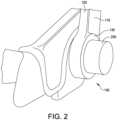
- FIG. 2 illustrates a generalized embodiment of a side impact energy absorbing apparatus 200 coupled to an outside surface of a handle pivot mechanism 130 of an embodiment of a child vehicle safety seat 100, only a portion of which is illustrated in FIG. 2 for clarity.
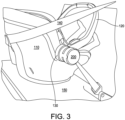
- FIG. 3 Another embodiment of a side impact energy absorbing apparatus 200 is illustrated coupled to the handle pivot mechanism 130 of another embodiment of a child vehicle safety seat 100 in FIG. 3 .
- the positions and coupling of seatbelt straps 140 that may be used to secure the child vehicle safety seat 100 to a motor vehicle seat 150 is also illustrated in FIG. 3 .
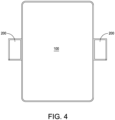
- a side impact energy absorbing apparatus 200 is provided on both lateral sides of a child vehicle safety seat 100, for example, as illustrated in FIG. 4 in which the child vehicle safety seat 100 is illustrated in a highly simplified manner.
- the child vehicle safety seat 100 should be positioned such that the side impact energy absorbing apparatus 200 faces a surface of the motor vehicle, for example, a door of the motor vehicle, that the child vehicle safety seat 100 is most likely to come into contact with upon the motor vehicle experiencing a side impact collision.
- the side impact energy absorbing apparatus 200 includes a pair of outer shells, an upper shell 205 and a lower shell 210.
- the lower shell 210 shall be considered the shell that contacts and is disposed on embodiments of a child vehicle safety seat 100.
- the outer periphery of one of the upper shell 205 or the lower shell 210 may be sized and shaped to fit within an internal perimeter of the other of the upper shell 205 or the lower shell 210.
- the one of the upper shell 205 or the lower shell 210 may have an outer surface sized and shaped to slideably engage the internal surface of the other of the upper shell 205 or the lower shell 210 such that the one of the upper shell 205 or the lower shell 210 may slide into or out from an internal volume of the other of the upper shell 205 or the lower shell 210.
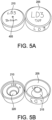
- Outer surfaces of one embodiment of a pair of upper and lower shells 205, 210 is illustrated in FIG. 5A .
- Inner surfaces of one embodiment of a pair of upper and lower shells 205, 210 is illustrated in FIG. 5B .
- the upper and lower shells 205, 210 may have internal features such as an internally projecting frustoconical projection 215 in the upper shell 205 and a recess 220 in the lower shell 210.
- the recess 220 in the lower shell 210 may have a shape complimentary to the frustoconical projection 215.
- the internal features of the upper and lower shells 205, 210 should not be considered limited to having the shapes illustrated in FIGS. 5B .
- the projection 215 may have an alternative shape, for example, that of a rectangle, a hemisphere or portion thereof, or a flat topped pyramid or square frustum and the recess 220 may have a complimentary shape.
- the lower shell 210 may have a diameter that provides for the lower shell 210 to be at least partially inserted into the upper shell 205, for example, as illustrated in FIG. 6A .
- An internal volume 225 is defined between the internal surfaces of the upper shell 205 and the lower shell when the lower shell 210 is at least partially inserted into the upper shell 205.
- This internal volume 225 may be at least partially, or substantially completely, filled with a resilient material 300, for example, a foam material or a memory foam material, as illustrated in FIG. 6B .
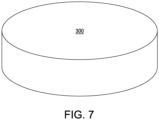
- the resilient material 300 may be provided in the form of a disc as illustrated in FIG. 7 and may deform to conform to the shape of the internal volume 225 when the upper and lower shells 205, 201 are joined around the resilient material.
- the resilient material 300 may be a polyurethane memory foam or any other suitable polymeric foam material.
- the upper and lower shells 205, 210 may include, for example, bayonet mounts or a ridge or ridges 230 in the lower shell 210 that fit or that can be rotated into position below a complimentary ridge or ridges 235 in the upper shell 205 as illustrated in FIGS. 6C and 6D .
- a clip or clips 240 and complimentary landing ridge or ridges 245 may be provided on the upper and lower shells 205, 210, for example, as illustrated in FIG. 6E .
- the upper and lower shells 205, 210 may be formed from a stiff material, for example, polypropylene or another engineering plastic and may have diameters or widths of about two inches (about five cm) and heights of about two inches (about five cm), although these materials and dimensions should be considered non-limiting examples only.
- the shell having the lesser diameter is designated as the lower shell 210 and the shell having the greater diameter is illustrated as the upper shell 205, however, it should be appreciated that in other embodiments, the lower shell 210 may have a greater diameter or cross-sectional area than the upper shell 205. Further, the shells should not be considered limited to being cylindrical. In other embodiments, the shells may have alternative cross sections, for example, triangular cross sections or rectangular cross sections. Additionally, in some embodiments, the shell with the lesser diameter or cross sectional area may include an internal protrusion such as the frustoconical projection 215 and the shell with the greater diameter or cross sectional area may include a recess, such as the recess 220 illustrated in FIG. 5B .
- the lower shell 210 may be mechanically coupled to a portion of a side of the child vehicle safety seat 100, for example, to a wall 410 of a handle pivot mechanism 130 of the child vehicle safety seat 100.
- On or more apertures 405 may be provided in a lower wall of the lower shell 210, one of which is illustrated in FIGS. 5A and 5B , through which a fastener, for example, a screw or bolt may pass to engage with and couple the lower shell 210 to the wall 410 of the child vehicle safety seat 100.
- a fastener for example, a screw or bolt
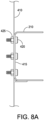
- FIG. 8A illustrates an embodiment of the lower shell 210 (internal features omitted for clarity) secured to a wall 410 of a child vehicle safety seat 100 by multiple bolts 420 passing through the lower wall 415 of the lower shell 210 and through the wall 410 of the child vehicle safety seat 100 and secured by nuts 425 on the opposite side of the wall 410 as the lower shell 210.
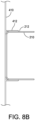
- FIG. 8B illustrates an embodiment in which a portion of the outer wall 212 of the lower shell 210 is threaded and engages internal threads of a receptacle 412 extending from the wall 410 so that the lower shell 210 may screwed into the receptacle 412 and be retained against the wall 410.
- the lower shell 210 may be secured to the wall 410 of a child vehicle safety seat 100 either fixedly or removably by other fastening mechanisms known in the art, for example, an adhesive, one or more clips, a bayonet mount, hook and loop fasteners, etc. Any one or more of the above referenced fastening mechanisms may be utilized alone or in combination.
- the upper shell 205 may be mounted on the side of the lower shell 210 not secured to the wall 410 in a manner as described above.
- the upper shell 205 of the side impact energy absorbing apparatus 200 In use, if an impact force is applied to the upper shell 205 of the side impact energy absorbing apparatus 200, the upper shell 205 is pushed inward into the lower shell 210. The internal volume 225 between the upper and lower shells 205, 210 is reduced, and the resilient material 300 within the internal volume 225 is compressed. Initially, the resilient material 300 is elastically deformed and absorbs impact energy at a first rate, e.g., the upper shell 205 is pushed inward toward the lower shell 210 at a first rate or distance per unit force.
- the resilient material 300 is squeezed between the internal features of the upper and lower shells 205, 210, for example, the projection 215 and recess 220 to a degree that it begins to plastically deform or tear.
- This additional mechanism of deformation of the resilient material 300 causes the upper shell 205 to be pushed inward toward the lower shell 210 at a second rate or distance per unit force, which may be less than the first rate or distance per unit force and may absorb more impact energy than the elastic deformation of the resilient material 300.
- the additional mechanism of deformation of the resilient material 300 may begin after the upper and lower shells 205, 210 are pushed together more than about 50% of the distance of separation in their resting uncompressed state.
- the side impact energy absorbing apparatus 200 may in some embodiments be reusable after absorbing impact energy. For example, if the absorbed impact energy is not sufficient to plastically deform the resilient material 300, the resilient material 300 may return to its initial, pre-impact shape. In other embodiments, the energy absorbing apparatus 200 should be replaced after being subjected to a sufficiently high impact force. For example, if an impact force causes the resilient material 300 to plastically deform a user may observe that the upper and lower shells 205, 210 do not return to their initial pre-impact configuration, which may provide an indication that the side impact energy absorbing apparatus 200, or perhaps only the resilient material 300, should be replaced.
- the fasteners or fastening mechanisms that hold the upper and lower shells 205, 210 together, and/or the fasteners or fastening mechanisms that hold the lower shell 210 to a wall of the child vehicle safety seat 100 may be releasable such that the upper and lower shells 205, 210 may be separated and the resilient material 300 replaced as needed or the side impact energy absorbing apparatus 200 may be removed and replaced as needed.
- a side impact energy absorbing apparatus is generally indicated at 900.
- the side impact energy absorbing apparatus 900 is provided on both lateral sides of a child vehicle safety seat 100.
- the child vehicle safety seat 100 should be positioned such that the side impact energy absorbing apparatus 900 faces a surface of the motor vehicle, for example, a door of the motor vehicle, that the child vehicle safety seat 100 is most likely to come into contact with upon the motor vehicle experiencing a side impact collision.
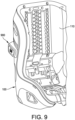
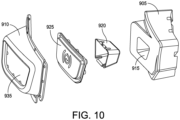
- the side impact energy absorbing apparatus 900 includes a foam inner support 905 and a rubber outer cover 910 that fits over the inner support.
- the inner support 905 is held in place or otherwise secured on a side of the shell 110 of the child vehicle safety seat 100.
- the inner support 905 may be sized and formed to fit within a receptacle of the shell 110 of the safety seat 100.
- the inner support 905 is secured to the shell 110 of the safety seat 100 by the outer cover 910.
- the inner support 905 includes a receptacle 915 formed therein, the purpose of which will be described below.
- the side impact energy absorbing apparatus 900 further includes a plastic insert 920 that is received within the receptacle 915 of the inner support 905 and a plastic inner cover 925 that is secured in place between the inner support and the outer cover 910 when the outer cover is secured to the inner support.
- the insert 920 has a relatively thin wall with a closed end and an open end, and is sized to fit within the receptacle 915 of the inner support 905 with the closed end first entering the receptacle.
- the receptacle 915 of the inner support 905 may have a shape complimentary to the rectangular-shaped frustum insert 920.
- the insert 920 may have an alternative shape, for example, that of a conical, a hemisphere or portion thereof, or a flat-topped pyramid or square frustum and the receptacle 915 may have a complimentary shape.
- the inner support 905 is held in place by the shell 110 and surrounding seat side foam of the safety seat 100.
- the inner support 905 can be held in place by glue, rivets, tape, or the like.
- the insert 920 is received within the receptacle 915 of the inner support with the inner cover 925 being placed over the open end of the insert.
- the outer cover 910 is placed over the inner cover 925, and, in one embodiment, is secured to the inner cover 925, for example, by a snap-fit connection associated with respective peripheries of the inner cover 925 and the outer cover 910 and/or the shell 110 of the safety seat 100.
- the shell 110 of the safety seat 100 holds the outer periphery of the outer cover 910 in place.
- the outer cover 910 may be secured to the inner support 905 and/or the shell 110 of the safety seat 100 by mechanical fasteners.
- the inner support 905 floats unattached to the shell 110 and/or the other components of the side impact energy absorbing apparatus 900, but is held in place.
- slots formed on the back of the inner support 905 are provided to clear ribs formed in the shell 110 so that the inner support 905 can engage a larger surface of the shell 110.
- the ribs also prevent relative movement of the inner support 905 and the shell 110.
- the outer cover 910 is secured to the shell by any suitable method, such as heat staking of molded-in posts provided on the shell over holes formed in a flange of the outer cover.
- the insert 920 is configured to partially enter the receptacle 915 of the inner support 905.
- An internal volume 930 ( FIG. 12 ) is defined between the internal surfaces of the inner support 905 and the outer surfaces of the insert 920.
- the internal volume 930 may be an open space.
- the internal volume may be at least partially, or substantially completely, filled with a resilient material, for example, a foam material or a memory foam material.
- the resilient material may be a polyurethane memory foam or any other suitable polymeric foam material.
- the arrangement is such that an impact force applied to the impact energy absorbing apparatus 900 having an amplitude of less than a threshold value causes the insert 920 to resist the impact force.
- the insert 920 is configured to slide inwardly into the receptacle 915 of the inner support 905 to absorb the impact force.
- the insert 920 is configured to occupy the internal volume 930 of the receptacle 915 as the insert 920 moves into the receptacle 915.
- the insert 920 is caused to plastically deform as the insert is moved within the receptacle 915.
- the inner cover 925 is designed to fit within an opening 935 formed in the outer cover 910. As shown, the inner cover 925 shields the insert 920 when assembled. However, the impact force applied to the impact energy absorbing apparatus 900 is applied from the inner cover 925 to the insert 920, with the outer cover 910 being deformed.
- the inner cover 925 may include a logo or label formed on an outer surface.
- the inner support 905 may be fabricated from a foam material.
- the outer cover 910 may be fabricated from a flexible material, such as rubber.
- the insert 920 and the inner cover 925 each may be fabricated from a stiff material, for example, polypropylene or another engineering plastic, although these materials and dimensions should be considered non-limiting examples only.
- the inner support 905 may be mechanically coupled to a portion of the side of the child vehicle safety seat 100, for example, to the shell 110.
- the side impact energy absorbing apparatus 900 may in some embodiments be reusable after absorbing impact energy. In other embodiments, the energy absorbing apparatus 900 should be replaced after being subjected to a sufficiently high impact force.
- embodiments of the apparatus 900 disclosed herein may also or alternatively be used to absorb impact energy from the front, rear, top, or bottom of an child conveyance device.
Landscapes
- Engineering & Computer Science (AREA)
- Aviation & Aerospace Engineering (AREA)
- Transportation (AREA)
- Mechanical Engineering (AREA)
- Health & Medical Sciences (AREA)
- Child & Adolescent Psychology (AREA)
- General Health & Medical Sciences (AREA)
- Seats For Vehicles (AREA)
- Vibration Dampers (AREA)
- Emergency Lowering Means (AREA)
Claims (15)
- Kindertransportvorrichtung (100), umfassend:
eine Aufprallenergie absorbierende Einrichtung (900), die an einem Abschnitt der Kindertransportvorrichtung (100) angeordnet ist, wobei die Aufprallenergie absorbierende Einrichtung (900) beinhaltet:eine innere Stütze (905), die dazu konfiguriert ist, gegen den Abschnitt der Kindertransportvorrichtung (100) positioniert zu werden, wobei die innere Stütze (905) eine darin ausgebildete Aufnahme (915) aufweist;eine äußere Abdeckung (910), die dazu konfiguriert ist, die innere Stütze (905) lösbar zu befestigen; undeinen Einsatz (920), der in der Aufnahme (915) der inneren Stütze (905) aufgenommen ist, wobei der Einsatz (920) durch die äußere Abdeckung (910) an Ort und Stelle gehalten wird, wenn die äußere Abdeckung (910) befestigt ist, wobei der Einsatz (920) eine Wand mit einem geschlossenen Ende und einem offenen Ende aufweist, wobei der Einsatz (920) so bemessen ist, dass er in die Aufnahme (915) der inneren Stütze (905) passt, wobei das geschlossene Ende zuerst in die Aufnahme (915) eintritt. - Kindertransportvorrichtung (100) nach Anspruch 1, wobei die Aufnahme (915) der inneren Stütze (905) eine Form aufweist, die komplementär zu einer Form des Einsatzes (920) ist.
- Kindertransportvorrichtung (100) nach Anspruch 2, wobei der Einsatz (920) einen rechteckigen Kegelstumpf verkörpert.
- Kindertransportvorrichtung (100) nach Anspruch 2, wobei der Einsatz (920) dazu konfiguriert ist, teilweise in die Aufnahme (915) der inneren Stütze (905) einzutreten, wobei zwischen Innenflächen der inneren Stütze (905) und Außenflächen des Einsatzes (920) ein Innenvolumen (930) definiert ist.
- Kindertransportvorrichtung (100) nach Anspruch 4, wobei, wenn eine Aufprallkraft mit einer Amplitude kleiner als ein Schwellenwert auf die Aufprallenergie absorbierende Einrichtung (900) ausgeübt wird, der Einsatz (920) dazu konfiguriert ist, der Aufprallkraft standzuhalten, und, wenn die Aufprallkraft mit einer Amplitude größer als der Schwellenwert auf die Aufprallenergie absorbierende Einrichtung (900) ausgeübt wird, der Einsatz (920) dazu konfiguriert ist, nach innen in die Aufnahme (915) der inneren Stütze (905) zu gleiten, um die Aufprallkraft zu absorbieren, wobei der Einsatz (920) dazu konfiguriert ist, das Innenvolumen (930) der Aufnahme (915) einzunehmen, wenn sich der Einsatz (920) in die Aufnahme (915) bewegt.
- Kindertransportvorrichtung (100) nach Anspruch 5, wobei bewirkt wird, dass sich der Einsatz (920) plastisch verformt, wenn der Einsatz (920) im Inneren der Aufnahme (915) bewegt wird.
- Kindertransportvorrichtung (100) nach Anspruch 1, ferner umfassend eine innere Abdeckung (925), die dazu konfiguriert ist, in eine in der äußeren Abdeckung (910) ausgebildete Öffnung zu passen, wobei die innere Abdeckung (925) den Einsatz (920) im zusammengebauten Zustand abschirmt.
- Kindertransportvorrichtung (100) nach Anspruch 7, wobei die innere Abdeckung (925) dazu gestaltet ist, in eine in der äußeren Abdeckung (910) ausgebildete Öffnung zu passen.
- Kindertransportvorrichtung (100) nach Anspruch 1, wobei die Kindertransportvorrichtung (100) ein Fahrzeugsicherheitssitz für Kinder ist.
- Kindertransportvorrichtung (100) nach Anspruch 9, wobei eine auf die Aufprallenergie absorbierende Einrichtung (900) ausgeübte Aufprallkraft mit einer Amplitude kleiner als ein Schwellenwert bewirkt, dass der Einsatz (920) der Aufprallkraft standhält.
- Kindertransportvorrichtung (100) nach Anspruch 10, wobei eine auf die Aufprallenergie absorbierende Einrichtung (900) ausgeübte Aufprallkraft mit einer Amplitude größer als der Schwellenwert bewirkt, dass der Einsatz (920) nach innen in die Aufnahme der inneren Stütze (905) gleitet, um den Einsatz (920) plastisch zu verformen.
- Kindertransportvorrichtung (100) nach Anspruch 9, wobei die innere Stütze (905) durch die äußere Abdeckung (910) an einer Schale (110) des Sicherheitssitzes (100) befestigt ist.
- Kindertransportvorrichtung (100) nach Anspruch 12, wobei die Schale (110) des Sicherheitssitzes (100) einen Außenumfang der äußeren Abdeckung (910) an Ort und Stelle hält.
- Kindertransportvorrichtung (100) nach Anspruch 1, wobei die Aufprallenergie absorbierende Einrichtung (900) austauschbar an dem Abschnitt der Kindertransportvorrichtung (100) befestigt ist.
- Kindertransportvorrichtung (100) nach Anspruch 1, wobei die innere Stütze (905) aus Schaumstoff hergestellt ist und die äußere Abdeckung (910) aus Kunststoffmaterial hergestellt ist.
Applications Claiming Priority (2)
| Application Number | Priority Date | Filing Date | Title |
|---|---|---|---|
| US16/572,009 US11318867B2 (en) | 2019-09-16 | 2019-09-16 | Child carrier with side impact protection |
| PCT/US2020/050843 WO2021055337A1 (en) | 2019-09-16 | 2020-09-15 | Child carrier with side impact protection |
Publications (2)
| Publication Number | Publication Date |
|---|---|
| EP4031409A1 EP4031409A1 (de) | 2022-07-27 |
| EP4031409B1 true EP4031409B1 (de) | 2025-01-08 |
Family
ID=72659375
Family Applications (1)
| Application Number | Title | Priority Date | Filing Date |
|---|---|---|---|
| EP20780873.4A Active EP4031409B1 (de) | 2019-09-16 | 2020-09-15 | Kindertrage mit seitenaufprallschutz |
Country Status (4)
| Country | Link |
|---|---|
| US (1) | US11318867B2 (de) |
| EP (1) | EP4031409B1 (de) |
| CN (1) | CN114364571B (de) |
| WO (1) | WO2021055337A1 (de) |
Families Citing this family (8)
| Publication number | Priority date | Publication date | Assignee | Title |
|---|---|---|---|---|
| CN113386639A (zh) | 2020-03-13 | 2021-09-14 | 宝钜瑞士股份有限公司 | 儿童安全座椅 |
| CN113815502B (zh) | 2020-06-19 | 2024-07-26 | 宝钜瑞士股份有限公司 | 儿童安全座椅及其侧撞保护机构 |
| CN118544909A (zh) | 2020-06-30 | 2024-08-27 | 宝钜瑞士股份有限公司 | 儿童安全座椅及其侧撞保护机构 |
| CN119099446A (zh) * | 2021-04-21 | 2024-12-10 | 宝钜瑞士股份有限公司 | 侧撞保护块、安装座和儿童安全座椅 |
| CN119096893A (zh) * | 2023-06-09 | 2024-12-10 | 居佳国际有限公司 | 载具 |
| CN116653721B (zh) * | 2023-06-27 | 2025-12-26 | 明门(中国)幼童用品有限公司 | 儿童座椅 |
| TW202525614A (zh) * | 2023-09-11 | 2025-07-01 | 瑞士商明門瑞士股份有限公司 | 汽車座椅上之側面撞擊保護 |
| TW202517479A (zh) * | 2023-09-11 | 2025-05-01 | 瑞士商明門瑞士股份有限公司 | 汽車座椅上之側面撞擊保護 |
Family Cites Families (15)
| Publication number | Priority date | Publication date | Assignee | Title |
|---|---|---|---|---|
| US6205600B1 (en) * | 1997-10-31 | 2001-03-27 | Graco Children's Products Inc. | Child restraint car bed |
| US9174555B2 (en) * | 2005-07-21 | 2015-11-03 | Arjuna Indraeswaran Rajasingham | Vehicle occupant support |
| US20110047685A1 (en) * | 2006-02-16 | 2011-03-03 | Ferrara Vincent R | Impact energy management method and system |
| US8038209B2 (en) | 2009-05-20 | 2011-10-18 | Cosco Management, Inc. | Energy-dissipation system |
| US7959223B2 (en) * | 2009-05-20 | 2011-06-14 | Cosco Management, Inc. | Energy-dissipation system |
| US8056972B2 (en) | 2009-05-20 | 2011-11-15 | Cosco Management, Inc. | Energy-dissipation system |
| AU2011200689A1 (en) | 2010-02-18 | 2011-09-01 | Britax Childcare Pty Ltd | Improvements relating to vehicle child restraints |
| US8348337B2 (en) | 2010-03-17 | 2013-01-08 | Britax Child Safety, Inc. | Child safety seat with energy absorbing apparatus |
| EP2570299B1 (de) | 2011-09-13 | 2015-03-04 | Britax Römer Kindersicherheit GmbH | Kindersitz für Fahrzeug |
| ES2868238T3 (es) * | 2013-07-16 | 2021-10-21 | Britax Roemer Kindersicherheit Gmbh | Asiento de seguridad para niños |
| CA2940813C (en) * | 2015-09-03 | 2017-08-22 | Wonderland Nurserygoods Company Limited | Infant carrier |
| US10118510B2 (en) * | 2015-12-01 | 2018-11-06 | Evenflo Company, Inc. | Impact protection for child car seat |
| NO344017B1 (en) | 2016-12-16 | 2019-08-19 | Torgersen Hans & Soenn | Child safety seat for a vehicle |
| CN207725262U (zh) * | 2017-12-15 | 2018-08-14 | 宝钜(中国)儿童用品有限公司 | 儿童安全座椅及其可收合侧撞保护机构 |
| CN208827649U (zh) * | 2018-09-30 | 2019-05-07 | 重庆贝艾思汽车用品有限公司 | 儿童安全座椅上的可伸缩侧保护结构 |
-
2019
- 2019-09-16 US US16/572,009 patent/US11318867B2/en active Active
-
2020
- 2020-09-15 CN CN202080063522.XA patent/CN114364571B/zh active Active
- 2020-09-15 EP EP20780873.4A patent/EP4031409B1/de active Active
- 2020-09-15 WO PCT/US2020/050843 patent/WO2021055337A1/en not_active Ceased
Also Published As
| Publication number | Publication date |
|---|---|
| US11318867B2 (en) | 2022-05-03 |
| EP4031409A1 (de) | 2022-07-27 |
| US20210078464A1 (en) | 2021-03-18 |
| WO2021055337A1 (en) | 2021-03-25 |
| CN114364571A (zh) | 2022-04-15 |
| CN114364571B (zh) | 2025-02-11 |
Similar Documents
| Publication | Publication Date | Title |
|---|---|---|
| EP4031409B1 (de) | Kindertrage mit seitenaufprallschutz | |
| US10118510B2 (en) | Impact protection for child car seat | |
| US11511656B2 (en) | Child restraint system with side impact bumper | |
| RU2572427C2 (ru) | Детское удерживающее устройство для транспортного средства (варианты) и устройство поглощения удара для детского удерживающего устройства | |
| CA2701307C (en) | Energy-dissipation system | |
| US8038209B2 (en) | Energy-dissipation system | |
| US8029054B2 (en) | Energy-dissipation system | |
| JPS5823256B2 (ja) | 乗物用幼児拘束装置 | |
| US20090256404A1 (en) | Child seat having a crush zone | |
| US20100295344A1 (en) | Energy-dissipation system | |
| EP2253503B1 (de) | Energieverzehrsystem | |
| US8052210B2 (en) | Energy-dissipation system | |
| US3865433A (en) | Energy absorbing restraint for passengers | |
| KR101623438B1 (ko) | 휴대용 차량용 안전벨트 체결장치 | |
| WO1997007716A1 (en) | Child safety seat | |
| WO2014089619A1 (en) | An anchorage device | |
| US4236751A (en) | Vehicle safety seat bottom | |
| EP2679439B9 (de) | Energiezerstreuungssystem | |
| EP3848239B1 (de) | Kindersicherheitssitz | |
| EP3315357B1 (de) | Positionsanpassungsvorrichtung für fussstütze für fahrzeugsitz | |
| US6305744B1 (en) | Ejectable safety seat structure for recreational-type vehicles | |
| US6050640A (en) | Buckle latch mechanism for infant car seat | |
| CA2285486A1 (en) | Ejectable safety seat structure for recreational-type vehicles | |
| KR20170067434A (ko) | 차량용 안전 보조시트 | |
| WO2017182504A1 (en) | A dog restraint device for use in a motor vehicle |
Legal Events
| Date | Code | Title | Description |
|---|---|---|---|
| STAA | Information on the status of an ep patent application or granted ep patent |
Free format text: STATUS: UNKNOWN |
|
| STAA | Information on the status of an ep patent application or granted ep patent |
Free format text: STATUS: THE INTERNATIONAL PUBLICATION HAS BEEN MADE |
|
| PUAI | Public reference made under article 153(3) epc to a published international application that has entered the european phase |
Free format text: ORIGINAL CODE: 0009012 |
|
| STAA | Information on the status of an ep patent application or granted ep patent |
Free format text: STATUS: REQUEST FOR EXAMINATION WAS MADE |
|
| 17P | Request for examination filed |
Effective date: 20220302 |
|
| AK | Designated contracting states |
Kind code of ref document: A1 Designated state(s): AL AT BE BG CH CY CZ DE DK EE ES FI FR GB GR HR HU IE IS IT LI LT LU LV MC MK MT NL NO PL PT RO RS SE SI SK SM TR |
|
| DAV | Request for validation of the european patent (deleted) | ||
| DAX | Request for extension of the european patent (deleted) | ||
| STAA | Information on the status of an ep patent application or granted ep patent |
Free format text: STATUS: EXAMINATION IS IN PROGRESS |
|
| 17Q | First examination report despatched |
Effective date: 20230504 |
|
| GRAP | Despatch of communication of intention to grant a patent |
Free format text: ORIGINAL CODE: EPIDOSNIGR1 |
|
| STAA | Information on the status of an ep patent application or granted ep patent |
Free format text: STATUS: GRANT OF PATENT IS INTENDED |
|
| INTG | Intention to grant announced |
Effective date: 20231009 |
|
| GRAJ | Information related to disapproval of communication of intention to grant by the applicant or resumption of examination proceedings by the epo deleted |
Free format text: ORIGINAL CODE: EPIDOSDIGR1 |
|
| STAA | Information on the status of an ep patent application or granted ep patent |
Free format text: STATUS: EXAMINATION IS IN PROGRESS |
|
| GRAP | Despatch of communication of intention to grant a patent |
Free format text: ORIGINAL CODE: EPIDOSNIGR1 |
|
| STAA | Information on the status of an ep patent application or granted ep patent |
Free format text: STATUS: GRANT OF PATENT IS INTENDED |
|
| INTC | Intention to grant announced (deleted) | ||
| INTG | Intention to grant announced |
Effective date: 20240301 |
|
| GRAJ | Information related to disapproval of communication of intention to grant by the applicant or resumption of examination proceedings by the epo deleted |
Free format text: ORIGINAL CODE: EPIDOSDIGR1 |
|
| STAA | Information on the status of an ep patent application or granted ep patent |
Free format text: STATUS: EXAMINATION IS IN PROGRESS |
|
| INTC | Intention to grant announced (deleted) | ||
| GRAP | Despatch of communication of intention to grant a patent |
Free format text: ORIGINAL CODE: EPIDOSNIGR1 |
|
| STAA | Information on the status of an ep patent application or granted ep patent |
Free format text: STATUS: GRANT OF PATENT IS INTENDED |
|
| INTG | Intention to grant announced |
Effective date: 20240805 |
|
| GRAS | Grant fee paid |
Free format text: ORIGINAL CODE: EPIDOSNIGR3 |
|
| GRAA | (expected) grant |
Free format text: ORIGINAL CODE: 0009210 |
|
| STAA | Information on the status of an ep patent application or granted ep patent |
Free format text: STATUS: THE PATENT HAS BEEN GRANTED |
|
| AK | Designated contracting states |
Kind code of ref document: B1 Designated state(s): AL AT BE BG CH CY CZ DE DK EE ES FI FR GB GR HR HU IE IS IT LI LT LU LV MC MK MT NL NO PL PT RO RS SE SI SK SM TR |
|
| REG | Reference to a national code |
Ref country code: GB Ref legal event code: FG4D |
|
| REG | Reference to a national code |
Ref country code: CH Ref legal event code: EP |
|
| REG | Reference to a national code |
Ref country code: DE Ref legal event code: R096 Ref document number: 602020044555 Country of ref document: DE |
|
| REG | Reference to a national code |
Ref country code: IE Ref legal event code: FG4D |
|
| P01 | Opt-out of the competence of the unified patent court (upc) registered |
Free format text: CASE NUMBER: APP_5985/2025 Effective date: 20250204 |
|
| REG | Reference to a national code |
Ref country code: LT Ref legal event code: MG9D |
|
| REG | Reference to a national code |
Ref country code: NL Ref legal event code: MP Effective date: 20250108 |
|
| REG | Reference to a national code |
Ref country code: AT Ref legal event code: MK05 Ref document number: 1758126 Country of ref document: AT Kind code of ref document: T Effective date: 20250108 |
|
| PG25 | Lapsed in a contracting state [announced via postgrant information from national office to epo] |
Ref country code: NL Free format text: LAPSE BECAUSE OF FAILURE TO SUBMIT A TRANSLATION OF THE DESCRIPTION OR TO PAY THE FEE WITHIN THE PRESCRIBED TIME-LIMIT Effective date: 20250108 |
|
| PG25 | Lapsed in a contracting state [announced via postgrant information from national office to epo] |
Ref country code: RS Free format text: LAPSE BECAUSE OF FAILURE TO SUBMIT A TRANSLATION OF THE DESCRIPTION OR TO PAY THE FEE WITHIN THE PRESCRIBED TIME-LIMIT Effective date: 20250408 |
|
| PG25 | Lapsed in a contracting state [announced via postgrant information from national office to epo] |
Ref country code: FI Free format text: LAPSE BECAUSE OF FAILURE TO SUBMIT A TRANSLATION OF THE DESCRIPTION OR TO PAY THE FEE WITHIN THE PRESCRIBED TIME-LIMIT Effective date: 20250108 |
|
| PG25 | Lapsed in a contracting state [announced via postgrant information from national office to epo] |
Ref country code: PL Free format text: LAPSE BECAUSE OF FAILURE TO SUBMIT A TRANSLATION OF THE DESCRIPTION OR TO PAY THE FEE WITHIN THE PRESCRIBED TIME-LIMIT Effective date: 20250108 |
|
| PG25 | Lapsed in a contracting state [announced via postgrant information from national office to epo] |
Ref country code: ES Free format text: LAPSE BECAUSE OF FAILURE TO SUBMIT A TRANSLATION OF THE DESCRIPTION OR TO PAY THE FEE WITHIN THE PRESCRIBED TIME-LIMIT Effective date: 20250108 |
|
| PG25 | Lapsed in a contracting state [announced via postgrant information from national office to epo] |
Ref country code: NO Free format text: LAPSE BECAUSE OF FAILURE TO SUBMIT A TRANSLATION OF THE DESCRIPTION OR TO PAY THE FEE WITHIN THE PRESCRIBED TIME-LIMIT Effective date: 20250408 Ref country code: IS Free format text: LAPSE BECAUSE OF FAILURE TO SUBMIT A TRANSLATION OF THE DESCRIPTION OR TO PAY THE FEE WITHIN THE PRESCRIBED TIME-LIMIT Effective date: 20250508 |
|
| PG25 | Lapsed in a contracting state [announced via postgrant information from national office to epo] |
Ref country code: HR Free format text: LAPSE BECAUSE OF FAILURE TO SUBMIT A TRANSLATION OF THE DESCRIPTION OR TO PAY THE FEE WITHIN THE PRESCRIBED TIME-LIMIT Effective date: 20250108 |
|
| PG25 | Lapsed in a contracting state [announced via postgrant information from national office to epo] |
Ref country code: PT Free format text: LAPSE BECAUSE OF FAILURE TO SUBMIT A TRANSLATION OF THE DESCRIPTION OR TO PAY THE FEE WITHIN THE PRESCRIBED TIME-LIMIT Effective date: 20250508 Ref country code: LV Free format text: LAPSE BECAUSE OF FAILURE TO SUBMIT A TRANSLATION OF THE DESCRIPTION OR TO PAY THE FEE WITHIN THE PRESCRIBED TIME-LIMIT Effective date: 20250108 |
|
| PG25 | Lapsed in a contracting state [announced via postgrant information from national office to epo] |
Ref country code: GR Free format text: LAPSE BECAUSE OF FAILURE TO SUBMIT A TRANSLATION OF THE DESCRIPTION OR TO PAY THE FEE WITHIN THE PRESCRIBED TIME-LIMIT Effective date: 20250409 Ref country code: BG Free format text: LAPSE BECAUSE OF FAILURE TO SUBMIT A TRANSLATION OF THE DESCRIPTION OR TO PAY THE FEE WITHIN THE PRESCRIBED TIME-LIMIT Effective date: 20250108 |
|
| PG25 | Lapsed in a contracting state [announced via postgrant information from national office to epo] |
Ref country code: AT Free format text: LAPSE BECAUSE OF FAILURE TO SUBMIT A TRANSLATION OF THE DESCRIPTION OR TO PAY THE FEE WITHIN THE PRESCRIBED TIME-LIMIT Effective date: 20250108 |
|
| PG25 | Lapsed in a contracting state [announced via postgrant information from national office to epo] |
Ref country code: SE Free format text: LAPSE BECAUSE OF FAILURE TO SUBMIT A TRANSLATION OF THE DESCRIPTION OR TO PAY THE FEE WITHIN THE PRESCRIBED TIME-LIMIT Effective date: 20250108 |
|
| PG25 | Lapsed in a contracting state [announced via postgrant information from national office to epo] |
Ref country code: SM Free format text: LAPSE BECAUSE OF FAILURE TO SUBMIT A TRANSLATION OF THE DESCRIPTION OR TO PAY THE FEE WITHIN THE PRESCRIBED TIME-LIMIT Effective date: 20250108 |
|
| REG | Reference to a national code |
Ref country code: DE Ref legal event code: R097 Ref document number: 602020044555 Country of ref document: DE |
|
| PG25 | Lapsed in a contracting state [announced via postgrant information from national office to epo] |
Ref country code: DK Free format text: LAPSE BECAUSE OF FAILURE TO SUBMIT A TRANSLATION OF THE DESCRIPTION OR TO PAY THE FEE WITHIN THE PRESCRIBED TIME-LIMIT Effective date: 20250108 |
|
| PGFP | Annual fee paid to national office [announced via postgrant information from national office to epo] |
Ref country code: DE Payment date: 20250929 Year of fee payment: 6 |
|
| PGFP | Annual fee paid to national office [announced via postgrant information from national office to epo] |
Ref country code: GB Payment date: 20250929 Year of fee payment: 6 |
|
| PG25 | Lapsed in a contracting state [announced via postgrant information from national office to epo] |
Ref country code: CZ Free format text: LAPSE BECAUSE OF FAILURE TO SUBMIT A TRANSLATION OF THE DESCRIPTION OR TO PAY THE FEE WITHIN THE PRESCRIBED TIME-LIMIT Effective date: 20250108 Ref country code: EE Free format text: LAPSE BECAUSE OF FAILURE TO SUBMIT A TRANSLATION OF THE DESCRIPTION OR TO PAY THE FEE WITHIN THE PRESCRIBED TIME-LIMIT Effective date: 20250108 |
|
| PG25 | Lapsed in a contracting state [announced via postgrant information from national office to epo] |
Ref country code: RO Free format text: LAPSE BECAUSE OF FAILURE TO SUBMIT A TRANSLATION OF THE DESCRIPTION OR TO PAY THE FEE WITHIN THE PRESCRIBED TIME-LIMIT Effective date: 20250108 |
|
| PG25 | Lapsed in a contracting state [announced via postgrant information from national office to epo] |
Ref country code: SK Free format text: LAPSE BECAUSE OF FAILURE TO SUBMIT A TRANSLATION OF THE DESCRIPTION OR TO PAY THE FEE WITHIN THE PRESCRIBED TIME-LIMIT Effective date: 20250108 |
|
| PLBE | No opposition filed within time limit |
Free format text: ORIGINAL CODE: 0009261 |
|
| STAA | Information on the status of an ep patent application or granted ep patent |
Free format text: STATUS: NO OPPOSITION FILED WITHIN TIME LIMIT |
|
| 26N | No opposition filed |
Effective date: 20251009 |
|
| PG25 | Lapsed in a contracting state [announced via postgrant information from national office to epo] |
Ref country code: IT Free format text: LAPSE BECAUSE OF FAILURE TO SUBMIT A TRANSLATION OF THE DESCRIPTION OR TO PAY THE FEE WITHIN THE PRESCRIBED TIME-LIMIT Effective date: 20250108 |