EP4019696B1 - Industriefaser - Google Patents
Industriefaser Download PDFInfo
- Publication number
- EP4019696B1 EP4019696B1 EP21214670.8A EP21214670A EP4019696B1 EP 4019696 B1 EP4019696 B1 EP 4019696B1 EP 21214670 A EP21214670 A EP 21214670A EP 4019696 B1 EP4019696 B1 EP 4019696B1
- Authority
- EP
- European Patent Office
- Prior art keywords
- machine direction
- side layer
- direction yarns
- wear
- web
- Prior art date
- Legal status (The legal status is an assumption and is not a legal conclusion. Google has not performed a legal analysis and makes no representation as to the accuracy of the status listed.)
- Active
Links
Images

Classifications
-
- D—TEXTILES; PAPER
- D21—PAPER-MAKING; PRODUCTION OF CELLULOSE
- D21F—PAPER-MAKING MACHINES; METHODS OF PRODUCING PAPER THEREON
- D21F7/00—Other details of machines for making continuous webs of paper
- D21F7/08—Felts
- D21F7/10—Seams thereof
-
- D—TEXTILES; PAPER
- D21—PAPER-MAKING; PRODUCTION OF CELLULOSE
- D21F—PAPER-MAKING MACHINES; METHODS OF PRODUCING PAPER THEREON
- D21F1/00—Wet end of machines for making continuous webs of paper
- D21F1/0027—Screen-cloths
- D21F1/0036—Multi-layer screen-cloths
- D21F1/0045—Triple layer fabrics
-
- D—TEXTILES; PAPER
- D03—WEAVING
- D03D—WOVEN FABRICS; METHODS OF WEAVING; LOOMS
- D03D11/00—Double or multi-ply fabrics not otherwise provided for
-
- D—TEXTILES; PAPER
- D03—WEAVING
- D03D—WOVEN FABRICS; METHODS OF WEAVING; LOOMS
- D03D1/00—Woven fabrics designed to make specified articles
-
- D—TEXTILES; PAPER
- D03—WEAVING
- D03D—WOVEN FABRICS; METHODS OF WEAVING; LOOMS
- D03D1/00—Woven fabrics designed to make specified articles
- D03D1/0094—Belts
-
- D—TEXTILES; PAPER
- D03—WEAVING
- D03D—WOVEN FABRICS; METHODS OF WEAVING; LOOMS
- D03D13/00—Woven fabrics characterised by the special disposition of the warp or weft threads, e.g. with curved weft threads, with discontinuous warp threads, with diagonal warp or weft
-
- D—TEXTILES; PAPER
- D03—WEAVING
- D03D—WOVEN FABRICS; METHODS OF WEAVING; LOOMS
- D03D3/00—Woven fabrics characterised by their shape
- D03D3/04—Endless fabrics
-
- D—TEXTILES; PAPER
- D21—PAPER-MAKING; PRODUCTION OF CELLULOSE
- D21F—PAPER-MAKING MACHINES; METHODS OF PRODUCING PAPER THEREON
- D21F1/00—Wet end of machines for making continuous webs of paper
- D21F1/0027—Screen-cloths
-
- D—TEXTILES; PAPER
- D21—PAPER-MAKING; PRODUCTION OF CELLULOSE
- D21F—PAPER-MAKING MACHINES; METHODS OF PRODUCING PAPER THEREON
- D21F1/00—Wet end of machines for making continuous webs of paper
- D21F1/0027—Screen-cloths
- D21F1/0036—Multi-layer screen-cloths
-
- D—TEXTILES; PAPER
- D21—PAPER-MAKING; PRODUCTION OF CELLULOSE
- D21F—PAPER-MAKING MACHINES; METHODS OF PRODUCING PAPER THEREON
- D21F1/00—Wet end of machines for making continuous webs of paper
- D21F1/10—Wire-cloths
Definitions
- the invention relates to an industrial textile consisting of two layers, a web-side layer and a wear-side layer. Particularly, the invention relates to an industrial textile having no additional stitching yarn.
- Triple-layer fabric structures are formed of two distinct fabric layers.
- the two fabric layers are stitched together by additional stitching yarns for forming a single fabric structure.
- the fabric layers are stitched together so that the layers are stacked relative to each other.
- machine direction yarns of the layers are overlapping. This enables formation of uniform drainage paths thought the fabric structure.
- the flow of water is so strong that some of fibers go through the fabric with the flow and some can even stick to the fabric structure and clog the fabric.
- SSB (sheet support binding) structures are multilayer fabric structures having two machine direction yarn systems and three cross machine direction yarn systems.
- One of the cross machine direction yarn systems consists of binding yarn pairs that bind the web-side and wear-side layers together and also participate in forming the web-side layer. Because two binding cross machine direction yarns are required to form one continuous cross machine direction yarn path, the cross machine yarn density becomes quite high. As a result, more material is needed to manufacture the product and it becomes more expensive manufacture. In addition, the production efficiency decreases.
- EP3384085A1 (application number EP 16870051 ) discloses a paper machine fabric structure that consist of two layers, a paper-side layer and a wear-side layer.
- the paper-side layer consists of the machine direction yarns and at least the binding cross machine direction yarns, which have been configured to form a part of the paper-side surface and bind the two layers together.
- the machine direction yarns of the paper-side layer and the wear-side layer are stacked. Thus, during dewatering some of fibers go through the fabric with the flow and some can even stick to the fabric structure and clog the fabric.
- WO 03/093573 A1 discloses a paper machine fabric comprising at least two separate layers formed using at least two separate yarn systems: one constituting the paper side and comprising machine direction and cross machine direction yarns, and the other constituting the machine side and comprising machine direction and cross machine direction yarns.
- the yarn systems are arranged to form independent structures in both directions of the fabric.
- the structures are bound together with binder yarns.
- the object of the invention is to provide an industrial textile, which is thin, less expensive and faster to manufacture and stays clean during the use.
- an industrial textile comprising two layers, a web-side layer and a wear-side layer, where: the web-side layer comprises machine direction yarns and binding cross machine direction yarns, the wear-side layer comprises machine direction yarns and cross machine direction yarns, the binding cross machine direction yarns extend from the web-side layer to the wear-side layer and bind a portion of wear-side layer machine direction yarns to bond the web-side layer and the wear-side layer together, and wherein the web-side layer is configured to change during a pattern repeat, and wherein the binding cross machine direction yarns are configured to bind the web-side layer machine direction yarns: in a five-shaft weave over one, under one, over one and under two web-side layer machine direction yarns, in a twelve-shaft weave under one, over one, under two, over one, under one, under two, over one, under one and over one web-side layer machine direction yarns, or in an eight-shaft weave under two, over one, under
- the web-side layer machine direction yarns and the wear-side layer machine direction yarns are partially or fully unstacked.
- the binding cross machine direction yarns bind the portion of wear-side layer machine direction yarns while the binding cross machine direction yarns bind the web-side layer machine direction yarns under two web-side layer machine direction yarns.
- the binding cross machine direction yarns are configured to bind every fifth of the wear-side layer machine direction yarns.
- the binding cross machine direction yarns bind a portion wear-side layer machine direction yarns to form binding points under the web-side layer.
- the binding cross machine direction yarns are configured to form a continuous independent yarn path.
- the web-side layer comprises cross machine direction yarns configured to only bind the web-side layer machine direction yarns.
- At least one of the web-side layer cross machine direction yarns is configured between two adjacent binding cross machine direction yarns.
- the web-side layer cross machine direction yarns are configured to bind the web-side layer machine direction yarns over one, under one, over one and under two machine direction yarns.
- the wear-side layer is a five-shaft weave or a ten-shaft weave.
- the wear-side layer is a five-shaft weave, wherein the wear-side layer cross machine direction yarns are configured to bind the wear-side layer machine direction yarns over one and under four machine direction yarns.
- the wear-side layer is a ten-shaft weave, wherein the wear-side layer cross machine direction yarns are configured to bind the wear-side layer machine direction yarns over two and under eight machine direction yarns.
- the wear-side layer is a ten-shaft weave, wherein the wear-side layer cross machine direction yarns are configured to bind the wear-side layer machine direction yarns over one, under one, over one and under seven machine direction yarns.
- the wear-side layer is a ten-shaft weave, wherein the wear-side layer cross machine direction yarns are configured to bind the wear-side layer machine direction yarns over one, under two, over one and under six machine direction yarns.
- the ratio of the web-side layer machine direction yarns to the wear-side layer machine direction yarns is 1:1, 1:2 or 2:1.
- the ratio of the web-side layer cross machine direction yarns to the wear-side layer cross machine direction yarns is 3:2, 2:1, 1:1, 1:2, 2:3 or 8:5.
- web-side layer refers to a side of a textile which is in contact with paper, board or tissue produced when the textile is assembled in a paper, board or tissue machine.
- the term “wear-side layer” refers to a side of the textile which is in contact with a paper, board or tissue machine equipment when the textile is assembled to the paper, board or tissue machine.
- machine direction refers to a moving direction of the textile in the paper, board or tissue machine when the textile is assembled to the paper, board or tissue machine.
- cross machine direction refers to a direction, which is perpendicular to the moving direction of the textile in the paper, board or tissue machine when the textile is assembled to the paper, board or tissue machine.
- non-plain weave refers to a weave, which is not a plain weave in which cross machine direction yarns pass over one and under one machine direction yarns. Instead, the weave is configured to change during a pattern repeat.
- the term "fully unstacked” refers to a textile structure, wherein the web-side layer machine direction yarns and the wear-side layer machine direction yarns do not overlap, but they are laterally displaced to avoid stacking.
- partially unstacked refers to a textile structure wherein at least some of the web-side layer machine direction yarns and the wear-side layer machine direction yarns do not overlap, but they are laterally displaced to avoid stacking.
- an industrial textile comprises two layers, a web-side layer and a wear-side layer.
- the web-side layer comprises machine direction yarns 1 and binding cross machine direction yarns 5.
- the wear-side layer comprises machine direction yarns 3 and cross machine direction yarns 4.
- the binding cross machine direction yarns 5 extend from the web-side layer to the wear-side layer and bind a portion of wear-side layer machine direction yarns to bond the web-side layer and the wear-side layer together.
- a weave of the web-side layer is configured to change during a pattern repeat.
- the weave is a non-plain weave.
- the binding cross machine direction yarns 5 can be configured to bind under one and over one web-side layer machine direction yarns 1. Then, the weave can be changed.
- the binding cross machine direction yarns 5 can be configured to bind under two web-side layer machine direction yarns 1. The pattern is repeated in the row. The same pattern can be repeated with alternate yarns in the following row.
- the binding cross machine direction yarns 5 bind the two layers together while forming a portion of the web-side layer. Thanks to this, the weaving time is reduced and production costs are decreased, and additional stitching yarns become superfluous.
- the web-side layer machine direction yarns 1 and the wear-side layer machine direction yarns 3 are partially or fully unstacked. This enables 5 to 15 % thinner textile than generally used paper machine fabrics, such as SSB fabrics. Due to the thinner structure, formation of a paper web and water removal improve. More effective water removal reduces the load of the paper machine. Reducing the paper machine load makes it possible to increase machine speed. This in turn increases productivity.
- a thin structure is also an advantage when the aim is to improve the dry matter content of the paper web.
- the reason for a poor dry content in thick textile structures is a large water space that increases the rewetting phenomenon.
- rewetting water drained from a paper web to a wire is being absorbed back to the paper web in the wire section, after the dewatering elements.
- the paper web is drier as it enters the press section, there are fewer breaks and the consumption of steam at the press section is reduced. This saves energy.
- the increase of dry content by one per cent at the wet wire section may already make it possible to raise the speed of the paper machine to a new level.
- the partially or fully unstacked structure there are few, if any, openings extending transversally straight through the textile from the web-side layer to the wear-side layer. Therefore, during dewatering, the flow of fibers through the textile structure and, consequently, clogging of the textile structure by fibers which adhere to the textile structure is minimized. Further, the void volume of the textile is reduced, which enables it to stay clean. Due to the low void volume, the textile carries less fibers and water.
- the binding cross machine direction yarns 5 are configured to bind the web-side layer machine direction yarns 1 in a five-shaft, a twelve-shaft weave or an eight shaft weave.
- the binding cross machine direction yarns 5 are configured to bind the web-side layer machine direction yarns 1 over one, under one, over one and under two web-side layer machine direction yarns 1.
- the binding cross machine direction yarns 5 are configured to bind the web-side layer machine direction yarns 1 under one, over one, under two, over one, under one, over one, under two, over one, under one and over one web-side layer machine direction yarns 1.
- the binding cross machine direction yarns 5 are configured to bind the web-side layer machine direction yarns 1 under two, over one, under one, over one, under two, over one web-side layer machine direction yarns 1.
- the binding cross machine direction yarn floats are short, which reduces internal wear and increases stability.
- the binding cross machine direction yarns 5 can be configured to bind the web-side layer machine direction yarns 1 in a twelve-shaft weave (not illustrated in the figures). In the twelve-shaft weave the binding cross machine direction yarns 5 are configured to bind the web-side layer machine direction yarns 1 under one, over one, under one, over one, under one, over one, under one, over one and under two web-side layer machine direction yarns 1.
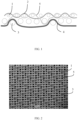
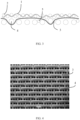
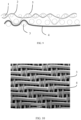
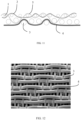
- FIGURE 1 illustrates a textile structure as viewed in the direction of machine direction yarns and FIGURE 2 illustrates the said textile structure as viewed from the web-side.
- the web-side layer is a five-shaft weave.
- the binding cross machine direction yarns 5 are configured to bind the web-side layer machine direction yarns 1 over one, under one, over one and under two web-side layer machine direction yarns 1.
- the binding cross machine direction yarn floats are short, which reduces internal wear and increases stability.
- FIGURE 1 illustrates that the binding cross machine direction yarns 5 bind the portion of wear-side layer machine direction yarns 3 while the binding cross machine direction yarns 5 bind the web-side layer machine direction yarns 1 under two web-side layer machine direction yarns 1. This enables the forming of the partially or fully unstacked structure.
- FIGURE 1 illustrates that the binding cross machine direction yarns 5 are configured to bind every fifth of the wear-side layer machine direction yarns 3.
- the every fifth of the wear-side layer machine direction yarns 3 participates in bonding the web-side layer and the wear-side layer together.
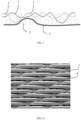
- FIGURE 3 illustrates the textile structure of FIGURES 1 and 2 as viewed in the direction of machine direction yarns.
- the binding cross machine direction yarns 5 bind a portion of the wear-side layer machine direction yarns 3 to form binding points under the web-side layer.
- the wear-side layer machine direction yarns 3 can move from the line of other wear-side layer machine direction yarns 3 towards to the web-side layer. However, the binding points stays under the web-side layer.
- binding of the wear-side layer machine direction yarns 3 by the binding cross machine direction yarns 5 is achieved so that the formed binding point does not reach the surface of the web-side layer. Therefore, the binding point does not clog the textile. Thanks to this, water permeability of the textile does not substantially decrease despite the partially or fully unstacked structure. Further, the cross machine direction yarns are straighter in the final structure. This minimizes stretching of the textile in the paper machine.
- the binding cross machine direction yarns 5 are configured to form a continuous independent yarn path.
- one binding cross machine direction yarn is required to form one continuous binding cross machine direction yarn path.
- This provides lower cross machine direction yarn density.
- less material is needed to manufacture the textile and it becomes less expensive to manufacture.
- the textile is 15 to 25 % faster to weave than a textile having two binding cross machine direction yarns forming the continuous yarn path together.
- the web-side layer further comprises cross machine direction yarns 2 configured to only bind the web-side layer machine direction yarns 1. So, the yarns only participate in the formation of the web-side layer.
- At least one of the web-side layer cross machine direction yarns 2 can be configured between two adjacent binding cross machine direction yarns 5.
- the web-side layer cross machine direction yarns 2 and the binding cross machine direction yarns 5 alternate in the web-side layer.
- the textile is 15 to 25 % faster to weave than a textile having two cross machine direction yarns forming the continuous yarn path together.
- the web-side layer cross machine direction yarns 2 can be configured to bind the web-side layer machine direction yarns 1 over one, under one, over one and under two machine direction yarns 1.
- the cross machine direction yarn 2 floats are short, which reduces internal wear and increases stability.
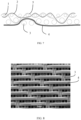
- FIGURES 4 , 6 , 8 , 10 and 12 illustrate structures as a view from the wear-side.
- FIGURES 1 , 5 , 7 , 9 , 11 , 13, 14 and 15 illustrate the structures as viewed in the direction of machine direction yarns.
- the wear-side layer can be a five-shaft weave or a ten-shaft weave.
- a six-shaft, an eight-shaft, a twelve-shaft or a sixteen-shaft weave can be used.
- FIGURES 1 and 4 illustrates that the wear-side layer is a five-shaft weave.
- the wear-side layer cross machine direction yarns 4 are configured to bind the wear-side layer machine direction yarns 3 over one and under four machine direction yarns 3.
- the cross machine direction yarn floats are relatively short, which reduces internal wear and increases stability.
- FIGURES 5 to 8 illustrate that the wear-side layer is a ten-shaft weave.
- the wear-side layer cross machine direction yarns 4 are configured to bind the wear-side layer machine direction yarns 3 over two and under eight machine direction yarns 3.
- the cross machine direction yarn floats are relatively long, which increases wear resistance.
- FIGURE 9 and 10 illustrate that the wear-side layer is a ten-shaft weave.
- the wear-side layer cross machine direction yarns 4 are configured to bind the wear-side layer machine direction yarns 3 over one, under one, over one and under seven machine direction yarns 3.
- the cross machine direction yarn floats are relatively long, which increases wear resistance.
- FIGURE 11 and 12 illustrates that the wear-side layer is a ten-shaft weave.
- the wear-side layer cross machine direction yarns 4 are configured to bind the wear-side layer machine direction yarns 3 over one, under two, over one and under six machine direction yarns 3.
- the cross machine direction yarn floats are relatively long, which increases wear resistance.
- FIGURE 13 illustrates that the wear-side layer is a six-shaft weave.
- the wear-side layer cross machine direction yarns 4 are configured to bind the wear-side layer machine direction yarns 3 over one and under five machine direction yarns 3.
- the cross machine direction yarn floats are relatively long, which increases wear resistance.
- FIGURE 14 illustrates that the wear-side layer is an eight-shaft weave.
- the wear-side layer cross machine direction yarns 4 are configured to bind the wear-side layer machine direction yarns 3 over two and under six machine direction yarns 3.
- the cross machine direction yarn floats are relatively long, which increases wear resistance.
- FIGURE 15 illustrates that the wear-side layer is a twelve-shaft weave.
- the wear-side layer cross machine direction yarns 4 are configured to bind the wear-side layer machine direction yarns 3 over one, under one, over one and under nine machine direction yarns 3.
- the cross machine direction yarn floats are relatively long, which increases wear resistance.
- the ratio of the web-side layer machine direction yarns 1 to the wear-side layer machine direction yarns 3 is preferably 1:1.
- the ratio can be for example, 1:2 or 2:1.
- the web-side layer machine direction yarns and the wear-side layer machine direction yarns are stacked.
- the ratio of the web-side layer machine direction yarns 1 to the wear-side layer machine direction yarns 3 can also be greater than one (>1) or less than one ( ⁇ 1).
- the ratio of the web-side layer cross machine direction yarns 2 to the wear-side layer cross machine direction yarns 4 is preferably 3:2 or 2:1. However, ratios of 1:1, 1:2, 2:3 or 8:5 can also be used.
- the diameters of the web-side layer yarns 1, 2, 5 can be smaller than the diameters of the wear-side layer yarns 3, 4.
- the diameters of web-side layer machine direction yarns 1 can be smaller than the diameters of the wear-side layer machine direction yarns.
- the diameters of the binding cross machine direction yarns 5 and the web-side layer cross machine direction yarns 2 can be smaller than the wear-side layer cross machine direction yarns 4.
- the web-side layer formed of thinner yarns reduces marking of a paper web.
- the wear-side layer formed of thicker yarns increases the service life of the textile.
- the diameters of the web-side layer yarns 1, 2, 5 can be the same than the diameters of the wear-side layer yarns 3, 4.
- the diameters of web-side layer machine direction yarns 1 can be the same than the diameters of the wear-side layer machine direction yarns.
- the diameters of the binding cross machine direction yarns 5 and the web-side layer cross machine direction yarns 2 can be the same than the wear-side layer cross machine direction yarns 4.
- the diameter of the web-side layer machine direction yarns 1 can be ⁇ 0.08 mm and/or the diameter of the web-side layer cross machine direction yarns 2 and the binding cross machine direction yarns 5 can be ⁇ 0.08 mm, preferably 0.13 mm.
- the diameter of the wear-side layer machine direction yarns 3 can be ⁇ 0.08 mm and/or the diameter of the wear-side layer cross machine direction yarns 4 can be 0.15 to 0.50 mm, preferably 0.40 mm.
- the yarns 1, 2, 3, 4, 5 of the textile can be monofilaments, but multifilaments can also be used.
- the cross-section of the yarns 1, 2, 3, 4, 5 can be round, square, rectangular, oval or any other suitable shape.
- the yarns 1, 2, 3, 4, 5 can be of man-made fibers, natural fibers or regenerated fibers. Further, recycled fibers can be used.
- the yarns 1,2, 3, 4, 5 of the textile can be polyester or polyamide yarns.
- PEN polyethylene naphthalate
- PPS polyphenylene sulphide
- the textile can have a weight of 280 to 1000 g/m 2 and a thickness of 0.4 mm to 2 mm.
- the industrial textile can be used as a wire in the wet section of a paper machine, but the structure can also be used with e.g. tissue, paperboard and non-woven machines.
- the structure of the invention can also be configured for use at the press or drying section of a paper machine.
Landscapes
- Engineering & Computer Science (AREA)
- Textile Engineering (AREA)
- Woven Fabrics (AREA)
- Paper (AREA)
Claims (16)
- Industrielles Textil, das zwei Schichten, eine bahnseitige Schicht und eine verschleißseitige Schicht, umfasst, wobei:- die bahnseitige Schicht in Maschinenrichtung verlaufende Fäden (1) und quer zur Maschinenrichtung verlaufende Bindefäden (5) umfasst,- die verschleißseitige Schicht in Maschinenrichtung verlaufende Fäden (3) und quer zur Maschinenrichtung verlaufende Fäden (4) umfasst,- die quer zur Maschinenrichtung verlaufenden Bindefäden (5) sich von der bahnseitigen Schicht zur verschleißseitigen Schicht erstrecken und einen Abschnitt von in Maschinenrichtung verlaufenden Fäden (3) der verschleißseitigen Schicht binden, um die bahnseitige Schicht und die verschleißseitige Schicht aneinanderzubinden, und
wobei ein Gewebe der bahnseitigen Schicht konfiguriert ist, um sich während einer Musterwiederholung zu ändern, und dadurch gekennzeichnet, dass die quer zur Maschinenrichtung verlaufenden Bindefäden (5) konfiguriert sind, um die in Maschinenrichtung verlaufenden Fäden (1) der bahnseitigen Schicht zu binden:- bei einem Fünf-Schaft-Gewebe über einem, unter einem, über einem und unter zwei in Maschinenrichtung verlaufenden Fäden (1) der bahnseitigen Schicht,- bei einem Zwölf-Schaft-Gewebe unter einem, über einem, unter zwei, über einem, unter einem, über einem, unter zwei, über einem, unter einem und über einem in Maschinenrichtung verlaufenden Faden (1) der bahnseitigen Schicht, oder- bei einem Acht-Schaft-Gewebe unter zwei, über einem, unter einem, über einem, unter zwei, über einem in Maschinenrichtung verlaufenden Faden (1) der bahnseitigen Schicht. - Industrielles Textil nach Anspruch 1, wobei die in Maschinenrichtung verlaufenden Fäden (1) der bahnseitigen Schicht und die in Maschinenrichtung verlaufenden Fäden (3) der verschleißseitigen Schicht teilweise oder vollständig ungestapelt sind.
- Industrielles Textil nach Anspruch 1 oder 2, wobei die quer zur Maschinenrichtung verlaufenden Bindefäden (5) den Abschnitt von in Maschinenrichtung verlaufenden Fäden (3) der verschleißseitigen Schicht binden, während die quer zur Maschinenrichtung verlaufenden Bindefäden (5) die in Maschinenrichtung verlaufenden Fäden (1) der bahnseitigen Schicht unter zwei in Maschinenrichtung verlaufende Fäden (1) der bahnseitigen Schicht binden.
- Industrielles Textil nach einem der vorstehenden Ansprüche, wobei die quer zur Maschinenrichtung verlaufenden Bindefäden (5) konfiguriert sind, um jeden fünften der in Maschinenrichtung verlaufenden Fäden (3) der verschleißseitigen Schicht zu binden.
- Industrielles Textil nach einem der vorstehenden Ansprüche, wobei die quer zur Maschinenrichtung verlaufenden Bindefäden (5) einen Abschnitt von in Maschinenrichtung verlaufenden Fäden (3) der verschleißseitigen Schicht binden, um Bindungspunkte unter der bahnseitigen Schicht zu bilden.
- Industrielles Textil nach einem der vorstehenden Ansprüche, wobei die quer zur Maschinenrichtung verlaufenden Bindefäden (5) konfiguriert sind, um einen kontinuierlichen unabhängigen Fadenpfad zu bilden.
- Industrielles Textil nach einem der vorstehenden Ansprüche, wobei die bahnseitige Schicht quer zur Maschinenrichtung verlaufende Fäden (2) umfasst, die konfiguriert sind, um nur die in Maschinenrichtung verlaufenden Fäden (1) der bahnseitigen Schicht zu binden.
- Industrielles Textil nach Anspruch 7, wobei mindestens einer der quer zur Maschinenrichtung verlaufenden Fäden (2) der bahnseitigen Schicht zwischen zwei benachbarten quer zur Maschinenrichtung verlaufenden Bindefäden (5) konfiguriert ist.
- Industrielles Textil nach einem der vorstehenden Ansprüche 7 bis 8, wobei die quer zur Maschinenrichtung verlaufenden Fäden (2) der bahnseitigen Schicht konfiguriert sind, um die in Maschinenrichtung verlaufenden Fäden (1) der bahnseitigen Schicht über einem, unter einem, über einem und unter zwei in Maschinenrichtung verlaufenden Fäden (1) zu binden.
- Industrielles Textil nach einem der vorstehenden Ansprüche, wobei die verschleißseitige Schicht ein Fünf-Schaft-Gewebe oder ein Zehn-Schaft-Gewebe ist.
- Industrielles Textil nach Anspruch 10, wobei die verschleißseitige Schicht ein Fünf-Schaft-Gewebe ist, wobei die quer zur Maschinenrichtung verlaufenden Fäden (4) der verschleißseitigen Schicht konfiguriert sind, um die in Maschinenrichtung verlaufenden Fäden (3) der verschleißseitigen Schicht über einem und unter vier in Maschinenrichtung verlaufenden Fäden (3) zu binden.
- Industrielles Textil nach Anspruch 10, wobei die verschleißseitige Schicht ein Zehn-Schaft-Gewebe ist, wobei die quer zur Maschinenrichtung verlaufenden Fäden (4) der verschleißseitigen Schicht konfiguriert sind, um die in Maschinenrichtung verlaufenden Fäden (3) der verschleißseitigen Schicht über zwei und unter acht in Maschinenrichtung verlaufenden Fäden (3) zu binden.
- Industrielles Textil nach Anspruch 10, wobei die verschleißseitige Schicht ein Zehn-Schaft-Gewebe ist, wobei die quer zur Maschinenrichtung verlaufenden Fäden (4) der verschleißseitigen Schicht konfiguriert sind, um die in Maschinenrichtung verlaufenden Fäden (3) der verschleißseitigen Schicht über einem, unter einem, über einem und unter sieben in Maschinenrichtung verlaufende Fäden (3) binden.
- Industrielles Textil nach Anspruch 10, wobei die verschleißseitige Schicht ein Zehn-Schaft-Gewebe ist, wobei die quer zur Maschinenrichtung verlaufenden Fäden (4) der verschleißseitigen Schicht konfiguriert sind, um die in Maschinenrichtung verlaufenden Fäden (3) der verschleißseitigen Schicht über einem, unter zwei, über einem und unter sechs in Maschinenrichtung verlaufenden Fäden (3) zu binden.
- Industrielles Textil nach einem der vorstehenden Ansprüche, wobei das Verhältnis der in Maschinenrichtung verlaufenden Fäden (1) der bahnseitigen Schicht zu den in Maschinenrichtung verlaufenden Fäden (3) der verschleißseitigen Schicht 1:1, 1:2 oder 2:1 beträgt.
- Industrielles Textil nach einem der vorstehenden Ansprüche, wobei das Verhältnis der quer zur Maschinenrichtung verlaufenden Fäden (2) der bahnseitigen Schicht zu den quer zur Maschinenrichtung verlaufenden Fäden (4) der verschleißseitigen Schicht 3:2, 2:1, 1:1, 1:2, 2:3 oder 8:5 beträgt.
Applications Claiming Priority (1)
| Application Number | Priority Date | Filing Date | Title |
|---|---|---|---|
| FI20206371A FI20206371A1 (en) | 2020-12-23 | 2020-12-23 | Industrial textile |
Publications (2)
| Publication Number | Publication Date |
|---|---|
| EP4019696A1 EP4019696A1 (de) | 2022-06-29 |
| EP4019696B1 true EP4019696B1 (de) | 2024-02-07 |
Family
ID=78916938
Family Applications (1)
| Application Number | Title | Priority Date | Filing Date |
|---|---|---|---|
| EP21214670.8A Active EP4019696B1 (de) | 2020-12-23 | 2021-12-15 | Industriefaser |
Country Status (7)
| Country | Link |
|---|---|
| US (1) | US11629438B2 (de) |
| EP (1) | EP4019696B1 (de) |
| JP (1) | JP7264981B2 (de) |
| KR (1) | KR20220091375A (de) |
| CN (1) | CN114657674B (de) |
| CA (1) | CA3138598A1 (de) |
| FI (1) | FI20206371A1 (de) |
Families Citing this family (2)
| Publication number | Priority date | Publication date | Assignee | Title |
|---|---|---|---|---|
| FI130870B1 (en) * | 2020-06-04 | 2024-04-30 | Valmet Technologies Oy | An industrial textile for manufacturing a fibrous web |
| FI20206371A1 (en) * | 2020-12-23 | 2022-06-24 | Valmet Technologies Inc | Industrial textile |
Family Cites Families (25)
| Publication number | Priority date | Publication date | Assignee | Title |
|---|---|---|---|---|
| US4161195A (en) * | 1978-02-16 | 1979-07-17 | Albany International Corp. | Non-twill paperforming fabric |
| US5052448A (en) * | 1989-02-10 | 1991-10-01 | Huyck Corporation | Self stitching multilayer papermaking fabric |
| FI90261C (fi) * | 1990-03-02 | 1994-01-10 | Tamfelt Oy Ab | Paperikonekangas |
| FI85605C (fi) * | 1990-06-15 | 1994-06-28 | Tamfelt Oy Ab | Tvaoskiktad pappersmaskinsduk |
| BR9710950A (pt) * | 1996-04-04 | 1999-10-26 | Asten Inc | Tecido para a fabricação de papel para incremento da espessura da folha de papel |
| AT404142B (de) * | 1996-09-18 | 1998-08-25 | Tiroler Loden Gmbh | Gewebe zur herstellung von bekleidung sowie verfahren zur herstellung eines solchen gewebes |
| JP2001098483A (ja) * | 1999-09-30 | 2001-04-10 | Nippon Felt Co Ltd | 製紙用二層織物 |
| JP2001336078A (ja) * | 2000-05-31 | 2001-12-07 | Nippon Felt Co Ltd | 製紙用二層織物 |
| FI110131B (fi) * | 2001-02-22 | 2002-11-29 | Tamfelt Oyj Abp | Paperikonekudos |
| FI112261B (fi) * | 2002-05-06 | 2003-11-14 | Tamfelt Oyj Abp | Paperikonekudos |
| GB2391557A (en) * | 2002-08-06 | 2004-02-11 | Richard Stone | Forming fabric for papermaking |
| DE10253491B3 (de) * | 2002-11-16 | 2004-05-13 | Andreas Kufferath Gmbh & Co. Kg | Papiermaschinensieb |
| US7008512B2 (en) * | 2002-11-21 | 2006-03-07 | Albany International Corp. | Fabric with three vertically stacked wefts with twinned forming wefts |
| US20050085148A1 (en) * | 2003-10-17 | 2005-04-21 | Thomas Baumgartner | Felt for forming fiber cement articles with multiplex base fabric |
| RU2354764C2 (ru) * | 2004-09-30 | 2009-05-10 | ЭстенДжонсон, Инк. | Двухслойная формирующая сетка с высоким сопротивлением в центральной плоскости |
| JP4762529B2 (ja) * | 2004-11-17 | 2011-08-31 | 日本フイルコン株式会社 | 工業用二層織物 |
| JP4762530B2 (ja) * | 2004-11-30 | 2011-08-31 | 日本フイルコン株式会社 | 工業用二層織物 |
| JP4383433B2 (ja) | 2006-07-21 | 2009-12-16 | 日本フエルト株式会社 | 製紙用織物 |
| WO2008073301A2 (en) * | 2006-12-08 | 2008-06-19 | Astenjohnson, Inc. | Machine side layer weave design for composite forming fabrics |
| US7743795B2 (en) | 2006-12-22 | 2010-06-29 | Voith Patent Gmbh | Forming fabric having binding weft yarns |
| EP2314762B1 (de) * | 2009-10-23 | 2012-09-26 | Heimbach GmbH & Co.KG | Gewebte Papiermaschinenbespannung |
| FI20115222A7 (fi) * | 2011-03-04 | 2012-09-05 | Metso Fabrics Oy | Paperikonekudos |
| FI20155918A (fi) * | 2015-12-04 | 2017-06-05 | Valmet Technologies Oy | Paperikonekudos |
| FI130024B (en) | 2019-10-03 | 2022-12-30 | Valmet Technologies Oy | Drying cloth |
| FI20206371A1 (en) * | 2020-12-23 | 2022-06-24 | Valmet Technologies Inc | Industrial textile |
-
2020
- 2020-12-23 FI FI20206371A patent/FI20206371A1/en not_active Application Discontinuation
-
2021
- 2021-11-11 CA CA3138598A patent/CA3138598A1/en active Pending
- 2021-12-02 KR KR1020210170989A patent/KR20220091375A/ko active Pending
- 2021-12-09 CN CN202111498687.2A patent/CN114657674B/zh active Active
- 2021-12-15 EP EP21214670.8A patent/EP4019696B1/de active Active
- 2021-12-16 US US17/553,301 patent/US11629438B2/en active Active
- 2021-12-22 JP JP2021207799A patent/JP7264981B2/ja active Active
Also Published As
| Publication number | Publication date |
|---|---|
| CN114657674A (zh) | 2022-06-24 |
| KR20220091375A (ko) | 2022-06-30 |
| EP4019696A1 (de) | 2022-06-29 |
| JP2022100282A (ja) | 2022-07-05 |
| US20220195642A1 (en) | 2022-06-23 |
| JP7264981B2 (ja) | 2023-04-25 |
| CA3138598A1 (en) | 2022-06-23 |
| US11629438B2 (en) | 2023-04-18 |
| FI20206371A1 (en) | 2022-06-24 |
| CN114657674B (zh) | 2023-05-26 |
Similar Documents
| Publication | Publication Date | Title |
|---|---|---|
| EP2877631B1 (de) | Trockensieb | |
| EP2242881B1 (de) | Ultranachgiebiger stoff | |
| US8652302B2 (en) | Fabric belt for a machine for the production of web material, particularly paper or cardboard | |
| US20040154683A1 (en) | Multi-layer fabric | |
| EP1936024A1 (de) | Formiersieb mit Bindeschussfäden | |
| JP2003342889A (ja) | 工業用二層織物 | |
| EP4019696B1 (de) | Industriefaser | |
| WO2009103167A1 (en) | Industrial filtration fabric with high centre plane resistance | |
| CN102057091B (zh) | 高纤维支撑物内在经纱连接的复合成形织物 | |
| JP4869767B2 (ja) | 繊維により高度に支持された安定な形成布 | |
| EP2899311B1 (de) | Papiermaschinenbespannung | |
| US20120178330A1 (en) | Papermakers' forming fabric including pairs of machine side complementary yarns | |
| EP2631360B1 (de) | Gewebe zur Formung einer Papierbahn mit geprägter Oberfläche | |
| EP1774090B1 (de) | Dreilagige bespannung mit kettführung mit gepaarten spezifischen kettbindefäden | |
| US8640741B2 (en) | Woven papermaker fabric, in particular a forming fabric | |
| JP3883275B2 (ja) | 上層織物に補助緯糸を配置した工業用2層織物 | |
| MX2009000877A (es) | Tela para secadora. | |
| CN101631912B (zh) | 用于制造幅材、尤其是纸或纸板的机器的织物带 | |
| EP1590527A2 (de) | Mehrschichtiges gewebe | |
| JP2020050994A (ja) | 製紙用織物 | |
| MXPA06004632A (en) | Stable forming fabric with high fiber support | |
| MXPA99003618A (en) | Papermakers fabric with enhanced cmd support and stacking |
Legal Events
| Date | Code | Title | Description |
|---|---|---|---|
| PUAI | Public reference made under article 153(3) epc to a published international application that has entered the european phase |
Free format text: ORIGINAL CODE: 0009012 |
|
| STAA | Information on the status of an ep patent application or granted ep patent |
Free format text: STATUS: THE APPLICATION HAS BEEN PUBLISHED |
|
| AK | Designated contracting states |
Kind code of ref document: A1 Designated state(s): AL AT BE BG CH CY CZ DE DK EE ES FI FR GB GR HR HU IE IS IT LI LT LU LV MC MK MT NL NO PL PT RO RS SE SI SK SM TR |
|
| STAA | Information on the status of an ep patent application or granted ep patent |
Free format text: STATUS: REQUEST FOR EXAMINATION WAS MADE |
|
| 17P | Request for examination filed |
Effective date: 20221130 |
|
| RBV | Designated contracting states (corrected) |
Designated state(s): AL AT BE BG CH CY CZ DE DK EE ES FI FR GB GR HR HU IE IS IT LI LT LU LV MC MK MT NL NO PL PT RO RS SE SI SK SM TR |
|
| P01 | Opt-out of the competence of the unified patent court (upc) registered |
Effective date: 20230602 |
|
| GRAP | Despatch of communication of intention to grant a patent |
Free format text: ORIGINAL CODE: EPIDOSNIGR1 |
|
| STAA | Information on the status of an ep patent application or granted ep patent |
Free format text: STATUS: GRANT OF PATENT IS INTENDED |
|
| INTG | Intention to grant announced |
Effective date: 20230922 |
|
| GRAS | Grant fee paid |
Free format text: ORIGINAL CODE: EPIDOSNIGR3 |
|
| GRAA | (expected) grant |
Free format text: ORIGINAL CODE: 0009210 |
|
| STAA | Information on the status of an ep patent application or granted ep patent |
Free format text: STATUS: THE PATENT HAS BEEN GRANTED |
|
| AK | Designated contracting states |
Kind code of ref document: B1 Designated state(s): AL AT BE BG CH CY CZ DE DK EE ES FI FR GB GR HR HU IE IS IT LI LT LU LV MC MK MT NL NO PL PT RO RS SE SI SK SM TR |
|
| REG | Reference to a national code |
Ref country code: GB Ref legal event code: FG4D |
|
| REG | Reference to a national code |
Ref country code: CH Ref legal event code: EP |
|
| REG | Reference to a national code |
Ref country code: DE Ref legal event code: R096 Ref document number: 602021009200 Country of ref document: DE |
|
| REG | Reference to a national code |
Ref country code: IE Ref legal event code: FG4D |
|
| REG | Reference to a national code |
Ref country code: LT Ref legal event code: MG9D |
|
| REG | Reference to a national code |
Ref country code: NL Ref legal event code: MP Effective date: 20240207 |
|
| PG25 | Lapsed in a contracting state [announced via postgrant information from national office to epo] |
Ref country code: IS Free format text: LAPSE BECAUSE OF FAILURE TO SUBMIT A TRANSLATION OF THE DESCRIPTION OR TO PAY THE FEE WITHIN THE PRESCRIBED TIME-LIMIT Effective date: 20240607 |
|
| PG25 | Lapsed in a contracting state [announced via postgrant information from national office to epo] |
Ref country code: LT Free format text: LAPSE BECAUSE OF FAILURE TO SUBMIT A TRANSLATION OF THE DESCRIPTION OR TO PAY THE FEE WITHIN THE PRESCRIBED TIME-LIMIT Effective date: 20240207 |
|
| PG25 | Lapsed in a contracting state [announced via postgrant information from national office to epo] |
Ref country code: GR Free format text: LAPSE BECAUSE OF FAILURE TO SUBMIT A TRANSLATION OF THE DESCRIPTION OR TO PAY THE FEE WITHIN THE PRESCRIBED TIME-LIMIT Effective date: 20240508 |
|
| REG | Reference to a national code |
Ref country code: AT Ref legal event code: MK05 Ref document number: 1655437 Country of ref document: AT Kind code of ref document: T Effective date: 20240207 |
|
| PG25 | Lapsed in a contracting state [announced via postgrant information from national office to epo] |
Ref country code: RS Free format text: LAPSE BECAUSE OF FAILURE TO SUBMIT A TRANSLATION OF THE DESCRIPTION OR TO PAY THE FEE WITHIN THE PRESCRIBED TIME-LIMIT Effective date: 20240507 Ref country code: HR Free format text: LAPSE BECAUSE OF FAILURE TO SUBMIT A TRANSLATION OF THE DESCRIPTION OR TO PAY THE FEE WITHIN THE PRESCRIBED TIME-LIMIT Effective date: 20240207 Ref country code: NL Free format text: LAPSE BECAUSE OF FAILURE TO SUBMIT A TRANSLATION OF THE DESCRIPTION OR TO PAY THE FEE WITHIN THE PRESCRIBED TIME-LIMIT Effective date: 20240207 |
|
| PG25 | Lapsed in a contracting state [announced via postgrant information from national office to epo] |
Ref country code: ES Free format text: LAPSE BECAUSE OF FAILURE TO SUBMIT A TRANSLATION OF THE DESCRIPTION OR TO PAY THE FEE WITHIN THE PRESCRIBED TIME-LIMIT Effective date: 20240207 |
|
| PG25 | Lapsed in a contracting state [announced via postgrant information from national office to epo] |
Ref country code: AT Free format text: LAPSE BECAUSE OF FAILURE TO SUBMIT A TRANSLATION OF THE DESCRIPTION OR TO PAY THE FEE WITHIN THE PRESCRIBED TIME-LIMIT Effective date: 20240207 |
|
| PG25 | Lapsed in a contracting state [announced via postgrant information from national office to epo] |
Ref country code: RS Free format text: LAPSE BECAUSE OF FAILURE TO SUBMIT A TRANSLATION OF THE DESCRIPTION OR TO PAY THE FEE WITHIN THE PRESCRIBED TIME-LIMIT Effective date: 20240507 Ref country code: NO Free format text: LAPSE BECAUSE OF FAILURE TO SUBMIT A TRANSLATION OF THE DESCRIPTION OR TO PAY THE FEE WITHIN THE PRESCRIBED TIME-LIMIT Effective date: 20240507 Ref country code: NL Free format text: LAPSE BECAUSE OF FAILURE TO SUBMIT A TRANSLATION OF THE DESCRIPTION OR TO PAY THE FEE WITHIN THE PRESCRIBED TIME-LIMIT Effective date: 20240207 Ref country code: LT Free format text: LAPSE BECAUSE OF FAILURE TO SUBMIT A TRANSLATION OF THE DESCRIPTION OR TO PAY THE FEE WITHIN THE PRESCRIBED TIME-LIMIT Effective date: 20240207 Ref country code: IS Free format text: LAPSE BECAUSE OF FAILURE TO SUBMIT A TRANSLATION OF THE DESCRIPTION OR TO PAY THE FEE WITHIN THE PRESCRIBED TIME-LIMIT Effective date: 20240607 Ref country code: HR Free format text: LAPSE BECAUSE OF FAILURE TO SUBMIT A TRANSLATION OF THE DESCRIPTION OR TO PAY THE FEE WITHIN THE PRESCRIBED TIME-LIMIT Effective date: 20240207 Ref country code: GR Free format text: LAPSE BECAUSE OF FAILURE TO SUBMIT A TRANSLATION OF THE DESCRIPTION OR TO PAY THE FEE WITHIN THE PRESCRIBED TIME-LIMIT Effective date: 20240508 Ref country code: FI Free format text: LAPSE BECAUSE OF FAILURE TO SUBMIT A TRANSLATION OF THE DESCRIPTION OR TO PAY THE FEE WITHIN THE PRESCRIBED TIME-LIMIT Effective date: 20240207 Ref country code: ES Free format text: LAPSE BECAUSE OF FAILURE TO SUBMIT A TRANSLATION OF THE DESCRIPTION OR TO PAY THE FEE WITHIN THE PRESCRIBED TIME-LIMIT Effective date: 20240207 Ref country code: BG Free format text: LAPSE BECAUSE OF FAILURE TO SUBMIT A TRANSLATION OF THE DESCRIPTION OR TO PAY THE FEE WITHIN THE PRESCRIBED TIME-LIMIT Effective date: 20240207 Ref country code: AT Free format text: LAPSE BECAUSE OF FAILURE TO SUBMIT A TRANSLATION OF THE DESCRIPTION OR TO PAY THE FEE WITHIN THE PRESCRIBED TIME-LIMIT Effective date: 20240207 |
|
| PG25 | Lapsed in a contracting state [announced via postgrant information from national office to epo] |
Ref country code: PL Free format text: LAPSE BECAUSE OF FAILURE TO SUBMIT A TRANSLATION OF THE DESCRIPTION OR TO PAY THE FEE WITHIN THE PRESCRIBED TIME-LIMIT Effective date: 20240207 Ref country code: PT Free format text: LAPSE BECAUSE OF FAILURE TO SUBMIT A TRANSLATION OF THE DESCRIPTION OR TO PAY THE FEE WITHIN THE PRESCRIBED TIME-LIMIT Effective date: 20240607 |
|
| PG25 | Lapsed in a contracting state [announced via postgrant information from national office to epo] |
Ref country code: SE Free format text: LAPSE BECAUSE OF FAILURE TO SUBMIT A TRANSLATION OF THE DESCRIPTION OR TO PAY THE FEE WITHIN THE PRESCRIBED TIME-LIMIT Effective date: 20240207 Ref country code: PT Free format text: LAPSE BECAUSE OF FAILURE TO SUBMIT A TRANSLATION OF THE DESCRIPTION OR TO PAY THE FEE WITHIN THE PRESCRIBED TIME-LIMIT Effective date: 20240607 Ref country code: PL Free format text: LAPSE BECAUSE OF FAILURE TO SUBMIT A TRANSLATION OF THE DESCRIPTION OR TO PAY THE FEE WITHIN THE PRESCRIBED TIME-LIMIT Effective date: 20240207 Ref country code: LV Free format text: LAPSE BECAUSE OF FAILURE TO SUBMIT A TRANSLATION OF THE DESCRIPTION OR TO PAY THE FEE WITHIN THE PRESCRIBED TIME-LIMIT Effective date: 20240207 |
|
| PG25 | Lapsed in a contracting state [announced via postgrant information from national office to epo] |
Ref country code: DK Free format text: LAPSE BECAUSE OF FAILURE TO SUBMIT A TRANSLATION OF THE DESCRIPTION OR TO PAY THE FEE WITHIN THE PRESCRIBED TIME-LIMIT Effective date: 20240207 |
|
| PG25 | Lapsed in a contracting state [announced via postgrant information from national office to epo] |
Ref country code: SM Free format text: LAPSE BECAUSE OF FAILURE TO SUBMIT A TRANSLATION OF THE DESCRIPTION OR TO PAY THE FEE WITHIN THE PRESCRIBED TIME-LIMIT Effective date: 20240207 |
|
| PG25 | Lapsed in a contracting state [announced via postgrant information from national office to epo] |
Ref country code: EE Free format text: LAPSE BECAUSE OF FAILURE TO SUBMIT A TRANSLATION OF THE DESCRIPTION OR TO PAY THE FEE WITHIN THE PRESCRIBED TIME-LIMIT Effective date: 20240207 Ref country code: CZ Free format text: LAPSE BECAUSE OF FAILURE TO SUBMIT A TRANSLATION OF THE DESCRIPTION OR TO PAY THE FEE WITHIN THE PRESCRIBED TIME-LIMIT Effective date: 20240207 |
|
| PG25 | Lapsed in a contracting state [announced via postgrant information from national office to epo] |
Ref country code: SK Free format text: LAPSE BECAUSE OF FAILURE TO SUBMIT A TRANSLATION OF THE DESCRIPTION OR TO PAY THE FEE WITHIN THE PRESCRIBED TIME-LIMIT Effective date: 20240207 |
|
| PG25 | Lapsed in a contracting state [announced via postgrant information from national office to epo] |
Ref country code: SM Free format text: LAPSE BECAUSE OF FAILURE TO SUBMIT A TRANSLATION OF THE DESCRIPTION OR TO PAY THE FEE WITHIN THE PRESCRIBED TIME-LIMIT Effective date: 20240207 Ref country code: SK Free format text: LAPSE BECAUSE OF FAILURE TO SUBMIT A TRANSLATION OF THE DESCRIPTION OR TO PAY THE FEE WITHIN THE PRESCRIBED TIME-LIMIT Effective date: 20240207 Ref country code: RO Free format text: LAPSE BECAUSE OF FAILURE TO SUBMIT A TRANSLATION OF THE DESCRIPTION OR TO PAY THE FEE WITHIN THE PRESCRIBED TIME-LIMIT Effective date: 20240207 Ref country code: EE Free format text: LAPSE BECAUSE OF FAILURE TO SUBMIT A TRANSLATION OF THE DESCRIPTION OR TO PAY THE FEE WITHIN THE PRESCRIBED TIME-LIMIT Effective date: 20240207 Ref country code: DK Free format text: LAPSE BECAUSE OF FAILURE TO SUBMIT A TRANSLATION OF THE DESCRIPTION OR TO PAY THE FEE WITHIN THE PRESCRIBED TIME-LIMIT Effective date: 20240207 Ref country code: CZ Free format text: LAPSE BECAUSE OF FAILURE TO SUBMIT A TRANSLATION OF THE DESCRIPTION OR TO PAY THE FEE WITHIN THE PRESCRIBED TIME-LIMIT Effective date: 20240207 |
|
| REG | Reference to a national code |
Ref country code: DE Ref legal event code: R097 Ref document number: 602021009200 Country of ref document: DE |
|
| PG25 | Lapsed in a contracting state [announced via postgrant information from national office to epo] |
Ref country code: IT Free format text: LAPSE BECAUSE OF FAILURE TO SUBMIT A TRANSLATION OF THE DESCRIPTION OR TO PAY THE FEE WITHIN THE PRESCRIBED TIME-LIMIT Effective date: 20240207 |
|
| PLBE | No opposition filed within time limit |
Free format text: ORIGINAL CODE: 0009261 |
|
| STAA | Information on the status of an ep patent application or granted ep patent |
Free format text: STATUS: NO OPPOSITION FILED WITHIN TIME LIMIT |
|
| PG25 | Lapsed in a contracting state [announced via postgrant information from national office to epo] |
Ref country code: IT Free format text: LAPSE BECAUSE OF FAILURE TO SUBMIT A TRANSLATION OF THE DESCRIPTION OR TO PAY THE FEE WITHIN THE PRESCRIBED TIME-LIMIT Effective date: 20240207 |
|
| 26N | No opposition filed |
Effective date: 20241108 |
|
| PG25 | Lapsed in a contracting state [announced via postgrant information from national office to epo] |
Ref country code: SI Free format text: LAPSE BECAUSE OF FAILURE TO SUBMIT A TRANSLATION OF THE DESCRIPTION OR TO PAY THE FEE WITHIN THE PRESCRIBED TIME-LIMIT Effective date: 20240207 |
|
| PGFP | Annual fee paid to national office [announced via postgrant information from national office to epo] |
Ref country code: CH Payment date: 20250101 Year of fee payment: 4 |
|
| PG25 | Lapsed in a contracting state [announced via postgrant information from national office to epo] |
Ref country code: MC Free format text: LAPSE BECAUSE OF FAILURE TO SUBMIT A TRANSLATION OF THE DESCRIPTION OR TO PAY THE FEE WITHIN THE PRESCRIBED TIME-LIMIT Effective date: 20240207 |
|
| PG25 | Lapsed in a contracting state [announced via postgrant information from national office to epo] |
Ref country code: LU Free format text: LAPSE BECAUSE OF NON-PAYMENT OF DUE FEES Effective date: 20241215 |
|
| PG25 | Lapsed in a contracting state [announced via postgrant information from national office to epo] |
Ref country code: IE Free format text: LAPSE BECAUSE OF NON-PAYMENT OF DUE FEES Effective date: 20241215 |
|
| REG | Reference to a national code |
Ref country code: CH Ref legal event code: U11 Free format text: ST27 STATUS EVENT CODE: U-0-0-U10-U11 (AS PROVIDED BY THE NATIONAL OFFICE) Effective date: 20260101 |
|
| PGFP | Annual fee paid to national office [announced via postgrant information from national office to epo] |
Ref country code: DE Payment date: 20251211 Year of fee payment: 5 |
|
| PGFP | Annual fee paid to national office [announced via postgrant information from national office to epo] |
Ref country code: GB Payment date: 20251219 Year of fee payment: 5 |
|
| PGFP | Annual fee paid to national office [announced via postgrant information from national office to epo] |
Ref country code: FR Payment date: 20251229 Year of fee payment: 5 |
|
| PGFP | Annual fee paid to national office [announced via postgrant information from national office to epo] |
Ref country code: BE Payment date: 20251219 Year of fee payment: 5 |