EP4017789B1 - Renfort pour corps creux - Google Patents
Renfort pour corps creux Download PDFInfo
- Publication number
- EP4017789B1 EP4017789B1 EP20758278.4A EP20758278A EP4017789B1 EP 4017789 B1 EP4017789 B1 EP 4017789B1 EP 20758278 A EP20758278 A EP 20758278A EP 4017789 B1 EP4017789 B1 EP 4017789B1
- Authority
- EP
- European Patent Office
- Prior art keywords
- bottom wall
- profile
- reinforcement
- shaped section
- main direction
- Prior art date
- Legal status (The legal status is an assumption and is not a legal conclusion. Google has not performed a legal analysis and makes no representation as to the accuracy of the status listed.)
- Active
Links
Images
Classifications
-
- B—PERFORMING OPERATIONS; TRANSPORTING
- B62—LAND VEHICLES FOR TRAVELLING OTHERWISE THAN ON RAILS
- B62D—MOTOR VEHICLES; TRAILERS
- B62D25/00—Superstructure or monocoque structure sub-units; Parts or details thereof not otherwise provided for
- B62D25/20—Floors or bottom sub-units
- B62D25/2009—Floors or bottom sub-units in connection with other superstructure subunits
- B62D25/2018—Floors or bottom sub-units in connection with other superstructure subunits the subunits being front structures
-
- B—PERFORMING OPERATIONS; TRANSPORTING
- B62—LAND VEHICLES FOR TRAVELLING OTHERWISE THAN ON RAILS
- B62D—MOTOR VEHICLES; TRAILERS
- B62D27/00—Connections between superstructure or understructure sub-units
- B62D27/02—Connections between superstructure or understructure sub-units rigid
- B62D27/026—Connections by glue bonding
-
- B—PERFORMING OPERATIONS; TRANSPORTING
- B62—LAND VEHICLES FOR TRAVELLING OTHERWISE THAN ON RAILS
- B62D—MOTOR VEHICLES; TRAILERS
- B62D29/00—Superstructures, understructures, or sub-units thereof, characterised by the material thereof
- B62D29/001—Superstructures, understructures, or sub-units thereof, characterised by the material thereof characterised by combining metal and synthetic material
- B62D29/002—Superstructures, understructures, or sub-units thereof, characterised by the material thereof characterised by combining metal and synthetic material a foamable synthetic material or metal being added in situ
-
- B—PERFORMING OPERATIONS; TRANSPORTING
- B62—LAND VEHICLES FOR TRAVELLING OTHERWISE THAN ON RAILS
- B62D—MOTOR VEHICLES; TRAILERS
- B62D29/00—Superstructures, understructures, or sub-units thereof, characterised by the material thereof
- B62D29/001—Superstructures, understructures, or sub-units thereof, characterised by the material thereof characterised by combining metal and synthetic material
- B62D29/005—Superstructures, understructures, or sub-units thereof, characterised by the material thereof characterised by combining metal and synthetic material preformed metal and synthetic material elements being joined together, e.g. by adhesives
Definitions
- the invention relates to the reinforcement of U-section profiles, in particular of the body structure of motor vehicles, and more particularly of the front stretchers of motor vehicles.
- Some body parts that ensure the rigidity of the vehicles on which they are installed have a structure forming one or more hollow bodies.
- the (complete) blocking of the hollow body(ies) of the front side rails by these profiles has the disadvantage of creating a blockage at the inlets of water and salts coming from wheel projections or water flows from the upper parts of motor vehicles, but also of creating a blockage for cataphoretic coating fluids. This has the major consequence of reducing the anti-corrosion guarantee of the vehicles, and therefore of weakening the structure of the front side rails.
- the published patent document EP1 387 789 B1 describes a reinforcing element for motor vehicle parts having hollow bodies.
- This reinforcing element which may be made of metal or plastic, has a U-shaped or M-shaped cross-section which is substantially conformed to the cross-section of the hollow body into which it is adapted to be inserted.
- Ribs are also present on the external face of the lower wall of this reinforcing element. These ribs or extensions have the function of delimiting one or more areas to which an expanding adhesive material can be applied. The function of this expanding material is to connect the reinforcing element to the inner face of the hollow body of the body part and thus contribute to its consolidation.
- this reinforcing element may also have orifices or channels to drain water that may accumulate in the hollow body(ies) of the body part, it does not guarantee effective and complete drainage over time, and thus limit or prevent corrosion of the hollow bodies and therefore the embrittlement over time of the body parts concerned.
- the invention aims to overcome at least one of the drawbacks of the aforementioned state of the art. More particularly, the invention aims to effectively prevent corrosion of hollow profiles, in a manner that is simple to implement.
- the invention relates to a beam comprising a U-shaped section profile with two side walls and a bottom wall; a reinforcement housed in the U-shaped section of the profile and fixed to said profile by an expanding adhesive between the side walls of the U-shaped section and said reinforcement.
- the reinforcement forms a partitioned structure extending in a main direction and comprising two opposite side faces facing the side walls of the profile and a bottom face facing the bottom wall of said profile.
- the partitioned structure comprises on the bottom face two ribs extending in the main direction so as to delimit with the bottom wall of the profile a ventilation channel.
- a plate fixed to the profile closes the U-shaped section.
- the expanding adhesive extends from the side walls towards the bottom wall of the U-shaped section and stops at the ribs of the reinforcement so as to form the ventilation channel.
- the partitioned structure comprises, on the bottom face, between the two ribs and on at least one section of said structure, a bottom wall provided with ventilation orifices.
- the ventilation orifices have an average diameter less than 10 mm and greater than 5 mm.
- the partitions form chambers, the bottom wall of the partitioned structure extending in the main direction along several chambers.
- the bottom wall of the partitioned structure extends transversely to the main direction beyond the two ribs to the lateral faces of said structure.
- the main direction forms an elbow, the bottom wall of the partitioned structure extending continuously along said elbow.
- an expandable adhesive material is applied to the side faces of the reinforcement.
- the bottom wall of the U-shaped section of the profile comprises openings along the main direction, in direct contact with the ventilation channel.
- the beam forms an elbow and is a longitudinal structural beam of a motor vehicle, called a stretcher.
- the invention also relates to a motor vehicle comprising a floor; a front lower apron fixed to a front edge of the floor; and two longitudinal structural beams extending under a front part of the floor towards an engine compartment of the motor vehicle; remarkable in that each of the two longitudinal structural beams is in accordance with the invention.
- the two longitudinal structural beams are commonly called stretchers.
- the measures of the invention are interesting in that they allow the hollow profiles to have a stiffness, particularly in bending, greater while ensuring a more extensive anti-corrosion guarantee, and therefore better overall mechanical performance.
- the bottom wall located at a distance from the neutral fiber of the reinforcement (corresponding essentially to the main direction of the partitioned structure of said reinforcement), contributes optimally to the stiffness of the reinforcement, while the ventilation holes in the bottom wall in question, located between the two ribs, make it possible to create a vertical circulation of air by convection which facilitates the ventilation and permanent drying of the hollow bodies of the bodywork parts concerned.
- This invention is all the more interesting as it does not interfere with the effectiveness of the cataphoresis of these hollow bodies during the assembly stage of motor vehicles.
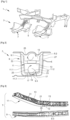
- the U-shaped section profile 9 forms a hollow body delimited by two side walls 9.1, 9.2 and a bottom wall 9.3.
- the reinforcement 11 is a structure with partitions which delimit chambers or cells 13. On the cross section of the Figure 2 , only two chambers 13 of the partitioned structure of the reinforcement 11 are in particular visible.
- This partitioned structure 11 is furthermore delimited by two opposite lateral faces 11.1, 11.2 and a bottom face 11.3.
- the two lateral faces 11.1, 11.2 are intended to be respectively opposite the lateral walls 9.1, 9.2 of the U-shaped section profile 9, and the bottom face 11.3 is intended to be opposite the bottom wall 9.3 of the same profile 9.
- This bottom face 11.3 comprises two ribs 17 which extend in the main direction of the partitioned structure 11 so as to delimit with the bottom wall 9.3 of the U-shaped section profile 9 a ventilation channel 19. Between these two ribs 17, and over at least one portion, the bottom face 11.3 further comprises a bottom wall 21 with ventilation orifices 23.
- These ventilation orifices 23 generally have an average diameter of less than 10 mm and greater than 5 mm and may be two or more in number for each chamber located opposite the face background 11.3 of the partitioned structure 11. In this case on the Figure 2 , only two ventilation orifices 23 are shown on the bottom wall 21 of the partitioned structure of the reinforcement 11.
- Vents 23 serve in particular to create a permanent circulation of air by convection between the interior of the chambers 13 concerned and the ventilation channel 19, thus allowing the drying of the hollow body(ies) of the stretchers 7.
- bottom wall 21 of the partitioned structure of the reinforcement 11 according to the invention can also extend transversely to the main direction beyond the two ribs 17 to the lateral faces 11.1, 11.2 of the structure 11.
- an expanding adhesive material 27 can also be applied between the side walls 9.1, 9.2 of the U-section profile 9 and the partitioned structure of the reinforcement 11.
- This expanding adhesive material 27 is compatible with the baking temperatures of anti-corrosion coating by cataphoresis around the reinforcement 11.
- the expandable adhesive material 27 extends in particular from the side walls 11.1, 11.2 towards the bottom wall 9.3 of the U-shaped section profile 9, and it stops at the ribs 17 of the reinforcement 11 so as to also form the ventilation channel 19.
- FIG. 3 represents a top and exploded view of a front stretcher of the front part of the vehicle of the Figure 1 , with a reinforcement according to the invention and a U-section profile which are not assembled.
- the partitioned structure of the reinforcement 11 extends, just like the U-shaped section profile 9, in a main direction forming an elbow, and that the bottom wall 21 of this structure 11 extends continuously along said elbow.
- This partitioned structure 11 is made up of several chambers or cells 13 delimited by transverse partitions 31. These chambers 13 are aligned along the main direction and can also be delimited by horizontal or oblique partitions. This is the case on the Figure 2 , where a horizontal partition 33 delimits two superimposed chambers 13.
- the horizontal partition 33 also comprises, and on at least one portion, ventilation orifices (not individually shown).
- ventilation orifices (not individually shown).
- the arrangement of these ventilation orifices makes it possible to create a second vertical and continuous air circulation between the two superimposed chambers 13 of the Figure 2 , which also contributes to the drying out over time of runoff water from the upper parts of motor vehicles 1 and/or cataphoresis fluids used during the assembly of bodywork parts.
- the bottom wall 9.3 of the U-shaped section profile 9 of the stretcher 7 comprises openings 35 along the main direction, in direct contact with the ventilation channel 19, the latter in this case not being visible on the Figure 3 but illustrated on the Figure 2 .
- the reinforcement for hollow bodies of bodywork parts has the advantage of continuously drying during the life of the vehicle, the water which may stagnate in the hollow bodies in which it is inserted, and thus improving the anti-corrosion guarantee of the coatings applied by cataphoresis during assembly of the vehicle, and in this sense of making it possible to avoid the weakening of the hollow bodywork parts.
Landscapes
- Engineering & Computer Science (AREA)
- Chemical & Material Sciences (AREA)
- Combustion & Propulsion (AREA)
- Transportation (AREA)
- Mechanical Engineering (AREA)
- Architecture (AREA)
- Structural Engineering (AREA)
- Body Structure For Vehicles (AREA)
- Blow-Moulding Or Thermoforming Of Plastics Or The Like (AREA)
Description
- La présente invention revendique la priorité de la demande
française 1909368 déposée le 23 Aout 2019 - L'invention a trait au renforcement de profilés de section en U, notamment de structure de carrosserie de véhicules automobiles, et plus particulièrement des brancards avant de véhicules automobiles.
- Certaines pièces de carrosserie qui assurent la rigidité des véhicules sur lesquels elles sont installées, ont une structure formant un ou plusieurs corps creux. Afin de renforcer en cas de choc ces pièces de carrosserie et/ou de limiter la masse augmentée des véhicules électriques les incorporant, il est connu de les renforcer en rajoutant dans les corps creux des inserts structuraux métalliques issus de profilés rectilignes. Tel est le cas, en particulier, pour les brancards avant des véhicules automobiles. Malheureusement, l'obturation (complète) du ou des corps creux des brancards avant par ces profilés, a pour inconvénient de créer un bouchon aux entrées d'eau et de sels provenant des projections des roues ou des écoulements d'eau provenant des parties hautes des véhicules automobiles, mais également de créer un bouchon aux fluides de revêtement par cataphorèse. Ceci a pour conséquence majeure de diminuer la garantie anti-corrosion des véhicules, et donc de fragiliser la structure des brancards avant.
- Le document brevet publié
EP1 387 789 B1 décrit un élément de renforcement pour des pièces de véhicules automobiles présentant des corps creux. Cet élément de renforcement, qui peut être élaboré en métal ou en matière plastique, présente une section transversale en forme de U ou de M qui est substantiellement conformée à la section transversale du corps creux auquel il est adapté pour être inséré. Des nervures sont également présentes sur la face externe de la paroi inférieure de cet élément de renforcement. Ces nervures ou extensions ont pour fonction de délimiter une ou des zones au niveau desquelles un matériel adhésif expansible peut être appliqué. Ce matériau expansible a pour fonction de relier l'élément de renforcement à la face intérieure du corps creux de la pièce de carrosserie et de participer ainsi à la consolidation de cette dernière. Cependant, bien que cet élément de renforcement puisse aussi présenter des orifices ou des canaux pour drainer l'eau pouvant s'accumuler au niveau du ou des corps creux de la pièce de carrosserie, il ne permet pas pour autant de garantir au cours du temps un drainage efficace et complet, et en cela de limiter ou empêcher la corrosion des corps creux et donc la fragilisation au cours du temps des pièces de carrosserie concernées. - L'invention a pour objectif de pallier au moins un des inconvénients de l'état de la technique susmentionné. Plus particulièrement, l'invention a pour objectif d'empêcher efficacement la corrosion des profilés creux, de façon simple à mettre en œuvre.
- A cet effet, l'invention a pour objet une poutre comprenant un profilé de section en U avec deux parois latérales et une paroi de fond ; un renfort logé dans la section en U du profilé et fixé audit profilé par un adhésif expansible entre les parois latérales de la section en U et ledit renfort. Le renfort forme une structure cloisonnée s'étendant suivant une direction principale et comprenant deux faces latérales opposées en vis-à-vis des parois latérales du profilé et une face de fond en vis-à-vis de la paroi de fond dudit profilé. La structure cloisonnée comprend sur la face de fond deux nervures s'étendant suivant la direction principale de manière à délimiter avec la paroi de fond du profilé un canal de ventilation. Une plaque fixée au profilé referme la section en U. L'adhésif expansible s'étend depuis les parois latérales vers la paroi de fond de la section en U et s'arrête aux nervures du renfort de manière à former le canal de ventilation. La structure cloisonnée comprend, sur la face de fond, entre les deux nervures et sur au moins un tronçon de ladite structure, une paroi de fond pourvue d'orifices de ventilation.
- Selon un mode avantageux de l'invention, les orifices de ventilation présentent un diamètre moyen inférieur à 10mm et supérieur à 5mm.
- Selon un mode avantageux de l'invention, les cloisons forment des chambres, la paroi de fond de la structure cloisonnée s'étendant suivant la direction principale le long de plusieurs chambres.
- Selon un mode avantageux de l'invention, pour certaines des chambres, les orifices de ventilation sont au nombre de deux ou plus par chambre.
- Selon un mode avantageux de l'invention, la paroi de fond de la structure cloisonnée s'étend transversalement à la direction principale au-delà des deux nervures jusqu'aux faces latérales de ladite structure.
- Selon un mode avantageux de l'invention, la direction principale forme un coude, la paroi de fond de la structure cloisonnée s'étendant de manière continue le long dudit coude.
- Avantageusement, un matériau adhésif expansible est appliqué sur les faces latérales du renfort.
- Selon un mode avantageux de l'invention, la paroi de fond de la section en U du profilé comprend des ajours le long de la direction principale, en contact direct avec le canal de ventilation.
- Selon un mode avantageux de l'invention, la poutre forme un coude et est une poutre structurelle longitudinale de véhicule automobile, désignée brancard.
- L'invention a également pour objet un véhicule automobile comprenant un plancher ; un tablier inférieur avant fixé à un bord avant du plancher ; et deux poutres structurelles longitudinales s'étendant sous une partie avant du plancher vers un compartiment moteur du véhicule automobile ; remarquable en ce que chacune des deux poutres structurelles longitudinales est conforme à l'invention.
- Les deux poutres structurelles longitudinales sont communément appelées brancards.
- Les mesures de l'invention sont intéressantes en ce qu'elles permettent aux profilés creux de présenter une raideur notamment en flexion plus grande tout en assurant une garantie anti-corrosion plus étendue, et donc des meilleures performances mécaniques globales. En effet, la paroi de fond, située à distance de la fibre neutre du renfort (correspondant essentiellement à la direction principale de la structure cloisonnée dudit renfort), participe de manière optimale à la raideur du renfort, alors que les orifices de ventilation dans la paroi de fond en question, situés entre les deux nervures, permettent de créer une circulation verticale de l'air par convection qui facilite l'aération et l'assèchement permanent des corps creux des pièces de carrosserie concernées. Cette invention est d'autant plus intéressante qu'elle n'interfère pas par ailleurs sur l'efficacité de la cataphorèse de ces corps creux lors de l'étape de montage des véhicules automobiles.
- D'autres caractéristiques et avantages de la présente invention seront mieux compris à l'aide de la description et des dessins, présentés à titre d'exemple.
-
- [
Fig 1 ] est une vue en perspective d'une portion de la partie avant de la structure d'un véhicule automobile selon l'invention; - [
Fig 2 ] illustre une coupe transversale d'un brancard avant de la partie avant du véhicule de lafigure 1 , comprenant un renfort selon l'invention logé dans un profilé de section en U ; - [
Fig 3 ] représente une vue de dessus et éclatée d'un brancard avant de la partie avant du véhicule de lafigure 1 , avec un renfort selon l'invention et un profilé de section en U non assemblés. -
- La
figure 1 est une vue en perspective d'une portion de la partie avant de la structure d'un véhicule automobile selon l'invention. Cette partie avant 3 comprend notamment un plancher 5, un tablier inférieur fixé à un bord avant du plancher 5, et deux poutres structurelles longitudinales 7 qui s'étendent sous une partie avant du plancher 5 en direction du compartiment moteur (non représenté) du véhicule automobile 1. Ces poutres structurelles longitudinales 7, qui sont incurvées et forment un coude, sont communément désignées par le terme « brancard ». - La
figure 2 représente une coupe transversale d'un brancard avant de la partie avant du véhicule de lafigure 1 . Ce brancard 7 comprend au moins deux éléments, à savoir un profilé 9 de section en U et un renfort 11 selon l'invention. - Le profilé 9 de section en U forme un corps creux délimité par deux parois latérales 9.1, 9.2 et une paroi de fond 9.3. De son côté le renfort 11 est une structure avec des cloisons qui délimitent des chambres ou alvéoles 13. Sur la coupe transversale de la
figure 2 , seules deux chambres 13 de la structure cloisonnée du renfort 11 sont en particulier visibles. Cette structure cloisonnée 11 est par ailleurs délimitée par deux faces latérales opposées 11.1, 11.2 et une face de fond 11.3. Les deux faces latérales 11.1, 11.2 sont destinées à être respectivement en regard des parois latérales 9.1, 9.2 du profilé 9 de section en U, et la face de fond 11.3 est quant à elle destinée à être en regard de la paroi de fond 9.3 du même profilé 9. Cette face de fond 11.3 comprend deux nervures 17 qui s'étendent suivant la direction principale de la structure cloisonnée 11 de façon à délimiter avec la paroi de fond 9.3 du profilé 9 de section en U un canal de ventilation 19. Entre ces deux nervures 17, et sur au moins une portion, la face de fond 11.3 comprend en outre une paroi de fond 21 avec des orifices de ventilation 23. Ces orifices de ventilation 23 présentent généralement un diamètre moyen inférieur à 10mm et supérieur à 5mm et peuvent être au nombre de deux ou plus pour chaque chambre située en vis-à-vis de la face de fond 11.3 de la structure cloisonnée 11. En l'occurrence sur lafigure 2 , seuls deux orifices de ventilation 23 sont représentés sur la paroi de fond 21 de la structure cloisonnée du renfort 11. Ces orifices de ventilation 23 servent en particulier à créer une circulation permanente d'air par convection entre l'intérieur des chambres 13 concernées et le canal de ventilation 19 permettant ainsi l'assèchement du ou des corps creux des brancards 7. Une plaque 25, fixée au profilé 9 de section en U et fermant la section en U, permet classiquement de délimiter la partie intérieure de la ou des chambres 13. - Il est également intéressant de noter que la paroi de fond 21 de la structure cloisonnée du renfort 11 selon l'invention peut également s'étendre transversalement à la direction principale au-delà des deux nervures 17 jusqu'aux faces latérales 11.1, 11.2 de la structure 11.
- Avantageusement, et comme illustré sur la
figure 2 , un matériau adhésif expansible 27 peut également être appliqué entre les parois latérales 9.1, 9.2 du profilé 9 de section en U et la structure cloisonnée du renfort 11. Ce matériau adhésif expansible 27 est compatible aux températures de cuisson de revêtement anti-corrosion par cataphorèse autour du renfort 11. Sur lafigure 2 , le matériau adhésif expansible 27 s'étend notamment depuis les parois latérales 11.1, 11.2 vers la paroi de fond 9.3 du profilé 9 de section en U, et il s'arrête aux nervures 17 du renfort 11 de manière à former aussi le canal de ventilation 19. - La
figure 3 représente une vue de dessus et éclatée d'un brancard avant de la partie avant du véhicule de lafigure 1 , avec un renfort selon l'invention et un profilé de section en U qui sont non assemblés. Sur cettefigure 3 , il est possible d'observer que la structure cloisonnée du renfort 11 s'étend, tout comme le profilé 9 de section en U, selon une direction principale en formant un coude, et que la paroi de fond 21 de cette structure 11 s'étend de manière continue le long dudit coude. Cette structure cloisonnée 11 est constituée de plusieurs chambres ou alvéoles 13 délimitées par des cloisons transversales 31. Ces chambres 13 sont alignées le long de la direction principale et peuvent également être délimitées par des cloisons horizontales ou obliques. Tel est le cas sur lafigure 2 , où une cloison horizontale 33 délimite deux chambres superposées 13. En l'occurrence, dans cet exemple, la cloison horizontale 33 comprend également, et sur au moins une portion, des orifices de ventilation (non individuellement représentés). La disposition de ces orifices de ventilation permet de créer une seconde circulation d'air verticale et continue entre les deux chambres 13 superposées de lafigure 2 , qui contribue aussi à l'assèchement au cours du temps des eaux de ruissellement provenant des parties hautes des véhicules automobiles 1 et/ou des fluides de cataphorèse utilisés lors du montage des pièces de carrosserie. - Comme illustré sur la
figure 3 , la paroi de fond 9.3 du profilé 9 de section en U du brancard 7 selon l'invention, comprend des ajours 35 le long de la direction principale, en contact direct avec le canal de ventilation 19, ce dernier étant en l'occurrence non visible sur lafigure 3 mais illustré sur lafigure 2 . - De façon générale, le renfort pour corps creux de pièces de carrosserie, selon l'invention, présente l'avantage d'assécher en continue durant la vie du véhicule, les eaux pouvant stagner dans les corps creux dans lesquels il est inséré, et d'améliorer ainsi la garantie anti-corrosion des revêtements appliqués par cataphorèse lors du montage du véhicule, et en ce sens de permettre d'éviter la fragilisation des pièces de carrosserie à corps creux.
Claims (9)
- Poutre comprenant :- un profilé (9) de section en U avec deux parois latérales (9.1, 9.2) et une paroi de fond (9.3);- un renfort (11) logé dans la section en U du profilé (9) et fixé audit profilé (9) par un adhésif expansible (27) entre les parois latérales (9.1, 9.2) de la section en U (9) et ledit renfort (11) ; et- une plaque (25) fixée au profilé (9) de manière à refermer la section en U ;le renfort (11) formant une structure cloisonnée s'étendant suivant une direction principale et comprenant deux faces latérales (11.1, 11.2) opposées en vis-à-vis des parois latérales (9.1, 9.2) du profilé (9) et une face de fond (11.3) en vis-à-vis de la paroi de fond (9.3) dudit profilé (9),caractérisé en ce quela structure cloisonnée (11) comprend sur la face de fond (11.3) deux nervures (17) s'étendant suivant la direction principale et délimitant avec la paroi de fond (9.3) du profilé (9) un canal de ventilation (19), l'adhésif expansible (27) s'étendant depuis les parois latérales (9.1, 9.2) vers la paroi de fond (9.3) de la section en U (9) et s'arrête aux nervures (17) du renfort (11) de manière à former le canal de ventilation (19), la structure cloisonnée (11) comprenant en outre sur la face de fond (11.3), entre les deux nervures (17) et sur au moins un tronçon de ladite structure (11), une paroi de fond (21) pourvue d'orifices de ventilation (23).
- Poutre selon la revendication 1, caractérisé en ce que les orifices de ventilation (23) présentent un diamètre moyen inférieur à 10mm et supérieur à 5mm.
- Poutre selon l'une des revendications 1 et 2, caractérisé en ce que les cloisons (31, 33) forment des chambres (13), la paroi de fond (21) de la structure cloisonnée (11) s'étendant suivant la direction principale le long de plusieurs chambres (13).
- Poutre selon la revendication 3, caractérisé en ce que pour certaines des chambres (13), les orifices de ventilation (23) sont au nombre de deux ou plus par chambre (13).
- Poutre selon l'une des revendications 1 à 4, caractérisé en ce que la paroi de fond (21) de la structure cloisonnée (11) s'étend transversalement à la direction principale au-delà des deux nervures (17) jusqu'aux faces latérales (11.1, 11.2) de ladite structure (11).
- Poutre selon l'une des revendications 1 à 5, caractérisé en ce que la direction principale forme un coude, la paroi de fond (21) de la structure cloisonnée (11) s'étendant de manière continue le long dudit coude.
- Poutre selon l'une des revendications précédentes, caractérisée en ce que la paroi de fond (9.3) de la section en U du profilé (9) comprend des ajours (35) le long de la direction principale, en contact direct avec le canal de ventilation (19).
- Poutre selon l'une des revendications précédentes, caractérisée en ce qu'elle forme un coude et est une poutre structurelle longitudinale (7) de véhicule automobile, désignée brancard (7).
- Véhicule automobile (1) comprenant :- un plancher (5);- un tablier inférieur avant fixé à un bord avant du plancher (5); et- deux poutres structurelles longitudinales (7) s'étendant sous une partie avant du plancher (5) vers un compartiment moteur du véhicule automobile (1);caractérisé en ce que
chacune des deux poutres structurelles longitudinales (7) est selon l'une des revendications précédentes .
Applications Claiming Priority (2)
| Application Number | Priority Date | Filing Date | Title |
|---|---|---|---|
| FR1909368A FR3100019B1 (fr) | 2019-08-23 | 2019-08-23 | Renfort pour corps creux |
| PCT/FR2020/051453 WO2021038156A1 (fr) | 2019-08-23 | 2020-08-10 | Renfort pour corps creux |
Publications (2)
| Publication Number | Publication Date |
|---|---|
| EP4017789A1 EP4017789A1 (fr) | 2022-06-29 |
| EP4017789B1 true EP4017789B1 (fr) | 2025-05-07 |
Family
ID=68281701
Family Applications (1)
| Application Number | Title | Priority Date | Filing Date |
|---|---|---|---|
| EP20758278.4A Active EP4017789B1 (fr) | 2019-08-23 | 2020-08-10 | Renfort pour corps creux |
Country Status (4)
| Country | Link |
|---|---|
| EP (1) | EP4017789B1 (fr) |
| CN (1) | CN114269634A (fr) |
| FR (1) | FR3100019B1 (fr) |
| WO (1) | WO2021038156A1 (fr) |
Families Citing this family (2)
| Publication number | Priority date | Publication date | Assignee | Title |
|---|---|---|---|---|
| EP1621166B2 (fr) † | 2004-07-28 | 2018-11-28 | The Procter and Gamble Company | Procede de fabrication de parties centrales absorbantes |
| FR3127744B1 (fr) * | 2021-10-05 | 2024-04-12 | Psa Automobiles Sa | Dispositif de renfort d’un châssis de véhicule automobile |
Citations (5)
| Publication number | Priority date | Publication date | Assignee | Title |
|---|---|---|---|---|
| WO2003000535A1 (fr) | 2001-05-08 | 2003-01-03 | L & L Products, Inc. | Renfort structurel perfectionne |
| US20080217960A1 (en) | 2006-12-05 | 2008-09-11 | Stefan Kochert | Reinforcing component |
| US9580111B1 (en) | 2015-09-28 | 2017-02-28 | Ford Global Technologies, Llc | Vehicle body component |
| WO2018192946A1 (fr) | 2017-04-21 | 2018-10-25 | Sika Technology Ag | Élément de renforcement |
| CN208007105U (zh) | 2018-03-30 | 2018-10-26 | 江西宇傲汽车车体有限公司 | 一种汽车中央通道加强件的总成结构 |
Family Cites Families (14)
| Publication number | Priority date | Publication date | Assignee | Title |
|---|---|---|---|---|
| US4970507A (en) | 1989-03-17 | 1990-11-13 | Gte Laboratories Incorporated | Broadband switching matrix for delay equalization and elimination of inversion |
| US6421979B1 (en) * | 1999-09-16 | 2002-07-23 | Basf Aktiengesellschaft | Composite constructional element |
| US6482486B1 (en) * | 2000-03-14 | 2002-11-19 | L&L Products | Heat activated reinforcing sleeve |
| DE10150061A1 (de) * | 2001-10-10 | 2003-05-15 | Hella Behr Fahrzeugsysteme | Metall/Kunststoff-Hybridträger für ein Fahrzeug-Frontmodul |
| DE102007025930A1 (de) * | 2007-06-02 | 2008-12-04 | Lanxess Deutschland Gmbh | Verstärkungselement für einen Fahrzeug Hohlkörper |
| US8020924B2 (en) * | 2007-12-26 | 2011-09-20 | Sika Technology Ag | Integrated reinforcing crossmember |
| EP2159109A1 (fr) * | 2008-09-01 | 2010-03-03 | Sika Technology AG | Renforcement avec concept de canal |
| JP5253050B2 (ja) * | 2008-09-03 | 2013-07-31 | 日野自動車株式会社 | トラックのフレーム構造 |
| EP2251250A1 (fr) * | 2009-05-05 | 2010-11-17 | Sika Technology AG | Collage avec bourrelets ou bosses adhésifs |
| CN202294965U (zh) * | 2011-09-21 | 2012-07-04 | 上海同捷科技股份有限公司 | 设有加强结构的车辆前纵梁 |
| CN202608882U (zh) * | 2012-04-17 | 2012-12-19 | 北汽福田汽车股份有限公司 | U型侧梁及具有u型侧梁的焊接梁 |
| JP5768838B2 (ja) * | 2013-06-17 | 2015-08-26 | トヨタ自動車株式会社 | 車両の骨格構造 |
| JP5962627B2 (ja) * | 2013-09-27 | 2016-08-03 | トヨタ自動車株式会社 | 車体補強構造 |
| EP2899100B1 (fr) * | 2014-01-27 | 2018-06-27 | MAGNA STEYR Fahrzeugtechnik AG & Co KG | Liaison adhésive et procédé d'adhésion de deux profilés |
-
2019
- 2019-08-23 FR FR1909368A patent/FR3100019B1/fr active Active
-
2020
- 2020-08-10 EP EP20758278.4A patent/EP4017789B1/fr active Active
- 2020-08-10 WO PCT/FR2020/051453 patent/WO2021038156A1/fr not_active Ceased
- 2020-08-10 CN CN202080059637.1A patent/CN114269634A/zh active Pending
Patent Citations (5)
| Publication number | Priority date | Publication date | Assignee | Title |
|---|---|---|---|---|
| WO2003000535A1 (fr) | 2001-05-08 | 2003-01-03 | L & L Products, Inc. | Renfort structurel perfectionne |
| US20080217960A1 (en) | 2006-12-05 | 2008-09-11 | Stefan Kochert | Reinforcing component |
| US9580111B1 (en) | 2015-09-28 | 2017-02-28 | Ford Global Technologies, Llc | Vehicle body component |
| WO2018192946A1 (fr) | 2017-04-21 | 2018-10-25 | Sika Technology Ag | Élément de renforcement |
| CN208007105U (zh) | 2018-03-30 | 2018-10-26 | 江西宇傲汽车车体有限公司 | 一种汽车中央通道加强件的总成结构 |
Non-Patent Citations (3)
| Title |
|---|
| ANONYMOUS: "Injection Adhesives for Vehicle Body Construction", SIKA, 1 March 2019 (2019-03-01), XP093366857, Retrieved from the Internet <URL:https://www.sika.com/dam/dms/corporate/media/glo-injection-adhesives-body-construction.pdf> |
| MOREL NICOLAS: "LIGHTER VEHICLE STARTS WITH SIKA", BETTER VEHICLES START WITH SIKA 2016 GALM SERIES- GLMM UK, 1 January 2016 (2016-01-01), XP093366850, Retrieved from the Internet <URL:https://www.lbcg.com/media/downloads/events/601/glmmeu-day-1-nicolas-morel-sika.11125.pdf> |
| SOUVAY DENIS: "CAR BODY REINFORCEMENT WITH SIKA", 6TH GLOBAL AUTOMOTIVE LIGHTWEIGHT MATERIALS EUROPE SUMMIT 2017; 25TH - 27TH APRIL 2017; BIRMINGHAM, UK., GALM INTELLIGENCE, 25 April 2017 (2017-04-25) - 2017-04-27, pages 1 - 24, XP093171501 |
Also Published As
| Publication number | Publication date |
|---|---|
| CN114269634A (zh) | 2022-04-01 |
| FR3100019B1 (fr) | 2021-07-23 |
| WO2021038156A1 (fr) | 2021-03-04 |
| FR3100019A1 (fr) | 2021-02-26 |
| EP4017789A1 (fr) | 2022-06-29 |
Similar Documents
| Publication | Publication Date | Title |
|---|---|---|
| EP3177507B1 (fr) | Structure de véhicule avec renfort entre longeron aluminium et pied avant | |
| FR2619766A1 (fr) | Porte de vehicule automobile | |
| EP4017789A1 (fr) | Renfort pour corps creux | |
| EP1227031A1 (fr) | Elément structurel comprenant un corps et des nervures de renfort et véhicule automobile correspondant | |
| EP2999619B1 (fr) | Ensemble comprenant un longeron interieur de la caisse d'un vehicule, une cloison et un support d'enrouleur de ceinture de securite | |
| WO2013079627A1 (fr) | Véhicule automobile comprenant une traverse supérieure de tablier | |
| EP4263295B1 (fr) | Dispositif de pare-chocs a absorbeur integre et vehicule comportant un tel dispositif | |
| WO2020193166A1 (fr) | Piece de fonderie d'un vehicule automobile | |
| EP2429879B1 (fr) | Dispositif de raccordement de soubassements, kit d'assemblage et procede d'hybridation de soubassements | |
| EP2836400B1 (fr) | Véhicule automobile comprenant un moyen de renfort d'un capot avant | |
| FR2978085A1 (fr) | Vehicule automobile a portiere coulissante | |
| FR3139540A1 (fr) | Garnissage intérieur étanche pour véhicule automobile | |
| FR3081962A1 (fr) | Entretoise pour le montage d’une canalisation d’un vehicule automobile | |
| EP3536585B1 (fr) | Panneau en tole constituant une doublure de la partie arrière d'un coté de caisse d'un véhicule et un passage de roue arrière | |
| FR3138895A1 (fr) | Train arrière de véhicule automobile fixé sur une extension de doublure du longeronnet | |
| FR3057831A1 (fr) | Pare-chocs de vehicule automobile ayant des conduits d’air servant de renforts lateraux | |
| FR3072934B1 (fr) | Panneau de brisement pour vehicule automobile de type utilitaire et vehicule comportant un tel panneau | |
| FR3160378A1 (fr) | ensemble de plancher pour véhicule automobile | |
| EP1735207B1 (fr) | Agencement pour la fixation d'un element mecanique de renfort pour vehicule automobile a un longeron | |
| FR3141430A1 (fr) | Ensemble de renfort avant pour véhicule automobile | |
| FR3162167A1 (fr) | Porte avant de véhicules automobiles a structure renforcée pour la protection contre les chocs latéraux | |
| EP4680515A1 (fr) | Renfort de longeron avec deux positions de fixation selon la largeur de voie du véhicule automobile | |
| FR3074130A1 (fr) | Renfort d'une doublure de custode de vehicule automobile comprenant une ouverture de bol a carburant | |
| FR3092068A1 (fr) | Véhicule à pièces de finition couplées à sa grille d’auvent et à ses ailes avant | |
| FR2988363A1 (fr) | Cloison d'etancheite gonflante avec deux jeux de fixations pour cavite modulable de caisse de vehicule. |
Legal Events
| Date | Code | Title | Description |
|---|---|---|---|
| STAA | Information on the status of an ep patent application or granted ep patent |
Free format text: STATUS: UNKNOWN |
|
| STAA | Information on the status of an ep patent application or granted ep patent |
Free format text: STATUS: THE INTERNATIONAL PUBLICATION HAS BEEN MADE |
|
| PUAI | Public reference made under article 153(3) epc to a published international application that has entered the european phase |
Free format text: ORIGINAL CODE: 0009012 |
|
| STAA | Information on the status of an ep patent application or granted ep patent |
Free format text: STATUS: REQUEST FOR EXAMINATION WAS MADE |
|
| 17P | Request for examination filed |
Effective date: 20220214 |
|
| AK | Designated contracting states |
Kind code of ref document: A1 Designated state(s): AL AT BE BG CH CY CZ DE DK EE ES FI FR GB GR HR HU IE IS IT LI LT LU LV MC MK MT NL NO PL PT RO RS SE SI SK SM TR |
|
| DAV | Request for validation of the european patent (deleted) | ||
| DAX | Request for extension of the european patent (deleted) | ||
| RAP3 | Party data changed (applicant data changed or rights of an application transferred) |
Owner name: STELLANTIS AUTO SAS |
|
| STAA | Information on the status of an ep patent application or granted ep patent |
Free format text: STATUS: EXAMINATION IS IN PROGRESS |
|
| 17Q | First examination report despatched |
Effective date: 20240704 |
|
| GRAP | Despatch of communication of intention to grant a patent |
Free format text: ORIGINAL CODE: EPIDOSNIGR1 |
|
| STAA | Information on the status of an ep patent application or granted ep patent |
Free format text: STATUS: GRANT OF PATENT IS INTENDED |
|
| INTG | Intention to grant announced |
Effective date: 20250108 |
|
| GRAS | Grant fee paid |
Free format text: ORIGINAL CODE: EPIDOSNIGR3 |
|
| GRAA | (expected) grant |
Free format text: ORIGINAL CODE: 0009210 |
|
| STAA | Information on the status of an ep patent application or granted ep patent |
Free format text: STATUS: THE PATENT HAS BEEN GRANTED |
|
| AK | Designated contracting states |
Kind code of ref document: B1 Designated state(s): AL AT BE BG CH CY CZ DE DK EE ES FI FR GB GR HR HU IE IS IT LI LT LU LV MC MK MT NL NO PL PT RO RS SE SI SK SM TR |
|
| REG | Reference to a national code |
Ref country code: GB Ref legal event code: FG4D Free format text: NOT ENGLISH |
|
| REG | Reference to a national code |
Ref country code: CH Ref legal event code: EP |
|
| REG | Reference to a national code |
Ref country code: DE Ref legal event code: R096 Ref document number: 602020050868 Country of ref document: DE |
|
| REG | Reference to a national code |
Ref country code: IE Ref legal event code: FG4D Free format text: LANGUAGE OF EP DOCUMENT: FRENCH |
|
| REG | Reference to a national code |
Ref country code: DE Ref legal event code: R084 Ref document number: 602020050868 Country of ref document: DE |
|
| REG | Reference to a national code |
Ref country code: NL Ref legal event code: MP Effective date: 20250507 |
|
| PG25 | Lapsed in a contracting state [announced via postgrant information from national office to epo] |
Ref country code: PT Free format text: LAPSE BECAUSE OF FAILURE TO SUBMIT A TRANSLATION OF THE DESCRIPTION OR TO PAY THE FEE WITHIN THE PRESCRIBED TIME-LIMIT Effective date: 20250908 Ref country code: ES Free format text: LAPSE BECAUSE OF FAILURE TO SUBMIT A TRANSLATION OF THE DESCRIPTION OR TO PAY THE FEE WITHIN THE PRESCRIBED TIME-LIMIT Effective date: 20250507 Ref country code: FI Free format text: LAPSE BECAUSE OF FAILURE TO SUBMIT A TRANSLATION OF THE DESCRIPTION OR TO PAY THE FEE WITHIN THE PRESCRIBED TIME-LIMIT Effective date: 20250507 |
|
| PGFP | Annual fee paid to national office [announced via postgrant information from national office to epo] |
Ref country code: DE Payment date: 20250724 Year of fee payment: 6 |
|
| REG | Reference to a national code |
Ref country code: LT Ref legal event code: MG9D |
|
| PG25 | Lapsed in a contracting state [announced via postgrant information from national office to epo] |
Ref country code: NO Free format text: LAPSE BECAUSE OF FAILURE TO SUBMIT A TRANSLATION OF THE DESCRIPTION OR TO PAY THE FEE WITHIN THE PRESCRIBED TIME-LIMIT Effective date: 20250807 Ref country code: GR Free format text: LAPSE BECAUSE OF FAILURE TO SUBMIT A TRANSLATION OF THE DESCRIPTION OR TO PAY THE FEE WITHIN THE PRESCRIBED TIME-LIMIT Effective date: 20250808 |
|
| PG25 | Lapsed in a contracting state [announced via postgrant information from national office to epo] |
Ref country code: NL Free format text: LAPSE BECAUSE OF FAILURE TO SUBMIT A TRANSLATION OF THE DESCRIPTION OR TO PAY THE FEE WITHIN THE PRESCRIBED TIME-LIMIT Effective date: 20250507 Ref country code: PL Free format text: LAPSE BECAUSE OF FAILURE TO SUBMIT A TRANSLATION OF THE DESCRIPTION OR TO PAY THE FEE WITHIN THE PRESCRIBED TIME-LIMIT Effective date: 20250507 |
|
| REG | Reference to a national code |
Ref country code: AT Ref legal event code: MK05 Ref document number: 1792209 Country of ref document: AT Kind code of ref document: T Effective date: 20250507 |
|
| PG25 | Lapsed in a contracting state [announced via postgrant information from national office to epo] |
Ref country code: BG Free format text: LAPSE BECAUSE OF FAILURE TO SUBMIT A TRANSLATION OF THE DESCRIPTION OR TO PAY THE FEE WITHIN THE PRESCRIBED TIME-LIMIT Effective date: 20250507 |
|
| PG25 | Lapsed in a contracting state [announced via postgrant information from national office to epo] |
Ref country code: HR Free format text: LAPSE BECAUSE OF FAILURE TO SUBMIT A TRANSLATION OF THE DESCRIPTION OR TO PAY THE FEE WITHIN THE PRESCRIBED TIME-LIMIT Effective date: 20250507 |
|
| PG25 | Lapsed in a contracting state [announced via postgrant information from national office to epo] |
Ref country code: AT Free format text: LAPSE BECAUSE OF FAILURE TO SUBMIT A TRANSLATION OF THE DESCRIPTION OR TO PAY THE FEE WITHIN THE PRESCRIBED TIME-LIMIT Effective date: 20250507 |
|
| PGFP | Annual fee paid to national office [announced via postgrant information from national office to epo] |
Ref country code: FR Payment date: 20250725 Year of fee payment: 6 |
|
| PG25 | Lapsed in a contracting state [announced via postgrant information from national office to epo] |
Ref country code: RS Free format text: LAPSE BECAUSE OF FAILURE TO SUBMIT A TRANSLATION OF THE DESCRIPTION OR TO PAY THE FEE WITHIN THE PRESCRIBED TIME-LIMIT Effective date: 20250807 |
|
| PG25 | Lapsed in a contracting state [announced via postgrant information from national office to epo] |
Ref country code: IS Free format text: LAPSE BECAUSE OF FAILURE TO SUBMIT A TRANSLATION OF THE DESCRIPTION OR TO PAY THE FEE WITHIN THE PRESCRIBED TIME-LIMIT Effective date: 20250907 |
|
| PG25 | Lapsed in a contracting state [announced via postgrant information from national office to epo] |
Ref country code: LV Free format text: LAPSE BECAUSE OF FAILURE TO SUBMIT A TRANSLATION OF THE DESCRIPTION OR TO PAY THE FEE WITHIN THE PRESCRIBED TIME-LIMIT Effective date: 20250507 |
|
| PG25 | Lapsed in a contracting state [announced via postgrant information from national office to epo] |
Ref country code: DK Free format text: LAPSE BECAUSE OF FAILURE TO SUBMIT A TRANSLATION OF THE DESCRIPTION OR TO PAY THE FEE WITHIN THE PRESCRIBED TIME-LIMIT Effective date: 20250507 Ref country code: SM Free format text: LAPSE BECAUSE OF FAILURE TO SUBMIT A TRANSLATION OF THE DESCRIPTION OR TO PAY THE FEE WITHIN THE PRESCRIBED TIME-LIMIT Effective date: 20250507 |
|
| PG25 | Lapsed in a contracting state [announced via postgrant information from national office to epo] |
Ref country code: CZ Free format text: LAPSE BECAUSE OF FAILURE TO SUBMIT A TRANSLATION OF THE DESCRIPTION OR TO PAY THE FEE WITHIN THE PRESCRIBED TIME-LIMIT Effective date: 20250507 |
|
| PG25 | Lapsed in a contracting state [announced via postgrant information from national office to epo] |
Ref country code: EE Free format text: LAPSE BECAUSE OF FAILURE TO SUBMIT A TRANSLATION OF THE DESCRIPTION OR TO PAY THE FEE WITHIN THE PRESCRIBED TIME-LIMIT Effective date: 20250507 |
|
| PG25 | Lapsed in a contracting state [announced via postgrant information from national office to epo] |
Ref country code: RO Free format text: LAPSE BECAUSE OF FAILURE TO SUBMIT A TRANSLATION OF THE DESCRIPTION OR TO PAY THE FEE WITHIN THE PRESCRIBED TIME-LIMIT Effective date: 20250507 Ref country code: SK Free format text: LAPSE BECAUSE OF FAILURE TO SUBMIT A TRANSLATION OF THE DESCRIPTION OR TO PAY THE FEE WITHIN THE PRESCRIBED TIME-LIMIT Effective date: 20250507 |
|
| PG25 | Lapsed in a contracting state [announced via postgrant information from national office to epo] |
Ref country code: IT Free format text: LAPSE BECAUSE OF FAILURE TO SUBMIT A TRANSLATION OF THE DESCRIPTION OR TO PAY THE FEE WITHIN THE PRESCRIBED TIME-LIMIT Effective date: 20250507 |
|
| REG | Reference to a national code |
Ref country code: DE Ref legal event code: R026 Ref document number: 602020050868 Country of ref document: DE |
|
| PLBI | Opposition filed |
Free format text: ORIGINAL CODE: 0009260 |
|
| REG | Reference to a national code |
Ref country code: CH Ref legal event code: L10 Free format text: ST27 STATUS EVENT CODE: U-0-0-L10-L00 (AS PROVIDED BY THE NATIONAL OFFICE) Effective date: 20260218 |
|
| PLAX | Notice of opposition and request to file observation + time limit sent |
Free format text: ORIGINAL CODE: EPIDOSNOBS2 |
|
| 26 | Opposition filed |
Opponent name: SIKA TECHNOLOGY AG Effective date: 20260205 |
|
| REG | Reference to a national code |
Ref country code: CH Ref legal event code: H13 Free format text: ST27 STATUS EVENT CODE: U-0-0-H10-H13 (AS PROVIDED BY THE NATIONAL OFFICE) Effective date: 20260324 |
|
| PG25 | Lapsed in a contracting state [announced via postgrant information from national office to epo] |
Ref country code: MC Free format text: LAPSE BECAUSE OF FAILURE TO SUBMIT A TRANSLATION OF THE DESCRIPTION OR TO PAY THE FEE WITHIN THE PRESCRIBED TIME-LIMIT Effective date: 20250507 |
|
| PG25 | Lapsed in a contracting state [announced via postgrant information from national office to epo] |
Ref country code: LU Free format text: LAPSE BECAUSE OF NON-PAYMENT OF DUE FEES Effective date: 20250810 |
|
| PG25 | Lapsed in a contracting state [announced via postgrant information from national office to epo] |
Ref country code: CH Free format text: LAPSE BECAUSE OF NON-PAYMENT OF DUE FEES Effective date: 20250831 |
|
| GBPC | Gb: european patent ceased through non-payment of renewal fee |
Effective date: 20250810 |