EP4015077A1 - Verfahren zur carbonylierung von epoxiden - Google Patents
Verfahren zur carbonylierung von epoxiden Download PDFInfo
- Publication number
- EP4015077A1 EP4015077A1 EP20214190.9A EP20214190A EP4015077A1 EP 4015077 A1 EP4015077 A1 EP 4015077A1 EP 20214190 A EP20214190 A EP 20214190A EP 4015077 A1 EP4015077 A1 EP 4015077A1
- Authority
- EP
- European Patent Office
- Prior art keywords
- iii
- bipy
- eda
- butyl
- tert
- Prior art date
- Legal status (The legal status is an assumption and is not a legal conclusion. Google has not performed a legal analysis and makes no representation as to the accuracy of the status listed.)
- Withdrawn
Links
Classifications
-
- C—CHEMISTRY; METALLURGY
- C07—ORGANIC CHEMISTRY
- C07F—ACYCLIC, CARBOCYCLIC OR HETEROCYCLIC COMPOUNDS CONTAINING ELEMENTS OTHER THAN CARBON, HYDROGEN, HALOGEN, OXYGEN, NITROGEN, SULFUR, SELENIUM OR TELLURIUM
- C07F11/00—Compounds containing elements of Groups 6 or 16 of the Periodic Table
- C07F11/005—Compounds containing elements of Groups 6 or 16 of the Periodic Table compounds without a metal-carbon linkage
-
- B—PERFORMING OPERATIONS; TRANSPORTING
- B01—PHYSICAL OR CHEMICAL PROCESSES OR APPARATUS IN GENERAL
- B01J—CHEMICAL OR PHYSICAL PROCESSES, e.g. CATALYSIS OR COLLOID CHEMISTRY; THEIR RELEVANT APPARATUS
- B01J31/00—Catalysts comprising hydrides, coordination complexes or organic compounds
- B01J31/16—Catalysts comprising hydrides, coordination complexes or organic compounds containing coordination complexes
- B01J31/20—Carbonyls
-
- B—PERFORMING OPERATIONS; TRANSPORTING
- B01—PHYSICAL OR CHEMICAL PROCESSES OR APPARATUS IN GENERAL
- B01J—CHEMICAL OR PHYSICAL PROCESSES, e.g. CATALYSIS OR COLLOID CHEMISTRY; THEIR RELEVANT APPARATUS
- B01J31/00—Catalysts comprising hydrides, coordination complexes or organic compounds
- B01J31/16—Catalysts comprising hydrides, coordination complexes or organic compounds containing coordination complexes
- B01J31/18—Catalysts comprising hydrides, coordination complexes or organic compounds containing coordination complexes containing nitrogen, phosphorus, arsenic or antimony as complexing atoms, e.g. in pyridine ligands, or in resonance therewith, e.g. in isocyanide ligands C=N-R or as complexed central atoms
- B01J31/1805—Catalysts comprising hydrides, coordination complexes or organic compounds containing coordination complexes containing nitrogen, phosphorus, arsenic or antimony as complexing atoms, e.g. in pyridine ligands, or in resonance therewith, e.g. in isocyanide ligands C=N-R or as complexed central atoms the ligands containing nitrogen
- B01J31/181—Cyclic ligands, including e.g. non-condensed polycyclic ligands, comprising at least one complexing nitrogen atom as ring member, e.g. pyridine
-
- B—PERFORMING OPERATIONS; TRANSPORTING
- B01—PHYSICAL OR CHEMICAL PROCESSES OR APPARATUS IN GENERAL
- B01J—CHEMICAL OR PHYSICAL PROCESSES, e.g. CATALYSIS OR COLLOID CHEMISTRY; THEIR RELEVANT APPARATUS
- B01J31/00—Catalysts comprising hydrides, coordination complexes or organic compounds
- B01J31/16—Catalysts comprising hydrides, coordination complexes or organic compounds containing coordination complexes
- B01J31/18—Catalysts comprising hydrides, coordination complexes or organic compounds containing coordination complexes containing nitrogen, phosphorus, arsenic or antimony as complexing atoms, e.g. in pyridine ligands, or in resonance therewith, e.g. in isocyanide ligands C=N-R or as complexed central atoms
- B01J31/1805—Catalysts comprising hydrides, coordination complexes or organic compounds containing coordination complexes containing nitrogen, phosphorus, arsenic or antimony as complexing atoms, e.g. in pyridine ligands, or in resonance therewith, e.g. in isocyanide ligands C=N-R or as complexed central atoms the ligands containing nitrogen
- B01J31/181—Cyclic ligands, including e.g. non-condensed polycyclic ligands, comprising at least one complexing nitrogen atom as ring member, e.g. pyridine
- B01J31/1815—Cyclic ligands, including e.g. non-condensed polycyclic ligands, comprising at least one complexing nitrogen atom as ring member, e.g. pyridine with more than one complexing nitrogen atom, e.g. bipyridyl, 2-aminopyridine
-
- B—PERFORMING OPERATIONS; TRANSPORTING
- B01—PHYSICAL OR CHEMICAL PROCESSES OR APPARATUS IN GENERAL
- B01J—CHEMICAL OR PHYSICAL PROCESSES, e.g. CATALYSIS OR COLLOID CHEMISTRY; THEIR RELEVANT APPARATUS
- B01J31/00—Catalysts comprising hydrides, coordination complexes or organic compounds
- B01J31/16—Catalysts comprising hydrides, coordination complexes or organic compounds containing coordination complexes
- B01J31/18—Catalysts comprising hydrides, coordination complexes or organic compounds containing coordination complexes containing nitrogen, phosphorus, arsenic or antimony as complexing atoms, e.g. in pyridine ligands, or in resonance therewith, e.g. in isocyanide ligands C=N-R or as complexed central atoms
- B01J31/1845—Catalysts comprising hydrides, coordination complexes or organic compounds containing coordination complexes containing nitrogen, phosphorus, arsenic or antimony as complexing atoms, e.g. in pyridine ligands, or in resonance therewith, e.g. in isocyanide ligands C=N-R or as complexed central atoms the ligands containing phosphorus
- B01J31/1875—Phosphinites (R2P(OR), their isomeric phosphine oxides (R3P=O) and RO-substitution derivatives thereof)
- B01J31/188—Amide derivatives thereof
-
- B—PERFORMING OPERATIONS; TRANSPORTING
- B01—PHYSICAL OR CHEMICAL PROCESSES OR APPARATUS IN GENERAL
- B01J—CHEMICAL OR PHYSICAL PROCESSES, e.g. CATALYSIS OR COLLOID CHEMISTRY; THEIR RELEVANT APPARATUS
- B01J31/00—Catalysts comprising hydrides, coordination complexes or organic compounds
- B01J31/16—Catalysts comprising hydrides, coordination complexes or organic compounds containing coordination complexes
- B01J31/22—Organic complexes
- B01J31/2204—Organic complexes the ligands containing oxygen or sulfur as complexing atoms
- B01J31/2208—Oxygen, e.g. acetylacetonates
- B01J31/2217—At least one oxygen and one nitrogen atom present as complexing atoms in an at least bidentate or bridging ligand
-
- B—PERFORMING OPERATIONS; TRANSPORTING
- B01—PHYSICAL OR CHEMICAL PROCESSES OR APPARATUS IN GENERAL
- B01J—CHEMICAL OR PHYSICAL PROCESSES, e.g. CATALYSIS OR COLLOID CHEMISTRY; THEIR RELEVANT APPARATUS
- B01J31/00—Catalysts comprising hydrides, coordination complexes or organic compounds
- B01J31/16—Catalysts comprising hydrides, coordination complexes or organic compounds containing coordination complexes
- B01J31/22—Organic complexes
- B01J31/2204—Organic complexes the ligands containing oxygen or sulfur as complexing atoms
- B01J31/2208—Oxygen, e.g. acetylacetonates
- B01J31/2226—Anionic ligands, i.e. the overall ligand carries at least one formal negative charge
- B01J31/2243—At least one oxygen and one nitrogen atom present as complexing atoms in an at least bidentate or bridging ligand
-
- B—PERFORMING OPERATIONS; TRANSPORTING
- B01—PHYSICAL OR CHEMICAL PROCESSES OR APPARATUS IN GENERAL
- B01J—CHEMICAL OR PHYSICAL PROCESSES, e.g. CATALYSIS OR COLLOID CHEMISTRY; THEIR RELEVANT APPARATUS
- B01J31/00—Catalysts comprising hydrides, coordination complexes or organic compounds
- B01J31/16—Catalysts comprising hydrides, coordination complexes or organic compounds containing coordination complexes
- B01J31/22—Organic complexes
- B01J31/2282—Unsaturated compounds used as ligands
- B01J31/2295—Cyclic compounds, e.g. cyclopentadienyls
-
- C—CHEMISTRY; METALLURGY
- C07—ORGANIC CHEMISTRY
- C07B—GENERAL METHODS OF ORGANIC CHEMISTRY; APPARATUS THEREFOR
- C07B41/00—Formation or introduction of functional groups containing oxygen
- C07B41/06—Formation or introduction of functional groups containing oxygen of carbonyl groups
-
- B—PERFORMING OPERATIONS; TRANSPORTING
- B01—PHYSICAL OR CHEMICAL PROCESSES OR APPARATUS IN GENERAL
- B01J—CHEMICAL OR PHYSICAL PROCESSES, e.g. CATALYSIS OR COLLOID CHEMISTRY; THEIR RELEVANT APPARATUS
- B01J2231/00—Catalytic reactions performed with catalysts classified in B01J31/00
- B01J2231/30—Addition reactions at carbon centres, i.e. to either C-C or C-X multiple bonds
- B01J2231/34—Other additions, e.g. Monsanto-type carbonylations, addition to 1,2-C=X or 1,2-C-X triplebonds, additions to 1,4-C=C-C=X or 1,4-C=-C-X triple bonds with X, e.g. O, S, NH/N
-
- B—PERFORMING OPERATIONS; TRANSPORTING
- B01—PHYSICAL OR CHEMICAL PROCESSES OR APPARATUS IN GENERAL
- B01J—CHEMICAL OR PHYSICAL PROCESSES, e.g. CATALYSIS OR COLLOID CHEMISTRY; THEIR RELEVANT APPARATUS
- B01J2531/00—Additional information regarding catalytic systems classified in B01J31/00
- B01J2531/02—Compositional aspects of complexes used, e.g. polynuclearity
- B01J2531/0202—Polynuclearity
- B01J2531/0205—Bi- or polynuclear complexes, i.e. comprising two or more metal coordination centres, without metal-metal bonds, e.g. Cp(Lx)Zr-imidazole-Zr(Lx)Cp
-
- B—PERFORMING OPERATIONS; TRANSPORTING
- B01—PHYSICAL OR CHEMICAL PROCESSES OR APPARATUS IN GENERAL
- B01J—CHEMICAL OR PHYSICAL PROCESSES, e.g. CATALYSIS OR COLLOID CHEMISTRY; THEIR RELEVANT APPARATUS
- B01J2531/00—Additional information regarding catalytic systems classified in B01J31/00
- B01J2531/02—Compositional aspects of complexes used, e.g. polynuclearity
- B01J2531/0238—Complexes comprising multidentate ligands, i.e. more than 2 ionic or coordinative bonds from the central metal to the ligand, the latter having at least two donor atoms, e.g. N, O, S, P
- B01J2531/0241—Rigid ligands, e.g. extended sp2-carbon frameworks or geminal di- or trisubstitution
- B01J2531/025—Ligands with a porphyrin ring system or analogues thereof, e.g. phthalocyanines, corroles
-
- B—PERFORMING OPERATIONS; TRANSPORTING
- B01—PHYSICAL OR CHEMICAL PROCESSES OR APPARATUS IN GENERAL
- B01J—CHEMICAL OR PHYSICAL PROCESSES, e.g. CATALYSIS OR COLLOID CHEMISTRY; THEIR RELEVANT APPARATUS
- B01J2531/00—Additional information regarding catalytic systems classified in B01J31/00
- B01J2531/02—Compositional aspects of complexes used, e.g. polynuclearity
- B01J2531/0238—Complexes comprising multidentate ligands, i.e. more than 2 ionic or coordinative bonds from the central metal to the ligand, the latter having at least two donor atoms, e.g. N, O, S, P
- B01J2531/0241—Rigid ligands, e.g. extended sp2-carbon frameworks or geminal di- or trisubstitution
- B01J2531/0252—Salen ligands or analogues, e.g. derived from ethylenediamine and salicylaldehyde
-
- B—PERFORMING OPERATIONS; TRANSPORTING
- B01—PHYSICAL OR CHEMICAL PROCESSES OR APPARATUS IN GENERAL
- B01J—CHEMICAL OR PHYSICAL PROCESSES, e.g. CATALYSIS OR COLLOID CHEMISTRY; THEIR RELEVANT APPARATUS
- B01J2531/00—Additional information regarding catalytic systems classified in B01J31/00
- B01J2531/50—Complexes comprising metals of Group V (VA or VB) as the central metal
- B01J2531/56—Vanadium
-
- B—PERFORMING OPERATIONS; TRANSPORTING
- B01—PHYSICAL OR CHEMICAL PROCESSES OR APPARATUS IN GENERAL
- B01J—CHEMICAL OR PHYSICAL PROCESSES, e.g. CATALYSIS OR COLLOID CHEMISTRY; THEIR RELEVANT APPARATUS
- B01J2531/00—Additional information regarding catalytic systems classified in B01J31/00
- B01J2531/60—Complexes comprising metals of Group VI (VIA or VIB) as the central metal
- B01J2531/62—Chromium
-
- B—PERFORMING OPERATIONS; TRANSPORTING
- B01—PHYSICAL OR CHEMICAL PROCESSES OR APPARATUS IN GENERAL
- B01J—CHEMICAL OR PHYSICAL PROCESSES, e.g. CATALYSIS OR COLLOID CHEMISTRY; THEIR RELEVANT APPARATUS
- B01J2531/00—Additional information regarding catalytic systems classified in B01J31/00
- B01J2531/60—Complexes comprising metals of Group VI (VIA or VIB) as the central metal
- B01J2531/66—Tungsten
-
- B—PERFORMING OPERATIONS; TRANSPORTING
- B01—PHYSICAL OR CHEMICAL PROCESSES OR APPARATUS IN GENERAL
- B01J—CHEMICAL OR PHYSICAL PROCESSES, e.g. CATALYSIS OR COLLOID CHEMISTRY; THEIR RELEVANT APPARATUS
- B01J2531/00—Additional information regarding catalytic systems classified in B01J31/00
- B01J2531/70—Complexes comprising metals of Group VII (VIIB) as the central metal
- B01J2531/72—Manganese
-
- B—PERFORMING OPERATIONS; TRANSPORTING
- B01—PHYSICAL OR CHEMICAL PROCESSES OR APPARATUS IN GENERAL
- B01J—CHEMICAL OR PHYSICAL PROCESSES, e.g. CATALYSIS OR COLLOID CHEMISTRY; THEIR RELEVANT APPARATUS
- B01J2531/00—Additional information regarding catalytic systems classified in B01J31/00
- B01J2531/80—Complexes comprising metals of Group VIII as the central metal
- B01J2531/84—Metals of the iron group
- B01J2531/845—Cobalt
Definitions
- the invention relates to a process for the carbonylation of epoxides in the presence of catalyst systems, the carbonylation taking place in the presence of carbon monoxide, and the catalyst system preferably being a vanadium-based, chromium-based, manganese-based and/or tungsten-based compound Contains tungsten-based compound.
- a further subject of the invention are carbonylation products and carbonylation secondary products and the use of catalyst systems according to the invention for the carbonylation of epoxides.
- DE 10235316 A1 discloses a process for preparing lactones by catalytic carbonylation of oxiranes, a catalyst system comprising a) at least one carbonylation catalyst A composed of neutral or anionic transition metal complexes of metals from groups 5 to 11 of the Periodic Table of the Elements and b) at least one chiral Lewis acid B is used as a catalyst, with the exception of [(salph)Al(THF)2][Co(CO)4].
- WO 2006/058681 A2 describes a process for preparing enantiomerically enriched lactones by catalytic carbonylation of lactones to anhydrides in the presence of a neutral or anionic transition metal complex.
- WO 2016/015019 A1 describes a method for the preparation of aluminum complexes with utility to catalyze the carbonylation of epoxides.
- JP2013173090 describes the carbonylation of epoxides using immobilized catalyst systems.
- WO 2011/163309 A2 describes a two-stage process for preparing polyhydroxybutyrate and/or polyhydroxypropionate homopolymers with subsequent thermal decomposition to unsaturated acids such as crotonic acid and/or acrylic acid.
- unsaturated acids such as crotonic acid and/or acrylic acid.
- the corresponding beta-lactones are produced by the carbonylation of epoxides and, in the second stage, converted to the corresponding homopolymers.
- a catalyst system in particular beta -lactones, cyclic ester ether compounds and as their Secondary products polyhydroxyalkanoate (co)polymers, in particular polyhydroxybutyrate and/or polyhydroxypropionate (co)polymers, are to be provided by a direct and one-step process.
- a chemically more stable catalyst system should be used here, so that longer storage and/or technically simpler storage, handling and use is possible compared to the cobalt-based systems described above from the prior art.
- cobalt is present in the very sensitive oxidation state -1 and can be degraded extremely easily with oxidants of all kinds, as well as with hydroxy compounds or water.
- the catalyst systems according to the invention should be distinguished by better technical availability and lower toxicity compared to the cobalt-based systems, with direct further processing of the carbonylation products to carbonylation secondary products, for example conversion to polyurethanes, being possible without prior removal of the catalyst system.
- the object of the invention is achieved by a process for the carbonylation of epoxides in the presence of catalyst systems, the carbonylation taking place in the presence of carbon monoxide, characterized in that the catalyst system is a vanadium-based, chromium-based, manganese based and / or tungsten-based compound preferably contains tungsten-based compound.
- the vanadium-based, chromium-based, manganese-based and/or tungsten-based compound is preferably a tungsten-based compound in amounts of 0.0001 mol % to 20 mol % based on the amount of substance epoxy used.
- the vanadium in the vanadium-based compound has an oxidation state of minus one (-1)
- the chromium in the chromium-based compound has an oxidation state of zero (0)
- the manganese in the manganese-based compound Oxidation state of zero (0) and plus one (+1) and/or the tungsten in the tungsten-based compound has an oxidation state of zero (0) and minus one (-1) prefers the tungsten in the tungsten-based compound to have an oxidation state of zero (0) and minus one (-1) have an oxidation state.
- the vanadium-based, chromium-based, manganese-based and/or tungsten-based compound preferably tungsten-based compound, is anionic.
- the vanadium-based, chromium-based, manganese-based and/or tungsten-based compound preferably tungsten-based compound, contains one or more carbonyl ligands, preferably one to six, particularly preferably two to five.
- the ligand (L) is one or more compound(s) and is selected from the group consisting of hydrido such as (H), halide such as F, Cl, Br and I, pseudohalide such as e.g .for example CN, N 3 , OCN, NCO, CNO, SCN, NCS and SeCN, inorganic N-ligands such as NC, NO, NO 2 , NO 3 , NH 2 , NCH 3 , NCCH 3 and NCCF 3 , pseudochalcogenides, Carboxylates such as OTf, OAc and HCOO, other inorganic anions such as OH and HSO 4 , allyl compounds such as ⁇ 3 -C 3 H 5 , dienes such as butadienes (C 4 C 6 ), cyclic C5 ligands, such as for example cyclopentadienyl (Cp, ⁇ 5 -C 5 H 5 ) and pentamethylcyclopen
- the ligand (L) is one or more compound(s) and is selected from the group consisting of H, F, Cl, Br, I, CN, NC, SCN, N 3 , NO 2 , NO 3 , NH 2 , OTf, OAc, OH, HSO 4 , ⁇ 3 -C 3 H 5 , Butadiene (C 4 C 6 ), Cyclopentadienyl (Cp, ⁇ 5 -C 5 H 5 ), Pentamethylcyclopentadienyl (Cp ⁇ , ⁇ 5 -C 5 Me 5 ), C(Ph)(Ph) (as Fischer carbene), C(OMe)(Ph) (as Fischer carbene), C(OEt)(NHPh) (as Fischer carbene), 1 ,3-Dimesitylimidazol-2-ylidene (IMes, NHC carbene), 1,3-bis(2,4,6-trimethylphen
- the catalyst system contains an additional Lewis acid.
- Lewis acids contain one or more coordinatively unsaturated metal atoms such as e.g. aluminum, tin, zinc, bismuth, vanadium, chromium, molybdenum, tungsten, iron, cobalt, nickel, rhodium, iridium, palladium, platinum, copper or zinc as Lewis acidic center .
- the semimetal boron also forms the Lewis acidic center of Lewis acids.
- Coordinatively unsaturated Lewis acidic centers are characterized by the ability of nucleophilic molecules to bind to them. Coordinatively unsaturated Lewis acidic centers can already be present in the compound used as a catalyst or are formed in the reaction mixture, e.g. by cleavage of a weakly bound nucleophilic molecule.
- the catalyst systems can also be synthesized in the reaction mixture itself and/or under reaction conditions. This procedure is referred to as for the in-situ generation of a catalyst system.
- the Lewis acid is cationic or charge-neutral, preferably cationic.
- the Lewis acid is cationic.
- the Lewis acids can be simple inorganic, organometallic or organic compounds, such as BF 3 , AlCl 3 , FeCl 3 B(CH 3 ) 3 , B(OH) 3 , BPh 3 , B(OR) 3 , SiCl 4 , SiF 4 , PF 4 , CO 2 , SO 3 etc. and adducts of these compounds.
- Lewis acids of more complex structure, in which the Lewis acidic center is coordinated by complex ligands are also known and are preferably used in one embodiment of the process according to the invention.
- the role of the ligands is, in particular, to have a stabilizing and/or reinforcing effect on the Lewis acidic centers through partial coordinative saturation of the Lewis acidic center or Lewis acidic centers.
- a stabilizing and/or reinforcing effect on the Lewis acidic centers through partial coordinative saturation of the Lewis acidic center or Lewis acidic centers.
- the cationic Lewis acid catalyst system can be formally represented as follows [M'(CO) 6-zx L x,z ] 1- [ML' m ] n+ o
- L' is the Lewis acid ligand
- o is the number of Lewis acids in the total ion pair.
- the denticity of the ligands is given in the formula notation with the index z, their number with the index x.
- the cationic Lewis acid is an unsubstituted dicyclopentadienyl metal cation, a substituted dicyclopentadienyl metal cation, an unsubstituted metal porphyrin cation, a substituted metal porphyrin cation, an unsubstituted metal salen cation, a substituted metal salen cation, an unsubstituted metal salphen cation and/or a substituted metal salphen cation.
- Cyclopentadienyl metal complexes Lewis acids based on unsubstituted and substituted porphyrin, chlorin and corrin complexes, Lewis acids based on unsubstituted and substituted salen, salpn, salane, salalen, salph, salphen and salqu complexes, Lewis acids based on of unsubstituted and substituted pincer complexes, Lewis acids based on unsubstituted and substituted pincer diiminopyridine complexes are particularly preferred as Lewis acid in one embodiment of the method according to the invention.
- Cyclopentadienyl metal complexes which are complexes between one or more metals and one or more cyclopentadienyl derivative ligands (C 5 R 5 - ), are characterized in that so-called ⁇ 5 metal-lagnd bonds are present.
- cyclopentadienyl metal complexes Cp complexes
- pentamethylcyclopentadienyl metal complexes Cp* complexes
- dicyclopentadienyl metal complexes ((Cp)2 complexes)
- dipentamethylcyclopentadienyl Metal complexes (Cp*)2 complexes) are suitable as Lewis acids.
- the substituents are independently selected from the group consisting of hydrogen (-H), methyl, tert.
- the substituents are independently selected from the group consisting of hydrogen (-H), methyl, tert.
- Butyl, phenyl, nitro, bromine, chlorine, hydroxy, diethylamino and methoxy are preferably selected from the group consisting of hydrogen (-H), methyl or tert. butyl, very particularly preferably tert. butyl.
- Lewis acids based on unsubstituted and substituted pincer complexes with the Lewis acidic center selected from the groups of aluminum, tin, zinc, bismuth, vanadium, chromium, molybdenum, manganese, tungsten, iron, cobalt , nickel, ruthenium, rhodium, iridium, indium, cerium, lanthanum, yttrium, gadolinium, palladium, platinum, copper and zinc.
- the Lewis acidic center selected from the groups of aluminum, tin, zinc, bismuth, vanadium, chromium, molybdenum, manganese, tungsten, iron, cobalt , nickel, ruthenium, rhodium, iridium, indium, cerium, lanthanum, yttrium, gadolinium, palladium, platinum, copper and zinc.
- the ligands of these tweezer complexes have the general form A-(organic linker)-E-(organic linker)-A, where A is selected from the group of elements P, N and S and where E is selected is from the group of elements C, B and N, and are tridentate.
- Lewis acids based on unsubstituted and substituted pincer diiminopyridine complexes with the Lewis acidic center selected from the groups of aluminum, tin, zinc, bismuth, vanadium, chromium, molybdenum, manganese, tungsten, iron , cobalt, nickel, ruthenium, rhodium, iridium, indium, cerium, lanthanum, yttrium, gadolinium, palladium, platinum, copper and zinc.
- the ligands of these DIP complexes are in the form of diiminopyridine and its derivatives.
- the catalyst system has the structure (VII), (VIII), (IX), (X), (XI), (XII), (XIII) and/or (XIV):
- the catalyst system has the structure (VII) and/or (VIII) and very particularly preferably the structure (VII).
- the epoxide of the present invention can be an epoxide having 2-45 carbon atoms.
- the epoxide is selected from at least one compound from the group consisting of ethylene oxide, propylene oxide, 1-butene oxide, 2,3-butene oxide, 2-methyl-1,2-propene oxide (isobutene oxide), 1-pentene oxide, 2 ,3-pentene oxide, 2-methyl-1,2-butene oxide, 3-methyl-1,2-butene oxide, epoxides of C6-C22 ⁇ -olefins such as 1-hexene oxide, 2,3-hexene oxide, 3,4-hexene oxide , 2-methyl-1,2-pentene oxide, 4-methyl-1,2-pentene oxide, 2-ethyl-1,2-butene oxide, 1-heptene oxide, 1-octene oxide, 1-nonene oxide, 1-decene oxide, 1-undecene oxide , 1-dodecene
- Examples of derivatives of glycidol are phenyl glycidyl ether, cresyl glycidyl ether, methyl glycidyl ether, ethyl glycidyl ether and 2-ethylhexyl glycidyl ether.
- the epoxide is ethylene oxide and/or propylene oxide.
- the carbonylation process is carried out in the presence of a suspending agent, preferably an aprotic suspending agent.
- the suspending agents used according to the invention do not contain any H-functional groups. All polar-aprotic, weakly polar-aprotic and non-polar-aprotic solvents which do not contain any H-functional groups are suitable as suspending agents. A mixture of two or more of these suspending agents can also be used as the suspending agent.
- polar aprotic solvents may be mentioned here as examples: 4-methyl-2-oxo-1,3-dioxolane (also referred to below as cyclic propylene carbonate or cPC), 1,3-dioxolan-2-one (also referred to below as referred to as cyclic ethylene carbonate or cEC), methyl formate, ethyl formate, isopropyl formate, propyl formate, ethyl acetate, isopropyl acetate, n-butyl acetate, methyl oxalate, 2,2-dimethyloxypropane, acetone, methyl ethyl ketone, acetonitrile, benzonitrile, diethyl carbonate, dimethyl carbonate, nitromethane, dimethyl sulfoxide, sulfolane, dimethylformamide, dimethylacetamide and N -methylpyrrolidone.
- the group of non-polar and weakly polar aprotic solvents includes, for example, ethers such as dioxolane, dioxane, diethyl ether, methyl tert-butyl ether, ethyl tert-butyl ether, tert-amyl methyl ether, butyl methyl ether, methyl propyl ether, dimethyl ether, diisopropyl ether, ethyl methyl ether, methyl phenyl ether, dimethoxymethane, diethoxymethane, dimethoxyethane (glyme), [12]crown-4, cyclopentyl methyl ether, triglyme, tetraglyme, diethylene glycol dibutyl ether, 2-methyltetrahydrofuran and tetrahydrofuran, esters such as ethyl acetate and butyl acetate, hydrocarbons such as pentane,
- chlorinated hydrocarbons such as chloroform, chlorobenzene, dichlorobenzene, fluorobenzene, difluorobenzene, methylene chloride, and carbon tetrachloride.
- Preferred suspending agents are 4-methyl-2-oxo-1,3-dioxolane, 1,3-dioxolan-2-one, 2-methyltetrahydrofuran, tetrahydrofuran, dioxanes, dimethoxyethane (glyme), diethyl ether, ethyl acetate, methyl ethyl ketone, N -methylpyrrolidone , Acetonitrile, sulfolane, dimethyl sulfoxide, dimethylformamide, toluene, xylene, ethylbenzene, dichlorobenzene, fluorobenzene, chlorobenzene and difluorobenzene and mixtures of two or more of these suspending agents are used, particular preference is given to 4-methyl-2-oxo-1,3-dioxolane, 1, 3-dioxolan-2-one, 2-methyltetrahydrofuran, tetrahydrofuran,
- the process is carried out at a CO partial pressure of from 60 to 130 bara, preferably from 70 to 120 bara and particularly preferably from 100 to 120 bara.
- the method is carried out at temperatures of 0°C to 200°C, preferably 60-190°C and particularly preferably 80-180°C
- Another subject of the present invention are carbonylation products by reacting epoxides with carbon monoxide according to the process according to the invention, the molar proportion of cyclic anhydrides based on the epoxide used being less than 5 mol%, the proportion of cyclic anhydrides being determined by means of the 1st H-NMR method was determined.
- reaction products of epoxides with carbon monoxide such as 4-ring lactones, beta -butyrolactone as a reaction product of propylene oxide and CO and propiolactone as a reaction product of ethylene oxide and CO, and also polyhydroxyalkanoates as a polymerization product of 4-ring lactones, in particular polyhydroxybutyrate
- beta -butyrolactone and polyhydroxypropionate from propiolactone and their copolymers which also have polyether repeating units in addition to the polyester repeating units mentioned.
- the carbonylation products also include reaction products of epoxides with carbon monoxide to form corresponding cyclic ester ether compounds, in particular dioxepanone and dioxocanedione compounds, in particular 1,4-dioxepan-5-one, 2,7-dimethyl-1,4-dioxepan-5-one, 2,6-dimethyl-1,4-dioxepan-5-one, 3,6-dimethyl-1,4-dioxepan-5-one, 3,7-dimethyl-1,4-dioxepan-5-one, 1, 5-dioxocane-2,6-dione, 3,8-dimethyl-1,5-dioxocane-2,6-dione, 3,7-dimethyl-1,5-dioxocane-2,6-dione and 4,8- dimethyl-1,5-dioxocane-2,6-dione.
- polyhydroxybutyrate (short: PHB)- and/or polyhydroxypropionate (short: PHP) in the form of copolymers together with polyether repeat units, such as polyether repeat unit formed from PO and / or polyether repeat unit formed from EO (* end groups and/or other repeat units).
- Another subject of the present invention is a process for preparing carbonylation products, preferably polyurethanes, by reacting the carbonylation products according to the invention with epoxides, polyisocyanates and/or polycarboxylic acids, preferably with polyisocyanates.
- the present invention also relates to the use of the catalyst system containing vanadium-based, chromium-based, manganese-based and/or tungsten-based compound, preferably tungsten-based compound, for the carbonylation of epoxides.
- NMR spectra were recorded on a Bruker AV400 or AV300 spectrometer at room temperature. 1H-NMRs were measured at 400 and 300 MHz, respectively, 13C-NMRs at 100 and 75 MHz, respectively. The 1H and 13C NMR signals are referenced to CHCl3 and TMS, respectively.
- ARCOL® POLYOL 1004 (PET 1004 for short) from Covestro was used as the polyether reference polymer for quantitative IR and NMR analysis. It is a bifunctional polyether polyol based on PO with an average MW of approx. 435 g/mol.
- PHB polyhydroxybutyrate
- a reference polymer for quantitative IR and NMR analysis is based on Tetrahedron Asymmetry , 2003, 14, 3249-3252 or.
- 3.8 mL ⁇ -butyrolactone and 40 mL toluene were placed in a Schlenk flask under an Ar inert gas atmosphere, 0.07 mL each of methanol and trifluoromethanesulfonic acid were added and the mixture was then stirred at 30° C. for 2 h.
- Catalyst system 2 was synthesized based on the literature. A mixture of W(CO) 6 and 2,2'-bipyridine in toluene was refluxed. The solid product (0.2 g, 0.44 mmol) and KC8 (0.08 g, 0.59 mmol) were reacted in THF (150 mL) in a Schlenk flask under an Ar atmosphere at -40 °C. The resulting reaction mixture was warmed to RT and stirred for 1 h. Then salphen complex salt A (0.28 g, 0.44 mmol) was added at RT and stirring was continued for 17 h. After the reaction, the solvent was removed, washed with pentane and extracted with THF. The solution was filtered through Celite.
- the experiment was carried out as described in the general experimental procedure. 1 mol% of catalyst system 1, DME as suspending agent, naphthalene as internal standard (0.009 mmol) and PO (0.924 mmol, 0.9 M) were used. The reaction was carried out at 150° C., 80 bar initial pressure and 19 h reaction time. A PO conversion of 95% was determined by NMR in the reaction mixture. The non-volatile components of the reaction mixture were isolated and analyzed. A content of 5.5% by weight PHB in the polymeric product was determined.
- the experiment was carried out as described in the general experimental procedure. 1 mol% of Catalyst System 2, THF as suspending agent, naphthalene as internal standard (0.009 mmol) and PO (0.924 mmol, 0.9 M) were employed. The reaction was carried out at 150° C., 112 bar initial pressure and 24 h reaction time. A PO conversion of 64% was determined by NMR in the reaction mixture. The non-volatile components of the reaction mixture were isolated and analyzed. A polymer yield of 24% was determined with a proportion of 33.3% by weight PHB in the polymeric product.
- the experiment was carried out as described in the general experimental procedure. 1 mol% of catalyst system 3, THF, naphthalene as an internal standard (0.2 mmol) and PO (2 mmol, 0.9 M) were used. The reaction was carried out at 120° C., 82 bar initial pressure and 15 h reaction time. A PO conversion of 100%, the formation of 77% methylsuccinic anhydride and 2% acetone could be determined by NMR in the reaction mixture be detected. Only traces of polymer and no PHB could be detected.
Landscapes
- Chemical & Material Sciences (AREA)
- Organic Chemistry (AREA)
- Inorganic Chemistry (AREA)
- Engineering & Computer Science (AREA)
- Materials Engineering (AREA)
- Chemical Kinetics & Catalysis (AREA)
- Catalysts (AREA)
Abstract
Gegenstand der Erfindung ist ein Verfahren zur Carbonylierung von Epoxiden in Gegenwart von Katalysator-Systemen, wobei die Carbonylierung in Gegenwart von Kohlenmonoxid erfolgt, und wobei das Katalysatorsystem eine Vanadium-basierte, Chrom-basierte, Mangan-basierte und/oder Wolfram-basierte Verbindung bevorzugt Wolfram-basierte Verbindung enthält. Ein weiterer Erfindungsgegenstand sind Carbonylierungsprodukte sowie Carbonylierungsfolgeprodukte und die Verwendung erfindungsgemäßer Katalysator-Systeme zur Carbonylierung von Epoxiden.
Description
- Gegenstand der Erfindung ist ein Verfahren zur Carbonylierung von Epoxiden in Gegenwart von Katalysator-Systemen, wobei die Carbonylierung in Gegenwart von Kohlenmonoxid erfolgt, und wobei das Katalysatorsystem eine Vanadium-basierte, Chrom-basierte, Mangan-basierte und/oder Wolfram-basierte Verbindung bevorzugt Wolfram-basierte Verbindung enthält. Ein weiterer Erfindungsgegenstand sind Carbonylierungsprodukte sowie Carbonylierungsfolgeprodukte und die Verwendung erfindungsgemäßer Katalysator-Systeme zur Carbonylierung von Epoxiden.
- In
DE 10235316 A1 wird ein Verfahren zur Herstellung von Lactonen durch katalytische Carbonylierung von Oxiranen offenbart, wobei ein Katalysatorsystem aus a) mindestens einem Carbonylierungskatalysator A aus neutralen oder anionischen Übergangsmetallkomplexen von Metallen der Gruppen 5 bis 11 des Periodensystems der Elemente und b) mindestens einer chiralen Lewis-Säure B als Katalysator eingesetzt wird, mit Ausnahme von [(salph)Al(THF)2][Co(CO)4]. InWO 2006/058681 A2 wird ein Verfahren zur Herstellung von enantiomerenangereicherten Lactonen durch katalytische Carbonylierung von Lactonen zu Anhydriden in Anwesenheit eines neutralen oder anionischen Übergangsmetall-Komplexen beschrieben. - In
WO 2016/015019 A1 wird eine Methode zur Darstellung von Aluminium-Komplexen, mit dem Nutzen die Carbonylierung von Epoxiden zu katalysieren, beschrieben. - In
JP2013173090 - In
WO 2011/163309 A2 wird ein zweistufiges Verfahren zur Herstellung von Polyhydroxybutyrat- und/oder Polyhydroxypropionat-Homopolymeren mit anschließender thermischer Zersetzung zu ungesättigten Säuren wie Crotonsäure und/oder Acrylsäure beschrieben. In der ersten Stufe werden durch die Carbonylierung von Epoxiden die entsprechenden beta-Lactone hergestellt und in der zweiten Stufe zu den entsprechenden Homopolymeren umgesetzt. - Die US-Bundesbehörde OSHA schreibt einen Zeitgewichteten Durchschnittswert für Arbeitsplatzgrenzwerte von ≤ 0,1 ppm für Cobaltcarbonyle und Cobalthydrocarbonyle vor (vgl. Clinical Toxicology, 1999, 37, 201-216), wohingegen Durchschnittswert für Expositionsgrenzwerte für Carbonylverbindungen der Metalle Vanadium, Chrom, Mangan und Wolfram in der Regel höher liegen.
- Die Weltproduktion an Cobalt lag 2016 bei 123.000 Tonnen (laut Department of Natural Resources, Canada). Wohingegen die jährliche Weltproduktion an Vanadium, Chrom, Mangan und Wolfram je in der Größenordnung von Millionen Tonnen liegt.
- Ausgehend vom Stand der Technik war es Aufgabe der vorliegenden Erfindung die Nachteile von Cobalt-basierten Katalysatoren für die Carbonylierung von Epoxiden abzuhelfen.
- Es war daher Aufgabe der vorliegenden Erfindung, ein vereinfachtes Verfahren für die Carbonylierung von Epoxiden zu Carbonylierungsprodukten unter Einsatz eines Katalysatorsystems bereitzustellen, wobei im Speziellen beta-Lactone, cyclische Esteretherverbindungen und als deren Folgeprodukte Polyhydroxyalkanoat-(Co)polymere, insbesondere Polyhydroxybutyrat- und/oder Polyhydroxypropionat-(Co)polymeren, durch eines direktes und einstufiges Verfahren bereitgestellt werden sollen.
- Hierbei soll ein chemisch stabileres Katalysatorsystem verwendet werden, so dass eine längere Lagerung und/oder eine technisch einfachere Lagerung, Handling und Nutzung gegenüber aus dem Stand der Technik vorbeschriebenen Cobalt-basierten Systemen möglich ist. In den im Stand der Technik vorbeschriebenen Cobalt-basierten Systemen liegt Cobalt in der sehr empfindlichen Oxidationsstufe -1 vor und kann äußerst leicht mit Oxidanzien aller Art sowie Hydroxyverbindungen oder Wasser degradiert werden. Daneben sollen sich die erfindungsgemäßen Katalysatorsysteme durch eine bessere technische Verfügbarkeit und eine geringere Toxizität gegenüber den Cobalt-basierten Systemen auszeichnen, wobei auch eine direkte Weiterverarbeitung der Carbonylierungsprdukte zu Carbonylierungsfolgeprodukten, beispielsweise der Umsetzung zu Polyurethanen ohne vorherige Abtrennung des Katalysatorsystems möglich ist.
- Überraschend wurde gefunden, dass die erfindungsgemäße Aufgabe gelöst wird durch ein Verfahren zur Carbonylierung von Epoxiden in Gegenwart von Katalysator-Systemen, wobei die Carbonylierung in Gegenwart von Kohlenmonoxid erfolgt, dadurch gekennzeichnet, dass das Katalysatorsystem eine Vanadium-basiert, Chrom-basierte, Mangan-basierte und/oder Wolfram-basierte Verbindung bevorzugt Wolfram-basierte Verbindung enthält.
- In einer Ausführungsform des erfindungsgemäßen Verfahren wird die Vanadium-basierte, Chrom-basierte, Mangan-basierte und/oder Wolfram-basierte Verbindung bevorzugt Wolfram-basierte Verbindung in Mengen von 0,0001 mol-% bis 20 mol-% bezogen auf die Stoffmenge an Epoxid verwendet.
- In einer Ausführungsform des erfindungsgemäßen Verfahrens weist das Vanadium in der Vanadium-basierten Verbindung eine Oxidationsstufe von minus eins (-1), das Chrom in der Chrom-basierten Verbindung eine Oxidationsstufe von null (0), das Mangan in der Mangan-basierten Verbindung eine Oxidationsstufe von null (0) und plus eins (+1) und/oder das Wolfram in der Wolfram-basierten Verbindung eine Oxidationsstufe von null (0) und minus eins (-1) bevorzugt das Wolfram in der Wolfram-basierten Verbindung eine Oxidationsstufe von null (0) und minus eins (-1) eine Oxidationsstufe auf.
- In einer Ausführungsform des erfindungsgemäßen Verfahrens ist die die Vanadium-basierte, Chrom-basierte, Mangan-basierte und/oder Wolfram-basierte Verbindung bevorzugt Wolfram-basierte Verbindung anionisch.
- In einer Ausführungsform des erfindungsgemäßen Verfahrens enthält die Vanadium-basierte, Chrom-basierte, Mangan-basierte und/oder Wolfram-basierte Verbindung bevorzugt Wolfram-basierte Verbindung ein oder mehrere Carbonyl-Liganden, bevorzugt ein bis sechs, besonders bevorzugt zwei bis fünf.
- In einer Ausführungsform des erfindungsgemäßen Verfahrens weist die Vanadium-basierte, Chrom-basierte, Mangan-basierte und/oder Wolfram-basierte Verbindung bevorzugt Wolfram-basierte Verbindung einen weiteren Liganden (L) ungleich des Carbonyl-Liganden auf, wobei folgender funktioneller Zusammenhang zwischen dem Carbonyl-Liganden und dem weiteren Liganden (L) der einkernigen Vanadium-basierten, Chrom-basierten und Wolfram-basierten Verbindung und der zweikernigen Mangan-basierten Verbindung resultiert:
M(1)(CO)6-xLx
Mit M(1) = V, Cr, W bevorzugt W
M(2)2(CO)10-xLx
Mit M(2) = Mn - In einer Ausführungsform erfindungsgemäßen Verfahrens ist der Ligand (L) eine oder mehrere Verbindung(en) und wird ausgewählt aus der Gruppe bestehend aus Hydrido, wie beispielsweise (H),Halogenid, wie beispielsweise F, Cl, Br und I, Pseudohalogenid, wie z.besipielsweise CN, N3, OCN, NCO, CNO, SCN, NCS und SeCN, anorganischen N-Liganden, wie beispielsweise NC, NO, NO2, NO3, NH2, NCH3, NCCH3 und NCCF3, Pseudochalkogenide, Carboxylate, wie beispielsweise OTf, OAc und HCOO, sonstige anorganische Anionen, wie beispielsweise OH und HSO4, Allylverbindungen wie beispielsweise η3-C3H5, Diene, wie beispielsweise Butadiene (C4C6), cyclische C5-Liganden, wie beispielsweise Cyclopentadienyl (Cp, η5-C5H5) und Pentamethylcyclopentadienyl (Cp∗, η5-C5Me5), Alkylverbindungen, Arylverbindungen, Fischer-Carbene, wie beispielsweise C(Ph)(Ph) (als Fischer-Carben), C(OMe)(Ph) (als Fischer-Carben), C(OEt)(NHPh) (als Fischer-Carben), NHC-Carbene, wie beispielsweise 1,3-Dimesitylimidazol-2-ylidene (IMes, NHC-Carben) und 1,3-Bis(2,4,6-trimethylphenyl)-4,5-dihydroimidazol-2-ylidene (SIMes, NHC-Carben), Amine, wie beispielsweise NH3, Ethylendiamin (eda), Diethylentriamin, Anilin, Pyridin, 2,2'-Bipyridin (bipy) und Terpyridin, Imine, Aminophosphine, wie beispielsweise PNP, PDI und PBP, Phosphine, wie beispielsweise PPh3, PMe3, PEt3, PBu3, PH3, P(OMe)3 und P(OEt)3, Phosphite, PEP-Pinzetten-Liganden mit E = B und N sowie Ether, wie beispielsweise Diethylether, THF und 2-Me-THF.
- In einer bevorzugten Ausführungsform erfindungsgemäßen Verfahrens ist der Ligand (L) eine oder mehrere Verbindung(en) und wird ausgewählt aus der Gruppe bestehend aus H, F, Cl, Br, I, CN, NC, SCN, N3, NO2, NO3, NH2, OTf, OAc, OH, HSO4, η3-C3H5, Butadiene (C4C6), Cyclopentadienyl (Cp, η5-C5H5), Pentamethylcyclopentadienyl (Cp∗, η5-C5Me5), C(Ph)(Ph) (als Fischer-Carben), C(OMe)(Ph) (als Fischer-Carben), C(OEt)(NHPh) (als Fischer-Carben), 1,3-Dimesitylimidazol-2-ylidene (IMes, NHC-Carben), 1,3-Bis(2,4,6-trimethylphenyl)-4,5-dihydroimidazol-2-ylidene (SIMes, NHC-Carben), NH3, Ethylendiamin (eda), Diethylentriamin, Tetramethylethylendiamin, Anilin, Pyridin, 2,2'-Bipyridin (bipy), PPh3, PMe3, PEt3, PBu3, PH3, P(OMe)3, P(OEt)3, Diethylether, THF und 2-Me-THF, bevorzugt H, F, Cl, Br, I, CN, NC, SCN, N3, NO2, NO3, NH2, OTf, OAc, η3-C3H5, Butadiene (C4C6), Cyclopentadienyl (Cp, η5-C5H5), Pentamethylcyclopentadienyl (Cp*, η5-C5Me5), C(Ph)(Ph) (als Fischer-Carben), C(OMe)(Ph) (als Fischer-Carben), C(OEt)(NHPh) (als Fischer-Carben), 1,3-Dimesitylimidazol-2-ylidene (IMes, NHC-Carben), 1,3-Bis(2,4,6-trimethylphenyl)-4,5-dihydroimidazol-2-ylidene (SIMes, NHC-Carben), Ethylendiamin (eda), Diethylentriamin, Tetramethylethylendiamin, Anilin, Pyridin, 2,2'-Bipyridin (bipy), PPh3 und PMe3, besonders bevorzugt H, F, Cl, Br, I, CN, NC, SCN, N3, OTf, Cyclopentadienyl (Cp, η5-C5H5), Pentamethylcyclopentadienyl (Cp*, η5-C5Me5), C(Ph)(Ph) (als Fischer-Carben), C(OMe)(Ph) (als Fischer-Carben), C(OEt)(NHPh) (als Fischer-Carben), 1,3-Dimesitylimidazol-2-ylidene (IMes, NHC-Carben) und 1,3-Bis(2,4,6-trimethylphenyl)-4,5-dihydroimidazol-2-ylidene (SIMes, NHC-Carben), ganz besonders bevorzugt Cl, Br, I, Ethylendiamin (eda), 2,2'-Bipyridin (bipy), Cyclopentadienyl (Cp, η5-C5H5) und Pentamethylcyclopentadienyl (Cp*, η5-C5Me5).
- In einer Ausführungsform des erfindungsgemäßen Verfahrens enthält das Katalysatorsystem eine zusätzliche Lewis Säure.
- Lewis Säuren enthalten als Lewis-saures Zentrum ein oder mehrere koordinativ ungesättigte Metallatome, wie z.B. Aluminium, Zinn, Zink, Bismut, Vanadium, Chrom, Molybdän, Wolfram, Eisen, Kobalt, Nickel, Rhodium, Iridium, Palladium, Platin, Kupfer oder Zink. Aber auch das Halbmetall Bor bildet das Lewis-saure Zentrum von Lewis-Säuren. Koordinativ ungesättigte Lewis-saure Zentren zeichnet sich dadurch aus, dass nukleophile Moleküle daran binden können. Koordinativ ungesättigte Lewis-saure Zentren kann bereits in der als Katalysator eingesetzten Verbindung vorhanden sein oder bildet sich in der Reaktionsmischung, z.B. durch Abspaltung eines schwach gebundenen nukleophilen Moleküls.
- In einer weiteren Ausführungsform des erfindungsgemäßen Verfahrens kann die Synthese der Katalysator-Systeme auch im Reaktionsgemisch selbst und/oder unter Reaktionsbedingungen erfolgen. Diese Vorgehensweise wird als zur in-situ Generierung eines Katalysator-Systems bezeichnet.
- In einer Ausführungsform des erfindungsgemäßen Verfahrens ist die Lewis-Säure kationisch oder ladungsneutral, bevorzugt kationisch.
- In einer bevorzugten Ausführungsform des erfindungsgemäßen Verfahrens ist die Lewis-Säure kationisch.
- Die Lewis Säuren können einfache anorganische, metallorganisch oder organische Verbindungen sein, wie z.B. BF3, AlCl3, FeCl3 B(CH3)3, B(OH)3, BPh3, B(OR)3, SiCl4, SiF4, PF4, CO2, SO3 usw. sowie Addukte dieser Verbindungen. Aber auch komplexer aufgebaute Lewis Säuren, in denen das Lewis-saure Zentrum durch Komplex-Liganden koordiniert wird, sind bekannt und kommen in einer Ausführungsform des erfindungsgemäßen Verfahrens bevorzugt zum Einsatz. Die Liganden haben dabei insbesondere die Rolle durch eine partielle koordinative Absättigung des Lewis-sauren Zentrums bzw. der Lewis-sauren Zentren eine stabilisierende und/oder verstärkende Wirkung auf die Lewis-sauren Zentren haben. Dabei kann zwischen elektronischen und sterischen Effekten der Liganden-Moleküle unterschieden werden. Quadratisch und tetraedrische Koordinationspolyeder zwischen N- und/oder O-Ligand(en) und Lewis-sauren Zentren sind dafür besonders geeignet.
- Das Katalysatorsystem mit kationischer Lewis-Säure lässt sich formal wir folgt darstellen
[M'(CO)6-zxLx,z]1-[ML'm]n+ o
Wobei L' gleich Ligand der Lewis-Säure ist und o die Anzahl der Lewis-Säuren des Gesamtionenpaares ist. Weiterhin wird die Zähnigkeit der Liganden in der Formelschreibweise mit dem Index z angegeben, ihre Anzahl mit dem Index x. - In einer Ausführungsform des erfindungsgemäßen Verfahrens ist die kationische Lewis-Säure ein unsubstituiertes Dicyclopentadienyl-Metall-Kation, ein substituiertes Dicyclopentadienyl-Metall-Kation, ein unsubstituiertes Metall-Porphyrin-Kation, ein substituiertes Metall-Porphyrin-Kation, ein unsubstituiertes Metall-Salen-Kation, ein substituiertes Metall-Salen-Kation, ein unsubstituiertes Metall-Salphen-Kation und/oder ein und substituiertes Metall-Salphen-Kation.
- Cyclopentadienyl-Metall-Komplexe, Lewis Säuren auf Basis von unsubstituierten und substituierten Porphyrin, Chlorin und Corrin-Komplexen, Lewis Säuren auf Basis von unsubstituierten und substituierten Salen, Salpn, Salan, Salalen, Salph, Salphen und Salqu-Komplexen, Lewis Säuren auf Basis von von unsubstituierten und substituierten Pinzetten-Komplexen, Lewis Säuren auf Basis von von unsubstituierten und substituierten Pinzetten-Diiminopyridin Komplexe sind in einer Ausführungsform des erfindungsgemäßen Verfahrens als Lewis Säure besonders bevorzugt.
- Cyclopentadienyl-Metall-Komplexe, welche Komplexe zwischen einem oder mehreren Metallen und einem oder mehreren Cyclopentadienyl-Derivat-Liganden (C5R5 -) sind, sind dadurch gekennzeichnet das so genannte η5 Metall-Lagnd-Bindungen vorliegen. In einer Ausführungsform des erfindungsgemäßen Verfahrens sind Cyclopentadienyl-Metall-Komplexe (Cp-Komplexe), Pentamethylcyclopentadienyl-Metall-Komplexe (Cp*-Komplexe), Dicyclopentadienyl-Metall-Komplexe ((Cp)2-Komplexe) und Di-Pentamethyl-cyclopentadienyl-Metall-Komplexe ((Cp*)2-Komplexe) als Lewis Säuren geeignet. Neben diesen unsubstituierten Cp-Ringen und Cp*-Ring-Systemen sind aber auch alle anderen erdenklichen Substitutionsmuster möglich. In einer Ausführungsform des erfindungsgemäßen Verfahrens ist der Dicyclopentadienyl-Metall Komplex gleich [Cp2Ti]+ und/oder [Cp2Ti(L')2]+ mit L' = THF, Et2O, PO und/oder EO.
- Lewis Säuren auf Basis von unsubstituierten und substituierten Porphyrin, Chlorin und Corrin-Komplexen mit dem Lewis-sauren Zentrum ausgewählt aus der Gruppen von Aluminium, Zinn, Zink, Bismut, Vanadium, Chrom, Molybdän, Mangan, Wolfram, Eisen, Kobalt, Nickel, Rhodium, Iridium, Indium, Cer, Lanthan, Yttrium, Gadolinium, Palladium, Platin, Kupfer und Zink. Alle denkbaren Substitutionsmuster sind möglich. In einer Ausführungsform des erfindungsgemäßen Verfahrens sind die Substituenten unabhängig voneinander ausgewählt aus der Gruppe von Wasserstoff (-H), Methyl, tert. Butyl, Methoxy, Phenyl, 4-Methylphenyl, 4-Methoxyphenyl, 4-Chlorphenyl, 4-Bromphenyl, 4-Carboxylphenyl, 3,5-Dimethoxyphenyl, 2-Pyridyl, 4-Pyridyl und N-Methyl-4-pyridyl, bevorzugt tert. Butyl, Methoxy, Phenyl, 4-Methylphenyl, 4-Methoxyphenyl, 4-Chlorphenyl oder 3,5-Dimethoxyphenyl, ganz besonders bevorzugt Phenyl.
- Lewis Säuren auf Basis von unsubstituierten und substituierten Salen, Salpn, Salan, Salalen, Salph, Salphen und Salqu-Komplexen mit dem Lewis-sauren Zentrum ausgewählt aus der Gruppen von Aluminium, Zinn, Zink, Bismut, Vanadium, Chrom, Molybdän, Mangan, Wolfram, Eisen, Kobalt, Nickel, Rhodium, Iridium, Indium, Cer, Lanthan, Yttrium, Gadolinium, Palladium, Platin, Kupfer und Zink. Alle denkbaren Substitutionsmuster sind möglich. In einer Ausführungsform des erfindungsgemäßen Verfahrens sind die Substituenten unabhängig voneinander ausgewählt aus der Gruppe von Wasserstoff (-H), Methyl, tert. Butyl, Phenyl, Nitro, Brom, Chlor, Hydroxy, Diethylamino und Methoxy bevorzugt ausgewählt aus der Gruppe von Wasserstoff (-H), Methyl oder tert. Butyl, ganz besonders bevorzugt tert. Butyl.
- Lewis Säuren auf Basis von von unsubstituierten und substituierten Pinzetten-Komplexen (engl. pincers complexes) mit dem Lewis-sauren Zentrum ausgewählt aus der Gruppen von Aluminium, Zinn, Zink, Bismut, Vanadium, Chrom, Molybdän, Mangan, Wolfram, Eisen, Kobalt, Nickel, Ruthenium, Rhodium, Iridium, Indium, Cer, Lanthan, Yttrium, Gadolinium, Palladium, Platin, Kupfer und Zink. In einer Ausführungsform des erfindungsgemäßen Verfahrens weisen die Liganden dieser Pinzetten-Komplexe die allgemeinen Form A-(organischer Linker)-E-(organischer Linker)-A, wobei A ausgewählt aus der Gruppe der Elemente P, N und S ist und wobei E ausgewählt aus der Gruppe der Elemente C, B und N ist, und sind tridentat.
- Lewis Säuren auf Basis von von unsubstituierten und substituierten Pinzetten-Diiminopyridin Komplexe (kurz: DIP-Komplexe) mit dem Lewis-sauren Zentrum ausgewählt aus der Gruppen von Aluminium, Zinn, Zink, Bismut, Vanadium, Chrom, Molybdän, Mangan, Wolfram, Eisen, Kobalt, Nickel, Ruthenium, Rhodium, Iridium, Indium, Cer, Lanthan, Yttrium, Gadolinium, Palladium, Platin, Kupfer und Zink. In einer Ausführungsform des erfindungsgemäßen Verfahrens weisen die Liganden dieser DIP-Komplexe die Form von Diiminopyridin und dessen Derivate auf.
- In einer Ausführungsform des erfindungsgemäßen Verfahrens weist das Katalysatorsystem die Struktur (I), (II), (III), (IV), (V), und/oder (VI) auf:


- mit L = H, F, Cl, Br, I, CN, NC, SCN, NCS, CP, N3, NO2, NO3, NH2, OTf, OH, HSO4,eda oder bipy bevorzugt H, F, Cl, Br, I, CN, N3, OTf, eda oder bipy ganz besonders bevorzugt Cl, Br, eda oder bipy;
- mit M = Cr(III), Al(III), Fe(III), Co(III), Mn(III), V(III), In(III), Ga(III), Y(III), Ru(III), La(III), Ce(III), Gd(III) oder Ir(III), bevorzugt Cr(III), Al(III), Fe(III), Co(III), Mn(III), oder Ga(III), ganz besonders bevorzugt Cr(III) oder Al(III);
- mit M' = V, Cr, Mn oder W bevorzugt W;
- mit R1 und R2 unabhängig voneinander ausgewählt aus der Gruppe von Wasserstoff (-H), Methyl, tert. Butyl, Phenyl, Nitro, Brom, Chlor, Hydroxy, Diethylamino und Methoxy bevorzugt R1 gleich R2 ausgewählt aus der Gruppe von Wasserstoff (-H), Methyl oder tert. Butyl, ganz besonders bevorzugt tert. Butyl;
- mit L = H, F, Cl, Br, I, CN, NC, SCN, NCS, CP, N3, NO2, NO3, NH2, OTf, OH, HSO4,eda oder bipy bevorzugt H, F, Cl, Br, I, CN, N3, OTf, eda oder bipy ganz besonders bevorzugt Cl, Br, eda oder bipy;
- mit M = Cr(III), Al(III), Fe(III), Co(III), Mn(III), V(III), In(III), Ga(III), Y(III), Ru(III), La(III), Ce(III), Gd(III) oder Ir(III), bevorzugt Cr(III), Al(III), Fe(III), Co(III), Mn(III), oder Ga(III), ganz besonders bevorzugt Cr(III) oder Al(III);
- mit M' = V, Cr, Mn oder W bevorzugt W;
- mit R ausgewählt aus der Gruppe von Wasserstoff (-H), Methyl, tert. Butyl, Methoxy, Phenyl, 4-Methylphenyl, 4-Methoxyphenyl, 4-Chlorphenyl, 4-Bromphenyl, 4-Carboxylphenyl, 3,5-Dimethoxyphenyl, 2-Pyridyl, 4-Pyridyl und N-Methyl-4-pyridyl, bevorzugt tert. Butyl, Methoxy, Phenyl, 4-Methylphenyl, 4-Methoxyphenyl, 4-Chlorphenyl oder 3,5-Dimethoxyphenyl, ganz besonders bevorzugt Phenyl.
- mit M = Cr(III), Al(III), Fe(III), Co(III), Mn(III), V(III), In(III), Ga(III), Y(III), Ru(III), La(III), Ce(III), Gd(III) oder Ir(III), bevorzugt Cr(III), Al(III), Fe(III), Co(III), Mn(III), oder Ga(III), ganz besonders bevorzugt Cr(III) oder Al(III);
- mit M' = V, Cr, Mn oder W bevorzugt W;
- mit R1 und R2 unabhängig voneinander ausgewählt aus der Gruppe von Wasserstoff (-H), Methyl, tert. Butyl, Phenyl, Nitro, Brom, Chlor, Hydroxy, Diethylamino und Methoxy bevorzugt R1 gleich R2 ausgewählt aus der Gruppe von Wasserstoff (-H), Methyl oder tert. Butyl, ganz besonders bevorzugt tert. Butyl;
- mit M = Cr(III), Al(III), Fe(III), Co(III), Mn(III), V(III), In(III), Ga(III), Y(III), Ru(III), La(III), Ce(III), Gd(III) oder Ir(III), bevorzugt Cr(III), Al(III), Fe(III), Co(III), Mn(III), oder Ga(III), ganz besonders bevorzugt Cr(III) oder Al(III);
- mit M' = V, Cr, Mn oder W bevorzugt W;
- mit R1 und R2 unabhängig voneinander ausgewählt aus der Gruppe von Wasserstoff (-H), Methyl, tert. Butyl, Phenyl, Nitro, Brom, Chlor, Hydroxy, Diethylamino und Methoxy bevorzugt R1 gleich R2 ausgewählt aus der Gruppe von Wasserstoff (-H), Methyl oder tert. Butyl, ganz besonders bevorzugt tert. Butyl;
- mit L = H, F, Cl, Br, I, CN, NC, SCN, NCS, CP, N3, NO2, NO3, NH2, OTf, OH, HSO4, eda oder bipy bevorzugt H, F, Cl, Br, I, CN, N3, OTf, eda oder bipy ganz besonders bevorzugt Cl, Br, eda oder bipy;
- mit Q = Li, Na, K, Rb, Cs, Cu oder Ag, bevorzugt Li, Na, K oder Rb, ganz besonders bevorzugt K;
- mit M' = V, Cr, Mn oder W bevorzugt W;
- mit n = 1-5, bevorzugt 2-5, ganz besonders bevorzugt 3;
- mit L = H, F, Cl, Br, I, CN, NC, SCN, NCS, CP, N3, NO2, NO3, NH2, OTf, OH, HSO4, eda oder bipy bevorzugt H, F, Cl, Br, I, CN, N3, OTf, eda oder bipy ganz besonders bevorzugt Cl, Br, eda oder bipy;
- mit M' = V, Cr, Mn oder W bevorzugt W.
- In einer bevorzugten Ausführungsform des erfindungsgemäßen Verfahrens weist das Katalysatorsystem die Struktur (VII), (VIII), (IX), (X), (XI), (XII), (XIII) und/oder (XIV) auf:


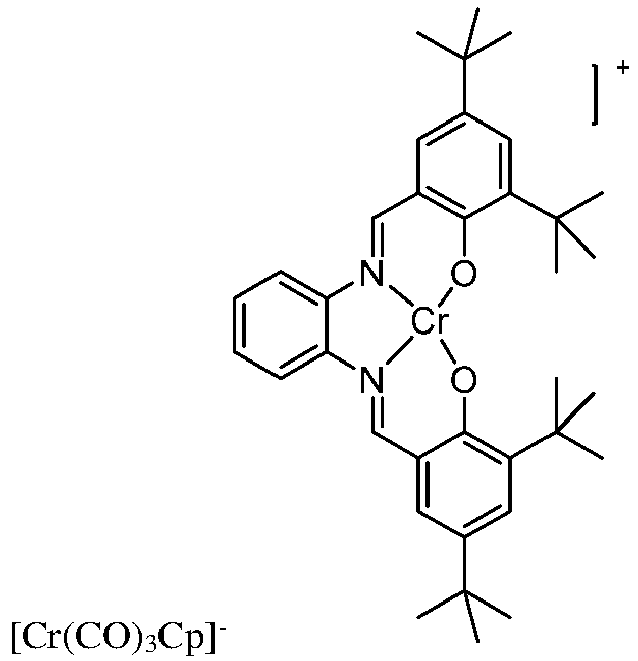


- In einer besonders bevorzugten Ausführungsform des erfindungsgemäßen Verfahrens weist das Katalysatorsystem die Struktur (VII) und/oder (VIII) und ganz besonders bevorzugt die Struktur (VII) auf.
- Das erfindungsgemäße Epoxid kann ein Epoxid mit 2-45 Kohlenstoffatomen sein. In einer bevorzugten Ausführungsform des Verfahrens wird das Epoxid ausgewählt aus mindestens einer Verbindung der Gruppe bestehend aus Ethylenoxid, Propylenoxid, 1-Butenoxid, 2,3-Butenoxid, 2-Methyl-1,2-propenoxid (Isobutenoxid), 1-Pentenoxid, 2,3-Pentenoxid, 2-Methyl-1,2-butenoxid, 3-Methyl-1,2-butenoxid, Epoxide von C6-C22 α-Olefinen, wie 1-Hexenoxid, 2,3-Hexenoxid, 3,4-Hexenoxid, 2-Methyl-1,2-pentenoxid, 4-Methyl-1,2-pentenoxid, 2-Ethyl-1,2-butenoxid, 1-Heptenoxid, 1-Octenoxid, 1-Nonenoxid, 1-Decenoxid, 1-Undecenoxid, 1-Dodecenoxid, 4-Methyl-1,2-pentenoxid, Cyclopentenoxid, Cyclohexenoxid, Cycloheptenoxid, Cyclooctenoxid, Styroloxid, Methylstyroloxid, Pinenoxid, Allylglycidylether, Vinylcyclohexenoxid, Cyclooctadienmonoepoxid, Cyclododecatrienmono-epoxid, Butadienmonoepoxid, Isoprenmonoepoxid, Limonenoxid, 1,4-Divinylbenzolmonoepoxid, 1,3-Divinylbenzolmonoepoxid, Glycidylacrylat Benzoloxid, Nahthalenoxid und Glycidylmethacrylat ein- oder mehrfach epoxidierte Fette als Mono-, Di- und Triglyceride, epoxidierte Fettsäuren, C1-C24-Ester epoxidierter Fettsäuren, Epichlorhydrin, Glycidol, und Derivate des Glycidols wie beispielsweise Glycidylether von C1-C22 Alkanolen, Glycidylester von C1-C22 Alkancarbonsäuren. Beispiele für Derivate des Glycidols sind Phenylglycidylether, Kresylglycidylether, Methylglycidylether, Ethylglycidylether und 2-Ethylhexylglycidylether.
- In einer besonders bevorzugten Ausführungsform des Verfahrens ist das Epoxid Ethylenoxid und/oder Propylenoxid.
- In einer Ausführungsform des erfindungsgemäßen Verfahrens wird das Carbonylierungsverfahren Gegenwart eines Suspensionsmittels, bevorzugt eines ein aprotischen Suspensionsmittel durchgeführt.
- Die erfindungsgemäß eingesetzten Suspensionsmittel enthalten keine H-funktionellen Gruppen. Als Suspensionsmittel sind alle polar-aprotischen, schwach polar-aprotischen und unpolar-aprotischen Lösungsmittel geeignet, die jeweils keine H-funktionellen Gruppen enthalten. Als Suspensionsmittel können auch eine Mischung aus zwei oder mehrerer dieser Suspensionsmittel eingesetzt werden. Beispielhaft seien an dieser Stelle folgende polar-aprotischen Lösungsmittel genannt: 4-Methyl-2-oxo-1,3-dioxolan (im Folgenden auch als cyclisches Propylencarbonat oder cPC bezeichnet), 1,3-Dioxolan-2-on (im Folgenden auch als cyclisches Ethylencarbonat oder cEC bezeichnet), Methylformiat, Ethylformiat, Isopropylformiat, Propylformiat, Ethylacetat, Isopropylacetat, n-Butylacetat, Oxalsäuremethylester, 2,2-Diemthoxypropan, Aceton, Methylethylketon, Acetonitril, Benzonitril, Diethylcarbonat, Diemethylcarbonat, Nitromethan, Dimethylsulfoxid, Sulfolan, Dimethylformamid, Dimethylacetamid und N-Methylpyrrolidon.
- Zu der Gruppe der unpolar- und schwach polar-aprotischen Lösungsmittel zählen z.B. Ether, wie z.B. Dioxolan, Dioxan, Diethylether, Methyl-tert-Butylether, Ethyl-tert-Butylether, tert-Amylmethylether, Butylmethylether, Methylpropylether, Dimethylether, Diisopropylether, Ethylmethylether, Methylphenylether, Dimethoxymethan, Diethoxymethan, Diemethoxyethan (Glyme), [12]Krone-4, Cyclopentylmethylether, Triglyme, Tetraglyme, Diethylenglycoldibutylether, 2-Methyltetrahydrofuran und Tetrahydrofuran, Ester, wie z.B. Essigsäureethylester und Essigsäurebutylester, Kohlenwasserstoffe, wie z.B. Pentan, n-Hexan, Benzol und alkylierte Benzolderivate (z.B. Toluol, Xylol, Ethylbenzol) und chlorierte Kohlenwasserstoffe, wie z.B., Chloroform, Chlorbenzol, Dichlorbenzol, Fluorbenzol, Difluorbenzol, Methylenechlorid, und Tetrachlorkohlenstoff. Bevorzugt als Suspensionsmittel werden 4-Methyl-2-oxo-1,3-dioxolan, 1,3-Dioxolan-2-on, 2-Methyltetrahydrofuran, Tetrahydrofuran, Dioxane, Diemethoxyethan (Glyme), Diethylether, Ethylacetat, Methylethylketon, N-Methylpyrrolidon, Acetonitril, Sulfolan, Dimethylsulfoxid, Dimethylformamid, Toluol, Xylol, Ethylbenzol, Dichlorbenzol, Fluorbenzol, Chlorbenzol und Difluorbenzol sowie Mischungen zweier oder mehrerer dieser Suspensionsmittel eingesetzt, besonders bevorzugt ist 4-Methyl-2-oxo-1,3-dioxolan, 1,3-Dioxolan-2-on, 2-Methyltetrahydrofuran, Tetrahydrofuran, Diemethoxyethan (Glyme), Diethylether, Ethylacetat, Acetonitril, Toluol, Dichlorbenzol, Fluorbenzol, Chlorbenzol und Difluorbenzol sowie Mischungen zweier oder mehrerer dieser Suspensionsmittel.
- In einer Ausführungsform erfindungsgemäßen Verfahrens wird das Verfahren bei einem CO-Partialdruck von 60 bis 130 bara bevorzugt von 70 bis 120 bara und besonders bevorzugt von 100 bis 120 bara durchgeführt.
- In einer Ausführungsform erfindungsgemäßen Verfahrens wird das Verfahren bei Temperaturen von 0 °C bis 200 °C bevorzugt 60-190 und besonders bevorzugt 80-180 °C durchgeführt
- Ein weiterer Gegenstand der vorliegenden Erfindung sind Carbonylierungsprodukte durch Umsetzung von Epoxiden mit Kohlenstoffmonoxid nach dem erfindungsgemäßen Verfahren, wobei der molare Anteil an cyclischen Anhydriden bezogen auf das eingesetzte Epoxid weniger als 5 mol% beträgt, wobei der Anteil an cyclischen Anhydriden mittels der im Experimentalteil offenbarten 1H-NMR Methode bestimmt wurde.
- Hierbei sind unter Carbonylierungsprodukten Umsetzungsprodukte von Epoxiden mit Kohlenstoffmonoxid wie beispielsweise 4-Ring-Lactone, beta-Butyrolacton als Reaktionsprodukt von Propylenoxid und CO und Propiolacton als Reaktionsprodukt von Ethylenoxid und CO, als auch Polyhydroxyalkanoate als Polymerisationsprodukt von 4-Ring-Lactonen, insbesondere Polyhydroxybutyrat aus beta-Butyrolacton und Polyhydroxypropionat aus Propiolacton sowie deren Copolymere, die neben den genannten Polyester-Wiederholungseinheiten auch Polyether-Wiederholungeinheiten aufweisen, zu verstehen. Erfindungsgemäß sind unter Carbonylierungsprodukten auch Umsetzungsprodukte von Epoxiden mit Kohlenstoffmonoxid zu entsprechenden cyclischen Esterether-Verbindungen insbesondere Dioxepanon- und Dioxocanedion-Verbindungen insbesondere 1,4-Dioxepan-5-on, 2,7-Dimethyl-1,4-dioxepan-5-on, 2,6-Dimethyl-1,4-dioxepan-5-on, 3,6-Dimethyl-1,4-dioxepan-5-on, 3,7-Dimethyl-1,4-dioxepan-5-on, 1,5-Dioxocane-2,6-dion, 3,8-Dimethyl-1,5-dioxocane-2,6-dion, 3,7-Dimethyl-1,5-dioxocane-2,6-dion und 4,8-Dimethyl-1,5-dioxocane-2,6-dion.
- Hierbei kann Polyhydroxybutyrat (kurz: PHB)-


- Ein weiterer Gegenstand der vorliegenden Erfindung ist ein Verfahren zur Herstellung von Carbonylierungsfolgeprodukten, bevorzugt Polyurethanen, durch Umsetzung der erfindungsgemäßen Carbonylierungsprodukte mit Epoxiden, Polyisocyananten und/oder Polycarbonsäuren, bevorzugt mit Polyisocyanaten.
- Auch die Verwendung der erfindungsgemäßen Vanadium-basierten, Chrom-basierten, Mangan-basierten und/oder Wolfram-basierten Verbindung bevorzugt Wolfram-basierten Verbindung enthaltenden Katalysatorsystems für die Carbonylierung von Epoxiden sind ein Gegenstand der vorliegenden Erfindung.
- Argon, kurz Ar, 99,998 %, Westfalen AG
Deuteriertes Chloroform, CDCl3, 99,8 %, Eurisotop
Deuteriertes Tetrahydrofuran, THF-d8, 99,5 %, Eurisotop
ARCOL® POLYOL 1004, kurz: PET 1004, Covestro Deutschland AG
beta-Butyrolacton, kurz: bBL, 98 %, Sigma Aldrich Chemie GmbH
Toluol, trocken, 99,85 %, Acros Organics
Methanol, trocken, 99,8 %, Acros Organics
Trifluormethansulfonsäure, kurz: TfOH, 98 %, Alfa Aesar
Silicagel 60, kurz: SiO2, Sigma Aldrich Chemie GmbH
3,5-Di-tert-butylsalicyladehyde, Sigma Aldrich Chemie GmbH
Chrom(II) chlorid, CrCl2, trocken, 99,9 %, Strem Chemicals, Inc.
Tetrahydrofuran, kurz: THF, trocken, 99,5 %, Acros Organics
Celite® 545, kurz: Celite, Acros Organics
n-Pentan, kurz: Pentan, trocken, 99 %, Acros Organics
Naphthalin, kurz: Nap, 99 %, Sigma Aldrich Chemie GmbH
Kohlenmonoxid, kurz: CO, 99,9 %, Paxair Deutschland GmbH
Propylenoxid, kurz: PO, 99,5 %, Sigma Aldrich Chemie GmbH
Dimethoxyethan, kurz: DME, trocken, 99,5 %, Acros Organics
Molsieb 3 Å, getrocknetes, Sigma Aldrich Chemie GmbH
Kaliumgraphit, KC8, Strem Chemicals Inc.
Wolframhexacarbonyl, W(CO)6, 97%, Sigma Aldrich Chemie GmbH
Natriumhydroxid, NaOH, Honeywell
Dicobaltoctacarbonyl, Co2(CO)8, ≥90 % (1-10 % Hexan), Sigma Aldrich Chemie GmbH - Alle Flüssigkeiten wurden durch mehrfache Gefrier-Pump-Tau-Zyklen entgast und unter AR-Schutzgasatmosphäre gelagert. Feststoffe wurden unter Vakuum entgast und ebenfalls unter Ar-Schutzgasatmosphäre gelagert. Propylenoxid wurde durch mehrfache Gefrier-Pump-Tau-Zyklen entgast und unter Ar-Schutzgasatmosphäre und über 3 Å Molsieb bei 0 °C gelagert. Naphthalin wurde sublimiert und unter Vakuum in einer Glovebox gelagert.
- Alle IR-Messungen wurden auf einem Bruker Alpha-PFT-IR Spektrometer durchgeführt. Falls nötig wurden die Messungen unter Ar-Schutzgas durchgeführt. Für alle gemessenen Spektren wurde eine automatische Basislinienkorrektur vorgenommen. Für weitere Details zur IR-Analytik der Produktgemische siehe unten "Quantitative IR-Analytik".
- NMR-Spektren wurden auf einem Bruker AV400 oder AV300 Spektrometer bei Raumtemperatur aufgenommen. 1H-NMRs wurden bei 400 bzw. 300 MHz gemessen, 13C-NMRs dementsprechend bei 100 bzw. 75 MHz. Die 1H- und 13C-NMR Signale sind gegen CHCl3 bzw. TMS referenziert.
- Zur Kalibrierung der quantitativen IR wurden Gemisch aus Polyhydroxybutyrat und Polyether mit 0-25 wt.-% Polyhydroxybutyrat-Anteil angefertigt und vermessen. Die Kalibrierungsgerade ergibt sich aus der Auftragung der relativen Absorbanz gegen den relativen Gewichtsanteil an Polyhydroxybutyrat. Die relativen Absorbanz wird aus dem Verhältnis der Absorbanz der C=O Bande zu dem der C-O Bande bestimmt. Der relative Massenanteil (in wt.-%) an Polyhydroxybutyrat- zu Polyether-Wiederholungseinheiten - in nicht flüchtigen Reaktionsrückständen (vgl. Allgemeine Versuchsvorschrift) - wurde somit wie folgt berechnen: w(Polyhydroxybutyrat) = relativen Absorbanz/0,0145. Analog wurde für Polyhydroxypropionat vorgegangen. Der relative Massenanteil (in wt.-%) an Polyhydroxypropionat- zu Polyether-Wiederholungseinheiten - in nicht flüchtigen Reaktionsrückständen (vgl. Allgemeine Versuchsvorschrift) - wurde somit wie folgt berechnen: w(Polyhydroxypropionat) = relativen Absorbanz/0,053.
- Als Polyether-Refrenzpolymer für die quantitative IR und NMR-Analytik wurde ARCOL® POLYOL 1004 (kurz PET 1004) der Fa. Covestro verwendet. Es handelt sich dabei um ein bifunktionelles Polyetherpolyol auf Basis von PO mit einem mittleren MW von ca. 435 g/mol.
- IR: v = 1087 (C-O) cm-1.
1H NMR (CDCl3, 7.26 ppm): 1.07-1.16 (m, CH3), 3.14-3.92 (m, CH, CH2);
13C NMR (CDCl3, 77.16 ppm): 17.0-18.6, 65.7-67.3, 73.4-76.1 ppm - Die Synthese von Polyhydroxybutyrat (kurz PHB) als Referenzpolymer für die quantitative IR und NMR-Analytik erfolgt in Anlehnung an Tetrahedron Asymmetry, 2003, 14, 3249-3252 bzw. Polym. Chem., 2014, 5, 161-168. Unter Ar-Schutzgasatmosphäre wurden 3,8 mL β-Butyrolacton und 40 mL Toluol in einen Schlenkkolben vorgelegt, mit je 0,07 mL Methanol und Trifluormethansulfonsäure versetzt und anschließend bei 30 °C für 2 h gerührt. Anschließend wurde mit 0,15 mL Diisopropylethylamin gequencht, am Rotationsverdampfer eingeengt, säulenchromatographisch aufgereinigt (stationäre Phase: SiO2, Laufmittel: DCM/MeOH 20:1 v/v) und von Lösungsmittel befreit. Das Referenzpolymer PHB wurde final am Hochvakuum getrocknet und mittels IR und NMR analysiert.

- IR: v = 1731 (C=O) cm-1.
1H NMR (CDCl3, 7.26 ppm): 5.25 (s, CH), 3.67 (s, OCH3) 2.4-2.63 (d, CH2), 1.25-1.28 (d, CH3) ppm.
13C NMR (CDCl3, 77.16 ppm): 20.0 (CH3), 41.0 (CH2), 67.8 (CH), 169.4 (C=O) ppm. - Die Synthese des Salphen-Komplexes Salz A erfolgte nach Jiang et al. in Top. Catal., 2017, 60, 750-754 und eine isolierter Ausbeute von 77 % wurde erhalten.

- Zu der festen Mischung aus W(CO)6 (0,26 g, 0,75 mmol) und Salphen-Komplexes Salz A (0,47 g, 0,75 mmol) in einem Schlenkkolben wurde unter Ar-Atmosphäre THF (20 ml) zugegeben. Das Reaktionsgemisch wurde 64 h unter Rückfluss erhitzt. Anschließend wurde der Kolben auf RT abgekühlt. Das gewonnene Reaktionsgemisch wurde mithilfe eine Glasfaserfilterkanülen transferiert, um unlösliche Materialien zu entfernen. Anschließend wurde das Lösungsmittel im Vakuum entfernt, mit Hexan gewaschen (2 x 15 mL) und anschließend im Vakuum getrocknet. Man erhielt Katalysator-System 1 (0,43 g, 0,40 mmol, 53 %). FT-IR (ATR unter Luftatmosphäre):2041, 1929, 1867 (C=O) cm-1

- Die Synthese von Katalysator-System 2 erfolgte in Anlehnung an die Literatur. Dabei wurde eine Mischung aus W(CO)6 und 2,2'-Bipyridin in Toluol refluxiert. Das feste Produkt (0,2 g, 0,44 mmol) und KC8 (0,08 g, 0,59 mmol) wurden in einem Schlenkkolben unter Ar-Atmosphäre bei -40 °C in THF (150 mL) zur Reaktion gebracht. Das resultierende Reaktionsgemisch wurde auf RT erwärmt und 1 h gerührt. Dann wurde Salphen-Komplexes Salz A (0,28 g, 0,44 mmol) bei RT zugegeben und 17 h weitergerührt. Nach der Umsetzung wurde das Lösungsmittel entfernt, mit Pentan gewaschen und mit THF extrahiert. Die Lösung wurde durch Celite filtriert. Anschließend wurde das Lösungsmittel im Vakuum entfernt, woraus Katalysator-System 2 als rotbrauner Feststoff (0,28 g, 0,24 mmol, 54 %) resultierte. FT-IR (ATR unter Ar-Atmosphäre): 2003, 1861, 1805 (C=O) cm-1

- Die Synthese des Katalysator-Systems 3 erfolgte nach Kramer et al. in Org. Lett., 2006, 8, 3709-3712 und eine isolierter Ausbeute von 68 % wurde erhalten.

- Katalysator-System, Suspensionsmittel, Naphthalin als interner Standard und Epoxid wurden unter Ar-Schutzgasgegenstrom in ein Schlenkrohr eingewogen und gerührt. Das Gesamtvolumen des Gemischs betrug 2-5 mL. Dieses Gemisch wurde nun vollständig unter einem leichten CO-Gasgegenstrom in einen 10 mL-Druckreaktor überführt. Der gewünschte CO-Vordruck wurde unter Rühren eingestellt, auf Reaktionstemperatur aufgeheizt und der Anfangsdruck bei Reaktionstemperatur bestimmt. Am Ende der Reaktionszeit wurde der Enddruck bei Reaktionstemperatur bestimmt und der Druckreaktor anschließend mit Hilfe eines Wasser/Eis-Gemischs abgekühlt. Der verbleibende Restdruck wurde langsam abgelassen und unverzüglich eine Probe des Reaktionsgemischs zur Analyse entnommen. Ein Teil der Probe wurde nach Filtration über eine Kurzwegsäule mit Celite als stationäre Phase mittels NMR und GC analysiert. Ein anderer Teil der Probe wurde unter Vakuum von flüchtigen Bestandteilen befreit und mittels quantitativer IR und NMR analysiert. Die Polymerausbeute wurde gravimetrisch unter Berücksichtigung des zurückbleibenden Katalysators bestimmt. Die flüchtigen Bestandteile wurden dabei mit Hilfe einer Kühlfalle aufgefangen, Naphthalin als externer Standard zugegeben und das Gemisch ebenfalls analysiert.
- Der Versuch wurde wie in der allgemeinen Versuchsvorschrift beschrieben durchgeführt. 1 mol% des Katalysator-Systems 1, DME als Suspensionsmittel, Naphthalin als interner Standard (0,009 mmol) und PO (0,924 mmol, 0,9 M) wurden eingesetzt. Die Reaktion wurde bei 150 °C, 80 bar Anfangsdruck und 19 h Reaktionszeit durchgeführt. Ein PO-Umsatz von 95 % wurde mittels NMR im Reaktionsgemisch bestimmt. Die nichtflüchtigen Bestandteile des Reaktionsgemisches wurden isoliert und analysiert. Es wurden ein Gehalt an 5,5 wt.-% PHB im polymeren Produkt bestimmt.
- Der Versuch wurde wie in der allgemeinen Versuchsvorschrift beschrieben durchgeführt. 1 mol% des Katalysator-Systems 2, THF als Suspensionsmittel, Naphthalin als interner Standard (0,009 mmol) und PO (0,924 mmol, 0,9 M) wurden eingesetzt. Die Reaktion wurde bei 150 °C, 112 bar Anfangsdruck und 24 h Reaktionszeit durchgeführt. Ein PO-Umsatz von 64 % wurde mittels NMR im Reaktionsgemisch bestimmt. Die nichtflüchtigen Bestandteile des Reaktionsgemisches wurden isoliert und analysiert. Es wurde eine Polymerausbeute von 24 % mit einem Anteil an 33,3 wt.-% PHB im polymeren Produkt bestimmt.
- Der Versuch wurde wie in der allgemeinen Versuchsvorschrift beschrieben durchgeführt. 1 mol% des Katalysator-Systems 3, THF, Naphthalin als interner Standard (0,2 mmol) und PO (2 mmol, 0,9 M) wurden eingesetzt. Die Reaktion wurde bei 120 °C, 82 bar Anfangsdruck und 15 h Reaktionszeit durchgeführt. Ein PO-Umsatz von 100 %, die Bildung von 77 % Methylbernsteinsäureanhydrid und 2 % Aceton konnte mittels NMR im Reaktionsgemisch nachgewiesen werden. Es konnten lediglich Spuren von Polymer und kein PHB nachgewiesen werden.
- Die Charakterisierung und Quantifizierung von Methylbernsteinsäureanhydrid erfolgt anhand der spezifischen 1H-NMR-Signale und deren Integralen im Verhältnis zum eingesetzten PO/internen Standard:
- 1H NMR (CDCl3, 7.26 ppm): 1.42 (d, CH3), 2.57-2.67 (m, CH), 3.11-3.23 (m, CH2) ;
- 13C NMR (CDCl3, 77.16 ppm): 16.1, 35.7, 36.1, 170.1, 174.6


Claims (15)
- Verfahren zur Carbonylierung von Epoxiden in Gegenwart von Katalysator-Systemen, wobei die Carbonylierung in Gegenwart von Kohlenmonoxid erfolgt, dadurch gekennzeichnet, dass das Katalysatorsystem eine Vanadium-basierte, Chrom-basierte, Mangan-basierte und/oder Wolfram-basierte Verbindung bevorzugt Wolfram-basierte Verbindung enthält.
- Verfahren gemäß Anspruch 1, wobei die Vanadium-basierte, Chrom-basierte, Mangan-basierte und/oder Wolfram-basierte Verbindung bevorzugt Wolfram-basierte Verbindung ein oder mehrere Carbonyl-Liganden bevorzugt ein bis sechs Carbonyl-Liganden, besonders bevorzugt zwei bis fünf Carbonyl-Liganden enthält.
- Verfahren gemäß Anspruch 1 oder 2, wobei die Vanadium-basierte, Chrom-basierte, Mangan-basierte und/oder Wolfram-basierte Verbindung bevorzugt Wolfram-basierte Verbindung einen weiteren Liganden (L) ungleich des Carbonyl-Liganden aufweist.
- Verfahren gemäß Anspruch 3, wobei der Ligand (L) eine oder mehrere Verbindung(en) ist und ausgewählt wird aus der Gruppe bestehend aus H, F, Cl, Br, I, CN, NC, SCN, N3, NO2, NO3, NH2, OTf, OAc, OH, HSO4, η3-C3H5, Butadiene (C4C6), Cyclopentadienyl (Cp, η5-C5H5), Pentamethylcyclopentadienyl (Cp*, η5-C5Me5), C(Ph)(Ph) (als Fischer-Carben), C(OMe)(Ph) (als Fischer-Carben), C(OEt)(NHPh) (als Fischer-Carben), 1,3-Dimesitylimidazol-2-ylidene (IMes, NHC-Carben), 1,3-Bis(2,4,6-trimethylphenyl)-4,5-dihydroimidazol-2-ylidene (SIMes, NHC-Carben), NH3, Ethylendiamin (eda), Diethylentriamin, Tetramethylethylendiamin, Anilin, Pyridin, 2,2'-Bipyridin (bipy), PPh3, PMe3, PEt3, PBu3, PH3, P(OMe)3, P(OEt)3, Diethylether, THF und 2-Me-THF, bevorzugt H, F, Cl, Br, I, CN, NC, SCN, N3, NO2, NO3, NH2, OTf, OAc, η3-C3H5, Butadiene (C4C6), Cyclopentadienyl (Cp, η5-C5H5), Pentamethylcyclopentadienyl (Cp∗, η5-C5Me5), C(Ph)(Ph) (als Fischer-Carben), C(OMe)(Ph) (als Fischer-Carben), C(OEt)(NHPh) (als Fischer-Carben), 1,3-Dimesitylimidazol-2-ylidene (IMes, NHC-Carben), 1,3-Bis(2,4,6-trimethylphenyl)-4,5-dihydroimidazol-2-ylidene (SIMes, NHC-Carben), Ethylendiamin (eda), Diethylentriamin, Tetramethylethylendiamin, Anilin, Pyridin, 2,2'-Bipyridin (bipy), PPh3 und PMe3, besonders bevorzugt H, F, Cl, Br, I, CN, NC, SCN, N3, OTf, Cyclopentadienyl (Cp, η5-C5H5), Pentamethylcyclopentadienyl (Cp*, η5-C5Me5), C(Ph)(Ph) (als Fischer-Carben), C(OMe)(Ph) (als Fischer-Carben), C(OEt)(NHPh) (als Fischer-Carben), 1,3-Dimesitylimidazol-2-ylidene (IMes, NHC-Carben) und 1,3-Bis(2,4,6-trimethylphenyl)-4,5-dihydroimidazol-2-ylidene (SIMes, NHC-Carben), ganz besonders bevorzugt Cl, Br, I, Ethylendiamin (eda), 2,2'-Bipyridin (bipy), Cyclopentadienyl (Cp, η5-C5H5) und Pentamethylcyclopentadienyl (Cp*, η5-C5Me5).
- Verfahren gemäß einem der Ansprüche 1 bis 4 wobei das Katalysator-System eine zusätzliche Lewis Säure enthält.
- Verfahren gemäß Anspruch 5, wobei die Lewis-Säure kationisch oder ladungsneutral, bevorzugt kationisch ist.
- Verfahren gemäß Anspruch 6, wobei die Lewis-Säure kationisch ist
- Verfahren gemäß Anspruch 7, wobei die kationische Lewis-Säure ein unsubstituiertes Dicyclopentadienyl-Metall-Kation, ein substituiertes Dicyclopentadienyl-Metall-Kation, ein unsubstituiertes Metall-Porphyrin-Kation, ein substituiertes Metall-Porphyrin-Kation, ein unsubstituiertes Metall-Salen-Kation, ein substituiertes Metall-Salen-Kation, ein unsubstituiertes Metall-Salphen-Kation und/oder ein und substituiertes Metall-Salphen-Kation ist.
- Verfahren gemäß einem der Ansprüche 1 bis 8, wobei die Vanadium-basierte, Chrom-basierte, Mangan-basierte und/oder Wolfram-basierte Verbindung bevorzugt Wolfram-basierte Verbindung anionisch ist.
- Verfahren gemäß einem der Ansprüche 1 bis 9, wobei das Katalysatorsystem die Struktur (I), (II), (III), (IV), (V) und/oder (VI) aufweist:
 mit L = H, F, Cl, Br, I, CN, NC, SCN, NCS, CP, N3, NO2, NO3, NH2, OTf, OH, HSO4, eda oder bipy bevorzugt H, F, Cl, Br, I, CN, N3, OTf, eda oder bipy ganz besonders bevorzugt Cl, Br, eda oder bipy;mit M = Cr(III), Al(III), Fe(III), Co(III), Mn(III), V(III), In(III), Ga(III), Y(III), Ru(III), La(III), Ce(III), Gd(III) oder Ir(III), bevorzugt Cr(III), Al(III), Fe(III), Co(III), Mn(III), oder Ga(III), ganz besonders bevorzugt Cr(III) oder Al(III);mit M' = V, Cr, Mn oder W bevorzugt W;mit R1 und R2 unabhängig voneinander ausgewählt aus der Gruppe von Wasserstoff (-H), Methyl, tert. Butyl, Phenyl, Nitro, Brom, Chlor, Hydroxy, Diethylamino und Methoxy bevorzugt R1 gleich R2 ausgewählt aus der Gruppe von Wasserstoff (-H), Methyl oder tert. Butyl, ganz besonders bevorzugt tert. Butyl;
 mit L = H, F, Cl, Br, I, CN, NC, SCN, NCS, CP, N3, NO2, NO3, NH2, OTf, OH, HSO4, eda oder bipy bevorzugt H, F, Cl, Br, I, CN, N3, OTf, eda oder bipy ganz besonders bevorzugt Cl, Br, eda oder bipy;mit M = Cr(III), Al(III), Fe(III), Co(III), Mn(III), V(III), In(III), Ga(III), Y(III), Ru(III), La(III), Ce(III), Gd(III) oder Ir(III), bevorzugt Cr(III), Al(III), Fe(III), Co(III), Mn(III), oder Ga(III), ganz besonders bevorzugt Cr(III) oder Al(III);mit M' = V, Cr, Mn oder W bevorzugt W;mit R ausgewählt aus der Gruppe von Wasserstoff (-H), Methyl, tert. Butyl, Methoxy, Phenyl, 4-Methylphenyl, 4-Methoxyphenyl, 4-Chlorphenyl, 4-Bromphenyl, 4-Carboxylphenyl, 3,5-Dimethoxyphenyl, 2-Pyridyl, 4-Pyridyl und N-Methyl-4-pyridyl, bevorzugt tert. Butyl, Methoxy, Phenyl, 4-Methylphenyl, 4-Methoxyphenyl, 4-Chlorphenyl oder 3,5-Dimethoxyphenyl, ganz besonders bevorzugt Phenyl.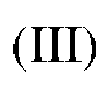
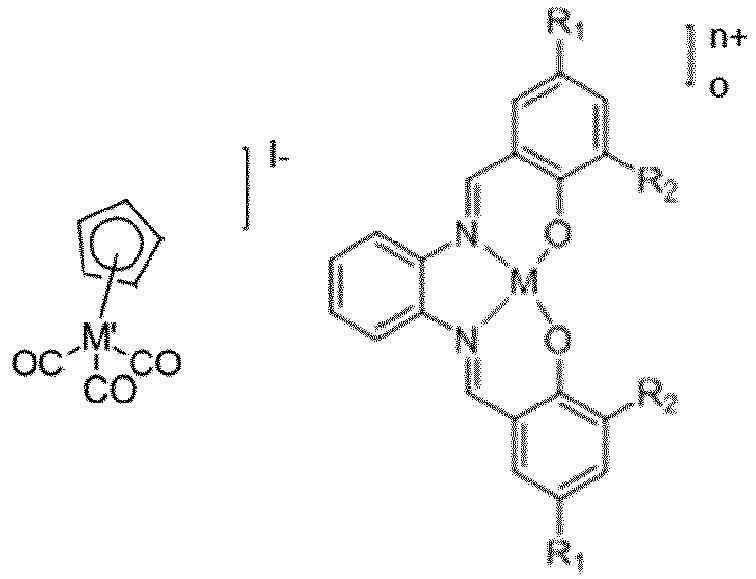 mit M = Cr(III), Al(III), Fe(III), Co(III), Mn(III), V(III), In(III), Ga(III), Y(III), Ru(III), La(III), Ce(III), Gd(III) oder Ir(III), bevorzugt Cr(III), Al(III), Fe(III), Co(III), Mn(III), oder Ga(III), ganz besonders bevorzugt Cr(III) oder Al(III);mit M' = V, Cr, Mn oder W bevorzugt W;mit R1 und R2 unabhängig voneinander ausgewählt aus der Gruppe von Wasserstoff (-H), Methyl, tert. Butyl, Phenyl, Nitro, Brom, Chlor, Hydroxy, Diethylamino und Methoxy bevorzugt R1 gleich R2 ausgewählt aus der Gruppe von Wasserstoff (-H), Methyl oder tert. Butyl, ganz besonders bevorzugt tert. Butyl;
 mit M = Cr(III), Al(III), Fe(III), Co(III), Mn(III), V(III), In(III), Ga(III), Y(III), Ru(III), La(III), Ce(III), Gd(III) oder Ir(III), bevorzugt Cr(III), Al(III), Fe(III), Co(III), Mn(III), oder Ga(III), ganz besonders bevorzugt Cr(III) oder Al(III);mit M' = V, Cr, Mn oder W bevorzugt W;mit R1 und R2 unabhängig voneinander ausgewählt aus der Gruppe von Wasserstoff (-H), Methyl, tert. Butyl, Phenyl, Nitro, Brom, Chlor, Hydroxy, Diethylamino und Methoxy bevorzugt R1 gleich R2 ausgewählt aus der Gruppe von Wasserstoff (-H), Methyl oder tert. Butyl, ganz besonders bevorzugt tert. Butyl;
 mit L = H, F, Cl, Br, I, CN, NC, SCN, NCS, CP, N3, NO2, NO3, NH2, OTf, OH, HSO4, eda oder bipy bevorzugt H, F, Cl, Br, I, CN, N3, OTf, eda oder bipy ganz besonders bevorzugt Cl, Br, eda oder bipy;mit Q = Li, Na, K, Rb, Cs, Cu oder Ag, bevorzugt Li, Na, K oder Rb, ganz besonders bevorzugt K;mit M' = V, Cr, Mn oder W bevorzugt W;mit n = 1-5, bevorzugt 2-5, ganz besonders bevorzugt 3;und/oder
 mit L = H, F, Cl, Br, I, CN, NC, SCN, NCS, CP, N3, NO2, NO3, NH2, OTf, OH, HSO4, eda oder bipy bevorzugt H, F, Cl, Br, I, CN, N3, OTf, eda oder bipy ganz besonders bevorzugt Cl, Br, eda oder bipy;mit M' = V, Cr, Mn oder W bevorzugt W.
 - Verfahren gemäß einem der Ansprüche 1 bis 10, wobei das Katalysatorsystem die Struktur (VII), (VIII), (IX), (X), (XI), (XII), (XIII) und/oder (XIV) aufweist:


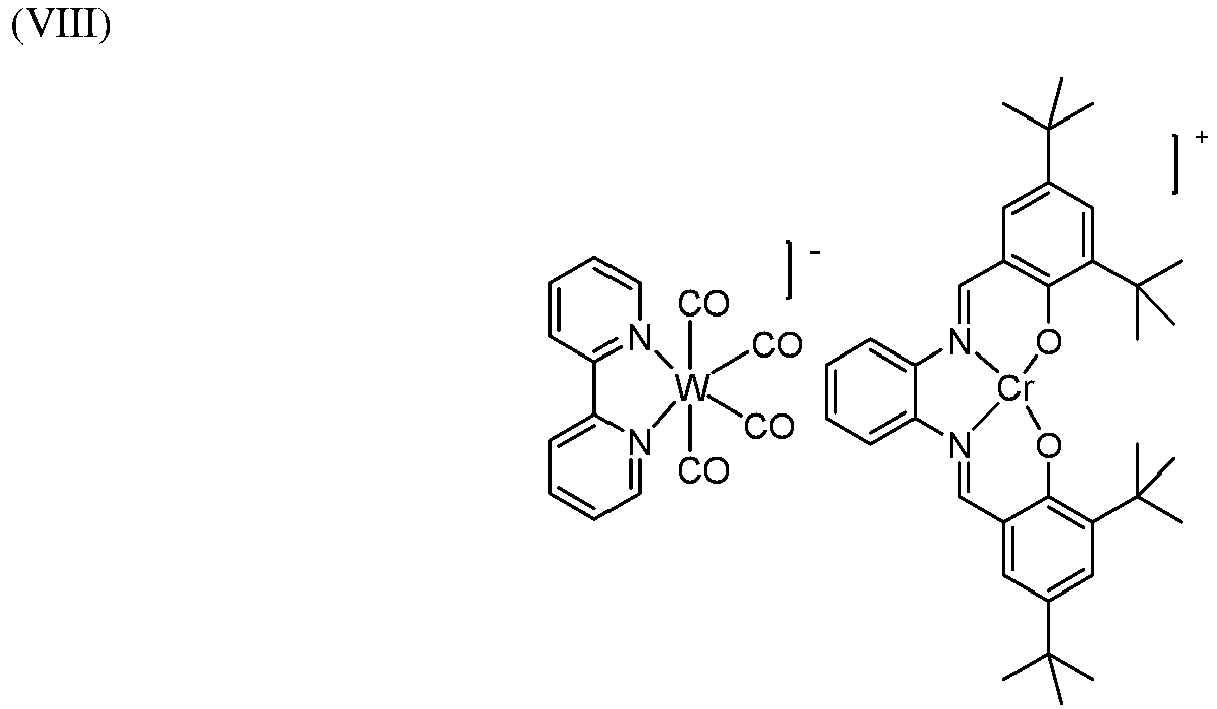


- Verfahren gemäß einem der Ansprüche 1 bis 11, wobei das Katalysatorsystem die Struktur (VII) und/oder (VIII) aufweist.
- Carbonylierungsprodukte erhältlich nach mindestens einem der Ansprüche 1 bis 12, wobei der molare Anteil an cyclischen Anhydriden bezogen auf das eingesetzte Epoxid weniger als 5 mol% beträgt, wobei der Anteil an cyclischen mittels der im Experimentalteil offenbarten 1H-NMR Methode bestimmt wurde.
- Verfahren zur Herstellung von Carbonylierungsfolgeprodukten, bevorzugt Polyurethanen, durch Umsetzung der Carbonylierungsprodukte gemäß Anspruch 13 mit Epoxiden, Polyisocyananten und/oder Polycarbonsäuren, bevorzugt mit Polyisocyanaten.
- Verwendung des Katalysator-Systems enthaltend der Chrom-basierten, Mangan-basierten und/oder Wolfram-basierten Verbindung bevorzugt Wolfram-basierten Verbindung gemäß einem der Ansprüche 1 bis 12 zur Carbonylierung von Epoxiden.
Priority Applications (2)
| Application Number | Priority Date | Filing Date | Title |
|---|---|---|---|
| EP20214190.9A EP4015077A1 (de) | 2020-12-15 | 2020-12-15 | Verfahren zur carbonylierung von epoxiden |
| US17/540,601 US20220185833A1 (en) | 2020-12-15 | 2021-12-02 | Process for the carbonylation of epoxides |
Applications Claiming Priority (1)
| Application Number | Priority Date | Filing Date | Title |
|---|---|---|---|
| EP20214190.9A EP4015077A1 (de) | 2020-12-15 | 2020-12-15 | Verfahren zur carbonylierung von epoxiden |
Publications (1)
| Publication Number | Publication Date |
|---|---|
| EP4015077A1 true EP4015077A1 (de) | 2022-06-22 |
Family
ID=74141266
Family Applications (1)
| Application Number | Title | Priority Date | Filing Date |
|---|---|---|---|
| EP20214190.9A Withdrawn EP4015077A1 (de) | 2020-12-15 | 2020-12-15 | Verfahren zur carbonylierung von epoxiden |
Country Status (2)
| Country | Link |
|---|---|
| US (1) | US20220185833A1 (de) |
| EP (1) | EP4015077A1 (de) |
Citations (8)
| Publication number | Priority date | Publication date | Assignee | Title |
|---|---|---|---|---|
| DE10235316A1 (de) | 2002-08-01 | 2004-02-12 | Basf Ag | Katalysator und Verfahren zur Carbonylierung von Oxiranen |
| WO2006058681A2 (de) | 2004-11-30 | 2006-06-08 | Basf Aktiengesellschaft | Verfahren zur herstellung von enantiomerenangereicherten lactonen |
| WO2011163309A2 (en) | 2010-06-22 | 2011-12-29 | Cornell University | Carbonylative polymerization methods |
| WO2013063191A1 (en) * | 2011-10-26 | 2013-05-02 | Novomer, Inc. | Process for production of acrylates from epoxides |
| US8481756B1 (en) * | 2007-09-04 | 2013-07-09 | Cornell Research Foundation, Inc. | Succinic anhydrides from epoxides |
| JP2013173090A (ja) | 2012-02-24 | 2013-09-05 | Nippon Shokubai Co Ltd | エポキシドのラクトン化用触媒及びそれを用いたラクトン化方法 |
| WO2016015019A1 (en) | 2014-07-25 | 2016-01-28 | Novomer, Inc. | Synthesis of metal complexes and uses thereof |
| US20190076834A1 (en) * | 2017-09-11 | 2019-03-14 | Novomer, Inc. | Processes Using Multifunctional Catalysts |
-
2020
- 2020-12-15 EP EP20214190.9A patent/EP4015077A1/de not_active Withdrawn
-
2021
- 2021-12-02 US US17/540,601 patent/US20220185833A1/en not_active Abandoned
Patent Citations (8)
| Publication number | Priority date | Publication date | Assignee | Title |
|---|---|---|---|---|
| DE10235316A1 (de) | 2002-08-01 | 2004-02-12 | Basf Ag | Katalysator und Verfahren zur Carbonylierung von Oxiranen |
| WO2006058681A2 (de) | 2004-11-30 | 2006-06-08 | Basf Aktiengesellschaft | Verfahren zur herstellung von enantiomerenangereicherten lactonen |
| US8481756B1 (en) * | 2007-09-04 | 2013-07-09 | Cornell Research Foundation, Inc. | Succinic anhydrides from epoxides |
| WO2011163309A2 (en) | 2010-06-22 | 2011-12-29 | Cornell University | Carbonylative polymerization methods |
| WO2013063191A1 (en) * | 2011-10-26 | 2013-05-02 | Novomer, Inc. | Process for production of acrylates from epoxides |
| JP2013173090A (ja) | 2012-02-24 | 2013-09-05 | Nippon Shokubai Co Ltd | エポキシドのラクトン化用触媒及びそれを用いたラクトン化方法 |
| WO2016015019A1 (en) | 2014-07-25 | 2016-01-28 | Novomer, Inc. | Synthesis of metal complexes and uses thereof |
| US20190076834A1 (en) * | 2017-09-11 | 2019-03-14 | Novomer, Inc. | Processes Using Multifunctional Catalysts |
Non-Patent Citations (7)
| Title |
|---|
| CLINICAL TOXICOLOGY, vol. 37, 1999, pages 201 - 216 |
| JAIPURI F A ET AL: "Protic acid-catalyzed polymerization of @b-lactones for the synthesis of chiral polyesters", TETRAHEDRON ASYMMETRY, PERGAMON PRESS LTD, OXFORD, GB, vol. 14, no. 20, 17 October 2003 (2003-10-17), pages 3249 - 3252, XP004464038, ISSN: 0957-4166, DOI: 10.1016/J.TETASY.2003.08.025 * |
| JIANG ET AL., TOP. CATAL., vol. 60, 2017, pages 750 - 754 |
| JIANG JIANWEI ET AL: "Base Effects on Carbonylative Polymerization of Propylene Oxide with a [(salph)Cr(THF)2]+[Co(CO)4]-Catalyst", TOPICS IN CATALYSIS, BALTZER SCIENCE PUBLISHERS, BUSSUM, NL, vol. 60, no. 9, 20 April 2017 (2017-04-20), pages 750 - 754, XP036278876, ISSN: 1022-5528, [retrieved on 20170420], DOI: 10.1007/S11244-017-0783-3 * |
| KRAMER ET AL., ORG. LETT., vol. 8, 2006, pages 3709 - 3712 |
| POLYM. CHEM., vol. 5, 2014, pages 161 - 168 |
| TETRAHEDRON ASYMMETRY, vol. 14, 2003, pages 3249 - 3252 |
Also Published As
| Publication number | Publication date |
|---|---|
| US20220185833A1 (en) | 2022-06-16 |
Similar Documents
| Publication | Publication Date | Title |
|---|---|---|
| Tehrani et al. | Urea-containing metal-organic frameworks as heterogeneous organocatalysts | |
| DE69528190T2 (de) | Polymerisation von cyclischen ethern und unter anwendung der katalysatoren aus gewählten metallverbindungen | |
| Ojwach et al. | Palladium complexes of multidentate pyrazolylmethyl pyridine ligands: Synthesis, structures and phenylacetylene polymerization | |
| DE3208058C2 (de) | Verfahren zur Gewinnung von Edelmetallen aus der Gruppe VIII des Periodensystems der Elemente, die an bei edelmetallkatalysierten Carbonylierungsreaktionen anfallende Rückstände gebunden sind | |
| CN114436949B (zh) | 一种四齿配体及金属络合物及其制备方法和应用 | |
| DE69331442T2 (de) | Polymerisation von cyclischen ethern unter anwendung der katalysatoren aus gewählten metallverbindungen | |
| WO2011032666A1 (de) | Verfahren zur herstellung von verbrückten mangan-komplexen des triazacyclononans | |
| DE69727460T2 (de) | Eine verbindung, die in einer katalytischen zusammensetzung verwendbar ist | |
| EP3983470A1 (de) | Verfahren zur carbonylierung von epoxiden | |
| DE69212366T2 (de) | Katalysatorzusammensetzungen | |
| EP3023430A1 (de) | Übergangsmetall-/carbenkomplex und verfahren zur herstellung davon | |
| WO2020249433A1 (de) | Verfahren zur herstellung von polyethercarbonatpolyolen | |
| EP3573993B1 (de) | Molybdän- und wolfram-alkylidin-n-heterozyklische carben-komplexe | |
| Lehtonen et al. | Synthesis and crystal structures of bis (2, 3-dimethyl-2, 3-butanediolato)(1, 2-ethanediolato) tungsten (VI) and tris (2, 3-dimethyl-2, 3-butanediolato) tungsten (VI) | |
| WO2022228953A1 (de) | Verfahren zur carbonylierung von epoxiden | |
| DE19654961C2 (de) | Verfahren für die Herstellung von Copolymerisaten aus Kohlenmonoxid und olefinisch ungesättigten Verbindungen | |
| DE60207853T2 (de) | Einstufige herstellung von 1,3-propandiol aus ethylenoxid und syngas mit einem katalysator mit einem phospholanoalkanliganden | |
| EP2750798B1 (de) | Katalysatoren für die herstellung von carbonaten aus epoxiden und co2 | |
| EP0944638B1 (de) | Cis-verbrückte metallkomplexe | |
| WO2021249814A1 (de) | Verfahren zur herstellung von polyethercarbonatpolyolen | |
| US20220185833A1 (en) | Process for the carbonylation of epoxides | |
| DE69718878T2 (de) | Ruthenium-optisch-aktiver Phosphin-Komplex, Verfahren zur Herstellung und Verfahren zur Herstellung von optisch-aktiven 4-Methyl-2-Oxetanon unter Verwendung derselben | |
| EP4083028A1 (de) | Verfahren zur carbonylierung von epoxiden | |
| EP1071689B1 (de) | Cis-verbrückte metallkomplexe und diese enthaltende katalysatorsysteme | |
| DE19651786C2 (de) | Katalysatorsysteme für die Herstellung von Copolymerisaten aus Kohlenmonoxid und olefinisch ungesättigten Verbindungen |
Legal Events
| Date | Code | Title | Description |
|---|---|---|---|
| PUAI | Public reference made under article 153(3) epc to a published international application that has entered the european phase |
Free format text: ORIGINAL CODE: 0009012 |
|
| STAA | Information on the status of an ep patent application or granted ep patent |
Free format text: STATUS: THE APPLICATION HAS BEEN PUBLISHED |
|
| AK | Designated contracting states |
Kind code of ref document: A1 Designated state(s): AL AT BE BG CH CY CZ DE DK EE ES FI FR GB GR HR HU IE IS IT LI LT LU LV MC MK MT NL NO PL PT RO RS SE SI SK SM TR |
|
| STAA | Information on the status of an ep patent application or granted ep patent |
Free format text: STATUS: THE APPLICATION IS DEEMED TO BE WITHDRAWN |
|
| 18D | Application deemed to be withdrawn |
Effective date: 20221223 |