EP4013374B1 - Zusammensetzungen für sonnenschutzverbindungen und verfahren dafür - Google Patents
Zusammensetzungen für sonnenschutzverbindungen und verfahren dafür Download PDFInfo
- Publication number
- EP4013374B1 EP4013374B1 EP20853893.4A EP20853893A EP4013374B1 EP 4013374 B1 EP4013374 B1 EP 4013374B1 EP 20853893 A EP20853893 A EP 20853893A EP 4013374 B1 EP4013374 B1 EP 4013374B1
- Authority
- EP
- European Patent Office
- Prior art keywords
- absorbing
- compound
- conjugate
- compounds
- group
- Prior art date
- Legal status (The legal status is an assumption and is not a legal conclusion. Google has not performed a legal analysis and makes no representation as to the accuracy of the status listed.)
- Active
Links
Images










Classifications
-
- A—HUMAN NECESSITIES
- A61—MEDICAL OR VETERINARY SCIENCE; HYGIENE
- A61K—PREPARATIONS FOR MEDICAL, DENTAL OR TOILETRY PURPOSES
- A61K8/00—Cosmetics or similar toiletry preparations
- A61K8/18—Cosmetics or similar toiletry preparations characterised by the composition
- A61K8/30—Cosmetics or similar toiletry preparations characterised by the composition containing organic compounds
- A61K8/33—Cosmetics or similar toiletry preparations characterised by the composition containing organic compounds containing oxygen
- A61K8/34—Alcohols
- A61K8/345—Alcohols containing more than one hydroxy group
-
- A—HUMAN NECESSITIES
- A61—MEDICAL OR VETERINARY SCIENCE; HYGIENE
- A61K—PREPARATIONS FOR MEDICAL, DENTAL OR TOILETRY PURPOSES
- A61K8/00—Cosmetics or similar toiletry preparations
- A61K8/18—Cosmetics or similar toiletry preparations characterised by the composition
- A61K8/30—Cosmetics or similar toiletry preparations characterised by the composition containing organic compounds
- A61K8/33—Cosmetics or similar toiletry preparations characterised by the composition containing organic compounds containing oxygen
- A61K8/35—Ketones, e.g. benzophenone
-
- A—HUMAN NECESSITIES
- A61—MEDICAL OR VETERINARY SCIENCE; HYGIENE
- A61K—PREPARATIONS FOR MEDICAL, DENTAL OR TOILETRY PURPOSES
- A61K8/00—Cosmetics or similar toiletry preparations
- A61K8/18—Cosmetics or similar toiletry preparations characterised by the composition
- A61K8/30—Cosmetics or similar toiletry preparations characterised by the composition containing organic compounds
- A61K8/46—Cosmetics or similar toiletry preparations characterised by the composition containing organic compounds containing sulfur
- A61K8/466—Cosmetics or similar toiletry preparations characterised by the composition containing organic compounds containing sulfur containing sulfonic acid derivatives; Salts
-
- A—HUMAN NECESSITIES
- A61—MEDICAL OR VETERINARY SCIENCE; HYGIENE
- A61K—PREPARATIONS FOR MEDICAL, DENTAL OR TOILETRY PURPOSES
- A61K8/00—Cosmetics or similar toiletry preparations
- A61K8/18—Cosmetics or similar toiletry preparations characterised by the composition
- A61K8/30—Cosmetics or similar toiletry preparations characterised by the composition containing organic compounds
- A61K8/49—Cosmetics or similar toiletry preparations characterised by the composition containing organic compounds containing heterocyclic compounds
- A61K8/494—Cosmetics or similar toiletry preparations characterised by the composition containing organic compounds containing heterocyclic compounds with more than one nitrogen as the only hetero atom
- A61K8/4946—Imidazoles or their condensed derivatives, e.g. benzimidazoles
-
- A—HUMAN NECESSITIES
- A61—MEDICAL OR VETERINARY SCIENCE; HYGIENE
- A61K—PREPARATIONS FOR MEDICAL, DENTAL OR TOILETRY PURPOSES
- A61K8/00—Cosmetics or similar toiletry preparations
- A61K8/18—Cosmetics or similar toiletry preparations characterised by the composition
- A61K8/30—Cosmetics or similar toiletry preparations characterised by the composition containing organic compounds
- A61K8/49—Cosmetics or similar toiletry preparations characterised by the composition containing organic compounds containing heterocyclic compounds
- A61K8/494—Cosmetics or similar toiletry preparations characterised by the composition containing organic compounds containing heterocyclic compounds with more than one nitrogen as the only hetero atom
- A61K8/496—Triazoles or their condensed derivatives, e.g. benzotriazoles
-
- A—HUMAN NECESSITIES
- A61—MEDICAL OR VETERINARY SCIENCE; HYGIENE
- A61K—PREPARATIONS FOR MEDICAL, DENTAL OR TOILETRY PURPOSES
- A61K8/00—Cosmetics or similar toiletry preparations
- A61K8/18—Cosmetics or similar toiletry preparations characterised by the composition
- A61K8/72—Cosmetics or similar toiletry preparations characterised by the composition containing organic macromolecular compounds
- A61K8/90—Block copolymers
-
- A—HUMAN NECESSITIES
- A61—MEDICAL OR VETERINARY SCIENCE; HYGIENE
- A61Q—SPECIFIC USE OF COSMETICS OR SIMILAR TOILETRY PREPARATIONS
- A61Q17/00—Barrier preparations; Preparations brought into direct contact with the skin for affording protection against external influences, e.g. sunlight, X-rays or other harmful rays, corrosive materials, bacteria or insect stings
- A61Q17/04—Topical preparations for affording protection against sunlight or other radiation; Topical sun tanning preparations
-
- A—HUMAN NECESSITIES
- A61—MEDICAL OR VETERINARY SCIENCE; HYGIENE
- A61Q—SPECIFIC USE OF COSMETICS OR SIMILAR TOILETRY PREPARATIONS
- A61Q19/00—Preparations for care of the skin
-
- A—HUMAN NECESSITIES
- A61—MEDICAL OR VETERINARY SCIENCE; HYGIENE
- A61Q—SPECIFIC USE OF COSMETICS OR SIMILAR TOILETRY PREPARATIONS
- A61Q5/00—Preparations for care of the hair
-
- C—CHEMISTRY; METALLURGY
- C08—ORGANIC MACROMOLECULAR COMPOUNDS; THEIR PREPARATION OR CHEMICAL WORKING-UP; COMPOSITIONS BASED THEREON
- C08B—POLYSACCHARIDES; DERIVATIVES THEREOF
- C08B15/00—Preparation of other cellulose derivatives or modified cellulose, e.g. complexes
-
- C—CHEMISTRY; METALLURGY
- C08—ORGANIC MACROMOLECULAR COMPOUNDS; THEIR PREPARATION OR CHEMICAL WORKING-UP; COMPOSITIONS BASED THEREON
- C08B—POLYSACCHARIDES; DERIVATIVES THEREOF
- C08B37/00—Preparation of polysaccharides not provided for in groups C08B1/00 - C08B35/00; Derivatives thereof
- C08B37/0006—Homoglycans, i.e. polysaccharides having a main chain consisting of one single sugar, e.g. colominic acid
- C08B37/0009—Homoglycans, i.e. polysaccharides having a main chain consisting of one single sugar, e.g. colominic acid alpha-D-Glucans, e.g. polydextrose, alternan, glycogen; (alpha-1,4)(alpha-1,6)-D-Glucans; (alpha-1,3)(alpha-1,4)-D-Glucans, e.g. isolichenan or nigeran; (alpha-1,4)-D-Glucans; (alpha-1,3)-D-Glucans, e.g. pseudonigeran; Derivatives thereof
- C08B37/0012—Cyclodextrin [CD], e.g. cycle with 6 units (alpha), with 7 units (beta) and with 8 units (gamma), large-ring cyclodextrin or cycloamylose with 9 units or more; Derivatives thereof
-
- C—CHEMISTRY; METALLURGY
- C08—ORGANIC MACROMOLECULAR COMPOUNDS; THEIR PREPARATION OR CHEMICAL WORKING-UP; COMPOSITIONS BASED THEREON
- C08B—POLYSACCHARIDES; DERIVATIVES THEREOF
- C08B37/00—Preparation of polysaccharides not provided for in groups C08B1/00 - C08B35/00; Derivatives thereof
- C08B37/0006—Homoglycans, i.e. polysaccharides having a main chain consisting of one single sugar, e.g. colominic acid
- C08B37/0009—Homoglycans, i.e. polysaccharides having a main chain consisting of one single sugar, e.g. colominic acid alpha-D-Glucans, e.g. polydextrose, alternan, glycogen; (alpha-1,4)(alpha-1,6)-D-Glucans; (alpha-1,3)(alpha-1,4)-D-Glucans, e.g. isolichenan or nigeran; (alpha-1,4)-D-Glucans; (alpha-1,3)-D-Glucans, e.g. pseudonigeran; Derivatives thereof
- C08B37/0021—Dextran, i.e. (alpha-1,4)-D-glucan; Derivatives thereof, e.g. Sephadex, i.e. crosslinked dextran
-
- C—CHEMISTRY; METALLURGY
- C08—ORGANIC MACROMOLECULAR COMPOUNDS; THEIR PREPARATION OR CHEMICAL WORKING-UP; COMPOSITIONS BASED THEREON
- C08B—POLYSACCHARIDES; DERIVATIVES THEREOF
- C08B37/00—Preparation of polysaccharides not provided for in groups C08B1/00 - C08B35/00; Derivatives thereof
- C08B37/0006—Homoglycans, i.e. polysaccharides having a main chain consisting of one single sugar, e.g. colominic acid
- C08B37/0024—Homoglycans, i.e. polysaccharides having a main chain consisting of one single sugar, e.g. colominic acid beta-D-Glucans; (beta-1,3)-D-Glucans, e.g. paramylon, coriolan, sclerotan, pachyman, callose, scleroglucan, schizophyllan, laminaran, lentinan or curdlan; (beta-1,6)-D-Glucans, e.g. pustulan; (beta-1,4)-D-Glucans; (beta-1,3)(beta-1,4)-D-Glucans, e.g. lichenan; Derivatives thereof
- C08B37/0027—2-Acetamido-2-deoxy-beta-glucans; Derivatives thereof
- C08B37/003—Chitin, i.e. 2-acetamido-2-deoxy-(beta-1,4)-D-glucan or N-acetyl-beta-1,4-D-glucosamine; Chitosan, i.e. deacetylated product of chitin or (beta-1,4)-D-glucosamine; Derivatives thereof
-
- C—CHEMISTRY; METALLURGY
- C08—ORGANIC MACROMOLECULAR COMPOUNDS; THEIR PREPARATION OR CHEMICAL WORKING-UP; COMPOSITIONS BASED THEREON
- C08B—POLYSACCHARIDES; DERIVATIVES THEREOF
- C08B37/00—Preparation of polysaccharides not provided for in groups C08B1/00 - C08B35/00; Derivatives thereof
- C08B37/006—Heteroglycans, i.e. polysaccharides having more than one sugar residue in the main chain in either alternating or less regular sequence; Gellans; Succinoglycans; Arabinogalactans; Tragacanth or gum tragacanth or traganth from Astragalus; Gum Karaya from Sterculia urens; Gum Ghatti from Anogeissus latifolia; Derivatives thereof
- C08B37/0063—Glycosaminoglycans or mucopolysaccharides, e.g. keratan sulfate; Derivatives thereof, e.g. fucoidan
- C08B37/0072—Hyaluronic acid, i.e. HA or hyaluronan; Derivatives thereof, e.g. crosslinked hyaluronic acid (hylan) or hyaluronates
-
- A—HUMAN NECESSITIES
- A61—MEDICAL OR VETERINARY SCIENCE; HYGIENE
- A61K—PREPARATIONS FOR MEDICAL, DENTAL OR TOILETRY PURPOSES
- A61K2800/00—Properties of cosmetic compositions or active ingredients thereof or formulation aids used therein and process related aspects
- A61K2800/40—Chemical, physico-chemical or functional or structural properties of particular ingredients
- A61K2800/57—Compounds covalently linked to a(n inert) carrier molecule, e.g. conjugates, pro-fragrances
Definitions
- compositions comprising compounds for preventing absorption of UV radiation, particularly for use in topical applications.
- sunscreen compositions such as those that reflect ultra-violet (UV) radiation away from exterior surfaces of the body, in greater frequency and for longer periods than was previously known.
- UV ultra-violet
- UV-reflective compounds were not absorbed through the skin into the general circulation of the body. But recent studies have shown that such compounds are absorbed by the skin and enter the interior of the body. For example, in 2019, in the Journal of the American Medical Association, Matta et al, describe the results of an exploratory maximal usage trial (MUsT) that studied the systemic absorption (through the skin and into the body) of sunscreen active ingredients using four commercially available sunscreen products.
- a MUsT study evaluates the systemic absorption of a topical drug (i.e., one applied to the skin) when used according to the maximum limits of the product's directions for use.
- sunscreens with SPF values of at least 15 are needed for preventing skin cancer and protecting the skin from sunburn and other UV damage.
- formulation compositions such as sunscreen formulations, comprising at least one UV absorbing conjugate compound, that are not absorbed, transmitted and/or transported across a body surface barrier, or are poorly absorbed, transmitted and/or transported or are slowly absorbed, transmitted and/or transported across body surfaces, such as skin, hair, nails, and mucous membranes, and that do not readily enter the general circulation of the body.
- US2018092819 describes UV radiation absorbing polymer composition, useful in a cosmetic composition, and as sunscreen active for protection of human skin against action of UV radiation.
- compositions comprising at least one UV absorbing conjugate compound that reflects and/or absorbs UV radiation, such as UV-A, UV-B and/or both UV-A and UV-B, that are not absorbed by, transmitted across and/or transported from the surface of the subject's body to the interior of the body or circulatory system of the subject's body.
- UV radiation such as UV-A, UV-B and/or both UV-A and UV-B
- formulation compositions comprising a benzotriazole compound conjugated to a conjugate compound via an amide linker wherein the benzotriazole conjugate compound has a molecular weight of at least 800 daltons and wherein, the benzatriazole compound absorbs ultraviolet light; formulation compositions comprising a benzotriazole compound conjugated to conjugate compound through the product of a Michael addition reaction wherein the benzotriazole conjugate compound has a molecular weight of at least 800 daltons and wherein, the benzatriazole compound absorbs ultraviolet light; formulation compositions comprising a benzotriazole functionalized polymer wherein benzotriazole functionalized polymer has a molecular weight of at least 800 daltons and wherein the benzotriazole is bonded to the polymer as a methacrylate, acrylate or acrylaminde derivative of a benzotriazole compound and wherein, the benzotriazole compound absorbs ultraviolet light; and/or formulation compositions comprising
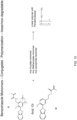
- a UV absorbing conjugate compound comprises the structure shown in Formula (1), (U -X) n -C, wherein, U is an UV absorbing compound moiety, X is a thioether, amine, amide, ester, urethane, sulfonamide group, or -CO-NH-NH-CO-, C is a conjugate compound moiety and n is an integer and where n is ⁇ 1.
- an UV absorbing conjugate compound has the structure shown in Formula (2), wherein Y is an UV absorbing compound moiety, X is a thioether, amine, amide, ester, urethane, sulfonamide group, -CO-NH-NH-CO-, D is a residue of a vinyl, acrylate, methacrylate or acrylamide group, A is a residue of a vinyl, acrylate, methacrylate or acrylamide monomer, B is a residue of a vinyl, acrylate, methacrylate or acrylamide monomer that is different from A, n is an integer and where n is ⁇ 1 and m and z are each an integer and where m is ⁇ 0, and z is ⁇ 0.
- the structure in Formula (2) can be a block copolymer or it can be a random copolymer.
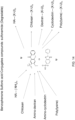
- a UV absorbing conjugate compound has the structure shown in Formula (3), (U -X)n -C-(X-U1)m (3) wherein, U is an UV absorbing compound moiety, U1 is a UV absorbing compound moiety that has a different chemical structure to U, X is a thioether, amine, amide, ester, urethane, sulfonamide group, -CO-NH-NH-CO-, C is a conjugate compound moiety and n and m are each an integer and where n and m is ⁇ 1.
- an UV absorbing conjugate compound has the structure shown in Formula (4), wherein Y is an UV absorbing compound moiety, Y 1 is a UV absorbing compound moiety that has a different chemical structure to Y, X is a thioether, amine, amide, ester, urethane, sulfonamide group, -CO-NH-NH-CO-, D is a residue of a vinyl, acrylate, methacrylate or acrylamide group, A is a residue of a vinyl, acrylate, methacrylate or acrylamide monomer, B is a residue of a vinyl, acrylate, methacrylate or acrylamide monomer that is different from A, n and p are each an integer and where n and p is ⁇ 1 and m and z are each an integer and where m is ⁇ 0, and z is ⁇ 0.
- the structure in Formula (4) can be a block copolymer or it can be a random copolymer.
- compositions comprising at least one UV absorbing conjugate compound and methods for making and using such compositions.
- an UV absorbing compound is a compound that reflects and/or absorbs radiation in certain ultraviolet (UV) wavelengths.
- inorganic compounds that reflect or scatter the light away from the skin, and organic (carbon-based) compounds that absorb UV rays.
- organic compounds that are UV absorbing compounds include, but are not limited to avobenzone or oxybenzone. Instead of physically deflecting UV rays, these molecules absorb UV radiation through their chemical bonds. As the bonds absorb UV radiation, the components of the sunscreen slowly break down and release heat.
- SPF is often used to show the protective level of a sunscreen composition.
- SPF is Sun Protection Factor, and refers to how well the sunscreen protects against UVB rays, which can cause sunburn and several types of skin cancer.
- UVA radiation penetrates deeper into the skin and can cause premature wrinkling, age spots and can also heighten the risk for some skin cancers.
- a broad spectrum sunscreen blocks against both UVA and UVB rays, but currently there is no standard for listing UVA absorbing power. Inorganic compounds that deflect sunlight will deflect both UVA and UVB rays.
- a sunscreen composition that is rated as SPF 15 to 50, as it is unproven that those rated higher than SPF 50 are any more effective that SPF 50.
- a sunscreen with an SPF of 15 protects against about 93 percent of UVB rays, and one with an SPF of 30 protects against 97 percent of rays, though no composition can block 100 percent of UV rays.
- a sunscreen composition will not eliminate UV radiation from reaching the body's surface, and thus, the SPF number refers to approximately the length of time it will take for a person's skin to show radiation damage, such as turning red.
- a sunscreen composition with an SPF of 15 will prevent Caucasian skin from getting red for approximately 15 times longer than skin that is not coated with the sunscreen composition. For example, if the skin starts to burn (turning red) in 10 minutes, a sunscreen composition with SPF 15 will prevent burning for about 150 minutes, or 2.5 hours.
- formulation compositions comprising at least one UV absorbing conjugate compound composition, for example, cosmetic compositions, comprising one or more compounds or molecules that reflect and/or absorb UV-A, UV-B or both UV-A and UV-B radiation, for use in preventing or ameliorating the harmful effects of UV radiation, such as that from the sun. It is desirable that the UV absorbing conjugate compounds are not significantly absorbed or transported through the body surface, such as skin, into the general circulation of the body. The biological activity and toxicity of many of the currently used UV absorbing and or UV reflecting compounds have not been studied.
- compositions disclosed herein comprise at least one UV absorbing compound for which its effective molecular weight is increased by conjugating the conjugate compound to the UV absorbing compound in order to reduce the absorption of the UV absorbing compound through the skin.
- the effective molecular weight of an UV absorbing compound can be increased by covalently coupling the UV absorbing compound to a conjugate compound or molecule such that the total molecular weight of the conjugated molecule (referred to herein as an UV absorbing conjugate compound) is greater than 500 daltons, or greater than 800 daltons, or greater than 1000 daltons.
- a UV absorbing conjugated compound may be referred to herein as an "absorbing compound” and includes a compound that absorbs UV radiation, or reflects UV radiation, or both absorbs and reflects UV radiation.
- a UV absorbing conjugate compound (UV absorbing compound) has the structure shown in Formula (1), (U-X) n -C (1) wherein, U is an UV absorbing compound moiety, X is a thioether, amine, amide, ester, urethane, sulfonamide group, or -CO-NH-NH-CO-, C is a conjugate compound moiety and n is an integer and where n is ⁇ 1.
- an UV absorbing conjugate compound has the structure shown in Formula (2), wherein Y is an UV absorbing compound moiety, X is a thioether, amine, amide, ester, urethane, sulfonamide group, -CO-NH-NH-CO-, D is a residue of a vinyl, acrylate, methacrylate or acrylamide group, A is a residue of a vinyl, acrylate, methacrylate or acrylamide monomer, B is a residue of a vinyl, acrylate, methacrylate or acrylamide monomer that is different from A, n is an integer and where n is ⁇ 1 and m and z are each an integer and where m is ⁇ 0, and z is ⁇ 0.
- the structure in Formula (2) can be a block copolymer or it can be a random copolymer.
- a UV absorbing conjugate compound has the structure shown in Formula (3), (U-X) n -C-(X-U 1 ) m (3) wherein, U is an UV absorbing compound moiety, U 1 is a UV absorbing compound moiety that has a different chemical structure to U, X is a thioether, amine, amide, ester, urethane, sulfonamide group, -CO-NH-NH-CO-, C is a conjugate compound moiety and n and m are each an integer and where n and m is ⁇ 1.
- an UV absorbing conjugate compound has the structure shown in Formula (4), wherein Y is an UV absorbing compound moiety, Y 1 is a UV absorbing compound moiety that has a different chemical structure to Y, X is a thioether, amine, amide, ester, urethane, sulfonamide group, -CO-NH-NH-CO-, D is a residue of a vinyl, acrylate, methacrylate or acrylamide group, A is a residue of a vinyl, acrylate, methacrylate or acrylamide monomer, B is a residue of a vinyl, acrylate, methacrylate or acrylamide monomer that is different from A, n and p are each an integer and where n and p is ⁇ 1 and m and z are each an integer and where m is ⁇ 0, and z is ⁇ 0.
- the structure in Formula (4) can be a block copolymer or it can be a random copolymer.
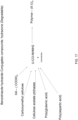
- compositions of the present disclosure may comprise one or more UV absorbing conjugate compounds that comprise a UV absorbing compound conjugated (bonded) with a conjugate compound.
- a conjugate compound, not including a conjugate compound comprising a polymer (described below), of a UV absorbing conjugate compound is a small molecule with a molecular weight of less than 1000 daltons, in a range from about 100 daltons to about 1000 daltons, from about 100 daltons to about 900 daltons, from about 200 daltons to about 8000 daltons, from about 200 daltons to about 1000 daltons, from about 100 daltons to about 300 daltons, from about 200 daltons to about 500 daltons, from about 300 daltons to about 1000 daltons; from about 400 daltons to about 8000 daltons; from about 400 daltons to about 1000 daltons; from about 500 daltons to about 1000 daltons; from about 400 daltons to about 800 daltons from about 500 daltons to about 600 da
- a conjugate compound has one or more functional groups that can react with a functional group of a UV absorbing compound.
- a functional group may be a component of a conjugate compound or may be added by chemical synthesis methods to a conjugate group.
- Functional groups on a conjugate compound include, but are not limited to, one or more thiol groups, amine groups, hydrazide group, carboxylic acid groups or a combination thereof.
- a conjugate compound can be an alkane.
- a conjugate compound is a linear alkane.
- a conjugate compound is a branched alkane.
- a conjugate compound comprises an aromatic ring.
- a conjugate compound comprises a benzene ring. In an aspect, a conjugate compound comprises two or more thiol or amine groups. In an aspect, a conjugate compound comprises at least one thiol group and at least one amine group. In an aspect, an amine group is a primary amine group. In an aspect, a conjugate compound comprises one or more carboxylic acid groups. In an aspect, a conjugate compound comprises one or more hydrazide groups.
- a conjugate compound with two or more amine groups can be reacted with one or more UV absorbing compounds that have a carboxylic acid group, an acrylate group, a methacrylate group or an acrylamide group.
- a conjugate compound that is an alkane, with two or more amine groups include, but is not limited to, C2 to C20 diamines, 1,5-Diamino-2-methylpentane, 1,3-Diamino-2-propanol, 3,3'-Diamino-N-methyldipropylamine, 1,3-Diamino-2-hydroxypropane-N,N,N',N'-tetraacetic acid, meso-1,4-Diamino-2,3-butanediol dihydrochloride, 1,4-Diamino-2-butanone dihydrochloride, 2,2- Bis(aminoethoxy)propane, Spermidine, DL-5-Hydroxylysine hydrochloride, triethylene
- a conjugate compound that comprise a benzene ring and at least two amine groups includes, but is not limited to, 1,2-diamino-3,5-dimethylbenzene, 4,4'-diamino[1,1'-biphenyl]-3,3'-diol, 1,2-diamino-4,5-dimethoxybenzene, 4,4'-diamino-2,2'-stilbenedisulfonic acid, 6,9-diamino-2-ethoxyacridine-DL-lactate monohydrate, 2,2'-diamino-4,4'-stilbenedicarboxylic acid, 3,8-diamino-6-phenylphenanthridine, 2,6-diamino-4-phenyl-1,3,5-triazine, m-xylylenediamine, p-xylylenediamine, o-xylylenediamine, 2,4,6-Trimethyl-m-
- a conjugate compound that comprises two or more amine groups include, but is not limited to, 3,5-diamino-1,2,4-triazole, 2,4-diamino-6-hydroxypyrimidine, 5,6-diamino-1,3-dimethyluracil hydrate, 2,4-diamino-6-phenyl-1,3,5-triazine, 2,4-diamino-6-(hydroxymethyl)pteridine, 2,4-diamino-6-(hydroxymethyl)pteridine hydrochloride, 2,6-diamino-3,5-difluoropyridine, 2-chloro-4,6-diamino-1,3,5- triazine, 2-nitro-1,4-phenylenediamine, 2,6-diaminopurine-9-arabinoside, melamine, 6-methyl-1,3,5-triazine-2,4-diamine, 2,6-diaminopyridine, 2,5-diaminominopyr
- a conjugate compound with two or more thiol groups can be reacted with one or more UV absorbing compounds having an alkene group to form a UV absorbing conjugate compound comprising a thioether.
- Alkene groups include, but are not limited to, a vinyl group, an acrylate group, a methacrylate group, a cyanoacrylate group or an acrylamide group.
- Conjugate compounds that are alkanes with two or more thiol groups include, but are not limited to, C2 to C20 dithiols, dithiothreitol, and 2,3-dimercapto-1-propanol, and 2,3-dimercaptosuccinic acid.
- a conjugate compound comprising a benzene ring and at least two thiol groups includes, but is not limited to, 1,4-benzenedimethanethiol, 1,4-benzenedimethanethiol, benzene-1,2-dithiol, benzene-1,4-dithiol, 1,3-benzenedithiol, biphenyl-4,4'-dithiol, and p-terphenyl-4,4"-dithiol.
- a conjugate compound comprising at least one thiol and one amine group include, but are not limited to, 2-aminobutane-1,4-dithiol hydrochloride, 4,5-diamino-2,6-dimercaptopyrimidine, 4,5-diamino-6-hydroxy-2-mercaptopyrimidine, and 4,6-diamino-2-pyrimidinethiol.
- a conjugate compound comprising two or more hydrazide are comprised by the present disclosure.
- One or more hydrazide groups can be reacted with a carboxylic acid group of the UV absorbing compound.
- Dihydrazide compounds include, but are not limited to, saturated aliphatic carboxylic acid dihydrazides having 2 to 18 carbon atoms, carbohydrazide, thiocarbohydrazide, adipic dihydrazide, succinic dihydrazide, oxalyldihydrazide, ethylmalonic acid dihydrazide, malonic acid dihydrazide, glutaric acid dihydrazide, sebacic acid dihydrazide, maleic acid dihydrazide, fumaric acid dihydrazide, itaconic acid dihydrazide, terephthalic acid dihydrazide, isophthalic acid dihydrazide, pimelic acid dihydrazide, puromellitic acid
- Trihydrazide conjugate compounds can include, but are not limited to, 1,2,4-butanetricarboxylic acid, trihydrazide, citric acid trihydrazide, 1,3,5-benzene(tricarboxylic trihydrazide), nitrilo-acetic trihydrazide, 1,2,4-benzene trihydrazide and cyanuric trihydrazide.
- Tetrathydrazide conjugate compounds can include, but are not limited to, ethylenediamine tetraacetic acid tetrahydrazide and 1,4,5,8-naphthoic acid tetrahydrazide.
- a conjugate compound can comprise a polymer, referred to herein as a "conjugate polymer", which includes homopolymers and copolymers.
- a conjugate polymer comprises a non-absorbable polymer.
- Non-absorbable polymers can include polymers comprising one or more amine groups, one or more carboxylic acid groups, one or more thiol groups, one or more hydrazide groups or a combination thereof.
- Conjugate polymers disclosed herein can have two or more repeat units.
- disclosed polymers can have a molecular weight greater than 200 daltons. In an aspect, the molecular weight of a conjugate polymer is greater than about 1000.
- conjugate polymers include, but are not limited to, polyalkylene oxide polymers that comprise one or more amine, carboxylic acid, thiol or hydrazide groups.
- Polyalkylene oxide conjugate polymers include, but are not limited to, methoxypolyethylene glycol, polyethylene glycol, polypropylene glycol or a copolymer of ethylene oxide and propylene oxide.
- a conjugate polymer can comprise one or more amine groups that can react with a carboxylic acid group of the UV absorbing compound.
- Conjugate polymers that comprise one or more amine groups include, but are not limited to,poly(ethyleneimine), poly(vinylamine) hydrochloride and copolymers thereof, poly(allylamine) and copolymers thereof, poly(4-aminostyrene) and copolymers thereof, poly(N-methylvinylamine) and copolymers thereof, poly(ethylene glycol) bis (2-aminoethyl), poly(2-Aminoethylmethacrylamide) and copolymers thereof, poly(N-(3-aminopropyl)methacrylamide) and copolymers thereof, 3arm PEG amine (glycerol core), 4arm PEG amine (pentaerythritol core), 6arm PEG amine (dipentaerythritol core), 8arm PEG amine (hexaglycerol core), 8arm PEG amine (tripentaerythritol core), methoxy PEG acetic acid, meth
- a conjugate polymer can comprise one or more hydrazide groups that can react with a carboxylic acid group of the UV absorbing compound to form a UV absorbing conjugate compound with a -CO-NH-NH-CO- linkage.
- Conjugate polymers comprising one or more hydrazide groups include, but are not limited to, methoxy PEG hydrazide, PEG dihydrazide, 3arm PEG hydrazide, 4arm PEG hydrazide, 6 arm PEG hydrazide, 8arm PEG hydrazide, and poly(acryloyl hydrazide).
- Conjugate polymers comprising one or more hydrazide groups can be prepared from polymers that comprise a carboxylic acid group, acrylonitrile groups or an acrylamide group. Examples of these polymers are described in US 20070225453 .
- Polyhydrazides can be obtained by reacting a polymer having a carboxylic acid lower alkyl ester group with hydrazine or hydrazine hydrate (see JPS52-22878B ).
- Polyhydrazides can be obtained by reacting a polycarboxylic acid containing polymer with an excess of a dihydrazide compound such that the resulting polymer has residual hydrazide groups. These residual hydrazide groups can be reacted with a carboxylic acid moiety of a UV absorbing compound.
- a conjugate polymer can comprise one or more thiol groups that can react with an acrylate, methacrylate, acrylamide or alkene group of a UV absorbing compound to form a UV absorbing conjugate compound with a thioether linkage.
- Polymers comprising one or more thiol groups include but are not limited to methoxy PEG thiol, PEG dithiol, 3arm PEG thiol, 4arm PEG thiol and 8arm PEG thiol,
- a non-degradable polymer comprising one or more carboxylic acid groups includes, but is not limited to, poly(acrylic acid) and copolymers thereof, poly(malic acid) and copolymers thereof, poly(maleic acid) and copolymers thereof, poly(fumaric acid) and copolymers thereof, poly(2-carboxyethyl acrylate) and copolymers thereof, poly(4-vinylbenzoic acid) and copolymers thereof, poly(maleic acid, mono-2-acryloxyethyl ester) and copolymers thereof, poly (methyacrylic acid) and copolymers thereof, and poly(phthalic acid, mono-2-acryloxyethyl ester) and copolymers thereof.
- An UV absorbing conjugate polymer compound can be prepared by a free radical polymerization reaction of a monomer composition comprising at least one UV absorbing compound that is capable of undergoing free radical polymerization to produce UV absorbing conjugate compounds according to Formula 2 and/or 4 above.
- UV absorbing compounds that can under go free radical polymerization include, but are not limited to, UV absorbing compounds comprising a vinyl group, an acrylate group, a methacrylate group or an acrylamide group.
- UV absorbing compounds include, but are not limited to, N-[[3-(benzotriazol-2-yl)-2-hydroxy-5-(2,4,4-trimethylpentan-2-yl)phenyl]methyl]-2-methylprop-2-enamide ( CAS 107479-06-1 ), and 2-[3-(2H-Benzotriazol-2-yl)-4-hydroxyphenyl]ethyl methacrylate ( CAS 96478-09-0 ).
- monomers that are capable of undergoing free radical polymerization include, but are not limited to, monomers that comprise a vinyl group, an acrylate group, a methacrylate group or an acrylamide group.
- Monomers can include hydrophilic or hydrophobic monomers.
- Monomers that can be used include, but are not limited to, those supplied by Polysciences, Inc. The monomer to initiator ratio can be adjusted to change the molecular weight of the produced polymer.
- a monomer composition disclosed herein can further comprise a crosslinking agent such that a crosslinked solid composition is produced.
- the crosslinked composition can undergo further processing such as milling, micronization, sieving or a combination thereof to produce microparticles or nanoparticles.
- an emulsion polymerization can be used to prepare crosslinked particles, and such polymerization reactions are known to those of skill in the art.
- a conjugate polymer compound is degradable. In an aspect, a conjugate polymer compound is hydrolytically stable at pH 6.5 to pH 7.5 for a period of at least 6 months. In an aspect, a conjugate polymer compound can be cleaved enzymatically. In an aspect, a conjugate polymer compound is hydrolytically stable at pH 6.5 to pH 7.5 for a period of at least 6 months but is cleaved when exposed to an appropriate enzyme.
- an enzymatically degradable conjugate polymer compound comprises a protein, a peptide or a polypeptide.
- the protein, peptide or polypeptide has one or more available amino groups to react with at least one UV absorbing compound.
- Such compounds include, but are not limited to, a protein, a peptide or a polypeptide that have one or more lysine moieties.
- Compounds that include one or more lysine moieties include, but are not limited to, poly(lysine).
- a protein, peptide or polypeptide has one or more available thiol groups to react with the UV absorbing compound.
- conjugate polymer compounds include, but are not limited to, a protein, a peptide or a polypeptide that have one or more cysteine moieties.
- Conjugate polymer compounds that include one or more cysteines include but are not limited to poly(cysteine).
- a protein, peptide or polypeptide has one or more available carboxylic acid groups to react with the UV absorbing compound.
- conjugate polymer compounds include, but are not limited to, a protein, a peptide or a polypeptide that have one or more carboxylic acid moieties.
- Conjugate polymer compounds that include one or more carboxylic acid include but are not limited to poly(aspartic acid) and copolymers thereof, poly(glutamic acid) and copolymers thereof.
- a protein, peptide or polypeptide conjugate polymer compound has one or more available amine group and thiol group to react with the UV absorbing compound.
- a conjugate polymer compound may comprise a polysaccharide.
- Polysaccharides that are enzymatically degradable and that have one or more functional groups that can react with a functional group on the UV absorbing compound or a derivative of a UV absorbing compound can be used to prepare the UV absorbing conjugate compound.
- Classes of polysaccharides that can be used in disclosed compositions include, but are not limited to, hyaluronic acid, alginic acid, cellulose, dextran, chitin, chitosan, xantham gum, xylan, guar gum, pullan, locust bean gum, starch, glucogen, cyclodextrin, amalose, amylopectin, pectin, callose, laminarin, chrysolaminarin, arabinoxylan, mannan, fucoidan and galalctomannan.
- These classes include derivatives and salts thereof.
- derivatives of cellulose include but are not limited to cellulose esters, cellulose ethers and cellulose nitrates.
- Cellulose esters include but are not limited to cellulose acetate, cellulose acetate propionate (CAP), and cellulose acetate butyrate (CAB).
- Cellulose ethers include but are not limited to methyl cellulose, ethyl cellulose, hydroxyethyl cellulose, hydroxypropylcellulose, carboxymethyl cellulose, hydroxypropyl methyl cellulose, hydroxyethyl methyl cellulose, methyl ethyl hydroxyethyl cellulose, and ethyl hydroxyethyl cellulose.
- Salts of alginic acid include but are not limited to sodium alginate and calcium alginate.
- the polysaccharide comprises at least one functional group that is capable of reaction with a functional group of the UV absorbing compound.
- Functional groups that can be used to react with UV absorbing compounds include, but are not limited to, hydroxyl, carboxylic acid, thiol, amine, acrylate, methacrylate, vinyl, acrylamide, hydrazide, allyl and vinyl sulfone groups.
- a polysaccharide comprises an amine group.
- the amine group of the polysaccharide can be reacted with a carboxylic acid group of an UV absorbing compound to form an amine group.
- the amine group of the polysaccharide can be reacted with an acrylate, acrylamide or methacrylate group of an UV absorbing compound through a Michael addition reaction.
- amine-containing polysaccharides include, but are not limited to, amino dextran, amino cyclodextrin, chitosan, amino cellulose, and deacetylated hyaluronic acid.
- Amino dextran used can have a molecular weight of greater than 1000 daltons.
- Amino cyclodextrin compounds include but are not limited to 6-monodeoxy-6-monoamino- ⁇ -cyclodextrin hydrochloride ( CAS 29390-67-8 ), heptakis-(6-amino-6-deoxy)-beta-cyclodextrin heptahydrochloride ( CAS 65024-90-0 ), heptakis-(2,3-di-O-methyl-6-amino-6-deoxy)- ⁇ -cyclodextrin heptahydrochloride, 6-monoamino-6-monodeoxy-per-methyl- ⁇ -Cyclodextrin hydrochloride, A,D-6-diamino-6-dideoxy- ⁇ -cyclodextrin dihydrochloride, hexakis-(2,3-di-O-methyl-6-amino-6-deoxy)
- Amino cellulose includes, but is not limited to, 6-deoxy-6-( ⁇ -aminoalkyl)aminocellulosecarbamates.
- Amino containing hyaluronic acid derivatives include, but are not limited to, deacetylated hyaluronic acid.
- a polysaccharide comprises a thiol group.
- the thiol group of a polysaccharide can be reacted with an acrylate, acrylamide or methacrylate group of an UV absorbing compound through a Michael addition reaction to form a thioether.
- Thiolated cyclodextrins include, but are not limited to, heptakis-(6-deoxy-6-mercapto)-beta-cyclodextrin ( CAS 160661-60-9 ), hexakis-(6-deoxy-6-mercapto)- ⁇ -cyclodextrin, and octakis-(6-deoxy-6-mercapto)- ⁇ -cyclodextrin.
- Thiolated chitosan can include, but is not limited to, alkyl thiolated chitosan derivatives such as chitosan-cysteine, chitosan-thiobutylamidine, chitosan-thioglycolic acid, chitosan-N-acetylcysteine, and chitosan-thioethylamidine and the aryl thiolated chitosan such as chitosan-6-mercaptonicotinic acid and chitosan-4-mercaptobenzoic acid.
- alkyl thiolated chitosan derivatives such as chitosan-cysteine, chitosan-thiobutylamidine, chitosan-thioglycolic acid, chitosan-N-acetylcysteine, and chitosan-thioethylamidine
- thiolated chitosan derivatives are detailed in WO2015169728A1 , Kast, Constantia E; Frick, Wolfram; Losert, Udo; Bernkop-Schnürch, Andreas, International Journal of Pharmaceutics, , Volume 256 (1) - Apr 30, 2003 , Roldo, Marta & Hornof, Margit & Caliceti, Paolo & Bernkop-Schnürch, Andreas. (2004).
- Thiolated hyaluronic acid can be prepared according to US 20100330143 , US 20080031854 .
- US 20100144902 and US 20100152423 .
- the polysaccharide can comprise one or more hydrazide groups.
- the hydrazide comprising polysaccharide is derived from a polysaccharide that comprises one or more carboxylic acid groups wherein one or more of the carboxylic acid groups have been reacted with a dihydrazide compound such that the derivatized polysaccharide comprises one or more hydrazide groups.
- polysaccharides that comprise one or more carboxylic acid groups include but are not limited to hyaluronic acid, galacturonan, xylogalacturonan, apiogalacturonan, alginic acid, carboxymethyl cellulose, and cellulose acetate phthalate
- the hydrazide polysaccharide can include but is not limited to hydrazide derivatized hyaluronic acid, hydrazide derivatized carboxymethyl cellulose, hydrazide derivatized cellulose acetate phthalate, hydrazide derivatized, alginic acid and hydrazide derivatized galacturonan.
- Hydrazide functionalized hyaluronic acid can be prepared according to US 20100330143 , US 20100144902 , and US 20100152423 .
- the polysaccharide can be degraded enzymatically.
- Hyaluronic acid can be degraded by a hyaluronidase
- chitosan can be degraded by lysozyme
- cellulose based polymers and oligomers can be degraded by cellulases and endoglucanases
- dextrans can be degraded by dextranase.
- a conjugate polymer compound may comprise polyamino acids.
- Polyamino acids can comprise peptides and/or proteins.
- Peptides include compounds with two or more amino acids.
- UV absorbing compounds with a carboxylic acid group or a sulfonic acid group can be reacted with the terminal amine group of a peptide or protein to form an amide or sulfonamide linkage respectively between the UV absorbing compound and the peptide or protein.
- UV absorbing conjugate compounds with two or more UV absorbing compounds attached can be prepared using proteins or peptides that comprise one or more amine containing amino acids. Suitable amine-containing amino acids include lysine, arginine and histidine. UV absorbing compounds with a carboxylic acid group or a sulfonic acid group can be reacted with the terminal amine group and the amine group of the amine containing amino acid of the peptide or protein to form an amide or sulfonamide linkage respectively between the UV absorbing compound and the peptide or protein.
- UV absorbing compounds with a hydrazide group can be reacted with the terminal carboxylic acid group of a peptide or protein to form a linkage between the UV absorbing compound and the peptide or protein.
- UV absorbing compounds with a hydrazide group can be reacted with the terminal carboxylic acid group of a peptide or protein as well as with any carboxylic acid containing amino acid within the peptide or protein to form a linkage between the UV absorbing compound and the peptide or protein.
- Suitable carboxylic acid containing amino acid include one or more aspartic acid and glutamic acid.
- the peptide is poly(glutamic acid), poly(aspartic acid) or combinations thereof.
- the conjugate compound can be a hydrolyzed collagen.
- the hydrolyzed collagen can be gelatin that comprise glutamic acid.
- UV absorbing conjugate compounds with two or more UV absorbing compounds attached can be prepared using proteins or peptides that comprise one or more amine-containing amino acids. Suitable amine containing amino acids include lysine, arginine and histidine. In an aspect, the peptide is poly(lysine), polyarginine, or poly(histidine) or combinations thereof.
- the conjugate compound can be a hydrolyzed collagen. In an aspect, the hydrolyzed collagen can be gelatin that comprises arginine.
- UV absorbing compounds with an alkene group can react with peptides or proteins that contain one or more free thiol groups.
- the peptide or protein comprise one or more cysteine groups in which the thiol is in a free form and not part of a disulfide bond.
- UV absorbing conjugate compounds comprising polysaccharides or polyamino acids can be crosslinked.
- Suitable crosslinkers include but are not limited to compounds that comprise two or more vinyl sulfone groups, epoxide groups, isocyanate groups or carbodiimide groups.
- the crosslinked material can undergo further processing such as milling, micronization, sieving or a combination thereof to produce microparticles or nanoparticle.
- the crosslinking reaction can take place as an emulsion such that crosslinked particles are produced.
- polysaccharide conjugate compounds or polyamino acid conjugate compounds can be formed into crosslinked particle via an emulsion reaction or through a crosslinking reaction with subsequent processing such as milling, micronization, sieving or a combination thereof.
- Polysaccharides or polyamino acids can be crosslinked using a suitable crosslinker.
- the crosslinking reaction can be an emulsion reaction such that particles are formed.
- the crosslinked material can be converted into a particulate form by processes that include milling, micronization, sieving or a combination thereof.
- the crosslinked particles can be reacted with a UV absorbing compound as described herein such that the UV absorbing compound is chemically bound to pre-crosslinked particles.
- a UV absorbing conjugate compound can be incorporated into a polysaccharide or polyamino acid prior to the crosslinking reaction and then it can be entrapped within the crosslinked material.
- the crosslinking reaction can be an emulsion reaction such that particles are formed.
- the crosslinked material can be converted into a particulate form by processes that include milling, micronization, sieving or a combination thereof.
- the UV absorbing compound comprising a hydrazide group can react with the residual carboxylic acid group of a degradable polyester using a carbodiimide to activate the ester.
- an initiator that comprises both at least one hydroxyl group and at least one carboxylic acid group can be used to initiate a ring opening polymerization of a polyester.
- Monomers that can be used include glycolide, lactide, ⁇ -caprolactone, trimethylene carbonate, p-dioxanone, 1,5-dioxepan-2-one and morpholinedione.
- Initiators that can be used include but are not limited to hydroxy alkane carboxylic acid compounds.
- hydroxy alkane carboxylic acid compounds include, but are not limited to, 10-hydroxydecanoic acid, 12-hydroxydodecanoic acid, 11-hydroxyundecanoic acid, 15-hydroxypentadecanoic acid, 16-hydroxyhexadecanoic acid, 12-hydroxyoctadecanoic acid, 12-hydroxystearic acid, citric acid, glycolic acid, and tartaric acid.
- the molecular weight of the polyester greater than 1000 daltons. In an aspect, the molecular weight is greater than 1500.
- UV absorbing compounds absorb UV radiation with a wavelength of less than 400 nm, e.g., from 200 to 400 nm.
- UV absorbing compounds can absorb, for example, UV-A (from 320 to 400 nm), UV-B (from 290 to 319 nm) and/or UV-C (from 200 to 289 nm) light.
- UV absorbing compounds absorb UV-A and/or UV-B radiation.
- UV absorbing compounds that absorb UV-A and/or UV-B radiation and deactivate the absorbed radiation energy in a nonradiative manner.
- UV absorbing compounds include, but are not limited to, benzophenone-based compounds, benzotriazole-based compounds, benzimidazole-based compounds that have absorbance in the 200 to 400 nm range.
- the UV absorbing compounds include, but are not limited to, benzophenone-based compounds, benzotriazole-based compounds, benzimidazole-based compounds that have absorbance in the 200 to 380 nm range.
- the UV absorbing compounds include, but are not limited to, benzophenone-based compounds, benzotriazole-based compounds, benzimidazole-based compounds that have absorbance in the 200 to 350 nm range.
- UV absorbing compounds comprising acrylamide, acrylate, methacrylate, maleimide, acrylonitrile, vinyl sulfone, amine, sulfonic acid, allyl, hydrazide and/or carboxylic acid groups that are available for reaction with a conjugate compound.
- UV absorbing compounds that comprise an acrylamide group, acrylate group, methacrylate group, maleimide group, acrylonitrile groups or a vinyl sulfone group that can undergo a Michael addition reaction can be used to prepare conjugate compounds.
- UV absorbing compounds that contain one or more functional groups capable of a Michael addition reaction can be conjugated to compounds that comprise one or more amine groups, thiol groups or a combination thereof.
- UV absorbing compounds that can be used include, but are not limited to, UV absorbing benzotriazole compound that comprise an acrylamide group, acrylate group, methacrylate group, maleimide group, acrylonitrile groups or a vinyl sulfone group.
- UV absorbing benzotriazole compound that comprise an acrylamide group, acrylate group, methacrylate group, maleimide group, acrylonitrile groups or a vinyl sulfone group.
- examples of these compounds include, but are not limited to, N-[[3-(benzotriazol-2-yl)-2-hydroxy-5-(2,4,4-trimethylpentan-2-yl)phenyl]methyl]-2-methylprop-2-enamide ( CAS 107479-06-1 ), and 2-[3-(2H-Benzotriazol-2-yl)-4-hydroxyphenyl]ethyl methacrylate ( CAS 96478-09-0 ).
- UV absorbing compounds that comprise a carboxylic acid group that can undergo a reaction with an amine group of a conjugating compound to form an amide bond.
- UV absorbing compounds include, but are not limited to, benzotriazole compounds that comprise a carboxylic acid group, including, but not limited to, 3-[3-(2H-Benzotriazol-2-yl)-5-tert-butyl-4-hydroxyphenyl]propionic acid ( CAS 84268-36-0 ).
- An UV absorbing compound can comprise a hydrazide group.
- a hydrazide comprising UV absorbing compound can be reacted with a conjugate compound that comprises one or more carboxylic acid groups.
- a hydrazide UV absorbing compound is prepared by reacting 3-[3-(2H-Benzotriazol-2-yl)-5-tert-butyl-4-hydroxyphenyl]propionic acid with an excess of a dihydrazide.
- the reaction product will comprise a hydrazide group that is chemically bound to the UV absorbing compound.
- UV absorbing compounds that comprise an alkene group that can undergo a thiol-ene reaction with a thiol group of a conjugate compound.
- An alkene containing UV absorbing compound includes, but is not limited to, benzotriazole compounds that comprise an alkene group.
- Benzotriazole compounds that comprise an alkene group include, but are not limited to, N-[[3-(benzotriazol-2-yl)-2-hydroxy-5-(2,4,4-trimethylpentan-2-yl)phenyl]methyl]-2-methylprop-2-enamide ( CAS 107479-06-1 ), 2-[3-(2H-Benzotriazol-2-yl)-4-hydroxyphenyl]ethyl methacrylate ( CAS 96478-09-0 ) and 2-(2H-Benzotriazol-2-yl)-4-methyl-6-(2-propenyl)phenol ( CAS 2170-39-0 ).
- the thiol-ene reaction can occur in the presence of a photo-initiator and a light source.
- the light source emits ultra-violet radiation.
- cleavage type photoinitiators also called Norrish Type I photoinitiators
- H-abstraction initiators also called Norrish Type II photoinitiators.
- Cleavage type photoinitiators include, but are not limited to, 2,2-dimethoxy-1,2-diphenylethan-1-one, 2-Hydroxy-2-methyl-1-phenylpropanone, 1-hydroxy-cyclohexylphenylketone, 2, 4, 6-trimethylbenzoyl diphenylphosphine oxide (TMDPO) and 2, 2-dimethoxy-2-phenyl acetophenone (DMPA).
- TMDPO 6-trimethylbenzoyl diphenylphosphine oxide
- DMPA 2-dimethoxy-2-phenyl acetophenone
- H-abstraction type photoinitiators include, but are not limited to, benzophenone (B), thioxanthone (TX), isopropyl thioxanthone and camphorquinone (CQ). Photoinitiators also include the Igacure series of photoinitiators from BASF/Ciba.
- Thermal initiators include, but are not limited to, 2,2'-azobis(isobutyronitrile) (AIBN) and benzoyl peroxide.
- UV absorbing compounds comprising a sulfonic acid group can undergo a reaction with an amine group of a conjugating compound to form a sulfonamide bond.
- Sulfonic acid containing UV absorbing compounds include, but are not limited to, benzimidazole compounds that comprise a sulfonic acid group, benzotriazole compounds that comprise a sulfonic acid group, and benzophenone compounds that comprise a sulfonic acid group.
- benzimidazole compounds that comprise a sulfonic acid group include, but are not limited to, 2-phenylbenzimidazole-5-sulfonic acid or Ensulizole ( CAS 27503-81-7 ).
- benzophenone compounds that comprise a sulfonic acid group include, but are not limited to, sulisobenzone or benzophenone-4 ( CAS 4065-45-6 ).
- benzotriazole compounds that comprise a sulfonic acid group include, but are not limited to, sodium;3-(benzotriazol-2-yl)-5-butan-2-yl-4-hydroxybenzenesulfonate ( CAS 92484-48-5 ), 3-(benzotriazol-2-yl)-5-butan-2-yl-4-hydroxybenzenesulfonic acid, 2-(2-hydroxy-3,5-dimethylphenyl)benzotriazole-4-sulfonic acid, 2-(5-tert-butyl-2-hydroxyphenyl)benzotriazole-5-sulfonic acid, 2-(5-Tert-butyl-2-hydroxy-3-propan-2-ylphenyl)benzotriazole-5-sulfonic acid, 2-(2-hydroxy-3
- Disclosed UV absorbing conjugate compounds may be formed into or incorporated into a particle, a sphere, a hollow sphere, a fiber, a hollow fiber or a liposome.
- Disclosed UV absorbing conjugate compounds may be incorporated into a particle, a sphere or a hollow sphere, a fiber or a hollow fiber formed from a matrix material.
- the matrix material may be a polymer, a glass or an inorganic matrix.
- the disclosed UV absorbing conjugate compounds may be coated onto a particle, a sphere or a hollow sphere, a fiber or a hollow fiber formed from a matrix material.
- Disclosed UV absorbing conjugate compounds may added into the hollow space of a hollow sphere, a hollow fiber or a porous inorganic matrix.
- a particle, a sphere, a hollow sphere, or a liposome has a mean diameter of less than about 500 nm.
- a particle, a sphere, a hollow sphere, or a liposome has a mean diameter of less than about 400 nm.
- a particle, a sphere, a hollow sphere, or a liposome has a mean diameter of less than about 300 nm.
- UV absorbing conjugate compounds disclosed herein can be incorporated into formulation compositions that can be applied to one or more body surfaces, such as a sunscreen, a cosmetic product or a hair product.
- Sunscreen compositions can include, but are not limited to, daily use sunscreens, water resistant sunscreens, or combinations thereof.
- Cosmetic compositions can include, but are not limited to, formulations such as a moisturizer, foundation, lip stick, lip gloss, chap stick, concealer, highlighter, blushes, eye shadows, cleansers, toners, serums, anti-aging products, setting sprays or combinations thereof.
- Hair product compositions include, but are not limited to, shampoos, conditioners, leave-in conditioners, hair mousse, hair gels, hair spray, curling creams, hair waxes, treatment oils, medicated hair treatments or combinations thereof.
- Disclosed formulation compositions comprising UV absorbing conjugate compounds may be prepared by methods that are well known by a person of ordinary skill in the field of cosmetic formulation.
- Various forms of formulation compositions are known. These forms include, but are not limited to, solutions, suspensions, emulsions, liposomes, dispersions, particulates.
- Product forms for the sunscreen, cosmetic or hair formulation can include but is not limited to solutions, sprays, gels, lotions, creams, mousses, emulsions, sticks, powders, or combinations thereof.
- a formulation composition disclosed herein can be an emulsion.
- a formulation is an oil-in-water (o/w) emulsion with a continuous water phase and a discontinuous oil phase.
- a moisturizer or sunscreen lotion is an example of an oil-in-water composition.
- a formulation is a water-in-oil (w/o) emulsions with a continuous oil phase and a discontinuous water phase.
- a sunscreen cream formulation composition may be a water-in-oil composition.
- an UV absorbing conjugate compound can be in the water phase.
- an UV absorbing conjugate compound can be in the oil phase.
- an UV absorbing conjugate compound can be in the water phase and the oil phase.
- a formulation composition can comprise two or more different UV absorbing conjugate compounds with one UV absorbing conjugate compounds in the water phase and the other in the oil phase.
- a formulation comprises two or more different UV absorbing conjugate compounds, optionally, with one UV absorbing conjugate compound in the water phase and the other in the oil phase and/or the water phase.
- a formulation comprises two or more different UV absorbing conjugate compounds with one UV absorbing conjugate compounds in the oil phase and the other in the oil phase and/or the water phase.
- oil-in-water emulsions may comprise a water content of about 40% (w/w) to 80% (w/w) of the final formulation.
- the water content can be about 50% (w/w) to about 70% (w/w) of the final formulation.
- Formulation compositions disclosed herein comprise one or more UV absorbing conjugate compounds may comprise an emulsifier.
- a formulation composition comprising one or more UV absorbing conjugate compounds may comprise an emollient.
- Emollients can include but are not limited to petrolatum, silicone oils, castor oil, lanolin, cocoa butter, liquid paraffin, cetyl alcohol, cetearyl alcohol, isopropyl myristate, isopropyl palmitate, shea butter, stearic acid, steryl alcohol, vegetable oil and combinations thereof.
- a formulation composition comprising one or more UV absorbing conjugate compounds may comprise a humectant.
- a humectant can include, but is not limited to, algae extract, aloe vera, aloe vera palmitate, butylene glycol, caprylyl glycol, ethoxydiglycol, glycerin, hexanediol, honey, hyaluronic acid, methyl gluceth-10, pentylene glycol, propanediol, prolylene gycol, sorbitol, sucrose cocoate, urea, sodium lactate and combinations thereof.
- a formulation composition comprising one or more UV absorbing conjugate compounds may comprise a conditioning agent.
- Conditioning agents include but are not limited to cocamidopropyl betaine, cocamidopropyl betaine, stearamidopropyl dimethylamine, trioctyldodecyl citrate, trioctyldodecyl citrate, PEG/PPG-8/3 diisostearate, myristamidopropyl dimethylamine phosphate (and) propylene glycol, polyquaternium-6, polyquaternium-47, polyquaternium-53, polyquaternium-7, polyquaternium-10, polyquaternium-22, polyquaternium-39, polyquaternium-5, acetylated lanolin, cetearyl alcohol (and) cetrimonium bromide, soyamidopropalkonium chloride, cocamidopropyl dimethylamine, isostearamidopropyl dimethylamine, acetamide MEA, isostearamido
- a formulation composition comprising one or more UV absorbing conjugate compounds may comprise inorganic particulates.
- Inorganic particles can include but are not limited to glass particles, glass beads, dyes, zinc oxide and titanium dioxide.
- a formulation composition comprising one or more UV absorbing conjugate compounds may comprise compounds that enhance water resistance of the formulation composition.
- Compounds that enhance water resistance of a formulation include, but are not limited to, film-forming polymers.
- Polymers that can be used include but are not limited to dehydroxanthan gum, Dermacryl AQF polymers, Bis-PEG-18methyl ether dimethylsilane, trimethylsiloxysilicate, and butylated PVP (polyvinylpyrrolidone), octylacrylamide/acrylates copolymer, octylacrylamide/acrylate/butylaminoethyl methacrylate copolymer, film forming polymers suitable for use in the present invention include: from National Starch and Chemical Company, AMPHOMER and AMPHOMER LV-71 polymers (octylacrylamide/acrylates/butylaminoethyl methacrylate copolymer), AMPHOMER HC polymer (acrylates/oct
- Film forming polymers can include polymers with no or limited water solubility as described in WO2017048706 .
- the amount of film-forming polymer present in the composition may be from about 0.1% to about 5%, or from about 0.1% to about 3%, or from about 0.1% to about 2%.
- a formulation composition disclosed herein may comprise one or more UV absorbing conjugate.
- an UV absorbing conjugate compound is present in an amount effective to provide a SPF of about 10 or greater.
- the amount of one or more UV absorbing conjugate compounds in a formulation composition may vary from about 2% (w/w) to about 60% (w/w) of the final formulation.
- the amount of one or more UV absorbing conjugate compound present in a formulation can be from about 6% (w/w) to about 40% (w/w) of the final formulation.
- the amount of one or more UV absorbing conjugate compounds in a formulation can be from about 6% (w/w) to about 25% (w/w) of the final formulation.
- Formulation compositions such as sunscreen, cosmetic and hair compositions disclosed herein can comprise components, that include, but are not limited to, antioxidants, binders, biological additives, buffering agents, colorants, thickeners, polymers, astringents, fragrance, humectants, opacifying agents, conditioners, exfoliating agents, pH adjusters, preservatives, natural extracts, essential oils, skin sensates, skin soothing agents, skin healing agents, SPF boosting agents or combinations thereof.
- the SPF boosting agent may be an agent that can reflect or refract UV light.
- the SPF boosting agent may be a hollow particle, a hollow sphere, a hollow fiber, a porous particle, a porous sphere or a porous fiber.
- the SPF boosting agent may comprise a polymer.
- the polymer may be a degradable polymer or a non-degradable polymer.
- the polymer may be a styrene/acrylate co-polymer.
- Formulation compositions such as sunscreen, cosmetic and hair compositions disclosed herein can have a pH that is from about 4.0 to about 8.0, or such as from about 5.5 to about 7.0.
- compositions and formulation compositions can be used to ameliorate the effects of UV radiation on body surfaces, particularly human and animal skin surfaces.
- an effective amount of a formulation composition disclosed herein comprising a UV absorbing conjugate compound composition is applied to the skin in an amount and frequency to provide at least SPF 15 protection for human or animal skin.
- the present disclosure comprises a kit comprising a formulation composition comprising an UV absorbing conjugate compound composition disclosed herein, contained within a container.
- the kit may further comprise written instructions for its use.
- compositions, methods, and kits comprising one or more UV absorbing conjugate compound compositions disclosed herein, contained within a container.
- the kit may further comprise written instructions, which optionally may be located on or within the container, for its use.
- UV absorbing compounds may comprise 1) (U -X)n -C, wherein, U is an UV absorbing compound moiety, X is a thioether, amine, amide, urethane, sulfonamide group, or - CO-NH-NH-CO-, C is a conjugate compound moiety and n is an integer and where n is ⁇ 1; or 2) (U -X)n -C, wherein, U is an UV absorbing compound moiety, X is an ester, C is a conjugate compound moiety and n is an integer and where n is ⁇ 1; or 3) wherein the UV absorbing conjugate compound has the structure, wherein Y is an UV absorbing compound moiety, X is a thioether, amine, amide, ester, urethane, sulfonamide group, -CO-NH-NH-CO-, D is a residue of a vinyl, acrylate, methacrylate or acrylamide group, A is a residue
- UV absorbing conjugate compounds comprise a UV absorbing compound comprising benzophenone-based compounds, benzotriazole-based compounds, or benzimidazole-based compounds that have absorbance from about 200 to about 380 nm range.
- UV absorbing conjugate compounds may comprise one or more UV absorbing benzotriazole compounds comprising the reaction residues of an acrylamide group, acrylate group, methacrylate group, maleimide group, acrylonitrile groups or a vinyl sulfone group.
- Topical formulation compositions disclosed herein may comprise a sunscreen formulation comprising a daily use sunscreen, a water resistant sunscreen, or combinations thereof; a cosmetic formulation comprising a moisturizer, foundation, lip stick, lip gloss, chap stick, concealer, highlighter, a blush, eye shadows, cleansers, toners, serums, anti-aging products, setting sprays or combinations thereof; a hair product composition include, comprising, a shampoo, a conditioner, a leave-in conditioner, a hair mousse, a hair gel, a hair spray, a curling cream, a hair wax, a treatment oil, a medicated hair treatment or combinations thereof.
- references in the specification and concluding claims to parts by weight of a particular element or component in a composition denotes the weight relationship between the element or component and any other elements or components in the composition or article for which a part by weight is expressed.
- X and Y are present at a weight ratio of 2:5, and are present in such ratio regardless of whether additional components are contained in the compound.
- a weight percent (wt. %) of a component is based on the total weight of the formulation or composition in which the component is included.
- a compound when referred to as a monomer or a compound, it is understood that this is not interpreted as one molecule or one compound.
- two monomers generally refers to two different monomers, and not two molecules.
- the terms "optional” or “optionally” means that the subsequently described event or circumstance can or cannot occur, and that the description includes instances where said event or circumstance occurs and instances where it does not.
- the terms “about,” “approximate,” and “at or about” mean that the amount or value in question can be the exact value designated or a value that provides equivalent results or effects as recited in the claims or taught herein. That is, it is understood that amounts, sizes, formulations, parameters, and other quantities and characteristics are not and need not be exact, but may be approximate and/or larger or smaller, as desired, reflecting tolerances, conversion factors, rounding off, measurement error and the like, and other factors known to those of skill in the art such that equivalent results or effects are obtained. In some circumstances, the value that provides equivalent results or effects cannot be reasonably determined.
- the term "subject” can be a vertebrate, such as a mammal, a fish, a bird, a reptile, or an amphibian.
- the subject of the herein disclosed methods can be a human, non-human primate, horse, pig, rabbit, dog, sheep, goat, cow, cat, guinea pig or rodent.
- the term does not denote a particular age or sex. Thus, adult and newborn subjects, as well as fetuses, whether male or female, are intended to be covered.
- a mammalian subject is a human.
- patient includes human and veterinary subjects.
- administering and “administration” refer to any method of providing a disclosed composition to a subject.
- the terms “comprises,” “comprising,” “includes,” “including,” “containing,” “characterized by,” “has,” “having” or any other variation thereof, are intended to cover a non-exclusive inclusion.
- a process, method, article, or apparatus that comprises a list of elements is not necessarily limited to only those elements but may include other elements not expressly listed or inherent to such process, method, article, or apparatus.
- the term “comprising” may also include the limitations associated with the use of “consisting of” or “consisting essentially of”.
- compositions, a process, a structure, or a portion of a composition, a process, or a structure is described herein using an open-ended term such as "comprising,” unless otherwise stated the description also includes an embodiment that "consists essentially of or “consists of the elements of the composition, the process, the structure, or the portion of the composition, the process, or the structure.
- ranges set forth herein include their endpoints unless expressly stated otherwise.
- an amount, concentration, or other value or parameter is given as a range, one or more preferred ranges or a list of upper preferable values and lower preferable values, this is to be understood as specifically disclosing all ranges formed from any pair of any upper range limit or preferred value and any lower range limit or preferred value, regardless of whether such pairs are separately disclosed.
- the scope of the invention is not limited to the specific values recited when defining a range.
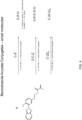
- N-[[3-(benzotriazol-2-yl)-2-hydroxy-5-(2,4,4-trimethylpentan-2-yl)phenyl]methyl]-2-methylprop-2-enamide ( CAS 107479-06-1 ) is added to chloroform.
- 1,6-hexanediamine is added to the chloroform in a molar ratio of 2.5:1 benzotriazol:diamine.
- the mixture is heated to about 40 °C for about 4 hrs.
- the resultant reaction mixture is concentrated using a rotavap.
- the conjugate is purified by silica gel column chromatography. As shown in FIG.
- Sodium hyaluronate 50 kDa was added to DMSO.
- the benzotriazole hydrazide from Example 2 is added to the DMSO mixture at a 0.1: 1 molar ratio of the hydrazide to the disaccharide units of the hyaluronic acid.
- Dicyclocarbodiimide (DCC) in about a 1:1 molar ratio to the hydrazide is added.
- the reaction mixture is allowed to stir overnight. Any formed precipitate was filtered and the resultant mixture is dialysed against water to remove the DMSO. Following dialysis, the contents of the dialysis bag are added to an excess cold ethanol. The precipitated material is filtered.
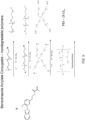
- the benzotriazole hydrazide (shown as U-CO-NH2), is reacted with the carboxylic acid group of cellulose acetate phthalate (C) to form the conjugate C-(X-U)n where X is a -CO-NHNH-CO- group and n >1.
- This is reaction is exemplary for the other compounds shown in FIG. 17 wherein other conjugate compounds that have multiple carboxylic acid groups are used in making the UV-absorbing conjugate compounds.
- Poly(acrylic acid, sodium salt) solution (average Mw ⁇ 1,200, 45 wt. % in H2O) is precipitated out of solution by adding 2M HCl dropwise.
- the precipitated poly(acrylic acid) is filtered and dried under vacuum.
- the poly(acrylic acid) is added to DMSO at 10% (w/v).
- Dicyclocarbodiimide (DCC) is added to the solution in a 0.9:1 molar ratio with the carboxylic acid groups.
- the solution is stirred for 5 minutes after which the benzotriazole hydrazide from Example 2 is added to the solution in a 0.8:1 molar ratio of carboxylic acid groups.
- the reaction mixture is allowed to stir overnight. Any formed precipitate was filtered from the solution.
- the resultant reaction mixture is concentrated using a rotavap.
- the solution is poured into an excess cold water to precipitate out the product.
- the precipitate is filtered and is washed with ethanol.
- the product
- hydrazine monohydrate is added to 6 g of hyaluronic acid (50 kDa) for a 2% w/v polymer solution. 3 g hydrazine sulfate is added to this solution. The resultant solution is stirred at 55° C for 72-96 hours. 120 mL of cold ethanol is added to the reaction mixture to precipitate out the hyaluronic acid product. The precipitated material is filtered, washed with ethanol, and dried under vacuum for 24 hours.
- the dried material is added to a beaker and 100 mL of acetic acid and 60 mL of 0.5M iodic acid (HIO 3 ) is added to the beaker.
- the solution stirred in a water bath at 4° C for at least 1 hour.
- An aqueous HI (57%, 17.5 mL) is added and the mixture is stirred for 15 minutes.
- the solution is transferred to a separatory funnel to which 150 mL diethyl ether is added.
- the mixture is shaken vigorously and the aqueous layer recovered.
- the extraction is repeated with diethyl ether until the violet colour is no longer visible in the organic layer.
- the pH of the collected aqueous solution is adjusted to 7-7.5 with 0.2 M NaOH.
- the polymer is precipitated by adding excess cold ethanol to the solution. The precipitate is filtered, washed with ethanol and then dried under vacuum.
- the contents of the dialysis bag are added to an excess cold ethanol.
- the precipitated material is filtered.
- the precipitate it titurated with methyl ethyl ketone.
- the benzatriazole-HA conjugate was dried under vacuum.
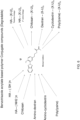
- the 3-[3-(2H-Benzotriazol-2-yl)-5-tert-butyl-4-hydroxyphenyl]propionic acid is reacted with the amine group of deacetylated hyaluronic acid (C) to form the conjugate C-(X-U)n where X is an amide and n > 1.
- This is reaction is exemplary for the other compounds shown in FIG. 9 wherein other conjugate compounds that have multiple amine groups are used in making the UV-absorbing conjugate compounds.
- the conjugate is purified by silica gel column chromatography.
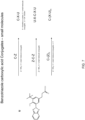
- This is reaction is exemplary for the other compounds shown in FIG. 8 wherein other conjugate compounds that have at least one amine groups are used in making the UV-absorbing conjugate compounds.
- the conjugate is purified by silica gel column chromatography.
- This is reaction is exemplary for the other compounds shown in FIG. 9 wherein other conjugate compounds that have at least one amine groups are used in making the UV-absorbing conjugate compounds.
- Benzophenone-4 (CAS 4065-45-6 ) is added to 50 mL anhydrous dimethyl formamide (DMF).
- Thionyl chloride is added to the reaction mixture such that the molar ratio of thionyl chloride: sulfonic acid groups is 0.95: 1.
- the mixture was stirred for 4 hrs after which and excess (1.2: 1 amine groups to sulfonic acid groups) of 1,6-hexane diamine was added.
- the reaction is heated to 50°C and run overnight.
- the reaction mixture is poured into excess water.
- the precipitate is filtered, washed with water and then dried under vacuum. As shown in FIG.
- This is reaction is exemplary for the other compounds shown in FIG. 12 wherein other conjugate compounds that have at least one amine groups are used in making the UV-absorbing conjugate compounds.
- hyaluronic acid 1 g hyaluronic acid is dissolved in 10 mL 0.25M NaOH. Once dissolved, 0.06 g 1,4-butanediol diglycidyl ether (BDDE) is added. The mixture is heated to 50°C for 3 hrs. The formed gel is added to 500 mL water and 0.2 M HCl is added to neutralize the solution. The supernatant water is decanted and the washing step is repeated two additional times. The gel is then added to a 60 mL syringe. The gel is forced through a 100 mesh screen contained in a filter holder. The gel is then forced through a 400 mesh screen contained in a filter holder. The gel is then dried under vacuum.
- BDDE 1,4-butanediol diglycidyl ether
- the dried gel particles are added to 50 mL DMSO.
- 0.1g benzotriazole hydrazide compound (Example 2) is added to the reaction mixture.
- EDC (0.9:1 EDC to hydrazide molar ratio) is added to the reaction mixture.
- the mixture is allowed to react overnight.
- the mixture is poured into excess water.
- the gel particles are filtered and dried under vacuum.
- the dried particles are washed with ethyl acetate and are then dried under vacuum.
- the water is added to the container and is heated to about 75 to 80°C.
- the remaining Phase A ingredients are added and mixed with a dispersion mixer until dissolved.
- the Phase B ingredients are added together and heated with mixing to about 75 to 80°C.
- Phase A mixture is added to phase B while mixing with a homogenizer. Under gentle stirring, the resultant emulsion is cooled to room temperature using a water bath.
- the formulation is prepared separately using UV absorbing conjugate as prepared in examples 1, 3-5 and 7-12.
- the glycerin and xanthan gum are added together and mixer with a dispersion mixer.
- the water is then added to the mixture with dispersion mixing.
- the mixture is heated to about 70 to 75°C.
- the Phase B ingredients are added together and heated with mixing to about 70 to 75°C.
- Phase B is added to phase A while mixing with a homogenizer. Under gentle stirring, the resultant emulsion is cooled to about 40°C using a water bath.
- Phase C is added to the emulsion and the mixture is homogenized for 2-5 minutes.
- the formulation is then cooled to room temperature while stirring gently.
- the Dermofeel ® PA-3 , xanthan gum and chlorphenesin were added together.
- the water was then added and under high shear mixing, the mixture was heated to about 80-85°C.
- the ingredients for Phase B were added together and the mixture was heated to about 80-85°C.
- Part B is then added to Part A under high shear stirring.
- the mixture is stirred for about 3 - 5 minutes.
- the resultant mixture is allowed to cool under medium stirring.
- the Melitane is added once the temperature is below 40 °C.
- the mixture is allowed to cool to room temperature and, if necessary, the pH is adjusted to pH 5.0 to 5.5.
- the formulation is prepared separately using UV absorbing conjugate as prepared in examples 1, 3-5 and 7-12.
- the reaction mixture was heated to 80°C for 4 hours.
- the reaction mixture was cooled to room temperature and the toluene was removed under vacuum. Approximately 126 mL hexane was added to the residue. The residue was left overnight and the supernatant was decanted off. The precipitated material was triturated with about 60 mL hexane. This was repeated five times. The sample was dried under vacuum.
Landscapes
- Health & Medical Sciences (AREA)
- Life Sciences & Earth Sciences (AREA)
- General Health & Medical Sciences (AREA)
- Chemical & Material Sciences (AREA)
- Animal Behavior & Ethology (AREA)
- Public Health (AREA)
- Veterinary Medicine (AREA)
- Birds (AREA)
- Epidemiology (AREA)
- Chemical Kinetics & Catalysis (AREA)
- Engineering & Computer Science (AREA)
- Biochemistry (AREA)
- Materials Engineering (AREA)
- Medicinal Chemistry (AREA)
- Polymers & Plastics (AREA)
- Organic Chemistry (AREA)
- Molecular Biology (AREA)
- Dermatology (AREA)
- Emergency Medicine (AREA)
- Cosmetics (AREA)
Claims (11)
- Topische Formulierungszusammensetzung, die eine oder mehrere UV-absorbierende Konjugatverbindungen umfasst, die eine UV-absorbierende Verbindung enthält, die mit einer Konjugatverbindung konjugiert ist, wobei die UV-absorbierende Verbindung ausgewählt ist aus einer Gruppe bestehend aus einer Benzophenonverbindung, die über einen Sulfonamid-Linker mit einer Konjugatverbindung konjugiert ist, wobei die Benzophenonkonjugatverbindung ein Molekulargewicht von mindestens 800 Dalton aufweist, einer Benzimidazolverbindung, die über einen Sulfonamid-Linker mit einer Konjugatverbindung konjugiert ist, wobei die Benzimidazolkonjugatverbindung ein Molekulargewicht von 800 Dalton aufweist, einer Benzotriazolverbindung, die über einen Amid-Linker mit einer Konjugatverbindung konjugiert ist, wobei die Benzotriazolkonjugatverbindung ein Molekulargewicht von mindestens 800 Dalton aufweist, einer Benzotriazolverbindung, die über das Produkt einer Michael-Additionsreaktion mit einer Konjugatverbindung konjugiert ist, wobei die Benzotriazolkonjugatverbindung ein Molekulargewicht von mindestens 800 Dalton aufweist, einem Benzotriazol-funktionalisierten Polymer, wobei das Benzotriazolfunktionalisierte Polymer ein Molekulargewicht von mindestens 800 Dalton aufweist und wobei das Benzotriazol als Methacrylat-, Acrylat,- oder Acrylamid-Derivat einer Benzotriazolverbindung an das Polymer gebunden ist, und einer Benzotriazolverbindung, die an ein Polysaccharid konjugiert ist, wobei die Benzotriazolpolysaccharidkonjugatverbindung ein Molekulargewicht von mindestens 800 Dalton aufweist, wobei die UV-absorbierende Konjugatverbindung nicht durch die Haut transportiert oder absorbiert wird.
- Zusammensetzung nach Anspruch 1, wobei die UV-absorbierende Verbindung
(U-X)n-C umfasst,
wobei U eine UV-absorbierende Verbindungseinheit ist, X eine Thioether-, Amin-, Amid-, Urethan-, Sulfonamidgruppe oder -CO-NH-NH-CO- ist, C eine konjugierte Verbindungseinheit ist und n eine ganze Zahl ist, wobei n ≥1 ist. - Zusammensetzung nach Anspruch 1, wobei die UV-absorbierende Verbindung
(U-X)n-C umfasst,
wobei U eine UV-absorbierender Verbindungseinheit ist, X ein Ester ist, C eine konjugierte Verbindungseinheit ist und n eine ganze Zahl ist, wobei n ≥1 ist. - Zusammensetzung nach Anspruch 1, wobei die UV-absorbierende Konjugatverbindung die Struktur

wobei Y eine UV-absorbierende Verbindungseinheit ist, X eine Thioether-, Amin-, Amid-, Ester-, Urethan-, Sulfonamidgruppe oder -CO-NH-NH-CO- ist, D ein Rest einer Vinyl-, Acrylat-, Methacrylat- oder Acrylamidgruppe ist, A ein Rest eines Vinyl-, Acrylat-, Methacrylat- oder Acrylamidmonomers ist, B ein Rest eines Vinyl-, Acrylat-, Methacrylat- oder Acrylamidmonomers ist, der von A verschieden ist, n eine ganze Zahl ist und wobei n ≥1 ist und m und z jeweils eine ganze Zahl sind, wobei m ≥0 ist und z ≥0 ist. - Zusammensetzung nach Anspruch 4, wobei die UV-absorbierende konjugierte Verbindung ein Blockcopolymer oder ein statistisches Copolymer ist.
- Zusammensetzung nach Anspruch 1, wobei die UV-absorbierende Konjugatverbindung (U-X)n-C-(X-U1)m umfasst,
wobei U eine UV-absorbierende Verbindungseinheit ist, U1 eine UV-absorbierende Verbindungseinheit ist, die eine andere chemische Struktur als U hat, X eine Thioether-, Amin-, Amid-, Ester-, Urethan-, Sulfonamidgruppe oder -CO-NH-NH-CO- ist, C eine konjugierte Verbindungseinheit ist und n und m jeweils eine ganze Zahl sind, wobei n und m ≥1 ist. - Zusammensetzung nach Anspruch 1, wobei die UV-absorbierende Konjugatverbindung

- Zusammensetzung nach Anspruch 7, wobei die UV-absorbierende Konjugatverbindung ein Blockcopolymer oder ein statistisches Copolymer ist.
- Zusammensetzung nach Anspruch 1, wobei die UV-absorbierenden Konjugatverbindungen Verbindungen auf Benzophenonbasis, Verbindungen auf Benzotriazolbasis oder Verbindungen auf Benzimidazolbasis umfassen, die eine Absorption im Bereich von etwa 200 bis etwa 380 nm aufweisen.
- Zusammensetzung nach Anspruch 9, wobei die UV-absorbierenden Konjugatverbindungen eine oder mehrere UV-absorbierende Benzotriazolverbindungen umfassen, die die Reaktionsreste einer Acrylamidgruppe, Acrylatgruppe, Methacrylatgruppe, Maleinimidgruppe, Acrylnitrilgruppen oder einer Vinylsulfongruppe umfassen.
- Topische Formulierungszusammensetzung nach Anspruch 1, formuliert als eine Sonnenschutzformulierung, die einen Sonnenschutz für den täglichen Gebrauch, einen wasserfesten Sonnenschutz oder Kombinationen davon umfasst; eine kosmetische Formulierung, die eine Feuchtigkeitscreme, eine Grundierung, einen Lippenstift, einen Lipgloss, einen Lippenbalsam, einen Verdecker, einen Highlighter, ein Rouge, einen Lidschatten, Reinigungsmittel, Toner, Seren, Anti-Aging-Produkte, Fixiersprays oder Kombinationen davon umfasst; oder eine Haarproduktzusammensetzung, die ein Shampoo, einen Conditioner, einen Leave-in-Conditioner, einen Haarschaum, ein Haargel, ein Haarspray, eine Lockencreme, ein Haarwachs, ein Behandlungsöl, eine medizinische Haarbehandlung oder Kombinationen davon umfasst.
Priority Applications (1)
| Application Number | Priority Date | Filing Date | Title |
|---|---|---|---|
| EP24223533.1A EP4549472A3 (de) | 2019-08-18 | 2020-08-18 | Zusammensetzungen für sonnenschutzverbindungen und verfahren dafür |
Applications Claiming Priority (3)
| Application Number | Priority Date | Filing Date | Title |
|---|---|---|---|
| US201962888526P | 2019-08-18 | 2019-08-18 | |
| US201962910902P | 2019-10-04 | 2019-10-04 | |
| PCT/US2020/046811 WO2021034834A1 (en) | 2019-08-18 | 2020-08-18 | Compositions for sunscreen compounds and methods thereof |
Related Child Applications (2)
| Application Number | Title | Priority Date | Filing Date |
|---|---|---|---|
| EP24223533.1A Division-Into EP4549472A3 (de) | 2019-08-18 | 2020-08-18 | Zusammensetzungen für sonnenschutzverbindungen und verfahren dafür |
| EP24223533.1A Division EP4549472A3 (de) | 2019-08-18 | 2020-08-18 | Zusammensetzungen für sonnenschutzverbindungen und verfahren dafür |
Publications (3)
| Publication Number | Publication Date |
|---|---|
| EP4013374A1 EP4013374A1 (de) | 2022-06-22 |
| EP4013374A4 EP4013374A4 (de) | 2023-10-04 |
| EP4013374B1 true EP4013374B1 (de) | 2025-02-19 |
Family
ID=74660612
Family Applications (2)
| Application Number | Title | Priority Date | Filing Date |
|---|---|---|---|
| EP20853893.4A Active EP4013374B1 (de) | 2019-08-18 | 2020-08-18 | Zusammensetzungen für sonnenschutzverbindungen und verfahren dafür |
| EP24223533.1A Pending EP4549472A3 (de) | 2019-08-18 | 2020-08-18 | Zusammensetzungen für sonnenschutzverbindungen und verfahren dafür |
Family Applications After (1)
| Application Number | Title | Priority Date | Filing Date |
|---|---|---|---|
| EP24223533.1A Pending EP4549472A3 (de) | 2019-08-18 | 2020-08-18 | Zusammensetzungen für sonnenschutzverbindungen und verfahren dafür |
Country Status (7)
| Country | Link |
|---|---|
| US (1) | US20220296485A1 (de) |
| EP (2) | EP4013374B1 (de) |
| JP (1) | JP7789659B2 (de) |
| KR (1) | KR20220063179A (de) |
| CN (3) | CN114555038A (de) |
| CA (1) | CA3151340A1 (de) |
| WO (1) | WO2021034834A1 (de) |
Families Citing this family (1)
| Publication number | Priority date | Publication date | Assignee | Title |
|---|---|---|---|---|
| TWI865183B (zh) * | 2023-11-17 | 2024-12-01 | 奇鈦科技股份有限公司 | 紫外光吸收物質、其製備方法及應用 |
Family Cites Families (18)
| Publication number | Priority date | Publication date | Assignee | Title |
|---|---|---|---|---|
| JPS5219795A (en) | 1975-08-07 | 1977-02-15 | Nitto Electric Ind Co Ltd | Preparation of oligomer having carboxylic hydazide groups |
| CA1043495A (fr) * | 1976-07-29 | 1978-11-28 | Bernard Jacquet | Polymeres anti-solaires et compositions cosmetiques les contenant |
| US4524061A (en) * | 1983-04-22 | 1985-06-18 | Gaf Corporation | Polymeric sunscreens |
| DE3439483A1 (de) * | 1984-10-27 | 1986-05-07 | Röhm GmbH, 6100 Darmstadt | Radikalisch polymerisierbarer uv-absorber, verfahren zu seiner herstellung und seine polymere |
| FR2726562B1 (fr) * | 1994-11-08 | 1996-12-27 | Oreal | Nouveaux filtres solaires, compositions cosmetiques photoprotectrices les contenant et utilisations |
| FR2789578A1 (fr) * | 1999-02-12 | 2000-08-18 | Oreal | Compositions photoprotectrices contenant un derive de benzotriazole et un compose a groupements benzoazolyle ou benzodiazolyle |
| WO2004075871A1 (en) * | 2003-02-26 | 2004-09-10 | Fuji Photo Film B.V. | Cosmetic uv-screen compositions and aminobutadiene-based uv-absorbing complexes therefor |
| CN100465194C (zh) | 2003-11-12 | 2009-03-04 | 大塚化学株式会社 | 聚丙烯酰肼以及树脂用交联或固化剂 |
| US20100330143A1 (en) | 2003-12-04 | 2010-12-30 | University Of Utah Research Foundation | Modified macromolecules and methods of making and using thereof |
| US7381762B2 (en) * | 2004-08-20 | 2008-06-03 | Milliken & Company | Ultraviolet light (UV) absorbing compounds and compositions containing UV absorbing compounds |
| US7147866B2 (en) * | 2004-09-29 | 2006-12-12 | Galaxy Surfactants Limited | UV-absorbing lipid vesicles |
| US8962013B2 (en) * | 2005-05-02 | 2015-02-24 | Bayer Intellectual Property Gmbh | Multi-layered transdermal system with triazine UV absorber |
| US20080031854A1 (en) | 2006-07-11 | 2008-02-07 | Prestwich Glenn D | Thiolated macromolecules and methods of making and using thereof |
| CN101200504B (zh) | 2006-12-11 | 2010-05-12 | 上海百瑞吉生物医药有限公司 | 高分子巯基化改性衍生物及其交联材料 |
| CN101338036B (zh) | 2007-07-06 | 2010-11-03 | 常州百瑞吉生物医药有限公司 | 生物相容快速凝胶化水凝胶及其喷雾剂的制备方法 |
| HUE046425T2 (hu) | 2014-05-07 | 2020-02-28 | Croma Pharma Ges M B H | Vizes szemészeti oldat és eljárás száraz szem szindróma kezelésére |
| JP6975139B2 (ja) | 2015-09-14 | 2021-12-01 | エッジウェル パーソナル ケア ブランズ リミテッド ライアビリティ カンパニーEdgewell Personal Care Brands, LLC | Uva日焼け止め活性薬剤の改良された耐水性を有する日焼け止め組成物 |
| US10596087B2 (en) * | 2016-10-05 | 2020-03-24 | Johnson & Johnson Consumer Inc. | Ultraviolet radiation absorbing polymer composition |
-
2020
- 2020-08-18 EP EP20853893.4A patent/EP4013374B1/de active Active
- 2020-08-18 WO PCT/US2020/046811 patent/WO2021034834A1/en not_active Ceased
- 2020-08-18 EP EP24223533.1A patent/EP4549472A3/de active Pending
- 2020-08-18 CN CN202080072789.5A patent/CN114555038A/zh active Pending
- 2020-08-18 CA CA3151340A patent/CA3151340A1/en active Pending
- 2020-08-18 US US17/636,339 patent/US20220296485A1/en active Pending
- 2020-08-18 KR KR1020227009018A patent/KR20220063179A/ko active Pending
- 2020-08-18 CN CN202311861315.0A patent/CN118948676A/zh active Pending
- 2020-08-18 CN CN202311861308.0A patent/CN118593387A/zh active Pending
- 2020-08-18 JP JP2022511354A patent/JP7789659B2/ja active Active
Also Published As
| Publication number | Publication date |
|---|---|
| KR20220063179A (ko) | 2022-05-17 |
| US20220296485A1 (en) | 2022-09-22 |
| CN114555038A (zh) | 2022-05-27 |
| JP7789659B2 (ja) | 2025-12-22 |
| CN118948676A (zh) | 2024-11-15 |
| CN118593387A (zh) | 2024-09-06 |
| JP2022545111A (ja) | 2022-10-25 |
| EP4549472A3 (de) | 2025-06-25 |
| EP4013374A4 (de) | 2023-10-04 |
| WO2021034834A1 (en) | 2021-02-25 |
| CA3151340A1 (en) | 2021-02-25 |
| EP4013374A1 (de) | 2022-06-22 |
| EP4549472A2 (de) | 2025-05-07 |
Similar Documents
| Publication | Publication Date | Title |
|---|---|---|
| US9149664B2 (en) | Sunscreen compositions | |
| US8475774B2 (en) | Sunscreen compositions comprising an ultraviolet radiation-absorbing polymer | |
| ES2269040T3 (es) | Preparaciones cosmeticas fotoestables que filtran la luz. | |
| KR101663053B1 (ko) | 모발 표면 개질용 조성물 | |
| MX2011003547A (es) | Composiciones para filtro solar y para el cuidado personal que contienen un terpolimero aleatorio. | |
| KR20100037614A (ko) | 연속 스프레이 선스크린 조성물 | |
| CA2400980A1 (fr) | Compositions cosmetiques contenant un copolymere d'acide methacrylique, une huile et leurs utilisations | |
| KR20010109519A (ko) | 화장용 모발 보호제 | |
| JP2003212744A (ja) | 半結晶性ポリマーを含む、皮膚または毛髪の抗日光保護用組成物 | |
| FR2847464A1 (fr) | Composition antisolaire vaporisable a base de microparticules spheriques de silice poreuse et dispositifs de pressurisation la contenant | |
| JP2003507407A (ja) | ポリシロキサン含有重合体を含む化粧品および/または医薬製剤ならびにその使用 | |
| EP4013374B1 (de) | Zusammensetzungen für sonnenschutzverbindungen und verfahren dafür | |
| CN106132386B (zh) | 局部组合物 | |
| EP1532965B1 (de) | Kosmetische Zusammensetzung auf der Basis einer kosmetisch wirksamen Verbindung und eines Gels, das mindestens ein vernetztes Netzwerk von Partikeln eines vernetzten Polymers enthält. | |
| WO2021101606A1 (en) | Compositions for sunscreen compounds and methods thereof | |
| WO2020160267A1 (en) | Sunscreen compositions | |
| CN113677321A (zh) | 包含特定超支化共聚物和1,3-丙二醇和/或n-羟基辛酰胺的组合物 | |
| EP2934697B1 (de) | Hautpflegeformulierungen | |
| CN119677493A (zh) | 包含自晒黑剂和某些鞘脂和/或某些鞘氨醇碱的组合物 | |
| WO2025068356A1 (en) | Use of a sulf-containing polymer for improving sun protection | |
| FR2957791A1 (fr) | Composition cosmetique comprenant une dispersion aqueuse de polymere et procede de traitement cosmetique |
Legal Events
| Date | Code | Title | Description |
|---|---|---|---|
| STAA | Information on the status of an ep patent application or granted ep patent |
Free format text: STATUS: THE INTERNATIONAL PUBLICATION HAS BEEN MADE |
|
| PUAI | Public reference made under article 153(3) epc to a published international application that has entered the european phase |
Free format text: ORIGINAL CODE: 0009012 |
|
| STAA | Information on the status of an ep patent application or granted ep patent |
Free format text: STATUS: REQUEST FOR EXAMINATION WAS MADE |
|
| 17P | Request for examination filed |
Effective date: 20220309 |
|
| AK | Designated contracting states |
Kind code of ref document: A1 Designated state(s): AL AT BE BG CH CY CZ DE DK EE ES FI FR GB GR HR HU IE IS IT LI LT LU LV MC MK MT NL NO PL PT RO RS SE SI SK SM TR |
|
| DAV | Request for validation of the european patent (deleted) | ||
| DAX | Request for extension of the european patent (deleted) | ||
| P01 | Opt-out of the competence of the unified patent court (upc) registered |
Effective date: 20230612 |
|
| A4 | Supplementary search report drawn up and despatched |
Effective date: 20230904 |
|
| RIC1 | Information provided on ipc code assigned before grant |
Ipc: C08B 15/00 20060101ALI20230830BHEP Ipc: C08B 37/00 20060101ALI20230830BHEP Ipc: C07C 49/786 20060101ALI20230830BHEP Ipc: A61Q 17/04 20060101ALI20230830BHEP Ipc: A61K 31/18 20060101ALI20230830BHEP Ipc: A61K 8/30 20060101AFI20230830BHEP |
|
| REG | Reference to a national code |
Ref country code: DE Ref legal event code: R079 Free format text: PREVIOUS MAIN CLASS: A61K0008300000 Ipc: C08B0037020000 Ref country code: DE Ref legal event code: R079 Ref document number: 602020046505 Country of ref document: DE Free format text: PREVIOUS MAIN CLASS: A61K0008300000 Ipc: C08B0037020000 |
|
| GRAP | Despatch of communication of intention to grant a patent |
Free format text: ORIGINAL CODE: EPIDOSNIGR1 |
|
| STAA | Information on the status of an ep patent application or granted ep patent |
Free format text: STATUS: GRANT OF PATENT IS INTENDED |
|
| RIC1 | Information provided on ipc code assigned before grant |
Ipc: C08B 15/00 20060101ALI20240507BHEP Ipc: A61Q 17/04 20060101ALI20240507BHEP Ipc: A61K 8/49 20060101ALI20240507BHEP Ipc: C08B 37/08 20060101ALI20240507BHEP Ipc: C08B 37/16 20060101ALI20240507BHEP Ipc: C08B 37/02 20060101AFI20240507BHEP |
|
| INTG | Intention to grant announced |
Effective date: 20240528 |
|
| GRAJ | Information related to disapproval of communication of intention to grant by the applicant or resumption of examination proceedings by the epo deleted |
Free format text: ORIGINAL CODE: EPIDOSDIGR1 |
|
| STAA | Information on the status of an ep patent application or granted ep patent |
Free format text: STATUS: REQUEST FOR EXAMINATION WAS MADE |
|
| GRAP | Despatch of communication of intention to grant a patent |
Free format text: ORIGINAL CODE: EPIDOSNIGR1 |
|
| STAA | Information on the status of an ep patent application or granted ep patent |
Free format text: STATUS: GRANT OF PATENT IS INTENDED |
|
| INTC | Intention to grant announced (deleted) | ||
| INTG | Intention to grant announced |
Effective date: 20241009 |
|
| GRAS | Grant fee paid |
Free format text: ORIGINAL CODE: EPIDOSNIGR3 |
|
| GRAA | (expected) grant |
Free format text: ORIGINAL CODE: 0009210 |
|
| STAA | Information on the status of an ep patent application or granted ep patent |
Free format text: STATUS: THE PATENT HAS BEEN GRANTED |
|
| AK | Designated contracting states |
Kind code of ref document: B1 Designated state(s): AL AT BE BG CH CY CZ DE DK EE ES FI FR GB GR HR HU IE IS IT LI LT LU LV MC MK MT NL NO PL PT RO RS SE SI SK SM TR |
|
| REG | Reference to a national code |
Ref country code: GB Ref legal event code: FG4D |
|
| REG | Reference to a national code |
Ref country code: CH Ref legal event code: EP |
|
| REG | Reference to a national code |
Ref country code: IE Ref legal event code: FG4D |
|
| REG | Reference to a national code |
Ref country code: DE Ref legal event code: R096 Ref document number: 602020046505 Country of ref document: DE |
|
| REG | Reference to a national code |
Ref country code: NL Ref legal event code: FP |
|
| REG | Reference to a national code |
Ref country code: SE Ref legal event code: TRGR |
|
| PG25 | Lapsed in a contracting state [announced via postgrant information from national office to epo] |
Ref country code: RS Free format text: LAPSE BECAUSE OF FAILURE TO SUBMIT A TRANSLATION OF THE DESCRIPTION OR TO PAY THE FEE WITHIN THE PRESCRIBED TIME-LIMIT Effective date: 20250519 |
|
| PG25 | Lapsed in a contracting state [announced via postgrant information from national office to epo] |
Ref country code: FI Free format text: LAPSE BECAUSE OF FAILURE TO SUBMIT A TRANSLATION OF THE DESCRIPTION OR TO PAY THE FEE WITHIN THE PRESCRIBED TIME-LIMIT Effective date: 20250219 |
|
| PG25 | Lapsed in a contracting state [announced via postgrant information from national office to epo] |
Ref country code: PL Free format text: LAPSE BECAUSE OF FAILURE TO SUBMIT A TRANSLATION OF THE DESCRIPTION OR TO PAY THE FEE WITHIN THE PRESCRIBED TIME-LIMIT Effective date: 20250219 |
|
| PG25 | Lapsed in a contracting state [announced via postgrant information from national office to epo] |
Ref country code: ES Free format text: LAPSE BECAUSE OF FAILURE TO SUBMIT A TRANSLATION OF THE DESCRIPTION OR TO PAY THE FEE WITHIN THE PRESCRIBED TIME-LIMIT Effective date: 20250219 |
|
| REG | Reference to a national code |
Ref country code: LT Ref legal event code: MG9D |
|
| PG25 | Lapsed in a contracting state [announced via postgrant information from national office to epo] |
Ref country code: NO Free format text: LAPSE BECAUSE OF FAILURE TO SUBMIT A TRANSLATION OF THE DESCRIPTION OR TO PAY THE FEE WITHIN THE PRESCRIBED TIME-LIMIT Effective date: 20250519 Ref country code: IS Free format text: LAPSE BECAUSE OF FAILURE TO SUBMIT A TRANSLATION OF THE DESCRIPTION OR TO PAY THE FEE WITHIN THE PRESCRIBED TIME-LIMIT Effective date: 20250619 |
|
| PG25 | Lapsed in a contracting state [announced via postgrant information from national office to epo] |
Ref country code: HR Free format text: LAPSE BECAUSE OF FAILURE TO SUBMIT A TRANSLATION OF THE DESCRIPTION OR TO PAY THE FEE WITHIN THE PRESCRIBED TIME-LIMIT Effective date: 20250219 |
|
| PG25 | Lapsed in a contracting state [announced via postgrant information from national office to epo] |
Ref country code: LV Free format text: LAPSE BECAUSE OF FAILURE TO SUBMIT A TRANSLATION OF THE DESCRIPTION OR TO PAY THE FEE WITHIN THE PRESCRIBED TIME-LIMIT Effective date: 20250219 Ref country code: PT Free format text: LAPSE BECAUSE OF FAILURE TO SUBMIT A TRANSLATION OF THE DESCRIPTION OR TO PAY THE FEE WITHIN THE PRESCRIBED TIME-LIMIT Effective date: 20250620 |
|
| PG25 | Lapsed in a contracting state [announced via postgrant information from national office to epo] |
Ref country code: GR Free format text: LAPSE BECAUSE OF FAILURE TO SUBMIT A TRANSLATION OF THE DESCRIPTION OR TO PAY THE FEE WITHIN THE PRESCRIBED TIME-LIMIT Effective date: 20250520 Ref country code: BG Free format text: LAPSE BECAUSE OF FAILURE TO SUBMIT A TRANSLATION OF THE DESCRIPTION OR TO PAY THE FEE WITHIN THE PRESCRIBED TIME-LIMIT Effective date: 20250219 |
|
| REG | Reference to a national code |
Ref country code: AT Ref legal event code: MK05 Ref document number: 1768213 Country of ref document: AT Kind code of ref document: T Effective date: 20250219 |
|
| PGFP | Annual fee paid to national office [announced via postgrant information from national office to epo] |
Ref country code: NL Payment date: 20250821 Year of fee payment: 6 |
|
| PG25 | Lapsed in a contracting state [announced via postgrant information from national office to epo] |
Ref country code: SM Free format text: LAPSE BECAUSE OF FAILURE TO SUBMIT A TRANSLATION OF THE DESCRIPTION OR TO PAY THE FEE WITHIN THE PRESCRIBED TIME-LIMIT Effective date: 20250219 |
|
| PG25 | Lapsed in a contracting state [announced via postgrant information from national office to epo] |
Ref country code: DK Free format text: LAPSE BECAUSE OF FAILURE TO SUBMIT A TRANSLATION OF THE DESCRIPTION OR TO PAY THE FEE WITHIN THE PRESCRIBED TIME-LIMIT Effective date: 20250219 |
|
| PGFP | Annual fee paid to national office [announced via postgrant information from national office to epo] |
Ref country code: DE Payment date: 20250819 Year of fee payment: 6 |
|
| PG25 | Lapsed in a contracting state [announced via postgrant information from national office to epo] |
Ref country code: IT Free format text: LAPSE BECAUSE OF FAILURE TO SUBMIT A TRANSLATION OF THE DESCRIPTION OR TO PAY THE FEE WITHIN THE PRESCRIBED TIME-LIMIT Effective date: 20250219 |
|
| PGFP | Annual fee paid to national office [announced via postgrant information from national office to epo] |
Ref country code: GB Payment date: 20250822 Year of fee payment: 6 Ref country code: BE Payment date: 20250820 Year of fee payment: 6 |
|
| PG25 | Lapsed in a contracting state [announced via postgrant information from national office to epo] |
Ref country code: AT Free format text: LAPSE BECAUSE OF FAILURE TO SUBMIT A TRANSLATION OF THE DESCRIPTION OR TO PAY THE FEE WITHIN THE PRESCRIBED TIME-LIMIT Effective date: 20250219 |
|
| PGFP | Annual fee paid to national office [announced via postgrant information from national office to epo] |
Ref country code: FR Payment date: 20250821 Year of fee payment: 6 |
|
| PGFP | Annual fee paid to national office [announced via postgrant information from national office to epo] |
Ref country code: CH Payment date: 20250901 Year of fee payment: 6 Ref country code: SE Payment date: 20250821 Year of fee payment: 6 |
|
| PG25 | Lapsed in a contracting state [announced via postgrant information from national office to epo] |
Ref country code: EE Free format text: LAPSE BECAUSE OF FAILURE TO SUBMIT A TRANSLATION OF THE DESCRIPTION OR TO PAY THE FEE WITHIN THE PRESCRIBED TIME-LIMIT Effective date: 20250219 Ref country code: CZ Free format text: LAPSE BECAUSE OF FAILURE TO SUBMIT A TRANSLATION OF THE DESCRIPTION OR TO PAY THE FEE WITHIN THE PRESCRIBED TIME-LIMIT Effective date: 20250219 |
|
| PGFP | Annual fee paid to national office [announced via postgrant information from national office to epo] |
Ref country code: IE Payment date: 20250821 Year of fee payment: 6 |
|
| PG25 | Lapsed in a contracting state [announced via postgrant information from national office to epo] |
Ref country code: RO Free format text: LAPSE BECAUSE OF FAILURE TO SUBMIT A TRANSLATION OF THE DESCRIPTION OR TO PAY THE FEE WITHIN THE PRESCRIBED TIME-LIMIT Effective date: 20250219 |
|
| PG25 | Lapsed in a contracting state [announced via postgrant information from national office to epo] |
Ref country code: SK Free format text: LAPSE BECAUSE OF FAILURE TO SUBMIT A TRANSLATION OF THE DESCRIPTION OR TO PAY THE FEE WITHIN THE PRESCRIBED TIME-LIMIT Effective date: 20250219 |
|
| REG | Reference to a national code |
Ref country code: DE Ref legal event code: R097 Ref document number: 602020046505 Country of ref document: DE |
|
| PLBE | No opposition filed within time limit |
Free format text: ORIGINAL CODE: 0009261 |
|
| STAA | Information on the status of an ep patent application or granted ep patent |
Free format text: STATUS: NO OPPOSITION FILED WITHIN TIME LIMIT |
|
| 26N | No opposition filed |
Effective date: 20251120 |