EP4013294B1 - Vorrichtung und verfahren zum auftragen von kosmetischen zusammensetzungen durch einen gitterendeffektor - Google Patents
Vorrichtung und verfahren zum auftragen von kosmetischen zusammensetzungen durch einen gitterendeffektor Download PDFInfo
- Publication number
- EP4013294B1 EP4013294B1 EP20768732.8A EP20768732A EP4013294B1 EP 4013294 B1 EP4013294 B1 EP 4013294B1 EP 20768732 A EP20768732 A EP 20768732A EP 4013294 B1 EP4013294 B1 EP 4013294B1
- Authority
- EP
- European Patent Office
- Prior art keywords
- skin
- composition
- area
- arrangement
- image data
- Prior art date
- Legal status (The legal status is an assumption and is not a legal conclusion. Google has not performed a legal analysis and makes no representation as to the accuracy of the status listed.)
- Active
Links
Images


Classifications
-
- A—HUMAN NECESSITIES
- A45—HAND OR TRAVELLING ARTICLES
- A45D—HAIRDRESSING OR SHAVING EQUIPMENT; EQUIPMENT FOR COSMETICS OR COSMETIC TREATMENTS, e.g. FOR MANICURING OR PEDICURING
- A45D44/00—Other cosmetic or toiletry articles, e.g. for hairdressers' rooms
-
- A—HUMAN NECESSITIES
- A45—HAND OR TRAVELLING ARTICLES
- A45D—HAIRDRESSING OR SHAVING EQUIPMENT; EQUIPMENT FOR COSMETICS OR COSMETIC TREATMENTS, e.g. FOR MANICURING OR PEDICURING
- A45D34/00—Containers or accessories specially adapted for handling liquid toiletry or cosmetic substances, e.g. perfumes
- A45D34/04—Appliances specially adapted for applying liquid, e.g. using roller or ball
-
- A—HUMAN NECESSITIES
- A45—HAND OR TRAVELLING ARTICLES
- A45D—HAIRDRESSING OR SHAVING EQUIPMENT; EQUIPMENT FOR COSMETICS OR COSMETIC TREATMENTS, e.g. FOR MANICURING OR PEDICURING
- A45D44/00—Other cosmetic or toiletry articles, e.g. for hairdressers' rooms
- A45D44/005—Other cosmetic or toiletry articles, e.g. for hairdressers' rooms for selecting or displaying personal cosmetic colours or hairstyle
-
- A—HUMAN NECESSITIES
- A61—MEDICAL OR VETERINARY SCIENCE; HYGIENE
- A61B—DIAGNOSIS; SURGERY; IDENTIFICATION
- A61B5/00—Measuring for diagnostic purposes; Identification of persons
- A61B5/0059—Measuring for diagnostic purposes; Identification of persons using light, e.g. diagnosis by transillumination, diascopy, fluorescence
- A61B5/0077—Devices for viewing the surface of the body, e.g. camera, magnifying lens
-
- A—HUMAN NECESSITIES
- A61—MEDICAL OR VETERINARY SCIENCE; HYGIENE
- A61K—PREPARATIONS FOR MEDICAL, DENTAL OR TOILETRY PURPOSES
- A61K8/00—Cosmetics or similar toiletry preparations
- A61K8/02—Cosmetics or similar toiletry preparations characterised by special physical form
- A61K8/04—Dispersions; Emulsions
- A61K8/044—Suspensions
-
- A—HUMAN NECESSITIES
- A61—MEDICAL OR VETERINARY SCIENCE; HYGIENE
- A61K—PREPARATIONS FOR MEDICAL, DENTAL OR TOILETRY PURPOSES
- A61K8/00—Cosmetics or similar toiletry preparations
- A61K8/18—Cosmetics or similar toiletry preparations characterised by the composition
- A61K8/19—Cosmetics or similar toiletry preparations characterised by the composition containing inorganic ingredients
- A61K8/29—Titanium; Compounds thereof
-
- A—HUMAN NECESSITIES
- A61—MEDICAL OR VETERINARY SCIENCE; HYGIENE
- A61M—DEVICES FOR INTRODUCING MEDIA INTO, OR ONTO, THE BODY; DEVICES FOR TRANSDUCING BODY MEDIA OR FOR TAKING MEDIA FROM THE BODY; DEVICES FOR PRODUCING OR ENDING SLEEP OR STUPOR
- A61M35/00—Devices for applying media, e.g. remedies, on the human body
-
- A—HUMAN NECESSITIES
- A61—MEDICAL OR VETERINARY SCIENCE; HYGIENE
- A61M—DEVICES FOR INTRODUCING MEDIA INTO, OR ONTO, THE BODY; DEVICES FOR TRANSDUCING BODY MEDIA OR FOR TAKING MEDIA FROM THE BODY; DEVICES FOR PRODUCING OR ENDING SLEEP OR STUPOR
- A61M35/00—Devices for applying media, e.g. remedies, on the human body
- A61M35/003—Portable hand-held applicators having means for dispensing or spreading integral media
-
- A—HUMAN NECESSITIES
- A61—MEDICAL OR VETERINARY SCIENCE; HYGIENE
- A61Q—SPECIFIC USE OF COSMETICS OR SIMILAR TOILETRY PREPARATIONS
- A61Q19/00—Preparations for care of the skin
-
- B—PERFORMING OPERATIONS; TRANSPORTING
- B41—PRINTING; LINING MACHINES; TYPEWRITERS; STAMPS
- B41J—TYPEWRITERS; SELECTIVE PRINTING MECHANISMS, i.e. MECHANISMS PRINTING OTHERWISE THAN FROM A FORME; CORRECTION OF TYPOGRAPHICAL ERRORS
- B41J29/00—Details of, or accessories for, typewriters or selective printing mechanisms not otherwise provided for
- B41J29/38—Drives, motors, controls or automatic cut-off devices for the entire printing mechanism
- B41J29/393—Devices for controlling or analysing the entire machine ; Controlling or analysing mechanical parameters involving printing of test patterns
-
- B—PERFORMING OPERATIONS; TRANSPORTING
- B41—PRINTING; LINING MACHINES; TYPEWRITERS; STAMPS
- B41J—TYPEWRITERS; SELECTIVE PRINTING MECHANISMS, i.e. MECHANISMS PRINTING OTHERWISE THAN FROM A FORME; CORRECTION OF TYPOGRAPHICAL ERRORS
- B41J3/00—Typewriters or selective printing or marking mechanisms characterised by the purpose for which they are constructed
- B41J3/36—Typewriters or selective printing or marking mechanisms characterised by the purpose for which they are constructed for portability, i.e. hand-held printers or laptop printers
-
- B—PERFORMING OPERATIONS; TRANSPORTING
- B41—PRINTING; LINING MACHINES; TYPEWRITERS; STAMPS
- B41J—TYPEWRITERS; SELECTIVE PRINTING MECHANISMS, i.e. MECHANISMS PRINTING OTHERWISE THAN FROM A FORME; CORRECTION OF TYPOGRAPHICAL ERRORS
- B41J3/00—Typewriters or selective printing or marking mechanisms characterised by the purpose for which they are constructed
- B41J3/407—Typewriters or selective printing or marking mechanisms characterised by the purpose for which they are constructed for marking on special material
- B41J3/4073—Printing on three-dimensional objects not being in sheet or web form, e.g. spherical or cubic objects
-
- A—HUMAN NECESSITIES
- A45—HAND OR TRAVELLING ARTICLES
- A45D—HAIRDRESSING OR SHAVING EQUIPMENT; EQUIPMENT FOR COSMETICS OR COSMETIC TREATMENTS, e.g. FOR MANICURING OR PEDICURING
- A45D44/00—Other cosmetic or toiletry articles, e.g. for hairdressers' rooms
- A45D2044/007—Devices for determining the condition of hair or skin or for selecting the appropriate cosmetic or hair treatment
-
- A—HUMAN NECESSITIES
- A61—MEDICAL OR VETERINARY SCIENCE; HYGIENE
- A61B—DIAGNOSIS; SURGERY; IDENTIFICATION
- A61B90/00—Instruments, implements or accessories specially adapted for surgery or diagnosis and not covered by any of the groups A61B1/00 - A61B50/00, e.g. for luxation treatment or for protecting wound edges
- A61B90/30—Devices for illuminating a surgical field, the devices having an interrelation with other surgical devices or with a surgical procedure
- A61B2090/309—Devices for illuminating a surgical field, the devices having an interrelation with other surgical devices or with a surgical procedure using white LEDs
-
- A—HUMAN NECESSITIES
- A61—MEDICAL OR VETERINARY SCIENCE; HYGIENE
- A61B—DIAGNOSIS; SURGERY; IDENTIFICATION
- A61B5/00—Measuring for diagnostic purposes; Identification of persons
- A61B5/44—Detecting, measuring or recording for evaluating the integumentary system, e.g. skin, hair or nails
- A61B5/441—Skin evaluation, e.g. for skin disorder diagnosis
- A61B5/442—Evaluating skin mechanical properties, e.g. elasticity, hardness, texture, wrinkle assessment
-
- A—HUMAN NECESSITIES
- A61—MEDICAL OR VETERINARY SCIENCE; HYGIENE
- A61M—DEVICES FOR INTRODUCING MEDIA INTO, OR ONTO, THE BODY; DEVICES FOR TRANSDUCING BODY MEDIA OR FOR TAKING MEDIA FROM THE BODY; DEVICES FOR PRODUCING OR ENDING SLEEP OR STUPOR
- A61M2205/00—General characteristics of the apparatus
- A61M2205/50—General characteristics of the apparatus with microprocessors or computers
- A61M2205/52—General characteristics of the apparatus with microprocessors or computers with memories providing a history of measured variating parameters of apparatus or patient
-
- A—HUMAN NECESSITIES
- A61—MEDICAL OR VETERINARY SCIENCE; HYGIENE
- A61M—DEVICES FOR INTRODUCING MEDIA INTO, OR ONTO, THE BODY; DEVICES FOR TRANSDUCING BODY MEDIA OR FOR TAKING MEDIA FROM THE BODY; DEVICES FOR PRODUCING OR ENDING SLEEP OR STUPOR
- A61M2205/00—General characteristics of the apparatus
- A61M2205/82—Internal energy supply devices
- A61M2205/8206—Internal energy supply devices battery-operated
-
- A—HUMAN NECESSITIES
- A61—MEDICAL OR VETERINARY SCIENCE; HYGIENE
- A61M—DEVICES FOR INTRODUCING MEDIA INTO, OR ONTO, THE BODY; DEVICES FOR TRANSDUCING BODY MEDIA OR FOR TAKING MEDIA FROM THE BODY; DEVICES FOR PRODUCING OR ENDING SLEEP OR STUPOR
- A61M2210/00—Anatomical parts of the body
- A61M2210/04—Skin
-
- B—PERFORMING OPERATIONS; TRANSPORTING
- B41—PRINTING; LINING MACHINES; TYPEWRITERS; STAMPS
- B41J—TYPEWRITERS; SELECTIVE PRINTING MECHANISMS, i.e. MECHANISMS PRINTING OTHERWISE THAN FROM A FORME; CORRECTION OF TYPOGRAPHICAL ERRORS
- B41J2203/00—Embodiments of or processes related to the control of the printing process
- B41J2203/01—Inspecting a printed medium or a medium to be printed using a sensing device
Definitions
- Cosmetic compositions can be applied by manually spreading the composition across the skin of the face with fingers, brushes or sponges.
- certain specialized liquid formulations of cosmetics can be applied to the skin using an airbrush device where the cosmetic is applied as a pressurized spray onto the skin of a subject.
- These airbrush devices are generally manually directed by a user across the skin of the subject, which can include sensitive regions (e.g. , eyes, nostrils and/or mouth) that may be irritated or harmed by application of such a pressurized spray of cosmetic.
- the pressurized airbrush cosmetic spray may not be safe for use in proximity to the eyes of the subject because the user may not be able to control the airbrush device with sufficient precision to avoid accidentally dispensing the pressurized spray of cosmetic into the eyes, which may irritate or even damage the fragile structure of the eyes.
- cosmetic compositions often include particulate materials suspended in a liquid formulation. Although such particulate materials may be safe for use topically, they may not be safe if inhaled, ingested or applied to mucus membranes.
- cosmetic particulate materials such as, for example, micronized particulates
- liquid topical formulations such as lotions and/or creams
- a user may not be able to control an airbrush device precisely enough to avoid accidentally dispensing the pressurized spray of cosmetic into the nostrils or mouth, these devices may present health risks when used in proximity to the nostrils and mouth.
- a prior art device for applying a composition to skin is known from US 2009/025747 .
- One exemplary embodiment of the present invention is directed to a handheld device for applying a composition to a skin of a face of user.
- the device comprises an end effector comprising a base portion and a protruding portion extending distally from the base portion, the protruding portion having a distal opening.
- the device also comprises a detector arrangement configured to obtain image data corresponding to an image of an area of the skin through the distal opening of the end effector.
- the device further comprises an applicator arrangement configured to apply the composition to a location within the area of the skin.
- the applicator arrangement comprises a nozzle configured to dispense a pressurized pulse of the composition from a reservoir to form a thin layer of the composition on the skin.
- the composition may be a cosmetic composition comprising particles of a reflectance modifying agent (e.g., titanium dioxide) in a liquid suspension.
- the device comprises a processing arrangement configured to receive the image data from the detector arrangement, analyze the image data to determine whether the applicator arrangement is aimed to safely dispense the composition to the area of skin and whether a frexel within the area of skin corresponds to a skin artifact, and direct the applicator arrangement to selectively apply the composition to the frexel when the applicator arrangement is aimed to safely dispense the composition to the area of skin and the skin artifact is detected from the frexel.
- the processing arrangement may determine whether the skin artifact is detected from the frexel based on a reflectance of the area of skin detected in the image.
- the processing arrangement of the handheld device is configured to direct the applicator arrangement to withhold from application of the composition to the skin when the applicator arrangement is not safely aimed to dispense the composition to the area of skin.
- the processing arrangement also analyses the image data and determine the applicator arrangement to be aimed to safely dispense the composition to the area of skin when the image data corresponds to a region on the face of the user located at least a predetermined distance away from at least one of eyes, nostrils and mouth of the face of the user.
- the processing arrangement may analyze the image data to determine a tilt of the device.
- the processing arrangement may determine the applicator arrangement to be aimed to safely dispense the composition to the area of skin when a magnitude of the tilt of the device is below a predetermined threshold, and determines the applicator arrangement as not safely aimed to dispense the composition to the area of skin when magnitude of the tilt of the device is above the predetermined threshold.
- the protruding portion of the end effector further comprises a plurality of grating bars extending across the distal opening, and the image data corresponds to an image of the area of skin overlaid with the plurality of grating bars.
- the processing arrangement may be configured to analyze the image data to identify a shadow of at least one of the grating bars in the image and determining a length of the shadow based on the image data.
- the processing arrangement may be further configured to determine the applicator arrangement to be aimed to safely dispense the composition to the area of skin when the length of the shadow is below a predetermined threshold, and determine the applicator arrangement as not safely aimed to dispense the composition to the area of skin when the length of the shadow is above the predetermined threshold.
- the processing arrangement may be also configured to adjust the image data to substitute data for portions of the image corresponding to the grating bars with data generated by the processing arrangement that approximate for skin underlying the grating bars, and to analyze the adjusted image data to identify locations within the area of skin that correspond to skin artifacts.
- a method for application of a composition to a skin of a face a user comprises obtaining, by a detector arrangement, image data corresponding to an image of an area of the skin over which a device is placed.
- the image data corresponds to an image of the area of skin overlaid with a plurality of grating bars of an end effector of the device, the grating bars extending across the area of the skin.
- the method also comprises analyzing, by a processing arrangement, the image data to determine a tilt of the device as compared to the area of the skin.
- the method further comprises determining, by the processing arrangement, whether an applicator arrangement is aimed to safely dispense the composition to the area of skin based on the tilt of the device.
- the processing arrangement may determine the applicator arrangement to be aimed to safely dispense the composition to the area of skin when a magnitude of the tilt of the device is below a predetermined threshold, and determine the applicator arrangement as not safely aimed to dispense the composition to the area of skin when magnitude of the tilt of the device is above the predetermined threshold.
- the processing arrangement may determine the tilt of the device by analyzing the image data to identify a shadow of at least one of the grating bars in the image and analyzing the shadow to determine a three-dimensional vector corresponding to the tilt.
- the present invention relates to devices and methods for applying a composition onto skin, in particular, skin of the face of a mammal or a human. More specifically, the invention relates to devices and methods for selectively applying a topical composition to the skin of the face to, for example, enhance aesthetic appearance of the skin, and which provides improved safety for operating near sensitive regions (e.g., eyes, nostrils and/or mouth) on the face of the mammal or human.
- near sensitive regions e.g., eyes, nostrils and/or mouth
- proximal and distal are intended to refer to a direction toward (proximal) and away from (distal) a user of the device.
- frexel refers to a small pixel-like region of skin, which corresponds to a single large pixel or a small number of pixels in a digitally obtained image.
- a frexel may correspond to a skin area having an average diameter from about 1/15 to about 1/5 inch.
- image data corresponding to an image of the skin can capture light reflectances extending over a range of spatial frequencies, which measures the level of detail present in an image over a distance across the skin observed by a detector (e.g., a camera) that generates the image data.
- Spatial frequency may be measured by the number of periodic features, e.g., described as a periodic sine-wave pattern corresponding to cycles of alternating dark and light striped patterns, within an image over a distance across the skin observed by the detector.
- the spatial frequency of an image may be calibrated and/or normalized based on a distance from which the skin is imaged by the detector.
- spatial frequency does not measure a wavelength or color of light, but instead refers to a spatial wavelength of the structure of the details of the skin captured by the detector in the image.
- Data corresponding to an image in a spatial domain can be processed by a computer processor using a Fourier transform function to obtain data for the image in the spatial frequency domain.
- This spatial frequency domain relates to an optical resolution of the image captured, which is distinct from a wavelength or color of light.
- the spatial frequency components of the image may generally be separated into three different categories, including (1) high spatial frequencies, (2) middle spatial frequencies, and (3) low spatial frequencies, using any suitable methods for image analysis, e.g., Fourier transform, filtering, etc.
- spatial frequency components having high spatial frequencies correspond to light reflectance in the image that contribute to the appearance of sharp edges and small details within the image.
- the spatial frequency components having high spatial frequencies correspond to features that appear to be small, natural variations in the skin, such as those derived from the genetic code of the person, e.g., pores, hair, follicles, cells, iris of the eye, etc.
- Low spatial frequencies correspond to light reflectances in the image that contribute to the broad visual appearance such as, for example, the color of larger features such as, for example, the nose, cheeks, etc.
- the remaining spatial frequency components between the low and spectral frequencies are referred to as the middle spatial frequencies.
- the range of middle spatial frequencies may be determined relative to the image captured.
- the range of middle spatial frequencies for an area of facial skin may be different from the range of middle spatial frequencies for an area of the skin on a leg.
- the range of middle spatial frequencies may also depend on the underlying skin tone of the skin imaged.
- the middle spatial frequencies for human skin can range from about 0.03 cycles/mm to about 1.5 cycles/mm, or more specifically from about 0.05 cycles/mm to about 1.0 cycles/mm and, even more specifically, from about 0.07 cycles/mm to about 0.5 cycles/mm.
- the present application provides a device and method for selectively applying a composition to skin, in particular, skin of the face of a subject (e.g., a mammal or a human) while providing improved safety for operation near sensitive regions (e.g., eyes, nostrils, and/or mouth) that may not otherwise be safe and/or suitable for application of the composition. More particularly, the present application provides a device and method for selectively applying a topical composition to the skin of the face while providing safeguards that restrict application of the composition into such sensitive regions. As described above, some compositions may be suitable for topical application but may not be suitable for direct application into sensitive areas such as, for example, the eyes, the nose and/or the mouth.
- operation of the device of the present application near such sensitive areas is restricted to improve safety of operation of the device near such sensitive regions.
- operation of the device near inlets to the respiratory system i.e., the nose and mouth
- the device and method of embodiments of the present application analyze data corresponding to an image or one or more frames of images of an area of skin adjacent to which the device is positioned to determine whether an applicator arrangement of the device is aimed to safely dispense the composition to the area of skin (e.g., whether the applicator arrangement is aimed to apply the composition outside of the predetermined range of a border of a sensitive region), and when the applicator arrangement is determined to be aimed to safely dispense the composition to the area of skin, further analysis of the image data is performed to selectively apply the composition to selected portions of the skin to address skin artifacts (e.g., scars, wrinkles, blemishes, freckles, sun damage, age spots etc.) whose appearance the user wishes to minimize or eliminate to improve an over-all aesthetic appearance of the skin.
- skin artifacts e.g., scars, wrinkles, blemishes, freckles, sun damage, age spots etc.
- the device prevents application of the composition by the applicator arrangement when the applicator arrangement is determined to be aimed to dispense the composition in an unsafe manner (e.g., to an area of skin that is within the predetermined range of a border of a sensitive region).
- an unsafe manner e.g., to an area of skin that is within the predetermined range of a border of a sensitive region.
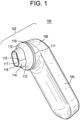
- Figs. 1 and 2 show an exemplary embodiment of a device 100 for applying a composition (e.g., a cosmetic or medical composition) to the skin.
- the device 100 of this embodiment is preferably sized and shaped to be a handheld device 100 designed to be held within a palm of a user's hand.
- the device 100 according to this embodiment comprises a head portion 102 and a handle portion 104.
- the handle portion 104 of the device 100 has an elongated shape defining a cavity for housing components therein.
- the handle portion 104 is sized and shaped to be held within the palm of the user's hand.
- the handle portion 104 is sized and shaped to be held by the fingertips of the user's hand.
- the head portion 102 of the device 100 comprises an end effector 110 that is reversibly attached to a body 108 of the head portion 102.
- the end effector 110 includes interior surfaces that define a cavity therein through which light can be delivered and an image of an area of skin can be captured by a detector arrangement.
- the interior surfaces of the end effector 110, in particular, the interior surfaces of the protruding portion 114 are surface modified (e.g., a textured mold finish) and/or treated with a surface coating (e.g., a light absorbing coating) to reduce reflectance of light by the modified or treated surfaces.
- a surface coating e.g., a light absorbing coating
- the end effector 110 comprises a base portion 112 that is reversibly attached to the body 108 and a protruding portion 114 that extends distally from the base portion 112.
- the base portion 112 and the protruding portion 114 of the end effector 110 may be formed as a single unitary component, such as, for example, molded as a single piece of plastic.
- the end effector 110 may be a disposable component that can be replaced after a session of use, or as desired by the user.
- the base portion 112 can have a tapered shape such that its proximal end 111 is wider (e.g., has a greater cross-sectional area) than its distal end 113.
- the tapered shape of the base portion 112 may be a funnel shape or a conoid shape.
- the proximal end 111 of the base portion 112 may comprise any suitable engagement mechanism for reversibly engaging and disengaging from the body 108 as would be understood by those skilled in the art.
- the protruding portion 114 of the end effector 110 extends from a proximal end 115 that is connected to the base portion 112 to a distal end 116 defining a distal opening 117 in the end effector 110.
- the protruding portion 114 extends from its proximal end 115 to its distal end 116 along a longitudinal axis that is perpendicular or substantially perpendicular to a plane extending across the proximal end 111 of the base portion 112 of the end effector 110.
- the protruding portion 114 may also have a tapered shape where the proximal end 115 is wider than the distal end 116. As shown in Figs.
- the protruding portion 114 of the end effector 110 may include additional surface features.
- the distal end 116 of the end effector 110 comprises a plurality of ridges or protrusions extending distally therefrom such that, when the end effector 110 is held against the skin, only the protrusions extending distally from the distal end 116 of the end effector 110 contact the skin.
- These protrusions reduce overall contact area of the device 100 with the skin and this may, for example, prevent smearing of previously applied composition, improve comfort and/or reduce pillowing of the surface of the skin that might otherwise result if a user pushed an end effector not including such protrusions against the skin.
- the distal end 116 of the end effector 110 includes a plurality of grating bars 118 (which is shown in the drawings with solid arrows), extending across a width of the distal opening 117 of the end effector 110.
- the grating bars 118 divide the distal opening 117 of the end effector 110 into a plurality of distal opening segments 117a where the applicator arrangement 140 includes at least one nozzle 142 associated with each segment 117a.
- each segment 117a may be independently analyzed to identify portions of skin to which the composition is to be applied and, based on this analysis, operating the nozzle 142 associated with the corresponding segment 117a.
- Each of the distal opening segments 117a shown in Fig.
- the grating bars 118 extend distally from the distal end 116 of the end effector 110 such that, when the end effector 110 is held against the skin, only the grating bars 118 are in contact with the skin.
- the plurality of grating bars 118 all extend distally from the distal end 116 by the same distance such that the grating bars 118 collectively lie along a plane parallel or substantially parallel to the distal opening 117 of the end effector 110.
- the grating bars 118 are aligned along the same plane as the distal opening 117 such that, when the end effector 110 is held against the skin, the grating bars 118 as well as the distal end 116 of the end effector 110 are in contact with the skin. As shown in Fig. 3 , the grating bars 118 are parallel or substantially parallel to one another. The plurality of grating bars 118 in this embodiment are spaced evenly or substantially evenly from one another. Furthermore, the grating bars 118 in some embodiments are surface treated or modified to reduce friction as they are moved along the skin.
- friction between the grating bars 118 and the skin may be reduced by coating the grating bars 118 with a friction-reducing coating, such as, for example, perfluoropolyether (PFPE), Polytetrafluoroethylene (PTFE), Nylon, Acetel, Polyester, polyimide, polyether ether ketone (PEEK), etc.
- PFPE perfluoropolyether
- PTFE Polytetrafluoroethylene
- Nylon Nylon
- Acetel Acetel
- Polyester polyimide
- PEEK polyether ether ketone
- the grating bars 118 may be formed from a material having reduced coefficient of friction, such as, for example, those materials identified above.
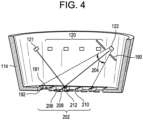
- the distal end 116 of the end effector 110 of this embodiment further comprises a pair of shadow guide pins 191, 192 (two are shown in Fig. 4 , more than two may be included) extending along the same plane as the grating bars 118.
- the first pin 191 is perpendicular or substantially perpendicular to the second pin 192.
- This pair of shadow guide pins 191, 192 casts two-direction shadows onto the area of skin framed by the distal opening 117 when this area of skin is illuminated by light source(s) 120, 121, 122 from the body 108 of the head portion 102.
- the two-direction shadows may then be captured in an image or one or more frames of images by a detector arrangement 130.
- the two-direction shadows casted by the shadow guide pins 191, 192 may be used to define two of three axes in a three-dimensional coordinate space for determining an orientation of the device 100 captured in the image(s) and/or a tilt of at least a portion of the device 100.
- the tilt may be determined as a directional vector in three-dimensional space having a magnitude indicating an amount of deviation from an orientation of the surface of the skin.
- the body 108 of the head portion 102 comprises at least one light source 120, 121, 122 for delivering light (e.g., visible light) through the distal opening 117 of the end effector 110 to an area of skin.
- the at least one light source 120, 121, 122 may comprise any suitable light emitting device for illuminating the area of skin, for example, one or more light emitting diodes (LEDs).
- the at least one light source 120, 121, 122 may also be selected and arranged to provide an amount of illumination over the area of skin sufficient to detect and/or measure reflectance of light by the skin.
- a plurality of grating bars 118 extend through the distal opening 117 of the end effector 110, as shown in Fig.
- a portion of the area of skin may be shadowed by the grating bars 118 while the light source(s) 120, 121, 122 provides a substantially uniform distribution of light to the remaining portion of the area of skin.
- a portion of the area of skin may also be shadowed by outer edges of the protruding portion 114 of the end effector 110, in particular, along a length of the protruding portion 114 while the light source(s) 120, 121, 122 provides a substantially uniform distribution of light to the remaining portion of the area of skin.
- the light source(s) 120, 121, 122 are arranged to deliver light through the distal opening 117 of the end effector 110 to an area of skin, without providing significant illumination to an interior of the end effector 110.
- the light source(s) 120 may be positioned perpendicular to the distal opening 117 of the end effector 110. More particularly, the light source(s) 120 may be positioned perpendicular or substantially perpendicular to areas of interest within the area of the skin framed by the distal opening 117 of the end effector 110, when the device 100 is in use.
- the light source(s) 121, 122 may be angled to direct light through the distal opening 117, while minimizing light directed toward interior surfaces of the end effector 110.
- the light source(s) 122 may be angled to direct light within a radial cone 204 (illustrated by the dotted lines in Fig. 4 ) through the distal opening 117 to an area of interest 202 on the skin within the area of the skin over which the distal opening 117 is place. It is contemplated that additional physical barriers and/or reflectors 190 may also be included in the body 108 of the head portion 102 to direct light from the light source(s) 121 or 122 to desired areas of interest while minimizing the reflectance of light from the interior surfaces of the end effector 110.
- the body 108 of the head portion 102 comprises at least two different light sources 121, 122 for delivering light at two different wavelengths, which may be operated sequentially or simultaneously.
- the at least two different light sources 121, 122 may be utilized simultaneously to provide different functionality.
- the two different wavelengths may be selected to minimize interference between illumination from these two different light sources 121, 122.
- the body 108 may comprise a first light source 121 delivering light having a first color (e.g., blue light) and a second light source 122 delivering light having a second color (e.g., green light).
- the first and second light sources 121, 122 may be utilized by the device 100 to illuminate the area of skin for imaging and analysis to ascertain different properties of the imaged area.
- the first light source 121 may be used by the device 100 to illuminate the area of skin for imaging and analysis to determine a tilt or a positioning of the device 100 relative to an orientation of the surface of the skin, e.g. , whether outer edges of the protruding portion 114 of the end effector 110 or grating bars 118 adjacent to each distal opening segment 117a are in contact with the surface of the skin.
- the first light source 121 may be selected to provide illumination for shadow casting and maximizing the contrast of shadows.
- the second light source 122 may, for example, be used to illuminate the area of skin for imaging and analysis to identify skin artifacts.
- the second light source 122 may provide diffuse lighting suitable for image analysis for detection of skin artifacts corresponding to locations having intense contributions in the middle spatial frequencies of an image.
- the first and second light sources 121, 122 may be operably connected to a processing arrangement 150 to selectively operate and control the first and second light sources 121, 122, as will be discussed further below.
- the body 108 of the head portion 102 also comprises a detector arrangement 130 for obtaining image data corresponding to an image or one or more frames of images of an area of skin obtained through the distal opening 117 of the end effector 110.
- the image data may correspond to an image or one or more frames of images of an area of skin over which the distal opening 117 is placed overlaid with the grating bars 118.
- the detector arrangement 130 comprises at least one sensor detecting light reflected from the area of the skin and/or the grating bars 118.
- the senor(s) may comprise any suitable components for detecting reflectance of light.
- the sensor(s) may be sensitive to an amount of reflected light in one or more wavelengths.
- Suitable sensors may include, for example, photographic or video cameras (which may include different types of camera lenses), photodiodes and/or phototransistors as would be understood by those skilled in the art.
- the sensor(s) of the detector arrangement 130 may comprise an RGB camera which can detect light in red, green and blue channels of the camera.
- the detector arrangements 130 may further comprise a color filter array (e.g. , a Bayer filter) for obtaining image data corresponding to images in different wavelengths ( e.g. , in different colors) when two or more light source(s) 121, 122 each having a different wavelength are used.
- a color filter array e.g. , a Bayer filter
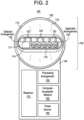
- the light source(s) 120, 121, 122 and the detector arrangement 130 are operably connected to a processing arrangement 150 executing instructions stored on a computer-accessible medium 160.
- the processing arrangement 150 in this embodiment controls the light source(s) 120, 121, 122 and receives and analyzes image data received from the detector arrangement 130. It is contemplated that the processing arrangement 150 and the computer-accessible medium 160 may be positioned anywhere within or external to the device 100. In one embodiment, as shown in Fig. 1 , the processing arrangement 150 and the computer-accessible medium 160 are located within the handle portion 104.
- the processing arrangement 150 in this embodiment also controls an applicator arrangement 140 to selectively apply the composition to desired frexels within areas of the skin when the processing arrangement 150 determines that the applicator arrangement 140 is aimed to safely dispense the composition to the areas of skin.
- the processing arrangement 150 may be, e.g., entirely or a part of, or include, but is not limited to, a computer/processor that can include, e.g., one or more microprocessors, and use instructions stored on a computer-accessible medium 160 (e.g., memory storage device).
- the computer-accessible medium 160 may, for example, be a non-transitory computer-accessible medium containing executable instructions therein.
- a storage arrangement may be provided separately from the computer-accessible medium 160, which may provide the instructions to the processing arrangement 150 to configure the processing arrangement 150 to execute certain exemplary procedures, processes and methods.
- the applicator arrangement 140 of this embodiment is part of the body 108 of the head portion 102.
- the applicator arrangement 140 of this embodiment selectively applies the composition to portions of the skin as directed by the processing arrangement 150 based on image data from the detector arrangement 130.
- the applicator arrangement 140 comprises at least one suitable application device for depositing a topical composition, ( e . g ., a cosmetic composition) onto one or more frexels at which artifacts have been identified.
- a topical composition e . g ., a cosmetic composition
- An exemplary cosmetic application device in this embodiment includes, for example, a sprayer ( e .
- the applicator arrangement 140 comprises one or more nozzle(s) 142 for depositing a pressurized liquid or viscous composition in the form of a pressurized pulse or mist onto the skin to form a thin layer of cosmetic coverage at an identified frexel.
- the nozzle(s) 142 dispense the composition in the form of pulse or mist droplets onto a surface of skin and thereby forming a thin continuous or discontinuously layer of the composition on the skin.
- the applicator arrangement 140 comprises multiple nozzles 142, such as, for example, an array of nozzles arranged in any desired configuration.
- the use of multiple nozzles 142 increases an overall rate at which the device 100 may apply the composition to frexels, reducing a total amount of time a user will need to move the device 100 across a targeted portion of skin before the desired level of treatment of artifacts has been achieved.
- the applicator arrangement 140 may include 3 to 8 nozzles, or 4 to 6 nozzles, each nozzle being aimed differently so that the composition can be applied to multiple frexels or different parts of a frexel at the same time.
- the applicator arrangement 140 includes 5 nozzles.
- the applicator arrangement 140 may comprise one or more nozzles 142 aimed to dispense the composition to each distal opening segment 117a.
- the nozzle 142 may be any suitable device for depositing a thin layer of the cosmetic composition onto the skin.
- the nozzle 142 comprises dual chambers with a first chamber holding the liquid or viscous composition and a second chamber containing a propellant (e.g., compressed air or nitrogen gas) applying pressure to, but not mixed with the composition when a pulse of the composition is dispensed to a frexel.
- the nozzle 142 comprises a first chamber holding the liquid or viscous composition and a second chamber containing a propellant to be mixed with the cosmetic composition when a pulse of the composition is dispensed to a frexel.
- the device of the present application may include any suitable nozzle(s) 142 for dispensing droplets of the composition under pressure as would be understood by those skilled in the art.
- the applicator arrangement 140 is operably connected to a reservoir 170 containing the cosmetic composition to be applied to the skin.
- the applicator arrangement 140 is fluidly connected by a series of conduits, valves, and/or pressure sources to the reservoir 170.
- the reservoir 170 may be housed anywhere within the device 100. In one exemplary embodiment, as shown in Fig. 2 , the reservoir 170 is housed within the handle portion 104 of the device 100.
- the composition within the reservoir 170 is transferred from the reservoir 170 to the applicator arrangement 140 for deposition of the composition.
- the reservoir 170 is a removeable container that can be replaced upon exhaustion of the contents therein.
- the reservoir 170 may be a pressurized canister containing the composition to be applied to the skin therein.
- composition to be applied to the skin may comprise, for example, any suitable cosmetic ingredients for modifying an appearance of the skin, such as, for example, an opaque substance, a tinted cosmetic, or any other suitable compositions for enhancing the appearance of skin.
- the composition may also comprise ingredients such as a moisturizer for hydration, a carrier, or a benefit agent ( e . g ., a beneficial compound/composition /extract or an active ingredient) for treating and/or ameliorating a skin condition, e .
- the exemplary composition in this embodiment is a cosmetic composition applied to the skin to alter or minimize the appearance of an artifact based on the image data supplied by the detector arrangement 130.
- Exemplary embodiments of benefit agents that may be incorporated into the composition are further described below.
- a non-limiting list of useful hydrating active benefit agents includes hyaluronic acid, and humectants.
- the hyaluronic acid may be linear, cross-linked, or a mixture of linear and cross-linked hyaluronic acid. It may be in a salt form, such as sodium hyaluronate.
- a humectant is a compound intended to increase the water content of the top layers of skin ( e . g ., hygroscopic compounds). Examples of suitable humectants include, but are not limited to, glycerin, sorbitol or trehalose or a salt or ester thereof.
- a non-limiting list of useful benefit agents for acne includes benzoyl peroxide, retinoids including retinol, retinal, retinoic acid, retinyl acetate, and retinyl palmitate, hydroxy acids include, but are not limited, to glycolic acid, lactic acid, malic acid, salicylic acid, citric acid, and tartaric acid, sulfur, Zinc PCA (Zinc Pyrrolidone carboxylic acid), Allantoin (5-ureidohydantoin), Rosemary, 4-hexylresorcinol, N-acetyl glucosamine, gluconolactone, niacinamide, azelaic acid, and resveratrol.
- retinoids including retinol, retinal, retinoic acid, retinyl acetate, and retinyl palmitate
- hydroxy acids include, but are not limited, to glycolic acid, lactic acid, malic acid, sal
- a non-limiting list of useful pigmentation active benefit agents includes resorcinols, such as niacinamide, 4-hexyl resorcinol, curcuminoids (such as Sabiwhite (Tetrahydrocurcumin), phytic acid, resveratrol, soybean glycine soja oil, gluconolactone, azelaic acid, and retinoids including retinol, retinal, retinoic acid, retinyl acetate, and retinyl palmitate, enzymes such as laccase, tyrosinase inhibitors, melanin-degradation agents, melanosome transfer inhibiting agents including PAR-2 antagonists, exfoliants, sunscreens, retinoids, antioxidants, Tranexamic acid, tranexamic acid cetyl ester hydrochloride, skin bleaching agents, linoleic acid, adenosine monophosphate disodium salt, Chamomilla extract, allantoin,
- tyrosinase inhibitors include but, are not limited to, Vitamin C and its derivatives, Vitamin E and its derivatives, Kojic Acid, Arbutin, resorcinols, hydroquinone, Flavones e .
- resorcinol derivatives include, but are not limited to, resorcinol, 4-substituted resorcinols like 4-alkylresorcinols such as 4-butyresorcinol (rucinol), 4-hexylresorcinol, phenylethyl resorcinol, 1-(2,4-dihydroxyphenyl)-3-(2,4-dimethoxy-3-methylphenyl)-Propane and the like and natural extracts enriched in resorcinols.
- 4-butyresorcinol rucinol
- 4-hexylresorcinol 4-hexylresorcinol
- phenylethyl resorcinol 1-(2,4-dihydroxyphenyl)-3-(2,4-dimethoxy-3-methylphenyl)-Propane and the like and natural extracts enriched in resorcinols.
- salicylates include, but are not limited to, 4-methoxy potassium salicylate, salicylic acid, acetylsalicylic acid, 4-methoxysalicylic acid and their salts.
- the tyrosinase inhibitors include a 4-substituted resorcinol, a vitamin C derivative, or a vitamin E derivative
- a non-limiting list of useful redness/antioxidant active benefit agents includes water-soluble antioxidants such as sulfhydryl compounds and their derivatives (e.g., sodium metabisulfite and N-acetyl-cysteine), lipoic acid and dihydrolipoic acid, resveratrol, lactoferrin, and ascorbic acid and ascorbic acid derivatives (e.g., ascorbyl palmitate and ascorbyl polypeptide).
- water-soluble antioxidants such as sulfhydryl compounds and their derivatives (e.g., sodium metabisulfite and N-acetyl-cysteine), lipoic acid and dihydrolipoic acid, resveratrol, lactoferrin, and ascorbic acid and ascorbic acid derivatives (e.g., ascorbyl palmitate and ascorbyl polypeptide).
- a non-limiting list of useful wrinkle active benefit agents includes N-acetyl glucosamine, 2-dimethylaminoethanol, copper salts such as copper chloride, peptides like argireline, syn-ake and those containing copper, coenzyme Q10, dill, blackberry, princess tree, picia anomala, and chicory, resorcinols, such as 4-hexyl resorcinol, curcuminoids and retinoids including retinol, retinal, retinoic acid, retinyl acetate, and retinyl palmitate, hydroxy acids include, but are not limited, to glycolic acid, lactic acid, malic acid, salicylic acid, citric acid, and tartaric acid.
- a non-limiting list of useful brightening active benefit agents includes Vitamin C and its derivatives such as Ascorbic Acid 2-Glucoside, alpha-hydroxy acids such as lactic acid, glycolic acid, malic acid, tartaric acid, citric acid, or any combination of any of the foregoing, beta-hydroxy acids such as salicylic acid, polyhydroxy acids such as lactobionic acid and gluconic acid.
- Additional skin benefit agents or actives may include those actives listed in the following paragraphs. While some of these actives may have been listed above, they are included below to ensure a more robust listing.
- vitamin C derivatives include, but are not limited to, ascorbic acid and salts, Ascorbic Acid-2-Glucoside, sodium ascorbyl phosphate, magnesium ascorbyl phosphate, and natural extract enriched in vitamin C.
- vitamin E derivatives include, but are not limited to, alpha-tocopherol, beta, tocopherol, gamma-tocopherol, delta-tocopherol, alpha-tocotrienol, beta-tocotrienol, gamma-tocotrienol, delta-tocotrienol and mixtures thereof, tocopherol acetate, tocopherol phosphate and natural extracts enriched in vitamin E derivatives.
- resorcinol derivatives include, but are not limited to, resorcinol, 4-substituted resorcinols like 4-alkylresorcinols such as 4-butyresorcinol (rucinol), 4-hexylresorcinol (Synovea HR, Sytheon), phenylethyl resorcinol (Symwhite, Symrise), 1-(2,4-dihydroxyphenyl)-3-(2,4-dimethoxy-3-methylphenyl)-Propane (nivitol, Unigen) and the like and natural extracts enriched in resorcinols.
- 4-butyresorcinol rucinol
- 4-hexylresorcinol Synovea HR, Sytheon
- phenylethyl resorcinol Symwhite, Symrise
- salicylates include, but are not limited to, 4-methoxy potassium salicylate, salicylic acid, acetylsalicylic acid, 4-methoxysalicylic acid and their salts.
- the tyrosinase inhibitors include a 4-substituted resorcinol, a vitamin C derivative, or a vitamin E derivative.
- the tyrosinase inhibitor comprises Phenylethyl resorcinol, 4-hexyl resorcinol, or ascorbyl-2-glucoside.
- melanin-degradation agents include, but are not limited to, peroxides and enzymes such as peroxidases and ligninases.
- the melanin-inhibiting agents include a peroxide or a ligninase.
- melanosome transfer inhibiting agents examples include PAR-2 antagonists such as soy trypsin inhibitor or Bowman-Birk Inhibitor, Vitamin B3 and derivatives such as Niacinamide, Essential soy, Whole Soy, Soy extract.
- the melanosome transfer inhibiting agents includes a soy extract or niacinamide.
- exfoliants include, but are not limited to, alpha-hydroxy acids such as lactic acid, glycolic acid, malic acid, tartaric acid, citric acid, or any combination of any of the foregoing, beta-hydroxy acids such as salicylic acid, polyhydroxy acids such as lactobionic acid and gluconic acid, and mechanical exfoliation such as microdermabrasion.
- the exfoliant include glycolic acid or salicylic acid.
- sunscreens include, but are not limited to, avobenzone (Parsol 1789), bisdisulizole disodium (Neo Heliopan AP), diethylamino hydroxybenzoyl hexyl benzoate (Uvinul A Plus), ecamsule (Mexoryl SX), methyl anthranilate, 4-aminobenzoic acid (PABA), cinoxate, ethylhexyl triazone (Uvinul T 150), homosalate, 4-methylbenzylidene camphor (Parsol 5000), octyl methoxycinnamate (Octinoxate), octyl salicylate (Octisalate), padimate O (Escalol 507), phenylbenzimidazole sulfonic acid (Ensulizole), polysilicone-15 (Parsol SLX), trolamine salicylate, Bemotrizinol (Tinosorb S), benzo
- retinoids examples include, but are not limited to, retinol (Vitamin A alcohol), retinal (Vitamin A aldehyde), retinyl acetate, retinyl propionate, retinyl linoleate, retinoic acid, retinyl palmitate, isotretinoin, tazarotene, bexarotene, Adapalene, combinations of two or more thereof and the like.
- the retinoid is selected from the group consisting of retinol, retinal, retinyl acetate, retinyl propionate, retinyl linoleate, and combinations of two or more thereof.
- the retinoid is retinol.
- antioxidants include, but are not limited to, water-soluble antioxidants such as sulfhydryl compounds and their derivatives (e.g., sodium metabisulfite and N-acetyl-cysteine, glutathione), lipoic acid and dihydrolipoic acid, stilbenoids such as resveratrol and derivatives, lactoferrin, iron and copper chelators and ascorbic acid and ascorbic acid derivatives (e.g., ascobyl-2-glucoside, ascorbyl palmitate and ascorbyl polypeptide).
- water-soluble antioxidants such as sulfhydryl compounds and their derivatives (e.g., sodium metabisulfite and N-acetyl-cysteine, glutathione), lipoic acid and dihydrolipoic acid, stilbenoids such as resveratrol and derivatives, lactoferrin, iron and copper chelators and ascorbic acid and ascorbic acid derivatives (e.g., as
- Oil-soluble antioxidants suitable for use in the compositions of this invention include, but are not limited to, butylated hydroxytoluene, retinoids (e.g., retinol and retinyl palmitate), tocopherols (e.g., tocopherol acetate), tocotrienols, and ubiquinones.
- Natural extracts containing antioxidants suitable for use in the compositions of this invention include, but not limited to, extracts containing flavonoids and isoflavonoids and their derivatives (e.g., genistein and diadzein), extracts containing resveratrol and the like.
- Such natural extracts include grape seed, green tea, black tea, white tea, pine bark, feverfew, parthenolide-free feverfew, oat extracts, blackberry extract, cotinus extract, soy extract, pomelo extract, wheat germ extract, Hesperedin, Grape extract, Portulaca extract, Licochalcone, chalcone, 2,2'-dihydroxy chalcone, Primula extract, propolis, and the like.
- useful benefit agents for acne include, but are not limited, salicylic acid, Zinc PCA (Zinc Pyrrolidone carboxylic acid), Allantoin (5-ureidohydantoin), Rosemary, 4-hexylresorcinol, N-acetyl glucosamine, gluconolactone, niacinamide, azelaic acid, and resveratrol.
- a list of useful pigmentation active benefit agents includes tetrahydrocurcumin, phytic acid, resveratrol, soybean glycine soja oil, gluconolactone, laccase, 4-hexyl resorcinol, N-acetyl glucosamine, gluconolactone, niacinamide, azelaic acid, and resveratrol.
- a list of useful active benefit agents includes to simultaneously treat acne and pigmentation includes 4-hexyl resorcinol, N-acetyl glucosamine, gluconolactone, niacinamide, azelaic acid, and resveratrol.
- the composition comprises one or more reflectance modifying agents (RMAs) (any component useful for altering reflectance of the skin).
- RMAs may include inks, dyes, pigments, bleaching agents, chemically altering agents and other substances that may be used to alter the reflectance of the skin.
- suitable RMAs may include a transparent RMA, such as a dye or a diluted pigment.
- Other suitable RMAs may include an opaque RMA having high refractive index particles.
- the high refractive index particles may comprise particles having a refractive index of 2.0 or greater.
- the RMA may comprise particles of titanium dioxide.
- the RMA may comprise particles of titanium dioxide having an average diameter from about 0.35 microns to about 1.35 microns, from about 0.5 microns to about 1.0 microns, or from about 0.6 microns to about 0.8 microns.
- the titanium dioxide particles may be uniformly distributed and/or suspended in the cosmetic composition (e.g., a liquid suspension).
- the device 100 further comprises a power source 180 providing power to control and operate the device 100.
- the power source 180 may be located anywhere within the device 100 or may alternatively be external to the device 100.
- the power source 180 which is housed within the handle portion 104 of the device 100, is operably connected to the light source(s) 120, 121, 122 the detector arrangement 130, the applicator arrangement 140 and/or the processing arrangement 150.
- the power source 180 may comprise a battery or a connection to an external source of power.
- the power source 180 may comprise a rechargeable battery device.
- the head portion 102 is placed over an area of skin to be treated.
- the distal opening 117 of the end effector 110 is placed against the skin to frame an area that is to be imaged by the detector arrangement 130 and selectively treated by the applicator arrangement 140 as directed by the processing arrangement 150.
- the device 100 images a plurality of different areas of skin. For example, as the head portion 102 is moved across a surface of the skin, the device 100 continuously or serially images different areas of the skin to obtain image data and analyze the image data to identify select frexels to which the composition is applied.
- the device 100 reviews previously treated areas to detect artifacts which were missed or incompletely addressed and applies the composition to identified artifacts on the skin (i.e., to select frexels).
- a plurality of grating bars 118 extend through the distal opening 117 of the end effector 110
- the user may prefer to move the device 100 along a path parallel or substantially parallel to the grating bars 118, as shown by the dotted lines in Fig. 3 .
- the present application also includes a method for determining whether at least a portion of an applicator arrangement 140 of a device 100 is safely positioned and aimed toward a target area of skin to selectively apply a composition (e.g., a cosmetic composition) to locations (e.g., frexels) within the area of skin. Dispensing is permitted by the application arrangement 140 (or by certain nozzles of the application arrangement 140) only when the applicator arrangement 140 or certain ones of its nozzles is determined to be aimed safely and is prevented (the applicator arrangement 140 is disabled) when the applicator arrangement 140 is determined to be aimed to dispense the composition in an unsafe or potentially unsafe manner.
- An exemplary method 300 is shown in Fig. 5 .
- the user initiates use of the device 100 by placing the distal end 106 of the end effector 110 of the device 100 against a surface of skin, for example, the skin of the face.
- the distal opening 117 of the end effector 110 frames an area of skin that is imaged and analyzed by the device 100.
- the distal opening 117 may be divided by a plurality of grating bars 118 into a plurality of distal opening segments 117a where at least one nozzle 142 of the applicator arrangement 140 is aimed to apply cosmetic to skin over which each distal opening segment 117a is positioned.
- the detector arrangement 130 images the area through the distal opening 117 to obtain image data for the area of the skin.
- the image data is analyzed by the processing arrangement 150 to first determine whether the nozzle(s) 142 associated with each distal opening segment 117a is aimed to safely dispense the composition to skin.
- Each nozzle 142 of this embodiment may be assessed and controlled independently from each other. Those nozzles 142 that are determined to be unsafely positioned are disabled while the remaining nozzles 142 of the applicator arrangement 140 are permitted to continue operations. These determinations may be conducted using any number of suitable methods, as will be discussed further below.
- the processing arrangement 150 may analyze the image data to determine whether image data for an area of skin over which a distal opening segment 117a is placed also corresponds to a region on the face of the user outside a predetermined distance or radius from one or more sensitive regions (e.g., eyes, nostrils and/or mouth). If the area of skin is outside of the predetermined distance or radius from the one or more sensitive regions, the processing arrangement 150 in this embodiment determines that the nozzle(s) 142 associated with this distal opening segment 117a is aimed to safely dispense the composition to the skin.
- sensitive regions e.g., eyes, nostrils and/or mouth
- the processing arrangement 150 determines that the nozzle(s) 142 associated with the distal opening segment 117a is not aimed to dispense the composition safely.
- the processing arrangement 150 of this embodiment compares the image data for the area of skin over which the distal opening segment 117a is placed to a database of previously acquired image data mapped to regions of the face of the user to identify a region on the face corresponding to the image data and determines whether this region contains a sensitive region or a portion of skin less than a predetermined distance from a sensitive region.
- the processing arrangement 150 when the processing arrangement 150 determines that a nozzle 142 is not aimed to safely dispense the composition, the processing arrangement 150 disables the unsafely aimed nozzle 142. The processing arrangement 150 may subsequently resume functionality to those disabled nozzle(s) 142 if the device 100 is moved to a different position on the skin and that the processing arrangement 150 subsequently determines that the new positioning of the previously disabled nozzle(s) 142 analyzes is now aimed to safely dispense the composition to the skin.
- the processing arrangement 150 may analyze the image data to determine whether nozzle(s) 142 aimed at an area of skin over which a distal opening segment 117a is positioned to safely dispense the composition to the skin. Each distal opening segment 117a may be assessed independently from each other and the nozzle(s) 142 associated with each distal opening segment 117a may be separately controlled. In particular, the processing arrangement 150 may analyze the portion of the image data corresponding to the area of skin over which a distal opening segment 117a is positioned to determine whether a portion of the outer edges of the protruding portion 114 of the end effector 110 and/or grating bars 118 adjacent to the distal opening segment 117a is in contact with the surface of the skin.
- the processing arrangement 150 determines that the nozzle(a) 142 associated with the analyzed distal opening segment 117a is not aimed to safely dispense the composition to the skin and disables the unsafely positioned nozzle(s) 142.
- contours of a face of a human are particularly curved around certain of the sensitive regions, such as, for example, areas surrounding the nose adjacent to the eyes, nostrils, and mouth.
- the surface of the skin may curve away from portions of the outer edges of the protruding portion 114 of the end effector 110 and/or grating bars 118 when the device 100 is placed over these sensitive regions.
- the detection of a shadow casted by at least a portion of the outer edges of the protruding portion 114 of the end effector 110 and/or one or more of the grating bars 118 adjacent to the distal opening segment 117a in the image data may be indicative that the portion of the outer edges of the protruding portion 114 of the end effector 110 and/or the one or more of the grating bars 118 are not positioned to be fully in contact with the surface of the skin, suggesting that the distal opening segment 117a may be placed over a sensitive region or within a predetermined distance or radius from the sensitive region.
- the processing arrangement 150 may disable a nozzle 142 of the applicator arrangement 140 when shadow(s) of the outer edges of the protruding portion 114 and/or one or more of the grating bars 118 is detected in the portion of the captured image corresponding to the distal opening segment 117a associated with the nozzle 142. Therefore, the processing arrangement 150 may determine that image data demonstrating a nozzle 142 having such proximity to a sensitive region indicates that the nozzle 142 is aimed to dispense composition in an unsafe manner.
- the processing arrangement 150 may further analyze a direction and/or a length of the shadow(s) casted by the outer edges of the protruding portion 114 and/or one or more of the grating bars 118 adjacent to the distal opening segment 117a to determine whether nozzle(s) 142 associated with the distal opening segment 117a is aimed to safely dispense the composition to the skin.
- the direction and/or length of the shadows may be used to determine whether the outer edges of the protruding portion 114 and/or one or more of the grating bars 118 adjacent to the distal opening segment 117a is separated from the surface of the skin above a certain predetermined tolerance (in either direction and/or length of the shadow) so as to cause the processing arrangement 150 to disable the nozzle(s) 142 associated with the distal opening segment 117a to prevent dispensing of the composition near or to sensitive regions.
- the processing arrangement 150 may determine that the nozzle 142 is aimed to safely dispense the composition to the area of skin when a length of a shadow detected therein is below a predetermined threshold, and may determine that the nozzle 142 is aimed to dispense the composition in an unsafe manner when the length of the shadow is above the predetermined threshold.
- the processing arrangement 150 may determine a tilt of the device 100 relative to the skin by analyzing the image data. Based on the tilt of the device, the processing arrangement 150 determines whether the nozzles 142 of the applicator arrangement 140 are aimed to safely dispense the composition to the skin. As a user attempts to address these areas, the device 100 may be tilted beyond a threshold level increasing a risk that, were composition to be dispensed, the eventual landing point of that composition is less accurately determinable and, as the device 100 in such circumstances is often near sensitive regions, the detection of tilt above a certain predetermined level causes the processing arrangement 150 to disable the applicator arrangement 140 to prevent the composition from entering sensitive regions.
- the processing arrangement 150 may also take into account a direction of tilt in determining whether the applicator arrangement 140 is aimed unsafely with respect to a sensitive region. For example, the processing arrangement 150 may disable the applicator arrangement 140 when 1) the image data indicates that the device 100 is tilted in a direction that follows contours of a sensitive region; 2) the device 100 is tilted to a degree beyond a predetermined threshold; and/or has a tilt vector magnitude exceeding a predetermined threshold. Therefore, the processing arrangement 150 may determine that image data demonstrating such proximity to a sensitive region indicates that the nozzles 142 of the applicator arrangement 140 are aimed to dispense composition in an unsafe manner.
- the processing arrangement 150 analyzes the image data to determine whether locations (e.g., frexels), if any, within the imaged area of skin correspond to skin artifacts.
- the processing arrangement 150 analyzes the image data and identifies those locations with the imaged area of skin that correspond to skin artifacts. More particularly, the processing arrangement 150 analyzes the image data to determine whether frexels within the imaged area of skin contain skin artifacts having a magnitude warranting the application of the cosmetic composition (i.e., a magnitude greater than a predetermined threshold level).
- the image data can be analyzed by the processing arrangement 150 using any suitable methods, to identify skin artifacts.
- step 312 the methods proceeds to step 314.
- the processing arrangement 150 directs select nozzle(s) 142 of the applicator arrangement 140 to apply to apply the composition to the locations or frexels of the artifact(s) identified within an imaged area of skin.
- the select nozzle(s) 142 are those that the processing arrangement 150 has determined to be aimed to safely dispense the composition to the skin.
- Step 312 applies the composition to those locations or frexels from which skin artifacts are detected only when the corresponding nozzle(s) 142 is determined by the processing arrangement 150 to be aimed to safely dispense the composition to the skin.
- the processing arrangement 150 determines that the nozzle(s) 142 is aimed to apply the composition to the skin in an unsafe manner, the processing arrangement 150 directs the nozzle(s) 142 to withhold from dispensing the composition. If a skin artifact is not detected in step 312, the method 300 does not apply any composition to any location within the imaged area of skin and the method 300 proceeds to step 316.
- the device 100 comprises an end effector 110 having a plurality of grating bars 118 extending through a distal opening 117 of the end effector 110, such as, for example, shown in Fig. 3 .
- the grating bars 118 of the end effector 110 provide visual guides within the image(s) captured by the detector arrangement 130 useful for determining a tilt of the device 100 relative to the skin, which can then be used in image analysis to determine whether the applicator arrangement 140 is aimed to safely dispense the composition to a target area of skin (steps 306 and 308).
- the device 100 in this embodiment analyzes image data corresponding to an image or one or more frames of images of an area of skin obtained through a grated end effector 110 to determine whether the applicator arrangement 140 is aimed to safely dispense the composition to the imaged area of skin.
- the image data obtained by the detector arrangement 130 in this embodiment corresponds to an image or one or more frames of images of an area of skin over which the distal opening 117 is placed that is also overlaid with the grating bars 118.
- the processing arrangement 150 analyzes the image data to determine whether the nozzle(s) 142 of the applicator arrangement 140 is aimed to safely dispense the composition to the skin.
- the processing arrangement 150 in this embodiment analyzes the image data to identify at least one shadow cast by at least one of the grating bars 118 and/or by an outer edge of the protruding portion 114 of the end effector 110 and determines a tilt of the nozzle(s) 142 relative to the surface of the skin based on a length, width and/or shape of the shadow.
- the tilt may be quantitatively measured using a length of the shadow. Specifically, if the length of the shadow is above a predetermined threshold, the applicator arrangement 140 is determined to be aimed to dispense the composition in an unsafe manner to the area of skin.
- the applicator arrangement 140 is determined to be aimed to safely dispense the composition to the area of skin.
- the tilt of the nozzle(s) relative to the surface of the skin may be quantitatively measured using a ratio of two different shadows, as will be discussed further below.
- the tilt of each of the nozzles or the device as a whole may also be determined as a directional vector in three-dimensional space having a magnitude indicating an amount of deviation from the surface of the skin.
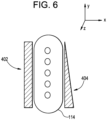
- the directional vector may be a composite of directional components in each of x, y, and z directions as shown in Fig. 6.
- Fig. 6 shows a view from an interior of the head portion 102 of the device 100 in a distal direction through the distal opening 117 of the end effector 110, including a plurality of dots illustrating alignment of a plurality of nozzles 142 of the applicator arrangement 140 in a distal direction. As shown in Fig.
- the x-directional axis extends along a width of the distal opening 117, horizontally to the view shown in Fig. 6 .
- the y-directional axis extends along a length of the distal opening 117, vertically to the view shown in Fig. 6 .
- the z-directional axis extends in a direction into and out of the view shown in Fig. 6 .
- the processing arrangement 150 analyzes the image data to identify at least one shadow cast by the grating bars 118 and/or by the outer edges of the protruding portion 114 of the end effector 110.
- the processing arrangement 150 further analyzes the length, width and/or shape of the shadow to determine each directional component (e.g., in the x, y, and z directions as illustrated in Fig. 6 ) to the tilt of the device 100.
- a tilt about the y-axis will be detected in this embodiment when the shadow appears longer on one side along the x-axis ( e.g. , left side of the view shown in Fig. 6 ) as compared to the opposite side of the x-axis (e.g., right side of the view shown in Fig. 6 ).
- a tilt about the x-axis can be detected when the shadow appears wider on one side along the y-axis ( e .
- a size of the shadow may be further analyzed to determine a parallel distance of the device from the skin surface, e . g ., a distance from the skin surface in the z-direction.
- the size of the shadow becomes larger as the device is positioned further from the skin surface.
- the device may provide feedback to the user suggesting a corrective movement to reduce the tilt. The feedback may be in a direction and to a degree corresponding to a vector opposing that of the tilt of the device.
- Fig. 6 shows two separate illustrative examples of shadows 402, 404 cast by the outer edges of the protruding portion 114 of the end effector 110. It is noted that shadows 402, 404 are shown together in Fig. 6 for illustrative purpose only.
- shadows 402, 404 are detected by the processing arrangement 150 in image data corresponding to separate images that reflect different directions and degrees of tilt of the device 100, as discussed below.
- the shadow 402 shown on the left side does not indicate a tilt component in either the x-directional or the y-directional axes. However, the length and width of shadow 402 can be analyzed by the processing arrangement 150 to determine a distance in the z-direction between the device and the skin surface.
- the shadow 404 shown on the right side indicates a tilt component in a z-direction about the x-axis. As can be seen in Fig. 6 , the top portion of the shadow 404 is narrower than the bottom portion of shadow 404 indicating that the device is tilted towards the skin an upward direction along the y-axis and away from the skin in a downward direction along the y-axis.
- the processing arrangement 150 identifies and measures the shadows to independently determine whether a nozzle 142 aligned with each opening segment 117a is aimed to safely dispense the composition to an area of skin within the opening segment 117a, and controls operating of the applicator arrangement 140 so that only those nozzles 142 aimed to safely dispense the composition through their corresponding opening segments 117a are permitted to apply the composition to the skin.
- those nozzles 142 aimed through those opening segments 117 to dispense the composition in an unsafe manner to the skin, as assessed by the tilt of each opening segment 117a are temporarily restricted from applying the composition to the skin so as to individually improve safety of operation for each nozzle 142.
- Example I This embodiment is further illustrated in Example I below.
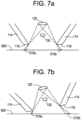
- the processing arrangement 150 analyzes the image data to identify a pair of shadows 510a, 510b cast by at least two of the grating bars 118 and/or by an outer edge of the protruding portion 114 of the end effector 110 and determines a tilt of the device 100 or the nozzle(s) 142 relative to the surface of the skin 500 based on a ratio of the length and/or width of the shadows 510a, 510b.
- Figs. 7a and 7b show a side view for an interior of the head portion 104 of the device 100. As shown in Figs.
- each of the opposing outer edges of the protruding portion 114 casts a shadow 510a, 510b on the surface of the skin 500.
- the processing arrangement 150 further analyzes the image data to determine a length and/or a width of each of the shadows 510a, 510b to determine a ratio of the length or width of shadows casted by opposing outer edges of the protruding portion 114. For example, the ratio is between the length or width of the shadow 510a to the length or width of shadow 510b. When the ratio is within a predetermined range, the applicator arrangement 140 (not shown in Figs.
- the ratio of the length of the shadow 510a to that of shadow 510b significantly deviates from the 1:1 ratio shown in Fig. 7a indicating that the distal end 116 is positioned at a significant angle to the surface of the skin 500 and the device 100 is determined not to be aimed to dispense the composition in a safe manner.
- the processing arrangement 150 may similarly analyze the image data to identify shadows cast by opposing grating bars 118 framing an opening segment 117a of a distal opening 117 to determine a tilt of nozzles(s) 142 corresponding to the opening segment 117a relative to the surface of the skin 500.
- Each portion of the area of skin framed by each of the opening segments 117a may be independently analyzed by the processing arrangement 150 to determine, for each segment 117a, a ratio of shadows cast by opposing grating bars 118 framing an opening segment 117 to determine whether the device 100 is oriented for safe application of the composition to the corresponding portion of skin.
- Figs. 7a and 7b show a flat portion of skin 500
- the ratio of the lengths and/or widths of shadows 510a, 510b cast by opposing outer edges of the protruding portion 114, as described above, may be used to determine a tilt of the device 100 or the nozzle(s) 142 relative to the surface of the skin 500 for skin of any contour.
- the contours of the face are generally curved around certain sensitive regions and therefore, as a user attempts to address these areas, the surface of the skin may curve away from the outer edges of the protruding portion 114.
- the processing arrangement 150 may determine that the device 100 is overly tilted relative to a surface of the skin 500, or that the device 100 is near or over one of the sensitive regions - either of which may be used as the basis for a determination that the applicator arrangement 140 is not aimed to dispense the composition in a safe manner.
- the method 300 proceeds to step 310 in which the image data is further analyzed to identify locations within the area of skin to which the composition should be applied.
- the image data corresponds to an image or one or more frames of images of an area of skin obtained through a grated end effector 110, and therefore, the image data corresponds to those regions of skin between the grating bars 118 that are visible to the detector arrangement 130, not to the skin underlying the grating bars 118.
- the image data may be adjusted so that portions of the image data corresponding to the grating bars 118 are modified by the processing arrangement 150 and the adjusted image data is further analyzed by the processing arrangement 150 to identify locations within the area of skin to which the composition should be applied.
- Such an adjustment to the image data is particularly useful to those analysis methods that utilize an average or an overall data profile of the imaged area of skin to identify skin artifacts, because the portions of the image data corresponding to the grating bars 118, which is significantly visually different from skin, would otherwise introduce a distortion to the results of such analysis methods.
- the processing arrangement 150 in this embodiment adjusts the image data by substituting for data corresponding to portions of the image including the grating bars 118 with data that approximates portions of the skin not covered by the grating bars 118 in the captured image.
- the processing arrangement 150 may adjust the image data such that data for portions of the image corresponding to the grating bars 118 is replaced by an average value, e.g., an average reflectance, of the remaining portions of the image.
- the processing arrangement 150 may adjust the image data such that data for portions of the image corresponding to the grating bars 118 is replaced by extrapolated values generated based on adjacent regions of the captured image.
- the processing arrangement 150 adjusts the image data using a database of previously obtained image data mapped to regions of the face of the user, where data for portions of the image corresponding to grating bars 118 is replaced by previously obtained image data corresponding to regions of the face covered by the grating bars 118 in the captured image.
- an exemplary device 100 as described above and illustrated in Fig. 4 includes two separate green LEDs as its first and second light sources 121, 122.
- the first and second light sources 121, 122 are individually and separately controlled by the processing arrangement 150 to turn on and off independently from each other.
- the device 100 determines whether a nozzle (not shown) is aimed to safely dispense a composition to an area of skin to which a first opening segment 206 is positioned over.
- the first and second light sources 121, 122 may each have a different wavelength and may be turned on simultaneously. Alternatively, the first light source 121 may be turned on while the remainder of the light source(s) 120, 122 are turned off for a predetermined amount of time.
- the detector arrangement 130 captures one or more frames of images of encompassing the area of skin framed by the first opening segment 206 during this time (e.g., for 100 frames) to generate image data.
- the processing arrangement 150 analyzes the image data to identify a first shadow 208 cast onto the area of skin framed by the first opening segment 206 by an adjacent grating bar 118 and to determine a length of the first shadow 208. If the length of the first shadow 208 is above a predetermined threshold, then the processing arrangement 150 determines the nozzle to be unsafely aimed to dispense a composition to an area of skin over which the first opening segment 206 is positioned.
- the processing arrangement 150 determines the nozzle to be safely aimed to dispense the composition to the area of skin over which the first opening segment 206 is placed and allows the device 100 to further proceed with identifying and applying the composition to frexel(s) within the first opening segment 206 at which skin artifacts are detected.
- the device 100 also determines whether an area of skin over which a second opening segment 210 is positioned is safe and/or suitable for application of a composition, independent from the above described imaging and analysis for the first opening segment 206.
- the first and second light sources 121, 122 each have a different wavelength and are both used to illuminate the area of skin simultaneously.
- the first light source 121 may be turned off and the second light source 122 is turned on for another predetermined amount of time.
- the detector arrangement 130 captures a separate set of image(s) encompassing the area of skin framed by the second opening segment 210 during this second period of time (e.g., for 100 frames) to generate a second set of image data.
- the processing arrangement 150 analyzes the second set of image data to identify and determine a length of the second shadow 212, in a manner similar to that discussed above for the first shadow 208. If the length of the second shadow 212 is above a predetermined threshold, then the processing arrangement 150 determines that another nozzle (not shown) aimed to dispense the composition to an area of skin framed by the second opening segment 210 in an unsafe manner.
- the processing arrangement 150 determines that the another nozzle is aimed to safely dispense the composition to an area of skin over which the second opening segment 210 is placed and allows the device 100 to further proceed to identify and selectively apply the composition to frexel(s) within the second opening segment 210 at which skin artifacts are detected.
- Example I describes independent imaging and analysis of two opening segments, it is contemplated that each of the opening segments 117a may be separately imaged and analyzed by the device 100 in a similar manner as described above.
Landscapes
- Health & Medical Sciences (AREA)
- Life Sciences & Earth Sciences (AREA)
- Animal Behavior & Ethology (AREA)
- General Health & Medical Sciences (AREA)
- Public Health (AREA)
- Veterinary Medicine (AREA)
- Engineering & Computer Science (AREA)
- Biomedical Technology (AREA)
- Heart & Thoracic Surgery (AREA)
- Molecular Biology (AREA)
- Surgery (AREA)
- Medical Informatics (AREA)
- Pathology (AREA)
- Biophysics (AREA)
- Physics & Mathematics (AREA)
- Anesthesiology (AREA)
- Hematology (AREA)
- Dermatology (AREA)
- Birds (AREA)
- Epidemiology (AREA)
- Chemical & Material Sciences (AREA)
- Manufacturing & Machinery (AREA)
- Inorganic Chemistry (AREA)
- Dispersion Chemistry (AREA)
- Cosmetics (AREA)
- Media Introduction/Drainage Providing Device (AREA)
- Image Processing (AREA)
- Measurement Of The Respiration, Hearing Ability, Form, And Blood Characteristics Of Living Organisms (AREA)
Claims (11)
- Handgeführte Vorrichtung (100) zum Auftragen einer Zusammensetzung auf eine Haut eines Gesichts eines Anwenders, umfassend:einen Endeffektor (110), umfassend einen Basisabschnitt (112) und einen vorspringenden Abschnitt (114), der sich distal von dem Basisabschnitt (112) erstreckt, wobei der vorspringende Abschnitt (114) eine distale Öffnung (117) aufweist;eine Detektoranordnung (130), die ausgestaltet ist, um Bilddaten entsprechend einem Bild eines Hautareals durch die distale Öffnung (117) des Endeffektors (110) hindurch zu erhalten;eine Applikatoranordnung (140), die ausgestaltet ist, um die Zusammensetzung auf eine Stelle innerhalb des Hautareals aufzutragen; undeine Verarbeitungsanordnung (150), die ausgestaltet ist zumEmpfangen der Bilddaten von der Detektoranordnung (130), undAnalysieren der Bilddaten, um zu bestimmen, ob ein Frexel innerhalb des Hautareals einem Hautartefakt entspricht;dadurch gekennzeichnet, dass der vorspringende Abschnitt (114) des Endeffektors (110) ferner eine Vielzahl von Gitterstäben (118) umfasst, die sich über die distale Öffnung (117) erstrecken, und die Bilddaten einem Bild des Hautareals entsprechen, das mit dieser Vielzahl von Gitterstäben (118) überlagert ist, und die Verarbeitungsanordnung (150) ferner ausgestaltet ist zum:Analysieren der Bilddaten, um zu bestimmen, ob die Applikatoranordnung (140) auf sicheres Abgeben der Zusammensetzung an das Hautareal zielt, wobei die Verarbeitungsanordnung (150) die Bilddaten analysiert und bestimmt, dass die Applikatoranordnung (140) auf sicheres Abgeben der Zusammensetzung an das Hautareal zielt, wenn die Bilddaten einer Region auf dem Gesicht des Anwenders entsprechen, die sich in mindestens einem vorbestimmten Abstand entfernt von mindestens einem von Augen, Nasenlöchern und Mund des Gesichts des Anwenders befindet,Anweisen der Applikatoranordnung (140), die Zusammensetzung auf das Frexel aufzubringen, wenn die Verarbeitungsanordnung (150) bestimmt, dass die Applikatoranordnung (140) auf sicheres Abgeben der Zusammensetzung an das Hautareal zielt und das Hautartefakt von dem Frexel detektiert wird; undAnweisen der Applikatoranordnung (140), von dem Auftragen der Zusammensetzung auf die Haut abzusehen, wenn die Applikatoranordnung (140) nicht auf sicheres Abgeben der Zusammensetzung an das Hautareal zielt.
- Vorrichtung nach Anspruch 1, wobei die Verarbeitungsanordnung (150) die Bilddaten analysiert, um eine Schräglage der Vorrichtung zu bestimmen.
- Vorrichtung nach Anspruch 2, wobei die Verarbeitungsanordnung (150) bestimmt, dass die Applikatoranordnung (140) auf sicheres Abgeben der Zusammensetzung an das Hautareal zielt, wenn ein Betrag der Schräglage der Vorrichtung unter einem vorbestimmten Schwellenwert liegt, und bestimmt, dass die Applikatoranordnung (140) nicht auf sicheres Abgeben der Zusammensetzung an das Hautareal zielt, wenn der Betrag der Schräglage oberhalb des vorbestimmten Schwellenwerts liegt.
- Vorrichtung nach einem der Ansprüche 1-3, wobei die Verarbeitungsanordnung (150) ausgestaltet ist, um die Bilddaten zu analysieren, um einen Schatten von mindestens einem der Gitterstäbe (118) in dem Bild zu bestimmen und basierend auf den Bilddaten eine Länge des Schattens zu bestimmen.
- Vorrichtung nach Anspruch 4, wobei die Verarbeitungsanordnung (150) ferner ausgestaltet ist, um zu bestimmen, dass die Applikatoranordnung (140) auf sicheres Abgeben der Zusammensetzung an das Hautareal zielt, wenn die Länge des Schattens unter einem vorbestimmten Schwellenwert liegt, und zu bestimmen, dass die Applikatoranordnung (140) nicht auf sicheres Abgeben der Zusammensetzung an das Hautareal zielt, wenn die Länge des Schattens oberhalb des vorbestimmten Schwellenwerts liegt.
- Vorrichtung nach einem der Ansprüche 1-5, wobei die Verarbeitungsanordnung (150) ausgestaltet ist, um die Bilddaten anzupassen, um Daten für Abschnitte des Bildes, die den Gitterstäben (118) entsprechen, durch Daten zu ersetzen, die durch die Verarbeitungsanordnung (150) generiert wurden, die sich der Haut, die unter den Gitterstäben (118) liegt, annähern, und um die angepassten Bilddaten zu analysieren, um Stellen innerhalb des Hautareals zu identifizieren, die Hautartefakten entsprechen.
- Vorrichtung nach einem der Ansprüche 1-6, wobei die Applikatoranordnung (140) eine Düse (142) umfasst, die ausgestaltet ist, um einen druckbeaufschlagten Puls der Zusammensetzung aus einem Reservoir (170) abzugeben, um eine dünne Schicht der Zusammensetzung auf der Haut zu bilden.
- Vorrichtung nach Anspruch 7, wobei die Zusammensetzung eine Kosmetikzusammensetzung ist, die Partikel eines Reflexionsmodifizierungsmittels, beispielsweise Titandioxid, in einer flüssigen Suspension umfasst.
- Verfahren zum Auftragen einer Zusammensetzung auf eine Haut eines Gesichts eines Anwenders, umfassend:Erhalten von Bilddaten, die einem Bild eines Hautareals entsprechen, über dem eine Vorrichtung platziert ist, durch eine Detektoranordnung (130);Analysieren der Bilddaten, um eine Schräglage der Vorrichtung im Vergleich zu dem Hautareal zu bestimmen, durch eine Verarbeitungsanordnung (150);Analysieren der Bilddaten, um Stellen innerhalb des Hautareals, die Hautartefakten entsprechen, zu identifizieren, durch die Verarbeitungsanordnung (150); unddadurch gekennzeichnet, dass das Verfahren ferner umfasst:Bestimmen durch die Verarbeitungsanordnung (150) basierend auf der Schräglage der Vorrichtung, ob eine Applikatoranordnung (140) auf sicheres Abgeben der Zusammensetzung an das Hautareal zielt, wobei die Verarbeitungsanordnung (150) bestimmt, dass die Applikatoranordnung (140) auf sicheres Abgeben der Zusammensetzung an das Hautareal zielt, wenn ein Betrag der Schräglage der Vorrichtung unter einem vorbestimmten Schwellenwert liegt, und bestimmt, dass die Applikatoranordnung (140) nicht auf sicheres Abgeben der Zusammensetzung an das Hautareal zielt, wenn der Betrag der Schräglage der Vorrichtung oberhalb des vorbestimmten Schwellenwerts liegt;Aufbringen der Zusammensetzung auf die identifizierten Stellen durch die Applikatoranordnung (140) nur dann, wenn bestimmt wird, dass die Applikatoranordnung auf sicheres Abgeben der Zusammensetzung an das Hautareal zielt; undAbsehen von dem Abgeben der Zusammensetzung auf die Haut, wenn die Applikatoranordnung (140) nicht auf sicheres Abgeben der Zusammensetzung an das Hautareal zielt, wobei die Bilddaten einem Bild des Hautareals entsprechen, das mit einer Vielzahl von Gitterstäben (118) eines Endeffektors (110) der Vorrichtung überlagert ist, wobei die Gitterstäbe (118) sich über das Hautareal erstrecken.
- Verfahren nach Anspruch 9, wobei die Verarbeitungsanordnung (150) die Schräglage der Vorrichtung bestimmt, indem die Bilddaten analysiert werden, um einen Schatten von mindestens einem der Gitterstäbe (118) in dem Bild zu identifizieren und den Schatten zu analysieren, um einen dreidimensionalen Vektor zu bestimmen, der der Schräglage entspricht.
- Verfahren nach Anspruch 9 oder 10, wobei die Verarbeitungsanordnung (150) die Bilddaten anpasst, um Daten für Abschnitte des Bildes, die den Gitterstäben (118) entsprechen, durch Daten zu ersetzen, die durch die Verarbeitungsanordnung (150) generiert wurden, die sich der Haut, die unter den Gitterstäben (118) liegt, annähern, und die anpassten Bilddaten analysiert, um Stellen innerhalb des Hautareals zu identifizieren, die Hautartefakten entsprechen.
Applications Claiming Priority (2)
| Application Number | Priority Date | Filing Date | Title |
|---|---|---|---|
| US201962888025P | 2019-08-16 | 2019-08-16 | |
| PCT/US2020/046211 WO2021034618A1 (en) | 2019-08-16 | 2020-08-13 | Device and method for application of cosmetic compositions through a grated end effector |
Publications (3)
| Publication Number | Publication Date |
|---|---|
| EP4013294A1 EP4013294A1 (de) | 2022-06-22 |
| EP4013294C0 EP4013294C0 (de) | 2024-08-14 |
| EP4013294B1 true EP4013294B1 (de) | 2024-08-14 |
Family
ID=72432987
Family Applications (1)
| Application Number | Title | Priority Date | Filing Date |
|---|---|---|---|
| EP20768732.8A Active EP4013294B1 (de) | 2019-08-16 | 2020-08-13 | Vorrichtung und verfahren zum auftragen von kosmetischen zusammensetzungen durch einen gitterendeffektor |
Country Status (9)
| Country | Link |
|---|---|
| US (1) | US12178978B2 (de) |
| EP (1) | EP4013294B1 (de) |
| JP (1) | JP7725449B2 (de) |
| KR (1) | KR20220051199A (de) |
| CN (1) | CN114206426B (de) |
| AU (1) | AU2020331921A1 (de) |
| BR (1) | BR112022000644A8 (de) |
| CA (1) | CA3151360A1 (de) |
| WO (1) | WO2021034618A1 (de) |
Families Citing this family (3)
| Publication number | Priority date | Publication date | Assignee | Title |
|---|---|---|---|---|
| SG11202105401TA (en) * | 2018-12-27 | 2021-07-29 | Johnson & Johnson Consumer Inc | Device and method for selective application of topical composition using dynamic threshold values |
| CN116634925A (zh) | 2020-08-03 | 2023-08-22 | 强生消费者公司 | 选择性施用化妆品组合物以赋予眼下亮白的系统和方法 |
| FR3133119B1 (fr) * | 2022-03-03 | 2025-06-06 | Oreal | Système de détection et de traitement des rides |
Family Cites Families (17)
| Publication number | Priority date | Publication date | Assignee | Title |
|---|---|---|---|---|
| JP4404650B2 (ja) * | 2004-01-30 | 2010-01-27 | デジタルファッション株式会社 | 化粧シミュレーション装置、化粧シミュレーション方法、化粧シミュレーションプログラム |
| AU2006279800B2 (en) | 2005-08-12 | 2012-03-29 | Tcms Transparent Beauty Llc | System and method for medical monitoring and treatment through cosmetic monitoring and treatment |
| KR101096409B1 (ko) * | 2005-09-16 | 2011-12-21 | (주)아모레퍼시픽 | 모아레 이미지를 이용한 피부 탄력 측정 방법 |
| US8942775B2 (en) * | 2006-08-14 | 2015-01-27 | Tcms Transparent Beauty Llc | Handheld apparatus and method for the automated application of cosmetics and other substances |
| US8184901B2 (en) | 2007-02-12 | 2012-05-22 | Tcms Transparent Beauty Llc | System and method for applying a reflectance modifying agent to change a person's appearance based on a digital image |
| US7890152B2 (en) * | 2007-02-11 | 2011-02-15 | Tcms Transparent Beauty Llc | Handheld apparatus and method for the automated application of cosmetics and other substances |
| US8027505B2 (en) | 2007-02-11 | 2011-09-27 | Tcms Transparent Beauty Llc | System and method for providing simulated images through cosmetic monitoring |
| KR20100015318A (ko) | 2007-02-12 | 2010-02-12 | 릭 비. 예거 | 인간 피부에 정전기적으로 약제를 인가하기 위한 시스템 및 방법 |
| US10092082B2 (en) * | 2007-05-29 | 2018-10-09 | Tcms Transparent Beauty Llc | Apparatus and method for the precision application of cosmetics |
| RU2501505C2 (ru) * | 2007-05-29 | 2013-12-20 | ТиСиЭмЭс ТРАНСПЭРЕНТ БЬЮТИ, ЭлЭлСи | Устройство и способ для точного нанесения косметических средств |
| WO2012103048A2 (en) | 2011-01-24 | 2012-08-02 | Tcms Transparent Beauty Llc | Apparatus and method for rapid and precise application of cosmetics |
| WO2014035793A1 (en) | 2012-08-27 | 2014-03-06 | Tcms Transparent Beauty Llc | Printer head with prism for sensing |
| US9955769B2 (en) * | 2014-07-25 | 2018-05-01 | The Procter & Gamble Company | Applicator heads for handheld treatment apparatus for modifying keratinous surfaces |
| WO2016054164A1 (en) | 2014-09-30 | 2016-04-07 | Tcms Transparent Beauty, Llc | Precise application of cosmetic looks from over a network environment |
| US10321826B2 (en) * | 2015-09-10 | 2019-06-18 | Temple University—Of the Commonwealth System of Higher Education | Optical dynamic imaging system |
| EP3442465B1 (de) | 2016-04-12 | 2020-11-18 | TCMS Transparent Beauty LLC | Gezielte abscheidung von zahnpflegemitteln |
| EP3560376B1 (de) * | 2016-12-20 | 2021-08-18 | Shiseido Company, Ltd. | Anwendungssteuerungsvorrichtung, anwendungssteuerungsverfahren, programm und aufzeichnungsmedium |
-
2020
- 2020-08-13 CN CN202080056616.4A patent/CN114206426B/zh active Active
- 2020-08-13 JP JP2022509629A patent/JP7725449B2/ja active Active
- 2020-08-13 AU AU2020331921A patent/AU2020331921A1/en active Pending
- 2020-08-13 BR BR112022000644A patent/BR112022000644A8/pt unknown
- 2020-08-13 KR KR1020227008583A patent/KR20220051199A/ko active Pending
- 2020-08-13 WO PCT/US2020/046211 patent/WO2021034618A1/en not_active Ceased
- 2020-08-13 US US16/947,724 patent/US12178978B2/en active Active
- 2020-08-13 CA CA3151360A patent/CA3151360A1/en active Pending
- 2020-08-13 EP EP20768732.8A patent/EP4013294B1/de active Active
Also Published As
| Publication number | Publication date |
|---|---|
| JP7725449B2 (ja) | 2025-08-19 |
| JP2023502830A (ja) | 2023-01-26 |
| CA3151360A1 (en) | 2021-02-25 |
| CN114206426B (zh) | 2025-05-09 |
| KR20220051199A (ko) | 2022-04-26 |
| US12178978B2 (en) | 2024-12-31 |
| CN114206426A (zh) | 2022-03-18 |
| BR112022000644A8 (pt) | 2022-09-27 |
| EP4013294A1 (de) | 2022-06-22 |
| BR112022000644A2 (pt) | 2022-03-03 |
| WO2021034618A1 (en) | 2021-02-25 |
| US20210046296A1 (en) | 2021-02-18 |
| EP4013294C0 (de) | 2024-08-14 |
| AU2020331921A1 (en) | 2022-04-07 |
Similar Documents
| Publication | Publication Date | Title |
|---|---|---|
| US20210402208A1 (en) | Device and method for controlling treatment for a skin condition using a tracer | |
| AU2019416198B2 (en) | Device and method for selective application of topical composition using dynamic threshold values | |
| EP4013294B1 (de) | Vorrichtung und verfahren zum auftragen von kosmetischen zusammensetzungen durch einen gitterendeffektor | |
| RU2844703C2 (ru) | Устройство и способ нанесения косметических композиций с помощью концевого эффектора с решеткой | |
| HK40074823B (en) | Device and method for application of cosmetic compositions through a grated end effector | |
| HK40074823A (en) | Device and method for application of cosmetic compositions through a grated end effector | |
| US20220193381A1 (en) | Device and method for continuous even application of composition to skin | |
| US12472336B2 (en) | System and method for selective application of cosmetic composition to impart undereye brightening | |
| RU2849293C2 (ru) | Устройство и способ избирательного нанесения композиции для местного применения с использованием динамических пороговых значений |
Legal Events
| Date | Code | Title | Description |
|---|---|---|---|
| STAA | Information on the status of an ep patent application or granted ep patent |
Free format text: STATUS: UNKNOWN |
|
| STAA | Information on the status of an ep patent application or granted ep patent |
Free format text: STATUS: THE INTERNATIONAL PUBLICATION HAS BEEN MADE |
|
| PUAI | Public reference made under article 153(3) epc to a published international application that has entered the european phase |
Free format text: ORIGINAL CODE: 0009012 |
|
| STAA | Information on the status of an ep patent application or granted ep patent |
Free format text: STATUS: REQUEST FOR EXAMINATION WAS MADE |
|
| 17P | Request for examination filed |
Effective date: 20211220 |
|
| AK | Designated contracting states |
Kind code of ref document: A1 Designated state(s): AL AT BE BG CH CY CZ DE DK EE ES FI FR GB GR HR HU IE IS IT LI LT LU LV MC MK MT NL NO PL PT RO RS SE SI SK SM TR |
|
| DAV | Request for validation of the european patent (deleted) | ||
| DAX | Request for extension of the european patent (deleted) | ||
| REG | Reference to a national code |
Ref country code: HK Ref legal event code: DE Ref document number: 40074823 Country of ref document: HK |
|
| STAA | Information on the status of an ep patent application or granted ep patent |
Free format text: STATUS: EXAMINATION IS IN PROGRESS |
|
| 17Q | First examination report despatched |
Effective date: 20230222 |
|
| RAP1 | Party data changed (applicant data changed or rights of an application transferred) |
Owner name: JOHNSON & JOHNSON CONSUMER INC. |
|
| GRAP | Despatch of communication of intention to grant a patent |
Free format text: ORIGINAL CODE: EPIDOSNIGR1 |
|
| STAA | Information on the status of an ep patent application or granted ep patent |
Free format text: STATUS: GRANT OF PATENT IS INTENDED |
|
| INTG | Intention to grant announced |
Effective date: 20240528 |
|
| GRAS | Grant fee paid |
Free format text: ORIGINAL CODE: EPIDOSNIGR3 |
|
| GRAA | (expected) grant |
Free format text: ORIGINAL CODE: 0009210 |
|
| STAA | Information on the status of an ep patent application or granted ep patent |
Free format text: STATUS: THE PATENT HAS BEEN GRANTED |
|
| AK | Designated contracting states |
Kind code of ref document: B1 Designated state(s): AL AT BE BG CH CY CZ DE DK EE ES FI FR GB GR HR HU IE IS IT LI LT LU LV MC MK MT NL NO PL PT RO RS SE SI SK SM TR |
|
| REG | Reference to a national code |
Ref country code: GB Ref legal event code: FG4D |
|
| REG | Reference to a national code |
Ref country code: CH Ref legal event code: EP |
|
| REG | Reference to a national code |
Ref country code: DE Ref legal event code: R096 Ref document number: 602020035816 Country of ref document: DE |
|
| REG | Reference to a national code |
Ref country code: IE Ref legal event code: FG4D |
|
| U01 | Request for unitary effect filed |
Effective date: 20240904 |
|
| U07 | Unitary effect registered |
Designated state(s): AT BE BG DE DK EE FI FR IT LT LU LV MT NL PT RO SE SI Effective date: 20240923 |
|
| RAP4 | Party data changed (patent owner data changed or rights of a patent transferred) |
Owner name: KENVUE BRANDS LLC |
|
| U1H | Name or address of the proprietor changed after the registration of the unitary effect |
Owner name: KENVUE BRANDS LLC; US |
|
| PG25 | Lapsed in a contracting state [announced via postgrant information from national office to epo] |
Ref country code: NO Free format text: LAPSE BECAUSE OF FAILURE TO SUBMIT A TRANSLATION OF THE DESCRIPTION OR TO PAY THE FEE WITHIN THE PRESCRIBED TIME-LIMIT Effective date: 20241114 |
|
| PG25 | Lapsed in a contracting state [announced via postgrant information from national office to epo] |
Ref country code: PL Free format text: LAPSE BECAUSE OF FAILURE TO SUBMIT A TRANSLATION OF THE DESCRIPTION OR TO PAY THE FEE WITHIN THE PRESCRIBED TIME-LIMIT Effective date: 20240814 Ref country code: GR Free format text: LAPSE BECAUSE OF FAILURE TO SUBMIT A TRANSLATION OF THE DESCRIPTION OR TO PAY THE FEE WITHIN THE PRESCRIBED TIME-LIMIT Effective date: 20241115 |
|
| PG25 | Lapsed in a contracting state [announced via postgrant information from national office to epo] |
Ref country code: IS Free format text: LAPSE BECAUSE OF FAILURE TO SUBMIT A TRANSLATION OF THE DESCRIPTION OR TO PAY THE FEE WITHIN THE PRESCRIBED TIME-LIMIT Effective date: 20241214 |
|
| PG25 | Lapsed in a contracting state [announced via postgrant information from national office to epo] |
Ref country code: HR Free format text: LAPSE BECAUSE OF FAILURE TO SUBMIT A TRANSLATION OF THE DESCRIPTION OR TO PAY THE FEE WITHIN THE PRESCRIBED TIME-LIMIT Effective date: 20240814 |
|
| PG25 | Lapsed in a contracting state [announced via postgrant information from national office to epo] |
Ref country code: RS Free format text: LAPSE BECAUSE OF FAILURE TO SUBMIT A TRANSLATION OF THE DESCRIPTION OR TO PAY THE FEE WITHIN THE PRESCRIBED TIME-LIMIT Effective date: 20241114 Ref country code: ES Free format text: LAPSE BECAUSE OF FAILURE TO SUBMIT A TRANSLATION OF THE DESCRIPTION OR TO PAY THE FEE WITHIN THE PRESCRIBED TIME-LIMIT Effective date: 20240814 |
|
| PG25 | Lapsed in a contracting state [announced via postgrant information from national office to epo] |
Ref country code: RS Free format text: LAPSE BECAUSE OF FAILURE TO SUBMIT A TRANSLATION OF THE DESCRIPTION OR TO PAY THE FEE WITHIN THE PRESCRIBED TIME-LIMIT Effective date: 20241114 Ref country code: PL Free format text: LAPSE BECAUSE OF FAILURE TO SUBMIT A TRANSLATION OF THE DESCRIPTION OR TO PAY THE FEE WITHIN THE PRESCRIBED TIME-LIMIT Effective date: 20240814 Ref country code: NO Free format text: LAPSE BECAUSE OF FAILURE TO SUBMIT A TRANSLATION OF THE DESCRIPTION OR TO PAY THE FEE WITHIN THE PRESCRIBED TIME-LIMIT Effective date: 20241114 Ref country code: IS Free format text: LAPSE BECAUSE OF FAILURE TO SUBMIT A TRANSLATION OF THE DESCRIPTION OR TO PAY THE FEE WITHIN THE PRESCRIBED TIME-LIMIT Effective date: 20241214 Ref country code: HR Free format text: LAPSE BECAUSE OF FAILURE TO SUBMIT A TRANSLATION OF THE DESCRIPTION OR TO PAY THE FEE WITHIN THE PRESCRIBED TIME-LIMIT Effective date: 20240814 Ref country code: GR Free format text: LAPSE BECAUSE OF FAILURE TO SUBMIT A TRANSLATION OF THE DESCRIPTION OR TO PAY THE FEE WITHIN THE PRESCRIBED TIME-LIMIT Effective date: 20241115 Ref country code: ES Free format text: LAPSE BECAUSE OF FAILURE TO SUBMIT A TRANSLATION OF THE DESCRIPTION OR TO PAY THE FEE WITHIN THE PRESCRIBED TIME-LIMIT Effective date: 20240814 |
|
| PG25 | Lapsed in a contracting state [announced via postgrant information from national office to epo] |
Ref country code: SM Free format text: LAPSE BECAUSE OF FAILURE TO SUBMIT A TRANSLATION OF THE DESCRIPTION OR TO PAY THE FEE WITHIN THE PRESCRIBED TIME-LIMIT Effective date: 20240814 |
|
| PG25 | Lapsed in a contracting state [announced via postgrant information from national office to epo] |
Ref country code: CZ Free format text: LAPSE BECAUSE OF FAILURE TO SUBMIT A TRANSLATION OF THE DESCRIPTION OR TO PAY THE FEE WITHIN THE PRESCRIBED TIME-LIMIT Effective date: 20240814 |
|
| PG25 | Lapsed in a contracting state [announced via postgrant information from national office to epo] |
Ref country code: SK Free format text: LAPSE BECAUSE OF FAILURE TO SUBMIT A TRANSLATION OF THE DESCRIPTION OR TO PAY THE FEE WITHIN THE PRESCRIBED TIME-LIMIT Effective date: 20240814 |
|
| PLBE | No opposition filed within time limit |
Free format text: ORIGINAL CODE: 0009261 |
|
| STAA | Information on the status of an ep patent application or granted ep patent |
Free format text: STATUS: NO OPPOSITION FILED WITHIN TIME LIMIT |
|
| 26N | No opposition filed |
Effective date: 20250515 |
|
| U20 | Renewal fee for the european patent with unitary effect paid |
Year of fee payment: 6 Effective date: 20250709 |
|
| PGFP | Annual fee paid to national office [announced via postgrant information from national office to epo] |
Ref country code: GB Payment date: 20250703 Year of fee payment: 6 |
|
| PGFP | Annual fee paid to national office [announced via postgrant information from national office to epo] |
Ref country code: CH Payment date: 20250901 Year of fee payment: 6 |